EP0550751A1 - Nicht-flüchtiger halbleiterspeicher - Google Patents
Nicht-flüchtiger halbleiterspeicher Download PDFInfo
- Publication number
- EP0550751A1 EP0550751A1 EP91916788A EP91916788A EP0550751A1 EP 0550751 A1 EP0550751 A1 EP 0550751A1 EP 91916788 A EP91916788 A EP 91916788A EP 91916788 A EP91916788 A EP 91916788A EP 0550751 A1 EP0550751 A1 EP 0550751A1
- Authority
- EP
- European Patent Office
- Prior art keywords
- source
- circuit
- cell
- block
- erase
- Prior art date
- Legal status (The legal status is an assumption and is not a legal conclusion. Google has not performed a legal analysis and makes no representation as to the accuracy of the status listed.)
- Granted
Links
Images












Classifications
-
- G—PHYSICS
- G11—INFORMATION STORAGE
- G11C—STATIC STORES
- G11C16/00—Erasable programmable read-only memories
- G11C16/02—Erasable programmable read-only memories electrically programmable
- G11C16/06—Auxiliary circuits, e.g. for writing into memory
- G11C16/10—Programming or data input circuits
- G11C16/14—Circuits for erasing electrically, e.g. erase voltage switching circuits
- G11C16/16—Circuits for erasing electrically, e.g. erase voltage switching circuits for erasing blocks, e.g. arrays, words, groups
-
- G—PHYSICS
- G11—INFORMATION STORAGE
- G11C—STATIC STORES
- G11C16/00—Erasable programmable read-only memories
- G11C16/02—Erasable programmable read-only memories electrically programmable
-
- G—PHYSICS
- G11—INFORMATION STORAGE
- G11C—STATIC STORES
- G11C16/00—Erasable programmable read-only memories
- G11C16/02—Erasable programmable read-only memories electrically programmable
- G11C16/06—Auxiliary circuits, e.g. for writing into memory
- G11C16/10—Programming or data input circuits
-
- G—PHYSICS
- G11—INFORMATION STORAGE
- G11C—STATIC STORES
- G11C16/00—Erasable programmable read-only memories
- G11C16/02—Erasable programmable read-only memories electrically programmable
- G11C16/06—Auxiliary circuits, e.g. for writing into memory
- G11C16/10—Programming or data input circuits
- G11C16/12—Programming voltage switching circuits
-
- G—PHYSICS
- G11—INFORMATION STORAGE
- G11C—STATIC STORES
- G11C16/00—Erasable programmable read-only memories
- G11C16/02—Erasable programmable read-only memories electrically programmable
- G11C16/06—Auxiliary circuits, e.g. for writing into memory
- G11C16/34—Determination of programming status, e.g. threshold voltage, overprogramming or underprogramming, retention
- G11C16/3418—Disturbance prevention or evaluation; Refreshing of disturbed memory data
Definitions
- the present invention relates to a non-volatile semiconductor memory, and more particularly to a non-volatile semiconductor memory having a plurality block of non-volatile memory cells of two-layered structure, capable of altering data in units of block.
- All-bit flash erase type memories have drawn attention as electrically erasable, programmable read-only memories (E2PROM).
- E2PROM electrically erasable, programmable read-only memories
- Recent requirements for such memories are to provide a function of altering data in each of a plurality of memory blocks in units of block. For example, a 4 M bit device is divided into 16 blocks each having 32 K bytes or into 4 blocks each having 256 K bytes, and data erasure is required to be performed on the block unit basis. With such block division of a cell array, cells in a plurality of different blocks are connected to the same word line or data line. Therefore, repeating write/erase of a particular block may apply stress to cells in other non-selected blocks.
- the characteristic structure of such a cell resides in that the gate oxide film under the floating gate is about 100 angstroms thinner than that of an EPROM cell because a tunnel current flows between the floating gate and source during data erase, and that the superposing area of the source n+ region and the floating gate is made wider than that of EPROM.
- a cell in an erase state or write state in a non-selected block is shown in Table 1.
- a cell in an erase state in a non-selected block connected to a selected word line is applied to an electric field of about 7.5 MV/cm between its floating gate and source, and a cell in a write state in a non-selected block connected to a selected data line is applied to an electric field of about 6.5 MV/cm between its floating gate and drain.
- a conventional device is associated with the problem that as data write and erase are effected to a selected block, data write error and erase error may occur at non-selected blocks.
- This scheme is characterized in that a plurality of memory cells connected to one selected word line can be erased at the same time. It is now assumed that a word line WL1 is selected and another word line WL2 is not selected in a data erase mode. Specifically, the selected word line WL1 is applied with a voltage VWL1 of -10 V, the non-selected word line WL2 is applied with a voltage VWL2 of 5 V, a source voltage VS is set to 5 V, and data lines DL1 and DL2 are set to a floating state. In this state, memory cells M1 and M2 enter an erase state, and memory cells M3 and M4 enter a non-erase state. In a program mode (in a data write mode), hot electrons are injected into a floating gate FG. In a read mode, a sense amplifier judges whether a selected cell is being turned on (a cell current flows) or off (a cell current will not flow).
- the above-described scheme has the following problems.
- WL2 is set to 5 V
- VS is set to 5 V
- DL1 and DL2 enter the floating state.
- the data lines DL1 and DL2 are charged via the non-selected cells M3 and M4 up to (5 V - V th ) where V th is a cell threshold value.
- a cell current for charging the data lines DL1 and DL2 flows in the non-selected cells M3 and M4 during the time period from t1 to t2, therefore leading to a possibility of write error at the non-selected cells M3 and M4.
- a memory cell array is divided into a plurality of blocks.
- a moderating voltage is applied to the source or control gate of a memory cell in another block (non-selected block) to moderate stress between the floating gate and source/drain, thereby preventing write error and erase error.
- the source and drain of a memory cell in the non-selected block are equalized to moderate an electric field between the control gate and source/drain and not to flow a channel current, thereby preventing write error.
- the source and data lines are equalized prior to setting the source line and word line of a cell in a non-selected block to an erase voltage.
- the equalization operation is released after the erase operation, thereby preventing malfunction of a non-selected cell.
- Fig. 1 is a diagram showing the overall arrangement of an embodiment according to the present invention.
- Fig. 2 is a circuit diagram showing the details of a portion of the embodiment shown in Fig. 1.
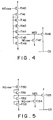
- Figs. 3 to 7 are circuit diagrams showing examples of the block erase circuit of the embodiment shown in Fig. 1.
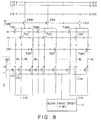
- Fig. 8 is a circuit diagram showing the details of the column gate section.
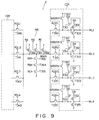
- Fig. 9 is a circuit diagram showing the main portion of the row decoder.
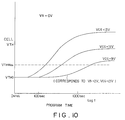
- Fig. 10 is a graph showing the characteristics of a memory cell in a non-selected block.
- Fig. 11 is a diagram showing the overall arrangement of another embodiment according to the present invention.
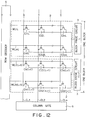
- Fig. 12 is a circuit diagram showing the details of a portion of the embodiment shown in Fig. 11.
- Fig. 13 is a diagram showing the overall arrangement of another embodiment according to the present invention.
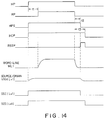
- Fig. 14 is a timing chart explaining the operation of the embodiment shown in Fig. 13.
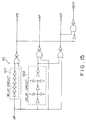
- Fig. 15 is a circuit diagram of the program control circuit shown in Fig. 13.
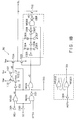
- Fig. 16 is a circuit diagram showing an example of the block erase circuit shown in Fig. 13.
- Fig. 17 is a circuit diagram showing another example of the block erase circuit.
- Fig. 18 is a circuit diagram showing another example of the block erase circuit.
- Fig. 19 is a circuit diagram of a stress moderating circuit.
- Figs. 20A and 20B are diagrams explaining the relationship between cell array division and current consumption.
- Fig. 21 is a conceptual view showing another embodiment of the present invention.
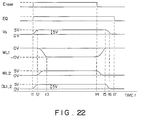
- Fig. 22 is a timing chart explaining the operation of the embodiment shown in Fig. 21.
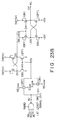
- Figs. 23A and 23B illustrate the states of a selected word line and non-selected word line shown in Fig. 21 during an erase mode.
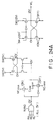
- Figs. 24A and 24B illustrate the states of a selected word line and non-selected word line shown in Fig. 21 during the program mode.
- Fig. 25 illustrates the state of the row decoder shown in Fig. 21 during the read mode.
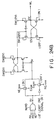
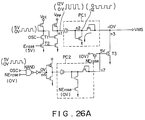
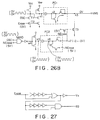
- Figs. 26A and 26B illustrate the state of the negative bias circuit shown in Fig. 21 during the erase mode and other modes.
- Fig. 27 is a circuit diagram of the source bias circuit shown in Fig. 21.
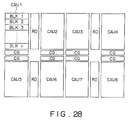
- Fig. 28 is a conceptual diagram showing the overall arrangement of another embodiment according to the present invention.
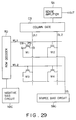
- Fig. 29 is a conceptual diagram of a conventional memory device.
- Fig. 30 is a timing chart explaining the operation of the conventional memory device.
- Fig. 1 shows a device whose memory cell array is divided into sixteen blocks in the data line direction according to the first embodiment.
- the memory cell array 1 is divided into sixteen blocks 2 each provided with a block erase circuit 3.
- reference numeral 5 represents a row decoder
- reference numeral 6 represents a column decoder
- reference numeral 7 represents a row pre-decoder.
- the details of each block 2 are shown in Fig. 2.
- each block erase circuit 3 is commonly connected to the sources of cells C XY in each block 2.
- Cells commonly connected to one data line DL ⁇ are located within the same block.
- Cells commonly connected to one word line WL i are located over a plurality of blocks.
- a predetermined potential moderating potential
- the electric field between the floating gate and source becomes about 5 MV/cm which moderates the electric field by about 2.5 MV/cm as compared with about 7.5 MV/cm when 0 V is applied to the cell source.
- Fig. 3 is an example of a circuit diagram of the block erase circuit 3 according to the present invention.
- This circuit is constructed of a block selecting unit 11, a level shifter 12, a charge transistor T116, discharge transistors T120 and T121, a delay circuit 13, and a non-selected block bias circuit 14.
- the block selecting circuit has a NOR gate NR100 calculating a NOR between an address selection signal BS and a signal NErase, the address selection signal BS being supplied from a NAND gate NA100 to which a block selection address BSA is inputted.
- the level shifter 12 is constructed of transistors T110 to T115 and an inverter I110.
- the charge transistor T116 is used for charging the selected block 2.
- the discharge transistors T120 and T121 are used for discharging electric charges from the cell sources during the time period except for the erase operation.
- the delay circuit 13 is used for controlling the timing of discharge, and is constructed of inverters I120 to I124, and a NAND gate NA120.
- the non-selected block bias circuit 14 is constructed of transistors T130 to T132, and resistors R130 and R131.
- the block erase circuit 3 of a block 2 selected by an address takes a state that an output BS of NA100 becomes “L”, the signal NErase becomes “L”, and an output EA of NR100 becomes “H”.
- the discharge transistors T120 and T121 turn off, the gates of which are applied with NErase and its delayed signal, respectively.
- current flows from the transistor T130 to the resistors R130 and R131 and to ground, setting a node NEG to an intermediate potential.
- the transistor T132 has a low gate voltage so that it turns off.
- the signal NErase becomes "L”
- the transistor T130 turns on
- the transistor T131 turns off, and current flows from T130 to the resistors R130 and R131 and to ground. Therefore, the node NEG between R131 and R131 takes a potential determined by the resistances of T130, R130, and R131.
- the cell sources are therefore charged through T132 and set to the potential of NEG - V TH (T132). For example, assuming that NEG is 3 V, and V TH of T132 is 1 V, then the cell sources are set to 2 V. At this time, similar to the case of the block erase circuit 3 connected to the selected block, the discharge transistors T120 and T121 turn off.
- the signal NErase becomes "H".
- the charge transistor T116 turns off, and for the non-selected block 2, the transistor T130 turns off, the transistor T131 turns on, and the charge transistor T132 turns off.
- the transistor T120 turns on to start discharging the cell sources.
- the gate of the transistor T121 becomes "H” after a predetermined time delay set by the delay circuit 13, to discharge the transistor T121.
- the reason why two transistors T120 and T121 are used for discharge is that an excessive peak current will flow if discharge is performed by a transistor of large dimension, because the junction capacity of the cell source region is large.
- the dimension of the transistor T120 is set small to gradually discharge.
- discharge is further performed by the transistor T121 whose dimension is set large.
- the reason why the dimension of the transistor T121 is set large is to prevent the cell sources SC from floating above 0 V (ground) during a read or program mode. Particularly in the program mode, a current of several mA flows so that it is necessary to set W to about several hundreds to 1000 ⁇ m.
- FIGS. 4 to 7 Other examples of the non-selected block bias circuit of the block erase circuit 3 are shown in Figs. 4 to 7.
- the resistors R130 and R131 shown in Fig. 3 are replaced by transistors. Namely, the resistor R130 is replaced by transistors T141 to T144, and the resistor R131 is replaced by transistors T145 and T146. Basically, the gate potential NEG of a charge transistor T148 is determined by a division ratio of resistors.
- the gate potential NEG of a charge transistor T155 is determined by the values V TH of transistors T152 and T153.
- the node NEG is set to 2 V TH and the cell sources are set to about V TH level.
- the potential at the cell sources CS is determined by V TH of a D-type transistor T161.
- the signal NErase becomes "L”
- a transistor T160 turns on
- the gate of the transistor T161 becomes "L”.
- the cell sources in a non-selected block are charged to a value V TH of the D-type transistor T161, i.e., to about 1 to 2 V.
- the circuits shown in Figs. 6 and 7 save power because current will not flow always as in the circuits shown in Figs. 3 to 5.
- the above-described circuits turn off upon reception of NErase + "H" during the program, read, and stand-by modes except the erase mode.
- Fig. 8 shows the structure of the column gate.
- Fig. 8 corresponding to Fig. 1 shows the column structure of one block, a row decoder buffer, a word line, and cells C111 to C 1m1 connected to the word line.
- This device is obtained, for example, by dividing a 4 M bit cell array into sixteen blocks in the data line direction at intervals of 32 K bytes.
- One block has 128 data lines for 8 I/O units each I/O assigned 16 data lines.
- One byte is selected by one of column signals h1 to h16.
- Each block is selected by one of column signals s1 to s16.
- T200 to T207 represent column gate transistors for selecting a block
- T210 to T287 represent column gate transistors selected by the column signal h1 to h16.
- Fig. 9 shows the structure of the row decoder 5.
- MD represents a main decoder having a plurality of transistors T350 to T355 and selected by outputs RAi, RBi, and RCi from the row pre-decoder
- T300, T310, T320, T330, T340 to T343 represent transfer gates selected by outputs RDR i and RDL i from the row pre-decoder
- T300', T310', T320', and T330' represent charge transistors
- T301 to T303, T311 to T313, T321 to T323, and T331 to T333 represent feedback-type inverters.
- a circuit CIR at the left side of Fig. 9 has the same structure as the circuit CIR at the right side.
- RDR1 for selecting the word line WL1 becomes "H”
- NRDR1 becomes "L”
- Other RDR2 to RDR4 become “L”
- other NRDR2 to NRDR4 become "H”.
- the transistor T302 turns on and the transistor T303 turns off, so the word line WL1 takes an SW potential.
- the transistors T312, T322, and T332 turn off T313, T323, and T333 turn on, so the other word lines WL2 to WL4 take a ground level.
- first to eighth blocks 2 and ninth to sixteenth blocks 2 are grouped on opposite sides of the row decoder 5 as shown in Fig. 1.
- the right transfer gate RDRi executes a logical calculation with a block selecting column signal Si to drive only the right word line connected to the selected block.
- the left transfer gate RDLi executes a logical calculation with the block selecting column signal Si to drive only the left word line connected to the selected block.
- Fig. 10 is a graph showing the relationship between time duration of stress applied to the control gate of an erased cell in a non-selected block and a change in cell V TH .
- the cell source is assumed to be set to 0 V.
- the control gate stress time period becomes long, the cell V TH rises. This rise is dependent upon the control gate potential.
- E sf electric field
- V TH0 and V THMax are herein introduced, the term V TH0 being a V TH of a cell in an erase state without no stress, and the term V THMax being a limit V TH of a cell providing no access time delay and no read error.
- the stress time period of cells in a non-selected block is about 800 sec, enabling to prevent malfunction to be caused by stress.
- a memory cell array is divided into blocks in the word line direction. Similar to the first embodiment, a block erase circuit 3 is provided at each block. The layout of cells is shown in Fig. 12. Cells C commonly connected to a word line WL are located within the same block. On the other hand, cells C commonly connected to a data line CL are located over a plurality of blocks. With such an arrangement, one data line CL is commonly connected to all corresponding cells in first to sixteenth blocks.
- a row decoder 5 selects a particular block 2 by applying a high potential to a word line WL of the block 2, while raising the potentials of other word lines WL in non-selected blocks to a potential, for example, a potential half that of the word line WL of the selected block.
- a circuit for raising the potential of word lines of non-selected blocks may use any general circuit for raising a word line potential.
- Stress applied to a cell in a non-selected block can be moderated even in the case of a flash-type E2PROM cell array divided into blocks for data alteration on the block unit basis. For example, even if data alteration is repeated 105 times with respect to a particular block, the V TH variation of a cell in a non-selected block can be sufficiently suppressed.
- an erase on the block unit basis is possible, providing value-added performance and an increased number of write/erase cycles with high reliability.
- the source and drain of a memory cell in a non-selected block are biased to the same potential at the same time to moderate the electric field between the control gate and source/drain and not to flow a channel current, thereby preventing write error and improving the reliability.
- Fig. 13 shows the overall structure of this embodiment.
- a cell array is divided into a plurality of blocks 2i (21, 22, ...) in the data line DL i direction.
- This memory device is provided with a stress moderating circuit SE shared by all blocks, and block erase circuits BE1, BE2, ... connected to corresponding source lines SL1, SL2, ... of respective blocks.
- the source line SL1 is connected to data lines DL11 to DL n1 via transfer gates TEQ11 to TEQ n1 to the gates of which an output signal SDI(1) from the block erase circuit BE1 is applied.
- GSE Stress moderating circuit SE
- PHC write potential raising circuit
- CG represents a column gate
- RD represents a row decoder
- EC represents an erase control circuit.
- the block 21 is selected and a cell C111 is selected to write data therein.
- the selected word line WL1 and data line DL11 are connected to the write potential raising circuit PHC via the row decoder RD and column gate CG to write data in the selected cell C n1 .
- the output signals SDI(1) and SSI(1) of the block erase circuit BE1 of the selected block 21 take a level "L", and the source line SL1 is disconnected from the data line DL11 and from the output (GSE) of the stress moderating circuit.
- the output signals SDI(1+1) and SSI(1+1) of the block erase circuit BE(1+1) take a level "H", so the transistors TEQ1(1+1) to TEQ n (1+1) and TUS(1+1) turn on.
- the source line SL(1+1) and data lines DL1(1+1) to DL n (1+1) are connected to the stress moderating circuit SE. Accordingly, the source and drain of each cell are set to about 2 V set by the stress moderating circuit SE. In this manner, in all non-selected blocks, the electric field between the cell gate and source/drain of each cell on the selected word line WL1 is moderated.
- an input HP to the program control circuit PC takes a level "H” to start the operation of a series of program-operation circuits.
- the output signals SDI(1+1) and SSI(1+1) take a level "H"
- the transistors TEQ1(1+1) to TEQ n (1+1) and TUS(1+1) turn on.
- the source/drain is equalized and connected to the stress moderating circuit SE.
- the stress moderating circuit SE starts operating to charge the source/drain to a predetermined potential.
- the word line WL1 potential rises after the source/drain potential is raised to a predetermined value.
- the output SSI(1+1) of the block erase circuit BE(1+1) takes a level "L”. Then, the transistor TUS(1+1) turns off to disconnect the stress moderating circuit SE and the source/drain. After the source/drain potential lowers, the output SDI(1) of the block erase circuit BE(1+1) takes a level "L", so that the transistors TEQ1(1+1) to TEQ n (1+1) turn off to release the equalization of the source/drain.
- the electric field between the control gate and source/drain can be moderated without flowing a channel current through the non-selected cell, while sufficiently suppressing an occurrence of write error.
- Fig. 14 is a timing chart of an input signal HP to, and output signals RP and HSP from, the program control circuit PC, a potential at the word line WL1, a cell source/drain potential, and the output signals SSI(1+1) and SDI(1+1) of the block erase circuit BE(1+1).
- the input signal HP is a program signal which takes a level "H" when a program instruction is supplied to the memory device.
- the signal RP is a signal for driving a program potential raising circuit, which signal rises at a time delayed by a predetermined time t1 from a rise of the input signal HP, and falls simultaneously with a fall of the input signal HP.
- the signal HPS is a signal for driving the block erase circuit BEi and the stress moderating circuit SE, which signals rises simultaneously with a rise of the input signal HP, and falls at a time delayed by a predetermined time t2 from a fall of the input signal HP.
- the signal HCP takes a level "H" from the start of the program operation to when the voltages applied to the word line WL1, data line DL1, and source line are discharged, rises simultaneously with a rise of the signal HP, and falls at a time delayed by a predetermined time t3 from a fall of the signal HP.
- the signal RSTP is a pulse signal which is outputted during the period from when the signal HPS falls upon reception of a discharge signal of the data line DL11 at the end of the program operation to when the data line DL11 is completely discharged.
- the delay times t1, t2, and t3 are set as t3 ⁇ t1 > t2.
- the word line WL1 is controlled by the signal RP such that it rises and falls synchronously with the signal RP.
- the charge/discharge of the source line and data line DL11 is controlled by the signal HPS, and is connected to and disconnected from the stress moderating circuit SE via the transistor TUS(1+1) to the gate of which the signal SSI(1) is applied.
- the equalization between the source line SL(1+1) and data lines DL1(1+1) to DL n (1+1) is performed during the period from the start to end of the program operation.
- the equalization signal SDI(1+1) changes synchronously with the signal HCP.
- Fig. 15 shows an example of the program control circuit PC shown in Fig. 13.
- the program control circuit PC outputs the signals HPS, RP, HCP, and RSTP respectively shown in Fig. 14.
- a delay circuit DC1 sets the delay time t1 and t3
- another delay circuit DC2 sets the delay time t2.
- Fig. 16 shows an example of the block erase circuit BEi shown in Fig. 13.
- SI represents a signal from the decoder for selecting a block.
- HPS is a signal outputted from the program control circuit PC, which takes a level "H” only during the program operation.
- RE is a signal outputted from the erase control circuit EC, which takes a level "H” only during the erase operation.
- Charging the source line SL is performed by a transistor T104 to which an output node nB of a level shifter logic circuit is connected.
- the level shifter logic circuit is constructed of elements I100, I109, NR100, T100 to T103, and I102.
- Discharging the source line SL is performed by a logic circuit having elements ND100, I101, and NR101, a transistor T105 connected to an output node nC of the logic circuit, an inverter I103 whose input is connected to the node nC, and a transistor T112 to the gate of which an output node nG of a source potential detecting circuit is connected, the source potential detecting circuit being constructed of transistors T106 to T111.
- the node nC and node nG take a level "H"
- the transistors T105 and T112 turn on, so the source line SL is discharged.
- a transistor having a small discharge capability is used as the transistor T105, and a transistor having a large discharge capability is used as the transistor T112.
- a logic circuit constructed of elements I104 to I108, C100 to C103, and NR102 is a delay circuit for setting the timing of a signal for equalizing the source line SL and data line DL.
- Table 4 shows main node voltages at respective signal lines in a selected block and non-selected block during the program, the erase and read operations.
- V CC is 5 V
- V PP is 12 V.
- the source line SL is then connected to the stress moderating circuit and set to a potential determined by the stress moderating circuit SE.
- the operation of the stress moderating circuit SE starts at the same time when the source line SL and data line DL are equalized.
- the source/drain junction capacity is fairly large as compared with the capacity of the equalizing transistor TEQ. Therefore, it takes a long time to charge the source line SL and data line DL, so that the potential starts rising under the condition that there is no potential difference between the source line SL and data line DL.
- HPS becomes "L". Therefore, the discharge transistor T105 first turns on to start discharging the source line SL and data line DL.
- the node nG As the potential of the source line SL lowers and becomes equal to or less than the threshold value V th of the transistor T111, the node nG is gradually charged. After a predetermined time lapse, the discharge transistor T112 also turns on so that the source line SL is sufficiently discharged. In this example, charging the node nG is controlled by the D-type transistor T107.
- Fig. 17 shows another example of the block erase circuit BE.
- the equalizing signal SDI for the source and data lines is generated not by a delay circuit but by a latch circuit.
- the signal timings are the same as those of the circuit shown in Fig. 16.
- like elements to those shown in Fig. 16 are represented by using identical reference numerals.
- Fig. 18 shows another example of the block erase circuit BE.
- the source line SL is discharged not by feeding back the source potential but by using a delay circuit having a predetermined delay time.
- the signal timings are set in the same manner as shown in Fig. 16.
- like elements to those shown in Fig. 17 are represented by using identical reference numerals.
- Fig. 19 shows an example of the stress moderating circuit SE shown in Fig. 13.
- Transistors T400 to T405 constitute a constant voltage circuit CCc for setting the signal GSE.
- Transistors T406 and T407 constitute a charge circuit CC a
- transistors T411 and T412 constitute another charge circuit CC b .
- a transistor T413 functions as a discharge transistor.
- Transistors T408 to T410 constitute a feedback circuit FBC for controlling the gate potential of the discharge transistor T413.
- a transistor T414 functions as a reset transistor.
- This circuit SE sets the stress moderating potential GES to about 2 V during the program operation, and to 0 V during the operations except the program operation.
- HPSB becomes "L”
- the constant voltage circuit is set up and a node nH is set to a predetermined voltage.
- the transistors T407 and T410 turn on to start charging the GSE.
- GSE rises to the predetermined value
- the charge circuit CC a stops its charging, and the charge circuit CC b flows a current determined by a ratio of the discharge transistor T413 and the charge circuit CC b in the manner described hereinbelow.
- the feedback circuit FBC lowers gm of the transistor T409 such that the node nK is set nearly to 0 V at the charge start period, and then set to an optional potential Va ( ⁇ V CC : supply voltage) when GSE reaches the predetermined voltage value.
- the discharge transistor T413 turns off during the charge start period because the gate node nK is set nearly to 0 V. However, as GSE rises, it starts discharging and sets GSE to the predetermined potential in accordance with the ratio of the discharge transistor T413 to the charge circuit CC b .
- the potential of GSE is determined in accordance with the potential at the node nH of the constant voltage circuit and the threshold values V th of the transistors T407 and T410, and is set to V nH - V th where V nH is a potential at the node nH.
- I-type transistors V th is nearly 0 V
- GSE is set easily to any potential within a range from 1 V to 3 V.
- the array of 4 M bit capacity for example is divided into two cell array units CAU1 and CAU2 disposed on opposite sides of a row decoder RD.
- the cell array unit CAU1 is divided into eight blocks BLC1 to BLC8, and the cell array unit CAU2 is divided into eight blocks BLC9 to BLC16.
- the array of 4 M bit capacity for example is divided into four cell array units CAU1 to CAU4, CAU1 and CAU2 being disposed on opposite sides of a row decoder RD1, and CAU3 and CAU4 being disposed on opposite sides of a row decoder RD2.
- the cell array units CAU1 to CAU4 are divided into four blocks BLC1 to BLC4, BLC5 to BLC8, BLC9 to BLC12, and BLC13 to BLC16, respectively.
- the junction capacity per one block can be considered to be 800 pF. Therefore, the charge/discharge capacity of the stress moderating circuit for the cell array of Fig. 20A is 5600 pF, and that for the cell array of Fig. 20B is 2400 pF.
- the dimension W (channel width) of a charge transistor In order to charge the non-selected block to 2 V in 200 ns, it is required to set the dimension W (channel width) of a charge transistor to 3000 to 5000 ⁇ m. therefore, a peak current is about 22 mA for the two-divided cell array, and about 14 mA for the four-divided cell array.
- the source potential at 2 V is discharged by using such a discharge transistor, the discharge time becomes 100 ns or shorter and the peak current becomes about 600 mA for the two-divided cell array, and about 220 mA for the four-divided cell array.
- the type of cell array division considerably influences current consumption.
- the current consumption of the two-divided cell array of Fig. 20A is 1.5 to 2.5 times as large as that of the four-divided cell array of Fig. 20B.
- the peak current is suppressed to about 10 mA or less by using a D-type charge transistor.
- first and second transistors having small and large discharge capabilities are used. Only the first discharge transistor with a small discharge capability is used during the discharge start period. Thereafter, the first and second discharge transistors with small and large discharge capabilities are used at the same time. In this manner, the peak current per one block is suppressed to about 2 mA or less.
- a potential is set without allowing a cell current to flow in a non-selected cell during the erase operation, thereby preventing malfunction of the non-selected cell.
- the source line SL and data line DL are equalized prior to applying an erase mode potential to the source line SL and word line WL.
- FIG. 21 The conceptual diagram illustrating such an embodiment of the present invention is shown in Fig. 21, and its timing chart is shown in Fig. 22.
- an erase signal Erase becomes "H" level at time t1.
- an output EQ of a source bias circuit SBC becomes "H” level.
- equalizing transistors TEQ1 and TEQ2 turn on to connect together a source line SL and data lines DL1 and DL2.
- the potential VS of a cell source takes the same potential (e.g., 5 V) as that of the cell drain (data line DL1, DL2).
- a selected word line e.g., WL2 are set to predetermined potentials.
- the selected word line WL1 is set to -10 V
- the non-selected word line WL2 is set to 5 V( at time t3).
- the important points in setting such voltages are that the voltages of the word lines WL1 and WL2 are set after completely equalizing the potentials of the source and drain, and that a cell current is not allowed to flow while charging the word line WL2 of the non-selected cell to 5 V.
- Table 5 shows examples of setting voltages in various operation modes. While referring to Table 5, there will be described examples of the row decoder RD, negative bias circuit NBC, and source bias circuit SBC, respectively shown in Fig. 21.
- Figs. 23A to 25 show circuit portions of the row decoder RD.
- Fig. 23A shows a circuit which generates a potential of -10 V to be applied to a selected word line during the erase operation.
- a NAND gate at the input side of the circuit of Fig. 23A is applied with signals RA, RB, and RC all being 5 V outputted from a pre-decoder to which an address is inputted.
- the circuit of Fig. 23A operates as illustrated to output -10 V as an output WL.
- the operation of the circuit of Fig. 23A is well known by those skilled in the art, so the detailed description thereof is omitted.
- Fig. 23B shows a circuit which generates a potential of 5 V to be applied to a non-selected word line during the erase operation.
- a NAND gate at the input side is applied with three signals RA, RB, and RC, at least one of which is 0 V.
- the circuit of Fig. 23B operates as illustrated to output 5 V as an output WL.
- Fig. 24A shows a circuit which generates a potential of 12 V to be applied to a selected word line during the program operation.
- a NAND gate at the input side is applied with signals all being 5 V.
- the circuit of Fig. 24A operates as illustrated to output 12 V as an output WL.
- Fig. 24B shows a circuit which generates a potential of 0 V to be applied to a non-selected word line during the program operation.
- a NAND gate at the input side is applied with three signals RA, RB, and RC, at least one of which is 0 V.
- the circuit of Fig. 24B operates as illustrated to output 0 V as an output WL.
- Fig. 25 shows a circuit which generates a potential of 5 V to be applied to a selected word line during the read operation.
- a NAND gate at the input side is applied with signals RA, RB, and RC all being 5 V.
- the circuit of Fig. 25 operates as illustrated to output 5 V as an output WL.
- Figs. 26A and 26B show examples of the negative bias circuit NBC.
- Fig. 26A shows a circuit which generates - 10 V as an output VMS during the erase operation. Specifically, during the erase operation, clocks OSC oscillating between 0 and 5 V as shown is applied to a transistor T1, and an erase signal (5 V) is applied to a transistor T2. As a result, an oscillation signal 0 to 12 V as shown appears at a node n1. This oscillation signal is inputted to a pump circuit PC1 at the next stage which then starts operating. An oscillation signal 0 to (-12 V) as shown appears at a node n2 of the pump circuit PC1.
- Fig. 26B is a circuit which generates 0 V as the VMS during the operations other than the erase operation.
- the circuit operates in the manner different from that shown in Fig. 26A in that an erase signal (0 V) is inputted to a transistor T2, and a non-erase signal (5 V) is inputted to the input terminal of a NAND gate.
- a voltage lowering pump circuit PC1 does not operate.
- An oscillation signal oscillating between 0 and 5 V as shown appears at a node n5.
- a pump circuit PC2 therefore starts operating.
- An oscillation signal oscillating between 0 and (-5 V) appears at a node n6 in the pump circuit PC2.
- Fig. 27 shows an example of the source bias circuit SBC.
- An output V s takes 5 V only during the erase operation, and takes 0 V during the program and read operations.
- Fig. 28 is a diagram for realizing such a method.
- a cell array is divided into eight cell array units SAU1 to SAU8.
- Each cell array unit SAUi is divided into n blocks BLK1 to BLKn.
- RD represents a row decoder
- CG represents a column decoder.
- one of the eight cell array units is selected to drive word lines, source lines, and data lines in only the selected unit. In this manner, power required for charge/discharge can be reduced.
Landscapes
- Read Only Memory (AREA)
- Semiconductor Memories (AREA)
- Non-Volatile Memory (AREA)
Priority Applications (1)
| Application Number | Priority Date | Filing Date | Title |
|---|---|---|---|
| EP97108528A EP0797213B1 (de) | 1990-09-25 | 1991-09-25 | Nichtflüchtiger Halbleiterspeicher |
Applications Claiming Priority (3)
| Application Number | Priority Date | Filing Date | Title |
|---|---|---|---|
| JP25475090 | 1990-09-25 | ||
| JP254750/90 | 1990-09-25 | ||
| PCT/JP1991/001272 WO1992005560A1 (fr) | 1990-09-25 | 1991-09-25 | Memoire remanente a semi-conducteurs |
Related Child Applications (2)
| Application Number | Title | Priority Date | Filing Date |
|---|---|---|---|
| EP97108528A Division EP0797213B1 (de) | 1990-09-25 | 1991-09-25 | Nichtflüchtiger Halbleiterspeicher |
| EP97108528.7 Division-Into | 1997-05-27 |
Publications (3)
| Publication Number | Publication Date |
|---|---|
| EP0550751A1 true EP0550751A1 (de) | 1993-07-14 |
| EP0550751A4 EP0550751A4 (en) | 1993-11-10 |
| EP0550751B1 EP0550751B1 (de) | 1998-01-07 |
Family
ID=17269360
Family Applications (2)
| Application Number | Title | Priority Date | Filing Date |
|---|---|---|---|
| EP91916788A Expired - Lifetime EP0550751B1 (de) | 1990-09-25 | 1991-09-25 | Nicht-flüchtiger halbleiterspeicher |
| EP97108528A Expired - Lifetime EP0797213B1 (de) | 1990-09-25 | 1991-09-25 | Nichtflüchtiger Halbleiterspeicher |
Family Applications After (1)
| Application Number | Title | Priority Date | Filing Date |
|---|---|---|---|
| EP97108528A Expired - Lifetime EP0797213B1 (de) | 1990-09-25 | 1991-09-25 | Nichtflüchtiger Halbleiterspeicher |
Country Status (6)
| Country | Link |
|---|---|
| US (1) | US5384742A (de) |
| EP (2) | EP0550751B1 (de) |
| JP (1) | JP2563702B2 (de) |
| KR (1) | KR920006988A (de) |
| DE (2) | DE69128635T2 (de) |
| WO (1) | WO1992005560A1 (de) |
Cited By (13)
| Publication number | Priority date | Publication date | Assignee | Title |
|---|---|---|---|---|
| EP0606650A2 (de) | 1993-01-13 | 1994-07-20 | Kabushiki Kaisha Toshiba | Nichtflüchtige Halbleiterspeicheranordnung |
| EP0668593A1 (de) * | 1994-02-21 | 1995-08-23 | STMicroelectronics S.r.l. | Regelschaltung und Verfahren zum Löschen von nichtflüchtigen Speicherzellen |
| EP0622806A3 (de) * | 1993-04-30 | 1995-10-18 | Toshiba Kk | Nichtflüchtige halbleiterspeicheranordnung. |
| EP0698888A1 (de) * | 1994-08-26 | 1996-02-28 | STMicroelectronics Limited | Steuerung einer kapazitiven Last |
| EP0664544A3 (de) * | 1994-01-19 | 1996-10-02 | Atmel Corp | Spannungsreduzierung für nichtflüchtige Speicherzelle. |
| WO1996036050A1 (en) * | 1995-05-12 | 1996-11-14 | Advanced Micro Devices, Inc. | Sector architecture for flash memory device |
| US5600592A (en) * | 1993-05-28 | 1997-02-04 | Kabushiki Kaisha Toshiba | Nonvolatile semiconductor memory device having a word line to which a negative voltage is applied |
| EP0757356A1 (de) * | 1995-07-31 | 1997-02-05 | STMicroelectronics S.r.l. | Flash-EEPROM mit gesteuerter Entladungszeit der Wortleitungs- und Sourcespannungen nach der Löschung |
| US5825205A (en) * | 1994-08-09 | 1998-10-20 | Kabushiki Kaisha Toshiba | Level-shift circuit for driving word lines of negative gate erasable type flash memory |
| EP0616334A4 (de) * | 1992-10-06 | 1999-03-24 | Fujitsu Ltd | Nichtfluechtige halbleiterspeicheranordnung mit schwebendem gatter. |
| EP0902435A3 (de) * | 1997-09-11 | 1999-10-06 | Nec Corporation | Programmierbare nichtflüchtige Halbleiterspeicheranordnung, die Störungen während des Programmierens verhindert |
| EP0822557A3 (de) * | 1996-07-30 | 2000-04-26 | Nec Corporation | Nichtflüchtige Halbleiterspeicheranordnung mit variabler Source-Spannung |
| WO2001075899A3 (en) * | 2000-04-04 | 2002-02-21 | Atmel Corp | Page mode erase in a flash memory array |
Families Citing this family (22)
| Publication number | Priority date | Publication date | Assignee | Title |
|---|---|---|---|---|
| DE69231356T2 (de) * | 1992-01-22 | 2000-12-28 | Macronix International Co. Ltd., Hsinchu | Nichtflüchtige Speicherzelle und Anordnungsarchitektur |
| KR0142510B1 (ko) * | 1993-10-29 | 1998-08-17 | 가네꼬 히사시 | 비휘발성 반도체 메모리 장치 |
| US5677875A (en) * | 1995-02-28 | 1997-10-14 | Nec Corporation | Non-volatile semiconductor memory device configured to minimize variations in threshold voltages of non-written memory cells and potentials of selected bit lines |
| KR0172532B1 (ko) * | 1995-10-18 | 1999-03-30 | 김주용 | 플래쉬 메모리 장치 |
| US5657268A (en) * | 1995-11-20 | 1997-08-12 | Texas Instruments Incorporated | Array-source line, bitline and wordline sequence in flash operations |
| JPH09153294A (ja) * | 1995-11-29 | 1997-06-10 | Nec Kyushu Ltd | 半導体記憶装置 |
| US5687117A (en) * | 1996-02-23 | 1997-11-11 | Micron Quantum Devices, Inc. | Segmented non-volatile memory array with multiple sources having improved source line decode circuitry |
| KR100204810B1 (ko) * | 1996-09-13 | 1999-06-15 | 윤종용 | 소거블럭사이즈를 가변시킬 수 있는 반도체 메모리장치 |
| KR100248868B1 (ko) * | 1996-12-14 | 2000-03-15 | 윤종용 | 플래시 불휘발성 반도체 메모리 장치 및 그 장치의 동작 모드 제어 방법 |
| US5956268A (en) * | 1997-02-12 | 1999-09-21 | Hyundai Electronics America | Nonvolatile memory structure |
| US5945717A (en) * | 1997-03-11 | 1999-08-31 | Micron Technology, Inc. | Segmented non-volatile memory array having multiple sources |
| US5801994A (en) * | 1997-08-15 | 1998-09-01 | Programmable Microelectronics Corporation | Non-volatile memory array architecture |
| US5995417A (en) * | 1998-10-20 | 1999-11-30 | Advanced Micro Devices, Inc. | Scheme for page erase and erase verify in a non-volatile memory array |
| JP3497770B2 (ja) * | 1999-05-20 | 2004-02-16 | 株式会社 沖マイクロデザイン | 半導体記憶装置 |
| DE69930238D1 (de) * | 1999-06-17 | 2006-05-04 | St Microelectronics Srl | Zeilendekodierer für nichtflüchtigen Speicher zur wahlfreien positiven und negativen Vorspannungseinstellung von Wortleitungen |
| US6532176B1 (en) * | 2001-09-25 | 2003-03-11 | Tower Semiconductor Ltd. | Non-volatile memory array with equalized bit line potentials |
| JP4110115B2 (ja) * | 2004-04-15 | 2008-07-02 | 株式会社東芝 | 半導体記憶装置 |
| US7276453B2 (en) * | 2004-08-10 | 2007-10-02 | E.I. Du Pont De Nemours And Company | Methods for forming an undercut region and electronic devices incorporating the same |
| JP2010079977A (ja) * | 2008-09-25 | 2010-04-08 | Toppan Printing Co Ltd | 定電流型電源回路を有する不揮発性半導体メモリ装置 |
| US9324438B2 (en) * | 2013-08-05 | 2016-04-26 | Jonker Llc | Method of operating incrementally programmable non-volatile memory |
| JP7212239B2 (ja) * | 2018-06-05 | 2023-01-25 | ユナイテッド・セミコンダクター・ジャパン株式会社 | 不揮発性半導体記憶装置及び不揮発性半導体記憶装置の書き換え方法 |
| US10734077B1 (en) * | 2019-06-28 | 2020-08-04 | Sandisk Technologies Llc | Word line discharge skip for faster read time |
Family Cites Families (11)
| Publication number | Priority date | Publication date | Assignee | Title |
|---|---|---|---|---|
| US4377857A (en) * | 1980-11-18 | 1983-03-22 | Fairchild Camera & Instrument | Electrically erasable programmable read-only memory |
| JPS63298894A (ja) * | 1987-05-29 | 1988-12-06 | Seiko Instr & Electronics Ltd | 半導体不揮発性メモリアレイにおけるセルの選択方法 |
| JP2633252B2 (ja) * | 1987-06-11 | 1997-07-23 | 沖電気工業株式会社 | 半導体記憶装置 |
| JPS6439694A (en) * | 1987-08-05 | 1989-02-09 | Mitsubishi Electric Corp | Non-volatile semiconductor memory device |
| JPS6432495A (en) * | 1987-07-27 | 1989-02-02 | Mitsubishi Electric Corp | Non-volatile semiconductor storage device |
| JPS6432494A (en) * | 1987-07-27 | 1989-02-02 | Mitsubishi Electric Corp | Non-volatile semiconductor storage device |
| JPH01166395A (ja) * | 1987-12-22 | 1989-06-30 | Mitsubishi Electric Corp | 不揮発性半導体記憶装置 |
| JP2732070B2 (ja) * | 1988-07-12 | 1998-03-25 | 三菱電機株式会社 | 不揮発性半導体記憶装置の書込み方法 |
| US5065364A (en) * | 1989-09-15 | 1991-11-12 | Intel Corporation | Apparatus for providing block erasing in a flash EPROM |
| KR930000869B1 (ko) * | 1989-11-30 | 1993-02-08 | 삼성전자 주식회사 | 페이지 소거 가능한 플래쉬형 이이피롬 장치 |
| US5103425A (en) * | 1991-03-11 | 1992-04-07 | Motorola, Inc. | Zener regulated programming circuit for a nonvolatile memory |
-
1991
- 1991-09-25 DE DE69128635T patent/DE69128635T2/de not_active Expired - Fee Related
- 1991-09-25 DE DE69133097T patent/DE69133097T2/de not_active Expired - Fee Related
- 1991-09-25 EP EP91916788A patent/EP0550751B1/de not_active Expired - Lifetime
- 1991-09-25 JP JP27337591A patent/JP2563702B2/ja not_active Expired - Fee Related
- 1991-09-25 US US08/030,343 patent/US5384742A/en not_active Expired - Lifetime
- 1991-09-25 EP EP97108528A patent/EP0797213B1/de not_active Expired - Lifetime
- 1991-09-25 WO PCT/JP1991/001272 patent/WO1992005560A1/ja not_active Ceased
- 1991-09-25 KR KR1019910016653A patent/KR920006988A/ko not_active Withdrawn
Cited By (28)
| Publication number | Priority date | Publication date | Assignee | Title |
|---|---|---|---|---|
| EP0616334A4 (de) * | 1992-10-06 | 1999-03-24 | Fujitsu Ltd | Nichtfluechtige halbleiterspeicheranordnung mit schwebendem gatter. |
| US6560144B2 (en) | 1993-01-13 | 2003-05-06 | Kabushiki Kaisha Toshiba | Nonvolatile semiconductor memory device |
| EP0606650A3 (en) * | 1993-01-13 | 1995-09-27 | Toshiba Kk | Nonvolatile semiconductor memory device. |
| US6385087B2 (en) | 1993-01-13 | 2002-05-07 | Kabushiki Kaisha Toshiba | Nonvolatile semiconductor memory device |
| US6252801B1 (en) | 1993-01-13 | 2001-06-26 | Kabushiki Kaisha Toshiba | Nonvolatile semiconductor memory device |
| US6144582A (en) * | 1993-01-13 | 2000-11-07 | Kabushiki Kaisha Toshiba | Nonvolatile semiconductor memory device |
| EP0606650A2 (de) | 1993-01-13 | 1994-07-20 | Kabushiki Kaisha Toshiba | Nichtflüchtige Halbleiterspeicheranordnung |
| US5901083A (en) * | 1993-01-13 | 1999-05-04 | Kabushiki Kaisha Toshiba | Nonvolatile semiconductor memory device |
| EP0622806A3 (de) * | 1993-04-30 | 1995-10-18 | Toshiba Kk | Nichtflüchtige halbleiterspeicheranordnung. |
| US5600592A (en) * | 1993-05-28 | 1997-02-04 | Kabushiki Kaisha Toshiba | Nonvolatile semiconductor memory device having a word line to which a negative voltage is applied |
| US6011723A (en) * | 1993-05-28 | 2000-01-04 | Kabushiki Kaisha Toshiba | Nonvolatile semiconductor memory device including a circuit for providing a boosted potential |
| US6529414B2 (en) | 1993-05-28 | 2003-03-04 | Kabushiki Kaisha Toshiba | Nonvolatile semiconductor memory device including a circuit for providing a boosted potential |
| US6324100B1 (en) | 1993-05-28 | 2001-11-27 | Kabushiki Kaisha Toshiba | Nonvolatile semiconductor memory device |
| US5875129A (en) * | 1993-05-28 | 1999-02-23 | Kabushiki Kaisha Toshiba | Nonvolatile semiconductor memory device including potential generating circuit |
| US6151252A (en) * | 1993-05-28 | 2000-11-21 | Kabushiki Kaisha Toshiba | Nonvolatile semiconductor memory device |
| EP0664544A3 (de) * | 1994-01-19 | 1996-10-02 | Atmel Corp | Spannungsreduzierung für nichtflüchtige Speicherzelle. |
| US5617356A (en) * | 1994-02-21 | 1997-04-01 | Sgs-Thomson Microelectronics S.R.L. | Regulation circuit and method for the erasing phase of non-volatile memory cells |
| EP0668593A1 (de) * | 1994-02-21 | 1995-08-23 | STMicroelectronics S.r.l. | Regelschaltung und Verfahren zum Löschen von nichtflüchtigen Speicherzellen |
| US5825205A (en) * | 1994-08-09 | 1998-10-20 | Kabushiki Kaisha Toshiba | Level-shift circuit for driving word lines of negative gate erasable type flash memory |
| EP0698888A1 (de) * | 1994-08-26 | 1996-02-28 | STMicroelectronics Limited | Steuerung einer kapazitiven Last |
| US5726936A (en) * | 1994-08-26 | 1998-03-10 | Sgs-Thomson Microelectronics Limited | Controlling capacitive load |
| WO1996036050A1 (en) * | 1995-05-12 | 1996-11-14 | Advanced Micro Devices, Inc. | Sector architecture for flash memory device |
| US5999456A (en) * | 1995-07-31 | 1999-12-07 | Stmicroelectronics S.R.L. | Flash EEPROM with controlled discharge time of the word lines and source potentials after erase |
| EP0757356A1 (de) * | 1995-07-31 | 1997-02-05 | STMicroelectronics S.r.l. | Flash-EEPROM mit gesteuerter Entladungszeit der Wortleitungs- und Sourcespannungen nach der Löschung |
| US5719807A (en) * | 1995-07-31 | 1998-02-17 | Sgs-Thomson Microelectronics S.R.L. | Flash EEPROM with controlled discharge time of the word lines and source potentials after erase |
| EP0822557A3 (de) * | 1996-07-30 | 2000-04-26 | Nec Corporation | Nichtflüchtige Halbleiterspeicheranordnung mit variabler Source-Spannung |
| EP0902435A3 (de) * | 1997-09-11 | 1999-10-06 | Nec Corporation | Programmierbare nichtflüchtige Halbleiterspeicheranordnung, die Störungen während des Programmierens verhindert |
| WO2001075899A3 (en) * | 2000-04-04 | 2002-02-21 | Atmel Corp | Page mode erase in a flash memory array |
Also Published As
| Publication number | Publication date |
|---|---|
| EP0550751A4 (en) | 1993-11-10 |
| JPH05274894A (ja) | 1993-10-22 |
| DE69128635D1 (de) | 1998-02-12 |
| DE69133097T2 (de) | 2003-02-20 |
| WO1992005560A1 (fr) | 1992-04-02 |
| JP2563702B2 (ja) | 1996-12-18 |
| EP0797213A1 (de) | 1997-09-24 |
| DE69133097D1 (de) | 2002-10-02 |
| EP0550751B1 (de) | 1998-01-07 |
| EP0797213B1 (de) | 2002-08-28 |
| KR920006988A (ko) | 1992-04-28 |
| US5384742A (en) | 1995-01-24 |
| DE69128635T2 (de) | 1998-05-20 |
Similar Documents
| Publication | Publication Date | Title |
|---|---|---|
| US5384742A (en) | Non-volatile semiconductor memory | |
| KR100290283B1 (ko) | 불휘발성 반도체 메모리 장치 및 그의 워드 라인 구동 방법 | |
| US6304489B1 (en) | Non-volatile semiconductor memory device and data programming method | |
| US5959892A (en) | Apparatus and method for programming virtual ground EPROM array cell without disturbing adjacent cells | |
| US6344999B1 (en) | Non-volatile semiconductor memory device and data programming method | |
| EP0052566A2 (de) | Elektrisch löschbarer, programmierbarer Festwertspeicher | |
| KR970004072B1 (ko) | 플로팅 게이트를 갖는 불휘발성 반도체 기억장치 | |
| US4408306A (en) | Column and row erasable EEPROM | |
| US4412309A (en) | EEPROM With bulk zero program capability | |
| JPH05159589A (ja) | 過消去保護を有する単トランジスタセルフラッシュメモリアレイ | |
| KR100278871B1 (ko) | 프로그래밍 동작시 비선택 메모리 셀의 외란을 방지하는프로그램 가능 반도체 비휘발성 메모리 장치 | |
| KR950003348B1 (ko) | 자동 기입-검증 제어기를 갖는 전기적으로 소거가능하고 프로그램가능한 불휘발성 반도체 메모리 | |
| KR20010044901A (ko) | 읽기 시간을 줄일 수 있는 불휘발성 반도체 메모리 장치 | |
| US7212443B2 (en) | Non-volatile memory and write method of the same | |
| US5684747A (en) | Method for erasing nonvolatile semiconductor memory device incorporating redundancy memory cells | |
| US6243297B1 (en) | Semiconductor storage device | |
| US6618298B2 (en) | Semiconductor memory device | |
| JP2000315392A (ja) | 不揮発性半導体記憶装置 | |
| JPS62298096A (ja) | Eeprom装置 | |
| JP3417817B2 (ja) | 不揮発性半導体メモリ | |
| JPH09180480A (ja) | 不揮発性メモリデバイス用スナッププログラミング予調整手順 | |
| JPS5913117B2 (ja) | 半導体メモリ | |
| KR100275609B1 (ko) | 비휘발성 반도체 기억 장치 | |
| JPH08129893A (ja) | 消去可能な不揮発性半導体記憶装置 | |
| JPH07254289A (ja) | 不揮発性半導体記憶装置 |
Legal Events
| Date | Code | Title | Description |
|---|---|---|---|
| PUAI | Public reference made under article 153(3) epc to a published international application that has entered the european phase |
Free format text: ORIGINAL CODE: 0009012 |
|
| 17P | Request for examination filed |
Effective date: 19930325 |
|
| AK | Designated contracting states |
Kind code of ref document: A1 Designated state(s): DE FR GB |
|
| A4 | Supplementary search report drawn up and despatched |
Effective date: 19930921 |
|
| AK | Designated contracting states |
Kind code of ref document: A4 Designated state(s): DE FR GB |
|
| 17Q | First examination report despatched |
Effective date: 19951229 |
|
| GRAG | Despatch of communication of intention to grant |
Free format text: ORIGINAL CODE: EPIDOS AGRA |
|
| GRAG | Despatch of communication of intention to grant |
Free format text: ORIGINAL CODE: EPIDOS AGRA |
|
| GRAG | Despatch of communication of intention to grant |
Free format text: ORIGINAL CODE: EPIDOS AGRA |
|
| GRAH | Despatch of communication of intention to grant a patent |
Free format text: ORIGINAL CODE: EPIDOS IGRA |
|
| GRAG | Despatch of communication of intention to grant |
Free format text: ORIGINAL CODE: EPIDOS AGRA |
|
| GRAH | Despatch of communication of intention to grant a patent |
Free format text: ORIGINAL CODE: EPIDOS IGRA |
|
| GRAH | Despatch of communication of intention to grant a patent |
Free format text: ORIGINAL CODE: EPIDOS IGRA |
|
| GRAA | (expected) grant |
Free format text: ORIGINAL CODE: 0009210 |
|
| AK | Designated contracting states |
Kind code of ref document: B1 Designated state(s): DE FR GB |
|
| DX | Miscellaneous (deleted) | ||
| REF | Corresponds to: |
Ref document number: 69128635 Country of ref document: DE Date of ref document: 19980212 |
|
| ET | Fr: translation filed | ||
| REG | Reference to a national code |
Ref country code: GB Ref legal event code: 746 Effective date: 19980915 |
|
| PLBE | No opposition filed within time limit |
Free format text: ORIGINAL CODE: 0009261 |
|
| STAA | Information on the status of an ep patent application or granted ep patent |
Free format text: STATUS: NO OPPOSITION FILED WITHIN TIME LIMIT |
|
| 26N | No opposition filed | ||
| REG | Reference to a national code |
Ref country code: FR Ref legal event code: D6 |
|
| REG | Reference to a national code |
Ref country code: GB Ref legal event code: IF02 |
|
| PGFP | Annual fee paid to national office [announced via postgrant information from national office to epo] |
Ref country code: FR Payment date: 20070914 Year of fee payment: 17 |
|
| PGFP | Annual fee paid to national office [announced via postgrant information from national office to epo] |
Ref country code: DE Payment date: 20081002 Year of fee payment: 18 |
|
| PGFP | Annual fee paid to national office [announced via postgrant information from national office to epo] |
Ref country code: GB Payment date: 20081001 Year of fee payment: 18 |
|
| REG | Reference to a national code |
Ref country code: FR Ref legal event code: ST Effective date: 20090529 |
|
| PG25 | Lapsed in a contracting state [announced via postgrant information from national office to epo] |
Ref country code: FR Free format text: LAPSE BECAUSE OF NON-PAYMENT OF DUE FEES Effective date: 20080930 |
|
| GBPC | Gb: european patent ceased through non-payment of renewal fee |
Effective date: 20090925 |
|
| PG25 | Lapsed in a contracting state [announced via postgrant information from national office to epo] |
Ref country code: DE Free format text: LAPSE BECAUSE OF NON-PAYMENT OF DUE FEES Effective date: 20100401 |
|
| PG25 | Lapsed in a contracting state [announced via postgrant information from national office to epo] |
Ref country code: GB Free format text: LAPSE BECAUSE OF NON-PAYMENT OF DUE FEES Effective date: 20090925 |