EP0553773B1 - Analyseelement für Immunoassays - Google Patents
Analyseelement für Immunoassays Download PDFInfo
- Publication number
- EP0553773B1 EP0553773B1 EP93101149A EP93101149A EP0553773B1 EP 0553773 B1 EP0553773 B1 EP 0553773B1 EP 93101149 A EP93101149 A EP 93101149A EP 93101149 A EP93101149 A EP 93101149A EP 0553773 B1 EP0553773 B1 EP 0553773B1
- Authority
- EP
- European Patent Office
- Prior art keywords
- zone
- compartments
- analyte
- analytical element
- multifunction
- Prior art date
- Legal status (The legal status is an assumption and is not a legal conclusion. Google has not performed a legal analysis and makes no representation as to the accuracy of the status listed.)
- Expired - Lifetime
Links
Images
Classifications
-
- B—PERFORMING OPERATIONS; TRANSPORTING
- B01—PHYSICAL OR CHEMICAL PROCESSES OR APPARATUS IN GENERAL
- B01L—CHEMICAL OR PHYSICAL LABORATORY APPARATUS FOR GENERAL USE
- B01L3/00—Containers or dishes for laboratory use, e.g. laboratory glassware; Droppers
- B01L3/50—Containers for the purpose of retaining a material to be analysed, e.g. test tubes
- B01L3/502—Containers for the purpose of retaining a material to be analysed, e.g. test tubes with fluid transport, e.g. in multi-compartment structures
- B01L3/5023—Containers for the purpose of retaining a material to be analysed, e.g. test tubes with fluid transport, e.g. in multi-compartment structures with a sample being transported to, and subsequently stored in an absorbent for analysis
-
- G—PHYSICS
- G01—MEASURING; TESTING
- G01N—INVESTIGATING OR ANALYSING MATERIALS BY DETERMINING THEIR CHEMICAL OR PHYSICAL PROPERTIES
- G01N33/00—Investigating or analysing materials by specific methods not covered by groups G01N1/00 - G01N31/00
- G01N33/48—Biological material, e.g. blood, urine; Haemocytometers
- G01N33/50—Chemical analysis of biological material, e.g. blood, urine; Testing involving biospecific ligand binding methods; Immunological testing
- G01N33/53—Immunoassay; Biospecific binding assay; Materials therefor
- G01N33/543—Immunoassay; Biospecific binding assay; Materials therefor with an insoluble carrier for immobilising immunochemicals
- G01N33/54366—Apparatus specially adapted for solid-phase testing
- G01N33/54386—Analytical elements
- G01N33/54387—Immunochromatographic test strips
-
- B—PERFORMING OPERATIONS; TRANSPORTING
- B01—PHYSICAL OR CHEMICAL PROCESSES OR APPARATUS IN GENERAL
- B01L—CHEMICAL OR PHYSICAL LABORATORY APPARATUS FOR GENERAL USE
- B01L2200/00—Solutions for specific problems relating to chemical or physical laboratory apparatus
- B01L2200/16—Reagents, handling or storing thereof
-
- B—PERFORMING OPERATIONS; TRANSPORTING
- B01—PHYSICAL OR CHEMICAL PROCESSES OR APPARATUS IN GENERAL
- B01L—CHEMICAL OR PHYSICAL LABORATORY APPARATUS FOR GENERAL USE
- B01L2300/00—Additional constructional details
- B01L2300/08—Geometry, shape and general structure
- B01L2300/0809—Geometry, shape and general structure rectangular shaped
- B01L2300/0816—Cards, e.g. flat sample carriers usually with flow in two horizontal directions
-
- B—PERFORMING OPERATIONS; TRANSPORTING
- B01—PHYSICAL OR CHEMICAL PROCESSES OR APPARATUS IN GENERAL
- B01L—CHEMICAL OR PHYSICAL LABORATORY APPARATUS FOR GENERAL USE
- B01L2300/00—Additional constructional details
- B01L2300/08—Geometry, shape and general structure
- B01L2300/0809—Geometry, shape and general structure rectangular shaped
- B01L2300/0825—Test strips
-
- B—PERFORMING OPERATIONS; TRANSPORTING
- B01—PHYSICAL OR CHEMICAL PROCESSES OR APPARATUS IN GENERAL
- B01L—CHEMICAL OR PHYSICAL LABORATORY APPARATUS FOR GENERAL USE
- B01L2300/00—Additional constructional details
- B01L2300/08—Geometry, shape and general structure
- B01L2300/0861—Configuration of multiple channels and/or chambers in a single devices
- B01L2300/0867—Multiple inlets and one sample wells, e.g. mixing, dilution
-
- B—PERFORMING OPERATIONS; TRANSPORTING
- B01—PHYSICAL OR CHEMICAL PROCESSES OR APPARATUS IN GENERAL
- B01L—CHEMICAL OR PHYSICAL LABORATORY APPARATUS FOR GENERAL USE
- B01L2400/00—Moving or stopping fluids
- B01L2400/04—Moving fluids with specific forces or mechanical means
- B01L2400/0403—Moving fluids with specific forces or mechanical means specific forces
- B01L2400/0406—Moving fluids with specific forces or mechanical means specific forces capillary forces
-
- G—PHYSICS
- G01—MEASURING; TESTING
- G01N—INVESTIGATING OR ANALYSING MATERIALS BY DETERMINING THEIR CHEMICAL OR PHYSICAL PROPERTIES
- G01N30/00—Investigating or analysing materials by separation into components using adsorption, absorption or similar phenomena or using ion-exchange, e.g. chromatography or field flow fractionation
- G01N30/90—Plate chromatography, e.g. thin layer or paper chromatography
- G01N30/94—Development
Definitions
- the invention relates to an analytical element for determination of an analyte in a sample liquid according to the principle of a heterogeneous immunoassay from a porous, capillary-active Backing material with a multifunction zone on which immobilized on a carrier-fixed specific binding partner and a chromatography zone surrounding the multifunction zone.
- the invention further relates to a method for the determination of an analyte in a sample liquid using the principle of a heterogeneous immunoassay of this analytical element.
- a predetermined one competes Amount of a labeled analyte derivative with the ones to be determined Analyte molecules around the binding site of the solid phase Binding partner. After an incubation period washed out the unbound material and the amount of labeled analyte derivatives in the bound or in the Free phase is determined as a measure of the amount of analyte.
- Sandwich immunoassays are generally performed after binding of the analyte on the solid phase-bound analyte-specific Binding partner a second analyte-specific binding partner, which carries a measurable label, added in excess. After washing the unbound material, the Amount of the labeled reagent in the bound phase as Measure for the amount of analyte determined.
- EP-A-0 070 300 describes a test element made of a porous Membrane that is divided into two zones. On a central The reaction zone is an analyte-specific binding partner immobilized. The reaction zone is radial from a chromatography zone surrounded by capillary fluid can pull out of the reaction zone. Depending on the test procedure the analyte is applied to the reaction zone and simultaneously or subsequently a predetermined amount of a marked one Binding partner added. By adding washing liquid becomes unbound labeling reagent from the reaction zone removed into the chromatography zone and the bound Labeling reagent measured in the reaction zone.
- the reagents go on their chromatographic Hike often unspecific ties with the Pores of the carrier material.
- the composition of the chromatography front is constantly changing and so is the Binding balance of the immune binding partner. So can these test strips are often only for qualitative or semi-quantitative Analyzes are used.
- EP-A 0469445 The possibility of several for an immunological reaction required reagents in a layer of a test element Narrow space is used in the older European Patent application EP-A 0469445 described.
- You use for Manufacturing the reagent layer is a process which also in an older European patent application, EP-A 0469444.
- reagent liquid on a target for example, an inert film applied.
- You can precisely dosed liquid quanta with high frequency exactly be positioned so that any pattern, for example alternating, non-touching strips mutually incompatible reagents.
- EP-A 0469445 becomes an analysis element without Chromatography properties described in the side by side several different reagent zones in close proximity available.
- the object of the invention was to address the disadvantages of the analysis elements to eliminate the state of the art and a To provide an analytical element in which all of the Test management necessary reagents integrated on a test element are, and yet a simpler, faster and more precise immunological determination of analytes in particular of protein parameters is made possible.
- the invention relates to an analysis element for determination an analyte based on the principle of a heterogeneous immunoassay, consisting of a porous capillary active carrier material with a multifunctional zone in which a carrier-fixed specific binding partner is immobilized, and a chromatography zone surrounding the multifunction zone, that dissolved reagents by capillary forces in more than one direction from the multifunction zone can, characterized in that in the multifunction zone all binding partners necessary for the heterogeneous immunoassay are applied in such a way that at least the analyte-specific and the marked binding partner in one Number of closely adjacent, but spatially separated Compartments are present, with at least the compartments of the marked binding partner is soluble in the moist state are.
- the porous, capillary-active carrier material lies in the test element as a flat matrix.
- the area can be, for example square, rectangular or circular be; a corresponding surface segment is also possible, like a test strip, for example.
- Such porous support materials are known to the person skilled in the art known. For example, paper, cellulose, nitrocellulose, pressed fibers, such as glass fibers, sintered Glass, ceramics or plastics more porous or fibrous Structure with sufficient hydrophilic properties used will. Nitrocellulose can be used particularly advantageously will.
- the choice of the pore size of the material depends on the respective reaction conditions. The larger the pores, the more on the other hand, the faster the liquid transport, the longer it takes the immunological response. As the cheapest pore size the ranges are 0.1 - 5 ⁇ m, preferably 0.45 - 1 ⁇ m proved.
- the matrix thickness is advantageously between 50 and 250 ⁇ m.
- the porous carrier material there are essentially on the porous carrier material two functional zones.
- a multifunction zone Preferably in the central position of the substrate surface there is a multifunction zone.
- This Zone is so named because on it both the analyte task, as well as the immunological response, as well as the subsequent detection of the bound labeled reaction components he follows.
- the multifunction zone represents a delimited one Area that is characterized in that within this range, all are for the heterogeneous immunoassay necessary binding partners are in one layer.
- This area is preferably circular, are possible but also other formats such as a rectangular format, for Example in the case of a test strip or other formats.
- the area size of the multifunction zone is based on essentially according to the amount of immunoreagents to be applied.
- the multifunction zone is preferably part of the capillary-active Carrier material itself. But it is also possible that the multifunctional zone with an additional capillary active Layer is formed, which is applied to the carrier material and is in liquid transport contact
- the multifunction zone is at least one chromatography zone partially surrounded. This has the job of excess Liquid or applied to the reaction zone Wash liquid and excess, freely moving reagents by capillary forces in at least two different Remove and record directions from the multifunction zone.
- a circular multifunction zone with one of these completely surrounding chromatography zone takes place the liquid transport from the multifunction zone in the chromatography zone radially in all directions in the carrier matrix outward.
- the liquid transport due to the limitations of the Strip essentially equally in both longitudinal directions of the strip.
- the present invention is characterized in that the multifunction zone all for the heterogeneous immunoassay necessary binding partners are applied.
- the one for the heterogeneous immunoassay of the present invention necessary Binding partners essentially consist of the following Binding partners together:
- a first binding partner is immobilized on the membrane.
- the first binding partner is not analyte-specific, but is specific for a second binding partner (immobilized, non-analyte-specific binding partner).
- a second binding partner is specifically capable of binding to the first binding partner and, on the other hand, is analyte-specific (analyte-specific binding partner).
- This binding partner can be present in non-immobilized form, but is bound to the first immobilized binding partner upon contact with it.
- the first and second binding partners together form an immobilized analyte-specific binding reagent.
- analyte-specific binding partner is to be immobilized from the outset in the multifunctional zone, its carrier fixation can also be carried out directly without the detour of the binding via a first binding partner.
- a third binding partner is the labeled reaction component (labeled binding partner). This binding partner must not be immobilized, which means that it adheres to the multifunctional zone when the analysis element is dry, but it must be freely soluble in the analyte liquid when the analyte solution is applied to the multifunctional zone.
- the third, labeled binding partner depends on the immunological Test principle that is applied.
- the analyte an antigen or a hapten, so the free one marked binding partner when using a competitive Test principle a labeled antigen analogous to the antigen be.
- the second attachment partner is an on in this case the first binding partner of bindable antibodies. Marked In this case, binding partner and antigen compete around the binding sites of the second binding partner, the Amount of bound labeled analyte analogue a measure of represents the concentration of the analyte.
- the free, labeled binding partner can be a labeled analyte-specific antibody.
- Second binding partner and labeled binding partner bind the analyte antigen via different epitopes.
- the amount of labeled binding partner bound is a measure of the concentration of the analyte.
- antigen and antibody can be exchanged in the description given above.
- Streptavidin or avidin
- all other specific binding pairs known to the person skilled in the art such as sugar / lectin, complementary nucleotide sequences, enzyme / cofactor, antibody / antigen, etc., are also possible.
- reaction components necessary for the heterogeneous immunoassay are common according to the multifunction zone upset. At least the two reaction components are located analyte-specific and marked binding partner on a number of closely neighboring but spatially different from each other separate so-called compartments.
- Compartment refers to one against the Dimensions of the reaction zone small, flat delimited Subarea that contains a reagent species.
- a Compartment can be made from one stain, or several overlapping Spots or consist of a line.
- the compartments are spatially separated from each other, because they are very close to each other in the multifunction zone are arranged, the compartments with different reagents prefer to alternate, that is, that alternate compartments of different reagents are adjacent are. For practical reasons, it's a regular one Alternate appropriately, so that there are different compartments Reagents in one or two directions Repeat cyclically so that there is a regular Line or dot pattern results. In exceptional cases, however also an alternating pattern without cyclic repetition be appropriate. Ideally, the distance between the compartments be infinitely small. On the other hand, should the compartments of different reagents in dry Just do not touch condition.
- the distance is the outer boundary different compartments between 10 ⁇ m and 1 mm, preferred between 30 ⁇ m and 250 ⁇ m, very particularly preferred between 40 ⁇ m and 100 ⁇ m.
- the width of the compartment lines or the diameter of the compartment stains should advantageously be less than 2 mm and is preferred between 50 ⁇ m and 1 mm. This formatting and arrangement of the Compartments are also referred to below as micro-compartments designated.
- compartments can be used both reagents that can be eluted and immobilized on the base layer included, only in the multifunction zone Compartments with elutable reagents ("elutable” or “soluble compartments") or a mixture of compartments with elutable reagents and immobilized reagents (“immobilized compartments”) may be present.
- the Reaction components involved in the immune reaction i.e. second and third binding partner - on compartments.
- non-analyte-specific binding partner becomes large immobilized on the multifunction zone.
- streptavidin is preferred, for example directly covalent or adsorptive in the form of polystreptavidin or immobilize T bovine serum albumin - streptavidin leaves (see EP-A-0 344 578).
- first Binding partners in the multifunction zone are those at reaction components involved in the immunological detection reaction, so second and third binding partner, in the form of Compartments applied.
- all reaction components are applied in compartmentalized form in the multifunctional zone.
- the first binding partner is in immobilized compartments, while the second or third binding partner is in soluble compartments.
- the membrane in the multifunctional zone is no longer covered over the entire area, but only in compartments by the first binding partner, it is advisable to select those materials as carrier material whose surface has no or only slight non-specific interactions with the analyte or the soluble ones Compartments present immunological reagents. Examples of this are modified nylon membranes such as Loprodyne R or other hydrophilic membranes such as hydrophilic Durapore R from Millipore.
- the application of the immunoreagents in compartments must done by such methods that are suitable for several different immunoreagents on a porous membrane in narrowly delimited and closely adjacent areas targeted and in reproducible manner, with different Some of the reagents can be eluted side by side in a confined space and are partly immobilized. The application of immunoreagents this has not been described previously.
- a large number of different printing techniques have proven suitable exposed. These include screen printing technology, the techniques known from computer printing technology such as ink-jet in different variations, dot matrix printing techniques, spraying techniques such as air brush, "charged drop” printing techniques and others.
- An application of immunoreagents via needle application is also more appropriate in such cases, by the distances the compartments need not be particularly small.
- the line width depends on how quickly the needle passes over the membrane or membrane is moved under the needle. Prefers is an application of reagents with upwards standing needle opening and membrane passed over it.
- More preferred methods in the sense of the invention are methods which allow a smaller distance between the compartments.
- This includes, for example, the application of immune reagents with the so-called airbrush process.
- This is a continuous one Spraying process in which, enveloped by a gas stream, Micro drops on a surface preferably in lines be applied. The gas flow is used for deflection and positioning of the microdroplet. This process is known for applying analyte solutions to the start line of Thin-film panels.
- the devices commercially available for this purpose are suitable for applying various immune reagents in a micro-compartmentalized manner to a porous matrix.
- microdroplets of the size 1 nl - 1000 nl, preferably below 100 nl are applied to the multifunctional zone of the analytical element according to the invention in dot or line patterns, preferably in alternating sequence of incompatible reagents.
- the density of the lines or dots depends on the absorbency of the carrier material and the size of the drops and is preferably between 10 and 100 lines per cm 2 or 100 to 10,000 drops per cm 2 .
- Ink jet techniques Ink jet techniques because these procedures are even smaller Apply reagent liquid quanta more sharply separated to let.
- bubble jet technique is very special prefers.
- Ink-jet techniques can be used in continuous and discontinuous techniques can be classified. Both groups are suitable for the invention.
- the area can be in the form of a plus or Minus sign have to make the analysis result clearer, respectively to make it easier for the layperson to understand, or he can serve a direct comparison between a with a reagent-coated section and a reagent-free section To enable partial area.
- ink jet technique is characterized by the fact that very small Precision portions of a liquid on a Base layer can be applied. The precision relates focus both on the exact positioning of the Reagent drop generated point on the base layer, as also on the reagent volume. The drops can be high Frequency are ejected one after the other.
- the volume of a quantity of reagent liquid ejected from an ink jet nozzle head is typically between 2 and 2000 nl, preferably between 100 and 800 nl.
- the area of the point generated by such a quantity on the base layer is strongly dependent on the reagent liquid and the base layer. It is approximately between 3000 ⁇ m 2 and 0.1 mm 2, preferably between 500 ⁇ m 2 and 0.2 mm 2 .
- the reagent liquid quanta are typically ejected at a frequency of more than 1000 s -1 , preferably between 1000 and 200,000 s -1 . Further details can be found in German patent application P 4024544.6 (EP-A 0469445) published on February 6, 1992.
- EP-A-119573 and EP-A-268237 were only used for the flat application of reagents uses special variants of ink jet technology, at which the volume of a nozzle chamber in one variant is mechanical, in the other variant piezoelectrically compressed when a drop is to be expelled.
- Bubble jet technology also beneficial for manufacturing of the analysis element according to the invention can be used can.
- control zones are arranged around the reaction zone. These control areas contain an immobilized specific capture reagent for the one that is soluble in the reaction zone marked binding partner. This can e.g. B. one against free labeled binding partner of directed antibodies be. With the help of one or more such control zones can be checked whether the after the immune reaction is not fixed Part of the labeled in the reaction zone Washed binding partner in the chromatography zone is generated and a signal is generated there. So is a positive reaction control enables.
- the invention further relates to a method for determination of an analyte in a sample liquid after Principle of a heterogeneous immunoassay using the analysis element according to the invention.
- the method is characterized in that analyte solution is applied to the multifunctional zones with a washing liquid that are not immobilized in the multifunction zone Reagents are flushed into the chromatography zone and determines the amount of analyte in the multifunctional zone becomes.
- the analytical element becomes the sample solution that is to be determined Contains analytes applied to the multifunctional zone.
- the task is preferably carried out in the middle of this Zone and volume of sample liquid should be as large be that the entire zone is wetted by liquid.
- a washing liquid can standard buffer solutions are used for immune reagents, that do not interact adversely with them.
- the washing liquid is advantageously one or more times on the Applied in the middle of the multifunction zone.
- the amount of in the multifunctional zone or in a partial area labeled binding partner in this zone as Measure of the amount of analyte measured.
- the measurement can be on on the membrane side, on the analyte and wash solution be abandoned. But it can also be advantageous on the opposite side of the carrier material will.
- the analysis element according to the invention shows during the implementation considerable advantages of heterogeneous immunoassays.
- a zone is not a cumbersome successive task of reagents and wash solutions more needed.
- the test reduced thus on the task of the analyte solution and subsequent Wash, reducing the duration of the test and that Risk of errors is significantly reduced.
- the invention allows the use of precisely measured reagents on the multifunction zone and avoids the need dosing of the reagents by the user.
- the minor Distances between the reagent compartments allow a good one and quick mixing of the reagents when in contact with liquid without additional measures. This enables one Very easy and quick to perform, even for inexperienced users Test quantitative within 10 - 300 seconds Delivers test results.
- By also completely new Test procedures in a confined space are made special fast test times achieved. This is the case if the reaction between the actual immune components (second and third binding partner) takes place in a homogeneous phase and the binding to the carrier only afterwards as heterogeneous Reaction takes place. This is made possible by the fact that binding partner according to the invention both in immobilized as also in soluble compartments in the multifunctional zone are upset.
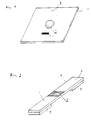
- the membrane contains a circular multifunction zone (2) by a chromatography zone (3) is surrounded on all sides.
- the chromatography zone one or more control zones (4) contain.
- the membrane can be installed in a housing that for the task of the analyte solution and reading the measurement result the multifunction zone (2) and, if applicable, the Control zone (4) above the multifunction zone (2) or the Control zone (4) has an opening. Will the measurement result read on the lower side of the membrane, contains the housing another opening below the multifunction zone.
- a strip-shaped membrane (1) contains in it In the middle is a circular multifunction zone (2), the diameter of which corresponds to the stripe width, and one in both Chromatography zone (3) connecting the membrane.
- the membrane can be covered with an absorbent material (5) connected to the chromatography zone.
- Nitrocellulose from Schleicher and Schüll AES 98 was polymerized with a streptavidin solution and soaked in PBS (1 mg / ml) and dried at 40 ° C. for 30 minutes. The binding capacity was checked by dropping 10 ul of a 5 x 10 -7 M solution of biotinylated B-phycoerythrin (Sigma, Kunststoff). After washing twice, a reproducible binding of> 80% could be determined by measuring the fixed fluorescence. The matrix was cut into 4 x 4 cm pieces.
- Reagent I Biotinylated T4 antibody (5 x 10 -7 M) in PBS buffer solution with 10% by weight trehalose and 0.2% by weight 8-anilino-1-naphthalene sulfonic acid (ANS).
- Reagent II T4-B-phycoerythrin (10 -6 M) in PBS buffer solution with 10% by weight trehalose and 0.2% by weight ANS.
- Reagent I and Reagent II were alternately applied to the center of the membrane using ink-jet (bubble-jet) with a Hewlett Packard paint-jet multi-channel print head.
- the line thickness was approx. 250 ⁇ m, the line spacing was also approx. 250 ⁇ m.
- the total amount of reagents applied was 0.5 ⁇ l / cm 2 , the printed area (multifunctional zone) had a length of approx. 1 cm in each direction of the area and approximately represented a circle.
- the membrane was underlaid with a 4 x 4 cm piece of Whatman 3 MM paper, which had a circular hole of approx. 2 x 2 cm in the middle, and installed in a holder.
- 5 ⁇ l of an analyte sample (human serum) from a serum standard series was applied to the center of the multifunctional zone with a pipette.
- 3 ⁇ 10 ⁇ l of washing buffer (PBS + 0.1% by weight Tween 20) were applied to the center of the multifunction zone at intervals of 10 seconds and then the center of the zone on a Hitachi 4010 device at Ex 515 nm, Em 580 nm measured.
Landscapes
- Health & Medical Sciences (AREA)
- Immunology (AREA)
- Life Sciences & Earth Sciences (AREA)
- Chemical & Material Sciences (AREA)
- Engineering & Computer Science (AREA)
- Hematology (AREA)
- Biomedical Technology (AREA)
- Molecular Biology (AREA)
- Urology & Nephrology (AREA)
- General Health & Medical Sciences (AREA)
- Analytical Chemistry (AREA)
- Food Science & Technology (AREA)
- General Physics & Mathematics (AREA)
- Medicinal Chemistry (AREA)
- Physics & Mathematics (AREA)
- Cell Biology (AREA)
- Biochemistry (AREA)
- Biotechnology (AREA)
- Microbiology (AREA)
- Pathology (AREA)
- Clinical Laboratory Science (AREA)
- Chemical Kinetics & Catalysis (AREA)
- Automatic Analysis And Handling Materials Therefor (AREA)
- Investigating Or Analysing Biological Materials (AREA)
- Investigating Or Analyzing Non-Biological Materials By The Use Of Chemical Means (AREA)
- Steroid Compounds (AREA)
Description
Ein dritter Bindungspartner ist die markierte Reaktionskomponente (markierter Bindungspartner). Dieser Bindungspartner darf nicht immobilisiert sein, daß heißt, er haftet zwar in trockenem Zustand des Analysenelementes in der Multifunktionszone, er muß aber bei Aufgabe der Analytlösung auf die Multifunktionszone frei in der Analytenflüssigkeit löslich sein.
Als erster Bindungspartner (immobilisiert und nicht-analytspezifisch) kann bevorzugt Streptavidin (oder Avidin) verwendet werden, das den zweiten, analytspezifischen Bindungspartner aufgrund dessen Konjugation mit einem Biotinmolekül spezifisch binden kann. Möglich sind aber auch alle dem Fachmann bekannten weiteren spezifischen Bindepaare wie Zucker/Lectin, komplementäre Nukleotidsequenzen, Enzym/Cofaktor, Antikörper/ Antigen usw.
| T4 Konzentration nmol/l | Fluoreszenzeinheiten |
| "0" | 32,5 |
| 47,6 | 26,5 |
| 94 | 17 |
| 175 | 13,5 |
| 328 | 9,5 |
Claims (15)
- Analysenelement zur Bestimmung eines Analyten nach dem Prinzip eines heterogenen Immunoassays bestehend aus einem porösen kapillaraktiven Trägermaterial (1), mit einer Multifunktionszone (2), in der ein spezifischer Bindungspartner auf dem Trägermaterial (1) immobilisiert ist, und einer die Multifunktionszone (2) so umgebenden Chromatographiezone (3), daß gelöste Reagenzien durch Kapillarkräfte in mehr als einer Richtung aus der Multifunktionszone entfernt werden können,
dadurch gekennzeichnet, daß in der Multifunktionszone (2) alle für den heterogenen Immunoassay notwendigen Bindungspartner in der Weise aufgebracht sind, daß mindestens die analytspezifischen Bindungspartner und markierten Bindungspartner in einer Anzahl räumlich voneinander getrennter Kompartimente vorliegen, wobei die Kompartimente einen Abstand von weniger als 1 mm voneinander haben und mindestens die Kompartimente des markierten Bindungspartners in feuchtem Zustand löslich sind. - Analysenelement gemäß Anspruch 1, dadurch gekennzeichnet, daß der analytspezifische Bindungspartner in Kompartimenten immobilisiert und der markierte Bindungspartner in Kompartimenten in löslicher Form vorliegt.
- Analysenelement gemäß Anspruch 1, dadurch gekennzeichnet, daß alle für den heterogenen Immunoassay notwendigen Bindungspartner in Kompartimenten vorliegen.
- Analysenelement gemäß einem der Ansprüche 1 - 3, dadurch gekennzeichnet, daß der auf dem Trägermaterial (1) immobilisierte Bindungspartner Avidin oder Streptavidin ist.
- Analysenelement gemäß einem der Ansprüche 1 - 4, dadurch gekennzeichnet, daß die analytspezifischen Bindungspartner und die markierten Bindungspartner aus biotinylierten Antikörpern und aus direkt markierten Antikörpern, die für einen Sandwich-Immunoassay geeignet sind, bestehen.
- Analysenelement gemäß einem der Ansprüche 1 - 4, dadurch gekennzeichnet, daß die analytspezifischen Bindungspartner und die markierten Bindungspartner aus biotinylierten Antikörpern und direkt markierten Antigenen, die für einen kompetitiven Immunoassay geeignet sind, bestehen.
- Analysenelement gemäß einem der Ansprüche 1 -6, dadurch gekennzeichnet, daß die Kompartimente eine Ausdehnung in eine Flächenrichtung von weniger als 2 mm haben.
- Analysenelement gemäß einem der Ansprüche 1 - 7, dadurch gekennzeichnet, daß die Kompartimente Linien bilden.
- Analysenelement gemäß einem der Ansprüche 1 - 8, dadurch gekennzeichnet, daß die Kompartimente Punkte bilden.
- Analysenelement gemäß einem der Ansprüche 1 - 3 , dadurch gekennzeichnet, daß Kompartimente gleicher Reagenzien durch Kompartimente verschiedener Reagenzien voneinander getrennt sind.
- Analysenelement gemäß einem der Ansprüche 1 - 10, dadurch gekennzeichnet, daß die Kompartimente über ein Ink-Jet-Verfahren aufgebracht sind.
- Analysenelement gemäß Anspruch 11, dadurch gekennzeichnet, daß die Kompartimente über ein Bubble-Jet-Verfahren aufgebracht sind.
- Analysenelement gemäß einem der Ansprüche 1 - 10, dadurch gekennzeichnet, daß die Kompartimente über Air-brush aufgebracht sind.
- Analysenelement gemäß einem der Ansprüche 1 - 13, dadurch gekennzeichnet, daß die Chromatographiezone zusätzlich eine oder mehrere Kontrollzonen (4) enthält.
- Verfahren zur Bestimmung eines Analyten nach dem Prinzip eines heterogenen Immunoassays, dadurch gekennzeichnet, daß die Analytlösung auf die Multifunktionszone (2) des Analysenelementes gemäß einem der Ansprüche 1 - 14 aufgebracht wird, daß mit einer Waschflüssigkeit die nicht auf der Multifunktionszone (2) immobilisierten Reagenzien in die Chromatographiezone (3) transportiert werden und in der Multifunktionszone (2) die Menge des Analyten bestimmt wird.
Applications Claiming Priority (2)
| Application Number | Priority Date | Filing Date | Title |
|---|---|---|---|
| DE4202848A DE4202848A1 (de) | 1992-01-31 | 1992-01-31 | Analysenelement fuer immunoassays |
| DE4202848 | 1992-01-31 |
Publications (3)
| Publication Number | Publication Date |
|---|---|
| EP0553773A2 EP0553773A2 (de) | 1993-08-04 |
| EP0553773A3 EP0553773A3 (en) | 1993-08-25 |
| EP0553773B1 true EP0553773B1 (de) | 1998-04-08 |
Family
ID=6450737
Family Applications (1)
| Application Number | Title | Priority Date | Filing Date |
|---|---|---|---|
| EP93101149A Expired - Lifetime EP0553773B1 (de) | 1992-01-31 | 1993-01-26 | Analyseelement für Immunoassays |
Country Status (5)
| Country | Link |
|---|---|
| EP (1) | EP0553773B1 (de) |
| JP (1) | JP2644956B2 (de) |
| AT (1) | ATE164945T1 (de) |
| DE (2) | DE4202848A1 (de) |
| ES (1) | ES2117060T3 (de) |
Cited By (1)
| Publication number | Priority date | Publication date | Assignee | Title |
|---|---|---|---|---|
| AT501069A1 (de) * | 2001-08-20 | 2006-06-15 | Walter Ing Pils | Vorrichtung und verfahren zum nachweis eines analyten |
Families Citing this family (2)
| Publication number | Priority date | Publication date | Assignee | Title |
|---|---|---|---|---|
| GB9317193D0 (en) * | 1993-08-18 | 1993-10-06 | Zeneca Ltd | Method |
| EP2607492A1 (de) * | 2011-12-22 | 2013-06-26 | Roche Diagniostics GmbH | Verfahren zur Bestimmung einer Analytkonzentration |
Family Cites Families (15)
| Publication number | Priority date | Publication date | Assignee | Title |
|---|---|---|---|---|
| IL52322A (en) * | 1976-06-18 | 1980-10-26 | Alfa Laval Ab | Method of making reagent test device and device made accorording to this method |
| US4517288A (en) * | 1981-01-23 | 1985-05-14 | American Hospital Supply Corp. | Solid phase system for ligand assay |
| GB8305197D0 (en) * | 1983-02-24 | 1983-03-30 | Amersham Int Plc | Assay methods |
| JPS6036181A (ja) * | 1983-08-08 | 1985-02-25 | Denrii Kk | 枚葉型用紙プリンタ−の印字部紙送り機構 |
| JPS6136181A (ja) * | 1984-07-30 | 1986-02-20 | 京セラ株式会社 | セラミツク部材と金属部材との結合方法 |
| DE3445816C1 (de) * | 1984-12-15 | 1986-06-12 | Behringwerke Ag, 3550 Marburg | Flaechenfoermiges diagnostisches Mittel |
| US5240844A (en) * | 1985-09-13 | 1993-08-31 | Wie Siong I | Test kit for determining the presence of organic materials and method of utilizing same |
| TW203120B (de) * | 1985-10-04 | 1993-04-01 | Abbott Lab | |
| CA1340069C (en) * | 1987-10-08 | 1998-10-06 | Gloria J. Covington | Depositing a binder on a solid support |
| IE64286B1 (en) * | 1988-05-25 | 1995-07-26 | Boehringer Mannheim Gmbh | Process for the determination of an immunologically detectable substance and a suitable vessel therefor |
| EP0353895A1 (de) * | 1988-07-18 | 1990-02-07 | MITSUI TOATSU CHEMICALS, Inc. | Immunoassay-Methode |
| JPH0288969A (ja) * | 1988-09-27 | 1990-03-29 | Terumo Corp | 免疫測定用試験具 |
| JPH03276067A (ja) * | 1990-03-19 | 1991-12-06 | Environment Diagnostics Inc | 液中物質測定用複合デバイス |
| DE4024544A1 (de) * | 1990-08-02 | 1992-02-06 | Boehringer Mannheim Gmbh | Analyseelement und verfahren zu seiner herstellung |
| DE4024545A1 (de) * | 1990-08-02 | 1992-02-06 | Boehringer Mannheim Gmbh | Verfahren und vorrichtung zum dosierten zufuehren einer biochemischen analysefluessigkeit auf ein target |
-
1992
- 1992-01-31 DE DE4202848A patent/DE4202848A1/de not_active Withdrawn
-
1993
- 1993-01-26 ES ES93101149T patent/ES2117060T3/es not_active Expired - Lifetime
- 1993-01-26 DE DE59308364T patent/DE59308364D1/de not_active Expired - Fee Related
- 1993-01-26 EP EP93101149A patent/EP0553773B1/de not_active Expired - Lifetime
- 1993-01-26 AT AT93101149T patent/ATE164945T1/de not_active IP Right Cessation
- 1993-01-30 JP JP5034784A patent/JP2644956B2/ja not_active Expired - Fee Related
Cited By (1)
| Publication number | Priority date | Publication date | Assignee | Title |
|---|---|---|---|---|
| AT501069A1 (de) * | 2001-08-20 | 2006-06-15 | Walter Ing Pils | Vorrichtung und verfahren zum nachweis eines analyten |
Also Published As
| Publication number | Publication date |
|---|---|
| ES2117060T3 (es) | 1998-08-01 |
| EP0553773A3 (en) | 1993-08-25 |
| DE4202848A1 (de) | 1993-08-05 |
| ATE164945T1 (de) | 1998-04-15 |
| JPH05273211A (ja) | 1993-10-22 |
| DE59308364D1 (de) | 1998-05-14 |
| JP2644956B2 (ja) | 1997-08-25 |
| EP0553773A2 (de) | 1993-08-04 |
Similar Documents
| Publication | Publication Date | Title |
|---|---|---|
| EP0553770B1 (de) | Analyseelement für Immunoassays | |
| EP0469445B1 (de) | Analyseelement und Verfahren zu seiner Herstellung | |
| DE60219207T2 (de) | Diagnostisches testverfahren | |
| DE3856421T2 (de) | Spezifische Bindungstestverfahren | |
| DE3880531T2 (de) | Integriertes immunoassayelement. | |
| DE3879048T2 (de) | Geraet fuer die laterale immunochromatographische bestimmung. | |
| DE60037268T2 (de) | Verfahren zur durchführung magnetischer chromatographischer assays | |
| DE69814052T2 (de) | Automatische immunoassay kassette | |
| DE69823014T2 (de) | Biochemisches und immunochemisches testgerät | |
| DE3382785T2 (de) | Aufsätze zum Gebrauch in Enzymimmunotests und Verfahren zur Herstellung dieser Aufsätze. | |
| EP0888548B1 (de) | Verfahren und teststreifen zur bestimmung eines analyten | |
| DE4229591C1 (de) | Immunologisches Verfahren zur Bestimmung eines Analyten | |
| DE69506387T2 (de) | Bindungstest unter verwendung von agenzien mit schwanzgruppen | |
| DE69608880T2 (de) | Testsatz und verfahren | |
| DE9001870U1 (de) | Analysentestvorrichtung | |
| DE69023476T2 (de) | Mehrschicht-Testvorrichtung zur Bestimmung von Substanzen in Flüssigkeiten. | |
| DE60025758T2 (de) | Analysevorrichtung und ihr gebrauch | |
| DE69719737T2 (de) | Immunoassay von vollblutproben | |
| EP2194381A1 (de) | Testelement mit kombinierter Kontroll- und Kalibrationszone | |
| DE69411189T2 (de) | Rücktitrations-messverfahren unter verwendung von zweiverschiedenen markern | |
| DE69837092T2 (de) | Immunoassayvorrichtung | |
| DE19903576C2 (de) | Quantitative Bestimmung von Analyten in einem heterogenen System | |
| EP0553773B1 (de) | Analyseelement für Immunoassays | |
| EP0457123B1 (de) | Testträger für die analytische Bestimmung eines Bestandteils einer Probenflüssigkeit | |
| DE3855385T2 (de) | Anordnung zur bestimmung eines analyts und verfahren dafür |
Legal Events
| Date | Code | Title | Description |
|---|---|---|---|
| PUAI | Public reference made under article 153(3) epc to a published international application that has entered the european phase |
Free format text: ORIGINAL CODE: 0009012 |
|
| PUAL | Search report despatched |
Free format text: ORIGINAL CODE: 0009013 |
|
| 17P | Request for examination filed |
Effective date: 19930126 |
|
| AK | Designated contracting states |
Kind code of ref document: A2 Designated state(s): AT BE CH DE DK ES FR GB IT LI LU NL SE |
|
| AK | Designated contracting states |
Kind code of ref document: A3 Designated state(s): AT BE CH DE DK ES FR GB IT LI LU NL SE |
|
| 17Q | First examination report despatched |
Effective date: 19961027 |
|
| GRAG | Despatch of communication of intention to grant |
Free format text: ORIGINAL CODE: EPIDOS AGRA |
|
| GRAG | Despatch of communication of intention to grant |
Free format text: ORIGINAL CODE: EPIDOS AGRA |
|
| GRAH | Despatch of communication of intention to grant a patent |
Free format text: ORIGINAL CODE: EPIDOS IGRA |
|
| GRAH | Despatch of communication of intention to grant a patent |
Free format text: ORIGINAL CODE: EPIDOS IGRA |
|
| GRAA | (expected) grant |
Free format text: ORIGINAL CODE: 0009210 |
|
| AK | Designated contracting states |
Kind code of ref document: B1 Designated state(s): AT BE CH DE DK ES FR GB IT LI LU NL SE |
|
| PG25 | Lapsed in a contracting state [announced via postgrant information from national office to epo] |
Ref country code: NL Free format text: LAPSE BECAUSE OF FAILURE TO SUBMIT A TRANSLATION OF THE DESCRIPTION OR TO PAY THE FEE WITHIN THE PRESCRIBED TIME-LIMIT Effective date: 19980408 |
|
| REF | Corresponds to: |
Ref document number: 164945 Country of ref document: AT Date of ref document: 19980415 Kind code of ref document: T |
|
| REG | Reference to a national code |
Ref country code: CH Ref legal event code: EP |
|
| REF | Corresponds to: |
Ref document number: 59308364 Country of ref document: DE Date of ref document: 19980514 |
|
| ET | Fr: translation filed | ||
| ITF | It: translation for a ep patent filed | ||
| GBT | Gb: translation of ep patent filed (gb section 77(6)(a)/1977) |
Effective date: 19980526 |
|
| PG25 | Lapsed in a contracting state [announced via postgrant information from national office to epo] |
Ref country code: SE Free format text: LAPSE BECAUSE OF FAILURE TO SUBMIT A TRANSLATION OF THE DESCRIPTION OR TO PAY THE FEE WITHIN THE PRESCRIBED TIME-LIMIT Effective date: 19980708 Ref country code: DK Free format text: LAPSE BECAUSE OF FAILURE TO SUBMIT A TRANSLATION OF THE DESCRIPTION OR TO PAY THE FEE WITHIN THE PRESCRIBED TIME-LIMIT Effective date: 19980708 |
|
| REG | Reference to a national code |
Ref country code: ES Ref legal event code: FG2A Ref document number: 2117060 Country of ref document: ES Kind code of ref document: T3 |
|
| NLV1 | Nl: lapsed or annulled due to failure to fulfill the requirements of art. 29p and 29m of the patents act | ||
| PG25 | Lapsed in a contracting state [announced via postgrant information from national office to epo] |
Ref country code: LU Free format text: LAPSE BECAUSE OF NON-PAYMENT OF DUE FEES Effective date: 19990126 Ref country code: AT Free format text: LAPSE BECAUSE OF NON-PAYMENT OF DUE FEES Effective date: 19990126 |
|
| PG25 | Lapsed in a contracting state [announced via postgrant information from national office to epo] |
Ref country code: LI Free format text: LAPSE BECAUSE OF NON-PAYMENT OF DUE FEES Effective date: 19990131 Ref country code: CH Free format text: LAPSE BECAUSE OF NON-PAYMENT OF DUE FEES Effective date: 19990131 Ref country code: BE Free format text: LAPSE BECAUSE OF NON-PAYMENT OF DUE FEES Effective date: 19990131 |
|
| PLBE | No opposition filed within time limit |
Free format text: ORIGINAL CODE: 0009261 |
|
| STAA | Information on the status of an ep patent application or granted ep patent |
Free format text: STATUS: NO OPPOSITION FILED WITHIN TIME LIMIT |
|
| RAP4 | Party data changed (patent owner data changed or rights of a patent transferred) |
Owner name: ROCHE DIAGNOSTICS GMBH |
|
| 26N | No opposition filed | ||
| BERE | Be: lapsed |
Owner name: BOEHRINGER MANNHEIM G.M.B.H. Effective date: 19990131 |
|
| REG | Reference to a national code |
Ref country code: CH Ref legal event code: PL |
|
| REG | Reference to a national code |
Ref country code: GB Ref legal event code: IF02 |
|
| PGFP | Annual fee paid to national office [announced via postgrant information from national office to epo] |
Ref country code: FR Payment date: 20030110 Year of fee payment: 11 |
|
| PGFP | Annual fee paid to national office [announced via postgrant information from national office to epo] |
Ref country code: GB Payment date: 20030122 Year of fee payment: 11 |
|
| PGFP | Annual fee paid to national office [announced via postgrant information from national office to epo] |
Ref country code: ES Payment date: 20030130 Year of fee payment: 11 |
|
| PGFP | Annual fee paid to national office [announced via postgrant information from national office to epo] |
Ref country code: DE Payment date: 20030206 Year of fee payment: 11 |
|
| PG25 | Lapsed in a contracting state [announced via postgrant information from national office to epo] |
Ref country code: GB Free format text: LAPSE BECAUSE OF NON-PAYMENT OF DUE FEES Effective date: 20040126 |
|
| PG25 | Lapsed in a contracting state [announced via postgrant information from national office to epo] |
Ref country code: ES Free format text: LAPSE BECAUSE OF NON-PAYMENT OF DUE FEES Effective date: 20040127 |
|
| PG25 | Lapsed in a contracting state [announced via postgrant information from national office to epo] |
Ref country code: DE Free format text: LAPSE BECAUSE OF NON-PAYMENT OF DUE FEES Effective date: 20040803 |
|
| GBPC | Gb: european patent ceased through non-payment of renewal fee |
Effective date: 20040126 |
|
| PG25 | Lapsed in a contracting state [announced via postgrant information from national office to epo] |
Ref country code: FR Free format text: LAPSE BECAUSE OF NON-PAYMENT OF DUE FEES Effective date: 20040930 |
|
| REG | Reference to a national code |
Ref country code: FR Ref legal event code: ST |
|
| PG25 | Lapsed in a contracting state [announced via postgrant information from national office to epo] |
Ref country code: IT Free format text: LAPSE BECAUSE OF NON-PAYMENT OF DUE FEES;WARNING: LAPSES OF ITALIAN PATENTS WITH EFFECTIVE DATE BEFORE 2007 MAY HAVE OCCURRED AT ANY TIME BEFORE 2007. THE CORRECT EFFECTIVE DATE MAY BE DIFFERENT FROM THE ONE RECORDED. Effective date: 20050126 |
|
| REG | Reference to a national code |
Ref country code: ES Ref legal event code: FD2A Effective date: 20040127 |