EP0571111A1 - Zusammengestelltes Rohr - Google Patents
Zusammengestelltes Rohr Download PDFInfo
- Publication number
- EP0571111A1 EP0571111A1 EP93303575A EP93303575A EP0571111A1 EP 0571111 A1 EP0571111 A1 EP 0571111A1 EP 93303575 A EP93303575 A EP 93303575A EP 93303575 A EP93303575 A EP 93303575A EP 0571111 A1 EP0571111 A1 EP 0571111A1
- Authority
- EP
- European Patent Office
- Prior art keywords
- tube
- cross sectional
- inside surface
- section
- partially
- Prior art date
- Legal status (The legal status is an assumption and is not a legal conclusion. Google has not performed a legal analysis and makes no representation as to the accuracy of the status listed.)
- Granted
Links
- 238000000034 method Methods 0.000 claims abstract description 20
- 239000012530 fluid Substances 0.000 claims abstract description 10
- 238000010438 heat treatment Methods 0.000 claims description 20
- 229920000642 polymer Polymers 0.000 claims description 17
- 238000007669 thermal treatment Methods 0.000 claims description 11
- 229920001169 thermoplastic Polymers 0.000 claims description 10
- 230000008859 change Effects 0.000 claims description 8
- 230000008569 process Effects 0.000 claims description 8
- 239000000835 fiber Substances 0.000 description 14
- 239000008280 blood Substances 0.000 description 13
- 210000004369 blood Anatomy 0.000 description 13
- 239000007789 gas Substances 0.000 description 13
- 238000007789 sealing Methods 0.000 description 11
- 239000007788 liquid Substances 0.000 description 10
- 239000013307 optical fiber Substances 0.000 description 9
- 239000000523 sample Substances 0.000 description 7
- 239000000126 substance Substances 0.000 description 6
- 239000000853 adhesive Substances 0.000 description 5
- 230000001070 adhesive effect Effects 0.000 description 5
- 238000004519 manufacturing process Methods 0.000 description 5
- 239000000463 material Substances 0.000 description 4
- 238000002844 melting Methods 0.000 description 4
- 230000008018 melting Effects 0.000 description 4
- 230000008719 thickening Effects 0.000 description 4
- 239000012491 analyte Substances 0.000 description 3
- 239000000975 dye Substances 0.000 description 3
- 238000001125 extrusion Methods 0.000 description 3
- 238000001727 in vivo Methods 0.000 description 3
- 238000005259 measurement Methods 0.000 description 3
- 230000002792 vascular Effects 0.000 description 3
- -1 for example Polymers 0.000 description 2
- 230000009477 glass transition Effects 0.000 description 2
- 239000012811 non-conductive material Substances 0.000 description 2
- 230000003287 optical effect Effects 0.000 description 2
- BASFCYQUMIYNBI-UHFFFAOYSA-N platinum Substances [Pt] BASFCYQUMIYNBI-UHFFFAOYSA-N 0.000 description 2
- 239000000565 sealant Substances 0.000 description 2
- 238000013494 PH determination Methods 0.000 description 1
- 239000004698 Polyethylene Substances 0.000 description 1
- BQCADISMDOOEFD-UHFFFAOYSA-N Silver Chemical compound [Ag] BQCADISMDOOEFD-UHFFFAOYSA-N 0.000 description 1
- 238000010521 absorption reaction Methods 0.000 description 1
- 230000002411 adverse Effects 0.000 description 1
- 230000008901 benefit Effects 0.000 description 1
- 238000004159 blood analysis Methods 0.000 description 1
- 239000004568 cement Substances 0.000 description 1
- 239000004020 conductor Substances 0.000 description 1
- 238000010276 construction Methods 0.000 description 1
- 238000001816 cooling Methods 0.000 description 1
- 238000012217 deletion Methods 0.000 description 1
- 230000037430 deletion Effects 0.000 description 1
- 239000003269 fluorescent indicator Substances 0.000 description 1
- 230000004927 fusion Effects 0.000 description 1
- 239000011521 glass Substances 0.000 description 1
- 239000003292 glue Substances 0.000 description 1
- PCHJSUWPFVWCPO-UHFFFAOYSA-N gold Chemical compound [Au] PCHJSUWPFVWCPO-UHFFFAOYSA-N 0.000 description 1
- 238000002955 isolation Methods 0.000 description 1
- 239000011159 matrix material Substances 0.000 description 1
- 210000004779 membrane envelope Anatomy 0.000 description 1
- 229910052697 platinum Inorganic materials 0.000 description 1
- 229920000573 polyethylene Polymers 0.000 description 1
- 238000012545 processing Methods 0.000 description 1
- 229910052709 silver Inorganic materials 0.000 description 1
- 239000004332 silver Substances 0.000 description 1
- 239000005341 toughened glass Substances 0.000 description 1
Images

Classifications
-
- A—HUMAN NECESSITIES
- A61—MEDICAL OR VETERINARY SCIENCE; HYGIENE
- A61B—DIAGNOSIS; SURGERY; IDENTIFICATION
- A61B5/00—Measuring for diagnostic purposes; Identification of persons
- A61B5/145—Measuring characteristics of blood in vivo, e.g. gas concentration or pH-value ; Measuring characteristics of body fluids or tissues, e.g. interstitial fluid or cerebral tissue
- A61B5/14542—Measuring characteristics of blood in vivo, e.g. gas concentration or pH-value ; Measuring characteristics of body fluids or tissues, e.g. interstitial fluid or cerebral tissue for measuring blood gases
-
- A—HUMAN NECESSITIES
- A61—MEDICAL OR VETERINARY SCIENCE; HYGIENE
- A61B—DIAGNOSIS; SURGERY; IDENTIFICATION
- A61B5/00—Measuring for diagnostic purposes; Identification of persons
- A61B5/145—Measuring characteristics of blood in vivo, e.g. gas concentration or pH-value ; Measuring characteristics of body fluids or tissues, e.g. interstitial fluid or cerebral tissue
- A61B5/1468—Measuring characteristics of blood in vivo, e.g. gas concentration or pH-value ; Measuring characteristics of body fluids or tissues, e.g. interstitial fluid or cerebral tissue using chemical or electrochemical methods, e.g. by polarographic means
- A61B5/1473—Measuring characteristics of blood in vivo, e.g. gas concentration or pH-value ; Measuring characteristics of body fluids or tissues, e.g. interstitial fluid or cerebral tissue using chemical or electrochemical methods, e.g. by polarographic means invasive, e.g. introduced into the body by a catheter
-
- B—PERFORMING OPERATIONS; TRANSPORTING
- B29—WORKING OF PLASTICS; WORKING OF SUBSTANCES IN A PLASTIC STATE IN GENERAL
- B29C—SHAPING OR JOINING OF PLASTICS; SHAPING OF MATERIAL IN A PLASTIC STATE, NOT OTHERWISE PROVIDED FOR; AFTER-TREATMENT OF THE SHAPED PRODUCTS, e.g. REPAIRING
- B29C61/00—Shaping by liberation of internal stresses; Making preforms having internal stresses; Apparatus therefor
- B29C61/04—Thermal expansion
-
- B—PERFORMING OPERATIONS; TRANSPORTING
- B29—WORKING OF PLASTICS; WORKING OF SUBSTANCES IN A PLASTIC STATE IN GENERAL
- B29C—SHAPING OR JOINING OF PLASTICS; SHAPING OF MATERIAL IN A PLASTIC STATE, NOT OTHERWISE PROVIDED FOR; AFTER-TREATMENT OF THE SHAPED PRODUCTS, e.g. REPAIRING
- B29C65/00—Joining or sealing of preformed parts, e.g. welding of plastics materials; Apparatus therefor
- B29C65/66—Joining or sealing of preformed parts, e.g. welding of plastics materials; Apparatus therefor by liberation of internal stresses, e.g. shrinking of one of the parts to be joined
-
- B—PERFORMING OPERATIONS; TRANSPORTING
- B29—WORKING OF PLASTICS; WORKING OF SUBSTANCES IN A PLASTIC STATE IN GENERAL
- B29C—SHAPING OR JOINING OF PLASTICS; SHAPING OF MATERIAL IN A PLASTIC STATE, NOT OTHERWISE PROVIDED FOR; AFTER-TREATMENT OF THE SHAPED PRODUCTS, e.g. REPAIRING
- B29C66/00—General aspects of processes or apparatus for joining preformed parts
- B29C66/01—General aspects dealing with the joint area or with the area to be joined
- B29C66/05—Particular design of joint configurations
- B29C66/10—Particular design of joint configurations particular design of the joint cross-sections
- B29C66/11—Joint cross-sections comprising a single joint-segment, i.e. one of the parts to be joined comprising a single joint-segment in the joint cross-section
- B29C66/112—Single lapped joints
- B29C66/1122—Single lap to lap joints, i.e. overlap joints
-
- B—PERFORMING OPERATIONS; TRANSPORTING
- B29—WORKING OF PLASTICS; WORKING OF SUBSTANCES IN A PLASTIC STATE IN GENERAL
- B29C—SHAPING OR JOINING OF PLASTICS; SHAPING OF MATERIAL IN A PLASTIC STATE, NOT OTHERWISE PROVIDED FOR; AFTER-TREATMENT OF THE SHAPED PRODUCTS, e.g. REPAIRING
- B29C66/00—General aspects of processes or apparatus for joining preformed parts
- B29C66/50—General aspects of joining tubular articles; General aspects of joining long products, i.e. bars or profiled elements; General aspects of joining single elements to tubular articles, hollow articles or bars; General aspects of joining several hollow-preforms to form hollow or tubular articles
- B29C66/51—Joining tubular articles, profiled elements or bars; Joining single elements to tubular articles, hollow articles or bars; Joining several hollow-preforms to form hollow or tubular articles
- B29C66/52—Joining tubular articles, bars or profiled elements
-
- B—PERFORMING OPERATIONS; TRANSPORTING
- B29—WORKING OF PLASTICS; WORKING OF SUBSTANCES IN A PLASTIC STATE IN GENERAL
- B29C—SHAPING OR JOINING OF PLASTICS; SHAPING OF MATERIAL IN A PLASTIC STATE, NOT OTHERWISE PROVIDED FOR; AFTER-TREATMENT OF THE SHAPED PRODUCTS, e.g. REPAIRING
- B29C66/00—General aspects of processes or apparatus for joining preformed parts
- B29C66/90—Measuring or controlling the joining process
- B29C66/91—Measuring or controlling the joining process by measuring or controlling the temperature, the heat or the thermal flux
- B29C66/914—Measuring or controlling the joining process by measuring or controlling the temperature, the heat or the thermal flux by controlling or regulating the temperature, the heat or the thermal flux
- B29C66/9141—Measuring or controlling the joining process by measuring or controlling the temperature, the heat or the thermal flux by controlling or regulating the temperature, the heat or the thermal flux by controlling or regulating the temperature
- B29C66/91411—Measuring or controlling the joining process by measuring or controlling the temperature, the heat or the thermal flux by controlling or regulating the temperature, the heat or the thermal flux by controlling or regulating the temperature of the parts to be joined, e.g. the joining process taking the temperature of the parts to be joined into account
-
- B—PERFORMING OPERATIONS; TRANSPORTING
- B29—WORKING OF PLASTICS; WORKING OF SUBSTANCES IN A PLASTIC STATE IN GENERAL
- B29L—INDEXING SCHEME ASSOCIATED WITH SUBCLASS B29C, RELATING TO PARTICULAR ARTICLES
- B29L2031/00—Other particular articles
- B29L2031/753—Medical equipment; Accessories therefor
- B29L2031/7542—Catheters
-
- Y—GENERAL TAGGING OF NEW TECHNOLOGICAL DEVELOPMENTS; GENERAL TAGGING OF CROSS-SECTIONAL TECHNOLOGIES SPANNING OVER SEVERAL SECTIONS OF THE IPC; TECHNICAL SUBJECTS COVERED BY FORMER USPC CROSS-REFERENCE ART COLLECTIONS [XRACs] AND DIGESTS
- Y10—TECHNICAL SUBJECTS COVERED BY FORMER USPC
- Y10S—TECHNICAL SUBJECTS COVERED BY FORMER USPC CROSS-REFERENCE ART COLLECTIONS [XRACs] AND DIGESTS
- Y10S174/00—Electricity: conductors and insulators
- Y10S174/08—Shrinkable tubes
-
- Y—GENERAL TAGGING OF NEW TECHNOLOGICAL DEVELOPMENTS; GENERAL TAGGING OF CROSS-SECTIONAL TECHNOLOGIES SPANNING OVER SEVERAL SECTIONS OF THE IPC; TECHNICAL SUBJECTS COVERED BY FORMER USPC CROSS-REFERENCE ART COLLECTIONS [XRACs] AND DIGESTS
- Y10—TECHNICAL SUBJECTS COVERED BY FORMER USPC
- Y10T—TECHNICAL SUBJECTS COVERED BY FORMER US CLASSIFICATION
- Y10T403/00—Joints and connections
- Y10T403/48—Shrunk fit
Definitions
- This invention relates to a tubular assembly, a method for the assembly thereof, and an apparatus for carrying out the method. More particularly, the invention is concerned with a tubular assembly comprising a tube and a part located at least partially within the tube.
- the part is preferably made of a thermoplastic polymer and relaxation of residual stresses or release of the memory of the manufacturing process used to make the part allows expansion of the part so that it engages the inside surface of the tube.
- tubes are stoppered, plugged or sealed by application of a press fit, shrink fit or wedging component into the bore thereof.
- Chemicals such as adhesives, sealants or glues are frequently applied to make a fluid tight joint.
- the accurate application of chemicals to make a small joint fluid tight presents added difficulties of placement and clean up. Often the chemicals used may interfere with the operation of the assembly being made therewith, and also chemical may leach into the blood stream during use of a tubular probe.
- Optical fibers or fiber optic chemical sensors used in vivo as probes must be sensitive to slight changes in gas or ion concentrations.
- U.S. patent No. 4,200,110 discloses a fiber optic pH probe comprising an ion permeable membrane envelope about the distal ends of a pair of optical fibers. The probe operates on the concept of optically detecting the change in color of a pH sensitive dye.
- U.S. Patent Reissue 31,879 discloses a method for measuring concentration of an analyte in a sample by measuring the intensity of light emitted from a fluorescent indicator attached to an optical fiber.
- U.S. Patent No. 5.047,208 discloses a calorimetric fiber optic sensor for blood gas measurement comprising a pH sensitive dye in a chamber at the distal end of an optical fiber. A white reflective surface is located distal to the chamber.
- U.S. Patent No. 5,005,576 discloses an optical probe for invasive blood gas measurement comprising sensors capable of measuring pH, pO2 and pCO2 using absorption dyes.
- a reflector unit is positioned at the distal end of an outer sheath having a gas-permeable adhesive to close off the end of the probe.
- U.S. Patent No. 5,047,627 discloses a multi-analyte sensor comprising three optical fibers each associated with an indicator matrix and a light reflectance material. Certainty and consistency of assembly is not always repeatable with adhesive attachment, and chemicals in the adhesive may adversely influence the chemistry of the sensor and therefor measurement accuracy.
- U.S. Patent No. 4,889,407 discloses an optical waveguide sensor having a plurality of cells arranged in an array which substantially covers the cross sectional area of the waveguide. Each of the cells contains an indicator sensitive to an analyte in a medium, particularly for the determination of pH and pCO2 in vivo in blood.
- a tubular assembly comprising a hollow elongated tube having an internal cross section with an inside surface, a proximal end and a distal end defining a bore around a longitudinal axis, and a part mounted within the bore so that it is at least partially within the tube, the part, preferably made of a thermoplastic polymer, having been thermally treated to expand and engage the inside surface of the tube so that, after change in temperature, the part has an external cross sectional size identical to the internal cross sectional size of the tube and thereby forms a fluid tight seal.
- the tube preferably has an internal cross sectional shape identical to the part and a cross sectional shape identical to the part and a cross sectional size larger than the part prior to changing temperature.
- the part has an external cross sectional size identical to the internal cross sectional size of the tube after change in temperature.
- the tube has a substantially circular internal cross sectional shape defined by the bore through the tube and the part has a substantially circular external cross sectional shape of a diameter that allows axial movement within the tube before thermal treatment.
- the part should preferably have a cross sectional shape and size to be near the inside surface upon placement of the part at least partially within the tube.
- the part or the tube may be supported so that relative movement along the axis places the part at least partially within the tube.
- the part is preferably made of a thermoplastic polymer by a process which develops within the polymer a memory of the unshaped thermoplastic polymer prior to forming into the cross sectional shape of the part so that residual stresses remaining in the formed part are relaxed by changing temperature causing expansion of the cross sectional size of the tube and/or the part.
- the part and tube are preferably made by an extrusion process to develop memory.
- the part may be located in the tube between the ends thereof or located in the tube near the proximal or distal end thereof.
- a form preferably made of a relatively nonconductive material, is preferably positioned for relative movement along the axis for placement about the tube whereinside the part is located.
- the form is preferably shaped and sized to fit the tube outside surface and contain it.
- the form, the tube and the part are preferably substantially circular in cross section.
- a heater preferably made of an electrically resistive element, is wrapped about the form and is associated therewith for changing the temperature of the tube and the part sufficiently to relax residual stresses of their respective manufacturing processes, and thereby cause engagement of the inside surface of the tube and the part.
- the heater changes the temperature beyond the glass transition point of the polymer allowing the combined tube and part to expand to the identical cross sectional size of the internal cross section of the form and to remain expanded thereafter.
- engagement means that if the part and tube are made of materials that are heat sealable with respect to one another, then they will fuse together when they are thermally heated. Alternatively, if the materials will not fuse then they form a tight fit therebetween upon engagement.
- the invention also provides a method of assembly of a tube with an axis along the longitude thereof and with inside and outside surfaces, a proximal end and a distal end and a part with a cross sectional shape and size similar to the inside surface of the tube when the part is at least partially within the tube using a form shaped and sized to fit about the outside surface of the tube and a heater associated with the form, which comprises the steps of supporting the tube and the part so that relative movement along the tube axis places the part at least partially within the tube; positioning the form for relative movement along the axis for placement about the tube whereinside the part is located to thereby contain the outside surface of the tube; subjecting the tube and the part to thermal treatment to change the temperature sufficiently to relax residual stresses and thereby cause engagement of the inside surface of the tube and the part.
- the method preferably also includes the added steps of clearing fluid about the junction between the part and the tube before heating. Preferably sufficient heat is conducted through the form into the part to form a seal between the part and the inside surface of the tube.
- the step of clearing fluid is performed most preferably by applying a vacuum near the part during placement.
- the invention also provides an apparatus for assembling a tube and a part inserted at least partially therewithin, characterized by a hollow elongated tube with an axis along the longitude thereof, and with inside and outside surfaces, a proximal end and a distal end; a part with a cross sectional shape and size similar to the inside surface when the part is at least partially within the tube, the part and the tube being supported so that relative movement along the axis places the part at least partially within the tube; a form positioned for relative movement along the axis for placement about the tube whereinside the part is located, the form shaped and sized to fit the tube outside surface and contain it; and a heater associated with the form for providing thermal treatment to change the temperature of the tube and the part sufficiently to relax residual stresses and thereby permit engagement between the inside surface of the tube and the part.
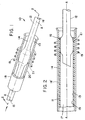
- the embodiment illustrated in Figure 1 comprises an apparatus 10 for assembly of a tube 11 and a part 12 located at least partially within the tube 11 by relaxation of residual stresses or release of the memory of the manufacturing process used to make the part 12 by a method which allows engagement of the tube 11 and the part 12.
- the most preferred application of the tubular assembly of the present invention is for the construction of a small (less than 20 gauge) blood gas sensor catheter.
- the assembly involves sealing of the distal portion of blood gas sensors within a vascular catheter sheath about sensors such as electrical wires and/or optical fibers passing axially therethrough and termination of the leading end of the blood gas catheter.
- Figure 1 is a perspective view partially in cross section of an apparatus 10 comprising a part 12 located at least partially within a form 18.
- the part 12 is formed of a polymeric monofilament in the preferred embodiment which extends along an axis A.
- Thermal treatment, i.e. heating, of the monofilament urges it axially toward the area of heating within the form 18 to encourage thickening and results in a larger section as shown.
- Urging the monofilament is, in the preferred embodiment, accomplished by feeding the monofilament axially toward the area of heating from either direction; that is, each end is pushed toward the middle with sufficient force to provide thickening.
- the tube 11 has as inside surface 13 and an outside surface 14 extending between a proximal end 15 and a distal end 16.
- the tube 11 is used as a sheath for a blood gas sensor accommodated in a vascular catheter and has an internal cross sectional shape identical to that of the part 12 and a cross sectional size slightly larger than that of the part 12 prior to being subjected to thermal treatment, as described hereinafter.
- the part 12 may take various forms, but it is preferred that the part 12 have an external cross sectional size substantially identical to the internal cross sectional size of the tube 11 after thermal treatment so that effective sealing is achieved.
- the tube 11 has an internal circular cross sectional shape defined by a bore 17 through the tube 11.
- the part 12 has a circular cross sectional shape of a diameter that may allow axial movement within the tube 11 prior to sealing.
- the part 12 preferably should have a cross sectional shape and size to be substantially near the inside surface 13 upon placement of the part 12 at least partially within the tube 11.
- the part 12, if used to seal the distal end 16, should be slightly tapered to displace any liquid in the tube 11 so that a bubble-free fill remains when the part 12 and tube 11 are sealed.
- An apparatus for assembly of the tube 11 and the expanded part 12 supports the part 12 and/or the tube 11 for relative movement along the axis A placing the part 12 at least partially within the tube 11.
- the precision and speed necessary to place the part 12 within the tube 11 is easily accomplished by automatic machinery that aligns the part 12 and the tube 11 with the axis A so that each is centered and may be placed concentric to one another.
- the part 12 is shown as a preferred monofilament which may be fed into and through a form 18 from either the proximal or distal end 15 or 16 in accord with the desired resuit.
- the part 12 is expanded in the form 18 by application of heat so that it may be located in the tube 11 between the proximal or distal end 15 or 16 thereof or located in the tube 11 near the proximal or distal end 15 or 16 thereof for sealing.
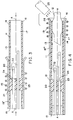
- Figure 2 is a side view in cross section of the form 18' used for assembly of the tube 11 and the part 12 (as reformed in a form 18) and wherein the part 12 is now located at least partially within the distal end 16 of the tube 11.
- the part 12 is inserted into the distal end 16 not through the tube 11 although that is a possible option.
- each of the part 12 and/or the tube 11 is made of a thermoplastic polymer by a process that develops within the polymer a memory of the unshaped thermoplastic polymer prior to forming into the cross sectional shape of the part 12 and/or the tube 11. While the part 12 and the tube 11 may be made from the same polymer they also may be made from different polymers.
- the sealing includes melting and when different polymers are used the sealing is a result of expansion which forms a tight interference fit.
- Residual stresses remaining in the formed part 12 and/or tube 11 may be relaxed by changing temperature causing expansion of the cross sectional size of the tube 11 and/or the part 12.
- the part 12 and/or the tube 11 are preferably made by an extrusion process to develop such processing memory.
- the changing cross sectional size of the tube 11 may provide a thicker wall section after heating and the part 12 may swell when heated.
- the tube 11, as necessary, is urged axially toward the area of heating to prevent thinning which could result in an opening or tear in the tube 11.
- the residual stress in the memory of the process used to make the tube 11, i.e. extrusion could cause the tube 11 to pull apart.
- Urging the tube 11 is accomplished by feeding the tube 11 axially toward the area of heating from one direction and the part 12, such as the monofilament, from the other toward the middle with sufficient force to prevent thinning.
- the fused joint (same polymer) between the part 12 and the tube 11 is therefore uniformly around the part 12 and the seal is sufficient to plug the distal end 16 of the tube 11.
- the forms 18 and 18' are preferably made of a relatively nonconductive material such as tempered glass and the forms 18 and 18' are preferably positioned for relative movement along the axis A for placement about the part 12 as in Figure 1 and may be placed over the tube 11 whereinside the part 12 is located as shown in Figure 2.
- the forms 18 and 18' are shaped and sized to fit the tube 11 inside surface 13 and outside surface 14, respectively and contain it.
- the forms 18 and 18', the tube 11 and the part 12 are preferably substantially circular in cross section. The dimensions are not critical but should be selected to provide the type of fit desired between forms 18 or 18', the part 12 and the tube 11.
- a heater 19 is preferably made of an electrically resistive element wrapped about an outer wall 20 of the form 18 or 18' and is associated therewith for changing the temperature of the tube 11 and the part 12 therewithin sufficiently to relax residual stresses resulting from their respective manufacturing processes.
- the heat applied will thereby cause expansion and engagement of the inside surface 13 and the part 12.
- the heater 19 raises the temperature beyond the glass transition point of the polymer of the tube 11 and/or the part 12 allowing the combined tube 11 and part 12 to expand to the identical cross sectional size of the internal cross section of the form 18 or 18' and to remain expanded after cooling. Melting of the polymer is not required, unless the same polymers are used. Otherwise, sealing is sufficiently accomplished when expansion takes place while the part 12 and the tube 11 are contained by the form 18 or 18'. Thus the contained expansion is adequate to create a joint 21 which will perform acceptably in connection with blood gas sensors. Expansion is for dissimilar polymers and fusion in the form of a melted heat seal occurs between similar polymers.
- the preferred method of assembly of the tube 11 with its axis along its longitude and inside and outside surfaces 13 and 14 extending between proximal and distal ends 15 and 16 over part 12 of a cross sectional shape and size to be near the inside surface 13 of the tube when the part 12 is at least partially within the tube 11 has several steps.
- the method may be performed as shown in the drawings with parts of various configurations.
- Form 18' is shaped and sized to fit about the tube 11 outside surface 14 with heater 19 about outer wall 20 of the form 18'.
- the next step comprises supporting the tube 11 and the part 12 so that relative movement therebetween and along axis A places the part 12 at least partially within the tube 11.
- That step is followed by positioning form 18' for relative movement along axis A for placement about the tube 11 whereinside the part 12 is located to thereby contain the outside surface 14.
- Sufficiently changing the temperature of the tube 11 and the part 12 relaxes residual stresses resulting from the manufacturing process used to make the tube 11 and/or the part 12 for causing engagement of the inside surface 13 of the tube 11 and the part 12.
- the method preferably also includes the added steps of conducting sufficient heat through form 18' into the tube 11 and/or the part 12 to relax residual stresses therein with or without melting the tube 11 and/or the part 12 and clearing fluid (or liquid) about the part 12 before heating.
- the step of clearing fluid is preferably performed by moving a gas along the tube 11 and the step of moving is most preferably performed by applying a vacuum to the junction between tube 11 and part 12.
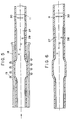
- Figure 3 is a side view in cross section of a plurality of sensors 22 extending through a radially inwardly expanded section 23 located within the tube 11 to illustrate supporting the sensors 22 with the tube 11 as the first step in the assembly of a sensor catheter.
- the radially inwardly expanded section 23 acts to support and separate the sensors of a blood gas catheter sensor.
- the radially inwardly expanded section 23 in Figure 3 shows two sensors passing through respective passageways 24 formed within the tube 11.
- the heater 19 surrounds a form 18'' and heat applied therewith changes the temperature of the tube 11 creating the radially inwardly expanded section 23 within the tube 11 after overcoming the relaxation of residual stresses within the polymer of the tube 11 by pushing the tube axially thus feeding sufficient polymer into the radially inwardly expanding section 23.
- the result is that the radially inwardly expanded section 23 swells when the tube 11 expands and the sensors 22 are captured, supported and held separately in passages 24.
- the preferred embodiment includes temperature sensors made of silver, platinum or gold wire, which are all good conductors of heat. Therefore, to heat properly and prevent the loss of heat to the wires, heating is conducted at just below the melting temperature of the tube 11 polymer, for example, polyethylene, and then quickly for a short time with a pulse of energy through the heating wire coil the temperature is raised to melt the tube 11.
- a seal is thus provided between the tube 11, the radially inwardly expanded section 23 and the sensors 22.
- the tube 11, as necessary, is urged axially toward the area of heating to provide thickening at the radially inwardly expanded section 23. Therefore an opening or tear in the tube 11 is prevented with the added material provided by feeding tube 11 into the space between the sensors 22 and the inside of the unreformed tube 11.
- Urging the tube 11 is preferably accomplished by feeding the tube 11 axially toward the area of heating from either direction; that is, each end 15 and 16 is pushed toward the middle with sufficient force to provide thickening around the sensors 22.
- the joint between the sensors and the tube 11 is therefore uniform around the sensors 22 and the seal is accomplished without added cement.
- a side view in cross section of the supported sensors 22 held within the radially inwardly expanded section 23 of the tube 11 illustrates how the distal end 16 thereof is plugged with the part 12 while a vacuum is drawn to clear liquid resulting when the part 12 is plugged into the tube 11.
- a pipe 25 is located near the distal end 16, i.e. just outside but in position to draw a vacuum near a junction 26 between the part 12 and the tube 11 are heated during the assembly process.
- Arrows B illustrate the vacuum in Figure 4. It should be appreciated that, although not preferred, a sealant may be drawn Into the tube 11 to fill the proximal end 15 and that is shown by the dark areas between the sensors 22 on the left side of Figure 4.
- the part 12 after being sealed in the distal end 16 as in Figures 2 and 4 may be cut to provide a desired shape at the sealed distal end 16.
- the distal seal is accomplished by first pushing the tapered plug into the tube 11 distal end 16 thus displacing liquid therein and drawing excess liquid away with vacuum. Then heating to seal the part 12 and tube 11. Thus, a completely liquid filled space devoid of air bubbles is attained.
- an optical fiber sensor 27 prepared in accordance with the disclosure in U.S. Patent No. 4,889,407 is shown positioned coaxially within the tube 11 and expanded to engage the inside of the tube 11 by the heater as described hereinbefore.
- the sensor comprises cells 29 arranged in a helical array which substantially covers the cross-sectional area of the fiber and a reflective mirror 30 embedded near the distal end of the optical fiber in accordance with the disclosure in copending patent application No. 887,457.
- the fiber 27 and the tube 11 are shown being sealed together in the side view in cross section of Figure 6.
- An annular space 28 surrounds a distal portion of the fiber 27.
- Figure 6 is a side view in cross section of the sealed fiber 27 and tube 11 shown removed from the glass form used to restrict radial expansion during the heating.
- the tube 11 is urged axially toward the area of heating to prevent thinning which could result in an opening or tear in the tube.
- Urging the tube 11 is preferably accomplished by feeding the tube 11 axially toward the area of heating from either direction; that is, each end is pushed toward the middle with sufficient force to prevent thinning.
- the joint between the fiber 27 and the tube 11 is therefore uniform around the fiber 27 and the seal is sufficient to maintain a liquid in the annular space 28 as needed.
- Figures 7 and 8 show a tip sealing process and apparatus similar to that disclosed in connection with Figures 1, 2 and 4.
- the tube 11 has a monofilament as part 12 and the plug to seal the end is also a part 12.
Landscapes
- Engineering & Computer Science (AREA)
- Health & Medical Sciences (AREA)
- Life Sciences & Earth Sciences (AREA)
- Physics & Mathematics (AREA)
- Mechanical Engineering (AREA)
- Heart & Thoracic Surgery (AREA)
- Pathology (AREA)
- Biomedical Technology (AREA)
- Biophysics (AREA)
- Medical Informatics (AREA)
- Molecular Biology (AREA)
- Surgery (AREA)
- Animal Behavior & Ethology (AREA)
- General Health & Medical Sciences (AREA)
- Public Health (AREA)
- Veterinary Medicine (AREA)
- Optics & Photonics (AREA)
- Thermal Sciences (AREA)
- Chemical & Material Sciences (AREA)
- General Chemical & Material Sciences (AREA)
- Chemical Kinetics & Catalysis (AREA)
- Joints Allowing Movement (AREA)
- Media Introduction/Drainage Providing Device (AREA)
- Characterised By The Charging Evacuation (AREA)
- Magnetically Actuated Valves (AREA)
- Sealing Devices (AREA)
- Plural Heterocyclic Compounds (AREA)
- Medicines Containing Antibodies Or Antigens For Use As Internal Diagnostic Agents (AREA)
- Lining Or Joining Of Plastics Or The Like (AREA)
- Rigid Pipes And Flexible Pipes (AREA)
- Materials For Medical Uses (AREA)
- Endoscopes (AREA)
Applications Claiming Priority (2)
| Application Number | Priority Date | Filing Date | Title |
|---|---|---|---|
| US887993 | 1992-05-22 | ||
| US07/887,993 US5280130A (en) | 1992-05-22 | 1992-05-22 | Assembly of a tube and a part and apparatus and method of manufacture |
Publications (2)
| Publication Number | Publication Date |
|---|---|
| EP0571111A1 true EP0571111A1 (de) | 1993-11-24 |
| EP0571111B1 EP0571111B1 (de) | 1997-08-13 |
Family
ID=25392299
Family Applications (1)
| Application Number | Title | Priority Date | Filing Date |
|---|---|---|---|
| EP93303575A Expired - Lifetime EP0571111B1 (de) | 1992-05-22 | 1993-05-07 | Zusammengestelltes Rohr |
Country Status (7)
| Country | Link |
|---|---|
| US (1) | US5280130A (de) |
| EP (1) | EP0571111B1 (de) |
| JP (1) | JPH0663146A (de) |
| AT (1) | ATE156748T1 (de) |
| AU (1) | AU657857B2 (de) |
| CA (1) | CA2096696A1 (de) |
| DE (2) | DE69313012T2 (de) |
Families Citing this family (13)
| Publication number | Priority date | Publication date | Assignee | Title |
|---|---|---|---|---|
| US5853408A (en) * | 1992-08-20 | 1998-12-29 | Advanced Cardiovascular Systems, Inc. | In-vivo modification of the mechanical properties of surgical devices |
| DE10047850A1 (de) * | 2000-09-27 | 2002-04-25 | Schott Rohrglas Gmbh | Verfahren und Vorrichtung zum Ablängen von Glasrohren |
| US20090018426A1 (en) * | 2007-05-10 | 2009-01-15 | Glumetrics, Inc. | Device and methods for calibrating analyte sensors |
| EP2120680A2 (de) | 2007-02-06 | 2009-11-25 | Glumetrics, Inc. | Optische systeme und verfahren zur ratiometrischen messung der blutzuckerkonzentration |
| US7751863B2 (en) | 2007-02-06 | 2010-07-06 | Glumetrics, Inc. | Optical determination of ph and glucose |
| CA2686065A1 (en) | 2007-05-10 | 2008-11-20 | Glumetrics, Inc. | Equilibrium non-consuming fluorescence sensor for real time intravascular glucose measurement |
| JP5631215B2 (ja) | 2007-11-21 | 2014-11-26 | メドトロニック ミニメド インコーポレイテッド | 血糖管理維持システム |
| WO2009129186A2 (en) * | 2008-04-17 | 2009-10-22 | Glumetrics, Inc. | Sensor for percutaneous intravascular deployment without an indwelling cannula |
| WO2011041546A1 (en) | 2009-09-30 | 2011-04-07 | Glumetrics, Inc. | Sensors with thromboresistant coating |
| US8467843B2 (en) * | 2009-11-04 | 2013-06-18 | Glumetrics, Inc. | Optical sensor configuration for ratiometric correction of blood glucose measurement |
| WO2011075710A1 (en) * | 2009-12-17 | 2011-06-23 | Glumetrics, Inc. | Identification of aberrant measurements of in vivo glucose concentration using temperature |
| JP6313034B2 (ja) * | 2013-12-18 | 2018-04-18 | 株式会社カネカ | カテーテルの製造方法およびカテーテル |
| SE2230149A1 (en) * | 2022-05-17 | 2023-11-18 | Cathprint Ab | Tube-in-tube merger |
Citations (6)
| Publication number | Priority date | Publication date | Assignee | Title |
|---|---|---|---|---|
| FR2215123A5 (de) * | 1972-12-22 | 1974-08-19 | Pontigny Jacques | |
| US3861972A (en) * | 1970-08-24 | 1975-01-21 | Johnson & Johnson | Intravenous catheter |
| US4178067A (en) * | 1978-01-19 | 1979-12-11 | Amp Incorporated | Splicing optic waveguides by shrinkable means |
| GB2195069A (en) * | 1986-08-05 | 1988-03-23 | Isopad Ltd | Electric heater for shrinking sleeves about cable splices |
| DE9010609U1 (de) * | 1990-07-14 | 1990-09-20 | Kabelmetal Electro Gmbh, 30179 Hannover | Kappenartiger wärmerückstellbarer hohler Gegenstand |
| EP0439284A1 (de) * | 1990-01-18 | 1991-07-31 | BRITISH TELECOMMUNICATIONS public limited company | Kabelverschlussvorrichtung |
Family Cites Families (10)
| Publication number | Priority date | Publication date | Assignee | Title |
|---|---|---|---|---|
| US31879A (en) * | 1861-04-02 | Machine for finishing leatheb | ||
| SE428596B (sv) * | 1975-04-09 | 1983-07-11 | Raychem Corp | Anordning for hopkoppling av substrat exv ror omfattande ett organ av minnesmetall |
| DE2508637C3 (de) | 1975-02-28 | 1979-11-22 | Max-Planck-Gesellschaft Zur Foerderung Der Wissenschaften E.V., 3400 Goettingen | Anordnung zur optischen Messung von Blutgasen |
| US4200110A (en) * | 1977-11-28 | 1980-04-29 | United States Of America | Fiber optic pH probe |
| US4754538A (en) * | 1983-11-15 | 1988-07-05 | Raychem Corporation | Annular tube-like driver |
| JPS63318954A (ja) * | 1987-06-23 | 1988-12-27 | Terumo Corp | 血管内留置用カテ−テル |
| DE3877949T2 (de) * | 1988-04-09 | 1993-05-19 | Hewlett Packard Gmbh | Herstellungsverfahren fuer eine optische sonde. |
| US4889407A (en) * | 1988-12-02 | 1989-12-26 | Biomedical Sensors Limited | Optical waveguide sensor and method of making same |
| US5047208A (en) * | 1989-02-23 | 1991-09-10 | Medtronic, Inc. | Blood gas monitoring sensors |
| US5047627A (en) * | 1990-05-18 | 1991-09-10 | Abbott Laboratories | Configuration fiber-optic blood gas sensor bundle and method of making |
-
1992
- 1992-05-22 US US07/887,993 patent/US5280130A/en not_active Expired - Fee Related
-
1993
- 1993-05-07 AT AT93303575T patent/ATE156748T1/de not_active IP Right Cessation
- 1993-05-07 DE DE69313012T patent/DE69313012T2/de not_active Expired - Fee Related
- 1993-05-07 EP EP93303575A patent/EP0571111B1/de not_active Expired - Lifetime
- 1993-05-18 DE DE9307575U patent/DE9307575U1/de not_active Expired - Lifetime
- 1993-05-20 CA CA002096696A patent/CA2096696A1/en not_active Abandoned
- 1993-05-21 AU AU38734/93A patent/AU657857B2/en not_active Ceased
- 1993-05-24 JP JP5121452A patent/JPH0663146A/ja active Pending
Patent Citations (6)
| Publication number | Priority date | Publication date | Assignee | Title |
|---|---|---|---|---|
| US3861972A (en) * | 1970-08-24 | 1975-01-21 | Johnson & Johnson | Intravenous catheter |
| FR2215123A5 (de) * | 1972-12-22 | 1974-08-19 | Pontigny Jacques | |
| US4178067A (en) * | 1978-01-19 | 1979-12-11 | Amp Incorporated | Splicing optic waveguides by shrinkable means |
| GB2195069A (en) * | 1986-08-05 | 1988-03-23 | Isopad Ltd | Electric heater for shrinking sleeves about cable splices |
| EP0439284A1 (de) * | 1990-01-18 | 1991-07-31 | BRITISH TELECOMMUNICATIONS public limited company | Kabelverschlussvorrichtung |
| DE9010609U1 (de) * | 1990-07-14 | 1990-09-20 | Kabelmetal Electro Gmbh, 30179 Hannover | Kappenartiger wärmerückstellbarer hohler Gegenstand |
Also Published As
| Publication number | Publication date |
|---|---|
| AU3873493A (en) | 1993-12-23 |
| EP0571111B1 (de) | 1997-08-13 |
| US5280130A (en) | 1994-01-18 |
| DE69313012T2 (de) | 1997-12-04 |
| DE9307575U1 (de) | 1993-09-23 |
| CA2096696A1 (en) | 1993-11-23 |
| AU657857B2 (en) | 1995-03-23 |
| DE69313012D1 (de) | 1997-09-18 |
| JPH0663146A (ja) | 1994-03-08 |
| ATE156748T1 (de) | 1997-08-15 |
Similar Documents
| Publication | Publication Date | Title |
|---|---|---|
| EP0571111B1 (de) | Zusammengestelltes Rohr | |
| US5335305A (en) | Optical sensor for fluid parameters | |
| US5124130A (en) | Optical probe | |
| US4682895A (en) | Fiber optic probe for quantification of colorimetric reactions | |
| US5166990A (en) | Multiple optical fiber event sensor and method of manufacture | |
| AU697241B2 (en) | Robust spectroscopic optical probe | |
| CA1334372C (en) | Measuring probe for blood parameters | |
| US5366903A (en) | Method of photometric in vitro determination of the content of an analyte in a sample of whole blood | |
| EP0190829A2 (de) | Optischer Sensor zur Sauerstoffpartialdruckmessung | |
| EP0471519A1 (de) | Multi-Lichtleiterfaser-Ereignismesser und Herstellungsverfahren | |
| DK168250B1 (da) | Flerkanals elektromagnetisk strålingstransmissionssystem | |
| JP2628355B2 (ja) | 生理学的測定装置のための光ファイバープローブコネクター | |
| EP0578980B1 (de) | Vor Umwelteinflüssen geschützter faseroptischer Koppler | |
| WO2004064629A1 (en) | Sensor system for detecting analytes in tear fluid | |
| EP0183329A2 (de) | Druckempfindliche Optrode | |
| MXPA97009071A (en) | Sonda optica espectroscopica, robu | |
| CA2489858C (en) | Splice for optical cable | |
| US4784811A (en) | Method of constructing improved pressure-sensitive optrode | |
| US5271073A (en) | Optical fiber sensor and method of manufacture | |
| US20100284863A1 (en) | Biosensor cartridge and biosensor mounting system with integral fluid storage and fluid selection mechanisms | |
| JP3084172B2 (ja) | 光を送信及び返信するためのデバイス及びその製造方法並びに製造装置 | |
| CA1207568A (en) | Optical connector for use during photometric analysis | |
| JPH02183145A (ja) | 光ファイバセンサ | |
| EP3236236A1 (de) | Strahlungssensor und verfahren zur herstellung eines strahlungssensors | |
| EP3972484A1 (de) | Sensor |
Legal Events
| Date | Code | Title | Description |
|---|---|---|---|
| PUAI | Public reference made under article 153(3) epc to a published international application that has entered the european phase |
Free format text: ORIGINAL CODE: 0009012 |
|
| 17P | Request for examination filed |
Effective date: 19930515 |
|
| AK | Designated contracting states |
Kind code of ref document: A1 Designated state(s): AT BE CH DE DK ES FR GB GR IE IT LI LU NL PT SE |
|
| 17Q | First examination report despatched |
Effective date: 19950825 |
|
| GRAG | Despatch of communication of intention to grant |
Free format text: ORIGINAL CODE: EPIDOS AGRA |
|
| GRAH | Despatch of communication of intention to grant a patent |
Free format text: ORIGINAL CODE: EPIDOS IGRA |
|
| GRAH | Despatch of communication of intention to grant a patent |
Free format text: ORIGINAL CODE: EPIDOS IGRA |
|
| GRAA | (expected) grant |
Free format text: ORIGINAL CODE: 0009210 |
|
| RAP1 | Party data changed (applicant data changed or rights of an application transferred) |
Owner name: DIAMETRICS MEDICAL LTD. |
|
| AK | Designated contracting states |
Kind code of ref document: B1 Designated state(s): AT BE CH DE DK ES FR GB GR IE IT LI LU NL PT SE |
|
| PG25 | Lapsed in a contracting state [announced via postgrant information from national office to epo] |
Ref country code: GR Free format text: LAPSE BECAUSE OF FAILURE TO SUBMIT A TRANSLATION OF THE DESCRIPTION OR TO PAY THE FEE WITHIN THE PRESCRIBED TIME-LIMIT Effective date: 19970813 Ref country code: ES Free format text: THE PATENT HAS BEEN ANNULLED BY A DECISION OF A NATIONAL AUTHORITY Effective date: 19970813 Ref country code: DK Free format text: LAPSE BECAUSE OF NON-PAYMENT OF DUE FEES Effective date: 19970813 |
|
| REF | Corresponds to: |
Ref document number: 156748 Country of ref document: AT Date of ref document: 19970815 Kind code of ref document: T |
|
| REG | Reference to a national code |
Ref country code: CH Ref legal event code: EP |
|
| REF | Corresponds to: |
Ref document number: 69313012 Country of ref document: DE Date of ref document: 19970918 |
|
| REG | Reference to a national code |
Ref country code: CH Ref legal event code: NV Representative=s name: PATENTANWALTSBUREAU R. A. MASPOLI |
|
| ITF | It: translation for a ep patent filed | ||
| PG25 | Lapsed in a contracting state [announced via postgrant information from national office to epo] |
Ref country code: SE Effective date: 19971113 |
|
| PG25 | Lapsed in a contracting state [announced via postgrant information from national office to epo] |
Ref country code: PT Effective date: 19971114 |
|
| ET | Fr: translation filed | ||
| PGFP | Annual fee paid to national office [announced via postgrant information from national office to epo] |
Ref country code: AT Payment date: 19980312 Year of fee payment: 6 |
|
| PGFP | Annual fee paid to national office [announced via postgrant information from national office to epo] |
Ref country code: GB Payment date: 19980320 Year of fee payment: 6 |
|
| PGFP | Annual fee paid to national office [announced via postgrant information from national office to epo] |
Ref country code: BE Payment date: 19980402 Year of fee payment: 6 |
|
| PGFP | Annual fee paid to national office [announced via postgrant information from national office to epo] |
Ref country code: FR Payment date: 19980407 Year of fee payment: 6 |
|
| PG25 | Lapsed in a contracting state [announced via postgrant information from national office to epo] |
Ref country code: LU Free format text: LAPSE BECAUSE OF NON-PAYMENT OF DUE FEES Effective date: 19980507 Ref country code: IE Free format text: LAPSE BECAUSE OF NON-PAYMENT OF DUE FEES Effective date: 19980507 |
|
| PG25 | Lapsed in a contracting state [announced via postgrant information from national office to epo] |
Ref country code: LI Free format text: LAPSE BECAUSE OF NON-PAYMENT OF DUE FEES Effective date: 19980531 Ref country code: CH Free format text: LAPSE BECAUSE OF NON-PAYMENT OF DUE FEES Effective date: 19980531 |
|
| PLBE | No opposition filed within time limit |
Free format text: ORIGINAL CODE: 0009261 |
|
| STAA | Information on the status of an ep patent application or granted ep patent |
Free format text: STATUS: NO OPPOSITION FILED WITHIN TIME LIMIT |
|
| 26N | No opposition filed | ||
| PG25 | Lapsed in a contracting state [announced via postgrant information from national office to epo] |
Ref country code: NL Free format text: LAPSE BECAUSE OF NON-PAYMENT OF DUE FEES Effective date: 19981201 |
|
| REG | Reference to a national code |
Ref country code: CH Ref legal event code: PL |
|
| NLV4 | Nl: lapsed or anulled due to non-payment of the annual fee |
Effective date: 19981201 |
|
| PG25 | Lapsed in a contracting state [announced via postgrant information from national office to epo] |
Ref country code: DE Free format text: LAPSE BECAUSE OF NON-PAYMENT OF DUE FEES Effective date: 19990302 |
|
| PG25 | Lapsed in a contracting state [announced via postgrant information from national office to epo] |
Ref country code: GB Free format text: LAPSE BECAUSE OF NON-PAYMENT OF DUE FEES Effective date: 19990507 Ref country code: AT Free format text: LAPSE BECAUSE OF NON-PAYMENT OF DUE FEES Effective date: 19990507 |
|
| PG25 | Lapsed in a contracting state [announced via postgrant information from national office to epo] |
Ref country code: BE Free format text: LAPSE BECAUSE OF NON-PAYMENT OF DUE FEES Effective date: 19990531 |
|
| BERE | Be: lapsed |
Owner name: DIAMETRICS MEDICAL LTD Effective date: 19990531 |
|
| GBPC | Gb: european patent ceased through non-payment of renewal fee |
Effective date: 19990507 |
|
| PG25 | Lapsed in a contracting state [announced via postgrant information from national office to epo] |
Ref country code: FR Free format text: LAPSE BECAUSE OF NON-PAYMENT OF DUE FEES Effective date: 20000131 |
|
| REG | Reference to a national code |
Ref country code: FR Ref legal event code: ST |
|
| PG25 | Lapsed in a contracting state [announced via postgrant information from national office to epo] |
Ref country code: IT Free format text: LAPSE BECAUSE OF NON-PAYMENT OF DUE FEES;WARNING: LAPSES OF ITALIAN PATENTS WITH EFFECTIVE DATE BEFORE 2007 MAY HAVE OCCURRED AT ANY TIME BEFORE 2007. THE CORRECT EFFECTIVE DATE MAY BE DIFFERENT FROM THE ONE RECORDED. Effective date: 20050507 |