EP0573878A1 - 3-Fluorpyridine, Verfahren zu ihrer Herstellung und ihre Verwendung in Flüssigkristallmischungen - Google Patents
3-Fluorpyridine, Verfahren zu ihrer Herstellung und ihre Verwendung in Flüssigkristallmischungen Download PDFInfo
- Publication number
- EP0573878A1 EP0573878A1 EP93108777A EP93108777A EP0573878A1 EP 0573878 A1 EP0573878 A1 EP 0573878A1 EP 93108777 A EP93108777 A EP 93108777A EP 93108777 A EP93108777 A EP 93108777A EP 0573878 A1 EP0573878 A1 EP 0573878A1
- Authority
- EP
- European Patent Office
- Prior art keywords
- diyl
- different
- same
- atoms
- fluoro
- Prior art date
- Legal status (The legal status is an assumption and is not a legal conclusion. Google has not performed a legal analysis and makes no representation as to the accuracy of the status listed.)
- Granted
Links
- 239000000203 mixture Substances 0.000 title claims abstract description 61
- 239000004973 liquid crystal related substance Substances 0.000 title claims description 23
- 238000000034 method Methods 0.000 title claims description 20
- 150000005757 3-fluoropyridines Chemical class 0.000 title claims description 14
- 238000002360 preparation method Methods 0.000 title claims description 3
- 230000008569 process Effects 0.000 title claims description 3
- -1 1,4-phenylene, pyrazine-2,5-diyl Chemical group 0.000 claims abstract description 76
- 125000000217 alkyl group Chemical group 0.000 claims abstract description 19
- 125000005407 trans-1,4-cyclohexylene group Chemical group [H]C1([H])C([H])([H])[C@]([H])([*:2])C([H])([H])C([H])([H])[C@@]1([H])[*:1] 0.000 claims abstract description 9
- 150000001875 compounds Chemical group 0.000 claims description 32
- 229910052799 carbon Inorganic materials 0.000 claims description 21
- 125000004432 carbon atom Chemical group C* 0.000 claims description 21
- QEENLQKOTDHQEW-UHFFFAOYSA-N 2,5-dibromo-3-fluoropyridine Chemical compound FC1=CC(Br)=CN=C1Br QEENLQKOTDHQEW-UHFFFAOYSA-N 0.000 claims description 12
- 125000004435 hydrogen atom Chemical group [H]* 0.000 claims description 12
- 229910052731 fluorine Inorganic materials 0.000 claims description 8
- 125000005714 2,5- (1,3-dioxanylene) group Chemical group [H]C1([H])OC([H])([*:1])OC([H])([H])C1([H])[*:2] 0.000 claims description 7
- WNXJIVFYUVYPPR-UHFFFAOYSA-N 1,3-dioxolane Chemical compound C1COCO1 WNXJIVFYUVYPPR-UHFFFAOYSA-N 0.000 claims description 6
- 125000001424 substituent group Chemical group 0.000 claims description 6
- CISUDJRBCKKAGX-UHFFFAOYSA-N 3-fluoro-1h-pyridin-2-one Chemical compound OC1=NC=CC=C1F CISUDJRBCKKAGX-UHFFFAOYSA-N 0.000 claims description 5
- 125000001246 bromo group Chemical group Br* 0.000 claims description 4
- WGOLHUGPTDEKCF-UHFFFAOYSA-N 5-bromopyridin-2-amine Chemical compound NC1=CC=C(Br)C=N1 WGOLHUGPTDEKCF-UHFFFAOYSA-N 0.000 claims description 3
- 125000000876 trifluoromethoxy group Chemical group FC(F)(F)O* 0.000 claims description 2
- 125000004093 cyano group Chemical group *C#N 0.000 claims 1
- 239000005262 ferroelectric liquid crystals (FLCs) Substances 0.000 abstract description 13
- CELKOWQJPVJKIL-UHFFFAOYSA-N 3-fluoropyridine Chemical compound FC1=CC=CN=C1 CELKOWQJPVJKIL-UHFFFAOYSA-N 0.000 abstract description 3
- RTZKZFJDLAIYFH-UHFFFAOYSA-N Diethyl ether Chemical compound CCOCC RTZKZFJDLAIYFH-UHFFFAOYSA-N 0.000 description 49
- VLKZOEOYAKHREP-UHFFFAOYSA-N n-Hexane Chemical compound CCCCCC VLKZOEOYAKHREP-UHFFFAOYSA-N 0.000 description 49
- WYURNTSHIVDZCO-UHFFFAOYSA-N Tetrahydrofuran Chemical compound C1CCOC1 WYURNTSHIVDZCO-UHFFFAOYSA-N 0.000 description 44
- 239000012071 phase Substances 0.000 description 39
- YMWUJEATGCHHMB-UHFFFAOYSA-N Dichloromethane Chemical compound ClCCl YMWUJEATGCHHMB-UHFFFAOYSA-N 0.000 description 36
- XEKOWRVHYACXOJ-UHFFFAOYSA-N Ethyl acetate Chemical compound CCOC(C)=O XEKOWRVHYACXOJ-UHFFFAOYSA-N 0.000 description 36
- FAPWRFPIFSIZLT-UHFFFAOYSA-M Sodium chloride Chemical compound [Na+].[Cl-] FAPWRFPIFSIZLT-UHFFFAOYSA-M 0.000 description 32
- YLQBMQCUIZJEEH-UHFFFAOYSA-N tetrahydrofuran Natural products C=1C=COC=1 YLQBMQCUIZJEEH-UHFFFAOYSA-N 0.000 description 22
- VYPSYNLAJGMNEJ-UHFFFAOYSA-N Silicium dioxide Chemical compound O=[Si]=O VYPSYNLAJGMNEJ-UHFFFAOYSA-N 0.000 description 16
- 239000000741 silica gel Substances 0.000 description 16
- 229910002027 silica gel Inorganic materials 0.000 description 16
- 239000011780 sodium chloride Substances 0.000 description 16
- PMZURENOXWZQFD-UHFFFAOYSA-L Sodium Sulfate Chemical compound [Na+].[Na+].[O-]S([O-])(=O)=O PMZURENOXWZQFD-UHFFFAOYSA-L 0.000 description 14
- 229910052938 sodium sulfate Inorganic materials 0.000 description 14
- 235000011152 sodium sulphate Nutrition 0.000 description 14
- 238000000819 phase cycle Methods 0.000 description 13
- LFQSCWFLJHTTHZ-UHFFFAOYSA-N Ethanol Chemical compound CCO LFQSCWFLJHTTHZ-UHFFFAOYSA-N 0.000 description 12
- 239000012074 organic phase Substances 0.000 description 12
- XLYOFNOQVPJJNP-UHFFFAOYSA-N water Substances O XLYOFNOQVPJJNP-UHFFFAOYSA-N 0.000 description 12
- NFHFRUOZVGFOOS-UHFFFAOYSA-N palladium;triphenylphosphane Chemical compound [Pd].C1=CC=CC=C1P(C=1C=CC=CC=1)C1=CC=CC=C1.C1=CC=CC=C1P(C=1C=CC=CC=1)C1=CC=CC=C1.C1=CC=CC=C1P(C=1C=CC=CC=1)C1=CC=CC=C1.C1=CC=CC=C1P(C=1C=CC=CC=1)C1=CC=CC=C1 NFHFRUOZVGFOOS-UHFFFAOYSA-N 0.000 description 11
- 239000004990 Smectic liquid crystal Substances 0.000 description 10
- 239000012429 reaction media Substances 0.000 description 10
- WEVYAHXRMPXWCK-UHFFFAOYSA-N Acetonitrile Chemical compound CC#N WEVYAHXRMPXWCK-UHFFFAOYSA-N 0.000 description 9
- UHOVQNZJYSORNB-UHFFFAOYSA-N Benzene Chemical compound C1=CC=CC=C1 UHOVQNZJYSORNB-UHFFFAOYSA-N 0.000 description 9
- ZMXDDKWLCZADIW-UHFFFAOYSA-N N,N-Dimethylformamide Chemical compound CN(C)C=O ZMXDDKWLCZADIW-UHFFFAOYSA-N 0.000 description 9
- JUJWROOIHBZHMG-UHFFFAOYSA-N Pyridine Chemical group C1=CC=NC=C1 JUJWROOIHBZHMG-UHFFFAOYSA-N 0.000 description 9
- YXFVVABEGXRONW-UHFFFAOYSA-N Toluene Chemical compound CC1=CC=CC=C1 YXFVVABEGXRONW-UHFFFAOYSA-N 0.000 description 9
- 238000004587 chromatography analysis Methods 0.000 description 9
- 229910052744 lithium Inorganic materials 0.000 description 9
- KBPLFHHGFOOTCA-UHFFFAOYSA-N 1-Octanol Chemical compound CCCCCCCCO KBPLFHHGFOOTCA-UHFFFAOYSA-N 0.000 description 8
- 238000006243 chemical reaction Methods 0.000 description 8
- 230000010287 polarization Effects 0.000 description 8
- 125000005620 boronic acid group Chemical class 0.000 description 7
- 238000011097 chromatography purification Methods 0.000 description 7
- 230000003287 optical effect Effects 0.000 description 7
- 238000001953 recrystallisation Methods 0.000 description 7
- 239000002904 solvent Substances 0.000 description 7
- 230000002269 spontaneous effect Effects 0.000 description 7
- MZRVEZGGRBJDDB-UHFFFAOYSA-N N-Butyllithium Chemical compound [Li]CCCC MZRVEZGGRBJDDB-UHFFFAOYSA-N 0.000 description 6
- CDBYLPFSWZWCQE-UHFFFAOYSA-L Sodium Carbonate Chemical compound [Na+].[Na+].[O-]C([O-])=O CDBYLPFSWZWCQE-UHFFFAOYSA-L 0.000 description 6
- UIIMBOGNXHQVGW-UHFFFAOYSA-M Sodium bicarbonate Chemical compound [Na+].OC([O-])=O UIIMBOGNXHQVGW-UHFFFAOYSA-M 0.000 description 6
- 239000007788 liquid Substances 0.000 description 6
- 238000002844 melting Methods 0.000 description 6
- 230000008018 melting Effects 0.000 description 6
- 239000000126 substance Substances 0.000 description 6
- RIOQSEWOXXDEQQ-UHFFFAOYSA-N triphenylphosphine Chemical compound C1=CC=CC=C1P(C=1C=CC=CC=1)C1=CC=CC=C1 RIOQSEWOXXDEQQ-UHFFFAOYSA-N 0.000 description 6
- LZDKZFUFMNSQCJ-UHFFFAOYSA-N 1,2-diethoxyethane Chemical compound CCOCCOCC LZDKZFUFMNSQCJ-UHFFFAOYSA-N 0.000 description 5
- WXRLCVUDLFFTFF-UHFFFAOYSA-N 5-bromo-3-nitro-1h-pyridin-2-one Chemical compound [O-][N+](=O)C1=CC(Br)=CNC1=O WXRLCVUDLFFTFF-UHFFFAOYSA-N 0.000 description 5
- JJQGESFVTSUMQA-UHFFFAOYSA-N 5-fluoro-6-(4-octoxyphenyl)pyridin-3-ol Chemical compound C1=CC(OCCCCCCCC)=CC=C1C1=NC=C(O)C=C1F JJQGESFVTSUMQA-UHFFFAOYSA-N 0.000 description 5
- WHXSMMKQMYFTQS-UHFFFAOYSA-N Lithium Chemical compound [Li] WHXSMMKQMYFTQS-UHFFFAOYSA-N 0.000 description 5
- 239000005457 ice water Substances 0.000 description 5
- UBQKCCHYAOITMY-UHFFFAOYSA-N pyridin-2-ol Chemical compound OC1=CC=CC=N1 UBQKCCHYAOITMY-UHFFFAOYSA-N 0.000 description 5
- WABZSVITXOJJKH-UHFFFAOYSA-N (4-octoxyphenyl)boronic acid Chemical compound CCCCCCCCOC1=CC=C(B(O)O)C=C1 WABZSVITXOJJKH-UHFFFAOYSA-N 0.000 description 4
- FGCLOZWITPAMDU-UHFFFAOYSA-N 5-bromo-3-fluoro-2-(4-octoxyphenyl)pyridine Chemical compound C1=CC(OCCCCCCCC)=CC=C1C1=NC=C(Br)C=C1F FGCLOZWITPAMDU-UHFFFAOYSA-N 0.000 description 4
- NLXLAEXVIDQMFP-UHFFFAOYSA-N Ammonia chloride Chemical compound [NH4+].[Cl-] NLXLAEXVIDQMFP-UHFFFAOYSA-N 0.000 description 4
- PHSPJQZRQAJPPF-UHFFFAOYSA-N N-alpha-Methylhistamine Chemical compound CNCCC1=CN=CN1 PHSPJQZRQAJPPF-UHFFFAOYSA-N 0.000 description 4
- 239000003054 catalyst Substances 0.000 description 4
- UMJSCPRVCHMLSP-UHFFFAOYSA-N pyridine Natural products COC1=CC=CN=C1 UMJSCPRVCHMLSP-UHFFFAOYSA-N 0.000 description 4
- 239000011541 reaction mixture Substances 0.000 description 4
- 230000007704 transition Effects 0.000 description 4
- 150000003751 zinc Chemical class 0.000 description 4
- OQKWPJCAKRVADO-UHFFFAOYSA-N 2,5-dibromo-3-nitropyridine Chemical compound [O-][N+](=O)C1=CC(Br)=CN=C1Br OQKWPJCAKRVADO-UHFFFAOYSA-N 0.000 description 3
- VHGBUYMPBFPXQM-UHFFFAOYSA-N 2,5-dibromopyridin-3-amine Chemical compound NC1=CC(Br)=CN=C1Br VHGBUYMPBFPXQM-UHFFFAOYSA-N 0.000 description 3
- PAUHMWVUOIRUHN-UHFFFAOYSA-N 4-(3-fluoro-5-octoxypyridin-2-yl)phenol Chemical compound CCCCCCCCOc1cnc(c(F)c1)-c1ccc(O)cc1 PAUHMWVUOIRUHN-UHFFFAOYSA-N 0.000 description 3
- UCUBXKKCJVFLEG-YOCNBXQISA-N CCCCCCCCOc1ccc(cc1)-c1ncc(OC(=O)[C@H]2CC[C@H](CCCCC)CC2)cc1F Chemical compound CCCCCCCCOc1ccc(cc1)-c1ncc(OC(=O)[C@H]2CC[C@H](CCCCC)CC2)cc1F UCUBXKKCJVFLEG-YOCNBXQISA-N 0.000 description 3
- MHAJPDPJQMAIIY-UHFFFAOYSA-N Hydrogen peroxide Chemical compound OO MHAJPDPJQMAIIY-UHFFFAOYSA-N 0.000 description 3
- OKKJLVBELUTLKV-UHFFFAOYSA-N Methanol Chemical compound OC OKKJLVBELUTLKV-UHFFFAOYSA-N 0.000 description 3
- OAICVXFJPJFONN-UHFFFAOYSA-N Phosphorus Chemical compound [P] OAICVXFJPJFONN-UHFFFAOYSA-N 0.000 description 3
- QAOWNCQODCNURD-UHFFFAOYSA-N Sulfuric acid Chemical compound OS(O)(=O)=O QAOWNCQODCNURD-UHFFFAOYSA-N 0.000 description 3
- 150000001298 alcohols Chemical class 0.000 description 3
- 229910052794 bromium Inorganic materials 0.000 description 3
- 239000003795 chemical substances by application Substances 0.000 description 3
- ZBQUMMFUJLOTQC-UHFFFAOYSA-N dichloronickel;3-diphenylphosphaniumylpropyl(diphenyl)phosphanium Chemical compound Cl[Ni]Cl.C=1C=CC=CC=1[PH+](C=1C=CC=CC=1)CCC[PH+](C=1C=CC=CC=1)C1=CC=CC=C1 ZBQUMMFUJLOTQC-UHFFFAOYSA-N 0.000 description 3
- FAMRKDQNMBBFBR-BQYQJAHWSA-N diethyl azodicarboxylate Substances CCOC(=O)\N=N\C(=O)OCC FAMRKDQNMBBFBR-BQYQJAHWSA-N 0.000 description 3
- 239000002019 doping agent Substances 0.000 description 3
- 230000032050 esterification Effects 0.000 description 3
- 238000005886 esterification reaction Methods 0.000 description 3
- FAMRKDQNMBBFBR-UHFFFAOYSA-N ethyl n-ethoxycarbonyliminocarbamate Chemical compound CCOC(=O)N=NC(=O)OCC FAMRKDQNMBBFBR-UHFFFAOYSA-N 0.000 description 3
- 150000004820 halides Chemical class 0.000 description 3
- RAXXELZNTBOGNW-UHFFFAOYSA-N imidazole Natural products C1=CNC=N1 RAXXELZNTBOGNW-UHFFFAOYSA-N 0.000 description 3
- 229910052698 phosphorus Inorganic materials 0.000 description 3
- 239000011574 phosphorus Substances 0.000 description 3
- 230000035484 reaction time Effects 0.000 description 3
- 229910000030 sodium bicarbonate Inorganic materials 0.000 description 3
- 235000017557 sodium bicarbonate Nutrition 0.000 description 3
- 229910000029 sodium carbonate Inorganic materials 0.000 description 3
- GEHJYWRUCIMESM-UHFFFAOYSA-L sodium sulfite Chemical compound [Na+].[Na+].[O-]S([O-])=O GEHJYWRUCIMESM-UHFFFAOYSA-L 0.000 description 3
- 238000003756 stirring Methods 0.000 description 3
- 229910052723 transition metal Inorganic materials 0.000 description 3
- 150000003624 transition metals Chemical class 0.000 description 3
- ZJVXXEFZKXBKPU-UHFFFAOYSA-N (4-bromophenoxy)-tert-butyl-diphenylsilane Chemical compound C=1C=CC=CC=1[Si](C=1C=CC=CC=1)(C(C)(C)C)OC1=CC=C(Br)C=C1 ZJVXXEFZKXBKPU-UHFFFAOYSA-N 0.000 description 2
- 0 *c(cc1)ccc1-c(c(F)c1)ncc1O Chemical compound *c(cc1)ccc1-c(c(F)c1)ncc1O 0.000 description 2
- OGFAWKRXZLGJSK-UHFFFAOYSA-N 1-(2,4-dihydroxyphenyl)-2-(4-nitrophenyl)ethanone Chemical compound OC1=CC(O)=CC=C1C(=O)CC1=CC=C([N+]([O-])=O)C=C1 OGFAWKRXZLGJSK-UHFFFAOYSA-N 0.000 description 2
- XYGUNTNTTDQAGL-UHFFFAOYSA-N 2-(4-decoxyphenyl)-5-octoxypyrimidine Chemical compound C1=CC(OCCCCCCCCCC)=CC=C1C1=NC=C(OCCCCCCCC)C=N1 XYGUNTNTTDQAGL-UHFFFAOYSA-N 0.000 description 2
- HOAGGFRICQSSLG-UHFFFAOYSA-N 2-(4-hexoxyphenyl)-5-octoxypyrimidine Chemical compound N1=CC(OCCCCCCCC)=CN=C1C1=CC=C(OCCCCCC)C=C1 HOAGGFRICQSSLG-UHFFFAOYSA-N 0.000 description 2
- MTAODLNXWYIKSO-UHFFFAOYSA-N 2-fluoropyridine Chemical class FC1=CC=CC=N1 MTAODLNXWYIKSO-UHFFFAOYSA-N 0.000 description 2
- DPAHAEXZGXGMPO-UHFFFAOYSA-N 3-fluoro-2,5-bis(4-octoxyphenyl)pyridine Chemical compound C1=CC(OCCCCCCCC)=CC=C1C1=CN=C(C=2C=CC(OCCCCCCCC)=CC=2)C(F)=C1 DPAHAEXZGXGMPO-UHFFFAOYSA-N 0.000 description 2
- CINVWNJOLDUTOG-UHFFFAOYSA-N 3-fluoro-2-(4-octoxyphenyl)-5-octylpyridine Chemical compound C1=CC(OCCCCCCCC)=CC=C1C1=NC=C(CCCCCCCC)C=C1F CINVWNJOLDUTOG-UHFFFAOYSA-N 0.000 description 2
- KHKWKTWCCLOWJW-UHFFFAOYSA-N 3-fluoro-2-octoxy-5-(4-octoxyphenyl)pyridine Chemical compound C1=CC(OCCCCCCCC)=CC=C1C1=CN=C(OCCCCCCCC)C(F)=C1 KHKWKTWCCLOWJW-UHFFFAOYSA-N 0.000 description 2
- OQDCSJPEDBGFDG-HOFKKMOUSA-N 3-fluoro-4-methyl-2-(4-octoxyphenyl)-5-[(2S,3S)-3-pentyloxiran-2-yl]oxypyridine Chemical compound CC1=C(C(=NC=C1O[C@@H]1O[C@H]1CCCCC)C1=CC=C(C=C1)OCCCCCCCC)F OQDCSJPEDBGFDG-HOFKKMOUSA-N 0.000 description 2
- ZHQPSLRKMBDAJL-UHFFFAOYSA-N 3-fluoro-5-octoxy-2-(4-octoxyphenyl)pyridine Chemical compound C1=CC(OCCCCCCCC)=CC=C1C1=NC=C(OCCCCCCCC)C=C1F ZHQPSLRKMBDAJL-UHFFFAOYSA-N 0.000 description 2
- VHYFNPMBLIVWCW-UHFFFAOYSA-N 4-Dimethylaminopyridine Chemical compound CN(C)C1=CC=NC=C1 VHYFNPMBLIVWCW-UHFFFAOYSA-N 0.000 description 2
- 150000005744 4-fluoropyrimidines Chemical class 0.000 description 2
- RVLAXPQGTRTHEV-UHFFFAOYSA-N 4-pentylcyclohexane-1-carboxylic acid Chemical compound CCCCCC1CCC(C(O)=O)CC1 RVLAXPQGTRTHEV-UHFFFAOYSA-N 0.000 description 2
- YBDFQCKEVWUHAP-UHFFFAOYSA-N 5-bromo-3-fluoro-1h-pyridin-2-one Chemical compound OC1=NC=C(Br)C=C1F YBDFQCKEVWUHAP-UHFFFAOYSA-N 0.000 description 2
- ZTEKPMUHHQJUPE-UHFFFAOYSA-N 5-bromo-3-fluoro-2-octoxypyridine Chemical compound CCCCCCCCOC1=NC=C(Br)C=C1F ZTEKPMUHHQJUPE-UHFFFAOYSA-N 0.000 description 2
- FEPXZFGQVDIXMZ-UHFFFAOYSA-N 5-fluoropyridine-3-carbaldehyde Chemical class FC1=CN=CC(C=O)=C1 FEPXZFGQVDIXMZ-UHFFFAOYSA-N 0.000 description 2
- JPNSCOJZYYUSDB-UHFFFAOYSA-N 6-[4-[tert-butyl(diphenyl)silyl]oxyphenyl]-5-fluoropyridin-3-ol Chemical compound C=1C=CC=CC=1[Si](C=1C=CC=CC=1)(C(C)(C)C)OC(C=C1)=CC=C1C1=NC=C(O)C=C1F JPNSCOJZYYUSDB-UHFFFAOYSA-N 0.000 description 2
- WKBOTKDWSSQWDR-UHFFFAOYSA-N Bromine atom Chemical compound [Br] WKBOTKDWSSQWDR-UHFFFAOYSA-N 0.000 description 2
- GDTDOQHAQHBAQO-UHFFFAOYSA-N CCCCCCCCOC1=CN=C(C(C=C2)=CC=C2OC)C(F)=C1 Chemical compound CCCCCCCCOC1=CN=C(C(C=C2)=CC=C2OC)C(F)=C1 GDTDOQHAQHBAQO-UHFFFAOYSA-N 0.000 description 2
- JYGADCHSYNXNDE-QAQDUYKDSA-N CCCCC[C@H]1CC[C@@H](CC1)c1ccc(cc1)-c1ncc(O)cc1F Chemical compound CCCCC[C@H]1CC[C@@H](CC1)c1ccc(cc1)-c1ncc(O)cc1F JYGADCHSYNXNDE-QAQDUYKDSA-N 0.000 description 2
- OKTJSMMVPCPJKN-UHFFFAOYSA-N Carbon Chemical compound [C] OKTJSMMVPCPJKN-UHFFFAOYSA-N 0.000 description 2
- CURLTUGMZLYLDI-UHFFFAOYSA-N Carbon dioxide Chemical compound O=C=O CURLTUGMZLYLDI-UHFFFAOYSA-N 0.000 description 2
- QOSSAOTZNIDXMA-UHFFFAOYSA-N Dicylcohexylcarbodiimide Chemical compound C1CCCCC1N=C=NC1CCCCC1 QOSSAOTZNIDXMA-UHFFFAOYSA-N 0.000 description 2
- XTHFKEDIFFGKHM-UHFFFAOYSA-N Dimethoxyethane Chemical compound COCCOC XTHFKEDIFFGKHM-UHFFFAOYSA-N 0.000 description 2
- VEXZGXHMUGYJMC-UHFFFAOYSA-N Hydrochloric acid Chemical compound Cl VEXZGXHMUGYJMC-UHFFFAOYSA-N 0.000 description 2
- FYYHWMGAXLPEAU-UHFFFAOYSA-N Magnesium Chemical compound [Mg] FYYHWMGAXLPEAU-UHFFFAOYSA-N 0.000 description 2
- GRYLNZFGIOXLOG-UHFFFAOYSA-N Nitric acid Chemical compound O[N+]([O-])=O GRYLNZFGIOXLOG-UHFFFAOYSA-N 0.000 description 2
- JFESOTHKCUMHGA-UHFFFAOYSA-N [4-(4-pentylcyclohexyl)phenyl]boronic acid Chemical compound C1CC(CCCCC)CCC1C1=CC=C(B(O)O)C=C1 JFESOTHKCUMHGA-UHFFFAOYSA-N 0.000 description 2
- YIJXYLJPGGWVKO-UHFFFAOYSA-N [4-(5-bromo-3-fluoropyridin-2-yl)phenoxy]-tert-butyl-diphenylsilane Chemical compound C=1C=CC=CC=1[Si](C=1C=CC=CC=1)(C(C)(C)C)OC(C=C1)=CC=C1C1=NC=C(Br)C=C1F YIJXYLJPGGWVKO-UHFFFAOYSA-N 0.000 description 2
- QTCSFMKFNGGRGG-UHFFFAOYSA-N [4-[tert-butyl(diphenyl)silyl]oxyphenyl]boronic acid Chemical compound C=1C=CC=CC=1[Si](C=1C=CC=CC=1)(C(C)(C)C)OC1=CC=C(B(O)O)C=C1 QTCSFMKFNGGRGG-UHFFFAOYSA-N 0.000 description 2
- QFIIINRAVUTCEN-UHFFFAOYSA-N [5-fluoro-6-(4-octoxyphenyl)pyridin-3-yl] octanoate Chemical compound C1=CC(OCCCCCCCC)=CC=C1C1=NC=C(OC(=O)CCCCCCC)C=C1F QFIIINRAVUTCEN-UHFFFAOYSA-N 0.000 description 2
- 239000002253 acid Substances 0.000 description 2
- 235000019270 ammonium chloride Nutrition 0.000 description 2
- 230000015572 biosynthetic process Effects 0.000 description 2
- GDTBXPJZTBHREO-UHFFFAOYSA-N bromine Substances BrBr GDTBXPJZTBHREO-UHFFFAOYSA-N 0.000 description 2
- 150000001735 carboxylic acids Chemical class 0.000 description 2
- 238000006880 cross-coupling reaction Methods 0.000 description 2
- 125000004212 difluorophenyl group Chemical group 0.000 description 2
- 150000002148 esters Chemical class 0.000 description 2
- 238000006266 etherification reaction Methods 0.000 description 2
- 238000001914 filtration Methods 0.000 description 2
- 230000003993 interaction Effects 0.000 description 2
- 239000000543 intermediate Substances 0.000 description 2
- 239000011777 magnesium Substances 0.000 description 2
- 229910052749 magnesium Inorganic materials 0.000 description 2
- 238000004519 manufacturing process Methods 0.000 description 2
- 229910052757 nitrogen Inorganic materials 0.000 description 2
- 125000002524 organometallic group Chemical group 0.000 description 2
- 229920000166 polytrimethylene carbonate Polymers 0.000 description 2
- 238000012545 processing Methods 0.000 description 2
- 150000003222 pyridines Chemical class 0.000 description 2
- LPXPTNMVRIOKMN-UHFFFAOYSA-M sodium nitrite Chemical compound [Na+].[O-]N=O LPXPTNMVRIOKMN-UHFFFAOYSA-M 0.000 description 2
- 235000010265 sodium sulphite Nutrition 0.000 description 2
- 241000894007 species Species 0.000 description 2
- 239000007858 starting material Substances 0.000 description 2
- FPGGTKZVZWFYPV-UHFFFAOYSA-M tetrabutylammonium fluoride Chemical compound [F-].CCCC[N+](CCCC)(CCCC)CCCC FPGGTKZVZWFYPV-UHFFFAOYSA-M 0.000 description 2
- NHDIQVFFNDKAQU-UHFFFAOYSA-N tripropan-2-yl borate Chemical compound CC(C)OB(OC(C)C)OC(C)C NHDIQVFFNDKAQU-UHFFFAOYSA-N 0.000 description 2
- FVEDGBRHTGXPOK-UHFFFAOYSA-N (5-fluoropyridin-3-yl)boronic acid Chemical class OB(O)C1=CN=CC(F)=C1 FVEDGBRHTGXPOK-UHFFFAOYSA-N 0.000 description 1
- GGGJYJXAFSEWNM-UHFFFAOYSA-N (5-fluoropyridin-3-yl)methanol Chemical class OCC1=CN=CC(F)=C1 GGGJYJXAFSEWNM-UHFFFAOYSA-N 0.000 description 1
- WSLDOOZREJYCGB-UHFFFAOYSA-N 1,2-Dichloroethane Chemical compound ClCCCl WSLDOOZREJYCGB-UHFFFAOYSA-N 0.000 description 1
- RYHBNJHYFVUHQT-UHFFFAOYSA-N 1,4-Dioxane Chemical compound C1COCCO1 RYHBNJHYFVUHQT-UHFFFAOYSA-N 0.000 description 1
- QUWHOIKFJBTGHZ-UHFFFAOYSA-N 1-bromo-4-(4-pentylcyclohexyl)benzene Chemical compound C1CC(CCCCC)CCC1C1=CC=C(Br)C=C1 QUWHOIKFJBTGHZ-UHFFFAOYSA-N 0.000 description 1
- UVBFFPZGOOKWNR-UHFFFAOYSA-N 1-bromo-4-octoxybenzene Chemical compound CCCCCCCCOC1=CC=C(Br)C=C1 UVBFFPZGOOKWNR-UHFFFAOYSA-N 0.000 description 1
- VMKOFRJSULQZRM-UHFFFAOYSA-N 1-bromooctane Chemical compound CCCCCCCCBr VMKOFRJSULQZRM-UHFFFAOYSA-N 0.000 description 1
- RRQYJINTUHWNHW-UHFFFAOYSA-N 1-ethoxy-2-(2-ethoxyethoxy)ethane Chemical compound CCOCCOCCOCC RRQYJINTUHWNHW-UHFFFAOYSA-N 0.000 description 1
- IBYIRCIVTGUDNK-UHFFFAOYSA-N 2-(4-butoxyphenyl)-5-octoxypyrimidine Chemical compound N1=CC(OCCCCCCCC)=CN=C1C1=CC=C(OCCCC)C=C1 IBYIRCIVTGUDNK-UHFFFAOYSA-N 0.000 description 1
- OXPDQFOKSZYEMJ-UHFFFAOYSA-N 2-phenylpyrimidine Chemical class C1=CC=CC=C1C1=NC=CC=N1 OXPDQFOKSZYEMJ-UHFFFAOYSA-N 0.000 description 1
- BXBGQGGYHLDDRB-UHFFFAOYSA-N 3-fluoro-2-octoxy-5-[4-(4-octoxyphenyl)phenyl]pyridine Chemical compound C1=CC(OCCCCCCCC)=CC=C1C1=CC=C(C=2C=C(F)C(OCCCCCCCC)=NC=2)C=C1 BXBGQGGYHLDDRB-UHFFFAOYSA-N 0.000 description 1
- ASPSADJGMUUIDG-UHFFFAOYSA-N 3-fluoro-5-octoxy-2-(6-octoxynaphthalen-2-yl)pyridine Chemical compound C1=CC2=CC(OCCCCCCCC)=CC=C2C=C1C1=NC=C(OCCCCCCCC)C=C1F ASPSADJGMUUIDG-UHFFFAOYSA-N 0.000 description 1
- JJESSYIBGPQHKL-UHFFFAOYSA-N 3-fluoro-5-octoxy-2-[4-(2-octoxyphenyl)phenyl]pyridine Chemical compound FC1=CC(OCCCCCCCC)=CN=C1C1=CC=C(C=2C(=CC=CC=2)OCCCCCCCC)C=C1 JJESSYIBGPQHKL-UHFFFAOYSA-N 0.000 description 1
- IISGTNMJBMNSCA-UIOOFZCWSA-N 3-fluoro-5-octoxy-2-[4-[[(2s,3s)-3-pentyloxiran-2-yl]methoxy]phenyl]pyridine Chemical compound FC1=CC(OCCCCCCCC)=CN=C1C(C=C1)=CC=C1OC[C@H]1[C@H](CCCCC)O1 IISGTNMJBMNSCA-UIOOFZCWSA-N 0.000 description 1
- JRGFPLCLCCDOKW-UHFFFAOYSA-N 4-(5-cyclopropylpentoxy)-2-(4-hexoxyphenyl)pyrimidine Chemical compound C1(CC1)CCCCCOC1=NC(=NC=C1)C1=CC=C(C=C1)OCCCCCC JRGFPLCLCCDOKW-UHFFFAOYSA-N 0.000 description 1
- GZFGOTFRPZRKDS-UHFFFAOYSA-N 4-bromophenol Chemical compound OC1=CC=C(Br)C=C1 GZFGOTFRPZRKDS-UHFFFAOYSA-N 0.000 description 1
- GHIYSYPZWAHZGI-UHFFFAOYSA-N 5-decoxy-2-(4-decoxyphenyl)-3-fluoropyridine Chemical compound C1=CC(OCCCCCCCCCC)=CC=C1C1=NC=C(OCCCCCCCCCC)C=C1F GHIYSYPZWAHZGI-UHFFFAOYSA-N 0.000 description 1
- JUHKPXJMKBBWCL-UHFFFAOYSA-N 5-decyl-2-(4-hexoxyphenyl)pyrimidine Chemical compound N1=CC(CCCCCCCCCC)=CN=C1C1=CC=C(OCCCCCC)C=C1 JUHKPXJMKBBWCL-UHFFFAOYSA-N 0.000 description 1
- SVJVVNTZEZFUST-UHFFFAOYSA-N 5-fluoro-3-octoxy-3-(6-octoxynaphthalen-2-yl)-4h-pyridine Chemical compound C1=CC2=CC(OCCCCCCCC)=CC=C2C=C1C1(OCCCCCCCC)CC(F)=CN=C1 SVJVVNTZEZFUST-UHFFFAOYSA-N 0.000 description 1
- IUFLFKASIHPKNZ-UHFFFAOYSA-N 5-fluoropyridin-3-ol Chemical class OC1=CN=CC(F)=C1 IUFLFKASIHPKNZ-UHFFFAOYSA-N 0.000 description 1
- BXZSBDDOYIWMGC-UHFFFAOYSA-N 5-fluoropyridine-3-carboxylic acid Chemical class OC(=O)C1=CN=CC(F)=C1 BXZSBDDOYIWMGC-UHFFFAOYSA-N 0.000 description 1
- LUITTWKYFLPUHF-UHFFFAOYSA-N 7-cyclopropylheptyl [4-(5-octylpyrimidin-2-yl)phenyl] carbonate Chemical compound N1=CC(CCCCCCCC)=CN=C1C(C=C1)=CC=C1OC(=O)OCCCCCCCC1CC1 LUITTWKYFLPUHF-UHFFFAOYSA-N 0.000 description 1
- VEFXTZYYAMYBME-IGFROFNYSA-N C(CCCC)[C@@H]1CC[C@H](CC1)CCC1(CC(=C(C=C1)C1=CC=CC=C1)F)CC Chemical group C(CCCC)[C@@H]1CC[C@H](CC1)CCC1(CC(=C(C=C1)C1=CC=CC=C1)F)CC VEFXTZYYAMYBME-IGFROFNYSA-N 0.000 description 1
- USSGBGBTLQMRJI-SOAUALDESA-N CCCCCCCCOc1cnc(c(F)c1)-c1ccc(cc1)[C@H]1CC[C@H](CCCCC)CC1 Chemical compound CCCCCCCCOc1cnc(c(F)c1)-c1ccc(cc1)[C@H]1CC[C@H](CCCCC)CC1 USSGBGBTLQMRJI-SOAUALDESA-N 0.000 description 1
- FMUVIAYEBPPOGM-HNKWHGCMSA-N CCCCCCCCc1cnc(c(F)c1)-c1ccc(OC(=O)[C@H]2CC[C@H](CCCCC)CC2)cc1 Chemical compound CCCCCCCCc1cnc(c(F)c1)-c1ccc(OC(=O)[C@H]2CC[C@H](CCCCC)CC2)cc1 FMUVIAYEBPPOGM-HNKWHGCMSA-N 0.000 description 1
- NRIISNCFRWFPLV-KWQFAZJVSA-N CCCCC[C@H](CC1)CC[C@@H]1C(C=C1)=CC=C1C1=NC=C(CCCCCCCCC2CC2)C=N1 Chemical compound CCCCC[C@H](CC1)CC[C@@H]1C(C=C1)=CC=C1C1=NC=C(CCCCCCCCC2CC2)C=N1 NRIISNCFRWFPLV-KWQFAZJVSA-N 0.000 description 1
- YLXPKVMEJAVTOJ-QAQDUYKDSA-N CCCCC[C@H]1CC[C@@H](CC1)c1ccc(cc1)-c1ncc(Br)cc1F Chemical compound CCCCC[C@H]1CC[C@@H](CC1)c1ccc(cc1)-c1ncc(Br)cc1F YLXPKVMEJAVTOJ-QAQDUYKDSA-N 0.000 description 1
- HPSILBVOPYOTEM-UHFFFAOYSA-N FC1=CC(OCCCCCCCC)=CN=C1C(C=C1)=CC=C1O[Si](C(C)(C)C)(C=1C=CC=CC=1)C1=CC=CC=C1 Chemical compound FC1=CC(OCCCCCCCC)=CN=C1C(C=C1)=CC=C1O[Si](C(C)(C)C)(C=1C=CC=CC=1)C1=CC=CC=C1 HPSILBVOPYOTEM-UHFFFAOYSA-N 0.000 description 1
- DXRBMDBGYLRMQK-UHFFFAOYSA-N FC1=CC(OCCCCCCCC)=CN=C1C1=CC=CC=C1O[Si](C(C)(C)C)(C=1C=CC=CC=1)C1=CC=CC=C1 Chemical compound FC1=CC(OCCCCCCCC)=CN=C1C1=CC=CC=C1O[Si](C(C)(C)C)(C=1C=CC=CC=1)C1=CC=CC=C1 DXRBMDBGYLRMQK-UHFFFAOYSA-N 0.000 description 1
- ZZVVLFYKAYEMFF-SOAUALDESA-N FC=1C(=NC=C(C1)C1=CC=C(C=C1)[C@@H]1CC[C@H](CC1)CCCCC)OCCCCCCCC Chemical compound FC=1C(=NC=C(C1)C1=CC=C(C=C1)[C@@H]1CC[C@H](CC1)CCCCC)OCCCCCCCC ZZVVLFYKAYEMFF-SOAUALDESA-N 0.000 description 1
- ZHNUHDYFZUAESO-UHFFFAOYSA-N Formamide Chemical class NC=O ZHNUHDYFZUAESO-UHFFFAOYSA-N 0.000 description 1
- 229910004039 HBF4 Inorganic materials 0.000 description 1
- UFHFLCQGNIYNRP-UHFFFAOYSA-N Hydrogen Chemical compound [H][H] UFHFLCQGNIYNRP-UHFFFAOYSA-N 0.000 description 1
- DGAQECJNVWCQMB-PUAWFVPOSA-M Ilexoside XXIX Chemical compound C[C@@H]1CC[C@@]2(CC[C@@]3(C(=CC[C@H]4[C@]3(CC[C@@H]5[C@@]4(CC[C@@H](C5(C)C)OS(=O)(=O)[O-])C)C)[C@@H]2[C@]1(C)O)C)C(=O)O[C@H]6[C@@H]([C@H]([C@@H]([C@H](O6)CO)O)O)O.[Na+] DGAQECJNVWCQMB-PUAWFVPOSA-M 0.000 description 1
- 239000007832 Na2SO4 Substances 0.000 description 1
- 239000004642 Polyimide Substances 0.000 description 1
- ZLMJMSJWJFRBEC-UHFFFAOYSA-N Potassium Chemical compound [K] ZLMJMSJWJFRBEC-UHFFFAOYSA-N 0.000 description 1
- CZPWVGJYEJSRLH-UHFFFAOYSA-N Pyrimidine Chemical compound C1=CN=CN=C1 CZPWVGJYEJSRLH-UHFFFAOYSA-N 0.000 description 1
- 239000002262 Schiff base Substances 0.000 description 1
- 150000004753 Schiff bases Chemical class 0.000 description 1
- QLCHVDICYCPIRZ-UHFFFAOYSA-N [5-fluoro-6-(4-octoxyphenyl)pyridin-3-yl]boronic acid Chemical compound C1=CC(OCCCCCCCC)=CC=C1C1=NC=C(B(O)O)C=C1F QLCHVDICYCPIRZ-UHFFFAOYSA-N 0.000 description 1
- 238000006359 acetalization reaction Methods 0.000 description 1
- 150000007513 acids Chemical class 0.000 description 1
- 239000000853 adhesive Substances 0.000 description 1
- 230000001070 adhesive effect Effects 0.000 description 1
- 239000011260 aqueous acid Substances 0.000 description 1
- 238000000149 argon plasma sintering Methods 0.000 description 1
- 230000004888 barrier function Effects 0.000 description 1
- 230000008901 benefit Effects 0.000 description 1
- 230000005540 biological transmission Effects 0.000 description 1
- 235000010290 biphenyl Nutrition 0.000 description 1
- 150000004074 biphenyls Chemical class 0.000 description 1
- KGBXLFKZBHKPEV-UHFFFAOYSA-N boric acid Chemical compound OB(O)O KGBXLFKZBHKPEV-UHFFFAOYSA-N 0.000 description 1
- 239000004327 boric acid Substances 0.000 description 1
- 150000001718 carbodiimides Chemical class 0.000 description 1
- 239000001569 carbon dioxide Substances 0.000 description 1
- 229910002092 carbon dioxide Inorganic materials 0.000 description 1
- 230000008859 change Effects 0.000 description 1
- 239000003638 chemical reducing agent Substances 0.000 description 1
- 230000003098 cholesteric effect Effects 0.000 description 1
- 150000001840 cholesterol esters Chemical class 0.000 description 1
- 150000001851 cinnamic acid derivatives Chemical class 0.000 description 1
- 239000000470 constituent Substances 0.000 description 1
- 238000005859 coupling reaction Methods 0.000 description 1
- 238000002425 crystallisation Methods 0.000 description 1
- 230000008025 crystallization Effects 0.000 description 1
- IGARGHRYKHJQSM-UHFFFAOYSA-N cyclohexylbenzene Chemical class C1CCCCC1C1=CC=CC=C1 IGARGHRYKHJQSM-UHFFFAOYSA-N 0.000 description 1
- 230000003247 decreasing effect Effects 0.000 description 1
- 238000011161 development Methods 0.000 description 1
- 239000012954 diazonium Substances 0.000 description 1
- 238000006193 diazotization reaction Methods 0.000 description 1
- IJGRMHOSHXDMSA-UHFFFAOYSA-O diazynium Chemical compound [NH+]#N IJGRMHOSHXDMSA-UHFFFAOYSA-O 0.000 description 1
- 229940019778 diethylene glycol diethyl ether Drugs 0.000 description 1
- 230000005684 electric field Effects 0.000 description 1
- 239000012530 fluid Substances 0.000 description 1
- 239000011737 fluorine Substances 0.000 description 1
- FATAVLOOLIRUNA-UHFFFAOYSA-N formylmethyl Chemical group [CH2]C=O FATAVLOOLIRUNA-UHFFFAOYSA-N 0.000 description 1
- 239000011521 glass Substances 0.000 description 1
- 238000010438 heat treatment Methods 0.000 description 1
- 150000004678 hydrides Chemical class 0.000 description 1
- 229910052739 hydrogen Inorganic materials 0.000 description 1
- 239000001257 hydrogen Substances 0.000 description 1
- 238000005984 hydrogenation reaction Methods 0.000 description 1
- 238000005286 illumination Methods 0.000 description 1
- 238000010348 incorporation Methods 0.000 description 1
- 239000012442 inert solvent Substances 0.000 description 1
- UBJFKNSINUCEAL-UHFFFAOYSA-N lithium;2-methylpropane Chemical compound [Li+].C[C-](C)C UBJFKNSINUCEAL-UHFFFAOYSA-N 0.000 description 1
- QUMVGVICPANVRR-UHFFFAOYSA-N lithium;octan-1-olate Chemical compound [Li+].CCCCCCCC[O-] QUMVGVICPANVRR-UHFFFAOYSA-N 0.000 description 1
- 150000002681 magnesium compounds Chemical class 0.000 description 1
- 239000011159 matrix material Substances 0.000 description 1
- 238000005259 measurement Methods 0.000 description 1
- 229910052751 metal Inorganic materials 0.000 description 1
- 239000002184 metal Substances 0.000 description 1
- 150000002736 metal compounds Chemical class 0.000 description 1
- DVSDBMFJEQPWNO-UHFFFAOYSA-N methyllithium Chemical compound C[Li] DVSDBMFJEQPWNO-UHFFFAOYSA-N 0.000 description 1
- 238000003541 multi-stage reaction Methods 0.000 description 1
- 230000007935 neutral effect Effects 0.000 description 1
- 150000002825 nitriles Chemical class 0.000 description 1
- REEZZSHJLXOIHL-UHFFFAOYSA-N octanoyl chloride Chemical compound CCCCCCCC(Cl)=O REEZZSHJLXOIHL-UHFFFAOYSA-N 0.000 description 1
- 230000003647 oxidation Effects 0.000 description 1
- 238000007254 oxidation reaction Methods 0.000 description 1
- KDLHZDBZIXYQEI-UHFFFAOYSA-N palladium Substances [Pd] KDLHZDBZIXYQEI-UHFFFAOYSA-N 0.000 description 1
- 238000002161 passivation Methods 0.000 description 1
- 150000002978 peroxides Chemical class 0.000 description 1
- 125000001997 phenyl group Chemical group [H]C1=C([H])C([H])=C(*)C([H])=C1[H] 0.000 description 1
- 239000004033 plastic Substances 0.000 description 1
- 229920001721 polyimide Polymers 0.000 description 1
- 229910052700 potassium Inorganic materials 0.000 description 1
- 239000011591 potassium Substances 0.000 description 1
- 238000000746 purification Methods 0.000 description 1
- 150000003230 pyrimidines Chemical class 0.000 description 1
- 230000009467 reduction Effects 0.000 description 1
- 238000011160 research Methods 0.000 description 1
- 229920006395 saturated elastomer Polymers 0.000 description 1
- 229910052708 sodium Inorganic materials 0.000 description 1
- 239000011734 sodium Substances 0.000 description 1
- 235000010288 sodium nitrite Nutrition 0.000 description 1
- 239000007787 solid Substances 0.000 description 1
- 125000006850 spacer group Chemical group 0.000 description 1
- 229910052717 sulfur Inorganic materials 0.000 description 1
- 238000003786 synthesis reaction Methods 0.000 description 1
- 150000001911 terphenyls Chemical class 0.000 description 1
- MHYGQXWCZAYSLJ-UHFFFAOYSA-N tert-butyl-chloro-diphenylsilane Chemical compound C=1C=CC=CC=1[Si](Cl)(C(C)(C)C)C1=CC=CC=C1 MHYGQXWCZAYSLJ-UHFFFAOYSA-N 0.000 description 1
- 238000005979 thermal decomposition reaction Methods 0.000 description 1
- 150000004867 thiadiazoles Chemical class 0.000 description 1
- 239000010409 thin film Substances 0.000 description 1
- 230000009466 transformation Effects 0.000 description 1
- 238000000844 transformation Methods 0.000 description 1
Classifications
-
- C—CHEMISTRY; METALLURGY
- C07—ORGANIC CHEMISTRY
- C07D—HETEROCYCLIC COMPOUNDS
- C07D213/00—Heterocyclic compounds containing six-membered rings, not condensed with other rings, with one nitrogen atom as the only ring hetero atom and three or more double bonds between ring members or between ring members and non-ring members
- C07D213/02—Heterocyclic compounds containing six-membered rings, not condensed with other rings, with one nitrogen atom as the only ring hetero atom and three or more double bonds between ring members or between ring members and non-ring members having three double bonds between ring members or between ring members and non-ring members
- C07D213/04—Heterocyclic compounds containing six-membered rings, not condensed with other rings, with one nitrogen atom as the only ring hetero atom and three or more double bonds between ring members or between ring members and non-ring members having three double bonds between ring members or between ring members and non-ring members having no bond between the ring nitrogen atom and a non-ring member or having only hydrogen or carbon atoms directly attached to the ring nitrogen atom
- C07D213/60—Heterocyclic compounds containing six-membered rings, not condensed with other rings, with one nitrogen atom as the only ring hetero atom and three or more double bonds between ring members or between ring members and non-ring members having three double bonds between ring members or between ring members and non-ring members having no bond between the ring nitrogen atom and a non-ring member or having only hydrogen or carbon atoms directly attached to the ring nitrogen atom with hetero atoms or with carbon atoms having three bonds to hetero atoms with at the most one bond to halogen, e.g. ester or nitrile radicals, directly attached to ring carbon atoms
- C07D213/62—Oxygen or sulfur atoms
- C07D213/63—One oxygen atom
- C07D213/64—One oxygen atom attached in position 2 or 6
-
- C—CHEMISTRY; METALLURGY
- C07—ORGANIC CHEMISTRY
- C07D—HETEROCYCLIC COMPOUNDS
- C07D213/00—Heterocyclic compounds containing six-membered rings, not condensed with other rings, with one nitrogen atom as the only ring hetero atom and three or more double bonds between ring members or between ring members and non-ring members
- C07D213/02—Heterocyclic compounds containing six-membered rings, not condensed with other rings, with one nitrogen atom as the only ring hetero atom and three or more double bonds between ring members or between ring members and non-ring members having three double bonds between ring members or between ring members and non-ring members
- C07D213/04—Heterocyclic compounds containing six-membered rings, not condensed with other rings, with one nitrogen atom as the only ring hetero atom and three or more double bonds between ring members or between ring members and non-ring members having three double bonds between ring members or between ring members and non-ring members having no bond between the ring nitrogen atom and a non-ring member or having only hydrogen or carbon atoms directly attached to the ring nitrogen atom
- C07D213/60—Heterocyclic compounds containing six-membered rings, not condensed with other rings, with one nitrogen atom as the only ring hetero atom and three or more double bonds between ring members or between ring members and non-ring members having three double bonds between ring members or between ring members and non-ring members having no bond between the ring nitrogen atom and a non-ring member or having only hydrogen or carbon atoms directly attached to the ring nitrogen atom with hetero atoms or with carbon atoms having three bonds to hetero atoms with at the most one bond to halogen, e.g. ester or nitrile radicals, directly attached to ring carbon atoms
- C07D213/61—Halogen atoms or nitro radicals
-
- C—CHEMISTRY; METALLURGY
- C07—ORGANIC CHEMISTRY
- C07D—HETEROCYCLIC COMPOUNDS
- C07D213/00—Heterocyclic compounds containing six-membered rings, not condensed with other rings, with one nitrogen atom as the only ring hetero atom and three or more double bonds between ring members or between ring members and non-ring members
- C07D213/02—Heterocyclic compounds containing six-membered rings, not condensed with other rings, with one nitrogen atom as the only ring hetero atom and three or more double bonds between ring members or between ring members and non-ring members having three double bonds between ring members or between ring members and non-ring members
- C07D213/04—Heterocyclic compounds containing six-membered rings, not condensed with other rings, with one nitrogen atom as the only ring hetero atom and three or more double bonds between ring members or between ring members and non-ring members having three double bonds between ring members or between ring members and non-ring members having no bond between the ring nitrogen atom and a non-ring member or having only hydrogen or carbon atoms directly attached to the ring nitrogen atom
- C07D213/60—Heterocyclic compounds containing six-membered rings, not condensed with other rings, with one nitrogen atom as the only ring hetero atom and three or more double bonds between ring members or between ring members and non-ring members having three double bonds between ring members or between ring members and non-ring members having no bond between the ring nitrogen atom and a non-ring member or having only hydrogen or carbon atoms directly attached to the ring nitrogen atom with hetero atoms or with carbon atoms having three bonds to hetero atoms with at the most one bond to halogen, e.g. ester or nitrile radicals, directly attached to ring carbon atoms
- C07D213/62—Oxygen or sulfur atoms
- C07D213/63—One oxygen atom
- C07D213/65—One oxygen atom attached in position 3 or 5
-
- C—CHEMISTRY; METALLURGY
- C07—ORGANIC CHEMISTRY
- C07D—HETEROCYCLIC COMPOUNDS
- C07D405/00—Heterocyclic compounds containing both one or more hetero rings having oxygen atoms as the only ring hetero atoms, and one or more rings having nitrogen as the only ring hetero atom
- C07D405/02—Heterocyclic compounds containing both one or more hetero rings having oxygen atoms as the only ring hetero atoms, and one or more rings having nitrogen as the only ring hetero atom containing two hetero rings
- C07D405/12—Heterocyclic compounds containing both one or more hetero rings having oxygen atoms as the only ring hetero atoms, and one or more rings having nitrogen as the only ring hetero atom containing two hetero rings linked by a chain containing hetero atoms as chain links
-
- C—CHEMISTRY; METALLURGY
- C09—DYES; PAINTS; POLISHES; NATURAL RESINS; ADHESIVES; COMPOSITIONS NOT OTHERWISE PROVIDED FOR; APPLICATIONS OF MATERIALS NOT OTHERWISE PROVIDED FOR
- C09K—MATERIALS FOR MISCELLANEOUS APPLICATIONS, NOT PROVIDED FOR ELSEWHERE
- C09K19/00—Liquid crystal materials
- C09K19/04—Liquid crystal materials characterised by the chemical structure of the liquid crystal components, e.g. by a specific unit
- C09K19/06—Non-steroidal liquid crystal compounds
- C09K19/34—Non-steroidal liquid crystal compounds containing at least one heterocyclic ring
- C09K19/3441—Non-steroidal liquid crystal compounds containing at least one heterocyclic ring having nitrogen as hetero atom
- C09K19/3444—Non-steroidal liquid crystal compounds containing at least one heterocyclic ring having nitrogen as hetero atom the heterocyclic ring being a six-membered aromatic ring containing one nitrogen atom, e.g. pyridine
Definitions
- ferroelectric liquid crystalline mixtures have been of particular interest (see, for example, JJW Goodby, Ferroelectric Liquid Crystals, Gordon and Breach, Philadelphia 1991).
- FLC mixtures ferroelectric liquid crystalline mixtures
- chiral, inclined-smectic phases such as S * C. Phases required [see, for example, RB Meyer, L. Liebert, L. Strzelecki and P. Keller, J. Physique 36 , L-69 (1975)], which are stable over a wide temperature range.
- This goal can be achieved with compounds that themselves have such phases, e.g. B. S * C. Phases, or by doping non-chiral inclined smectic phases with optically active compounds [see, for example, M. Brunet, Cl. Williams, Ann. Phys. 3 , 237 (1978)].
- phase sequence of the liquid crystal mixture with decreasing temperature is: isotropic ⁇ nematic ⁇ smectic A ⁇ smectic C (see, for example, K. Flatischler et al., Mol. Cryst. Liq. Cryst. 131, 21 (1985); T Matsumoto et al., P. 468-470, Proc. Of the 6th Int. Display Research Conf., Japan Display, September 30 - October 2, 1986, Tokyo, Japan; M. Murakami et al., Ibid, p . 344 - 347).
- the condition must additionally be met that the pitch of the helix is large in the S * C phase, ie larger than 5 ⁇ m, and very large in the N * phase, ie larger than 10 ⁇ m, or is infinite.
- the optical switching time ⁇ [ ⁇ s] of ferroelectric liquid crystal systems which should be as short as possible, depends on the rotational viscosity of the system ⁇ [mPas], the spontaneous polarization P S [nC / cm2] and the electric field strength E [V / m] according to relationship Since the field strength E is determined by the electrode spacing in the electro-optical component and by the applied voltage, the ferroelectric display medium must be low-viscosity and have a high spontaneous polarization so that a short switching time is achieved.
- a small optical anisotropy ⁇ n preferably ⁇ O, 13, and a low positive or preferably negative dielectric anisotropy ⁇ are required (see, for example, ST Lagerwall et al., "Ferroelectric Liquid Crystals for Displays” SID Symposium, Oct. Meeting 1985, San Diego, Ca, USA).
- the basis (or matrix) used here are preferably compounds which themselves already have the desired phase sequence I ⁇ N ⁇ S A ⁇ S C.
- Other components of the mixture are often added to lower the melting point and broaden the S C - and usually also the N phase, to induce optical activity, to compensate for pitch and to adapt the optical and dielectric anisotropy, but, for example, do not increase the rotational viscosity, if possible shall be.
- EP-A 0 158 137 describes 4-fluoropyrimidines as compounds and as mixture components in general. However, they have no or only a slight tendency to form smectic phases and are therefore used in nematic mixtures.
- DE-A 40 29 165 and DE-A 40 30 582 present 4-fluoropyrimidines as components for ferroelectric liquid crystal mixtures.
- the present invention relates to 3-fluoropyridine derivatives of the formula (I) and their use as components for ferroelectric liquid-crystal mixtures, at least one 3-fluoropyridine of the general formula (I) being used as a component in a liquid-crystal mixture.
- R1, R2, the same or different, -H, -F, -Cl, -CN, -NCS, -CF3, -OCF3, -OCHF2 or straight-chain or branched (with or without asymmetrical carbon atom) alkyl with 1 to 16 C- Atoms, where also one or two non-adjacent -CH2 groups by -O -, - S -, - CO -, - CO-O -, - O-CO-, -CO-S -, - S-CO-, -O-CO-O-, -CH CH -, - C ⁇ C-, or -Si (CH3) 2- can be replaced, and wherein one or more H atoms of the alkyl radical can be substituted by -F, -Cl, -Br or -CN, or one of the following chiral groups: A1, A2, A3, A4 the same or different 1,4-phenylene,
- 3-Fluoropyridine derivatives of the formula (I) in which the symbols have the following meanings are also preferred: R1, R2, the same or different, -H, -F, -CN or straight-chain or branched (with or without asymmetric C-atom) alkyl with 1 to 16 C-atoms, where also a -CH2 group by -O -, - CO-, -CO-O-, -O-CO-, -CH CH- or -Si (CH3) 2- can be replaced, or one of the following chiral groups: A1, A2, A3, A4 the same or different, 1,4-phenylene, pyrazine-2,5-diyl, pyridazine-3,6-diyl, pyridine-2,5-diyl, pyrimidine-2,5-diyl, in which one or two H atoms can be replaced by F, trans-1,4-cyclohexylene, 1,3-dioxane
- the compounds according to the invention are chemically and photochemically stable. They have low melting points and generally broad liquid-crystalline phases, in particular broad nematic, smectic A and smectic C phases. Furthermore, the compounds according to the invention are notable for increased miscibility, low viscosity and ⁇ values which are close to zero.
- Both liquid-crystalline compounds with this structural element can be used to produce ferroelectric mixtures as well as nematic or chiral nematic mixtures which are suitable for use in electro-optical or completely optical elements, for.
- display elements, switching elements, light modulators are suitable for image processing, signal processing or in general in the field of non-linear optics.
- the liquid crystal mixtures according to the invention generally consist of 2 to 20, preferably 2 to 15 components, including at least one compound of the formula (I).
- the other constituents are preferably selected from the known compounds with nematic, cholesteric and / or inclined smectic phases, these include, for example, Schiff bases, biphenyls, pyridines, thiadiazoles, difluorophenyls, terphenyls, phenylcyclohexanes, cyclohexylbiphenyls, pyrimidines, cinnamic acid esters, cholesterol esters, and polynuclear esters -Alkylbenzoic acids.
- the commercially available liquid crystal mixtures are present as mixtures of various components, at least one of which is mesogenic, before the addition of the compound (s) according to the invention.
- the liquid crystal mixtures generally contain 0.1 to 70 mol%, preferably 0.5 to 50 mol%, in particular 1 to 25 mol%.
- the P s values are determined according to the method of H. Diamant et al. (Rev. Sci. Instr., 28, 30, 1957), measuring cells with 2 ⁇ m electrode spacing and rubbed polyimide being used as an orientation layer.
- ⁇ and K the measuring cell on the turntable is one Polarization microscope attached between crossed analyzer and polarizer.
- contrast (K) the measuring cell is positioned by turning it so that a photodiode indicates minimal light transmission (dark state). The microscope illumination is controlled so that the photodiode shows the same light intensity for all cells. After a switching operation, the light intensity (bright state) changes and the contrast is calculated from the ratio of the light intensities of these states.
- the position of the table with minimal light passage for the two switching states in the cell is determined by rotating the table.
- the difference between the two positions on the turntable is twice the effective tilt angle.
- the switching time ⁇ is determined by measuring the rise time of the light signal from 10 to 90% signal level.
- the shadow voltage consists of rectangular pulses and is ⁇ 10 V / ⁇ m.
- phase transition temperatures are determined on heating with the aid of a polarizing microscope based on the texture changes. The determination of the melting point, however, was carried out with a DSC device.
- the indication of the phase transition temperatures between the phases Nematic (N or N *) Smectic-C (S C or S C *) Smectic-A (S A or S A *) Crystalline (X) takes place in ° C and the values are between the phase names in the phase sequence.
- Liquid-crystalline mixtures which contain compounds of the general formula (I) are particularly suitable for use in electro-optical switching and display devices (displays).
- Switching and display devices include the following components: a liquid crystalline medium, carrier plates (e.g. made of glass or plastic) coated with transparent electrodes, at least one orientation layer, spacers, adhesive frames, polarizers and thin color filter layers for color displays.
- Other possible components are antireflection, passivation, compensation and barrier layers as well as electrically non-linear elements, such as thin-film transistors (TFT) and metal-insulator-metal (MIM) elements.
- TFT thin-film transistors
- MIM metal-insulator-metal
- the compounds according to the invention can be prepared, for example, by the process outlined in Schemes 1 to 6, in which the side chains are converted via the intermediate stage 2,5-dibromo-3-fluoropyridine (VI) by multi-stage reaction R1 (-A1) k (-M1) l (-A2) m (-M2) n - and (-M3) o (-A3) p (-M4) q (-A4) r -R2 in the 2- or 5-position of the pyridine ring.
- the starting compound of the production process according to the invention is the commercially available 2-amino-5-bromopyridine (II), which is analogous to that of T. S. Safonova and L. G. Levkovskaya in Khim. Heterotics Soedin 1968, pages 997-1000 described method can be converted with 5-bromo-2-hydroxy-3-nitropyridine (III) with nitric and sulfuric acid.
- II 2-amino-5-bromopyridine
- Compound (V) can be prepared by the method of Balz and Schiemann (see Houben-Weyl, Methods of Organic Chemistry, Georg Thieme Verlag, Stuttgart) via the diazotization to the diazonium tetrafluoroborate and the thermal decomposition of the same in 2,5-dibromo-3 -convert fluoropyridine (VI).
- An alternative starting compound of the production process according to the invention is 3-fluoro-2-hydroxypyridine (XIV), which according to the method described by M.P. Cava and B. Weinstein can be produced in the Journal of Organic Chemistry 23 (1958) on pages 1616 to 1617.
- 5-bromo-3-fluorine 2-hydroxypyridine (XV) obtained, which by treatment with a brominating agent such as phosphorus tribromide, phosphorus oxytribromide and phosphorus pentabromide, at temperatures between 50 ° C and 250 ° C, in particular between 100 ° C and 170 ° C in the 2,5-dibromo 3-fluoropyridine (VI) can be transferred.
- a brominating agent such as phosphorus tribromide, phosphorus oxytribromide and phosphorus pentabromide
- 3-fluoropyridines of type (VII) can be treated in an inert reaction medium by treatment with a lithium alkyl, such as n-butyllithium, tert-butyllithium or methyl lithium, at temperatures between -100 and 50 ° C., in particular between -80 and 10 ° C. , e.g. As diethyl ether, tetrahydrofuran or ethylene glycol dimethyl ether, are converted into 3-fluoro-5-lithium pyridine of the formula (VIII).
- a lithium alkyl such as n-butyllithium, tert-butyllithium or methyl lithium
- 5-Lithiumpyridines of the general formula (VIII) are accessible to the reaction with electrophilic compounds, so that 3-fluoropyridines either directly or via further intermediates (compounds (IX), (X), (XI), (XII) and (XIII)) Formula (I) can be obtained.
- suitable reducing agents e.g. B. complex hydrides, by esterification with carboxylic acids or carboxylic acid halides of Z3 or by etherification with alcohols or halides of Z3 to compounds of formula (I).
- 3-fluoro-5-lithium pyridines (VIII) By reaction of 3-fluoro-5-lithium pyridines (VIII) with formic acid amides at temperatures between -100 and 50 ° C, in particular between -80 and 10 ° C, in an inert reaction medium, for. B. diethyl ether, tetrahydrofuran or ethylene glycol diethyl ether, 3-fluoro-5-formylpyridines (XI) are obtained, which after the acid-catalyzed acetalization with 2-Z4-1,3-propanediols according to methods known per se from the literature (see, for example, Houben-Weyl , Methods of Organic Chemistry, Georg Thieme Verlag, Stuttgart) deliver 3-fluoropyridines of type (I).
- the boronic acids (XII) can undergo coupling reactions with halides of Z3
- a transition metal catalyst e.g. B. tetrakis (triphenylphosphine) palladium [0]
- reaction media such as benzene / ethanol / water
- 3-fluoropyridines (I) are also made from the boronic acids (XII) by esterifying them with 2-Z4-1,3-propanediols according to methods known per se from the literature (see, for example, Houben-Weyl, Methods of Organic Chemistry, Georg Thieme Verlag , Stuttgart) received.
- boronic acids e.g. B. hydrogen peroxide
- reaction media such as B. diethyl ether or tetrahydrofuran
- XIII 3-fluoro-5-hydroxypyridines
- B. diethyl ether or tetrahydrofuran leads to the 3-fluoro-5-hydroxypyridines (XIII), which can be obtained by esterification according to methods known per se from the literature (see, for example, Houben-Weyl, Methods of Organic Chemistry, Georg Thieme Verlag, Stuttgart) can be converted into 3-fluoropyridines of the general formula (I) with carboxylic acids or carboxylic acid halides of Z3 or by etherification with alcohols or halides of Z3.
- the invention is illustrated by the following examples:
- octanoic acid chloride 1.2 ml (7.1 mmol) of octanoic acid chloride are added dropwise to 1.5 g (4.7 mmol) of 3-fluoro-5-hydroxy-2- (4-octyloxyphenyl) pyridine in 20 ml of pyridine at 0 ° C., and 3 h at 0 ° C stirred. It is then poured onto ice water, filtered off and the residue is purified by chromatography (silica gel / hexane: ethyl acetate 9: 1) and by recrystallization from acetonitrile. 1.34 g of octanoic acid [3-fluoro-2- (4-octyloxyphenyl) pyridin-5-yl] ester are obtained.
- Lithium octanolate (previously prepared from 13.02 g (100.00 mmol) of 1-octanol and 69 ml (110.00 mmol) of a 1.6 molar n-butyllithium solution in n-hexane in 40 ml of tetrahydrofuran at 0 ° C) and 25.49 g (100.00 mmol) of 2,5-dibromo-3-fluoropyridine are refluxed in 40 ml of tetrahydrofuran for 7 hours.
- 5-bromo-2- (4-tert-butyl-diphenylsilyloxyphenyl) -3-fluoropyridine is prepared from 2,5-dibromo-3-fluoropyridine and 4-tert-butyl-diphenylsilyloxybenzeneboronic acid.
- 5-bromo-2- (4-tert-butyl-diphenylsilyloxyphenyl) -3-fluoropyridine is used to produce 2- (4-tert-butyl-diphenylsilyloxyphenyl) -3-fluoro-5-hydroxypyridine.
- 2- (tert-butyl-diphenylsilyloxyphenyl) -3-fluoro-5-octyloxypyridine is prepared from 2- (4-tert-butyl-diphenylsilyloxyphenyl) -3-fluoro-5-hydroxypyridine and octanol.
- Example 1 4- (trans-4-pentylcyclohexyl) bromobenzene is used to produce 4- (trans-4-pentylcyclohexyl) benzene boronic acid.
- Example 1 4- (trans-4-pentylcyclohexyl) benzeneboronic acid and 2,5-dibromo-3-fluoropyridine 5-bromo-3-fluoro-2- [4- (trans-4-pentylcyclohexyl) phenyl] pyridine produced.
- Example 17 [(2S, 3S) -3-pentyloxiran-2-yl] methyl- [3-fluoro-2- (4- (trans-4-pentylcyclohexyl) phenyl) pyridin-5-yl] ether
- a ferroelectric mixture consisting of the components 5-octyloxy-2- (4-hexyloxyphenyl) pyrimidine 22.8 mol% 5-octyloxy-2- (4-butyloxyphenyl) pyrimidine 24.0 mol% 5-octyloxy-2- (4-decyloxyphenyl) pyrimidine 19.2 mol% 5-octyloxy-2- (4-octyloxyphenyl) pyrimidine trans-4-pentyl-cyclohexane carboxylic acid- 10.5 mol% (4- (5-decylpyrimidin-2-yl)) phenyl ester ((2S, 3S) -3-pentyloxiran-2-yl) methyl- (3-fluoro- 13.5 mol% 2- (4-octyloxyphenyl) pyridin-5-yl) ether 10.0 mol% shows the following liquid crystalline phase areas: X 3 S * C 89 S A
- liquid-crystalline mixture which differs from the above-mentioned mixture only in that it contains no dopant according to the invention, has the following phase ranges.
- Application examples 1 and 2 also demonstrate that the addition of the compounds according to the invention leads to an increase in the S C phase range.
- a mixture consists of 30 mol% of trans-4-pentylcyclohexane carboxylic acid [3-fluoro-2- (4-octyloxyphenyl) pyridin-5-yl] ester Component A 70 mole% 4-ethyl-2-fluoro-4- [2- (trans-4-n-pentylcyclohexyl) ethyl] biphenyl Component B, has a clearing point of 135 ° C and crystallizes at -28 ° C.
- component B has the following phase transformations: X 24 S B (13) N 103.4 I
- component A according to the invention leads to a lowering of the crystallization point and to an increase in the nematic phase range.
- This example shows that the components according to the invention are particularly well suited to broadening the nematic range of liquid crystals. It should also be emphasized that the compound in this example reduces the dielectric anisotropy of the mixture.
- An achiral basic mix consisting of the components shows the following liquid crystalline phase areas: X -21 (-40) S c 79 S A 91 N 101 I by adding 10% by weight of the substance according to the invention from Example 10, a mixture with the phase sequence is obtained X -22 (-45) S c 81 S A 85 N 106 I receive.
- the substance according to the invention widens the nematic phase and increases the S A -S c transition, at the same time the melting point is lowered.
- a broadening of the temperature range S c phase to both high and low temperatures is of great advantage for the application, since this means that the range of switchable ferroelectric S * c Phase (with the addition of chiral dopants).
- the chrial substance hardly changes the liquid-crystalline phase transitions, while the melting point is greatly reduced.
- the spontaneous polarization becomes T / ° C Ps / nC 60 4.4 40 7.6 20th 8.4 certainly.
- the substance according to the invention thus enables the spontaneous polarization and thus the switching speed to be varied without greatly changing the LC phases of the basic mixture, while simultaneously lowering the melting point.
Landscapes
- Chemical & Material Sciences (AREA)
- Organic Chemistry (AREA)
- Crystallography & Structural Chemistry (AREA)
- Engineering & Computer Science (AREA)
- Materials Engineering (AREA)
- Pyridine Compounds (AREA)
- Liquid Crystal Substances (AREA)
- Plural Heterocyclic Compounds (AREA)
Abstract
Description
- Die ungewöhnliche Kombination von anisotropem und fluidem Verhalten der Flüssigkristalle hat zu ihrer Verwendung in elektrooptischen Schalt- und Anzeigevorrichtungen geführt. Dabei können ihre elektrischen, magnetischen, elastischen und/oder thermischen Eigenschaften zu Orientierungsänderungen genutzt werden. Optische Effekte lassen sich beispielsweise mit Hilfe der Doppelbrechung, der Einlagerung dichroitisch absorbierender Farbstoffmoleküle ("guest-host mode") oder der Lichtstreuung erzielen.
- Zur Erfüllung der ständig steigenden Praxisanforderungen auf den verschiedenen Anwendungsgebieten besteht laufend ein Bedarf an neuen verbesserten Flüssigkristall ("liquid crystal")-Mischungen und somit auch an einer Vielzahl mesogener Verbindungen unterschiedlicher Struktur. Dies gilt sowohl für die Gebiete, bei denen nematische LC-Phasen verwendet werden, als auch für solche mit smektischen LC-Phasen.
- Auf besonderes Interesse sind in den letzten Jahren ferroelektrische flüssigkristalline Mischungen (FLC-Mischungen) gestoßen (siehe z. B. J.W. Goodby, Ferroelectric Liquid Crystals, Gordon and Breach, Philadelphia 1991). Für die praktische Verwendung von ferroelektrischen Flüssigkristallen in elektrooptischen Anzeigen werden chirale, geneigt-smektische Phasen, wie S


- Bei der Verwendung ferroelektrischer Flüssigkristallmischungen in elektrooptischen Bauelementen ist eine einheitliche planare Orientierung der Flüssigkristalle notwendig, um ein hohes Kontrastverhältnis zu erzielen. Es hat sich gezeigt, daß sich eine einheitliche planare Orientierung in der S

- Für ferroelektrische (chiral smektische) Flüssigkristallmischungen muß zusätzlich die Bedingung erfüllt sein, daß die Ganghöhe (pitch) der Helix in der S*C-Phase groß, d. h. größer als 5 µm, und in der N*-Phase sehr groß, d. h. größer als 10 µm, bzw. unendlich ist.
- Die optische Schaltzeit τ[µs] ferroelektrischer Flüssigkristallsysteme, die möglichst kurz sein soll, hängt von der Rotationsviskosität des Systems γ[mPas], der spontanen Polarisation PS[nC/cm²] und der elektrischen Feldstärke E[V/m] ab nach der Beziehung

Da die Feldstärke E durch den Elektrodenabstand im elektrooptischen Bauteil und durch die angelegte Spannung festgelegt ist, muß das ferroelektrische Anzeigemedium niedrigviskos sein und eine hohe spontane Polarisation aufweisen, damit eine kurze Schaltzeit erreicht wird. - Schließlich wird neben thermischer, chemischer und photochemischer Stabilität eine kleine optische Anisotropie Δn, von vorzugsweise ≈ O,13, und eine geringe positive oder vorzugsweise negative dielektrische Anisotropie Δ∈ verlangt (siehe z.B. S. T. Lagerwall et al., "Ferroelectric Liquid Crystals for Displays" SID Symposium, Oct. Meeting 1985, San Diego, Ca, USA).
- Die Gesamtheit dieser Forderungen ist im allgemeinen nur mit Mischungen aus mehreren Komponenten zu erfüllen. Als Basis (oder Matrix) dienen dabei bevorzugt Verbindungen, die selbst bereits die gewünschte Phasenfolge I→N→SA→SC aufweisen. Weitere Komponenten der Mischung werden oftmals zur Schmelzpunktserniedrigung und zur Verbreiterung der SC- und meist auch N-Phase, zum Induzieren der optischen Aktivität, zur Pitch-Kompensation und zur Anpassung der optischen und dielektrischen Anisotropie zugesetzt, wobei aber beispielsweise die Rotationsviskosität möglichst nicht vergrößert werden soll.
- Einzelne dieser Komponenten und auch bestimmte Mischungen sind bereits aus dem Stand der Technik bekannt. Da aber die Entwicklung, insbesondere von ferroelektrischen Flüssigkristallmischungen, noch in keiner Weise als abgeschlossen betrachtet werden kann, sind die Hersteller von Displays an unterschiedlichen Mischungen interessiert. Dieses ist u. a. auch deshalb so, weil erst das Zusammenwirken der flüssigkristallinen Mischungen mit den einzelnen Bauteilen der Anzeigevorrichtungen bzw. der Zellen (z. B. der Orientierungsschicht) Rückschlüsse auf die Qualität auch der flüssigkristallinen Mischungen zuläßt.
- In EP-A 0 158 137 werden 4-Fluorpyrimidine als Verbindungen und als Mischungskomponenten allgemein beschrieben. Sie weisen jedoch keine oder nur eine geringe Tendenz zur Ausbildung smektischer Phasen auf und finden daher Einsatz in nematischen Mischungen.
- In DE-A 40 29 165 sowie in DE-A 40 30 582 werden 4-Fluorpyrimidine als Komponenten für ferroelektrische Flüssigkristallmischungen vorgestellt.
- Desweiteren ist bekannt, daß Mono- und Difluorphenylverbindungen als Komponenten von Flüssigkristallmischungen verwendet werden können (siehe z.B. JP-A 2169-537; V.Reiffenrath, The Twelfth International Liquid Crystal Conference, Freiburg, 15.-19.August 1988). Diese Verbindungen haben jedoch zum Teil keine SC-Phase.Ferner treten aufgrund fluorophober Wechselwirkungen häufig Mischbarkeitsprobleme mit strukturell unterschiedlichen Mischungskomponenten, z. B. Phenylpyrimidinen, auf.
Pyridinderivate zeigen ebenfalls flüssigkristallines Verhalten unter Ausbildung einer SC-Phase (T.Geelhaar, 1st International Symposium on Ferroelectric Liquid Crystals, Arcachon, 2. - 23. September 1987; US 4,952,335). Eine in diesen Verbindungen häufig auftretende SI-Phase beeinträchtigt jedoch deren Verwendung in ferroelektrischen Flüssigkristallmischungen. - Derivate des 2-Fluorpyridins mit ausschließlich nematischen Phasen zur Verwendung in Flüssigkristallmischungen werden in WO-91 /04249 und WO-91/04248 beschrieben.
- Gegenstand der vorliegenden Erfindung sind 3-Fluorpyridin-Derivate der Formel (I) und deren Verwendung als Komponenten für ferroelektrische Flüssigkristallmischungen, wobei mindestens ein 3-Fluorpyridin der allgemeinen Formel (I) als Komponente in einer Flüssigkristallmischung eingesetzt wird.

Die Symbole haben hierbei folgende Bedeutung:
R¹, R² gleich oder verschieden, -H, -F, -Cl, -CN, -NCS, -CF₃, -OCF₃, -OCHF₂ oder geradkettiges oder verzweigtes (mit oder ohne asymmetrisches C-Atom) Alkyl mit 1 bis 16 C-Atomen, wobei auch eine oder zwei nicht benachbarte -CH₂-Gruppen durch -O-,-S-,-CO-,-CO-O-,-O-CO-, -CO-S-,-S-CO-, -O-CO-O-, -CH=CH-,-C≡C-,
oder -Si(CH₃)₂- ersetzt sein können, und wobei auch ein oder mehrere H-Atome des Alkylrestes durch -F, -Cl, -Br oder -CN substituiert sein können, oder eine der nachfolgenden chiralen Gruppen:
A¹, A², A³, A⁴ gleich oder verschieden 1,4-Phenylen, Pyrazin-2,5-diyl, Pyridazin--3,6-diyl, Pyridin-2,5-diyl, Pyrimidin-2,5-diyl, wobei ein oder zwei H-Atome durch F ersetzt sein können, trans-1,4-Cyclohexylen, bei dem ein oder zwei H-Atome jeweils durch CN ersetzt sein können, (1,3,4)-Thiadiazol-2,5-diyl, 1,3-Dioxan-2,5-diyl, Naphthalin-2,6-diyl, Bicyclo[2.2.2.]octan-1,4-diyl oder 1,3-Dioxaborinan-2,5-diyl;
M¹, M², M³, M⁴ gleich oder verschieden -O-, -S-,-CO-, -CO-O-, -O-CO-, -CO-S-, -S-CO-, -O-CO-O-, -CH₂-O-, -O-CH₂-, -CH₂-CH₂₋, -CH=CH- oder -C≡C-;
R³, R⁴, R⁶, R⁷ gleich oder verschieden, H oder geradkettiges oder verzweigtes Alkyl mit 1 bis 16 bzw. 3 bis 16 C-Atomen oder R³ und R⁴ zusammen auch - (CH₂)₄- oder -(CH₂)₅-, wenn als Substituenten an ein Dioxolan System gebunden;
M⁵ -CH₂-O-, -CO-O-, -O-CH₂-, -O-CO- oder eine Einfachbindung k, l, m, n, o, p, q, r Null oder Eins, unter der Bedingung, daß die Summe k+m+p+r kleiner 4 und größer Null ist. - In einer bevorzugten Ausführung der Erfindung haben die Symbole in der Formel (I) folgende Bedeutung:
R¹, R² gleich oder verschieden -H, -F, -CN oder geradkettiges oder verzweigtes (mit oder ohne asymmetrisches C-Atom) Alkyl mit 1 bis 16 C-Atomen, wobei auch eine -CH₂-Gruppe durch -O-, -S-,-CO-, -CO-O-, -O-CO-, -O-CO-O-, -CH=CH-, -C≡C-,
oder -Si(CH₃)₂- ersetzt sein kann, oder eine der nachfolgenden chiralen Gruppen:
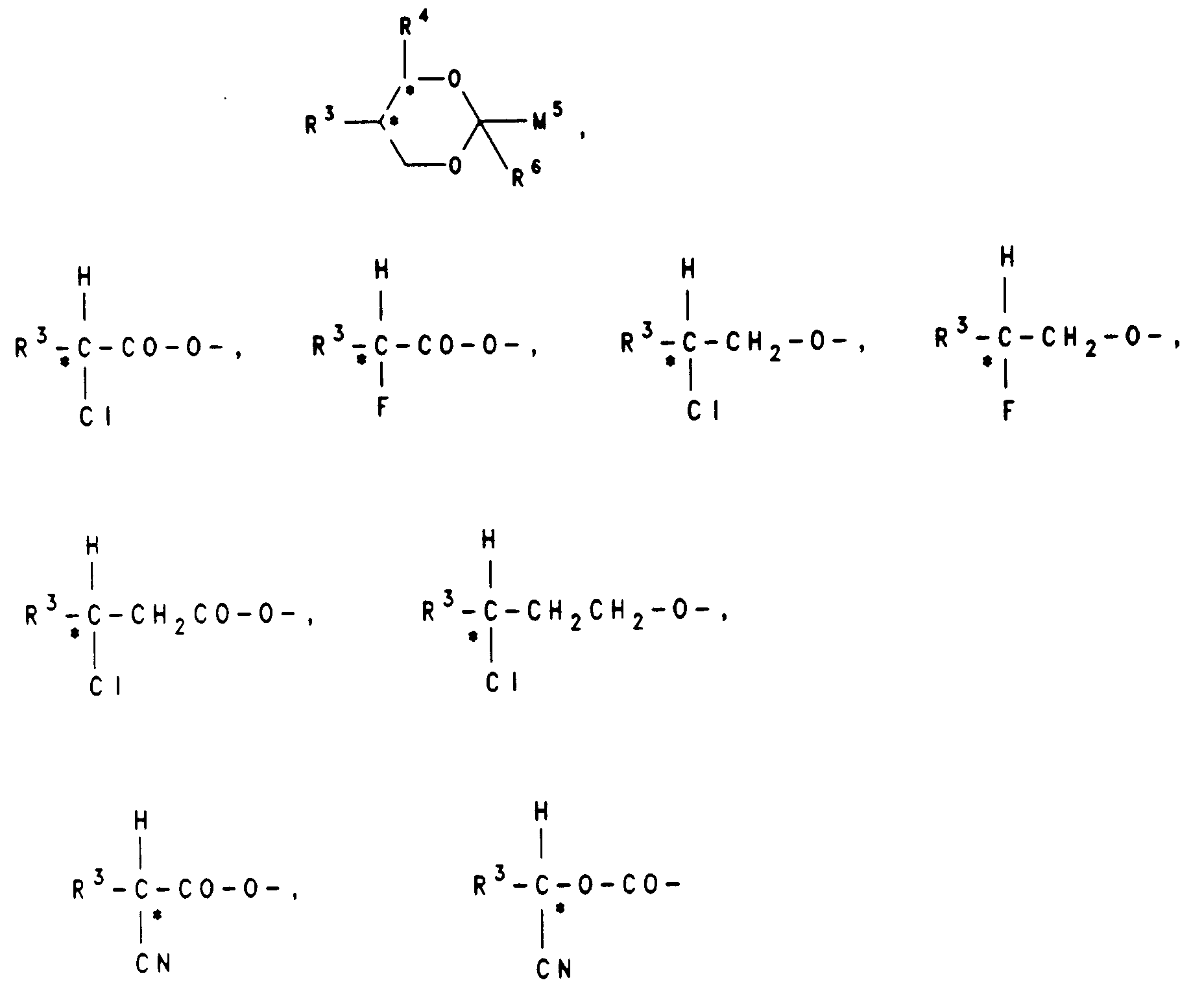
A¹, A², A³, A⁴ gleich oder verschieden, 1,4-Phenylen, Pyrazin-2,5-diyl, Pyridazin-3,6-diyl, Pyridin-2,5-diyl, Pyrimidin-2,5-diyl, wobei ein oder zwei H-Atome jeweils durch F ersetzt sein können, trans-1,4-Cyclohexylen, (1,3,4)-Thiadiazol-2,5-diyl, 1,3-Dioxan-2,5-diyl, Naphthalin-2,6-diyl, Bicyclo[2.2.2]octan-1,4-diyl oder 1,3-Dioxaborinan-2,5-diyl;
M¹, M², M³, M⁴ gleich oder verschieden, -O-,-CO-, -CO-O-, -O-CO-, -CH₂-O-, -O-CH₂-, -CH₂-CH₂-, -CH=CH- oder -C≡C-;
R³, R⁴, R⁶, R⁷ gleich oder verschieden H oder geradkettiges oder verzweigtes Alkyl mit 1 bis 10 bzw. 3 bis 10 C-Atomen oder R³ und R⁴ zusammen auch -(CH₂)₄-oder -(CH₂)₅-, wenn als Substituenten an ein Dioxolan-System gebunden;
M⁵ -CH₂-O-, -CO-O-, -O-CH₂-, -O-CO- oder eine Einfachbindung. - Ferner werden 3-Fluorpyridin-Derivate der Formel (I) bevorzugt, bei denen die Symbole folgende Bedeutung haben:
R¹, R² gleich oder verschieden, -H, -F, -CN oder geradkettiges oder verzweigtes (mit oder ohne asymmetrisches C-Atom) Alkyl mit 1 bis 16 C-Atomen, wobei auch eine -CH₂-Gruppe durch -O-,-CO-, -CO-O-, -O-CO-, -CH=CH- oder -Si(CH₃)₂- ersetzt sein kann, oder eine der nachfolgenden chiralen Gruppen:
A¹, A², A³, A⁴ gleich oder verschieden, 1,4-Phenylen, Pyrazin-2,5-diyl, Pyridazin-3,6-diyl, Pyridin-2,5-diyl, Pyrimidin-2,5-diyl, bei dem ein oder zwei H-Atome durch F ersetzt sein können, trans-1,4-Cyclohexylen, 1,3-Dioxan-2,5-diyl, Naphthalin-2,6-diyl oder 1,3-Dioxaborinan-2,5-diyl;
M¹, M², M³, M⁴ gleich oder verschieden -O-, -CO-O-, -O-CO-, -O-CH₂-, -CH₂-O-, -CH₂-CH₂- oder -CH =CH-;
R³, R⁴, R⁶, R⁷ gleich oder verschieden H oder geradkettiges oder verzweigtes Alkyl mit 1 bis 10 C-Atomen oder R³ und R⁴ zusammen auch -(CH₂)₄- oder - (CH₂)₅-, wenn als Substituenten an ein Dioxolan-System gebunden;
M⁵ -CH₂-O-, -CO-O-, -O-CH₂-, -O-CO- oder eine Einfachbindung. - Insbesondere bevorzugt ist ein 3-Fluorpyridin der Formel (I), bei dem R¹, R² gleich oder verschieden H oder Alkyl mit 1 bis 16 C-Atomen ist, wobei auch eine -CH₂-Gruppe durch -O-, -CO-O- oder -O-CO- ersetzt sein kann, oder die chirale Gruppe

A¹, A², A³, A⁴ gleich oder verschieden, 1,4-Phenylen, Pyrazin-2,5-diyl, Pyridazin-3,6-diyl, Pyridin-2,5-diyl, Pyrimidin-2,5-diyl, bei dem ein oder zwei H-Atome jeweils durch F ersetzt sein können, trans-1,4-Cyclohexylen, 1,3-Dioxan-2,5-diyl, Naphthalin-2,6-diyl oder 1,3 Dioxaborinan-2,5-diyl;
M¹, M², M³, M⁴ sind gleich oder verschieden, -O-, -CO-O-, -O-CO-, -OCH₂-, -CH₂-O- oder -CH₂CH₂-;
R³, R⁴, R⁶ gleich oder verschieden H oder ein geradkettiges Alkyl mit 1 bis 10 C-Atomen;
M⁵ -CH₂-O- oder -CO-O- ist. - Die erfindungsgemäßen Verbindungen sind chemisch und photochemisch stabil. Sie verfügen über niedrige Schmelzpunkte und im allgemeinen breite flüssigkristalline Phasen, insbesondere breite nematische, smektische A und smektische C-Phasen.
Weiterhin zeichnen sich die erfindungsgemäßen Verbindungen durch eine erhöhte Mischbarkeit, niedrige Viskosität und Δε-Werte die nahe bei Null liegen aus. - Aus flüssigkristallinen Verbindungen mit diesem Strukturelement lassen sich sowohl ferroelektrische Mischungen als auch nematische oder auch chiral nematische Mischungen herstellen, die für die Anwendung in elektrooptischen oder vollständig optischen Elementen, z. B. Anzeigeelementen, Schaltelementen, Lichtmodulatoren Elementen zur Bildbearbeitung, Signalverarbeitung oder allgemein im Bereich der nichtlinearen Optik geeignet sind.
- Die erfindungsgemäßen Flüssigkristallmischungen bestehen im allgemeinen aus 2 bis 20, vorzugsweise 2 bis 15 Komponenten, darunter mindestens eine Verbindung der Formel (I). Die anderen Bestandteile werden vorzugsweise ausgewählt aus den bekannten Verbindungen mit nematischen, cholesterischen und/oder geneigtsmektischen Phasen, dazu gehörten beispielsweise Schiffsche Basen, Biphenyle, Pyridine, Thiadiazole, Difluorphenyle, Terphenyle, Phenylcyclohexane, Cyclohexylbiphenyle, Pyrimidine, Zimtsäureester, Cholesterinester sowie mehrkernige Ester von p-Alkylbenzoesäuren. Im allgemeinen liegen die im Handel erhältlichen Flüssigkristallmischungen bereits vor der Zugabe der erfindungsgemäßen Verbindung(en) als Gemische verschiedener Komponenten vor, von denen mindestens eine mesogen ist.
- Von dem oder den erfindungsgemäßen 3-Fluorpyridin-Derivaten enthalten die Flüssigkristallmischungen im allgemeinen 0,1 bis 70 Mol-%, bevorzugt 0,5 bis 50 Mol-%, insbesondere 1 bis 25 Mol-%.
- Für die gebrauchsfertigen ferroelektrischen Flüssigkristallmischungen wurden die Werte für die spontane Polarisation Ps[nC/cm²], den Kontrast K und die optische Schaltzeit τ[µs] bestimmt, wobei alle Messungen bei einer Temperatur von 25 °C vorgenommen wurden.
- Die Ps-Werte werden nach der Methode von H. Diamant et al. (Rev. Sci. Instr., 28, 30, 1957) gemessen, wobei Meßzellen mit 2 µm Elektrodenabstand und geriebenem Polyimid als Orientierungsschicht verwendet werden.
Zur Bestimmung von τ und K wird die Meßzelle auf dem Drehtisch eines Polarisationsmikroskops zwischen gekreuztem Analysator und Polarisator befestigt. Für die Bestimmung des Kontrastes (K) wird die Meßzelle durch Drehen so positioniert, daß eine Photodiode minimalen Lichtdurchgang anzeigt (Dunkelzustand). Die Mikroskop-Beleuchtung wird so geregelt, daß die Photodiode für alle Zellen die gleiche Lichtintensität anzeigt. Nach einem Schaltvorgang ändert sich die Lichtintensität (Hellzustand) und der Kontrast wird aus dem Verhältnis der Lichtintensitäten dieser Zustände berechnet. - Zur Bestimmung von τ und des Schaltwinkels φeff wird durch Drehen des Tisches die Position des Tisches mit minimalem Lichtdurchgang für die beiden Schaltzustände in der Zelle bestimmt. Die Differenz der beiden Positionen am Drehtisch ist gleich dem doppelten effektiven Tiltwinkel. Mit Hilfe einer Photodiode erfolgt die Bestimmung der Schaltzeit τ, indem die Anstiegszeit des Lichtsignals von 10 auf 90 % Signalhöhe gemessen wird. Die Schattspannung besteht aus Rechteckpulsen und beträgt ± 10 V/µm.
- Die Phasenumwandlungstemperaturen werden beim Aufheizen mit Hilfe eines Polarisationsmikroskops anhand der Texturänderungen bestimmt. Die Bestimmung des Schmelzpunkts wurde hingegen mit einem DSC-Gerät durchgeführt. Die Angabe der Phasenumwandlungstemperaturen zwischen den Phasen
Nematisch (N bzw. N*)
Smektisch-C (SC bzw. SC*)
Smektisch-A (SA bzw. SA*)
Kristallin (X)
erfolgt in °C und die Werte stehen zwischen den Phasenbezeichnungen in der Phasenfolge. - Flüssigkristalline Mischungen, die Verbindungen der allgemeinen Formel (I) enthalten, sind besonders für die Verwendung in elektrooptischen Schalt- und Anzeigevorrichtungen (Displays) geeignet. Schalt- und Anzeigevorrichtungen (LC-Displays) weisen u. a. folgende Bestandteile auf: ein flüssigkristallines Medium, Trägerplatten (z. B. aus Glas oder Kunststoff), beschichtet mit transparenten Elektroden, mindestens eine Orientierungsschicht, Abstandshalter, Kleberahmen, Polarisatoren sowie für Farbdisplays dünne Farbfilterschichten. Weitere mögliche Komponenten sind Antireflex-, Passivierungs-, Ausgleichs- und Sperrschichten sowie elektrisch-nichtlineare Elemente, wie Dünnschichttransistoren (TFT) und Metall-Isolator-Metall-(MIM)-Elemente. Im Detail ist der Aufbau von Flüssigkristalldisplays bereits in einschlägigen Monographien beschrieben (z. B. E. Kaneko, "Liquid Crystal TV Displays: Principles and Applications of Liquid Crystal Displays", KTK Scientific Publishers, 1987, Seiten 12 - 30 und 63 - 172).
- Die Herstellung der erfindungsgemäßen Verbindungen kann beispielsweise durch das in den Schemata 1 bis 6 skizzierte Verfahren erfolgen, bei dem über die Zwischenstufe 2,5-Dibrom-3-fluorpyridin (VI) durch mehrstufige Umsetzung die Seitenketten
R¹(-A¹)k(-M¹)l(-A²)m(-M²)n- und (-M³)o(-A³)p(-M⁴)q(-A⁴)r-R² in die 2- bzw. 5-Position des Pyridinrings eingebracht werden. - Ausgangsverbindung des erfindungsgemäßen Herstellungsverfahrens ist das kommerziell erhältliche 2-Amino-5-brompyridin (II), welches analog der von T. S. Safonova und L. G. Levkovskaya in Khim. Geterotsikl. Soedin 1968, Seite 997 - 1000 beschriebenen Methode mit Salpeter- und Schwefelsäure in 5-Brom-2-hydroxy-3-nitropyridin (III) überführt werden kann.
- Durch Umsetzung des 2-Hydroxypyridins (III) mit einem Bromierungsmittel, wie Phosphortribromid, Phosphoroxytribromid und Phosphorpentabromid, bei Temperaturen zwischen 50 und 200 °C, insbesondere zwischen 100 und 150 °C, wird das 2,5-Dibrom-3-nitropyridin (IV) erhalten, welches nach ansich literaturbekannten Methoden (siehe z. B. Houben-Weyl, Methoden der Organischen Chemie, Georg Thieme Verlag, Stuttgart) zum 3-Amino-2,5-dibrompyridin (V) reduziert wird.
- Verbindung (V) läßt sich nach der Methode von Balz und Schiemann (siehe Houben-Weyl, Methoden der Organischen Chemie, Georg Thieme Verlag, Stuttgart) über die Diazotierung zum Diazonium-tetrafluoroborat und die thermische Zersetzung desselben in 2,5-Dibrom-3-fluoropyridin (VI) umwandeln.
- Eine alternative Ausgangsverbindung des erfindungsgemäßen Herstellungsverfahrens ist 3-Fluor-2-hydroxypyridin (XIV), welches nach der von M.P. Cava und B. Weinstein im Journal of Organic Chemistry 23 (1958) auf den Seiten 1616 bis 1617 beschriebenen Methode hergestellt werden kann.
- Durch Umsetzung von 3-Fluor-2-hydroxypyridin (XIV) mit Brom bei Temperaturen zwischen -70°C und 150°C, insbesondere zwischen -20°C und 50°C in einem inerten Lösungsmittel wird 5-Brom-3-fluor-2-hydroxypyridin (XV) erhalten, welches durch Behandlung mit einem Bromierungsmittel, wie Phosphortribromid, Phosphoroxytribromid und Phosphorpentabromid, bei Temperaturen zwischen 50°C und 250°C, insbesondere zwischen 100°C und 170°C in das 2,5-Dibrom-3-fluorpyridin (VI) überführt werden kann.
- Der Austausch des Brom-Substituenten in 2-Position der Verbindung (VI) gegen eine Gruppierung der allgemeinen Formel Z¹ = (-M³)o(-A³)p(-M⁴)q(-A⁴)r-R² durch Umsetzung mit einer Metallverbindung von Z¹, z. B. einer Lithium-, Natrium-, Kalium- oder Magnesiumverbindung, bei Temperaturen zwischen -40 und 100 °C, insbesondere zwischen -10 und 70 °C, in einem inerten Reaktionsmedium, z. B. Diethylether, Tetrahydrofuran, 1,4-Dioxan, Ethylenglykoldiethylether oder Diethylenglykoldiethylether, führt zu Verbindungen der Formel (VII).
- Die Kreuzkupplung von Verbindung (VI) mit metallorganischen Derivaten von Z¹, z. B. Grignard-, Lithium- und Zinkderivaten, sowie Boronsäuren von Z¹ unter Verwendung von Übergangsmetallkatalysatoren, z. B. [1,3-bis(diphenylphosphino)-propan]nickel(II)chlorid und Tetrakis(triphenylphosphin)palladium(0) bei Temperaturen zwischen -40 und 200 °C, insbesondere zwischen -10 und 100 °C, in Reaktionsmedien, wie Benzol/Ethanol/Wasser für die Umsetzung mit Boronsäuren von Z¹ und z. B. Diethylether oder Tetrahydrofuran für die Umsetzung mit Grignard-, Lithium- und Zinkderivaten von Z¹, liefert ebenfalls Verbindungen des Typs (VII).
- Durch Kreuzkupplung von Verbindungen des Typs (VII) mit metallorganischen Derivaten von Z², z. B. Grignard-, Lithium- und Zinkderivaten, sowie Boronsäuren von Z² unter Verwendung von Übergangsmetallkatalysatoren, z. B. [1,3-bis(diphenylphosphino)propan]nickel(II)chlorid und Tetrakis(triphenylphosphin)palladium(0) bei Temperaturen zwischen -40 und 200 °C, insbesondere zwischen -10 und 100 °C, in Reaktionsmedien, wie Benzol/Ethanol/Wasser für die Umsetzung mit Boronsäuren von Z² und Diethylether oder Tetrahydrofuran für die Umsetzung mit Grignard-, Lithium- und Zinkderivaten von Z², erhält man 3-Fluorpyridine (I).
- 3-Fluorpyridine des Typs (VII) können durch Behandlung mit einem Lithiumalkyl, wie n-Butyllithium, tert.-Butyllithium oder Methyllithium, bei Temperaturen zwischen - 100 und 50 °C, insbesondere zwischen -80 und 10 °C, in einem inerten Reaktionsmedium, z. B. Diethylether, Tetrahydrofuran oder Ethylenglykoldimethylether, in 3-Fluor-5-lithiumpyridine der Formel (VIII) überführt werden. 5-Lithiumpyridine der allgemeinen Formel (VIII) sind der Umsetzung mit elektrophilen Verbindungen zugänglich, wodurch entweder direkt oder über weitere Zwischenstufen (Verbindungen (IX), (X), (XI), (XII) und (XIII)) 3-Fluorpyridine der Formel (I) erhalten werden können.
- So führen 3-Fluor-5-lithiumpyridine (VIII) nach der Behandlung mit Kohlendioxid bei Temperaturen zwischen -100 und 50 °C, insbesondere zwischen -80 und 10 °C, in einem inerten Reaktionsmedium, z. B. Diethylether, Tetrahydrofuran oder Ethylenglykoldiethylether zu 3-Fluor-5-pyridincarbonsäuren der allgemeinen Formel (IX). Die Spezies (IX) können nach an sich literaturbekannten Methoden (siehe z. B. Houben-Weyl, Methoden der Organischen Chemie, Georg Thieme Verlag, Stuttgart), entweder direkt durch Veresterung mit Alkoholen von Z³ unter Zuhilfenahme geeigneter Kondensationsmittel, z. B. Carbodiimiden, zu 3-Fluorpyridinen (I) oder nach Reduktion zu 3-Fluor-5-hydroxymethylpyridinen (X) mit geeigneten Reduktionsmitteln, z. B. komplexen Hydriden, durch Veresterung mit Carbonsäuren bzw. Carbonsäurehalogeniden von Z³ oder durch Veretherung mit Alkoholen bzw. Halogeniden von Z³ zu Verbindungen der Formel (I) umgesetzt werden.
- Die Reaktion von Verbindungen des Typs (VIII) mit Nitrilen, Carbonsäurehalogeniden und Formylmethylderivaten von Z³ bei Temperaturen zwischen -100 und 50 °C, insbesondere zwischen -80 und 10 °C, in einem inerten Reaktionsmedium, z. B. Diethylether, Tetrahydrofuran oder Ethylenglykoldiethylether, führt direkt zu 3-Fluorpyridinen der Formel (I). Olefinische 3-Fluorpyridine (I) lassen sich durch Hydrierung der olefinischen Doppelbindung nach an sich literaturbekannten Methoden (siehe z. B. Houben-Weyl, Methoden der Organischen Chemie, Georg Thieme Verlag, Stuttgart) in gesättigte Spezies (I) umwandeln.
- Durch Reaktion von 3-Fluor-5-lithiumpyridinen (VIII) mit Ameisensäureamiden bei Temperaturen zwischen -100 und 50 °C, insbesondere zwischen -80 und 10 °C, in einem inerten Rekationsmedium, z. B. Diethylether, Tetrahydrofuran oder Ethylenglykoldiethylether werden 3-Fluor-5-formylpyridine (XI) erhalten, welche nach der sauer katalysierten Acetalisierung mit 2-Z⁴-1,3-Propandiolen nach an sich literaturbekannten Methoden (siehe z. B. Houben-Weyl, Methoden der Organischen Chemie, Georg Thieme Verlag, Stuttgart) 3-Fluorpyridine des Typs (I) liefern.
- Bei der sukzessiven Behandlung der 3-Fluor-lithiumpyridine (VII) mit Borsäuretrialkylestern bei Temperaturen zwischen -100 und 50 °C, insbesondere zwischen -80 und 10 °C, und wäßriger Säure bei Temperaturen zwischen -10 und 50 °C, insbesondere zwischen 10 und 30 °C, in einem inerten Reaktionsmedium, z. B. Diethylether, Tetrahydrofuran oder Ethylenglykoldiethylether, werden 3-Fluor-5-pyridinboronsäuren der Formel (XII) erhalten.
- Die Boronsäuren (XII) können Kupplungsreaktionen mit Halogeniden von Z³ unter Verwendung eines Übergangsmetallkatalysators, z. B. Tetrakis(triphenylphosphin)palladium[0], bei Temperaturen zwischen 30 und 200 °C, insbesondere zwischen 50 und 100 °C, in Reaktionsmedien, wie Benzol/Ethanol/Waser, zur Darstellung von Verbindungen des Typs (I) unterworfen werden.
- 3-Fluorpyridine (I) werden aus den Boronsäuren (XII) desweiteren durch deren Veresterung mit 2-Z⁴-1,3-Propandiolen nach an sich literaturbekannten Methoden (siehe z. B. Houben-Weyl, Methoden der Organischen Chemie, Georg Thieme Verlag, Stuttgart) erhalten.
- Die Oxidation der Boronsäuren (XII) mit Peroxiden, z. B. Wasserstoffperoxid, bei Temperaturen zwischen 10 und 100 °C, insbesondere zwischen 30 und 70 °C, in Reaktionsmedien, wie z. B. Diethylether oder Tetrahydrofuran, führt zu den 3-Fluor-5-hydroxypyridinen (XIII), welche sich nach an sich literaturbekannten Methoden (siehe z. B. Houben-Weyl, Methoden der Organischen Chemie, Georg Thieme Verlag, Stuttgart) durch Veresterung mit Carbonsäuren bzw. Carbonsäurehalogeniden von Z³ oder durch Veretherung mit Alkoholen bzw. Halogeniden von Z³ in 3-Fluorpyridine der allgemeinen Formel (I) überführen lassen.


Z¹ = (-M³)o(-A³)p(-M⁴)q(-A⁴)r-R²
Z² = R¹(-A¹)k(-M¹)l(-A²)m(-M²)n-

Z¹, Z² siehe Schema 2
Z³ = R¹ (-A¹)k(-M¹)l(-A²)m-
X = Cl, Br, I

Z¹, Z², Z³, X siehe Schema 2 und 3.
Z⁴ = R¹(-A¹)k(-M¹)l
R⁸ = geradkettiges oder verzweigtes Alkyl mit 1 bis 10 C-Atomen
Z¹, Z², Z³, Z⁴, R⁸, X siehe Schemata 2, 3 und 4.
Die Erfindung wird durch die nachfolgenden Beispiele näher erläutert: - Zu 100 g (574,7 mmol) 2-Amino-5-Brompyridin in 300 ml konzentrierter Schwefelsäure (d = 1,84 g/cm³) werden bei 60 °C 34,5 ml (821,6 mmol) rauchende Salpetersäure (d = 1,5 g/cm³) getropft und anschließend 2 h bei 60 °C gerührt. Das Reaktionsgemisch wird auf Eiswasser gegossen, der ausgefallene Feststoff wird abfiltriert, mit Wasser gewaschen und getrocknet. Es werden 88,16 g 5-Brom-2-hydroxy-3-nitropyridin erhalten.

77,11 g (354,4 mmol) 5-Brom-2-hydroxy-3-nitropyridin werden zusammen mit 101,61 g (354,4 mmol) Phosphoroxytribromid und 33,7 ml (354,4 mmol) Phosphortribromid für 3 h auf 120 °C erhitzt. Anschließend wird das Reaktionsgemisch in kleinen Portionen vorsichtig auf Eiswasser gegossen, 1 h gerührt und dreimal mit Dichlormethan extrahiert. Die organische Phase wird zweimal mit Wasser gewaschen, über Natriumsulfat getrocknet, filtriert und vom Lösungsmittel befreit. Nach chromatographischer Reinigung (Kieselgel/Dichlormethan) werden 43,05 g 2,5-Dibrom-3-nitropyridin erhalten.
43,00 g (152,52 mmol) 2,5-Dibrom-3-nitropyridin werden unter Verwendung von 1,5 g Pd (10 %) auf Aktivkohle in 450 ml Methanol bis zum Verbrauch der berechneten Menge Wasserstoff hydriert, vom Katalysator abfiltriert und vom Lösungsmittel befreit. Es werden 37,56 g 3-Amino-2,5-dibrompyridin erhalten.
37,00 g (146,87 mmol) 3-Amino-2,5-dibrompyridin werden in 50 ml wäßriger HBF₄ (35 %ig) bei -10 °C mit 11,10 g (160,87 mmol) Natriumnitrit in 20 ml Wasser diazotiert. Nach halbstündigem Nachrühren bei -10 °C wird das Reaktionsgemisch 30 min auf 50 °C erhitzt, auf Eiswasser gegossen, mit Natriumhydrogencarbonat neutralisiert und dreimal mit Dichlormethan extrahiert. Die organische Phase wird zweimal mit Wasser gewaschen, über Natriumsulfat getrocknet, filtriert und vom Lösungsmittel befreit. Nach chromatographischer Reinigung (Kieselgel/Dichlormethan) werden 11,10 g 2,5-Dibrom-3-fluorpyridin erhalten.
Aus 2,40 g (99,0 mmol) Magnesium und 25,56 g (89,6 mmol) 4-Octyloxybrombenzol in 250 ml Tetrahydrofuran werden in 3 h bei 60 °C die Lösung der Grignardverbindung hergestellt, welche zu einer auf -70 °C abgekühlten Lösung von 18,62 g (99,00 mmol) Triisopropylborat in 100 ml Tetrahydrofuran getropft und über Nacht gerührt wird. Anschließend werden 130 ml 10 %ige Salzsäure zugetropft und 1 h bei Raumtemperatur gerührt, zwischen Natriumchloridlösung und Ether verteilt, die organische Phase mit Natriumchloridlösung gewaschen, über Natriumsulfat getrocknet und eingeengt, wonach 21,26 g 4-Octyloxybenzolboronsäure erhalten werden.
12,74 g (50,00 mmol) 2,5-Dibrom-3-fluorpyridin, 12,51 g (50,00 mmol) 4-Octyloxybenzolboronsäure, 0,58 g (0,50 mmol) Tetrakis(triphenylphosphin)palladium(0) und 10,60 g (100 mmol) Natriumcarbonat werden in 375 ml Toluol, 250 ml Ethanol und 125 ml Wasser 3 h auf 80 °C erhitzt. Anschließend wird zwischen wäßriger Natriumchloridlösung und Ether verteilt, die organische Phase mit wäßriger Natriumchloridlösung gewaschen, über Natriumsulfat getrocknet, eingeengt und chromatographisch (Kieselgel/Hexan: Essigester = 9:1) gereinigt. Es werden
13,31 g 5-Brom-3-fluor-2-(4-octyloxyphenyl)pyridin erhalten.
Aus 0,30 g (12,30 mmol) Magnesium und 2,16 g (11,18 mmol) Octylbromid in 10 ml Tetrahydrofuran wird in 2 h bei 50 °C die Lösung der Grignardverbindung hergestellt, welche zu einer auf -10 °C abgekühlten Lösung von 2,13 g (5,59 mmol) 5-Brom-3-fluor-2-(4-octyloxyphenyl)pyridin und 0,03 g (0,06 mmol) [1,3-Bis(diphenylphosphino)-propan]nickel(II)chlorid in 60 ml Tetrahydrofuran getropft und 3 h bei -10 °C gerührt wird. Anschließend wird zwischen Ether und wäßriger Ammoniumchloridlösung verteilt, die organische Phase zweimal mit wäßriger Natriumchloridlösung gewaschen, über Natriumsulfat getrocknet und zur Trockne eingeengt. Nach chromatographischer Reinigung (Kieselgel/Dichlormethan: Hexan 7:3) werden 1,89 g 3-Fluor-5-octyl-2-(4-octyloxyphenyl)pyridin erhalten.
Die Verbindung zeigt die Phasenfolge:
X 25,5 (5) N 35 I. - Zu einer auf -70 °C abgekühlten Lösung von 7,61 g (20,00 mmol) 5-Brom-3-fluor-2-(4-octyloxyphenyl)pyridin in 400 ml Tetrahydrofuran werden 15 ml (24,00 mmol) 1,6 molare n-Butyllithiumlösung in Hexan getropft und 15 min bei -70 °C gerührt. Anschließend werden 7,5 g (40,00 mmol) Triisopropylborat zugetropft, 1,5 h bei -70 °C gerührt, auf Raumtemperatur erwärmt, 500 ml Ammoniumchloridlösung und 500 ml Ether zugegeben, die organische Phase abgetrennt und zweimal mit wäßriger Natriumchloridlösung gewaschen, über Natriumsulfat getrocknet und eingeengt. Die so erhaltene 3-Fluor-2-(4-octyloxyphenyl)pyridin-5-boronsäure wird in 100 ml Tetrahydrofuran mit 30 ml 17,5 Gew.-%iger wäßriger Wasserstoffperoxidlösung 2 h unter Rückfluß erhitzt, anschließend auf 0 °C abgekühlt und tropfenweise mit 200 ml wäßriger Natriumsulfitlösung versetzt. Die organische Phase wird abgetrennt, zweimal mit wäßriger Natriumchloridlösung gewaschen, über Natriumsulfat getrocknet und zur Trockne eingeengt. Nach Umkristallisation aus 1,2-Dichlorethan werden 5,08 g 3-Fluor-5-hydroxy-2-(4-octyloxyphenyl)pyridin erhalten.

Zu 3,00 g (11,5 mmol) Triphenylphosphin in 50 ml Tetrahydrofuran werden bei 0 °C 2,00 g (11,5 mmol) Azodicarbonsäurediethylester getropft und 30 min. bei Raumtemperatur gerührt. Anschließend werden 2,42 g (7,7 mmol) 3-Fluor-5-hydroxy-2-(4-octyloxyphenyl)pyridin und 1,00 g (7,7 mmol) 1-Octanol zugegeben. Nach einer Reaktionszeit von 18 h bei Raumtemperatur wird das Lösungsmittel abdestilliert und der Rückstand chromatographisch (Kieselgel/Hexan: Ethylacetat 95:5) gereinigt. Nach Umkristallisation aus Acetonitril werden 1,38 g 3-Fluor-5-octyloxy-2-(4-octyloxyphenyl)pyridin erhalten.
Die Verbindung zeigt die Phasenfolge:
X 51,3 (42,5) SA 50 N 69 I.
- Die Synthese erfolgt analog Beispiel 2.

Die Verbindung zeigt die Phasenfolge:
X 57 (48) Sc 49 SA 69 N 70 I
- Zu 1,5 g (4,7 mmol) 3-Fluor-5-hydroxy-2-(4-octyloxyphenyl)pyridin in 20 ml Pyridin werden bei 0 °C 1,2 ml (7,1 mmol) Octansäurechlorid zugetropft und 3 h bei 0 °C gerührt. Anschließend wird auf Eiswasser gegossen, abfiltriert und der Rückstand chromatographisch (Kieselgel/Hexan: Ethylacetat 9:1) und durch Umkristallisation aus Acetonitril gereinigt. Es werden 1,34 g Octansäure-[3-fluor-2-(4-octyloxyphenyl)pyridin-5-yl]ester erhalten.
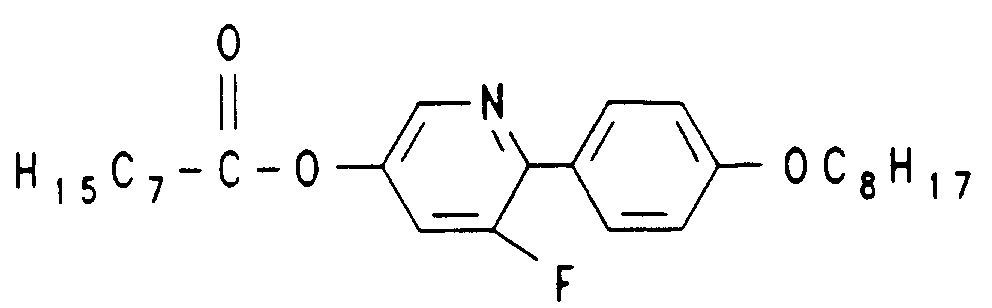
- Zu 63,7 g (563,2 mmol) 3-Fluor-2-hydroxypyridin in 700 ml Dimethylformamid werden bei 0°C 32,0 ml (620,0 mmol) Brom getropft. Nach zweistündigem Nachrühren bei Raumtemperatur werden 800 ml Wasser zugegeben und 78 g Na₂SO₃ in 350 ml Wasser zugetropft. Anschließend wird dreimal mit je 400 ml Dichlormethan extrahiert, die organische Phase über Na₂SO₄ getrocknet und zur Trockne eingeengt. Es werden 97,6 g 5-Brom-3-fluor-2-hydroxypyridin erhalten.

97,6 g (508,0 mmol) 5-Brom-3-fluor-2-hydroxypyridin werden in 500 ml Phosphortribromid 6 h bei 150°C gerührt. Anschließend wird auf Eiswasser gegossen, 2 h gerührt, dreimal mit Dichlormethan extrahiert, die organische Phase mit Natriumhydrogencarbonatlösung neutral gewaschen, über Natriumsulfat getrocknet und zur Trockne eingeengt. Nach chromatographischer Reinigung (Kieselgel/Dichlormethan) werden 76,53 g 2,5-Dibrom-3-fluorpyridin erhalten.
Lithiumoctanolat (das zuvor aus 13,02 g (100,00 mmol) 1-Octanol und 69 ml (110,00 mmol) einer 1,6 molaren n-Butyllithiumlösung in n-Hexan in 40 ml Tetrahydrofuran bei 0 °C hergestellt wurde) und 25,49 g (100,00 mmol) 2,5-Dibrom-3-fluorpyridin werden in 40 ml Tetrahydrofuran 7 h unter Rückfluß erhitzt. Anschließend wird zwischen wäßriger Natriumchloridlösung und Ether verteilt, die Etherphase zweimal mit wäßriger Natriumchloridlösung gewaschen, über Natriumsulfat getrocknet, filtriert und vom Lösungsmittel befreit. Nach chromatographischer Reinigung (Kieselgel/Hexan: Ethylacetat 9:1) werden 18,19 g (59,80 mmol) 5-Brom-3-fluor-2-octyloxypyridin erhalten.
3,00 g (9,86 mmol) 5-Brom-3-fluor-2-octyloxypyridin, 2,47 g (9,86 mmol) 4-Octyloxybenzolboronsäure, 0,11 g (0,10 mmol) Tetrakis(triphenylphosphin)palladium(0) und 2,09 g (19,72 mmol) Natriumcarbonat werden in 90 ml Toluol, 60 ml Ethanol und 30 ml Wasser 3 h auf 80 °C erhitzt. Anschließend wird zwischen wäßriger Natriumchloridlösung und Ether verteilt, die organische Phase mit wäßriger Natriumchloridlösung gewaschen, über Natriumsulfat getrocknet, eingeengt und chromatographisch gereinigt (Kieselgel/Hexan: Ethylacetat 9:1). Es werden 2,85 g 3-Fluor-2-octyloxy-5-(4-octyloxyphenyl)pyridin erhalten.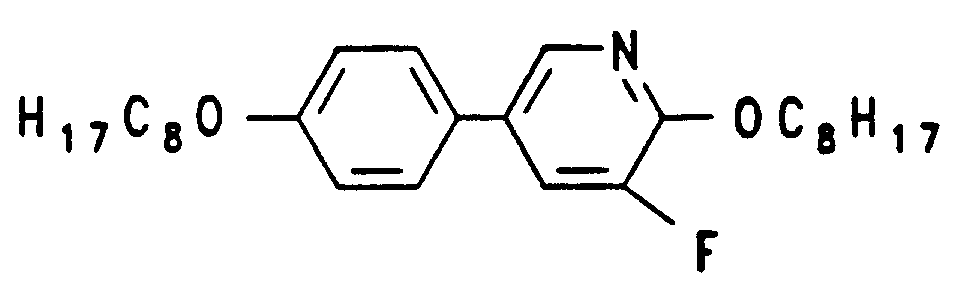
- Die Darstellung erfolgt analog Beispiel 2

- 4,00 g (10,51 mmol) 5-Brom-3-fluor-2-(4-octyloxyphenyl)pyridin, 2,63 g (10,51 mmol) 4-Octyloxybenzolboronsäure, 0,12 g (0,11 mmol) Tetrakis(triphenylphosphin)palladium(0) und 2,23 g (21,02 mmol) Natriumcarbonat werden in 100 ml Toluol, 70 ml Ethanol und 40 ml Wasser 3 h auf 80 °C erhitzt. Anschließend wird zwischen wäßriger Natriumchloridlösung und Ether verteilt, die organische Phase mit wäßriger Natriumchloridlösung gewaschen, über Natriumsulfat getrocknet, eingeengt und chromatographisch gereinigt (Kieselgel/Dichlormethan). Es werden 3,72 g 3-Fluor-2,5-di(4-octyloxyphenyl)pyridin erhalten.

Die Verbindung zeigt die Phasenfolge:
X 88 (77,9) Sc 142 SA 171 N 172 I.
- Die Darstellung erfolgt analog Beispiel 5.

- 0,29 g (0,91 mmol) 3-Fluor-5-hydroxy-2-(4-octyloxyphenyl)pyridin, 0,19 g (0,91 mmol) Dicyclohexylcarbodiimid, 0,16 g (0,91 mmol) trans-4-Pentylcyclohexancarbonsäure und 0,01 g 4-(N,N-Dimethylamino)pyridin werden in 10 ml Dichlormethan 18 h bei Raumtemperatur gerührt. Nach Filtration, Einengen zur Trockne, chromatographischer Reinigung (Kieselgel/Hexan: Ethylacetat 8:2) und Umkristallisation aus Acetonitril werden 0,19 g trans-4-Pentylcyclohexancarbonsäure-[3-fluor-2-(4-octyloxyphenyl)pyridin-5-yl]ester erhalten.

Die Verbindung zeigt die Phasenfolge:
X 65,2 (40,2) Sc 63 SA 129 N 173 I.
- Zu 35,24 g (130,0 mmol) tert.-Butyl-chlor-diphenylsilan und 11,25 g (65,0 mmol) 4-Bromphenol in 150 ml Dimethylformamid werden bei Raumtemperatur 11,06 g (162,5 mmol) Imidazol in 30 ml Dimethylformamid getropft. Nach einstündigem Rühren bei Raumtemperatur wird das Reaktionsgemisch auf 1000 ml 5 Gew.-%ige wäßrige Natriumhydrogencarbonatlösung gegossen, zweimal mit 400 ml Dichlormethan extrahiert, die organische Phase mit wäßriger Natriumchloridlösung gewaschen, über Natriumsulfat getrocknet, filtriert und zur Trockne eingeengt. Nach chromatographischer Reinigung (Kieselgel/Hexan: Ethylacetat 8:2) werden 23,40 g 4-Bromphenyl-tert.-butyl-diphenylsilylether erhalten.

Analog Beispiel 1 wird aus 4-Bromphenyl-tert.-butyl-diphenylsilylether 4-tert.-Butyl-diphenylsilyloxybenzolboronsäure hergestellt.
Analog Beispiel 1 wird aus 2,5-Dibrom-3-fluorpyridin und 4-tert.-Butyl-diphenylsilyloxybenzolboronsäure 5-Brom-2-(4-tert.-butyl-diphenylsilyloxyphenyl)-3-fluorpyridin hergestellt.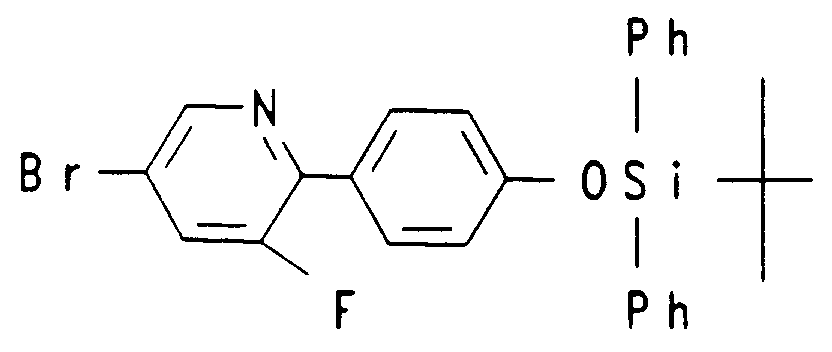
Analog Beispiel 2 wird aus 5-Brom-2-(4-tert.-butyl-diphenylsilyloxyphenyl)-3-fluorpyridin 2-(4-tert.-Butyl-diphenylsilyloxyphenyl)-3-fluor-5-hydroxypyridin hergestellt.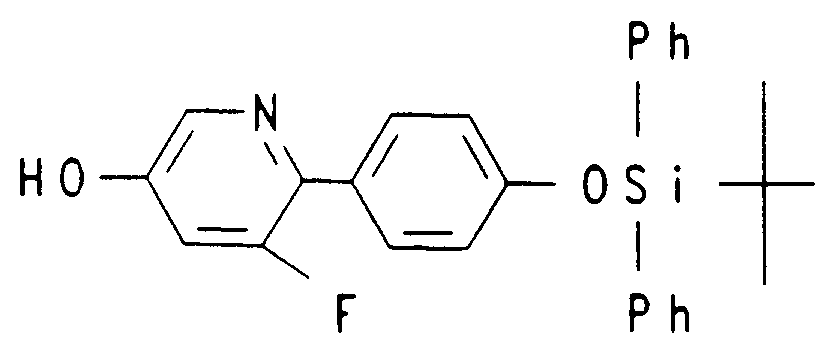
Analog Beispiel 2 wird aus 2-(4-tert-Butyl-diphenylsilyloxyphenyl)-3-fluor-5-hydroxypyridin und Octanol 2-(tert.-Butyl-diphenylsilyloxyphenyl)-3-fluor-5-octyloxypyridin hergestellt.
4,30 g (8,00 mmol) 2-(4-tert.-Butyl-diphenylsilyloxyphenyl)-3-fluor-5-octyloxypyridin werden mit 16 ml einer 1-molaren Tetrabutylammoniumfluoridlösung in Tetrahydrofuran in 50 ml Tetrahydrofuran 2 h bei Raumtemperatur gerührt. Anschließend wird mit wäßriger Natriumchloridlösung versetzt, mit Ether extrahiert, die Etherphase mit wäßriger Natriumchloridlösung gewaschen, über Natriumsulfat getrocknet, zur Trockne eingeengt und chromatographisch (Kieselgel/Hexan: Ethylacetat 8:2) gereinigt. Es werden 2,16 g 3-Fluor-2-(4-hydroxyphenyl)-5-octyloxypyridin erhalten.
1,11 g (83,50 mmol) 3-Fluor-2-(4-hydroxyphenyl)-5-octyloxypyridin, 0,72 g (3,50 mmol) Dicyclohexylcarbodiimid, 0,69 g (3,50 mmol) trans-4-Pentylcyclohexancarbonsäure und 0,02 g 4-(N,N-Dimethylamino)pyridin werden in 20 ml Dichlormethan 3 h bei Raumtemperatur gerührt. Nach Filtration, Einengen zur Trockne, chromatographischer Reinigung (Kieselgel/Hexan: Essigester 8:2) und Umkristallisation aus n-Hexan werden 1,00 g trans-4-Pentylcyclohexancarbonsäure-[4-(3-fluor-5-octylpyridin-2-yl)phenyl]ester erhalten.
Die Verbindung zeigt die Phasenfolge: X 75 (60) N 169 I. -
- Analog Beispiel 1 wird aus 4-(Trans-4-pentylcyclohexyl)brombenzol 4-(Trans-4-pentylcyclohexyl)benzolboronsäure hergestellt.

Analog Beispiel 1 wird aus 4-(Trans-4-pentylcyclohexyl)benzolboronsäure und 2,5-Dibrom-3-fluor-pyridin 5-Brom-3-fluor-2-[4-(trans-4-pentylcyclohexyl)phenyl]pyridin hergestellt.
Analog Beispiel 2 erhält man aus 5-Brom-3-fluor-2-[4-(trans-4-pentylcyclohexyl)phenyl]pyridin 3-Fluor-5-hydroxy-2-[4-(trans-4-pentylcyclohexyl)phenyl]pyridin.
Analog Beispiel 2 wird aus Octanol und 3-Fluor-5-hydroxy-2-[4-(trans-4-pentylcyclohexyl)phenyl]pyridin 3-Fluor-5-ocryloxy-2-[4-(trans-4-pentylcyclohexyl)phenyl]pyridin erhalten.
-
- Die Darstellung erfolgt analog Beispiel 5.

- Die Darstellung erfolgt analog Beispiel 5.

- Die Darstellung erfolgt analog Beispiel 11.

- Zu 0,67 g (2,55 mmol) Triphenylphosphin in 15 ml Tetrahydrofuran werden bei 0 °C 0,44 g (2,55 mmol) Azodicarbonsäurediethylester getropft und 30 min. bei Raumtemperatur gerührt. Anschließend werden 0,54 g (1,70 mmol) 3-Fluor-5-hydroxy-2-(4-octyloxyphenyl)pyridin und 0,25 g (1,70 mmol) 2-[(2S,3S)-3-Pentyloxiranyl]methanol zugegeben. Nach einer Reaktionszeit von 18 h bei Raumtemperatur wird das Lösungsmittel abdestilliert und der Rückstand chromatographisch (Kieselgel/Hexan:Ethylacetat 8:2) gereinigt. Die Umkristallisation aus Hexan: Ethylacetat 8:2) ergibt 0,28 g [(2S,3S)-3-Pentyloxiran-2-yl]methyl-[3-fluor-2-(4-octyloxyphenyl)pyridin-5-yl]ether.

Die Verbindung zeigt die Phasenfolge:
X 54,6 (14,5) Sc 53 SA 65 N 73 I.
- Zu 1,37 g (5,25 mmol) Triphenylphosphin in 20 ml Tetrahydrofuran werden bei 0 °C 0,91 g (5,25 mmol) Azodicarbonsäurediethylester getropft und 30 min bei 0 °C gerührt. Anschließend werden 1,11 g (3,50 mmol) 3-Fluor-2-(4-hydroxyphenyl)-5-octyloxypyridin und 0,75 g (5,25 mmol) 2-[(2S,3S)-3-Pentyloxiran-2-yl]methanol zugegeben. Nach einer Reaktionszeit von 18 h bei Raumtemperatur wird das Lösungsmittel abdestilliert und der Rückstand chromatographisch (Kieselgel/Hexan:Essigester 8:2) gereinigt. Die Umkristallisation aus Hexan ergibt 0,85 g [(2S,3S-3-Pentyloxiran-2-yl]methyl-[4-(3-fluor-5-octyloxypyridin-2-yl)phenyl]ether.

Die Verbindung zeigt die Phasenfolge:
X 55 (36) N 68 I.
- Die Darstellung erfolgt analog Beispiel 15.

-
a) Eine ferroelektrische Mischung, die aus den Komponenten5-Octyloxy-2-(4-hexyloxyphenyl)pyrimidin 22,8 Mol-% 5-Octyloxy-2-(4-butyloxyphenyl)pyrimidin 24,0 Mol-% 5-Octyloxy-2-(4-decyloxyphenyl)pyrimidin 19,2 Mol-% 5-Octyloxy-2-(4-octyloxyphenyl)pyrimidin trans-4-Pentyl-cyclohexancarbonsäure- 10,5 Mol-% (4-(5-decylpyrimidin-2-yl))phenylester ((2S,3S)-3-Pentyloxiran-2-yl)methyl-(3-fluor- 13,5 Mol-% 2-(4-octyloxyphenyl)pyridin-5-yl)ether 10,0 Mol-%
X 3 S*C 89 SA 94 N* 108 I
Sie weist bei einer Temperatur von 20 °C eine spontane Polarisation von 9,8 nC/cm² auf und schaltet bei einer Feldstärke von 10 V/µm mit einer Schaltzeit von 320 µs.
b) Im Vergleich dazu weist eine bekannte flüssigkristalline Mischung (DE 38 31 226.3), die sich von der obengenannten Mischung nur dadurch unterscheidet, daß sie keinen erfindungsgemäßen Dotierstoff enthält, folgende Phasenbereiche auf.
X 9 SC 84 SA 93 N 105 I
Diese Mischung belegt, daß mit den erfindungsgemäßen Verbindungen schnell schaltende ferroelektrische Mischungen herstellbar sind. -
a) Eine Mischung, die aus den Komponenten5-Octyloxy-2-(4-hexyloxyphenyl)pyrimidin 16,4 Mol-% 5-Octyloxy-2-(4-decyloxyphenyl)pyrimidin 10,9 Mol-% 5-Decyl-2-(4-hexyloxyphenyl)pyrimidin 10,6 Mol-% 5-Octyl-2-(4-(7-cyclopropylheptyloxy)carbonyloxy-phenyl)-pyrimidin 11,0 Mol-% 5-(8-Cyclopropyloctyloxy)-2-(4-(4-transpentyl-cyclohexyl)-phenyl)-pyrimidin 12,7 Mol-% trans-4-Pentyl-cyclohexancarbonsäure-4-(5-(8-cyclopropyloctyl)-pyrimidin-2-yl)phenylester 7,8 Mol-% 5-(5-Cyclopropylpentyloxy-2-(4-hexyloxyphenyl)-pyrimidin 11,7 Mol-% ((2S,3S)-3-Pentyloxiran-2-yl)methyl-(4-(3-fluor-5-octyloxypyridin-2-yl)phenyl)ether 10,0 Mol-%
X - 15 S*C 75 SA 80 N* 91 I
Sie weist bei einer Temperatur von 25 °C eine spontane Polarisation von 3,5 nC/cm² auf.
b) Im Vergleich dazu weist die flüssigkristalline Mischung, die sich von der oben genannten Mischung nur dadurch unterscheidet, daß sie keinen erfindungsgemäßen Dotierstoff enthält, folgende Phasenbereiche auf.
X -13 SC 65 SA 70 N 86 I
Die Anwendungsbeispiele 1 und 2 belegen zudem, daß die Zugabe der erfindungsgemäßen Verbindungen zu einer Erhöhung des SC-Phasenbereiches führt. - Eine Mischung besteht aus
30 Mol-% trans-4-Pentyl-cyclohexancarbonsäure-[3-fluor-2-(4-octyloxyphenyl)pyridin-5-yl]ester
Komponente A
70 Mol-% 4-Ethyl-2-fluoro-4-[2-(trans-4-n-pentylcyclohexyl)-ethyl]-biphenyl
Komponente B,
weist einen Klärpunkt von 135 °C auf und kristallisiert bei -28 °C. - Im Vergleich dazu weist die Komponente B folgende Phasenumwandlungen auf:
X 24 SB (13) N 103,4 I
Die Zugabe der erfindungsgemäßen Komponente A führt zu einer Erniedrigung des Kristallisationspunktes und zu einer Erhöhung des nematischen Phasenbereichs. Dieses Beispiel belegt, daß die erfindungsgemäßen Komponenten besonders gut geeignet sind, den nematischem Bereich von Flüssigkristallen zu verbreitern. Hervorzuheben ist ferner, daß die Verbindung in diesem Beispiel die dielektrische Anisotropie der Mischung verkleinert. - Eine achirale Grundmischung, die aus den Komponenten


besteht, zeigt folgende flüssigkristalline Phasenbereiche:
X -21 (-40) Sc 79 SA 91 N 101 I
durch Zugabe von 10 w.-% der erfindungsgemäßen Substanz aus Beispiel 10 wird eine Mischung mit der Phasenfolge
X -22 (-45) Sc 81 SA 85 N 106 I
erhalten. - Es zeigt sich, daß die erfindungsgemäße Substanz die nematische Phase verbreitert und den SA-Sc-Übergang anhebt, gleichzeitig wird der Schmelzpunkt gesenkt. Eine Verbreiterung des Temperaturbereiches Sc-Phase sowohl zu hohen als auch niedrigen Temperaturen ist für die Anwendung von großem Vorteil, da hierdurch der Bereich der schaltbaren ferroelektrischen S

- Eine achirale Grundmischung, die aus den Komponenten


besteht, zeigt folgende flüssigkristalline Phasenbereiche:
X -21 (-40) Sc 79 SA 91 N 101 I
Durch Zugabe von 10 w.-% der erfindungsgemäßen Substanz aus Beispiel Nr. 16 wird eine ferroelektrische Mischung mit der Phasenfolge
X -35 (-41) Sc 76 SA 85 N 98 I
erhalten. - Die chriale Substanz verändert die flüssigkristallinen Phasenübergänge kaum, während der Schmelzpunkt stark gesenkt wird.
- Die spontane Polarisation wird zu
T / °C Ps / nC 60 4,4 40 7,6 20 8,4
bestimmt. - Die erfindungsgemäße Substanz ermöglicht damit eine Variation der spontanen Polarisation und somit der Schaltgeschwindigkeit, ohne die LC-Phasen der Grundmischung stark zu verändern, bei gleichzeitigem Absenken des Schmelzpunktes.
Claims (9)
- 3-Fluorpyridinverbindung der allgemeinen Formel (I)

R¹, R² gleich oder verschieden, -H, -F, -Cl, -CN, -NCS,-CF₃,-OCF₃,-OCHF₂ oder geradkettiges oder verzweigtes (mit oder ohne asymmetrisches C-Atom) Alkyl mit 1 bis 16 C-Atomen, wobei auch eine oder zwei nicht benachbarte -CH₂-Gruppen durch -O-,-S-,-CO-,-CO-O-,-O-CO-, -CO-S-,-S-CO-, -O-CO-O-,-CH=CH-,-C≡C-,


M¹, M², M³, M⁴ gleich oder verschieden, -O-, -S-, -CO-, -CO-O-, -O-CO-, -CO-S-, -S-CO-, -O-CO-O-, -CH₂-O-, -O-CH₂-, -CH₂-CH₂₋, -CH=CH- oder -C≡C-;
R³, R⁴, R⁶, R⁷ gleich oder verschieden, H oder geradkettiges oder verzweigtes Alkyl mit 1 bis 16 C-Atomen oder R³ und R⁴ zusammen auch -(CH₂)₄- oder - (CH₂)₅-, wenn als Substituenten an ein Dioxolan System gebunden;
M⁵ -CH₂-O-, -CO-O-, -O-CH₂-, -O-CO- oder eine Einfachbindung;
k, l, m, n, o, p, q, r Null oder Eins, unter der Bedingung, daß die Summe k + m + p + r kleiner 4 und größer Null ist. - 3-Fluorpyridinverbindung nach Anspruch 1, dadurch gekennzeichnet, daß die Symbole in der allgemeinen Formel (I) folgende Bedeutung haben:
R¹, R² gleich oder verschieden, -H, -F, -CN oder geradkettiges oder verzweigtes (mit oder ohne asymmetrischem C-Atom) Alkyl mit 1 bis 16 C-Atomen, wobei auch eine -CH₂-Gruppe durch -O-, -S-, -CO-, -CO-O-, -O-CO-, -O-CO-O-, -CH=CH-, -C≡C-,

M¹, M², M³, M⁴ gleich oder verschieden, -O-, -CO-, -CO-O, -O-CO-, -CH₂-O-, -O-CH₂-, -CH₂-CH₂-, -CH=CH- oder -C≡C-;
R³, R⁴, R⁶, R⁷ gleich oder verschieden, H oder geradkettiges oder verzweigtes Alkyl mit 1 bis 10 C-Atomen oder R³ und R⁴ zusammen auch -(CH₂)₄-oder -(CH₂)₅-wenn als Substituenten an ein Dioxolan-System gebunden;
M⁵ -CH₂-O-, -CO-O-, -O-CH₂-, -O-CO- oder eine Einfachbindung. - 3-Fluorpyridinverbindung nach Anspruch 1, dadurch gekennzeichnet, daß die Symbole der allgemeinen Formel (I) folgende Bedeutung haben:
R¹, R² gleich oder verschieden, -H, -F, -CN oder geradkettiges oder verzweigtes (mit oder ohne asymmetrisches C-Atom) Alkyl mit 1 bis 16 C-Atomen, wobei auch eine -CH₂-Gruppe durch -O-,-CO-, -CO-O-, -O-CO-, -CH=CH-,
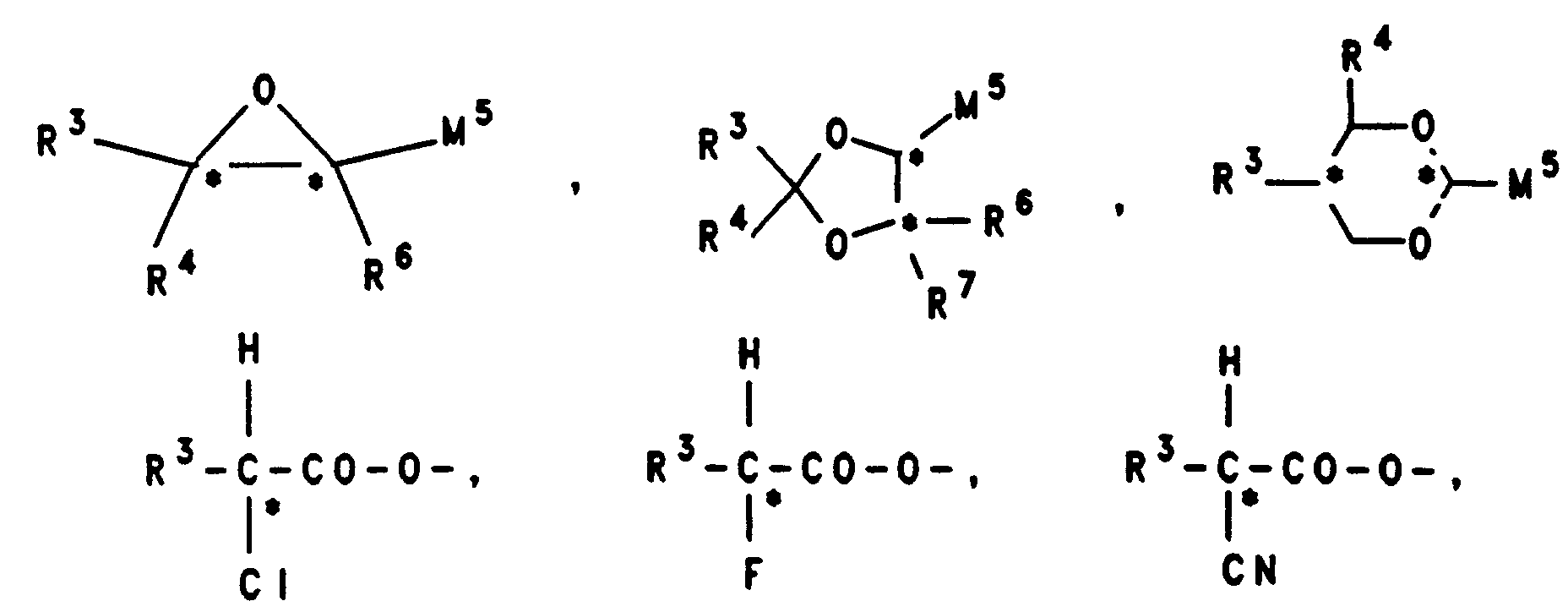
M¹, M², M³, M⁴ gleich oder verschieden, -O-, -CO-O-, -O-CO-, -O-CH₂-, -CH₂-O-, -CH₂-CH₂- oder -CH=CH-;
R³, R⁴, R⁶, R⁷ gleich oder verschieden, H oder geradkettiges oder verzweigtes Alkyl mit 1 bis 10 C-Atomen oder R³ und R⁴ zusammen auch -(CH₂)₄- oder -(CH₂)₅-, wenn als Substituenten an ein Dioxolan-System gebunden;
M⁵ -CH₂-O-, -CO-O-, -O-CH₂-, -O-CO- oder eine Einfachbindung. - 3-Fluorpyridinverbindung nach Anspruch 1, dadurch gekennzeichnet, daß die Symbole der allgemeinen Formel (I) folgende Bedeutung haben:
R¹, R² gleich oder verschieden, H oder Alkyl mit 1 bis 16 C-Atomen, wobei auch eine -CH₂-Gruppe durch -O-, -CO-O- oder -O-CO- ersetzt sein kann, oder die chirale Gruppe
M¹, M², M³, M⁴ gleich oder verschieden, -O-, -CO-O-, -O-CO-, -OCH₂-, -CH₂-O-oder -CH₂CH₂-;
R³, R⁴, R⁶ gleich oder verschieden, H oder ein geradkettiges Alkyl mit 1 bis 10 C-Atomen;
M⁵ -CH₂-O- oder -CO-O-. - Flüssigkristallmischung, enthaltend mindestens eine Verbindung der Formel I nach einem oder mehreren der Ansprüche 1 bis 4.
- Flüssigkristallmischung nach Anspruch 5, dadurch gekennzeichnet, daß die Flüssigkristallmischung ferroelektrisch ist.
- Flüssigkristallmischung nach Anspruch 5, dadurch gekennzeichnet, daß die Flüssigkristallmischung nematisch ist.
- Schalt- und/oder Anzeigevorrichtung, enthaltend Trägerplatten, Elektroden, mindestens einen Polarisator, mindestens eine Orientierungsschicht sowie ein flüssigkristallines Medium, dadurch gekennzeichnet, daß das flüssigkristalline Medium eine Flüssigkristallmischung nach einem oder mehreren der Ansprüche 5 bis 7 ist.
- Verfahren zur Herstellung eines 3-Fluorpyridin-Derivats nach Anspruch 1, dadurch gekennzeichnet, daß 2-Amino-5-brompyridin oder 3-Fluor-2-hydroxypyridin in mehreren Stufen zu 2,5-Dibrom-3-fluorpyridin umgesetzt wird und anschließend die beiden Bromatome in 2- und 5-Position in mehreren Stufen gegen die Ketten R¹ (-A¹)k(-M¹)l(-A²)m(-M²)n- bzw. (-M³)o(-A³)p(-M⁴)q(-A⁴)r-R² ausgetauscht werden, wobei die Symbole dieselbe Bedeutung wie in Anspruch 1 haben.
Applications Claiming Priority (2)
| Application Number | Priority Date | Filing Date | Title |
|---|---|---|---|
| DE4218873 | 1992-06-09 | ||
| DE4218873 | 1992-06-09 |
Publications (2)
| Publication Number | Publication Date |
|---|---|
| EP0573878A1 true EP0573878A1 (de) | 1993-12-15 |
| EP0573878B1 EP0573878B1 (de) | 2000-12-20 |
Family
ID=6460648
Family Applications (1)
| Application Number | Title | Priority Date | Filing Date |
|---|---|---|---|
| EP93108777A Expired - Lifetime EP0573878B1 (de) | 1992-06-09 | 1993-06-01 | 3-Fluorpyridine, Verfahren zu ihrer Herstellung und ihre Verwendung in Flüssigkristallmischungen |
Country Status (10)
| Country | Link |
|---|---|
| US (1) | US5445763A (de) |
| EP (1) | EP0573878B1 (de) |
| JP (1) | JPH0673006A (de) |
| KR (1) | KR940005573A (de) |
| CN (1) | CN1082028A (de) |
| AT (1) | ATE198195T1 (de) |
| AU (1) | AU4324193A (de) |
| DE (1) | DE59310130D1 (de) |
| MX (1) | MX9303448A (de) |
| WO (1) | WO1993025529A1 (de) |
Cited By (3)
| Publication number | Priority date | Publication date | Assignee | Title |
|---|---|---|---|---|
| WO1994026720A1 (en) * | 1993-05-06 | 1994-11-24 | Hoechst Aktiengesellschaft | Novel compounds for use in liquid-crystal compositions |
| US5629428A (en) * | 1993-05-12 | 1997-05-13 | Hoechst Aktiengesellschaft | 3-Chloropyridines, and their use in liquid-crystal mixtures |
| WO2009103402A1 (de) * | 2008-02-18 | 2009-08-27 | Merck Patent Gmbh | Flüssigkristallines medium und flüssigkristallanzeige |
Families Citing this family (13)
| Publication number | Priority date | Publication date | Assignee | Title |
|---|---|---|---|---|
| DE3824902A1 (de) * | 1988-07-22 | 1990-02-15 | Hoechst Ag | Optisch aktive, in 4-stellung einen mesogenen rest tragende 1,3-dioxolan-derivate, ein verfahren zu ihrer herstellung und ihre verwendung als dotierstoffe in fluessigkristallmischungen |
| US5630962A (en) * | 1990-12-19 | 1997-05-20 | Hoechst Aktiengesellschaft | 2-Fluoropyridines, their preparation and their use in liquid crystal mixtures |
| DE69426586T2 (de) * | 1993-09-23 | 2001-05-31 | Sharp K.K., Osaka | Integrierte elektrooptische Flüssigkristallvorrichtung und Verfahren zu seiner Verwendung |
| US5614639A (en) * | 1995-03-31 | 1997-03-25 | Eli Lilly And Company | Process for preparing 2-substituted benzo[b]thiophene compounds and intermediates thereof |
| US6133485A (en) * | 1998-04-15 | 2000-10-17 | Synphar Laboratories, Inc. | Asymmetric synthesis of 2-(2,4-difluorophenyl)-1-heterocycl-1-yl butan-2,3-diols |
| US6551668B1 (en) * | 1998-06-08 | 2003-04-22 | Aventis Research & Technologies | Monostable ferroelectric active matrix display |
| US6413448B1 (en) | 1999-04-26 | 2002-07-02 | Displaytech, Inc. | Cyclohexyl- and cyclohexenyl-substituted liquid crystals with low birefringence |
| US7195719B1 (en) | 2001-01-03 | 2007-03-27 | Displaytech, Inc. | High polarization ferroelectric liquid crystal compositions |
| GB0126849D0 (en) * | 2001-11-08 | 2002-01-02 | Qinetiq Ltd | Novel compounds |
| US6838128B1 (en) | 2002-02-05 | 2005-01-04 | Displaytech, Inc. | High polarization dopants for ferroelectric liquid crystal compositions |
| US7785678B2 (en) | 2006-04-15 | 2010-08-31 | Merck Patent Gmbh | Liquid-crystalline mixtures and liquid-crystal displays |
| JP5371954B2 (ja) * | 2007-04-24 | 2013-12-18 | メルク パテント ゲゼルシャフト ミット ベシュレンクテル ハフツング | 液晶混合物のためのピリジン化合物 |
| CN104781370B (zh) * | 2012-10-22 | 2017-07-14 | 默克专利股份有限公司 | 液晶介质 |
Citations (7)
| Publication number | Priority date | Publication date | Assignee | Title |
|---|---|---|---|---|
| EP0206228A2 (de) * | 1985-06-18 | 1986-12-30 | Chisso Corporation | Ferroelektrische chiralsmektische Flüssigkristallzusammensetzung und Lichtschalter |
| EP0284093A1 (de) * | 1987-03-26 | 1988-09-28 | Dainippon Ink And Chemicals, Inc. | Optisch aktive Pyridine |
| WO1991004248A1 (en) * | 1989-09-22 | 1991-04-04 | MERCK Patent Gesellschaft mit beschränkter Haftung | Pyridine derivatives |
| WO1991004249A1 (en) * | 1989-09-22 | 1991-04-04 | MERCK Patent Gesellschaft mit beschränkter Haftung | Pyridine derivatives and a liquid crystal medium |
| EP0475444A1 (de) * | 1990-09-14 | 1992-03-18 | Hoechst Aktiengesellschaft | Die Verwendung von 4-Fluor-pyrimidin-Derivaten als Komponente für ferroelektrische Flüssigkristallmischungen |
| WO1992009576A1 (de) * | 1990-11-27 | 1992-06-11 | MERCK Patent Gesellschaft mit beschränkter Haftung | 3,6-disubstituierte-2-halogenpyridine |
| WO1992011241A1 (de) * | 1990-12-19 | 1992-07-09 | Hoechst Aktiengesellschaft | 2-fluorpyridine, verfahren zu ihrer herstellung und ihre verwendung in flüssigkristallmischungen |
Family Cites Families (3)
| Publication number | Priority date | Publication date | Assignee | Title |
|---|---|---|---|---|
| EP0120575B1 (de) * | 1983-02-18 | 1989-06-14 | Nippon Shokubai Kagaku Kogyo Co., Ltd | Fluorierte organische Verbindungen |
| JPH0825946B2 (ja) * | 1988-12-23 | 1996-03-13 | 関東化学株式会社 | フツ素置換ビフエニル誘導体 |
| DE4126482A1 (de) * | 1991-08-10 | 1993-02-11 | Bayer Ag | (alpha)-trifluormethyl-substituierte, gesaettigt-bicyclische amine und verfahren zu deren herstellung |
-
1993
- 1993-06-01 EP EP93108777A patent/EP0573878B1/de not_active Expired - Lifetime
- 1993-06-01 AT AT93108777T patent/ATE198195T1/de not_active IP Right Cessation
- 1993-06-01 DE DE59310130T patent/DE59310130D1/de not_active Expired - Fee Related
- 1993-06-07 US US08/072,929 patent/US5445763A/en not_active Expired - Lifetime
- 1993-06-08 JP JP5137251A patent/JPH0673006A/ja active Pending
- 1993-06-08 WO PCT/EP1993/001446 patent/WO1993025529A1/de not_active Ceased
- 1993-06-08 KR KR1019930010300A patent/KR940005573A/ko not_active Withdrawn
- 1993-06-08 AU AU43241/93A patent/AU4324193A/en not_active Abandoned
- 1993-06-09 MX MX9303448A patent/MX9303448A/es unknown
- 1993-06-09 CN CN93108735A patent/CN1082028A/zh active Pending
Patent Citations (7)
| Publication number | Priority date | Publication date | Assignee | Title |
|---|---|---|---|---|
| EP0206228A2 (de) * | 1985-06-18 | 1986-12-30 | Chisso Corporation | Ferroelektrische chiralsmektische Flüssigkristallzusammensetzung und Lichtschalter |
| EP0284093A1 (de) * | 1987-03-26 | 1988-09-28 | Dainippon Ink And Chemicals, Inc. | Optisch aktive Pyridine |
| WO1991004248A1 (en) * | 1989-09-22 | 1991-04-04 | MERCK Patent Gesellschaft mit beschränkter Haftung | Pyridine derivatives |
| WO1991004249A1 (en) * | 1989-09-22 | 1991-04-04 | MERCK Patent Gesellschaft mit beschränkter Haftung | Pyridine derivatives and a liquid crystal medium |
| EP0475444A1 (de) * | 1990-09-14 | 1992-03-18 | Hoechst Aktiengesellschaft | Die Verwendung von 4-Fluor-pyrimidin-Derivaten als Komponente für ferroelektrische Flüssigkristallmischungen |
| WO1992009576A1 (de) * | 1990-11-27 | 1992-06-11 | MERCK Patent Gesellschaft mit beschränkter Haftung | 3,6-disubstituierte-2-halogenpyridine |
| WO1992011241A1 (de) * | 1990-12-19 | 1992-07-09 | Hoechst Aktiengesellschaft | 2-fluorpyridine, verfahren zu ihrer herstellung und ihre verwendung in flüssigkristallmischungen |
Non-Patent Citations (1)
| Title |
|---|
| DATABASE WPI Week 9032, Derwent Publications Ltd., London, GB; AN 90-242916 & JP-A-2 169 537 (KANTO KAGAKU K.K.) * |
Cited By (6)
| Publication number | Priority date | Publication date | Assignee | Title |
|---|---|---|---|---|
| WO1994026720A1 (en) * | 1993-05-06 | 1994-11-24 | Hoechst Aktiengesellschaft | Novel compounds for use in liquid-crystal compositions |
| US5876628A (en) * | 1993-05-06 | 1999-03-02 | Hoechst Aktiengesellschaft | Compounds for use in liquid-crystal composition |
| US5629428A (en) * | 1993-05-12 | 1997-05-13 | Hoechst Aktiengesellschaft | 3-Chloropyridines, and their use in liquid-crystal mixtures |
| WO2009103402A1 (de) * | 2008-02-18 | 2009-08-27 | Merck Patent Gmbh | Flüssigkristallines medium und flüssigkristallanzeige |
| US8268191B2 (en) | 2008-02-18 | 2012-09-18 | Merck Patent Gmbh | Liquid-crystalline medium and liquid-crystal display |
| DE102009006272B4 (de) * | 2008-02-18 | 2019-02-28 | Merck Patent Gmbh | Flüssigkristallines Medium und dessen Verwendung in einer Flüssigkristallanzeige |
Also Published As
| Publication number | Publication date |
|---|---|
| KR940005573A (ko) | 1994-03-21 |
| DE59310130D1 (de) | 2001-01-25 |
| JPH0673006A (ja) | 1994-03-15 |
| CN1082028A (zh) | 1994-02-16 |
| EP0573878B1 (de) | 2000-12-20 |
| WO1993025529A1 (de) | 1993-12-23 |
| AU4324193A (en) | 1994-01-04 |
| MX9303448A (es) | 1994-04-29 |
| ATE198195T1 (de) | 2001-01-15 |
| US5445763A (en) | 1995-08-29 |
Similar Documents
| Publication | Publication Date | Title |
|---|---|---|
| EP0573878B1 (de) | 3-Fluorpyridine, Verfahren zu ihrer Herstellung und ihre Verwendung in Flüssigkristallmischungen | |
| EP0563146B1 (de) | 2-fluorpyridine, verfahren zu ihrer herstellung und ihre verwendung in flüssigkristallmischungen | |
| EP0541081B1 (de) | Verbindungen mit nur einer Seitenkette zur Verwendung in Flüssigkristallmischungen | |
| DE19524230A1 (de) | Fluorierte Phenanthren-Derivate und ihre Verwendung in flüssigkristallinen Mischungen | |
| EP0578054A1 (de) | Meta-substituierte Sechsringaromaten zur Verwendung in Flüssigkristallmischungen | |
| DE19500768A1 (de) | Phenanthren-Derivate und ihre Verwendung in flüssigkristallinen Mischungen | |
| DE4315867A1 (de) | 3-Chlorpyridine, Verfahren zu ihrer Herstellung und ihre Verwendung in Flüssigkristallmischungen | |
| DE4030579A1 (de) | Cyclohexylphenylpyrimidine, verfahren zu ihrer herstellung und ihre verwendung in fluessigkristallinen mischungen | |
| EP0883618B1 (de) | Difluorphenylpyrimidylpyridin-derivate und ihre verwendung in flüssigkristallinen mischungen | |
| EP0532916B1 (de) | 2-Fluorpyrazine, Verfahren zu ihrer Herstellung und ihre Verwendung in flüssigkristallinen Mischungen | |
| EP0602596B1 (de) | Trifluorphenylen-Verbindungen, Verfahren zu ihrer Herstellung und ihre Verwendung in flüssigkristallinen Mischungen | |
| EP0552658A1 (de) | Derivate der 3-Cyclohexylpropionsäure und ihre Verwendung in ferroelektrischen Flüssigkristallmischungen | |
| EP0639189B1 (de) | Pyridylpyrimidine, verfahren zu ihrer herstellung und ihre verwendung in flüssigkristallinen mischungen | |
| DE4427199A1 (de) | 3,4-Difluorpyridine und ihre Verwendung in flüssigkristallinen Mischungen | |
| DE4331679A1 (de) | Spiro[5,5]undecane und ihre Verwendung in Flüssigkristallmischungen | |
| DE19748432A1 (de) | 2,3-Difluornaphthalin-Derivate und ihre Verwendung in flüssigkristallinen Mischungen | |
| EP0743971B1 (de) | Phenanthridin-derivate und ihre verwendung in flüssigkristallinen mischungen | |
| EP0946477B1 (de) | 9,9-difluor-9,10-dihydrophenanthren-derivate für flüssigkristallinen mischungen | |
| DE19538404B4 (de) | Difluorchinolin-Derivate und diese enthaltenden Flüssigkristallmischungen sowie Schalt- und/oder Anzeigevorrichtung | |
| EP0821049B1 (de) | Cyclopentyl-Verbindungen | |
| DE4030603C2 (de) | Pyridinpyrimidine | |
| DE4240041A1 (de) | Neue Derivate des Naphthalins zur Verwendung in ferroelektrischen Flüssigkristallmischungen | |
| DE19653009A1 (de) | 6-Fluorphenanthridin-Derivate und ihre Verwendung in flüssigkristallinen Mischungen | |
| EP0433826B1 (de) | Fluorphenylpyridine | |
| DE4111461A1 (de) | 2-fluorpyridine, verfahren zu ihrer herstellung und ihre verwendung in ferroelektrischen fluessigkristallmischungen |
Legal Events
| Date | Code | Title | Description |
|---|---|---|---|
| PUAI | Public reference made under article 153(3) epc to a published international application that has entered the european phase |
Free format text: ORIGINAL CODE: 0009012 |
|
| AK | Designated contracting states |
Kind code of ref document: A1 Designated state(s): AT BE CH DE DK ES FR GB GR IE IT LI LU MC NL PT SE |
|
| 17P | Request for examination filed |
Effective date: 19940219 |
|
| 17Q | First examination report despatched |
Effective date: 19961219 |
|
| GRAG | Despatch of communication of intention to grant |
Free format text: ORIGINAL CODE: EPIDOS AGRA |
|
| RAP1 | Party data changed (applicant data changed or rights of an application transferred) |
Owner name: AVENTIS RESEARCH & TECHNOLOGIES GMBH & CO. KG |
|
| GRAG | Despatch of communication of intention to grant |
Free format text: ORIGINAL CODE: EPIDOS AGRA |
|
| GRAG | Despatch of communication of intention to grant |
Free format text: ORIGINAL CODE: EPIDOS AGRA |
|
| GRAH | Despatch of communication of intention to grant a patent |
Free format text: ORIGINAL CODE: EPIDOS IGRA |
|
| GRAH | Despatch of communication of intention to grant a patent |
Free format text: ORIGINAL CODE: EPIDOS IGRA |
|
| GRAA | (expected) grant |
Free format text: ORIGINAL CODE: 0009210 |
|
| AK | Designated contracting states |
Kind code of ref document: B1 Designated state(s): AT BE CH DE DK ES FR GB GR IE IT LI LU MC NL PT SE |
|
| PG25 | Lapsed in a contracting state [announced via postgrant information from national office to epo] |
Ref country code: SE Free format text: THE PATENT HAS BEEN ANNULLED BY A DECISION OF A NATIONAL AUTHORITY Effective date: 20001220 Ref country code: NL Free format text: LAPSE BECAUSE OF FAILURE TO SUBMIT A TRANSLATION OF THE DESCRIPTION OR TO PAY THE FEE WITHIN THE PRESCRIBED TIME-LIMIT Effective date: 20001220 Ref country code: IT Free format text: LAPSE BECAUSE OF FAILURE TO SUBMIT A TRANSLATION OF THE DESCRIPTION OR TO PAY THE FEE WITHIN THE PRE;WARNING: LAPSES OF ITALIAN PATENTS WITH EFFECTIVE DATE BEFORE 2007 MAY HAVE OCCURRED AT ANY TIME BEFORE 2007. THE CORRECT EFFECTIVE DATE MAY BE DIFFERENT FROM THE ONE RECORDED.SCRIBED TIME-LIMIT Effective date: 20001220 Ref country code: IE Free format text: LAPSE BECAUSE OF FAILURE TO SUBMIT A TRANSLATION OF THE DESCRIPTION OR TO PAY THE FEE WITHIN THE PRESCRIBED TIME-LIMIT Effective date: 20001220 Ref country code: GR Free format text: LAPSE BECAUSE OF NON-PAYMENT OF DUE FEES Effective date: 20001220 Ref country code: GB Free format text: LAPSE BECAUSE OF FAILURE TO SUBMIT A TRANSLATION OF THE DESCRIPTION OR TO PAY THE FEE WITHIN THE PRESCRIBED TIME-LIMIT Effective date: 20001220 Ref country code: FR Free format text: LAPSE BECAUSE OF FAILURE TO SUBMIT A TRANSLATION OF THE DESCRIPTION OR TO PAY THE FEE WITHIN THE PRESCRIBED TIME-LIMIT Effective date: 20001220 Ref country code: ES Free format text: THE PATENT HAS BEEN ANNULLED BY A DECISION OF A NATIONAL AUTHORITY Effective date: 20001220 |
|
| REF | Corresponds to: |
Ref document number: 198195 Country of ref document: AT Date of ref document: 20010115 Kind code of ref document: T |
|
| REG | Reference to a national code |
Ref country code: CH Ref legal event code: EP |
|
| REG | Reference to a national code |
Ref country code: IE Ref legal event code: FG4D Free format text: GERMAN |
|
| REF | Corresponds to: |
Ref document number: 59310130 Country of ref document: DE Date of ref document: 20010125 |
|
| PG25 | Lapsed in a contracting state [announced via postgrant information from national office to epo] |
Ref country code: PT Free format text: LAPSE BECAUSE OF FAILURE TO SUBMIT A TRANSLATION OF THE DESCRIPTION OR TO PAY THE FEE WITHIN THE PRESCRIBED TIME-LIMIT Effective date: 20010320 Ref country code: DK Free format text: LAPSE BECAUSE OF FAILURE TO SUBMIT A TRANSLATION OF THE DESCRIPTION OR TO PAY THE FEE WITHIN THE PRESCRIBED TIME-LIMIT Effective date: 20010320 |
|
| NLV1 | Nl: lapsed or annulled due to failure to fulfill the requirements of art. 29p and 29m of the patents act | ||
| EN | Fr: translation not filed | ||
| PG25 | Lapsed in a contracting state [announced via postgrant information from national office to epo] |
Ref country code: LU Free format text: LAPSE BECAUSE OF NON-PAYMENT OF DUE FEES Effective date: 20010601 Ref country code: AT Free format text: LAPSE BECAUSE OF NON-PAYMENT OF DUE FEES Effective date: 20010601 |
|
| GBV | Gb: ep patent (uk) treated as always having been void in accordance with gb section 77(7)/1977 [no translation filed] |
Effective date: 20001220 |
|
| PG25 | Lapsed in a contracting state [announced via postgrant information from national office to epo] |
Ref country code: MC Free format text: LAPSE BECAUSE OF NON-PAYMENT OF DUE FEES Effective date: 20010630 Ref country code: LI Free format text: LAPSE BECAUSE OF NON-PAYMENT OF DUE FEES Effective date: 20010630 Ref country code: CH Free format text: LAPSE BECAUSE OF NON-PAYMENT OF DUE FEES Effective date: 20010630 Ref country code: BE Free format text: LAPSE BECAUSE OF NON-PAYMENT OF DUE FEES Effective date: 20010630 |
|
| PLBE | No opposition filed within time limit |
Free format text: ORIGINAL CODE: 0009261 |
|
| STAA | Information on the status of an ep patent application or granted ep patent |
Free format text: STATUS: NO OPPOSITION FILED WITHIN TIME LIMIT |
|
| REG | Reference to a national code |
Ref country code: IE Ref legal event code: FD4D |
|
| 26N | No opposition filed | ||
| BERE | Be: lapsed |
Owner name: AVENTIS RESEARCH & TECHNOLOGIES G.M.B.H. & CO. K. Effective date: 20010630 |
|
| REG | Reference to a national code |
Ref country code: CH Ref legal event code: PL |
|
| PGFP | Annual fee paid to national office [announced via postgrant information from national office to epo] |
Ref country code: DE Payment date: 20050526 Year of fee payment: 13 |
|
| PG25 | Lapsed in a contracting state [announced via postgrant information from national office to epo] |
Ref country code: DE Free format text: LAPSE BECAUSE OF NON-PAYMENT OF DUE FEES Effective date: 20070102 |