EP0574791A2 - Polymerelektrolyt-Membran und Verfahren zu ihrer Herstellung - Google Patents
Polymerelektrolyt-Membran und Verfahren zu ihrer Herstellung Download PDFInfo
- Publication number
- EP0574791A2 EP0574791A2 EP93109139A EP93109139A EP0574791A2 EP 0574791 A2 EP0574791 A2 EP 0574791A2 EP 93109139 A EP93109139 A EP 93109139A EP 93109139 A EP93109139 A EP 93109139A EP 0574791 A2 EP0574791 A2 EP 0574791A2
- Authority
- EP
- European Patent Office
- Prior art keywords
- sulfonic acid
- polyether ketone
- general formula
- sulfonated
- electrolyte membrane
- Prior art date
- Legal status (The legal status is an assumption and is not a legal conclusion. Google has not performed a legal analysis and makes no representation as to the accuracy of the status listed.)
- Granted
Links
- 0 CC(*)(*)OC(CCC(C1)O)C*1N=O Chemical compound CC(*)(*)OC(CCC(C1)O)C*1N=O 0.000 description 1
Classifications
-
- C—CHEMISTRY; METALLURGY
- C08—ORGANIC MACROMOLECULAR COMPOUNDS; THEIR PREPARATION OR CHEMICAL WORKING-UP; COMPOSITIONS BASED THEREON
- C08J—WORKING-UP; GENERAL PROCESSES OF COMPOUNDING; AFTER-TREATMENT NOT COVERED BY SUBCLASSES C08B, C08C, C08F, C08G or C08H
- C08J5/00—Manufacture of articles or shaped materials containing macromolecular substances
- C08J5/20—Manufacture of shaped structures of ion-exchange resins
- C08J5/22—Films, membranes or diaphragms
- C08J5/2287—After-treatment
-
- C—CHEMISTRY; METALLURGY
- C08—ORGANIC MACROMOLECULAR COMPOUNDS; THEIR PREPARATION OR CHEMICAL WORKING-UP; COMPOSITIONS BASED THEREON
- C08J—WORKING-UP; GENERAL PROCESSES OF COMPOUNDING; AFTER-TREATMENT NOT COVERED BY SUBCLASSES C08B, C08C, C08F, C08G or C08H
- C08J5/00—Manufacture of articles or shaped materials containing macromolecular substances
- C08J5/20—Manufacture of shaped structures of ion-exchange resins
- C08J5/22—Films, membranes or diaphragms
-
- B—PERFORMING OPERATIONS; TRANSPORTING
- B01—PHYSICAL OR CHEMICAL PROCESSES OR APPARATUS IN GENERAL
- B01D—SEPARATION
- B01D71/00—Semi-permeable membranes for separation processes or apparatus characterised by the material; Manufacturing processes specially adapted therefor
- B01D71/06—Organic material
- B01D71/52—Polyethers
- B01D71/522—Aromatic polyethers
- B01D71/5222—Polyetherketone, polyetheretherketone, or polyaryletherketone
-
- C—CHEMISTRY; METALLURGY
- C08—ORGANIC MACROMOLECULAR COMPOUNDS; THEIR PREPARATION OR CHEMICAL WORKING-UP; COMPOSITIONS BASED THEREON
- C08G—MACROMOLECULAR COMPOUNDS OBTAINED OTHERWISE THAN BY REACTIONS ONLY INVOLVING UNSATURATED CARBON-TO-CARBON BONDS
- C08G65/00—Macromolecular compounds obtained by reactions forming an ether link in the main chain of the macromolecule
- C08G65/34—Macromolecular compounds obtained by reactions forming an ether link in the main chain of the macromolecule from hydroxy compounds or their metallic derivatives
- C08G65/48—Polymers modified by chemical after-treatment
-
- H—ELECTRICITY
- H01—ELECTRIC ELEMENTS
- H01M—PROCESSES OR MEANS, e.g. BATTERIES, FOR THE DIRECT CONVERSION OF CHEMICAL ENERGY INTO ELECTRICAL ENERGY
- H01M8/00—Fuel cells; Manufacture thereof
- H01M8/10—Fuel cells with solid electrolytes
- H01M8/1016—Fuel cells with solid electrolytes characterised by the electrolyte material
- H01M8/1018—Polymeric electrolyte materials
- H01M8/102—Polymeric electrolyte materials characterised by the chemical structure of the main chain of the ion-conducting polymer
- H01M8/1025—Polymeric electrolyte materials characterised by the chemical structure of the main chain of the ion-conducting polymer having only carbon and oxygen, e.g. polyethers, sulfonated polyetheretherketones [S-PEEK], sulfonated polysaccharides, sulfonated celluloses or sulfonated polyesters
-
- H—ELECTRICITY
- H01—ELECTRIC ELEMENTS
- H01M—PROCESSES OR MEANS, e.g. BATTERIES, FOR THE DIRECT CONVERSION OF CHEMICAL ENERGY INTO ELECTRICAL ENERGY
- H01M8/00—Fuel cells; Manufacture thereof
- H01M8/10—Fuel cells with solid electrolytes
- H01M8/1016—Fuel cells with solid electrolytes characterised by the electrolyte material
- H01M8/1018—Polymeric electrolyte materials
- H01M8/1069—Polymeric electrolyte materials characterised by the manufacturing processes
- H01M8/1072—Polymeric electrolyte materials characterised by the manufacturing processes by chemical reactions, e.g. in situ polymerisation or in situ crosslinking
-
- C—CHEMISTRY; METALLURGY
- C08—ORGANIC MACROMOLECULAR COMPOUNDS; THEIR PREPARATION OR CHEMICAL WORKING-UP; COMPOSITIONS BASED THEREON
- C08J—WORKING-UP; GENERAL PROCESSES OF COMPOUNDING; AFTER-TREATMENT NOT COVERED BY SUBCLASSES C08B, C08C, C08F, C08G or C08H
- C08J2371/00—Characterised by the use of polyethers obtained by reactions forming an ether link in the main chain; Derivatives of such polymers
- C08J2371/08—Polyethers derived from hydroxy compounds or from their metallic derivatives
- C08J2371/10—Polyethers derived from hydroxy compounds or from their metallic derivatives from phenols
-
- H—ELECTRICITY
- H01—ELECTRIC ELEMENTS
- H01M—PROCESSES OR MEANS, e.g. BATTERIES, FOR THE DIRECT CONVERSION OF CHEMICAL ENERGY INTO ELECTRICAL ENERGY
- H01M8/00—Fuel cells; Manufacture thereof
- H01M8/10—Fuel cells with solid electrolytes
- H01M8/1004—Fuel cells with solid electrolytes characterised by membrane-electrode assemblies [MEA]
-
- Y—GENERAL TAGGING OF NEW TECHNOLOGICAL DEVELOPMENTS; GENERAL TAGGING OF CROSS-SECTIONAL TECHNOLOGIES SPANNING OVER SEVERAL SECTIONS OF THE IPC; TECHNICAL SUBJECTS COVERED BY FORMER USPC CROSS-REFERENCE ART COLLECTIONS [XRACs] AND DIGESTS
- Y02—TECHNOLOGIES OR APPLICATIONS FOR MITIGATION OR ADAPTATION AGAINST CLIMATE CHANGE
- Y02E—REDUCTION OF GREENHOUSE GAS [GHG] EMISSIONS, RELATED TO ENERGY GENERATION, TRANSMISSION OR DISTRIBUTION
- Y02E60/00—Enabling technologies; Technologies with a potential or indirect contribution to GHG emissions mitigation
- Y02E60/30—Hydrogen technology
- Y02E60/50—Fuel cells
-
- Y—GENERAL TAGGING OF NEW TECHNOLOGICAL DEVELOPMENTS; GENERAL TAGGING OF CROSS-SECTIONAL TECHNOLOGIES SPANNING OVER SEVERAL SECTIONS OF THE IPC; TECHNICAL SUBJECTS COVERED BY FORMER USPC CROSS-REFERENCE ART COLLECTIONS [XRACs] AND DIGESTS
- Y02—TECHNOLOGIES OR APPLICATIONS FOR MITIGATION OR ADAPTATION AGAINST CLIMATE CHANGE
- Y02P—CLIMATE CHANGE MITIGATION TECHNOLOGIES IN THE PRODUCTION OR PROCESSING OF GOODS
- Y02P70/00—Climate change mitigation technologies in the production process for final industrial or consumer products
- Y02P70/50—Manufacturing or production processes characterised by the final manufactured product
-
- Y—GENERAL TAGGING OF NEW TECHNOLOGICAL DEVELOPMENTS; GENERAL TAGGING OF CROSS-SECTIONAL TECHNOLOGIES SPANNING OVER SEVERAL SECTIONS OF THE IPC; TECHNICAL SUBJECTS COVERED BY FORMER USPC CROSS-REFERENCE ART COLLECTIONS [XRACs] AND DIGESTS
- Y10—TECHNICAL SUBJECTS COVERED BY FORMER USPC
- Y10S—TECHNICAL SUBJECTS COVERED BY FORMER USPC CROSS-REFERENCE ART COLLECTIONS [XRACs] AND DIGESTS
- Y10S522/00—Synthetic resins or natural rubbers -- part of the class 520 series
- Y10S522/904—Monomer or polymer contains initiating group
-
- Y—GENERAL TAGGING OF NEW TECHNOLOGICAL DEVELOPMENTS; GENERAL TAGGING OF CROSS-SECTIONAL TECHNOLOGIES SPANNING OVER SEVERAL SECTIONS OF THE IPC; TECHNICAL SUBJECTS COVERED BY FORMER USPC CROSS-REFERENCE ART COLLECTIONS [XRACs] AND DIGESTS
- Y10—TECHNICAL SUBJECTS COVERED BY FORMER USPC
- Y10S—TECHNICAL SUBJECTS COVERED BY FORMER USPC CROSS-REFERENCE ART COLLECTIONS [XRACs] AND DIGESTS
- Y10S522/00—Synthetic resins or natural rubbers -- part of the class 520 series
- Y10S522/904—Monomer or polymer contains initiating group
- Y10S522/905—Benzophenone group
Definitions
- the invention relates to polymer electrolyte membranes based on a sulfonated aromatic polyether ketone.
- Cation exchange membranes are u. a. used in electrochemical cells that work instead of a liquid electrolyte with a polymeric solid electrolyte as an ion conductor. Examples include water electrolysers and hydrogen / oxygen fuel cells. Membranes for this purpose must meet considerable requirements with regard to chemical, electrochemical, mechanical stability and proton conductivity. For this reason, only fluorinated membranes, which primarily contain sulfonic acid exchange functions, have been used successfully in continuous operation, for example in chlor-alkali electrolysis.
- fluorinated exchange membranes Although the use of fluorinated exchange membranes is state of the art, they have disadvantages for use in solid electrolyte applications. In addition to a high cost factor, such materials with the properties required above are only available in membrane form with defined parameters (thickness, exchanger capacity) and they are neither thermoplastic nor processable as a solution. Especially for applications as a polymeric solid electrolyte in fuel cell / electrolysis operation, however, membranes with adjustable properties are required which enable the membrane properties to be optimally adapted to the requirements in the cell.
- the properties that can be set include the variation of the membrane thickness, since the resistance, which is proportional to the membrane thickness, plays a significant part in the electrical losses of the cell, especially at high current densities.
- Commercial perfluorinated membranes typically have a thickness of 170 to 180 ⁇ m, thicknesses below 0.1 mm are desirable.
- Polymers with the possibility of thermoplastic or solution processability offer the possibility of providing membranes of any thickness.
- the adjustable properties include the degree of crosslinking of the membrane.
- the low membrane resistance required requires a high ion exchange capacity of the membrane.
- the amount of the ion exchange capacity that can be used in practice is limited, since the membrane swells considerably with increasing value, especially at elevated temperatures, and its mechanical properties are no longer sufficient.
- Polymers typically used for cation exchange membranes such as e.g. B. sulfonated polystyrenes offer the possibility of being made from liquid monomers and polymerizing in membrane form of any thickness after adding crosslinking molecules; however, due to the hydrogen atoms on the aliphatic main chain, they do not have the required long-term chemical stability.
- Other properties that characterize a good cation exchange membrane are insensitivity to business interruptions, resistance to delamination of a carrier film and (in the case of alkali chloride electrolysis) insensitivity to brine impurities.
- the object was therefore to provide ion-conductive membranes which are suitable for use as solid electrolyte polymers, have sufficient chemical stability and can be prepared from polymers which dissolve in suitable solvents. It should preferably be possible to make these membranes more resistant by subsequent treatment.
- This process is characterized in that at least 5% of the sulfonic acid groups present are converted into sulfonyl chloride groups in the sulfonic acid, and the sulfonyl chloride groups are reacted with an amine which has at least one crosslinkable substituent or another functional group, 5% to 25 % of the originally present sulfonic acid groups are converted into sulfonamide groups, then unreacted sulfonic acid chloride groups are hydrolyzed, the resulting aromatic sulfonic acid amide is isolated and dissolved in an organic solvent, the solution is processed into a film and then the crosslinkable substituents present in the film networked.
- Asymmetric membranes derived from a sulfonated aromatic polyether ketone are the subject of EP-A-182506. However, the membranes described there are free of crosslinkable or crosslinked groups.
- the sulfonation of the polyether ketone of the general formula (I) is preferably carried out in such a way that it is dissolved in 94 to 97% by weight of sulfuric acid, and a sulfonating agent is added to the resulting solution until the sulfuric acid concentration is 98 to 99.5 Is wt .-% and the reaction mixture is worked up as soon as the desired degree of sulfonation is reached. It is advantageous to work under conditions in which sulfonation is largely suppressed or sulfonation does not yet occur.
- aromatic polyether ketones given in formula (I) are readily available. In principle, they can be built up by electrophilic polycondensation according to Friedel-Crafts, an aromatic bis-acid dihalide being reacted with an aromatic ether.
- All divalent aromatic radicals -Ar- of the polymer to be sulfonated preferably consist of phenylene, preferably of 1,4-phenylene.
- Fuming sulfuric acid, chlorosulfonic acid and sulfur trioxide are preferably used as the sulfonating agent, which serves to increase the sulfuric acid concentration and for sulfonation.
- the concentration of the sulfuric acid used for dissolving is preferably 96 to 96.5%.
- the dissolution temperature depends on the number ratio of ether bridges / carbonyl bridges. With an increasing proportion of ether groups relative to the carbonyl groups, the reactivity of the polyether ketone main chain for electrophilic substitution (e.g. sulfonation) increases.
- the number of sulfonic acid groups that can be introduced depends on the number of aromatic rings bridged by oxygen. Only O-phenyl-O units are sulfonated under the specified conditions, while O-phenyl-CO groups remain unsulfonated.
- the temperature when the polymer is dissolved is between 10 and 60 ° C., in particular between 20 and 60 ° C., preferably between 30 and 50 ° C. During this solution process, sulfonation of the main chain is largely suppressed. Our own NMR studies have shown that no degradation occurs during the sulfonation.
- the concentration of sulfuric acid is increased, for example by adding oleum, until the H 2 SO 4 concentration is 98 to 99.9, in particular 98 to 99.5, preferably 98.2 to 99.5% by weight. % is.
- the reaction temperature in the actual sulfonation can be higher than in the dissolving process. In general, sulfonation is carried out at 10 to 100 ° C., in particular 30 to 90 ° C., preferably at 30 to 80 ° C. Both an increase in temperature and an increase in the reaction time result in an increase in the degree of sulfonation of the polymer. Typical reaction times are between 0.5 and 10 hours, in particular between 1 to 8 hours, preferably between 1.5 and 3 hours. Reaction times over 10 hours only slightly increase the degree of sulfonation. Increasing the temperature of the solution to at least 50 ° C after adding the sulfonating agent accelerates the sulfonation considerably.
- Homopolymers of the general formulas IV or V or VI are preferably sulfonated. According to a further embodiment of the invention, the process described is used for the sulfonation of an aromatic polyether ketone, which is a copolymer, and from at least 2 different units of the general formulas IV, V and VI is constructed.
- Another preferred embodiment of the process according to the invention consists in using a polyether ketone which is composed of units of the general formula V or VI and additionally of units which cannot be sulfonated.
- the sulfonation of copolymers from monomer units of the general formula IV and non-sulfonable ether ketone units is described in EP-A-41780 and EP 08895.
- a homopolymer of the general formula IV is completely sulfonated, a completely water-soluble product with very strong swellability in water at room temperature would be obtained under the same conditions, and its isolation is very difficult.
- the polyether ketone is dissolved in sulfuric acid from 94 to 97% by weight.
- a sulfonating agent is added to the solution obtained until the sulfuric acid concentration is 98 to 99.5% by weight.
- the reaction mixture is worked up as soon as the desired degree of sulfonation is reached.
- the non-sulfonatable units preferably have the formula IIIa and are then formally derived from 4-oxy-benzophenone or have the general formula Xlllb and are then derived from 4-oxy-benzosulfone.
- the polymer of the general formula IV is dissolved in sulfuric acid from 95 to 96.5% by weight at a maximum of 25 ° C.
- the homopolymer of the formula VI is preferably in sulfuric acid from 95 to 96.5% by weight at 25 to 50 ° C dissolved and then sulfonated at temperatures from 60 to 90 ° C.
- the polymers of the general formula I are dissolved at 25 ° C. The actual sulfonation then takes place at at least 50 ° C. and an acid concentration of at least 98.5% by weight of H 2 SO 4 .
- sulfonic acid groups into sulfonyl chloride groups takes place according to known methods.
- amines reacting with the S0 2 CI group have a further (non-crosslinkable) functional group, this should be able to add to other functional groups G.
- GEG in which E is a bridge member
- two polymeric aryl ether ketone sulfonic acids can be linked by means of functional groups.
- An example of a corresponding amine with a functional group is 2-aminomethylfuran, where the N-furylmethylsulfonamide obtained from this condenses with a substituted maleic anhydride in a Diels-Alder reaction to form two non-aromatic six-membered rings.
- the functional group of the amine represents an amino or alcohol function, dimerization with the aid of a divalent epoxide is possible.
- the reaction of the sulfonyl chloride groups with the amine is preferably carried out in an inert solvent, for. B. in chloroform or dichloroethane.
- an inert solvent for. B. in chloroform or dichloroethane.
- organic solvents e.g. B. N-methylpyrrolidone or dimethyl sulfoxide.
- the crosslinkable substituents are advantageously crosslinked by high-energy radiation or heat or the functional groups introduced with the amine are subjected to condensation, in particular a cycloaddition reaction, by treatment with suitable compounds.
- the crosslinking of the membrane greatly reduces swelling in water, especially at elevated temperatures. This is favorable for the use of the membrane in fuel or electrolysis cells.
- certain uncrosslinked aromatic polyether ketone sulfonic acids are also suitable as material for membranes.
- DE-OS 3402471 and DE-OS 3321860 describe cation exchanger membranes which can be obtained from aromatic ether ether ketones of the general formula (IV) by sulfonation.
- the invention therefore further relates to a method for producing a polymer electrolyte membrane based on a sulfonated aromatic polyether ketone which is free of crosslinked or crosslinkable groups.
- an aromatic polyether ketone is sulfonated, the sulfonic acid formed is isolated and dissolved in an organic solvent, in particular an aprotic-polar solvent, and the solution is processed into a film.
- the polyelectrolyte membranes described have sulfonic acid groups and are derived from aromatic aryl ether ketones. Regardless of whether they also contain crosslinked or uncrosslinked sulfonamide groups, they are suitable as proton-conducting solid electrolyte membranes in fuel cells or electrolysis cells.
- the polymeric sulfonic acids are uncrosslinked at the time of their further processing, they can be dissolved in suitable polar solvents such as dimethylformamide, NMP, DMAc, DMSO.
- suitable polar solvents such as dimethylformamide, NMP, DMAc, DMSO.
- the solution thus obtained preferably has a molarity between 50 and 450 g / l. It is poured onto a substrate and a subsequent evaporation of the solvent gives a homogeneous membrane.
- the solution for setting a defined membrane thickness can be distributed over the substrate by means of a doctor blade of a defined wet film thickness and thicknesses in the range from 0.05 to 0.4 mm can be achieved, for example.
- polymeric sulfonic acids and sulfonic acid derivatives used have molecular weights of at least 30,000.
- the radical A has the general formula (X) where B is a divalent radical, e.g. B. an alkylene chain having 1 to 4 carbon atoms, a phenylene radical, diphenyl ether radical, 2,2-bisphenylpropane radical or 2,2-bisphenoxyphenyl-propane radical.
- B is a divalent radical, e.g. B. an alkylene chain having 1 to 4 carbon atoms, a phenylene radical, diphenyl ether radical, 2,2-bisphenylpropane radical or 2,2-bisphenoxyphenyl-propane radical.
- Mixtures of polymeric crosslinkable sulfonamides and polymeric noncrosslinkable aromatic sulfonic acids can also be processed together to form membranes.
- crosslinking greatly reduces swelling in water.
- a crosslinkable sulfonic acid derivative of the formula (VII) can be combined with a sulfonic acid which was obtained in the sulfonation of the compound of the general formula (I). The mixture obtained is processed into a membrane and (VII) crosslinked later.
- the proportion of (XII) is advantageously 0.5 to 25% by weight and the proportion of (11) is 75 to 99.5% by weight.
- a catalyst must be applied to the membrane surface.
- This application can be done e.g. B. achieve that by installing the membrane in a coating cell so that the cell is divided by the membrane into two rooms. If the easily reducible salt of a catalyst metal, for example hexachloroplatinic acid, is introduced on one side and a reducing agent is introduced on the other, this diffuses through the membrane and deposits the catalytically active metal, for example platinum, on the membrane surface.
- a catalyst metal for example hexachloroplatinic acid
- the catalyst coating can be carried out by pressing on a metal powder.
- a platinum coverage of 1 to 20 mg / cm 2 can be achieved in this way.
- the pressing pressure is, for example, 1.1 to 8.8 bar, the pressing time between 5 and 15 minutes.
- a general description of the pressing process is contained in Appleby, Yeager, Energy (Oxford) 11 (1988) p 132.
- the sulfonation of the polyether ketone can also be followed from the 13 C-NMR spectra.
- the signal at 142.0 ppm shows sulfonation of the hydroquinone unit.
- the weak signal at 119.0 ppm is due to unsubstituted hydroquinone units.
- the corresponding carbon atom adjacent to a sulfonated hydroquinone unit shows signals at 161.5 and 162.8 ppm.
- Sulfonated polyether ketone which was prepared according to Example 2 (degree of sulfonation 90%), was dissolved in DMF (concentration: 100 to 300 g / l) and the solution was drawn over a glass plate using a 0.2 mm doctor blade. The DMF evaporated within 15 hours. Then the glass plate was placed in water. The polymer film detached from the glass. After equilibration in aqueous KCI solution, the film thickness was over 27 ⁇ m.
- the water absorption capacity of the film is below 50% at room temperature and around 1900% at 80 ° C. However, the membrane remains stable. The permselectivity of the membrane is about 90%. Even after irradiation with a 700 W low-pressure mercury vapor lamp (30 min.), The membrane is still soluble in dimethylformamide. Irrigation does not change the water absorption capacity.
- sulfonated polyether ether ketone ketone with a degree of sulfonation of 90% are dissolved in 100 ml of dimethylformamide.
- the homogeneous solution is poured onto a glass plate and distributed on the surface with the aid of a knife with a wet film thickness of 350 ⁇ m. After drying for 24 hours at room temperature, the membrane can be removed in a water bath. The average thickness of the membrane equilibrated in distilled water at room temperature was 65 ⁇ m.
- the catalyst is applied using the hot pressing process at 130 ° C., resulting in a platinum covering of 5 mg / cm 2 membrane area.
- This membrane was installed in a water electrolysis test cell with a membrane area of 1 cm 2 .
- the membrane showed stable behavior up to 80 ° C.
- the cell potential was 2.15 volts at a temperature of 80 ° C. and a current load of 1 A / cm 2 .
- the internal resistance in electrolysis operation at 80 ° C was 185 mOhm.
- a membrane produced and coated according to Example 7 was installed in a hydrogen / oxygen fuel cell with a membrane area of 12 cm 2 .
- the membrane proved to be temperature stable up to a temperature of 80 ° C.
- a cell voltage of 700 mV was established with a load of 175 mA / cm 2 .
Landscapes
- Chemical & Material Sciences (AREA)
- Chemical Kinetics & Catalysis (AREA)
- Engineering & Computer Science (AREA)
- Manufacturing & Machinery (AREA)
- General Chemical & Material Sciences (AREA)
- Health & Medical Sciences (AREA)
- Medicinal Chemistry (AREA)
- Polymers & Plastics (AREA)
- Organic Chemistry (AREA)
- Life Sciences & Earth Sciences (AREA)
- Sustainable Development (AREA)
- Sustainable Energy (AREA)
- Electrochemistry (AREA)
- Materials Engineering (AREA)
- Crystallography & Structural Chemistry (AREA)
- Fuel Cell (AREA)
- Polyethers (AREA)
- Manufacture Of Macromolecular Shaped Articles (AREA)
- Conductive Materials (AREA)
- Compositions Of Macromolecular Compounds (AREA)
Abstract

- Ar einen Phenylenring mit p- und/oder m-Bindungen,
- Ar' eine Phenylen-, Naphthylen-, Biphenylen-, Anthrylen- oder eine andere zweiwertige aromatische Einheit,
- X, N und M unabhängig voneinander 0 oder 1,
- Y 0, 1, 2 oder 3,
- P 1, 2, 3 oder 4
Description
- Die Erfindung betrifft Polymerelektrolyt-Membrane auf Basis eines sulfonierten aromatischen Polyetherketons.
- Kationenaustauschermembranen werden u. a. in elektrochemischen Zellen eingesetzt, die anstelle eines Flüssigelektrolyten mit einem polymeren Festelektrolyten als lonenleiter arbeiten. Beispiele hierfür sind Wasserelektrolyseure und Wasserstoff-/Sauerstoff-Brennstoffzellen. Membranen für diesen Einsatzzweck müssen erheblichen Anforderungen bezüglich chemischer, elektrochemischer, mechanischer Stabilität und Protonenleitfähgikeit genügen. Aus diesem Grunde wurden bisher nur fluorierte Membranen, die vornehmlich sulfonsaure Austauscherfunktionen erhalten, erfolgreich im Dauerbetrieb eingesetzt, beispielsweise in der Chlor-Alkali-Elektrolyse.
- Obwohl die Verwendung fluorierter Austauschermembranen Stand der Technik ist, weisen sie Nachteile für den Einsatz in Festelektrolytanwendungen auf. Neben einem hohen Kostenfaktor stehen solche Materialien mit oben geforderten Eigenschaften nur in Membranform mit definierten Kenngrößen (Dicke, Austauscherkapazität) zur Verfügung und sie sind weder thermoplastisch noch als Lösung verarbeitbar. Gerade für Anwendungen als polymerer Festelektrolyt im Brennstoffzellen-/Elektrolysebetrieb werden jedoch Membranen mit einstellbaren Eigenschaften benötigt, die eine optimale Anpassung der Membraneigenschaften an die Anforderungen in der Zelle ermöglichen.
- Zu den einstellbaren Eigenschaften gehört die Variation der Membrandicke, da insbesondere bei hohen Stromdichten, der der Membrandicke proportionale Widerstand erheblichen Anteil an den elektrischen Verlusten der Zelle hat. Kommerzielle, perfluorierte Membranen weisen typischerweise eine Dicke von 170 bis 180 um auf, Dicken unterhalb von 0,1 mm sind wünschenswert. Polymere mit der Möglichkeit der thermoplastischen bzw. lösungsmäßigen Verarbeibarkeit bieten hier die Möglichkeit, Membranen in beliebiger Dicke bereitzustellen.
- Zu den einstellbaren Eigenschaften gehört der Vernetzungsgrad der Membran. Der benötigte geringe Membranwiderstand bedingt eine hohe lonenaustauschkapazität der Membran. Bei allen chemisch nicht vernetzten Membranen (hierzu gehören auch die kommerziellen perfluorierten Membranen) ist die Höhe der praktisch einsetzbaren lonenaustauschkapazität jedoch limitiert, da die Membran mit zunehmendem Wert, insbesondere bei erhöhten Temperaturen, erheblich quillt und ihre mechanischen Eigenschaften nicht mehr ausreichend sind. Polymermaterialien, die nach ihrer Verarbeitung zur Membran jedoch grundsätzlich chemisch vernetzbar sind, bieten die Möglichkeit, die Quellung zu begrenzen.
- Typischerweise für Kationenaustauschermembranen verwendete Polymere, wie z. B. sulfonierte Polystyrole, bieten zwar die Möglichkeit, aus flüssigen Monomeren hergestellt und in Membranform beliebiger Dicke nach Zugabe von Vernetzermolekülen polymerisiert werden zu können; sie weisen aber infolge der Wasserstoffatome an der aliphatischen Hauptkette nicht die erforderliche chemische Langzeitstabilität auf. Weitere Eigenschaften, die eine gute Kationenaustauschermembran auszeichen, sind eine Unempfindlichkeit bei Betriebsunterbrechungen, die Beständigkeit gegen die Delaminieren einer Trägerfolie und (bei der Alkalichlorid-Elektrolyse) Unempfindlichkeit gegen Soleverunreinigungen.
- Es bestand deshalb die Aufgabe, ionenleitfähige Membranen bereit zu stellen, die sich für den Einsatz als Polymere Festelektrolyten eignen, ausreichende chemische Stabilität aufweisen und aus Polymeren hergestellt werden können, die sich in geeigneten Lösungsmitteln lösen. Vorzugsweise sollte die Möglichkeit bestehen, diese Membranen durch eine nachträgliche Behandlung beständiger zu machen.
- Diese Aufgabe wird gelöst durch ein Verfahren zur Herstellung einer Polymerelektrolyt-Membran aus sulfoniertem aromatischen Polyetherketon, bei dem man ein aromatisches Polyetherketon der allgemeinen Formel (I)

in der - Ar einen Phenylenring mit p- und/oder m-Bindungen,
- Ar' eine Phenylen-, Naphthylen-, Biphenylylen, Anthrylen- oder eine andere zweiwertige aromatische Einheit,
- X, N und M unabhängig voneinander 0 oder 1,
- Y 0, 1, 2 oder 3,
- P 1, 2, 3 oder 4
- sulfoniert, die Sulfonsäure isoliert, in einem organischen Lösungsmittel auflöst und die Lösung zu einer Folie verarbeitet. Dieses Verfahren ist dadurch gekennzeichnet, daß man in der Sulfonsäure mindestens 5 % der vorhandenen Sulfonsäuregruppen in Sulfonylchlorid-Gruppen umwandelt, man die Sulfonylchlorid-Gruppen mit einem Amin umsetzt, das mindestens einen vernetzbaren Substituenten oder eine weitere funktionelle Gruppe aufweist, wobei 5 % bis 25 % der ursprünglich vorhandenen Sulfonsäuregruppen in Sulfonamid-Gruppen umgewandelt werden, man anschließend nicht reagierte Sulfonsäurechlorid-Gruppen hydrolisiert, man das resultierende aromatische Sulfonsäureamid isoliert und in einem organischen Lösemittel auflöst, man die Lösung zu einer Folie verarbeitet und dann die in der Folie vorhandenen vernetzbaren Substituenten vernetzt.
- Asymmetrische Membranen, die sich von einem sulfonierten aromatischen Polyetherketon ableiten, sind Gegenstand von EP-A-182506. Die dort beschriebenen Membranen sind aber frei von vernetzbaren oder vernetzten Gruppen.
- Vorzugsweise wird die Sulfonierung des Polyetherketons der allgemeinen Formel (I) so durchgeführt, daß man es in Schwefelsäure von 94 bis 97 Gew.-% löst, man die erhaltene Lösung mit einem sulfonierenden Agens versetzt, bis die Schwefelsäure-Konzentration 98 bis 99,5 Gew.-% beträgt und man den Reaktionsansatz aufarbeitet, sobald der gewünschte Sulfonierungsgrad erreicht ist. Günstig ist es, wenn man dabei unter Bedingungen arbeitet, bei denen eine Sulfonierung weitgehend unterdrückt wird bzw. es noch nicht zu einer Sulfonierung kommt.
- Die in Formel (I) angegebenen aromatischen Polyetherketone sind leicht zugänglich. Sie lassen sich prinzipiell durch elektrophile Polykondensation nach Friedel-Crafts aufbauen, wobei ein aromatisches Bissäuredihalogenid mit einem aromatischen Ether umgesetzt wird.
- Vorzugsweise werden bei den Polymeren der Formel I die Indizes so abgestimmt, daß p = 2 - (1 -X) . M.
- Das Polymere mit p = 1, X = 0, M = 1, Y = 0, N = 0, ist unter der Bezeichnung @Victrex im Handel verfügbar. Polymere, in denen N = 1 oder Y = 3 oder p = 4 oder X = 1 beträgt, lassen sich vorzugsweise nach einem nucleophilen Verfahren herstellen.
- Vorzugsweise bestehen sämtliche zweiwertigen aromatischen Reste -Ar- des zu sulfonierenden Polymers aus Phenylen, vorzugsweise aus 1,4-Phenylen. Als sulfonierendes Agens, das zur Erhöhung der Schwefelsäure-Konzentration und zur Sulfonierung dient, werden vorzugsweise rauchende Schwefelsäure, Chlorsulfonsäure und Schwefeltrioxid eingesetzt.
- Vorzugsweise beträgt die Konzentration der zum Auflösen verwendeten Schwefelsäure 96 bis 96,5 %. Die Lösetemperatur ist abhängig von dem Zahlenverhältnis Ether-Brücken/Carbonyl-Brücken. Mit steigendem Anteil an Ethergruppen relativ zu den Carbonylgruppen nimmt die Reaktivität der Polyetherketon-Hauptkette für eine elektrophile Substitution (z.B. Sulfonierung) zu.
- Die Anzahl der einführbaren Sulfonsäuregruppen ist von der Anzahl der über Sauerstoffe verbrückten aromatischer Ringe abhängig. Nur O-Phenyl-O-Einheitenwerden unter den angegebenen Bedingungen sulfoniert, während O-Phenyl-CO-Gruppen unsulfoniert bleiben. Im allgemeinen liegt die Temperatur beim Auflösen des Polymers zwischen 10 und 60 °C, insbesondere zwischen 20 und 60 °C, vorzugsweise zwischen 30 und 50 °C. Während dieses Lösungsprozesses ist eine Sulfonierung der Hauptkette weitgehend unterdrückt. Eigene NMR-Untersuchungen haben gezeigt, daß während der Sulfonierung kein Abbau eintritt.
- Nach vollständigem Lösen der Probe wird die Konzentration der Schwefelsäure, z.B. durch Zugabe von Oleum erhöht, bis die H2S04-Konzentration 98 bis 99,9, insbesondere 98 bis 99,5, vorzugsweise 98,2 bis 99,5 Gew.-% beträgt. Die Reaktionstemperatur bei der eigentlichen Sulfonierung kann höher liegen als beim Löseprozeß. Im allgemeinen sulfoniert man bei 10 bis 100°C, insbesondere 30 bis 90 °C, vorzugsweise bei 30 bis 80 °C. Sowohl eine Temperaturerhöhung wie auch eine Verlängerung der Reaktionszeit bewirken eine Erhöhung des Sulfonierungsgrads des Polymers. Typische Reaktionszeiten liegen zwischen 0,5 und 10 Stunden, insbesondere zwischen 1 bis 8 Stunden, vorzugsweise zwischen 1,5 bis 3 Stunden. Reaktionszeiten über 10 Stunden erhöhen den Sulfonierungsgrad nur noch unwesentlich. Eine Erhöhung der Temperatur der Lösung auf mindestens 50 °C nach Zugabe des sulfonierenden Agens beschleunigt die Sulfonierung erheblich.
- Bevorzugt werden Homopolymere der allgemeinen Formeln IV oder V oder VI sulfoniert. Nach einer weiteren Ausgestaltung der Erfindung wird das beschriebene Verfahren eingesetzt zur Sulfonierung eines aromatischen Polyetherketons, das ein Copolymer darstellt, und aus mindestens 2 unterschiedlichen Einheiten der allgemeinen Formeln IV, V und VI


aufgebaut ist. - Eine weitere vorzugsweise Ausgestaltung des erfindungsgemäßen Verfahrens besteht darin, daß man ein Polyetherketon einsetzt, das aus Einheiten der allgemeinen Formel V oder VI und zusätzlich aus nicht sulfonierbaren Einheiten aufgebaut ist. Die Sulfonierung von Copolymeren aus Monomer-Einheiten der allgemeinen Formel IV und nichtsulfonierbaren Etherketon-Einheiten wird in EP-A-41780 und EP 08895 beschrieben. Bei der vollständigen Sulfonierung eines Homopolymeren der allgemeinen Formel IV würde unter den gleichen Bedingungen ein vollkommen wasserlösliches Produkt mit sehr starker Quellbarkeit in Wasser bei Raumtemperatur erhalten werden, dessen Isolierung sehr schwierig ist. Diese Eigenschaften sind z. B. für eine Anwendung der Polysulfonsäuren als hydrophile lonenaustauschermembrane in Elektrolysezellen unerwünscht, da eine starke Quellung zum Verlust der mechanischen Beständigkeit der Membran führt. Andererseits ist aber gerade für eine hohe lonenaustauscherkapazität ein hoher Sulfonierungsgrad erforderlich.
- Auch bei diesem Verfahren wird das Polyetherketon in Schwefelsäure von 94 bis 97 Gew.-% gelöst. Die erhaltene Lösung wird mit einem sulfonierenden Agens versetzt bis die Schwefelsäurekonzentration 98 bis 99,5 Gew.-% beträgt. Der Reaktionsansatz wird aufgearbeitet, sobald der gewünschte Sulfonierungsgrad erreicht ist.
- Die nicht sulfonierbaren Einheiten weisen vorzugsweise die Formel Xllla auf

und leiten sich dann formal von 4-Oxy-Benzophenon ab oder besitzen die allgemeine Formel Xlllb
und leiten sich dann von 4-Oxy-Benzosulfon ab. - Das Polymere der allgemeinen Formel IV wird in Schwefelsäure von 95 bis 96,5 Gew.-% bei maximal 25 ° C gelöst. Zum Lösen des Polymeren der allgemeinen Formel V in Schwefelsäure von 94 bis 96 Gew.- % arbeitet man vorzugsweise bei 30 ° C. Das Homopolymer der Formel VI wird vorzugsweise in Schwefelsäure von 95 bis 96,5 Gew.-% bei 25 bis 50 °C gelöst und anschließend bei Temperaturen von 60 bis 90°C sulfoniert. Die Polymere der allgemeinen Formel I werden bei 25°C gelöst. Die eigentliche Sulfonierung findet dann bei mindestens 50 ° C und einer Säurekonzentration von mindestens 98,5 Gew.-% H2SO4 statt.
- Die teilweise Umwandlung von Sulfonsäuregruppen in Sulfonylchlorid-Gruppen erfolgt nach bekannten Methoden. Beispielsweise kann man die isolierten Sulfonsäuren mit der berechneten Menge PC15 oder Thionylchlorid in einem inerten Lösungsmittel oder in überschüssigem Thionylchlorid umsetzten. Als Amine, die mit dem Sulfonyl-Gruppen reagieren und vernetzbare Substituenten einführen, eignen sich alle aliphatischen oder aromatischen Amine, die den zweiwertigen, polymerisierbaren Rest -CH=CH- aufweisen, beispielsweise Allylamin, p-Amino-Zimtsäure und C1-C4-Alkylester der p-Amino-Zimtsäure. Falls die mit der S02CI-Gruppe reagierenden Amine eine weitere (nicht vernetzbare) funktionelle Gruppe aufweisen, so soll diese in der Lage sein, sich an andere funktionelle Gruppen G zu addieren. Durch Umsetzung der gebildeten Sulfonamide mit einer Verbindung G-E-G, in der E ein Brückenglied bedeutet, lassen sich so zwei polymere Aryletherketonsulfonsäuren mittels funktioneller Gruppen verknüpfen. Als Beispiel für ein entsprechendes Amin mit einer funktionellen Gruppe sei das 2-Aminomethylfuran genannt, wobei das hieraus gewonnene N-Furylmethyl-sulfonamid mit einem substituierten Maleinsäureanhydrid in einer Diels-Alder-Reaktion unter Bildung von zwei nicht-aromatischen Sechsringen kondensiert. Falls die funktionelle Gruppe des Amins eine Amino- oder Alkoholfunktion darstellt, ist eine Dimerisierung mit Hilfe eines zweiwertigen Epoxyds möglich.
- Die Umsetzung der Sulfonylchlorid-Gruppen mit dem Amin erfolgt vorzugsweise in einem inerten Lösungsmittel, z. B. in Chloroform oder Dichlorethan. Durch den Ersatz einer Sulfonsäure-Gruppe durch eine substituierte Sulfonamid-Gruppe steigt die Löslichkeit in organischen Lösungsmitteln, z. B. N-Methylpyrrolidon oder Dimethylsulfoxyd an. Das Auflösen von polymeren, aromatischen Aryletherketon-Sulfonsäuren (ohne weitere funktionelle Grupen) in organischen Lösemitteln, und die Weiterverarbeitung der Lösung zu einer Folie ist Stand der Technik. Entsprechende Lösungsmittel werden beispielsweise in der EP-A-0142973 angegeben.
- Die Hydrolyse von nicht umgesetzten Sulfonylchlorid-Gruppen erfolgt durch wässrige Aufarbeitung.
- Vorzugsweise hat die so hergestellte polymere Sulfonsäure die allgemeine Formel (VII)

wobei - a eine Zahl von 0,15 bis 0,95,
- b eine Zahl von 0,05 bis 0,25,
- c eine Zahl von 0 bis 0,8,
- a + b eine Zahl von 0,2 bis 1,0 bedeutet und
- a+b+c = 1 und
- Nachdem die Polymerelektrolyt-Membran nach dem angegebenen erfindungsgemäßen Verfahren hergestellt wurde, werden die vernetzbaren Substituenten vorteilhafterweise durch energiereiche Strahlung oder Wärme vernetzt oder die mit dem Amin eingeführten funktionellen Gruppen durch Behandlung mit geeigneten Verbindungen einer Kondensation, insbesondere einer Cycloadditions-Reaktion unterworfen.
- Durch die Vernetzung der Membran wird das Quellen in Wasser, insbesondere bei erhöhter Temperatur sehr stark vermindert. Dies ist günstig für den Einsatz der Membran in Brennstoff- oder Elektrolysezellen.
- Für bestimmte Zwecke eignen sich auch bestimmte unvernetzte aromatische Polyetherketon-Sulfonsäuren als Material für Membranen. Beispielsweise werden in DE-OS 3402471 und DE-OS 3321860 Kationentauscher-Membranen beschrieben, die sich aus aromatischen Etheretherketonen der allgemeinen Formel (IV) durch Sulfonierung gewinnen lassen. Die Erfindung betrifft daher ferner ein Verfahren zur Herstellung einer Polymerelektrolyt-Membran auf Basis eines sulfonierten aromatischen Polyetherketons, das frei ist von vernetzten oder vernetzbaren Gruppen. Hierzu wird ein aromatisches Polyetherketon sulfoniert, die entstehende Sulfonsäure isoliert und in einem organischen Lösungsmittel, insbesondere einem aprotisch-polaren Lösungsmittel, aufgelöst und die Lösung zu einer Folie verarbeitet. Nach einer Ausgestaltung dieses Verfahrens besitzt die verwendete Sulfonsäure die allgemeine Formel (11)

wobei a = 0,2 bis 1,0, c = 0 bis 0,8 und a + c = 1 ist. - Nach einer weiteren Ausgestaltung dieses Verfahrens besitzt die verwendete Sulfonsäure die allgemeine Formel (III)
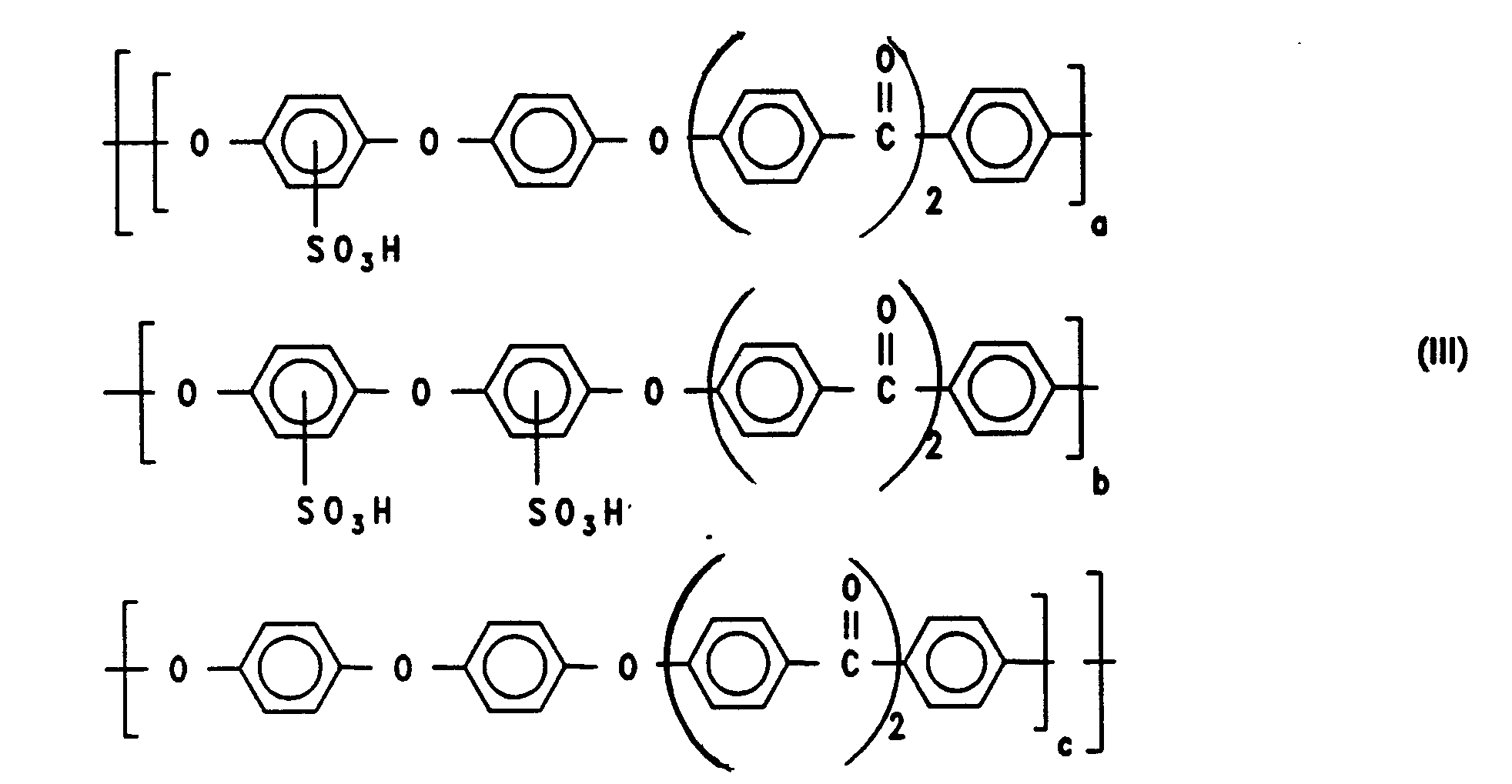
wobei - a = 0 bis 1,
- b = 0 bis 1,
- c = 0 bis 0,5 und
- a + b + c = 1 beträgt.
- Sie ist erhältlich durch Sulfonierung des Homopolymers der allgemeinen Formel V. Bei der Sulfonierung werden zuerst Monosubstitutionsprodukte (b = 0) erhalten, in denen a zwischen 0,5 und 1 und c zwischen 0 und 0,5 liegt. Dann erreicht a ein Maximum (etwa 1) wobei b gering bleibt und c auf geringe Werte zurückgeht. Schließlich kommt es zur Disulfonierung und der Wert von b steigt auf Kosten von a an. Die beschriebenen Polyelektrolyt-Membranen weisen Sulfonsäuregruppen auf und leiten sich von aromatischen Aryletherketonen ab. Unabhängig davon, ob sie darüber hinaus vernetzte oder unvernetzte Sulfonamid-Gruppen enthalten, eignen sie sich als protonenleitende Festelektrolyt-Membranen in Brennstoffzellen oder Elektrolysezellen. Da die polymeren Sulfonsäuren zum Zeitpunkt ihrer Weiterverarbeitung unvernetzt sind, lassen sie sich in geeigneten, polaren Lösungsmitteln wie Dimethylformamid, NMP, DMAc, DMSO lösen. Die so erhaltene Lösung weist vorzugsweise eine Molarität zwischen 50 und 450 g/I auf. Sie wird auf ein Substrat gegossen und durch anschließendes Verdampfen des Lösungsmittels erhält man eine homogene Membran. Alternativ kann man die Lösung zur Einstellung einer definierten Membrandicke mittels einer Rakel definierter Naßfilmdicke über das Substrat verteilen und beispielsweise Dicken im Bereich von 0,05 bis 0,4 mm erzielen. Nach dem gleichen Prinzip werden Trägergewebe oder mikroporöse bis poröse Trägermembranen, z. B. aus Polyethylen, Polypropylen, Polytetrafluorethylen oder Glas, mit der oben aufgeführen Lösung in Kontakt gebracht und das Lösungsmittel anschließend verdampft. Allgemein weisen die eingesetzten polymeren Sulfonsäuren und Sufonsäure-Derivate Molgewichte von mindestens 30000 auf.
- Die so erhaltene Membran bildet einen Sonderfall einer Polyelektrolyt-Membran, deren Material aus einem aromatischen Polyetherketon der Formel (I) durch Sulfonierung gewonnen wird. Diese Membranen können für Brennstoffzellen und Elektrolysezellen als Feststoffelektrolyt eingesetzt werden. Falls man die Membran aus einer Lösung einer polymeren Sulfonsäure der allgemeinen Formel (VII) hergestellt hat, so liegt nach dem Vernetzen in der Polyelektrolyt-Membran ein sulfoniertes aromatisches Polyetherketon der allgemeinen Formel (VIII) vor

wobei - a eine Zahl von 0,15 bis 0,95,
- b eine Zahl von 0,05 bis 0,25,
- c eine Zahl von 0 bis 0,8,
- a + b eine Zahl von 0,2 bis 1,0 bedeutet und
- a + b + c = 1 ist und wobei A ein durch Cycloaddition entstandenes zweiwertiges Ringsystem darstellt. Sofern bei der Umsetzung der Sulfonsäurechlorid-Gruppen ein Para-Amino-Zimtsäureester eingesetzt wurde und die sich von diesem Ester ableitenden reaktiven Endgruppen durch Licht oder Wärme dimerisiert wurden, so bedeutet A einen Rest der allgemeinen Formel (IX)
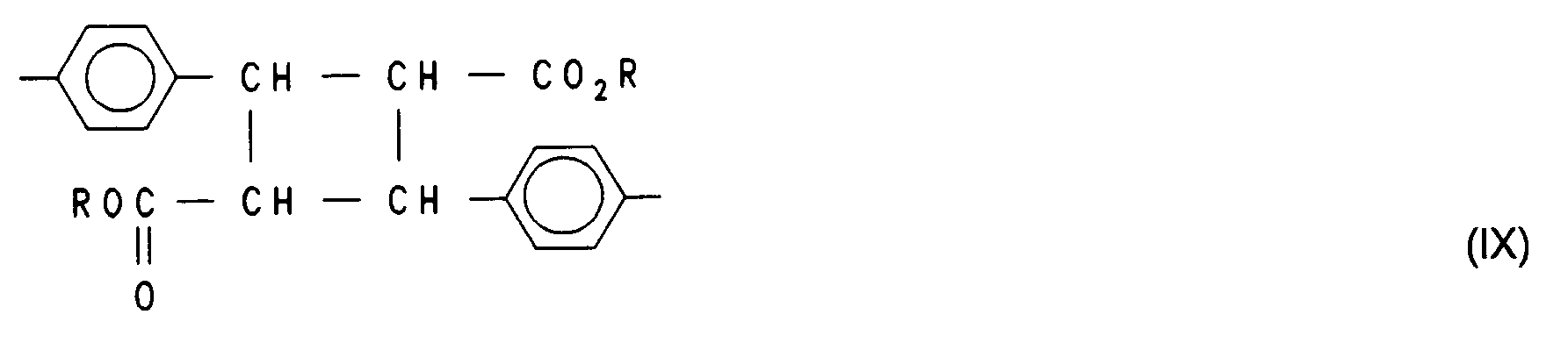
- in der R insbesondere für Wasserstoff oder Methyl steht. Falls die Sulfonylchlorid-Gruppen mit 2-Aminomethyl-furan umgesetzt wurden und die Verknüpfung der sich von diesem Amin ableitenden Reste mit einem Bis-Maleinimid durchgeführt wurde, hat der Rest A die allgemeine Formel (X)

wobei B einen zweiwertigen Rest, z. B. eine Alkylenkette mit 1 bis 4 Kohlenstoff-Atomen, einen Phenylenrest, Diphenylether-Rest, 2,2-Bisphenylpropanrest oder 2,2-Bisphenoxyphenyl-propanrest bedeutet. - Man kann auch Gemische aus polymeren vernetzbaren Sulfonamiden und polymeren nicht vernetzbaren aromatischen Sulfonsäuren gemeinsam zu Membranen verarbeiten. Auch hier tritt der Vorteil auf, daß durch eine Vernetzung das Quellen in Wasser stark verringert wird. Beispielsweise kann man ein vernetzbares Sulfonsäure-Derivat der Formel (VII) vereinen mit einer Sulfonsäure, die bei der Sulfonierung der Verbindung der allgemeinen Formel (I) gewonnen wurde. Die erhaltene Mischung wird zu einer Membran verarbeitet und (VII) später vernetzt. Vorzugsweise hat die unvernetzbare Sulfonsäure die allgemeine Formel (11) und das vernetzbare Sulfonsäure-Derivat die allgemeine Formel (XII)

wobei R für einen vernetzbaren Substituenten steht, beispielsweise NH2 R Allylamin oder p-Amino-Zimtsäure bedeutet, und a = 0 bis 1, c = 0 bis 0,5 und a + c = 1 ist. - Nach der Vernetzung durch (Licht, Wärme, Einfluß vernetzender Chemikalien) wird der Anteil an dem vernetzbaren Derivat der Formel XII umgewandelt in ein vernetztes Sulfonsäure-Derivat der Formel XI.

in der b = 0,5 bis 1, c = 0 bis 0,5, b + c = 1 und A ein durch Cycloaddition entstandenes zweiwertiges Ringsystem darstellt. - In diesem Fall beträgt vorteilhafterweise der Anteil an (XII) 0,5 bis 25 Gew.-% und der Anteil an (11) 75 bis 99,5 Gew.-%.
- Für den Einsatz der vernetzten Membran als Festelektrolyt in einer nach dem SPE - Verfahren arbeitenden Elektrolysezelle oder Brennstoffzelle, muß ein Katalysator auf die Membranoberfläche aufgebracht werden. Dieses Aufbringen kann man z. B. dadurch erreichen, daß man die Membran in einer Beschichtungszelle so einbaut, daß die Zelle durch die Membran in zwei Räume aufgeteilt wird. Wenn man auf der einen Seite das leicht reduzierbare Salz eines Katalysatormetalls, beispielsweise Hexachloroplatinsäure einbringt, in der anderen ein Reduktionsmittel einbringt, so diffundiert dieses durch die Membran und scheidet auf der Membranoberfläche das katalytisch wirksame Metall, beispielsweise Platin ab. Solche Verfahren wurden von H. Takinaka und E. Torikai in japanischen Patentanmeldungen angegeben (vgl. Chem. Abstracts 93(8) : 83677v und Chem. Abstracts 103(26) : 216571 e).
- Alternativ kann die Katalysatorbeschichtung durch Aufpressen eines Metallpulvers erfolgen. Beispielsweise kann man so eine Platinbelegung von 1 bis 20 mg/cm2 erzielen. Der Pressdruck beträgt beispielsweise 1,1 bis 8,8 bar, die Pressdauer zwischen 5 bis 15 Minuten. Eine allgemeine Beschreibung des Pressverfahrens ist in Appleby, Yeager, Energy (Oxford) 11 (1988) p 132 enthalten.
- Der Test der beschichteten Membranen erfolgt in Wasserelektrolyseuren bzw. Wasserstoff/Sauerstoff-Brennstoffzellen, die nach dem Festelektrolyt-Prinzip arbeiten. Die mit dem Katalysator beschichtete Membran separiert die beiden Halbzellen und ist gleichzeitig für den lonentransport zuständig. Auf die Membran folgend enthält jede Halbzelle zudem eine metallische Gas- und Stromverteilerstruktur, einen metallischen Stromkollektor sowie im Falle der Wasserelektrolyse Wasserzufuhr-/Gasableitungssysteme und im Falle der Wasserstoff/Sauerstoff-Brennstoffzelle Gaszufuhr/Wasserableitungssysteme. Die Zellen sind im Bereich von 20 bis 80 °C temperierbar, die Membranen werden mit einer definierten Stromdichte im Bereich 0 bis 1 A/cm2 Membranfläche belastet. In der Wasserelektrolysezelle ist die Bestimmung des Membranwiderstandes in der Zelle mittels des Verfahrens der Impedanzspektroskopie möglich. Der Quellungswert Q der Membran in Prozent ist definiert als:
- Q = (Naßgewicht - Trockengewicht) 100 / Trockengewicht
- Die Erfindung wird durch die Beispiele näher erläutert.
- In einer Vierhals-Rührapparatur mit Tropftrichter und Ölbad wurde 96 %ige konz. Schwefelsäure vorgelegt und unterschiedliche aromatische Polyetherketone gelöst. Danach wurde die Säurekonzentration durch Titration mit Oleum (Gehalt 20 % S03) auf 98,5 bis 99,5 Gew.-% H2S04 eingestellt. Die Sulfonierung wird durch eine sich anschließende Temperaturerhöhung beschleunigt. Die Endtemperatur hängt vom jeweiligen Polymer ab.
- Die Versuche der Tabelle 1 wurden mit einem Homopolymer der allgemeinen Formel (IV) durchgeführt. Die Versuche der Tabelle 2 wurden mit einem Homopolymer der allgemeinen Formel (V) durchgeführt. Die Versuche der Tabelle 3 wurden mit einem Homopolymer der allgemeinen Formel (VI) durchgeführt. In den Tabellen wurden folgende Abkürzungen benutzt:
-
- LT = Lösetemperatur
- RT = Reaktionstemperatur
- RZ = Reaktionszeit
- Ausb. = Ausbeute
- inh. V. = inhärente Viskosität in conc. H2 S04 bei 25°C (0,1 %) gemessen
- Sulfgrad = Sulfonierungsgrad, bestimmt durch den Schwefelgehalt aus der Elementaranalyse (Anteil der sulfonierten O-Phenylen-O-Einheiten)
- 230 ml Chlorsulfonsäure wurden in einem 11-Dreihals-Rundkolben mit KPG-Rührer vorgelegt und unter Stickstoff mit Eis/Kochsalz auf -14 °C abgekühlt. Innerhalb von 10 min. wurden 25,0 g Polyetherketon zugegeben und mit 20 ml Chlorsulfonsäure nachgespült. Nach 1 h war das gesamte Polyetherketon gelöst und das Eisbad wurde entfernt. Das Reaktionsgemisch erwärmte sich auf 26 ° C und wurde nun durch ein Wasserbad konstant bei 24 ° C gehalten.
- Während der gesamten Reaktionszeit wurden in Zeitabständen jeweils 0,5 bis 0,8 ml entnommen und in ca. 15 ml Wasser gefällt. Die Flocken wurden abgesaugt, mit Wasser bis zur pH-Neutralität gewaschen, zweimal mit Ethanol nachgewaschen und bei 100 °C am Ölpumpenvakuum getrocknet. Anschließend wurden Schwefel-Elementaranalysen angefertigt.
- Nach etwa 9 h Reaktionsdauer wurde der gesamte Kolbeninhalt mit Ausnahme von etwa 15 ml in 10 I gerührtes Eis/Wasser-Gemisch eingegossen. Das dabei ausgeflockte Produkt wurde abgesaugt und bis zur pH-Neutralität des Waschwassers mit Eis-Wasser gewaschen. Es wurde noch mit Ethanol und Ether nachgewaschen und bei ca. 80 °C im Vakuum getrocknet. Die 15 ml Reaktionslösung wurden nach ca. 29 h entsprechend aufgearbeitet. Die Abhängigkeit des Sulfonierungsgrades von der Reaktionsdauer ist in Tabelle 2 dargestellt. Der Sulfonierungsgrad wurde aus dem S/G-Verhältnis der Elementaranalyse berechnet.
- Mit zunehmenden Sulfonierungsgrad steigt die Löslichkeit in heißem Dimethylformamid, Dimethylsulfoxid und N-Methylpyrrolidon an.

- Die Sulfonierung des Polyetherketons läßt sich auch anhand der 13C-NMR-Spektren verfolgen. Das Signal bei 142,0 ppm beweist eine Sulfonierung der Hydrochinon-Einheit. Das schwache Signal bei 119,0 ppm, rührt von unsubstituierten Hydrochinon-Einheiten. Zu dem gleichen Ergebnis führt auch das Signal bei 159,7 ppm, welches durch den Kohlenstoff erzeugt wird, der über eine Etherbindung mit der Hydrochinon-Einheit verbunden ist und para-ständig eine Keto-Funktion besitzt. Das entsprechende Kohlenstoffatom in Nachbarstellung zu einer sulfonierten Hydrochinon-Einheit weist Signale bei 161,5 bzw. 162,8 ppm auf.
- 12,5 g des sulfonierten Polyetherketons von Beispiel 2 werden in einem 21-Dreihals-Rundkolben unter Rühren mit 250 ml Thionylchlorid und 30 Tropfen DMF versetzt. Dabei ist eine starke Gasentwicklung zu beobachten. Das Gemisch wird 2 h unter sanftem Rückfluß gekocht, nochmals mit 150 ml Thionylchlorid versetzt und weitere 14 h unter Rückfluß zum Sieden erhitzt. Nach Zugabe von 400 ml Tetrachlorethan bis auf einen Rückstand von ca. 250 ml abdestiliert. Nach dem Abkühlen wird die Reaktionsmischung in 2,5 I Ether eingerührt. Die farblosen Flocken werden abgesaugt, mit Ether gewaschen und im Vakuum getrocknet. Ausbeute: 12,4 g (95 %)
- Beispiel 4: Umsetzung des Sulfonylchlorid-Polyetherketons mit primären oder sekundären Aminen (allgemeine Vorschrift)
- 1,60 g (32,6 mmol) des Sulfonylchlorid-Polyetherketons von Beispiel 3 werden unter Stickstoff in 25 ml Chloroform gelöst. Bei ca. 0 ° C werden anschließend 25 bis 70 mmol des Amins zugetropft. Nach ca. 16 h Rühren bei Raumtemperatur wird das Reaktionsgemisch langsam in 750 ml Methanol eingegossen. Nach dem Absaugen wird das flockige Produkt mit 600 ml Ether behandelt. Das Produkt wird im Vakuum bei ca. 80 ° C getrocknet.
- Ausbeute: 56 bis 86 %
- Sulfoniertes Polyetherketon, das gemäß Beispiel 2 hergestellt wurde (Sulfonierungsgrad 90 %), wurde in DMF gelöst (Konzentration: 100 bis 300 g/I) und die Lösung mit einer 0,2 mm-Rakel über eine Glasplatte gezogen. Innerhalb von 15 Stunden war das DMF verdampft. Dann wurde die Glasplatte in Wasser gelegt. Die Polymerfolie löste sich vom Glas. Nach dem Äquilibrieren in wässriger KCI-Lösung betrug die Foliendicke über 27 um.
- Das Wasseraufnahmevermögen der Folie bei Raumtemperatur liegt unter 50 % und bei 80 ° C bei ca. 1900 %. Die Membran bleibt dabei jedoch beständig. Die Permselektivität der Membran beträgt etwa 90 %. Die Membran ist auch nach einer Bestrahlung mit einer 700 W Quecksilber-Niederdruckdampflampe (30 min.) noch in Dimethylformamid löslich. Das Wasseraufnahmevermögen wird durch das Bestrahlen nicht verändert.
- Nach dem Verfahren von Beispiel 4 wurde ein Sulfonamid der Formel (XII) (a = etwa 0,95, c = etwa 0,05) hergestellt, in dem der Rest NHR sich von p-Amino-Zimtsäure-methylester ableitet. 20 g des Sulfonamids und 80 g der Sulfonsäure von Beispiel 2 wurden in 1 I DMF gelöst und aus der Lösung nach dem Verfahren von Beispiel 5 Folien bereitet. Nach dem Äquilibrieren in KCI-Lösung betrug die Foliendicke etwa 3 um.
- Durch zweistündiges Bestrahlen aus einem Abstand von ca. 5 cm mit einer 300 W-UV-Lampe fand eine teilweise [2 + 2]-Cycloaddition der Zimtsäure-Doppelbindung statt.
- Während vor dem Bestrahlen das Wasseraufnahmevermögen der Folie (bei 85 °C) ca. 1800 % betrug, sank es nach der Bestrahlung auf 400 % ab. Die Permselektivität der Membran beträgt etwa 90 %.
- Zur Herstellung der Kationenaustauschermembran werden 25 g sulfoniertes Polyetheretherketonketon mit einem Sulfonierungsgrad von 90 % in 100 ml Dimethylformamid gelöst. Die homogene Lösung wird auf eine Glasplatte gegossen und mit Hilfe einer Rakel der Naßfilmdicke 350 um auf der Oberfläche verteilt. Nach 24-stündiger Trocknung bei Raumtemperatur läßt sich die Membran im Wasserbad ablösen. Die mittlere Dicke der bei Raumtemeratur in destilliertem Wasser äquilibrierten Membran betrug 65 um.
- Die Katalysatoraufbringung erfolgt im Heißpreßverfahren bei 130 °C, wobei sich eine Platinbelegung von 5 mg/cm2 Membranfläche ergab. Diese Membran wurde in eine Wasserelektrolyse-Testzelle mit einer Membranfläche von 1 cm2 eingebaut.
- Bei den Messungen zeigte die Membran bis 80 ° C stabiles Verhalten. Das Zellpotential lag bei einer Temperatur von 80 °C und einer Strombelastung von 1 A/cm2 bei 2,15 Volt. Der Innenwiderstand im Elektrolysebetrieb bei 80 ° C betrug 185 mOhm.
- Während eines Dauertestes bei 80 ° C unter einer Belastung von 1 A/cm2 erwies sich die Membran über einen Zeitraum von 191 Stunden als stabil.
- Eine gemäß Beispiel 7 hergestellte und beschichtete Membran wurde in eine Wasserstoff-/Sauerstoff-Brennstoffzelle mit einer Membranfläche von 12 cm2 eingebaut. Die Membran erwies sich bis zu einer Temperatur von 80 ° C als temperaturstabil. Im Betrieb mit einem Überdruck von jeweils 1 bar sowohl auf der Wasserstoff- wie auf der Sauerstoffseite stellte sich bei einer Belastung mit 175 mA/cm2 eine Zellspannung von 700 mV ein.
bedeuten,
R2 ausgewählt ist aus den Resten



Claims (20)

wobei
bedeuten,
sulfoniert, die Sulfonsäure isoliert, in einem organischen Lösemittel auflöst und die Lösung zu einer Folie verarbeitet, dadurch gekennzeichnet, daß man in der Sulfonsäure mindestens 5 % der vorhandenen Sulfonsäuregruppen in Sulfonylchlorid-Gruppen umwandelt, man die Sulfonylchlorid-Gruppen mit einem Amin umsetzt, das mindestens einen vernetzbaren Substituenten oder eine weitere funktionelle Gruppe aufweist, wobei 5 % bis 25 % der ursprünglich vorhandenen Sulfonsäuregruppen in Sulfonamid-Gruppen umgewandelt werden, man anschließend nicht reagierte Sulfonsäurechlorid-Gruppen hydrolisiert, man das resultierende aromatische Sulfonsäureamid isoliert und in einem organischen Lösemittel auflöst, man die Lösung zu einer Folie verarbeitet und dann die in der Folie vorhandenen vernetzbaren Substituenten vernetzt.

besitzt, wobei a = 0,2 bis 1,0, c = 0 bis 0,8 und a + c = 1 ist.

besitzt, wobei

sulfoniert, bis ein Sulfonierungsgrad von 0,5 bis 1,0 erreicht ist und man die isolierte Sulfonsäure weiter verarbeitet.

sulfoniert, bis ein Sulfonierungsgrad von 0,5 bis 1,0 bezogen auf die sulfonierbaren O-Phenylen-O-Einheiten erreicht ist und man die isolierte Sulfonsäure weiterverarbeitet.

sulfoniert, bis ein Sulfonierungsgrad von 0,5 bis 1,0, vorzugsweise 0,6 bis 0,8, bezogen auf die sulfonierbare O-Phenylen-O-Einheit, erreicht ist und man die isolierte Sulfonsäure weiterverarbeitet.

durch Sulfonierung gewonnen wird, wobei X, M, N, Y, P, Ar und Ar' die in Anspruch 1 angegebene Bedeutung besitzen und der Sulfonierungsgrad mindestens 0,5 Sulfonsäuregruppen pro wiederkehrende Einheit beträgt, als protonenleitende Festelektrolyt-Membran in Brennstoffzellen oder Elektrolysezellen.


wobei


aufweist,
wobei


steht, wobei R Wasserstoff oder Methyl bedeutet.

steht, wobei B einen zweiwertigen Rest bedeutet.

in der b = 0,5 bis 1, c = 0 bis 0,5, b + c = 1 ist und A die in Anspruch 14 angegebene Bedeutung aufweist und

bei dem mindestens 20 % der O-Phenylen-O-Einheiten mit einer SO3H-Gruppe substituiert sind, wobei Ar, Ar', X, N, M, Y und P die in Anspruch 1 angegebene Bedeutung aufweisen, besteht.


wobei NH2 R Allylamin oder p-Amino-Zimtsäure bedeutet und a = 0 bis 1, c = 0 bis 0,5 und a + c = 1 ist.
Applications Claiming Priority (4)
| Application Number | Priority Date | Filing Date | Title |
|---|---|---|---|
| DE4219412 | 1992-06-13 | ||
| DE4219412 | 1992-06-13 | ||
| DE4242692 | 1992-12-17 | ||
| DE4242692 | 1992-12-17 |
Publications (3)
| Publication Number | Publication Date |
|---|---|
| EP0574791A2 true EP0574791A2 (de) | 1993-12-22 |
| EP0574791A3 EP0574791A3 (en) | 1995-10-18 |
| EP0574791B1 EP0574791B1 (de) | 1999-12-22 |
Family
ID=25915663
Family Applications (1)
| Application Number | Title | Priority Date | Filing Date |
|---|---|---|---|
| EP93109139A Expired - Lifetime EP0574791B1 (de) | 1992-06-13 | 1993-06-07 | Polymerelektrolyt-Membran und Verfahren zu ihrer Herstellung |
Country Status (8)
| Country | Link |
|---|---|
| US (4) | US5438082A (de) |
| EP (1) | EP0574791B1 (de) |
| JP (3) | JP3342106B2 (de) |
| KR (5) | KR100289851B1 (de) |
| CA (1) | CA2098238C (de) |
| DE (1) | DE59309908D1 (de) |
| SG (1) | SG73410A1 (de) |
| TW (1) | TW250485B (de) |
Cited By (47)
| Publication number | Priority date | Publication date | Assignee | Title |
|---|---|---|---|---|
| WO1996029359A1 (de) * | 1995-03-20 | 1996-09-26 | Hoechst Aktiengesellschaft | Polymerelektrolyte und verfahren zu ihrer herstellung |
| EP0768330A1 (de) * | 1995-10-12 | 1997-04-16 | Fraunhofer-Gesellschaft Zur Förderung Der Angewandten Forschung E.V. | Sulfonierte Polyaryletherketone |
| WO1997023919A1 (de) | 1995-12-22 | 1997-07-03 | Hoechst Research & Technology Deutschland Gmbh & Co.Kg | Kontinuierliches verfahren zur herstellung von menbran-elektroden-verbunden (mea) |
| WO1997024777A1 (en) * | 1995-12-28 | 1997-07-10 | Research Foundation Of The State University Of New York | Blend membranes based on sulfonated poly(phenylene oxide) for enhanced polymer electrochemical cells |
| WO1997040543A1 (de) * | 1996-04-24 | 1997-10-30 | Hoechst Research & Technology Deutschland Gmbh & Co.Kg | Verfahren zur herstellung einer kationenaustauschenden polymerelektrolyt membrane (pem) |
| DE19732578A1 (de) * | 1997-07-29 | 1999-03-04 | Hoechst Ag | Hochtemperaturbeständige Kationenaustauscher als Katalysatoren bei Reaktionstemperaturen über 150 DEG C |
| DE19817376A1 (de) * | 1998-04-18 | 1999-10-21 | Univ Stuttgart Lehrstuhl Und I | Säure-Base-Polymerblends und ihre Verwendung in Membranprozessen |
| WO1999048932A3 (de) * | 1998-03-27 | 1999-12-02 | Univ Stuttgart Inst Fuer Chemi | Modifiziertes polymer und modifizierte polymermembran |
| WO2000009588A1 (de) * | 1998-08-12 | 2000-02-24 | Universität Stuttgart | Modifikation von engineeringpolymeren mit n-basischen gruppen und mit ionenaustauschergruppen in der seitenkette |
| EP0870340A4 (de) * | 1995-11-22 | 2000-03-22 | California Inst Of Techn | Polymermaterial für elektrolytische membranen von brennstoffzellen |
| WO2000015691A1 (en) * | 1998-09-11 | 2000-03-23 | Victrex Manufacturing Limited | Ion-exchange polymers |
| US6042958A (en) * | 1997-04-25 | 2000-03-28 | Johnson Matthey Public Limited Company | Composite membranes |
| DE19840186A1 (de) * | 1998-09-03 | 2000-03-30 | Dornier Gmbh | Verbundglasscheibe mit elektrisch steuerbarem Reflexionsgrad |
| WO2000023177A1 (de) * | 1998-10-16 | 2000-04-27 | Celanese Ventures Gmbh | Membranen, enthaltend sulfoniertes polyetherketon und weiteres polymer, verfahren zu deren herstellung und deren verwendung |
| WO2000066254A1 (de) * | 1999-04-30 | 2000-11-09 | Universität Stuttgart | Stufenweise alkylierung von polymeren aminen |
| WO2001019896A1 (en) * | 1999-09-10 | 2001-03-22 | Victrex Manufacturing Limited | Composite ion-exchange membranes |
| WO2000074827A3 (de) * | 1999-04-30 | 2001-03-29 | Univ Stuttgart Inst Fuer Chemi | Komposite und kompositmembranen |
| WO2001015249A3 (en) * | 1999-08-23 | 2001-11-08 | Ballard Power Systems | Fuel cell anode structures for voltage reversal tolerance |
| WO2001070857A3 (en) * | 2000-03-22 | 2001-12-20 | Victrex Mfg Ltd | Ion-exchange materials |
| WO2001070858A3 (en) * | 2000-03-22 | 2001-12-27 | Victrex Mfg Ltd | Composite ion exchange material |
| WO2001071835A3 (en) * | 2000-03-22 | 2002-02-14 | Victrex Mfg Ltd | Membrane/electrode composite |
| WO2001071839A3 (en) * | 2000-03-22 | 2002-03-21 | Victrex Mfg Ltd | Ion exchange materials |
| WO2001087992A3 (de) * | 2000-05-19 | 2002-05-23 | Univ Stuttgart Inst Fuer Chemi | Kovalent und ionisch vernetzte polymere und polymermembranen |
| WO2002077068A3 (de) * | 2001-03-28 | 2002-11-14 | Fuma Tech Gmbh | Sulfoniertes polyetherketonketon |
| US6485856B1 (en) | 1999-06-22 | 2002-11-26 | Johnson Matthey Public Limited Company | Non-woven fiber webs |
| WO2003030289A3 (de) * | 2001-09-28 | 2003-11-13 | Inst Polymerforschung Dresden | Polymere brennstoffzellen-membran und verfahren zu ihrer herstellung |
| US6759441B1 (en) | 1998-04-18 | 2004-07-06 | Universitat Stuttgart Lehrstuhl Und Institut Fur Chemische Verfahrenstechnik | Acid-base polymer blends and their use in membrane processes |
| WO2004076530A1 (de) * | 2003-02-28 | 2004-09-10 | Basf Aktiengesellschaft | Verfahren zur herstellung eines zum protonenaustausch befähigten polymersystems auf der basis von polyaryletherketonen |
| US6953634B2 (en) | 2002-02-21 | 2005-10-11 | Daimlerchrysler Ag | Method for manufacturing composite membranes |
| EP1612232A4 (de) * | 2003-04-07 | 2006-05-17 | Mitsui Chemicals Inc | Vernetzbares ionenleitendes harz und damit hergestellte ionenleitende polymermembranen, bindemittel und brennstoffzellen |
| US7052792B2 (en) | 2000-03-17 | 2006-05-30 | Johnson Matthey Public Limited Company | Proton conducting polymer membrane for electrochemical cell |
| EP1681311A1 (de) * | 2005-01-12 | 2006-07-19 | Basf Aktiengesellschaft | Funktionalisierte Polyarylether |
| US7125626B2 (en) | 1994-12-07 | 2006-10-24 | Japan Gore-Tex, Inc. | Ion exchange assembly for an electrochemical cell |
| WO2008012222A3 (de) * | 2006-07-28 | 2008-04-24 | Leibniz Inst Polymerforschung | Sulfonierte polyarylenverbindungen, membranmaterial daraus, verfahren zu ihrer herstellung und verwendung |
| US7405021B2 (en) | 2000-07-08 | 2008-07-29 | Johnson Matthey Public Limited Company | Water-retaining anode structure for a fuel cell |
| WO2009109545A1 (de) * | 2008-03-04 | 2009-09-11 | Basf Se | Verfahren zur herstellung von sulfonierten polyaryletherketonen mit regelung des sulfonierungsgrades mittels uv-spektroskopie |
| DE102009014906A1 (de) | 2008-04-01 | 2009-10-15 | Basf Se | Polymerelektrolyte basierend auf Lewis-Säure modifizierten Imidazoliumsalzen |
| US7776957B2 (en) | 2005-06-30 | 2010-08-17 | Basf Aktiengesellschaft | Aqueous formulations containing polyaromatic compounds with acid groups |
| DE102009013207A1 (de) | 2009-03-17 | 2010-09-23 | Rheinisch-Westfälische Technische Hochschule Aachen | Bipolare Membran |
| EP1040155B2 (de) † | 1997-12-08 | 2010-12-01 | BASF Fuel Cell GmbH | Verfahren zur herstellung einer membran zum betrieb von brennstoffzellen und elektrolyseuren |
| EP1493770A3 (de) * | 1998-09-11 | 2010-12-08 | Victrex Manufacturing Limited | Ionenaustauschpolymere |
| US7931995B2 (en) | 1997-09-12 | 2011-04-26 | Gore Enterprise Holdings, Inc. | Solid electrolyte composite for electrochemical reaction apparatus |
| US8022165B2 (en) | 2006-02-16 | 2011-09-20 | Basf Se | Catalytic process for the phosphonylation of high-temperature polymers |
| EP2117678A4 (de) * | 2006-12-14 | 2012-03-07 | Arkema Inc | Hochtemperaturstabile polyelektrolyte mit aromatischen gruppen in der hauptkette |
| WO2012080078A2 (en) | 2010-12-18 | 2012-06-21 | Umicore Galvanotechnik Gmbh | Dire-contact membrane anode for use in electrolysis cells |
| WO2016012670A1 (fr) * | 2014-07-23 | 2016-01-28 | Cdp Innovation | Nouveaux polymeres contenant des sels de lithium ou de sodium de bis(sulfonyl)imides greffes, leurs procedes de preparation et leurs utilisations comme electrolytes pour batteries |
| WO2016012669A1 (fr) * | 2014-07-23 | 2016-01-28 | Cdp Innovation | Nouveaux polymeres contenant des sels de lithium ou de sodium de sulfonamides, leurs procedes de preparation et leurs utilisations comme electrolytes pour batteries |
Families Citing this family (173)
| Publication number | Priority date | Publication date | Assignee | Title |
|---|---|---|---|---|
| EP0574791B1 (de) * | 1992-06-13 | 1999-12-22 | Aventis Research & Technologies GmbH & Co. KG | Polymerelektrolyt-Membran und Verfahren zu ihrer Herstellung |
| DE4415678A1 (de) * | 1994-05-04 | 1995-11-09 | Hoechst Ag | Elektrochemische Zelle |
| US6254978B1 (en) * | 1994-11-14 | 2001-07-03 | W. L. Gore & Associates, Inc. | Ultra-thin integral composite membrane |
| US5939206A (en) * | 1996-08-29 | 1999-08-17 | Xerox Corporation | Stabilized porous, electrically conductive substrates |
| US5761809A (en) * | 1996-08-29 | 1998-06-09 | Xerox Corporation | Process for substituting haloalkylated polymers with unsaturated ester, ether, and alkylcarboxymethylene groups |
| US5739254A (en) * | 1996-08-29 | 1998-04-14 | Xerox Corporation | Process for haloalkylation of high performance polymers |
| US5849809A (en) * | 1996-08-29 | 1998-12-15 | Xerox Corporation | Hydroxyalkylated high performance curable polymers |
| US6007877A (en) | 1996-08-29 | 1999-12-28 | Xerox Corporation | Aqueous developable high performance photosensitive curable aromatic ether polymers |
| US5863963A (en) * | 1996-08-29 | 1999-01-26 | Xerox Corporation | Halomethylated high performance curable polymers |
| US5994425A (en) * | 1996-08-29 | 1999-11-30 | Xerox Corporation | Curable compositions containing photosensitive high performance aromatic ether polymers |
| US5945253A (en) | 1996-08-29 | 1999-08-31 | Xerox Corporation | High performance curable polymers and processes for the preparation thereof |
| US5889077A (en) * | 1996-08-29 | 1999-03-30 | Xerox Corporation | Process for direct substitution of high performance polymers with unsaturated ester groups |
| US5958995A (en) | 1996-08-29 | 1999-09-28 | Xerox Corporation | Blends containing photosensitive high performance aromatic ether curable polymers |
| US6124372A (en) | 1996-08-29 | 2000-09-26 | Xerox Corporation | High performance polymer compositions having photosensitivity-imparting substituents and thermal sensitivity-imparting substituents |
| US5837783A (en) * | 1997-05-08 | 1998-11-17 | The United States Of America As Represented By The Secretary Of The Air Force | Sulfo-pendent aryletherketone polymer film containing NLO chromophore |
| JP4398522B2 (ja) * | 1997-05-22 | 2010-01-13 | バスフ・ヒュエル・セル・ゲーエムベーハー | 燃料電池用高分子電解質膜の製造方法及び燃料電池 |
| WO1999005100A1 (fr) * | 1997-07-25 | 1999-02-04 | Acep Inc | Composes ioniques ayant une charge anionique delocalisee, leur utilisation comme composants de conducteurs ioniques ou de catalyseur |
| US6248469B1 (en) | 1997-08-29 | 2001-06-19 | Foster-Miller, Inc. | Composite solid polymer electrolyte membranes |
| US6030718A (en) | 1997-11-20 | 2000-02-29 | Avista Corporation | Proton exchange membrane fuel cell power system |
| USRE39556E1 (en) * | 1997-11-20 | 2007-04-10 | Relion, Inc. | Fuel cell and method for controlling same |
| US6096449A (en) | 1997-11-20 | 2000-08-01 | Avista Labs | Fuel cell and method for controlling same |
| EP1400539B1 (de) | 1998-01-30 | 2008-12-03 | Hydro Quebec | Verfahren zur Herstellung von vernetzten sulfonierten Polymeren |
| US6090895A (en) * | 1998-05-22 | 2000-07-18 | 3M Innovative Properties Co., | Crosslinked ion conductive membranes |
| US6248480B1 (en) * | 1998-06-29 | 2001-06-19 | Sri International | High temperature polymer electrolytes |
| EP1115769A1 (de) * | 1998-08-28 | 2001-07-18 | Foster-Miller, Inc. | Ionisch leitende materialien geeignet zur verwendung in elektrochemischen anwendungen und verfahren |
| US20040209965A1 (en) * | 1998-10-16 | 2004-10-21 | Gascoyne John Malcolm | Process for preparing a solid polymer electrolyte membrane |
| US20040266299A1 (en) * | 1998-10-16 | 2004-12-30 | Fongalland Dharshini Chryshatha | Substrate |
| US6139920A (en) * | 1998-12-21 | 2000-10-31 | Xerox Corporation | Photoresist compositions |
| US7550216B2 (en) * | 1999-03-03 | 2009-06-23 | Foster-Miller, Inc. | Composite solid polymer electrolyte membranes |
| DE19919988A1 (de) * | 1999-04-30 | 2000-11-02 | Univ Stuttgart | Protonenleitende Keramik-Polymer-Kompositmembran für den Temperaturbereich bis 300 DEG C |
| US6117967A (en) * | 1999-06-04 | 2000-09-12 | Xerox Corporation | Arylene ether alcohol polymers |
| US6174636B1 (en) | 1999-06-04 | 2001-01-16 | Xerox Corporation | Imaging members containing arylene ether alcohol polymers |
| US6177238B1 (en) | 1999-06-04 | 2001-01-23 | Xerox Corporation | Ink jet printheads containing arylene ether alcohol polymers and processes for their formation |
| JP3656244B2 (ja) | 1999-11-29 | 2005-06-08 | 株式会社豊田中央研究所 | 高耐久性固体高分子電解質及びその高耐久性固体高分子電解質を用いた電極−電解質接合体並びにその電極−電解質接合体を用いた電気化学デバイス |
| JP4802354B2 (ja) | 1999-12-27 | 2011-10-26 | 住友化学株式会社 | 高分子電解質およびその製造方法 |
| EP1138712B1 (de) * | 2000-03-29 | 2006-01-18 | JSR Corporation | Polyarylen Kopolymer und Protonen leitende Membran |
| US6468682B1 (en) | 2000-05-17 | 2002-10-22 | Avista Laboratories, Inc. | Ion exchange membrane fuel cell |
| US7326480B2 (en) | 2000-05-17 | 2008-02-05 | Relion, Inc. | Fuel cell power system and method of controlling a fuel cell power system |
| DE10024575A1 (de) * | 2000-11-02 | 2001-11-22 | Univ Stuttgart | Kovalent vernetzte Polymere und Polymermembranen via Sulfinatalkylierung |
| DE10054233A1 (de) * | 2000-05-19 | 2002-05-08 | Univ Stuttgart Lehrstuhl Und I | Kovalent vernetzte Kompositmembranen |
| TW522435B (en) * | 2000-05-23 | 2003-03-01 | Toray Industries | Slurry, display component and process for producing the display component |
| ATE478913T1 (de) | 2000-06-02 | 2010-09-15 | Stanford Res Inst Int | Polymermembranzusammensetzung |
| GB0016750D0 (en) * | 2000-07-08 | 2000-08-30 | Johnson Matthey Plc | Improved material for electrode manufacture |
| JP3607862B2 (ja) | 2000-09-29 | 2005-01-05 | 株式会社日立製作所 | 燃料電池 |
| EP1354907B1 (de) | 2000-11-13 | 2006-03-01 | Toyo Boseki Kabushiki Kaisha | Polybenzazolverbindung mit sulfo- und/oder phosphonogruppe, diese enthaltende harzzusammensetzung, harzformteil, polymerfestelektrolytfolie, verbund aus festelektrolytfolie und elektrodenkatalysatorschicht und verfahren zur herstellung des verbunds |
| JP4240263B2 (ja) * | 2000-12-22 | 2009-03-18 | 富士フイルム株式会社 | 電解質組成物及び非水電解質二次電池 |
| JP3412762B2 (ja) * | 2001-01-19 | 2003-06-03 | 本田技研工業株式会社 | 複合高分子電解質膜及びその製造方法 |
| JP5021864B2 (ja) * | 2001-02-21 | 2012-09-12 | パナソニック株式会社 | 固体高分子電解質型燃料電池用膜・電極接合体および固体高分子電解質膜 |
| US20020160272A1 (en) * | 2001-02-23 | 2002-10-31 | Kabushiki Kaisha Toyota Chuo | Process for producing a modified electrolyte and the modified electrolyte |
| JP4221164B2 (ja) * | 2001-03-30 | 2009-02-12 | 本田技研工業株式会社 | 固体高分子型燃料電池 |
| DE10296599B9 (de) * | 2001-03-30 | 2018-01-18 | Honda Giken Kogyo K.K. | Polymerelektrolytbrennstoffzelle |
| WO2002099916A2 (en) | 2001-06-01 | 2002-12-12 | Polyfuel, Inc | Fuel cell assembly for portable electronic device and interface, control, and regulator circuit for fuel cell powered electronic device |
| US7316855B2 (en) | 2001-06-01 | 2008-01-08 | Polyfuel, Inc. | Fuel cell assembly for portable electronic device and interface, control, and regulator circuit for fuel cell powered electronic device |
| WO2002101860A1 (en) * | 2001-06-11 | 2002-12-19 | Honda Giken Kogyo Kabushiki Kaisha | Electrode structure for solid polymer fuel cell, its production method, and solid polymer fuel cell |
| CA2451662A1 (en) * | 2001-06-25 | 2003-01-03 | Honda Giken Kogyo Kabushiki Kaisha | Electrode structure for solid-polymer type fuel cell |
| TW588076B (en) * | 2001-07-03 | 2004-05-21 | Sumitomo Chemical Co | Polymer electrolyte membrane and fuel cell |
| JP2003068327A (ja) * | 2001-08-28 | 2003-03-07 | Kanegafuchi Chem Ind Co Ltd | 燃料電池用膜 |
| JP3561250B2 (ja) | 2001-09-21 | 2004-09-02 | 株式会社日立製作所 | 燃料電池 |
| GB0123109D0 (en) * | 2001-09-26 | 2001-11-14 | Victrex Mfg Ltd | Cells |
| TWI236486B (en) * | 2001-10-10 | 2005-07-21 | Mitsui Chemicals Inc | Crosslinkable aromatic resin having protonic acid group, and ion conductive polymer membrane, binder and fuel cell using the resin |
| US7196151B2 (en) * | 2001-11-22 | 2007-03-27 | Haering Thomas | Functionalized main chain polymers |
| WO2003060011A2 (de) * | 2001-11-22 | 2003-07-24 | HÄRING, Rima | Modifizierte kovalent vernetzte polymere |
| DE60236314D1 (en) | 2001-11-29 | 2010-06-17 | Ube Industries | Polyelektrolytzusammensetzungen |
| JP3737751B2 (ja) * | 2001-12-20 | 2006-01-25 | 株式会社日立製作所 | 燃料電池、それに用いる高分子電解質及びイオン交換性樹脂 |
| DE10163518A1 (de) | 2001-12-21 | 2003-07-10 | Fraunhofer Ges Forschung | Protonenleitfähige Membranen/Schichten und Verfahren zu deren Herstellung |
| GB0200253D0 (en) * | 2002-01-08 | 2002-02-20 | Johnson Matthey Plc | Improved material for electrode manufacture |
| JP4501052B2 (ja) * | 2002-01-24 | 2010-07-14 | 東洋紡績株式会社 | 熱架橋性高分子固体電解質、高分子固体電解質膜及びその製造方法 |
| WO2003067695A2 (en) * | 2002-02-06 | 2003-08-14 | Battelle Memorial Institute | Polymer electrolyte membrane fuel cell system |
| AU2003219726A1 (en) | 2002-02-06 | 2003-09-02 | Battelle Memorial Institute | Methods of removing contaminants from a fuel cell electrode |
| GB0210194D0 (en) * | 2002-05-03 | 2002-06-12 | Johnson Matthey Plc | Composite membrane |
| AU2003237849B2 (en) | 2002-05-13 | 2009-07-02 | Polyfuel, Inc. | Sulfonated copolymer |
| US7354679B2 (en) | 2002-05-13 | 2008-04-08 | Polyfuel, Inc. | Ion conductive random copolymers |
| US7572535B2 (en) * | 2002-05-13 | 2009-08-11 | Polyfuel, Inc. | Ion conductive copolymers containing one or more hydrophobic oligomers |
| CA2485971A1 (en) * | 2002-05-13 | 2004-05-21 | Polyfuel, Inc. | Ion conductive block copolymers |
| GB0212636D0 (en) * | 2002-05-31 | 2002-07-10 | Johnson Matthey Plc | Electrode |
| US7141322B2 (en) * | 2002-06-27 | 2006-11-28 | H Power Corporation | Alcohol fueled direct oxidation fuel cells |
| US6630265B1 (en) * | 2002-08-13 | 2003-10-07 | Hoku Scientific, Inc. | Composite electrolyte for fuel cells |
| US7678863B2 (en) * | 2002-09-25 | 2010-03-16 | National Research Council Of Canada | Proton exchange membrane materials based on sulfonated poly (phthalazinones) |
| EP1561768B8 (de) * | 2002-10-08 | 2010-02-17 | Toyo Boseki Kabushiki Kaisha | SULFONSûUREGRUPPENHALTIGE POLYARYLENETHER-VERBINDUNG, DIESE ENTHALTENDE ZUSAMMENSETZUNG UND VERFAHREN ZU DEREN HERSTELLUNG |
| US7649025B2 (en) * | 2002-10-17 | 2010-01-19 | Toyo Boseki Kabushiki Kaisha | Composite ion-exchange membrane |
| US20040175598A1 (en) * | 2002-12-02 | 2004-09-09 | Bliven David C. | Fuel cell power supply for portable computing device and method for fuel cell power control |
| CA2508123A1 (en) * | 2002-12-02 | 2004-06-17 | Polyfuel, Inc. | Fuel cell cartridge for portable electronic device |
| AU2003296367A1 (en) * | 2002-12-05 | 2004-06-30 | Battelle Memorial Institute | Methods of removing sulfur from a fuel cell electrode |
| CN100364160C (zh) * | 2003-03-06 | 2008-01-23 | 东丽株式会社 | 高分子电解质材料、高分子电解质部件、膜电极复合体和高分子电解质型燃料电池 |
| US20040258972A1 (en) * | 2003-04-08 | 2004-12-23 | Yanhai Du | Solid state electrochemical devices |
| EP1624513A1 (de) * | 2003-04-09 | 2006-02-08 | NEC Corporation | Brennstoffzelle und verfahren zu ihrer herstellung |
| WO2005001969A1 (ja) * | 2003-06-25 | 2005-01-06 | Toray Industries, Inc. | 高分子電解質ならびにそれを用いた高分子電解質膜、膜電極複合体および高分子電解質型燃料電池 |
| US6962959B2 (en) * | 2003-08-28 | 2005-11-08 | Hoku Scientific, Inc. | Composite electrolyte with crosslinking agents |
| GB0322598D0 (en) * | 2003-09-26 | 2003-10-29 | Victrex Mfg Ltd | Polymeric material |
| DE602004030358D1 (de) * | 2003-10-02 | 2011-01-13 | Univ Yamanashi | Sulfonierte aromatische polyether, herstellungsverfahren dafür und elektrolytmembranen |
| TW200518377A (en) * | 2003-10-17 | 2005-06-01 | Sumitomo Chemical Co | Block copolymer and applications thereof |
| KR100506096B1 (ko) * | 2003-10-27 | 2005-08-03 | 삼성에스디아이 주식회사 | 말단 술폰산기를 포함하는 고분자 및 이를 채용한 고분자전해질과 연료 전지 |
| WO2005050671A2 (en) * | 2003-11-13 | 2005-06-02 | Polyfuel, Inc. | Ion conductive random copolymers |
| CN100558793C (zh) * | 2003-11-13 | 2009-11-11 | 复合燃料公司 | 离子导电无规共聚物 |
| US20070275286A1 (en) * | 2004-02-23 | 2007-11-29 | Serge Kaliaguine | Method for Cross-Linking Sulfonated Polymers |
| US7504461B2 (en) * | 2004-03-12 | 2009-03-17 | Polyfuel, Inc. | Ion-conductive copolymers containing one or more ion-conducting oligomers |
| CA2563040C (en) * | 2004-04-30 | 2012-07-17 | Sumitomo Chemical Company, Limited | Polymer having oxocarbon group, and use thereof |
| JP4752318B2 (ja) * | 2004-04-30 | 2011-08-17 | 住友化学株式会社 | オキソカーボン基を有する高分子及びその用途 |
| CA2511112A1 (en) * | 2004-06-30 | 2005-12-30 | Her Majesty The Queen In Right Of Canada, As Represented By The Minister Of National Research Council Of Canada | Synthesis of poly(arylene)s copolymers containing pendant sulfonic acid groups bonded to naphthalene as proton exchange membrane meterials |
| US20080020253A1 (en) * | 2004-07-09 | 2008-01-24 | Ingo Neubert | Method for Producing a Membrane-Electrode Unit |
| KR101232445B1 (ko) * | 2004-09-03 | 2013-02-12 | 도레이 카부시키가이샤 | 고분자 전해질 재료, 고분자 전해질 부품, 막 전극 복합체,및 고분자 전해질형 연료 전지 |
| US20060088748A1 (en) * | 2004-10-26 | 2006-04-27 | Gangadhar Panambur | Novel compositions of monomers, oligomers and polymers and methods for making the same |
| EP1826846A4 (de) | 2004-11-10 | 2010-01-13 | Toyo Boseki | Aromatische kohlenwasserstoffbasenprotonen-austauschmembran und direktmethanol-brennstoffzelle damit |
| ATE501221T1 (de) | 2004-11-10 | 2011-03-15 | Toyo Boseki | Protonenleitendes polymer enthaltende zusammensetzung und herstellungsverfahren dafür, die protonenleitendes polymer enthaltende zusammensetzung enthaltende katalysatortinte und den katalysator enthaltende brennstoffzelle |
| US7208243B2 (en) | 2004-12-01 | 2007-04-24 | Toyota Technical Center Usa, Inc. | Proton exchange membranes using cycloaddition reaction between azide and alkyne containing components |
| KR100657918B1 (ko) * | 2004-12-11 | 2006-12-14 | 삼성에스디아이 주식회사 | 고분자 전해질 및 이를 채용한 연료전지 |
| KR100657740B1 (ko) * | 2004-12-22 | 2006-12-14 | 주식회사 엘지화학 | 브랜치된 술폰화 멀티 블록 공중합체 및 이를 이용한전해질막 |
| WO2006070929A1 (ja) | 2004-12-27 | 2006-07-06 | Kuraray Co., Ltd. | 固体高分子型燃料電池用高分子電解質膜、膜-電極接合体及び燃料電池 |
| KR20070097569A (ko) * | 2005-01-12 | 2007-10-04 | 스미또모 가가꾸 가부시키가이샤 | 옥소카본류를 함유하는 조성물 및 그의 용도 |
| TWI543201B (zh) | 2005-02-15 | 2016-07-21 | 東麗股份有限公司 | 高分子電解質成形體、高分子電解質零件、膜電極複合體及高分子電解質型燃料電池 |
| WO2006093257A1 (ja) | 2005-03-04 | 2006-09-08 | Ube Industries, Ltd. | 新規高分子電解質、高分子電解質組成物、電解質膜およびその製造法と用途 |
| EP1860135A4 (de) | 2005-03-17 | 2010-06-09 | Teijin Ltd | Elektrolytmembran |
| TW200702363A (en) * | 2005-04-05 | 2007-01-16 | Sumitomo Chemical Co | Crosslinked polymer electrolyte and method for producing the same |
| CN101375457A (zh) * | 2005-05-24 | 2009-02-25 | 复合燃料公司 | 含有离子导电低聚物的离子导电共聚物 |
| WO2006132207A1 (ja) * | 2005-06-09 | 2006-12-14 | Toyo Boseki Kabushiki Kaisha | スルホン酸基含有ポリマーおよびその製造方法、該スルホン酸基含有ポリマーを含有する樹脂組成物、高分子電解質膜、高分子電解質膜/電極接合体、燃料電池 |
| TWI366941B (en) * | 2005-06-17 | 2012-06-21 | Sumitomo Chemical Co | Electrolyte containing oxocarbons and its use |
| WO2007001076A1 (en) * | 2005-06-27 | 2007-01-04 | Showa Denko K.K. | Solid electrolytic capacitor and production method thereof |
| JP4978827B2 (ja) * | 2005-06-27 | 2012-07-18 | 株式会社村田製作所 | 固体電解コンデンサ及びその製造方法 |
| BRPI0614609A2 (pt) * | 2005-08-03 | 2016-11-08 | Univ Alabama | silanos como uma fonte de hidrogênio |
| DE102005054149A1 (de) * | 2005-11-14 | 2007-05-16 | Basf Ag | Aminhaltige Katalysatortinte für Brennstoffzellen |
| KR100723391B1 (ko) * | 2006-01-13 | 2007-05-30 | 삼성에스디아이 주식회사 | 고분자 전해질막 및 이를 구비한 연료전지 |
| JP4857789B2 (ja) | 2006-02-01 | 2012-01-18 | 株式会社日立製作所 | 燃料電池、それに用いる高分子電解質及びイオン交換性樹脂 |
| DE112007000280A5 (de) | 2006-02-03 | 2008-10-30 | HÄRING, Thomas | Phosphonsäure-haltige Blends und Phosphonsäure-haltige Polymere |
| EP1986257B1 (de) | 2006-02-13 | 2012-05-23 | Kuraray Co., Ltd. | Polyelektrolytfilm, filmelektrodenbaugruppe und brennstoffzelle des festpolymertyps |
| US8455557B2 (en) | 2006-05-24 | 2013-06-04 | Ben Gurion University Of The Negev R&D Authority | Membranes, coatings and films and methods for their preparation |
| CA2657462C (en) * | 2006-08-11 | 2016-05-17 | Toray Industries, Inc. | Polymer electrolyte material having high proton conductivity |
| EP2061109A4 (de) | 2006-08-25 | 2010-06-09 | Sumitomo Chemical Co | Polymerelektrolytmembran, laminat dafür und verfahren zu ihrer herstellung |
| CN101529628A (zh) | 2006-08-25 | 2009-09-09 | 住友化学株式会社 | 高分子电解质膜、其层压体及它们的制造方法 |
| JP2008108673A (ja) * | 2006-10-27 | 2008-05-08 | Hitachi Ltd | 炭化水素系固体高分子電解質膜、膜/電極接合体、その製造方法並びに燃料電池電源、燃料電池電源システム及び電子機器 |
| JP5334382B2 (ja) | 2006-10-27 | 2013-11-06 | 国立大学法人横浜国立大学 | 電気化学セル及びこれを用いた燃料電池 |
| JP2008195748A (ja) * | 2007-02-08 | 2008-08-28 | Japan Atomic Energy Agency | 架橋芳香族高分子電解質膜及びその製造方法 |
| US20100279198A1 (en) * | 2007-02-16 | 2010-11-04 | Polyfuel, Inc. | Composite polymer electrolyte membranes |
| US8026020B2 (en) | 2007-05-08 | 2011-09-27 | Relion, Inc. | Proton exchange membrane fuel cell stack and fuel cell stack module |
| WO2008144660A2 (en) * | 2007-05-18 | 2008-11-27 | Polyfuel, Inc. | Chemically cross linked ionomer membrane |
| WO2009048653A1 (en) * | 2007-05-18 | 2009-04-16 | Polyfuel, Inc. | Bis(aryl)sulfonimide functionalized ion conducting polymers |
| ITMI20071034A1 (it) * | 2007-05-23 | 2008-11-24 | St Microelectronics Srl | Sintesi e caratterizzazione di una nuova membrana a scambio protonico (pem) per applicazioni in celle a combustibile |
| WO2008149815A1 (ja) | 2007-06-04 | 2008-12-11 | Kuraray Co., Ltd. | 高分子電解質、高分子電解質膜、膜-電極接合体及び固体高分子型燃料電池 |
| US9293778B2 (en) | 2007-06-11 | 2016-03-22 | Emergent Power Inc. | Proton exchange membrane fuel cell |
| KR100928718B1 (ko) * | 2007-10-09 | 2009-11-27 | 성균관대학교산학협력단 | 유기 용매 건조법에 의한 균일하게 황산기가 부착된peek 전해질 막의 제조 방법 |
| US8003274B2 (en) | 2007-10-25 | 2011-08-23 | Relion, Inc. | Direct liquid fuel cell |
| US7981567B2 (en) * | 2007-10-29 | 2011-07-19 | Sumitomo Chemical Company, Limited | Polymer having oxocarbon group, and use thereof |
| US8138231B2 (en) * | 2007-10-29 | 2012-03-20 | Sumitomo Chemical Company, Limited | Polymer having oxycarbon group, and use thereof |
| KR100964238B1 (ko) * | 2008-01-03 | 2010-06-16 | (주)엘켐텍 | 고분자 전해질 막, 수전해 장치, 연료 전지 및 이를포함하는 연료 전지 시스템 |
| ES2499393T3 (es) | 2008-04-11 | 2014-09-29 | Christopher M. Mcwhinney | Membrana de aparato electroquímico |
| JP5557430B2 (ja) * | 2008-04-11 | 2014-07-23 | 日東電工株式会社 | プロトン伝導性高分子電解質膜およびその製造方法ならびにそれを用いた膜−電極接合体および高分子電解質型燃料電池 |
| US9598782B2 (en) | 2008-04-11 | 2017-03-21 | Christopher M. McWhinney | Membrane module |
| EP2276095B1 (de) * | 2008-05-08 | 2014-02-12 | Nitto Denko Corporation | Elektrolytfilm für eine feststoffpolymer-brennstoffzelle und herstellungsverfahren dafür |
| TW201024333A (en) * | 2008-12-26 | 2010-07-01 | Ind Tech Res Inst | Sulfonated polyether ether ketone ketone, film utilizing the same, and method for manufacturing the same |
| WO2010082623A1 (ja) | 2009-01-19 | 2010-07-22 | 東レ株式会社 | 高分子電解質膜の製造方法 |
| WO2010095139A1 (en) | 2009-02-19 | 2010-08-26 | Ben-Gurion University Of The Negev Research And Development Authority | Chemically resistant membranes, coatings and films and methods for their preparation |
| KR101064986B1 (ko) | 2009-06-04 | 2011-09-15 | 강원대학교산학협력단 | 세라믹 다공성 지지체, 그를 이용한 강화 복합 전해질 막 및 그를 구비한 막-전극 어셈블리 |
| KR101267904B1 (ko) | 2010-11-26 | 2013-05-27 | 한국화학연구원 | 술폰화된 방향족 단량체의 개선된 정제방법 |
| JP6008870B2 (ja) | 2010-12-12 | 2016-10-19 | ベン‐グリオン ユニバーシティ オブ ザ ネゲヴ リサーチ アンド デベロップメント オーソリティ | 陰イオン交換膜、その調製方法および用途 |
| US9172076B2 (en) | 2011-01-11 | 2015-10-27 | Etv Energy Ltd. | Membranes suitable for use as separators and electrochemical cells including such separators |
| JP2013056953A (ja) * | 2011-09-07 | 2013-03-28 | Hitachi Ltd | 電解質材料並びにこれを用いたプロトン伝導性電解質膜、膜電極接合体及び固体高分子形燃料電池 |
| KR101380839B1 (ko) * | 2012-05-30 | 2014-04-10 | 한국원자력연구원 | 기름 수거용 구조체 및 기름 수거용 구조체의 제조방법 |
| EP2889940A4 (de) | 2012-08-23 | 2016-04-06 | Kuraray Co | Polyelektrolytfilm |
| KR101579001B1 (ko) | 2013-04-29 | 2015-12-18 | 주식회사 엘지화학 | 고분자 전해질막, 고분자 전해질막을 포함하는 막전극 접합체 및 막 전극 접합체를 포함하는 연료전지 |
| CN105849959B (zh) | 2013-11-26 | 2019-11-19 | 株式会社Lg化学 | 聚合物电解质膜、包括聚合物电解质膜的膜电极组合件及包括膜电极组合件的燃料电池 |
| JP6362879B2 (ja) * | 2014-03-11 | 2018-07-25 | 国立研究開発法人物質・材料研究機構 | プロトン交換膜燃料電池用電解質膜の製造方法 |
| KR20160024137A (ko) | 2014-08-25 | 2016-03-04 | (주)엘켐텍 | 고분자 전해질 막, 수전해 장치, 연료 전지 및 이를 포함하는 연료 전지 시스템 |
| JP2018503219A (ja) * | 2014-12-03 | 2018-02-01 | スリーエム イノベイティブ プロパティズ カンパニー | レドックスフロー電池のためのポリマー電解質膜 |
| JP2016207610A (ja) * | 2015-04-28 | 2016-12-08 | 東洋紡株式会社 | 複合高分子電解質膜およびその製造方法ならびに膜電極接合体、燃料電池 |
| JP2016207609A (ja) * | 2015-04-28 | 2016-12-08 | 東洋紡株式会社 | 複合高分子電解質膜およびその製造方法ならびに膜電極接合体、燃料電池 |
| US10862151B2 (en) | 2015-08-17 | 2020-12-08 | National Institute For Materials Science | Polyphenylsulfone-based proton conducting polymer electrolyte, proton conducting solid polymer electrolyte membrane, electrode catalyst layer for solid polymer fuel cells, method for producing electrode catalyst layer for slid polymer fuel cells, and fuel cell |
| KR102096130B1 (ko) * | 2016-05-02 | 2020-04-01 | 주식회사 엘지화학 | 담체-나노입자 복합체, 이를 포함하는 촉매 및 이의 제조방법 |
| KR20190055206A (ko) * | 2016-11-04 | 2019-05-22 | 가부시키가이샤니혼트림 | 고체 고분자막 전극 |
| KR102022413B1 (ko) * | 2016-11-21 | 2019-09-18 | 주식회사 엘지화학 | 촉매 및 이의 제조방법 |
| KR102012213B1 (ko) | 2018-01-18 | 2019-10-21 | 명지대학교 산학협력단 | 고정된 무기산을 포함하는 고분자 전해질 막, 이를 이용한 수전해 장치, 연료 전지 및 연료 전지 시스템 |
| WO2019157377A1 (en) * | 2018-02-09 | 2019-08-15 | Board Of Regents, The University Of Texas System | Sulfonated poly(arylene ether) membranes with high monovalent salt rejection even in the presence of mixed salt feeds that contain multivalent salts |
| US12410289B2 (en) | 2018-10-05 | 2025-09-09 | Rensselaer Polytechnic Institute | Preparation of ion exchange membranes from polyolefins and polycyclic olefins |
| KR102365496B1 (ko) | 2020-02-19 | 2022-02-18 | 한국화학연구원 | 술폰화 가지형 고분자, 이의 제조방법 및 용도 |
| WO2025037493A1 (ja) * | 2023-08-17 | 2025-02-20 | 東洋紡株式会社 | 変性ポリフェニレンオキサイド分離膜およびその製造方法 |
Family Cites Families (13)
| Publication number | Priority date | Publication date | Assignee | Title |
|---|---|---|---|---|
| DE2964904D1 (en) * | 1978-09-05 | 1983-03-31 | Ici Plc | Sulphonated polyarylethersulphone copolymers and process for the manufacture thereof |
| EP0041780A1 (de) * | 1980-06-10 | 1981-12-16 | Imperial Chemical Industries Plc | Sulfonierte Polyarylätherketone |
| US4414368A (en) * | 1982-12-27 | 1983-11-08 | Albany International Corp. | Chlorosulfonated polysulfones and derivatives thereof |
| US4508852A (en) * | 1983-09-22 | 1985-04-02 | Albany International Corp. | Compositions and method of preparation by chlorosulfonation of difficultly sulfonatable poly(ether sulfone) |
| GB8412673D0 (en) * | 1984-05-18 | 1984-06-27 | Raychem Ltd | Polymer membrane |
| GB8428525D0 (en) * | 1984-11-12 | 1984-12-19 | Ici Plc | Membranes |
| GB8513113D0 (en) * | 1985-05-23 | 1985-06-26 | Ici Plc | Polymer solutions |
| IL89970A (en) * | 1989-04-14 | 1994-10-21 | Weizmann Kiryat Membrane Prod | Composite membranes containing a coated layer of crosslinked polyaromatic polymers and/or sulfonated poly (haloalkylenes) |
| DE4128569C1 (de) * | 1991-08-28 | 1992-12-24 | Mira Dr.Rer.Nat. Josowicz | |
| TW256843B (de) * | 1992-06-11 | 1995-09-11 | Hoechst Ag | |
| EP0574791B1 (de) * | 1992-06-13 | 1999-12-22 | Aventis Research & Technologies GmbH & Co. KG | Polymerelektrolyt-Membran und Verfahren zu ihrer Herstellung |
| DE4314745C1 (de) * | 1993-05-04 | 1994-12-08 | Fraunhofer Ges Forschung | Brennstoffzelle |
| DE4415678A1 (de) * | 1994-05-04 | 1995-11-09 | Hoechst Ag | Elektrochemische Zelle |
-
1993
- 1993-06-07 EP EP93109139A patent/EP0574791B1/de not_active Expired - Lifetime
- 1993-06-07 SG SG1996006972A patent/SG73410A1/en unknown
- 1993-06-07 DE DE59309908T patent/DE59309908D1/de not_active Expired - Fee Related
- 1993-06-10 US US08/075,219 patent/US5438082A/en not_active Expired - Lifetime
- 1993-06-11 KR KR1019930010580A patent/KR100289851B1/ko not_active Expired - Fee Related
- 1993-06-11 CA CA002098238A patent/CA2098238C/en not_active Expired - Fee Related
- 1993-06-14 JP JP14222693A patent/JP3342106B2/ja not_active Expired - Fee Related
- 1993-07-24 TW TW082105952A patent/TW250485B/zh active
-
1995
- 1995-05-19 US US08/444,392 patent/US5741408A/en not_active Expired - Lifetime
- 1995-05-19 US US08/444,716 patent/US5561202A/en not_active Expired - Lifetime
-
1997
- 1997-10-06 US US08/944,667 patent/US6214488B1/en not_active Expired - Fee Related
-
2000
- 2000-03-29 KR KR1020000016045A patent/KR100308843B1/ko not_active Expired - Fee Related
- 2000-03-29 KR KR1020000016046A patent/KR100308844B1/ko not_active Expired - Fee Related
- 2000-03-29 KR KR1020000016047A patent/KR100308845B1/ko not_active Expired - Fee Related
- 2000-03-29 KR KR1020000016048A patent/KR100308846B1/ko not_active Expired - Fee Related
-
2001
- 2001-10-31 JP JP2001334882A patent/JP3645851B2/ja not_active Expired - Fee Related
-
2002
- 2002-06-20 JP JP2002180436A patent/JP3594940B2/ja not_active Expired - Fee Related
Cited By (80)
| Publication number | Priority date | Publication date | Assignee | Title |
|---|---|---|---|---|
| US7125626B2 (en) | 1994-12-07 | 2006-10-24 | Japan Gore-Tex, Inc. | Ion exchange assembly for an electrochemical cell |
| WO1996029359A1 (de) * | 1995-03-20 | 1996-09-26 | Hoechst Aktiengesellschaft | Polymerelektrolyte und verfahren zu ihrer herstellung |
| US7307138B2 (en) | 1995-03-20 | 2007-12-11 | Joachim Clauss | Polymer electrolytes and process for their preparation |
| EP0768330A1 (de) * | 1995-10-12 | 1997-04-16 | Fraunhofer-Gesellschaft Zur Förderung Der Angewandten Forschung E.V. | Sulfonierte Polyaryletherketone |
| EP0870340A4 (de) * | 1995-11-22 | 2000-03-22 | California Inst Of Techn | Polymermaterial für elektrolytische membranen von brennstoffzellen |
| WO1997023919A1 (de) | 1995-12-22 | 1997-07-03 | Hoechst Research & Technology Deutschland Gmbh & Co.Kg | Kontinuierliches verfahren zur herstellung von menbran-elektroden-verbunden (mea) |
| US6197147B1 (en) | 1995-12-22 | 2001-03-06 | Hoescht Research & Technology Deutschland Gmbh & Co. Kg | Process for continuous production of membrane-electrode composites |
| WO1997024777A1 (en) * | 1995-12-28 | 1997-07-10 | Research Foundation Of The State University Of New York | Blend membranes based on sulfonated poly(phenylene oxide) for enhanced polymer electrochemical cells |
| WO1997040543A1 (de) * | 1996-04-24 | 1997-10-30 | Hoechst Research & Technology Deutschland Gmbh & Co.Kg | Verfahren zur herstellung einer kationenaustauschenden polymerelektrolyt membrane (pem) |
| US6214891B1 (en) | 1996-04-24 | 2001-04-10 | Hoechst Research & Technology Deutschland Gmbh & Co., Kg | Process for producing a cation-exchanging polymer electrolyte membrane (PEM) |
| US6042958A (en) * | 1997-04-25 | 2000-03-28 | Johnson Matthey Public Limited Company | Composite membranes |
| EP0900593A3 (de) * | 1997-07-29 | 1999-06-30 | Aventis Research & Technologies GmbH & Co KG | Verwendung von hochtemperaturbeständigen sulfonierten aromatischen Polyetherketon-Kationenaustauschern und sulfonierten Polyphenylensulfid-Kationenaustauschern als Katalysatoren |
| US6274749B1 (en) | 1997-07-29 | 2001-08-14 | Hoechst Research & Technology Gmbh & Co. Kg | High-temperature resistant sulfonated aromatic polyether ketone cation exchangers and sulfonated poly (phenylene sulfide) cation exchangers as catalysts at reaction temperature above 150° C |
| DE19732578C2 (de) * | 1997-07-29 | 2000-08-24 | Aventis Res & Tech Gmbh & Co | Verwendung von sulfonierten aromatischen Polyetherketon-Kationenaustauschern und sulfonierten Polyphenylensulfid-Kationenaustauschern als Katalysatoren |
| DE19732578A1 (de) * | 1997-07-29 | 1999-03-04 | Hoechst Ag | Hochtemperaturbeständige Kationenaustauscher als Katalysatoren bei Reaktionstemperaturen über 150 DEG C |
| US7931995B2 (en) | 1997-09-12 | 2011-04-26 | Gore Enterprise Holdings, Inc. | Solid electrolyte composite for electrochemical reaction apparatus |
| EP1040155B2 (de) † | 1997-12-08 | 2010-12-01 | BASF Fuel Cell GmbH | Verfahren zur herstellung einer membran zum betrieb von brennstoffzellen und elektrolyseuren |
| WO1999048932A3 (de) * | 1998-03-27 | 1999-12-02 | Univ Stuttgart Inst Fuer Chemi | Modifiziertes polymer und modifizierte polymermembran |
| US6509441B1 (en) | 1998-03-27 | 2003-01-21 | Universitat Stuttgart | Modified polymer and modified polymer membranes |
| US6194474B1 (en) | 1998-04-18 | 2001-02-27 | Universtitat Stuttgart | Acid-base polymer blends and their application in membrane processes |
| DE19817376A1 (de) * | 1998-04-18 | 1999-10-21 | Univ Stuttgart Lehrstuhl Und I | Säure-Base-Polymerblends und ihre Verwendung in Membranprozessen |
| US6759441B1 (en) | 1998-04-18 | 2004-07-06 | Universitat Stuttgart Lehrstuhl Und Institut Fur Chemische Verfahrenstechnik | Acid-base polymer blends and their use in membrane processes |
| WO1999054389A1 (de) * | 1998-04-18 | 1999-10-28 | Universität Stuttgart | Säure-base-polymerblends und ihre verwendung in membranprozessen |
| US6300381B1 (en) | 1998-04-18 | 2001-10-09 | Universitat Stuttgart | Acid-base polymer blends and their application in membrane processes |
| WO2000009588A1 (de) * | 1998-08-12 | 2000-02-24 | Universität Stuttgart | Modifikation von engineeringpolymeren mit n-basischen gruppen und mit ionenaustauschergruppen in der seitenkette |
| US6590067B2 (en) | 1998-08-12 | 2003-07-08 | Universitaet Stuttgart | Modification of polymers with basic N-groups and ion exchange groups in the lateral chain |
| CN1293123C (zh) * | 1998-08-12 | 2007-01-03 | 斯图加特大学 | 用侧链上碱性氮基团和离子交换基团对工程聚合物进行改性 |
| DE19840186A1 (de) * | 1998-09-03 | 2000-03-30 | Dornier Gmbh | Verbundglasscheibe mit elektrisch steuerbarem Reflexionsgrad |
| DE19840186C2 (de) * | 1998-09-03 | 2003-03-13 | Daimler Chrysler Ag | Verbundglasscheibe mit elektrisch steuerbarem Reflexionsgrad |
| US6259549B1 (en) | 1998-09-03 | 2001-07-10 | Dornier Gmbh | Laminated glass pane assembly with electrically controllable reflectance and method of making said assemblies |
| EP1493770A3 (de) * | 1998-09-11 | 2010-12-08 | Victrex Manufacturing Limited | Ionenaustauschpolymere |
| WO2000015691A1 (en) * | 1998-09-11 | 2000-03-23 | Victrex Manufacturing Limited | Ion-exchange polymers |
| AU764333B2 (en) * | 1998-09-11 | 2003-08-14 | Victrex Manufacturing Limited | Ion-exchange polymers |
| US6969755B2 (en) | 1998-09-11 | 2005-11-29 | Victrex Manufacturing Limited | Ion-exchange polymers |
| US6828353B1 (en) | 1998-09-11 | 2004-12-07 | Victrex Manufacturing Limited | Ion-exchange polymers |
| WO2000023177A1 (de) * | 1998-10-16 | 2000-04-27 | Celanese Ventures Gmbh | Membranen, enthaltend sulfoniertes polyetherketon und weiteres polymer, verfahren zu deren herstellung und deren verwendung |
| US6914084B1 (en) | 1998-10-16 | 2005-07-05 | Celanese Ventures Gmbh | Membranes containing sulfonated polyetherketone and another polymer, method for the production and use thereof |
| US9675939B2 (en) | 1999-04-30 | 2017-06-13 | Thomas Häring | Composites and composite membranes |
| US7049020B2 (en) | 1999-04-30 | 2006-05-23 | Thomas Haring | Composites and composite membranes |
| WO2000074827A3 (de) * | 1999-04-30 | 2001-03-29 | Univ Stuttgart Inst Fuer Chemi | Komposite und kompositmembranen |
| WO2000066254A1 (de) * | 1999-04-30 | 2000-11-09 | Universität Stuttgart | Stufenweise alkylierung von polymeren aminen |
| US6485856B1 (en) | 1999-06-22 | 2002-11-26 | Johnson Matthey Public Limited Company | Non-woven fiber webs |
| WO2001015249A3 (en) * | 1999-08-23 | 2001-11-08 | Ballard Power Systems | Fuel cell anode structures for voltage reversal tolerance |
| AU778365B2 (en) * | 1999-09-10 | 2004-12-02 | Victrex Manufacturing Limited | Composite ion-exchange membranes |
| WO2001019896A1 (en) * | 1999-09-10 | 2001-03-22 | Victrex Manufacturing Limited | Composite ion-exchange membranes |
| US7052792B2 (en) | 2000-03-17 | 2006-05-30 | Johnson Matthey Public Limited Company | Proton conducting polymer membrane for electrochemical cell |
| US6902801B2 (en) | 2000-03-22 | 2005-06-07 | Victrex Manufacturing Limited | Composite ion exchange material |
| WO2001070858A3 (en) * | 2000-03-22 | 2001-12-27 | Victrex Mfg Ltd | Composite ion exchange material |
| WO2001070857A3 (en) * | 2000-03-22 | 2001-12-20 | Victrex Mfg Ltd | Ion-exchange materials |
| US7125935B2 (en) | 2000-03-22 | 2006-10-24 | Victrex Manufacturing Limited | Ion exchange materials |
| WO2001071839A3 (en) * | 2000-03-22 | 2002-03-21 | Victrex Mfg Ltd | Ion exchange materials |
| WO2001071835A3 (en) * | 2000-03-22 | 2002-02-14 | Victrex Mfg Ltd | Membrane/electrode composite |
| US6767585B2 (en) * | 2000-05-19 | 2004-07-27 | Universität Stuttgart | Ionically and covalently cross-linked polymers and polymer membranes |
| WO2001087992A3 (de) * | 2000-05-19 | 2002-05-23 | Univ Stuttgart Inst Fuer Chemi | Kovalent und ionisch vernetzte polymere und polymermembranen |
| US7405021B2 (en) | 2000-07-08 | 2008-07-29 | Johnson Matthey Public Limited Company | Water-retaining anode structure for a fuel cell |
| US6984713B2 (en) | 2001-03-28 | 2006-01-10 | FuMa-Tech Gesellschaft fur funktionelle Membranen und Anlagentechnologie mbH | Sulfonated polyetherketoneketone |
| WO2002077068A3 (de) * | 2001-03-28 | 2002-11-14 | Fuma Tech Gmbh | Sulfoniertes polyetherketonketon |
| WO2003030289A3 (de) * | 2001-09-28 | 2003-11-13 | Inst Polymerforschung Dresden | Polymere brennstoffzellen-membran und verfahren zu ihrer herstellung |
| US6953634B2 (en) | 2002-02-21 | 2005-10-11 | Daimlerchrysler Ag | Method for manufacturing composite membranes |
| WO2004076530A1 (de) * | 2003-02-28 | 2004-09-10 | Basf Aktiengesellschaft | Verfahren zur herstellung eines zum protonenaustausch befähigten polymersystems auf der basis von polyaryletherketonen |
| EP1612232A4 (de) * | 2003-04-07 | 2006-05-17 | Mitsui Chemicals Inc | Vernetzbares ionenleitendes harz und damit hergestellte ionenleitende polymermembranen, bindemittel und brennstoffzellen |
| EP1681311A1 (de) * | 2005-01-12 | 2006-07-19 | Basf Aktiengesellschaft | Funktionalisierte Polyarylether |
| US7776957B2 (en) | 2005-06-30 | 2010-08-17 | Basf Aktiengesellschaft | Aqueous formulations containing polyaromatic compounds with acid groups |
| US8022165B2 (en) | 2006-02-16 | 2011-09-20 | Basf Se | Catalytic process for the phosphonylation of high-temperature polymers |
| US8163864B2 (en) | 2006-07-28 | 2012-04-24 | Leibniz-Institut Fuer Polymerforschung Dresden E.V. | Sulfonated polyarylene compounds, membrane material made therefrom, method for the production thereof and use |
| WO2008012222A3 (de) * | 2006-07-28 | 2008-04-24 | Leibniz Inst Polymerforschung | Sulfonierte polyarylenverbindungen, membranmaterial daraus, verfahren zu ihrer herstellung und verwendung |
| EP2117678A4 (de) * | 2006-12-14 | 2012-03-07 | Arkema Inc | Hochtemperaturstabile polyelektrolyte mit aromatischen gruppen in der hauptkette |
| WO2009109545A1 (de) * | 2008-03-04 | 2009-09-11 | Basf Se | Verfahren zur herstellung von sulfonierten polyaryletherketonen mit regelung des sulfonierungsgrades mittels uv-spektroskopie |
| DE102009014906A1 (de) | 2008-04-01 | 2009-10-15 | Basf Se | Polymerelektrolyte basierend auf Lewis-Säure modifizierten Imidazoliumsalzen |
| WO2010106021A1 (de) | 2009-03-17 | 2010-09-23 | Rheinisch-Westfälische Technische Hochschule Aachen | Bipolare membran |
| DE102009013207A1 (de) | 2009-03-17 | 2010-09-23 | Rheinisch-Westfälische Technische Hochschule Aachen | Bipolare Membran |
| WO2012080078A2 (en) | 2010-12-18 | 2012-06-21 | Umicore Galvanotechnik Gmbh | Dire-contact membrane anode for use in electrolysis cells |
| DE102010055143A1 (de) | 2010-12-18 | 2012-06-21 | Umicore Galvanotechnik Gmbh | Direktkontakt-Membrananode für die Verwendung in Elektrolysezellen |
| DE102010055143B4 (de) | 2010-12-18 | 2022-12-01 | Umicore Galvanotechnik Gmbh | Direktkontakt-Membrananode für die Verwendung in Elektrolysezellen |
| WO2016012670A1 (fr) * | 2014-07-23 | 2016-01-28 | Cdp Innovation | Nouveaux polymeres contenant des sels de lithium ou de sodium de bis(sulfonyl)imides greffes, leurs procedes de preparation et leurs utilisations comme electrolytes pour batteries |
| WO2016012669A1 (fr) * | 2014-07-23 | 2016-01-28 | Cdp Innovation | Nouveaux polymeres contenant des sels de lithium ou de sodium de sulfonamides, leurs procedes de preparation et leurs utilisations comme electrolytes pour batteries |
| FR3024145A1 (fr) * | 2014-07-23 | 2016-01-29 | Cdp Innovation | Nouveaux polymeres contenant des sels de lithium ou de sodium de sulfonamides, leurs procedes de preparation et leurs utilisations comme electrolytes pour batteries |
| FR3024146A1 (fr) * | 2014-07-23 | 2016-01-29 | Cdp Innovation | Nouveaux polymeres contenant des sels de lithium ou de sodium de bis(sulfonyl)imides greffes, leurs procedes de preparation et leurs utilisations comme electrolytes pour batteries |
| US10109883B2 (en) | 2014-07-23 | 2018-10-23 | Cpd Innovation | Polymers containing sulfonamide sodium or lithium salts, methods for production thereof and uses of same as electrolytes for batteries |
| US10141603B2 (en) | 2014-07-23 | 2018-11-27 | Cpd Innovation | Polymers containing grafted bis(sulfonyl)imide sodium or lithium salts, methods for production thereof and uses of same as electrolytes for batteries |
Also Published As
| Publication number | Publication date |
|---|---|
| KR100289851B1 (ko) | 2001-05-15 |
| JP2003086023A (ja) | 2003-03-20 |
| EP0574791B1 (de) | 1999-12-22 |
| CA2098238C (en) | 2004-04-13 |
| US5741408A (en) | 1998-04-21 |
| US6214488B1 (en) | 2001-04-10 |
| JP3342106B2 (ja) | 2002-11-05 |
| JP3594940B2 (ja) | 2004-12-02 |
| KR100308846B1 (ko) | 2001-11-14 |
| KR100308845B1 (ko) | 2001-11-14 |
| DE59309908D1 (de) | 2000-01-27 |
| TW250485B (de) | 1995-07-01 |
| KR100308844B1 (ko) | 2001-11-14 |
| KR100308843B1 (ko) | 2001-11-14 |
| JP3645851B2 (ja) | 2005-05-11 |
| US5561202A (en) | 1996-10-01 |
| SG73410A1 (en) | 2000-06-20 |
| KR940005726A (ko) | 1994-03-22 |
| JPH0693114A (ja) | 1994-04-05 |
| US5438082A (en) | 1995-08-01 |
| CA2098238A1 (en) | 1993-12-14 |
| JP2002220458A (ja) | 2002-08-09 |
| EP0574791A3 (en) | 1995-10-18 |
Similar Documents
| Publication | Publication Date | Title |
|---|---|---|
| EP0574791B1 (de) | Polymerelektrolyt-Membran und Verfahren zu ihrer Herstellung | |
| DE69933129T2 (de) | Ionenaustauschpolymere | |
| DE102009020231B4 (de) | Neue Protonenaustauschmembranen für Brennstoffzellenanwendungen | |
| DE60020915T2 (de) | Polymere Kompositmembran und Verfahren zu ihrer Herstellung | |
| DE60214166T2 (de) | Polymerelektrolyt für eine brennstoffzelle des festpolymertyps und brennstoffzelle | |
| EP1040155B1 (de) | Verfahren zur herstellung einer membran zum betrieb von brennstoffzellen und elektrolyseuren | |
| DE602004013249T2 (de) | Sulfoniertes Polymer mit einem Nitrilgruppen enthaltenden hydrophoben Block und feste Polymerelektrolyte | |
| DE3318857A1 (de) | Verfahren zur herstellung von polypyrrolen und nach diesem verfahren erhaltene filmfoermige produkte | |
| WO1999054389A1 (de) | Säure-base-polymerblends und ihre verwendung in membranprozessen | |
| DE60033681T2 (de) | Komposit-ionenaustauschmembranen | |
| DE102006019414B4 (de) | Blockcopolymere mit Säuregruppen | |
| WO2007082660A1 (de) | Protonenleitende polymermembran | |
| EP0840760B1 (de) | Polymerelektrolyte und verfahren zu deren herstellung | |
| DE102007029542A1 (de) | Verfahren zur Herstellung eines sulfonierten Poly (1,3,4-oxadiazol)-Polymers | |
| DE60223539T2 (de) | Ionomer zur verwendung in brennstoffzellen und verfahren zur herstellung derselben | |
| DE102004021074A1 (de) | Sulfonimid enthaltende Poly(Arylenether) und Poly(Arylenethersulfone), Verfahren zu deren Herstellung und Verwendung derselben | |
| EP1451887B1 (de) | Protonenleitende elektrolytmembran, verfahren zu ihrer herstellung und deren verwendung in einer brennstoffzelle | |
| EP1165216A1 (de) | Sulfonierte aromatische polymere, membran enthaltend diese polymere, verfahren zu deren herstellung und deren verwendung | |
| DE10155543C2 (de) | Protonenleitende Elektrolytmembran, Verfahren zu ihrer Herstellung und deren Verwendung | |
| DE19535086B4 (de) | Verwendung von polymeren Festkörperelektrolyten sowie Verfahren zu deren Herstellung | |
| WO1997011099A9 (de) | Polymere festkörperelektrolyte auf basis funktionalisierter copoly(m-phenylen)e | |
| DE112004003007T5 (de) | Sulfoniertes Polymer, umfassend einen hydrophoben Block des Nitriltyps, und Festpolymerelektrolyt | |
| DE602004008754T2 (de) | Ionenleitfähige polymermaterialien | |
| WO2011020872A1 (de) | Langzeitstabile polymerelektrolytmembran für ht-brennstoffzellen und verfahren zu ihrer herstellung | |
| DE10155545A1 (de) | Protonenleitende polymere Elektrolytmembran, Verfahren zu ihrer Herstellung und die Membran enthaltende Brennstoffzelle |
Legal Events
| Date | Code | Title | Description |
|---|---|---|---|
| PUAI | Public reference made under article 153(3) epc to a published international application that has entered the european phase |
Free format text: ORIGINAL CODE: 0009012 |
|
| AK | Designated contracting states |
Kind code of ref document: A2 Designated state(s): BE DE FR GB IT NL |
|
| PUAL | Search report despatched |
Free format text: ORIGINAL CODE: 0009013 |
|
| AK | Designated contracting states |
Kind code of ref document: A3 Designated state(s): BE DE FR GB IT NL |
|
| 17P | Request for examination filed |
Effective date: 19960418 |
|
| 17Q | First examination report despatched |
Effective date: 19970530 |
|
| GRAG | Despatch of communication of intention to grant |
Free format text: ORIGINAL CODE: EPIDOS AGRA |
|
| GRAG | Despatch of communication of intention to grant |
Free format text: ORIGINAL CODE: EPIDOS AGRA |
|
| GRAH | Despatch of communication of intention to grant a patent |
Free format text: ORIGINAL CODE: EPIDOS IGRA |
|
| GRAH | Despatch of communication of intention to grant a patent |
Free format text: ORIGINAL CODE: EPIDOS IGRA |
|
| RAP1 | Party data changed (applicant data changed or rights of an application transferred) |
Owner name: AVENTIS RESEARCH & TECHNOLOGIES GMBH & CO. KG |
|
| GRAA | (expected) grant |
Free format text: ORIGINAL CODE: 0009210 |
|
| AK | Designated contracting states |
Kind code of ref document: B1 Designated state(s): BE DE FR GB IT NL |
|
| REF | Corresponds to: |
Ref document number: 59309908 Country of ref document: DE Date of ref document: 20000127 |
|
| ITF | It: translation for a ep patent filed | ||
| GBT | Gb: translation of ep patent filed (gb section 77(6)(a)/1977) |
Effective date: 20000224 |
|
| ET | Fr: translation filed | ||
| PLBE | No opposition filed within time limit |
Free format text: ORIGINAL CODE: 0009261 |
|
| STAA | Information on the status of an ep patent application or granted ep patent |
Free format text: STATUS: NO OPPOSITION FILED WITHIN TIME LIMIT |
|
| 26N | No opposition filed | ||
| REG | Reference to a national code |
Ref country code: GB Ref legal event code: IF02 |
|
| PG25 | Lapsed in a contracting state [announced via postgrant information from national office to epo] |
Ref country code: IT Free format text: LAPSE BECAUSE OF NON-PAYMENT OF DUE FEES;WARNING: LAPSES OF ITALIAN PATENTS WITH EFFECTIVE DATE BEFORE 2007 MAY HAVE OCCURRED AT ANY TIME BEFORE 2007. THE CORRECT EFFECTIVE DATE MAY BE DIFFERENT FROM THE ONE RECORDED. Effective date: 20050607 |
|
| REG | Reference to a national code |
Ref country code: GB Ref legal event code: 732E |
|
| REG | Reference to a national code |
Ref country code: FR Ref legal event code: TP |
|
| NLS | Nl: assignments of ep-patents |
Owner name: PEMEAS GMBH Effective date: 20061020 |
|
| BECA | Be: change of holder's address |
Owner name: *PEMEAS G.M.B.H.INDUSTRIEPARK HOECHST, D-65926 FRAN Effective date: 20060102 |
|
| BECH | Be: change of holder |
Owner name: *PEMEAS G.M.B.H. Effective date: 20060102 |
|
| PGFP | Annual fee paid to national office [announced via postgrant information from national office to epo] |
Ref country code: DE Payment date: 20090604 Year of fee payment: 17 |
|
| PGFP | Annual fee paid to national office [announced via postgrant information from national office to epo] |
Ref country code: NL Payment date: 20100625 Year of fee payment: 18 |
|
| PGFP | Annual fee paid to national office [announced via postgrant information from national office to epo] |
Ref country code: GB Payment date: 20100401 Year of fee payment: 18 Ref country code: FR Payment date: 20100726 Year of fee payment: 18 |
|
| PGFP | Annual fee paid to national office [announced via postgrant information from national office to epo] |
Ref country code: BE Payment date: 20100803 Year of fee payment: 18 |
|
| PG25 | Lapsed in a contracting state [announced via postgrant information from national office to epo] |
Ref country code: DE Free format text: LAPSE BECAUSE OF NON-PAYMENT OF DUE FEES Effective date: 20110101 |
|
| BERE | Be: lapsed |
Owner name: *PEMEAS G.M.B.H. Effective date: 20110630 |
|
| REG | Reference to a national code |
Ref country code: NL Ref legal event code: V1 Effective date: 20120101 |
|
| GBPC | Gb: european patent ceased through non-payment of renewal fee |
Effective date: 20110607 |
|
| REG | Reference to a national code |
Ref country code: FR Ref legal event code: ST Effective date: 20120229 |
|
| PG25 | Lapsed in a contracting state [announced via postgrant information from national office to epo] |
Ref country code: BE Free format text: LAPSE BECAUSE OF NON-PAYMENT OF DUE FEES Effective date: 20110630 |
|
| PG25 | Lapsed in a contracting state [announced via postgrant information from national office to epo] |
Ref country code: FR Free format text: LAPSE BECAUSE OF NON-PAYMENT OF DUE FEES Effective date: 20110630 |
|
| PG25 | Lapsed in a contracting state [announced via postgrant information from national office to epo] |
Ref country code: NL Free format text: LAPSE BECAUSE OF NON-PAYMENT OF DUE FEES Effective date: 20120101 |
|
| PG25 | Lapsed in a contracting state [announced via postgrant information from national office to epo] |
Ref country code: GB Free format text: LAPSE BECAUSE OF NON-PAYMENT OF DUE FEES Effective date: 20110607 |