EP0582169A2 - Pharmazeutische Zubereitungen zur oralen Verabreichung von Dihydropyridinen in Getränkform - Google Patents
Pharmazeutische Zubereitungen zur oralen Verabreichung von Dihydropyridinen in Getränkform Download PDFInfo
- Publication number
- EP0582169A2 EP0582169A2 EP93111920A EP93111920A EP0582169A2 EP 0582169 A2 EP0582169 A2 EP 0582169A2 EP 93111920 A EP93111920 A EP 93111920A EP 93111920 A EP93111920 A EP 93111920A EP 0582169 A2 EP0582169 A2 EP 0582169A2
- Authority
- EP
- European Patent Office
- Prior art keywords
- coprecipitate
- pvp
- dihydropyridine
- nimodipine
- pharmaceutical preparation
- Prior art date
- Legal status (The legal status is an assumption and is not a legal conclusion. Google has not performed a legal analysis and makes no representation as to the accuracy of the status listed.)
- Withdrawn
Links
Images


Classifications
-
- A—HUMAN NECESSITIES
- A61—MEDICAL OR VETERINARY SCIENCE; HYGIENE
- A61K—PREPARATIONS FOR MEDICAL, DENTAL OR TOILETRY PURPOSES
- A61K9/00—Medicinal preparations characterised by special physical form
- A61K9/0087—Galenical forms not covered by A61K9/02 - A61K9/7023
- A61K9/0095—Drinks; Beverages; Syrups; Compositions for reconstitution thereof, e.g. powders or tablets to be dispersed in a glass of water; Veterinary drenches
-
- A—HUMAN NECESSITIES
- A61—MEDICAL OR VETERINARY SCIENCE; HYGIENE
- A61K—PREPARATIONS FOR MEDICAL, DENTAL OR TOILETRY PURPOSES
- A61K31/00—Medicinal preparations containing organic active ingredients
- A61K31/33—Heterocyclic compounds
- A61K31/395—Heterocyclic compounds having nitrogen as a ring hetero atom, e.g. guanethidine or rifamycins
- A61K31/435—Heterocyclic compounds having nitrogen as a ring hetero atom, e.g. guanethidine or rifamycins having six-membered rings with one nitrogen as the only ring hetero atom
- A61K31/44—Non condensed pyridines; Hydrogenated derivatives thereof
-
- A—HUMAN NECESSITIES
- A61—MEDICAL OR VETERINARY SCIENCE; HYGIENE
- A61K—PREPARATIONS FOR MEDICAL, DENTAL OR TOILETRY PURPOSES
- A61K31/00—Medicinal preparations containing organic active ingredients
- A61K31/74—Synthetic polymeric materials
- A61K31/785—Polymers containing nitrogen
- A61K31/787—Polymers containing nitrogen containing heterocyclic rings having nitrogen as a ring hetero atom
- A61K31/79—Polymers of vinyl pyrrolidone
-
- A—HUMAN NECESSITIES
- A61—MEDICAL OR VETERINARY SCIENCE; HYGIENE
- A61K—PREPARATIONS FOR MEDICAL, DENTAL OR TOILETRY PURPOSES
- A61K9/00—Medicinal preparations characterised by special physical form
- A61K9/0002—Galenical forms characterised by the drug release technique; Application systems commanded by energy
- A61K9/0007—Effervescent
-
- A—HUMAN NECESSITIES
- A61—MEDICAL OR VETERINARY SCIENCE; HYGIENE
- A61K—PREPARATIONS FOR MEDICAL, DENTAL OR TOILETRY PURPOSES
- A61K9/00—Medicinal preparations characterised by special physical form
- A61K9/14—Particulate form, e.g. powders, Processes for size reducing of pure drugs or the resulting products, Pure drug nanoparticles
- A61K9/141—Intimate drug-carrier mixtures characterised by the carrier, e.g. ordered mixtures, adsorbates, solid solutions, eutectica, co-dried, co-solubilised, co-kneaded, co-milled, co-ground products, co-precipitates, co-evaporates, co-extrudates, co-melts; Drug nanoparticles with adsorbed surface modifiers
- A61K9/146—Intimate drug-carrier mixtures characterised by the carrier, e.g. ordered mixtures, adsorbates, solid solutions, eutectica, co-dried, co-solubilised, co-kneaded, co-milled, co-ground products, co-precipitates, co-evaporates, co-extrudates, co-melts; Drug nanoparticles with adsorbed surface modifiers with organic macromolecular compounds
Definitions
- the commonly used method for maintaining sufficient bioavailability is based on the administration of such dihydropyridines in amorphous or mycellar form, among which nimodipine, nifedipine and nisoldipine are the best known representatives.
- the amorphous state is usually obtained by preparations from coprecipitates with pharmacologically acceptable polymers, such as polyvinylpyrrolidone (PVP), while the formation of mycelles is usually obtained by dilution of solutions which have high surfactant contents and contain alcohols as auxiliaries.
- pharmacologically acceptable polymers such as polyvinylpyrrolidone (PVP)
- PVP polyvinylpyrrolidone
- the drop preparation has remarkable and valuable advantages in the use of this preparation, which is used to treat insufficient brain circulation, on the part of the elderly, which is the main group of patients in question.
- a weak side of the pharmaceutical Drop preparation consists of the need for the patient to dose (ie count) the drops themselves. Indeed, this apparently simple activity can be a not inconsiderable obstacle for an elderly patient and can be perceived as very difficult.
- the nimodipine / PVP coprecipitate was used in the formulation, the amount of PVP being such that it is sufficient for the safe maintenance of the amorphous state of the nimodipine, without undesirable foam formation during the Bring about shower activity.
- the optimal nimodipine / PVP ratio was determined by examining the solution profile of an amount of coprecipitate equivalent to 15 mg of nimodipine, in the apparatuses known from the various pharmacopoeias for this purpose.
- PVP 30 and PVP 90 can be used.
- the coprecipitate obtained with PVP 90 is a third example. In this case only Coprecipitates with a ratio of 1: 1 or 1: 2 are produced, because at a ratio of 1: 3 an unusable plastic mass is obtained.
- the preferred polyvinyl pyrrolidone according to the present invention is PVP 25; the preferred nimodipine: PVP ratio is 1: 3.
- the orange juice granulate it can be made at various concentrations using a fluid bed granulator by spraying orange juice concentrate on very fine sucrose.
- the effervescent couple was adjusted so that the finished beverage had a pH between 5 and 6, which is an optimal range for maintaining a pleasant taste in such preparations.
- the invention is explained below by means of some exemplary preparations based on pharmaceutically active dihydropyridines in effervescent granule form.
- the parts are given as parts by weight and the ratios as weight / weight information.
- Nimodipine and PVP 25 are used in a ratio of 1: 3 dissolved in acetone (4 parts) at room temperature; one stirs to complete dissolution; after the acetone has been evaporated off, the coprecipitate is obtained in the form of an amorphous, brittle solid which is then granulated and mixed with the other constituents.
- Coprecipitate from nimodipine PVP 30 (1: 2) 90.0 mg citric acid 800.0 mg Na bicarbonate 800.0 mg Citrus flavor 50.0 mg Orange granules * (see above) q.s. ad 4.0 g
- the procedure is as in Example 1.
- Nimodipine (1 part) and PVP 25 (3 parts) are dissolved in acetone (8 parts) at room temperature; stirring to complete solution; then the solution is spray dried in a fluidized bed apparatus under reduced pressure with recovery of the solvent under the following conditions: Inlet temperature 120 ° -150 ° C Starting temperature 50 ° -80 ° C Spray throughput 1-1.5 kg / min
- Nimodipine (5 parts) and PVP 25 (15 parts) are dissolved in tert-butyl alcohol (80 parts). The batch is then frozen at -10 ° C. to -20 ° C. and lyophilized in accordance with customary methods. Primary drying: gradual heating up to + 20 ° C. Secondary drying: 4-5 hours at + 40 ° C
- Coprecipitate of nimodipine Poloxamer F 127 (1: 3) 120.0 mg E 110 1.0 mg Saccharin 7.0 mg Citrus flavor 50.0 mg Sucrose q.s.ad 3.5 g
- nimodipine / poloxamer F 127 (1: 3) coprecipitate is dissolved in acetone (5 parts); the solution obtained is used to granulate the finest sucrose (22.5 parts). The mixture is sieved and dried under reduced pressure.
- the residue is granulated and mixed with further sucrose and citrus aroma.
Landscapes
- Health & Medical Sciences (AREA)
- Animal Behavior & Ethology (AREA)
- Medicinal Chemistry (AREA)
- Pharmacology & Pharmacy (AREA)
- Epidemiology (AREA)
- Life Sciences & Earth Sciences (AREA)
- Chemical & Material Sciences (AREA)
- General Health & Medical Sciences (AREA)
- Public Health (AREA)
- Veterinary Medicine (AREA)
- Engineering & Computer Science (AREA)
- Bioinformatics & Cheminformatics (AREA)
- Pharmaceuticals Containing Other Organic And Inorganic Compounds (AREA)
- Medicinal Preparation (AREA)
Abstract
Description
- Die Verabreichung von pharmazeutischen Zubereitungen auf der Basis von Dihydropyridinen stellt ein ziemlich heikles Problem dar, wegen der äußerst geringen Löslichkeit dieser chemischen Verbindungen.
- Das gewöhnlich verwendete Verfahren zur Erhaltung einer genügenden biologischen Verfügbarkeit basiert auf der Verabreichung solcher Dihydropyridinen in amorpher oder mycellarer Form, unter welchen Nimodipin, Nifedipin und Nisoldipin die bekanntesten Vertreter sind.
- Der amorphe Zustand wird üblicherweise durch Zubereitungen aus Copräzipitaten mit pharmakologisch unbedenklichen Polymerisaten, wie Polyvinylpyrrolidon (PVP) erhalten, während die Bildung von Mycellen üblicherweise durch Verdünnung von Lösungen, die hohe Gehalte an Tensiden aufweisen und Alkohole als Hilfsmittel enthalten, erhalten wird.
- Das gemeinsame Problem ist in beiden Fällen, wie man den Kristallbildungsvorgängen vorbeugen kann, da sie die biologische Verfügbarkeit einiger Dihydropyridinen, worunter Nimodipin, deswegen dramatisch beeinflussen können, da die amorphe und kristalline Form stark unterschiedlich löslich sind.
- Unter den verschiedenen verfügbaren pharmazeutischen Formen von Nimodipin, weist das Tropfenpräparat bemerkenswerte und wertvolle Vorteile hinsichtlich der Einnahme dieser Zubereitung, die für die Behandlung einer ungenügenden Hirnzirkulation dient, seitens älteren Patienten, die die Hauptgruppe der in Frage kommenden Patienten darstellt.
- Eine schwache Seite des pharmazeutischen Tropfenpräparats besteht aus der Notwendigkeit, daß der Patient die Tropfen selbst dosieren (d.h. zählen) muß. Diese anscheinend einfache Tätigkeit kann in der Tat ein nicht unbeträchtliches Hindernis für einen älteren Patienten sein und als sehr beschwerlich wahrgenommen werden.
- Unter den verschiedenen möglichen Lösungen hat sich am geeignetesten diejenige gezeigt, die aus der Zubereitung einer in Wasser dispergierbaren Einzeldosis besteht, die organoleptisch so eingestellt wird, daß der unangenehme Geschmack des Wirkstoffes verdeckt wird. Ein Orangensaft-Granulat und der entsprechende Aromastoff haben sich als sehr zweckmäßig dafür bewiesen. Auch die Anwesenheit eines Brausesystems trägt zur Annehmlichkeit der Zubereitung und zur sicheren Dispersion des Wirkstoffs bei.
- Damit die Auflösung des Dihydropyridins, Z. B. des Nimodipins gewährleistet wird, wurde in die Formulierung das Nimodipin/PVP Copräzipitat eingesetzt, wobei die PVP-Menge so bemessen wird, daß sie zur sicheren Erhaltung des amorphen Zustandes des Nimodipins ausreicht, ohne eine unerwünschte Schaumbildung während der Brauseaktivität herbeizuführen.
- Das Dihydropyridin/PVP, insbesondere das Nimodipin/PVP-Copräzipitat läßt sich nach verschiedenen Verfahrensweisen, die nachfolgend erläutert werden, herstellen.
- Auflösung von Nimodipin (1 Teil) und PVP (3 Teile) in organischem Lösungsmittel, z.B. Aceton (3 Teile), mit darauffolgender Trocknung im Ofen unter vermindertem Druck.
- Zerstäubung einer Lösung von Nimodipin und PVP in organischem Lösungsmittel.
- Lösung von Nimodipin (1 Teil) und PVP 25 (3 Teile) in Tetrahydrofuran (3 Teile). Ausfällung mittels Petrolether (7 Teile). Filtration und Trocknung des Copräzipitates.
- Trocknung einer Lösung von Nimodipin und PVP in organischem Lösungsmittel in einem Fließbettapparat unter vermindertem Druck.
- Gefriertrocknung einer Lösung von Nimodipin und PVP in einem geeigneten organischen Lösungsmittel, wie tert.-Butylalkohol, usw.
- Das optimale Nimodipin/PVP-Verhältnis wurde durch Untersuchung des Lösungsprofils einer 15 mg Nimodipin äquivalenten Copräzipitatmenge, in den aus den verschiedenen Pharmakopöen bekannten, dazu geeigneten Apparaten, bestimmt.
- Die Untersuchungsbedingungen sind:
Mediumvolumen 1300 ml 0,1N HCl
T° = 37 °C
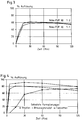
Drehzahl des Rührblattes: 50 UpM. - Die mit dem Nimodipin/PVP 25 Copräzipitat erhalten Ergebnisse sind in Figur 1 wiedergegeben. Sie beweisen, daß eine direkte Abhängigkeit der Wirkstoffmenge, die freigesetzt wird, von der PVP-Menge, die im Copräzipitat vorliegt, besteht. Bei Anwendung des Verhältnisses 1 : 3 wurde ein sehr zufriedenstellendes Auflösungsprofil erhalten, wobei eine 80%ige Auflösung nach 15 Minuten erreicht wurde, die sich für mehr als 2 Stunden praktisch stabil erwies.
- Die obengenannten Werte deuten auf eine Übersättigung mit geringer, oder sogar keiner, Neigung zur Rekristallisierung. Höhere PVP-Mengen sind daher unter diesem Gesichtspunkt überflüssig, während sie zu einer unerwünschten Überflüssigen Schaumbildung führen könnten . Der vorliegenden Erfindung gemäß können auch andere PVP-Typen, wie z.B. PVP 30 und PVP 90, eingesetzt werden.
- Im Vergleich zu PVP 25 zeigen die Ergebnisse in Figur 2, daß bei dem Verhältnis Nimodipin : PVP 30 = 1 : 2 höhere Konzentrationen erhalten werden, bei dem Verhältnis 1 : 3 dagegen kein Unterschied vorliegt.
- Das mit PVP 90 erhaltene Copräzipitat stellt ein drittes Beispiel dar. In diesem Falle wurden nur Copräzipitate mit Verhältnis 1 : 1 bzw. 1 : 2 hergestellt, denn beim Verhältnis 1 : 3 wird eine nicht verwendbare plastische Masse erhalten.
- Mit PVP 90 wird beim Verhältnis 1 : 1 ein gutes Profil erhalten, das beim Verhältnis 1 : 2 unveränderbar zu sein scheint.
- Das bevorzugte Polyvinylpyrrolidon ist nach der vorliegenden Erfindung PVP 25; das bevorzugte Nimodipin : PVP Verhältnis ist 1 : 3.
- Was das Orangensaft-Granulat betrifft, kann es mit verschiedener Konzentration mittels eines Fließbett-Granulators hergestellt werden, indem man auf ganz feiner Saccharose Orangensaft-Konzentrat sprüht. Das Brausestoffpaar wurde so eingestellt, daß das fertige Getränk einen pH-Wert zwischen 5 und 6 aufwies, der ein optimales Bereich zur Erhaltung eines angenehmen Geschmacks bei solchen Zubereitungen darstellt.
- Nachfolgend wird die Erfindung durch einige beispielhafte Zubereitungen auf Basis von pharmazeutisch wirksamen Dihydropyridinen in Brausegranulatform erläutert. In den Beispielen sind die Teile als Gewichtsteile und die Verhältnisse als Gewicht/Gewicht-Angaben angeführt.
-

- Nimodipin und PVP 25 werden im Verhältnis 1 : 3 in Aceton (4 Teile) bei Raumtemperatur gelöst; man rührt zur vollständigen Auflösung; nach Abdampfen des Acetons erhält man das Copräzipitat in der Form eines amorphen spröden Feststoffes, der anschließend granuliert und mit den anderen Bestandteilen vermischt wird.
-
Copräzipitat aus Nimodipin : PVP 30 (1:2) 90,0 mg Zitronensäure 800,0 mg Na-Bicarbonat 800,0 mg Zitrusaroma 50,0 mg Orangengranulat* (s. oben) q.s. ad 4,0 g Man verfährt gemäß Beispiel 1. -
Copräzipitat aus Nifedipin : PVP 25 (1:3) 40,0 mg Zitronensäure 800,0 mg Na-Bicarbonat 800,0 mg Zitrusaroma 50,0 mg Orangengranulat* (s. oben) q.s. ad 4,0 g Man verfährt gemäß Beispiel 1. -
Copräzipitat aus Nisoldipin: PVP 25 (1:3) 40,0 mg Zitronensäure 800,0 mg Na-Bicarbonat 800,0 mg Zitrusaroma q.s. ad 3,5 g Man verfährt gemäß Beispiel 1. - In den Figuren 5 und 6 sind die Ergebnisse, die die Stabilität der obengenannten Zubereitungen betreffen, wiedergegeben.
-
Copräzipitat aus Nimodipin : PVP 25 (1:3) 120,0 mg Zitrusaroma 50,0 mg Zitronengranulat* (wie oben) q.s. ad 5,0 g Man verfährt gemäß Beispiel 1. -
- Herstellung eines Copräzipitates mittels eines Fließbett-Granulators unter vermindertem Druck.
- Nimodipin (1 Teil) und PVP 25 (3 Teile) werden in Aceton (8 Teile) bei Raumtemperatur gelöst; man rührt zur vollständigen Lösung; anschließend wird die Lösung in einem Fließbett-Apparat unter vermindertem Druck mit Rückgewinnung des Lösungsmittels unter folgenden Bedingungen sprühgetrocknet:
Eintrittstemperatur 120°-150°C Ausgangstemperatur 50°-80°C Sprühdurchsatz 1-1,5 kg/min - Herstellung eines Copräzipitates durch Gefriertrocknung.
- Nimodipin (5 Teile) und PVP 25 (15 Teile) werden in tert.-Butylalkohol (80 Teile) gelöst. Danach wird der Ansatz bei -10°C bis -20°C gefroren und gemäß üblichen Verfahren lyophilisiert.
Primärtrocknung: allmähliche Erwärmung bis + 20°C.
Sekundärtrocknung: 4-5 Std bei +40°C -
Copräzipitat aus Nimodipin : Poloxamer F 127 (1:3) 120,0 mg E 110 1,0 mg Saccharin 7,0 mg Zitrusaroma 50,0 mg Saccharose q.s.ad 3,5 g - Das Nimodipin / Poloxamer F 127 (1:3) Copräzipitat wird in Aceton (5 Teile) gelöst; die dabei erhaltene Lösung wird zur Granulierung von feinster Saccharose (22,5 Teile) eingesetzt. Die Mischung wird gesiebt und unter vermindertem Druck getrocknet.
- Der Rückstand wird granuliert und mit weiterer Saccharose und Zitrusaroma vermischt.
Claims (7)
- Als Getränk verabreichbare pharmazeutische Zubereitung auf der Basis von therapeutisch wirksamem Dihydropyridin, dadurch gekennzeichnet, daß sie aus einem Copräzipitat von wesentlich amorphem Dihydropyridin mit einem geeigneten pharmakologisch unbedenklichen Polymerisat besteht.
- Pharmazeutische Zubereitung gemäß Anspruch 1, dadurch gekennzeichnet, daß das therapeutisch wirksame Dihydropyridin Nimodipin ist.
- Pharmazeutische Zubereitung gemäß Anspruch 1 oder 2, dadurch gekennzeichnet, daß das pharmakologisch unbedenkliche Polymerisat Polyvinylpyrrolidon ist.
- Pharmazeutische Zubereitung gemäß einem der Ansprüche 1 bis 3, dadurch gekennzeichnet, daß das Polyvinylpyrrolidon ein Molekulargewicht zwischen 25.000 und 90.000 Dalton aufweist.
- Pharmazeutische Zubereitung gemäß einem der Ansprüche 1 bis 4, dadurch gekennzeichnet, daß das Gewichtsverhältnis Dihydropyridin / Polyvinylpyrrolidon zwischen 1:2 und 1:5 liegt.
- Pharmazeutische Zubereitung gemäß Anspruch 1, dadurch gekennzeichnet, daß sie der folgenden Zusammensetzung entspricht:
Copräzipitat aus Nimodipin : PVP 25 (1:3) 120,0 mg Zitronensäure 800,0 mg Na-Bicarbonat 800,0 mg Zitrusaroma 50,0 mg Orangengranulat q.s.ad 3,5 g - Verfahren zur Herstellung einer pharmazeutischen Zubereitung in Getränkform, dadurch gekennzeichnet, daß man ein Copräzipitat aus Dihydropyridin und Polyvinylpyrrolidon herstellt, wobei man das Dihydropyridin und das Polyvinylpyrrolidon in einem geeigneten Lösungsmittel löst, anschließend das Copräzipitat nach an sich bekannten Verfahren so trocknet, daß das Dihydropyridin in einer wesentlich amorphen Form erhalten, und das so erhaltene Copräzipitat nach an sich bekannten Methoden in die gewünschte pharmazeutische Form überführt wird.
Applications Claiming Priority (2)
| Application Number | Priority Date | Filing Date | Title |
|---|---|---|---|
| ITMI921930 | 1992-08-05 | ||
| ITMI921930A IT1255792B (it) | 1992-08-05 | 1992-08-05 | Composizioni farmaceutiche per la somministrazione orale di diidropiridine in forma di bevanda |
Publications (2)
| Publication Number | Publication Date |
|---|---|
| EP0582169A2 true EP0582169A2 (de) | 1994-02-09 |
| EP0582169A3 EP0582169A3 (en) | 1995-09-27 |
Family
ID=11363839
Family Applications (1)
| Application Number | Title | Priority Date | Filing Date |
|---|---|---|---|
| EP93111920A Withdrawn EP0582169A3 (en) | 1992-08-05 | 1993-07-26 | Pharmaceutical preparations for the oral administration of dihydropyridines in beverage form |
Country Status (5)
| Country | Link |
|---|---|
| US (2) | US5491154A (de) |
| EP (1) | EP0582169A3 (de) |
| JP (1) | JPH072700A (de) |
| CA (1) | CA2101680A1 (de) |
| IT (1) | IT1255792B (de) |
Cited By (3)
| Publication number | Priority date | Publication date | Assignee | Title |
|---|---|---|---|---|
| WO2001015664A3 (en) * | 1999-08-31 | 2001-09-20 | Bradford Particle Design Plc | Coformulation methods and their products |
| WO2012093971A3 (en) * | 2011-01-06 | 2012-09-20 | Mahmut Bilgic | Effervescent compositions comprising amlodipine |
| CN105596293A (zh) * | 2016-01-29 | 2016-05-25 | 中国药科大学 | 一种脑靶向尼莫地平纳米混悬剂及其制备方法 |
Families Citing this family (16)
| Publication number | Priority date | Publication date | Assignee | Title |
|---|---|---|---|---|
| US5773025A (en) | 1993-09-09 | 1998-06-30 | Edward Mendell Co., Inc. | Sustained release heterodisperse hydrogel systems--amorphous drugs |
| US5455046A (en) * | 1993-09-09 | 1995-10-03 | Edward Mendell Co., Inc. | Sustained release heterodisperse hydrogel systems for insoluble drugs |
| US6726930B1 (en) | 1993-09-09 | 2004-04-27 | Penwest Pharmaceuticals Co. | Sustained release heterodisperse hydrogel systems for insoluble drugs |
| EP0859603B1 (de) | 1996-07-08 | 2008-12-17 | Penwest Pharmaceuticals Co. | Matrix mit verzögerter freisetzung für hochdosierte unlösliche arzneistoffe |
| JP2001523221A (ja) * | 1996-09-01 | 2001-11-20 | ファーモス コーポレイション | 親油性物質の促進された生物学的利用能のための固形共沈物 |
| US5891469A (en) * | 1997-04-02 | 1999-04-06 | Pharmos Corporation | Solid Coprecipitates for enhanced bioavailability of lipophilic substances |
| US5989463A (en) | 1997-09-24 | 1999-11-23 | Alkermes Controlled Therapeutics, Inc. | Methods for fabricating polymer-based controlled release devices |
| US6056977A (en) | 1997-10-15 | 2000-05-02 | Edward Mendell Co., Inc. | Once-a-day controlled release sulfonylurea formulation |
| KR100463496B1 (ko) | 1999-09-30 | 2005-01-06 | 펜웨스트 파머슈티칼즈 컴파니 | 고가용성 약물용 서방성 메트리스 시스템 |
| IL134701A0 (en) * | 2000-02-23 | 2001-04-30 | J P M E D Ltd | Homogeneous solid matrix containing vegetable proteins |
| US6589955B2 (en) | 2001-06-20 | 2003-07-08 | Bristol-Myers Squibb Company | Pediatric formulation of gatifloxacin |
| MXPA03011935A (es) * | 2001-06-22 | 2004-03-26 | Pfizer Prod Inc | Composiciones farmaceuticas que contienen conjuntos de polimero y farmaco. |
| AU2003291757A1 (en) * | 2002-11-08 | 2004-06-03 | Bristol-Myers Squibb Company | Formulations of low solubility bioactive agents and processes for making the same |
| CA2531116A1 (en) * | 2003-07-01 | 2005-01-20 | Michael Hawley | Diffusion layer modulated solids |
| US7507823B2 (en) * | 2004-05-06 | 2009-03-24 | Bristol-Myers Squibb Company | Process of making aripiprazole particles |
| US9399019B2 (en) | 2012-05-09 | 2016-07-26 | Evonik Corporation | Polymorph compositions, methods of making, and uses thereof |
Family Cites Families (7)
| Publication number | Priority date | Publication date | Assignee | Title |
|---|---|---|---|---|
| DE1670827C3 (de) * | 1967-03-20 | 1974-10-24 | Bayer Ag, 5090 Leverkusen | 4-(2'-Nitrophenyl)-2,6-dimethyl-3,5-dicarbmethoxy-1,4-dihydropyridin |
| DE1962791A1 (de) * | 1969-12-15 | 1971-06-24 | Boehringer Mannheim Gmbh | Brausetabletten,Brausepulver und Verfahren zur Herstellung derselben |
| US4154839A (en) * | 1975-11-05 | 1979-05-15 | Bayer Aktiengesellschaft | 2,6-Dimethyl-3-carboxymethoxy-4-(2-nitrophenyl)-5-carbisobutoxy-1,4-dihydropyridine |
| EP0001247A1 (de) * | 1977-09-14 | 1979-04-04 | Kanebo, Ltd. | Nifedipine enthaltendes Arzneipräparat und Verfahren zu seiner Herstellung. |
| DE2815578C2 (de) * | 1978-04-11 | 1986-01-16 | Bayer Ag, 5090 Leverkusen | Neue pharmazeutische Verwendung von Nimodipin |
| JPH0729926B2 (ja) * | 1989-07-25 | 1995-04-05 | 大塚製薬株式会社 | 易吸収性製剤用組成物 |
| GB9025251D0 (en) * | 1990-11-20 | 1991-01-02 | Solomon Montague C | Nifedipine dosage forms |
-
1992
- 1992-08-05 IT ITMI921930A patent/IT1255792B/it active IP Right Grant
-
1993
- 1993-07-26 EP EP93111920A patent/EP0582169A3/de not_active Withdrawn
- 1993-07-29 US US08/099,288 patent/US5491154A/en not_active Expired - Fee Related
- 1993-07-30 CA CA002101680A patent/CA2101680A1/en not_active Abandoned
- 1993-08-03 JP JP5209968A patent/JPH072700A/ja active Pending
-
1995
- 1995-09-29 US US08/536,552 patent/US5622978A/en not_active Expired - Fee Related
Cited By (3)
| Publication number | Priority date | Publication date | Assignee | Title |
|---|---|---|---|---|
| WO2001015664A3 (en) * | 1999-08-31 | 2001-09-20 | Bradford Particle Design Plc | Coformulation methods and their products |
| WO2012093971A3 (en) * | 2011-01-06 | 2012-09-20 | Mahmut Bilgic | Effervescent compositions comprising amlodipine |
| CN105596293A (zh) * | 2016-01-29 | 2016-05-25 | 中国药科大学 | 一种脑靶向尼莫地平纳米混悬剂及其制备方法 |
Also Published As
| Publication number | Publication date |
|---|---|
| IT1255792B (it) | 1995-11-16 |
| EP0582169A3 (en) | 1995-09-27 |
| JPH072700A (ja) | 1995-01-06 |
| US5622978A (en) | 1997-04-22 |
| ITMI921930A0 (it) | 1992-08-05 |
| CA2101680A1 (en) | 1994-02-06 |
| US5491154A (en) | 1996-02-13 |
| ITMI921930A1 (it) | 1994-02-05 |
Similar Documents
| Publication | Publication Date | Title |
|---|---|---|
| DE3638414C2 (de) | Pharmazeutische Zusammensetzung mit analgetischer Wirkung | |
| DE60019120T2 (de) | Fenofibrat enthaltende pharmazeutische zusammensetzung und verfahren zu ihrer herstellung | |
| DE3636123C2 (de) | ||
| DE69936352T3 (de) | Stabilisierung von rapamycinen oder rapamycinderivaten | |
| EP0078430B1 (de) | Verfahren zur Herstellung von festen, schnellfreisetzenden Arzneizubereitungen mit Dihydropyridinen | |
| DE60132108T2 (de) | Gefriergetrocknetes pantoprazol-präparat und pantoprazol-injektion | |
| DD265142A5 (de) | Verfahren zur herstellung des besylatsalzes von amlodipin | |
| DE69314028T2 (de) | Mikrokügeln aus bioresorbierbarem polymer ohne tensid, verfahren zu ihrer herstellung und ihre verwendung als arzneimittel | |
| DD201974A5 (de) | Verfahren zur herstellung von festen arzneizubereitungen enthaltend nifedipin | |
| DD222495A5 (de) | Verfahren zur herstellung einer zweiphasigen festen arzneizubereitung | |
| US5622978A (en) | Pharmaceutical preparations for the oral administration of dihydropyridines in beverage form | |
| WO2008064854A1 (de) | Arzneimittelzubereitung von tramadol und acetaminophen | |
| WO2001078732A1 (de) | Lagerstabile infusionslösung des ciprofloxacins | |
| EP0167909B2 (de) | Feste Arzneizubereitungen mit Dihydropyridin und Verfahren zu ihrer Herstellung | |
| DE19501266A1 (de) | Verfahren zur Herstellung von Flavano-Lignan-Zubereitungen mit verbesserter Freisetzung und Resorbierbarkeit danach erhältliche Zubereitungen und deren Verwendung zur Herstellung von Arzneimitteln | |
| EP0277462B1 (de) | Verfahren zur Herstellung nasaler Lösungen enthaltend synthetisches Human calcitonin. | |
| DE3119510C2 (de) | ||
| DE60101979T2 (de) | Lösung enthaltend N-[O-(p-pivaloyloxybenzenesulfonylamino)benzoyl]glyzin Mononatriumsalz Tetrahydrat und diese Lösung enthaltendes Arzneimittel | |
| DE69123248T2 (de) | Verfahren zur herstellung einer wässrigen suspension | |
| EP0531845B1 (de) | Pharmazeutische Zubereitungen mit einer speziellen Kristallmodifikation des 1,4-Dihydro-2,6-dimethyl-4-(3-nitrophenyl)-3,5-pyridindicarbonsäure-isopropyl-(2-methoxyethyl)-esters | |
| DE3442065C2 (de) | Nifedipin-Zusammensetzung und Verfahren zu ihrer Herstellung | |
| EP1638532B1 (de) | Injizierbare darreichungsform von flupirtin | |
| DE69715247T2 (de) | Auf quinupristin und dalfopristin basierte stabilisierte pharmazeutische zusammensetzung, und deren zubereitung | |
| EP1040838A1 (de) | Stabile wässrige Lösung von EM 12 | |
| DE10048510A1 (de) | Lagerstabile Infusionslösung des Ciprofloxacins mit verringertem Säuregehalt |
Legal Events
| Date | Code | Title | Description |
|---|---|---|---|
| PUAI | Public reference made under article 153(3) epc to a published international application that has entered the european phase |
Free format text: ORIGINAL CODE: 0009012 |
|
| AK | Designated contracting states |
Kind code of ref document: A2 Designated state(s): AT BE CH DE DK ES FR GB GR IE IT LI LU MC NL PT SE |
|
| PUAL | Search report despatched |
Free format text: ORIGINAL CODE: 0009013 |
|
| AK | Designated contracting states |
Kind code of ref document: A3 Designated state(s): AT BE CH DE DK ES FR GB GR IE IT LI LU MC NL PT SE |
|
| 17P | Request for examination filed |
Effective date: 19960313 |
|
| 17Q | First examination report despatched |
Effective date: 19990310 |
|
| STAA | Information on the status of an ep patent application or granted ep patent |
Free format text: STATUS: THE APPLICATION HAS BEEN WITHDRAWN |
|
| 18W | Application withdrawn |
Withdrawal date: 19990626 |