EP0584509A1 - Tinte, Verfahren und Gerät zur Tintenstrahlaufzeichnung - Google Patents
Tinte, Verfahren und Gerät zur Tintenstrahlaufzeichnung Download PDFInfo
- Publication number
- EP0584509A1 EP0584509A1 EP19930111231 EP93111231A EP0584509A1 EP 0584509 A1 EP0584509 A1 EP 0584509A1 EP 19930111231 EP19930111231 EP 19930111231 EP 93111231 A EP93111231 A EP 93111231A EP 0584509 A1 EP0584509 A1 EP 0584509A1
- Authority
- EP
- European Patent Office
- Prior art keywords
- ink
- recording
- head
- jet recording
- thermo
- Prior art date
- Legal status (The legal status is an assumption and is not a legal conclusion. Google has not performed a legal analysis and makes no representation as to the accuracy of the status listed.)
- Granted
Links
- RWRGYRDAWHMRTO-UHFFFAOYSA-N C(C12)C3C(C4)CCC5C1C4C2C3C5 Chemical compound C(C12)C3C(C4)CCC5C1C4C2C3C5 RWRGYRDAWHMRTO-UHFFFAOYSA-N 0.000 description 1
Images



Classifications
-
- C—CHEMISTRY; METALLURGY
- C09—DYES; PAINTS; POLISHES; NATURAL RESINS; ADHESIVES; COMPOSITIONS NOT OTHERWISE PROVIDED FOR; APPLICATIONS OF MATERIALS NOT OTHERWISE PROVIDED FOR
- C09D—COATING COMPOSITIONS, e.g. PAINTS, VARNISHES OR LACQUERS; FILLING PASTES; CHEMICAL PAINT OR INK REMOVERS; INKS; CORRECTING FLUIDS; WOODSTAINS; PASTES OR SOLIDS FOR COLOURING OR PRINTING; USE OF MATERIALS THEREFOR
- C09D11/00—Inks
- C09D11/30—Inkjet printing inks
-
- B—PERFORMING OPERATIONS; TRANSPORTING
- B41—PRINTING; LINING MACHINES; TYPEWRITERS; STAMPS
- B41J—TYPEWRITERS; SELECTIVE PRINTING MECHANISMS, i.e. MECHANISMS PRINTING OTHERWISE THAN FROM A FORME; CORRECTION OF TYPOGRAPHICAL ERRORS
- B41J2/00—Typewriters or selective printing mechanisms characterised by the printing or marking process for which they are designed
- B41J2/005—Typewriters or selective printing mechanisms characterised by the printing or marking process for which they are designed characterised by bringing liquid or particles selectively into contact with a printing material
- B41J2/01—Ink jet
- B41J2/21—Ink jet for multi-colour printing
- B41J2/2107—Ink jet for multi-colour printing characterised by the ink properties
- B41J2/2114—Ejecting specialized liquids, e.g. transparent or processing liquids
-
- B—PERFORMING OPERATIONS; TRANSPORTING
- B41—PRINTING; LINING MACHINES; TYPEWRITERS; STAMPS
- B41M—PRINTING, DUPLICATING, MARKING, OR COPYING PROCESSES; COLOUR PRINTING
- B41M5/00—Duplicating or marking methods; Sheet materials for use therein
- B41M5/0011—Pre-treatment or treatment during printing of the recording material, e.g. heating, irradiating
- B41M5/0017—Application of ink-fixing material, e.g. mordant, precipitating agent, on the substrate prior to printing, e.g. by ink-jet printing, coating or spraying
-
- C—CHEMISTRY; METALLURGY
- C09—DYES; PAINTS; POLISHES; NATURAL RESINS; ADHESIVES; COMPOSITIONS NOT OTHERWISE PROVIDED FOR; APPLICATIONS OF MATERIALS NOT OTHERWISE PROVIDED FOR
- C09D—COATING COMPOSITIONS, e.g. PAINTS, VARNISHES OR LACQUERS; FILLING PASTES; CHEMICAL PAINT OR INK REMOVERS; INKS; CORRECTING FLUIDS; WOODSTAINS; PASTES OR SOLIDS FOR COLOURING OR PRINTING; USE OF MATERIALS THEREFOR
- C09D11/00—Inks
- C09D11/02—Printing inks
- C09D11/10—Printing inks based on artificial resins
- C09D11/106—Printing inks based on artificial resins containing macromolecular compounds obtained by reactions only involving carbon-to-carbon unsaturated bonds
-
- C—CHEMISTRY; METALLURGY
- C09—DYES; PAINTS; POLISHES; NATURAL RESINS; ADHESIVES; COMPOSITIONS NOT OTHERWISE PROVIDED FOR; APPLICATIONS OF MATERIALS NOT OTHERWISE PROVIDED FOR
- C09D—COATING COMPOSITIONS, e.g. PAINTS, VARNISHES OR LACQUERS; FILLING PASTES; CHEMICAL PAINT OR INK REMOVERS; INKS; CORRECTING FLUIDS; WOODSTAINS; PASTES OR SOLIDS FOR COLOURING OR PRINTING; USE OF MATERIALS THEREFOR
- C09D11/00—Inks
- C09D11/02—Printing inks
- C09D11/14—Printing inks based on carbohydrates
-
- Y—GENERAL TAGGING OF NEW TECHNOLOGICAL DEVELOPMENTS; GENERAL TAGGING OF CROSS-SECTIONAL TECHNOLOGIES SPANNING OVER SEVERAL SECTIONS OF THE IPC; TECHNICAL SUBJECTS COVERED BY FORMER USPC CROSS-REFERENCE ART COLLECTIONS [XRACs] AND DIGESTS
- Y10—TECHNICAL SUBJECTS COVERED BY FORMER USPC
- Y10S—TECHNICAL SUBJECTS COVERED BY FORMER USPC CROSS-REFERENCE ART COLLECTIONS [XRACs] AND DIGESTS
- Y10S260/00—Chemistry of carbon compounds
- Y10S260/38—Ink
Definitions
- the present invention relates to an ink, and an ink-jet recording method and instruments making use of the ink.
- the present invention relates to an ink which can achieve high-speed, highly fine and high-image quality, full-color recording on non-coated paper such as paper for electrophotography, paper for reporting, notepaper, letter paper, bond paper and continuous business forms, i.e., so-called plain paper, which are commonly used in offices and homes, to say nothing of coated paper specially prepared for ink-jet recording, and an ink-jet recording method and instruments making use of such an ink.
- Japanese Patent Application Laid-Open No. 55-29546 discloses a process for enhancing the penetrability of an ink into a paper sheet, in which a specific surfactant is added to the ink to lower the surface tension of the ink. It is also disclosed in Japanese Patent Application laid-Open No. 55-57862 to add a strongly basic substance to an ink so as to chemically dissolve a sizing agent and pulp contained in a paper sheet, thereby controlling the areas of dots and the easiness of absorption.
- Japanese Patent Application Laid-Open No. 58-13675 discloses the addition of polyvinylpyrrolidone having a molecular weight of not less than 40,000 to an ink
- Japanese Patent Application Laid-Open No. 3-172362 discloses a method of controlling the areas of dots and the easiness of absorption by adding a specific microemulsion to an ink.
- U.S. Patent Nos. 3,653,932, 3,715,219, 4,390,369 and 4,490,731 separately disclose a solid-liquid phase-change ink, i.e., an ink which is solid at room temperature, but turns liquid at a specified temperature or higher.
- the phase-change ink of this type is ejected as a liquid and then struck against a recording material to immediately solidify on the surface of the recording material.
- inks that are in a gel state at room temperature, but change into a sol state under heat are disclosed in Japanese Patent Application Laid-Open Nos. 62-181372 and 1-272623, etc. As with the solid-liquid phase-change ink, these inks are all intended to change again into the gel state after their impact against recording materials to suppress the running of the inks.
- the method of enhancing the penetrability of an ink by the addition of a surfactant can improve the fixability of the ink, but involves a problem that since a recording agent also penetrates deeply, the color-producing property of the ink is lowered.
- the method in which a strongly basic substance is added to an ink is insufficient to solve problems of both running and fixability against paper making use of a certain size, for example, medium-quality paper, and also has a problem of safety for human body.
- the solid-liquid phase-change type ink requires to liquefy the ink upon operation, and hence involves such problems that the ink makes the burden to apparatus such as the temperature control of an ink feed system heavier, and moreover, when the print is exposed to, for example, an extremely high temperature during its storage, the ink remelts, resulting in deformation of printed areas.
- the sol-gel transition ink is also difficult to handle and has a problem of shelf stability in prints.
- an ink comprising at least a recording agent, a liquid medium dissolving the recording agent therein and a compound having thermo-reversible gelation property, wherein the ink is in a homogeneous solution system at 25°C, and the compound having thermo-reversible gelation property separates out in the ink solution in a temperature range of from 30°C to 65°C, so that the ink becomes a dispersion state.
- an ink-jet recording method comprising ejecting droplets of an ink out of an orifice in accordance with a recording signal to make a record on a recording material, wherein said ink is the ink described above.
- an ink-jet recording method comprising ejecting droplets of an ink out of an orifice in accordance with a recording signal to make a record on a recording material, wherein said ink is the ink described above, and the volume of the ink applied to the recording material is 40 nl/mm2 or less.
- a recording unit comprising an ink container portion with an ink held therein and a head from which the ink is ejected in the form of ink droplets, wherein said ink is the ink described above.
- an ink cartridge comprising an ink container portion with an ink held therein, wherein said ink is the ink described above.
- an ink-jet recording apparatus comprising a recording unit having an ink container portion with an ink held therein and a head from which the ink is ejected in the form of ink droplets, wherein said ink is the ink described above.
- an ink-jet recording apparatus comprising a recording head from which an ink is ejected in the form of ink droplets, an ink cartridge having an ink container portion with an ink held therein, and an ink feeder for feeding the ink from the ink cartridge to the recording head, wherein said ink is the ink described above.
- Figs. 1A and 1B are schematic diagrams illustrating temperature-viscosity curves of inks according to the present invention.
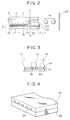
- Fig. 2 is a longitudinal cross-sectional view of a head of an ink-jet recording apparatus.
- Fig. 3 is a transverse cross-sectional view of the head of the ink-jet recording apparatus.
- Fig. 4 is a perspective view of the appearance of a multi-head which is an array of such heads as shown in Fig. 2.
- Fig. 5 is a perspective view of an illustrative ink-jet recording apparatus.
- Fig. 6 is a longitudinal cross section of an illustrative ink cartridge.
- Fig. 7 is a perspective view of a recording unit.
- Examples of the compound having thermo-reversible gelation property, which is used in an ink according to the present invention, may include water-soluble cellulose ethers described in, for example, "Collected Papers on Polymers", Vol. 38, p. 133 (1981).
- an aqueous solution of a water-soluble cellulose ether resides in that since the water-soluble cellulose ether has a negative temperature coefficient on solubility, the microgel of the polymer reversibly repeats the separation from an aqueous phase and dissolution in the aqueous phase according to rise and drop in temperature.
- the viscosity of the aqueous solution rapidly decreases as illustrated in Fig. 1A. More specifically, polymer molecule hydrates in the solution at a low temperature and do not interact on each other except for simple entanglement. However, the polymer molecules undergo dehydration in which water of hydration is released from the molecules as the temperature is raised, resulting in viscosity decrease as a change of solution properties.
- a penetrable solvent is added to the ink.
- a penetrable solvent acts so as to help the ink to penetrate into paper immediately after its impact against the paper, and hence contributes toward imparting high-speed fixability to the ink.
- the action of the compound having thermo-reversible gelation property allows the ink to increase the viscosity, thereby developing an effect of reducing the penetration speed of the ink. Therefore, the ink is prevented from penetrating too deep into the paper, so that the recording agent as a color material remains in the vicinity of the paper surface, and the color-producing property of the ink is not impaired.
- the ink is allowed to suppress not only the penetration in the depth direction but also the spreading in the transverse direction, so that the ink does not bring about the degradation of print quality such as feathering and dot gain.
- Figs. 1A and 1B schematically illustrate the viscosity-temperature curves of typical inks according to the present invention.
- the viscosity of the ink at a temperature T H higher than a transition temperature T G at which the ink changes from a homogeneous solution system to a dispersion state (hereinafter referred to as "transition temperature to the dispersion state" merely), i.e., gel coagulates and separates from the aqueous phase by the action of the compound having thermo-reversible gelation property, is lower than that of the ink near at room temperature T R .
- the temperature of a recording head should be preset to T H in Fig. 1A or 1B to fly out droplets of the ink whose viscosity has decreased. After impacting against paper which is a recording material, the ink thickens back to the original viscosity as its temperature lowers, so that the recording agent in the ink remains in the surface of the paper without penetrating deeply in the paper, and the color-producing property of the ink is hence improved.
- bleeding of ink due to color mixing of inks of different colors (hereinafter called merely “bleeding") can be prevented even when full-color images are formed. Furthermore, color ink-jet recording good in fixability can be achieved.
- the transition temperature to the dispersion state of the ink it is preferable to preset the transition temperature to the dispersion state of the ink to a temperature ranging from 30 to 65°C in that the burden of the apparatus is lightened. If the transition temperature to the dispersion state is preset too high, the evaporation of the ink from the tip of a nozzle tends to occur when the temperature of the head is preset to such a range upon recording. It is not hence preferable to preset the transition temperature to the dispersion state to such a high temperature from the viewpoint of reliability.
- the temperature at which the ink changes from the homogeneous solution system to the dispersion state means a temperature at which the compound having thermo-reversible gelation property, which has been hydrated, releases water molecules with temperature increase, so that the compound is reduced in solubility and hence separates out as fine particles from the homogeneous solution of the ink, whereby the ink solution turns a dispersion state.
- optical means such as reduction in the transmittance and change in light scattering coefficient of the ink.
- the ink according to the present invention comprises at least a compound having thermo-reversible gelation property and features that it is in a homogeneous solution system at 25°C and the compound having thermo-reversible gelation property separates out in the ink solution in a temperature range of from 30°C to 65°C so that the ink becomes a dispersion state.
- thermo-reversible gelation property and used in the ink according to the present invention are mentioned below.
- the compounds according to the present invention are not limited to the following compounds.
- Exemplary compounds thereof may include water-soluble cellulose ethers such as hydroxypropyl cellulose, hydroxypropylmethyl cellulose, methyl cellulose and hydroxybutoxy-modified methyl cellulose/hydroxypropylmethyl cellulose, and water-soluble polyvinyl acetal.
- the molecular weights of the above-mentioned compounds may suitably be not less than 5 cps, but not more than 10,000 cps as determined in terms of the viscosity of its 2% aqueous solution at 25°C. Any compounds having an extremely high molecular weight are not preferred because the particle sizes of their particles in the dispersion state are difficult to control precisely.
- the compounds having thermo-reversible gelation property as described above may be used either singly or in any combination thereof.
- Their amount contained in the ink may be from 0.01 to 20 % by weight, preferably from 0.05 to 10 % by weight, more preferably from 0.1 to 5 % by weight based on the total weight of the ink though it varies according to the kinds of dyes or pigments, other additives and solvents to be used, and the like.
- a component which can bring about a further effect when used in combination with the above-described compound having thermo-reversible gelation property may include a penetrable solvent which is used for the purpose of improving the fixability of the ink. Therefore, an ink including the penetrable solvent in addition to the above-described compound having thermo-reversible gelation property is an ink according to another preferred embodiment of the present invention.
- Examples of the penetrable solvent used in the present invention include monohydric alcohols such as ethyl alcohol, propyl alcohol, isopropyl alcohol, n-butyl alcohol, isobutyl alcohol, n-pentyl alcohol, cyclohexanol and benzyl alcohol, and other polyhydric alcohols and alkyl ethers thereof. Specific examples thereof may include 1,7-heptanediol, tripropylene glycol, hexylene glycol, dipropylene glycol monomethyl ether, tripropylene glycol monomethyl ether and triethylene glycol monobutyl ether. However, the penetrable solvents are not limited to these compounds.
- the penetrable solvent as described above is used in a large amount, the shape of a single dot itself is not deformed owing to the effect of the thermo-reversibly gelling compound, resulting in a print sharp in edge.
- Examples of the recording agents usable in the ink according to the present invention may include direct dyes, acid dyes, food colors, basic dyes, reactive dyes, disperse dyes, vat dyes, soluble vat dyes, reactive disperse dyes, oil colors and various pigments.
- the content of these recording agents may be determined depending upon the kinds of the liquid medium components, properties required of the ink, and the like. However, they may be generally used in a proportion of from about 0.2 to 20 % by weight, preferably from 0.5 to 10 % by weight, more preferably from 1 to 5 % by weight, based on the total weight of the ink.
- Examples of the organic solvents usable in the ink according to the present invention may include alcohols such as methyl alcohol, ethyl alcohol, n-propyl alcohol, isopropyl alcohol, n-butyl alcohol, sec-butyl alcohol, tert-butyl alcohol, isobutyl alcohol, n-pentanol and cyclohexanol; amides such as dimethylformamide and dimethylacetamide; ketones and keto-alcohols such as acetone and diacetone alcohol; ethers such as tetrahydrofuran and dioxane; addition polymers of oxyethylene or oxypropylene with diethylene glycol, triethylene glycol, tetraethylene glycol, dipropylene glycol, tripropylene glycol, polyethylene glycol, polypropylene glycol and the like; alkylene glycols such as ethylene glycol, propylene glycol, trimethylene glycol, butylene glycol and hexylene glycol;
- the content of the above-mentioned organic solvents is generally within a range of from 1 to 50 % by weight, preferably from 2 to 30 % by weight based on the total weight of the ink.
- transition temperature to the dispersion state of the ink according to the present invention varies according to the kind and amount of a solvent used, one pays attention to the consideration of the solvent composition like the characteristics of the compound having thermo-reversible gelation property.
- the organic solvents as described above may be used either singly or in any combination thereof.
- the most preferred composition of the liquid medium is a mixed solvent comprising water and at least one organic solvent, and containing at least one water-soluble, high-boiling solvent, for example, a polyhydric alcohol such as diethylene glycol, triethylene glycol or glycerol.
- the inks may contain, as needed, a variety of other additives such as a dispersant, a surfactant, a viscosity modifier, a surface tension modifier, an optical whitening agent, an antioxidant, a mildewproofing agent and a pH adjustor within limits not impeding the achievement of the object of the present invention.
- the surfactant is added with a view toward improving the fixability of the ink like the above-described penetrable solvent.
- No particular limitation is imposed on the chemical structure of the surfactant used in the present invention. It is however preferable that the surface tension of its aqueous solution in a CMC (critical micelle concentration) should be not less than 10 dyn/cm, but not more than 40 dyn/cm.
- the content of the surfactant in the ink is not less than 0.02 % by weight, but not more than 10 % by weight, and may be within a range by which the fixability and color-producing property are well balanced with each other.
- the inks according to the present invention may suitably be used in all the ink-jet recording systems commonly used, but are particularly suitable for use in an ink-jet recording system of a type that an ink is ejected by the bubbling phenomenon of the ink caused by thermal energy.
- the ink may desirably be adjusted so as to give a viscosity ranging from 5 to 500 cps, preferably from 10 to 100 cps at 25°C, and a surface tension ranging from 25 to 68 dyn/cm at 25°C as preferable physical properties upon unoperation.
- a temperature upon operation (the temperature indicated by T H in Fig. 1A) is preset, it is preferable to preset it to a temperature higher than the transition temperature to the dispersion state (the temperature indicated by T G in Fig. 1A) by 2°C to 40°C.
- the operation temperature may desirably be adjusted to a range of from 30°C to 65°C, preferably from 35°C to 45°C.
- the transition temperature to the dispersion state may be controlled by selecting the kind, molecular weight and amount of the compound having thermo-reversible gelation property to be used. It is also possible to control it by selecting the kind and amount of the organic solvent to be used, or adding a suitable inorganic salt.
- the ink may desirably have a viscosity ranging from 0.5 to 5 cps, preferably from 0.5 to 3 cps, and a surface tension ranging from 25 to 68 dyn/cm as preferable physical properties upon operation.
- viscosity may desirably fall within a range of from about 0.5 to 20 cps, preferably from 0.8 to 10 cps, more preferably from 1 to 5 cps in a temperature range of from 25°C to the operation temperature.
- FIG. 2 An illustrative example of an ink-jet recording apparatus of this invention, which is suitable for use in conducting recording using the above-described inks according to the present invention, will hereinafter be described. Examples of the construction of a head, which is a main component of such an apparatus, are illustrated in Figs. 2, 3 and 4.
- a head 13 is composed of a glass, ceramic or plastic plate or the like having an ink-passing channel 14 and a heating head 15, which is used for thermal recording (the drawing shows a head to which, however, is not limited), said heating head 15 being bonded to the plate.
- the heating head 15 is composed of a protective film 16 made of silicon oxide or the like, aluminum electrodes 17-1 and 17-2, a heating resistor layer 18 made of nichrome or the like, a heat accumulating layer 19, and a substrate 20 made of alumina or the like having a good heat radiating property.
- An ink 21 comes up to an ejection orifice 22 (a minute opening) and forms a meniscus 23 owing to a pressure P.
- the heating head 15 rapidly generates heat at the region shown by n to form bubbles in the ink 21 which is in contact with this region.
- the meniscus 23 of the ink is projected by the action of the pressure thus produced, and the ink 21 is ejected from the orifice 22 to a recording material 25 in the form of recording droplets 24.
- Fig. 4 illustrates an appearance of a multi-head composed of an array of a number of heads as shown in Fig. 2.
- the multi-head is formed by closely bonding a glass plate 27 having a number of channels 26 to a heating head 28 similar to the head as illustrated in Fig. 2.
- Fig. 2 is a cross-sectional view of the head 13 taken along the flow path of the ink
- Fig. 3 is a cross-sectional view taken along line A-B in Fig. 2.
- the viscosity of the ink held to the operation temperature in the above-described manner becomes lower than that upon unoperation owing to the action of the compound having thermo-reversible gelation property, whereby the ejecting behavior of the ink from the head is sufficiently enhanced.
- Fig. 5 illustrates an example of an ink-jet recording apparatus in which such a head has been incorporated.
- reference numeral 61 designates a blade serving as a wiping member, one end of which is a stationary end held by a blade-holding member to form a cantilever.
- the blade 61 is provided at the position adjacent to the region in which a recording head operates, and in this embodiment, is held in such a form that it protrudes to the course through which the recording head is moved.
- Reference numeral 62 indicates a cap, which is provided at the home position adjacent to the blade 61, and is so constituted that it moves in the direction perpendicular to the direction in which the recording head is moved and comes into contact with the face of ejection openings to cap it.
- Reference numeral 63 denotes an ink-absorbing member provided adjoiningly to the blade 61 and, similar to the blade 61, held in such a form that it protrudes to the course through which the recording head is moved.
- the above-described blade 61, cap 62 and absorbing member 63 constitute a recovery portion 64 for the recording head, where the blade 61 and absorbing member 63 remove off water, dust and/or the like from the face of the ink-ejecting openings.
- Reference numeral 65 designates the recording head having an ejection-energy-generating means and serving to eject the ink onto a recording material set in an opposing relation with the ejection opening face provided with ejection openings to conduct recording.
- Reference numeral 66 indicates a carriage on which the recording head 65 is mounted so that the recording head 65 can be moved.
- the carriage 66 is slidably interlocked with a guide rod 67 and is connected (not illustrated) at its part to a belt 69 driven by a motor 68.
- the carriage 66 can be moved along the guide rod 67 and hence, the recording head 65 can be moved from a recording region to a region adjacent thereto.
- Reference numerals 51 and 52 denote a paper feeding part from which the recording materials are separately inserted, and paper feed rollers driven by a motor (not illustrated), respectively. With such construction, the recording material is fed to the position opposite to the ejection opening face of the recording head, and discharged from a paper discharge section provided with paper discharge rollers 53 with the progress of recording.
- the cap 62 in the head recovery portion 64 is receded from the moving course of the recording head 65 when the recording head 65 is returned to its home position, for example, after completion of recording, and the blade 61 remains protruded to the moving course.
- the ejection opening face of the recording head 65 is wiped.
- the cap 62 comes into contact with the ejection opening face of the recording head 65 to cap it, the cap 62 is moved so as to protrude to the moving course of the recording head.
- the cap 62 and the blade 61 are at the same positions as the positions upon the wiping as described above. As a result, the ejection opening face of the recording head 65 is also wiped at the time of this movement.
- the above movement of the recording head to its home position is made not only when the recording is completed or the recording head is recovered for ejection, but also when the recording head is moved between recording regions for the purpose of recording, during which it is moved to the home position adjacent to each recording region at given intervals, where the ejection opening face is wiped in accordance with this movement.
- Fig. 6 illustrates an exemplary ink cartridge in which an ink fed to the head through an ink-feeding member, for example, a tube is contained.
- reference numeral 40 designates an ink container portion containing the ink to be fed, as exemplified by a bag for the ink.
- One end thereof is provided with a stopper 42 made of rubber.
- a needle (not illustrated) may be inserted into this stopper 42 so that the ink in the bag 40 for the ink can be fed to the head.
- Reference numeral 44 indicates an ink absorbing member for receiving a waste ink.
- the ink container portion is formed of a polyolefin, in particular, polyethylene, at its surface with which the ink comes into contact.
- the ink-jet recording apparatus used in this invention may not be limited to the apparatus as described above in which the head and the ink cartridge are separately provided. Therefore, a device in which these members are integrally formed as shown in Fig. 7 can also be preferably used.
- reference numeral 70 designates a recording unit, in the interior of which an ink container portion containing an ink, for example, an ink-absorbing member, is contained.
- the recording unit 70 is so constructed that the ink in such an ink-absorbing member is ejected in the form of ink droplets through a head 71 having a plurality of orifices.
- polyurethane, cellulose or polyvinyl acetal is preferably used as a material for the ink-absorbing member.
- Reference numeral 72 indicates an air passage for communicating the interior of the recording unit 70 with the atmosphere.
- This recording unit 70 can be used in place of the recording head shown in Fig. 4, and is detachably installed on the carriage 66.
- Water-soluble cellulose ethers shown in Table 1 were provided as compounds having thermo-reversible gelation property. With respect to these compounds, the molecular weights or polymerization degrees or viscosities of their 2 % aqueous solutions at 20°C, degrees of substitution with -OCH3, M (%), degrees of substitution with -OC3H5OH, HP (%), and temperatures, T G at which the viscosities of the respective aqueous solutions start sharply decreasing owing to gelation under heat are set forth collectively in Table 1. Table 1 No.
- Inks according to the present invention were prepared by separately using the above-described compounds having thermo-reversible gelation property and mixing their corresponding components, which will be described subsequently, with them.
- an aqueous solution of each water-soluble cellulose ether selected from the above-mentioned compounds was prepared in a proper concentration (20 % by weight or lower).
- aqueous solution of the water-soluble cellulose ether predetermined amounts of water, an organic solvent(s) and a dye, and optionally a surfactant were then added in that order so as to control the concentration of the water-soluble cellulose ether to a desired level.
- the resulting mixture was stirred for 5 hours and then filtered under pressure through a membrane filter (Fluoropore Filter, trade name; product of Sumitomo Electric Industries, Ltd.) having a pore size of 0.22 ⁇ m, thereby obtaining Inks 1 through 4 of black, yellow, magenta and cyan colors in each of Examples 1 to 4.
- a membrane filter Fruoropore Filter, trade name; product of Sumitomo Electric Industries, Ltd.
- Ink compositions of the four inks of different colors are shown in Tables 2 to 5, respectively.
- numerals indicate the amounts (% by weight based on the total weight of the ink) of the respective components added.
- Table 2 Compositions of black inks according to Examples 1 to 4 Component of ink Example 1 2 3 4 C.I.
- Table 4 Compositions of magenta inks according to Examples 1 to 4 Component of ink Example 1 2 3 4 C.I. Acid Red 35 2.5 2.5 2.5 2.5 Diethylene glycol 7.5 10.0 10.0 10.0 Isopropyl alcohol - - - 2.5 Surfactant (*) 0.8 0.3 0.1 0.05 Thermo-gelling compound A B C D Amount of thermo-gelling compound added 0.5 0.5 0.5 1.5 Water 88.7 86.7 86.9 83.5 (*): Acetylenol-EH, product of Kawaken Fine Chemicals Co., Ltd. The same surfactant was used in all Examples 1 to 4.
- Table 5 Compositions of cyan inks according to Examples 1 to 4 Component of ink Example 1 2 3 4 C.I. Direct Blue 199 3.0 3.0 3.0 3.0 Diethylene glycol 7.5 10.0 10.0 10.0 Isopropyl alcohol - - - 2.5 Surfactant (*) 0.8 0.3 0.1 0.05 Thermo-gelling compound A B C D Amount of thermo-gelling compound added 0.5 0.5 0.5 1.5 Water 88.2 86.2 86.4 83.0 (*): Acetylenol-EH, product of Kawaken Fine Chemicals Co., Ltd. The same surfactant was used in all Examples 1 to 4.
- inks having the same compositions as those of the inks in the respective examples except that any water-soluble cellulose ether according to this invention was not used were prepared as inks of Comparative Examples 1 to 4. In each of these inks, the water-soluble cellulose ether was replaced by water.
- Inorganic salt-containing inks of the respective colors according to the present invention were prepared, which contained the same hydroxypropylmethyl cellulose as used in Example 1, and were composed of components shown in the following Table 6.
- Table 6 Component of ink Example 5 Dye The same concentration as the dye of the corresponding color in Example 1 Diethylene glycol 7.5 Propylene glycol 7.5 Isopropyl alcohol 5.0 Surfactant 0.8 Thermo-gelling compound A Amount of thermo-gelling compound added 1.5 Sodium carbonate 0.075 Water Balance
- Viscosities at 25°C, ⁇ (25°C), operation temperatures, T H and viscosities at operation temperature, ⁇ (T H ) of the inks according to the respective examples are shown in Table 7.
- Table 7 Example ⁇ (25°C) ⁇ (T H ) T H (°C) 1 300 5.0 60 2 20 2.5 50 3 15 2.8 60 4 7.5 1.5 60 5 280 4.8 45
- the unit of ⁇ is cps.
- the recording heads were then heated to and maintained at the operation temperature, T H of ink corresponding to the inks obtained in each example, thereby conducting ink-jet recording on commercially-available paper for electrophotography.
- T H of ink corresponding to the inks obtained in each example thereby conducting ink-jet recording on commercially-available paper for electrophotography.
- the ink-jetting density of a full-solid printed area is 10 nl/mm2 in each color.
- Blue-color solid printing (overlapping solid printing of cyan and magenta inks at 100 % duty) was conducted on commercially-available paper for electrophotography. After 10 seconds, 20 seconds and 30 seconds, the printed area was rubbed with filter paper (No. 5 C, trade name; product of Toyo Filter Paper K.K.) to evaluate the fixability in accordance with the following standard:
- the reflection density of a 100 % solid-printed area as to each color ink was measured using a Macbeth RD-918 reflection densitometer to use its value as an index of the evaluation of the color-producing property.
- Characters were printed with each black ink, and a 100 % duty solid printing was conducted with its corresponding yellow ink on the character print, thereby evaluating the print quality of the characters and ranking it in accordance with the following standard.
- the rank of B or higher is a level practicable without problems.
- Example 5 which contained the inorganic salt, made it possible to lower the operation temperature, T H owing to the addition of the inorganic salt as shown in Table 7.
- both print quality and fixability were identical with those of Example 1 as described in Table 8.
- the inks of Examples 1 to 5 according to the present invention are of a type that a temperature-viscosity curve of ink is illustrated in Fig. 1A.
- thermo-reversible gelation property used in Examples 6 to 8, and viscosities of these compounds are shown in Table 10.
- Table 10 Compound No. Thermo-reversibly gelling compound Trade name and producer ⁇ * (cps) F Polyvinyl acetal S-lec KW-1, product of Sekisui Chemical Co., Ltd. 200 G Methyl cellulose Methocell A-15C, product of Dow Chemical Japan Ltd. 1500 H Hydroxybutylmethyl cellulose Methocell HB, product of Dow Chemical Japan Ltd. 100 *: A value determined on a 2 % aqueous solution at 25°C.
- Table 11 Their corresponding components shown in Table 11 were mixed in the same manner as in Examples 1 to 5 to obtain black inks according to Examples 6 to 8.
- numerals indicate % by weight of the respective components based on the total weight of the ink.
- Table 11 Component of ink Compositional ratio Ex. 6 Ex. 7 Ex. 8 C.I. Food Black 2 3.0 3.0 3.0 Diethylene glycol 8.0 8.0 8.0 Thermo-reversibly gelling compound shown in Table 10 F G H Amount of thermo-reversibly gelling compound added 0.5 2.0 2.5 Water Balance Balance Balance Balance
- Yellow inks according to Examples 6 to 8 were obtained in the same manner as in Examples 1 to 5 by preparing the same compositions as in Table 11 except that 2 % by weight of C.I. Direct Yellow 86 was used in place of 3.0 % by weight of C.I. Food Black 2.
- Magenta inks according to Examples 6 to 8 were obtained in the same manner as in Examples 1 to 5 by preparing the same compositions as in Table 11 except that 2.5 % by weight of C.I. Acid Red 35 was used in place of 3.0 % by weight of C.I. Food Black 2.
- Cyan inks according to Examples 6 to 8 were obtained in the same manner as in Examples 1 to 5 by preparing the same compositions as in Table 11 except that 3.0 % by weight of C.I. Direct Blue 199 was used in place of 3.0 % by weight of C.I. Food Black 2.
- thermo-reversibly gelling compound the compound shown in Table 10
- water was supplied instead
- Viscosities at 25°C, ⁇ (25°C), operation temperatures, T H and viscosities at operation temperature, ⁇ (T H ) of the respective inks according to Examples 6 to 8 are shown in Table 12.
- Table 12 Example ⁇ (25°C) ⁇ (T H ) T H (°C) 6 3.0 1.5 50 7 4.0 2.0 45 8 4.5 2.3 45
- ink-jet recording was conducted in the same manner as in Examples 1 to 5.
- the color-producing property, fixability and resistance to ink bleeding were evaluated in the same manner as in Examples 1 to 5.
- the present invention can provide recorded images good in printability on plain paper compared with the case making use of the inks of the comparative examples.
- the use of the inks according to the present invention can allow the color-producing property to more enhance without impairing printability such as fixability and resistance to bleeding compared with the case making use of the inks of the comparative examples.
- Black inks according to Examples 9 to 12 were prepared in the same manner as in Examples 1 to 5 by using the thermo-reversibly gelling compound indicated by F in Table 10 and mixing their corresponding components shown in the following Table 14.
- Table 14 Component of ink Compositional ratio Ex. 9 Ex. 10 Ex. 11 Ex. 12 C.I. Food Black 2 3.0 3.0 3.0 3.0 Compound indicated by F in Table 10 1.0 1.0 1.0 1.0 1.0 1.0 1.0 1.0 1.0 1.0 1.0 1.0 1.0 1.0 1.0 1.0 1.0 1.0 1.0 1.0 1.0 1.0 1.0 1.0 1.0 1.0 1.0 1.0 1.0 1.0 1.0 1.0 1.0 1.0 1.0 1.0 1.0 1.0 1.0 1.0 1.0 1.0 1.0 1.0 1.0 1.0 1.0 1.0 1.0 1.0 1.0 1.0 1.0 1.0 1.0 1.0 1.0 1.0 1.0 1.0 1.0 1.0 1.0 1.0 1.0 1.0 1.0 1.0 1.0 1.0 1.0 1.0 1.0 1.0 1.0 1.0 1.0
- Yellow inks according to Examples 9 to 12 were obtained in the same manner as in Examples 1 to 5 by preparing the same compositions as in Table 14 except that 2 % by weight of C.I. Direct Yellow 86 was used in place of 3.0 % by weight of C.I. Food Black 2.
- Magenta inks according to Examples 9 to 12 were obtained in the same manner as in Examples 1 to 5 by preparing the same compositions as in Table 14 except that 2.5 % by weight of C.I. Acid Red 35 was used in place of 3.0 % by weight of C.I. Food Black 2.
- Cyan inks according to Examples 9 to 12 were obtained in the same manner as in Examples 1 to 5 by preparing the same compositions as in Table 14 except that 3.0 % by weight of C.I. Direct Blue 199 was used in place of 3.0 % by weight of C.I. Food Black 2.
- the same color ink-jet recording as in Examples 1 to 8 was conducted by presetting the operation temperature of the recording head to 50°C in the same manner as in Examples 1 to 5.
- the color-producing property, fixability and resistance to ink bleeding were evaluated in the same manner as in Examples 1 to 8.
- the inks and ink-jet recording method according to the present invention can provide recorded images good in printability on plain paper. More specifically, the color-producing property can be more improved without impairing printability such as fixability and resistance to bleeding due to color mixing between color inks.
Landscapes
- Chemical & Material Sciences (AREA)
- Life Sciences & Earth Sciences (AREA)
- Engineering & Computer Science (AREA)
- Materials Engineering (AREA)
- Wood Science & Technology (AREA)
- Organic Chemistry (AREA)
- Chemical Kinetics & Catalysis (AREA)
- Health & Medical Sciences (AREA)
- Molecular Biology (AREA)
- Ink Jet Recording Methods And Recording Media Thereof (AREA)
- Inks, Pencil-Leads, Or Crayons (AREA)
- Ink Jet (AREA)
Applications Claiming Priority (4)
| Application Number | Priority Date | Filing Date | Title |
|---|---|---|---|
| JP4203885A JPH0649399A (ja) | 1992-07-30 | 1992-07-30 | インク、これを用いたインクジェット記録方法及びかかるインクを用いた機器 |
| JP203885/92 | 1992-07-30 | ||
| JP05459393A JP3453399B2 (ja) | 1992-07-30 | 1993-02-22 | サーマルインクジェット記録方法 |
| JP54593/93 | 1993-02-22 |
Publications (2)
| Publication Number | Publication Date |
|---|---|
| EP0584509A1 true EP0584509A1 (de) | 1994-03-02 |
| EP0584509B1 EP0584509B1 (de) | 1996-10-02 |
Family
ID=26395367
Family Applications (1)
| Application Number | Title | Priority Date | Filing Date |
|---|---|---|---|
| EP19930111231 Expired - Lifetime EP0584509B1 (de) | 1992-07-30 | 1993-07-13 | Tinte, Verfahren und Gerät zur Tintenstrahlaufzeichnung |
Country Status (9)
| Country | Link |
|---|---|
| US (1) | US5439515A (de) |
| EP (1) | EP0584509B1 (de) |
| JP (1) | JP3453399B2 (de) |
| KR (1) | KR0130881B1 (de) |
| AT (1) | ATE143684T1 (de) |
| AU (1) | AU669914B2 (de) |
| CA (1) | CA2100523C (de) |
| DE (1) | DE69305132T2 (de) |
| ES (1) | ES2093329T3 (de) |
Cited By (7)
| Publication number | Priority date | Publication date | Assignee | Title |
|---|---|---|---|---|
| EP0691385A1 (de) * | 1994-05-06 | 1996-01-10 | Tektronix, Inc. | Phasenaustauschtinten und Verfahren zu ihrer Verwendung in einem Tintenstrahldrucker |
| WO1996032811A3 (en) * | 1995-04-12 | 1996-11-28 | Eastman Kodak Co | High capacity compressed document image storage for digital color printers |
| EP0704504A3 (de) * | 1994-09-29 | 1997-02-19 | Canon Kk | Wässrige Tintenstrahl-Tinte, Tintenstrahl-Aufzeichnungsverfahren und Werkzeuge unter Verwendung dieser Tinte |
| EP0761782A1 (de) * | 1995-08-31 | 1997-03-12 | Canon Kabushiki Kaisha | Wässrige Tintenstrahltinte, Tintenstrahl-Aufzeichnungsverfahren und Werkzeuge unter Verwendung derselben |
| EP0771861A3 (de) * | 1995-10-30 | 1997-10-01 | Tektronix Inc | Wasserfeste, hochglänzende, durch Heizung gelbildende, wässrige Phasenaustausch-Tinte und Verfahren zu ihrer Verwendung |
| EP0765758A3 (de) * | 1995-09-29 | 1998-04-15 | Canon Kabushiki Kaisha | Tintenstrahlaufzeichnungsverfahren und Tintenstrahlaufzeichnungsgerät |
| US5866638A (en) * | 1995-12-01 | 1999-02-02 | Canon Kabushiki Kaisha | Ink for two-part liquid system recording, and ink set, ink container, recording unit, recording process and recording apparatus using the same |
Families Citing this family (30)
| Publication number | Priority date | Publication date | Assignee | Title |
|---|---|---|---|---|
| JP3431933B2 (ja) * | 1992-10-21 | 2003-07-28 | キヤノン株式会社 | インク、これを用いたインクジェット記録方法及びかかるインクを備えた記録機器 |
| US5618338A (en) * | 1994-07-08 | 1997-04-08 | Canon Kabushiki Kaisha | Liquid composition, ink set and image-forming method and apparatus which employ the same |
| US5549740A (en) * | 1994-07-11 | 1996-08-27 | Canon Kabushiki Kaisha | Liquid composition, ink set and image forming method and apparatus using the composition and ink set |
| JPH0881611A (ja) * | 1994-07-11 | 1996-03-26 | Canon Inc | 液体組成物、インクセット及びこれを用いた画像形成方法と装置 |
| EP0729847B1 (de) * | 1995-02-28 | 1998-08-26 | Riso Kagaku Corporation | Schablonendruckverfahren und Emulsionstinte für Schablonendruck |
| DE69625130T2 (de) * | 1995-07-07 | 2003-07-31 | Canon K.K., Tokio/Tokyo | Tintenstrahlaufzeichnungsverfahren |
| US5624485A (en) * | 1995-09-08 | 1997-04-29 | Scitex Digital Printing, Inc. | Water based recording fluid |
| US5872896A (en) * | 1996-07-08 | 1999-02-16 | Seiko Epson Corporation | Continuous-tone ink reduction |
| US5989325A (en) * | 1998-03-05 | 1999-11-23 | Xerox Corporation | Ink compositions |
| NL1012549C2 (nl) * | 1999-07-09 | 2001-01-10 | Ocu Technologies B V | Inktsamenstelling voor een smeltbare inkt en een werkwijze voor het bedrukken van een substraat met een dergelijke inktsamenstelling. |
| US6530656B1 (en) | 1999-09-30 | 2003-03-11 | Canon Kabushiki Kaisha | Color ink-jet recording ink set, ink-jet recording method, recording unit, ink-cartridge, ink-jet recording apparatus and bleeding reduction method |
| US6723137B1 (en) | 1999-10-01 | 2004-04-20 | Canon Kabushiki Kaisha | Printing process, print obtained by the process and processed article |
| US6513897B2 (en) | 2000-12-29 | 2003-02-04 | 3M Innovative Properties Co. | Multiple resolution fluid applicator and method |
| JP3689643B2 (ja) * | 2001-03-28 | 2005-08-31 | キヤノン株式会社 | 液滴による画像形成方法および画像形成装置並びに液滴吐出飛翔方法 |
| US6746114B2 (en) | 2001-05-10 | 2004-06-08 | Canon Kabushiki Kaisha | Ink set, process for forming colored portion and ink-jet recording apparatus |
| US6789887B2 (en) * | 2002-02-20 | 2004-09-14 | Eastman Kodak Company | Inkjet printing method |
| DK1624034T3 (da) * | 2003-05-02 | 2011-07-25 | Canon Kk | Vandigt fluorescerende blæk, billede optaget under anvendelse deraf samt evalueringsfremgangsmåde |
| KR100864548B1 (ko) * | 2004-03-16 | 2008-10-20 | 캐논 가부시끼가이샤 | 잉크젯용 잉크 및 잉크젯 기록 방법 |
| JP4856885B2 (ja) * | 2004-03-16 | 2012-01-18 | キヤノン株式会社 | 液体組成物、液体組成物とインクのセット及び画像記録方法 |
| WO2005092993A1 (ja) * | 2004-03-26 | 2005-10-06 | Canon Kabushiki Kaisha | 活性エネルギー線硬化型水性インク、それを用いたインクジェット記録方法、インクカートリッジ、記録ユニット及びインクジェット記録装置 |
| WO2005092994A1 (ja) * | 2004-03-26 | 2005-10-06 | Canon Kabushiki Kaisha | 活性エネルギー線硬化型水性インク組成物、それを用いたインクジェット記録方法、インクカートリッジ、記録ユニット及びインクジェット記録装置 |
| CN1977004B (zh) * | 2004-06-28 | 2010-05-05 | 佳能株式会社 | 水性墨水、喷墨记录方法、墨盒、记录单元、喷墨记录装置和图像形成方法 |
| AU2006203245A1 (en) * | 2005-09-01 | 2007-03-15 | Oce-Technologies B.V. | A method for printing a substrate with radiation curable ink, and an ink suitable for application in the said method |
| US8282725B2 (en) * | 2009-04-22 | 2012-10-09 | Canon Kabushiki Kaisha | Self-dispersion pigment, production process of self-dispersion pigment, ink set and ink jet recording method |
| JP2011241384A (ja) | 2010-04-22 | 2011-12-01 | Canon Inc | 活性エネルギー線硬化型のインクジェット記録用液体組成物、及びそれを用いたインクジェット記録方法 |
| JP5942708B2 (ja) * | 2011-09-13 | 2016-06-29 | 株式会社リコー | インクジェット用インク、インクジェット記録方法、インクジェット記録装置及びインク記録物 |
| US8939570B2 (en) | 2011-12-02 | 2015-01-27 | Canon Kabushiki Kaisha | Ink jet ink, ink cartridge, ink jet recording method and polymer particle |
| US8845085B2 (en) | 2011-12-02 | 2014-09-30 | Canon Kabushiki Kaisha | Image recording method, and set of ink jet ink and liquid composition |
| CN114059362A (zh) * | 2021-11-17 | 2022-02-18 | 江苏博来特新材料有限公司 | 一种热敏凝胶化的直喷型纺织墨水及其应用 |
| CN114395930B (zh) * | 2021-12-31 | 2024-08-23 | 山东中康国创先进印染技术研究院有限公司 | 一种用于印花织物免前后处理的直喷型活性染料墨水及其应用 |
Citations (4)
| Publication number | Priority date | Publication date | Assignee | Title |
|---|---|---|---|---|
| EP0015704A1 (de) * | 1979-03-05 | 1980-09-17 | Whittaker Corporation | Strahltinten |
| EP0329026A1 (de) * | 1988-02-19 | 1989-08-23 | Dataproducts Corporation | Thermisch reversible Sol-Gel-Phasenaustausch-Tinte oder Tinte für den Impulstintenstrahldruck |
| JPH0238088A (ja) * | 1988-07-28 | 1990-02-07 | Oji Paper Co Ltd | インクジエツト記録用紙 |
| JPH02299878A (ja) * | 1989-05-15 | 1990-12-12 | Canon Inc | 画像記録用インク |
Family Cites Families (22)
| Publication number | Priority date | Publication date | Assignee | Title |
|---|---|---|---|---|
| BE755392A (fr) * | 1969-08-28 | 1971-02-01 | Teletype Corp | Encre et appareil d'impression electrostatique |
| BE756224A (fr) * | 1969-09-23 | 1971-03-01 | Teletype Corp | Encre et appareil d'impression electrostatiques |
| JPS6034992B2 (ja) * | 1978-08-22 | 1985-08-12 | セイコーエプソン株式会社 | インクジエツト記録用速乾性インク |
| US4789399A (en) * | 1981-03-03 | 1988-12-06 | Paul C. Fisher | Pressurized roller pens and inks for such pens |
| US4390369A (en) * | 1981-12-17 | 1983-06-28 | Exxon Research And Engineering Co. | Natural wax-containing ink jet inks |
| JPS5813675A (ja) * | 1981-07-17 | 1983-01-26 | Konishiroku Photo Ind Co Ltd | インクジエツト記録用インク組成物および記録方法 |
| US4490731A (en) * | 1982-11-22 | 1984-12-25 | Hewlett-Packard Company | Ink dispenser with "frozen" solid ink |
| JPS6269577A (ja) | 1985-09-21 | 1987-03-30 | Ushio Inc | パルス放電型レ−ザの出力制御装置 |
| US4786198A (en) * | 1985-12-23 | 1988-11-22 | The Gillette Company | Ink compositions and writing instruments including the compositions |
| JPS62181372A (ja) * | 1986-02-04 | 1987-08-08 | Fujitsu Ltd | インクジエツト記録用インク |
| JPH064799B2 (ja) * | 1987-03-31 | 1994-01-19 | 谷口インキ製造株式会社 | 印刷インキ |
| US5100468A (en) * | 1987-09-09 | 1992-03-31 | Canon Kabushiki Kaisha | Image recording ink |
| US5021802A (en) * | 1988-02-19 | 1991-06-04 | Dataproducts Corporation | Thermally reversible sol-gel phase change ink or bubble jet ink |
| US4798399A (en) | 1988-04-18 | 1989-01-17 | Cameron William M | Combination safety cage for all terrain vehicle |
| JPH01272623A (ja) * | 1988-04-25 | 1989-10-31 | Matsushita Electric Works Ltd | エポキシ樹脂組成物 |
| US4971628A (en) * | 1988-10-24 | 1990-11-20 | The Gillette Company | Shock resistant ink compositions and writing instruments including the compositions |
| JP2622173B2 (ja) * | 1989-06-26 | 1997-06-18 | キヤノン株式会社 | 被記録材及びこれを用いた記録方法 |
| JP2668442B2 (ja) * | 1989-08-04 | 1997-10-27 | キヤノン株式会社 | 記録媒体及びインクジェット記録方法 |
| JP3089639B2 (ja) * | 1989-12-01 | 2000-09-18 | セイコーエプソン株式会社 | 画像記録用インク |
| US5131949A (en) * | 1990-02-09 | 1992-07-21 | Canon Kabushiki Kaisha | Ink, ink-jet recording process, and instrument making use of the ink |
| JP3005057B2 (ja) * | 1990-02-09 | 2000-01-31 | キヤノン株式会社 | インク、これを用いたインクジェット記録方法及び機器 |
| JP3005058B2 (ja) * | 1990-02-09 | 2000-01-31 | キヤノン株式会社 | インク、これを用いたインクジェット記録方法及び機器 |
-
1993
- 1993-02-22 JP JP05459393A patent/JP3453399B2/ja not_active Expired - Fee Related
- 1993-07-13 EP EP19930111231 patent/EP0584509B1/de not_active Expired - Lifetime
- 1993-07-13 DE DE69305132T patent/DE69305132T2/de not_active Expired - Fee Related
- 1993-07-13 US US08/090,548 patent/US5439515A/en not_active Expired - Lifetime
- 1993-07-13 ES ES93111231T patent/ES2093329T3/es not_active Expired - Lifetime
- 1993-07-13 AT AT93111231T patent/ATE143684T1/de active
- 1993-07-14 CA CA 2100523 patent/CA2100523C/en not_active Expired - Lifetime
- 1993-07-29 AU AU44304/93A patent/AU669914B2/en not_active Expired
- 1993-07-30 KR KR93014644A patent/KR0130881B1/ko not_active Expired - Fee Related
Patent Citations (4)
| Publication number | Priority date | Publication date | Assignee | Title |
|---|---|---|---|---|
| EP0015704A1 (de) * | 1979-03-05 | 1980-09-17 | Whittaker Corporation | Strahltinten |
| EP0329026A1 (de) * | 1988-02-19 | 1989-08-23 | Dataproducts Corporation | Thermisch reversible Sol-Gel-Phasenaustausch-Tinte oder Tinte für den Impulstintenstrahldruck |
| JPH0238088A (ja) * | 1988-07-28 | 1990-02-07 | Oji Paper Co Ltd | インクジエツト記録用紙 |
| JPH02299878A (ja) * | 1989-05-15 | 1990-12-12 | Canon Inc | 画像記録用インク |
Non-Patent Citations (2)
| Title |
|---|
| DATABASE WPI Week 9105, Derwent World Patents Index; AN 91-031921 * |
| PATENT ABSTRACTS OF JAPAN 20 April 1990 (1990-04-20) * |
Cited By (10)
| Publication number | Priority date | Publication date | Assignee | Title |
|---|---|---|---|---|
| EP0691385A1 (de) * | 1994-05-06 | 1996-01-10 | Tektronix, Inc. | Phasenaustauschtinten und Verfahren zu ihrer Verwendung in einem Tintenstrahldrucker |
| EP0704504A3 (de) * | 1994-09-29 | 1997-02-19 | Canon Kk | Wässrige Tintenstrahl-Tinte, Tintenstrahl-Aufzeichnungsverfahren und Werkzeuge unter Verwendung dieser Tinte |
| US5955515A (en) * | 1994-09-29 | 1999-09-21 | Canon Kabushiki Kaisha | Water-based ink for ink-jet, and ink-jet recording method and instruments using the ink |
| WO1996032811A3 (en) * | 1995-04-12 | 1996-11-28 | Eastman Kodak Co | High capacity compressed document image storage for digital color printers |
| EP0761782A1 (de) * | 1995-08-31 | 1997-03-12 | Canon Kabushiki Kaisha | Wässrige Tintenstrahltinte, Tintenstrahl-Aufzeichnungsverfahren und Werkzeuge unter Verwendung derselben |
| US6372818B1 (en) | 1995-08-31 | 2002-04-16 | Canon Kabushiki Kaisha | Water-based ink for ink-jet, and ink-jet recording method and instruments using the same |
| EP0765758A3 (de) * | 1995-09-29 | 1998-04-15 | Canon Kabushiki Kaisha | Tintenstrahlaufzeichnungsverfahren und Tintenstrahlaufzeichnungsgerät |
| US5969740A (en) * | 1995-09-29 | 1999-10-19 | Canon Kabushiki Kaisha | Ink-jet recording process, and ink-jet recording apparatus |
| EP0771861A3 (de) * | 1995-10-30 | 1997-10-01 | Tektronix Inc | Wasserfeste, hochglänzende, durch Heizung gelbildende, wässrige Phasenaustausch-Tinte und Verfahren zu ihrer Verwendung |
| US5866638A (en) * | 1995-12-01 | 1999-02-02 | Canon Kabushiki Kaisha | Ink for two-part liquid system recording, and ink set, ink container, recording unit, recording process and recording apparatus using the same |
Also Published As
| Publication number | Publication date |
|---|---|
| CA2100523C (en) | 1997-06-03 |
| JPH06192605A (ja) | 1994-07-12 |
| AU669914B2 (en) | 1996-06-27 |
| JP3453399B2 (ja) | 2003-10-06 |
| EP0584509B1 (de) | 1996-10-02 |
| CA2100523A1 (en) | 1994-01-31 |
| DE69305132T2 (de) | 1997-02-20 |
| KR940005409A (ko) | 1994-03-21 |
| AU4430493A (en) | 1994-02-03 |
| DE69305132D1 (de) | 1996-11-07 |
| ATE143684T1 (de) | 1996-10-15 |
| KR0130881B1 (en) | 1998-04-20 |
| ES2093329T3 (es) | 1996-12-16 |
| US5439515A (en) | 1995-08-08 |
Similar Documents
| Publication | Publication Date | Title |
|---|---|---|
| EP0584509B1 (de) | Tinte, Verfahren und Gerät zur Tintenstrahlaufzeichnung | |
| US5415686A (en) | Ink, ink-jet recording method making use of the same and instrument provided with the ink | |
| KR940009862B1 (ko) | 잉크 | |
| EP1008633B1 (de) | Tinte | |
| AU748191B2 (en) | Ink, ink set, ink cartridge, recording unit, image recording apparatus and image recording method | |
| US5782967A (en) | Ink-jet ink containing phytic acid, and ink jet recording method and ink-jet instrument using the same | |
| US5254157A (en) | Recording solution containing a compound obtained by alkylation or acetylation of a triol | |
| EP0940453B1 (de) | Tinte, Tintenset, Tintenbehälter, Aufzeichnungseinheit, Bildaufzeichnungsverfahren und Bildaufzeichnungsgerät | |
| US5221333A (en) | Ink, inj-jet recording process, and instrument using the ink | |
| US5248991A (en) | Ink, ink-jet recording process recording unit, ink cartridge, and ink-jet recording apparatus employing ink | |
| US20020077386A1 (en) | Liquid composition and ink set, and image-forming process and apparatus using the same | |
| JPH04211467A (ja) | インク、インクジェット記録方法、記録ユニット、インクカートリッジ及びインクジェット記録装置 | |
| JPH0649399A (ja) | インク、これを用いたインクジェット記録方法及びかかるインクを用いた機器 | |
| US5583553A (en) | Forming method of color images | |
| JPH06226999A (ja) | カラーインクジェット記録方法及び記録装置 | |
| JP3809196B2 (ja) | インクジェット記録方法、インクジェット記録装置及びインクジェット記録画像の定着性向上方法 | |
| JP3039877B2 (ja) | インク、これを用いたインクジェット記録方法及びかかるインクを用いた機器 | |
| KR940009863B1 (ko) | 잉크제트 기록방법 | |
| JPH10219162A (ja) | インク組成物、インクセット、これを用いる画像記録方法及び記録装置 | |
| JP2980995B2 (ja) | インク、これを用いたインクジェット記録方法及びかかるインクを用いた機器 | |
| JP3009064B2 (ja) | インク、これを用いたインクジェット記録方法及びかかるインクを用いた機器 | |
| JP3008215B2 (ja) | インク、これを用いたインクジェット記録方法及びかかるインクを用いた機器 | |
| JP3055810B2 (ja) | インク、インクジェット記録方法、記録ユニット、インクカートリッジ及びインクジェット記録装置 | |
| JPH05194896A (ja) | 記録液 | |
| JPH08120202A (ja) | インクジェット記録用水系インク |
Legal Events
| Date | Code | Title | Description |
|---|---|---|---|
| PUAI | Public reference made under article 153(3) epc to a published international application that has entered the european phase |
Free format text: ORIGINAL CODE: 0009012 |
|
| AK | Designated contracting states |
Kind code of ref document: A1 Designated state(s): AT BE CH DE DK ES FR GB GR IE IT LI LU NL PT SE |
|
| 17P | Request for examination filed |
Effective date: 19940715 |
|
| 17Q | First examination report despatched |
Effective date: 19941121 |
|
| GRAH | Despatch of communication of intention to grant a patent |
Free format text: ORIGINAL CODE: EPIDOS IGRA |
|
| GRAH | Despatch of communication of intention to grant a patent |
Free format text: ORIGINAL CODE: EPIDOS IGRA |
|
| GRAA | (expected) grant |
Free format text: ORIGINAL CODE: 0009210 |
|
| AK | Designated contracting states |
Kind code of ref document: B1 Designated state(s): AT BE CH DE DK ES FR GB GR IE IT LI LU NL PT SE |
|
| PG25 | Lapsed in a contracting state [announced via postgrant information from national office to epo] |
Ref country code: GR Free format text: LAPSE BECAUSE OF FAILURE TO SUBMIT A TRANSLATION OF THE DESCRIPTION OR TO PAY THE FEE WITHIN THE PRESCRIBED TIME-LIMIT Effective date: 19961002 Ref country code: DK Effective date: 19961002 Ref country code: BE Effective date: 19961002 Ref country code: AT Effective date: 19961002 |
|
| REF | Corresponds to: |
Ref document number: 143684 Country of ref document: AT Date of ref document: 19961015 Kind code of ref document: T |
|
| REG | Reference to a national code |
Ref country code: CH Ref legal event code: NV Representative=s name: BOVARD AG PATENTANWAELTE |
|
| REF | Corresponds to: |
Ref document number: 69305132 Country of ref document: DE Date of ref document: 19961107 |
|
| ET | Fr: translation filed | ||
| REG | Reference to a national code |
Ref country code: IE Ref legal event code: FG4D Free format text: 70103 |
|
| REG | Reference to a national code |
Ref country code: ES Ref legal event code: FG2A Ref document number: 2093329 Country of ref document: ES Kind code of ref document: T3 |
|
| ITF | It: translation for a ep patent filed | ||
| PG25 | Lapsed in a contracting state [announced via postgrant information from national office to epo] |
Ref country code: SE Effective date: 19970102 Ref country code: PT Effective date: 19970102 |
|
| PG25 | Lapsed in a contracting state [announced via postgrant information from national office to epo] |
Ref country code: LU Free format text: LAPSE BECAUSE OF NON-PAYMENT OF DUE FEES Effective date: 19970731 |
|
| PLBE | No opposition filed within time limit |
Free format text: ORIGINAL CODE: 0009261 |
|
| STAA | Information on the status of an ep patent application or granted ep patent |
Free format text: STATUS: NO OPPOSITION FILED WITHIN TIME LIMIT |
|
| 26N | No opposition filed | ||
| REG | Reference to a national code |
Ref country code: GB Ref legal event code: IF02 |
|
| PGFP | Annual fee paid to national office [announced via postgrant information from national office to epo] |
Ref country code: FR Payment date: 20090722 Year of fee payment: 17 |
|
| PGFP | Annual fee paid to national office [announced via postgrant information from national office to epo] |
Ref country code: GB Payment date: 20090731 Year of fee payment: 17 Ref country code: DE Payment date: 20090731 Year of fee payment: 17 |
|
| PGFP | Annual fee paid to national office [announced via postgrant information from national office to epo] |
Ref country code: IT Payment date: 20090717 Year of fee payment: 17 |
|
| REG | Reference to a national code |
Ref country code: CH Ref legal event code: PFA Owner name: CANON KABUSHIKI KAISHA Free format text: CANON KABUSHIKI KAISHA#30-2, SHIMOMARUKO 3-CHOME#OHTA-KU TOKYO 146 (JP) -TRANSFER TO- CANON KABUSHIKI KAISHA#30-2, SHIMOMARUKO 3-CHOME#OHTA-KU TOKYO 146 (JP) |
|
| GBPC | Gb: european patent ceased through non-payment of renewal fee |
Effective date: 20100713 |
|
| REG | Reference to a national code |
Ref country code: FR Ref legal event code: ST Effective date: 20110331 |
|
| PG25 | Lapsed in a contracting state [announced via postgrant information from national office to epo] |
Ref country code: DE Free format text: LAPSE BECAUSE OF NON-PAYMENT OF DUE FEES Effective date: 20110201 |
|
| REG | Reference to a national code |
Ref country code: DE Ref legal event code: R119 Ref document number: 69305132 Country of ref document: DE Effective date: 20110201 |
|
| PG25 | Lapsed in a contracting state [announced via postgrant information from national office to epo] |
Ref country code: IT Free format text: LAPSE BECAUSE OF NON-PAYMENT OF DUE FEES Effective date: 20100713 Ref country code: FR Free format text: LAPSE BECAUSE OF NON-PAYMENT OF DUE FEES Effective date: 20100802 |
|
| PG25 | Lapsed in a contracting state [announced via postgrant information from national office to epo] |
Ref country code: GB Free format text: LAPSE BECAUSE OF NON-PAYMENT OF DUE FEES Effective date: 20100713 |
|
| PGFP | Annual fee paid to national office [announced via postgrant information from national office to epo] |
Ref country code: CH Payment date: 20110718 Year of fee payment: 19 |
|
| PGFP | Annual fee paid to national office [announced via postgrant information from national office to epo] |
Ref country code: IE Payment date: 20120607 Year of fee payment: 20 |
|
| PGFP | Annual fee paid to national office [announced via postgrant information from national office to epo] |
Ref country code: ES Payment date: 20120703 Year of fee payment: 20 |
|
| PGFP | Annual fee paid to national office [announced via postgrant information from national office to epo] |
Ref country code: NL Payment date: 20120716 Year of fee payment: 20 |
|
| REG | Reference to a national code |
Ref country code: CH Ref legal event code: PL |
|
| REG | Reference to a national code |
Ref country code: NL Ref legal event code: V4 Effective date: 20130713 |
|
| REG | Reference to a national code |
Ref country code: IE Ref legal event code: MK9A |
|
| PG25 | Lapsed in a contracting state [announced via postgrant information from national office to epo] |
Ref country code: IE Free format text: LAPSE BECAUSE OF EXPIRATION OF PROTECTION Effective date: 20130713 |
|
| REG | Reference to a national code |
Ref country code: ES Ref legal event code: FD2A Effective date: 20140828 |
|
| PG25 | Lapsed in a contracting state [announced via postgrant information from national office to epo] |
Ref country code: ES Free format text: LAPSE BECAUSE OF EXPIRATION OF PROTECTION Effective date: 20130714 |