EP0585558A2 - Processeur de signal vidéo - Google Patents
Processeur de signal vidéo Download PDFInfo
- Publication number
- EP0585558A2 EP0585558A2 EP93110674A EP93110674A EP0585558A2 EP 0585558 A2 EP0585558 A2 EP 0585558A2 EP 93110674 A EP93110674 A EP 93110674A EP 93110674 A EP93110674 A EP 93110674A EP 0585558 A2 EP0585558 A2 EP 0585558A2
- Authority
- EP
- European Patent Office
- Prior art keywords
- signal
- reference signal
- video signal
- electrode
- voltage
- Prior art date
- Legal status (The legal status is an assumption and is not a legal conclusion. Google has not performed a legal analysis and makes no representation as to the accuracy of the status listed.)
- Ceased
Links
Images





Classifications
-
- H—ELECTRICITY
- H04—ELECTRIC COMMUNICATION TECHNIQUE
- H04N—PICTORIAL COMMUNICATION, e.g. TELEVISION
- H04N9/00—Details of colour television systems
- H04N9/64—Circuits for processing colour signals
-
- H—ELECTRICITY
- H04—ELECTRIC COMMUNICATION TECHNIQUE
- H04N—PICTORIAL COMMUNICATION, e.g. TELEVISION
- H04N5/00—Details of television systems
- H04N5/44—Receiver circuitry for the reception of television signals according to analogue transmission standards
- H04N5/57—Control of contrast or brightness
- H04N5/59—Control of contrast or brightness in dependence upon beam current of cathode ray tube
Definitions
- the present invention relates to a video signal processing apparatus for color television receivers and similar imaging devices.
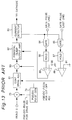
- Fig. 13 is a block diagram of a conventional video signal processor.
- this processor comprises a pseudo-pulse generator 78 for generating pseudopulses for drive and cut-off adjustment, a first adding unit 79 for adding the drive adjustment pseudo-pulse to the first line of the video signal, a second adding unit 80 for adding the cut-off adjustment pseudo-pulse to the last line of the video signal, a contrast and drive adjustment means 81 for controlling the video signal gain and adjusting the contrast and drive, a pedestal clamp video amplifier 82 for amplifying the video signal pedestal clamp and output, a current detector 83 for detecting the cathode current of the cathode ray tube, a first gate 84 that opens at the first line of the video signal, a second gate 85 that opens at the last line of the video signal, a first signal holder 86 for holding the output from the first gate, a second signal holder 87 for holding the output from the second gate, a first comparator 88 for comparing the first signal holder output
- the drive adjustment pseudo-pulse added to the first line of the video signal by the adding unit 79 is detected by the current detector 83 and first gate 84, and the resulting output is held by the first signal holder 86 for one vertical scanning period (IV).
- the hold output is then compared with the reference voltage 90 by the first comparator 88.
- the first comparator 88 output is defined as an error voltage, and the gain of the contrast and drive adjustment means 81 is controlled so that this error voltage becomes zero (0).
- the cut-off is adjusted as follows.
- the cut-off adjustment pseudo-pulse added to the last line of the video signal by the adding unit 80 is detected by the current detector 83 and second gate 85, and the resulting output is held by the second signal holder 87 for one vertical scanning period (IV).
- the hold output is then compared with the reference voltage 91 by the second comparator 89.
- the second comparator 89 output is defined as an error voltage, and the pedestal clamp video amplifier 82 is controlled so that this error voltage becomes zero (0).
- an object of the present invention is to provide a multimedia-compatible video signal processor, and specifically a video signal processor achieving high stability, high fidelity images with a wide band video signal input.
- a video signal processor comprises an adding means for adding a brightness reference signal symmetrically with reference to the black level in the vertical blanking period of the input video signal, a control means for applying the signal added by the adding means to the first electrode of the cathode ray tube (CRT), and detecting the current of the brightness reference signal from the added signal to control the current potential, and a second signal applying means for applying the current potential controlled by the control means to the second electrode of the CRT.
- the invention thus comprised can separately drive the high amplitude, wide band video signal at the first CRT electrode and the brightness control signal at the second CRT electrode, and can achieve a high amplitude, wide band signal applied to the first CRT electrode.
- a video signal processor comprises an adding means for adding a brightness reference signal and contrast reference signal in the vertical blanking period of the input video signal, a first control means for referencing the black level to extract the contrast reference signal added by the adding means for contrast feedback control, a first signal applying means for applying the signal from the first control means to the first CRT electrode, a control means for detecting the current of the brightness reference signal from the first control means output signal to control the current potential, and a second signal applying means for applying the current potential from the control means to the second electrode of the CRT.
- the invention thus comprised can achieve high stability, high fidelity signal processing by means of feedback control. Reliable operation of the feedback loop for contrast and brightness control can also be assured with any input video signal, and a high stability video signal processor can thus be achieved.
- a video signal processor comprises a correction means for adding a brightness reference signal symmetrically with reference to the black level in the vertical blanking period of the input video signal, and applying gamma and uniformity correction based on this reference signal, a first signal applying means for applying the signal corrected by the correction means to the first CRT electrode, a control means for detecting the current of the brightness reference signal from the corrected signal to control the current potential, and a second signal applying means for applying the current potential from the control means to the second electrode of the CRT.
- the invention thus comprised can achieve high precision gamma and uniformity correction with good signal tracking by basing the signal correction process on the brightness reference signal added to the vertical blanking period of the input video signal.
- Fig. 1 is a block diagram of a video signal processor according to the first embodiment.
- the contrast (CONT below) control signal and other image adjustment signals are input to the input terminal 1
- the video signal is input to the video signal input terminal 2
- the brightness control signal is input to the brightness control signal input terminal 3
- the synchronization (sync) signal is input to the sync signal input terminal 4.
- the brightness (BRT) reference signal generator 7 generates the BRT reference signal during the vertical blanking period but offset the vertical fly-back period.
- the adder 5 adds the BRT reference signal to the video signal.
- the amplifier 6 adjusts the gain according to the image adjustment signal from the input terminal 1.
- the current detector 9 detects the cathode current of the BRT reference signal.
- the sample/hold circuit 10 samples and holds the wave peak of the BRT reference signal based on the timing signal from the BRT reference signal generator 7.
- the comparator 11 compares the wave peak of the sampled and held BRT reference signal with the black level reference signal to output the amplitude value of the BRT reference signal.
- the voltage controller 12 controls the current voltage based on the comparator 11 output.
- the blanking (BLK) signal amplifier 8 generates the blanking signal based on the sync signal from the sync signal input terminal 4.
- the signal clamp 13 clamps the peak of the BLK signal from the BLK signal amplifier 8 at the control signal from the voltage controller 12.
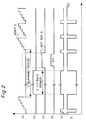
- a video signal processor thus comprised is described below with reference to the wave form diagram in Fig. 2.
- the video signal supplied to the video signal input terminal 2 is shown as the Fig. 2 (a) wave
- the vertical sync signal synchronized to the deflection and supplied to the sync signal input terminal 4 is shown as wave (b).
- the BRT reference signal generator 7 generates the BRT reference signal (Fig. 2 (c)) during the vertical blanking period of the video signal (Fig. 2 (a)), but offset from the vertical fly-back period of the deflection (Fig. 2 (b)).
- the wave peak of the BRT reference signal is controlled by the input to the brightness control signal input terminal 3. This is for the current detection of the BRT reference signal to be carried out in a period other than the fly-back period.
- the BRT reference signal from the BRT reference signal generator 7 is added to the video signal by the adder 5, resulting in addition of the BRT reference signal as shown by the dotted line in Fig. 2 (a).
- the signal from the adder 5 is then supplied to the current detector 9 through the amplifier 6.
- the current detector 9 detects the cathode current of the BRT reference signal added to the video signal vertical blanking period, and applies the cathode current to the first CRT electrode, i.e., the cathode electrode.
- Current detector 9 detects the current of the BRT reference signal added to the video signal, and produces a voltage signal indicative of the current level.
- the voltage signal from the current detector 9 is sampled and held by the sample/hold circuit 10 in response to the sample/hold pulse (Fig. 2 (d)).
- the sample/hold circuit 10 produces the sampled signal which is supplied to the comparator 11 for comparison with a reference potential, and the comparison result is supplied to the voltage controller 12.
- the BLK signal amplifier 8 generates the BLK signal containing the horizontal and vertical fly-back periods (Fig. 2 (e)) from the deflection-synchronized sync signal input to the sync signal input terminal 4, amplifies the signal to the voltage VGC required to cut off the cathode, and outputs the BLK signal shown in Fig. 2 (f).
- the signal clamp 13 clamps the peak of the (Fig. 2 (f)) BLK signal from the BLK signal amplifier 8 to adjust the voltage VGC relatively to the control voltage from the voltage controller 12, and applies the result to the second CRT electrode, i.e., the grid (G1) electrode. Brightness is thus controlled because the peak (VGC) of the BLK signal (Fig. 2 (f)) changes with the BRT reference signal.
- the brightness control method is described in detail below with reference to Fig. 3.
- the voltage signal applied to the cathode terminal of a CRT is shown as waves (A) in Figs. 3a, 3b, 3c and 3d
- the voltage signal applied to the grid electrode is shown as waves (B) in Figs. 3a, 3b, 3c and 3d.
- the waves (A) in Figs. 3a, 3b, 3c and 3d are similar to the wave (a) shown in Fig. 2, but in up-side-down relationship.
- the video signal will have a drooped down portion below the pedestal voltage VPED, i.e., towards the dark side, as shown in Fig. 3a (A).
- Figs. 3a, 3b, 3c and 3d show various cases with various levels of the BRT reference signal caused by the change of the brightness control signal.
- Fig. 3a shows a case when the pedestal level VPED is reduced 40 volts by the addition of the BRT reference signal.
- FIG. 3b shows a case when the pedestal level VPED is reduced 20 volts by the addition of the BRT reference signal.
- Fig. 3c shows a case when the pedestal level VPED is maintained the same by the addition of the 0 level BRT reference signal.
- Fig. 3e shows a case when the pedestal level VPED is increased 20 volts by the addition of the BRT reference signal.
- the pedestal voltage VPED applied to the cathode is, e.g., 200 volts, as shown in Figs. 3a, 3b, 3c and 3d, but the current applied to the cathode is several micro amperes.
- the current detector 9 detects the current flowing to the cathode at the sampling and hold period S/H, and converts the current to a voltage signal (added BRT reference signal) which is relative to, e.g., 1/20 of the voltage applied to the cathode.
- current detector 9 detects a current to the cathode, e.g., 16 ⁇ A, converts the detected current, 16 ⁇ A, to a voltage, i.e., 160 volts, and reduces the voltage to a reasonable level, i.e., 8 volts with a predetermined reduction ratio, e.g,. 1/20.
- the voltage, 8 volts, from the current detector 9 is applied to sample/hold circuit 10 for sampling the 8 volts.
- the comparator 11 the sampled voltage, 8 volts, is compared with a reference voltage, e.g., 5 volts, from a reference voltage generator REF.
- the reference voltage generator REF generates a reference voltage which is commensurate with a predetermined current, e.g., 10 ⁇ A, applied to the cathode.
- a predetermined current e.g. 10 ⁇ A
- the reference voltage 5 volts indicates that the voltage that can be applied to the cathode by the current of 10 ⁇ A is 100 volts (5x20).
- clamp 13 clamps the signal (Fig. 1 (f), Fig. 3a (b)) not to exceed -40 volts.
- the level-controlled blanking signal (Fig. 3a (B)) is applied to the grid electrode.
- the cut off voltage VCF will be fixed to a desired voltage, 200 volts.
- Brightness can thus be controlled by applying brightness feedback control to maintain a constant cut-off voltage.
- Fig. 3b (A) shows a case in which the signal applied to the cathode is cut in half when compared with the amplitude of the video signal shown in Fig. 3a (A).
- the grid wave at this time is controlled to be higher than the wave shown in Fig. 3a (B) so that the BLK signal peak VGC2 > VGC1 (Fig. 3b (B)).
- Fig. 3c (A) shows a case in which the potential at the added BRT reference signal is set to the same level as the pedestal potential.
- Fig. 3d (A) shows a case in which the cathode wave added with the BRT reference signal is raised greater than the pedestal voltage VPED, that is in the brighter direction.
- the grid wave at this time is controlled to be further higher than the wave shown in Fig. 3d (B) so that the BLK signal peak VGC4 > 0 > VGC1.
- the brightness control is carried out by the detection of actual current signal applied to the cathode and using the brightness reference signal added on the pedestal level of the video signal in both directions, i.e., to the bright side and to the dark side, the brightness control operation can be carried out quickly and with high preciseness.
- the signal levels of the added brightness reference signals are shown to be greater in the darker side (downward) and smaller in the brighter side (upward), the limit of such levels can be selected within a reasonable range.
- the amplifier can easily achieve a high amplitude, wide band signal because just the amplitude of the video signal is controlled based on the cathode wave to maintain a constant pedestal potential.
- Brightness control can be achieved by means of a simple construction because the grid voltage is controlled rather than controlling the voltage of the cathode which would require a wide band processing. Also, since the change of the cathode current is monitored after every frame, it is possible to automatically suppress the unwanted cathode current deviations caused by the long term use of the CRT and its driving circuit.
- the CRT changes its operation characteristics due to (i) the grid dooming which occurs immediately after the power on by the emission current continuing for a few minutes, resulting in unstableness of the brightness, (ii) the drifting of the cut off voltage VCF after a long term use and (iii) the temperature characteristics of the driving circuit. Because of these factors, according to the prior art television set, as shown by a real line in a graph of Fig. 3e, it has taken one to two hours before the cathode current becomes stable in terms of brightness control. By the employment of the present invention, however, it has taken less than one minutes, as shown by a dotted line in a graph of Fig. 3e, to stabilize the brightness control.
- a current amount iK1 of the added BRT reference signal detected by the current detector 9 is set to be within several ⁇ A to several tens ⁇ A resulting in slight gleaming light on the screen. Therefore, the brightness of R, G, B colors with respect to the current amount iK1 before the brightness control effected by the present invention is different, as shown in the graph of Fig. 3f, but will be converged after the brightness control effected by the present invention, as shown in the graph of Fig. 3g.
- the brightness control of the present invention it is possible to provide a constant and stable cut off voltage VCF not only after the brightness control but also other controls such as contrast control.
- the BLK signal applied to the grid electrode is described as the blanking signal in this embodiment to simplify the brightness control operation, but when blanking is applied by the cathode voltage applied to the cathode electrode, the signal applied to the grid electrode is the DC potential.
- a brightness reference signal is added to the video signal blanking period and applied to the first electrode, and the current of the brightness reference signal is detected from the added signal to control the DC potential of the blanking signal applied to the second electrode. It is thus possible to separately drive the high amplitude, wide band video signal at the first electrode and the brightness control signal at the second electrode, thereby easily achieving a high amplitude, wide band signal applied to the first electrode.
- reliable operation of the feedback loop for brightness control can be assured with any input video signal, thus achieving a multimedia compatible, high stability video signal processor, and yet correcting the long term use deviation in the characteristics of the CRT and its driving circuit.
- the adder 14 adds the reference signal to the video signal.
- the reference signal generator 15 generates the brightness (BRT) reference signal and the contrast (CONT) reference signal.
- the CONT control signal is input to the CONT control signal input terminal 16.
- the variable gain amplifier 17 varies the gain of the video signal.
- the clamp 18 clamps the output of variable gain amplifier 17 as a DC signal during the pedestal period of the video signal.
- the sample/hold circuit 19 samples and holds the peak of the contrast reference signal.
- the comparator 20 compares the contrast reference signal peak with the black level reference signal, and outputs the amplitude of the contrast reference signal.
- the GAIN reference potential is input to input terminal 21.
- the sample/hold pulses 1 and 2 are input to input terminals 22a and 22b, respectively.
- the output amplifier 23 amplifies the video signal to the level required to drive the CRT cathode.
- the BIAS reference potential is input to input terminal 24.
- a video signal processor thus comprised is described below with reference to the wave form diagram in Fig. 5.
- the video signal supplied to the video signal input terminal 2 is shown in Fig. 5 (a), and the vertical sync signal synchronized to the deflection supplied to the sync signal input terminal 4 is shown in Fig. 5 (b).
- the reference signal generator 15 generates the BRT reference signal (Fig. 5 (c)) during the vertical blanking period of the video signal (Fig. 5 (a)), but offset from the vertical fly-back period (Fig. 5 (b)), and generates the CONT reference signal (Fig. 5 (d)) during the horizontal fly-back period.
- the wave peak of the BRT reference signal is controlled by the input to the brightness control signal input terminal 3, and the peak of the CONT reference signal is controlled by the control signal from the CONT control signal input terminal 16.
- the BRT reference signal and CONT reference signal from the reference signal generator 15 and the video signal are added by the adder 14, which outputs the video signal with the reference signals added as shown in Fig. 5 (e).
- the signal from the adder 14 is supplied to the clamp 18 through the variable gain amplifier 17, and the pedestal is clamped during the pedestal period of the video signal.
- the CONT reference signal level is sampled from the clamp 18 output signal and held by the sample/hold circuit 19 at the sample/hold pulse 1 (5/H1, Fig. 5 (g)), and converted to a DC potential.
- the signal from the sample/hold circuit 19 is supplied to the comparator 20 for comparison with the GAIN reference potential from the input terminal 21, and the comparison result is supplied to the variable gain amplifier 17 for feedback control of the contrast.
- the signal from the clamp 18 is also supplied to the current detector 9 through the output amplifier 23.
- the current detector 9 detects the cathode current of the BRT reference signal added to the vertical blanking period, and applies the cathode current to the cathode electrode.
- the BRT reference signal level of the current/voltage converted signal output from the current detector 9 is sampled and held by the sample/hold circuit 10 at the sample/hold pulse 2 (S/H2, Fig. 5 (f)), and converted to a DC potential.
- the signal from the sample/hold circuit 10 is input to the comparator 11 for comparison with the BIAS reference potential, and the result is supplied to the voltage controller 12.
- the BLK signal amplifier 8 generates the BLK signal containing the horizontal and vertical fly-back periods from the deflection-synchronized sync signal input to the sync signal input terminal 4, amplifies the signal to the voltage required to cut off the cathode, and outputs the BLK signal shown in Fig. 5 (h).
- the signal clamp 13 clamps the peak of the (Fig. 5 (h)) BLK signal from the BLK signal amplifier 8 to adjust the voltage to the control voltage from the voltage controller 12.
- the contrast control operation is described in detail below.
- the peak of the CONT reference signal added as described above is sampled and held by the sample/hold circuit 19 based on the timing signal shown in Fig. 5 (g).
- the output from the sample/hold circuit 19 and the GAIN reference potential are compared by the comparator 20 to obtain the amplitude of the contrast reference signal.
- This amplitude value is input to the variable gain amplifier 17 to enable feedback gain control, and the contrast of the video signal is controlled so that the amplitude is equal to a constant reference value.
- the operating wave of this contrast control process is shown in Fig. 6a to 6f.
- the output wave of contrast control is as shown in Figs. 6b, 6d and 6f.
- contrast is controlled by using feedback control so that the peak VCONT of the CONT reference signal is constant.
- changes in the cathode current are monitored, changes in the cathode current resulting from natural changes in the CRT over time are automatically compensated for.
- Figs. 6i and 6j show a relationship between the contrast control voltage of the gain control portion and the output voltage according to the prior art which has no feedback control and the same of the second embodiment, respectively.
- prior art since the output characteristics of R, G, B are not the same, the color balance changes relatively to the change of the contrast control.
- the second embodiment as shown in Fig. 6j, since feedback control is applied to the contrast control, the variation of the gain of the gain control portion for difference colors R, G, B are automatically suppressed to have a constant gain.
- the contrast control can be carried out while maintaining the output characteristics of R, G, B the same.
- color balance among R, G, B will not change even after the contrast control.
- the amplitude of the video signal can be changed by either changing the VBIAS or changing the VCONT.
- the contrast control is done by controlling the VCONT, and the drive control of the three colors R, G, B is done by the VBIAS.
- stable feedback control is achieved by adding the BRT reference signal during the vertical blanking period but offset the vertical fly-back period, and by adding the CONT reference signal during the horizontal fly-back period to enable automatic brightness suppression control.
- the black level reference signal is used as the reference signal for detecting the peaks of the contrast and brightness reference signals.
- the CONT reference signal shown in Fig. 6a and the black level reference signal shown in Fig. 6h are added during the horizontal fly-back period as shown in Fig. 6g.
- the black level reference signal level is set to the same level as the pedestal level.
- the CONT reference signal and BRT reference signal peaks are detected referenced to this black level reference signal, and feedback control is applied based on the detection signal.
- the sample/hold circuit 19 shown in Fig. 4 includes first and second sample/hold circuits.
- the first sample/hold circuit samples and holds the level of the added contrast reference signal as described above, and detects the level of the holding signal.
- the second sample/hold circuit samples and holds the level of the black level reference signal, and detects the level of the holding signal.
- the gain of the variable gain control 17 is controlled by the use of the amplitude of the contrast reference signal. Therefore, the comparator 20 shown in Fig. 4 also includes first and second comparators. The first comparator compares the two outputs from the first and second sample/hold circuits to obtain an amplitude of the contrast reference signal. The obtained amplitude is then compared in the second comparator with a reference voltage, and the result is used to control the gain of the variable gain control 17 so that the amplitude value equals the reference value, thus maintaining a stable video signal contrast.
- the operation of the brightness control is the same as that in the first embodiment, and therefore, the description therefor is omitted.
- the amplitude information of the reference signal is needed to control the contrast i.e., the reference for the black level is required.
- the image adjustment reference signal peaks and black level reference signal can be reliably sampled and held, and the amplitude information of the image adjustment reference signals can be reliably obtained for any sync signal phase or fly-back period, i.e., for any input video signal.
- reliable operation of the feedback loop for contrast and brightness control can be assured, and a high stability video signal processor for multimedia applications can achieved.
- the white balance adjustment operation is described next.
- the white balance adjustment is used to compensate for variations in the color balance at each color gradation resulting from the emissions characteristics of the CRT.
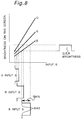
- CRT emissions characteristics are not uniform for red, green and blue, and RGB image brightness values will vary between CRT devices even when the same signal is input because of differences in the relationship between the input signal and the output screen as shown in Fig. 7. It is therefore necessary to adjust the video signal gain and G1 potential for each RGB value to obtain a uniform display screen brightness. This is the gain and bias adjustment of the white balance adjustment.
- the brightness reference signal and contrast reference signal are added to the blanking period and horizontal fly-back period, respectively, of the video signal, the contrast reference signal is extracted based on the black level for contrast feedback control while applying the signal to the first electrode, and the current of the brightness reference signal is detected from the first applied signal to control the DC potential of the blanking signal applied to the second electrode.
- the high amplitude, wide band video signal and the brightness control signal can thus be separately driven at the first and second electrodes, respectively, and the amplitude and band width of the signal applied to the first electrode can be easily increased. Reliable operation of the feedback loop for contrast and brightness control can also be assured for any input video signal, and a high stability video signal processor can be achieved.
- Fig. 9 is a block diagram of a video signal processor according to this embodiment.
- the gamma correction operator 25 applies gamma correction based on the BRT reference signal.
- the amplifier 26 changes the gain based on the image adjustment signal from the input terminal 1.
- the current detector 27 detects the cathode current of the BRT reference signal.
- the sample/hold circuit 28 samples and holds the BRT reference signal peak according to the timing signal from the BRT reference signal generator 7.
- the comparator 29 compares the BRT reference signal peak with the black level reference signal, and outputs the amplitude of the BRT reference signal.
- the voltage controller 30 controls the DC voltage based on the output from the comparator 29.
- the clamp 31 clamps the signal peak so that the BLK signal peak is set to the control voltage from the voltage controller 30. Note that components performing like operations in Figs. 1 and 9 are identified by the same reference numerals, and further description is omitted below.
- a video signal processor thus comprised is described below with reference to the wave form diagram in Fig. 10.
- the video signal supplied to the video signal input terminal 2 is shown as the Fig. 10 (a) wave
- the vertical sync signal synchronized to the deflection supplied to the sync signal input terminal 4 is shown as wave (b).
- the BRT reference signal generator 7 generates the BRT reference signal (Fig. 10 (c)) from the vertical blanking period of the video signal (Fig. 10 (a)) and the vertical fly-back period of the deflection (Fig. 10 (b)) during a predetermined period outside the vertical fly-back period of the deflection but within the vertical blanking period of the video signal.
- the peak of the BRT reference signal is controlled by the control signal from the brightness control signal input terminal 3.
- the BRT reference signal from the BRT reference signal generator 7 is added to the video signal by the adder 5, and the reference signal-added video signal (Fig. 10 (d)) is output.
- the signal from the adder 5 is supplied to the gamma correction operator 25 and clamped during the BRT reference signal period.
- Gamma correction is then applied by the gamma correction circuit (not shown in the figures) in the gamma correction operator 25, which is a nonlinear amplifier using the nonlinear characteristics of transistors and diodes.
- the gamma corrected wave (Fig. 10 (e)) is then output.
- the signal from the gamma correction operator 25 is supplied to the amplifier 26, pedestal clamped again during the pedestal period of the video signal, and the signal amplified according to the image adjustment signal from the input terminal 1 is supplied to the current detector 27.
- the current detector 27 detects the cathode current of the BRT reference signal added to the vertical blanking period, and this cathode current is applied to the cathode electrode.
- the BRT reference signal level of the current/voltage converted signal from the current detector 27 is sampled and held by the sample/hold circuit 28, and converted to a DC potential.
- the signal from the sample/hold circuit 28 is input to the comparator 29 for comparison with the reference potential, and the result is output to the voltage controller 30.
- the BLK signal amplifier 8 generates the BLK signal containing the horizontal and vertical fly-back periods from the deflection-synchronized sync signal input to the sync signal input terminal 4, amplifies the signal to the voltage required to cut off the cathode, and outputs the BLK signal.
- the signal clamp 31 clamps the peak of the (Fig. 10 (f)) BLK signal from the BLK signal amplifier 8 to adjust the voltage to the control voltage from the voltage controller 30.
- the gamma correction method is described in detail below with reference to Fig. 11.
- the video signal with the added BRT reference signal and input to the gamma correction operator 25 is shown in Fig. 11 (a).
- the output characteristics when the BRT reference signal is set to maximum (max), standard (typ), and minimum (min) are shown in Figs. 11 (b, c, d), respectively.
- the ramp output wave when the BRT reference signal is set to standard (typ) conditions Fig. 11 (b)
- nonlinear processing is automatically applied from 50% of the signal mean, but nonlinear processing is applied from 100% of the signal mean when the BRT reference signal is set to minimum (min) conditions (Fig. 11 (c)), and from 0% of the signal mean when the BRT reference signal is set to maximum (max) conditions (Fig. 11 (d)).
- high precision gamma correction can be achieved by adding the BRT reference signal to the video signal, and applying gamma correction according to the BRT reference signal level.
- this is particularly suited to gamma correction when the blue phosphors are saturated at the emissions characteristics of the high current band.
- This embodiment has been described using gamma correction for signal correction, but uniformity correction correcting color shading and uniformity of the screen brightness will also track the BRT setting conditions.
- nonlinear processing based on the brightness reference signal added to the video signal blanking period is applied and the signal is applied to the first electrode, i.e., the cathode electrode, and the brightness reference signal current is detected to control the DC potential of the blanking signal applied to the second electrode, i.e., the grid electrode (G1).
- High precision gamma correction is thus possible, it is possible to separately drive the high amplitude, wide band video signal at the first electrode and the brightness control signal at the second electrode, and a high amplitude, wide band signal can easily be applied to the first electrode.
- reliable operation of the feedback loop for brightness control can be assured with any input video signal, thus achieving a multimedia compatible, high stability video signal processor.
- first and second electrodes in the above embodiments are described as being the cathode electrode and the grid electrode, respectively, of a cathode ray tube, but other electrodes can also be used.
- the BLK signal pulse signal is described as applied to the second electrode, i.e., the grid electrode, but a DC potential can be applied if the cathode signal is used for blanking.
- the video signal is applied to the cathode electrode and the BRT reference signal to the grid electrode, but the reverse is also possible.
- BRT reference signal is added to the pedestal voltage level (black level) of the video signal, but can be added in other level for obtaining the added BRT reference signal to do the BRT control. Also, the range of the upper and lower limits of the added BRT reference signal can be varied according to the type of display device to which the present invention is applied.
- the CONT feedback control loop is formed using the signal from the output amplifier input, but the output amplifier output can also be used for the feedback loop.
- a nonlinear amplifier circuit is used as the gamma correction circuit, but a plural segment approximation circuit can also be used.
- Gamma correction in the third embodiment is also accomplished by nonlinear processing, but another type of signal processing correction circuit can also be used.
- a brightness reference signal is added to the video signal blanking period and applied to the first electrode, and the current of the brightness reference signal is detected from the added signal to control the DC potential of the blanking signal applied to the second electrode. It is thus possible to separately drive the high amplitude, wide band video signal at the first electrode and the brightness control signal at the second electrode, thereby easily achieving a high amplitude, wide band signal applied to the first electrode.
- the current feedback type control is done by adding the brightness reference signal to the pedestal voltage level (black level) of the video signal, the brightness is controlled using the actual CRT driving signal, thus achieving a high precise BRT control, and yet correcting unwanted deviation in the characteristics of the CRT and its driving circuit caused by the long term use.
- reliable operation of the feedback loop for brightness control can be assured with any input video signal, thus achieving a multimedia compatible, high stability video signal processor.
- the brightness reference signal and contrast reference signal are added to the vertical blanking period and fly-back period, respectively, of the video signal, the contrast reference signal is extracted based on the black level for contrast feedback control while applying the signal to the first electrode, and the current of the brightness reference signal is detected from the first applied signal to control the DC potential of the blanking signal applied to the second electrode.
- the high amplitude, wide band video signal and the brightness control signal can thus be separately driven at the first and second electrodes, respectively, and the amplitude and band width of the signal applied to the first electrode can be easily increased. Reliable operation of the feedback loop for contrast and brightness control can also be assured for any input video signal, and a high stability video signal processor can be achieved.
- the image adjustment reference signal peaks and black level reference signal can be reliably sampled and held, and the amplitude information of the image adjustment reference signals can be reliably obtained for any sync signal phase or blanking period, i.e., for any input video signal.
- reliable operation of the feedback loop for contrast and brightness control can be assured, and a high stability video signal processor for multimedia applications can achieved.
- nonlinear processing based on the brightness reference signal added to the video signal blanking period is applied and the signal is applied to the first electrode, i.e., the cathode electrode, and the brightness reference signal current is detected to control the DC potential of the blanking signal applied to the second electrode, i.e., the grid electrode (G1).
- the grid electrode i.e., the grid electrode (G1).
- High precision gamma correction with good signal tracking is thus possible, it is possible to separately drive the high amplitude, wide band video signal at the first electrode and the brightness control signal at the second electrode, and a high amplitude, wide band signal can easily be applied to the first electrode.
Landscapes
- Engineering & Computer Science (AREA)
- Multimedia (AREA)
- Signal Processing (AREA)
- Picture Signal Circuits (AREA)
- Transforming Electric Information Into Light Information (AREA)
- Television Receiver Circuits (AREA)
Applications Claiming Priority (4)
| Application Number | Priority Date | Filing Date | Title |
|---|---|---|---|
| JP233389/92 | 1992-09-01 | ||
| JP4233389A JPH0686191A (ja) | 1992-09-01 | 1992-09-01 | 映像信号処理装置 |
| JP271337/92 | 1992-10-09 | ||
| JP4271337A JPH06121331A (ja) | 1992-10-09 | 1992-10-09 | 映像信号処理装置 |
Publications (2)
| Publication Number | Publication Date |
|---|---|
| EP0585558A2 true EP0585558A2 (fr) | 1994-03-09 |
| EP0585558A3 EP0585558A3 (en) | 1996-11-20 |
Family
ID=26531019
Family Applications (1)
| Application Number | Title | Priority Date | Filing Date |
|---|---|---|---|
| EP93110674A Ceased EP0585558A3 (en) | 1992-09-01 | 1993-07-05 | Video signal processor |
Country Status (3)
| Country | Link |
|---|---|
| US (1) | US5504538A (fr) |
| EP (1) | EP0585558A3 (fr) |
| KR (1) | KR970000851B1 (fr) |
Cited By (2)
| Publication number | Priority date | Publication date | Assignee | Title |
|---|---|---|---|---|
| EP0809396A3 (fr) * | 1996-05-22 | 1999-03-31 | Matsushita Electric Industrial Co., Ltd. | Appareil de limitation automatique du comant de faisceau et ses méthodes de réalisation |
| GB2338390A (en) * | 1997-03-04 | 1999-12-15 | Sanyo Electric Co | Television system |
Families Citing this family (72)
| Publication number | Priority date | Publication date | Assignee | Title |
|---|---|---|---|---|
| US5978041A (en) * | 1994-10-24 | 1999-11-02 | Hitachi, Ltd. | Image display system |
| US6791623B1 (en) * | 1994-10-24 | 2004-09-14 | Hitachi, Ltd. | Image display system |
| US5714842A (en) * | 1995-07-21 | 1998-02-03 | Apple Computer, Inc. | Automatic cutoff control for a DC coupled CRT video drive |
| US5808699A (en) * | 1995-10-02 | 1998-09-15 | Matsushita Electric Industrial Co., Ltd. | Visual image signal processing apparatus using arithmetic operation on brightness reference signal overlaid in fly-back period of input visual image signal |
| US5715013A (en) * | 1996-02-09 | 1998-02-03 | Lg Electronics Inc. | Double picture producing apparatus for wide screen television |
| KR100204543B1 (ko) * | 1996-07-22 | 1999-06-15 | 윤종용 | 휴/새츄레이션을 이용한 색조정기능을 갖는 디스플레이 장치의 제어방법 |
| JPH10145807A (ja) * | 1996-11-12 | 1998-05-29 | Matsushita Electric Ind Co Ltd | オートカットオフ回路 |
| DE19709681A1 (de) * | 1997-03-11 | 1998-09-17 | Thomson Brandt Gmbh | Schaltung zur Überwachung des Strahlstroms in einer Farbildröhre |
| US6580465B1 (en) * | 1998-01-09 | 2003-06-17 | Pentax Corporation | Clamp voltage generating circuit and clamp level adjusting method |
| US7154563B1 (en) * | 1998-04-30 | 2006-12-26 | Stmicroelectronics Asia Pacific Pte Ltd. | Automatic brightness limitation for avoiding video signal clipping |
| US6710821B1 (en) * | 1998-06-26 | 2004-03-23 | Sanyo Electric Co., Ltd. | White balance adjusting apparatus |
| EP0982709A1 (fr) | 1998-08-24 | 2000-03-01 | Alps Electric Co., Ltd. | Afficheur à cristaux liquides avec ajustement du contraste |
| US6437833B1 (en) * | 1998-11-18 | 2002-08-20 | Kabushiki Kaisha Toshiba | Automatic white balance adjusting circuit in color image display |
| JP2001238127A (ja) * | 2000-02-21 | 2001-08-31 | Fuji Photo Film Co Ltd | カメラ |
| US7002605B1 (en) | 2000-07-03 | 2006-02-21 | Alps Electric Co., Ltd. | Image display apparatus for fixing luminance of blank area and varying only luminance of image |
| US7045977B2 (en) * | 2001-11-12 | 2006-05-16 | Matsushita Electric Industrial Co., Ltd. | Vertical/horizontal amplitude controller |
| KR100425312B1 (ko) * | 2001-12-11 | 2004-03-30 | 삼성전자주식회사 | 자동 휘도 조정 장치 및 방법 |
| KR100497395B1 (ko) * | 2003-06-30 | 2005-06-23 | 삼성전자주식회사 | 화질을 자동으로 설정하는 방법 |
| US20050097046A1 (en) | 2003-10-30 | 2005-05-05 | Singfield Joy S. | Wireless electronic check deposit scanning and cashing machine with web-based online account cash management computer application system |
| US7277135B1 (en) * | 2004-07-23 | 2007-10-02 | National Semiconductor Corporation | Video display signal brightness control circuit |
| US8799147B1 (en) | 2006-10-31 | 2014-08-05 | United Services Automobile Association (Usaa) | Systems and methods for remote deposit of negotiable instruments with non-payee institutions |
| US7885451B1 (en) | 2006-10-31 | 2011-02-08 | United Services Automobile Association (Usaa) | Systems and methods for displaying negotiable instruments derived from various sources |
| US7873200B1 (en) | 2006-10-31 | 2011-01-18 | United Services Automobile Association (Usaa) | Systems and methods for remote deposit of checks |
| US7876949B1 (en) | 2006-10-31 | 2011-01-25 | United Services Automobile Association | Systems and methods for remote deposit of checks |
| US8708227B1 (en) | 2006-10-31 | 2014-04-29 | United Services Automobile Association (Usaa) | Systems and methods for remote deposit of checks |
| US8351677B1 (en) | 2006-10-31 | 2013-01-08 | United Services Automobile Association (Usaa) | Systems and methods for remote deposit of checks |
| US10380559B1 (en) | 2007-03-15 | 2019-08-13 | United Services Automobile Association (Usaa) | Systems and methods for check representment prevention |
| US8959033B1 (en) | 2007-03-15 | 2015-02-17 | United Services Automobile Association (Usaa) | Systems and methods for verification of remotely deposited checks |
| US8538124B1 (en) | 2007-05-10 | 2013-09-17 | United Services Auto Association (USAA) | Systems and methods for real-time validation of check image quality |
| US8433127B1 (en) | 2007-05-10 | 2013-04-30 | United Services Automobile Association (Usaa) | Systems and methods for real-time validation of check image quality |
| US9058512B1 (en) | 2007-09-28 | 2015-06-16 | United Services Automobile Association (Usaa) | Systems and methods for digital signature detection |
| US8358826B1 (en) | 2007-10-23 | 2013-01-22 | United Services Automobile Association (Usaa) | Systems and methods for receiving and orienting an image of one or more checks |
| US9892454B1 (en) | 2007-10-23 | 2018-02-13 | United Services Automobile Association (Usaa) | Systems and methods for obtaining an image of a check to be deposited |
| US9898778B1 (en) | 2007-10-23 | 2018-02-20 | United Services Automobile Association (Usaa) | Systems and methods for obtaining an image of a check to be deposited |
| US9159101B1 (en) | 2007-10-23 | 2015-10-13 | United Services Automobile Association (Usaa) | Image processing |
| US7996315B1 (en) | 2007-10-30 | 2011-08-09 | United Services Automobile Association (Usaa) | Systems and methods to modify a negotiable instrument |
| US8001051B1 (en) | 2007-10-30 | 2011-08-16 | United Services Automobile Association (Usaa) | Systems and methods to modify a negotiable instrument |
| US7996314B1 (en) | 2007-10-30 | 2011-08-09 | United Services Automobile Association (Usaa) | Systems and methods to modify a negotiable instrument |
| US8046301B1 (en) | 2007-10-30 | 2011-10-25 | United Services Automobile Association (Usaa) | Systems and methods to modify a negotiable instrument |
| US7996316B1 (en) | 2007-10-30 | 2011-08-09 | United Services Automobile Association | Systems and methods to modify a negotiable instrument |
| US8320657B1 (en) | 2007-10-31 | 2012-11-27 | United Services Automobile Association (Usaa) | Systems and methods to use a digital camera to remotely deposit a negotiable instrument |
| US8290237B1 (en) | 2007-10-31 | 2012-10-16 | United Services Automobile Association (Usaa) | Systems and methods to use a digital camera to remotely deposit a negotiable instrument |
| US7896232B1 (en) | 2007-11-06 | 2011-03-01 | United Services Automobile Association (Usaa) | Systems, methods, and apparatus for receiving images of one or more checks |
| US7900822B1 (en) | 2007-11-06 | 2011-03-08 | United Services Automobile Association (Usaa) | Systems, methods, and apparatus for receiving images of one or more checks |
| US10380562B1 (en) | 2008-02-07 | 2019-08-13 | United Services Automobile Association (Usaa) | Systems and methods for mobile deposit of negotiable instruments |
| US8351678B1 (en) | 2008-06-11 | 2013-01-08 | United Services Automobile Association (Usaa) | Duplicate check detection |
| US8422758B1 (en) | 2008-09-02 | 2013-04-16 | United Services Automobile Association (Usaa) | Systems and methods of check re-presentment deterrent |
| US10504185B1 (en) | 2008-09-08 | 2019-12-10 | United Services Automobile Association (Usaa) | Systems and methods for live video financial deposit |
| US7885880B1 (en) | 2008-09-30 | 2011-02-08 | United Services Automobile Association (Usaa) | Atomic deposit transaction |
| US7974899B1 (en) | 2008-09-30 | 2011-07-05 | United Services Automobile Association (Usaa) | Atomic deposit transaction |
| US8275710B1 (en) | 2008-09-30 | 2012-09-25 | United Services Automobile Association (Usaa) | Systems and methods for automatic bill pay enrollment |
| US7962411B1 (en) | 2008-09-30 | 2011-06-14 | United Services Automobile Association (Usaa) | Atomic deposit transaction |
| US8391599B1 (en) | 2008-10-17 | 2013-03-05 | United Services Automobile Association (Usaa) | Systems and methods for adaptive binarization of an image |
| US7949587B1 (en) | 2008-10-24 | 2011-05-24 | United States Automobile Association (USAA) | Systems and methods for financial deposits by electronic message |
| US7970677B1 (en) | 2008-10-24 | 2011-06-28 | United Services Automobile Association (Usaa) | Systems and methods for financial deposits by electronic message |
| US8452689B1 (en) | 2009-02-18 | 2013-05-28 | United Services Automobile Association (Usaa) | Systems and methods of check detection |
| US10956728B1 (en) | 2009-03-04 | 2021-03-23 | United Services Automobile Association (Usaa) | Systems and methods of check processing with background removal |
| US8542921B1 (en) | 2009-07-27 | 2013-09-24 | United Services Automobile Association (Usaa) | Systems and methods for remote deposit of negotiable instrument using brightness correction |
| US9779392B1 (en) | 2009-08-19 | 2017-10-03 | United Services Automobile Association (Usaa) | Apparatuses, methods and systems for a publishing and subscribing platform of depositing negotiable instruments |
| US8977571B1 (en) | 2009-08-21 | 2015-03-10 | United Services Automobile Association (Usaa) | Systems and methods for image monitoring of check during mobile deposit |
| US8699779B1 (en) | 2009-08-28 | 2014-04-15 | United Services Automobile Association (Usaa) | Systems and methods for alignment of check during mobile deposit |
| US9129340B1 (en) | 2010-06-08 | 2015-09-08 | United Services Automobile Association (Usaa) | Apparatuses, methods and systems for remote deposit capture with enhanced image detection |
| US20120242412A1 (en) * | 2011-03-25 | 2012-09-27 | Peter Fletcher-Haynes | Auto Bias |
| US10380565B1 (en) | 2012-01-05 | 2019-08-13 | United Services Automobile Association (Usaa) | System and method for storefront bank deposits |
| US10552810B1 (en) | 2012-12-19 | 2020-02-04 | United Services Automobile Association (Usaa) | System and method for remote deposit of financial instruments |
| US11138578B1 (en) | 2013-09-09 | 2021-10-05 | United Services Automobile Association (Usaa) | Systems and methods for remote deposit of currency |
| US9286514B1 (en) | 2013-10-17 | 2016-03-15 | United Services Automobile Association (Usaa) | Character count determination for a digital image |
| US10402790B1 (en) | 2015-05-28 | 2019-09-03 | United Services Automobile Association (Usaa) | Composing a focused document image from multiple image captures or portions of multiple image captures |
| KR102341097B1 (ko) * | 2015-07-15 | 2021-12-22 | 쿠쿠전자 주식회사 | 전기 조리기 |
| US11030752B1 (en) | 2018-04-27 | 2021-06-08 | United Services Automobile Association (Usaa) | System, computing device, and method for document detection |
| US11900755B1 (en) | 2020-11-30 | 2024-02-13 | United Services Automobile Association (Usaa) | System, computing device, and method for document detection and deposit processing |
| US12211095B1 (en) | 2024-03-01 | 2025-01-28 | United Services Automobile Association (Usaa) | System and method for mobile check deposit enabling auto-capture functionality via video frame processing |
Family Cites Families (18)
| Publication number | Priority date | Publication date | Assignee | Title |
|---|---|---|---|---|
| JPS5537146B2 (fr) * | 1972-08-28 | 1980-09-26 | ||
| US4135200A (en) * | 1977-05-12 | 1979-01-16 | Rca Corporation | Brightness control circuit with predictable brightness control range |
| JPS55141870A (en) * | 1979-04-23 | 1980-11-06 | Sony Corp | Luminance adjusting circuit |
| JPS55143891A (en) * | 1979-04-26 | 1980-11-10 | Sony Corp | Color video output drive adjusting circuit |
| US4598316A (en) * | 1983-05-31 | 1986-07-01 | Rca Corporation | Brightness control network in a video signal processor with AC coupled output stages |
| JPH0628419B2 (ja) * | 1984-06-21 | 1994-04-13 | ソニー株式会社 | 画像調整装置 |
| US4642690A (en) * | 1984-08-27 | 1987-02-10 | Rca Corporation | Digital video signal processor with analog level control |
| JPS61187472A (ja) * | 1985-02-15 | 1986-08-21 | Hitachi Ltd | 自動輝度制限回路 |
| JPH0636586B2 (ja) * | 1985-08-12 | 1994-05-11 | ソニー株式会社 | テレビジヨン受像機 |
| JPS6248891A (ja) * | 1985-08-28 | 1987-03-03 | Hitachi Ltd | オ−トホワイトバランス調整回路 |
| DE3620990C2 (de) * | 1986-06-23 | 1995-04-13 | Broadcast Television Syst | Verfahren und Schaltungsanordnung zur nichtlinearen Übertragung eines Videosignals |
| US4786970A (en) * | 1987-08-26 | 1988-11-22 | Eastman Kodak Company | Logarithmic amplifier |
| US4945414A (en) * | 1988-05-12 | 1990-07-31 | Rca Licensing Corporation | Compensator for temperature-induced black level drift for use in a television receiver |
| JPH0831377B2 (ja) * | 1988-08-26 | 1996-03-27 | 株式会社村田製作所 | 高圧トランス |
| US4982287A (en) * | 1989-11-01 | 1991-01-01 | Rca Licensing Corporation | Control of brightness level adapted to control of contrast |
| US5079623A (en) * | 1990-04-30 | 1992-01-07 | Thomson Consumer Electronics, Inc. | Signal clamp for a dual function input terminal of a "one-chip" television signal processing IC |
| JPH0437263A (ja) * | 1990-05-31 | 1992-02-07 | Matsushita Electric Ind Co Ltd | 階調補正装置 |
| US5185656A (en) * | 1991-10-11 | 1993-02-09 | Ikegami Tsushinki Co., Ltd. | Circuit for compressing image signal |
-
1993
- 1993-03-11 KR KR1019930003619A patent/KR970000851B1/ko not_active Expired - Fee Related
- 1993-07-05 EP EP93110674A patent/EP0585558A3/en not_active Ceased
-
1994
- 1994-12-27 US US08/364,853 patent/US5504538A/en not_active Expired - Fee Related
Cited By (3)
| Publication number | Priority date | Publication date | Assignee | Title |
|---|---|---|---|---|
| EP0809396A3 (fr) * | 1996-05-22 | 1999-03-31 | Matsushita Electric Industrial Co., Ltd. | Appareil de limitation automatique du comant de faisceau et ses méthodes de réalisation |
| GB2338390A (en) * | 1997-03-04 | 1999-12-15 | Sanyo Electric Co | Television system |
| GB2338390B (en) * | 1997-03-04 | 2001-03-14 | Sanyo Electric Co | Television system |
Also Published As
| Publication number | Publication date |
|---|---|
| KR970000851B1 (ko) | 1997-01-20 |
| EP0585558A3 (en) | 1996-11-20 |
| KR940008518A (ko) | 1994-04-29 |
| US5504538A (en) | 1996-04-02 |
Similar Documents
| Publication | Publication Date | Title |
|---|---|---|
| US5504538A (en) | Video signal processor for controlling the brightness and contrast of a display device | |
| US3914545A (en) | Automatic contrast control utilizing three control signals | |
| US4369466A (en) | Video signal processing circuit | |
| JPS5837752B2 (ja) | エイゾウゾウフクキ | |
| US4516152A (en) | Video signal processor with automatic kinescope white balance and beam current limiter control systems | |
| US3928867A (en) | Television receiver with picture level control | |
| EP0700208B1 (fr) | Circuits limiteurs de la commande automatique de la brillance et du contraste et un processeur de traitement des signaux de luminance et de différence de couleurs et un dispositif d'affichage vidéo comprenant de tels circuits | |
| US3735029A (en) | Method and apparatus for maintaining the beam current of an image-display device within controlled limits | |
| JPS60206292A (ja) | ビデオ信号処理装置 | |
| US4298886A (en) | Automatic peak beam current leveler system | |
| US3072741A (en) | Television brightness and contrast control circuit | |
| JPS6298388A (ja) | デ−タ表示ビデオ・モニタ装置 | |
| US5808699A (en) | Visual image signal processing apparatus using arithmetic operation on brightness reference signal overlaid in fly-back period of input visual image signal | |
| FI76465C (fi) | Signalbehandlingsanordning. | |
| KR920003724B1 (ko) | 자동 영상관 바이어스 제어장치 | |
| US4514664A (en) | Color television receiver | |
| FI67283B (fi) | Straolstroembegraensningskrets foer bildroeret av en faergtelevisionsmottagare | |
| US5892544A (en) | Beam current detection and control system for a cathode ray tube | |
| US5889558A (en) | Variable black level bias image display | |
| US4166281A (en) | Video image highlight suppression circuit with delayed compensation | |
| CN1116798A (zh) | 自动显像管偏压控制系统 | |
| US6288503B1 (en) | Compensation of picture tube ageing effects | |
| US3763316A (en) | Dynamic focusing circuits for cathode ray tubes | |
| JPH06121331A (ja) | 映像信号処理装置 | |
| US3637921A (en) | Luminance amplifier with black level stabilization control |
Legal Events
| Date | Code | Title | Description |
|---|---|---|---|
| PUAI | Public reference made under article 153(3) epc to a published international application that has entered the european phase |
Free format text: ORIGINAL CODE: 0009012 |
|
| 17P | Request for examination filed |
Effective date: 19930705 |
|
| AK | Designated contracting states |
Kind code of ref document: A2 Designated state(s): DE GB NL |
|
| PUAL | Search report despatched |
Free format text: ORIGINAL CODE: 0009013 |
|
| AK | Designated contracting states |
Kind code of ref document: A3 Designated state(s): DE GB NL |
|
| 17Q | First examination report despatched |
Effective date: 19980120 |
|
| GRAG | Despatch of communication of intention to grant |
Free format text: ORIGINAL CODE: EPIDOS AGRA |
|
| STAA | Information on the status of an ep patent application or granted ep patent |
Free format text: STATUS: THE APPLICATION HAS BEEN REFUSED |
|
| 18R | Application refused |
Effective date: 19991118 |