EP0589441B1 - Composition de céramiques diélectriques - Google Patents
Composition de céramiques diélectriques Download PDFInfo
- Publication number
- EP0589441B1 EP0589441B1 EP93115295A EP93115295A EP0589441B1 EP 0589441 B1 EP0589441 B1 EP 0589441B1 EP 93115295 A EP93115295 A EP 93115295A EP 93115295 A EP93115295 A EP 93115295A EP 0589441 B1 EP0589441 B1 EP 0589441B1
- Authority
- EP
- European Patent Office
- Prior art keywords
- composition
- dielectric
- represented
- dielectric constant
- formula
- Prior art date
- Legal status (The legal status is an assumption and is not a legal conclusion. Google has not performed a legal analysis and makes no representation as to the accuracy of the status listed.)
- Expired - Lifetime
Links
Images

Classifications
-
- C—CHEMISTRY; METALLURGY
- C04—CEMENTS; CONCRETE; ARTIFICIAL STONE; CERAMICS; REFRACTORIES
- C04B—LIME, MAGNESIA; SLAG; CEMENTS; COMPOSITIONS THEREOF, e.g. MORTARS, CONCRETE OR LIKE BUILDING MATERIALS; ARTIFICIAL STONE; CERAMICS; REFRACTORIES; TREATMENT OF NATURAL STONE
- C04B35/00—Shaped ceramic products characterised by their composition; Ceramics compositions; Processing powders of inorganic compounds preparatory to the manufacturing of ceramic products
- C04B35/01—Shaped ceramic products characterised by their composition; Ceramics compositions; Processing powders of inorganic compounds preparatory to the manufacturing of ceramic products based on oxide ceramics
- C04B35/495—Shaped ceramic products characterised by their composition; Ceramics compositions; Processing powders of inorganic compounds preparatory to the manufacturing of ceramic products based on oxide ceramics based on vanadium, niobium, tantalum, molybdenum or tungsten oxides or solid solutions thereof with other oxides, e.g. vanadates, niobates, tantalates, molybdates or tungstates
- C04B35/497—Shaped ceramic products characterised by their composition; Ceramics compositions; Processing powders of inorganic compounds preparatory to the manufacturing of ceramic products based on oxide ceramics based on vanadium, niobium, tantalum, molybdenum or tungsten oxides or solid solutions thereof with other oxides, e.g. vanadates, niobates, tantalates, molybdates or tungstates based on solid solutions with lead oxides
-
- C—CHEMISTRY; METALLURGY
- C04—CEMENTS; CONCRETE; ARTIFICIAL STONE; CERAMICS; REFRACTORIES
- C04B—LIME, MAGNESIA; SLAG; CEMENTS; COMPOSITIONS THEREOF, e.g. MORTARS, CONCRETE OR LIKE BUILDING MATERIALS; ARTIFICIAL STONE; CERAMICS; REFRACTORIES; TREATMENT OF NATURAL STONE
- C04B35/00—Shaped ceramic products characterised by their composition; Ceramics compositions; Processing powders of inorganic compounds preparatory to the manufacturing of ceramic products
- C04B35/01—Shaped ceramic products characterised by their composition; Ceramics compositions; Processing powders of inorganic compounds preparatory to the manufacturing of ceramic products based on oxide ceramics
- C04B35/495—Shaped ceramic products characterised by their composition; Ceramics compositions; Processing powders of inorganic compounds preparatory to the manufacturing of ceramic products based on oxide ceramics based on vanadium, niobium, tantalum, molybdenum or tungsten oxides or solid solutions thereof with other oxides, e.g. vanadates, niobates, tantalates, molybdates or tungstates
- C04B35/497—Shaped ceramic products characterised by their composition; Ceramics compositions; Processing powders of inorganic compounds preparatory to the manufacturing of ceramic products based on oxide ceramics based on vanadium, niobium, tantalum, molybdenum or tungsten oxides or solid solutions thereof with other oxides, e.g. vanadates, niobates, tantalates, molybdates or tungstates based on solid solutions with lead oxides
- C04B35/499—Shaped ceramic products characterised by their composition; Ceramics compositions; Processing powders of inorganic compounds preparatory to the manufacturing of ceramic products based on oxide ceramics based on vanadium, niobium, tantalum, molybdenum or tungsten oxides or solid solutions thereof with other oxides, e.g. vanadates, niobates, tantalates, molybdates or tungstates based on solid solutions with lead oxides containing also titanates
-
- H—ELECTRICITY
- H01—ELECTRIC ELEMENTS
- H01B—CABLES; CONDUCTORS; INSULATORS; SELECTION OF MATERIALS FOR THEIR CONDUCTIVE, INSULATING OR DIELECTRIC PROPERTIES
- H01B3/00—Insulators or insulating bodies characterised by the insulating materials; Selection of materials for their insulating or dielectric properties
- H01B3/02—Insulators or insulating bodies characterised by the insulating materials; Selection of materials for their insulating or dielectric properties mainly consisting of inorganic substances
- H01B3/12—Insulators or insulating bodies characterised by the insulating materials; Selection of materials for their insulating or dielectric properties mainly consisting of inorganic substances ceramics
-
- H—ELECTRICITY
- H01—ELECTRIC ELEMENTS
- H01G—CAPACITORS; CAPACITORS, RECTIFIERS, DETECTORS, SWITCHING DEVICES, LIGHT-SENSITIVE OR TEMPERATURE-SENSITIVE DEVICES OF THE ELECTROLYTIC TYPE
- H01G4/00—Fixed capacitors; Processes of their manufacture
- H01G4/002—Details
- H01G4/018—Dielectrics
- H01G4/06—Solid dielectrics
- H01G4/08—Inorganic dielectrics
- H01G4/12—Ceramic dielectrics
- H01G4/1209—Ceramic dielectrics characterised by the ceramic dielectric material
- H01G4/1254—Ceramic dielectrics characterised by the ceramic dielectric material based on niobium or tungsteen, tantalum oxides or niobates, tantalates
Definitions
- the present invention relates to a dielectric ceramic composition for use in the microwave band range.
- a dielectric body is assembled as a resonator in an oscillator or a filter device of the communication apparatus.
- the size of the resonator is in reverse proportion to the root of the dielectric constant of the dielectric body as long as the same resonating mode is used. Therefore, the miniaturisation of the dielectric resonator requires a dielectric body having a high dielectric constant.
- U.S. Patent Publication No. 4,330,631 disclosed a dielectric body of a BaO-TiO 2 -Sm 2 O 3 system having a high dielectric constant.
- the dielectric body of this system has a relative dielectric constant of about 80, a Q value of about 3000 at a frequency of 2 to 4 GHz and a low temperature coefficient of the resonant frequency.
- a further miniaturization of the resonator requires a dielectric body having a higher relative dielectric constant in the micro wave band, a higher no-load Q and a lower temperature coefficient of the resonant frequency.
- dielectric bodies having such higher dielectric constant There have been proposed dielectric bodies having such higher dielectric constant.
- Japanese Patent Tokkaihei 1993-20925 discloses a dielectric body represented by the formula: (Pb 1-x Ca x ) 1+a (Fe 1/2 Nb 1/2 ) O 3+a having a dielectric constant as high as 90 or more and a practical Q value and temperature characteristics.
- the sintering temperature is as low as about 1150°C.
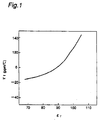
- Fig.1 shows the variation of the dielectric constant corresponding to the temperature coefficient of the resonant frequency when varying x in the (Pb 1-x Ca x ) 1+a (Fe 1/2 N 1/2 ) O 3+a system.
- a dielectric composition whose dielectric constant and temperature coefficient ⁇ f can be controlled independently. That is, a dielectric composition in which the variation curve of Fig.1 can be shifted to the side of a higher or a lower dielectric constant.
- a dielectric body which can be sintered at low temperatures.
- EP-A1-0 460 231 discloses a Pb(B 1 ,B 2 )O 3 ceramic dielectric for use in electronic components which can be sintered even at a temperature as low as 1,100 °C or below, has a high permittivity and excellent mechanical strength and is formulated to have a crystal structure represented by [Pb 1-x A x ] [A] (B 1 ,B 2 ) [B] O 3 , wherein A is at least one element selected from among Ca, Sr, Ba, Ag, La and Nd; B 1 is at least one element selected from among Mg, Zn, Ni, Co, Fe, Mn and In; B 2 is at least one element selected from among Nb, W, Ta and Sb; x is 0 to 0.5; and the molar ratio [A]/[B] ranges from 0.95 to 0.99.
- EP-A1-0 121 161 discloses a constant type dielectric ceramic composition which comprises a composite material comprising at least one of BaO and CaO, PbO, Fe 2 O 3 , Nb 2 O 5 , WO 3 and CuO, wherein said composite material is represented by the general formula xPb(Fe 1/2 Nb 1/2 )O 3-y M(Cu 1/2 W 1/2 )O 3-z Pb(Fe 2/3 W 1/3 )O 3 wherein M is at least one of Ba and Ca, and 0 to 1.0 % by weight of manganese oxide (MnO) with respect to the composite material.
- MnO manganese oxide
- It is the object of the present invention to provide a ceramic composition for a dielectric body allowing independent control of the dielectric constant and the temperature coefficient of the body, which leads to the result that the dielectric constant at ⁇ f 0 can be shifted to higher or lower values.
- a further object of the invention is to provide a ceramic composition for a dielectric body that can be sintered at lower temperatures compared to conventional dielectric bodies and which has superior dielectric properties in the microwave band.
- dielectric ceramic composition as defined in claim 1.
- Suitable and preferred embodiments of the dielectric ceramic composition are defined in the subclaims.
- composition of dielectric ceramics represented by the formula: A 1+a B O 3+a (0 ⁇ a ⁇ 0.08) wherein A and B site are as defined in claim 1.
- B site contains at least one atom selected from the group comprising Ti and W to render the composition independently controllable in respect of the dielectric constant and the temperature coefficient of the resonant frequency.
- Fig.2 shows the substitution effect at B site in the above generic formula A 1+a BO 3+a .
- B site substitution by Ti or W renders the composition independently controllable in respect of the dielectric constant and the temperature coefficient of the resonant frequency depending to the sustitution amount.
- a site may contain Sr or Ba atoms and B site may contain at least one of Cr, Mn, Co, Ni, Cu, Zn, Si, Al, Mg, Bi and Sb.
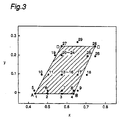
- a dielectric ceramic composition which comprises lead oxide, calcium oxide, iron oxide, niobium oxide and titanium oxide and is represented by the following formula: (Pb 1-x Ca x ) 1+a ⁇ (Fe 1/2 Nb 1/2 ) 1-y Ti y ⁇ O 3+a wherein x and y are within a phase diagram square area enclosed by the following four points A, B, C and D:
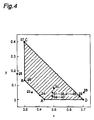
- a dielectric ceramic composition which comprises lead oxide, calcium oxide, iron oxide, niobium oxide and tungsten oxide and is represented by the following formula: (Pb 1-x Ca x ) 1+a ⁇ (Fe 1/2 Nb 1/2 ) 1-z (Fe 2/3 W 1/3 ) z ⁇ O 3+a wherein x, y and a are defined by the following relations; 0.43 ⁇ x ⁇ 0.63 0.0 ⁇ z ⁇ 0.5 and 0.0 ⁇ a ⁇ 0.08.
- compositions according to the first and the third embodiment and represented by the following formula: ( ⁇ Pb 1-x Ca x ⁇ 1-z Sr z ) 1+a ⁇ Fe 1/2 (Ta 1-m Nb m ) 1/2 ⁇ 1-y Ti y O 3+a wherein m is defined by the following relation 0.0 ⁇ m ⁇ 1.0.
- compositions according to the second and the fourth embodiment and represented by the following formula: (Pb 1-x-y Ca x Sr y ) 1+a ⁇ Fe 1/2 (Ta 1-m Nb m ) 1/2 ⁇ 1-z (Fe 2/3 W 1/3 ) z O 3+a wherein m is defined by the following relation 0.0 ⁇ m ⁇ 1.0.
- compositions Nos. 1 to 4, 12, 16, 20 and 24 of table 1 and Nos. 21 and 44 of table 3 are outside the invention.
- This example is correspoding to the embodiment defined by the claim 2 of the present invention.
- Starting material comprise PbO, TiO 2 , CaCO 3 , Fe 2 O 3 , and Nb 2 O 5 of a high purity. After the purity compensation of each of the starting materials, a given amount of each of the starting materials is weighed to give a composition (Pb 1-x Ca x ) 1+a ⁇ (Fe 1/2 Nb 1/2 ) 1-y Ti y ⁇ O 3+a having x, y and a shown in the following Table 1. Numbers in Fig.3 indicate the Sample numbers listed in the Table 1.
- the starting materials are mixed for 17 hours in a ball mill using balls made of stabilized zirconia and pure water as a solvent. The pure water is separated from the starting materials by a filtering process after the ball mill operation.
- the starting materials are dried, put in an alumina crucible and then preheated for two hours at a temperature of 750 to 850°C.
- the pre-heated materials are crushed into rough particles in a alumina mortar and are crushed for 17 hours in a ball mill.
- the crushed materials are dried and then further admixed with an aqueous solution of 5 % of polyvinyl alcohol.
- the added aqueous solution is adjusted to be 6 wt.% of the crushed materials.
- the materials with the aqueous solution are granulated through 30 mesh.
- the granulated materials are then pressed into a circular disc having a diameter of 13 mm and a height of 5 mm with a pressure of 100 MPa.
- the pressed disc is heated in air at 600°C for 2 hours in order to burn out the polyvinyl alcohol and then put in a magnesia crucible having a magnesia cap with the pre-heated same composition powder in order to prevent evaporation of PbO.
- the disc in the magnesia crucible is heated at a temperature of 950 to 1200°C for 2 hours and then cooled to give a sintered body having a highest apparent density.
- the sintered body is subjected to a test for measuring a resonant frequency and a Q value through a dielectric resonating method. It is possible to calculate a relative dielectric constant( ⁇ r) from the size of the sintered body and the resonant frequency.
- the resonant frequency ranges from 2 to 5 GHz.
- the resonant frequency is measured at temperatures of -25°C, 20°C and 85°C and the temperature coefficient ( ⁇ f ) thereof is calculated by the least square method. The results are lasted in Table 1.
- compositions shown by a mark (#) show a composition outside of the composition range according to the present example.
- the compositions belonging to the scope of the claim 2 indicate the dielectric constant of more than 70, the Q value of more than 500, the absolute value of the temperature coefficient of less than 100 ppm/°C.
- composition zone neighboring Sample No.13 indicating such a superior dielectric characteristics as the dielectric constant of more than 95, the Q value of more than 1800, the absolute temperature coefficient of less than 20ppm/°C.
- Example 1 The methods for preparing the sintered body and evaluating the dielectric characteristics are same as Example 1.
- test composition is represented by the formula: ⁇ (Pb 0.43 Ca 0.57 ) 1-z Sr z ⁇ 1.0 ⁇ (Fe 1/2 (Nb 1-b Ta b ) 1/2 ) 0.9 Ti 0.1 ⁇ O 3
- the sintering temperature in Table 2 is the temperature at which a highest apparent density is given by sintering.
- Example 1 The methods for preparing the sintered body and evaluating the characteristics are the same as Example 1.
- test sample is represented by the formula: (Pb 1-x-y Ca x Sr y ) 1+a ⁇ Fe 1/2 (Ta 1-m Nb m ) 1/2 ⁇ 1-z (Fe 2/3 W 1/3 ) z O 3+a
- Sample Nos. 23 to 45 are the compositions containing Sr which correspond to the compositions claimed in the claims 6 and 7.
- compositions claimed in the claims 5, 6 and 7, achieve a dielectric constant higher than 50, a Q value higher than 500 and the temperature coefficient of resonant frequency ⁇ f less than 100 ppm/°C in an absolute value.
- the composition of dielectric ceramics are provided with excellent dielectric characteristics at the microwave band.
- compositions according to the present invention can be sintered at a temperature lower than the temperature used in the conventional dielectric body.
- the dielectric compositions according to the present invention can applicable for use to the small, coaxial dielectric resonator:
- the composition according to the present invention can be sintered at a low temperature at which an electric conductor such as copper or silver paste can be sintered and accordingly can be used for formation of a circuit substrate for the microwave band and an integrated device. It can be said that the composition according to the present invention makes a big contribution to the electronic industry.
- oxide materials such as Ba, Cr, Mn, Co, Ni, Cu, Zn, Si, Al, Mg, Bi and Sb other than the oxides defined by the Examples so long as the other oxides have no bad effect on the dielectric characteristics of the resultant dielectric body.
Landscapes
- Engineering & Computer Science (AREA)
- Chemical & Material Sciences (AREA)
- Ceramic Engineering (AREA)
- Manufacturing & Machinery (AREA)
- Materials Engineering (AREA)
- Structural Engineering (AREA)
- Organic Chemistry (AREA)
- Inorganic Chemistry (AREA)
- Power Engineering (AREA)
- Microelectronics & Electronic Packaging (AREA)
- Inorganic Insulating Materials (AREA)
Claims (8)
- Composition de céramique diélectrique représentée par la formule générale
a est défini par la relation - Composition selon la revendication 1, représentée par la formuleet a est défini par la relationA : (x,y) = (0,43, 0,0) ;B : (x,y) = (0,63, 0,0) ;C : (x,y) = (0,74, 0,25) ;D : (x,y) = (0,57, 0,25) ;
- Composition selon la revendication 1, représentée par la formuleet a et z sont définis par les relationsA : (x,y) = (0,43, 0,0) ;B : (x,y) = (0,63, 0,0) ;C : (x,y) = (0,74, 0,25) ;D : (x,y) = (0,57, 0,25) ;
- Composition selon la revendication 2 ou 3, dans laquelle une partie ou la totalité du Nb est substituée par Ta et dans laquelle la composition est représentée par la formule
- Composition selon la revendication 1, représentée par la formule
- Composition selon la revendication 1, représentée par la formule généraleet a et z sont définis par les relationsA : (x,y) = (0,43, 0,0) ;B : (x,y) = (0,3, 0,13) ;C : (x,y) = (0,3, 0,4) ;D : (x,y) = (0,7, 0,0) ;
- Composition selon la revendication 5 ou 6, dans laquelle une partie ou la totalité du Nb est substituée par Ta et dans laquelle la composition est représentée par la formule
- Composition selon la revendication 1, dans laquelle B, en plus de Fe et Nb et Ti ou W, contient au moins un élément choisi parmi Cr, Mn, Co, Ni, Cu, Zn, Si, Al, Mg, Bi et Sb.
Applications Claiming Priority (6)
| Application Number | Priority Date | Filing Date | Title |
|---|---|---|---|
| JP252449/92 | 1992-09-22 | ||
| JP25244992 | 1992-09-22 | ||
| JP25244992 | 1992-09-22 | ||
| JP1446393 | 1993-02-01 | ||
| JP14463/93 | 1993-02-01 | ||
| JP1446393 | 1993-02-01 |
Publications (2)
| Publication Number | Publication Date |
|---|---|
| EP0589441A1 EP0589441A1 (fr) | 1994-03-30 |
| EP0589441B1 true EP0589441B1 (fr) | 1999-12-29 |
Family
ID=26350413
Family Applications (1)
| Application Number | Title | Priority Date | Filing Date |
|---|---|---|---|
| EP93115295A Expired - Lifetime EP0589441B1 (fr) | 1992-09-22 | 1993-09-22 | Composition de céramiques diélectriques |
Country Status (3)
| Country | Link |
|---|---|
| US (1) | US5459115A (fr) |
| EP (1) | EP0589441B1 (fr) |
| DE (1) | DE69327437T2 (fr) |
Families Citing this family (8)
| Publication number | Priority date | Publication date | Assignee | Title |
|---|---|---|---|---|
| TW239892B (fr) * | 1993-05-20 | 1995-02-01 | Tdk Electronics Co Ltd | |
| JP3254595B2 (ja) * | 1993-11-25 | 2002-02-12 | 日本特殊陶業株式会社 | サーミスタ用磁器組成物 |
| JPH10231173A (ja) * | 1996-12-16 | 1998-09-02 | Tdk Corp | 誘電体磁器組成物、誘電体磁器材料およびその製造方法ならびに誘電体素子およびその製造方法 |
| KR100216717B1 (ko) * | 1997-05-27 | 1999-09-01 | 박호군 | 고주파 유전체 조성물 |
| JPH10330165A (ja) * | 1997-05-30 | 1998-12-15 | Kyocera Corp | 高周波用誘電体磁器 |
| DE102004002204A1 (de) * | 2004-01-15 | 2005-08-11 | Epcos Ag | Keramikmaterial |
| CN110511026B (zh) * | 2019-07-24 | 2022-01-04 | 桂林理工大学 | 一种x8r型陶瓷电容器介质材料及其制备方法 |
| CN116715508B (zh) * | 2023-04-27 | 2025-12-09 | 中国振华集团云科电子有限公司 | 一种低介电镓、锗基高品质因数微波介质材料及制备方法 |
Family Cites Families (8)
| Publication number | Priority date | Publication date | Assignee | Title |
|---|---|---|---|---|
| US4078938A (en) * | 1976-01-16 | 1978-03-14 | Nippon Electric Company, Ltd. | Ceramic compositions having high dielectric constant |
| JPS5937526B2 (ja) * | 1980-07-01 | 1984-09-10 | 松下電器産業株式会社 | 誘電体磁組成物 |
| JPS57148807A (en) * | 1981-03-11 | 1982-09-14 | Nippon Electric Co | High dielectric porcelain composition |
| FR2515168A1 (fr) * | 1981-10-23 | 1983-04-29 | Thomson Csf | Composition ceramique destinee a la realisation de composants electriques, et procede de preparation de cette composition |
| JPS59181407A (ja) * | 1983-03-31 | 1984-10-15 | 株式会社東芝 | 高誘電率磁器組成物 |
| JPS6332807A (ja) * | 1986-07-24 | 1988-02-12 | アルプス電気株式会社 | 誘電体磁器組成物 |
| JP2762309B2 (ja) * | 1989-12-22 | 1998-06-04 | マルコン電子株式会社 | 誘電体磁器組成物及びこれを使用した電子部品 |
| JP2738172B2 (ja) * | 1991-07-16 | 1998-04-08 | 松下電器産業株式会社 | 誘電体磁器組成物 |
-
1993
- 1993-09-22 EP EP93115295A patent/EP0589441B1/fr not_active Expired - Lifetime
- 1993-09-22 US US08/124,552 patent/US5459115A/en not_active Expired - Lifetime
- 1993-09-22 DE DE69327437T patent/DE69327437T2/de not_active Expired - Fee Related
Also Published As
| Publication number | Publication date |
|---|---|
| US5459115A (en) | 1995-10-17 |
| DE69327437D1 (de) | 2000-02-03 |
| EP0589441A1 (fr) | 1994-03-30 |
| DE69327437T2 (de) | 2000-08-03 |
Similar Documents
| Publication | Publication Date | Title |
|---|---|---|
| EP1020416B1 (fr) | Procédé de fabrication de matériau céramique diélectrique et résonateur diélectrique | |
| KR100292915B1 (ko) | 유전체 세라믹 조성물 | |
| EP0589441B1 (fr) | Composition de céramiques diélectriques | |
| EP1093180A2 (fr) | Composition céramique diélectrique à haute fréquence, résonateur diélectrique, filtre diélectrique, duplexeur diélectrique et dispositif de communication | |
| KR100241103B1 (ko) | 유전체 세라믹재료 및 그 제조방법 | |
| US5256639A (en) | Dielectric ceramic composition | |
| EP1172345B1 (fr) | Composition céramique diélectrique à haute fréquence, résonateur diélectrique, filtre diélectrique, duplexeur diélectrique et dispositif de communication | |
| EP0464773B1 (fr) | L'emploi de compositions céramiques diélectriques comme un résonateur diélectrique | |
| JP4839496B2 (ja) | 高周波用誘電体磁器組成物、誘電体共振器、誘電体フィルタ、誘電体デュプレクサ及び通信機装置 | |
| EP1505043A2 (fr) | Composition céramique diélectrique et appareil électronique céramique | |
| US5846892A (en) | Ceramic dielectrics and methods for forming the same | |
| US5629252A (en) | Method for manufacturing a dielectric ceramic composition dielectric ceramic and multilayer high frequency device | |
| EP0671370B1 (fr) | Composition céramique diélectrique | |
| EP1013624B1 (fr) | Composition céramique diélectrique à haute fréquence, résonateur diélectrique, filtre diélectrique, duplexeur diélectrique et dispositif de communication | |
| JP4513076B2 (ja) | 高周波用誘電体磁器組成物、誘電体共振器、誘電体フィルタ、誘電体デュプレクサおよび通信機装置 | |
| JP3040286B2 (ja) | 誘電体磁器組成物 | |
| JPH0680467A (ja) | 誘電体磁器組成物 | |
| JP2798106B2 (ja) | 誘電体磁器組成物、その誘電体磁器組成物を用いた積層物の製造方法及び誘電体磁器組成物の積層物 | |
| JP3474606B2 (ja) | 誘電体磁器組成物 | |
| JP2992197B2 (ja) | 誘電体磁器材料およびその製造方法 | |
| JP3278520B2 (ja) | 誘電体磁器組成物 | |
| JP3235410B2 (ja) | 誘電体磁器組成物 | |
| JP2000233970A (ja) | 高周波用誘電体磁器組成物、誘電体共振器、誘電体フィルタ、誘電体デュプレクサおよび通信機装置 | |
| JP3376933B2 (ja) | 高周波用誘電体磁器組成物および誘電体共振器 | |
| JP3575336B2 (ja) | 高周波用誘電体磁器組成物、誘電体共振器、誘電体フィルタ、誘電体デュプレクサおよび通信機装置 |
Legal Events
| Date | Code | Title | Description |
|---|---|---|---|
| PUAI | Public reference made under article 153(3) epc to a published international application that has entered the european phase |
Free format text: ORIGINAL CODE: 0009012 |
|
| 17P | Request for examination filed |
Effective date: 19930923 |
|
| AK | Designated contracting states |
Kind code of ref document: A1 Designated state(s): DE FR GB IT |
|
| 17Q | First examination report despatched |
Effective date: 19941202 |
|
| GRAG | Despatch of communication of intention to grant |
Free format text: ORIGINAL CODE: EPIDOS AGRA |
|
| GRAG | Despatch of communication of intention to grant |
Free format text: ORIGINAL CODE: EPIDOS AGRA |
|
| GRAH | Despatch of communication of intention to grant a patent |
Free format text: ORIGINAL CODE: EPIDOS IGRA |
|
| GRAH | Despatch of communication of intention to grant a patent |
Free format text: ORIGINAL CODE: EPIDOS IGRA |
|
| GRAA | (expected) grant |
Free format text: ORIGINAL CODE: 0009210 |
|
| AK | Designated contracting states |
Kind code of ref document: B1 Designated state(s): DE FR GB IT |
|
| PG25 | Lapsed in a contracting state [announced via postgrant information from national office to epo] |
Ref country code: IT Free format text: LAPSE BECAUSE OF FAILURE TO SUBMIT A TRANSLATION OF THE DESCRIPTION OR TO PAY THE FEE WITHIN THE PRE;WARNING: LAPSES OF ITALIAN PATENTS WITH EFFECTIVE DATE BEFORE 2007 MAY HAVE OCCURRED AT ANY TIME BEFORE 2007. THE CORRECT EFFECTIVE DATE MAY BE DIFFERENT FROM THE ONE RECORDED.SCRIBED TIME-LIMIT Effective date: 19991229 |
|
| REF | Corresponds to: |
Ref document number: 69327437 Country of ref document: DE Date of ref document: 20000203 |
|
| ET | Fr: translation filed | ||
| PLBE | No opposition filed within time limit |
Free format text: ORIGINAL CODE: 0009261 |
|
| 26N | No opposition filed | ||
| REG | Reference to a national code |
Ref country code: GB Ref legal event code: IF02 |
|
| PGFP | Annual fee paid to national office [announced via postgrant information from national office to epo] |
Ref country code: DE Payment date: 20070920 Year of fee payment: 15 |
|
| PGFP | Annual fee paid to national office [announced via postgrant information from national office to epo] |
Ref country code: GB Payment date: 20070919 Year of fee payment: 15 |
|
| PGFP | Annual fee paid to national office [announced via postgrant information from national office to epo] |
Ref country code: FR Payment date: 20070914 Year of fee payment: 15 |
|
| GBPC | Gb: european patent ceased through non-payment of renewal fee |
Effective date: 20080922 |
|
| REG | Reference to a national code |
Ref country code: FR Ref legal event code: ST Effective date: 20090529 |
|
| PG25 | Lapsed in a contracting state [announced via postgrant information from national office to epo] |
Ref country code: DE Free format text: LAPSE BECAUSE OF NON-PAYMENT OF DUE FEES Effective date: 20090401 |
|
| PG25 | Lapsed in a contracting state [announced via postgrant information from national office to epo] |
Ref country code: FR Free format text: LAPSE BECAUSE OF NON-PAYMENT OF DUE FEES Effective date: 20080930 |
|
| PG25 | Lapsed in a contracting state [announced via postgrant information from national office to epo] |
Ref country code: GB Free format text: LAPSE BECAUSE OF NON-PAYMENT OF DUE FEES Effective date: 20080922 |