EP0592333B1 - Polymerzusammensetzungen, enthaltend organische amphiphile elektro-aktive Charge-Transfer-Komplexe und/oder Radikalionensalze, Herstellung und Verwendung davon - Google Patents
Polymerzusammensetzungen, enthaltend organische amphiphile elektro-aktive Charge-Transfer-Komplexe und/oder Radikalionensalze, Herstellung und Verwendung davon Download PDFInfo
- Publication number
- EP0592333B1 EP0592333B1 EP93420382A EP93420382A EP0592333B1 EP 0592333 B1 EP0592333 B1 EP 0592333B1 EP 93420382 A EP93420382 A EP 93420382A EP 93420382 A EP93420382 A EP 93420382A EP 0592333 B1 EP0592333 B1 EP 0592333B1
- Authority
- EP
- European Patent Office
- Prior art keywords
- polymer
- carbon atoms
- amphiphilic
- compound
- derivatives
- Prior art date
- Legal status (The legal status is an assumption and is not a legal conclusion. Google has not performed a legal analysis and makes no representation as to the accuracy of the status listed.)
- Expired - Lifetime
Links
- 0 *C(*1)=C(*)*C1=C1*C(*)=C(*)*1 Chemical compound *C(*1)=C(*)*C1=C1*C(*)=C(*)*1 0.000 description 3
Classifications
-
- H—ELECTRICITY
- H01—ELECTRIC ELEMENTS
- H01B—CABLES; CONDUCTORS; INSULATORS; SELECTION OF MATERIALS FOR THEIR CONDUCTIVE, INSULATING OR DIELECTRIC PROPERTIES
- H01B1/00—Conductors or conductive bodies characterised by the conductive materials; Selection of materials as conductors
- H01B1/06—Conductors or conductive bodies characterised by the conductive materials; Selection of materials as conductors mainly consisting of other non-metallic substances
- H01B1/12—Conductors or conductive bodies characterised by the conductive materials; Selection of materials as conductors mainly consisting of other non-metallic substances organic substances
- H01B1/121—Charge-transfer complexes
-
- G—PHYSICS
- G06—COMPUTING OR CALCULATING; COUNTING
- G06V—IMAGE OR VIDEO RECOGNITION OR UNDERSTANDING
- G06V10/00—Arrangements for image or video recognition or understanding
- G06V10/40—Extraction of image or video features
- G06V10/46—Descriptors for shape, contour or point-related descriptors, e.g. scale invariant feature transform [SIFT] or bags of words [BoW]; Salient regional features
-
- C—CHEMISTRY; METALLURGY
- C08—ORGANIC MACROMOLECULAR COMPOUNDS; THEIR PREPARATION OR CHEMICAL WORKING-UP; COMPOSITIONS BASED THEREON
- C08F—MACROMOLECULAR COMPOUNDS OBTAINED BY REACTIONS ONLY INVOLVING CARBON-TO-CARBON UNSATURATED BONDS
- C08F2800/00—Copolymer characterised by the proportions of the comonomers expressed
- C08F2800/10—Copolymer characterised by the proportions of the comonomers expressed as molar percentages
Definitions
- the subject of the present invention is polymer compositions. containing electroactive amphiphilic organic compounds of the family charge transfer complexes and / or radical ion salts, and especially polymer particles comprising, implanted at their surface of molecules of said amphiphilic compounds, their process for obtaining and using them for the production of polymer films conductors.
- the doping polymer is generally dispersed in the polymerization medium and, more particularly, the polymerization is carried out in a latex of doping polymer.
- Such a process turns out to be particularly interesting because it leads to obtaining polymer particles constituted by the dopable transformable polymer associated with the electroconductive polymer.
- the dispersions of these particles can be used directly to obtain electroconductive articles by coating and evaporation of the dispersion medium or else the composite electroconductive particles can be separated from the dispersion medium by the usual techniques and transformed into finished objects.
- European patent EP-A-0 071 862 describes an electroconductive polymer based on polystyrene, containing a complex with charge transfer. This complex is added in powder form or in solution to a polystyrene solution. The solvent is then evaporated. The charge transfer complex is present in the resin in the form of needles.
- the present invention provides polymers which are electroconductive in their mass.
- the first object of the present invention is polymer compositions which can be used for obtaining polymers easily transformable conductors.
- a second object of the invention resides in partial aqueous or hydro-organic dispersions of compositions of polymers which can be used for obtaining polymer compositions easily transformable electroconductive;
- a third object of the invention resides in a process for obtaining polymer compositions usable for obtaining conductive polymer compositions;
- the fourth object of the invention is conductive polymer compositions;
- a fifth object of the invention resides in the aqueous dispersions or hydro-organic of said conductive polymer compositions; as sixth object, the present invention relates to the use of the compositions electrically conductive polymers for obtaining conductive coatings.
- TCNE tetracyanoethylene
- HCBD hexacyanobutadiene
- TCNB 1,2,4,5-tetracyanobenzene
- TCNQ 7,7,8,8-tetracyanoquinodimethane
- TCNDQ tetracyanodiquinodimethane
- benzotetracyanoquinodimethane benzo-TCNQ
- 2,3,5,6-tetrachloroparabenzoquinone CA
- TB trinitrobenzene
- TNAP tetranaphthoquinodimethane
- thiophenetetracyanoquinodimethane thiophene-TCNQ
- selenophenetetracyanoquinodimethane selenophenetetracyanoquinodimethane (selenophene-TCNQ)
- tetracyanoquinoquinazolino-quinazoline as well as the derivatives of these acceptors electrons such as
- the doping group Z can represent a Lewis acid such as I - , (I 3 ) - , (PF 6 ) - , (ClO 4 ) - , (BF 4 ) - , (ReO 4 ) - , (IO 4 ) - , (FSO 3 ) - , (AsF 4 ) - , (AsF 6 ) - , Br - , Cl - and (MnCl 6 ) - .
- a Lewis acid such as I - , (I 3 ) - , (PF 6 ) - , (ClO 4 ) - , (BF 4 ) - , (ReO 4 ) - , (IO 4 ) - , (FSO 3 ) - , (AsF 4 ) - , (AsF 6 ) - , Br - , Cl - and (MnCl 6 ) - .
- Z represents I - , (I 3 ) - or Cl - .
- the groups R 1 and R 2 may in particular consist of alkyl or alkyl-thio radicals, linear or branched, having from 1 to 30 carbon atoms, substituted or unsubstituted cycloalkyl, substituted or unsubstituted cycloalkyl-thio, cycloalkyl-alkyl substituted or unsubstituted or cycloalkyl-alkyl-thio substituted or unsubstituted in which the cyclic part is preferably a cyclohexyl or cyclopentyl radical, the alkyl substituent (s) have from 1 to 30 carbon atoms and the alkyl part has from 1 to 30 carbon atoms carbon and aryl or aryl-thio radicals such as phenyl, phenylthio or naphthyl, alkylaryl or alkylaryl-thio radicals in which the alkyl substituent (s) have from 1 to 30 carbon atoms and the aryl part is
- the groups R 3 and R 4 may in particular consist of the hydroxycarbonyl group, the alkali metal, amine or quaternary ammonium salts of a hydroxycarbonyl group, hydroxycarbonylalkyl or hydroxycarbonylalkyl-thio groups having 2 to 7 carbon atoms , alkoxycarbonyls, alkoxycarbonylalkyls or alkoxycarbonylalkyl-thio having from 2 to 8 carbon atoms, the carbamoyl group, carbamoylalkyl or N-alkylcarbamoylalkyl groups, having 2 to 12 carbon atoms.
- radicals comprising a linear and / or cyclic hydrocarbon chain having from 14 to 30 carbon atoms
- the tetradecyl and tetradecyl radicals of which may be mentioned without limitation -thio, hexadecyl, hexadecyl-thio, octadecyl, octadecyl-thio, eicosanyl, eicosanyl-thio, nonylphenyls, octylphenyls, dinonylphenyls, dioctylphenyls.
- the hydroxycarbonyl group, the alkali metal, amine or quaternary ammonium salts of a hydroxycarbonyl group, the hydroxycarbonylalkyl and hydroxycarbonylalkyl-thio groups having from 2 to 4 atoms are preferred.
- carbon atoms such as, for example, hydroxycarbonylmethyl, hydroxycarbonylmethyl-thio, hydroxycarbonylethyl, hydroxycarbonylethyl-thio, hydroxycarbonylproyl, hydroxycarbonylpropyl-thio and alkoxycarbonyl, alkoxycarbonylalkyl and alkoxycarbonylalkyl-thio groups having, for example, 2 to 5 carbon atoms; , ethoxycarbonyl, methoxycarbonylmethyl, methoxycarbonylmethyl-thio, methoxycarbonylethyl, methoxycarbonylethyl-thio, methoxycarbonylpropyl, methoxycarbonylpropyl-thio, ethoxycarbonylethyl, ethoxycarbonylethyl-thio.
- amphiphilic organic compounds of general formula (VI) are preferably associated with a Z dopant as defined above.
- amphiphilic organic compounds (B) can be prepared by conventional methods, such as that described by L.R. Melby et al in Journal of American Society, vol. 84 (1962), pages 3374-3387.
- the amphiphilic organic compounds (B) of formula D d A a are prepared by reacting a halide of the electron donor D with a salt of the electron acceptor A, for example an iodide from D with a lithium salt from A.
- the compound thus obtained can also be reacted with an excess of electron acceptor A, which generally makes it possible to obtain an amphiphilic organic compound which conducts electricity.
- the amphiphilic organic compounds of formula D d A to Z z can be obtained by reacting a compound of D and Z with the electron acceptor A.
- the starting compounds used for the preparation of the compounds Amphiphilic organics are obtained by conventional methods.
- electron acceptors A are known compounds which are prepared according to conventional methods.
- polymer constituting the transformable particles usable as constituent (Pm) of the compositions according to the invention, it is can use any polymer that can be easily transformed into finished products such as fibers, films, molded articles or coatings by usual polymer transformation techniques such as extrusion, extrusion-blowing, calendering, molding, coating, etc.
- thermoplastic polymers can be used such as polymers and copolymers of ⁇ -olefins (polyethylene, polypropylene, ethylene-propylene copolymers); polymers and copolymers of conjugated diolefins (polybutadiene, polyisoprene, copolymers butadiene-isoprene); polymers and copolymers of styrene and ⁇ -methylstyrene with other mono- or polyethylene monomers such as polystyrene, styrene-butadiene, styrene-acrylonitrile copolymers, styrene-butadiene-acrylonitrile copolymers, copolymers styrene-butadiene-unsaturated carboxylic acid such as for example acid maleic; polymers and copolymers of vinyl esters: acetate vinyl, vinyl propionate such as polyvinyl acetate, ethylene-vin
- thermoplastic polymers are used easily dispersible in water in the form of stable aqueous dispersions or latex.
- Thermoplastic polymers can also be used, such as those mentioned above, including in their chains patterns carrying anionic groups which can play the role of a dopant for initiation of the conduction phenomenon.
- copolyesters comprising a plurality of units derived from diols and / or diacids carrying one or several sulfonic or sulfonate groups.
- Such copolyesters have been described in particular in the French patents published under n ° 1.401.581 and 1,602,002, and in European patent n ° 0.129.674.
- graft copolymers obtained by radical polymerization in aqueous phase of one or more acrylic monomer (s) optionally associated with one or more vinyl monomer (s), in the presence of a copolyester comprising a plurality of units derived from diols and / or diacids carrying one or more sulfonic or sulfonate groups such as those described in the aforementioned patents or patent applications.
- a copolyester comprising a plurality of units derived from diols and / or diacids carrying one or more sulfonic or sulfonate groups such as those described in the aforementioned patents or patent applications.
- Such graft copolymers have been described in the European patent application published under n ° 0.260.203 including the teaching concerning the said graft copolymers is incorporated into the present application by reference.
- the polymer compositions according to the invention can be prepared by any process allowing the amphiphilic compound (B) to be incorporated to the polymer (Pm).
- a process that is particularly suitable for obtaining these compositions consists in adding the amphiphilic compound (B) to an aqueous or hydro-organic dispersion of particles of the polymer transformable (Pm).
- PM polymer particles are obtained (PM) comprising, implanted on their surface, molecules of the compound amphiphilic (B).
- the hydrophobic chains of compound (B) are tangled intimately with the polymer chains (Pm) and hydrophilic and electroactive parts of compound (B) are arranged at the surface of said particles.
- the transformable polymers (Pm) mentioned above are preferably used in the form of stable dispersions, or latex, in water or a hydro-organic medium.
- the polymer does does not have a hydrophilic group making it possible to easily obtain a latex, can associate with it one or more ionic surfactants or not ionic such as those usually used for obtaining aqueous dispersions well known to those skilled in the art.
- the polymer content of the latexes is not critical and may vary within wide limits. In general, latex containing from 1 to 50% by weight of polymer are very suitable; preferably latexes containing 5 to 30% by weight of polymer are used.
- the particle size of the polymer constituting the latex is chosen by depending on the application for which the final latex is intended; in generally, latexes are used, the diameter of the particles of polymer is between approximately 0.01 and 15 ⁇ m and, preferably, between 0.05 and 5 ⁇ m.
- Particles of polymers modified by organic compounds amphiphiles of formula (I) can be obtained by addition with stirring of a solution of the amphiphilic compound (B) in an organic solvent at a aqueous or hydro-organic dispersion of the support polymer (Pm).
- solvent is not critical and essentially depends on the nature of the compound amphiphilic, that of the support polymer and the medium containing it. We preferably uses solutions of the amphiphilic compound in a solvent organic.
- amphiphilic compound is a derivative of tetrathiafulvalene (TTF), a hydrocarbon or a chlorinated hydrocarbon such as toluene, chloroform or dichloromethane; it is also possible to use a water-miscible solvent such as acetone and methyl ethyl ketone or mixtures of solvents such as than chloroform / acetonitrile.
- TTF tetrathiafulvalene
- a hydrocarbon or a chlorinated hydrocarbon such as toluene, chloroform or dichloromethane
- a water-miscible solvent such as acetone and methyl ethyl ketone or mixtures of solvents such as than chloroform / acetonitrile.
- the solvent for the amphiphilic compound is eliminated by evaporation.
- Pm glass transition temperature of the polymer
- the respective amounts of polymer (Pm) and compound amphiphilic (B) present in the compositions according to the invention can vary within wide limits.
- the amount of compound (B) can represent from 0.1 to 20% by weight of the polymer (Pm) and, preferably, of 0.2 to 5%.
- the polymer-support (Pm) and amphiphilic compound compositions (B) can be separated from the latex by known methods, for example by centrifugation.
- the polymer (Pm) and amphiphilic compound (B) compositions particularly suitable for obtaining polymers conductors easy to implement in the form of various objects such as films, wires, coatings, molded objects.
- the current the invention therefore also relates to such conductive polymers and their production processes.
- thermoplastic films bearing a coating of electroconductive polymer on at least one of their faces.
- thermoplastic films mention may be made of polyethylene films, polypropylene, polyamides (polyamides-66 or polyamide-6 for example), polyvinyl chloride, polyvinylidene chloride, derivatives of cellulose, polyester and in particular polyalkylene glycol terephthalate.
- the polymer dispersion according to the invention can then be deposited on the thermoplastic films by known methods of coating.
- thermoplastic film can undergo a treatment intended to improve adhesion to the electroconductive coating (for example corona treatment) or may receive a primary adhesion coating of known type.
- Thermoplastic films with a polymer coating electric conductor according to the invention constitute a final object of the this request.
- transformable polymeric compositions constituted by at less a transformable polymer (Pm) and an amphiphilic compound (B) can have been made electroconductive by the precursors of the Z dopant, such as iodine, bromine or chlorine.
- This doping is carried out either on the polymer composition such which, preferably on the polymer composition formed, especially in the form of a coating of a polymer film thermoplastic as described above.
- ketone (c1) 3.7 g of ketone (c1) are mixed with 1.7 g of ketone (c2) in 100 ml of pure triethylphosphite (distilled under nitrogen) and heated to reflux for 1 h. By cooling, 2 g of orange precipitate are obtained. The C18-TTF is separated by chromatography. The yield is 20%.
- a film of prepared modified latex is poured onto a glass plate in a), using a film puller adjusted to obtain a thickness of 0.8 mm.
- the film and the support are placed in an oven for 24 h to evaporate the chloroform and water. When the drying is finished, we separates the film from its support.
- the film is brought into contact for 3 h in a crystallizer with iodine vapor, to boost it by oxidation. He is then conditioned in a desiccator before the surface resistance measurements.
- the film surface resistance is determined using a KEITHLEY 617® brand electrometer and a KEITHLEY 6105® cell comprising 3 electrodes. From the surface resistance value, the surface conductivity can easily be calculated.
- the composite film obtained has a surface conductivity of 12 x 10 -8 S.cm -1 after being kept in a desiccator for 24 hours.
- a film was prepared by following the procedure described above, but after replacing the styrene / butadiene / maleic acid copolymer modified by the implantation of C18-TTF with the same styrene / butadiene / maleic acid copolymer not modified. Under these conditions, a film was obtained having a surface conductivity of 1.65 x 10 -13 S.cm -1 after being kept in a desiccator for 24 hours.
- Example 2 By operating as in Example 2, a series of films was prepared electrically conductive from different copolymer latexes styrene / butadiene / maleic acid, modified by the implantation of C18-TTF prepared in Example 1.
- the implantation of C18-TTF and the preparation of electrically conductive films were conducted under the same conditions as for example 2 except for the following characteristics indicated below, with the surface conductivity values obtained.
Landscapes
- Engineering & Computer Science (AREA)
- Physics & Mathematics (AREA)
- Spectroscopy & Molecular Physics (AREA)
- Computer Vision & Pattern Recognition (AREA)
- General Physics & Mathematics (AREA)
- Multimedia (AREA)
- Theoretical Computer Science (AREA)
- Compositions Of Macromolecular Compounds (AREA)
- Conductive Materials (AREA)
- Paints Or Removers (AREA)
Claims (20)
- Polymerzusammensetzungen, dadurch gekennzeichnet, dass sie durch mindestens ein umformbares Polymer (Pm) und mindestens eine amphiphile organische Verbindung (B) gebildet werden, ausgewählt aus den Komplexen zur Ladungsübertragung und den Radikalionensalzen der allgemeinen Formel (I):D einen Elektronendonator bedeutet,A ein Elektronenakzeptor bedeutet,Z ein Dopant bedeutet, welches selbst nicht-amphiphiler Donator oder Akzeptor von Elektronen sein kann,mindestens eine der Verbindungen D und A amphiphil ist und mindestens einen gesättigten oder ungesättigten Kohlenwasserstoff-Substituenten mit mindestens 10 Kohlenstoffatomen aufweist,d eine Zahl ≥ 0 ist,a eine Zahl ≥ 0 ist,z eine Zahl ≥ 0 ist,mindestens eines der Symbole d und a eine Zahl > 0 ist.
- Polymerzusammensetzungen nach Anspruch 1, dadurch gekennzeichnet, dass in der Formel (I) der amphiphilen, organischen Verbindung (B) die Symbole d, a und z unabhängig voneinander die Zahlen bis zu 20 bedeuten.
- Polymerzusammensetzungen nach einem der Ansprüche 1 oder 2, dadurch gekennzeichnet, dass in der Formel (I) der amphiphilen, organischen Verbindung (B) die Elektronendonatoren D ausgewählt sind aus:den Tetraheterofulvalenen und ihren Derivaten der allgemeinen Formel (II)in welcher Y S oder Se bedeutet, und R eine gesättigte oder ungesättigte, aliphatische, cycloaliphatische oder aromatische Kohlenwasserstoff-Gruppe bedeutet;
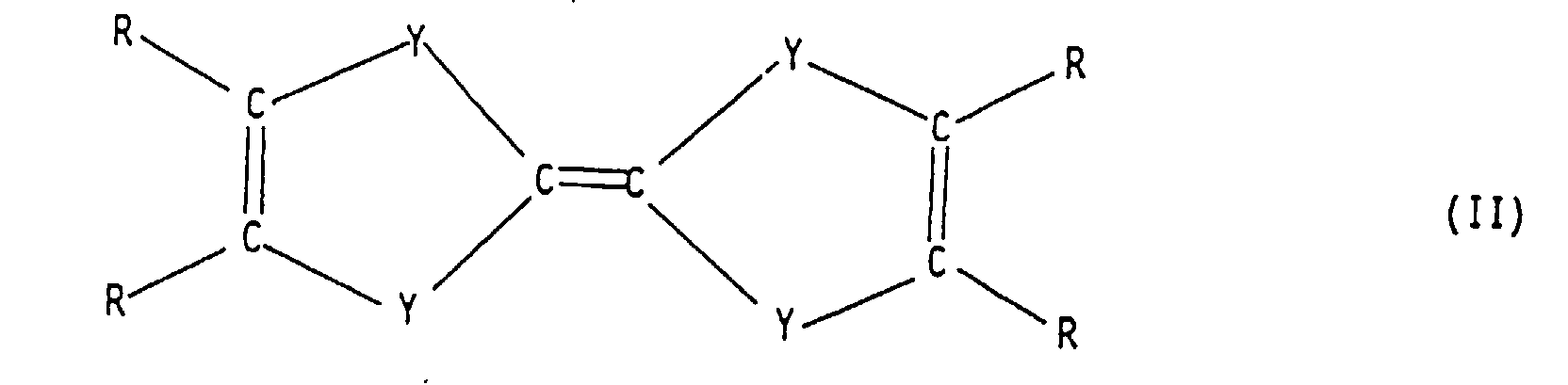 den Tetraheterotetracenen und ihren Derivaten der allgemeinen Formel (III):in welcher Y S und/oder Se bedeutet;
 den Tetraheteronaphthalinen und ihren Derivaten der allgemeinen Formel (IV):in welcher Y S und /oder Se bedeutet;
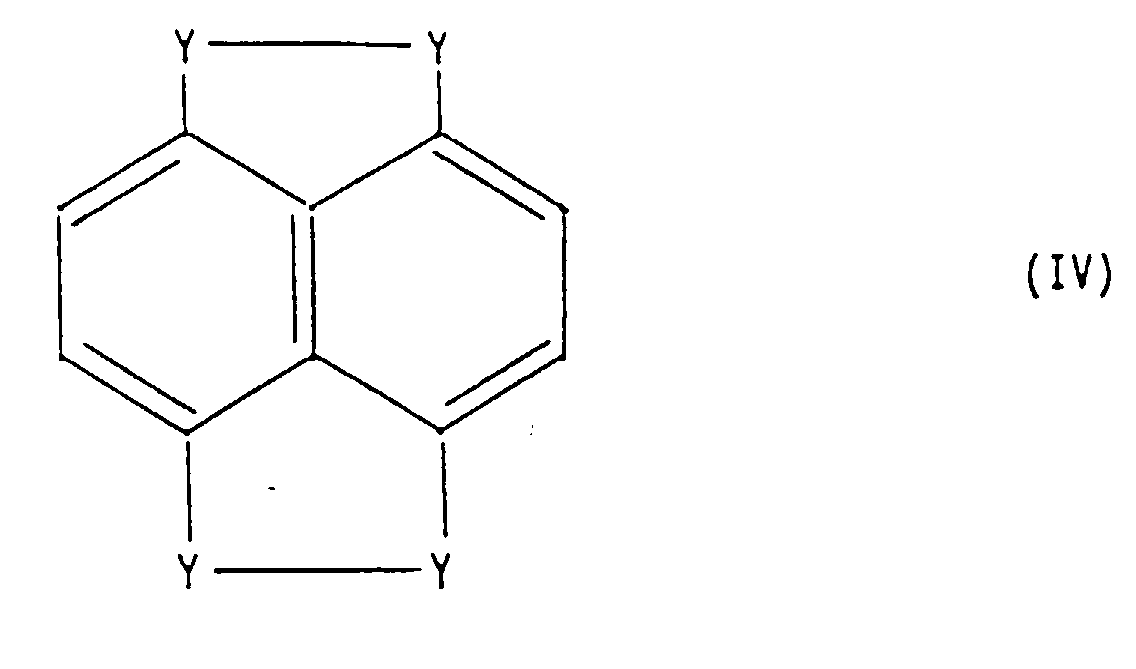 dem Perylen und seinen Derivaten;den Bisheteropyranen und ihren Derivaten der allgemeinen Formel (V):in welcher X S und /oder Se oder ein N-Alkyl-Radikal, und R ein gesättigtes oder ungesättigtes, aliphatisches, cycloaliphatisches oder aromatisches Kohlenwasserstoff-Radikal bedeuten;
 den aliphatischen Basen wie quatemären Ammoniumgruppen, welche 4 gesättigte oder ungesättigte Kohlenwasserstoff-Radikale beinhalten, wovon mindestens eines mindestens 10 Kohlenstoffatome aufweist;den aromatischen Basen wie quatemären Ammoniumgruppen, welche vom Anilin oder Anilin-Derivaten abgeleitet sind, deren Substituent des Stickstoffatoms oder gegebenenfalls mindestens ein Substituent des oder der Benzolringe ein gesättigtes oder ungesättigtes Kohlenwasserstoff-Radikal ist, welches mindestens 10 Kohlenstoffatome aufweist, vom N,N' Tetramethylphenylendiamin und seinen Derivaten;den heterozyklischen Basen wie quatemäre Ammoniumgruppen, die von den Pyridinen, den Piperidinen, den Bipyridinen, den Bipiperidinen, den Benzopyridinen wie die Chinoline, die Isochinoline, die Acridine, die Phenazine und die Phenathroline abgeleitet sind, deren Substituent des Stickstoffatoms oder gegebenenfalls ein Substituent des oder der heterozyklischen Verbindungen und der Benzolringe ein gesättigtes oder ungesättigtes Kohlenwasserstoff-Radikal ist, welches mindestens 10 Kohlenstoffatome aufweist;den heterozyklischen Basen, welche mehrere Heteroatome verschiedener Art umfassen, wie Schwefel- und Stickstoffatome, wie die N-Alkylbenzothiazole und ihre substituierten Derivate und die N-Alkylindoleniniumtrimethincyanine und ihre substituierten Derivate.
 - Polymerzusammensetzungen nach einem der Ansprüche 1 bis 3, dadurch gekennzeichnet, dass in der Formel (I) der amphiphilen, organischen Verbindung (B) die Elektronenakzeptoren A ausgewählt sind aus: dem Tetracyanoethylen (TCNE), dem Hexacyanobutadien (HCBD), dem 1,2,4,5-Tetracyanobenzol (TCNB), dem 7,7,8,8-Tetracyanochinodimethan (TCNQ) und seinen substituierten Derivaten, dem Tetracyanodichinodimethan (TCNDQ), dem Benzotetracyanochinodimethan (Benzo-TCNQ), dem 2,3,5,6-Tetrachloroparabenzochinon (CA), dem Trinitrobenzol (TNB), dem Tetranaphtochinodimethan (TNAP), dem Thiophentetracyanochinodimethan (Thiophen-TCNQ), dem Selenophentetracyanochinodimethan (Selenophen-TCNQ), dem Tetracyanochinochinazolino-chinazolin sowie die Derivate dieser Elektronenakzeptoren wie ihre Halogenderivate, insbesondere Fluorderivate, ihre Alkoxyl-Derivate und ihre Alkyl-Derivate.
- Polymerzusammensetzungen nach einem der Ansprüche 1 bis 4, dadurch gekennzeichnet, dass in der Formel (I) der amphiphilen, organischen Verbindung (B) die Gruppe Dopant Z eine Lewis-Säure bedeutet wie I- , (I3)-, (PF6)-, (Cl04)-, (BF4)-, (Re04)-, (I04)-, (FSO3)-, (AsF4)-, (AsF6)-, Br-, Cl- und (MnCl6)-, und vorzugsweise bedeutet Z I-, (I3)- oder Cl-.
- Polymerzusammensetzungen nach einem der Ansprüche 1 bis 5, dadurch gekennzeichnet, dass die amphiphile, organische Verbindung (B) eine Donatorverbindung der allgemeinen Formel (VI) enthält:in welcher:
 wobei die genannte Verbindung vorzugsweise an ein Dopant Z - wie es in Anspruch 5 definiert wurde - gebunden ist.R1 und R2 , identisch oder verschieden, Kohlenwasserstoff-Gruppen bedeuten, wovon mindestens eine eine hydrophobe Gruppe ist,R3 und R4, identisch oder verschieden, hydrophile Gruppen bedeuten,
 - Zusammensetzungen nach Anspruch 6, dadurch gekennzeichnet, dass die amphiphile Verbindung (B) eine Verbindung der Formel (VI) enthält, in welcher:R1 und R2 gebildet werden durch lineare oder verzweigte Alkyl- oder Alkylthio-Radikale, welche 1 bis 30 Kohlenstoffatome aufweisen, durch Aryl- oder Arylthio-Radikale, wie Phenyl-, Phenylthio- oder Naphtyl-, durch Alkylaryl- oder Alkylarylthio-Radikale, in denen der oder die Alkyl-Substituenten 1 bis 30 Kohlenstoffatome aufweisen und der Aryl-Teil ein Phenyl- oder Naphthyl-Radikal ist, durch Aralkyl- oder Aralkylthio-Radikale, in denen der Alkyl-Teil 1 bis 10 Kohlenstoffatome aufweist und der Aryl-Teil ein Phenyl- oder Naphthyl-Radikal ist, wobei mindestens eine der Gruppen R1 und R2 hydrophob ist, das heißt, dass sie durch ein lineares oder verzweigtes Alkyl- oder Alkylthio-Radikal mit 10 bis 30 Kohlenstoffatomen gebildet ist, oder durch ein Alkylaryl, Alkylarylthio-, Aralkyl- oder Aralkylthio-Radikal, dessen oder deren Alkylteile 6 bis 30 Kohlenstoffatome aufweisen;R3 und R4 gebildet werden durch die Hydroxycarbonyl-Gruppe, durch Hydroxycarbonylalkyl- oder Hydroxycarbonylalkylthio-Gruppen mit 2 bis 7 Kohlenstoffatomen, durch Alkoxycarbonyl-, Alkoxycarbonylalkyl- oder Alkoxycarbonylalkylthio-Gruppen mit 2 bis 8 Kohlenstoffatomen, die Carbamoyl-Gruppe, Carbamoylalkyl- oder N-alkylcarbamoylalkyl-Gruppen mit 2 bis 12 Kohlenstoffatomen.
- Zusammensetzungen nach Anspruch 7, dadurch gekennzeichnet, dass die amphiphile Verbindung eine Verbindung der allgemeinen Formel (VI) enthält, in welcher R1 und R2 vorzugsweise beide hydrophobe Gruppen sind.
- Zusammensetzungen nach einem der Ansprüche 7 oder 8, dadurch gekennzeichnet, dass die amphiphile Verbindung eine Verbindung der allgemeinen Formel (VI) enthält, in welcher:R1 und R2 vorzugsweise Radikale sind, die eine lineare und/oder zyklische Kohlenwasserstoff-Kette mit 14 bis 30 Kohlenstoffatomen umfassen, wie die Tetradecyl-, Tetradecylthio-, Hexadecyl-, Hexadecylthio-, Octadecyl-, Octadecylthio, Eicosanyl-, Eicosanylthio-, Nonylphenyl-, Octylphenyl-, Dinonylphenyl-, Dioctylphenyl-Radikale;R3 und R4 sind vorzugsweise die Hydroxycarbonyl-Gruppe, Hydroxycarbonylalkyl- und Hydroxycarbonylthio-Gruppen mit 2 bis 4 Kohlenstoffatomen, wie die Hydroxycarbonylmethyl-, Hydroxycarbonylmethylthio-, Hydroxycarbonylethyl-, Hydroxycarbonylethylthio-, Hydroxycarbonylpropyl-, Hydroxycarbonylpropylthio-Radikale, und Alkoxycarbonyl-, Alkoxycarbonylalkyl- und Alkoxycarbonylalkylthio-Gruppen mit 2 bis 5 Kohlenstoffatomen, wie die Methoxycarbonyl-, Ethoxycarbonyl-, Methoxycarbonylmethyl-, Methoxycarbonylmethylthio-, Methoxycarbonylethyl-, Methoxycarbonylethylthio-, Methoxycarbonylpropyl-, Methoxycarbonylpropylthio, Ethoxycarbonylethyl- und Ethoxycarbonylethylthio-Radikale.
- Zusammensetzungen nach einem der Ansprüche 1 bis 9, dadurch gekennzeichnet, dass das formbare Polymer (Pm) ein thermoplastisches Polymer ist.
- Zusammensetzungen nach einem der Ansprüche 1 bis 9, dadurch gekennzeichnet, dass das formbare Polymer (Pm) ein ungesättigtes Styrol-Butadien-Karboxylsäure Copolymer ist.
- Zusammensetzungen nach einem der Ansprüche 1 bis 11, dadurch gekennzeichnet , dass sie in Form von Polymerteilchen (Pm) vorliegen, auf deren Oberfläche Moleküle der amphiphilen Verbindung (B) eingesetzt sind.
- Zusammensetzungen nach Anspruch 12, dadurch gekennzeichnet, dass die Teilchen in Form einer stabilen Dispersion in Wasser oder in einem hydro-organischen Medium vorliegen.
- Zusammensetzungen nach einem der Ansprüche 1 bis 13, dadurch gekennzeichnet, dass die amphiphile Verbindung (B) 0,1 bis 20 Gew.% des Polymers (Pm) ausmacht.
- Verfahren zur Herstellung von Polymer-Zusammensetzungen nach einem der Ansprüche 1 bis 14, dadurch gekennzeichnet, dass man eine Lösung einer amphiphilen Verbindung (B) in einem Lösungsmittel zu einer stabilen Dispersion eines Polymeres (Pm) in Wasser oder in einem hydro-organischen Medium zufügt, worauf man gegebenenfalls das Lösungsmittel eliminiert.
- Verfahren nach Anspruch 15, dadurch gekennzeichnet, dass die Mischung, welche durch die Dispersion des Polymers (Pm) und die amphiphile Verbindung dargestellt wird, bis zu der Glasübergangs-Temperatur des Polymers (Pm) erwärmt wird.
- Verfahren nach einem der Ansprüche 15 oder 16, dadurch gekennzeichnet, dass die formbaren Polymer-Zusammensetzungen nach einem der Ansprüche 1 bis 14, welche durch mindestens ein formbares Polymer (Pm) und eine amphiphile Verbindung (B) gebildet sind, durch Doping mit Hilfe eines Zwischenstoffes des Dopant Z, wie Iod, Brom oder Chlor, elektrisch leitend gemacht worden sind.
- Verfahren nach Anspruch 17, dadurch gekennzeichnet, dass das Doping entweder auf der Polymer-Zusammensetzung an sich oder vorzugsweise auf der in eine Form, insbesondere in die Form einer Beschichtung einer thermoplastischen Polymer-Folie, gebrachten Zusammensetzung erfolgt.
- Folien aus thermoplastischen Polymeren, welche eine Beschichtung einer elektrisch leitenden Polymer-Zusammensetzung nach einem der Ansprüche 1 bis 14 enthalten.
- Folien aus Polyester, die eine Beschichtung einer elektrisch leitenden Polymer-Zusammensetzung nach einem der Ansprüche 1 bis 14 tragen.
Applications Claiming Priority (2)
| Application Number | Priority Date | Filing Date | Title |
|---|---|---|---|
| FR9212265A FR2696470B1 (fr) | 1992-10-07 | 1992-10-07 | Compositions de polymères contenant des composés organiques amphiphiles électroactifs de la famille des complexes à transfert de charge et/ou des sels d'ions radicaux, leur obtention et leur utilisation. |
| FR9212265 | 1992-10-07 |
Publications (2)
| Publication Number | Publication Date |
|---|---|
| EP0592333A1 EP0592333A1 (de) | 1994-04-13 |
| EP0592333B1 true EP0592333B1 (de) | 2001-02-07 |
Family
ID=9434519
Family Applications (1)
| Application Number | Title | Priority Date | Filing Date |
|---|---|---|---|
| EP93420382A Expired - Lifetime EP0592333B1 (de) | 1992-10-07 | 1993-09-23 | Polymerzusammensetzungen, enthaltend organische amphiphile elektro-aktive Charge-Transfer-Komplexe und/oder Radikalionensalze, Herstellung und Verwendung davon |
Country Status (5)
| Country | Link |
|---|---|
| US (3) | US5753728A (de) |
| EP (1) | EP0592333B1 (de) |
| JP (1) | JPH0819314B2 (de) |
| DE (1) | DE69329917T2 (de) |
| FR (1) | FR2696470B1 (de) |
Families Citing this family (5)
| Publication number | Priority date | Publication date | Assignee | Title |
|---|---|---|---|---|
| DE69531477T2 (de) * | 1994-05-16 | 2004-07-15 | Koninklijke Philips Electronics N.V. | Halbleiteranordnung aus halbleitendem, organischem material |
| GB9418955D0 (en) * | 1994-09-21 | 1994-11-09 | Ciba Geigy Ag | Novel electroconductive composition |
| DE112007000148T5 (de) | 2006-01-12 | 2008-11-20 | 3M Innovative Properties Co., St. Paul | Licht kollimierender Film |
| JP5185549B2 (ja) * | 2007-03-13 | 2013-04-17 | 昭和シェル石油株式会社 | 潤滑油組成物 |
| CN115536958B (zh) * | 2022-11-28 | 2023-04-07 | 广东腐蚀科学与技术创新研究院 | 一种耐蚀性的导电高分子复合材料及其制备方法和应用 |
Citations (1)
| Publication number | Priority date | Publication date | Assignee | Title |
|---|---|---|---|---|
| EP0071862A1 (de) * | 1981-08-07 | 1983-02-16 | Bayer Ag | Polystyrol mit hoher elektrischer Leitfähigkeit |
Family Cites Families (29)
| Publication number | Priority date | Publication date | Assignee | Title |
|---|---|---|---|---|
| GB1066339A (en) * | 1962-12-21 | 1967-04-26 | Vogt Hans | Method of forming alkaline accumulators |
| ES316614A1 (es) * | 1964-08-24 | 1966-07-01 | Gen Electric | Un procedimiento para preparar una composicion electronicamente conductora. |
| NL6918964A (de) * | 1969-01-03 | 1970-07-07 | ||
| JPS5243566B2 (de) * | 1972-08-03 | 1977-10-31 | ||
| US4183006A (en) * | 1976-06-11 | 1980-01-08 | Matsushita Electric Industrial Company, Limited | Organic heat-sensitive semiconductive materials |
| JPS56106302A (en) * | 1980-01-24 | 1981-08-24 | Matsushita Electric Industrial Co Ltd | Electrode for conductive high molecular material |
| DE3005849A1 (de) * | 1980-02-16 | 1981-09-03 | Bayer Ag, 5090 Leverkusen | Elektrisch leitende und antistatische formmassen |
| US4359411A (en) * | 1980-10-03 | 1982-11-16 | The United States Of America As Represented By The Secretary Of The Navy | Flexible semiconductive polymers |
| JPS57126853A (en) * | 1981-01-31 | 1982-08-06 | Nissin Electric Co Ltd | Highly dielectric composition |
| JPS57126850A (en) * | 1981-01-31 | 1982-08-06 | Nissin Electric Co Ltd | Highly dielectric composition |
| JPS57126852A (en) * | 1981-01-31 | 1982-08-06 | Nissin Electric Co Ltd | Highly dielectric composition |
| JPS57180657A (en) * | 1981-04-30 | 1982-11-06 | Nissin Electric Co Ltd | Composition having high dielectric constant |
| DE3126264A1 (de) * | 1981-07-03 | 1983-01-20 | Basf Ag, 6700 Ludwigshafen | Polymere mit mindestens zwei stabilen und reversibel umwandelbaren oxidationsstufen und ihre anwendung als redoxsysteme und in der elektrotechnik sowie zur antistatischen ausruestung von kunststoffen |
| JPS5814411A (ja) * | 1981-07-16 | 1983-01-27 | 日新電機株式会社 | コンデンサ |
| US4939559A (en) * | 1981-12-14 | 1990-07-03 | International Business Machines Corporation | Dual electron injector structures using a conductive oxide between injectors |
| JPS60215005A (ja) * | 1984-04-10 | 1985-10-28 | Nippon Sanmou Senshoku Kk | 導電性材料 |
| JPS612703A (ja) * | 1984-06-15 | 1986-01-08 | Showa Denko Kk | 導電性樹脂 |
| US4684598A (en) * | 1984-11-23 | 1987-08-04 | The Johns Hopkins University | Enhanced optically sensitive medium using organic charge transfer materials to provide reproducible thermal/optical erasure |
| US4939556A (en) * | 1986-07-10 | 1990-07-03 | Canon Kabushiki Kaisha | Conductor device |
| US5006278A (en) * | 1987-01-12 | 1991-04-09 | Allied-Signal | Solution processible forms of electrically conductive polyaniline and the method of manufacture of electroconductive articles therefrom |
| FR2610928B1 (fr) * | 1987-02-13 | 1989-05-05 | Thomson Csf | Composes organiques du type tetrathiafulvalene utilisables pour l'elaboration de films de langmuir-blodgett conducteurs et leur procede de fabrication |
| ES2032222T3 (es) * | 1987-04-03 | 1993-01-16 | Ciba-Geigy Ag | Polimeros y compustos de moldeo antiestaticos y conductores de la electricidad. |
| FR2615194B1 (fr) * | 1987-05-11 | 1991-06-14 | Rhone Poulenc Chimie | Particules de polymere comportant, implantees a leur surface des molecules amphiphiles portant des groupes ionogenes ou reactifs, leur procede de preparation et leur application en biologie |
| DE3741161A1 (de) * | 1987-12-04 | 1989-06-15 | Basf Lacke & Farben | Hitzehaertbares waessriges ueberzugsmittel fuer die kathodische elektrotauchlackierung |
| DE58907567D1 (de) * | 1988-09-30 | 1994-06-01 | Ciba Geigy | Antistatische und elektrisch leitende Zusammensetzung. |
| US5356744A (en) * | 1989-12-27 | 1994-10-18 | Xerox Corporation | Conductive layers using charge transfer complexes |
| DE4037799A1 (de) * | 1990-11-28 | 1992-06-04 | Basf Ag | Copolymere mit naphthalin-einheiten |
| ATE127121T1 (de) * | 1991-07-02 | 1995-09-15 | Ciba Geigy Ag | Radikalkationensalze von tetrathiotetracen und kupferchlorid, deren herstellung und deren verwendung. |
| JPH05247257A (ja) * | 1992-01-29 | 1993-09-24 | Ciba Geigy Ag | 電荷移動錯体を含む合成高分子組成物、それらの製造方法およびその用途 |
-
1992
- 1992-10-07 FR FR9212265A patent/FR2696470B1/fr not_active Expired - Lifetime
-
1993
- 1993-09-23 DE DE69329917T patent/DE69329917T2/de not_active Expired - Fee Related
- 1993-09-23 EP EP93420382A patent/EP0592333B1/de not_active Expired - Lifetime
- 1993-10-07 JP JP5251798A patent/JPH0819314B2/ja not_active Expired - Lifetime
-
1995
- 1995-06-05 US US08/465,308 patent/US5753728A/en not_active Expired - Lifetime
-
1997
- 1997-02-21 US US08/803,213 patent/US5783643A/en not_active Expired - Lifetime
- 1997-04-15 US US08/839,643 patent/US5783112A/en not_active Expired - Lifetime
Patent Citations (1)
| Publication number | Priority date | Publication date | Assignee | Title |
|---|---|---|---|---|
| EP0071862A1 (de) * | 1981-08-07 | 1983-02-16 | Bayer Ag | Polystyrol mit hoher elektrischer Leitfähigkeit |
Also Published As
| Publication number | Publication date |
|---|---|
| EP0592333A1 (de) | 1994-04-13 |
| DE69329917D1 (de) | 2001-03-15 |
| US5783643A (en) | 1998-07-21 |
| US5783112A (en) | 1998-07-21 |
| DE69329917T2 (de) | 2001-07-26 |
| FR2696470A1 (fr) | 1994-04-08 |
| US5753728A (en) | 1998-05-19 |
| FR2696470B1 (fr) | 1994-11-04 |
| JPH06192472A (ja) | 1994-07-12 |
| JPH0819314B2 (ja) | 1996-02-28 |
Similar Documents
| Publication | Publication Date | Title |
|---|---|---|
| EP0473511B1 (de) | Material auf Basis eines elektrisch leitenden Polymers mit Magnetteilchen und Herstellungsverfahren | |
| JP2001261795A (ja) | 水溶性π共役重合体の製造方法 | |
| EP1302506B1 (de) | Verwendung von Sulfon-, Phosphon- und Phosphor-Säuren als Dotierstoffe von Polyanilinen und aus Polyanilinen leitfähigen Verbundmaterialien | |
| EP0440957A2 (de) | Neue Polythiophen-Dispersionen, ihre Herstellung und ihre Verwendung | |
| EP0525866B1 (de) | Fluorierte Thiophene, von diesen Thiophenen abgeleitete Polymere, leitfähige Polymere, die diese Polymere enthalten, Verfahren zu ihrer Herstellung, ihre Anwendung sowie Vorrichtungen die diese leitfähigen Polymere enthalten | |
| EP0550349B1 (de) | Elektrisch leitfähige Polymerzusammensetzungen enthaltend amphiphile, polymerisierbare Pyrrolderivate, ihre Herstellung und Verwendung | |
| EP0592333B1 (de) | Polymerzusammensetzungen, enthaltend organische amphiphile elektro-aktive Charge-Transfer-Komplexe und/oder Radikalionensalze, Herstellung und Verwendung davon | |
| FR2536076A1 (fr) | Polymeres electroactifs heterocycliques a trois noyaux hexagonaux condenses | |
| JPH02113055A (ja) | ポリヘテロ芳香族化合物および重合スルフェートの導電性組成物 | |
| EP0095982B1 (de) | Tetrakis(trialkylsiloxy)alanate von Alkalimetallen, ihre festen Lösungen mit plastischen Materialien und ihre Anwendung in der Herstellung von Leiterelementen für elektrochemische Generatoren | |
| FR2536078A1 (fr) | Polymeres heterodiazoliques electroactifs | |
| EP0446172A2 (de) | Elektrisch leitende Pressmassen und Füllstoffe aus Polyheteroaromaten und polymeren Sulfaten | |
| EP3954677B1 (de) | Neuartige verbindung und diese enthaltende organische lichtemittierende vorrichtung | |
| EP0362142A2 (de) | Antistatische und elektrisch leitende Zusammensetzung | |
| EP1194932B1 (de) | Verwendung von sulfon- und phosphonsäuren als dotierstoffe von polyanilinfilmen und aus polyanilin leitende verbundwerkstoffe | |
| EP0509588A1 (de) | Verfahren zur Herstellung von Polyindolen, Mischungen sowie elektrisch leitfähige Gegenstände diese enthaltend und Anwendung dieser Polyindole | |
| HU194288B (en) | Process for preparing macromolecular material which is conductive on its surface | |
| FR2852320A1 (fr) | Nouveaux polymeres a base de nouveaux monomeres de types bithiophene, leur procede de preparation, et leurs applications | |
| FR2613169A1 (fr) | Procede microlithographique de realisation de circuits utilisant des films organiques, conducteurs, sensibles aux rayonnements electromagnetiques et aux particules chargees et les circuits et composants obtenus par ce procede | |
| WO1987001504A1 (fr) | Procede de preparation d'un polymere electroconducteur sous forme d'une poudre moulable | |
| DE3813589A1 (de) | Neue polythiophene, verfahren zu ihrer herstellung und ihre verwendung | |
| EP0537047A1 (de) | Leitfähiges Verbundmaterial, Überzugsmittel und Messfühler durch Anwendung dieses leitfähigen Materials | |
| DE3903973A1 (de) | Neue heterocyclische verbindungen, ihre herstellung und ihre verwendung | |
| FR2886643A1 (fr) | Nouveau type de jonction moleculaire entre semi-conducteur et un metal |
Legal Events
| Date | Code | Title | Description |
|---|---|---|---|
| PUAI | Public reference made under article 153(3) epc to a published international application that has entered the european phase |
Free format text: ORIGINAL CODE: 0009012 |
|
| AK | Designated contracting states |
Kind code of ref document: A1 Designated state(s): CH DE DK FR GB IT LI SE |
|
| 17P | Request for examination filed |
Effective date: 19940623 |
|
| RAP1 | Party data changed (applicant data changed or rights of an application transferred) |
Owner name: TORAY PLASTICS EUROPE SA |
|
| GRAG | Despatch of communication of intention to grant |
Free format text: ORIGINAL CODE: EPIDOS AGRA |
|
| 17Q | First examination report despatched |
Effective date: 20000418 |
|
| GRAG | Despatch of communication of intention to grant |
Free format text: ORIGINAL CODE: EPIDOS AGRA |
|
| GRAH | Despatch of communication of intention to grant a patent |
Free format text: ORIGINAL CODE: EPIDOS IGRA |
|
| GRAH | Despatch of communication of intention to grant a patent |
Free format text: ORIGINAL CODE: EPIDOS IGRA |
|
| GRAA | (expected) grant |
Free format text: ORIGINAL CODE: 0009210 |
|
| AK | Designated contracting states |
Kind code of ref document: B1 Designated state(s): CH DE DK FR GB IT LI SE |
|
| PG25 | Lapsed in a contracting state [announced via postgrant information from national office to epo] |
Ref country code: SE Free format text: THE PATENT HAS BEEN ANNULLED BY A DECISION OF A NATIONAL AUTHORITY Effective date: 20010207 Ref country code: IT Free format text: LAPSE BECAUSE OF FAILURE TO SUBMIT A TRANSLATION OF THE DESCRIPTION OR TO PAY THE FEE WITHIN THE PRE;WARNING: LAPSES OF ITALIAN PATENTS WITH EFFECTIVE DATE BEFORE 2007 MAY HAVE OCCURRED AT ANY TIME BEFORE 2007. THE CORRECT EFFECTIVE DATE MAY BE DIFFERENT FROM THE ONE RECORDED.SCRIBED TIME-LIMIT Effective date: 20010207 |
|
| REG | Reference to a national code |
Ref country code: CH Ref legal event code: EP |
|
| REG | Reference to a national code |
Ref country code: CH Ref legal event code: NV Representative=s name: NOVAPAT INTERNATIONAL S.A. |
|
| REF | Corresponds to: |
Ref document number: 69329917 Country of ref document: DE Date of ref document: 20010315 |
|
| GBT | Gb: translation of ep patent filed (gb section 77(6)(a)/1977) |
Effective date: 20010309 |
|
| PG25 | Lapsed in a contracting state [announced via postgrant information from national office to epo] |
Ref country code: DK Free format text: LAPSE BECAUSE OF FAILURE TO SUBMIT A TRANSLATION OF THE DESCRIPTION OR TO PAY THE FEE WITHIN THE PRESCRIBED TIME-LIMIT Effective date: 20010507 |
|
| PLBE | No opposition filed within time limit |
Free format text: ORIGINAL CODE: 0009261 |
|
| STAA | Information on the status of an ep patent application or granted ep patent |
Free format text: STATUS: NO OPPOSITION FILED WITHIN TIME LIMIT |
|
| REG | Reference to a national code |
Ref country code: GB Ref legal event code: IF02 |
|
| 26N | No opposition filed | ||
| PGFP | Annual fee paid to national office [announced via postgrant information from national office to epo] |
Ref country code: CH Payment date: 20020821 Year of fee payment: 10 |
|
| PGFP | Annual fee paid to national office [announced via postgrant information from national office to epo] |
Ref country code: GB Payment date: 20020918 Year of fee payment: 10 |
|
| PGFP | Annual fee paid to national office [announced via postgrant information from national office to epo] |
Ref country code: DE Payment date: 20021002 Year of fee payment: 10 |
|
| PG25 | Lapsed in a contracting state [announced via postgrant information from national office to epo] |
Ref country code: GB Free format text: LAPSE BECAUSE OF NON-PAYMENT OF DUE FEES Effective date: 20030923 |
|
| PG25 | Lapsed in a contracting state [announced via postgrant information from national office to epo] |
Ref country code: LI Free format text: LAPSE BECAUSE OF NON-PAYMENT OF DUE FEES Effective date: 20030930 Ref country code: CH Free format text: LAPSE BECAUSE OF NON-PAYMENT OF DUE FEES Effective date: 20030930 |
|
| PG25 | Lapsed in a contracting state [announced via postgrant information from national office to epo] |
Ref country code: DE Free format text: LAPSE BECAUSE OF NON-PAYMENT OF DUE FEES Effective date: 20040401 |
|
| GBPC | Gb: european patent ceased through non-payment of renewal fee |
Effective date: 20030923 |
|
| REG | Reference to a national code |
Ref country code: CH Ref legal event code: PL |
|
| PGFP | Annual fee paid to national office [announced via postgrant information from national office to epo] |
Ref country code: FR Payment date: 20111005 Year of fee payment: 19 |
|
| REG | Reference to a national code |
Ref country code: FR Ref legal event code: ST Effective date: 20130531 |
|
| PG25 | Lapsed in a contracting state [announced via postgrant information from national office to epo] |
Ref country code: FR Free format text: LAPSE BECAUSE OF NON-PAYMENT OF DUE FEES Effective date: 20121001 |