EP0596442A1 - Agent de protection contre les rayons ultraviolets, procédé de préparation et composition cosmétique à laquelle il est mélangé - Google Patents
Agent de protection contre les rayons ultraviolets, procédé de préparation et composition cosmétique à laquelle il est mélangé Download PDFInfo
- Publication number
- EP0596442A1 EP0596442A1 EP93117688A EP93117688A EP0596442A1 EP 0596442 A1 EP0596442 A1 EP 0596442A1 EP 93117688 A EP93117688 A EP 93117688A EP 93117688 A EP93117688 A EP 93117688A EP 0596442 A1 EP0596442 A1 EP 0596442A1
- Authority
- EP
- European Patent Office
- Prior art keywords
- water
- ultraviolet
- particles
- cerium
- shielding agent
- Prior art date
- Legal status (The legal status is an assumption and is not a legal conclusion. Google has not performed a legal analysis and makes no representation as to the accuracy of the status listed.)
- Granted
Links
Images



Classifications
-
- A—HUMAN NECESSITIES
- A61—MEDICAL OR VETERINARY SCIENCE; HYGIENE
- A61Q—SPECIFIC USE OF COSMETICS OR SIMILAR TOILETRY PREPARATIONS
- A61Q17/00—Barrier preparations; Preparations brought into direct contact with the skin for affording protection against external influences, e.g. sunlight, X-rays or other harmful rays, corrosive materials, bacteria or insect stings
- A61Q17/04—Topical preparations for affording protection against sunlight or other radiation; Topical sun tanning preparations
-
- A—HUMAN NECESSITIES
- A61—MEDICAL OR VETERINARY SCIENCE; HYGIENE
- A61K—PREPARATIONS FOR MEDICAL, DENTAL OR TOILETRY PURPOSES
- A61K8/00—Cosmetics or similar toiletry preparations
- A61K8/02—Cosmetics or similar toiletry preparations characterised by special physical form
- A61K8/0241—Containing particulates characterized by their shape and/or structure
- A61K8/0254—Platelets; Flakes
-
- A—HUMAN NECESSITIES
- A61—MEDICAL OR VETERINARY SCIENCE; HYGIENE
- A61K—PREPARATIONS FOR MEDICAL, DENTAL OR TOILETRY PURPOSES
- A61K8/00—Cosmetics or similar toiletry preparations
- A61K8/18—Cosmetics or similar toiletry preparations characterised by the composition
- A61K8/19—Cosmetics or similar toiletry preparations characterised by the composition containing inorganic ingredients
-
- A—HUMAN NECESSITIES
- A61—MEDICAL OR VETERINARY SCIENCE; HYGIENE
- A61K—PREPARATIONS FOR MEDICAL, DENTAL OR TOILETRY PURPOSES
- A61K8/00—Cosmetics or similar toiletry preparations
- A61K8/18—Cosmetics or similar toiletry preparations characterised by the composition
- A61K8/19—Cosmetics or similar toiletry preparations characterised by the composition containing inorganic ingredients
- A61K8/25—Silicon; Compounds thereof
-
- A—HUMAN NECESSITIES
- A61—MEDICAL OR VETERINARY SCIENCE; HYGIENE
- A61K—PREPARATIONS FOR MEDICAL, DENTAL OR TOILETRY PURPOSES
- A61K8/00—Cosmetics or similar toiletry preparations
- A61K8/18—Cosmetics or similar toiletry preparations characterised by the composition
- A61K8/19—Cosmetics or similar toiletry preparations characterised by the composition containing inorganic ingredients
- A61K8/26—Aluminium; Compounds thereof
-
- C—CHEMISTRY; METALLURGY
- C09—DYES; PAINTS; POLISHES; NATURAL RESINS; ADHESIVES; COMPOSITIONS NOT OTHERWISE PROVIDED FOR; APPLICATIONS OF MATERIALS NOT OTHERWISE PROVIDED FOR
- C09C—TREATMENT OF INORGANIC MATERIALS, OTHER THAN FIBROUS FILLERS, TO ENHANCE THEIR PIGMENTING OR FILLING PROPERTIES ; PREPARATION OF CARBON BLACK ; PREPARATION OF INORGANIC MATERIALS WHICH ARE NO SINGLE CHEMICAL COMPOUNDS AND WHICH ARE MAINLY USED AS PIGMENTS OR FILLERS
- C09C1/00—Treatment of specific inorganic materials other than fibrous fillers; Preparation of carbon black
- C09C1/28—Compounds of silicon
-
- C—CHEMISTRY; METALLURGY
- C09—DYES; PAINTS; POLISHES; NATURAL RESINS; ADHESIVES; COMPOSITIONS NOT OTHERWISE PROVIDED FOR; APPLICATIONS OF MATERIALS NOT OTHERWISE PROVIDED FOR
- C09C—TREATMENT OF INORGANIC MATERIALS, OTHER THAN FIBROUS FILLERS, TO ENHANCE THEIR PIGMENTING OR FILLING PROPERTIES ; PREPARATION OF CARBON BLACK ; PREPARATION OF INORGANIC MATERIALS WHICH ARE NO SINGLE CHEMICAL COMPOUNDS AND WHICH ARE MAINLY USED AS PIGMENTS OR FILLERS
- C09C1/00—Treatment of specific inorganic materials other than fibrous fillers; Preparation of carbon black
- C09C1/40—Compounds of aluminium
- C09C1/405—Compounds of aluminium containing combined silica, e.g. mica
-
- C—CHEMISTRY; METALLURGY
- C09—DYES; PAINTS; POLISHES; NATURAL RESINS; ADHESIVES; COMPOSITIONS NOT OTHERWISE PROVIDED FOR; APPLICATIONS OF MATERIALS NOT OTHERWISE PROVIDED FOR
- C09C—TREATMENT OF INORGANIC MATERIALS, OTHER THAN FIBROUS FILLERS, TO ENHANCE THEIR PIGMENTING OR FILLING PROPERTIES ; PREPARATION OF CARBON BLACK ; PREPARATION OF INORGANIC MATERIALS WHICH ARE NO SINGLE CHEMICAL COMPOUNDS AND WHICH ARE MAINLY USED AS PIGMENTS OR FILLERS
- C09C1/00—Treatment of specific inorganic materials other than fibrous fillers; Preparation of carbon black
- C09C1/40—Compounds of aluminium
- C09C1/42—Clays
-
- C—CHEMISTRY; METALLURGY
- C09—DYES; PAINTS; POLISHES; NATURAL RESINS; ADHESIVES; COMPOSITIONS NOT OTHERWISE PROVIDED FOR; APPLICATIONS OF MATERIALS NOT OTHERWISE PROVIDED FOR
- C09C—TREATMENT OF INORGANIC MATERIALS, OTHER THAN FIBROUS FILLERS, TO ENHANCE THEIR PIGMENTING OR FILLING PROPERTIES ; PREPARATION OF CARBON BLACK ; PREPARATION OF INORGANIC MATERIALS WHICH ARE NO SINGLE CHEMICAL COMPOUNDS AND WHICH ARE MAINLY USED AS PIGMENTS OR FILLERS
- C09C3/00—Treatment in general of inorganic materials, other than fibrous fillers, to enhance their pigmenting or filling properties
- C09C3/06—Treatment with inorganic compounds
- C09C3/063—Coating
-
- A—HUMAN NECESSITIES
- A61—MEDICAL OR VETERINARY SCIENCE; HYGIENE
- A61K—PREPARATIONS FOR MEDICAL, DENTAL OR TOILETRY PURPOSES
- A61K2800/00—Properties of cosmetic compositions or active ingredients thereof or formulation aids used therein and process related aspects
- A61K2800/40—Chemical, physico-chemical or functional or structural properties of particular ingredients
- A61K2800/41—Particular ingredients further characterized by their size
- A61K2800/412—Microsized, i.e. having sizes between 0.1 and 100 microns
-
- A—HUMAN NECESSITIES
- A61—MEDICAL OR VETERINARY SCIENCE; HYGIENE
- A61K—PREPARATIONS FOR MEDICAL, DENTAL OR TOILETRY PURPOSES
- A61K2800/00—Properties of cosmetic compositions or active ingredients thereof or formulation aids used therein and process related aspects
- A61K2800/40—Chemical, physico-chemical or functional or structural properties of particular ingredients
- A61K2800/60—Particulates further characterized by their structure or composition
- A61K2800/61—Surface treated
- A61K2800/62—Coated
- A61K2800/621—Coated by inorganic compounds
-
- C—CHEMISTRY; METALLURGY
- C01—INORGANIC CHEMISTRY
- C01P—INDEXING SCHEME RELATING TO STRUCTURAL AND PHYSICAL ASPECTS OF SOLID INORGANIC COMPOUNDS
- C01P2002/00—Crystal-structural characteristics
- C01P2002/80—Crystal-structural characteristics defined by measured data other than those specified in group C01P2002/70
- C01P2002/84—Crystal-structural characteristics defined by measured data other than those specified in group C01P2002/70 by UV- or VIS- data
-
- C—CHEMISTRY; METALLURGY
- C01—INORGANIC CHEMISTRY
- C01P—INDEXING SCHEME RELATING TO STRUCTURAL AND PHYSICAL ASPECTS OF SOLID INORGANIC COMPOUNDS
- C01P2004/00—Particle morphology
- C01P2004/54—Particles characterised by their aspect ratio, i.e. the ratio of sizes in the longest to the shortest dimension
-
- C—CHEMISTRY; METALLURGY
- C01—INORGANIC CHEMISTRY
- C01P—INDEXING SCHEME RELATING TO STRUCTURAL AND PHYSICAL ASPECTS OF SOLID INORGANIC COMPOUNDS
- C01P2004/00—Particle morphology
- C01P2004/80—Particles consisting of a mixture of two or more inorganic phases
- C01P2004/82—Particles consisting of a mixture of two or more inorganic phases two phases having the same anion, e.g. both oxidic phases
- C01P2004/84—Particles consisting of a mixture of two or more inorganic phases two phases having the same anion, e.g. both oxidic phases one phase coated with the other
-
- C—CHEMISTRY; METALLURGY
- C01—INORGANIC CHEMISTRY
- C01P—INDEXING SCHEME RELATING TO STRUCTURAL AND PHYSICAL ASPECTS OF SOLID INORGANIC COMPOUNDS
- C01P2006/00—Physical properties of inorganic compounds
- C01P2006/60—Optical properties, e.g. expressed in CIELAB-values
Definitions
- the present invention relates to an ultraviolet-shielding agent, a method for the preparation thereof and a cosmetic composition compounded therewith. More particularly, the invention relates to an ultraviolet-shielding agent based on a powdery inorganic material, a method for the preparation thereof and an ultraviolet-shielding cosmetic or toiletry composition compounded with the powdery ultraviolet-shielding agent.
- ultraviolet light as a constituent of sunlight has a strong influence on living body to cause various undesirable changes, for example, in the human skin sometimes resulting in cutaneous cancers and also has an influence to cause degradation of organic materials such as plastics.
- cosmetic or toiletry compositions to be applied to the human skin are compounded with an ultraviolet-absorbing or ultraviolet-shielding agent so as to protect the human skin from the direct influence of the ultraviolet light.
- Plastic resins are also compounded with an ultraviolet-absorbing or ultraviolet-shielding agent when shaped articles thereof are to be used in sunlight in order to mitigate ultraviolet-induced degradation thereof.
- cosmetic compositions when desired to have a protecting effect against ultraviolet light, are sometimes compounded with an organic ultraviolet-absorbing agent capable of strongly absorbing ultraviolet light, such as oxybenzone and derivatives thereof, derivatives of salicylic acid, benzophenone compounds, derivatives of p-aminobenzoic acid, derivatives of cinnamic acid and the like.
- organic ultraviolet-absorbing agents in general have good compatibility with organic ingredients in cosmetic compositions and plastic resins so that they are widely used when the material compounded therewith is desired to retain transparency or translucency.
- an ultraviolet-shielding agent which is an inorganic powder having a power to scatter or diffuse ultraviolet light including Zinc oxide, titanium dioxide, talc, clay and the like.
- an ultraviolet-shielding agent including 5-chlorouracil, guanine, cytosine and the like.
- a proposal is made to use fine flakes of an iron-containing synthetic mica as an ultraviolet-shielding agent.
- the above described ultraviolet-absorbing and ultraviolet-shielding agents each have their respective disadvantages and advantages.
- the organic ultraviolet-absorbing and ultraviolet-shielding agents are generally not quite stable against irradiation with strong ultraviolet light so that no sustained protecting effect against ultraviolet light can be obtained therewith.
- some of these organic compounds have toxicity against human body so that the application field thereof is more or less limited.
- Inorganic ultraviolet-shielding agents also have various problems. Titanium dioxide has a high hiding power so that it cannot be compounded in a cosmetic composition or plastic resin desired to have good transparency or translucency although titanium dioxide has no toxicity against human body.
- Some of inorganic ultraviolet-shielding agents have a catalytic activity to accelerate degradation of organic materials to decrease the durability of the material compounded therewith and also have an irritating effect on the human skin so that the amount thereof in a cosmetic composition is necessarily limited.
- the present invention accordingly has an object to provide a novel and improved ultraviolet-shielding agent based on an inorganic powder which can be compounded in various kinds of polymeric materials and cosmetic compositions with good dispersibility little decreasing the transparency or translucency of the composition compounded therewith and having no toxicity against human body and no catalytic activity to accelerate degradation of the material compounded therewith but having good stability and resistance against heat and chemicals as well as a method for the preparation thereof.
- the present invention also has an object to provide a novel cosmetic composition which can effectively protect human skin from the adverse influences of ultraviolet light without irritation to the skin and toxicity to the human body by compounding a novel inorganic ultraviolet-shielding agent.
- the inorganic ultraviolet-shielding agent of the present invention is a powder consisting of particles of an inorganic material having a refractive index in the range from 1.45 to 1.65 and a flaky particle configuration, such as particles of mica, talc, sericite and the like, each particle being coated on the surface with a composite coating layer consisting of a water-insoluble cerium compound and amorphous silica after a calcination treatment at a specified temperature.
- the above defined inorganic ultraviolet-shielding agent in a powdery form can be prepared by the method which comprises the steps of:
- the cosmetic composition of the present invention is characterized by comprising, besides components constituting a cosmetic composition in admixture, an ultraviolet-shielding agent in the form of a powder consisting of particles of an inorganic material having a specified refractive index and a flaky particle configuration, each particle being coated with a composite coating layer consisting of a water-insoluble cerium compound and amorphous silica, in such an amount as to substantially shield ultraviolet light.
- an ultraviolet-shielding agent in the form of a powder consisting of particles of an inorganic material having a specified refractive index and a flaky particle configuration, each particle being coated with a composite coating layer consisting of a water-insoluble cerium compound and amorphous silica, in such an amount as to substantially shield ultraviolet light.
- the ultraviolet-shielding agent of the present invention is a powder consisting of particles of an inorganic material having a specified refractive index and a flaky particle configuration, of which each particle is coated with a composite coating layer consisting of a water-insoluble cerium compound and amorphous silica.
- cerium (IV) oxide and other cerium (IV) compounds have strong absorption of ultraviolet light so that cerium compounds are sometimes used when an ultraviolet-shielding effect is desired.
- eyeglass lenses are prepared from optical glass containing cerium (IV) oxide as a constituent in order to protect the wearer's eyes against adverse influences of ultraviolet light.
- certain colored pigments such as chrome yellow can be imparted with improved fastness against irradiation with ultraviolet light by the treatment with a water-soluble cerium salt such as cerium (IV) nitrate.
- the present invention has been completed as a result of the extensive investigations undertaken by the inventors on the base of this knowledge in the prior art.
- the starting material for the preparation of the inventive ultraviolet-shielding agent is a powder of an inorganic material consisting of particles having a flaky particle configuration and a refractive index in the range from 1.45 to 1.65 or, preferably, from 1.5 to 1.6 such as mica, talc, sericite and the like though not particularly limitative thereto.
- the flaky particle configuration here implied can be defined, for example, in terms of the so-called aspect ratio which should preferably be in the range from 10 to 100.
- the starting powder is dispersed in an aqueous medium by using a suitable blending machine to give an aqueous dispersion of the powder.
- the amount of water as the dispersion medium is not particularly limitative but, preferably, water is added to the pigment particles in such an amount that the aqueous dispersion contains from 5 to 40% by weight of the pigment particles. Thereafter, the aqueous dispersion is admixed dropwise with an aqueous solution of a water-soluble cerium salt such as cerium (IV) chloride, cerium (IV) nitrate, cerium (IV) sulfate and the like while the aqueous dispersion is kept at a temperature in the range from 60 ° C to 100°C or, preferably, from 80°C to 100 ° C under agitation.
- the amount of the cerium salt added to the aqueous dispersion is usually in the range from 1 to 30% by weight calculated as cerium (IV) oxide Ce0 2 based on the amount of the inorganic powder before coating contained in the aqueous dispersion.
- the aqueous dispersion of the flaky pigment particles containing the water-soluble cerium compound is admixed with a precipitant of the cerium compound so as to form and deposite a water-insoluble cerium compound, such as cerium oxide, cerium hydroxide, cerium phosphate, cerium polyphosphate, cerium carbonate, cerium oxalate and the like, on the surface of the flaky pigment particles.
- a precipitant of the cerium compound such as cerium oxide, cerium hydroxide, cerium phosphate, cerium polyphosphate, cerium carbonate, cerium oxalate and the like.
- the precipitant should be selected depending on the particular type of the water-insoluble cerium compound to be deposited on the surface of the particles.
- the pH value of the aqueous dispersion is adjusted to be in the range from 7 to 9 by the addition of a suitable pH-controlling agent, e.g. acid or alkali, in the form of an aqueous solution depending on the pH value of the aqueous dispersion before the pH adjustment so that cerium (IV) hydroxide as a water-insoluble cerium compound is formed in the aqueous dispersion and deposited on the surface of the flaky particles to form a coating layer of the water-insoluble cerium compound.
- a suitable pH-controlling agent e.g. acid or alkali
- the precipitant is selected from phosphoric acid and water-soluble salts thereof, polyphosphoric acid and salts thereof and the like.
- cerium carbonate and cerium oxalate as a water-insoluble cerium compound can be formed by using a water-soluble carbonate, e.g., sodium carbonate, and oxalic acid or a water-soluble salt thereof, respectively, as the precipitant.
- the aqueous dispersion is then filtered to give a cake of the powder which is washed with water, dried and disintegrated into a powder of flaky particles having a coating layer of the water-insoluble cerium compound although it is optional that the wet cake of the flaky particles before drying is dispersed again in an aqueous medium to be subjected to the treatment in the next step for the deposition of amorphous silica.
- the cerium-coated flaky particles after drying and disintegration are then again dispersed in an aqueous medium to give an aqueous dispersion by using a suitable blending machine.
- the solid content in this aqueous dispersion is preferably 40% by weight or lower in order to ensure good dispersibility of the powder in the aqueous medium.
- the aqueous dispersion is heated at a temperature in the range from 60 ° C to 100 ° C or, preferably, from 80 ° C to 100 ° C under agitation and an aqueous solution of a water-soluble silicate salt is added dropwise into the aqueous dispersion under agitation.
- silicates include, in addition to inorganic silicates such as sodium silicate, organic silicate esters such as ethyl orthosilicate and the like as well as a partial hydrolysis product thereof, which can be used in the form of an aqueous emulsion.
- inorganic silicates such as sodium silicate, organic silicate esters such as ethyl orthosilicate and the like as well as a partial hydrolysis product thereof, which can be used in the form of an aqueous emulsion.
- amorphous silica is formed in the aqueous dispersion and deposited on the surface of the cerium-coated flaky particles to form a composite coating layer consisting of the water-insoluble cerium compound and the amorphous silica.
- the amount of deposition of the amorphous silica is preferably in the range from 2 to 40% by weight calculated as silicon dioxide Si0 2 based on the amount of the cerium-coated particles.
- the aqueous dispersion is admixed with an inorganic acid such as sulfuric acid, nitric acid and the like so as to adjust the pH of the aqueous dispersion to 9 to 11. Agitation of the aqueous dispersion for additional 30 minutes or longer is followed by neutralization with an inorganic acid so that the pH of the aqueous dispersion is brought to 6 to 7 although it is optional that the whole amount of the acid is added at a time.
- an inorganic acid such as sulfuric acid, nitric acid and the like
- amorphous silica is deposited on the surface of the particles to complete the composite coating layer and the particles are collected by filtration, washed with water, dried and disintegrated to give flaky particles compositely coated with a water-insoluble cerium compound and amorphous silica.
- the above obtained compositely coated particles are then separated from the aqueous medium of the dispersion by a suitable method such as filtration or centrifugation followed by drying.
- the thus dried particles are subjected to a heat treatment or calcination at a temperature in the range from 200 to 1000 ° C or, preferably, from 300 to 500 ° C for a length-of time of at least 30 minutes.
- Figure 1 of the accompanying drawing is a graphic showing of the light transmission as a function of wavelength through a layer of the talc pigment of the compositely coated particles prepared by the above described method, of which the content of the water-insoluble cerium compound was 10% by weight calculated as Ce0 2 based on the talc particles before coating and the content of silica was 18% by weight based on the cerium-coated talc particles.
- the curve I is for the powder as prepared, i.e. before heat treatment
- the curves II, III, IV and V are for the powders after a heat treatment or calcination for two hours at 150 °C,200 0 C,500 0 C and 1000 °C, respectively.
- the procedure for the measurement of the light transmission through a layer of the powder mentioned above was as follows. Thus, 0.5 g of the sample powder and 0.4 ml of castor oil were kneaded together in a Hoover muller rotating at 50 rpm followed by the admixture of 6 ml of a clear lacquer under agitation to give a dispersion which was uniformly applied to and spread over the surface of a transparent fused quartz glass plate in a thickness of 35 ⁇ m after drying and the light transmission spectrum through the thus formed layer of the dispersion was measured by using a spectrophotometer.
- the coating amount with the water-insoluble cerium compound is in the range from 1 to 30% by weight calculated as cerium (IV) oxide based on the pigment particles before coating.
- cerium (IV) oxide based on the pigment particles before coating.
- the content of amorphous silica as a constituent of the composite coating layer on the surface of the inorganic flaky particles is in the range from 2 to 40% by weight based on the cerium-coated particles.
- the composite coating layer after deposition of amorphous silica cannot be dense enough so that no sufficient protecting effect can be obtained for the underlying deposition of the water-insoluble cerium compound.
- the content of the amorphous silica is too large, on the other hand, the deposited amorphous silica is partly in an isolated state to decrease the dispersibility of the compositely coated particles.
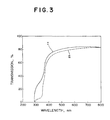
- Figure 3 of the accompanying drawing is a graphic showing of the light transmission through a layer of the coated talc particles after a heat treatment at 500 ° C for 2 hours as a function of wavelength of the light, of which the curve I is for a powder containing 10% by weight of the water-insoluble cerium compound calculated as cerium (IV) oxide Ce0 2 without deposition of amorphous silica and the curve II is for a powder containing 10% by weight of the water-insoluble cerium compound calculated as Ce0 2 and 18% by weight of amorphous silica.
- This graph clearly indicates that the deposition treatment of amorphous silica is important in order for the particles to exhibit a high ultraviolet-shielding effect.
- Figure 4 is a graphic showing of the light transmission through a layer of the inventive ultraviolet-shielding talc powder as compared with conventional ultraviolet-shielding agents, of which the curve I is for the inventive talc powder containing 10% by weight of the water-insoluble cerium compound calculated as cerium (IV) oxide and 18% by weight of amorphous silica after a heat treatment at 500 ° C for 2 hours, curve II is for a conventional organic ultraviolet-shielding agent (Tinuvin 1130, a product by Ciba-Geigy Co.), curve III is for a finely divided zinc oxide powder and curve IV is for a finely divided titanium dioxide powder.
- the curve I is for the inventive talc powder containing 10% by weight of the water-insoluble cerium compound calculated as cerium (IV) oxide and 18% by weight of amorphous silica after a heat treatment at 500 ° C for 2 hours
- curve II is for a conventional organic ultraviolet-shielding agent (Tinuvin 1130,
- the curve V is given for the purpose of control showing the absorption spectrum obtained by conducting the measurement in the same manner as for the other curves excepting omission of any ultraviolet-shielding agent in the sample mixture.
- the ultraviolet-shielding effect of the inventive powder is superior to the organic ultraviolet-shielding agent in the wavelength region of 280 to 400 nm though somewhat inferior as compared with the conventional inorganic ultraviolet-shielding agents but, in the wavelength region of 400 to 800 nm, i.e.
- the light transmission of the inventive ultraviolet-shielding agent is much higher than the conventional inorganic ultraviolet-shielding agents, though somewhat lower than the organic one, indicating that better transparency or translucency could be obtained therewith when it is compounded in plastics, cosmetic compositions and the like.
- one of the most promising applications of the inventive ultraviolet-shielding agent is as an ingredient in cosmetic or toiletry compositions desired to exhibit an ultraviolet-shielding effect for the protection of human skin against adverse influences caused by exposure to ultraviolet light.
- known ultraviolet-shielding agents including both organic and inorganic ones each have their own respective disadvantages and problems relative to the stability, safety, irritativeness against human skin, dispersibility, translucency and so on when they are compounded in a cosmetic composition if not to mention the expensiveness thereof as is the case with organic ultraviolet-shielding agents and insusceptibility to aesthetic coloration as is the case with synthetic micas.
- the ultraviolet-shielding cosmetic composition of the invention is a blend which comprises, in addition to at least one component with which a cosmetic composition is composed, a powder, as an ultraviolet-shielding agent, consisting of particles of an inorganic material having a refractive index of 1.45 to 1.65 and a flaky particle configuration, such as particles of mica, talc, sericite and the like, each particle being coated on the surface with a composite coating layer consisting of a water-insoluble cerium compound and amorphous silica, in an amount sufficient for the cosmetic composition to exhibit an ultraviolet-shielding effect on the human skin.
- a powder as an ultraviolet-shielding agent, consisting of particles of an inorganic material having a refractive index of 1.45 to 1.65 and a flaky particle configuration, such as particles of mica, talc, sericite and the like, each particle being coated on the surface with a composite coating layer consisting of a water-insoluble cerium compound and amorphous silica, in an amount
- the ultraviolet-shielding agent used in the inventive cosmetic composition is an inorganic material so that it is free from the problem of instability as is unavoidable in conventional organic ultraviolet-absorbing or ultraviolet-shielding agents.
- the particles thereof have deposition of amorphous silica so that the powder has good dispersibility in any cosmetic compositions and the cosmetic composition compounded therewith is free from the disadvantage of irritativeness against human skin.
- the ultraviolet-shielding agent used in the inventive cosmetic composition has high translucency to light in the visible region so that the cosmetic composition compounded therewith does not suffer from a decrease in the aesthetic value of appearance.
- the above defined ultraviolet-shielding agent used in the inventive cosmetic composition has compatibility with other ultraviolet-shielding agents so that, if desired, a cosmetic composition can be compounded with two kinds or more of ultraviolet-shielding agents in combination including the above defined one as an essential ingredient in the inventive cosmetic composition.
- the ultraviolet-shielding agent of the invention and the method for the preparation thereof as well as several formulations of the ultraviolet-shielding cosmetic compositions according to the invention.
- the ultraviolet-shielding talc and mica powders referred to as the UV-shielding talc and UV-shielding mica, respectively, were those prepared in Example 1 and Example 2, respectively.
- An aqueous dispersion was prepared by vigorously agitating 500 g of talc in 10 liters of deionized water for one hour and 264 g of an aqueous solution of cerium (IV) nitrate in a concentration of 19% by weight calculated as cerium (IV) oxide Ce0 2 were added dropwise into the aqueous dispersion of talc heated and kept at 80 ° C under agitation. Thereafter, an aqueous solution of sodium hydroxide was added to the aqueous dispersion to adjust the pH of the aqueous dispersion to 7 to 9 so that cerium (IV) hydroxide was precipitated and deposited on the surface of talc particles to form a coating layer. The thus coated talc particles were collected by filtration, washed with water, dried and disintegrated to give a powder of flaky talc particles coated with cerium (IV) hydroxide as a water-insoluble cerium compound.
- cerium-coated talc particles were dispersed in 10 liters of water by vigorously agitating for one hour and 348 g of sodium silicate containing 28.5% by weight of Si0 2 were added to the aqueous dispersion at a temperature of 80 ° C or higher under agitation.
- the pH value of the aqueous dispersion was adjusted to 9 to 11 by the addition of diluted sulfuric acid followed by further continued agitation for additional one hour and addition of another portion of diluted sulfuric acid to adjust the pH of the aqueous dispersion to 6 to 8 so that amorphous silica was precipitated and deposited on the surface of the cerium-coated talc particles.
- the particles were collected by filtration, washed with water, dried and disintegrated to give a powder of flaky talc particles compositely coated with a water-insoluble cerium compound, i.e. cerium (IV) hydroxide, and amorphous silica, which was subjected to a heat treatment at 500 ° C for 2 hours to give an ultraviolet-shielding agent of the invention containing 10% by weight of the water-insoluble cerium compound calculated as cerium (IV) oxide Ce0 2 based on the talc particles before coating and 18% by weight of amorphous silica calculated as Si0 2 based on the ceriun- coated talc particles.
- a water-insoluble cerium compound i.e. cerium (IV) hydroxide
- amorphous silica i.e. cerium (IV) hydroxide
- An aqueous dispersion was prepared by vigorously agitating 500 g of fine mica flakes in 10 liters of deionized water for one our and 527 g of an aqueous solution of cerium (IV) nitrate in a concentration of 19% by weight calculated as Ce0 2 were added dropwise into the aqueous dispersion of mica flakes heated and kept at 80 ° C under agitation followed by the adjustment of the pH value of the dispersion to 7 to 9 by the addition of an aqueous solution of sodium carbonate so that cerium (IV) carbonate was precipitated and deposited on the surface of the mica flakes to form a coating layer of a water-insoluble cerium compound.
- the thus coated mica flakes were collected by filtration, washed with water, dried and disintegrated to give a powder of cerium-coated mica flakes.
- cerium-coated mica flakes were dispersed in 10 liters of deionized water by vigorously agitating for one hour and 674 g of the same sodium silicate as used in Example 1 were added to the aqueous dispersion of the cerium-coated mica flakes under agitation at a temperature of 80 ° C or higher, of which the pH value was adjusted to 9 to 11 by the addition of diluted sulfuric acid and, after further continued agitation for additional one hour, to 6 to 8 by the addition of another portion of diluted sulfuric acid so that amorphous silica was precipitated and deposited on the surface of the cerium-coated mica flakes.
- the thus obtained mica flakes compositely coated with a water-insoluble cerium compound and amorphous silica were collected by filtration of the aqueous dispersion, washed with water, dried and disintegrated to give a powder of the coated mica flakes, which was calcined at 900 ° C for 2 hours.
- the thus prepared powder of compositely coated mica flakes contained the water-insoluble cerium compound and amorphous silica in amounts of 20% by weight calculated as Ce0 2 and 32% by weight calculated as Si0 2 , respectively, to exhibit a high and stable ultraviolet-shielding effect and translucency as in the ultraviolet-shielding agent prepared in Example 1.
- a powder foundation was prepared from each in the indicated amount of the ingredients listed below, the total amount being 100 parts:
- the ingredients (1) to (6) were first mixed together and the mixture was transferred into a highspeed blender followed by the admixture of the ingredients (7) to (10) to be thoroughly blended.
- the thus prepared uniform mixture was disintegrated by using a pulverizing machine followed by particle size classification by using a set of screens.
- the powder could be readily shaped by compression molding into a compact cake.
- a water-type powder foundation was prepared from each in the indicated amount of the ingredients listed below, the total amount being 100 parts:
- the ingredients (1) to (6) were first mixed together and the mixture was transferred into a highspeed blender followed by the addition of the ingredient (9) to be blended. Thereafter, the ingredients (7), (8) and (10) were added to the blender in which they were thoroughly blended together.
- the thus prepared uniform mixture was disintegrated by using a pulverizing machine followed by particle size classification by using a set of screens. The powder could be readily shaped by compression molding into a compact cake.
- a liquid foundation was prepared from each in the indicated amount of the ingredients listed below, the total amount being 100 parts:
- a cream foundation was prepared from each in the indicated amount of the ingredients listed below, the total amount being 100 parts:
- a sun-screen lotion was prepared from each in the indicated amount of the ingredients listed below, the total amount being 100 parts:
- a sun-protect cream was prepared from each in the indicated amount of the ingredients listed below, the total amount being 100 parts:
- a sun-screen cream was prepared from each in the indicated amount of the ingredients listed below, the total amount being 100 parts:
Landscapes
- Health & Medical Sciences (AREA)
- Life Sciences & Earth Sciences (AREA)
- Chemical & Material Sciences (AREA)
- Veterinary Medicine (AREA)
- Animal Behavior & Ethology (AREA)
- General Health & Medical Sciences (AREA)
- Public Health (AREA)
- Epidemiology (AREA)
- Birds (AREA)
- Organic Chemistry (AREA)
- Inorganic Chemistry (AREA)
- Dispersion Chemistry (AREA)
- Dermatology (AREA)
- Cosmetics (AREA)
Applications Claiming Priority (4)
| Application Number | Priority Date | Filing Date | Title |
|---|---|---|---|
| JP32274992A JP2635278B2 (ja) | 1992-11-06 | 1992-11-06 | 化粧料 |
| JP32275092A JPH06145645A (ja) | 1992-11-06 | 1992-11-06 | 紫外線遮断剤とその製造方法 |
| JP322749/92 | 1992-11-06 | ||
| JP322750/92 | 1992-11-06 |
Publications (2)
| Publication Number | Publication Date |
|---|---|
| EP0596442A1 true EP0596442A1 (fr) | 1994-05-11 |
| EP0596442B1 EP0596442B1 (fr) | 1997-04-09 |
Family
ID=26570919
Family Applications (1)
| Application Number | Title | Priority Date | Filing Date |
|---|---|---|---|
| EP93117688A Expired - Lifetime EP0596442B1 (fr) | 1992-11-06 | 1993-11-02 | Agent de protection contre les rayons ultraviolets, procédé de préparation et composition cosmétique à laquelle il est mélangé |
Country Status (3)
| Country | Link |
|---|---|
| US (1) | US5478550A (fr) |
| EP (1) | EP0596442B1 (fr) |
| DE (1) | DE69309609T2 (fr) |
Cited By (4)
| Publication number | Priority date | Publication date | Assignee | Title |
|---|---|---|---|---|
| EP0767074A3 (fr) * | 1995-10-05 | 1998-01-07 | Nippon Paper Industries Co., Ltd. | Milieu d'enregistrement thermique |
| WO2002016509A1 (fr) * | 2000-08-17 | 2002-02-28 | Imerys Minerals Limited | Produits kaoliniques et utilisations |
| FR2867181A1 (fr) * | 2004-03-02 | 2005-09-09 | Rhodia Chimie Sa | Dispersion colloidale de particules d'un compose de cerium enrobees de silice, compose solide obtenu a partir de cette dispersion, procedes de preparation et utilisation |
| WO2019102114A1 (fr) | 2017-11-24 | 2019-05-31 | Rhodia Operations | Particules d'oxyde de cerium / silice |
Families Citing this family (23)
| Publication number | Priority date | Publication date | Assignee | Title |
|---|---|---|---|---|
| US6923974B2 (en) * | 1990-08-16 | 2005-08-02 | Catalysts & Chemicals Industries Co., Ltd. | Flaky fine powder, production thereof, and cosmetic |
| US5851652A (en) * | 1992-10-09 | 1998-12-22 | E. I. Du Pont De Nemours And Company | Lightfast T102 pigment |
| KR970000745B1 (ko) * | 1993-11-19 | 1997-01-18 | 주식회사 엘지화학 | 항균성 화장료용 안료와 그 제조방법 및 이를 함유하는 화장료 조성물 |
| US5902569A (en) * | 1995-03-10 | 1999-05-11 | Kao Corporation | Ultraviolet shielding composite fine particles, method for producing the same, and cosmetics |
| EP0810181B1 (fr) * | 1996-05-27 | 2002-06-19 | Nippon Denko Co.,Ltd. | Procédé pour la préparation de particules composites de silice et d'oxyde de cerium |
| AU715053B2 (en) * | 1996-06-13 | 2000-01-13 | Pola Chemical Industries Inc. | Method for evaluating make-up cosmetic product and powder composition |
| GB9807180D0 (en) | 1998-04-04 | 1998-06-03 | Ecc Int Ltd | Pigment products |
| EP0957140A3 (fr) * | 1998-05-14 | 2000-05-10 | Nikki Chemical Co., Ltd. | Matériau blocquant l'ultraviolet et procédé pour sa préparation |
| US6564199B1 (en) | 1999-04-01 | 2003-05-13 | Imerys Pigments, Inc. | Kaolin clay pigments, their preparation and use |
| DE10084442T1 (de) | 1999-04-01 | 2002-05-02 | Imerys Pigments Inc | Kaolin-Pigmente, ihre Herstellung und Verwendung |
| FR2795065B1 (fr) | 1999-06-16 | 2002-04-19 | Rhodia Chimie Sa | Sol d'un phosphate de cerium et/ou de lanthane, procede de preparation et utilisation en polissage |
| US6554892B1 (en) | 1999-07-02 | 2003-04-29 | Imerys Kaolin, Inc. | Compositions and methods for making a coarse platey, high brightness kaolin product |
| GB0020180D0 (en) | 2000-08-17 | 2000-10-04 | Imerys Minerals Ltd | Kaolin products and their production |
| US20030085012A1 (en) | 2001-09-07 | 2003-05-08 | Jones J Philip E | Hyperplaty clays and their use in paper coating and filling, methods for making same, and paper products having improved brightness |
| US6808559B2 (en) | 2002-02-26 | 2004-10-26 | Imerys Pigments, Inc. | Kaolin clay pigments suited to rotogravure printing applications and method for preparing the same |
| US7488471B2 (en) * | 2002-10-28 | 2009-02-10 | Mmp, Inc. | Transparent oil-in-water emulsion |
| KR101239074B1 (ko) * | 2011-05-24 | 2013-03-11 | 씨큐브 주식회사 | 내후성이 우수한 외장재 안료 및 그 제조 방법 |
| US12180084B2 (en) | 2019-04-23 | 2024-12-31 | The Regents Of The University Of California | Cerium (III) carbonate formulations |
| JP2021014412A (ja) * | 2019-07-10 | 2021-02-12 | 三菱鉛筆株式会社 | 液体化粧料組成物 |
| EP4121396A4 (fr) | 2020-03-20 | 2024-07-03 | The Regents of The University of California | Dispersion aqueuse de particules de carbonate de cérium (iii) |
| US20230144769A1 (en) * | 2020-03-20 | 2023-05-11 | The Regents Of The University Of California | Preparation of Cerium (III) Carbonate Dispersion |
| AU2021239884A1 (en) * | 2020-03-20 | 2022-10-13 | Rohm And Haas Company | Preparation of cerium (III) carbonate dispersion |
| CN115386246B (zh) * | 2022-09-13 | 2024-02-06 | 中山市华山高新陶瓷材料有限公司 | 一种双层包裹型硫化铈红色颜料化学镀膜的制备方法 |
Citations (5)
| Publication number | Priority date | Publication date | Assignee | Title |
|---|---|---|---|---|
| EP0220509A1 (fr) * | 1985-10-08 | 1987-05-06 | MERCK PATENT GmbH | Pigments nacrés stables dans les glaçures et émaux |
| EP0342533A1 (fr) * | 1988-05-19 | 1989-11-23 | MERCK PATENT GmbH | Pigments nacrés résistant aux intempéries et procédé de production |
| EP0401045A1 (fr) * | 1989-06-02 | 1990-12-05 | Tayca Corporation | Pigments chromatiques à base de dioxyde de titane |
| EP0498686A2 (fr) * | 1991-02-08 | 1992-08-12 | The Mearl Corporation | Pigment macré à base d'oxychlorure de bismuth ayant une résistance accrue aux intempéries et sa production |
| JPH04249584A (ja) * | 1990-12-28 | 1992-09-04 | Teika Corp | 耐紫外線変色性に優れた鱗片状顔料組成物及びその使用 |
Family Cites Families (1)
| Publication number | Priority date | Publication date | Assignee | Title |
|---|---|---|---|---|
| JPS5998009A (ja) * | 1982-11-29 | 1984-06-06 | Kanebo Ltd | 皮膚化粧料 |
-
1993
- 1993-09-29 US US08/128,078 patent/US5478550A/en not_active Expired - Lifetime
- 1993-11-02 DE DE69309609T patent/DE69309609T2/de not_active Expired - Fee Related
- 1993-11-02 EP EP93117688A patent/EP0596442B1/fr not_active Expired - Lifetime
Patent Citations (5)
| Publication number | Priority date | Publication date | Assignee | Title |
|---|---|---|---|---|
| EP0220509A1 (fr) * | 1985-10-08 | 1987-05-06 | MERCK PATENT GmbH | Pigments nacrés stables dans les glaçures et émaux |
| EP0342533A1 (fr) * | 1988-05-19 | 1989-11-23 | MERCK PATENT GmbH | Pigments nacrés résistant aux intempéries et procédé de production |
| EP0401045A1 (fr) * | 1989-06-02 | 1990-12-05 | Tayca Corporation | Pigments chromatiques à base de dioxyde de titane |
| JPH04249584A (ja) * | 1990-12-28 | 1992-09-04 | Teika Corp | 耐紫外線変色性に優れた鱗片状顔料組成物及びその使用 |
| EP0498686A2 (fr) * | 1991-02-08 | 1992-08-12 | The Mearl Corporation | Pigment macré à base d'oxychlorure de bismuth ayant une résistance accrue aux intempéries et sa production |
Non-Patent Citations (1)
| Title |
|---|
| DATABASE WPI Week 9242, Derwent World Patents Index; AN 92-345112 * |
Cited By (5)
| Publication number | Priority date | Publication date | Assignee | Title |
|---|---|---|---|---|
| EP0767074A3 (fr) * | 1995-10-05 | 1998-01-07 | Nippon Paper Industries Co., Ltd. | Milieu d'enregistrement thermique |
| WO2002016509A1 (fr) * | 2000-08-17 | 2002-02-28 | Imerys Minerals Limited | Produits kaoliniques et utilisations |
| FR2867181A1 (fr) * | 2004-03-02 | 2005-09-09 | Rhodia Chimie Sa | Dispersion colloidale de particules d'un compose de cerium enrobees de silice, compose solide obtenu a partir de cette dispersion, procedes de preparation et utilisation |
| WO2005095505A1 (fr) * | 2004-03-02 | 2005-10-13 | Rhodia Chimie | Dispersion colloïdale de particules d'un compose de cerium enrobees de silice, compose solide obtenu a partir de cette dispersion, procedes de preparation et utilisation |
| WO2019102114A1 (fr) | 2017-11-24 | 2019-05-31 | Rhodia Operations | Particules d'oxyde de cerium / silice |
Also Published As
| Publication number | Publication date |
|---|---|
| DE69309609D1 (de) | 1997-05-15 |
| US5478550A (en) | 1995-12-26 |
| DE69309609T2 (de) | 1997-09-25 |
| EP0596442B1 (fr) | 1997-04-09 |
Similar Documents
| Publication | Publication Date | Title |
|---|---|---|
| EP0596442B1 (fr) | Agent de protection contre les rayons ultraviolets, procédé de préparation et composition cosmétique à laquelle il est mélangé | |
| EP0317272B1 (fr) | Poudre d'oxyde de zinc en paillettes et composition pour application externe | |
| JPWO1999025654A1 (ja) | 透明性に優れる紫外線遮蔽性酸化亜鉛及びこれを含有する組成物 | |
| EP0359909B1 (fr) | Cosmétiques photochromes régulateurs de couleur | |
| KR20000070222A (ko) | 투명성이 우수한 자외선 차폐성 산화아연 및 이를 함유하는 조성물 | |
| JPH11193354A (ja) | シリカ被覆酸化亜鉛粒子、その製法及びその粒子を含有する 組成物 | |
| KR100482529B1 (ko) | 실리카-세륨옥시드복합인자,그의제조방법및그를배합한수지조성물및화장조성물 | |
| WO1995016637A1 (fr) | Particule de dioxyde de titane a base de rutile contenant du fer ultra-fin et procede pour sa production | |
| EP0558881B1 (fr) | Pigment en paillettes formant écran aux rayons ultraviolets, procédé de préparation et cosmétiques le contenant | |
| JP3267508B2 (ja) | シリカ・酸化セリウム複合粒子、その製造方法及びそれを配合した樹脂組成物並びに化粧料 | |
| JPH045001B2 (fr) | ||
| JP2717904B2 (ja) | 鉄含有超微粒子ルチル型二酸化チタン及びその製造方法 | |
| JP3427195B2 (ja) | 紫外線遮断作用を有する複合マイカ粉体 | |
| JPH0587545B2 (fr) | ||
| JP2577465B2 (ja) | 酸化チタン・酸化鉄複合系ゾルの製造方法およびそのゾルを配合した化粧料 | |
| JP3506755B2 (ja) | ホトクロミック性複合体、その製造方法及び皮膚外用剤 | |
| JPS61257907A (ja) | 化粧料 | |
| JPH0930933A (ja) | 化粧料 | |
| JP2635278B2 (ja) | 化粧料 | |
| JPS61257910A (ja) | 化粧料 | |
| JPH08239223A (ja) | 酸化チタン・酸化鉄複合系ゾルおよびそのゾルを配合した化粧料 | |
| JP3375462B2 (ja) | 化粧料 | |
| JP2931180B2 (ja) | 鉄含有超微粒子二酸化チタンの製造方法 | |
| JP2576824B2 (ja) | 紫外線遮断剤とこれを配合した樹脂組成物および化粧料 | |
| JP2782132B2 (ja) | 化粧料 |
Legal Events
| Date | Code | Title | Description |
|---|---|---|---|
| PUAI | Public reference made under article 153(3) epc to a published international application that has entered the european phase |
Free format text: ORIGINAL CODE: 0009012 |
|
| AK | Designated contracting states |
Kind code of ref document: A1 Designated state(s): DE FR GB |
|
| 17P | Request for examination filed |
Effective date: 19941111 |
|
| 17Q | First examination report despatched |
Effective date: 19950411 |
|
| GRAG | Despatch of communication of intention to grant |
Free format text: ORIGINAL CODE: EPIDOS AGRA |
|
| GRAH | Despatch of communication of intention to grant a patent |
Free format text: ORIGINAL CODE: EPIDOS IGRA |
|
| GRAH | Despatch of communication of intention to grant a patent |
Free format text: ORIGINAL CODE: EPIDOS IGRA |
|
| GRAA | (expected) grant |
Free format text: ORIGINAL CODE: 0009210 |
|
| AK | Designated contracting states |
Kind code of ref document: B1 Designated state(s): DE FR GB |
|
| REF | Corresponds to: |
Ref document number: 69309609 Country of ref document: DE Date of ref document: 19970515 |
|
| ET | Fr: translation filed | ||
| PLBE | No opposition filed within time limit |
Free format text: ORIGINAL CODE: 0009261 |
|
| STAA | Information on the status of an ep patent application or granted ep patent |
Free format text: STATUS: NO OPPOSITION FILED WITHIN TIME LIMIT |
|
| 26N | No opposition filed | ||
| REG | Reference to a national code |
Ref country code: GB Ref legal event code: IF02 |
|
| REG | Reference to a national code |
Ref country code: FR Ref legal event code: TP |
|
| REG | Reference to a national code |
Ref country code: GB Ref legal event code: 732E |
|
| PGFP | Annual fee paid to national office [announced via postgrant information from national office to epo] |
Ref country code: DE Payment date: 20051027 Year of fee payment: 13 |
|
| PGFP | Annual fee paid to national office [announced via postgrant information from national office to epo] |
Ref country code: GB Payment date: 20051102 Year of fee payment: 13 |
|
| PGFP | Annual fee paid to national office [announced via postgrant information from national office to epo] |
Ref country code: FR Payment date: 20051108 Year of fee payment: 13 |
|
| PG25 | Lapsed in a contracting state [announced via postgrant information from national office to epo] |
Ref country code: DE Free format text: LAPSE BECAUSE OF NON-PAYMENT OF DUE FEES Effective date: 20070601 |
|
| GBPC | Gb: european patent ceased through non-payment of renewal fee |
Effective date: 20061102 |
|
| REG | Reference to a national code |
Ref country code: FR Ref legal event code: ST Effective date: 20070731 |
|
| PG25 | Lapsed in a contracting state [announced via postgrant information from national office to epo] |
Ref country code: GB Free format text: LAPSE BECAUSE OF NON-PAYMENT OF DUE FEES Effective date: 20061102 |
|
| PG25 | Lapsed in a contracting state [announced via postgrant information from national office to epo] |
Ref country code: FR Free format text: LAPSE BECAUSE OF NON-PAYMENT OF DUE FEES Effective date: 20061130 |