EP0596671B1 - Radikalisch gepfropfte zyklische Carbonylgruppen enthaltende Verbindungen und Herstellung davon - Google Patents
Radikalisch gepfropfte zyklische Carbonylgruppen enthaltende Verbindungen und Herstellung davon Download PDFInfo
- Publication number
- EP0596671B1 EP0596671B1 EP93308675A EP93308675A EP0596671B1 EP 0596671 B1 EP0596671 B1 EP 0596671B1 EP 93308675 A EP93308675 A EP 93308675A EP 93308675 A EP93308675 A EP 93308675A EP 0596671 B1 EP0596671 B1 EP 0596671B1
- Authority
- EP
- European Patent Office
- Prior art keywords
- alkyl
- polymer
- carbonyl
- saturated hydrocarbon
- group
- Prior art date
- Legal status (The legal status is an assumption and is not a legal conclusion. Google has not performed a legal analysis and makes no representation as to the accuracy of the status listed.)
- Expired - Lifetime
Links
Classifications
-
- C—CHEMISTRY; METALLURGY
- C08—ORGANIC MACROMOLECULAR COMPOUNDS; THEIR PREPARATION OR CHEMICAL WORKING-UP; COMPOSITIONS BASED THEREON
- C08F—MACROMOLECULAR COMPOUNDS OBTAINED BY REACTIONS ONLY INVOLVING CARBON-TO-CARBON UNSATURATED BONDS
- C08F283/00—Macromolecular compounds obtained by polymerising monomers on to polymers provided for in subclass C08G
-
- C—CHEMISTRY; METALLURGY
- C07—ORGANIC CHEMISTRY
- C07C—ACYCLIC OR CARBOCYCLIC COMPOUNDS
- C07C45/00—Preparation of compounds having >C = O groups bound only to carbon or hydrogen atoms; Preparation of chelates of such compounds
- C07C45/61—Preparation of compounds having >C = O groups bound only to carbon or hydrogen atoms; Preparation of chelates of such compounds by reactions not involving the formation of >C = O groups
- C07C45/67—Preparation of compounds having >C = O groups bound only to carbon or hydrogen atoms; Preparation of chelates of such compounds by reactions not involving the formation of >C = O groups by isomerisation; by change of size of the carbon skeleton
- C07C45/68—Preparation of compounds having >C = O groups bound only to carbon or hydrogen atoms; Preparation of chelates of such compounds by reactions not involving the formation of >C = O groups by isomerisation; by change of size of the carbon skeleton by increase in the number of carbon atoms
-
- C—CHEMISTRY; METALLURGY
- C07—ORGANIC CHEMISTRY
- C07C—ACYCLIC OR CARBOCYCLIC COMPOUNDS
- C07C45/00—Preparation of compounds having >C = O groups bound only to carbon or hydrogen atoms; Preparation of chelates of such compounds
- C07C45/61—Preparation of compounds having >C = O groups bound only to carbon or hydrogen atoms; Preparation of chelates of such compounds by reactions not involving the formation of >C = O groups
- C07C45/67—Preparation of compounds having >C = O groups bound only to carbon or hydrogen atoms; Preparation of chelates of such compounds by reactions not involving the formation of >C = O groups by isomerisation; by change of size of the carbon skeleton
- C07C45/68—Preparation of compounds having >C = O groups bound only to carbon or hydrogen atoms; Preparation of chelates of such compounds by reactions not involving the formation of >C = O groups by isomerisation; by change of size of the carbon skeleton by increase in the number of carbon atoms
- C07C45/70—Preparation of compounds having >C = O groups bound only to carbon or hydrogen atoms; Preparation of chelates of such compounds by reactions not involving the formation of >C = O groups by isomerisation; by change of size of the carbon skeleton by increase in the number of carbon atoms by reaction with functional groups containing oxygen only in singly bound form
- C07C45/71—Preparation of compounds having >C = O groups bound only to carbon or hydrogen atoms; Preparation of chelates of such compounds by reactions not involving the formation of >C = O groups by isomerisation; by change of size of the carbon skeleton by increase in the number of carbon atoms by reaction with functional groups containing oxygen only in singly bound form being hydroxy groups
-
- C—CHEMISTRY; METALLURGY
- C07—ORGANIC CHEMISTRY
- C07C—ACYCLIC OR CARBOCYCLIC COMPOUNDS
- C07C49/00—Ketones; Ketenes; Dimeric ketenes; Ketonic chelates
- C07C49/587—Unsaturated compounds containing a keto groups being part of a ring
- C07C49/703—Unsaturated compounds containing a keto groups being part of a ring containing hydroxy groups
- C07C49/747—Unsaturated compounds containing a keto groups being part of a ring containing hydroxy groups containing six-membered aromatic rings
-
- C—CHEMISTRY; METALLURGY
- C07—ORGANIC CHEMISTRY
- C07C—ACYCLIC OR CARBOCYCLIC COMPOUNDS
- C07C67/00—Preparation of carboxylic acid esters
- C07C67/30—Preparation of carboxylic acid esters by modifying the acid moiety of the ester, such modification not being an introduction of an ester group
- C07C67/333—Preparation of carboxylic acid esters by modifying the acid moiety of the ester, such modification not being an introduction of an ester group by isomerisation; by change of size of the carbon skeleton
- C07C67/343—Preparation of carboxylic acid esters by modifying the acid moiety of the ester, such modification not being an introduction of an ester group by isomerisation; by change of size of the carbon skeleton by increase in the number of carbon atoms
-
- C—CHEMISTRY; METALLURGY
- C07—ORGANIC CHEMISTRY
- C07D—HETEROCYCLIC COMPOUNDS
- C07D239/00—Heterocyclic compounds containing 1,3-diazine or hydrogenated 1,3-diazine rings
- C07D239/02—Heterocyclic compounds containing 1,3-diazine or hydrogenated 1,3-diazine rings not condensed with other rings
- C07D239/24—Heterocyclic compounds containing 1,3-diazine or hydrogenated 1,3-diazine rings not condensed with other rings having three or more double bonds between ring members or between ring members and non-ring members
- C07D239/28—Heterocyclic compounds containing 1,3-diazine or hydrogenated 1,3-diazine rings not condensed with other rings having three or more double bonds between ring members or between ring members and non-ring members with hetero atoms or with carbon atoms having three bonds to hetero atoms with at the most one bond to halogen, directly attached to ring carbon atoms
- C07D239/46—Two or more oxygen, sulphur or nitrogen atoms
- C07D239/60—Three or more oxygen or sulfur atoms
-
- C—CHEMISTRY; METALLURGY
- C08—ORGANIC MACROMOLECULAR COMPOUNDS; THEIR PREPARATION OR CHEMICAL WORKING-UP; COMPOSITIONS BASED THEREON
- C08F—MACROMOLECULAR COMPOUNDS OBTAINED BY REACTIONS ONLY INVOLVING CARBON-TO-CARBON UNSATURATED BONDS
- C08F8/00—Chemical modification by after-treatment
-
- C—CHEMISTRY; METALLURGY
- C08—ORGANIC MACROMOLECULAR COMPOUNDS; THEIR PREPARATION OR CHEMICAL WORKING-UP; COMPOSITIONS BASED THEREON
- C08F—MACROMOLECULAR COMPOUNDS OBTAINED BY REACTIONS ONLY INVOLVING CARBON-TO-CARBON UNSATURATED BONDS
- C08F8/00—Chemical modification by after-treatment
- C08F8/04—Reduction, e.g. hydrogenation
-
- C—CHEMISTRY; METALLURGY
- C08—ORGANIC MACROMOLECULAR COMPOUNDS; THEIR PREPARATION OR CHEMICAL WORKING-UP; COMPOSITIONS BASED THEREON
- C08F—MACROMOLECULAR COMPOUNDS OBTAINED BY REACTIONS ONLY INVOLVING CARBON-TO-CARBON UNSATURATED BONDS
- C08F2800/00—Copolymer characterised by the proportions of the comonomers expressed
- C08F2800/20—Copolymer characterised by the proportions of the comonomers expressed as weight or mass percentages
Definitions
- the contacting is conducted at a temperature and for a time sufficient to produce the novel compositions, suitably from 90°C to 220°C and suitably from 0.05 to 1 hour.
- composition of matter comprises
- compositions of, and as prepared according to the method of, the invention are particularly useful as solution viscosification agents.
- Typical carbonyl monomers include alloxan, 1,3-dimethylalloxan, indantrione, tetralintetrone, 1,8-naphthalene-trione, cyclopentane-1,2,3-trione, cyclohexane-1,2,3-trione, tetrahydrofuran-2,3,4-trione, pyrrolidine-2,3,4-trione, benzopyran-2,3,4-trione, quinoline-2,3,4-trione, rhodizonic acid, croconic acid, triquinoyl, leuconic acid, isopropylidene ketomalonate, and dehydroascorbic acid derivatives.
- Useful free radical initiators used in forming the compounds of this invention include dialkyl peroxides such as di-tertiary-butyl peroxide,2,5-dimethyl-2,5-di-tertiary-butyl-peroxyhexane, di-cumyl peroxide; alkyl peroxides such as tertiary-butyl hydroperoxide, tertiary-octyl hydroperoxide, cumene hydroperoxide; aroyl peroxides such as benzoyl peroxide; peroxyl esters such as tertiary-butyl peroxypivalate, tertiary-butyl perbenzoate; and azo compounds such as azo-bis-isobutyronitrile. Any free radical initiator with a suitable half life at the reaction temperatures cited above can be used.
- Typical examples of useful substituted hydrocarbons consist of decanol, octadecanol, ethoxylated octadecanol, stearic acid, ethyl stearate, methyl decyl ketone, tetrapropylbenzene, tetrapropylene, tetraisobutylene, mineral oils, and synthetic lubricant oils.
- Homopolymers of ethylene such as high and low density polyethylene, atactic or cystalline polypropylene, polybutene, polyisobutylene, homopolymers and copolymers of higher alpha-olefins, copolymers of ethylene with propylene, EPR, which may also contain unconjugated dienes (EPDM), copolymers of ethylene with butenes or higher alphaolefins, copolymers of propylene with butenes, and higher alphaolefins.
- EPR unconjugated dienes
- dienes such as butadiene, and isoprene are used in copolymer formation, the resulting polymers are hydrogenated to saturate substantially all of the ethylenic unsaturation.
- Useful polymers include hydrogenated styrene butadiene block and hydrogenated styrene isoprene block, and star polymers.
- Preferred polymers include polyolefins, polyalkyl esters, polystyrene and polyvinyl halides and esters.
- the reaction of the cyclic carbonyl monomer with hydrocarbon and/or polymer substrates can occur in solution, in a melt, and in polymer processing equipment such as a rubber mill, a Brabender, an extruder, or a Banbury mixer.
- the polymer when grafting in solution, is dissolved in a suitable solvent, such as chlorobenzene, dichlorobenzene, or mineral oil, and heated to temperatures ranging from about 90°C, to about 180°C depending upon the radical initiator to be used.
- a suitable solvent such as chlorobenzene, dichlorobenzene, or mineral oil
- the carbonyl monomer is added and heated for a suitable period to free any radical-reactive carbonyl groups which may be tied up as a hydrate, alcoholate, or polar solvate.
- the radical initiator is added in one dose, or dropwise over a suitable time span, usually from about 5 to 60 minutes.
- Another option is to add a mixture of the monomer and peroxide in a suitable solvent to the hydrocarbon or polymer solution at an addition rate and suitable reaction temperature consistent with the half life of the radical initiator.
- the reaction mixture is heated, with stirring, until visual color changes, infrared analysis, and/or nmr analysis indicates that the radical addition of the carbonyl monomer to the hydrocarbon is complete.
- Grafting reactions with carbonyl monomers such as anhydrous indantrione exhibit characteristic color changes going from lavender, green, yellow, and finally a gold color, which signals complete monomer consumption in the homolytic grafting reaction.
- the amount of carbonyl monomer employed is dictated by the level of functionality desired in radical adducts.
- Levels of radical grafting onto hydrocarbons and polymers ranging from 0.1 wt.% to about 20 wt.% carbonyl monomer can readily be achieved.
- the high grafting efficiency realized with the carbonyl monomers of the present invention do not usually require the use of excess carbonyl monomer.
- the high efficiency of radical grafting of cyclic carbonyl monomers onto hydrocarbons and polymer substrates do not usually require stripping or filtering procedures.
- functionalized products can be isolated by solvent removal using evaporative techniques, or in the case of functional polymers, by adding the reaction mixture to a polar solvent such as acetone or methanol, which induce the precipitation of the functionalized polymer.
- a polar solvent such as acetone or methanol
- Radical grafting of polymers may also be conducted without a solvent, as in a melt, or in polymer processing equipment such as a rubber mill, an extruder, a Banbury mixer, and Brabender mixer.
- reaction temperatures ranging from 90°C to 220°C, and reaction times ranging from .05 to 1 hour are typical.
- the amount of free radical initiator used is generally between 1 and 100 wt.% based on the weight of the carbonyl monomer, and often depends upon the nature of the free radical initiator, and hydrocarbon or polymer substrate being grafted.
- the susceptibility of certain polymers to undergo crosslinking and/or chain scission necessitates requires careful discretion regarding reagent concentrations, time, temperature, and process conditions since these parameters are all dependent variables in the grafting process.
- grafting processes which use from 10 wt.% to 50 wt.% levels of free radical initiator, at grafting temperatures ranging from 120°C to 180°C, in an oxygen-free reactor can produce functional polymers with significant levels of appended carbonyl monomers.
- Vacuum distillation of the mixture afforded a residue which featured an infrared spectrum with a prominent carbonyl absorption band at 5.85 microns, a gc-mass spectrum showing isomers with a molecular ion at m/e 428, and a carbon magnetic resonance spectrum consistent with a mixture of isomers derived from the radical addition of pristane to indan-1,2,3-trione.
- a mixture of 1 gram of 1,3-dimethylalloxan, 20 grams of 1,2-dichlorobenzene, and 10 ml of pristane were combined in a nitro gen-blanketed 100 ml round bottom flask equipped with a condensor, magnetic stirrer, thermometer, and dropping funnel.
- the temperature reached 160°C the radical initiator, t-butyl peroxide (0.5 ml) was added all at once, and the mixture was stirred at 160°C until a clear solution was obtained (about an hour).
- the resulting solution was heated for 4 hours, cooled, diluted with 300 ml of cyclohexane and filtered. Rotoevaporation of the filtrate gave a residue which featured an infrared spectrum with a carbonyl band at 5.9 microns, and analyzed for 1.48% nitrogen.
- the cooled solution was diluted with 100 ml of cyclohexane, and added slowly to a liter of acetone.
- the precipitated polymer was redissolved in cyclohexane and again precipitated from a large volume of acetone, and dried in a vacuum oven at 40°C overnight.
- the polymer featured an infrared spectrum (film) with a prominent carbonyl absorption at 5.8 microns, and analyzed for 2.10% oxygen.
- a 10 gram sample of the ethylene-propylene copolymer used in Example 13 and 90 grams of dichlorobenzene were charged into a reactor blanketed with nitrogen and heated to 150°C. Twenty mls of a dioxane solution containing 1 gram of anhydrous alloxan and 0.5 ml of t-butyl peroxide were added dropwise to the stirred polymer solution at 160°C over a 15 minute period. The temperature was maintained at 160°C by allowing the dioxane to distill out of the reactor as the dioxane solution was added.
- the reaction mixture was cooled, diluted with about 200 ml of cyclohexane and slowly added to a liter of acetone to precipitate the functionalized polymer.
- the orange-colored polymer was redissolved in cyclo-hexane and again added to a large volume of acetone.
- the precipitated polymer was dried in a vacuum oven at 40°C overnight.
- the dried polymer featured an infrared spectrum with a strong carbonyl absorption band at 5.9 microns, and analyzed for 0.65% nitrogen.
- Rotoevaporation gave a residue which featured an infrared spectrum dominated by a strong ketone carbonyl absorption at about 5.8 microns, a uv-gel permeation chromatogram confirming the presence of a functional polymer featuring the same polydispersity as the starting polymer, and an elemental analysis indicating that the functional polymer contained 2.2% oxygen.
Landscapes
- Chemical & Material Sciences (AREA)
- Organic Chemistry (AREA)
- Chemical Kinetics & Catalysis (AREA)
- Polymers & Plastics (AREA)
- Health & Medical Sciences (AREA)
- Medicinal Chemistry (AREA)
- General Chemical & Material Sciences (AREA)
- Organic Low-Molecular-Weight Compounds And Preparation Thereof (AREA)
- Addition Polymer Or Copolymer, Post-Treatments, Or Chemical Modifications (AREA)
- Pyrane Compounds (AREA)
- Pyrrole Compounds (AREA)
- Quinoline Compounds (AREA)
- Furan Compounds (AREA)
Claims (10)
- Verfahren zur Bildung einer carbonylhaltigen Zusammensetzung, bei dem in Gegenwart eines freiradikalischen Initiators(i) mindestens eine Verbindung ausgewählt aus gesättigten Kohlenwasserstoffen, substituierten gesättigten Kohlenwasserstoffen, gesättigten Kohlenwasserstoffpolymeren, funktionalisierten gesättigten Kohlenwasserstoffpolymeren und Mischungen derselben mit(ii) einer oder mehreren carbonylhaltigen Verbindungen ausgewählt aus solchen mit den Strukturenkontaktiert wird, wobei Q = HOH, MeOH, EtOH oder n-BuOH, n = 0, 1, > 1, und X und Y unabhängig ausgewählt sind aus CH2 und C=O, W unabhängig ausgewählt ist aus CH2, C=O, O, NH, CMe2, C=N-Alkyl und N-Alkyl, wobei Alkyl 1 bis 18 Kohlenstoffatome aufweist, U und V unabhängig aus den gleichen Gruppen wie W und abhängig so gewählt sind, daß U und V zusammen eines aus 1,2-Phenylen, 1,8-Naphthalindiyl und 1,2-Naphthalindiyl sind, vorausgesetzt, daß mindestens einer aus X, Y, U, V und W C=O ist.

- Verfahren nach Anspruch 1, bei dem das Kontaktieren bei einer Temperatur von 90°C bis 220°C erfolgt.
- Verfahren nach Anspruch 1 oder Anspruch 2, bei dem der Kohlenwasserstoff 10 bis 50 Kohlenstoffatome besitzt.
- Verfahren nach Anspruch 1 oder Anspruch 2, bei dem das Polymer ein
M n von 500 bis 10 Millionen aufweist. - Verfahren nach einem der vorhergehenden Ansprüche, bei dem jede Carbonylverbindung die Formelaufweist.

- Verfahren nach einem der Ansprüche 1 bis 4, bei dem jede Carbonylverbindung die Formelaufweist.

- Verfahren nach einem der vorhergehenden Ansprüche, bei dem der Substituent oder die funktionelle Gruppe ausgewählt ist aus OH, O[CH2CH2O]xH, wobei x 1 bis 10 ist, Cl, CN, COOH, COO-Alkyl, wobei Alkyl 1 bis 18 Kohlenstoffatome besitzt, und Aryl.
- Stoffzusammensetzung, die(a) einen Kohlenwasserstoffrest und(b) einen cyclischen Rest ausgewählt aus der Gruppe bestehend ausumfaßt, wobei Q = HOH, MeOH, EtOH oder n-BuOH, n = 0, 1, > 1, und X und Y unabhängig ausgewählt sind aus der Gruppe bestehend aus CH2 und C=O, W unabhängig ausgewählt ist aus der Gruppe bestehend aus CH2, C=O, O, NH, CMe2, C=N-Alkyl und N-Alkyl, wobei Alkyl 1 bis 18 Kohlenstoffatome aufweist, U und V unabhängig aus der gleichen Gruppe wie W ausgewählt sind und abhängig so gewählt sind, daß U und V zusammen eines aus 1,2-Phenylen, 1,8-Naphthalindiyl und 1,2-Naphthalindiyl sind, vorausgesetzt, daß mindestens einer aus X, Y, U, V und W C=O ist, wobei die Stoffzusammensetzung zur Bildung von einer oder mehreren Verbindungen mit Strukturen ausgewählt aus
 brauchbar ist, wobei R ein gesättigter Kohlenwasserstoff, substituierter gesättigter Kohlenwasserstoff, gesättigtes Kohlenwasserstoffpolymer, funktionalisiertes gesättigtes Kohlenwasserstoffpolymer und Mischungen derselben ist.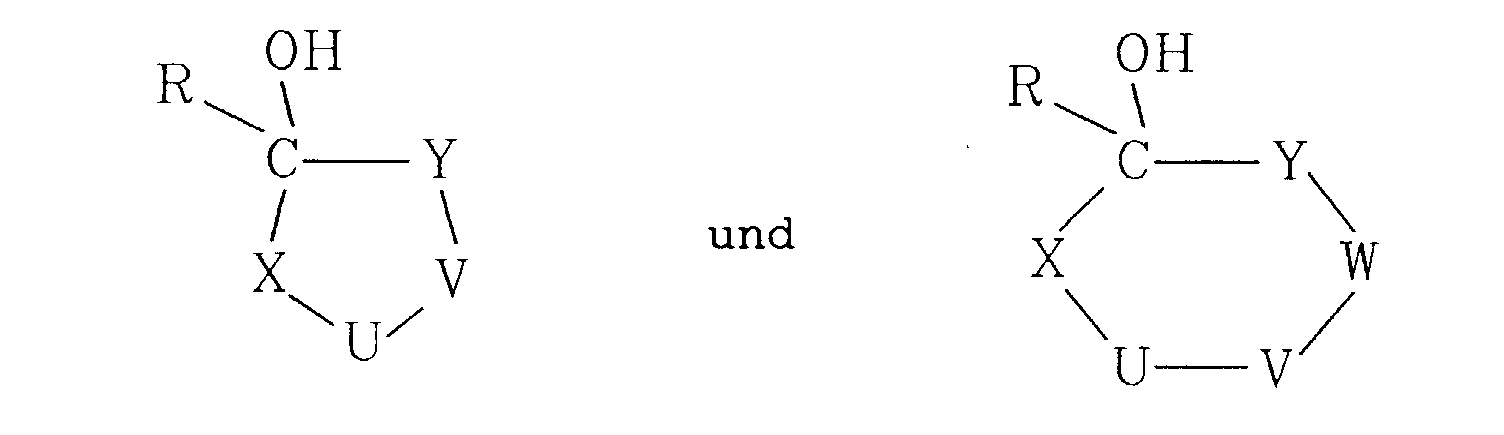
- zusammensetzung nach Anspruch 8, bei der der Substituent oder die funktionalisierte Gruppe ausgewählt ist aus OH, O[CH2CH2O]xH, wobei x 1 bis 10 ist, Cl, CN, COOH, COO-Alkyl, wobei Alkyl 1 bis 18 Kohlenstoffatome besitzt, und Aryl.
- Zusammensetzung nach Anspruch 8 oder Anspruch 9, bei der das Polymer ein durchschnittliches Molekulargewicht (Zahlenmittel) im Bereich von 500 bis 10 Millionen aufweist und ausgewählt ist aus Polyolefin, Polyallylestern, Polystyrol, Polyacrylaten und Polyvinylhalogeniden und -estern.
Applications Claiming Priority (2)
| Application Number | Priority Date | Filing Date | Title |
|---|---|---|---|
| US07/972,270 US5288811A (en) | 1992-11-05 | 1992-11-05 | Cyclic carbonyl containing compounds via radical grafting |
| US972270 | 1992-11-05 |
Publications (3)
| Publication Number | Publication Date |
|---|---|
| EP0596671A2 EP0596671A2 (de) | 1994-05-11 |
| EP0596671A3 EP0596671A3 (de) | 1994-11-23 |
| EP0596671B1 true EP0596671B1 (de) | 1998-09-09 |
Family
ID=25519438
Family Applications (1)
| Application Number | Title | Priority Date | Filing Date |
|---|---|---|---|
| EP93308675A Expired - Lifetime EP0596671B1 (de) | 1992-11-05 | 1993-10-29 | Radikalisch gepfropfte zyklische Carbonylgruppen enthaltende Verbindungen und Herstellung davon |
Country Status (7)
| Country | Link |
|---|---|
| US (1) | US5288811A (de) |
| EP (1) | EP0596671B1 (de) |
| JP (1) | JPH06219988A (de) |
| KR (1) | KR100249986B1 (de) |
| BR (1) | BR9304405A (de) |
| CA (1) | CA2102476A1 (de) |
| DE (1) | DE69320912T2 (de) |
Families Citing this family (6)
| Publication number | Priority date | Publication date | Assignee | Title |
|---|---|---|---|---|
| US5646098A (en) * | 1990-07-23 | 1997-07-08 | Exxon Chemical Patents Inc | Carbonyl containing compounds and their derivatives as multi-functional fuel and lube additives |
| AU683453B2 (en) * | 1993-12-03 | 1997-11-13 | Exxon Research And Engineering Company | Carbonyl containing compounds |
| DE19854573A1 (de) | 1998-11-26 | 2000-05-31 | Basf Ag | Verfahren zur Nachvernetzung von Hydrogelen mit 2-Oxo-tetrahydro-1,3-oxazinen |
| ES2323217T3 (es) * | 1999-11-30 | 2009-07-09 | Electric Power Research Institute | Metodo para la deteccion fotometrica de iones utilizados en sondas de electroforesis capilar, procedimiento de fabricacion y utilizacion de estas sondas. |
| US7550065B2 (en) * | 2005-04-21 | 2009-06-23 | Lyondell Chemical Technology, L.P. | Method for recovering solvents |
| KR102244399B1 (ko) * | 2020-07-20 | 2021-04-26 | 경해정공 주식회사 | 케이블 덕트 제조장치 |
Family Cites Families (6)
| Publication number | Priority date | Publication date | Assignee | Title |
|---|---|---|---|---|
| US3554973A (en) * | 1963-09-12 | 1971-01-12 | Monsanto Co | Modifying halogenated cycloalkenyl ketone containing alpha olefin polymers |
| JPS58444B2 (ja) * | 1979-01-19 | 1983-01-06 | 三枝 武夫 | 大環状ビス↓−1,3↓−ジケトンを有するスチレン系重合体およびその製造方法 |
| JPS5834180B2 (ja) * | 1979-04-28 | 1983-07-25 | 岩夫 田伏 | 重金属捕促剤およびその製造方法 |
| NL8301035A (nl) * | 1983-03-23 | 1984-10-16 | Organon Teknika Bv | Macromoleculair materiaal met carbonylgroepen geschikt als sorbent voor stikstofverbindingen. |
| DE4008218A1 (de) * | 1990-03-15 | 1991-09-19 | Huels Chemische Werke Ag | Formmassen auf basis von thermoplastisch verarbeitbaren, funktionalisierten, olefinischen polymeren und polyamiden |
| US5057564A (en) * | 1990-07-23 | 1991-10-15 | Exxon Research And Engineering Company | Cyclic carbonyl containing polymers |
-
1992
- 1992-11-05 US US07/972,270 patent/US5288811A/en not_active Expired - Fee Related
-
1993
- 1993-10-29 DE DE69320912T patent/DE69320912T2/de not_active Expired - Fee Related
- 1993-10-29 EP EP93308675A patent/EP0596671B1/de not_active Expired - Lifetime
- 1993-10-29 BR BR9304405A patent/BR9304405A/pt not_active IP Right Cessation
- 1993-11-04 JP JP5275537A patent/JPH06219988A/ja active Pending
- 1993-11-04 CA CA002102476A patent/CA2102476A1/en not_active Abandoned
- 1993-11-04 KR KR1019930023315A patent/KR100249986B1/ko not_active Expired - Fee Related
Also Published As
| Publication number | Publication date |
|---|---|
| KR940011509A (ko) | 1994-06-21 |
| KR100249986B1 (ko) | 2000-03-15 |
| BR9304405A (pt) | 1994-07-05 |
| EP0596671A3 (de) | 1994-11-23 |
| DE69320912T2 (de) | 1999-02-11 |
| CA2102476A1 (en) | 1994-05-06 |
| JPH06219988A (ja) | 1994-08-09 |
| EP0596671A2 (de) | 1994-05-11 |
| DE69320912D1 (de) | 1998-10-15 |
| US5288811A (en) | 1994-02-22 |
Similar Documents
| Publication | Publication Date | Title |
|---|---|---|
| DE60106773T2 (de) | Verwendung von trioxepanen zur herstellung von acrylharzen mit hohem feststoffgehalt, styrolharzen und polyethylenharzen mit niedriger dichte | |
| US6632895B1 (en) | Functionalized alkoxyamine initiators | |
| EP0596671B1 (de) | Radikalisch gepfropfte zyklische Carbonylgruppen enthaltende Verbindungen und Herstellung davon | |
| JP5521165B2 (ja) | ヒドロキシスチレンダイマー誘導体、その製造方法、連鎖移動剤およびラジカル重合性モノマーの重合方法 | |
| Tsuda et al. | Cyclopolymerization of ether dimers of α-(hydroxymethyl) acrylic acid and its alkyl esters: Substituent effect on cyclization efficiency and microstructures | |
| Bizilj et al. | The self-reactions of 1-methoxycarbonyl-1-methylethyl and higher ester radicals: combination vs disproportionation and oligomeric products from secondary reactions | |
| KR101315543B1 (ko) | 중합 개시제 | |
| EP0596672B1 (de) | Radikalisch gepfropfte Carbonylgruppen enthaltende Verbindungen und Herstellung davon | |
| EP0716076A2 (de) | Bisphenolesterderivate | |
| DE60000719T2 (de) | Polymerisationsverfahren unter verwendung verdünnter multikomponenten ströme | |
| EP0529159B1 (de) | Cyclische Carbonylgruppen enthaltende Polymere | |
| DE19718288A1 (de) | Stabilisierte Zusammensetzung und polymere Antioxidantien | |
| US3708520A (en) | Vinyl esters of dialkylhydroxyphenyl alkanoates | |
| US20250326877A1 (en) | Diacrylated monolignol thermoset resins | |
| EP0738253B1 (de) | Carbonylgruppen enthaltende verbindungen | |
| CA1146552A (en) | Stabilized polymer compositions | |
| SU1710543A1 (ru) | 3,3-Ди-(3,5-ди-трет-бутил-4-гидроксифенил)-1,1-диадамантил, про вл ющий антиокислительные свойства в реакци х термоокислительной деструкции углеводородов | |
| Knaus et al. | Peroxide-initiated grafting of maleimides onto hydrocarbon substrates | |
| US4146552A (en) | Dehydrogenation of cis-1,2-dicyanocycloalkane | |
| GB1590173A (en) | Bulk polymerisation of olefinically unsaturated compounds | |
| Benefice-Malouet et al. | An improved synthesis of perfluoroalkyl aldehydes from the reaction of perfluoroalkyl iodides with dimethylformamide | |
| US6730747B1 (en) | Carbonyl containing compounds | |
| US6077915A (en) | Carbonyl containing compounds | |
| Amriev et al. | Telomerization of acrylic monomers with iodoform | |
| Selenova et al. | Synthesis and reactivity of metal-containing monomers: 28. Low-temperature radical polymerization of zinc, barium, magnesium, and lead acrylates under the action of organocobalt initiators |
Legal Events
| Date | Code | Title | Description |
|---|---|---|---|
| PUAI | Public reference made under article 153(3) epc to a published international application that has entered the european phase |
Free format text: ORIGINAL CODE: 0009012 |
|
| AK | Designated contracting states |
Kind code of ref document: A2 Designated state(s): BE DE FR GB IT NL |
|
| PUAL | Search report despatched |
Free format text: ORIGINAL CODE: 0009013 |
|
| AK | Designated contracting states |
Kind code of ref document: A3 Designated state(s): BE DE FR GB IT NL |
|
| 17P | Request for examination filed |
Effective date: 19950425 |
|
| 17Q | First examination report despatched |
Effective date: 19960320 |
|
| RAP1 | Party data changed (applicant data changed or rights of an application transferred) |
Owner name: EXXON CHEMICAL PATENTS INC. |
|
| GRAG | Despatch of communication of intention to grant |
Free format text: ORIGINAL CODE: EPIDOS AGRA |
|
| GRAG | Despatch of communication of intention to grant |
Free format text: ORIGINAL CODE: EPIDOS AGRA |
|
| GRAH | Despatch of communication of intention to grant a patent |
Free format text: ORIGINAL CODE: EPIDOS IGRA |
|
| GRAH | Despatch of communication of intention to grant a patent |
Free format text: ORIGINAL CODE: EPIDOS IGRA |
|
| GRAA | (expected) grant |
Free format text: ORIGINAL CODE: 0009210 |
|
| AK | Designated contracting states |
Kind code of ref document: B1 Designated state(s): BE DE FR GB IT NL |
|
| REF | Corresponds to: |
Ref document number: 69320912 Country of ref document: DE Date of ref document: 19981015 |
|
| ET | Fr: translation filed | ||
| PLBE | No opposition filed within time limit |
Free format text: ORIGINAL CODE: 0009261 |
|
| 26N | No opposition filed | ||
| REG | Reference to a national code |
Ref country code: GB Ref legal event code: IF02 |
|
| PGFP | Annual fee paid to national office [announced via postgrant information from national office to epo] |
Ref country code: GB Payment date: 20020913 Year of fee payment: 10 |
|
| PGFP | Annual fee paid to national office [announced via postgrant information from national office to epo] |
Ref country code: NL Payment date: 20020919 Year of fee payment: 10 |
|
| PGFP | Annual fee paid to national office [announced via postgrant information from national office to epo] |
Ref country code: FR Payment date: 20021003 Year of fee payment: 10 |
|
| PGFP | Annual fee paid to national office [announced via postgrant information from national office to epo] |
Ref country code: DE Payment date: 20021031 Year of fee payment: 10 |
|
| PGFP | Annual fee paid to national office [announced via postgrant information from national office to epo] |
Ref country code: BE Payment date: 20021125 Year of fee payment: 10 |
|
| PG25 | Lapsed in a contracting state [announced via postgrant information from national office to epo] |
Ref country code: GB Free format text: LAPSE BECAUSE OF NON-PAYMENT OF DUE FEES Effective date: 20031029 |
|
| PG25 | Lapsed in a contracting state [announced via postgrant information from national office to epo] |
Ref country code: BE Free format text: LAPSE BECAUSE OF NON-PAYMENT OF DUE FEES Effective date: 20031031 |
|
| BERE | Be: lapsed |
Owner name: *EXXON CHEMICAL PATENTS INC. Effective date: 20031031 |
|
| PG25 | Lapsed in a contracting state [announced via postgrant information from national office to epo] |
Ref country code: NL Free format text: LAPSE BECAUSE OF NON-PAYMENT OF DUE FEES Effective date: 20040501 Ref country code: DE Free format text: LAPSE BECAUSE OF NON-PAYMENT OF DUE FEES Effective date: 20040501 |
|
| GBPC | Gb: european patent ceased through non-payment of renewal fee |
Effective date: 20031029 |
|
| PG25 | Lapsed in a contracting state [announced via postgrant information from national office to epo] |
Ref country code: FR Free format text: LAPSE BECAUSE OF NON-PAYMENT OF DUE FEES Effective date: 20040630 |
|
| NLV4 | Nl: lapsed or anulled due to non-payment of the annual fee |
Effective date: 20040501 |
|
| REG | Reference to a national code |
Ref country code: FR Ref legal event code: ST |
|
| PG25 | Lapsed in a contracting state [announced via postgrant information from national office to epo] |
Ref country code: IT Free format text: LAPSE BECAUSE OF NON-PAYMENT OF DUE FEES;WARNING: LAPSES OF ITALIAN PATENTS WITH EFFECTIVE DATE BEFORE 2007 MAY HAVE OCCURRED AT ANY TIME BEFORE 2007. THE CORRECT EFFECTIVE DATE MAY BE DIFFERENT FROM THE ONE RECORDED. Effective date: 20051029 |