EP0597428B1 - Anodisierungsapparat mit einer Trägervorrichtung für das zu behandelnde Substrat - Google Patents
Anodisierungsapparat mit einer Trägervorrichtung für das zu behandelnde Substrat Download PDFInfo
- Publication number
- EP0597428B1 EP0597428B1 EP93118093A EP93118093A EP0597428B1 EP 0597428 B1 EP0597428 B1 EP 0597428B1 EP 93118093 A EP93118093 A EP 93118093A EP 93118093 A EP93118093 A EP 93118093A EP 0597428 B1 EP0597428 B1 EP 0597428B1
- Authority
- EP
- European Patent Office
- Prior art keywords
- substrate
- sealing member
- treated
- crystalline silicon
- support jig
- Prior art date
- Legal status (The legal status is an assumption and is not a legal conclusion. Google has not performed a legal analysis and makes no representation as to the accuracy of the status listed.)
- Expired - Lifetime
Links
- 239000000758 substrate Substances 0.000 title claims description 181
- 238000002048 anodisation reaction Methods 0.000 title claims description 31
- 238000007789 sealing Methods 0.000 claims description 63
- 230000015572 biosynthetic process Effects 0.000 claims description 36
- 239000007788 liquid Substances 0.000 claims description 13
- 230000002093 peripheral effect Effects 0.000 claims description 13
- 239000012530 fluid Substances 0.000 claims description 6
- 239000000126 substance Substances 0.000 claims description 6
- 229910021419 crystalline silicon Inorganic materials 0.000 description 57
- 238000005755 formation reaction Methods 0.000 description 38
- 239000003792 electrolyte Substances 0.000 description 37
- 229910052710 silicon Inorganic materials 0.000 description 20
- XUIMIQQOPSSXEZ-UHFFFAOYSA-N Silicon Chemical compound [Si] XUIMIQQOPSSXEZ-UHFFFAOYSA-N 0.000 description 18
- BASFCYQUMIYNBI-UHFFFAOYSA-N platinum Chemical compound [Pt] BASFCYQUMIYNBI-UHFFFAOYSA-N 0.000 description 18
- 239000010703 silicon Substances 0.000 description 17
- 229910021426 porous silicon Inorganic materials 0.000 description 15
- KRHYYFGTRYWZRS-UHFFFAOYSA-N Fluorane Chemical compound F KRHYYFGTRYWZRS-UHFFFAOYSA-N 0.000 description 14
- 239000000243 solution Substances 0.000 description 13
- 238000000034 method Methods 0.000 description 11
- 229910052697 platinum Inorganic materials 0.000 description 9
- 239000011148 porous material Substances 0.000 description 9
- 239000013078 crystal Substances 0.000 description 8
- 238000006243 chemical reaction Methods 0.000 description 7
- 239000004809 Teflon Substances 0.000 description 6
- 229920006362 Teflon® Polymers 0.000 description 6
- 239000011347 resin Substances 0.000 description 6
- 229920005989 resin Polymers 0.000 description 6
- BFKJFAAPBSQJPD-UHFFFAOYSA-N tetrafluoroethene Chemical group FC(F)=C(F)F BFKJFAAPBSQJPD-UHFFFAOYSA-N 0.000 description 6
- 239000007789 gas Substances 0.000 description 5
- 229910052751 metal Inorganic materials 0.000 description 5
- 239000002184 metal Substances 0.000 description 5
- 239000000203 mixture Substances 0.000 description 5
- 239000004065 semiconductor Substances 0.000 description 4
- LFQSCWFLJHTTHZ-UHFFFAOYSA-N Ethanol Chemical compound CCO LFQSCWFLJHTTHZ-UHFFFAOYSA-N 0.000 description 3
- UFHFLCQGNIYNRP-UHFFFAOYSA-N Hydrogen Chemical compound [H][H] UFHFLCQGNIYNRP-UHFFFAOYSA-N 0.000 description 3
- 125000004429 atom Chemical group 0.000 description 3
- 239000001257 hydrogen Substances 0.000 description 3
- 229910052739 hydrogen Inorganic materials 0.000 description 3
- 238000002955 isolation Methods 0.000 description 3
- XLYOFNOQVPJJNP-UHFFFAOYSA-N water Substances O XLYOFNOQVPJJNP-UHFFFAOYSA-N 0.000 description 3
- 229920006169 Perfluoroelastomer Polymers 0.000 description 2
- 229910008284 Si—F Inorganic materials 0.000 description 2
- 239000007864 aqueous solution Substances 0.000 description 2
- 230000004888 barrier function Effects 0.000 description 2
- 239000000470 constituent Substances 0.000 description 2
- 238000011109 contamination Methods 0.000 description 2
- 238000009826 distribution Methods 0.000 description 2
- 230000000694 effects Effects 0.000 description 2
- 229920001971 elastomer Polymers 0.000 description 2
- 230000005684 electric field Effects 0.000 description 2
- 239000012212 insulator Substances 0.000 description 2
- 238000004519 manufacturing process Methods 0.000 description 2
- 239000000463 material Substances 0.000 description 2
- 239000002245 particle Substances 0.000 description 2
- 230000010287 polarization Effects 0.000 description 2
- 229920001296 polysiloxane Polymers 0.000 description 2
- 230000008569 process Effects 0.000 description 2
- ZOXJGFHDIHLPTG-UHFFFAOYSA-N Boron Chemical compound [B] ZOXJGFHDIHLPTG-UHFFFAOYSA-N 0.000 description 1
- 229910008045 Si-Si Inorganic materials 0.000 description 1
- 229910006411 Si—Si Inorganic materials 0.000 description 1
- QVGXLLKOCUKJST-UHFFFAOYSA-N atomic oxygen Chemical compound [O] QVGXLLKOCUKJST-UHFFFAOYSA-N 0.000 description 1
- 229910052796 boron Inorganic materials 0.000 description 1
- 239000000969 carrier Substances 0.000 description 1
- 230000000052 comparative effect Effects 0.000 description 1
- 238000007599 discharging Methods 0.000 description 1
- 238000005530 etching Methods 0.000 description 1
- 229910052731 fluorine Inorganic materials 0.000 description 1
- 239000011737 fluorine Substances 0.000 description 1
- -1 fluorine ions Chemical class 0.000 description 1
- 125000001153 fluoro group Chemical group F* 0.000 description 1
- 230000006870 function Effects 0.000 description 1
- 150000002431 hydrogen Chemical class 0.000 description 1
- 230000006698 induction Effects 0.000 description 1
- 230000002452 interceptive effect Effects 0.000 description 1
- 230000007246 mechanism Effects 0.000 description 1
- 238000005459 micromachining Methods 0.000 description 1
- 230000000269 nucleophilic effect Effects 0.000 description 1
- 239000001301 oxygen Substances 0.000 description 1
- 229910052760 oxygen Inorganic materials 0.000 description 1
- 238000005498 polishing Methods 0.000 description 1
- 230000002265 prevention Effects 0.000 description 1
- 230000009257 reactivity Effects 0.000 description 1
Images



Classifications
-
- C—CHEMISTRY; METALLURGY
- C25—ELECTROLYTIC OR ELECTROPHORETIC PROCESSES; APPARATUS THEREFOR
- C25D—PROCESSES FOR THE ELECTROLYTIC OR ELECTROPHORETIC PRODUCTION OF COATINGS; ELECTROFORMING; APPARATUS THEREFOR
- C25D11/00—Electrolytic coating by surface reaction, i.e. forming conversion layers
- C25D11/02—Anodisation
- C25D11/32—Anodisation of semiconducting materials
-
- C—CHEMISTRY; METALLURGY
- C25—ELECTROLYTIC OR ELECTROPHORETIC PROCESSES; APPARATUS THEREFOR
- C25D—PROCESSES FOR THE ELECTROLYTIC OR ELECTROPHORETIC PRODUCTION OF COATINGS; ELECTROFORMING; APPARATUS THEREFOR
- C25D11/00—Electrolytic coating by surface reaction, i.e. forming conversion layers
- C25D11/005—Apparatus specially adapted for electrolytic conversion coating
-
- C—CHEMISTRY; METALLURGY
- C25—ELECTROLYTIC OR ELECTROPHORETIC PROCESSES; APPARATUS THEREFOR
- C25D—PROCESSES FOR THE ELECTROLYTIC OR ELECTROPHORETIC PRODUCTION OF COATINGS; ELECTROFORMING; APPARATUS THEREFOR
- C25D17/00—Constructional parts, or assemblies thereof, of cells for electrolytic coating
- C25D17/004—Sealing devices
-
- C—CHEMISTRY; METALLURGY
- C25—ELECTROLYTIC OR ELECTROPHORETIC PROCESSES; APPARATUS THEREFOR
- C25D—PROCESSES FOR THE ELECTROLYTIC OR ELECTROPHORETIC PRODUCTION OF COATINGS; ELECTROFORMING; APPARATUS THEREFOR
- C25D17/00—Constructional parts, or assemblies thereof, of cells for electrolytic coating
- C25D17/06—Suspending or supporting devices for articles to be coated
-
- C—CHEMISTRY; METALLURGY
- C25—ELECTROLYTIC OR ELECTROPHORETIC PROCESSES; APPARATUS THEREFOR
- C25D—PROCESSES FOR THE ELECTROLYTIC OR ELECTROPHORETIC PRODUCTION OF COATINGS; ELECTROFORMING; APPARATUS THEREFOR
- C25D5/00—Electroplating characterised by the process; Pretreatment or after-treatment of workpieces
- C25D5/02—Electroplating of selected surface areas
- C25D5/022—Electroplating of selected surface areas using masking means
Definitions
- the present invention relates to a supporting device for substrate which supports a substrate to be treated (hereinafter referred to simply as "treated substrate") in a treating solution, and an anode formation (anodization) apparatus provided with it.
- treated substrate a substrate to be treated
- an anode formation (anodization) apparatus provided with it.
- the present invention relates to an apparatus for anodization of a crystalline silicon layer used in the field of formation technique of SOI (silicon on insulator) which is utilized in ULSI including Bi-CMOS device with both low dissipation power and high-speed operation, three-dimensional structure device including layered functional elements such as a sensor device, an arithmetical element, a memory, etc., or a high-voltage device such as a power transistor for electronic switching system, discharge printer, or plasma display, and in the field of micro machining technique, etc.
- SOI silicon on insulator
- the present invention relates to an anodization apparatus used in producing porous silicon.
- porous silicon in the present invention means a crystalline silicon having a single crystal structure and at the same time having many pores therein.
- crystalline silicon substrate in the present invention means a silicon single crystal wafer having no pores, which is utilized in the field of semiconductor industries.
- porous silicon was found by A. Uhlir and D. R. Turner in the course of study for electrolytic polishing of silicon single crystal which was biased in a positive potential in a hydrofluoric acid (hereinafter referred to simply as "HF") aqueous solution.
- HF hydrofluoric acid
- anodization apparatus having the structure as shown in a cross section in Fig. 8 as pore-etching apparatus for crystalline silicon utilizing an anodization reaction.
- reference numeral 1 denotes a degenerated crystalline silicon substrate as a substrate to be treated (treated substrate), 2 a formation tank made of a tetrafluoroethylene resin (trade mane: Teflon), 3a and 3b platinum electrode plates to which a voltage is applied from an external direct current (DC) power source (not shown) to constitute negative and positive electrodes, respectively, 4 a substrate support jig made of a tetrafluoroethylene resin (trade name: Teflon) constituting substrate support means, 5 a sealing member for substrate made of a tetrafluoroethylene resin (trade name: Goatex) having flexibility, elasticity and hermetic property, 11a and 11b bodies of electrolyte, which is a hydrofluoric acid mixture solution, and 15 a Goatex sealing member for the substrate support jig, which maintains a hermetic contact between the formation tank 2 and the substrate support jig 4.
- a substrate support jig made of a tetrafluor
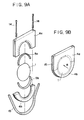
- FIG. 9A is a perspective view to illustrate constituent elements in the conventional substrate support jig 4 shown in Fig. 8, and Fig. 9B a perspective view to show an assembled state of the support jig 4.
- numerals 4a and 4b represent segments of the substrate support jig, which can be separated from each other so that the crystalline silicon substrate 1 can be readily mounted to or dismounted form the jig.
- Numerals 5a and 5b represent segments of the substrate sealing member made of Goatex, which are set in grooves inside the substrate support jig segments 4a, 4b, respectively, to maintain the hermetic condition between the substrate support jig segments 4a, 4b and the crystalline silicon substrate 1. They are divided in the same manner as the substrate support jig segments 4a, 4b are.
- Crystalline silicon substrates used in semiconductor industries are normally subjected to the orientation flatting processing to indicate the direction of crystallographic axis. Therefore, the segmented substrate sealing member (5a and 5b) and the segmented substrate support jig (4a and 4b) each are shaped asymmetric.
- Numeral 14 denotes bolts made of Teflon, which exert an urging force on the substrate sealing member segments 5a, 5b after assembling the substrate support jig segments 4a, 4b and setting the crystalline silicone substrate 1 thereto. By screwing the bolts 14 completely, the entire circumference of the crystalline silicon substrate 1 and junction planes between the substrate support jig segments 4a and 4b are sealed from the electrolyte bodies 11a, 11b.
- the support jig sealing member 15 made of Goatex is set on a groove in the circumference of the substrate support jig 4, and then the assembly is inserted into the formation tank 2, whereby the electrolyte bodies 11a, 11b can be separated from each other electrically and hermetically.
- the anode-side electrolyte 11b serves as a liquid electrode. Further, electrical barrier is made on a surface of the crystalline silicone substrate 1 facing the cathode-side electrolyte 11a due to the difference in work function between the electrolyte and the crystalline silicon substrate. Numeral 8 denotes the direction of a formation current.
- the external DC power source (not shown) supplies a current to form a cathode of the platinum electrode 3a and an anode of the platinum electrode 3b, whereby fluorine ions (hereinafter referred to simply as "F - ions") are generated in the electrolyte 11a in the formation tank 2.
- F - ions react with silicon atoms on the cathode-side surface of the silicon wafer 1 to form tetrafluorosilicon (SiF 4 ) and hydrogen (H 2 ), whereby the silicon wafer 1 is dissolved while forming pores.
- the above-mentioned electrolyte is usually used in combination with alcohol.
- the added alcohol prevents hydrogen gas generated during the reaction from adhering to the surface, then interfering supply of hydrofluoric acid to the surface, and in turn impeding the reaction.
- the above-mentioned predominant formation of pores also occurs in a degenerated n-type silicon in which holes are minority carriers. In this case, the formation of electron-hole pairs upon irradiation with light is a supply source of holes.
- the crystalline silicon substrate 1 is arranged to effect electrical seal of the electrolyte throughout the entire circumference in the peripheral portion of the beveled side surface, so that the cathode-side surface of the crystalline silicon substrate 1 can be uniformly treated to form many pores.
- the cross sectional structure of the apparatus is electrically symmetrical with respect to the crystalline silicon substrate 1, the both surfaces or entire region of the crystalline silicon substrate 1 can be subjected to the pore-making treatment by inversion of the polarity of the voltage applied to the platinum electrodes 3a, 3b.
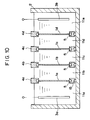
- a plurality of crystalline silicon substrates (1a-1d) are arranged in an electrically sealed state at certain intervals through substrate support jigs (4a-4d) as described above along the electric line force of the formation current between the platinum electrodes 3a,3b, whereby the plurality of crystalline silicon substrates can be subjected to the pore-making treatment at the same time.
- the electrolyte has a specific resistance of about 20 ⁇ cm and serves also as a liquid electrode. Further, since the anodization reaction proceeds by a potential difference due to the electric barrier between the cathode-side surface and the anode-side surface of the crystalline silicon substrate, it is needless to say that the formation tank and the substrate support jig except for the crystalline silicon substrate should be made of materials excellent in electric insulating properties.
- a current path is formed through the electrolyte so as to lower the potential difference, whereby the anodization reaction does not proceed near the leakage portion to form a local nonporous region around the leakage portion.
- the conventional sealing member does not have a structure to seal the entire circumference in the peripheral portion on the side surface of the crystalline silicon substrate without a cut or parting, there is a possibility to leak the electrolyte through the junction portion in the substrate support jig in addition to such a problem that labor and time are required for mounting and dismounting the crystalline silicon substrate.
- a problem to be solved is that there is no conventionally available supporting device for substrate, which fully meets the desires to surely prevent the leakage of electrolyte by the treated substrate, to easily mount or dismount the treated substrate, to reduce a production cost, and to simplify the structure.
- a supporting device for treated substrate according to the present invention is applicable to a formation tank in which a chemical treatment is effected on a treated substrate supported in a treating solution, which comprises:
- an integral sealing member without a cut or parting throughout the entire circumference is used for hermetically sealing the peripheral portion of substrate around the entire circumference in close fit to the substrate, so that the treating solution can be surely prevented from leaking.
- the inner diameter of the sealing member is slightly larger than the outer diameter of the treated substrate such as a crystalline silicon substrate; when the pressure is exerted, the inner size of the sealing member becomes perfectly coincident with or slightly smaller than the size of crystalline silicon substrate. Further, a deformation amount of the sealing member and an urging force thereon can be finely adjusted by the air or liquid pressure. Then the treated substrate can be supported without damage while surely preventing the solution from leaking.
- Such a stretchable sealing member is set on the inner circumferential surface of the substrate support jig, which keeps its shape unchanged upon exertion of the pressure, so that the sealing member can be repetitively used as setting, sealing and releasing crystalline silicon substrates one by one.
- sealing members can seal the entire circumference of crystalline silicon substrate without a cut or junction, they are free of leakage of electrolyte as observed from a junction in a substrate support jig in the conventional sealing member, and the crystalline silicon substrate can be readily mounted to or dismounted from either of the sealing members.
- Fig. 1 is a schematic cross section of an apparatus I in Embodiment 1 of the present invention.
- reference numeral 1 designates a crystalline silicon substrate as a substrate to be treated (treated substrate), 21a and 21b electrode support jigs made of a tetrafluoroethylene resin (trade name: Teflon), 3a and 3b platinum electrode plates to which a voltage is applied from an unrepresented external DC power source to constitute negative and positive electrodes, 4 a substrate support jig made of a tetrafluoroethylene resin (trade name: Teflon), constituting substrate supporting means, 5 a substrate sealing member made of a perfluoro elastomer rubber (trade name: Kemraz or Kalrez) similarly having flexibility, elasticity, hermetic property and chemical resistance, 6 a groove, in which the substrate sealing member 5 is set, for uniformly transmitting an air pressure or a liquid pressure onto the sealing member 5, using a space between them, and 7 a pressure supply port for supplying the air or liquid
- Numeral 8 denotes outlets for discharging gas generating during formation.
- Numeral 9 denotes formation tank sealing members made of a tetrafluoroethylene resin (trade name: Goatex) having flexibility, elasticity, chemical resistance and hermetic property for preventing an electrolyte from leaking through joint planes between the electrode support jigs 21a, 21b and the substrate support jig 4, and 10 bolts for fixing the electrode support jigs 21a, 21b and the substrate support jig 4 to each other.
- Numerals 11a and 11b represent the electrolyte, which is a hydrofluoric acid mixture solution.
- Fig. 2A is a cross section to illustrate a positional relation immediately before the crystalline silicon substrate 1 is set in the substrate support jig 4 of the present invention as shown in Fig. 1 or immediately after the setting condition is released. Since Fig. 2A shows a state that the air or liquid pressure is released, the inner diameter of substrate sealing member 5 is larger than the outer diameter of crystalline silicon substrate 1. In this state the crystalline silicon substrate can freely pass inside the substrate sealing member.
- Fig. 2B is a cross section to illustrate a state that the crystalline silicon substrate 1 is set.
- the pressure urges the substrate sealing member 5 along a taper of groove 6 in the normal direction to the crystalline silicon substrate 1 to project it out of the groove 6.
- arrows represent a direction of deformation of the substrate sealing member 5.
- the taper formation in the substrate sealing member 5 and the groove 6 is preferable for hermetically keeping the air or liquid pressure or for preventing a positional deviation of the substrate sealing member 5 relative to the crystalline silicon substrate upon projecting out of the groove.
- the substrate sealing member is made of a perfluoro elastomer rubber (trade name: Kemraz) having an elongation of 200 % at the room temperature.
- the pore-making treatment is carried out as follows on the crystalline silicon substrate.
- a p-type (100) crystalline silicon is produced by the CZ (Czochralski) method as doped with boron (B) to provide a resistivity of 0.01 to 0.02 ⁇ cm.
- B boron
- a wafer is obtained by orientation-flat processing of the thus produced p-type crystalline silicon in diameter 125 mm and thickness 0.6 mm. The wafer is used as the crystalline silicon substrate 1.
- Pressure applying means is compressed air in pressure of 2 kgf/cm 2 from a compressor (not shown) in the pressure supply adjuster 40 in Fig. 1.
- the substrate sealing member 5 has the shape similar to that of the used crystalline silicon substrate 1, but the sealing member 5 has an aperture with inner diameter in a state free of the pressure of compressed air, 2 mm larger than the outer diameter of silicon substrate 1 so that the crystalline silicon substrate 1 may pass freely through the sealing member 5.
- the sealing member 5 has a straight portion corresponding to the orientation flat portion of crystalline silicon substrate 1, and the straight portion has the same length of 42.5 mm as that of substrate.
- an unrepresented vacuum chuck jig When the crystalline silicon substrate 1 is set in the substrate support jig 4, an unrepresented vacuum chuck jig first sucks and supports a flat surface of crystalline silicon substrate 1 in the state that the pressure of compressed air is released, and then locates it in the center of substrate sealing member 5.
- the pressure supply adjuster 40 adjusts the pressure to keep the substrate sealing member 5 in hermetic fit to the entire circumference of crystalline silicon substrate 1. While the pressure is maintained, the vacuum of the vacuum chuck jig is removed.
- the substrate support jig 4 unitedly supports the crystalline silicon substrate 1 to assure hermetic seal for electrolyte.
- the electrode support jigs 21a and 21b are connected to the both ends of substrate support jig 4 through the formation tank sealing members 9 and the assembly is secured by the bolts 10.
- Two electrically independent formation cells are formed by the substrate support jig 4, the crystalline silicon substrate 1, and the electrode support jigs 21a, 21b.
- a hydrofluoric acid mixture solution in which 48 wt% (% by weight) pure-water-diluted hydrofluoric acid, pure water and alcohol are mixed at a ratio of 1:1:1, is poured into the cells through the outlets 8 to form a body of cathode-side electrolyte 11a and a body of anode-side electrolyte 11b.
- the hydrofluoric acid mixture solution has a resistivity of 23.6 ⁇ cm.
- a DC constant-current source (not shown) supplies a current at current density of 8 mA/cm 2 to each of platinum electrodes 3a and 3b.
- the formation reaction starts with the current flow to form pores on the crystalline silicon substrate 1 from the cathode electrode 3a side surface to the anode-side surface.
- Gas such as hydrogen produced in the pore-making treatment is discharged out of the formation cells through the outlets 8.
- the pure water is then discharged and thereafter the bolts 10 are unscrewed to separate the electrode support jigs 21a, 21b and the substrate support jig 4, disassembling the formation tank.
- the crystalline silicon substrate 1 is then supported by the vacuum chuck (not shown) and the compressed air applied onto the substrate sealing member 5 is released.
- the substrate sealing member 5 having elasticity restores its original shape to free the crystalline silicon substrate 1.
- a reaction for about twelve minutes formed a porous silicon layer in thickness of 10 ⁇ m.
- the thickness distribution of porous silicon layer was such that the thickness was 10 ⁇ m at the center of substrate and 11 to 12 ⁇ m in the peripheral portion of substrate.
- the thus produced porous silicon had a percentage of pores P (Porosity) of 55 %.
- the porous silicon layer was not formed in the leaking portion at all, though the formation reaction occurred at a certain distance from the leaking portion.
- the porous silicon layer was first formed in thickness of 10 ⁇ m in the region outside a circle with radius 40 mm about the leaking portion.
- the anodization apparatus of the present invention may be so arranged that the electrolyte overflows the formation cells.
- Fig. 11 shows an example of such anodization apparatus.
- reference numerals 1a, 1b designate formation cells which can keep the liquid surface of electrolyte above the highest portion of treated substrate, 2a, 2b platinum electrodes, 3 a silicon wafer as a treated substrate, 5a, 5b HF aqueous solution as electrolyte, 6 a wafer holder made of Teflon, and 40 an adjuster for supplying a pressure to the wafer holder.
- Numerals 7a, 7b are overflow tanks for receiving the overflowing solution, and 8a, 8b pumps as electrolyte supply means.
- the pumps 8a, 8b circulate the electrolyte in the formation cells.
- the electrolyte in the formation cell 1a on the treated surface side of treated substrate overflows the upper wall of formation cell 1a into the overflow tanks 7a, 7b.
- the overflow tanks 7a, 7b formed around the formation cell 1a are arranged to be connected to each other, and the overflowing solution thereinto is circulated by the pump 8a to the formation cell 1a.
- bubbles in the electrolyte are discharged from the upper surface of solution and particles are efficiently discharged into the overflow tanks upon overflow to be then removed by a filter 9a set in a pipe in the circulation system.
- the electrolyte is supplied to overflow and then to be cleaned, so that attachment of particles or bubbles may be reduced to the porous surface of treated substrate, enabling more uniform chemical treatment.
- a conductive bulkhead (such as a wafer) for preventing metal contamination may be provided between the treated substrate and the positive metal electrode to avoid direct contact between the electrolyte and the positive metal electrode.
- the metal is prevented from dissolving into the electrolyte, thus preventing metal contamination on the treated substrate.
- the hermetic contact between the treated substrate and the sealing member is achieved by a sealing member arranged oblique to the main surface of treated substrate and urged against the peripheral portion thereof.
- the present invention permits one of electrodes to be set on the back surface of treated substrate.
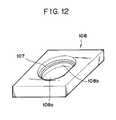
- the treated substrate (such as wafer) can be effectively transported in the present invention, using a cassette for carrying the treated substrate as shown in Fig. 12.
- a wafer cassette 108 is formed as a plane-plate member, in which an aperture 108a shaped to fit the contour of wafer as the treated substrate is formed in the central portion.
- a step 108b is formed on the lower portion of inner wall in the aperture 108a as a support portion for supporting the peripheral edge of wafer set in the aperture 108a.
- the step 108b is integrally formed throughout the entire circumference of inner wall in the aperture 108a.
- a wafer seal 107 is provided as a sealing member on the upper surface of the step 108b throughout the entire circumference thereof, and a wafer is mounted on this wafer seal 107.
- the treated substrate can be efficiently transported or mounted to the anodization apparatus or to a semiconductor process system.
- Three sets of substrate support jigs 4 as used in Embodiment 1 of the present invention are provided and intervals of the crystalline silicon substrates 1 are arranged to be 50 mm. Then, a plurality of substrates are subjected to anodization treatment at the same time.
- Such formation tank has the same structure as in Embodiment 1 of the present invention except that the substrates are arranged along the formation current between the platinum electrodes.
- the formation conditions are the same as in Embodiment 1 except that the applied voltage is increased in order to allow the same amount of formation current to flow.
- the thickness of the porous silicon layer was from 10 to 11 ⁇ m in the center of the five crystalline silicon substrates after anodization.
- the apparatus of the present invention can be used for formation reactions other than the pore-making treatment on the crystalline silicon substrate as long as the type and the mixture ratio of electrolyte are properly selected.
- sealing methods in the present invention can be readily used for sealing other liquid or gas materials than the electrolyte of the present invention.
- the present invention can provide a supporting device for substrate having a simple structure, which can certainly prevent the leakage of the treating solution, which is easy in mounting or dismounting the treated substrate and which can be produced in low cost, because the device is so arranged that the treated substrate is hermetically sealed and supported under pressure throughout the entire circumference.
- the anodization apparatus of the invention enjoys an effect of uniform treatment on the treated substrate.
Landscapes
- Chemical & Material Sciences (AREA)
- Engineering & Computer Science (AREA)
- Chemical Kinetics & Catalysis (AREA)
- Electrochemistry (AREA)
- Materials Engineering (AREA)
- Metallurgy (AREA)
- Organic Chemistry (AREA)
- Weting (AREA)
Claims (6)
- Trägervorrichtung für ein zu behandelndes Substrat (1), die für einen Anodisierungsapparat verwendet werden kann, der mindestens zwei Halbzellen umfaßt,
in dem eine chemische Behandlung des in einer Behandlungslösung gehaltenen Substrats (1) durchgeführt wird,
und die ferner die nachstehenden Bestandteile umfaßt:ein Dichtelement (5), das Elastizität aufweist, und hermetisch an den gesamtem Bereich des Umfangs des Substrats (1) angepaßt ist, ausgenommen die zu behandelnde Fläche, und das Substrat (1) hält, wobei das Dichtelement (5) über seinem gesamten Umfang keinen Schnitt aufweist und die mindestens zwei Halbzellen durch das Substrat (1), das von dem Dichtelement (5) gehalten wird, voneinander getrennt werden;eine Einrichtung (4) zum Halten des Substrats, die das Dichtelement (5) trägt; undeine Einrichtung (7) zum Einleiten eines Fluids eines Gases oder einer Flüssigkeit von außen in den durch die Einrichtung (4) zum Halten des Substrats und das Dichtelement (5) gebildeten Hohlraum, so daß der Druck des Fluids das Dichtelement (5) gegen den Bereich des Substratumfangs, ausgenommen die zu behandelnden Oberfläche auf dem Substrat, drückt, um zu erreichen, daß sie hermetisch aneinander angepaßt werden; undeine Einrichtung für eine Änderung des Drucks, um das Ausmaß der Deformierung des Dichtelements (5) und der darauf ausgeübten Kraft zu steuern. - Trägervorrichtung für ein zu behandelndes Substrat (1) nach Anspruch 1,
wobei mindestens ein Satz des Substrats (1) und der Einrichtung (4) zum Halten des Substrats mit einem Paar von Einrichtungen (21a, 21b) zum Halten der Elektroden kombiniert wird, die in der Lösung angeordnet werden, um Halbzellen zu bilden, die die Lösung in getrenntem Zustand enthalten. - Anodisierungsapparat, der die nachstehenden Bestandteile umfaßt:
eine Trägervorrichtung nach Anspruch 1 oder Anspruch 2; und Elektroden (3a, 3b). - Anodisierungsapparat nach Anspruch 3, wobei eine Zirkulation der Behandlungslösung herbeigeführt wird.
- Anodisierungsapparat nach Anspruch 4, wobei die Zirkulation der Behandlungslösung mittels einer Pumpe herbeigeführt wird.
- Anodisierungsapparat nach Anspruch 3 oder Anspruch 4, wobei für ein Überlaufen der Behandlungslösung aus dem Herstellungsbehälter gesorgt wird.
Applications Claiming Priority (14)
| Application Number | Priority Date | Filing Date | Title |
|---|---|---|---|
| JP32229592A JP3110178B2 (ja) | 1992-11-09 | 1992-11-09 | 半導体基板の作製方法及び陽極化成装置 |
| JP322295/92 | 1992-11-09 | ||
| JP732/93 | 1993-01-06 | ||
| JP73293A JP3181128B2 (ja) | 1993-01-06 | 1993-01-06 | 半導体プロセス装置 |
| JP21637/93 | 1993-01-18 | ||
| JP2163793A JPH06216110A (ja) | 1993-01-18 | 1993-01-18 | 陽極化成方法及び陽極化成装置 |
| JP86876/93 | 1993-03-23 | ||
| JP08687693A JP3416190B2 (ja) | 1993-03-23 | 1993-03-23 | 陽極化成装置及び陽極化成方法 |
| JP05095011A JP3129569B2 (ja) | 1993-03-31 | 1993-03-31 | 陽極化成装置及び陽極化成法 |
| JP95011/93 | 1993-03-31 | ||
| JP12207793A JP3201875B2 (ja) | 1993-04-27 | 1993-04-27 | 陽極化成装置及び陽極化成法 |
| JP122077/93 | 1993-04-27 | ||
| JP135117/93 | 1993-05-14 | ||
| JP13511793A JPH06326084A (ja) | 1993-05-14 | 1993-05-14 | 陽極化成装置 |
Publications (2)
| Publication Number | Publication Date |
|---|---|
| EP0597428A1 EP0597428A1 (de) | 1994-05-18 |
| EP0597428B1 true EP0597428B1 (de) | 1997-07-30 |
Family
ID=27563084
Family Applications (1)
| Application Number | Title | Priority Date | Filing Date |
|---|---|---|---|
| EP93118093A Expired - Lifetime EP0597428B1 (de) | 1992-11-09 | 1993-11-08 | Anodisierungsapparat mit einer Trägervorrichtung für das zu behandelnde Substrat |
Country Status (3)
| Country | Link |
|---|---|
| US (1) | US5458755A (de) |
| EP (1) | EP0597428B1 (de) |
| DE (1) | DE69312636T2 (de) |
Cited By (2)
| Publication number | Priority date | Publication date | Assignee | Title |
|---|---|---|---|---|
| US8926803B2 (en) | 2009-01-15 | 2015-01-06 | Solexel, Inc. | Porous silicon electro-etching system and method |
| US10829864B2 (en) | 2009-01-15 | 2020-11-10 | Trutag Technologies, Inc. | Apparatus and methods for uniformly forming porous semiconductor on a substrate |
Families Citing this family (63)
| Publication number | Priority date | Publication date | Assignee | Title |
|---|---|---|---|---|
| SE500333C2 (sv) * | 1993-03-17 | 1994-06-06 | Herman Georg Grimmeiss | Anordning för elektrolytisk oxidation av kiselskivor |
| US5824199A (en) * | 1993-11-22 | 1998-10-20 | E. I. Du Pont De Nemours And Company | Electrochemical cell having an inflatable member |
| DE69533245D1 (de) * | 1994-03-25 | 2004-08-19 | Nec Electronics Corp | Vorrichtung zur elektrolytischen Behandlung |
| JP3376258B2 (ja) | 1996-11-28 | 2003-02-10 | キヤノン株式会社 | 陽極化成装置及びそれに関連する装置及び方法 |
| JP3985065B2 (ja) * | 1997-05-14 | 2007-10-03 | 忠弘 大見 | 多孔質シリコン基板の形成方法及び多孔質シリコン基板の形成装置 |
| JP3413090B2 (ja) | 1997-12-26 | 2003-06-03 | キヤノン株式会社 | 陽極化成装置及び陽極化成処理方法 |
| SG71903A1 (en) | 1998-01-30 | 2000-04-18 | Canon Kk | Process of reclamation of soi substrate and reproduced substrate |
| DE19803852C2 (de) * | 1998-01-31 | 2003-12-18 | Bosch Gmbh Robert | Verfahren zur Herstellung beidseitig oxidierter Siliziumwafer |
| JPH11243076A (ja) * | 1998-02-26 | 1999-09-07 | Canon Inc | 陽極化成方法及び陽極化成装置並びに半導体基板の製造方法 |
| JP3762144B2 (ja) | 1998-06-18 | 2006-04-05 | キヤノン株式会社 | Soi基板の作製方法 |
| JP2000082679A (ja) | 1998-07-08 | 2000-03-21 | Canon Inc | 半導体基板とその作製方法 |
| US6197654B1 (en) * | 1998-08-21 | 2001-03-06 | Texas Instruments Incorporated | Lightly positively doped silicon wafer anodization process |
| US6417069B1 (en) | 1999-03-25 | 2002-07-09 | Canon Kabushiki Kaisha | Substrate processing method and manufacturing method, and anodizing apparatus |
| US6468923B1 (en) | 1999-03-26 | 2002-10-22 | Canon Kabushiki Kaisha | Method of producing semiconductor member |
| US6410436B2 (en) | 1999-03-26 | 2002-06-25 | Canon Kabushiki Kaisha | Method of cleaning porous body, and process for producing porous body, non-porous film or bonded substrate |
| DE19914905A1 (de) * | 1999-04-01 | 2000-10-05 | Bosch Gmbh Robert | Elektrochemische Ätzanlage und Verfahren zur Ätzung eines Ätzkörpers |
| DE19936569B4 (de) * | 1999-08-03 | 2006-04-27 | Robert Bosch Gmbh | Herstellung von porösem Silicium |
| TW587332B (en) | 2000-01-07 | 2004-05-11 | Canon Kk | Semiconductor substrate and process for its production |
| JP2002075917A (ja) | 2000-08-25 | 2002-03-15 | Canon Inc | 試料の分離装置及び分離方法 |
| US6454917B1 (en) * | 2000-10-30 | 2002-09-24 | Taiwan Semiconductor Manufacturing Co., Ltd. | High throughput and high performance copper electroplating tool |
| JP3892703B2 (ja) * | 2001-10-19 | 2007-03-14 | 富士通株式会社 | 半導体基板用治具及びこれを用いた半導体装置の製造方法 |
| US20040124088A1 (en) * | 2002-12-26 | 2004-07-01 | Canon Kabushiki Kaisha | Processing apparatus |
| JP4438049B2 (ja) * | 2003-08-11 | 2010-03-24 | キヤノン株式会社 | 電界効果トランジスタ及びそれを用いたセンサ並びにその製造方法 |
| US7323731B2 (en) * | 2003-12-12 | 2008-01-29 | Canon Kabushiki Kaisha | Photoelectric conversion device, method of manufacturing photoelectric conversion device, and image pickup system |
| JP2005210062A (ja) * | 2003-12-26 | 2005-08-04 | Canon Inc | 半導体部材とその製造方法、及び半導体装置 |
| US9508886B2 (en) | 2007-10-06 | 2016-11-29 | Solexel, Inc. | Method for making a crystalline silicon solar cell substrate utilizing flat top laser beam |
| US8399331B2 (en) | 2007-10-06 | 2013-03-19 | Solexel | Laser processing for high-efficiency thin crystalline silicon solar cell fabrication |
| JP2007297657A (ja) * | 2006-04-28 | 2007-11-15 | Canon Inc | 吸着パット及び基板処理装置 |
| JP2008019495A (ja) * | 2006-07-14 | 2008-01-31 | Ebara Corp | 多孔質体の洗浄方法および洗浄装置 |
| US20080264477A1 (en) * | 2006-10-09 | 2008-10-30 | Soltaix, Inc. | Methods for manufacturing three-dimensional thin-film solar cells |
| US7999174B2 (en) * | 2006-10-09 | 2011-08-16 | Solexel, Inc. | Solar module structures and assembly methods for three-dimensional thin-film solar cells |
| US8193076B2 (en) | 2006-10-09 | 2012-06-05 | Solexel, Inc. | Method for releasing a thin semiconductor substrate from a reusable template |
| US8035028B2 (en) * | 2006-10-09 | 2011-10-11 | Solexel, Inc. | Pyramidal three-dimensional thin-film solar cells |
| US8035027B2 (en) | 2006-10-09 | 2011-10-11 | Solexel, Inc. | Solar module structures and assembly methods for pyramidal three-dimensional thin-film solar cells |
| US8030119B2 (en) * | 2008-03-08 | 2011-10-04 | Crystal Solar, Inc. | Integrated method and system for manufacturing monolithic panels of crystalline solar cells |
| US8294026B2 (en) | 2008-11-13 | 2012-10-23 | Solexel, Inc. | High-efficiency thin-film solar cells |
| US9890465B2 (en) * | 2009-01-15 | 2018-02-13 | Trutag Technologies, Inc. | Apparatus and methods for uniformly forming porous semiconductor on a substrate |
| US9076642B2 (en) * | 2009-01-15 | 2015-07-07 | Solexel, Inc. | High-Throughput batch porous silicon manufacturing equipment design and processing methods |
| EP2427914A4 (de) * | 2009-05-05 | 2013-06-05 | Solexel Inc | Hochproduktionsanlage zur herstellung poröser halbleiter |
| US9318644B2 (en) | 2009-05-05 | 2016-04-19 | Solexel, Inc. | Ion implantation and annealing for thin film crystalline solar cells |
| MY166305A (en) | 2009-12-09 | 2018-06-25 | Solexel Inc | High-efficiency photovoltaic back-contact solar cell structures and manufacturing methods using thin planar semiconductor absorbers |
| WO2011100647A2 (en) | 2010-02-12 | 2011-08-18 | Solexel, Inc. | Double-sided reusable template for fabrication of semiconductor substrates for photovoltaic cell and microelectronics device manufacturing |
| ITMI20100407A1 (it) * | 2010-03-12 | 2011-09-13 | Rise Technology S R L | Cella foto-voltaica con regioni di semiconduttore poroso per ancorare terminali di contatto |
| JP5489855B2 (ja) | 2010-05-14 | 2014-05-14 | キヤノン株式会社 | 固体撮像装置の製造方法 |
| US9870937B2 (en) | 2010-06-09 | 2018-01-16 | Ob Realty, Llc | High productivity deposition reactor comprising a gas flow chamber having a tapered gas flow space |
| JP5715351B2 (ja) * | 2010-06-30 | 2015-05-07 | キヤノン株式会社 | 半導体装置およびその製造方法、ならびに固体撮像装置 |
| EP2601687A4 (de) | 2010-08-05 | 2018-03-07 | Solexel, Inc. | Rückseitenverstärkung und vernetzungsmittel für solarzellen |
| EP2619790B1 (de) * | 2010-09-24 | 2018-03-28 | Solexel, Inc. | Entwurf einer ausrüstung zur herstellung von porösem silicium mit hohem durchsatz und verarbeitungsverfahren dafür |
| WO2013126033A2 (en) * | 2010-11-03 | 2013-08-29 | Solexel, Inc. | Apparatus and methods for uniformly forming porous semiconductor on a substrate |
| US8992746B2 (en) * | 2010-12-02 | 2015-03-31 | Dainippon Screen Mfg. Co., Ltd. | Anodizing apparatus |
| EP2710639A4 (de) | 2011-05-20 | 2015-11-25 | Solexel Inc | Selbstaktivierte vorderseiten-vorspannung für eine solarzelle |
| JP5908266B2 (ja) * | 2011-11-30 | 2016-04-26 | 株式会社Screenホールディングス | 陽極化成装置及びそれを備えた陽極化成システム並びに半導体ウエハ |
| JP6193005B2 (ja) | 2013-06-14 | 2017-09-06 | Kyb株式会社 | 保持装置及びそれを備えた高速めっき装置 |
| JP6189656B2 (ja) | 2013-06-14 | 2017-08-30 | Kyb株式会社 | 給電部材及びそれを備えた高速めっき装置 |
| FR3020642B1 (fr) * | 2014-04-30 | 2021-07-02 | Turbomeca | Dispositif destine a la mise en oeuvre d'un traitement d'anodisation |
| FR3039563B1 (fr) * | 2015-07-31 | 2017-08-25 | Silimixt | Dispositif de support adaptable pour substrats a traiter notamment par voie chimique ou electrochimique |
| FR3039564B1 (fr) * | 2015-07-31 | 2017-08-25 | Silimixt | Dispositif de support pour substrat a traiter notamment par voie chimique ou electrochimique |
| CN106906506B (zh) * | 2016-12-29 | 2018-12-25 | 平湖瑞星金属工艺有限公司 | 一种通讯设备表面氧化处理的夹具 |
| JP6847691B2 (ja) * | 2017-02-08 | 2021-03-24 | 株式会社荏原製作所 | めっき装置およびめっき装置とともに使用される基板ホルダ |
| ES2816180T3 (es) * | 2018-02-26 | 2021-03-31 | Cockerill Maintenance & Ingenierie Sa | Instalación y método de tratamiento superficial localizado para piezas industriales |
| CN109056049B (zh) * | 2018-08-16 | 2020-08-04 | 湖南文理学院 | 一种纳米多孔硅双凹透镜的制备方法 |
| JP2020105590A (ja) | 2018-12-27 | 2020-07-09 | キオクシア株式会社 | 基板処理装置および基板処理方法 |
| KR20200104691A (ko) * | 2019-02-27 | 2020-09-04 | 주식회사 만도 | 아노다이징 장치 |
Family Cites Families (12)
| Publication number | Priority date | Publication date | Assignee | Title |
|---|---|---|---|---|
| US2737488A (en) * | 1952-11-20 | 1956-03-06 | Western Electric Co | Electroplating apparatus |
| US2801965A (en) * | 1954-05-06 | 1957-08-06 | Western Electric Co | Plating rack |
| CH335913A (de) * | 1956-11-08 | 1959-01-31 | Robert Dr Weynschenk | Einrichtung zur teilweisen Galvanisierung von profilierten Gehäusekörpern |
| CH460975A (fr) * | 1967-05-05 | 1968-08-15 | Charmilles Sa Ateliers | Dispositif d'amenée de courant à une pièce à usiner par usinage électro-chimique |
| DE1931174B2 (de) * | 1969-06-19 | 1975-09-04 | Siemens Ag, 1000 Berlin Und 8000 Muenchen | Einrichtung zum elektrolytischen Durchlaufpolieren von stabförmigen Werkstücken aus Zirkortlegierungen |
| US3835017A (en) * | 1972-12-22 | 1974-09-10 | Buckbee Mears Co | Reusable shields for selective electrodeposition |
| CH578054A5 (en) * | 1973-09-07 | 1976-07-30 | Oxy Metal Finishing Corp | Jigs for selective electroplating - using inflatable balloons to mask the interior of the workpieces being plated |
| FR2315028A1 (fr) * | 1975-06-17 | 1977-01-14 | Quadrimetal Offset | Organes de prehension gonflables |
| US4430179A (en) * | 1981-08-03 | 1984-02-07 | Olin Corporation | Portable method for filter press cell assembly |
| US4605483A (en) * | 1984-11-06 | 1986-08-12 | Michaelson Henry W | Electrode for electro-plating non-continuously conductive surfaces |
| FR2615207B1 (fr) * | 1987-05-14 | 1991-11-22 | Framatome Sa | Canne tubulaire pour le traitement de la surface interieure d'un tube |
| US4898653A (en) * | 1988-09-26 | 1990-02-06 | The Dow Chemical Company | Combination electrolysis cell seal member and membrane tentering means |
-
1993
- 1993-11-08 DE DE69312636T patent/DE69312636T2/de not_active Expired - Lifetime
- 1993-11-08 US US08/148,341 patent/US5458755A/en not_active Expired - Lifetime
- 1993-11-08 EP EP93118093A patent/EP0597428B1/de not_active Expired - Lifetime
Non-Patent Citations (1)
| Title |
|---|
| G. BAI, K.H. KIM, M. NICOLET, Appl. Phys. Lett. 57 (21) 2247-9,(1990). * |
Cited By (2)
| Publication number | Priority date | Publication date | Assignee | Title |
|---|---|---|---|---|
| US8926803B2 (en) | 2009-01-15 | 2015-01-06 | Solexel, Inc. | Porous silicon electro-etching system and method |
| US10829864B2 (en) | 2009-01-15 | 2020-11-10 | Trutag Technologies, Inc. | Apparatus and methods for uniformly forming porous semiconductor on a substrate |
Also Published As
| Publication number | Publication date |
|---|---|
| DE69312636T2 (de) | 1998-02-05 |
| DE69312636D1 (de) | 1997-09-04 |
| EP0597428A1 (de) | 1994-05-18 |
| US5458755A (en) | 1995-10-17 |
Similar Documents
| Publication | Publication Date | Title |
|---|---|---|
| EP0597428B1 (de) | Anodisierungsapparat mit einer Trägervorrichtung für das zu behandelnde Substrat | |
| US11651987B2 (en) | Substrate support carrier with improved bond layer protection | |
| US6448155B1 (en) | Production method of semiconductor base material and production method of solar cell | |
| US6202655B1 (en) | Anodizing apparatus and apparatus and method associated with the same | |
| EP1092228B1 (de) | Elektrode für plasmabehandlungsverfahren und verfahren zur herstellung und anwendung derselben | |
| KR100306839B1 (ko) | 화학반응을이용한처리방법및처리장치 | |
| US20060070884A1 (en) | Electrochemical processing apparatus and method | |
| JP3225850B2 (ja) | 静電吸着電極およびその製作方法 | |
| CN1124304A (zh) | 用于阳极氧化的设备及方法 | |
| WO2016037110A1 (en) | Method and apparatus for forming porous silicon layers | |
| JP3110178B2 (ja) | 半導体基板の作製方法及び陽極化成装置 | |
| JP3416190B2 (ja) | 陽極化成装置及び陽極化成方法 | |
| JP3337705B2 (ja) | 陽極化成装置及び方法 | |
| US20170317225A1 (en) | System and method for all wrap around porous silicon formation | |
| KR19990063513A (ko) | 양극화성장치 및 양극화성처리방법 및 다공질기판 | |
| JP3149060B2 (ja) | 陽極化成装置、陽極化成方法及びシリコン基板の製造方法 | |
| TWI783550B (zh) | 陽極化成裝置及陽極化成方法 | |
| TW202136589A (zh) | 陽極處理裝置 | |
| JP3129569B2 (ja) | 陽極化成装置及び陽極化成法 | |
| JP2006131969A (ja) | 陽極化成方法及びその装置 | |
| JP2023158901A (ja) | 金属部材、半導体製造装置、及び保持装置 | |
| JP2001316868A (ja) | カソード用シート、電解メッキ装置及び電解メッキ方法 | |
| JPH11214353A (ja) | 陽極化成装置、基板ホルダ、電極支持具及び基板並びにその処理方法 |
Legal Events
| Date | Code | Title | Description |
|---|---|---|---|
| PUAI | Public reference made under article 153(3) epc to a published international application that has entered the european phase |
Free format text: ORIGINAL CODE: 0009012 |
|
| AK | Designated contracting states |
Kind code of ref document: A1 Designated state(s): DE FR GB IT NL |
|
| 17P | Request for examination filed |
Effective date: 19941004 |
|
| 17Q | First examination report despatched |
Effective date: 19950118 |
|
| GRAG | Despatch of communication of intention to grant |
Free format text: ORIGINAL CODE: EPIDOS AGRA |
|
| GRAH | Despatch of communication of intention to grant a patent |
Free format text: ORIGINAL CODE: EPIDOS IGRA |
|
| GRAH | Despatch of communication of intention to grant a patent |
Free format text: ORIGINAL CODE: EPIDOS IGRA |
|
| GRAA | (expected) grant |
Free format text: ORIGINAL CODE: 0009210 |
|
| AK | Designated contracting states |
Kind code of ref document: B1 Designated state(s): DE FR GB IT NL |
|
| REF | Corresponds to: |
Ref document number: 69312636 Country of ref document: DE Date of ref document: 19970904 |
|
| ET | Fr: translation filed | ||
| ITF | It: translation for a ep patent filed | ||
| PLBE | No opposition filed within time limit |
Free format text: ORIGINAL CODE: 0009261 |
|
| STAA | Information on the status of an ep patent application or granted ep patent |
Free format text: STATUS: NO OPPOSITION FILED WITHIN TIME LIMIT |
|
| 26N | No opposition filed | ||
| REG | Reference to a national code |
Ref country code: GB Ref legal event code: IF02 |
|
| PGFP | Annual fee paid to national office [announced via postgrant information from national office to epo] |
Ref country code: NL Payment date: 20041103 Year of fee payment: 12 |
|
| PGFP | Annual fee paid to national office [announced via postgrant information from national office to epo] |
Ref country code: GB Payment date: 20041104 Year of fee payment: 12 |
|
| PG25 | Lapsed in a contracting state [announced via postgrant information from national office to epo] |
Ref country code: IT Free format text: LAPSE BECAUSE OF NON-PAYMENT OF DUE FEES;WARNING: LAPSES OF ITALIAN PATENTS WITH EFFECTIVE DATE BEFORE 2007 MAY HAVE OCCURRED AT ANY TIME BEFORE 2007. THE CORRECT EFFECTIVE DATE MAY BE DIFFERENT FROM THE ONE RECORDED. Effective date: 20051108 Ref country code: GB Free format text: LAPSE BECAUSE OF NON-PAYMENT OF DUE FEES Effective date: 20051108 |
|
| PG25 | Lapsed in a contracting state [announced via postgrant information from national office to epo] |
Ref country code: NL Free format text: LAPSE BECAUSE OF NON-PAYMENT OF DUE FEES Effective date: 20060601 |
|
| GBPC | Gb: european patent ceased through non-payment of renewal fee |
Effective date: 20051108 |
|
| NLV4 | Nl: lapsed or anulled due to non-payment of the annual fee |
Effective date: 20060601 |
|
| PGFP | Annual fee paid to national office [announced via postgrant information from national office to epo] |
Ref country code: DE Payment date: 20121130 Year of fee payment: 20 |
|
| PGFP | Annual fee paid to national office [announced via postgrant information from national office to epo] |
Ref country code: FR Payment date: 20121214 Year of fee payment: 20 |
|
| REG | Reference to a national code |
Ref country code: DE Ref legal event code: R071 Ref document number: 69312636 Country of ref document: DE |
|
| PG25 | Lapsed in a contracting state [announced via postgrant information from national office to epo] |
Ref country code: DE Free format text: LAPSE BECAUSE OF EXPIRATION OF PROTECTION Effective date: 20131109 |