EP0597624B1 - Energy absorbing mounting systems for vehicle windows - Google Patents
Energy absorbing mounting systems for vehicle windows Download PDFInfo
- Publication number
- EP0597624B1 EP0597624B1 EP93308799A EP93308799A EP0597624B1 EP 0597624 B1 EP0597624 B1 EP 0597624B1 EP 93308799 A EP93308799 A EP 93308799A EP 93308799 A EP93308799 A EP 93308799A EP 0597624 B1 EP0597624 B1 EP 0597624B1
- Authority
- EP
- European Patent Office
- Prior art keywords
- poly
- window frame
- glazing
- window
- thermoplastic polymer
- Prior art date
- Legal status (The legal status is an assumption and is not a legal conclusion. Google has not performed a legal analysis and makes no representation as to the accuracy of the status listed.)
- Expired - Lifetime
Links
Images

Classifications
-
- B—PERFORMING OPERATIONS; TRANSPORTING
- B60—VEHICLES IN GENERAL
- B60J—WINDOWS, WINDSCREENS, NON-FIXED ROOFS, DOORS, OR SIMILAR DEVICES FOR VEHICLES; REMOVABLE EXTERNAL PROTECTIVE COVERINGS SPECIALLY ADAPTED FOR VEHICLES
- B60J1/00—Windows; Windscreens; Accessories therefor
- B60J1/08—Windows; Windscreens; Accessories therefor arranged at vehicle sides
-
- B—PERFORMING OPERATIONS; TRANSPORTING
- B60—VEHICLES IN GENERAL
- B60J—WINDOWS, WINDSCREENS, NON-FIXED ROOFS, DOORS, OR SIMILAR DEVICES FOR VEHICLES; REMOVABLE EXTERNAL PROTECTIVE COVERINGS SPECIALLY ADAPTED FOR VEHICLES
- B60J10/00—Sealing arrangements
- B60J10/30—Sealing arrangements characterised by the fastening means
-
- B—PERFORMING OPERATIONS; TRANSPORTING
- B60—VEHICLES IN GENERAL
- B60J—WINDOWS, WINDSCREENS, NON-FIXED ROOFS, DOORS, OR SIMILAR DEVICES FOR VEHICLES; REMOVABLE EXTERNAL PROTECTIVE COVERINGS SPECIALLY ADAPTED FOR VEHICLES
- B60J10/00—Sealing arrangements
- B60J10/70—Sealing arrangements specially adapted for windows or windscreens
Definitions
- the present invention relates to energy absorbing mounting systems for vehicle windows, particularly for automobiles, which are safe for impact collisions, and in particular vehicle impact collisions.
- Tempered glass places the two outer surfaces of the glass into compression. Therefore when the glass is impacted it will shatter into very small pieces. Tempered glass has replaced annealed glass in window openings of motor vehicles. Annealed glass breaks into large dagger-like shards that can easily lacerate and seriously injure a vehicle occupant. While tempered glass has reduced lacerations, there remain several problems.
- Tempered glass can cause laceration of an occupant because the small fragments have very sharp edges; and if a tempered glass window breaks, pieces of glass remain embedded in the edge of the window. This may cause parts of a person's body to be raked along the edge of the window and result in serious lacerations.
- tempered glass Since tempered glass will shatter, it does not offer the vehicle occupant any protection from being ejected from the passenger compartment. If the vehicle is impacted from the side, the passenger could be partly or wholly ejected out through the window opening. If the vehicle begins to tumble in a rollover then the occupant could be partially or fully ejected and could incur a serious or a fatal injury once parts of the body are outside the vehicle.
- Windshields for example, are composed of two layers of glass separated with a thin layer of plastic.
- the inner layer made of poly (vinyl butyral), holds the broken glass together upon vehicular impact.
- a further refinement is found in that a second plastic layer is applied to the inner surface of the window.
- a moveable window design with a combination of an inner plastic layer and an outer glass layer is known.
- This window is intended to contain the occupant within the vehicle during a side impact collision.
- This is accomplished by a multi-part structure composed of a plastic frame that moves up and down in a special track design.
- the plastic frame has an edge in the shape of a "T,” and acts to sandwich together the outer glass layer and the inner plastic layer.
- the disadvantages are that the inner plastic layer is prone to scratching, reducing driver visibility, and the frame adds weight to the glazing structure.
- thermoplastic window for motor vehicles US-A-4,635,420 describes an acrylic window material that is ultrasonically welded to a plastic gasket. A safety feature is disclosed where grooves or notches are placed inward from the edge of the acrylic window to facilitate breakaway zones. Two disadvantages in this type of gasket installation are that it is not commonly used by original equipment manufacturers and is not economical to manufacture.
- Another patent describes a synthetic resin window for a vehicle that has a frame or gasket molded from the same synthetic resin material.' This window is lightweight yet does not incorporate any feature that makes it safe during a potential side impact collision.
- a monolithic glazing structure composed of a thermoplastic resin with a window mounting system that can reduce lacerations, produce no head injuries and provide occupant containment.
- a further benefit may be from a reduction in weight of the window structure.
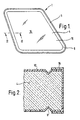
- FIGS. 1, 2 and 3 there is shown a synthetic resin window according to one embodiment of the present invention, which may be used in an automotive vehicle.
- the window module is designated by reference numeral 1, and is made of an appropriate thermoplastic resin by means of an injection molding or thermoforming process, as will be described hereinafter, and secured to a relevant vehicle chassis panel 6 with a mounting system.
- the window module 1 includes a window body portion 4 in the form of a sheet of transparent or semi-transparent synthetic resin, such as polycarbonate resin, acrylic resin or polyglutarimide resin.
- the window module 1 further includes a frame portion 5 extending along the peripheral edge of the window body portion 4.
- An abrasion resistant coating 10 covers the surfaces of the window body portion 4.
- a pressure sensitive foam tape 16 can be used as hereinafter described.
- a notch or groove 9 cut or molded into the window body portion 4 will enhance the formation of a breakaway zone 14.
- notches or other shaped grooves 9 are cut or molded into one or both sides of the synthetic resin glazing material.
- Some of the possible shapes shown in FIG. 3 can be cut or molded into the synthetic resin glazing materials as taught by US-A-4,635,420.
- a double sided adhesive foam strip 16 is adhered around the edge of the glazing material.
- the thermoplastic resin can be any high modulus transparent material, such as poly (methyl methacrylate) (PMMA), impact modified poly (methyl methacrylate), acrylic copolymers, poly (methyl methacrylate-co-alkyl acrylate) wherein the alkyl group contains 1 to 8 carbon atoms, acrylic blends, acrylic alloys, poly (vinyl chloride), poly (styrene-co-acrylonitrile) wherein the acrylonitrile polymer comprises up to 40% of the copolymer, polycarbonate, poly (ethylene terephthalate), polystyrene, poly (styrene-co-methyl methacrylate), poly ( alpha - methylstyrene-co-methyl methacrylate), poly ( alpha -methylstyrene-co-alkyl acrylate) wherein the alkyl group contains 1 to 8 carbon atoms, poly (vinyl acetate), poly (ester carbonate), polyarylate, poly (ether sulfone), or
- thermoplastic glazing material meets the following criteria: an elastic modulus in the range of 2.0 to 4.2 GPa, a coefficient of thermal expansion of 4 to 8 ⁇ 10 -5 cm/cm/° C at room temperature, and a continuous service temperature of at least 70° C or more for an acrylic thermoplastic. Ranges for other thermoplastic resins are above about 115° C for PMMI, and above about 110° C for polycarbonate.
- thermoplastic materials may be colored or tinted, for example, to reduce solar transmission levels.
- thermoplastics are usually formed into the shape and size of a window by using sheet or molding powder (pellets).
- the thermoplastic sheet can be from about 1.5 to 6 mm in thickness and drape-formed or thermoformed using an appropriate mold.
- the plastic sheet is heated to a temperature so that it softens and can easily take on the shape of a mold.
- the window thickness can be from between about 1.5 to 6 mm.
- the window 4 used in this invention has been treated on both sides with an abrasion resistant coating 10.
- This provides a hard surface that is not easily scratched.
- Coatings such as polysiloxanes, transparent thermosetting resins, UV-curable coatings, polyurethanes, or diamond-like abrasion resistant coatings may be practical for this use. Coatings may be applied by plasma deposition, ion implantation, ion-assisted coating, evaporation, sputter deposition, physical or chemical vapor deposition, thermal spraying, and plasma assisted depositions. Other abrasion resistant coatings are known in the art.
- thermoplastic part Before the coating process begins, the thermoplastic part is annealed in an oven to remove any residual stress.
- the polysiloxane used in this invention is applied in conjunction with a primer and is typically coated by dipping the plastic glazing part into a liquid coating solution. However, flow, sprayable, curtain and other coating techniques may also be used. After each coating step the part is dried in an oven at elevated temperature. Any hard coating could be used, though it would have to be compatible with both the thermoplastic and the mounting system.
- One adhesive used in this invention is a foam tape, made from acrylic based materials, and has a pressure sensitive adhesive on both sides of the tape. Or the tape could have a hot melt adhesive.
- the tape is typically 5 mm to 26 mm wide and from 1 mm to 7 mm thick.
- the foam density should be about from 0.3 to 0.8 grams per cubic centimeter.
- thermoplastic window such as polyurethane, or neoprene or any other type of foam material that can be formed into a tape with two adhesive layers.
- the tape should preferably be water and weather resistant. Any of these materials could be enhanced so that they meet these criteria by adding additives, stabilizers, plasticisers and blowing agents known in the art.
- the foam density is of importance in the performance of this invention. For instance, it has been shown that a tape of density in the lower part of the range given will tear during an impact to the plastic window, but a foam in the higher part of the density range will not tear. If the window does break, the foam with the higher density will more likely hold broken pieces in the plane of the window and may cause lacerations.
- the pressure sensitive adhesive on the vehicle side of the tape should be formulated to adhere well to the paint systems used on motor vehicles.
- the adhesive strength between the tape and the plastic or paint surface should be higher than the cohesive strength of the tape.
- a cohesive failure of the tape can be predicted by its mechanical properties.
- An attachment system such as Velcro could be engineered to provide the energy absorbing design to hold the thermoplastic window at low to moderate head impact velocities. At high head impact velocities, the specially designed Velcro attachment system could then rip itself apart, safely releasing the window module.
- a notch or groove 9 may be placed inward from the edge of the plastic window to provide a breakaway zone.
- Various types of notches are disclosed in U.S. Pat. No. 5,035,096. Any combination of notches could be used in conjunction with the window mounting techniques to define specific breakaway zones 14 in the plastic window.
- the notch depth is preferably between 10 and 80% of the thickness of the plastic window.
- the radius can be from about 5% of the part thickness to about 200% or more of the part thickness, and may be molded , cut, or machined into the thermoplastic glazing.
- the notch is designed in terms of radius, type of cross section, location along the perimeter (along any number or sections of the sides of the window), distance inward from the edge (1 to 100 mm, for example, so as to aesthetically pleasing) and depth, so that the section of the window inward of the notch or groove will break out along the notch at relatively high impact velocities, for example, above 32 kilometers per hour. At low to moderate head impact velocities, for example, 0 to 32 kilometers per hour, the notch should not break. This will provide for containment of the occupant under less severe impact conditions, greatly reducing the possibility of ejection of the occupant from the vehicle through the window opening.
- Tempered glass is a very high modulus, brittle material that is designed intentionally to break into small fragments upon impact. However, tempered glass breaks at an impact velocity that is relatively low compared to the typical crash velocities as specified in several government testing procedures (see 49CFR 571.214, below).
- thermoplastic materials in the invention are such that the plastic window will not break at the head velocities where tempered glass shatters, for example below 23 kilometers per hour. If used in combination with the mounting systems mentioned above, the whole glazing structure will be stretched or deflected out from the vehicle structure.
- the window module can be made to be pushed out so that the window remains intact and limits the likelihood of injury to the impacting occupant's head or body parts.
- the mounting system can be designed so that the window will be released from the vehicle in a safe manner.
- Either the window will detach itself from the mounting system, break along the breakaway zone cut into the window, or the window will break and any fragments will be safely released from the window frame by a notch breaking or, in one case, by a foam tape ripping itself apart.
- This invention is used for mounting plastic windows into motor vehicles.
- the types of windows are: windshields, moveable windows as found on the side of motor vehicles, side windows that do not move, opera windows, flipper windows, or other types of venting windows, and back windows.
- Types of motor vehicles are passenger cars, light trucks, multi-purpose vehicles, off-road vehicles, heavy trucks,buses, recreational vehicles and motor homes.
- HIC Head Injury Criteria
- the Chamois Laceration Scale is as follows: 0 Superficial Cuts Pass 1 Outer Layer Cuts Pass 2 Inner Layer Cuts Fail (Reference Society of Automotive Engineers Paper Number 860198 (1986).)
- Extruded sheet of PMMI 5 mm thick, is thermoformed into the shape and size of an automobile side quarter window.
- the plastic window is coated with an abrasion resistant coating, i.e., a polysiloxane.
- the window is pre-treated with a liquid primer and cleaner.
- Two automotive foam tapes with densities in the range of 0.5 to 0.65 and 0.6 to 0.75 grams per cubic centimeter, and 6.2 and 12.5 mm wide, are pressed onto the treated surface.
- the window and tape are then installed adhesively into a quarter window frame opening by revealing the second side of the foam tape.
- the window is tested by launching a human surrogate head (49 CFR572E defines head and geometry) at 26, 34 and 40 kilometers per hour towards the window. Data are collected regarding the head deceleration upon impact, the disposition of the window and any fragments, and the laceration is measured using a two-layer chamois skin placed over the head. The disposition, chamois laceration values, and HIC values of the window or its fragments are shown below.
- Extruded sheet of PMMI 5 mm thick, is thermoformed into the shape and size of an automobile side quarter window.
- the plastic window is dip coated with a polysiloxane abrasion resistant coating.
- a notch in the shape of a letter v, with a 60° angle, is cut 14mm inward from the outer edge of the window. The notch in several cases is from 2.5 to 3.0 mm deep.
- the window is pre-treated with a liquid primer and cleaner.
- Two automotive foam tapes with densities in the range of 0.5 to 0.65 grams per cubic centimeter, and 12.5 mm wide, are pressed onto the treated surface. The window and tape are then installed adhesively into a quarter window frame opening by revealing the second side of the foam tape.
- the window is mounted to the window aperture in a portion of the vehicle chassis panel.
- the window module is then tested by launching towards the test fixture a human surrogate head (49 CFR572E defines head and geometry) at 26, 34 and 40 kilometers per hour. Data are collected regarding the head deceleration upon impact, the disposition of the window and any fragments, and the laceration is measured using 2 layers of chamois skin placed over the head. The disposition, chamois laceration values, and HIC values of the window or its fragments are shown below.
- Extruded sheet of PMMI 5 mm thick, is thermoformed into the shape and size of an automobile side quarter window.
- the plastic window is dip coated with a polysiloxane abrasion resistant coating.
- a notch in the shape of a letter v, with a 60° angle, is cut 14mm inward from the outer edge of the several window.
- the notch is 3.0 mm deep.
- the window is pre-treated with a liquid primer and cleaner.
- An automotive foam tapes with densities in the range of 0.5 to 0.65 grams per cubic centimeter, and 6.2 and 12.5 mm wide, are pressed onto the treated surface.
- the window and tape are then installed adhesively into a quarter window frame opening by revealing the second side of the foam tape.
- the window is mounted to the window aperture in a portion of the vehicle chassis panel .
- the vehicle chassis panel adjacent to a vehicle seat is firmly attached to a test structure.
- SID anthropomorphic side impact dummy
- the window module is then tested by accelerating the whole test structure (dummy on bench adjacent to vehicle chassis panel) using a HYGE sled, where this acceleration results in head impact velocities of 36 to 37 kilometers per hour. Data are collected regarding the head deceleration upon impact, the disposition of the window and any fragments, and the laceration is measured using 2 layers of chamois skin placed over the head.
- Head Velocity (km/hr) Tape Width (mm) Notch Depth (mm) Window Disposition Chamois Laceration Scale Head Injury Criteria 42 12.5 3.0 break along notch 0 ⁇ 1000 38 12.5 3.0 break along notch 0 ⁇ 1000 38 6.2 0 window pop-out 0 ⁇ 1000
Landscapes
- Engineering & Computer Science (AREA)
- Mechanical Engineering (AREA)
- Window Of Vehicle (AREA)
- Laminated Bodies (AREA)
- Vehicle Interior And Exterior Ornaments, Soundproofing, And Insulation (AREA)
- Securing Of Glass Panes Or The Like (AREA)
- Injection Moulding Of Plastics Or The Like (AREA)
Applications Claiming Priority (2)
| Application Number | Priority Date | Filing Date | Title |
|---|---|---|---|
| US97347392A | 1992-11-09 | 1992-11-09 | |
| US973473 | 1992-11-09 |
Publications (2)
| Publication Number | Publication Date |
|---|---|
| EP0597624A1 EP0597624A1 (en) | 1994-05-18 |
| EP0597624B1 true EP0597624B1 (en) | 2001-10-10 |
Family
ID=25520940
Family Applications (1)
| Application Number | Title | Priority Date | Filing Date |
|---|---|---|---|
| EP93308799A Expired - Lifetime EP0597624B1 (en) | 1992-11-09 | 1993-11-03 | Energy absorbing mounting systems for vehicle windows |
Country Status (17)
| Country | Link |
|---|---|
| US (1) | US5419088A (cs) |
| EP (1) | EP0597624B1 (cs) |
| JP (1) | JPH06144007A (cs) |
| KR (1) | KR100302124B1 (cs) |
| CN (1) | CN1052691C (cs) |
| AU (1) | AU670633B2 (cs) |
| BR (1) | BR9304473A (cs) |
| CA (1) | CA2102254A1 (cs) |
| CZ (1) | CZ238593A3 (cs) |
| DE (1) | DE69330901T2 (cs) |
| ES (1) | ES2161705T3 (cs) |
| HU (1) | HU216624B (cs) |
| MX (1) | MX9306868A (cs) |
| PL (1) | PL300997A1 (cs) |
| RU (1) | RU2123434C1 (cs) |
| TW (1) | TW337769U (cs) |
| ZA (1) | ZA938301B (cs) |
Cited By (2)
| Publication number | Priority date | Publication date | Assignee | Title |
|---|---|---|---|---|
| US8998297B1 (en) | 2014-02-26 | 2015-04-07 | Google Inc. | Systems for mounting a vehicle windshield |
| US12304123B2 (en) | 2021-02-23 | 2025-05-20 | Srg Global Liria, S.L. | Pedestrian safe front panel/grille having a two-shot molded decorative part |
Families Citing this family (47)
| Publication number | Priority date | Publication date | Assignee | Title |
|---|---|---|---|---|
| US5525401A (en) * | 1994-10-24 | 1996-06-11 | Decoma International Inc. | Vehicle window and method of making the same |
| US5934737A (en) * | 1996-04-15 | 1999-08-10 | Chrysler Corporation | Dynamic impact energy absorbing assembly |
| FR2756292B1 (fr) * | 1996-11-26 | 1998-12-24 | Saint Gobain Vitrage | Procede de preparation d'une feuille en matiere plastique, cette feuille et vitrage la comportant |
| KR100456576B1 (ko) * | 1996-12-24 | 2005-04-22 | 현대자동차주식회사 | 자동차의도어글래스구조 |
| US5887393A (en) * | 1997-03-05 | 1999-03-30 | Excel Industries, Inc. | Plastic glazing window module |
| US5915780A (en) * | 1997-03-05 | 1999-06-29 | Excel Industries, Inc. | Encapsulated plastic glazing window module |
| FR2779990B1 (fr) * | 1998-06-19 | 2000-07-21 | Saint Gobain Vitrage | Vitrage en matiere plastique avec ajout de matiere plastique surmoule |
| FR2789947B1 (fr) * | 1999-02-22 | 2001-04-13 | Saint Gobain Vitrage | Dispositifs de fixation d'un vitrage pour vehicule automobile |
| US20010054814A1 (en) * | 1999-12-10 | 2001-12-27 | Bridgestone Corporation | Impact absorbing member and head protective member |
| US7018057B2 (en) * | 2000-08-23 | 2006-03-28 | Vtec Technologies, Llc | Transparent plastic optical components and abrasion resistant polymer substrates and methods for making the same |
| US6764129B2 (en) * | 2000-10-10 | 2004-07-20 | Kabushiki Kaisha Toyota Jidoshokki | Plastic window panel |
| FR2821319B1 (fr) * | 2001-02-26 | 2003-07-04 | Plastic Omnium Cie | Piece de carrosserie de custode |
| US6810635B2 (en) * | 2001-11-09 | 2004-11-02 | Steven R. Meizlish | Automotive window trim molding |
| HUP0500069A2 (hu) * | 2002-02-20 | 2005-04-28 | Saint-Gobain Glass France | Merev elemmel, adott esetben egy ráformázott műanyag részben befoglalt merev elemmel ellátott üvegezés |
| JP2004009965A (ja) * | 2002-06-10 | 2004-01-15 | Honda Motor Co Ltd | 車両のウインドシールド取付構造 |
| WO2004099295A1 (ja) † | 2003-05-12 | 2004-11-18 | Teijin Chemicals, Ltd. | シート状窓部材および窓構造体 |
| US7143979B2 (en) * | 2003-05-30 | 2006-12-05 | The Boeing Company | Vehicle windshield |
| US7621299B2 (en) * | 2003-10-03 | 2009-11-24 | Cabot Corporation | Method and apparatus for filling a vessel with particulate matter |
| DE102004015920A1 (de) * | 2004-03-31 | 2005-10-20 | Webasto Ag Fahrzeugtechnik | Anordnung zum Verschließen einer Öffnung eines Fahrzeugs mit einem Splitterschutzelement |
| DE102004041866A1 (de) * | 2004-08-27 | 2006-03-02 | Schott Ag | Nachtsicht-Scheinwerfer |
| US7802413B2 (en) * | 2004-10-04 | 2010-09-28 | The Boeing Company | Apparatus and methods for reinforcing a structural panel |
| US7530531B2 (en) | 2004-10-04 | 2009-05-12 | The Boeing Company | Apparatus and methods for installing an aircraft window panel |
| US7823832B2 (en) * | 2004-10-04 | 2010-11-02 | The Boeing Company | Injection-molded window panel and related methods |
| RU2432367C2 (ru) * | 2006-06-07 | 2011-10-27 | Зефирос, Инк. | Способ уплотнения, экранирования и упрочнения части самоходного транспортного средства |
| US7758104B2 (en) * | 2007-02-13 | 2010-07-20 | Clark Equipment Company | Window arrangement for a construction vehicle |
| EP2139660B1 (en) | 2007-04-27 | 2013-12-25 | Exatec, LLC. | Abrasion resistant plastic glazing with in-mold coating |
| US20080272613A1 (en) * | 2007-05-01 | 2008-11-06 | Weiss Keith D | Encapsulated plastic panel and method of making the same |
| WO2008150955A1 (en) * | 2007-06-04 | 2008-12-11 | Dow Global Technologies Inc. | Energy absorbing member |
| US8091955B2 (en) * | 2009-04-16 | 2012-01-10 | Clark Equipment Company | Sliding window for work vehicle cab |
| DE102009034936B4 (de) * | 2009-07-28 | 2013-04-25 | Webasto Ag | Windschutzscheibe eines Kraftfahrzeuges |
| DE102010026669A1 (de) * | 2010-07-09 | 2012-01-12 | Daimler Ag | Verfahren zur Montage eines Strangprofils |
| EP2581243B1 (en) * | 2011-10-12 | 2019-10-09 | Volvo Car Corporation | Controlled collapse of car windshield |
| DE102011116045A1 (de) * | 2011-10-17 | 2013-04-18 | GM Global Technology Operations LLC (n. d. Gesetzen des Staates Delaware) | Kraftfahrzeugkarosserie mit plasmabehandelter Klebefläche |
| CA2820253C (en) * | 2012-08-08 | 2020-10-27 | Shrenik Shah | System and method for improving impact safety |
| DE102012018331A1 (de) | 2012-09-15 | 2013-03-21 | Daimler Ag | Spritzgussverfahren zur Herstellung eines mehrschichtigen Kraftfahrzeug - Kunststofffensters und Spritzgussanlage dafür |
| ES2601785T3 (es) * | 2013-09-13 | 2017-02-16 | Dmg Mori Seiki Aktiengesellschaft | Sección de cubierta de cabina de una máquina herramienta con elemento de marco y cristal |
| CN103707743B (zh) * | 2013-12-31 | 2016-04-06 | 浙江美盾防护技术有限公司 | 汽车用三角窗及其制造方法 |
| WO2017220903A1 (fr) * | 2016-06-20 | 2017-12-28 | Compagnie Plastic Omnium | Ouvrant en matiere plastique conservant sa fonction d'obturation de l'ouverture de la caisse en cas de choc |
| US9982969B2 (en) | 2016-08-11 | 2018-05-29 | Joe Klingman | Patrol vehicle and personal protection system |
| US10906494B1 (en) * | 2017-01-19 | 2021-02-02 | State Farm Mutual Automobile Insurance Company | Systems and methods for predicting occupant location based on vehicular collision |
| FR3063254B1 (fr) * | 2017-02-27 | 2019-03-22 | Saint-Gobain Glass France | Procede d'encapsulation |
| US11021126B1 (en) * | 2017-06-30 | 2021-06-01 | Apple Inc. | Windshield area intrusion control |
| CN107244061B (zh) * | 2017-07-24 | 2019-02-22 | 福耀玻璃工业集团股份有限公司 | 一种塑料车窗的模压成型方法及其成型装置 |
| DE102017124579A1 (de) * | 2017-10-20 | 2019-04-25 | Dalphi Metal Espana, S.A. | Fahrzeuginsassen-rückhaltesystem mit einem gassack |
| CN108297510B (zh) * | 2017-12-26 | 2020-04-17 | 神通科技集团股份有限公司 | 一种自动挡液式塑料玻璃及淋涂方法 |
| CN112721585A (zh) * | 2021-01-04 | 2021-04-30 | 林俊钦 | 一种防止汽车车窗玻璃炸裂的方法 |
| DE202024106655U1 (de) | 2024-11-19 | 2024-12-09 | Krd Sicherheitstechnik Gmbh | Fahrzeug mit einer Sicherheitsscheibe aus Kunststoff und Nachrüstsatz |
Family Cites Families (25)
| Publication number | Priority date | Publication date | Assignee | Title |
|---|---|---|---|---|
| BE786856A (fr) * | 1971-07-28 | 1973-01-29 | Saint Gobain | Fixation de pare-brise en verre |
| FR2157189A5 (en) * | 1971-10-21 | 1973-06-01 | Peugeot & Renault | Windscreen seals - moulded in situ with the use of a flexible mould which can be dismantled |
| US4068428A (en) * | 1976-10-22 | 1978-01-17 | Peterson Iii O James | Insulation window |
| US4246374A (en) * | 1979-04-23 | 1981-01-20 | Rohm And Haas Company | Imidized acrylic polymers |
| US4217424A (en) * | 1979-05-07 | 1980-08-12 | Rohm And Haas Company | Impact modification of polyglutarimides |
| DE2944753C2 (de) * | 1979-11-02 | 1986-11-13 | Hermann Prof. Dr.-Ing. Appel | Vorrichtung zur Halterung einer Scheibe an der Karosserie eines Fahrzeuges |
| US4409758A (en) * | 1981-03-12 | 1983-10-18 | Plaskolite, Inc. | Perimeter strip for magnetically attractable extruded plastic window system |
| US4477499A (en) * | 1982-09-07 | 1984-10-16 | General Electric Company | Thermoformable silicone resin coating composition and dual component coating system for polycarbonate |
| US4616456A (en) * | 1983-04-25 | 1986-10-14 | Parker Gregory H | Insulated window cover apparatus |
| US4663228A (en) * | 1983-05-03 | 1987-05-05 | Advanced Glass Systems Corp. | Laminated safety glass |
| US4645708A (en) * | 1984-08-13 | 1987-02-24 | General Electric Company | Internal protective coatings for sensitive resinous laminae |
| US4635420A (en) * | 1985-04-22 | 1987-01-13 | Almac Plastics Inc. | Motor vehicle glazing assembly and method of manufacture thereof |
| DE3518145A1 (de) * | 1985-05-21 | 1986-11-27 | Elkamet-Werk Lahn-Kunststoff GmbH, 7100 Heilbronn | Fensterscheibe insbesondere fuer fahrzeuge |
| US4727117A (en) * | 1985-08-27 | 1988-02-23 | Rohm And Haas Company | Imide polymers |
| US4700525A (en) * | 1986-04-16 | 1987-10-20 | Donnelly Corporation | Molded panel assembly and fasteners therefor |
| US4759810A (en) * | 1987-05-01 | 1988-07-26 | Libbey-Owens-Ford Co. | Method and apparatus for applying a gasket to an object |
| US4839206A (en) * | 1987-09-15 | 1989-06-13 | Norton Company | Double sided adhesive tape |
| SU1544596A1 (ru) * | 1988-01-06 | 1990-02-23 | Производственное Объединение "Ташкентский Тракторный Завод Им.50-Летия Ссср" | Окно кабины транспортного средства |
| JPH066311B2 (ja) * | 1988-02-18 | 1994-01-26 | 株式会社池田硝子工業所 | モールまたはホルダー付板状体の製造方法 |
| DE3821457A1 (de) * | 1988-06-25 | 1989-12-28 | Flachglas Ag | Einbaufertiges aggregat aus einer kraftfahrzeugscheibe und einem einbaurahmen |
| US5066723A (en) * | 1988-07-15 | 1991-11-19 | Exxon Chemical Patents Inc. | Impact-modified polymers (p-1304) |
| US5061531A (en) * | 1988-07-18 | 1991-10-29 | M. L. Burke, Co. | Glazing utilizing rim process to produce sealed and framed insulating glass unit |
| DE3843080A1 (de) * | 1988-12-21 | 1990-07-12 | Bayerische Motoren Werke Ag | Vorrichtung zum festlegen von anklebbaren kraftfahrzeugfensterscheiben |
| US5027569A (en) * | 1990-08-20 | 1991-07-02 | The Standard Products Company | Encapsulated static seal |
| US5035096A (en) * | 1990-08-24 | 1991-07-30 | Hashimoto Forming Industry Co., Ltd. | Synthetic resin window for automotive vehicles or the like |
-
1993
- 1993-06-29 JP JP5157772A patent/JPH06144007A/ja active Pending
- 1993-11-02 CA CA002102254A patent/CA2102254A1/en not_active Abandoned
- 1993-11-03 DE DE69330901T patent/DE69330901T2/de not_active Expired - Fee Related
- 1993-11-03 ES ES93308799T patent/ES2161705T3/es not_active Expired - Lifetime
- 1993-11-03 EP EP93308799A patent/EP0597624B1/en not_active Expired - Lifetime
- 1993-11-04 MX MX9306868A patent/MX9306868A/es not_active IP Right Cessation
- 1993-11-05 RU RU93050171A patent/RU2123434C1/ru active
- 1993-11-08 CZ CZ932385A patent/CZ238593A3/cs unknown
- 1993-11-08 ZA ZA938301A patent/ZA938301B/xx unknown
- 1993-11-08 HU HU9303158A patent/HU216624B/hu not_active IP Right Cessation
- 1993-11-08 BR BR9304473A patent/BR9304473A/pt not_active IP Right Cessation
- 1993-11-09 KR KR1019930023665A patent/KR100302124B1/ko not_active Expired - Fee Related
- 1993-11-09 AU AU50526/93A patent/AU670633B2/en not_active Ceased
- 1993-11-09 PL PL93300997A patent/PL300997A1/xx unknown
- 1993-11-09 CN CN93114453A patent/CN1052691C/zh not_active Expired - Fee Related
- 1993-11-25 TW TW085201339U patent/TW337769U/zh unknown
-
1994
- 1994-06-28 US US08/266,997 patent/US5419088A/en not_active Expired - Fee Related
Cited By (2)
| Publication number | Priority date | Publication date | Assignee | Title |
|---|---|---|---|---|
| US8998297B1 (en) | 2014-02-26 | 2015-04-07 | Google Inc. | Systems for mounting a vehicle windshield |
| US12304123B2 (en) | 2021-02-23 | 2025-05-20 | Srg Global Liria, S.L. | Pedestrian safe front panel/grille having a two-shot molded decorative part |
Also Published As
| Publication number | Publication date |
|---|---|
| US5419088A (en) | 1995-05-30 |
| RU2123434C1 (ru) | 1998-12-20 |
| ES2161705T3 (es) | 2001-12-16 |
| AU5052693A (en) | 1994-05-19 |
| DE69330901T2 (de) | 2002-04-11 |
| CA2102254A1 (en) | 1994-05-10 |
| JPH06144007A (ja) | 1994-05-24 |
| KR940011238A (ko) | 1994-06-20 |
| HUT67729A (en) | 1995-04-28 |
| CN1052691C (zh) | 2000-05-24 |
| BR9304473A (pt) | 1994-05-17 |
| CZ238593A3 (en) | 1994-10-19 |
| TW337769U (en) | 1998-08-01 |
| MX9306868A (es) | 1995-01-31 |
| PL300997A1 (en) | 1994-05-16 |
| AU670633B2 (en) | 1996-07-25 |
| HU216624B (hu) | 1999-07-28 |
| HU9303158D0 (en) | 1994-03-28 |
| DE69330901D1 (de) | 2001-11-15 |
| CN1096256A (zh) | 1994-12-14 |
| ZA938301B (en) | 1994-07-01 |
| KR100302124B1 (ko) | 2001-11-22 |
| EP0597624A1 (en) | 1994-05-18 |
Similar Documents
| Publication | Publication Date | Title |
|---|---|---|
| EP0597624B1 (en) | Energy absorbing mounting systems for vehicle windows | |
| US4242403A (en) | Automotive glazing units and method of producing the same | |
| US5820201A (en) | High impact barrier for automobile body exterior components | |
| US4112171A (en) | Automotive glazing structure and method of producing the same | |
| US5521760A (en) | Energy absorbing rearview mirror assembly | |
| US3900673A (en) | Automotive glazing structure | |
| US4232080A (en) | Safety window comprising self-healing polymeric layer | |
| US4059469A (en) | Glazing units, methods of making the same and adhesion promoters therefor | |
| US4543283A (en) | Encapsulated glazing product | |
| US7114760B2 (en) | Safety shield window insert | |
| PL190583B1 (pl) | Szyba zespolona i jej zastosowanie | |
| KR102529169B1 (ko) | 충격 성능이 개선된 만곡된 커버 유리를 갖는 차량 인테리어 시스템 및 이를 형성하는 방법 | |
| KR20160060114A (ko) | 중합체 판유리 및 유리 판유리로 구성된 복합 판유리 | |
| KR102346586B1 (ko) | 자동차유리 보호필름 | |
| US11034136B2 (en) | Intrusion resistant laminated automotive glazing | |
| US5283696A (en) | Shatter resistant mirror | |
| CN118722161B (zh) | 车窗玻璃组件和车辆 | |
| KR20190011528A (ko) | 자동차 전파 탐지기 방호용 전방 커버 및 그 제조방법 | |
| CN115534635A (zh) | 车辆用窗玻璃 | |
| KR20190034882A (ko) | 자동차 전파 탐지기 방호 커버 제조용 금형 및 이를 이용한 방호 커버의 제조방법 | |
| JPS5948775B2 (ja) | ガラスシ−ト組体 | |
| JPH06170881A (ja) | 合成樹脂製窓の成形方法 | |
| Raymond | Mounting Systems for Plastic Glazing-Part 1-Component Level Testing | |
| CN120716429A (zh) | 车辆用窗玻璃 | |
| JPH06190867A (ja) | 合成樹脂製の窓及びその成形方法 |
Legal Events
| Date | Code | Title | Description |
|---|---|---|---|
| PUAI | Public reference made under article 153(3) epc to a published international application that has entered the european phase |
Free format text: ORIGINAL CODE: 0009012 |
|
| 17P | Request for examination filed |
Effective date: 19931112 |
|
| AK | Designated contracting states |
Kind code of ref document: A1 Designated state(s): DE ES FR GB IT NL SE |
|
| 17Q | First examination report despatched |
Effective date: 19970310 |
|
| GRAG | Despatch of communication of intention to grant |
Free format text: ORIGINAL CODE: EPIDOS AGRA |
|
| GRAG | Despatch of communication of intention to grant |
Free format text: ORIGINAL CODE: EPIDOS AGRA |
|
| GRAH | Despatch of communication of intention to grant a patent |
Free format text: ORIGINAL CODE: EPIDOS IGRA |
|
| GRAH | Despatch of communication of intention to grant a patent |
Free format text: ORIGINAL CODE: EPIDOS IGRA |
|
| GRAA | (expected) grant |
Free format text: ORIGINAL CODE: 0009210 |
|
| AK | Designated contracting states |
Kind code of ref document: B1 Designated state(s): DE ES FR GB IT NL SE |
|
| PG25 | Lapsed in a contracting state [announced via postgrant information from national office to epo] |
Ref country code: NL Free format text: LAPSE BECAUSE OF FAILURE TO SUBMIT A TRANSLATION OF THE DESCRIPTION OR TO PAY THE FEE WITHIN THE PRESCRIBED TIME-LIMIT Effective date: 20011010 |
|
| PGFP | Annual fee paid to national office [announced via postgrant information from national office to epo] |
Ref country code: FR Payment date: 20011012 Year of fee payment: 9 |
|
| PGFP | Annual fee paid to national office [announced via postgrant information from national office to epo] |
Ref country code: SE Payment date: 20011018 Year of fee payment: 9 |
|
| PGFP | Annual fee paid to national office [announced via postgrant information from national office to epo] |
Ref country code: GB Payment date: 20011019 Year of fee payment: 9 |
|
| PGFP | Annual fee paid to national office [announced via postgrant information from national office to epo] |
Ref country code: NL Payment date: 20011026 Year of fee payment: 9 |
|
| PGFP | Annual fee paid to national office [announced via postgrant information from national office to epo] |
Ref country code: DE Payment date: 20011029 Year of fee payment: 9 |
|
| PGFP | Annual fee paid to national office [announced via postgrant information from national office to epo] |
Ref country code: ES Payment date: 20011113 Year of fee payment: 9 |
|
| REF | Corresponds to: |
Ref document number: 69330901 Country of ref document: DE Date of ref document: 20011115 |
|
| REG | Reference to a national code |
Ref country code: ES Ref legal event code: FG2A Ref document number: 2161705 Country of ref document: ES Kind code of ref document: T3 |
|
| REG | Reference to a national code |
Ref country code: GB Ref legal event code: IF02 |
|
| ET | Fr: translation filed | ||
| NLV1 | Nl: lapsed or annulled due to failure to fulfill the requirements of art. 29p and 29m of the patents act | ||
| PLBE | No opposition filed within time limit |
Free format text: ORIGINAL CODE: 0009261 |
|
| 26N | No opposition filed | ||
| PG25 | Lapsed in a contracting state [announced via postgrant information from national office to epo] |
Ref country code: GB Free format text: LAPSE BECAUSE OF NON-PAYMENT OF DUE FEES Effective date: 20021103 |
|
| PG25 | Lapsed in a contracting state [announced via postgrant information from national office to epo] |
Ref country code: SE Free format text: LAPSE BECAUSE OF NON-PAYMENT OF DUE FEES Effective date: 20021104 Ref country code: ES Free format text: LAPSE BECAUSE OF NON-PAYMENT OF DUE FEES Effective date: 20021104 |
|
| PG25 | Lapsed in a contracting state [announced via postgrant information from national office to epo] |
Ref country code: DE Free format text: LAPSE BECAUSE OF NON-PAYMENT OF DUE FEES Effective date: 20030603 |
|
| GBPC | Gb: european patent ceased through non-payment of renewal fee | ||
| EUG | Se: european patent has lapsed | ||
| PG25 | Lapsed in a contracting state [announced via postgrant information from national office to epo] |
Ref country code: FR Free format text: LAPSE BECAUSE OF NON-PAYMENT OF DUE FEES Effective date: 20030731 |
|
| REG | Reference to a national code |
Ref country code: FR Ref legal event code: ST |
|
| REG | Reference to a national code |
Ref country code: ES Ref legal event code: FD2A Effective date: 20031213 |
|
| PG25 | Lapsed in a contracting state [announced via postgrant information from national office to epo] |
Ref country code: IT Free format text: LAPSE BECAUSE OF NON-PAYMENT OF DUE FEES;WARNING: LAPSES OF ITALIAN PATENTS WITH EFFECTIVE DATE BEFORE 2007 MAY HAVE OCCURRED AT ANY TIME BEFORE 2007. THE CORRECT EFFECTIVE DATE MAY BE DIFFERENT FROM THE ONE RECORDED. Effective date: 20051103 |