EP0597634A2 - Öffnungsverfahren von Fenstern in dielektrischen Schichten einer integrierten Schaltung - Google Patents
Öffnungsverfahren von Fenstern in dielektrischen Schichten einer integrierten Schaltung Download PDFInfo
- Publication number
- EP0597634A2 EP0597634A2 EP93308839A EP93308839A EP0597634A2 EP 0597634 A2 EP0597634 A2 EP 0597634A2 EP 93308839 A EP93308839 A EP 93308839A EP 93308839 A EP93308839 A EP 93308839A EP 0597634 A2 EP0597634 A2 EP 0597634A2
- Authority
- EP
- European Patent Office
- Prior art keywords
- layer
- substrate
- dielectric
- over
- forming
- Prior art date
- Legal status (The legal status is an assumption and is not a legal conclusion. Google has not performed a legal analysis and makes no representation as to the accuracy of the status listed.)
- Withdrawn
Links
Images
Classifications
-
- H—ELECTRICITY
- H10—SEMICONDUCTOR DEVICES; ELECTRIC SOLID-STATE DEVICES NOT OTHERWISE PROVIDED FOR
- H10W—GENERIC PACKAGES, INTERCONNECTIONS, CONNECTORS OR OTHER CONSTRUCTIONAL DETAILS OF DEVICES COVERED BY CLASS H10
- H10W20/00—Interconnections in chips, wafers or substrates
- H10W20/01—Manufacture or treatment
- H10W20/071—Manufacture or treatment of dielectric parts thereof
- H10W20/081—Manufacture or treatment of dielectric parts thereof by forming openings in the dielectric parts
- H10W20/082—Manufacture or treatment of dielectric parts thereof by forming openings in the dielectric parts the openings being tapered via holes
-
- H—ELECTRICITY
- H10—SEMICONDUCTOR DEVICES; ELECTRIC SOLID-STATE DEVICES NOT OTHERWISE PROVIDED FOR
- H10W—GENERIC PACKAGES, INTERCONNECTIONS, CONNECTORS OR OTHER CONSTRUCTIONAL DETAILS OF DEVICES COVERED BY CLASS H10
- H10W20/00—Interconnections in chips, wafers or substrates
- H10W20/01—Manufacture or treatment
- H10W20/071—Manufacture or treatment of dielectric parts thereof
- H10W20/081—Manufacture or treatment of dielectric parts thereof by forming openings in the dielectric parts
-
- H—ELECTRICITY
- H10—SEMICONDUCTOR DEVICES; ELECTRIC SOLID-STATE DEVICES NOT OTHERWISE PROVIDED FOR
- H10W—GENERIC PACKAGES, INTERCONNECTIONS, CONNECTORS OR OTHER CONSTRUCTIONAL DETAILS OF DEVICES COVERED BY CLASS H10
- H10W20/00—Interconnections in chips, wafers or substrates
- H10W20/01—Manufacture or treatment
- H10W20/071—Manufacture or treatment of dielectric parts thereof
- H10W20/092—Manufacture or treatment of dielectric parts thereof by smoothing the dielectric parts
Definitions
- the present invention relates to integrated circuits in general, and more particularly to integrated circuits having planarized dielectrics and methods for their fabrication.
- windows also termed “contacts” or “vias”
- conductive material is deposited within the window. Conductive material may also be deposited over the dielectric.
- the conductive layer is then lithographically patterned to form electrical conductors, often termed "runners.”
- runners electrical conductors
- a planar surface reduces the depth of field requirements for the optical system used to expose the resist layer that defines the pattern.
- planarization of the first dielectric layer i.e., the dielectric layer adjacent the gate and source/drain regions
- resist etchback involves depositing a resist material on the surface to be planarized. Since the resist is a liquid, its top surface assumes a flat profile regardless of the underlying irregularities. A plasma etch of the hardened resist and the underlying dielectric causes the flat surface of the resist to be transferred into the underlying dielectric since the etch rate of the resist is chosen to be similar to that of the dielectric. In another technique, a mechanical wafer polisher is used to planarize the surface of the dielectric.
- planarization though desirable for the reasons mentioned above, presents certain problems in subsequent processing.
- the etching problem is addressed by the present invention which includes forming a raised topographic feature upon a substrate; and forming a first layer upon the topographic feature; the first layer does not cover the substrate and it has a predetermined thickness. Then a second layer is formed upon the first layer and upon the substrate. The second layer is then planarized. The first and second layers are selectively etched to create first and second openings; the first opening is over the topographic feature and the second opening is over the substrate. The thickness of the first layer is chosen so that the first opening exposes the topographic feature at the same time that the second opening exposes the substrate.
- the topographic feature may be a gate or runner.
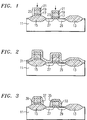
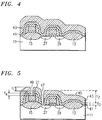
- FIGS. 1-5 are cross-sectional views which schematically show an illustrative embodiment of the present invention.
- Reference numeral 11 denotes a substrate which may be silicon, epitaxial silicon, doped silicon, etc.
- Reference numerals 13 and 15 denote field oxides which may, for example, be formed by the LOCOS (local oxidation of silicon) process.
- Reference numerals 17 and 19 denote, respectively, gate dielectric (which is typically silicon dioxide, although silicon oxynitride may be considered suitable) and gate conductor which is a conductive material such as polysilicon.
- Reference numeral 21 denotes a dielectric material which, illustratively, may be an oxide of silicon formed from TEOS.
- the structure of FIG. 1 may be formed (after definition of field oxides 13 and 15) by depositing a blanket dielectric layer, followed by a blanket conductive layer, followed by a blanket dielectric layer.
- a photoresist is spun on top of the three layers and subsequently patterned. The patterned photoresist is then used as a mask to etch the underlying dielectric layer. After the underlying dielectric layer is etched, the photoresist may be optionally removed and the already-etched dielectric used as a mask for etching the underlying conductor. Alternatively, the photoresist may be permitted to remain in place.
- the term "hard mask" etching is applied to those processes in which the overlying dielectric serves as a mask for etching an underlying layer.
- gate 19 and runner 25 are defined.
- the thickness of overlying dielectric layer 21 is chosen with particular care as will be described below.
- source and drain regions 27 and 29 may be formed, typically, by ion implantation.
- dielectric layer 31 may (optionally) be blanket deposited and subsequently etched to form spacers 33, 35, 37 and 39.
- spacers 33, 35, 37 and 39 may be blanket deposited and subsequently etched to form spacers 33, 35, 37 and 39.
- the use of single layer or multi-layered spacers is optional.
- a dielectric layer 41 which may, illustratively, be TEOS is formed. Then a second dielectric layer 43 which, illustratively, may be TEOS doped with dopants such as boron and/or phosphorus, is formed over layer 41.
- a dielectric layer 41 which may, illustratively, be TEOS is formed.
- a second dielectric layer 43 which, illustratively, may be TEOS doped with dopants such as boron and/or phosphorus, is formed over layer 41.
- dielectric 43 is either smoothed or planarized, thereby producing smooth or planarized upper surface 45.
- Dielectric material 43 (which is typically BPTEOS) is chosen to have an etch rate which is faster than that of dielectric 41 (which is typically undoped TEOS).
- Dielectric layer 21 which caps runner 25 is also chosen to have an etch rate which is slower than the etch rate of dielectric layer 43. Examination of FIG. 5 shows that the etching process over runner 25 must first traverse a thickness t1 of relatively fast etching dielectric 43 and then traverse thickness t3 of slower etching dielectric 41 and thickness t4 of slower etching dielectric 21.
- openings 49 and 47 are tapered.
- Various etching processes may be used to create the tapered structure shown on the figure. Tapered openings are useful if they are to be subsequently filled with aluminum. Should a tungsten plug process be desired instead, openings 49 and 47 may be created with straight sides.
- dielectric 41 may be eliminated if the process designer has no fear of migration of dopants from dielectric 43 into substrate 11.
Landscapes
- Internal Circuitry In Semiconductor Integrated Circuit Devices (AREA)
- Insulated Gate Type Field-Effect Transistor (AREA)
- Drying Of Semiconductors (AREA)
- Formation Of Insulating Films (AREA)
- Physical Vapour Deposition (AREA)
- ing And Chemical Polishing (AREA)
- Electrodes Of Semiconductors (AREA)
Applications Claiming Priority (2)
| Application Number | Priority Date | Filing Date | Title |
|---|---|---|---|
| US975235 | 1992-11-12 | ||
| US07/975,235 US5268332A (en) | 1992-11-12 | 1992-11-12 | Method of integrated circuit fabrication having planarized dielectrics |
Publications (2)
| Publication Number | Publication Date |
|---|---|
| EP0597634A2 true EP0597634A2 (de) | 1994-05-18 |
| EP0597634A3 EP0597634A3 (en) | 1994-08-24 |
Family
ID=25522812
Family Applications (1)
| Application Number | Title | Priority Date | Filing Date |
|---|---|---|---|
| EP9393308839A Withdrawn EP0597634A3 (en) | 1992-11-12 | 1993-11-04 | Method of opening windows in dielectric layers of an integrated circuit. |
Country Status (5)
| Country | Link |
|---|---|
| US (1) | US5268332A (de) |
| EP (1) | EP0597634A3 (de) |
| JP (1) | JPH06224188A (de) |
| KR (1) | KR100276146B1 (de) |
| TW (1) | TW247370B (de) |
Families Citing this family (4)
| Publication number | Priority date | Publication date | Assignee | Title |
|---|---|---|---|---|
| JP2926864B2 (ja) * | 1990-04-12 | 1999-07-28 | ソニー株式会社 | 銅系金属膜のエッチング方法 |
| US6297110B1 (en) * | 1994-07-29 | 2001-10-02 | Stmicroelectronics, Inc. | Method of forming a contact in an integrated circuit |
| CA2223588C (en) | 1995-06-07 | 2004-01-06 | Noven Pharmaceuticals, Inc. | Transdermal compositions containing low molecular weight drugs which are liquid at room temperatures |
| CN102157437B (zh) * | 2010-02-11 | 2013-12-25 | 中国科学院微电子研究所 | 半导体结构的形成方法 |
Family Cites Families (3)
| Publication number | Priority date | Publication date | Assignee | Title |
|---|---|---|---|---|
| US4708770A (en) * | 1986-06-19 | 1987-11-24 | Lsi Logic Corporation | Planarized process for forming vias in silicon wafers |
| EP0263220B1 (de) * | 1986-10-08 | 1992-09-09 | International Business Machines Corporation | Verfahren zur Herstellung einer Kontaktöffnung mit gewünschter Schräge in einer zusammengesetzten Schicht, die mit Photoresist maskiert ist |
| US5022958A (en) * | 1990-06-27 | 1991-06-11 | At&T Bell Laboratories | Method of etching for integrated circuits with planarized dielectric |
-
1992
- 1992-11-12 US US07/975,235 patent/US5268332A/en not_active Expired - Lifetime
-
1993
- 1993-11-04 EP EP9393308839A patent/EP0597634A3/en not_active Withdrawn
- 1993-11-06 TW TW082109364A patent/TW247370B/zh not_active IP Right Cessation
- 1993-11-11 KR KR1019930023860A patent/KR100276146B1/ko not_active Expired - Lifetime
- 1993-11-12 JP JP5282863A patent/JPH06224188A/ja not_active Withdrawn
Also Published As
| Publication number | Publication date |
|---|---|
| KR100276146B1 (ko) | 2001-01-15 |
| KR940012505A (ko) | 1994-06-23 |
| TW247370B (de) | 1995-05-11 |
| JPH06224188A (ja) | 1994-08-12 |
| EP0597634A3 (en) | 1994-08-24 |
| US5268332A (en) | 1993-12-07 |
Similar Documents
| Publication | Publication Date | Title |
|---|---|---|
| US6498096B2 (en) | Borderless contact to diffusion with respect to gate conductor and methods for fabricating | |
| US5447874A (en) | Method for making a semiconductor device comprising a dual metal gate using a chemical mechanical polish | |
| US6140238A (en) | Self-aligned copper interconnect structure and method of manufacturing same | |
| EP0284840B1 (de) | Verfahren zur Herstellung von gleichmässigen Materialschichten | |
| US6033980A (en) | Method of forming submicron contacts and vias in an integrated circuit | |
| US6165889A (en) | Process for forming trenches and contacts during the formation of a semiconductor memory device | |
| US5795811A (en) | Method for forming insulating films in semiconductor devices | |
| US5342808A (en) | Aperture size control for etched vias and metal contacts | |
| JPH0745714A (ja) | 半導体集積回路装置及びその製造方法 | |
| US6180517B1 (en) | Method of forming submicron contacts and vias in an integrated circuit | |
| US5369303A (en) | Self-aligned contact process | |
| US5437763A (en) | Method for formation of contact vias in integrated circuits | |
| KR20000013550A (ko) | 반도체 장치의 자기 정렬 콘택 형성 방법 | |
| US6278189B1 (en) | High density integrated circuits using tapered and self-aligned contacts | |
| US6114235A (en) | Multipurpose cap layer dielectric | |
| US5759867A (en) | Method of making a disposable corner etch stop-spacer for borderless contacts | |
| EP0632495A2 (de) | Verfahren zur Herstellen von Mikrograben für Isolationszonen für Halbleiteranordnungen | |
| US5895269A (en) | Methods for preventing deleterious punch-through during local interconnect formation | |
| US5268332A (en) | Method of integrated circuit fabrication having planarized dielectrics | |
| US6306741B1 (en) | Method of patterning gate electrodes with high K gate dielectrics | |
| US6222255B1 (en) | Method of creating an interconnect in a substrate and semiconductor device employing the same | |
| US5966632A (en) | Method of forming borderless metal to contact structure | |
| US6245657B1 (en) | Self-aligned, low contact resistance, via fabrication process | |
| US5904559A (en) | Three dimensional contact or via structure with multiple sidewall contacts | |
| US5504039A (en) | Method for making a self-aligned oxide gate cap |
Legal Events
| Date | Code | Title | Description |
|---|---|---|---|
| PUAI | Public reference made under article 153(3) epc to a published international application that has entered the european phase |
Free format text: ORIGINAL CODE: 0009012 |
|
| AK | Designated contracting states |
Kind code of ref document: A2 Designated state(s): DE ES FR GB IT |
|
| RAP3 | Party data changed (applicant data changed or rights of an application transferred) |
Owner name: AT&T CORP. |
|
| PUAL | Search report despatched |
Free format text: ORIGINAL CODE: 0009013 |
|
| AK | Designated contracting states |
Kind code of ref document: A3 Designated state(s): DE ES FR GB IT |
|
| 17P | Request for examination filed |
Effective date: 19950209 |
|
| 17Q | First examination report despatched |
Effective date: 19961014 |
|
| 18D | Application deemed to be withdrawn |
Effective date: 20000222 |