EP0601836B1 - Farbphotographisches lichtempfindliches Silberhalogenidmaterial - Google Patents
Farbphotographisches lichtempfindliches Silberhalogenidmaterial Download PDFInfo
- Publication number
- EP0601836B1 EP0601836B1 EP93309829A EP93309829A EP0601836B1 EP 0601836 B1 EP0601836 B1 EP 0601836B1 EP 93309829 A EP93309829 A EP 93309829A EP 93309829 A EP93309829 A EP 93309829A EP 0601836 B1 EP0601836 B1 EP 0601836B1
- Authority
- EP
- European Patent Office
- Prior art keywords
- hydrogen atoms
- silver halide
- group
- sensitive material
- photographic light
- Prior art date
- Legal status (The legal status is an assumption and is not a legal conclusion. Google has not performed a legal analysis and makes no representation as to the accuracy of the status listed.)
- Expired - Lifetime
Links
Classifications
-
- G—PHYSICS
- G03—PHOTOGRAPHY; CINEMATOGRAPHY; ANALOGOUS TECHNIQUES USING WAVES OTHER THAN OPTICAL WAVES; ELECTROGRAPHY; HOLOGRAPHY
- G03C—PHOTOSENSITIVE MATERIALS FOR PHOTOGRAPHIC PURPOSES; PHOTOGRAPHIC PROCESSES, e.g. CINE, X-RAY, COLOUR, STEREO-PHOTOGRAPHIC PROCESSES; AUXILIARY PROCESSES IN PHOTOGRAPHY
- G03C7/00—Multicolour photographic processes or agents therefor; Regeneration of such processing agents; Photosensitive materials for multicolour processes
- G03C7/30—Colour processes using colour-coupling substances; Materials therefor; Preparing or processing such materials
- G03C7/392—Additives
- G03C7/39208—Organic compounds
- G03C7/39232—Organic compounds with an oxygen-containing function
-
- G—PHYSICS
- G03—PHOTOGRAPHY; CINEMATOGRAPHY; ANALOGOUS TECHNIQUES USING WAVES OTHER THAN OPTICAL WAVES; ELECTROGRAPHY; HOLOGRAPHY
- G03C—PHOTOSENSITIVE MATERIALS FOR PHOTOGRAPHIC PURPOSES; PHOTOGRAPHIC PROCESSES, e.g. CINE, X-RAY, COLOUR, STEREO-PHOTOGRAPHIC PROCESSES; AUXILIARY PROCESSES IN PHOTOGRAPHY
- G03C7/00—Multicolour photographic processes or agents therefor; Regeneration of such processing agents; Photosensitive materials for multicolour processes
- G03C7/30—Colour processes using colour-coupling substances; Materials therefor; Preparing or processing such materials
- G03C7/388—Processes for the incorporation in the emulsion of substances liberating photographically active agents or colour-coupling substances; Solvents therefor
- G03C7/3885—Processes for the incorporation in the emulsion of substances liberating photographically active agents or colour-coupling substances; Solvents therefor characterised by the use of a specific solvent
-
- G—PHYSICS
- G03—PHOTOGRAPHY; CINEMATOGRAPHY; ANALOGOUS TECHNIQUES USING WAVES OTHER THAN OPTICAL WAVES; ELECTROGRAPHY; HOLOGRAPHY
- G03C—PHOTOSENSITIVE MATERIALS FOR PHOTOGRAPHIC PURPOSES; PHOTOGRAPHIC PROCESSES, e.g. CINE, X-RAY, COLOUR, STEREO-PHOTOGRAPHIC PROCESSES; AUXILIARY PROCESSES IN PHOTOGRAPHY
- G03C7/00—Multicolour photographic processes or agents therefor; Regeneration of such processing agents; Photosensitive materials for multicolour processes
- G03C7/30—Colour processes using colour-coupling substances; Materials therefor; Preparing or processing such materials
- G03C7/392—Additives
- G03C7/39208—Organic compounds
-
- G—PHYSICS
- G03—PHOTOGRAPHY; CINEMATOGRAPHY; ANALOGOUS TECHNIQUES USING WAVES OTHER THAN OPTICAL WAVES; ELECTROGRAPHY; HOLOGRAPHY
- G03C—PHOTOSENSITIVE MATERIALS FOR PHOTOGRAPHIC PURPOSES; PHOTOGRAPHIC PROCESSES, e.g. CINE, X-RAY, COLOUR, STEREO-PHOTOGRAPHIC PROCESSES; AUXILIARY PROCESSES IN PHOTOGRAPHY
- G03C7/00—Multicolour photographic processes or agents therefor; Regeneration of such processing agents; Photosensitive materials for multicolour processes
- G03C7/30—Colour processes using colour-coupling substances; Materials therefor; Preparing or processing such materials
- G03C7/392—Additives
- G03C7/39208—Organic compounds
- G03C7/3924—Heterocyclic
- G03C7/39268—Heterocyclic the nucleus containing only oxygen as hetero atoms
-
- G—PHYSICS
- G03—PHOTOGRAPHY; CINEMATOGRAPHY; ANALOGOUS TECHNIQUES USING WAVES OTHER THAN OPTICAL WAVES; ELECTROGRAPHY; HOLOGRAPHY
- G03C—PHOTOSENSITIVE MATERIALS FOR PHOTOGRAPHIC PURPOSES; PHOTOGRAPHIC PROCESSES, e.g. CINE, X-RAY, COLOUR, STEREO-PHOTOGRAPHIC PROCESSES; AUXILIARY PROCESSES IN PHOTOGRAPHY
- G03C7/00—Multicolour photographic processes or agents therefor; Regeneration of such processing agents; Photosensitive materials for multicolour processes
- G03C7/30—Colour processes using colour-coupling substances; Materials therefor; Preparing or processing such materials
- G03C7/392—Additives
- G03C7/39208—Organic compounds
- G03C7/39288—Organic compounds containing phosphorus or silicon
Definitions
- the present invention relates to a silver halide color photographic light-sensitive material, and more particularly, to a silver halide color photographic light-sensitive material excellent in light-fastness for color images thereon and further excellent in coloring property.
- the above-mentioned dye images do not have sufficient stability mainly against UV rays or visible rays so that they are subject to color change and color fading when they are exposed to the above-mentioned actinic rays.
- there have been proposed methods including one choosing various couplers with a property of less color fading one using a UV absorber for protecting dye images from UV rays or one introducing to a coupler a group providing light flatness.
- UV absorber In order to provide satisfactory light fastness to dye images by the use of a UV absorber, it is necessary to use UV absorbers in a relatively large amount. In such occasions, dye images were sometimes noticeably contaminated due to coloring of the UV absorber itself. In addition, a UV absorber does not work to prevent color fading of dye images caused by visible rays. In other words, there is a limitation in improving light fastness by a UV absorber.
- 2,360,290 and 4,015,990 propose methods using a-tocopherols and their acyl derivatives.
- Japanese Patent Publication No. 27534/1977, Japanese Patent O.P.I. Publication No. 14751/1977, and U.S.P. No. 2,735,765 propose methods using hydroquinone derivatives
- U.S.P. Nos. 3,432,300 and 3,574,627 propose methods using 6-hydroxychromans.
- U.S.P. No. 3,573,050 proposes a method using 5-hydroxychroman derivatives
- Japanese Patent Publication No. 20977/1974 proposes a method using 6,6'-dihydroxy-2,2'-spirobichromans.
- the above-mentioned compounds do not show sufficient effects for preventing color fading or color changing of dyes, though they show the effects to some extent.
- British Patent No. 1,451,000 discloses a method of improving stability of dye images against light by the use of azomethine extinction compounds whose absorption peak is more bathochromic compared with the peak of dye images.
- their influence on the hue of dye images is so noticeable and disadvantageous, because the azomethine extinction compounds themselves are colored.
- the first object of the present invention is to provide a silver halide color photographic light-sensitive material wherein the spectral absorption characteristics of dye images formed therein is excellent and light fastness of the dye images has noticeably been improved.
- the second object of the present invention is to provide a silver halide color photographic light -sensitive material excellent in coloring property.
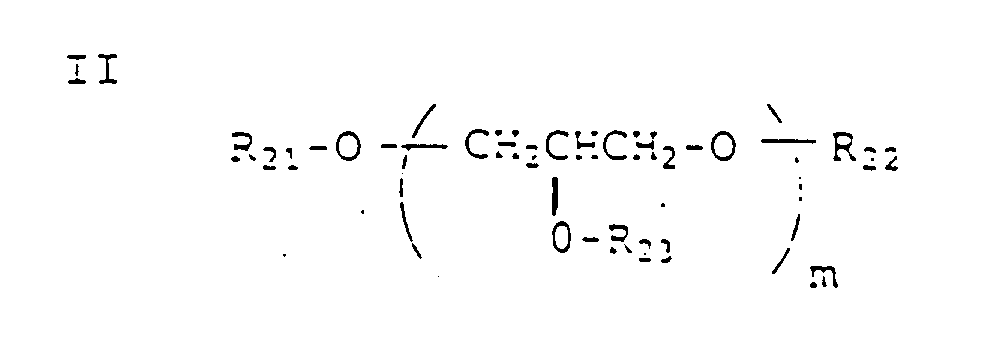
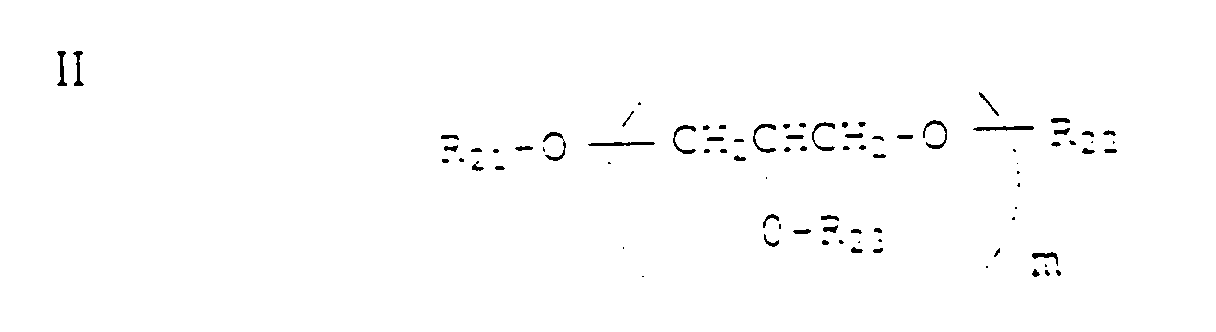
- the silver halide color photographic light-sensitive material of the invention comprises a polyvalent alcohol chosen from the following Formulae II to Formula VII: wherein R 21 , R 22 and R 23 each independently represent a hydrogen atom, or an acyl group and m is from 1 to 20.
- R 21 , R 22 and R 23 each independently represent a hydrogen atom, or an acyl group and m is from 1 to 20.
- m is two or more, two or more of R 23 may be the same or different.
- m is 2.
- m 1, two of R 21 , R 22 and R 23 are hydrogen atoms.
- m is two or more, at least two of R 21 R 22 and R 23 are hydrogen atoms but all of R 21 R 22 and R 23 are not hydrogen atoms simultaneously.
- two or more of R 21 , R 22 and R 23 are hydrogen atoms and the other is an acyl group.
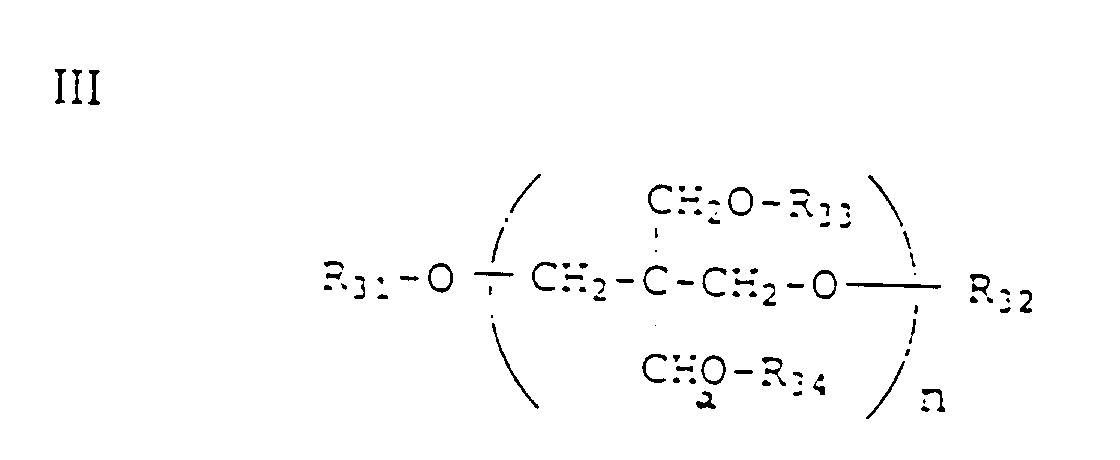
- R 31 , R 32 , R 33 and R 34 each represent a hydrogen atom, an alkyl, alkenyl, cycloalkyl, cycloalkenyl, acyl, sulfonyl, phosphonyl, carbamoyl or sulfamoyl group and n is from 1 to 20.
- n is two or more, two or more of R 33 or R 34 may be the same or different.
- n is 1, at least two of R 31 , R 32 , R 33 and R 34 are hydrogen atoms.
- R 31 , R 32 , R 33 and R 34 are hydrogen atoms but all of R 31 , R 32 , R 33 and R 34 are not hydrogen atoms simultaneously.
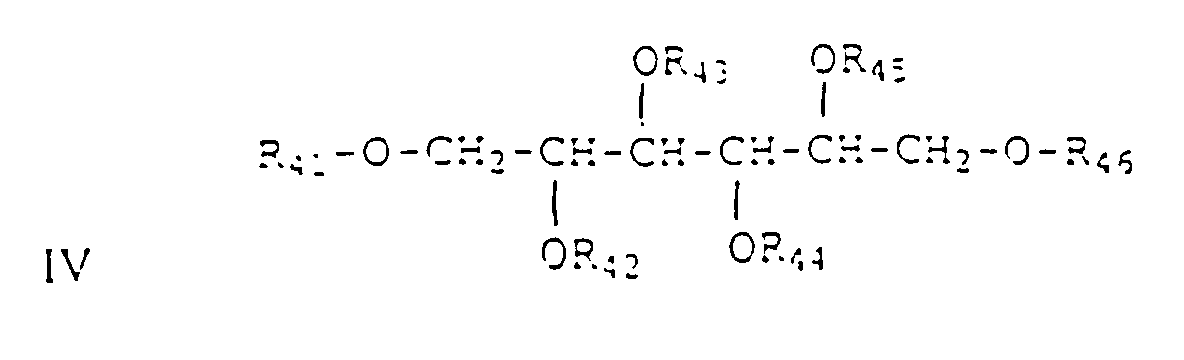
- R 41 to R 46 each represent a hydrogen atom, an alkyl, alkenyl, cycloalkyl, cycloalkenyl, acyl, sulfonyl, phosphonyl, carbamoyl or sulfamoyl group, and at least two of R 41 , R 42 , R 43 , R 44 , R 45 and R 46 are hydrogen atoms but all of R 41 to R 46 are not hydrogen atoms simultaneously.
- R 51 is a substituted alkyl or substituted alkenyl group each of which has two or more hydroxy groups
- R 52 is an alkyl, alkenyl, cycloalkyl or cycloalkenyl group, and R 51 and R 52 may form a lactone ring by condensation each other.
- the poly valent alcohol is preferably contained in a lipophilic fine grain comprising a dye forming coupler in a ratio by weight of not less than 50 % to the dye-forming coupler.
- R 61 , R 62 , R 63 , R 64 , R 71 , R 72 , R 73 and R 74 each represent a hydrogen atom, an alkyl, alkenyl, cycloalkyl, cycloalkenyl, aryl, acyl, sulfonly, phosphonyl, carbamoyl or sulfamoyl group, and at least two of R 61 , R 62 , R 63 , R 64 , R 71 , R 72 , R 73 and R 74 are hydrogen atoms but all of R 61 to R 64 and R 71 to R 74 are not hydrogen atoms simultaneously.
- the poly valent alcohol represented by Formula VI is contained in a lipophilic fine grain comprising a dye image-forming coupler in a ratio by weight of not less than 50 % to the dye-forming coupler.
- R 3 to R 6 and R 9 to R 12 are defined as follows;
- alkyl groups represented by R 31 , R 32 , R 33 , R 34 , R 41 , R 42 , R 43 , R 44 , R 44 , R 46 , R 61 , R 62 , R 63 , R 64 , R 71 , R 72 , R 73 and R 74 hereinafter (abbreviated as R 31 to R 74 ) may be either straight-chained or branched. Of them, those having from 1 to 32 carbons are preferable.
- a methyl group, an ethyl group, an isopropyl group, a t-butyl group, a dodecyl group, a heptadecyl group and a 2-ethylhexyl group are typically cited.
- Alkenyl groups represented by R 31 to R 74 may be either straight-chained or branched. Of them, those having from 2 to 32 carbons are preferable. For example, a vinyl group, a propenyl group, a 11-undecenyl group and a 1-methylpropenyl group are typically cited.
- a cycloalkyl group represented by R 31 to R 74 those having from 3 to 12 carbon atoms are preferable, and those having from 5 to 7 carbons are especially preferable. They may have a branch-structure. For example, a cyclohexyl group, a cyclopentyl group, a cyclopropyl group and a 2-methylcyclopropyl group are typically cited.
- a cycloalkenyl group represented by R 31 to R 74 those having from 3 to 12 carbons are preferable, and those having from 5 to 7 carbons are especially preferable. They may have a branch-structure. For example, a 1-cyclohexyenyl group and a 2-cyclopentenyl group are typically cited.
- R 61 , R 62 , R 63 , R 64 , R 71 , R 72 , R 73 , R 74 those having from 6 to 14 carbons are preferable.
- a phenyl group, a 1-naphtyl group and a 2-naphtyl group are typically cited.
- alkyl group, alkenyl group, cycloalkyl group, cycloalkenyl group and aryl group may be substituted with a substituent.
- substituent therefor an alkyl group, an alkenyl group, a cycloalkenyl group, an alkinyl group, an aryl group, a heterocycle group, an alkyl thio group, an aryl thio group, a heterocyclic thio group, a sulfonyl group, a sulfinyl group, an acyl group, a carbamoyl group, a sulfamoyl group, a cyano group, an alkoxy group, an aryloxy group, a heterocyclic oxy group, a siloxy group, an acyloxy group, a carbamoyloxy group, an amino group, an alkyl amino group, an anilino group, an acyl amino
- a substituted alkyl group or a substituted alkenyl group each containing 2 or more hydroxyl groups represented by R 51 represent an alkyl group and an alkenyl group (each including those substituted by a substituent) represented by the above-mentioned R 21 to R 52 wherein 2 or more arbitrary hydrogen atoms are substituted by a hydroxyl group.
- R 51 represents an alkyl group and an alkenyl group (each including those substituted by a substituent) represented by the above-mentioned R 21 to R 52 wherein 2 or more arbitrary hydrogen atoms are substituted by a hydroxyl group.
- a 1,2-dihydroxypropyl group and a 1,1-dihydroxymethylethyl group are typically cited.
- R 21 , R 22 , R 23 , R 31 , R 32 , R 33 , R 34 , R 41 , R 42 , R 43 , R 44 , R 45 , R 46 , R 61 , R 62 , R 63 , R 64 , R 71 , R 72 , R 73 and R 74 (hereinafter abbreviated as R 21 to R 74 ) and Y, -C( O)-R 3 (R 3 represents the above-mentioned compounds) is preferable;
- the sulfonyl group represented by R 31 to R 74 is preferably -SO 2 -R 4 (R 4 represents the above-mentioned compounds);
- the preferable example of the sulfamoyl group represented by R 31 to R 74 and Y, is -SO 2 N ⁇ (R 11 )(R 12 ) (R 11 and R 12 represent the above-mentioned compounds).
- R 5 and R 6 , R 9 and R 10 , and R 11 and R 12 may be condensed with each other to form a ring.
- two arbitrary substituents chosen from R 21 , R 22 and R 23 may be condensed with each other to form a ring.
- two arbitrary substituents chosen from R 31 , R 32 and R 33 may be condensed with each other for forming a ring.
- R 61 and R 62 and/or R 62 and R 63 and/or R 63 and/or R 64 are respectively condensed with each other to form a ring.
- An alkylene group represented by L may be of straight-chained and branched-chained.
- an ethylene group, a 1-methylethyl group and a propylene group are cited.
- arylene group represented by L a p-phenylene group, an o-phenylene group and a 1,4-naphtylene group are exemplified.
- An alkylene group and an arylene group represented by L may be substituted with other substituent which is the same as the substituent in the above-mentioned R 1 through R 3 .
- the total number of carbons in the polyvalent alcohol is preferably not less than 6 (provided that, it is not less than 10 for Formulae VI and VII).
- the compound is preferably immiscible in water.
- a polyvalent alcohol having a molecular weight of not more than 5,000 is preferable, and in the liquid state liquid at room temperature is particularly preferred.
- the number of hydroxy group in the polyvalent alcohol is preferably three or more. The more the number of the hydroxy group becomes, the more preferable a result is obtained.
- the molecular weight of the polyhydric alcohol is preferably not more than 5000 and one which is in the liquid state at normal temperatures is preferable.
- the hydroxyl group value is preferably 50 or more.
- the logP value of the polyhydric alcohol is preferably not less than 3.
- Typical examples of the polyhydric alcohol preferably used in the present invention are given below:
- the aliphatic polyhydric alcohol used in the present invention is suitably used as a solvent of a dye-forming coupler to form a fine oil particle containing a dye forming coupler.
- yellow couplers used with the polyhydric alcohol include benzoyl acetoanilide and pyvaloyl acetoanilide couplers.
- magenta couplers include 5-pyrazolone, pyrazolotriazole and indazolone couplers, and examples of cyan coupler includes phenol, naphthol, pyrazoloquinazolone, pyrazolopilimidine, pyrazolotriazole and imidazole couplers.
- cyan couplers used with the polyhydric alcohol include C-1 to C-24 cited in pp 59 to 61 JA OPI 4-313751.
- magenta coupler in combination with the polyhydric alcohol compound in the material of the invention.
- magenta coupler are represented by wherein Z is a group of non-metal atoms necessary to complete a nitrogen-containing heterocyclic ring which may have a substituent; X represents a hydrogen atom or a group which is capable of being released upon reaction with an oxidation product of a color developing agent; and R represents a hydrogen atom or a substituent.
- the coupler can usually be used in an amount of between 1 ⁇ 10 -3 mols and 1 mol per mol of silver halide and, more preferably within a range of between 1 ⁇ 10 -2 mol and 8 ⁇ 10 -1 mols/mol.
- a dye forming coupler and the aliphatic polyhydric alcohol which is referred to as “polyhydric alcohol” are usually incorporated in at least one of the silver halide emulsion layers.
- the coupler and the polyhydric alcohol are, individually or in combination, dissolved in a mixure of high boiling solvent such as dibutylphthalate, tricresylphosphate and so on and a low boiling solvent such as butyl acetate, ethylacetate and so on, or in a low boiling solvent cited above, they are mixed with gelatin solution containing surfactant, then the mixure is emulsified by high speed mixer, colloid mill or hypersonic dispersing machine. The resulting emulsion is added directly to the silver halide emulsion. After the above-mentioned emulsification solution is set, finely divided and after washing, this may be added to the emulsion.
- high boiling solvent such as dibutylphthalate, tricresylphosphate and so on
- a low boiling solvent such as butyl acetate, ethylacetate and so on
- gelatin solution containing surfactant emulsified by high speed mixer, colloid mill or hyper
- the emulsion containing the magenta coupler or the polyhydric alcohol may be prepared and added to the silver halide emulsion separately, however, in accordance with the preferable embodiment of the present invention, both the magenta coupler and the polyhydric alcohol are dissolved, dispersed and incorporated in the silver halide emulsion simultaneously.
- the polyhydric alcohol is used in an amount of from 0.01 to 20 g, preferably from 0.5 to 8 g per 1 g of the coupler.
- the polyhydric alcohol may be used either alone or two or more kinds in combination.
- the weight ratio of the polyhydric alcohol to the coupler is preferably more than 50 %.
- any conventionally known silver halide emulsion can be used.
- Said emulsion can be sensitized either chemically or optically in a desired wavelength region by the conventional method and using an appropriate sensitizing dye.
- any conventionally known photographic additives such as an anti-foggant, a stabilizing agent, etc. can be added.
- a binder used in the silver halide emulsion gelatin is advantageous.
- emulsion layers and hydrophilic colloidal layers can be hardened and can comprise a plasticizer, or a dispersion of water-insoluble synthetic coupler is used in the emulsion layer of the color photographic light-sensitive material.
- the light-sensitive material can comprise a colored coupler and a competing coupler having color correction ability, a compound releasing such a photographically usable fragment, on reaction with an oxidation product of developing agent, as developing accelerating agent, toning agent, hardener, fogging agent, antifogging agent, chemical sensitizer, optical sensitizer or desensitizer.
- the light-sensitive material can comprise one or more auxiliary layers such as a filter layer, an anti-halation layer, an anti-irradiation layer.
- auxiliary layers and/or the silver halide emulsion layer can comprise a dye which is capable of dissolving out from the light-sensitive material or is bleached during photographic processing.
- other photographic additives such as formalin scavenger, fluorescent brightening agent, matting agent, lubricant, image stabilizing agent, surfactant, anti color-foggant, development accelerator, development retarder, bleaching accelerator may also be incorporated.
- a paper laminated with polyethylene, polyethylene terephthalate film, baryta paper, cellulose triacetate film can be used.
- the green sensitive silver halide emulsion layer comprising the dye-forming coupler described above, it is preferable that at least one dye image stabilizing agent represented by formula AO-I or AO-II is incorporated.
- R 121 represents a hydrogen atom, an alkyl group, an aryl group, a heterocyclic group or a residue represented below:
- R 121 a, R 121 b, and R 121 c individually represent a mono-valent organic group;
- R 122 , R 123 , R 124 , R 125 , and R 126 independently represent a hydrogen atom, a halogen atom or a group which is capable of substituting to the benzene ring; and
- R 121 to R 126 may individually be connected with each other to form a bond with each other and form a 5-membered or a 6-membered cyclic group.
- R 131 represents an aliphatic group or an aromatic group and Y represents a group of non-metal atoms necessary to complete a 5- to 7-membered ring together with a nitrogen atom.
- the alkyl group the aryl group and the heterocyclic group represented by R 121 in formula AO-I, those listed for R 3 above may be mentioned and as for the heterocyclic group, for example, pyrazole grop, 2-imidazolyl group, 3-pyridyl group and 2-furyl group are listed.
- the mono-valent organic group which R 121 a, R 121 b, and R 121 c represent an alkyl group, an aryl group, an alkoxy group, an aryloxy group, a halogen atom may be mentioned.
- R 121 a hydrogen atom or an alkyl group is preferable.
- R 122 to R 126 groups listed as R above may be mentioned.
- the hydrogen atom, the hydroxy group, the alkyl group, the aryl group, the alkoxy group, the aryloxy group, and the acyl amino group are preferable to R 122 , R 123 , R 125 , and R 126 and the alkyl group, the hydroxy group, the aryl group, the alkoxy group, and the aryloxy group are preferable to R 124 .
- R 121 and R 122 may connect with each other to form a 5-member or 6-member cyclic group.
- R 121 and R 122 may close ring to form a methylenedioxy ring. Still further, R 123 and R 124 can connect with each other to form a 5-member hydrocarbon ring and in that case, the alkyl group, the aryl group, or the heterocyclic group is preferable as R 121 .
- R 131 in the above-mentioned formula AO-II represents an aliphatic group or an aromatic group, preferably an alkyl group or an aryl group or a heterocyclic group, and, most preferably, an aryl group.
- the heterocyclic group which Y forms together with the nitrogen atom for example, a piperidine ring, a piperadine ring, a morpholine ring, a thiomorpholine ring, a thiomorpholine-1, 1-dione ring and a pyroridine ring may be mentioned.
- the added amount of the compounds of formulae AO-I or AO-II is usually from 5 to 500 mol% and, more preferably, from 20 to 200 mol% per 100 mol% of the dye-forming coupler.
- a metal chelate compound disclosed in eg. JP O.P.I. 61-158329 and 62-183459 may be incorporated.
- This emulsion was then mixed with a blue-sensitive silver halide emulsion comprising 8.67 of silver by which this dispersant was shown below, anti-irradiation dye (AIY-1) was added, and the coating composition for the first layer was prepared.
- anti-irradiation dye AIY-1
- coating composition for the first layer was prepared.
- coating solutions were prepared in the same manner as in the first layer.
- a gelatin hardener HH-1) was added to the second layer and the fourth layer and (HH-2) was added to the seventh layer.
- surfactants SU-1) and (SU-3) were added to adjust the surface tension of the coating solution.
- Amounts of the silver halide emulsions added were each shown in terms of the silver contents.
- Samples 102 to 120, 105' to 120', and 105'' to 105'' were prepared in the same manner as Sample 101 except that the high boiling point organic solvent DNP was replaced by the high boiling point organic solvent or the polyhydric alcohol given in Tables 3, 4 and 5 below:
- compositions of respective processing solutions are as follows: The replenishing amount of each processing solution is 80 ml per m 2 of silver halide light-sensitive color photographic material.
- Color developer Tank solution Replenisher Pure water 800 ml 800 ml Triethanolamine 10 g 18 g N,N-Diethyl hydroxyl amines 5 g 9 g Potassium chloride 2.4 g 1-hydroxy ethylidene-1,1-di-phosphonic acid 1.0 g 1.8 g N-ethyl-N-beta-methane sulfonamide ethyl-4-(aminoaniline)-3-methyl sulfate 5.4 g 8.2 g Fluorescent brightening agent 4,4'-di-amino stilbene sulfonate derivative 1.0 g 1.8 g Potassium carbonate 27 g 27 g
- Samples 111 to 119 and 115' to 120' HBS is used in an amount of three times that of Samples 101 to 110.
- the polyol compound defined herein works much more effectivly when a large amount thereof is used. The stability against light is improved and a sharp absorption peak is obtained.
- Example 1 a magenta coupler, HBS and dye stabilizer in the third layer of Sample 101 above were replaced with those shown in Table 5 to obtain Samples 200 to 214. The same test was conducted as in Example 1. The results are summarized in Table 5.
- Samples using the polyhydric alcohol of any of the Formula II to VII as a HBS in combination with a magenta coupler M-8 which has a secondary alkyl group at the 6 position show the improvement in stability against light.
- Samples containing increased amount of the polyhydric alcohol of any of Formulae II to VII show further improved stability to light.
- Example 1 HBS in the third layer of Sample 101 was replaced with those shown in table 6 to obtain Samples 201' to 212'. The same test was conducted as for Example 1. The results are summarized in Table 6.
- Sample No. HBS in 3rd layer, amount thereof (g/m 2) HBS/Cp
- Light stability Dmax 101 DNP (0.2) 0 57 1.97 201' DNP (0.18) 0.056 58 2.17 II-1 (0.02) 202' DNP (0.1) 0.28 58 2.19 II-1 (0.1) 203' DNP (0.02) 0.51 69 2.20 II-1 (0.18) 204' II-1 (0.2) 0.56 73 2.22 205' DNP (0.18) 0.056 57 2.16 VI-1 (0.02) 206 DNP (0.1) 0.28 58 2.17 VI-1 (0.1) 207' DNP (0.02) 0.51 67 2.18 VI-1 (0.18) 208' VI-1 (0.20) 0.56 70 2.21 209' DNP (0.18) 0.056 57 2.16
- Example a part of amount of the polyhydric alcohol is replaced with a conventional high boiling solvent. Consequently the weight ratio of the polyhydric alcohol to a coupler is varied.
- the Table shows that the samples containing a polyhydric alcohol in an amount of more than 50 weight % to a coupler are more advantageous in the stability to light. Further samples containing no conventional HBS are much more effective.
- Example 1 HBS in the first layer of Sample 101 were replaced with those shown Table 7 to obtain Samples 302 to 311. The resulting samples were exposed wedgewise by blue light, and the same developing process and test was conducted as in Example 1. The results are summarized in Table 7. Sample No.
- HBS in 1st layer Amount of HBS (g/m 2 ) Dmax Light stability (Dye residual ratio) 301 DNP 0.20 2.58 81 302 HBS-2 0.20 2.27 75 303 II-2 0.20 2.49 88 304 III-9 0.20 2.47 86 305 IV-9 0.20 2.47 85 306 V-14 0.20 2.42 85 307 VI-4 0.20 2.45 84 308 VI-8 0.20 2.48 84 309 VII-3 0.20 2.41 86 310 VII-6 0.20 2.44 85 311 VII-7 0.20 2.39 86
- Table 7 shows that the samples containing the polyhydric alcohol compound of any of Formulae II to VII (Samples 303 to 311) exhibit improved stability to light and color developabilty.
- HBS-2 that has one hydroxy group in the molecule, exhibits slight improvement in stability to light, but deterioration of color developability.
- Example 1 HBS in the fifth layer of Sample 101 were replaced with those shown Table 8 to obtain Samples 402 to 411. The resulting samples were exposed wedgewise by red light, and the same developing process and test was conducted as in Example 1. The results are summarized in Table 8. Sample No.
- HBS in 5th layer Amount of HBS (g/m 2 ) Dmax Light stability (Dye residual ratio) 401 DOP 0.20 2.07 70 402 HBS-2 0.20 2.05 72 403 II-2 0.20 2.24 82 404 III-9 0.20 2.20 82 405 IV-9 0.20 2.20 79 406 V-14 0.20 2.17 78 407 VI-4 0.20 2.19 80 408 VI-8 0.20 2.25 83 409 VII-3 0.20 2.25 81 410 VII-6 0.20 2.19 82 411 VII-7 0.20 2.30 77
- Table 8 shows that the samples containing the polyhydric alcohol compound of any of Formulae II to VII (Samples 403 to 411) exhibit improved stability to light and color developabilty.
- HBS-2 that has one hydroxy group in the molecule, exhibits slight improvement of stability to light, but deterioration of color developability.
Landscapes
- Physics & Mathematics (AREA)
- General Physics & Mathematics (AREA)
- Spectroscopy & Molecular Physics (AREA)
- Silver Salt Photography Or Processing Solution Therefor (AREA)
Claims (20)
- Lichtempfindliches farbphotographisches Silberhalogenid-Aufzeichnungsmaterial, umfassend eine auf einem Schichtträger vorgesehene Silberhalogenidemulsionsschicht, wobei die Silberhalogenidemulsionsschicht einen mehrwertigen Alkohol, ausgewählt aus den Formeln II bis VII, enthält:worin R21, R22 und R23 unabhängig voneinander jeweils ein Wasserstoffatom oder eine Acylgruppe darstellen und m = 1 bis 20, wobei im Falle, daß m = 2 oder mehr, zwei oder mehr Reste R23 gleich oder verschieden sein können, im Falle, daß m = 1, zwei der Reste R21, R22 und R23 Wasserstoffatome darstellen, und im Falle, daß m = 2 oder mehr, mindestens zwei der Reste R21, R22 und R23 Wasserstoffatome darstellen, jedoch nicht sämtliche Reste R21, R22 und R23 gleichzeitig für Wasserstoffatome stehen;
 worin R31, R32, R33 und R34 jeweils ein Wasserstoffatom oder eine Alkyl-, Alkenyl-, Cycloalkyl-, Cycloalkenyl-, Acyl-, Sulfonyl-, Phosphonyl-, Carbamoyl- oder Sulfamoylgruppe darstellen und n = 1 bis 20, wobei im Falle, daß n = 2 oder mehr, zwei oder mehr der Reste R33 oder R34 gleich oder verschieden sein können, im Falle, daß n = 1, mindestens zwei der Reste R31, R32, R33 und R34 Wasserstoffatome darstellen, und im Falle, daß n = 2 oder mehr, mindestens zwei der Reste R31, R32, R33 und R34 für Wasserstoffatome stehen, jedoch nicht sämtliche Reste R31, R32, R33 und R34 gleichzeitig Wasserstoffatome darstellen;
 worin R41 bis R46 jeweils für ein Wasserstoffatom oder eine Alkyl-, Alkenyl-, Cycloalkyl-, Cycloalkenyl-, Acyl-, Sulfonyl-, Phosphonyl-, Carbamoyl- oder Sulfamoylgruppe stehen und mindestens zwei der Reste R41, R42, R43, R44, R45 und R46 Wasserstoffatome darstellen, wobei jedoch nicht sämtliche Reste R41 bis R46 gleichzeitig Wasserstoffatome bedeuten;
 worin R51 für eine substituierte Alkyl- oder substituierte Alkenylgruppe, von denen jede zwei oder mehrere Hydroxygruppen aufweist, steht und R52 eine Alkyl-, Alkenyl-, Cycloalkyl- oder Cycloalkenylgruppe bedeutet, wobei R51 und R52 durch Kondensation miteinander einen Lactonring bilden können;
 worin R61, R62, R63, R64, R71, R72, R73 und R74 jeweils für ein Wasserstoffatom oder eine Alkyl-, Alkenyl-, Cyloalkyl-, Cycloalkenyl-, Aryl-, Acyl-, Sulfonyl-, Phosphonyl-, Carbamoyl- oder Sulfamoylgruppe stehen und mindestens zwei der Reste R61, R62, R63 und R64 und mindestens zwei der Reste R71, R72, R73 und R74 Wasserstoffatome bedeuten, wobei jedoch nicht sämtliche Reste R61 bis R64 und R71 bis R74 gleichzeitig Wasserstoffatome darstellen.
- Lichtempfindliches farbphotographisches Silberhalogenid-Aufzeichnungsmaterial nach Anspruch 1, wobei der mehrwertige Alkohol durch die Formeln II, VI und VII dargestellt ist.
- Lichtempfindliches farbphotographisches Silberhalogenid-Aufzeichnungsmaterial nach Anspruch 2, wobei die Gesamtzahl von Kohlenstoffen in dem mehrwertigen Alkohol bei einer Verbindung der Formel II nicht weniger als 6 bzw. bei einer Verbindung der Formel VI oder VII nicht weniger als 10 beträgt.
- Lichtempfindliches farbphotographisches Silberhalogenid-Aufzeichnungsmaterial nach Anspruch 2, wobei der mehrwertige Alkohol durch die Formeln II, VI oder VII dargestellt ist:worin R21, R22 und R23 jeweils für ein Wasserstoffatom oder eine Acylgruppe stehen und m = 1 bis 3, wobei im Falle, daß m = 2 oder mehr, zwei oder mehr Reste R23 gleich oder verschieden sein können, im Falle, daß m = 1, zwei der Reste R21, R22 und R23 für Wasserstoffatome stehen, und im Falle, daß m = 2 oder mehr, mindestens zwei der Reste R21, R22 und R23 Wasserstoffatome darstellen, wobei jedoch nicht sämtliche Reste R21, R22 und R23 gleichzeitig Wasserstoffatome bedeuten;
 worin R61, R62, R63, R64, R71, R72, R73 und R74 jeweils für ein Wasserstoffatom oder eine Acylgruppe stehen und mindestens zwei der Reste R61, R62, R63 und R64 Wasserstoffatome bedeuten, wobei jedoch nicht sämtliche Reste R61 bis R64 gleichzeitig Wasserstoffatome darstellen, und mindestens zwei der Reste R71, R72, R73 und R74 für Wasserstoffatome stehen, jedoch nicht sämtliche Reste R71 bis R74 gleichzeitig Wasserstoffatome bedeuten.
- Lichtempfindliches farbphotographisches Silberhalogenid-Aufzeichnungsmaterial nach Anspruch 4, wobei der mehrwertige Alkohol durch die Formel II dargestellt wird:worin R21, R22 und R23 jeweils für ein Wasserstoffatom oder eine Acylgruppe stehen und m = 1 bis 3, wobei im Falle, daß m = 2 oder mehr, zwei oder mehrere Reste R23 Wasserstoffatome bedeuten können und im Falle, daß m = 2 oder mehr, mindestens zwei der Reste R21, R22 und R23 Wasserstoffatome bedeuten, jedoch nicht sämtliche Reste R21, R22 und R23 gleichzeitig für Wasserstoffatome stehen.
- Lichtempfindliches farbphotographisches Silberhalogenid-Aufzeichnungsmaterial nach einem der vorhergehenden Ansprüche, wobei die Silberhalogenidemulsionsschicht einen einen Farbstoff bildenden Kuppler umfaßt und der mehrwertige Alkohol in Form von den einen Farbstoff bildenden Kuppler umfassenden lipophilen feinen Körnchen vorhanden ist.
- Lichtempfindliches farbphotographisches Silberhalogenid-Aufzeichnungsmaterial nach Anspruch 6, wobei der mehrwertige Alkohol in Form von lipophilen feinen Körnchen, welche den einen Farbstoff bildenden Kuppler umfassen, in einem Gew.-Anteil von nicht weniger als 50%, bezogen auf den einen Farbstoff bildenden Kuppler, vorhanden ist.
- Lichtempfindliches farbphotographisches Silberhalogenid-Aufzeichnungsmaterial nach Anspruch 6 oder 7, wobei der einen Farbstoff bildende Kuppler aus einem Gelbkuppler, einem Purpurrotkuppler oder einem Blaugrünkuppler besteht.
- Lichtempfindliches farbphotographisches Silberhalogenid-Aufzeichnungsmaterial nach Anspruch 8, wobei der einen Farbstoff bildende Kuppler aus einem Purpurrotkuppler besteht.
- Lichtempfindliches farbphotographisches Silberhalogenid-Aufzeichnungsmaterial nach einem der vorhergehenden Ansprüche, wobei das Molekulargewicht des mehrwertigen Alkohols nicht mehr als 5000 beträgt.
- Lichtempfindliches farbphotographisches Silberhalogenid-Aufzeichnungsmaterial nach einem der vorhergehenden Ansprüche, wobei der mehrwertige Alkohol bei Raumtemperatur in flüssiger Form vorliegt.
- Lichtempfindliches farbphotographisches Silberhalogenid-Aufzeichnungsmaterial, umfassend einen Schichtträger und eine darauf befindliche Silberhalogenidemulsionsschicht, die einen einen Farbstoff bildenden Kuppler und einen mehrwertigen Alkohol der in Anspruch 4 definierten Formel II umfassende lipophile feine Körnchen umfaßt, wobei das Gew.-Verhältnis mehrwertiger Alkohol/Farbstoff bildender Kuppler nicht weniger als 50% beträgt.
- Lichtempfindliches farbphotographisches Silberhalogenid-Aufzeichnungsmaterial nach Anspruch 1, wobei der mehrwertige Alkohol durch die Formel II dargestellt ist:worin R21, R22 und R23 jeweils für ein Wasserstoffatom oder eine Acylgruppe stehen und m = 1 bis 20, wobei im Falle, daß m = 2 oder mehr, zwei oder mehr der Reste R23 gleich oder verschieden sein können, im Falle, daß m = 1, zwei der Reste R21, R22 und R23 Wasserstoffatome darstellen und im Falle, daß m = 2 oder mehr, mindestens zwei der Reste R21, R22 und R23 Wasserstoffatome bedeuten, jedoch nicht sämtliche Reste R21, R22 und R23 gleichzeitig für Wasserstoffatome stehen.

- Lichtempfindliches farbphotographisches Silberhalogenid-Aufzeichnungsmaterial nach Anspruch 1, wobei der mehrwertige Alkohol durch die Formel VI dargestellt ist:worin R61, R62, R63 und R64 jeweils für ein Wasserstoffatom oder eine Alkyl-, Alkenyl-, Cycloalkyl-, Cycloalkenyl-, Aryl-, Acyl-, Sulfonyl-, Phosphonyl-, Carbamoyl- oder Sulfamoylgruppe stehen und mindestens zwei der Reste R61, R62, R63 und R64 Wasserstoffatome darstellen, wobei jedoch nicht sämtliche Reste R61 bis R64 gleichzeitig Wasserstoffatome bedeuten.

- Lichtempfindliches farbphotographisches Silberhalogenid-Aufzeichnungsmaterial nach Anspruch 1, wobei der mehrwertige Alkohol durch die Formel VII dargestellt ist:worin R71, R72, R73 und R74 jeweils für ein Wasserstoffatom oder eine Alkyl-, Alkenyl-, Cycloalkyl-, Cycloalkenyl-, Aryl-, Acyl-, Sulfonyl-, Phosphonyl-, Carbamoyl- oder Sulfamoylgruppe stehen und mindestens zwei der Reste R71, R72, R73 und R74 Wasserstoffatome darstellen, jedoch nicht sämtliche Reste R71 bis R74 gleichzeitig Wasserstoffatome bedeuten.

- Lichtempfindliches farbphotographisches Silberhalogenid-Aufzeichnungsmaterial nach Anspruch 4, wobei der mehrwertige Alkohol durch die Formel VI dargestellt ist:worin R61, R62, R63 und R64 jeweils für ein Wasserstoffatom oder eine Acylgruppe stehen und mindestens zwei der Reste R61, R62, R63 und R64 Wasserstoffatome bedeuten, jedoch nicht sämtliche Reste R61 bis R64 gleichzeitig Wasserstoffatome darstellen.

- Lichtempfindliches farbphotographisches Silberhalogenid-Aufzeichnungsmaterial nach Anspruch 4, wobei der mehrwertige Alkohol durch die Formel VII dargestellt ist:worin R71, R72, R73 und R74 jeweils für ein Wasserstoffatom oder eine Acylgruppe stehen und mindestens zwei der Reste R71, R72, R73 und R74 Wasserstoffatome bedeuten, jedoch nicht sämtliche Reste R71 bis R74 gleichzeitig Wasserstoffatome darstellen.

- Lichtempfindliches farbphotographisches Silberhalogenid-Auffzeichnungsmaterial nach Anspruch 13, wobei es sich bei der Verbindung der Formel II um die Beispielverbindung II-1, 2, 5, 13 oder 26 handelt.
- Lichtempfindliches farbphotographisches Silberhalogenid-Aufzeichnungsmaterial nach Anspruch 14, wobei es sich bei dem mehrwertigen Alkohol um die Beispielverbindung IV-1, 2, 3, 4, 7, 8 oder 9 handelt.
- Lichtempfindliches farbphotographisches Silberhalogenid-Aufzeichnungsmaterial nach Anspruch 15, wobei es sich bei dem mehrwertigen Alkohol um die Beispielverbindung VII-1, 3, 4, 6, 7 oder 14 handelt.
Applications Claiming Priority (3)
| Application Number | Priority Date | Filing Date | Title |
|---|---|---|---|
| JP326826/92 | 1992-12-07 | ||
| JP32682692 | 1992-12-07 | ||
| JP32682692 | 1992-12-07 |
Publications (3)
| Publication Number | Publication Date |
|---|---|
| EP0601836A2 EP0601836A2 (de) | 1994-06-15 |
| EP0601836A3 EP0601836A3 (de) | 1995-04-12 |
| EP0601836B1 true EP0601836B1 (de) | 2000-10-04 |
Family
ID=18192149
Family Applications (1)
| Application Number | Title | Priority Date | Filing Date |
|---|---|---|---|
| EP93309829A Expired - Lifetime EP0601836B1 (de) | 1992-12-07 | 1993-12-07 | Farbphotographisches lichtempfindliches Silberhalogenidmaterial |
Country Status (3)
| Country | Link |
|---|---|
| US (1) | US5376520A (de) |
| EP (1) | EP0601836B1 (de) |
| DE (1) | DE69329523T2 (de) |
Families Citing this family (7)
| Publication number | Priority date | Publication date | Assignee | Title |
|---|---|---|---|---|
| US5468600A (en) * | 1993-07-21 | 1995-11-21 | Fuji Photo Film Co., Ltd. | Silver halide color photographic material |
| US5545514A (en) * | 1994-07-14 | 1996-08-13 | Konica Corporation | Silver halide light-sensitive color photographic material |
| JPH0854716A (ja) * | 1994-08-12 | 1996-02-27 | Konica Corp | ハロゲン化銀写真感光材料およびその処理方法 |
| DE4430948A1 (de) * | 1994-08-31 | 1996-03-07 | Agfa Gevaert Ag | Farbfotografisches Silberhalogenidmaterial |
| EP0731386B1 (de) * | 1995-03-10 | 2005-10-05 | Konica Corporation | Lichtempfindliches farbphotographisches Silberhalogenidmaterial |
| EP2702049B1 (de) * | 2011-04-26 | 2016-11-02 | Dow Global Technologies LLC | Erneuerbare tenside aus zuckeralkoholen |
| CN105051020A (zh) * | 2013-03-14 | 2015-11-11 | 埃莱万斯可再生能源科学股份有限公司 | 不饱和脂肪酸的脱水多羟糖醇酯和它们的制备 |
Family Cites Families (24)
| Publication number | Priority date | Publication date | Assignee | Title |
|---|---|---|---|---|
| US2360290A (en) | 1941-07-31 | 1944-10-10 | Eastman Kodak Co | Preventing formation of color fog in emulsions |
| US2735765A (en) | 1953-06-03 | 1956-02-21 | Ch-chs | |
| US3069262A (en) | 1958-03-27 | 1962-12-18 | Polaroid Corp | Processes for forming dye developer images having stability in sunlight |
| US3432300A (en) | 1965-05-03 | 1969-03-11 | Eastman Kodak Co | 6-hydroxy chromans used as stabilizing agents in a color photographic element |
| US3574627A (en) | 1969-02-06 | 1971-04-13 | Eastman Kodak Co | Color photographic elements |
| US3573050A (en) | 1969-02-27 | 1971-03-30 | Eastman Kodak Co | Color photographic layers comprising non-diffusible 5-hydroxycoumarans as stabilizing compounds |
| JPS5224412B2 (de) * | 1971-08-25 | 1977-07-01 | ||
| JPS4831625A (de) | 1971-08-26 | 1973-04-25 | ||
| JPS4831256A (de) | 1971-08-26 | 1973-04-24 | ||
| JPS4920977A (de) | 1972-06-15 | 1974-02-23 | ||
| JPS5618943B2 (de) | 1973-04-25 | 1981-05-02 | ||
| JPS526623B2 (de) | 1973-04-26 | 1977-02-23 | ||
| CA1032807A (en) | 1973-05-07 | 1978-06-13 | Wendell F. Smith (Jr.) | Stabilized dyes |
| CA1035769A (en) | 1973-11-29 | 1978-08-01 | Wendell F. Smith (Jr.) | Stabilized dyes |
| JPS5234494B2 (de) | 1974-07-09 | 1977-09-03 | ||
| JPS5952568B2 (ja) | 1974-09-07 | 1984-12-20 | 日本電気株式会社 | ハイブリツド変成器装置 |
| IT1063725B (it) | 1975-07-24 | 1985-02-11 | Ibm | Apparecchiatura di memorizzazione dei dati |
| JPS5227534A (en) | 1975-07-31 | 1977-03-01 | Matsushita Electric Works Ltd | Heatproof switchboard |
| US4284709A (en) * | 1979-05-15 | 1981-08-18 | Ciba-Geigy Aktiengesellschaft | Process for incorporating photographic additives in hydrophilic colloid preparations |
| JPS6050532A (ja) * | 1983-08-30 | 1985-03-20 | Konishiroku Photo Ind Co Ltd | ハロゲン化銀カラ−写真感光材料 |
| DE3564871D1 (en) * | 1984-05-22 | 1988-10-13 | Konishiroku Photo Ind | Silver halide color photographic material |
| JPS62151849A (ja) * | 1985-12-26 | 1987-07-06 | Konishiroku Photo Ind Co Ltd | ハロゲン化銀カラ−写真感光材料 |
| US4916050A (en) * | 1987-05-26 | 1990-04-10 | Konica Corporation | Silver halide light-sensitive photographic material |
| US4970139A (en) * | 1989-10-02 | 1990-11-13 | Eastman Kodak Company | Methods of preparation of precipitated coupler dispersions with increased photographic activity |
-
1993
- 1993-12-02 US US08/161,147 patent/US5376520A/en not_active Expired - Lifetime
- 1993-12-07 DE DE69329523T patent/DE69329523T2/de not_active Expired - Fee Related
- 1993-12-07 EP EP93309829A patent/EP0601836B1/de not_active Expired - Lifetime
Also Published As
| Publication number | Publication date |
|---|---|
| US5376520A (en) | 1994-12-27 |
| EP0601836A2 (de) | 1994-06-15 |
| EP0601836A3 (de) | 1995-04-12 |
| DE69329523D1 (de) | 2000-11-09 |
| DE69329523T2 (de) | 2001-05-17 |
Similar Documents
| Publication | Publication Date | Title |
|---|---|---|
| US4814262A (en) | Silver halide photographic light-sensitive material to provide dye-image with improved color-fastness to light | |
| US4666826A (en) | Photographic light-sensitive material containing phenolic couplers and stabilizers | |
| US4526864A (en) | Silver halide photographic light-sensitive material | |
| US5236819A (en) | Light-sensitive silver halide photographic material capable of producing a dye image with improved fastness | |
| US4529690A (en) | Silver halide color photographic light-sensitive material | |
| EP0112514B1 (de) | Photographisches lichtempfindliches Silberhalogenidmaterial | |
| US6218097B1 (en) | Color photographic silver halide material | |
| DE3246292A1 (de) | Farbphotographisches, lichtempfindliches silberhalogenidmaterial | |
| US5376520A (en) | Silver halide light sensitive color photographic material | |
| US4609618A (en) | Silver halide photographic light-sensitive material | |
| JPH0829934A (ja) | ハロゲン化銀カラー写真感光材料 | |
| JPH0546532B2 (de) | ||
| US5342746A (en) | Method for the formation of color photographic materials with high coupling reactivity and reduced color developer PH sensitivity | |
| US5731133A (en) | Process for the production of a chromogenically developed color photographic image using a compound capable of reacting with primary aromatic amines | |
| EP0692737B1 (de) | Farbphotographisches lichtempfindliches Silberhalogenidmaterial | |
| US4205990A (en) | Process for forming a cyan dye image by the use of a 2-equivalent cyan coupler | |
| JP3451491B2 (ja) | ハロゲン化銀カラー写真感光材料 | |
| US6096492A (en) | Color photographic material | |
| JP3491214B2 (ja) | ハロゲン化銀カラー写真感光材料 | |
| US6017689A (en) | Color photographic silver halide material | |
| US6020114A (en) | Color photographic recording material | |
| JPH0561168A (ja) | ハロゲン化銀カラー写真感光材料 | |
| JP2835635B2 (ja) | ハロゲン化銀カラー写真感光材料 | |
| JPH05150429A (ja) | ハロゲン化銀カラー写真感光材料 | |
| JPH0588324A (ja) | ハロゲン化銀カラー写真感光材料 |
Legal Events
| Date | Code | Title | Description |
|---|---|---|---|
| PUAI | Public reference made under article 153(3) epc to a published international application that has entered the european phase |
Free format text: ORIGINAL CODE: 0009012 |
|
| AK | Designated contracting states |
Kind code of ref document: A2 Designated state(s): DE FR GB NL |
|
| PUAL | Search report despatched |
Free format text: ORIGINAL CODE: 0009013 |
|
| AK | Designated contracting states |
Kind code of ref document: A3 Designated state(s): DE FR GB NL |
|
| 17P | Request for examination filed |
Effective date: 19951004 |
|
| 17Q | First examination report despatched |
Effective date: 19981023 |
|
| GRAG | Despatch of communication of intention to grant |
Free format text: ORIGINAL CODE: EPIDOS AGRA |
|
| GRAG | Despatch of communication of intention to grant |
Free format text: ORIGINAL CODE: EPIDOS AGRA |
|
| GRAG | Despatch of communication of intention to grant |
Free format text: ORIGINAL CODE: EPIDOS AGRA |
|
| GRAH | Despatch of communication of intention to grant a patent |
Free format text: ORIGINAL CODE: EPIDOS IGRA |
|
| GRAH | Despatch of communication of intention to grant a patent |
Free format text: ORIGINAL CODE: EPIDOS IGRA |
|
| GRAA | (expected) grant |
Free format text: ORIGINAL CODE: 0009210 |
|
| AK | Designated contracting states |
Kind code of ref document: B1 Designated state(s): DE FR GB NL |
|
| REF | Corresponds to: |
Ref document number: 69329523 Country of ref document: DE Date of ref document: 20001109 |
|
| ET | Fr: translation filed | ||
| PLBE | No opposition filed within time limit |
Free format text: ORIGINAL CODE: 0009261 |
|
| STAA | Information on the status of an ep patent application or granted ep patent |
Free format text: STATUS: NO OPPOSITION FILED WITHIN TIME LIMIT |
|
| 26N | No opposition filed | ||
| REG | Reference to a national code |
Ref country code: GB Ref legal event code: IF02 |
|
| PGFP | Annual fee paid to national office [announced via postgrant information from national office to epo] |
Ref country code: GB Payment date: 20041201 Year of fee payment: 12 |
|
| PGFP | Annual fee paid to national office [announced via postgrant information from national office to epo] |
Ref country code: NL Payment date: 20041205 Year of fee payment: 12 |
|
| PGFP | Annual fee paid to national office [announced via postgrant information from national office to epo] |
Ref country code: FR Payment date: 20041208 Year of fee payment: 12 |
|
| PG25 | Lapsed in a contracting state [announced via postgrant information from national office to epo] |
Ref country code: GB Free format text: LAPSE BECAUSE OF NON-PAYMENT OF DUE FEES Effective date: 20051207 |
|
| PG25 | Lapsed in a contracting state [announced via postgrant information from national office to epo] |
Ref country code: NL Free format text: LAPSE BECAUSE OF NON-PAYMENT OF DUE FEES Effective date: 20060701 |
|
| GBPC | Gb: european patent ceased through non-payment of renewal fee |
Effective date: 20051207 |
|
| PG25 | Lapsed in a contracting state [announced via postgrant information from national office to epo] |
Ref country code: FR Free format text: LAPSE BECAUSE OF NON-PAYMENT OF DUE FEES Effective date: 20060831 |
|
| NLV4 | Nl: lapsed or anulled due to non-payment of the annual fee |
Effective date: 20060701 |
|
| REG | Reference to a national code |
Ref country code: FR Ref legal event code: ST Effective date: 20060831 |
|
| PGFP | Annual fee paid to national office [announced via postgrant information from national office to epo] |
Ref country code: DE Payment date: 20081205 Year of fee payment: 16 |
|
| PG25 | Lapsed in a contracting state [announced via postgrant information from national office to epo] |
Ref country code: DE Free format text: LAPSE BECAUSE OF NON-PAYMENT OF DUE FEES Effective date: 20100701 |