EP0602858A1 - Vorrichtung und Verfahren zur Unterbrechungsbedienung in einem Mehrrechnersystem - Google Patents
Vorrichtung und Verfahren zur Unterbrechungsbedienung in einem Mehrrechnersystem Download PDFInfo
- Publication number
- EP0602858A1 EP0602858A1 EP93309710A EP93309710A EP0602858A1 EP 0602858 A1 EP0602858 A1 EP 0602858A1 EP 93309710 A EP93309710 A EP 93309710A EP 93309710 A EP93309710 A EP 93309710A EP 0602858 A1 EP0602858 A1 EP 0602858A1
- Authority
- EP
- European Patent Office
- Prior art keywords
- processor
- interrupt
- processors
- interrupt priority
- priority
- Prior art date
- Legal status (The legal status is an assumption and is not a legal conclusion. Google has not performed a legal analysis and makes no representation as to the accuracy of the status listed.)
- Ceased
Links
Images




Classifications
-
- G—PHYSICS
- G06—COMPUTING OR CALCULATING; COUNTING
- G06F—ELECTRIC DIGITAL DATA PROCESSING
- G06F9/00—Arrangements for program control, e.g. control units
- G06F9/06—Arrangements for program control, e.g. control units using stored programs, i.e. using an internal store of processing equipment to receive or retain programs
- G06F9/46—Multiprogramming arrangements
- G06F9/48—Program initiating; Program switching, e.g. by interrupt
- G06F9/4806—Task transfer initiation or dispatching
- G06F9/4812—Task transfer initiation or dispatching by interrupt, e.g. masked
-
- G—PHYSICS
- G06—COMPUTING OR CALCULATING; COUNTING
- G06F—ELECTRIC DIGITAL DATA PROCESSING
- G06F13/00—Interconnection of, or transfer of information or other signals between, memories, input/output devices or central processing units
- G06F13/14—Handling requests for interconnection or transfer
- G06F13/20—Handling requests for interconnection or transfer for access to input/output bus
- G06F13/24—Handling requests for interconnection or transfer for access to input/output bus using interrupt
- G06F13/26—Handling requests for interconnection or transfer for access to input/output bus using interrupt with priority control
Definitions
- the invention relates to the servicing of interrupts in a multiprocessor data processing system.
- processor architectures normally include registers which specify the existing priority level.
- a current processor priority register designates in each processor the priority level associated with the instruction then in progress.
- the priority register is local to the associated processor, and therefore either resides on the CPU chip or an immediately adjacent support chip, such as a system control unit (SCU) chip.
- SCU system control unit
- the distance between the processors creates a potential latency in any comparisons of the priorities as reflected in the various registers. Therefore, the priority comparison following an interrupt is normally accomplished through the use of localized groupings of shadow registers or tables which track the priority information in the individualized current processor priority registers (CPPRs).
- shadow registers or tables eliminates communication delays in the priority comparison upon interrupt, the number of registers, the size of the comparison, the size of the bus interconnecting the registers, and the number of cycles needed to disseminate priority information, increase linearly with the number of processors and levels of priority. For example, with 16 processors, and an 8-bit priority code, the system requires 16 shadow registers of 8 bits each, a 16 way compare between the shadow registers, an 8-bit bus between the 16 processors, and an interval of at least 16 clock cycle to disseminate the priority data. As the number of processors increases, so do the number of registers and associated delays.
- Another technique practiced to reconcile interrupt priority in a multiprocessor system uses a line to bit serially broadcast a packet of interrupt information to the various processors upon the occurrence of a service request type interrupt.
- the processors individually and locally compare the states reflected in their individual interrupt priority registers to the priority defined by the interrupt request as specified in the packet.
- Processors of suitable priority level acknowledge acceptance simultaneously, which acknowledgements are then resolved when more than one processor responds. The particulars of whether the multiple acknowledgements can be timely resolved are not clearly disclosed.
- This invention provides apparatus for servicing interrupts in a data processing system having a plurality of processors each having corresponding interrupt priority information, characterised by: logic for bit serially comparing the interrupt priority information of the processors; and means to select a processor in response to an interrupt according to the output from the logic for bit serially comparing.
- the apparatus selects a processor to service interrupts in a system having a plurality of processors with individual interrupt priority states, by bit serially comparing interrupt priority information among the processors, and selecting a processor directly responsive to an interrupt using the results from the bit serially comparison.
- the invention relates to methods performed by the apparatus.
- the time intervals between interrupts are used to repetitively compare processor interrupt priority information, as reflected in the current processor priority registers (CPPRs), and then identify the lowest priority processor for servicing interrupts.
- processor priority registers CPPRs
- numerically distinct processor identification information can be used to uniquely select a processor to service the interrupt.
- the selection of the unique processor, from multiples having the same priority level, can be accomplished by random, round robin, or fixed choice using processor identification numbers.
- a preferred implementation involves a bit serial logical comparison of the data in current processor priority registers to ascertain the then lowest priority processor. Thereafter, a similar practice is applied to the processor identification numbers. The latter step ensures processor singularity when multiple processors exhibit equal priority. At the conclusion of each such repetitive cycle, not only is the selected lowest priority processor identified, but that identification is known locally by all the processors and the associated interrupt management resources of the system.
- Figure 1 illustrates by schematic block diagram the architecture of a symmetric multiprocessor system suited to the practice of the present invention.
- the architecture is somewhat analogous to the SHARED MEMORY SYSTEM POWER/4 multiprocessor system commercially available from IBM Corporation.
- Figure 1 involves the use of a RISC System/6000 type workstation (also available from IBM Corporation), or an equivalent, for each multichip module (MCM) 1 and related system bus 2.
- MCM multichip module
- each workstation equivalent is connected through a non-blocking switch 3 to a bank of shared global memory, generally at 4. Cache coherency is maintained by software.
- Each workstation equivalent system bus has connected thereto a multitude of bus unit controllers (BUCs) 6 and related I/O devices 7.
- BUCs bus unit controllers
- the I/O devices generate service request type interrupts on their respective system buses. Also illustrated in Figure 1 is bus-to-bus interface (BTBI) 8, an interface to multiple Microchannel I/O buses. All devices connected to system buses 2 are potential sources of interrupt signals.
- BTBI bus-to-bus interface
- All devices connected to system buses 2 are potential sources of interrupt signals.
- the problem is to select with minimum delay a processor, in this case a CPU, of a priority suitable to service the interrupt.
- Each MCM 1 in Figure 1 is shown to include four central processing units (CPUs), a system control unit (SCU) 9 and a bank of L2 level caches.
- CPUs central processing units
- SCU system control unit
- L2 level caches The depiction of four generic CPUs is somewhat more general than in the above noted RISC System/6000, which system has three processors individually performing fixed point, floating point and branch processing.
- L2 level caches The inclusion of L2 level caches is likewise somewhat different.
- the present invention is described generally in the context of system in Figure 1, and in particular as to the structures and operation in SCU 9 and interrupt competition logic 11.
- the interrupt priority driven processor selection is completed before the receipt of the I/O service request.
- the processor designated to service the I/O request is known before the interrupt occurs.
- the processor selection is accomplished in two phases.
- the first phase involves bit serial competition or comparison of the processor priority data in the respective processor interrupt priority registers. It should be apparent that term bit serial comparison is meant to encompass not only bit by bit comparisons, but those accomplished in multiple bit increments where suitable.
- This phase is followed in direct succession by a processor unique identification phase, used to resolve priority level matches among processors.
- the embodiment involves the use of 8 interrupt priority bits, corresponding to 256 levels of interrupt priority, and four processor identification bits, suitable to distinguish between 16 processors.
- the interrupt priority is repetitively redefined every twelve or so master clock cycles, where a few clock cycles may be expended in latching delays between successive stages in the comparison logic.
- Figure 3 illustrates by specific numerical example a competition between five processors individually possessing an 8 bit interrupt priority.
- 00X represents the highest priority
- FFX represents the lowest priority.
- the goal is to identify the processor or processors having the lowest priority level.
- the processor bits are compared one per clock cycle.
- the outcomes of the comparisons are returned to the originating processors as information about the priority level of the lowest level processor being identified.
- a processor determines, by a comparison of its bit to the bit returned, that a lower priority level processor exists, such processor removes itself from the successive competition. Therefore, as illustrated in Figure 3, after the first comparison the first processor removes itself from the competition knowing that one or more processors have a lower priority.
- This removal from competition, until the next start competition cycle begins, is preferably accomplished by setting a competition latch state. As illustrated in Figure 3, the competition proceeds by comparing the successive bit positions, from the most significant to the least significant, using only interrupt priority registers of processors which remain in the competition.
- the identification phase works in a similar manner to the competition phase. This phase serves to select a single processor when multiple processors exhibit the same interrupt priority level. In this case, the comparison involves the use of processor unique identification information. As embodied, the processor having the highest numerical identification number is selected. Since the embodiment contemplates variations of the data in the identification register, the outcome can be changed to otherwise distribute the servicing tasks.
- a less preferred, arrangement accomplishes the comparison through the use of a single line bus with a pull-up resistor and open drain connections at each workstation equivalent.
- each processor asserts its priority value on the common line as represented by the state of the drain on the transistor connected to the shared line.
- a Boolean logic OR the distributed capacitance and inductance of the line which connects all workstation equivalents is likely to introduce a speed limitation inconsistent with the performance of contemporary multiprocessor systems.
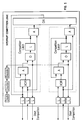
- Figure 4 illustrates the functional elements that would be in the SCU for this embodiment. Note that this embodiment needs only two lines, a synchronization for the start of competition, and the competition line itself. The identification of the lowest interrupt priority unit and its related interrupt priority level are derived directly by latching the bit position related state from the competition line. As shown in Figure 5, shadow registers are used to allow changes to the CPPR and ID registers during the competition and identification comparison sequences.
- bit position comparison is accomplished by logic circuitry such as that depicted in Figure 5. Synchronization, the receipt of interrupt priority bit position information, and the return of lowest interrupt priority information, are accomplished through three lines connected to each workstation equivalent SCU ( Figure 1).
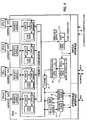
- the preferred embodiment SCU which uses the comparator in Figure 5, is depicted in Figure 6.
- the depiction of SCU 9 is in data flow format to more clearly relate the system elements to the methods defined by the flow diagrams in Figures 7-10.
- each CPU has associated therewith an interrupt priority register to indicate the priority level for the process then in progress.
- the priority values in registers CPPR0-CPPR3 are compared in priority comparator 12 to identify the lowest priority for the set of four CPUs connected to each SCU 9.
- the minimum CPPR value and related processor ID for each SCU is stored in register 13.
- the outcome of an interrupt priority competition and related identification sequence, as described hereinbefore, is entered into register 14 and transferred for storage into shadow register 16.
- An interrupt from an I/O device on the system bus local to the SCU is conveyed to request queue 17.
- interrupts generated by an I/O device on the system bus of another SCU are entered through the switch interface and stored in request queue 18. Thereafter, one or the other of the requests is compared to the system minimum interrupt priority level for the related processor as stored in shadow register 16. If the compare performed in block 19 involves a request from the system bus of the local SCU as stored in request queue 17, and the outcome of the compare indicates that the request is of a lower interrupt priority than that stored in shadow register 16, the interrupt request is entered into reject queue 21 for eventual return to the system bus. Otherwise, the request is conveyed to the external interrupt pending registers (XIPRs) of the four CPUs.
- XIPRs external interrupt pending registers
- Requests conveyed through the switch interface and request queue 18 are sent directly to the XIPR register corresponding to the CPU having the lowest interrupt priority level. If the corresponding XIPR register is full, the interrupt request is returned to either reject queue 21 or the switch interface for retransmission to the originating SCU.
- FIG. 7 and 8 The operations depicted by flow diagram in Figs. 7 and 8 are those undertaken to transmit interrupt competition information from SCU 9 (Fig. 6).
- Figs. 9 and 10 represent the operations performed in the interrupt comparator logic of Fig. 5.
- the operations in Fig. 11 correspond to those accomplished upon the receipt of interrupt competition information into SCU 9 (Fig. 6).
- the timing diagram in Fig. 12 depicts the events, including integrated circuit chip boundary "Latch In" and "Latch Out" actions associated with the interrupt priority and processor individualized identification comparisons. Note the 12 clock cycle repetition rate of the competition.
- Figs. 13-16 depict the events associated with various of the functions performed in SCU 9 (Fig. 6) following the occurrence of an interrupt.
- the routing depicts the management of both accepted and rejected interrupts.
- the operations are identified by the blocks to which they relate.
Landscapes
- Engineering & Computer Science (AREA)
- Theoretical Computer Science (AREA)
- Physics & Mathematics (AREA)
- General Engineering & Computer Science (AREA)
- General Physics & Mathematics (AREA)
- Software Systems (AREA)
- Multi Processors (AREA)
- Bus Control (AREA)
Applications Claiming Priority (2)
| Application Number | Priority Date | Filing Date | Title |
|---|---|---|---|
| US99317392A | 1992-12-18 | 1992-12-18 | |
| US993173 | 1997-12-18 |
Publications (1)
| Publication Number | Publication Date |
|---|---|
| EP0602858A1 true EP0602858A1 (de) | 1994-06-22 |
Family
ID=25539186
Family Applications (1)
| Application Number | Title | Priority Date | Filing Date |
|---|---|---|---|
| EP93309710A Ceased EP0602858A1 (de) | 1992-12-18 | 1993-12-03 | Vorrichtung und Verfahren zur Unterbrechungsbedienung in einem Mehrrechnersystem |
Country Status (3)
| Country | Link |
|---|---|
| US (1) | US5379434A (de) |
| EP (1) | EP0602858A1 (de) |
| JP (1) | JPH06223042A (de) |
Cited By (11)
| Publication number | Priority date | Publication date | Assignee | Title |
|---|---|---|---|---|
| EP0644487A3 (de) * | 1993-09-20 | 1995-11-29 | Ibm | Skalierbare Unterbrechungsstruktur für ein Simultanverarbeitungssystem. |
| EP0827085A3 (de) * | 1996-08-20 | 1999-02-03 | Compaq Computer Corporation | Verfahren und Vorrichtung zur Unterbrechungsverteilung in einem skalierbaren symmetrischen Mehrprozessorsystem ohne die Busbreite oder das Busprotokoll zu verändern |
| EP1698972A2 (de) | 2005-03-01 | 2006-09-06 | Seiko Epson Corporation | Prozessor und Informationsverarbeitungsverfahren |
| EP1686474A3 (de) * | 2005-01-28 | 2007-08-01 | Seiko Epson Corporation | Prozessor und Informationsverarbeitungsvorrichtung |
| WO2006082989A3 (en) * | 2005-02-04 | 2007-08-16 | Sony Computer Entertainment Inc | System and method of interrupt handling |
| US7386642B2 (en) | 2005-01-28 | 2008-06-10 | Sony Computer Entertainment Inc. | IO direct memory access system and method |
| US7680972B2 (en) | 2005-02-04 | 2010-03-16 | Sony Computer Entertainment Inc. | Micro interrupt handler |
| EP2241979A1 (de) * | 2009-04-14 | 2010-10-20 | LStar Technologies LLC | Unterbrochene Arbitrierung für Multiprozessoren |
| US8234431B2 (en) | 2009-10-13 | 2012-07-31 | Empire Technology Development Llc | Interrupt masking for multi-core processors |
| US8260996B2 (en) | 2009-04-24 | 2012-09-04 | Empire Technology Development Llc | Interrupt optimization for multiprocessors |
| US8321614B2 (en) | 2009-04-24 | 2012-11-27 | Empire Technology Development Llc | Dynamic scheduling interrupt controller for multiprocessors |
Families Citing this family (25)
| Publication number | Priority date | Publication date | Assignee | Title |
|---|---|---|---|---|
| US5581770A (en) * | 1992-06-04 | 1996-12-03 | Mitsubishi Denki Kabushiki Kaisha | Floating interruption handling system and method |
| JPH07105175A (ja) * | 1993-10-08 | 1995-04-21 | Nec Corp | マイクロコンピュータ |
| US5630147A (en) * | 1993-12-17 | 1997-05-13 | Intel Corporation | System management shadow port |
| US5708813A (en) * | 1994-12-12 | 1998-01-13 | Digital Equipment Corporation | Programmable interrupt signal router |
| US6016531A (en) * | 1995-05-26 | 2000-01-18 | International Business Machines Corporation | Apparatus for performing real time caching utilizing an execution quantization timer and an interrupt controller |
| DE69632289T2 (de) * | 1995-07-25 | 2005-05-19 | Jin-Young Cho | Verteiltes serielles schiedsverfahren |
| JPH0969047A (ja) * | 1995-09-01 | 1997-03-11 | Sony Corp | Risc型マイクロプロセッサおよび情報処理装置 |
| US5892956A (en) * | 1995-12-19 | 1999-04-06 | Advanced Micro Devices, Inc. | Serial bus for transmitting interrupt information in a multiprocessing system |
| US5931924A (en) * | 1997-04-14 | 1999-08-03 | International Business Machines Corporation | Method and system for controlling access to a shared resource that each requestor is concurrently assigned at least two pseudo-random priority weights |
| US5935234A (en) * | 1997-04-14 | 1999-08-10 | International Business Machines Corporation | Method and system for controlling access to a shared resource in a data processing system utilizing pseudo-random priorities |
| US6148361A (en) * | 1998-12-17 | 2000-11-14 | International Business Machines Corporation | Interrupt architecture for a non-uniform memory access (NUMA) data processing system |
| US6606676B1 (en) * | 1999-11-08 | 2003-08-12 | International Business Machines Corporation | Method and apparatus to distribute interrupts to multiple interrupt handlers in a distributed symmetric multiprocessor system |
| EP1213650A3 (de) * | 2000-08-21 | 2006-08-30 | Texas Instruments France | Auf aktueller Aufgabe basierte Prioritätsarbitrierung und Speicherverwaltungseinheit |
| US6880021B2 (en) * | 2001-09-28 | 2005-04-12 | International Business Machines Corporation | Intelligent interrupt with hypervisor collaboration |
| US7386619B1 (en) * | 2003-01-06 | 2008-06-10 | Slt Logic, Llc | System and method for allocating communications to processors in a multiprocessor system |
| US7316017B1 (en) * | 2003-01-06 | 2008-01-01 | Slt Logic, Llc | System and method for allocatiing communications to processors and rescheduling processes in a multiprocessor system |
| US7529875B2 (en) * | 2003-08-20 | 2009-05-05 | International Business Machines Corporation | Assigning interrupts for input/output (I/O) devices among nodes of a non-uniform memory access (NUMA) system |
| US7222200B2 (en) * | 2004-10-14 | 2007-05-22 | Dell Products L.P. | Method for synchronizing processors in SMI following a memory hot plug event |
| US20060112208A1 (en) * | 2004-11-22 | 2006-05-25 | International Business Machines Corporation | Interrupt thresholding for SMT and multi processor systems |
| JP4569368B2 (ja) * | 2005-04-26 | 2010-10-27 | 日本電気株式会社 | 計算機システム、メモリ初期化方法、および計算機システムのプログラム |
| US20080244138A1 (en) * | 2007-03-29 | 2008-10-02 | Seiko Epson Corporation | Microcomputer |
| JP2009251802A (ja) * | 2008-04-03 | 2009-10-29 | Panasonic Corp | マルチプロセッサシステムおよびマルチプロセッサシステムの割込み制御方法 |
| US8375155B2 (en) * | 2010-06-23 | 2013-02-12 | International Business Machines Corporation | Managing concurrent serialized interrupt broadcast commands in a multi-node, symmetric multiprocessing computer |
| DE102011106103A1 (de) * | 2011-06-09 | 2012-12-13 | Texas Instruments Deutschland Gmbh | Elektronische Vorrichtung und Verfahren zur Verarbeitung von Unterbrechungsanforderungen gemäß einem Prioritätsschema |
| CN108182930B (zh) * | 2017-12-18 | 2021-12-10 | 福建星网视易信息系统有限公司 | 音效处理方法、设备及音视频点播系统 |
Citations (3)
| Publication number | Priority date | Publication date | Assignee | Title |
|---|---|---|---|---|
| US4644465A (en) * | 1983-06-22 | 1987-02-17 | Hitachi, Ltd. | Apparatus for controlling I/O interrupt in multiprocessor system |
| EP0348076A1 (de) * | 1988-06-24 | 1989-12-27 | International Computers Limited | Einrichtung zur Datenverarbeitung |
| EP0533361A1 (de) * | 1991-09-17 | 1993-03-24 | NCR International, Inc. | Unterbrechungsbearbeitung in einem Computersystem |
Family Cites Families (20)
| Publication number | Priority date | Publication date | Assignee | Title |
|---|---|---|---|---|
| US3660823A (en) * | 1970-07-20 | 1972-05-02 | Honeywell Inc | Serial bit comparator with selectable bases of comparison |
| US4268904A (en) * | 1978-02-15 | 1981-05-19 | Tokyo Shibaura Electric Co., Ltd. | Interruption control method for multiprocessor system |
| US4271468A (en) * | 1979-11-06 | 1981-06-02 | International Business Machines Corp. | Multiprocessor mechanism for handling channel interrupts |
| EP0048767B1 (de) * | 1980-09-27 | 1985-03-20 | Ibm Deutschland Gmbh | Prioritätsstufengesteuerte Unterbrechungseinrichtung |
| US4495569A (en) * | 1982-06-28 | 1985-01-22 | Mitsubishi Denki Kabushiki Kaisha | Interrupt control for multiprocessor system with storage data controlling processor interrupted by devices |
| US4769768A (en) * | 1983-09-22 | 1988-09-06 | Digital Equipment Corporation | Method and apparatus for requesting service of interrupts by selected number of processors |
| US4633394A (en) * | 1984-04-24 | 1986-12-30 | International Business Machines Corp. | Distributed arbitration for multiple processors |
| US4779195A (en) * | 1985-06-28 | 1988-10-18 | Hewlett-Packard Company | Interrupt system using masking register in processor for selectively establishing device eligibility to interrupt a particular processor |
| US4796176A (en) * | 1985-11-15 | 1989-01-03 | Data General Corporation | Interrupt handling in a multiprocessor computing system |
| JPS62243058A (ja) * | 1986-04-15 | 1987-10-23 | Fanuc Ltd | マルチプロセツサシステムの割込制御方法 |
| JPH07104841B2 (ja) * | 1986-07-24 | 1995-11-13 | 株式会社日立製作所 | 多重処理システムの割込み制御方法 |
| US4839800A (en) * | 1986-08-29 | 1989-06-13 | Bull Hn Information Systems Inc. | Data processing system with a fast interrupt |
| US4974148A (en) * | 1987-07-06 | 1990-11-27 | Motorola Computer X, Inc. | Bus arbiter with equitable priority scheme |
| US4959781A (en) * | 1988-05-16 | 1990-09-25 | Stardent Computer, Inc. | System for assigning interrupts to least busy processor that already loaded same class of interrupt routines |
| US5210871A (en) * | 1988-07-15 | 1993-05-11 | The Charles Stark Draper Labroatory, Inc. | Interprocessor communication for a fault-tolerant, mixed redundancy distributed information processing system |
| JPH07104842B2 (ja) * | 1989-03-03 | 1995-11-13 | 日本電気株式会社 | 外部記憶装置の割込み制御方式 |
| JPH0346051A (ja) * | 1989-07-14 | 1991-02-27 | Oki Electric Ind Co Ltd | マルチプロセッサシステムの割込み制御方式 |
| JPH03237549A (ja) * | 1990-02-14 | 1991-10-23 | Nec Eng Ltd | メモリアクセス制御システム |
| US5179707A (en) * | 1990-06-01 | 1993-01-12 | At&T Bell Laboratories | Interrupt processing allocation in a multiprocessor system |
| US5125093A (en) * | 1990-08-14 | 1992-06-23 | Nexgen Microsystems | Interrupt control for multiprocessor computer system |
-
1993
- 1993-12-03 EP EP93309710A patent/EP0602858A1/de not_active Ceased
- 1993-12-15 JP JP5315529A patent/JPH06223042A/ja active Pending
-
1994
- 1994-06-10 US US08/258,127 patent/US5379434A/en not_active Expired - Fee Related
Patent Citations (3)
| Publication number | Priority date | Publication date | Assignee | Title |
|---|---|---|---|---|
| US4644465A (en) * | 1983-06-22 | 1987-02-17 | Hitachi, Ltd. | Apparatus for controlling I/O interrupt in multiprocessor system |
| EP0348076A1 (de) * | 1988-06-24 | 1989-12-27 | International Computers Limited | Einrichtung zur Datenverarbeitung |
| EP0533361A1 (de) * | 1991-09-17 | 1993-03-24 | NCR International, Inc. | Unterbrechungsbearbeitung in einem Computersystem |
Cited By (18)
| Publication number | Priority date | Publication date | Assignee | Title |
|---|---|---|---|---|
| US5701495A (en) * | 1993-09-20 | 1997-12-23 | International Business Machines Corporation | Scalable system interrupt structure for a multi-processing system |
| EP0644487A3 (de) * | 1993-09-20 | 1995-11-29 | Ibm | Skalierbare Unterbrechungsstruktur für ein Simultanverarbeitungssystem. |
| EP0827085A3 (de) * | 1996-08-20 | 1999-02-03 | Compaq Computer Corporation | Verfahren und Vorrichtung zur Unterbrechungsverteilung in einem skalierbaren symmetrischen Mehrprozessorsystem ohne die Busbreite oder das Busprotokoll zu verändern |
| US6041377A (en) * | 1996-08-20 | 2000-03-21 | Compaq Computer Corporation | Method and apparatus for distributing interrupts in a scalable symmetric multiprocessor system without changing the bus width or bus protocol |
| US6249830B1 (en) | 1996-08-20 | 2001-06-19 | Compaq Computer Corp. | Method and apparatus for distributing interrupts in a scalable symmetric multiprocessor system without changing the bus width or bus protocol |
| EP1686474A3 (de) * | 2005-01-28 | 2007-08-01 | Seiko Epson Corporation | Prozessor und Informationsverarbeitungsvorrichtung |
| US7386642B2 (en) | 2005-01-28 | 2008-06-10 | Sony Computer Entertainment Inc. | IO direct memory access system and method |
| WO2006082989A3 (en) * | 2005-02-04 | 2007-08-16 | Sony Computer Entertainment Inc | System and method of interrupt handling |
| US7350006B2 (en) | 2005-02-04 | 2008-03-25 | Sony Computer Entertainment Inc. | System and method of interrupt handling |
| US7680972B2 (en) | 2005-02-04 | 2010-03-16 | Sony Computer Entertainment Inc. | Micro interrupt handler |
| EP1698972A3 (de) * | 2005-03-01 | 2007-06-06 | Seiko Epson Corporation | Prozessor und Informationsverarbeitungsverfahren |
| EP1698972A2 (de) | 2005-03-01 | 2006-09-06 | Seiko Epson Corporation | Prozessor und Informationsverarbeitungsverfahren |
| CN1828563B (zh) * | 2005-03-01 | 2011-05-11 | 精工爱普生株式会社 | 处理器及信息处理方法 |
| EP2241979A1 (de) * | 2009-04-14 | 2010-10-20 | LStar Technologies LLC | Unterbrochene Arbitrierung für Multiprozessoren |
| US7996595B2 (en) | 2009-04-14 | 2011-08-09 | Lstar Technologies Llc | Interrupt arbitration for multiprocessors |
| US8260996B2 (en) | 2009-04-24 | 2012-09-04 | Empire Technology Development Llc | Interrupt optimization for multiprocessors |
| US8321614B2 (en) | 2009-04-24 | 2012-11-27 | Empire Technology Development Llc | Dynamic scheduling interrupt controller for multiprocessors |
| US8234431B2 (en) | 2009-10-13 | 2012-07-31 | Empire Technology Development Llc | Interrupt masking for multi-core processors |
Also Published As
| Publication number | Publication date |
|---|---|
| US5379434A (en) | 1995-01-03 |
| JPH06223042A (ja) | 1994-08-12 |
Similar Documents
| Publication | Publication Date | Title |
|---|---|---|
| US5379434A (en) | Apparatus and method for managing interrupts in a multiprocessor system | |
| US7849247B2 (en) | Interrupt controller for accelerated interrupt handling in a data processing system and method thereof | |
| EP0535821B1 (de) | Verfahren und Gerät für die dynamische Zuweisung von unadressierten Unterbrechungen | |
| US4675812A (en) | Priority circuit for channel subsystem having components with diverse and changing requirement for system resources | |
| US5535341A (en) | Apparatus and method for determining the status of data buffers in a bridge between two buses during a flush operation | |
| EP0226096B1 (de) | Multiprozessorsystem mit multihierarchischen Ebenen | |
| US4672536A (en) | Arbitration method and device for allocating a shared resource in a data processing system | |
| EP2306328A2 (de) | Kommunikationssystem und Verfahren mit Verbindungsidentifikation auf mehreren Ebenen | |
| EP0117432B1 (de) | Unterbrechungssteuerungsgerät mit erweiterter Zuverlässigkeit | |
| US6141713A (en) | Bus arbitrator with a hierarchical control structure | |
| US6026451A (en) | System for controlling a dispatch of requested data packets by generating size signals for buffer space availability and preventing a dispatch prior to a data request granted signal asserted | |
| JPH077374B2 (ja) | インタフェース回路 | |
| US7383336B2 (en) | Distributed shared resource management | |
| US5241661A (en) | DMA access arbitration device in which CPU can arbitrate on behalf of attachment having no arbiter | |
| JPH0727507B2 (ja) | チャネル選択アービトレーション | |
| EP0118670B1 (de) | Prioritätssystem für Kanalsubsystem | |
| JP2594600B2 (ja) | シングルチップマイクロコンピュータ | |
| EP0479229B1 (de) | Multiprozessor-Doppelbussystem mit minimalen Zugriffskonflikten | |
| US5826045A (en) | Arbitration parking apparatus and method for a split transaction bus in a multiprocessor computer system | |
| US5557756A (en) | Chained arbitration | |
| JP3491588B2 (ja) | 外部バス制御装置 | |
| EP0283580B1 (de) | Rechnersystem mit Kanaldirektspeicherzugriffsarbitrierung | |
| EP0454096B1 (de) | Unterbrechungssteuerschaltung und Mikrocomputersystem, das diese enthält | |
| KR940004579B1 (ko) | 인터럽트 처리장치 | |
| EP0602916A2 (de) | Querbalkenverbindungsgerät |
Legal Events
| Date | Code | Title | Description |
|---|---|---|---|
| PUAI | Public reference made under article 153(3) epc to a published international application that has entered the european phase |
Free format text: ORIGINAL CODE: 0009012 |
|
| AK | Designated contracting states |
Kind code of ref document: A1 Designated state(s): DE FR GB |
|
| 17P | Request for examination filed |
Effective date: 19941021 |
|
| 17Q | First examination report despatched |
Effective date: 19970410 |
|
| GRAG | Despatch of communication of intention to grant |
Free format text: ORIGINAL CODE: EPIDOS AGRA |
|
| STAA | Information on the status of an ep patent application or granted ep patent |
Free format text: STATUS: THE APPLICATION HAS BEEN REFUSED |
|
| 18R | Application refused |
Effective date: 19980315 |