EP0603408B1 - Composition de correcteur liquide - Google Patents
Composition de correcteur liquide Download PDFInfo
- Publication number
- EP0603408B1 EP0603408B1 EP93913528A EP93913528A EP0603408B1 EP 0603408 B1 EP0603408 B1 EP 0603408B1 EP 93913528 A EP93913528 A EP 93913528A EP 93913528 A EP93913528 A EP 93913528A EP 0603408 B1 EP0603408 B1 EP 0603408B1
- Authority
- EP
- European Patent Office
- Prior art keywords
- weight
- synthetic resin
- correction fluid
- correction
- film
- Prior art date
- Legal status (The legal status is an assumption and is not a legal conclusion. Google has not performed a legal analysis and makes no representation as to the accuracy of the status listed.)
- Expired - Lifetime
Links
Classifications
-
- C—CHEMISTRY; METALLURGY
- C08—ORGANIC MACROMOLECULAR COMPOUNDS; THEIR PREPARATION OR CHEMICAL WORKING-UP; COMPOSITIONS BASED THEREON
- C08K—Use of inorganic or non-macromolecular organic substances as compounding ingredients
- C08K3/00—Use of inorganic substances as compounding ingredients
- C08K3/18—Oxygen-containing compounds, e.g. metal carbonyls
- C08K3/20—Oxides; Hydroxides
- C08K3/22—Oxides; Hydroxides of metals
-
- C—CHEMISTRY; METALLURGY
- C09—DYES; PAINTS; POLISHES; NATURAL RESINS; ADHESIVES; COMPOSITIONS NOT OTHERWISE PROVIDED FOR; APPLICATIONS OF MATERIALS NOT OTHERWISE PROVIDED FOR
- C09D—COATING COMPOSITIONS, e.g. PAINTS, VARNISHES OR LACQUERS; FILLING PASTES; CHEMICAL PAINT OR INK REMOVERS; INKS; CORRECTING FLUIDS; WOODSTAINS; PASTES OR SOLIDS FOR COLOURING OR PRINTING; USE OF MATERIALS THEREFOR
- C09D10/00—Correcting fluids, e.g. fluid media for correction of typographical errors by coating
-
- C—CHEMISTRY; METALLURGY
- C09—DYES; PAINTS; POLISHES; NATURAL RESINS; ADHESIVES; COMPOSITIONS NOT OTHERWISE PROVIDED FOR; APPLICATIONS OF MATERIALS NOT OTHERWISE PROVIDED FOR
- C09D—COATING COMPOSITIONS, e.g. PAINTS, VARNISHES OR LACQUERS; FILLING PASTES; CHEMICAL PAINT OR INK REMOVERS; INKS; CORRECTING FLUIDS; WOODSTAINS; PASTES OR SOLIDS FOR COLOURING OR PRINTING; USE OF MATERIALS THEREFOR
- C09D133/00—Coating compositions based on homopolymers or copolymers of compounds having one or more unsaturated aliphatic radicals, each having only one carbon-to-carbon double bond, and at least one being terminated by only one carboxyl radical, or of salts, anhydrides, esters, amides, imides, or nitriles thereof; Coating compositions based on derivatives of such polymers
- C09D133/04—Homopolymers or copolymers of esters
- C09D133/06—Homopolymers or copolymers of esters of esters containing only carbon, hydrogen and oxygen, the oxygen atom being present only as part of the carboxyl radical
Definitions
- the present invention relates to a correction fluid composition which is used to erase letters written in an aqueous ink, letters written in an oily ink, typed letters, images (PPC lines) copied by a dry duplicator, or the like for the sake of the correction of the drawn letters or lines.
- an oily correction fluid For the correction of the letters of an aqueous ink written with a fountain pen or an aqueous ballpoint pen, an oily correction fluid has been used, and for the correction of the letters of an oily ink written with an oily ballpoint pen or an oily felt-tip pen, an aqueous correction fluid has been used.
- a correction fluid called an amphibious type or a common type which can be applied to correct the letters of both the oily and aqueous inks is getting the mainstream.
- a synthetic resin such as an acrylic resin, a petroleum resin, a chlorinated polyolefin resin or a synthetic rubber is usually used as a resin for forming a correction film.
- a suitable amount of a solvent having large polarity is employed in addition to the non-polar solvent in order to increase the solubility of a synthetic resin used in the correction fluid, for example, an acrylic resin, a petroleum resin or a chlorine-based resin
- the solvent having the large polarity include a chlorine-based solvent such as l,l,l-trichloroethane, aromatic solvents such as toluene and xylene, acetate solvents such as ethyl acetate and butyl acetate, and ketone solvents such as methyl ethyl ketone and methyl isobutyl ketone (refer to Japanese Patent Publication No. (Sho) 61-36552 and Japanese Patent Application Laid-open Nos. (Sho) 61-19674 and (Hei) 3-95280).
- a chlorine-based solvent such as l,l,l-trichloroethane
- aromatic solvents such as toluene and xylene
- the amphibious type correction fluid is applied onto a toner image copied by a dry duplicator or a line drawn with an oily ballpoint pen, a dye or a black toner is dissolved in the correction fluid, so that a correction film is often soiled.
- a non-polar solvent is much less poisonous as compared with other solvents, but a binder and a synthetic resin such as a resin for the dispersion of a pigment which are usually used in a correction fluid are sparingly soluble in the non-polar solvent. For this reason, in the correction fluid using the non-polar solvent, the resin tends to separate from the solvent with time, which easily gives rise to fatal problems of the correction fluid such as failures of the correction film (the delamination of the film at the restart of writing and the occurrence of cracks in the film), and the deterioration of shelf stability due to the poor dispersion of the pigment (a viscosity increase phenomenon and the change of the deposited pigment into a hard cake).
- An object of the present invention is to solve the above-mentioned problems, i.e., to provide a correction fluid composition which is excellent in shelf stability and which can form a correction film having good stability and giving no contamination.
- an acrylic synthetic resin having a specific composition obtained by copolymerization is particularly excellent in solubility in the above-mentioned non-polar solvent.
- this acrylic synthetic resin it has been successfully made to obtain a correction fluid composition which is excellent in shelf stability and which can form a correction film having good stability and giving no contamination, and in consequence, a correction fluid composition of the present invention has been completed.
- a correction fluid composition of the present invention is characterized by comprising an acrylic synthetic resin having a molecular weight of from 30,000 to 200,000 obtained by copolymerizing 93 to 99.6% by weight of a (meth)acrylate represented by the formula (I) (wherein R 1 is hydrogen or a methyl group, and R 2 is an aliphatic hydrocarbon group, a cyclic aliphatic hydrocarbon group or a partially aromatic group-substituted aliphatic hydrocarbon group having 1 to 18 carbon atoms) and not less than 0.4% by weight to less than 2% by weight of a basic nitrogen-containing monomer represented by the formula (II) (wherein R 3 is hydrogen or a methyl group; each of R 4 and R 5 is independently a methyl group or an ethyl group; and A is an alkylene group having 1 to 4 carbon atoms) and if necessary, 5% by weight or less of a styrene monomer; a pigment containing titanium dioxide as the main component;
- the correction fluid composition of the present invention comprises 5 to 15% by weight of the acrylic synthetic resin, 40 to 60% by weight of the pigment, and 25 to 55% by weight of a non-polar solvent containing 50% by weight or less of n-heptane, 2,2,4-trimethylpentane or a mixture of n-heptane and 2,2,4-trimethylpentane.
- Examples of a (meth)acrylate represented by the formula (I) which can be used to obtain an acrylic synthetic resin of a correction fluid composition of the present invention include acrylates such as methyl acrylate, ethyl acrylate, propyl acrylate, isopropyl acrylate, isobutyl acrylate, n-butyl acrylate, 2-ethylhexyl acrylate, octyl acrylate, lauryl acrylate, cetyl acrylate, stearyl acrylate, oleyl acrylate and cyclohexyl acrylate; and methacrylates such as methyl methacrylate, ethyl methacrylate, propyl methacrylate, isopropyl methacrylate, isobutyl methacrylate, n-butyl methacrylate, 2-ethylhexyl methacrylate, octyl methacrylate, lauryl methacrylate, cet
- (meth)acrylates may be used singly or in combination, depending upon a correction film performance and a pigment dispersion performance.
- Particularly preferable is a combination of at least one monomer selected from the group consisting of n-butyl methacylate, isobutyl methacrylate and ethyl methacrylate and at least one monomer selected from the group consisting of lauryl methacrylate, n-butyl acrylate and 2-ethylhexyl methacrylate.
- the (meth)acrylate represented by the formula (I) is required to be present in the range of from 93 to 99.6% by weight as a copolymerizable component of the acrylic synthetic resin. If the content of the (meth)acrylate is less than 93% by weight, the solubility of the acrylic synthetic resin in the non-polar solvent is poor and an obtained correction film is fragile. If it is more than 99.6% by weight, the dispersion stability is conversely poor.
- Examples of the basic nitrogen-containing monomer represented by the formula (II) which can be used to obtain the acrylic synthetic resin in the correction fluid composition of the present invention include N,N-N,N-diethylaminoethyl methacrylate, N,N-dimethylaminoethyl acrylate, N,N-diethylaminoethyl methacrylate, and N,N-diethylaminoethyl acrylate. From the viewpoint of pigment dispersion properties and viscosity stability, N,N-dimethylaminoethyl methacrylate and N,N-diethylaminoethyl methacrylate are preferable.
- the basic nitrogen-containing monomer represented by the formula (II) is required to be present in the range of not less than 0.4% by weight to less than 2.0% by weight as the copolymerizable component of the acrylic synthetic resin. If the content of the basic nitrogen-containing monomer is less than 0.4% by weight, the amount of the titanium dioxide pigment which is adsorbed by the resin decreases, and in particular, the dispersion stability of the pigment tends to decline over a long period of time.
- the content of the basic nitrogen-containing monomer is 2.0% by weight or more, the solubility of the acrylic synthetic resin itself in the non-polar organic solvent tends conversely to decline, so that the acrylic synthetic resin varnish itself is liable to bring about phase separation during storage.
- the resin easily separates from the solvent with time, so that there easily occur fatal problems of the correction fluid such as the deterioration of shelf stability due to the poor dispersion of the pigment in the correction fluid (viscosity increase and a pigment settling phenomenon) and failures of the correction film (the delamination of the film at the restart of writing and the occurrence of cracks in the dry film).
- styrene monomer may be added as a copolymerizable component to the acrylic synthetic resin which is used in the correction fluid composition of the present invention.
- the copolymerization of this styrene monomer permits obtaining the film having a close surface layer and flexibility.
- the content of the styrene monomer is 5% by weight or more, the solubility of the acrylic synthetic resin in the non-polar solvent declines, and the obtained correction film is brittle, so that a trouble occurs at the time of rewriting.
- the acrylic synthetic resin which is used in the correction fluid composition of the present invention is soluble in the solvent, has a performance as a dispersion resin for titanium dioxide or another pigment to be filled, and exerts a proper performance as the correction film.
- the amount of the acrylic synthetic resin is in the range of from 5 to 15% by weight, preferably from 7 to 13% by weight based on the weight of the composition. If the amount of the acrylic synthetic resin is 5% by weight or less, the dispersion failure of the pigment occurs, and the obtained correction film is very brittle, so that some cracks occur and the film tends to delaminate at the time of the writing on the correction film, i.e., the rewriting. If it is 15% by weight or more, the film is conversely liable to be viscous, which deteriorates a rewriting performance and increases the viscosity of the correction fluid, so that the smooth film cannot be obtained any more.
- the acrylic synthetic resin which is used in the correction fluid composition of the present invention can be prepared by a conventional known solution polymerization process.
- the molecular weight of the acrylic synthetic resin is in the range of from 30,000 to 200,000. If the molecular weight of the acrylic synthetic resin is 30,000 or less, the correction film is liable to be viscous, which deteriorates the rewriting performance. Conversely, if it is more than 200,000, the viscosity of the correction fluid increases, so that the fluidity of the correction fluid declines and a coating performance noticeably deteriorates. Particularly considering the proper film performance and the correction fluid viscosity, the molecular weight of the acrylic synthetic resin is preferably in the range of from 60,000 to 150,000.
- rutile type or anatase type titanium dioxide can be used as an essential component.
- Typical examples of the usable rutile type titanium dioxide include R-780, R-820, CR-50 and CR-93 made by ISHIHARA SANGYO KAISHA LTD.; R-900 and R-931 made by Du Pont; JR-701, JR-600, JR-801 and JRNC made by TAYCA CORPORATION; KR-380, KR-380N and KR-460 made by Titan Kogyo Kabushiki Kaisha; and the like.
- typical examples of the usable anatase type titanium dioxide include A-100 and A-220 made by ISHIHARA SANGYO KAISHA LTD.; JA-3 and JA-5 made by TAYCA CORPORATION; KA-10 and KA-20 made by Sakai Chemical Industry Co., Ltd; and the like.
- fine silica powder, calcium carbonate, talc, clay, and aluminum silicate powder can be used in a suitable combination, but in this case, from the viewpoint of concealing properties, the amount of the other pigment is preferably 30% or less based on the weight of titanium dioxide.
- non-polar solvent which can be used in the correction fluid composition of the present invention, so long as it gives a proper drying velocity as the correction fluid, dissolves the acrylic synthetic resin, and scarcely dissolves/blurs a coloring component such as an aqueous ink, an oily ink, a PPC toner or a heat transfer ribbon.
- examples of the usable main solvent include cycloparaffin-based solvents such as cyclohexane, methylcyclohexane, and ethylcyclohexane; paraffin-based solvents such as n-heptane, 3-methylpentane, 2,2,4-trimethylpentane; and cyclopentane-based solvents such as methylcyclopentane, ethylcyclopentane. They may be used singly or in the form of a mixture thereof. It is particularly preferable to use n-heptane and/or 2,2,4-trimethylpentane in an amount of 50% by weight or less, preferably 5 to 50% by weight based on the weight of the total solvent.
- cycloparaffin-based solvents such as cyclohexane, methylcyclohexane, and ethylcyclohexane
- paraffin-based solvents such as n-heptane, 3-methylpentane, 2,2,
- an oily dispersant for the dispersion of titanium dioxide, a filler pigment and a coloring pigment can be used, if necessary.
- a polycarboxylic acid-based dispersant can be used in an anionic system; in a cationic system, a long-chain amine-based dispersant can be used; and in a nonionic system, a polyether-based dispersant can be used in a nonionic system.
- examples of a commercially available titanate coupling agent include Titacoat S-151 and, S-152 made by Nippon Soda Co., Ltd.
- examples of the oily dispersant include Disperbyk-160, Lactimon and the like made by Big Chemie Co., Ltd.; Solsperse #3000, #9000 and #24000 made by ICI; Antigel made by Schwegmann Co., Ltd.
- correction fluid composition of the present invention there may be used, if necessary, conventionally known anti-settling agent, viscosity modifier, polymerization inhibitor, anti-skinning agent, coloring pigment and the like in addition to the above-mentioned components.
- the correction fluid composition of the present invention can be obtained by mixing and dispersing the above-mentioned components by means of a mixing/dispersing machine such as a bead mill, an attritor, a ball mill, a sand grinder and the like.
- a mixing/dispersing machine such as a bead mill, an attritor, a ball mill, a sand grinder and the like.
- the correction fluid composition of the present invention is excellent in the dispersion stability of the pigment mainly comprising titanium dioxide, shelf stability and a correction film performance, and this film is protected from contamination with the ink of written lines, so that the clean white correction film can be formed.
- the acrylic synthetic resin peculiar to the present invention in the composition is well soluble in the non-polar solvent without using a polar solvent, whereby the dispersion properties of the pigment are improved and so the shelf stability and the correction film performance of the correction fluid composition are also improved. Furthermore, since the non-polar solvent is used in place of the polar solvent and the above-mentioned excellent correction film is formed, a dye, a wax and a resin used in an ink of various written letters and drawn lines are not dissolved in the correction film. Therefore, the film is not soiled, so that the white clean correction film can be obtained.
- Acrylic synthetic resins which were used in examples and comparative examples were prepared as follows:
- a correction fluid was applied onto a writing paper designated by JIS with a film applicator with 50 ⁇ m clearance, and a spiral line was then drawn with an oily ballpoint pen "SA-S Black” (made by Mitsubishi Pencil Co., Ltd.) to measure a time taken until writing could usually be done).
- SA-S Black oily ballpoint pen
- test paper prepared by the same manner as in the above-mentioned test of the dryness properties was folded, and a weight of 500 g was put thereon in accordance with a JIS method. Afterward, the test piece was spread, and it was observed whether the peeling of a film was present or not. Evaluation was made on the basis of the following criteria:
- a glossiness of a correction fluid composition film used in a contrast ratio test was measured at an incidence/reflection angle of 60° by the use of a digital angle-changeable gloss meter (Suga Testing Machine Co., Ltd.).
- a correction fluid composition before a storage test was applied onto a contrast ratio testing paper (JIS K 5400) by means of a film applicator having a clearance of 50 pm, and after drying, a diffused reflective ratio was then measured by a color computer (Suga Testing Machine Co., Ltd.). Afterward, the initial contrast ratio was calculated in accordance with a predetermined equation.
- correction fluid compositions obtained in the examples and the comparative examples were placed in a reservoir containing two shaking balls in a correction pen "CLP-8N" (Mitsubishi Pencil Co., Ltd.), and the correction pen was then upward allowed to stand for 3 months. Afterward, the composition was shaken again, and at this time, the number of the shaking operations till the generation of the hit sound of the shaking balls was counted. In addition, a contrast ratio after 20 shaking operations was measured as the contrast ratio after shaking.
- the correction fluid composition was evaluated to be acceptable.
- a correction fluid composition of the present invention is used to erase letters written in an aqueous ink, letters written in an oily ink, typed letters, images (PPC lines) copied by a dry duplicator, and the like for the sake of the correction of the drawn letters and lines.
- an acrylic copolymer synthetic resin containing a specific amount of basic nitrogen-containing monomer is used as an acrylic copolymer synthetic resin, and therefore the excellent dispersion stability of titanium dioxide which is a pigment having high contrast properties can be maintained for a long period of time. Furthermore, since a specific non-polar organic solvent is used, an original white clean correction film of the amphibious type correction fluid can be obtained.
Landscapes
- Chemical & Material Sciences (AREA)
- Organic Chemistry (AREA)
- Life Sciences & Earth Sciences (AREA)
- Engineering & Computer Science (AREA)
- Materials Engineering (AREA)
- Wood Science & Technology (AREA)
- Health & Medical Sciences (AREA)
- Chemical Kinetics & Catalysis (AREA)
- Medicinal Chemistry (AREA)
- Polymers & Plastics (AREA)
- Paints Or Removers (AREA)
- Compositions Of Macromolecular Compounds (AREA)
- Inks, Pencil-Leads, Or Crayons (AREA)
Abstract
Claims (3)
- Composition de fluide de correction qui est caractérisée en ce qu'elle comprend une résine synthétique acrylique ayant une masse moléculaire de 30 000 à 200 000, obtenue par copolymérisation de 93 à 99,6 % en poids d'un (méth)acrylate représenté par la formule (I) :(dans laquelle R1 est l'hydrogène ou un groupe méthyle, et R2 est un groupe hydrocarboné aliphatique, un groupe hydrocarboné aliphatique cyclique ou un groupe hydrocarboné aliphatique substitué partiellement par un groupe aromatique ayant de 1 à 18 atomes de carbone)

et pas moins de 0,4 % en poids à moins de 2 % en poids d'un monomère de base contenant de l'azote représenté par la formule (II):(dans laquelle R3 est l'hydrogène ou un groupe méthyle; chacun des R4 et R5 est indépendamment un groupe méthyle et un groupe éthyle ; et A est un groupe alkylène ayant de 1 à 4 atomes de carbone)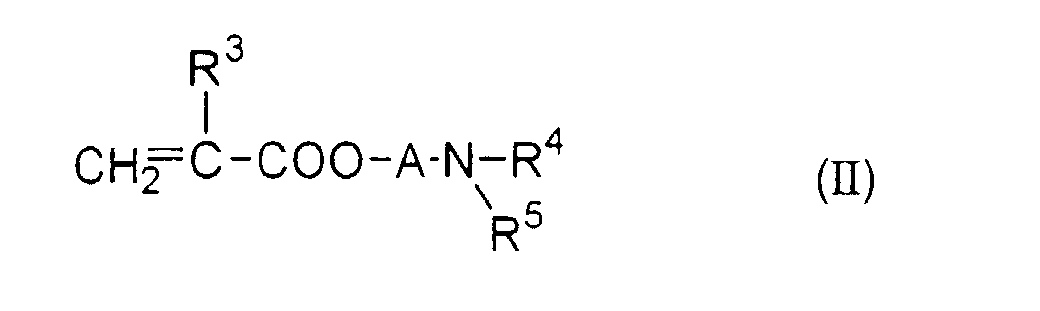
et si nécessaire, 5 % en poids ou moins d'un monomère styrène ; un pigment contenant du dioxyde de titane comme composant principal ; et un solvant non polaire. - Composition de fluide de correction selon la revendication 1, qui comprend de 5 à 15 % en poids de la résine synthétique acrylique, de 40 à 60 % en poids du pigment, et de 25 à 55 % en poids d'un solvant non polaire contenant 50 % en poids ou moins de n-heptane, de 2,2,4-triméthylpentane ou un mélange de n-heptane et de 2,2,4-triméthylpentane.
- Composition de fluide de correction selon la revendication 1, qui comprend un solvant non polaire contenant 50 % en poids ou moins de n-heptane et de 2,2,4-triméthylpentane, ou un mélange de n-heptane et de 2,2,4-triméthylpentane.
Applications Claiming Priority (5)
| Application Number | Priority Date | Filing Date | Title |
|---|---|---|---|
| JP181551/92 | 1992-06-17 | ||
| JP18155192 | 1992-06-17 | ||
| JP137744/93 | 1993-06-08 | ||
| JP5137744A JPH06184476A (ja) | 1992-06-17 | 1993-06-08 | 修正液組成物 |
| PCT/JP1993/000806 WO1993025626A1 (fr) | 1992-06-17 | 1993-06-16 | Composition de correcteur liquide |
Publications (3)
| Publication Number | Publication Date |
|---|---|
| EP0603408A1 EP0603408A1 (fr) | 1994-06-29 |
| EP0603408A4 EP0603408A4 (fr) | 1994-11-17 |
| EP0603408B1 true EP0603408B1 (fr) | 1999-02-24 |
Family
ID=26470965
Family Applications (1)
| Application Number | Title | Priority Date | Filing Date |
|---|---|---|---|
| EP93913528A Expired - Lifetime EP0603408B1 (fr) | 1992-06-17 | 1993-06-16 | Composition de correcteur liquide |
Country Status (5)
| Country | Link |
|---|---|
| US (1) | US5500455A (fr) |
| EP (1) | EP0603408B1 (fr) |
| JP (1) | JPH06184476A (fr) |
| DE (1) | DE69323607T2 (fr) |
| WO (1) | WO1993025626A1 (fr) |
Families Citing this family (9)
| Publication number | Priority date | Publication date | Assignee | Title |
|---|---|---|---|---|
| ZA955550B (en) * | 1994-07-08 | 1996-02-16 | Gillette Co | Aqueous correction fluids |
| US5922400A (en) * | 1997-01-09 | 1999-07-13 | The Gillette Company | Correction fluid |
| US6083618A (en) * | 1997-06-25 | 2000-07-04 | The Gillette Company | Correction fluids comprising composite polymeric particles |
| AU750581B2 (en) * | 1997-05-13 | 2002-07-25 | Clean Japan Center Foundation, The | Coating material for forming vitreous coating film, method of coating with the same, and coater |
| US5964931A (en) * | 1997-12-31 | 1999-10-12 | Correct Solutions, Corp. | Correction fluid marker and formulation for fluid |
| JP2001158869A (ja) * | 1999-09-20 | 2001-06-12 | Sakura Color Prod Corp | 筆記具用油性インキ |
| JP4586610B2 (ja) * | 2004-09-30 | 2010-11-24 | ぺんてる株式会社 | 修正液 |
| JP5561917B2 (ja) * | 2008-07-24 | 2014-07-30 | 三菱鉛筆株式会社 | 油性修正液組成物 |
| JP7219943B2 (ja) | 2018-03-13 | 2023-02-09 | 株式会社トンボ鉛筆 | 感圧転写修正テープ |
Citations (1)
| Publication number | Priority date | Publication date | Assignee | Title |
|---|---|---|---|---|
| JPS57171115A (en) * | 1981-04-13 | 1982-10-21 | Niigata Eng Co Ltd | Bearing |
Family Cites Families (8)
| Publication number | Priority date | Publication date | Assignee | Title |
|---|---|---|---|---|
| JPS5941364A (ja) * | 1982-09-01 | 1984-03-07 | Sumitomo Chem Co Ltd | カロチノイド類を含有する着色剤 |
| JPS5959754A (ja) * | 1982-09-29 | 1984-04-05 | Pentel Kk | 修正液 |
| DE3323951A1 (de) * | 1983-07-02 | 1985-01-03 | Röhm GmbH, 6100 Darmstadt | Acrylatharze als bindemittel fuer farbmittelkonzentrate |
| US4654081A (en) * | 1984-07-02 | 1987-03-31 | Minnesota Mining And Manufacturing Company | Nonsmearing correction fluid |
| JPS6136552A (ja) * | 1984-07-27 | 1986-02-21 | Yamaha Motor Co Ltd | 内燃機関のカム軸駆動装置 |
| JPS6459303A (en) * | 1987-08-31 | 1989-03-07 | Nippon Telegraph & Telephone | Optical coupling part for optical waveguide and light receiving/emitting element |
| JP2662599B2 (ja) * | 1989-04-05 | 1997-10-15 | 藤倉化成株式会社 | 修正液 |
| JPH0395280A (ja) * | 1989-06-16 | 1991-04-19 | Tombow Pencil Co Ltd | 修正液 |
-
1993
- 1993-06-08 JP JP5137744A patent/JPH06184476A/ja active Pending
- 1993-06-16 US US08/196,246 patent/US5500455A/en not_active Expired - Fee Related
- 1993-06-16 EP EP93913528A patent/EP0603408B1/fr not_active Expired - Lifetime
- 1993-06-16 WO PCT/JP1993/000806 patent/WO1993025626A1/fr not_active Ceased
- 1993-06-16 DE DE69323607T patent/DE69323607T2/de not_active Expired - Lifetime
Patent Citations (1)
| Publication number | Priority date | Publication date | Assignee | Title |
|---|---|---|---|---|
| JPS57171115A (en) * | 1981-04-13 | 1982-10-21 | Niigata Eng Co Ltd | Bearing |
Also Published As
| Publication number | Publication date |
|---|---|
| US5500455A (en) | 1996-03-19 |
| EP0603408A1 (fr) | 1994-06-29 |
| JPH06184476A (ja) | 1994-07-05 |
| EP0603408A4 (fr) | 1994-11-17 |
| WO1993025626A1 (fr) | 1993-12-23 |
| DE69323607T2 (de) | 1999-07-22 |
| DE69323607D1 (de) | 1999-04-01 |
Similar Documents
| Publication | Publication Date | Title |
|---|---|---|
| EP0603408B1 (fr) | Composition de correcteur liquide | |
| EP0546132B1 (fr) | Fluide correcteur sans danger pour la couche d'ozone | |
| EP0635039B1 (fr) | Liquide de correction exempt d'effets nocifs sur l'ozone | |
| JPH032279A (ja) | 顔料組成物 | |
| CA2057566C (fr) | Composition d'encre de marquage, de type ethanol | |
| JP2774891B2 (ja) | 修正被覆剤組成物 | |
| JP3369242B2 (ja) | 修正液組成物 | |
| JP3918091B2 (ja) | インキ組成物 | |
| JP2662599B2 (ja) | 修正液 | |
| JPH02169678A (ja) | 修正液 | |
| JP5561917B2 (ja) | 油性修正液組成物 | |
| JP2921011B2 (ja) | 高隠蔽性液状組成物 | |
| JP2000336315A (ja) | 水性修正液 | |
| JP2010144122A (ja) | 油性修正液組成物 | |
| JPH11100535A (ja) | 修正液 | |
| JP3304296B2 (ja) | 修正液 | |
| JP3354854B2 (ja) | 修正液 | |
| JPS5959754A (ja) | 修正液 | |
| JPH0411665A (ja) | 液状組成物 | |
| JPH07166114A (ja) | 発色性記録材料用修正液 | |
| JPH07118581A (ja) | 水性修正液 | |
| JP2000136334A (ja) | 水性修正液 | |
| JPH02261869A (ja) | 感熱紙修正インキ用発色抑制剤 | |
| JP2012036250A (ja) | 油性修正液組成物 | |
| JPH064805B2 (ja) | ボ−ドマ−カ−用インキ組成物 |
Legal Events
| Date | Code | Title | Description |
|---|---|---|---|
| PUAI | Public reference made under article 153(3) epc to a published international application that has entered the european phase |
Free format text: ORIGINAL CODE: 0009012 |
|
| 17P | Request for examination filed |
Effective date: 19940316 |
|
| AK | Designated contracting states |
Kind code of ref document: A1 Designated state(s): DE FR IT |
|
| A4 | Supplementary search report drawn up and despatched | ||
| AK | Designated contracting states |
Kind code of ref document: A4 Designated state(s): DE FR IT |
|
| 17Q | First examination report despatched |
Effective date: 19960717 |
|
| GRAG | Despatch of communication of intention to grant |
Free format text: ORIGINAL CODE: EPIDOS AGRA |
|
| GRAH | Despatch of communication of intention to grant a patent |
Free format text: ORIGINAL CODE: EPIDOS IGRA |
|
| GRAH | Despatch of communication of intention to grant a patent |
Free format text: ORIGINAL CODE: EPIDOS IGRA |
|
| GRAA | (expected) grant |
Free format text: ORIGINAL CODE: 0009210 |
|
| AK | Designated contracting states |
Kind code of ref document: B1 Designated state(s): DE FR IT |
|
| ITF | It: translation for a ep patent filed | ||
| REF | Corresponds to: |
Ref document number: 69323607 Country of ref document: DE Date of ref document: 19990401 |
|
| ET | Fr: translation filed | ||
| PLBE | No opposition filed within time limit |
Free format text: ORIGINAL CODE: 0009261 |
|
| STAA | Information on the status of an ep patent application or granted ep patent |
Free format text: STATUS: NO OPPOSITION FILED WITHIN TIME LIMIT |
|
| 26N | No opposition filed | ||
| PGFP | Annual fee paid to national office [announced via postgrant information from national office to epo] |
Ref country code: DE Payment date: 20120613 Year of fee payment: 20 |
|
| PGFP | Annual fee paid to national office [announced via postgrant information from national office to epo] |
Ref country code: FR Payment date: 20120619 Year of fee payment: 20 |
|
| PGFP | Annual fee paid to national office [announced via postgrant information from national office to epo] |
Ref country code: IT Payment date: 20120621 Year of fee payment: 20 |
|
| REG | Reference to a national code |
Ref country code: DE Ref legal event code: R071 Ref document number: 69323607 Country of ref document: DE |
|
| PG25 | Lapsed in a contracting state [announced via postgrant information from national office to epo] |
Ref country code: DE Free format text: LAPSE BECAUSE OF EXPIRATION OF PROTECTION Effective date: 20130618 |