EP0603699A1 - Substituierte Pyridine als HMG-CoA-Reduktase-Inhitoren - Google Patents
Substituierte Pyridine als HMG-CoA-Reduktase-Inhitoren Download PDFInfo
- Publication number
- EP0603699A1 EP0603699A1 EP93120057A EP93120057A EP0603699A1 EP 0603699 A1 EP0603699 A1 EP 0603699A1 EP 93120057 A EP93120057 A EP 93120057A EP 93120057 A EP93120057 A EP 93120057A EP 0603699 A1 EP0603699 A1 EP 0603699A1
- Authority
- EP
- European Patent Office
- Prior art keywords
- carbon atoms
- chain
- straight
- branched alkyl
- formula
- Prior art date
- Legal status (The legal status is an assumption and is not a legal conclusion. Google has not performed a legal analysis and makes no representation as to the accuracy of the status listed.)
- Granted
Links
- 150000003222 pyridines Chemical class 0.000 title claims abstract description 16
- 229940121710 HMGCoA reductase inhibitor Drugs 0.000 title description 2
- 239000002471 hydroxymethylglutaryl coenzyme A reductase inhibitor Substances 0.000 title description 2
- 229940096701 plain lipid modifying drug hmg coa reductase inhibitors Drugs 0.000 title description 2
- 150000001875 compounds Chemical class 0.000 claims abstract description 19
- 239000003814 drug Substances 0.000 claims abstract description 10
- 208000031226 Hyperlipidaemia Diseases 0.000 claims abstract description 3
- 125000000217 alkyl group Chemical group 0.000 claims description 72
- 125000004432 carbon atom Chemical group C* 0.000 claims description 65
- 125000001997 phenyl group Chemical group [H]C1=C([H])C([H])=C(*)C([H])=C1[H] 0.000 claims description 30
- -1 methoxy, phenoxy Chemical group 0.000 claims description 21
- 125000002023 trifluoromethyl group Chemical group FC(F)(F)* 0.000 claims description 21
- UFHFLCQGNIYNRP-UHFFFAOYSA-N Hydrogen Chemical compound [H][H] UFHFLCQGNIYNRP-UHFFFAOYSA-N 0.000 claims description 18
- 125000001559 cyclopropyl group Chemical group [H]C1([H])C([H])([H])C1([H])* 0.000 claims description 15
- 239000001257 hydrogen Substances 0.000 claims description 15
- 229910052739 hydrogen Inorganic materials 0.000 claims description 15
- 238000000034 method Methods 0.000 claims description 13
- 125000003545 alkoxy group Chemical group 0.000 claims description 12
- 229910052731 fluorine Inorganic materials 0.000 claims description 12
- 239000011737 fluorine Substances 0.000 claims description 12
- 229910052736 halogen Inorganic materials 0.000 claims description 12
- 150000002367 halogens Chemical class 0.000 claims description 12
- 238000002360 preparation method Methods 0.000 claims description 12
- 125000002887 hydroxy group Chemical group [H]O* 0.000 claims description 11
- 125000001153 fluoro group Chemical group F* 0.000 claims description 10
- ZAMOUSCENKQFHK-UHFFFAOYSA-N Chlorine atom Chemical group [Cl] ZAMOUSCENKQFHK-UHFFFAOYSA-N 0.000 claims description 9
- PXGOKWXKJXAPGV-UHFFFAOYSA-N Fluorine Chemical compound FF PXGOKWXKJXAPGV-UHFFFAOYSA-N 0.000 claims description 8
- 239000000460 chlorine Chemical group 0.000 claims description 8
- 229910052801 chlorine Inorganic materials 0.000 claims description 8
- WKBOTKDWSSQWDR-UHFFFAOYSA-N Bromine atom Chemical compound [Br] WKBOTKDWSSQWDR-UHFFFAOYSA-N 0.000 claims description 6
- 125000004453 alkoxycarbonyl group Chemical group 0.000 claims description 6
- 125000001797 benzyl group Chemical group [H]C1=C([H])C([H])=C(C([H])=C1[H])C([H])([H])* 0.000 claims description 6
- GDTBXPJZTBHREO-UHFFFAOYSA-N bromine Substances BrBr GDTBXPJZTBHREO-UHFFFAOYSA-N 0.000 claims description 6
- 229910052794 bromium Inorganic materials 0.000 claims description 6
- 125000004093 cyano group Chemical group *C#N 0.000 claims description 6
- 125000000753 cycloalkyl group Chemical group 0.000 claims description 6
- 125000001511 cyclopentyl group Chemical group [H]C1([H])C([H])([H])C([H])([H])C([H])(*)C1([H])[H] 0.000 claims description 6
- 125000000449 nitro group Chemical group [O-][N+](*)=O 0.000 claims description 6
- 150000002431 hydrogen Chemical class 0.000 claims description 4
- 125000002496 methyl group Chemical group [H]C([H])([H])* 0.000 claims description 4
- 239000000546 pharmaceutical excipient Substances 0.000 claims description 4
- 125000004169 (C1-C6) alkyl group Chemical group 0.000 claims description 3
- 125000000113 cyclohexyl group Chemical group [H]C1([H])C([H])([H])C([H])([H])C([H])(*)C([H])([H])C1([H])[H] 0.000 claims description 3
- 239000012442 inert solvent Substances 0.000 claims description 3
- JUJWROOIHBZHMG-UHFFFAOYSA-N pyridine Substances C1=CC=NC=C1 JUJWROOIHBZHMG-UHFFFAOYSA-N 0.000 claims description 3
- 125000001424 substituent group Chemical group 0.000 claims description 3
- VGGSQFUCUMXWEO-UHFFFAOYSA-N Ethene Chemical group C=C VGGSQFUCUMXWEO-UHFFFAOYSA-N 0.000 claims description 2
- 239000007789 gas Substances 0.000 claims description 2
- 208000020346 hyperlipoproteinemia Diseases 0.000 claims description 2
- 238000004519 manufacturing process Methods 0.000 claims description 2
- 230000001681 protective effect Effects 0.000 claims description 2
- 125000002485 formyl group Chemical class [H]C(*)=O 0.000 claims 1
- UMJSCPRVCHMLSP-UHFFFAOYSA-N pyridine Natural products COC1=CC=CN=C1 UMJSCPRVCHMLSP-UHFFFAOYSA-N 0.000 claims 1
- 230000001225 therapeutic effect Effects 0.000 claims 1
- 229940079593 drug Drugs 0.000 abstract 2
- HVYWMOMLDIMFJA-DPAQBDIFSA-N cholesterol Chemical compound C1C=C2C[C@@H](O)CC[C@]2(C)[C@@H]2[C@@H]1[C@@H]1CC[C@H]([C@H](C)CCCC(C)C)[C@@]1(C)CC2 HVYWMOMLDIMFJA-DPAQBDIFSA-N 0.000 description 20
- LFQSCWFLJHTTHZ-UHFFFAOYSA-N Ethanol Chemical compound CCO LFQSCWFLJHTTHZ-UHFFFAOYSA-N 0.000 description 14
- YXFVVABEGXRONW-UHFFFAOYSA-N Toluene Chemical compound CC1=CC=CC=C1 YXFVVABEGXRONW-UHFFFAOYSA-N 0.000 description 12
- 239000000126 substance Substances 0.000 description 12
- HEDRZPFGACZZDS-MICDWDOJSA-N Trichloro(2H)methane Chemical compound [2H]C(Cl)(Cl)Cl HEDRZPFGACZZDS-MICDWDOJSA-N 0.000 description 10
- 235000012000 cholesterol Nutrition 0.000 description 10
- OKKJLVBELUTLKV-UHFFFAOYSA-N Methanol Chemical compound OC OKKJLVBELUTLKV-UHFFFAOYSA-N 0.000 description 9
- 241001465754 Metazoa Species 0.000 description 8
- 239000002904 solvent Substances 0.000 description 8
- 150000003254 radicals Chemical class 0.000 description 7
- UHOVQNZJYSORNB-UHFFFAOYSA-N Benzene Chemical compound C1=CC=CC=C1 UHOVQNZJYSORNB-UHFFFAOYSA-N 0.000 description 6
- XEKOWRVHYACXOJ-UHFFFAOYSA-N Ethyl acetate Chemical compound CCOC(C)=O XEKOWRVHYACXOJ-UHFFFAOYSA-N 0.000 description 6
- WYURNTSHIVDZCO-UHFFFAOYSA-N Tetrahydrofuran Chemical compound C1CCOC1 WYURNTSHIVDZCO-UHFFFAOYSA-N 0.000 description 6
- 238000005160 1H NMR spectroscopy Methods 0.000 description 5
- RTZKZFJDLAIYFH-UHFFFAOYSA-N Diethyl ether Chemical compound CCOCC RTZKZFJDLAIYFH-UHFFFAOYSA-N 0.000 description 5
- 230000015572 biosynthetic process Effects 0.000 description 5
- 230000002440 hepatic effect Effects 0.000 description 5
- 210000004185 liver Anatomy 0.000 description 5
- 125000001255 4-fluorophenyl group Chemical group [H]C1=C([H])C(*)=C([H])C([H])=C1F 0.000 description 4
- 241000416162 Astragalus gummifer Species 0.000 description 4
- KFZMGEQAYNKOFK-UHFFFAOYSA-N Isopropanol Chemical compound CC(C)O KFZMGEQAYNKOFK-UHFFFAOYSA-N 0.000 description 4
- 229920001615 Tragacanth Polymers 0.000 description 4
- 230000037396 body weight Effects 0.000 description 4
- 239000003638 chemical reducing agent Substances 0.000 description 4
- 238000001727 in vivo Methods 0.000 description 4
- 239000003112 inhibitor Substances 0.000 description 4
- 229910052987 metal hydride Inorganic materials 0.000 description 4
- 239000000203 mixture Substances 0.000 description 4
- 229940116362 tragacanth Drugs 0.000 description 4
- 235000010487 tragacanth Nutrition 0.000 description 4
- 239000000196 tragacanth Substances 0.000 description 4
- 0 *C1CC(*O)OC(*)C1 Chemical compound *C1CC(*O)OC(*)C1 0.000 description 3
- 102100029077 3-hydroxy-3-methylglutaryl-coenzyme A reductase Human genes 0.000 description 3
- YMWUJEATGCHHMB-UHFFFAOYSA-N Dichloromethane Chemical compound ClCCl YMWUJEATGCHHMB-UHFFFAOYSA-N 0.000 description 3
- 150000001299 aldehydes Chemical group 0.000 description 3
- 238000004587 chromatography analysis Methods 0.000 description 3
- 150000004681 metal hydrides Chemical class 0.000 description 3
- 239000000825 pharmaceutical preparation Substances 0.000 description 3
- BDERNNFJNOPAEC-UHFFFAOYSA-N propan-1-ol Chemical compound CCCO BDERNNFJNOPAEC-UHFFFAOYSA-N 0.000 description 3
- CXWXQJXEFPUFDZ-UHFFFAOYSA-N tetralin Chemical compound C1=CC=C2CCCCC2=C1 CXWXQJXEFPUFDZ-UHFFFAOYSA-N 0.000 description 3
- QTBSBXVTEAMEQO-UHFFFAOYSA-M Acetate Chemical compound CC([O-])=O QTBSBXVTEAMEQO-UHFFFAOYSA-M 0.000 description 2
- XKRFYHLGVUSROY-UHFFFAOYSA-N Argon Chemical compound [Ar] XKRFYHLGVUSROY-UHFFFAOYSA-N 0.000 description 2
- ULGZDMOVFRHVEP-RWJQBGPGSA-N Erythromycin Chemical compound O([C@@H]1[C@@H](C)C(=O)O[C@@H]([C@@]([C@H](O)[C@@H](C)C(=O)[C@H](C)C[C@@](C)(O)[C@H](O[C@H]2[C@@H]([C@H](C[C@@H](C)O2)N(C)C)O)[C@H]1C)(C)O)CC)[C@H]1C[C@@](C)(OC)[C@@H](O)[C@H](C)O1 ULGZDMOVFRHVEP-RWJQBGPGSA-N 0.000 description 2
- VEXZGXHMUGYJMC-UHFFFAOYSA-N Hydrochloric acid Chemical compound Cl VEXZGXHMUGYJMC-UHFFFAOYSA-N 0.000 description 2
- 108090000895 Hydroxymethylglutaryl CoA Reductases Proteins 0.000 description 2
- DGAQECJNVWCQMB-PUAWFVPOSA-M Ilexoside XXIX Chemical compound C[C@@H]1CC[C@@]2(CC[C@@]3(C(=CC[C@H]4[C@]3(CC[C@@H]5[C@@]4(CC[C@@H](C5(C)C)OS(=O)(=O)[O-])C)C)[C@@H]2[C@]1(C)O)C)C(=O)O[C@H]6[C@@H]([C@H]([C@@H]([C@H](O6)CO)O)O)O.[Na+] DGAQECJNVWCQMB-PUAWFVPOSA-M 0.000 description 2
- IMNFDUFMRHMDMM-UHFFFAOYSA-N N-Heptane Chemical compound CCCCCCC IMNFDUFMRHMDMM-UHFFFAOYSA-N 0.000 description 2
- 239000007832 Na2SO4 Substances 0.000 description 2
- CTQNGGLPUBDAKN-UHFFFAOYSA-N O-Xylene Chemical compound CC1=CC=CC=C1C CTQNGGLPUBDAKN-UHFFFAOYSA-N 0.000 description 2
- 241000700159 Rattus Species 0.000 description 2
- PMZURENOXWZQFD-UHFFFAOYSA-L Sodium Sulfate Chemical compound [Na+].[Na+].[O-]S([O-])(=O)=O PMZURENOXWZQFD-UHFFFAOYSA-L 0.000 description 2
- 239000004480 active ingredient Substances 0.000 description 2
- 150000001298 alcohols Chemical class 0.000 description 2
- SIPUZPBQZHNSDW-UHFFFAOYSA-N bis(2-methylpropyl)aluminum Chemical compound CC(C)C[Al]CC(C)C SIPUZPBQZHNSDW-UHFFFAOYSA-N 0.000 description 2
- CODNYICXDISAEA-UHFFFAOYSA-N bromine monochloride Chemical compound BrCl CODNYICXDISAEA-UHFFFAOYSA-N 0.000 description 2
- 229910052799 carbon Inorganic materials 0.000 description 2
- 229930195733 hydrocarbon Natural products 0.000 description 2
- 150000002430 hydrocarbons Chemical class 0.000 description 2
- 230000005764 inhibitory process Effects 0.000 description 2
- 239000012280 lithium aluminium hydride Substances 0.000 description 2
- 239000002808 molecular sieve Substances 0.000 description 2
- 239000012074 organic phase Substances 0.000 description 2
- 239000003960 organic solvent Substances 0.000 description 2
- 239000003208 petroleum Substances 0.000 description 2
- 230000000144 pharmacologic effect Effects 0.000 description 2
- 239000000047 product Substances 0.000 description 2
- 238000007363 ring formation reaction Methods 0.000 description 2
- 229910052708 sodium Inorganic materials 0.000 description 2
- 239000011734 sodium Substances 0.000 description 2
- URGAHOPLAPQHLN-UHFFFAOYSA-N sodium aluminosilicate Chemical compound [Na+].[Al+3].[O-][Si]([O-])=O.[O-][Si]([O-])=O URGAHOPLAPQHLN-UHFFFAOYSA-N 0.000 description 2
- 229910052938 sodium sulfate Inorganic materials 0.000 description 2
- 235000011152 sodium sulphate Nutrition 0.000 description 2
- 239000006228 supernatant Substances 0.000 description 2
- 239000000725 suspension Substances 0.000 description 2
- YLQBMQCUIZJEEH-UHFFFAOYSA-N tetrahydrofuran Natural products C=1C=COC=1 YLQBMQCUIZJEEH-UHFFFAOYSA-N 0.000 description 2
- XLYOFNOQVPJJNP-UHFFFAOYSA-N water Substances O XLYOFNOQVPJJNP-UHFFFAOYSA-N 0.000 description 2
- 239000008096 xylene Substances 0.000 description 2
- CABVTRNMFUVUDM-VRHQGPGLSA-N (3S)-3-hydroxy-3-methylglutaryl-CoA Chemical compound O[C@@H]1[C@H](OP(O)(O)=O)[C@@H](COP(O)(=O)OP(O)(=O)OCC(C)(C)[C@@H](O)C(=O)NCCC(=O)NCCSC(=O)C[C@@](O)(CC(O)=O)C)O[C@H]1N1C2=NC=NC(N)=C2N=C1 CABVTRNMFUVUDM-VRHQGPGLSA-N 0.000 description 1
- RYHBNJHYFVUHQT-UHFFFAOYSA-N 1,4-Dioxane Chemical compound C1COCCO1 RYHBNJHYFVUHQT-UHFFFAOYSA-N 0.000 description 1
- 101710158485 3-hydroxy-3-methylglutaryl-coenzyme A reductase Proteins 0.000 description 1
- HBAQYPYDRFILMT-UHFFFAOYSA-N 8-[3-(1-cyclopropylpyrazol-4-yl)-1H-pyrazolo[4,3-d]pyrimidin-5-yl]-3-methyl-3,8-diazabicyclo[3.2.1]octan-2-one Chemical class C1(CC1)N1N=CC(=C1)C1=NNC2=C1N=C(N=C2)N1C2C(N(CC1CC2)C)=O HBAQYPYDRFILMT-UHFFFAOYSA-N 0.000 description 1
- QTBSBXVTEAMEQO-UHFFFAOYSA-N Acetic acid Chemical group CC(O)=O QTBSBXVTEAMEQO-UHFFFAOYSA-N 0.000 description 1
- 206010003210 Arteriosclerosis Diseases 0.000 description 1
- YXHKONLOYHBTNS-UHFFFAOYSA-N Diazomethane Chemical compound C=[N+]=[N-] YXHKONLOYHBTNS-UHFFFAOYSA-N 0.000 description 1
- WHXSMMKQMYFTQS-UHFFFAOYSA-N Lithium Chemical compound [Li] WHXSMMKQMYFTQS-UHFFFAOYSA-N 0.000 description 1
- PCZOHLXUXFIOCF-UHFFFAOYSA-N Monacolin X Natural products C12C(OC(=O)C(C)CC)CC(C)C=C2C=CC(C)C1CCC1CC(O)CC(=O)O1 PCZOHLXUXFIOCF-UHFFFAOYSA-N 0.000 description 1
- 102000004316 Oxidoreductases Human genes 0.000 description 1
- 108090000854 Oxidoreductases Proteins 0.000 description 1
- 239000007868 Raney catalyst Substances 0.000 description 1
- NPXOKRUENSOPAO-UHFFFAOYSA-N Raney nickel Chemical compound [Al].[Ni] NPXOKRUENSOPAO-UHFFFAOYSA-N 0.000 description 1
- 229910000564 Raney nickel Inorganic materials 0.000 description 1
- 241000700157 Rattus norvegicus Species 0.000 description 1
- FAPWRFPIFSIZLT-UHFFFAOYSA-M Sodium chloride Chemical class [Na+].[Cl-] FAPWRFPIFSIZLT-UHFFFAOYSA-M 0.000 description 1
- 210000000683 abdominal cavity Anatomy 0.000 description 1
- 230000001154 acute effect Effects 0.000 description 1
- 230000001476 alcoholic effect Effects 0.000 description 1
- AZDRQVAHHNSJOQ-UHFFFAOYSA-N alumane Chemical compound [AlH3] AZDRQVAHHNSJOQ-UHFFFAOYSA-N 0.000 description 1
- 150000001408 amides Chemical class 0.000 description 1
- 150000001412 amines Chemical class 0.000 description 1
- 229910052786 argon Inorganic materials 0.000 description 1
- 208000011775 arteriosclerosis disease Diseases 0.000 description 1
- 239000008280 blood Substances 0.000 description 1
- 210000004369 blood Anatomy 0.000 description 1
- 239000003054 catalyst Substances 0.000 description 1
- 238000005119 centrifugation Methods 0.000 description 1
- 238000006243 chemical reaction Methods 0.000 description 1
- 239000007795 chemical reaction product Substances 0.000 description 1
- 150000001840 cholesterol esters Chemical class 0.000 description 1
- 239000012230 colorless oil Substances 0.000 description 1
- 238000002425 crystallisation Methods 0.000 description 1
- 230000008025 crystallization Effects 0.000 description 1
- SBZXBUIDTXKZTM-UHFFFAOYSA-N diglyme Chemical compound COCCOCCOC SBZXBUIDTXKZTM-UHFFFAOYSA-N 0.000 description 1
- IJKVHSBPTUYDLN-UHFFFAOYSA-N dihydroxy(oxo)silane Chemical compound O[Si](O)=O IJKVHSBPTUYDLN-UHFFFAOYSA-N 0.000 description 1
- 201000010099 disease Diseases 0.000 description 1
- 208000037265 diseases, disorders, signs and symptoms Diseases 0.000 description 1
- 239000003480 eluent Substances 0.000 description 1
- 125000004185 ester group Chemical group 0.000 description 1
- 150000002148 esters Chemical class 0.000 description 1
- 150000002170 ethers Chemical class 0.000 description 1
- 238000000605 extraction Methods 0.000 description 1
- 238000004362 fungal culture Methods 0.000 description 1
- 239000011521 glass Substances 0.000 description 1
- 238000010438 heat treatment Methods 0.000 description 1
- 238000005984 hydrogenation reaction Methods 0.000 description 1
- 230000007062 hydrolysis Effects 0.000 description 1
- 238000006460 hydrolysis reaction Methods 0.000 description 1
- 150000002440 hydroxy compounds Chemical class 0.000 description 1
- 230000002401 inhibitory effect Effects 0.000 description 1
- 150000002576 ketones Chemical class 0.000 description 1
- 150000002596 lactones Chemical class 0.000 description 1
- 239000007788 liquid Substances 0.000 description 1
- 229910052744 lithium Inorganic materials 0.000 description 1
- HZRMTWQRDMYLNW-UHFFFAOYSA-N lithium metaborate Chemical compound [Li+].[O-]B=O HZRMTWQRDMYLNW-UHFFFAOYSA-N 0.000 description 1
- PCZOHLXUXFIOCF-BXMDZJJMSA-N lovastatin Chemical compound C([C@H]1[C@@H](C)C=CC2=C[C@H](C)C[C@@H]([C@H]12)OC(=O)[C@@H](C)CC)C[C@@H]1C[C@@H](O)CC(=O)O1 PCZOHLXUXFIOCF-BXMDZJJMSA-N 0.000 description 1
- QLJODMDSTUBWDW-UHFFFAOYSA-N lovastatin hydroxy acid Natural products C1=CC(C)C(CCC(O)CC(O)CC(O)=O)C2C(OC(=O)C(C)CC)CC(C)C=C21 QLJODMDSTUBWDW-UHFFFAOYSA-N 0.000 description 1
- 229910000510 noble metal Inorganic materials 0.000 description 1
- 231100000252 nontoxic Toxicity 0.000 description 1
- 230000003000 nontoxic effect Effects 0.000 description 1
- 150000004880 oxines Chemical class 0.000 description 1
- 229910052697 platinum Inorganic materials 0.000 description 1
- JVUYWILPYBCNNG-UHFFFAOYSA-N potassium;oxido(oxo)borane Chemical compound [K+].[O-]B=O JVUYWILPYBCNNG-UHFFFAOYSA-N 0.000 description 1
- 125000004309 pyranyl group Chemical class O1C(C=CC=C1)* 0.000 description 1
- 238000007127 saponification reaction Methods 0.000 description 1
- 238000000926 separation method Methods 0.000 description 1
- 239000012279 sodium borohydride Substances 0.000 description 1
- 229910000033 sodium borohydride Inorganic materials 0.000 description 1
- BEOOHQFXGBMRKU-UHFFFAOYSA-N sodium cyanoborohydride Chemical compound [Na+].[B-]C#N BEOOHQFXGBMRKU-UHFFFAOYSA-N 0.000 description 1
- NVIFVTYDZMXWGX-UHFFFAOYSA-N sodium metaborate Chemical compound [Na+].[O-]B=O NVIFVTYDZMXWGX-UHFFFAOYSA-N 0.000 description 1
- 238000003786 synthesis reaction Methods 0.000 description 1
- LALRXNPLTWZJIJ-UHFFFAOYSA-N triethylborane Chemical compound CCB(CC)CC LALRXNPLTWZJIJ-UHFFFAOYSA-N 0.000 description 1
- YFNKIDBQEZZDLK-UHFFFAOYSA-N triglyme Chemical compound COCCOCCOCCOC YFNKIDBQEZZDLK-UHFFFAOYSA-N 0.000 description 1
- PZRXQXJGIQEYOG-UHFFFAOYSA-N zinc;oxido(oxo)borane Chemical compound [Zn+2].[O-]B=O.[O-]B=O PZRXQXJGIQEYOG-UHFFFAOYSA-N 0.000 description 1
Classifications
-
- C—CHEMISTRY; METALLURGY
- C07—ORGANIC CHEMISTRY
- C07D—HETEROCYCLIC COMPOUNDS
- C07D213/00—Heterocyclic compounds containing six-membered rings, not condensed with other rings, with one nitrogen atom as the only ring hetero atom and three or more double bonds between ring members or between ring members and non-ring members
- C07D213/02—Heterocyclic compounds containing six-membered rings, not condensed with other rings, with one nitrogen atom as the only ring hetero atom and three or more double bonds between ring members or between ring members and non-ring members having three double bonds between ring members or between ring members and non-ring members
- C07D213/04—Heterocyclic compounds containing six-membered rings, not condensed with other rings, with one nitrogen atom as the only ring hetero atom and three or more double bonds between ring members or between ring members and non-ring members having three double bonds between ring members or between ring members and non-ring members having no bond between the ring nitrogen atom and a non-ring member or having only hydrogen or carbon atoms directly attached to the ring nitrogen atom
- C07D213/24—Heterocyclic compounds containing six-membered rings, not condensed with other rings, with one nitrogen atom as the only ring hetero atom and three or more double bonds between ring members or between ring members and non-ring members having three double bonds between ring members or between ring members and non-ring members having no bond between the ring nitrogen atom and a non-ring member or having only hydrogen or carbon atoms directly attached to the ring nitrogen atom with substituted hydrocarbon radicals attached to ring carbon atoms
- C07D213/28—Radicals substituted by singly-bound oxygen or sulphur atoms
- C07D213/30—Oxygen atoms
-
- A—HUMAN NECESSITIES
- A61—MEDICAL OR VETERINARY SCIENCE; HYGIENE
- A61P—SPECIFIC THERAPEUTIC ACTIVITY OF CHEMICAL COMPOUNDS OR MEDICINAL PREPARATIONS
- A61P3/00—Drugs for disorders of the metabolism
- A61P3/06—Antihyperlipidemics
-
- A—HUMAN NECESSITIES
- A61—MEDICAL OR VETERINARY SCIENCE; HYGIENE
- A61P—SPECIFIC THERAPEUTIC ACTIVITY OF CHEMICAL COMPOUNDS OR MEDICINAL PREPARATIONS
- A61P43/00—Drugs for specific purposes, not provided for in groups A61P1/00-A61P41/00
-
- A—HUMAN NECESSITIES
- A61—MEDICAL OR VETERINARY SCIENCE; HYGIENE
- A61P—SPECIFIC THERAPEUTIC ACTIVITY OF CHEMICAL COMPOUNDS OR MEDICINAL PREPARATIONS
- A61P9/00—Drugs for disorders of the cardiovascular system
- A61P9/10—Drugs for disorders of the cardiovascular system for treating ischaemic or atherosclerotic diseases, e.g. antianginal drugs, coronary vasodilators, drugs for myocardial infarction, retinopathy, cerebrovascula insufficiency, renal arteriosclerosis
-
- C—CHEMISTRY; METALLURGY
- C07—ORGANIC CHEMISTRY
- C07D—HETEROCYCLIC COMPOUNDS
- C07D405/00—Heterocyclic compounds containing both one or more hetero rings having oxygen atoms as the only ring hetero atoms, and one or more rings having nitrogen as the only ring hetero atom
- C07D405/02—Heterocyclic compounds containing both one or more hetero rings having oxygen atoms as the only ring hetero atoms, and one or more rings having nitrogen as the only ring hetero atom containing two hetero rings
- C07D405/06—Heterocyclic compounds containing both one or more hetero rings having oxygen atoms as the only ring hetero atoms, and one or more rings having nitrogen as the only ring hetero atom containing two hetero rings linked by a carbon chain containing only aliphatic carbon atoms
Definitions
- the invention relates to new substituted pyridines, processes for their preparation and their use in medicaments.
- lactone derivatives isolated from fungal cultures are inhibitors of 3-hydroxy-3-methyl-glutaryl coenzyme A reductase (HMG-CoA reductase) [Mevinolin, EP 22 478; U.S. 4,231,938].
- HMG-CoA reductase 3-hydroxy-3-methyl-glutaryl coenzyme A reductase
- the compounds according to the invention each have 1 or 2 asymmetric carbon atoms to which the radicals -OR8 and -OR9 are bonded. They can therefore exist in various stereochemical forms.
- the invention relates both to the individual isomers and to their mixtures.
- the substances according to the invention can be present in the erythro configuration or in the threo configuration. This can be exemplified for the substituent (a) [R3 / R5]: There are two enantiomers of each of the substances in threo and erythro configuration.
- the substances according to the invention can be in the E configuration or the Z configuration. Those connections that are E-configured are preferred.
- the process according to the invention can be illustrated by the following formula scheme:
- the usual organic solvents are generally suitable as solvents for the reduction. Ethers such as diethyl ether, tetrahydrofuran or dioxane are preferred. Tetrahydrofuran is particularly preferred.
- Complex metal hydrides such as lithium aluminum hydride, sodium cyanoborohydride, sodium aluminum hydride, diisoburyl aluminum hydride or sodium bis (2-methoxyethoxy) dihydroaluminate, are suitable as reducing agents.
- Diisobutyl aluminum hydride is preferred.
- the reducing agent is generally used in an amount of 4 mol to 10 mol, preferably 4 mol to 5 mol, based on 1 mol of the compounds of the general formula (II).
- the reduction generally takes place in a temperature range from -78 ° C. to + 50 ° C., preferably from -78 ° C. to 0 ° C., particularly preferably at -78 ° C., in each case depending on the choice of the reducing agent and solvent.
- the reduction generally proceeds at normal pressure, but it is also possible to work at elevated or reduced pressure.
- the cyclization of the aldehydes to the corresponding pyranes is generally carried out at room temperature or by heating in inert organic solvents, if appropriate in the presence of molecular sieves.
- Suitable solvents are hydrocarbons such as benzene, toluene, xylene, petroleum fractions, or tetralin or diglyme or triglyme. Benzene, toluene or xylene are preferably used. It is also possible to use mixtures of the solvents mentioned. Hydrocarbons, in particular toluene, are particularly preferably used in the presence of molecular sieve.
- the cyclization is generally carried out in a temperature range from -40 ° C. to + 100 ° C., preferably from -25 ° C. to + 50 ° C.
- the hydrogenation is carried out using customary methods using hydrogen in the presence of noble metal catalysts, such as Pd / C, Pt / C or Raney nickel, in one of the solvents listed above, preferably in alcohols such as methanol, ethanol or propanol, in a temperature range of -20 ° C to + 100 ° C, preferably from 0 ° C to + 50 ° C, at normal pressure or gauge pressure.
- noble metal catalysts such as Pd / C, Pt / C or Raney nickel
- the triple or double bond is also reduced in the above-mentioned reduction of the ester group.
- the reduction can be carried out using the customary reducing agents, preferably those which are suitable for the reduction of ketones to hydroxy compounds.
- Reduction with complex metal hydrides is preferred such as lithium boranate, sodium boranate, potassium boranate, zinc boranate, lithium trialkylhydridoboranate or lithium aluminum hydride.
- the reduction with sodium borohydride is very particularly preferably carried out in the presence of triethylborane.
- the reduction generally takes place in a temperature range from -78 ° C to + 50 ° C, preferably from -78 ° C to + 25 ° C and under normal pressure.
- the substituted pyridines according to the invention and their isomeric forms have valuable pharmacological properties which are superior compared to the prior art; in particular, they are highly effective inhibitors of 3-hydroxy-3-methyl-glutaryl coenzyme A (HGM-CoA) reductase in vivo and, as a result thereof, inhibitors of cholesterol biosynthesis. They can therefore be used to treat hyperlipoproteinemia or arteriosclerosis.
- the active compounds according to the invention also bring about a reduction in the cholesterol content in the blood.
- the substances to be examined were tested for in vivo inhibition of hepatic cholesterol biosynthesis in male Wistar rats with a body weight between 140 and 160 g.
- the rats were weighed 18 hours before the substances were administered orally, in groups of 6 animals (control group without substance load 8 animals) divided and fasted.
- the substances to be examined were suspended in an aqueous 0.75% tragacanth suspension with an Ultra-Turrax directly before application.
- the tragacanth suspension (control animals) or the substances suspended in tragacanth were applied using a pharyngeal tube. 2 h after the oral administration of substance, the animals were injected with 14C-acetate (12.5 ⁇ Ci / animal) intraperitoneally.
- the residue was taken up in isopropanol, transferred to scintillation tubes and made up with LSC cocktail.
- the 14C cholesterol synthesized from 14C acetate in the liver was measured in the liquid scintillation counter.
- the hepatic 14C-cholesterol content of the animals treated only with tragacanth served as a control.
- the inhibitory activity of the substances is expressed in% of the hepatic 14C-cholesterol content of the Table 1
- Acute inhibition of 14C-cholesterol biosynthesis in vivo in rat liver Example No. Dose that inhibits hepatic 14C cholesterol synthesis by 50% ( ⁇ g / kg body weight po) 1 20th
- the present invention also includes pharmaceutical preparations which, in addition to inert, non-toxic, pharmaceutically suitable auxiliaries and excipients, contain one or more compounds of the general formula (I) or which consist of one or more active compounds of the formula (I), and processes for the preparation of these preparations.
- the active compounds of the formula (I) should be present in these preparations in a concentration of 0.1 to 99.5% by weight, preferably 0.5 to 95% by weight, of the total mixture.
- the pharmaceutical preparations can also contain other pharmaceutical active ingredients.
- the pharmaceutical preparations listed above can be prepared in a customary manner by known methods, for example using the excipient or excipients.
- the active compound (s) of the formula (I) in total amounts of about 0.1 ⁇ g / kg to about 100 ⁇ g / kg, preferably in total amounts of about 1 ⁇ g / kg to 50 ⁇ g / kg body weight 24 hours each, if necessary in the form of several single doses, to achieve the desired result.
- the preparation is carried out analogously to Examples I and 1 from sodium erythro- [4- (4-fluorophenyl) -5-hydroxymethyl-2,6-diisopropyl-pyrid-3-yl] -3,5-dihydroxy-hept-6- enoat.
- 1 H-NMR (CDCl3): ⁇ 1.2-1.4 (m, 2H); 1.22 (dd, 6H); 1.32 (d, 6H); 1.55 (m.
Landscapes
- Chemical & Material Sciences (AREA)
- Organic Chemistry (AREA)
- Health & Medical Sciences (AREA)
- Engineering & Computer Science (AREA)
- Bioinformatics & Cheminformatics (AREA)
- Veterinary Medicine (AREA)
- General Health & Medical Sciences (AREA)
- Public Health (AREA)
- Chemical Kinetics & Catalysis (AREA)
- General Chemical & Material Sciences (AREA)
- Medicinal Chemistry (AREA)
- Nuclear Medicine, Radiotherapy & Molecular Imaging (AREA)
- Pharmacology & Pharmacy (AREA)
- Life Sciences & Earth Sciences (AREA)
- Animal Behavior & Ethology (AREA)
- Hematology (AREA)
- Obesity (AREA)
- Diabetes (AREA)
- Urology & Nephrology (AREA)
- Vascular Medicine (AREA)
- Cardiology (AREA)
- Heart & Thoracic Surgery (AREA)
- Pyridine Compounds (AREA)
- Pharmaceuticals Containing Other Organic And Inorganic Compounds (AREA)
- Plural Heterocyclic Compounds (AREA)
Abstract
Description
- Die Erfindung betrifft neue substituierte Pyridine, Verfahren zu ihrer Herstellung, sowie ihre Verwendung in Arzneimitteln.
- Es ist bekannt, daß aus Pilzkulturen isolierte Lacton-Derivate Inhibitoren der 3-Hydroxy-3-methyl-glutaryl Coenzym A Reduktase (HMG-CoA-Reduktase) sind [Mevinolin, EP 22 478; US-4 231 938].
- Außerdem ist bekannt, daß Pyridin-substituierte Dihydroxyheptensäuren Inhibitoren der HMG-CoA-Reduktase sind [EP 325 130; EP 307 342; EP 306 929].
- Die vorliegende Erfindung betrifft jetzt neue substituierte Pyridine der allgemeinen Formel (I)

in welcher - R¹
- für Cycloalkyl mit 3 bis 7 Kohlenstoffatomen steht, oder
für geradkettiges oder verzweigtes Alkyl mit bis zu 8 Kohlenstoffatomen steht, oder
für Phenyl steht, das gegebenenfalls bis zu 2-fach gleich oder verschieden durch Halogen, Trifluormethyl oder durch geradkettiges oder verzweigtes Alkyl mit bis zu 6 Kohlenstoffatomen substituiert ist, oder für einen Rest der Formel
worin - R⁶ und R⁷
- gleich oder verschieden sind und Wasserstoff oder geradkettiges oder verzweigtes Alkyl mit bis zu 4 Kohlenstoffatomen bedeuten,
- R²
- für Cycloalkyl mit 3 bis 7 Kohlenstoffatomen steht, oder
für geradkettiges oder verzweigtes Alkyl mit bis zu 8 Kohlenstoffatomen steht, - R³
- für einen Rest der Formel

worin - X
- die Gruppe -CH₂-CH₂-, CH=H- oder -C≡C- bedeutet,
- R⁸, R⁹ und R¹⁰
- gleich oder verschieden sind und Wasserstoff oder einen Rest der Formel -CO-R¹¹ oder -COO-R¹² bedeuten,
worin - R¹¹ und R¹²
- gleich oder verschieden sind und geradkettiges oder verzweigtes Alkyl mit bis zu 8 Kohlenstoffatomen oder Phenyl bedeuten,
oder - R⁸ und R⁹
- gemeinsam einen Rest der Formel

- R⁴
- für Phenyl steht, das gegebenenfalls bis zu 2-fach gleich oder verschieden durch Halogen, Trifluormethyl, Methoxy, Phenoxy oder geradkettiges oder verzweigtes Alkyl mit bis zu 8 Kohlenstoffatomen substituiert ist,
- R⁵
- die oben angegebene Bedeutung von R³ hat und mit dieser gleich oder verschieden ist, oder
für Wasserstoff, Cyano, Carboxy oder geradkettiges oder verzweigtes Alkoxycarbonyl mit bis zu 8 Kohlenstoffatomen steht, oder
für geradkettiges oder verzweigtes Alkyl mit bis zu 8 Kohlenstoffatomen steht, das gegebenenfalls durch Halogen, Hydroxy oder durch geradkettiges oder verzweigtes Alkoxy mit bis zu 8 Kohlenstoffatomen oder durch eine Gruppe der Formel -O-(CH₂)a-R¹³ oder -O-CO-R¹⁴ substituiert ist,
worin - a
- eine Zahl 0 oder 1 bedeutet,
- R¹³
- Phenyl oder Benzyl bedeutet, die gegebenenfalls bis zu 2-fach gleich oder verschieden durch Halogen, Trifluormethyl, Cyano, Nitro oder durch geradkettiges oder verzweigtes Alkyl mit bis zu 6 Kohlenstoffatomen substituiert sind,
- R¹⁴
- die oben angegebene Bedeutung von R¹³ hat und mit dieser gleich oder verschieden ist, oder
geradkettiges oder verzweigtes Alkyl mit bis zu 8 Kohlenstoffatomen bedeutet,
oder - R⁵
- für einen Rest der Formel -CH=N-O-R¹⁵ steht,
worin - R¹⁵
- die oben angegebene Bedeutung von R¹⁴ hat und mit dieser gleich oder verschieden ist.
- Die erfindungsgemäßen Verbindungen haben jeweils in Abhängigkeit der unter R³ und/oder R⁵ aufgeführten Seitenketten, 1 oder 2 asymmetrische Kohlenstoffatomen, an denen die Reste -OR⁸ und -OR⁹ gebunden sind. Sie können daher in verschiedenen stereochemischen Formen existieren.
- Die Erfindung betrifft sowohl die einzelnen Isomeren als auch deren Mischungen. So können die erfindungsgemäßen Stoffe je nach der relativen Stellung der Reste -OR⁸ / -OR⁹ in der Erythro-Konfiguration oder in der Threo-Konfiguration vorliegen. Dies kann für den Substituenten (a) [R³/R⁵] beispielhaft erläutert werden:

Sowohl von den Stoffen in Threo- als auch in Erythro-Konfiguration existieren wiederum jeweils zwei Enantiomere. - Darüber hinaus können die erfindungsgemäßen Stoffe aufgrund der Doppelbindung (A und B = -CH=CH-) in E-Konfiguration oder der Z-Konfiguration vorliegen. Bevorzugt sind diejenigen Verbindungen, die E-konfiguriert sind.
- Außerdem stehen die Aldehydreste jeweils im Gleichgewicht mit den entsprechenden Pyranen

Bevorzugt sind Verbindungen der allgemeinen Formel (I)
in welcher - R¹
- für Cyclopropyl, Cyclopentyl oder für geradkettiges oder verzweigtes Alkyl mit bis zu 6 Kohlenstoffatomen steht, oder
für Phenyl steht, das gegebenenfalls durch Fluor, Chlor, Trifluormethyl oder Methyl substituiert ist, - R²
- für Cyclopropyl, Cyclopentyl oder Cyclohexyl steht, oder
für geradkettiges oder verzweigtes Alkyl mit bis zu 6 Kohlenstoffatomen steht, - R³
- für einen Rest der Formel

worin - X
- die Gruppe -CH₂-CH₂-, CH=H- oder -C≡C- bedeutet,
- R⁸, R⁹ und R¹⁰
- gleich oder verschieden sind und Wasserstoff oder einen Rest der Formel -CO-R¹¹ oder -COO-R¹² bedeuten,
worin - R¹¹ und R¹²
- gleich oder verschieden sind und geradkettiges oder verzweigtes Alkyl mit bis zu 6 Kohlenstoffatomen oder Phenyl bedeuten,
oder - R⁸ und R⁹
- gemeinsam einen Rest der Formel

- R⁴
- für Phenyl steht, das gegebenenfalls bis zu 2-fach gleich oder verschieden durch Fluor, Chlor, Brom, Trifluormethyl oder durch geradkettiges oder verzweigtes Alkyl mit bis zu 6 Kohlenstoffatomen substituiert ist,
- R⁵
- die oben angegebene Bedeutung von R³ hat und mit dieser gleich oder verschieden ist, oder
für Wasserstoff, Cyano, Carboxy oder geradkettiges oder verzweigtes Alkoxycarbonyl mit bis zu 6 Kohlenstoffatomen steht, oder
für geradkettiges oder verzweigtes Alkyl mit bis zu 6 Kohlenstoffatomen steht, das gegebenenfalls durch Fluor, Chlor, Brom, Hydroxy oder durch geradkettiges oder verzweigtes Alkoxy mit bis zu 6 Kohlenstoffatomen substituiert ist, oder das durch eine Gruppe der Formel - O-(CH₂)a-R¹³ oder -O-CO-R¹⁴ substituiert ist,
worin - a
- eine Zahl 0 oder 1 bedeutet,
und - R¹³
- Phenyl oder Benzyl bedeutet, die gegebenenfalls durch Fluor, Chlor, Brom, Trifluormethyl, Cyano, Nitro oder durch geradkettiges oder verzweigtes Alkyl mit bis zu 4 Kohlenstoffatomen substituiert sind,
- R¹⁴
- die oben angegebene Bedeutung von R¹³ hat und mit dieser gleich oder verschieden ist, oder geradkettiges oder verzweigtes Alkyl mit bis zu 6 Kohlenstoffatomen bedeutet,
- R⁵
- für einen Rest der Formel -CH=N-O-R¹⁵ steht,
worin - R¹⁵
- die oben angegebene Bedeutung von R¹⁴ hat und mit dieser gleich oder verschieden ist.
- Besonders bevorzugt sind Verbindungen der allgemeinen Formel (I),
in welcher - R¹
- für Cyclopropyl oder geradkettiges oder verzweigtes Alkyl mit bis zu 4 Kohlenstoffatomen steht,
- R²
- für Cyclopropyl oder für geradkettiges oder verzweigtes Alkyl mit bis zu 4 Kohlenstoffatomen steht,
- R³
- für einen Rest der Formel

worin - X
- die Gruppe -CH₂-CH₂- oder CH=CH- bedeutet,
- R⁸, R⁹ und R¹⁰
- gleich oder verschieden sind und Wasserstoff oder einen Rest der Formel -CO-R¹¹ bedeuten,
worin - R¹¹
- geradkettiges oder verzweigtes Alkyl mit bis zu 4 Kohlenstoffatomen bedeutet,
- R⁴
- für Phenyl steht, das gegebenenfalls durch Fluor, Trifluormethyl oder durch geradkettiges oder verzweigtes Alkyl mit bis zu 4 Kohlenstoffatomen substituiert ist,
- R⁵
- die oben angegebene Bedeutung von R³ hat und mit dieser gleich oder verschieden ist, oder
für Wasserstoff oder für geradkettiges oder verzweigtes Alkyl mit bis zu 4 Kohlenstoffatomen steht, das gegebenenfalls durch Hydroxy oder durch geradkettiges oder verzweigtes Alkoxy mit bis zu 4 Kohlenstoffatomen oder durch p-Fluorbenzyloxy substituiert ist. - Ganz besonders bevorzugt sind Verbindungen der allgemeinen Formel (I)
in welcher - R¹
- für geradkettiges oder verzweigtes Alkyl mit bis zu 4 Kohlenstoffatomen steht,
- R²
- für Cyclopropyl oder für geradkettiges oder verzweigtes Alkyl mit bis zu 4 Kohlenstoffatomen steht,
- R³
- für einen Rest der Formel

worin - X
- die Gruppe -CH₂-CH₂- oder -CH=CH- bedeutet,
- R⁴
- für Phenyl steht, das gegebenenfalls durch Fluor substituiert ist,
- R⁵
- die oben angegebene Bedeutung von R³ hat oder
für geradkettiges oder verzweigtes Alkyl mit bis zu 4 Kohlenstoffatomen steht, das gegebenenfalls durch Hydroxy oder Alkoxy mit bis zu 4 Kohlenstoffatomen oder durch Fluorbenzyloxy substituiert sein kann. - Außerdem wurde ein Verfahren zur Herstellung der erfindungsgemäßen Verbindungen der allgemeinen Formel (I) gefunden, das dadurch gekennzeichnet ist, daß man
- Verbindungen der allgemeinen Formel (II)

in welcher - R¹, R² und R⁴
- die oben angegebene Bedeutung haben
- D
- für einen Rest der Formel

worin - A, B, R⁸ und R⁹
- die oben angegebene Bedeutung haben,
- R¹⁶
- für C₁-C₆-Alkyl steht
und - E
- entweder ebenfalls die oben angegebene Bedeutung von D hat oder für einen unter R³ oben angegebenen anderen Substituenten steht,
- Das erfindungsgemäße Verfahren kann durch folgendes Formelschema beispielhaft erläutert werden:
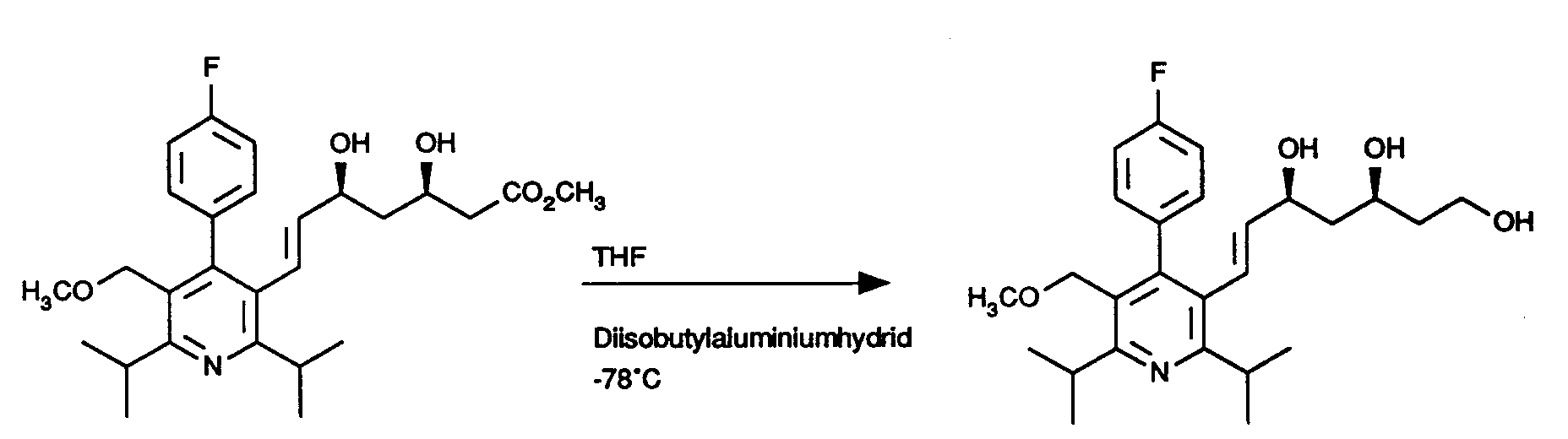
Als Lösemittel für die Reduktion eignen sich im allgemeinen die üblichen organischen Losemittel. Bevorzugt sind Ether wie Diethylether, Tetrahydrofuran oder Dioxan. Besonders bevorzugt ist Tetrahydrofuran. - Als Reduktionsmittel eignen sich komplexe Metallhydride, wie beispielsweise Lithiumalumihiumhydrid, Natriumcyanoborhydrid, Natriumaluminiumhydrid, Diisoburylaluminiumhydrid oder Natrium-bis-(2-methoxyethoxy)dihydroaluminat. Bevorzugt ist Diisobutylaluminiumhydrid.
- Das Reduktionsmittel wird im allgemeinen in einer Menge von 4 mol bis 10 mol, bevorzugt von 4 mol bis 5 mol bezogen auf 1 mol der Verbindungen der allgemeinen Formel(II) eingesetzt.
- Die Reduktion verläuft im allgemeinen in einem Temperaturbereich von - 78°C bis +50°C, bevorzugt von -78°C bis 0°C, besonders bevorzugt bei -78°C, jeweils in Abhängigkeit von der Wahl des Reduktionsmittels sowie Lösemittel.
- Die Reduktion verläuft im allgemeinen bei Normaldruck, es ist aber auch möglich bei erhöhtem oder erniedrigtem Druck zu arbeiten.
- Die Cyclisierung der Aldehyde zu den entsprechenden Pyranen erfolgt im allgemeinen bei Raumtemperatur oder durch Erhitzen in inerten organischen Lösemitteln, gegebenenfalls in Anwesenheit von Molsieb.
- Als Lösemittel eignen sich hierbei Kohlenwasserstoffe wie Benzol, Toluol, Xylol, Erdölfraktionen, oder Tetralin oder Diglyme oder Triglyme. Bevorzugt werden Benzol, Toluol oder Xylol eingesetzt. Ebenso ist es möglich Gemische der genannten Lösemittel einzusetzen. Besonders bevorzugt verwendet man Kohlenwasserstoffe, insbesondere Toluol, in Anwesenheit von Molsieb.
- Die Cyclisierung wird im allgemeinen in einem Temperaturbereich von - 40°C bis +100°C, bevorzugt von -25°C bis +50°C durchgeführt.
- Die Hydrierung erfolgt nach üblichen Methoden mit Wasserstoff in Anwesenheit von Edelmetallkatalysatoren, wie beispielsweise Pd/C, Pt/C oder Raney-Nickel in einem der oben aufgeführten Lösemittel, vorzugsweise in Alkoholen wie beispielsweise Methanol, Ethanol oder Propanol, in einem Temperaturbereich von -20°C bis +100°C, bevorzugt von 0°C bis +50°C, bei Normaldruck oder Überdruck.
- Gegebenenfalls erfolgt die Reduktion der Dreifach- bzw. Doppelbindung auch bei der oben aufgeführten Reduktion der Estergruppe.
- Die Verbindungen der allgemeinen Formel (II) sind im Fall, daß D und/oder E für den Rest der Formel

steht, bekannt [vgl. EP 325 130]. - Im Fall, daß D und/oder E für den Rest der Formel

steht,
sind die Verbindungen größenteils neu. Sie können aber in Analogie zu dem in der DOS 40 23 308 publizierten Verfahren hergestellt werden, indem man ausgehend von den Verbindungen der allgemeinen Formel (III)
in welcher - R¹, R² und R⁴
- die oben angegebene Bedeutung haben
- R⁸ und R¹⁰
- die oben angegebene Bedeutung haben,
- Die Reduktion kann mit den üblichen Reduktionsmitteln, bevorzugt mit solchen, die für die Reduktion von Ketonen zu Hydroxyverbindungen geeignet sind, durchgeführt werden. Besonders geeignet ist hierbei die Reduktion mit Metallhydriden oder komplexen Metallhydriden in inerten Lösemitteln, gegebenenfalls in Anwesenheit eines Trialkylborans. Bevorzugt wird die Reduktion mit komplexen Metallhydriden wie beispielsweise Lithiumboranat, Natriumboranat, Kaliumboranat, Zinkboranat, Lithium-trialkylhydrido-boranat oder Lithiumaluminiumhydrid durchgeführt. Ganz besonders bevorzugt wird die Reduktion mit Natriumborhydrid, in Anwesenheit von Triethylboran durchgeführt.
- Die Reduktion verläuft im allgemeinen in einem Temperaturbereich von - 78°C bis +50°C, bevorzugt von -78°C bis +25°C und unter Normaldruck.
- Die Verbindungen der allgemeinen Formel (III) sind größenteils neu und können in Analogie zu bekannten Methoden hergestellt werden [vgl. DE 38 172 98 A; US 50 91 378].
- Im Fall der enantiomerenreinen Verbindungen der allgemeinen Formel (I) werden entweder die entsprechenden enantiomerenreinen Ester der allgemeinen Formel (II) eingesetzt, die nach publizierten Verfahren durch Umsetzung der racemischen Produkten mit enantiomerenreinen Aminen zu den entsprechenden diastereomeren Amidgemischen, anschließender Trennung durch Chromatographie oder Kristallisation in die einzelnen Diastereomere und anschließender Hydrolyse erhalten werden [vgl. DOS 40 40 026] oder man trennt die racemischen Endprodukte nach üblichen chromatographischen Methoden.
- Die erfindungsgemäßen substituierten Pyridine sowie deren isomere Formen besitzen wertvolle, im Vergleich zum Stand der Technik überlegene, pharmakologische Eigenschaften; insbesondere sind sie in vivo hochwirksame Inhibitoren der 3-Hydroxy-3-methyl-glutaryl Coenzym A (HGM-CoA) Reduktase und infolge dessen Inhibitoren der Cholesterolbiosynthese. Sie können deshalb zur Behandlung von Hyperlipoproteinämie oder Arteriosklerose eingesetzt werden. Die erfindungsgemäßen Wirkstoffe bewirken außerdem eine Senkung des Cholesteringehaltes im Blut.
- Die pharmakologische Wirkung der erfindungsgemäßen Stoffe wurde in folgendem Test bestimmt:
- Cholesterin wird im Säugetierorgänismus aus Acetateinheiten aufgebaut. Um die hepatische Cholesterinbiosynthese in vivo zu messen, wurde den Tieren radioaktiv markiertes ¹⁴C-Acetat appliziert und später der Gehalt an ¹⁴C-Cholesterin in der Leber bestimmt.
- Die zu untersuchenden Substanzen wurden auf eine Hemmung der hepatischen Cholesterinbiosynthese in vivo an männlichen Wistar-Ratten mit einem Körpergewicht zwischen 140 und 160 g geprüft Die Ratten wurden zu diesem Zweck 18 h vor der oralen Applikation der Substanzen gewogen, in Gruppen zu 6 Tieren (Kontrollgruppe ohne Substanzbelastung 8 Tiere) eingeteilt und nüchterngesetzt. Die zu untersuchenden Subtanzen wurden direkt vor der Applikation in wäßriger 0,75 %iger Traganthsuspension mit einem Ultra-Turrax suspendiert Die Applikation der Traganthsuspension (Kontrolltiere) bzw. der in Traganth suspendierten Substanzen erfolgte mittels einer Schlundsonde. 2 h nach der oralen Substanzgabe wurden den Tieren ¹⁴C-Acetat (12,5 µCi/Tier) intraperitoneal injiziert.
- Weitere 2 h später (4 h nach Substanzapplikation) wurden die Tiere durch Halsschnitt getötet und entblutet. Anschließend wurde der Bauchraum geöffnet und eine Leberprobe von ca. 700 mg zur Bestimmung des aus ¹⁴C-Acetat synthetisierten ¹⁴C-Cholesterins entnommen. Die Extraktion des Cholesterins erfolgte modifiziert nach Duncan et al. (J. Chromatogr. 162 (1979) 281-292)). Die Leberprobe wurde in einem Glaspotter in Isopropanol homogenisiert. Nach Schütteln und anschließender Zentrifugation wurde der Überstand mit alkoholischer KOH versetzt und die Cholesterinester verseift. Nach der Verseifung wurde das Gesamtcholesterin mit Heptan ausgeschüttelt und der Überstand eingedampft. Der Rückstand wurde in Isopropanol aufgenommen, in Szintillationsröhrchen überführt und mit LSC-Cocktail aufgefüllt. Das aus ¹⁴C-Acetat in der Leber synthetisierte ¹⁴C-Cholesterin wurde im Flüssigkeitsszintillationszähler gemessen. Der hepatische ¹⁴C-Cholesteringehalt, der nur mit Traganth behandelten Tiere diente als Kontrolle. Die inhibitorische Aktivität der Substanzen wird in % des synthetisierten hepatischen ¹⁴C-Cholesteringehaltes der
Tabelle 1 Akute Hemmung der ¹⁴C-Cholesterinbiosynthese in vivo in der Rattenleber Beispiel Nr. Dosis, die die hepatische ¹⁴C-Cholesterinsynthese zu 50 % hemmt (µg/kg KG p.o.) 1 20 - Zur vorliegenden Erfindung gehören auch pharmazeutische Zubereitungen, die neben inerten, nicht-toxischen, pharmazeutisch geeigneten Hilfs- und Trägerstoffen eine oder mehrere Verbindungen der allgemeinen Formel (I) enthalten, oder die aus einem oder mehreren Wirkstoffen der Formel (I) bestehen, sowie Verfahren zur Herstellung dieser Zubereitungen.
- Die Wirkstoffe der Formel (I) sollen in diesen Zubereitungen in einer Konzentration von 0,1 bis 99,5 Gew.-%, bevorzugt von 0,5 bis 95 Gew.-% der Gesamtmischung vorhanden sein.
- Neben den Wirkstoffen der Formel (I) können die pharmazeutischen Zubereitungen auch andere pharmazeutische Wirkstoffe enthalten.
- Die oben aufgeführten pharmazeutischen Zubereitungen können in üblicher Weise nach bekannten Methoden hergestellt werden, beispielsweise mit dem oder den Hilfs- oder Trägerstoffen.
- Im allgemeinen hat es sich als vorteilhaft erwiesen, den oder die Wirkstoffe der Formel (I) in Gesamtmengen von etwa 0,1 µg/kg bis etwa 100 µg/kg, bevorzugt in Gesamtmengen von etwa 1 µg/kg bis 50 µg/kg Körpergewicht je 24 Stunden, gegebenenfalls in Form mehrerer Einzelgaben, zur Erzielung des gewünschten Ergebnisses zu verabreichen.
- Es kann aber gegebenenfalls vorteilhaft sein, von den genannten Mengen abzuweichen, und zwar in Abhängigkeit von der Art und dem Körpergewicht des behandelten Objekts, vom individuellen Verhalten gegenüber dem Medikament, der Art und Schwere der Erkrankung, der Art der Zubereitung und Applikation, sowie dem Zeitpunkt bzw. Intervall, zu welchem die Verabreichung erfolgt.
- 3R,5S-(+)-Methyl-erythro-(E)-7-[4-(4-fluorphenyl)-2,6-diisopropyl-5-methoxymethyl-pyrid-3-yl]-3,5-dihydroxy-hept-6-enoat

4,81 g (10 mmol) 3R,5S-(+)-Natrium-erythro-(E)-7-[4-(4-fluorphenyl)-2,6-diisopropy-5-methoxymethyl-pyrid-3-yl]-3,5-dihydroxy-hept-6-enoat werden in 100 ml Wasser gelöst und durch Zugabe von 1 N Salzsäure wird pH 4 eingestellt Es wird 2 mal mit 150 ml Methylenchlorid extrahiert Die organische Phase wird mit Na₂SO₄ getrocknet und dann bis zu vollständigen Umsetzung mit einer ätherischen Diazomethanlösung umgesetzt. Anschließend wird das Lösemittel am Rotationsverdampfer abgezogen und der Rückstand im Hochvakuum getrocknet.
Ausbeute: 4,65 g (98% d.Th.)
¹H-NMR (CDCl₃): δ = 1,23 (m, 6H); 1,32 (d, 6H); 1,40 (m, 2H); 2,43 (m, 2H); 3,18 (s, 3H); 3,32 (m, 2H); 3,73 (s, 3H); 4,05 (s, 2H); 4,08 (m, 1H); 4,29 (m, 1H); 5,23 (dd, 1H); 6,31 (d, 1H); 7,0 - 7,20 (m, 4H) ppm.
Spezifische Drehung (EtOH): [α]²⁰D = 41,7° (c=1,0) - 3S,5S-(+)-(E)-7-[4-(4-Fluorphenyl)-2,6-diisopropyl-5-methoxymethylpyrid-3yl]-hept-6-en-1,3,5-triol

4 g (8,5 mmol) der Verbindung aus Beispiel I werden unter Argon in 100 ml absolutem THF gelöst. Bei -78°C werden 35,8 ml (43 mmol) einer 1,2 M Diisobutylaluminiumhydrid-Lösung (in Toluol) zugetropft. Nach 12 h bei - 30°C läßt man die Reaktionslösung auf 0°C kommen und gibt vorsichtig 150 ml Wasser zu. Anschließend wird 3 mal mit je 200 ml Essigester extrahiert. Die organische Phase wird mit gesättigter NaCl-Lösung gewaschen, mit Na₂SO₄ getrocknet und am Rotationsverdampfer eingeengt. Nach Chromatographie über Kieselgel 60 (25 - 40 µ, Laufmittel Essigester/Petrolether 7/3) erhält man das gewünschte Produkt.
Ausbeute: 1,98 g (52% d.Th.)
¹H-NMR (CDCl₃): δ = 1,2 - 1,5 (m, 2H); 1,23 (dd, 6H); 1,36 (d, 6H); 1,65 (m, 2H); 3,19 (s, 3H); 3,30 (m, 2H); 3,82 (m, 2H); 4,02 (m, 1H); 4,07 (s, 2H); 4,27 (m, 1H); 5,26 (dd, 1H); 6,28 (d, 1H); 7,0 - 7,2 (m, 4H) ppm.
Spezifische Drehung (EtOH): [α]²⁰D = 31,1° (c=1,0) - 3S,5S-(+)-(E)-7-[5-(4-Fluorbenzyloxymethyl)-4(4-fluorphenyl)-2,6-di-isopropyl-pyrid-3-yl]hept-6-en-1,3,5-triol

Die Herstellung erfolgt analog den Beispielen I und 1 aus 3R,5S-(+)-Natriumerythro-(E)-7-[5-(4-fluorberzyloxymethyl)-4-(4-fluorphenyl)-2,6-diisopropyl-pyrid-3-yl]-3,5-dihydroxy-hept-6-enoat.
¹H-NMR (CDCl₃): δ = 1,1 - 1,4 (m, 2H); 1,18 (dd, 6H); 1,22 (d, 6H); 1,58 (m, 2H); 3,32 (m, 2H); 3,78 (m, 2H); 3,95 (m, 1H); 4,06 (s, 2H); 4,18 (m, 1H); 4,22 (s, 2H); 5,18 (dd, 1H); 6,22 (dd, 1H); 6,8 - 7,2 (m, 8H) ppm. - Erythro-(E)-7-[4-(4-fluorphenyl)-5-hydroxymethyl-2,6-diisopropyl-pyrid-3-yl]hept-6-ene-1,3,5-triol

Die Herstellung erfolgt analog den Beispielen I und 1 aus Natrium-erythro-[4-(4-fluorphenyl)-5-hydroxymethyl-2,6-diisopropyl-pyrid-3-yl]-3,5-dihydroxy-hept-6-enoat.
¹H-NMR (CDCl₃): δ = 1,2 - 1,4 (m, 2H); 1,22 (dd, 6H); 1,32 (d, 6H); 1,55 (m, 2H); 3,28 (sept., 1H); 3,42 (sept., 1H); 3,86 (m, 2H); 4,03 (m, 1H); 4,28 (m, 1H); 4,42 (d, 2H); 5,27 (dd, 1H); 6,28 (d, 1H); 7,0 - 7,2 (m, 2H) ppm. - 2,6-Diisopropyl-4-(4-fluorphenyl)-3,5-bis-(erythro-3,5,7-trihydroxy-hept-1-(E)-enyl)-pyridin

Die Herstellung erfolgt analog den Beispielen I und 1 aus 2,6-Diisopropyl-4-(4-fluorphenyl)-3,5-bis-(methyl-erythro-(E)-3,5-dihydroxy-hept-6-enoat-7-yl)-pyridin ¹H-NMR (CDCl₃): δ = 1,2 - 1,4 (m, 12H); 1,4 - 1,7 (m, 8H); 3,29 (hept. 2H); 3,83 (m, 4H); 4,03 (m, 2H); 4,30 (m, 2H); 5,28 (dd, 2H); 6,28 (d, 2H); 6,9 - 7,1 (m, 4H) ppm. - Erythro-(E)-7-[2-(4-fluorphenyl)-4,6-diisopropyl-5-methoxymethyl-pyrid-3-yl]hept-6-en-1,3,5-triol

Herstellung analog Beispiel 1 aus Methyl-erythro-(E)-7-[2-(4-fluorphenyl)-4,6-diisopropyl-5-methoxymethyl-pyrid-3-yl]-3,5-dihydroxy-hept-6-enoat
Ausbeute: 34 %, farbloses Öl
MS (DCI): 446 (30 %, M+H)
und im Fall, daß -X- für die -CH₂-CH₂-Gruppe steht, die Ethengruppe (X = -CH=CH-) oder die Ethingruppe (X = -C≡C-) sukzessive nach üblichen Methoden hydriert, und gegebenenfalls die Isomeren trennt.

steht,
worin
Als Losemittel eignen sich in diesem Fall insbesondere Alkohole wie Methanol, Ethanol oder Propanol, bevorzugt Ethanol.
Claims (10)
- Neue substituierte Pyridine der allgemeinen Formel
 R¹ für Cycloalkyl mit 3 bis 7 Kohlenstoffatomen steht, oder
für geradkettiges oder verzweigtes Alkyl mit bis zu 8 Kohlenstoffatomen steht, oder
für Phenyl steht, das gegebenenfalls bis zu 2-fach gleich oder verschieden durch Halogen, Trifluormethyl oder durch geradkettiges oder verzweigtes Alkyl mit bis zu 6 Kohlenstoffatomen substituiert ist, oder
für einen Rest der Formel
worinR⁶ und R⁷ gleich oder verschieden sind und Wasserstoff oder geradkettiges oder verzweigtes Alkyl mit bis zu 4 Kohlenstoffatomen bedeuten,R² für Cycloalkyl mit 3 bis 7 Kohlenstoffatomen steht, oder für geradkettiges oder verzweigtes Alkyl mit bis zu 8 Kohlenstoffatomen steht,R³ für einen Rest der Formel
worinX die Gruppe -CH₂-CH₂-, CH=CH- oder -C≡C- bedeutet,R⁸, R⁹ und R¹⁰ gleich oder verschieden sind und Wasserstoff oder einen Rest der Formel -CO-R¹¹ oder -COO-R¹² bedeuten,
worinR¹¹ und R¹² gleich oder verschieden sind und geradkettiges oder verzweigtes Alkyl mit bis zu 8 Kohlenstoffatomen oder Phenyl bedeuten, oderR⁸ und R⁹ gemeinsam einen Rest der Formel R⁴ für Phenyl steht, das gegebenenfalls bis zu 2-fach gleich oder verschieden durch Halogen, Trifluormethyl, Methoxy, Phenoxy oder geradkettiges oder verzweigtes Alkyl mit bis zu 8 Kohlenstoffatomen substituiert ist,R⁵ die oben angegebene Bedeutung von R³ hat und mit dieser gleich oder verschieden ist, oder
für Wasserstoff, Cyano, Carboxy oder geradkettiges oder verzweigtes Alkoxycarbonyl mit bis zu 8 Kohlenstoffatomen steht, oder
für geradkettiges oder verzweigtes Alkyl mit bis zu 8 Kohlenstoffatomen steht, das gegebenenfalls durch Halogen, Hydroxy oder durch geradkettiges oder verzweigtes Alkoxy mit bis zu 8 Kohlenstoffatomen oder durch eine Gruppe der Formel -O-(CH₂)a-R¹³ oder -O-CO-R¹⁴ substituiert ist,
worina eine Zahl 0 oder 1 bedeutet,R¹³ Phenyl oder Benzyl bedeutet, die gegebenenfalls bis zu 2-fach gleich oder verschieden durch Halogen, Trifluormethyl, Cyano, Nitro oder durch geradkettiges oder verzweigtes Alkyl mit bis zu 6 Kohlenstoffatomen substituiert sind,R¹⁴ die oben angegebene Bedeutung von R¹³ hat und mit dieser gleich oder verschieden ist, oder
geradkettiges oder verzweigtes Alkyl mit bis zu 8 Kohlenstoffatomen bedeutet,
oderR⁵ für einen Rest der Formel -CH=N-O-R¹⁵ steht,
worinR¹⁵ die oben angegebene Bedeutung von R¹⁴ hat und mit dieser gleich oder verschieden ist. - Neue substituierte Pyridine nach Anspruch 1
worinR¹ für Cyclopropyl, Cyclopentyl oder für geradkettiges oder verzweigtes Alkyl mit bis zu 6 Kohlenstoffatomen steht, oder
für Phenyl steht, das gegebenenfalls durch Fluor, Chlor, Trifluormethyl oder Methyl substituiert ist,R² für Cyclopropyl, Cyclopentyl oder Cyclohexyl steht, oder für geradkettiges oder verzweigtes Alkyl mit bis zu 6 Kohlenstoffatomen steht,R³ für einen Rest der Formel
worinX die Gruppe -CH₂-CH₂-, CH=CH- oder -C≡C- bedeutet,R⁸, R⁹ und R¹⁰ gleich oder verschieden sind und Wasserstoff oder einen Rest der Formel -CO-R¹¹ oder -COO-R¹² bedeuten,
worinR¹¹ und R¹² gleich oder verschieden sind und geradkettiges oder verzweigtes Alkyl mit bis zu 6 Kohlenstoffatomen oder Phenyl bedeuten,
oderR⁸ und R⁹ gemeinsam einen Rest der Formel R⁴ für Phenyl steht, das gegebenenfalls bis zu 2-fach gleich oder verschieden durch Fluor, Chlor, Brom, Trifluormethyl oder durch geradkettiges oder verzweigtes Alkyl mit bis zu 6 Kohlenstoffatomen substituiert ist,R⁵ die oben angegebene Bedeutung von R³ hat und mit dieser gleich oder verschieden ist, oder
für Wasserstoff, Cyano, Carboxy oder geradkettiges oder verzweigtes Alkoxycarbonyl mit bis zu 6 Kohlenstoffatomen steht, oder
für geradkettiges oder verzweigtes Alkyl mit bis zu 6 Kohlenstoffatomen steht, das gegebenenfalls durch Fluor, Chlor, Brom, Hydroxy oder durch geradkettiges oder verzweigtes Alkoxy mit bis zu 6 Kohlenstoffatomen substituiert ist, oder das durch eine Gruppe der Formel -O-(CH₂)a-R¹³ oder -O-CO-R¹⁴ substituiert ist,
worina eine Zahl 0 oder 1 bedeutet,
undR¹³ Phenyl oder Benzyl bedeutet, die gegebenenfalls durch Fluor, Chlor, Brom, Trifluormethyl, Cyano, Nitro oder durch geradkettiges oder verzweigtes Alkyl mit bis zu 4 Kohlenstoffatomen substituiert sind,R¹⁴ die oben angegebene Bedeutung von R¹³ hat und mit dieser gleich oder verschieden ist, oder
geradkettiges oder verzweigtes Alkyl mit bis zu 6 Kohlenstoffatomen bedeutet,
oderR⁵ für einen Rest der Formel -CH=N-O-R¹⁵ steht,
worinR¹⁵ die oben angegebene Bedeutung von R¹⁴ hat und mit dieser gleich oder verschieden ist. - Neue substituierte Pyridine nach Anspruch 1
worinR¹ für Cyclopropyl oder geradkettiges oder verzweigtes Alkyl mit bis zu 4 Kohlenstoffatomen steht,R² für Cyclopropyl oder für geradkettiges oder verzweigtes Alkyl mit bis zu 4 Kohlenstoffatomen steht,R³ für einen Rest der Formel
worinX die Gruppe -CH₂-CH₂- oder CH=CH- bedeutet,R⁸, R⁹ und R¹⁰ gleich oder verschieden sind und Wasserstoff oder einen Rest der Formel -CO-R¹¹ bedeuten,
worinR¹¹ geradkettiges oder verzweigtes Alkyl mit bis zu 4 Kohlenstoffatomen bedeutet,
R⁴ für Phenyl steht, das gegebenenfalls durch Fluor, Trifluormethyl oder durch geradkettiges oder verzweigtes Alkyl mit bis zu 4 Kohlenstoffatomen substituiert ist,R⁵ die oben angegebene Bedeutung von R³ hat und mit dieser gleich oder verschieden ist, oder
für Wasserstoff oder
für geradkettiges oder verzweigtes Alkyl mit bis zu 4 Kohlenstoffatomen steht, das gegebenenfalls durch Hydroxy oder durch geradkettiges oder verzweigtes Alkoxy mit bis zu 4 Kohlenstoffatomen oder durch p-Fluorbenzyloxy substituiert ist. - Neue substituierte Pyridine nach Anspruch 1
worinR¹ für geradkettiges oder verzweigtes Alkyl mit bis zu 4 Kohlenstoffatomen steht,R² für Cyclopropyl oder für geradkettiges oder verzweigtes Alkyl mit bis zu 4 Kohlenstoffatomen steht,
worinX die Gruppe -CH₂-CH₂- oder -CH=CH- bedeutet,R⁴ für Phenyl steht, das gegebenenfalls durch Fluor substituiert ist,
undR⁵ die oben angegebene Bedeutung von R³ hat oder
für geradkettiges oder verzweigtes Alkyl mit bis zu 4 Kohlenstoffatomen steht, das gegebenenfalls durch Hydroxy oder Alkoxy mit bis zu 4 Kohlenstoffatomen oder durch p-Fluorbenzyloxy substituiert sein kann. - Neue substituierte Pyridine nach Anspruch 1 zur therapeutischen Anwendung.
- Verfahren zur Herstellung von neuen substituierten Pyridinen nach Anspruch 1 dadurch gekennzeichnet, daß man
Verbindungen der allgemeinen Formel (II) R¹, R² und R⁴ die oben angegebene Bedeutung haben
undD für einen Rest der Formel
worinA, B, R⁸ und R⁹ die oben angegebene Bedeutung haben,R¹⁶ für C₁-C₆-Alkyl steht
undE entweder ebenfalls die oben angegebene Bedeutung von D hat oder für einen unter R³ oben aufgeführten anderen Substituenten steht, in inerten Lösemitteln, unter Schutzgasatmosphäre, gegebenenfalls über die Stufe des Aldehyds reduziert,
und im Fall, daß -X- für die -CH₂-CH₂-Gruppe steht, die Ethengruppe (X = -CH=CH-) oder die Ethingruppe (X = -C≡C-) sukzessive nach üblichen Methoden hydriert, und gegebenenfalls die Isomeren trennt. - Arzneimittel enthaltend mindestens ein neues substituiertes Pyridin nach Anspruch 1.
- Arzneimittel nach Anspruch 7 zur Behandlung von Hyperlipoproteinämie.
- Verfahren zur Herstellung von Arzneimitteln nach Anspruch 7 dadurch gekennzeichnet, daß man die neuen substituierten Pyridine gegebenenfalls mit Hilfe von üblichen Hilfs- und Trägerstoffen in eine geeignete Applikationsform überführt.
- Verwendung von neuen substituierten Pyridinen nach Anspruch 1 zur Herstellung von Arzneimitteln.
Applications Claiming Priority (2)
| Application Number | Priority Date | Filing Date | Title |
|---|---|---|---|
| DE4244029A DE4244029A1 (de) | 1992-12-24 | 1992-12-24 | Neue substituierte Pyridine |
| DE4244029 | 1992-12-24 |
Publications (2)
| Publication Number | Publication Date |
|---|---|
| EP0603699A1 true EP0603699A1 (de) | 1994-06-29 |
| EP0603699B1 EP0603699B1 (de) | 1997-01-15 |
Family
ID=6476507
Family Applications (1)
| Application Number | Title | Priority Date | Filing Date |
|---|---|---|---|
| EP93120057A Expired - Lifetime EP0603699B1 (de) | 1992-12-24 | 1993-12-13 | Substituierte Pyridine als HMG-CoA-Reduktase-Inhitoren |
Country Status (7)
| Country | Link |
|---|---|
| US (1) | US5409910A (de) |
| EP (1) | EP0603699B1 (de) |
| JP (1) | JP3391873B2 (de) |
| AT (1) | ATE147741T1 (de) |
| CA (1) | CA2112011C (de) |
| DE (2) | DE4244029A1 (de) |
| ES (1) | ES2096843T3 (de) |
Cited By (3)
| Publication number | Priority date | Publication date | Assignee | Title |
|---|---|---|---|---|
| EP0796846A1 (de) * | 1996-03-20 | 1997-09-24 | Bayer Ag | 2-Aryl-substituierte Pyridine |
| EP0818447A1 (de) * | 1996-07-08 | 1998-01-14 | Bayer Ag | 6-(Hydroxymethyl-ethyl)pyridine als HMG-CoA-Reduktase Inhibitoren |
| WO1998004528A3 (en) * | 1996-07-31 | 1999-11-11 | Bayer Ag | Substituted pyridines and biphenyls as anti-hypercholesterinemic, anti-hyperlipoproteinemic and anti-hyperglycemic agents |
Citations (2)
| Publication number | Priority date | Publication date | Assignee | Title |
|---|---|---|---|---|
| EP0306929A2 (de) * | 1987-09-08 | 1989-03-15 | Warner-Lambert Company | 6-[[(substituierte)Pyridin-3-yl]alkyl]- und alkenyl]-tetrahydro-4-hydroxypyran-2-one-Inhibitoren von der Cholesterol-Biosynthese |
| EP0325130A2 (de) * | 1988-01-20 | 1989-07-26 | Bayer Ag | Substituierte Pyridine |
Family Cites Families (7)
| Publication number | Priority date | Publication date | Assignee | Title |
|---|---|---|---|---|
| AU535944B2 (en) * | 1979-06-15 | 1984-04-12 | Merck & Co., Inc. | Hypocholestermic fermentation products from aspergillus |
| US4231938A (en) * | 1979-06-15 | 1980-11-04 | Merck & Co., Inc. | Hypocholesteremic fermentation products and process of preparation |
| US5169857A (en) * | 1988-01-20 | 1992-12-08 | Bayer Aktiengesellschaft | 7-(polysubstituted pyridyl)-hept-6-endates useful for treating hyperproteinaemia, lipoproteinaemia or arteriosclerosis |
| US5091378A (en) * | 1987-05-22 | 1992-02-25 | E. R. Squibb & Sons, Inc. | Phosphorus-containing HMG-CoA reductase inhibitors, new intermediates and method |
| PT87929B (pt) * | 1987-07-10 | 1995-03-01 | Hoechst Ag | Processo para a preparacao de derivados de acido 3-desmetil-mevalonico e de composicoes farmaceuticas que os contem |
| DE4023308A1 (de) * | 1990-07-21 | 1992-01-23 | Bayer Ag | Substituierte pyrido-oxazine |
| US5177080A (en) * | 1990-12-14 | 1993-01-05 | Bayer Aktiengesellschaft | Substituted pyridyl-dihydroxy-heptenoic acid and its salts |
-
1992
- 1992-12-24 DE DE4244029A patent/DE4244029A1/de not_active Withdrawn
-
1993
- 1993-12-13 AT AT93120057T patent/ATE147741T1/de not_active IP Right Cessation
- 1993-12-13 ES ES93120057T patent/ES2096843T3/es not_active Expired - Lifetime
- 1993-12-13 DE DE59305147T patent/DE59305147D1/de not_active Expired - Fee Related
- 1993-12-13 EP EP93120057A patent/EP0603699B1/de not_active Expired - Lifetime
- 1993-12-17 US US08/169,804 patent/US5409910A/en not_active Expired - Lifetime
- 1993-12-17 JP JP34331093A patent/JP3391873B2/ja not_active Expired - Fee Related
- 1993-12-21 CA CA002112011A patent/CA2112011C/en not_active Expired - Fee Related
Patent Citations (2)
| Publication number | Priority date | Publication date | Assignee | Title |
|---|---|---|---|---|
| EP0306929A2 (de) * | 1987-09-08 | 1989-03-15 | Warner-Lambert Company | 6-[[(substituierte)Pyridin-3-yl]alkyl]- und alkenyl]-tetrahydro-4-hydroxypyran-2-one-Inhibitoren von der Cholesterol-Biosynthese |
| EP0325130A2 (de) * | 1988-01-20 | 1989-07-26 | Bayer Ag | Substituierte Pyridine |
Non-Patent Citations (1)
| Title |
|---|
| G. BECK ET AL., JOURNAL OF MEDICINAL CHEMISTRY, vol. 33, no. 1, 1990, WASHINGTON US, pages 52 - 60 * |
Cited By (7)
| Publication number | Priority date | Publication date | Assignee | Title |
|---|---|---|---|---|
| EP0796846A1 (de) * | 1996-03-20 | 1997-09-24 | Bayer Ag | 2-Aryl-substituierte Pyridine |
| US6127383A (en) * | 1996-03-20 | 2000-10-03 | Bayer Aktiengesellschaft | 2-aryl-substituted pyridines |
| EP0818447A1 (de) * | 1996-07-08 | 1998-01-14 | Bayer Ag | 6-(Hydroxymethyl-ethyl)pyridine als HMG-CoA-Reduktase Inhibitoren |
| US5849749A (en) * | 1996-07-08 | 1998-12-15 | Bayer Aktiengesellschaft | 6-(hydroxymethyl-ethyl)pyridines |
| WO1998004528A3 (en) * | 1996-07-31 | 1999-11-11 | Bayer Ag | Substituted pyridines and biphenyls as anti-hypercholesterinemic, anti-hyperlipoproteinemic and anti-hyperglycemic agents |
| US6218431B1 (en) | 1996-07-31 | 2001-04-17 | Bayer Corporation | Substituted biphenyls |
| RU2195443C2 (ru) * | 1996-07-31 | 2002-12-27 | Байер Корпорейшн | Замещенные биарильные соединения или замещенные пиридины и фармацевтические композиции на их основе |
Also Published As
| Publication number | Publication date |
|---|---|
| CA2112011A1 (en) | 1994-06-25 |
| JP3391873B2 (ja) | 2003-03-31 |
| DE59305147D1 (de) | 1997-02-27 |
| DE4244029A1 (de) | 1994-06-30 |
| US5409910A (en) | 1995-04-25 |
| CA2112011C (en) | 2005-07-26 |
| ES2096843T3 (es) | 1997-03-16 |
| JPH06234740A (ja) | 1994-08-23 |
| EP0603699B1 (de) | 1997-01-15 |
| ATE147741T1 (de) | 1997-02-15 |
Similar Documents
| Publication | Publication Date | Title |
|---|---|---|
| EP0603649B1 (de) | Substituierte 4-Phenyl-pyridone und 4-Phenyl-2-alkoxypyridine als HMG-CoA-Reductase-Inhitoren | |
| EP0674638B1 (de) | Substituierte triole | |
| EP0361273B1 (de) | 7-Substituierte Derivate der 3,5-Dihydroxyhept-6-insäure, Verfahren zu ihrer Herstellung, ihre Verwendung als Arzneimittel, sowie Zwischenprodukte | |
| EP0491226B1 (de) | Substituierte Pyridyl-dihydroxy-heptensäure und deren Salze | |
| EP0207331B1 (de) | Neue feste Formen von 2-Äthoxy-4-[N-(1-(2-piperidino-phenyl)-3-methyl-1-butyl)-aminocarbonylmethyl]-benzoesäure, diese Formen enthaltende Arzneimittel und Verfahren zu ihrer Herstellung | |
| EP0465970A1 (de) | Substituierte Pyrrolopyridine | |
| CH649079A5 (de) | Sulfonatabkoemmlinge und verfahren zur herstellung solcher sowie diese abkoemmlinge enthaltende antilipaemische praeparate. | |
| EP0033156B1 (de) | 1-Phenyl-2-cyclohexen-1-alkylamin-Derivate, Verfahren zu deren Herstellung und diese enthaltende Arzneimittel | |
| EP0391185B1 (de) | Substituierte 1,8-Naphthyridine | |
| EP0603699B1 (de) | Substituierte Pyridine als HMG-CoA-Reduktase-Inhitoren | |
| DE3874394T2 (de) | 1,3-dioxane. | |
| EP0135162B1 (de) | Weinsäuremonoester von optisch aktiven Alkanolaminen, Verfahren zu ihrer Herstellung und ihre Verwendung | |
| EP0354418B1 (de) | 6-Fluor-3,5-dihydroxycarbonsäuren und deren Derivate, Verfahren zu ihrer Herstellung, ihre Verwendung als Arzneimittel, pharmazeutische Präparate und Zwischenprodukte | |
| DE69208464T2 (de) | N-((4,5-dihydroxy- und 4,5,8-trihydroxy-9,10-dihydro-9,10-dioxo-2-anthracen-yl)carbonyl)aminosäure zur therapie osteoartikulärer leiden | |
| EP0300249B1 (de) | 7-[1H-Pyrrol-3-yl]-substituierte 3,5-Dihydroxy-heptansäuren, ihre entsprechenden delta-Lactone und Salze, Verfahren zu ihrer Herstellung, ihre Verwendung als Arzneimittel, pharmazeutische Präparate und Zwischenprodukte | |
| EP0643052A2 (de) | Verfahren zur enantioselektiven Hydrierung von 2H-Pyran-2-on-Derivaten | |
| EP0391850B1 (de) | Ungesättigte Aminodicarbonsäurederivate | |
| DE69300011T2 (de) | Diacylglycerol-Nicotinate, Verfahren zu ihrer Herstellung und diese enthaltende pharmazeutische Zubereitungen. | |
| DE3918364A1 (de) | 3-desmethyl-2-methyl-mevalonsaeurederivate, verfahren zu ihrer herstellung, ihre verwendung als arzneimittel, sowie zwischenprodukte | |
| EP0420806A1 (de) | Phosphonsäure, Verfahren zur Herstellung und Verwendung als Arzneimittelwirkstoff | |
| EP0818447B1 (de) | 6-(Hydroxymethyl-ethyl)pyridine als HMG-CoA-Reduktase Inhibitoren | |
| DE2331081A1 (de) | Neue cyclopentanderivate und verfahren zu ihrer herstellung | |
| EP0350445A1 (de) | Substituierte Azacyclohexyl-Derivate | |
| DE4321421A1 (de) | Substituierte 4-Phenyl-pyridone und 4-Phenyl-2-alkoxypyridine | |
| CH646163A5 (de) | Thromboxananaloge. |
Legal Events
| Date | Code | Title | Description |
|---|---|---|---|
| PUAI | Public reference made under article 153(3) epc to a published international application that has entered the european phase |
Free format text: ORIGINAL CODE: 0009012 |
|
| AK | Designated contracting states |
Kind code of ref document: A1 Designated state(s): AT BE CH DE DK ES FR GB GR IE IT LI LU MC NL PT SE |
|
| 17P | Request for examination filed |
Effective date: 19941115 |
|
| 17Q | First examination report despatched |
Effective date: 19950810 |
|
| GRAH | Despatch of communication of intention to grant a patent |
Free format text: ORIGINAL CODE: EPIDOS IGRA |
|
| GRAH | Despatch of communication of intention to grant a patent |
Free format text: ORIGINAL CODE: EPIDOS IGRA |
|
| GRAH | Despatch of communication of intention to grant a patent |
Free format text: ORIGINAL CODE: EPIDOS IGRA |
|
| GRAA | (expected) grant |
Free format text: ORIGINAL CODE: 0009210 |
|
| AK | Designated contracting states |
Kind code of ref document: B1 Designated state(s): AT BE CH DE DK ES FR GB GR IE IT LI LU MC NL PT SE |
|
| PG25 | Lapsed in a contracting state [announced via postgrant information from national office to epo] |
Ref country code: NL Free format text: LAPSE BECAUSE OF FAILURE TO SUBMIT A TRANSLATION OF THE DESCRIPTION OR TO PAY THE FEE WITHIN THE PRESCRIBED TIME-LIMIT Effective date: 19970115 Ref country code: GR Free format text: LAPSE BECAUSE OF FAILURE TO SUBMIT A TRANSLATION OF THE DESCRIPTION OR TO PAY THE FEE WITHIN THE PRESCRIBED TIME-LIMIT Effective date: 19970115 Ref country code: DK Effective date: 19970115 |
|
| REF | Corresponds to: |
Ref document number: 147741 Country of ref document: AT Date of ref document: 19970215 Kind code of ref document: T |
|
| REG | Reference to a national code |
Ref country code: CH Ref legal event code: NV Representative=s name: E. BLUM & CO. PATENTANWAELTE Ref country code: CH Ref legal event code: EP |
|
| GBT | Gb: translation of ep patent filed (gb section 77(6)(a)/1977) |
Effective date: 19970125 |
|
| REF | Corresponds to: |
Ref document number: 59305147 Country of ref document: DE Date of ref document: 19970227 |
|
| REG | Reference to a national code |
Ref country code: IE Ref legal event code: FG4D Free format text: 71573 |
|
| ITF | It: translation for a ep patent filed | ||
| ET | Fr: translation filed | ||
| REG | Reference to a national code |
Ref country code: ES Ref legal event code: FG2A Ref document number: 2096843 Country of ref document: ES Kind code of ref document: T3 |
|
| ET | Fr: translation filed |
Free format text: CORRECTIONS |
|
| PG25 | Lapsed in a contracting state [announced via postgrant information from national office to epo] |
Ref country code: PT Effective date: 19970415 |
|
| NLV1 | Nl: lapsed or annulled due to failure to fulfill the requirements of art. 29p and 29m of the patents act | ||
| PLBE | No opposition filed within time limit |
Free format text: ORIGINAL CODE: 0009261 |
|
| STAA | Information on the status of an ep patent application or granted ep patent |
Free format text: STATUS: NO OPPOSITION FILED WITHIN TIME LIMIT |
|
| PG25 | Lapsed in a contracting state [announced via postgrant information from national office to epo] |
Ref country code: LU Free format text: LAPSE BECAUSE OF NON-PAYMENT OF DUE FEES Effective date: 19971213 Ref country code: AT Free format text: LAPSE BECAUSE OF NON-PAYMENT OF DUE FEES Effective date: 19971213 |
|
| PG25 | Lapsed in a contracting state [announced via postgrant information from national office to epo] |
Ref country code: SE Free format text: LAPSE BECAUSE OF NON-PAYMENT OF DUE FEES Effective date: 19971214 |
|
| PG25 | Lapsed in a contracting state [announced via postgrant information from national office to epo] |
Ref country code: BE Free format text: LAPSE BECAUSE OF NON-PAYMENT OF DUE FEES Effective date: 19971231 |
|
| 26N | No opposition filed | ||
| PG25 | Lapsed in a contracting state [announced via postgrant information from national office to epo] |
Ref country code: IE Free format text: LAPSE BECAUSE OF NON-PAYMENT OF DUE FEES Effective date: 19980330 |
|
| REG | Reference to a national code |
Ref country code: IE Ref legal event code: FD4D Ref document number: 71573 Country of ref document: IE |
|
| BERE | Be: lapsed |
Owner name: BAYER A.G. Effective date: 19971231 |
|
| PG25 | Lapsed in a contracting state [announced via postgrant information from national office to epo] |
Ref country code: MC Free format text: LAPSE BECAUSE OF NON-PAYMENT OF DUE FEES Effective date: 19980630 |
|
| EUG | Se: european patent has lapsed |
Ref document number: 93120057.0 |
|
| REG | Reference to a national code |
Ref country code: GB Ref legal event code: IF02 |
|
| PGFP | Annual fee paid to national office [announced via postgrant information from national office to epo] |
Ref country code: DE Payment date: 20061115 Year of fee payment: 14 |
|
| PGFP | Annual fee paid to national office [announced via postgrant information from national office to epo] |
Ref country code: FR Payment date: 20061120 Year of fee payment: 14 |
|
| PGFP | Annual fee paid to national office [announced via postgrant information from national office to epo] |
Ref country code: GB Payment date: 20061213 Year of fee payment: 14 |
|
| PGFP | Annual fee paid to national office [announced via postgrant information from national office to epo] |
Ref country code: ES Payment date: 20061219 Year of fee payment: 14 |
|
| PGFP | Annual fee paid to national office [announced via postgrant information from national office to epo] |
Ref country code: IT Payment date: 20061231 Year of fee payment: 14 |
|
| PGFP | Annual fee paid to national office [announced via postgrant information from national office to epo] |
Ref country code: CH Payment date: 20070105 Year of fee payment: 14 |
|
| REG | Reference to a national code |
Ref country code: CH Ref legal event code: PFA Owner name: BAYER AG Free format text: BAYER AG# #51368 LEVERKUSEN (DE) -TRANSFER TO- BAYER AG# #51368 LEVERKUSEN (DE) |
|
| REG | Reference to a national code |
Ref country code: CH Ref legal event code: PL |
|
| GBPC | Gb: european patent ceased through non-payment of renewal fee |
Effective date: 20071213 |
|
| PG25 | Lapsed in a contracting state [announced via postgrant information from national office to epo] |
Ref country code: LI Free format text: LAPSE BECAUSE OF NON-PAYMENT OF DUE FEES Effective date: 20071231 Ref country code: DE Free format text: LAPSE BECAUSE OF NON-PAYMENT OF DUE FEES Effective date: 20080701 Ref country code: CH Free format text: LAPSE BECAUSE OF NON-PAYMENT OF DUE FEES Effective date: 20071231 |
|
| REG | Reference to a national code |
Ref country code: FR Ref legal event code: ST Effective date: 20081020 |
|
| PG25 | Lapsed in a contracting state [announced via postgrant information from national office to epo] |
Ref country code: GB Free format text: LAPSE BECAUSE OF NON-PAYMENT OF DUE FEES Effective date: 20071213 |
|
| REG | Reference to a national code |
Ref country code: ES Ref legal event code: FD2A Effective date: 20071214 |
|
| PG25 | Lapsed in a contracting state [announced via postgrant information from national office to epo] |
Ref country code: FR Free format text: LAPSE BECAUSE OF NON-PAYMENT OF DUE FEES Effective date: 20071231 Ref country code: ES Free format text: LAPSE BECAUSE OF NON-PAYMENT OF DUE FEES Effective date: 20071214 |
|
| PG25 | Lapsed in a contracting state [announced via postgrant information from national office to epo] |
Ref country code: IT Free format text: LAPSE BECAUSE OF NON-PAYMENT OF DUE FEES Effective date: 20071213 |