EP0603731A1 - Reinigung von Flüssigkristallen, sowie Flüssigkristallzusammensetzung - Google Patents
Reinigung von Flüssigkristallen, sowie Flüssigkristallzusammensetzung Download PDFInfo
- Publication number
- EP0603731A1 EP0603731A1 EP93120224A EP93120224A EP0603731A1 EP 0603731 A1 EP0603731 A1 EP 0603731A1 EP 93120224 A EP93120224 A EP 93120224A EP 93120224 A EP93120224 A EP 93120224A EP 0603731 A1 EP0603731 A1 EP 0603731A1
- Authority
- EP
- European Patent Office
- Prior art keywords
- liquid crystal
- porous particles
- liquid crystals
- containing compound
- imido group
- Prior art date
- Legal status (The legal status is an assumption and is not a legal conclusion. Google has not performed a legal analysis and makes no representation as to the accuracy of the status listed.)
- Granted
Links
- 239000004973 liquid crystal related substance Substances 0.000 title claims abstract description 163
- 239000000203 mixture Substances 0.000 title claims abstract description 32
- 238000000746 purification Methods 0.000 title description 12
- 239000002245 particle Substances 0.000 claims abstract description 83
- 150000001875 compounds Chemical class 0.000 claims abstract description 48
- 210000002858 crystal cell Anatomy 0.000 claims abstract description 28
- 238000000034 method Methods 0.000 claims description 38
- 229920001721 polyimide Polymers 0.000 claims description 33
- 239000004642 Polyimide Substances 0.000 claims description 29
- GTDPSWPPOUPBNX-UHFFFAOYSA-N ac1mqpva Chemical compound CC12C(=O)OC(=O)C1(C)C1(C)C2(C)C(=O)OC1=O GTDPSWPPOUPBNX-UHFFFAOYSA-N 0.000 claims description 20
- 125000006158 tetracarboxylic acid group Chemical group 0.000 claims description 12
- 239000002904 solvent Substances 0.000 claims description 11
- 150000004985 diamines Chemical class 0.000 claims description 10
- 125000005442 diisocyanate group Chemical group 0.000 claims description 10
- 150000004984 aromatic diamines Chemical class 0.000 claims description 8
- 125000003118 aryl group Chemical group 0.000 claims description 8
- 238000006243 chemical reaction Methods 0.000 claims description 8
- XLYOFNOQVPJJNP-UHFFFAOYSA-N water Substances O XLYOFNOQVPJJNP-UHFFFAOYSA-N 0.000 claims description 7
- 230000014759 maintenance of location Effects 0.000 abstract description 27
- 125000005462 imide group Chemical group 0.000 abstract description 7
- 230000000052 comparative effect Effects 0.000 description 11
- 239000011521 glass Substances 0.000 description 11
- 239000000758 substrate Substances 0.000 description 11
- -1 2,3-difluorophenylenes Chemical class 0.000 description 9
- UHOVQNZJYSORNB-UHFFFAOYSA-N Benzene Chemical compound C1=CC=CC=C1 UHOVQNZJYSORNB-UHFFFAOYSA-N 0.000 description 9
- 230000000694 effects Effects 0.000 description 9
- 239000012535 impurity Substances 0.000 description 9
- ATUOYWHBWRKTHZ-UHFFFAOYSA-N Propane Chemical compound CCC ATUOYWHBWRKTHZ-UHFFFAOYSA-N 0.000 description 8
- 239000011159 matrix material Substances 0.000 description 8
- SECXISVLQFMRJM-UHFFFAOYSA-N N-Methylpyrrolidone Chemical compound CN1CCCC1=O SECXISVLQFMRJM-UHFFFAOYSA-N 0.000 description 6
- HLBLWEWZXPIGSM-UHFFFAOYSA-N 4-Aminophenyl ether Chemical compound C1=CC(N)=CC=C1OC1=CC=C(N)C=C1 HLBLWEWZXPIGSM-UHFFFAOYSA-N 0.000 description 5
- 239000004962 Polyamide-imide Substances 0.000 description 5
- 238000001914 filtration Methods 0.000 description 5
- 238000005259 measurement Methods 0.000 description 5
- 229920002312 polyamide-imide Polymers 0.000 description 5
- 229920000642 polymer Polymers 0.000 description 5
- CSCPPACGZOOCGX-UHFFFAOYSA-N Acetone Chemical compound CC(C)=O CSCPPACGZOOCGX-UHFFFAOYSA-N 0.000 description 4
- 210000004027 cell Anatomy 0.000 description 4
- 238000002156 mixing Methods 0.000 description 4
- 125000000962 organic group Chemical group 0.000 description 4
- 229920000768 polyamine Polymers 0.000 description 4
- 239000009719 polyimide resin Substances 0.000 description 4
- 238000002360 preparation method Methods 0.000 description 4
- 239000001294 propane Substances 0.000 description 4
- VLDPXPPHXDGHEW-UHFFFAOYSA-N 1-chloro-2-dichlorophosphoryloxybenzene Chemical compound ClC1=CC=CC=C1OP(Cl)(Cl)=O VLDPXPPHXDGHEW-UHFFFAOYSA-N 0.000 description 3
- IJGRMHOSHXDMSA-UHFFFAOYSA-N Atomic nitrogen Chemical compound N#N IJGRMHOSHXDMSA-UHFFFAOYSA-N 0.000 description 3
- ZMXDDKWLCZADIW-UHFFFAOYSA-N N,N-Dimethylformamide Chemical compound CN(C)C=O ZMXDDKWLCZADIW-UHFFFAOYSA-N 0.000 description 3
- ZMANZCXQSJIPKH-UHFFFAOYSA-N Triethylamine Chemical compound CCN(CC)CC ZMANZCXQSJIPKH-UHFFFAOYSA-N 0.000 description 3
- 238000010521 absorption reaction Methods 0.000 description 3
- 238000000862 absorption spectrum Methods 0.000 description 3
- PNEYBMLMFCGWSK-UHFFFAOYSA-N aluminium oxide Inorganic materials [O-2].[O-2].[O-2].[Al+3].[Al+3] PNEYBMLMFCGWSK-UHFFFAOYSA-N 0.000 description 3
- 229910001873 dinitrogen Inorganic materials 0.000 description 3
- 238000012674 dispersion polymerization Methods 0.000 description 3
- 125000001997 phenyl group Chemical group [H]C1=C([H])C([H])=C(*)C([H])=C1[H] 0.000 description 3
- 229920001228 polyisocyanate Polymers 0.000 description 3
- 239000005056 polyisocyanate Substances 0.000 description 3
- 238000003756 stirring Methods 0.000 description 3
- ARCGXLSVLAOJQL-UHFFFAOYSA-N trimellitic acid Chemical class OC(=O)C1=CC=C(C(O)=O)C(C(O)=O)=C1 ARCGXLSVLAOJQL-UHFFFAOYSA-N 0.000 description 3
- XQUPVDVFXZDTLT-UHFFFAOYSA-N 1-[4-[[4-(2,5-dioxopyrrol-1-yl)phenyl]methyl]phenyl]pyrrole-2,5-dione Chemical compound O=C1C=CC(=O)N1C(C=C1)=CC=C1CC1=CC=C(N2C(C=CC2=O)=O)C=C1 XQUPVDVFXZDTLT-UHFFFAOYSA-N 0.000 description 2
- YBRVSVVVWCFQMG-UHFFFAOYSA-N 4,4'-diaminodiphenylmethane Chemical compound C1=CC(N)=CC=C1CC1=CC=C(N)C=C1 YBRVSVVVWCFQMG-UHFFFAOYSA-N 0.000 description 2
- NWIVYGKSHSJHEF-UHFFFAOYSA-N 4-[(4-amino-3,5-diethylphenyl)methyl]-2,6-diethylaniline Chemical compound CCC1=C(N)C(CC)=CC(CC=2C=C(CC)C(N)=C(CC)C=2)=C1 NWIVYGKSHSJHEF-UHFFFAOYSA-N 0.000 description 2
- OMHOXRVODFQGCA-UHFFFAOYSA-N 4-[(4-amino-3,5-dimethylphenyl)methyl]-2,6-dimethylaniline Chemical compound CC1=C(N)C(C)=CC(CC=2C=C(C)C(N)=C(C)C=2)=C1 OMHOXRVODFQGCA-UHFFFAOYSA-N 0.000 description 2
- QJENIOQDYXRGLF-UHFFFAOYSA-N 4-[(4-amino-3-ethyl-5-methylphenyl)methyl]-2-ethyl-6-methylaniline Chemical compound CC1=C(N)C(CC)=CC(CC=2C=C(CC)C(N)=C(C)C=2)=C1 QJENIOQDYXRGLF-UHFFFAOYSA-N 0.000 description 2
- KMKWGXGSGPYISJ-UHFFFAOYSA-N 4-[4-[2-[4-(4-aminophenoxy)phenyl]propan-2-yl]phenoxy]aniline Chemical compound C=1C=C(OC=2C=CC(N)=CC=2)C=CC=1C(C)(C)C(C=C1)=CC=C1OC1=CC=C(N)C=C1 KMKWGXGSGPYISJ-UHFFFAOYSA-N 0.000 description 2
- QGZKDVFQNNGYKY-UHFFFAOYSA-N Ammonia Chemical compound N QGZKDVFQNNGYKY-UHFFFAOYSA-N 0.000 description 2
- 238000004438 BET method Methods 0.000 description 2
- MQJKPEGWNLWLTK-UHFFFAOYSA-N Dapsone Chemical compound C1=CC(N)=CC=C1S(=O)(=O)C1=CC=C(N)C=C1 MQJKPEGWNLWLTK-UHFFFAOYSA-N 0.000 description 2
- RTZKZFJDLAIYFH-UHFFFAOYSA-N Diethyl ether Chemical compound CCOCC RTZKZFJDLAIYFH-UHFFFAOYSA-N 0.000 description 2
- ROSDSFDQCJNGOL-UHFFFAOYSA-N Dimethylamine Chemical compound CNC ROSDSFDQCJNGOL-UHFFFAOYSA-N 0.000 description 2
- OTMSDBZUPAUEDD-UHFFFAOYSA-N Ethane Chemical compound CC OTMSDBZUPAUEDD-UHFFFAOYSA-N 0.000 description 2
- UFHFLCQGNIYNRP-UHFFFAOYSA-N Hydrogen Chemical compound [H][H] UFHFLCQGNIYNRP-UHFFFAOYSA-N 0.000 description 2
- 239000002253 acid Substances 0.000 description 2
- 239000003463 adsorbent Substances 0.000 description 2
- 150000008064 anhydrides Chemical class 0.000 description 2
- JSYBAZQQYCNZJE-UHFFFAOYSA-N benzene-1,2,4-triamine Chemical compound NC1=CC=C(N)C(N)=C1 JSYBAZQQYCNZJE-UHFFFAOYSA-N 0.000 description 2
- 230000015572 biosynthetic process Effects 0.000 description 2
- 238000009835 boiling Methods 0.000 description 2
- 238000006482 condensation reaction Methods 0.000 description 2
- 238000007796 conventional method Methods 0.000 description 2
- 238000010908 decantation Methods 0.000 description 2
- 238000000151 deposition Methods 0.000 description 2
- 230000008021 deposition Effects 0.000 description 2
- KZTYYGOKRVBIMI-UHFFFAOYSA-N diphenyl sulfone Chemical compound C=1C=CC=CC=1S(=O)(=O)C1=CC=CC=C1 KZTYYGOKRVBIMI-UHFFFAOYSA-N 0.000 description 2
- 239000010419 fine particle Substances 0.000 description 2
- 239000001257 hydrogen Substances 0.000 description 2
- 229910052739 hydrogen Inorganic materials 0.000 description 2
- 238000005470 impregnation Methods 0.000 description 2
- 238000003780 insertion Methods 0.000 description 2
- 230000037431 insertion Effects 0.000 description 2
- ZFSLODLOARCGLH-UHFFFAOYSA-N isocyanuric acid Chemical group OC1=NC(O)=NC(O)=N1 ZFSLODLOARCGLH-UHFFFAOYSA-N 0.000 description 2
- 239000000463 material Substances 0.000 description 2
- 229920003192 poly(bis maleimide) Polymers 0.000 description 2
- 239000000843 powder Substances 0.000 description 2
- 239000011347 resin Substances 0.000 description 2
- 229920005989 resin Polymers 0.000 description 2
- 239000000565 sealant Substances 0.000 description 2
- 238000000926 separation method Methods 0.000 description 2
- 125000006850 spacer group Chemical group 0.000 description 2
- 238000004544 sputter deposition Methods 0.000 description 2
- 239000007858 starting material Substances 0.000 description 2
- FYSNRJHAOHDILO-UHFFFAOYSA-N thionyl chloride Chemical compound ClS(Cl)=O FYSNRJHAOHDILO-UHFFFAOYSA-N 0.000 description 2
- SRPWOOOHEPICQU-UHFFFAOYSA-N trimellitic anhydride Chemical compound OC(=O)C1=CC=C2C(=O)OC(=O)C2=C1 SRPWOOOHEPICQU-UHFFFAOYSA-N 0.000 description 2
- NJMOHBDCGXJLNJ-UHFFFAOYSA-N trimellitic anhydride chloride Chemical compound ClC(=O)C1=CC=C2C(=O)OC(=O)C2=C1 NJMOHBDCGXJLNJ-UHFFFAOYSA-N 0.000 description 2
- WZCQRUWWHSTZEM-UHFFFAOYSA-N 1,3-phenylenediamine Chemical compound NC1=CC=CC(N)=C1 WZCQRUWWHSTZEM-UHFFFAOYSA-N 0.000 description 1
- CBCKQZAAMUWICA-UHFFFAOYSA-N 1,4-phenylenediamine Chemical compound NC1=CC=C(N)C=C1 CBCKQZAAMUWICA-UHFFFAOYSA-N 0.000 description 1
- XAZPKEBWNIUCKF-UHFFFAOYSA-N 1-[4-[4-[2-[4-[4-(2,5-dioxopyrrol-1-yl)phenoxy]phenyl]propan-2-yl]phenoxy]phenyl]pyrrole-2,5-dione Chemical compound C=1C=C(OC=2C=CC(=CC=2)N2C(C=CC2=O)=O)C=CC=1C(C)(C)C(C=C1)=CC=C1OC(C=C1)=CC=C1N1C(=O)C=CC1=O XAZPKEBWNIUCKF-UHFFFAOYSA-N 0.000 description 1
- VOZKAJLKRJDJLL-UHFFFAOYSA-N 2,4-diaminotoluene Chemical compound CC1=CC=C(N)C=C1N VOZKAJLKRJDJLL-UHFFFAOYSA-N 0.000 description 1
- DQRBPSWYWPHGLU-UHFFFAOYSA-N 2,5-bis(carboxymethoxy)benzoic acid Chemical compound OC(=O)COC1=CC=C(OCC(O)=O)C(C(O)=O)=C1 DQRBPSWYWPHGLU-UHFFFAOYSA-N 0.000 description 1
- RLYCRLGLCUXUPO-UHFFFAOYSA-N 2,6-diaminotoluene Chemical compound CC1=C(N)C=CC=C1N RLYCRLGLCUXUPO-UHFFFAOYSA-N 0.000 description 1
- MTVRACIHAHWZEW-UHFFFAOYSA-N 2-phenoxycarbonylterephthalic acid Chemical compound OC(=O)C1=CC=C(C(O)=O)C(C(=O)OC=2C=CC=CC=2)=C1 MTVRACIHAHWZEW-UHFFFAOYSA-N 0.000 description 1
- LJGHYPLBDBRCRZ-UHFFFAOYSA-N 3-(3-aminophenyl)sulfonylaniline Chemical compound NC1=CC=CC(S(=O)(=O)C=2C=C(N)C=CC=2)=C1 LJGHYPLBDBRCRZ-UHFFFAOYSA-N 0.000 description 1
- ZBMISJGHVWNWTE-UHFFFAOYSA-N 3-(4-aminophenoxy)aniline Chemical compound C1=CC(N)=CC=C1OC1=CC=CC(N)=C1 ZBMISJGHVWNWTE-UHFFFAOYSA-N 0.000 description 1
- NYRFBMFAUFUULG-UHFFFAOYSA-N 3-[4-[2-[4-(3-aminophenoxy)phenyl]propan-2-yl]phenoxy]aniline Chemical compound C=1C=C(OC=2C=C(N)C=CC=2)C=CC=1C(C)(C)C(C=C1)=CC=C1OC1=CC=CC(N)=C1 NYRFBMFAUFUULG-UHFFFAOYSA-N 0.000 description 1
- UPMLOUAZCHDJJD-UHFFFAOYSA-N 4,4'-Diphenylmethane Diisocyanate Chemical compound C1=CC(N=C=O)=CC=C1CC1=CC=C(N=C=O)C=C1 UPMLOUAZCHDJJD-UHFFFAOYSA-N 0.000 description 1
- CDIBHUYMESSNFP-UHFFFAOYSA-N 4-(4,4-diaminocyclohexa-2,5-dien-1-ylidene)cyclohexa-2,5-diene-1,1-diamine Chemical compound C1=CC(N)(N)C=CC1=C1C=CC(N)(N)C=C1 CDIBHUYMESSNFP-UHFFFAOYSA-N 0.000 description 1
- QGJAHBYJESEUHU-UHFFFAOYSA-N 4-[3-(3,4-dicarboxyphenyl)phenyl]phthalic acid Chemical compound C1=C(C(O)=O)C(C(=O)O)=CC=C1C1=CC=CC(C=2C=C(C(C(O)=O)=CC=2)C(O)=O)=C1 QGJAHBYJESEUHU-UHFFFAOYSA-N 0.000 description 1
- HHLMWQDRYZAENA-UHFFFAOYSA-N 4-[4-[2-[4-(4-aminophenoxy)phenyl]-1,1,1,3,3,3-hexafluoropropan-2-yl]phenoxy]aniline Chemical compound C1=CC(N)=CC=C1OC1=CC=C(C(C=2C=CC(OC=3C=CC(N)=CC=3)=CC=2)(C(F)(F)F)C(F)(F)F)C=C1 HHLMWQDRYZAENA-UHFFFAOYSA-N 0.000 description 1
- XZOQPRNOAGCWNT-UHFFFAOYSA-N 4-[[(3,4-dicarboxyphenyl)-dimethylsilyl]oxy-dimethylsilyl]phthalic acid Chemical compound C=1C=C(C(O)=O)C(C(O)=O)=CC=1[Si](C)(C)O[Si](C)(C)C1=CC=C(C(O)=O)C(C(O)=O)=C1 XZOQPRNOAGCWNT-UHFFFAOYSA-N 0.000 description 1
- VQVIHDPBMFABCQ-UHFFFAOYSA-N 5-(1,3-dioxo-2-benzofuran-5-carbonyl)-2-benzofuran-1,3-dione Chemical compound C1=C2C(=O)OC(=O)C2=CC(C(C=2C=C3C(=O)OC(=O)C3=CC=2)=O)=C1 VQVIHDPBMFABCQ-UHFFFAOYSA-N 0.000 description 1
- QQGYZOYWNCKGEK-UHFFFAOYSA-N 5-[(1,3-dioxo-2-benzofuran-5-yl)oxy]-2-benzofuran-1,3-dione Chemical compound C1=C2C(=O)OC(=O)C2=CC(OC=2C=C3C(=O)OC(C3=CC=2)=O)=C1 QQGYZOYWNCKGEK-UHFFFAOYSA-N 0.000 description 1
- ZHBXLZQQVCDGPA-UHFFFAOYSA-N 5-[(1,3-dioxo-2-benzofuran-5-yl)sulfonyl]-2-benzofuran-1,3-dione Chemical compound C1=C2C(=O)OC(=O)C2=CC(S(=O)(=O)C=2C=C3C(=O)OC(C3=CC=2)=O)=C1 ZHBXLZQQVCDGPA-UHFFFAOYSA-N 0.000 description 1
- 239000004593 Epoxy Substances 0.000 description 1
- FXHOOIRPVKKKFG-UHFFFAOYSA-N N,N-Dimethylacetamide Chemical compound CN(C)C(C)=O FXHOOIRPVKKKFG-UHFFFAOYSA-N 0.000 description 1
- 239000004988 Nematic liquid crystal Substances 0.000 description 1
- YGYAWVDWMABLBF-UHFFFAOYSA-N Phosgene Chemical compound ClC(Cl)=O YGYAWVDWMABLBF-UHFFFAOYSA-N 0.000 description 1
- 239000002262 Schiff base Substances 0.000 description 1
- 150000004753 Schiff bases Chemical class 0.000 description 1
- VYPSYNLAJGMNEJ-UHFFFAOYSA-N Silicium dioxide Chemical compound O=[Si]=O VYPSYNLAJGMNEJ-UHFFFAOYSA-N 0.000 description 1
- 239000004990 Smectic liquid crystal Substances 0.000 description 1
- 239000000654 additive Substances 0.000 description 1
- 229920006223 adhesive resin Polymers 0.000 description 1
- 125000003342 alkenyl group Chemical group 0.000 description 1
- 150000001408 amides Chemical class 0.000 description 1
- 229910021529 ammonia Inorganic materials 0.000 description 1
- 150000003863 ammonium salts Chemical class 0.000 description 1
- 125000005337 azoxy group Chemical group [N+]([O-])(=N*)* 0.000 description 1
- 239000011324 bead Substances 0.000 description 1
- ANUAIBBBDSEVKN-UHFFFAOYSA-N benzene-1,2,4,5-tetramine Chemical compound NC1=CC(N)=C(N)C=C1N ANUAIBBBDSEVKN-UHFFFAOYSA-N 0.000 description 1
- 150000001558 benzoic acid derivatives Chemical class 0.000 description 1
- 235000010290 biphenyl Nutrition 0.000 description 1
- 150000004074 biphenyls Chemical class 0.000 description 1
- WKDNYTOXBCRNPV-UHFFFAOYSA-N bpda Chemical compound C1=C2C(=O)OC(=O)C2=CC(C=2C=C3C(=O)OC(C3=CC=2)=O)=C1 WKDNYTOXBCRNPV-UHFFFAOYSA-N 0.000 description 1
- 125000003178 carboxy group Chemical group [H]OC(*)=O 0.000 description 1
- 239000003054 catalyst Substances 0.000 description 1
- 239000003795 chemical substances by application Substances 0.000 description 1
- 239000011248 coating agent Substances 0.000 description 1
- 238000000576 coating method Methods 0.000 description 1
- 238000004440 column chromatography Methods 0.000 description 1
- 238000011109 contamination Methods 0.000 description 1
- 229920001577 copolymer Polymers 0.000 description 1
- NZNMSOFKMUBTKW-UHFFFAOYSA-N cyclohexanecarboxylic acid Chemical class OC(=O)C1CCCCC1 NZNMSOFKMUBTKW-UHFFFAOYSA-N 0.000 description 1
- 150000001934 cyclohexanes Chemical class 0.000 description 1
- IGARGHRYKHJQSM-UHFFFAOYSA-N cyclohexylbenzene Chemical class C1CCCCC1C1=CC=CC=C1 IGARGHRYKHJQSM-UHFFFAOYSA-N 0.000 description 1
- WVIIMZNLDWSIRH-UHFFFAOYSA-N cyclohexylcyclohexane Chemical class C1CCCCC1C1CCCCC1 WVIIMZNLDWSIRH-UHFFFAOYSA-N 0.000 description 1
- 230000002542 deteriorative effect Effects 0.000 description 1
- 150000002012 dioxanes Chemical class 0.000 description 1
- USIUVYZYUHIAEV-UHFFFAOYSA-N diphenyl ether Natural products C=1C=CC=CC=1OC1=CC=CC=C1 USIUVYZYUHIAEV-UHFFFAOYSA-N 0.000 description 1
- 238000004090 dissolution Methods 0.000 description 1
- 230000005684 electric field Effects 0.000 description 1
- 230000001804 emulsifying effect Effects 0.000 description 1
- 125000001301 ethoxy group Chemical group [H]C([H])([H])C([H])([H])O* 0.000 description 1
- IIEWJVIFRVWJOD-UHFFFAOYSA-N ethylcyclohexane Chemical class CCC1CCCCC1 IIEWJVIFRVWJOD-UHFFFAOYSA-N 0.000 description 1
- ANSXAPJVJOKRDJ-UHFFFAOYSA-N furo[3,4-f][2]benzofuran-1,3,5,7-tetrone Chemical compound C1=C2C(=O)OC(=O)C2=CC2=C1C(=O)OC2=O ANSXAPJVJOKRDJ-UHFFFAOYSA-N 0.000 description 1
- 230000005484 gravity Effects 0.000 description 1
- AMGQUBHHOARCQH-UHFFFAOYSA-N indium;oxotin Chemical compound [In].[Sn]=O AMGQUBHHOARCQH-UHFFFAOYSA-N 0.000 description 1
- 239000003456 ion exchange resin Substances 0.000 description 1
- 229920003303 ion-exchange polymer Polymers 0.000 description 1
- 239000007788 liquid Substances 0.000 description 1
- 238000004519 manufacturing process Methods 0.000 description 1
- 238000002844 melting Methods 0.000 description 1
- 230000008018 melting Effects 0.000 description 1
- 239000012528 membrane Substances 0.000 description 1
- 238000012544 monitoring process Methods 0.000 description 1
- OBKARQMATMRWQZ-UHFFFAOYSA-N naphthalene-1,2,5,6-tetracarboxylic acid Chemical compound OC(=O)C1=C(C(O)=O)C=CC2=C(C(O)=O)C(C(=O)O)=CC=C21 OBKARQMATMRWQZ-UHFFFAOYSA-N 0.000 description 1
- DOBFTMLCEYUAQC-UHFFFAOYSA-N naphthalene-2,3,6,7-tetracarboxylic acid Chemical compound OC(=O)C1=C(C(O)=O)C=C2C=C(C(O)=O)C(C(=O)O)=CC2=C1 DOBFTMLCEYUAQC-UHFFFAOYSA-N 0.000 description 1
- YTVNOVQHSGMMOV-UHFFFAOYSA-N naphthalenetetracarboxylic dianhydride Chemical compound C1=CC(C(=O)OC2=O)=C3C2=CC=C2C(=O)OC(=O)C1=C32 YTVNOVQHSGMMOV-UHFFFAOYSA-N 0.000 description 1
- 238000012856 packing Methods 0.000 description 1
- 230000035699 permeability Effects 0.000 description 1
- 239000004033 plastic Substances 0.000 description 1
- 229920003023 plastic Polymers 0.000 description 1
- 239000004848 polyfunctional curative Substances 0.000 description 1
- 229920001296 polysiloxane Polymers 0.000 description 1
- 238000001556 precipitation Methods 0.000 description 1
- 239000002243 precursor Substances 0.000 description 1
- 239000012629 purifying agent Substances 0.000 description 1
- JRDBISOHUUQXHE-UHFFFAOYSA-N pyridine-2,3,5,6-tetracarboxylic acid Chemical compound OC(=O)C1=CC(C(O)=O)=C(C(O)=O)N=C1C(O)=O JRDBISOHUUQXHE-UHFFFAOYSA-N 0.000 description 1
- 150000003230 pyrimidines Chemical class 0.000 description 1
- 230000035484 reaction time Effects 0.000 description 1
- 238000007789 sealing Methods 0.000 description 1
- 238000010008 shearing Methods 0.000 description 1
- 239000000741 silica gel Substances 0.000 description 1
- 229910002027 silica gel Inorganic materials 0.000 description 1
- 238000001179 sorption measurement Methods 0.000 description 1
- 239000007921 spray Substances 0.000 description 1
- 239000000126 substance Substances 0.000 description 1
- 150000003457 sulfones Chemical class 0.000 description 1
- 238000003786 synthesis reaction Methods 0.000 description 1
- 150000001911 terphenyls Chemical class 0.000 description 1
- 229920001187 thermosetting polymer Polymers 0.000 description 1
- 150000001608 tolans Chemical class 0.000 description 1
- DVKJHBMWWAPEIU-UHFFFAOYSA-N toluene 2,4-diisocyanate Chemical compound CC1=CC=C(N=C=O)C=C1N=C=O DVKJHBMWWAPEIU-UHFFFAOYSA-N 0.000 description 1
- 238000005829 trimerization reaction Methods 0.000 description 1
- 239000002966 varnish Substances 0.000 description 1
- 230000037303 wrinkles Effects 0.000 description 1
Images

Classifications
-
- C—CHEMISTRY; METALLURGY
- C09—DYES; PAINTS; POLISHES; NATURAL RESINS; ADHESIVES; COMPOSITIONS NOT OTHERWISE PROVIDED FOR; APPLICATIONS OF MATERIALS NOT OTHERWISE PROVIDED FOR
- C09K—MATERIALS FOR MISCELLANEOUS APPLICATIONS, NOT PROVIDED FOR ELSEWHERE
- C09K19/00—Liquid crystal materials
-
- C—CHEMISTRY; METALLURGY
- C09—DYES; PAINTS; POLISHES; NATURAL RESINS; ADHESIVES; COMPOSITIONS NOT OTHERWISE PROVIDED FOR; APPLICATIONS OF MATERIALS NOT OTHERWISE PROVIDED FOR
- C09K—MATERIALS FOR MISCELLANEOUS APPLICATIONS, NOT PROVIDED FOR ELSEWHERE
- C09K19/00—Liquid crystal materials
- C09K19/52—Liquid crystal materials characterised by components which are not liquid crystals, e.g. additives with special physical aspect: solvents, solid particles
-
- C—CHEMISTRY; METALLURGY
- C09—DYES; PAINTS; POLISHES; NATURAL RESINS; ADHESIVES; COMPOSITIONS NOT OTHERWISE PROVIDED FOR; APPLICATIONS OF MATERIALS NOT OTHERWISE PROVIDED FOR
- C09K—MATERIALS FOR MISCELLANEOUS APPLICATIONS, NOT PROVIDED FOR ELSEWHERE
- C09K2323/00—Functional layers of liquid crystal optical display excluding electroactive liquid crystal layer characterised by chemical composition
- C09K2323/02—Alignment layer characterised by chemical composition
- C09K2323/027—Polyimide
Definitions
- This invention relates to a process for producing purified liquid crystals, a liquid crystal composition, and a liquid crystal cell and a liquid crystal display device using these purified liquid crystals and the liquid crystal composition.
- JP-A Japanese Patent Unexamined Publication
- JP-A No. 64-87685 discloses a process for removing impurities using an adsorbent such as silica gel, alumina, porous polymer beads made from styrene-divinylbenzene copolymer, ion exchange resins, etc.
- the adsorbent adsorbs not only ionic impurities which are adsorbed on polyimide orientation film and deteriorate liquid crystal display properties, but also other additives such as liquid crystal mixtures having polar groups, chiral agents, etc., resulting in changing the liquid crystal composition and deteriorating the display properties.
- JP-A 4-258925 discloses a device for inserting liquid crystals having a liquid crystal reservoir, inner wall of which is covered with a polyimide resin in order to remove impurities by adsorbing on the polyimide resin. But since the contact area with liquid crystals is small, the removal of impurities is insufficient, resulting in failing to obtain long-period display stability, particularly under high temperature circumstances (40°-80°C). Further, even if the polyimide resin was ground to a powder, the specific surface area was still insufficient to remove the impurities.
- the present invention provides a process for producing purified liquid crystals which comprises treating liquid crystals with porous particles of an imide group-containing compound.
- the present invention also provides a liquid crystal composition comprising liquid crystals and porous particles of an imide group-containing compound.
- the present invention further provides a liquid crystal cell or a liquid crystal display device containing such purified liquid crystals or such a liquid crystal composition.
- Fig. 1 is a plane view of an ITO transparent electrode pattern used in Examples.
- Fig. 2 is a plane view of another ITO transparent electrode pattern used in Examples.
- Fig. 3 is a cross-sectional view of a liquid crystal cell produced in Examples.
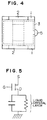
- Fig. 4 is a top view of a liquid crystal cell produced in Examples.
- Fig. 5 is a rough sketch of an apparatus for measuring a voltage retention rate.
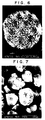
- Fig. 6 is a photograph of a porous particle of polyimide used in Example 2.
- Fig. 7 is a photograph of active alumina used in Comparative Example 1.
- liquid crystals are purified by treating (or contacting) liquid crystals with porous particles of an imide group-containing compound.
- the resulting purified liquid crystals show long-period display stability, particularly at high temperatures (40°-80°C), and a lost amount during the purification is very small.
- liquid crystals to be purified there can be used conventionally used liquid crystals usable in display devices, for example, nematic liquid crystals, cholestic liquid crystals, and smectic liquid crystals of Schiff bases, azos, azoxys, benzoic acid esters, biphenyls, terphenyls, cyclohexylcarboxylic acid esters, phenylcyclohexanes, biphenylcyclohexanes, pyrimidines, dioxanes, cyclohexylcyclohexane esters, cyclohexylethanes, cyclohexanes, tolans, alkenyls, 2,3-difluorophenylenes, etc.
- These liquid crystals can be purified alone or as a mixture thereof.
- the imide group-containing compound there can be used polyimides obtained by reacting a tetracarboxylic dianhydride with a diamine, polyimides obtained by reacting a tetracarboxylic dianhydride with a diisocyanate, polyamideimides obtained by reacting a tricarboxylic monoanhydride with a diamine or a diisocyanate, bismaleimide polymers, etc. so long as they are not dissolved in liquid crystals.
- the polyimides obtained by reacting a tetracarboxylic dianhydride with a diamine or diisocyanate have repeating units of the formulae (1) to (3); wherein R1 is a tetravalent organic group; R2 is a divalent organic group; and n is an integer larger than 1, wherein A1 is a tetravalent aromatic residue; A2 is a divalent aromatic residue, and m is an integer larger than 1, wherein A3 is Z is -CH2-, -O-, -SO2- or -S-; A4 is Z is as defined above; and p is an integer larger than 1.
- the polyamideimides obtained by reacting a tricarboxylic anhydride with a diamine or a diisocyanate have repeating units of the formula: wherein R3 is a divalent organic group; R4 is a trivalent organic group; and k is an integer larger than 1.
- Aromatic tetracarboxylic dianhydrides pyromellitic dianhydride, 3,3',4,4'-benzophenonetetracarboxylic dianhydride, 3,3',4,4'-biphenyltetracarboxylic dianhydride, 1,2,5,6-naphthalenetetracarboxylic dianhydride, 2,3,6,7-naphthalenetetracarboxylic dianhydride, 2,3,5,6-pyridinetetracarboxylic dianhydride, 1,4,5,8-naphthalenetetracarboxylic dianhydride, 3,4,9,10-perrylenetetracarboxylic dianhydride, 4,4'-sulfonyldiphthalic dianhydride, m-terphenyl-3,3'',4,4''-tetracarboxylic dianhydride, 4,4'-oxy
- Alicyclic tetracarboxylic dianhydrides of the formulae These tetracarboxylic dianhydrides can be used singly or as a mixture thereof. Among them, the use of aromatic tetracarboxylic dianhydrides is preferable.
- diamines there can be used aliphatic diamines, alicyclic diamines, heterocyclic diamines, aromatic diamines, silicone diamines, etc. Among them, aromatic diamines and alicyclic diamines obtained by reducing aromatic diamines with hydrogen are preferable.
- aromatic diamines are as follows: 4,4'-diaminodiphenyl ether, 3,4'-diaminodiphenyl ether, 4,4'-diaminodiphenylmethane, 4,4'-methylene-bis-(2,6-dimethylaniline), 4,4'-methylene-bis-(2,6-diethylaniline), 4,4'-methylene-bis-(2-methyl-6-ethylaniline), 4,4'-diaminodiphenylsulfone, 3,3'-diaminodiphenylsulfone, 4,4'-benzophenonediamine, 3,3'-benzophenonediamine, meta-phenylenediamine, para-phenylenediamine, 4,4'-di(4-aminophenoxy)phenylsulfone, 4,4'-di(3-aminophenoxy)phenylsulfone, 4,4'-di(4-aminophenoxy)
- aromatic diamines the following ones are more preferable. 4,4'-diaminodiphenyl ether, 4,4'-diaminodiphenylmethane, 4,4'-benzophenonediamine, 4,4'-diaminodiphenylsulfone, 2,2-bis[4-(4-aminophenoxy)phenyl]propane, 4,4'-methylene-bis-(2,6-dimethylaniline), 4,4'-methylene-bis-(2,6-diethylaniline), and 4,4'-methylene-bis-(2-methyl-6-ethylaniline).
- a polyamine having three or more functionalities is used as a part of the above-mentioned diamines, there can be obtained a cross-likable polyimide resin.
- a polyamine are aromatic triamines such as 1,2,4-triaminobenzene, etc.; aromatic tetraamines such as 1,2,4,5-tetraaminobenzene, 4,4'-diaminobenzidine, etc.; aromatic polyamines of the formula: wherein j is 0 or an integer of 1 to 9.
- diisocyanates there can be used diisocyanates obtained by reacting the above-mentioned diamines with phosgene or thionyl chloride; isocyanurate ring-containing polyisocyanates obtained by trimerization reaction of polyisocyanate or diisocyanate obtained by treating a polyamine similarly; aromatic diisocyanates such as 4,4'-diphenylmethane diisocyanate, 4,4'-diphenyl ether diisocyanate, 3,3'-dimethyldiphenyl-4,4'-diisocyanate, tolylene diisocyanate, etc.; carbodiimido group-containing aromatic diisocyanates obtained by condensation reaction of the aromatic diisocyanates; and isocyanurate ring-containing polyisocyanates obtained by condensation reaction of these aromatic diisocyanates.
- trimellitic anhydride there can be used reactive acid derivatives of trimellitic acid such as trimellitic anhydride, trimellitic anhydride monochloride, 1,4-dicarboxy-3-N,N-dimethylcarbamoylbenzene, 1,4-dicarboxy-3-carbophenoxybenzene, 1,4-dicarboxymethoxy-3-carboxybenzene, ammonium salts of trimellitic acid using ammonia, dimethylamine, triethylamine, etc.
- trimellitic anhydride and trimellitic anhydride monochloride is more preferable.
- the polyimides and polyamideimides can include repeating units (e.g. branched repeating units, cross-linked repeating units) other than those of the formulae (1) to (4).
- bismaleimide polymers examples include polymers of 4,4'-bismaleimidediphenylmethane, 2,2-bis[4-(4-maleimidephenoxy)phenyl]propane, bis[4-(3-maleimidephenoxy)phenyl]sulfone, 3,4'-bismaleimidediphenyl ether, 1,2-bis(4-maleimidephenoxy)ethane, 1,2-bis[2-(4-maleimidephenoxy)ethoxy]ethane, 1,6-bismaleimidehexane, etc.
- porous particles means porous spheres or sphere-like bodies or pseudo-spheres having a large specific surface area and a number of wrinkles or larnellas on the surfaces thereof as shown in Fig. 6.
- Such porous particles of imido group-containing compound can be produced by a process wherein a solution of an imido group-containing compound is added to a poor solvent and fine particles are made under high shearing, a process wherein a solution of an imido group-containing compound is spray dried, a process wherein fine particles formed by passing through small holes are recovered (a membrane emulsifying method, JP-A 2-95433), or a direct synthesis process such as non-aqueous dispersion polymerization of starting materials of the polyimides and polyamideimides having repeating units of the formulae (1) to (4) (Japanese Patent Examined Publication No. 60-48531, JP-A 59-230018), dispersion polymerization of these starting materials (JP-A 59-108030, 60-221425, 63-277241), etc.
- porous particles of polyimide obtained by reacting a tetracarboxylic dianhydride with a diamine in a solvent which does not dissolve produced polyimide particles and porous particles of polyimide obtained by reacting a tetracarboxylic dianhydride with a diisocyanate in a solvent which does not dissolve produced polyimide.
- porous particles of polyimide obtained by dispersion polymerization of an aromatic tetracarboxylic dianhydride and an aromatic diamine in a solvent which does not dissolve resulting polyimide particles are used.
- Such porous particles of polyimide can be produced by uniformly dissolving almost equimolar amounts of an aromatic tetracarboxylic dianhydride and an aromatic diamine, and 10 to 200% by mole of water per mole of the tetracarboxylic dianhydride in a basic solvent (e.g. N-methyl pyrrolidone, N,N-dimethylformamide, N,N-dimethylacetamide) at a temperature lower than 150°C, and carrying out the reaction at 150 to 300°C.
- a basic solvent e.g. N-methyl pyrrolidone, N,N-dimethylformamide, N,N-dimethylacetamide
- the polyimides having repeating units of the formulae (1) to (3) and the polyamideimides having repeating units of the formula (4) may further contain one or more carboxyl groups or amide acid groups in the main molecular chain.
- the average particle size of porous particles of the imido group-containing compound is not particularly limited. But, when the average particle size is too small, there is a tendency to worsen the workability at the time of filtration and decantation, and also to worsen permeability in the case of packing the porous particles in a column. On the other hand, when the average particle size is too large, there is a tendency to lower the specific surface area and to lessen the effect for improving the purification of liquid crystals and the voltage retention rate. Therefore, the average particle size is preferably 0.1 to 5,000 ⁇ m, more preferably 1 to 5,000 ⁇ m.
- the specific surface area of the porous particles of the imido group-containing compound when it is too small, there is a tendency to lessen the effect of improving the purification of liquid crystals and the voltage retention rate.
- the specific surface area is preferably 1 m2/g or more, more preferably 5 m2/g or more, particularly preferably 10 m2/g or more, and extremely particularly preferably 20 m2/g or more.
- the upper limit of the specific surface area is not particularly limited, but usually about 5,000 m2/g.
- Control of the average particle size and the specific surface area of the imido group-containing compound can be conducted by applying proper conditions at the time of production of porous particles (e.g. the kind of solvent, combination of solvents, using amounts of solvents, stirring conditions, reaction time, reaction temperature, precipitation conditions, etc.).
- proper conditions at the time of production of porous particles e.g. the kind of solvent, combination of solvents, using amounts of solvents, stirring conditions, reaction time, reaction temperature, precipitation conditions, etc.
- treating in the purification process means any ways which can conduct purification of liquid crystals, wherein the liquid crystals are contacted with the porous particles of imido group-containing compound.
- the treating method includes, for example, a batch method and a column method.
- liquid crystals and porous particles of imido group-containing compound are charged in a proper vessel and, if necessary, stirred, followed by separation of the porous particles of imido group-containing compound to give purified liquid crystals.
- porous particles As to the mixing ratio of the liquid crystals and the porous particles of imido group-containing compound (hereinafter referred to as "porous particles") in the batch method, when the amount of the porous particles is too small, there is a tendency to lower the improving effect of purification of liquid crystals and the voltage retention rate of a liquid crystal cell. On the other hand, when the amount of the porous particles is too large, there is a tendency to increase the absorbed amount of liquid crystals on the porous particles, resulting in causing an undesirable loss of liquid crystals. Therefore, it is preferable to use the porous particles in an amount of 0.01 to 30% by weight based on the weight of liquid crystals.
- the treating time in the batch method is preferably 10 seconds or more, since there is a tendency to lower the improving effect of the voltage retention rate of a liquid crystal cell when the treating (or contacting) time is too short.
- the treating temperature in the batch method is preferably above the melting point of liquid crystals without causing any problems. But when the temperature is too high, there is a possibility of decomposing the liquid crystals and the porous powders.
- the separation of the porous particles from the mixture of liquid crystals and the porous particles can be carried out by a filtration method, a decantation method, and the like.
- the porous particles are packed in a proper vessel to form a column and liquid crystals are passed through the column to give purified liquid crystals.
- the liquid crystals can pass through the column either by natural flow by gravity or flow using a pump.
- Preferable flow rate is in the range of 0.0001 cm/min to 100 cm/min in terms of linear velocity.
- the present invention also provide a liquid crystal composition comprising liquid crystals and porous particles of an imido group-containing compound.
- liquid crystals those mentioned above can be used.
- porous particles of an imido group-containing compound there can be used those mentioned above can be used.
- the liquid crystal composition mentioned above can be obtained by mixing the liquid crystals and the imido group-containing compound in a vessel such as a beaker, followed by insertion of the liquid crystal composition into a cell to form a liquid crystal cell.
- a vessel such as a beaker
- porous particles of imido group-containing compound are dispersed on glass substrates like a liquid crystal spacer, and the glass substrates are used for forming a cell, into which liquid crystals are inserted to finally form a liquid crystal cell in which the liquid crystal composition is consequently formed.
- the mixing ratio in the liquid crystal composition when the amount of the porous particles of imido group-containing compound is too small, there is a tendency to lower the effect of preventing the lowering of resistivity of liquid crystals and to lower the effect of preventing the lowering of voltage retention rate of a liquid crystal cell. On the other hand, when the amount of the porous particles of imido group-containing compound is too large, the image quality of the cell becomes worse due to the small amount of liquid crystal phase. Considering the above facts, it is preferable to use the porous particles of imido group-containing compound in an amount of 10 ⁇ 10to 10 ⁇ 3% by weight based on the weight of the liquid crystal.
- the liquid crystal cell of the present invention is obtained by inserting the liquid crystals purified as mentioned above, or the liquid crystal composition, mentioned above into a cell structure obtained by a conventional method (e.g. Matsumoto and Tsunoda, "Fundamental and Application of Liquid Crystals", published by Kogyo Chosa-kai, 1991).
- an indium tin oxide (ITO) transparent electrode is formed on a glass substrate by a sputtering method, etc. Then, a varnish of polyimide or a precursor thereof is coated on the ITO transparent electrode for film formation, dried and, if necessary, rubbed to form an orientation film. A pair of thus obtained glass substrates are placed oppositely so as to face the orientation films each other. The periphery of the glass substrates are sealed with a sealing pattern and the purified liquid crystals or the liquid crystal composition is inserted into the resulting cavity to give the liquid crystal cell.
- ITO indium tin oxide
- the liquid crystal display device comprising, e.g. two substantially parallel spaced plates; a frame sealed between said plates and defining a tight chamber therebetween; control electrodes arranged on the inner facing surfaces of said plates for providing an electric field therebetween; a coating of alignment material (e.g. polyimide, etc.) covering said inner surfaces and said electrodes; and a liquid crystal mixture, can be formed by a conventional method, e.g. as mentioned above, by inserting the purified liquid crystals or the liquid crystal composition mentioned above thereinto.
- the liquid crystal display device includes a segment type display and a matrix type display, and the matrix type display includes a simple matrix type display and an active matrix type display.
- the resistivity of liquid crystals and the voltage retention rate of a liquid crystal cell can be improved remarkably.
- the resistivity influences remarkably on display properties of liquid crystal displays. Generally speaking, higher resistivity makes display properties better.
- the resistivity is influenced by the kind of liquid crystals, required properties for the driving method of liquid crystal displays, required price, and the like.
- the resistivity is preferably 1012 ⁇ cm or more.
- the voltage retention rate which influences the display properties of liquid crystal displays greatly, the higher value gives better display properties.
- the voltage retention rate is, in practice, influenced by the kind of liquid crystals, required properties for the driving method of liquid crystal displays, required price, and the like.
- the voltage retention rate is preferably 84% or more at 16.5 ms (frame frequency 60 Hz) when a 5 V rectangular-current impulse with a pulse width of 100 ⁇ m is applied at a measuring temperature of 23°C (room temperature).
- the resulting particles were dried at 200°C for 3 hours to give an imido group-containing compound having an average particle size of 100 ⁇ m.
- the porous particles had a specific surface area of 5 m2/g (BET method, Sorptomatic 1800 type, mfd. by Carloerba Strumentazione). In the infrared absorption spectrum, the special absorption due to imido group at 1780 cm ⁇ 1 was admitted remarkably.
- liquid crystals ZLI-4792, a trade name, mfd. by Merck Japan Ltd.
- porous particles of the imido group-containing compound obtained in above (1) was placed and stirred for 1 hour at room temperature using a magnetic stirrer. After removing the porous particles by filtration, there were obtained purified liquid crystals.
- the resistivity of liquid crystals was measured using an electrode for liquid electrode (LE-21, a trade name, mfd. by Ando Electric Co., Ltd.) at room temperature. The results are shown in Table 1.
- a predetermined ITO transparent electrode was formed by a sputtering method. This pattern is shown in Figs. 1 and 2, wherein numeral 1 denotes a glass substrate, and numeral 2 denotes an ITO transparent electrode.
- a pair of thus produced glass substrates were placed in parallel so as to face the ITO transparent electrodes each other and the peripheries thereof were sealed with an epoxy thermosetting adhesive (resin: SE-4500 clear, a trade name, mfd. by HAVEN Chemical Co.; hardener: SE-4500 CATALYST, a trade name, mfd. by HAVEN Chemical Co.).
- the voltage retention rate was measured.
- the voltage retention rate was measured by applying a pulse voltage using a model circuit shown in Fig. 5 in a state of monitoring the voltage between ITO electrodes of both glass substrates using a digital memory scope and measuring changes of the voltage between ITO electrodes. More concretely, a gate signal of a voltage of 10 V with a pulse width of 30 ⁇ sec. was input between the gate G and source S in the model circuit in Fig. 5 and changes of the drain voltage VD were measured to obtain the root-mean-square value of the wave form on the scope. From said value, the voltage retention rate was calculated by the following equation:
- An active driving type liquid crystal display device was formed using the purified liquid crystals obtained in above (2) and a polyimide as an orientation film (Active Matrix type orientation film LQ-T210, a trade name, mfd. by Hitachi Chemical Co., Ltd.). Display properties (particularly display uniformity) were remarkably excellent.
- Example 1 The process of Example 1 was repeated except for using active alumina (for column chromatography, 200 mesh, mfd. by Wako Pure Chemical Industries, Ltd., Fig. 7 with 500 magnifications) in place of the porous particles of imido group-containing compound. The results are shown in Table 1.
- Example 1 The process of Example 1 was repeated except for omitting the treatment with porous particles of imido group-containing compound. The results are shown in Table 1.
- Table 1 Resistivity ( ⁇ cm) Voltage retention rate (%) Example 1 1.0 ⁇ 1012 84.5 Comparative Example 1 5.7 ⁇ 1011 80.1 Comparative Example 2 1.3 ⁇ 1011 77.5
- Fig. 6 is a photograph of a porous particle of the imido group-compound (30,000 magnifications). The resulting particles had an average particle size of 9 ⁇ m and a specific surface area of 40 m2/g. In the infrared absorption spectrum, the special absorption due to imido group at 1780 cm ⁇ 1 was admitted.
- Example 2 The display ability was evaluated in the same manner as described in Example 1. The display properties (particularly display uniformity) were remarkably excellent. Table 2 Resistivity ( ⁇ cm) Voltage retention rate (%) Example 2 1.2 ⁇ 1012 85.5
- porous particles of imido group-containing compound obtained in above (1) in an amount of 1.3 ⁇ 10 ⁇ 8 g were charged into a 10-ml beaker containing 5 g of liquid crystals (ZLI-4792, a trade name, mfd. by Merck Japan Ltd.) and stirred well to give a liquid crystal composition.
- liquid crystals ZLI-4792, a trade name, mfd. by Merck Japan Ltd.
- the voltage retention rate was measured in the same manner as described in Example 1 (4) except for inserting the liquid crystal composition obtained in above (2) into a cavity between two substrates of liquid crystal cell by a vacuum impregnation method.
- An active driving type liquid crystal display device was formed by using the liquid crystal composition obtained in above (2) and a polyimide (Active Matrix type orientation film LQ-T 210, a trade name, mfd. by Hitachi Chemical Co., Ltd.) as an orientation film. Display properties (particularly display uniformity) were remarkably excellent.
- Example 3 The process of Example 3 was repeated except for forming a liquid crystal cell using only the liquid crystals without using the porous particles of imido group-containing compound.
- Example 3 The liquid crystal cells obtained in Example 3 and Comparative Example 3 were allowed to stand at a high temperature of 80°C and taken out after certain periods. Then, the voltage retention rate was measured and listed in Table 4. Table 4 Example No. Voltage retention rate (%) 100 hrs. 200 hrs. 500 hrs. 1000 hrs. Example 4 98.1 98.0 98.0 97.5 Comparative Example 4 94.0 90.5 83.7 75.2
- Example 4 As shown in Table 4, the voltage retention rate of Example 4 is as high as 97.5% even after 1000 hours at 80°C, while that of Comparative Example 4 is lowered to 75.2%. This means that display stability at high temperatures can be obtained according to the present invention.
- the present invention since a sufficient purifying effect can be obtained by only using a small amount of porous particles of imido group-containing compound, the losing amount of precious liquid crystals during purification, e.g. a loss by trapping on a liquid crystal purifying agent, can be reduced. Further, since the thus purified liquid crystals or the liquid crystal composition containing such porous particles of imido group-containing compound can provide liquid crystals and liquid crystal compositions having long-period display stability and long period display stability under high temperature circumstances, liquid crystal cells and liquid crystal display devices containing these liquid crystals or liquid crystal compositions are excellent in display properties.
Landscapes
- Chemical & Material Sciences (AREA)
- Crystallography & Structural Chemistry (AREA)
- Engineering & Computer Science (AREA)
- Materials Engineering (AREA)
- Organic Chemistry (AREA)
- Liquid Crystal Substances (AREA)
- Liquid Crystal (AREA)
Applications Claiming Priority (6)
| Application Number | Priority Date | Filing Date | Title |
|---|---|---|---|
| JP335961/92 | 1992-12-16 | ||
| JP33596192 | 1992-12-16 | ||
| JP34678292 | 1992-12-25 | ||
| JP346782/92 | 1992-12-25 | ||
| JP5023140A JPH06234974A (ja) | 1993-02-12 | 1993-02-12 | 液晶組成物、液晶セル及び液晶表示装置 |
| JP23140/93 | 1993-02-12 |
Publications (2)
| Publication Number | Publication Date |
|---|---|
| EP0603731A1 true EP0603731A1 (de) | 1994-06-29 |
| EP0603731B1 EP0603731B1 (de) | 1998-03-11 |
Family
ID=27284139
Family Applications (1)
| Application Number | Title | Priority Date | Filing Date |
|---|---|---|---|
| EP93120224A Expired - Lifetime EP0603731B1 (de) | 1992-12-16 | 1993-12-15 | Reinigung von Flüssigkristallen, sowie Flüssigkristallzusammensetzung |
Country Status (4)
| Country | Link |
|---|---|
| US (2) | US5422034A (de) |
| EP (1) | EP0603731B1 (de) |
| KR (1) | KR100303196B1 (de) |
| DE (1) | DE69317378T2 (de) |
Families Citing this family (10)
| Publication number | Priority date | Publication date | Assignee | Title |
|---|---|---|---|---|
| US5422034A (en) * | 1992-12-16 | 1995-06-06 | Hitachi Chemical Company, Ltd. | Purification of liquid crystals and liquid crystal composition |
| DE69807371T2 (de) * | 1997-03-06 | 2002-12-19 | Mitsubishi Gas Chemical Co., Inc. | Verfahren zur Reinigung von Flüssigkristallen |
| WO2001009675A1 (en) * | 1999-07-29 | 2001-02-08 | Matsushita Electric Industrial Co., Ltd. | Liquid crystal display device and method for manufacturing the same |
| KR100960580B1 (ko) * | 2002-09-26 | 2010-06-03 | 디아이씨 가부시끼가이샤 | 액정 재료를 재이용하기 위한 처리 방법 |
| CN100417982C (zh) * | 2005-10-18 | 2008-09-10 | 比亚迪股份有限公司 | 一种生产结存回收混合液晶再利用方法 |
| JP4986071B2 (ja) * | 2007-03-30 | 2012-07-25 | 国立大学法人東京工業大学 | 樹脂組成物、硬化物及び光学用部材 |
| CN101381604B (zh) * | 2008-10-17 | 2011-08-03 | 江苏和成化学材料有限公司 | 液晶单体或液晶组合物的纯化方法 |
| US9469734B2 (en) * | 2011-03-25 | 2016-10-18 | Sabic Global Technologies B.V. | Fast dissolving polyimide powders |
| DE102013020400A1 (de) * | 2013-12-10 | 2015-06-11 | Merck Patent Gmbh | Reinigungsvorrichtung |
| US9562191B2 (en) | 2015-04-01 | 2017-02-07 | Citizen Finedevice Co., Ltd. | Compositions and methods for removing ions from liquid crystal materials |
Citations (11)
| Publication number | Priority date | Publication date | Assignee | Title |
|---|---|---|---|---|
| JPS5553317A (en) * | 1978-10-16 | 1980-04-18 | Hitachi Ltd | Liquid crystal display element |
| JPS57204512A (en) * | 1981-06-11 | 1982-12-15 | Sharp Corp | Manufacture of liquid crystal display element |
| JPS581774A (ja) * | 1981-06-25 | 1983-01-07 | Casio Comput Co Ltd | 液晶表示装置 |
| JPS5936227A (ja) * | 1982-08-24 | 1984-02-28 | Sharp Corp | 液晶表示装置 |
| US4464489A (en) * | 1982-12-11 | 1984-08-07 | Nitto Electric Industrial Co., Ltd. | Method for the production of polyimide powder |
| US4520071A (en) * | 1984-04-18 | 1985-05-28 | Nitto Electric Industrial Co., Ltd. | Spherical porous polyimide powder |
| JPS62173438A (ja) * | 1986-01-28 | 1987-07-30 | Fujitsu Ltd | 液晶表示素子 |
| JPS62210419A (ja) * | 1986-03-12 | 1987-09-16 | Fujitsu Ltd | 液晶表示素子の製法 |
| JPS6487685A (en) * | 1987-09-29 | 1989-03-31 | Seimi Chem Kk | Production of liquid crystal composition of high resistivity |
| JPH0497127A (ja) * | 1990-08-09 | 1992-03-30 | Sharp Corp | 液晶表示装置 |
| JPH04258925A (ja) * | 1991-02-14 | 1992-09-14 | Matsushita Electric Ind Co Ltd | 液晶注入装置 |
Family Cites Families (6)
| Publication number | Priority date | Publication date | Assignee | Title |
|---|---|---|---|---|
| JPS5827285B2 (ja) * | 1980-11-21 | 1983-06-08 | 三菱化学株式会社 | 多孔質焼結体 |
| JPS5823835A (ja) * | 1981-08-05 | 1983-02-12 | Mitsubishi Chem Ind Ltd | 多孔質焼結体 |
| JPS58198542A (ja) * | 1982-05-17 | 1983-11-18 | Mitsubishi Chem Ind Ltd | 多孔質焼結体 |
| JPS606726A (ja) * | 1983-06-25 | 1985-01-14 | Nissan Chem Ind Ltd | 新規ポリイミド樹脂及びその製造法 |
| US5288426A (en) * | 1988-04-21 | 1994-02-22 | Nippon Oil Company. Limited | Nonlinear optical materials |
| US5422034A (en) * | 1992-12-16 | 1995-06-06 | Hitachi Chemical Company, Ltd. | Purification of liquid crystals and liquid crystal composition |
-
1993
- 1993-12-10 US US08/164,710 patent/US5422034A/en not_active Expired - Fee Related
- 1993-12-15 EP EP93120224A patent/EP0603731B1/de not_active Expired - Lifetime
- 1993-12-15 DE DE69317378T patent/DE69317378T2/de not_active Expired - Fee Related
- 1993-12-16 KR KR1019930028038A patent/KR100303196B1/ko not_active Expired - Fee Related
-
1994
- 1994-12-20 US US08/360,088 patent/US5540857A/en not_active Expired - Fee Related
Patent Citations (11)
| Publication number | Priority date | Publication date | Assignee | Title |
|---|---|---|---|---|
| JPS5553317A (en) * | 1978-10-16 | 1980-04-18 | Hitachi Ltd | Liquid crystal display element |
| JPS57204512A (en) * | 1981-06-11 | 1982-12-15 | Sharp Corp | Manufacture of liquid crystal display element |
| JPS581774A (ja) * | 1981-06-25 | 1983-01-07 | Casio Comput Co Ltd | 液晶表示装置 |
| JPS5936227A (ja) * | 1982-08-24 | 1984-02-28 | Sharp Corp | 液晶表示装置 |
| US4464489A (en) * | 1982-12-11 | 1984-08-07 | Nitto Electric Industrial Co., Ltd. | Method for the production of polyimide powder |
| US4520071A (en) * | 1984-04-18 | 1985-05-28 | Nitto Electric Industrial Co., Ltd. | Spherical porous polyimide powder |
| JPS62173438A (ja) * | 1986-01-28 | 1987-07-30 | Fujitsu Ltd | 液晶表示素子 |
| JPS62210419A (ja) * | 1986-03-12 | 1987-09-16 | Fujitsu Ltd | 液晶表示素子の製法 |
| JPS6487685A (en) * | 1987-09-29 | 1989-03-31 | Seimi Chem Kk | Production of liquid crystal composition of high resistivity |
| JPH0497127A (ja) * | 1990-08-09 | 1992-03-30 | Sharp Corp | 液晶表示装置 |
| JPH04258925A (ja) * | 1991-02-14 | 1992-09-14 | Matsushita Electric Ind Co Ltd | 液晶注入装置 |
Non-Patent Citations (9)
| Title |
|---|
| DATABASE WPI Week 8022, Derwent World Patents Index; AN 80-39177C * |
| DATABASE WPI Week 8305, Derwent World Patents Index; AN 83-10411K * |
| DATABASE WPI Week 8307, Derwent World Patents Index; AN 83-15973K * |
| DATABASE WPI Week 8414, Derwent World Patents Index; AN 84-085865 * |
| DATABASE WPI Week 8736, Derwent World Patents Index; AN 87-252970 * |
| DATABASE WPI Week 8743, Derwent World Patents Index; AN 87-301828 * |
| DATABASE WPI Week 8919, Derwent World Patents Index; AN 89-142056 * |
| DATABASE WPI Week 9243, Derwent World Patents Index; AN 92-354899 * |
| PATENT ABSTRACTS OF JAPAN vol. 16, no. 327 (P - 1387) 16 July 1992 (1992-07-16) * |
Also Published As
| Publication number | Publication date |
|---|---|
| KR940014736A (ko) | 1994-07-19 |
| DE69317378D1 (de) | 1998-04-16 |
| DE69317378T2 (de) | 1998-07-02 |
| US5540857A (en) | 1996-07-30 |
| US5422034A (en) | 1995-06-06 |
| EP0603731B1 (de) | 1998-03-11 |
| KR100303196B1 (ko) | 2001-11-22 |
Similar Documents
| Publication | Publication Date | Title |
|---|---|---|
| EP1037092B1 (de) | Ausrichtungsmittel für flüssigkristalle | |
| EP1111442A1 (de) | Mittel zur behandlung von flüssigkristallausrichtungsschichten und eine dieses verwendende flüssigkristallvorrichtung, sowie verfahren zur ausrichtung von flüssigkristallen | |
| JPH09316200A (ja) | 液晶配向剤 | |
| WO1997043687A1 (fr) | Agent d'alignement de cristaux liquides | |
| EP0603731B1 (de) | Reinigung von Flüssigkristallen, sowie Flüssigkristallzusammensetzung | |
| EP1004925B1 (de) | Photoorientierungsschicht bestehend aus 3,3'4,4'-Benzophenontetracarboxyldianhydrid und ortho-substituierten aromatischen Diaminen für Flüssigkristallanzeigen | |
| US5759442A (en) | Polyimide alignment film from 2,2-BIS (3,4-dicarboxyphenyl)--hexafluoropropane dianhydride and ortho-substituted aromatic diamines for active matrix liquid crystal displays | |
| KR20090127865A (ko) | 액정 배향제 및 액정 표시 소자 | |
| JP5077558B2 (ja) | 液晶配向剤および液晶表示素子 | |
| CN103748068B (zh) | 二胺化合物及其制备方法、液晶配向剂、液晶配向膜、液晶显示元件 | |
| JPH05203952A (ja) | 液晶配向剤 | |
| JP4985906B2 (ja) | 垂直液晶配向剤および垂直液晶表示素子 | |
| JPH06308503A (ja) | 液晶配向剤 | |
| JPH07278544A (ja) | 精製された液晶の製造法、液晶セル及び液晶表示装置 | |
| CN112457866B (zh) | 一种液晶取向剂、液晶取向膜以及液晶显示元件 | |
| JPH0369922A (ja) | 液晶配向剤 | |
| JP4168442B2 (ja) | ジアミン化合物、ポリアミック酸、イミド化重合体、液晶配向剤、および液晶表示素子 | |
| KR100554330B1 (ko) | 액정배향막의제조방법 | |
| JP3393614B2 (ja) | 精製された液晶の製造方法、液晶セル及び液晶表示装置 | |
| JPH0749501A (ja) | 液晶配向剤 | |
| JPH01239525A (ja) | 液晶配向膜用材料 | |
| JPH09263761A (ja) | 液晶精製用ペースト、それを用いた液晶セル及び液晶表示装置 | |
| JPH07292358A (ja) | 精製された液晶の製造法、液晶セル及び液晶表示装置 | |
| JPH07270739A (ja) | 精製された液晶の製造法、液晶セル及び液晶表示装置 | |
| JPH07270741A (ja) | 精製された液晶の製造法、液晶セル及び液晶表示装置 |
Legal Events
| Date | Code | Title | Description |
|---|---|---|---|
| PUAI | Public reference made under article 153(3) epc to a published international application that has entered the european phase |
Free format text: ORIGINAL CODE: 0009012 |
|
| AK | Designated contracting states |
Kind code of ref document: A1 Designated state(s): DE FR GB |
|
| 17P | Request for examination filed |
Effective date: 19941103 |
|
| 17Q | First examination report despatched |
Effective date: 19960131 |
|
| GRAG | Despatch of communication of intention to grant |
Free format text: ORIGINAL CODE: EPIDOS AGRA |
|
| GRAH | Despatch of communication of intention to grant a patent |
Free format text: ORIGINAL CODE: EPIDOS IGRA |
|
| GRAH | Despatch of communication of intention to grant a patent |
Free format text: ORIGINAL CODE: EPIDOS IGRA |
|
| GRAA | (expected) grant |
Free format text: ORIGINAL CODE: 0009210 |
|
| AK | Designated contracting states |
Kind code of ref document: B1 Designated state(s): DE FR GB |
|
| ET | Fr: translation filed | ||
| REF | Corresponds to: |
Ref document number: 69317378 Country of ref document: DE Date of ref document: 19980416 |
|
| PLBE | No opposition filed within time limit |
Free format text: ORIGINAL CODE: 0009261 |
|
| STAA | Information on the status of an ep patent application or granted ep patent |
Free format text: STATUS: NO OPPOSITION FILED WITHIN TIME LIMIT |
|
| 26N | No opposition filed | ||
| REG | Reference to a national code |
Ref country code: GB Ref legal event code: IF02 |
|
| PGFP | Annual fee paid to national office [announced via postgrant information from national office to epo] |
Ref country code: FR Payment date: 20031210 Year of fee payment: 11 Ref country code: GB Payment date: 20031210 Year of fee payment: 11 |
|
| PGFP | Annual fee paid to national office [announced via postgrant information from national office to epo] |
Ref country code: DE Payment date: 20031229 Year of fee payment: 11 |
|
| PG25 | Lapsed in a contracting state [announced via postgrant information from national office to epo] |
Ref country code: GB Free format text: LAPSE BECAUSE OF NON-PAYMENT OF DUE FEES Effective date: 20041215 |
|
| PG25 | Lapsed in a contracting state [announced via postgrant information from national office to epo] |
Ref country code: DE Free format text: LAPSE BECAUSE OF NON-PAYMENT OF DUE FEES Effective date: 20050701 |
|
| GBPC | Gb: european patent ceased through non-payment of renewal fee |
Effective date: 20041215 |
|
| PG25 | Lapsed in a contracting state [announced via postgrant information from national office to epo] |
Ref country code: FR Free format text: LAPSE BECAUSE OF NON-PAYMENT OF DUE FEES Effective date: 20050831 |
|
| REG | Reference to a national code |
Ref country code: FR Ref legal event code: ST |