EP0610334B1 - Inhibiteurs non peptidyles a base d'integrine specifiques du recepteur gpii b iii a - Google Patents
Inhibiteurs non peptidyles a base d'integrine specifiques du recepteur gpii b iii a Download PDFInfo
- Publication number
- EP0610334B1 EP0610334B1 EP92922468A EP92922468A EP0610334B1 EP 0610334 B1 EP0610334 B1 EP 0610334B1 EP 92922468 A EP92922468 A EP 92922468A EP 92922468 A EP92922468 A EP 92922468A EP 0610334 B1 EP0610334 B1 EP 0610334B1
- Authority
- EP
- European Patent Office
- Prior art keywords
- dihydro
- methyl
- dione
- benzodiazapine
- alkyl
- Prior art date
- Legal status (The legal status is an assumption and is not a legal conclusion. Google has not performed a legal analysis and makes no representation as to the accuracy of the status listed.)
- Expired - Lifetime
Links
- 0 CCNCC1*C1 Chemical compound CCNCC1*C1 0.000 description 61
- PTXFGUVCXVEZET-UHFFFAOYSA-N CC(C(N1)=O)SC1=O Chemical compound CC(C(N1)=O)SC1=O PTXFGUVCXVEZET-UHFFFAOYSA-N 0.000 description 2
- XPCTZQVDEJYUGT-UHFFFAOYSA-N CC(OC=CC1=O)=C1O Chemical compound CC(OC=CC1=O)=C1O XPCTZQVDEJYUGT-UHFFFAOYSA-N 0.000 description 2
- NNZATUPYJKESOO-UHFFFAOYSA-N COCc(cc1)ccc1NC(N)=N Chemical compound COCc(cc1)ccc1NC(N)=N NNZATUPYJKESOO-UHFFFAOYSA-N 0.000 description 2
- HMTSWYPNXFHGEP-UHFFFAOYSA-N Cc1ccc(CN)cc1 Chemical compound Cc1ccc(CN)cc1 HMTSWYPNXFHGEP-UHFFFAOYSA-N 0.000 description 2
- PVRZUUKQXRDBGQ-RQOWECAXSA-N C/C=C\C1=CC(CC(N)=N)CC=C1 Chemical compound C/C=C\C1=CC(CC(N)=N)CC=C1 PVRZUUKQXRDBGQ-RQOWECAXSA-N 0.000 description 1
- NFKDOZIFRBUOCG-UHFFFAOYSA-N CC#CC(NC)=O Chemical compound CC#CC(NC)=O NFKDOZIFRBUOCG-UHFFFAOYSA-N 0.000 description 1
- NFELFGOIODAJLU-UHFFFAOYSA-N CC#Cc1cccc(CN)c1 Chemical compound CC#Cc1cccc(CN)c1 NFELFGOIODAJLU-UHFFFAOYSA-N 0.000 description 1
- LGTCPKHOJZDPDY-WQLSENKSSA-N CC(/C(/C)=N\c1c(C)[nH]cc1)=C Chemical compound CC(/C(/C)=N\c1c(C)[nH]cc1)=C LGTCPKHOJZDPDY-WQLSENKSSA-N 0.000 description 1
- XEZDFJSLRGKWNP-XFXZXTDPSA-N CC(/C(/C)=N\c1c(C)cc[nH]1)=C Chemical compound CC(/C(/C)=N\c1c(C)cc[nH]1)=C XEZDFJSLRGKWNP-XFXZXTDPSA-N 0.000 description 1
- YEWKBSDMMDADEX-UHFFFAOYSA-N CC(C(C)(C(N1)=O)O)C1=O Chemical compound CC(C(C)(C(N1)=O)O)C1=O YEWKBSDMMDADEX-UHFFFAOYSA-N 0.000 description 1
- XYYONDUSJXPAAX-UHFFFAOYSA-N CC(CC1)C=CC1OC Chemical compound CC(CC1)C=CC1OC XYYONDUSJXPAAX-UHFFFAOYSA-N 0.000 description 1
- HFXCLLSBYJCBOZ-UHFFFAOYSA-N CC(CC1)CC1NS(C)(=O)=O Chemical compound CC(CC1)CC1NS(C)(=O)=O HFXCLLSBYJCBOZ-UHFFFAOYSA-N 0.000 description 1
- QMXWLTVZKBQDCD-UHFFFAOYSA-N CC(N1)=NNC1S Chemical compound CC(N1)=NNC1S QMXWLTVZKBQDCD-UHFFFAOYSA-N 0.000 description 1
- BHNZRBXCCGWNGA-UHFFFAOYSA-N CC(NC(C(O)=C)=O)O Chemical compound CC(NC(C(O)=C)=O)O BHNZRBXCCGWNGA-UHFFFAOYSA-N 0.000 description 1
- MTENJKHNRWGUCL-UHFFFAOYSA-N CC(NCc1ccccn1)=N Chemical compound CC(NCc1ccccn1)=N MTENJKHNRWGUCL-UHFFFAOYSA-N 0.000 description 1
- QEIHVTKMBYEXPZ-UHFFFAOYSA-N CC1=NCCN1C Chemical compound CC1=NCCN1C QEIHVTKMBYEXPZ-UHFFFAOYSA-N 0.000 description 1
- WQKULOTUKJKACL-UHFFFAOYSA-N CC1C=NOC1O Chemical compound CC1C=NOC1O WQKULOTUKJKACL-UHFFFAOYSA-N 0.000 description 1
- VSKQTKLVBFPZSZ-UHFFFAOYSA-N CCC(CC1)CCC1NS(C)(=O)=O Chemical compound CCC(CC1)CCC1NS(C)(=O)=O VSKQTKLVBFPZSZ-UHFFFAOYSA-N 0.000 description 1
- AIURLDWRLJJWTQ-WEVVVXLNSA-N CCCCC(C)/N=C/C Chemical compound CCCCC(C)/N=C/C AIURLDWRLJJWTQ-WEVVVXLNSA-N 0.000 description 1
- XXXZQWGEVVOWFW-UHFFFAOYSA-N CCCCNS(C)(=O)=O Chemical compound CCCCNS(C)(=O)=O XXXZQWGEVVOWFW-UHFFFAOYSA-N 0.000 description 1
- FZMLKENAMKEQOI-UHFFFAOYSA-N CCc(cc1)ccc1C(N)=N Chemical compound CCc(cc1)ccc1C(N)=N FZMLKENAMKEQOI-UHFFFAOYSA-N 0.000 description 1
- NOKROJJCMIOWOJ-PLNGDYQASA-N CN(C)C/C=C\NCC[N+](C)=[N-] Chemical compound CN(C)C/C=C\NCC[N+](C)=[N-] NOKROJJCMIOWOJ-PLNGDYQASA-N 0.000 description 1
- UNHOPMIDKWXFMF-UHFFFAOYSA-N CN(CC1)CC1N Chemical compound CN(CC1)CC1N UNHOPMIDKWXFMF-UHFFFAOYSA-N 0.000 description 1
- PVOAHINGSUIXLS-UHFFFAOYSA-N CN1CCNCC1 Chemical compound CN1CCNCC1 PVOAHINGSUIXLS-UHFFFAOYSA-N 0.000 description 1
- GFKJEUAOUDIEFG-UHFFFAOYSA-N CNC(C1CCN(CN)CC1)=O Chemical compound CNC(C1CCN(CN)CC1)=O GFKJEUAOUDIEFG-UHFFFAOYSA-N 0.000 description 1
- PZKZNGDDVRVCRN-UHFFFAOYSA-N CNC(CC(N)=N)=O Chemical compound CNC(CC(N)=N)=O PZKZNGDDVRVCRN-UHFFFAOYSA-N 0.000 description 1
- NYXHSRNBKJIQQG-UHFFFAOYSA-N CNC(OC)=O Chemical compound CNC(OC)=O NYXHSRNBKJIQQG-UHFFFAOYSA-N 0.000 description 1
- IVDNVUABSBYLCK-UHFFFAOYSA-N CNC(c1ccccc1)=N Chemical compound CNC(c1ccccc1)=N IVDNVUABSBYLCK-UHFFFAOYSA-N 0.000 description 1
- LSAWFHNFIJBGMR-UHFFFAOYSA-N CNC1=NCCC1 Chemical compound CNC1=NCCC1 LSAWFHNFIJBGMR-UHFFFAOYSA-N 0.000 description 1
- DMUZPSGTYFDKEN-UHFFFAOYSA-N COCC(CC1)CCN1C(N)=N Chemical compound COCC(CC1)CCN1C(N)=N DMUZPSGTYFDKEN-UHFFFAOYSA-N 0.000 description 1
- JAEQOSKUYPMJAT-UHFFFAOYSA-N COCCN1CCOCC1 Chemical compound COCCN1CCOCC1 JAEQOSKUYPMJAT-UHFFFAOYSA-N 0.000 description 1
- IDPURXSQCKYKIJ-UHFFFAOYSA-N COc1ccc(CN)cc1 Chemical compound COc1ccc(CN)cc1 IDPURXSQCKYKIJ-UHFFFAOYSA-N 0.000 description 1
- GSNNHGKCGLQEGV-UHFFFAOYSA-N COc1ccc(CNC(N)=N)cc1 Chemical compound COc1ccc(CNC(N)=N)cc1 GSNNHGKCGLQEGV-UHFFFAOYSA-N 0.000 description 1
- UBYXITFNZVIVDW-UHFFFAOYSA-N Cc(cc1)ccc1C(N)=N Chemical compound Cc(cc1)ccc1C(N)=N UBYXITFNZVIVDW-UHFFFAOYSA-N 0.000 description 1
- ONEYFZXGNFNRJH-UHFFFAOYSA-N Cc(cc1)ccc1N1CCNCC1 Chemical compound Cc(cc1)ccc1N1CCNCC1 ONEYFZXGNFNRJH-UHFFFAOYSA-N 0.000 description 1
- CDGUNEVOZODTCD-UHFFFAOYSA-N Cc(cc1)ccc1NOC Chemical compound Cc(cc1)ccc1NOC CDGUNEVOZODTCD-UHFFFAOYSA-N 0.000 description 1
- MGDDCOQTUFIGCN-UHFFFAOYSA-N Cc1c(O)[o]nc1 Chemical compound Cc1c(O)[o]nc1 MGDDCOQTUFIGCN-UHFFFAOYSA-N 0.000 description 1
- URLKBWYHVLBVBO-UHFFFAOYSA-N Cc1ccc(C)cc1 Chemical compound Cc1ccc(C)cc1 URLKBWYHVLBVBO-UHFFFAOYSA-N 0.000 description 1
- KWBSNZRNBKLLPP-UHFFFAOYSA-N Cc1ccc(CC(N)=N)cc1 Chemical compound Cc1ccc(CC(N)=N)cc1 KWBSNZRNBKLLPP-UHFFFAOYSA-N 0.000 description 1
- ZWXAVIBKKKTERN-UHFFFAOYSA-N Cc1nnc(C(F)(F)F)[nH]1 Chemical compound Cc1nnc(C(F)(F)F)[nH]1 ZWXAVIBKKKTERN-UHFFFAOYSA-N 0.000 description 1
- MQHUFZSOYDDORL-CCAGOZQPSA-N N/C=C\C=C/N=O Chemical compound N/C=C\C=C/N=O MQHUFZSOYDDORL-CCAGOZQPSA-N 0.000 description 1
- SKAXPNUOPAVXLK-UHFFFAOYSA-O NC([NH3+])NCCCCCc(cc1C(N(CCC(O)=O)C2)=O)ccc1N(c1ccccc1)C2=O Chemical compound NC([NH3+])NCCCCCc(cc1C(N(CCC(O)=O)C2)=O)ccc1N(c1ccccc1)C2=O SKAXPNUOPAVXLK-UHFFFAOYSA-O 0.000 description 1
Classifications
-
- C—CHEMISTRY; METALLURGY
- C07—ORGANIC CHEMISTRY
- C07D—HETEROCYCLIC COMPOUNDS
- C07D223/00—Heterocyclic compounds containing seven-membered rings having one nitrogen atom as the only ring hetero atom
- C07D223/14—Heterocyclic compounds containing seven-membered rings having one nitrogen atom as the only ring hetero atom condensed with carbocyclic rings or ring systems
- C07D223/16—Benzazepines; Hydrogenated benzazepines
-
- A—HUMAN NECESSITIES
- A61—MEDICAL OR VETERINARY SCIENCE; HYGIENE
- A61P—SPECIFIC THERAPEUTIC ACTIVITY OF CHEMICAL COMPOUNDS OR MEDICINAL PREPARATIONS
- A61P43/00—Drugs for specific purposes, not provided for in groups A61P1/00-A61P41/00
-
- A—HUMAN NECESSITIES
- A61—MEDICAL OR VETERINARY SCIENCE; HYGIENE
- A61P—SPECIFIC THERAPEUTIC ACTIVITY OF CHEMICAL COMPOUNDS OR MEDICINAL PREPARATIONS
- A61P7/00—Drugs for disorders of the blood or the extracellular fluid
- A61P7/02—Antithrombotic agents; Anticoagulants; Platelet aggregation inhibitors
-
- C—CHEMISTRY; METALLURGY
- C07—ORGANIC CHEMISTRY
- C07D—HETEROCYCLIC COMPOUNDS
- C07D243/00—Heterocyclic compounds containing seven-membered rings having two nitrogen atoms as the only ring hetero atoms
- C07D243/06—Heterocyclic compounds containing seven-membered rings having two nitrogen atoms as the only ring hetero atoms having the nitrogen atoms in positions 1 and 4
- C07D243/10—Heterocyclic compounds containing seven-membered rings having two nitrogen atoms as the only ring hetero atoms having the nitrogen atoms in positions 1 and 4 condensed with carbocyclic rings or ring systems
-
- C—CHEMISTRY; METALLURGY
- C07—ORGANIC CHEMISTRY
- C07D—HETEROCYCLIC COMPOUNDS
- C07D243/00—Heterocyclic compounds containing seven-membered rings having two nitrogen atoms as the only ring hetero atoms
- C07D243/06—Heterocyclic compounds containing seven-membered rings having two nitrogen atoms as the only ring hetero atoms having the nitrogen atoms in positions 1 and 4
- C07D243/10—Heterocyclic compounds containing seven-membered rings having two nitrogen atoms as the only ring hetero atoms having the nitrogen atoms in positions 1 and 4 condensed with carbocyclic rings or ring systems
- C07D243/14—1,4-Benzodiazepines; Hydrogenated 1,4-benzodiazepines
-
- C—CHEMISTRY; METALLURGY
- C07—ORGANIC CHEMISTRY
- C07D—HETEROCYCLIC COMPOUNDS
- C07D267/00—Heterocyclic compounds containing rings of more than six members having one nitrogen atom and one oxygen atom as the only ring hetero atoms
- C07D267/02—Seven-membered rings
- C07D267/08—Seven-membered rings having the hetero atoms in positions 1 and 4
- C07D267/12—Seven-membered rings having the hetero atoms in positions 1 and 4 condensed with carbocyclic rings or ring systems
- C07D267/14—Seven-membered rings having the hetero atoms in positions 1 and 4 condensed with carbocyclic rings or ring systems condensed with one six-membered ring
Definitions
- the present invention relates to nonpeptidyl inhibitors of integrin receptors. Specifically, the invention is directed to antagonists of the final common pathway of platelet aggregation. These antagonists act as potent antithrombotics. The invention further relates to therapeutic applications of these nonpeptidyl inhibitors in diseases for which blocking platelet aggregation is indicated.
- Platelets are particles found in whole blood that initiate and provide the structural basis for the hemostatic plug necessary to stop bleeding. Platelets depend on adhesive interactions with extracellular proteins and other cells for proper function (see Hawiger, J. Atherosclerosis Reviews 21:165-186 (1990) and Roth J. R. Immunology Today 13(2):100-105 (1992)).
- the external platelet plasma membrane surface is covered with a variety of membrane bound glycoproteins, many of which have recognition and adhesive functions.
- Each integrin receptor is an ⁇ heterodimer displaying characteristic affinity and specificity toward various protein ligands found in serum and /or the extracellular matrix including; von Willebrand factor (vWF), collagen, entactin, tenascin, fibronectin (Fn), vitronectin (Vn), and laminin, as well as fibrinogen (Fg) and thrombospondin (see Kieffer et al ., Ann. Rev. Cell Biol. 6:329-357(1990) and Ruoslahti, J . Clin. Invest., 87:1-5 (1991)).
- vWF von Willebrand factor
- Fn fibronectin
- Vn vitronectin
- laminin laminin
- fibrinogen Fg
- thrombospondin see Kieffer et al ., Ann. Rev. Cell Biol. 6:329-357(1990) and Ruoslahti, J . Clin. Invest
- GPII b III a The most abundant integrin found on the surface of normal platelets is GPII b III a comprising about 50,000 molecules per platelet and representing about 2% of the total platelet protein.
- GPII b III a is a non-covalent, calcium ion dependent heterodimeric complex (Jennings, et al., J. Biol. Chem. 257: 10458 (1982)) that is restricted in distribution to platelets and other cells of the megakaryocytic lineage (Kieffer et al ., supra ).
- GPII b III a promiscuously binds a number of protein ligands with varying affinities, including; fibrinogen, fibronectin, von Willebrand factor, vitronectin and thrombospondin (Plow et al . , Biochemistry of Platelets, Phillips and Shuman eds., p. 225-256, Orlando: Academic Press [1986]).
- Each of these protein ligands contain at least one tripeptide sequence Arg-Gly-Asp (RGD) which is commonly referred to as the "recognition sequence”.
- GPII b III a binding to its natural ligands can be inhibited to varying degrees by peptides and proteins containing the amino acid recognition sequences; Arg-Gly-Asp (Ruoslahti, supra and EPO 368 486, assigned to Merck & Co.) , Lys-Gly-Asp (KGD), and the fibrinogen ⁇ -chain carboxy-terminal dodecapeptide HHLGGAKQAGDV and analogues thereof (Timmons et al., Biochemistry , 28:2919-2922 [1989]).
- Atherosclerotic plaques form niduses or platelet plugs and thrombi that lead to vascular narrowing and occlusion, resulting in myocardial and cerebral ischemic disease. This may happen spontaneously or following procedures such as angioplasty or endarterectomy. Thrombi that break off and are released into the circulation cause infarction of different organs, especially the brain, extremities, heart and kidneys.
- platelets may also play a role in venous thrombosis.
- a large percentage of such patients have no antecedent risk factors and develop venous thrombophlebitis and subsequent pulmonary emboli without a known cause.
- Other patients who form venous thrombi have underlying diseases known to predispose them to these syndromes. Some of these patients may have genetic or acquired deficiencies of factors that normally prevent hypercoagulability, such as antithrombin-3. Others have mechanical obstructions to venous flow, such as tumor masses, that lead to low flow states and thrombosis. Patients with malignancy have a high incidence of thrombotic phenomena for unclear reasons. Antithrombotic therapy in this situation with currently available agents is dangerous and often ineffective.
- a large category of patients including those with atherosclerosis, coronary artery disease, artificial heart valves, cancer, and a history of stroke, phlebitis, or pulmonary emboli, are candidates for limited or chronic antithrombotic therapy.
- the number of available therapeutic agents is limited and these, for the most part, act by inhibiting or reducing levels of circulating clotting factors. These agents are frequently not effective against the patient's underlying hematologic problem, which often concerns an increased propensity for platelet aggregation and adhesion. They also cause the patient to be susceptible to abnormal bleeding.
- Available antiplatelet agents such as aspirin, inhibit only part of the platelet activation process and are therefore often inadequate for therapy and also cause the patient to be susceptible to abnormal bleeding.
- An ideal anti-thrombotic drug would have many properties currently not available (see e.g. Sixma, et al . Thrombosis Research 67: 305-311 [1992]).
- An agent which effectively inhibits the final common pathway of platelet activation, namely fibrinogen binding to the GP II b III a receptor, should accordingly be useful in a large group of disorders characterized by a hyperthrombotic state as described above.
- Such agents include anti-thrombotic peptides and pseudopeptides capable of inhibiting platelet aggregation.
- Ruoslahti et al . (U.S. patent no. 4,578,079) suggest that tetrapeptides containing the RGD sequence may be used to inhibit platelet aggregation.
- Zimmerman et al . (U.S. patent no. 4,683,291) disclose that positively charged amino acid residues (e. g. Arg and Lys) and homologues located before or toward the amino terminus of the RGD sequence are superior for inhibiting fibrinogen-platelet binding.
- Adams et al . (US. patent no.
- Barker et al . disclose substantially rigid RGD cyclic peptides possessing high affinity for the GP II b III a receptor.
- a particularly efficacious rigid RGD cyclic peptide described by Barker et al . is represented by the following structure: Tjoeng et al . (U.S. patent no.
- 4,879,313 describe peptide mimetic platelet aggregation inhibitors in which the first two residues of the RGD sequence are replaced by the pseudodipeptidyl 8-guanidino-octanoyl moiety.
- Other peptidomimetics in which the Arg of the RGD sequence has been altered include; WO89/07609 (homo-Arg[Har]), EP 341 915 (Har and alkyl-Arg), WO90/15620 (Har and amidino derivatives e. g.
- EP 422 937 aryl-, arylalkyl-, and cycloalkyl-amines
- WO9l /07976 alkylamidino and alkylamino derivatives
- WO91/04247 alkylamino and alkylguanidino proline derivatives. See also EP 384 362 (glycine derivatives) and EP 381 033.
- a benzoic acid derivative inhibitor having a particular low IC50 in an ELISA measurement of fibrinogen GPII b III a binding has the following structure: Fibrinogen receptor antagonists possessing similar structures can be found in EP 478 362, EP 478 363, and EP 478 328, all assigned to Merck.
- a representative Merck compound has the following structure: Also of interest are biphenyl derivatives described in EP 483 667 and EP 496 378, the latter publication providing a representative compound having the structure; Quinazoline-3-alkanoic acid derivatives are also reported to have an inhibitory effect on platelet aggregation(although possibly by a different mechanism) in EP 456 835 A1.
- R and R3 may be interalia hydrogen, lower alkyl, lower alkoxy, aralkyl groups that may be substituted with interalia -NR4R5, where R4 or R5 may be hydrogen, lower alkyl, or connected with each other to make five- or six-membered heterocycles which may contain another heteroatom, and A-R1 may be lower alkyl.
- benzodiazepines and related ligands interact with a specific site commonly referred to as the "benzodiazepine receptor" that is associated with a neuro-inhibitory postsynaptic GABA receptor and a chloride ionophore channel (see eg. Watjen et al ., J. Med. Chem. 32:2282-2291[1989]). Binding of ligands to this receptor is known to produce a wide variety of neuro-physiological effects. Benzodiazepines have not been reported to have platelet aggregation inhibition activity. The preparation and therapeutic use of benzodiazepines is described in, for example; EP 0 059 390, EP 0 059 386, and EP 0 394 101.
- Benzodiazepinediones have been employed as intermediates in the synthesis of various anti-HIV-1 compounds. For example Kukla, M. J. et al ., J. Med. Chem. 34:3187-3197 (1991) reduce the dilactam to either the corresponding "-one" or diamine in the preparation of various TIBO derivatives having anti-HIV activity. Pyridodiazepines are also described as useful for treatment of HIV infection in U.S. Patent No. 5,087,625.
- nonpeptidyl compounds having potent antithrombotic activity It is another object of the invention to produce such compounds that are essentially free of amide bonds, substantially rigid, and stable to degradation. It is a further object to produce potent nonpeptidyl antithrombotics that specifically inhibit the GPII b III a -Fg interaction but do not strongly inhibit other RGD sensitive integrin interactions including the Vn-VnR, Fn-FnR, and GPII b III a -vWF interactions. It is still a further object to produce potent nonpeptidyl platelet aggregation inhibitors that do not significantly increase cutaneous bleeding time or diminish other hemodynamic factors. It is also an object of this invention to produce nonpeptidyl compounds having a long half-life and a large therapeutic range.
- R1 and R when bonded to adjacent carbon atoms may join to form an unsubstituted or substituted aryl ring, where the substituents are typically selected from halo (F, Cl, Br, I), cyano, azido, nitro, hydroxy, mercapto, sulfonamido, ureido, thioureido, carboxamido, carbamoyloxy, formyloxy, formyl, C1-C4alkyl, C1-C4alkoxy, phenyl, and phenoxy.
- substituents are typically selected from halo (F, Cl, Br, I), cyano, azido, nitro, hydroxy, mercapto, sulfonamido, ureido, thioureido, carboxamido, carbamoyloxy, formyloxy, formyl, C1-C4alkyl, C1-C4alkoxy, phenyl,
- Y1, Y, Y3, Y4 and Y5 are independently selected from CH, CR1, CR, and N;
- Z1 is selected from CH2, NH, S, and O;
- Q1 is a substituted or unsubstituted positively charged nitrogen-containing moiety.
- Q1 is selected from:
- L1 is a bivalent radical containing from 3 to 9 methylene groups where any methylene group or groups may be replaced with one or more alkene, alkyne, aryl, or functional groups containing the heteroatoms selected from the group N, O, and S.
- L1 is a saturated or unsaturated, linear, branched, or cyclic bivalent radical separating Q from the 7 carbon of the benzodiazepinedione nucleus.
- the heteroatoms (N, O, and S) will comprise from 0-5 of the atoms separating Q from the benzodiazepinedione nucleus.
- L1 is typically an optionally substituted bivalent radical including; (A) C3-C7-alkylene, (B) C3-C7-cycloalkylene, (C) C3-C7-alkenylene, (D) C3-C7-alkadienylene, (E) C3-C7-alkynylene, (F) C4-C7-alkadiynylene, (G) C4-C7-alkenynylene, (H) C6-C14-arylene, (I) C6-C14-aryl-C2-C4-alkynylene, (J) C1-C3-alkyl-C6-C14-aryl-C2-C4-alkynylene, (K) C6-C14-aryl-C2-C4-alkenylene, (L) C1-C3-alkyl-C6-C14-arylene, (M) C1-C3-alkyl-C6-C14-arylene
- T-U-G is selected from; and where; (1) X is defined above, (2) R18, R19, R0, R3, are typically selected from (i) hydrogen, (ii) optionally substituted C1-C12 alkyl, (iii) optionally substituted C3-C12 alkenyl, (iv) optionally substituted C3-C14 cycloalkyl, (v) optionally substituted C1-C12 alkyl-C6-C14 aryl, (vi) optionally substituted C6-C14 aryl, (vii) optionally substituted C1-C4 alkylphenyl, and (viii) optionally substituted C1 -C12 alkoxy, (3) R1 and R are typically selected from (i) Q-L3- where Q is selected from hydrogen and Q1, and L3 is either a chemical bond, L1 or L, (ii) optionally substituted C1-C12-alkyl, (iii) optionally substituted C6-C14-aryl, (i
- R5 and R6 taken together may form trimethylene, tetramethylene, pentamethylene, and 3-oxopentamethylene.
- R1 and R taken together may form an optionally substituted 5, 6, or 7 member saturated or unsaturated homocyclic or heterocyclic ring containing 0-3 heteroatoms selected from O, S, and N, where the substituents are selected from R1.
- W is -R7-w.
- R7 is selected from (a) a covalent bond, (b) substituted or unsubstituted methylene, and (c) substituted or unsubstituted ethylene where the substituents are selected from (i) nitro, (ii) halo(F, Cl, Br, l), (iii) C1-C6 alkyl, (iv) halo(F, Cl, Br, l)-C1-C6 alkyl, and (v) substituted or unsubstituted phenyl where the substituents are selected from (1) C1-C6 alkyl, (2) C1-C6 alkoxy, (3) halo(F, Cl, Br, I), and (4) CF3.
- w is selected from (a) -COR8, (b) -SO3R31, (c) -NHSO2R3 , (d) -PO(OR31)2, (e) -SO2NHR3, (f) -CONHOR31, (g) -C(OH)R33PO(OR33)2, (h) -CN, (i) -SO2NH-heteroaryl where the heteroaryl is a 5- or 6-member aromatic ring containing 1 to 3 heteroatoms selected from O, N, and S and where the heteroaryl is unsubstituted or substituted with one or two substituents selected from the group (i) -OH, (ii) -SH, (iii) -(C1-C4alkyl), (iv) -C1-C4alkoxyl, (v) CF3, (vi) halo(F, Cl, Br, l), (vii) NO2, (viii) -COOH, (ix) -COO-
- R8 is selected from the group consisting of (a) hydroxy, (b) C1 -C8-alkoxy, (c) C3-C12-alkenoxy, (d) C6-C12-aryloxy, (e) C1-C6-alkyl-C6-C12-aryloxy, (f) di-C1-C8-alkylamino-C1-C8-alkoxy, (g) acylamino-C1-C8-alkoxy selected from the group (i) acetylaminoethoxy, (ii) nicotinoylaminoethoxy, and (iii) succinamidoethoxy, (h) C1-C8-alkoyloxy-C1-C8-alkoxy, (i) C6-C12-aryl-C1-C8-alkoxy where the aryl group is unsubstituted or substituted with one to three of the groups (i) nitro, (ii)
- R9 and R30 are independently selected from the group consisting of (a) hydrogen, (b) C1-C8-alkyl, (c) C3-C8-alkenyl, (d) C6-C12-aryl where the aryl group is unsubstituted or substituted with one to three of the groups (i) nitro, (ii) halo (F, Cl, Br, I), (iii) C1 -C4-alkoxy, and (iv) amino, and (e) C6-C12-aryl-C1-C8-alkyl where the aryl group is unsubstituted or substituted with one to three of the groups (i) nitro, (ii) halo (F, Cl, Br, I), and (iii) C1-C4-alkoxy.
- R31 is selected from the group consisting of (a) H, (b) C1-C6 alkyl, (c) halo(F, Cl, Br, I)-C1-C6 alkyl, (d) phenyl, (e) benzyl, and (f) -CH2-O-COCH3.
- R3 is selected from the group consisting of (a) H, (b) benzyl and (c) -CH(R35)-O-C(O)R35.
- R33 is selected from the group consisting of (a) aryl, (b) heteroaryl, (c) (C3-C7)-cycloalkyl, (d) (C1-C4)-alkyl, unsubstituted or substituted with a substituent selected from the group consisting of (i) aryl, (ii) heteroaryl, (iii) -OH, (iv) -SH, (v) (C1-C4)-alkyl, (vi) (C1-C4)-alkoxy, (vii) (C1-C4)-alkylthio, (viii) -CF 3, (ix) halo (F, Cl, Br, l), (x) -NO2, (xi) -CO2H, (xii) CO2-(C1-C4)-alkyl, (xiii) -NH2, (xiv)-N[(C1-C4)-alkyl]2, (xv) -NH[(C1-C4)
- R34 is selected from the group consisting of (a) -CN, (b) -NO2, (c) -COOR31, (d) C1-C6-perfluoroalkyl, and (e) CF3.
- R35 is independently selected from the group consisting of (a) H, (b) (C1-C6)-alkyl, (C2-C6)-alkenyl, (C2-C6)-alkynyl or (C3-C8)-cycloalkyl, each of which is unsubstituted or substituted with: (i) OH, (ii) (C1-C4)-alkoxy, (iii) CO2R33, (iv) OCOR33, (v) CONHR33, (vi) CON(R33)2, (vii) N(R33)C(O)R33, (viii) NH2, (ix) (C1-C4)-alkylamino, (x) di[(C1-C4)-alkyl]amino, (xi) aryl, (xii) heteroaryl, (c) -C(O)-aryl, (d) -NO2, (e) halo(Cl, Br, I, F), (f) -OH
- R36 is selected from the group consisting of (a) H or (b) (C1-C4)-alkyl unsubstituted or substituted with (i) NH2, (ii) NH[(C1-C4)-alkyl], (iii) N[(C1-C4)-alkyl]2, (iv) CO2H, (v) CO2(C1-C4)-alkyl, (vi) OH, (vii) SO3H, or (viii) SO2NH2.
- R37 is selected from the group consisting of (a) H, (b) (C1-C6)-alkyl, (c) (C2-C6)-alkenyl, (d) (C1-C6)-alkoxyalkyl, (e) -CH2-O-COCH 3, or (f) -CH2-phenyl, where the phenyl is unsubstituted or substituted with a substituent selected from -NO2, -NH2, -OH, or -OCH3.
- R38,R39, and R40 are each independently selected from H, Cl, CN, NO2, CF3, C2F5, C3F7, CHF2, CH2F, CO2CH3, CO2C2H5, SO2CH3, SO2CF3 and SO2C6F5, where Z is selected from O, S, NR41 and CH2.
- R41 is selected from hydrogen, CH3, and CH2C6H5 or a tautomer thereof.
- the invention further provides a pharmaceutical composition
- a pharmaceutical composition comprising a pharmaceutically, acceptable excipient and/or pharmaceutically acceptable hydrates, solvates, and salts of I.
- the invention provides a method for inhibiting platelet aggregation or reducing platelet aggregation in a mammal comprising administering a platelet aggregation inhibiting amount of the pharmaceutical composition of I.
- the method includes administering the pharmaceutical composition in combination with a peptidyl antithrombotic and/or a thrombolytic agent and/or an anticoagulant.
- the term "positively charged” when used to describe the moiety Q means at least 10% of the Q groups are positively charged at physiological pH. This will normally mean that the pK b of the nitrogen containing moiety will be about 6.9 or higher.
- the phrase "positively charged Q moiety;" as used to define Q is intended to embrace chemical groups which, when attached to the linking moiety L of Formula I, confers basic character to the compound of Formula I. "Basic character” means proton accepting or electron donating capability, that is, the capacity of the compound of Formula I to be a proton acceptor in the presence of a proton donor, such as water.
- Q will be a prodrug that is capable of being converted, in vivo, into a positively charged basic moiety.
- other equivalent basic groups other than the guanidino group that can be substituted into Q to produce biologically equivalent compounds of Formula I.
- Such other basic groups are collectively referred to as "bioisosteres of the guanidino group” or “basic bioisoteres”. Representative examples of such "basic bioisoteres” are set forth above under Q (A) through (I).
- alkyl means a branched or unbranched, saturated aliphatic hydrocarbon radical, having the number of carbon atoms specified, or if no number is specified, having up to 12 carbon atoms.
- alkyl radicals include methyl, ethyl, n-propyl, isopropyl, n-butyl, iso-butyl, sec-butyl, tert-butyl, n-pentyl, 2-methylbutyl, 2,2-dimethylpropyl, n-hexyl, 2-methylpentyl, 2,2-dimethylbutyl, n-heptyl, 2-methylhexyl, and the like.
- the terms “lower alkyl” "C1-C6 alkyl” and “alkyl of 1 to 6 carbon atoms” are synonymous and used interchangeably.
- a preferred "C1-C6 alkyl” group is methyl.
- substituted C n -C m alkyl where m and n are integers identifying the range of carbon atoms contained in the alkyl group, denotes the above alkyl groups that are substituted by one, two or three halogen, hydroxy, protected hydroxy, amino, protected amino, C1-C7 acyloxy, nitro, carboxy, protected carboxy, carbamoyl, carbamoyloxy, cyano, methylsulfonylamino or C1-C4 alkoxy groups.
- the substituted alkyl groups may be substituted once, twice or three times with the same or with different substituents.
- Examples of the above substituted alkyl groups include but are not limited to; cyanomethyl, nitromethyl, hydroxymethyl, trityloxymethyl, propionyloxymethyl, aminomethyl, carboxymethyl, alkyloxycarbonylmethyl, allyloxycarbonylaminomethyl, carbamoyloxymethyl, methoxymethyl, ethoxymethyl, t-butoxymethyl, acetoxymethyl, chloromethyl, bromomethyl, iodomethyl, trifluromethyl, 6-hydroxyhexyl, 2,4-dichloro(n-butyl), 2-amino(iso-propyl), 2-carbamoyloxyethyl and the like.
- a preferred group of examples within the above "C1 -C12 substituted alkyl” group includes the substituted methyl group, e.g. a methyl group substituted by the same substituents as the "substituted C n -C m alkyl” group.
- the substituted methyl group include groups such as hydroxymethyl, protected hydroxymethyl (e.g. tetrahydropyranyloxymethyl), acetoxymethyl, carbamoyloxymethyl, trifluoromethyl, chloromethyl, bromomethyl and iodomethyl.
- C1-C12 alkyloxy or “C1-C12 alkoxy” are used interchangeably herein and denote groups such as methoxy, ethoxy, n-propoxy, isopropoxy, n-butoxy, t-butoxy and like groups.
- C1-C12 acyloxy or “C1-C12 alkanoyloxy” are used interchangeably and denote herein groups such as formyloxy, acetoxy, propionyloxy, butyryloxy, pentanoyloxy, hexanoyloxy, heptanoyloxy, and the like.
- C1-C12 alkylcarbonyl C1-C12 alkanoyl
- C1-C12 acyl are used interchangeably herein encompass groups such as formyl, acetyl, propionyl, butyryl, pentanoyl, hexanoyl, heptanoyl, benzoyl and the like.
- cycloalkyl refers to a mono-, bi-, or tricyclic aliphatic ring having 3 to 14 carbon atoms and preferably 3 to 7 carbon atoms.
- alkenyl means a branched or unbranched hydrocarbon radical having the number of carbon atoms designated containing one or more carbon-carbon double bonds, each double bond being independently cis, trans, or a nongeometric isomer.
- alkynyl means a branched or unbranched hydrocarbon radical having the number of carbon atoms designated containing one or more carbon-carbon triple bonds.
- C1-C12 alkylthio and C1-C12 substituted alkylthio denote C1-C12 alkyl and C1-C12 substituted alkyl groups, respectively, attached to a sulfur which is in turn the point of attachment for the alkylthio or substituted alkylthio group to the group or substituent designated.
- aryl when used alone means a homocyclic aromatic radical whether or not fused having the number of carbon atoms designated.
- Preferred aryl groups include phenyl, napthyl, biphenyl, phenanthrenyl, naphthacenyl, and the like (see e.g. Lang's Handbook of Chemistry (Dean, J. A., ed) 13 th ed. Table 7-2 [1985]).
- substituted phenyl or “substituted aryl” denotes a phenyl group or aryl group substituted with one, two or three substituents chosen from halogen(F, Cl, Br, I), hydroxy, protected hydroxy, cyano, nitro, C1-C6 alkyl, C1-C6 alkoxy, carboxy, protected carboxy, carboxymethyl, protected carboxymethyl, hydroxymethyl, protected hydroxymethyl, aminomethyl, protected aminomethyl, trifluoromethyl N-(methylsulfonylamino) or other groups specified.
- substituted phenyl includes but is not limited to a mono- or di(halo)phenyl group such as 4-chlorophenyl, 2,6-dichlorophenyl, 2,5-dichlorophenyl, 3,4-dichlorophenyl, 3-chlorophenyl, 3-bromophenyl, 4-bromophenyl, 3,4-dibromophenyl, 3-chloro-4-fluorophenyl, 2-fluorophenyl and the like; a mono- or di(hydroxy)phenyl group such as 4-hydroxyphenyl, 3-hydroxyphenyl, 2,4-dihydroxyphenyl, the protected-hydroxy derivatives thereof and the like; a nitrophenyl group such as 3- or 4-nitrophenyl; a cyanophenyl group, for example, 4-cyanophenyl; a mono- or di(lower alkyl)phenyl group such as 4-methylphenyl, 2,4-dimethyl
- substituted phenyl represents disubstituted phenyl groups wherein the substituents are different, for example, 3-methyl-4-hydroxyphenyl, 3-chloro-4-hydroxyphenyl, 2-methoxy-4-bromophenyl, 4-ethyl-2-hydroxyphenyl, 3-hydroxy-4-nitrophenyl, 2-hydroxy-4-chlorophenyl and the like.
- Preferred substituted phenyl groups include the 2- and 3-trifluoromethylphenyl, the 4-hydroxyphenyl, the 2-aminomethylphenyl and the 3-(N-(methylsulfonylamino))phenyl groups.
- arylalkyl means one, two, or three aryl groups having the number of carbon atoms designated, appended to an alkyl radical having the number of carbon atoms designated including but not limited to; benzyl, napthylmethyl, phenethyl, benzhydryl (diphenylmethyl), trityl, and the like.
- a preferred arylalkyl group is the benzyl group.
- substituted C6-C10aryl-C1-C8alkyl denotes a C1-C8alkyl group substituted at any carbon with a C6-C10aryl group bonded to the alkyl group through any aryl ring position and substituted on the C1-C8alkyl portion with one, two or three groups chosen from halogen (F, Cl, Br, l), hydroxy, protected hydroxy, amino, protected amino, C1-C7acyloxy, nitro, carboxy, protected carboxy, carbamoyl, carbamoyloxy, cyano, C1-C6alkylthio, N-(methylsulfonylamino) or C1-C4alkoxy.
- halogen F, Cl, Br, l
- hydroxy, protected hydroxy, amino, protected amino, C1-C7acyloxy nitro, carboxy, protected carboxy, carbamoyl, carbamoyloxy, cyano, C1-C6alkylthio
- the aryl group may be substituted with one, two, or three groups chosen from halogen, hydroxy, protected hydroxy, nitro, C1-C6alkyl, C1-C4alkoxy, carboxy, protected carboxy, carboxymethyl, protected carboxymethyl, hydroxymethyl, protected hydroxymethyl, aminomethyl, protected aminomethyl, or an N-(methylsulfonylamino) group.
- the substituents can be the same or different.
- substituted C6-C10aryl-C1-C8alkyl examples include groups such as 2-phenyl-1 -chloroethyl, 2-(4-methoxyphenyl)ethyl, 2,6-dihydroxy-4-phenyl(n-hexyl), 5-cyano-3-methoxy-2-phenyl(n-pentyl), 3-(2,6-dimethylphenyl)n-propyl, 4-chloro-3-aminobenzyl, 6-(4-methoxyphenyl)-3-carboxy(n-hexyl), 5-(4-aminomethyl phenyl)-3-(aminomethyl)(n-pentyl), and the like.
- carboxy-protecting group refers to one of the ester derivatives of the carboxylic acid group commonly employed to block or protect the carboxylic acid group while reactions are carried out on other functional groups on the compound.
- carboxylic acid protecting groups include 4-nitrobenzyl, 4-methoxybenzyl, 3,4-dimethoxybenzyl, 2,4-dimethoxybenzyl, 2,4,6-trimethoxybenzyl, 2,4,6-trimethylbenzyl, pentamethylbenzyl, 3,4-methylenedioxybenzyl, benzhydryl, 4,4'-dimethoxybenzhydryl, 2,2',4,4'-tetramethoxybenzhydryl, t-butyl, t-amyl, trityl,4-methoxytrityl, 4,4'-dimethoxytrityl, 4,4',4"-trimethoxytrityl, 2-phenylprop-2-yl, trimethylsilyl
- carboxy-protecting group employed is not critical so long as the derivatized carboxylic acid is stable to the condition of subsequent reaction(s) on other positions of the benzodiazepinedione molecule and can be removed at the appropriate point without disrupting the remainder of the molecule.
- Preferred carboxylic acid protecting groups are the allyl and p-nitrobenzyl groups.
- amide-protecting group refers to any group typically used in the peptide art for protecting the peptide nitrogens from undesirable side reactions.
- groups include p-methoxyphenyl, 3,4-dimethoxybenzyl, benzyl, O-nitrobenzyl, di-(p-methoxyphenyl)methyl, triphenylmethyl, (p-methoxyphenyl)diphenylmethyl, diphenyl-4-pyridylmethyl, m-2-(picolyl)-N'-oxide, 5-dibenzosuberyl, trimethylsilyl, t-butyl dimethylsilyl, and the like. Further descriptions of these protecting groups can be found in "Protective Groups in Organic Synthesis", by Theodora W. Greene, 1981, John Wiley and Sons, New York.
- heterocyclic group or “heterocyclic” or “HET” or “heterocyclyl” are used interchangeably as used herein refer to any mono-, bi-, or tricyclic saturated, unsaturated, or aromatic ring having the number of atoms designated where at least one ring is a 5-, 6- or 7-membered ring containing from one to four heteroatoms selected from the group nitrogen, oxygen, and sulfur preferably at least one heteroatom is nitrogen ( Lang's Handbook of Chemistry, supra ).
- the 5-membered ring has 0 to 2 double bonds and the 6- or 7-membered ring has 0 to 3 double bonds and the nitrogen or sulfur heteroatoms may optionally be oxidized, and any nitrogen heteroatom may optionally be quaternized.
- the definition are any bicyclic groups where any of the above heterocyclic rings are fused to a benzene ring. Heterocyclics in which nitrogen is the heteroatom are preferred.
- Heterocyclic 5-membered ring systems containing a sulfur or oxygen atom and one to three nitrogen atoms are also suitable for use in the instant invention.
- preferred groups include thiazolyl, in particular thiazol-2-yl and thiazol-2-yl N-oxide, thiadiazolyl, in particular 1,3,4-thiadiazol-5-yl and 1,2,4-thiadiazol-5-yl, oxazolyl, preferably oxazol-2-yl, and oxadiazolyl, such as 1,3,4-oxadiazol-5-yl, and 1,2,4-oxadiazol-5-yl.
- a group of further preferred examples of 5-membered ring systems with 2 to 4 nitrogen atoms include imidazolyl, preferably imidazol-2-yl; triazolyl, preferably 1,3,4-triazol-5-yl; 1,2,3-triazol-5-yl, 1,2,4-triazol-5-yl, and tetrazolyl, preferably 1H-tetrazol-5-yl.
- a preferred group of examples of benzo-fused derivatives are benzoxazol-2-yl, benzthiazol-2-yl and benzimidazol-2-yl.
- heterocylic ring systems are 6-membered ring systems containing one to three nitrogen atoms.
- Such examples include pyridyl, such as pyrid-2-yl, pyrid-3-yl, and pyrid-4-yl; pyrimidyl, preferably pyrimid-2-yl and pyrimid-4-yl; triazinyl, preferably 1,3,4-triazin-2-yl and 1,3,5-triazin-4-yl; pyridazinyl, in particular pyridazin-3-yl, and pyrazinyl.
- pyridine N-oxides and pyridazine N-oxides and the pyridyl, pyrimid-2-yl, pyrimid-4-yl, pyridazinyl and the 1,3,4-triazin-2-yl radicals are a preferred group.
- heterocyclics include; 1,3-thiazol-2-yl, 4-(carboxymethyl)-5-methyl-1,3-thiazol-2-yl, 4-(carboxymethyl)-5-methyl-1,3-thiazol-2-yl sodium salt, 1,2,4-thiadiazol-5-yl, 3-methyl-1,2,4-thiadiazol-5-yl, 1,3,4-triazol-5-yl, 2-methyl-1,3,4-triazol-5-yl, 2-hydroxy-1,3,4-triazol-5-yl, 2-carboxy-4-methyl-1,3,4-triazol -5-yl sodium salt, 2-carboxy-4-methyl-1,3,4-triazol-5-yl, 1,3-oxazol-2-yl, 1,3,4-oxadiazol-5-yl, 2-methyl-1,3,4-oxadiazol-5-yl, 2-(hydroxymethyl)-1,3,4-oxadiazol-5-yl, 1,2,4-ox
- heterocyclics includes; 4-(carboxymethyl)-5-methyl-1,3-thiazol-2-yl, 4-(carboxymethyl)-5-methyl-1,3-thiazol-2-yl sodium salt, 1,3,4-triazol-5-yl, 2-methyl-1,3,4-triazol-5-yl, 1H-tetrazol-5-yl, 1-methyl-1 H-tetrazol-5-yl, 1-(1-(dimethylamino)eth-2-yl)-1H-tetrazol-5-yl, 1-(carboxymethyl)-1H-tetrazol-5-yl, 1-(carboxymethyl)-1 H-tetrazol-5-yl sodium salt, 1-(methylsulfonic acid)-1H-tetrazol-5-yl, 1-(methylsulfonic acid)-1H-tetrazol-5-yl sodium salt, 1,2,3-triazol-5-yl, 1,4,5,6-tetrahydro-5,6-d
- Bivalent radicals L (either L1, L, or L3) whether branched or unbranched, derived from alkanes, alkenes, alkadienes, alkynes, alkadiynes, and arenes optionally containing O, N and/or S atoms, or homo- and heterocycles either aromatic or aliphatic, are designated by adding the suffix "ene" to the corresponding monovalent radical.
- Atoms bearing the free valences may include any C, O, N or S.
- the phrase "negatively charged acidic moiety" as used to define the W moiety is intended to embrace chemical groups which, when attached to the 7-member lactam ring of Formula I, confers acidic character to the compound of Formula I.
- “Acidic character” means proton-donor capability, that is, the capacity of the compound of Formula I to be a proton donor in the presence of a proton acceptor, such as water.
- the acidic group should be selected to have proton donor capability such that the compound of Formula I has a pK a in a range from about one to about twelve. More typically, the Formula I compound would have a pK a in a range from about two to about seven.
- W will be a group that contains at least one acidic hydrogen.
- W will be a prodrug that is capable of being converted, in vivo, into a negatively charged acidic moiety.
- An example of an acidic group containing at least one acidic hydrogen atom is the carboxyl group (-COOH).
- a preferred example of W in Formula I containing a carboxyl group is where R7 is -CH2- and "w" is -COOH.
- equivalent acidic groups other than carboxyl group that can be substituted into W to produce biologically equivalent compounds of Formula I. Such other acidic groups are collectively referred to as "bioisosteres of the carboxylate" or "acidic bioisoteres”.
- acidic bioisoteres are set forth above under “w” (a) through (ap).
- Other specific examples of such acidic bioisoteres may be independently selected from acidic moieties consisting of CO2H, CO2CH3, SH, CH2SH, C2H4SH, PO3H2, NHSO2CF3, NHSO2C6F5, SO3H, CONHNH2, CONHNHSO2CF3, CONHOCH3, CONHOC2H5, CONHCF3, OH, CH2OH, C2H4OH, OPO3H2,OSO3H, wherein each of R37, R38 R39, and R40 is independently selected from H, Cl, CN, NO2, CF3, C2F5, C3F7, CHF2, CH2F, CO2CH3, CO2C2H5, SO2CH3, SO2CF3 and SO2C6F5; wherein Z is selected from O, S, NR41 and CH2; wherein R41 is selected from hydrido, CH3 and CH2C6H
- “Pharmaceutically acceptable salts” include both acid and base addition salts.
- “Pharmaceutically acceptable acid addition salt” refers to those salts which retain the biological effectiveness and properties of the free bases and which are not biologically or otherwise undesirable, formed with inorganic acids such as hydrochloric acid, hydrobromic acid, sulfuric acid, nitric acid, carbonic acid, phosphoric acid and the like, and organic acids may be selected from aliphatic, cycloaliphatic, aromatic, araliphatic, heterocyclic, carboxylic, and sulfonic classes of organic acids such as formic acid, acetic acid, propionic acid, glycolic acid, gluconic acid, lactic acid, pyruvic acid, oxalic acid, malic acid, maleic acid, maloneic acid, succinic acid, fumaric acid, tartaric acid, citric acid, aspartic acid, ascorbic acid, glutamic acid, anthranilic acid, benzoic acid, cinnamic acid, mandelic acid, embonic acid, phenylacetic acid, methanes
- “Pharmaceutically acceptable base addition salts” include those derived from inorganic bases such as sodium, potassium, lithium, ammonium, calcium, magnesium, iron, zinc, copper, manganese, aluminum salts and the like. Particularly preferred are the ammonium, potassium, sodium, calcium and magnesium salts.
- Salts derived from pharmaceutically acceptable organic nontoxic bases includes salts of primary, secondary, and tertiary amines, substituted amines including naturally occurring substituted amines, cyclic amines and basic ion exchange resins, such as isopropylamine, trimethylamine, diethylamine, triethylamine, tripropylamine, ethanolamine, 2-diethylaminoethanol, trimethamine, dicyclohexylamine, lysine, arginine, histidine, caffeine, procaine, hydrabamine, choline, betaine, ethylenediamine, glucosamine, methylglucamine, theobromine, purines, piperizine, piperidine, N-ethylpiperidine, polyamine resins and the like.
- Particularly preferred organic non-toxic bases are isopropylamine, diethylamine, ethanolamine, trimethamine, dicyclohexylamine, choline, and caffeine.
- prodrug means a derivative of a parent drug molecule that enhances pharmaceutically desirable characteristics or properties (e.g. transport, bioavailablity, pharmacodynamics, etc.) and that requires biotransformation, either spontaneous or enzymatic, within the organism to release the active parent drug.
- substituted fused 7-membered "lactam" ring compounds defined by formula I especially including substituted 3,4-dihydro-1 H -1,4-benzodiazepine-2,5-diones (referred to hereafter as substituted benzodiazepinediones) are capable of acting as fibrinogen receptor antagonists, that is inhibiting both platelet aggregation and binding of fibrinogen to the platelet receptor, GPII b III a , at concentrations comparable to many of the more potent anti-aggregatory peptides of the prior art ( see e.g. Ali et al . EP 341 915).
- the instant fibrinogen receptor antagonists are particularly useful when they inhibit the binding of fibrinogen to the GPII b III a receptor with an lC50 in a Fg/GPII b III a ELISA as described herein of at least about 35nM and an lC50 in a platelet aggregation (PA) assay, also described herein, of at least about 3 ⁇ M.
- PA platelet aggregation
- preferred fibrinogen receptor antagonists represented by Formulae I-VI will have IC50's for Fg/GPII b III a ELISA's and PA assays equal to or greater than that of the prior art compound N-[3-(4-amidinobenzamido)benzoyl]-3-aminoproprionoic acid,
- This compound is used as an internal standard and has been found to have an Fg/GPII b III a ELISA lC50 of about 25 nM and a PA inhibition assay lC50 of about 3 ⁇ M when measured according to the assays described herein.
- Most preferred fibrinogen receptor antagonists represented by Formulae l-VI have lC50s in Fg/GPII b III a ELISA of at least about 15 nM and in platelet aggregation inhibition assays of at least about 1 ⁇ M or three times more potent in a platelet aggregation inhibition assay than the reference compound N-[3-(4-amidinobenzamido)benzoyl]-3-aminoproprionoic acid.
- This reference compound is readily prepared by standard methods from commercially available precursors (e.g. ⁇ -alanine, m -aminobenzoic acid, and p -amidinobenzoic acid) or may be synthesized according to the procedures set forth in EP 372 486 A2.
- precursors e.g. ⁇ -alanine, m -aminobenzoic acid, and p -amidinobenzoic acid
- the compounds described in the present invention may therefore inhibit the binding of fibrinogen to its receptor on platelets, GPII b III a , and thus prevent the aggregation of platelets and the formation of platelet plugs, emboli and thrombi in the circulatory system in mammals.
- Thromboembolic disorders have been shown to be directly related to the susceptibility of blood platelets to aggregate. Mammals exposed to medical procedures such as angioplasty and thrombolytic therapy are particularly susceptible to thrombus formation.
- the compounds of the present invention can be used to inhibit thrombus formation following angioplasty.
- antithrombolytic agents such as tissue plasminogen activator and its derivatives (US patents 4,752,603; 4,766,075; 4,777,043; EP 199 574; EP 238 304; EP 228 862; EP 297 860; PCT WO89/04368; PCT WO89/00197), streptokinase and its derivatives, or urokinase and its derivatives to prevent arterial reocclusion following thrombolytic therapy.
- tissue plasminogen activator and its derivatives US patents 4,752,603; 4,766,075; 4,777,043; EP 199 574; EP 238 304; EP 228 862; EP 297 860; PCT WO89/04368; PCT WO89/00197
- streptokinase and its derivatives or urokinase and its derivatives to prevent arterial reocclusion following thrombolytic therapy.
- the compounds of the present invention may be administered prior to, simultaneously with, or
- Mammals exposed to renal dialysis, blood oxygenation, cardiac catheterization and similar medical procedures as well as mammals fitted with certain prosthetic devices are also susceptible to thromboembolic disorders.
- Physiologic conditions, with or without known cause may also lead to thromboembolic disorders.
- the compounds described herein may be useful in treating thromboembolic disorders in mammals.
- the compounds described herein may also be used as adjuncts to anticoagulant therapy, for example in combination with aspirin, heparin or warfarin and other anticoagulant agents.
- the application of the compounds described herein for these and related disorders will be apparent to those skilled in the art.
- Vn-VnR antagonism is particularly pronounced when substituent Q1-L1- is bonded to position 8 or 9 of the substituted benzodiazapinedione, as represented by Formula Vla below.
- the instant compounds are useful in treating bone disorders such as osteoporosis.
- Compounds of this invention are also useful as intermediates generally, or as precursors of inhibitors to GPII b III a or other integrin receptors and thus in addition to treating cardiovascular and bone disease, these compounds may be usefully employed in metastatic disease, or for any disease where antagonism of RGD binding integrin receptors is indicated.
- One embodiment of the invention comprises a compound represented by formula I capable of inhibiting binding of the platelet GPII b III a receptor to its native in vivo ligands.
- Preferred nonpeptidyl inhibitors include compounds represented by structural formulae II-VI: where R1, R, R0, R1,R, R8, R9, Q1,L1 and L are defined above.
- Suitable groups Q contain one or more nitrogen atoms and have a pK b sufficiently high so that they are at least 10% positively charged at physiological pH.
- Q may be one or more primary, secondary, tertiary, or quartinary amines or imines either isolated or conjugated with other nitrogen atoms to form groups including but not limited to; aminomethyleneimino, amidino, and guanidino groups and multiples thereof.
- Q may be a saturated or unsaturated (including aromatic) heterocyclic group provided the group bears a positive charge at physiological pH.
- any of the nitrogen containing heterocycles described above may be substituted with amino, imino, amidino, aminomethyleneamino, iminomethylamino, guanidino, N G -amino-guanidino, alkylamino, dialkylamino, trialkylamino, or alkylideneamino groups.
- Exemplary preferred Q1 groups include the following:
- Q groups are amino, amidino, and guanidino groups.
- the length of the bivalent radical L appears to be important to biological activity.
- length is meant the distance between the A ring and the first charge bearing N of substituent Q.
- a moiety is a 5 or 6-member ring
- suitable lengths for bivalent radical L1 range from about 3 to about 9 methylene equivalents.
- L1 is therefore a bivalent radical containing from 3 to 9 methylene groups connecting Q to the number 7 carbon of the benzodiazepinedione nucleus (or an equivalent position on other 5 or 6-member A rings) where any methylene group or groups may be replaced with one or more or a combination of; alkene, alkyne, aryl, heterocycle or a functional group or groups containing the heteroatoms N, O, and S, so long as the overall length is equivalent to from 3 to 9 methylene groups.
- These functional groups include one or more of the following: -O- -S- and may be isolated within the linker ( e.g.
- ethers thioethers, ketones, sulfoxides and the like
- any combination provided only that the compounds so produced are stable in aqueous solution and do not exceed the above stated length requirements.
- combining these functional groups produces esters, amides, ureidos, carbamates, carbonates, sulfonamides, sulfoxides, sulfones, and the like.
- Preferred lengths for L1 are from 4 to 6 while most preferred lengths are about 5 methylene equivalents.
- a bivalent radical is of appropriate length, it is preferred that it be somewhat rigid, that is, contain one or more sp or sp atoms.
- L1's are selected from substituted or unsubstituted; C3-C7-alkylene, C3-C7-cycloalkylene, C3-C7-alkenylene, C4-C7-cycloalkenylene, C5-C8-cycloalkadienylene, C3-C7-alkadienylene, C3-C7-alkynylene, C4-C7-alkenynylene, C6-C14-arylene, C6-C14-aryl-C2-C4-alkynylene, C1-C3-alkyl-C6-C14-aryl-C2-C4-alkynylene, C6-C14-aryl-C2-C4-alkenylene, C
- R15 is selected from; a chemical bond, C1-C4-alkyl, C2-C4-alkenyl, C2-C4-alkynyl, C6-C10-aryl, and C1-C3-alkyl-C6-C12-aryl.
- R16 is selected from; a chemical bond, C1-C5-alkyl, C3-C7-cycloalkyl C3-C5-alkenyl, C3-C5-alkynyl, C6-C10-aryl, C1-C3-alkyl-C6-C12-aryl, and C6-C10-aryl-C1-C2-alkyl.
- the substituents are preferably selected from one to three R1 defined above.
- More preferred bivalent radicals L1 are selected from the following groups:
- R14 is selected from; a chemical bond, C1-C5-alkyl, C3-C7-cycloalkyl, C2-C5-alkenyl, C3-C5-alkynyl, C6-C10-aryl, C1-C2-alkyl-C6-C12-aryl, C1-C2-alkyl-C6-C10-aryl-C1-C2-alkyl, C6-C10-aryl-C1-C2-alkyl, C6-C10-aryloxy-C1-C2-alkyl, and piperizinyl.
- R15 is a chemical bond connecting L1 to position 7 of the benzodiazepinedione.
- R16 is selected from; C1-C5-alkyl, C3-C7-cycloalkyl, C3-C5-alkenyl, C3-C5-alkynyl, C6-C10-aryl, C1-C3-alkyl-C6-C12-aryl, C6-C10-aryl-C1-C2-alkyl, and piperizinyl.
- L1's R14 and R16 bond L1 to Q1.
- Q1-L1- combinations are selected from; H2N-(CH2)3- , H2N-(CH2)4- , H2N-(CH2)5-, H2N-(CH2)6- , H2N-(CH2)2-O- , H2N-(CH2)3-O- , H2N-(CH2)4-O- , H2N-(CH2)5-O- , H2N-CH2-C ⁇ C- , H2N-(CH2)2-C ⁇ C- , H2N-(CH2)3-C ⁇ C- , H2N-(CH2)4-C ⁇ C- , and
- Very most preferred Q1-L1- combinations are selected from;
- the length of the bivalent radical L is also important to biological activity.
- the A moiety is a 10-member fused ring [e.g. the napthalene moiety of the napthadiazepinedione nucleus (carbon 8 of Formula III)]
- suitable lengths for bivalent radical L range from about 1 to about 7 methylene equivalents.
- L is therefore a bivalent radical containing from 1 to 7 methylene groups connecting Q1 to the number 8 carbon of the napthadiazepinedione nucleus (or an equivalent position on other 10-member A rings) where any methylene group or groups may be replaced with one or more alkene, alkyne, aryl, heterocycle or functional groups containing the heteroatoms N, O, and S, so long as the overall length is equivalent to 1 to 7 methylene groups.
- the functional groups are the same as described above for L1 and may be combined in any combination provided again that the compounds produced are stable in aqueous solution and do not exceed the stated length requirements for L.
- Preferred lengths for L are from 2 to 4 while most preferred lengths are about 3 methylene equivalents.
- Preferred A rings include; benzene, napthalene, tetrahydronapthalene, cyclohexane, thiophene, pyridine, pyrazine, pyrimidine, quinoline, isoquinoline, quinoxaline, quinazoline, pteridine, and naphthyridine
- the most preferred A ring is benzene.
- R1 and R Preferred substituents of rings A are R1 and R, where each R1 and R, is independently selected from hydrogen, halogen(F, Cl, Br, l), cyano, nitro, carboxyl, mercaptocarbonyl, mercapto, pthalimido and a substituent having from 1 to 12 carbon atoms selected from: alkyl, hydroxyalkyl, formyl, haloalkyl, cycloalkyl, cycloalkylalkyl, cycloalkylhaloalkyl, cycloalkylcarbonyl, alkoxy, aralkyl, aralkylhaloalkyl, aryl, aroyl, aryloxy, aryloxyalkyl, aralkoxy, alkoxyalkyl, alkylcarbonyl, alkylcarbonylalkyl, alkoxycarbonyl, alkenyl, cycloalkenyl, alkylnyl, carboxyl
- each R1 and R also may be independently selected from sulfonyl, sulfonylamido, amino and amido radicals of the formula where X is oxygen or sulfur, each "a" is a number independently selected from zero to six, inclusive, and where each of R3 through R5 is independently selected from the groups described above.
- R3 and R4 taken together, R4 and R5 taken together and R3 and R5 taken together may each form heterocyclic having from five to seven ring members including the hetero atom of the sulfonyl, amino or amido radical and which heterocyclic may further contain one or more hetero atoms as ring members selected from oxygen, nitrogen, and sulfur and which heterocyclic group may be saturated or partially saturated.
- R8 is selected from the groups defined below.
- Preferred seven member rings are those of formula I where T bears the substituent R.
- T is preferably sp3 carbon or nitrogen.
- G is a methylene group.
- the most preferred "lactam ring" is a diazepinedione.
- R19 and R0 are preferably hydrogen or halogen.
- R18 and R1 are preferably hydrogen or halogen or taken together form oxo.
- R is preferably selected from; hydrogen, optionally substituted C1-C6-alkyl, where the substituents are selected from amino, hydroxy, halo (F, Cl, Br, I), carboxy, and C1-C4-alkoxycarbonyl, optionally substituted C6-C10-aryl, and optionally substituted C6-C12-aryl-C1-C4-alkyl, where the substituents on any aryl group are selected from amino, nitro, halo (F, Cl, Br, l), halo(F, Cl, Br, l)-C1-C6-alkyl, C1-C6-alkoxy, C6-C10-aryloxy, amino-C1-C6-acylamino, amino-C1-C6-acyl, and guanidino C6-C10-
- D is preferably hydrogen, phenyl, or lower alkyl.
- Xaa is two amino acid residues
- the terminal residue is Arg or Lys amide.
- Common naturally occurring a-amino acids are described by the standard three letter amino acid code when referring to amino acids or residues. When the three-letter code begins with a lower-case letter, it is understood the amino acid is the unnatural or D-isomeric form.
- W is -R7-w.
- R7 is preferably selected from (a) a covalent bond, (b) substituted or unsubstituted methylene, and (c) substituted or unsubstituted ethylene, where the substituents are independently selected from one or more of the groups (i) nitro, (ii) halo(F, Cl, Br,l), (iii) C1-C6alkyl, (iv) halo(F, Cl, Br, l)-C1-C6alkyl, and (v) substituted or unsubstituted phenyl where the substituents are selected from (1) C1-C6alkyl, (2) C1-C6alkoxy, (3) halo(F, Cl, Br, I), and (4) CF3.
- w is selected from (a) -COR8, (b) -SO3R31, (c) -NHSO2R3 (d) -PO(OR31)2, (e) -SO2NHR3, (f) -CONHOR31, (g) -C(OH)R33PO(OR33)2, (h) -CN, (i) -SO2NH-heterocycle where the heterocycle is a 5- or 6-member aromatic ring containing 1 to 3 heteroatoms selected from O, N, and S and where the heterocycle is unsubstituted or substituted with one or two substituents selected from the group (i) -OH, (ii) -SH, (iii) -(C1-C4alkyl), (iv) -(C1-C4alkoxyl), (v) CF3, (vi) halo(F, Cl, Br, I), (vii) NO2, (viii) -COOH, (ix) -COO-(C1-C
- R8 is selected from the group consisting of (a) hydroxy, (b) C1-C8-alkoy, (c) C3-C12-alkenoxy, (d)C6-C12,-aryloxy, (e) C1-C6-alkyl-C6-C12-aryloxy, (f) di-C1-C8-alkylamino-C1-C8-alkoxy, (g)acylamino-C1-C8-alkoxy selected from the group (i) acetylaminoethoxy, (ii) nicotinoylaminoethoxy, and (iii) succinamidoethoxy, (h) C1-C8-alkoxy, (i) C6-C12-aryl-C1-C8-alkoxy where the aryl group is unsubstituted or substituted with one to three of the groups (i) nitro, (ii) halo (F, Cl, Br, I), (
- R9 and R30 are independently selected from the group (a) hydrogen, (b) C1-C8-alkyl, (c) C3-C8-alkenyl, (d) C6-C12-aryl where the aryl group is unsubstituted or substituted with one to three of the groups (i) nitro, (ii) halo (F, Cl, Br, I), (iii) C1-C4-alkoxy, and (iv) amino, and (e) C6-C12-aryl-C1-C8-alkyl where the aryl group is unsubstituted or substituted with one to three of the groups (i) nitro, (ii) halo (F, Cl, Br, I), and (iii) C1-C4-alkoxy.
- R31 is selected from the group consisting of (a) H, (b) C1-C6 alkyl, (c) halo(F, Cl, Br, I)-C1-C6 alkyl, (d) phenyl, (e) benzyl, and (f) -CH2-O-COCH3.
- R3 is selected from the group consisting of (a) H, (b) benzyl, and (c) -CH(R35)-O-C(O)R35.
- R33 is selected from the group consisting of (a) aryl, (b) heterocycle, (c) (C3-C7)-cycloalkyl, (d) (C1-C4)-alkyl, unsubstituted or substituted with a substituent selected from the group consisting of (i) aryl, (ii) heterocycle, (iii) -OH, (iv) -SH, (v) (C1-C4)-alkyl, (vi) (C1-C4)-alkoxy, (vii) (C1-C4)-alkylthio, (viii) -CF 3, (ix) halo (F, Cl, Br, I), (x) -NO2, (xi)-CO2H, (xii) CO2-(C1-C4)alkyl, (xiii) -NH2, (xiv) -N[(C1-C4)-alkyl)-]2, (xv) -NH[(C1-C4)alky
- R34 is selected from the group consisting of (a) -CN, (b) -NO2, (c) -COOR31, (d) C1-C6-perfluoroalkyl, and (e) CF3.
- R35 is independently selected from the group consisting of (a) H, (b) (C1-C6)-alkyl, (C2-C6)-alkenyl, (C2-C6)-alkynyl or (C3-C8)-cycloalkyl, each of which is unsubstituted or substituted with: (i) OH, (ii) (C1-C4)-alkoxy, (iii) CO2R33, (iv) OCOR33, (v) CONHR33, (vi) CON(R33)2, (vii) N(R33)C(O)R33, (viii) NH2, (ix) (C1-C4)-alkylamino, (x) di[(C1-C4)-alkyl]amino, (xi) aryl, (xii) heteroaryl, (c) -C(O)-aryl, (d) -NO2, (e) halo(Cl, Br, I, F), (f) -OH
- R36 is selected from the group (a) H; or (b) (C1-C4)-alkyl unsubstituted or substituted with (i) NH2, (ii) NH[(C1-C4)-alkyl], (iii) N[(C1-C4)-alkyl]2, (iv) CO2H, (v) CO2(C1-C4)-alkyl, (vi) OH, (vii) SO3H, or (viii) SO2NH2.
- R37 is selected from the group consisting of (a) H, (b) (C1-C6)-alkyl, (c) (C2-C6)-alkenyl, (d) (C1-C6)-alkoxyalkyl, (e) -CH2-O-COCH3 or (f) -CH2-phenyl, where the phenyl is unsubstituted or substituted with a substituent selected from -NO2, -NH2, -OH, or -OCH3.
- R38, R39, and R40 are each independently selected from H, Cl, CN, NO2, CF3, C2F5, C3F7, CHF2, CH2F, CO2CH3, CO2C2H5, SO2CH3, SO2CF3 and SO2C6F5; wherein Z is selected from O, S, NR41 and CH2.
- R41 is selected from hydrogen, CH3, and CH2C6H5 or a tautomer or pharmaceutically acceptable salt thereof.
- Preferred "w”'s are selected from; -COR8.-NHSO2CF3,
- W's are either a tetrazole or a carboxylate.
- these groups are represented by; and where R7 is methylene, and R8 and R31 are hydroxy and hydrogen respectively.
- R8 and R31 are substituents that transform compounds represented by structural formulae I- VI into prodrugs.
- preferred prodrug forms include simple esters, ⁇ -acyloxyalkyl esters, and amides.
- Preferred esters include compounds where R8 is selected from; -O-CH2-CH3 , -O-CH2-CH2-CH2-CH3 , and
- An alternative embodiment of the invention comprises a compound represented by formula VII capable of inhibiting binding of the osteoclast ⁇ v ⁇ 3 receptor to its native in vivo ligands.
- R1, R, R0, R, R8 Q1, and L1 are defined above.
- Vn-VnR vitronectin-vitronectin receptor
- the nitrogen containing substituents Q or a precursor thereof may be added to the linker L and the combination Q-L-, usually in protected form, may be bonded to ring A.
- Q or Q plus a portion of L may be added to L or a portion thereof after ring A and the rest of the molecule have been formed.
- Q itself may be prepared and bonded to ring A by standard methods published in both the scientific and patent literature (see e.g. US patents; 4,992,542, 4,997,936,4,194,047,5,003,076,5,063,207,5,063,208, and 5,079,357, and references cited therein).
- the key intermediate is the substituted 3,4-dihydro-1 H -1,4-benzodiazepine-2,5-dione 1.
- the benzodiazepinedione 1 (R ⁇ H) may be prepared using a triply convergent approach from the isatoic anhydride 2, the b-alanine ester 3, and the a-haloacetyl halide 4 (Scheme 1).
- the b-alanine ester 3 may also be substituted or unsubstituted as the free amine or, more conveniently, as its salt (e.g. HCI).
- the reaction may be carried out with b-alanine ethyl ester hydrochloride, ethyl 3-phenyl-3-aminopropionate p-tosylate, aspartyl-valine dibenzyl ester hydrochloride, or the like.
- the reaction is conducted in a dry polar aprotic solvent, such as dimethylformamide or the like, in the presence of an equimolar amount, or up to 30% excess, of a tertiary amine as the organic base, e.g. triethylamine.
- a tertiary amine as the organic base
- the reaction may be catalysed by dimethylaminopyridine (Venuti, M.C. Synthesis 266 (1982)).
- the reaction requires between about 0.5 to 4 hours at temperatures between about room temperature and 100°C .
- the reaction is conducted at 50°C for about 2 hours in dimethylformamide as the solvent.
- the products are isolated and purified by conventional methods, typically by solvent extraction into a compatible solvent.
- the product may be further purified by column chromatography or other appropriate methods.
- the reaction can be accomplished in a polar aprotic solvent, in the presence of a molar amount, or up to 50% excess, of an organic base.
- the reaction will be conducted in dimethylformamide as solvent and 2,6-lutidine as the organic base.
- the reaction is allowed to proceed at temperatures between about room temperature to 200°C for about 0.5 hours to 2 days.
- the reaction will be run at 80°C for 16 hours.
- the products are isolated and purified by conventional methods, typically by solvent extraction into a compatible solvent. The product may be further purified by column chromatography or other appropriate methods.
- 6 (R ⁇ H) may be prepared by allowing 6a to react with an aldehyde or ketone, under dehydrating conditions, in the presence of a catalytic amount of acid followed by reduction with a trialkylsilane and a strong acid.
- the first of these reactions can be accomplished in a non-polar aprotic solvent, such as toluene, and an organic acid, such as p-toluenesulphonic acid at temperatures between 80-160°C for times between 1 to 60 mins.
- the reaction will be conducted at reflux for 10 mins.
- the product may be isolated by crystallization or carried on to reduction without further purification.
- Reduction can be achieved by the addition of an excess of trialkylsilane, such as triethylsilane, in the presence of an excess of a strong acid, such as trifluoroacetic acid, at temperatures between -30 to 30°C for times between 0.5 to 48 hours with a non-reactive organic solvent, such as dichloromethane.
- a non-reactive organic solvent such as dichloromethane.
- reduction is run at 0°C for 2 hours with dichloromethane as a co-solvent.
- the products are isolated and purified by conventional methods, typically by crystallization from suitable solvents.
- the product may be otherwise purified by solvent extraction into a compatible solvent followed by column chromatography or other appropriate methods.
- N-(2-aminobenzoyl)-b-alanine esters 6 Conversion of N-(2-aminobenzoyl)-b-alanine esters 6 to the benzodiazepinedione 1 (R ⁇ H) involves first the acylation of the anilino nitrogen, followed by a base promoted ring formation.
- the acylation reaction can be achieved by either reaction of 6 with an a-haloacyl halide in the presence of an equimolar amount, or up to 30% excess, of an organic base, such as triethylamine, or with an a-haloacid in the presence of an amide coupling reagent, such as dicyclohexylcarbodiimide
- an amide coupling reagent such as dicyclohexylcarbodiimide
- these reactions are conducted in a pre-dried, non-reactive organic solvent, such as methylene chloride, diethyl ether, or tetrahydrofuran under a dry, inert atmosphere, such as nitrogen.
- a pre-dried, non-reactive organic solvent such as methylene chloride, diethyl ether, or tetrahydrofuran
- acylation with an a-halo acylhalide will be run in methylene chloride
- acylation with an a-halo-acid will be run in tetrahydrofuran.
- the reactions are allowed to run at temperatures between about 0°C to room temperature for times between about 0.5 to 24 hours.
- the reactions will be allowed to run for 2 hours at room temperature.
- the products are isolated and purified by conventional methods, typically by solvent extraction into a compatible solvent. Generally, further purification of the acylated products 7 is not required.
- Cyclization of the acylated N-(2-acylaminobenzoyl)-b-alanine esters 7 may be achieved by reaction with a base such as an alkali metal alkoxide, hydride, or carbonate in a polar solvent at temperatures between about 0 and 100°C for about 0.5 to 2 hours.
- a base such as an alkali metal alkoxide, hydride, or carbonate
- a polar solvent for example, a solution of the N-(2-aminobenzoyl)-b-alanine ester 7 is commonly added over a period of approximately 15 to 60 minutes to a slurry of an alkali metal hydride in an appropriate solvent, cooled to 0°C.
- the solvent will be a polar aprotic solvent such as dimethylfomamide and the alkali metal hydride be sodium hydride or calcium carbonate.
- the reaction mixture is generally allowed to warm to room temperature and run for an additional 60 to 105 minutes after which the reaction is neutralized by the addition of a solution of an acid, such as 10% citric acid or the like, and the solvent evaporated.
- an acid such as 10% citric acid or the like
- the reaction can be conducted in either a polar aprotic solvent, such as dimethyl sulfoxide, or weak organic base, such as pyridine, at temperatures of 100-200 °C for about 2-86 hours.
- the reaction will be run in pyridine at refluxing temperature for about 24 hours.
- the product is then isolated by dilution with an appropriate organic solvent, such as ethyl acetate, and washed with aqueous acid, such as 10% citric acid, and aqueous base, such as saturated sodium bicarbonate.
- Conversion of the compounds having the structural formula 9 to compounds having the structural formula 10, provides those compounds classified in Groups 1 and 2. This may be accomplished by allowing 9 to react with an alkyne 11 in the presence of a palladium (II) salt, a copper (I) salt, and an organic base.
- the alkyne 11 is substituted in a way such that the Y group can be synthetically converted to the positively charged Q group of structural Formula I. More preferably, the Y group is a protected form of the positively charged Q group of structural Formula I.
- the alkyne may be a N-Boc-amino alkyne, a benzo or alkylnitrile alkyne, a nitrobenzo alkyne, or the like.
- L' is L less the functional groups shown below in scheme 3.
- the reaction is allowed to run in a dry organic polar aprotic solvent, such as ethyl acetate or the like, to the exclusion of oxygen at temperatures between about room temperature and 180°C for times between about 2 and 48 hours.
- a dry organic polar aprotic solvent such as ethyl acetate or the like
- the reaction will run with a catalytic amount of palladium(II) salt at 10 molar percent and cupric(I) salt at 5 molar percent.
- the product can be isolated by solvent extraction in to a suitable organic solvent, such as ethyl acetate, and washed with a solution of 10% ethylenediaminetetraacetic acid and the solvent evaporated.
- the products may be further purified by column chromatography.
- Preparation of the compounds classified in Groups 3 and 4 may be achieved by reduction of the alkyne moiety in compounds of the general formula 10 to yield the saturated compounds 12 by allowing the alkyne to stir under an atmosphere of hydrogen in the presence of a small amount of palladium on carbon.
- the reaction is run in an inert solvent, such as ethyl acetate, with a 5-10 molar percent by weight of 10% palladium on carbon at temperatures between about room temperature and 50°C for times between about 15 - 240 minutes.
- the reaction is carried out at room temperature for 1 hour.
- the products are isolated by filtration of the mixture through a filter agent, such as Celite®, and evaporation of solvent.
- Conversion of the compounds of the general formula 10 or 12 in which Y is a N-( tert -butoxycarbonyl) amino protected moiety (N-BOC) to the amino esters 13 can be accomplished by allowing the material to react with a strong acid.
- the reaction is carried out by mixing the N-BOC amino ester with a large excess of concentrated solution of a strong acid, such as hydrogen chloride, dissolved in an appropriate inert solvent, such as ethyl acetate.
- the reaction can be conducted at a temperature between about minus 30°C and room temperature for about 0.5 to 24 hours.
- the reaction can be run in the presence of a molar amount of trialkylsilane, such as triethylsilane or the like.
- the reaction will be carried out at room temperature for 2 hours with a molar equivalent of triethylsilane in ethyl acetate.
- the solvent is evaporated and the products can be further purified by high-pressure liquid chromatography using a reverse phase column.
- Conversion of the compounds of the general formula 10 or 12 in which the Y functional group is an arylnitrile to the amino esters 13 can be achieved by allowing the arylnitriles 10 or 12 to react with dicobalt octacarbonyl in the presence of trimethylsilane.
- the reduction of a benzonitrile to a benzylamine is a known reaction (Murai, T.; Sakane, T.; Kato, S. Tetrahedron Lett .
- the solvent is evaporated and the resulting material diluted with methanol and allowed to react with a 5 fold excess of potassium fluoride.
- the products are then isolated by solvent extraction and further purified high-pressure liquid chromatography using a reverse phase column.
- Conversion of the compounds of the general formula 10 or 12 in which the Y functional group is a nitroarene, to the amino ester 13 can be executed by a selective reduction (Bellamy, F.D.; Ou, K. Tetrahedron Lett . 25: 839-842[1984]).
- the reaction is generally run with a five molar excess of stannous chloride dihydrate in either ethyl acetate or ethanol as the solvent at temperatures between about 50 and 100°C for times between about 15-120 minutes under an inert atmosphere, such as nitrogen.
- the reaction is carried out at 70°C in ethanol for approximately 30 minutes.
- the products are then isolated by solvent extraction and further purified by high-pressure liquid chromatography using a reverse phase column.
- Conversion of the amino esters to their corresponding amino acids of the structural formula I involves saponification using well known conditions and reagents.
- a strong alkali metal base such as sodium hydroxide, lithium hydroxide or the like
- Alcohols which may be used as the solvent for this reaction may include, for example, methanol, ethanol, and isopropanol, but, methanol is preferred.
- the preferred base is sodium hydroxide at a concentration between about 1 to 6N, though 2N is preferred.
- the reaction may be conducted at a temperature between about 0 to 50°C for times between about 10 to 60 minutes.
- the reaction is carried out at room temperature for 30 minutes after which the reaction is neutralized with a concentrated solution of a strong acid, such as hydrochloric acid or the like, and the solvent evaporated.
- a strong acid such as hydrochloric acid or the like
- the products are isolated by high-pressure liquid chromatography using a reverse phase column.
- the conversion of the amino acids to their corresponding guanidino acids of the structural formula I is a known reaction (Kim, K. Lin, Y.-L.; Mosher, H.S. Tetrahedron Lett. 3183- 3186 [1988]).
- the reaction can be accomplished by allowing the amino acid to react with aminoiminomethanesulfonic acid.
- the reaction can be conducted with a equimolar to a 10 fold molar excess of aminoiminomethanesulfonic acid at temperatures between 0 to 50°C for times between about 15 to 120 minutes in a polar protic solvent, such as methanol, water or the like.
- the solution, prior to the addition of aminoiminomethanesulfonic acid may be made neutral or basic by the addition of weak base, such as an alkali metal carbonate.
- weak base such as an alkali metal carbonate.
- the amino acid will be allowed to react with a 5 fold excess aminoiminomethanesulfonic acid at room temperature for 30 minutes with 5% potassium bicarbonate in water as the reaction medium, whereas for aryl amines the amino acid will be allowed to react with an equimolar amount of aminoiminomethanesulfonic acid at room temperature for 1 hour in methanol.
- the reaction mixture will be made acidic by the addition of a dilute solution of an acid, such as acetic acid and the solvent evaporated.
- the products are isolated by high-pressure liquid chromatography using a reverse phase column.
- Preparation of the compounds classified as Groups 4-11 may also be prepared from the key intermediate 9. Conversion of the iodoarene 9 to a synthetic precursors of those compounds found in Groups 5-11 namely compounds 15-18, may be accomplished by a multistep reaction sequence (Scheme 4). First, the iodoarene is carbonylated in an alcoholic solvent (R'OH) under a carbon monoxide atmosphere utilizing a palladium (0) catalyst. The alcoholic solvent (R'OH) must be chosen so as to allow for the selective removal of the R' group of the diester 14.
- R'OH alcoholic solvent
- the alcoholic solvent is methanol
- this methyl ester functionality in 14 can be removed by mild basic hydrolysis to afford acid 15.
- the treatment of 15 with a molar equivalent of diphenylphosphoryl azide and a molar equivalent of a tertiary amine such as triethylamine at room temperature in a non-protic solvent such as dichloromethane affords the isocyanate 16.
- This may be hydrolyzed to the amine 17 by the addition of water to a solution of 16 in tetrahydrofuran at room temperature.
- conversion of the aniline 17 to its corresponding diazonium salt by treatment with nitrous acid and subsequent heating of the diazonium salt in the presence of water produces the phenol 18.
- Schemes 5 and 6 depict methods that may be used to introduce the linking groups of compounds classified as Groups 4-11 onto the benzodiazepinedione nucleus.
- preparation of the biaryl adducts 19, precursors of Group 5 type compounds may be accomplished by allowing 9 to react with substituted aryl molecules 20, where Y and L' are defined as above, in the presence of palladium(0). Allowing the carboxylic acid 15 to react with an amine 21 or alcohol 22 in the presence of a dehydrating reagent, such as dicyclohexylcarbodiimide (DCC) or the like, will yield the amide 23 and ester 24, forerunners of Group 10 and 11 type compounds, respectively.
- DCC dicyclohexylcarbodiimide
- 25 can be prepared from the aniline 17 by reaction with a carboxylic acid 26 in the presence of a coupling reagent, such as DCC or the like.
- Compounds of the general formula 25 are precursors of Group 5 type compounds.
- Conversion of aniline 17 into its corresponding urea 27 or carbamate 28 may be accomplished by reaction of the isocyanate16 in the presence of an amine 21 or alcohol 22, respectively. Treatment of the phenol 18 with phosgene and an amine 21 or alcohol 22 yields the carbamate 29 and carbonate 30, respectively. Reaction of a sulfonylhalide 32 with either the aniline 17 or phenol 18 would produce the corresponding sulfonamide 33 and sufinyl ester 34, respectively. Allowing the phenol 18 to react with an alcohol 22 in the presence of diethylazodicarboxylate and triphenylphophine will furnish 31, a precursor to Group 12 type compounds.
- the product 27 is a synthetic precursor to those compounds classified as Group 7
- product 28 is a forerunner to Group 6 type compounds
- product 29 will give rise to Group 8 type compounds
- product 30 is a precursor to Group 9 type compounds
- Products 33 and 34 are precursors to Group 15 and 16, respectively.
- Scheme 7 depict methods that may be used in the preparation of the compounds classified as Groups 13,14, 17 and 18. Diazotization of the aniline 17, by the reaction of 17 with nitrous acid, followed by treatment with sulfur dioxide in the presence of cupric chloride (Gilbert, Synthesis, 1969, 1-10) yields the sulfonyl chloride 35.
- Reaction of 35 with either the amine 21 or the alcohol 22 will provide the synthetic precursor to Groups 13 and 14, respectively, namely, the suphonamide 36 and sulfinyl ester 37.
- the diazonium salt prepared by diazotization of 17 when allowed to react with oximes in the presence of copper sulphate and sodium sufite will give the corresponding oxime 38, which can be readily hydrolyzed to yield the aryl ketone 39 (Beech, J. Chew. Soc, 1954, 1297).
- Clemmensen reduction of the ketone 39 using zinc amalgam and aqueous hydrogen chloride gives rise to the benzyl adduct 40 (Vedejs, Org. React. 1975, 22, 401).
- the products 39 and 40 are precursors to the compounds classified as Groups 17 and 18, respectively.
- Each of the protected precursors 19, 23, 24, 25, 27, 28, 29, 30, 31, 33, 34, 36. 37, 39, and 40 may be treated in a similar way as described above for compounds 10 and 12 (Scheme 3) to prepare the compounds encompassed by this invention.
- the compounds described in this invention may be isolated as the free acid or base or converted to salts of various inorganic and organic acids and bases.
- Such salts are within the scope of this invention.
- Examples of such salts include ammonium, metal salts like sodium, potassium, calcium and magnesium; salts with organic bases like dicyclohexylamine, N- methyl-D-glucamine and the like; and salts with amino acids like arginine or lysine.
- Salts with inorganic and organic acids may be likewise prepared, for example, using hydrochloric, hydrobromic, sulfuric, phosphoric, trifluoroacetic, methanesulfonic, malic, maleic, fumaric and the like.
- Non-toxic and physiologically compatible salts are particularly useful although other less desirable salts may have use in the processes of isolation and purification.
- a number of methods are useful for the preparation of the salts described above and are known to those skilled in the art. For example, reaction of the free acid or free base form of a compound of Formula I with one or more molar equivalents of the desired acid or base in a solvent or solvent mixture in which the salt is insoluble; or in a solvent like water after which the solvent is removed by evaporation, distillation or freeze drying. Altematively, the free acid or base form of the product may be passed over an ion exchange resin to form the desired salt or one salt form of the product may be converted to another using the same general process.
- the compounds of this invention may be utilized in compositions such as tablets, capsules or elixirs for oral administration; suppositories for rectal administration; sterile solutions or suspensions for injectable administration, and the like.
- Animals in need of treatment using compounds of this invention can be administered dosages that will provide optimal efficacy.
- the dose and method of administration will vary from animal to animal and be dependent upon such factors as weight, diet, concurrent medication and other factors which those skilled in the medical arts will recognize.
- Dosage formulations of the nonpeptidyl inhibitors of the present invention are prepared for storage or administration by mixing the inhibitor having the desired degree of purity with physiologically acceptable carriers, excipients, or stabilizers.
- Such materials are non-toxic to the recipients at the dosages and concentrations employed, and include buffers such as phosphate, citrate, acetate and other organic acid salts; antioxidants such as ascorbic acid; low molecular weight (less than about ten residues) peptides such as polyarginine, proteins, such as serum albumin, gelatin, or immunoglobulins; hydrophilic polymers such as polyvinylpyrrolidinone; amino acids such as glycine, glutamic acid, aspartic acid, or arginine; monosaccharides, disaccharides, and other carbohydrates including cellulose or its derivatives, glucose, mannose, or dextrins; chelating agents such as EDTA; sugar alcohols such as mannitol or sorbitol; counterions such as sodium and/
- Dosage formulations of the nonpeptidyl inhibitors of the present invention to be used for therapeutic administration must be sterile. Sterility is readily accomplished by filtration through sterile filtration membranes such as 0.2 micron membranes. Nonpeptidyl inhibitor formulations ordinarily will be stored in lyophilized form or as an aqueous solution.
- the pH of the cyclic inhibitor preparations typically will be between 3 and 11, more preferably from 5 to 9 and most preferably from 7 to 8. It will be understood that use of certain of the foregoing excipients, carriers, or stabilizers will result in the formation of cyclic polypeptide salts. While the preferred route of administration is by hypodermic injection needle, other methods of administration are also anticipated such as suppositories, aerosols, oral dosage formulations and topical formulations such as ointments, drops and dermal patches.
- Therapeutic nonpeptidyl inhibitor formulations generally are paced into a container having a sterile access port, for example, an intravenous solution bag or vial having a stopper pierceable by hypodermic injection needle.
- Therapeutically effective dosages may be determined by either in vitro or in vivo methods. For each particular nonpeptidyl inhibitor of the present invention, individual determinations may be made to determine the optimal dosage required. The range of therapeutically effective dosages will naturally be influenced by the route of administration. For injection by hypodermic needle it may be assumed the dosage is delivered into the body's fluids. For other routes of administration, the absorption efficiency must be individually determined for each inhibitor by methods well known in pharmacology.
- the range of therapeutic dosages is from about 0.001 nM to 1.0 mM, more preferably from 0.1 nM to 100 mM, and most preferably from 1.0 nM to 50 mM.
- a compound or mixture of compounds of Formula I as the free acid or base form or as a pharmaceutically acceptable salt, is compounded with a physiologically acceptable vehicle, carrier, excipient, binder, preservative, stabilizer, flavor, etc., as called for by accepted pharmaceutical practice.
- a physiologically acceptable vehicle, carrier, excipient, binder, preservative, stabilizer, flavor, etc. as called for by accepted pharmaceutical practice.
- the amount of active ingredient in these compositions is such that a suitable dosage in the range indicated is obtained.
- Typical adjuvants which may be incorporated into tablets, capsules and the like are a binder such as acacia, corn starch or gelatin; an excipient such as microcrystalline cellulose; a disintegrating agent like corn starch or alginic acid; a lubricant such as magnesium stearate; a sweetening agent such as sucrose or lactose; a flavoring agent such as peppermint, wintergreen or cherry.
- a binder such as acacia, corn starch or gelatin
- an excipient such as microcrystalline cellulose
- a disintegrating agent like corn starch or alginic acid
- a lubricant such as magnesium stearate
- a sweetening agent such as sucrose or lactose
- a flavoring agent such as peppermint, wintergreen or cherry.
- a liquid carrier such as a fatty oil.
- Other materials of various types may be used as coatings or as modifiers of the physical form of the dosage unit.
- a syrup or elixir may contain the active compound, a sweetener such as sucrose, preservatives like propyl paraben, a coloring agent and a flavoring agent such as cherry.
- a sweetener such as sucrose
- preservatives like propyl paraben a coloring agent
- a flavoring agent such as cherry.
- Sterile compositions for injection can be formulated according to conventional pharmaceutical practice. For example, dissolution or suspension of the active compound in a vehicle such as water or naturally occurring vegetable oil like sesame, peanut, or cottonseed oil or a synthetic fatty vehicle like ethyl oleate or the like may be desired. Buffers, preservatives, antioxidants and the like can be incorporated according to accepted pharmaceutical practice.
- In-vitro biological activity of the compounds of Formula I are monitored using a modified fibrinogen-GPIIbIIIa ELISA based on the method of Nachman and Leung J . Clin. Invest. 69:263-269 (1982)) which measures the inhibition of fibrinogen binding to purified human platelet GPIIbIIIa receptor.
- Human fibrinogen is prepared by the method of Lipinska, et al. (J. Lab. Clin. Med. 84:509-516 (1974)).
- Platelet GPII b III a is prepared by the method of Fitzgerald, et al., Anal. Biochem., 151:169-177 (1985).
- TACTS buffer contains 20mM Tris.HCI, pH 7.5, 0.02% sodium azide, 2 mM calcium chloride, 0.05% Tween 20, 150 mM sodium chloride.
- PBS phosphate buffered saline
- the plate is wushed and 1 mg/ml of murine anti-platelet monoclonal antibody AP3 ( Newman et al ., Blood 65:227-232 (1985)) is added. After another wash a goat anti-mouse IgG conjugated to horseradish peroxidase is added. A final wash is performed and developing reagent buffer (10 mg ophenylenediamine dihydrochloride, 0.0212% hydrogen peroxide, 0.22 mM citrate, 50 mM phosphate, pH 5.0) is added and then incubated until color develops. The reaction is stopped with 1N sulfuric acid and the absorbance at 492 nm is recorded.
- developing reagent buffer (10 mg ophenylenediamine dihydrochloride, 0.0212% hydrogen peroxide, 0.22 mM citrate, 50 mM phosphate, pH 5.0) is added and then incubated until color develops. The reaction is stopped with 1N sulfuric acid and the absorbance at 492 nm is
- platelet aggregation assays may be performed, in human platelet rich plasma (PRP).
- PRP human platelet rich plasma
- Fifty milliliters of whole human blood (9 parts) is drawn on 3.6% sodium citrate (1 part) from a donor who has not taken aspirin or related medications for at least two weeks.
- the blood is centrifuged at 160 x g for 10 min at 22°C and then allowed to stand for 5 min after which the PRP is decanted.
- Platelet poor plasma (PPP) is isolated from the remaining blood after centrifugation at 2000 x g for 25 min.
- the platelet count of the PRP is adjusted to ca. 300,00 per microliter with PPP.
- An aggregating agent (collagen, 1 mg/ml; U46619, 100 ng/ml; or ADP, 8 mM) is added and the platelet aggregation recorded.
- reaction mixture was diluted with 50mL ethyl acetate and washed 2X5OmL 10% citric acid, 2X50mL sat. sodium bicarbonate, dried over magnesium sulfate, filtered, and concentrated in vacuo.
- N-(2-methylamino-5-iodobenzoyl)-b-alanine ethyl ester was prepared using the method described in part (c) of Example 1.
- N-(2-amino-5-iodobenzoyl)-b-alanine ethyl ester yielded 204.5 mgs (39%) of N-(2-methylamino-5-iodobenzoyl)-b-alanine ethyl ester
- TLC, SiO2, 1:1 ethyl acetate/hexane R f 0.67
- 253.2mgs of a 7:1 mixture of N-(2-amino-5-iodobenzoyl)-b-alanine ethyl ester and N-(2-dimethylamino-5-iodobenzoyl)-b-alanine ethyl ester TLC, SiO2, 1:1 ethyl acetate/hexane
- the mixture was cooled to 0°C and acidified to pH 6.5 with 5% aq. HCl and extracted with CH2Cl2 (50mL). The organic layer was washed with brine, dried over sodium sulfate, decanted and concentrated in vacuo.
- This material was dissolved in 4mL of water containing 117mL of concentrated sulfuric acid and cooled to 0°C with an ice bath.
- Sodium nitrite (97mg, 1.5mMol) in 2mL of water was added to the solution dropwise, and the temperature of the solution was allowed to rise to room temperature over one hour.
- 2.6g (14mMol) of potassium iodide was added to the solution and stirring was continued for 24hr.
- the reaction mixture was diluted with water and extracted with ethyl acetate, and the ethyl acetate was dried (sodium sulfate) and evaporated. Chromatography on silica gel yielded ca.
- Pentane was added to induce precipitation of a white solid that was again filtered away.
- the filtrate was concentrated in vacuo , and dissolved in methanol (60mL).
- Triethylamine 27 grams, 0.267mol
- propanedithiol 23 grams, 0.215mol
- the solution was diluted with 100mL water and partitioned between methylene chloride and 1N NaOH.
- the organic layer was extracted with 2X200mL 1N HCl and the aqueous layer washed with 100mL methylene chloride, made basic with 2N NaOH and extracted 3X75mL methylene chloride.
- Oxalyl chloride (5.70 mL, 65.4 mmol) was added slowly to a rapidly stirred suspension of 14.6 g (48.9 mmol) of 5-(4-cyanobenzyloxy)-2-nitrobenzoic acid and 2 mL of dimethylformamide in 100 mL of benzene. When gas evolution ceased, the solution was heated briefly to 60 °C, concentrated in vacuo, and redissolved in 75 mL of tetrahydrofuran.
- Tin(II)chloride(12.2 g, 64.4 mmol) was added to a solution of 5.12 g (12.9 mmol) of N-(5-(4-cyanobenzyloxy)-2-nitrobenzoyl)-b-alanine ethyl ester in 40 mL of 1:1 ethyl acetate/ethanol and the mixture heated to 70°C for 15 min, cooled, and poured into a mixture of ice water, 1 N sodium bicarbonate, and ethyl acetate. 1 N sodium hydroxide was added carefully until a clear solution resulted and the aqueous phase was separated and extracted with ethyl acetate.
- Triethylsilane (1.34 mL, 8.40 mmol) was added and the mixture was stirred at room temperature for 12 h, concentrated in vacuo, and partitioned between 1 N aqueous sodium bicarbonate and ethyl acetate. The organic phase was washed with water, brine, dried over anhydrous magnesium sulfate, and concentrated. Chromatography (silica gel-60, 2:3 ethyl acetate/hexane) gave 820 mg (59%) of N-(5-(4-cyanobenzyloxy)-2-(4-chlorobenzylamino)benzoyl)-b-alanine ethyl ester as a colorless solid.
- the aqueous phase was discarded and the organic layer washed with 1 N aqueous sodium bicarbonate, brine, dried over anhydrous magnesium sulfate, and concentrated.
- the residue was dissolved in 5 mL of dimethylformamide, 1.08g (3.33 mmol) of cesium carbonate was added, and the mixture warmed briefly to 60°C and allowed to stir at ambient temperature for 12 h.
- the resulting suspension was partitioned between ethyl acetate and water and the organic phase was separated and washed with water, brine, dried over anhydrous magnesium sulfate, and concentrated.
- Time(%MeCN): 0:00(10), 00:15(10,inj.,detect on), 10:00(10), 40:00(50), 55:00(50), 59:58(10, detect off), 60:00(off), R f 38.3min).
- aniline there may be prepared, for example, the following compounds: N-(4-methoxy)phenyl-5-nitroanthranilic acid, N-(4-chloro)phenyl-5-nitroanthranilic acid, N-(3-trifluromethyl)phenyl-5-nitroanthranilic acid.
- N-aryl-5-nitroanthranilic acid for example, the following compounds: N-(N-(4-methoxy)phenyl-5-nitroanthranoyl)-b-alanine ethyl ester, N-(N-(4-chloro)phenyl-5-nitroanthranoyl)-b-alanine ethyl ester, N-(N-(4-trifluromethyl)phenyl-5-nitroanthranoyl)-b-alanine ethyl ester.
- N-(N-aryl-5-nitroanthranoyl)-b-alanine ethyl ester for N-(N-phenyl-5-nitroanthranoyl)-b-alanine ethyl ester there may be prepared, for example, the following compounds: N-(N-(4-methoxy)phenyl-5-iodoanthranoyl)-b-alanine ethyl ester, N-(N-(4-chloro)phenyl-5-iodoanthranoyl)-b-alanine ethyl ester, N-(N-(4-trifluromethyl)phenyl-5-iodoanthranoyl)-b-alanine ethyl ester.
- N-aryl-5-iodoanthranilic acid for N-(N-phenyl-5-iodoanthranoyl)-b-alanine ethyl ester
- N-(N-phenyl-5-iodoanthranoyl)-b-alanine ethyl ester there may be prepared, for example, the following compounds : 1-(4-methoxy)phenyl-4-(2-carboxyethyl)-7-iodo-3,4-dihydro-1 H -1,4-benzodiazepine-2,5-dione ethyl ester, 1-(4-chloro)phenyl-4-(2-carboxyethyl)-7-iodo-3,4-dihydro-1 H -1,4-benzodiazepine-2,5-dione ethyl ester, 1-(4-trifluromethyl)phenyl-4-(2-carboxyethyl)-7
- Time(%MeCN): 0;00(10), 00:15(10, inj. detect on), 10:00(10), 40:00(50), 55:00(50), 59:58(10, detect off), 60:00(off), R f 37.1min).
- Time(%MeCN): 0:00(10), 00:15(10,inj.,detect on), 10:00(10), 40:00(50), 55:00(50), 59:58(10, detect off), 60:00(off), R f 32.1min).
- Time(%MeCN): 0:00(10), 00:15(10,inj.,detect on), 10:00(10), 40:00(50), 55:00(50), 59:58(10, detect off), 60:00(off) R f 38.3min).
- Time(%MeCN): 0:00(10), 00:15(10,inj., detect on), 10:00(10), 40:00(50), 55:00(50), 59:58(10), detect off), 60:00(off), R f 45.4min).
- the method used is essentially that described in Nachman and Leung (J. Clin. Invest., 69: 263-269 [1982]).
- the GP II b III a is essentially purified as described in Fitzgerald et al., (Anal. Biochem. 151: 169-177 [1985]).
- Outdated human platelets are washed 3 times with 10 mM tris-HCl, 150 mM NaCl (TBS), 1 mM EDTA, pH 7.5, and centrifuged at 2000 ⁇ g to pellet cells.
- Cells are lysed in 5 pellet volumes of TBS, 1% Triton X-100, 1 mM Ca2Cl2, and followed by centrifugation at 30,000 x g.
- the supernatant fraction is collected and the supernatant is loaded onto a concanavalin-A column, previously equilibrated in TBS, 1 mM Ca2Cl2, 0.1% Triton, 0.05% NaN3 and eluted with 0.2 M a-methylmannoside.
- Fractions are pooled and loaded onto a heparin-agarose column.
- the flowthrough is collected and concentrated on an Amicon YM 30 filter to a volume of approximately 5-10 ml.
- the concentrate is then applied to an S-300 column (500 ml) and 6 ml fractions are collected.
- the GP II b III a containing fractions are collected, pooled, and stored at -80° C.
- fibrinogen The purification of fibrinogen is conducted essentially as described by Lipinska et al., ( J. Lab . Clin. Med. 507, [1974]). Briefly, a 0.3 % w/v solution of human fibrinogen (Kabi #5302) is dissolved in 150 mM NaCl. Saturated (NH4)2SO4 is added dropwise with stirring to the fibrinogen solution to obtain about 16 % saturation. The precipitate is spun down in appropriate size bottles at 2000 x g. The supernatant is decanted and the precipitate resuspended in 150 mM NaCl (approximately 50% of the original volume). NH4SO4 is again added dropwise to obtain 16 % saturation.
- NH4SO4 Saturated
- the suspension is spun down and the precipitate is resuspended in Tris-saline in a minimal volume (approximately 5% of the original volume). Any remaining insoluble material is spun down at 2000 rpm in a Sorval type centrifuge and the fibrinogen supernatant is decanted and dialyzed overnight at 4°C against Tris-saline. Characterization of the fibrinogen is by the Bradford protein assay, SDS-PAGE, and/or Western blotting using well known standard procedures.
- 96 well plates are coated (Type Nunc 1 MaxisorpTM) with 10 mg/ml purified fibrinogen (100 ml/well), and allowed to stand overnight at 4°C.
- the plates are washed three times with PBS Tween (0.137 M NaCl, 0.003 M KCl, 0.008 M Na2HPO4, 0.001 M KH2PO 4, pH 7.4 at room temperature, 0.05% Tween-20) and blocked for 1 to 2 hours at room temperature with 200 ml/well TNCNT (which is 0.5% BSA, 20mM Tris, pH 7.5 at room temperature, 120mM NaCl, 0.2% NaN 3, 2mM CaCl2, 0.05% Tween 20, 0.5% BSA [Calbiochem RIA grade or better]) on a plate shaker.
- PBS Tween 0.137 M NaCl, 0.003 M KCl, 0.008 M Na2HPO4, 0.001 M KH2PO 4, pH 7.4 at room temperature, 0.05% Tween-20
- the plates are again washed three times with PBS/Tween and then 50 ml of sample in TNCNT is added.
- the mixture is incubated for 15 minutes at room temperature on a plate shaker.
- the stock solution of purified GP II b III a receptor from human platelets (0.4 - 1.0 mg/ml GP II b III a in 0.1% Triton X-100, 1mM CaCl2, 20 mM Tris, 150 mM NaCl, 0.05% NaN3 in 0.3 M N-acetyl glucosamine pH 7.5, stored at -70°C), is reconstituted to about 40 mg/ml in TNCNT.
- GP II b III a Fifty ml of this diluted GP II b III a is then added to each well and incubated on a plate shaker at room temperature. After one hour, the plates are washed four times with PBS/Tween and 100 ml of a polyclonal or monoclonal antibody specific for GP IIIa such as AP3 (1mg/ml) (See e.g. Newman et al., Blood, 65: 227-232 [1985]) in ELISA buffer (PBS, 0.5% BSA, 0.05% Tween 20, 0.01% Thimerasol) is added. After a one hour incubation at room temperature on a plate shaker, the samples are washed 4 times with PBS/Tween.
- a polyclonal or monoclonal antibody specific for GP IIIa such as AP3 (1mg/ml) (See e.g. Newman et al., Blood, 65: 227-232 [1985])
- GAM-HRP horse radish peroxidase conjugate of goat anti-mouse IgG [Pel-Freeze Cat. 715305-1] dissolved in ELISA buffer
- OPD/H2O2 substrate 10 mg o -phenylenediamine in 15 ml phosphate/citrate buffer, at room temperature and covered with foil; just before use, 6.25 ml of 30% H2O2 is added to give a final solution of 0.67 mg OPD/ml in 0.0125% H2O2 ).
- the phosphate/citrate buffer consists of 16 mM Citric Acid, 50 mM Na2 HPO4, pH 5.0). The color develops within about 3 to 20 minutes and the reaction is stopped with 100 ml 1 M H2SO4. The optical density at 492 nm vs 405 nm is recorded and IC50 values are determined.
- Vn Human vitronectin
- Human vitronection receptor (VnR) is purified from human placenta by the method of Pytela et al., (Methods Enzymol ., 144: 475 [1987]).
- the a v b3 receptor can be purified from some cell lines (e.g., human embryonic kidney 293 cells) transfected with DNA sequences for both the a v and b3 subunits.
- the subunits are purified by employing octylglucoside extraction followed by Con-A, Heparin-Sepharose, and S-300 Chromatography.
- Anti-GP II b III a monoclonal antibodies specific for human GPIII a are prepared by the method of Newman et al. (Blood, 65: 227-232 [1985]), or a similar procedure. This mouse Mab is specific for the b3 subunit of the vitronectin receptor.
- Rabbit Fab 2 anti-mouse Fc fragment horse radish peroxidase conjugate (anti-MuFc HRP) is obtained from PelFreeze (cat. no. 715305-1).
- 16 mM citric acid , 50 mM Na2PO4 at pH 5.0 can be used as a substrate buffer.
- the reaction is stopped with 50 ml/well 1 M H2SO4.
- the plates are read at 492-405 nm and the data analyzed by four-parameter fit.
- Microtiter plates are coated with 1.0 mg/ml GP II b III a, prepared by the method of Fitzgerald et al., (Anal. Biochem. 151: 169-177 [1985]) and allowed to incubate overnight in coat buffer. The plates are then washed three times in wash buffer (0.05% Tween 20 in PBS) and 150 ml of assay buffer is added and allowed to incubate for 1-2 hours at room temperature on plate shaker.
- the plates are washed three times and 50 ml of 2x inhibitor in assay buffer (Assay buffer: 0.5% BSA/50mM Tris, 100mM NaCl, 1.0mM CaCl2, 1.0mM MgCl2, 1.0mM MnCl2; coat buffer is the same but without BSA) is added.
- Assay buffer 0.5% BSA/50mM Tris, 100mM NaCl, 1.0mM CaCl2, 1.0mM MgCl2, 1.0mM MnCl2; coat buffer is the same but without BSA
- Fifty ml of 4.0 mg/ml vWF prepared as described by Ledford et al., Thrombosis and Haemostasis, 64(4): 569-575 [1990]
- assay buffer prepared as described by Ledford et al., Thrombosis and Haemostasis, 64(4): 569-575 [1990]
- the plates are washed three times and the antibody mixture is added (1:5000 of mouse anti-vWF and 1:5000 of rabbit-anti-mouse-Fc-HRP, both commercially available) in assay buffer and incubated for 1 hour at room temperature on plate-shaker. Plates are again washed three times and 100 ml of substrate solution (10 mg OPD, 6.5 ml H2 O2, 15 ml phosphate citrate buffer) is added and incubated at room temperature. The color change of OPD/H2O2 reagent is read at 492 nm with a 405 nm reference wavelength on the filter photometer.
- Platelet aggregation assays are performed in human platelet rich plasma (PRP). Fifty milliliters of whole human blood (9 parts) is drawn on 3.6% sodium citrate (1 part) from a donor who has not taken aspirin or related medications for at least two weeks. The blood is centrifuged at 160 x g for 10 minutes at 22°C and allowed to stand for 5 minutes after which the PRP is decanted. Platelet poor plasma (PPP) is isolated from the remaining blood after centrifugation at 2000 x g for 25 minutes. The platelet count of the PRP is diluted to about 300,000 platelets per microliter with PPP.
- PPP platelet poor plasma
- a 225 ml aliquot of PRP plus 25 ml of either a dilution of the test inhibitor sample or a control (PBS) is incubated for 5 minutes in a Chrono-log Whole Blood Aggregometer at 25°C.
- An aggregating agent (collagen, 1 mg/ml; U46619, 100 ng/ml; or ADP, 17 mM) is added and the transmission is recorded.
Landscapes
- Chemical & Material Sciences (AREA)
- Organic Chemistry (AREA)
- Health & Medical Sciences (AREA)
- Life Sciences & Earth Sciences (AREA)
- General Health & Medical Sciences (AREA)
- Veterinary Medicine (AREA)
- Chemical Kinetics & Catalysis (AREA)
- General Chemical & Material Sciences (AREA)
- Medicinal Chemistry (AREA)
- Nuclear Medicine, Radiotherapy & Molecular Imaging (AREA)
- Bioinformatics & Cheminformatics (AREA)
- Pharmacology & Pharmacy (AREA)
- Engineering & Computer Science (AREA)
- Animal Behavior & Ethology (AREA)
- Public Health (AREA)
- Hematology (AREA)
- Diabetes (AREA)
- Pharmaceuticals Containing Other Organic And Inorganic Compounds (AREA)
- Peptides Or Proteins (AREA)
- Medicines That Contain Protein Lipid Enzymes And Other Medicines (AREA)
- Heterocyclic Carbon Compounds Containing A Hetero Ring Having Nitrogen And Oxygen As The Only Ring Hetero Atoms (AREA)
- Plural Heterocyclic Compounds (AREA)
- Preparation Of Compounds By Using Micro-Organisms (AREA)
- Acyclic And Carbocyclic Compounds In Medicinal Compositions (AREA)
Claims (16)
- Composé représenté par la formule structurale (I) :
 dans laquelle la structure partielle
 représente un groupe


 formules dans lesquellesR¹ et R sont choisis, indépendamment, entre l'hydrogène, les groupes halogéno, (F, Cl, Br, I), cyano, carboxamido, carbamoyloxy, formyloxy, formyle, azido, nitro, uréido, thiouréido, thiocyanato, hydroxy, mercapto, sulfonamido, et un radical facultativement substitué choisi entre des radicaux alkyle en C₁ à C₁₂, alcényle en C₂ à C₁₂, alcynyle en C₃ à C₁₂, cycloalkyle en C₃ à C₁₂, aryle en C₆ à C₁₄, (aryle en C₆ à C₁₀)-(alkyle en C₁ à C₈), alkyloxy en C₁ à C₁₂, aryloxy en C₆ à C₁₄, alcylamino en C₁ à C₁₂, N,N-di(acyle en C₁ à C₁₂)amino, N-(alkyle en C₁ à C₁₂)-N-(C₁-sulfonulamino), (alkyle en C₁ à C₁₂)-thiocarbonyle, alkylthio en C₁ à C₁₂, alkylsulfinyle en C₁ à C₁₂, alkylsulfonyle en C₁ à C₁₂, alkylsulfonato en C₁ à C₁₂, N-(alkyle en C₁ à C₁₂)sulfonamido, N,N-di-(alkyle en C₁ à C₁₂) sulfonamido, N-(alkyle en C₁ à C₁₂) -N-thioformylamino, thioacylamino en C₁ à C₁₂, N-(alkyle en C₁ à C₁₂)-N-(thioacylamino en C₁ à C₁₂), alkylsulfinamido en C₁ à C₁₂, N-(alkyle en C₁ à C₁₂)-N-(alkyle en C₁ à C₁₂)sulfinylamino, carbalkoxy en C₁ à C₁₂, (alkyle en C₁ à C₁₂)-carbonyle, alcanoyloxy en C₁ à C₁₂, N-(alkyle en C₁ à C₁₂)carboxamido, N,N-di-(carboxamido en C₁ à C₁₂), N-(alkyle en C₁ à C₁₂)carbamoyloxy, N,N-di-(carbamoyloxy en C₁ à C₁₂), et hétérocycloalkyle ou hétéro-aryle ayant 1 à 3 noyaux, chaque noyau ayant 5 à 7 atomes avec 0 à 3 hétéro-atomes choisis entre N, O et S, sous réserve qu'au moins un noyau contienne un hétéro-atome, dans lesquels les substituants sont choisis entre des constituants halogéno (F, Cl, Br, l), cyano, azido, nitro, hydroxy, mercapto, sulfonamido, uréido, thiouréido, carboxamido, carbamoyloxy, formyloxy, formyle, alkyle en C₁ à C₄, alkoxy en C₁ à C₄, phényle et phénoxy, facultativement, R¹ et R, lorsqu'ils sont liés à des atomes de carbone adjacents, peuvent être réunis en formant un noyau aryle non substitué ou substitué, les substituants étant choisis entre des substituants halogéno (F, Cl, Br, I), cyano, azido, nitro, hydroxy, mercapto, sulfonamido, uréido, thiouréido, carboxamido, carbamoyloxy, formyloxy, formyle, alkyle en C₁ à C₄, alkoxy en C₁ à C₄, phényle et phénoxy ;Y¹, Y, Y³, Y⁴ et Y⁵ sont choisis, indépendamment, entre CH, CR¹, CR et N ;X est choisi entre O, S, =NCN et =NO(alkyle en C₁ à C₃) ;Z¹ est choisi entre CH₂, NH, S et O ;Q¹ est choisi dans le groupe consistant en(A) un groupe amino choisi entre-NH₂,-NR³H,-NR³R⁴, et-NR³R⁴R⁵,dans lesquels R³, R⁴ et R⁵ sont choisis, indépendamment, entre(i) un groupe cyano,(ii) un radical facultativement substitué choisi entre(a) -NR⁶R⁷,(b) - C=NR⁸) -NR⁶R⁷,(c) -N=CR⁹-NR⁶R⁷,(d) -NR¹⁰-CR⁹=NR⁸, et(e) -NR¹⁰-C (=NR⁸) -NR⁶R⁷,dans lesquels les groupes R⁶, R⁷, R⁸, R⁹ et R¹⁰ sont choisis chacun, indépendamment, entrel'hydrogène,un groupe alkoxy en C₁ à C₄,un groupe alyle en C₁ à C₄, etun groupe halogéno (F, Cl, Br, I)-alkyle en C₁ à C₄,(iii) un groupe alkyle en C₁ à C₁₂, facultativement substitué,(iv) un groupe cycloalkyle en C₃ à C₁₂ facultativement substitué,(v) un groupe aryle en C₆ à C₁₄ facultativement substitué,(vi) un groupe (alkyle en C₁ à C₆)-(aryle en C₆ à C₁₄) facultativement substitué,(vii) un groupe alkoxy en C₁ à C₈ facultativement substitué,(vii) un groupe aryloxy en C₆ à C₁₄ facultativement substitué, et(ix) un groupe (alkoxy en C₁ à C₈)-carbonyle facultativement substitué,
dans lesquels les substituants consistent en un à trois groupes R¹¹, chaque groupe R¹¹ étant choisi indépendamment entre(a) un groupe aryloxy en C₆ à C₁₂ facultativement substitué,(b) un groupe arylamino en C₆ à C₁₂ facultativement substitué,(c) un groupe aroyle en C₆ à C₁₂ facultativement substitué,(d) un groupe alkoxy en C₁ à C₈ facultativement substitué,(e) un groupe (alkoxy en C₁ à C₈)-alkyle facultativement substitué,(f) un groupe (alkoxy en C₁ à C₈)-alkyloxy facultativement substitué,(g) un groupe (alkoxy en C₁ à C₈)-carbonyle facultativement substitué,(h) un groupe (alkyle en C₁ à C₈)-carbonyle facultativement substitué,(i) un groupe (aralkyle en C₁ à C₈)-carbonyle facultativement substitué,(j) un groupe (alkyle en C₁ à C₈)-thiocarbonyle facultativement substitué,(k) un groupe (aralkyle en C₆ à C₁₂)-thiocarbonyle facultativement substitué,(l) un groupe (alkoxy en C₂ à C₈)-thiocarbonyle facultativement substitué,(m) un groupe aryle en C₆ à C₁₂ facultativement substitué,(n) un groupe alkcanoylamino en C₁ à C₄ facultativement substitué,(o) un ruope (alkoxy en C₁ à C₆)-carbonyle-(alkylamino en C₀ à C₆) facultativement substitué,(p) un groupe alkylsulfonylamino en C₁ à C₈ facultativement substitué,(q) un groupe (aralkyle en C₆ à C₁₀)sulfonylamino facultativement substitué,(r) un gruope aralkyle en C₆ à C₁₀ facultativement substitué,(s) un groupe alkaryle en C₆ à C₁₀ facultativement substitué,(t) un groupe alkylthio en C₁ à C₈ facultativement substitué,(u) un groupe aralkylthio en C₆ à C₁₀ facultativement substitué,(v) un groupe alkylsulfinyle en C₁ à C₈ facultativement substitué,(w) un groupe aralkylsulfinyle en C₆ à C₁₀ facultativement substitué,(x) un groupe alkylsulfonyle en C₁ à C₈ facultativement substitué,(y) un groupe aralkylsulfonyle en C₆ à C₁₀ facultativement substitué,(z) un groupe alkylaminosulfonyle en C₁ à C₈ facultativement substitué,(aa) un groupe aralkylsulfonylamino en C₆ à C₁₀ facultativement substitué,(ab) un hétérocycle penta- ou hexagonal facultativement substitué contenant 1 à 4 hétéro-atomes choisis entre N, O et S, et(ac) un groupe alcényle en C₂ à C₈ facultativement substitué,dans lesquels les substituants consistent en un à trois R¹, chaque groupe R¹ étant choisi, indépendamment, entre des groupesnitro,amino,alkylamino en C₁ à C₈,di-(alkyle en C₁ à C₈)amino,amidino,aminométhylèneimino,imino,imino-alkyle en C₁ à C₄,iminométhylèneamino,guanidino,arylamino en C₆ à C₁₀,acylamino en C₁ à C₈,alkylsulfonamino en C₁ à C₄,azido,cyano,hydroxy,hydroxyalkyle en C₁ à C₈,alkoxy en C₁ à C₈,phényloxy,alcanoyloxy en C₁ à C₈,alcanoyle en C₁ à C₈,aroyle en C₆ à C₁₂,benzamido,phényle,halogéno (F, Cl, Br, I),halogénalkyle en C₁ à C₈, etalkyle en C₁ à C₈,(ad) aminosulfonyle(ae) oxo,(af) thio,(ag) thiocarbonyle,(ah) hydroxy,(ai) mercapto,(aj) formyle,(ak) formyloxy,(al) carboxy,(am) amino,(an) uréido,(ao) amidino,(ap) guanidino,(aq) aminométhylèneimino,(ar) imino,(as) glycyle,(at) phtalimido,(au) succinimido,(av) morpholino,(aw) cycloalkyle en C₃ à C₇, et(ax) halogéno (F, Cl, Br, I),facultativement, R³ et R⁴, pris conjointement, peuvent former un groupe, facultativement substitué,tétraméthylène,pentaméthylène,3-oxopentaméthylène, et3-azapentaméthylène,dans lesquels les substituants consistent en un à trois groupes R¹,(B) un groupe amino choisi entre-C(=NH)-NH₂-C(=NH)-NHR³,-C(=NR⁴)-NHR³,-C(=NH)-NR³R⁴, et-C(=NR⁵)-NR³R⁴,dans lesquels R³, R⁴ et R⁵ répondent aux définitions précitées,(C) un groupe aminoalkylèneimino choisi entre-N=CH-NH₂,-N=CH-NHR³,-N=CH-NR³R⁴, et-N=CR⁵-NR³R⁴,dans lesquels R³, R⁴ et R⁵ répondent aux définitions précitées,(D) un groupe iminoalkylèneamino choisi entre-NH-CH=NH,-NH-CH=NR³,-NH-CR⁴=NR³, et-NR⁵-CR⁴=NR³,dans lesquels R³, R⁴ et R⁵ répondent aux définitions précitées,(E) un groupe guanidino choisi entre-NH-C (=NH) -NH₂,-NH-C(=NH) -NR³H,-NH-C (=NH) -NR³R⁴,-NH-C (=NR⁵) -NR³R⁴,-NR³-C (=NR³) -NR³R⁴,-NR³-C(=NH) -NR³R⁴,-NR³-C(=NR³) -NH₂,-NR³-C (=NH) -NH₂,-NR³-C (=NR³) -NHR⁴, et-NR³-C (=NH) -NHR⁴,dans lesquels R³, R⁴ et R⁵ répondent aux définitions précitées,(F) un groupe hétérocyclique saturé facultativement substitué choisi entre

 (G) un groupe hérocyclyle (non aromatique insaturé facultativement substitué choisi entre

 (H) un groupe hétérocyclyle (aromatique) insaturé facultativement substitué choisi entre


 (I) un groupe bicyclohétérocyclique facultativement substitué choisi entre :


 L¹ représente un radical bivalent facultativement substitué choisi dans le groupe consistant en(A) un groupe alkylène en C₃ à C₇,(B) un groupe cycloalkylène en C₃ à C₇,(C) un groupe alcénylène en C₃ à C₇,(D) un groupe alcadiénylène en C₃ à C₇,(E) un groupe alcynylène en C₃ à C₇,(F) un groupe alcadiynylène en C₄ à C₇,(G) un groupe alcénylène en C₄ à C₇,(H) un groupe arylène en C₆ à C₁₄,(I) un groupe (aryle en C₆ à C₁₄)-alcynylène en C₂ à C₄,(J) un groupe (alkyle en C₁ à C₃)-(aryle en C₆ à C₁₄)-alcynylène en C₂ à C₄,(K) un groupe (aryle en C₆ à C₁₄)-(alcénylène en C₂ à C₄),(L) un groupe (alkyle en C₁ à C₃) - (arylène en C₆ à C₁₄),(M) un groupe (alkyle en C₁ à C₃)-(aryle en C₆ à c₁₄) - (alcénylène en C₂ à C₄),(N) un groupe (aryle en C₆ à C₁₄)-(alkylène en C₁ à C₃),(O) un groupe (aryle en C₆ à C₁₄)-(alkyloxyène en C₁ à C₃),(P) un groupe (alkyle en C₁ ou C₂)-(aryle en C₆ à C₁₄)-(alkylène en C₁ ou C₂),(Q) un groupe (alkyle en C₁ à C₃)-oxy-(arylène en C₆ à C₁₄),(R) un groupe alkyloxyène en C₂ à C₆,(S) un groupe (alkyle en C₁ à C₅)-oxy-(alkylène en C₁ à C₅),(T) un groupe aryloxyène en C₆ à C₁₀,(U) un groupe (aryle en C₆ à C₁₀)-oxy-(alkylène en C₁ à C₅),(V) un groupe alkylthioène en C₂ à C₆,(W) un groupe (alkyle en C₁ à C₅)-thio-(alkylène en C₁ à C₅),(X) un groupe arylthioène en C₆ à C₁₀,(Y) un groupe (aryle en C₆ à C₁₀)-thio-(alkylène en C₁ à C₅),(Z) un groupe (alkyle en C₁ à C₅)-sulfoxyde-(alkylène en C₁ à C₅),(AA) un groupe (alkyle en C₁ à C₅)-sulfone-(alkylène en C₁ à C₅),


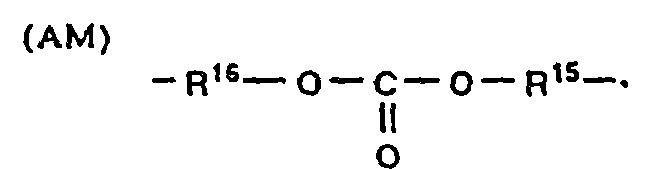


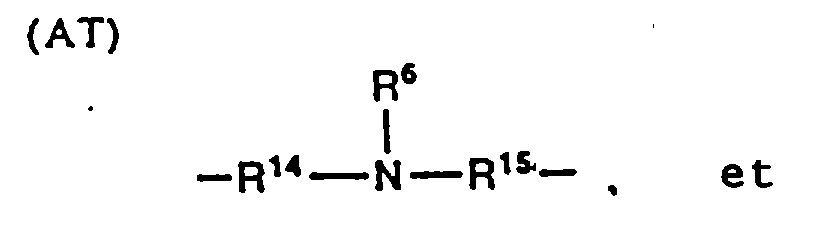
 dans lesquelsR¹⁴ est choisi entreune liaison chimique,un groupe alkyle en C₁ à C₈,un groupe cycloalkyle en C₃ à C₇,un groupe alcényle en C₂ à C₅,un groupe alcynyle en C₃ à C₅,un groupe aryle en C₆ à C₁₀,un groupe (alkyle en C₁ à C₃)-(aryle en C₆ à C₁₂),un groupe (alkyle en C₁ ou C₂)-(aryle en C₆ à C₁₀)-(alkyle en C₁ ou C₂),un groupe (aryle en C₆ à C₁₀)-(alkyle en C₁ ou C₂), etun groupe (aryle en C₆ à C₁₀)-oxy-(alkyle en C₁ ou C₂),R¹⁵ est choisi entreune liaison chimiqueun groupe alkyle en C₁ à C₄,un groupe alcényle en C₂ à C₄,un groupe alcynyle en C₂ à C₄,un groupe aryle en C₆ à C₁₀, etun groupe (alkyle en C₁ à C₃)-(aryle en C₆ à C₁₂),R¹⁶ est choisi entreune liaison chimiqueun groupe alkyle en C₁ à C₅,un groupe cycloalkyle en C₃ à C₇,un groupe alcényle en C₃ à C₅,un groupe alcynyle en C₃ à C₅,un groupe aryle en C₆ à C₁₀,un groupe (alkyle en C₁ à C₃)-(aryle en C₆ à C₁₂), etun groupe (aryle en C₆ à C₁₀)-(alkyle en C₁ ou C₂),R¹⁷ est choisi entreun groupe alcényle en C₃ ou C₄,un groupe alcynyle en C₃ ou C₄,un groupe aryle en C₆ à C₁₀, etun groupe benzyle, etHET désigne un hétérocycle ayant 5 à 14 atomes dans 1 à 3 cycles, chaque cycle ayant 1 à 3 hétéro-atomes choisis entre N, O et S,les substituants consistant en un à trois groupes R¹ ;L représente un radical bivalent facultativement substitué choisi dans le groupe consistant en un groupe


 dans lesquelso est égal à 1 ou 2,p est égal à 1, 2, 3 ou 4,R⁶ répond à la définition précitée, etles substituants consistent en un ou trois groupes R¹ ;T-UG est choisi dans le groupe consistant en un groupe


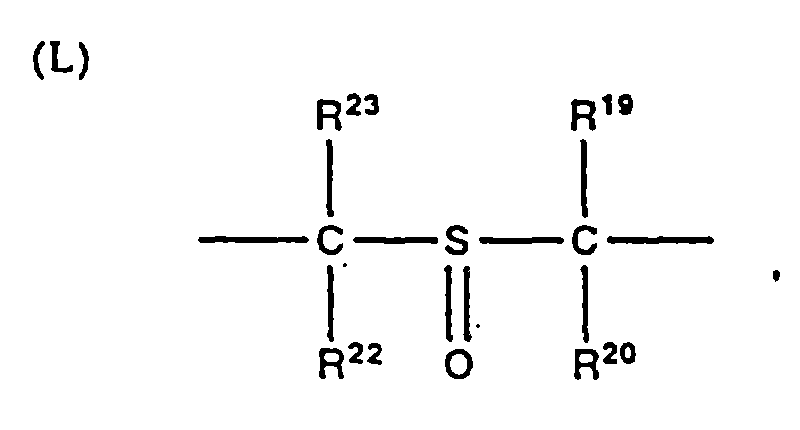


 dans lesquelsX représente O ou S,R¹⁸ et R³ sont choisis, indépendamment, dans le groupe consistant en(i) hydrogène,(ii) un groupe alkyle en C₁ à C₁₂ facultativement substitué,(iii) un groupe alcényle en C₃ à C₁₂ facultativement substitué,(iv) un groupe cycloalkyle en C₃ à C₁₄ facultativement substitué,(v) un groupe (alkyle en C₁ à C₁₂)-(aryle en C₆ à C₁₄) facultativement substitué,(vi) un groupe aryle en C₆ à C₁₄ facultativement substitué,(vii) un groupe (alkyle en C₁ à C₄)-phényle facultativement substitué, et(viii) un groupe alkoxy en C₁ à C₁₂ facultativement substitué,R¹⁹ et R⁰ sont choisis, indépendamment, entre(i) l'hydrogène,(ii) un groupe halogéno (F, Cl, Br, I),(iii) un groupe alkoxy en C₁ à C₄,(iv) un groupe alkyle en C₁ à C₄,(v) un groupe phényle,(vi) un groupe benzyle, et(vii) un groupe halogéno (F, Cl, Br, I)-(alkyle en C₁ à C₄,R¹ et R sont choisis, indépendamment, dans le groupe consistant en(i) l'hydrogène,(ii) un groupe alkyle en C₁ à C₁₂ facultativement substitué,(iii) un groupe aryle en C₆ à C₁₄ facultativement substitué,(iv) un groupe cycloalkyle en C₃ à C₁₄ facultativement substitué,(v) un groupe (alkyle en C₁ à C₁₂)-(aryle en C₆ à C₁₄) facultativement substitué, et(vi) un groupe (alkyle en C₁ à C₁₂) - (cycloalkyle en C₃ à C₁₄) facultativement substitué,dans lesquels les substituants sont choisis entre(a) un groupe halogéno (F, Cl, Br, I),(b) un groupe nitro,(c) un groupe hydroxy,(d) un groupe carboxy,(e) un groupe tétrazole,(f) un groupe hydroxamate,(g) un groupe sulfamide,(h) un groupe trifluorimide,(i) un groupe phosphonate,(j) un groupe alkyle en C₁ à C₆,(k) un groupe aryle en C₆ à C₁₄,(l) un groupe benzyle,(m) un groupe cycloalkyle en C₃ à C₁₄,(n) un groupe COR⁴,dans lequel R⁴ est choisi dans le groupe consistant enun groupe alkoxy en C₁ à C₈,un groupe alcénoxy en C₃ à C₁₂,un groupe aryloxy en C₆ à C₁₂,un groupe (alkyle en C₁ à C₆)-(aryloxy en C₆ à C₁₂),un groupe di-(alkyle en C₁ à C₈)-amino-(alkoxy en C₁ à C₈),un groupe acylamino-(alkoxy en C₁ à C₈) choisi dans le groupe consistant enun groupe acétylaminoéthoxy,un groupe nicotinoylaminoéthoxy ; etun groupe succinamidoéthoxy,un groupe (alkoyloxy en C₁ à C₈)-oxy-(alkoxy en C₁ à C₈), etun groupe (aryle en C₆ à C₁₂) -(alkoxy en C₁ à C₈) dans lequel le groupe aryle est non substitué ou substitué avec un à trois des groupesnitro,halogéno (F, Cl, Br, I),alkoxy en C₁ à C₄,amino,hydroxy,hydroxy-alkoxy en C₂ à C₈, etdihydroxy-alkoxy en C₃ à C₈, et(o) un groupe CONR⁵R⁶dans lequel R⁵ et R⁶ sont choisis, indépendamment entrel'hydrogène,un groupe alkyle en C₁ à C₁₀,un groupe alcényle en C₃ à C₁₀,un groupe aryle en C₆ à C₁₄,un groupe (alkyle en C₁ à C₆)-(aryle en C₆ à C₁₀),facultativement, R⁵ et R⁶, conjointement, peuvent former un groupetriméthylène,tétraméthylène,pentaméthylène, et3-oxopentaméthylène, et(vii) un groupe Q-L³dans lequel Q est choisi entrel'hydrogène, etQ¹, etL³ est choisi entreune liaison chimique,L¹, etL ;D est choisi dans le groupe consistant enR, etun groupe -(C=O)-Xaa, dans lequel Xaa représente un à trois résidus de D- ou L-α-amino-acides ;W représente un groupe -R⁷-w dans lequelR⁷ est choisi entre(a) une liaison covalente,(b) un groupe méthylène substitué ou non substitué, et(c) un groupe éthylène substitué ou non substitué,dans lesquels les substituants sont choisis entre(i) un groupe nitro,(ii) un groupe halogéno (F, Cl, Br, I),(iii) un groupe alkyle en C₁ à C₆,(iv) un groupe halogéno (F, Cl, Br, I)-(alkyle en C₁ à C₆), et(v) un groupe phényle substitué ou non substitué,les substituants sur le groupe phényle étant choisis entre(1) un groupe alkyle en C₁ à C₆,(2) un groupe alkoxy en C₁ à C₆,(3) un groupe halogéno (F, Cl, Br, I), et(4) un groupe CF₃ ;w est choisi entre les groupes(a) -COR⁸,(b) -SO₃R³¹,(c) -NHSO₂R³,(d) -PO(OR³¹)₂,(e) -SO₂NHR³,(f) -CONHOR³¹,(g) -C(OH)R³³)₂PO(OR³³)₂,(h) -CN,(i) un groupe -SO₂NH-hétérocycle dans lequel l'hétérocycle est un noyau aromatique penta- ou heptagonal contenant 1 à 3 hétéro-atomes choisis entre 0, N et S et l'hétérocycle est non substitué ou substitué avec un ou deux substituants choisis entre des groupes(i) -OH,(ii) -SH,(iii) alkyle en C₁ à C₄,(iv) alkoxy en C₁ à C₄,(v) CF₃,(vi) halogéno (F, Cl, Br, I),(vii) NO₂,(viii) -COOH,(ix) -COO-(alkyle en C₁ à C₄),(x) -NH₂,(xi) -NH(alkyle en C₁ à C₄), et(xii) -N(alkyle en C₁ à C₄)₂,(j) -CH₂SO₂NH-hétérocycle,(k) -SO₂NHCOR³³,(l) -CH₂SO₂NHCOR³,(m) -CONHSO₂R³³,(n) -CH₂CONHSO₂R³³,(o) -NHCONHSO₂R³³,(p) -NHSO₂NHCOR³³,(q) -CONHNHSO₂CF₃,(r) -CON(OH)R³¹,(s) -CONHCOCF₃,(t) -CONHSO₂R⁸,(u) -CONHSO₂R⁹,(v) -CONHSO₂R³⁰,


 R⁸ est choisi dans le groupe consistant en(a) un groupe hydroxy,(b) un groupe alkoxy en C₁ à C₈,(c) un groupe alcénoxy en C₃ à C₁₂,(d) un groupe aryloxy en C₆ à C₁₂,(e) un groupe (alkyle en C₁ à C₆) -(aryloxy en C₆ à C₁₂),(f) un groupe di-(alkyle en C₁ à C₈)-amino-(alkoxy en C₁ à C₈),(g) un groupe acylamino-(alkoxy en C₁ à C₈) choisi dans le groupe consistant en(i) un groupe acétylaminoéthoxy,(ii) un groupe nicotinoylaminoéthoxy, et(iii) un groupe succinamidoéthoxy,(h) un groupe (alkoxyle en C₁ à C₈)-oxy-(alkoxy en C₁ à C₈),(i) un groupe (aryle en C₆ à C₁₂)-(alkoxy en C₁ à C₈),dans lesquels n'importe quels groupes aryle sont non substitués ou substitués avec un à trois des groupes(i) nitro,(ii) halogéno (F, Cl, Br, I),(iii) alkoxy en C₁ à C₄, et(iv) amino,(j) un groupe hydroxy-alkoxy en C₂ à C₈,(k) un groupe dihydroxy-alkoxy en C₃ à C₈, et(l) un groupe NR⁹R³⁰ ;R⁹ et R³⁰ sont choisis, indépendamment, dans le groupe consistant en(a) l'hydrogène,(b) un groupe alkyle en C₁ à C₈,(c) un groupe alcényle en C₃ à C₈,(d) un groupe aryle en C₆ à C₁₂,(e) un groupe (aryle en C₆ à C₁₂)-(alkyle en C₁ à C₈),dans lesquels n'importe quels groupes aryle sont non substitués ou substitués avec un à trois des groupes(i) nitro,(ii) halogéno (F, Cl, Br, I),(iii) alkoxy en C₁ à C₄, et(iv) aminoR³¹ est choisi dans le groupe consistant en(a) l'hydrogène,(b) un groupe alkyle en C₁ à C₆,(c) un groupe halogéno (F, Cl, Br, I)-alkyle en C₁ à C₆,(d) un groupe phényle,(e) un groupe benzyle, et(f) un groupe -CH₂-O-COCH₃ ;R³ est choisi dans le groupe consistant en(a) l'hydrogène,(b) un groupe benzyle, et(c) un groupe -CH(R³⁵)-O-C(O)R³⁵ ;R³³ est choisi dans le groupe consistant en(a) un groupe aryle,(b) un groupe hétéro-aryle,(c) un groupe cycloalkyle en C₃ à C₇,(d) un groupe alkyle en C₁ à C₄, non substitué ou substitué avec un substituant choisi dans le groupe consistant en(i) un groupe aryle,(ii) un groupe hétéro-aryle,(iii) un groupe -OH,(iv) un groupe -SH,(v) un groupe alkyle en C₁ à C₄,(vi) un groupe alkoxy en C₁ à C₄,(vii) un groupe alkylthio en C₁ à C₄,(viii) un groupe CF₃,(ix) un groupe halogéno (F, Cl, Br, I),(x) un groupe -NO₂,(xi) un groupe -CO₂H,(xii) un groupe CO₂-(alkyle en C₁ à C₄),(xiii) un groupe -NH₂,(xiv) un groupe -N-(alkyle en C₁ à C₄)₂,(xv) un groupe -NH-(alkyle en C₁ à C₄),(xvi) un groupe -PO₃H, et(xvii) un groupe PO(OH) (alkoxy en C₁ à C₄), et(e) un groupe perfluoralkyle en C₁ à C₄ ;R³⁴ est choisi dans le groupe consistant en(a) un groupe -CN,(b) un groupe -NO₂,(c) un groupe -COOR³¹,(d) un groupe perfluoralkyle en C₁ à C₆,(e) un groupe CF₃ ;R³⁵ est choisi, indépendamment, dans le groupe consistant en(a) l'hydrogène,(b) un groupe alkyle en C₁ à C₆ facultativement substitué,(c) un groupe alcényle en C₂ à C₆ facultativement substitué,(d) un groupe alcynyle en C₂ à C₆ facultativement substitué, et(e) un groupe cycloalkyle en C₃ à C₈ facultativement substitué,dans lesquels les substituants sont choisis entre des groupes(i) OH,(ii) alkoxy en C₁ à C₄,(iii) CO₂R³³,(iv) OCOR³³,(v) CONHR³³,(vi) CON(R³³)₂,(vii) N(R³³)C(O)R³³,(viii) NH₂,(ix) alkylamino en C₁ à C₄,(x) di-(alkyle en C₁ à C₄)amino,(xi) aryle, et(xii) hétéro-aryle,(f) un groupe -C(O)-aryle,(g) un groupe -NO₂,(h) un groupe halogéno (Cl, Br, I, F),(i) un groupe -OH,(j) un groupe -OR³⁶,(k) un groupe perfluoralkyle en C₁ à C₄,(l) un groupe -SH,(m) un groupe -S(O)₁₋₂-alkyle en C₁ à C₄,(n) un groupe -CO₂R³³,(o) un groupe -SO₃H,(p) un groupe -NR³³R³⁶,(q) un groupe -NR³³C(O)R³⁶,(r) un groupe NR³³COOR³,(s) un groupe -SO₂NHR³,(t) un groupe -SO₂NR³³R³³,(u) un groupe -NHSO₂R³,(v) un groupe -C(O)NHSO₂R³,(w) un groupe aryle,(x) un hétérocycle,(y) un groupe morpholine-4-yle,(z) un groupe CONH₂, et(aa) un groupe 1H-tétrazole-5-yle ;R³⁶ est choisi dans le groupe consistant en(a) l'hydrogène, et(b) un groupe alkyle en C₁ à C₄ non substitué ou substitué avec un des groupes consistant en(i) NH₂,(ii) NH-(alkyle en C₁ à C₄),(iii) N-(alkyle en C₁ à C₄)₂,(iv) CO₂H,(v) CO₂(alkyle en C₁ à C₄),(vi) OH,(vii) SO₃H, et(viii) SO₂NH₂ ;R³⁷ est choisi dans le groupe consistant en(a) l'hydrogène,(b) un groupe alkyle en C₁ à C₆,(c) un groupe alcényle en C₂ à C₆,(d) un groupe (alkoxy en C₁ à C₆)alkyle,(e) un groupe -CH₂-O-COCH₃, et(f) un groupe -CH₂-phényle, dans lequel le groupe phényle est non substitué ou substitué avec un substituant choisi entre les groupes(i) -NO₂,(ii) -NH₂,(iii) -OH, et(iv) -OCH₃ ;R³⁸, R³⁹ et R⁴⁰ sont choisis chacun, indépendamment, entre(a) l'hydrogène,(b) un groupe Cl,(c) un groupe CN,(d) un groupe NO₂,(e) un groupe CF₃,(f) un groupe C₂F₅,(g) un groupe C₃F₇,(h) un groupe CHF₂,(i) un groupe CH₂F,(j) un groupe CO₂CH₃,(k) un groupe CO₂C₂H₅,(l) un groupe SO₂CH₃,(m) un groupe SO₂CF₃, et(n) SO₂C₆F₅,Z étant choisi entre O, S, un groupe NR⁴¹ et CH₂ ;R⁴¹ est choisi entre l'hydrogène, un groupe CH₃ et un groupe CH₂C₆H₅ ; etses sels pharmaceutiquement acceptables.
 - Composé suivant la revendication 1, représenté par la formule II :
 dans laquelleR¹ représente un à trois groupes choisis, indépendamment, entre l'hydrogène, les groupes halogéno (F, Cl, Br, I), cyano, carboxamido, carbamoyloxy, formyloxy, formyle, azido, nitro, uréido, thiouréido, hydroxy, mercapto, sulfonamido, et un radical facultativement substitué choisi entre des radicaux alkyle en C₁ à C₁₂, alcényle en C₂ à C₁₂, alcynyle en C₃ à C₁₂, cycloalkyle en C₃ à C₁₂, aryle en C₆ à C₁₄, (aryle en C₆ à C₁₀)-(alkyle en C₁ à C₈), alkyloxy en C₁ à C12, aryloxy en C₆ à C₁₄ et alcylamino en C₁ à C₁₂, dans lesquels les substituants sont choisis entre des substituants halogéno (F, Cl, Br, I), cyano, azido, nitro, hydroxy, mercapto, sulfonamido, uréido, thiouréido, carboxamido, carbamoyloxy, formyloxy, formyle, alkyle en C₁ à C₄, alkoxy en C₁ à C₄, phényle et phénoxy ;Q¹ est choisi dans le groupe consistant en(A) un groupe amino choisi entre des groupes-NH₂,-NR³H,-NR³R⁴, et-NR³R⁴R⁵,dans lesquels R³, R⁴ et R⁵ sont choisis, indépendamment, entre (i) un radical facultativement substitué choisi entre (a) -NR⁶R⁷, (b) -C(=NR⁸)-NR⁶R⁷, (c) -N=CR⁹-NR⁶R⁷, (d) -NR¹⁰-CR⁹=NR⁸, et (e) -NR¹⁰-C(=NR⁸) -NR⁶R⁷, dans lesquels chacun des groupes R⁶, R⁷, R⁸, R⁹ et R¹⁰ est choisi, indépendamment, entre l'hydrogène, des groupes alkoxy en C₁ à C₄, alkyle en C₁ à C₄, et halogéno (F, Cl, Br, I)-alkyle en C₁ à C₄, (ii) un groupe alkyle en C₁ à C₁₂, facultativement substitué, (iii) un groupe cycloalkyle en C₃ à C₁₂ facultativement substitué, (iv) un groupe aryle en C₆ à C₁₄ facultativement substitué, (v) un groupe (alkyle en C₁ à C₆) - (aryle en C₆ à C₁₄) facultativement substitué, (vi) un groupe alkoxy en C₁ à C₈ facultativement substitué, et (vii) un groupe aryloxy en C₆ à C₁₄ facultativement substitué, dans lesquels les substituants consistent en un à trois groupes Rll, chaque groupe R¹¹ étant choisi indépendamment entre (a) un groupe aryloxy en C₆ à C₁₂ facultativement substitué, (b) un groupe arylamino en C₆ à C₁₂ facultativement substitué, (c) un groupe aroyle en C₆ à C₁₂ facultativement substitué, dans lesquels les substituants consistent en un à trois groupes R¹, chaque groupe R¹ étant choisi, indépendamment, entre des groupes nitro, amino, alkylamino en C₁ à C₈, di-(alkyle en C₁ à C₈)amino, amidino, aminométhylèneimino, imnio, imino-alkyle en C₁ à C₄, iminométhylèneamino, guanidino, arylamino en C₆ à C₁₀, acylamino en C₁ à C₈, alkylsulfonamido en C₁ à C₄, azido, cyano, hydroxy, hydroxyalkyle en C₁ à C₈, alkoxy en C₁ à C₈, phényloxy, alcanoyloxy en C₁ à C₈, alcanoyle en C₁ à C₈, aroyle en C₆ à C₁₂, benzamido, phényle, halogéno (F, Cl, Br, I), halogénalkyle en C₁ à C₈ et alkyle en C₁ à C₈, (d) un groupe halogéno (F, cl, Br, I), (e) un groupe hydroxy, (f) un groupe mercapto, (g) un groupe formyle, (h)) un groupe formyloxy, (i) un groupe carboxy, (j) un groupe amino, (k) un groupe uréido, (l) un groupe amidino, (m) un groupe guanidino, (n) un groupe aminométhyléneimino, (o) un groupe imimno, (p) un groupe glycyle, (q) un groupe phtalimido, (r) un groupe succinimido, (s) un groupe morpholino et (t) un groupe cycloalkyle en C₃ à C₇, facultativement, R³ et R⁴, pris conjointement, peuvent former un groupe tétraméthylène, pentaméthylène, 3-oxopentaméhtylène ou 3-azapentaméthylène facultativement substitué, dans lequel les substituants consistent en un à trois groupes R¹,(B) un groupe amidino choisi entre-C (=NH) -NH₂-C (=NH) -NHR³,-C (=NR⁴) -NHR³,-C (=NH) -NR³R⁴, et-C (=NR⁵) -NR³R⁴,dans lesquels R³, R⁴ et R⁵ répondent aux définitions précitées,(C) un groupe aminoalkylèneamino choisi entre les groupes-N=CH-NH₂,-N=CH-NHR³,-N=CH-NR³R⁴, et-N=CR⁵-NR³R⁴, et-N-CR⁵-NR³R⁴,dans lesquels R³, R⁴ et R⁵ répondent aux définitions précitées,(D) un groupe iminoalkylèneamino choisi entre les groupes-NH-CH=NH,-NH-CH=NR³,-NH-CR⁴=NR³, et-NR⁵-CR⁴=NR3 ,dans lesquels R³, R⁴ et R⁵ répondent aux définitions précitées,(E) un groupe guanidino choisi entre les groupes-NH-C(=NH)-NH₂,-NH-C(=NH)-NR³H,-NH-C(=NH)-NR³R⁴,-NH-C(=NR⁵)-NR³R⁴,-NR³-C(=NR³)-NR³R⁴,-NR³-C(=NH)-NR³R⁴,-NR³-C(=NR³)-NH₂,-NR³-C(=NH)-NH₂,-NR³-C(=NR³)-NHR⁴, et-NR³-C(=NH)-NHR⁴,dans lesquels R³, R⁴ et R⁵ répondent aux définitions précitées,(F) un groupe hétérocyclique saturé facultativement substitué choisi entre des groupes

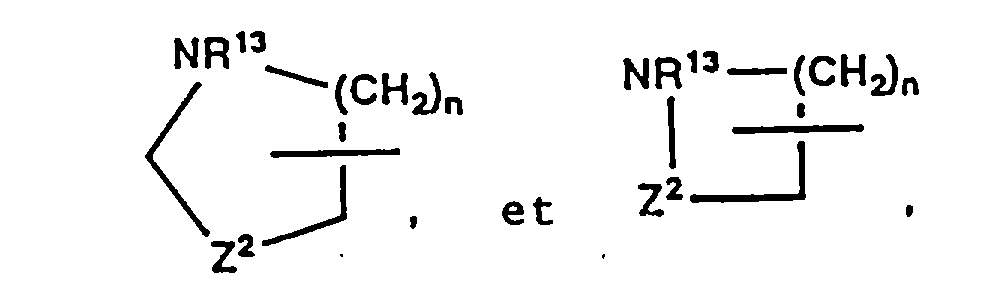 dans lesquels (1) n est égal à 0, 1, 2 ou 3, (2) R¹³ est choisi entre les groupes R⁶, -CR⁹=NR⁸, -CR⁹(=NR⁸) -NR⁶R⁷, -C(=NR⁸)-NR⁶R⁷, -N=CR⁹-NR⁶R⁷, -NR¹⁰-CR⁹=NR⁸ et -NR¹⁰-(C=NR⁸)-NR⁶R⁷ dans lesquels R⁶ et R¹⁰ répondent aux définitions précitées, (3) Z représente O, S ou un groupe NR¹³, et (4) les substituants consistent indépendamment en un à trois groupes R¹ ;L¹ représente un radical bivalent facultativement substitué choisi dans des groupes alkylène en C₃ à C₇, cycloalkylène en C₃ à C₇, alcynylène en C₃ à C₇, cycloalcénylène en C₄ à C₇, cycloalcadiénylène en C₅ à C₈, alcadiénylène en C₃ à C₇, alcynylène en C₃ à C₇, alcénylène en C₄ à C₇, arylène en C₆ à C₁₄, (aryle en C₆ à C₁₄)-alcynylène en C₂ à C₄, (alkyle en C₁ à C₃)-(aryle en C₆ à C₁₄)-(alcynylène en C₂ à C₄), (aryle en C₆ à C₁₄)-(alcénylène en C₂ à C₄), (alkyle en C₁ à C₃)-(arylène en C₆ à C₁₄), (alkyle en C₁ à C₃)-(aryle en C₆ à C₁₄)-(alcénylène en C₂ à C₄), (aryle en C₆ à C₁₄)-(alkylène en C₁ à C₃), (aryle en C₆ à C₁₄)-(alkyloxyène en C₁ à C₃), (alkyle en C₁ ou C₂)-(aryle en C₆ à C₁₄)-alkylène en C₁ ou C₂), (alkyle en C₁ à C₃)-oxy-(arylène en C₆ à C₁₄), alkyloxyène en C₂ à C₈, (alkyle en C₁ à C₅)-oxy-(alkylène en C₁ à C₅), aryloxyène en C₆ à C₁₀, aryle (en C₆ à C₁₀)-oxy-(alkylène en C₁ à C₅), (aryle en C₆ à C₁₀)-thio-(alkylène en C₁ à C₅),


 dans lesquels R¹⁴ est choisi entre une liaison chimique, des groupes alkyle en C₁ à C₈, cycloalkyle en C₃ à C₇, alcényle en C₂ à C₅, alcynyle en C₃ à C₅, aryle en C₆ à C₁₀, (alkyle en C₁ à C₃)-(aryle en C₆ à C₁₂), (alkyle en C₁ ou C₂)-(aryle en C₆ à C₁₀)-(alkyle en C₁ ou C₂), et (aryle en C₆ à C₁₀)-(alkyle en C₁ ou C₂), R¹⁵ est choisi entre une liaison chimique, des groupes alkyle en C₁ à C₄, alcényle en C₂ à C₄, alcynyle en C₂ à C₄ et aryle en C₆ à C₁₀, R¹⁶ est choisi entre une liaison chimique, des groupes alkyle en C₁ à C₅, cycloalkyle en C₃ à C₇, alcényle en C₃ à C₅, alcynyle en C₃ à C₅, aryle en C₆ à C₁₀, (alkyle en C₁ à C₃)-(aryle en C₆ à C₁₂), (alkyle en C₁ à C₃)-(aryle en C₆ à C₁₂) et (aryle en C₆ à C₁₀)-(alkyle en C₁ ou C₂), dans lesquels les substituants consistent en un à trois groupes R¹ ;R⁰ est choisi dans le groupe consistant en l'hydrogène, des groupes halogéno (F, Cl, Br, I), alkoxy en C₁ à C₄, alkyle en C₁ à C₄, phényle, benzyle et halogéno (F, cl, Br, I)-alkyle en C₁ à C₄ ;R est choisi dans le groupe consistant en (i) l'hydrogène, (ii) un groupe alkyle en C₁ à C₁₂ facultativement substitué, (iii) un groupe aryle en C₆ à C₁₄ facultativement substitué, (iv) un groupe cycloalkyle en C₃ à C₁₄ facultativement substitué, (v) un groupe (alkyle en C₁ à C₁₂)-(aryle en C₆ à C₁₄) facultativement substitué, (vi) un groupe (alkyle en C₁ à C₁₂)-(cycloalkyle en C₃ à C₁₄) facultativement substitué, dans lesquels les substituants sont choisis entre des groupes (a) halogéno (F, Cl, Br, I), (b) nitro, (c) hydroxy, (d) carboxy, (e) tétrazole, (f) hydroxamate, (g) sulfonamide, (h) trifluorimide, (i) phosphonate, (j) alkyle en C₁ à C₆, (k) aryle en C₆ à C₁₄, (l) benzyle, (m) cycloalkyle en C₃ à C₁₄, (n) COR⁴ dans lequel R⁴ est choisi entre des groupes alkoxy en C₁ à C₈, alcénoxy en C₃ à C₁₂, aryloxy en C₆ à C₁₂, di-(alkyle en C₁ à C₈)-amino-(alkoxy en C₁ à C₈), acylamino-(alkoxy en C₁ à C₈) choisi entre les groupes acétylaminoéthoxy, nicotinoylaminoéthoxy, succinamidoéthoxy et pivaloyloxyéthoxy, et (aryle en C₆ à C₁₂) -(alkoxy en C₁ à C₈) dans lequel le groupe aryle est non substitué ou substitué avec un à trois des groupes nitro, halogéno (F, Cl, Br, I), alkoxy en C₁ à C₄, amino, hydroxy, hydroxyalkoxy en C₂ à C₈ et dihydroxyalkoxy en C₃ à C₈, (o) CONR⁵R⁶ dans lequel R⁵ et R⁶ sont choisis, indépendamment, entre l'hydrogène, des groupes alkyle en C₁ à C₁₀, alcényle en C₃ à C₁₀, aryle en C₆ à C₁₄, (alkyle en C₁ à C₆)-(aryle en C₆ à C₁₀), facultativement R⁵ et R⁶, pris conjointement, peuvent former un groupe triméthylène, tétraméthylène, pentaméthylène ou 3-oxopentaméthylène, et (vii) un groupe Q-L³ dans lequel Q est choisi entre l'hydrogène et Q¹, et L³ est choisi entre une liaison chimique, L¹ et L, L étant un radical divalent facultativement substitué choisi entre les groupes


 dans lesquels o est égal à 1 ou 2, p est égal à 1, 2, 3 ou 4, R⁶ répond à la définition précitée, les substituants consistant en un à trois groupes R¹ ;D est choisi entre les groupes R et -(C=O)-Xaa, dans lequel Xaa représente un à trois D- ou L-α-amino-acidesR⁸ est choisi dans le groupe consistant en (i) un groupe hydroxy, (ii) un groupe alkoxy en C₁ à C₈, (iii) un groupe alcénoxy en C₃ à C₁₂, (iv) un groupe aryloxy en C₆ à C₁₂, (v) un groupe (alkyle en C₁ à C₆)-(aryle en C₆ à C₁₂)-oxy, (vi) un groupe di-(alkyle en C₁ à C₈)-amino-(alkoxy en C₁ à C₈), (vii) un groupe acylamino(alkoxy en C₁ à C₈) choisi entre les groupes (a) acétylaminoéthoxy, (b) nicotinyloaminoéthoxy et (c) succinamidoéthoxy, (viii) un groupe (alcoyle en C₁ à C₈)-oxy-(alkoxy en C₁ à C₈), (ix) un groupe (aryle en C₆ à C₁₂)-(alkoxy en C₁ à C₈), dans lequel le groupe aryle est non substitué ou substitué avec un à trois des groupes (a) nitro, (b) halogéno (F, C1, Br, I), (c) alkoxy en C₁ à C₄ et (d) amino, (x) un groupe hydroxy-alkoxy en C₂ à C₈, (xi) un groupe dihydroxy-alkoxy en C₃ à C₈, et (xii) un groupe NR⁹R³⁰ dans lequel R⁹ et R³⁰ sont choisis, indépendamment, dans le groupe consistant en (a) l'hydrogène, (b) un groupe alkyle en C₁ à C₈, (c) un groupe alcényle en C₃ à C₈, (d) un groupe aryle en C₆ à C₁₂, le groupe aryle étant non substitué ou substitué avec un à trois des groupes nitro, halogéno (F, Cl, Br, I), alkoxy en C₁ à C₄, et amino, et (e) un groupe (aryle en C₆ à C₁₂)-(alkyle en C₁ à C₈) dans lequel le groupe aryle est non substitué ou substitué avec un à trois des groupes nitro, halogéno (F, Cl, Br, I) et alkoxy en C₁ à C₄ ;R⁹ représente un ou deux groupes choisis, indépendamment, dans le groupe consistant en (a) l'hydrogène, (b) un groupe alkyle en C₁ à C₈, (c) un groupe alcényle en C₃ à C₈, (d) un groupe aryle en C₆ à C₁₂, et (e) un groupe (aryle en C₆ à C₁₂)-(alkyle en C₁ à C₈), dans lesquels n'importe quels groupes aryle sont non substitués ou substitués avec un à trois des groupes (i) nitro, (ii) halogéno (F, Cl, Br, I), (iii) alkoxy en C₁ à C₄, et (iv) amino ; etses sels pharmaceutiquement acceptables.
 - Composé suivant la revendication 2, dans lequel L¹ est choisi dans le groupe consistant en les radicaux
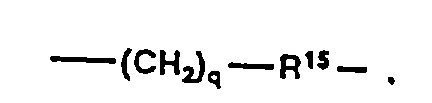


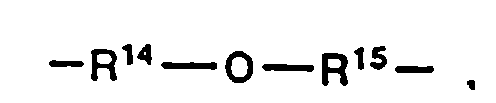 dans lesquelsp est égal à 1, 2, 3 ou 4 ;q est égal à 3, 4, 5, 6 ou 7 ;r est égal à 1, 2, 3, 4 ou 5 ;s est égal à 2 ou 3 ;R¹⁴ est choisi entre des groupesalkyle en C₂ à C₅,cycloalkyle en C₃ à C₇,alcényle en C₂ à C₅,alcynyle en C₃ à C₅,aryle en C₆ à C₁₀,(alkyle en C₁ à C₃)-(aryle en C₆ à C₁₂),(alkyle en C₁ ou C₂)-(aryle en C₆ à C₁₀)-(alkyle en C₁ ou C₂),(aryle en C₆ à C₁₀)-(alkyle en C₁ ou C₂), et(aryle en C₆ à C₁₀)-oxy-(alkyle en C₁ ou C₂) ;R¹⁵ représente une liaison chimique connectant L¹ à la position 7 de la benzodiazépinedione ;R¹⁶ est choisi entre des groupesalkyle en C₂ à C₅,cycloalkyle en C₃ à C₇,alcényle en C₃ à C₅,alcynyle en C₃ à C₅,aryle en C₆ à C₁₀,(alkyle en C₁ à C₃)-(aryle en C₆ à C₁₂), et(aryle en C₆ à C₁₀)-(alkyle en C₁ ou C₂)les groupes R¹⁴ et R¹⁶ liant le groupe L¹ à Q¹.
 - Composé suivant la revendication 3, dans lequel R est choisi dans le groupe consistant enl'hydrogène,un groupe alkyle en C₁ à C₆ facultativement substitué,dans lequel les substituants sont choisis entre des groupesamino,hydroxy,halogéno (F, Cl, Br, I),carboxy, et(alkoxy en C₁ à C₄)-carbonyle,un groupe aryle en C₆ à C₁₀ facultativement substitué, etun groupe (aryle en C₆ à C₁₂)-(alkyle en C₁ à C₄) facultativement substituédans lequel les substituants sur n'importe quels groupes aryle sont choisis entre des groupesamino,nitro,halogéno (F, Cl, Br, I),halogéno (F, Cl, Br, I)-alkyle en C₁ à C₆,alkoxy en C₁ à C₆,aryloxy en C₆ à C₁₀,amino-acylamino en C₁ à C₆,amino-acyle en C₁ à C₆, etguanidino-aroylamino en C₆ à C₁₀.
- Composé suivant la revendication 3, dans lequel Q¹-L¹ est choisi dans le groupe consistant en les radicaux


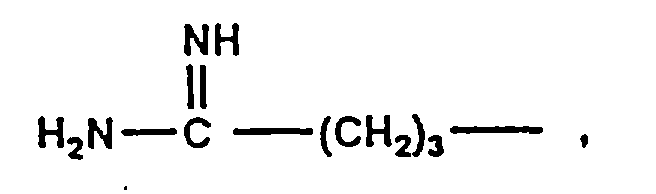


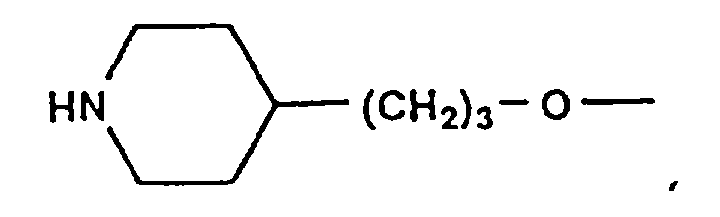


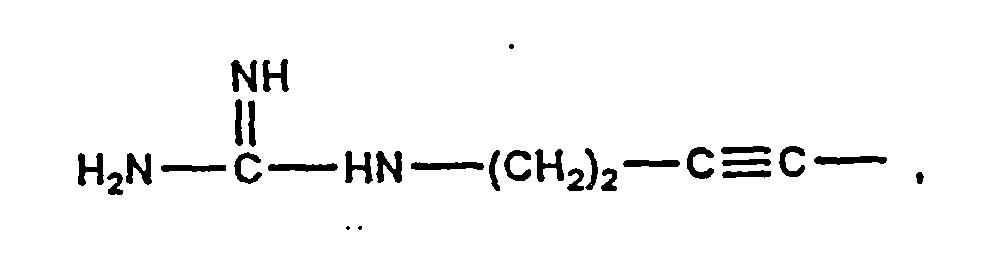


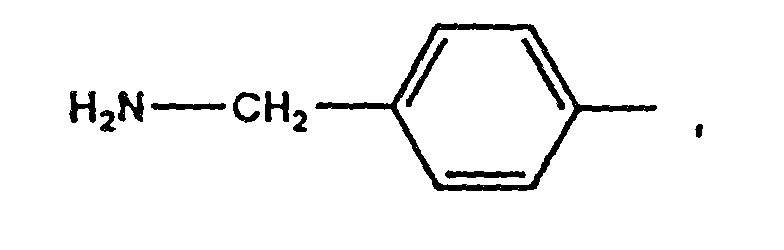


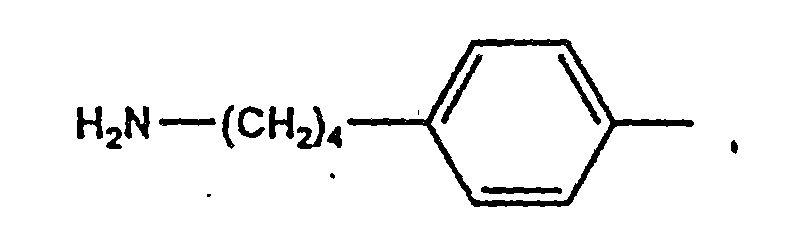


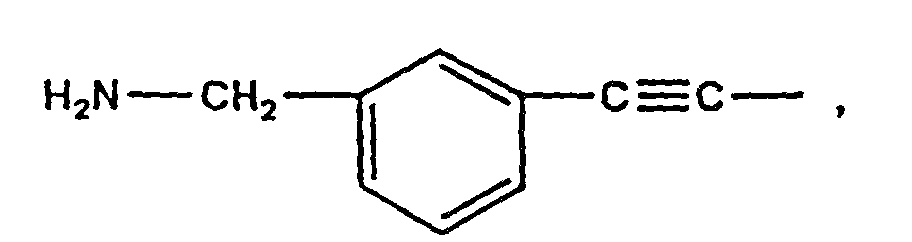


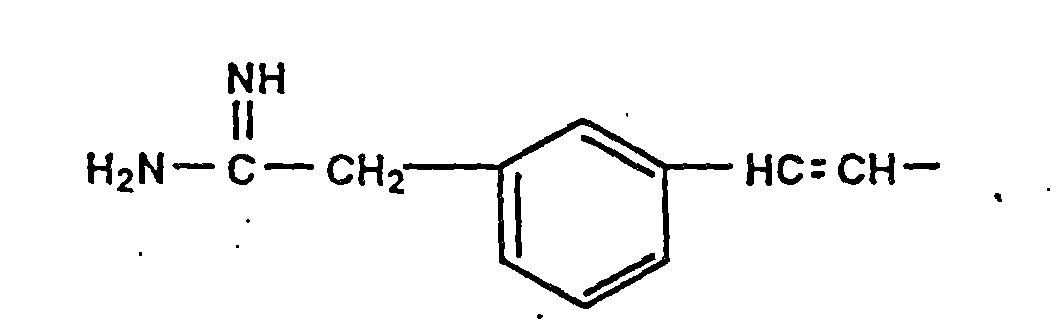


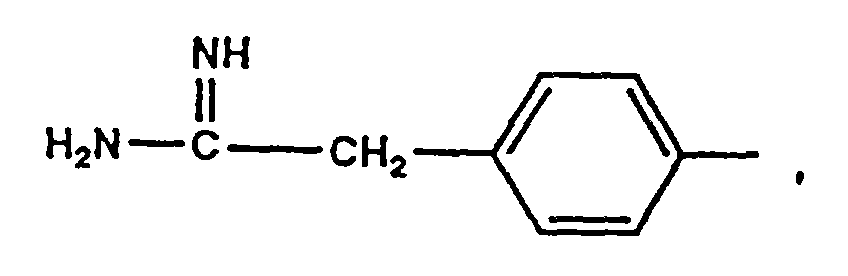


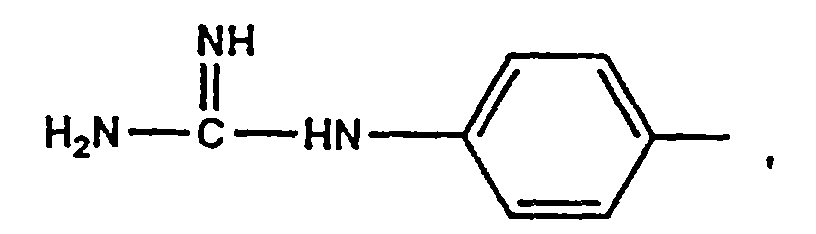


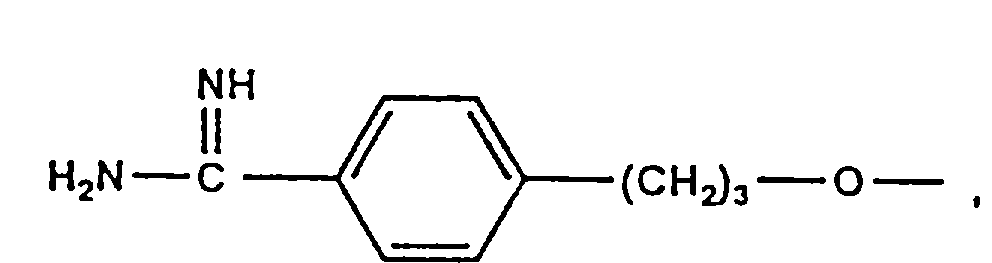


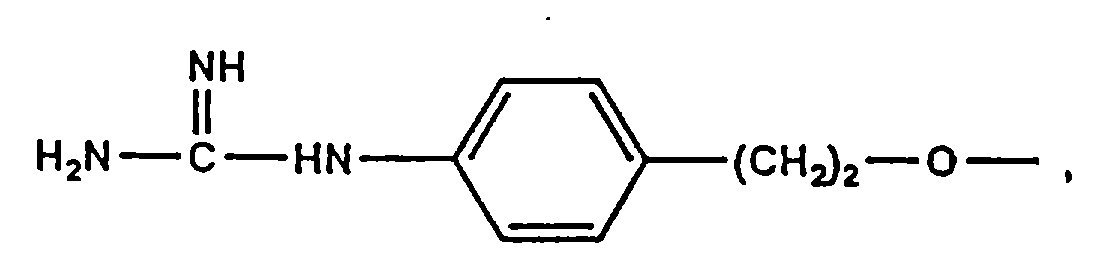

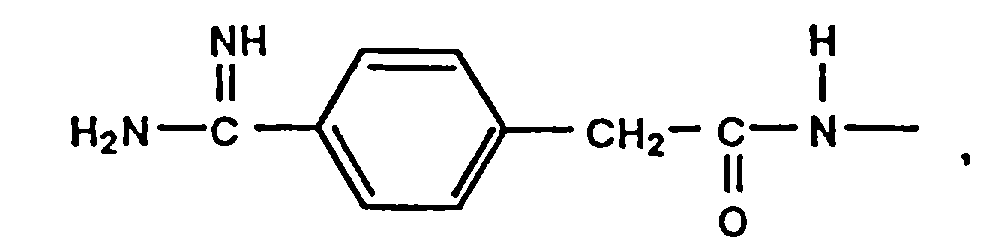


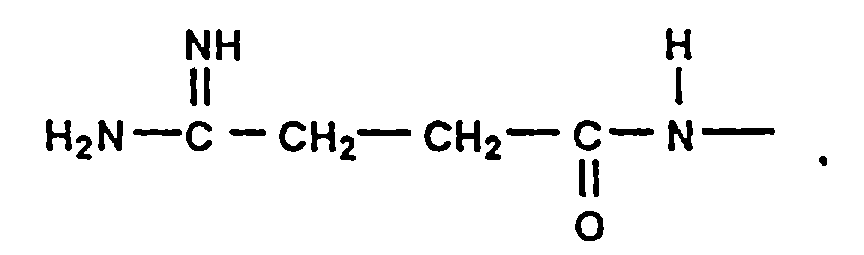


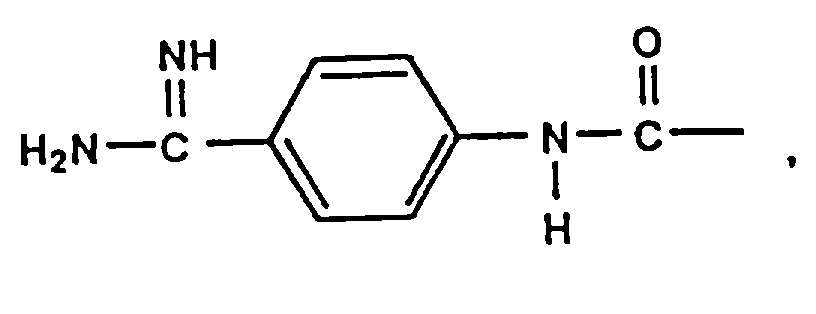


- Composé suivant la revendication 2, choisi dans le groupe consistant en :1-(4-chlorophényl)méthyl-4-(2-carboxyéthyl)-7-(4-(1-pipérizine)-phényl)-3,4-dihydro-1H-1,4-benzodiazapine-2,5-dione1-(diphényl)méthyl-4-(2-carboxyéthyl)-7-(4-(1-pipérizine)-phényl)-3,4-dihydro-1H-1,4-benzodiazapine-2,5-dione,1-(m-trifluorométhyl)phényl-4-(2-carboxyéthyl)-7-(4-(1-pipérizine)-phényl)-3,4-dihydro-1H-1,4-benzodiazapine-2,5-dione,1-(méthyl-4-(2-carboxyéthyl)-7-(4-(1-pipérizine)-phényl)-3,4-dihydro-1H-1,4-benzodiazapine-2,5-dione,1-(1-méthyl)éthyl-4-(2-carboxyéthyl)-7-(4-(1-pipérizine)-phényl)-3,4-dihydro-1H-1,4-benzodiazapine-2,5-dione,1-(2-méthyl)propyl-4-(2-carboxyéthyl)-7-(4-(1-pipérizine)-phényl)-3,4-dihydro-1H-1,4-benzodiazapine-2,5-dione,1-(4-chlorophényl)méthyl-4-(2-carboxyéthyl)-7-(4-(2-aminoéthoxy)-phényl)-3,4-dihydro-1H-1,4-benzodiazapine-2,5-dione,1-(diphényl)méthyl-4-(2-carboxyéthyl)-7-(4-(2-aminoéthoxy)-phényl)-3,4-dihydro-1H-1,4-benzodiazapine-2,5-dione,1-(m-trifluorométhyl)phényl-4-(2-carboxyéthyl)-7-(4-(2-aminoéthoxy)-phényl)-3,4-dihydro-1H-1,4-benzodiazapine-2,5-dione,1-méthyl-4-(2-carboxyéthyl)-7-(4-(2-aminoéthoxy)-phényl)-3,4-dihydro-1H-1,4-benzodiazapine-2,5-dione,1-(1-méthyl)éthyl-4-(2-carboxyéthyl)-7-(4-(2-aminoéthoxy)-phényl)-3,4-dihydro-1H-1,4-benzodiazapine-2,5-dione,le 1-(2-méthyl)propyl-4-(2-carboxyéthyl)-7-(4-(2-aminoéthoxy)-phényl)-3,4-dihydro-1H-1,4-benzodiazapine-2,5-dione,1-(diphényl)méthyl-4-(2-carboxyéthyl)-7-(6-aminohexyl)-3,4-dihydro-1H-1,4-benzodiazapine-2,5-dione,1-(diphényl)méthyl-4-(2-carboxyéthyl)-7-(6-aminohex-1-ynyl)-3,4-dihydro-1H-1,4-benzodiazapine-2,5-dione,1-(diphényl)méthyl-4-(2-carboxyéthyl)-7-(5-aminopentoxy)-3,4-dihydro-1H-1,4-benzodiazapine-2,5-dione,1-(diphényl)méthyl-4-(2-carboxyéthyl)-7-(5-guanidinopentyl)-3,4-dihydro-1H-1,4-benzodiazapine-2,5-dione,1-(diphényl)méthyl-4-(2-carboxyéthyl)-7-(4-guanidinobutoxy)-3,4-dihydro-1H-1,4-benzodiazapine-2,5-dione,1-(diphényl)méthyl-4-(2-carboxyéthyl)-7-(5-aminopent-1-ynyl)-3,4-dihydro-1H-1,4-benzodiazapine-2,5-dione,1-(diphényl)méthyl-4-(2-carboxyéthyl)-7-(5-guanidinopent-1-ynyl)-3,4-dihydro-1H-1,4-benzodiazapine-2,5-dione,1-(diphényl)méthyl-4-(2-carboxyéthyl)-7-(4-amidino)benzamido-3,4-dihydro-1H-1,4-benzodiazapine-2,5-dione,1-(diphényl)méthyl-4-(2-carboxyéthyl)-7-(4-amidino)benzyloxy-3,4-dihydro-1H-1,4-benzodiazapine-2,5-dione,1-(diphényl)méthyl-4-(2-carboxyéthyl)-7-[2-(4-amidinophényl)]éthényl-3,4-dihydro-1H-1,4-benzodiazapine-2,5-dione,1-(diphényl)méthyl-4-(2-carboxyéthyl)-7-[2-(4-amidinophényl)]éthynyl-3,4-dihydro-1H-1,4-benzodiazapine-2,5-dione,1-(4-chlorophényl)méthyl-4-(2-carboxyéthyl)-7-(6-aminohexyl)-3,4-dihydro-1H-1,4-benzodiazapine-2,5-dione,1-(4-chlorophényl)méthyl-4-(2-carboxyéthyl)-7-(5-aminopentoxy)-3,4-dihydro-1H-1,4-benzodiazapine-2,5-dione,1-(4-chlorophényl)méthyl-4-(2-carboxyéthyl)-7-(4-amidino)benzamido-3,4-dihydro-1H-1,4-benzodiazapine-2,5-dione,1-(4-chlorophényl)méthyl-4-(2-carboxyéthyl)-7-(4-amidino)benzyloxy-3,4-dihydro-1H-1,4-benzodiazapine-2,5-dione,1-(4-chlorophényl)méthyl-4-(2-carboxyéthyl)-7-[2-(4-amidinophényl)]éthényl-3,4-dihydro-1H-1,4-benzodiazapine-2,5-dione,1-(4-chlorophényl)méthyl-4-(2-carboxyéthyl)-7-[2-(4-amidinophényl)]éthynyl-3,4-dihydro-1H-1,4-benzodiazapine-2,5-dione,1-méthyl-4-(2-carboxyéthyl)-7-(4-amidino)-benzamido-3,4-dihydro-1H-1,4-benzodiazapine-2,5-dione,1-méthyl-4-(2-carboxyéthyl)-7-(4-amidino)-benzyloxy-3,4-dihydro-1H-1,4-benzodiazapine-2,5-dione,1-méthyl-4-(2-carboxyéthyl)-7-[2-(4-amidinophényl)]éthényl-3,4-dihydro-1H-1,4-benzodiazapine-2,5-dione,1-méthyl-4-(2-carboxyéthyl)-7-[2-(4-amidinophényl)]éthynyl-3,4-dihydro-1H-1,4-benzodiazapine-2,5-dione,1-(1-méthyl)éthyl-4-(2-carboxyéthyl)-7-(4-amidino)benzamido-3,4-dihydro-1H-1,4-benzodiazapine-2,5-dione,1-(1-méthyl)éthyl-4-(2-carboxyéthyl)-7-(4-amidino)benzyloxy-3,4-dihydro-1H-1,4-benzodiazapine-2,5-dione,1-(1-méthyl)éthyl-4-(2-carboxyéthyl)-7-[2-(4-amidinophényl)]éthényl-3,4-dihydro-1H-1,4-benzodiazapine-2,5-dione,1-(2-méthyl)éthyl-4-(2-carboxyéthyl)-7-[2-(4-amidinophényl)]éthynyl-3,4-dihydro-1H-1,4-benzodiazapine-2,5-dione,1-(2-méthyl)propyl-4-(2-carboxyéthyl)-7-(4-amidino)benzamido-3,4-dihydro-1H-1,4-benzodiazapine-2,5-dione,1-(2-méthyl)propyl-4-(2-carboxyéthyl)-7-(4-amidino)benzyloxy-3,4-dihydro-1H-1,4-benzodiazapine-2,5-dione,1-(2-méthyl)propyl-4-(2-carboxyéthyl)-7-[2-(4-amidinophényl)]éthényl-3,4-dihydro-1H-1,4-benzodiazapine-2,5-dione,1-(2-méthyl)propyl-4-(2-carboxyéthyl)-7-[2-(4-amidinophényl)]éthynyl-3,4-dihydro-1H-1,4-benzodiazapine-2,5-dione,1-(2,4-difluorophényl)méthyl-4-(2-carboxyéthyl)-7-(4-(1-pipérizine)-phényl)-3,4-dihydro-1H-1,4-benzodiazapine-2,5-dione,1-(2,4-difluorophényl)méthyl-4-(2-carboxyéthyl)-7-(4-(2-aminoéthoxy)-phényl)-3,4-dihydro-1H-1,4-benzodiazapine-2,5-dione,1-(2,4-difluorophényl)méthyl-4-(2-carboxyéthyl)-7-(6-aminohexyl)-3,4-dihydro-1H-1,4-benzodiazapine-2,5-dione,1-(2,4-difluorophényl)méthyl-4-(2-carboxyéthyl)-7-(5-aminopentoxy)-3,4-dihydro-1H-1,4-benzodiazapine-2,5-dione,1-(2,4-difluorophényl)méthyl-4-(2-carboxyéthyl)-7-(4-amidino)benzamido-3,4-dihydro-1H-1,4-benzodiazapine-2,5-dione,1-(2,4-difluorophényl)méthyl-4-(2-carboxyéthyl)-7-(4-amidino)benzyloxy-3,4-dihydro-1H-1,4-benzodiazapine-2,5-dione,1-(2,4-difluorophényl)méthyl-4-(2-carboxyéthyl)-7-[2-(4-amidinophényl)]éthényl-3,4-dihydro-1H-1,4-benzodiazapine-2,5-dione,1-(2,4-difluorophényl)méthyl-4-(2-carboxyéthyl)-7-[2-(4-amidinophényl)]éthynyl-3,4-dihydro-1H-1,4-benzo-diazapine-2,5-dione,1-(4-chlorophényl)méthyl-4-(2-carboxyéthyl)-7-[2-(4-pipéridinyl)éthyloxy]-3,4-dihydro-1H-1,4-benzodiazapine-2,5-dione,1-(diphényl)méthyl-4-(2-carboxyéthyl)-7-[2-(4-pipéridinyl)éthyloxy]-3,4-dihydro-1H-1,4-benzodiazapine-2,5-dione,1-(m-trifluorométhyl)phényl)-4-(2-carboxyéthyl)-7-[2-(4-pipéridinyl)éthyloxy]-3,4-dihydro-1H-1,4-benzodiazapine-2,5-dione,1-méthyl-4-(2-carboxyéthyl)-7-[2-(4-pipéridinyl)éthyloxy]-3,4-dihydro-1H-1,4-benzodiazapine-2,5-dione,1-(1-méthyl)éthyl-4-(2-carboxyéthyl)-7-[2-(4-pipéridinyl) éthyloxy]-3,4-dihydro-1H-1,4-benzodiazapine-2,5-dione,1-(2-méthyl)propyl-4-(2-carboxyéthyl)-7-[2-(4-pipéridinyl)éthyloxy]-3,4-dihydro-1H-1,4-benzodiazapine-2,5-dione,1-(2,4-difluorophénylphényl)méthyl-4-(2-carboxyéthyl)-7-[2-(4-pipéridinyl)éthyloxy]-3,4-dihydro-1H-1,4-benzodiazapine-2,5-dione,1-(4-chlorophényl)méthyl-4-(3-butanoyl)-7-(4-(1-pipérizine)-phényl)-3,4-dihydro-1H-1,4-benzodiazapine-2,5-dione,1-(diphényl)méthyl-4-(3-butanoyl)-7-(4-(1-pipérizine)-phényl)-3,4-dihydro-1H-1,4-benzodiazapine-2,5-dione,1-(m-trifluorométhyl)phényl-4-(3-butanoyl)-7-(4-(1-pipérizine)-phényl)-3,4-dihydro-1H-1,4-benzodiazapine-2,5-dione,1-méthyl-4-(3-butanoyl)-7-(4-(1-pipérizine)-phényl)-3,4-dihydro-1H-1,4-benzodiazapine-2,5-dione,1-(1-méthyl)éthyl-4-(3-butanoyl)-7-(4-(1-pipérizine)-phényl)-3,4-dihydro-1H-1,4-benzodiazapine-2,5-dione,1-(2-méthyl)propyl-4-(3-butanoyl)-7-(4-(1-pipérizine)-phényl)-3,4-dihydro-1H-1,4-benzodiazapine-2,5-dione,1-(4-chlorophényl)méthyl-4-(3-butanoyl)-7-(4-(2-aminoéthoxy)-phényl)-3,4-dihydro-1H-1,4-benzodiazapine-2,5-dione,1-(diphényl)méthyl-4-(3-butanoyl)-7-(4-(2-aminoéthoxy)-phényl)-3,4-dihydro-1H-1,4-benzodiazapine-2,5-dione,1-(m-trifluorométhyl)phényl-4-(3-butanoyl)-7-(4-(2-aminoéthoxy)-phényl)-3,4-dihydro-1H-1,4-benzodiazapine-2,5-dione,1-méthyl-4-(3-butanoyl)-7-(4-(2-aminoéthoxy)-phényl)-3,4-dihydro-1H-1,4-benzodiazapine-2,5-dione,1-(1-méthyl)éthyl-4-(3-butanoyl)-7-(4-(2-amino-éthoxy)-phényl)-3,4-dihydro-1H-1,4-benzodiazapine-2,5-dione,1-(2-méthyl)propyl-4-(3-butanoyl)-7-(4-(2-amino-éthoxy)-phényl)-3,4-dihydro-1H-1,4-benzodiazapine-2,5-dione,1-(diphényl)méthyl-4-(3-butanoyl)-7-(6-aminohexyl)-3,4-dihydro-1H-1,4-benzodiazapine-2,5-dione,1-(diphényl)méthyl-4-(3-butanoyl)-7-(6-aminohex-1-ynyl)-3,4-dihydro-1H-1,4-benzodiazapine-2,5-dione,1-(diphényl)méthyl-4-(3-butanoyl)-7-(5-aminopentoxy)-3,4-dihydro-1H-1,4-benzodiazapine-2,5-dione,1-(diphényl)méthyl-4-(3-butanoyl)-7-(5-guanidinopentyl)-3,4-dihydro-1H-1,4-benzodiazapine-2,5-dione,1-(diphényl)méthyl-4-(3-butanoyl)-7-(4-guanidinobutoxy)-3,4-dihydro-1H-1,4-benzodiazapine-2,5-dione,1-(diphényl)méthyl-4-(3-butanoyl)-7-(5-aminopent-1-ynyl)-3,4-dihydro-1H-1,4-benzodiazapine-2,5-dione,1-(diphényl)méthyl-4-(3-butanoyl)-7-(5-guanidinopent-1-ynyl)-3,4-dihydro-1H-1,4-benzodiazapine-2,5-dione,1-(diphényl)méthyl-4-(3-butanoyl)-7-(4-amidino)-benzamido-3,4-dihydro-1H-1,4-benzodiazapine-2,5-dione,1-(diphényl)méthyl-4-(3-butanoyl)-7-(4-amidino)-benzyloxy-3,4-dihydro-1H-1,4-benzodiazapine-2,5-dione,1-(diphényl)méthyl-4-(3-butanoyl)-7-[2-(4-amidinophényl)] éthényl-3,4-dihydro-1H-1,4-benzodiazapine-2,5-dione,1-(diphényl)méthyl-4-(3-butanoyl)-7-[2-(4-amidinophényl)]éthynyl-3,4-dihydro-1H-1,4-benzodiazapine-2,5-dione,1-(4-chlorophényl)méthyl-4-(3-butanoyl)-7-(6-aminohexyl)-3,4-dihydro-1H-1,4-benzodiazapine-2,5-dione,1-(4-chlorophényl)méthyl-4-(3-butanoyl)-7-(5-aminopentoxy)-3,4-dihydro-1H-1,4-benzodiazapine-2,5-dione,1-(4-chlorophényl)méthyl-4-(3-butanoyl)-7-(4-amidino)benzamido-3,4-dihydro-1H-1,4-benzodiazapine-2,5-dione,1-(4-chlorophényl)méthyl-4-(3-butanoyl)-7-(4-amidino)benzyloxy-3,4-dihydro-1H-1,4-benzodiazapine-2,5-dione,1-(4-chlorophényl)méthyl-4-(3-butanoyl)-7-[2-(4-amidinophényl)]éthényl-3,4-dihydro-1H-1,4-benzodiazapine-2,5-dione,1-(4-chlorophényl)méthyl-4-(3-butanoyl)-7-[2-(4-amidinophényl)]éthynyl-3,4-dihydro-1H-1,4-benzodiazapine-2,5-dione,1-méthyl-4-(3-butanoyl)-7-(4-amidino)benzamido-3,4-dihydro-1H-1,4-benzodiazapine-2,5-dione,1-méthyl-4-(3-butanoyl)-7-(4-amidino)benzyloxy-3,4-dihydro-1H-1,4-benzodiazapine-2,5-dione,1-méthyl-4-(3-butanoyl)-7-[2-(4-amidinophényl)]-éthényl-3,4-dihydro-1H-1,4-benzodiazapine-2,5-dione,1-méthyl-4-(3-butanoyl)-7-[2-(4-amidinophényl)]-éthynyl-3,4-dihydro-1H-1,4-benzodiazapine-2,5-dione,1-(1-méthyl)éthyl-4-(3-butanoyl)-7-(4-amidino)-benzamido-3,4-dihydro-1H-1,4-benzodiazapine-2,5-dione,1-(1-méthyl)éthyl-4-(3-butanoyl)-7-(4-amidino)-benzyloxy-3,4-dihydro-1H-1,4-benzodiazapine-2,5-dione,1-(1-méthyl)éthyl-4-(3-butanoyl)-7-[2-(4-amidinophényl)]éthényl-3,4-dihydro-1H-1,4-benzodiazapine-2,5-dione,1-(2-méthyl)éthyl-4-(3-butanoyl)-7-[2-(4-amidinophényl)]éthynyl-3,4-dihydro-1H-1,4-benzodiazapine-2,5-dione,1-(2-méthyl)propyl-4-(3-butanoyl)-7-(4-amidino)-benzamido-3,4-dihydro-1H-1,4-benzodiazapine-2,5-dione,1-(2-méthyl)propyl-4-(3-butanoyl)-7-(4-amidino)-benzyloxy-3,4-dihydro-1H-1,4-benzodiazapine-2,5-dione,1-(2-méthyl)propyl-4-(3-butanoyl)-7-[2-(4-amidinophényl)]éthényl-3,4-dihydro-1H-1,4-benzodiazapine-2,5-dione,1-(2-méthyl)propyl-4-(3-butanoyl)-7-[2-(4-amidinophényl)] éthynyl-3,4-dihydro-1H-1,4-benzodiazapine-2,5-dione,1-(2,4-difluorophényl)méthyl-4-(3-butanoyl)-7-(4-(1-pipérizine)-phényl)-3,4-dihydro-1H-1,4-benzodiazapine-2,5-dione,1-(2,4-difluorophényl)méthyl-4-(3-butanoyl)-7-(4-(2-aminoéthoxy)-phényl)-3,4-dihydro-1H-1,4-benzodiazapine-2,5-dione,1-(2,4-difluorophényl)méthyl-4-(3-butanoyl)-7-(6-aminohexyl)-3,4-dihydro-1H-1,4-benzodiazapine-2,5-dione,1-(2,4-difluorophényl)méthyl-4-(3-butanoyl)-7-(5-aminopentoxy)-3,4-dihydro-1H-1,4-benzodiazapine-2,5-dione,1-(2,4-difluorophényl)méthyl-4-(3-butanoyl)-7-(4-amidino)benzamido-3,4-dihydro-1H-1,4-benzodiazapine-2,5-dione,1-(2,4-difluorophényl)méthyl-4-(3-butanoyl)-7-(4-amidino)benzyloxy-3,4-dihydro-1H-1,4-benzodiazapine-2,5-dione,1-(2,4-difluorophényl)méthyl-4-(3-butanoyl)-7-[2-(4-amidinophényl)]éthényl-3,4-dihydro-1H-1,4-benzodiazapine-2,5-dione,1-(2,4-difluorophényl)méthyl-4-(3-butanoyl)-7-[2-(4-amidinophényl)]éthynyl-3,4-dihydro-1H-1,4-benzodiazapine-2,5-dione,1-(4-chlorophényl)méthyl-4-(3-butanoyl)-7-[2-(4-pipéridinyl)éthyloxy]-3,4-dihydro-1H-1,4-benzodiazapine-2,5-dione,1-(diphényl)méthyl-4-(3-butanoyl)-7-[2-(4-pipéridinyl)éthyloxy]-3,4-dihydro-1H-1,4-benzodiazapine-2,5-dione,1-(m-trifluorométhyl)phényl-4-(3-butanoyl)-7-[2-(4-pipéridinyl) éthyloxy]-3,4-dihydro-1H-1,4-benzodiazapine-2,5-dione,1-méthyl-4-(3-butanoyl)-7-[2-(4-pipéridinyl)-éthyloxy]-3,4-dihydro-1H-1,4-benzodiazapine-2,5-dione,1-(1-méthyl)éthyl-4-(3-butanoyl)-7-[2-(4-pipéridinyl)éthyloxy]-3,4-dihydro-1H-1,4-benzodiazapine-2,5-dione,1-(2-méthyl)propyl-4-(3-butanoyl)-7-[2-(4-pipéridinyl) éthyloxy]-3,4-dihydro-1H-1,4-benzodiazapine-2,5-dione,1-(2,4-difluorophényl)méthyl-4-(3-butanoyl)-7-[2-(4-pipéridinyl)éthyloxy]-3,4-dihydro-1H-1,4-benzodiazapine-2,5-dione,1-(4-chlorophényl)méthyl-4-[(2-méthyl)carboxyéthyl)]-7-(4-(1-pipérizine)-phényl)-3,4-dihydro-1H-1,4-benzo-diazapine-2,5-dione,1-(diphényl)méthyl-4-[(2-méthyl)carboxyéthyl)]-7-(4-(1-pipérizine)-phényl)-3,4-dihydro-1H-1,4-benzodiazapine-2,5-dione,1-(m-trifluorophényl)phényl-4-[(2-méthyl)carboxyéthyl)]-7-(4-(1-pipérizine)-phényl)-3,4-dihydro-1H-1,4-benzo-diazapine-2,5-dione,1-méthyl-4-[(2-méthyl)carboxyéthyl)]-7-(4-(1-pipérizine)-phényl)-3,4-dihydro-1H-1,4-benzodiazapine-2,5-dione,1-(1-méthyl)éthyl-4-[(2-méthyl)carboxyéthyl)]-7-(4-(1-pipérizine)-phényl)-3,4-dihydro-1H-1,4-benzodiazapine-2,5-dione,1-(2-méthyl)propyl-4-[(2-méthyl)carboxyéthyl)]-7-(4-(1-pipérizine)-phényl)-3,4-dihydro-1H-1,4-benzodiazapine-2,5-dione,1-(4-chlorophényl)méthyl-4-[(2-méthyl)carboxyéthyl)]-7-(4-(2-aminoéthoxy)-phényl)-3,4-dihydro-1H-1,4-benzodiazapine-2,5-dione,1-(diphényl)méthyl-4-[(2-méthyl)carboxyéthyl)]-7-(4-(2-aminoéthoxy) -phényl)-3,4-dihydro-1H-1,4-benzodiazapine-2,5-dione,1-(m-trifluorométhyl)phényl-4-[(2-méthyl)carboxyéthyl)]-7-(4-(2-aminoéthoxy)-phényl)-3,4-dihydro-1H-1,4-benzodiazapine-2,5-dione,1-méthyl-4-[(2-méthyl)carboxyéthyl)]-7-(4-(2-aminoéthoxy)-phényl)-3,4-dihydro-1H-1,4-benzodiazapine-2,5-dione,1-(1-méthyl)éthyl-4-[(2-méthyl)carboxyéthyl)]-7-(4-(2-aminoéthoxy)-phényl)-3,4-dihydro-1H-1,4-benzodiazapine-2,5-dione,1-(2-tréthyl)propyl-4-[(2-méthyl)carboxyéthyl)]-7-(4-(2-aminoéthoxy)-phényl)-3,4-dihydro-1H-1,4-benzodiazapine-2,5-dione,1-(diphényl)méthyl-4-[(2-méthyl)carboxyéthyl)]-7-(6-aminohexyl)-3,4-dihydro-1H-1,4-benzodiazapine-2,5-dione,1-(diphényl)méthyl-4-[(2-méthyl)carboxyéthyl)]-7-(6-aminohex-1-ynyl)-3,4-dihydro-1H-1,4-benzodiazapine-2,5-dione,1-(diphényl)méthyl-4-[(2-méthyl)carboxyéthyl)]-7-(5-aminopentoxy)-3,4-dihydro-1H-1,4-benzodiazapine-2,5-dione,1-(diphényl)méthyl-4-[(2-méthyl)carboxyéthyl)]-7-(5-guanidinopentyl)-3,4-dihydro-1H-1,4-benzodiazapine-2,5-dione,1-(diphényl)méthyl-4-[(2-méthyl)carboxyéthyl)]-7-(4-guanidinobutoxy)-3,4-dihydro-1H-1,4-benzodiazapine-2,5-dione,1-(diphényl)méthyl-4-[(2-méthyl)carboxyéthyl)]-7-(5-aminopent-1-ynyl)-3,4-dihydro-1H-1,4-benzodiazapine-2,5-dione,1-(diphényl)méthyl-4-[(2-méthyl)carboxyéthyl)]-7-(5-guanidinopent-1-ynyl)-3,4-dihydro-1H-1,4-benzodiazapine-2,5-dione,1-(diphényl)méthyl-4-[(2-méthyl)carboxyéthyl)]-7-(4-(amidino)benzamido)-3,4-dihydro-1H-1,4-benzodiazapine-2,5-dione,1-(diphényl)méthyl-4-[(2-méthyl)carboxyéthyl)]-7-(4-amidino)benzyloxy-3,4-dihydro-1H-1,4-benzodiazapine-2,5-dione,1-(diphényl)méthyl-4-[(2-méthyl)carboxyéthyl)]-7-[2-(4-amidinophényl)]éthényl-3,4-dihydro-1H-1,4-benzo-diazapine-2,5-dione,1-(diphényl)méthyl-4-[(2-méthyl)carboxyéthyl)]-7-[2-(4-amidinophényl)]éthynyl-3,4-dihydro-1H-1,4-benzodiazapine-2,5-dione,1-(4-chlorophényl)méthyl-4-[(2-méthyl)carboxyéthyl)]-7-(6-aminohexyl)-3,4-dihydro-1H-1,4-benzodiazapine-2,5-dione,1-(4-chlorophényl)méthyl-4-[(2-méthyl)carboxyéthyl)]-7-(5-aminopentoxy)-3,4-dihydro-1H-1,4-benzodiazapine-2,5-dione,1-(4-chlorophényl)méthyl-4-[(2-méthyl)carboxyéthyl)]-7-(4-amidino)benzamido-3,4-dihydro-1H-1,4-benzodiazapine-2,5-dione,1-(4-chlorophényl)méthyl-4-[(2-méthyl)carboxyéthyl)]-7-(4-amidino)benzyloxy-3,4-dihydro-1H-1,4-benzo-diazapine-2,5-dione,1-(4-chlorophényl)méthyl-4-[(2-méthyl)carboxyéthyl)]-7-[2-(4-amidinophényl)]éthényl-3,4-dihydro-1H-1,4-benzodiazapine-2,5-dione,1-(4-chlorophényl)méthyl-4-[(2-méthyl)carboxyéthyl)]-7-[2-(4-amidinophényl)]éthynyl-3,4-dihydro-1H-1,4-benzodiazapine-2,5-dione,1-méthyl-4-[(2-méthyl)carboxyéthyl)]-7-(4-amidino)benzamido-3,4-dihydro-1H-1,4-benzodiazapine-2,5-dione,1-méthyl-4-[(2-méthyl)carboxyéthyl)]-7-(4-amidino)benzyloxy-3,4-dihydro-1H-1,4-benzodiazapine-2,5-dione,1-méthyl-4-[(2-méthyl)carboxyéthyl)]-7-[2-(4-amidinophényl)]éthényl-3,4-dihydro-1H-1,4-benzodiazapine-2,5-dione,1-méthyl-4-[(2 -méthyl)carboxyéthyl)]-7-[2-(4-amidinophényl)]éthynyl-3,4-dihydro-1H-1,4-benzodiazapine-2,5-dione,1-(1-méthyl)éthyl-4-[(2-méthyl)carboxyéthyl)]-7-(4-amidino)benzamido-3,4-dihydro-1H-1,4-benzodiazapine-2,5-dione,1-(1-méthyl)éthyl-4-[(2-méthyl)carboxyéthyl)]-7-(4-amidino)benzyloxy-3,4-dihydro-1H-1,4-benzodiazapine-2,5-dione,1-(1-méthyl)éthyl-4-[(2-méthyl)carboxyéthyl)]-7-[2-(4-amidinophényl)]éthényl-3,4-dihydro-1H-1,4-benzodiazapine-2,5-dione,1-(2-méthyl)éthyl-4-[(2-méthyl)carboxyéthyl)]-7-[2-(4-amidinophényl)]éthynyl-3,4-dihydro-1H-1,4-benzodiazapine-2,5-dione,1-(2-méthyl)propyl-4-[(2-méthyl)carboxyéthyl)]-7-(4-amidino)benzamido-3,4-dihydro-1H-1,4-benzodiazapine-2,5-dione,1-(2-méthyl)propyl-4-[(2-méthyl)carboxyéthyl)]-7-(4-amidino)benzyloxy-3,4-dihydro-1H-1,4-benzodiazapine-2,5-dione,1-(2-méthyl)propyl-4-[(2-méthyl)carboxyéthyl)]-7-[2-(4-amidinophényl)]éthényl-3,4-dihydro-1H-1,4-benzodiazapine-2,5-dione,1-(2-méthyl)propyl-4-[(2-méthyl)carboxyéthyl)]-7-[2-(4-amidinophényl)]éthényl-3,4-dihydro-1H-1,4-benzodiazapine-2,5-dione,1-(2,4-difluorophényl)méthyl-4-[(2-méthyl)-carboxyéthyl)]-7-(4-(1-pipérizine)-phényl)-3,4-dihydro-1H-1,4-benzodiazapine-2,5-dione,1-(2,4-difluorophényl)méthyl-4-[(2-méthyl)-carboxyéthyl)]-7-(4-(2-aminoéthoxy)-phényl)-3,4-dihydro-1H-1,4-benzodiazapine-2,5-dione,1-(2,4-difluorophényl)méthyl-4-[(2-méthyl)-carboxyéthyl)]-7-(6-aminohexyl)-3,4-dihydro-1H-1,4-benzodiazapine-2,5-dione,1-(2,4-difluorophényl)méthyl-4-[(2-méthyl)-carboxyéthyl)]-7-(5-aminopentoxy)-3,4-dihydro-1H-1,4-benzodiazapine-2,5-dione,1-(2,4-difluorophényl)méthyl-4-[(2-méthyl)-carboxyéthyl)]-7-(4-amidino)benzamido-3,4-dihydro-1H-1,4-benzodiazapine-2,5-dione,1-(2,4-difluorophényl)méthyl-4-[(2-méthyl)-carboxyéthyl)]-7-(4-amidino)benzyloxy-3,4-dihydro-1H-1,4-benzodiazapine-2,5-dione,1-(2,4-difluorophényl)méthyl-4-[(2-méthyl)-carboxyéthyl)]-7-[2-(4-amidinophényl)]éthényl-3,4-dihydro-1H-1,4-benzodiazapine-2,5-dione,1-(2,4-difluorophényl)méthyl-4-[(2-méthyl)-carboxyéthyl)]-7-[2-(4-amidinophényl)]éthynyl-3,4-dihydro-1H-1,4-benzodiazapine-2,5-dione,1-(4-chlorophényl)méthyl-4-[(2-méthyl)carboxyéthyl)-7-[2-(4-pipéridinyl)éthyloxy]-3,4-dihydro-1H-1,4-benzodiazapine-2,5-dione,1-(diphényl)méthyl-4-[(2-méthyl)carboxyéthyl)]-7-[2-(4-pipéridinyl)éthyloxy]-3,4-dihydro-1H-1,4-benzo-diazapine-2,5-dione,1-(m-trifluorométhyl)phényl-4-[(2-méthyl)carboxyéthyl)]-7-[2-(4-pipéridinyl)éthyloxy]-3,4-dihydro-1H-1,4-benzodiazapine-2,5-dione,1-méthyl-4-[(2-méthyl) carboxyéthyl)]-7-[2-(4-pipéridinyl)éthyloxy]-3,4-dihydro-1H-1,4-benzodiazapine-2,5-dione,1-(1-méthyl)éthyl-4-[(2-méthyl)carboxyéthyl)]-7-[2-(4-pipéridinyl)éthyloxy]-3,4-dihydro-1H-1,4-benzodiazapine-2,5-dione,1-(2-méthyl)propyl-4-[(2-méthyl)carboxyéthyl)]-7-[2-(4-pipéridinyl)éthyloxy]-3,4-dihydro-1H-1,4-benzodiazapine-2,5-dione,1-(2,4-difluorophényl)méthyl-4-[(2-méthyl)-carboxyéthyl)]-7-[2-(4-pipéridinyl)éthyloxy]-3,4-dihydro-1H-1,4-benzodiazapine-2,5-dione,1-(3-butyryl)aminophényl)méthyl-4-(2-carboxyéthyl)-7-(6-aminohexyl)-3,4-dihydro-1H-1,4-benzodiazapine-2,5-dione,1-(3-butyryl)aminophényl)méthyl-4-(2-carboxyéthyl)-7-(5-guanidinopentyl)-3,4-dihydro-1H-1,4-benzodiazapine-2,5-dione,1-(3-(4-aminobutyryl)aminophényl)méthyl-4-(2-carboxyéthyl)-7-(6-aminohexyl)-3,4-dihydro-1H-1,4-benzo-diazapine-2,5-dione,1-(3-(4-guanidinobutyryl)aminophényl)méthyl-4-(2-carboxyéthyl)-7-(5-guanidinopentyl)-3,4-dihydro-1H-1,4-benzodiazapine-2,5-dione,1-(3-(6-aminohexoyl)aminophényl)méthyl-4-(2-carboxyéthyl)-7-(6-aminohexyl)-3,4-dihydro-1H-1,4-benzodiazapine-2,5-dione,1-(3-(6-guanidinohexoyl)aminophényl)méthyl-4-(2-carboxyéthyl)-7-(5-guanidinopentyl)-3,4-dihydro-1H-1,4-benzodiazapine-2,5-dione,1-(3-(6-aminopentoyl)aminophényl)méthyl-4-(2-carboxyéthyl)-7-(6-aminohexyl)-3,4-dihydro-1H-1,4-benzodiazapine-2,5-dione,1-(3-(6-guanidinopentoyl)aminophényl)méthyl-4-(2-carboxyéthyl)-7-(5-guanidinopentyl)-3,4-dihydro-1H-1,4-benzodiazapine-2,5-dione,1-(3-(6-aminopropionyl)aminophényl)méthyl-4-(2-carboxyéthyl)-7-(6-aminohexyl)-3,4-dihydro-1H-1,4-benzodiazapine-2,5-dione,1-(3-(6-guanidinopropionyl)aminophényl)méthyl-4-(2-carboxyéthyl)-7-(5-guanidinopentyl)-3,4-dihydro-1H-1,4-benzodiazapine-2,5-dione,1-(3-(6-aminoacétyl)aminophényl)méthyl-4-(2-carboxyéthyl)-7-(6-aminohexyl)-3,4-dihydro-1H-1,4-benzodiazapine-2,5-dione,1-(3-(6-guanidinoacétyl)aminophényl)méthyl-4-(2-carboxyéthyl)-7-(5-guanidinopentyl)-3,4-dihydro-1H-1,4-benzodiazapine-2,5-dione,1-(3-(4-guanidinobenzyl)aminophényl)méthyl-4-(2-carboxyéthyl)-7-(6-aminohexyl)-3,4-dihydro-1H-1,4-benzodiazapine-2,5-dione,1-(4-(6-aminopropionyl)aminophényl)méthyl-4-(2-carboxyéthyl)-7-(6-aminohexyl)-3,4-dihydro-1H-1,4-benzodiazapine-2,5-dione,1-(3-(4-aminobutyl)phényl)méthyl-4-(2-carboxyéthyl)-7-(6-aminohexyl)-3,4-dihydro-1H-1,4-benzodiazapine-2,5-dione, et1-(4-carboxyphényl)méthyl-4-(2-carboxyéthyl)-7-(6-aminohexyl)-3,4-dihydro-1H-1,4-benzodiazapine-2,5-dione.
- Composé suivant la revendication 1, représenté par la formule III et IV :

 dans lesquellesR¹ et R sont choisis, indépendamment, entre l'hydrogène et des groupes halogéno (F, Cl, Br, I) ;Q¹ est choisi dans le groupe consistant en(A) un groupe amino,(B) un groupe amidino,(C) un groupe aminoalkylèneimino,(D) un groupe iminoalkylèneamino, et(E) un groupe guanidino ;R⁰ représente de l'hydrogène ;R est choisi dans le groupe consistant en (i) l'hydrogène, (ii) un groupe alkyle en C₁ à C₁₂ facultativement substitué, (iii) un groupe aryle en C₆ à C₁₄ facultativement substitué, (iv) un groupe cycloalkyle en C₃ à C₁₄ facultativement substitué, (v) un groupe (alkyle en C₁ à C₁₂) - (aryle en C₆ à C₁₄) facultativement substitué, (vi) un groupe (alkyle en C₁ à C₁₂)-(cycloalkyle en C₃ à C₁₄) facultativement substitué, dans lesquels les substituants sont choisis entre des groupes (a) halogéno (F, Cl, Br, I), (b) nitro, (c) hydroxy, (d) carboxy, (e) tétrazole, (f) hydroxamate, (g) sulfonamide, (h) trifluorimide, (i) phosphonate, (j) alkyle en C₁ à C₆, (k) aryle en C₆ à C₁₄, (l) benzyle, (m) cycloalkyle en C₃ à C₁₄, (n) COR⁴ dans lequel R⁴ est choisi entre des groupes alkoxy en C₁ à C₈, alcénoxy en C₃ à C₁₂, aryloxy en C₆ à C₁₂, di-(alkyle en C₁ à C₈)-amino-(alkoxy en C₁ à C₈), acylamino-(alkoxy en C₁ à C₈) choisi entre les groupes acétylaminoéthoxy, nicotinoylaminoéthoxy, succinamidoéthoxy et pivaloyloxyéthoxy, et (aryle en C₆ à C₁₂)-(alkoxy en C₁ à C₈) dans lequel le groupe aryle est non substitué ou substitué avec un à trois des groupes nitro, halogéno (F, Cl, Br, I), alkoxy en C₁ à C₄, amino, hydroxy, hydroxyalkoxy en C₂ à C₈ et dihydroxyalkoxy en C₃ à C₈, (o) CONR⁵R⁶ dans lequel R⁵ et R⁶ sont choisis, indépendamment, entre l'hydrogène, des groupes alkyle en C₁ à C₁₀, alcényle en C₃ à C₁₀, aryle en C₆ à C₁₄, (alkyle en C₁ à C₆)-(aryle en C₆ à C₁₀), facultativement R⁵ et R⁶, pris conjointement, peuvent former un groupe triméthylène, tétraméthylène, pentaméthylène ou 3-oxopentaméthylène, et (vii) un groupe Q-L³ dans lequel Q est choisi entre l'hydrogène et Q¹, et L³ est choisi entre une liaison chimique et L¹, L¹ représentant un radical divalent facultativement substitué choisi entre des groupes alkylène en C₃ à C₇, cycloalkylène en C₃ à C₇, alcénylène en C₃ à C₇, cycloalcénylène en C₄ à C₇, cycloalcadiényléne en C₅ à C₈, alcadiénylène en C₃ à C₇, alcynylène en C₃ à C₇, alcénylène en C₄ à C7' arylène en C₆ à C14' (aryle en C₆ à C₁₄)-alcynylène en C₂ à C₄, (alkyle en C₁ à C₃)-(aryle en C₆ à C₁₄)-(alcynylène en C₂ à C₄), (aryle en C₆ à C₁₄)-(alcénylène en C₂ à C₄), (alkyle en C₁ à C₃)-(arylène en C₆ à C₁₄), (alkyle en C₁ à C₃)-(aryle en C₆ à C₁₄)-(alcénylène en C₂ à C₄), (aryle en C₆ à C₁₄)-(alkylène en C₁ à C₃), (aryle en C₆ à C₁₄)-(alkyloxyène en C₁ à C₃), (alkyle en C₁ ou C₂)-(aryle en C₆ à C₁₄)-(alkylène en C₁ ou C₂), (alkyle en C₁ à C₃)-oxy-(arylène en C₆ à C₁₄), alkyloxyène en C₂ à C₈, (alkyle en C₁ à C₅)-oxy-(alkylène en C₁ à C₅), aryloxyène en C₆ à C₁₀, aryle (en C₆ à C₁₀)-oxy-(alkylène en C₁ à C₅), (aryle en C₆ à C₁₀)-thio-(alkylène en C₁ à C₅),


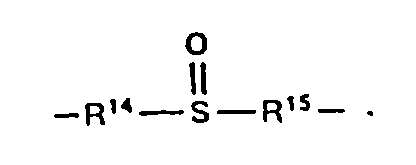
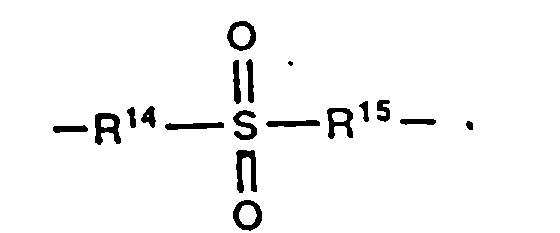


 dans lesquels R¹⁴ est choisi entre une liaison chimique et des groupes alkyle en C₁ à C₈, cycloalkyle en C₃ à C₇, alcényle en C₂ à C₅, alcynyle en C₃ à C₅, aryle en C₆ à C₁₀, (alkyle en C₁ à C₃)-(aryle en C₆ à C₁₂), (alkyle en C₁ ou C₂)-(aryle en C₆ à C₁₀)-(alkyle en C₁ ou C₂ et (aryle en C₆ à C₁₀)-(alkyle en C₁ ou C₂), R¹⁵ est choisi entre une liaison chimique et des groupes alkyle en C₁ à C₄, alcényle en C₂ à C₄, alcynyle en C₂ à C₄ et aryle en C₆ à C₁₀, R¹⁶ est choisi entre une liaison chimique et des groupes alkyle en C₂ à C₅, cycloalkyle en C₃ à C₇, alcényle en C₃ à C₅, alcynyle en C₃ à C₅, aryle en C₆ à C₁₀, (alkyle en C₁ à C₃)-(aryle en C₆ à C₁₂), (alkyle en C₁ à C₃)-(aryle en C₆ à C₁₂), et (aryle en C₆ à C₁₀)-(alkyle en C₁ ou C₂), dans lesquels R¹⁴ ou R¹⁶ est lié à N et R¹⁵ est lié à Q et dans lesquels les substituants consistent en un à trois groupes R¹ ;L représente un radical divalent facultativement substitué choisi dans le groupe consistant en les radicaux
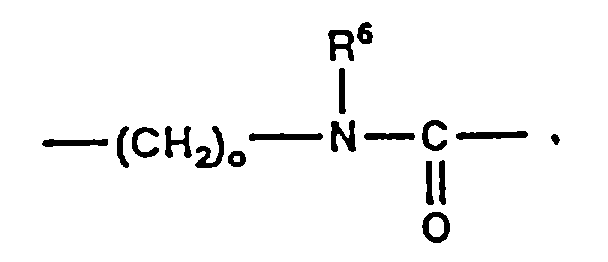


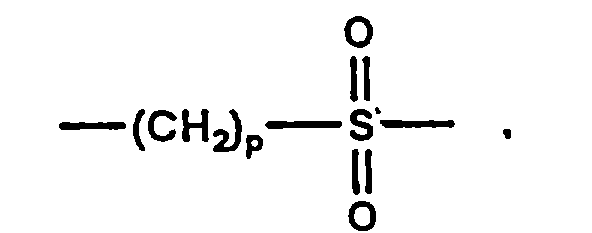


 D est choisi entre le groupe consistant en R et -(C=O)-Xaa, dans lequel Xaa consiste en un à trois D- ou L-α-amino-acides ;R⁸ est choisi dans des groupes (i) hydroxy, (ii) alkoxy en C₁ à C₈, (iii) alcénoxy en C₃ à C₁₂, (iv) aryloxy en C₆ à C₁₂, (v) (alkyle en C₁ à C₆)-(aryle en C₆ à C₁₂)-oxy, (vi) di-(alkyle en C₁ à C₈)-amino-(alkoxy en C₁ à C₈), (vii) acylamino-(alkoxy en C₁ à C₈) choisi entre les groupes (a) acétylaminoéthoxy, (b) nicotinoylaminoéthoxy et (c) succinamidoéthoxy, (viii) (alcoyle en C₁ à C₈)-oxy-(alkoxy en C₁ à C₈), (ix) (aryle en C₆ à C₁₂)-(alkoxy en C₁ à C₈), dans lequel le groupe aryle est non substitué ou substitué avec un à trois des groupes (a) nitro, (b) halogéno (F, Cl, Br, I), (c) alkoxy en C₁ à C₄ et (d) amino, (x) hydroxy-alkoxy en C₂ à C₈, (xi) dihydroxy-alkoxy en C₃ à C₈, et (xii) NR⁹R³⁰ dans lequel R⁹ et R³⁰ sont choisis, indépendamment, dans le groupe consistant en (a) l'hydrogène, (b) un groupe alkyle en C₁ à C₈, (c) un groupe alcényle en C₃ à C₈, (d) un groupe aryle en C₆ à C₁₂, dans lequel le groupe aryle est non substitué ou substitué avec un à trois des groupes nitro, halogéno (F, Cl, Br, I), alkoxy en C₁ à C₄, et amino, et (e) un groupe (aryle en C₆ à C₁₂) - (alkyle en C₁ à C₈) dans lequel le groupe aryle est non substitué ou substitué avec un à trois des groupes nitro, halogéno (F, Cl, Br, I) et alkoxy en C₁ à C₄ ;ses sels pharmaceutiquement acceptables.
 - Composé suivant la revendication 1, représenté par la formule V :
 dans laquelleR¹ représente un à trois groupes choisis indépendamment entre l'hydrogène et un halogène (F, Cl, Br, I) ;Q¹ est choisi dans le groupe consistant en(A) un groupe amino,(B) un groupe amidino,(C) un groupe aminoalkylèneimino,(D) un groupe iminoalkylèneamino, et(E) un groupe guanidino ;L¹ représente un radical divalent facultativement substitué choisi dans le groupe consistant en les radicaux


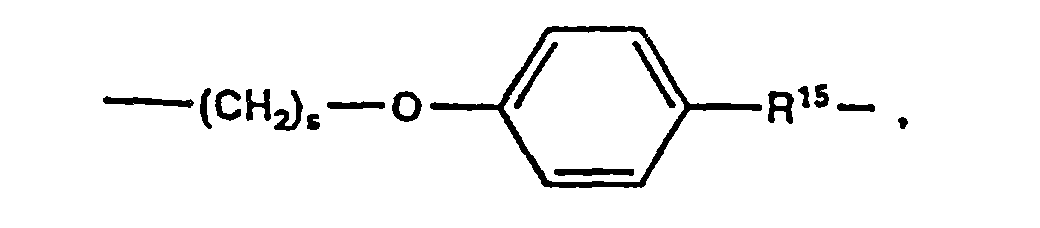


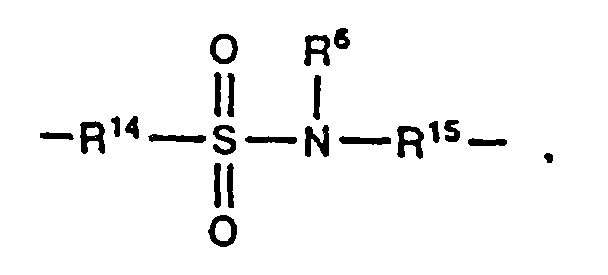


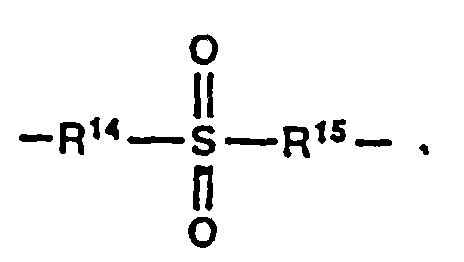


 dans lesquelsp est égal à 1, 2, 3 ou 4 ;q est égal à 3, 4, 5, 6 ou 7 ;r est égal à 1, 2, 3, 4 ou 5 ;s est égal 2 ou 3 ;R¹⁴ est choisi entre des groupesalkyle en C₂ à C₅,cycloalkyle en C₃ à C₇,alcényle en C₂ à C₅,alcynyle en C₃ à C₅,aryle en C₆ à C₁₀,(alkyle en C₁ ou C₂)-(aryle en C₆ à C₁₂),(alkyle en C₁ ou C₂)-(aryle en C₆ à C₁₀)-(alkyle en C₁ ou C₂),(aryle en C₆ à C₁₀)-(alkyle en C₁ ou C₂), et(aryle en C₆ à C₁₀)-oxy-(alkyle en C₁ ou C₂) ;R¹⁵ représente une liaison chimique connectant L¹ à la position 8 de la benzazépine-one ;R¹⁶ est choisi entre des groupesalkyle en C₂ à C₅,cycloalkyle en C₃ à C₇,alcényle en C₃ à C₅,alcynyle en C₃ à C₅,aryle en C₆ à C₁₀,(alkyle en C₁ à C₃)-(aryle en C₆ à C₁₂), et(aryle en C₆ à C₁₀)-(alkyle en C₁ ou C₂),R¹⁴ et R¹⁶ liant le groupe L¹ au groupe Q¹, etles substituants étant choisis entre l'hydrogène et des groupes halogéno (F, Cl, Br, I,), alkoxy en C₁ à C₄, alkyle en C₁ à C₄, phényle, benzyle et halogéno (F, Cl, Br, I)-alkyle en C₁ à C₄ ;R⁰ représente l'hydrogène ;R¹ est choisi dans le groupe consistant en (i) l'hydrogène, (ii) un groupe alkyle en C₁ à C₁₂ facultativement substitué, (iii) un groupe aryle en C₆ à C₁₄ facultativement substitué, (iv) un groupe cycloalkyle en C₃ à C₁₄ facultativement substitué, (v) un groupe (alkyle en C₁ à C₁₂)- (aryle en C₆ à C₁₄) facultativement substitué, (vi) un groupe (alkyle en C₁ à C₁₂)-(cycloalkyle en C₃ à C₁₄) facultativement substitué, dans lesquels les substituants sont choisis entre des groupes (a) halogéno (F, Cl, Br, I), (b) nitro, (c) hydroxy, (d) carboxy, (e) tétrazole, (f) hydroxamate, (g) sulfonamide, (h) trifluorimide, (i) phosphonate, (j) alkyle en C₁ à C₆, (k) aryle en C₆ à C₁₄, (l) benzyle, (m) cycloalkyle en C₃ à C₁₄, (n) COR⁴ dans lequel R⁴ est choisi entre des groupes alkoxy en C₁ à C₈, alcénoxy en C₃ à C₁₂, aryloxy en C₆ à C₁₂, di-(alkyle en C₁ à C₈)-amino-(alkoxy en C₁ à C₈), acylamino-(alkoxy en C₁ à C₈) choisi entre les groupes acétylaminoéthoxy, nicotinoylaminoéthoxy, succinamidoéthoxy et pivaloyloxyéthoxy, et (aryle en C₆ à C₁₂)-(alkoxy en C₁ à C₈) dans lequel le groupe aryle est non substitué ou substitué avec un à trois des groupes nitro, halogéno (F, Cl, Br, I), alkoxy en C₁ à C₄, amino, hydroxy, hydroxyalkoxy en C₂ à C₈ et dihydroxyalkoxy en C₃ à C₈, (o) CONR⁵R⁶ dans lequel R⁵ et R⁶ sont choisis, indépendamment, entre l'hydrogène et des groupes alkyle en C₁ à C₁₀, alcényle en C₃ à C₁₀, aryle en C₆ à C₁₄, (alkyle en C₁ à C₆)-(aryle en C₆ à C₁₀), facultativement R⁵ et R⁶, pris conjointement, peuvent former un groupe triméthylène, tétraméthylène, pentaméthylène ou 3-oxopentaméthylène, et (vii) un groupe Q-L³ dans lequel Q est choisi entre l'hydrogène et Q¹, et L³ est choisi entre une liaison chimique et L¹, R¹⁵ liant L¹ à la position 4 de la benzazépine-one ;D est choisi entre le groupe consistant en R¹ et -(C=O)-Xaa, dans lequel Xaa représente un à trois D- ou L-α-amino-acides ;R⁸ est choisi entre des groupes (i) hydroxy, (ii) alkoxy en C₁ à C₈, (iii) alcénoxy en C₃ à C₁₂, (iv) aryloxy en C₆ à C₁₂, (v) (alkyle en C₁ à C₆)-(aryle en C₆ à C₁₂)-oxy, (vi) di-(alkyle en C₁ à C₈)-amino-(alkoxy en C₁ à C₈), (vii) acylamino-(alkoxy en C₁ à C₈) choisi entre les groupes (a) acétylaminoéthoxy, (b) nicotinoylaminoéthoxy et (c) succinamidoéthoxy, (viii) (alcoyle en C₁ à C₈)-oxy-(alkoxy en C₁ à C₈), (ix) (aryle en C₆ à C₁₂)-(alkoxy en C₁ à C₈), dans lequel le groupe aryle est non substitué ou substitué avec un à trois des groupes (a) nitro, (b) halogéno (F, Cl, Br, I), (c) alkoxy en C₁ à C₄ et (d) amino, (x) hydroxy-alkoxy en C₂ à C₈, (xi) dihydroxy-alkoxy en C₃ à C₈, et (xii) NR⁹R³⁰ dans lequel R⁹ et R³⁰ sont choisis, indépendamment, dans le groupe consistant en (a) l'hydrogène, (b) un groupe alkyle en C₁ à C₈, (c) un groupe alcényle en C₃ à C₈, (d) un groupe aryle en C₆ à C₁₂, dans lequel le groupe aryle est non substitué ou substitué avec un à trois des groupes nitro, halogéno (F, Cl, Br, I), alkoxy en C₁ à C₄, et amino, et (e) un groupe (aryle en C₆ à C₁₂)-(alkyle en C₁ à C₈) dans lequel le groupe aryle est non substitué ou substitué avec un à trois des groupes nitro, halogéno (F, Cl, Br, I) et alkoxy en C₁ à C₄ ;ses sels pharmaceutiquement acceptables.
 - Composé suivant la revendication 1, représenté par la formule VI :
 dans laquelleR¹ représente un à trois groupes choisis indépendamment entre l'hydrogène et un halogène (F, Cl, Br, I) ;Q¹ est choisi dans le groupe consistant en(A) un groupe amino,(B) un groupe amidino,(C) un groupe aminoalkylèneimino,(D) un groupe iminoalkylèneamino, et(E) un groupe guanidino ;L¹ représente un radical bivalent facultativement substitué choisi dans le groupe consistant en les radicaux





 dans lesquelsp est égal à 1, 2, 3 ou 4 ;q est égal à 3, 4, 5, 6 ou 7 ;r est égal à 1, 2, 3, 4 ou 5 ;s est égal 2 ou 3 ;R¹⁴ est choisi entre des groupesalkyle en C₂ à C₅,cycloalkyle en C₃ à C₇,alcényle en C₂ à C₅,alcynyle en C₃ à C₅,aryle en C₆ à C₁₀,(alkyle en C₁ ou C₂)-(aryle en C₆ à C₁₂),(alkyle en C₁ ou C₂)-(aryle en C₆ à C₁₀)-(alkyle en C₁ ou C₂),(aryle en C₆ à C₁₀)-(alkyle en C₁ ou C₂), et(aryle en C₆ à C₁₀)-oxy-(alkyle en C₁ ou C₂) ;R¹⁵ représente une liaison chimique connectant L¹ à la position 8 de la benzazépine-one ;R¹⁶ est choisi entre des groupesalkyle en C₂ à C₅,cycloalkyle en C₃ à C₇,alcényle en C₃ à C₅,alcynyle en C₃ à C₅,aryle en C₆ à C₁₀,(alkyle en C₁ à C₃)-(aryle en C₆ à C₁₂), et(aryle en C₆ à C₁₀)-(alkyle en C₁ ou C₂),R¹⁴ et R¹⁶ liant L¹ à Q¹, etles substituants étant choisis dans le groupe consistant entre l'hydrogène et des groupes halogéno (F, Cl, Br, I,), alkoxy en C₁ à C₄, alkyle en C₁ à C₄, phényle, benzyle et halogéno (F, Cl, Br, I)-alkyle en C₁ à C₄ ;R⁰ représente l'hydrogène ;R¹ et R sont choisis dans le groupe consistant en (i) l'hydrogène, (ii) un groupe alkyle en C₁ à C₁₂ facultativement substitué, (iii) un groupe aryle en C₆ à C₁₄ facultativement substitué, (iv) un groupe cycloalkyle en C₃ à C₁₄ facultativement substitué, (v) un groupe (alkyle en C₁ à C₁₂)-(aryle en C₆ à C₁₄) facultativement substitué, (vi) un groupe (alkyle en C₁ à C₁₂)-(cycloalkyle en C₃ à C₁₄) facultativement substitué, dans lesquels les substituants sont choisis entre des groupes (a) halogéno (F, Cl, Br, I), (b) nitro, (c) hydroxy, (d) carboxy, (e) tétrazole, (f) hydroxamate, (g) sulfonamido, (h) trifluorimide, (i) phosphonate, (j) alkyle en C₁ à C₆, (k) aryle en C₆ à C₁₄, (l) benzyle, (m) cycloalkyle en C₃ à C₁₄, (n) COR⁴ dans lequel R⁴ est choisi entre des groupes alkoxy en C₁ à C₈, alcénoxy en C₃ à C₁₂, aryloxy en C₆ à C₁₂, di-(alkyle en C₁ à C₈)-amino-(alkoxy en C₁ à C₈), acylamino-(alkoxy en C₁ à C₈) choisi entre les groupes acétylaminoéthoxy, nicotinoylaminoéthoxy, succinamidoéthoxy et pivaloyloxyéthoxy, et (aryle en C₆ à C₁₂)-(alkoxy en C₁ à C₈) dans lequel le groupe aryle est non substitué ou substitué avec un à trois des groupes nitro, halogéno (F, Cl, Br, I), alkoxy en C₁ à C₄, amino, hydroxy, hydroxyalkoxy en C₂ à C₈ et dihydroxyalkoxy en C₃ à C₈, (o) CONR⁵R⁶ dans lequel R⁵ et R⁶ sont choisis, indépendamment, entre l'hydrogène et des groupes alkyle en C₁ à C₁₀, alcényle en C₃ à C₁₀, aryle en C₆ à C₁₄, (alkyle en C₁ à C₆)-(aryle en C₆ à C₁₀), facultativement R⁵ et R⁶, pris conjointement, peuvent former un groupe triméthylène, tétraméthylène, pentaméthylène ou 3-oxopentaméthylène, et (vii) un groupe Q-L³ dans lequel Q est choisi entre l'hydrogène et Q¹, et L³ est choisi entre une liaison chimique et L¹, R¹⁵ liant L¹ à la position 4 ou 5 de la benzazépine-one ;D est choisi entre le groupe consistant en R¹ et -(C=O)-Xaa, dans lequel Xaa représente un à trois D- ou L-α-amino-acides ;R⁸ est choisi entre des groupes (i) hydroxy, (ii) alkoxy en C₁ à C₈, (iii) alcénoxy en C₃ à C₁₂, (iv) aryloxy en C₆ à C₁₂, (v) (alkyle en C₁ à C₆)-(aryle en C₆ à C₁₂) -oxy, (vi) di-(alkyle en C₁ à C₈)-amino-(alkoxy en C₁ à C₈), (vii) acylamino-(alkoxy en C₁ à C₈) choisi entre les groupes (a) acétylaminoéthoxy, (b) nicotinoylaminoéthoxy et (c) succinamidoéthoxy, (viii) (alcoyle en C₁ à C₈)-oxy-(alkoxy en C₁ à C₈), (ix) (aryle en C₆ à C₁₂)-(alkoxy en C₁ à C₈), dans lequel le groupe aryle est non substitué ou substitué avec un à trois des groupes (a) nitro, (b) halogéno (F, Cl, Br, I), (c) alkoxy en C₁ à C₄ et (d) amino, (x) hydroxy-alkoxy en C₂ à C₈, (xi) dihydroxy-alkoxy en C₃ à C₈, et (xii) NR⁹R³⁰ dans lequel R⁹ et R³⁰ sont choisis, indépendamment, dans le groupe consistant en (a) l'hydrogène, (b) un groupe alkyle en C₁ à C₈, (c) un groupe alcényle en C₃ à C₈, (d) un groupe aryle en C₆ à C₁₂, dans lequel le groupe aryle étant non substitué ou substitué avec un à trois des groupes nitro, halogéno (F, Cl, Br, I), alkoxy en C₁ à C₄, et amino, et (e) un groupe (aryle en C₆ à C₁₂)-(alkyle en C₁ à C₈) dans lequel le groupe aryle est non substitué ou substitué avec un à trois des groupes nitro, halogéno (F, Cl, Br, I) et alkoxy en C₁ à C₄ ;ses sels pharmaceutiquement acceptables.
 - Composition pharmaceutique comprenant un excipient pharmaceutiquement acceptable et le composé suivant les revendications 1 à 9.
- Composé suivant l'une quelconque des revendications 1 à 9, destiné à être utilisé dans une méthode de traitement.
- Utilisation d'un composé suivant l'une quelconque des revendications 1 à 9 dans la préparation d'un médicament destiné à inhiber l'agrégation plaquettaire.
- Utilisation d'un composé suivant l'une quelconque des revendications 1 à 9 dans la préparation d'un médicament destiné à réduire l'agrégation plaquettaire.
- Utilisation d'un composé suivant l'une quelconque des revendications 1 à 9 dans la préparation d'un médicament destiné au traitement d'un mammifère présentant une tendance accrue à la formation de thrombus.
- Utilisation suivant la revendication 14, dans laquelle le médicament est administré en association avec un agent thrombolytique.
- Utilisation suivant la revendication 14, dans laquelle le médicament est administré en association avec un anticoagulant.
Applications Claiming Priority (5)
| Application Number | Priority Date | Filing Date | Title |
|---|---|---|---|
| US866931 | 1986-05-27 | ||
| US78147791A | 1991-10-18 | 1991-10-18 | |
| US781477 | 1991-10-18 | ||
| US07/866,931 US5250679A (en) | 1991-10-18 | 1992-04-10 | Nonpeptidyl platelet aggregation inhibitors having specificity for the GPIIb III.sub. receptor |
| PCT/US1992/008788 WO1993008174A1 (fr) | 1991-10-18 | 1992-10-15 | INHIBITEURS NON PEPTIDYLES A BASE D'INTEGRINE SPECIFIQUES DU RECEPTEUR GPIIbIII¿a? |
Publications (2)
| Publication Number | Publication Date |
|---|---|
| EP0610334A1 EP0610334A1 (fr) | 1994-08-17 |
| EP0610334B1 true EP0610334B1 (fr) | 1996-01-24 |
Family
ID=27119863
Family Applications (1)
| Application Number | Title | Priority Date | Filing Date |
|---|---|---|---|
| EP92922468A Expired - Lifetime EP0610334B1 (fr) | 1991-10-18 | 1992-10-15 | Inhibiteurs non peptidyles a base d'integrine specifiques du recepteur gpii b iii a |
Country Status (15)
| Country | Link |
|---|---|
| US (2) | US5250679A (fr) |
| EP (1) | EP0610334B1 (fr) |
| JP (2) | JP3789468B2 (fr) |
| AT (1) | ATE133412T1 (fr) |
| AU (1) | AU673501B2 (fr) |
| CA (1) | CA2119745C (fr) |
| DE (1) | DE69207916T2 (fr) |
| DK (1) | DK0610334T3 (fr) |
| ES (1) | ES2085651T3 (fr) |
| FI (1) | FI941222A7 (fr) |
| GE (1) | GEP20032957B (fr) |
| GR (1) | GR3019517T3 (fr) |
| MD (1) | MD960330A (fr) |
| NO (1) | NO307417B1 (fr) |
| WO (1) | WO1993008174A1 (fr) |
Cited By (2)
| Publication number | Priority date | Publication date | Assignee | Title |
|---|---|---|---|---|
| US7067148B2 (en) | 2001-02-15 | 2006-06-27 | King Pharmaceutical Research & Development, Inc. | Stabilized pharmaceutical and thyroid hormone compositions and method of preparation |
| US7101569B2 (en) | 2001-08-14 | 2006-09-05 | Franz G Andrew | Methods of administering levothyroxine pharmaceutical compositions |
Families Citing this family (105)
| Publication number | Priority date | Publication date | Assignee | Title |
|---|---|---|---|---|
| JP2703408B2 (ja) * | 1990-12-28 | 1998-01-26 | 麒麟麦酒株式会社 | 1,4‐ベンゾチアゼピン誘導体 |
| US5645815A (en) | 1991-02-08 | 1997-07-08 | Diatide, Inc. | Radiolabled compounds for thrombus imaging |
| US5736122A (en) * | 1991-02-08 | 1998-04-07 | Diatide, Inc. | Technetium-99m labeled peptides for thrombus imaging |
| ATE188387T1 (de) * | 1991-02-08 | 2000-01-15 | Diatide Inc | Technetium-99m markierte polypeptide zur bildformung |
| US6019958A (en) * | 1991-02-08 | 2000-02-01 | Diatide, Inc. | Technetium-99m labeled peptides for imaging inflammation |
| AU666318B2 (en) * | 1991-06-28 | 1996-02-08 | Smithkline Beecham Corporation | Bicyclic fibrinogen antagonists |
| US5939412A (en) * | 1992-06-26 | 1999-08-17 | Smithkline Beecham Corporation | Bicyclic fibrinogen antagonists |
| US5663166A (en) * | 1991-10-18 | 1997-09-02 | Genentech, Inc. | Nonpeptidyl integrin inhibitors having specificity for the GPIIb IIIa receptor |
| US5750754A (en) * | 1993-03-29 | 1998-05-12 | Zeneca Limited | Heterocyclic compounds |
| GB9406144D0 (en) * | 1993-03-29 | 1994-05-18 | Zeneca Ltd | Heterocyclic compounds |
| US5652242A (en) * | 1993-03-29 | 1997-07-29 | Zeneca Limited | Heterocyclic derivatives |
| US5753659A (en) * | 1993-03-29 | 1998-05-19 | Zeneca Limited | Heterocyclic compouds |
| WO1994022834A1 (fr) * | 1993-03-29 | 1994-10-13 | Zeneca Limited | Derives heterocycliques utilises comme inhibiteurs d'agregation plaquettaire |
| ZA942439B (en) * | 1993-04-08 | 1996-01-08 | Diatech Inc | Radiolabeled compounds for thrombus imaging |
| US5463011A (en) * | 1993-06-28 | 1995-10-31 | Zeneca Limited | Acid derivatives |
| GB9313285D0 (en) * | 1993-06-28 | 1993-08-11 | Zeneca Ltd | Acid derivatives |
| GB9313268D0 (en) * | 1993-06-28 | 1993-08-11 | Zeneca Ltd | Chemical compounds |
| IL110172A (en) * | 1993-07-22 | 2001-10-31 | Lilly Co Eli | Bicyclic compounds and pharmaceutical compositions containing them |
| US6137002A (en) | 1993-07-22 | 2000-10-24 | Eli Lilly And Company | Glycoprotein IIb/IIIa antagonists |
| US6448269B1 (en) | 1993-07-22 | 2002-09-10 | Eli Lilly And Company | Glycoprotein IIb/IIIa antagonists |
| US5731324A (en) * | 1993-07-22 | 1998-03-24 | Eli Lilly And Company | Glycoprotein IIb/IIIa antagonists |
| US5493020A (en) * | 1993-07-29 | 1996-02-20 | Genentech, Inc. | Tricyclic inhibitors of the GPIIb IIIa receptor |
| CA2134192A1 (fr) * | 1993-11-12 | 1995-05-13 | Michael L. Denney | Antagonistes iib/iiia de la glycoproteine 5, 6-bicyclique |
| DE4341665A1 (de) * | 1993-12-07 | 1995-06-08 | Basf Ag | Bicyclen-Derivate, ihre Herstellung und Verwendung |
| US6403578B1 (en) | 1993-12-21 | 2002-06-11 | Smithkline Beecham Corporation | Bicyclic fibrinogen antagonists |
| MA23420A1 (fr) * | 1994-01-07 | 1995-10-01 | Smithkline Beecham Corp | Antagonistes bicycliques de fibrinogene. |
| ZA955391B (en) * | 1994-06-29 | 1996-02-09 | Smithkline Beecham Corp | Vitronectin receptor antagonists |
| US6458784B1 (en) | 1994-06-29 | 2002-10-01 | Smithkline Beecham Corporation | Vitronectin receptor antagonists |
| AU702661B2 (en) * | 1994-06-29 | 1999-02-25 | Smithkline Beecham Corporation | Vitronectin receptor antagonists |
| EP0796252A4 (fr) * | 1994-12-09 | 1998-02-04 | Smithkline Beecham Corp | Antagonistes du fibrinogene a cycle double |
| US5639765A (en) * | 1995-01-17 | 1997-06-17 | G. D. Searle & Co. | Guanidinoalkyl glycine β-amino acids useful for inhibiting bone loss |
| US5977101A (en) * | 1995-06-29 | 1999-11-02 | Smithkline Beecham Corporation | Benzimidazoles/Imidazoles Linked to a Fibrinogen Receptor Antagonist Template Having Vitronectin Receptor Antagonist Activity |
| JP2000502354A (ja) * | 1995-12-29 | 2000-02-29 | スミスクライン・ビーチャム・コーポレイション | ビトロネクチン受容体アンタゴニスト |
| US6107300A (en) * | 1996-03-27 | 2000-08-22 | Dupont Pharmaceuticals | Arylamino fused pyrimidines |
| DK0894084T3 (da) * | 1996-03-29 | 2002-10-14 | Searle & Co | Kanelsyrederivater og deres anvendelse som integrinantagonister |
| DK0914605T3 (da) | 1996-07-25 | 2007-09-10 | Biogen Idec Inc | Molekylemodel for VLA-4-inhibitorer |
| CN1478472A (zh) * | 1996-07-25 | 2004-03-03 | ¸ | 细胞粘连抑制剂 |
| US6686350B1 (en) * | 1996-07-25 | 2004-02-03 | Biogen, Inc. | Cell adhesion inhibitors |
| US20030125317A1 (en) | 1996-10-02 | 2003-07-03 | Smithkline Beecham Corporation | Vitronectin receptor antagonists |
| PE32799A1 (es) * | 1996-12-25 | 1999-04-09 | Agrogene Ltd | Nuevo derivado del acido aminobutirico para la proteccion de enfermedades fungosas |
| US7109326B2 (en) | 1997-04-15 | 2006-09-19 | Genentech, Inc. | Halo-alkoxycarbonyl prodrugs |
| DE69830577T2 (de) * | 1997-04-15 | 2006-05-04 | Genentech, Inc., South San Francisco | Halo-alkoxycarbonylverbindungen |
| US6197794B1 (en) | 1998-01-08 | 2001-03-06 | Celltech Therapeutics Limited | Phenylalanine derivatives |
| US6329372B1 (en) | 1998-01-27 | 2001-12-11 | Celltech Therapeutics Limited | Phenylalanine derivatives |
| EP1054877A1 (fr) * | 1998-02-11 | 2000-11-29 | Du Pont Pharmaceuticals Company | Nouveaux sulfamides cycliques utilises comme inhibiteurs des metalloproteases |
| ATE273273T1 (de) | 1998-02-26 | 2004-08-15 | Celltech Therapeutics Ltd | Phenylalaninderivate als inhibitoren von alpha4 integrinen |
| US6136804A (en) | 1998-03-13 | 2000-10-24 | Merck & Co., Inc. | Combination therapy for treating, preventing, or reducing the risks associated with acute coronary ischemic syndrome and related conditions |
| JP2002506024A (ja) * | 1998-03-13 | 2002-02-26 | メルク エンド カムパニー インコーポレーテッド | 急性冠動脈虚血症候群および関連状態に対する併用療法および組成物 |
| GB9805655D0 (en) | 1998-03-16 | 1998-05-13 | Celltech Therapeutics Ltd | Chemical compounds |
| US6521626B1 (en) | 1998-03-24 | 2003-02-18 | Celltech R&D Limited | Thiocarboxamide derivatives |
| WO1999050249A2 (fr) | 1998-04-01 | 1999-10-07 | Du Pont Pharmaceuticals Company | Antagonistes de l'integrine |
| GB9811159D0 (en) | 1998-05-22 | 1998-07-22 | Celltech Therapeutics Ltd | Chemical compounds |
| GB9811969D0 (en) | 1998-06-03 | 1998-07-29 | Celltech Therapeutics Ltd | Chemical compounds |
| GB9812088D0 (en) | 1998-06-05 | 1998-08-05 | Celltech Therapeutics Ltd | Chemical compounds |
| GB9814414D0 (en) | 1998-07-03 | 1998-09-02 | Celltech Therapeutics Ltd | Chemical compounds |
| GB9821061D0 (en) | 1998-09-28 | 1998-11-18 | Celltech Therapeutics Ltd | Chemical compounds |
| GB9821222D0 (en) * | 1998-09-30 | 1998-11-25 | Celltech Therapeutics Ltd | Chemical compounds |
| GB9825652D0 (en) | 1998-11-23 | 1999-01-13 | Celltech Therapeutics Ltd | Chemical compounds |
| US6204282B1 (en) | 1998-11-30 | 2001-03-20 | Schering Corporation | Benzimidazole compounds that are vitronectin receptor antagonists |
| GB9826174D0 (en) | 1998-11-30 | 1999-01-20 | Celltech Therapeutics Ltd | Chemical compounds |
| US6339083B1 (en) | 1998-12-14 | 2002-01-15 | Bayer Aktiengesellschaft | Multiheterocyclic pharmAceuticals |
| US6511649B1 (en) | 1998-12-18 | 2003-01-28 | Thomas D. Harris | Vitronectin receptor antagonist pharmaceuticals |
| EP1140864A2 (fr) | 1998-12-18 | 2001-10-10 | Du Pont Pharmaceuticals Company | Medicaments antagonistes du recepteur de la vitronectine |
| US6569402B1 (en) | 1998-12-18 | 2003-05-27 | Bristol-Myers Squibb Pharma Company | Vitronectin receptor antagonist pharmaceuticals |
| EP1028114A1 (fr) | 1999-02-13 | 2000-08-16 | Aventis Pharma Deutschland GmbH | Nouveaux dérivés de guanidine et leur utilisation comme inhibiteurs de l'adhésion des cellules |
| US6171578B1 (en) * | 1999-04-14 | 2001-01-09 | Diatide, Inc. | Benzodiazepine derivatives for imaging thrombi |
| US6518283B1 (en) | 1999-05-28 | 2003-02-11 | Celltech R&D Limited | Squaric acid derivatives |
| WO2001004103A1 (fr) | 1999-07-13 | 2001-01-18 | F. Hoffmann-La Roche Ag | Benzazepinones et quinazolines |
| EE200200070A (et) * | 1999-08-13 | 2003-04-15 | Biogen, Inc. | Raku adhesiooni inhibiitorid |
| US6514964B1 (en) * | 1999-09-27 | 2003-02-04 | Amgen Inc. | Fused cycloheptane and fused azacycloheptane compounds and their methods of use |
| US6534513B1 (en) | 1999-09-29 | 2003-03-18 | Celltech R&D Limited | Phenylalkanoic acid derivatives |
| DE10028575A1 (de) * | 2000-06-14 | 2002-03-14 | Basf Ag | Integrinliganden |
| US6455539B2 (en) | 1999-12-23 | 2002-09-24 | Celltech R&D Limited | Squaric acid derivates |
| DE60130910T2 (de) | 2000-04-17 | 2008-07-10 | Ucb Pharma, S.A. | Enamin-derivate als zell-adhäsionsmoleküle |
| US6545013B2 (en) | 2000-05-30 | 2003-04-08 | Celltech R&D Limited | 2,7-naphthyridine derivatives |
| US6403608B1 (en) | 2000-05-30 | 2002-06-11 | Celltech R&D, Ltd. | 3-Substituted isoquinolin-1-yl derivatives |
| JP2004502762A (ja) | 2000-07-07 | 2004-01-29 | セルテック アール アンド ディ リミテッド | 二環性ヘテロ芳香環を含有するインテグリンアンタゴニストとしてのスクエア酸誘導体 |
| JP2004505110A (ja) | 2000-08-02 | 2004-02-19 | セルテック アール アンド ディ リミテッド | 3位置換イソキノリン−1−イル誘導体 |
| ES2309209T3 (es) | 2001-11-13 | 2008-12-16 | Ortho-Mcneil-Janssen Pharmaceuticals, Inc. | 1,4-benzodiazepinas sustituidas y uso de las mismas para el tratamiento del cancer. |
| US7078409B2 (en) * | 2002-03-28 | 2006-07-18 | Beta Pharma, Inc. | Fused quinazoline derivatives useful as tyrosine kinase inhibitors |
| WO2004052364A1 (fr) | 2002-12-06 | 2004-06-24 | The Trustees Of Boston University | Procedes permettant de prolonger l'activite de l'enos |
| US7196112B2 (en) | 2004-07-16 | 2007-03-27 | Biogen Idec Ma Inc. | Cell adhesion inhibitors |
| KR101594898B1 (ko) | 2005-07-15 | 2016-02-18 | 알바니 몰레큘라 리써치, 인크. | 아릴- 및 헤테로아릴-치환된 테트라히드로벤자제핀, 및 노르에피네프린, 도파민 및 세로토닌의 재흡수를 차단하기 위한 용도 |
| JP5368792B2 (ja) | 2005-07-29 | 2013-12-18 | レスバーロジックス コーポレイション | 複合疾患の予防および処置のための薬学的組成物および挿入可能な医療用デバイスによるその送達 |
| DK2118074T3 (en) | 2007-02-01 | 2014-03-10 | Resverlogix Corp | Compounds for the prevention and treatment of cardiovascular diseases |
| US20090012103A1 (en) | 2007-07-05 | 2009-01-08 | Matthew Abelman | Substituted heterocyclic compounds |
| KR101629356B1 (ko) | 2008-06-26 | 2016-06-13 | 리스버로직스 코퍼레이션 | 퀴나졸리논 유도체의 제조방법 |
| WO2010053757A1 (fr) | 2008-10-29 | 2010-05-14 | Gilead Palo Alto, Inc. | Inhibiteurs, à base de 2-oxoquinoxaline, des canaux sodiques tardifs |
| WO2010074807A1 (fr) | 2008-10-30 | 2010-07-01 | Gilead Palo Alto, Inc. | Dérivés 3, 4-dihydroquinolin-2 (1h) -one utilisés comme modulateurs de canaux sodiques |
| WO2010056865A1 (fr) | 2008-11-14 | 2010-05-20 | Gilead Palo Alto, Inc. | Dérivés de quinoléine au titre de modulateurs de canaux ioniques |
| NZ594332A (en) | 2009-01-08 | 2013-09-27 | Resverlogix Corp | Compounds for the prevention and treatment of cardiovascular disease |
| KR101709492B1 (ko) | 2009-03-18 | 2017-02-23 | 리스버로직스 코퍼레이션 | 신규한 소염제 |
| US9757368B2 (en) | 2009-04-22 | 2017-09-12 | Resverlogix Corp. | Anti-inflammatory agents |
| PT2464645T (pt) | 2009-07-27 | 2017-10-11 | Gilead Sciences Inc | Compostos heterocíclicos fusionados como moduladores do canal de iões |
| WO2012003392A1 (fr) | 2010-07-02 | 2012-01-05 | Gilead Sciences, Inc. | Composés hétérocycliques condensés en tant que modulateurs des canaux ioniques |
| AU2012253653A1 (en) | 2011-05-10 | 2013-05-02 | Gilead Sciences, Inc. | Fused heterocyclic compounds as sodium channel modulators |
| NO3175985T3 (fr) | 2011-07-01 | 2018-04-28 | ||
| AU2015224425B2 (en) * | 2011-07-01 | 2017-02-09 | Gilead Sciences, Inc. | Fused benzoxazepinones as ion channel modulators |
| TWI622583B (zh) * | 2011-07-01 | 2018-05-01 | 基利科學股份有限公司 | 作為離子通道調節劑之稠合雜環化合物 |
| AU2013201608B9 (en) * | 2011-07-01 | 2015-07-23 | Gilead Sciences, Inc. | Fused benzoxazepinones as ion channel modulators |
| RU2640115C2 (ru) | 2011-11-01 | 2017-12-26 | Ресверлоджикс Корп. | Фармацевтические композиции замещенных хиназолинонов |
| WO2014080291A2 (fr) | 2012-11-21 | 2014-05-30 | Rvx Therapeutics Inc. | Dérivés biaryle servant d'inhibiteurs de bromodomaines |
| US9073878B2 (en) | 2012-11-21 | 2015-07-07 | Zenith Epigenetics Corp. | Cyclic amines as bromodomain inhibitors |
| US9271978B2 (en) | 2012-12-21 | 2016-03-01 | Zenith Epigenetics Corp. | Heterocyclic compounds as bromodomain inhibitors |
| US10111885B2 (en) | 2015-03-13 | 2018-10-30 | Resverlogix Corp. | Compositions and therapeutic methods for the treatment of complement-associated diseases |
Family Cites Families (30)
| Publication number | Priority date | Publication date | Assignee | Title |
|---|---|---|---|---|
| US3371085A (en) * | 1959-12-10 | 1968-02-27 | Hoffmann La Roche | 5-aryl-3h-1,4-benzodiazepin-2(1h)-ones |
| US3374264A (en) * | 1962-10-04 | 1968-03-19 | Hoffmann La Roche | N-haloacetyl-anthranilic acids and esters |
| GB1124133A (en) * | 1964-10-02 | 1968-08-21 | Abbott Lab | Substituted 1,4-benzodiazepine-2,5-diones |
| US3415814A (en) * | 1966-09-28 | 1968-12-10 | Sterling Drug Inc | 4-(cyclopropylmethyl)-3h-1,4-benzodiazepine-2,5(1h,4h)-dione |
| DE1918072A1 (de) * | 1969-04-09 | 1970-10-15 | Boehringer Sohn Ingelheim | Verfahren zur Herstellung von 1-substituierten 4-Alkyl-3H-1,4-benzodiazepin-2,5-[1H,4H]-dionen |
| US3551414A (en) * | 1969-05-16 | 1970-12-29 | United States Steel Corp | 6,7-dihydro-5h-dibenz(c,e)azepin-7-ones |
| CA1143728A (fr) * | 1979-10-04 | 1983-03-29 | Max Gerecke | Derives d'imidazodiazepine |
| CA1174673A (fr) * | 1981-02-27 | 1984-09-18 | Walter Hunkeler | Imidazodiazepines |
| CA1184175A (fr) * | 1981-02-27 | 1985-03-19 | Walter Hunkeler | Imidazodiazepines |
| US4585768A (en) * | 1984-04-10 | 1986-04-29 | Tanabe Seiyaku Co., Ltd. | 1,5-benzothiazepine derivatives and processes for preparing the same |
| US4689326A (en) * | 1985-10-17 | 1987-08-25 | Research Corporation | Process for controlling hyperlipidemia |
| CA1319144C (fr) * | 1986-11-14 | 1993-06-15 | Quirico Branca | Derives tetrahydronaphtalene |
| EP0322779A3 (fr) * | 1987-12-29 | 1991-05-08 | Yoshitomi Pharmaceutical Industries, Ltd. | Composés de benzolactame et leur utilisation pharmaceutique |
| ZW6189A1 (en) * | 1988-05-09 | 1990-05-09 | Smithkline Beckman Corp | Anti-aggregatory peptides |
| US5039805A (en) * | 1988-12-08 | 1991-08-13 | Hoffmann-La Roche Inc. | Novel benzoic and phenylacetic acid derivatives |
| US5084466A (en) * | 1989-01-31 | 1992-01-28 | Hoffmann-La Roche Inc. | Novel carboxamide pyridine compounds which have useful pharmaceutical utility |
| CA2008116C (fr) * | 1989-02-23 | 2001-11-20 | Thomas Weller | Derives de glycine |
| FR2645744B1 (fr) * | 1989-04-13 | 1994-01-21 | Roussel Uclaf | Derives de la benzothiazepine, leur procede de preparation et les intermediaires ainsi obtenus, leur application comme medicaments et les compositions les renfermant |
| US5318899A (en) * | 1989-06-16 | 1994-06-07 | Cor Therapeutics, Inc. | Platelet aggregation inhibitors |
| US5384309A (en) * | 1989-07-17 | 1995-01-24 | Genentech, Inc. | Cyclized peptides and their use as platelet aggregation inhibitors |
| US5061693A (en) * | 1989-07-28 | 1991-10-29 | Merck & Co., Inc. | Fibrinogen receptor antagonists |
| FR2652352A1 (fr) * | 1989-09-28 | 1991-03-29 | Jouveinal Sa | Benzodiazepines, leur procede et intermediaires de preparation et leurs applications en therapeutique. |
| NZ235564A (en) * | 1989-10-13 | 1993-10-26 | Merck & Co Inc | Fibrinogen receptor antagonist and pharmaceutical compositions |
| AU6470590A (en) * | 1989-10-23 | 1991-04-26 | Smithkline Beecham Corporation | Cyclic anti-aggregatory peptides |
| US5053392A (en) * | 1989-12-01 | 1991-10-01 | Rhone-Poulenc Rorer Pharmaceuticals Inc. | Novel arginine, glycine, aspartic acid derivatives as platelet-aggregation inhibitors |
| JPH0747582B2 (ja) * | 1989-12-11 | 1995-05-24 | 杏林製薬株式会社 | キナゾリン―3―アルカン酸誘導体とその塩およびその製造法 |
| DE69126871T2 (de) * | 1990-04-06 | 1998-03-12 | Jolla Cancer Res Found | Verfahren und verbindung zur behandlung von thrombose |
| DE4102024A1 (de) * | 1991-01-24 | 1992-07-30 | Thomae Gmbh Dr K | Biphenylderivate, diese verbindungen enthaltende arzneimittel und verfahren zu ihrer herstellung |
| AU666318B2 (en) * | 1991-06-28 | 1996-02-08 | Smithkline Beecham Corporation | Bicyclic fibrinogen antagonists |
| RU2124503C1 (ru) * | 1992-05-18 | 1999-01-10 | И.Р.Сквибб энд Санз, Инк. | Гетероциклические азотсодержащие производные карбоновой кислоты, способ их получения и фармацевтическая композиция |
-
1992
- 1992-04-10 US US07/866,931 patent/US5250679A/en not_active Expired - Lifetime
- 1992-10-15 AU AU27976/92A patent/AU673501B2/en not_active Expired
- 1992-10-15 MD MD96-0330A patent/MD960330A/ro unknown
- 1992-10-15 WO PCT/US1992/008788 patent/WO1993008174A1/fr not_active Ceased
- 1992-10-15 EP EP92922468A patent/EP0610334B1/fr not_active Expired - Lifetime
- 1992-10-15 ES ES92922468T patent/ES2085651T3/es not_active Expired - Lifetime
- 1992-10-15 AT AT92922468T patent/ATE133412T1/de active
- 1992-10-15 DE DE69207916T patent/DE69207916T2/de not_active Expired - Lifetime
- 1992-10-15 CA CA002119745A patent/CA2119745C/fr not_active Expired - Lifetime
- 1992-10-15 JP JP50779093A patent/JP3789468B2/ja not_active Expired - Lifetime
- 1992-10-15 GE GEAP19922402A patent/GEP20032957B/en unknown
- 1992-10-15 FI FI941222A patent/FI941222A7/fi unknown
- 1992-10-15 DK DK92922468.1T patent/DK0610334T3/da active
-
1993
- 1993-05-06 US US08/058,722 patent/US5403836A/en not_active Expired - Lifetime
-
1994
- 1994-04-15 NO NO941378A patent/NO307417B1/no not_active IP Right Cessation
-
1996
- 1996-04-02 GR GR960400905T patent/GR3019517T3/el unknown
-
2003
- 2003-04-08 JP JP2003104672A patent/JP2003300962A/ja active Pending
Cited By (2)
| Publication number | Priority date | Publication date | Assignee | Title |
|---|---|---|---|---|
| US7067148B2 (en) | 2001-02-15 | 2006-06-27 | King Pharmaceutical Research & Development, Inc. | Stabilized pharmaceutical and thyroid hormone compositions and method of preparation |
| US7101569B2 (en) | 2001-08-14 | 2006-09-05 | Franz G Andrew | Methods of administering levothyroxine pharmaceutical compositions |
Also Published As
| Publication number | Publication date |
|---|---|
| GEP20032957B (en) | 2003-04-25 |
| US5250679A (en) | 1993-10-05 |
| JP3789468B2 (ja) | 2006-06-21 |
| MD960330A (ro) | 1998-05-31 |
| ES2085651T3 (es) | 1996-06-01 |
| JPH07500341A (ja) | 1995-01-12 |
| FI941222L (fi) | 1994-06-02 |
| DE69207916D1 (de) | 1996-03-07 |
| ATE133412T1 (de) | 1996-02-15 |
| FI941222A7 (fi) | 1994-06-02 |
| CA2119745C (fr) | 2007-02-20 |
| AU673501B2 (en) | 1996-11-14 |
| NO941378L (no) | 1994-06-20 |
| FI941222A0 (fi) | 1994-03-15 |
| NO941378D0 (no) | 1994-04-15 |
| WO1993008174A1 (fr) | 1993-04-29 |
| US5403836A (en) | 1995-04-04 |
| GR3019517T3 (en) | 1996-07-31 |
| NO307417B1 (no) | 2000-04-03 |
| AU2797692A (en) | 1993-05-21 |
| DK0610334T3 (da) | 1996-06-03 |
| JP2003300962A (ja) | 2003-10-21 |
| CA2119745A1 (fr) | 1993-04-29 |
| DE69207916T2 (de) | 1996-10-17 |
| EP0610334A1 (fr) | 1994-08-17 |
Similar Documents
| Publication | Publication Date | Title |
|---|---|---|
| JP3789468B2 (ja) | GPII▲b▼III▲a▼受容体特異性非ペプチド性インテグリン阻害剤 | |
| US5565449A (en) | Nonpeptidyl integrin inhibitors having specificity for the GPIIb IIIa receptor | |
| JP3497164B2 (ja) | 二環式フィブリノーゲン拮抗薬 | |
| KR100480320B1 (ko) | 벤조디아제핀 유도체 | |
| EP0674623B1 (fr) | Antagonistes bicycliques du fibrinogene | |
| ES2197950T3 (es) | Antagonistas del receptor de la integrina. | |
| EP0708775B1 (fr) | INHIBITEURS TRICYCLIQUES DU RECEPTEUR GPII b III a | |
| EP0698015A1 (fr) | Preparation de n-cyanodithioimino-carbonates et de 3-mercapto-5-amino-1h-1,2,4-triazole | |
| CA2514547A1 (fr) | Agonistes de recepteurs | |
| KR20130041168A (ko) | P2x4 수용체 길항제 | |
| AU2007299822A1 (en) | Spiro benzazepines as vasopressin antagonists | |
| EP0975608B1 (fr) | Promedicaments haloalcoxycarbonyles | |
| US6127359A (en) | Bicyclic fibrinogen antagonists | |
| US5618811A (en) | Tetrahydro-1H-benzazepinones and hexahydroazepinones as selective cholecystokinin-B receptor antagonists | |
| JPH11505509A (ja) | 二環式フィブリノーゲン拮抗薬 | |
| JP2004346059A (ja) | 受容体作動薬 | |
| WO2000023428A1 (fr) | Composes de 1,5-benzodiazepine, procede de production de ces composes, et medicament | |
| US7109326B2 (en) | Halo-alkoxycarbonyl prodrugs |
Legal Events
| Date | Code | Title | Description |
|---|---|---|---|
| PUAI | Public reference made under article 153(3) epc to a published international application that has entered the european phase |
Free format text: ORIGINAL CODE: 0009012 |
|
| 17P | Request for examination filed |
Effective date: 19940509 |
|
| AK | Designated contracting states |
Kind code of ref document: A1 Designated state(s): AT BE CH DE DK ES FR GB GR IE IT LI LU MC NL SE |
|
| 17Q | First examination report despatched |
Effective date: 19950127 |
|
| GRAA | (expected) grant |
Free format text: ORIGINAL CODE: 0009210 |
|
| AK | Designated contracting states |
Kind code of ref document: B1 Designated state(s): AT BE CH DE DK ES FR GB GR IE IT LI LU MC NL SE |
|
| REF | Corresponds to: |
Ref document number: 133412 Country of ref document: AT Date of ref document: 19960215 Kind code of ref document: T |
|
| REG | Reference to a national code |
Ref country code: IE Ref legal event code: FG4D Free format text: 67025 |
|
| REF | Corresponds to: |
Ref document number: 69207916 Country of ref document: DE Date of ref document: 19960307 |
|
| ET | Fr: translation filed | ||
| ITF | It: translation for a ep patent filed | ||
| REG | Reference to a national code |
Ref country code: ES Ref legal event code: FG2A Ref document number: 2085651 Country of ref document: ES Kind code of ref document: T3 |
|
| REG | Reference to a national code |
Ref country code: DK Ref legal event code: T3 |
|
| REG | Reference to a national code |
Ref country code: GR Ref legal event code: FG4A Free format text: 3019517 |
|
| PLBE | No opposition filed within time limit |
Free format text: ORIGINAL CODE: 0009261 |
|
| STAA | Information on the status of an ep patent application or granted ep patent |
Free format text: STATUS: NO OPPOSITION FILED WITHIN TIME LIMIT |
|
| 26N | No opposition filed | ||
| REG | Reference to a national code |
Ref country code: GB Ref legal event code: IF02 |
|
| PGFP | Annual fee paid to national office [announced via postgrant information from national office to epo] |
Ref country code: AT Payment date: 20101014 Year of fee payment: 19 |
|
| PGFP | Annual fee paid to national office [announced via postgrant information from national office to epo] |
Ref country code: DE Payment date: 20101013 Year of fee payment: 19 |
|
| PGFP | Annual fee paid to national office [announced via postgrant information from national office to epo] |
Ref country code: IT Payment date: 20101018 Year of fee payment: 19 Ref country code: GB Payment date: 20101013 Year of fee payment: 19 |
|
| PGFP | Annual fee paid to national office [announced via postgrant information from national office to epo] |
Ref country code: MC Payment date: 20110928 Year of fee payment: 20 |
|
| PGFP | Annual fee paid to national office [announced via postgrant information from national office to epo] |
Ref country code: GR Payment date: 20110914 Year of fee payment: 20 |
|
| PGFP | Annual fee paid to national office [announced via postgrant information from national office to epo] |
Ref country code: BE Payment date: 20111012 Year of fee payment: 20 Ref country code: CH Payment date: 20111012 Year of fee payment: 20 Ref country code: SE Payment date: 20111011 Year of fee payment: 20 Ref country code: DK Payment date: 20111011 Year of fee payment: 20 Ref country code: NL Payment date: 20111021 Year of fee payment: 20 Ref country code: ES Payment date: 20110930 Year of fee payment: 20 Ref country code: LU Payment date: 20111013 Year of fee payment: 20 Ref country code: IE Payment date: 20111011 Year of fee payment: 20 Ref country code: FR Payment date: 20111103 Year of fee payment: 20 |
|
| REG | Reference to a national code |
Ref country code: DE Ref legal event code: R071 Ref document number: 69207916 Country of ref document: DE |
|
| REG | Reference to a national code |
Ref country code: DE Ref legal event code: R071 Ref document number: 69207916 Country of ref document: DE |
|
| REG | Reference to a national code |
Ref country code: DK Ref legal event code: EUP |
|
| REG | Reference to a national code |
Ref country code: NL Ref legal event code: V4 Effective date: 20121015 |
|
| BE20 | Be: patent expired |
Owner name: *GENENTECH INC. Effective date: 20121015 |
|
| REG | Reference to a national code |
Ref country code: CH Ref legal event code: PL |
|
| REG | Reference to a national code |
Ref country code: GB Ref legal event code: PE20 Expiry date: 20121014 |
|
| REG | Reference to a national code |
Ref country code: SE Ref legal event code: EUG |
|
| REG | Reference to a national code |
Ref country code: AT Ref legal event code: MK07 Ref document number: 133412 Country of ref document: AT Kind code of ref document: T Effective date: 20121015 |
|
| REG | Reference to a national code |
Ref country code: GR Ref legal event code: MA Ref document number: 960400905 Country of ref document: GR Effective date: 20121016 |
|
| PG25 | Lapsed in a contracting state [announced via postgrant information from national office to epo] |
Ref country code: GB Free format text: LAPSE BECAUSE OF EXPIRATION OF PROTECTION Effective date: 20121014 |
|
| REG | Reference to a national code |
Ref country code: ES Ref legal event code: FD2A Effective date: 20130702 |
|
| REG | Reference to a national code |
Ref country code: IE Ref legal event code: MM4A |
|
| PG25 | Lapsed in a contracting state [announced via postgrant information from national office to epo] |
Ref country code: ES Free format text: LAPSE BECAUSE OF EXPIRATION OF PROTECTION Effective date: 20121016 Ref country code: IE Free format text: LAPSE BECAUSE OF NON-PAYMENT OF DUE FEES Effective date: 20121015 |