EP0612820B1 - Tinte, Tintenstrahlaufzeichnungsverfahren und -vorrichtung - Google Patents
Tinte, Tintenstrahlaufzeichnungsverfahren und -vorrichtung Download PDFInfo
- Publication number
- EP0612820B1 EP0612820B1 EP94102824A EP94102824A EP0612820B1 EP 0612820 B1 EP0612820 B1 EP 0612820B1 EP 94102824 A EP94102824 A EP 94102824A EP 94102824 A EP94102824 A EP 94102824A EP 0612820 B1 EP0612820 B1 EP 0612820B1
- Authority
- EP
- European Patent Office
- Prior art keywords
- ink
- group
- dye
- substituted
- hydrogen atom
- Prior art date
- Legal status (The legal status is an assumption and is not a legal conclusion. Google has not performed a legal analysis and makes no representation as to the accuracy of the status listed.)
- Expired - Lifetime
Links
- 238000000034 method Methods 0.000 title claims 3
- QAOWNCQODCNURD-UHFFFAOYSA-L Sulfate Chemical compound [O-]S([O-])(=O)=O QAOWNCQODCNURD-UHFFFAOYSA-L 0.000 claims abstract 4
- 229910052783 alkali metal Inorganic materials 0.000 claims abstract 4
- XLYOFNOQVPJJNP-UHFFFAOYSA-M hydroxide Chemical compound [OH-] XLYOFNOQVPJJNP-UHFFFAOYSA-M 0.000 claims abstract 3
- QGZKDVFQNNGYKY-UHFFFAOYSA-O Ammonium Chemical compound [NH4+] QGZKDVFQNNGYKY-UHFFFAOYSA-O 0.000 claims abstract 2
- 239000007788 liquid Substances 0.000 claims abstract 2
- 125000004435 hydrogen atom Chemical group [H]* 0.000 claims 14
- 239000000975 dye Substances 0.000 claims 11
- 125000000217 alkyl group Chemical group 0.000 claims 10
- 125000003710 aryl alkyl group Chemical group 0.000 claims 10
- 125000003178 carboxy group Chemical group [H]OC(*)=O 0.000 claims 10
- ZBNARPCCDMHDDV-UHFFFAOYSA-N chembl1206040 Chemical compound C1=C(S(O)(=O)=O)C=C2C=C(S(O)(=O)=O)C(N=NC3=CC=C(C=C3C)C=3C=C(C(=CC=3)N=NC=3C(=CC4=CC(=CC(N)=C4C=3O)S(O)(=O)=O)S(O)(=O)=O)C)=C(O)C2=C1N ZBNARPCCDMHDDV-UHFFFAOYSA-N 0.000 claims 8
- 125000000547 substituted alkyl group Chemical group 0.000 claims 8
- 125000003118 aryl group Chemical group 0.000 claims 6
- 229910052801 chlorine Inorganic materials 0.000 claims 6
- 125000001309 chloro group Chemical group Cl* 0.000 claims 6
- 125000004093 cyano group Chemical group *C#N 0.000 claims 6
- -1 nitrogen-containing compound Chemical class 0.000 claims 6
- 125000003107 substituted aryl group Chemical group 0.000 claims 6
- 239000004094 surface-active agent Substances 0.000 claims 6
- 239000002253 acid Substances 0.000 claims 5
- 125000003342 alkenyl group Chemical group 0.000 claims 4
- 150000001875 compounds Chemical class 0.000 claims 4
- FPVGTPBMTFTMRT-UHFFFAOYSA-L disodium;2-amino-5-[(4-sulfonatophenyl)diazenyl]benzenesulfonate Chemical compound [Na+].[Na+].C1=C(S([O-])(=O)=O)C(N)=CC=C1N=NC1=CC=C(S([O-])(=O)=O)C=C1 FPVGTPBMTFTMRT-UHFFFAOYSA-L 0.000 claims 4
- 235000019233 fast yellow AB Nutrition 0.000 claims 4
- 125000005647 linker group Chemical group 0.000 claims 4
- 125000005017 substituted alkenyl group Chemical group 0.000 claims 4
- IAYPIBMASNFSPL-UHFFFAOYSA-N Ethylene oxide Chemical class C1CO1 IAYPIBMASNFSPL-UHFFFAOYSA-N 0.000 claims 3
- WMFOQBRAJBCJND-UHFFFAOYSA-M Lithium hydroxide Chemical compound [Li+].[OH-] WMFOQBRAJBCJND-UHFFFAOYSA-M 0.000 claims 3
- KWYUFKZDYYNOTN-UHFFFAOYSA-M Potassium hydroxide Chemical compound [OH-].[K+] KWYUFKZDYYNOTN-UHFFFAOYSA-M 0.000 claims 3
- 229910006069 SO3H Inorganic materials 0.000 claims 3
- HEMHJVSKTPXQMS-UHFFFAOYSA-M Sodium hydroxide Chemical compound [OH-].[Na+] HEMHJVSKTPXQMS-UHFFFAOYSA-M 0.000 claims 3
- XSQUKJJJFZCRTK-UHFFFAOYSA-N Urea Chemical compound NC(N)=O XSQUKJJJFZCRTK-UHFFFAOYSA-N 0.000 claims 3
- 150000001412 amines Chemical class 0.000 claims 3
- 239000001045 blue dye Substances 0.000 claims 3
- 125000002915 carbonyl group Chemical group [*:2]C([*:1])=O 0.000 claims 3
- 239000000463 material Substances 0.000 claims 3
- 125000004433 nitrogen atom Chemical group N* 0.000 claims 3
- 239000001043 yellow dye Substances 0.000 claims 3
- CDBYLPFSWZWCQE-UHFFFAOYSA-L Sodium Carbonate Chemical compound [Na+].[Na+].[O-]C([O-])=O CDBYLPFSWZWCQE-UHFFFAOYSA-L 0.000 claims 2
- 125000004429 atom Chemical group 0.000 claims 2
- 239000001913 cellulose Substances 0.000 claims 2
- 229920002301 cellulose acetate Polymers 0.000 claims 2
- 238000004040 coloring Methods 0.000 claims 2
- IIPYXGDZVMZOAP-UHFFFAOYSA-N lithium nitrate Chemical compound [Li+].[O-][N+]([O-])=O IIPYXGDZVMZOAP-UHFFFAOYSA-N 0.000 claims 2
- AJDUTMFFZHIJEM-UHFFFAOYSA-N n-(9,10-dioxoanthracen-1-yl)-4-[4-[[4-[4-[(9,10-dioxoanthracen-1-yl)carbamoyl]phenyl]phenyl]diazenyl]phenyl]benzamide Chemical compound O=C1C2=CC=CC=C2C(=O)C2=C1C=CC=C2NC(=O)C(C=C1)=CC=C1C(C=C1)=CC=C1N=NC(C=C1)=CC=C1C(C=C1)=CC=C1C(=O)NC1=CC=CC2=C1C(=O)C1=CC=CC=C1C2=O AJDUTMFFZHIJEM-UHFFFAOYSA-N 0.000 claims 2
- 239000002736 nonionic surfactant Substances 0.000 claims 2
- 229920000098 polyolefin Polymers 0.000 claims 2
- 229920002635 polyurethane Polymers 0.000 claims 2
- 239000004814 polyurethane Substances 0.000 claims 2
- 239000011118 polyvinyl acetate Substances 0.000 claims 2
- 229920002689 polyvinyl acetate Polymers 0.000 claims 2
- SCVFZCLFOSHCOH-UHFFFAOYSA-M potassium acetate Chemical compound [K+].CC([O-])=O SCVFZCLFOSHCOH-UHFFFAOYSA-M 0.000 claims 2
- BWHMMNNQKKPAPP-UHFFFAOYSA-L potassium carbonate Chemical compound [K+].[K+].[O-]C([O-])=O BWHMMNNQKKPAPP-UHFFFAOYSA-L 0.000 claims 2
- FGIUAXJPYTZDNR-UHFFFAOYSA-N potassium nitrate Chemical compound [K+].[O-][N+]([O-])=O FGIUAXJPYTZDNR-UHFFFAOYSA-N 0.000 claims 2
- VWDWKYIASSYTQR-UHFFFAOYSA-N sodium nitrate Chemical compound [Na+].[O-][N+]([O-])=O VWDWKYIASSYTQR-UHFFFAOYSA-N 0.000 claims 2
- 125000001424 substituent group Chemical group 0.000 claims 2
- 125000000020 sulfo group Chemical group O=S(=O)([*])O[H] 0.000 claims 2
- UMGDCJDMYOKAJW-UHFFFAOYSA-N thiourea Chemical compound NC(N)=S UMGDCJDMYOKAJW-UHFFFAOYSA-N 0.000 claims 2
- LWIHDJKSTIGBAC-UHFFFAOYSA-K tripotassium phosphate Chemical compound [K+].[K+].[K+].[O-]P([O-])([O-])=O LWIHDJKSTIGBAC-UHFFFAOYSA-K 0.000 claims 2
- HZAXFHJVJLSVMW-UHFFFAOYSA-N 2-Aminoethan-1-ol Chemical compound NCCO HZAXFHJVJLSVMW-UHFFFAOYSA-N 0.000 claims 1
- QHVBDWZOQBMLLW-UHFFFAOYSA-N 4-[(5-amino-3-methyl-1-phenylpyrazol-4-yl)diazenyl]-2,5-dichlorobenzenesulfonic acid Chemical compound NC1=C(C(=NN1C1=CC=CC=C1)C)N=NC1=C(C=C(C(=C1)Cl)S(=O)(=O)O)Cl QHVBDWZOQBMLLW-UHFFFAOYSA-N 0.000 claims 1
- VHUUQVKOLVNVRT-UHFFFAOYSA-N Ammonium hydroxide Chemical compound [NH4+].[OH-] VHUUQVKOLVNVRT-UHFFFAOYSA-N 0.000 claims 1
- HMEKVHWROSNWPD-UHFFFAOYSA-N Erioglaucine A Chemical compound [NH4+].[NH4+].C=1C=C(C(=C2C=CC(C=C2)=[N+](CC)CC=2C=C(C=CC=2)S([O-])(=O)=O)C=2C(=CC=CC=2)S([O-])(=O)=O)C=CC=1N(CC)CC1=CC=CC(S([O-])(=O)=O)=C1 HMEKVHWROSNWPD-UHFFFAOYSA-N 0.000 claims 1
- PMZURENOXWZQFD-UHFFFAOYSA-L Sodium Sulfate Chemical compound [Na+].[Na+].[O-]S([O-])(=O)=O PMZURENOXWZQFD-UHFFFAOYSA-L 0.000 claims 1
- VMHLLURERBWHNL-UHFFFAOYSA-M Sodium acetate Chemical compound [Na+].CC([O-])=O VMHLLURERBWHNL-UHFFFAOYSA-M 0.000 claims 1
- GSEJCLTVZPLZKY-UHFFFAOYSA-N Triethanolamine Chemical compound OCCN(CCO)CCO GSEJCLTVZPLZKY-UHFFFAOYSA-N 0.000 claims 1
- 150000001298 alcohols Chemical class 0.000 claims 1
- 125000003545 alkoxy group Chemical group 0.000 claims 1
- 125000002947 alkylene group Chemical group 0.000 claims 1
- HSFWRNGVRCDJHI-UHFFFAOYSA-N alpha-acetylene Natural products C#C HSFWRNGVRCDJHI-UHFFFAOYSA-N 0.000 claims 1
- 239000000908 ammonium hydroxide Substances 0.000 claims 1
- BFNBIHQBYMNNAN-UHFFFAOYSA-N ammonium sulfate Chemical compound N.N.OS(O)(=O)=O BFNBIHQBYMNNAN-UHFFFAOYSA-N 0.000 claims 1
- 229910052921 ammonium sulfate Inorganic materials 0.000 claims 1
- 235000011130 ammonium sulphate Nutrition 0.000 claims 1
- 239000002280 amphoteric surfactant Substances 0.000 claims 1
- 239000004202 carbamide Substances 0.000 claims 1
- 125000001951 carbamoylamino group Chemical group C(N)(=O)N* 0.000 claims 1
- 125000004432 carbon atom Chemical group C* 0.000 claims 1
- 229920001577 copolymer Polymers 0.000 claims 1
- ZBCBWPMODOFKDW-UHFFFAOYSA-N diethanolamine Chemical compound OCCNCCO ZBCBWPMODOFKDW-UHFFFAOYSA-N 0.000 claims 1
- WIWGQTZNHNTAOB-UHFFFAOYSA-L disodium;1-amino-4-(4-dodecyl-2-sulfonatoanilino)-9,10-dioxoanthracene-2-sulfonate Chemical compound [Na+].[Na+].[O-]S(=O)(=O)C1=CC(CCCCCCCCCCCC)=CC=C1NC1=CC(S([O-])(=O)=O)=C(N)C2=C1C(=O)C1=CC=CC=C1C2=O WIWGQTZNHNTAOB-UHFFFAOYSA-L 0.000 claims 1
- FTZLWXQKVFFWLY-UHFFFAOYSA-L disodium;2,5-dichloro-4-[3-methyl-5-oxo-4-[(4-sulfonatophenyl)diazenyl]-4h-pyrazol-1-yl]benzenesulfonate Chemical compound [Na+].[Na+].CC1=NN(C=2C(=CC(=C(Cl)C=2)S([O-])(=O)=O)Cl)C(=O)C1N=NC1=CC=C(S([O-])(=O)=O)C=C1 FTZLWXQKVFFWLY-UHFFFAOYSA-L 0.000 claims 1
- LYCAIKOWRPUZTN-UHFFFAOYSA-N ethylene glycol Natural products OCCO LYCAIKOWRPUZTN-UHFFFAOYSA-N 0.000 claims 1
- 125000005843 halogen group Chemical group 0.000 claims 1
- 150000004679 hydroxides Chemical class 0.000 claims 1
- WGCNASOHLSPBMP-UHFFFAOYSA-N hydroxyacetaldehyde Natural products OCC=O WGCNASOHLSPBMP-UHFFFAOYSA-N 0.000 claims 1
- YAMHXTCMCPHKLN-UHFFFAOYSA-N imidazolidin-2-one Chemical compound O=C1NCCN1 YAMHXTCMCPHKLN-UHFFFAOYSA-N 0.000 claims 1
- 239000002563 ionic surfactant Substances 0.000 claims 1
- XIXADJRWDQXREU-UHFFFAOYSA-M lithium acetate Chemical compound [Li+].CC([O-])=O XIXADJRWDQXREU-UHFFFAOYSA-M 0.000 claims 1
- XGZVUEUWXADBQD-UHFFFAOYSA-L lithium carbonate Chemical compound [Li+].[Li+].[O-]C([O-])=O XGZVUEUWXADBQD-UHFFFAOYSA-L 0.000 claims 1
- 229910052808 lithium carbonate Inorganic materials 0.000 claims 1
- 229910001386 lithium phosphate Inorganic materials 0.000 claims 1
- INHCSSUBVCNVSK-UHFFFAOYSA-L lithium sulfate Inorganic materials [Li+].[Li+].[O-]S([O-])(=O)=O INHCSSUBVCNVSK-UHFFFAOYSA-L 0.000 claims 1
- 229910052751 metal Inorganic materials 0.000 claims 1
- 239000002184 metal Substances 0.000 claims 1
- 239000000203 mixture Substances 0.000 claims 1
- 125000000962 organic group Chemical group 0.000 claims 1
- IEQIEDJGQAUEQZ-UHFFFAOYSA-N phthalocyanine Chemical group N1C(N=C2C3=CC=CC=C3C(N=C3C4=CC=CC=C4C(=N4)N3)=N2)=C(C=CC=C2)C2=C1N=C1C2=CC=CC=C2C4=N1 IEQIEDJGQAUEQZ-UHFFFAOYSA-N 0.000 claims 1
- 235000011056 potassium acetate Nutrition 0.000 claims 1
- 229910000027 potassium carbonate Inorganic materials 0.000 claims 1
- 239000004323 potassium nitrate Substances 0.000 claims 1
- 235000010333 potassium nitrate Nutrition 0.000 claims 1
- 229910000160 potassium phosphate Inorganic materials 0.000 claims 1
- 235000011009 potassium phosphates Nutrition 0.000 claims 1
- OTYBMLCTZGSZBG-UHFFFAOYSA-L potassium sulfate Chemical compound [K+].[K+].[O-]S([O-])(=O)=O OTYBMLCTZGSZBG-UHFFFAOYSA-L 0.000 claims 1
- 229910052939 potassium sulfate Inorganic materials 0.000 claims 1
- 235000011151 potassium sulphates Nutrition 0.000 claims 1
- JUJWROOIHBZHMG-UHFFFAOYSA-O pyridinium Chemical compound C1=CC=[NH+]C=C1 JUJWROOIHBZHMG-UHFFFAOYSA-O 0.000 claims 1
- 150000003839 salts Chemical class 0.000 claims 1
- 239000001632 sodium acetate Substances 0.000 claims 1
- 235000017281 sodium acetate Nutrition 0.000 claims 1
- 229910000029 sodium carbonate Inorganic materials 0.000 claims 1
- 239000004317 sodium nitrate Substances 0.000 claims 1
- 235000010344 sodium nitrate Nutrition 0.000 claims 1
- 239000001488 sodium phosphate Substances 0.000 claims 1
- 229910000162 sodium phosphate Inorganic materials 0.000 claims 1
- 229910052938 sodium sulfate Inorganic materials 0.000 claims 1
- 235000011152 sodium sulphate Nutrition 0.000 claims 1
- JJOZGUHSYVEZEB-UHFFFAOYSA-M sodium;2-[4-[[4-(benzenesulfonyloxy)-3-methylphenyl]diazenyl]anilino]-5-nitrobenzenesulfonate Chemical compound [Na+].CC1=CC(N=NC=2C=CC(NC=3C(=CC(=CC=3)[N+]([O-])=O)S([O-])(=O)=O)=CC=2)=CC=C1OS(=O)(=O)C1=CC=CC=C1 JJOZGUHSYVEZEB-UHFFFAOYSA-M 0.000 claims 1
- WBPFVHVTNAEJCX-UHFFFAOYSA-M sodium;2-[[4-(dimethylamino)phenyl]-(4-dimethylazaniumylidenecyclohexa-2,5-dien-1-ylidene)methyl]-5-[ethyl-[(3-sulfonatophenyl)methyl]amino]benzenesulfonate Chemical compound [Na+].C=1C=C(C(=C2C=CC(C=C2)=[N+](C)C)C=2C=CC(=CC=2)N(C)C)C(S([O-])(=O)=O)=CC=1N(CC)CC1=CC=CC(S([O-])(=O)=O)=C1 WBPFVHVTNAEJCX-UHFFFAOYSA-M 0.000 claims 1
- RBTVSNLYYIMMKS-UHFFFAOYSA-N tert-butyl 3-aminoazetidine-1-carboxylate;hydrochloride Chemical compound Cl.CC(C)(C)OC(=O)N1CC(N)C1 RBTVSNLYYIMMKS-UHFFFAOYSA-N 0.000 claims 1
- TWQULNDIKKJZPH-UHFFFAOYSA-K trilithium;phosphate Chemical compound [Li+].[Li+].[Li+].[O-]P([O-])([O-])=O TWQULNDIKKJZPH-UHFFFAOYSA-K 0.000 claims 1
- RYFMWSXOAZQYPI-UHFFFAOYSA-K trisodium phosphate Chemical compound [Na+].[Na+].[Na+].[O-]P([O-])([O-])=O RYFMWSXOAZQYPI-UHFFFAOYSA-K 0.000 claims 1
- UJMBCXLDXJUMFB-UHFFFAOYSA-K trisodium;5-oxo-1-(4-sulfonatophenyl)-4-[(4-sulfonatophenyl)diazenyl]-4h-pyrazole-3-carboxylate Chemical compound [Na+].[Na+].[Na+].[O-]C(=O)C1=NN(C=2C=CC(=CC=2)S([O-])(=O)=O)C(=O)C1N=NC1=CC=C(S([O-])(=O)=O)C=C1 UJMBCXLDXJUMFB-UHFFFAOYSA-K 0.000 claims 1
- 235000019235 yellow 2G Nutrition 0.000 claims 1
- 150000001340 alkali metals Chemical group 0.000 abstract 1
- 0 CC(*1)*=C(C)*=C1N Chemical compound CC(*1)*=C(C)*=C1N 0.000 description 1
Images

Classifications
-
- C—CHEMISTRY; METALLURGY
- C09—DYES; PAINTS; POLISHES; NATURAL RESINS; ADHESIVES; COMPOSITIONS NOT OTHERWISE PROVIDED FOR; APPLICATIONS OF MATERIALS NOT OTHERWISE PROVIDED FOR
- C09D—COATING COMPOSITIONS, e.g. PAINTS, VARNISHES OR LACQUERS; FILLING PASTES; CHEMICAL PAINT OR INK REMOVERS; INKS; CORRECTING FLUIDS; WOODSTAINS; PASTES OR SOLIDS FOR COLOURING OR PRINTING; USE OF MATERIALS THEREFOR
- C09D11/00—Inks
- C09D11/30—Inkjet printing inks
- C09D11/32—Inkjet printing inks characterised by colouring agents
- C09D11/328—Inkjet printing inks characterised by colouring agents characterised by dyes
-
- C—CHEMISTRY; METALLURGY
- C09—DYES; PAINTS; POLISHES; NATURAL RESINS; ADHESIVES; COMPOSITIONS NOT OTHERWISE PROVIDED FOR; APPLICATIONS OF MATERIALS NOT OTHERWISE PROVIDED FOR
- C09D—COATING COMPOSITIONS, e.g. PAINTS, VARNISHES OR LACQUERS; FILLING PASTES; CHEMICAL PAINT OR INK REMOVERS; INKS; CORRECTING FLUIDS; WOODSTAINS; PASTES OR SOLIDS FOR COLOURING OR PRINTING; USE OF MATERIALS THEREFOR
- C09D11/00—Inks
- C09D11/30—Inkjet printing inks
- C09D11/32—Inkjet printing inks characterised by colouring agents
-
- C—CHEMISTRY; METALLURGY
- C09—DYES; PAINTS; POLISHES; NATURAL RESINS; ADHESIVES; COMPOSITIONS NOT OTHERWISE PROVIDED FOR; APPLICATIONS OF MATERIALS NOT OTHERWISE PROVIDED FOR
- C09D—COATING COMPOSITIONS, e.g. PAINTS, VARNISHES OR LACQUERS; FILLING PASTES; CHEMICAL PAINT OR INK REMOVERS; INKS; CORRECTING FLUIDS; WOODSTAINS; PASTES OR SOLIDS FOR COLOURING OR PRINTING; USE OF MATERIALS THEREFOR
- C09D11/00—Inks
- C09D11/30—Inkjet printing inks
- C09D11/38—Inkjet printing inks characterised by non-macromolecular additives other than solvents, pigments or dyes
-
- Y—GENERAL TAGGING OF NEW TECHNOLOGICAL DEVELOPMENTS; GENERAL TAGGING OF CROSS-SECTIONAL TECHNOLOGIES SPANNING OVER SEVERAL SECTIONS OF THE IPC; TECHNICAL SUBJECTS COVERED BY FORMER USPC CROSS-REFERENCE ART COLLECTIONS [XRACs] AND DIGESTS
- Y10—TECHNICAL SUBJECTS COVERED BY FORMER USPC
- Y10S—TECHNICAL SUBJECTS COVERED BY FORMER USPC CROSS-REFERENCE ART COLLECTIONS [XRACs] AND DIGESTS
- Y10S260/00—Chemistry of carbon compounds
- Y10S260/38—Ink
Definitions
- the present invention relates to an ink, and an ink-jet recording method and instruments making use of the ink.
- an ink which can provide images excellent in water fastness on non-coated paper such as paper for copying, paper for reporting, notepaper, letter paper, bond paper and continuous business forms, i.e., so-called plain paper, which are commonly used in offices and homes, and is excellent in solution stability and suitable for use in a system capable of high-image quality recording using bubble-jet printer, and an ink-jet recording method and instruments making use of such an ink.
- the present invention also relates to an ink-jet recording ink, and particularly to an ink which can provide images excellent in water fastness on all recording materials, in particular, non-coated paper such as paper for copying, paper for reporting, notepaper, letter paper, bond paper and continuous business forms, i.e., so-called plain paper, which are commonly used in offices and homes, has an ideal black color, and is excellent in solution stability and suitable for use in a system capable of high-image quality recording using bubble-jet printer, and a recording method and instruments making use of such an ink.
- non-coated paper such as paper for copying, paper for reporting, notepaper, letter paper, bond paper and continuous business forms
- plain paper so-called plain paper
- this invention relates to an ink capable of conducting recording free of feathering and unevenness of color strength on plain paper, and an ink-jet recording method making use of such an ink.
- the present invention relates to a method of preventing the association of a dye.
- Japanese Patent Application Laid-Open Nos. 2-296878 and 2-255876 have proposed to contain a polyamine in a water-based ink composition.
- the polyamine forms a salt with a hydrophilic group in a dye contained in the ink, and so the solution stability of the ink is lowered. Therefore, there are potential problems of reduction in reliability such as clogging at the tip of an orifice, and of bronzing (association of the dye) on a recording material, which may result in unevenness of printing and/or low density. It has also been considered to contain a dissolution stabilizer in the ink for a purpose of improving the solution stability of the ink. In this case, however, it is necessary to contain a great amount of the dissolution stabilizer in the ink, so that the image quality of prints formed with such an ink becomes deteriorated.
- Japanese Patent Application Laid-Open No. 3-91577 has proposed to improve the water fastness of images by providing a dye having at least one carboxyl group in which the carboxyl group is formed into an ammonium salt or a volatile substituted ammonium salt, whereby ammonia or amine vaporizes on a recorded article to form a free acid.
- these dyes are originally hard to be dissolved in water, so that the water fastness of prints formed from an ink containing such a dye is improved compared with the conventionally-used inks.
- these dyes tend to cause a disadvantage that when such a dye is dissolved in water or a solvent to prepare an ink, the water or solvent evaporates where a cartridge containing the ink is left over for a long period of time, for example, so that the ink becomes highly viscous, dried and lastly solidified, resulting in failure of printing (such a condition will hereinafter be called "crusting").
- U.S. Patent Nos. 4,963,189, 5,062893 and 5,062,892 disclose techniques of reducing kogation, i.e. a phenomenon that some components of ink are thermally decomposed and built up on a heater element of an ink-jet head and of adding 0.2 % by weight (0.02 mol/l, 0.58 mol/mol of dye) of sodium phosphate as a pH buffer to an ink. They also disclose a technique of adding an oxo anion to reduce the kogation on the heater.
- EP-A-0 415 581 and EP-A-0 463 737 disclose inks for ink jet recording comprising a disazo dye and a nitrogen-containing compound.
- the first reference also discloses an organic amine contained in the ink.
- EP-A-0 490 195 discloses an ink composition for ink jet recording comprising at least water, a water-soluble organic solvent and a disazo dye and may additionally comprise a surfactant being an organic amine or a nitrogen-containing compound.
- EP-A-0 524 372 discloses inks comprising a trisazo compound, an organic amine and a nitrogen-containing cyclic compound.
- non-coated paper such as paper for copying, paper for reporting, notepaper, letter paper, bond paper and continuous business forms, i.e., so-called plain paper, which are commonly used in offices and homes, and can solve problems of clogging and storage stability, and an ink-jet recording method and instruments making use of such an ink.
- Another object of the present invention is to provide an ink which provides prints good in water fastness using various kinds of plain paper, causes no clogging in an orifice without adversely affecting the quality of images even after stored for a long period of time and can ensure reliability such as storage stability of the ink, and an ink-jet recording method and instruments making use of such an ink.
- a further object of the present invention is to provide an ink excellent in reliability, in which ink droplets are stably formed even when the ejection of the ink is suspended and then resumed, and no irregularity of print occurs.
- a still further object of the present invention is to provide an ink which can provide images excellent in water fastness when recorded on plain paper, has an ideal black color and is excellent in solution stability, and an ink-jet recording method and instruments making use of such an ink.
- a yet still further object of the present invention is to provide an ink which can provide high-quality images high in density and free of undefined or irregular feathering and can solve problems of clogging at nozzles and storage stability, and an ink-jet recording method and instruments making use of such an ink.
- an ink comprising a coloring material and a liquid medium dissolving the coloring material therein, wherein the ink comprises a dye as defined in claim 1 an organic amine, and a nitrogen-containing compound as defined in claim 1 and an ink-jet recording method and instruments making use of such an ink.
- an ink comprising a coloring material and a liquid medium dissolving this material therein, wherein the ink comprises a dye having at least one ammonium ion as a counter ion and the ammonium salt of an inorganic or organic acid, is excellent in solution stability without impairing good water fastness inherent in the dye, that is, the ink causes no clogging at an orifice and is good in preventiveness against occurrence of bronzing on a recording material, thus leading to completion of the first aspect of the present invention.
- a dye upon printing, a dye immediately deposits in the form of a free acid to cause bronzing on a recording material where the ink free from the ammonium salt of the inorganic or organic acid is used.
- the dye deposits at a relatively slow speed. It is therefore believed that the ink moderately penetrates into a recording material, so that no bronzing occurs.
- inks containing ammonium carbonate or ammonium phosphate are particularly useful in achieving the object of the first aspect of the present invention because lowering in pH which may be attendant on the vaporization of ammonia does not occur.
- an ink comprising a coloring material and a liquid medium dissolving this material therein, wherein the ink comprises a dye having at least one ammonium ion as a counter ion and an organic amine, is excellent in solution stability without impairing good water fastness inherent in the dye, causes no clogging at the tip (orifice) of a nozzle and provides images good in quality after the printing, thus leading to completion of the present invention.
- the solubility of the dye reduces if ammonia vaporizes from the tip of the nozzle or during long-term storage of the ink, and so the dye becomes a free acid, the dye does not become a free acid because the ink contains the organic amine. Therefore, the solubility of the dye increases to prevent its insolubilization.
- the ink further comprises a surfactant, it exhibits a synergistic effect that the association of molecules is prevented owing to the solubilizing effect of the surfactant, and the stability of the ink as a solution is hence improved, whereby clogging or crusting at the tip of the nozzle is prevented.
- the ink further comprises a nitrogen-containing compound, it exhibits another synergistic effect that the solubility of the dye is more increased.
- the ink further comprises at least one compound of hydroxides and alkali metal salts, the solution stability of the ink is improved without impairing the water fastness inherent in the dye, that is, the ink causes no clogging at the tip of the nozzle and provides images good in quality after recording.
- the ink further comprises a sulfate, the water fastness of resulting prints is also improved.
- organic amine useful in the practice of the present invention include primary to tertiary amines such as monoethanolamine, diethanolamine, triethanolamine, ethylmonoethanolamine, normal-butylmonoethanol amine, dimethylethanolamine, diethylethanolamine, ethyldiethanolamine, normal-butyldiethanolamine, di-normal-butylethanolamine, mono-isopropanolamine, diisopropanolamine, triisopropanolamine and the like, to which, however, are not limited.
- primary to tertiary amines such as monoethanolamine, diethanolamine, triethanolamine, ethylmonoethanolamine, normal-butylmonoethanol amine, dimethylethanolamine, diethylethanolamine, ethyldiethanolamine, normal-butyldiethanolamine, di-normal-butylethanolamine, mono-isopropanolamine, diisopropanolamine, triisopropanol
- the content of the organic amine is preferably within a range of from 0.01 to 10 % by weight, more preferably from 0.1 to 5.0 % by weight based on the total weight of the ink.
- the dyes used in the present invention are dyes capable of having at least one ammonium ion as a counter ion.
- Dyes in which at least one -COOH or -COSH of each of compounds represented by the following structural formulae (b) to (e) forms a salt with an ammonium ion are used.
- Ar and Ar 1 are independently an aryl group or a substituted aryl group, at least one of which has at least one substituent group selected from the group consisting of -COOH and -COSH
- J and J 1 are independently a group represented by the formula in which R 5 is an atom or group selected from the group consisting of a hydrogen atom, alkyl groups, substituted alkyl groups, alkoxy groups, halogen atoms, a cyano group, a ureido group, and NHCOR 6 (R 6 being a hydrogen atom, an alkyl group, a substituted alkyl group, an aryl group, a substituted aryl group, an aralkyl group or a substituted aralkyl group), T is an alkyl group, W is an atom or group selected from the group consisting of a hydrogen atom, a cyano group, -CONR 10
- Ar and Ar 1 are independently an aryl group or a substituted aryl group having at least one -COOH as a substituent group
- J and J 1 are independently a group represented by the formula (1) or (2)
- X is a group represented by the formula (4) or (5).
- J 2 is a group of the formula Ar 2 and Ar 3 are independently an aryl group or a substituted aryl group, at least one of which has at least one substituent group selected from the group consisting of -COOH and -COSH
- R 12 and R 13 are independently a hydrogen atom, an alkyl group, a substituted alkyl group, an alkenyl group or a substituted alkenyl group
- L 1 is a divalent organic bonding group
- n is 0 or 1
- X 1 is a carbonyl group or a group represented by the formula in which Z is NR 14 R 15 , SR 16 or OR 16
- Y is a hydrogen atom, a chlorine atom, Z, SR 17 or OR 17 ,
- Ar 2 and Ar 3 are independently an aryl group or a substituted aryl group having at least one -COOH, and X 1 is a group represented by the formula (4) or (5).
- Pc(SO 3 H) t (SO 2 -NR 18 -L 2 -NR 19 -X 2 -NR 20 -G) q
- Pc is a phthalocyanine ring containing a metal
- R 18 , R 19 and R 20 are independently a hydrogen atom, an alkyl group, a substituted alkyl group, an alkenyl group, a substituted alkenyl group, an aralkyl group or a substituted aralkyl group
- L 2 is a divalent organic bonding group
- X 2 is a carbonyl group or a group represented by the formula in which Z is NR 21 R 22 , SR 23 or OR 23
- Y is a hydrogen atom, a chlorine atom, Z, SR 24 or OR 24
- E is a chlorine atom or a cyano group
- R 21 , R 22 , R 23 and R 24 are independently a hydrogen atom
- X 2 is a group represented by the formula (4) or (5)
- G is an organic acid group substituted by at least one -COOH.
- the dyes represented by the above formulae may preferably be used in combination with yellow or blue dyes in order to produce an ideal black color as a print.
- yellow dyes include compounds represented by the structural formula (b), C.I. Acid Yellow 17:1, C.I. Acid Yellow 23, C.I. Acid Yellow 49, C.I. Acid Yellow 65, C.I. Acid Yellow 104, C.I. Acid Yellow 183, C.I. Acid yellow 155, C.I. Acid Yellow 194, C.I. Direct Yellow 86, C.I. Direct Yellow 106, C.I. Direct Yellow 142 and C.I. Direct Yellow 194.
- blue dyes include compounds represented by the structural formula (d), C.I. Acid Blue 9, C.I. Acid Blue 13, C.I. Acid Blue 68, C.I. Acid Blue 69, C.I. Acid Blue 138, C.I.
- Acid Blue 185 C.I. Acid Blue 249, C.I. Acid Blue 258, C.I. Direct Blue 83, C.I. Direct Blue 86, C.I. Direct Blue 87, C.I. Direct Blue 95, C.I. Direct Blue 143, C.I. Direct Blue 166, C.I. Direct Blue 176 and C.I. Direct Blue 199.
- a mixing ratio of the dye of the structural formula (e) to the yellow or blue dye is preferably within a range of from 40:1 to 4:1, more preferably from 20:1 to 4:1 by weight from the viewpoint of producing an ideal black color near a primary color.
- the content of the dye(s) in the ink is preferably within a range of from 0.2 to 10 % by weight, more preferably from 0.5 to 8.0 % by weight based on the total weight of the ink.
- the liquid medium used in the present invention for dissolving the coloring material therein is preferably a mixed solvent of water and a water-soluble organic solvent.
- the water-soluble organic solvent may be used amides such as dimethylformamide and dimethylacetamide; ketones such as acetone; ethers such as tetrahydrofuran and dioxane; polyalkylene glycols such as polyethylene glycol and polypropylene glycol; alkylene glycols the alkylene moiety of which has 2 to 6 carbon atoms, such as ethylene glycol, propylene glycol, butylene glycol, triethylene glycol, hexylene glycol and diethylene glycol; thiodiglycol; glycerol; 1,2,6-hexanetriol; lower alkyl ethers of polyhydric alcohols, such as ethylene glycol monomethyl (or monoethyl) ether, diethylene glycol monomethyl (or monoethyl) ether and triethylene glycol monomethyl (or monoe
- the content of the water-soluble organic solvent in the ink is preferably within a range of, generally, from 10 to 40 % by weight, more preferably, from 10 to 30 % by weight based on the total weight of the ink.
- surfactant useful in the practice of the second aspect of the present invention examples include anionic surfactants such as fatty acid salts, higher alcohol sulfuric ester salts, alkylbenzenesulfonates and higher alcohol phosphoric ester salts, cationic surfactants such as aliphatic amine salts and quaternary ammonium salts, nonionic surfactants such as ethylene oxide adducts of higher alcohols, ethylene oxide adducts of alkylphenols, aliphatic ethylene oxide adducts, ethylene oxide adducts of higher alcohol fatty acid esters, ethylene oxide adducts of fatty acid amides, ethylene oxide adducts of higher alkyl amines, ethylene oxide adducts of polypropylene glycol, fatty acid esters of polyhydric alcohols and alkanolamine fatty acid amides, and amino acid- and betaine-type amphoteric surfactants.
- anionic surfactants such as
- nonionic surfactants such as ethylene oxide adducts of higher alcohols, ethylene oxide adducts of alkylphenols, ethylene oxide-propylene oxide copolymers and ethylene oxide adducts of acetylene glycol are preferably used. Further, it is particularly preferred that the number of moles of added ethylene oxide in the ethylene oxide adducts should be within a range of from 4 to 20.
- the amount of the surfactant to be added is preferably within a range of from 0.01 to 10 % by weight, more preferably from 0.1 to 5.0 % by weight based on the total weight of the ink. If the amount is less than 0.01 % by weight, the penetrability can not be imparted to the desired extent though depending upon the kind of the surfactant used. If the amount exceeds 10 % by weight, the initial viscosity of the ink is increased. It is not hence preferable to use the surfactant in such a small or great amount.
- the nitrogen-containing compound of the present invention includes urea, thiourea, ethyleneurea, alkylureas, alkylthioureas, dialkylureas, dialkylthioureas. Particularly, urea is preferably used.
- the content of the nitrogen-containing compound in the ink is preferably within a range of from 0.01 to 20 % by weight, more preferably from 0.1 to 15 % by weight based on the total weight of the ink.
- hydroxide useful in the practice of the present invention examples include sodium hydroxide, lithium hydroxide, potassium hydroxide, ammonium hydroxide, magnesium hydroxide, calcium hydroxide, barium hydroxide and the like, to which, however, are not limited.
- the content of the hydroxide in the ink is preferably within a range of from 0.01 to 10 % by weight, more preferably from 0.1 to 5.0 % by weight based on the total weight of the ink.
- the content of the alkali metal salt in the ink is preferably within a range of from 0.01 to 10 % by weight, more preferably from 0.1 to 5.0 % by weight based on the total weight of the ink.
- sulfate useful in the present invention examples include sodium sulfate, lithium sulfate, potassium sulfate, ammonium sulfate, gallium sulfate, calcium sulfate, barium sulfate, beryllium sulfate, magnesium sulfate and the like, to which, however, are not limited.
- the content of the sulfate in the ink is preferably within a range of from 0.01 to 10 % by weight, more preferably from 0.1 to 5.0 % by weight based on the total weight of the ink.
- a preferable combination of the additives in the present invention is a combination of the organic amine, the urea derivative and the surfactant.
- the reason is considered to be attributed to the fact that even if the ammonium salt in the dye vaporizes as ammonia during the storage of the ink, the dye does not become a free acid because the metal ion exists therein, whereby the solution stability of the ink is kept good.
- the use of the alkali metal salt in combination with the organic amine and the urea derivative makes the effect of the alkali metal salt heightened, whereby the reliability of the ink is improved by leaps and bounds.
- the ink according to of the present invention may contain, in addition to the above components, various additives such as pH adjustors, viscosity modifiers, antiseptics, antioxidants, vaporization accelerators, rust preventives, mildewproofing agents and chelating agents as necessary.
- various additives such as pH adjustors, viscosity modifiers, antiseptics, antioxidants, vaporization accelerators, rust preventives, mildewproofing agents and chelating agents as necessary.
- the inks according to the present invention may suitably be used, in particular, in an ink-jet recording system of a type that recording is conducted by ejecting droplets of an ink by the action of thermal energy.
- the inks may also be used for general-purpose writing utensils.
- thermal energy corresponding to recording signals is applied to an ink within a recording head, and ink droplets are generated in accordance with the thermal energy.
- FIGS. 1, 2 and 3 Examples of the construction of an head, which is a main component of such an apparatus, are illustrated in Figs. 1, 2 and 3.
- a head 13 is formed by bonding a glass, ceramic or plastic plate or the like having a groove through which an ink is passed, to a heating head 15, which is used for thermal recording (the drawing shows a head to which, however, is not limited).
- the heating head 15 is composed of a protective film 16 made of silicon oxide or the like, aluminum electrodes 17-1 and 17-2, a heating resistor layer 18 made of nichrome or the like, a heat accumulating layer 19, and a substrate 20 made of alumina or the like having a good heat radiating property.
- An ink 21 comes up to an ejection orifice 22 (a minute opening) and forms a meniscus 23 owing to a pressure P.
- the heating head 15 rapidly generates heat at the region of thermal action surface 109 to form bubbles in the ink 21 which is in contact with this region.
- the meniscus 23 of the ink is projected by the action of the pressure thus produced, and the ink 21 is ejected from the orifice 22 to a recording material 25 in the form of recording droplets 24.
- Fig. 3 illustrates an appearance of a multi-head composed of an array of a number of heads as shown in Fig. 1.
- the multi-head is formed by closely bonding a glass plate 27 having a number of channels 26 to a heating head 28 similar to the head as illustrated in Fig. 1.
- Fig. 1 is a cross-sectional view of the head 13 taken along the flow path of the ink
- Fig. 2 is a cross-sectional view taken along line A-B of Fig. 1.
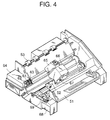
- Fig. 4 illustrates an example of an ink-jet recording apparatus in which such a head has been incorporated.
- reference numeral 61 designates a blade serving as a wiping member, one end of which is a stationary end held by a blade-holding member to form a cantilever.
- the blade 61 is provided at a position adjacent to a region in which a recording head operates, and in this embodiment, is held in such a form that it protrudes to the course through which the recording head is moved.
- Reference numeral 62 indicates a cap, which is provided at a home position adjacent to the blade 61, and is so constituted that it moves in a direction perpendicular to a direction in which the recording head is moved and comes into contact with the face of ejection openings to cap it.
- Reference numeral 63 denotes an ink-absorbing member provided adjoiningly to the blade 61 and, similar to the blade 61, held in such a form that it protrudes to the course through which the recording head is moved.
- the above-described blade 61, cap 62 and absorbing member 63 constitute a recovery portion 64 for the recording head, where the blade 61 and the absorbing member 63 remove off water, dust and/or the like from the face of the ink-ejecting openings.
- Reference numeral 65 designates the recording head having an ejection-energy-generating means and serving to eject the ink onto a recording material set in an opposing relation with the ejection opening face provided with ejection openings to conduct recording.
- Reference numeral 66 indicates a carriage on which the recording head 65 is mounted so that the recording head 65 can be moved.
- the carriage 66 is slidably interlocked with a guide rod 67 and is connected (not illustrated) at its part to a belt 69 driven by a motor 68.
- the carriage 66 can be moved along the guide rod 67 and hence, the recording head 65 can be moved from a recording region to a region adjacent thereto.
- Reference numerals 51 and 52 denote a paper feeding part from which the recording materials are separately inserted, and paper feed rollers driven by a motor (not illustrated), respectively. With such construction, the recording material is fed to the position opposite to the ejection opening face of the recording head, and discharged from a paper discharge section provided with paper discharge rollers 53 with the progress of recording.
- the cap 62 in the head recovery portion 64 is receded from the moving course of the recording head 65 when the recording head 65 is returned to its home position, for example, after completion of recording, and the blade 61 remains protruded to the moving course.
- the ejection opening face of the recording head 65 is wiped.
- the cap 62 comes into contact with the ejection opening face of the recording head 65 to cap it, the cap 62 is moved so as to protrude to the moving course of the recording head.
- the cap 62 and the blade 61 are at the same positions as the positions upon the wiping as described above. As a result, the ejection opening face of the recording head 65 is also wiped at the time of this movement.
- the above movement of the recording head to its home position is made not only when the recording is completed or the recording head is recovered for ejection, but also when the recording head is moved between recording regions for the purpose of recording, during which it is moved to the home position adjacent to each recording region at given intervals, where the ejection opening face is wiped in accordance with this movement.
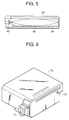
- Fig. 5 illustrates an exemplary ink cartridge in which an ink fed to the head through an ink-feeding member, for example, a tube is contained.
- reference numeral 40 designates an ink container portion containing the ink to be fed, as exemplified by a bag for the ink.
- One end thereof is provided with a stopper 42 made of rubber.
- a needle (not illustrated) may be inserted into this stopper 42 so that the ink in the bag 40 for the ink can be fed to the head.
- Reference numeral 44 indicates an ink-absorbing member for receiving a waste ink.
- the ink container portion is formed of a polyolefin, in particular, polyethylene, at its surface with which the ink comes into contact.
- the ink-jet recording apparatus used in this invention may not be limited to the apparatus as described above in which the head and the ink cartridge are separately provided. Therefore, a device in which these members are integrally formed as shown in Fig. 6 can also be preferably used.
- reference numeral 70 designates a recording unit, in the interior of which an ink container portion containing an ink, for example, an ink-absorbing member, is contained.
- the recording unit 70 is so constructed that the ink in such an ink-absorbing member is ejected in the form of ink droplets through a head 71 having a plurality of orifices.
- polyurethane, cellulose or polyvinyl acetal is preferably used as a material for the ink-absorbing member.
- Reference numeral 72 indicates an air passage for communicating the interior of the recording unit 70 with the atmosphere.
- This recording unit 70 can be used in place of the recording head shown in Fig. 3, and is detachably installed on the carriage 66.
- Illustrative Compound b-1 2.5 parts Ammonium sulfate 0.2 part Glycerol 10 parts Urea 5 parts Water 82.3 parts
- Illustrative Compound c-2 2.5 parts Ammonium carbonate 1 part Diethylene glycol 15 parts Urea 5 parts Isopropyl alcohol 4 parts Water 77.5 parts
- compositions of Reference Examples 1 to 8 their corresponding ammonium salts of the inorganic or organic acids were omitted, and instead, purified water was supplied to prepare respective inks according to Comparative Examples 1 to 8.
- the printer was left over for 1 month in a constant temperature chamber at 35°C, and then for 24 hours at room temperature. After conducting recovery operation (sucking operation by pumping), printing was conducted.
- the clogging tendency was ranked in accordance with the following standard:
- Solid printing was conducted on commercially-available recording paper by the printer. After the resulting print was left over for at least 1 hour, the gloss of the solid printed area was observed by naked eyes to rank the bronzing tendency in accordance with the following standard:
- Illustrative Compound c-1 4 parts Glycerol 7.5 parts Polyethylene glycol 7.5 parts Triethanolamine 1 part Water 80 parts
- Illustrative Compound d-1 4 parts Glycerol 5 parts Ethylene glycol 20 parts Diethanolamine 2 parts Acetylenol EH (product of Kawaken Fine Chemicals Co., Ltd.) 2 parts Water 67 parts
- Illustrative Compound b-2 3 parts Glycerol 9.5 parts Ethylene glycol 8.5 parts Dimethylethanolamine 1 part Ethylene oxide-propylene oxide copolymer (Pepole AS-053X, trade name, product of Toho Chemical Industry Co., Ltd.) 5 parts Water 73 parts
- Illustrative Compound c-2 6 parts Thiodiglycol 10 parts Ethylene glycol 10 parts Triethanolamine 3 parts Acetylenol EH (product of Kawaken Fine Chemicals Co., Ltd.) 3 parts Urea 10 parts Water 58 parts
- Illustrative Compound d-2 2.5 parts Thiodiglycol 10.5 parts Ethylene glycol 10.5 parts Monoethanolamine 2 parts Ethylene oxide-propylene oxide copolymer (Pepole AS-053X, trade name, product of Toho Chemical Industry Co., Ltd.) 2 parts Urea 5 parts Sodium hydroxide 1 part Water 66.5 parts
- Illustrative Compound b-3 2.5 parts Glycerol 7.5 parts Ethylene glycol 7.5 parts Diethylethanolamine 3 parts Acetylenol EH (product of Kawaken Fine Chemicals Co., Ltd.) 3 parts Urea 5 parts Lithium acetate 2 parts Water 69.5 parts
- Illustrative Compound b-4 3 parts Glycerol 7 parts Thiodiglycol 7 parts Diethanolamine 3 parts Ethylene oxide-propylene oxide copolymer (Pepole AS-053X, trade name, product of Toho Chemical Industry Co., Ltd.) 1 part Urea 7 parts Lithium hydroxide 1 part Sodium sulfate 1 part Water 70 parts
- Illustrative Compound d-3 3 parts Glycerol 7.5 parts Thiodiglycol 7.5 parts Triethanolamine 1 parts Ethylene oxide-propylene oxide copolymer (Pepole AS-053X, trade name, product of Toho Chemical Industry Co., Ltd.) 1 part Urea 8 parts Lithium acetate 0.2 part Sodium sulfate 0.5 part Water 71.3 parts
- Illustrative Compound e-1 4 parts C.I. Direct Yellow 86 1 part Thiodiglycol 5 parts Glycerol 8 parts Dimethylethanolamine 2 parts Acetylenol EH (product of Kawaken Fine Chemicals Co., Ltd.) 1 part Urea 10 parts Lithium hydroxide 1 part Ammonium sulfate 1 part Water 67 parts
- Illustrative Compound e-1 2 parts C.I. Direct Yellow 86 1 part Glycerol 5 parts Ethylene glycol 7 parts Triethanolamine 1 part Ethylene oxide-propylene oxide copolymer (Pepole AS-053X, trade name, product of Toho Chemical Industry Co., Ltd.) 1 part Urea 5 parts Lithium hydroxide 0.5 part Ammonium sulfate 0.5 part Water 77 parts
- Illustrative Compound e-1 3 parts C.I. Direct Yellow 86 0.5 part C.I. Direct Blue 199 0.5 part Glycerol 8 parts Thiodiglycol 5 parts Triethanolamine 1 part Acetylenol EH (product of Kawaken Fine Chemicals Co., Ltd.) 2 parts Urea 10 parts Lithium hydroxide 1 part Ammonium sulfate 2 parts Water 67 parts
- ink droplets were ejected from a certain nozzle, whereby the degree of ejection stability was evaluated at the time the ejection of ink droplets from the nozzle was suspended for 1 minute and then resumed, and ranked in accordance with the following standard:
Landscapes
- Chemical & Material Sciences (AREA)
- Life Sciences & Earth Sciences (AREA)
- Engineering & Computer Science (AREA)
- Materials Engineering (AREA)
- Wood Science & Technology (AREA)
- Organic Chemistry (AREA)
- Inks, Pencil-Leads, Or Crayons (AREA)
- Ink Jet Recording Methods And Recording Media Thereof (AREA)
- Particle Formation And Scattering Control In Inkjet Printers (AREA)
- Ink Jet (AREA)
- Pens And Brushes (AREA)
Claims (37)
- Tinte, die ein Farbmaterial und ein flüssiges Medium, das das Farbmaterial darin löst, enthält, wobei die Tinte mindestens einen der Farbstoffe, in denen mindestens ein -COOH oder -COSH einer jeden der Verbindungen, die durch die nachstehenden Strukturformeln (b) bis (e) wiedergegeben werden, in der Lage ist, mit einem Ammoniumion ein Salz zu bilden; ein organisches Amin; und eine stickstoffhaltige Verbindung umfaßt, die aus der Gruppe ausgewählt ist, die aus Harnstoff, Thioharnstoff, Ethylenharnstoff, Alkylharnstoffen, Alkylthioharnstoffen, Dialkylharnstoffen und Dialkylthioharnstoffen besteht:worin Ar und Ar1 unabhängig eine Arylgruppe oder eine substituierte Arylgruppe darstellen, wobei mindestens eines davon mindestens eine Substituentengruppe aufweist, die aus der Gruppe ausgewählt ist, die aus -COOH und -COSH besteht, und J und J1 unabhängig eine Gruppe darstellen, die durch die nachstehenden Formeln wiedergegeben wird:
 worin R5 ein Atom oder eine Gruppe ist, die aus der Gruppe ausgewählt ist, die aus einem Wasserstoffatom, Alkylgruppen, substituierten Alkylgruppen, Alkoxygruppen, Halogenatomen, einer Cyanogruppe, einer Ureidogruppe, und NHCOR6 (worin R6 ein Wasserstoffatom, eine Alkylgruppe, eine substituierte Alkylgruppe, eine Arylgruppe, eine substituierte Arylgruppe, eine Aralkylgruppe oder eine substituierte Aralkylgruppe ist) besteht, und T ist eine Alkylgruppe, W ist ein Atom oder eine Gruppe, die aus der Gruppe ausgewählt ist, die aus einem Wasserstoffatom, einer Cyanogruppe, -CONR10R11, Pyridinium und -COOH besteht, m ist eine Alkylenkette mit 2 bis 8 Kohlenstoffatomen, B ist ein Wasserstoffatom, eine Alkylgruppe oder -COOH; R1, R2, R3 R4, R10 und R11 sind unabhängig ein Wasserstoffatom, eine Alkylgruppe oder eine substituierte Alkylgruppe, L ist eine zweiwertige bindende organische Gruppe, n ist 0 oder 1, X ist eine Carbonylgruppe oder eine Gruppe, die durch die nachstehenden Formeln wiedergegeben wird:
 worin Z für OR7, SR7 oder NR8R9 steht, Y ein Wasserstoffatom, ein Chloratom oder eine Cyanogruppe ist, E ein Chloratom oder eine Cyanogruppe ist, und R7, R8 und R9 unabhängig ein Wasserstoffatom, eine Alkenylgruppe, eine substituierte Alkenylgruppe, eine Alkylgruppe, eine substituierte Alkylgruppe, eine Arylgruppe, eine substituierte Arylgruppe, eine Aralkylgruppe oder eine substituierte Aralkylgruppe sind, oder R8 und R9 zusammen mit dem N-Atom, an das sie gebunden sind, einen 5- oder 6gliedrigen Ring bilden, unter der Voraussetzung, daß der Farbstoff (b) mindestens zwei Gruppen aufweist, die aus -COOH und -COSH ausgewählt sind, wobei darin kein SO3H enthalten ist, oder die gleiche Anzahl an Gruppen, die aus -COOH und -COSH ausgewählt sind, wie die Anzahl an SO3H-Gruppen aufweist, wobei der Farbstoff (b) eine oder mehrere SO3H-Gruppen aufweist;
 Ar2 und Ar3 sind unabhängig eine Arylgruppe oder eine substituierte Arylgruppe, wobei mindestens eines davon mindestens eine Substituentengruppe aufweist, die aus der Gruppe ausgewählt ist, die aus -COOH und -COSH besteht, und R12 und R13 sind unabhängig ein Wasserstoffatom, eine Alkylgruppe, eine substituierte Alkylgruppe, eine Alkenylgruppe oder eine substituierte Alkenylgruppe, L1 ist eine zweiwertige bindende organische Gruppe, n ist 0 oder 1, X1 ist eine Carbonylgruppe oder eine Gruppe, die durch die nachstehenden Formeln wiedergegeben wird:
 worin Z für NR14R15, SR16 oder OR16 steht, Y ein Wasserstoffatom, ein Chloratom, Z, SR17 oder OR17 ist, und E ein Chloratom oder eine Cyanogruppe ist, und R14, R15, R16 und R17 unabhängig ein Wasserstoffatom, eine Alkylgruppe, eine substituierte Alkylgruppe, eine Alkenylgruppe, eine substituierte Alkenylgruppe, eine Arylgruppe, eine substituierte Arylgruppe, eine Aralkylgruppe oder eine substituierte Aralkylgruppe sind, oder R14 und R15 zusammen mit dem N-Atom, an das sie gebunden sind, einen 5- oder 6gliedrigen Ring bilden, unter der Voraussetzung, daß der Farbstoff (c) die gleiche Anzahl an Gruppen, die aus der Gruppe ausgewählt sind, die aus -COOH und -COSH besteht, wie die Anzahl an SO3H-Gruppen aufweist;
 worin Z für NR21R22, SR23 oder OR23 steht, Y ein Wasserstoffatom, ein Chloratom, Z, SR24 oder OR24 ist, und E ein Chloratom oder eine Cyanogruppe ist; und R21, R22, R23 und R24 stellen unabhängig ein Wasserstoffatom, eine Alkylgruppe, eine substituierte Alkylgruppe, eine Arylgruppe, eine substituierte Arylgruppe, eine Aralkylgruppe oder eine substituierte Aralkylgruppe dar, oder R21 und R22 bilden zusammen mit dem N-Atom, an das sie gebunden sind, einen 5- oder 6gliedrigen Ring, G ist eine farblose organische Gruppe, die mit einer oder zwei Gruppen substituiert ist, die aus der Gruppe ausgewählt sind, die aus -COSH und -COOH besteht, und (t + q) ist 3 oder 4, unter der Voraussetzung, daß der Farbstoff (d) mindestens eine SO3H-Gruppe und die gleiche Anzahl an Gruppen, die aus der Gruppe ausgewählt sind, die aus -COSH und -COOH besteht, wie die Anzahl an SO3H-Gruppen aufweist; und
 worin Y ein Wasserstoffatom oder SO3H ist.
- Tinte nach Anspruch 1, die ferner ein grenzflächenaktives Mittel umfaßt.
- Tinte nach Anspruch 1, die ferner mindestens eine Verbindung aus Hydroxiden und Alkalimetallsalzen umfaßt.
- Tinte nach Anspruch 1, die ferner ein Sulfat umfaßt.
- Tinte nach Anspruch 1, wobei der Farbstoff mindestens eine Carboxylgruppe aufweist.
- Tinte nach Anspruch 1, wobei der Farbstoff eine zweiwertige bindende organische Gruppe aufweist.
- Tinte nach Anspruch 1, die in Kombination mindestens einen der durch die Strukturformel (e) wiedergegebenen Farbstoffe und mindestens einen Farbstoff umfaßt, der aus gelben und blauen Farbstoffen ausgewählt ist.
- Tinte nach Anspruch 7, wobei der gelbe Farbstoff mindestens ein Farbstoff ist, der aus der Gruppe ausgewählt ist, die aus Verbindungen, die durch die Strukturformel (b) wiedergegeben werden, CI Säuregelb 17:1, CI Säuregelb 23, CI Säuregelb 49, CI Säuregelb 65, CI Säuregelb 104, CI Säuregelb 183, CI Säuregelb 155, CI Säuregelb 194, CI Direktgelb 86, CI Direktgelb 106, CI Direktgelb 142 und CI Direktgelb 194 besteht.
- Tinte nach Anspruch 7, wobei der blaue Farbstoff mindestens ein Farbstoff ist, der aus der Gruppe ausgewählt ist, die aus Verbindungen, die durch die Strukturformel (d) wiedergegeben werden, CI Säureblau 9, CI Säureblau 13, CI Säureblau 68, CI Säureblau 69, CI Säureblau 138, CI Säureblau 185, CI Säureblau 249, CI Säureblau 258, CI Direktblau 83, CI Direktblau 86, CI Direktblau 87, CI Direktblau 95, CI Direktblau 143, CI Direktblau 166, CI Direktblau 176 und CI Direktblau 199 besteht.
- Tinte nach Anspruch 7, wobei das Mischungsverhältnis von dem Farbstoff, der durch die Strukturformel (e) wiedergegeben wird, zu dem gelben Farbstoff in einem Bereich von 40:1 bis 4:1, bezogen auf das Gewicht, liegt.
- Tinte nach Anspruch 9, wobei das Mischungsverhältnis von dem Farbstoff, der durch die Strukturformel (e) wiedergegeben wird, zu dem blauen Farbstoff in einem Bereich von 40:1 bis 4:1, bezogen auf das Gewicht, liegt.
- Tinte nach Anspruch 1, wobei das organische Amin aus der Gruppe ausgewählt ist, die aus Monoethanolamin, Diethanolamin, Triethanolamin, Monopropanolamin, Dipropanolamin und Tripropanolamin besteht.
- Tinte nach Anspruch 1, wobei der Gehalt des organischen Amins in einem Bereich von 0,01 bis 5,0 Gewichts-%, bezogen auf das Gesamtgewicht der Tinte, liegt.
- Tinte nach Anspruch 2, wobei das grenzflächenaktive Mittel ein ionisches grenzflächenaktives Mittel, ein nichtionisches grenzflächenaktives Mittel, ein amphoteres grenzflächenaktives Mittel oder eine Mischung aus zwei oder mehreren grenzflächenaktiven Mitteln davon ist.
- Tinte nach Anspruch 2, wobei das grenzflächenaktive Mittel ein nichtionisches grenzflächenaktives Mittel ist.
- Tinte nach Anspruch 2, wobei das grenzflächenaktive Mittel mindestens eines ist, das aus der Gruppe ausgewählt ist, die aus Ethylenoxid-Addukten höherer Alkohole, Ethylenoxid-Addukten von Alkylphenolen, Ethylenoxid-Propylenoxid-Copolymeren und Ethylenoxid-Addukten von Acetylenglykol besteht.
- Tinte nach Anspruch 2, wobei der Gehalt des grenzflächenaktiven Mittels in einem Bereich von 0,01 bis 10 Gewichts-%, bezogen auf das Gesamtgewicht der Tinte, liegt.
- Tinte nach Anspruch 1, wobei der Gehalt der stickstoffhaltigen Verbindung in einem Bereich von 0,01 bis 20 Gewichts-%, bezogen auf das Gesamtgewicht der Tinte, liegt.
- Tinte nach Anspruch 3, wobei das Hydroxid aus der Gruppe ausgewählt ist, die aus Natriumhydroxid, Lithiumhydroxid, Kaliumhydroxid und Ammoniumhydroxid besteht.
- Tinte nach Anspruch 3, wobei der Gehalt des Hydroxids in einem Bereich von 0,01 bis 5,0 Gewichts-%, bezogen auf das Gesamtgewicht der Tinte, liegt.
- Tinte nach Anspruch 3, wobei das Alkalimetallsalz aus der Gruppe ausgewählt ist, die aus Natriumacetat, Lithiumacetat, Kaliumacetat, Natriumnitrat, Lithiumnitrat, Kaliumnitrat, Natriumphosphat, Lithiumphosphat, Kaliumphosphat, Natriumcarbonat, Lithiumcarbonat und Kaliumcarbonat besteht.
- Tinte nach Anspruch 3, wobei der Gehalt des Alkalimetallsalzes in einem Bereich von 0,01 bis 5,0 Gewichts-%, bezogen auf das Gesamtgewicht der Tinte, liegt.
- Tinte nach Anspruch 4, wobei das Sulfat aus der Gruppe ausgewählt ist, die aus Natriumsulfat, Lithiumsulfat, Kaliumsulfat und Ammoniumsulfat besteht.
- Tinte nach Anspruch 4, wobei der Gehalt des Sulfats in einem Bereich von 0,01 bis 5,0 Gewichts-%, bezogen auf das Gesamtgewicht der Tinte, liegt.
- Tintenstrahl-Aufzeichnungsverfahren, das den Ausstoß von Tröpfchen einer Tinte aus einer Öffnung in Übereinstimmung mit einem Aufzeichnungssignal, um auf dem Aufzeichnungsmaterial eine Aufzeichnung durchzuführen, umfaßt, wobei die Tinte eine Tinte ist, wie sie in einem der Ansprüche 1 bis 24 dargelegt ist.
- Tintenstrahl-Aufzeichnungsverfahren nach Anspruch 25, wobei die Tintentröpfchen durch die Einwirkung von Wärmeenergie auf die Tinte ausgestoßen werden.
- Aufzeichnungseinheit, die einen Tintenbehälterabschnitt mit darin enthaltener Tinte und einen Kopf umfaßt, aus dem die Tinte in Form von Tintentröpfchen ausgestoßen wird, wobei die Tinte eine Tinte ist, wie sie in einem der Ansprüche 1 bis 24 dargelegt ist.
- Aufzeichnungseinheit nach Anspruch 27, wobei der Kopf ein Kopf ist, der ein Einwirken von Wärmeenergie auf die Tinte veranlaßt, um ihre Tröpfchen auszustoßen.
- Aufzeichnungseinheit nach Anspruch 27, wobei der Tintenbehälterabschnitt aus Polyurethan, Cellulose oder Polyvinylacetat gebildet ist.
- Tintenkasette, die einen Tintenbehälterabschnitt mit darin enthaltener Tinte umfaßt, wobei die Tinte eine Tinte ist, wie sie in einem der Ansprüche 1 bis 24 dargelegt ist.
- Tintenkasette nach Anspruch 30, wobei der Tintenbehälterabschnitt auf seiner Oberfläche, mit der die Tinte in Kontakt kommt, aus einem Polyolefin gefertigt ist.
- Tintenstrahl-Aufzeichnungsgerät, das eine Auf zeichnungseinheit, die einen Tintenbehälterabschnitt mit einer darin enthaltenen Tinte und einen Kopf aufweist, aus dem die Tinte in Form von Tintentröpfchen ausgestoßen wird, umfaßt, wobei die Tinte eine Tinte ist, wie sie in einem der Ansprüche 1 bis 24 dargelegt ist.
- Tintenstrahl-Aufzeichnungsgerät nach Anspruch 32, wobei der Kopf ein Kopf ist, der ein Einwirken von Wärmeenergie auf die Tinte veranlaßt, um ihre Tröpfchen auszustoßen.
- Tintenstrahl-Aufzeichnungsgerät nach Anspruch 32, wobei der Tintenbehälterabschnitt aus Polyurethan, Cellulose oder Polyvinylacetat gebildet ist.
- Tintenstrahl-Aufzeichnungsgerät, das einen Aufzeichnungskopf, aus dem Tinte in Form von Tintentröpfchen ausgestoßen wird, eine Tintenkasette, die einen Tintenbehälterabschnitt mit darin enthaltener Tinte aufweist, und eine Tintenzuführeinrichtung für die Zufuhr der Tinte von der Tintenkasette zu dem Aufzeichnungskopf umfaßt, wobei die Tinte eine Tinte ist, wie sie in einem der Ansprüche 1 bis 24 dargelegt ist.
- Tintenstrahl-Aufzeichnungsgerät nach Anspruch 35, wobei der Aufzeichnungskopf ein Kopf ist, der ein Einwirken von Wärmeenergie auf die Tinte veranlaßt, um ihre Tröpfchen auszustoßen.
- Tintenstrahl-Aufzeichnungsgerät nach Anspruch 35, wobei der Tintenbehälterabschnitt auf seiner Oberfläche, mit der die Tinte in Kontakt kommt, aus einem Polyolefin gefertigt ist.
Priority Applications (2)
| Application Number | Priority Date | Filing Date | Title |
|---|---|---|---|
| EP00104226A EP1008633B1 (de) | 1993-02-26 | 1994-02-24 | Tinte |
| EP03010904A EP1338631B1 (de) | 1993-02-26 | 1994-02-24 | Tinte, Tintenstrahlaufzeichnungsverfahren und -vorrichtung |
Applications Claiming Priority (15)
| Application Number | Priority Date | Filing Date | Title |
|---|---|---|---|
| JP61333/93 | 1993-02-26 | ||
| JP6133393 | 1993-02-26 | ||
| JP6133393A JPH06248212A (ja) | 1993-02-26 | 1993-02-26 | インク、これを用いたインクジェット記録方法及びかかるインクを用いた機器 |
| JP153632/93 | 1993-06-24 | ||
| JP15363293 | 1993-06-24 | ||
| JP5153632A JPH0726178A (ja) | 1993-06-24 | 1993-06-24 | インク、これを用いたインクジェット記録方法及び染料の会合防止方法 |
| JP244963/93 | 1993-09-30 | ||
| JP24496393A JP3387574B2 (ja) | 1993-09-30 | 1993-09-30 | インク、インクジェット記録方法、インクジェット記録ユニット、インクカートリッジおよびインクジェット記録装置 |
| JP24496393 | 1993-09-30 | ||
| JP26781493A JP3205147B2 (ja) | 1993-10-01 | 1993-10-01 | 金属非腐食性記録液、インクジェット記録方法、インク、記録ユニット、インクカートリッジ、インクジェット記録装置及び印刷方法 |
| JP267814/93 | 1993-10-01 | ||
| JP26781493 | 1993-10-01 | ||
| JP29820193 | 1993-11-29 | ||
| JP298201/93 | 1993-11-29 | ||
| JP29820193A JP3423382B2 (ja) | 1993-11-29 | 1993-11-29 | インクジェット用のインク、インクジェット記録方法、記録ユニット、インクカートリッジおよびインクジェット記録装置 |
Related Child Applications (1)
| Application Number | Title | Priority Date | Filing Date |
|---|---|---|---|
| EP00104226A Division EP1008633B1 (de) | 1993-02-26 | 1994-02-24 | Tinte |
Publications (3)
| Publication Number | Publication Date |
|---|---|
| EP0612820A2 EP0612820A2 (de) | 1994-08-31 |
| EP0612820A3 EP0612820A3 (de) | 1995-03-01 |
| EP0612820B1 true EP0612820B1 (de) | 2000-10-18 |
Family
ID=27523653
Family Applications (3)
| Application Number | Title | Priority Date | Filing Date |
|---|---|---|---|
| EP94102824A Expired - Lifetime EP0612820B1 (de) | 1993-02-26 | 1994-02-24 | Tinte, Tintenstrahlaufzeichnungsverfahren und -vorrichtung |
| EP03010904A Expired - Lifetime EP1338631B1 (de) | 1993-02-26 | 1994-02-24 | Tinte, Tintenstrahlaufzeichnungsverfahren und -vorrichtung |
| EP00104226A Expired - Lifetime EP1008633B1 (de) | 1993-02-26 | 1994-02-24 | Tinte |
Family Applications After (2)
| Application Number | Title | Priority Date | Filing Date |
|---|---|---|---|
| EP03010904A Expired - Lifetime EP1338631B1 (de) | 1993-02-26 | 1994-02-24 | Tinte, Tintenstrahlaufzeichnungsverfahren und -vorrichtung |
| EP00104226A Expired - Lifetime EP1008633B1 (de) | 1993-02-26 | 1994-02-24 | Tinte |
Country Status (8)
| Country | Link |
|---|---|
| US (1) | US5451251A (de) |
| EP (3) | EP0612820B1 (de) |
| KR (3) | KR0135726B1 (de) |
| CN (1) | CN1062883C (de) |
| AT (3) | ATE197064T1 (de) |
| AU (2) | AU666997B2 (de) |
| DE (3) | DE69426134T2 (de) |
| TW (2) | TW515827B (de) |
Families Citing this family (114)
| Publication number | Priority date | Publication date | Assignee | Title |
|---|---|---|---|---|
| US5492952A (en) * | 1993-03-22 | 1996-02-20 | Canon Kabushiki Kaisha | Ink, ink-jet recording process and apparatus making use of the same |
| US5690723A (en) * | 1995-01-18 | 1997-11-25 | Seiko Epson Corporation | Ink composition suitable for ink jet recording |
| JPH09123437A (ja) * | 1995-08-28 | 1997-05-13 | Seiko Epson Corp | インクジェットプリンタ及びインクジェット記録用インク |
| US5728201A (en) * | 1995-09-14 | 1998-03-17 | Canon Kabushiki Kaisha | Ink, and ink-jet recording method and instruments using the same |
| EP0771860B1 (de) * | 1995-11-02 | 2002-01-09 | Seiko Epson Corporation | Tintenzusammensetzung, die eine gute Wiedergabe der Schwarzfabre erlaubt, und Tintenstrahl-Aufzeichnungsverfahren unter Verwendung derselben |
| US5911815A (en) * | 1995-11-30 | 1999-06-15 | Canon Kabushiki Kaisha | Ink set and ink-jet recording method using the same |
| US5865883A (en) * | 1996-03-14 | 1999-02-02 | Canon Kabushiki Kaisha | Ink, ink cartridge and recording unit, ink-jet recording method and ink-jet recording apparatus |
| US5972082A (en) * | 1996-04-30 | 1999-10-26 | Ricoh Company, Ltd. | Aqueous ink composition and ink-jet printing method using the same |
| JP3106966B2 (ja) * | 1996-07-17 | 2000-11-06 | 富士ゼロックス株式会社 | インクジェット記録用インク及びインクジェット記録方法 |
| JPH1060338A (ja) * | 1996-08-21 | 1998-03-03 | Fuji Xerox Co Ltd | インクジェット記録用インク及びインクジェット記録方法 |
| GB2332441B (en) * | 1996-09-19 | 2001-03-21 | Zeneca Ltd | Azo dyes for ink-jet printing |
| US6290763B1 (en) * | 1996-09-19 | 2001-09-18 | Zeneca Limited | AZO dyes and compositions comprising such dyes |
| US5910211A (en) * | 1996-10-01 | 1999-06-08 | Minolta Co., Ltd. | Ink for ink-jet recording containing alkylene oxide adduct of acetylene glycol |
| GB9621225D0 (en) * | 1996-10-11 | 1996-11-27 | Zeneca Ltd | Bisazo ink-jet dyes |
| US5843217A (en) * | 1996-10-11 | 1998-12-01 | Minolta Co., Ltd. | Ink for ink jet recording |
| GB9621224D0 (en) * | 1996-10-11 | 1996-11-27 | Zeneca Ltd | Bisazo ink-jet dyes |
| US5980623A (en) * | 1997-01-29 | 1999-11-09 | Fuji Xerox Co., Ltd. | Ink set for ink jet recording and ink jet recording method |
| DE69700293T2 (de) | 1997-02-13 | 2000-02-03 | Ilford Imaging Switzerland Gmbh, Marly | Farbstoffe für den Tintenstrahldruck |
| US6281917B1 (en) | 1997-04-01 | 2001-08-28 | Canon Kabushiki Kaisha | Image forming process employing liquid composition and ink in combination |
| JPH10291365A (ja) * | 1997-04-21 | 1998-11-04 | Fuji Xerox Co Ltd | 多色インクセット及びインクジェット記録方法 |
| US5925176A (en) * | 1997-06-11 | 1999-07-20 | Hewlett-Packard Company | Salt-based ink compositions |
| US5925746A (en) * | 1997-07-02 | 1999-07-20 | Ciba Specialty Chemicals Corporation | Azo dyes, processes for their preparation and the use thereof |
| DE59811709D1 (de) * | 1997-10-06 | 2004-09-02 | Clariant Gmbh | Verwendung von Pigment Yellow 155 in elektrophotographischen Tonern und Entwicklern und Ink-Jet-Tinten |
| JP4168465B2 (ja) * | 1998-02-02 | 2008-10-22 | セイコーエプソン株式会社 | 水溶性インク、水溶性インクの製造方法、およびインクジェット記録方法 |
| JP3862441B2 (ja) | 1998-03-20 | 2006-12-27 | キヤノン株式会社 | インクジェット記録用インク、インクセット、インクカートリッジ、記録ユニット、画像記録装置、画像記録方法、カラー画像の形成方法および画像の光学濃度向上方法 |
| US5985929A (en) * | 1998-11-05 | 1999-11-16 | Kern; Jerome | Cold chemical sterilant |
| US6066200A (en) * | 1999-04-27 | 2000-05-23 | Xerox Corporation | Ink compositions |
| US6514920B1 (en) | 1999-06-03 | 2003-02-04 | Canon Kabushiki Kaisha | Liquid composition, method of cleaning ink-jet recording head, ink-jet recording apparatus, cartridge, and method of regenerating ink-jet recording head |
| JP4027027B2 (ja) | 1999-09-17 | 2007-12-26 | キヤノン株式会社 | インク、インクセット、インクカートリッジ、記録ユニット、画像記録装置およびインクジェット記録方法 |
| US6530656B1 (en) | 1999-09-30 | 2003-03-11 | Canon Kabushiki Kaisha | Color ink-jet recording ink set, ink-jet recording method, recording unit, ink-cartridge, ink-jet recording apparatus and bleeding reduction method |
| DE60018668T2 (de) | 1999-10-05 | 2006-05-11 | Canon K.K. | Tintensatz für Tintenstrahl-Aufzeichnung, Tintenstrahl-Aufzeichnungsverfahren, Aufzeichnungseinheit, Aufzeichnungsgerät und Verfahren zur Reduzierung der Farbvermischung |
| US6682588B2 (en) | 2000-02-17 | 2004-01-27 | Canon Kabushiki Kaisha | Ink-jet ink, method for alleviating kogation on surface of heater of ink-jet recording head, method for ink-jet recording, ink-jet recording apparatus, recording unit and method for prolonging ink-jet recording head life |
| US6702882B2 (en) | 2000-06-23 | 2004-03-09 | Canon Kabushiki Kaisha | Ink set, ink jet recording method, recording unit, ink cartridge and ink jet recording apparatus |
| EP1167474B1 (de) | 2000-06-23 | 2005-12-14 | Canon Kabushiki Kaisha | Tinte, Tintensatz, Tintenstrahlaufzeichnungsverfahren, Tintenpatrone, Aufzeichnungseinheit und Aufzeichnungsgerät |
| US6471350B2 (en) | 2000-08-09 | 2002-10-29 | Canon Kabushiki Kaisha | Method of protecting heater surface of ink-jet printer, ink-jet recording apparatus, recording unit and method of prolonging service life of ink-jet recording head |
| CA2356809C (en) | 2000-09-04 | 2005-11-22 | Canon Kabushiki Kaisha | Ink set for ink jet recording |
| US6676254B2 (en) | 2000-12-21 | 2004-01-13 | Canon Kabushiki Kaisha | Recording method, ink cartridge, printing device and information recording apparatus |
| JP4738655B2 (ja) * | 2001-07-04 | 2011-08-03 | 富士フイルム株式会社 | インクジェット記録用インク組成物 |
| US6821329B2 (en) * | 2001-10-31 | 2004-11-23 | Hewlett-Packard Development Company, L.P. | Ink compositions and methods of ink-jet printing on hydrophobic media |
| TWI271424B (en) * | 2001-12-21 | 2007-01-21 | Benq Corp | Multicolor dye set and inkjet ink composition with high chroma |
| DE10260361A1 (de) | 2001-12-25 | 2003-07-17 | Benq Corp | Tintenstrahl-Tintenzusammensetzung mit hoher Chromatizität |
| TWI292426B (de) * | 2001-12-25 | 2008-01-11 | Benq Corp | |
| US7390083B2 (en) * | 2002-02-08 | 2008-06-24 | Fujifilm Corporation | Ink-jet recording ink and method of ink-jet recording |
| JP3849626B2 (ja) * | 2002-03-13 | 2006-11-22 | ブラザー工業株式会社 | インクジェット記録用水性インク |
| US6976755B2 (en) * | 2002-10-02 | 2005-12-20 | Canon Kabushiki Kaisha | Aqueous ink, ink jet recording method, ink tank recording unit and ink jet recording apparatus |
| US6863719B2 (en) * | 2002-12-30 | 2005-03-08 | Lexmark International, Inc. | Ink jet ink with improved reliability |
| JP4721403B2 (ja) | 2003-02-20 | 2011-07-13 | キヤノン株式会社 | 水性インク及び該水性インクによる記録画像と画像形成方法 |
| US20040209015A1 (en) * | 2003-04-15 | 2004-10-21 | Palitha Wickramanayake | Additives for use in print media to reduce bronzing |
| WO2004096932A1 (ja) * | 2003-05-02 | 2004-11-11 | Canon Kabushiki Kaisha | インク及び該インクを用いたインクジェット記録方法 |
| EP1621591A4 (de) * | 2003-05-02 | 2009-03-04 | Canon Kk | Wässrige tinte und darauf basierendes bildungsverfahren und abbild |
| CN100410338C (zh) * | 2003-05-02 | 2008-08-13 | 佳能株式会社 | 水性荧光油墨、记录图像形成方法及记录图像 |
| DK1624034T3 (da) * | 2003-05-02 | 2011-07-25 | Canon Kk | Vandigt fluorescerende blæk, billede optaget under anvendelse deraf samt evalueringsfremgangsmåde |
| WO2005044932A1 (en) * | 2003-11-11 | 2005-05-19 | Canon Kabushiki Kaisha | An ink comprising a block copolymer dispersing agent having a hydrophilic and a hydrophobic segment and an ink-applying process and apparatus using the same |
| KR100538238B1 (ko) * | 2003-11-12 | 2005-12-21 | 삼성전자주식회사 | 잉크 조성물 |
| JP3958325B2 (ja) * | 2004-03-16 | 2007-08-15 | キヤノン株式会社 | プリント媒体用塗布液、インクジェット用インク、画像形成方法、プリント媒体用塗布液とインクジェット用インクとのセット、及びインクジェット記録装置 |
| WO2005108511A1 (ja) * | 2004-05-10 | 2005-11-17 | Canon Kabushiki Kaisha | インクセット、インクジェット記録方法、インクカートリッジ、記録ユニット、インクジェット記録装置及び画像形成方法 |
| WO2006001508A1 (ja) * | 2004-06-24 | 2006-01-05 | Canon Kabushiki Kaisha | 水性インク、インクタンク、インクジェット記録装置、インクジェット記録方法、及びインクジェット記録画像 |
| CN1973005B (zh) * | 2004-06-28 | 2010-09-29 | 佳能株式会社 | 青色墨水及成套墨水 |
| AU2005257524B2 (en) * | 2004-06-28 | 2009-07-30 | Canon Kabushiki Kaisha | Aqueous ink, ink set, and image forming method |
| WO2006001540A1 (ja) * | 2004-06-28 | 2006-01-05 | Canon Kabushiki Kaisha | シアンインク、インクセット、インクと反応液のセット、及び画像形成方法 |
| ATE486107T1 (de) | 2004-06-28 | 2010-11-15 | Canon Kk | Wässrige tinte, wässriger tintensatz, tintenpatrone, tintenstrahlaufzeichner, tintenstrahlaufzeichnungsverfahren und bilderzeugungsverfahren |
| EP1726449B1 (de) * | 2004-06-28 | 2016-06-29 | Canon Kabushiki Kaisha | Aufzeichnungsverfahren, tintenpatrone und bilderzeugungsverfahren |
| CN1977004B (zh) * | 2004-06-28 | 2010-05-05 | 佳能株式会社 | 水性墨水、喷墨记录方法、墨盒、记录单元、喷墨记录装置和图像形成方法 |
| JP3833235B2 (ja) * | 2004-07-02 | 2006-10-11 | キヤノン株式会社 | インク、インクジェット記録方法、記録ユニット、インクカートリッジ及びインクジェット記録装置 |
| JP3793222B2 (ja) * | 2004-07-02 | 2006-07-05 | キヤノン株式会社 | インクジェット用インク、インクセット、インクジェット記録方法、インクカートリッジ、記録ユニット、及びインクジェット記録装置 |
| JP3793223B2 (ja) * | 2004-07-02 | 2006-07-05 | キヤノン株式会社 | インクジェット用インク、インクジェット記録方法、インクカートリッジ、記録ユニット、及びインクジェット記録装置 |
| US7188943B2 (en) * | 2004-07-14 | 2007-03-13 | Hewlett-Packard Development Company, Lp. | Ink set for inkjet printing |
| JP2006063330A (ja) * | 2004-07-29 | 2006-03-09 | Canon Inc | インクジェット用インク、インクジェット記録方法、インクカートリッジ、記録ユニット及びインクジェット記録装置 |
| JP4794936B2 (ja) * | 2004-07-29 | 2011-10-19 | キヤノン株式会社 | インクセット、インクジェット記録方法、インクカートリッジのセット及び記録ユニット |
| JP2006063332A (ja) | 2004-07-29 | 2006-03-09 | Canon Inc | インクジェット用ブラックインク、インクセット、インクジェット記録方法、インクカートリッジ、記録ユニット、及びインクジェット記録装置 |
| JP4324138B2 (ja) * | 2004-08-04 | 2009-09-02 | キヤノン株式会社 | インクセット、インクジェット記録方法、記録ユニット及びインクジェット記録装置 |
| JP2006070258A (ja) * | 2004-08-04 | 2006-03-16 | Canon Inc | インクジェット用イエローインク、インクジェット用淡インク、インクセット、インクジェット記録方法、インクカートリッジ、記録ユニット及びインクジェット記録装置 |
| EP1792950A1 (de) * | 2004-09-08 | 2007-06-06 | Canon Kabushiki Kaisha | Zwischenprodukt bei der herstellung von pigmentkristallen, verfahren zur herstellung von pigmentkristallen aus dem zwischenprodukt sowie kristallines pigment |
| WO2006028267A1 (ja) | 2004-09-08 | 2006-03-16 | Canon Kabushiki Kaisha | 被覆微粒子、分散微粒子、被覆微粒子の製造方法、インク、記録方法及び記録画像 |
| JPWO2006028268A1 (ja) * | 2004-09-08 | 2008-05-08 | キヤノン株式会社 | 顔料、顔料の製造方法、顔料分散体、顔料分散体の製造方法、記録用インク、記録方法及び記録画像 |
| US7351277B2 (en) | 2004-09-08 | 2008-04-01 | E. I. Du Pont De Nemours And Company | IR transparent cyan inkjet ink |
| WO2006049305A1 (ja) * | 2004-11-02 | 2006-05-11 | Canon Kabushiki Kaisha | 蛍光画像形成方法及びその画像とインクジェット記録方法 |
| JP4812078B2 (ja) | 2004-12-28 | 2011-11-09 | キヤノン株式会社 | インクジェット記録装置 |
| JP4808418B2 (ja) * | 2005-02-28 | 2011-11-02 | キヤノンファインテック株式会社 | インクジェット用水系インク、インクジェット記録方法、インクカートリッジおよびインクジェット記録装置 |
| JP4646669B2 (ja) * | 2005-03-30 | 2011-03-09 | キヤノン株式会社 | 吐出用液体、吐出方法、液滴化方法、カートリッジ及び吐出装置 |
| JP5318563B2 (ja) * | 2005-03-31 | 2013-10-16 | フジフィルム・イメイジング・カラランツ・リミテッド | 化合物、組成物および使用 |
| GB0506496D0 (en) * | 2005-03-31 | 2005-05-04 | Avecia Ltd | Compound, composition and use |
| US20060264534A1 (en) * | 2005-05-23 | 2006-11-23 | Zeying Ma | Inkjet inks having reduced bronzing |
| KR100750125B1 (ko) * | 2005-08-18 | 2007-08-21 | 삼성전자주식회사 | 잉크젯 잉크 조성물, 잉크 카트리지 및 잉크젯 기록장치 |
| JP4851167B2 (ja) | 2005-11-07 | 2012-01-11 | キヤノンファインテック株式会社 | インクジェット用水性インク、インクジェット記録方法、インクカートリッジおよびインクジェット記録装置 |
| JP4971754B2 (ja) * | 2005-11-16 | 2012-07-11 | キヤノン株式会社 | 水性インク、インクジェット記録方法、インクカートリッジ、記録ユニット、及びインクジェット記録装置 |
| JP5938815B2 (ja) * | 2006-05-25 | 2016-06-22 | キヤノン株式会社 | 水性インク、インクジェット記録方法、インクカートリッジ、記録ユニット、及びインクジェット記録装置 |
| JP4621193B2 (ja) * | 2006-11-24 | 2011-01-26 | キヤノン株式会社 | 液体組成物、インクジェット記録方法、及びインクジェット記録用インクセット |
| JP5064783B2 (ja) * | 2006-12-20 | 2012-10-31 | キヤノン株式会社 | インク及びインクジェット記録方法 |
| US7868060B2 (en) * | 2007-02-05 | 2011-01-11 | Canon Kabushiki Kaisha | Aqueous ink, ink jet recording method, ink cartridge, recording unit, ink jet recording apparatus, and image |
| JP2008239964A (ja) * | 2007-03-01 | 2008-10-09 | Canon Inc | インクジェット記録用インクセット及びインクジェット記録方法 |
| US8016932B2 (en) * | 2007-05-11 | 2011-09-13 | Canon Kabushiki Kaisha | Aqueous ink, ink set, image forming method and image forming apparatus |
| US7682433B2 (en) * | 2007-05-11 | 2010-03-23 | Canon Kabushiki Kaisha | Ink set, ink jet recording method, ink cartridge, recording unit, and ink jet recording apparatus |
| US7988277B2 (en) * | 2007-05-11 | 2011-08-02 | Canon Kabushiki Kaisha | Ink set, ink jet recording method, ink cartridge, recording unit, ink jet recording method, and aqueous ink |
| JP2009001004A (ja) * | 2007-05-23 | 2009-01-08 | Canon Inc | インクジェット記録装置、及びインクジェット記録方法 |
| US7550037B2 (en) * | 2007-07-05 | 2009-06-23 | Canon Kabushiki Kaisha | Ink, ink jet recording method, ink cartridge, recording unit and ink jet recording apparatus |
| EP2227510A4 (de) * | 2007-12-28 | 2014-03-05 | Canon Kk | Pigmentdispersion und davon gebrauch machendes farbstrahlaufzeichnungsmedium |
| JP2009173913A (ja) * | 2007-12-28 | 2009-08-06 | Canon Inc | 表面改質無機顔料、着色表面改質無機顔料、記録媒体、及びこれらの製造方法、並びに画像形成方法、記録画像 |
| JP5383238B2 (ja) * | 2008-03-19 | 2014-01-08 | キヤノン株式会社 | インクジェット用インク、インクジェット記録方法、インクカートリッジ、及びインクジェット記録装置 |
| GB0817932D0 (en) * | 2008-10-01 | 2008-11-05 | Fujifilm Imaging Colorants Ltd | Phthalocyanines and their use in ink-jet printing |
| WO2011041368A1 (en) | 2009-09-30 | 2011-04-07 | Videojet Technologies Inc. | Thermal ink jet ink composition |
| EP2482997B1 (de) | 2009-09-30 | 2016-05-25 | Videojet Technologies, Inc. | Wärmetintenstrahl-tintenzusammensetzung |
| JP5709474B2 (ja) * | 2009-12-11 | 2015-04-30 | キヤノン株式会社 | 反応液とインクとのセット、及び画像形成方法 |
| JP6029304B2 (ja) | 2011-04-19 | 2016-11-24 | キヤノン株式会社 | インクと反応液とのセット、及び画像形成方法 |
| JP6000597B2 (ja) | 2011-04-19 | 2016-09-28 | キヤノン株式会社 | インク、インクカートリッジ及びインクジェット記録方法 |
| US20130176368A1 (en) * | 2011-07-12 | 2013-07-11 | E I Du Pont De Nemours And Company | Ink-jet inks having improved corrosion resistance |
| JP5988754B2 (ja) | 2011-09-08 | 2016-09-07 | キヤノン株式会社 | 水性インク、インクカートリッジ、及びインクジェット記録方法 |
| JP2013209620A (ja) | 2012-03-02 | 2013-10-10 | Canon Inc | インク、インクカートリッジ、及びインクジェット記録方法 |
| JP6558974B2 (ja) | 2014-06-30 | 2019-08-14 | キヤノン株式会社 | 水性インク、水性インクの製造方法、インクカートリッジ、及びインクジェット記録方法 |
| JP2016138253A (ja) | 2015-01-23 | 2016-08-04 | キヤノン株式会社 | 水性インク、インクカートリッジ、及びインクジェット記録方法 |
| US10253200B2 (en) | 2015-01-23 | 2019-04-09 | Canon Kabushiki Kaisha | Aqueous ink, ink cartridge, and ink jet recording method |
| ES2904520T3 (es) * | 2018-08-24 | 2022-04-05 | Memjet Technology Ltd | Formulaciones de tinta basada en pigmentos que tienen tiempo de vida de cabezal de impresión mejorada |
| KR102402664B1 (ko) | 2020-10-21 | 2022-05-26 | 김동순 | 송배전용 지중관 변형완화장치 |
| US12480012B2 (en) | 2021-01-29 | 2025-11-25 | Canon Kabushiki Kaisha | Ink jet recording method and ink jet recording apparatus |
Family Cites Families (47)
| Publication number | Priority date | Publication date | Assignee | Title |
|---|---|---|---|---|
| GB2106039A (en) * | 1981-08-14 | 1983-04-07 | Hewlett Packard Co | Thermal ink jet printer |
| JPS5995157A (ja) * | 1982-11-23 | 1984-06-01 | Yokogawa Hewlett Packard Ltd | バブル駆動インク・ジエツト・プリント用ヘツド |
| JPS59100214A (ja) * | 1982-11-29 | 1984-06-09 | Nippon Kokan Kk <Nkk> | 厚肉高張力鋼の製造方法 |
| US4557761A (en) * | 1982-12-01 | 1985-12-10 | Canon Kabushiki Kaisha | Recording liquid |
| EP0112000A3 (de) * | 1982-12-15 | 1985-04-03 | Hewlett-Packard Company | Thermischer Tintenstrahldrucker, welcher sekundäre Tintendampfbildung verwertet |
| JPS60243175A (ja) * | 1984-05-17 | 1985-12-03 | Canon Inc | 記録液 |
| US4732613A (en) * | 1984-11-08 | 1988-03-22 | Canon Kabushiki Kaisha | Recording liquid |
| JPS61113672A (ja) * | 1984-11-08 | 1986-05-31 | Canon Inc | 記録液及びこれを用いたインクジェット記録方法 |
| US4804411A (en) * | 1986-02-17 | 1989-02-14 | Canon Kabushiki Kaisha | Recording liquid |
| US4864324A (en) * | 1986-08-13 | 1989-09-05 | Canon Kabushiki Kaisha | Color image forming method and ink used therefor |
| JPS63120776A (ja) * | 1986-11-11 | 1988-05-25 | Ricoh Co Ltd | 水性インク組成物 |
| EP0328122B1 (de) * | 1988-02-09 | 1993-10-06 | Canon Kabushiki Kaisha | Aufzeichnungs-Flüssigkeit und Tintenstrahlverfahren unter Verwendung dieser Flüssigkeit |
| JPH07119378B2 (ja) * | 1989-01-27 | 1995-12-20 | キヤノン株式会社 | 記録液及びこれを用いたインクジェット記録方法 |
| US5256194A (en) * | 1988-05-17 | 1993-10-26 | Canon Kabushiki Kaisha | Color ink jet recording method |
| US5135571A (en) * | 1988-06-07 | 1992-08-04 | Canon Kabushiki Kaisha | Recording liquid |
| JPH0826263B2 (ja) * | 1988-07-26 | 1996-03-13 | キヤノン株式会社 | 記録液及びこれを用いたインクジェット記録方法 |
| EP0359376B1 (de) * | 1988-07-26 | 1994-03-09 | Canon Kabushiki Kaisha | Aufzeichnungsflüssigkeit und Tintentstrahl-Aufzeichnungsverfahren unter Verwendung derselben |
| JP2715167B2 (ja) * | 1988-12-21 | 1998-02-18 | 株式会社パイロット | 耐水性を有するインキ組成物 |
| JPH0778191B2 (ja) * | 1989-02-02 | 1995-08-23 | キヤノン株式会社 | インク及び記録方法 |
| JP2663303B2 (ja) * | 1989-02-02 | 1997-10-15 | キヤノン株式会社 | インク及び記録方法 |
| US5231417A (en) * | 1989-02-02 | 1993-07-27 | Canon Kabushiki Kaisha | Ink jet recording process, device, apparatus and cartridge employing ink |
| US5216437A (en) * | 1989-02-02 | 1993-06-01 | Canon Kabushiki Kaisha | Ink, and recording method making use of same |
| US5135570A (en) * | 1989-02-09 | 1992-08-04 | Canon Kabushiki Kaisha | Ink, and recording process making use of it |
| JP2729833B2 (ja) * | 1989-05-10 | 1998-03-18 | 株式会社パイロット | 耐水性を有するインキ組成物 |
| US4963189A (en) * | 1989-08-24 | 1990-10-16 | Hewlett-Packard Company | Waterfast ink formulations with a novel series of anionic dyes containing two or more carboxyl groups |
| JP2942319B2 (ja) * | 1989-09-19 | 1999-08-30 | キヤノン株式会社 | インク及びこれを用いたインクジェット記録方法 |
| US5062892A (en) * | 1989-10-27 | 1991-11-05 | Hewlett-Packard Company | Ink additives for improved ink-jet performance |
| US5215577A (en) * | 1990-01-30 | 1993-06-01 | Canon Kabushiki Kaisha | Ink, and ink-jet recording method and apparatus employing the ink |
| EP0440084B1 (de) * | 1990-01-30 | 1994-06-15 | Canon Kabushiki Kaisha | Tinte und Tintenstrahl-Aufzeichnungsverfahren und Vorrichtung für diese Tinte |
| US5178671A (en) * | 1990-02-09 | 1993-01-12 | Canon Kabushiki Kaisha | Ink, and ink-jet recording method and apparatus employing the ink |
| US5131949A (en) * | 1990-02-09 | 1992-07-21 | Canon Kabushiki Kaisha | Ink, ink-jet recording process, and instrument making use of the ink |
| JP2801411B2 (ja) * | 1990-02-09 | 1998-09-21 | キヤノン株式会社 | インク、これを用いたインクジェット記録方法及び機器 |
| US5130723A (en) * | 1990-02-09 | 1992-07-14 | Canon Kabushiki Kaisha | Ink, and ink-jet recording method and apparatus employing the ink |
| JP3005057B2 (ja) * | 1990-02-09 | 2000-01-31 | キヤノン株式会社 | インク、これを用いたインクジェット記録方法及び機器 |
| JP3005058B2 (ja) * | 1990-02-09 | 2000-01-31 | キヤノン株式会社 | インク、これを用いたインクジェット記録方法及び機器 |
| US5062893A (en) * | 1990-06-22 | 1991-11-05 | Hewlett-Packard Company | Ink formulations by mixing anionic waterfast dyes containing two or more carboxyl groups |
| GB9016448D0 (en) * | 1990-07-26 | 1990-09-12 | Ici Plc | Anionic compounds |
| GB9016451D0 (en) * | 1990-07-26 | 1990-09-12 | Ici Plc | Anionic compounds |
| GB9016449D0 (en) * | 1990-07-26 | 1990-09-12 | Ici Plc | Anionic compounds |
| US5258066A (en) * | 1990-11-29 | 1993-11-02 | Canon Kabushiki Kaisha | Ink containing halogenated alkanol with 2 to 4 carbon atoms, recording method and apparatus using the same |
| US5167703A (en) * | 1990-11-30 | 1992-12-01 | Canon Kabushiki Kaisha | Ink, ink-jet recording process and instrument making use of the ink |
| US5215578A (en) * | 1991-01-18 | 1993-06-01 | Canon Kabushiki Kaisha | Ink containing tris-azo dye, ink-jet recording method and apparatus using the same |
| EP0495520B1 (de) * | 1991-01-18 | 1996-04-03 | Canon Kabushiki Kaisha | Tinte, Tintenstrahlaufzeichnungsverfahren und Gerät unter Verwendung desselben |
| US5108503A (en) * | 1991-04-16 | 1992-04-28 | Hewlett-Packard Company | Smear resistant inks for ink-jet printers |
| US5258505A (en) * | 1991-07-26 | 1993-11-02 | Canon Kabushiki Kaisha | Trisazo compounds, and dye compositions containing same |
| JP3147948B2 (ja) * | 1991-09-26 | 2001-03-19 | キヤノン株式会社 | インクジェット記録に用いるインク、インクジェット記録方法、記録ユニット、インクカートリッジ及びインクジェット記録装置 |
| US5250121A (en) * | 1991-09-26 | 1993-10-05 | Canon Kabushiki Kaisha | Ink-jet textile printing ink and ink-jet textile printing process |
-
1994
- 1994-02-23 US US08/200,452 patent/US5451251A/en not_active Expired - Lifetime
- 1994-02-24 DE DE69426134T patent/DE69426134T2/de not_active Expired - Lifetime
- 1994-02-24 TW TW085103777A patent/TW515827B/zh not_active IP Right Cessation
- 1994-02-24 AT AT94102824T patent/ATE197064T1/de not_active IP Right Cessation
- 1994-02-24 DE DE69434442T patent/DE69434442T2/de not_active Expired - Lifetime
- 1994-02-24 AT AT00104226T patent/ATE279484T1/de not_active IP Right Cessation
- 1994-02-24 EP EP94102824A patent/EP0612820B1/de not_active Expired - Lifetime
- 1994-02-24 TW TW083101595A patent/TW296403B/zh not_active IP Right Cessation
- 1994-02-24 DE DE69434076T patent/DE69434076T2/de not_active Expired - Lifetime
- 1994-02-24 AU AU56395/94A patent/AU666997B2/en not_active Ceased
- 1994-02-24 EP EP03010904A patent/EP1338631B1/de not_active Expired - Lifetime
- 1994-02-24 EP EP00104226A patent/EP1008633B1/de not_active Expired - Lifetime
- 1994-02-24 AT AT03010904T patent/ATE300587T1/de not_active IP Right Cessation
- 1994-02-25 KR KR1019940003416A patent/KR0135726B1/ko not_active Expired - Lifetime
- 1994-02-26 CN CN94101931A patent/CN1062883C/zh not_active Expired - Fee Related
-
1996
- 1996-05-24 AU AU54517/96A patent/AU685703B2/en not_active Ceased
-
1997
- 1997-08-25 KR KR97042064A patent/KR0135638B1/ko not_active Expired - Lifetime
- 1997-08-25 KR KR97042063A patent/KR0135639B1/ko not_active Expired - Lifetime
Also Published As
| Publication number | Publication date |
|---|---|
| CN1062883C (zh) | 2001-03-07 |
| EP1338631B1 (de) | 2005-07-27 |
| DE69434442D1 (de) | 2005-09-01 |
| EP1008633B1 (de) | 2004-10-13 |
| KR0135639B1 (en) | 1998-04-22 |
| EP1338631A1 (de) | 2003-08-27 |
| AU5639594A (en) | 1994-09-15 |
| AU5451796A (en) | 1996-08-01 |
| US5451251A (en) | 1995-09-19 |
| DE69426134T2 (de) | 2001-05-17 |
| EP1008633A3 (de) | 2000-10-04 |
| DE69434076T2 (de) | 2005-11-17 |
| AU685703B2 (en) | 1998-01-22 |
| KR0135638B1 (en) | 1998-04-22 |
| DE69434442T2 (de) | 2006-05-24 |
| ATE279484T1 (de) | 2004-10-15 |
| DE69434076D1 (de) | 2004-11-18 |
| ATE197064T1 (de) | 2000-11-15 |
| CN1100117A (zh) | 1995-03-15 |
| DE69426134D1 (de) | 2000-11-23 |
| TW515827B (en) | 2003-01-01 |
| ATE300587T1 (de) | 2005-08-15 |
| KR0135726B1 (ko) | 1998-04-22 |
| KR940019816A (ko) | 1994-09-15 |
| EP1008633A2 (de) | 2000-06-14 |
| EP0612820A2 (de) | 1994-08-31 |
| TW296403B (de) | 1997-01-21 |
| AU666997B2 (en) | 1996-02-29 |
| EP0612820A3 (de) | 1995-03-01 |
Similar Documents
| Publication | Publication Date | Title |
|---|---|---|
| EP1338631B1 (de) | Tinte, Tintenstrahlaufzeichnungsverfahren und -vorrichtung | |
| EP0648821B1 (de) | Tinte, Tintenstrahlaufzeichnungsverfahren und -vorrichtung | |
| US5213613A (en) | Ink, and ink-jet recording method and instrument using the same | |
| US5728201A (en) | Ink, and ink-jet recording method and instruments using the same | |
| US5409529A (en) | Ink, and ink-jet recording method and instrument using the same | |
| US6412936B1 (en) | Ink, ink set, ink cartridge, recording unit, image recording process and image recording apparatus | |
| EP0669381B1 (de) | Farbstoff, diesen enthaltende Druckfarbe und Tintenstrahlaufzeichnungsverfahren und Gerät die Druckfarbe verwendend | |
| CA2100201C (en) | Ink, ink-jet recording method, and ink-jet recording apparatus | |
| US5118351A (en) | Ink, ink-jet recording process, and instrument using the ink | |
| US5141558A (en) | Ink, ink-jet recording process, and instrument using the ink | |
| US5254157A (en) | Recording solution containing a compound obtained by alkylation or acetylation of a triol | |
| US5190581A (en) | Ink, ink-jet recording method, and instrument employing the ink | |
| US5132700A (en) | Ink-jet recording process and apparatus employing-ink for ink-jet recording | |
| US5220347A (en) | Ink jet recording method and apparatus employing ink | |
| US5248991A (en) | Ink, ink-jet recording process recording unit, ink cartridge, and ink-jet recording apparatus employing ink | |
| EP0842994A1 (de) | Wässrige pigmenthaltige Tinte, Tintenstrahl-Aufzeichnungsverfahren und Vorrichtung unter Verwendung derselben | |
| US5466282A (en) | Azo dye compound, ink containing the same, and recording method and instrument using the ink | |
| US5865883A (en) | Ink, ink cartridge and recording unit, ink-jet recording method and ink-jet recording apparatus | |
| JP3542433B2 (ja) | インク、これを用いたインクジェット記録方法及びかかるインクを用いた機器 | |
| JP3423382B2 (ja) | インクジェット用のインク、インクジェット記録方法、記録ユニット、インクカートリッジおよびインクジェット記録装置 | |
| EP0447784B1 (de) | Tinte, Tintenstrahldruckverfahren und diese Tinte verwendendes Instrument | |
| JPH09302293A (ja) | インク、インクカートリッジ及び記録ユニット、これらを用いたインクジェット記録方法及びインクジェット記録装置 | |
| JPH0995637A (ja) | インク、これを用いたインクジェット記録方法及び記録装置 | |
| JP3754718B2 (ja) | 染料、インク、インクジェット記録方法、記録ユニット、インクカートリッジ及びインクジェット記録装置 | |
| JPH07238246A (ja) | インク、これを用いたインクジェット記録方法及びかかるインクを用いた機器 |
Legal Events
| Date | Code | Title | Description |
|---|---|---|---|
| PUAI | Public reference made under article 153(3) epc to a published international application that has entered the european phase |
Free format text: ORIGINAL CODE: 0009012 |
|
| AK | Designated contracting states |
Kind code of ref document: A2 Designated state(s): AT BE CH DE DK ES FR GB GR IE IT LI LU NL PT SE |
|
| PUAL | Search report despatched |
Free format text: ORIGINAL CODE: 0009013 |
|
| AK | Designated contracting states |
Kind code of ref document: A3 Designated state(s): AT BE CH DE DK ES FR GB GR IE IT LI LU NL PT SE |
|
| 17P | Request for examination filed |
Effective date: 19950718 |
|
| 17Q | First examination report despatched |
Effective date: 19970813 |
|
| GRAG | Despatch of communication of intention to grant |
Free format text: ORIGINAL CODE: EPIDOS AGRA |
|
| GRAG | Despatch of communication of intention to grant |
Free format text: ORIGINAL CODE: EPIDOS AGRA |
|
| GRAH | Despatch of communication of intention to grant a patent |
Free format text: ORIGINAL CODE: EPIDOS IGRA |
|
| GRAH | Despatch of communication of intention to grant a patent |
Free format text: ORIGINAL CODE: EPIDOS IGRA |
|
| GRAA | (expected) grant |
Free format text: ORIGINAL CODE: 0009210 |
|
| AK | Designated contracting states |
Kind code of ref document: B1 Designated state(s): AT BE CH DE DK ES FR GB GR IE IT LI LU NL PT SE |
|
| PG25 | Lapsed in a contracting state [announced via postgrant information from national office to epo] |
Ref country code: NL Free format text: LAPSE BECAUSE OF FAILURE TO SUBMIT A TRANSLATION OF THE DESCRIPTION OR TO PAY THE FEE WITHIN THE PRESCRIBED TIME-LIMIT Effective date: 20001018 Ref country code: LI Free format text: LAPSE BECAUSE OF FAILURE TO SUBMIT A TRANSLATION OF THE DESCRIPTION OR TO PAY THE FEE WITHIN THE PRESCRIBED TIME-LIMIT Effective date: 20001018 Ref country code: GR Free format text: LAPSE BECAUSE OF NON-PAYMENT OF DUE FEES Effective date: 20001018 Ref country code: ES Free format text: THE PATENT HAS BEEN ANNULLED BY A DECISION OF A NATIONAL AUTHORITY Effective date: 20001018 Ref country code: CH Free format text: LAPSE BECAUSE OF FAILURE TO SUBMIT A TRANSLATION OF THE DESCRIPTION OR TO PAY THE FEE WITHIN THE PRESCRIBED TIME-LIMIT Effective date: 20001018 Ref country code: BE Free format text: LAPSE BECAUSE OF FAILURE TO SUBMIT A TRANSLATION OF THE DESCRIPTION OR TO PAY THE FEE WITHIN THE PRESCRIBED TIME-LIMIT Effective date: 20001018 Ref country code: AT Free format text: LAPSE BECAUSE OF FAILURE TO SUBMIT A TRANSLATION OF THE DESCRIPTION OR TO PAY THE FEE WITHIN THE PRESCRIBED TIME-LIMIT Effective date: 20001018 |
|
| REF | Corresponds to: |
Ref document number: 197064 Country of ref document: AT Date of ref document: 20001115 Kind code of ref document: T |
|
| REG | Reference to a national code |
Ref country code: CH Ref legal event code: EP |
|
| REG | Reference to a national code |
Ref country code: IE Ref legal event code: FG4D |
|
| REF | Corresponds to: |
Ref document number: 69426134 Country of ref document: DE Date of ref document: 20001123 |
|
| ET | Fr: translation filed | ||
| ITF | It: translation for a ep patent filed | ||
| PG25 | Lapsed in a contracting state [announced via postgrant information from national office to epo] |
Ref country code: SE Free format text: LAPSE BECAUSE OF FAILURE TO SUBMIT A TRANSLATION OF THE DESCRIPTION OR TO PAY THE FEE WITHIN THE PRESCRIBED TIME-LIMIT Effective date: 20010118 Ref country code: PT Free format text: LAPSE BECAUSE OF FAILURE TO SUBMIT A TRANSLATION OF THE DESCRIPTION OR TO PAY THE FEE WITHIN THE PRESCRIBED TIME-LIMIT Effective date: 20010118 Ref country code: DK Free format text: LAPSE BECAUSE OF FAILURE TO SUBMIT A TRANSLATION OF THE DESCRIPTION OR TO PAY THE FEE WITHIN THE PRESCRIBED TIME-LIMIT Effective date: 20010118 |
|
| PG25 | Lapsed in a contracting state [announced via postgrant information from national office to epo] |
Ref country code: LU Free format text: LAPSE BECAUSE OF NON-PAYMENT OF DUE FEES Effective date: 20010224 |
|
| PG25 | Lapsed in a contracting state [announced via postgrant information from national office to epo] |
Ref country code: IE Free format text: LAPSE BECAUSE OF NON-PAYMENT OF DUE FEES Effective date: 20010226 |
|
| NLV1 | Nl: lapsed or annulled due to failure to fulfill the requirements of art. 29p and 29m of the patents act | ||
| REG | Reference to a national code |
Ref country code: CH Ref legal event code: PL |
|
| PLBE | No opposition filed within time limit |
Free format text: ORIGINAL CODE: 0009261 |
|
| STAA | Information on the status of an ep patent application or granted ep patent |
Free format text: STATUS: NO OPPOSITION FILED WITHIN TIME LIMIT |
|
| 26N | No opposition filed | ||
| REG | Reference to a national code |
Ref country code: IE Ref legal event code: MM4A |
|
| REG | Reference to a national code |
Ref country code: GB Ref legal event code: IF02 |
|
| PGFP | Annual fee paid to national office [announced via postgrant information from national office to epo] |
Ref country code: FR Payment date: 20120312 Year of fee payment: 19 |
|
| PGFP | Annual fee paid to national office [announced via postgrant information from national office to epo] |
Ref country code: DE Payment date: 20120229 Year of fee payment: 19 |
|
| PGFP | Annual fee paid to national office [announced via postgrant information from national office to epo] |
Ref country code: IT Payment date: 20120209 Year of fee payment: 19 Ref country code: GB Payment date: 20120224 Year of fee payment: 19 |
|
| GBPC | Gb: european patent ceased through non-payment of renewal fee |
Effective date: 20130224 |
|
| REG | Reference to a national code |
Ref country code: FR Ref legal event code: ST Effective date: 20131031 |
|
| REG | Reference to a national code |
Ref country code: DE Ref legal event code: R119 Ref document number: 69426134 Country of ref document: DE Effective date: 20130903 |
|
| PG25 | Lapsed in a contracting state [announced via postgrant information from national office to epo] |
Ref country code: IT Free format text: LAPSE BECAUSE OF NON-PAYMENT OF DUE FEES Effective date: 20130224 |
|
| PG25 | Lapsed in a contracting state [announced via postgrant information from national office to epo] |
Ref country code: GB Free format text: LAPSE BECAUSE OF NON-PAYMENT OF DUE FEES Effective date: 20130224 Ref country code: DE Free format text: LAPSE BECAUSE OF NON-PAYMENT OF DUE FEES Effective date: 20130903 Ref country code: FR Free format text: LAPSE BECAUSE OF NON-PAYMENT OF DUE FEES Effective date: 20130228 |