EP0618913B1 - Imidazolyle ou imidazolylalkyle substitue par un anneau a quatre ou cinq membres contenant un atome azote - Google Patents
Imidazolyle ou imidazolylalkyle substitue par un anneau a quatre ou cinq membres contenant un atome azote Download PDFInfo
- Publication number
- EP0618913B1 EP0618913B1 EP93901329A EP93901329A EP0618913B1 EP 0618913 B1 EP0618913 B1 EP 0618913B1 EP 93901329 A EP93901329 A EP 93901329A EP 93901329 A EP93901329 A EP 93901329A EP 0618913 B1 EP0618913 B1 EP 0618913B1
- Authority
- EP
- European Patent Office
- Prior art keywords
- compound
- temperature
- group
- alkyl
- reaction
- Prior art date
- Legal status (The legal status is an assumption and is not a legal conclusion. Google has not performed a legal analysis and makes no representation as to the accuracy of the status listed.)
- Expired - Lifetime
Links
- 0 CC1(CCN(*)CCC1)c1c(*)[n](*)cn1 Chemical compound CC1(CCN(*)CCC1)c1c(*)[n](*)cn1 0.000 description 39
- LWCFURQTAQPROG-UHFFFAOYSA-N C(C1CNC1)c1c[nH]cn1 Chemical compound C(C1CNC1)c1c[nH]cn1 LWCFURQTAQPROG-UHFFFAOYSA-N 0.000 description 1
- GDRPZERUBPDYBB-UHFFFAOYSA-N C=C=NC(C=N)C1=C=NC1 Chemical compound C=C=NC(C=N)C1=C=NC1 GDRPZERUBPDYBB-UHFFFAOYSA-N 0.000 description 1
- LWCRXAOAKMPKQU-WAYWQWQTSA-N CC/C(/N=C)=C/NC Chemical compound CC/C(/N=C)=C/NC LWCRXAOAKMPKQU-WAYWQWQTSA-N 0.000 description 1
- WMPQYKCRUWQBCM-UHFFFAOYSA-N CN(CCC1CC(NC2)=C/C2=C\[Tl])C1=O Chemical compound CN(CCC1CC(NC2)=C/C2=C\[Tl])C1=O WMPQYKCRUWQBCM-UHFFFAOYSA-N 0.000 description 1
- XHNONHMBMHYGAV-UHFFFAOYSA-N CN(CCC1C[TlH]C2C=C(CCl)NC2)C1=O Chemical compound CN(CCC1C[TlH]C2C=C(CCl)NC2)C1=O XHNONHMBMHYGAV-UHFFFAOYSA-N 0.000 description 1
- UMJIHLPLJAOKGN-UHFFFAOYSA-N COC(C1NCCCC1(C1N)C1NC=C=C)=O Chemical compound COC(C1NCCCC1(C1N)C1NC=C=C)=O UMJIHLPLJAOKGN-UHFFFAOYSA-N 0.000 description 1
- KTEPQLOOQDLKHF-BQBZGAKWSA-N C[C@@H](CNC1)[C@H]1c1c[nH]cn1 Chemical compound C[C@@H](CNC1)[C@H]1c1c[nH]cn1 KTEPQLOOQDLKHF-BQBZGAKWSA-N 0.000 description 1
- CAGMHRADCUEORD-HTQZYQBOSA-N C[C@H](CNC1)[C@@H]1C1=CCC=N1 Chemical compound C[C@H](CNC1)[C@@H]1C1=CCC=N1 CAGMHRADCUEORD-HTQZYQBOSA-N 0.000 description 1
- KPJVKGCIIOYCKJ-HYXAFXHYSA-N N/C(/C1(CNCC1)Cl)=C\NI Chemical compound N/C(/C1(CNCC1)Cl)=C\NI KPJVKGCIIOYCKJ-HYXAFXHYSA-N 0.000 description 1
Classifications
-
- C—CHEMISTRY; METALLURGY
- C07—ORGANIC CHEMISTRY
- C07D—HETEROCYCLIC COMPOUNDS
- C07D403/00—Heterocyclic compounds containing two or more hetero rings, having nitrogen atoms as the only ring hetero atoms, not provided for by group C07D401/00
- C07D403/02—Heterocyclic compounds containing two or more hetero rings, having nitrogen atoms as the only ring hetero atoms, not provided for by group C07D401/00 containing two hetero rings
- C07D403/04—Heterocyclic compounds containing two or more hetero rings, having nitrogen atoms as the only ring hetero atoms, not provided for by group C07D401/00 containing two hetero rings directly linked by a ring-member-to-ring-member bond
-
- A—HUMAN NECESSITIES
- A61—MEDICAL OR VETERINARY SCIENCE; HYGIENE
- A61P—SPECIFIC THERAPEUTIC ACTIVITY OF CHEMICAL COMPOUNDS OR MEDICINAL PREPARATIONS
- A61P1/00—Drugs for disorders of the alimentary tract or the digestive system
- A61P1/14—Prodigestives, e.g. acids, enzymes, appetite stimulants, antidyspeptics, tonics, antiflatulents
-
- A—HUMAN NECESSITIES
- A61—MEDICAL OR VETERINARY SCIENCE; HYGIENE
- A61P—SPECIFIC THERAPEUTIC ACTIVITY OF CHEMICAL COMPOUNDS OR MEDICINAL PREPARATIONS
- A61P25/00—Drugs for disorders of the nervous system
- A61P25/04—Centrally acting analgesics, e.g. opioids
-
- A—HUMAN NECESSITIES
- A61—MEDICAL OR VETERINARY SCIENCE; HYGIENE
- A61P—SPECIFIC THERAPEUTIC ACTIVITY OF CHEMICAL COMPOUNDS OR MEDICINAL PREPARATIONS
- A61P25/00—Drugs for disorders of the nervous system
- A61P25/18—Antipsychotics, i.e. neuroleptics; Drugs for mania or schizophrenia
-
- A—HUMAN NECESSITIES
- A61—MEDICAL OR VETERINARY SCIENCE; HYGIENE
- A61P—SPECIFIC THERAPEUTIC ACTIVITY OF CHEMICAL COMPOUNDS OR MEDICINAL PREPARATIONS
- A61P25/00—Drugs for disorders of the nervous system
- A61P25/20—Hypnotics; Sedatives
-
- A—HUMAN NECESSITIES
- A61—MEDICAL OR VETERINARY SCIENCE; HYGIENE
- A61P—SPECIFIC THERAPEUTIC ACTIVITY OF CHEMICAL COMPOUNDS OR MEDICINAL PREPARATIONS
- A61P25/00—Drugs for disorders of the nervous system
- A61P25/28—Drugs for disorders of the nervous system for treating neurodegenerative disorders of the central nervous system, e.g. nootropic agents, cognition enhancers, drugs for treating Alzheimer's disease or other forms of dementia
-
- A—HUMAN NECESSITIES
- A61—MEDICAL OR VETERINARY SCIENCE; HYGIENE
- A61P—SPECIFIC THERAPEUTIC ACTIVITY OF CHEMICAL COMPOUNDS OR MEDICINAL PREPARATIONS
- A61P27/00—Drugs for disorders of the senses
- A61P27/02—Ophthalmic agents
-
- A—HUMAN NECESSITIES
- A61—MEDICAL OR VETERINARY SCIENCE; HYGIENE
- A61P—SPECIFIC THERAPEUTIC ACTIVITY OF CHEMICAL COMPOUNDS OR MEDICINAL PREPARATIONS
- A61P27/00—Drugs for disorders of the senses
- A61P27/02—Ophthalmic agents
- A61P27/14—Decongestants or antiallergics
-
- A—HUMAN NECESSITIES
- A61—MEDICAL OR VETERINARY SCIENCE; HYGIENE
- A61P—SPECIFIC THERAPEUTIC ACTIVITY OF CHEMICAL COMPOUNDS OR MEDICINAL PREPARATIONS
- A61P29/00—Non-central analgesic, antipyretic or antiinflammatory agents, e.g. antirheumatic agents; Non-steroidal antiinflammatory drugs [NSAID]
-
- A—HUMAN NECESSITIES
- A61—MEDICAL OR VETERINARY SCIENCE; HYGIENE
- A61P—SPECIFIC THERAPEUTIC ACTIVITY OF CHEMICAL COMPOUNDS OR MEDICINAL PREPARATIONS
- A61P37/00—Drugs for immunological or allergic disorders
-
- A—HUMAN NECESSITIES
- A61—MEDICAL OR VETERINARY SCIENCE; HYGIENE
- A61P—SPECIFIC THERAPEUTIC ACTIVITY OF CHEMICAL COMPOUNDS OR MEDICINAL PREPARATIONS
- A61P37/00—Drugs for immunological or allergic disorders
- A61P37/08—Antiallergic agents
-
- C—CHEMISTRY; METALLURGY
- C07—ORGANIC CHEMISTRY
- C07D—HETEROCYCLIC COMPOUNDS
- C07D403/00—Heterocyclic compounds containing two or more hetero rings, having nitrogen atoms as the only ring hetero atoms, not provided for by group C07D401/00
- C07D403/02—Heterocyclic compounds containing two or more hetero rings, having nitrogen atoms as the only ring hetero atoms, not provided for by group C07D401/00 containing two hetero rings
- C07D403/06—Heterocyclic compounds containing two or more hetero rings, having nitrogen atoms as the only ring hetero atoms, not provided for by group C07D401/00 containing two hetero rings linked by a carbon chain containing only aliphatic carbon atoms
Definitions
- H 3 receptor sites are known and are of current interest to those skilled in the art--for example, see: West, Jr. et al., "Biexponential Kinetics of (R)- ⁇ -[ 3 H]Methylhistamine Binding to the Rat Brain H 3 Histamine Receptor", Joumal of Neurochemistry, Vol. 55, No. 5, pp. 1612-1616, 1990; West, Jr.
- Arrang et al. in U.S. 4,767, 778 disclose a pharmaceutical composition containing a histamine derivative of the formula: wherein each of R 1 , R 2 , and R 4 , represents a hydrogen or a methyl, or R 1 and R 2 taken together represent a methylene, and R 3 is a hydrogen, a methyl or a carboxy, with the proviso that R 1 , R 2 , R 3 , and R 4 are not simultaneously methyl groups. It is disclosed that the derivatives behave as complete agonists of the H 3 receptors in rat brain and produce a maximal inhibition of release identical to that induced by histamine (approximately 60%).
- the histamine derivatives powerfully inhibit the release and synthesis of histamine by very selectively stimulating the H 3 receptors. Consequently, according to Arrang et al., the derivatives are likely to decrease histaminergic transmission in the digestive tract and in the nervous, cardiovascular and immune systems.
- Arrang et al. disclose that the derivatives can be used in therapy as a drug having sedative effects, as a sleep regulator, anticonvulsant, regulator of hypothalamo-hypophyseal secretion, antidepressant, and modulator of cerebral circulation.
- inhibition of the release of inflammation messengers in various allergic conditions e.g., asthma
- the inhibition of release of gastric histamine is likely to exert antisecretory and antiulcerative effects.
- modification of release of the messengers of immune responses is likely to modulate the latter responses.
- EP 0 338 939 discloses compounds of the formula:
- the compounds have the formula: wherein R is -CH 2 (CH 2 ) m -Me, -CO-(CH 2 ) m -Me or -CO-CMe 2 -R 2 ; m is 2-18; R 2 is H or Me; R 1 is -(CH 2 ) n -R 3 ; n is 0-13; R 3 is H, i-Pr or t-Bu; and the floating group is at the 2- or 4- position; with the proviso that (1) the sum of C atoms in R 1 does not exceed 13; and (2) the sum of C atoms in R and R 1 does not exceed 25.
- Derwent abstract 90-180087/24 for EP 372125A discloses compounds of the formula: wherein X is O or S; R 1 is halo, CF 3 , CN, NO 2 , OH, or 1-6C alkoxy; R 2 is H, 1-6C alkyl, aryl, 7-13C aralkyl, optionally substituted amino or 5- or 6-membered N-containing ring; and R 3 is 1-6C hydrocarbyl, 7-13C aralkyl or 1-13C acyl. It is disclosed that these compounds have alpha2-antagonist activity with no dopamine activity and that they are useful for treating depression and other related illnesses (e.g., anxiety or cognitive disorders).
- X is O or S
- R 1 is halo, CF 3 , CN, NO 2 , OH, or 1-6C alkoxy
- R 2 is H, 1-6C alkyl, aryl, 7-13C aralkyl, optionally substituted amino or 5- or 6-membered N-
- 4935417 discloses that these compounds are calcium channel antagonists useful for treating mammals having a variety of disease states, such as stroke, epilipsy, hypertension, angina, migraine, arrhythmia, thrombosis, embolism and also for treatment of spinal injuries.
- novel compounds having agonist or antagonist activity on H 3 receptors would be a welcome contribution to the art.
- This invention provides just such a contribution by providing novel compounds having H 3 agonist or antagonist activity.
- This invention provides compounds of the formula: or a pharmaceutically acceptable salt or solvate thereof, wherein:
- compositions comprising a pharmaceutically acceptable carrier and an effective amount of a Compound of Formula I.
- This invention further provides a method of treating allergy, (for example asthma), inflammation, hypertension, raised intraocular pressure (such as glaucoma)--i.e., a method of lowering intraocular pressure, sleeping disorders (e.g., hypersomnia, somnolence, narcolepsy and sleeplessness, such as insomnia), states of hyper and hypo motility and acidic secretion of the gastrointestinal tract, hypo and hyperactivity of the central nervous system (for example, agitation and depression) and other CNS disorders (such as Alzheimers, Schizophrenia, and migraine) comprising administering an effective amount of a compound of Formula I to a patient in need of such treatment.
- allergy for example asthma
- inflammation for example asthma
- hypertension such as glaucoma
- raised intraocular pressure such as glaucoma
- a method of lowering intraocular pressure lowering intraocular pressure
- sleeping disorders e.g., hypersomnia, somnolence, narcolepsy and sleeplessness, such as
- m is 0 or 1;
- R 5 is selected from the group consisting of H and C 1 to C 20 alkyl and (CH 2 ) q -R 9 wherein R 9 is phenyl; and
- R 1 to R 4 and R 6 to R 8 are each independently selected from the group consisting of: H, C 1 to C 6 alkyl, and -(CH 2 ) q -R 9 wherein R 9 is phenyl.
- R 5 is selected from the group consisting of H and methyl; and R 1 , R 2 , R 3 , R 4 , R 6 , R 7 , and R 8 are each independently selected from the group consisting of: H, methyl, ethyl, pentyl, benzyl, and 2-phenylethyl.
- Representative compounds of this invention include compounds of the formula: and wherein m and R 1 to R 8 are as defined for Formula I.
- Representative compounds of Formula II include compounds of Formulas II-1, II.2 and II-3: and wherein R 1 , R 2 , R 3 , R 5 , and R 8 are as defined for Formula I.
- R 3 , R 4 , R 6 , and R 8 are H.
- Preferred compounds of Formula II are represented by compounds of Formulas IIB and IIC: wherein R 1 and R 2 are as defined for Formula I with H being preferred, R 5 is as defined for Formula I with H and methyl being preferred and R 7 is selected from the group consisting of H, C 1 to C 6 alkyl, and -(CH 2 ) q -R 9 wherein R 9 is phenyl.
- R 7 is C 1 to C 6 alkyl, and most preferably methyl.
- Representative compounds of Formula IIA include compounds of Formulas IIA-1 and IIA-2: and wherein R 1 , R 2 , and R 5 are as defined for Formula I.
- Representative compounds of Formula III include compounds of Formulas III-1 and III-2: and wherein R 1 , R 2 , and R 5 are as defined for Formula I.
- Representative compounds of Formula IV include compounds of Formulas IV-1, IV-2, IV-3, IV-4, IV-5, IV-6 and IV-7: wherein R 1 , R 2 , R 3 , R 4 , R 5 , R 6 , R 7 , and R 8 are as defined for Formula I.
- Representative compounds of Formula IV also include compounds of Formulas IV-8, IV.9, and IV-10: wherein R 1 , R 3 , R 5 , and R 6 are as defined for formula I, especially such compounds wherein R 5 is H or methyl, with R 1 preferably being hydrogen.
- Representative compounds of Formula I include
- Certain compounds of the invention may exist in different isomeric (e.g., enantiomers and diastereoisomers) forms.
- the invention contemplates all such isomers both in pure form and in admixture, including racemic mixtures. Enol forms are also included.
- the compounds of Formula I can exist in unsolvated as well as solvated forms, including hydrated forms, e.g., hemi-hydrate.
- solvated forms including hydrated forms, e.g., hemi-hydrate.
- pharmaceutically acceptable solvents such as water, ethanol and the like are equivalent to the unsolvated forms for purposes of the invention.
- Certain compounds of the invention will be acidic in nature, e.g. those compounds which possess a carboxyl or phenolic hydroxyl group. These compounds may form pharmaceutically acceptable salts. Examples of such salts may include sodium, potassium, calcium, aluminum, gold and silver salts. Also contemplated are salts formed with pharmaceutically acceptable amines such as ammonia, alkyl amines, hydroxyalkylamines, N-methylglucamine and the like.
- Certain basic compounds of the invention also form pharmaceutically acceptable salts, e.g., acid addition salts.
- the nitrogen atoms may form salts with acids.
- suitable acids for salt formation are hydrochloric, sulfuric, phosphoric, acetic, citric, oxalic, malonic, salicylic, malic, fumaric, succinic, ascorbic, maleic, methanesulfonic and other mineral and carboxylic acids well known to those in the art.
- the salts are prepared by contacting the free base form with a sufficient amount of the desired acid to produce a salt in the conventional manner.
- the free base forms may be regenerated by treating the salt with a suitable dilute aqueous base solution such as dilute aqueous sodium hydroxide, potassium carbonate, ammonia and sodium bicarbonate.
- a suitable dilute aqueous base solution such as dilute aqueous sodium hydroxide, potassium carbonate, ammonia and sodium bicarbonate.
- the free base forms differ from their respective salt forms somewhat in certain physical properties, such as solubility in polar solvents, but the acid and base salts are otherwise equivalent to their respective free base forms for purposes of the invention.
- Processes (I) to (XI) form further aspects of the invention for producing the compounds of Formula I indicated. 1) deprotecting compound (10) by treatment with dilute aqueous acid, at a temperature of 25 to 90°C, to produce compound (11);
- Step 1 commercially available compound (1) is dissolved in a suitable alcohol, ROH wherein R is a lower alkyl such as a C 1 to C 6 alkyl (e.g., methyl, ethyl, isopropyl and the like), preferably methanol, containing a catalytic amount of concentrated hydrochloric acid or similar acid.
- ROH a lower alkyl such as a C 1 to C 6 alkyl (e.g., methyl, ethyl, isopropyl and the like), preferably methanol, containing a catalytic amount of concentrated hydrochloric acid or similar acid.
- the reaction mixture is heated at a temperature of about 50 to about 70°C to produce compound (2).
- esterification methods known in the art that may also be employed.
- Step 2 compound (2) is reacted with compound (3) in a polar organic solvent at a temperature of about 0 to about 50°C in the presence of an organic base to produce compound (4).
- Z represents the protecting group: (trityl group).
- Z can be other protecting groups, such as 2-(trimethylsilyl)ethoxymethyl, benzyloxycarbonyl, and the like; however, unless stated otherwise, Z preferably represents the trityl group in the processes described below for making the compounds of this invention.
- Suitable organic solvents include: DMF (N, N-dimethylformamide), CH 2 Cl 2 and the like. DMF is preferred.
- triethylamine is used as the base.
- Other suitable bases include N,N-diisopropylethylamine and the like.
- Step 3 the enolate of compound (4) reacts with R 8 -L in an organic solvent to produce compound (5).
- the reaction is conducted at a temperature in the range of about 0 to about 50°C.
- L is a suitable leaving group such as Cl, Br, I and the like.
- LDA lithium diisopropylamide
- Suitable organic solvents include tetrahydrofuran, 1,4-dioxane and the like.
- THF tetrahydrofuran
- Step 4 the enolate of compound (5) is reacted with compound (6) in an organic solvent in the presence of a Lewis acid to produce compound (7).
- Suitable organic solvents include tetrahydrofuran, diethyl ether, 1,4-dioxane and the like.
- tetrahydrofuran or diethyl ether is used.
- Suitable organic bases used to generate the anion of (5) include lithium diisopropylamide, LiN(Si(CH 3 ) 3 ) 2 , and NaH.
- LiN(Si(CH 3 ) 3 ) 2 is used.
- Lewis acids include BF 3 •(C 2 H 5 ) 2 O, (CH 3 ) 3 SiCl and the like, with BF 3 •(C 2 H 5 ) 2 O being preferred.
- the reaction is conducted at a temperature within the range of about -78 to about 0°C.
- Compound (7) is converted to compound (8) by reacting compound (7) with Al(R 12 ) 3 in an organic solvent at a temperature of about 50°C.
- R 12 is a suitable alkyl group such as methyl, ethyl, isopropyl, butyl, and the like.
- Methylene chloride is a preferred solvent for this reaction, but others, such as 1,2-dichloroethane, can be employed.
- Step 5 compound (8) is reduced to compound (9).
- the reaction is conducted in an organic solvent at a temperature within the range of about 20 to about 70°C using a known reducing agent.
- suitable reducing agents include DIBALH (diisobutyl aluminum hydride) and AlH 3 .
- tetrahydrofuran is used as the organic solvent, but other suitable solvents include 1,4-dioxane and the like.
- Step 6 compound (9) is reacted with (i) R 5 -X (when R 5 is -C(O)R 10 , -C(O)OR 10' , -C(O)NR 10 R 11 or alkyl) in an organic solvent optionally in the presence of a siutable base (e.g., triethylamine); or (ii) R 5A -CHO (when R 5 is alkyl, cycloalkyl, allyl, propargyl, benzyl or substituted benzyl) in the presence of NaBH 3 (CN) (sodium cyanoborohydride) or other hydrogenating conditions (e.g. H 2 /Pd/ROH) in an organic solvent; to produce compound (10).
- a siutable base e.g., triethylamine
- R 5A -CHO when R 5 is alkyl, cycloalkyl, allyl, propargyl, benzyl or substituted benzyl
- R 5A represents an R 5 group that has one less -CH 2 - group.
- CH 2 Cl 2 is used as the solvent when R 5 -X is used, and tetrahydrofuran or an alcohol is used as the solvent when R 5A -CHO is used.
- X represents a suitable leaving group such as Cl, Br, I, or -OCH 3 .
- the reaction ((i) or (ii)) can be performed at a temperature within the range of about -30 to about 80°C.
- reaction is performed at a temperature in the range of about 20 to about 110°C.
- compounds wherein R 5 is -C(O)NR 10 R 11 may be made from compounds wherein R 5 is -C(O)OR 10' by reacting such compounds with NHR 10 R 11 in an organic solvent (e.g., THF) at a temperature of about 25 to about 100°C.
- organic solvent e.g., THF
- Compound (9), or compound (10) wherein R 5 is -C(O)O(t-butyl) can be reacted with aqueous acid (e.g., HCI, HBr, and the like), at a temperature of about 25 to about 100°C, to produce compound (11) wherein R 5 is H.
- aqueous acid e.g., HCI, HBr, and the like
- Step 7 compound (10) is deprotected by treatment with dilute aqueous acid, such as HCI or HBr, at a temperature of about 25 to about 90°C to produce compound (11).
- dilute aqueous acid such as HCI or HBr
- Other protecting groups are removed by methods well known in the art.
- intermediate compounds wherein the imidazole nitrogen is protected by Z and the nitrogen of the cyclic four or five membered amine is substituted with -C(O)C(t-butyl) or unsubstituted, i.e., hydrogen is bound to the amine nitrogen, such as in compounds (10) or (9), respectively, such intermediate compounds can be reacted with aqueous acid (e.g., HCI, HBr, and the like), at a temperature of about 25 to about 100°C, to produce deprotected final products wherein R 5 is H, e.g., compound (11).
- aqueous acid e.g., HCI, HBr, and the like
- Step 1 urocanic acid (12) is heated with a catalytic amount of concentrated sulfuric acid in a solvent R 13 OH to produce a compound (13).
- R 13 is an alkyl group such as methyl, ethyl, and the like.
- the reaction is conducted at a temperature equivalent to the boiling point of the solvent (R 13 OH), for example 65°C for methanol.
- Step 2 compound (13) is reacted with trityl chloride (see compound (3) in Preparation A above) to produce compound (14), wherein Z represents the trityl group.
- Other suitable compounds which provide protecting groups (Z) which can be used instead of trityl chloride include SEM (2-(trimethylsilyl)ethoxymethyl) chloride.
- Step 3 compound (14) (from Step 2) is reacted with compound (15) to produce compound (16).
- the reaction takes place at a temperature within the range of about 20 to about 100°C in an organic solvent containing an organic base.
- organic bases include DBU (1, 8-diazabicyclo[5.4.0]undec-7-ene), and TMG (1, 1, 3, 3-tetramethylguanidine).
- Suitable solvents include acetonitrile, tetrahydrofuran, N, N-dimethylformamide and the like.
- Step 4 compound (16) (from Step 3) is hydrogenated to produce compound (17).
- the hydrogenation takes place in an organic solvent, using Raney-Nickel, at a temperature of about 20 to about 60°C.
- ethanol is used as the organic solvent. Under these conditions cyclization occurs in situ to provide the desired lactam (17).
- Step 5 the anion of compound (17) is reacted with R 14 -L to place the R 14 on the indicated nitrogen atom in compound (18).
- R 14 can be a suitable protecting group such as Si(CH 3 ) 2 C(CH 3 ) 3 or -C(O)O(t-butyl), or R 14 can be an alkyl, cycloalkyl, benzyl, substitued benzyl, allyl, or propargyl group.
- L is a leaving group, such as Cl, Br, I or -OSO 2 CF 3 .
- the reaction is conducted in an organic solvent such as THF, diethyl ether, 1,4-dioxane or DMSO in the presence of a suitable base, such as lithium diisopropylamide or NaH.
- a suitable base such as lithium diisopropylamide or NaH.
- the reaction takes place at a temperature within the range of about -78 to about 80°C.
- Step 6 the enolate of compound (18) reacts with R 6 -X and then with R 7 -X to produce compound (19).
- X represents a suitable leaving group, such as Cl, Br, I or -OSO 2 CF 3 .
- Each reaction to place each substituent group on the ring takes place in an organic solvent using an organic base.
- Tetrahydrofuran is the solvent usually used; however, other suitable solvents include 1,4-dioxane, diethyl ether and the like.
- organic bases include lithium diisopropylamide, M + N[Si(CH 3 ) 3 ] 2 , KH and the like.
- M + represents a suitable metal cation such as Na, Li, K, and the like.
- the reaction is usually conducted at a temperature of about -78 to about 80 °C.
- Step 7 compound (19) is reduced to compound (20) with a reducing agent in an organic solvent at a suitable temperature.
- a reducing agent LiAlH 4 (lithium aluminium hydride) is used with tetrahydrofuran at a temperature of about 0 to about 70°C.
- suitable reducing agents include BH 3 (borane) and the like.
- organic solvents which may be used include 1,4-dioxane and the like.
- R 14 is alkyl, cycloalkyl, benzyl, substituted benzyl, allyl, or propargyl.
- R 14 is -Si(CH 3 ) 2 C(CH 3 ) 3 or -C(O)O(t-butyl),
- Step 8 following reaction path 1, compound (20) is deprotected by following the procedure in Step 7 of Preparation A to produce compound (22).
- reaction path 2 when R 14 is -Si(CH 3 ) 2 C(CH 3 ) 3 , compound (20) is treated with tetrabutylammonium fluoride in tetrahydrofuran at a temperature of about 0 to about 50°C to produce compound (21), or compound (20), when R 14 is -C(O)O(t-butyl), is treated with dilute aqueous acid (e.g., HCI, HBr and the like).
- dilute aqueous acid e.g., HCI, HBr and the like.
- Step 9 the procedures in Steps 6 and 7 of Preparation A are followed so that compound (21) may be converted to compound (22).
- Step 1 compound (23), synthesized according to Degraw et al. J. Med. Chem., 1977 , 20 , 1671, wherein Z is the trityl group, is reacted with R 8 -L in an organic solvent, in the presence of an organic base, at a temperature of about 0 to about 50°C to produce compound (24).
- L is a suitable leaving group such as, for example, halogen (halides) selected from the group consisting of: Cl, Br, and I; -OSO 2 -C 6 H 4 -CH 3 (wherein C 6 H 4 is phenyl); -OSO 2 -CH 3 ; and the like.
- Suitable organic bases include lithium diisopropylamide, LiN[Si(CH 3 ) 3 ] 2 , and the like.
- the organic solvent is tetrahydrofuran.
- suitable solvents which may be used include 1,4-dioxane and the like.
- Step 2 the anion of compound (24) is reacted with compound (25) (wherein R is alkyl) to produce compound (26).
- the reaction is conducted at a temperature of about -78 to about 50°C in an organic solvent containing an organic base.
- Suitable organic bases include lithium diisopropylamide, LiN(Si(CH 3 ) 3 ) 2 , and the like.
- the organic solvent is tetrahydrofuran.
- suitable solvents which may be used include DMF and the like.
- Step 3 following the procedure set forth in Step 6 of Preparation B, compound (26) is substituted with substituent groups R 6 and R 7 to produce compound (27).
- compound (27) is prepared by the reaction of compound (24) with compound (26A) under similar conditions for the reaction of compound (24) with compound (25).
- Step 4 compound (27) is reduced using H 2 and Raney-Nickel.
- the reduction takes place in ethanol at a temperature of about 25 (roorn temperature) to about 80°C.
- Other reducing agents can be used such as NaBH 4 /CoCl 2 wherein the reduction takes place in ethanol at about room temperature.
- Subsequent cyclization in situ provides compound (28).
- Step 5 compound (28) is reduced to compound (29) in tetrahydrofuran using LiAlH 4 and a reaction temperature of about 0 to about 70°C.
- Another suitable reducing agent is BH 3 .
- Step 6 compound (29) is converted to compound (30) according to the procedure described in Step 6 of Preparation A.
- Step 7 compound (30) is deprotected to produce compound (31) by following the procedure described in Step 7 of Preparation A.
- Step 1 compound (32) is reacted with compound (33) to produce compound (34).
- the reaction is conducted in tetrahydrofuran at a temperature of about 25 to about 70°C.
- Other usable organic solvents besides tetrahydrofuran include DMF and the like.
- Compound (32) is prepared following the literature procedure set forth in J. L. Kelley et al., J. Med. Chem., 20 , 721(1977).
- the Wittig reagent, compound (33) is either commercially available or may be prepared from the corresponding ⁇ -halo ketone and triphenylphosphine using standard reaction conditions known in the art.
- Step 2 compound (34) is reacted with compound (35) to produce compound (36).
- the reaction is carried out according to the procedure set forth in Step 3 of Preparation B.
- Step 3 compound (36) is hydrogenated at a temperature of about 25 to about 70°C using H 2 and Raney-Nickel.
- the reaction is conducted in ethanol in similar fashion to the reaction described in Step 4 of Preparation C.
- Step 4 following the procedure in Step 6 of Preparation A, compound (37) is reacted with R 5 -X or R 5A -CHO to produce compound (38).
- Step 5 compound (38) is deprotected at a temperature of about 50 to about 100°C using aqueous acid such as 10 % aqueous hydrochloric acid to produce compound (39).
- aqueous acid such as 10 % aqueous hydrochloric acid
- Step 1 compound (40) is reacted with di-tert-butyl dicarbonate ((tBOC) 2 O) in an organic solvent in the presence of an organic base.
- the reaction is conducted at a temperature of about 0 to about 30°C.
- methylene chloride is used as the organic solvent, but other suitable organic solvents include DMF and the like.
- Triethylamine is used as the organic base.
- Other bases which can be used include 4-dimethylaminopyridine and the like.
- r represents 1 or 2.
- the desired starting reactant (40) can be obtained commercially.
- the BOC group is chosen as an activating group on nitrogen which increases the kinetic acidity of the ⁇ -proton such that a lithio salt would result (for example, Step 2).
- Other activating groups on nitrogen known in the art that can also be employed include nitroso, phosphoryl, hindered acyl, and formamidyl. (see Aldrichimica Acta, Vol. 8, No. 3, 1985).
- Step 2 the anion of compound (41) is reacted with compound (42), to produce compound (43).
- the reaction is conducted in an organic solvent containing an organic base and TMEDA (tetramethylethylenediamine).
- TMEDA tetramethylethylenediamine
- the reaction is conducted at a temperature of about -78 to about 25°C (room temperature). Tetrahydrofuran is preferably used as the solvent, other suitable solvents include diethyl ether and the like.
- the anion of (41) is prepared by metalation of (41) with sec-butyllithium in THF at -78°C.
- Compound (42) is obtained by reacting compound (32) with an organometallic reagent R 1 M, wherein M is Li or MgBr, and then with thionyl chloride (SOCl 2 ).
- Step 3 compound (43) is treated with HCI or similar acid in an inert organic solvent such as ethyl acetate or dioxane, at a temperature of about 0°C to selectively deprotect (43) thus producing compound (44).
- an inert organic solvent such as ethyl acetate or dioxane
- Step 4 compound (44) is reacted with R 5 -X or R 5A -CHO in accordance with the procedure set forth in Step 6 of Preparation A to produce compound (44A).
- Step 5 compound (44A) is then deprotected to produce compound (45) by following the procedure set forth in Step 7 of Preparation A.
- Step 1 compound (41)--see Step 1 of Preparation E--is reacted with compound (32) in accordance with the procedure set forth in Step 2 of Preparation E. r is 1 or 2.
- Step 2 compound (46) is oxidized to produce compound (47).
- the oxidation is accomplished by treating compound (46) with an oxidizing agent, such as MnO 2 or PDC (pyridinium dichromate), in an inert organic solvent, such as tetrahydrofuran or methylene chloride, at a temperature of about 20 to about 70°C.
- an oxidizing agent such as MnO 2 or PDC (pyridinium dichromate
- an inert organic solvent such as tetrahydrofuran or methylene chloride
- Step 3 compound (47) reacts, under usual Wittig reaction conditions, with compound (48) in an organic solvent at a temperature of about 25 to about 70°C to produce compound (49).
- R 1A represents an R 1 group which has one less -CH 2 - group.
- the organic solvent is tetrahydrofuran; however, other suitable solvents, such as 1,4-dioxane and the like, can be used.
- Step 4 compound (43) is produced when compound (49) is hydrogenated in tetrahydrofuran with H 2 using a Pd-C (palladium/carbon) catalyst.
- Pd-C palladium/carbon
- organic solvents which can be used include ethyl acetate, methanol and the like.
- suitable metal catalysts such as Pt, Pd-Al 2 O 3 , Ra-Ni, NiB, and Pd-CaCO 3 can also be employed as the hydrogenation catalyst.
- Step 5 conversion of compound (43) to compound (44) and then to compound (45) is accomplished by following the same process described in Steps 3, 4, and 5 of Preparation E.
- Step 1 the anion of compound (50) reacts with compound (32) in an organic solvent at a temperature of about -78 to about 25°C to produce compound (51) wherein p is 1 or 2.
- Suitable organic solvents include tetrahydrofuran and the like.
- the organic base used to generate the anion of (50) is lithium diisopropylamide or M + N[Si(CH 3 ) 3 ] 2 wherein M + is a metal cation such as Li, Na, or K. Z is trityl.
- Compound (50) is obtained from the commercially available unprotected precursor according to known methods--see, for example, Step 5 of Preparation B.
- Step 2 compound (51) is reacted with R 1 -Q, wherein Q is Li or MgBr, in tetrahydrofuran containing CuCN and a Lewis acid, such as BF 3 , (CH 3 ) 3 SiCl and the like, to produce compound (52).
- a Lewis acid such as BF 3 , (CH 3 ) 3 SiCl and the like.
- the reaction is conducted at a temperature of about -78 to about 20°C.
- Tetrahydrofuran is the preferred organic solvent; however, other suitable solvents include diethyl ether and the like.
- the reduction is conducted in tetrahydrofuran; however, other organic solvents, such as 1,4-dioxane and the like, can be used.
- Step 4 compound (53) is converted to compound (54) according to the processes described in Steps 8 and 9 of Preparation B for the conversion of compound (20) to compound (22).
- Other suitable solvents besides tetrahydrofuran can also be used, such as DMF and the like.
- Other suitable bases which can be used to generate the anion of (50) include NaN[Si(CH 3 ) 3 ] 2 , KN[Si(CH 3 ) 3 ] 2 , KH and the like.
- Compound (52) is converted to compound (54) following the procedures in Steps 3 and 4 of Preparation G.
- Compound (55) reacts with R 6 -M (wherein M is Li, ZnBr or MgBr) in tetrahydrofuran containing BF 3 •(C 2 H 5 ) 2 O and CuCN at a temperature of about -78 to about 20°C to produce compound (56).
- R 6 -M wherein M is Li, ZnBr or MgBr
- M is Li, ZnBr or MgBr
- tetrahydrofuran containing BF 3 •(C 2 H 5 ) 2 O and CuCN at a temperature of about -78 to about 20°C
- Other suitable solvents such as diethyl ether can be used.
- Compound (56) is converted to compound (57) in accordance with the reaction steps set forth in Preparation G or Preparation H.
- Compound (55) is obtained by reacting the commercially available unprotected precursor with R 14 -L according to known methods--see, for example, Step 5 of Preparation B.
- Compound (62) is produced by the reduction of compound (23) in tetrahydrofuran at a temperature of about 0 to about 70°C using diisobutylaluminum hydride as the reducing agent followed by an aqueous work up.
- reduction of compound (4) by bis(2-methoxyethoxy)aluminum hydride also can produce compound (62), see for example R. Kanazawa & T. Tokoroyama, Synthesis, 526(1976).
- Compound (59) is produced by reacting compound (62) in an organic solvent containing an organic base with R 1 -L and then with R 2 -L in accordance with the method set forth in Step 3 of Preparation A.
- the organic solvent is tetrahydrofuran and the organic base is lithium diisopropylamide.
- L is a suitable leaving group such as Cl, Br, I, -OSO 2 -CF 3 and the like.
- the sequence of the preparation of compound (59), from compound (4) or (23), can be switched, i.e., alkylation first to introduce R 1 and R 2 and then reduction.
- Q represents Li or MgBr.
- compound (58) is produced by either reacting compound (63) with (H 5 C 6 ) 3 P/CG 4 or (H 5 C 6 ) 3 PG 2 (see Fiser & Fiser, Reagents for Organic Synthesis, Vol. 1, p1247(1967)).
- compound (58) is produced by reacting compound (63) with Cl-SO 2 -C 6 H 4 -CH 3 , Cl-SO 2 -CH 3 or Cl-SO 2 -CF 3 , respectively, in methylene chloride containing triethylamine (as base) at a temperature of about -78 to about 0°C.
- Step 1 compound (65) is produced when compound (64) is reacted with (t-BOC) 2 O and triethylamine.
- the reaction is conducted in an organic solvent, such as methylene chloride or DMF, using a temperature within the range of about 0 to about 25°C (room temperature).
- Step 2 compound (66) is produced by treating compound (65) with an oxidizing agent such as pyridinium dichromate.
- the oxidation reaction is conducted in an organic solvent, such as methylene chloride, using a temperature of about 25 to about 50°C.
- Step 3 compound (67) is produced when the enolate of compound (66) is reacted with R 3 -L wherein L is a suitable leaving group, such as halogen (e.g., Cl, Br, or I), -OSO 2 CF 3 and the like.
- L is a suitable leaving group, such as halogen (e.g., Cl, Br, or I), -OSO 2 CF 3 and the like.
- the reaction takes place in an organic solvent, such as tetrahydrofuran or benzene, containing a suitable base, such as NaH, LDA, or LiN(Si(CH 3 ) 3 ) 2 .
- a suitable base such as NaH, LDA, or LiN(Si(CH 3 ) 3 ) 2 .
- tetrahydrofuran is used as the solvent and LDA is used as the base.
- the reaction is conducted at a temperature of about 0 to about 80°C.
- Step 4 compound (67) is reacted with R 4 -L using the same procedure set forth in Step 3 in order to produce compound (68).
- Step 5 compound (69) is produced When compound (68) is first reacted with R 6 -L and then reacted with R 7 -L Each reaction is conducted using the same procedure set forth in Step 3.
- Step 6 compound (71) is obtained When compound (69) is reacted with compound (70) The reaction takes place in an organic solvent, such as tetrahydrofuran, DMF or benzene, containing a suitable base, such as NaH, LDA, or LiN(Si(CH 3 ) 3 ) 2 . Preferably, tetrahydrofuran is used as the solvent and LDA is used as the base. The reaction is conducted at a temperature of about 0 to about 80°C. Compound (70) is obtained by reacting with P(C 6 H 5 ) 3 in an organic solvent, such as methylene chloride, CH 3 CN, tetrahydrofuran and the like, using a temperature of about 25 to about 50°C. In compounds (70) and (70A), Z represents trityl or SEM.
- an organic solvent such as tetrahydrofuran, DMF or benzene
- a suitable base such as NaH, LDA, or LiN(Si(CH
- Step 7 compound (72) is produced by using compound (71) and following the same procedures set forth in Steps 3, 4 and 5 of Preparation E.
- Steps 3, 4 and 5 are only if desired and R 3 , R 4 , R 5 , R 6 , and R 7 are as defined for Formula I.
- certain functional groups may be incompatable with some transformations described herein and consequently it is sometimes desirable and/or necessary to protect certain groups during the reactions.
- Certain protecting groups are employed in the above processes but, as those skilled in the art will recognize, other protecting groups may be used in their place.
- Conventional protecting groups are operable as described in Greene, T.W., and Wuts, P.G.M., "Protective Groups In Organic Synthesis,” John Wiley & Sons, New York, 1991; the disclosure of which is incorporated herein by reference thereto. After the reaction or reactions, the protecting groups may be removed by standard procedures.
- the compounds of this invention are either agonists or antagonists of the histamine H 3 receptor.
- the binding affinity of the compounds of the invention to the H 3 receptor may be demonstrated by the procedure described below:
- the source of the H 3 receptors in this experiment was guinea pig brain.
- the animals used weighed 400-600 g.
- the tissue was homogenized using a Polytron in a solution of 50 mM Tris, pH 7.5.
- the final concentration of tissue in the homogenization buffer was 10% w/v.
- the homogenates were centrifuged at 1000 x g for 10 min. in order to remove clumps of tissue and debris.
- the resulting supernatants were then centrifuged at 50,000 x g for 20 min. in order to sediment the membranes, which were next washed 3 times in homogenization buffer (50,000 x g for 20 min. each).
- the membranes were frozen and stored at -70°C until needed.
- inert, pharmaceutically acceptable carriers can be either solid or liquid.
- Solid form preparations include powders, tablets, dispersible granules, capsules, cachets and suppositories.
- the powders and tablets may be comprised of from about 5 to about 70 percent active ingredient.
- Suitable solid carriers are known in the art, e.g. magnesium carbonate, magnesium stearate, talc, sugar, lactose. Tablets, powders, cachets and capsules can be used as solid dosage forms suitable for oral administration.
- a low melting wax such as a mixture of fatty acid glycerides or cocoa butter is first melted, and the active ingredient is dispersed homogeneously therein as by stirring. The molten homogeneous mixture is then poured into convenient sized molds, allowed to cool and thereby solidify.
- Liquid form preparations include solutions, suspensions and emulsions. As an example may be mentioned water or water-propylene glycol solutions for parenteral injection.
- Liquid form preparations may also include solutions for intranasal administration.
- Aerosol preparations suitable for inhalation may include solutions and solids in powder form, which may be in combination with a pharmaceutically acceptable carrier, such as an inert compressed gas.
- a pharmaceutically acceptable carrier such as an inert compressed gas.
- solid form preparations which are intended to be converted, shortly before use, to liquid form preparations for either oral or parenteral administration.
- liquid forms include solutions, suspensions and emulsions.
- the compounds of the invention may also be deliverable transdermally.
- the transdermal compositions can take the form of creams, lotions, aerosols and/or emulsions and can be included in a transdermal patch of the matrix or reservoir type as are conventional in the art for this purpose.
- the compound is administered orally.
- the pharmaceutical preparation is in unit dosage form.
- the preparation is subdivided into unit doses containing appropriate quantities of the active component, e.g., an effective amount to achieve the desired purpose.
- the quantity of active compound in a unit dose of preparation may be varied or adjusted from about 0.1 mg to 1000 mg, more preferably from about 1 mg to 500 mg, according to the particular application.
- the actual dosage employed may be varied depending upon the requirements of the patient and the severity of the condition being treated. Determination of the proper dosage for a particular situation is within the skill of the art. Generally, treatment is initiated with smaller dosages which are less than the optimum dose of the compound. Thereafter, the dosage is increased by small increments until the optimum effect under the circumstances is reached. For convenience, the total daily dosage may be divided and administered in portions during the day if desired.
- the amount and frequency of administration of the compounds of the invention and the pharmaceutically acceptable salts thereof will be regulated according to the judgment of the attending clinician considering such factors as age, condition and size of the patient as well as severity of the symptoms being treated.
- a typical recommended dosage regimen is oral administration of from 1 mg to 2000 mg/day preferably 10 to 1000 mg/day, in one to four divided doses to achieve relief of the symptoms.
- the compounds are non-toxic when administered within this dosage range.
- the cis -lactam 5c (0.60 g, 2.0 mmol) was treated in the same manner as described for the preparation of pyrrolidine 6t .
- the crude reaction product was purified by Rash chromatography (gradient elution; CH 2 Cl 2 :. MeOH/NH 3 , 6:1 to 4:1) to give 6c as a colorless oil (0.36 g, 63%).
- the lactam 26 (1.05 g, 2.58 mmol) was treated with a solution of lithium aluminum hydride in diethyl ether (1.0 M, 13.0 mL, 13.0 mmol) as described for the preparation of the pyrrolidine 6t (see Example 1, Step E).
- the crude product was purified by flash chromatography (gradient elution: CH 2 Cl 2 : CH 3 OH/NH 3 , 8:1 to 7:1 to 6:1) to give the pyrrolidine 27 as a colorless glass (720 mg, 71%).
- Compound 49 was reduced by mixing 1.5 g of 49 , 1.5 g of Raney-Ni and 1.5 g of anhydrous Na 2 SO 4 in 50 mL of absolute ethanol and subjecting the resulting mixture to 60 psi. of H 2 for 26 hours.
- the reaction mixture was filtered through a pad of celite and the pad was washed with ethanol and CH 2 Cl 2 .
- the filtrate was concentrated to yield 0.83 g of 50 (62%).
- active compound is used to designate the compound Any compound of structural formula I can be used as active compound the pharmaceutical composition examples which follow.
- Tablets No. Ingredients mg/tablet mg/tablet 1. Active compound 100 500 2. Lactose USP 122 113 3. Corn Starch, Food Grade, as a 10% paste in Purified Water 30 40 4. Corn Starch, Food Grade 45 40 5. Magnesium Stearate 3 7 Total 300 ⁇ 700 ⁇
Landscapes
- Health & Medical Sciences (AREA)
- Organic Chemistry (AREA)
- Chemical & Material Sciences (AREA)
- Engineering & Computer Science (AREA)
- Bioinformatics & Cheminformatics (AREA)
- Public Health (AREA)
- General Chemical & Material Sciences (AREA)
- Medicinal Chemistry (AREA)
- Nuclear Medicine, Radiotherapy & Molecular Imaging (AREA)
- Chemical Kinetics & Catalysis (AREA)
- Pharmacology & Pharmacy (AREA)
- Life Sciences & Earth Sciences (AREA)
- Animal Behavior & Ethology (AREA)
- General Health & Medical Sciences (AREA)
- Veterinary Medicine (AREA)
- Biomedical Technology (AREA)
- Neurology (AREA)
- Neurosurgery (AREA)
- Immunology (AREA)
- Ophthalmology & Optometry (AREA)
- Pain & Pain Management (AREA)
- Psychiatry (AREA)
- Hospice & Palliative Care (AREA)
- Rheumatology (AREA)
- Anesthesiology (AREA)
- Pulmonology (AREA)
- Nutrition Science (AREA)
- Pharmaceuticals Containing Other Organic And Inorganic Compounds (AREA)
- Plural Heterocyclic Compounds (AREA)
- Acyclic And Carbocyclic Compounds In Medicinal Compositions (AREA)
- Agricultural Chemicals And Associated Chemicals (AREA)
Claims (22)
- Composé de la formule :
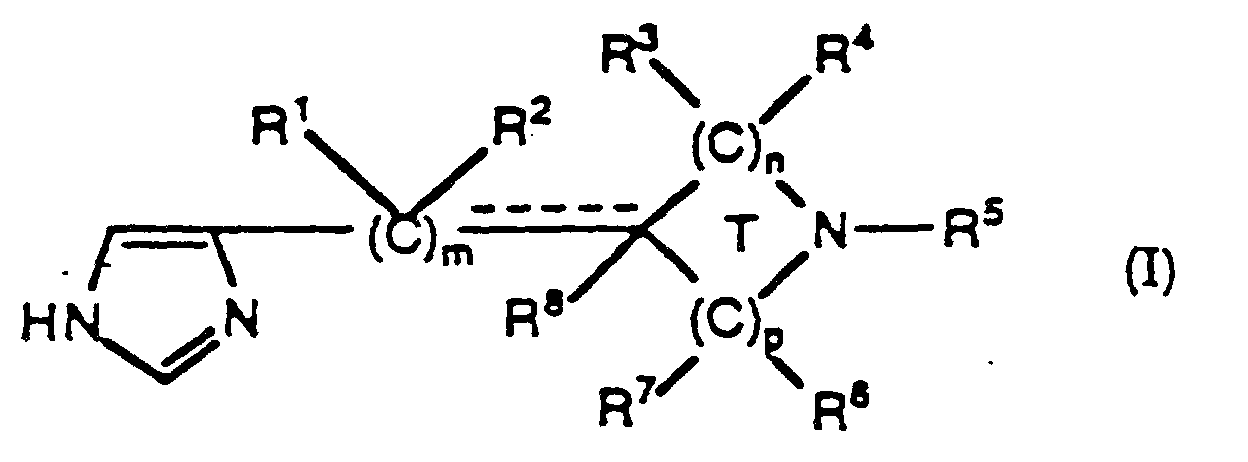 (A) m est un nombre entier sélectionné dans le groupe consistant en : 0, 1, et 2;(B) n et p sont des nombres entiers et chacun est indépendamment sélectionné dans le groupe consistant en : 0, 1, 2, et 3 de façon que la somme de n et p soit 2 ou 3 de façon que quand la somme de n et p est 2, T soit un cycle à 4 membres et quand la somme de n et p est 3, T soit un cycle à 5 membres;(C) chacun de R1, R2, R3, R4, R6, R7, et R8 est indépendamment sélectionné dans le groupe consistant en :(1) H;(2) alkyle C1 à C6;(3) cycloalkyle C3 à C6; et(4) -(CH2)q-R9 où q est un nombre entier de : 1 à 7, et R9 est sélectionné dans le groupe consistant en phényle, phényle substitué, -OR10, -C(O)OR10, -C(O)R10, -OC(O)R10, -C(O)NR10R11, CN et -SR10 où R10 et R11 sont tels que définis ci-dessous et où chacun des substituants sur ledit phényle substitué est indépendamment sélectionné dans le groupe consistant en : -OH, -O-(alkyle C1 C6), halogène, alkyle C1 à C6, -CF3, -CN, et -NO2, et où lesdits phényles substitués contiennent 1 à 3 substituants;(D) R5 est sélectionné dans le groupe consistant en :(1) H;(2) alkyle C1 à C20;(3) cycloalkyle C3 à C6;(4) -C(O)OR10'; où R10' est le même que R10 défini ci-dessous à l'exception que R10' n'est pas H;(5) -C(O)R10;(6) -C(O)NR10R11;(7) allyle;(8) propargyle; et(9) -(CH2)q-R9, où q et R9 sont tels que définis ci-dessus à condition que quand q est 1, R9 ne soit pas -OH ni -SH;(E) chacun de R10 et R11 est indépendamment sélectionné dans le groupe consistant en : H, alkyle C1 à C6, et cycloalkyle C3 à C6; et, pour le substituant -C(O)NR10R11, R10 et R11, avec l'azote auquel ils sont liés, peuvent former un cycle ayant 5, 6 ou 7 atomes;(F) la ligne en pointillé (-----) représente une double liaison qui est facultativement présente quand m est 1, et T est un cycle à 5 membres et n n'est pas 0, et p n'est pas 0, et quand ladite double liaison est présente, alors R2 et R8 sont absents;(G) quand m est 2, chaque R1 est un substituant identique ou différent pour chaque m, et chaque R2 est un substituant identique ou différent pour chaque m;(H) quand n est 2 ou 3, chaque R3 est un substituant identique ou différent pour chaque n, et chaque R4 est un substituant identique ou différent pour chaque n; et(I) quand p est 2 ou 3, chaque R6 est un substituant identique ou différent pour chaque p, et chaque R7 est un substituant identique ou différent pour chaque p.
 - Composé de la revendication 1 où ledit composé est sélectionné dans le groupe consistant en composés ayant pour formule :


- Composé de la revendication 1 où ledit composé est sélectionné dans le groupe consistant en composés ayant la formule :


- Composé de la revendication 1 où m est 0 ou 1.
- Composé de la revendication 4 où R5 est sélectionné dans le groupe consistant en H, alkyle C1 à C20 et (CH2)q-R9 où R9 est phényle.
- Composé de la revendication 5 où R1 à R4 et R6 à R8 sont indépendamment sélectionnés dans le groupe consistant en H, alkyle C1 à C6, et -(CH2)q-R9 où R9 est phényle.
- Composé de la revendication 6 où chaque R1 à R4 et R6 à R8 sont indépendamment sélectionnés dans le groupe consistant en H, méthyle, éthyle, pentyle, benzyle, et 2-phényléthyle.
- Composé de la revendication 7 où R5 est H ou méthyle.
- Composé de la revendication 1 ayant la formule sélectionnée dans le groupe consistant en :

- Composé de la revendication 9 où R7 est alkyle C1 à C6, R1 est H, et R2 est H.
- Composé de la revendication 1 ayant la formule sélectionnée dans le groupe consistant en :


- Composé de la revendication 11 où R5 est sélectionné dans le groupe consistant en H et méthyle.
- Composé de la revendication 12 où R1 est H.
- Composé de la revendication 1 où ledit composé est sélectionné dans le groupe consistant en :


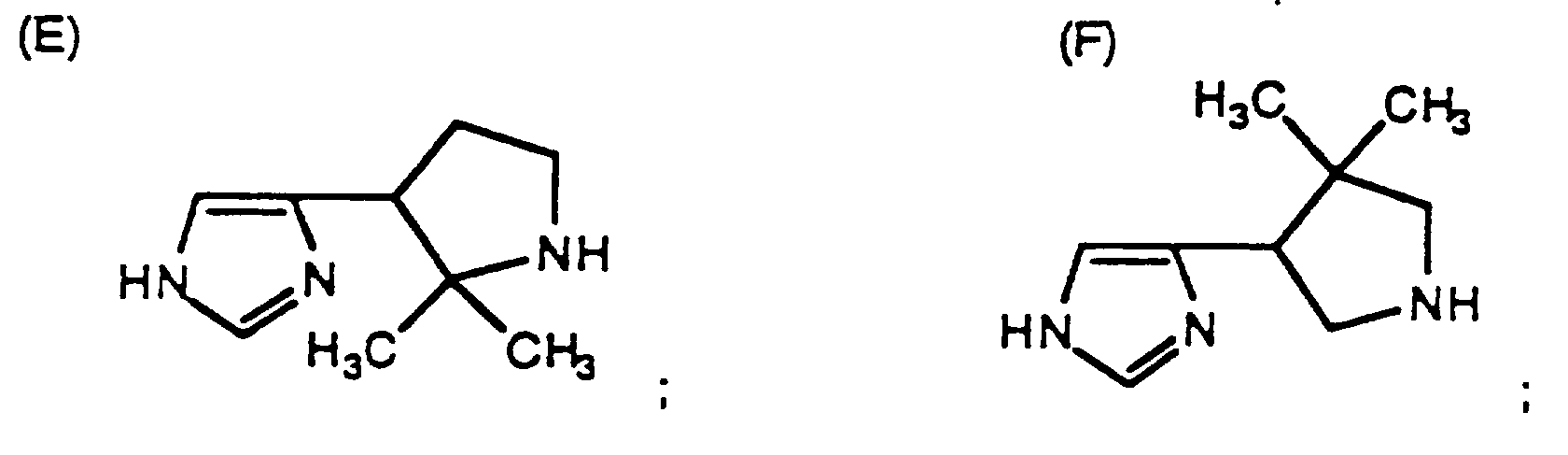
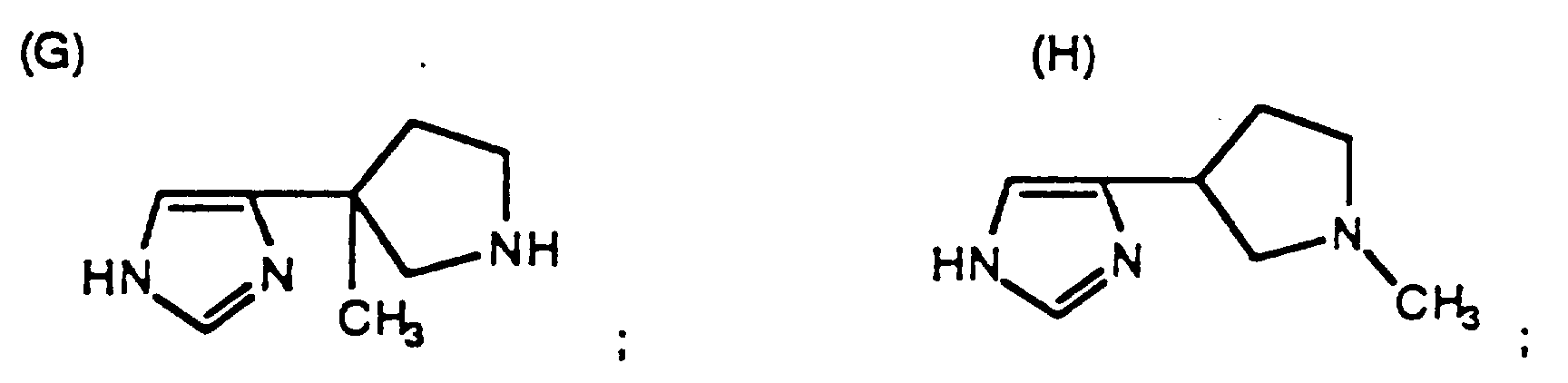


- Composé de la revendication 14 ayant pour formule :

- Composé de la revendication 14 ayant pour formule :

- Composé de la revendication 14 ayant pour formule :

- Composé de la revendication 14 ayant pour formule

- Composition pharmaceutique, à utiliser comme agoniste du récepteur de H3 ou antagoniste comprenant un support pharmaceutiquement acceptable et une quantité efficace d'un Composé de la revendication 1.
- Méthode de préparation d'une composition pharmaceutique consistant à mélanger un composé de la revendication 1 avec son support pharmaceutiquement acceptable.
- Procédé de préparation d'un composé de la revendication 1 de la formule indiquée, comprenant un processus sélectionné parmi les Processus (I) à (IX) qui suivent :

 1) suppression de la protection du composé (20) par traitement avec un acide aqueux dilué, à une température de 25 à 90°C, pour produire le composé (22), ladite réaction suivant le trajet réactionnel 1 quand R14 est alkyle, cycloalkyle, benzyle, benzyle substitué, allyle ou propargyle; ou2)(a) traitement du composé (20), quand R14 est -Si(CH3)2C(CH3)3, avec du fluorure de tétrabutylammonium dans le tétrahydrofuranne à une température de 0 à 50°C pour produire le composé (21); ou le traitement du composé (20), quand R14 est -C(O)O(t-butyl), avec un acide aqueux dilué pour produire le composé (21);(b) réaction du composé (21) avec (i) R5-X, où R5 est -C(O)R10, -C(O)OR10', -C(O)NR10R11 ou alkyle dans un solvant organique facultativement en présence d'une base appropriée; ou (ii) avec R5A-CHO, quand R5 est alkyle, cycloalkyle, allyle, propargyle, benzyle ou benzyle substitué, en conditions d'hydrogénation, ou en présence de NaBH3(CN), dans un solvant organique; où R5A représente un groupe R5 qui a un groupe -CH2- de moins et X représente un groupe partant approprié; ladite réaction (i) ou (ii) étant accomplie à une température entre -30 et 80°C; et(c) suppression de la protection du composé produit en 2)(b) par traitement avec un acide aqueux dilué à une température de 25 à 90°C pour produire le composé (22);
 1) réaction du composé (29) avec (i)R5-X, quand R5 est -C(O)R10, -C(O)OR10', -C(O)NR10R11 ou alkyle dans un solvant organique, facultativement en présence d'une base appropriée; ou (ii) avec R5A-CHO quand R5 est alkyle, cycloalkyle, allyle, propargyle, benzyle ou benzyle substitué, en conditions d'hydrogénation, ou en présence de NaBH3(CN) dans un solvant organique; où R5A représente un groupe R5 qui a un groupe -CH2- de moins et X représente un groupe partant approprié; ladite réaction (i) ou (ii) étant accomplie à une température entre -30 et 80°C, pour produire le composé (30); et2) suppression de la protection du composé (30) par traitement avec un acide aqueux dilué à une température de 25 à 90°C pour produire le composé (31);
 1) réaction du composé (37) avec (i) R5-X, quand R5 est -C(O)R10, -C(O)OR10', -C(O)NR10R11 ou alkyle dans un solvant organique, facultativement en présence d'une base appropriée; ou (ii) avec R5A-CHO, quand R5 est alkyle, cycloalkyle, allyle, propargyle, benzyle ou benzyle substitué en conditions d'hydrogénation, ou en présence de NaBH3(CN), dans un solvant organique; où R5A représente un groupe R5 qui a un groupe -CH2- de moins et X représente un groupe partant approprié; ladite réaction (i) ou (ii) étant accomplie à une température entre -30 et 80°C, pour produire le composé (38); et2) suppression de la protection du composé (38) par traitement avec un acide aqueux dilué à une température de 25 à 100°C pour donner le composé (39);
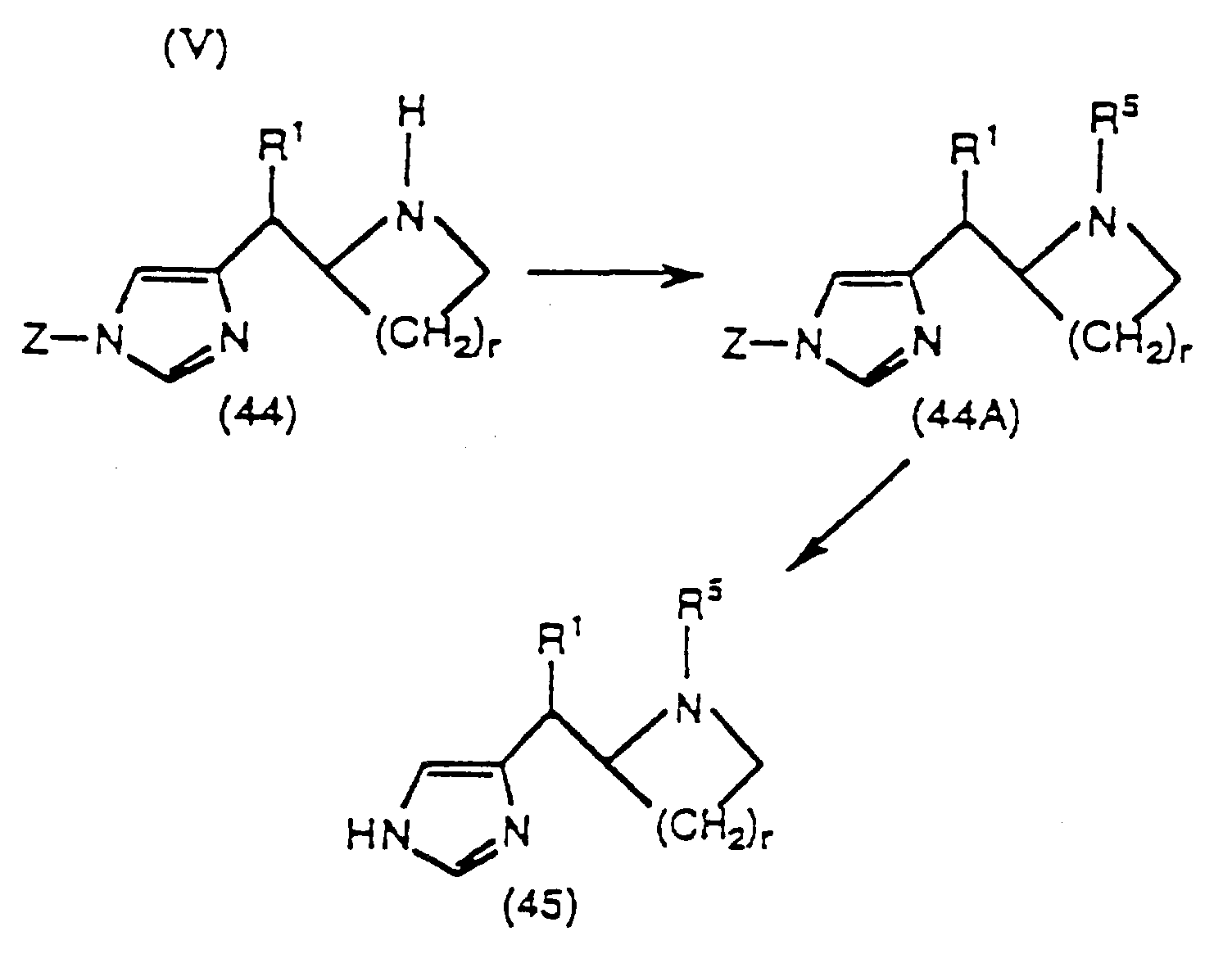 1) réaction du composé (44), où r est 1 ou 2, avec (i) R5-X, quand R5 est -C(O)R10, -C(O)OR10', -C(O)NR10R11 ou alkyle, dans un solvant organique facultativement en présence d'une base appropriée; ou (ii) avec R5A-CHO, quand R5 est alkyle, cycloalkyle, allyle, propargyle, benzyle ou benzyle substitué, en conditions d'hydrogénation, ou en présence de NaBH3(CN), dans un solvant organique; où R5A représente un groupe R5 qui a un groupe -CH2- de moins et X représente un groupe partant approprié; ladite réaction (i) ou (ii) étant accomplie à une température entre -30 et 80°C, pour produire le composé (44A); et2) suppression de la protection du composé (44A) par traitement avec un acide aqueux dilué à une température de 25 à 90°C pour produire le composé (45);
 1) suppression de la protection du composé (53), où p est 1 ou 2, par traitement avec un acide aqueux dilué, à une température de 25 à 90°C, pour produire le composé (54), ladite réaction étant utilisée quand R14 est alkyle, cycloalkyle, benzyle, benzyle substitué, allyle ou propargyle; ou2)(a) traitement du composé (53), quand R14 est -Si(CH3)2C(CH3)3, avec du fluorure de tétrabutylammonium dans le tétrahydrofuranne à une température de 0 à 50°C; ou traitement du composé (53), quand R14 est -C(O)O(t-butyl), avec un acide aqueux dilué;(b) réaction du composé produit en 2)(a) avec (i) R5-X, quand R5 est -C(O)R10, -C(O)OR10', -C(O)NR10R11 ou alkyle dans un solvant organique facultativement en présence d'une base appropriée; ou (ii) avec R5A-CHO, quand R5 est alkyle, cycloalkyle, allyle, propargyle, benzyle ou benzyle substitué, en conditions d'hydrogénation, ou en présence de NaBH3(CN), dans un solvant organique; où R5A représente un groupe R5 qui a un groupe -CH2- de moins et X représente un groupe partant approprié; ladite réaction (i) ou (ii) étant accomplie à une température entre -30 et 80°C; et(c) suppression de la protection du composé produit en 2)(b) par traitement avec un acide aqueux dilué à une température de 25 à 90°C pour produire le composé (54);
 1) préparation de l'anion du composé (56) par réaction du composé (56) avec une base appropriée à une température de -20 à 20°C et réaction dudit anion avec le composé (32)
 2) réaction du produit de 1) avec R1-Q, où Q est Li ou MgBr, dans un solvant approprié contenant CuCN et un acide de Lewis, ladite réaction est entreprise à une température de -78 à 20°C;3) réaction de l'énolate du produit de 2) avec R8-L, où L représente un groupe partant approprié, dans un solvant organique, ladite réaction est entreprise à une température de 0 à 50°C;4) réduction du composé R8 substitué résultant de 3) avec LiAlH4 à une température de 25 à 65°C dans un solvant organique;5) suppression de la protection du produit réactionnel de 4) par traitement avec un acide aqueux dilué, à une température de 25 à 90°C, pour produire le composé (57), ladite réaction étant utilisée quand R14 est alkyle, cycloalkyle, benzyle, benzyle substitué, allyle ou propargyle; ou6)(a) traitement du produit réactionnel de (4), quand R14 est -Si(CH3)2C(CH3)3, avec du fluorure de tétrabutylammonium dans le tétrahydrofuranne à une température de 0 à 50°C; ou bien traitement du produit de la réaction de 4), quand R14 est -C(O)O(t-butyl), avec un acide aqueux dilué;b) réaction du composé produit en 6)(a) avec (i) R5-X, quand R5 est -C(O)R10, -C(O)OR10', -C(O)NR10R11 ou alkyle dans un solvant organique facultativement en présence d'une base appropriée; ou bien (ii) avec R5A-CHO, quand R5 est alkyle, cycloalkyle, allyle, propargyle, benzyle ou benzyle substitué, en conditions d'hydrogénation, ou en présence de NaBH3(CN), dans un solvant organique; où R5A représente un groupe R5 qui a un groupe -CH2- de moins et X représente un groupe partant approprié; ladite réaction (i) ou (ii) étant accomplie à une température entre -30 et 80°C; etc) suppression de la protection du composé produit en 6)(b) par traitement avec un acide aqueux dilué à une température de 25 à 90°C pour produire le composé (57);
 1) préparation de l'anion du composé (56) par réaction du composé (56) avec une base appropriée à une température de -20 à 20°C, et réaction dudit anion avec le composé 42
 2) réaction de l'énolate du produit de 1) avec R8-L, où L représente un groupe partant approprié, dans un solvant organique, ladite réaction est entreprise à une température de 0 à 50°C;3) réduction du composé R8 substitué résultant de 2) avec LiAlH4 à une température de 25 à 65°C dans un solvant organique;4) suppression de la protection du produit réactionnel de 3) par traitement avec un acide aqueux dilué à une température de 25 à 90°C, pour produire le composé (57), ladite réaction étant utilisée quand R14 est alkyle, cycloalkyle, benzyle, benzyle substitué, allyle ou propargyle; ou5)(IX) utilisation du composé (58) :(a)traitement du produit réactionnel de 3), quand R14 est -Si(CH3)2C(CH3)3, avec du fluorure de tétrabutylammonium dans le tétrahydrofuranne à une température de 0 à 50°C; ou bien traitement du produit réactionnel de 3), quand R14 est -C(O)O(t-butyl), avec un acide aqueux dilué;(b) réaction du composé produit en 5)(a) avec (i) R5-X, quand R5 est -C(O)R10, -C(O)OR10', -C(O)NR10R11 ou alkyle dans un solvant organique, facultativement en présence d'une base appropriée; ou (ii) avec R5A-CHO, quand R5 est alkyle, cycloalkyle, allyle, propargyle, benzyle ou benzyle substitué, en conditions d'hydrogénation, ou en présence de NaBH3(CN), dans un solvant organique; où R5A représente un groupe R5 qui a un groupe -CH2- de moins et X représente un groupe partant approprié; ladite réaction (i) ou (ii) étant accomplie à une température entre -30 et 80°C; et(c) suppression de la protection du composé produit en 5)(b) par traitement avec un acide aqueux dilué à une température de 25 à 90°C pour produire le composé (57);


 1) traitement du composé (71) avec un acide dans un solvant organique inerte à une température de 0°C pour provoquer la suppression sélective de la protection du cycle de pyrrolidine;2) réaction du produit réactionnel de 1) avec (i)R5-X, quand R5 est -C(O)R10, -C(O)OR10', -C(O)NR10R11 ou alkyle dans un solvant organique, facultativement en présence d'une base appropriée; ou (ii) avec R5A-CHO, quand R5 est alkyle, cycloalkyle, allyle, propargyle, benzyle ou benzyle substitué, en conditions d'hydrogénation, ou en présence de NaBH3(CN), dans un solvant organique; où R5A représente un groupe R5 qui a un groupe -CH2- de moins et X représente un groupe partant approprié; ladite réaction (i) ou (ii) étant accomplie à une température entre -30 et 80°C; et2) suppression de la protection du produit réactionnel de 2) par traitement avec un acide aqueux dilué à une température de 25 à 90°C pour produire le composé (72); ou(XI) Préparation des composés de la revendication 1, où R5 est H, par réaction d'un composé intermédiaire de l'une des étapes de procédé ci-dessus (I), (II), (III), (IV), (V), (VI), (VII), (VIII), (IX), ou (X), avec un acide aqueux, à une température de 25 à 100°C, ledit composé intermédiaire ayant l'azote de l'imidazole protégé par Z et ayant l'azote de l'amine cyclique à quatre ou cinq membres substitué par - C(O)O(t-butyl) ou non substitué.
 - Utilisation d'un composé de formule I selon l'une quelconque des revendications 1 à 18 dans la fabrication d'un médicament pour une utilisation comme agoniste du récepteur de H3 ou antagoniste.
Applications Claiming Priority (3)
| Application Number | Priority Date | Filing Date | Title |
|---|---|---|---|
| US80978191A | 1991-12-18 | 1991-12-18 | |
| US809781 | 1991-12-18 | ||
| PCT/US1992/010743 WO1993012108A1 (fr) | 1991-12-18 | 1992-12-17 | Imidazolyle ou imidazoylalkyle substitue par un azote a quatre ou cinq membres contenant un compose heterocyclique |
Publications (2)
| Publication Number | Publication Date |
|---|---|
| EP0618913A1 EP0618913A1 (fr) | 1994-10-12 |
| EP0618913B1 true EP0618913B1 (fr) | 1996-08-14 |
Family
ID=25202205
Family Applications (1)
| Application Number | Title | Priority Date | Filing Date |
|---|---|---|---|
| EP93901329A Expired - Lifetime EP0618913B1 (fr) | 1991-12-18 | 1992-12-17 | Imidazolyle ou imidazolylalkyle substitue par un anneau a quatre ou cinq membres contenant un atome azote |
Country Status (20)
| Country | Link |
|---|---|
| US (1) | US5463074A (fr) |
| EP (1) | EP0618913B1 (fr) |
| JP (1) | JPH07121939B2 (fr) |
| KR (1) | KR0142802B1 (fr) |
| AT (1) | ATE141269T1 (fr) |
| AU (1) | AU671092B2 (fr) |
| CA (1) | CA2129679C (fr) |
| DE (1) | DE69212844T2 (fr) |
| DK (1) | DK0618913T3 (fr) |
| ES (1) | ES2090956T3 (fr) |
| GR (1) | GR3021464T3 (fr) |
| HK (1) | HK31397A (fr) |
| IL (1) | IL104125A (fr) |
| MX (1) | MX9207393A (fr) |
| MY (1) | MY110108A (fr) |
| NZ (1) | NZ246441A (fr) |
| SG (1) | SG44510A1 (fr) |
| TW (1) | TW268950B (fr) |
| WO (1) | WO1993012108A1 (fr) |
| ZA (1) | ZA929788B (fr) |
Families Citing this family (31)
| Publication number | Priority date | Publication date | Assignee | Title |
|---|---|---|---|---|
| US5633250A (en) * | 1991-12-18 | 1997-05-27 | Schering Corporation | Imidazoylalkyl substituted with a six or seven membered heterocyclic ring containing two nitrogen atoms |
| FR2732017B1 (fr) * | 1995-03-21 | 2000-09-22 | Inst Nat Sante Rech Med | Nouveaux derives de l'imidazole antagonistes et/ou agonistes du recepteur h3 de l'histamine, leur preparation et leurs applications therapeutiques |
| WO1997001556A1 (fr) * | 1995-06-29 | 1997-01-16 | Novo Nordisk A/S | Nouveaux composes azacycliques et azabicycliques substitues |
| CA2249617A1 (fr) * | 1996-04-03 | 1997-10-09 | S. Jane Desolms | Inhibiteurs de la farnesyl-proteine transferase |
| CA2250353A1 (fr) * | 1996-04-03 | 1997-10-09 | Christopher J. Dinsmore | Inhibiteurs de la farnesyl-proteine transferase |
| US6072057A (en) * | 1996-06-06 | 2000-06-06 | Gliatech Inc. | 1H-4(5)-cyclo-substituted imidazole derivatives as histamine H3 receptor agents |
| US6407132B1 (en) | 1997-07-25 | 2002-06-18 | James Black Foundation Limited | Substituted imidazole derivatives and their use as histamine H3 receptor ligands |
| US5990147A (en) * | 1997-11-07 | 1999-11-23 | Schering Corporation | H3 receptor ligands of the phenyl-alkyl-imidazoles type |
| US6034251A (en) * | 1997-11-07 | 2000-03-07 | Schering Corporation | Phenyl-alkyl-imidazoles |
| EP1028956A1 (fr) * | 1997-11-07 | 2000-08-23 | Schering Corporation | Imidazoylalkyle substitue par un noyau heterocyclique a cinq, six ou sept chainons contenant un atome d'azote |
| US6028095A (en) * | 1998-10-15 | 2000-02-22 | Warner-Lambert Company | Treatment of inflammatory bowel disease using histamine H3 -receptor agonists |
| US6133291A (en) * | 1998-10-16 | 2000-10-17 | Schering Corporation | N-(imidazolylalkyl)substituted cyclic amines as histamine-H3 agonists or antagonists |
| US6100279A (en) * | 1998-11-05 | 2000-08-08 | Schering Corporation | Imidazoylalkyl substituted with a five, six or seven membered heterocyclic ring containing one nitrogen atom |
| WO2000042023A1 (fr) | 1999-01-18 | 2000-07-20 | Novo Nordisk A/S | Imidazoles substitues, leur preparation et utilisation |
| US6908926B1 (en) | 1999-04-16 | 2005-06-21 | Novo Nordisk A/S | Substituted imidazoles, their preparation and use |
| GB9924941D0 (en) * | 1999-10-22 | 1999-12-22 | Univ Manchester | Treatment of dyskinesia |
| US6437147B1 (en) | 2000-03-17 | 2002-08-20 | Novo Nordisk | Imidazole compounds |
| US6610721B2 (en) | 2000-03-17 | 2003-08-26 | Novo Nordisk A/S | Imidazo heterocyclic compounds |
| PE20020507A1 (es) | 2000-10-17 | 2002-06-25 | Schering Corp | Compuestos no-imidazoles como antagonistas del receptor histamina h3 |
| AU2002253929A1 (en) | 2001-02-08 | 2002-09-24 | Schering Corporation | Use of dual h3/m2 antagonists with a bipiperidinic structure in the treatment of cognition deficit disorders |
| MXPA03008356A (es) | 2001-03-13 | 2003-12-11 | Schering Corp | Compuestos del tipo no imidazol como antagonistas de histamina h3. |
| FR2827863A1 (fr) * | 2001-07-27 | 2003-01-31 | Sanofi Synthelabo | Derives d'aminoalkylimidazole, leur preparation et leur utilisation en therapeutique |
| US7332508B2 (en) * | 2002-12-18 | 2008-02-19 | Novo Nordisk A/S | Substituted homopiperidine, piperidine or pyrrolidine derivatives |
| GB0505969D0 (en) | 2005-03-23 | 2005-04-27 | Novartis Ag | Organic compounds |
| EP1707203A1 (fr) | 2005-04-01 | 2006-10-04 | Bioprojet | Utilization des allkylamines sans imidazoles comme ligandes du recepteur histamine H3 pour le traitement de la maladie de Parkinson, de l'apnee obstructive du sommeil, de la demence vasculaire et de la demence avec corps de Lewy |
| EP1717235A3 (fr) | 2005-04-29 | 2007-02-28 | Bioprojet | Phenoxypropylpiperidines and -pyrrolidines et leur utilisation comme ligands du récepteur histaminique H3 |
| EP1717233A1 (fr) * | 2005-04-29 | 2006-11-02 | Bioprojet | Ligands du récepteur histaminique H3 et leur application thérapeutique |
| GB0514203D0 (en) | 2005-07-11 | 2005-08-17 | Novartis Ag | Organic compounds |
| BRPI0620736A2 (pt) | 2005-12-30 | 2011-12-20 | Novartis Ag | compostos orgánicos |
| SG182223A1 (en) | 2007-06-25 | 2012-07-30 | Novartis Ag | N5-(2-ethoxyethyl)-n3-(2-pyridinyl)-3,5-piperidinedicarboxamide derivatives for use as renin inhibitors |
| WO2013151982A1 (fr) | 2012-04-03 | 2013-10-10 | Arena Pharmaceuticals, Inc. | Méthodes et composés utiles pour traiter le prurit, et procédés d'identification desdits composés |
Family Cites Families (24)
| Publication number | Priority date | Publication date | Assignee | Title |
|---|---|---|---|---|
| US2987522A (en) * | 1958-03-17 | 1961-06-06 | Petrolite Corp | Amidine products |
| US3491098A (en) * | 1967-05-29 | 1970-01-20 | Sterling Drug Inc | 1-((imidazolyl)-lower-alkyl)-4-substituted-piperazines |
| US3470197A (en) * | 1967-08-30 | 1969-09-30 | Miles Lab | 1-substituted derivatives of 3-ethyl-4 - (1-methylimidazolyl-(5)-methyl)-2-pyrrolidinone |
| US4011238A (en) * | 1972-07-26 | 1977-03-08 | Gruppo Lepetit S.P.A. | 2-imidazolidione derivatives |
| EP0003732B1 (fr) * | 1978-02-01 | 1983-10-19 | The Wellcome Foundation Limited | Dérivés d'imidazole et leurs sels, leur préparation et leurs formulations pharmaceutiques |
| GR73560B (fr) * | 1979-02-24 | 1984-03-15 | Pfizer | |
| DK151884C (da) * | 1979-03-07 | 1988-06-13 | Pfizer | Analogifremgangsmaade til fremstilling af 3-(1-imidazolylalkyl)indolderivater eller farmaceutisk acceptable syreadditionssalte deraf |
| US4404387A (en) * | 1980-09-17 | 1983-09-13 | The Upjohn Company | Aminoalkyl-substituted imidazoles |
| US4404382A (en) * | 1980-09-17 | 1983-09-13 | The Upjohn Company | Piperazinyl-substituted imidazoles |
| US4431653A (en) * | 1982-03-18 | 1984-02-14 | Hoffmann-La Roche Inc. | Penicillanic acid derivatives |
| DE3313073A1 (de) * | 1983-04-12 | 1984-10-18 | Bayer Ag, 5090 Leverkusen | 1-azolyl-3-pyrazolyl-2-propanol-derivate, verfahren zu ihrer herstellung und ihre verwendung als fungizide |
| US4581370A (en) * | 1983-07-12 | 1986-04-08 | Schering A.G. | Antiarrhythmic imidazoliums |
| DK704488D0 (da) * | 1988-12-19 | 1988-12-19 | Novo Industri As | Nye n-substituerede azaheterocykliske carboxylsyrer |
| FR2579596B1 (fr) * | 1985-03-26 | 1987-11-20 | Inst Nat Sante Rech Med | (imidazolyl-4) piperidines, leur preparation et leur application en therapeutique |
| FR2586562B1 (fr) * | 1985-09-02 | 1989-03-10 | Inst Nat Sante Rech Med | Composition pharmaceutique contenant de l'a-methylhistamine |
| US4935417A (en) * | 1987-04-24 | 1990-06-19 | Syntex Pharmaceuticals Ltd. | Sustituted imidazolyl-alkyl-piperazine and -diazepine derivatives for treating cerebrovascular disease |
| US5091428A (en) * | 1987-04-24 | 1992-02-25 | Syntex Pharmaceuticals, Ltd. | Substituted imidazolyl-alkyl-piperazine and -diazepine derivatives |
| US5010075A (en) * | 1987-04-24 | 1991-04-23 | Syntex Pharmaceuticals Ltd. | Substituted imidazolyl-alkyl-piperazine and -diazepine derivatives |
| DE3811574A1 (de) * | 1988-03-31 | 1989-10-19 | Schering Ag | N-substituierte imidazole, verfahren zu ihrer herstellung sowie ihre verwendung in arzneimitteln |
| FR2630328B1 (fr) * | 1988-04-22 | 1990-08-24 | Inst Nat Sante Rech Med | Derive de l'histamine, sa preparation et son application en therapeutique |
| US4925851A (en) * | 1989-05-23 | 1990-05-15 | Sandoz Pharmaceuticals Corp. | 2- or 4-substituted-[2-(1H-imidazol-1-yl)ethyl]piperidines |
| US5264449A (en) * | 1989-11-13 | 1993-11-23 | Allergan, Inc. | N-substituted derivatives of 3R,4R-ethyl-[(1-methyl-1H-imidazol-5-yl)methyl]-2-pyrrolidinone |
| US5066663A (en) * | 1990-05-21 | 1991-11-19 | Warner-Lambert Company | Substituted-hetero-cyclopentanones and cyclopentenones and derivatives thereof acting at muscarinic receptors |
| EP0633882A1 (fr) * | 1992-04-01 | 1995-01-18 | The University Of Toledo | Imidazoles substitues de 4- 4'-piperidinyl ou de 3'-pirrolidinyl] en tant qu'antagonistes du recepteur h3 et utilisations therapeutiques |
-
1992
- 1992-12-17 US US08/244,851 patent/US5463074A/en not_active Expired - Fee Related
- 1992-12-17 WO PCT/US1992/010743 patent/WO1993012108A1/fr not_active Ceased
- 1992-12-17 JP JP5511100A patent/JPH07121939B2/ja not_active Expired - Fee Related
- 1992-12-17 AT AT93901329T patent/ATE141269T1/de not_active IP Right Cessation
- 1992-12-17 ZA ZA929788A patent/ZA929788B/xx unknown
- 1992-12-17 TW TW081110144A patent/TW268950B/zh active
- 1992-12-17 AU AU32773/93A patent/AU671092B2/en not_active Ceased
- 1992-12-17 DK DK93901329.8T patent/DK0618913T3/da active
- 1992-12-17 IL IL10412592A patent/IL104125A/xx not_active IP Right Cessation
- 1992-12-17 DE DE69212844T patent/DE69212844T2/de not_active Expired - Fee Related
- 1992-12-17 SG SG1996001200A patent/SG44510A1/en unknown
- 1992-12-17 EP EP93901329A patent/EP0618913B1/fr not_active Expired - Lifetime
- 1992-12-17 NZ NZ246441A patent/NZ246441A/en unknown
- 1992-12-17 MY MYPI92002334A patent/MY110108A/en unknown
- 1992-12-17 CA CA002129679A patent/CA2129679C/fr not_active Expired - Fee Related
- 1992-12-17 MX MX9207393A patent/MX9207393A/es not_active IP Right Cessation
- 1992-12-17 ES ES93901329T patent/ES2090956T3/es not_active Expired - Lifetime
- 1992-12-27 KR KR94701079A patent/KR0142802B1/ko not_active Expired - Fee Related
-
1996
- 1996-10-24 GR GR960402819T patent/GR3021464T3/el unknown
-
1997
- 1997-03-13 HK HK31397A patent/HK31397A/en not_active IP Right Cessation
Also Published As
| Publication number | Publication date |
|---|---|
| ZA929788B (en) | 1993-06-22 |
| DE69212844T2 (de) | 1997-01-09 |
| HK31397A (en) | 1997-03-21 |
| MX9207393A (es) | 1994-06-30 |
| SG44510A1 (en) | 1997-12-19 |
| JPH07121939B2 (ja) | 1995-12-25 |
| KR0142802B1 (en) | 1998-07-15 |
| MY110108A (en) | 1998-01-27 |
| JPH06511009A (ja) | 1994-12-08 |
| CA2129679A1 (fr) | 1993-06-24 |
| NZ246441A (en) | 1996-02-27 |
| ATE141269T1 (de) | 1996-08-15 |
| DE69212844D1 (de) | 1996-09-19 |
| GR3021464T3 (en) | 1997-01-31 |
| IL104125A0 (en) | 1993-05-13 |
| WO1993012108A1 (fr) | 1993-06-24 |
| DK0618913T3 (da) | 1996-10-14 |
| US5463074A (en) | 1995-10-31 |
| IL104125A (en) | 2000-08-31 |
| AU671092B2 (en) | 1996-08-15 |
| TW268950B (fr) | 1996-01-21 |
| CA2129679C (fr) | 2000-05-09 |
| AU3277393A (en) | 1993-07-19 |
| KR940703826A (fr) | 1994-12-12 |
| ES2090956T3 (es) | 1996-10-16 |
| EP0618913A1 (fr) | 1994-10-12 |
Similar Documents
| Publication | Publication Date | Title |
|---|---|---|
| EP0618913B1 (fr) | Imidazolyle ou imidazolylalkyle substitue par un anneau a quatre ou cinq membres contenant un atome azote | |
| EP0619818B1 (fr) | Imidazoylalkyle substitue par un cycle heterocyclique contenant de l'azote a six elements | |
| AU662588B2 (en) | Imidazolyl-alkyl-piperazine and -diazepine derivatives as histamine H3 agonists/antagonists | |
| Moltzen et al. | Bioisosteres of arecoline: 1, 2, 3, 6-tetrahydro-5-pyridyl-substituted and 3-piperidyl-substituted derivatives of tetrazoles and 1, 2, 3-triazoles. Synthesis and muscarinic activity | |
| AU650182B2 (en) | Novel azaheterocyclylmethyl-chromans | |
| EP0592438B1 (fr) | Derives d'indole | |
| US5397800A (en) | Certain 1-azabicyclo[2.2.1]heptanes useful as muscarinic receptor antagonists | |
| US6100279A (en) | Imidazoylalkyl substituted with a five, six or seven membered heterocyclic ring containing one nitrogen atom | |
| US5559246A (en) | Indole derivatives | |
| US5807872A (en) | Imidazoylalkyl substituted with a six membered nitrogen containing heterocyclic ring | |
| AU1296799A (en) | Imidazoylalkyl substituted with a five, six or seven membered heterocyclic ring containing one nitrogen atom | |
| EP0808316B1 (fr) | 2,3-dihydro-1,4-dioxynopyridines substitues a effet vasoconstricteur | |
| US5633250A (en) | Imidazoylalkyl substituted with a six or seven membered heterocyclic ring containing two nitrogen atoms | |
| US5932596A (en) | Imidazoylalkyl substituted with a six membered nitrogen containing nitrogen containing heterocyclic ring | |
| JPH1081684A (ja) | 置換3−アミノキヌクリジン薬剤組成物 |
Legal Events
| Date | Code | Title | Description |
|---|---|---|---|
| PUAI | Public reference made under article 153(3) epc to a published international application that has entered the european phase |
Free format text: ORIGINAL CODE: 0009012 |
|
| 17P | Request for examination filed |
Effective date: 19940611 |
|
| AK | Designated contracting states |
Kind code of ref document: A1 Designated state(s): AT BE CH DE DK ES FR GB GR IE IT LI LU MC NL PT SE |
|
| 17Q | First examination report despatched |
Effective date: 19950127 |
|
| GRAH | Despatch of communication of intention to grant a patent |
Free format text: ORIGINAL CODE: EPIDOS IGRA |
|
| GRAA | (expected) grant |
Free format text: ORIGINAL CODE: 0009210 |
|
| GRAH | Despatch of communication of intention to grant a patent |
Free format text: ORIGINAL CODE: EPIDOS IGRA |
|
| AK | Designated contracting states |
Kind code of ref document: B1 Designated state(s): AT BE CH DE DK ES FR GB GR IE IT LI LU MC NL PT SE |
|
| REF | Corresponds to: |
Ref document number: 141269 Country of ref document: AT Date of ref document: 19960815 Kind code of ref document: T |
|
| REG | Reference to a national code |
Ref country code: CH Ref legal event code: NV Representative=s name: HUG INTERLIZENZ AG |
|
| REG | Reference to a national code |
Ref country code: IE Ref legal event code: FG4D Free format text: 69439 |
|
| REF | Corresponds to: |
Ref document number: 69212844 Country of ref document: DE Date of ref document: 19960919 |
|
| REG | Reference to a national code |
Ref country code: DK Ref legal event code: T3 |
|
| REG | Reference to a national code |
Ref country code: ES Ref legal event code: FG2A Ref document number: 2090956 Country of ref document: ES Kind code of ref document: T3 |
|
| ITF | It: translation for a ep patent filed | ||
| REG | Reference to a national code |
Ref country code: ES Ref legal event code: FG2A Ref document number: 2090956 Country of ref document: ES Kind code of ref document: T3 |
|
| ET | Fr: translation filed |
Free format text: CORRECTIONS |
|
| REG | Reference to a national code |
Ref country code: GR Ref legal event code: FG4A Free format text: 3021464 |
|
| SC4A | Pt: translation is available |
Free format text: 960924 AVAILABILITY OF NATIONAL TRANSLATION |
|
| PLBE | No opposition filed within time limit |
Free format text: ORIGINAL CODE: 0009261 |
|
| STAA | Information on the status of an ep patent application or granted ep patent |
Free format text: STATUS: NO OPPOSITION FILED WITHIN TIME LIMIT |
|
| PG25 | Lapsed in a contracting state [announced via postgrant information from national office to epo] |
Ref country code: MC Effective date: 19970630 |
|
| 26N | No opposition filed | ||
| PGFP | Annual fee paid to national office [announced via postgrant information from national office to epo] |
Ref country code: DK Payment date: 20010919 Year of fee payment: 10 |
|
| PGFP | Annual fee paid to national office [announced via postgrant information from national office to epo] |
Ref country code: NL Payment date: 20010921 Year of fee payment: 10 |
|
| PGFP | Annual fee paid to national office [announced via postgrant information from national office to epo] |
Ref country code: PT Payment date: 20010925 Year of fee payment: 10 |
|
| PGFP | Annual fee paid to national office [announced via postgrant information from national office to epo] |
Ref country code: LU Payment date: 20011011 Year of fee payment: 10 |
|
| PGFP | Annual fee paid to national office [announced via postgrant information from national office to epo] |
Ref country code: GR Payment date: 20011017 Year of fee payment: 10 |
|
| PGFP | Annual fee paid to national office [announced via postgrant information from national office to epo] |
Ref country code: IE Payment date: 20011019 Year of fee payment: 10 |
|
| PGFP | Annual fee paid to national office [announced via postgrant information from national office to epo] |
Ref country code: AT Payment date: 20011105 Year of fee payment: 10 |
|
| PGFP | Annual fee paid to national office [announced via postgrant information from national office to epo] |
Ref country code: SE Payment date: 20011204 Year of fee payment: 10 |
|
| REG | Reference to a national code |
Ref country code: GB Ref legal event code: IF02 |
|
| PGFP | Annual fee paid to national office [announced via postgrant information from national office to epo] |
Ref country code: CH Payment date: 20020103 Year of fee payment: 10 |
|
| PGFP | Annual fee paid to national office [announced via postgrant information from national office to epo] |
Ref country code: BE Payment date: 20020117 Year of fee payment: 10 |
|
| REG | Reference to a national code |
Ref country code: CH Ref legal event code: NV Representative=s name: E. BLUM & CO. PATENTANWAELTE |
|
| PG25 | Lapsed in a contracting state [announced via postgrant information from national office to epo] |
Ref country code: LU Free format text: LAPSE BECAUSE OF NON-PAYMENT OF DUE FEES Effective date: 20021217 Ref country code: IE Free format text: LAPSE BECAUSE OF NON-PAYMENT OF DUE FEES Effective date: 20021217 Ref country code: AT Free format text: LAPSE BECAUSE OF NON-PAYMENT OF DUE FEES Effective date: 20021217 |
|
| PG25 | Lapsed in a contracting state [announced via postgrant information from national office to epo] |
Ref country code: SE Free format text: LAPSE BECAUSE OF NON-PAYMENT OF DUE FEES Effective date: 20021218 |
|
| PG25 | Lapsed in a contracting state [announced via postgrant information from national office to epo] |
Ref country code: LI Free format text: LAPSE BECAUSE OF NON-PAYMENT OF DUE FEES Effective date: 20021231 Ref country code: CH Free format text: LAPSE BECAUSE OF NON-PAYMENT OF DUE FEES Effective date: 20021231 Ref country code: BE Free format text: LAPSE BECAUSE OF NON-PAYMENT OF DUE FEES Effective date: 20021231 |
|
| PG25 | Lapsed in a contracting state [announced via postgrant information from national office to epo] |
Ref country code: DK Free format text: LAPSE BECAUSE OF NON-PAYMENT OF DUE FEES Effective date: 20030131 |
|
| BERE | Be: lapsed |
Owner name: *SCHERING CORP. Effective date: 20021231 |
|
| PG25 | Lapsed in a contracting state [announced via postgrant information from national office to epo] |
Ref country code: PT Free format text: LAPSE BECAUSE OF NON-PAYMENT OF DUE FEES Effective date: 20030630 |
|
| PG25 | Lapsed in a contracting state [announced via postgrant information from national office to epo] |
Ref country code: NL Free format text: LAPSE BECAUSE OF NON-PAYMENT OF DUE FEES Effective date: 20030701 |
|
| PG25 | Lapsed in a contracting state [announced via postgrant information from national office to epo] |
Ref country code: GR Free format text: LAPSE BECAUSE OF NON-PAYMENT OF DUE FEES Effective date: 20030707 |
|
| REG | Reference to a national code |
Ref country code: DK Ref legal event code: EBP |
|
| EUG | Se: european patent has lapsed | ||
| REG | Reference to a national code |
Ref country code: CH Ref legal event code: PL |
|
| NLV4 | Nl: lapsed or anulled due to non-payment of the annual fee |
Effective date: 20030701 |
|
| REG | Reference to a national code |
Ref country code: PT Ref legal event code: MM4A Free format text: LAPSE DUE TO NON-PAYMENT OF FEES Effective date: 20030630 |
|
| REG | Reference to a national code |
Ref country code: IE Ref legal event code: MM4A |
|
| PGFP | Annual fee paid to national office [announced via postgrant information from national office to epo] |
Ref country code: GB Payment date: 20051104 Year of fee payment: 14 |
|
| PGFP | Annual fee paid to national office [announced via postgrant information from national office to epo] |
Ref country code: FR Payment date: 20051201 Year of fee payment: 14 |
|
| PGFP | Annual fee paid to national office [announced via postgrant information from national office to epo] |
Ref country code: ES Payment date: 20051215 Year of fee payment: 14 |
|
| PGFP | Annual fee paid to national office [announced via postgrant information from national office to epo] |
Ref country code: DE Payment date: 20051230 Year of fee payment: 14 |
|
| PGFP | Annual fee paid to national office [announced via postgrant information from national office to epo] |
Ref country code: IT Payment date: 20061231 Year of fee payment: 15 |
|
| PG25 | Lapsed in a contracting state [announced via postgrant information from national office to epo] |
Ref country code: DE Free format text: LAPSE BECAUSE OF NON-PAYMENT OF DUE FEES Effective date: 20070703 |
|
| GBPC | Gb: european patent ceased through non-payment of renewal fee |
Effective date: 20061217 |
|
| REG | Reference to a national code |
Ref country code: FR Ref legal event code: ST Effective date: 20070831 |
|
| PG25 | Lapsed in a contracting state [announced via postgrant information from national office to epo] |
Ref country code: GB Free format text: LAPSE BECAUSE OF NON-PAYMENT OF DUE FEES Effective date: 20061217 |
|
| REG | Reference to a national code |
Ref country code: ES Ref legal event code: FD2A Effective date: 20061218 |
|
| PG25 | Lapsed in a contracting state [announced via postgrant information from national office to epo] |
Ref country code: FR Free format text: LAPSE BECAUSE OF NON-PAYMENT OF DUE FEES Effective date: 20070102 Ref country code: ES Free format text: LAPSE BECAUSE OF NON-PAYMENT OF DUE FEES Effective date: 20061218 |
|
| PG25 | Lapsed in a contracting state [announced via postgrant information from national office to epo] |
Ref country code: IT Free format text: LAPSE BECAUSE OF NON-PAYMENT OF DUE FEES Effective date: 20071217 |