EP0620255B1 - Abriebfeste, beschlaghindernde Überzugszusammensetzung und damit beschichteter Kunststofformkörper - Google Patents
Abriebfeste, beschlaghindernde Überzugszusammensetzung und damit beschichteter Kunststofformkörper Download PDFInfo
- Publication number
- EP0620255B1 EP0620255B1 EP94105810A EP94105810A EP0620255B1 EP 0620255 B1 EP0620255 B1 EP 0620255B1 EP 94105810 A EP94105810 A EP 94105810A EP 94105810 A EP94105810 A EP 94105810A EP 0620255 B1 EP0620255 B1 EP 0620255B1
- Authority
- EP
- European Patent Office
- Prior art keywords
- meth
- acrylate
- group
- composition
- dimethoxysilane
- Prior art date
- Legal status (The legal status is an assumption and is not a legal conclusion. Google has not performed a legal analysis and makes no representation as to the accuracy of the status listed.)
- Expired - Lifetime
Links
Classifications
-
- C—CHEMISTRY; METALLURGY
- C09—DYES; PAINTS; POLISHES; NATURAL RESINS; ADHESIVES; COMPOSITIONS NOT OTHERWISE PROVIDED FOR; APPLICATIONS OF MATERIALS NOT OTHERWISE PROVIDED FOR
- C09D—COATING COMPOSITIONS, e.g. PAINTS, VARNISHES OR LACQUERS; FILLING PASTES; CHEMICAL PAINT OR INK REMOVERS; INKS; CORRECTING FLUIDS; WOODSTAINS; PASTES OR SOLIDS FOR COLOURING OR PRINTING; USE OF MATERIALS THEREFOR
- C09D4/00—Coating compositions, e.g. paints, varnishes or lacquers, based on organic non-macromolecular compounds having at least one polymerisable carbon-to-carbon unsaturated bond ; Coating compositions, based on monomers of macromolecular compounds of groups C09D183/00 - C09D183/16
- C09D4/06—Organic non-macromolecular compounds having at least one polymerisable carbon-to-carbon unsaturated bond in combination with a macromolecular compound other than an unsaturated polymer of groups C09D159/00 - C09D187/00
-
- C—CHEMISTRY; METALLURGY
- C08—ORGANIC MACROMOLECULAR COMPOUNDS; THEIR PREPARATION OR CHEMICAL WORKING-UP; COMPOSITIONS BASED THEREON
- C08F—MACROMOLECULAR COMPOUNDS OBTAINED BY REACTIONS ONLY INVOLVING CARBON-TO-CARBON UNSATURATED BONDS
- C08F265/00—Macromolecular compounds obtained by polymerising monomers on to polymers of unsaturated monocarboxylic acids or derivatives thereof as defined in group C08F20/00
- C08F265/04—Macromolecular compounds obtained by polymerising monomers on to polymers of unsaturated monocarboxylic acids or derivatives thereof as defined in group C08F20/00 on to polymers of esters
- C08F265/06—Polymerisation of acrylate or methacrylate esters on to polymers thereof
-
- C—CHEMISTRY; METALLURGY
- C09—DYES; PAINTS; POLISHES; NATURAL RESINS; ADHESIVES; COMPOSITIONS NOT OTHERWISE PROVIDED FOR; APPLICATIONS OF MATERIALS NOT OTHERWISE PROVIDED FOR
- C09D—COATING COMPOSITIONS, e.g. PAINTS, VARNISHES OR LACQUERS; FILLING PASTES; CHEMICAL PAINT OR INK REMOVERS; INKS; CORRECTING FLUIDS; WOODSTAINS; PASTES OR SOLIDS FOR COLOURING OR PRINTING; USE OF MATERIALS THEREFOR
- C09D4/00—Coating compositions, e.g. paints, varnishes or lacquers, based on organic non-macromolecular compounds having at least one polymerisable carbon-to-carbon unsaturated bond ; Coating compositions, based on monomers of macromolecular compounds of groups C09D183/00 - C09D183/16
-
- Y—GENERAL TAGGING OF NEW TECHNOLOGICAL DEVELOPMENTS; GENERAL TAGGING OF CROSS-SECTIONAL TECHNOLOGIES SPANNING OVER SEVERAL SECTIONS OF THE IPC; TECHNICAL SUBJECTS COVERED BY FORMER USPC CROSS-REFERENCE ART COLLECTIONS [XRACs] AND DIGESTS
- Y10—TECHNICAL SUBJECTS COVERED BY FORMER USPC
- Y10T—TECHNICAL SUBJECTS COVERED BY FORMER US CLASSIFICATION
- Y10T428/00—Stock material or miscellaneous articles
- Y10T428/31504—Composite [nonstructural laminate]
- Y10T428/31507—Of polycarbonate
-
- Y—GENERAL TAGGING OF NEW TECHNOLOGICAL DEVELOPMENTS; GENERAL TAGGING OF CROSS-SECTIONAL TECHNOLOGIES SPANNING OVER SEVERAL SECTIONS OF THE IPC; TECHNICAL SUBJECTS COVERED BY FORMER USPC CROSS-REFERENCE ART COLLECTIONS [XRACs] AND DIGESTS
- Y10—TECHNICAL SUBJECTS COVERED BY FORMER USPC
- Y10T—TECHNICAL SUBJECTS COVERED BY FORMER US CLASSIFICATION
- Y10T428/00—Stock material or miscellaneous articles
- Y10T428/31504—Composite [nonstructural laminate]
- Y10T428/31511—Of epoxy ether
-
- Y—GENERAL TAGGING OF NEW TECHNOLOGICAL DEVELOPMENTS; GENERAL TAGGING OF CROSS-SECTIONAL TECHNOLOGIES SPANNING OVER SEVERAL SECTIONS OF THE IPC; TECHNICAL SUBJECTS COVERED BY FORMER USPC CROSS-REFERENCE ART COLLECTIONS [XRACs] AND DIGESTS
- Y10—TECHNICAL SUBJECTS COVERED BY FORMER USPC
- Y10T—TECHNICAL SUBJECTS COVERED BY FORMER US CLASSIFICATION
- Y10T428/00—Stock material or miscellaneous articles
- Y10T428/31504—Composite [nonstructural laminate]
- Y10T428/31652—Of asbestos
- Y10T428/31663—As siloxane, silicone or silane
-
- Y—GENERAL TAGGING OF NEW TECHNOLOGICAL DEVELOPMENTS; GENERAL TAGGING OF CROSS-SECTIONAL TECHNOLOGIES SPANNING OVER SEVERAL SECTIONS OF THE IPC; TECHNICAL SUBJECTS COVERED BY FORMER USPC CROSS-REFERENCE ART COLLECTIONS [XRACs] AND DIGESTS
- Y10—TECHNICAL SUBJECTS COVERED BY FORMER USPC
- Y10T—TECHNICAL SUBJECTS COVERED BY FORMER US CLASSIFICATION
- Y10T428/00—Stock material or miscellaneous articles
- Y10T428/31504—Composite [nonstructural laminate]
- Y10T428/31652—Of asbestos
- Y10T428/31667—Next to addition polymer from unsaturated monomers, or aldehyde or ketone condensation product
Definitions
- the present invention relates to an antifogging abrasion resistant coating composition and a synthetic resin article coated therewith; and, more particularly, to silicone coating composition for forming an abrasion resistant curable coating on the surface of a resin substrate to prevent fogging which may occur on the surface of the substrate, and to a synthetic resin article coated with the inventive composition.
- Optical devices when used in such diverse applications as lenses, sunglasses, goggles, reflectors, and mirrors in automobiles, frequently suffers from the fogging or misting due to differences in the ambient temperature/humidity.
- plastic materials having a superior fracture resistance have been developed and used in automobiles, other optical devices and the like. Since such plastic materials normally have a lighter weight than glass, it is particularly attractive in the field of transportation.
- plastic materials polycarbonate and polymethyl methacrylate are commonly employed. Particularly, polycarbonate is prefered due to its high impact strength, high heat distortion temperature, excellent dimensional stability and self-distinguishing property, in addition to the fact that it can be easily prepared.
- these plastic materials have a serious drawback in that they can be easily scratched by cleaning and weathering, which may cause deteriorate the transparancy and aesthetic appreance thereof.
- Japanese Patent Nos. 69247/1978, 55044/1979, 55048/1979, 88545/1979, 88637/1979, 102831/1980 and 22341/1981 disclose processes for reducing the surface fogging of a resin substrate, which comprises applying a surfactant to the surface or compounding a surfactant with the resin during the preparation of the latter.
- these methods have the limited ability of preventing the fogging and improving the abrasion resistance.
- Japanese Patent Nos. 69678/1980, 86848/1980, 53070/1981, 239/1986, 6064/1988 and 172778/1988, U.S. Patent No. 4,080,476 and European Patent No. 399,441 disclose compositions comprising a hydrophilic acrylic resin, a radiation-curable (meth)acrylate and a surfactant, which are intended to provide a cured coating having an improved abrasion resistance and anti-fogging property.
- these compositions has a balancing dilemma in that when an improved abrasion resistance is obtained, the anti-fogging property becomes inferior; and vice versa.
- the coating obtained by the above process provides an improved abrasion resistance, but still has an inferior anti-fogging effect to that of the above acrylic resin composition. Further, when polycarbonate is employed as a substrate, the adhesion between the substrate in the cured coating is poor, which may take the coating get easily peeled off from the substrate.
- US-A-4908840 discloses thermosetting resin compositions which were prepared by polymerizing monomers in situ to obtain a polymer.
- the known composition does not contain an epoxy functional silane.
- the curing time is relatively long.
- US-A-4 522 966 discloses a non-fogging coating composition which comprises a polyhydric alcohol having an ethylene oxide chain and an epoxyalkylacrylate polymer as additional components. The curing of the known composition leads to a coating having a limited cross linking density.
- JP-A-541 195 99 discloses a thermoset resin composition comprising ⁇ -mercaptopropyltrimethoxysilane which is foul smelling. Further the curing time of the known composition is quite long.
- a coating composition comprising:
- a coating composition containing at least one compound having an epoxide group comprising:
- a coated composition comprising:
- Preferred embodiments of the first aspect of the present invention are compositions wherein the aminofunctional organosilane compound (B) is selected from the group consisting of aminomethyl trimethoxy silane, aminoethyl trimethoxysilane, aminoethyl triethoxy silane, aminoethyl triethoxysilane, ⁇ -aminopropyl trimethoxy silane, aminoethyl triacetoxysilane, ⁇ -aminopropyl triethoxy silane, ⁇ -aminopropyl methyldimethoxysilane, ⁇ -aminopropyl methyldiethoxysilane, N- ⁇ -(aminoethyl)- ⁇ -aminopropyl trimethoxysilane, N- ⁇ -(aminoethyl)- ⁇ -aminoprpyl triethoxy silane, ⁇ -aminobutyl trimethoxysilane, ⁇ -aminobutyl tri
- a curing catalyst (F) is added, which is a base selected from the group consisting of sodium hydroxide, ammonia, potassium, hydroxide, n-butylamide, di-n-butylamide, tri-n-butylamide, guanidine, biguanide, imidazole, ammonium perchlorate, triphenoxy boron and choline acetate;
- the multifunctional (meth)acrylate is selected from the group consisting of pentaerithritol tetra(meth)acrylate, pentaerithritol tri(meth)acrylate, trimethylolpropane tri(meth)acrylate, trimethylolethane tri(meth)acrylate, pentaglycerol tri(meth)acrylate, dipentaerithritol tetra(meth)acrylate, dipentaerithritol penta(meth)acrylate, dipentaerithritol hexa(meth)acrylate, ethylene glycol di(meth)acrylate, 1,3-propylene glycol di(meth)acrylate, 1,4-butanediol di(meth)acrylate, 1,6-hexanediol di(meth)acrylate, tripropylene glycol di(meth)acrylate, ethoxylated bisphenol
- the inventive coating composition may be a blend of two or more of the composition.
- a synthetic resin article having the inventive composition coated onto the surface of the resin substrate and hot-air drying the coated substrate at a temperature ranging from 90 to 150°C for a period ranging from 10 minutes to 2 hours to form a cured film on the surface in a thickness ranging from 1 to 30 ⁇ m.
- the substrate is made of a polymer material selected from the group consisting of polymethylmethacrylate, polycarbonate, polyallydiglycol carbonate, polstyrene, acrylonitrile-styrene copolymer, polyvinyl chloride, polyacetate, ABS (acrylonitrile-butadienestyrene) and polyester.
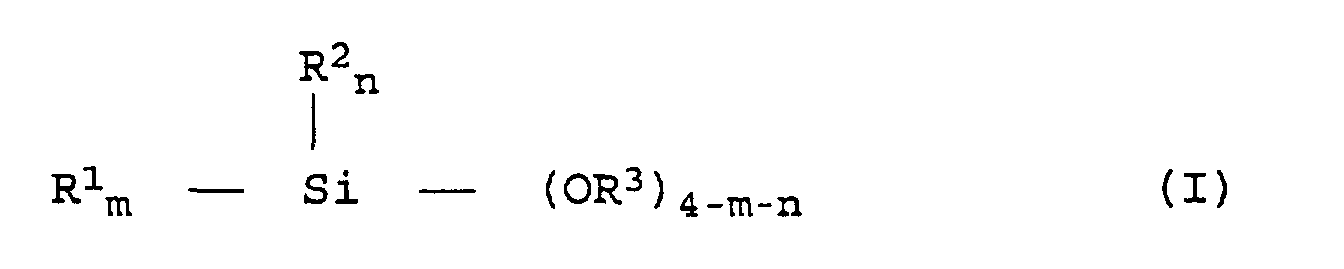
- the epoxy functional organosilane which may be used as Component(A), may be preferably possessed with at least one epoxy group.
- Representative examples of the epoxy functional organosilane compound may include: glycidoxymethyl trimethoxysilane, glycidoxymethyl triethoxysilane, ⁇ -gycidoxypropyl trimethoxysilane, ⁇ -glycidoxypropyl triethoxysilane, ⁇ -glycidoxypropyl tri(methoxyethoxy)silane, ⁇ -glycidoxypropyl triacetoxysilane, glycidoxymethyl dimethoxysilane, glycidoxymethyl (methyl)dimethoxysilane, glycidoxymethyl (ethyl)dimethoxysilane, glycidoxymethyl (phenyl)dimethoxysilane, glycidoxymethyl (vinyl) dimethoxysilane, glycidoxymethyl (dimethyl)me
- the hydrolysate or condensate of the epoxy functional organosilane compound may be used and easily produced by adding water in the presence of a hydrolysis or condensation catalyst to the organosilane compound in a lower alcohol such as methanol, ethanol and isopropanol.
- the hydrolysate or condensate preferably has a concentration ranging from 10 to 70 wt%, more preferably 20 to 60 wt% (based on solids) and a viscosity ranging from 5 to 50 cps(centipoise) at 25°C. If the solid content is less than 10wt%, the abrasion resistance and the anti-fogging effect becomes lowered; and, if the solid-content is greater than 70wt%, the storage stability becomes poor.
- the epoxy functional organosilane compound or the hydrolysate or condensate thereof, as Component(A), may be preferably employed in an amount of up to 50wt% of the composition. If the amount is greater than 50wt%, the storage stability of the composition as well as the anti-fogging effect becomes deteriorated.
- Component(A) provides a cured coating having a strong abrasion resistance preferably when applied on the surface of the substrate and then dried and cured at a temperature ranging from 90 to 150°C for a period ranging from 10 minutes to 2 hours.
- the epoxy group in Component(A) participates in forming a crosslinkage together with the amino functional group or hydroxyl group of the other components.
- the amino functional organosilane which may be used as Component(B), is preferably possessed with at least one amino group.
- exemplary amino funtional organosilane compounds are: aminomethyl trimethoxy silane, aminoethyl trimethoxysilane, aminomethyl triethoxy silane, aminoethyl triethoxysilane, ⁇ -aminopropyl trimethoxy silane, aminoethyl triacetoxysilane, ⁇ -aminopropyl triethoxy silane, ⁇ -aminopropyl methyldimethoxy silane, ⁇ -aminopropyl methyldiethoxysilane, N- ⁇ -(aminoethyl)- ⁇ -aminopropyl trimethoxysilane, N- ⁇ -(aminoethyl)- ⁇ -aminopropyl triethoxy silane, ⁇ -aminobutyl trimethoxysilane, ⁇ -aminobut
- the hydrolysate or condensate of the amino functional organosilane compound may be preferably used; and easily produced by adding water in the presence of a hydrolysis or condensation catalyst to the organosilane compound in a lower alcohol such as methanol, ethanol and isopropanol.
- the hydrolysate or condensate preferably has a concentration ranging from 10 to 60 wt%, more preferably 20 to 50 wt% (based on solids) and a viscosity ranging from 5 to 300 cps(centipoise) at 25°C. If the solid content is less than 10wt%, the abrasion resistance and the anti-fogging effect becomes lowered; and, if the solid content is greater than 60wt%, the storage stability and the coatability of the composition become lowered.
- the amino functional organosilane compound or the hydrolysate or condensate thereof, as Component(B), may be preferably employed in an amount of ranging from 10 to 70wt% of the composition. If the amount is less than 10wt%, the anti-fogging effect of the finally cured coating composition becomes lowered; and, if the amount is greater than 70wt%, the abrasion resistance of the cured coating and the coatability of the composition are poor.
- the amount of water employed may range from 0.1 to 5 moles per mole of the hydrolyzable group contained in the organosilane compound. If the amount of water employed is less than 0.1 mole, the overall conversion of the silane during the curing of the coated substrate becomes lowered; and, if the amount is greater than 5 moles, the abrasion resistance of the cured coating and the coatability of the composition are poor.
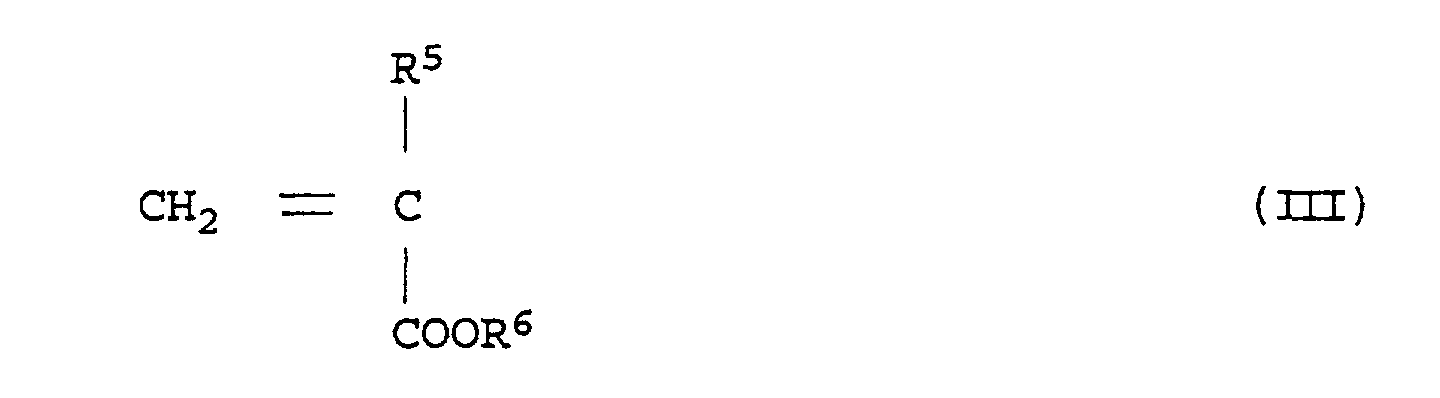
- a hydrophilic (meth)acrylate monomer of formula(III), or a copolymer of two components selected from the hydrophilic monomer of formula(III), a hydrophilic monomer of formula(IV) and an organosilane of formula(V) and/or a terpolymer of the three components may be employed.
- the hydrophilic (meth)acrylate monomer of formula(III) is preferably possessed with at least one hydrophilic group and may be selected from the group consisting of acrylic acid, methacrylic acid, 2-hydroxyethyl acrylate, 2-hydroxypropyl acrylate, 2-hydroxyethyl methacrylate, 2-hydroxypropyl methacrylate, 3-hydroxypropyl acrylate, 3-hydroxypropyl methacrylate, hydroxyallyl methacrylate, 2-carboxylethyl acrylate, glycidyl methacrylate and the like.
- representative of the hydrophilic monomer of formula(IV) may include: glycidyl acrylate, glycidyl methacrylate, acrylamide, methacrylamide, N-hydroxymethyl (meth)acrylamide, N-(2-hydroxyethyl) (meth)acrylamide, N,N-dihydroxymethyl (meth)acrylamide, N,N-di(2-hydroxyethyl) (meth)acrylamide and the like.
- Suitable silicon-containing compounds of formula(V) may include: N-(3-acryloxy-2-hydroxypropyl)-3-aminopropyl triethoxysilane, 3-acryloxy propyldimethylmethoxysilane, 3-acryloxy propylmethylbis(trimethylsiloxy)silane, 3-acryloxy propylmethyldichlorosilane,3-acryloxypropyltrimethoxysilane, 3-acryloxy propyl tris(trimethylsiloxy)silane, 3-(meth) acryloxy propyltrimethoxysilane and the like.
- the hydrophilic (meth)acrylate of formula(III) may be connected to a silicon network by a Michael addition reaction with the amino group of the amino functional organosilane of formula(II) or the condensate or hydrolysate thereof, as Component(B), or may form separately a polymer chain by a radical polymerization of the double bond present therein.
- the double bond in the (meth)acrylate participates in forming the network to thereby contribute toward the improvement of the abrasion resistance; and the hydrophilic group of the (meth)acrylate, i.e., a hydroxyl, carboxyl or glycidyl group, provides anti-fogging effect.
- a copolymer of two components selected from the hydrophilic (meth)acrylate(III), a hydrophilic monomer of formula(IV) and an organosilane of formula(V), and/or a terpolymer of the three components, which may also be used as Component(C), preferably has an average molecular weight ranging from 2,000 to 100,000 and may be prepared by a conventional method.
- hydrophilic (meth) acrylate of formula(III), the copolymer and the terpolymer may be used individually or in a mixture thereof.
- Component(C) may be employed in an amount ranging from 10 to 70wt%, preferably 15 to 60 wt%, of the composition. If the amount is less than 10wt%, the effect of reducing the fogging and improving the abrasion resistance becomes rapidly lowered; and, if the amount is greater than 70wt%, the abrasion resistance and wettability of the cured coating become inferior.
- a curing catalyst as Component(D) is employed in the coating composition of the present invention, which functions to catalyze the curing process of the composition.
- Such curing catalyst may be an acid, base or metallic salt; and the representative compounds thereof include:
- the curing catalyst may be employed in an amount ranging from 0.05 to 10 wt%, preferably 0.1 to 5 wt% of the composition.
- the epoxy functional organosilane (as Component(A)) is employed in an amount of up to 20wt%; the amino functional organosilane (as Component(B)) is employed in an amount ranging from 15 to 70wt%; the hydrophilic (meth)acryalte monomer, or the copolymer and/or terpolymer(as Component(C)) is employed in an amount ranging from 15 to 70wt%; and the curing catalyst (as Component(D)) is employed in an amount ranging from 0.05 to 10% by weight of the composition.
- the coating composition of the present invention employs the hydrophilic (meth)acrylate monomer of formula(III) as Component(C)
- the composition may comprise a multi-functional (meth)acrylate(Component(E)) having at least two (meth)acryl group in one molecule, as a crosslinking agent component, and a radical polymerization initiator(Component (F)).
- Component(E) and Component(F) are not required.
- multi-functional (meth)acrylate are: those compounds having at least three functional groups, such as pentaerithritol tetra(meth)acrylate, pentaerithritol tri(meth)acrylate, trimethylolpropane tri(meth)acrylate, trimethylolethane tri(meth)acrylate, pentaglycerol tri(meth)acrylate, dipentaerithritol tetra(meth)acrylate, dipentaerithritol penta(meth)acrylate, dipentaerithritol hexa(meth)acrylate; and di-functional(meth)acrylate compounds such as ethylene glycol di(meth)acrylate, 1,3-propylene glycol di(meth)acrylate, 1,4-butanediol di(meth)acrylate, 1,6-hexanediol di(meth)acrylate, tripropylene glycol di(meth)acrylate,
- the multi-functional (meth)acrylate monomer may be coupled to a silicon network by a Michael addition reaction with the amino group of the amino functional organosilane of formula(II) or the condensate or hydrolysate thereof (Component(B)), or may form an inter-crosslinked chain structure by crosslinking it with the hydrophilic (meth)acrylate (Component(C)) by a radical polymerization, to thereby impart an improved abrasion resistance to the cured coating.
- the (meth)acryl group of the multi-functional (meth)acrylate monomer provides an excellent coatabilty of the composition to the polycarbonate substrate, together with the (meth)acryl group of the hydrophilic (meth)acrylate (Component(C)).
- the multi-functional (meth)acrylate monomer may be employed in an amount ranging from 0.5 to 20 wt%, preferably 1 to 10 wt% of the composition. If the amount is less than 0.5wt%, the effect of improving the abrasion resistance is very low due to the reduced level of crosslinking; and, if the amount is greater than 20wt%, the storage stability of the composition becomes lowered due to gelation by a Michael addition reaction.
- the radical polymerization initiator (Component(F)), which easily generates radicals when heated, is employed to accelerate the polymerization between the hydrophilic (meth)acrylate (Component(C)) and the multi-functional (meth)acrylate monomer (Component(E)) upon curing of the composition.
- the radical polymerization initiator may be, for example, a ketone peroxide, diacyl peroxide, hydroperoxide, dialkyl peroxide, peroxy ketal, alkyl perester, peroxy carbonate and a water soluble peroxide.
- ketone peroxide may include: ethylmethylketone peroxide, methylisobutylketone peroxide, cyclohexanone peroxide, methylcyclohexanone peroxide, 3,3,5-trimethylcyclohexanone peroxide and the like;
- exemplary diacyl peroxide may include: acetyl peroxide, propionyl peroxide, isobutyryl peroxide, octanoyl peroxide, 3,3,5-trimethylhexanoyl peroxide, decanoyl peroxide, rauroyl peroxide, benzoyl peroxide, para-chlorobenzoyl peroxide, 2,4-dichlorobenzoyl peroxide, acetyl cyclohexanesulfonyl peroxide and the like;and exemplary hydroperoxide may include: t-butyl hydroperoxide, cumene hydroperoxide, isopropy
- dialkyl peroxide examples include: di-t-butyl peroxide, t-butyl- ⁇ -cumyl peroxide, dicumene peroxide, 1,4-bis(t-butylperoxyisopropyl)benzene, 1,3-bis(t-butyl peroxyisopropyl)benzene, 2,5-dimethyl-2,5-di(t-butylperoxy) hexane and the like;
- exemplary peroxy ketal may include: 1,1-bisbutyl peroxy-3,3,5-trimethyl cyclohexane, n-butyl-4,4-bis(t-butylperoxy)valerate, 2,2-bis(t-butylperoxy) butane and the like.
- alkyl perester may include: t-butyl peroxyacetate, t-butyl peroxyisobutyrate, t-butyl peroxyoctoate, t-butyl peroxypivalate, t-butyl peroxy neodecanoate, t-butyl peroxy-3,5,5-trimethylhexanoate, t-butyl peroxybenzoate, di-t-butyl peroxyphthalate, di-t-butyl peroxyisophthalate, t-butyl peroxylaurate, 2,5-dimethyl-2,5-dibenzoyl peroxyhexane and the like; and exemplary compounds of the peroxycarbonate may include: di-2-ethylhexyl peroxydicarbonate, diisopropyl peroxydicarbonate, di-sec-butyl peroxydicarbonate, di-n-propyl peroxydicarbonate, dimethoxy iso
- the radical polymeriztion initiator if chosen, may be employed in an amount ranging from 0.05 to 10wt%, preferably 0.1 to 5wt% of the composition.
- composition of the present invention may comprise, optionally, a levelling agent, a slipping agent, an adhesion promoter and a polymerization inhibitor in an effective amount of, e.g., up to 10wt%; and, an organic solvent may be added to, or removed from the composition, for the purpose of controlling the viscosity and concentration of the composition.
- the abrasion resistant and anti-fogging composition of the present invention may be applied onto a suitable synthetic resin article as a substrate and then hot-air dried to remove the solvent therefrom and to cure the coating, and to thereby obtain the resin article having a cured coating.
- a resin article substrate any article molded from various thermoplastic and thermosetting resins including polymethylmethacrylate, polycarbonate, polyallyldiglycol carbonate, polystyrene, acrylonitrile-styrene copolymer, polyvinyl chloride, polyacetate, ABS(acrylonitrile-butadiene-styrene), polyester in the form of a sheet, film, rod or other shape may be employed.
- the articles made from polymethylmethacrylate, polycarbonate and polyallyldiglycol carbonate resin may be preferably applied with the present composition, especially when they require enhanced optical properties, heat resistance, impact strength and abrsion resistance.
- the articles to be used as a substrate may be preferably pretreated by cleaning, etching, discharging with a corona discharge, irradiating with an activated energy beam, dyeing, printing and the like.
- the composition may be applied by using a conventional method such as brushing, flowing, spraying, rotating or dipping depending on the characteristics and the final use of the resin article.
- a conventional method such as brushing, flowing, spraying, rotating or dipping depending on the characteristics and the final use of the resin article.
- the brushing and flowing method are preferred for providing an improved abrasion resistance to a part of an article;
- the spraying method is preferred for coating an article having a complicated structure;
- the rotating method is preferred for coating an article having a smooth and symmetric structure;
- the dipping method is preferred for coating an article in the form of a rod or sheet.
- the viscosity of the composition preferably ranges 100 cps (centipoise) or less at 25°C so as to provide a coating having satisfactory surface charcteristic.
- the coating composition of the present invention is preferably applied onto a resin article such that the thickness of the cured coating may be within the range of 1 to 30 ⁇ m, depending on the purpose of the final use of the article. If the thickness of the cured coating is less than 1 ⁇ m, the abrasion resistance and the anti-fogging property are inferior; and, if the thickness is greater than 30 ⁇ m, the coating becomes brittle and, therefore, the crack resistance and the strength of the article may become poor.
- the resin article substrate thus applied is then subjected to a hot-air drying process at a temperature from 90 to 150°C for a period from 10 minutes to 2 hours to obtain an article having a coating with good abrasion resistance and anti-fogging property effect.
- the air drying process may be preferably conducted at a temperature from 90 to 100°C for a period from 10 to 20 minutes to remove the residual solvent and then at a temperature from 120 to 130°C for a period from 20 to 40 minutes for curing.
- the resin article having a cured coating in accordance with the present invention has good surface smoothness, appearance, surface strength, abrasion resistance, scratch resistance and adhesion. Further, since the coating is transparent and peel or crack resistant, it is very useful in such applications as helmet shields, lenses for wearing glasses, head lamps, sunglasses, optical devices and watches, lighting equipment covers, mirrors and the like.
- the adhesion of the cured coating to the article was measured by using a cross cut cellotape peeling test, i.e., by pulling an adhesive tape from a 1 mm crosshatched grid of the coating over the surface area of 100 mm 2 . This procedure was repeated three times. The results are classified as follows:
- the crack resistance was measured by a cooling-heating test, i.e., by dipping the article with a cured coating on the surface into warm water maintained at 60°C for 1 hour and then into iced water maintained close to 0°C for 10 minutes, and drying the article at 80°C. This procedure was repeated five times. The results are classified as follows:
- the anti-fogging effect was measured by storing the article with a cured coating on the surface in a refrigerator at 4°C for 60 minutes and then subjecting the cold article to saturated water vapor at 55°C to measure the time at which the coating begins to be fogged with the vapor. This procedure was repeated five times to obtain an average time.
- Preparation 1 Preparation of a copolymer solution of hydroxyethyl methacrylate and glycidyl methacrylate (Copolymer (B))
- Preparation 2 Preparation of a terpolymer solution of glycidyl methacrylate, hydroxyethyl methacrylate and methacryloxypropyl trimethoxysilane (Terpolymer(A))
- Preparation 3 preparation of a terpolymer solution of hydroxyethyl methacrylate, glycidyl methacrylate and acrylamide (Terpolymer(C))
- ethyl cellosolve Into 250g of ethyl cellosolve were charged 80g of hydroxyethyl methacrylate, 12g of glycidyl methacrylate, 6g of acrylamide and 7g of azobis-isobutyronitrile, and the mixture was stirred at 450rpm to completely dissolve the azobisisobutyronitrile, heated to 95°C and reacted at that temperature for 5 hours to obtain a solution of a terpolymer of hydroxyethyl methacrylate, glycidyl methacrylate and acrylamide having a molecular weight of 18,000.
- copolymers and terpolymers obtained in the Preparations 1 to 3 were employed in an amount shown in Table 2 to prepare various coating compositions of the present invention.
- a plate of polycarbonate resin having a thickness of 3mm was dipped into one of the compositions and then removed at a speed of 1 mm/sec to apply the coating composition onto the surface of the plate.
- the coated plate was placed in a hot-air drying oven at 90°C for 10 minutes and cured at 130°C for 20 minutes to cure the coating.
- the properties of the cured coatings were measured as described previously and the results are shown in Table 2.
- the synthetic resin articles coated with the compositions of the present invention have excellent abrasion resistance, scratch resistance, adhesion, crack resistance and anti-fogging property.
Landscapes
- Chemical & Material Sciences (AREA)
- Organic Chemistry (AREA)
- Wood Science & Technology (AREA)
- Life Sciences & Earth Sciences (AREA)
- Engineering & Computer Science (AREA)
- Materials Engineering (AREA)
- Medicinal Chemistry (AREA)
- Polymers & Plastics (AREA)
- Chemical Kinetics & Catalysis (AREA)
- Health & Medical Sciences (AREA)
- Paints Or Removers (AREA)
- Coating Of Shaped Articles Made Of Macromolecular Substances (AREA)
- Materials Applied To Surfaces To Minimize Adherence Of Mist Or Water (AREA)
Claims (15)
- Beschichtungszusammensetzung, welche mindestens eine Verbindung mit einer Epoxygruppe enthält, welche aufweist:(B) 10 bis 70 Gew.-% einer Organosilanverbindung mit Aminfunktionalität der Formel (II), oder deren Hydrolysat oder Kondensat;(C) 10 bis 70 Gew.-% eines Polymers mit mindestens zwei Komponenten, die von einem hydrophilen (Meth)acrylatmonomer der Formel (III) und einem eine Epoxygruppe enthaltenden hydrophilen Monomer der Formel (IV) abgeleitet sind; und(D) 0,05 bis 10 Gew.-% einer Säure, einer Base oder eines Metallsalzes als Härtekatalysator,

 wobei:
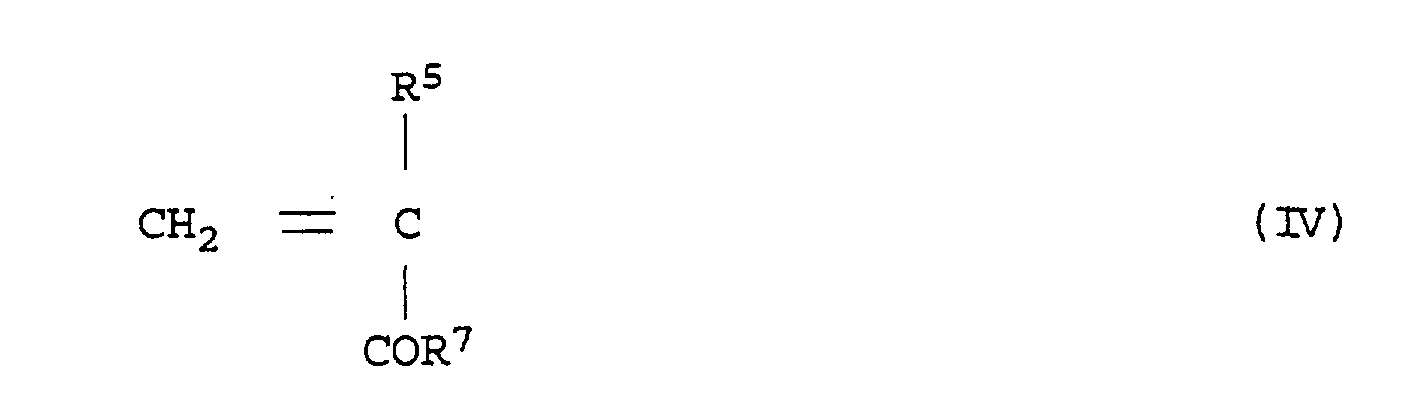 R2 für ein Wasserstoffatom oder eine C1-6-Alkyl- oder Vinylgruppe steht;R3 für eine C1-5-Alkyl-, C1-4-Alkoxyalkyl- oder - Acylgruppe steht;R4 für eine Alkylgruppe mit einer oder mehr Gruppen mit Aminfunktionalität steht;R5 für ein Wasserstoffatom oder eine Methylgruppe steht;R6 für ein Wasserstoffatom oder eine C1-4-Alkylgruppe steht, welche einen Hydroxylsubstituenten enthält;R7 für eine C1-4-Alkoxygruppe steht, die eine Epoxygruppe enthält;m für eine ganze Zahl von >0 bis 3 steht; undn für eine ganze Zahl von 0 bis 2 steht, unter der Voraussetzung, daß m+n≤3.
- Zusammensetzung nach Anspruch 1, wobei die Organosilanverbindung mit Aminfunktionalität (B) aus der Gruppe bestehend aus Aminomethyl'-trimethoxysilan, Aminoethyl-trimethoxysilan, Aminoethyl-triethoxysilan, Aminoethyl-triethoxysilan, γ-Aminopropyl-trimethoxysilan, Aminoethyl-triacetoxysilan, γ-Aminopropyl-triethoxysilan, γ-Aminopropyl-methyldimethoxysilan, γ-Aminopropyl-methyldiethoxysilan, N-β-(Aminoethyl)-γ-aminopropyl-trimethoxysilan, N-β-(Aminoethyl) -γ-aminopropyl-triethoxysilan, δ-Aminobutyl-trimethoxysilan, δ-Aminobutyl-triethoxysilan, δ-Aminobutyl-methyldimethoxysilan, δ-Aminobutyl-methyldiethoxysilan, δ-Aminobutylphenyl-dimethoxysilan, δ-Aminobutylphenyl-diethoxysilan, N-(γ-Acryloxy-β-hydroxypropyl) -γ-aminopropyl-triethoxysilan, Diethylentriaminopropyl-trimethoxysilan, Aminophenyl-trimethoxysilan, Aminophenyl-triethoxysilan und γ-Ureidopropyl-triethoxysilan ausgewählt ist.
- Zusammensetzung nach Anspruch 1, wobei ein Härtekatalysator (F) zugegeben wird, bei dem es sich um eine Base handelt, die aus der Gruppe bestehend aus Natriumhydroxid, Ammoniak, Kaliumhydroxid, n-Butylamin, Di-n-butylamin, Tri-n-butylamin, Guanidin, Biguanid, Imidazol, Ammoniumperchlorat, Triphenoxybor und Cholinacetat ausgewählt ist.
- Zusammensetzung nach Anspruch 1, wobei der Härtekatalysator (F) zugegeben wird, bei dem es sich um ein Metallsalz handelt, das aus der Gruppe bestehend aus Natriumacetat, Cobaltlaurat, Cobaltnaphthenat, Zinkoctylat, Zinnoctylat, Aluminiumacetylacetonat, Cobaltacetylacetonat, Nickelacetylacetonat, Zinknaphthonat, Zinkborfluorid, Zinnborfluorid, Tetrabutoxytitanat, Tetraisopropoxytitanat, Chromacetylacetonat und Titanylacetylacetonat ausgewählt ist.
- Zusammensetzung nach Anspruch 1, wobei das Organosilan mit Aminfunktionalität als Komponente (B) in einer Menge in einem Bereich von 15 bis 70 Gew.-% eingesetzt wird; das hydrophile (Meth)acrylatmonomer oder das Copolymer und/oder das Terpolymer als Komponente (C) in einer Menge in einem Bereich von 15 bis 70 Gew.-% eingesetzt wird; und der Härtekatalysator als Komponente (D) in einer Menge in einem Bereich von 0,05 bis 10 Gew.-% der Zusammensetzung eingesetzt wird.
- Beschichtungszusammensetzung, welche aufweist:(A) bis zu 50 Gew.-% eines Organosilans mit Epoxyfunktionalität der Formel (I), oder von dessen Hydrolysat oder Kondensat;(B) 10 bis 70 Gew.-% eines Organosilans mit Aminfunktionalität der Formel (II), oder von dessen Hydrolysat oder Kondensat;(C) 10 bis 70 Gew.-% eines hydrophilen (Meth)acrylatmonomers der Formel (III);(D) 0,5 bis 20 Gew.-% eines multifunktionellen (Meth)acrylats mit mindestens zwei (Meth)acrylgruppen im Molekül;(E) 0,05 bis 10 Gew.-% eines Radikalpolymerisations-Initiators; und(F) 0,05 bis 10 Gew.-% einer Base oder eines Metallsalzes als Härtekatalysator,
 wobei:
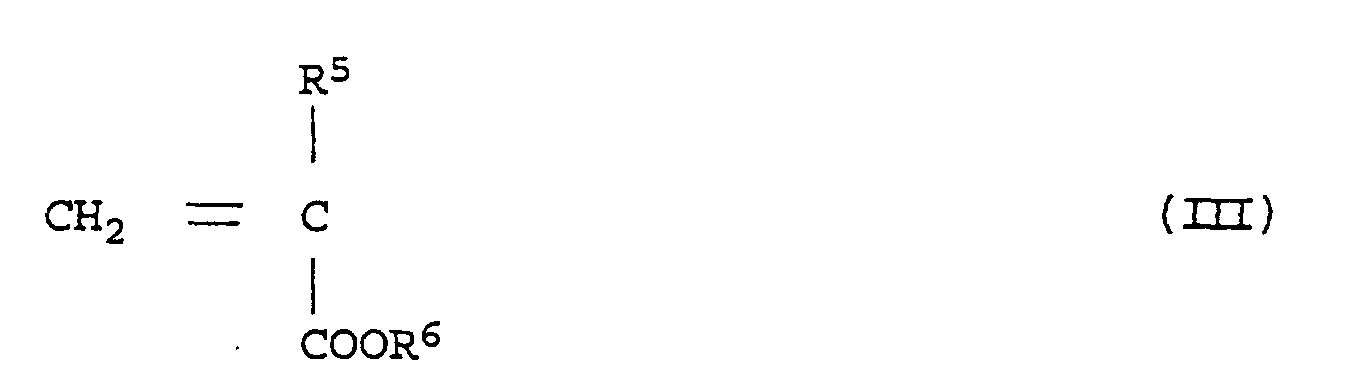 R1 für eine Alkylgruppe steht, welche eine Gruppe mit Epoxyfunktionalität aufweist;R2 für ein Wasserstoffatom oder eine C1-6-Alkyl- oder -Vinylgruppe steht;R3 für eine C1-5-Alkyl-, C1-4-Alkoxyalkyl- oder -Acylgruppe steht;R4 für eine Alkylgruppe mit einer oder mehr Gruppen mit Aminfunktionalität steht;R5 für ein Wasserstoffatom oder eine Methylgruppe steht;R6 für ein Wasserstoffatom oder eine einen Hydroxylsubstituenten enthaltende C1-4-Alkylgruppe steht;m für eine ganze Zahl von > 0 bis 3 steht; undn für eine ganze Zahl von 0 bis 2 steht, unter der Voraussetzung, daß m+n ≤ 3.
- Zusammensetzung nach Anspruch 6, wobei das multifunktionelle (Meth)acrylat aus der Gruppe bestehend aus Pentaerythrol-tetra(meth)acrylat, Pentaerythroltri(meth)acrylat, Trimethylolpropan-tri(meth)acrylat, Trimethylolethan-tri(meth)acrylat, Pentaglycerintri(meth)acrylat, Dipentaerythrol-tetra(meth)acrylat, Dipentaerythrol-penta(meth)acrylat, Dipentaerythrolhexa(meth)acrylat, Ethylenglycol-di(meth)acrylat, 1,3-Propylenglycol-di(meth)acrylat, 1,4-Butandioldi(meth)acrylat, 1,6-Hexandiol-di(meth)acrylat, Tripropylenglycol-di(meth)acrylat, ethoxyliertem (Bisphenol A)-di(meth)acrylat und Tricyclodecandimethanol-di(meth)acrylat ausgewählt ist.
- Zusammensetzung nach Anspruch 6 oder 7, wobei der Radikalpolymerisations-Initiator aus der Gruppe bestehend aus Ketonperoxiden, Diacylperoxiden, Hydroperoxides, Dialkylperoxiden, Peroxyketalen, Alkylperestern, Peroxycarbonaten und wasserlöslichen Peroxiden ausgewählt ist.
- Beschichtungszusammensetzung, hergestellt durch Mischen der Zusammensetzung nach Anspruch 1 mit der Zusammensetzung nach Anspruch 6.
- Artikel, hergestellt durch Beschichten eines synthetischen Harzsubstrates mit der Beschichtungszusammensetzung nach Anspruch 1 oder 6 und darauffolgendes Heißlufttrocknen des beschichteten Substrats.
- Artikel nach Anspruch 10, wobei das Substrat aus einem Polymermaterial hergestellt ist, das aus der Gruppe bestehend aus Polymethylmethacrylat, Polycarbonat, Polyallyldiglycolcarbonat, Polystyrol, Acrylnitril-Styrol-Copolymer, Polyvinylchlorid, Polyacetat, ABS (Acrylnitril-Butadien-Styrol) und Polyester ausgewählt ist.
- Artikel nach Anspruch 10 oder 11, wobei das Trocknen bei einer Temperatur, die in einem Bereich von 90 bis 130°C liegt, während einer Zeit in einem Bereich von 10 Minuten bis 2 Stunden durchgeführt wird.
- Artikel nach Anspruch 10, wobei die Dicke der ausgehärteten Beschichtung auf dem Substrat in einem Bereich von 1 bis 30 µm liegt.
- Zusammensetzung nach Anspruch 6, wobei die Organosilanverbindung mit Epoxyfunktionalität aus der Gruppe bestehend aus Glycidoxymethyl-trimethoxysilan, Glycidoxymethyl-triethoxysilan, γ-Glycidoxypropyl-trimethoxysilan, γ-Glycidoxypropyl-triethoxysilan, γ-Glycidoxypropyl-tri(methoxyethoxy)silan, γ-Glycidoxypropyl-triacetoxysilan, Glycidoxymethyl-dimethoxysilan, Glycidoxymethyl(methyl)dimethoxysilan, Glycidoxymethyl(ethyl)dimethoxysilan, Glycidoxymethyl (phenyl)dimethoxysilan, Glycidoxymethyl(vinyl)dimethoxysilan, Glycidoxymethyl(dimethyl)dimethoxysilan, γ-Glycidoxypropyl (methyl)dimethoxysilan, γ-Glycidoxypropyl (ethyl)dimethoxysilan, γ-Glycidoxypropyl(dimethyl)methoxysilan, Bis-(glycidoxymethyl)dimethoxysilan, Bis-(glycidoxymethyl)diethoxysilan, Bis-(glycidoxyethyl)dimethoxysilan, Bis-(glycidoxyethyl)diethoxysilan, Bis-(glycidoxypropyl)dimethoxysilan, Bis-(glycidoxypropyl)diethoxysilan, Tris-(glycidoxymethyl)methoxysilan, Tris-(glycidoxymethyl)ethoxysilan, Tris-(glycidoxyethyl)methoxysilan, Tris-(glycidoxyethyl)ethoxysilan, Tris-(glycidoxypropyl)methoxysilan, Tris-(glycidoxypropyl)ethoxysilan, Glycidylmethyl-trimethoxysilan, Glycidylmethyl-triethoxysilan, γ-Glycidylpropyl-triethoxysilan, γ-Glycidylpropyltri (methoxyethoxy)silan, γ-Glycidylpropyl-triacetoxysilan, 3,4-Epoxycyclohexylmethyl-trimethoxysilan, 3,4-Epoxycyclohexylmethyl-triethoxysilan, 3,4-Epoxycyclohexylethyl-trimethoxysilan und 3,4-Epoxycyclohexylpropyl-trimethoxysilan ausgewählt ist.
- Zusammensetzung nach Anspruch 6, wobei das Organosilan mit Epoxyfunktionalität in einer Menge von bis zu 20 Gew.-% eingesetzt wird.
Applications Claiming Priority (2)
| Application Number | Priority Date | Filing Date | Title |
|---|---|---|---|
| KR1019930006425A KR100214288B1 (ko) | 1993-04-16 | 1993-04-16 | 안개서림 방지용 내마모성 피복조성물 및 이를 도포한 합성수지 성형품 |
| KR9306425 | 1993-04-16 |
Publications (2)
| Publication Number | Publication Date |
|---|---|
| EP0620255A1 EP0620255A1 (de) | 1994-10-19 |
| EP0620255B1 true EP0620255B1 (de) | 2002-02-27 |
Family
ID=19354059
Family Applications (1)
| Application Number | Title | Priority Date | Filing Date |
|---|---|---|---|
| EP94105810A Expired - Lifetime EP0620255B1 (de) | 1993-04-16 | 1994-04-14 | Abriebfeste, beschlaghindernde Überzugszusammensetzung und damit beschichteter Kunststofformkörper |
Country Status (7)
| Country | Link |
|---|---|
| US (2) | US5674941A (de) |
| EP (1) | EP0620255B1 (de) |
| JP (1) | JP3227507B2 (de) |
| KR (1) | KR100214288B1 (de) |
| CN (1) | CN1040015C (de) |
| DE (1) | DE69429940T2 (de) |
| TW (1) | TW314543B (de) |
Cited By (2)
| Publication number | Priority date | Publication date | Assignee | Title |
|---|---|---|---|---|
| US6352758B1 (en) | 1998-05-04 | 2002-03-05 | 3M Innovative Properties Company | Patterned article having alternating hydrophilic and hydrophobic surface regions |
| CN102108220A (zh) * | 2010-10-29 | 2011-06-29 | 陈国坚 | 一种有机硅防水剂及其制备方法 |
Families Citing this family (63)
| Publication number | Priority date | Publication date | Assignee | Title |
|---|---|---|---|---|
| DE19500241A1 (de) * | 1995-01-05 | 1996-07-11 | Thera Ges Fuer Patente | Radikalisch polymerisierbare Zubereitungen und ihre Verwendung |
| JP3351666B2 (ja) * | 1995-10-20 | 2002-12-03 | 株式会社中戸研究所 | 防曇性反射防止膜、光学部品、及び防曇性反射防止膜の製造方法 |
| JPH09323392A (ja) * | 1996-06-05 | 1997-12-16 | Teijin Ltd | シリコーン易接着性フイルム及びその製造法 |
| GB9624881D0 (en) * | 1996-11-29 | 1997-01-15 | Courtaulds Coatings Holdings | Coating compositions |
| US6159537A (en) * | 1997-08-01 | 2000-12-12 | 3M Innovative Properties Company | Method of making a retroreflective article that has a binder layer containing an epoxy resin and silicone crosslinked polymer |
| US6150350A (en) * | 1997-09-15 | 2000-11-21 | Hoffman-La Roche Inc. | Antimicrobial compositions |
| CA2305513C (en) * | 1997-10-15 | 2005-01-04 | Yazaki Corporation | Transparent substrate bearing an anti-stain, hydrophobic coating, and process for making it |
| US6395331B1 (en) * | 1997-10-28 | 2002-05-28 | Yazaki Corporation | Transparent substrate bearing an anti-stain, hydrophobic coating, and process for making it |
| US6281321B1 (en) | 1997-11-27 | 2001-08-28 | Akzo Nobel N.V. | Coating compositions |
| FR2787800B1 (fr) * | 1998-12-23 | 2001-01-26 | Atochem Elf Sa | Procede de fabrication d'une composition organosoluble de resine (meth)acrylique, et utilisation de cette composition comme liant des peintures marines antisalissures |
| JP3648183B2 (ja) * | 2001-08-29 | 2005-05-18 | 聡 澤村 | 透明シリコーン系被膜形成組成物及びその硬化方法。 |
| US7410691B2 (en) * | 2001-12-27 | 2008-08-12 | Ppg Industries Ohio, Inc. | Photochromic optical article |
| US7452611B2 (en) * | 2001-12-27 | 2008-11-18 | Transitions Optical, Inc. | Photochromic optical article |
| US6911263B2 (en) * | 2002-01-30 | 2005-06-28 | Awi Licensing Company | PET wear layer/sol gel top coat layer composites |
| US6762260B2 (en) * | 2002-03-05 | 2004-07-13 | Dow Global Technologies Inc. | Organoborane amine complex polymerization initiators and polymerizable compositions |
| JP4195236B2 (ja) * | 2002-03-26 | 2008-12-10 | 日本ウェーブロック株式会社 | 金属調成形物成形用金属調加飾シート及びその製造方法、並びに、金属調成形物成形用金属調加飾シート中間材 |
| EP1549718A1 (de) * | 2002-09-06 | 2005-07-06 | Koninklijke Philips Electronics N.V. | Siebdruckmasse, durch siebdruck aufgetragene schicht und mit einer derartigen schicht versehenes substrakt |
| KR100564565B1 (ko) * | 2002-11-14 | 2006-03-28 | 삼성전자주식회사 | 실리콘을 함유하는 폴리머 및 이를 포함하는 네가티브형레지스트 조성물과 이들을 이용한 반도체 소자의 패턴형성 방법 |
| US6777512B1 (en) | 2003-02-28 | 2004-08-17 | Dow Global Technologies Inc. | Amine organoborane complex initiated polymerizable compositions containing siloxane polymerizable components |
| RU2358992C2 (ru) * | 2003-06-09 | 2009-06-20 | Дау Глобал Текнолоджиз Инк. | Стабилизированные органоборановые инициаторы полимеризации и способные к полимеризации композиции |
| CN1321164C (zh) * | 2003-06-20 | 2007-06-13 | 上海小糸车灯有限公司 | 亲水性高分子防雾涂料及其制备方法 |
| US8067066B2 (en) | 2003-10-03 | 2011-11-29 | Hempel A/S | Tie-coat composition comprising at least two types of functional polysiloxane compounds and a method for using the same for establishing a coating on a substrate |
| CN100519681C (zh) * | 2003-11-28 | 2009-07-29 | 精工爱普生株式会社 | 防雾处理液及其制造方法、防雾性物品及其制造方法 |
| US7703456B2 (en) | 2003-12-18 | 2010-04-27 | Kimberly-Clark Worldwide, Inc. | Facemasks containing an anti-fog / anti-glare composition |
| CN1898082B (zh) * | 2003-12-22 | 2010-09-29 | 陶氏环球技术公司 | 促进的有机硼烷胺络合物引发的可聚合组合物 |
| US8501886B2 (en) * | 2003-12-22 | 2013-08-06 | Dow Global Technologies Llc | Accelerated organoborane amine complex initiated polymerizable compositions |
| US7189456B2 (en) * | 2004-03-04 | 2007-03-13 | Transitions Optical, Inc. | Photochromic optical article |
| US20050196626A1 (en) * | 2004-03-04 | 2005-09-08 | Knox Carol L. | Photochromic optical article |
| US20050196616A1 (en) * | 2004-03-04 | 2005-09-08 | Stewart Kevin J. | Photochromic optical article |
| US7811480B2 (en) * | 2004-03-04 | 2010-10-12 | Transitions Optical, Inc. | Photochromic optical article |
| US7261843B2 (en) * | 2004-03-04 | 2007-08-28 | Transitions Optical, Inc. | Photochromic optical article |
| NO322724B1 (no) | 2004-04-15 | 2006-12-04 | Sinvent As | Fremgangsmåte til fremstilling av polyforgrenet organisk/uorganisk hybridpolymer |
| US7504156B2 (en) | 2004-04-15 | 2009-03-17 | Avery Dennison Corporation | Dew resistant coatings |
| AU2005235067B2 (en) * | 2004-04-20 | 2010-07-08 | Kureha Corporation | Antifogging laminated film |
| EP1783185B1 (de) * | 2004-08-26 | 2009-11-11 | Idemitsu Kosan Co., Ltd. | Beschichtungszusammensetzung und harzmehrschichtkörper |
| EP1831020A4 (de) * | 2004-12-21 | 2010-07-21 | Mitsubishi Polyester Film Inc | Wärmehärtbare in-line-beschichtung mit proxidhärter |
| BRPI0617591A2 (pt) * | 2005-10-07 | 2011-08-02 | Dow Global Technologies Inc | sistemas para iniciar polimerização via radical livre, composição polimerizável de duas partes, método de polimerização, método para ligar dois ou mais substratos entre si, método para modificar a superfìcie de um polìmero de baixa energia superficial, método para revestir um substrato, composição de revestimento e laminado |
| DE102005049141A1 (de) * | 2005-10-14 | 2007-04-19 | Klöckner Pentaplast GmbH & Co. KG | Beschichtungsgemisch, das durch Strahlung vernetzbar ist, Kunststoff-Folie und Verfahren zum Beschichten einer Kunststoff-Folie mit einem Beschichtungsgemisch |
| JP4978828B2 (ja) * | 2006-06-12 | 2012-07-18 | Toto株式会社 | 防曇性コーティング組成物およびそれを用いた防曇性被膜の製造方法 |
| DE102007020404A1 (de) * | 2006-09-18 | 2008-10-30 | Nano-X Gmbh | Verfahren zur Herstellung eines Beschichtungsmaterials |
| DE102006044310A1 (de) * | 2006-09-18 | 2008-03-27 | Nano-X Gmbh | Silanbeschichtungsmaterial und Verfahren zur Herstellung eines Silanbeschichtungsmaterials |
| US7524907B2 (en) * | 2006-10-12 | 2009-04-28 | Dow Global Technologies, Inc. | Accelerated organoborane initiated polymerizable compositions |
| US20080103274A1 (en) * | 2006-10-12 | 2008-05-01 | Jialanella Gary L | Accelerated organoborane initiated polymerizable compositions |
| JP5337394B2 (ja) * | 2007-05-15 | 2013-11-06 | 富士フイルム株式会社 | 親水性コーティング組成物及びこれを用いた親水性部材 |
| JP2009256568A (ja) * | 2007-08-17 | 2009-11-05 | Fujifilm Corp | 親水性膜形成用組成物、スプレー用組成物およびこれを用いた親水性部材 |
| JP5469837B2 (ja) * | 2007-09-12 | 2014-04-16 | 富士フイルム株式会社 | 親水性組成物 |
| JP2009256564A (ja) * | 2007-09-26 | 2009-11-05 | Fujifilm Corp | 親水性膜形成用組成物および親水性部材 |
| JP5427382B2 (ja) * | 2008-03-25 | 2014-02-26 | 富士フイルム株式会社 | 親水性部材、フィン材、アルミニウム製フィン材、熱交換器およびエアコン |
| CN102051101B (zh) * | 2010-11-18 | 2012-07-04 | 浙江大学 | 一种常温固化防污减阻水凝胶软涂层的制备方法 |
| DE102012009691B4 (de) | 2012-05-15 | 2021-12-09 | Carl Zeiss Vision International Gmbh | Antifog-Beschichtung auf einer Optikkomponente, Optikkomponente mit dieser Antifog-Beschichtung sowie Verfahren zur Herstellung dieser Antifog-Beschichtung |
| CN102649830B (zh) * | 2012-05-17 | 2013-11-27 | 陕西科技大学 | 一种阳离子有机硅改性聚丙烯酰胺的制备方法 |
| CN102649832B (zh) * | 2012-05-17 | 2013-10-23 | 陕西科技大学 | 非离子型疏水缔合聚丙烯酰胺的制备方法 |
| US9834699B2 (en) * | 2012-06-19 | 2017-12-05 | Watever Inc. | Coating composition |
| WO2014152428A1 (en) | 2013-03-15 | 2014-09-25 | Curatolo Benedict S | Dual curable composition |
| CN103627317A (zh) * | 2013-12-07 | 2014-03-12 | 北京顺缘天和新材料技术有限公司 | 一种省工型防腐涂料及其制备方法 |
| CN104529185B (zh) * | 2015-01-14 | 2017-05-03 | 湖南松井新材料有限公司 | 防雾涂层及该涂层的制备方法 |
| LU92802B1 (en) * | 2015-08-19 | 2017-03-01 | Luxembourg Patent Co | Sol-gel formulations enhancing corrosion resistance and lubrication properties of pressure equipment |
| CN112368347B (zh) * | 2018-07-19 | 2022-04-08 | 陶氏环球技术有限责任公司 | 耐候性且耐久性涂料组合物 |
| TWI731537B (zh) * | 2019-12-31 | 2021-06-21 | 財團法人工業技術研究院 | 底漆組合物及積層板 |
| JP7694107B2 (ja) * | 2020-03-31 | 2025-06-18 | マツダ株式会社 | シラン系塗料組成物の製造方法および積層体の製造方法 |
| US11459482B2 (en) * | 2020-06-19 | 2022-10-04 | Pall Corporation | Icephobic coating and coated articles |
| CN114015317B (zh) * | 2021-11-05 | 2022-09-02 | 福耀玻璃工业集团股份有限公司 | 防雾涂料及其制备方法和防雾玻璃 |
| KR20230093895A (ko) * | 2021-12-20 | 2023-06-27 | 주식회사 케이씨텍 | 유무기 하이브리드 조성물용 표면처리제 |
Family Cites Families (9)
| Publication number | Priority date | Publication date | Assignee | Title |
|---|---|---|---|---|
| JPS609070B2 (ja) * | 1974-08-21 | 1985-03-07 | 日本原子力研究所 | 熱硬化性樹脂組成物の製法 |
| JPS54119599A (en) * | 1978-03-10 | 1979-09-17 | Japan Atom Energy Res Inst | Transparent thermosetting resin composition |
| US4243767A (en) * | 1978-11-16 | 1981-01-06 | Union Carbide Corporation | Ambient temperature curable hydroxyl containing polymer/silicon compositions |
| FR2483448B1 (fr) * | 1980-05-29 | 1985-12-20 | Nippon Sheet Glass Co Ltd | Composition de revetement antibuee, article faconne revetu de cette composition et procede de preparation de cet article |
| US4348462A (en) * | 1980-07-11 | 1982-09-07 | General Electric Company | Abrasion resistant ultraviolet light curable hard coating compositions |
| JPH0627196B2 (ja) * | 1984-03-12 | 1994-04-13 | 大日本印刷株式会社 | 放射線硬化性有機珪素化合物の製造法 |
| US4603068A (en) * | 1984-06-08 | 1986-07-29 | Harte Woodworking Limited | Display panel and a display panel system |
| JPS63215704A (ja) * | 1987-03-04 | 1988-09-08 | Nippon Oil Co Ltd | 硬化性導電性組成物 |
| DE69004776T2 (de) * | 1989-10-18 | 1994-06-09 | Dow Corning | Keine flüchtigen organischen Verbindungen enthaltende strahlungshärtbare Silikonüberzüge. |
-
1993
- 1993-04-16 KR KR1019930006425A patent/KR100214288B1/ko not_active Expired - Fee Related
-
1994
- 1994-04-14 EP EP94105810A patent/EP0620255B1/de not_active Expired - Lifetime
- 1994-04-14 DE DE69429940T patent/DE69429940T2/de not_active Expired - Fee Related
- 1994-04-15 JP JP07766494A patent/JP3227507B2/ja not_active Expired - Fee Related
- 1994-04-15 CN CN94104440A patent/CN1040015C/zh not_active Expired - Fee Related
- 1994-04-15 TW TW083103364A patent/TW314543B/zh active
- 1994-04-15 US US08/335,002 patent/US5674941A/en not_active Expired - Lifetime
-
1996
- 1996-04-26 US US08/638,270 patent/US5679458A/en not_active Expired - Lifetime
Cited By (3)
| Publication number | Priority date | Publication date | Assignee | Title |
|---|---|---|---|---|
| US6352758B1 (en) | 1998-05-04 | 2002-03-05 | 3M Innovative Properties Company | Patterned article having alternating hydrophilic and hydrophobic surface regions |
| CN102108220A (zh) * | 2010-10-29 | 2011-06-29 | 陈国坚 | 一种有机硅防水剂及其制备方法 |
| CN102108220B (zh) * | 2010-10-29 | 2013-04-10 | 陈国坚 | 一种有机硅防水剂及其制备方法 |
Also Published As
| Publication number | Publication date |
|---|---|
| CN1098429A (zh) | 1995-02-08 |
| KR100214288B1 (ko) | 1999-08-02 |
| DE69429940D1 (de) | 2002-04-04 |
| JP3227507B2 (ja) | 2001-11-12 |
| CN1040015C (zh) | 1998-09-30 |
| EP0620255A1 (de) | 1994-10-19 |
| JPH06340841A (ja) | 1994-12-13 |
| DE69429940T2 (de) | 2002-10-31 |
| US5674941A (en) | 1997-10-07 |
| TW314543B (de) | 1997-09-01 |
| US5679458A (en) | 1997-10-21 |
Similar Documents
| Publication | Publication Date | Title |
|---|---|---|
| US5674941A (en) | Antifogging abrasion resistant coating composition and synthetic resin article coated therewith | |
| JP4041968B2 (ja) | 下塗り剤組成物、該組成物を用いたコーティング方法、及びコーティング物品 | |
| JP3841141B2 (ja) | 下塗り剤組成物及びコーティング方法 | |
| KR100293099B1 (ko) | 고굴절율을가지는경화물품을생산할수있는코팅조성물및그조성물로부터얻어지는피복물품 | |
| EP1279443B1 (de) | Antireflektierender, kratzfester Mehrschichtverbund | |
| JP3956043B2 (ja) | コーティング組成物およびその製造方法ならびに耐擦傷性プラスチックレンズ | |
| JPH036282A (ja) | プライマー組成物 | |
| JP4126522B2 (ja) | 被膜形成用組成物用縮合物及び加水分解物の製造方法 | |
| EP1826233B1 (de) | Härtbare Zusammensetzung und beschichteter Artikel | |
| JP6524261B2 (ja) | 積層体の製造方法 | |
| JPH0593170A (ja) | 被覆用組成物及び合成樹脂成形品の表面改質方法 | |
| EP0402466B1 (de) | Verfahren zur herstellung von giessstücken aus methacryl-harz | |
| JP4372268B2 (ja) | コーティング剤、および被覆層を有する樹脂成形品 | |
| JPS5938262A (ja) | コ−ティング組成物 | |
| CN1265408A (zh) | 亲水性防雾防霜耐磨涂料及其应用 | |
| JPH09194760A (ja) | 被覆材組成物、それを用いてなる機能性に優れた物品、及びプラスチックレンズ | |
| JPH0911406A (ja) | 表面を保護されたプラスチック成形体及びその製造方法 | |
| JP2007231060A (ja) | 硬化性組成物及び被覆物品 | |
| US20260035522A1 (en) | Coated article and production method therefor | |
| JP3782670B2 (ja) | 被覆用硬化性組成物、被覆物品、自動車用外板、および活性エネルギー線硬化性組成物 | |
| JP4092522B2 (ja) | 下塗り剤組成物及びプラスチック基体の表面保護方法 | |
| JP2018066003A (ja) | 塗料組成物、その硬化膜及びその硬化膜を備える塗装物品 | |
| JPS59109528A (ja) | 被覆ポリカ−ボネ−ト系樹脂成形物品 | |
| KR0177181B1 (ko) | 안개서림을 방지하는 내마모성 피복 조성물, 합성수지 성형품의 제조방법 및 그 방법에 의하여 제조된 합성수지 성형품 | |
| JP2746590B2 (ja) | プライマー組成物とその用法 |
Legal Events
| Date | Code | Title | Description |
|---|---|---|---|
| PUAI | Public reference made under article 153(3) epc to a published international application that has entered the european phase |
Free format text: ORIGINAL CODE: 0009012 |
|
| 17P | Request for examination filed |
Effective date: 19940414 |
|
| AK | Designated contracting states |
Kind code of ref document: A1 Designated state(s): CH DE GB LI SE |
|
| 17Q | First examination report despatched |
Effective date: 19960115 |
|
| GRAG | Despatch of communication of intention to grant |
Free format text: ORIGINAL CODE: EPIDOS AGRA |
|
| GRAG | Despatch of communication of intention to grant |
Free format text: ORIGINAL CODE: EPIDOS AGRA |
|
| GRAH | Despatch of communication of intention to grant a patent |
Free format text: ORIGINAL CODE: EPIDOS IGRA |
|
| RAP1 | Party data changed (applicant data changed or rights of an application transferred) |
Owner name: LUCKY LTD. |
|
| GRAH | Despatch of communication of intention to grant a patent |
Free format text: ORIGINAL CODE: EPIDOS IGRA |
|
| REG | Reference to a national code |
Ref country code: GB Ref legal event code: IF02 |
|
| GRAA | (expected) grant |
Free format text: ORIGINAL CODE: 0009210 |
|
| AK | Designated contracting states |
Kind code of ref document: B1 Designated state(s): CH DE GB LI SE |
|
| REG | Reference to a national code |
Ref country code: CH Ref legal event code: EP |
|
| REF | Corresponds to: |
Ref document number: 69429940 Country of ref document: DE Date of ref document: 20020404 |
|
| REG | Reference to a national code |
Ref country code: CH Ref legal event code: NV Representative=s name: ISLER & PEDRAZZINI AG |
|
| PLBE | No opposition filed within time limit |
Free format text: ORIGINAL CODE: 0009261 |
|
| STAA | Information on the status of an ep patent application or granted ep patent |
Free format text: STATUS: NO OPPOSITION FILED WITHIN TIME LIMIT |
|
| 26N | No opposition filed |
Effective date: 20021128 |
|
| PGFP | Annual fee paid to national office [announced via postgrant information from national office to epo] |
Ref country code: SE Payment date: 20060406 Year of fee payment: 13 Ref country code: DE Payment date: 20060406 Year of fee payment: 13 |
|
| PGFP | Annual fee paid to national office [announced via postgrant information from national office to epo] |
Ref country code: GB Payment date: 20060412 Year of fee payment: 13 |
|
| PGFP | Annual fee paid to national office [announced via postgrant information from national office to epo] |
Ref country code: CH Payment date: 20060413 Year of fee payment: 13 |
|
| REG | Reference to a national code |
Ref country code: CH Ref legal event code: PCAR Free format text: ISLER & PEDRAZZINI AG;POSTFACH 1772;8027 ZUERICH (CH) |
|
| REG | Reference to a national code |
Ref country code: CH Ref legal event code: PL |
|
| GBPC | Gb: european patent ceased through non-payment of renewal fee |
Effective date: 20070414 |
|
| PG25 | Lapsed in a contracting state [announced via postgrant information from national office to epo] |
Ref country code: DE Free format text: LAPSE BECAUSE OF NON-PAYMENT OF DUE FEES Effective date: 20071101 |
|
| PG25 | Lapsed in a contracting state [announced via postgrant information from national office to epo] |
Ref country code: LI Free format text: LAPSE BECAUSE OF NON-PAYMENT OF DUE FEES Effective date: 20070430 Ref country code: CH Free format text: LAPSE BECAUSE OF NON-PAYMENT OF DUE FEES Effective date: 20070430 |
|
| PG25 | Lapsed in a contracting state [announced via postgrant information from national office to epo] |
Ref country code: GB Free format text: LAPSE BECAUSE OF NON-PAYMENT OF DUE FEES Effective date: 20070414 |
|
| PG25 | Lapsed in a contracting state [announced via postgrant information from national office to epo] |
Ref country code: SE Free format text: LAPSE BECAUSE OF NON-PAYMENT OF DUE FEES Effective date: 20070415 |