EP0623911A1 - Verfahren zur Steuerung einer Flüssigkristall-Anzeigevorrichtung - Google Patents
Verfahren zur Steuerung einer Flüssigkristall-Anzeigevorrichtung Download PDFInfo
- Publication number
- EP0623911A1 EP0623911A1 EP94106559A EP94106559A EP0623911A1 EP 0623911 A1 EP0623911 A1 EP 0623911A1 EP 94106559 A EP94106559 A EP 94106559A EP 94106559 A EP94106559 A EP 94106559A EP 0623911 A1 EP0623911 A1 EP 0623911A1
- Authority
- EP
- European Patent Office
- Prior art keywords
- signal
- liquid crystal
- electrodes
- voltage
- pixels
- Prior art date
- Legal status (The legal status is an assumption and is not a legal conclusion. Google has not performed a legal analysis and makes no representation as to the accuracy of the status listed.)
- Withdrawn
Links
- 239000004973 liquid crystal related substance Substances 0.000 title claims abstract description 61
- 238000000034 method Methods 0.000 title claims description 25
- 210000002858 crystal cell Anatomy 0.000 abstract description 5
- 230000000717 retained effect Effects 0.000 abstract description 3
- 239000007788 liquid Substances 0.000 abstract description 2
- 238000010586 diagram Methods 0.000 description 5
- 230000009467 reduction Effects 0.000 description 4
- 239000011159 matrix material Substances 0.000 description 2
- 230000002093 peripheral effect Effects 0.000 description 2
- 230000004913 activation Effects 0.000 description 1
- 238000001994 activation Methods 0.000 description 1
- 230000006866 deterioration Effects 0.000 description 1
- 230000000694 effects Effects 0.000 description 1
- 238000004519 manufacturing process Methods 0.000 description 1
- 238000000926 separation method Methods 0.000 description 1
Images





Classifications
-
- G—PHYSICS
- G09—EDUCATION; CRYPTOGRAPHY; DISPLAY; ADVERTISING; SEALS
- G09G—ARRANGEMENTS OR CIRCUITS FOR CONTROL OF INDICATING DEVICES USING STATIC MEANS TO PRESENT VARIABLE INFORMATION
- G09G3/00—Control arrangements or circuits, of interest only in connection with visual indicators other than cathode-ray tubes
- G09G3/20—Control arrangements or circuits, of interest only in connection with visual indicators other than cathode-ray tubes for presentation of an assembly of a number of characters, e.g. a page, by composing the assembly by combination of individual elements arranged in a matrix no fixed position being assigned to or needed to be assigned to the individual characters or partial characters
- G09G3/34—Control arrangements or circuits, of interest only in connection with visual indicators other than cathode-ray tubes for presentation of an assembly of a number of characters, e.g. a page, by composing the assembly by combination of individual elements arranged in a matrix no fixed position being assigned to or needed to be assigned to the individual characters or partial characters by control of light from an independent source
- G09G3/36—Control arrangements or circuits, of interest only in connection with visual indicators other than cathode-ray tubes for presentation of an assembly of a number of characters, e.g. a page, by composing the assembly by combination of individual elements arranged in a matrix no fixed position being assigned to or needed to be assigned to the individual characters or partial characters by control of light from an independent source using liquid crystals
- G09G3/3611—Control of matrices with row and column drivers
- G09G3/3674—Details of drivers for scan electrodes
- G09G3/3677—Details of drivers for scan electrodes suitable for active matrices only
-
- G—PHYSICS
- G09—EDUCATION; CRYPTOGRAPHY; DISPLAY; ADVERTISING; SEALS
- G09G—ARRANGEMENTS OR CIRCUITS FOR CONTROL OF INDICATING DEVICES USING STATIC MEANS TO PRESENT VARIABLE INFORMATION
- G09G3/00—Control arrangements or circuits, of interest only in connection with visual indicators other than cathode-ray tubes
- G09G3/20—Control arrangements or circuits, of interest only in connection with visual indicators other than cathode-ray tubes for presentation of an assembly of a number of characters, e.g. a page, by composing the assembly by combination of individual elements arranged in a matrix no fixed position being assigned to or needed to be assigned to the individual characters or partial characters
- G09G3/34—Control arrangements or circuits, of interest only in connection with visual indicators other than cathode-ray tubes for presentation of an assembly of a number of characters, e.g. a page, by composing the assembly by combination of individual elements arranged in a matrix no fixed position being assigned to or needed to be assigned to the individual characters or partial characters by control of light from an independent source
- G09G3/36—Control arrangements or circuits, of interest only in connection with visual indicators other than cathode-ray tubes for presentation of an assembly of a number of characters, e.g. a page, by composing the assembly by combination of individual elements arranged in a matrix no fixed position being assigned to or needed to be assigned to the individual characters or partial characters by control of light from an independent source using liquid crystals
- G09G3/3611—Control of matrices with row and column drivers
- G09G3/3648—Control of matrices with row and column drivers using an active matrix
-
- G—PHYSICS
- G09—EDUCATION; CRYPTOGRAPHY; DISPLAY; ADVERTISING; SEALS
- G09G—ARRANGEMENTS OR CIRCUITS FOR CONTROL OF INDICATING DEVICES USING STATIC MEANS TO PRESENT VARIABLE INFORMATION
- G09G2300/00—Aspects of the constitution of display devices
- G09G2300/08—Active matrix structure, i.e. with use of active elements, inclusive of non-linear two terminal elements, in the pixels together with light emitting or modulating elements
- G09G2300/0876—Supplementary capacities in pixels having special driving circuits and electrodes instead of being connected to common electrode or ground; Use of additional capacitively coupled compensation electrodes
-
- G—PHYSICS
- G09—EDUCATION; CRYPTOGRAPHY; DISPLAY; ADVERTISING; SEALS
- G09G—ARRANGEMENTS OR CIRCUITS FOR CONTROL OF INDICATING DEVICES USING STATIC MEANS TO PRESENT VARIABLE INFORMATION
- G09G3/00—Control arrangements or circuits, of interest only in connection with visual indicators other than cathode-ray tubes
- G09G3/20—Control arrangements or circuits, of interest only in connection with visual indicators other than cathode-ray tubes for presentation of an assembly of a number of characters, e.g. a page, by composing the assembly by combination of individual elements arranged in a matrix no fixed position being assigned to or needed to be assigned to the individual characters or partial characters
- G09G3/34—Control arrangements or circuits, of interest only in connection with visual indicators other than cathode-ray tubes for presentation of an assembly of a number of characters, e.g. a page, by composing the assembly by combination of individual elements arranged in a matrix no fixed position being assigned to or needed to be assigned to the individual characters or partial characters by control of light from an independent source
- G09G3/36—Control arrangements or circuits, of interest only in connection with visual indicators other than cathode-ray tubes for presentation of an assembly of a number of characters, e.g. a page, by composing the assembly by combination of individual elements arranged in a matrix no fixed position being assigned to or needed to be assigned to the individual characters or partial characters by control of light from an independent source using liquid crystals
- G09G3/3611—Control of matrices with row and column drivers
- G09G3/3614—Control of polarity reversal in general
Definitions
- the present invention relates to a method for driving a liquid crystal display device, and more particularly to a method for driving a matrix liquid crystal display device having plural pixels arranged in a matrix.
- liquid crystal display devices are commercialized in various fields such as display for a word processor, a personal computer or the like, electronic view finder for a video camera, projection television or displays for an automobile. Also there is being required image display of a larger size, a higher resolution and a higher image quality.
- Fig. 1 schematically shows the configuration of such liquid crystal display device, applied for a television receiver.
- Fig. 1 there are shown a vertical shift register 10; a horizontal shift register 20; switching transistors 22; a common signal line 24; a signal inverting circuit 30; a clock generator circuit 40; a liquid crystal display panel 100; address signal lines V1, V2,..., V m-1 , V m ; vertical data signal lines D1, D2,..., D n ; a signal S bearing image information; and an output signal S' bearing image information, released from the signal inverting circuit 30.
- the vertical data signal lines D1 - D n are connected, respectively through the horizontal transfer switches 22, to the signal line 24, and the gates of the horizontal transfer switches 22 receive signals from the horizontal shift register 20, in response to the signal from the clock generator circuit 40.
- the signal from the clock generator circuit 40 is also supplied to the vertical shift register 10, thus driving the address signal lines V1 - V m in succession in synchronization with the signal S.
- the signal from the clock generator circuit 40 is further supplied to the signal inverting circuit 30, thereby inverting the signal S in synchronisation therewith.
- the clock generator circuit 40 is given an unrepresented synchronization signal, prepared from the image information bearing signal S, in order to achieve synchronization with the signal S.
- the vertical shift register 10 the horizontal shift register 20 and the signal inverting circuit 30 effect the desired television scanning operation, by means of the pulses prepared by the clock generator 40.
- a row of pixels is selected by the address signal lines V1 - V m from the vertical shift register 10, and the vertical data signal lines D1 - D n are selected by the successive activations of the horizontal transfer switches 22 by driving pulses H1 - H m from the horizontal shift register 20, whereby image signals are supplied to the respective pixels.
- the input terminals of the horizontal transfer switches 22 are connected, through the common signal line 24, to the signal inverting circuit 30, which is provided for converting the input image signal into an AC drive signal, in order to prevent deterioration in the characteristics of the liquid crystal.
- the signal inverting circuit 30 which is provided for converting the input image signal into an AC drive signal, in order to prevent deterioration in the characteristics of the liquid crystal.
- various methods such as frame inversion, field inversion, 1H (horizontal scanning period) inversion and bit (every pixel) inversion.
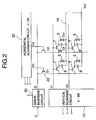
- Fig. 2 is an equivalent circuit of the liquid crystal panel 100 shown in Fig. 1.
- Fig. 2 there are only shown four pixels driven with the data signal lines D1, D2 and the address signal lines V1, V2 within the liquid crystal panel 100.
- liquid crystal pixels 5 there are shown liquid crystal pixels 5; switching transistors 7 respectively attached to the pixels; common electrode lines 16; and additional capacitances 9. Electrodes of the liquid crystal pixel 5 and the additional capacitance 9 are electrically connected to the output side of the respective switching transistor 7, and the other electrodes are connected to the common electrode line 16.
- the input terminals of the switching transistors 7 are electrically connected, in groups of respective vertical columns of pixels, to the data signal lines D1, D2. Also the address signal lines V1, V2 are electrically connected, in groups of respective horizontal rows of pixels, to the gates of the switching transistors 7.
- C LC and C S respectively indicate the equivalent capacitance of the liquid crystal pixel and the additional capacitance.
- Fig. 3 is a timing chart showing an example of the output signal S' from the signal inverting circuit 30.
- the input signal S bearing image information is converted into the output signal S' by inversion by every 1H.
- V LC is the potential of the common electrode
- V DL is the black level of the positive image signal
- V WL is the white level thereof
- V DH is the black level of the negative image signal
- V WH is the white level thereof.
- V DL - V DH the entire signal amplitude (V DL - V DH ) is equal to twice of (V DL - V LC ), so that it becomes about 10 V if the potential difference between V DL and V LC is about 5 V.
- each transistor becomes non-conductive in response to an input signal of a voltage lower than the threshold voltage V th of said transistor.
- the voltage of the image signal S' becomes larger than the potential difference mentioned above. In the foregoing example, this signal voltage is usually taken as about 13 V or larger.
- the method disclosed in the Japanese Patent Laid-open Application No. 54-98525 consists of inverting the common electrode potential V LC in synchronization with the inversion of the image signal S', thereby selecting a same amplitude range for the positive and negative image signals and reducing the entire signal amplitude range to about 1/2.
- liquid crystal capacitance C LC is in the order of several ten fF, while the additional capacitance C S is about 100 fF. If the toal capacitance for a pixel is 100 fF, the total capacitance of the entire liquid crystal display device becomes about 10,000 pF when it is applied to a television display, as there are at least required 100,000 pixels.
- the number of pixels of the liquid crystal display device is increasing, for achieving color display or a higher image quality.
- the capacitance of the device will correspondingly increase, for example to 30,000 pF for 300,000 pixels, or 50,000 pF for 500,000 pixels, so that cost reduction and compactization of the driving circuits will become more difficult to achieve.
- the method disclosed in the Japanese Patent Laid-open Application No. 1-138590 consists of employing separate common electrodes for the liquid crystal and for the additional capacitance, and applying an inversion potential to the common electrode of the liquid crystal.
- the image signal voltage V LC ' applied to the liquid crystal for inverting the common electrode potential V LC for the liquid crystal of a capacitance smaller than the additional capacitance varies at maximum: V LC x C S /(C LC + C S ).
- Such difficulty may be overcome by selecting the additional capacitance C S sufficiently smaller than the liquid crystal capacitance C LC , but, in such case, the total capacitance per pixel becomes too small for maintaining the signal voltage, so that satisfactory image display performance is difficult to obtain.
- the conventional driving methods for the liquid crystal display device involves a very large signal voltage because of the threshold voltage V th of the transistors present in the display device and also because of the image signal amplitude extending in the positive and negative polarities, thereby requiring designs with high voltage resistance in the signal processing IC, drive pulse generating IC, liquid crystal display panel, other peripheral circuits and wirings, thus leading to a larger dimension and an elevated cost of the liquid crystal display device.
- an object of the present invention is to provide a driving method for the liquid crystal display device, enabling drive with a lower voltage, thereby allowing to achieve compactization and cost reduction of the liquid crystal display device.
- Another object of the present invention is to provide a driving method for the liquid crystal display device provided with a plurality of pixels each of which is provided with a switching transistor for receiving a signal inverted at a desired interval and an additional capacitance for maintaining the signal voltage, wherein one of the electrodes of said additional capacitance is commonly connected for a desired block of said pixels, and the potential of said electrode is varied after the supply of said signal.
- Still another object of the present invention is to provide a driving method for the liquid crystal display device for effecting display by entry of a signal, inverted at a desired interval, through switching transistors to pixels respectively provided with additional capacitances, wherein electrodes, one each, of said additional capacitances and electrodes, one each, of the pixels are commonly but mutually separately connected electrically in each of desired blocks of the pixels, while the other electrodes of said additional capacitances and the other pixel electrodes are respectively connected to said switching transistors in each of said desired blocks, and, in at least one of said desired blocks, after said signal is supplied to the other electrodes of said additional capacitances and the other pixel electrodes through said switching transistors in a state in which a desired potential is supplied to the other electrodes of said additional capacitances, a potential different from said desired potential is supplied to the other electrodes of said additional capacitances.
- a driving method for the liquid crystal display device provided with a plurality of pixels each of which is provided with a switching transistor receiving the supply of a signal inverted at a desired interval and an additional capacitance for retaining the signal voltage, wherein electrodes, one each, of said additional capacitances are commonly connected in each of desired blocks of said pixels, and the potential of said electrodes in a desired pixel block is varied after the supply of said signal to said pixel block.
- This method enables device drive with a low voltage and a high speed, thereby achieving reductions in size and cost of the liquid crystal display device.
- the common electrodes for liquid crystal driving and those of the additional capacitances are electrically separated, and the above-mentioned common electrodes of the additional capacitances are further separated for each vertical column of pixels, whereby the voltages applied to the common electrodes of said additional capacitances are rendered independently controllable.
- Such separation of the common electrodes reduces the capacitance of each group of common electrodes for example to about 9 pF, in case of about 500 pixels in the horizontal direction, so that the high-speed drive is significantly facilitated.
- transistors 42, 42', 46, 46' In Fig. 4 there are shown transistors 42, 42', 46, 46'; common electrode lines 52, 52' for additional capacitances 9; and a common electrode line 54 to which connected are those of a common potential among the display electrodes of the liquid crystal pixels.
- V ab and V3 indicate potentials applicable to the common electrode lines 52, 52'.
- the common electrode lines 52, 52',..., each commonly connected to the electrodes, one each, of the additional capacitances corresponding to the pixels of a horizontal row and thus constituting a block of pixels, are respectively connected to the transistors 42, 42'; 46, 46';... controlled by the output of a vertical scanning circuit 10.
- said transistors 42, 42', 46, 46',... are of p-MOS type, and each of address lines V1, V2,... receives, from the vertical scanning circuit 10, an L-level pulse in a selected state or an H-level pulse in a non-selected state.
- the voltage V C1 of the common electrode line 52, common to the additional capacitances 9, becomes equal to V ab or V3 respectively when the address line V1 is selected or not selected by the vertical scanning circuit 10.
- the common electrodes 54 of the liquid crystal cells 5 receive a voltage V LC ', while the voltage V ab assumes a potential V a or V b , and the voltage V3 assumes a potential V a .
- the common electrode line 52 receives the voltage V a , and, in response to the horizontal scanning pulses H n , negative image signals within a range of V WH ' to V DH ' are supplied, in succession, to the liquid crystal cells 5 and the additional capacitances 9, through the lines D1 - D n and the switching transistors 7.
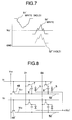
- the pixels belonging to the address line V1 retain the signal voltage same as at the signal entry, because of the non-conductive state of the transistors 7, so that the voltage applied to the liquid crystal remains unchanged (cf. S1' in Fig. 7).
- the image signals of said range V DC ' - V WL ' are represented by voltages larger than the common electrode voltage V LC ' for the liquid crystal 5, approximately by a range of V WL ' to V DL '.
- the period of application of such unshifted improper voltage is about 50 ⁇ sec. at maximum, while the signal retaining period is about 17 to 33 msec., and the response of liquid crystal to the signal requires several to several ten milliseconds.
- the present embodiment shifts the voltage of the positive image signals by about V WL ' - V DL ', thereby correspondingly compress the entire signal voltage amplitude.
- the non-conductive portion of the signal resulting from the threshold voltage V th of the p-MOS transistor is compensated by the above-mentioned shift of the signal voltage.
- the voltages of the common electrode lines 52, 52',... of the additional capacitances 9 are controlled by transistors 48, 48',...
- the voltages V C1 , V C2 ,... to be applied to the common electrode lines 52, 52',... are controlled by the transistors 48, 48',... connected electrically thereto.
- the common electrode line for the pixels corresponding to the selected vertical address is given a voltage V ab , but, in the non-selected state, is maintained in a floating state with the voltage V ab .
- the liquid crystal 5 can thus be driven with the signals as shown in Fig. 5, by means of such voltage V ab and the on/off operations of the transistors.
- this embodiment can reduce the signal voltage amplitude as in the first embodiment, however, with a reduced number of transistors.
- This embodiment further reduces the signal voltage amplitude as will be explained in the following with reference to timing charts shown in Figs. 10 and 11.
- the image signals of positive and negative polarities are so selected as to overlap with the common electrode voltage of the liquid crystal, thereby further reducing the entire signal voltage range by such overlapping portion.
- Such voltage shift after the voltage application at the entry of image signals into the pixels allows to apply a desired voltage to the liquid crystal and to further reduce the signal voltage range.
- the present invention is to reduce the amplitude of the input image signals, utilizing a variation in the voltage of the common electrodes of the additional capacitances between the write-in phase of the image signals and the signal retaining phase, and is not limited to the foregoing embodiments as long as the above-mentioned condition is met.
- it is applicable to the interlace drive with different combinations of vertical scanning operations, or to various image input methods such as dot-sequential input method or collective input method utilizing temporary retaining capacitances.
- the driving method of the present invention being capable of reducing the range of the input image signals through the control of the common electrode potential of the additional capacitances in the liquid crystal display device, allows to employ a lower voltage in the designing of liquid crystal panel and peripheral IC's, thereby achieving reductions in size, cost and power consumption of the display device.
- each pixel is provided with a liquid crystal cell 5, a switching transistor 7 and an additional capacitance 9, and the additional capacitances are electrically commonly connected for a block of plural pixels.
- the image signal is supplied to the pixels corresponding to the block, the potential of desired one of the common electrode lines 52, 52', to which the additional capacitances 9 corresponding to the block are connected, is varied and retained at thus varied value.
Landscapes
- Engineering & Computer Science (AREA)
- Chemical & Material Sciences (AREA)
- Crystallography & Structural Chemistry (AREA)
- Physics & Mathematics (AREA)
- Computer Hardware Design (AREA)
- General Physics & Mathematics (AREA)
- Theoretical Computer Science (AREA)
- Liquid Crystal (AREA)
- Liquid Crystal Display Device Control (AREA)
- Control Of Indicators Other Than Cathode Ray Tubes (AREA)
Applications Claiming Priority (2)
| Application Number | Priority Date | Filing Date | Title |
|---|---|---|---|
| JP102731/93 | 1993-04-28 | ||
| JP10273193A JPH06313876A (ja) | 1993-04-28 | 1993-04-28 | 液晶表示装置の駆動方法 |
Publications (1)
| Publication Number | Publication Date |
|---|---|
| EP0623911A1 true EP0623911A1 (de) | 1994-11-09 |
Family
ID=14335400
Family Applications (1)
| Application Number | Title | Priority Date | Filing Date |
|---|---|---|---|
| EP94106559A Withdrawn EP0623911A1 (de) | 1993-04-28 | 1994-04-27 | Verfahren zur Steuerung einer Flüssigkristall-Anzeigevorrichtung |
Country Status (3)
| Country | Link |
|---|---|
| US (2) | US6031514A (de) |
| EP (1) | EP0623911A1 (de) |
| JP (1) | JPH06313876A (de) |
Cited By (3)
| Publication number | Priority date | Publication date | Assignee | Title |
|---|---|---|---|---|
| US4867980A (en) * | 1986-10-10 | 1989-09-19 | Coopers Animal Health Australia Limited | Heavy density depot |
| CN100487785C (zh) * | 2005-10-03 | 2009-05-13 | 精工爱普生株式会社 | 电光装置、电光装置的驱动方法和电子设备 |
| US10847116B2 (en) | 2009-11-30 | 2020-11-24 | Semiconductor Energy Laboratory Co., Ltd. | Reducing pixel refresh rate for still images using oxide transistors |
Families Citing this family (31)
| Publication number | Priority date | Publication date | Assignee | Title |
|---|---|---|---|---|
| DE69532017T2 (de) | 1994-06-06 | 2004-08-05 | Canon K.K. | Gleichstromkompensation für Anzeige mit Zeilensprung |
| US6911962B1 (en) | 1996-03-26 | 2005-06-28 | Semiconductor Energy Laboratory Co., Ltd. | Driving method of active matrix display device |
| US6670938B1 (en) | 1999-02-16 | 2003-12-30 | Canon Kabushiki Kaisha | Electronic circuit and liquid crystal display apparatus including same |
| US6868154B1 (en) * | 1999-08-02 | 2005-03-15 | Robert O. Stuart | System and method for providing a service to a customer via a communication link |
| KR100770543B1 (ko) * | 2001-03-20 | 2007-10-25 | 엘지.필립스 엘시디 주식회사 | 액정표시장치와 그 구동방법 |
| JP4112283B2 (ja) * | 2002-05-29 | 2008-07-02 | 東芝松下ディスプレイテクノロジー株式会社 | 表示装置用電極基板 |
| JP4144462B2 (ja) * | 2002-08-30 | 2008-09-03 | セイコーエプソン株式会社 | 電気光学装置及び電子機器 |
| JP2005173244A (ja) * | 2003-12-11 | 2005-06-30 | Toshiba Matsushita Display Technology Co Ltd | 液晶表示装置、液晶表示パネルの表示方法 |
| US7463403B1 (en) * | 2005-04-22 | 2008-12-09 | Silicon Light Machines Corporation | High impedance drive circuit for a micro-electromechanical system device |
| JP4259528B2 (ja) * | 2005-05-26 | 2009-04-30 | セイコーエプソン株式会社 | 電気光学装置及びこれを備えた電子機器 |
| US7652649B2 (en) * | 2005-06-15 | 2010-01-26 | Au Optronics Corporation | LCD device with improved optical performance |
| TWI449009B (zh) * | 2005-12-02 | 2014-08-11 | Semiconductor Energy Lab | 顯示裝置和使用該顯示裝置的電子裝置 |
| KR101256665B1 (ko) * | 2005-12-30 | 2013-04-19 | 엘지디스플레이 주식회사 | 액정패널 |
| US20070170528A1 (en) * | 2006-01-20 | 2007-07-26 | Aaron Partridge | Wafer encapsulated microelectromechanical structure and method of manufacturing same |
| US7881690B2 (en) * | 2006-04-07 | 2011-02-01 | Belair Networks Inc. | System and method for zero intermediate frequency filtering of information communicated in wireless networks |
| US20090117859A1 (en) * | 2006-04-07 | 2009-05-07 | Belair Networks Inc. | System and method for frequency offsetting of information communicated in mimo based wireless networks |
| US8254865B2 (en) * | 2006-04-07 | 2012-08-28 | Belair Networks | System and method for frequency offsetting of information communicated in MIMO-based wireless networks |
| KR20090006198A (ko) * | 2006-04-19 | 2009-01-14 | 이그니스 이노베이션 인크. | 능동형 디스플레이를 위한 안정적 구동 방식 |
| KR101352936B1 (ko) * | 2006-11-29 | 2014-01-16 | 엘지디스플레이 주식회사 | 액정 표시 장치 |
| TWI348065B (en) * | 2007-01-10 | 2011-09-01 | Au Optronics Corp | Liquid crystal display |
| CN100480796C (zh) * | 2007-01-22 | 2009-04-22 | 友达光电股份有限公司 | 液晶显示器结构 |
| CN100492115C (zh) * | 2007-07-12 | 2009-05-27 | 昆山龙腾光电有限公司 | 降低液晶面板闪烁度的调节装置和调节方法及液晶面板 |
| US7884891B2 (en) * | 2008-01-21 | 2011-02-08 | Beijing Boe Optoelectronics Technology Co., Ltd. | Thin film transistor liquid crystal display |
| CN101770750B (zh) * | 2008-12-26 | 2012-01-25 | 北京京东方光电科技有限公司 | 液晶显示器及其控制方法 |
| TWI395033B (zh) * | 2009-03-17 | 2013-05-01 | Wintek Corp | 液晶顯示面板 |
| TWI384307B (zh) * | 2009-04-13 | 2013-02-01 | Au Optronics Corp | 液晶顯示器 |
| KR101763660B1 (ko) * | 2009-12-18 | 2017-08-01 | 가부시키가이샤 한도오따이 에네루기 켄큐쇼 | 액정 표시 장치 및 그 구동 방법 |
| US8633889B2 (en) | 2010-04-15 | 2014-01-21 | Semiconductor Energy Laboratory Co., Ltd. | Display device, driving method thereof, and electronic appliance |
| TWI534773B (zh) | 2010-04-23 | 2016-05-21 | 半導體能源研究所股份有限公司 | 顯示裝置的驅動方法 |
| CN108109592B (zh) | 2016-11-25 | 2022-01-25 | 株式会社半导体能源研究所 | 显示装置及其工作方法 |
| TWI670552B (zh) * | 2018-05-25 | 2019-09-01 | 友達光電股份有限公司 | 液晶顯示器及其控制方法 |
Citations (2)
| Publication number | Priority date | Publication date | Assignee | Title |
|---|---|---|---|---|
| EP0435101A1 (de) * | 1989-12-15 | 1991-07-03 | Seiko Epson Corporation | Flüssigkristall-Anzeigevorrichtung in Matrixform mit Dünnschichttransistoren |
| US5151805A (en) * | 1989-11-28 | 1992-09-29 | Matsushita Electric Industrial Co., Ltd. | Capacitively coupled driving method for TFT-LCD to compensate for switching distortion and to reduce driving power |
Family Cites Families (17)
| Publication number | Priority date | Publication date | Assignee | Title |
|---|---|---|---|---|
| US4206386A (en) * | 1977-04-18 | 1980-06-03 | Matsushita Electric Industrial Co., Ltd. | Gas discharge display device |
| JPS5498525A (en) * | 1978-01-20 | 1979-08-03 | Matsushita Electric Ind Co Ltd | Driving circuit for liquid crystal display unit |
| DE2953769C2 (de) * | 1978-02-08 | 1985-02-14 | Sharp K.K., Osaka | Flüssigkristall-Anzeigematrix mit Dünnfilmtransistor-Anordnung |
| DE3019832C2 (de) * | 1979-05-28 | 1986-10-16 | Kabushiki Kaisha Suwa Seikosha, Shinjuku, Tokio/Tokyo | Treiberschaltung für eine Flüssigkristallanzeigematrix |
| JPS55159493A (en) * | 1979-05-30 | 1980-12-11 | Suwa Seikosha Kk | Liquid crystal face iimage display unit |
| JPS6211829A (ja) * | 1985-03-28 | 1987-01-20 | Toshiba Corp | アクテイブマトリツクス形液晶表示装置 |
| JPS6249399A (ja) * | 1985-08-29 | 1987-03-04 | キヤノン株式会社 | 表示装置 |
| JP2620240B2 (ja) * | 1987-06-10 | 1997-06-11 | 株式会社日立製作所 | 液晶表示装置 |
| JPH0746266B2 (ja) * | 1987-06-17 | 1995-05-17 | シャープ株式会社 | 薄膜elディスプレイユニットの駆動方法および駆動回路 |
| JPH01138590A (ja) * | 1988-08-25 | 1989-05-31 | Seiko Epson Corp | 液晶表示装置 |
| US5105288A (en) * | 1989-10-18 | 1992-04-14 | Matsushita Electronics Corporation | Liquid crystal display apparatus with the application of black level signal for suppressing light leakage |
| JP2810755B2 (ja) * | 1990-02-26 | 1998-10-15 | キヤノン株式会社 | インクジェット記録ヘッドの吐出駆動方法およびインクジェット記録装置 |
| US5828354A (en) * | 1990-07-13 | 1998-10-27 | Citizen Watch Co., Ltd. | Electrooptical display device |
| US5414442A (en) * | 1991-06-14 | 1995-05-09 | Semiconductor Energy Laboratory Co., Ltd. | Electro-optical device and method of driving the same |
| DE69214206T2 (de) * | 1991-07-08 | 1997-03-13 | Asahi Glass Co. Ltd., Tokio/Tokyo | Steuerverfahren für ein Flüssigkristallanzeigeelement |
| DE69225105T2 (de) * | 1991-10-04 | 1999-01-07 | Kabushiki Kaisha Toshiba, Kawasaki, Kanagawa | Flüssigkristallanzeigegerät |
| US5706123A (en) * | 1996-09-27 | 1998-01-06 | Texas Instruments Incorporated | Switched control signals for digital micro-mirror device with split reset |
-
1993
- 1993-04-28 JP JP10273193A patent/JPH06313876A/ja active Pending
-
1994
- 1994-04-27 EP EP94106559A patent/EP0623911A1/de not_active Withdrawn
-
1997
- 1997-04-28 US US08/841,823 patent/US6031514A/en not_active Expired - Fee Related
-
1999
- 1999-12-13 US US09/459,480 patent/US6683591B2/en not_active Expired - Fee Related
Patent Citations (2)
| Publication number | Priority date | Publication date | Assignee | Title |
|---|---|---|---|---|
| US5151805A (en) * | 1989-11-28 | 1992-09-29 | Matsushita Electric Industrial Co., Ltd. | Capacitively coupled driving method for TFT-LCD to compensate for switching distortion and to reduce driving power |
| EP0435101A1 (de) * | 1989-12-15 | 1991-07-03 | Seiko Epson Corporation | Flüssigkristall-Anzeigevorrichtung in Matrixform mit Dünnschichttransistoren |
Cited By (5)
| Publication number | Priority date | Publication date | Assignee | Title |
|---|---|---|---|---|
| US4867980A (en) * | 1986-10-10 | 1989-09-19 | Coopers Animal Health Australia Limited | Heavy density depot |
| CN100487785C (zh) * | 2005-10-03 | 2009-05-13 | 精工爱普生株式会社 | 电光装置、电光装置的驱动方法和电子设备 |
| US10847116B2 (en) | 2009-11-30 | 2020-11-24 | Semiconductor Energy Laboratory Co., Ltd. | Reducing pixel refresh rate for still images using oxide transistors |
| US11282477B2 (en) | 2009-11-30 | 2022-03-22 | Semiconductor Energy Laboratory Co., Ltd. | Liquid crystal display device, method for driving the same, and electronic device including the same |
| US11636825B2 (en) | 2009-11-30 | 2023-04-25 | Semiconductor Energy Laboratory Co., Ltd. | Liquid crystal display device, method for driving the same, and electronic device including the same |
Also Published As
| Publication number | Publication date |
|---|---|
| US20020105489A1 (en) | 2002-08-08 |
| JPH06313876A (ja) | 1994-11-08 |
| US6031514A (en) | 2000-02-29 |
| US6683591B2 (en) | 2004-01-27 |
Similar Documents
| Publication | Publication Date | Title |
|---|---|---|
| US6031514A (en) | Method for driving liquid crystal display device | |
| US6075505A (en) | Active matrix liquid crystal display | |
| US5598180A (en) | Active matrix type display apparatus | |
| US6421041B2 (en) | Active matrix display and image forming system based on multiple partial image displays | |
| US5648793A (en) | Driving system for active matrix liquid crystal display | |
| US5510805A (en) | Scanning circuit | |
| US7812807B2 (en) | Display device and driving device | |
| KR100561946B1 (ko) | 액정표시장치 및 그 구동방법 | |
| JPH01202793A (ja) | マトリクス表示装置 | |
| KR100549983B1 (ko) | 액정표시장치 및 그 구동방법 | |
| EP0489459B1 (de) | Verfahren zum Steuern einer Matrixanzeige und eine durch dieses Verfahren gesteuerte Matrixanzeige | |
| WO1997022963A2 (en) | Matrix display devices | |
| KR100648141B1 (ko) | 표시 장치 및 상기 표시 장치의 구동 방법 | |
| JPH06337657A (ja) | 液晶表示装置 | |
| US6636196B2 (en) | Electro-optic display device using a multi-row addressing scheme | |
| JP3131411B2 (ja) | 液晶ディスプレイ装置 | |
| JPH05108030A (ja) | 液晶パネルの駆動回路 | |
| JP2004533018A5 (de) | ||
| US6882333B2 (en) | Display method and display apparatus therefor | |
| JP3192547B2 (ja) | 液晶表示装置の駆動方法 | |
| JP3149084B2 (ja) | 表示装置 | |
| JP2598474Y2 (ja) | アクティブマトリックス型液晶表示装置の階調駆動回路 | |
| JP3080053B2 (ja) | 液晶ディスプレイ装置の点順次駆動方法 | |
| JPH0612035A (ja) | 表示装置 | |
| JPH0427527B2 (de) |
Legal Events
| Date | Code | Title | Description |
|---|---|---|---|
| PUAI | Public reference made under article 153(3) epc to a published international application that has entered the european phase |
Free format text: ORIGINAL CODE: 0009012 |
|
| AK | Designated contracting states |
Kind code of ref document: A1 Designated state(s): DE FR GB IT NL |
|
| 17P | Request for examination filed |
Effective date: 19950321 |
|
| 17Q | First examination report despatched |
Effective date: 19961031 |
|
| STAA | Information on the status of an ep patent application or granted ep patent |
Free format text: STATUS: THE APPLICATION IS DEEMED TO BE WITHDRAWN |
|
| 18D | Application deemed to be withdrawn |
Effective date: 19970513 |