EP0626199A2 - Procédé pour la production de tamis moléculaires de carbone - Google Patents
Procédé pour la production de tamis moléculaires de carbone Download PDFInfo
- Publication number
- EP0626199A2 EP0626199A2 EP94303640A EP94303640A EP0626199A2 EP 0626199 A2 EP0626199 A2 EP 0626199A2 EP 94303640 A EP94303640 A EP 94303640A EP 94303640 A EP94303640 A EP 94303640A EP 0626199 A2 EP0626199 A2 EP 0626199A2
- Authority
- EP
- European Patent Office
- Prior art keywords
- resin
- group
- phenolic resin
- carbon
- metal
- Prior art date
- Legal status (The legal status is an assumption and is not a legal conclusion. Google has not performed a legal analysis and makes no representation as to the accuracy of the status listed.)
- Withdrawn
Links
- 229910052799 carbon Inorganic materials 0.000 title claims abstract description 38
- OKTJSMMVPCPJKN-UHFFFAOYSA-N Carbon Chemical compound [C] OKTJSMMVPCPJKN-UHFFFAOYSA-N 0.000 title claims abstract description 37
- 238000000034 method Methods 0.000 title claims abstract description 33
- 239000002808 molecular sieve Substances 0.000 title claims abstract description 22
- URGAHOPLAPQHLN-UHFFFAOYSA-N sodium aluminosilicate Chemical compound [Na+].[Al+3].[O-][Si]([O-])=O.[O-][Si]([O-])=O URGAHOPLAPQHLN-UHFFFAOYSA-N 0.000 title claims abstract description 22
- 238000004519 manufacturing process Methods 0.000 title claims abstract description 9
- 229920005989 resin Polymers 0.000 claims abstract description 51
- 239000011347 resin Substances 0.000 claims abstract description 51
- 229920001568 phenolic resin Polymers 0.000 claims abstract description 36
- 239000005011 phenolic resin Substances 0.000 claims abstract description 35
- KXGFMDJXCMQABM-UHFFFAOYSA-N 2-methoxy-6-methylphenol Chemical compound [CH]OC1=CC=CC([CH])=C1O KXGFMDJXCMQABM-UHFFFAOYSA-N 0.000 claims abstract description 34
- 238000010438 heat treatment Methods 0.000 claims abstract description 29
- 229910052751 metal Inorganic materials 0.000 claims abstract description 29
- 239000002184 metal Substances 0.000 claims abstract description 29
- 229920001187 thermosetting polymer Polymers 0.000 claims abstract description 21
- 150000001768 cations Chemical class 0.000 claims abstract description 20
- 239000000463 material Substances 0.000 claims abstract description 12
- 230000000737 periodic effect Effects 0.000 claims abstract description 5
- IJGRMHOSHXDMSA-UHFFFAOYSA-N Atomic nitrogen Chemical compound N#N IJGRMHOSHXDMSA-UHFFFAOYSA-N 0.000 claims description 44
- 239000000047 product Substances 0.000 claims description 24
- 229910052757 nitrogen Inorganic materials 0.000 claims description 22
- 239000002245 particle Substances 0.000 claims description 22
- QVGXLLKOCUKJST-UHFFFAOYSA-N atomic oxygen Chemical compound [O] QVGXLLKOCUKJST-UHFFFAOYSA-N 0.000 claims description 15
- 239000001301 oxygen Substances 0.000 claims description 15
- 229910052760 oxygen Inorganic materials 0.000 claims description 15
- 238000005342 ion exchange Methods 0.000 claims description 12
- 229920001223 polyethylene glycol Polymers 0.000 claims description 12
- 239000003431 cross linking reagent Substances 0.000 claims description 11
- 239000000203 mixture Substances 0.000 claims description 11
- 239000002202 Polyethylene glycol Substances 0.000 claims description 10
- 239000007864 aqueous solution Substances 0.000 claims description 9
- 239000004634 thermosetting polymer Substances 0.000 claims description 9
- 238000000926 separation method Methods 0.000 claims description 8
- 239000007789 gas Substances 0.000 claims description 6
- 238000001179 sorption measurement Methods 0.000 claims description 5
- 229920001169 thermoplastic Polymers 0.000 claims description 5
- 239000004416 thermosoftening plastic Substances 0.000 claims description 5
- 150000001875 compounds Chemical class 0.000 claims description 3
- 150000002736 metal compounds Chemical class 0.000 claims description 3
- 150000002739 metals Chemical class 0.000 claims description 3
- 239000012467 final product Substances 0.000 claims description 2
- 239000003795 chemical substances by application Substances 0.000 claims 2
- VKYKSIONXSXAKP-UHFFFAOYSA-N hexamethylenetetramine Chemical compound C1N(C2)CN3CN1CN2C3 VKYKSIONXSXAKP-UHFFFAOYSA-N 0.000 description 16
- 238000003763 carbonization Methods 0.000 description 15
- WSFSSNUMVMOOMR-UHFFFAOYSA-N Formaldehyde Chemical compound O=C WSFSSNUMVMOOMR-UHFFFAOYSA-N 0.000 description 12
- 238000011084 recovery Methods 0.000 description 11
- 239000004312 hexamethylene tetramine Substances 0.000 description 9
- 235000010299 hexamethylene tetramine Nutrition 0.000 description 9
- 229960004011 methenamine Drugs 0.000 description 9
- 229920003986 novolac Polymers 0.000 description 9
- 239000000243 solution Substances 0.000 description 6
- 239000003245 coal Substances 0.000 description 5
- 150000002500 ions Chemical group 0.000 description 5
- 239000000843 powder Substances 0.000 description 5
- 239000007858 starting material Substances 0.000 description 5
- VMHLLURERBWHNL-UHFFFAOYSA-M Sodium acetate Chemical compound [Na+].CC([O-])=O VMHLLURERBWHNL-UHFFFAOYSA-M 0.000 description 4
- 239000000314 lubricant Substances 0.000 description 4
- 239000008188 pellet Substances 0.000 description 4
- 229920000642 polymer Polymers 0.000 description 4
- 239000001632 sodium acetate Substances 0.000 description 4
- 235000017281 sodium acetate Nutrition 0.000 description 4
- 239000000126 substance Substances 0.000 description 4
- 239000003463 adsorbent Substances 0.000 description 3
- 230000000052 comparative effect Effects 0.000 description 3
- 238000004132 cross linking Methods 0.000 description 3
- 238000000465 moulding Methods 0.000 description 3
- 230000007935 neutral effect Effects 0.000 description 3
- ISWSIDIOOBJBQZ-UHFFFAOYSA-N phenol group Chemical group C1(=CC=CC=C1)O ISWSIDIOOBJBQZ-UHFFFAOYSA-N 0.000 description 3
- 239000011734 sodium Substances 0.000 description 3
- 229920005992 thermoplastic resin Polymers 0.000 description 3
- XLYOFNOQVPJJNP-UHFFFAOYSA-N water Substances O XLYOFNOQVPJJNP-UHFFFAOYSA-N 0.000 description 3
- CURLTUGMZLYLDI-UHFFFAOYSA-N Carbon dioxide Chemical compound O=C=O CURLTUGMZLYLDI-UHFFFAOYSA-N 0.000 description 2
- 235000013162 Cocos nucifera Nutrition 0.000 description 2
- 244000060011 Cocos nucifera Species 0.000 description 2
- 239000002253 acid Substances 0.000 description 2
- 150000001339 alkali metal compounds Chemical class 0.000 description 2
- 239000012298 atmosphere Substances 0.000 description 2
- 239000000571 coke Substances 0.000 description 2
- 238000009833 condensation Methods 0.000 description 2
- 230000005494 condensation Effects 0.000 description 2
- 230000000694 effects Effects 0.000 description 2
- 238000002474 experimental method Methods 0.000 description 2
- 238000001125 extrusion Methods 0.000 description 2
- 239000008187 granular material Substances 0.000 description 2
- 238000007654 immersion Methods 0.000 description 2
- 239000011261 inert gas Substances 0.000 description 2
- VNWKTOKETHGBQD-UHFFFAOYSA-N methane Chemical compound C VNWKTOKETHGBQD-UHFFFAOYSA-N 0.000 description 2
- 239000011148 porous material Substances 0.000 description 2
- 238000002360 preparation method Methods 0.000 description 2
- 229920003987 resole Polymers 0.000 description 2
- 229910052708 sodium Inorganic materials 0.000 description 2
- 239000004215 Carbon black (E152) Substances 0.000 description 1
- UFHFLCQGNIYNRP-UHFFFAOYSA-N Hydrogen Chemical compound [H][H] UFHFLCQGNIYNRP-UHFFFAOYSA-N 0.000 description 1
- DGAQECJNVWCQMB-PUAWFVPOSA-M Ilexoside XXIX Chemical compound C[C@@H]1CC[C@@]2(CC[C@@]3(C(=CC[C@H]4[C@]3(CC[C@@H]5[C@@]4(CC[C@@H](C5(C)C)OS(=O)(=O)[O-])C)C)[C@@H]2[C@]1(C)O)C)C(=O)O[C@H]6[C@@H]([C@H]([C@@H]([C@H](O6)CO)O)O)O.[Na+] DGAQECJNVWCQMB-PUAWFVPOSA-M 0.000 description 1
- 239000004372 Polyvinyl alcohol Substances 0.000 description 1
- 238000010521 absorption reaction Methods 0.000 description 1
- 230000004913 activation Effects 0.000 description 1
- 150000001298 alcohols Chemical class 0.000 description 1
- 229910052783 alkali metal Inorganic materials 0.000 description 1
- 150000001340 alkali metals Chemical class 0.000 description 1
- 150000001721 carbon Chemical class 0.000 description 1
- 239000001569 carbon dioxide Substances 0.000 description 1
- 229910002092 carbon dioxide Inorganic materials 0.000 description 1
- 238000006243 chemical reaction Methods 0.000 description 1
- 230000006835 compression Effects 0.000 description 1
- 238000007906 compression Methods 0.000 description 1
- 238000001816 cooling Methods 0.000 description 1
- 238000000354 decomposition reaction Methods 0.000 description 1
- 230000006837 decompression Effects 0.000 description 1
- 125000004836 hexamethylene group Chemical group [H]C([H])([*:2])C([H])([H])C([H])([H])C([H])([H])C([H])([H])C([H])([H])[*:1] 0.000 description 1
- 229930195733 hydrocarbon Natural products 0.000 description 1
- 150000002430 hydrocarbons Chemical class 0.000 description 1
- 239000001257 hydrogen Substances 0.000 description 1
- 229910052739 hydrogen Inorganic materials 0.000 description 1
- 239000003077 lignite Substances 0.000 description 1
- 239000012299 nitrogen atmosphere Substances 0.000 description 1
- 229920002451 polyvinyl alcohol Polymers 0.000 description 1
- 229910001414 potassium ion Inorganic materials 0.000 description 1
- 239000002243 precursor Substances 0.000 description 1
- 230000000717 retained effect Effects 0.000 description 1
- 238000007873 sieving Methods 0.000 description 1
- 238000005245 sintering Methods 0.000 description 1
- 239000000758 substrate Substances 0.000 description 1
- -1 tetramethylene hexamine Chemical compound 0.000 description 1
- AGGKEGLBGGJEBZ-UHFFFAOYSA-N tetramethylenedisulfotetramine Chemical compound C1N(S2(=O)=O)CN3S(=O)(=O)N1CN2C3 AGGKEGLBGGJEBZ-UHFFFAOYSA-N 0.000 description 1
- 235000013311 vegetables Nutrition 0.000 description 1
- 238000005406 washing Methods 0.000 description 1
Images
Classifications
-
- B—PERFORMING OPERATIONS; TRANSPORTING
- B01—PHYSICAL OR CHEMICAL PROCESSES OR APPARATUS IN GENERAL
- B01D—SEPARATION
- B01D53/00—Separation of gases or vapours; Recovering vapours of volatile solvents from gases; Chemical or biological purification of waste gases, e.g. engine exhaust gases, smoke, fumes, flue gases, aerosols
- B01D53/02—Separation of gases or vapours; Recovering vapours of volatile solvents from gases; Chemical or biological purification of waste gases, e.g. engine exhaust gases, smoke, fumes, flue gases, aerosols by adsorption, e.g. preparative gas chromatography
- B01D53/04—Separation of gases or vapours; Recovering vapours of volatile solvents from gases; Chemical or biological purification of waste gases, e.g. engine exhaust gases, smoke, fumes, flue gases, aerosols by adsorption, e.g. preparative gas chromatography with stationary adsorbents
-
- B—PERFORMING OPERATIONS; TRANSPORTING
- B01—PHYSICAL OR CHEMICAL PROCESSES OR APPARATUS IN GENERAL
- B01J—CHEMICAL OR PHYSICAL PROCESSES, e.g. CATALYSIS OR COLLOID CHEMISTRY; THEIR RELEVANT APPARATUS
- B01J20/00—Solid sorbent compositions or filter aid compositions; Sorbents for chromatography; Processes for preparing, regenerating or reactivating thereof
- B01J20/02—Solid sorbent compositions or filter aid compositions; Sorbents for chromatography; Processes for preparing, regenerating or reactivating thereof comprising inorganic material
- B01J20/20—Solid sorbent compositions or filter aid compositions; Sorbents for chromatography; Processes for preparing, regenerating or reactivating thereof comprising inorganic material comprising free carbon; comprising carbon obtained by carbonising processes
-
- B—PERFORMING OPERATIONS; TRANSPORTING
- B01—PHYSICAL OR CHEMICAL PROCESSES OR APPARATUS IN GENERAL
- B01D—SEPARATION
- B01D2253/00—Adsorbents used in seperation treatment of gases and vapours
- B01D2253/20—Organic adsorbents
- B01D2253/206—Ion exchange resins
-
- B—PERFORMING OPERATIONS; TRANSPORTING
- B01—PHYSICAL OR CHEMICAL PROCESSES OR APPARATUS IN GENERAL
- B01D—SEPARATION
- B01D2256/00—Main component in the product gas stream after treatment
- B01D2256/10—Nitrogen
-
- B—PERFORMING OPERATIONS; TRANSPORTING
- B01—PHYSICAL OR CHEMICAL PROCESSES OR APPARATUS IN GENERAL
- B01D—SEPARATION
- B01D2256/00—Main component in the product gas stream after treatment
- B01D2256/12—Oxygen
-
- B—PERFORMING OPERATIONS; TRANSPORTING
- B01—PHYSICAL OR CHEMICAL PROCESSES OR APPARATUS IN GENERAL
- B01D—SEPARATION
- B01D2257/00—Components to be removed
- B01D2257/10—Single element gases other than halogens
- B01D2257/102—Nitrogen
-
- B—PERFORMING OPERATIONS; TRANSPORTING
- B01—PHYSICAL OR CHEMICAL PROCESSES OR APPARATUS IN GENERAL
- B01D—SEPARATION
- B01D2257/00—Components to be removed
- B01D2257/10—Single element gases other than halogens
- B01D2257/104—Oxygen
-
- B—PERFORMING OPERATIONS; TRANSPORTING
- B01—PHYSICAL OR CHEMICAL PROCESSES OR APPARATUS IN GENERAL
- B01D—SEPARATION
- B01D53/00—Separation of gases or vapours; Recovering vapours of volatile solvents from gases; Chemical or biological purification of waste gases, e.g. engine exhaust gases, smoke, fumes, flue gases, aerosols
- B01D53/02—Separation of gases or vapours; Recovering vapours of volatile solvents from gases; Chemical or biological purification of waste gases, e.g. engine exhaust gases, smoke, fumes, flue gases, aerosols by adsorption, e.g. preparative gas chromatography
- B01D53/04—Separation of gases or vapours; Recovering vapours of volatile solvents from gases; Chemical or biological purification of waste gases, e.g. engine exhaust gases, smoke, fumes, flue gases, aerosols by adsorption, e.g. preparative gas chromatography with stationary adsorbents
- B01D53/047—Pressure swing adsorption
Definitions
- the present invention relates to a process for producing carbon molecular sieves.
- adsorbent carbons by various methods. Thus numerous methods are known for making active carbons. However many carbons, such as active carbons, will adsorb large amounts of various different materials but are not suitable for the separation of the components of a mixture on the basis of differences in molecular weight, molecular size or molecular shape.
- Carbon molecular sieves are known which may be used for example for the separation of nitrogen and oxygen.
- US 4 629 476 discloses such a carbon molecular sieve. It is made by starting with a coal or a carbon of vegetable origin and using a polymer to block macropores in the carbonaceous substrate.
- US 4 458 022 refers to the presence of alkali metal compounds in the context of preparing carbon molecular sieves.
- the specification states that, in the preparation of molecular sieves from coconut shell, the graphitisation of the coconut shell is hindered by the presence of alkali metal compounds. These are therefore removed by acid washing.
- thermoplastic alkaline phenol-aldehyde resin precursors which are heated to form a thermoplastic product, which is then finely divided, shaped, sintered, and carbonised.
- the production of a non-porous body is disclosed.
- porosity the use of a thermoplastic resin will lead to the production of non-macroporous materials, which will not be suitable for use as molecular sieves.
- Japanese unexamined published specification 61-6108 discloses a carbon molecular sieve suitable for separating hydrocarbon isomers which is produced by carbonising a mixture of PVA derivatives and phenolic resin.
- the polyvinyl alcohol derivative is said to act as a pore former giving the micropores required for molecular sieve activity.
- the specification gives an example of a material prepared from a resol phenolic resin without the addition of a PVA derivative. This was made by carbonising to 600°C in a nitrogen atmosphere followed by activation for one hour in a steam atmosphere. The resulting product was not a satisfactory molecular sieve.
- references to the Periodic Table are references to the Periodic Table as published in the Guide to Classification in Section C of the British Patent Office Classification in which Group IA are the alkali metals and hydrogen.
- the quantity of Group IA metal desposited on the resin is preferably in the range 1 x 10 ⁇ 4 to 6 x 10 ⁇ 4 moles per mole of carbon in the final product.
- thermoplastic phenolic resin and a cross-linking agent are subjected to a pre-cure step to produce a partially cured thermoset resin which is then comminuted to give particles of partially cured phenolic resin before the treatment with cations of metals of Group IA metals.
- the Group IA metal can be introduced after the final curing step to give a thermoset resin by an ion-exchange process.
- the group IA metal can be introduced by incorporating Group IA metal compounds before the final curing step which gives the thermoset resin which is carbonised.
- one or more compounds containing the required cations are mixed with the pre-cured resin particles and the resulting mixture is then formed into shaped articles.
- the shaped articles are then subjected to a further curing step (a post-comminution curing step or "post-cure” step) preferably in the presence of additional cross-linking agent to cause the particles to sinter together to give a porous product.
- the post-cure step may be carried out as one step with the subsequent carbonisation.
- the phenolic resin particles are formed into shaped articles together with additional quantities of cross-linking agent and subjected to a "post-cure" step to produce a shaped porous thermoset phenolic resin article.
- the porous article is then subjected to treatment with a solution containing Group IA metal cations so as to deposit cations by ion-exchange on the resin.
- a solution containing Group IA metal cations so as to deposit cations by ion-exchange on the resin.
- a solution containing Group IA metal cations so as to deposit cations by ion-exchange on the resin.
- a solution containing Group IA metal cations so as to deposit cations by ion-exchange on the resin.
- a solution containing Group IA metal cations so as to deposit cations by ion-exchange on the resin.
- a solution containing Group IA metal cations so as to deposit cations by ion-exchange on the
- thermoset phenolic resin treated with the metal cations of Group IA metal may be a fully thermoset resin or it may be a partially cured thermoset resin with an ability for individual particles of the resin to sinter together on heating. It must not however be a thermoplastic resin which would melt during the initial heating stage involved in carbonisation so as to give a non-macroporous carbon.
- thermoset resin subjected to carbonisation may be in the form of a powder, for example of particle size in the range 250 micrometres to preferably less than 106 micrometres, or may be pellets, granules, extrudates or larger artefacts prepared by various methods e.g. moulding.
- Phenolic resol resins are made by alkaline condensation of phenol and formaldehyde. These will generally give resins with an excessive amount of Group IA metal cation. It is generally preferred to use thermoset phenolic resins derived from Novolak resins, to which the required amount of metal has been added. Novolak phenol-formaldehyde resins are thermoplastic resins produced by condensation of phenol and formaldehyde under acid conditions.
- thermoplastic phenolic resin is preferably converted into a thermoset partially cured phenolic resin prior to a comminution step.
- the partial cure is preferably carried out by heating a Novolak resin together with a cross-linking agent.
- a cross-linking agent is effectively a source of formaldehyde.
- formaldehyde itself can be used it may be more convenient to use hexamethylene tetramine (“hex"), particularly as moulding powders containing this cross-linking agent are commercially available.
- the cross-linking reaction is initiated by heating.
- the quantity of cross-linking agent, the time and the temperature are preferably controlled such that the resulting resin is not completely cured (i.e. it is still capable of sintering together and further curing) but is sufficiently thermoset that it will not melt.
- the quantity of cross-linking agent preferably corresponds to 1-5% by weight of hexamethylene tetramine based on the weight of phenolic resin.
- An example of a combination of cross-linking amount, time and temperature which can be used for a Novolak resin with 2.5-3% by weight of tetramethylene hexamine are those in the range 130-200°C with times in the range 24 hours to 30 minutes. Lower temperatures require longer heating times.
- the initially formed pre-cured product is comminuted by any convenient method to give resin particles preferably having a particle size below 500 micrometres, preferably below 120 micrometres, preferably below 60 micrometres.
- the comminution may be carried out until substantially all the particles are below a desired size limit.
- particles below the desired size limit may be separated from the comminuted product for example by sieving.
- the remaining material may be returned to the comminution process.
- thermoset phenolic resin is then formed into shaped articles.
- adsorbent carbon in the form of very fine powders such powders are very difficult to handle. It is therefore desirable to be able to produce adsorbent carbon in the form of relatively large shaped articles e.g. pellets extrudates and granules.
- the forming process of the present invention allows such shaped articles to be produced before the carbonisation step.
- the forming process of the present invention may be carried out for example by the use of tabletting presses or by extrusion.
- the step of introducing the cations may be carried out either before forming the shaped articles or after porous phenolic resin articles have been produced following the forming and a subsequent additional curing step.
- the pre-cured thermoset phenolic resin particles subjected to the step of being formed into shaped articles may also contain additional cross-linking agent e.g. hexamethylene tetramine.
- additional cross-linking agent e.g. hexamethylene tetramine.
- the quantity of cross-linking if present may be such as to correspond to up to 15% by weight of hexamethylene tetramine, preferably 5-10% by weight based on the weight of phenolic resin.
- the hexamethylene is preferably added as an aqueous solution.
- a lubricant is conventional in tabletting and extrusion processes.
- Polyethylene glycols may be used as lubricants, preferably added as aqueous solution.
- any polyethylene glycol present acts essentially as a lubricant.
- the metal cation is subsequently introduced by ion-exchange then the polyethylene glycol helps to control the uptake of the metal cation in the ion-exchange step.
- polyethylene glycols are one having a MW of 6000.
- quantities of polyethylene glycol which may be used particularly when cations are introduced by ion exchange is 5 to 15% wt.
- This heating step is carried out to further cure it.
- This heating step may be carried out at temperatures in the range 100° to 200°C, and times in the range 24 hours to 30 minutes.
- the post-comminution curing step may be combined with the carbonisation step, so that the initial heating completed any curing still possible, and further heating results in carbonisation.
- the post-cure step helps to give a phenolic resin which takes up the optimum quantities of Group IA metal.
- the carbonisation step is carried out by heating the Group IA modified thermoset phenolic resin to a temperature in the range 600°C to 1000°C, more preferably 700° to 850°C.
- the heating step may be carried out in an inert atmosphere initially but may be completed under a reduced pressure. It may be convenient to carry out the initial stage of heating the resin under a stream of inert gas to carry away decomposition products.
- the step of heating the material to be carbonised above 500°C is preferably carried out under reduced pressure.
- reduced pressure we mean an absolute pressure of not more than 10kPa, more preferably not more than 1000 Pa.
- the rate of heating of the material to be carbonised may for example be from 0.1 to 5°C/minute. Once the carbon has reached the temperature of 600°C to 1000°C it may be held there, for example for up to 6 hours, before being allowed to cool. It should be noted that the requirement for the heating to be carried out under reduced pressure does not exclude the presence of inert gas in contact with the carbonised material at temperatures above 500°C during the cooling step, providing that the carbon has been subjected to reduced pressure during the heating step during the carbonisation step.
- the molecular sieves prepared according to the present invention are particularly suitable for use in the separation of gases.
- the process of the present invention may be used to make carbon molecular sieves for the separation of nitrogen and oxygen by pressure swing absorption, or of carbon dioxide and methane.
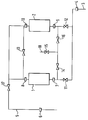
- Figure 1 is a diagrammatic representation of a pressure swing adsorption apparatus and to the following Examples.
- the starting material was a Novolak resin moulding powder containing 3% by weight of hexamethylene tetramine, commercially available from BP Chemicals Limited.
- a layer (25 mm deep) of the resin was heated on a tray in an air circulating oven at 150°C for 2 hours.
- the resulting partially cured resin sheet was ground in a laboratory grinder until substantially all the resin had a particle size below 106 micrometres.
- the ground resin was then mixed with an aqueous solution of (a) hexamethylene tetramine and (b) polyethylene glycol having a molecular weight of 6000 so as to give a product containing 7% by weight of hexamethyl tetramine by weight of the resin and 10% by weight of polyethylene glycol based on the weight of the resin.
- the mixture was then formed into pellets in a tabletting press.
- the pellets were then cured in an oven at 150°C for 1 hour. They were then ground in a laboratory mill until substantially all the resin had a particle size in the range 355-125 micrometre.
- the ground resin was then subjected to ion exchange with a 0.5 molar aqueous solution of
- the ground resin was immersed in the aqueous solution and allowed to remain until ion exchange was complete.
- the ion exchange carbon was then washed with water until pH of solution was neutral.
- the ion exchanged resin was then carbonised.
- the resin was introduced into a furnace at 25°C and the pressure in the furnace reduced to below 10 ⁇ 1 mbar 100 pa.
- the furnace was then heated at the rate of 5°C per minute (while maintaining a reduced pressure) to 800°C. (The vacuum pump continued to operate but the pressure rose due to evolved volatile materials).
- the furnace was held at 800°C for 15 minutes and then cooled back to 25°C while maintaining a reduced pressure.
- a carbon molecular sieve was prepared as in Example 1 except that instead of the formed and cured phenolic resin being ground to a particle size in the range 355-125 micrometres it was ground to a size in the range 1-2 mm.
- This Example shows the use of a carbon molecular sieve made according to Example 1 in a pressure swing adsorption process for the separation of nitrogen from air.
- the apparatus used is shown in Figure 1. It consists of two vessels 1 and 2, each containing a bed of carbon of 20 cm3 volume. Gas could be admitted to the apparatus through inlet 3 and mass flow meter 4 and could be withdrawn from the apparatus through outlet 5 and mass flow meter 6. Vessels 1 and 2 were provided with inlet and outlet filters 7, 8, 9 and 10 respectively. Solenoid valves 11 to 17 were provided in the inlets to the vessels 1 and 2 and in lines between the inlets and outlets of the vessels and in a line to a vent 18. The operation of the valves was in accordance with signals from a programmable logic controller (not shown). The beds were pressurised, equalised and depressurised according to a preprogrammed sequence.
- the product flow and cycle time were varied while keeping the equalisation time between the beds constant.
- the vents were pressurised with air at 7 bar gauge (0.8 MPa absolute).
- the product taken off from outlet line 5 was analysed using a mass spectrometer.
- the valve operating sequence for any given cycle time was as follows.
- valve 11 was opened and vessel 1 was pressurised with air. Five seconds later valve 17 was opened and product taken off from vessel 1.
- Valves 16, 13 and 14 were opened so connecting the inlets and outlets of vessels 1 and 2. The carbon beds in the vessels are thus brought to the same pressure.
- valves 16 and 14 were closed.
- Valve 15 was then opened so as to depressurise vessel 1 through vent 18.
- Valve 12 is opened to pressurise vessel 2 with air from the inlet.
- Valve 17 is opened after 5 seconds and product (nitrogen) is taken off.
- Valves 12 and 15 are closed. Valves 14 and 16 are opened so that the beds in vessels 1 and 2 are equilibrated.
- Valves 14 and 13 are closed. Valve 15 is opened and vessel 2 is depressurised.
- the percentage oxygen is the percentage of oxygen in the gas recovered through line 5.
- the nitrogen recovery represents the proportion of the total nitrogen in the air fed to the process which is recovered in the outlet line.
- Example 3 was repeated but using a commercially available carbon sold for use in the separation of nitrogen and oxygen by pressure swing adsorption. It is believed that this carbon is derived from coal.
- the starting material was Novolak resin EX BP Chemicals.
- the resin was part cured in an air circulating oven at 150°C for 2 hours.
- the resulting cured resin was ground to a particle size of below 106 micrometres.
- the ground resin was then mixed with 7.5 wt% hexamethylenetetromine and 10 wt% polyethylene glycol (added in aqueous solution).
- the mixture was then extruded at a diameter of 2 mm and air dried.
- the extrudate was cured at 150°C for 1 hour and ion exchanged by immersion in aqueous sodium acetate solution (0.5M) for 19 hours.
- the exchanged resin was washed with water until the pH of solution was neutral.
- the ion exchanged extrudate was carbonised by heating to 780°C in a vacuum carbonisation furnace at a heating rate of 5°C/min, after the sample has been evacuated to a pressure below 10 ⁇ 1 mbar.
- the carbonisation temperature of 780°C was held for 15 minutes and then cooled to room temperature while maintaining the vacuum.
- the starting material was Novolak resin EX BP Chemicals.
- the resin was part cured in an air circulating oven at 150°C for 2 hours.
- the resulting pre-cured resin was ground to a particle size of below 106 micrometres.
- the ground resin was then mixed with 7.5 wt% hexamethylenetetramine and 12.5 wt% polyethylene glycol (added in aqueous solution).
- the mixture was then extruded at a diameter of 2 mm and air dried.
- the extrudate was post-cured at 150°C for 1 hour, and ion exchanged by immersion in aqueous sodium acetate solution (0.5M) for 19 hours.
- the exchanged resin was washed with water until the pH of solution was neutral.
- the ion exchanged extrudate was carbonised by heating to 800°C in a vacuum carbonisation furnace at a heating rate of 5°C/min, after the sample has been evacuated to below 10 ⁇ 1 mbar.
- the carbonisation temperature of 800°C was held for 15 minutes and then cooled to room temperature while maintaining vacuum.
- Example 4 The products of Examples 5 and 6 were tested as in Example 3. The results are shown in Tables 4 and 5.
- Table 4 Cycle Time (min) Inlet flow (Nm3/h/m3) Product flow (Nm3/h/m3) % Oxygen % Nitrogen recovery 1 352 48 0.4 17.5 1 393 86 0.7 27.7 1 428 114 1.1 33.8 1 485 170 2.0 44.0 1 522 205 2.8 49.0 1 604 285 4.9 57.5
- Novolak resin Ex BP Chemicals was part cured in an air circulating oven at 150°C for 2 hours.
- the resulting pre-cured resin was ground to a particle size of below 106 micrometres.
- the ground resin was then mixed with an aqueous solution of 7.5 wt hexamethylenetetramine, 12.5 wt% polyethyleneglycol, and 0.04 wt% Na (added as sodium acetate).
- the mixture was then extruded at a diameter of 2 mm and air dried.
- the resin extrudate was carbonised by heating to 765°C in a vacuum carbonisation furnace at a heating rate of 5°C/min after the sample had been evacuated to below 10 ⁇ 1 mbar.
- the carbonisation temperature of 765°C was held for 15 mintures and then cooled to room temperature while maintaining vacuum.
Landscapes
- Chemical & Material Sciences (AREA)
- Analytical Chemistry (AREA)
- Chemical Kinetics & Catalysis (AREA)
- Inorganic Chemistry (AREA)
- Organic Chemistry (AREA)
- Engineering & Computer Science (AREA)
- General Chemical & Material Sciences (AREA)
- Oil, Petroleum & Natural Gas (AREA)
- Carbon And Carbon Compounds (AREA)
- Solid-Sorbent Or Filter-Aiding Compositions (AREA)
Applications Claiming Priority (2)
| Application Number | Priority Date | Filing Date | Title |
|---|---|---|---|
| GB9311122 | 1993-05-28 | ||
| GB939311122A GB9311122D0 (en) | 1993-05-28 | 1993-05-28 | Carbons |
Publications (2)
| Publication Number | Publication Date |
|---|---|
| EP0626199A2 true EP0626199A2 (fr) | 1994-11-30 |
| EP0626199A3 EP0626199A3 (fr) | 1995-02-01 |
Family
ID=10736335
Family Applications (1)
| Application Number | Title | Priority Date | Filing Date |
|---|---|---|---|
| EP94303640A Withdrawn EP0626199A3 (fr) | 1993-05-28 | 1994-05-20 | Procédé pour la production de tamis moléculaires de carbone. |
Country Status (3)
| Country | Link |
|---|---|
| EP (1) | EP0626199A3 (fr) |
| JP (1) | JPH0748112A (fr) |
| GB (1) | GB9311122D0 (fr) |
Cited By (6)
| Publication number | Priority date | Publication date | Assignee | Title |
|---|---|---|---|---|
| EP0784032A4 (fr) * | 1995-07-20 | 1999-03-17 | Nippon Oxygen Co Ltd | Procede pour produire un carbone de tamis moleculaire |
| WO2003008068A1 (fr) * | 2001-07-16 | 2003-01-30 | Carbon Technologies Nv | Filtre |
| WO2004087309A1 (fr) * | 2003-04-02 | 2004-10-14 | Philip, Morris, Products, S.A. | Sorbant contenant du charbon actif |
| CN109319759A (zh) * | 2018-10-25 | 2019-02-12 | 湖州强大分子筛科技有限公司 | 一种用于四氟乙烷纯化的碳分子筛及其制备方法 |
| CN113041998A (zh) * | 2021-03-18 | 2021-06-29 | 安徽理工大学 | 一种防静电碳分子筛的制备方法及其应用 |
| CN114425245A (zh) * | 2020-09-23 | 2022-05-03 | 中国石油化工股份有限公司 | 一种酚醛树脂基复合碳膜及其制备方法和应用 |
Family Cites Families (4)
| Publication number | Priority date | Publication date | Assignee | Title |
|---|---|---|---|---|
| GB1375900A (fr) * | 1972-06-29 | 1974-11-27 | ||
| JPS62108722A (ja) * | 1985-11-06 | 1987-05-20 | Tonbo Enpitsu:Kk | 分子ふるい炭素組成物 |
| JPH03141111A (ja) * | 1989-10-24 | 1991-06-17 | Kanebo Ltd | 分子ふるい炭素の製造法 |
| US5081097A (en) * | 1990-01-19 | 1992-01-14 | California Institute Of Technology | Copper modified carbon molecular sieves for selective oxygen removal |
-
1993
- 1993-05-28 GB GB939311122A patent/GB9311122D0/en active Pending
-
1994
- 1994-05-20 EP EP94303640A patent/EP0626199A3/fr not_active Withdrawn
- 1994-05-30 JP JP6117038A patent/JPH0748112A/ja active Pending
Cited By (10)
| Publication number | Priority date | Publication date | Assignee | Title |
|---|---|---|---|---|
| EP0784032A4 (fr) * | 1995-07-20 | 1999-03-17 | Nippon Oxygen Co Ltd | Procede pour produire un carbone de tamis moleculaire |
| US5968471A (en) * | 1995-07-20 | 1999-10-19 | Nippon Sanso Corporation | Process for producing molecular sieve carbon |
| WO2003008068A1 (fr) * | 2001-07-16 | 2003-01-30 | Carbon Technologies Nv | Filtre |
| US7160366B2 (en) | 2001-07-16 | 2007-01-09 | Mast Carbon International Ltd. | Filter element |
| WO2004087309A1 (fr) * | 2003-04-02 | 2004-10-14 | Philip, Morris, Products, S.A. | Sorbant contenant du charbon actif |
| US7370657B2 (en) | 2003-04-02 | 2008-05-13 | Philip Morris Usa Inc. | Activated carbon-containing sorbent |
| CN109319759A (zh) * | 2018-10-25 | 2019-02-12 | 湖州强大分子筛科技有限公司 | 一种用于四氟乙烷纯化的碳分子筛及其制备方法 |
| CN109319759B (zh) * | 2018-10-25 | 2021-10-29 | 湖州强大分子筛科技有限公司 | 一种用于四氟乙烷纯化的碳分子筛及其制备方法 |
| CN114425245A (zh) * | 2020-09-23 | 2022-05-03 | 中国石油化工股份有限公司 | 一种酚醛树脂基复合碳膜及其制备方法和应用 |
| CN113041998A (zh) * | 2021-03-18 | 2021-06-29 | 安徽理工大学 | 一种防静电碳分子筛的制备方法及其应用 |
Also Published As
| Publication number | Publication date |
|---|---|
| GB9311122D0 (en) | 1993-07-14 |
| JPH0748112A (ja) | 1995-02-21 |
| EP0626199A3 (fr) | 1995-02-01 |
Similar Documents
| Publication | Publication Date | Title |
|---|---|---|
| EP0282053B1 (fr) | Procédé de fabrication et utilisation de tamis moléculaire en carbone | |
| EP1798197B1 (fr) | Procédé de séparation d'azote gazeux et carbone tamis moléculaire | |
| CN108439403B (zh) | 一种低温预热解、原料超细化制备生物质成型活性炭的方法 | |
| US4420415A (en) | Process for the production of carbon molecular sieves | |
| US12138616B2 (en) | Microporous carbon materials to separate nitrogen in associated and non-associated natural gas streams | |
| KR20180129857A (ko) | 바인더-프리 석탄계 성형 활성탄의 제조방법 | |
| JPH04227055A (ja) | メタノールのカルボニル化 | |
| KR100508133B1 (ko) | 비표면적이 높고 개선된 기계적 특성을 갖는 입자 형태의 탄화규소계 촉매 지지체 | |
| CN101628715B (zh) | I型人造金刚石专用粉体材料的制备方法 | |
| JPS59162178A (ja) | 貫流可能な多孔質の炭化珪素製成形体の製造方法 | |
| US5498589A (en) | Process for the production of carbon molecular sieves | |
| CN107321307A (zh) | 一种用油茶壳制作碳分子筛的方法 | |
| JPH0748112A (ja) | 炭素モレキュラシーブの製造方法 | |
| JPS59162113A (ja) | 貫流可能な多孔質の炭素製成形体の製造方法 | |
| CN110734060A (zh) | 一种超容炭的制备方法 | |
| CN121001960A (zh) | 碳分子筛及其制造方法、以及气体分离装置 | |
| JPH0620546B2 (ja) | 分子ふるい炭素及びその製造法 | |
| JP2610867B2 (ja) | 熱炭素還元による窒化ケイ素のセラミツクス製造用粉末の製造方法 | |
| KR102181923B1 (ko) | 나프탈렌을 이용한 다형상 활성탄소 제조 방법 | |
| JPH11349318A (ja) | 活性炭の製造方法 | |
| KR102543475B1 (ko) | 탄소 흡착제 제조방법 및 이로부터 제조된 탄소 흡착제. | |
| KR20200080477A (ko) | 커피 활성탄화물의 제조방법 | |
| CN104445152B (zh) | 一种大孔炭材料的制备方法及其产品 | |
| KR20200055985A (ko) | 나노 금속분말을 이용한 유해가스 제거용 고효율 활성탄소 제조 방법 | |
| KR100435006B1 (ko) | 다중 입도분포 분말로부터 반응소결 탄화규소 제조용 균일 프리폼의 제조방법 |
Legal Events
| Date | Code | Title | Description |
|---|---|---|---|
| PUAI | Public reference made under article 153(3) epc to a published international application that has entered the european phase |
Free format text: ORIGINAL CODE: 0009012 |
|
| AK | Designated contracting states |
Kind code of ref document: A2 Designated state(s): AT BE CH DE DK ES FR GB GR IE IT LI LU MC NL PT SE |
|
| PUAL | Search report despatched |
Free format text: ORIGINAL CODE: 0009013 |
|
| AK | Designated contracting states |
Kind code of ref document: A3 Designated state(s): AT BE CH DE DK ES FR GB GR IE IT LI LU MC NL PT SE |
|
| STAA | Information on the status of an ep patent application or granted ep patent |
Free format text: STATUS: THE APPLICATION IS DEEMED TO BE WITHDRAWN |
|
| 18D | Application deemed to be withdrawn |
Effective date: 19950802 |