EP0626703A2 - Anisotropes sphärisches Magnetpulver - Google Patents
Anisotropes sphärisches Magnetpulver Download PDFInfo
- Publication number
- EP0626703A2 EP0626703A2 EP94303386A EP94303386A EP0626703A2 EP 0626703 A2 EP0626703 A2 EP 0626703A2 EP 94303386 A EP94303386 A EP 94303386A EP 94303386 A EP94303386 A EP 94303386A EP 0626703 A2 EP0626703 A2 EP 0626703A2
- Authority
- EP
- European Patent Office
- Prior art keywords
- powder
- microns
- particles
- magnetic
- magnet
- Prior art date
- Legal status (The legal status is an assumption and is not a legal conclusion. Google has not performed a legal analysis and makes no representation as to the accuracy of the status listed.)
- Withdrawn
Links
Images






Classifications
-
- H—ELECTRICITY
- H01—ELECTRIC ELEMENTS
- H01F—MAGNETS; INDUCTANCES; TRANSFORMERS; SELECTION OF MATERIALS FOR THEIR MAGNETIC PROPERTIES
- H01F1/00—Magnets or magnetic bodies characterised by the magnetic materials therefor; Selection of materials for their magnetic properties
- H01F1/01—Magnets or magnetic bodies characterised by the magnetic materials therefor; Selection of materials for their magnetic properties of inorganic materials
- H01F1/03—Magnets or magnetic bodies characterised by the magnetic materials therefor; Selection of materials for their magnetic properties of inorganic materials characterised by their coercivity
- H01F1/032—Magnets or magnetic bodies characterised by the magnetic materials therefor; Selection of materials for their magnetic properties of inorganic materials characterised by their coercivity of hard-magnetic materials
- H01F1/04—Magnets or magnetic bodies characterised by the magnetic materials therefor; Selection of materials for their magnetic properties of inorganic materials characterised by their coercivity of hard-magnetic materials metals or alloys
- H01F1/047—Alloys characterised by their composition
- H01F1/053—Alloys characterised by their composition containing rare earth metals
- H01F1/055—Alloys characterised by their composition containing rare earth metals and magnetic transition metals, e.g. SmCo5
- H01F1/057—Alloys characterised by their composition containing rare earth metals and magnetic transition metals, e.g. SmCo5 and IIIa elements, e.g. Nd2Fe14B
- H01F1/0571—Alloys characterised by their composition containing rare earth metals and magnetic transition metals, e.g. SmCo5 and IIIa elements, e.g. Nd2Fe14B in the form of particles, e.g. rapid quenched powders or ribbon flakes
- H01F1/0574—Alloys characterised by their composition containing rare earth metals and magnetic transition metals, e.g. SmCo5 and IIIa elements, e.g. Nd2Fe14B in the form of particles, e.g. rapid quenched powders or ribbon flakes obtained by liquid dynamic compaction
-
- H—ELECTRICITY
- H01—ELECTRIC ELEMENTS
- H01F—MAGNETS; INDUCTANCES; TRANSFORMERS; SELECTION OF MATERIALS FOR THEIR MAGNETIC PROPERTIES
- H01F1/00—Magnets or magnetic bodies characterised by the magnetic materials therefor; Selection of materials for their magnetic properties
- H01F1/01—Magnets or magnetic bodies characterised by the magnetic materials therefor; Selection of materials for their magnetic properties of inorganic materials
- H01F1/03—Magnets or magnetic bodies characterised by the magnetic materials therefor; Selection of materials for their magnetic properties of inorganic materials characterised by their coercivity
- H01F1/032—Magnets or magnetic bodies characterised by the magnetic materials therefor; Selection of materials for their magnetic properties of inorganic materials characterised by their coercivity of hard-magnetic materials
- H01F1/04—Magnets or magnetic bodies characterised by the magnetic materials therefor; Selection of materials for their magnetic properties of inorganic materials characterised by their coercivity of hard-magnetic materials metals or alloys
- H01F1/047—Alloys characterised by their composition
- H01F1/053—Alloys characterised by their composition containing rare earth metals
- H01F1/055—Alloys characterised by their composition containing rare earth metals and magnetic transition metals, e.g. SmCo5
- H01F1/057—Alloys characterised by their composition containing rare earth metals and magnetic transition metals, e.g. SmCo5 and IIIa elements, e.g. Nd2Fe14B
- H01F1/0571—Alloys characterised by their composition containing rare earth metals and magnetic transition metals, e.g. SmCo5 and IIIa elements, e.g. Nd2Fe14B in the form of particles, e.g. rapid quenched powders or ribbon flakes
- H01F1/0573—Alloys characterised by their composition containing rare earth metals and magnetic transition metals, e.g. SmCo5 and IIIa elements, e.g. Nd2Fe14B in the form of particles, e.g. rapid quenched powders or ribbon flakes obtained by reduction or by hydrogen decrepitation or embrittlement
Definitions
- the present invention relates to magnetic materials exhibiting high intrinsic coercivity and, more particularly, to such materials in powder form.
- NdFeB-type alloys The magnetic properties of rare earth-transitional metal-boron alloys such as NdFeB-type alloys are well known to those in the art.
- One of the applications in which NdFeB alloys are used is the production of bonded magnets. Bonded magnets consist of magnetic particles agglomerated in a binder, such as an organic polymer, and exhibit strong magnetic properties.
- NdFeB alloy powders for use in the production of bonded magnets have been commercially prepared by crushing melt-spun ribbons into powder.
- the flake-like particles formed by crushing melt-spun ribbons generally exhibit isotropic behavior and relatively poor flowability. Consequently, they do not achieve their full potential as magnetic materials and are somewhat difficult to form into bonded magnets using conventional injection molding equipment.
- the mechanical strength of bonded magnets formed of such flake-like particles is relatively poor because of stress concentrations arising from the sharp edges of the flake-like particles.
- NdFeB alloy powders have been prepared by crushing and pulverizing cast ingots of NdFeB alloys. Powders prepared in this manner typically display intrinsic coercivity, H ci , values of less than 5kOe because of their large-grained microstructures formed during relatively slow cooling and metallurgical defects or oxidation on the particle surfaces. As a consequence of the low H ci values they display, crushed and pulverized NdFeB alloy powders have not been used in the preparation of bonded magnets.
- coercive NdFeB alloy powders have been prepared by heating an NdFeB alloy in a hydrogen atmosphere and removing the hydrogen in a desorption step. Powders prepared by subjecting a cast NdFeB alloy, either in ingot or powder form, to HDDR have irregularly shaped, i.e. non-spherical, particles with the shape of the particles varying depending upon the fracture patterns in the alloy.
- NdFeB powders prepared by subjecting a cast alloy to HDDR are isotropic, although some anisotropic behavior has been noted for cast alloys containing a refractory metal addition such as Nb, Ti, Zr, or Hf.
- spherical NdFeB alloy powders can be produced using gas atomization.
- a spherical powder morphology is well suited for use in the production of bonded magnets because the relatively high flowability of spherical powders is conducive to injection molding.
- the mechanical strength of bonded magnets formed from spherical particles should be high because the spherical shape of the particles minimizes the possibility that stress concentrations from sharp-edged particles will occur during bending.
- spherical NdFeB alloy powders produced by gas atomization have not been widely used in the production of bonded magnets because they display low H ci values.
- a method for improving the intrinsic coercivity of relatively coarse spherical NdFeB alloy powder produced by gas atomization is disclosed in U.S. Patent No. 5,127,970 to Kim .
- the method involves subjecting a spherical NdFeB alloy powder having a particle size within the range of 200-300 microns to dual hydrogen absorption-desorption treatment cycles at an elevated temperature in the range of 660°C to 850°C. While the intrinsic coercivity of the NdFeB powder is enhanced, the nature of the powder remains isotropic. Thus, the enhanced remanence (B r ) and maximum energy product (BH max ) desired for commercial applications, which result from anisotropic behavior, are not realized.
- B r enhanced remanence
- BH max maximum energy product
- An additional object of the invention is to provide a magnetic material of high intrinsic coercivity.
- a further object of the invention is to provide a bonded magnet formed from anisotropic spherical particles having a high coercivity per particle.
- the method of forming a magnetically anisotropic powder of the invention includes forming a substantially spherical powder having a major magnetic phase and an average particle size of less than about 200 microns, diffusing hydrogen into the spherical powder at elevated temperatures in an amount sufficient to disproportionate the major magnetic phase, and desorbing the hydrogen by heating the disproportionated powder under vacuum.
- the disproportionated powder retains its spherical shape and is magnetically anisotropic, exhibiting a reasonably high intrinsic coercivity and maximum energy product.
- the spherical, magnetically anisotropic powder can be mixed with a binder and processed into a bonded magnet.
- the magnetic material from which the spherical powder is formed may be comprised of a rare earth-transition metal-boron alloy including at least one element from the iron group, at least one rare earth element, and boron.
- the major magnetic phase of the spherical powder preferably consists essentially of (Nd 1-x R x )2 Fe14B, where R is one or more of La, Sm, Pr, Dy, Tb, Ho, Er, Tm, Yb, Lu, and Y, and x is from 0 to 1.
- a preferred range for the average particle size of the spherical powder is from about 10 microns to about 150 microns.
- the disproportionation and desorption steps may be carried out at elevated temperatures in the range from 500°C to 1000°C, and preferably in the range from about 900°C to about 950°C.
- the method also includes the step of heating the dehydrogenated powder to increase the intrinsic coercivity of the powder.
- Another aspect of the invention is a method of forming a bonded magnet consisting essentially of magnetically anisotropic powder.
- the method of forming a magnet includes forming a substantially spherical powder having a major magnetic phase and an average particle size of less than about 200 microns by inert gas atomization, diffusing hydrogen into the spherical powder at elevated temperatures in an amount sufficient to disproportionate the major magnetic phase, desorbing hydrogen by heating the disproportionated powder under vacuum, mixing the dehydrogenated powder with a suitable binder to form a mixture comprised of powder particles dispersed in the binder, and aligning and magnetizing the powder particles in the mixture in a magnetic field.
- a further aspect of the invention is a bonded magnet formed of spherical, magnetically anisotropic particles.
- the bonded magnet includes a plurality of substantially spherical particles consisting essentially of at least one element from the iron group, at least one rare earth element, and boron.
- the spherical particles are magnetically anisotropic, magnetized, and aligned.
- a binder agglomerates the spherical particles into a bonded magnet having an intrinsic coercivity in excess of 7kOe.
- recrystallized grains in the spherical powder particles subdivide the powder particles into individual magnetic domains having an average size of less than 0.5 micron.
- Figure 1 is a 500X optical micrograph of Nd 12.6 Dy 1.4 Fe79Nb 0.5 B 6.5 (Batch H) powder showing the spherical shape of the particles in the as-atomized state. The relatively large grain size of the particles varies with particle diameter.
- Figure 2 is a graph of magnetization curves for as-atomized Nd 11.7 Dy 1.3 Fe80Nb 0.5 B 6.5 (Batch F) powder measured parallel and perpendicular to the original magnetization direction.
- the as-atomized powders were immersed in molten paraffin and solidified under a DC magnetic field.
- the measured magnetization was normalized to 100% powder theoretical density.
- the difference in magnetization at zero magnetic field, B r between the measured directions is about 10 emu/g, which reflects isotropic behavior.
- Figure 3 is a 500X optical micrograph of Nd 12.6 Dy 1.4 Fe79Nb 0.5 B 6.5 (Batch H) powder of the present invention formed by inert gas atomization and HDDR treatment.
- the particles shown in Figure 3 have undergone grain refinement so that their grain size is beyond the resolution of optical microscopy but otherwise have retained the spherical shape and original particle size of the as-atomized particles shown in Figure 1.
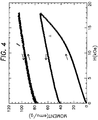
- Figure 4 is a graph of magnetization curves for Nd 11.7 Dy 1.3 Fe80Nb 0.5 B 6.5 (Batch F) powder of the present invention measured parallel and perpendicular to the original magnetization direction. The difference in magnetization at zero magnetic field between the measured directions is about 40 emu/g, which reflects anisotropic behavior.
- Figure 5 is a graph of second quadrant demagnetization curves for Nd 11.7 Dy 1.3 Fe80Nb 0.5 B 6.5 (Batch F) powder of the present invention measured with and without magnetic field alignment.
- the B r value for the powder increases from about 5.5 kG without magnetic field alignment to about 7.9 kG with magnetic field alignment.
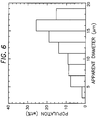
- Figure 6 is a bar graph showing the particle size distribution for the powders of Batches A and D in Example 1.
- Figure 7 is a bar graph showing the particle size distribution for the powders of Batches B and C in Example 1.
- Figure 8 is a bar graph showing the particle size distribution for the powder of Batch E in Example 2.
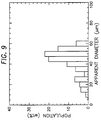
- Figure 9 is a bar graph showing the particle size distribution for the powder of Batch F in Example 2.
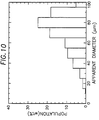
- Figure 10 is a bar graph showing the particle size distribution for the powder of Batch G in Example 2.
- Figure 11 is a bar graph showing the particle size distribution for the powder of Batch H in Example 2.
- the method of forming a magnetically anisotropic powder of the invention includes forming a substantially spherical powder having a major magnetic phase and an average particle size of less than about 200 microns.
- Magnetic materials of the NdFeB-type are suitable for use in the invention.
- the spherical powder is comprised of at least one element from the iron group, at least one rare earth element, and boron.
- the element from the iron group may be Fe, Ni, Co, or mixtures thereof.
- the rare earth element may be selected from the lanthanide group including Nd, La, Sm, Pr, Dy, Tb, Ho, Er, Tm, Yb, Lu, Y, mixtures thereof, and mischmetal.
- Substantially spherical powder having an average particle size of less than about 200 microns, and preferably less than about 150 microns may be formed by known techniques including, but not limited to, inert gas atomization, plasma spray, and in-flight solidification.
- a preferred range for the average particle size of the spherical powder is from about 10 microns to about 150 microns.
- a more preferred range for the average particle size of the spherical powder is from about 10 microns to about 70 microns.
- the term "major magnetic phase” means the phase of a magnetic material that most contributes to the magnetic properties of the material. It is preferred that the major magnetic phase of the spherical powder consists essentially of (Nd 1-x R x )2 Fe14B, where R is one or more of La, Sm, Pr, Dy, Tb, Ho, Er, Tm, Yb, Lu, and Y, and x is from 0 to 1. In a preferred embodiment, the major magnetic phase of the spherical powder consists essentially of tetragonal Nd2Fe14B.
- hydrogen is diffused into the spherical powder at elevated temperatures in an amount sufficient to disproportionate the major magnetic phase.
- the major magnetic phase undergoes a disproportionation reaction.
- the amount of hydrogen required to disproportionate a magnetic phase is described in U.S. Patent No. 4,981,532, the disclosure of which is hereby incorporated by reference.
- the hydrogen disproportionation step may be carried out for approximately 1 hour at a temperature in the range from 500°C to 1000°C. In a preferred embodiment, the hydrogen disproportionation step is carried out for approximately 1 hour at a temperature in the range from about 900°C to about 950°C.
- hydrogen is desorbed from the disproportionated powder by heating under vacuum.
- the disproportionated phases gradually recombine.
- the major magnetic phase is Nd2Fe14B
- the NdH x , Fe, and Fe2B phases recombine into Nd2Fe14B.
- the hydrogen desorption step which is also described in U.S. Patent No. 4,981,532, may be carried out for 1-3 hours at a temperature in the range from 500°C to 1000°C.
- the hydrogen desorption step is carried out under vacuum for approximately 1 hour at a temperature in the range from about 900°C to about 950°C.
- Powders formed by gas atomization are spherical in shape (see, for example, the powder particles in Figure 1) and each particle typically consists of many randomly oriented grains.
- gas atomized NdFeB-type particles are magnetically isotropic in the as-atomized state as demonstrated in Figure 2.
- the NdFeB-type particles formed in accordance with the present invention surprisingly retain their spherical shape and original particle size (compare the powder particles in Figure 3 with those in Figure 1) and unexpectedly display magnetic anisotropy.
- Figures 4 and 5 are graphs showing magnetization and demagnetization curves, respectively, for spherical powders of the present invention. As can be seen in Figure 5, the demagnetization curves along directions aligned with and perpendicular to the magnetization direction are significantly different demonstrating that the spherical powders of the present invention are magnetically anisotropic.
- the dehydrogenated powder can be reheated to a temperature of 500°C to 700°C to increase the intrinsic coercivity of the powder.
- the major magnetic phase is Nd2Fe14B
- one or more refractory elements may be added to the powder to minimize the secondary recrystallization of Nd2Fe14B grains during thermal treatment.
- the refractory element(s) may be selected from the 3d or 4d metal groups including Co, Nb, V, Mo, Ti, Zr, Cr, W, and mixtures thereof.
- one or more grain boundary modifiers such as Cu, Al, and Ga may be added to increase the coercivity of the powder.
- Another aspect of the invention is a method of forming a bonded magnet consisting essentially of magnetically anisotropic powder.
- the method includes the steps described above in connection with the method of forming a magnetically anisotropic powder, namely forming a substantially spherical powder, diffusing hydrogen into the powder to disproportionate the major magnetic phase, and desorbing the hydrogen by heating the disproportionated powder under vacuum.
- the method further includes mixing the dehydrogenated powder with a suitable binder to form a mixture comprised of powder particles dispersed in the binder, and aligning and magnetizing the powder particles in the mixture in a magnetic field.
- Suitable binders include, but are not limited to, organic polymers such as nylon.
- the mixture of powder particles dispersed in the binder may be formed into a magnet by injection molding, cold compression and curing, or any other suitable process.
- the mixing step and the aligning and magnetizing step may be combined into a single step through the use of automated processing equipment.
- Bonded magnets comprised of substantially spherical, magnetically anisotropic particles formed in accordance with the invention have intrinsic coercivities in excess of 7kOe.
- a plurality of recrystallized grains are formed in the spherical powder particles.
- the recrystallized grains subdivide the powder particles into individual magnetic domains having an average size of less than 0.5 micron.
- the average particle size of each batch was measured by optical microscopy in conjunction with an image analyzer.
- the average particle size of Batches A and D in the as-atomized state was about 15 microns.
- the average particle size of Batches B and C in the as-atomized state was about 11 microns.
- the particle size distributions for Batches A and D and Batches B and C are shown in Figures 6 and 7, respectively.
- Each batch was subjected to HDDR treatment for one hour at the following temperatures: 850°C, 900°C and 950°C.
- the average domain size of each batch after HDDR treatment was less than 0.5 micron as determined by scanning electron microscopy under a polarized beam.
- the thus-formed powders were mixed with paraffin to form simulated bonded magnets.
- the bonded magnets were magnetically aligned by applying a D.C. magnetic field of 30 kOe during solidification of the paraffin.
- the intrinsic coercivity, H ci of the magnetically aligned bonded magnets was measured using a Walker Hysteresisgraph, Model MH-50.
- the measured H ci values for the magnetically aligned bonded magnets are shown in Table 2. TABLE 2 H ci (kOe) Treatment Batch A Batch B Batch C Batch D HDDR @ 850°C 10.4 8.6 9.7 9.2 HDDR @ 900°C 15.3 13.8 12.0 7.3 HDDR @ 1000°C 14.2 13.8 10.5 12.1
- Second quadrant demagnetization curves (with and without magnetic field alignment) for bonded magnets formed from the powder of Batch F are shown in Figure 5.
- the significant difference in the demagnetization curves shows that the atomized, HDDR-treated powders of the invention are magnetically anisotropic, i.e., they respond differently when exposed to the magnetic field.
- the average particle size of each batch was measured by optical microscopy in conjunction with an image analyzer.
- the average particle size of Batches E, F, G, and H in the as-atomized state was about 60 microns, about 45 microns, about 80 microns, and about 70 microns, respectively.
- H ci The intrinsic coercivity, H ci , of powder samples from each batch was measured under the following conditions: (1) as-atomized; (2) as-atomized with an isothermal treatment for 1.5 hours at 500°C, 600°C, and 700°C; (3) HDDR-treated for one hour at 850°C, 900°C, and 950°C; and (4) HDDR-treated as in (3) with an isothermal treatment for 1.5 hours at 550°C, 600°C, and 650°C.
- the measured H ci values for each sample are listed in Table 5.
- the as-atomized powders of Batches E through H all exhibit an H ci of not greater than 3 kOe.
- These low H ci values are improved by applying an isothermal treatment at a temperature in the range of 500°C to 700°C to the as-atomized powders.
- an isothermal treatment at 600°C increased the H ci level for Batch H from 3.0 kOe in the as-atomized state to 6.3 kOe.
- a more significant increase in H ci is observed when the as-atomized powder is subjected to both HDDR treatment and an isothermal treatment.
- the H ci level for Batch F is 15.9 kOe.
- H ci depends on the HDDR temperature.
- the H ci level for Batch E is optimized at 900°C whereas the H ci level for Batch G is optimized at 850°C. Severe secondary recrystallization is observed in powders that have been HDDR-treated above 950°C and, as a consequence, H ci significantly decreases.
- H ci is less sensitive to the HDDR temperature.
- Batch F can be HDDR-treated over the temperature range of 850°C to 950°C with a peak at 900°C.
- an H ci of more than 14 kOe was obtained when HDDR was performed at temperatures below 900°C.
- the H ci became very sensitive to the temperature of the isothermal treatment.
- An H ci of 13.8 kOe was obtained when the isothermal treatment was carried out at 600°C.
- the B r and BH max values for Batches E through H in Example 2 are lower than observed for Batches A through D in Example 1.
- the alloy compositions of Batches E through H should yield higher B r and BH max values than the compositions of Batches A through D.
- the powders of Batches E through H are much coarser than the powders of Batches A through D.
- the average particle sizes for Batches E through H range from about 45 microns to about 80 microns whereas the average particle sizes for Batches A through D range from about 11 microns to about 15 microns.
- the B r and BH max values observed in Examples 1 and 2 demonstrate that finer particle sizes play a significant role in improving magnetic properties, particularly B r and BH max , after HDDR treatment.
Landscapes
- Chemical & Material Sciences (AREA)
- Crystallography & Structural Chemistry (AREA)
- Inorganic Chemistry (AREA)
- Engineering & Computer Science (AREA)
- Power Engineering (AREA)
- Hard Magnetic Materials (AREA)
- Powder Metallurgy (AREA)
Applications Claiming Priority (2)
| Application Number | Priority Date | Filing Date | Title |
|---|---|---|---|
| US69276 | 1993-05-28 | ||
| US08/069,276 US5474623A (en) | 1993-05-28 | 1993-05-28 | Magnetically anisotropic spherical powder and method of making same |
Publications (2)
| Publication Number | Publication Date |
|---|---|
| EP0626703A2 true EP0626703A2 (de) | 1994-11-30 |
| EP0626703A3 EP0626703A3 (de) | 1995-01-25 |
Family
ID=22087888
Family Applications (1)
| Application Number | Title | Priority Date | Filing Date |
|---|---|---|---|
| EP94303386A Withdrawn EP0626703A3 (de) | 1993-05-28 | 1994-05-11 | Anisotropes sphärisches Magnetpulver. |
Country Status (6)
| Country | Link |
|---|---|
| US (1) | US5474623A (de) |
| EP (1) | EP0626703A3 (de) |
| JP (1) | JPH06346101A (de) |
| CN (1) | CN1057630C (de) |
| CA (1) | CA2124395C (de) |
| TW (1) | TW255973B (de) |
Families Citing this family (19)
| Publication number | Priority date | Publication date | Assignee | Title |
|---|---|---|---|---|
| CN1059368C (zh) * | 1997-05-23 | 2000-12-13 | 冶金工业部钢铁研究总院 | 一种永磁体粉末的制备方法 |
| JP2001524604A (ja) * | 1997-11-20 | 2001-12-04 | インスティトゥート フュア フェストケルパー− ウント ヴェルクシュトッフオルシュング ドレースデン エー ファウ | 磁気合金粉末の製法 |
| JPH11241104A (ja) * | 1997-12-25 | 1999-09-07 | Nichia Chem Ind Ltd | Sm−Fe−N系合金粉末及びその製造方法 |
| JP2004115921A (ja) * | 1997-12-25 | 2004-04-15 | Nichia Chem Ind Ltd | Sm−Fe−N系合金粉末及びその製造方法 |
| AU2327300A (en) * | 1999-02-10 | 2000-08-29 | Hitachi Maxell, Ltd. | Magnetic recording medium, and magnetic powder and method for preparing the same |
| US6261515B1 (en) | 1999-03-01 | 2001-07-17 | Guangzhi Ren | Method for producing rare earth magnet having high magnetic properties |
| US6444052B1 (en) * | 1999-10-13 | 2002-09-03 | Aichi Steel Corporation | Production method of anisotropic rare earth magnet powder |
| US6613213B1 (en) | 2000-03-27 | 2003-09-02 | Brookhaven Science Associates, Llc | Method for producing electrodes using microscale or nanoscale materials obtained from hydrogendriven metallurgical reactions |
| US6555018B2 (en) * | 2001-02-28 | 2003-04-29 | Magnequench, Inc. | Bonded magnets made with atomized permanent magnetic powders |
| JP4451760B2 (ja) * | 2004-11-09 | 2010-04-14 | 財団法人秋田県資源技術開発機構 | 球状NiP微小粒子の製造方法および異方性導電フィルム用導電粒子の製造方法 |
| WO2010007673A1 (ja) * | 2008-07-16 | 2010-01-21 | ミネベア株式会社 | 希土類-鉄系環状磁石の製造方法、及びモータ |
| JP5059929B2 (ja) | 2009-12-04 | 2012-10-31 | 住友電気工業株式会社 | 磁石用粉末 |
| JP5059955B2 (ja) * | 2010-04-15 | 2012-10-31 | 住友電気工業株式会社 | 磁石用粉末 |
| CN103151130A (zh) | 2010-05-19 | 2013-06-12 | 住友电气工业株式会社 | 磁性部件用粉末、粉末成形体及磁性部件 |
| JP6788955B2 (ja) * | 2014-09-30 | 2020-11-25 | 日亜化学工業株式会社 | ボンド磁石およびその製造方法 |
| EP3360627B1 (de) * | 2017-02-08 | 2022-01-05 | Heraeus Deutschland GmbH & Co. KG | Pulver zur verwendung in einem additiven fertigungsverfahren |
| DE102018101765B4 (de) * | 2018-01-26 | 2019-12-05 | Stahl Cranesystems Gmbh | Skalierbare Hysteresekupplung |
| CN110014157A (zh) * | 2019-05-29 | 2019-07-16 | 浙江鑫盛永磁科技有限公司 | 防氧化的钕铁硼加工工艺 |
| CN121260621B (zh) * | 2025-09-25 | 2026-06-09 | 四川大学 | 一种具有均匀亚微米晶粒结构的RE-Fe-B磁粉及制备方法 |
Family Cites Families (9)
| Publication number | Priority date | Publication date | Assignee | Title |
|---|---|---|---|---|
| US4402770A (en) * | 1981-10-23 | 1983-09-06 | The United States Of America As Represented By The Secretary Of The Navy | Hard magnetic alloys of a transition metal and lanthanide |
| GB8318009D0 (en) * | 1983-07-02 | 1983-08-03 | Lucas Ind Plc | Hydrogen storage |
| GB8707905D0 (en) * | 1987-04-02 | 1987-05-07 | Univ Birmingham | Magnets |
| CN1012477B (zh) * | 1987-08-19 | 1991-05-01 | 三菱金属株式会社 | 稀土-铁-硼磁体粉末及其制备方法 |
| JPH01162302A (ja) * | 1987-12-18 | 1989-06-26 | Seiko Electronic Components Ltd | ボンド磁石用合金粉末の製造方法 |
| US5143560A (en) * | 1990-04-20 | 1992-09-01 | Hitachi Metals, Inc., Ltd. | Method for forming Fe-B-R-T alloy powder by hydrogen decrepitation of die-upset billets |
| JP3196224B2 (ja) * | 1991-02-01 | 2001-08-06 | 三菱マテリアル株式会社 | 希土類−Fe−Co−B系異方性磁石 |
| US5127970A (en) * | 1991-05-21 | 1992-07-07 | Crucible Materials Corporation | Method for producing rare earth magnet particles of improved coercivity |
| US5314548A (en) * | 1992-06-22 | 1994-05-24 | General Motors Corporation | Fine grained anisotropic powder from melt-spun ribbons |
-
1993
- 1993-05-28 US US08/069,276 patent/US5474623A/en not_active Expired - Lifetime
-
1994
- 1994-05-11 EP EP94303386A patent/EP0626703A3/de not_active Withdrawn
- 1994-05-16 TW TW083104420A patent/TW255973B/zh not_active IP Right Cessation
- 1994-05-26 CA CA002124395A patent/CA2124395C/en not_active Expired - Lifetime
- 1994-05-27 JP JP6136751A patent/JPH06346101A/ja active Pending
- 1994-05-27 CN CN94105584A patent/CN1057630C/zh not_active Expired - Lifetime
Also Published As
| Publication number | Publication date |
|---|---|
| CA2124395A1 (en) | 1994-11-29 |
| US5474623A (en) | 1995-12-12 |
| JPH06346101A (ja) | 1994-12-20 |
| EP0626703A3 (de) | 1995-01-25 |
| TW255973B (de) | 1995-09-01 |
| CN1057630C (zh) | 2000-10-18 |
| CN1100228A (zh) | 1995-03-15 |
| CA2124395C (en) | 2006-10-17 |
Similar Documents
| Publication | Publication Date | Title |
|---|---|---|
| US5474623A (en) | Magnetically anisotropic spherical powder and method of making same | |
| RU2377680C2 (ru) | Редкоземельный постоянный магнит | |
| US4921551A (en) | Permanent magnet manufacture from very low coercivity crystalline rare earth-transition metal-boron alloy | |
| US5352301A (en) | Hot pressed magnets formed from anisotropic powders | |
| US6120620A (en) | Praseodymium-rich iron-boron-rare earth composition, permanent magnet produced therefrom, and method of making | |
| KR20000048146A (ko) | 희토류/철/붕소계 영구자석 합금 조성물 | |
| JPS6325904A (ja) | 永久磁石およびその製造方法並びに永久磁石製造用組成物 | |
| US4834812A (en) | Method for producing polymer-bonded magnets from rare earth-iron-boron compositions | |
| US20060096669A1 (en) | Exchange spring magnet powder and a method of producing the same | |
| US20070137733A1 (en) | Mixed rare-earth based high-coercivity permanent magnet | |
| JPH0551656B2 (de) | ||
| US4900374A (en) | Demagnetization of iron-neodymium-boron type permanent magnets without loss of coercivity | |
| JPH08181009A (ja) | 永久磁石とその製造方法 | |
| JPH1092617A (ja) | 永久磁石及びその製造方法 | |
| JPH0685369B2 (ja) | 永久磁石の製造方法 | |
| JPH07176418A (ja) | 高性能のホットプレス済み磁石 | |
| EP1072044A1 (de) | Praseodymium -reiche seltenerd-eisen-bor zusammensetzung, dauermagnet daraus hergestellt, und herstellungsverfahren | |
| KR900006533B1 (ko) | 이방성 자성분말과 이의 자석 및 이의 제조방법 | |
| JP3645312B2 (ja) | 磁性材料と製造法 | |
| JP2001006911A (ja) | 希土類永久磁石の製造方法 | |
| JPH06124812A (ja) | 窒化物磁性粉とその合成方法 | |
| JPH06112019A (ja) | 窒化物磁性材料 | |
| JPH07211570A (ja) | 希土類永久磁石の製造方法 | |
| JP3209292B2 (ja) | 磁性材料とその製造方法 | |
| JP3209291B2 (ja) | 磁性材料とその製造方法 |
Legal Events
| Date | Code | Title | Description |
|---|---|---|---|
| PUAI | Public reference made under article 153(3) epc to a published international application that has entered the european phase |
Free format text: ORIGINAL CODE: 0009012 |
|
| AK | Designated contracting states |
Kind code of ref document: A2 Designated state(s): DE FR GB IT SE |
|
| PUAL | Search report despatched |
Free format text: ORIGINAL CODE: 0009013 |
|
| AK | Designated contracting states |
Kind code of ref document: A3 Designated state(s): DE FR GB IT SE |
|
| 17P | Request for examination filed |
Effective date: 19950718 |
|
| 17Q | First examination report despatched |
Effective date: 19970212 |
|
| RAP1 | Party data changed (applicant data changed or rights of an application transferred) |
Owner name: RHONE-POULENC INC. |
|
| STAA | Information on the status of an ep patent application or granted ep patent |
Free format text: STATUS: THE APPLICATION IS DEEMED TO BE WITHDRAWN |
|
| 18D | Application deemed to be withdrawn |
Effective date: 19980106 |