EP0635574B1 - Souches récombinantes dépourvues de marqueurs de sélection: procédé pour leur obtention et utilisation de ces souches - Google Patents
Souches récombinantes dépourvues de marqueurs de sélection: procédé pour leur obtention et utilisation de ces souches Download PDFInfo
- Publication number
- EP0635574B1 EP0635574B1 EP94201896A EP94201896A EP0635574B1 EP 0635574 B1 EP0635574 B1 EP 0635574B1 EP 94201896 A EP94201896 A EP 94201896A EP 94201896 A EP94201896 A EP 94201896A EP 0635574 B1 EP0635574 B1 EP 0635574B1
- Authority
- EP
- European Patent Office
- Prior art keywords
- gene
- dna
- gla
- selection marker
- marker gene
- Prior art date
- Legal status (The legal status is an assumption and is not a legal conclusion. Google has not performed a legal analysis and makes no representation as to the accuracy of the status listed.)
- Expired - Lifetime
Links
- 108090000623 proteins and genes Proteins 0.000 title claims abstract description 206
- 239000003550 marker Substances 0.000 title claims abstract description 144
- 238000000034 method Methods 0.000 title claims description 70
- 239000012634 fragment Substances 0.000 claims abstract description 135
- 241000233866 Fungi Species 0.000 claims abstract description 22
- 108020004414 DNA Proteins 0.000 claims description 136
- 239000013598 vector Substances 0.000 claims description 84
- 230000002538 fungal effect Effects 0.000 claims description 44
- 230000010354 integration Effects 0.000 claims description 35
- 230000037430 deletion Effects 0.000 claims description 24
- 238000012217 deletion Methods 0.000 claims description 24
- 108010048241 acetamidase Proteins 0.000 claims description 22
- 241000228212 Aspergillus Species 0.000 claims description 16
- 108010011619 6-Phytase Proteins 0.000 claims description 15
- 108091028043 Nucleic acid sequence Proteins 0.000 claims description 15
- 102000004169 proteins and genes Human genes 0.000 claims description 15
- 238000004519 manufacturing process Methods 0.000 claims description 13
- 230000006798 recombination Effects 0.000 claims description 10
- 238000005215 recombination Methods 0.000 claims description 10
- 241000228143 Penicillium Species 0.000 claims description 8
- 241000223259 Trichoderma Species 0.000 claims description 8
- 101710121765 Endo-1,4-beta-xylanase Proteins 0.000 claims description 7
- 230000000975 bioactive effect Effects 0.000 claims description 7
- 239000002299 complementary DNA Substances 0.000 claims description 7
- 150000001875 compounds Chemical class 0.000 claims description 7
- 238000002744 homologous recombination Methods 0.000 claims description 6
- 230000006801 homologous recombination Effects 0.000 claims description 6
- 229940085127 phytase Drugs 0.000 claims description 6
- 239000003242 anti bacterial agent Substances 0.000 claims description 5
- 230000003115 biocidal effect Effects 0.000 claims description 5
- 230000001105 regulatory effect Effects 0.000 claims description 5
- 230000002068 genetic effect Effects 0.000 claims description 4
- 102000052510 DNA-Binding Proteins Human genes 0.000 claims description 3
- 230000002457 bidirectional effect Effects 0.000 claims description 3
- 108010065511 Amylases Proteins 0.000 claims description 2
- 102000013142 Amylases Human genes 0.000 claims description 2
- 108090000746 Chymosin Proteins 0.000 claims description 2
- 108091005804 Peptidases Proteins 0.000 claims description 2
- 239000004365 Protease Substances 0.000 claims description 2
- 235000019418 amylase Nutrition 0.000 claims description 2
- 229940080701 chymosin Drugs 0.000 claims description 2
- GNOLWGAJQVLBSM-UHFFFAOYSA-N n,n,5,7-tetramethyl-1,2,3,4-tetrahydronaphthalen-1-amine Chemical compound C1=C(C)C=C2C(N(C)C)CCCC2=C1C GNOLWGAJQVLBSM-UHFFFAOYSA-N 0.000 claims description 2
- 101710096438 DNA-binding protein Proteins 0.000 claims 2
- 230000014621 translational initiation Effects 0.000 claims 2
- 108700026220 vif Genes Proteins 0.000 claims 2
- 239000004382 Amylase Substances 0.000 claims 1
- 102000004882 Lipase Human genes 0.000 claims 1
- 108090001060 Lipase Proteins 0.000 claims 1
- 239000004367 Lipase Substances 0.000 claims 1
- 102100037486 Reverse transcriptase/ribonuclease H Human genes 0.000 claims 1
- 102000005936 beta-Galactosidase Human genes 0.000 claims 1
- 108010005774 beta-Galactosidase Proteins 0.000 claims 1
- 238000012258 culturing Methods 0.000 claims 1
- 235000019421 lipase Nutrition 0.000 claims 1
- 238000010367 cloning Methods 0.000 abstract description 17
- 238000012239 gene modification Methods 0.000 abstract description 6
- 230000005017 genetic modification Effects 0.000 abstract description 6
- 235000013617 genetically modified food Nutrition 0.000 abstract description 6
- 230000002759 chromosomal effect Effects 0.000 abstract description 2
- 241000894007 species Species 0.000 abstract description 2
- 241000894006 Bacteria Species 0.000 abstract 1
- 240000004808 Saccharomyces cerevisiae Species 0.000 abstract 1
- 101150108358 GLAA gene Proteins 0.000 description 157
- 101150069003 amdS gene Proteins 0.000 description 115
- 241000228245 Aspergillus niger Species 0.000 description 58
- 239000013612 plasmid Substances 0.000 description 53
- FVTWJXMFYOXOKK-UHFFFAOYSA-N 2-fluoroacetamide Chemical compound NC(=O)CF FVTWJXMFYOXOKK-UHFFFAOYSA-N 0.000 description 40
- DLFVBJFMPXGRIB-UHFFFAOYSA-N Acetamide Chemical compound CC(N)=O DLFVBJFMPXGRIB-UHFFFAOYSA-N 0.000 description 40
- 108020004707 nucleic acids Proteins 0.000 description 37
- 102000039446 nucleic acids Human genes 0.000 description 37
- 150000007523 nucleic acids Chemical class 0.000 description 37
- 108091092724 Noncoding DNA Proteins 0.000 description 35
- 230000000692 anti-sense effect Effects 0.000 description 33
- 238000000246 agarose gel electrophoresis Methods 0.000 description 29
- 241000351920 Aspergillus nidulans Species 0.000 description 26
- 230000009466 transformation Effects 0.000 description 22
- 238000003752 polymerase chain reaction Methods 0.000 description 21
- 241000588724 Escherichia coli Species 0.000 description 20
- 239000002609 medium Substances 0.000 description 20
- 108091034117 Oligonucleotide Proteins 0.000 description 18
- 210000004027 cell Anatomy 0.000 description 18
- 101150073906 gpdA gene Proteins 0.000 description 18
- 101150095733 gpsA gene Proteins 0.000 description 18
- 108091026890 Coding region Proteins 0.000 description 17
- 238000004458 analytical method Methods 0.000 description 17
- JLCPHMBAVCMARE-UHFFFAOYSA-N [3-[[3-[[3-[[3-[[3-[[3-[[3-[[3-[[3-[[3-[[3-[[5-(2-amino-6-oxo-1H-purin-9-yl)-3-[[3-[[3-[[3-[[3-[[3-[[5-(2-amino-6-oxo-1H-purin-9-yl)-3-[[5-(2-amino-6-oxo-1H-purin-9-yl)-3-hydroxyoxolan-2-yl]methoxy-hydroxyphosphoryl]oxyoxolan-2-yl]methoxy-hydroxyphosphoryl]oxy-5-(5-methyl-2,4-dioxopyrimidin-1-yl)oxolan-2-yl]methoxy-hydroxyphosphoryl]oxy-5-(6-aminopurin-9-yl)oxolan-2-yl]methoxy-hydroxyphosphoryl]oxy-5-(6-aminopurin-9-yl)oxolan-2-yl]methoxy-hydroxyphosphoryl]oxy-5-(6-aminopurin-9-yl)oxolan-2-yl]methoxy-hydroxyphosphoryl]oxy-5-(6-aminopurin-9-yl)oxolan-2-yl]methoxy-hydroxyphosphoryl]oxyoxolan-2-yl]methoxy-hydroxyphosphoryl]oxy-5-(5-methyl-2,4-dioxopyrimidin-1-yl)oxolan-2-yl]methoxy-hydroxyphosphoryl]oxy-5-(4-amino-2-oxopyrimidin-1-yl)oxolan-2-yl]methoxy-hydroxyphosphoryl]oxy-5-(5-methyl-2,4-dioxopyrimidin-1-yl)oxolan-2-yl]methoxy-hydroxyphosphoryl]oxy-5-(5-methyl-2,4-dioxopyrimidin-1-yl)oxolan-2-yl]methoxy-hydroxyphosphoryl]oxy-5-(6-aminopurin-9-yl)oxolan-2-yl]methoxy-hydroxyphosphoryl]oxy-5-(6-aminopurin-9-yl)oxolan-2-yl]methoxy-hydroxyphosphoryl]oxy-5-(4-amino-2-oxopyrimidin-1-yl)oxolan-2-yl]methoxy-hydroxyphosphoryl]oxy-5-(4-amino-2-oxopyrimidin-1-yl)oxolan-2-yl]methoxy-hydroxyphosphoryl]oxy-5-(4-amino-2-oxopyrimidin-1-yl)oxolan-2-yl]methoxy-hydroxyphosphoryl]oxy-5-(6-aminopurin-9-yl)oxolan-2-yl]methoxy-hydroxyphosphoryl]oxy-5-(4-amino-2-oxopyrimidin-1-yl)oxolan-2-yl]methyl [5-(6-aminopurin-9-yl)-2-(hydroxymethyl)oxolan-3-yl] hydrogen phosphate Polymers Cc1cn(C2CC(OP(O)(=O)OCC3OC(CC3OP(O)(=O)OCC3OC(CC3O)n3cnc4c3nc(N)[nH]c4=O)n3cnc4c3nc(N)[nH]c4=O)C(COP(O)(=O)OC3CC(OC3COP(O)(=O)OC3CC(OC3COP(O)(=O)OC3CC(OC3COP(O)(=O)OC3CC(OC3COP(O)(=O)OC3CC(OC3COP(O)(=O)OC3CC(OC3COP(O)(=O)OC3CC(OC3COP(O)(=O)OC3CC(OC3COP(O)(=O)OC3CC(OC3COP(O)(=O)OC3CC(OC3COP(O)(=O)OC3CC(OC3COP(O)(=O)OC3CC(OC3COP(O)(=O)OC3CC(OC3COP(O)(=O)OC3CC(OC3COP(O)(=O)OC3CC(OC3COP(O)(=O)OC3CC(OC3COP(O)(=O)OC3CC(OC3CO)n3cnc4c(N)ncnc34)n3ccc(N)nc3=O)n3cnc4c(N)ncnc34)n3ccc(N)nc3=O)n3ccc(N)nc3=O)n3ccc(N)nc3=O)n3cnc4c(N)ncnc34)n3cnc4c(N)ncnc34)n3cc(C)c(=O)[nH]c3=O)n3cc(C)c(=O)[nH]c3=O)n3ccc(N)nc3=O)n3cc(C)c(=O)[nH]c3=O)n3cnc4c3nc(N)[nH]c4=O)n3cnc4c(N)ncnc34)n3cnc4c(N)ncnc34)n3cnc4c(N)ncnc34)n3cnc4c(N)ncnc34)O2)c(=O)[nH]c1=O JLCPHMBAVCMARE-UHFFFAOYSA-N 0.000 description 15
- IJGRMHOSHXDMSA-UHFFFAOYSA-N Atomic nitrogen Chemical compound N#N IJGRMHOSHXDMSA-UHFFFAOYSA-N 0.000 description 14
- 108010073178 Glucan 1,4-alpha-Glucosidase Proteins 0.000 description 14
- 230000003321 amplification Effects 0.000 description 14
- 238000003199 nucleic acid amplification method Methods 0.000 description 14
- 239000000523 sample Substances 0.000 description 14
- 235000018102 proteins Nutrition 0.000 description 13
- 210000001938 protoplast Anatomy 0.000 description 13
- 238000010276 construction Methods 0.000 description 12
- 108020004705 Codon Proteins 0.000 description 11
- 230000006872 improvement Effects 0.000 description 11
- 230000004048 modification Effects 0.000 description 10
- 238000012986 modification Methods 0.000 description 10
- 108020005038 Terminator Codon Proteins 0.000 description 9
- 239000013611 chromosomal DNA Substances 0.000 description 9
- 244000005700 microbiome Species 0.000 description 9
- 230000037361 pathway Effects 0.000 description 9
- QGZKDVFQNNGYKY-UHFFFAOYSA-N Ammonia Chemical compound N QGZKDVFQNNGYKY-UHFFFAOYSA-N 0.000 description 8
- 241001370055 Aspergillus niger CBS 513.88 Species 0.000 description 8
- 241000228150 Penicillium chrysogenum Species 0.000 description 8
- 238000006243 chemical reaction Methods 0.000 description 8
- 239000000047 product Substances 0.000 description 8
- 102100022624 Glucoamylase Human genes 0.000 description 7
- XSQUKJJJFZCRTK-UHFFFAOYSA-N Urea Chemical compound NC(N)=O XSQUKJJJFZCRTK-UHFFFAOYSA-N 0.000 description 7
- 210000000349 chromosome Anatomy 0.000 description 7
- 229910052757 nitrogen Inorganic materials 0.000 description 7
- 229920001817 Agar Polymers 0.000 description 6
- 240000006439 Aspergillus oryzae Species 0.000 description 6
- LFQSCWFLJHTTHZ-UHFFFAOYSA-N Ethanol Chemical compound CCO LFQSCWFLJHTTHZ-UHFFFAOYSA-N 0.000 description 6
- WQZGKKKJIJFFOK-GASJEMHNSA-N Glucose Natural products OC[C@H]1OC(O)[C@H](O)[C@@H](O)[C@@H]1O WQZGKKKJIJFFOK-GASJEMHNSA-N 0.000 description 6
- 239000008272 agar Substances 0.000 description 6
- 239000000872 buffer Substances 0.000 description 6
- 239000008103 glucose Substances 0.000 description 6
- 238000009396 hybridization Methods 0.000 description 6
- UCSJYZPVAKXKNQ-HZYVHMACSA-N streptomycin Chemical compound CN[C@H]1[C@H](O)[C@@H](O)[C@H](CO)O[C@H]1O[C@@H]1[C@](C=O)(O)[C@H](C)O[C@H]1O[C@@H]1[C@@H](NC(N)=N)[C@H](O)[C@@H](NC(N)=N)[C@H](O)[C@H]1O UCSJYZPVAKXKNQ-HZYVHMACSA-N 0.000 description 6
- UXVMQQNJUSDDNG-UHFFFAOYSA-L Calcium chloride Chemical compound [Cl-].[Cl-].[Ca+2] UXVMQQNJUSDDNG-UHFFFAOYSA-L 0.000 description 5
- 102000053602 DNA Human genes 0.000 description 5
- 239000011543 agarose gel Substances 0.000 description 5
- 230000015572 biosynthetic process Effects 0.000 description 5
- 239000001110 calcium chloride Substances 0.000 description 5
- 229910001628 calcium chloride Inorganic materials 0.000 description 5
- 230000000694 effects Effects 0.000 description 5
- 238000001962 electrophoresis Methods 0.000 description 5
- 238000005516 engineering process Methods 0.000 description 5
- 238000000855 fermentation Methods 0.000 description 5
- 230000004151 fermentation Effects 0.000 description 5
- 238000011534 incubation Methods 0.000 description 5
- 238000003780 insertion Methods 0.000 description 5
- 230000037431 insertion Effects 0.000 description 5
- 239000000203 mixture Substances 0.000 description 5
- 238000010369 molecular cloning Methods 0.000 description 5
- 101150095344 niaD gene Proteins 0.000 description 5
- 239000000725 suspension Substances 0.000 description 5
- YBJHBAHKTGYVGT-ZKWXMUAHSA-N (+)-Biotin Chemical compound N1C(=O)N[C@@H]2[C@H](CCCCC(=O)O)SC[C@@H]21 YBJHBAHKTGYVGT-ZKWXMUAHSA-N 0.000 description 4
- QKNYBSVHEMOAJP-UHFFFAOYSA-N 2-amino-2-(hydroxymethyl)propane-1,3-diol;hydron;chloride Chemical compound Cl.OCC(N)(CO)CO QKNYBSVHEMOAJP-UHFFFAOYSA-N 0.000 description 4
- 108010014303 DNA-directed DNA polymerase Proteins 0.000 description 4
- 102000016928 DNA-directed DNA polymerase Human genes 0.000 description 4
- 108700039691 Genetic Promoter Regions Proteins 0.000 description 4
- 239000007836 KH2PO4 Substances 0.000 description 4
- 229910002651 NO3 Inorganic materials 0.000 description 4
- NHNBFGGVMKEFGY-UHFFFAOYSA-N Nitrate Chemical compound [O-][N+]([O-])=O NHNBFGGVMKEFGY-UHFFFAOYSA-N 0.000 description 4
- 239000000020 Nitrocellulose Substances 0.000 description 4
- 108020004511 Recombinant DNA Proteins 0.000 description 4
- AUNGANRZJHBGPY-SCRDCRAPSA-N Riboflavin Chemical compound OC[C@@H](O)[C@@H](O)[C@@H](O)CN1C=2C=C(C)C(C)=CC=2N=C2C1=NC(=O)NC2=O AUNGANRZJHBGPY-SCRDCRAPSA-N 0.000 description 4
- 229930006000 Sucrose Natural products 0.000 description 4
- CZMRCDWAGMRECN-UGDNZRGBSA-N Sucrose Chemical compound O[C@H]1[C@H](O)[C@@H](CO)O[C@@]1(CO)O[C@@H]1[C@H](O)[C@@H](O)[C@H](O)[C@@H](CO)O1 CZMRCDWAGMRECN-UGDNZRGBSA-N 0.000 description 4
- 241000499912 Trichoderma reesei Species 0.000 description 4
- 239000002253 acid Substances 0.000 description 4
- 229910021529 ammonia Inorganic materials 0.000 description 4
- 238000013459 approach Methods 0.000 description 4
- 230000000721 bacterilogical effect Effects 0.000 description 4
- 230000008901 benefit Effects 0.000 description 4
- 230000029087 digestion Effects 0.000 description 4
- 238000012869 ethanol precipitation Methods 0.000 description 4
- 238000002474 experimental method Methods 0.000 description 4
- IXCSERBJSXMMFS-UHFFFAOYSA-N hydrogen chloride Substances Cl.Cl IXCSERBJSXMMFS-UHFFFAOYSA-N 0.000 description 4
- 238000002955 isolation Methods 0.000 description 4
- 229910000402 monopotassium phosphate Inorganic materials 0.000 description 4
- 229920001220 nitrocellulos Polymers 0.000 description 4
- GNSKLFRGEWLPPA-UHFFFAOYSA-M potassium dihydrogen phosphate Chemical compound [K+].OP(O)([O-])=O GNSKLFRGEWLPPA-UHFFFAOYSA-M 0.000 description 4
- 239000001965 potato dextrose agar Substances 0.000 description 4
- 230000008929 regeneration Effects 0.000 description 4
- 238000011069 regeneration method Methods 0.000 description 4
- 238000010561 standard procedure Methods 0.000 description 4
- 239000005720 sucrose Substances 0.000 description 4
- 238000012546 transfer Methods 0.000 description 4
- QTBSBXVTEAMEQO-UHFFFAOYSA-N Acetic acid Chemical compound CC(O)=O QTBSBXVTEAMEQO-UHFFFAOYSA-N 0.000 description 3
- FBPFZTCFMRRESA-FSIIMWSLSA-N D-Glucitol Natural products OC[C@H](O)[C@H](O)[C@@H](O)[C@H](O)CO FBPFZTCFMRRESA-FSIIMWSLSA-N 0.000 description 3
- 108010017826 DNA Polymerase I Proteins 0.000 description 3
- 102000004594 DNA Polymerase I Human genes 0.000 description 3
- 229930182555 Penicillin Natural products 0.000 description 3
- JGSARLDLIJGVTE-MBNYWOFBSA-N Penicillin G Chemical compound N([C@H]1[C@H]2SC([C@@H](N2C1=O)C(O)=O)(C)C)C(=O)CC1=CC=CC=C1 JGSARLDLIJGVTE-MBNYWOFBSA-N 0.000 description 3
- 229940088710 antibiotic agent Drugs 0.000 description 3
- 239000004202 carbamide Substances 0.000 description 3
- KRKNYBCHXYNGOX-UHFFFAOYSA-N citric acid Chemical compound OC(=O)CC(O)(C(O)=O)CC(O)=O KRKNYBCHXYNGOX-UHFFFAOYSA-N 0.000 description 3
- 230000000295 complement effect Effects 0.000 description 3
- 238000011161 development Methods 0.000 description 3
- 230000018109 developmental process Effects 0.000 description 3
- QEWYKACRFQMRMB-UHFFFAOYSA-N fluoroacetic acid Chemical compound OC(=O)CF QEWYKACRFQMRMB-UHFFFAOYSA-N 0.000 description 3
- 230000004927 fusion Effects 0.000 description 3
- 230000002779 inactivation Effects 0.000 description 3
- SURQXAFEQWPFPV-UHFFFAOYSA-L iron(2+) sulfate heptahydrate Chemical compound O.O.O.O.O.O.O.[Fe+2].[O-]S([O-])(=O)=O SURQXAFEQWPFPV-UHFFFAOYSA-L 0.000 description 3
- WRUGWIBCXHJTDG-UHFFFAOYSA-L magnesium sulfate heptahydrate Chemical compound O.O.O.O.O.O.O.[Mg+2].[O-]S([O-])(=O)=O WRUGWIBCXHJTDG-UHFFFAOYSA-L 0.000 description 3
- 239000002773 nucleotide Substances 0.000 description 3
- 125000003729 nucleotide group Chemical group 0.000 description 3
- 229940049954 penicillin Drugs 0.000 description 3
- 238000007747 plating Methods 0.000 description 3
- 229920001223 polyethylene glycol Polymers 0.000 description 3
- 238000010187 selection method Methods 0.000 description 3
- 239000000243 solution Substances 0.000 description 3
- 239000000600 sorbitol Substances 0.000 description 3
- 229960005322 streptomycin Drugs 0.000 description 3
- 238000011144 upstream manufacturing Methods 0.000 description 3
- FWMNVWWHGCHHJJ-SKKKGAJSSA-N 4-amino-1-[(2r)-6-amino-2-[[(2r)-2-[[(2r)-2-[[(2r)-2-amino-3-phenylpropanoyl]amino]-3-phenylpropanoyl]amino]-4-methylpentanoyl]amino]hexanoyl]piperidine-4-carboxylic acid Chemical compound C([C@H](C(=O)N[C@H](CC(C)C)C(=O)N[C@H](CCCCN)C(=O)N1CCC(N)(CC1)C(O)=O)NC(=O)[C@H](N)CC=1C=CC=CC=1)C1=CC=CC=C1 FWMNVWWHGCHHJJ-SKKKGAJSSA-N 0.000 description 2
- QTBSBXVTEAMEQO-UHFFFAOYSA-M Acetate Chemical compound CC([O-])=O QTBSBXVTEAMEQO-UHFFFAOYSA-M 0.000 description 2
- 241000228195 Aspergillus ficuum Species 0.000 description 2
- AUNGANRZJHBGPY-UHFFFAOYSA-N D-Lyxoflavin Natural products OCC(O)C(O)C(O)CN1C=2C=C(C)C(C)=CC=2N=C2C1=NC(=O)NC2=O AUNGANRZJHBGPY-UHFFFAOYSA-N 0.000 description 2
- 230000004544 DNA amplification Effects 0.000 description 2
- KCXVZYZYPLLWCC-UHFFFAOYSA-N EDTA Chemical compound OC(=O)CN(CC(O)=O)CCN(CC(O)=O)CC(O)=O KCXVZYZYPLLWCC-UHFFFAOYSA-N 0.000 description 2
- 102000004190 Enzymes Human genes 0.000 description 2
- 108090000790 Enzymes Proteins 0.000 description 2
- CSNNHWWHGAXBCP-UHFFFAOYSA-L Magnesium sulfate Chemical compound [Mg+2].[O-][S+2]([O-])([O-])[O-] CSNNHWWHGAXBCP-UHFFFAOYSA-L 0.000 description 2
- DFPAKSUCGFBDDF-UHFFFAOYSA-N Nicotinamide Chemical compound NC(=O)C1=CC=CN=C1 DFPAKSUCGFBDDF-UHFFFAOYSA-N 0.000 description 2
- 238000012408 PCR amplification Methods 0.000 description 2
- 229920001030 Polyethylene Glycol 4000 Polymers 0.000 description 2
- 208000020584 Polyploidy Diseases 0.000 description 2
- CDBYLPFSWZWCQE-UHFFFAOYSA-L Sodium Carbonate Chemical compound [Na+].[Na+].[O-]C([O-])=O CDBYLPFSWZWCQE-UHFFFAOYSA-L 0.000 description 2
- 108091081024 Start codon Proteins 0.000 description 2
- JZRWCGZRTZMZEH-UHFFFAOYSA-N Thiamine Natural products CC1=C(CCO)SC=[N+]1CC1=CN=C(C)N=C1N JZRWCGZRTZMZEH-UHFFFAOYSA-N 0.000 description 2
- 241000355691 Trichoderma reesei QM9414 Species 0.000 description 2
- 150000007513 acids Chemical class 0.000 description 2
- 230000004075 alteration Effects 0.000 description 2
- 238000003556 assay Methods 0.000 description 2
- 239000011616 biotin Substances 0.000 description 2
- 229960002685 biotin Drugs 0.000 description 2
- 235000020958 biotin Nutrition 0.000 description 2
- AIYUHDOJVYHVIT-UHFFFAOYSA-M caesium chloride Chemical compound [Cl-].[Cs+] AIYUHDOJVYHVIT-UHFFFAOYSA-M 0.000 description 2
- 229940041514 candida albicans extract Drugs 0.000 description 2
- 239000005018 casein Substances 0.000 description 2
- BECPQYXYKAMYBN-UHFFFAOYSA-N casein, tech. Chemical compound NCCCCC(C(O)=O)N=C(O)C(CC(O)=O)N=C(O)C(CCC(O)=N)N=C(O)C(CC(C)C)N=C(O)C(CCC(O)=O)N=C(O)C(CC(O)=O)N=C(O)C(CCC(O)=O)N=C(O)C(C(C)O)N=C(O)C(CCC(O)=N)N=C(O)C(CCC(O)=N)N=C(O)C(CCC(O)=N)N=C(O)C(CCC(O)=O)N=C(O)C(CCC(O)=O)N=C(O)C(COP(O)(O)=O)N=C(O)C(CCC(O)=N)N=C(O)C(N)CC1=CC=CC=C1 BECPQYXYKAMYBN-UHFFFAOYSA-N 0.000 description 2
- 235000021240 caseins Nutrition 0.000 description 2
- 229940088598 enzyme Drugs 0.000 description 2
- 102000006602 glyceraldehyde-3-phosphate dehydrogenase Human genes 0.000 description 2
- 108020004445 glyceraldehyde-3-phosphate dehydrogenase Proteins 0.000 description 2
- 101150029559 hph gene Proteins 0.000 description 2
- 238000002703 mutagenesis Methods 0.000 description 2
- 231100000350 mutagenesis Toxicity 0.000 description 2
- 230000035772 mutation Effects 0.000 description 2
- LXNHXLLTXMVWPM-UHFFFAOYSA-N pyridoxine Chemical compound CC1=NC=C(CO)C(CO)=C1O LXNHXLLTXMVWPM-UHFFFAOYSA-N 0.000 description 2
- 108091008146 restriction endonucleases Proteins 0.000 description 2
- 229960002477 riboflavin Drugs 0.000 description 2
- 235000019192 riboflavin Nutrition 0.000 description 2
- 239000002151 riboflavin Substances 0.000 description 2
- VWDWKYIASSYTQR-UHFFFAOYSA-N sodium nitrate Chemical compound [Na+].[O-][N+]([O-])=O VWDWKYIASSYTQR-UHFFFAOYSA-N 0.000 description 2
- 238000006467 substitution reaction Methods 0.000 description 2
- 238000003786 synthesis reaction Methods 0.000 description 2
- 235000019157 thiamine Nutrition 0.000 description 2
- KYMBYSLLVAOCFI-UHFFFAOYSA-N thiamine Chemical compound CC1=C(CCO)SCN1CC1=CN=C(C)N=C1N KYMBYSLLVAOCFI-UHFFFAOYSA-N 0.000 description 2
- 229960003495 thiamine Drugs 0.000 description 2
- 239000011721 thiamine Substances 0.000 description 2
- 231100000331 toxic Toxicity 0.000 description 2
- 230000002588 toxic effect Effects 0.000 description 2
- XLYOFNOQVPJJNP-UHFFFAOYSA-N water Chemical compound O XLYOFNOQVPJJNP-UHFFFAOYSA-N 0.000 description 2
- 239000012138 yeast extract Substances 0.000 description 2
- RZLVQBNCHSJZPX-UHFFFAOYSA-L zinc sulfate heptahydrate Chemical compound O.O.O.O.O.O.O.[Zn+2].[O-]S([O-])(=O)=O RZLVQBNCHSJZPX-UHFFFAOYSA-L 0.000 description 2
- OWEGMIWEEQEYGQ-UHFFFAOYSA-N 100676-05-9 Natural products OC1C(O)C(O)C(CO)OC1OCC1C(O)C(O)C(O)C(OC2C(OC(O)C(O)C2O)CO)O1 OWEGMIWEEQEYGQ-UHFFFAOYSA-N 0.000 description 1
- AEDORKVKMIVLBW-BLDDREHASA-N 3-oxo-3-[[(2r,3s,4s,5r,6r)-3,4,5-trihydroxy-6-[[5-hydroxy-4-(hydroxymethyl)-6-methylpyridin-3-yl]methoxy]oxan-2-yl]methoxy]propanoic acid Chemical compound OCC1=C(O)C(C)=NC=C1CO[C@H]1[C@H](O)[C@@H](O)[C@H](O)[C@@H](COC(=O)CC(O)=O)O1 AEDORKVKMIVLBW-BLDDREHASA-N 0.000 description 1
- IFBHRQDFSNCLOZ-ZIQFBCGOSA-N 4-nitrophenyl alpha-D-glucoside Chemical compound O[C@@H]1[C@@H](O)[C@H](O)[C@@H](CO)O[C@@H]1OC1=CC=C([N+]([O-])=O)C=C1 IFBHRQDFSNCLOZ-ZIQFBCGOSA-N 0.000 description 1
- 229920000936 Agarose Polymers 0.000 description 1
- QGZKDVFQNNGYKY-UHFFFAOYSA-O Ammonium Chemical compound [NH4+] QGZKDVFQNNGYKY-UHFFFAOYSA-O 0.000 description 1
- 101100074137 Arabidopsis thaliana IRX12 gene Proteins 0.000 description 1
- 108010084185 Cellulases Proteins 0.000 description 1
- 102000005575 Cellulases Human genes 0.000 description 1
- 229910021580 Cobalt(II) chloride Inorganic materials 0.000 description 1
- 102000004127 Cytokines Human genes 0.000 description 1
- 108090000695 Cytokines Proteins 0.000 description 1
- 108700020911 DNA-Binding Proteins Proteins 0.000 description 1
- 101100364969 Dictyostelium discoideum scai gene Proteins 0.000 description 1
- 241000196324 Embryophyta Species 0.000 description 1
- 241000702191 Escherichia virus P1 Species 0.000 description 1
- 108700007698 Genetic Terminator Regions Proteins 0.000 description 1
- 101150022713 LAC4 gene Proteins 0.000 description 1
- 229920002774 Maltodextrin Polymers 0.000 description 1
- GUBGYTABKSRVRQ-PICCSMPSSA-N Maltose Natural products O[C@@H]1[C@@H](O)[C@H](O)[C@@H](CO)O[C@@H]1O[C@@H]1[C@@H](CO)OC(O)[C@H](O)[C@H]1O GUBGYTABKSRVRQ-PICCSMPSSA-N 0.000 description 1
- 108060004795 Methyltransferase Proteins 0.000 description 1
- 101100364971 Mus musculus Scai gene Proteins 0.000 description 1
- 229910004616 Na2MoO4.2H2 O Inorganic materials 0.000 description 1
- 241000221960 Neurospora Species 0.000 description 1
- 108090000913 Nitrate Reductases Proteins 0.000 description 1
- 102000035195 Peptidases Human genes 0.000 description 1
- 108010021757 Polynucleotide 5'-Hydroxyl-Kinase Proteins 0.000 description 1
- 102000008422 Polynucleotide 5'-hydroxyl-kinase Human genes 0.000 description 1
- 108010076504 Protein Sorting Signals Proteins 0.000 description 1
- 102000007056 Recombinant Fusion Proteins Human genes 0.000 description 1
- 108010008281 Recombinant Fusion Proteins Proteins 0.000 description 1
- 108700005075 Regulator Genes Proteins 0.000 description 1
- 238000012300 Sequence Analysis Methods 0.000 description 1
- 101100370749 Streptomyces coelicolor (strain ATCC BAA-471 / A3(2) / M145) trpC1 gene Proteins 0.000 description 1
- QAOWNCQODCNURD-UHFFFAOYSA-N Sulfuric acid Chemical compound OS(O)(=O)=O QAOWNCQODCNURD-UHFFFAOYSA-N 0.000 description 1
- 108010006785 Taq Polymerase Proteins 0.000 description 1
- 239000007984 Tris EDTA buffer Substances 0.000 description 1
- 229920004890 Triton X-100 Polymers 0.000 description 1
- 239000013504 Triton X-100 Substances 0.000 description 1
- 240000000038 Ziziphus mauritiana Species 0.000 description 1
- 235000006545 Ziziphus mauritiana Nutrition 0.000 description 1
- DFPAKSUCGFBDDF-ZQBYOMGUSA-N [14c]-nicotinamide Chemical compound N[14C](=O)C1=CC=CN=C1 DFPAKSUCGFBDDF-ZQBYOMGUSA-N 0.000 description 1
- 238000010521 absorption reaction Methods 0.000 description 1
- 230000002411 adverse Effects 0.000 description 1
- BFNBIHQBYMNNAN-UHFFFAOYSA-N ammonium sulfate Chemical compound N.N.OS(O)(=O)=O BFNBIHQBYMNNAN-UHFFFAOYSA-N 0.000 description 1
- 229910052921 ammonium sulfate Inorganic materials 0.000 description 1
- 229940025131 amylases Drugs 0.000 description 1
- 230000003322 aneuploid effect Effects 0.000 description 1
- 208000036878 aneuploidy Diseases 0.000 description 1
- WQZGKKKJIJFFOK-VFUOTHLCSA-N beta-D-glucose Chemical compound OC[C@H]1O[C@@H](O)[C@H](O)[C@@H](O)[C@@H]1O WQZGKKKJIJFFOK-VFUOTHLCSA-N 0.000 description 1
- KGBXLFKZBHKPEV-UHFFFAOYSA-N boric acid Chemical compound OB(O)O KGBXLFKZBHKPEV-UHFFFAOYSA-N 0.000 description 1
- 239000003795 chemical substances by application Substances 0.000 description 1
- 238000003776 cleavage reaction Methods 0.000 description 1
- JZCCFEFSEZPSOG-UHFFFAOYSA-L copper(II) sulfate pentahydrate Chemical compound O.O.O.O.O.[Cu+2].[O-]S([O-])(=O)=O JZCCFEFSEZPSOG-UHFFFAOYSA-L 0.000 description 1
- 239000012228 culture supernatant Substances 0.000 description 1
- 230000001419 dependent effect Effects 0.000 description 1
- 239000008121 dextrose Substances 0.000 description 1
- 239000012470 diluted sample Substances 0.000 description 1
- 230000003467 diminishing effect Effects 0.000 description 1
- 238000010828 elution Methods 0.000 description 1
- 230000009144 enzymatic modification Effects 0.000 description 1
- 238000012262 fermentative production Methods 0.000 description 1
- 238000011049 filling Methods 0.000 description 1
- 235000013305 food Nutrition 0.000 description 1
- 102000034356 gene-regulatory proteins Human genes 0.000 description 1
- 108091006104 gene-regulatory proteins Proteins 0.000 description 1
- 238000010362 genome editing Methods 0.000 description 1
- 108010002430 hemicellulase Proteins 0.000 description 1
- 230000000977 initiatory effect Effects 0.000 description 1
- 238000011031 large-scale manufacturing process Methods 0.000 description 1
- 231100000518 lethal Toxicity 0.000 description 1
- 230000001665 lethal effect Effects 0.000 description 1
- 239000007788 liquid Substances 0.000 description 1
- 229910052943 magnesium sulfate Inorganic materials 0.000 description 1
- ISPYRSDWRDQNSW-UHFFFAOYSA-L manganese(II) sulfate monohydrate Chemical compound O.[Mn+2].[O-]S([O-])(=O)=O ISPYRSDWRDQNSW-UHFFFAOYSA-L 0.000 description 1
- CDUFCUKTJFSWPL-UHFFFAOYSA-L manganese(II) sulfate tetrahydrate Chemical compound O.O.O.O.[Mn+2].[O-]S([O-])(=O)=O CDUFCUKTJFSWPL-UHFFFAOYSA-L 0.000 description 1
- 230000007246 mechanism Effects 0.000 description 1
- 230000001404 mediated effect Effects 0.000 description 1
- 230000000813 microbial effect Effects 0.000 description 1
- 238000002156 mixing Methods 0.000 description 1
- 239000003471 mutagenic agent Substances 0.000 description 1
- 231100000707 mutagenic chemical Toxicity 0.000 description 1
- 229960003966 nicotinamide Drugs 0.000 description 1
- 235000005152 nicotinamide Nutrition 0.000 description 1
- 239000011570 nicotinamide Substances 0.000 description 1
- 230000001937 non-anti-biotic effect Effects 0.000 description 1
- 108010090409 novozym 234 Proteins 0.000 description 1
- 229940046166 oligodeoxynucleotide Drugs 0.000 description 1
- 235000010482 polyoxyethylene sorbitan monooleate Nutrition 0.000 description 1
- 229920000053 polysorbate 80 Polymers 0.000 description 1
- OTYBMLCTZGSZBG-UHFFFAOYSA-L potassium sulfate Chemical compound [K+].[K+].[O-]S([O-])(=O)=O OTYBMLCTZGSZBG-UHFFFAOYSA-L 0.000 description 1
- 229910052939 potassium sulfate Inorganic materials 0.000 description 1
- 230000003389 potentiating effect Effects 0.000 description 1
- 238000002360 preparation method Methods 0.000 description 1
- 230000008569 process Effects 0.000 description 1
- 238000000746 purification Methods 0.000 description 1
- 235000008160 pyridoxine Nutrition 0.000 description 1
- 239000011677 pyridoxine Substances 0.000 description 1
- 238000002708 random mutagenesis Methods 0.000 description 1
- 230000007017 scission Effects 0.000 description 1
- 230000003248 secreting effect Effects 0.000 description 1
- 239000006152 selective media Substances 0.000 description 1
- 229910000029 sodium carbonate Inorganic materials 0.000 description 1
- FDEIWTXVNPKYDL-UHFFFAOYSA-N sodium molybdate dihydrate Chemical compound O.O.[Na+].[Na+].[O-][Mo]([O-])(=O)=O FDEIWTXVNPKYDL-UHFFFAOYSA-N 0.000 description 1
- 239000007787 solid Substances 0.000 description 1
- 230000007480 spreading Effects 0.000 description 1
- 238000003892 spreading Methods 0.000 description 1
- 239000008223 sterile water Substances 0.000 description 1
- 239000000758 substrate Substances 0.000 description 1
- 239000006228 supernatant Substances 0.000 description 1
- 230000001131 transforming effect Effects 0.000 description 1
- 230000009261 transgenic effect Effects 0.000 description 1
- 101150016309 trpC gene Proteins 0.000 description 1
- 229940011671 vitamin b6 Drugs 0.000 description 1
- 238000005406 washing Methods 0.000 description 1
- 239000011592 zinc chloride Substances 0.000 description 1
- JIAARYAFYJHUJI-UHFFFAOYSA-L zinc dichloride Chemical compound [Cl-].[Cl-].[Zn+2] JIAARYAFYJHUJI-UHFFFAOYSA-L 0.000 description 1
Images















Classifications
-
- C—CHEMISTRY; METALLURGY
- C12—BIOCHEMISTRY; BEER; SPIRITS; WINE; VINEGAR; MICROBIOLOGY; ENZYMOLOGY; MUTATION OR GENETIC ENGINEERING
- C12N—MICROORGANISMS OR ENZYMES; COMPOSITIONS THEREOF; PROPAGATING, PRESERVING, OR MAINTAINING MICROORGANISMS; MUTATION OR GENETIC ENGINEERING; CULTURE MEDIA
- C12N15/00—Mutation or genetic engineering; DNA or RNA concerning genetic engineering, vectors, e.g. plasmids, or their isolation, preparation or purification; Use of hosts therefor
- C12N15/09—Recombinant DNA-technology
- C12N15/11—DNA or RNA fragments; Modified forms thereof; Non-coding nucleic acids having a biological activity
- C12N15/52—Genes encoding for enzymes or proenzymes
-
- C—CHEMISTRY; METALLURGY
- C12—BIOCHEMISTRY; BEER; SPIRITS; WINE; VINEGAR; MICROBIOLOGY; ENZYMOLOGY; MUTATION OR GENETIC ENGINEERING
- C12N—MICROORGANISMS OR ENZYMES; COMPOSITIONS THEREOF; PROPAGATING, PRESERVING, OR MAINTAINING MICROORGANISMS; MUTATION OR GENETIC ENGINEERING; CULTURE MEDIA
- C12N15/00—Mutation or genetic engineering; DNA or RNA concerning genetic engineering, vectors, e.g. plasmids, or their isolation, preparation or purification; Use of hosts therefor
- C12N15/09—Recombinant DNA-technology
- C12N15/63—Introduction of foreign genetic material using vectors; Vectors; Use of hosts therefor; Regulation of expression
- C12N15/65—Introduction of foreign genetic material using vectors; Vectors; Use of hosts therefor; Regulation of expression using markers
Definitions
- the present invention discloses selection marker gene free recombinant filamentous fungal strains, a method for obtaining these strains and the use of these strains. Furthermore, the method of the present invention is used for performing strain improvement.
- Selection methods are generally developed around a suitable assay and are of major importance in the discrimination between wild type and mutant strains.
- the gene products may be proteins that are of interest themselves, on the other hand it is also possible that the encoded gene products serve as regulatory proteins in the synthesis of other products.
- Strains can be improved by introducing multiple copies of desired protein encoding genes into specific host organisms. However, it is also possible to increase expression levels by introducing regulatory genes.
- Genes are introduced using vectors that serve as vehicles for introduction of the genes.
- Such vectors may be plasmids, cosmids or phages.
- the vector may be capable of expression of the genes in which case the vector generally is self-replicating.
- the vector may however also only be capable of integration.
- Another characteristic of the vector is that, when the expression product cannot be selected easily based on altered phenotypic properties, the vector is equipped with a marker that can easily be selected for.
- Vectors have not been isolated from all known microorganisms either since no vector could be found in the organism or since available vectors from other organisms could be used with little or no modification. The same applies to selection marker genes.
- the transformed microorganism would contain only the desired gene(s), fragments thereof or modifications in the gene and as little as possible or no further remnants of the DNA used for cloning.
- WO 93/01283 discloses recombinant marker gene free plant cells from which marker genes are excised using the bacteriophage P1 cvr/lox system.
- the present invention discloses a selection marker gene that can easily be deleted again from the recombinant host organism.
- the deletion of the said marker gene is based on dominant selection.
- the marker is used filamentous fungi.
- Selected cells will be recombinant and will have deleted the selection marker gene.
- the present invention discloses filamentous fungal cells, that have a modification in the genome characterized in that the alteration is introduced using the amd S gene or the cDNA derived therefrom.
- selection marker gene that can be used in this way is the acetamidase gene.
- this gene is obtainable from filamentous fungi, more preferably from Aspergilli , most preferably from Aspergillus nidulans.
- the invention further shows the introduction, deletion or modification of desired heterologous or homologous genes or DNA elements in the filamentous fungus using the acetamidase ( amd S) gene as a marker. Subsequently the amd S gene is deleted. Preferably, the amd S and the desired genes are introduced site-specifically.
- amd S acetamidase
- the invention discloses a vector containing:
- the invention further discloses filamentous fungi transformed with the said vector.
- the invention further discloses selection marker gene free recombinant filamentous fungi.
- the invention discloses filamentous fungi containing site-specifically introduced genes without any further foreign DNA being present.
- the method is therefore also suited for repeated modifications of the host genome, e.g. the sequential introduction of multiple gene copies at predetermined loci.
- the invention provides a method for obtaining selection marker gene free recombinant filamentous fungal strains comprising the following steps:
- the invention also provides modifications of this method, for example:
- the desired DNA fragment and the selection marker may be present on two different DNA molecules which are co-transformed.
- the selection marker does not necessarily integrate into the genome of the strain but may be present on an episomal DNA molecule which can be cured.
- the present invention further illustrates that this marker gene can be deleted from the genome of the transformed organisms without leaving a trace i.e. DNA used for cloning.
- the invention discloses also the use of the amd S gene for deleting a desired gene from the chromosome of a filamentous fungal 'host' organism.
- the following strains are employed Aspergilli , Trichoderma , Penicillium .
- the method of the present invention provides recombinant strains with genomic modifications obtained by repeating the procedure with the same or other vectors.
- T. LAC4 terminator sequence
- the present invention discloses the use of a marker for preparing selection marker gene free recombinant filamentous fungal host strains.
- the selection marker gene can be used on an episomal DNA vector.
- the marker gene is preferably integrated into the genome of the filamentous fungal host strain.
- the advantage of the selection marker of the present invention is that it is a non-antibiotic dominant selection marker.
- Another advantage of the selection marker of the present invention is that it can be easily deleted from the transformed filamentous fungal host organism. The deletion of the marker is based on dominant selection.
- the selection marker of the present invention is a dominant and bi-directional selection marker. To our knowledge it is the only selection-marker available which is bidirectional and dominant in both directions.
- selection marker gene we use the term selection marker gene'. With this term we mean the DNA coding for the marker protein in a functional form irrespective of whether it is the actual gene or the cDNA derived therefrom. The gene or cDNA is used dependent on the host organism and the expected splicing problems.
- 'vector' any DNA molecule that can be introduced into a selected filamentous fungal host irrespective of whether the vector integrates into the genome of the filamentous fungal host cell or remains episomal.
- the vector contains a selectable marker gene functional in the selected host or can be co-transformed with another DNA molecule containing such a selection marker gene.
- the present description uses the term 'desired heterologous or homologous genes or DNA fragments'.
- a DNA fragment that may be obtained from the filamentous fungal host strain or from another species or strain.
- the desired DNA fragment may contain any genetic element, parts thereof or combinations thereof, such as a gene (coding part or complete locus), a cDNA, a promoter, a terminator, an intron, a signal sequence, any regulatory DNA sequence or recognition sequence of DNA-binding proteins.
- the fragment may also be a DNA sequence that has been modified i.e. contains one or more nucleotide alterations (e.g. insertions, deletions, substitutions).
- the present description further uses the term 'introduction' of a desired gene or DNA fragment. By this is intended an insertion deletion, substitution of desired DNA sequences in a selected filamentous fungal host cell.
- the term 'genetic modification' used in the present invention refers to any modification of DNA sequences in a selected filamentous fungal host cell which is the result of the introduction of any one of the above mentioned desired DNA fragments into the host cell, preferably by transformation or co-transformation.
- the procedure of the present invention can be repeated, so that the modifications suggested above can be combined in the recombinant filamentous fungal strain.
- the procedure of the present invention can be used repeatedly up to the point that a recombinant filamentous fungal strain is obtained from which all undesired activities have been removed by deletion or inactivation of the corresponding genetic elements and which contains the desired acivities at the desired levels by sequential introduction of the corresponding desired DNA fragments at desired copynumbers and preferably at desired and defined loci.
- the A . nidulans acetamidase ( amd S) gene allows A . nidulans to grow on acetamide as the sole N-source.
- the acetamidase gene can in principle be used as a selection marker provided that acetamide is taken up by the cells.
- the amd S gene has successfully been employed as a marker gene in Aspergilli (Kelly and Hynes (1985) EMBO J. 4 , 475-479; Christensen et al. (1988) Bio/technology 6 , 1419-1422), Penicillium (Beri and Turner (1987) Curr. Genet.
- amd S gene from A . nidulans is capable of converting acetamide to ammonia and acetic acid. This property enables A . nidulans to grow on a medium containing acetamide as the sole N-source or C-source.
- amd S gene Another property of the amd S gene is that it is also able to convert fluoracetamide to ammonia and fluoracetic acid. Fluoracetic acid however is toxic to the cell. It allows the production of marker gene free recombinant filamentous fungal strains.
- the fluoracetamide converting property enables the counter-selection of transformed filamentous fungal cells.
- the amd S gene is introduced into the filamentous fungal host strain and integrated into the genome through homologous recombination.
- the transformed filamentous fungal strains are selected on a medium containing acetamide as the sole N-source. Subsequently the selected strains are grown on a medium containing fluoracetamide and urea (or other preferably defined N-sources) as the sole N-sources.
- the surviving filamentous fungal strains will have deleted the amd S gene.
- the present invention uses the A.nidulans amd S gene as acetamidase marker gene.
- the relevant properties provided by the acetamidase encoded by the A.nidulans amd S gene i.e. the ability to hydrolyse acetamide into ammonia and acetate as well as the ability to liberate fluoracetic acid from fluoracetamide, can also be provided by acetamidases from other sources.
- Use of an acetamidase marker gene is therefore not restricted to the A.nidulans amd S gene but includes any DNA sequence encoding a functional acetamidase.
- the frequency of marker deletion is substantially increased by increasing the capacity of the gene for intrachromosomal homologous recombination.
- the amd S gene is preferably placed between DNA repeats. These repeats are not necessarily both present in the vector but may also be created by a single cross-over integration. Alternatively, one may omit flanking repeats and rely on other mechanisms for removal or inactivation of the marker gene. In that case, however, the outcome may be less predictable and may not result in removal but rather in mere inactivation of the marker gene.
- the vector may be constructed in such a way that, after deletion of the marker gene, no extraneous foreign DNA (except the DNA of interest) remains in the chromosome of the filamentous fungal host strain.
- the invention discloses a vector comprising:
- Identical results may be obtained when the DNA-fragment destined for introduction into the filamentous fungal host genome and the selectable marker gene (e.g. the acetamidase gene) are present on two different DNA molecules which are co-transformed, in which case the DNA molecule containing the selectable marker does not necessarily integrate into the filamentous fungal host genome but may be present on an episomal DNA molecule which can be cured.
- the selectable marker gene e.g. the acetamidase gene
- sequences used for integration as mentioned under b) are used if site-specific (or better locus specific) integration is desired. If such a sequence is not present the vector nevertheless may integrate into the genome. This does not influence the ability to delete the selection marker gene.
- the dominant counter-selection described above can be employed in the development of industrial filamentous fungal production strains in various ways.
- the use of a dominant selection marker is especially advantageous in the development of improved filamentous fungal production strains due to the fact that these strains are often diploid or polyploid.
- the vector used for integration of the amd S gene preferably contains another gene of interest.
- the invention thus further enables the introduction of desired foreign or homologous genes or DNA elements in the filamentous fungal host organisms of choice using the amd S gene as a marker. Subsequently the amd S gene is deleted.
- the amdS and the desired genes or DNA elements are introduced site-specifically, whereafter the amd S gene is deleted.
- the invention discloses filamentous fungal organisms containing site-specifically introduced genes without any further foreign DNA being present.
- the invention is used for integration of multiple copies of a desired gene or a DNA element at predetermined genomic loci.
- the invention provides a method for obtaining selection of marker gene free filamentous fungal recombinant strains comprising the following steps:
- the present invention further shows that this marker gene can be deleted from the chromosomes of the transformed filamentous fungal organisms without leaving a trace i.e. DNA used for cloning. Moreover, the invention also shows that similar if not identical results can be obtained when the desired gene or DNA element and the selection marker are present on two different DNA molecules which are co-transformed.
- the invention discloses the use of the amd S gene for deleting a desired gene from the chromosome of a filamentous fungal 'host' organism.
- the method of the present invention is ideally suited for, but not limited to the cloning and expression of genes coding for proteins used in food, feed or pharmaceutical applications or genes involved in biosynthesis of antibiotics and other bio-active compounds, i.e. recombinant proteins and/or hosts-organisms that are subject to strict registration requirements.
- proteins are well known in the art and include chymosin, phytase, xylanases, amylases, cellulases and hemicellulases, cytokines and other pharmaceutical proteins, etc.
- a preferred method for the deletion of a given gene would use a DNA construct containing the following elements in a 5' to 3' order: sequences 5' of the gene to be deleted, directly fused to sequences 3' of the gene to be deleted, followed downstream by a functional selection marker gene (preferably an acetamidase gene), followed downstream by again sequences 3' of the gene to be deleted.
- a functional selection marker gene preferably an acetamidase gene
- Transformation of this DNA construct and subsequent replacement of the chromosomal copy of the gene to be deleted by the DNA construct with cross-over points in the sequences 5' and 3' of the gene to be deleted results in deletion of the given gene.
- Subsequent intrachromosmal recombination between the repeats flanking the selection marker gene and counter-selection for these recombinants finally results in a selection marker free filamentous fungal strain with the given gene deleted.
- the DNA construct used for this deletion can be constructed such that no foreign DNA or other traces of the genetic modification are left in the strain carrying the deletion.
- the invention discloses selection marker gene free recombinant filamentous fungal microorganisms.
- Such microorganisms can be organisms that, after the use of the disclosed technology, contain an extra copy of a desired gene (either homologous or s heterologous).
- Such filamentous fungal microorganisms can be re-transformed over and over by sequential application of the same technology to insert or delete additional copies of the same or other gene(s) of interest.
- the filamentous fungal microorganisms may also be characterized in that they have (a) predetermined gene(s) deleted or altered in any desired way.
- the method of the present invention makes possible the fine-tuning of the production of desired proteins. This possibility is based on the ease with which repeated rounds of insertion and deletion can be performed.
- the method makes possible the insertion or deletion of a desired number of gene copies.
- the proteins are produced in desired amounts and in desired ratios. This is especially useful for the production of mixtures of proteins or enzymes.
- the acetamidase gene is capable of conversion of acetamide as the sole N-source in Aspergillus it is here shown that the acetamidase gene is easily deleted from the genome of transformed Aspergilli .
- the amd S gene is cloned between direct repeats. In principle any direct repeat which allows for internal recombination can be employed. In the present examples this is demonstrated by cloning the amdS gene between 3' amyloglucosidase ( gla A) non-coding DNA sequences.
- amd S gene can be integrated and deleted upon plating on medium containing fluoracetamide and urea as N-sources.
- amyloglucosidase gene can be deleted from the genome of Aspergillus .
- a replacement vector is constructed containing a part of the gla A promoter, a synthetic DNA sequence containing stop codons in all three reading frames, the amd S gene from A . nidulans under the control of the A . nidulans glyceraldehyde-3-phosphate dehydrogenase promoter and wherein the amd S gene is flanked by 3' gla A non-coding sequences.
- the vector After transformation of A . niger the vector is integrated by double crossing-over thereby effectively replacing the amyloglucosidase gene.
- selection for amd S activity the transformed strains are plated on fluoracetamide and urea. Selection resulted in strains wherein the amd S gene was deleted.
- This example is an illustration of the possibility of using the amd S gene for deletion of a desired gene from the genome of an Aspergillus strain.
- Other genes can be eliminated or modified in a similar manner.
- a gene can be inserted marker free at a predetermined site in the genome.
- An integration vector is constructed containing the A . niger gla A locus and the amd S gene flanked by two 3' gla A non-coding repeats.
- the construct is shown to integrate at the amyloglucosidase locus. After selection on fluoracetamide the amd S gene is deleted. In this way a gene copy is integrated at a specific locus without leaving marker DNA.
- This method can be employed for gene amplification and gene replacement.
- the system as described for Aspergillus above is expected to give the same results when other filamentous fungal strains are employed, which are known to be incapable of growth on acetamide as the sole N-source.
- the use of the amd S gene as a selection marker has been described for among others Penicillium and Trichoderma .
- the amd S gene can even be used in filamentous fungi which are capable of using acetamide as sole N-source albeit poorly. In this case the background of poorly growing untransformed cells can be repressed by the inclusion of CsCl in the selection media (Tilburn, J. et al. (1983) Gene, 26 , 205-221).
- the system is expected to be applicable to filamentous fungi in general.
- Transformation of A.niger was performed according to the method described by Tilburn, J. et.al. (1983) Gene 26 , 205-221 and Kelly, J. & Hynes, M. (1985) EMBO J., 4 , 475-479 with the following modifications:
- amd S marker in most examples relating to Aspergillus , Trichoderma and Penicillium is cloned between repeats consisting of a part of the 3' non-coding region of amyloglucosidase gene. Removal of the amd S selection marker is achieved either by internal recombination between the 3' gla A non-coding repeats that flank the amd S selection marker or by homologous recombination between the repeats that are created by integration via a single cross-over event. Selection of cells that have lost the amd S selection marker is achieved by growth on plates containing fluoracetamide. Cells harbouring the amd S gene metabolize fluoracetamide to ammonium and fluoracetate which is toxic to the cell. Consequently, only cells that have lost the amd S gene are able to grow on plates containing fluoracetamide.
- spores were collected by plating spores or mycelia onto PDA-plates (Potato Dextrose Agar, Oxoid), prepared according to the supplier's instructions. After growth for 3-7 days at 30°C spores were collected after adding 0,01% Triton X-100 to the plates.
- PDA-plates Potato Dextrose Agar, Oxoid
- 5-10 ml of this culture was inoculated into 100 ml of fermentation medium containing per litre: 70 g maltodextrines; 25 g hydrolysed casein; 12.5 g yeast extract; 1 g KH 2 PO 4 ; 2 g K 2 SO 4 ; 0.5 g MgSO 4 .7H 2 O; 0.03 g ZnCl 2 ; 0.02 g CaCl 2 ; 0.01 g MnSO 4 .4H 2 O; 0.3 g FeSO 4 .7H 2 O; 10 ml penicillin (5000 IU/ml)/Streptomycin (5000 UG/ml); adjusted to pH 5.6 with 4 N H 2 SO 4 . These cultures were grown at 34°C for 5-10 days. Samples were taken for the analysis of the glucoamylase production at different time points during fermentation. Fermentation broth samples were centrifuged (10 minutes, 10.000xg) and supernatants collected.
- the glucoamylase activity was determined by incubating 10 ⁇ l of a six times diluted sample of the culture supernatant in 0.032 M NaAC/HAC pH4.05 with 115 ⁇ l of 0.2% (w/v) p-Nitrophenyl ⁇ -D-glucopyranoside (Sigma) in 0.032 M NaAc/HAc pH 4.05. After a 30 min incubation at room temperature, 50 ⁇ l of 0.3 M Na 2 CO 3 was added and the absorption at a wavelength of 405 nm was measured. The A 405na is a measure for the AG production.
- a genomic target gene in A.niger will be replaced by transforming A.niger with a replacement vector which integrates into the A.niger genome via a double cross-over homologous recombination.
- the replacement vector comprises a DNA region homologous to the target locus interrupted by a selectable marker gene flanked by DNA repeats.
- plasmid pGBDEL4L is used to delete the gla A coding region and a (proximal) part of the gla A promoter region.
- This vector comprises a part of the A.niger gla A genomic locus, wherein the gla A coding sequences as well as a part of the gla A promoter sequences are replaced by the A.nidulans amd S gene under the control of A.nidulans gpd A promoter as selection marker flanked by 3'-untranslated gla A sequences as direct repeats. Transformation of A.niger with this vector directs replacement of the gla A gene by the amd S marker gene.
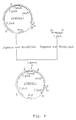
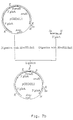
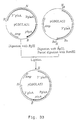
- amd S marker gene will be deleted properly by an internal recombination event between the 3' gla A DNA repeats, resulting in a marker gene free ⁇ gla A recombinant strain, possessing finally no foreign DNA sequences at all (for a schematic view, see Figure 2).
- the gene replacement vector pGBDEL4L contains 5'-part of the A.niger amyloglucosidase ( gla A) promoter region, a synthetic DNA sequence of 16 bp providing stopcodons in all three reading frames, the A.nidulans acetamidase ( amd S) gene under control of the A.nidulans glyceraldehyde-3-phosphate dehydrogenase ( gpd A) promoter, flanked at both sides by 3' gla A non-coding sequences.
- Plasmid pAB6-1 contains the entire gla A locus from A.niger on a 15.5 kb Hind III fragment cloned in the Hin dIII site of pUC19 (Yanisch-Perron et al. , Gene 33 (1985) 103-119, and is obtainable from e.g. Boehringer Mannheim, Germany).
- pAB6-1 was digested with Eco RI and the 1.8 kb Eco RI DNA fragment just upstream of the gla A gene was isolated by agarose gel electrophoresis and ligated into pUC19 digested with Eco RI and subsequently transferred to E. coli and molecular cloned.
- the resulting plasmid was designated pAB6-3 ( Figure 3A).
- pAB6-1 was digested with Hin dIII and Bgl II.
- the derived plasmid (designated pAB6-31) contains a 3.6 kb gla A promoter fragment with a destroyed Eco RI site in the middle, but still possessing the Eco RI site (now unique in this DNA fragment) just upstream of the gla A ATG initiation site ( Figure 4).
- the A.nidulans amd S gene used herein is located on an approximately 4 kb sized Eco RI- Kpn I fragment in plasmid pGW325 (Wernars et al. , thesis (1986) Agricultural University, Wageningen, The Netherlands). This Eco RI- Kpn I DNA fragment containing the amd S gene, flanked by its own regulatory sequences, was molecular cloned into the appropriate sites of pUC19 as described by Verdoes et al. (Transgenic Res. 2 pp 84-92, 1993) resulting in pAN4-1.
- pAN4-1 was digested with Eco RI and Kpn I, the 4 kb sized DNA fragment containing the amd S gene was isolated by agarose gel electrophoresis, ligated into pAB6-31 digested with Eco RI and Kpn I and the ligation mixture was transferred to E. coli for molecular cloning.
- the obtained plasmid was designated pAB6S ( Figure 5) and contains a 3.8 kb gla A promoter DNA fragment and the 4 kb amd S fragment.
- Plasmid pAB6S was first partially digested with Sal I, and ligated to the synthetic derived oligonucleotide TN0001 (SEQ ID NO: 3) having the following sequence: and secondly digested with Eco RI.
- the DNA fragment comprising the pUC19, the gla A promoter and the amd S gene sequences was purified and isolated by agarose gel electrophoresis.
- the PCR was performed as described by Saiki et al. (Science 239, 487-491, 1988) and according to the supplier of TAQ-polymerase (Cetus). Twenty five amplification cycles (each 2 minutes at 55 °C; 3 minutes at 72 °C and 2 minutes at 94°C) were performed in a DNA-amplifier (Perkin-Elmer/Cetus). The 1 kb amplified DNA fragment was digested with Hin dIII and Sal I, purified by agarose gel electrophoresis, ethanol precipitated and subsequently cloned into the Hin dIII and Sal I restriction sites of pGBDEL1. The thus obtained plasmid was designated pGBDEL2 ( Figure 7A,B).
- the amdS promoter region in pGBDEL2 was exchanged by the stronger A . nidulans gpd A promoter. Fusion of the gpd A promoter sequence to the coding sequence of the amd S gene was performed by the Polymerase Chain Reaction (PCR) method.
- PCR Polymerase Chain Reaction
- plasmid pAN7-1 (Punt et al., Gene 56 , 117-124, 1987) containing the E.coli hph gene under control of the A.nidulans gpd A promoter and the A.nidulans trp C terminator and plasmid pAN4-1, containing the A.nidulans amd S gene under control of its own regulatory sequences.
- primers four synthetic oligonucleotides were used, possessing the following sequences: (a 5' gpd A promoter specific oligo nucleotide, positioned at approximately 880 bp upstream of the ATG startcodon of the E.
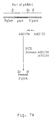
- FIG. 8A A schematic view of these amplifications is presented in Figure 8A.
- the two fragments generated were subsequently purified by agarose gel electrophoresis, ethanol precipitated and used as templates in a third PCR reaction with oligo nucleotides AB 2977 (SEQ ID NO: 6) and AB2994 (SEQ ID NO: 9) as primers.
- the resulting DNA fragment was digested with Eco RI, purified by agarose gel electrophoresis and ethanol precipitation, and cloned into the Eco RI site of pTZ18R (United States Biochemicals).
- the resulting plasmid was designated pGBGLA24 ( Figure 8B).
- Characteristic for the intact gla A locus is a 3.5 kb hybridizing fragment in a Bam HI digest and a 4.5 kb hybridizing fragment in a Kpn I digest (see figure 11A).
- the 3.5 kb Bam HI hybridizing fragment and the 4.5 kb Kpn I hybridizing fragment are absent and replaced by a 5.5 kb Bam HI hybridizing fragment and a 6.3 kb Kpn I hybridizing fragment.
- transformant #19 shows the expected pattern of a truncated gla A locus ( Figure 11B). This transformant was designated GBA-102.
- the amd S gene in the transformant A.niger GBA-102 was removed again as described in the Experimental section.
- the removal of the amd S selection marker gene in only 2 surviving recombinant strains was verified by Southern analysis of the chromosomal DNA. High molecular weight DNA was isolated, digested with Bam HI and Kpn I and subsequently separated by electrophoresis on a 0.7% agarose gel. Following transfer to nitrocellulose hybridization was performed according to standard procedures using the probes described in the previous section. A schematic presentation of the hybridizing fragments is shown in Figure 11c. The results of the Southern analyses are presented in Figure 10B.
- the vector contains DNA sequences homologous to the host genome to target the vector at a predefined genomic locus of the host, by a single cross-over event.
- This type of vector comprises a selection marker gene flanked by DNA repeats as well. The selection marker gene in transformants derived with this vector can be removed properly again by applying the counter-selection procedure.
- the integration vector pGBGLA30 consists of the A.niger amyloglucosidase ( gla A) gene under control of the native promoter and the A.nidulans amd S gene under control of the A.nidulans gpd A promoter flanked by 3' gla A non-coding sequences to direct integration at the 3' gla A non-coding region and to remove the amd S selection marker gene via the counter-selection.
- the thus obtained plasmid was designated pGBGLA26 ( Figure 14).
- plasmid pAB6-1 containing the entire gla A locus was used as template and as primers four synthetic oligo nucleotides were designed possessing the following sequence: (a 3' gla A non-coding specific sequence just downstream the stopcodon of the gla A gene) (a 3' gla A non-coding specific sequence around the Kpn I site approx. 1 kb downstream of the stop codon) (a 3' gla A non-coding specific sequence around the Kpn I site approx. 1 kb downstream of the stop codon) (a 3' gla A non-coding specific sequence approx. 2.2 kb downstream of the stopcodon)
- the two generated PCR DNA fragments were purified by agarose gel electrophoresis and ethanol precipitation and subsequently used as template in the third PCR with oligonucleotides AB3448 (SEQ ID NO: 14) and AB3520 (SEQ ID NO: 17) as primers to generate the fusion fragment. Twenty-five amplification cycles (each: 2 minutes at 55°C; 3 minutes at 72°C; 2 minutes at 94°C) were carried out in a DNA-amplifier (Perkin-Elmer/Cetus). The amplified DNA fragment was purified by agarose gel electrophoresis and ethanol precipitation and subsequently subcloned in the Sma I site of pTZ18R. The obtained plasmid was designated pGBGLA17 ( Figure 17B).
- the approximately 1 kb sized 3' gla A non-coding region in this plasmid was exchanged by the 2.2 kb 3' gla A non-coding region of pGBGLA17.
- pGBGLA17 and pGBGLA21 were digested with Kpn I and Hin dIII.
- the 2.2 kb 3' gla A non-coding region DNA fragment from pGBGLA17 and the 4.9 kb DNA fragment of pGBGLA21 were isolated by agarose gel electrophoresis, ligated and subsequently molecular cloned by transferring the ligation mixture to E. coli.
- the thus derived plasmid was designated pGBGLA22 ( Figure 19).
- the amd S gene with the extended 3' gla A non-coding region was completed with the gpd A promoter and fused to the remaining part of the amd S gene.
- pGBGLA22 was digested with Bgl II and Hin dIII, the 4.4 kb amd S/3' gla A non-coding region DNA fragment isolated by agarose gel electrophoresis, subsequently ligated with plasmid pGBGLA24 digested with Bgl II and Hin dIII and transferred to E. coli .
- the thus derived plasmid was designated pGBGLA25 ( Figure 20).
- pGBGLA25 was partially digested with Eco RI and in the Eco RI site of the gpd A promoter the synthetic fragment consisting of the two oligonucleotides AB3781 (SEQ ID NO: 18) and AB3782 (SEQ ID NO: 19): was inserted.
- This new plasmid was designated pGBGLA43 ( Figure 21). Due to this cloning step, the Eco RI restriction site just in front of the gpd A promoter was destroyed by the introduction of an Apa I restriction site.
- the plasmid pGBGLA43 was digested with Apa I and Xho I, and the 5.3 kb DNA fragment comprising the gpd A promoter/ amd S gene/3' gla A non-coding region was isolated by agarose gel electrophoresis, subsequently ligated with pGBGLA42 digested with Apa I and Xho I, and transferred to E.coli .
- the derived plasmid was designated pGBGLA28 ( Figure 22).
- the 3' gla A non-coding region DNA fragment (positioned at approximately 2.2 kb downstream the stop codon of the gla A gene, designated 3'' gla A non-coding region), was amplified and provided with suitable restriction sites using the PCR method.
- the plasmid pAB6-1 was used as template and as primers two synthetic oligonucleotides were designed possessing the following sequence: (a partly 3'' gla A non-coding specific sequence around the Sal I site positioned at about 2.2 kb downstream the stop codon of the gla A gene) (a partly 3'' gla A non-coding specific sequence around the Xho I site located at about 4.4 kb downstream the stop codon of the gla A gene)
- the final step comprises the insertion of the 3" gla A non-coding sequence from pGBGLA29A into the plasmid pGBGLA28.
- pGBGLA29A was digested with Hin dIII and Not I.
- the 2.2 kb sized 3' gla A non-coding region fragment was isolated by agarose gel electrophoresis, subsequently ligated to pGBGLA28 digested with Hin dIII and Not I and transferred to E. coli .
- the derived integration vector was designated pGBGLA30 ( Figure 24).
- E.coli sequences were removed from the integration vector pGBGLA30 by Xho I digestion and agarose gel electrophoresis.
- the A.niger strain GBA-107 was transformed with either 5 or 10 ⁇ g DNA fragment by procedures as described in the experimental section. Single A.niger transformants were purified several times on selective acetamide containing plates. Spores of individual transformants were collected following growth for about 5 days at 30°C on 0.4% potato dextrose agar (Oxoid, England) plates. Southern analyses were performed to verify whether integration into the 3' gla A non coding region of the endogenous truncated gla A locus had occurred.
- Characteristic for the intact gla A locus is a 4.5 kb hybridizing fragment in a Kpn I digest and a 10 kb hybridizing fragment in a Bgl II digest.
- Characteristic for the truncated gla A locus of A.niger GBA-107 is a 3.4 kb hybridizing fragment in a Kpn I digest and a 13 kb hybridizing fragment in a Bgl II digest.
- transformants #107-5 and #107-9 show the expected hybridization pattern of a single pGBGLA30 copy integrated into the predefined 3' non-coding region of the truncated gla A locus.
- the hybridization pattern of transformant #107-7 indicates integration of the pGBGLA30 copy elsewhere into the genome of A.niger GBA-107.
- the transformants with the correctly integrated pGBGLA30 copy were designated GBA-119 and GBA-122 and were used to remove subsequently the amd S selection marker gene properly.
- amd S selection marker gene in the transformants A.niger GBA-119 and GBA-122 was removed again as described in the experimental section.
- the removal of the amd S selection marker gene in several surviving recombinant strains was verified by Southern analysis of the chromosomal DNA. High molecular weight DNA was isolated, digested either with Kpn I or Bgl II and subsequently separated by electrophoresis on a 0.7% agarose gel. Following transfer to nitrocellulose, hybridization was performed according to standard procedures. As probe the 32 P labelled 2.2 kb Hin dIII/ Not I 3'' gla A non-coding fragment isolated from plasmid pGBGLA29A (described previously, Figure 24) was used.
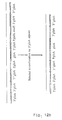
- FIG. 26 A schematic presentation of the hybridizing fragments is shown in Figure 26.
- the results of only 3 surviving recombinant strains from A.niger GBA-119 (#AG5-5, #AG5-6 and #AG5-7) as well as 3 surviving recombinant strains from A.niger GBA-122 (#AG9-1, #AG9-2 and #AG9-4) and the reference strains A.niger CBS 531.88 and A.niger GBA-107 are shown in Figure 27A,B.
- a 6.9 kb hybridizing fragment is present in a Kpn I digest and a 6.9 kb hybridizing fragment in a Bgl II digest.
- a 6.9 kb hybridizing fragment is present in a Kpn I digest and a 13 kb hybridizing fragment in a Bgl II digest.
- strains #AG5-7, #AG5-5, #AG9-1 and #AG9-4 show the expected hybridizing pattern of the correctly removed amd S selection marker gene. These strains were designated GBA-120, GBA-121, GBA-123 and GBA-124 respectively.
- the hybridizing patterns of strains #AG5-6 and #AG9-2 indicate loss of the entire pGBGLA30 copy resulting in the parental A.niger GBA-107 strain with only a truncated gla A locus.
- Strains A.niger GBA-120, GBA-121, GBA-123 and GBA-124 were tested in shake flask fermentations for the ability to produce glucoamylase. As reference strains A.niger CBS 531.88, GBA-107, GBA-119 and GBA-122 were tested. Shake flask fermentations and the glucoamylase assay were performed as described in the experimental section. In the strains GBA-119 till GBA-124 levels varying between 150-200 U/ml could be measured. These glucoamylase levels were to be expected and comparable to levels obtained with the parental untransformed wild-type strain A.niger CBS 531.88.
- the gene of interest and the selection marker gene are located on two separate vectors and that these vectors are co-transformed to A.niger .
- the vectors contain DNA sequences homologous to the host genome to target the vectors at a predefined genomic locus of the host, by a single cross-over event.
- the vector with the gene of interest pGBGLA53 consists of the A.ficuum phytase gene under control of the A.niger glucoamylase ( gla A) promoter flanked by 3' gla A non-coding sequences to direct integration at the 3' gla A non-coding region.
- the vector with the selection marker gene pGBGLA50 consists of the A.nidulans amdS gene under control of the A.nidulans gpd A promoter flanked by 3' gla A non-coding sequences to direct integration at the 3' gla A non-coding region.
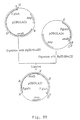
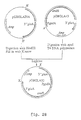
- pGBGLA50 comprises one cloning step. Plasmid pGBGLA29A was digested with Hin dIII and the sticky ends were filled in using the Klenow fragment of E.coli DNA polymerase. Next, the 2.2 kb 3'' gla A non-coding region fragment was isolated by agarose gel-electrophoresis, subsequently ligated into pGBGLA43 digested with Apa I and treated with T4 DNA polymerase to generate blunt ends, and transferred to E.coli . The derived plasmid with the 3'' gla A non-coding region DNA fragment in the correct orientation was designated pGBGLA50 ( Figure 28).
- the first step in the construction pathway of pGBGLA53 is the subcloning of two fragments, comprising the gla A promoter fused to almost entire coding sequence of the A.ficuum phytase gene.
- plasmid pGBGLA42 was digested with Hin dIII and Eco RI and the 1.8 kb Hin dIII/ Eco RI 5' gla A promoter fragment was isolated by agarose gel-electrophoresis.
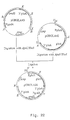
- Plasmid pFYT3 (European Patent Application 0 420 358 A1) was digested with Eco RI and Bgl II and the 1.6 kb Eco RI/ Bgl II fragment comprising the 3'part of the gla A promoter fused to the 5' part of the phytase gene was isolated by agarose gel-electrophoresis and ligated together with the 1.8 kb Hin dIII/ Eco RI 5' gla A promoter fragment isolated from pGBGLA42 into the Hin dIII and Bgl II sites of pSp73 (Promega). The resulting plasmid was designated pGBGLA49 ( Figure 29).
- the next step is the cloning of a 3' gla A non-coding region DNA fragment into pGBGLA49.
- this 3' gla A non-coding region DNA fragment (positioned at approximately 2.2 kb downstream the stop codon of the gla A gene) was amplified and provided with suitable restriction sites using the PCR method.
- the plasmid pAB6-1 was used as template and as primers two synthetic oligonucleotides with the following sequence were designed: (a 3' gla A non-coding sequence located approximately 2.2 kb downstream the stopcodon of the gla A gene) (a 3' gla A non-coding sequence located approximately 4.4 kb downstream the stopcodon of the gla A gene)
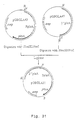
- Plasmid pGBGLA47 was digested with Hin dIII en Not I, the 2.2 kb 3'' gla A non-coding DNA fragment was isolated by agarose gel-electrophoresis and cloned into the Hin dIII and Not I sites of pGBGLA49. The resulting plasmid was designated pGBGLA51 ( Figure 31).
- the last step in the construction pathway of pGBGLA53 is the cloning of the DNA fragment comprising the remaining part of the phytase coding sequence fused to the 3' gla A non-coding DNA fragment located just downstream the stop codon of the gla A gene.
- the remaining part of the phytase gene and the 3' gla A non-coding DNA fragment located just downstream the stopcodon of the gla A gene were fused and provided with suitable restriction sites using the PCR method.
- plasmid pAB6-1 was used as template and as primers two synthetic oligonucleotides were used, having the following sequences: (36 bp of the phytase coding sequence, starting at the Bgl II site until the stopcodon fused to the 3' gla A non-coding region, starting just downstream the stopcodon of the gla A gene) (a 3' gla A non-coding sequence located approximately 2.2 kb downstream the stopcodon of the gla A gene)
- Plasmid pGBGLA52 was digested with Bgl II and partially digested with Bam HI, the 2.2 kb phytase/3' gla A non-coding DNA fragment was isolated by agarose gel-electrophoresis and cloned into the Bgl II site of pGBGLA51.
- the derived plasmid with the 2.2 kb phytase/3' gla A non-coding DNA fragment in the correct orientation was designated pGBGLA53 (figure 33).
- E.coli sequences were removed from pGBGLA50 and pGBGLA53 by respectively Xho I or Hin dIII digestion followed by agarose gel-electrophoresis.
- the A.niger GBA-107 strain was transformed with respectively 1 ⁇ g pGBGLA50 fragment plus 1 ⁇ g pGBGLA53 fragment, 1 ⁇ g pGBGLA50 fragment plus 5 ⁇ g pGBGLA53 fragment, or 1 ⁇ g pGBGLA50 fragment plus 10 ⁇ g pGBGLA53 fragment using the transformation procedure described in the ' experimental section.
- amd S marker gene was deleted by an internal recombination event between the DNA repeats that were created by integration via a single cross-over event (i.e. the 3' gla A non-coding sequences). Proper removal of only the amd S marker gene was verified by Southern analysis using the same digests and probes as in example 2.
- This example describes the marker gene free introduction of the gla A gene or the phytase gene in A.oryzae NRRL3485.
- A.oryzae NRRL3485 was transformed as described in the experimental section using the same vectors and approach as described in examples 2 and 3. Single transformants were isolated, purified and Southern analysis of chromosomal DNA of several transformants was performed to verify integrations of respectively the pGBGLA30 vector or the pGBGLA50 and pGBGLA53 vectors. In the Southern analysis, the same digests and probes were used as described in example 2.
- T.reesei QM9414 was transformed as described in the experimental section using the same vectors and approach as described in examples 2 and 3. Single transformants were isolated, purified and Southern analysis of chromosomal DNA of several transformants was performed to verify whether integration of respectively the pGBGLA30 vector or the pGBGLA50 and pGBGLA53 vectors. In the Southern analysis, the same digests and probes were used as described in example 2.
- the amd S-selection marker gene can then be removed selectively from purified transformants by applying the counter-selection procedure as described in the experimental section, while the second piece of DNA will remain stably integrated into the chromosomes of the transformant.
- the stable, marker gene free introduction of a niaD-gene is described which enables a niaD-host to grow on nitrate as sole nitrogen-source.
- co-transformants are found by replica plating spores of purified transformants to plates containing nitrate as sole nitrogen source. Typically about 20-60% of the replica plated transformants were able to grow on this medium, indicating that in these transformants not only the amd S selection marker gene but also the niaD-gene has integrated into the genome and is expressed.
- amd S selection marker gene is subsequently removed from the co-transformants by counter-selection on fluoracetamide.
- the medium used contained 10 mM fluor-acetamide. Spores were plated at a density of 10 4 spores per plate. After 5-7 days of incubation at 25°C, fluor-acetamide resistant colonies could be identified as solid colonies clearly distinct from the faint background.
- the nia D + -phenotype of the recombinants is demonstrated by their growth on the fluoracetamide-medium containing nitrate as sole nitrogen source.
- the amd S'-phenotype of the recombinants was confirmed by lack of growth of the recombinants on plates containing acetamide as sole nitrogen source. Typically, 0.1-2% of the original number of plated spores exhibited the desired phenotype.
Landscapes
- Genetics & Genomics (AREA)
- Health & Medical Sciences (AREA)
- Life Sciences & Earth Sciences (AREA)
- Engineering & Computer Science (AREA)
- Biomedical Technology (AREA)
- Wood Science & Technology (AREA)
- Organic Chemistry (AREA)
- Chemical & Material Sciences (AREA)
- Biotechnology (AREA)
- General Engineering & Computer Science (AREA)
- Zoology (AREA)
- Bioinformatics & Cheminformatics (AREA)
- Molecular Biology (AREA)
- Microbiology (AREA)
- Plant Pathology (AREA)
- Biophysics (AREA)
- Biochemistry (AREA)
- General Health & Medical Sciences (AREA)
- Physics & Mathematics (AREA)
- Micro-Organisms Or Cultivation Processes Thereof (AREA)
- Preparation Of Compounds By Using Micro-Organisms (AREA)
Claims (25)
- Un vecteur contenant un gène de marqueur de sélection dominant bidirectionnel et qui peut être contre-sélectionné qui est encadré par des répétitions directes d'ADN qui permettent la recombinaison interne du gène de marqueur au sein du génome du champignon filamenteux.
- Un vecteur selon la revendication 1, caractérisé en ce que les répétitions directes d'ADN sont choisies parmi une séquence qui est en 5' ou en 3' de la séquence d'ADN à supprimer du génome.
- Un vecteur selon l'une quelconque des revendications 1 à 2, caractérisé en ce que le gène de marqueur de sélection est un gène d'acétamidase.
- Un vecteur selon la revendication 3, caractérisé en ce que le gène d'acétamidase provient d'un champignon.
- Un vecteur selon la revendication 4, caractérisé en ce que le gène d'acétamidase provient d'une espèce d'Aspergillus.
- Un vecteur selon l'une quelconque des revendications 1 à 5, caractérisé en ce que le vecteur contient également un fragment d'ADN désiré.
- Un vecteur selon la revendication 6, caractérisé en ce que le fragment d'ADN désiré contient un élément génétique sélectionné parmi le groupe constitué par : un gène, un ADN complémentaire, un promoteur, un terminateur, un élément régulateur, un intron, une séquence de reconnaissance pour une protéine de liaison à l'ADN, un site d'initiation de traduction, un site de restriction et combinaisons de ces éléments.
- Un vecteur selon la revendication 7, caractérisé en ce que le fragment d'ADN désiré contient une séquence encodant une chymosine, une phytase, une xylanase, une lipase, une amylase, une protéase, ou une β-galactosidase.
- Un champignon filamenteux recombinant transformé avec le vecteur selon l'une quelconque des revendications 1 à 8.
- Un champignon filamenteux recombinant selon la revendication 9, caractérisé en ce qu'il contient au moins deux vecteurs selon l'une quelconque des revendications 1 à 8.
- Un champignon filamenteux recombinant selon l'une quelconque des revendications 9 à 10, caractérisé en ce que le vecteur est intégré au sein du génome du dit champignon filamenteux via recombinaison homologue à un site spécifique.
- Un champignon filamenteux recombinant selon l'une quelconque des revendications 9 à 11, caractérisé en ce que le champignon filamenteux est une espèce d'Aspergillus, de Trichoderma ou de Pénicillium.
- Une méthode pour obtenir un champignon filamenteux recombinant qui ne possède pas de marqueur de sélection; cette dite méthode comprenant les étapes suivantes :(a) intégration d'un fragment d'ADN désiré et d'un gène de marqueur de sélection dominant et bidirectionnel dans le génome du champignon filamenteux,(b) sélection des transformants,(c) délétion du gène de marqueur de sélection par recombinaison entre les répétitions encadrant le gène de marqueur de sélection,(d) contre-sélection basée sur l'absence du gène de marqueur de sélection.
- Une méthode selon la revendication 13, caractérisée en ce qu'en 5'ou 3' du gène de marqueur de sélection une séquence est clonée qui forme une répétition avec une séquence qui est en 3'ou 5' de la séquence à être délétée du génome.
- Une méthode selon l'une quelconque des revendications 13 à 14, caractérisée en ce que le fragment d'ADN désiré contient un élément génétique sélectionné parmi le groupe constitué par : un gène, un ADN complémentaire, un promoteur, un terminateur, un élément régulateur, un intron, une séquence de reconnaissance pour une protéine de liaison à l'ADN, un site d'initiation de traduction, un site de restriction et combinaisons de ces éléments.
- Une méthode selon l'une quelconque des revendications 13 à 14, caractérisée en ce que les étapes (a) à (d) sont répétées sur le champignon filamenteux recombinant obtenu, en utilisant le même ou bien un fragment d'ADN désiré différent.
- Une méthode selon l'une quelconque des revendications 13 à 16, caractérisée en ce que le gène de marqueur de sélection est un gène d'acétamidase.
- Une méthode selon la revendication 17, caractérisé en ce que le gène de marqueur de sélection est un gène d'acétamidase qui provient d'un champignon.
- Une méthode selon la revendication 18, caractérisée en ce que le gène de marqueur de sélection est un gène d'acétamidase qui provient d'une espèce d'Aspergillus.
- Une méthode pour la production d'un composé bio-actif, caractérisée en ce que la méthode comprend l'étape de cultiver le champignon filamenteux produit selon la méthode selon l'une quelconque des revendications 13 à 19.
- Une méthode selon la revendication 20, caractérisée en ce que le composé bio-actif est une protéine.
- Une méthode selon la revendication 20, caractérisée en ce que le composé bio-actif est un antibiotique.
- Utilisation du champignon filamenteux produit selon la méthode selon l'une quelconque des revendications 13 à 19 pour la production d'un composé bio-actif.
- Utilisation selon la revendication 23, caractérisée en ce que le composé bio-actif est une protéine.
- Utilisation selon la revendication 23, caractérisée en ce que le composé bio-actif est un antibiotique.
Priority Applications (2)
| Application Number | Priority Date | Filing Date | Title |
|---|---|---|---|
| EP94201896A EP0635574B1 (fr) | 1993-07-23 | 1994-06-30 | Souches récombinantes dépourvues de marqueurs de sélection: procédé pour leur obtention et utilisation de ces souches |
| EP03075731A EP1321523A3 (fr) | 1993-07-23 | 1994-06-30 | Souches récombinantes dépourvues de marqueurs de sélection: procédé pour leur obtention et utilisation de ces souches |
Applications Claiming Priority (3)
| Application Number | Priority Date | Filing Date | Title |
|---|---|---|---|
| EP93202195 | 1993-07-23 | ||
| EP93202195 | 1993-07-23 | ||
| EP94201896A EP0635574B1 (fr) | 1993-07-23 | 1994-06-30 | Souches récombinantes dépourvues de marqueurs de sélection: procédé pour leur obtention et utilisation de ces souches |
Related Child Applications (2)
| Application Number | Title | Priority Date | Filing Date |
|---|---|---|---|
| EP03075731A Division EP1321523A3 (fr) | 1993-07-23 | 1994-06-30 | Souches récombinantes dépourvues de marqueurs de sélection: procédé pour leur obtention et utilisation de ces souches |
| EP02080688 Division | 2002-12-18 |
Publications (2)
| Publication Number | Publication Date |
|---|---|
| EP0635574A1 EP0635574A1 (fr) | 1995-01-25 |
| EP0635574B1 true EP0635574B1 (fr) | 2003-04-23 |
Family
ID=8214006
Family Applications (2)
| Application Number | Title | Priority Date | Filing Date |
|---|---|---|---|
| EP94201896A Expired - Lifetime EP0635574B1 (fr) | 1993-07-23 | 1994-06-30 | Souches récombinantes dépourvues de marqueurs de sélection: procédé pour leur obtention et utilisation de ces souches |
| EP03075731A Withdrawn EP1321523A3 (fr) | 1993-07-23 | 1994-06-30 | Souches récombinantes dépourvues de marqueurs de sélection: procédé pour leur obtention et utilisation de ces souches |
Family Applications After (1)
| Application Number | Title | Priority Date | Filing Date |
|---|---|---|---|
| EP03075731A Withdrawn EP1321523A3 (fr) | 1993-07-23 | 1994-06-30 | Souches récombinantes dépourvues de marqueurs de sélection: procédé pour leur obtention et utilisation de ces souches |
Country Status (13)
| Country | Link |
|---|---|
| US (3) | US5876988A (fr) |
| EP (2) | EP0635574B1 (fr) |
| JP (2) | JP3833725B2 (fr) |
| CN (1) | CN100347301C (fr) |
| AT (1) | ATE238425T1 (fr) |
| BR (1) | BR9402912A (fr) |
| CA (1) | CA2128589C (fr) |
| DE (1) | DE69432543T2 (fr) |
| DK (1) | DK0635574T3 (fr) |
| ES (1) | ES2198410T3 (fr) |
| FI (2) | FI114481B (fr) |
| IE (1) | IE20030875A1 (fr) |
| NZ (2) | NZ264065A (fr) |
Cited By (58)
| Publication number | Priority date | Publication date | Assignee | Title |
|---|---|---|---|---|
| WO2007063133A2 (fr) | 2005-12-01 | 2007-06-07 | Dsm Ip Assets B.V. | Nouveaux gènes utiles pour la production industrielle d'acide citrique |
| EP2172557A1 (fr) | 2004-04-02 | 2010-04-07 | DSM IP Assets B.V. | Mutants fongiques filamenteux avec une efficacité améliorée de recombinaison homologue |
| WO2010102976A1 (fr) | 2009-03-10 | 2010-09-16 | Dsm Ip Assets B.V. | Estérase prégastrique et ses dérivés |
| WO2010102982A1 (fr) | 2009-03-10 | 2010-09-16 | Dsm Ip Assets B.V. | Procédé d'amélioration du rendement d'un polypeptide |
| WO2010122141A1 (fr) | 2009-04-24 | 2010-10-28 | Dsm Ip Assets B.V. | Hydrate de carbone dégradant un polypeptide et ses utilisations |
| WO2010121933A1 (fr) | 2009-04-22 | 2010-10-28 | Dsm Ip Assets B.V. | Procédé de production d'un polypeptide recombinant d'intérêt |
| WO2011009700A1 (fr) | 2009-07-22 | 2011-01-27 | Dsm Ip Assets B.V. | Cellule hôte améliorée destinée à la production d'un composé intéressant |
| WO2011048046A2 (fr) | 2009-10-22 | 2011-04-28 | Basf Se | Variantes de phytase synthétiques |
| WO2011054899A1 (fr) | 2009-11-04 | 2011-05-12 | Dsm Ip Assets B.V. | Transformants de talaromyces |
| EP2345727A2 (fr) | 2004-04-16 | 2011-07-20 | DSM IP Assets B.V. | Promoteurs de champignon pour l'expression d'un gène dans une cellule de champignon. |
| WO2011095374A2 (fr) | 2010-02-04 | 2011-08-11 | Dsm Ip Assets B.V. | Procédé pour la préparation de souches fongiques filamenteuses ayant un cycle sexuel et procédé pour la préparation de souches fongiques filamenteuses à croisement sexuel |
| WO2011098577A1 (fr) | 2010-02-11 | 2011-08-18 | Dsm Ip Assets B.V. | Cellule hôte apte à produire des enzymes utiles pour la dégradation de la matière lignocellulosique |
| WO2011098580A1 (fr) | 2010-02-11 | 2011-08-18 | Dsm Ip Assets B.V. | Polypeptide ayant une activité cellobiohydrolase et ses utilisations |
| WO2012000886A1 (fr) | 2010-06-29 | 2012-01-05 | Dsm Ip Assets B.V. | Polypeptide doté d'une activité de bêta-glucosidase et ses utilisations |
| WO2012000888A1 (fr) | 2010-06-29 | 2012-01-05 | Dsm Ip Assets B.V. | Polypeptide présentant une activité acétylxylane estérase et ses applications |
| WO2012000887A1 (fr) | 2010-06-29 | 2012-01-05 | Dsm Ip Assets B.V. | Polypeptide doté d'une activité de swollénine et ses utilisations |
| WO2012001169A1 (fr) | 2010-07-01 | 2012-01-05 | Dsm Ip Assets B.V. | Procédé de production d'un composé particulier |
| WO2012000891A1 (fr) | 2010-06-29 | 2012-01-05 | Dsm Ip Assets B.V. | Polypeptide ayant la capacité de dégrader les glucides et leur utilisation |
| WO2012000892A1 (fr) | 2010-06-29 | 2012-01-05 | Dsm Ip Assets B.V. | Polypeptide présentant une activité de dégradation de glucides ou facilitant cette activité, et ses applications |
| WO2012000890A1 (fr) | 2010-06-29 | 2012-01-05 | Dsm Ip Assets B.V. | Polypeptide doté d'une activité de bêta-glucosidase et ses utilisations |
| EP2410048A1 (fr) | 2005-01-24 | 2012-01-25 | DSM IP Assets B.V. | Procédé de production d'un composé d'intérêt dans une cellule fongique filamenteuse |
| EP2423315A1 (fr) | 2006-06-29 | 2012-02-29 | DSM IP Assets B.V. | Procédé permettant d'obtenir une expression de polypeptide améliorée |
| WO2012123429A1 (fr) | 2011-03-11 | 2012-09-20 | Dsm Ip Assets B.V. | Système vecteur-hôte |
| EP2511372A1 (fr) | 2006-11-02 | 2012-10-17 | DSM IP Assets B.V. | Production améliorée de protéines sécrétées par des champignons filamenteux |
| WO2012143861A1 (fr) | 2011-04-21 | 2012-10-26 | Basf Se | Variants synthétiques de phytase |
| EP2631295A2 (fr) | 2007-02-15 | 2013-08-28 | DSM IP Assets B.V. | Cellule hôte recombinée pour production de composé dýintérêt |
| WO2013189878A1 (fr) | 2012-06-19 | 2013-12-27 | Dsm Ip Assets B.V. | Promoteurs permettant d'exprimer un gène dans une cellule |
| EP2687602A1 (fr) | 2007-11-20 | 2014-01-22 | DSM IP Assets B.V. | Production d'acide succinique dans une cellule eucaryote |
| WO2014013074A1 (fr) | 2012-07-19 | 2014-01-23 | Dsm Ip Assets B.V. | Souche déficiente en agse |
| WO2014118360A2 (fr) | 2013-02-04 | 2014-08-07 | Dsm Ip Assets B.V. | Polypeptide dégradant les glucides et utilisations associées |
| WO2014202622A2 (fr) | 2013-06-19 | 2014-12-24 | Dsm Ip Assets B.V. | Gène de rasamsonia et son utilisation |
| WO2014202621A1 (fr) | 2013-06-20 | 2014-12-24 | Dsm Ip Assets B.V. | Polypeptide de dégradation des hydrates de carbone et utilisations de ce dernier |
| WO2014202620A2 (fr) | 2013-06-19 | 2014-12-24 | Dsm Ip Assets B.V. | Gène de rasamsonia et son utilisation |
| WO2014202624A2 (fr) | 2013-06-19 | 2014-12-24 | Dsm Ip Assets B.V. | Gène de rasamsonia et son utilisation |
| WO2015082488A1 (fr) | 2013-12-02 | 2015-06-11 | Dsm Ip Assets B.V. | Protéine structurante de la glace |
| WO2016075312A1 (fr) | 2014-11-13 | 2016-05-19 | Pivert | Kits de criblage et d'expression de proteines chez la levure yarrowia lipolytica |
| WO2016193292A1 (fr) | 2015-06-02 | 2016-12-08 | Dsm Ip Assets B.V. | Utilisation de la protéine structurante de la glace afp19 exprimée dans des souches fongiques filamenteuses pour la préparation de produits alimentaires |
| WO2017100377A1 (fr) | 2015-12-07 | 2017-06-15 | Zymergen, Inc. | Amélioration de souches microbiennes par une plateforme d'ingénierie génomique htp |
| WO2018019948A1 (fr) | 2016-07-29 | 2018-02-01 | Dsm Ip Assets B.V. | Polypeptides présentant une activité améliorant la cellulolyse et leurs utilisations |
| US9988624B2 (en) | 2015-12-07 | 2018-06-05 | Zymergen Inc. | Microbial strain improvement by a HTP genomic engineering platform |
| WO2018114938A1 (fr) | 2016-12-21 | 2018-06-28 | Dsm Ip Assets B.V. | Variants d'enzyme lipolytique |
| WO2018114912A1 (fr) | 2016-12-21 | 2018-06-28 | Dsm Ip Assets B.V. | Variants d'enzyme lipolytique |
| WO2018114940A1 (fr) | 2016-12-21 | 2018-06-28 | Dsm Ip Assets B.V. | Variants d'enzyme lipolytique |
| WO2018114941A1 (fr) | 2016-12-21 | 2018-06-28 | Dsm Ip Assets B.V. | Variants d'enzyme lipolytique |
| WO2018166943A1 (fr) | 2017-03-13 | 2018-09-20 | Dsm Ip Assets B.V. | Souche déficientes en régulateur transcriptionnel d'amas binucléaire de zinc |
| WO2018226900A2 (fr) | 2017-06-06 | 2018-12-13 | Zymergen Inc. | Plate-forme d'ingénierie génomique htp permettant d'améliorer les souches fongiques |
| WO2018226810A1 (fr) | 2017-06-06 | 2018-12-13 | Zymergen Inc. | Mutagenèse de transposon à haut débit |
| US10544411B2 (en) | 2016-06-30 | 2020-01-28 | Zymergen Inc. | Methods for generating a glucose permease library and uses thereof |
| US10544390B2 (en) | 2016-06-30 | 2020-01-28 | Zymergen Inc. | Methods for generating a bacterial hemoglobin library and uses thereof |
| WO2021089452A1 (fr) | 2019-11-04 | 2021-05-14 | Dsm Ip Assets B.V. | Transfection à faible volume |
| US11028401B2 (en) | 2018-06-06 | 2021-06-08 | Zymergen Inc. | Manipulation of genes involved in signal transduction to control fungal morphology during fermentation and production |
| WO2021144342A1 (fr) | 2020-01-14 | 2021-07-22 | The Protein Brewery B.V. | Expression de l'ovalbumine et de ses variants naturels |
| US11208649B2 (en) | 2015-12-07 | 2021-12-28 | Zymergen Inc. | HTP genomic engineering platform |
| US11293029B2 (en) | 2015-12-07 | 2022-04-05 | Zymergen Inc. | Promoters from Corynebacterium glutamicum |
| EP4023757A1 (fr) | 2020-12-29 | 2022-07-06 | The Protein Brewery B.V. | Procédés de génération de transformants d'organismes hétérocaryotes sans marqueur de sélection |
| US11479779B2 (en) | 2020-07-31 | 2022-10-25 | Zymergen Inc. | Systems and methods for high-throughput automated strain generation for non-sporulating fungi |
| WO2023242273A1 (fr) | 2022-06-14 | 2023-12-21 | Newmilkbuzz B.V. | Expression de caséines de lait chez des champignons filamenteux |
| WO2024133849A1 (fr) | 2022-12-22 | 2024-06-27 | The Protein Brewery B.V. | Fermentation d'ovalbumine |
Families Citing this family (116)
| Publication number | Priority date | Publication date | Assignee | Title |
|---|---|---|---|---|
| NL1003096C2 (nl) | 1995-05-15 | 1996-11-19 | Gist Brocades Bv | Application of phospholipases in animal feed. |
| DE69637908D1 (de) | 1995-06-23 | 2009-06-04 | Danisco | Neuartige methode zur isolierung von mutanten und zur klonierung der complementierenden gene |
| CA2201730C (fr) | 1995-08-03 | 2008-01-22 | Bart Willem Swinkels | Utilisation de genes amds homologues comme marqueurs selectables |
| EP0814165B1 (fr) * | 1996-06-21 | 2003-04-09 | Suntory Limited | Procédé pour préparer des cellules de la levure transformées, sans gène marqueur de sélection |
| US6265186B1 (en) | 1997-04-11 | 2001-07-24 | Dsm N.V. | Yeast cells comprising at least two copies of a desired gene integrated into the chromosomal genome at more than one non-ribosomal RNA encoding domain, particularly with Kluyveromyces |
| EP0973918B1 (fr) * | 1997-04-11 | 2008-06-11 | DSM IP Assets B.V. | Cellules de levure comprenant au moins deux copies d'un gene desire integree dans le genome chromosomique dans plus d'un domaine codant de l'arn non ribosomique, en particulier avec des kluyveromyces |
| PL336345A1 (en) * | 1997-04-11 | 2000-06-19 | Dsm Nv | Genic conversion as a tool for constructing recombined filiform fungi |
| BR9812113A (pt) | 1997-07-31 | 2000-07-18 | Dsm Nv | Enzimas de aspergillus degradando celulose |
| US6436643B1 (en) | 1997-12-22 | 2002-08-20 | Unilever Patent Holdings Bv | Process for site-directed integration of multiple copies of a gene in a mould |
| WO1999032617A2 (fr) * | 1997-12-22 | 1999-07-01 | Dsm N.V. | Clonage d'expression dans les champignons filamenteux |
| EP1953230A1 (fr) | 1998-05-19 | 2008-08-06 | DSM IP Assets B.V. | Production in vivo de céphalosporines améliorée |
| US6358705B1 (en) | 1998-07-16 | 2002-03-19 | Novo Nordisk A/S | Method of making proteins in transformed yeast cells |
| WO2000004172A1 (fr) * | 1998-07-16 | 2000-01-27 | Novo Nordisk A/S | Technique de production de proteines dans des cellules de levure transformees |
| US7220542B2 (en) | 2000-07-17 | 2007-05-22 | Van Den Brink Johannes Maarten | Expression cloning in filamentous fungi |
| US6750379B2 (en) * | 2000-03-09 | 2004-06-15 | Dekalb Genetics Corporation | Homologous recombination-mediated transgene alterations in plants |
| ES2394481T3 (es) | 2000-09-21 | 2013-02-01 | Basf Se | Xilanasa de talaromyces |
| ES2319757T5 (es) | 2002-01-23 | 2018-05-22 | Dsm Ip Assets B.V. | Fermentación de azúcares de pentosa |
| US7517671B2 (en) | 2002-02-28 | 2009-04-14 | New England Biolabs, Inc. | Methods and compositions for concentrating secreted recombinant protein |
| TWI328612B (en) | 2002-07-25 | 2010-08-11 | Dsm Ip Assets Bv | Genes and their encoded polypeptides involved in the biosynthetic pathway of vitamin b12, vectors and host cells comprising the genes, and process for producing vitamin b12 |
| WO2004048580A1 (fr) * | 2002-11-28 | 2004-06-10 | Universiteit Leiden | Procede d'integration sans marqueur d'une sequence d'interet dans le genome d'une cellule |
| US20070093465A1 (en) | 2003-05-28 | 2007-04-26 | Van Den Berg Marco A | Cephem compound |
| CN1298213C (zh) * | 2003-09-10 | 2007-02-07 | 王海波 | 一种通过分割处理获得无选择标记转基因植物的方法 |
| WO2005040186A2 (fr) * | 2003-10-14 | 2005-05-06 | Dsm Ip Assets B.V. | Procede destine a preparer une cellule hote modifiee |
| US20080070277A1 (en) * | 2004-10-15 | 2008-03-20 | Sagt Cornelis M J | Homologous Amds Genes as Selectable Marker |
| CA2595074A1 (fr) | 2005-01-18 | 2006-07-27 | Vereniging Voor Christelijk Hoger Onderwijs, Wetenschappelijk Onderzoek En Patientenzorg | Mycobacteries presentant un lipoarabinomannane deficient en coiffes de mannose |
| EA014783B1 (ru) | 2005-11-29 | 2011-02-28 | ДСМ АйПи АССЕТС Б.В. | Связывающий днк-сайт активатора транскрипции, пригодный для экспрессии генов |
| US20100120154A1 (en) | 2007-03-21 | 2010-05-13 | Dsm Ip Assets B.V. | Method for homologous recombination |
| EP2220234B1 (fr) | 2007-11-20 | 2012-06-27 | DSM IP Assets B.V. | Production d'acide dicarboxylique dans une levure recombinante |
| EP2222854A1 (fr) | 2007-11-20 | 2010-09-01 | DSM IP Assets B.V. | Production d'acide dicarboxylique dans un champignon filamenteux |
| CN101918539A (zh) | 2007-12-17 | 2010-12-15 | 阿姆斯特丹大学 | 包含发酵基因卡盒的自养生物进行光驱动的co2还原生成有机化合物以用作燃料或用作工业半成品 |
| FR2927089B1 (fr) | 2008-02-05 | 2011-03-25 | Inst Nat De La Rech Agronomique Inra | Procede d'integration ciblee de multicopies d'un gene d'interet dans une souche de yarrowia |
| EP2116136A1 (fr) | 2008-05-08 | 2009-11-11 | Nederlandse Organisatie voor toegepast- natuurwetenschappelijk onderzoek TNO | Nouvelles phytases |
| US8597931B2 (en) * | 2008-07-11 | 2013-12-03 | Institut National De La Recherche Agronomique (Inra) | Mutant yeast strains capable of accumulating a large quantity of lipids |
| EP2318525A2 (fr) * | 2008-07-29 | 2011-05-11 | Danisco US Inc. | Production accrue de protéases aspartiques dans des cellules fongiques filamenteuses |
| EP2310487A2 (fr) | 2008-08-05 | 2011-04-20 | DSM IP Assets B.V. | Souches productrices d'adipoyl-7-adca |
| WO2010107310A1 (fr) | 2009-03-17 | 2010-09-23 | Nederlandse Organisatie Voor Toegepast- Natuurwetenschappelijk Onderzoek Tno | Nouvelles protéines actives de cellulose et lignocellulose |
| WO2010118932A1 (fr) | 2009-04-15 | 2010-10-21 | Dsm Ip Assets B.V. | Procédé de production d'acide dicarboxylique |
| UA108853C2 (uk) | 2009-07-10 | 2015-06-25 | Спосіб ферментації галактози | |
| EP2560988A1 (fr) | 2010-04-21 | 2013-02-27 | DSM IP Assets B.V. | Procédé de production de cellules qui sont capables de convertir l'arabinose |
| EP2388331A1 (fr) | 2010-05-21 | 2011-11-23 | Nederlandse Organisatie voor toegepast -natuurwetenschappelijk onderzoek TNO | Promoteur constitutif |
| EP2627765B1 (fr) | 2010-10-13 | 2017-05-10 | DSM IP Assets B.V. | Cellules de levure de fermentation à base de pentose et de glucose |
| AU2012244691A1 (en) | 2011-04-22 | 2013-10-17 | Dsm Ip Assets B.V. | Yeast cell capable of converting sugars including arabinose and xylose |
| AR087423A1 (es) | 2011-08-04 | 2014-03-19 | Dsm Ip Assets Bv | Celula capaz de fermentar azucares pentosas |
| EP2554668A1 (fr) | 2011-08-04 | 2013-02-06 | DSM IP Assets B.V. | Cellule de fermentation de sucre de pentose |
| MX355028B (es) | 2012-01-23 | 2018-03-28 | Dsm Ip Assets Bv | Produccion de diterpeno. |
| AR093025A1 (es) | 2012-10-16 | 2015-05-13 | Dsm Ip Assets Bv | Celulas con conversion mejorada de pentosas |
| WO2014096436A1 (fr) * | 2012-12-21 | 2014-06-26 | Estibio Aps | Double mutation génétique, exempte de marqueur, de bactéries thermoanaerobacter |
| EP2772545A1 (fr) | 2013-03-01 | 2014-09-03 | Nederlandse Organisatie voor toegepast -natuurwetenschappelijk onderzoek TNO | Protéines d'amidon actives |
| WO2014142647A1 (fr) | 2013-03-14 | 2014-09-18 | Wageningen Universiteit | Souches fongiques ayant une production améliorée d'acide citrique et d'acide itaconique |
| EP2981610A1 (fr) | 2013-04-05 | 2016-02-10 | Université du Luxembourg | Production biotechnologique d'acide itaconique |
| EP2992105A1 (fr) | 2013-05-02 | 2016-03-09 | Dutch DNA Biotech B.V. | Nouvelle voie de l'acide organique |
| MX367033B (es) | 2013-05-31 | 2019-08-02 | Dsm Ip Assets Bv | Microorganismos para la produccion de diterpeno. |
| EP3021689B1 (fr) | 2013-07-15 | 2021-03-24 | DSM IP Assets B.V. | Production de diterpène |
| EP3536697A1 (fr) | 2013-07-31 | 2019-09-11 | DSM IP Assets B.V. | Récupération de glycosides de stéviol |
| WO2016012429A1 (fr) | 2014-07-24 | 2016-01-28 | Dsm Ip Assets B.V. | Cellule de levure présentant un transport amélioré du pentose |
| US10590436B2 (en) | 2015-01-06 | 2020-03-17 | Dsm Ip Assets B.V. | CRISPR-CAS system for a lipolytic yeast host cell |
| WO2016110512A1 (fr) | 2015-01-06 | 2016-07-14 | Dsm Ip Assets B.V. | Système crispr-cas pour une cellule hôte de levure |
| DK3242950T3 (da) | 2015-01-06 | 2021-12-20 | Dsm Ip Assets Bv | Crispr-cas-system til en trådformet svampeværtscelle |
| EP3253779A1 (fr) | 2015-02-06 | 2017-12-13 | Cargill, Incorporated | Enzymes glucoamylases modifiées et souches de levures caractérisées par une production de bioproduits améliorée |
| WO2016131818A1 (fr) | 2015-02-16 | 2016-08-25 | Dsm Ip Assets B.V. | Processus de production d'acide itaconique en conditions anaérobies |
| WO2016146711A1 (fr) | 2015-03-16 | 2016-09-22 | Dsm Ip Assets B.V. | Udp-glycosyltransférases |
| CA2979957A1 (fr) | 2015-03-23 | 2016-09-29 | Dsm Ip Assets B.V. | Udp-glycosyltransferases de solanum lycopersicum |
| CN107429220A (zh) | 2015-03-27 | 2017-12-01 | 嘉吉公司 | 经葡糖淀粉酶修饰的酵母菌株和用于产生生物产物的方法 |
| CN107666834B (zh) | 2015-04-03 | 2021-08-24 | 帝斯曼知识产权资产管理有限公司 | 甜菊醇糖苷 |
| BR112017022488A2 (pt) | 2015-04-21 | 2018-07-17 | Dsm Ip Assets Bv | produção microbiana de terpenoides |
| CN107636144B (zh) | 2015-05-22 | 2021-02-19 | 帝斯曼知识产权资产管理有限公司 | 消耗乙酸盐/酯的酵母细胞 |
| CN107820394A (zh) | 2015-07-10 | 2018-03-20 | 帝斯曼知识产权资产管理有限公司 | 甜菊醇糖苷组合物 |
| WO2017024150A1 (fr) | 2015-08-05 | 2017-02-09 | Cargill, Incorporated | Souches de levure modifiées au moyen de xylose isomérase et procédés de production d'un produit biologique |
| CA2993744A1 (fr) | 2015-08-13 | 2017-02-16 | Dsm Ip Assets B.V. | Transport de glycoside de steviol |
| KR20180053684A (ko) | 2015-09-21 | 2018-05-23 | 푸락 바이오켐 비.브이. | Fdca의 진균 제조 |
| WO2017050652A1 (fr) | 2015-09-25 | 2017-03-30 | Dsm Ip Assets B.V. | Asparaginase |
| CN108138152B (zh) | 2015-10-05 | 2023-01-06 | 帝斯曼知识产权资产管理有限公司 | 贝壳杉烯酸羟化酶 |
| MY186400A (en) * | 2015-10-06 | 2021-07-22 | Dsm Ip Assets Bv | Eukaryotic cell with increased production of fermentation product |
| BR112018010387A8 (pt) | 2015-11-24 | 2019-02-26 | Cargill Inc | levedura geneticamente modificada e processo para fabricar etanol |
| BR112018009729A8 (pt) | 2015-12-02 | 2019-02-26 | Basf Se | método para produzir um polipeptídeo recombinante, fungo filamentoso myceliophthora thermophila e uso de uma construção de ácido nucleico |
| BR112018011902A2 (pt) | 2015-12-17 | 2018-12-04 | Cargill Inc | método de fermentação, levedura geneticamente modificada, construto de ácido nucleico, vetor, célula hospedeira, meio de fermentação e utilização da levedura geneticamente modificada |
| KR20180098386A (ko) | 2015-12-30 | 2018-09-03 | 디에스엠 아이피 어셋츠 비.브이. | 트라이아실글리세롤의 부분 효소적 가수 분해 |
| US11441099B2 (en) | 2015-12-30 | 2022-09-13 | Dsm Ip Assets B.V. | Partial enzymatic hydrolysis of triacylglycerols |
| WO2017167849A1 (fr) | 2016-03-31 | 2017-10-05 | Dsm Ip Assets B.V. | Composition enzymatique et préparation d'un produit laitier aux propriétés améliorées |
| WO2017167848A1 (fr) | 2016-03-31 | 2017-10-05 | Dsm Ip Assets B.V. | Composition enzymatique et préparation d'un produit laitier ayant des propriétés améliorées |
| WO2017167847A1 (fr) | 2016-03-31 | 2017-10-05 | Dsm Ip Assets B.V. | Production de lait à faible teneur en lactose |
| WO2017216136A1 (fr) | 2016-06-14 | 2017-12-21 | Dsm Ip Assets B.V. | Cellule de levure recombinée |
| CN109689864B (zh) | 2016-07-13 | 2023-04-04 | 帝斯曼知识产权资产管理有限公司 | 苹果酸脱氢酶 |
| WO2018027131A1 (fr) | 2016-08-05 | 2018-02-08 | Cargill, Incorporated | Polypeptides de glucoamylase modifiés par une séquence de tête et souches de levure manipulées présentant une production de produits biologiques améliorée |
| CA3033243A1 (fr) | 2016-08-09 | 2018-02-15 | Dsm Ip Assets B.V. | Cristallisation de glycosides de steviol |
| WO2018029272A1 (fr) | 2016-08-09 | 2018-02-15 | Dsm Ip Assets B.V. | Cristallisation de glycosides de stéviol |
| CN110036114B (zh) | 2016-08-26 | 2023-09-29 | 勒萨弗尔公司 | 提高的衣康酸生产 |
| WO2018073107A1 (fr) | 2016-10-19 | 2018-04-26 | Dsm Ip Assets B.V. | Cellule eucaryote comprenant de la xylose isomérase |
| CN109890961B (zh) | 2016-10-27 | 2024-03-08 | 帝斯曼知识产权资产管理有限公司 | 香叶基香叶基焦磷酸酯合酶 |
| BR112019011525A2 (pt) | 2016-12-08 | 2020-01-28 | Dsm Ip Assets Bv | ácido caurenoico hidroxilases |
| WO2018114995A1 (fr) | 2016-12-22 | 2018-06-28 | Dsm Ip Assets B.V. | Procédés de fermentation pour la production de glycosides de stéviol |
| KR20190098213A (ko) * | 2016-12-30 | 2019-08-21 | 지머젠 인코포레이티드 | 유전자 조작 및 균주 정제를 위한 자동화 단계를 사용하여 균류 생산 균주를 제조하는 방법 |
| EP3378931A1 (fr) | 2017-03-21 | 2018-09-26 | Purac Biochem B.V. | Cellules hôtes déficientes en monooxygenase à décarboxylation de fdca pour la production de fdca |
| CA3064143A1 (fr) | 2017-06-13 | 2018-12-20 | Dsm Ip Assets B.V. | Cellule de levure recombinee |
| EP4155400A1 (fr) | 2017-06-27 | 2023-03-29 | DSM IP Assets B.V. | Glycosyltransférases udp |
| US11414683B2 (en) | 2017-09-26 | 2022-08-16 | Dsm Ip Assets B.V. | Acetic acid consuming strain |
| CA3091450A1 (fr) | 2018-02-28 | 2019-09-06 | Cargill, Incorporated | Levure modifiee a glucoamylase et procedes de fermentation |
| EP3533878A1 (fr) | 2018-02-28 | 2019-09-04 | Dutch DNA Biotech B.V. | Procédé de production d'acide 2-hydroxy-2-méthylsuccinique en utilisant d'aspergillus |
| BR112020022516A2 (pt) | 2018-05-07 | 2021-02-09 | Dsm Ip Assets B.V. | processo para degomagem enzimática de óleo |
| WO2019243312A1 (fr) | 2018-06-19 | 2019-12-26 | Dsm Ip Assets B.V. | Variants d'enzyme lipolytique |
| US20250290081A1 (en) | 2020-10-22 | 2025-09-18 | Dsm Ip Assets B.V. | Microorganisms for diterpene production |
| EP4359426A2 (fr) | 2021-06-24 | 2024-05-01 | Fonterra Co-Operative Group Limited | Protéines de recombinaison |
| EP4370688A1 (fr) | 2021-07-12 | 2024-05-22 | Danisco Us Inc | Cellule de levure recombinée |
| CN117940570A (zh) | 2021-07-12 | 2024-04-26 | 丹尼斯科美国公司 | 重组酵母细胞 |
| MX2024000509A (es) | 2021-07-12 | 2024-03-15 | Danisco Us Inc | Celula de levadura recombinante. |
| US20250320529A1 (en) | 2021-07-12 | 2025-10-16 | Danisco Us Inc. | Recombinant yeast cell |
| US20250283121A1 (en) | 2021-07-12 | 2025-09-11 | Danisco Us Inc. | Recombinant yeast cell |
| WO2023285297A1 (fr) | 2021-07-12 | 2023-01-19 | Dsm Ip Assets B.V. | Cellule de levure recombinée |
| US20250163361A1 (en) | 2021-11-04 | 2025-05-22 | Danisco Us Inc. | Recombinant yeast cell |
| CN118234857A (zh) | 2021-11-04 | 2024-06-21 | 丹尼斯科美国公司 | 变体多肽和重组酵母细胞 |
| EP4426848A1 (fr) | 2021-11-04 | 2024-09-11 | Danisco Us Inc | Procédé de production d'éthanol et cellule de levure recombinante |
| CA3237662A1 (fr) | 2021-11-09 | 2023-05-19 | Amgen Inc. | Production de proteines therapeutiques |
| US20250304938A1 (en) | 2022-05-16 | 2025-10-02 | Dsm Ip Assets B.V. | Lipolytic enzyme variants |
| WO2024218244A1 (fr) | 2023-04-20 | 2024-10-24 | Dsm Ip Assets B.V. | Souches et procédés de production de mogrosides |
| CN121794375A (zh) | 2023-07-11 | 2026-04-03 | 帝斯曼知识产权资产管理有限公司 | 蛋白质精氨酸脱亚胺酶 |
| WO2025144795A1 (fr) | 2023-12-28 | 2025-07-03 | Dsm Ip Assets B.V. | Cellules et procédés de production de composés glycosylés |
Family Cites Families (14)
| Publication number | Priority date | Publication date | Assignee | Title |
|---|---|---|---|---|
| US5422267A (en) * | 1984-05-22 | 1995-06-06 | Robert R. Yocum | Industrial yeast comprising an integrated glucoamylase gene |
| DE3650202T3 (de) * | 1985-08-29 | 2004-06-03 | Genencor International, Inc., South San Francisco | Expression von heterologen Polypeptiden in filamentösen Pilzen, Verfahren zu deren Herstellung und Vektoren zu deren Herstellung. |
| US5298405A (en) * | 1986-04-30 | 1994-03-29 | Alko Limited | Enzyme preparations with recombinantly-altered cellulose profiles and methods for their production |
| US5079145A (en) * | 1988-10-21 | 1992-01-07 | Synergen Associates, Inc. | Process for preparing microorganisms used for making phenyl acetyl carlinol (pac) |
| GB8904762D0 (en) * | 1989-03-02 | 1989-04-12 | Glaxo Group Ltd | Biological process |
| US5695976A (en) * | 1989-12-18 | 1997-12-09 | Novo Nordisk A/S | Stable integration of DNA in bacterial genomes |
| US5498830A (en) * | 1990-06-18 | 1996-03-12 | Monsanto Company | Decreased oil content in plant seeds |
| US5824513A (en) * | 1991-01-17 | 1998-10-20 | Abbott Laboratories | Recombinant DNA method for producing erythromycin analogs |
| EP0498137A1 (fr) * | 1991-02-06 | 1992-08-12 | Novo Nordisk A/S | Systèmes d'expression |
| WO1993001283A1 (fr) * | 1991-07-08 | 1993-01-21 | The United States Of America As Represented By The Secretary Of Agriculture | Plantes transgeniques sans genes de selection |
| EP0565172A1 (fr) * | 1992-04-10 | 1993-10-13 | Quest International B.V. | Clonage et expression d'un ADN codant pour une forme de maturation d'un polypeptide avec activité sulfhydryl oxidase |
| US5550045A (en) * | 1992-05-15 | 1996-08-27 | Unilever Patent Holdings, B.V. | Cloning and expression of DNA encoding a ripening form of a polypeptide having rhamnogalcturonase activity |
| US6291205B1 (en) * | 1992-06-12 | 2001-09-18 | Merck & Co., Inc. | Method of increasing production of disulfide bonded recombinant proteins by saccharomyces cerevisiae |
| US6110713A (en) * | 1993-03-23 | 2000-08-29 | Regents Of The University Of Minnesota | Production of glutamic acid and lysine using auxotrophic mutants of Bacillus methanolicus |
-
1994
- 1994-06-30 DE DE69432543T patent/DE69432543T2/de not_active Expired - Lifetime
- 1994-06-30 ES ES94201896T patent/ES2198410T3/es not_active Expired - Lifetime
- 1994-06-30 AT AT94201896T patent/ATE238425T1/de active
- 1994-06-30 EP EP94201896A patent/EP0635574B1/fr not_active Expired - Lifetime
- 1994-06-30 DK DK94201896T patent/DK0635574T3/da active
- 1994-06-30 EP EP03075731A patent/EP1321523A3/fr not_active Withdrawn
- 1994-07-21 CA CA002128589A patent/CA2128589C/fr not_active Expired - Lifetime
- 1994-07-22 BR BR9402912A patent/BR9402912A/pt not_active Application Discontinuation
- 1994-07-22 FI FI943485A patent/FI114481B/fi not_active IP Right Cessation
- 1994-07-22 CN CNB94107997XA patent/CN100347301C/zh not_active Expired - Lifetime
- 1994-07-22 NZ NZ264065A patent/NZ264065A/en not_active IP Right Cessation
- 1994-07-22 JP JP17087794A patent/JP3833725B2/ja not_active Expired - Lifetime
- 1994-07-22 IE IE20030875A patent/IE20030875A1/en not_active Application Discontinuation
- 1994-07-22 NZ NZ299139A patent/NZ299139A/en not_active IP Right Cessation
-
1997
- 1997-06-23 US US08/880,557 patent/US5876988A/en not_active Expired - Lifetime
-
1998
- 1998-11-10 US US09/189,583 patent/US6063614A/en not_active Expired - Lifetime
-
1999
- 1999-02-26 US US09/258,518 patent/US6955909B1/en not_active Expired - Fee Related
-
2004
- 2004-08-27 FI FI20041124A patent/FI117388B/fi not_active IP Right Cessation
-
2005
- 2005-06-06 JP JP2005166041A patent/JP2005296019A/ja active Pending
Cited By (78)
| Publication number | Priority date | Publication date | Assignee | Title |
|---|---|---|---|---|
| EP2172557A1 (fr) | 2004-04-02 | 2010-04-07 | DSM IP Assets B.V. | Mutants fongiques filamenteux avec une efficacité améliorée de recombinaison homologue |
| EP3351637A1 (fr) | 2004-04-02 | 2018-07-25 | DSM IP Assets B.V. | Mutants fongiques filamenteux avec une efficacité améliorée de recombinaison homologue |
| EP2345727A2 (fr) | 2004-04-16 | 2011-07-20 | DSM IP Assets B.V. | Promoteurs de champignon pour l'expression d'un gène dans une cellule de champignon. |
| EP2410048A1 (fr) | 2005-01-24 | 2012-01-25 | DSM IP Assets B.V. | Procédé de production d'un composé d'intérêt dans une cellule fongique filamenteuse |
| WO2007063133A2 (fr) | 2005-12-01 | 2007-06-07 | Dsm Ip Assets B.V. | Nouveaux gènes utiles pour la production industrielle d'acide citrique |
| EP2423315A1 (fr) | 2006-06-29 | 2012-02-29 | DSM IP Assets B.V. | Procédé permettant d'obtenir une expression de polypeptide améliorée |
| EP2511372A1 (fr) | 2006-11-02 | 2012-10-17 | DSM IP Assets B.V. | Production améliorée de protéines sécrétées par des champignons filamenteux |
| EP2631295A2 (fr) | 2007-02-15 | 2013-08-28 | DSM IP Assets B.V. | Cellule hôte recombinée pour production de composé dýintérêt |
| EP2687602A1 (fr) | 2007-11-20 | 2014-01-22 | DSM IP Assets B.V. | Production d'acide succinique dans une cellule eucaryote |
| WO2010102982A1 (fr) | 2009-03-10 | 2010-09-16 | Dsm Ip Assets B.V. | Procédé d'amélioration du rendement d'un polypeptide |
| WO2010102976A1 (fr) | 2009-03-10 | 2010-09-16 | Dsm Ip Assets B.V. | Estérase prégastrique et ses dérivés |
| WO2010121933A1 (fr) | 2009-04-22 | 2010-10-28 | Dsm Ip Assets B.V. | Procédé de production d'un polypeptide recombinant d'intérêt |
| WO2010122141A1 (fr) | 2009-04-24 | 2010-10-28 | Dsm Ip Assets B.V. | Hydrate de carbone dégradant un polypeptide et ses utilisations |
| EP3293264A1 (fr) | 2009-07-22 | 2018-03-14 | DSM IP Assets B.V. | Cellule hôte améliorée pour la production d'un composé d'intérêt |
| WO2011009700A1 (fr) | 2009-07-22 | 2011-01-27 | Dsm Ip Assets B.V. | Cellule hôte améliorée destinée à la production d'un composé intéressant |
| WO2011048046A2 (fr) | 2009-10-22 | 2011-04-28 | Basf Se | Variantes de phytase synthétiques |
| WO2011054899A1 (fr) | 2009-11-04 | 2011-05-12 | Dsm Ip Assets B.V. | Transformants de talaromyces |
| WO2011095374A2 (fr) | 2010-02-04 | 2011-08-11 | Dsm Ip Assets B.V. | Procédé pour la préparation de souches fongiques filamenteuses ayant un cycle sexuel et procédé pour la préparation de souches fongiques filamenteuses à croisement sexuel |
| WO2011098577A1 (fr) | 2010-02-11 | 2011-08-18 | Dsm Ip Assets B.V. | Cellule hôte apte à produire des enzymes utiles pour la dégradation de la matière lignocellulosique |
| WO2011098580A1 (fr) | 2010-02-11 | 2011-08-18 | Dsm Ip Assets B.V. | Polypeptide ayant une activité cellobiohydrolase et ses utilisations |
| WO2012000886A1 (fr) | 2010-06-29 | 2012-01-05 | Dsm Ip Assets B.V. | Polypeptide doté d'une activité de bêta-glucosidase et ses utilisations |
| WO2012000890A1 (fr) | 2010-06-29 | 2012-01-05 | Dsm Ip Assets B.V. | Polypeptide doté d'une activité de bêta-glucosidase et ses utilisations |
| WO2012000892A1 (fr) | 2010-06-29 | 2012-01-05 | Dsm Ip Assets B.V. | Polypeptide présentant une activité de dégradation de glucides ou facilitant cette activité, et ses applications |
| WO2012000891A1 (fr) | 2010-06-29 | 2012-01-05 | Dsm Ip Assets B.V. | Polypeptide ayant la capacité de dégrader les glucides et leur utilisation |
| WO2012000887A1 (fr) | 2010-06-29 | 2012-01-05 | Dsm Ip Assets B.V. | Polypeptide doté d'une activité de swollénine et ses utilisations |
| WO2012000888A1 (fr) | 2010-06-29 | 2012-01-05 | Dsm Ip Assets B.V. | Polypeptide présentant une activité acétylxylane estérase et ses applications |
| WO2012001169A1 (fr) | 2010-07-01 | 2012-01-05 | Dsm Ip Assets B.V. | Procédé de production d'un composé particulier |
| WO2012123429A1 (fr) | 2011-03-11 | 2012-09-20 | Dsm Ip Assets B.V. | Système vecteur-hôte |
| WO2012143861A1 (fr) | 2011-04-21 | 2012-10-26 | Basf Se | Variants synthétiques de phytase |
| WO2013189878A1 (fr) | 2012-06-19 | 2013-12-27 | Dsm Ip Assets B.V. | Promoteurs permettant d'exprimer un gène dans une cellule |
| WO2014013074A1 (fr) | 2012-07-19 | 2014-01-23 | Dsm Ip Assets B.V. | Souche déficiente en agse |
| WO2014118360A2 (fr) | 2013-02-04 | 2014-08-07 | Dsm Ip Assets B.V. | Polypeptide dégradant les glucides et utilisations associées |
| WO2014202622A2 (fr) | 2013-06-19 | 2014-12-24 | Dsm Ip Assets B.V. | Gène de rasamsonia et son utilisation |
| WO2014202620A2 (fr) | 2013-06-19 | 2014-12-24 | Dsm Ip Assets B.V. | Gène de rasamsonia et son utilisation |
| WO2014202624A2 (fr) | 2013-06-19 | 2014-12-24 | Dsm Ip Assets B.V. | Gène de rasamsonia et son utilisation |
| WO2014202621A1 (fr) | 2013-06-20 | 2014-12-24 | Dsm Ip Assets B.V. | Polypeptide de dégradation des hydrates de carbone et utilisations de ce dernier |
| WO2015082488A1 (fr) | 2013-12-02 | 2015-06-11 | Dsm Ip Assets B.V. | Protéine structurante de la glace |
| WO2016075312A1 (fr) | 2014-11-13 | 2016-05-19 | Pivert | Kits de criblage et d'expression de proteines chez la levure yarrowia lipolytica |
| WO2016193292A1 (fr) | 2015-06-02 | 2016-12-08 | Dsm Ip Assets B.V. | Utilisation de la protéine structurante de la glace afp19 exprimée dans des souches fongiques filamenteuses pour la préparation de produits alimentaires |
| WO2017100377A1 (fr) | 2015-12-07 | 2017-06-15 | Zymergen, Inc. | Amélioration de souches microbiennes par une plateforme d'ingénierie génomique htp |
| US9988624B2 (en) | 2015-12-07 | 2018-06-05 | Zymergen Inc. | Microbial strain improvement by a HTP genomic engineering platform |
| US11085040B2 (en) | 2015-12-07 | 2021-08-10 | Zymergen Inc. | Systems and methods for host cell improvement utilizing epistatic effects |
| EP3858996A1 (fr) | 2015-12-07 | 2021-08-04 | Zymergen, Inc. | Amélioration de souches microbiennes par une plateforme d'ingénierie génomique htp |
| US11155807B2 (en) | 2015-12-07 | 2021-10-26 | Zymergen Inc. | Automated system for HTP genomic engineering |
| US11208649B2 (en) | 2015-12-07 | 2021-12-28 | Zymergen Inc. | HTP genomic engineering platform |
| US11293029B2 (en) | 2015-12-07 | 2022-04-05 | Zymergen Inc. | Promoters from Corynebacterium glutamicum |
| US10047358B1 (en) | 2015-12-07 | 2018-08-14 | Zymergen Inc. | Microbial strain improvement by a HTP genomic engineering platform |
| US10968445B2 (en) | 2015-12-07 | 2021-04-06 | Zymergen Inc. | HTP genomic engineering platform |
| US11352621B2 (en) | 2015-12-07 | 2022-06-07 | Zymergen Inc. | HTP genomic engineering platform |
| US11312951B2 (en) | 2015-12-07 | 2022-04-26 | Zymergen Inc. | Systems and methods for host cell improvement utilizing epistatic effects |
| US10336998B2 (en) | 2015-12-07 | 2019-07-02 | Zymergen Inc. | Microbial strain improvement by a HTP genomic engineering platform |
| US10457933B2 (en) | 2015-12-07 | 2019-10-29 | Zymergen Inc. | Microbial strain improvement by a HTP genomic engineering platform |
| US11155808B2 (en) | 2015-12-07 | 2021-10-26 | Zymergen Inc. | HTP genomic engineering platform |
| US10883101B2 (en) | 2015-12-07 | 2021-01-05 | Zymergen Inc. | Automated system for HTP genomic engineering |
| US10647980B2 (en) | 2015-12-07 | 2020-05-12 | Zymergen Inc. | Microbial strain improvement by a HTP genomic engineering platform |
| US10745694B2 (en) | 2015-12-07 | 2020-08-18 | Zymergen Inc. | Automated system for HTP genomic engineering |
| US10808243B2 (en) | 2015-12-07 | 2020-10-20 | Zymergen Inc. | Microbial strain improvement by a HTP genomic engineering platform |
| US10544390B2 (en) | 2016-06-30 | 2020-01-28 | Zymergen Inc. | Methods for generating a bacterial hemoglobin library and uses thereof |
| US10544411B2 (en) | 2016-06-30 | 2020-01-28 | Zymergen Inc. | Methods for generating a glucose permease library and uses thereof |
| WO2018019948A1 (fr) | 2016-07-29 | 2018-02-01 | Dsm Ip Assets B.V. | Polypeptides présentant une activité améliorant la cellulolyse et leurs utilisations |
| WO2018114941A1 (fr) | 2016-12-21 | 2018-06-28 | Dsm Ip Assets B.V. | Variants d'enzyme lipolytique |
| WO2018114940A1 (fr) | 2016-12-21 | 2018-06-28 | Dsm Ip Assets B.V. | Variants d'enzyme lipolytique |
| WO2018114912A1 (fr) | 2016-12-21 | 2018-06-28 | Dsm Ip Assets B.V. | Variants d'enzyme lipolytique |
| WO2018114938A1 (fr) | 2016-12-21 | 2018-06-28 | Dsm Ip Assets B.V. | Variants d'enzyme lipolytique |
| WO2018166943A1 (fr) | 2017-03-13 | 2018-09-20 | Dsm Ip Assets B.V. | Souche déficientes en régulateur transcriptionnel d'amas binucléaire de zinc |
| US10954511B2 (en) | 2017-06-06 | 2021-03-23 | Zymergen Inc. | HTP genomic engineering platform for improving fungal strains |
| US11180753B2 (en) | 2017-06-06 | 2021-11-23 | Zymergen Inc. | HTP genomic engineering platform for improving fungal strains |
| US11242524B2 (en) | 2017-06-06 | 2022-02-08 | Zymergen Inc. | HTP genomic engineering platform for improving fungal strains |
| WO2018226810A1 (fr) | 2017-06-06 | 2018-12-13 | Zymergen Inc. | Mutagenèse de transposon à haut débit |
| WO2018226900A2 (fr) | 2017-06-06 | 2018-12-13 | Zymergen Inc. | Plate-forme d'ingénierie génomique htp permettant d'améliorer les souches fongiques |
| US11028401B2 (en) | 2018-06-06 | 2021-06-08 | Zymergen Inc. | Manipulation of genes involved in signal transduction to control fungal morphology during fermentation and production |
| US11299741B2 (en) | 2018-06-06 | 2022-04-12 | Zymergen Inc. | Manipulation of genes involved in signal transduction to control fungal morphology during fermentation and production |
| WO2021089452A1 (fr) | 2019-11-04 | 2021-05-14 | Dsm Ip Assets B.V. | Transfection à faible volume |
| WO2021144342A1 (fr) | 2020-01-14 | 2021-07-22 | The Protein Brewery B.V. | Expression de l'ovalbumine et de ses variants naturels |
| US11479779B2 (en) | 2020-07-31 | 2022-10-25 | Zymergen Inc. | Systems and methods for high-throughput automated strain generation for non-sporulating fungi |
| EP4023757A1 (fr) | 2020-12-29 | 2022-07-06 | The Protein Brewery B.V. | Procédés de génération de transformants d'organismes hétérocaryotes sans marqueur de sélection |
| WO2023242273A1 (fr) | 2022-06-14 | 2023-12-21 | Newmilkbuzz B.V. | Expression de caséines de lait chez des champignons filamenteux |
| WO2024133849A1 (fr) | 2022-12-22 | 2024-06-27 | The Protein Brewery B.V. | Fermentation d'ovalbumine |
Also Published As
| Publication number | Publication date |
|---|---|
| EP0635574A1 (fr) | 1995-01-25 |
| NZ299139A (en) | 1998-06-26 |
| DK0635574T3 (da) | 2003-08-11 |
| NZ264065A (en) | 1998-06-26 |
| EP1321523A3 (fr) | 2004-03-03 |
| FI943485L (fi) | 1995-01-24 |
| BR9402912A (pt) | 1995-04-11 |
| FI114481B (fi) | 2004-10-29 |
| US6955909B1 (en) | 2005-10-18 |
| JP2005296019A (ja) | 2005-10-27 |
| CN1098743A (zh) | 1995-02-15 |
| CN100347301C (zh) | 2007-11-07 |
| DE69432543T2 (de) | 2003-12-24 |
| US5876988A (en) | 1999-03-02 |
| AU690909B2 (en) | 1998-05-07 |
| FI117388B (fi) | 2006-09-29 |
| US6063614A (en) | 2000-05-16 |
| AU6862894A (en) | 1995-02-02 |
| JPH07147971A (ja) | 1995-06-13 |
| CA2128589A1 (fr) | 1995-01-24 |
| FI943485A0 (fi) | 1994-07-22 |
| ATE238425T1 (de) | 2003-05-15 |
| IE940591A1 (en) | 1995-01-25 |
| EP1321523A2 (fr) | 2003-06-25 |
| DE69432543D1 (de) | 2003-05-28 |
| CA2128589C (fr) | 2005-10-11 |
| IE20030875A1 (en) | 2004-01-14 |
| ES2198410T3 (es) | 2004-02-01 |
| JP3833725B2 (ja) | 2006-10-18 |
| FI20041124L (fi) | 2004-08-27 |
Similar Documents
| Publication | Publication Date | Title |
|---|---|---|
| EP0635574B1 (fr) | Souches récombinantes dépourvues de marqueurs de sélection: procédé pour leur obtention et utilisation de ces souches | |
| EP0758020B1 (fr) | Gène amdS d' Aspergillus niger codant pour une acétamidase | |
| JP5043254B2 (ja) | 糸状面細胞内の問題のdnaライブラリーの作製及びスクリーニング | |
| DK0979294T3 (en) | Gene conversion AS A TOOL FOR CONSTRUCTION OF RECOMBINANT INDUSTRIAL filamentous fungi | |
| US20110223671A1 (en) | Methods for using positively and negatively selectable genes in a filamentous fungal cell | |
| EP1412505B1 (fr) | Sequences d'adn destinees a reguler la transcription | |
| US6051431A (en) | Selection marker gene free recombinant strains: a method for obtaining them and the use of these strains | |
| EP0866872A1 (fr) | CHAMPIGNON DANS LEQUEL LES GENES areA, pepC ET/OU pepE ONT ETE INACTIVES | |
| JP4495904B2 (ja) | 改変プロモーター | |
| JPH099968A (ja) | 糸状菌のエンハンサーdna塩基配列およびその用途 | |
| AU724400B2 (en) | Recombinant yeast strain and a method for obtaining same | |
| EP0815241B1 (fr) | Identification et clonage d'un transposon mobile a partir d'aspergillus | |
| IE83483B1 (en) | Selection marker gene free recombinant strains: a method for obtaining them and the use of these strains | |
| CN113056552A (zh) | 经修饰的丝状真菌宿主细胞 | |
| WO2002059331A1 (fr) | Mutation in vivo et recombinaison dans des champignons filamenteux | |
| WO2025262103A1 (fr) | Promoteurs supérieurs pour la production de protéines fongiques | |
| JP2000125859A (ja) | 新規な選択マーカー遺伝子ならびにリゾムコール・プシルスの形質転換系 | |
| JPH099970A (ja) | ビアラホス耐性を指標とする担子菌細胞の形質転換の方法およびそれによって得られる担子菌形質転換細胞 |
Legal Events
| Date | Code | Title | Description |
|---|---|---|---|
| PUAI | Public reference made under article 153(3) epc to a published international application that has entered the european phase |
Free format text: ORIGINAL CODE: 0009012 |
|
| AK | Designated contracting states |
Kind code of ref document: A1 Designated state(s): AT BE CH DE DK ES FR GB GR IE IT LI LU MC NL PT SE |
|
| 17P | Request for examination filed |
Effective date: 19950209 |
|
| 17Q | First examination report despatched |
Effective date: 19980407 |
|
| RAP1 | Party data changed (applicant data changed or rights of an application transferred) |
Owner name: DSM N.V. |
|
| GRAH | Despatch of communication of intention to grant a patent |
Free format text: ORIGINAL CODE: EPIDOS IGRA |
|
| GRAH | Despatch of communication of intention to grant a patent |
Free format text: ORIGINAL CODE: EPIDOS IGRA |
|
| GRAA | (expected) grant |
Free format text: ORIGINAL CODE: 0009210 |
|
| AK | Designated contracting states |
Designated state(s): AT BE CH DE DK ES FR GB GR IE IT LI LU MC NL PT SE |
|
| REG | Reference to a national code |
Ref country code: GB Ref legal event code: FG4D |
|
| REG | Reference to a national code |
Ref country code: CH Ref legal event code: EP |
|
| REF | Corresponds to: |
Ref document number: 69432543 Country of ref document: DE Date of ref document: 20030528 Kind code of ref document: P |
|
| REG | Reference to a national code |
Ref country code: IE Ref legal event code: FG4D |
|
| PG25 | Lapsed in a contracting state [announced via postgrant information from national office to epo] |
Ref country code: MC Free format text: LAPSE BECAUSE OF NON-PAYMENT OF DUE FEES Effective date: 20030630 Ref country code: LU Free format text: LAPSE BECAUSE OF NON-PAYMENT OF DUE FEES Effective date: 20030630 Ref country code: IE Free format text: LAPSE BECAUSE OF NON-PAYMENT OF DUE FEES Effective date: 20030630 |
|
| PG25 | Lapsed in a contracting state [announced via postgrant information from national office to epo] |
Ref country code: SE Free format text: LAPSE BECAUSE OF FAILURE TO SUBMIT A TRANSLATION OF THE DESCRIPTION OR TO PAY THE FEE WITHIN THE PRESCRIBED TIME-LIMIT Effective date: 20030723 Ref country code: PT Free format text: LAPSE BECAUSE OF FAILURE TO SUBMIT A TRANSLATION OF THE DESCRIPTION OR TO PAY THE FEE WITHIN THE PRESCRIBED TIME-LIMIT Effective date: 20030723 Ref country code: GR Free format text: LAPSE BECAUSE OF FAILURE TO SUBMIT A TRANSLATION OF THE DESCRIPTION OR TO PAY THE FEE WITHIN THE PRESCRIBED TIME-LIMIT Effective date: 20030723 |
|
| REG | Reference to a national code |
Ref country code: DK Ref legal event code: T3 |
|
| RAP2 | Party data changed (patent owner data changed or rights of a patent transferred) |
Owner name: DSM IP ASSETS B.V. |
|
| NLT2 | Nl: modifications (of names), taken from the european patent patent bulletin |
Owner name: DSM IP ASSETS B.V. |
|
| REG | Reference to a national code |
Ref country code: ES Ref legal event code: FG2A Ref document number: 2198410 Country of ref document: ES Kind code of ref document: T3 |
|
| ET | Fr: translation filed | ||
| PLBE | No opposition filed within time limit |
Free format text: ORIGINAL CODE: 0009261 |
|
| STAA | Information on the status of an ep patent application or granted ep patent |
Free format text: STATUS: NO OPPOSITION FILED WITHIN TIME LIMIT |
|
| REG | Reference to a national code |
Ref country code: IE Ref legal event code: MM4A |
|
| 26N | No opposition filed |
Effective date: 20040126 |
|
| REG | Reference to a national code |
Ref country code: GB Ref legal event code: 732E |
|
| REG | Reference to a national code |
Ref country code: FR Ref legal event code: TP |
|
| REG | Reference to a national code |
Ref country code: CH Ref legal event code: PUE Owner name: DSM IP ASSETS B.V. Free format text: DSM N.V.#HET OVERLOON 1#6411 TE HEERLEN (NL) -TRANSFER TO- DSM IP ASSETS B.V.#HET OVERLOON 1#6411 TE HEERLEN (NL) |
|
| NLS | Nl: assignments of ep-patents |
Owner name: DSM IP ASSETS B.V. Effective date: 20050915 |
|
| NLT1 | Nl: modifications of names registered in virtue of documents presented to the patent office pursuant to art. 16 a, paragraph 1 |
Owner name: KONINKLIJKE DSM N.V. |
|
| PGFP | Annual fee paid to national office [announced via postgrant information from national office to epo] |
Ref country code: ES Payment date: 20120726 Year of fee payment: 19 |
|
| PGFP | Annual fee paid to national office [announced via postgrant information from national office to epo] |
Ref country code: AT Payment date: 20120529 Year of fee payment: 19 |
|
| PGFP | Annual fee paid to national office [announced via postgrant information from national office to epo] |
Ref country code: GB Payment date: 20130626 Year of fee payment: 20 Ref country code: DE Payment date: 20130626 Year of fee payment: 20 Ref country code: DK Payment date: 20130611 Year of fee payment: 20 Ref country code: CH Payment date: 20130612 Year of fee payment: 20 |
|
| PGFP | Annual fee paid to national office [announced via postgrant information from national office to epo] |
Ref country code: FR Payment date: 20130624 Year of fee payment: 20 Ref country code: IT Payment date: 20130618 Year of fee payment: 20 Ref country code: NL Payment date: 20130608 Year of fee payment: 20 |
|
| PGFP | Annual fee paid to national office [announced via postgrant information from national office to epo] |
Ref country code: BE Payment date: 20130614 Year of fee payment: 20 |
|
| BE20 | Be: patent expired |
Owner name: *DSM IP ASSETS B.V. Effective date: 20140630 |
|
| REG | Reference to a national code |
Ref country code: DE Ref legal event code: R071 Ref document number: 69432543 Country of ref document: DE |
|
| REG | Reference to a national code |
Ref country code: DE Ref legal event code: R071 Ref document number: 69432543 Country of ref document: DE |
|
| REG | Reference to a national code |
Ref country code: DK Ref legal event code: EUP Effective date: 20140630 |
|
| REG | Reference to a national code |
Ref country code: NL Ref legal event code: V4 Effective date: 20140630 |
|
| REG | Reference to a national code |
Ref country code: CH Ref legal event code: PL |
|
| REG | Reference to a national code |
Ref country code: GB Ref legal event code: PE20 Expiry date: 20140629 |
|
| PG25 | Lapsed in a contracting state [announced via postgrant information from national office to epo] |
Ref country code: GB Free format text: LAPSE BECAUSE OF EXPIRATION OF PROTECTION Effective date: 20140629 |
|
| REG | Reference to a national code |
Ref country code: AT Ref legal event code: MK07 Ref document number: 238425 Country of ref document: AT Kind code of ref document: T Effective date: 20140630 |
|
| REG | Reference to a national code |
Ref country code: ES Ref legal event code: FD2A Effective date: 20140905 |
|
| PG25 | Lapsed in a contracting state [announced via postgrant information from national office to epo] |
Ref country code: DE Free format text: LAPSE BECAUSE OF EXPIRATION OF PROTECTION Effective date: 20140701 |
|
| PG25 | Lapsed in a contracting state [announced via postgrant information from national office to epo] |
Ref country code: ES Free format text: LAPSE BECAUSE OF EXPIRATION OF PROTECTION Effective date: 20140701 |