EP0637862A2 - Dispositif laser à semi-conducteur et méthode de fabrication - Google Patents
Dispositif laser à semi-conducteur et méthode de fabrication Download PDFInfo
- Publication number
- EP0637862A2 EP0637862A2 EP94111892A EP94111892A EP0637862A2 EP 0637862 A2 EP0637862 A2 EP 0637862A2 EP 94111892 A EP94111892 A EP 94111892A EP 94111892 A EP94111892 A EP 94111892A EP 0637862 A2 EP0637862 A2 EP 0637862A2
- Authority
- EP
- European Patent Office
- Prior art keywords
- layer
- compound semiconductor
- laser device
- thickness
- compound
- Prior art date
- Legal status (The legal status is an assumption and is not a legal conclusion. Google has not performed a legal analysis and makes no representation as to the accuracy of the status listed.)
- Ceased
Links
Images




Classifications
-
- H—ELECTRICITY
- H01—ELECTRIC ELEMENTS
- H01S—DEVICES USING THE PROCESS OF LIGHT AMPLIFICATION BY STIMULATED EMISSION OF RADIATION [LASER] TO AMPLIFY OR GENERATE LIGHT; DEVICES USING STIMULATED EMISSION OF ELECTROMAGNETIC RADIATION IN WAVE RANGES OTHER THAN OPTICAL
- H01S5/00—Semiconductor lasers
- H01S5/30—Structure or shape of the active region; Materials used for the active region
- H01S5/32—Structure or shape of the active region; Materials used for the active region comprising PN junctions, e.g. hetero- or double- heterostructures
- H01S5/327—Structure or shape of the active region; Materials used for the active region comprising PN junctions, e.g. hetero- or double- heterostructures in AIIBVI compounds, e.g. ZnCdSe-laser
-
- B—PERFORMING OPERATIONS; TRANSPORTING
- B82—NANOTECHNOLOGY
- B82Y—SPECIFIC USES OR APPLICATIONS OF NANOSTRUCTURES; MEASUREMENT OR ANALYSIS OF NANOSTRUCTURES; MANUFACTURE OR TREATMENT OF NANOSTRUCTURES
- B82Y20/00—Nanooptics, e.g. quantum optics or photonic crystals
-
- H—ELECTRICITY
- H01—ELECTRIC ELEMENTS
- H01S—DEVICES USING THE PROCESS OF LIGHT AMPLIFICATION BY STIMULATED EMISSION OF RADIATION [LASER] TO AMPLIFY OR GENERATE LIGHT; DEVICES USING STIMULATED EMISSION OF ELECTROMAGNETIC RADIATION IN WAVE RANGES OTHER THAN OPTICAL
- H01S5/00—Semiconductor lasers
- H01S5/20—Structure or shape of the semiconductor body to guide the optical wave ; Confining structures perpendicular to the optical axis, e.g. index or gain guiding, stripe geometry, broad area lasers, gain tailoring, transverse or lateral reflectors, special cladding structures, MQW barrier reflection layers
-
- H—ELECTRICITY
- H01—ELECTRIC ELEMENTS
- H01S—DEVICES USING THE PROCESS OF LIGHT AMPLIFICATION BY STIMULATED EMISSION OF RADIATION [LASER] TO AMPLIFY OR GENERATE LIGHT; DEVICES USING STIMULATED EMISSION OF ELECTROMAGNETIC RADIATION IN WAVE RANGES OTHER THAN OPTICAL
- H01S5/00—Semiconductor lasers
- H01S5/20—Structure or shape of the semiconductor body to guide the optical wave ; Confining structures perpendicular to the optical axis, e.g. index or gain guiding, stripe geometry, broad area lasers, gain tailoring, transverse or lateral reflectors, special cladding structures, MQW barrier reflection layers
- H01S5/22—Structure or shape of the semiconductor body to guide the optical wave ; Confining structures perpendicular to the optical axis, e.g. index or gain guiding, stripe geometry, broad area lasers, gain tailoring, transverse or lateral reflectors, special cladding structures, MQW barrier reflection layers having a ridge or stripe structure
- H01S5/227—Buried mesa structure ; Striped active layer
-
- H—ELECTRICITY
- H10—SEMICONDUCTOR DEVICES; ELECTRIC SOLID-STATE DEVICES NOT OTHERWISE PROVIDED FOR
- H10H—INORGANIC LIGHT-EMITTING SEMICONDUCTOR DEVICES HAVING POTENTIAL BARRIERS
- H10H20/00—Individual inorganic light-emitting semiconductor devices having potential barriers, e.g. light-emitting diodes [LED]
- H10H20/01—Manufacture or treatment
- H10H20/011—Manufacture or treatment of bodies, e.g. forming semiconductor layers
- H10H20/012—Manufacture or treatment of bodies, e.g. forming semiconductor layers having light-emitting regions comprising only Group II-IV materials
- H10H20/0125—Manufacture or treatment of bodies, e.g. forming semiconductor layers having light-emitting regions comprising only Group II-IV materials with a substrate not being Group II-VI materials
-
- H—ELECTRICITY
- H10—SEMICONDUCTOR DEVICES; ELECTRIC SOLID-STATE DEVICES NOT OTHERWISE PROVIDED FOR
- H10H—INORGANIC LIGHT-EMITTING SEMICONDUCTOR DEVICES HAVING POTENTIAL BARRIERS
- H10H20/00—Individual inorganic light-emitting semiconductor devices having potential barriers, e.g. light-emitting diodes [LED]
- H10H20/80—Constructional details
- H10H20/81—Bodies
- H10H20/822—Materials of the light-emitting regions
- H10H20/823—Materials of the light-emitting regions comprising only Group II-VI materials, e.g. ZnO
-
- H—ELECTRICITY
- H10—SEMICONDUCTOR DEVICES; ELECTRIC SOLID-STATE DEVICES NOT OTHERWISE PROVIDED FOR
- H10H—INORGANIC LIGHT-EMITTING SEMICONDUCTOR DEVICES HAVING POTENTIAL BARRIERS
- H10H20/00—Individual inorganic light-emitting semiconductor devices having potential barriers, e.g. light-emitting diodes [LED]
- H10H20/80—Constructional details
- H10H20/83—Electrodes
- H10H20/832—Electrodes characterised by their material
-
- H—ELECTRICITY
- H10—SEMICONDUCTOR DEVICES; ELECTRIC SOLID-STATE DEVICES NOT OTHERWISE PROVIDED FOR
- H10P—GENERIC PROCESSES OR APPARATUS FOR THE MANUFACTURE OR TREATMENT OF DEVICES COVERED BY CLASS H10
- H10P14/00—Formation of materials, e.g. in the shape of layers or pillars
- H10P14/20—Formation of materials, e.g. in the shape of layers or pillars of semiconductor materials
- H10P14/29—Formation of materials, e.g. in the shape of layers or pillars of semiconductor materials characterised by the substrates
- H10P14/2901—Materials
- H10P14/2907—Materials being Group IIIA-VA materials
- H10P14/2911—Arsenides
-
- H—ELECTRICITY
- H10—SEMICONDUCTOR DEVICES; ELECTRIC SOLID-STATE DEVICES NOT OTHERWISE PROVIDED FOR
- H10P—GENERIC PROCESSES OR APPARATUS FOR THE MANUFACTURE OR TREATMENT OF DEVICES COVERED BY CLASS H10
- H10P14/00—Formation of materials, e.g. in the shape of layers or pillars
- H10P14/20—Formation of materials, e.g. in the shape of layers or pillars of semiconductor materials
- H10P14/32—Formation of materials, e.g. in the shape of layers or pillars of semiconductor materials characterised by intermediate layers between substrates and deposited layers
- H10P14/3202—Materials thereof
- H10P14/3214—Materials thereof being Group IIIA-VA semiconductors
- H10P14/3221—Arsenides
-
- H—ELECTRICITY
- H10—SEMICONDUCTOR DEVICES; ELECTRIC SOLID-STATE DEVICES NOT OTHERWISE PROVIDED FOR
- H10P—GENERIC PROCESSES OR APPARATUS FOR THE MANUFACTURE OR TREATMENT OF DEVICES COVERED BY CLASS H10
- H10P14/00—Formation of materials, e.g. in the shape of layers or pillars
- H10P14/20—Formation of materials, e.g. in the shape of layers or pillars of semiconductor materials
- H10P14/32—Formation of materials, e.g. in the shape of layers or pillars of semiconductor materials characterised by intermediate layers between substrates and deposited layers
- H10P14/3202—Materials thereof
- H10P14/3224—Materials thereof being Group IIB-VIA semiconductors
- H10P14/3228—Sulfides
-
- H—ELECTRICITY
- H10—SEMICONDUCTOR DEVICES; ELECTRIC SOLID-STATE DEVICES NOT OTHERWISE PROVIDED FOR
- H10P—GENERIC PROCESSES OR APPARATUS FOR THE MANUFACTURE OR TREATMENT OF DEVICES COVERED BY CLASS H10
- H10P14/00—Formation of materials, e.g. in the shape of layers or pillars
- H10P14/20—Formation of materials, e.g. in the shape of layers or pillars of semiconductor materials
- H10P14/32—Formation of materials, e.g. in the shape of layers or pillars of semiconductor materials characterised by intermediate layers between substrates and deposited layers
- H10P14/3202—Materials thereof
- H10P14/3224—Materials thereof being Group IIB-VIA semiconductors
- H10P14/3231—Selenides
-
- H—ELECTRICITY
- H10—SEMICONDUCTOR DEVICES; ELECTRIC SOLID-STATE DEVICES NOT OTHERWISE PROVIDED FOR
- H10P—GENERIC PROCESSES OR APPARATUS FOR THE MANUFACTURE OR TREATMENT OF DEVICES COVERED BY CLASS H10
- H10P14/00—Formation of materials, e.g. in the shape of layers or pillars
- H10P14/20—Formation of materials, e.g. in the shape of layers or pillars of semiconductor materials
- H10P14/32—Formation of materials, e.g. in the shape of layers or pillars of semiconductor materials characterised by intermediate layers between substrates and deposited layers
- H10P14/3242—Structure
- H10P14/3244—Layer structure
- H10P14/3251—Layer structure consisting of three or more layers
- H10P14/3252—Alternating layers, e.g. superlattice
-
- H—ELECTRICITY
- H10—SEMICONDUCTOR DEVICES; ELECTRIC SOLID-STATE DEVICES NOT OTHERWISE PROVIDED FOR
- H10P—GENERIC PROCESSES OR APPARATUS FOR THE MANUFACTURE OR TREATMENT OF DEVICES COVERED BY CLASS H10
- H10P14/00—Formation of materials, e.g. in the shape of layers or pillars
- H10P14/20—Formation of materials, e.g. in the shape of layers or pillars of semiconductor materials
- H10P14/34—Deposited materials, e.g. layers
- H10P14/3402—Deposited materials, e.g. layers characterised by the chemical composition
- H10P14/3424—Deposited materials, e.g. layers characterised by the chemical composition being Group IIB-VIA materials
- H10P14/3428—Sulfides
-
- H—ELECTRICITY
- H10—SEMICONDUCTOR DEVICES; ELECTRIC SOLID-STATE DEVICES NOT OTHERWISE PROVIDED FOR
- H10P—GENERIC PROCESSES OR APPARATUS FOR THE MANUFACTURE OR TREATMENT OF DEVICES COVERED BY CLASS H10
- H10P14/00—Formation of materials, e.g. in the shape of layers or pillars
- H10P14/20—Formation of materials, e.g. in the shape of layers or pillars of semiconductor materials
- H10P14/34—Deposited materials, e.g. layers
- H10P14/3402—Deposited materials, e.g. layers characterised by the chemical composition
- H10P14/3424—Deposited materials, e.g. layers characterised by the chemical composition being Group IIB-VIA materials
- H10P14/3431—Selenides
-
- H—ELECTRICITY
- H10—SEMICONDUCTOR DEVICES; ELECTRIC SOLID-STATE DEVICES NOT OTHERWISE PROVIDED FOR
- H10P—GENERIC PROCESSES OR APPARATUS FOR THE MANUFACTURE OR TREATMENT OF DEVICES COVERED BY CLASS H10
- H10P14/00—Formation of materials, e.g. in the shape of layers or pillars
- H10P14/20—Formation of materials, e.g. in the shape of layers or pillars of semiconductor materials
- H10P14/34—Deposited materials, e.g. layers
- H10P14/3438—Doping during depositing
- H10P14/3441—Conductivity type
- H10P14/3442—N-type
-
- H—ELECTRICITY
- H10—SEMICONDUCTOR DEVICES; ELECTRIC SOLID-STATE DEVICES NOT OTHERWISE PROVIDED FOR
- H10P—GENERIC PROCESSES OR APPARATUS FOR THE MANUFACTURE OR TREATMENT OF DEVICES COVERED BY CLASS H10
- H10P14/00—Formation of materials, e.g. in the shape of layers or pillars
- H10P14/20—Formation of materials, e.g. in the shape of layers or pillars of semiconductor materials
- H10P14/34—Deposited materials, e.g. layers
- H10P14/3438—Doping during depositing
- H10P14/3441—Conductivity type
- H10P14/3444—P-type
-
- H—ELECTRICITY
- H01—ELECTRIC ELEMENTS
- H01S—DEVICES USING THE PROCESS OF LIGHT AMPLIFICATION BY STIMULATED EMISSION OF RADIATION [LASER] TO AMPLIFY OR GENERATE LIGHT; DEVICES USING STIMULATED EMISSION OF ELECTROMAGNETIC RADIATION IN WAVE RANGES OTHER THAN OPTICAL
- H01S5/00—Semiconductor lasers
- H01S5/02—Structural details or components not essential to laser action
- H01S5/028—Coatings ; Treatment of the laser facets, e.g. etching, passivation layers or reflecting layers
-
- H—ELECTRICITY
- H01—ELECTRIC ELEMENTS
- H01S—DEVICES USING THE PROCESS OF LIGHT AMPLIFICATION BY STIMULATED EMISSION OF RADIATION [LASER] TO AMPLIFY OR GENERATE LIGHT; DEVICES USING STIMULATED EMISSION OF ELECTROMAGNETIC RADIATION IN WAVE RANGES OTHER THAN OPTICAL
- H01S5/00—Semiconductor lasers
- H01S5/02—Structural details or components not essential to laser action
- H01S5/028—Coatings ; Treatment of the laser facets, e.g. etching, passivation layers or reflecting layers
- H01S5/0281—Coatings made of semiconductor materials
-
- H—ELECTRICITY
- H01—ELECTRIC ELEMENTS
- H01S—DEVICES USING THE PROCESS OF LIGHT AMPLIFICATION BY STIMULATED EMISSION OF RADIATION [LASER] TO AMPLIFY OR GENERATE LIGHT; DEVICES USING STIMULATED EMISSION OF ELECTROMAGNETIC RADIATION IN WAVE RANGES OTHER THAN OPTICAL
- H01S5/00—Semiconductor lasers
- H01S5/02—Structural details or components not essential to laser action
- H01S5/028—Coatings ; Treatment of the laser facets, e.g. etching, passivation layers or reflecting layers
- H01S5/0282—Passivation layers or treatments
-
- H—ELECTRICITY
- H01—ELECTRIC ELEMENTS
- H01S—DEVICES USING THE PROCESS OF LIGHT AMPLIFICATION BY STIMULATED EMISSION OF RADIATION [LASER] TO AMPLIFY OR GENERATE LIGHT; DEVICES USING STIMULATED EMISSION OF ELECTROMAGNETIC RADIATION IN WAVE RANGES OTHER THAN OPTICAL
- H01S5/00—Semiconductor lasers
- H01S5/04—Processes or apparatus for excitation, e.g. pumping, e.g. by electron beams
- H01S5/042—Electrical excitation ; Circuits therefor
- H01S5/0421—Electrical excitation ; Circuits therefor characterised by the semiconducting contacting layers
-
- H—ELECTRICITY
- H01—ELECTRIC ELEMENTS
- H01S—DEVICES USING THE PROCESS OF LIGHT AMPLIFICATION BY STIMULATED EMISSION OF RADIATION [LASER] TO AMPLIFY OR GENERATE LIGHT; DEVICES USING STIMULATED EMISSION OF ELECTROMAGNETIC RADIATION IN WAVE RANGES OTHER THAN OPTICAL
- H01S5/00—Semiconductor lasers
- H01S5/20—Structure or shape of the semiconductor body to guide the optical wave ; Confining structures perpendicular to the optical axis, e.g. index or gain guiding, stripe geometry, broad area lasers, gain tailoring, transverse or lateral reflectors, special cladding structures, MQW barrier reflection layers
- H01S5/2004—Confining in the direction perpendicular to the layer structure
-
- H—ELECTRICITY
- H01—ELECTRIC ELEMENTS
- H01S—DEVICES USING THE PROCESS OF LIGHT AMPLIFICATION BY STIMULATED EMISSION OF RADIATION [LASER] TO AMPLIFY OR GENERATE LIGHT; DEVICES USING STIMULATED EMISSION OF ELECTROMAGNETIC RADIATION IN WAVE RANGES OTHER THAN OPTICAL
- H01S5/00—Semiconductor lasers
- H01S5/20—Structure or shape of the semiconductor body to guide the optical wave ; Confining structures perpendicular to the optical axis, e.g. index or gain guiding, stripe geometry, broad area lasers, gain tailoring, transverse or lateral reflectors, special cladding structures, MQW barrier reflection layers
- H01S5/2004—Confining in the direction perpendicular to the layer structure
- H01S5/2009—Confining in the direction perpendicular to the layer structure by using electron barrier layers
-
- H—ELECTRICITY
- H01—ELECTRIC ELEMENTS
- H01S—DEVICES USING THE PROCESS OF LIGHT AMPLIFICATION BY STIMULATED EMISSION OF RADIATION [LASER] TO AMPLIFY OR GENERATE LIGHT; DEVICES USING STIMULATED EMISSION OF ELECTROMAGNETIC RADIATION IN WAVE RANGES OTHER THAN OPTICAL
- H01S5/00—Semiconductor lasers
- H01S5/20—Structure or shape of the semiconductor body to guide the optical wave ; Confining structures perpendicular to the optical axis, e.g. index or gain guiding, stripe geometry, broad area lasers, gain tailoring, transverse or lateral reflectors, special cladding structures, MQW barrier reflection layers
- H01S5/22—Structure or shape of the semiconductor body to guide the optical wave ; Confining structures perpendicular to the optical axis, e.g. index or gain guiding, stripe geometry, broad area lasers, gain tailoring, transverse or lateral reflectors, special cladding structures, MQW barrier reflection layers having a ridge or stripe structure
- H01S5/2205—Structure or shape of the semiconductor body to guide the optical wave ; Confining structures perpendicular to the optical axis, e.g. index or gain guiding, stripe geometry, broad area lasers, gain tailoring, transverse or lateral reflectors, special cladding structures, MQW barrier reflection layers having a ridge or stripe structure comprising special burying or current confinement layers
- H01S5/2211—Structure or shape of the semiconductor body to guide the optical wave ; Confining structures perpendicular to the optical axis, e.g. index or gain guiding, stripe geometry, broad area lasers, gain tailoring, transverse or lateral reflectors, special cladding structures, MQW barrier reflection layers having a ridge or stripe structure comprising special burying or current confinement layers based on II-VI materials
-
- H—ELECTRICITY
- H01—ELECTRIC ELEMENTS
- H01S—DEVICES USING THE PROCESS OF LIGHT AMPLIFICATION BY STIMULATED EMISSION OF RADIATION [LASER] TO AMPLIFY OR GENERATE LIGHT; DEVICES USING STIMULATED EMISSION OF ELECTROMAGNETIC RADIATION IN WAVE RANGES OTHER THAN OPTICAL
- H01S5/00—Semiconductor lasers
- H01S5/20—Structure or shape of the semiconductor body to guide the optical wave ; Confining structures perpendicular to the optical axis, e.g. index or gain guiding, stripe geometry, broad area lasers, gain tailoring, transverse or lateral reflectors, special cladding structures, MQW barrier reflection layers
- H01S5/22—Structure or shape of the semiconductor body to guide the optical wave ; Confining structures perpendicular to the optical axis, e.g. index or gain guiding, stripe geometry, broad area lasers, gain tailoring, transverse or lateral reflectors, special cladding structures, MQW barrier reflection layers having a ridge or stripe structure
- H01S5/223—Buried stripe structure
- H01S5/2231—Buried stripe structure with inner confining structure only between the active layer and the upper electrode
-
- H—ELECTRICITY
- H01—ELECTRIC ELEMENTS
- H01S—DEVICES USING THE PROCESS OF LIGHT AMPLIFICATION BY STIMULATED EMISSION OF RADIATION [LASER] TO AMPLIFY OR GENERATE LIGHT; DEVICES USING STIMULATED EMISSION OF ELECTROMAGNETIC RADIATION IN WAVE RANGES OTHER THAN OPTICAL
- H01S5/00—Semiconductor lasers
- H01S5/20—Structure or shape of the semiconductor body to guide the optical wave ; Confining structures perpendicular to the optical axis, e.g. index or gain guiding, stripe geometry, broad area lasers, gain tailoring, transverse or lateral reflectors, special cladding structures, MQW barrier reflection layers
- H01S5/22—Structure or shape of the semiconductor body to guide the optical wave ; Confining structures perpendicular to the optical axis, e.g. index or gain guiding, stripe geometry, broad area lasers, gain tailoring, transverse or lateral reflectors, special cladding structures, MQW barrier reflection layers having a ridge or stripe structure
- H01S5/227—Buried mesa structure ; Striped active layer
- H01S5/2275—Buried mesa structure ; Striped active layer mesa created by etching
-
- H—ELECTRICITY
- H01—ELECTRIC ELEMENTS
- H01S—DEVICES USING THE PROCESS OF LIGHT AMPLIFICATION BY STIMULATED EMISSION OF RADIATION [LASER] TO AMPLIFY OR GENERATE LIGHT; DEVICES USING STIMULATED EMISSION OF ELECTROMAGNETIC RADIATION IN WAVE RANGES OTHER THAN OPTICAL
- H01S5/00—Semiconductor lasers
- H01S5/30—Structure or shape of the active region; Materials used for the active region
- H01S5/32—Structure or shape of the active region; Materials used for the active region comprising PN junctions, e.g. hetero- or double- heterostructures
- H01S5/3201—Structure or shape of the active region; Materials used for the active region comprising PN junctions, e.g. hetero- or double- heterostructures incorporating bulkstrain effects, e.g. strain compensation, strain related to polarisation
-
- H—ELECTRICITY
- H01—ELECTRIC ELEMENTS
- H01S—DEVICES USING THE PROCESS OF LIGHT AMPLIFICATION BY STIMULATED EMISSION OF RADIATION [LASER] TO AMPLIFY OR GENERATE LIGHT; DEVICES USING STIMULATED EMISSION OF ELECTROMAGNETIC RADIATION IN WAVE RANGES OTHER THAN OPTICAL
- H01S5/00—Semiconductor lasers
- H01S5/30—Structure or shape of the active region; Materials used for the active region
- H01S5/32—Structure or shape of the active region; Materials used for the active region comprising PN junctions, e.g. hetero- or double- heterostructures
- H01S5/3211—Structure or shape of the active region; Materials used for the active region comprising PN junctions, e.g. hetero- or double- heterostructures characterised by special cladding layers, e.g. details on band-discontinuities
-
- H—ELECTRICITY
- H01—ELECTRIC ELEMENTS
- H01S—DEVICES USING THE PROCESS OF LIGHT AMPLIFICATION BY STIMULATED EMISSION OF RADIATION [LASER] TO AMPLIFY OR GENERATE LIGHT; DEVICES USING STIMULATED EMISSION OF ELECTROMAGNETIC RADIATION IN WAVE RANGES OTHER THAN OPTICAL
- H01S5/00—Semiconductor lasers
- H01S5/30—Structure or shape of the active region; Materials used for the active region
- H01S5/32—Structure or shape of the active region; Materials used for the active region comprising PN junctions, e.g. hetero- or double- heterostructures
- H01S5/3211—Structure or shape of the active region; Materials used for the active region comprising PN junctions, e.g. hetero- or double- heterostructures characterised by special cladding layers, e.g. details on band-discontinuities
- H01S5/3213—Structure or shape of the active region; Materials used for the active region comprising PN junctions, e.g. hetero- or double- heterostructures characterised by special cladding layers, e.g. details on band-discontinuities asymmetric clading layers
-
- H—ELECTRICITY
- H01—ELECTRIC ELEMENTS
- H01S—DEVICES USING THE PROCESS OF LIGHT AMPLIFICATION BY STIMULATED EMISSION OF RADIATION [LASER] TO AMPLIFY OR GENERATE LIGHT; DEVICES USING STIMULATED EMISSION OF ELECTROMAGNETIC RADIATION IN WAVE RANGES OTHER THAN OPTICAL
- H01S5/00—Semiconductor lasers
- H01S5/30—Structure or shape of the active region; Materials used for the active region
- H01S5/32—Structure or shape of the active region; Materials used for the active region comprising PN junctions, e.g. hetero- or double- heterostructures
- H01S5/3211—Structure or shape of the active region; Materials used for the active region comprising PN junctions, e.g. hetero- or double- heterostructures characterised by special cladding layers, e.g. details on band-discontinuities
- H01S5/3215—Structure or shape of the active region; Materials used for the active region comprising PN junctions, e.g. hetero- or double- heterostructures characterised by special cladding layers, e.g. details on band-discontinuities graded composition cladding layers
-
- H—ELECTRICITY
- H01—ELECTRIC ELEMENTS
- H01S—DEVICES USING THE PROCESS OF LIGHT AMPLIFICATION BY STIMULATED EMISSION OF RADIATION [LASER] TO AMPLIFY OR GENERATE LIGHT; DEVICES USING STIMULATED EMISSION OF ELECTROMAGNETIC RADIATION IN WAVE RANGES OTHER THAN OPTICAL
- H01S5/00—Semiconductor lasers
- H01S5/30—Structure or shape of the active region; Materials used for the active region
- H01S5/32—Structure or shape of the active region; Materials used for the active region comprising PN junctions, e.g. hetero- or double- heterostructures
- H01S5/3211—Structure or shape of the active region; Materials used for the active region comprising PN junctions, e.g. hetero- or double- heterostructures characterised by special cladding layers, e.g. details on band-discontinuities
- H01S5/3216—Structure or shape of the active region; Materials used for the active region comprising PN junctions, e.g. hetero- or double- heterostructures characterised by special cladding layers, e.g. details on band-discontinuities quantum well or superlattice cladding layers
-
- H—ELECTRICITY
- H01—ELECTRIC ELEMENTS
- H01S—DEVICES USING THE PROCESS OF LIGHT AMPLIFICATION BY STIMULATED EMISSION OF RADIATION [LASER] TO AMPLIFY OR GENERATE LIGHT; DEVICES USING STIMULATED EMISSION OF ELECTROMAGNETIC RADIATION IN WAVE RANGES OTHER THAN OPTICAL
- H01S5/00—Semiconductor lasers
- H01S5/30—Structure or shape of the active region; Materials used for the active region
- H01S5/32—Structure or shape of the active region; Materials used for the active region comprising PN junctions, e.g. hetero- or double- heterostructures
- H01S5/3211—Structure or shape of the active region; Materials used for the active region comprising PN junctions, e.g. hetero- or double- heterostructures characterised by special cladding layers, e.g. details on band-discontinuities
- H01S5/3218—Structure or shape of the active region; Materials used for the active region comprising PN junctions, e.g. hetero- or double- heterostructures characterised by special cladding layers, e.g. details on band-discontinuities specially strained cladding layers, other than for strain compensation
-
- H—ELECTRICITY
- H01—ELECTRIC ELEMENTS
- H01S—DEVICES USING THE PROCESS OF LIGHT AMPLIFICATION BY STIMULATED EMISSION OF RADIATION [LASER] TO AMPLIFY OR GENERATE LIGHT; DEVICES USING STIMULATED EMISSION OF ELECTROMAGNETIC RADIATION IN WAVE RANGES OTHER THAN OPTICAL
- H01S5/00—Semiconductor lasers
- H01S5/30—Structure or shape of the active region; Materials used for the active region
- H01S5/34—Structure or shape of the active region; Materials used for the active region comprising quantum well or superlattice structures, e.g. single quantum well [SQW] lasers, multiple quantum well [MQW] lasers or graded index separate confinement heterostructure [GRINSCH] lasers
- H01S5/3403—Structure or shape of the active region; Materials used for the active region comprising quantum well or superlattice structures, e.g. single quantum well [SQW] lasers, multiple quantum well [MQW] lasers or graded index separate confinement heterostructure [GRINSCH] lasers having a strained layer structure in which the strain performs a special function, e.g. general strain effects, strain versus polarisation
- H01S5/3406—Structure or shape of the active region; Materials used for the active region comprising quantum well or superlattice structures, e.g. single quantum well [SQW] lasers, multiple quantum well [MQW] lasers or graded index separate confinement heterostructure [GRINSCH] lasers having a strained layer structure in which the strain performs a special function, e.g. general strain effects, strain versus polarisation including strain compensation
-
- H—ELECTRICITY
- H01—ELECTRIC ELEMENTS
- H01S—DEVICES USING THE PROCESS OF LIGHT AMPLIFICATION BY STIMULATED EMISSION OF RADIATION [LASER] TO AMPLIFY OR GENERATE LIGHT; DEVICES USING STIMULATED EMISSION OF ELECTROMAGNETIC RADIATION IN WAVE RANGES OTHER THAN OPTICAL
- H01S5/00—Semiconductor lasers
- H01S5/30—Structure or shape of the active region; Materials used for the active region
- H01S5/34—Structure or shape of the active region; Materials used for the active region comprising quantum well or superlattice structures, e.g. single quantum well [SQW] lasers, multiple quantum well [MQW] lasers or graded index separate confinement heterostructure [GRINSCH] lasers
- H01S5/3409—Structure or shape of the active region; Materials used for the active region comprising quantum well or superlattice structures, e.g. single quantum well [SQW] lasers, multiple quantum well [MQW] lasers or graded index separate confinement heterostructure [GRINSCH] lasers special GRINSCH structures
-
- H—ELECTRICITY
- H01—ELECTRIC ELEMENTS
- H01S—DEVICES USING THE PROCESS OF LIGHT AMPLIFICATION BY STIMULATED EMISSION OF RADIATION [LASER] TO AMPLIFY OR GENERATE LIGHT; DEVICES USING STIMULATED EMISSION OF ELECTROMAGNETIC RADIATION IN WAVE RANGES OTHER THAN OPTICAL
- H01S5/00—Semiconductor lasers
- H01S5/30—Structure or shape of the active region; Materials used for the active region
- H01S5/34—Structure or shape of the active region; Materials used for the active region comprising quantum well or superlattice structures, e.g. single quantum well [SQW] lasers, multiple quantum well [MQW] lasers or graded index separate confinement heterostructure [GRINSCH] lasers
- H01S5/3422—Structure or shape of the active region; Materials used for the active region comprising quantum well or superlattice structures, e.g. single quantum well [SQW] lasers, multiple quantum well [MQW] lasers or graded index separate confinement heterostructure [GRINSCH] lasers comprising type-II quantum wells or superlattices
-
- H—ELECTRICITY
- H01—ELECTRIC ELEMENTS
- H01S—DEVICES USING THE PROCESS OF LIGHT AMPLIFICATION BY STIMULATED EMISSION OF RADIATION [LASER] TO AMPLIFY OR GENERATE LIGHT; DEVICES USING STIMULATED EMISSION OF ELECTROMAGNETIC RADIATION IN WAVE RANGES OTHER THAN OPTICAL
- H01S5/00—Semiconductor lasers
- H01S5/30—Structure or shape of the active region; Materials used for the active region
- H01S5/34—Structure or shape of the active region; Materials used for the active region comprising quantum well or superlattice structures, e.g. single quantum well [SQW] lasers, multiple quantum well [MQW] lasers or graded index separate confinement heterostructure [GRINSCH] lasers
- H01S5/347—Structure or shape of the active region; Materials used for the active region comprising quantum well or superlattice structures, e.g. single quantum well [SQW] lasers, multiple quantum well [MQW] lasers or graded index separate confinement heterostructure [GRINSCH] lasers in AIIBVI compounds, e.g. ZnCdSe- laser
Definitions
- the present invention relates to a semiconductor laser device, and particularly to a short wave semiconductor laser device composed of a II-VI compound semiconductor used for information processing terminal equipment such as an optical disk, laser beam printer or laser television, and a method of fabricating the laser device.
- a conventional semiconductor laser device using a II-VI compound semiconductor has a gain waveguiding type electrode stripe structure in which an alloy of ZnCdSSe or ZnMgSSe is grown on a GaAs substrate.
- the former structure using ZnCdSSe has been described, for example in Unexamined Japanese Patent Publication No. HEI 3-91270; and the latter structure using ZnMgSSe has been described, for example in Unexamined Japanese Patent Publication No. HEI 5-75217.
- a continuous oscillation at low temperatures or a pulse oscillation at room temperature can be realized at an oscillation wavelength of about 500 nm (ZnCdSSe system) or about 450 nm (ZnMgSSe system).
- the threshold current is relatively large because of the gain waveguiding type. It is difficult to form an ohmic contact with an electrode material because of the wide gap material. The thermal expansion strain remains in the device because a III-V compound semiconductor is used as a growth substrate. It is difficult to design a laser structure with a large band continuity between a clad layer and an active layer for the ZnCdSSe system being easy in the conducting control compared with the ZnMgSSe system, resulting in the insufficient confinement of injected charge and light. Because of these disadvantages, the above structures are difficult to achieve the continuous oscillation at room temperature and the operation with a high reliability.
- An object of the present invention is to provide a short wave semiconductor laser device composed of a II-VI compound semiconductor capable of solving the above-described problems.
- the present invention basically includes a buried type semiconductor laser structure using a II-VI compound semiconductor for reducing the threshold current and improving the reliability, wherein a multi-layer reflection film is provided for achieving the short wave oscillation.
- a buried type semiconductor laser device composed of a II-VI compound semiconductor a buried layer is made of a II-VI compound semiconductor having a refraction factor lower than that of an active layer of the laser device.
- the buried layer has a forbidden band width larger than that of an active layer of the laser device.
- the buried layer has such a composition that the lattice constant thereof is substantially matched to that of a substrate on which the laser device is grown, and also it has an electric resistance high enough not to exert an effect on the operation of the laser composed of an n-type clad-active layer-a p-type clad.
- the buried layer is made of a II-VI compound semiconductor having a conducting type opposed to that of a clad layer being horizontally contacted with the surface of a substrate or to that of an active layer.
- the method of forming a buried layer includes the steps of: forming sulfur atoms or a layer of sulfur atoms on a II-VI compound semiconductor; introducing the II-VI compound semiconductor in a thin film deposition apparatus; removing the sulfur atoms or a layer of sulfur atoms by a suitable amount using electromagnetic wave, corpuscular beam, heat or solution; and growing or depositing a new material of a II-VI compound semiconductor, a III-V compound, a IV compound, a IV-VI compound, or a II-VII compound.
- the sulfur atoms or a layer of sulfur atoms formed on the II-VI compound semiconductor are removed at a temperature of 400°C or less, and a new material of a II-VI compound semiconductor, a III-V compound, a IV compound, a IV-VI compound, or a II-VII compound is grown or deposited on the exposed surface.
- a material, which is used for formation of a protection film or multi-layer reflection film at the end surface of a resonator, contains one kind or more of II-VI compounds having a forbidden band width larger than that of an active layer, such as ZnS or MgS; one kind or more of IV-VI compounds having a forbidden band width larger than that of an active layer, such as SiO2 or TiO2; one kind or more of II-VII compounds having a forbidden band width larger than that of an active layer, such as MgF2 or CaF2; or one kind or more of IV compounds having a forbidden band width larger than that of an active layer, such as C, SiCx or SiNx.
- a cap layer is made of a P-type CdSSe alloy having a small energy difference on the valency electron side to the clad layer and a relatively narrow forbidden band width.
- the cap layer made of an alloy with a gradient composition can be easily fabricated by exposing the surface of a clad layer to a molecular beam of Cd or Te. Namely, in forming an electrode to the II-VI compound semiconductor, a layer including an alloy of CdSSe is grown on the II-VI compound semiconductor as a cap layer, and then a metal film as an electrode is deposited on this layer. In this case, the II-VI compound semiconductor is exposed to a molecular beam or a gas containing Cd or Te in a crystal deposition apparatus, and a metal film as an electrode is deposited on the surface thereof.
- a strain superlattice is introduced in the hetero-interface. Namely, in epitaxially growing a device composed of a II-VI compound semiconductor on a substrate made of a IV such as Si or a III-V compound semiconductor such as GaAs or InP, a strained supperlattice including at least one thin film of II-VI compound semiconductor is introduced in the hetero-interface as a region for reducing a strain caused by thermal expansion or contraction.
- the ZnCdSSe based laser structure adopts a GRIN-SCH structure using a supperlattice with the film thickness gradually changed as a light confinement layer.
- a buried type laser structure enables the effective current constriction. Moreover, by provision of a refraction factor waveguiding type structure for waveguide of a light, it is possible to reduce the threshold current, and to improve the laser light characteristics. To fabricate the buried structure, the re-growth technique of the buried layer is required. However, by processing the surface of a II-VI compound forming the mesa structure with sulfur, it becomes possible to obtain the cleaned surface through heating at a temperature near the growth temperature of II-VI compound (400°C or less).
- a reflection multi-layer film or protection film not to absorb a short wave light on the end surface of the resonator, it is possible to reduce the threshold current, and to suppress the breakage of the end surface.
- a thin film of ZnS or MgS excellent in adhesiveness, or a diamond based (poly-C, SiC) thin film having a high refraction factor and a resistance to deterioration and by processing the end surface with sulfur prior to formation of these thin films, it becomes possible to obtain a high reliability.
- a semiconductor laser of a ZnCdSSe system using clad layers having different alloy compositions it is possible to achieve the lattice match to the substrate, and to effectively confine the injected charge.
- a ZnSSe alloy is used as the p-type clad layer
- a ZnCdSe alloy is used as an active layer
- a ZnCdSSe alloy is used as an n-type clad layer
- electrons can be confined by the electrical field formed in ZnSSe and positive holes can be confined by the electrical field formed in ZnCdSSe.
- an asymmetric SCH structure is used to achieve the light confinement, wherein a ZnCdSSe n-type clad layer is used as a light guide layer, and an n-type ZnCdS alloy is used as a clad layer.
- the film thickness of the light guide layer is required to be more than the critical film thickness of ZnSe for effectively confining a light.
- lattice defects in ZnSe present a problem.
- a superlattice composed of ZnSe-ZnSSe with the film thickness gradually changed is used as the light guide layer. This makes it possible to obtain a film thickness enough to confine a light without any generation of lattice defects, and to easily fabricate a GRIN-SCH type semiconductor device using molecular beam epitaxy which is difficult to fabricate an alloy having a gradient composition.
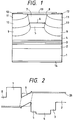
- FIG. 1 A first embodiment of the present invention will be described with reference to Fig. 1.
- an SiO2 film was formed on the above layers by vacuum vapor deposition.
- the SiO2 film was made in the form of a stripe having a width of about 5 ⁇ m using the known photolithography.
- a reverse mesa structure having a depth of about 2.5 ⁇ m was then formed using a phosphoric acid based etching solution.
- This sample was then dipped in a (NH4)2Sx solution for several min and cleaned by an alcohol based solvent, and it was put in the molecular beam epitaxy system again.
- This sample was heated at about 300°C to remove excessive sulfur.
- the SiO2 film was then removed using a fluoric acid based etching solution, and an SiO2 film 12 was formed on the sample by vacuum vapor deposition.
- a striped hole having a width of about 5 ⁇ m was opened in the SiO2 film 12 to the above stripe using the known photolithography.
- the sample was then dipped in the (NH4)2Sx solution for several min and cleaned with alcohol based solvent.
- a Ti-Pt-Au multi-layer electrode 13 was deposited to a thickness of about 1 ⁇ m by vacuum vapor deposition.
- an AuGe-Ni-Au multi-layer electrode 14 was deposited on the rear surface of the GaAs substrate which was polished to a thickness of 100 ⁇ m, after which the sample was cleaved to form a laser structure having a length of 400 ⁇ m.
- the device thus obtained was dipped in the (NH4)2Sx solution for several min and cleaned with alcohol based solvent.
- a ZnS-SiO2 multi-layer reflection film was then formed at the end surface of the resonator by sputtering.
- Numeral 26 designates the Fermi level.
- Positive holes injected by the p-type semiconductor layer are confined by an electric potential formed on the valency electron band side by the p-n junction and the junction between the Zn 0.8 Cd 0.2 S 0.4 Se 0.6 light guide layer and the Zn 0.8 Cd 0.2 S 0.1 Se 0.9 active layer.
- electrons injected from the n-type semiconductor are confined by an electric potential formed on the conducting band side by the p-n junction and the junction between the ZnS 0.1 Se 0.9 clad layer and the Zn 0.8 Cd 0.2 S 0.1 Se 0.9 active layer.
- the surface of the sample was then irradiated with molecular beams of Te for several tens min while keeping the sample temperature at the crystal growth temperature.
- a p-type ZnSeTe alloy having a gradient composition was formed on the surface of the sample.
- SiO2 film was formed on the sample by vacuum vapor deposition.
- the SiO2 film was made in the form of a stripe having a width of about 5 ⁇ m using the known photolithography.
- a reverse mesa structure having a depth of about 3.0 ⁇ m was then formed using a phosphoric acid based etching solution.
- the sample was then dipped in a (NH4)2Sx solution for several min and cleaned by an alcohol based solvent, and it was put in the molecular beam epitaxy system again.
- the sample was heated at about 300°C to remove excessive sulfur.
- the SiO2 film was then removed using a fluoric acid based etching solution, and an SiO2 film 12 was formed on the surface of the sample by vacuum vapor deposition.
- a striped hole having a width of about 5 ⁇ m was opened in the SiO2 film 12 to the above stripe using the known photolithography.
- the sample was then dipped in a (NH4)2Sx solution for several min and cleaned with alcohol based solvent.
- a Ti-Pt-Au multi-layer electrode 13 was deposited to a thickness of about 1 ⁇ m by vacuum vapor deposition.
- an AuGe-Ni-Au multi-layer electrode 14 was deposited on the rear surface of the GaAs substrate which was polished to a thickness of 100 ⁇ m, after which the sample was cleaved to form a laser structure having a length of 400 ⁇ m.
- the device thus obtained was dipped in the (NH4)2Sx solution for several min and cleaned with alcohol based solvent.
- An SiNx-SiCx multi-layer reflection film was then formed at the end surface of the resonator by plasma CVD.
- the ZnSe-Zn 0.8 Cd 0.2 Se supperlattice light guide layer used in this structure is shown in Fig. 4.
- numeral 27 designates ZnSe
- 28 is Zn 0.8 Cd 0.2 Se
- 29 is the lower end of an apparent conducting band
- 30 is the upper end of an apparent valency electron band.
- the structure in which the film thickness is gradually changed has the same effect as that of the alloy having the gradient composition.
- the laser of this structure has a band structure shown in Fig. 5.
- numeral 26 designates the Fermi level.
- SiO2 film was formed on the above layers by vacuum vapor deposition.
- the SiO2 film was made in the form of a stripe having a width of about 5 ⁇ m using the known photolithography.
- a reverse mesa structure having a depth of about 2.0 ⁇ m was then formed using a sulfuric acid based etching solution.
- This sample was then dipped in a (NH4)2Sx solution for several min and cleaned by an alcohol based solvent, and it was put in the molecular beam epitaxy system again.
- This sample was heated at about 300°C to remove excessive sulfur.
- an undoped MgS 0.9 Se 0.1 block layer 33 (n/p ⁇ 1 El5, 2.0 ⁇ m) was grown as a buried layer.
- the SiO2 film was then removed using a fluoric acid based etching solution, and an SiO2 film 12 was formed on the surface of the sample by vacuum vapor deposition.
- a striped hole having a width of about 5 ⁇ m was opened in the SiO2 film 12 to the above stripe using the known photolithography.
- the sample was then dipped in a (NH4)2Sx solution for several min and cleaned with alcohol based solvent.
- a Ti-Pt-Au multi-layer electrode 13 was deposited to a thickness of about 1 ⁇ m by vacuum vapor deposition.
- an AuGe-Ni-Au multi-layer electrode 25 was deposited on the rear surface of the GaAs substrate which was polished to a thickness of 100 ⁇ m, after which the sample was cleaved to form a laser structure having a length of 500 ⁇ m.
- the device thus obtained was dipped in the (NH4)2Sx solution for several min and cleaned with alcohol based solvent, and a SiO2-TiO2 multi-layer reflection film was formed at the end surface of the resonator by vacuum vapor deposition.
- the semiconductor laser device of this structure is capable of continuously oscillating a blue laser of a single vertical mode with an oscillation wavelength of about 450 nm at room temperature.
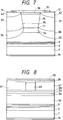
- a fourth embodiment of the present invention will be described with reference to Fig. 7.
- the surface of the sample was irradiated with molecular beams of Te for several tens min while keeping the sample temperature at the crystal growth temperature, and then was cooled to a temperature near room temperature.
- a p-type ZnSeTe alloy having a gradient composition was formed on the surface of the sample.
- an SiO2 film was formed on the sample by plasma CVD.
- the SiO2 film was made in the form of a stripe having a width of about 5 ⁇ m using the known photolithography.
- a reverse mesa structure having a depth of about 2 ⁇ m was then formed using a sulfuric acid based etching solution.
- This sample was then dipped in a (NH4)2Sx solution for several min and cleaned by an alcohol based solvent, and it was put in the metal-organic vapor deposition system.
- This sample was irradiated with hydrogen radicals while being heated at about 300°C to remove excessive sulfur.
- the SiO2 film was then removed using a fluoric acid based etching solution, and an SiO2 film 12 was formed on the sample by plasma CVD.
- a striped hole having a width of about 5 ⁇ m was opened in the SiO2 film 12 to the above stripe using the known photolithography.
- the sample was then dipped in a (NH4)2Sx solution for several min and cleaned with alcohol based solvent.
- a Ti-Pt-Au multi-layer electrode 13 was deposited to a thickness of about 1 ⁇ m by vacuum vapor deposition.
- an AuGe-Ni-Au multi-layer electrode 14 was deposited on the rear surface of the GaAs substrate which was polished to a thickness of 100 ⁇ m, after which the sample was cleaved to form a laser structure with a length of 400 ⁇ m.
- the device thus obtained was dipped in the (NH4)2Sx solution for several min and cleaned with alcohol based solvent, and a CaF2-SiO2 multi-layer reflection film was formed at the end surface of the resonator by sputtering.
- the semiconductor laser of this structure is capable of continuously oscillating at room temperature a marine blue laser of a single vertical mode having a characteristic of a threshold current of 50 mA, a drive voltage 4V, and an oscillation wavelength of 510 nm.
- a fifth embodiment of the present invention will be described with reference to Fig. 8.
- SiO2 film was formed on the above layers by plasma CVD.
- the SiO2 film was made in the form of a stripe having a width of about 5 ⁇ m using the known photolithography.
- a reverse mesa structure having a depth of about 1 ⁇ m was formed using a sulfuric acid based selective etching solution.
- This sample was then dipped in a (NH4)2Sx solution for several min and cleaned by an alcohol based solvent, and it was put in the metal-organic vapor deposition system.
- the sample was irradiated with hydrogen radicals while being heated at about 300°C to remove excessive sulfur.
- the SiO2 film was then removed using a fluoric acid based etching solution, and the sample was dipped in a (NH4)2Sx solution for several minutes and cleaned using an alcohol solvent, and it was put in the molecular beam epitaxy system.
- the surface of the sample was irradiated with molecular beams of Te for several tens min while keeping the sample temperature at the crystal growth temperature, and was then cooled to a temperature near room temperature. By this processing, a p-type ZnSeTe alloy having a gradient composition was formed on the surface of the sample.
- a Ti-Pt-Au multi-layer electrode 13 was deposited to a thickness of about 1 ⁇ m by vacuum vapor deposition.
- an AuGe-Ni-Au multi-layer electrode 14 was deposited on the rear surface of the GaAs substrate which was polished to a thickness of 100 ⁇ m, after which the sample was cleaved to form a laser structure having a length of 400 ⁇ m.
- the device thus obtained was dipped in the (NH4)2Sx solution for several min and cleaned with alcohol based solvent, and a ZnS-SiO2 multi-layer reflection film was formed at the end surface of the resonator by sputtering.
- the semiconductor laser of this structure is capable of continuously oscillating at room temperature a marine blue laser of a single vertical mode having a characteristic of a threshold current of 60 mA, a drive voltage 5V, and an oscillation wavelength of 450 nm.
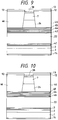
- a sixth embodiment of the present invention will be described with reference to Fig. 9.
- the surface of the sample was irradiated with molecular beams of Te for several tens min while keeping the sample temperature at the crystal growth temperature, and was then cooled to a temperature near room temperature.
- a p-type ZnSeTe alloy with a gradient composition was formed on the surface of the sample.
- an SiO2 film was formed on the sample by plasma CVD.
- the SiO2 film was made in the form of a stripe having a width of about 5 ⁇ m using the known photolithography.
- a reverse mesa structure having a depth of about 1.5 ⁇ m was then formed using a bromine based selective etching solution.
- the sample was then dipped in a (NH4)2Sx solution for several min and cleaned with an alcohol based solvent, and it was put in the metal-organic vapor deposition system.
- This sample was irradiated with hydrogen radicals while being heated at about 300°C to remove excessive sulfur.
- an SiO2 film 12 was formed on the buried layer by plasma CVD, and a striped hole having a width of about 5 ⁇ m was formed in the SiO2 film using the known photolithography.
- a Ti-Pt-Au multi-layer electrode 13 was deposited to a thickness of about 1 ⁇ m by vacuum vapor deposition.
- an AuGe-Ni-Au multi-layer electrode 14 was deposited on the rear surface of the GaAs substrate which was polished to a thickness of 100 ⁇ m, after which the sample was cleaved to form a laser structure having a length of 1000 ⁇ m.
- the device thus obtained was dipped in the (NH4)2Sx solution for several min and cleaned with alcohol based solvent, and an SiNx-SiO2 multi-layer reflection film was formed at the end surface of the resonator by sputtering.
- the semiconductor laser of this structure is capable of continuously oscillating at room temperature a marine blue laser of a single vertical mode having a characteristic of a threshold current of 2 mA, a drive voltage 4V, and an oscillation wavelength of 500 nm.
- a seventh embodiment of the present invention will be described with reference to Fig. 10.
- the surface of the sample was irradiated with molecular beams of Te for several tens min while keeping the sample temperature of at the crystal growth temperature, and was then cooled to a temperature near room temperature.
- a p-type ZnSeTe alloy with a gradient composition was formed on the surface of the sample.
- an SiO2 film was formed on the sample by plasma CVD.
- the SiO2 film was made in the form of a stripe having a width of about 5 ⁇ m using the known photolithography.
- a reverse mesa structure having a depth of about 1.5 ⁇ m was formed using a bromine based selective etching solution.
- This sample was then dipped in a (NH4)2Sx solution for several min and cleaned with an alcohol based solvent, and it was put in the metal-organic vapor deposition system.
- This sample was irradiated with hydrogen radicals while being heated at about 300°C to remove excessive sulfur.
- an SiO2 film 12 was formed on the buried layer by plasma CVD, and a striped hole having a width of about 5 ⁇ m was formed in the SiO2 film using the known photolithography.
- a Ti-Pt-Au multi-layer electrode 13 was deposited to a thickness of about 1 ⁇ m by vacuum vapor deposition.
- an AuGe-Ni-Au multi-layer electrode 14 was deposited on the rear surface of the GaAs substrate which was polished to a thickness of 100 ⁇ m, after which the sample was cleaved to form a laser structure with a length of 1000 ⁇ m.
- the device thus obtained was dipped in the (NH4)2Sx solution for several min and cleaned with alcohol based solvent, and an SiNx-SiO2 multi-layer reflection film was formed at the end surface of the resonator by sputtering.
- the semiconductor laser of this structure is capable of continuously oscillating at room temperature a marine blue of a single vertical mode having a characteristic of a threshold current of 2 mA, a drive voltage 4V, and an oscillation wavelength of 500 nm.
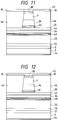
- a eighth embodiment of the present invention will be described with reference to Fig. 11.
- the surface of the sample was irradiated with molecular beams of Te for several tens min while keeping the sample temperature at the crystal growth temperature, and was then cooled to a temperature near room temperature.
- a p-type ZnSeTe alloy with a gradient composition was formed on the surface of the sample.
- an SiO2 film was formed on the above layers by plasma CVD.
- the SiO2 film was made in the form of a stripe having a width of about 5 ⁇ m using the known photolithography.
- a reverse mesa structure having a depth of about 1.5 ⁇ m was formed using a bromine based selective etching solution.
- This sample was then dipped in a (NH4)2Sx solution for several min and cleaned with an alcohol based solvent, and it was put in the metal-organic vapor deposition system.
- This sample was irradiated with hydrogen radicals while being heated at about 300°C to remove excessive sulfur.
- an SiO2 film 12 was formed on the buried layer by plasma CVD, and a striped hole having a width of about 5 ⁇ m was formed on the SiO2 film using the known photolithography.
- a Ti-Pt-Au multi-layer electrode 13 was deposited to a thickness of about 1 ⁇ m by vacuum vapor deposition.
- an AuGe-Ni-Au multi-layer electrode 14 was deposited on the rear surface of the GaAs substrate which was polished to a thickness of 100 ⁇ m, after which the sample was cleaved to form a laser structure with a length of 1000 ⁇ m.
- the device thus obtained was dipped in the (NH4)2Sx solution for several min and cleaned with alcohol based solvent, and an SiNx-SiO2 multi-layer reflection film was formed at the end surface of the resonator by sputtering.
- the semiconductor laser of this structure is capable of continuously oscillating at room temperature a marine blue laser of a single vertical mode having a characteristic of a threshold current of 2 mA, a drive voltage 4V, and an oscillation wavelength of 500 nm.
- a ninth embodiment of the present invention will be described with reference to Fig. 12.
- the surface of the sample was irradiated with molecular beams of Te for several tens min while keeping the sample temperature at the crystal growth temperature, and was then cooled to a temperature near room temperature.
- a p-type ZnSeTe alloy with a gradient composition was formed on the surface of the sample.
- an SiO2 film was formed on the sample by plasma CVD.
- the SiO2 film was made in the form of a stripe having a width of about 5 ⁇ m using the known photolithography.
- a reverse mesa structure having a depth of about 1.5 ⁇ m was formed using a bromine based selective etching solution.
- This sample was then dipped in a (NH4)2Sx solution for several min and cleaned by an alcohol based solvent, and it was put in the metal-organic vapor deposition system.
- the sample was irradiated with hydrogen radicals while being heated at about 300°C to remove excessive sulfur.
- an SiO2 film 12 was formed on the buried layer by plasma CVD, and a striped hole having a width of about 5 ⁇ m was formed in the SiO2 film using the known photolithography.
- a Ti-Pt-Au multi-layer electrode 13 was deposited to a thickness of about 1 ⁇ m by vacuum vapor deposition.
- an AuGe-Ni-Au multi-layer electrode 14 was deposited on the rear surface of the GaAs substrate which was polished to a thickness of 100 ⁇ m, after which the sample was cleaved to form a laser structure with a length of 1000 ⁇ m.
- the device thus obtained was dipped in the (NH4)2Sx solution for several min and cleaned with an alcohol based solvent, and an SiNx-SiO2 multi-layer reflection film was formed at the end surface of the resonator by sputtering.
- the semiconductor laser of this structure is capable of continuously oscillating at room temperature a marine blue laser of a single vertical mode having a characteristic of a threshold current of 2 mA, a drive voltage 4V, and an oscillation wavelength of 500 nm.
- a tenth embodiment of the present invention will be described with reference to Fig. 13.
- the surface of the sample was irradiated with molecular beams of Te for several tens min while keeping the sample temperature at the crystal growth temperature, and was then cooled to a temperature near room temperature.
- a p-type ZnSeTe alloy with a gradient composition was formed on the surface of the sample.
- An SiO2 film was formed on the sample by plasma CVD.
- the SiO2 film was made in the form of a stripe having a width of about 5 ⁇ m using the known photolithography.
- a reverse mesa structure having a depth of about 1.5 ⁇ m was formed using a bromine based selective etching solution.
- This sample was then dipped in a (NH4)2Sx solution for several min and cleaned by an alcohol based solvent, and it was put in the metal-organic vapor deposition system.
- This sample was irradiated with hydrogen radicals while being heated at about 300°C to remove excessive sulfur.
- an SiO2 film 12 was formed on the buried layer by plasma CVD, and a striped hole having a width of about 5 ⁇ m was formed on the SiO2 film using the known photolithography.
- a Ti-Pt-Au multi-layer electrode 13 was deposited to a thickness of about 1 ⁇ m by vacuum vapor deposition.
- an AuGe-Ni-Au multi-layer electrode 14 was deposited on the rear surface of the GaAs substrate which was polished to a thickness of 100 ⁇ m, after which the sample was cleaved to form a laser structure with a length of 1000 ⁇ m.
- the device thus obtained was dipped in the (NH4)2Sx solution for several min and cleaned with alcohol based solvent, and an SiNx-SiO2 multi-layer reflection film was formed at the end surface of the resonator by sputtering.
- the semiconductor laser of this structure is capable of continuously oscillating at room temperature a marine blue laser of a single vertical mode having a characteristic of a threshold current of 2 mA, a drive voltage 4V, and an oscillation wavelength of 500 nm.
- an eleventh embodiment of the present invention will be described with reference to Fig. 14.
- the surface of the sample was irradiated with molecular beams of Te for several tens min while keeping the sample temperature at the crystal growth temperature, and was then cooled to a temperature near room temperature.
- a p-type ZnSeTe alloy with a gradient composition was formed on the surface of the sample.
- An SiO2 film was formed on the sample by plasma CVD.
- the SiO2 film was made in the form of a stripe having a width of about 5 ⁇ m using the known photolithography.
- a reverse mesa structure having a depth of about 1.5 ⁇ m was formed using a bromine based selective etching solution.
- This sample was then dipped in a (NH4)2Sx solution for several min and cleaned by an alcohol based solvent, and it was put in the metal-organic vapor deposition system.
- This sample was irradiated with hydrogen radicals while being heated at about 300°C to remove excessive sulfur.
- an SiO2 film 12 was formed on the buried layer by plasma CVD, and a striped hole having a width of about 5 ⁇ m was formed on the SiO2 film using the known photolithography.
- a Ti-Pt-Au multi-layer electrode 13 was deposited to a thickness of about 1 ⁇ m by vacuum vapor deposition.
- an AuGe-Ni-Au multi-layer electrode 14 was deposited on the rear surface of the GaAs substrate which was polished to a thickness of 100 ⁇ m, after which the sample was cleaved to form a laser structure with a length of 1000 ⁇ m.
- the device thus obtained was dipped in the (NH4)2Sx solution for several min and cleaned with alcohol based solvent, and an SiNx-SiO2 multi-layer reflection film was formed at the end surface of the resonator by sputtering.
- the semiconductor laser of this structure is capable of continuously oscillating at room temperature a marine blue laser of a single vertical mode having a characteristic of a threshold current of 2 mA, a drive voltage 4V, and an oscillation wavelength of 500 nm.
- a twelfth embodiment of the present invention will be described with reference to Fig. 15.
- the surface of the sample was irradiated with molecular beams of Te for several tens min while keeping the sample temperature at the crystal growth temperature, and was then cooled to a temperature near room temperature.
- a p-type ZnSeTe alloy with a gradient composition was formed on the surface of the sample.
- An SiO2 film was formed on the sample by plasma CVD.
- the SiO2 film was made in the form of a stripe having a width of about 5 ⁇ m using the known photolithography.
- a reverse mesa structure having a depth of about 1.5 ⁇ m was formed using a bromine based selective etching solution.
- This sample was then dipped in a (NH4)2Sx solution for several min and cleaned by an alcohol based solvent, and it was put in the metal-organic vapor deposition system.
- This sample was irradiated with hydrogen radicals while being heated at about 300°C to remove excessive sulfur.
- an SiO2 film 12 was formed on the buried layer by plasma CVD, and a striped hole having a width of about 5 ⁇ m was formed on the SiO2 film using the known photolithography.
- a Ti-Pt-Au multi-layer electrode 13 was deposited to a thickness of about 1 ⁇ m by vacuum vapor deposition.
- an AuGe-Ni-Au multi-layer electrode 14 was deposited on the rear surface of the GaAs substrate which was polished to a thickness of 100 ⁇ m, after which the sample was cleaved to form a laser structure with a length of 1000 ⁇ m.
- the device thus obtained was dipped in the (NH4)2Sx solution for several min and cleaned with alcohol based solvent, and an SiNx-SiO2 multi-layer reflection film was formed at the end surface of the resonator by sputtering.
- the semiconductor laser of this structure is capable of continuously oscillating at room temperature a marine blue laser of a single vertical mode having a characteristic of a threshold current of 2 mA, a drive voltage 4V, and an oscillation wavelength of 500 nm.
- a thirteenth embodiment of the present invention will be described with reference to Fig. 16.
- the surface of the sample was irradiated with molecular beams of Te for several tens min while keeping the sample temperature at the crystal growth temperature, and was then cooled to a temperature near room temperature.
- a p-type ZnSeTe alloy with a gradient composition was formed on the surface of the sample.
- An SiO2 film was formed on the sample by plasma CVD.
- the SiO2 film was made in the form of a stripe having a width of about 5 ⁇ m using the known photolithography.
- a reverse mesa structure having a depth of about 1.5 ⁇ m was formed using a bromine based selective etching solution.
- This sample was then dipped in a (NH4)2Sx solution for several min and cleaned by an alcohol based solvent, and it was put in the metal-organic vapor deposition system.
- This sample was irradiated with hydrogen radicals while being heated at about 300°C to remove excessive sulfur.
- an SiO2 film 12 was formed on the buried layer by plasma CVD, and a striped hole having a width of about 5 ⁇ m was formed on the SiO2 film using the known photolithography.
- a Ti-Pt-Au multi-layer electrode 13 was deposited to a thickness of about 1 ⁇ m by vacuum vapor deposition.
- an AuGe-Ni-Au multi-layer electrode 14 was deposited on the rear surface of the GaAs substrate which was polished to a thickness of 100 ⁇ m, after which the sample was cleaved to form a laser structure with a length of 1000 ⁇ m.
- the device thus obtained was dipped in the (NH4)2Sx solution for several min and cleaned with alcohol based solvent, and an SiNx-SiO2 multi-layer reflection film was formed at the end surface of the resonator by sputtering.
- the semiconductor laser of this structure is capable of continuously oscillating at room temperature a marine blue laser of a single vertical mode having a characteristic of a threshold current of 2 mA, a drive voltage 4V, and an oscillation wavelength of 500 nm.
- a short wave II-VI compound semiconductor laser with a high reliability which is capable of reducing the threshold current, lowering the contact resistance of an electrode, and reducing the lattice strain due to thermal expansion; and which is capable of continuously oscillating a laser at room temperature by the improvement in the confinement of injected charge and light.
Landscapes
- Physics & Mathematics (AREA)
- Optics & Photonics (AREA)
- Condensed Matter Physics & Semiconductors (AREA)
- General Physics & Mathematics (AREA)
- Electromagnetism (AREA)
- Geometry (AREA)
- Engineering & Computer Science (AREA)
- Chemical & Material Sciences (AREA)
- Nanotechnology (AREA)
- Biophysics (AREA)
- Life Sciences & Earth Sciences (AREA)
- Crystallography & Structural Chemistry (AREA)
- Semiconductor Lasers (AREA)
Applications Claiming Priority (4)
| Application Number | Priority Date | Filing Date | Title |
|---|---|---|---|
| JP19447193 | 1993-08-05 | ||
| JP194471/93 | 1993-08-05 | ||
| JP62384/94 | 1994-03-31 | ||
| JP6238494 | 1994-03-31 |
Publications (2)
| Publication Number | Publication Date |
|---|---|
| EP0637862A2 true EP0637862A2 (fr) | 1995-02-08 |
| EP0637862A3 EP0637862A3 (fr) | 1995-05-24 |
Family
ID=26403435
Family Applications (1)
| Application Number | Title | Priority Date | Filing Date |
|---|---|---|---|
| EP94111892A Ceased EP0637862A3 (fr) | 1993-08-05 | 1994-07-29 | Dispositif laser à semi-conducteur et méthode de fabrication. |
Country Status (2)
| Country | Link |
|---|---|
| EP (1) | EP0637862A3 (fr) |
| KR (1) | KR950007215A (fr) |
Cited By (7)
| Publication number | Priority date | Publication date | Assignee | Title |
|---|---|---|---|---|
| EP0661784A3 (fr) * | 1993-12-27 | 1995-12-27 | Mitsubishi Chem Corp | Laser à diode à semi-conducteur. |
| WO1997007536A3 (fr) * | 1995-08-16 | 1997-04-03 | Philips Electronics Nv | Utilisation d'un laser a configuration en arete dans un canal |
| WO1999039413A3 (fr) * | 1998-01-28 | 1999-09-16 | Koninkl Philips Electronics Nv | Lasers ii-iv possedant des structures a guidage par l'indice |
| WO2003096498A3 (fr) * | 2002-05-13 | 2004-07-29 | Forschungsverbund Berlin Ev | Procede de passivation des surfaces reflectrices de composants a semiconducteurs optiques |
| EP1622207A4 (fr) * | 2003-04-23 | 2007-08-08 | Hoya Corp | Diode electroluminescente |
| EP2290766A3 (fr) * | 2009-08-28 | 2015-04-22 | m2k-laser GmbH | Laser à diodes haute puissance et son procédé de fabrication |
| US20240039248A1 (en) * | 2022-08-01 | 2024-02-01 | Sumitomo Electric Industries, Ltd. | Semiconductor laser device and method of manufacturing the same |
Family Cites Families (8)
| Publication number | Priority date | Publication date | Assignee | Title |
|---|---|---|---|---|
| US4866489A (en) * | 1986-07-22 | 1989-09-12 | Matsushita Electric Industrial Co., Ltd. | Semiconductor device |
| JP2544378B2 (ja) * | 1987-03-25 | 1996-10-16 | 株式会社日立製作所 | 光半導体装置 |
| JPH0391270A (ja) * | 1989-09-01 | 1991-04-16 | Kokusai Denshin Denwa Co Ltd <Kdd> | 半導体発光素子 |
| JP2680917B2 (ja) * | 1990-08-01 | 1997-11-19 | シャープ株式会社 | 半導体レーザ素子の製造方法 |
| JPH04363086A (ja) * | 1990-10-11 | 1992-12-15 | Hitachi Ltd | 半導体発光装置 |
| US5404027A (en) * | 1991-05-15 | 1995-04-04 | Minnesota Mining & Manufacturing Compay | Buried ridge II-VI laser diode |
| JPH04370920A (ja) * | 1991-06-20 | 1992-12-24 | Matsushita Electric Ind Co Ltd | 化合物半導体のエピタキシャル成長方法 |
| WO1993003524A1 (fr) * | 1991-08-01 | 1993-02-18 | Optronics Ireland | Structure laser |
-
1994
- 1994-07-29 EP EP94111892A patent/EP0637862A3/fr not_active Ceased
- 1994-08-01 KR KR1019940018977A patent/KR950007215A/ko not_active Ceased
Cited By (9)
| Publication number | Priority date | Publication date | Assignee | Title |
|---|---|---|---|---|
| EP0661784A3 (fr) * | 1993-12-27 | 1995-12-27 | Mitsubishi Chem Corp | Laser à diode à semi-conducteur. |
| US5619518A (en) * | 1993-12-27 | 1997-04-08 | Mitsubishi Chemical Corporation | Semiconductor laser diode |
| WO1997007536A3 (fr) * | 1995-08-16 | 1997-04-03 | Philips Electronics Nv | Utilisation d'un laser a configuration en arete dans un canal |
| WO1999039413A3 (fr) * | 1998-01-28 | 1999-09-16 | Koninkl Philips Electronics Nv | Lasers ii-iv possedant des structures a guidage par l'indice |
| WO2003096498A3 (fr) * | 2002-05-13 | 2004-07-29 | Forschungsverbund Berlin Ev | Procede de passivation des surfaces reflectrices de composants a semiconducteurs optiques |
| EP1622207A4 (fr) * | 2003-04-23 | 2007-08-08 | Hoya Corp | Diode electroluminescente |
| EP2290766A3 (fr) * | 2009-08-28 | 2015-04-22 | m2k-laser GmbH | Laser à diodes haute puissance et son procédé de fabrication |
| US9450375B2 (en) | 2009-08-28 | 2016-09-20 | M2K-Laser Gmbh | High-power diode laser and method for producing a high-power diode laser |
| US20240039248A1 (en) * | 2022-08-01 | 2024-02-01 | Sumitomo Electric Industries, Ltd. | Semiconductor laser device and method of manufacturing the same |
Also Published As
| Publication number | Publication date |
|---|---|
| EP0637862A3 (fr) | 1995-05-24 |
| KR950007215A (ko) | 1995-03-21 |
Similar Documents
| Publication | Publication Date | Title |
|---|---|---|
| EP0038085B1 (fr) | Diode laser à hétéro-structure profonde et procédé pour sa fabrication | |
| US4866489A (en) | Semiconductor device | |
| EP1400835B1 (fr) | Modulateur optique à semi-conducteur et laser avec un tel modulateur | |
| EP0683924B1 (fr) | Procédé pour fabriquer un contact ohmique à composition proportionnée pour semi-conducteurs II-VI de type p | |
| US4607369A (en) | Semiconductor laser having a burying layer of a II-VI compound | |
| US5751753A (en) | Semiconductor laser with lattice mismatch | |
| US6865202B2 (en) | Semiconductor laser element | |
| US5665977A (en) | Semiconductor light emitting device with defect decomposing and blocking layers | |
| EP1016175B1 (fr) | DIODES A LASER BLEU-VERT II-VI A TENEUR EN Be | |
| US6639926B1 (en) | Semiconductor light-emitting device | |
| US4815082A (en) | Semiconductor laser device | |
| US20180331501A1 (en) | AlInGaN ALLOY BASED LASER DIODE | |
| KR950007215A (ko) | 반도체레이저장치 및 그 제작방법 | |
| EP0632554B1 (fr) | Dispositif semi-conducteur à émission de lumière | |
| JP3062510B2 (ja) | 半導体光素子 | |
| Kaneko et al. | Lattice mismatched LPE growth of InGaP on patterned InP substrate | |
| Yin et al. | Mid-infrared diode lasers for free-space optical communications | |
| JPH07321419A (ja) | 半導体レーザ装置及びその作製方法 | |
| JPH08288587A (ja) | 半導体レーザ | |
| JPH09289353A (ja) | 半導体発光素子およびその製造方法 | |
| JPH08222811A (ja) | 半導体発光素子 | |
| KR100459579B1 (ko) | 베릴륨을함유한ⅱ-ⅵ족청색-녹색레이저다이오드 | |
| Niina et al. | A buried-cap planar stripe (BCP) GaAlAs laser with ZnSe current-confinement region by MBE | |
| JPH08172216A (ja) | 歪量子井戸型半導体発光装置の製造方法 | |
| JPH08213410A (ja) | 半導体装置およびその製造方法 |
Legal Events
| Date | Code | Title | Description |
|---|---|---|---|
| PUAI | Public reference made under article 153(3) epc to a published international application that has entered the european phase |
Free format text: ORIGINAL CODE: 0009012 |
|
| AK | Designated contracting states |
Kind code of ref document: A2 Designated state(s): DE GB NL |
|
| PUAL | Search report despatched |
Free format text: ORIGINAL CODE: 0009013 |
|
| AK | Designated contracting states |
Kind code of ref document: A3 Designated state(s): DE GB NL |
|
| 17P | Request for examination filed |
Effective date: 19951109 |
|
| 17Q | First examination report despatched |
Effective date: 19960605 |
|
| GRAG | Despatch of communication of intention to grant |
Free format text: ORIGINAL CODE: EPIDOS AGRA |
|
| STAA | Information on the status of an ep patent application or granted ep patent |
Free format text: STATUS: THE APPLICATION HAS BEEN REFUSED |
|
| 18R | Application refused |
Effective date: 19980822 |