EP0645264A2 - Profil de pneumatique et procédé de mesure de déphasage optimum entre des parties adjacentes de la bande de roulement - Google Patents
Profil de pneumatique et procédé de mesure de déphasage optimum entre des parties adjacentes de la bande de roulement Download PDFInfo
- Publication number
- EP0645264A2 EP0645264A2 EP94115000A EP94115000A EP0645264A2 EP 0645264 A2 EP0645264 A2 EP 0645264A2 EP 94115000 A EP94115000 A EP 94115000A EP 94115000 A EP94115000 A EP 94115000A EP 0645264 A2 EP0645264 A2 EP 0645264A2
- Authority
- EP
- European Patent Office
- Prior art keywords
- tread
- phase
- parts
- tire
- function
- Prior art date
- Legal status (The legal status is an assumption and is not a legal conclusion. Google has not performed a legal analysis and makes no representation as to the accuracy of the status listed.)
- Granted
Links
Images




Classifications
-
- B—PERFORMING OPERATIONS; TRANSPORTING
- B60—VEHICLES IN GENERAL
- B60C—VEHICLE TYRES; TYRE INFLATION; TYRE CHANGING; CONNECTING VALVES TO INFLATABLE ELASTIC BODIES IN GENERAL; DEVICES OR ARRANGEMENTS RELATED TO TYRES
- B60C11/00—Tyre tread bands; Tread patterns; Anti-skid inserts
- B60C11/03—Tread patterns
- B60C11/0318—Tread patterns irregular patterns with particular pitch sequence
-
- Y—GENERAL TAGGING OF NEW TECHNOLOGICAL DEVELOPMENTS; GENERAL TAGGING OF CROSS-SECTIONAL TECHNOLOGIES SPANNING OVER SEVERAL SECTIONS OF THE IPC; TECHNICAL SUBJECTS COVERED BY FORMER USPC CROSS-REFERENCE ART COLLECTIONS [XRACs] AND DIGESTS
- Y10—TECHNICAL SUBJECTS COVERED BY FORMER USPC
- Y10T—TECHNICAL SUBJECTS COVERED BY FORMER US CLASSIFICATION
- Y10T156/00—Adhesive bonding and miscellaneous chemical manufacture
- Y10T156/10—Methods of surface bonding and/or assembly therefor
- Y10T156/1002—Methods of surface bonding and/or assembly therefor with permanent bending or reshaping or surface deformation of self sustaining lamina
- Y10T156/1007—Running or continuous length work
- Y10T156/1023—Surface deformation only [e.g., embossing]
Definitions
- the invention relates to a vehicle tire with a profiled tread, on the circumference of which treads (pitches) of at least two different lengths are arranged, the tread being axially divided into several parts and the successive step lengths forming a sequence of steps in each of the axial parts.
- each tread half contributes about half to the total radiated sound power; Avoiding coherence should, however, result in extinctions to some extent and, moreover, the frequency spectrum should be more closely approximated to a uniform noise, which is perceived as less disturbing for the same sound power with a longer exposure time than a tonal sound, i.e. as a sound, the sound power of which is essentially concentrated on frequencies that are in an integer ratio to a fundamental frequency.
- the present invention is not primarily a further improvement of the noise emitted by the tire and by the contact surface between the tire and the road surface, but rather to further reduce the radial force fluctuations which can excite wheel suspension and body parts by structure-borne noise.
- the object is achieved by the characterizing features of claim 1 or 9, that is, in that the phase shift between the pitch sequences of the different tread parts is dimensioned such that the distance between the absolute extremes of the sum of the weighted images is minimal for each function defined below or at most 25% larger than this minimum.
- Each tread part is assigned a function which is the subsequent ablation of the successive steps of the tread part in question on the abscissa when the respective step length is ablated from the abscissa on the ordinate.
- a "mapping" is determined that is easiest for technical experts to define as a residual function after the elimination of all harmonic components greater than the x. Rank, where x is an integer between 8 and 14.
- each periodic signal including the functions defined above, can be reconstructed in such a way that the signal is first analyzed in a completely harmonic manner ("complete" means up to the highest order actually occurring in the signal, generally infinite) and with a signal is in turn synthesized from the information thus obtained on the amplitude and phase position of each harmonic.
- the signal obtained in this way is identical to the output signal; Analysis and synthesis could also be understood as operations that are inverse to each other, with the identical mapping as a neutral element.
- phase offset angle it is essential in the determination of the phase offset angle according to the invention that the analysis is only incomplete, namely from the 1st to the xth Order takes place, where x is an integer between 8 and 14, preferably between 9 and 11. With this truncation of the analysis, the subsequent synthesis no longer leads back to the original signal.
- phase information is usually cut away and the amplitude information is taken into account at least up to a much larger order.
- the amplitudes from the 50th to the 110th order are particularly important for noise optimization.
- a special feature of the calculation method presented here is that only up to the 10th order is analyzed and the phase information is not cut away within these limits.
- the sum of the weighting factors should be 1.
- both halves towards the center of the tire - apart from the phase offset to be determined according to the invention are symmetrical and have the same sequence of steps and where the camber and toe-in of the wheel suspension to be optimized are equal to 0 are, i.e. the load share of both tire halves in the total load capacity of the tire is the same, namely equal to 1 ⁇ 2, both weighting factors are: 1 ⁇ 2.
- the inside of the tire carries slightly more than the outside of the vehicle, which is to be taken into account in a slightly higher weighting factor for the inside of the tire if a tire is perfectly matched to a vehicle, e.g. 0.52 to 0.48.
- this delicacy only has an effect in the rare case in which the sum of all figures shows two almost equally small relative minima, which means that the selection of the smallest relative minimum can be mixed up; but even then the size (ie the peak / peak value reached, not the associated phase angle) of the smallest relative minimum is practically unchanged.
- a particularly important case in practice is that the tire tread is not divided into a left and right half (as in exemplary embodiment 1), but into an (axially) outer and an inner region.
- These preferred embodiments which correspond to claims 5 and 6, almost completely avoid the occurrence of torques about the vertical axis of the wheel when it rolls off;
- the entry of a particularly stiff positive area into the Latsch not only leads to an increase in the wheel load component but also in the rolling resistance component, which in particular in the outermost popitive tracks due to the larger lever arm there towards the steering axis allows the wheel to turn in exactly this direction, but the same thing happens also on the other side of the tire, so that both effects largely compensate.
- the steering wheel is particularly quiet - even at high speeds.
- both tread areas - more precisely their illustrations - should be weighted with 1 ⁇ 2.
- the transverse groove depth in the inner positive tracks is greater than in the shoulder tracks, i.e. if the tread stiffness fluctuates more over the circumference, the correct weighting factor is correspondingly larger and that of the outer tracks smaller . How much the stiffness fluctuation increases with increasing transverse groove depth is known to the person skilled in the art in a few minutes after running through a finite element program describing the tread parts in question. - The reverse applies where the transverse groove depth is greater in the shoulder marks than in the inner.
- the inner positive tracks occupy a larger part of the tire width than the outer ones, so that the load share of the inner tracks is greater than that of the outer ones.
- the weighting factor of the image of the inner tracks is correspondingly larger in such a case and the weighting factor of the image of the outer tracks is to be determined correspondingly smaller.
- the transverse grooves do not reach the zenith; a circumferential band not divided by transverse grooves runs smoothly on the roadway assumed to be smooth. Assuming that 6% of the overall tire width occupied by the inner positive tracks is not penetrated by transverse grooves, the weighting factor of the inner tracks should be reduced accordingly (i.e. about 3%) and that of the outer tracks increased accordingly.
- the inclination angle of the transverse grooves changes over the tire width in some types of tires.
- Very precise statements on this problem can be obtained by the finite element method familiar to the person skilled in the art; In the area of approximately axially running transverse grooves ( ⁇ between 70 ° and 110 °) this dependency can be taken into account with sufficient accuracy by introducing the factor cos ( ⁇ ).
- a tolerance range as stated at the end of the first characteristic feature is also justified by the fact that the task of vibration suppression (low frequency range) is in weak competition with the other development goal of less direct sound radiation from the tire and its contact surface with the road (Latsch), in particular its subjective rating.
- the distance between the absolute extremes of the sum of the images of the functions of the tread parts is at most 10% greater than the achievable minimum. This results in a particularly large reduction in the radial force fluctuation and still leaves sufficient space for fine-tuning the phase offset with regard to the subjective noise.
- this is a relative minimum in all three individual figure sums, approximately the size of the respective absolute minimum, usually hardly 10% larger.
- the teaching according to the invention is based on the knowledge that a large part of the radial force fluctuations to be combated is caused by the variation of the block lengths: a region of large block lengths flattened out with greater resistance when entering the mountain pass than a region of small block lengths.
- the transmitted radial force increases with a constant distance between the axis of rotation and the carriageway or test drum when a tread section of large block lengths enters the Latsch and, conversely, decreases when a tread section of small block lengths enters.
- the resulting radial force fluctuation is greater, the greater the tread depth, hardness of the tread and the maximum step length ratio and the smaller, the larger the tread radius and the air pressure.
- irregularities such as joints in the carcass and the belt have hitherto been held responsible for radial force fluctuations, the inventors have recognized that the pitch sequence can also have a significant influence; Because RKS rises above atmospheric pressure due to sub-structure irregularities, according to the inventors' knowledge, by comparing the RKS record at different air pressures, it is even possible to estimate which of the influences is at the individual tire.
- the present invention allows the same sequence of steps to be used in the same direction of rotation in all parts of the tread. This makes it possible, which is advantageous for the aquaplaning behavior, to form continuous transverse grooves across the entire width of the tire.
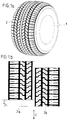
- FIG. 1a shows a perspective view of a vehicle tire 1 that can be divided into two tread halves.
- FIG. 1b shows a section of the profile development of this tire, the two tread halves 2a and 2b being offset from one another in the circumferential direction U by an arc length ⁇ x r.
- ⁇ is the phase offset angle to be determined according to the invention (if specified in degrees, as is done below, is to be expanded with 2pi / 360 °) and r is the tread radius.
- phase offset is not given below as the arc length, but as the angle ( ⁇ ) around the tire's axis of rotation.
- FIG. 2 shows how the function f, which is shown in a solid thin line, can be determined from a pitch sequence, in this case the one listed above:
- an abscissa unit dimension is set arbitrarily for the stride length 1, here taking into account the prescribed one Drawing margin 2.12 mm.
- the graph jumps to 1.56 according to the 6th step, which has the length "2", and remains there - because this is also not a repetition point - only for 1 times the 1.56 times the abscissa unit dimension, i.e. 3 , 31 mm. Then the graph falls back to 1.00 in accordance with the 7th to 9th steps, which repeat the length "1", and remains there for 3 times the abscissa unit dimension, ie 6.36 mm. And so on until the episode has run through exactly once.
- the peak / peak value is equal to the peak / peak value of each individual image g, i.e. 0.665 due to the identity of the two sequences of steps, a reduction of 46.5% is achieved.
- FIG. 4 is intended to illustrate how the peak / peak value of the composite image gz behaves as a function of the selected phase offset ⁇ . It can be seen that in addition to the absolute minimum at 22 ° there is an almost equally small relative minimum at 52 °. This is important because, according to the inventors, a phase offset greater than 30 ° frequently leads to a more favorable subjective evaluation of the noise.
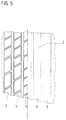
- FIG. 5 shows a section of a development of an arrow-shaped tread 2.
- the profile is symmetrical to the center line drawn in broken lines; because of the symmetry, it is sufficient to draw only the left half in detail.
- the profile is divided into 5 block tracks, numbered 3 to 7 from left to right.
- the transverse grooves run in a V-shape, in the remaining tracks 3, 4, 6 and 7 in a straight line at an angle of 60 ° to the circumferential direction.
- the shoulder blocks are divided more coarsely than the inner blocks; the same sequence of steps is used in the two rows of shoulder blocks 3 and 7, which is already known from the first embodiment and has 60 steps.
- the associated function and illustration are shown in Figure 2.
- a step sequence with 70 steps is used, but the same maximum step length ratio and also only two step lengths.
- phase offset angles For the sake of clarity, the following illustration is limited to the search for the two best phase offsets.
- the intermediate tracks 4 and 6 located between the middle track 5 and the shoulder tracks 3 and 7 are considered to be invariant.
- FIG. 7 now shows function f3.7 and figure g3.7 of shoulder tracks 3 and 7 in phase offset 0 ° to function f4.6 and figure g4.6 of intermediate tracks 4 and 6.
- the phase offset of middle track 5 is also 0 ° here.
- the two upper figures g3.7 and g4.6 are each weighted with 0.4 and the figure g5 of the middle row 5 is weighted with 0.2.
- the diagram at the bottom of the figure results for the sum gz of the composite image.
- Their peak / peak value is 0.537.
- Figure 8 is constructed analogously to Figure 7, however, the upper and lower of the three mapping diagrams are shown in the phase shift where the peak / peak value of the composite mapping gz is minimal; after all, the distance between the extremes could be reduced to 0.265.
- the shoulder step sequence has been rotated by 123 ° in relation to the intermediate step sequence (indicated by an arrow above) and the middle step sequence by 88 ° compared to the intermediate step sequence (also indicated by arrow).
- a tire 1 optimized in this way not only introduces particularly low vibrations into the wheel suspension but also, owing to the phase equality between lanes 3 and 7 and between lanes 4 and 6, leaves the steering practically completely free of any tire-related vibration.
Landscapes
- Engineering & Computer Science (AREA)
- Mechanical Engineering (AREA)
- Tires In General (AREA)
- Length Measuring Devices With Unspecified Measuring Means (AREA)
Applications Claiming Priority (2)
| Application Number | Priority Date | Filing Date | Title |
|---|---|---|---|
| DE4332811 | 1993-09-27 | ||
| DE4332811A DE4332811C2 (de) | 1993-09-27 | 1993-09-27 | Profilierter Fahrzeugreifen und Verfahren zum Bemessen des optimalen Phasenversatzes zwischen nebeneinander angeordneten Laufflächenteilen |
Publications (3)
| Publication Number | Publication Date |
|---|---|
| EP0645264A2 true EP0645264A2 (fr) | 1995-03-29 |
| EP0645264A3 EP0645264A3 (fr) | 1995-08-30 |
| EP0645264B1 EP0645264B1 (fr) | 1996-11-27 |
Family
ID=6498715
Family Applications (1)
| Application Number | Title | Priority Date | Filing Date |
|---|---|---|---|
| EP94115000A Expired - Lifetime EP0645264B1 (fr) | 1993-09-27 | 1994-09-23 | Profil de pneumatique et procédé de mesure de déphasage optimum entre des parties adjacentes de la bande de roulement |
Country Status (4)
| Country | Link |
|---|---|
| US (1) | US5746848A (fr) |
| EP (1) | EP0645264B1 (fr) |
| DE (2) | DE4332811C2 (fr) |
| ES (1) | ES2097596T3 (fr) |
Cited By (5)
| Publication number | Priority date | Publication date | Assignee | Title |
|---|---|---|---|---|
| US5865921A (en) * | 1996-02-26 | 1999-02-02 | Bridgestone/Firestone, Inc. | Tire noise treatment |
| US6514366B1 (en) | 2000-02-10 | 2003-02-04 | Bridgestone/Firestone North American Tire, Llc | Method of developing tread pattern |
| US7006930B2 (en) | 2001-08-22 | 2006-02-28 | Bridgestone/Firestone North American Tire, Llc | Method of analyzing tire pitch sequence based on lug stiffness variations |
| US7769567B2 (en) | 2002-11-01 | 2010-08-03 | Bridgestone Americas Tire Operations, Llc | Method for designing tire noise pitch sequence |
| US9327558B2 (en) | 2010-01-27 | 2016-05-03 | Bridgestone Americas Tire Operations, Llc | Tire with noise-reducing tread pattern |
Families Citing this family (16)
| Publication number | Priority date | Publication date | Assignee | Title |
|---|---|---|---|---|
| US6112167A (en) * | 1998-01-08 | 2000-08-29 | Bridgestone/Firestone Inc. | Tire tread noise treatment |
| JP3218230B2 (ja) * | 1998-12-07 | 2001-10-15 | 住友ゴム工業株式会社 | 空気入りタイヤ |
| DE60022792T2 (de) * | 2000-09-19 | 2006-06-29 | Société de Technologie Michelin | Verfahren zur konstruktion eines reifens mit reduziertem hohlraumgeräusch und nach dem verfahren aufgebauter reifen |
| US7073382B2 (en) * | 2000-09-19 | 2006-07-11 | Michelin Recherehe Et Technique, S.A. | Method for designing a tire with reduced cavity noise |
| JP3566939B2 (ja) * | 2001-03-28 | 2004-09-15 | 住友ゴム工業株式会社 | 空気入りタイヤの単位模様配列方法 |
| WO2003064187A1 (fr) * | 2002-01-31 | 2003-08-07 | Societe De Technologie Michelin | Sculpture de bande de roulement et methode de construction |
| DE10333282A1 (de) * | 2003-07-18 | 2005-02-03 | Continental Aktiengesellschaft | Luftreifen für Kraftfahrzeugräder |
| USD504865S1 (en) * | 2004-05-18 | 2005-05-10 | The Goodyear Tire & Rubber Company | Tire tread |
| USD541731S1 (en) | 2005-11-15 | 2007-05-01 | The Goodyear Tire & Rubber Company | Tire tread |
| US20070175565A1 (en) * | 2006-01-27 | 2007-08-02 | Brown Jack E Jr | Continuous variable pitching methods |
| CN107399204A (zh) * | 2013-06-19 | 2017-11-28 | 普利司通美国轮胎运营有限责任公司 | 具有降噪胎面花纹的轮胎 |
| JP6970598B2 (ja) * | 2017-11-28 | 2021-11-24 | Toyo Tire株式会社 | トレッドパターン生成方法、トレッドパターン生成装置、及びプログラム |
| JP6970599B2 (ja) * | 2017-11-30 | 2021-11-24 | Toyo Tire株式会社 | トレッドパターン生成方法、トレッドパターン生成装置、及びプログラム |
| JP7497584B2 (ja) * | 2020-03-19 | 2024-06-11 | 住友ゴム工業株式会社 | タイヤ、タイヤの製造方法、タイヤの設計方法及び模様構成単位の配列決定方法 |
| JP7497583B2 (ja) * | 2020-03-19 | 2024-06-11 | 住友ゴム工業株式会社 | タイヤ、タイヤの製造方法、タイヤの設計方法及び模様構成単位の配列決定方法 |
| JP7497585B2 (ja) * | 2020-03-19 | 2024-06-11 | 住友ゴム工業株式会社 | タイヤ、タイヤの模様構成単位の配列決定方法、トレッドセグメントの割り位置決定方法、タイヤの設計方法及びタイヤの製造方法 |
Family Cites Families (16)
| Publication number | Priority date | Publication date | Assignee | Title |
|---|---|---|---|---|
| DE1282500C2 (de) * | 1960-08-01 | 1976-01-02 | Continental Gummi-Werke Ag, 3000 Hannover | Laufflaechengestaltung fuer fahrzeugluftreifen |
| CA1050869A (fr) * | 1976-04-05 | 1979-03-20 | Uniroyal | Reduction du bruit de pneumatiques |
| US4178199A (en) * | 1976-04-05 | 1979-12-11 | Uniroyal, Inc. | Noise reduction in pneumatic tires |
| LU79499A1 (fr) * | 1978-04-21 | 1979-06-13 | Goodyear Tire & Rubber | Perfectionnements aux enveloppes de pneumatiques |
| DE3218219C2 (de) * | 1982-05-14 | 1986-11-06 | Continental Gummi-Werke Ag, 3000 Hannover | Verfahren zum Herstellen eines geräuschoptimierten Fahrzeugluftreifens |
| AT378741B (de) * | 1983-01-19 | 1985-09-25 | Semperit Ag | Laufflaechenprofil fuer einen fahrzeugluftreifen |
| US4936364A (en) * | 1986-03-07 | 1990-06-26 | Sumitomo Rubbert Industries, Ltd. | Low-noise tire |
| JPS62255202A (ja) * | 1986-04-28 | 1987-11-07 | Bridgestone Corp | 低騒音空気入りタイヤ |
| US4721141A (en) * | 1986-05-21 | 1988-01-26 | The Goodyear Tire And Rubber Company | Asymmetrical tire pitching techniques |
| JPS63279902A (ja) * | 1987-05-11 | 1988-11-17 | Toyo Tire & Rubber Co Ltd | 低騒音タイヤ |
| JPS6478005A (en) * | 1987-09-18 | 1989-03-23 | Matsushita Electric Industrial Co Ltd | Fm demodulation circuit |
| DE4026486C2 (de) * | 1990-08-22 | 1996-07-25 | Uniroyal Englebert Gmbh | Lauffläche eines Fahrzeugluftreifens |
| US5309965A (en) * | 1991-08-20 | 1994-05-10 | General Tire, Inc. | Multiple pitch sequence optimization |
| DE4136226C2 (de) * | 1991-11-02 | 1995-02-16 | Continental Ag | Umlaufend bewegliches Bauteil |
| US5314551A (en) * | 1991-11-14 | 1994-05-24 | General Tire, Inc. | Tire pitch sequencing for reduced tire tread noise |
| JP3804058B2 (ja) * | 1997-09-09 | 2006-08-02 | ソニー株式会社 | インクジェットプリンタ、ならびにインクジェットプリンタ用記録ヘッドの駆動装置および方法 |
-
1993
- 1993-09-27 DE DE4332811A patent/DE4332811C2/de not_active Expired - Fee Related
-
1994
- 1994-09-23 ES ES94115000T patent/ES2097596T3/es not_active Expired - Lifetime
- 1994-09-23 EP EP94115000A patent/EP0645264B1/fr not_active Expired - Lifetime
- 1994-09-23 DE DE59401145T patent/DE59401145D1/de not_active Expired - Lifetime
- 1994-09-27 US US08/313,891 patent/US5746848A/en not_active Expired - Lifetime
Cited By (6)
| Publication number | Priority date | Publication date | Assignee | Title |
|---|---|---|---|---|
| US5865921A (en) * | 1996-02-26 | 1999-02-02 | Bridgestone/Firestone, Inc. | Tire noise treatment |
| US6514366B1 (en) | 2000-02-10 | 2003-02-04 | Bridgestone/Firestone North American Tire, Llc | Method of developing tread pattern |
| US7006930B2 (en) | 2001-08-22 | 2006-02-28 | Bridgestone/Firestone North American Tire, Llc | Method of analyzing tire pitch sequence based on lug stiffness variations |
| US7769567B2 (en) | 2002-11-01 | 2010-08-03 | Bridgestone Americas Tire Operations, Llc | Method for designing tire noise pitch sequence |
| US9327558B2 (en) | 2010-01-27 | 2016-05-03 | Bridgestone Americas Tire Operations, Llc | Tire with noise-reducing tread pattern |
| US9937756B2 (en) | 2010-01-27 | 2018-04-10 | Bridgestone Americas Tire Operations, Llc | Tire with noise-reducing tread pattern |
Also Published As
| Publication number | Publication date |
|---|---|
| ES2097596T3 (es) | 1997-04-01 |
| DE4332811C2 (de) | 1996-12-05 |
| US5746848A (en) | 1998-05-05 |
| EP0645264A3 (fr) | 1995-08-30 |
| DE59401145D1 (de) | 1997-01-09 |
| DE4332811A1 (de) | 1995-03-30 |
| EP0645264B1 (fr) | 1996-11-27 |
Similar Documents
| Publication | Publication Date | Title |
|---|---|---|
| EP0645264B1 (fr) | Profil de pneumatique et procédé de mesure de déphasage optimum entre des parties adjacentes de la bande de roulement | |
| DE69001738T2 (de) | Luftreifen. | |
| DE69215789T2 (de) | Luftreifenlaufstreifen mit mehrfach optimierter Profilschrittfolge | |
| DE60212749T2 (de) | Verfahren zur Gestaltung von zyklischen Profilmustern in einer Reifenlauffläche | |
| DE69714806T2 (de) | Verfahren zum Ermitteln der Stellung der Lenkung eines Kraftfahrzeuges | |
| DE3780217T2 (de) | Teilungsschritte der profilbloecke eines asymetrischen reifens. | |
| DE68912074T2 (de) | Reifen für Fahrzeuge. | |
| DE69210112T2 (de) | LKW-Luftreifen | |
| DE19581912C2 (de) | Vorrichtung zur Untersuchung eines Zahnrades | |
| DE69513331T2 (de) | Lauffläche mit Bändern unterschiedlicher Pitch-Länge | |
| EP1170152B1 (fr) | Bandage pneumatique | |
| DE4009432A1 (de) | Radialreifen-paar | |
| DE4237559A1 (fr) | ||
| DE69505891T2 (de) | Reifenlauffläche | |
| DE2944723C2 (fr) | ||
| DE69010378T2 (de) | Vorrichtung zum Ermitteln des Drehmomentes einer rotierenden Welle. | |
| DE69806538T2 (de) | Reifenvulkanisierungsformwerk | |
| DE2905051C2 (fr) | ||
| EP0846577A2 (fr) | Bandage pneumatique de véhicule ayant un profil pourvu d'incisions | |
| EP0454659B1 (fr) | Bandage pneumatique de véhicule | |
| DE4416435A1 (de) | Laufflächenprofil | |
| DE69723779T2 (de) | Eisenbahnräder mit Schalldämpfungsvorrichtung | |
| DE4007760C2 (de) | Fahrzeugluftreifen | |
| EP0028349B1 (fr) | Machine hydrostatique à engrenages | |
| DE19746070C2 (de) | Verfahren zur Montage eines Gleitlagers |
Legal Events
| Date | Code | Title | Description |
|---|---|---|---|
| PUAI | Public reference made under article 153(3) epc to a published international application that has entered the european phase |
Free format text: ORIGINAL CODE: 0009012 |
|
| AK | Designated contracting states |
Kind code of ref document: A2 Designated state(s): DE ES FR GB LU |
|
| PUAL | Search report despatched |
Free format text: ORIGINAL CODE: 0009013 |
|
| AK | Designated contracting states |
Kind code of ref document: A3 Designated state(s): DE ES FR GB LU |
|
| 17P | Request for examination filed |
Effective date: 19950914 |
|
| 17Q | First examination report despatched |
Effective date: 19951123 |
|
| GRAG | Despatch of communication of intention to grant |
Free format text: ORIGINAL CODE: EPIDOS AGRA |
|
| GRAH | Despatch of communication of intention to grant a patent |
Free format text: ORIGINAL CODE: EPIDOS IGRA |
|
| GRAH | Despatch of communication of intention to grant a patent |
Free format text: ORIGINAL CODE: EPIDOS IGRA |
|
| GRAA | (expected) grant |
Free format text: ORIGINAL CODE: 0009210 |
|
| AK | Designated contracting states |
Kind code of ref document: B1 Designated state(s): DE ES FR GB LU |
|
| REF | Corresponds to: |
Ref document number: 59401145 Country of ref document: DE Date of ref document: 19970109 |
|
| ET | Fr: translation filed | ||
| GBT | Gb: translation of ep patent filed (gb section 77(6)(a)/1977) |
Effective date: 19970227 |
|
| REG | Reference to a national code |
Ref country code: ES Ref legal event code: FG2A Ref document number: 2097596 Country of ref document: ES Kind code of ref document: T3 |
|
| PLBE | No opposition filed within time limit |
Free format text: ORIGINAL CODE: 0009261 |
|
| STAA | Information on the status of an ep patent application or granted ep patent |
Free format text: STATUS: NO OPPOSITION FILED WITHIN TIME LIMIT |
|
| 26N | No opposition filed | ||
| REG | Reference to a national code |
Ref country code: GB Ref legal event code: IF02 |
|
| PGFP | Annual fee paid to national office [announced via postgrant information from national office to epo] |
Ref country code: LU Payment date: 20020828 Year of fee payment: 9 |
|
| PGFP | Annual fee paid to national office [announced via postgrant information from national office to epo] |
Ref country code: GB Payment date: 20020904 Year of fee payment: 9 |
|
| PGFP | Annual fee paid to national office [announced via postgrant information from national office to epo] |
Ref country code: ES Payment date: 20020923 Year of fee payment: 9 |
|
| PG25 | Lapsed in a contracting state [announced via postgrant information from national office to epo] |
Ref country code: LU Free format text: LAPSE BECAUSE OF NON-PAYMENT OF DUE FEES Effective date: 20030923 Ref country code: GB Free format text: LAPSE BECAUSE OF NON-PAYMENT OF DUE FEES Effective date: 20030923 |
|
| PG25 | Lapsed in a contracting state [announced via postgrant information from national office to epo] |
Ref country code: ES Free format text: LAPSE BECAUSE OF NON-PAYMENT OF DUE FEES Effective date: 20030924 |
|
| GBPC | Gb: european patent ceased through non-payment of renewal fee |
Effective date: 20030923 |
|
| REG | Reference to a national code |
Ref country code: ES Ref legal event code: FD2A Effective date: 20030924 |
|
| REG | Reference to a national code |
Ref country code: FR Ref legal event code: CP |
|
| PGFP | Annual fee paid to national office [announced via postgrant information from national office to epo] |
Ref country code: DE Payment date: 20130930 Year of fee payment: 20 |
|
| PGFP | Annual fee paid to national office [announced via postgrant information from national office to epo] |
Ref country code: FR Payment date: 20130919 Year of fee payment: 20 |
|
| REG | Reference to a national code |
Ref country code: DE Ref legal event code: R071 Ref document number: 59401145 Country of ref document: DE |
|
| REG | Reference to a national code |
Ref country code: DE Ref legal event code: R071 Ref document number: 59401145 Country of ref document: DE |
|
| PG25 | Lapsed in a contracting state [announced via postgrant information from national office to epo] |
Ref country code: DE Free format text: LAPSE BECAUSE OF EXPIRATION OF PROTECTION Effective date: 20140924 |