EP0646684A1 - Coffrage a beton permeable a l'eau - Google Patents
Coffrage a beton permeable a l'eau Download PDFInfo
- Publication number
- EP0646684A1 EP0646684A1 EP94907696A EP94907696A EP0646684A1 EP 0646684 A1 EP0646684 A1 EP 0646684A1 EP 94907696 A EP94907696 A EP 94907696A EP 94907696 A EP94907696 A EP 94907696A EP 0646684 A1 EP0646684 A1 EP 0646684A1
- Authority
- EP
- European Patent Office
- Prior art keywords
- thermoplastic resin
- water
- concrete
- resin layer
- sheet
- Prior art date
- Legal status (The legal status is an assumption and is not a legal conclusion. Google has not performed a legal analysis and makes no representation as to the accuracy of the status listed.)
- Ceased
Links
Images

Classifications
-
- E—FIXED CONSTRUCTIONS
- E04—BUILDING
- E04G—SCAFFOLDING; FORMS; SHUTTERING; BUILDING IMPLEMENTS OR AIDS, OR THEIR USE; HANDLING BUILDING MATERIALS ON THE SITE; REPAIRING, BREAKING-UP OR OTHER WORK ON EXISTING BUILDINGS
- E04G9/00—Forming or shuttering elements for general use
- E04G9/10—Forming or shuttering elements for general use with additional peculiarities such as surface shaping, insulating or heating, permeability to water or air
Definitions
- This invention relates to a water permeable concrete shuttering made of a thermoplastic resin having a water permeable surface layer.
- This concrete shuttering made of a thermoplastic resin is usually such that the panel surface of the shuttering is composed of a thermoplastic resin sheet or a fiber-reinforced thermoplastic resin sheet whose strength has been enhanced with a fiber such as glass fiber or the like, and said sheet is prepared by melting a thermoplastic resin or a mixture thereof with glass fiber or the like and forming it into a sheet, and the surface of the sheet has the structure that it is completely covered with a resin.
- Such a concrete shuttering having a panel surface made of a thermoplastic resin has such many advantages that it does not cause any earth environmental problem resulting from the use of a large amount of wood, is lighter in weight than a concrete shuttering made of wood and is also excellent in releasability from concrete after the concrete has been poured using the shuttering.
- the panel surface contacting concrete does not absorb water content nor is permeated by water content, so that there has been such a disadvantage that the so-called curing time from the pouring of concrete to the complete hardening of concrete becomes long.
- the present inventors have made research for the purpose of developing a concrete shuttering made of a thermoplastic resin which satisfies the characteristics required as concrete shuttering and can shorten the concrete-curing time, and have consequently reached this invention.
- this invention provides a water-permeable concrete shuttering made of a thermoplastic resin composed of a thermoplastic resin layer and a thermoplastic resin layer having water-permeability provided on at least one of the surfaces thereof.
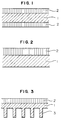
- Fig. 1 shows a sectional structure of the water-permeable concrete shuttering of this invention in which the base thermoplastic resin layer is a flat plate having a water-permeable thermoplastic resin layer on both surfaces thereof.
- Fig. 2 shows a sectional structure of the water-permeable concrete shuttering of this invention in which the base thermoplastic resin layer is a flat plate having a water-permeable thermoplastic resin layer on one surface thereof.
- Fig. 3 shows a sectional structure of the water-permeable concrete shuttering of this invention in which the base thermoplastic resin layer is a ribbed flat plate having a water-permeable thermoplastic resin layer on the flat plate side thereof.
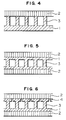
- Fig. 4 shows a sectional structure of the water-permeable concrete shuttering of this invention in which the base thermoplastic resin layer is a ribbed flat plate having a water-permeable thermoplastic resin layer on the rib side thereof.
- Fig. 5 shows a sectional structure of the water-permeable concrete shuttering of this invention in which the base thermoplastic resin layer has a plastic corrugated board structure and has water-permeable thermoplastic resin layers on both surfaces thereof.
- Fig. 6 shows a sectional structure of the water-permeable concrete shuttering of this invention in which the base thermoplastic resin layer has a plastic corrugated board structure with pores and has water-permeable thermoplastic resin layers on both surfaces thereof.
- Fig. 7 shows a sectional structure of the water-permeable concrete shuttering in which the base thermoplastic resin layer is a flat plate provided with water-introducing grooves and having a water-permeable thermoplastic resin layer on the water-introducing groove side flat plate thereof.
- the water-permeable concrete shuttering made of a thermoplastic resin of this invention is composed of a thermoplastic resin layer 1 which becomes the base of a concrete shuttering (base thermoplastic resin layer) and a thermoplastic resin layer having water-permeability 2 (water-permeable thermoplastic resin layer) provided on the surface thereof.
- the structure of the base thermoplastic resin layer is not particularly limited, and may be of a flat plate (Figs. 1 and 2), a structure having so many ribs 3 that the cross section thereof is in the form of a comb (Figs. 3 and 4) or of a plastic corrugated board shape whose cross section is in the form of a ladder (Fig. 5). Also, as modifications thereof, it is possible to provide, for example, grooves 5 for introducing water on the surface of the base thermoplastic resin layer (Fig. 7) and provide pores 4 in the resin layer (Fig.
- the material constituting such a base thermoplastic resin layer is not particularly limited as far as it satisfies the strength as a concrete shuttering, and there are mentioned thermoplastic resins, for example, polyethylene, polypropylene, ABS resin, vinyl chloride resin, PMMA, nylon, polycarbonate resin and the like; however, polypropylene is preferred from aspects of heat resistance, strength, economy and the like.
- Such a base thermoplastic resin layer is composed of such a thermoplastic resin, and in order to enhance the mechanical and physical strengths as concrete shuttering, it is very effective to use a fiber-reinforced thermoplastic resin in which about 10 to 70% by weight of various reinforcing fibers, for example, glass fiber, are blended with the resin.
- thermoplastic resin may, of course, have blended therewith various compounding agents such as stabilizer, coloring agent, filler and the like which are usually blended with thermoplastic resins.
- the water-permeable thermoplastic resin layer is provided on the surface of the base thermoplastic resin layer, and the surface of the base thermoplastic resin layer refers to the surface on the side on which the base thermoplastic resin, when used as a concrete shuttering, contacts the concrete, and generally, said surface is smooth in many cases.
- said surface may be the rib side, and the water-permeable resin layer may be provided not only on one surface but also on both surfaces of the base thermoplastic resin layer.
- the water-permeable thermoplastic resin layer has a function of accelerating the removal of the water content in concrete by allowing it to contact with the surface of concrete poured to absorb the water content in the concrete or pass the water content through the layer, and any thermoplastic resin layer having water-permeability may be used.
- any thermoplastic resin layer having water-permeability may be used.
- an expanded fiber-filled thermoplastic resin sheet obtained by expansion-molding a fiber-filled thermoplastic resin sheet (stampable sheet) in the thickness direction is preferably used.
- glass fibers are usually used; however, other fibers such as carbon fiber, alumina fiber and the like may be used, and there is no particular limit.
- thermoplastic resin is not particularly limited, and any thermoplastic resin can be used which is compatible with these fibers and has a strength and chemical resistance which are characteristics required for the shuttering materials.
- Such resins include specifically the same thermoplastic resins as those constituting the above base thermoplastic resin layer, for example, polypropylene, polyethylene, ABS resin, vinyl chloride resin, PMMA, nylon, polycarbonate resin and the like, and polypropylene is particularly preferably used.
- the fiber content in the stampable sheet is usually 10 to 70% by weight, preferably 20 to 50% by weight.
- stampable sheets there are known a sheet obtained by blending continuous glass fibers with a polypropylene resin which is called as a dry method stampable sheet and a sheet obtained by blending glass fibers having a length of several millimeters to about 30 millimeters with a polypropylene resin or a polyethylene terephthalate resin which is called as a wet method stampable sheet, and usually, these sheets are commercially available as melt-pressed sheets.
- Such sheets can all be used as the starting materials for expanded fiber-filled thermoplastic resin sheet; however, there is preferably used a wet method stampable sheet by which a larger expansion ratio is obtained and a sheet having excellent water-permeability is easily obtained without extremely reducing the mechanical strength.
- the expanded fiber-filled thermoplastic resin sheet suitable as the water-permeable thermoplastic resin layer is obtained by subjecting the stampable sheet mentioned above to expansion-molding in the thickness direction, and before the expansion-molding, the sheet has little water-permeability.
- the expansion-molding method includes various methods such as a method by which the stampable sheet is simply heated and expanded and then cooled, a method by which the sheet is heated and expanded in such a space that the predetermined expansion ratio is obtained and then cooled and other like methods; however, a method is most preferable which comprises previously heating and expanding the stampable sheet, compressing the same to the predetermined expansion ratio and cooling the same in this state because according to this method, the desired expansion ratio can be exactly confirmed and the method is excellent in workability.
- the expansion ratio is indicated by the ratio of the thickness of the stampable sheet after the expansion to the thickness of the sheet before the expansion.
- the expansion ratio is 2 times.
- the lower limit is not particularly limited since when the expansion ratio exceeds 1, water-permeability appears.
- the expansion ratio is usually 1.05 times, preferably 1.1 times.
- the method in which a water-permeable thermoplastic resin layer is provided on the surface of the base thermoplastic resin layer and the two are integrated includes various methods such as a method in which the previously produced water-permeable thermoplastic resin layer and the base thermoplastic resin layer are bonded with an adhesive, a method in which the two are bonded by an ultrasonic bonding method, a method in which the interface to be bonded between the two resin layers is melted to heat-fusion-bond the two layers, a method in which the stampable sheet in the heated and expanded state is placed on the base thermoplastic resin sheet and the two are pressed to form an expanded fiber-filled thermoplastic resin sheet and simultaneously heat-fusion-bond the two, a method in which the previously prepared expanded fiber-filled thermoplastic resin sheet is placed in the upper and lower molds, feeding a molten thermoplastic resin to between the sheet and the mold surface, the molds are thereafter closed, pressed and cooled to form the base thermoplastic resin layer and simultaneously heat-fusion-bond, to the surface thereof, the expanded fiber-filled thermoplastic resin sheet,
- thermoplastic resin filled with a fiber such as glass fiber or the like when used as the base, it is possible to heat and expand only the surface layer portion of the base on its side contacting the concrete and thereafter compress or cool without compressing the base to convert the surface layer portion of the base thermoplastic resin layer to a water-permeable thermoplastic resin layer, thereby providing the water-permeable thermoplastic resin layer without being accompanied by any bonding work.
- thermoplastic resin of this invention when the resin for forming the water-permeable thermoplastic resin layer is the same as the resin for forming the base thermoplastic resin layer, the bonding between the two resin layers becomes more strong, and not only is the strength as a concrete shuttering enhanced but also the workability becomes good, and in addition, the reproduction and reuse of the used concrete shutterings become possible, and hence, said case is very effective in practice.
- the total thickness of the shuttering may be such a thickness that the necessary strength as shuttering is obtained and there is no particular limit. It is usually about 10 to 70 mm. However, from the viewpoint of workability during use, particularly its relation to conventional wood concrete shutterings, the thickness is preferably 10 to 15 mm when the shuttering is composed only of such a flat plate as shown in Figs. 1, 2 and 7 and 62 to 65 mm when the base thermoplastic resin layer has a ribbed structure as shown in Figs. 3 to 6.
- the thickness of the water-permeable thermoplastic resin layer is usually 15 mm or less, preferably 10 mm or less because even when the thickness is larger no effect corresponding to the increased thickness can be expected and the total thickness of the shuttering becomes too large.
- the lower limit is not particularly limited as far as the layer has water-permeability. It is, however, usually 0.5 mm, preferably 1 mm.
- test methods in the Examples are as follows.
- a stampable sheet (Keipla Sheet manufactured by Keipla Sheet Co., Ltd., basis weight: 1,750 g/m2, thickness: 1.5 mm) which contained 30% by weight of glass fiber having an average fiber length of 12 mm and an average glass fiber diameter of 10 ⁇ and in which the matrix resin was polypropylene was heated in heating oven until the surface of the sheet became 210°C.
- a heat-expanded sheet which had been expanded about 3 times in the thickness direction was set in a flat plate mold, and pressed with cooling at a pressure of 10 kg/cm2 so that the thickness became 3 mm to obtain an expansion-molded sheet of the stampable sheet having an expansion ratio of 2 times.
- the expansion-molded sheet obtained above was bonded with an adhesive to both the surfaces of an article having a plastic corrugated board-like structure in which the top thickness was 0.5 mm, the rib thickness was 0.5 mm, the rib interval was 5 mm and the total thickness was 5 mm to obtain a concrete shuttering having a sectional structure as shown in Fig. 5 in which the width was 600 mm, the height was 900 mm and the thickness was 11 mm.
- a stampable sheet (Keipla Sheet manufactured by Keipla Sheet Co., Ltd., basis weight: 4,000 g/m2, thickness: 3.4 mm) which contained 30% by weight of glass fiber having an average fiber length of 12 mm and an average glass fiber diameter of 10 ⁇ and in which the matrix resin was polypropylene was heated, and the resulting heat-expanded sheet was pressed with cooling to obtain an expansion-molded sheet of the stampable sheet having a width of 600 mm, a length of 900 mm and a thickness of 4 mm. The expansion ratio of this sheet was 1.2 times.
- a ribbed concrete shuttering was produced by the following method: The above expansion-molded sheet was placed between the upper and lower molds, and a molten polypropylene resin (Sumitomo Noblen manufactured by Sumitomo Chemical Co., Ltd.) containing 20% by weight of glass fiber was fed to between the sheet and the lower mold through a molten resin path provided in the lower mold, after which the molds were closed and then pressed and cooled to obtain a ribbed concrete shuttering having a sectional structure as shown in Fig.
- a molten polypropylene resin Suditomo Noblen manufactured by Sumitomo Chemical Co., Ltd.
- the plate-like portion had a thickness of 7 mm (the upper layer portion was an expansion-molded sheet having a thickness of 4 mm) and ribs each having a thickness of 5 mm and a height of 10 mm were integrally bonded thereto at an interval of 54 mm.
- a stampable sheet (Keipla Sheet manufactured by Keipla Sheet Co., Ltd., basis weight: 2,000 g/m2, thickness: 1.7 mm) which contained 30% by weight of glass fiber having an average fiber length of 12 mm and an average glass fiber diameter of 10 ⁇ and in which the matrix resin was polypropylene was heated, and the resulting heat-expanded sheet was pressed with cooling to obtain an expansion-molded sheet of the stampable sheet having a width of 600 mm, a length of 900 mm and a thickness of 3 mm. The expansion ratio of this sheet was 1.8 times.
- This expansion-molded sheet was bonded with an adhesive to one surface of a polymethyl methacrylate plate (Sumipex manufactured by Sumitomo Chemical Co., Ltd.) having a thickness of 8 mm to obtain a concrete shuttering having a sectional structure as shown in Fig. 2.
- a polymethyl methacrylate plate Silicone manufactured by Sumitomo Chemical Co., Ltd.
- Example 2 Two sheets of the same starting stampable sheets as in Example 1 were bonded with an adhesive to each of both surfaces of the same plastic corrugated board having a thickness of 5 mm as in used in Example 1 to obtain a concrete shuttering having a thickness of 11 mm and having the structure shown in Fig. 5.
Landscapes
- Engineering & Computer Science (AREA)
- Architecture (AREA)
- Mechanical Engineering (AREA)
- Civil Engineering (AREA)
- Structural Engineering (AREA)
- Moulds, Cores, Or Mandrels (AREA)
- Forms Removed On Construction Sites Or Auxiliary Members Thereof (AREA)
Applications Claiming Priority (3)
| Application Number | Priority Date | Filing Date | Title |
|---|---|---|---|
| JP4301393A JPH06254825A (ja) | 1993-03-03 | 1993-03-03 | 透水性コンクリート型枠 |
| JP43013/93 | 1993-03-03 | ||
| PCT/JP1994/000316 WO1994020704A1 (fr) | 1993-03-03 | 1994-02-28 | Coffrage a beton permeable a l'eau |
Publications (2)
| Publication Number | Publication Date |
|---|---|
| EP0646684A1 true EP0646684A1 (fr) | 1995-04-05 |
| EP0646684A4 EP0646684A4 (fr) | 1995-07-05 |
Family
ID=12652106
Family Applications (1)
| Application Number | Title | Priority Date | Filing Date |
|---|---|---|---|
| EP94907696A Ceased EP0646684A4 (fr) | 1993-03-03 | 1994-02-28 | Coffrage a beton permeable a l'eau. |
Country Status (3)
| Country | Link |
|---|---|
| EP (1) | EP0646684A4 (fr) |
| JP (1) | JPH06254825A (fr) |
| WO (1) | WO1994020704A1 (fr) |
Cited By (3)
| Publication number | Priority date | Publication date | Assignee | Title |
|---|---|---|---|---|
| DE19812517A1 (de) * | 1998-03-21 | 1999-09-30 | Johns Manville Int Inc | Betonschalung zur Herstellung von Betonartikeln |
| EP1580348A3 (fr) * | 2004-03-26 | 2008-05-21 | Woodwelding AG | Elemént de coffrage |
| DE102008009019A1 (de) * | 2008-02-13 | 2009-08-27 | Technische Universität Berlin | Schalung zur Herstellung von Betonkörpern |
Families Citing this family (1)
| Publication number | Priority date | Publication date | Assignee | Title |
|---|---|---|---|---|
| JP6320980B2 (ja) * | 2015-10-14 | 2018-05-09 | 株式会社高洋商会 | コンクリート用透水性型枠 |
Family Cites Families (7)
| Publication number | Priority date | Publication date | Assignee | Title |
|---|---|---|---|---|
| US3621092A (en) * | 1969-02-20 | 1971-11-16 | Union Carbide Corp | Stamping process |
| GB8400292D0 (en) * | 1984-01-06 | 1984-02-08 | Wiggins Teape Group Ltd | Fibre reinforced moulded plastics articles |
| EP0329200A3 (fr) * | 1984-01-06 | 1992-05-20 | The Wiggins Teape Group Limited | Objets moulés en matière plastique renforcée de fibres |
| GB8400294D0 (en) * | 1984-01-06 | 1984-02-08 | Wiggins Teape Group Ltd | Fibre reinforced composite plastics material |
| JPS61188104A (ja) * | 1985-02-15 | 1986-08-21 | 昭和電工株式会社 | コンクリ−ト用型枠 |
| JPH028459A (ja) * | 1988-02-26 | 1990-01-11 | Idemitsu N S G Kk | コンクリート打込用型枠及びその製造方法 |
| JPH04347261A (ja) * | 1991-05-24 | 1992-12-02 | Unitika Ltd | 透水性コンクリート型枠およびその製造方法 |
-
1993
- 1993-03-03 JP JP4301393A patent/JPH06254825A/ja active Pending
-
1994
- 1994-02-28 WO PCT/JP1994/000316 patent/WO1994020704A1/fr not_active Ceased
- 1994-02-28 EP EP94907696A patent/EP0646684A4/fr not_active Ceased
Cited By (6)
| Publication number | Priority date | Publication date | Assignee | Title |
|---|---|---|---|---|
| DE19812517A1 (de) * | 1998-03-21 | 1999-09-30 | Johns Manville Int Inc | Betonschalung zur Herstellung von Betonartikeln |
| DE19812517C2 (de) * | 1998-03-21 | 2000-06-21 | Johns Manville Int Inc | Betonschalung zur Herstellung von Betonartikeln |
| US6450476B1 (en) | 1998-03-21 | 2002-09-17 | Johns Manville International, Inc. | Formwork for producing articles of concrete |
| EP1580348A3 (fr) * | 2004-03-26 | 2008-05-21 | Woodwelding AG | Elemént de coffrage |
| DE102008009019A1 (de) * | 2008-02-13 | 2009-08-27 | Technische Universität Berlin | Schalung zur Herstellung von Betonkörpern |
| DE102008009019B4 (de) * | 2008-02-13 | 2011-01-05 | Technische Universität Berlin | Schalung zur Herstellung von Betonkörpern |
Also Published As
| Publication number | Publication date |
|---|---|
| JPH06254825A (ja) | 1994-09-13 |
| EP0646684A4 (fr) | 1995-07-05 |
| WO1994020704A1 (fr) | 1994-09-15 |
Similar Documents
| Publication | Publication Date | Title |
|---|---|---|
| DE69815304T2 (de) | Verfahren zur herstellung eines thermoplastischen produktes mit hohem kriechwiderstand | |
| EP0152994B1 (fr) | Matière plastique composite renforcée de fibres | |
| RU2494869C2 (ru) | Композитные изделия и способ их изготовления (варианты) | |
| FI84452C (fi) | Gjutna, fiberarmerade plastprodukter | |
| JP2997238B2 (ja) | 揮発性モノマー含有熱硬化性成形用組成物およびその成形方法 | |
| IE57944B1 (en) | Improvements in fibre reinforced plastics sheets | |
| JPH02141211A (ja) | 発泡物質板からなる成形品及びその製造方法 | |
| JPH07113068B2 (ja) | 繊維補強発泡体およびその製造方法 | |
| JP2020504688A (ja) | 強化された高分子物品の生産における組み合わされた一次繊維及び炭素繊維構成要素 | |
| TW539607B (en) | Loading and unloading pallet, forming material and method of producing it | |
| US3867495A (en) | Method for fabricating molded elements by bonding solid particles with a resin | |
| US6849322B2 (en) | Method of producing cellulosic article having increased thickness, and product thereof | |
| JP3378235B2 (ja) | 繊維成形板および繊維成形板の製造方法 | |
| EP0904930B1 (fr) | Procédé de fabrication d'articles à partir d'une matière plastique renforcée de fibres | |
| KR19980042938A (ko) | 열경화성 수지 혼합물 및 섬유물질의 라미너 생성물 | |
| WO1994020704A1 (fr) | Coffrage a beton permeable a l'eau | |
| JP2005178167A (ja) | 複合パネル | |
| JPH04241931A (ja) | 複合成形品の製造方法 | |
| JP2748604B2 (ja) | 繊維強化熱可塑性樹脂成形品の製造方法 | |
| JPH11182030A (ja) | 樹脂製コンクリート打設用型枠 | |
| JPH03261519A (ja) | 繊維強化熱可塑性樹脂成形品の製造方法 | |
| KR100403508B1 (ko) | 불포화 폴리에스테르계 폴리머 모르타르 경화물의 제조방법 | |
| KR960005302B1 (ko) | 폴리프로필렌계 복합재료 쉬트의 제조방법 및 이로부터 제조된 복합재료쉬트 | |
| US20080230962A1 (en) | Method of creating high strength expanded thermoformable honeycomb structures with cementitious reinforcement | |
| JPH0970809A (ja) | 複合成形品よりなる型枠およびその製造方法 |
Legal Events
| Date | Code | Title | Description |
|---|---|---|---|
| PUAI | Public reference made under article 153(3) epc to a published international application that has entered the european phase |
Free format text: ORIGINAL CODE: 0009012 |
|
| 17P | Request for examination filed |
Effective date: 19941202 |
|
| AK | Designated contracting states |
Kind code of ref document: A1 Designated state(s): BE DE FR GB IT |
|
| A4 | Supplementary search report drawn up and despatched |
Effective date: 19950518 |
|
| AK | Designated contracting states |
Kind code of ref document: A4 Designated state(s): BE DE FR GB IT |
|
| GRAG | Despatch of communication of intention to grant |
Free format text: ORIGINAL CODE: EPIDOS AGRA |
|
| 17Q | First examination report despatched |
Effective date: 19970219 |
|
| STAA | Information on the status of an ep patent application or granted ep patent |
Free format text: STATUS: THE APPLICATION HAS BEEN REFUSED |
|
| 18R | Application refused |
Effective date: 19970809 |