EP0654804A2 - Festelektrolytkondensator - Google Patents
Festelektrolytkondensator Download PDFInfo
- Publication number
- EP0654804A2 EP0654804A2 EP94118041A EP94118041A EP0654804A2 EP 0654804 A2 EP0654804 A2 EP 0654804A2 EP 94118041 A EP94118041 A EP 94118041A EP 94118041 A EP94118041 A EP 94118041A EP 0654804 A2 EP0654804 A2 EP 0654804A2
- Authority
- EP
- European Patent Office
- Prior art keywords
- solid electrolyte
- anode
- electrolyte layer
- polymer compound
- conductive polymer
- Prior art date
- Legal status (The legal status is an assumption and is not a legal conclusion. Google has not performed a legal analysis and makes no representation as to the accuracy of the status listed.)
- Granted
Links
Images
Classifications
-
- H—ELECTRICITY
- H01—ELECTRIC ELEMENTS
- H01G—CAPACITORS; CAPACITORS, RECTIFIERS, DETECTORS, SWITCHING DEVICES, LIGHT-SENSITIVE OR TEMPERATURE-SENSITIVE DEVICES OF THE ELECTROLYTIC TYPE
- H01G9/00—Electrolytic capacitors, rectifiers, detectors, switching devices, light-sensitive or temperature-sensitive devices; Processes of their manufacture
- H01G9/004—Details
- H01G9/022—Electrolytes; Absorbents
- H01G9/025—Solid electrolytes
-
- H—ELECTRICITY
- H01—ELECTRIC ELEMENTS
- H01G—CAPACITORS; CAPACITORS, RECTIFIERS, DETECTORS, SWITCHING DEVICES, LIGHT-SENSITIVE OR TEMPERATURE-SENSITIVE DEVICES OF THE ELECTROLYTIC TYPE
- H01G11/00—Hybrid capacitors, i.e. capacitors having different positive and negative electrodes; Electric double-layer [EDL] capacitors; Processes for the manufacture thereof or of parts thereof
- H01G11/22—Electrodes
- H01G11/30—Electrodes characterised by their material
- H01G11/48—Conductive polymers
-
- H—ELECTRICITY
- H01—ELECTRIC ELEMENTS
- H01G—CAPACITORS; CAPACITORS, RECTIFIERS, DETECTORS, SWITCHING DEVICES, LIGHT-SENSITIVE OR TEMPERATURE-SENSITIVE DEVICES OF THE ELECTROLYTIC TYPE
- H01G11/00—Hybrid capacitors, i.e. capacitors having different positive and negative electrodes; Electric double-layer [EDL] capacitors; Processes for the manufacture thereof or of parts thereof
- H01G11/54—Electrolytes
- H01G11/56—Solid electrolytes, e.g. gels; Additives therein
-
- H—ELECTRICITY
- H01—ELECTRIC ELEMENTS
- H01G—CAPACITORS; CAPACITORS, RECTIFIERS, DETECTORS, SWITCHING DEVICES, LIGHT-SENSITIVE OR TEMPERATURE-SENSITIVE DEVICES OF THE ELECTROLYTIC TYPE
- H01G9/00—Electrolytic capacitors, rectifiers, detectors, switching devices, light-sensitive or temperature-sensitive devices; Processes of their manufacture
- H01G9/004—Details
- H01G9/022—Electrolytes; Absorbents
- H01G9/025—Solid electrolytes
- H01G9/028—Organic semiconducting electrolytes, e.g. TCNQ
-
- Y—GENERAL TAGGING OF NEW TECHNOLOGICAL DEVELOPMENTS; GENERAL TAGGING OF CROSS-SECTIONAL TECHNOLOGIES SPANNING OVER SEVERAL SECTIONS OF THE IPC; TECHNICAL SUBJECTS COVERED BY FORMER USPC CROSS-REFERENCE ART COLLECTIONS [XRACs] AND DIGESTS
- Y02—TECHNOLOGIES OR APPLICATIONS FOR MITIGATION OR ADAPTATION AGAINST CLIMATE CHANGE
- Y02E—REDUCTION OF GREENHOUSE GAS [GHG] EMISSIONS, RELATED TO ENERGY GENERATION, TRANSMISSION OR DISTRIBUTION
- Y02E60/00—Enabling technologies; Technologies with a potential or indirect contribution to GHG emissions mitigation
- Y02E60/13—Energy storage using capacitors
Definitions
- the present invention relates to a solid electrolytic capacitor and, more particularly, to a solid electrolytic capacitor using a conductive polymer compound as a solid electrolyte.
- a tantalum solid electrolytic capacitor is generally constituted by an anode obtained by sintering a tantalum powder, a tantalum oxide coating serving as a dielectric formed on the anode, a solid electrolyte formed on the oxide coating, and a cathode conductor formed on the solid electrolyte.
- a conventional capacitor using manganese dioxide as a solid electrolyte is well known.
- a capacitor using a conductive polymer compound such as polypyrrole in place of manganese dioxide is also proposed. Note that, as cathode conductors, a graphite layer and a silver layer are often used.
- a capacitor using a conductive polymer compound as a solid electrolyte has excellent characteristics in a high-frequency range compared with that of a capacitor using manganese dioxide because the conductivity of the conductive polymer compound is several tens times that of manganese dioxide.
- a capacitor using the conductive polymer compound has received a good deal of attention as a capacitor which copes with an increase in operating frequency of electronic equipment in recent years. Since manganese dioxide is produced by thermally decomposing manganese nitrate, thermal stress at about 200 to 300 ° C repeatedly acts on a capacitor element, and defects occur in an oxide coating, thereby disadvantageously increasing a leakage current.
- a conductive polymer compound when used as a solid electrolyte, it is known that a highly reliable product which is free from degradation of an oxide coating can be provided because a capacitor element need not be treated at a high temperature (e.g., Reference 1).
- conductive polymer compounds polypyrrole, a derivative thereof (Reference 1 and Japanese Patent Laid-Open No. 64-4912 (Reference 2)), and a five-membered heterocyclic copolymer or a mixture of polypyrrole, polythiophene, and a derivative thereof as disclosed in, e.g., Japanese Patent Laid-Open No. 2-98915 (Reference 3) are used.
- the solid electrolytic capacitor using a conductive polymer compound poses several problems because the solid electrolyte consists of a single chemical species.
- a balance between a conductivity and a heat resistance is important. More specifically, although both polypyrrole and polyaniline are attempted to be applied as the solid electrolytes of solid electrolytic capacitors, polypyrrole generally has a high conductivity and a low heat resistance, but polyaniline generally has a low conductivity and a high heat resistance. The conductivity directly influences high-frequency characteristics, and the heat resistance influences the application temperature of a capacitor.
- a solid electrolytic capacitor comprising an anode consisting of a valve metal and having a lead extending therefrom, a dielectric layer constituted by an oxide coating formed by oxidizing a surface of the anode, a solid electrolyte layer formed on the dielectric layer, and a cathode electrode formed on the solid electrolyte layer, wherein the solid electrolyte layer consists of a conductive polymer compound obtained by doping a dopant in one of a copolymer and a mixture of polypyrrole or a derivative thereof, the polypyrrole having a repetition unit represented by a formula
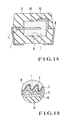
- Fig. 1A is a sectional view showing a solid electrolytic capacitor according to an embodiment of the present invention
- Fig. 1B is an enlarged sectional view showing a main part B of the solid electrolytic capacitor shown in Fig. 1A.
- An anode 1 formed by sintering a tantalum powder was anodized in an aqueous phosphoric acid solution to form a dielectric 2, on the surface of the sintered body, constituted by a tantalum oxide coating. Thereafter, the anode 1 was dipped in a pyrrole-aniline solution mixture containing pyrrole, aniline, and ethanol at a weight ratio of 15 : 15 : 70.
- the anode 1 was dipped in an oxidant solution set at a temperature of 15°C and containing ammonium persulfate, toluenesulfonic acid, dodecylbenzene ferric sulfonate, and ethanol at a weight ratio of 20 : 10 : 10 : 60 to polymerize a conductive polymer compound on the dielectric 2, thereby producing a solid electrolyte layer 3.
- the non-reacted oxidant and excessive acid adhering to the anode 1 were washed away with water, and the anode 1 was dried in a vacuum state at 50 ° C for 1 hour.
- a graphite layer 5 and a cathode electrode 6 constituted by a silver layer were sequentially formed on the solid electrolyte layer 3 consisting of the produced conductive polymer compound, thereby completing a capacitor.
- the electrical characteristics and heat resistance of the capacitor were measured. In the evaluation of the heat resistance, the capacitor was left in the air at 150°C, and a time required for setting an equivalent series resistance (ESR) at 100 kHz to be twice an initial value was measured.
- ESR equivalent series resistance
- An anode on which an oxide coating identical to that of Example 1 was formed was dipped in a pyrrole solution containing pyrrole and ethanol at a weight ratio of 30 : 70.
- This anode was dipped in an oxidant solution set at a temperature of 15°C and containing dodecylbenzene ferric sulfonate and ethanol at a weight ratio of 40 : 60 to polymerize a conductive polymer compound constituting a solid electrolyte layer on an oxide coating constituting a dielectric.
- the non-reacted oxidant and excessive acid adhering to the anode were washed away with water, and the anode was dried in a vacuum state at 50 ° C for 1 hour.
- a graphite layer and a silver layer constituting a cathode electrode were sequentially formed on the produced conductive polymer compound layer, thereby completing a capacitor. The electrical characteristics and heat resistance of the capacitor were measured.
- An anode on which an oxide coating identical to that of Example 1 was formed was dipped in an aniline solution containing aniline and ethanol at a weight ratio of 30 : 70.
- This anode was dipped in an oxidant solution set at a temperature of 15 ° C and containing ammonium persulfate, toluenesulfonic acid, and ethanol at a weight ratio of 20 : 20 : 60 to polymerize a conductive polymer compound on the oxide coating.
- the non-reacted oxidant and excessive acid were washed away with water, and the anode was dried in a vacuum state at 50 ° C for 1 hour.
- a graphite layer and a silver layer were sequentially formed on the produced conductive polymer compound layer, thereby completing a capacitor. The electrical characteristics and heat resistance of the capacitor were measured.
- a pyrrole-aniline solution mixture containing pyrrole, aniline, and ethanol at a weight ratio of 15 : 15 : 70 was mixed at an equi-molar ratio with an oxidant solution containing ammonium persulfate toluenesulfonic acid, dodecylbenzene ferric sulfonate, and ethanol at a weight ratio of 20 : 10: 10 : 60.
- the resultant solution mixture was kept at a temperature lower than a temperature at which a polymerization reaction progressed.
- a anode 1 on which a dielectric 2 constituted by a tantalum oxide coating was formed as in Example 1 was dipped in the solution mixture of the pyrrole-aniline solution mixture and the oxidant solution, and a polymerization reaction was caused to progress in an atmosphere at a predetermined temperature to form a solid electrolyte layer 3 consisting of a conductive polymer compound on the dielectric 2, thereby manufacturing a capacitor.
- the conductivity and heat resistance of the solid electrolyte layer 3 itself were evaluated as follows.
- the solution mixture of the pyrrole-aniline solution mixture and the oxidant solution was filtered by filter paper.
- the product on the filter paper was washed with water and dried in a vacuum state at 50 ° C for 1 hour.
- the product was molded into a pellet by a tablet molding machine.
- the obtained pellet consisting of a conductive polymer compound was measured by a three-terminal method.
- Example 1 and Comparative Examples 1 and 2 in order to evaluate the heat resistance of the pellet, the pellet was left in the air at 150 ° C, a time required for setting the conductivity of the pellet to be twice the initial value was measured.
- a pyrrole solution containing pyrrole and ethanol at a weight ratio of 30 : 70 was mixed at an equi-molar ratio with an oxidant solution containing dodecylbenzene ferric sulfonate and ethanol at a weight ratio of 40 : 60, and the same procedures as in Example 1 were performed. The conductivity and heat resistance of the resultant pellet were evaluated.
- a aniline solution containing aniline and ethanol at a weight ratio of 30 : 70 was mixed at an equi-molar ratio with an oxidant solution containing ammonium persulfate, toluenesulfonic acid, and ethanol at a weight ratio of 20 : 20 : 60, and the same procedures as in Example 1 were performed. The conductivity and heat resistance of the resultant pellet were evaluated.
- Example 1 and Comparative Examples 1 and 2 The electrical characteristics and heat resistance of the capacitors manufactured in Example 1 and Comparative Examples 1 and 2 are shown in Table 1.
- the conductivities and heat resistances of the conductive polymer pellets manufactured in Example 2 and Comparative Examples 3 and 4 are shown in Table 2.
- the heat resistance of the capacitor obtained in each of Examples 1 and 2 of the present invention is increased to a value 6 to 10 times the heat resistance of the capacitor obtained in each of Comparative Examples 1 and 3 in which a polymer compound consisting of only polypyrrole is used as a solid electrolyte.
- the conductivity of the pellet obtained in each of Examples 1 and 2 is increased to a value about twice the conductivity of the pellet obtained in each of Comparative Examples 2 and 4 in which a polymer compound consisting of only polyaniline is used as a solid electrolyte. That is, it is understand that each of Examples 1 and 2 has both the excellent properties of polypyrrole and polyaniline.
- the anode 1 consisting of a tantalum sintered material is dipped in a pyrrole-aniline solution mixture.
- the tantalum sintered material may be dipped in a solution mixture of soluble polypyrrole, a derivative thereof, polyaniline, and a derivative thereof, the same effect as described above can be obtained.
- a conductive polymer compound obtained by doping a dopant in the copolymer or mixture of polypyrrole having a high conductivity or a derivative thereof and polyaniline having a high heat resistance or a derivative thereof is used as a solid electrolyte.
- the solid electrolytic capacitor is excellent in high-frequency characteristics and heat resistance.
- the conductive polymer compound layer is formed by performing a chemical oxidation and polymerization process by the method described in each of Examples 1 and 2, and the chemical oxidation and polymerization process is repeated, thereby controlling the thickness of a conductive polymer compound layer to be a desired thickness. Therefore, the solid electrolytic capacitor can be manufactured with good reproducibility of the thickness of the solid electrolyte layer, i.e., good controllability of a conductivity and good reproducibility of heat resistance.
Landscapes
- Engineering & Computer Science (AREA)
- Chemical & Material Sciences (AREA)
- Power Engineering (AREA)
- Chemical Kinetics & Catalysis (AREA)
- Electrochemistry (AREA)
- Microelectronics & Electronic Packaging (AREA)
- Materials Engineering (AREA)
- Polyoxymethylene Polymers And Polymers With Carbon-To-Carbon Bonds (AREA)
- Macromolecular Compounds Obtained By Forming Nitrogen-Containing Linkages In General (AREA)
Applications Claiming Priority (2)
| Application Number | Priority Date | Filing Date | Title |
|---|---|---|---|
| JP288931/93 | 1993-11-18 | ||
| JP5288931A JP2937716B2 (ja) | 1993-11-18 | 1993-11-18 | タンタル固体電解コンデンサ及びその製造方法 |
Publications (3)
| Publication Number | Publication Date |
|---|---|
| EP0654804A2 true EP0654804A2 (de) | 1995-05-24 |
| EP0654804A3 EP0654804A3 (de) | 1995-07-19 |
| EP0654804B1 EP0654804B1 (de) | 1998-01-28 |
Family
ID=17736668
Family Applications (1)
| Application Number | Title | Priority Date | Filing Date |
|---|---|---|---|
| EP94118041A Expired - Lifetime EP0654804B1 (de) | 1993-11-18 | 1994-11-15 | Festelektrolytkondensator |
Country Status (5)
| Country | Link |
|---|---|
| US (1) | US5428500A (de) |
| EP (1) | EP0654804B1 (de) |
| JP (1) | JP2937716B2 (de) |
| KR (1) | KR0164234B1 (de) |
| DE (1) | DE69408284T2 (de) |
Cited By (2)
| Publication number | Priority date | Publication date | Assignee | Title |
|---|---|---|---|---|
| EP0803886A3 (de) * | 1996-04-04 | 1999-03-24 | Matsushita Electric Industrial Co., Ltd. | Aus einem Polymer von Pyrrol oder seinem Derivat bestehender Festelektrolytkondensator mit leitfähiger Schicht und Herstellungsverfahren |
| EP1085590A1 (de) * | 1999-09-20 | 2001-03-21 | Honda Giken Kogyo Kabushiki Kaisha | Polymer-Kompositmembran, Verfahren zu ihrer Herstellung und Polymerelektrolytmembran |
Families Citing this family (24)
| Publication number | Priority date | Publication date | Assignee | Title |
|---|---|---|---|---|
| JP2536458B2 (ja) * | 1994-08-16 | 1996-09-18 | 日本電気株式会社 | ジスルホン酸化合物、それをド―パントとする導電性高分子、導電材およびそれを用いた固体電解コンデンサ |
| JPH08143771A (ja) * | 1994-11-25 | 1996-06-04 | Nec Corp | 耐熱性ポリアニリンあるいはその誘導体及び固体電解コ ンデンサ並びにそれらの製造方法 |
| DE69513128T2 (de) * | 1994-11-25 | 2000-06-15 | Nec Corp., Tokio/Tokyo | Festelektrolytkondensator mit zwei Elektrolytschichten und Herstellungsverfahren |
| JP2828035B2 (ja) * | 1996-05-30 | 1998-11-25 | 日本電気株式会社 | 固体電解コンデンサの製造方法 |
| JP3251208B2 (ja) * | 1997-07-24 | 2002-01-28 | 富山日本電気株式会社 | 固体電解コンデンサの製造方法 |
| ATE441194T1 (de) * | 1998-06-11 | 2009-09-15 | Showa Denko Kk | Filmkondensatorelement und schicht- festelektrolytkondensator |
| DE69939262D1 (de) * | 1998-06-25 | 2008-09-18 | Nichicon Corp | Verfahren zur herstellung eines festelektrolytkondensators |
| JP3667531B2 (ja) * | 1998-07-07 | 2005-07-06 | 松下電器産業株式会社 | 電解コンデンサの製造方法 |
| JP4036985B2 (ja) * | 1998-10-26 | 2008-01-23 | 三洋電機株式会社 | 固体電解コンデンサ |
| JP2000235937A (ja) | 1999-02-16 | 2000-08-29 | Matsushita Electric Ind Co Ltd | 固体電解コンデンサおよびその製造方法 |
| JP2000243665A (ja) | 1999-02-17 | 2000-09-08 | Matsushita Electric Ind Co Ltd | 固体電解コンデンサおよびその製造方法 |
| TW442809B (en) | 1999-02-17 | 2001-06-23 | Matsushita Electric Industrial Co Ltd | Method and apparatus for manufacturing solid electrolytic capacitor |
| JP3663952B2 (ja) | 1999-02-17 | 2005-06-22 | 松下電器産業株式会社 | 固体電解コンデンサの製造方法 |
| US6136176A (en) * | 1999-05-21 | 2000-10-24 | Kemet Electronics Corporation | Capacitor with conductive polymer |
| US6483694B1 (en) * | 1999-06-22 | 2002-11-19 | Showa Denko Kabushiki Kaisha | Electrode for electrolytic capacitor, electrolytic capacitor, and manufacturing method therefor |
| US6334945B1 (en) | 2000-09-07 | 2002-01-01 | Kemet Electronics Corporation | Aging process for solid electrode capacitor |
| SG111043A1 (en) * | 2001-02-08 | 2005-05-30 | Matsushita Electric Industrial Co Ltd | Solid electrolytic capacitor and manufacturing method thereof |
| US7061772B2 (en) * | 2002-08-05 | 2006-06-13 | Nec Tokin Corporation | Electronic circuit with transmission line type noise filter |
| US6682989B1 (en) * | 2002-11-20 | 2004-01-27 | Intel Corporation | Plating a conductive material on a dielectric material |
| MXPA05008151A (es) * | 2003-02-07 | 2005-10-05 | Showa Denko Kk | Capacitor y metodo de produccion del capacitor. |
| US7218506B2 (en) * | 2004-03-31 | 2007-05-15 | Tdk Corporation | Electrolytic capacitor and method of manufacturing the same |
| DE102004030802B4 (de) * | 2004-06-25 | 2007-11-22 | Epcos Ag | Mit leitfähigen Polymeren beschichteter keramischer Körper und Verfahren zur Herstellung |
| US7423862B2 (en) * | 2004-12-24 | 2008-09-09 | Showa Denko K.K. | Solid electrolytic capacitor element, solid electrolytic capacitor and production method thereof |
| US11776760B2 (en) | 2020-02-13 | 2023-10-03 | KYOCERA AVX Components Corporation | Solid electrolytic capacitor containing polyaniline |
Family Cites Families (12)
| Publication number | Priority date | Publication date | Assignee | Title |
|---|---|---|---|---|
| US4609971A (en) * | 1983-08-11 | 1986-09-02 | North American Philips Corporation | Electrolytic capacitor with polymer conductor |
| JPS61239617A (ja) * | 1985-04-16 | 1986-10-24 | 昭和電工株式会社 | 固体電解コンデンサ |
| DE3636100A1 (de) * | 1986-10-23 | 1988-05-05 | Roederstein Kondensatoren | Festkoerperkondensator mit einem elektrisch leitfaehigen polymeren als bestandteil des festelektrolyten |
| US4780796A (en) * | 1987-01-13 | 1988-10-25 | The Japan Carlit Co., Ltd. | Solid electrolytic capacitor |
| DE3720321A1 (de) * | 1987-06-19 | 1988-12-29 | Basf Ag | Polymere, enthaltend von aminoaromaten ableitbare einheiten |
| JPH0697494B2 (ja) * | 1987-06-29 | 1994-11-30 | 株式会社日立製作所 | 磁気ヘッド及びその製造方法 |
| JPH0832815B2 (ja) * | 1988-06-09 | 1996-03-29 | 日本石油株式会社 | 高分子組成物 |
| JPH0241886A (ja) * | 1988-07-29 | 1990-02-13 | Pentel Kk | ダイレクトドライブロボット |
| JP2922521B2 (ja) * | 1988-10-06 | 1999-07-26 | 昭和電工株式会社 | 固体電解コンデンサ |
| JP2640866B2 (ja) * | 1989-11-28 | 1997-08-13 | マルコン電子株式会社 | 固体電解コンデンサの製造方法 |
| JPH0456445A (ja) * | 1990-06-25 | 1992-02-24 | Mitsubishi Electric Corp | ネットワークシステム試験方式 |
| JPH04137517A (ja) * | 1990-09-27 | 1992-05-12 | Marcon Electron Co Ltd | 固体電解コンデンサの製造方法 |
-
1993
- 1993-11-18 JP JP5288931A patent/JP2937716B2/ja not_active Expired - Fee Related
-
1994
- 1994-11-14 US US08/339,681 patent/US5428500A/en not_active Expired - Lifetime
- 1994-11-15 EP EP94118041A patent/EP0654804B1/de not_active Expired - Lifetime
- 1994-11-15 DE DE69408284T patent/DE69408284T2/de not_active Expired - Fee Related
- 1994-11-18 KR KR1019940030357A patent/KR0164234B1/ko not_active Expired - Fee Related
Cited By (4)
| Publication number | Priority date | Publication date | Assignee | Title |
|---|---|---|---|---|
| EP0803886A3 (de) * | 1996-04-04 | 1999-03-24 | Matsushita Electric Industrial Co., Ltd. | Aus einem Polymer von Pyrrol oder seinem Derivat bestehender Festelektrolytkondensator mit leitfähiger Schicht und Herstellungsverfahren |
| US6206937B1 (en) | 1996-04-04 | 2001-03-27 | Matsushita Electric Industrial Co., Ltd. | Solid electrolytic capacitors comprising a conductive layer made of a polymer of pyrrole or its derivative and method for making the same |
| EP1085590A1 (de) * | 1999-09-20 | 2001-03-21 | Honda Giken Kogyo Kabushiki Kaisha | Polymer-Kompositmembran, Verfahren zu ihrer Herstellung und Polymerelektrolytmembran |
| US6465120B1 (en) | 1999-09-20 | 2002-10-15 | Honda Giken Kogyo Kabushiki Kaisha | Composite polymer membrane, method for producing the same and solid polymer electrolyte membrane |
Also Published As
| Publication number | Publication date |
|---|---|
| US5428500A (en) | 1995-06-27 |
| JP2937716B2 (ja) | 1999-08-23 |
| DE69408284T2 (de) | 1998-09-03 |
| JPH07142292A (ja) | 1995-06-02 |
| KR0164234B1 (ko) | 1999-01-15 |
| EP0654804B1 (de) | 1998-01-28 |
| DE69408284D1 (de) | 1998-03-05 |
| EP0654804A3 (de) | 1995-07-19 |
Similar Documents
| Publication | Publication Date | Title |
|---|---|---|
| US5428500A (en) | Solid electrolytic capacitor | |
| US6154358A (en) | Solid electrolytic capacitor using a conducting polymer | |
| US5694287A (en) | Solid electrolytic capacitor with conductive polymer as solid electrolyte and method of manufacturing the same | |
| JPH0745481A (ja) | 固体電解コンデンサ及びその製造方法 | |
| JP2765453B2 (ja) | 固体電解コンデンサの製造方法 | |
| US6343005B1 (en) | Solid electrolytic capacitors and method for manufacturing the same | |
| JP3228323B2 (ja) | 固体電解コンデンサおよびその製造方法 | |
| JP3245567B2 (ja) | 固体電解コンデンサの製造方法 | |
| CN101681690B (zh) | 共轭低聚物作为形成导电聚合物用的添加剂的用途 | |
| US5965062A (en) | Electrically-conductive polymer and production method thereof, and solid-electrolytic capacitor | |
| JP2004265941A (ja) | 固体電解コンデンサ及びその製造方法 | |
| JP5170707B2 (ja) | 固体電解コンデンサ及びその製造方法 | |
| JP2632944B2 (ja) | 固体電解コンデンサ | |
| JPH10303080A (ja) | 固体電解コンデンサの製造方法 | |
| KR20030030177A (ko) | 고체 전해커패시터의 제조방법 | |
| KR20030005708A (ko) | 전도성 고분자를 이용한 고체 전해 커패시터의 제조방법 | |
| JPH02166715A (ja) | 固体電解コンデンサ | |
| JP3454733B2 (ja) | 固体電解コンデンサの製造方法 | |
| JP2001102272A (ja) | タンタル固体電解コンデンサ及びその製造方法 | |
| JPH10303075A (ja) | 固体電解コンデンサの製造方法 | |
| JPH05152168A (ja) | 固体電解コンデンサの製造方法 | |
| JPH0682589B2 (ja) | 固体電解コンデンサ | |
| KR20020085538A (ko) | 고체 전해 커패시터의 제조방법 |
Legal Events
| Date | Code | Title | Description |
|---|---|---|---|
| PUAI | Public reference made under article 153(3) epc to a published international application that has entered the european phase |
Free format text: ORIGINAL CODE: 0009012 |
|
| AK | Designated contracting states |
Kind code of ref document: A2 Designated state(s): DE FR GB |
|
| PUAL | Search report despatched |
Free format text: ORIGINAL CODE: 0009013 |
|
| AK | Designated contracting states |
Kind code of ref document: A3 Designated state(s): DE FR GB |
|
| 17P | Request for examination filed |
Effective date: 19950608 |
|
| 17Q | First examination report despatched |
Effective date: 19960110 |
|
| GRAG | Despatch of communication of intention to grant |
Free format text: ORIGINAL CODE: EPIDOS AGRA |
|
| GRAG | Despatch of communication of intention to grant |
Free format text: ORIGINAL CODE: EPIDOS AGRA |
|
| GRAH | Despatch of communication of intention to grant a patent |
Free format text: ORIGINAL CODE: EPIDOS IGRA |
|
| GRAH | Despatch of communication of intention to grant a patent |
Free format text: ORIGINAL CODE: EPIDOS IGRA |
|
| GRAA | (expected) grant |
Free format text: ORIGINAL CODE: 0009210 |
|
| AK | Designated contracting states |
Kind code of ref document: B1 Designated state(s): DE FR GB |
|
| REF | Corresponds to: |
Ref document number: 69408284 Country of ref document: DE Date of ref document: 19980305 |
|
| ET | Fr: translation filed | ||
| PLBE | No opposition filed within time limit |
Free format text: ORIGINAL CODE: 0009261 |
|
| STAA | Information on the status of an ep patent application or granted ep patent |
Free format text: STATUS: NO OPPOSITION FILED WITHIN TIME LIMIT |
|
| 26N | No opposition filed | ||
| REG | Reference to a national code |
Ref country code: GB Ref legal event code: IF02 |
|
| REG | Reference to a national code |
Ref country code: GB Ref legal event code: 732E |
|
| PGFP | Annual fee paid to national office [announced via postgrant information from national office to epo] |
Ref country code: FR Payment date: 20021108 Year of fee payment: 9 |
|
| REG | Reference to a national code |
Ref country code: FR Ref legal event code: TP |
|
| PGFP | Annual fee paid to national office [announced via postgrant information from national office to epo] |
Ref country code: GB Payment date: 20021113 Year of fee payment: 9 |
|
| PGFP | Annual fee paid to national office [announced via postgrant information from national office to epo] |
Ref country code: DE Payment date: 20021121 Year of fee payment: 9 |
|
| PG25 | Lapsed in a contracting state [announced via postgrant information from national office to epo] |
Ref country code: GB Free format text: LAPSE BECAUSE OF NON-PAYMENT OF DUE FEES Effective date: 20031115 |
|
| PG25 | Lapsed in a contracting state [announced via postgrant information from national office to epo] |
Ref country code: DE Free format text: LAPSE BECAUSE OF NON-PAYMENT OF DUE FEES Effective date: 20040602 |
|
| GBPC | Gb: european patent ceased through non-payment of renewal fee |
Effective date: 20031115 |
|
| PG25 | Lapsed in a contracting state [announced via postgrant information from national office to epo] |
Ref country code: FR Free format text: LAPSE BECAUSE OF NON-PAYMENT OF DUE FEES Effective date: 20040730 |
|
| REG | Reference to a national code |
Ref country code: FR Ref legal event code: ST |