EP0654828A2 - TFT mit niedriger parasitäter Kapazität - Google Patents
TFT mit niedriger parasitäter Kapazität Download PDFInfo
- Publication number
- EP0654828A2 EP0654828A2 EP94118141A EP94118141A EP0654828A2 EP 0654828 A2 EP0654828 A2 EP 0654828A2 EP 94118141 A EP94118141 A EP 94118141A EP 94118141 A EP94118141 A EP 94118141A EP 0654828 A2 EP0654828 A2 EP 0654828A2
- Authority
- EP
- European Patent Office
- Prior art keywords
- electrode
- pixel
- drain
- gate
- thin film
- Prior art date
- Legal status (The legal status is an assumption and is not a legal conclusion. Google has not performed a legal analysis and makes no representation as to the accuracy of the status listed.)
- Granted
Links
Images




Classifications
-
- H—ELECTRICITY
- H10—SEMICONDUCTOR DEVICES; ELECTRIC SOLID-STATE DEVICES NOT OTHERWISE PROVIDED FOR
- H10D—INORGANIC ELECTRIC SEMICONDUCTOR DEVICES
- H10D30/00—Field-effect transistors [FET]
- H10D30/60—Insulated-gate field-effect transistors [IGFET]
- H10D30/67—Thin-film transistors [TFT]
- H10D30/6757—Thin-film transistors [TFT] characterised by the structure of the channel, e.g. transverse or longitudinal shape or doping profile
-
- G—PHYSICS
- G02—OPTICS
- G02F—OPTICAL DEVICES OR ARRANGEMENTS FOR THE CONTROL OF LIGHT BY MODIFICATION OF THE OPTICAL PROPERTIES OF THE MEDIA OF THE ELEMENTS INVOLVED THEREIN; NON-LINEAR OPTICS; FREQUENCY-CHANGING OF LIGHT; OPTICAL LOGIC ELEMENTS; OPTICAL ANALOGUE/DIGITAL CONVERTERS
- G02F1/00—Devices or arrangements for the control of the intensity, colour, phase, polarisation or direction of light arriving from an independent light source, e.g. switching, gating or modulating; Non-linear optics
- G02F1/01—Devices or arrangements for the control of the intensity, colour, phase, polarisation or direction of light arriving from an independent light source, e.g. switching, gating or modulating; Non-linear optics for the control of the intensity, phase, polarisation or colour
- G02F1/13—Devices or arrangements for the control of the intensity, colour, phase, polarisation or direction of light arriving from an independent light source, e.g. switching, gating or modulating; Non-linear optics for the control of the intensity, phase, polarisation or colour based on liquid crystals, e.g. single liquid crystal display cells
- G02F1/133—Constructional arrangements; Operation of liquid crystal cells; Circuit arrangements
- G02F1/136—Liquid crystal cells structurally associated with a semi-conducting layer or substrate, e.g. cells forming part of an integrated circuit
- G02F1/1362—Active matrix addressed cells
- G02F1/1368—Active matrix addressed cells in which the switching element is a three-electrode device
-
- H—ELECTRICITY
- H10—SEMICONDUCTOR DEVICES; ELECTRIC SOLID-STATE DEVICES NOT OTHERWISE PROVIDED FOR
- H10D—INORGANIC ELECTRIC SEMICONDUCTOR DEVICES
- H10D30/00—Field-effect transistors [FET]
- H10D30/60—Insulated-gate field-effect transistors [IGFET]
- H10D30/67—Thin-film transistors [TFT]
- H10D30/6729—Thin-film transistors [TFT] characterised by the electrodes
- H10D30/673—Thin-film transistors [TFT] characterised by the electrodes characterised by the shapes, relative sizes or dispositions of the gate electrodes
-
- H—ELECTRICITY
- H10—SEMICONDUCTOR DEVICES; ELECTRIC SOLID-STATE DEVICES NOT OTHERWISE PROVIDED FOR
- H10D—INORGANIC ELECTRIC SEMICONDUCTOR DEVICES
- H10D30/00—Field-effect transistors [FET]
- H10D30/60—Insulated-gate field-effect transistors [IGFET]
- H10D30/67—Thin-film transistors [TFT]
- H10D30/674—Thin-film transistors [TFT] characterised by the active materials
-
- H—ELECTRICITY
- H10—SEMICONDUCTOR DEVICES; ELECTRIC SOLID-STATE DEVICES NOT OTHERWISE PROVIDED FOR
- H10D—INORGANIC ELECTRIC SEMICONDUCTOR DEVICES
- H10D86/00—Integrated devices formed in or on insulating or conducting substrates, e.g. formed in silicon-on-insulator [SOI] substrates or on stainless steel or glass substrates
Definitions
- This invention relates to a TFT (thin film transistor) array in an active matrix liquid crystal display (AMLCD) having a plurality of TFTs arranged in the form of a matrix, each TFT including a gate electrode, a semiconductor film, a drain electrode, a source electrode, and a pixel electrode stacked on a transparent insulation substrate.
- AMLCD active matrix liquid crystal display
- Active matrix liquid crystal display devices are composed of a matrix of liquid crystal pixels arranged horizontally in rows and vertically in columns.
- the individual liquid crystal picture elements or pixels include first and second opposing polarizers, a liquid crystal material disposed between the polarizers, and transparent electrodes mounted on opposite sides of the liquid crystal material.
- Individual pixels of active matrix liquid crystal displays are more fully described in U.S. Patent Nos. 4,632,514; 5,150,235; and 5,161,041, the disclosures of which are incorporated herein by reference.
- Such active matrix displays generally include X and Y address lines which are vertically and horizontally spaced apart and cross at an angle to one another thereby forming a plurality of crossover points. Associated with each crossover point is an element to be selectively addressed.
- These elements can be, for example, liquid crystal display pixels or the memory cells of an electronically addressable memory array.
- isolation device e.g. a thin film transistor
- the isolation elements permit the individual elements or pixels to be selectively addressed by the application of suitable read potentials between respective pairs of the X and Y address lines.
- Amorphous semiconductor thin film field effect transistors or TFTs have found wide usage for the isolation devices in such arrays.
- Thin film transistors formed from deposited semiconductors such as amorphous silicon alloys are ideally suited for such applications because they exhibit a very high dark resistivity and, therefore, have very low OFF state currents.
- the reverse leakage currents are so low that very high ON-to-OFF current ratios are made possible for effectively isolating the non-addressed array pixels from the pixels being addressed.
- TFTs thin film transistors
- TFTs generally include substantially co-planar source and drain electrodes, a semiconductor material between the source and drain electrodes, and a gate electrode in proximity to the semiconductor but electrically insulated therefrom by a gate insulator.
- Current flow through the thin film transistor between the source and drain is controlled by the application of a voltage to the gate electrode.
- the voltage to the gate electrode produces an electric field which accumulates a charged region near the semiconductor-gate insulator interface. This charged region forms a current conducting channel in the semiconductor through which the device current is conducted.
- FIGS 1 and 2 show a conventional linear-type thin film transistor used in conjunction with an active matrix liquid crystal display.
- a plurality (not shown) of TFTs 1 are arranged on a transparent insulating substrate 2 in the form of a matrix.
- Gate electrodes 3 of the thin film transistors 1 are connected by a gate line 4 extending in the row direction.
- Drain electrodes 5 of the thin film transistors 1 are connected by a drain line 6 extending in the column direction.
- a source electrode 7 of each thin film transistor 1 is connected to a transparent pixel electrode 8 independently formed in an area surrounded by the gate and drain lines 4 and 6.
- the pixel electrode 8 is the transparent electrode adjacent a liquid crystal layer which in conjunction with an opposing electrode on the other side of the liquid crystal layer selectively drives the liquid crystal pixel enabling respective polarizers to transmit or absorb light rays.
- An electrode, to which a data signal is supplied, will be referred to as a drain electrode hereinafter.
- the gate electrode 3 consisting of Cr or the like is formed on the transparent glass substrate 2, and a gate insulating film 9 consisting of silicon oxide or silicon nitride is formed on the upper surface of the glass substrate 2 including the upper surface of the gate electrode 3.
- a semiconductorfilm 10 consisting of amorphous silicon is stacked on the gate insulating film 9 above the gate electrode 3.
- Drain and source electrodes 5 and 7 are formed on the semiconductor film 10. The source and drain electrodes are separated from one another by a predetermined distance, forming channel portion 11. Drain and source electrodes 5 and 7 respectively have contact layers 5a and 7a, and metal layers 5b and 7b, and are electrically connected to the semiconductor film 10.
- the source electrode 7 is connected to the transparent pixel electrode 8 consisting of Indium-Tin-Oxide (to be referred to as "ITO" hereinafter) which in turn leads to the pixel made up of a liquid crystal layer, opposing polarizers and opposing electrodes (one being pixel electrode 8).
- ITO Indium-Tin-Oxide
- the linear type thin film transistor of Figures 1 and 2 unfortunately, has a relatively high parasitic capacitance which tends to cause pixel flickering, image retention, and gray scale nonuniformity.
- the relatively high parasitic capacitance (C GS ) of the linear-type TFT shown in Figures 1 and 2 causes the pixel voltage across the liquid crystal material to drop by about 1-2 volts when the voltage signal to the gate electrode is shut off.
- the pixel voltage drop or shift is determined by the following equation: where C ST is the storage capacitance, which is added in parallel to the liquid crystal capacitance C Lc .
- the parameter 8Vg is the gate pulse height.
- 8Vp can be offset by adjusting the voltage on the counterelectrode (on the top plate) to get a substantially pure AC voltage across the liquid crystal material.
- C Lc depends upon the voltage across the liquid crystal material
- 8V P can generally not be offset for every gray level and, for large displays, cannot be offset over the entire display area.
- the residual DC component can lead to pixel flickering, image retention, gray scale nonuniformity and electrochemical degradation of the liquid crystal material.
- the voltage drop and corresponding DC component across the liquid crystal pixel becomes smaller. Accordingly, the voltage drop across the pixel is proportional to the parasitic capacitance or C GS of the TFT.
- the relatively high voltage drop across the prior art pixel discussed above leads to flickering, image retention, and gray scale nonuniformity in the pixel display. Flickering results from a small DC component across the pixel electrodes spanning the liquid crystal layer. Accordingly, pure AC voltage across the pixel electrodes is ideal.
- the DC component across the pixel electrodes of the prior art TFT of Figures 1 and 2 can be substantially eliminated or reduced, thereby greatly reducing pixel flickering, gray scale nonuniformity, image retention, and electrochemical degradation of the LC material.
- TFT thin film transistor
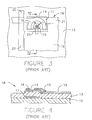
- Figures 3 and 4 illustrate an attempt, described in U.S. Patent Nos. 5,003,356 and 5,055,899, to reduce the parasitic or gate-source capacitance C GS present between the gate and source electrodes.
- the prior art open-ring thin film transistor of Figures 3 and 4 includes a gate electrode 11 formed on a glass substrate 12, and a gate insulating film 13 consisting of silicon nitride and having a thickness of about 3,000 A stacked on the gate electrode 11.
- a semiconductor film 14 consisting of amorphous silicon (a-Si) is stacked on the part of the gate insulating film 13 which corresponds to the gate electrode 11.
- the a-Si layer 14 extends laterally at least to the lateral peripheral edges of the gate electrode 11.
- a partially circular source electrode 15 is formed on the semiconductor film 14.
- the source electrode 15 has a diameter of about 4 f..lm (micrometers).
- a drain electrode 16 is formed in a semi-annular or half-circular shape on the semiconductor film 14 only partially surrounding the source electrode 15, thereby forming a semiconductor channel portion "L" in a partially annular space between the source and drain electrodes 15 and 16. Because the channel portion is formed so as to partially surround the source electrode 15, if the distance between the source and drain electrodes is a channel length L, and the length of an arc defined by substantially intermediate points of the channel length L is a channel width W, the channel width W is sufficiently larger than the channel length L. The channel length to width ratio is therefore less than one thereby providing for a reduced parasitic capacitance C GS .
- the source electrode 15 is only partially surrounded by the drain electrode 16 because the source and drain electrodes are substantially coplanar and an opening is left in the drain 16 to allow the pixel electrode 19, 25 to extend into electrical contact with the source electrode 15. Furthermore, the open-ring design of the prior art TFT shown in Figures 3-4 is provided so as to not unduly limit the viewing display area of the arrayed pixels 19 thereby providing for a fairly large display area for each pixel.
- the drain electrode 16 of Figures 3-4 does not substantially completely surround the source electrode 15.
- a plurality (not shown) of the open-ring TFTs 18 of Figures 3 and 4 each arranged in the above-described manner are, in the prior art, arrayed on a substrate 12 in the form of a matrix.
- the source electrode 15 of each thin film transistor 18 is connected to a pixel electrode 19 consisting of a transparent conductive substance such as ITO.
- Drain electrodes 16 of TFTs 18 arranged in the column direction are commonly connected to a drain line 20, while the gate electrodes 11 of thin film transistors 18 arranged in the row direction are commonly connected to a gate line 21 (each TFT therefore has a gate electrode 11 connected to a horizontally extending gate line 21 and a drain electrode 16 connected to a vertically extending drain line 20.
- a plurality (not shown) of pixel electrodes 19 connected to source electrodes 15 of TFTs 18 are arrayed above the glass substrate 12 in the form of a matrix.
- a linear portion 25 of the transparent pixel electrode 19 passes through the opening in the semi-circular shaped drain electrode 16. Therefore, the pixel electrode (19, 25) does not cross over the drain electrode 16 but, instead, extends through the opening created in the drain 16. That is, the drain electrode 16 adjacent the linear portion 25 of the pixel electrode is removed so as to prevent an unnecessary electric field from being applied to the channel portion.
- the source electrode 15 is formed so as to be smaller in size than the drain electrode 16. Therefore, the area where the source and gate electrodes 15 and 11 overlap one another is considerably smaller than that where the drain and gate electrodes 16 and 11 overlap one another. Accordingly, the parasitic capacitance, or C GS , between the gate and source electrodes is decreased.
- the open-ring geometric design of the prior art thin film transistor of Figures 3 and 4 does, in fact, reduce the parasitic capacitance between the gate and source electrodes, the open-ring thin film transistor of Figures 3-4 is not without its drawbacks.
- the prior art open-ring TFT is very photosensitive and the parasitic capacitance C GS of the open-ring TFT shown in Figures 3-4 has not been decreased as much as would be most preferably desired.
- the linear electrode portion 25 and the amorphous silicon semiconductor layer of this TFT are not completely shielded by the gate electrode from the backlighting scheme (not shown) by the gate, thus subjecting the thin film transistor of Figures 3-4 to undesirable photosensitivity with respect to the backlighting scheme (not shown) of the liquid crystal display which illuminates the pixels and TFTs from beneath the gate 11.
- Figure 3 illustrates the edges of the semiconductor layer 14 extending beyond the edges of the gate electrode 11.
- the ON current an important parameter in determining how fast the pixel will charge up during the positive charging cycle, of this prior art open-ring transistor is undesirably low.
- the open-ring TFT shown in Figures 3 and 4 is located on the gate line 21, thereby reducing the display area of pixel electrode 19.
- the aforesaid described prior art TFTs are very photosensitive.
- the reason for this high degree of photosensitivity is that the semiconductor a-Si layers are photosensitive and are not completely shielded by the prior art gate electrodes from the intense radiation of backlighting schemes because the prior art a-Si layers extend at least to the periphery of the gate electrodes.
- this invention fulfills the above-described needs in the art by providing a pixel for use in a liquid crystal display, comprising: a layer of liquid crystal material sandwiched between two spaced substrates, each substrate having a pixel electrode mounted thereon, and wherein one of the pixel electrodes is electrically connected to a thin film transistor, the thin film transistor comprising:
- the thin film transistor further comprises a passivation insulating layer formed on an upper surface of at least one of the drain and source electrodes, and the one pixel electrode electrically connected to the source electrode is transparent and is adhered to and crosses over the passivation layer.
- the thin film transistor further comprises a gate insulating layer disposed between the semiconductor film and the gate electrode, wherein the gate insulating layer includes a silicon nitride layer about 2,000 A thick and a TaO layer about 1,600 A thick.
- the gate electrode not including the gate line, has a larger horizontal surface area than the semiconductor layer.
- AMLCD active matrix liquid crystal display
- a MCD active matrix liquid crystal display
- one of the plurality of thin film transistors including a drain electrode electrically connected to a drain line, a gate electrode electrically connected to a gate line, and a source electrode electrically connected to a transparent pixel electrode of a corresponding pixel display, wherein the source and drain electrodes of said one thin film transistor are formed on a semiconductor film and separated from one another by a channel defining a predetermined length and width
- the improvement comprising: wherein the source electrode of the one thin film transistor is centrally located on the semiconductor film and is substantially completely surrounded laterally by the drain electrode.
- the drain electrode is substantially annular or circular defining an inner and an outer diameter
- the source electrode is substantially round
- the gate electrode is substantially round and has a diameter substantially larger than the inner diameter of the drain electrode thereby increasing the tolerance for misalignment of the source and drain electrodes relative to the gate electrode.
- the gate line is arranged in a row direction
- the drain line is arranged in a column direction substantially perpendicular to the gate line
- the gate and drain lines intersect one another defining the pixel display area therebetween.
- the thin film transistor is located at an intersection of the gate and drain lines thereby enlarging the size of the pixel display area.
- a passivation layer is formed on an upper surface of at least one of the drain and source electrodes, wherein the transparent pixel electrode electrically connected to the source and the pixel display is adhered to and crosses over the passivation layer, and wherein the pixel electrode consists essentially of Indium-Tin-Oxide (ITO) and the passivation layer consists essentially of one of: silicon nitride, silicon oxide, and combinations thereof.
- the channel is ringed shaped and has a channel length of about 6 micrometers and the diameter of the source being about 8 micrometers.
- the semiconductor film consists essentially of amorphous silicon and is about 2,000 A thick.
- TFTs thin film transistors
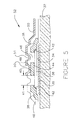
- FIG. 5 is a cross-sectional side view illustrating a first embodiment of the ring-shaped thin film transistor of this invention.
- Gate electrode 30 consisting of either chromium (Cr), aluminum (Al), tantalum (Ta), or combinations thereof, and having a thickness of about 1,000-5,000 A (most preferably about 2,500 A) is formed on an insulating substrate 32 preferably consisting essentially of a transparent glass plate.
- a gate insulating film 34 having a thickness of about 3,000-4,000 A (most preferably about 3,600 A) is formed on the upper surface of the insulating glass substrate 32 including the upper surface of the gate electrode 30.
- the gate insulating film 34 is made of, for example, silicon nitride, silicon oxide, tantalum oxide, or combinations thereof.
- This gate insulating film 34 may include two layers (not shown), one of, for example, silicon nitride, and the other of tantalum oxide. If made of two layers, each gate insulating film layer most preferably has a thickness of about 1,500-2,000 A.
- Asemiconductorfilm 36 consisting essentially of, for example, amorphous silicon (a-Si) and having a thickness of about 1,000-3,000 A (most preferably about 2,000 A) is formed on the gate insulating film 34, above and covering a portion above the gate electrode 30 as shown in Figure 5.
- the edges of the semiconductor layer 36 do not extend to the lateral periphery of the gate electrode 30.
- the diameter of the a-Si semiconductor layer is substantially less than the diameter of the gate electrode thereby reducing the photosensitivity of the TFT of this embodiment.
- Circular or annular shaped drain electrode 38 and centrally located source electrode 40 are formed on the semiconductorfilm 36.
- the centrally located source electrode 40 is preferably substantially round, and is substantially completely surrounded by the annular drain electrode 38.
- the source and drain electrodes, 40 and 38, are separated from each other by a predetermined distance that forms a channel length portion 41.
- each contact film 42 and 44 preferably consists essentially of one layer preferably made of amorphous silicon doped with an impurity (e.g. phosphorous) in a high concentration and having a thickness of about 500 A.
- Each electrode 38 and 40 is preferably made of a conductive metal material such as chromium.
- the drain and source electrodes themselves may be about 1,000-5,000 Athick but most preferably are about 4,000 A thick.
- a passivation and insulating layer 46 made of silicon nitride, silicon oxide, or any other suitable material is preferably deposited on substantially the entire exposed surface above the insulating substrate 32 on which the above-described films have been stacked in a predetermined form.
- the passivation layer 46 preferably extends over the matrix array including the pixel, and the gate and drain lines, and has openings only for the thru-holes 48. Alternatively, the passivation layer may have an opening for the pixels 54.
- the substantially annular drain electrode 38 is preferably completely covered with the passivation insulating film 46 and is thereby insulated from the other electrodes.
- the thickness of the passivation layer or film 46 on the drain and source electrodes 38 and 40 is about 2,000-8,000 A (most preferably about 3,000 A).
- the passivation film 46 protects and passivates the TFT channel 41 and electrically isolates the electrodes.
- the layer 46 fills in recesses generated upon formation of the above-described thin films, thereby substantially smoothing the surface above the insulating substrate 32.
- the thickness of the passivation film may be constant as illustrated in Figure 5 or may vary so as to provide for a substantially smoother upper surface thereof.
- the presence of the passivation insulating layer 46 allows the formation of a bridge over the channel and the drain electrode 38, wherein the pixel electrode crosses the bridge formed over the closed ring.
- a thru-hole 48 extending through the passivation film 46 is formed in a portion of the passivation film 46 above the source electrode 40.
- a transparent pixel electrode 50 electrically connected to the pixel display and consisting essentially of, for example, ITO and having a thickness of about 1,000 A is formed on the upper surface of the passivation layer or film 46.
- the transparent pixel electrode 50 extends into the thru-hole 48 and hence is electrically connected to the source electrode 40 thereby conductively connecting the source electrode 40 to the pixel.
- a portion 51 of the transparent pixel electrode 50 crosses over the channel portion 41 of the semiconductor film 36 formed between the drain and source electrodes 38 and 40.
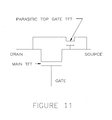
- the portion 51 of the transparent pixel electrode crossing over the channel 41 forms a top gate transistor more fully described below and schematically illustrated in Figure 11. Due to the presence of the passivation layer 46, the portion of the pixel electrode 50 disposed above the gate electrode 30 is generally not coplanar with either the source or drain electrodes.
- the thickness of the passivation and insulating film 46 formed on the drain and source electrodes 38 and 40 is excessively small, the passivation and insulating properties of the TFT are degraded. In contrast to this, if the thickness of the film 46 is excessively large, electrical connection between the source electrode 40 and the pixel electrode 50 through thru-hole 48 becomes rather difficult. Accordingly, the thickness of the passivation layer 46 preferably falls within the range of about 2,000-8,000 A. Furthermore, as the thickness of the passivation layer 46 becomes larger, the significance and effect of the top gate transistor formed by crossover portion 51 is reduced.
- the passivation insulator layer 46 is formed on the drain electrode 38 and part of the source electrode 40, the pixel electrode 50 is provided with a bridge over the drain electrode and the channel 41, and furthermore, the probability of short circuiting between the drain and source electrodes 38 and 40 is considerably decreased.
- the gate electrode 30 consisting essentially of a metal film (e.g. chromium) having a thickness of about 1,000-5,000 A, most preferably about 2,500 A, is deposited by means of sputtering or vapor deposition on the cleaned top surface of a transparent insulating substrate 32.
- the metal film 30 is then patterned by photolithography or the like to form the gate electrode 30.
- the insulating transparent substrate 32 may be made of glass, quartz, sapphire, or the like.
- the gate electrode 30 may consist essentially of, for example, chromium, titanium, tungsten, tantalum, copper, aluminum, combinations thereof, or the like.
- the gate insulating film 34 is then formed on the surface of the insulating substrate 32 by plasma enhanced chemical vapor deposition (CVD) or the like so as to have a thickness of about 3,000-4,000 A and cover the gate electrode 30.
- CVD plasma enhanced chemical vapor deposition
- a silicon nitride film, silicon oxide film, tantalum oxide film or combinations thereof may be used as the gate insulating film 34.
- the semiconductor film 36 made of amorphous silicon or the like and the contact films 42 and 44 made of amorphous silicon doped with an impurity at high concentration are continuously formed or stacked by plasma chemical vapor deposition or the like onto the gate insulating film 34 so as to have thicknesses of, for example, about 2,000 A and about 500 A respectively.
- the semiconductor film 36 and the contact films 42 and 44 are patterned by photolithography or the like so as to cover a portion above the gate electrode 30.
- amorphous silicon carbide SiC
- tellurium selenium
- gerumanium cadmium sulfide
- CdSe cadmium selenide
- a relatively thick metal film having a thickness of about 1,000-5,000 A (most preferably about 4,000 A) is then formed on the entire surface extant by vapor deposition, sputtering, or the like, thus covering the contact films 42 and 44.
- This metal film is then patterned by photolithography, etching, or the like to remove the film and contact films 42 and 44 at the channel portion 41, thereby forming the drain and source electrodes 38 and 40 above the gate electrode 30, which are separated from each other by a predetermined channel length distance 41, as shown in Figure 5.
- Chromium, titanium, tungsten, tantelum, copper, aluminum, molybdenum, or the like may be used as a material for the metal films of the drain and source electrodes 38 and 40.
- the passivation insulating film 46 is formed on and over the insulating substrate 32, preferably covering substantially at least the drain electrode 38 and source electrode 40, but preferably covering the entire surface area.
- the passivation layer 46 may be formed of, for example, silicon nitride, a polyimide, or silicon oxide, and is preferably deposited via plasma enhanced chemical vapor deposition.
- the thickness of the passivation layer 46 on the drain and source electrodes is preferably about 2,000-8,000 A.
- the portion 51 of the film 46 covering the channel 41 may have an increased thickness with respect to the portion covering the electrodes so as to reduce the effect of the parasitic top gate transistor formed by the crossover portion 51 of the pixel electrode 50 over the channel 41. This increased thickness may be achieved via adjustments in the coating process.
- the thru-hole 48 is formed in the passivation insulatorfilm 46 above a portion of the source electrode 40 by etching or the like.
- the transparent pixel electrode 50 made of a material such as ITO, tin oxide, or Indium oxide is then sputtered and patterned on the top surface of the passivation film 46 including the thru-hole 48 to a thickness of about 1,000 A. With the above-described process, fabrication of the thin film transistor of this embodiment of this invention is completed.
- the parasitic capacitance C GS of the thin film transistor of this embodiment is improved due to the geometric design of the TFT wherein the drain electrode substantially laterally surrounds the source electrode.
- the C GS small DC components across the pixel (between the opposing pixel electrodes) are reduced thereby substantially reducing flicker, image retention, and gray scale nonuniformity in the pixel.
- a plurality of thin film transistors 52 of the first, second, or third embodiments of this invention are arranged on the transparent insulating substrate 32 in the form of a matrix, and are used as switching devices for corresponding liquid crystal display pixels 54 wherein each pixel display 54 includes a liquid crystal layer, opposing polarizers and a pair of opposing electrodes (one of which is the pixel electrode 50). More specifically, a plurality of TFTs 52 are arrayed on the transparent substrate in the column and row directions. Gate electrodes 30 of the respective thin film transistors are commonly electrically connected to conductive gate lines 56 in the row direction. Drain electrodes 38 of the respective TFTs 52 are commonly electrically connected to conductive drain lines 58 in the column direction.
- Source electrodes 40 of TFTs 52 are connected to the transparent pixel electrodes 50, which extend from their respective pixel displays 54 to the thru-holes 48 thereby being electrically connected to both the source electrodes 40 and pixel displays 54.
- Pixel displays 54 are respectively arranged in a plurality of regions surrounded by the gate and drain lines 56 and 58, and are electrically independent from one another. The edges of the pixels 54 are preferably located closely adjacent the gate and drain lines, and may even slightly overlap them.
- an opposite transparent substrate 60 (preferably on the viewer side of the AMLCD) having a corresponding transparent pixel electrode 62 formed on its entire surface is placed on the substrate 32 on which thin film transistors 52 are arranged in the form of a matrix in the above-described manner so as to oppose them.
- a liquid crystal display device is obtained by sealing liquid crystal material 64 between the opposing substrates 60 and 32.
- each transparent pixel electrode 50 corresponds to one image displaying pixel or picture element of the active matrix liquid crystal display.
- Scan signals are sequentially supplied to the plurality of gate lines 56.
- Data signals for controlling the ON/OFF states of the respective pixels 54 are supplied to the plurality of drain lines 58 in accordance with the timing of the scan signals.
- Thin film transistor 52 whose gate electrode 30 has received a scanned signal is turned ON, reads a data signal supplied at that timing, and thereafter supplies the data signal via a voltage to the pixel electrode 50 and a resulting electric field is applied to the liquid crystal material 64 located between the pixel electrode 50 which has received the data signal and the transparent electrode 62 of the opposite substrate 60 in accordance with a potential difference between the opposite electrodes. Then, the orientation state of the molecules of the liquid crystal material 64 is changed, and thus transmission and interception of light are controlled according to the polarizers (not shown).
- the passivation insulating film 46 of a particular TFT is formed on at least a drain electrode 38 of the TFT, and the transparent pixel electrode 50 is formed on the resultant structure. Therefore, short circuiting between the transparent pixel electrode 50 and the drain electrode 38 can be prevented.
- the distance between the pixel display and the drain and gate lines i.e. distance A in Figure 1
- a maximum effective pixel display area is obtained.
- a pixel display opening ratio of about 53.5% or more can be realized as opposed to that of about 50% in conventional linear TFT devices, such as that shown in Figure 1.
- the step of forming the transparent pixel electrode 50 is the last one, and the source electrodes of all the arrayed TFTs are commonly connected upon deposition of the transparent conductive film before the step of separating the transparent electrodes 50 individually is executed, operations of all the TFTs can be measured within a short period of time by bringing the probe of a measuring device into contact with a plurality of gate and drain lines and the transparent conductive film while supplying test signals.
- Figures 8 and 9 illustrate second and third embodiments of the ring-TFT of this invention.
- Figure 8 is a top view illustrating an octagonal source electrode 40 completely surrounded by a substantially annular octagonal drain electrode 38.
- the diameter of the source electrode 40 shown in Figure 8 is about 10 micrometers before etching and about 8 micrometers after etching of the electrode material.
- the channel length 41 of the TFT shown in Figure 8, as in all of the TFTs illustrated in Figures 5-11 herein, is about 4 micrometers before etching and about 6 micrometers after etching.
- the channel width W (see Figure 10) as in all the TFTs illustrated in Figures 5-11 herein, may be determined via conventional mathematical formulations.
- Figure 9 illustrates a thin film transistor similar to the second embodiment illustrated in Figure 8 described above, except that the source electrode 40 has an island diameter of about 8 micrometers before etching and about 6 micrometers after etching.
- the width of the pixel electrode 50 is substantially similar to the diameter of source electrode 40 in contrast to the embodiment of Figure 8 where the width of the pixel electrode 50 is slightly less than the diameter of source electrode 40.
- the TFTs of Figures 8 and 9, instead of being octagonal, could be elliptical, hexogonal, circular, or rectangular.
- the reference numeral 90 is the photoresist pattern used to pattern the a-Si semiconductor layer, and 36 is the resulting a-Si layer.
- the resulting semiconductor layer 36 in Figures 8-9 has an outer lateral edge about 0.5-2.0 f..lm inward from the outer lateral edge of the gate electrode.
- Figure 10 is a top cross-sectional view illustrating the cross-sections of the source electrode 40 and drain electrode 38 of the first embodiment of this invention illustrated in Figures 5-7.
- the annular or circular drain electrode 38 completely surrounds centrally located round source electrode 40. Because the channel portion 41 between the source and drain electrodes is formed so as to completely surround the centrally located source electrode 40, the channel width W is sufficiently larger than the channel length L. Therefore, the L/W ratio of the channel length L to the channel width W is substantially less than one. Because of the geometric design of the TFT of this embodiment of this invention, the gate source parasitic capacitance C GS can be made small compared to the capacitance generated between one pixel electrode 50 and the opposing pixel electrode 62 through the liquid crystal material 64.
- the influences of gate signals on source potentials can be reduced thereby reducing flickering of the pixel.
- the channel width W can be increased, high drive performance of this TFT can also be realized.
- the small DC components across the pixel can be substantially eliminated and flickering, image retention, and gray scale nonuniformity can be greatly reduced, if not eliminated.
- variables D1 and D2 determine the parasitic capacitance of the thin film transistors of this invention.
- D1 being the radius of the central round source electrode 40
- D2 being the inner radius of the drain electrode 38
- the parameter C ox simply represents the gate insulative capacitance per unit area.
- the thin film transistors of the above-described embodiments of this invention also have a substantially reduced photosensitivity.
- Backlighting assemblies (not shown) of active matrix liquid crystal displays are positioned below substrate 32 and emit intense radiation onto the pixel including the TFT. Because of the design of the TFTs of the above-described embodiments of this invention, wherein the transparent pixel electrode 50 crosses over the drain electrode 38, the pixel electrode 50 is shielded by the source, gate and drain electrodes from the heat and radiation generated by the backlighting assembly. Furthermore, the amorphous silicon layer 36 is photosensitive and needs to be shielded from the backlight by the gate electrode.
- the a-Si semiconductor layer 36 does not extend to the lateral periphery of the gate electrode 30 and is therefore not exposed to the backlight radiation as in the aforesaid discussed prior art TFTs. Accordingly, the TFT of these embodiments are less photosensitive. Therefore, the TFTs of this invention also have the advantage, relative to the open ringed TFT shown in Figures 3-4, of having a reduced photosensitivity due to the geometric design of the semiconductor layer, the gate electrode, and the crossover aspect of the pixel electrode crossing over the drain electrode.
- the gate electrode 30 has a larger horizontal surface area than the semiconductor layer and therefore effectively shields the photosensitive semiconductor layer from the backlight radiation.
- the thin film transistor of the above-described embodiments of this invention is not as susceptible to misalignment as prior art TFTs.
- the reason for this, as can be seen in Figure 5, is that the source and drain electrodes may be moved left or right about 1-3 micrometers (wm) without vacating the peripheral area of the gate electrode 30. Therefore, the TFTs of particular embodiments of this invention have an increased margin for misalignment in the manufacturing process.
- the prior art TFTs shown herein in Figures 1-4 have no such tolerance for misalignment.
- top gate thin film transistor formed by the crossover 51 of the pixel electrode 50 over the annular channel 41 will be discussed as follows. Where the portion 51 of pixel electrode 50 crosses the channel 41, a small top gate transistor is formed with the passivation insulator layer 46 acting as the gate dielectric.
- the equivalent circuit for this configuration is shown in Figure 11. Only when V SD (the voltage between the source and drain discussed in the examples below) is positive and larger than the threshold voltage of this top gate transistor, is an accumulation layer formed at the interface of the passivation layer 46 and the semiconductor layer 36, and an excess leakage current is observed.
- This parasitic top gate TFT has a substantially higher threshold than the main ring TFT formed by source 40, drain 38, semiconductor 36, and gate 30.
- the highest V so is about 10 volts.
- the ring TFT of the above-described embodiments of this invention can be shut off by a V Gs of about -5 volts, and the top parasitic transistor is not an inhibitor.
- the OFF current behaves normally for negative voltage and normal positive voltage (e.g. about 10 volts) on the source electrode.
- normal positive voltage e.g. about 10 volts
- increased OFF current is observed.
- the parasitic top gate transistor formed by the crossover 51 of the pixel electrode 50 over the channel 41 is not detrimental to the operation of the TFT of the above-described embodiments of this invention.
- TFTs of the above-described embodiments may be further optimized as needed by increasing the threshold voltage (V th ) of the parasitic top gate TFT by, for example, proper choice of passivation layer material, interface treatments, and increasing the thickness of the passivation layer.
- V th threshold voltage
- a contact metal (not shown) consisting essentially of a conductive metal material may be buried in the through hole 48 formed above the source electrode 40, and the transparent pixel electrode 50 may then be deposited on the resultant structure, thereby electrically connecting the source electrode 40 to the transparent pixel electrode 50.
- the contact metal may include, for example, nickel, gold, silver, chromium, or the like and is formed in the through hole 48 by electrolysis plating.
- the source and pixel electrodes 40 and 50 are connected to one another through the contact metal (not shown). Hence, electrical connection therebetween may be ensured.
- This modification allows simpler electrical connection of the pixel and source electrodes and is especially useful when the thickness of the passivation layer46 is increased above about 400-500 A.
- a second possible modification of the ring-shaped TFT of the above-described embodiments of this invention is as follows.
- the above-described illustrated embodiments of this invention show the passivation insulator layer 46 having a substantially constant thickness across each of the source electrode 40, the semiconductive layer 36, and the drain electrode 38.
- the passivation layer 46 may be deposited on the above-described films so as to define an upper surface thereof being substantially flat. This would allow the pixel electrode 50 to be deposited onto a flat upper surface of the passivation layer 46, thereby allowing the transparent pixel electrode to be more easily and simply deposited onto the passivation layer.
- Figure 12 illustrates a pixel display 54 of this invention to which the pixel electrode 50 is electrically connected.
- the pixel electrode 50 extends between the pixel 54 and the source electrode 40 of a TFT of this invention.
- An opposing pixel electrode 62 is disposed on the opposite side of the liquid crystal layer 64 and is mounted on the lower substrate 60.
- Polarizers 71 and 72 are on opposite sides of the pixel and may be crossed or parallel thereby creating either a normally white or normally black display.
- Orientation films 74 and 75 align the LC material 64 adjacent the films 74 and 75 in predetermined directions (preferably at angles perpendicular to one another) thereby preferably creating a twisted nematic liquid crystal cell.
- the color filter may be, for example, red, green, or blue.
- the pixel 54 shown in Figure 12 is merely one pixel or subpixel in the array of LCD pixels 54 shown in Figure 6.
- the first and second TFTs (“Type A” and "Type B”) were ring-shaped thin film transistors according to this invention.
- the third (“open-ring TFT”) was similar to the first two except that a portion of the drain electrode was removed so that the pixel electrode did not cross over the drain electrode or a channel portion formed between the source and drain, thereby simulating the open-ring TFT shown in prior art Figures 3-4.
- the fourth (“linear TFT”) was a conventional linear type TFT similar to that illustrated in Figures 1 and 2 with a layering system similar to those of "Type A” and "Type B".
- the first TFT formed according to this invention was formed as follows.
- This TFT had a cross-sectional view similar to that illustrated in Figure 5, having a lower insulating substrate upon which a gate electrode, a dual layered gate insulating layer, a semiconductor layer, a contact layer, source and drain electrodes, a passivation insulator layer, and a transparent pixel electrode were formed.
- the source electrode was round having a diameter of 6 f..lm and the drain electrode was circular or annular and completely surrounded and was partially substantially co-planar with the source electrode.
- the lateral edges of the a-Si semiconductor layer did not extend to the periphery of the gate electrode.
- the channel length was 6 micrometers.
- the semiconductor layer was formed of amorphous silicon and was 2,000 A thick.
- the gate insulating layer was a dual layered system with a 1,600 A thick TaO layer and a 2,000 A thick silicon nitride layer. The temperature was 26°C.
- the gate electrode was about 2,500 A thick and the source and drain electrodes were about 4,000 A thick. Table 1 below illustrates the resultant ON and OFF currents as well as the parasitic capacitance C ⁇ of this "Type A" ring-shaped TFT.
- V G 20V
- V s 10V
- V D OV
- the "+” refers to positive V SD
- the "-" refers to the probes being switched on the source and drain electrodes.
- C GS (min) was the parasitic capacitance when the TFT was OFF
- C GS (max) is the parasitic capacitance when the TFT was ON.
- C GS was measured as a function of V GS with a Keithly 3330 LCZ meter. The meter had a resolution of 10- 15 F (1fF).
- a second ring-shaped thin film transistor (“Type B") according to this invention was formed as follows.
- the "Type B” TFT of this example also had a cross-section similar to that illustrated in Figure 5.
- the channel length was 6 micrometers.
- the layering system and respective thicknesses thereof were similar to those described above in Example 1, but the temperature was 27°C.
- the principal difference between the TFT of this example and that of Example 1 was that the source electrode of this example was round and had a diameter of 8 micrometers. Therefore, while similar TFTs were made in Examples 1 and 2, the principal difference is that the central round source electrode of Example 2 had a diameter about 2 micrometers larger than that of Example 1.
- Both TFTs of Examples 1 and 2 had round centrally located source electrodes and circular or annular drain electrodes completely surrounding the source electrodes. Table 2 below illustrates the current, voltage, and parasitic capacitance characteristics of the "Type B" TFT of Example 2.
- a partial ring-shaped TFT (“open-ring TFT”) was formed as follows.
- the "open-ring TFT” was formed in a manner identical to the "Type B” TFT of Example 2 except that the drain electrode was horseshoe shaped with the source-drain metal removed under the crossover bridge 51 illustrated in Figure 5. Although this "open-ring TFT” did not have a drain which completely or substantially surrounded the source, its drain electrode surrounded the source to an extent greater than that shown in Figures 3-4 herein.
- the temperature was 27°C. Table 3 below illustrates the current voltage, and parasitic capacitance characteristics of the "open-ring TFT" of Example 3.
- linear TFT similar to that shown in Figures 1-2 was made and tested as follows.
- This linear TFT had a cross-section including a lower insulating substrate upon which a gate electrode, a dual layered gate insulating layer, a semiconductor layer, a contact layer, source and drain electrodes, a passivation insulator layer, and a transparent pixel electrode were formed.
- the channel length was 6 ⁇ m and the channel width was 36 ⁇ m.
- the semiconductor layer was of a-Si and was 2,000 A thick.
- the temperature was 29°C.
- the gate insulating layer included a 1,600 A thick TaO layer and a 2,000 A thick SiN layer. Table 4 below illustrates the resultant ON and OFF currents as well as the parasitic capacitance C GS of this "linear TFT.”
- Table 5 compares the current and parasitic capacitance of the four TFTs of Examples 1-4.
- the TFTs of particular embodiments of this invention (“Type A” and “Type B”) have parasitic capacitance C GS significantly lower than those of the "linear TFT” and the "open-ring TFT”.
- the "Type A” TFT has the lowest C GS , but its ON current is reduced relative to that of "Type B”. Therefore, "Type B” has the best performance with about a 22% reduction in C GS (max) relative to the "open ring” and almost a 50% reduction in C GS (max) relative to the "linear TFT”, while sacrificing only about 10% in ON current ION (-) relative to the "linear TFT” and having about a 15-20% increase in ON current relative to the "open ring TFT”.
- the ON current ION (-) is the ever important parameter used in determining how fast the pixel will charge up during the positive charging cycle C GS (max), the gate source capacitance in the TFT ON state, determines the pixel voltage drop or shift after switching off the gate.
- the TFTs of particular embodiments of this invention (“Type A” and “Type B”) are clearly superior to both the conventional "linear TFT” and the "open ring TFT”. This is because the TFTs of particular embodiments of this invention have a decreased parasitic capacitance relative to the "linear TFT” and “open ring TFT” and preferably an increased ON current relative to the "open-ring TFT.”
Landscapes
- Physics & Mathematics (AREA)
- Nonlinear Science (AREA)
- Mathematical Physics (AREA)
- Engineering & Computer Science (AREA)
- Chemical & Material Sciences (AREA)
- Crystallography & Structural Chemistry (AREA)
- Microelectronics & Electronic Packaging (AREA)
- General Physics & Mathematics (AREA)
- Optics & Photonics (AREA)
- Thin Film Transistor (AREA)
- Liquid Crystal (AREA)
- Bipolar Integrated Circuits (AREA)
- Bipolar Transistors (AREA)
Applications Claiming Priority (2)
| Application Number | Priority Date | Filing Date | Title |
|---|---|---|---|
| US08/154,713 US5414283A (en) | 1993-11-19 | 1993-11-19 | TFT with reduced parasitic capacitance |
| US154713 | 1993-11-19 |
Publications (3)
| Publication Number | Publication Date |
|---|---|
| EP0654828A2 true EP0654828A2 (de) | 1995-05-24 |
| EP0654828A3 EP0654828A3 (de) | 1995-08-30 |
| EP0654828B1 EP0654828B1 (de) | 1999-05-06 |
Family
ID=22552458
Family Applications (1)
| Application Number | Title | Priority Date | Filing Date |
|---|---|---|---|
| EP94118141A Expired - Lifetime EP0654828B1 (de) | 1993-11-19 | 1994-11-17 | TFT mit niedriger parasitärer Kapazität |
Country Status (5)
| Country | Link |
|---|---|
| US (2) | US5414283A (de) |
| EP (1) | EP0654828B1 (de) |
| AT (1) | ATE179832T1 (de) |
| CA (1) | CA2135995C (de) |
| DE (1) | DE69418283T2 (de) |
Cited By (3)
| Publication number | Priority date | Publication date | Assignee | Title |
|---|---|---|---|---|
| FR2810148A1 (fr) * | 2000-06-09 | 2001-12-14 | Lg Philips Lcd Co Ltd | Substrat reseau de dispositif d'affichage a cristaux liquides et methode de fabrication correspondante |
| JP2006310636A (ja) * | 2005-04-28 | 2006-11-09 | Lg Phillips Lcd Co Ltd | 薄膜トランジスタ |
| EP2940520A1 (de) * | 2014-04-30 | 2015-11-04 | LG Display Co., Ltd. | Bildanzeigevorrichtung vom z-inversions-typ und verfahren zur herstellung davon |
Families Citing this family (100)
| Publication number | Priority date | Publication date | Assignee | Title |
|---|---|---|---|---|
| JP3507117B2 (ja) * | 1993-02-26 | 2004-03-15 | キヤノン株式会社 | Tft基板及び該基板を有する液晶表示装置 |
| US5847413A (en) * | 1994-08-31 | 1998-12-08 | Semiconductor Energy Laboratory Co., Ltd. | Differential amplifier circuit and analog buffer |
| US5774099A (en) * | 1995-04-25 | 1998-06-30 | Hitachi, Ltd. | Liquid crystal device with wide viewing angle characteristics |
| US5539219A (en) * | 1995-05-19 | 1996-07-23 | Ois Optical Imaging Systems, Inc. | Thin film transistor with reduced channel length for liquid crystal displays |
| US5532180A (en) * | 1995-06-02 | 1996-07-02 | Ois Optical Imaging Systems, Inc. | Method of fabricating a TFT with reduced channel length |
| US6372534B1 (en) | 1995-06-06 | 2002-04-16 | Lg. Philips Lcd Co., Ltd | Method of making a TFT array with photo-imageable insulating layer over address lines |
| US5994721A (en) | 1995-06-06 | 1999-11-30 | Ois Optical Imaging Systems, Inc. | High aperture LCD with insulating color filters overlapping bus lines on active substrate |
| US7167155B1 (en) | 1995-07-20 | 2007-01-23 | E Ink Corporation | Color electrophoretic displays |
| JPH0951098A (ja) * | 1995-08-04 | 1997-02-18 | Sharp Corp | 薄膜トランジスタおよびその製造方法 |
| US5650358A (en) * | 1995-08-28 | 1997-07-22 | Ois Optical Imaging Systems, Inc. | Method of making a TFT having a reduced channel length |
| GB2307768B (en) * | 1995-11-25 | 1998-06-10 | Lg Electronics Inc | Matrix array of active matrix lcd and manufacturing method thereof |
| KR100219118B1 (ko) * | 1996-08-30 | 1999-09-01 | 구자홍 | 박막트랜지스터 액정표시장치 및 그 제조방법 |
| US5894136A (en) | 1996-01-15 | 1999-04-13 | Lg Electronics Inc. | Liquid crystal display having a bottom gate TFT switch having a wider active semiconductor layer than a conductive layer on same |
| JP3402909B2 (ja) * | 1996-03-12 | 2003-05-06 | アルプス電気株式会社 | 薄膜トランジスタ装置及び液晶表示装置 |
| US5798745A (en) * | 1996-09-30 | 1998-08-25 | Rockwell International | LCD panel having tailored pushdown voltages |
| US6140687A (en) * | 1996-11-28 | 2000-10-31 | Matsushita Electric Industrial Co., Ltd. | High frequency ring gate MOSFET |
| GB9626487D0 (en) * | 1996-12-17 | 1997-02-05 | Philips Electronics Nv | Electronic devices and their manufacture |
| JP2985838B2 (ja) * | 1997-07-18 | 1999-12-06 | 日本電気株式会社 | 薄膜トランジスタアレイ基板の製造方法 |
| US6359672B2 (en) | 1997-10-20 | 2002-03-19 | Guardian Industries Corp. | Method of making an LCD or X-ray imaging device with first and second insulating layers |
| US6011274A (en) * | 1997-10-20 | 2000-01-04 | Ois Optical Imaging Systems, Inc. | X-ray imager or LCD with bus lines overlapped by pixel electrodes and dual insulating layers therebetween |
| DE19746619A1 (de) * | 1997-10-22 | 1999-05-06 | Siemens Ag | Elektrisches Halbleiterbauelement |
| US6704133B2 (en) | 1998-03-18 | 2004-03-09 | E-Ink Corporation | Electro-optic display overlays and systems for addressing such displays |
| JP4021045B2 (ja) * | 1998-03-31 | 2007-12-12 | 株式会社アドバンスト・ディスプレイ | アクティブマトリクス型表示装置 |
| US7075502B1 (en) * | 1998-04-10 | 2006-07-11 | E Ink Corporation | Full color reflective display with multichromatic sub-pixels |
| US5917199A (en) | 1998-05-15 | 1999-06-29 | Ois Optical Imaging Systems, Inc. | Solid state imager including TFTS with variably doped contact layer system for reducing TFT leakage current and increasing mobility and method of making same |
| JP3678587B2 (ja) * | 1998-08-05 | 2005-08-03 | 株式会社 日立ディスプレイズ | 液晶表示装置 |
| US6545291B1 (en) | 1999-08-31 | 2003-04-08 | E Ink Corporation | Transistor design for use in the construction of an electronically driven display |
| US6159759A (en) * | 1999-11-19 | 2000-12-12 | Chartered Semiconductor Manufacturing Ltd. | Method to form liquid crystal displays using a triple damascene technique |
| US6780687B2 (en) * | 2000-01-28 | 2004-08-24 | Semiconductor Energy Laboratory Co., Ltd. | Method of manufacturing a semiconductor device having a heat absorbing layer |
| DE10034873B4 (de) * | 2000-07-18 | 2005-10-13 | Pacifica Group Technologies Pty Ltd | Verfahren und Bremsanlage zum Regeln des Bremsvorgangs bei einem Kraftfahrzeug |
| JP2002222944A (ja) * | 2001-01-26 | 2002-08-09 | Kitakiyuushiyuu Techno Center:Kk | 半導体素子 |
| EP1378015A4 (de) | 2001-04-10 | 2005-08-03 | Sarnoff Corp | Verfahren und vorrichtung zur bereitstellung eines aktiven matrix-pixel mit hoher leistungsfähigkeit unter verwendung organischer dünnfilmtransistoren |
| KR100442489B1 (ko) * | 2001-06-11 | 2004-07-30 | 엘지.필립스 엘시디 주식회사 | 액정표시소자 |
| KR100391157B1 (ko) * | 2001-10-25 | 2003-07-16 | 엘지.필립스 엘시디 주식회사 | 액정 표시 장치용 어레이 기판 및 그의 제조 방법 |
| US7009663B2 (en) | 2003-12-17 | 2006-03-07 | Planar Systems, Inc. | Integrated optical light sensitive active matrix liquid crystal display |
| US7023503B2 (en) * | 2002-02-20 | 2006-04-04 | Planar Systems, Inc. | Image sensor with photosensitive thin film transistors |
| US7053967B2 (en) * | 2002-05-23 | 2006-05-30 | Planar Systems, Inc. | Light sensitive display |
| WO2003073159A1 (en) * | 2002-02-20 | 2003-09-04 | Planar Systems, Inc. | Light sensitive display |
| WO2003075207A2 (en) * | 2002-03-01 | 2003-09-12 | Planar Systems, Inc. | Reflection resistant touch screens |
| AU2003232018A1 (en) | 2002-04-24 | 2003-11-10 | E Ink Corporation | Electronic displays |
| US7190008B2 (en) * | 2002-04-24 | 2007-03-13 | E Ink Corporation | Electro-optic displays, and components for use therein |
| US7223672B2 (en) * | 2002-04-24 | 2007-05-29 | E Ink Corporation | Processes for forming backplanes for electro-optic displays |
| US20060034492A1 (en) * | 2002-10-30 | 2006-02-16 | Roy Siegel | Hand recognition system |
| KR100887997B1 (ko) * | 2002-12-26 | 2009-03-09 | 엘지디스플레이 주식회사 | 기생 용량 편차가 최소화된 액정 표시 장치용 박막트랜지스터 |
| US20080084374A1 (en) * | 2003-02-20 | 2008-04-10 | Planar Systems, Inc. | Light sensitive display |
| TW586238B (en) * | 2003-06-05 | 2004-05-01 | Hannstar Display Corp | Circular thin film transistor structure |
| US20050134749A1 (en) * | 2003-12-19 | 2005-06-23 | Adiel Abileah | Reflection resistant display |
| KR101030545B1 (ko) * | 2004-03-30 | 2011-04-21 | 엘지디스플레이 주식회사 | 액정표시소자 |
| US7773139B2 (en) | 2004-04-16 | 2010-08-10 | Apple Inc. | Image sensor with photosensitive thin film transistors |
| US7142261B2 (en) | 2004-06-29 | 2006-11-28 | Au Optronics Corporation | Liquid crystal display having compensation capacitor |
| US7382421B2 (en) * | 2004-10-12 | 2008-06-03 | Hewlett-Packard Development Company, L.P. | Thin film transistor with a passivation layer |
| GB0426563D0 (en) | 2004-12-03 | 2005-01-05 | Plastic Logic Ltd | Alignment tolerant patterning on flexible substrates |
| US20060131669A1 (en) * | 2004-12-22 | 2006-06-22 | Douglas Albagli | Thin film transistor for imaging system |
| KR101085451B1 (ko) * | 2005-02-11 | 2011-11-21 | 삼성전자주식회사 | 표시장치용 박막트랜지스터 기판과 그 제조방법 |
| US7796223B2 (en) * | 2005-03-09 | 2010-09-14 | Samsung Electronics Co., Ltd. | Liquid crystal display apparatus having data lines with curved portions and method |
| US7537976B2 (en) * | 2005-05-20 | 2009-05-26 | Semiconductor Energy Laboratory Co., Ltd. | Manufacturing method of thin film transistor |
| JP2006337819A (ja) * | 2005-06-03 | 2006-12-14 | Canon Inc | 表示装置およびその駆動方法 |
| JP4702003B2 (ja) * | 2005-11-16 | 2011-06-15 | セイコーエプソン株式会社 | 液晶装置およびプロジェクタ |
| TWI283073B (en) * | 2005-12-14 | 2007-06-21 | Au Optronics Corp | LCD device and fabricating method thereof |
| KR101189279B1 (ko) * | 2006-01-26 | 2012-10-09 | 삼성디스플레이 주식회사 | 표시장치와 이의 제조방법 |
| US20070187685A1 (en) * | 2006-02-10 | 2007-08-16 | Chih-Chung Tu | Thin film transistor and thin film transistor array substrate |
| US7688392B2 (en) * | 2006-04-06 | 2010-03-30 | Chunghwa Picture Tubes, Ltd. | Pixel structure including a gate having an opening and an extension line between the data line and the source |
| TWI328878B (en) * | 2006-09-15 | 2010-08-11 | Au Optronics Corp | Electrode structure of a transistor, and pixel structure and display apparatus comprising the same |
| US7456475B2 (en) * | 2006-10-27 | 2008-11-25 | Hannstar Display Corp. | Display panel |
| KR101393636B1 (ko) * | 2007-07-24 | 2014-05-09 | 삼성디스플레이 주식회사 | 유기 박막 트랜지스터 표시판 및 그 제조방법 |
| US9224582B2 (en) | 2007-11-29 | 2015-12-29 | Applied Materials, Inc. | Apparatus and method for depositing electrically conductive pasting material |
| US8110450B2 (en) | 2007-12-19 | 2012-02-07 | Palo Alto Research Center Incorporated | Printed TFT and TFT array with self-aligned gate |
| TWI417606B (zh) * | 2009-03-13 | 2013-12-01 | Century Display Shenxhen Co | High picture quality LCD display panel |
| KR101626899B1 (ko) * | 2009-04-21 | 2016-06-03 | 삼성디스플레이 주식회사 | 박막 트랜지스터 기판 및 이의 제조 방법 |
| KR101602635B1 (ko) | 2009-11-30 | 2016-03-22 | 삼성디스플레이 주식회사 | 표시 장치, 박막 트랜지스터 기판 및 이의 제조 방법 |
| US9310923B2 (en) | 2010-12-03 | 2016-04-12 | Apple Inc. | Input device for touch sensitive devices |
| US8928635B2 (en) | 2011-06-22 | 2015-01-06 | Apple Inc. | Active stylus |
| US9329703B2 (en) | 2011-06-22 | 2016-05-03 | Apple Inc. | Intelligent stylus |
| US8638320B2 (en) | 2011-06-22 | 2014-01-28 | Apple Inc. | Stylus orientation detection |
| US8879013B2 (en) * | 2011-12-26 | 2014-11-04 | Shenzhen China Star Optoelectronics Technology Co., Ltd. | Thin-film transistor liquid crystal display device, substrate, and manufacturing method |
| US9652090B2 (en) | 2012-07-27 | 2017-05-16 | Apple Inc. | Device for digital communication through capacitive coupling |
| US9176604B2 (en) | 2012-07-27 | 2015-11-03 | Apple Inc. | Stylus device |
| US9557845B2 (en) | 2012-07-27 | 2017-01-31 | Apple Inc. | Input device for and method of communication with capacitive devices through frequency variation |
| KR101373964B1 (ko) | 2012-08-10 | 2014-03-13 | 경희대학교 산학협력단 | 디스플레이 소자 구동회로, 상기 디스플레이 소자 구동회로에 포함되는 박막 트랜지스터 및 이의 제조 방법 |
| US10048775B2 (en) | 2013-03-14 | 2018-08-14 | Apple Inc. | Stylus detection and demodulation |
| CN103178119B (zh) * | 2013-03-25 | 2015-07-29 | 京东方科技集团股份有限公司 | 阵列基板、阵列基板制备方法以及显示装置 |
| CN103311254B (zh) * | 2013-05-09 | 2015-08-19 | 深圳市华星光电技术有限公司 | 显示装置及其制造方法 |
| TWI522716B (zh) * | 2013-05-10 | 2016-02-21 | 群創光電股份有限公司 | 薄膜電晶體基板及顯示裝置 |
| US10845901B2 (en) | 2013-07-31 | 2020-11-24 | Apple Inc. | Touch controller architecture |
| US10032924B2 (en) * | 2014-03-31 | 2018-07-24 | The Hong Kong University Of Science And Technology | Metal oxide thin film transistor with channel, source and drain regions respectively capped with covers of different gas permeability |
| US10061450B2 (en) | 2014-12-04 | 2018-08-28 | Apple Inc. | Coarse scan and targeted active mode scan for touch |
| US20160190157A1 (en) * | 2014-12-30 | 2016-06-30 | Shenzhen China Star Optoelectronics Technology Co. Ltd. | Pixel structure and manufacturing method thereof |
| CN104483793A (zh) * | 2014-12-30 | 2015-04-01 | 深圳市华星光电技术有限公司 | Tft-lcd像素结构及其制作方法 |
| CN104679356B (zh) * | 2015-03-23 | 2017-10-20 | 京东方科技集团股份有限公司 | 光学传感单元、触摸面板及其制作方法、显示装置 |
| CN105226071B (zh) * | 2015-10-30 | 2018-06-05 | 京东方科技集团股份有限公司 | 一种显示基板及其制作方法、显示装置 |
| CN105428370B (zh) * | 2015-11-10 | 2018-09-04 | 深圳市华星光电技术有限公司 | 液晶显示面板及液晶显示装置 |
| US10474277B2 (en) | 2016-05-31 | 2019-11-12 | Apple Inc. | Position-based stylus communication |
| US10504939B2 (en) | 2017-02-21 | 2019-12-10 | The Hong Kong University Of Science And Technology | Integration of silicon thin-film transistors and metal-oxide thin film transistors |
| WO2019135731A1 (en) * | 2018-01-02 | 2019-07-11 | Intel Corporation | Thin-film transistor with source/drain structure to reduce parasitic capacitance |
| CN108493236B (zh) * | 2018-03-22 | 2021-03-26 | 京东方科技集团股份有限公司 | 薄膜晶体管及其制造方法、柔性显示屏及显示装置 |
| KR102604006B1 (ko) * | 2018-08-14 | 2023-11-21 | 엘지전자 주식회사 | 반도체 발광 소자를 이용한 디스플레이 장치 및 그 제조 방법 |
| CN111081160B (zh) * | 2019-12-31 | 2022-01-04 | 上海天马微电子有限公司 | 显示面板、显示装置及显示面板的制作方法 |
| US12153764B1 (en) | 2020-09-25 | 2024-11-26 | Apple Inc. | Stylus with receive architecture for position determination |
| KR20230104726A (ko) * | 2020-11-17 | 2023-07-10 | 가부시키가이샤 한도오따이 에네루기 켄큐쇼 | 반도체 장치 및 반도체 장치의 제작 방법 |
| CN113972285A (zh) * | 2021-10-25 | 2022-01-25 | 京东方科技集团股份有限公司 | 氧化物薄膜晶体管 |
Family Cites Families (47)
| Publication number | Priority date | Publication date | Assignee | Title |
|---|---|---|---|---|
| US3405330A (en) * | 1965-11-10 | 1968-10-08 | Fairchild Camera Instr Co | Remote-cutoff field effect transistor |
| US3454844A (en) * | 1966-07-01 | 1969-07-08 | Hughes Aircraft Co | Field effect device with overlapping insulated gates |
| US3413531A (en) * | 1966-09-06 | 1968-11-26 | Ion Physics Corp | High frequency field effect transistor |
| US3492548A (en) * | 1967-09-25 | 1970-01-27 | Rca Corp | Electroluminescent device and method of operating |
| JPS4921984B1 (de) * | 1969-05-28 | 1974-06-05 | ||
| JPS4936514B1 (de) * | 1970-05-13 | 1974-10-01 | ||
| US3862360A (en) * | 1973-04-18 | 1975-01-21 | Hughes Aircraft Co | Liquid crystal display system with integrated signal storage circuitry |
| US4112333A (en) * | 1977-03-23 | 1978-09-05 | Westinghouse Electric Corp. | Display panel with integral memory capability for each display element and addressing system |
| US4081896A (en) * | 1977-04-11 | 1978-04-04 | Rca Corporation | Method of making a substrate contact for an integrated circuit |
| US4333225A (en) * | 1978-12-18 | 1982-06-08 | Xerox Corporation | Method of making a circular high voltage field effect transistor |
| US4288806A (en) * | 1979-05-29 | 1981-09-08 | Xerox Corporation | High voltage MOSFET with overlapping electrode structure |
| JPS5910988A (ja) * | 1982-07-12 | 1984-01-20 | ホシデン株式会社 | カラ−液晶表示器 |
| US4738936A (en) * | 1983-07-01 | 1988-04-19 | Acrian, Inc. | Method of fabrication lateral FET structure having a substrate to source contact |
| JPS6065573A (ja) * | 1983-09-21 | 1985-04-15 | Ricoh Co Ltd | 薄膜トランジスタ |
| US4537654A (en) * | 1983-12-09 | 1985-08-27 | Trw Inc. | Two-gate non-coplanar FET with self-aligned source |
| GB8406330D0 (en) * | 1984-03-10 | 1984-04-11 | Lucas Ind Plc | Amorphous silicon field effect transistors |
| JPS60189969A (ja) * | 1984-03-12 | 1985-09-27 | Matsushita Electric Ind Co Ltd | 薄膜トランジスタ |
| JPS60192369A (ja) * | 1984-03-13 | 1985-09-30 | Matsushita Electric Ind Co Ltd | 薄膜トランジスタ |
| US4843443A (en) * | 1984-05-14 | 1989-06-27 | Energy Conversion Devices, Inc. | Thin film field effect transistor and method of making same |
| NL8402859A (nl) * | 1984-09-18 | 1986-04-16 | Philips Nv | Werkwijze voor het vervaardigen van submicrongroeven in bijvoorbeeld halfgeleidermateriaal en met deze werkwijze verkregen inrichtingen. |
| NL8402856A (nl) * | 1984-09-18 | 1986-04-16 | Philips Nv | Werkwijze voor het vervaardigen van een halfgeleiderinrichting. |
| EP0197991B1 (de) * | 1984-10-17 | 1989-01-18 | ETAT FRANCAIS représenté par le Ministre des PTT (Centre National d'Etudes des Télécommunications) | Verfahren zum herstellen von elektrischen schaltkreisen mit dünnschichtigen transistoren und kondensatoren |
| US4855806A (en) * | 1985-08-02 | 1989-08-08 | General Electric Company | Thin film transistor with aluminum contacts and nonaluminum metallization |
| US4686553A (en) * | 1985-08-02 | 1987-08-11 | General Electric Company | Low capacitance amorphous silicon field effect transistor structure |
| FR2586859B1 (fr) * | 1985-08-27 | 1987-11-20 | Thomson Csf | Procede de fabrication d'un transistor de commande pour ecran plat de visualisation et element de commande realise selon ce procede |
| FR2593631B1 (fr) * | 1986-01-27 | 1989-02-17 | Maurice Francois | Ecran d'affichage a matrice active a resistance de grille et procedes de fabrication de cet ecran |
| US4877749A (en) * | 1986-02-28 | 1989-10-31 | Polyfet Re Devices, Inc. | Method of forming a low loss FET |
| US4798810A (en) * | 1986-03-10 | 1989-01-17 | Siliconix Incorporated | Method for manufacturing a power MOS transistor |
| GB2199694A (en) * | 1986-12-23 | 1988-07-13 | Philips Electronic Associated | A method of manufacturing a semiconductor device |
| DE3752301T2 (de) * | 1986-11-29 | 2000-03-23 | Sharp K.K., Osaka | Verfahren zur Herstellung eines Dünnschichttransistors |
| US4762398A (en) * | 1987-01-26 | 1988-08-09 | Hosiden Electronics Co., Ltd. | Pixel transistor free of parasitic capacitance fluctuations from misalignment |
| JPS63184366A (ja) * | 1987-01-26 | 1988-07-29 | Nec Corp | 増幅回路 |
| JPH0834311B2 (ja) * | 1987-06-10 | 1996-03-29 | 日本電装株式会社 | 半導体装置の製造方法 |
| JPS6482674A (en) * | 1987-09-25 | 1989-03-28 | Casio Computer Co Ltd | Thin film transistor |
| US5032883A (en) * | 1987-09-09 | 1991-07-16 | Casio Computer Co., Ltd. | Thin film transistor and method of manufacturing the same |
| US4914058A (en) * | 1987-12-29 | 1990-04-03 | Siliconix Incorporated | Grooved DMOS process with varying gate dielectric thickness |
| US4949141A (en) * | 1988-02-04 | 1990-08-14 | Amoco Corporation | Vertical gate thin film transistors in liquid crystal array |
| US4859623A (en) * | 1988-02-04 | 1989-08-22 | Amoco Corporation | Method of forming vertical gate thin film transistors in liquid crystal array |
| JP2740813B2 (ja) * | 1988-02-26 | 1998-04-15 | セイコープレシジョン株式会社 | 非晶質シリコン薄膜トランジシタアレイ基板 |
| US5051800A (en) * | 1988-04-30 | 1991-09-24 | Hajime Shoji | Thin film semiconductor device and liquid crystal display apparatus using thereof |
| US5237193A (en) * | 1988-06-24 | 1993-08-17 | Siliconix Incorporated | Lightly doped drain MOSFET with reduced on-resistance |
| US4853345A (en) * | 1988-08-22 | 1989-08-01 | Delco Electronics Corporation | Process for manufacture of a vertical DMOS transistor |
| US4914051A (en) * | 1988-12-09 | 1990-04-03 | Sprague Electric Company | Method for making a vertical power DMOS transistor with small signal bipolar transistors |
| JP2558351B2 (ja) * | 1989-06-29 | 1996-11-27 | 沖電気工業株式会社 | アクティブマトリクス表示パネル |
| US5058995A (en) * | 1990-03-15 | 1991-10-22 | Thomson Consumer Electronics, Inc. | Pixel electrode structure for liquid crystal display devices |
| US5073519A (en) * | 1990-10-31 | 1991-12-17 | Texas Instruments Incorporated | Method of fabricating a vertical FET device with low gate to drain overlap capacitance |
| JPH05110075A (ja) * | 1991-10-15 | 1993-04-30 | Nec Corp | 絶縁ゲート型電界効果トランジスタ |
-
1993
- 1993-11-19 US US08/154,713 patent/US5414283A/en not_active Expired - Lifetime
-
1994
- 1994-11-16 CA CA002135995A patent/CA2135995C/en not_active Expired - Fee Related
- 1994-11-17 AT AT94118141T patent/ATE179832T1/de not_active IP Right Cessation
- 1994-11-17 EP EP94118141A patent/EP0654828B1/de not_active Expired - Lifetime
- 1994-11-17 DE DE69418283T patent/DE69418283T2/de not_active Expired - Fee Related
-
1995
- 1995-01-20 US US08/375,658 patent/US5614427A/en not_active Expired - Lifetime
Cited By (5)
| Publication number | Priority date | Publication date | Assignee | Title |
|---|---|---|---|---|
| FR2810148A1 (fr) * | 2000-06-09 | 2001-12-14 | Lg Philips Lcd Co Ltd | Substrat reseau de dispositif d'affichage a cristaux liquides et methode de fabrication correspondante |
| JP2006310636A (ja) * | 2005-04-28 | 2006-11-09 | Lg Phillips Lcd Co Ltd | 薄膜トランジスタ |
| EP2940520A1 (de) * | 2014-04-30 | 2015-11-04 | LG Display Co., Ltd. | Bildanzeigevorrichtung vom z-inversions-typ und verfahren zur herstellung davon |
| US9588386B2 (en) | 2014-04-30 | 2017-03-07 | Lg Display Co., Ltd. | Z-inversion type display device with ‘T’-shaped electrode and method of manufacturing the same |
| US9780126B2 (en) | 2014-04-30 | 2017-10-03 | Lg Display Co., Ltd. | Z-inversion type display device and method of manufacturing the same |
Also Published As
| Publication number | Publication date |
|---|---|
| US5614427A (en) | 1997-03-25 |
| US5414283A (en) | 1995-05-09 |
| EP0654828A3 (de) | 1995-08-30 |
| DE69418283D1 (de) | 1999-06-10 |
| CA2135995A1 (en) | 1995-05-20 |
| CA2135995C (en) | 2000-05-30 |
| EP0654828B1 (de) | 1999-05-06 |
| DE69418283T2 (de) | 1999-12-23 |
| ATE179832T1 (de) | 1999-05-15 |
Similar Documents
| Publication | Publication Date | Title |
|---|---|---|
| EP0654828B1 (de) | TFT mit niedriger parasitärer Kapazität | |
| US5694185A (en) | Matrix array of active matrix LCD and manufacturing method thereof | |
| US6297518B1 (en) | Active matrix display and electrooptical device | |
| US8133773B2 (en) | Apparatus and method for reducing photo leakage current for TFT LCD | |
| KR100209281B1 (ko) | 액정 표시 소자 및 그 제조방법 | |
| US6894735B2 (en) | Array substrate of liquid crystal display device | |
| US5459595A (en) | Active matrix liquid crystal display | |
| US5062690A (en) | Liquid crystal display with redundant FETS and redundant crossovers connected by laser-fusible links | |
| US6175394B1 (en) | Capacitively coupled field effect transistors for electrostatic discharge protection in flat panel displays | |
| US6914260B2 (en) | Electro-optical device | |
| KR100221759B1 (ko) | 박막 트랜지스터를 사용한 능동 매트릭스 액정 표시 장치 | |
| US5796448A (en) | Structure for a parasitic capacitor and a storage capacitor in a thin film transistor-liquid crystal display and a method for making the same | |
| US5087113A (en) | Liquid crystal display device | |
| US5191452A (en) | Active matrix liquid crystal display fabrication for grayscale | |
| KR20020042898A (ko) | 액정표시장치용 어레이기판과 그 제조방법 | |
| EP3246749B1 (de) | Flüssigkristallanzeige | |
| EP0721215B1 (de) | Herstellung eines Gitters mit metallischen Abtastzeilen zur Steuerung von Halbleiter-Gitterzeilen | |
| EP0721214B1 (de) | Schaltung mit Gitterzeilen, die an zwei oder mehr Kanalbereichen eine Halbleiterlinie kreuzt | |
| US5657101A (en) | LCD having a thin film capacitor with two lower capacitor electrodes and a pixel electrode serving as an upper electrode | |
| EP1840635A2 (de) | Flüssigkristallanzeige mit einem Dünnschichttransistoranordnungstafel | |
| US7133088B2 (en) | Liquid crystal display device and method of fabricating the same | |
| EP0721213B1 (de) | Gitter mit metallischen Abtastzeilen zur Steuerung von Halbleiter-Gitterzeilen | |
| US7349036B2 (en) | Liquid crystal display storage device and method of fabricating the same | |
| KR100392602B1 (ko) | 액정표시장치용 어레이 기판 및 그의 제조방법 | |
| GB2307768A (en) | Active matrix liquid crystal display |
Legal Events
| Date | Code | Title | Description |
|---|---|---|---|
| PUAI | Public reference made under article 153(3) epc to a published international application that has entered the european phase |
Free format text: ORIGINAL CODE: 0009012 |
|
| AK | Designated contracting states |
Kind code of ref document: A2 Designated state(s): AT BE CH DE DK ES FR GB GR IE IT LI LU MC NL PT SE |
|
| RAX | Requested extension states of the european patent have changed |
Free format text: LT PAYMENT 941206;SI PAYMENT 941206 |
|
| PUAL | Search report despatched |
Free format text: ORIGINAL CODE: 0009013 |
|
| AK | Designated contracting states |
Kind code of ref document: A3 Designated state(s): AT BE CH DE DK ES FR GB GR IE IT LI LU MC NL PT SE |
|
| 17P | Request for examination filed |
Effective date: 19960215 |
|
| RAP1 | Party data changed (applicant data changed or rights of an application transferred) |
Owner name: OIS OPTICAL IMAGING SYSTEMS, INC. |
|
| 17Q | First examination report despatched |
Effective date: 19970312 |
|
| GRAG | Despatch of communication of intention to grant |
Free format text: ORIGINAL CODE: EPIDOS AGRA |
|
| GRAG | Despatch of communication of intention to grant |
Free format text: ORIGINAL CODE: EPIDOS AGRA |
|
| GRAH | Despatch of communication of intention to grant a patent |
Free format text: ORIGINAL CODE: EPIDOS IGRA |
|
| GRAH | Despatch of communication of intention to grant a patent |
Free format text: ORIGINAL CODE: EPIDOS IGRA |
|
| GRAA | (expected) grant |
Free format text: ORIGINAL CODE: 0009210 |
|
| AK | Designated contracting states |
Kind code of ref document: B1 Designated state(s): AT BE CH DE DK ES FR GB GR IE IT LI LU MC NL PT SE |
|
| AX | Request for extension of the european patent |
Free format text: LT PAYMENT 19941206;SI PAYMENT 19941206 |
|
| LTIE | Lt: invalidation of european patent or patent extension | ||
| PG25 | Lapsed in a contracting state [announced via postgrant information from national office to epo] |
Ref country code: SE Free format text: THE PATENT HAS BEEN ANNULLED BY A DECISION OF A NATIONAL AUTHORITY Effective date: 19990506 Ref country code: LI Free format text: LAPSE BECAUSE OF FAILURE TO SUBMIT A TRANSLATION OF THE DESCRIPTION OR TO PAY THE FEE WITHIN THE PRESCRIBED TIME-LIMIT Effective date: 19990506 Ref country code: IT Free format text: LAPSE BECAUSE OF FAILURE TO SUBMIT A TRANSLATION OF THE DESCRIPTION OR TO PAY THE FEE WITHIN THE PRE;WARNING: LAPSES OF ITALIAN PATENTS WITH EFFECTIVE DATE BEFORE 2007 MAY HAVE OCCURRED AT ANY TIME BEFORE 2007. THE CORRECT EFFECTIVE DATE MAY BE DIFFERENT FROM THE ONE RECORDED.SCRIBED TIME-LIMIT Effective date: 19990506 Ref country code: GR Free format text: LAPSE BECAUSE OF NON-PAYMENT OF DUE FEES Effective date: 19990506 Ref country code: ES Free format text: THE PATENT HAS BEEN ANNULLED BY A DECISION OF A NATIONAL AUTHORITY Effective date: 19990506 Ref country code: CH Free format text: LAPSE BECAUSE OF FAILURE TO SUBMIT A TRANSLATION OF THE DESCRIPTION OR TO PAY THE FEE WITHIN THE PRESCRIBED TIME-LIMIT Effective date: 19990506 Ref country code: BE Free format text: LAPSE BECAUSE OF FAILURE TO SUBMIT A TRANSLATION OF THE DESCRIPTION OR TO PAY THE FEE WITHIN THE PRESCRIBED TIME-LIMIT Effective date: 19990506 Ref country code: AT Free format text: LAPSE BECAUSE OF FAILURE TO SUBMIT A TRANSLATION OF THE DESCRIPTION OR TO PAY THE FEE WITHIN THE PRESCRIBED TIME-LIMIT Effective date: 19990506 |
|
| REF | Corresponds to: |
Ref document number: 179832 Country of ref document: AT Date of ref document: 19990515 Kind code of ref document: T |
|
| REG | Reference to a national code |
Ref country code: CH Ref legal event code: EP |
|
| REF | Corresponds to: |
Ref document number: 69418283 Country of ref document: DE Date of ref document: 19990610 |
|
| REG | Reference to a national code |
Ref country code: IE Ref legal event code: FG4D |
|
| ET | Fr: translation filed | ||
| PG25 | Lapsed in a contracting state [announced via postgrant information from national office to epo] |
Ref country code: PT Free format text: LAPSE BECAUSE OF FAILURE TO SUBMIT A TRANSLATION OF THE DESCRIPTION OR TO PAY THE FEE WITHIN THE PRESCRIBED TIME-LIMIT Effective date: 19990806 Ref country code: DK Free format text: LAPSE BECAUSE OF FAILURE TO SUBMIT A TRANSLATION OF THE DESCRIPTION OR TO PAY THE FEE WITHIN THE PRESCRIBED TIME-LIMIT Effective date: 19990806 |
|
| REG | Reference to a national code |
Ref country code: CH Ref legal event code: PL |
|
| PG25 | Lapsed in a contracting state [announced via postgrant information from national office to epo] |
Ref country code: LU Free format text: LAPSE BECAUSE OF NON-PAYMENT OF DUE FEES Effective date: 19991117 Ref country code: IE Free format text: LAPSE BECAUSE OF NON-PAYMENT OF DUE FEES Effective date: 19991117 |
|
| PLBE | No opposition filed within time limit |
Free format text: ORIGINAL CODE: 0009261 |
|
| STAA | Information on the status of an ep patent application or granted ep patent |
Free format text: STATUS: NO OPPOSITION FILED WITHIN TIME LIMIT |
|
| 26N | No opposition filed | ||
| PG25 | Lapsed in a contracting state [announced via postgrant information from national office to epo] |
Ref country code: MC Free format text: LAPSE BECAUSE OF NON-PAYMENT OF DUE FEES Effective date: 20000531 |
|
| REG | Reference to a national code |
Ref country code: IE Ref legal event code: MM4A |
|
| PGFP | Annual fee paid to national office [announced via postgrant information from national office to epo] |
Ref country code: FR Payment date: 20001110 Year of fee payment: 7 |
|
| PGFP | Annual fee paid to national office [announced via postgrant information from national office to epo] |
Ref country code: DE Payment date: 20001113 Year of fee payment: 7 |
|
| PGFP | Annual fee paid to national office [announced via postgrant information from national office to epo] |
Ref country code: GB Payment date: 20001115 Year of fee payment: 7 |
|
| PGFP | Annual fee paid to national office [announced via postgrant information from national office to epo] |
Ref country code: NL Payment date: 20001130 Year of fee payment: 7 |
|
| PG25 | Lapsed in a contracting state [announced via postgrant information from national office to epo] |
Ref country code: GB Free format text: LAPSE BECAUSE OF NON-PAYMENT OF DUE FEES Effective date: 20011117 |
|
| REG | Reference to a national code |
Ref country code: GB Ref legal event code: IF02 |
|
| PG25 | Lapsed in a contracting state [announced via postgrant information from national office to epo] |
Ref country code: NL Free format text: LAPSE BECAUSE OF NON-PAYMENT OF DUE FEES Effective date: 20020601 |
|
| PG25 | Lapsed in a contracting state [announced via postgrant information from national office to epo] |
Ref country code: DE Free format text: LAPSE BECAUSE OF NON-PAYMENT OF DUE FEES Effective date: 20020702 |
|
| GBPC | Gb: european patent ceased through non-payment of renewal fee |
Effective date: 20011117 |
|
| PG25 | Lapsed in a contracting state [announced via postgrant information from national office to epo] |
Ref country code: FR Free format text: LAPSE BECAUSE OF NON-PAYMENT OF DUE FEES Effective date: 20020730 |
|
| NLV4 | Nl: lapsed or anulled due to non-payment of the annual fee |
Effective date: 20020601 |
|
| REG | Reference to a national code |
Ref country code: FR Ref legal event code: ST |
|
| REG | Reference to a national code |
Ref country code: FR Ref legal event code: ST |