EP0676817B2 - Procédé de fabrication d'un fil supraconducteur à haute température - Google Patents
Procédé de fabrication d'un fil supraconducteur à haute température Download PDFInfo
- Publication number
- EP0676817B2 EP0676817B2 EP95105193A EP95105193A EP0676817B2 EP 0676817 B2 EP0676817 B2 EP 0676817B2 EP 95105193 A EP95105193 A EP 95105193A EP 95105193 A EP95105193 A EP 95105193A EP 0676817 B2 EP0676817 B2 EP 0676817B2
- Authority
- EP
- European Patent Office
- Prior art keywords
- temperature
- heat treatment
- wire
- carrying
- phase
- Prior art date
- Legal status (The legal status is an assumption and is not a legal conclusion. Google has not performed a legal analysis and makes no representation as to the accuracy of the status listed.)
- Expired - Lifetime
Links
Images

Classifications
-
- H—ELECTRICITY
- H10—SEMICONDUCTOR DEVICES; ELECTRIC SOLID-STATE DEVICES NOT OTHERWISE PROVIDED FOR
- H10N—ELECTRIC SOLID-STATE DEVICES NOT OTHERWISE PROVIDED FOR
- H10N60/00—Superconducting devices
- H10N60/01—Manufacture or treatment
- H10N60/0268—Manufacture or treatment of devices comprising copper oxide
- H10N60/0801—Manufacture or treatment of filaments or composite wires
Definitions
- the present invention relates to a method of preparing an oxide superconducting wire, and more particularly, it relates to a method of preparing an oxide superconducting wire having a high critical current density.
- ceramics-based superconducting materials i.e., oxide superconducting materials
- oxide superconducting materials are watched with interest as superconducting materials exhibiting higher critical temperatures.
- yttrium-, bismuth- and thallium-based superconducting materials exhibit high critical temperatures of about 90 K, 110 K and 120 K respectively, and practical applications thereof are expected.
- a process of working an oxide superconducting material into a wire in a solid phase state basically includes the steps of charging raw material powder for superconductor in a metal sheath of silver or the like, carrying out drawing and rolling thereon, and carrying out a heat treatment for forming a sintered body with respect to the superconducting material. It is known that a wire having a higher critical current density is obtained by a further heat treatment for rolling and sintering which is carried out after the heat treatment step of forming the sintered body in the aforementioned process.
- An oxide superconducting wire must have a high critical current density in addition to a high critical temperature, so that the same is applied to a cable or a magnet. Further, a long oxide superconducting wire must have homogeneous characteristics, particularly homogeneous superconductivity.
- EP-A-0475 315 discloses a method of preparing an oxide high-temperature superconductor.
- the powdery raw material is filled in a metal sheath and the filled sheath is heat treated during two hours to discharge the generated gases, mainly CO 2 .
- An object of the present invention is to provide a method which can prepare an oxide superconducting wire having a further improved critical current density, in order to satisfy the aforementioned requirements.
- the method, of preparing a high-temperature superconducting wire, according to the present invention comprises the steps defined in claim 1.
- No sintered body is substantially formed by the heat treatment at the low temperature, while the critical current density of the finally obtained high-temperature superconducting wire is increased as compared with a case of carrying out no such heat treatment, due the heat treatment at the low temperature.
- a sintering step for forming a sintered body of an oxide superconductor is carried out immediately after plastic working.
- the wire is previously heat treated at the temperature which is lower than the sintering temperature in advance of the sintering step, thereby remarkably improving the critical current density of the finally obtained superconducting wire, as hereafter described in more concrete terms.
- the degree of improvement of the critical current density which depends on the structure of the prepared wire and conditions for preparing the same, is about 1.2 times at the least, and may be up to about 1.8 to 2.0 times.
- the method according to the present invention is used for forming a wire having a bismuth (Bi)-based oxide superconductor.
- the method according to the present invention comprises the steps of charging raw material powder having an element composition capable of forming a 2223 phase of a Bi-based oxide superconductor and mainly consisting essentially of a 2212 phase of the Bi-based oxide superconductor and a non-superconducting phase in a metal sheath, carrying out plastic working on the metal sheath which is charged with the raw material powder for obtaining a tape wire, carrying out a heat treatment at a first temperature on the obtained tape wire, and carrying out a heat treatment at a second temperature, which is higher than the first temperature, on the wire obtained by said heat treatment at the first temperature, wherein the first temperature substantially forms neither a 2223 phase of the Bi-based oxide superconductor nor a sintered body thereof while the second temperature forms a 2223
- the 2223 phase of the Bi-based oxide superconductor has a composition of Bi 2 Sr 2 Ca 2 Cu 3 O 10-x (0 ⁇ X ⁇ 1 ), while the 2212 phase thereof has a composition of Bi 2 Sr 2 Ca 1 Cu 2 O 8-x (0 ⁇ X ⁇ 1 ).
- the 2223 phase of the Bi-based oxide superconductor has a composition of (Bi, Pb) 2 Sr 2 Ca 2 Cu 3 O 10-X (0 ⁇ X ⁇ 1 ), while the 2212 phase thereof has a composition of (Bi, Pb) 2 Sr 2 Ca 1 CU 2 O 8-X (0 ⁇ X ⁇ 1)
- the non-superconducting phase may have a composition such as Sr-Ca-Cu-O, (Ca, Sr)-Pb-O, or Ca-Cu-O.
- powder as defined in claim 1 can be obtained by mixing powder materials of oxides and/or carbonates of elements for forming the superconductor in prescribed compounding ratios, sintering the mixture, and crushing the sintered substance.
- a metal sheath to be charged with the obtained powder can consist essentially of at least one stabilizing material which is selected from the group consisting of silver and a silver alloy, for example.
- the stabilized metal sheath which is charged with the powder is subjected to plastic working.
- This plastic working includes extrusion, drawing, rolling etc., for example.
- the rolling can provide a tape-shaped superconducting wire.
- the wire obtained by the plastic working is subjected to a first heat treatment at a low temperature, and a second heat treatment at a high temperature, in accordance with the present invention.
- the first heat treatment i.e., the heat treatment in advance of sintering, is carried out at a temperature in the range of 700 to 800°C.
- a temperature of 700 to 800°C is necessary.
- the object of the present invention can be attained by the heat treatment at 700 to 800°C, as understood from Examples described later. In this temperature range, the heat treatment is carried out for 10 to 50 hours According to the present invention, this time is selected in consideration of the wire production efficiency, and can bring improvement of the critical current density at the temperature of 700 to 800 °C.
- the time for the first heat treatment can be properly varied in response to the heating temperature and conditions for preparing the wire.
- the range of the heating time which is required for attaining the object of the present invention tends to be reduced when a high temperature is employed, while the required treatment time tends to be lengthened when a low temperature is employed.
- a higher temperature is not necessarily preferable but a proper temperature and a proper time can be appropriately selected in response to the structure of the wire and the conditions for preparing the same.
- the first heat treatment can be preferably carried out in the atmosphere or under reduced pressure.
- the second heat treatment is carried out afterthe first heat treatment, for forming a sintered body with respect to the oxide superconductor.
- a ceramics superconductor of a 2223 phase is formed from the 2212 phase and the non-superconducting phase in the wire.
- the second heat treatment is carried out at a temperature which is higher than 800°C, preferably in the range of 830 to 860°C, more preferably in the range of 840 to 850°C, for example.
- the second heat treatment can be preferably carried out in the atmosphere, or in a low oxygen atmosphere.
- the second heat treatment may be carried out either intermittently or continuously
- a cooling step can be interposed between these treatments.
- the wire can be cooled to the room temperature, for example.
- the second heat treatment can be carried out while increasing the temperature as such after completion of the first heat treatment. While the cooling step is preferably interposed in order to obtain a higher critical current density, the object of the present invention can be attained in either method.
- plastic working (rolling) and sintering are further carried out after the sintering step.
- the plastic working (rolling) and the subsequent sintering can be repeated a plurality of times.
- the first heat treatment may be carried out once in advance of the first sintering step, in order to improve the critical current density.
- the treatment at the temperature which is lower than the sintering temperature is not restricted to once but may be carried out a plurality of times. Also in this case, the heat treatment at the low temperature is necessarily carried out in advance of the sintering step.
- the plastic working includes drawing and rolling.
- the metal sheath which is employed in the present invention is preferably prepared from a sheath consisting essentially of a noble metal or a noble metal alloy such as silver or a silver alloy.
- a superconducting wire having a critical current density exceeding 30,000 A/cm 2 can be readily prepared as understood from Examples described later.
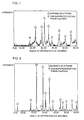
- a wire which was obtained after rolling was heated under conditions for forming no sintered body, e.g., at a temperature of 700 to 800°C, according to the present invention. Then, X-ray diffraction measurement was made on the powder in the interior of the wire, to obtain a chart shown in Fig. 2. This chart exhibits no broad peaks appearing in Fig. 1. Thus, it was supposed that an amorphous state may have been converted to a crystalline state, for example, with removal of an influence which was exerted in the plastic working.
- Powder was prepared similarly to Example 1, charged in a silver pipe, and thereafter subjected to drawing.
- the wire was cut after the drawing to obtain 61 wires, which were bundled and charged in a silver pipe of 12.0 mm in outer diameter and 10.0 mm in inner diameter, and again subjected to drawing and rolling.
- Three multifilamentary wires of 100 m in length were prepared through the aforementioned steps. Two of the obtained wires were heat treated under conditions of 700°C and 20 hours (sample 7) and 760°C and 20 hours (sample 8) respectively. Then, these samples were further heated as such with no cooling, and sintered under conditions of 845°C and 50 hours.
- Example 9 The remaining wire (sample 9) was sintered at 845°C for 50 hours, thereafter subjected to rolling, and then sintered at 840°C for 50 hours.
- Critical currents and critical current densities were measured as to the respective samples. Table 2 shows the results.
- an oxide high-temperature superconducting wire having a higher critical current density and superior superconductivity can be prepared according to the present invention.
Landscapes
- Engineering & Computer Science (AREA)
- Manufacturing & Machinery (AREA)
- Superconductors And Manufacturing Methods Therefor (AREA)
- Inorganic Compounds Of Heavy Metals (AREA)
Claims (5)
- Procédé de préparation d'un fil supraconducteur à haute température, comportant les étapes consistant à :charger une poudre de matière première ayant une composition en élément capable de former une phase 2223 d'un supraconducteur à base d'oxyde à base de bismuth et consistant principalement essentiellement en une phase 2212 et une phase non-superconductrice dans une gaine en métal ;réaliser un travail plastique sur ladite gaine en métal qui est chargée avec ladite poudre afin d'obtenir un fil ;réaliser un traitement thermique à une première température sur ledit fil obtenu ; refroidir éventuellement ledit fil obtenu par ledit traitement thermique à la première température à la température ambiante ;réaliser un traitement thermique à une deuxième température, qui est plus élevée que la ladite première température, sur ledit fil obtenu par ledit traitement thermique à la première température ou dans le cas où le refroidissement est réalisé après le premier traitement thermique, sur le fil obtenu par ladite étape de refroidissement ; dans lequelledit traitement thermique à ladite première température est effectué à une température dans la plage de 700 à 800°C pendant 10 à 50 heures et ne forme sensiblement aucun corps fritté dudit supraconducteur à base d'oxyde, ledit traitement thermique à ladite deuxième température étant effectué à une température supérieure à 800°C et formant un corps fritté dudit supraconducteur à base d'oxyde, etla densité de courant critique du fil supraconducteur à haute température finalement obtenu est augmentée par ledit traitement thermique à ladite première température par rapport à un cas sans réalisation dudit traitement thermique.
- Procédé de préparation d'un fil supraconducteur à haute température selon la revendication 1, comportant les étapes consistant à :réaliser le travail plastique sur ladite gaine en métal qui est chargée avec ladite poudre de matière première pour obtenir un fil en ruban ;réaliser le traitement thermique à la première température sur ledit fil en ruban obtenu ; etréaliser le traitement thermique à la deuxième température en réalisant le travail plastique sur le fil après ledit traitement thermique à ladite deuxième température et en réalisant ensuite un troisième traitement thermique pour un frittage supplémentaire, dans lequelledit traitement thermique à ladite première température ne forme sensiblement ni une phase 2223 dudit supraconducteur à base d'oxyde à base de bismuth ni un corps fritté de celui-ci, ledit traitement thermique à ladite deuxième température formant une phase 2223 dudit supraconducteur à base d'oxyde de bismuth et un corps fritté de celui-ci.
- Procédé selon la revendication 1 ou 2, comportant, en outre, une étape de refroidissement entre lesdits traitements thermiques auxdites première et deuxième températures.
- Procédé selon la revendication 1 ou 2, dans lequel lesdits traitements thermiques auxdites première et deuxième températures sont réalisés en continu sans aucune interposition d'une étape de refroidissement entre eux.
- Procédé selon l'une quelconque des revendications 1 à 4, dans lequel le traitement thermique à la première température est effectué à pression réduite ou dans l'atmosphère.
Applications Claiming Priority (3)
| Application Number | Priority Date | Filing Date | Title |
|---|---|---|---|
| JP6918394 | 1994-04-07 | ||
| JP6069183A JPH07282659A (ja) | 1994-04-07 | 1994-04-07 | 高温超電導線材の製造方法 |
| JP69183/94 | 1994-04-07 |
Publications (3)
| Publication Number | Publication Date |
|---|---|
| EP0676817A1 EP0676817A1 (fr) | 1995-10-11 |
| EP0676817B1 EP0676817B1 (fr) | 1998-09-09 |
| EP0676817B2 true EP0676817B2 (fr) | 2004-06-09 |
Family
ID=13395364
Family Applications (1)
| Application Number | Title | Priority Date | Filing Date |
|---|---|---|---|
| EP95105193A Expired - Lifetime EP0676817B2 (fr) | 1994-04-07 | 1995-04-06 | Procédé de fabrication d'un fil supraconducteur à haute température |
Country Status (3)
| Country | Link |
|---|---|
| EP (1) | EP0676817B2 (fr) |
| JP (1) | JPH07282659A (fr) |
| DE (1) | DE69504557T3 (fr) |
Families Citing this family (4)
| Publication number | Priority date | Publication date | Assignee | Title |
|---|---|---|---|---|
| US5661114A (en) | 1993-04-01 | 1997-08-26 | American Superconductor Corporation | Process of annealing BSCCO-2223 superconductors |
| US6194352B1 (en) * | 1994-01-28 | 2001-02-27 | American Superconductor Corporation | Multifilament composite BSCCO oxide superconductor |
| JP4701631B2 (ja) * | 2004-05-13 | 2011-06-15 | 住友電気工業株式会社 | 超電導線材の製造方法 |
| JP2006012537A (ja) | 2004-06-24 | 2006-01-12 | Sumitomo Electric Ind Ltd | 超電導線材の製造方法 |
Citations (6)
| Publication number | Priority date | Publication date | Assignee | Title |
|---|---|---|---|---|
| EP0281444A1 (fr) † | 1987-02-05 | 1988-09-07 | Sumitomo Electric Industries Limited | Procédé pour fabriquer un fil supraconducteur en céramique de type multioxyde |
| EP0290331A2 (fr) † | 1987-05-01 | 1988-11-09 | Sumitomo Electric Industries Limited | Composite supraconducteur |
| EP0356969A2 (fr) † | 1988-08-29 | 1990-03-07 | Sumitomo Electric Industries, Ltd. | Procédé pour la production d'un supraconducteur en oxide |
| EP0451532A1 (fr) † | 1990-04-11 | 1991-10-16 | Hoechst Aktiengesellschaft | Procédé d'élaboration d'un supraconducteur haute température |
| EP0462409A1 (fr) † | 1990-06-18 | 1991-12-27 | Hoechst Aktiengesellschaft | Procédé de production de pièces moulées tubulaires d'un matériau supraconducteur à haute température et usine pour son exécution |
| DE4124980A1 (de) † | 1991-07-27 | 1993-01-28 | Hoechst Ag | Stabilisierter keramischer hochtemperatur-supraleiter sowie verfahren zu seiner herstellung |
Family Cites Families (5)
| Publication number | Priority date | Publication date | Assignee | Title |
|---|---|---|---|---|
| JPH0473821A (ja) * | 1990-07-16 | 1992-03-09 | Sumitomo Electric Ind Ltd | 酸化物超電導線材の製造方法 |
| JPH04121912A (ja) * | 1990-09-10 | 1992-04-22 | Sumitomo Electric Ind Ltd | ビスマス系酸化物高温超電導体の製造方法 |
| JP3149441B2 (ja) * | 1991-01-19 | 2001-03-26 | 住友電気工業株式会社 | ビスマス系酸化物超電導線材の製造方法 |
| JPH04292819A (ja) * | 1991-03-20 | 1992-10-16 | Sumitomo Electric Ind Ltd | 酸化物超電導線材の製造方法 |
| JPH0536317A (ja) * | 1991-07-24 | 1993-02-12 | Sumitomo Electric Ind Ltd | ビスマス系酸化物超電導線材の製造方法 |
-
1994
- 1994-04-07 JP JP6069183A patent/JPH07282659A/ja active Pending
-
1995
- 1995-04-06 DE DE69504557T patent/DE69504557T3/de not_active Expired - Lifetime
- 1995-04-06 EP EP95105193A patent/EP0676817B2/fr not_active Expired - Lifetime
Patent Citations (6)
| Publication number | Priority date | Publication date | Assignee | Title |
|---|---|---|---|---|
| EP0281444A1 (fr) † | 1987-02-05 | 1988-09-07 | Sumitomo Electric Industries Limited | Procédé pour fabriquer un fil supraconducteur en céramique de type multioxyde |
| EP0290331A2 (fr) † | 1987-05-01 | 1988-11-09 | Sumitomo Electric Industries Limited | Composite supraconducteur |
| EP0356969A2 (fr) † | 1988-08-29 | 1990-03-07 | Sumitomo Electric Industries, Ltd. | Procédé pour la production d'un supraconducteur en oxide |
| EP0451532A1 (fr) † | 1990-04-11 | 1991-10-16 | Hoechst Aktiengesellschaft | Procédé d'élaboration d'un supraconducteur haute température |
| EP0462409A1 (fr) † | 1990-06-18 | 1991-12-27 | Hoechst Aktiengesellschaft | Procédé de production de pièces moulées tubulaires d'un matériau supraconducteur à haute température et usine pour son exécution |
| DE4124980A1 (de) † | 1991-07-27 | 1993-01-28 | Hoechst Ag | Stabilisierter keramischer hochtemperatur-supraleiter sowie verfahren zu seiner herstellung |
Non-Patent Citations (6)
| Title |
|---|
| Advances in Superconductivity II, Proceedings of the 2nd International Symposium on Superconductivity (ISS'89), November 14-17, 1989, Tsukuba (Japan), T. Ishiguro and K. Kajimura (eds.), Springer-Verlag 1990, pp. 419-422 † |
| Applied Physics Letter, Vol. 59, No. 6, 5 Aug. 1991, pp. 736-738 † |
| Applied Superconductivity 1993, Vol. 1, H.C. Freyhardt (ed.), DGM Informationsgesellschaft Verlag, pp. 217-220 † |
| IEEE Transactions on Applied Superconductivity, Vol. 3, No. 1, March 1993, pp. 942-945 † |
| Materials Research Society Symposium-Proceedings, Vol. 275, 1992, Materials Research Society, pp. 233-238 † |
| Physica C, Vol. 220, 1994, pp. 81-92 † |
Also Published As
| Publication number | Publication date |
|---|---|
| DE69504557T3 (de) | 2005-02-03 |
| EP0676817B1 (fr) | 1998-09-09 |
| EP0676817A1 (fr) | 1995-10-11 |
| DE69504557T2 (de) | 1999-05-12 |
| JPH07282659A (ja) | 1995-10-27 |
| DE69504557D1 (de) | 1998-10-15 |
Similar Documents
| Publication | Publication Date | Title |
|---|---|---|
| US5661114A (en) | Process of annealing BSCCO-2223 superconductors | |
| EP0356969B1 (fr) | Procédé pour la production d'un supraconducteur en oxide | |
| EP0449161B1 (fr) | Procédé pour la fabrication d'un supraconducteur en oxyde de bimuth | |
| US5635456A (en) | Processing for Bi/Sr/Ca/Cu/O-2223 superconductors | |
| EP0496281B1 (fr) | Procédé de fabrication d'un fil supraconducteur multifilamentaire comprenant de l'oxyde de bismuth | |
| US5569641A (en) | Synthesis of Bi1.8 Pb0.4 Sr2 Ca2 Cu3 Ox superconductor | |
| EP0676817B2 (fr) | Procédé de fabrication d'un fil supraconducteur à haute température | |
| EP0449222B1 (fr) | Supraconducteur d'oxyde de thallium et méthode pour sa préparation | |
| EP0409150B1 (fr) | Fil supraconducteur | |
| US5399312A (en) | Method for fabricating high-jc thallium-based superconducting tape | |
| EP1411154B1 (fr) | Cristal aciculaire supraconducteur d'oxyde a temperature critique elevee et son procede de production | |
| JPH04324209A (ja) | 酸化物超電導線およびその製造方法 | |
| EP1003228A2 (fr) | Procédé pour la préparation d'un matériau composé supraconducteur d'oxyde | |
| JPH06342607A (ja) | 酸化物超電導線材の製造方法 | |
| US6207619B1 (en) | Oxidic superconductor with a bismuth phase of the 2223 type and method of manufacture thereof | |
| JP2567967B2 (ja) | 酸化物超電導線材の製造法 | |
| JPH0864044A (ja) | 高温超電導線材の製造方法 | |
| JP3109076B2 (ja) | 酸化物超電導線材の製造方法 | |
| JP2904348B2 (ja) | 化合物超電導線の製造方法 | |
| JPH06223650A (ja) | Bi系酸化物超電導線の製造方法 | |
| JPH04292814A (ja) | ビスマス系酸化物超電導線材の製造方法 | |
| EP0362694A2 (fr) | Procédé pour la production de fil d'oxyde supraconducteur | |
| JPH0982154A (ja) | 酸化物超電導線材の製造方法 | |
| JPH0717366B2 (ja) | 酸化物系超電導材料の製造方法 | |
| JPH0554735A (ja) | セラミツクス超電導導体の製造方法 |
Legal Events
| Date | Code | Title | Description |
|---|---|---|---|
| PUAI | Public reference made under article 153(3) epc to a published international application that has entered the european phase |
Free format text: ORIGINAL CODE: 0009012 |
|
| AK | Designated contracting states |
Kind code of ref document: A1 Designated state(s): CH DE FR GB IT LI SE |
|
| 17P | Request for examination filed |
Effective date: 19951106 |
|
| 17Q | First examination report despatched |
Effective date: 19960409 |
|
| GRAG | Despatch of communication of intention to grant |
Free format text: ORIGINAL CODE: EPIDOS AGRA |
|
| GRAG | Despatch of communication of intention to grant |
Free format text: ORIGINAL CODE: EPIDOS AGRA |
|
| GRAH | Despatch of communication of intention to grant a patent |
Free format text: ORIGINAL CODE: EPIDOS IGRA |
|
| RAP1 | Party data changed (applicant data changed or rights of an application transferred) |
Owner name: JAPAN SCIENCE AND TECHNOLOGY CORPORATION Owner name: SUMITOMO ELECTRIC INDUSTRIES, LTD. |
|
| GRAH | Despatch of communication of intention to grant a patent |
Free format text: ORIGINAL CODE: EPIDOS IGRA |
|
| GRAA | (expected) grant |
Free format text: ORIGINAL CODE: 0009210 |
|
| AK | Designated contracting states |
Kind code of ref document: B1 Designated state(s): CH DE FR GB IT LI SE |
|
| REG | Reference to a national code |
Ref country code: CH Ref legal event code: EP |
|
| REF | Corresponds to: |
Ref document number: 69504557 Country of ref document: DE Date of ref document: 19981015 |
|
| ET | Fr: translation filed | ||
| REG | Reference to a national code |
Ref country code: CH Ref legal event code: NV Representative=s name: ISLER & PEDRAZZINI AG |
|
| PLBI | Opposition filed |
Free format text: ORIGINAL CODE: 0009260 |
|
| PLBF | Reply of patent proprietor to notice(s) of opposition |
Free format text: ORIGINAL CODE: EPIDOS OBSO |
|
| 26 | Opposition filed |
Opponent name: SIEMENS AG Effective date: 19990608 |
|
| PLBF | Reply of patent proprietor to notice(s) of opposition |
Free format text: ORIGINAL CODE: EPIDOS OBSO |
|
| PLAW | Interlocutory decision in opposition |
Free format text: ORIGINAL CODE: EPIDOS IDOP |
|
| PLAW | Interlocutory decision in opposition |
Free format text: ORIGINAL CODE: EPIDOS IDOP |
|
| APAC | Appeal dossier modified |
Free format text: ORIGINAL CODE: EPIDOS NOAPO |
|
| APAE | Appeal reference modified |
Free format text: ORIGINAL CODE: EPIDOS REFNO |
|
| APAC | Appeal dossier modified |
Free format text: ORIGINAL CODE: EPIDOS NOAPO |
|
| REG | Reference to a national code |
Ref country code: GB Ref legal event code: IF02 |
|
| APBU | Appeal procedure closed |
Free format text: ORIGINAL CODE: EPIDOSNNOA9O |
|
| PUAH | Patent maintained in amended form |
Free format text: ORIGINAL CODE: 0009272 |
|
| STAA | Information on the status of an ep patent application or granted ep patent |
Free format text: STATUS: PATENT MAINTAINED AS AMENDED |
|
| 27A | Patent maintained in amended form |
Effective date: 20040609 |
|
| AK | Designated contracting states |
Kind code of ref document: B2 Designated state(s): CH DE FR GB IT LI SE |
|
| REG | Reference to a national code |
Ref country code: CH Ref legal event code: AEN Free format text: AUFRECHTERHALTUNG DES PATENTES IN GEAENDERTER FORM |
|
| REG | Reference to a national code |
Ref country code: SE Ref legal event code: RPEO |
|
| ET3 | Fr: translation filed ** decision concerning opposition | ||
| APAH | Appeal reference modified |
Free format text: ORIGINAL CODE: EPIDOSCREFNO |
|
| REG | Reference to a national code |
Ref country code: CH Ref legal event code: PCAR Free format text: ISLER & PEDRAZZINI AG;POSTFACH 1772;8027 ZUERICH (CH) |
|
| PGFP | Annual fee paid to national office [announced via postgrant information from national office to epo] |
Ref country code: CH Payment date: 20120412 Year of fee payment: 18 |
|
| PGFP | Annual fee paid to national office [announced via postgrant information from national office to epo] |
Ref country code: SE Payment date: 20120411 Year of fee payment: 18 |
|
| REG | Reference to a national code |
Ref country code: CH Ref legal event code: PL |
|
| REG | Reference to a national code |
Ref country code: SE Ref legal event code: EUG |
|
| PG25 | Lapsed in a contracting state [announced via postgrant information from national office to epo] |
Ref country code: LI Free format text: LAPSE BECAUSE OF NON-PAYMENT OF DUE FEES Effective date: 20130430 Ref country code: SE Free format text: LAPSE BECAUSE OF NON-PAYMENT OF DUE FEES Effective date: 20130407 Ref country code: CH Free format text: LAPSE BECAUSE OF NON-PAYMENT OF DUE FEES Effective date: 20130430 |
|
| PGFP | Annual fee paid to national office [announced via postgrant information from national office to epo] |
Ref country code: GB Payment date: 20140402 Year of fee payment: 20 |
|
| PGFP | Annual fee paid to national office [announced via postgrant information from national office to epo] |
Ref country code: FR Payment date: 20140409 Year of fee payment: 20 Ref country code: IT Payment date: 20140314 Year of fee payment: 20 Ref country code: DE Payment date: 20140430 Year of fee payment: 20 |
|
| REG | Reference to a national code |
Ref country code: DE Ref legal event code: R071 Ref document number: 69504557 Country of ref document: DE |
|
| REG | Reference to a national code |
Ref country code: DE Ref legal event code: R071 Ref document number: 69504557 Country of ref document: DE |
|
| REG | Reference to a national code |
Ref country code: GB Ref legal event code: PE20 Expiry date: 20150405 |
|
| PG25 | Lapsed in a contracting state [announced via postgrant information from national office to epo] |
Ref country code: GB Free format text: LAPSE BECAUSE OF EXPIRATION OF PROTECTION Effective date: 20150405 |