EP0677778A2 - Photographisches Silberhalogenidmaterial und Verfahren zu dessen Herstellung - Google Patents
Photographisches Silberhalogenidmaterial und Verfahren zu dessen Herstellung Download PDFInfo
- Publication number
- EP0677778A2 EP0677778A2 EP95105765A EP95105765A EP0677778A2 EP 0677778 A2 EP0677778 A2 EP 0677778A2 EP 95105765 A EP95105765 A EP 95105765A EP 95105765 A EP95105765 A EP 95105765A EP 0677778 A2 EP0677778 A2 EP 0677778A2
- Authority
- EP
- European Patent Office
- Prior art keywords
- support
- photographic material
- range
- styrene
- layer
- Prior art date
- Legal status (The legal status is an assumption and is not a legal conclusion. Google has not performed a legal analysis and makes no representation as to the accuracy of the status listed.)
- Granted
Links
Images

Classifications
-
- G—PHYSICS
- G03—PHOTOGRAPHY; CINEMATOGRAPHY; ANALOGOUS TECHNIQUES USING WAVES OTHER THAN OPTICAL WAVES; ELECTROGRAPHY; HOLOGRAPHY
- G03C—PHOTOSENSITIVE MATERIALS FOR PHOTOGRAPHIC PURPOSES; PHOTOGRAPHIC PROCESSES, e.g. CINE, X-RAY, COLOUR, STEREO-PHOTOGRAPHIC PROCESSES; AUXILIARY PROCESSES IN PHOTOGRAPHY
- G03C1/00—Photosensitive materials
- G03C1/76—Photosensitive materials characterised by the base or auxiliary layers
- G03C1/795—Photosensitive materials characterised by the base or auxiliary layers the base being of macromolecular substances
Definitions
- the present invention relates to a silver halide photographic material which comprises a plastic support containing styrenic polymer and at least one silver halide emulsion layer provided thereon.
- the invention further relates to a process for the preparation of the photographic material and an image forming process using the material.
- a silver halide photographic material usually has a problem about dimensional stability.
- the dimension changes according to the change of temperature or humidity, particularly to the change of humidity.
- the dimensional change is a problem, when the photographic material is used for the preparation of a printing plate, which requires reproducing a dot image for a multicolor print or a minute line art.
- the dimensional change is due to the changes of the protective colloidal layers (including silver halide emulsion layers) and the support. Accordingly, the colloidal layers and the support should be improved to obtain a high dimensional stability.
- Japanese Patent Provisional Publication No. 3(1991)-131843 discloses a photographic film containing a syndiotactic styrenic polymer, which can be used as a support of a photographic material.
- the plastic support of the syndiotactic styrenic polymer has an excellent dimensional stability to varying humidity.
- the present inventors have noted some problems when the plastic support of the syndiotactic styrene polymer is used as the support of a photographic material, particularly a material for the preparation of a printing plate.
- a process for forming an image on a presensitized plate using a photographic material comprising steps of laminating a developed photographic material on a presensitized plate, and exposing to ultraviolet rays the presensitized plate through the photographic material to form a print image on the plate.
- the ultraviolet ray should be transmitted through the support of the photographic material to reach a light sensitive layer of the presensitized plate.
- the light source of the ultraviolet ray usually is a mercury lamp, which emits rays of about 350 nm. Therefore, a photographic support requires a high transmittance of ultraviolet within the range of about 350 nm.
- the haze within the visible region can be decreased by inhibiting the growth of spherulites having a diameter of more than 5 ⁇ m.
- the growth of smaller spherulites (diameter: 5 ⁇ m or less) must be inhibited to obtain a high transmittance of ultraviolet. Accordingly, the high transmittance of ultraviolet requires not only decreasing the number of the spherulites but also controlling the diameters of them.
- the growth of the spherulites cannot be so controlled according to the disclosures of Japanese Patent Provisional Publication No. 3(1991)-131843.
- An object of the present invention is to provide a silver halide photographic material which is improved in the dimensional stability and the transmittance of ultraviolet.
- Another object of the invention is to provide a process for the preparation of the silver halide photographic material.
- a further object of the invention is to provide an image forming process using the photographic material.
- the present invention provides a silver halide photographic material which has a plastic support comprising a syndiotactic styrenic polymer and at least one silver halide emulsion layer provided thereon, wherein the support shows a transmittance at 350 nm of not less than 70%, said transmittance being measured on the support of 100 ⁇ m thick.
- the photographic material can be prepared by a process comprising the steps of: extruding melted plastic comprising the syndiotactic styrenic polymer on a casting drum to form a plastic sheet; cooling the sheet on the drum at a temperature of from 25°C to a temperature higher than a glass transition temperature of the syndiotactic styrenic polymer by 20°C; conveying the sheet on a roll having a diameter of 50 to 1,000 mm at from a temperature lower than the glass transition temperature by 70°C to a temperatgure higher than the glass transition temperature by 20°C; stretching the sheet to prepare the plastic support; and forming a silver halide emulsion layer on the plastic support.
- the photographic material can be advantageously used in an image forming process comprising the steps of: imagewise exposing to light a silver halide photographic material of claim 1, developing the photographic material to form a photographic image; laminating the photographic material on a presensitized plate; and exposing to ultraviolet rays the presensitized plate through the photographic material to form a print image on the plate.
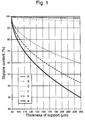
- Fig. 1 is a graph showing a preferred range of styrene content in a copolymer or a polymer mixture.
- Fig. 2 is a flow chart schematically illustrating the process for the preparation of the plastic support.
- the plastic support of the present invention consists of plastic comprising a syndiotactic styrenic polymer, and the plastic has such a transmittance that at least 70% of ultraviolet at 350 nm is transmitted through the plastic of 100 ⁇ m thickness.
- the transmittance of ultraviolet is preferably in the range of 76 to 100%, and more preferably in the range of 80 to 100%.
- the styrenic polymer means polystyrene, polymers of styrene derivatives and copolymers thereof.
- Examples of the styrene derivatives include alkylstyrenes, arylstyrenes, alkenylstyrenes, halogenated styrenes, halogenated alkylstyrenes and alkoxystyrenes.
- Examples of the alkylstyrenes include methylstyrene, ethylstyrene, propylstyrene and butylstyrene.
- An example of the arylstyrene is phenylstyrene.
- An example of the alkenylstyrene is vinylstyrene.
- halogenated styrenes examples include chlorostyrene, bromostyrene and fluorostyrene.
- alkoxystyrenes include methoxystyrene and ethoxystyrene.
- the styrene derivatives further include compounds formed by condensing the benzene ring of styrene with another aromatic ring. Examples of such compounds include vinylnaphthalene and acenaphthylene.
- the styrene derivatives furthermore include hydrogenated styrenes (e.g., vinylcyclohexane).
- Preferred monomers for the styrenic polymers include styrene, alkylstyrenes (e.g., p-methylstyrene, m-methylstyrene, p-tert-butylstyrene), hydrogenated styrenes and halogenated styrenes (e.g., p-chlorostyrene, m-chlorostyrene, p-fluorostyrene). Styrene and alkylstyrenes (particularly p-methylstyrene) are more preferred.
- the styrenic polymer consists of a main chain (comprising carbon to carbon bond) and a side chain (phenyl or its derivative).
- the carbon atom of the main chain to which the side chain is attached is asymmetric carbon.
- the syndiotactic styrenic polymer has a regular configuration that the asymmetric carbon atoms are arranged almost alternatively in opposite directions.
- the streogerularity (tacticity) can be most precisely determined by a nuclear magnetic resonance method using carbon isotope (13C-NMR).
- the tacticity measured by the 13C-NMR method is indicated by the number of continuous structural (repeating) units.
- a diad means two continuous structural units
- a triad means three continuous three units
- a pentad means five continuous units.
- the syndiotactic styrenic polymer of the present invention generally has such a tacticity that the content of a racemic diad is 75 to 100% (preferably 85 to 100%).
- the racemic diad means that two asymmetric carbon atoms are arranged alternatively in opposite directions in two continuous structural units.
- the syndiotactic styrenic polymer preferably has such a tacticity that the content of a racemic pentad is 30 to 100% (preferably 50 to 100%).
- the syndiotactic styrenic polymer is preferably in the form of a copolymer.
- the combinations of two monomers for the copolymer include the following (1), (2), (3) and (4).
- the combinations of three or more monomers for the copolymer can be obtained by further combining the following (1) to (4).
- the styrene moiety and the styrene derivative moieties in the copolymers have the syndiotactic structure.
- the whole structure of the copolymer preferably is syndiotactic.
- vinyl monomers examples include olefin monomers (e.g., ethylene, propylene, butene, hexene, octene), diene monomers (e.g., butadiene, isoprene), cyclic olefin monomers, cyclic diene monomers, acrylic esters, methacrylic esters (e.g., methyl methacrylate), maleic anhydride and acrylonitrile.
- olefin monomers e.g., ethylene, propylene, butene, hexene, octene
- diene monomers e.g., butadiene, isoprene
- cyclic olefin monomers e.g., cyclic diene monomers
- acrylic esters methacrylic esters (e.g., methyl methacrylate)
- maleic anhydride acrylonitrile
- the ratio of polystyrene in the mixture is more preferably in the range defined in the following formula (IIb), and most preferably in the range defined in the formula (IIc):
- SPS and T have the same meanings as defined in the formula (IIa).
- A is the upper limit of the styrene content defined in the formula (Ia) or (IIa)
- B is the upper limit defined in the formula (Ib) or (IIb)
- C is the upper limit defined in the formula (Ic) or (IIc)
- c is the lower limit defined in the formula (Ic) or (IIc)
- b is the lower limit defined in the formula (Ib) or (IIb)
- a is the lower limit defined in the formula (Ia) or (IIa).
- the spherulites in plastic are formed in the case that the growth speed of the spherulite is faster than the cooling speed of melt, which is the melted plastic polymer extruded on a casting drum. Accordingly, spherulites tend to be formed in a thick support, which requires a long time for cooling. Further, spherulites tend to be formed in a syndiotactic polystyrene. Therefore, the content of the styrene unit is defined above as a function of the thickness of the support. The content means wt.% of the styrene unit per the total weight of the copolymer or the polymer mixture.
- a single or double screw extruding machine is available.
- a double screw extruding machine is advantageously used to mixing polymers uniformly.
- the extruding machine preferably has a vent.
- the sheet is conveyed on the roll having a diameter of 50 to 1,000 mm.
- the diameter is preferably in the range of 80 to 800 mm, and more preferably in the range of 100 to 500 mm.
- the crazing can be inhibited by use of the roll having a diameter of not less than 50 mm.
- a roll of more than 1,000 mm is too large to construct a compact apparatus.
- the wrap angle at the conveying stage is preferably in the range of 60 to 240°, more preferably in the range of 70 to 220°, and most preferably in the range of 80 to 200°.
- the crazing tends to be caused where the wrap angle is more than 240°.
- the wrap angle of less than 60° causes a problem such as a slip while conveying the support to cause a scratch on the sheet.
- the support preferably has an expansion coefficient to humidity in the range of 1 ⁇ 10 ⁇ 6/%RH to 8 ⁇ 10 ⁇ 6/%RH.
- the coefficient is more preferably in the range of 1.2 ⁇ 10 ⁇ 6/%RH to 5 ⁇ 10 ⁇ 6/%RH, and most preferably in the range of 1.4 ⁇ 10 ⁇ 6/%RH to 2.5 ⁇ 10 ⁇ 6/%RH.
- the support having the above-mentioned thickness patterns can be obtained by heating the support at a temperature higher than the glass transition point plus 50°C before coating a silver halide emulsion.
- the support preferably has a thermal shrinkage ratio of not more than 0.4% at 110°C for 30 minutes.
- the amount of a light generally is 20 to 10,000 mJ/cm2 in the case of using the high pressure mercury vapor lamp of a main wavelength of 365 nm, and preferably 50 to 2,000 mJ/cm2.
- the amount of a light generally is 100 to 10,000 mJ/cm2 in the case of using the low pressure mercury vapor lamp of a main wavelength of 365 nm, and preferably 300 to 1,500 mJ/cm2.
- the glow discharge treatment is preferably conducted under a reduced pressure while heating the support to shorten the treatment time and to increase the adhesion effectively.
- the preheat temperature is preferably in the range of 50°C to the glass transition point (Tg), more preferably in the range of 60°C to Tg, and most preferably in the range of 70°C to Tg. In the case that the temperature is higher than Tg, the adhesion is degraded.
- pressure is preferably in the range of 0.005 to 20 Torr, and more preferably in the range of 0.02 to 2 Torr.
- the voltage is preferably in the range of 500 to 5,000 V, and more preferably in the range of 500 to 3,000 V.
- a discharge frequency preferably is in the range of 0 (i.e., a direct current) to several handled MHz, more preferably in the range of 50 Hz to 20 MHz, and most preferably in the range of 1 Hz to 1 MHz.
- the flame treatment is preferably conducted in the range of 1 to 10 Kcal/m2, and more preferably in the range of 3 to 30 Kcal/m2.
- the distance between the flame of the burner is preferably not longer than the 4 cm.
- the treatment apparatus is available from Kasuga Electric Co., Ltd.
- the backup roll for the support preferably is a hollow roll containing cooling water to keep a constant temperature.
- the undercoating layers may be provided between the surface treated support and the silver halide emulsion layer.
- the undercoating layer may comprise a first coating layer and a second under coating layer. The first coating layer adheres to the support, and the second coating layer adheres to the silver halide emulsion layer.
- the support is swelled to mixing the polymers of the support and the undercoating layer along the interface.
- the adhesion along the interface is increased.
- the undercoating polymers include a water soluble polymer, cellulose ester, a latex polymer and a water soluble polyester.
- materials for the water soluble polymer include gelatin, gelatin derivatives, casein, agar, sodium alginate, starch, polyvinyl alcohol, an acrylic acid-containing copolymer and a maleic anhydride-containing copolymer.
- Examples of materials for the latex polymer include a vinyl chloride-containing copolymer, a vinylidene chloride-containing copolymer, an acrylic acid ester-containing copolymer, a vinyl acetate-containing copolymer and a butadiene-containing copolymer.
- Gelatin is most preferred. Lime-treated gelatin, acid-treated gelatin, enzyme-treated gelatin, gelatin derivative and denatured gelatin are available. Lime-treated gelatin and acid-treated gelatin are particularly preferred.
- hydrophilic colloidal layers is described below.
- hydrophilic colloid is gelatin.
- Lime-treated gelatin, acid-treated gelatin, enzyme-treated gelatin, gelatin derivative and denatured gelatin are available. Lime-treated gelatin and acid-treated gelatin are particularly preferred.
- Other hydrophilic colloids are also available. Examples of the hydrophilic colloids include colloidal albumin, casein, agar, sodium alginate, starch derivatives, carboxymethyl cellulose, hydroxymethyl cellulose, polyvinyl alcohol, poly-N-vinyl pyrrolidone, polyacrylamide amide and copolymers thereof. Two or more polymers may be used in combination.
- Hydrophilic backing layer consists of a hydrophilic colloid.
- the hydrophilic layer functions as an anticurl layer which compensates the curl caused by the shrinkage of the hydrophilic colloid contained in photographic layers.
- Examples of the hydrophilic colloids are the same as the examples of the colloids used in the photographic layers.
- the coating amount is preferably so adjusted that the ratio of the coating amount of the hydrophilic colloid contained in the backing layers to the coating amount of the hydrophilic colloid contained in the photographic layers is not more than 0.5.
- the coating amount means the total amount of the backing layers or the photographic layers.
- the coating amount also means the total amounts of two or more hydrophilic colloids, in the case that two or more colloids are used in a single layer or two or more layers.
- a polymer latex may be added to the hydrophilic backing layer.
- the polymer latex is an aqueous dispersion of a water-insoluble polymer.
- the average particle size of the latex is preferably in the range of 20 to 200 ⁇ m.
- the dry amount ratio of the latex to a binder is preferably in the range of 0.01 to 1.0, and more preferably in the range of 0.1 to 0.8.
- the polymers in the latex is preferably made from alkyl acrylates, hydroxyalkyl acrylates, glycidyl acrylates, alkyl methacrylates, hydroxyalkyl methacrylates and glycidyl methacrylates.
- the average molecular weight of the polymer is preferably not less than 100,000, and more preferably in the range of 300,000 to 500,000. Examples of the polymers are shown below.
- the hydrophobic backing layer functions as a water-resistant layer.
- the hydrophobic layer preferably has a function of not passing water but passing vapor.
- the layer preferably is substantially water-resistant.
- the substantial water-resistance means that the swelling ratio about the thickness is not more than 1.3 where the layer is immersed in water at 25°C for 1 minute.
- the swelling ratio is preferably not more than 1.1.
- the swelling ratio about the total thickness of the layers is preferably not more than 1.5, and more preferably is not more than 1.3 where the layers are immersed in water at 25°C for 1 minute.
- the increase of the thickness preferably is not more than 2 ⁇ m, and more preferably is not more than 1 ⁇ m after the layers are immersed in water.
- the hydrophobic layer can be formed by coating and drying a latex.
- the polymers of the latex are preferably made from ethylene, vinyl chloride, urethane, vinylidene chloride, vinylidene fluoride, butadiene, acrylamides, acrylic esters, ⁇ -alkyl-substituted acrylic esters or styrenes.
- the average particle size of the latex is preferably in the range of 0.01 to 0.5 ⁇ m, and more preferably in the range of 0.02 to 0.2 ⁇ m.
- the glass transition point of the layer is preferably in the range of 10 to 150 °C.
- the backing layer may contain a plasticizer.
- the plasticizers include phthalic esters (e.g., dibutyl phthalate, diisooctyl phthalate, diphenyl phthalate), glycol derivatives (e.g., diethylene glycol, diethylene glycol dioctyl ether, triethylene acetate glycol), phosphoric esters (e.g., triphenyl phosphate, tridecyl phosphate) and ketones (e.g., cyclodekanone, n-octadecanone, n-octadekane-3,6,9-trione). Two or more plasticizers may be used in combination.
- the amount of the plasticizer is preferably in the range of 0.1 to 100 wt.%, and more preferably in the range of 3 to 10 wt.% based on the solid content of the polymer.
- An organic solvent having a boiling point of lower than 250°C may be added to the polymer latex.
- organic solvents examples include cellosolves (e.g., ethylcellosolve, butylcellosolve), alcohols (e.g., isopropanol, n-butanol, sec-butanol, furfuryl alcohol), glycols (e.g., ethylene glycol monobutyl ether, diethylene glycol monoethyl ether, ethyl acetate glycol monoethyl ether).
- cellosolves e.g., ethylcellosolve, butylcellosolve
- alcohols e.g., isopropanol, n-butanol, sec-butanol, furfuryl alcohol
- glycols e.g., ethylene glycol monobutyl ether, diethylene glycol monoethyl ether, ethyl acetate glycol monoethyl ether.
- Two or more organic solvents may be used in combination.
- the thickness of the hydrophobic polymer layer (the total thickness of two or more layers) is preferably in the range of 0.05 to 10 ⁇ m, and more preferably in the range of 0.1 to 5 ⁇ m. glycol, diethylene glycol dioctyl ether, triethylene acetate glycol).
- the backing layers may further contain a matting agent, a slipping agent, an antistatic agent, a surface active agent, a cross-linking agent and an electroconductive substance.
- the silver halide emulsion is usually prepared from a reaction of a water-soluble silver salt (e.g., silver nitrate) with a water-soluble halide salt (e.g., potassium bromide) in an aqueous solution of a water-soluble polymer (e.g., gelatin).
- a water-soluble silver salt e.g., silver nitrate
- a water-soluble halide salt e.g., potassium bromide
- a water-soluble polymer e.g., gelatin
- Silver chloride, silver bromide, silver chlorobromide, silver iodobromide and silver chloroiodobromide are available. There is no specific limitation with respect to the grain shape and the grain size distribution.
- the silver halide emulsion layer may further contain a chemical sensitizer, a spectral sensitizer, an antifogging agent, a hydrophilic colloid (e.g., gelatin), a hardening agent for gelatin, a surface active agent and an adhesive agent.
- a chemical sensitizer e.g., a spectral sensitizer
- an antifogging agent e.g., gelatin
- a hydrophilic colloid e.g., gelatin
- Japanese Patent Provisional Publications No. 58(1983)-62648, No. 58(1983)-62649 and No. 51(1976)-115291 disclose a method of adding fine oxide particles of Sn, Zn, Ti, In or V.
- Japanese Patent Provisional Publications No. 57(1982)-204540 and No. 54(1979)-133324 disclose a method of adding a polymer.
- Japanese Patent Provisional Publications No. 64(1989)-26849 and No. 61(1986)-24907 disclose a method of adding a surface active agent.
- a metal oxide such as SnO2 is preferably used.
- An electroconductive crystal of oxide or a complex oxide thereof is preferably used as the fine metal oxide particle.
- the fine metal oxide particles preferably have a volume resistance of not higher than 107 ⁇ , and more preferably not higher than 105 ⁇ .
- the particle size is preferably in the range of 0.01 to 0.7 ⁇ m, and more preferably in the range of 0.02 to 0.5 ⁇ m.
- the process for the preparation of the fine metal oxide particles is described in Japanese Patent Provisional Publication No. 56(1981)-143430.
- the metal particles may be prepared in the presence of a hetero atom.
- the hetero atom is incorporated into the particles to increase the conductivity. Further, an oxygen defect may be introduced into the fine particles.
- ZnO particles may contain Al or In.
- TiO2 particles may contain Nb or Ta.
- SnO2 particles may contain Sb, Nb or a halogen atom.
- the amount of the hetero atom is preferably in the range of 0.01 to 30 mol%, and more preferably in the range of 0.1 to 10 mol%.
- SnO2 particles containing Sb is particularly preferred.
- a non-light-sensitive hydrophilic colloidal layer may be provided on the photographic material.
- the colloidal layer usually contains a dye.
- Various dyes are available.
- Japanese Patent Provisional Publication No. 3(1991)-109535 discloses dyes dissolved in oil which is dispersed in a layer.
- U.S. Patents No. 2,719,088, No. 2,498,841, No. 2,496,843, Japanese Patent Provisional Publications No. 60(1985)-45237 and No. 3(1991)-5748 disclose dyes adsorbed on the surface of inorganic substance.
- Japanese Patent Provisional Publication No. 2(1990)-298939 discloses dyes adsorbed on a polymer.
- a printed negative original film having an image is laminated on the photographic material of the present invention.
- the emulsion layers are contact with each other.
- the lamination is then exposed to light.
- the exposure may be conducted in a conventional machine (for example, P-627FM, Dainippon Screen Co., Ltd.).
- a laser plotter for example, Raster Graph RG-5000, Dainippon Screen Co., Ltd.
- a scanner for example, Direct Scanner Graph SG-757, Dainippon Screen Co., Ltd. or Lux Scan 4500, Fuji Photo Film Co., Ltd.
- the direct exposing method is particularly preferred.
- the photographic material is developed according to a conventional process.
- the development can be conducted in an authomatic developing machine (for example, FG-680AG, Fuji Photo Film Co., Ltd.)
- the exposed and developed photographic material of the present invention is then laminated on a negative or positive presensitized lithographic plate.
- the presensitized lithographic plate is described in Japanese Patent Provisional Publication No. 3(1991)-273250.
- the lamination is then exposed to ultraviolet using a mercury lump or a metal halide lamp (e.g., PS light, Fuji Photo Film Co., ltd.).
- the plate is then developed and rinsed according to a conventional process to obtain a lithographic plate.
- the transmittance of the sample film was measured using an ultraviolet to visible light spectrophotometer at 350 nm using the air as the reference.
- a biaxially stretched and thermally fixed support was observed by a polarizing microscope ( ⁇ 400). A photograph was then taken, and magnified ( ⁇ 1,000). The spherulites having a diameter in the range of 0.05 to 5 ⁇ m were selected from the photograph. The volume ratio was calculated by dividing the total sectioned area by the split field in the eye piece. The volume ratio was expressed as percentage.
- the average dimensional change of the support at 25°C between 20%RH and 80%RH was measured immediately after the preparation of the film in the following manner.
- a sample sheet A4 size were moved by hands to a table at a distance of 50 cm in a darkroom. The procedure was repeated to move 100 sheets. The samples were developed. A fog of a half circle shape caused by knick was observed. The samples having no fog was evaluated as A, and the samples showing a fog was graded as B.
- a gray scale having the density difference of 0.15 was printed on an original film (sample film).
- the original film was placed on a presensitized lithographic plate (disclosed in Example 1 of Japanese Patent Provisional Publication No. 3(1995)-273250).
- the lamination was exposed to light using a metal halide lump (MU200-2-OL type, 3 kL, Toshiba Co., Ltd.).
- the plated was developed, and rinsed.
- the time required for changing the fifth grade of the gray scale to white was determined.
- the developing solution was prepared by diluting DP-4 (Fuji Photo Film Co., Ltd.) to 1/8.
- the distance from the casting outlet to the first stretching zone was measured, and divided into 10 parts.
- the temperatures of the both surfaces of the support at the center along the width direction were measured by a contact thermometer at each of the parts. The highest temperature was then determined.
- the product was washed with a mixture of hydrochloric acid and ethanol to decompose and remove the catalyst.
- the product was dried to obtain 640 g of a copolymer.
- the weight average molecular weight (Mw) of the copolymer was 440,000, and the number average molecular weight (Mn) was 240,000.
- the copolymer was analyzed by 13C-NMR. As a result, absorption peaks were observed at 145.00, 145.22 and 142.09 ppm.
- the ratio of the racemic pentad of the styrene units as tacticity was 75%, which was calculated from the peak areas.
- the polymerization reactions were repeated in the same manner as is mentioned above, except that the molar ratio of styrene to p-methylstyrene was changed to 50/0, 47.88/2.12 or 46.82/3.18 to form a syndiotactic polymer (p-methyl styrene content: 0 wt.%) or copolymers (p-methyl styrene content: 10 or 15 wt.%).
- the Mw of the polymers were 400,000, 420,000 and 430,000 respectively.
- the Mn of the polymers were 220,000, 230,000 and 240,000 respectively.
- the tacticities of the polymers were 74%, 71% and 70% respectively.
- an isotactic polystyrene (HH-30E, Idemitsu Petrochemical Co., Ltd.) was used in a comparative sample.
- the above-prepared homopolymer and copolymers were dried for a whole day and night at 150°C under reduced pressure.
- Pellets were formed by a single screw extruder. In the case that a polymer mixture was formed, a double screw extruder having a vent was used in place of the single extruder.
- the pellets were dried for a whole day and night at 130°C. Tg and Tm of the pellets were measured according to the above-mentioned method (4).
- pellets were placed in an extruding machine having a filter and T-die, and then extruded.
- the residence time between the hopper and the T-die was determined from the average extruded amount. The results are set forth in Table 1.
- the extruding temperature was the average temperature measured at the outlet of the extruding machine.
- the melt extruded from the T-die was hardened on a cooling roll of the casting drum to form a raw sheet.
- the time between the outlet of T-die and the cooling roll was determined from the linear flow rate of the melt and the distance between the T-die and the casting drum.
- the flow rate was calculated from the extruded amount and the thickness and the width of the extruded and hardened raw sheet.
- the time was changed by adjusting the distance between the T-die and the casting drum.
- the casting drum was made of a hollow stainless roll.
- the temperature set forth in Table 1 was kept by using circulating water adjusted at a constant temperature.
- the thickness of the raw sheet was adjusted by controlling the distance between the T-die and the casting drum.
- the extruding conditions are set forth in Table 1.
- the raw sheet was peeled out from the casting drum.
- the sheet was then conveyed on rolls having the diameter set forth in Table 1 to a longitudinal stretching zone.
- 6 stainless rolls were arranged alternatively.
- the distance between each two rolls was 300 mm.
- the wrap angle was 150°.
- the temperature of the support was controlled by the air adjusted at a constant temperature.
- the temperature of the support was measured a contact thermometer as is described in (8).
- the surface of the support was observed with naked eyes, and the occurrences of marks (hexagonal pattern of 1 mm to 10 cm) were evaluated. The results are set forth in Table 1.
- the raw sheet was stretched at Tg+15°C along the longitudinal direction between rolls.
- the stretching rate was 3,000% per minute. As a result, the length was extended 3.5 times.
- the sheet was then stretched at Tg+20°C along the lateral direction using a tenter.
- the stretching rate was 3,000% per minute. As a result, the length was extended 4.0 times.
- the obtained biaxially stretched film was subjected to a heat setting at 250°C for 30 seconds while conducting a thermal relaxation of 5%.
- a biaxially stretched polyethylene terephthalate film was prepared according to a conventional process.
- the thickness of the film was 100 ⁇ m or 175 ⁇ m.
- Electrodes Four cylindrical rods (electrodes) were fixed on an insulated board at the distance of 10 cm.
- the rod had the sectioned diameter of 2 cm and the length of 150 cm.
- a cooling medium flowed in the hollow of the rod.
- the electrode board was fixed in a vacuum tank.
- a biaxially stretched film was moved parallel to the electrode face at the distance of 15 cm. The moving speed was controlled to subject the surface to the treatment for 2 seconds.
- the film is conveyed on a heated roll having a thermostat for three quarters round just before the film reaches the electrode.
- the heated roll has the diameter of 50 cm.
- a thermocouple thermometer was in contact with the surface of the film between the heated roll and the electrode zone to control the surface temperature at 90°C.
- the pressure in the vacuum tank was 0.2 Torr.
- the partial pressure of H2O in the atmosphere was 75%.
- the charge frequency was 30 KHz.
- the power was 2,500 W.
- the treatment strength was 0.5 KV ⁇ A ⁇ minute/m2. After the charge treatment, the support was conveyed on a cooling roll having a thermostat. The diameter of the roll was 50 cm. The support was then wound up.
- the coating solution for an undercoating layer having the following composition was coated on the treated surface of the support using a wire bar in the coated amount of 10 ml/m2.
- the support was then dried at 115°C for 2 minutes, and wound up.
- Undercoating layer Gelatin 10.0 weight parts Water 24.0 weight parts Methanol 961.0 weight parts Salicylic acid 3.0 weight parts
- Polyamide-epichlorohydrin resin (described in synthesis example 1 of Japanese Patent Provisional Publication No. 51(1976)-27099) 0.5 weight part
- Nonion surface active agent Compound I-13 described in Japanese Patent Publication No. 3(1991)-27099) 1.0 weight part
- the first and second emulsion layers and the lower and upper protective layers were simultaneously coated.
- an aqueous silver nitrate solution and an aqueous sodium chloride solution containing (NH4)2Rh(H2O)Cl5 were simultaneously added to the core grains. The addition was continued for 14 minutes while controlling the potential of 95 mV. Thus, silver chloride cubic emulsion was prepared. The average grain size was 0.15 ⁇ m.
- an aqueous silver nitrate solution and an aqueous sodium chloride solution containing (NH4)2Rh(H2O)Cl5 were simultaneously added to the core grains. The addition was continued for 7 minutes while controlling the potential of 95 mV. Thus, silver chloride cubic emulsion was prepared. The average grain size was 0.10 ⁇ m.
- the coating solution was prepared in the same manner as in the formation of the first emulsion layer, except that the above-prepared emulsion was used.
- the solution was coated on the first emulsion layer.
- the coated amount of silver was 1.5 g/m2.
- the coated gelatin amount was 0.7 2.0 g/m2.
- the contents were added to 12.5 5 aqueous gelatin solution (160 g).
- the mixture was placed in a roll mill for 10 minutes to remove bubbles.
- the obtained mixture was filtered out to remove ZrO2 beads.
- the average particle size was about 3.0 ⁇ m.
- the mixture contained crude particles.
- the mixture was then centrifuged to classify the particles so that the maximum particle size in the resulting mixture was 1 ⁇ m.
- Electroconductive backing layer SnO2/Sb weight ratio: 9/1, average particle size: 0.25 ⁇ m
- Compound (6) 7 mg/m2 Sodium dodecylbenzenesulfonate 10 mg/m2 Sodium dihexyl- ⁇ -sulfosuccinate 40 mg/m2 Sodium polystyrenesulfonate 9 mg/m2 Surface backing layer Gelatin (Ca2+ content: 30 ppm) 2.82 g/m2 Polymethyl methacrylate particles (average particle size: 4.7 ⁇ m) 54 mg/m2 Compound (6) 3 mg/m2 Compound (7) 40 mg/m2 Compound (8) 40 mg/m2 Compound (9) 80 mg/m2 Compound (10) 150 mg/m2 Sodium dodecylbenzenesulfonate 75 mg/m
- the prepared photographic material was evaluated with respect to the relative exposure and the handling according to the previously described methods. The results are set forth in Table 2.
- the characteristics of the supports were also obtained by using a copolymer (Sample Nos. 1-1 to 13), a homopolymer (Sample No. 1-14) or a polymer mixture (Sample Nos. 1-15 and 16).
- the samples Nos. 1-2, 1-4, 1-6, 1-8 and 1-10 were scarcely improved in the ultraviolet transmittance and the relative exposure, compared with the PET supports.
- the thickness of the support is preferably not less than 90 ⁇ m because a thin support causes knick while handling the photographic material (Sample No. 1-17).
- the occurrence of crazing can be inhibited by conveying the support between the casting drum and the stretching zone under the conditions of the present invention.
- the support having no crazing has a high transmittance of ultraviolet. If a small roll is used to convey the support (Sample No. 1-23), the ultraviolet transmittance is decreased. Further, a high temperature of the conveying roll causes a mark of the roll on the sheet (Sample No. 1-25). On the other hand, a low temperature of the conveying roll reduces the ultraviolet transmittance (Sample No. 1-28).
- the support of the sample No. 1-19 was subjected to a surface treatment (glow discharge treatment) in the same manner as in Example 1. Further, an undercoating layer was coated on the support in the same manner as in Example 1.
- Electroconductive backing layer Gelatin (Ca2+ content: 3,000 ppm) 100 mg/m2 Compound A 1 mg/m2 Sodium dihexyl- ⁇ -sulfosuccinate 11 mg/m2 Sodium dodecylbenzenesulfonate 15 mg/m2 Sodium polystyrenesulfonate 10 mg/m2 SnO2/Sb (weight ratio: 9/1, average particle size: 0.25 ⁇ m) 200 mg/m2 Surface backing layer Gelatin (Ca2+ content: 30 ppm) (Amount is set forth in Table 3) Polymethyl methacrylate particles (average particle size: 3.4 ⁇ m) 20 mg/m2 Compound A 4 mg/m2 Dye (1) 60 mg/m2 Dye (2) 40 mg/m2 Dye (3) 32 mg/m2 Sodium dihexyl- ⁇ -sulfosuccinate 20 mg/m
- Non-light-sensitive layer Gelatin 1.0 g/m2 Sodium polystyrenesulfonate 15 mg/m2 2,4-Dichloro-6-hydroxy-s-triazine 7 mg/m2 1,3-Bis(vinylsulfonyl)propanol-2 15 mg/m2
- Polyethyl acrylate latex particle size: 0.05 ⁇ m 600 mg/m2
- a silver halide emulsion was prepared according to a conventional process.
- the silver bromide content in the emulsion was 30 mol%, and the silver chloride content was 70 mol%.
- the emulsion further contain 3.5 ⁇ 10 ⁇ 7 (based on 1 mol of silver) of rhodium.
- gelatin was added to the emulsion.
- 6 mg of sodium thiosulfate, 8.5 mg of chloroauric acid were added based on 1 mol of silver.
- the emulsion was then subjected to a chemical sensitization at 60 °C for 50 minutes.
- the average grain size of the obtained emulsion was 0.25 ⁇ m.
- the grain shape was cubic.
- the silver content and the gelatin content were 125 g and 53 g respectively based on 1 kg of the emulsion.
- the coating amount of silver was 3.5 g/m2 and the coating amount of gelatin was 1.6 mg/m2.
- the support of the sample No. 1-19 was subjected to a surface treatment (glow discharge treatment) in the same manner as in Example 1. Further, an undercoating layer was coated on the support in the same manner as in Example 1.
- Electroconductive backing layer (Sample No. 6) Methyl methacrylate/ethyl acrylate/acrylic acid copolymer (60/35/5) latex (average particle size: 0.1 ⁇ m) 100 mg/m2 Sodium dodecylbenzenesulfonate 15 mg/m2 SnO2/Sb (weight ratio: 9/1, average particle size: 0.25 ⁇ m) 200 mg/m2 Drying temperature 110°C Electroconductive backing layer (Sample No.
- Polyolefin latex (Chemipal S-120, Mitsui Petrochemical Co., Ltd.) 1 g/m2 Polymethyl methacrylate particles (average particle size: 3.4 ⁇ m) 20 mg/m2 Sodium dodecylbenzenesulfonate 80 mg/m2 C8F17SO3Li 8 mg/m2 C8F17SO2N(C3H7)CH2COOK 9 mg/m2 Drying temperature 110°C Surface backing layer (Sample No.
- Non-light-sensitive layer Gelatin 1.0 g/m2 Compound A 2 mg/m2 Solid dye dispersion A 70 mg/m2 Solid dye dispersion B 75 mg/m2 Sodium polystyrenesulfonate 15 mg/m2 2,4-Dichloro-6-hydroxy-s-triazine 7 mg/m2 1,3-Bis(vinylsulfonyl)propanol-2 15 mg/m2 Polyethyl acrylate latex (particle size: 0.05 ⁇ m) 600 mg/m2
- the solid dye dispersions were prepared in the same manner as in Example 1, except that the following dyes A & B were used.
- the emulsion layer and the protective layer were formed in the same manner as in the preparation of the sample Nos. 1 to 5.
- the biaxially stretched support of the sample No. 1-21 (syndiotactic polystyrene support) having the thickness of 175 ⁇ m was subjected to a surface treatment (glow discharge treatment) in the same manner as in Example 1. Further, an undercoating layer was coated on the support in the same manner as in Example 1.
- the obtained photographic materials were stored at 25°C and 65%RH for 10 days.
- the materials were evaluated in the following manner.
- a photographic material of a PET support having the same photographic and backing layers was compared with the material of the syndiotactic styrenic polymer (styrene/-p-methyl styrene copolymer) support in the same manner as in Example 1 to determine the relative exposure.
- the samples were cut into pieces of 5 cm ⁇ 25 cm. Two holes having the diameter of 8 mm were opened at the distance of 200 mm in the samples. The samples were conditioned at 25°C and 55%RH for 24 hours.
- the distance between the two holes was measured using a pin gage at the precision of 1/1000 mm.
- the measured distance is X mm.
- the sample was then conditioned at 25°C and 30%RH for 24 hours. Then, the distance between the two holes was measure in the same manner. The measured distance is Y mm.
- the samples 2-1 to 2-7 of the present invention have an excellent relative exposure.
- the dimensional stability is also improved in the samples of the present invention.
- the dimensional stability is further improved by adjusting the ratio of gelatin (the gelatin amount in the backing layers to the gelatin amount in the photographic layers) of not more than 0.5.
- the support of the sample No. 1-1 (syndiotactic polystyrene support) was subjected to a surface treatment (glow discharge treatment) in the same manner as in Example 1. Further, an undercoating layer was coated on the support in the same manner as in Example 1.
- the support of the sample No. 1-20 was subjected to a surface treatment (glow discharge treatment) in the same manner as in Example 1. Further, an undercoating layer was coated on the support in the same manner as in Example 1.
- Electroconductive backing layer SnO2/Sb (weight ratio: 9/1, average particle size: 0.25 ⁇ m) 200 mg/m2 Gelatin 170 mg/m2 Sodium dodecylbenzenesulfonate 10 mg/m2 1,3-Divinylsulfonyl-2-propanol 10 mg/m2 Sodium polystyrenesulfonate 9 mg/m2
- Binder set forth in Table 5 1 g/m2 Polymethyl methacrylate fine particles (average particle size: 5 ⁇ m) 10 mg/m2 n-C16H32OSO3Na 10 mg/m2 Sodium dodecylbenzenesulfonate 3 mg/m2 C8F17SO3K 3 mg/m2 (2-3) Surface backing layer (Sample Nos.
- a dye layer, a silver halide emulsion layer, a lower protective layer, an upper protective layer are simultaneously coated on the reverse side of the support using a slide coater.
- (3-1) Dye layer Gelatin 1.0 g/m2 Solid dye dispersion A 70 mg/m2 Solid dye dispersion B 75 mg/m2 Phosphoric acid 15 mg/m2 Sodium dodecylbenzensulfonate 15 mg/m2 Sodium polystyrenesulfonate 25 mg/m2 1,1'-Bis(vinylsulfonyl)methane 30 mg/m2
- the solid dye dispersions were prepared in the same manner as in Example 1, except that the dyes A & B used in Example 2 were used.
- Solution (I) Water 1,000 ml Gelatin 20 g Sodium chloride 20 g 1,3-Dimethylimidazolidine-2-thione 20 mg Sodium benzenesulfonate 6 mg Solution (II) Water 400 ml Silver nitrate 100 g Solution (III) Water 400 ml Sodium chloride 30.5 g Potassium bromide 14 g 0.001% Aqueous solution of potassium hexachloroiridium(III) acid 15 mg 0.001% Aqueous solution of ammonium hexabromoiridium(III) acid 15 mg
- solution (II) and (III) were added to the solution (I) while stirring at 38°C and pH of 4.5 for 10 minutes to form core grains of 0.16 ⁇ m. Further the following solutions (IV) and (V) were added to the core grains for 10 minutes. Furthermore, 0.15 g of potassium iodide was added to form grains.
- Solution (IV) Water 400 ml Silver nitrate 100 g
- Solution (V) Water 400 ml Sodium chloride 30.5 g Potassium bromide 14 g K4Fe(CN)6 1 ⁇ 10 ⁇ 5 mol per 1 mol of silver
- the emulsion was washed with water according to a conventional flocculation method. Further, 40 g of gelatin was added to the emulsion.
- the emulsion was adjusted to pH 5.3 and pAg 7.5. To the emulsion, 5.2 mg of sodium thiosulfate, 10.0 mg of chloroauric acid and 2.0 mg of N,N-dimethylselenourea were added. To the emulsion, 8 mg of sodium benzenesulfonate and 2.0 mg of sodium benzenesulfinate were further added. The emulsion was subjected to a chemical sensitization under the optimum conditions to prepare a cubic silver iodochlorobromide emulsion having the average grain size of 0.20 ⁇ m. The silver chloride content was 80 mole%.
- the sensitizing dye (1) was added to the emulsion, 5 ⁇ 10 ⁇ 4 mol of the sensitizing dye (1) was added, and the emulsion was subjected to an ortho sensitization. Further, hydroquinone (2.5 g per 1 mol of silver), 1-phenyl-5-mercaptotetrazole (2.5 g per 1 mol of silver), colloidal silica (Snowtechs C, Nissan Chemical Co., Ltd., average particle size: 0.015 ⁇ m, 30 wt.% of gelatin), polyethyl acrylate latex of 0.05 ⁇ m (plasticizer, 40 wt.% of gelatin) and 1,1'-bis(vinylsulfonyl)methane (hardening agent, 180 mg/m2) were added to the emulsion.
- hydroquinone 2.5 g per 1 mol of silver
- 1-phenyl-5-mercaptotetrazole 2.5 g per 1 mol of silver
- colloidal silica Snowtechs C
- the coating amount of silver was 3.0 g/m2, and the coating amount of gelatin was 1.5 g/m2. (3-3) Lower protective layer Gelatin 0.25 g/m2 Sodium benzenesulfonate 4 mg/m2 1-Hydroxy-2-benzaldoxime 25 mg/m2 Polyethyl acrylate latex 125 mg/m2 Upper protective layer Gelatin 0.25 g/m2 Silica matting agent (average particle size: 2.5 ⁇ m) 50 mg/m2 Gelatin dispersion of the compound (1) 30 mg/m2 Colloidal silica (Snowtechs C, Nissan Chemical Co., Ltd.) 30 mg/m2 Compound (2) 5 mg/m2 Sodium dodecylbenzenesulfonate 10 mg/m2 The obtained samples were stored at 25°C and 65%RH for 10 days. The samples were evaluated by the following manner.
- Dry thickness d0 The sectioned face of the sample was observed by a scanning electron microscope to determine the thickness of the electroconductive layer, the backing layer and the polymer layer.
- the samples were cut into pieces of 5 cm ⁇ 25 cm. Two holes having the diameter of 8 mm were opened at the distance of 200 mm in the samples. The samples were conditioned at 25°C and 55%RH for 24 hours.
- the distance between the two holes was measured using a pin gage at the precision of 1/1000 mm.
- the measured distance is X mm.
- the sample was then developed in an authomatic developing machine. After the development, the distance between the two holes was measure in the same manner. The measured distance is Y mm.
- the samples 3-1 to 3-4 of the present invention show the excellent relative humidity. Further, the samples 3-1 to 3-3 having the hydrophobic backing layer on the hydrophilic backing layer show the excellent dimensional stability.
- the syndiotactic styrenic polymers (styrene/p-methyl styrene syndiotactic copolymer) were prepared in the same manner as in Example 1. Further, mixtures of styrenic polymers (mixture of syndiotactic polystyrene and styrene/p-methylstyrene syndiotactic copolymer) were prepared. The styrene contents of the polymers or the mixtures are set forth in Table 6.
- the weight average molecular weight of the polymer was in the range of 400,000 to 500,000.
- the number average molecular weight of the polymer was in the range of 220,000 to 260,000.
- the content of the racemic pentad was 70 to 74%.
- the above-prepared polymers were dried for a whole day and night at 150°C under reduced pressure. Pellets were formed by a single screw extruder. In the case that a polymer mixture was formed, a double screw extruder having a vent was used in place of the single extruder. The pellets were dried for a whole day and night at 130°C. Tg and Tm of the pellets were measured according to the above-mentioned method (4). The results are set forth in Table 6.
- pellets were placed in an extruding machine having a filter and T-die, and then extruded.
- the residence time between the hopper and the T-die was 14 minutes.
- the extruding temperature (the average temperature measured at the outlet of the extruding machine) was Tm+90°C.
- the melt extruded from the T-die was hardened on a cooling roll of the casting drum to form a raw sheet.
- the time between the outlet of T-die and the cooling roll was 0.3 second. Further, a static charge was applied at the casting stage to keep the flatness.
- the thickness of the raw sheet was adjusted by controlling the distance between the T-die and the casting drum.
- the raw sheet was stretched at Tg+15°C along the longitudinal direction between rolls.
- the stretching rate was 3,000% per minute. As a result, the length was extended 3.5 times.
- the sheet was then stretched at Tg+20°C along the lateral direction using a tenter.
- the stretching rate was 3,000% per minute. As a result, the length was extended 4.0 times.
- the obtained biaxially stretched film was subjected to a heat setting at 250°C for 30 seconds while conducting a thermal relaxation of 5%.
- the support was subjected to the surface treatment in the same manner as in Example 1. Further, the undercoating layer was coated on the support in the same manner as in Example 1.
- Electroconductive backing layer SnO2/Sb weight ratio: 9/1, average particle size: 0.25 ⁇ m
- Compound (6) used in Example 1 7 mg/m2 Sodium dodecylbenzenesulfonate 10 mg/m2 Sodium dihexyl- ⁇ -sulfosuccinate 40 mg/m2 Sodium polystyrenesulfonate 9 mg/m2 Surface backing layer Gelatin (Ca2+ content: 30 ppm) 3.6 g/m2 Compound (6) used in Example 1 3 mg/m2 Polymethyl methacrylate particles (average particle size: 4.7 ⁇ m) 50 mg/m2 Compound (7) used in Example 1 40 mg/m2 Compound (8) used in Example 1 40 mg/m2 Compound (9) used in Example 1 80 mg/m2 Sodium dodecylbenz
- a plastic support (1) having the thickness of 85 ⁇ m was prepared in the same manner as in Example 2 of U.S. Patent No. 5,188,930.
- the plastic was a mixture of syndiotactic polystyrene and atactic polystyrene.
- the amount of the atactic polystyrene was 10 wt.% of the amount of the syndiotactic polystyrene.
- the support (1) was prepared according to a conventional process.
- plastic support (2) having the thickness of 85 ⁇ m was prepared in the same manner as in Example 3 of U.S. Patent No. 5,188,930.
- the plastic was styrene/p-methylstyrene syndiotactic copolymer.
- the copolymer was made from 950 ml of styrene and 50 ml of p-methylstyrene.
- the support (2) was also prepared according to a conventional process.
- the ultraviolet transmittance was measured with respect to the prepared supports (disclosed in U.S. Patent No. 5,188,930) in the same manner as in Example 1 of the present specification. As a result, the transmittance of the support (1) was 76 %, and that of the support (2) was 77 %.
- the expansion coefficient to humidity was measure in the same manner as in Example 1.
- the coefficient of the supports (1) and (2) was 5 ⁇ 10 ⁇ 7, which is the same value as described in U.S. Patent No. 5,188,930.
- the support of U.S. Patent No. 5,188,930 is superior to the support of the present invention with respect to the dimensional stability.
- the support of the present invention is superior to the of U.S. Patent No. 5,188,930 with respect to the ultraviolet transmittance.
- the difference was caused by the specific conditions in the process of the preparation of the support.
- the support of the present invention was conveyed on a roll having a specific diameter at a specific temperature.
Landscapes
- Physics & Mathematics (AREA)
- Spectroscopy & Molecular Physics (AREA)
- Chemical & Material Sciences (AREA)
- Engineering & Computer Science (AREA)
- Materials Engineering (AREA)
- General Physics & Mathematics (AREA)
- Shaping By String And By Release Of Stress In Plastics And The Like (AREA)
- Manufacture Of Macromolecular Shaped Articles (AREA)
- Laminated Bodies (AREA)
Applications Claiming Priority (3)
| Application Number | Priority Date | Filing Date | Title |
|---|---|---|---|
| JP75919/94 | 1994-04-14 | ||
| JP7591994 | 1994-04-14 | ||
| JP7591994 | 1994-04-14 |
Publications (3)
| Publication Number | Publication Date |
|---|---|
| EP0677778A2 true EP0677778A2 (de) | 1995-10-18 |
| EP0677778A3 EP0677778A3 (de) | 1997-02-26 |
| EP0677778B1 EP0677778B1 (de) | 2001-12-05 |
Family
ID=13590212
Family Applications (1)
| Application Number | Title | Priority Date | Filing Date |
|---|---|---|---|
| EP95105765A Expired - Lifetime EP0677778B1 (de) | 1994-04-14 | 1995-04-18 | Photographisches Silberhalogenidmaterial |
Country Status (3)
| Country | Link |
|---|---|
| US (1) | US5582964A (de) |
| EP (1) | EP0677778B1 (de) |
| DE (1) | DE69524280T2 (de) |
Cited By (2)
| Publication number | Priority date | Publication date | Assignee | Title |
|---|---|---|---|---|
| EP0706082A1 (de) * | 1994-10-06 | 1996-04-10 | Konica Corporation | Ein photographisches lichtempfindliches Silberhalogenidmaterial |
| EP0905559A1 (de) * | 1997-09-24 | 1999-03-31 | Eastman Kodak Company | Photographischer Filmträger und photographische Elemente |
Families Citing this family (4)
| Publication number | Priority date | Publication date | Assignee | Title |
|---|---|---|---|---|
| JPH0990561A (ja) * | 1995-09-26 | 1997-04-04 | Konica Corp | ハロゲン化銀写真感光材料 |
| US6066442A (en) * | 1995-10-23 | 2000-05-23 | Konica Corporation | Plastic film having an improved anti-static property |
| JP2002309019A (ja) * | 2001-04-18 | 2002-10-23 | Idemitsu Petrochem Co Ltd | 成形品及び成形品の接着方法 |
| CN100572427C (zh) * | 2004-04-26 | 2009-12-23 | 富士胶片株式会社 | 纤维素酰化物薄膜和纤维素酰化物颗粒的制造方法 |
Family Cites Families (4)
| Publication number | Priority date | Publication date | Assignee | Title |
|---|---|---|---|---|
| ATE7823T1 (de) * | 1980-01-29 | 1984-06-15 | Vickers Limited | Entwickler und verfahren zum entwickeln strahlenempfindlicher platten unter verwendung derselben. |
| JP2774330B2 (ja) * | 1989-10-18 | 1998-07-09 | 出光興産株式会社 | 写真フィルム |
| US5188930A (en) * | 1989-10-18 | 1993-02-23 | Idemitsu Kosan Co., Ltd. | Photographic film of syndiotactic styrene polymer |
| US5357014A (en) * | 1991-08-09 | 1994-10-18 | Idemitsu Kosan Co., Ltd. | Styrenic resin molding and process for producing same |
-
1995
- 1995-04-14 US US08/422,267 patent/US5582964A/en not_active Expired - Lifetime
- 1995-04-18 EP EP95105765A patent/EP0677778B1/de not_active Expired - Lifetime
- 1995-04-18 DE DE69524280T patent/DE69524280T2/de not_active Expired - Lifetime
Cited By (2)
| Publication number | Priority date | Publication date | Assignee | Title |
|---|---|---|---|---|
| EP0706082A1 (de) * | 1994-10-06 | 1996-04-10 | Konica Corporation | Ein photographisches lichtempfindliches Silberhalogenidmaterial |
| EP0905559A1 (de) * | 1997-09-24 | 1999-03-31 | Eastman Kodak Company | Photographischer Filmträger und photographische Elemente |
Also Published As
| Publication number | Publication date |
|---|---|
| DE69524280D1 (de) | 2002-01-17 |
| US5582964A (en) | 1996-12-10 |
| EP0677778B1 (de) | 2001-12-05 |
| EP0677778A3 (de) | 1997-02-26 |
| DE69524280T2 (de) | 2002-05-23 |
Similar Documents
| Publication | Publication Date | Title |
|---|---|---|
| US6232059B1 (en) | Thermographic recording elements | |
| EP0677778B1 (de) | Photographisches Silberhalogenidmaterial | |
| DE60021139T2 (de) | Verfahren zur Wärmeentwicklung für wärmeentwickelbares Bildaufzeichnungsmaterial | |
| US5558979A (en) | Silver halide photographic material | |
| EP0577138A2 (de) | Photographischer Silberhalogenidmaterial | |
| US6316172B1 (en) | Heat-developable photographic light-sensitive material and heat-development method thereof | |
| JP3447843B2 (ja) | 写真用支持体の製造方法 | |
| JP2000206653A (ja) | 熱現像感光材料 | |
| EP0423712A1 (de) | Photographischer Film | |
| US6124042A (en) | Low-heat-shrinkage polyester film and heat-development photographic light-sensitive material using the same | |
| US6399292B2 (en) | Photothermographic photosensitive material and photothemographic method | |
| US5773125A (en) | Syndiotactic styrenic polymer film, process for the preparation of the same and photographic material | |
| EP0957398A1 (de) | Thermographisches Aufzeichnungselement | |
| JP3779340B2 (ja) | 写真用支持体 | |
| DE69933617T2 (de) | Wärmeentwickelbares Bildaufzeichnungsmaterial | |
| JPH08334863A (ja) | スチレン系写真用支持体およびその製造方法 | |
| JPH08239497A (ja) | 塗布層を有するスチレンポリマーフイルム、その製造方法およびハロゲン化銀写真感光材料 | |
| JP2000029165A (ja) | 低熱収縮フイルムおよびそれを支持体とする熱現像写真感光材料 | |
| JP3739942B2 (ja) | 低熱収縮フイルムおよびそれを支持体とする熱現像写真感光材料 | |
| JPH08220694A (ja) | ハロゲン化銀写真感光材料の製造方法 | |
| US6274247B1 (en) | Low-heat-shrinkage polyester support and heat-development photographic light-sensitive material | |
| JPH07319118A (ja) | ハロゲン化銀写真感光材料 | |
| JP3739980B2 (ja) | 熱現像写真感光材料 | |
| JP2001066725A (ja) | 熱現像感光材料およびその画像形成方法 | |
| JP2000029166A (ja) | 熱現像写真感光材料 |
Legal Events
| Date | Code | Title | Description |
|---|---|---|---|
| PUAI | Public reference made under article 153(3) epc to a published international application that has entered the european phase |
Free format text: ORIGINAL CODE: 0009012 |
|
| AK | Designated contracting states |
Kind code of ref document: A2 Designated state(s): DE FR GB NL |
|
| PUAL | Search report despatched |
Free format text: ORIGINAL CODE: 0009013 |
|
| AK | Designated contracting states |
Kind code of ref document: A3 Designated state(s): DE FR GB NL |
|
| 17P | Request for examination filed |
Effective date: 19970707 |
|
| 17Q | First examination report despatched |
Effective date: 20000526 |
|
| GRAG | Despatch of communication of intention to grant |
Free format text: ORIGINAL CODE: EPIDOS AGRA |
|
| RTI1 | Title (correction) |
Free format text: SILVER HALIDE PHOTOGRAPHIC MATERIAL |
|
| GRAG | Despatch of communication of intention to grant |
Free format text: ORIGINAL CODE: EPIDOS AGRA |
|
| GRAH | Despatch of communication of intention to grant a patent |
Free format text: ORIGINAL CODE: EPIDOS IGRA |
|
| GRAH | Despatch of communication of intention to grant a patent |
Free format text: ORIGINAL CODE: EPIDOS IGRA |
|
| GRAA | (expected) grant |
Free format text: ORIGINAL CODE: 0009210 |
|
| AK | Designated contracting states |
Kind code of ref document: B1 Designated state(s): DE FR GB NL |
|
| PG25 | Lapsed in a contracting state [announced via postgrant information from national office to epo] |
Ref country code: NL Free format text: LAPSE BECAUSE OF FAILURE TO SUBMIT A TRANSLATION OF THE DESCRIPTION OR TO PAY THE FEE WITHIN THE PRESCRIBED TIME-LIMIT Effective date: 20011205 Ref country code: FR Free format text: LAPSE BECAUSE OF FAILURE TO SUBMIT A TRANSLATION OF THE DESCRIPTION OR TO PAY THE FEE WITHIN THE PRESCRIBED TIME-LIMIT Effective date: 20011205 |
|
| REG | Reference to a national code |
Ref country code: GB Ref legal event code: IF02 |
|
| REF | Corresponds to: |
Ref document number: 69524280 Country of ref document: DE Date of ref document: 20020117 |
|
| PG25 | Lapsed in a contracting state [announced via postgrant information from national office to epo] |
Ref country code: GB Free format text: LAPSE BECAUSE OF NON-PAYMENT OF DUE FEES Effective date: 20020418 |
|
| NLV1 | Nl: lapsed or annulled due to failure to fulfill the requirements of art. 29p and 29m of the patents act | ||
| PLBE | No opposition filed within time limit |
Free format text: ORIGINAL CODE: 0009261 |
|
| STAA | Information on the status of an ep patent application or granted ep patent |
Free format text: STATUS: NO OPPOSITION FILED WITHIN TIME LIMIT |
|
| EN | Fr: translation not filed | ||
| 26N | No opposition filed | ||
| GBPC | Gb: european patent ceased through non-payment of renewal fee |
Effective date: 20020418 |
|
| PGFP | Annual fee paid to national office [announced via postgrant information from national office to epo] |
Ref country code: DE Payment date: 20100325 Year of fee payment: 16 |
|
| REG | Reference to a national code |
Ref country code: DE Ref legal event code: R119 Ref document number: 69524280 Country of ref document: DE |
|
| PG25 | Lapsed in a contracting state [announced via postgrant information from national office to epo] |
Ref country code: DE Free format text: LAPSE BECAUSE OF NON-PAYMENT OF DUE FEES Effective date: 20111031 |
|
| REG | Reference to a national code |
Ref country code: DE Ref legal event code: R119 Ref document number: 69524280 Country of ref document: DE Effective date: 20111101 Ref country code: DE Ref legal event code: R119 Ref document number: 69524280 Country of ref document: DE Effective date: 20111031 |