EP0677782A1 - Elément photographique comprenant une émulsion avec sensibilité particulière au bleu et méthode de traitement de celui-ci - Google Patents
Elément photographique comprenant une émulsion avec sensibilité particulière au bleu et méthode de traitement de celui-ci Download PDFInfo
- Publication number
- EP0677782A1 EP0677782A1 EP95200938A EP95200938A EP0677782A1 EP 0677782 A1 EP0677782 A1 EP 0677782A1 EP 95200938 A EP95200938 A EP 95200938A EP 95200938 A EP95200938 A EP 95200938A EP 0677782 A1 EP0677782 A1 EP 0677782A1
- Authority
- EP
- European Patent Office
- Prior art keywords
- negative
- sensitivity
- blue
- color
- emulsion
- Prior art date
- Legal status (The legal status is an assumption and is not a legal conclusion. Google has not performed a legal analysis and makes no representation as to the accuracy of the status listed.)
- Granted
Links
- 239000000839 emulsion Substances 0.000 title claims abstract description 176
- 230000035945 sensitivity Effects 0.000 title claims abstract description 125
- 238000000034 method Methods 0.000 title claims description 40
- 238000012545 processing Methods 0.000 title claims description 11
- -1 silver halide Chemical class 0.000 claims abstract description 63
- 230000003595 spectral effect Effects 0.000 claims abstract description 56
- 229910052709 silver Inorganic materials 0.000 claims abstract description 47
- 239000004332 silver Substances 0.000 claims abstract description 47
- 229910052717 sulfur Inorganic materials 0.000 claims abstract description 16
- 230000008569 process Effects 0.000 claims description 13
- VEXZGXHMUGYJMC-UHFFFAOYSA-M Chloride anion Chemical compound [Cl-] VEXZGXHMUGYJMC-UHFFFAOYSA-M 0.000 claims description 4
- 150000004820 halides Chemical class 0.000 claims description 4
- JKFYKCYQEWQPTM-UHFFFAOYSA-N 2-azaniumyl-2-(4-fluorophenyl)acetate Chemical compound OC(=O)C(N)C1=CC=C(F)C=C1 JKFYKCYQEWQPTM-UHFFFAOYSA-N 0.000 claims 1
- 229910021612 Silver iodide Inorganic materials 0.000 claims 1
- 229940045105 silver iodide Drugs 0.000 claims 1
- 239000010410 layer Substances 0.000 description 109
- 239000000975 dye Substances 0.000 description 64
- 230000001235 sensitizing effect Effects 0.000 description 44
- 108010010803 Gelatin Proteins 0.000 description 34
- 238000012937 correction Methods 0.000 description 34
- 229920000159 gelatin Polymers 0.000 description 34
- 239000008273 gelatin Substances 0.000 description 34
- 235000019322 gelatine Nutrition 0.000 description 34
- 235000011852 gelatine desserts Nutrition 0.000 description 34
- XMBWDFGMSWQBCA-UHFFFAOYSA-N hydrogen iodide Chemical compound I XMBWDFGMSWQBCA-UHFFFAOYSA-N 0.000 description 21
- 206010070834 Sensitisation Diseases 0.000 description 20
- 230000008313 sensitization Effects 0.000 description 20
- 238000011160 research Methods 0.000 description 15
- NINIDFKCEFEMDL-UHFFFAOYSA-N Sulfur Chemical compound [S] NINIDFKCEFEMDL-UHFFFAOYSA-N 0.000 description 13
- PCHJSUWPFVWCPO-UHFFFAOYSA-N gold Chemical compound [Au] PCHJSUWPFVWCPO-UHFFFAOYSA-N 0.000 description 13
- 229910052737 gold Inorganic materials 0.000 description 13
- 239000010931 gold Substances 0.000 description 13
- 238000001556 precipitation Methods 0.000 description 13
- 239000011593 sulfur Substances 0.000 description 13
- CBEQRNSPHCCXSH-UHFFFAOYSA-N iodine monobromide Chemical compound IBr CBEQRNSPHCCXSH-UHFFFAOYSA-N 0.000 description 11
- 239000000126 substance Substances 0.000 description 9
- 239000003795 chemical substances by application Substances 0.000 description 8
- 230000000052 comparative effect Effects 0.000 description 8
- 230000001419 dependent effect Effects 0.000 description 8
- XLYOFNOQVPJJNP-UHFFFAOYSA-M hydroxide Chemical compound [OH-] XLYOFNOQVPJJNP-UHFFFAOYSA-M 0.000 description 8
- 150000001875 compounds Chemical class 0.000 description 7
- 239000000463 material Substances 0.000 description 7
- KXDAEFPNCMNJSK-UHFFFAOYSA-N Benzamide Chemical compound NC(=O)C1=CC=CC=C1 KXDAEFPNCMNJSK-UHFFFAOYSA-N 0.000 description 6
- WPYMKLBDIGXBTP-UHFFFAOYSA-N benzoic acid Chemical compound OC(=O)C1=CC=CC=C1 WPYMKLBDIGXBTP-UHFFFAOYSA-N 0.000 description 6
- 230000007935 neutral effect Effects 0.000 description 6
- 235000002639 sodium chloride Nutrition 0.000 description 6
- 238000001228 spectrum Methods 0.000 description 6
- BQCADISMDOOEFD-UHFFFAOYSA-N Silver Chemical compound [Ag] BQCADISMDOOEFD-UHFFFAOYSA-N 0.000 description 5
- 239000011248 coating agent Substances 0.000 description 5
- 238000000576 coating method Methods 0.000 description 5
- 238000011161 development Methods 0.000 description 5
- 239000006185 dispersion Substances 0.000 description 5
- 239000000203 mixture Substances 0.000 description 5
- ZUNKMNLKJXRCDM-UHFFFAOYSA-N silver bromoiodide Chemical compound [Ag].IBr ZUNKMNLKJXRCDM-UHFFFAOYSA-N 0.000 description 5
- 159000000000 sodium salts Chemical class 0.000 description 5
- 238000005286 illumination Methods 0.000 description 4
- 239000011229 interlayer Substances 0.000 description 4
- QEALYLRSRQDCRA-UHFFFAOYSA-N myristamide Chemical compound CCCCCCCCCCCCCC(N)=O QEALYLRSRQDCRA-UHFFFAOYSA-N 0.000 description 4
- JVXXKQIRGQDWOJ-UHFFFAOYSA-N naphthalene-2-carboxamide Chemical compound C1=CC=CC2=CC(C(=O)N)=CC=C21 JVXXKQIRGQDWOJ-UHFFFAOYSA-N 0.000 description 4
- 239000004848 polyfunctional curative Substances 0.000 description 4
- 125000002924 primary amino group Chemical group [H]N([H])* 0.000 description 4
- ADZWSOLPGZMUMY-UHFFFAOYSA-M silver bromide Chemical compound [Ag]Br ADZWSOLPGZMUMY-UHFFFAOYSA-M 0.000 description 4
- GRWAIJBHBCCLGS-UHFFFAOYSA-N 2-(tetrazol-1-yl)acetic acid Chemical compound OC(=O)CN1C=NN=N1 GRWAIJBHBCCLGS-UHFFFAOYSA-N 0.000 description 3
- QTBSBXVTEAMEQO-UHFFFAOYSA-M Acetate Chemical compound CC([O-])=O QTBSBXVTEAMEQO-UHFFFAOYSA-M 0.000 description 3
- 239000005711 Benzoic acid Substances 0.000 description 3
- SNRUBQQJIBEYMU-UHFFFAOYSA-N Dodecane Natural products CCCCCCCCCCCC SNRUBQQJIBEYMU-UHFFFAOYSA-N 0.000 description 3
- QOSMNYMQXIVWKY-UHFFFAOYSA-N Propyl levulinate Chemical compound CCCOC(=O)CCC(C)=O QOSMNYMQXIVWKY-UHFFFAOYSA-N 0.000 description 3
- 239000002585 base Substances 0.000 description 3
- 235000010233 benzoic acid Nutrition 0.000 description 3
- 239000000084 colloidal system Substances 0.000 description 3
- XBDQKXXYIPTUBI-UHFFFAOYSA-N dimethylselenoniopropionate Natural products CCC(O)=O XBDQKXXYIPTUBI-UHFFFAOYSA-N 0.000 description 3
- 230000010354 integration Effects 0.000 description 3
- 230000000873 masking effect Effects 0.000 description 3
- QSHDDOUJBYECFT-UHFFFAOYSA-N mercury Chemical compound [Hg] QSHDDOUJBYECFT-UHFFFAOYSA-N 0.000 description 3
- DUWWHGPELOTTOE-UHFFFAOYSA-N n-(5-chloro-2,4-dimethoxyphenyl)-3-oxobutanamide Chemical compound COC1=CC(OC)=C(NC(=O)CC(C)=O)C=C1Cl DUWWHGPELOTTOE-UHFFFAOYSA-N 0.000 description 3
- 235000019260 propionic acid Nutrition 0.000 description 3
- 230000001681 protective effect Effects 0.000 description 3
- 239000003381 stabilizer Substances 0.000 description 3
- 239000004094 surface-active agent Substances 0.000 description 3
- XLYOFNOQVPJJNP-UHFFFAOYSA-N water Substances O XLYOFNOQVPJJNP-UHFFFAOYSA-N 0.000 description 3
- KAMCBFNNGGVPPW-UHFFFAOYSA-N 1-(ethenylsulfonylmethoxymethylsulfonyl)ethene Chemical compound C=CS(=O)(=O)COCS(=O)(=O)C=C KAMCBFNNGGVPPW-UHFFFAOYSA-N 0.000 description 2
- KOPFEFZSAMLEHK-UHFFFAOYSA-N 1h-pyrazole-5-carboxylic acid Chemical compound OC(=O)C=1C=CNN=1 KOPFEFZSAMLEHK-UHFFFAOYSA-N 0.000 description 2
- CIWBSHSKHKDKBQ-JLAZNSOCSA-N Ascorbic acid Chemical compound OC[C@H](O)[C@H]1OC(=O)C(O)=C1O CIWBSHSKHKDKBQ-JLAZNSOCSA-N 0.000 description 2
- RTZKZFJDLAIYFH-UHFFFAOYSA-N Diethyl ether Chemical compound CCOCC RTZKZFJDLAIYFH-UHFFFAOYSA-N 0.000 description 2
- QIGBRXMKCJKVMJ-UHFFFAOYSA-N Hydroquinone Chemical compound OC1=CC=C(O)C=C1 QIGBRXMKCJKVMJ-UHFFFAOYSA-N 0.000 description 2
- KDLHZDBZIXYQEI-UHFFFAOYSA-N Palladium Chemical compound [Pd] KDLHZDBZIXYQEI-UHFFFAOYSA-N 0.000 description 2
- 241001637516 Polygonia c-album Species 0.000 description 2
- 229910021607 Silver chloride Inorganic materials 0.000 description 2
- 238000010521 absorption reaction Methods 0.000 description 2
- 239000002253 acid Substances 0.000 description 2
- DNSISZSEWVHGLH-UHFFFAOYSA-N butanamide Chemical compound CCCC(N)=O DNSISZSEWVHGLH-UHFFFAOYSA-N 0.000 description 2
- 125000002915 carbonyl group Chemical group [*:2]C([*:1])=O 0.000 description 2
- YCIMNLLNPGFGHC-UHFFFAOYSA-N catechol Chemical compound OC1=CC=CC=C1O YCIMNLLNPGFGHC-UHFFFAOYSA-N 0.000 description 2
- 229920002678 cellulose Polymers 0.000 description 2
- 238000009826 distribution Methods 0.000 description 2
- 125000000031 ethylamino group Chemical group [H]C([H])([H])C([H])([H])N([H])[*] 0.000 description 2
- LNTHITQWFMADLM-UHFFFAOYSA-N gallic acid Chemical compound OC(=O)C1=CC(O)=C(O)C(O)=C1 LNTHITQWFMADLM-UHFFFAOYSA-N 0.000 description 2
- ALBYIUDWACNRRB-UHFFFAOYSA-N hexanamide Chemical compound CCCCCC(N)=O ALBYIUDWACNRRB-UHFFFAOYSA-N 0.000 description 2
- 239000003112 inhibitor Substances 0.000 description 2
- 239000000314 lubricant Substances 0.000 description 2
- 125000002496 methyl group Chemical group [H]C([H])([H])* 0.000 description 2
- 238000002156 mixing Methods 0.000 description 2
- BASFCYQUMIYNBI-UHFFFAOYSA-N platinum Chemical compound [Pt] BASFCYQUMIYNBI-UHFFFAOYSA-N 0.000 description 2
- 238000002360 preparation method Methods 0.000 description 2
- MAZUUFMIUTXWHD-FMIVXFBMSA-N propyl (e)-2-cyano-3-(4-methoxyphenyl)prop-2-enoate Chemical compound CCCOC(=O)C(\C#N)=C\C1=CC=C(OC)C=C1 MAZUUFMIUTXWHD-FMIVXFBMSA-N 0.000 description 2
- 108090000623 proteins and genes Proteins 0.000 description 2
- 102000004169 proteins and genes Human genes 0.000 description 2
- 239000002516 radical scavenger Substances 0.000 description 2
- 150000003839 salts Chemical class 0.000 description 2
- 239000003352 sequestering agent Substances 0.000 description 2
- HKZLPVFGJNLROG-UHFFFAOYSA-M silver monochloride Chemical compound [Cl-].[Ag+] HKZLPVFGJNLROG-UHFFFAOYSA-M 0.000 description 2
- 229920002554 vinyl polymer Polymers 0.000 description 2
- GVEYRUKUJCHJSR-UHFFFAOYSA-N (4-azaniumyl-3-methylphenyl)-ethyl-(2-hydroxyethyl)azanium;sulfate Chemical compound OS(O)(=O)=O.OCCN(CC)C1=CC=C(N)C(C)=C1 GVEYRUKUJCHJSR-UHFFFAOYSA-N 0.000 description 1
- ILKZXYARHQNMEF-UHFFFAOYSA-N (4-azaniumyl-3-methylphenyl)-ethyl-(2-methoxyethyl)azanium;4-methylbenzenesulfonate Chemical compound CC1=CC=C(S(O)(=O)=O)C=C1.CC1=CC=C(S(O)(=O)=O)C=C1.COCCN(CC)C1=CC=C(N)C(C)=C1 ILKZXYARHQNMEF-UHFFFAOYSA-N 0.000 description 1
- QGKMIGUHVLGJBR-UHFFFAOYSA-M (4z)-1-(3-methylbutyl)-4-[[1-(3-methylbutyl)quinolin-1-ium-4-yl]methylidene]quinoline;iodide Chemical compound [I-].C12=CC=CC=C2N(CCC(C)C)C=CC1=CC1=CC=[N+](CCC(C)C)C2=CC=CC=C12 QGKMIGUHVLGJBR-UHFFFAOYSA-M 0.000 description 1
- BCMCBBGGLRIHSE-UHFFFAOYSA-N 1,3-benzoxazole Chemical compound C1=CC=C2OC=NC2=C1 BCMCBBGGLRIHSE-UHFFFAOYSA-N 0.000 description 1
- 150000005208 1,4-dihydroxybenzenes Chemical class 0.000 description 1
- CDAWCLOXVUBKRW-UHFFFAOYSA-N 2-aminophenol Chemical class NC1=CC=CC=C1O CDAWCLOXVUBKRW-UHFFFAOYSA-N 0.000 description 1
- KFJDQPJLANOOOB-UHFFFAOYSA-N 2h-benzotriazole-4-carboxylic acid Chemical compound OC(=O)C1=CC=CC2=NNN=C12 KFJDQPJLANOOOB-UHFFFAOYSA-N 0.000 description 1
- XTBFKMDOQMQYPP-UHFFFAOYSA-N 4-n,4-n-diethylbenzene-1,4-diamine;hydron;chloride Chemical compound Cl.CCN(CC)C1=CC=C(N)C=C1 XTBFKMDOQMQYPP-UHFFFAOYSA-N 0.000 description 1
- KHBQMWCZKVMBLN-UHFFFAOYSA-N Benzenesulfonamide Chemical compound NS(=O)(=O)C1=CC=CC=C1 KHBQMWCZKVMBLN-UHFFFAOYSA-N 0.000 description 1
- 241000283690 Bos taurus Species 0.000 description 1
- OYPRJOBELJOOCE-UHFFFAOYSA-N Calcium Chemical compound [Ca] OYPRJOBELJOOCE-UHFFFAOYSA-N 0.000 description 1
- 241000819038 Chichester Species 0.000 description 1
- QXNVGIXVLWOKEQ-UHFFFAOYSA-N Disodium Chemical class [Na][Na] QXNVGIXVLWOKEQ-UHFFFAOYSA-N 0.000 description 1
- 239000004593 Epoxy Substances 0.000 description 1
- 241000282326 Felis catus Species 0.000 description 1
- 239000004606 Fillers/Extenders Substances 0.000 description 1
- 241001562081 Ikeda Species 0.000 description 1
- 239000004952 Polyamide Substances 0.000 description 1
- BUGBHKTXTAQXES-UHFFFAOYSA-N Selenium Chemical compound [Se] BUGBHKTXTAQXES-UHFFFAOYSA-N 0.000 description 1
- FAPWRFPIFSIZLT-UHFFFAOYSA-M Sodium chloride Chemical compound [Na+].[Cl-] FAPWRFPIFSIZLT-UHFFFAOYSA-M 0.000 description 1
- ZMANZCXQSJIPKH-UHFFFAOYSA-N Triethylamine Chemical class CCN(CC)CC ZMANZCXQSJIPKH-UHFFFAOYSA-N 0.000 description 1
- MPLZNPZPPXERDA-UHFFFAOYSA-N [4-(diethylamino)-2-methylphenyl]azanium;chloride Chemical compound [Cl-].CC[NH+](CC)C1=CC=C(N)C(C)=C1 MPLZNPZPPXERDA-UHFFFAOYSA-N 0.000 description 1
- SJOOOZPMQAWAOP-UHFFFAOYSA-N [Ag].BrCl Chemical compound [Ag].BrCl SJOOOZPMQAWAOP-UHFFFAOYSA-N 0.000 description 1
- XCFIVNQHHFZRNR-UHFFFAOYSA-N [Ag].Cl[IH]Br Chemical compound [Ag].Cl[IH]Br XCFIVNQHHFZRNR-UHFFFAOYSA-N 0.000 description 1
- 150000001241 acetals Chemical class 0.000 description 1
- 230000003044 adaptive effect Effects 0.000 description 1
- 239000000654 additive Substances 0.000 description 1
- 230000004931 aggregating effect Effects 0.000 description 1
- 239000003513 alkali Substances 0.000 description 1
- 125000000217 alkyl group Chemical group 0.000 description 1
- 150000001412 amines Chemical class 0.000 description 1
- 238000004458 analytical method Methods 0.000 description 1
- 239000002216 antistatic agent Substances 0.000 description 1
- 235000010323 ascorbic acid Nutrition 0.000 description 1
- 229960005070 ascorbic acid Drugs 0.000 description 1
- 239000011668 ascorbic acid Substances 0.000 description 1
- 239000011230 binding agent Substances 0.000 description 1
- 230000005540 biological transmission Effects 0.000 description 1
- 230000015572 biosynthetic process Effects 0.000 description 1
- 238000004061 bleaching Methods 0.000 description 1
- 239000007844 bleaching agent Substances 0.000 description 1
- 210000000988 bone and bone Anatomy 0.000 description 1
- OVIZSQRQYWEGON-UHFFFAOYSA-N butane-1-sulfonamide Chemical compound CCCCS(N)(=O)=O OVIZSQRQYWEGON-UHFFFAOYSA-N 0.000 description 1
- 239000011575 calcium Substances 0.000 description 1
- 229910052791 calcium Inorganic materials 0.000 description 1
- 238000004364 calculation method Methods 0.000 description 1
- 239000000969 carrier Substances 0.000 description 1
- 150000001768 cations Chemical class 0.000 description 1
- 239000001913 cellulose Substances 0.000 description 1
- 229910052798 chalcogen Inorganic materials 0.000 description 1
- 150000001787 chalcogens Chemical class 0.000 description 1
- 230000008859 change Effects 0.000 description 1
- 239000002738 chelating agent Substances 0.000 description 1
- 238000012993 chemical processing Methods 0.000 description 1
- 238000006243 chemical reaction Methods 0.000 description 1
- AGOYDEPGAOXOCK-KCBOHYOISA-N clarithromycin Chemical compound O([C@@H]1[C@@H](C)C(=O)O[C@@H]([C@@]([C@H](O)[C@@H](C)C(=O)[C@H](C)C[C@](C)([C@H](O[C@H]2[C@@H]([C@H](C[C@@H](C)O2)N(C)C)O)[C@H]1C)OC)(C)O)CC)[C@H]1C[C@@](C)(OC)[C@@H](O)[C@H](C)O1 AGOYDEPGAOXOCK-KCBOHYOISA-N 0.000 description 1
- 239000003086 colorant Substances 0.000 description 1
- 239000000470 constituent Substances 0.000 description 1
- 229920001577 copolymer Polymers 0.000 description 1
- 239000013078 crystal Substances 0.000 description 1
- 230000003247 decreasing effect Effects 0.000 description 1
- 238000013461 design Methods 0.000 description 1
- XLCGXWPXVZVBTA-UHFFFAOYSA-N dodecyl 3-[[2-(3-benzyl-4-ethoxy-2,5-dioxoimidazolidin-1-yl)-3-(4-methoxyphenyl)-3-oxopropanoyl]amino]-4-chlorobenzoate Chemical compound CCCCCCCCCCCCOC(=O)C1=CC=C(Cl)C(NC(=O)C(N2C(N(CC=3C=CC=CC=3)C(OCC)C2=O)=O)C(=O)C=2C=CC(OC)=CC=2)=C1 XLCGXWPXVZVBTA-UHFFFAOYSA-N 0.000 description 1
- 125000003438 dodecyl group Chemical group [H]C([H])([H])C([H])([H])C([H])([H])C([H])([H])C([H])([H])C([H])([H])C([H])([H])C([H])([H])C([H])([H])C([H])([H])C([H])([H])C([H])([H])* 0.000 description 1
- 238000001035 drying Methods 0.000 description 1
- 239000012992 electron transfer agent Substances 0.000 description 1
- 238000000295 emission spectrum Methods 0.000 description 1
- FPVGTPBMTFTMRT-NSKUCRDLSA-L fast yellow Chemical compound [Na+].[Na+].C1=C(S([O-])(=O)=O)C(N)=CC=C1\N=N\C1=CC=C(S([O-])(=O)=O)C=C1 FPVGTPBMTFTMRT-NSKUCRDLSA-L 0.000 description 1
- 235000019233 fast yellow AB Nutrition 0.000 description 1
- 229940074391 gallic acid Drugs 0.000 description 1
- 235000004515 gallic acid Nutrition 0.000 description 1
- 229940042795 hydrazides for tuberculosis treatment Drugs 0.000 description 1
- BHEPBYXIRTUNPN-UHFFFAOYSA-N hydridophosphorus(.) (triplet) Chemical compound [PH] BHEPBYXIRTUNPN-UHFFFAOYSA-N 0.000 description 1
- 229960004337 hydroquinone Drugs 0.000 description 1
- 230000006872 improvement Effects 0.000 description 1
- 229910052741 iridium Inorganic materials 0.000 description 1
- GKOZUEZYRPOHIO-UHFFFAOYSA-N iridium atom Chemical compound [Ir] GKOZUEZYRPOHIO-UHFFFAOYSA-N 0.000 description 1
- 239000004816 latex Substances 0.000 description 1
- 229920000126 latex Polymers 0.000 description 1
- 239000006249 magnetic particle Substances 0.000 description 1
- 238000004519 manufacturing process Methods 0.000 description 1
- 239000011159 matrix material Substances 0.000 description 1
- 239000006224 matting agent Substances 0.000 description 1
- 238000005259 measurement Methods 0.000 description 1
- 230000007246 mechanism Effects 0.000 description 1
- 150000002734 metacrylic acid derivatives Chemical class 0.000 description 1
- 239000003607 modifier Substances 0.000 description 1
- FECCTLUIZPFIRN-UHFFFAOYSA-N n-[2-[2-amino-5-(diethylamino)phenyl]ethyl]methanesulfonamide;hydrochloride Chemical compound Cl.CCN(CC)C1=CC=C(N)C(CCNS(C)(=O)=O)=C1 FECCTLUIZPFIRN-UHFFFAOYSA-N 0.000 description 1
- RMHJJUOPOWPRBP-UHFFFAOYSA-N naphthalene-1-carboxamide Chemical compound C1=CC=C2C(C(=O)N)=CC=CC2=C1 RMHJJUOPOWPRBP-UHFFFAOYSA-N 0.000 description 1
- VILFVXYKHXVYAB-UHFFFAOYSA-N naphthalene-2,7-disulfonic acid Chemical compound C1=CC(S(O)(=O)=O)=CC2=CC(S(=O)(=O)O)=CC=C21 VILFVXYKHXVYAB-UHFFFAOYSA-N 0.000 description 1
- 229910000510 noble metal Inorganic materials 0.000 description 1
- 229910052762 osmium Inorganic materials 0.000 description 1
- SYQBFIAQOQZEGI-UHFFFAOYSA-N osmium atom Chemical compound [Os] SYQBFIAQOQZEGI-UHFFFAOYSA-N 0.000 description 1
- 150000004989 p-phenylenediamines Chemical class 0.000 description 1
- 238000004806 packaging method and process Methods 0.000 description 1
- 229910052763 palladium Inorganic materials 0.000 description 1
- 239000002245 particle Substances 0.000 description 1
- 125000001997 phenyl group Chemical group [H]C1=C([H])C([H])=C(*)C([H])=C1[H] 0.000 description 1
- 239000004014 plasticizer Substances 0.000 description 1
- 229910052697 platinum Inorganic materials 0.000 description 1
- 229920002401 polyacrylamide Polymers 0.000 description 1
- 229920002647 polyamide Polymers 0.000 description 1
- 229920000642 polymer Polymers 0.000 description 1
- 229920002689 polyvinyl acetate Polymers 0.000 description 1
- 229920002451 polyvinyl alcohol Polymers 0.000 description 1
- 229920002717 polyvinylpyridine Polymers 0.000 description 1
- 239000002243 precursor Substances 0.000 description 1
- 238000003672 processing method Methods 0.000 description 1
- 230000009467 reduction Effects 0.000 description 1
- 230000004044 response Effects 0.000 description 1
- 229910052702 rhenium Inorganic materials 0.000 description 1
- WUAPFZMCVAUBPE-UHFFFAOYSA-N rhenium atom Chemical compound [Re] WUAPFZMCVAUBPE-UHFFFAOYSA-N 0.000 description 1
- 229910052711 selenium Inorganic materials 0.000 description 1
- 239000011669 selenium Substances 0.000 description 1
- 239000002356 single layer Substances 0.000 description 1
- 239000011780 sodium chloride Substances 0.000 description 1
- GGCZERPQGJTIQP-UHFFFAOYSA-N sodium;9,10-dioxoanthracene-2-sulfonic acid Chemical compound [Na+].C1=CC=C2C(=O)C3=CC(S(=O)(=O)O)=CC=C3C(=O)C2=C1 GGCZERPQGJTIQP-UHFFFAOYSA-N 0.000 description 1
- 239000007787 solid Substances 0.000 description 1
- 239000002904 solvent Substances 0.000 description 1
- 125000000446 sulfanediyl group Chemical group *S* 0.000 description 1
- 230000001629 suppression Effects 0.000 description 1
- 229910052714 tellurium Inorganic materials 0.000 description 1
- PORWMNRCUJJQNO-UHFFFAOYSA-N tellurium atom Chemical compound [Te] PORWMNRCUJJQNO-UHFFFAOYSA-N 0.000 description 1
- HRXKRNGNAMMEHJ-UHFFFAOYSA-K trisodium citrate Chemical compound [Na+].[Na+].[Na+].[O-]C(=O)CC(O)(CC([O-])=O)C([O-])=O HRXKRNGNAMMEHJ-UHFFFAOYSA-K 0.000 description 1
- 238000005406 washing Methods 0.000 description 1
- 239000001043 yellow dye Substances 0.000 description 1
Images


Classifications
-
- G—PHYSICS
- G03—PHOTOGRAPHY; CINEMATOGRAPHY; ANALOGOUS TECHNIQUES USING WAVES OTHER THAN OPTICAL WAVES; ELECTROGRAPHY; HOLOGRAPHY
- G03C—PHOTOSENSITIVE MATERIALS FOR PHOTOGRAPHIC PURPOSES; PHOTOGRAPHIC PROCESSES, e.g. CINE, X-RAY, COLOUR, STEREO-PHOTOGRAPHIC PROCESSES; AUXILIARY PROCESSES IN PHOTOGRAPHY
- G03C7/00—Multicolour photographic processes or agents therefor; Regeneration of such processing agents; Photosensitive materials for multicolour processes
- G03C7/30—Colour processes using colour-coupling substances; Materials therefor; Preparing or processing such materials
- G03C7/3041—Materials with specific sensitometric characteristics, e.g. gamma, density
Definitions
- This invention relates to a photographic element which has a blue sensitive layer with a defined blue spectral sensitivity profile, and a method of producing prints from such an element.
- Typical color photographic negatives have three records which are sensitive to respective areas of the visible light spectrum, namely red, green and blue. Each record is usually in the form of one or more layers each containing a light sensitive silver halide emulsion. These records also contain couplers which imagewise produce cyan, magenta and yellow dyes, respectively. In a color negative film, the records are usually arranged on a support in the order of red, green and blue sensitive records (that is, the blue sensitive record is furthest from the support).
- Conventional silver halide emulsions usually have grains which are primarily cubic, octahedral, cubo-octahedral or polymorphic in shape. Such grains typically have an inherent sensitivity to visible light in the region of about 400-430nm. Therefore, sensitizing dyes are used on the emulsions to sensitize them to the required red and green region of the spectrum, with a blue sensitizing dye typically being used to sensitize the blue sensitive emulsion to the 450-500nm region.
- Tabular grain emulsions are known for use in the blue sensitive layer of a color negative film. Tabular grains, when present in the blue sensitive layer, result in improved transmission of incident light to the underlying green and red sensitive layers. Such grains are also sensitized in the 450-500nm region for blue sensitive emulsions. While such grains have little inherent sensitivity in the 400-430nm range, such emulsions are typically sensitized in the 450-500nm region since there are more photons in that region than 400-450nm and thus sensitivity of the blue record is maximized.
- the image of the negative is usually printed onto a receiver (typically having a paper base although potentially a transparent base might also be used) to yield a positive image.
- a receiver typically having a paper base although potentially a transparent base might also be used
- the overall color quality of the prints depends on the relative amounts of cyan, magenta and yellow densities in the negative.
- Color negative films are designed so that, for a specific taking illuminant (usually daylight), a specified cyan, magenta, and yellow density relationship is effected when a gray uniform target is photographed.
- not all exposed and processed negatives will have a total dye density which in fact integrates over the entire negative to equal gray. There are several causes for this, including chemical processing variations, latent image and film keeping variability, scene spectral illumination variations, as well as scenes composed of objects which do not integrate to gray such as a white cat sleeping on a red car hood.
- the integrated red, green and blue density relative to a gray center referenced as D'
- this leads to adjustment of the appropriate red, green or blue light exposures of the negative to the print (for example, by controlling the duration or intensity of those colors through the use of direct control of the light source(s) and/or filters), to yield a perfect gray print balance.
- the printer algorithm is designed to alter (or "correct") the red, green and/or blue light exposure, in a manner which depends on the value of D'.
- the degree to which this correction is applied varies depending on the particular printer algorithm used. Due to the diverse causes of color bias, well designed printers do not apply 100% correction. Simple algorithms apply some smaller correction, often 50% to minimize the chances of removing all the color bias in the film which can significantly alter the appearance of captured scenes which do not integrate to gray. More complex algorithms alter the amount of correction depending on the color bias direction(hue) to make a more intelligent assessment as to how much of the bias to correct based on known hue-dependent bias causes.
- the automatic printer attempts to remove some or all of the color bias (that is, the degree to which D' differs from 0, sometimes referenced in this application as "saturation" of a negative) recognized by the printer in the film frame.
- the goal of the printer is to reduce in the print as much as possible, all the color bias in the negative to be printed except that caused by the objects in the scene itself and occasionally some of the bias caused by the scene illuminant (as in pictures taken at sunset) so that the printed reproduction appears to the viewer as the original scene is remembered.
- the present invention realizes that the key to designing a film which will allow the printer to produce the minimum amount of incorrect color correction in the resulting prints due to scene illuminant variation is to minimize the printer saturation parameter, D'. Regardless of the correction factor any particular automatic printer algorithm may apply, lower printer saturation parameters will always lead to lower residual print color bias.
- the printer saturation parameter can be minimized for the same negative imagewise exposed under different lighting conditions, by maintaining similar red, green, blue density relationships under all illuminants of interest. In the case of a color negative film which may be exposed under fluorescent lighting or daylight, this means the film should have a low printer saturation parameter under those conditions. Since the amount of dye produced by any coupler in a color record will depend on the sensitization of the layer in which it is located, this implies controlling the sensitization of each layer so that it will be sufficiently similar under daylight or fluorescent lighting.
- the present invention also realizes that most fluorescent lights have a narrow strong emission at 435nm and relatively low emission between 450-500nm.
- the blue sensitive record should contain an emulsion which has a high sensitivity in the region of 435nm.
- the present invention provides a color photographic element comprising a base (sometimes referenced as a "support") and a blue sensitive silver halide emulsion layer which satisifies each of the following spectral sensitivity requirements: S max(426-444nm) ⁇ 65%S max(400-500nm) IS (425-450) ⁇ 25%(IS (400-500) ) in which S max(426-444nm) is the maximum sensitivity between 426 to 444nm, S max(400-500nm) is the maximum sensitivity between 400-500nm, IS (425-450) is the integrated spectral sensitivity of the blue sensitive layer from 425 to 450nm, and IS (400-500) is the integrated spectral sensitivity of the blue sensitive layer in the region 400-500nm
- the present invention also provides a process of printing a positive from a subject color negative on the foregoing type of photographic element (particularly such negatives that have been exposed under fluorescent lighting).
- the method comprises printing the negative in a printer which measures color densities and evaluates the difference in color densities of the subject negative relative to a standard negative, and automatically adjusts the amount of red, green or blue light exposure (or any two, or all three) for the subject negative based on the difference in color densities so that the print produced from the subject negative will have a color balance closer to that of an optimum color balance of a print produced from the standard negative.
- automated adjusts is meant that the printer can carry out the necessary adjustment without operator manual adjustment, according to a preset suitable algorithm (which algorithm itself may be varied by a printer operator).
- Film neutral gamma that is, the slope of the DlogE curve affects film densities. Lowering film gamma will therefore decrease the printer saturation parameters. However, for a given film neutral gamma, the present invention can provide a lower printer saturation parameter and lower the color bias of a print printed from a negative in an automatic printer.
- the standard negative could be almost any negative which reproduces a gray card well when exposed under daylight.
- the standard negative referred to herein can be a negative the same as the subject negative or the same except for the spectral sensitization of the blue sensitive layer.
- the standard negative for blue tabular grain films will usually have an all tabular grain silver halide emulsion layer or layers for the blue sensitive record, and each of which has been sensitized with a sensitizing dye to the 450-500nm region only.
- standard negatives are derived from a population of negatives of a kind which the printer is likely to process (for example, consumer pictures), the standard negative in such a case being that one which has statistically averaged red, green and blue densities based on such a population.
- An "optimum color balanced print" produced from the standard negative is a print which is obtained from a standard negative when the negative is given the red, green and blue light exposures required such that the print has the same color balance as the gray card (in the first case) or the statistically averaged red, green and blue densities of the population (in the second case).
- a color element of the present invention is typically a negative element (in that it is designed to form a negative image following processing).
- a color negative film is meant a film which has an associated indication that the film is a "negative" film or is to be processed by a color negative process. Such associated indication will usually be a reference on the film or its packaging, that the film is to be be processed by a standard color negative process.
- Color negative films typically will contain a masking coupler or a preformed dye which is not removed during processing of the film by a standard color negative process such as by C-41 processing (which is described in the British Journal of Photography Annual , 1979, page 204). Color negative processing is also described in Research Disclosure I , mentioned below. Color negative films will also typically have a transparent support.
- a color element of the present invention may have various red and green spectral sensitivity profiles. However, it is preferred that it has a maximum red sensitivity of between 600-660nm. Within the foregoing range, maximum red sensitivities between 600-640nm or between 640-660nm can be used. Preferably the red sensitivity of the red sensitive record of the element is between 600-640nm. Using the 600-640nm range allows the element to have a red sensitivity more similar to that of the human eye and to better match the emission spectra of fluorescent lights As to the green sensitive record of the element, this should preferably have a maximum sensitivity between 530-570nm.
- the blue sensitive layer has a blue sensitivity at a wavelength of 485nm, S 485 , such that S 485 ⁇ 30%(S Bmax ). More particularly, the foregoing could be ⁇ 20%( ⁇ Bmax ). With regard to S max(426-444nm) , this could be ⁇ 75%S max(400-500nm) or even ⁇ 85%S max(400-500nm) . Similarly, IS (425-450) could be ⁇ 35%(IS (400-500) ) or even ⁇ 45% or 50% of (IS (400-500) ).
- ⁇ Bmax is from 426 to 444nm
- ⁇ Bmax could be from 430 to 440nm or even 432 to 438nm (or even 433-437nm).
- S ⁇ 400-( ⁇ Bmax-15),( ⁇ Bmax+15)-500 ⁇ could be less than 55%(S ⁇ Bmax ) or even less than 45% or 35% of S ⁇ Bmax .
- IS (425-450) this could be ⁇ 35%(IS (400-500) ) or even ⁇ 45% or 55% of IS (400-500) ). It will be understood in this application that when any sensitivity parameters of a particular emulsion, layer or record of an element is referenced, this means the sensitivity as measured in the element.
- integrated spectral sensitivity in any wavelength region refers to the integration of the sensitivity (on a linear scale) in that region.
- integrated spectral sensitivity referenced as "ISS” below
- ISS integrated spectral sensitivity within any wavelength region
- ISS ⁇ SS( ⁇ ) ⁇ d ⁇
- SS spectral sensitivity
- Such integration can be performed by suitable instruments or other measurement.
- One simple way of obtaining integrated spectral sensitivity over any wavelength region of interest is to first obtain a plot of linear spectral sensitivity versus wavelength on a paper of uniform weight. The region of interest can then be cut out and weighed, and the weight compared with any other regions weight to obtain a percentage of integrated spectral sensitivity for one region in relation to the other.
- the silver halide emulsion used for the blue sensitive layer it is preferably a tabular emulsion and further preferably a tabular silver bromoiodide emulsion in which, of all halide present, chloride is less than 10% and iodide is less than 10% (and more preferably less than 6% chloride and 6% iodide).
- the tabular grain emulsion will be silver bromoiodide. Unless otherwise indicated throughout this application, all percentages are by moles.
- a color negative of the present invention will usually have the blue record made up of one or more blue sensitive layers.
- all blue sensitive layers taken together can be considered a single layer for the purposes of the present invention. That is, where there is more than one blue sensitive layer, then when considered together they should meet the limitations of the present invention.
- the automatic printer typically adjusts the red exposure, E r , green exposure, E g , or blue exposure, E b , (this includes adjustment of any two or all three, as required) based on the difference in color saturation of the subject negative relative to a standard negative, D'.
- Typical automatic printers on which a film of the present invention may be printed include those described above which have printer algorithms set for: (1) no color correction; (2) a 50% or some other percentage color correction; (3) or hue dependent color correction. These three types of color correction are described in more detail below:
- the printer assesses the overall negative density relative to the setup negative (that is, the standard negative).
- the printer assess the overall negative density relative to the normal setup negative and determines the R, G, and B exposure time ratios for the new negative relative to the setup negative. These exposure times are then adjusted to provide some color correction.
- the color correction is determined by calculating the color saturation of the new negative relative to the setup negative.
- One way which is commonly used to assess negative color saturation is described by E. Goll in the article referenced above.
- the average R, G, and B film densities are determined by the printer and compared to those for the setup negative.
- the density differences are calculated as described on page 95 of the reference.
- a T-space conversion matrix is applied to these density differences as described on page 97 of the reference.
- film saturation is calculated from these parameters as described on page 99 of the reference.
- the printer After determining the negative saturation, the printer corrects for 50% of the film saturation by adjusting the R, G, and B exposures relative to what is needed for a neutral correction only.
- the actual adjustment of the R, G, and B exposures is accomplished using the film saturation value and the hue of the film saturation (described on page 99 of the reference), in a way which compensates for the hue of the negative (for example, if the film has a magenta bias, the green exposure is increased and the red and blue exposures are decreased to remove 50% of the color saturation in the negative on printing).
- Printers using this kind of algorithm proceed exactly as the constant percent correction printers do until the film hue and saturation are calculated.
- the printer then makes a correction dependent on the hue of the film color bias relative to the setup negative, and from the saturation level of the film color bias.
- the printer corrects maximally for small film color biases and to an increasingly smaller degree as the film color saturation increases.
- the amount of correction is determined by a printer color space (often called T-space) boundary. It the film color saturation is greater than the boundary, no color correction is made.
- the distance from the boundary to the central neutral point varies depending on the film color bias hue, in such a way as to allow the printer to make large corrections for film color biases which are introduced by typical illuminant variations, such as sunset and north skylight for daylight illumination.
- This kind of algorithm is described in deatail in the article by E. Goll referenced above.
- the blue sensitive layer of elements of the present invention preferably has a ⁇ Bmax between 430-440nm (or even 433-437nm). Additionally, the blue sensitive layer in elements of the present invention, can also have substantial sensitivity in the 450-500nm region and can even be sensitized by a spectral sensitizing dye in the foregoing region. In fact, substantial sensitivity in the 450-500nm region will provide the blue sensitive layer with increased blue speed under some lighting conditions.
- the blue sensitive layer of the present invention can be a silver halide tabular grain emulsion layer having less than 80% silver chloride and the grains of which have a tabularity of at least 8 sensitized such that the wavelength of maximum sensitivity of the layer between 400-500nm, ⁇ Bmax , the sensitivity at 485nm, S 485 , the sensitivity at 410nm, S 410 , and the sensitivity at ⁇ Bmax , S Bmax , are defined by: 430nm ⁇ ⁇ Bmax ⁇ 440nm or 450nm ⁇ ⁇ Bmax ⁇ 480nm and: S 485 ⁇ 50%(S Bmax ) S 410 ⁇ 60%(S Bmax ) and the maximum sensitivity of the layer between 430-440nm, S (430-440)max , and the maximum sensitivity between 450-480nm, S (450-480)max , have the following relationship: 90%( ⁇ (450-480)max ) ⁇ ⁇ (430-440)max
- the blue sensitive layer of elements of the present invention must meet the sensitivity requirements of the present invention as already defined.
- a color element of the above defined type will usually have a blue record made up of one or more blue sensitive layers.
- each blue sensitive layer will be of the type defined above (that is, a blue sensitive tabular grain silver halide emulsion layer of the type and sensitivity defined above).
- the present invention can include the possibility of a blue sensitive layer being other than the defined blue sensitive tabular grain silver halide emulsion.
- the necessary spectral sensitivity characteristics of the blue sensitive silver halide tabular grain emulsion layer defined above can be obtained by adjusting the inherent sensitivity of the emulsion in a known manner or by using a sensitizing dye (particularly on tabular grain emulsions).
- a sensitizing dye can be used which will provide a peak sensitivity on the emulsion between 426-444nm (more preferably 430-440nm or even 433-437nm). If sensitivity at 450-500nm is also desired then a second appropriate sensitizing dye can be used which will provide a peak in that region. The amounts of such dyes used can then be adjusted to provide the desired sensitivity in the 450-500nm while maintaining the necessary sensitivity profile of the present invention as already defined above
- the sensitizing dyes selected to sensitize the blue sensitive tabular silver halide emulsion to within the required characteristics will have to be selected bearing in mind these characteristics.
- the spectral sensitivity profile of the emulsion can be manipulated not only by the dyes used but also through factors such as the order of addition, the environment (VAg), the emulsion surface and other factors.
- the dyes can be added as solutions or as dispersions as prepared by the means including the type of process outlined in Boettcher et al US 5,217,859 and references therein.
- Potentially suitable dyes include those types described in T.H. James, editor, The Theory of the Photographic Process , 4th Edition, Macmillan, New York, 1977, Chapter 8, and in F. M. Hamer, Cyanine Dyes and Related Compounds , Wiley, New York, 1964, or US 4,439,520 page 26 line 61 to page 34.
- sensitizing dyes for example a "short dye” providing a peak sensitivity in the 426-444nm region, and a "long” dye providing a peak sensitivity in the 450-500nm region
- spectral sensitizing dyes are capable of aggregating (particularly of forming J aggregates) on silver halide (for example, silver bromide or bromoiodide) tabular grain surfaces in the 426-444nm region, some particular examples are shown in Table 1, below.
- U.S. patent application entitled “Photographic Elements Containing Particular Blue Sensitized Tabular Grain Emulsion” by Reed et al., filed on the same date as the present application (Attorney Docket No. 63655) discloses dyes which can usefully sensitize in the foregoing short and long regions.
- Some examples of spectral sensitizing dyes sensitizing an emulsion in the 450-480nm region are shown in Table 2.
- color photographic elements contain dye image-forming units sensitive to each of the three primary regions of the spectrum.
- Each unit (sometimes referred to as a "record") can be one or more layers sensitive to a given region of the spectrum (for example, blue light).
- the units of the element, including the layers of the image-forming units, can be arranged in various orders as known in the art although the order described above (red sensitive on a transparent support first, followed by green sensitive then blue sensitive) is preferred.
- the emulsions sensitive to each of the three primary regions of the spectrum can be disposed as a single segmented layer.
- the element can contain additional layers, such as filter layers, interlayers, overcoat layers, subbing layers, antihalation layers and the like. All of these can be coated on a support which could be opaque (for example, paper or, more typically, transparent.
- Photographic elements of the present invention may also usefully include a magnetic recording material as described in Research Disclosure , Item 34390, November 1992, or a transparent magnetic recording layer such as a layer containing magnetic particles on the underside of a transparent support as in US 4,279,945 and US 4,302,523.
- This and other Research Disclosures references herein are published by Kenneth Mason Publications, Ltd., Dudley Annex, 12a North Street, Emsworth, Hampshire P010 7DQ, ENGLAND.
- the element typically will have a total thickness (excluding the support) of from 5 to 30 microns.
- the silver halide emulsions employed in the elements of this invention will be negative-working, such as surface-sensitive emulsions or unfogged internal latent image forming emulsions. Suitable emulsions and their preparation as well as methods of chemical and spectral sensitization are described in Sections I through IV. Color materials and development modifiers are described in Sections V and XXI.
- Vehicles which can be used in the elements of the present invention are described in Section IX, and various additives such as antifoggants, stabilizers, light absorbing and scattering materials, hardeners, coating aids, plasticizers, lubricants and matting agents are described , for example, in Sections V, VI, VIII, X, XI, XII, and XVI. Manufacturing methods are described in Sections XIV and XV, other layers and supports in Sections XIII and XVII, processing methods and agents in Sections XIX and XX, and exposure alternatives in Section XVIII.
- the photographic elements of the present may also use colored couplers (e.g. to adjust levels of interlayer correction) and masking couplers such as those described in EP 213.490; Japanese Published Application 58-172,647; U.S. Patent 2,983,608; German Application DE 2,706,117C; U.K. Patent 1,530,272; Japanese Application A-113935; U.S. Patent 4,070,191 and German Application DE 2,643,965.
- the masking couplers may be shifted or blocked.
- the photographic elements may also contain materials that accelerate or otherwise modify the processing steps of bleaching or fixing to improve the quality of the image.
- Bleach accelerators described in EP 193,389; EP 301,477; U.S. 4,163,669; U.S. 4,865,956; and U.S. 4,923,784 are particularly useful.
- development accelerators or their precursors UK Patent 2,097,140; U.K. Patent 2,131,188; electron transfer agents (U.S. 4,859,578; U.S.
- antifogging and anti color-mixing agents such as derivatives of hydroquinones, aminophenols, amines, gallic acid; catechol; ascorbic acid; hydrazides; sulfonamidophenols; and non color-forming couplers.
- the elements may also contain filter dye layers comprising colloidal silver sol or yellow and/or magenta filter dyes, either as oil-in-water dispersions, latex dispersions or as solid particle dispersions. Additionally, they may be used with "smearing" couplers (e.g. as described in U.S. 4,366,237; EP 96,570; U.S. 4,420,556; and U.S. 4,543,323.) Also, the couplers may be blocked or coated in protected form as described, for example, in Japanese Application 61/258,249 or U.S. 5,019,492.
- the photographic elements may further contain other image-modifying compounds such as "Developer Inhibitor-Releasing” compounds (DIR's).
- DIR's Developer Inhibitor-Releasing compounds
- DIR compounds are also disclosed in "Developer-Inhibitor-Releasing (DIR) Couplers for Color Photography," C.R. Barr, J.R. Thirtle and P.W. Vittum in Photographic Science and Engineering , Vol. 13, p. 174 (1969).
- the emulsions and materials to form elements of the present invention may be coated on pH adjusted support as described in U.S. 4,917,994; with epoxy solvents (EP 0 164 961); with additional stabilizers (as described, for example, in U.S. 4,346,165; U.S. 4,540,653 and U.S. 4,906,559); with ballasted chelating agents such as those in U.S. 4,994,359 to reduce sensitivity to polyvalent cations such as calcium; and with stain reducing compounds such as described in U.S. 5,068,171 and U.S. 5,096,805.
- the light sensitive layers of the element of the present invention may employ any suitable silver halide such as silver iodobromide (preferred for all layers), silver bromide, silver chloride, silver chlorobromide, silver chloroiodobromide, and the like.
- the type of silver halide grains preferably include polymorphic, cubic, octahedral or tabular.
- the blue sensitive layer in particular preferably uses as the silver halide, a tabular grain emulsion of the type already specified.
- the range of iodide content in a silver bromoiodide tabular grain emulsion of the blue sensitive layer as required by the present invention can be 0.1% to 9%, preferably 0.2% to 8%, and most preferably 0.5% to 6%.
- the grain size of the silver halide in such layer may have any distribution known to be useful in photographic compositions, and may be either polydispersed or monodispersed. Particularly useful in this invention, and preferably used as the silver halide in the blue sensitive layer, is a tabular grain silver halide.
- the emulsions can be either non-tabular grain or tabular grain emulsions, where tabular grains are those with two parallel major faces each clearly larger than any remaining grain face and tabular grain emulsions are those in which the tabular grains account for at least 30 percent, more typically at least 50 percent, preferably >70 percent and optimally >90 percent of total grain projected area.
- the tabular grains can account for substantially all (>97 percent) of total grain projected area.
- the emulsion can further have a tabularity of > 40 or even >100 or >1000.
- the tabular silver halide emulsions for the blue sensitive layer preferably have a tabularity of from 25 to 4000, and more preferably from 100 to 1500).
- the tabular grains can be of any thickness compatible with achieving an aim average aspect ratio and/or average tabularity of the tabular grain emulsion.
- the tabular grains satisfying projected area requirements are those having thicknesses of ⁇ 0.3 ⁇ m, thin ( ⁇ 0.2 ⁇ m) tabular grains being specifically preferred and ultrathin ( ⁇ 0.07 ⁇ m) tabular grains being contemplated for maximum grain surface to volume ratios.
- thicker tabular grains typically up to 0.5 ⁇ m in thickness, are contemplated.
- High iodide tabular grain emulsions are illustrated by House U.S. Patent 4,490,458, Maskasky U.S. Patent 4,459,353 and Yagi et al EPO 0 410 410.
- Tabular grains formed of silver halide(s) that form a face centered cubic (rock salt type) crystal lattice structure can have either ⁇ 100 ⁇ or ⁇ 111 ⁇ major faces.
- Emulsions containing ⁇ 111 ⁇ major face tabular grains, including those with controlled grain dispersities, halide distributions, twin plane spacing, edge structures and grain dislocations as well as adsorbed ⁇ 111 ⁇ grain face stabilizers, are illustrated by Wey U.S. Patent 4,399,215, Maskasky U.S.
- Emulsions containing ⁇ 100 ⁇ major face tabular grains are illustrated by Bogg U.S. Patent 4,063,951, Mignot U.S. Patent 4,386,156, Maskasky U.S. Patents 5,264,337 and 5,275,930, House et al EPO 0 534 395 and Saitou et al EPO 0 569 971.
- the silver halide grains to be used in the invention may be prepared according to methods known in the art, such as those described in Research Disclosure I and James, The Theory of the Photographic Process , or US 4,439,520 for precipitation of iodobromide tabular grains. These include methods such as ammoniacal emulsion making, neutral or acid emulsion making, and others known in the art. These methods generally involve mixing a water soluble silver salt with a water soluble halide salt in the presence of a protective colloid, and controlling the temperature, pAg, pH values, etc, at suitable values during formation of the silver halide by precipitation.
- the silver halide to be used in the invention may be advantageously subjected to chemical sensitization with noble metal (for example, gold) sensitizers, middle chalcogen (for example, sulfur) sensitizers, reduction sensitizers and others known in the art.
- noble metal for example, gold
- middle chalcogen for example, sulfur
- reduction sensitizers and others known in the art.
- Compounds and techniques useful for chemical sensitization of silver halide are known in the art and described in Research Disclosure I and the references cited therein.
- Photographic emulsions generally include a vehicle for coating the emulsion as a layer of a photographic element.
- Useful vehicles include both naturally occurring substances such as proteins, protein derivatives, cellulose derivatives (e.g., cellulose esters), gelatin (e.g., alkali-treated gelatin such as cattle bone or hide gelatin, or acid treated gelatin such as pigskin gelatin), gelatin derivatives (e.g., acetylated gelatin, phthalated gelatin, and the like), and others as described in Research Disclosure I .
- Also useful as vehicles or vehicle extenders are hydrophilic water-permeable colloids.
- the vehicle can be present in the emulsion in any amount useful in photographic emulsions.
- the emulsion can also include any of the addenda known to be useful in photographic emulsions.
- Chemical sensitizers such as active gelatin, sulfur, selenium, tellurium, gold, platinum, palladium, iridium, osmium, rhenium, phosphorous, or combinations thereof. Chemical sensitization is generally carried out at pAg levels of from 5 to 10, pH levels of from 5 to 8, and temperatures of from 30 to 80 o C, as illustrated in Research Disclosure , June 1975, item 13452 and U.S. Patent No. 3,772,031.
- the silver halide may be sensitized by sensitizing dyes by any method known in the art, such as described in Research Disclosure I .
- the blue sensitive tabular silver halide emulsion will be sensitized to meet the requirements as described above.
- the dye or dyes may be added to an emulsion of the silver halide grains and a hydrophilic colloid at any time prior to (e.g., during or after chemical sensitization) or simultaneous with the coating of the emulsion on a photographic element.
- the dye should be added during chemical sensitization.
- the dye/silver halide emulsion may be mixed with a dispersion of color image-forming coupler immediately before coating or in advance of coating (for example, 2 hours).
- Photographic elements of the present invention are preferably imagewise exposed using any of the known techniques, including those described in Research Disclosure I , section XVIII. This typically involves imagewise exposure to light in the visible region of the spectrum (particularly including fluorescent light, that is, light from typical fluorescent light sources).
- Photographic elements comprising the composition of the invention can be processed in any of a number of well-known photographic processes which form negative dye images, utilizing any suitable processing composition, described, for example, in Research Disclosure I , or in James, The Theory of the Photographic Process 4th, 1977.
- Preferred color developing agents are p-phenylenediamines.
- 4-amino N,N-diethylaniline hydrochloride 4-amino-3-methyl-N,N-diethylaniline hydrochloride, 4-amino-3-methyl-N-ethyl-N-( ⁇ -(methanesulfonamido) ethylaniline sesquisulfate hydrate, 4-amino-3-methyl-N-ethyl-N-( ⁇ -hydroxyethyl)aniline sulfate, 4-amino-3- ⁇ -(methanesulfonamido)ethyl-N,N-diethylaniline hydrochloride and 4-amino-N-ethyl-N-(2-methoxyethyl)-m-toluidine di-p-toluene sulfonic acid.
- a negative of the present invention is then used to produce a print preferably on an automatic printer of the type, and in the manner, already described above.
- EXAMPLES 1 through 5 The films labeled EXAMPLES 1 through 5 were constructed as described below.
- EXAMPLE 1 is a comparative film having a single peak blue sensitivity at 470nm and which does not have a blue layer meeting the requirements of the present invention.
- EXAMPLES 2 through 6 are films of the present invention.
- EXAMPLE 1 has the format described below: The following layers are coated onto a clear acetate film support in the order cited. The coverages are in mg per square meter of the named component except in the case of emulsions where the coverages are in mg of silver per square meter.
- the designation "DIR” represents "development releasing inhibitor” and is used to denote those couplers which release an inhibitor during development.
- a hardener, bis(vinylsulfonylmethyl) ether is added to maintain layer integrity during processing.
- the amount of yellow filter dye (FD-4) used in Layer 10 was adjusted to give equal yellow speeds as the sensitizing dyes in the slow and fast yellow layers were changed.
- EXAMPLE 2 is identical to EXAMPLE 1 except YE-3b and YE-4b were used in place of YE-1b and YE-2b.
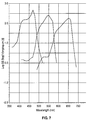
- the measured spectral sensitivity profiles of the blue sensitive record of Example 1 is shown in Figure 1.
- the spectral sensitivity profiles of the blue sensitive records of Examples 2 to 6, are shown in Figures 2 to 6, respectively.
- Each of several light sources was used to photograph a gray target with the six films.
- the light sources included Warm White Deluxe fluorescent, Cool White fluorescent, Ultralume(economy fluorescent), Mercury Vapor lights and a simulated daylight ("HMI").
- the films were processed in standard C-41 chemistry as described in British Journal of Photography Annual 1979 pg 204. Red, green and blue densities of each exposed negative were then measured.
- a KODAK KDPC automatic printer algorithm was then used to calculate the printer saturation parameter of each negative exposed under each light source when the printer is set up on the film exposed under the simulated daylight.
- Example 1 film which photographed the gray target under the simulated daylight was used as the standard negative (that is, D' was set to 0 for this negative) for the Example 1 film which photographed the gray target under the other lighting considitions.
- Example 2 film which photographed the gray film frame exposed under the simulated daylight illumination served as the standard negative for the Example 2 film which photographed the gray target under the other lighting conditions.
- a similar procedure was likewise followed for the films of Examples 3 through 6. To avoid contaminating the printer saturation results with the variability in gammas between the films of the EXAMPLES 1 to 6, the gammas of all films were corrected to 0.65 in the algorithm using the over/under setup parameters.
- Table 3 The film peak blue sensitivities are summarized below in Table 3 (two numbers indicate two peaks at the indicated wavelengths). Table 3 also shows the integrated spectral sensitivity between 425-450nm, IS (425-450) ), as a percentage of the total of all blue spectral sensitivity, IS (400-500) . Note that other than the comparative of Example 1, the foreoging percentage exceeds 25%. In each of the films of Examples 1 through 6, the maximum red sensitivity was at 652nm and the maximum green sensitivity was at 548nm. The values of the printer saturation for each negative under each lighting condition, are tabulated in Table 4 below. Average saturation values for each negative under all of the non-daylight lighting conditions, are provided in Table 4 under "Average" and also shown in Table 3.
- Examples 7 to 10 were prepared (Examples 7 and 9 are comparatives): EXAMPLES 7 and 8 share a common format as described below: The following layers were coated onto a clear acetate film support in the order cited: The amounts are in mg per square meter (mg/m2): Layer 1: Antihalation Layer grey silver 150.0 gelatin 1614.6 UV dye UV-1 75.3 UV dye UV-2 32.3 sequestrant and antistain agents as needed Layer 2: (Low Sensitivity Red-Sensitive Emulsion Layer) cyan emulsion CE-1 538.2 cyan emulsion CE-2 430.4 gelatin 1460.1 Coupler-1 478.8 Coupler-2 64.6 Coupler-3 5.4 Layer 3: Middle Sensitivity Red-Sensitive Emulsion Layer cyan emulsion CE-3 968.8 gelatin 1345.0 Coupler-3 43.04 Coupler-1 355.1 Coupler
- Layer 6 Low Sensitivity Green-Sensitive Emulsion Layer magenta emulsion ME-2 495.0 gelatin 1184.0 Coupler-6 301.3 Coupler-7 75.3 Layer 7: Middle Sensitivity Green-Sensitive Emulsion Layer magenta emulsion ME-3 914.9 gelatin 1162.5 Coupler-6 145.3 Coupler-7 53.8 Coupler-8 26.9 Layer 8: High Sensitivity Green-Sensitive Emulsion Layer magenta emulsion ME-4 753.5 gelatin 968.4 Coupler-6 64.6 Coupler-9 10.8 Coupler-7 43.0 Layer 9: Yellow Filter Layer gelatin 860.8 oxidized developer scavenger ODS 75.3 yellow Filter dye YFD 166.8 antistain agent, surfactants and antifoggant as needed.
- Layer 10 Low Sensitivity Blue-Sensitive Emulsion Layer yellow emulsion YE-1 161.5 yellow emulsion YE-2 107.6 yellow emulsion YE-3 269.1 gelatin 2280.1 Coupler-5 699.7 Coupler-10 592.0 Coupler-11 118.4 Coupler-2 5.4 Coupler-8 21.5
- Layer 11 High Sensitivity Blue-Sensitive Emulsion Layer yellow emulsion YE-4 559.7 gelatin 753.5 Coupler-5 178.7 Coupler-10 151.8 Coupler-11 57.0 Coupler-2 1.4 Coupler-8 5.4
- Layer 12 UV Absorbing Layer UV dye UV-1 107.6 UV dye UV-2 107.3 gelatin 699.7 Lippmann Silverbromide 215.3
- Layer 13 Protective Overcoat Layer gelatin 888.0 surfactants, lubricant, antistatic agent, soluble matte agent. Hardener bis(vinylsulfonylmethyl) ether is also added.
- This format shows a triple coated magenta record and a triple coated cyan record.
- the results can be demonstrated with double coated records.
- the layer order as presented in Eeles et al US 4,184,876 with the Fast Cyan above a slower magenta layer would also work. It is important to achieve for this example, consistent linear D LogE curves, the couplers and levels can be varied.
- the magenta and cyan emulsions are also not critical, as long as they have the necessary curve shape (that is, so that all color records have consistent DlogE curves of the same gamma). Also, the cyan and magenta emulsions must show spectral sensitivity commonly observed in color films.
- the maximum green spectral sensitivity should be in the range of 530-570nm
- the maximum red spectral sensitivity should be in the range of 590-670nm.
- the magenta emulsions be tabular grain emulsions so that the red record acutance is less degraded than if conventional emulsions are used in the magenta record.
- EXAMPLE 8 was coated the same as EXAMPLE 7 with the following exceptions: Emulsion YE-1 was replaced by Emulsion YE-1A. Emulsion YE-2 was replaced by Emulsion YE-2A. Emulsion YE-3 was replaced by Emulsion YE-3A. Emulsion YE-4 was replaced by Emulsion YE-4A; the latter used at 699.4 mg/m2.
- the yellow emulsions in EXAMPLE 8 are exactly like those in EXAMPLE 7 except the spectral sensitizing dye used is YD-1 and YD-26 at a 1:1 molar ratio.
- the film elements of EXAMPLES 7 and 8 are the same except for their blue spectral sensitization.
- the emulsion preparation procedure is well known, for example see US 4,439,520 or US 5,272,048.
- the iodide is added at 70% of the precipitation.
- Emulsions YE-1b and YE-2b have the iodide added during the interval of 17 to 95% of the precipitation.
- the remainer of the emulsions in the EXAMPLES 7 to 10 are run dump iodide of which 1.1% is added through 70% of the precipitation and 3% is added at the 70% point. All the emulsions follow a typical sulfur and gold chemical sensitization and a spectral sensitization with the respective sensitizing dyes.
- Layer 1 Antihalation Layer grey silver 150.0 UV dye UV-1 75.3 gelatin 2,421.0 sequestrants and antistain agents as needed
- Layer 2 Low Sensitivity Red-Sensitive Emulsion Layer Cyan Emulsion CE-1 527.2 Cyan Emulsion CE-5 527.2 Coupler-2 53.8 Coupler-1 538.0 gelatin 1,775.4
- Layer 3 Middle Sensitivity Red- Sensitive Emulsion Layer Cyan Emulsion CE-4A 807.0 Coupler-2 32.3 Coupler-1 258.2 Coupler-3 59.2 Coupler-4 43.0 gelatin 1,614.0
- Layer 4 High Sensitivity Red-Sensitive Emulsion Layer Cyan Emulsion CE-6 860.8 Coupler-1 96.8 Coupler-3 45.2 Coupler-4 43.0 Coupler-12 5.4 gelatin 1,718.4
- Layer 5 Interlayer ODS-1 75.3 gelatin 860.8
- Layer 6 Low Sensitivity Green-Sensitive Emulsion Layer Magenta Emulsion ME-1 258.3 Magent
- EXAMPLE 10 (Invention) is identical to EXAMPLE 9 with the following exceptions:
- Each of several light sources was used to photograph a gray target with the two films which differ only in the shape of the blue spectral sensitivity.
- the light sources included Warm White Deluxe fluorescent, Cool White fluorescent, Ultralume (economy fluorescent), Mercury Vapor lights and a simulated daylight ("HMI").
- the films were processed in standard C-41 chemistry as described in British Journal of Photography Annual 1979 pg 204.
- a Kodak KDPS automatic printer was then used to measure the printer saturation parameter of each negative exposed under each light source when the printer is set up on the film exposed under the simulated daylight.
- Example 7 film which photographed the gray target under the simulated daylight was used as the standard negative (that is, D' was set to 0 for this negative) for the Example 7 film which photographed the gray target under the other lighting considitions.
- Example 8 film which photographed the gray film frame exposed under the simulated daylight illumination served as the standard negative for the Example 8 film which photographed the gray target under the other lighting conditions.
- the exposed negatives were then printed in an automatic printer with two different settings of the printer correction algorithm (50% or 100% chromatic correction) to illustrate the advantages in final print color balance when negatives of the present invention are printed versus other negatives.
- the procedure consisted of (1) setting up the printer using as a standard negative, the negative from the film of the same example used to photograph the gray card under the an HMI simulated daylight so that the printer produced a perfect gray print on KODAK Edge photographic paper, and (2) using the automatic printer mechanism to print the exposed negatives made under the illuminants described using either (A) 50% chromatic correction or (B) 100% chromatic correction and the subject failure suppression (SFS) boundary described in Goll et al. reference, above.
- SFS subject failure suppression
- Procedure A is typical of a modern minilab operation while procedure B is typical of modern high volume photofinishing operation.
- the T-space boundary (described above) used in the examples below where procedure (B) was used (hue dependent color correction), was defined by the following points in T-space: Hue Saturation Hue 9 100 12 21 35 31 39 500 42 69 55 71 100 35 114
- the status A densities of the resulting prints were measured, and trilinear plotting analysis was used to determine the magnitude and direction of the residual color print balance.
- the values of the printer saturation and residual print balance are tabulated below.
- the film peak sensitivities are summarized below in Table 6 (two numbers indicate two peaks at the indicated wavelengths).
- the films of Examples 8 and 10 are inventive films, while those of Examples 7 and 9 are comparatives.
- the films of Examples 7 and 8 have matched red, green and blue gamma values.
- the films of Example 9 and 10 also have matched red, green and blue gamma values, but the gamma values of Example 9 and 10 films are higher than those of the films of Examples 7 and 8.
- the values for each light source are provided in Table 7 below.
- each inventive film when exposed under any of the described lights and processed in the automatic printer, provided a lower printer saturation value than a film not meeting the requirements of the present invention. Further, regardless of the type of printer correction, lower saturation values, as expected, lead to lower residual print color balance. Also, the type of printer correction algorithm used did not change this result. For example, this can be seen by comparing samples 1 and 5, or 11 and 15, or any other combination of inventive and non-inventive films exposed under the same lighting conditions, regardless of the printer correction used.
Landscapes
- Physics & Mathematics (AREA)
- General Physics & Mathematics (AREA)
- Silver Salt Photography Or Processing Solution Therefor (AREA)
- Control Of Exposure In Printing And Copying (AREA)
Applications Claiming Priority (2)
| Application Number | Priority Date | Filing Date | Title |
|---|---|---|---|
| US22823494A | 1994-04-15 | 1994-04-15 | |
| US228234 | 1994-04-15 |
Publications (2)
| Publication Number | Publication Date |
|---|---|
| EP0677782A1 true EP0677782A1 (fr) | 1995-10-18 |
| EP0677782B1 EP0677782B1 (fr) | 2003-10-29 |
Family
ID=22856346
Family Applications (1)
| Application Number | Title | Priority Date | Filing Date |
|---|---|---|---|
| EP95200938A Expired - Lifetime EP0677782B1 (fr) | 1994-04-15 | 1995-04-13 | Elément photographique comprenant une émulsion avec sensibilité particulière au bleu et méthode de traitement de celui-ci |
Country Status (4)
| Country | Link |
|---|---|
| US (1) | US5576157A (fr) |
| EP (1) | EP0677782B1 (fr) |
| JP (1) | JP3595018B2 (fr) |
| DE (1) | DE69532015T2 (fr) |
Cited By (4)
| Publication number | Priority date | Publication date | Assignee | Title |
|---|---|---|---|---|
| EP0866364A1 (fr) * | 1997-03-18 | 1998-09-23 | Agfa-Gevaert AG | Matériau d'enregistrement photographique en couleurs à haute sensibilité avec une sensibilité accrue dans la région spectrale bleue |
| EP0866368A3 (fr) * | 1997-03-18 | 1998-10-07 | Agfa-Gevaert AG | Matériau d'enregistrement photographique en couleurs à haute sensibilité avec une sensibilité accrue dans la région spectrale verte |
| EP0978762A1 (fr) * | 1998-08-05 | 2000-02-09 | Eastman Kodak Company | Elément de pellicule photographique ayant une large sensibilité au bleu |
| EP1022609A1 (fr) * | 1999-01-25 | 2000-07-26 | Eastman Kodak Company | Composés fragmentables donneurs d'électrons avec large sensibilisation spectrale au bleu |
Families Citing this family (3)
| Publication number | Priority date | Publication date | Assignee | Title |
|---|---|---|---|---|
| US6518008B1 (en) | 1999-01-25 | 2003-02-11 | Eastman Kodak Company | Fragmentable electron donor compounds in combination with high bromide tabular grain emulsions |
| US6531272B1 (en) | 1999-01-25 | 2003-03-11 | Eastman Kodak Company | Color photographic element containing a fragmentable electron donor for improved photographic response |
| JP2001075242A (ja) | 1999-09-06 | 2001-03-23 | Fuji Photo Film Co Ltd | ハロゲン化銀カラー写真感光材料 |
Citations (3)
| Publication number | Priority date | Publication date | Assignee | Title |
|---|---|---|---|---|
| US4611918A (en) * | 1983-03-24 | 1986-09-16 | Noritsu Kenkya Center Co., Ltd. | Method of determining the optimum exposure conditions for a color printer |
| US4663271A (en) * | 1985-03-04 | 1987-05-05 | Fuji Photo Film Co., Ltd. | Color photographic light-sensitive materials |
| EP0503549A1 (fr) * | 1991-03-12 | 1992-09-16 | Konica Corporation | Un matériau photographique couleur à l'halogénure d'argent sensible à la lumière |
Family Cites Families (31)
| Publication number | Priority date | Publication date | Assignee | Title |
|---|---|---|---|---|
| US3652284A (en) * | 1968-11-04 | 1972-03-28 | Eastman Kodak Co | Photographic silver halide emulsion containing a methine dye |
| BE756607R (fr) * | 1969-09-29 | 1971-03-01 | Eastman Kodak Co | |
| JPS511419B1 (fr) * | 1971-02-09 | 1976-01-17 | ||
| JPS5037538B2 (fr) * | 1972-01-24 | 1975-12-03 | ||
| US4320193A (en) * | 1980-05-21 | 1982-03-16 | Bristol-Myers Company | Photographic emulsions having special chromatic effects |
| US4359280A (en) * | 1980-07-28 | 1982-11-16 | Peter Krause | Process and system for variable contrast color photographic imaging |
| EP0082649B1 (fr) * | 1981-12-19 | 1986-11-05 | Konica Corporation | Matériau photosensible d'halogénure d'argent pour la photographie en couleurs |
| JPS60118833A (ja) * | 1983-11-30 | 1985-06-26 | Fuji Photo Film Co Ltd | ハロゲン化銀写真乳剤 |
| JPH07117718B2 (ja) * | 1985-02-26 | 1995-12-18 | 富士写真フイルム株式会社 | カラー写真感光材料 |
| JPS62160449A (ja) * | 1986-01-08 | 1987-07-16 | Fuji Photo Film Co Ltd | カラ−写真感光材料 |
| JPH0690463B2 (ja) * | 1986-01-08 | 1994-11-14 | 富士写真フイルム株式会社 | カラ−写真感光材料 |
| JPS62178965A (ja) * | 1986-02-03 | 1987-08-06 | Fuji Photo Film Co Ltd | ハロゲン化銀カラ−反転写真感光材料 |
| JP2645367B2 (ja) * | 1987-06-25 | 1997-08-25 | 富士写真フイルム株式会社 | ハロゲン化銀カラー写真感光材料及びその処理方法 |
| JPH0750310B2 (ja) * | 1987-09-10 | 1995-05-31 | 富士写真フイルム株式会社 | 写真感光材料およびその処理方法 |
| JPH0652397B2 (ja) * | 1987-09-11 | 1994-07-06 | 富士写真フイルム株式会社 | 感光材料包装ユニット |
| JPH0769583B2 (ja) * | 1987-10-26 | 1995-07-31 | 富士写真フイルム株式会社 | ハロゲン化銀写真感光材料 |
| JPH02167539A (ja) * | 1988-09-14 | 1990-06-27 | Fuji Photo Film Co Ltd | ハロゲン化銀写真感光材料 |
| JP2571429B2 (ja) * | 1988-12-26 | 1997-01-16 | 富士写真フイルム株式会社 | ハロゲン化銀カラー写真感光材料 |
| JPH02302755A (ja) * | 1989-05-17 | 1990-12-14 | Konica Corp | ハロゲン化銀写真感光材料 |
| US5185237A (en) * | 1989-06-13 | 1993-02-09 | Fuji Photo Film Co., Ltd. | Silver halide color photographic material and process for the formation of color images thereon |
| JP2881315B2 (ja) * | 1989-10-04 | 1999-04-12 | コニカ株式会社 | 階調及び処理安定性等に優れるハロゲン化銀写真感光材料 |
| JP2614120B2 (ja) * | 1989-10-25 | 1997-05-28 | 富士写真フイルム株式会社 | 色再現および調子再現の改良されたハロゲン化銀カラー写真感光材料 |
| US5180657A (en) * | 1989-12-22 | 1993-01-19 | Konica Corporation | Color photographic light-sensitive material offering excellent hue reproduction |
| US5200308A (en) * | 1990-01-19 | 1993-04-06 | Konica Corporation | Color photographic material |
| JP2757063B2 (ja) * | 1990-05-14 | 1998-05-25 | 富士写真フイルム株式会社 | ハロゲン化銀写真感光材料 |
| JP2884371B2 (ja) * | 1990-09-04 | 1999-04-19 | コニカ株式会社 | ハロゲン化銀カラー写真感光材料 |
| JP3041724B2 (ja) * | 1991-01-25 | 2000-05-15 | コニカ株式会社 | 色相再現性に優れたハロゲン化銀カラー写真感光材料 |
| US5250403A (en) * | 1991-04-03 | 1993-10-05 | Eastman Kodak Company | Photographic elements including highly uniform silver bromoiodide tabular grain emulsions |
| IT1245856B (it) * | 1991-04-03 | 1994-10-25 | Minnesota Mining & Mfg | Materiale fotografico a colori a piu' strati agli alogenuri d'argento comprendente un supersensibilizzatore disolfurico |
| US5272048A (en) * | 1991-05-14 | 1993-12-21 | Eastman Kodak Company | Reversal photographic elements containing tabular grain emulsions |
| JPH05289266A (ja) * | 1992-04-09 | 1993-11-05 | Konica Corp | ハロゲン化銀カラー写真画像形成方法 |
-
1995
- 1995-04-13 EP EP95200938A patent/EP0677782B1/fr not_active Expired - Lifetime
- 1995-04-13 DE DE69532015T patent/DE69532015T2/de not_active Expired - Fee Related
- 1995-04-14 JP JP8964095A patent/JP3595018B2/ja not_active Expired - Fee Related
- 1995-06-07 US US08/473,685 patent/US5576157A/en not_active Expired - Fee Related
Patent Citations (3)
| Publication number | Priority date | Publication date | Assignee | Title |
|---|---|---|---|---|
| US4611918A (en) * | 1983-03-24 | 1986-09-16 | Noritsu Kenkya Center Co., Ltd. | Method of determining the optimum exposure conditions for a color printer |
| US4663271A (en) * | 1985-03-04 | 1987-05-05 | Fuji Photo Film Co., Ltd. | Color photographic light-sensitive materials |
| EP0503549A1 (fr) * | 1991-03-12 | 1992-09-16 | Konica Corporation | Un matériau photographique couleur à l'halogénure d'argent sensible à la lumière |
Cited By (7)
| Publication number | Priority date | Publication date | Assignee | Title |
|---|---|---|---|---|
| EP0866364A1 (fr) * | 1997-03-18 | 1998-09-23 | Agfa-Gevaert AG | Matériau d'enregistrement photographique en couleurs à haute sensibilité avec une sensibilité accrue dans la région spectrale bleue |
| EP0866368A3 (fr) * | 1997-03-18 | 1998-10-07 | Agfa-Gevaert AG | Matériau d'enregistrement photographique en couleurs à haute sensibilité avec une sensibilité accrue dans la région spectrale verte |
| US6040125A (en) * | 1997-03-18 | 2000-03-21 | Agfa-Gevaert Nv | High-speed color photographic recording material having increased sensitivity in the blue spectral region |
| EP0978762A1 (fr) * | 1998-08-05 | 2000-02-09 | Eastman Kodak Company | Elément de pellicule photographique ayant une large sensibilité au bleu |
| US6225037B1 (en) | 1998-08-05 | 2001-05-01 | Eastman Kodak Company | Photographic film element with broad blue sensitivity |
| EP1022609A1 (fr) * | 1999-01-25 | 2000-07-26 | Eastman Kodak Company | Composés fragmentables donneurs d'électrons avec large sensibilisation spectrale au bleu |
| US6509144B1 (en) | 1999-01-25 | 2003-01-21 | Eastman Kodak Company | Fragmentable electron donor compounds combined with broad blue spectral sensitization |
Also Published As
| Publication number | Publication date |
|---|---|
| EP0677782B1 (fr) | 2003-10-29 |
| JP3595018B2 (ja) | 2004-12-02 |
| DE69532015D1 (de) | 2003-12-04 |
| JPH0844009A (ja) | 1996-02-16 |
| US5576157A (en) | 1996-11-19 |
| DE69532015T2 (de) | 2004-06-24 |
Similar Documents
| Publication | Publication Date | Title |
|---|---|---|
| JP3041724B2 (ja) | 色相再現性に優れたハロゲン化銀カラー写真感光材料 | |
| EP0684511B1 (fr) | Pellicule à contraste bas | |
| US5705327A (en) | Color negative films with non-linear characteristic curve shape for telecine transfer applications | |
| EP0677782B1 (fr) | Elément photographique comprenant une émulsion avec sensibilité particulière au bleu et méthode de traitement de celui-ci | |
| EP0677783B1 (fr) | Elément photographique comprenant une émulsion particulière sensibilisée au bleu à grains tabulaires et méthode de traitement de celui-ci | |
| EP0721147B1 (fr) | Pellicule négative couleur avec contraste réglé pour balayage électronique | |
| US4521507A (en) | Multi-layer light-sensitive silver halide color photographic material | |
| US5750320A (en) | Color motion picture print films for telecine transfer applications | |
| US5576128A (en) | Color negative films with low mid-scale contrast for telecine transfer applications | |
| EP0677774B1 (fr) | Eléments photographiques contenant une émulsion à grains tabulaires présentant une sensibilisation particulière au bleu | |
| US6372418B1 (en) | Color motion picture print film with improved tonescale | |
| US6093526A (en) | Photographic film element containing an emulsion with broadened green responsivity | |
| US6045983A (en) | Color negative films adapted for digital scanning | |
| US5563027A (en) | Color reversal electronic output film | |
| USH1243H (en) | Silver halide color photographic light-sensitive material | |
| US5932403A (en) | Silver halide photographic light sensitive material having silver halide emulsion blends in the fast layer | |
| EP0740195B1 (fr) | Eléments photographiques à l'halogénure d'argent comprenant des colorants sensibilisateurs spécifiques pour le bleu | |
| EP0447138A1 (fr) | Matériau photographique couleur sensible à la lumière | |
| JP2881330B2 (ja) | 色相再現に優れたカラー写真感光材料 | |
| EP0775938A1 (fr) | Combinaison de colorant filtre jaune et copulant magenta pyrazolone à 4 équivalents | |
| JP2002196458A (ja) | 写真要素 | |
| JPH03264955A (ja) | 色相再現性に優れたカラー写真感光材料 | |
| EP0501465A1 (fr) | Matériau photographique couleur à l'halogénure d'argent sensible à la lumière |
Legal Events
| Date | Code | Title | Description |
|---|---|---|---|
| PUAI | Public reference made under article 153(3) epc to a published international application that has entered the european phase |
Free format text: ORIGINAL CODE: 0009012 |
|
| AK | Designated contracting states |
Kind code of ref document: A1 Designated state(s): BE CH DE FR GB IT LI NL |
|
| 17P | Request for examination filed |
Effective date: 19960313 |
|
| 17Q | First examination report despatched |
Effective date: 19990706 |
|
| GRAH | Despatch of communication of intention to grant a patent |
Free format text: ORIGINAL CODE: EPIDOS IGRA |
|
| GRAH | Despatch of communication of intention to grant a patent |
Free format text: ORIGINAL CODE: EPIDOS IGRA |
|
| GRAS | Grant fee paid |
Free format text: ORIGINAL CODE: EPIDOSNIGR3 |
|
| RBV | Designated contracting states (corrected) |
Designated state(s): DE GB |
|
| GRAA | (expected) grant |
Free format text: ORIGINAL CODE: 0009210 |
|
| AK | Designated contracting states |
Kind code of ref document: B1 Designated state(s): DE GB |
|
| REG | Reference to a national code |
Ref country code: GB Ref legal event code: FG4D |
|
| REF | Corresponds to: |
Ref document number: 69532015 Country of ref document: DE Date of ref document: 20031204 Kind code of ref document: P |
|
| PLBE | No opposition filed within time limit |
Free format text: ORIGINAL CODE: 0009261 |
|
| STAA | Information on the status of an ep patent application or granted ep patent |
Free format text: STATUS: NO OPPOSITION FILED WITHIN TIME LIMIT |
|
| 26N | No opposition filed |
Effective date: 20040730 |
|
| PGFP | Annual fee paid to national office [announced via postgrant information from national office to epo] |
Ref country code: GB Payment date: 20050314 Year of fee payment: 11 |
|
| PGFP | Annual fee paid to national office [announced via postgrant information from national office to epo] |
Ref country code: DE Payment date: 20050429 Year of fee payment: 11 |
|
| PG25 | Lapsed in a contracting state [announced via postgrant information from national office to epo] |
Ref country code: GB Free format text: LAPSE BECAUSE OF NON-PAYMENT OF DUE FEES Effective date: 20060413 |
|
| PG25 | Lapsed in a contracting state [announced via postgrant information from national office to epo] |
Ref country code: DE Free format text: LAPSE BECAUSE OF NON-PAYMENT OF DUE FEES Effective date: 20061101 |
|
| GBPC | Gb: european patent ceased through non-payment of renewal fee |
Effective date: 20060413 |