EP0682111A1 - Animal transgénique ou chimérique et procédé de criblage de produits pharmaceutiques - Google Patents
Animal transgénique ou chimérique et procédé de criblage de produits pharmaceutiques Download PDFInfo
- Publication number
- EP0682111A1 EP0682111A1 EP95107951A EP95107951A EP0682111A1 EP 0682111 A1 EP0682111 A1 EP 0682111A1 EP 95107951 A EP95107951 A EP 95107951A EP 95107951 A EP95107951 A EP 95107951A EP 0682111 A1 EP0682111 A1 EP 0682111A1
- Authority
- EP
- European Patent Office
- Prior art keywords
- gene
- dna
- recipient
- sequence
- insertion dna
- Prior art date
- Legal status (The legal status is an assumption and is not a legal conclusion. Google has not performed a legal analysis and makes no representation as to the accuracy of the status listed.)
- Granted
Links
- 241001465754 Metazoa Species 0.000 title claims abstract description 52
- 230000009261 transgenic effect Effects 0.000 title claims abstract description 27
- 238000000034 method Methods 0.000 title claims description 31
- 239000000825 pharmaceutical preparation Substances 0.000 title claims description 4
- 229940127557 pharmaceutical product Drugs 0.000 title claims description 4
- 238000012216 screening Methods 0.000 title claims 2
- 230000008569 process Effects 0.000 title description 8
- 108090000623 proteins and genes Proteins 0.000 claims abstract description 198
- 238000003780 insertion Methods 0.000 claims abstract description 128
- 230000037431 insertion Effects 0.000 claims abstract description 128
- 230000000295 complement effect Effects 0.000 claims abstract description 16
- 108020004414 DNA Proteins 0.000 claims description 64
- 210000004027 cell Anatomy 0.000 claims description 46
- 230000006801 homologous recombination Effects 0.000 claims description 32
- 238000002744 homologous recombination Methods 0.000 claims description 32
- 230000000694 effects Effects 0.000 claims description 23
- 108091026890 Coding region Proteins 0.000 claims description 21
- 230000001105 regulatory effect Effects 0.000 claims description 21
- 239000012634 fragment Substances 0.000 claims description 16
- 239000003795 chemical substances by application Substances 0.000 claims description 12
- 230000002068 genetic effect Effects 0.000 claims description 10
- 208000037265 diseases, disorders, signs and symptoms Diseases 0.000 claims description 8
- 201000010099 disease Diseases 0.000 claims description 7
- 239000003550 marker Substances 0.000 claims description 5
- 230000001575 pathological effect Effects 0.000 claims description 4
- 238000009830 intercalation Methods 0.000 claims description 3
- 108020004707 nucleic acids Proteins 0.000 claims description 3
- 102000039446 nucleic acids Human genes 0.000 claims description 3
- 150000007523 nucleic acids Chemical class 0.000 claims description 3
- 238000002372 labelling Methods 0.000 claims description 2
- 210000004102 animal cell Anatomy 0.000 claims 1
- 239000013612 plasmid Substances 0.000 description 61
- 101100507941 Mus musculus Hoxc8 gene Proteins 0.000 description 57
- 101001045158 Homo sapiens Homeobox protein Hox-C8 Proteins 0.000 description 50
- 102100022601 Homeobox protein Hox-C8 Human genes 0.000 description 49
- 238000002703 mutagenesis Methods 0.000 description 27
- 231100000350 mutagenesis Toxicity 0.000 description 27
- 108010005774 beta-Galactosidase Proteins 0.000 description 22
- 210000001671 embryonic stem cell Anatomy 0.000 description 19
- 238000013518 transcription Methods 0.000 description 18
- 230000035897 transcription Effects 0.000 description 18
- 101150066555 lacZ gene Proteins 0.000 description 17
- 102000005936 beta-Galactosidase Human genes 0.000 description 14
- 230000010354 integration Effects 0.000 description 12
- 238000004519 manufacturing process Methods 0.000 description 11
- 230000004048 modification Effects 0.000 description 11
- 238000012986 modification Methods 0.000 description 11
- 108700028369 Alleles Proteins 0.000 description 9
- 210000003527 eukaryotic cell Anatomy 0.000 description 9
- 210000000276 neural tube Anatomy 0.000 description 9
- 101150004541 HOXC8 gene Proteins 0.000 description 8
- 108010091358 Hypoxanthine Phosphoribosyltransferase Proteins 0.000 description 8
- 238000004458 analytical method Methods 0.000 description 8
- 238000010367 cloning Methods 0.000 description 8
- 238000011161 development Methods 0.000 description 8
- 230000018109 developmental process Effects 0.000 description 8
- 210000002257 embryonic structure Anatomy 0.000 description 8
- 210000004602 germ cell Anatomy 0.000 description 8
- 230000002779 inactivation Effects 0.000 description 8
- 239000000523 sample Substances 0.000 description 8
- 238000011144 upstream manufacturing Methods 0.000 description 8
- WQZGKKKJIJFFOK-FPRJBGLDSA-N beta-D-galactose Chemical compound OC[C@H]1O[C@@H](O)[C@H](O)[C@@H](O)[C@H]1O WQZGKKKJIJFFOK-FPRJBGLDSA-N 0.000 description 7
- 238000002474 experimental method Methods 0.000 description 7
- 230000000977 initiatory effect Effects 0.000 description 7
- 230000035772 mutation Effects 0.000 description 7
- 230000008488 polyadenylation Effects 0.000 description 7
- 230000008685 targeting Effects 0.000 description 7
- 238000013519 translation Methods 0.000 description 7
- 229930193140 Neomycin Natural products 0.000 description 6
- 108091028043 Nucleic acid sequence Proteins 0.000 description 6
- 108091034117 Oligonucleotide Proteins 0.000 description 6
- 108091081024 Start codon Proteins 0.000 description 6
- 238000010276 construction Methods 0.000 description 6
- 239000003623 enhancer Substances 0.000 description 6
- 230000006870 function Effects 0.000 description 6
- 230000000415 inactivating effect Effects 0.000 description 6
- 108020004999 messenger RNA Proteins 0.000 description 6
- 229960004927 neomycin Drugs 0.000 description 6
- 238000003752 polymerase chain reaction Methods 0.000 description 6
- 210000001519 tissue Anatomy 0.000 description 6
- 238000001890 transfection Methods 0.000 description 6
- 102000004190 Enzymes Human genes 0.000 description 5
- 108090000790 Enzymes Proteins 0.000 description 5
- 241000206602 Eukaryota Species 0.000 description 5
- 102000018251 Hypoxanthine Phosphoribosyltransferase Human genes 0.000 description 5
- 108091000080 Phosphotransferase Proteins 0.000 description 5
- 230000029087 digestion Effects 0.000 description 5
- 238000004520 electroporation Methods 0.000 description 5
- 102000020233 phosphotransferase Human genes 0.000 description 5
- 108020003175 receptors Proteins 0.000 description 5
- 241000588724 Escherichia coli Species 0.000 description 4
- 241000251539 Vertebrata <Metazoa> Species 0.000 description 4
- 230000001413 cellular effect Effects 0.000 description 4
- 230000002759 chromosomal effect Effects 0.000 description 4
- 238000009396 hybridization Methods 0.000 description 4
- 230000007246 mechanism Effects 0.000 description 4
- 230000006798 recombination Effects 0.000 description 4
- 238000005215 recombination Methods 0.000 description 4
- 241000894006 Bacteria Species 0.000 description 3
- 108091035707 Consensus sequence Proteins 0.000 description 3
- 108010054576 Deoxyribonuclease EcoRI Proteins 0.000 description 3
- 241001529936 Murinae Species 0.000 description 3
- 241000699666 Mus <mouse, genus> Species 0.000 description 3
- 241000699670 Mus sp. Species 0.000 description 3
- 241000700605 Viruses Species 0.000 description 3
- 230000001580 bacterial effect Effects 0.000 description 3
- 210000002459 blastocyst Anatomy 0.000 description 3
- 230000015556 catabolic process Effects 0.000 description 3
- 239000002299 complementary DNA Substances 0.000 description 3
- 238000006731 degradation reaction Methods 0.000 description 3
- 238000009826 distribution Methods 0.000 description 3
- 210000003981 ectoderm Anatomy 0.000 description 3
- 238000007901 in situ hybridization Methods 0.000 description 3
- 239000012678 infectious agent Substances 0.000 description 3
- 239000002773 nucleotide Substances 0.000 description 3
- 125000003729 nucleotide group Chemical group 0.000 description 3
- 102000004169 proteins and genes Human genes 0.000 description 3
- 102000005962 receptors Human genes 0.000 description 3
- 238000011160 research Methods 0.000 description 3
- 238000012163 sequencing technique Methods 0.000 description 3
- 108091032973 (ribonucleotides)n+m Proteins 0.000 description 2
- 108020004705 Codon Proteins 0.000 description 2
- 241000701533 Escherichia virus T4 Species 0.000 description 2
- TWRXJAOTZQYOKJ-UHFFFAOYSA-L Magnesium chloride Chemical compound [Mg+2].[Cl-].[Cl-] TWRXJAOTZQYOKJ-UHFFFAOYSA-L 0.000 description 2
- 208000021642 Muscular disease Diseases 0.000 description 2
- 201000009623 Myopathy Diseases 0.000 description 2
- 241000030538 Thecla Species 0.000 description 2
- JLCPHMBAVCMARE-UHFFFAOYSA-N [3-[[3-[[3-[[3-[[3-[[3-[[3-[[3-[[3-[[3-[[3-[[5-(2-amino-6-oxo-1H-purin-9-yl)-3-[[3-[[3-[[3-[[3-[[3-[[5-(2-amino-6-oxo-1H-purin-9-yl)-3-[[5-(2-amino-6-oxo-1H-purin-9-yl)-3-hydroxyoxolan-2-yl]methoxy-hydroxyphosphoryl]oxyoxolan-2-yl]methoxy-hydroxyphosphoryl]oxy-5-(5-methyl-2,4-dioxopyrimidin-1-yl)oxolan-2-yl]methoxy-hydroxyphosphoryl]oxy-5-(6-aminopurin-9-yl)oxolan-2-yl]methoxy-hydroxyphosphoryl]oxy-5-(6-aminopurin-9-yl)oxolan-2-yl]methoxy-hydroxyphosphoryl]oxy-5-(6-aminopurin-9-yl)oxolan-2-yl]methoxy-hydroxyphosphoryl]oxy-5-(6-aminopurin-9-yl)oxolan-2-yl]methoxy-hydroxyphosphoryl]oxyoxolan-2-yl]methoxy-hydroxyphosphoryl]oxy-5-(5-methyl-2,4-dioxopyrimidin-1-yl)oxolan-2-yl]methoxy-hydroxyphosphoryl]oxy-5-(4-amino-2-oxopyrimidin-1-yl)oxolan-2-yl]methoxy-hydroxyphosphoryl]oxy-5-(5-methyl-2,4-dioxopyrimidin-1-yl)oxolan-2-yl]methoxy-hydroxyphosphoryl]oxy-5-(5-methyl-2,4-dioxopyrimidin-1-yl)oxolan-2-yl]methoxy-hydroxyphosphoryl]oxy-5-(6-aminopurin-9-yl)oxolan-2-yl]methoxy-hydroxyphosphoryl]oxy-5-(6-aminopurin-9-yl)oxolan-2-yl]methoxy-hydroxyphosphoryl]oxy-5-(4-amino-2-oxopyrimidin-1-yl)oxolan-2-yl]methoxy-hydroxyphosphoryl]oxy-5-(4-amino-2-oxopyrimidin-1-yl)oxolan-2-yl]methoxy-hydroxyphosphoryl]oxy-5-(4-amino-2-oxopyrimidin-1-yl)oxolan-2-yl]methoxy-hydroxyphosphoryl]oxy-5-(6-aminopurin-9-yl)oxolan-2-yl]methoxy-hydroxyphosphoryl]oxy-5-(4-amino-2-oxopyrimidin-1-yl)oxolan-2-yl]methyl [5-(6-aminopurin-9-yl)-2-(hydroxymethyl)oxolan-3-yl] hydrogen phosphate Polymers Cc1cn(C2CC(OP(O)(=O)OCC3OC(CC3OP(O)(=O)OCC3OC(CC3O)n3cnc4c3nc(N)[nH]c4=O)n3cnc4c3nc(N)[nH]c4=O)C(COP(O)(=O)OC3CC(OC3COP(O)(=O)OC3CC(OC3COP(O)(=O)OC3CC(OC3COP(O)(=O)OC3CC(OC3COP(O)(=O)OC3CC(OC3COP(O)(=O)OC3CC(OC3COP(O)(=O)OC3CC(OC3COP(O)(=O)OC3CC(OC3COP(O)(=O)OC3CC(OC3COP(O)(=O)OC3CC(OC3COP(O)(=O)OC3CC(OC3COP(O)(=O)OC3CC(OC3COP(O)(=O)OC3CC(OC3COP(O)(=O)OC3CC(OC3COP(O)(=O)OC3CC(OC3COP(O)(=O)OC3CC(OC3COP(O)(=O)OC3CC(OC3CO)n3cnc4c(N)ncnc34)n3ccc(N)nc3=O)n3cnc4c(N)ncnc34)n3ccc(N)nc3=O)n3ccc(N)nc3=O)n3ccc(N)nc3=O)n3cnc4c(N)ncnc34)n3cnc4c(N)ncnc34)n3cc(C)c(=O)[nH]c3=O)n3cc(C)c(=O)[nH]c3=O)n3ccc(N)nc3=O)n3cc(C)c(=O)[nH]c3=O)n3cnc4c3nc(N)[nH]c4=O)n3cnc4c(N)ncnc34)n3cnc4c(N)ncnc34)n3cnc4c(N)ncnc34)n3cnc4c(N)ncnc34)O2)c(=O)[nH]c1=O JLCPHMBAVCMARE-UHFFFAOYSA-N 0.000 description 2
- 230000004913 activation Effects 0.000 description 2
- 239000012190 activator Substances 0.000 description 2
- 239000011543 agarose gel Substances 0.000 description 2
- SHGAZHPCJJPHSC-YCNIQYBTSA-N all-trans-retinoic acid Chemical compound OC(=O)\C=C(/C)\C=C\C=C(/C)\C=C\C1=C(C)CCCC1(C)C SHGAZHPCJJPHSC-YCNIQYBTSA-N 0.000 description 2
- 230000008901 benefit Effects 0.000 description 2
- 230000015572 biosynthetic process Effects 0.000 description 2
- 239000002131 composite material Substances 0.000 description 2
- 238000012217 deletion Methods 0.000 description 2
- 230000037430 deletion Effects 0.000 description 2
- 238000001514 detection method Methods 0.000 description 2
- 210000002308 embryonic cell Anatomy 0.000 description 2
- ZMMJGEGLRURXTF-UHFFFAOYSA-N ethidium bromide Chemical compound [Br-].C12=CC(N)=CC=C2C2=CC=C(N)C=C2[N+](CC)=C1C1=CC=CC=C1 ZMMJGEGLRURXTF-UHFFFAOYSA-N 0.000 description 2
- 229960005542 ethidium bromide Drugs 0.000 description 2
- 230000004927 fusion Effects 0.000 description 2
- 238000001415 gene therapy Methods 0.000 description 2
- 230000006872 improvement Effects 0.000 description 2
- 231100000518 lethal Toxicity 0.000 description 2
- 230000001665 lethal effect Effects 0.000 description 2
- 230000001537 neural effect Effects 0.000 description 2
- 230000007170 pathology Effects 0.000 description 2
- 239000011541 reaction mixture Substances 0.000 description 2
- 230000010076 replication Effects 0.000 description 2
- 108091008146 restriction endonucleases Proteins 0.000 description 2
- 229930002330 retinoic acid Natural products 0.000 description 2
- 239000000758 substrate Substances 0.000 description 2
- 208000001608 teratocarcinoma Diseases 0.000 description 2
- 230000014621 translational initiation Effects 0.000 description 2
- 229960001727 tretinoin Drugs 0.000 description 2
- DGVVWUTYPXICAM-UHFFFAOYSA-N β‐Mercaptoethanol Chemical compound OCCS DGVVWUTYPXICAM-UHFFFAOYSA-N 0.000 description 2
- QKNYBSVHEMOAJP-UHFFFAOYSA-N 2-amino-2-(hydroxymethyl)propane-1,3-diol;hydron;chloride Chemical compound Cl.OCC(N)(CO)CO QKNYBSVHEMOAJP-UHFFFAOYSA-N 0.000 description 1
- OPIFSICVWOWJMJ-AEOCFKNESA-N 5-bromo-4-chloro-3-indolyl beta-D-galactoside Chemical compound O[C@@H]1[C@@H](O)[C@@H](O)[C@@H](CO)O[C@H]1OC1=CNC2=CC=C(Br)C(Cl)=C12 OPIFSICVWOWJMJ-AEOCFKNESA-N 0.000 description 1
- 201000009030 Carcinoma Diseases 0.000 description 1
- 240000000244 Crotalaria pallida Species 0.000 description 1
- 102000012410 DNA Ligases Human genes 0.000 description 1
- 108010061982 DNA Ligases Proteins 0.000 description 1
- 108010017826 DNA Polymerase I Proteins 0.000 description 1
- 102000004594 DNA Polymerase I Human genes 0.000 description 1
- 108010014303 DNA-directed DNA polymerase Proteins 0.000 description 1
- 102000016928 DNA-directed DNA polymerase Human genes 0.000 description 1
- 241000255581 Drosophila <fruit fly, genus> Species 0.000 description 1
- 108010010803 Gelatin Proteins 0.000 description 1
- 108700005087 Homeobox Genes Proteins 0.000 description 1
- 102000014150 Interferons Human genes 0.000 description 1
- 108010050904 Interferons Proteins 0.000 description 1
- 102000015696 Interleukins Human genes 0.000 description 1
- 108010063738 Interleukins Proteins 0.000 description 1
- 241000124008 Mammalia Species 0.000 description 1
- 241001045988 Neogene Species 0.000 description 1
- 101710163270 Nuclease Proteins 0.000 description 1
- 102000043276 Oncogene Human genes 0.000 description 1
- 108700020796 Oncogene Proteins 0.000 description 1
- 108010021757 Polynucleotide 5'-Hydroxyl-Kinase Proteins 0.000 description 1
- 102000008422 Polynucleotide 5'-hydroxyl-kinase Human genes 0.000 description 1
- 241001505332 Polyomavirus sp. Species 0.000 description 1
- 108700008625 Reporter Genes Proteins 0.000 description 1
- 102000006382 Ribonucleases Human genes 0.000 description 1
- 108010083644 Ribonucleases Proteins 0.000 description 1
- 241000714474 Rous sarcoma virus Species 0.000 description 1
- 240000004808 Saccharomyces cerevisiae Species 0.000 description 1
- 108010006785 Taq Polymerase Proteins 0.000 description 1
- 108091023040 Transcription factor Proteins 0.000 description 1
- 102000040945 Transcription factor Human genes 0.000 description 1
- 240000004922 Vigna radiata Species 0.000 description 1
- 235000010721 Vigna radiata var radiata Nutrition 0.000 description 1
- 235000011469 Vigna radiata var sublobata Nutrition 0.000 description 1
- 102000018265 Virus Receptors Human genes 0.000 description 1
- 108010066342 Virus Receptors Proteins 0.000 description 1
- 239000002253 acid Substances 0.000 description 1
- 230000001800 adrenalinergic effect Effects 0.000 description 1
- 230000003321 amplification Effects 0.000 description 1
- 239000000427 antigen Substances 0.000 description 1
- 108091007433 antigens Proteins 0.000 description 1
- 102000036639 antigens Human genes 0.000 description 1
- 238000013459 approach Methods 0.000 description 1
- 238000003556 assay Methods 0.000 description 1
- 230000006399 behavior Effects 0.000 description 1
- 238000009835 boiling Methods 0.000 description 1
- 239000002771 cell marker Substances 0.000 description 1
- 210000000349 chromosome Anatomy 0.000 description 1
- 238000003776 cleavage reaction Methods 0.000 description 1
- 239000000470 constituent Substances 0.000 description 1
- 238000007796 conventional method Methods 0.000 description 1
- 238000012937 correction Methods 0.000 description 1
- 238000009402 cross-breeding Methods 0.000 description 1
- SUYVUBYJARFZHO-RRKCRQDMSA-N dATP Chemical compound C1=NC=2C(N)=NC=NC=2N1[C@H]1C[C@H](O)[C@@H](COP(O)(=O)OP(O)(=O)OP(O)(O)=O)O1 SUYVUBYJARFZHO-RRKCRQDMSA-N 0.000 description 1
- SUYVUBYJARFZHO-UHFFFAOYSA-N dATP Natural products C1=NC=2C(N)=NC=NC=2N1C1CC(O)C(COP(O)(=O)OP(O)(=O)OP(O)(O)=O)O1 SUYVUBYJARFZHO-UHFFFAOYSA-N 0.000 description 1
- RGWHQCVHVJXOKC-SHYZEUOFSA-J dCTP(4-) Chemical compound O=C1N=C(N)C=CN1[C@@H]1O[C@H](COP([O-])(=O)OP([O-])(=O)OP([O-])([O-])=O)[C@@H](O)C1 RGWHQCVHVJXOKC-SHYZEUOFSA-J 0.000 description 1
- HAAZLUGHYHWQIW-KVQBGUIXSA-N dGTP Chemical compound C1=NC=2C(=O)NC(N)=NC=2N1[C@H]1C[C@H](O)[C@@H](COP(O)(=O)OP(O)(=O)OP(O)(O)=O)O1 HAAZLUGHYHWQIW-KVQBGUIXSA-N 0.000 description 1
- NHVNXKFIZYSCEB-XLPZGREQSA-N dTTP Chemical compound O=C1NC(=O)C(C)=CN1[C@@H]1O[C@H](COP(O)(=O)OP(O)(=O)OP(O)(O)=O)[C@@H](O)C1 NHVNXKFIZYSCEB-XLPZGREQSA-N 0.000 description 1
- 208000035475 disorder Diseases 0.000 description 1
- 238000001962 electrophoresis Methods 0.000 description 1
- 230000013020 embryo development Effects 0.000 description 1
- 238000005516 engineering process Methods 0.000 description 1
- 230000004720 fertilization Effects 0.000 description 1
- 230000003328 fibroblastic effect Effects 0.000 description 1
- -1 for example Proteins 0.000 description 1
- 108020001507 fusion proteins Proteins 0.000 description 1
- 102000037865 fusion proteins Human genes 0.000 description 1
- 230000007045 gastrulation Effects 0.000 description 1
- 239000000499 gel Substances 0.000 description 1
- 239000008273 gelatin Substances 0.000 description 1
- 229920000159 gelatin Polymers 0.000 description 1
- 235000019322 gelatine Nutrition 0.000 description 1
- 235000011852 gelatine desserts Nutrition 0.000 description 1
- 238000012239 gene modification Methods 0.000 description 1
- 230000005017 genetic modification Effects 0.000 description 1
- 235000013617 genetically modified food Nutrition 0.000 description 1
- 230000012010 growth Effects 0.000 description 1
- 239000003102 growth factor Substances 0.000 description 1
- 230000036039 immunity Effects 0.000 description 1
- 238000000338 in vitro Methods 0.000 description 1
- 238000001727 in vivo Methods 0.000 description 1
- 238000012966 insertion method Methods 0.000 description 1
- 229940079322 interferon Drugs 0.000 description 1
- 230000001788 irregular Effects 0.000 description 1
- 229960000318 kanamycin Drugs 0.000 description 1
- 229930027917 kanamycin Natural products 0.000 description 1
- SBUJHOSQTJFQJX-NOAMYHISSA-N kanamycin Chemical compound O[C@@H]1[C@@H](O)[C@H](O)[C@@H](CN)O[C@@H]1O[C@H]1[C@H](O)[C@@H](O[C@@H]2[C@@H]([C@@H](N)[C@H](O)[C@@H](CO)O2)O)[C@H](N)C[C@@H]1N SBUJHOSQTJFQJX-NOAMYHISSA-N 0.000 description 1
- 229930182823 kanamycin A Natural products 0.000 description 1
- 229910001629 magnesium chloride Inorganic materials 0.000 description 1
- 238000012423 maintenance Methods 0.000 description 1
- 206010025482 malaise Diseases 0.000 description 1
- 210000004962 mammalian cell Anatomy 0.000 description 1
- 210000001161 mammalian embryo Anatomy 0.000 description 1
- 230000013011 mating Effects 0.000 description 1
- 239000011159 matrix material Substances 0.000 description 1
- 230000035800 maturation Effects 0.000 description 1
- 238000002844 melting Methods 0.000 description 1
- 230000008018 melting Effects 0.000 description 1
- 230000004060 metabolic process Effects 0.000 description 1
- 238000000520 microinjection Methods 0.000 description 1
- 230000000394 mitotic effect Effects 0.000 description 1
- 238000002156 mixing Methods 0.000 description 1
- 230000000877 morphologic effect Effects 0.000 description 1
- 101150091879 neo gene Proteins 0.000 description 1
- 210000000653 nervous system Anatomy 0.000 description 1
- 238000003199 nucleic acid amplification method Methods 0.000 description 1
- 239000012188 paraffin wax Substances 0.000 description 1
- 230000035935 pregnancy Effects 0.000 description 1
- 238000002360 preparation method Methods 0.000 description 1
- 238000012545 processing Methods 0.000 description 1
- 230000007420 reactivation Effects 0.000 description 1
- 230000009467 reduction Effects 0.000 description 1
- 230000003362 replicative effect Effects 0.000 description 1
- 230000007017 scission Effects 0.000 description 1
- 230000008684 selective degradation Effects 0.000 description 1
- 230000035945 sensitivity Effects 0.000 description 1
- 230000035939 shock Effects 0.000 description 1
- 241000894007 species Species 0.000 description 1
- 238000010186 staining Methods 0.000 description 1
- 210000000130 stem cell Anatomy 0.000 description 1
- 238000006467 substitution reaction Methods 0.000 description 1
- 230000004083 survival effect Effects 0.000 description 1
- 238000002560 therapeutic procedure Methods 0.000 description 1
- 210000000115 thoracic cavity Anatomy 0.000 description 1
- 231100000331 toxic Toxicity 0.000 description 1
- 230000002588 toxic effect Effects 0.000 description 1
- 230000005030 transcription termination Effects 0.000 description 1
- 230000009466 transformation Effects 0.000 description 1
- 238000011282 treatment Methods 0.000 description 1
Images






Classifications
-
- A—HUMAN NECESSITIES
- A01—AGRICULTURE; FORESTRY; ANIMAL HUSBANDRY; HUNTING; TRAPPING; FISHING
- A01K—ANIMAL HUSBANDRY; AVICULTURE; APICULTURE; PISCICULTURE; FISHING; REARING OR BREEDING ANIMALS, NOT OTHERWISE PROVIDED FOR; NEW BREEDS OF ANIMALS
- A01K67/00—Rearing or breeding animals, not otherwise provided for; New or modified breeds of animals
- A01K67/027—New or modified breeds of vertebrates
- A01K67/0275—Genetically modified vertebrates, e.g. transgenic
-
- C—CHEMISTRY; METALLURGY
- C07—ORGANIC CHEMISTRY
- C07K—PEPTIDES
- C07K14/00—Peptides having more than 20 amino acids; Gastrins; Somatostatins; Melanotropins; Derivatives thereof
- C07K14/435—Peptides having more than 20 amino acids; Gastrins; Somatostatins; Melanotropins; Derivatives thereof from animals; from humans
- C07K14/46—Peptides having more than 20 amino acids; Gastrins; Somatostatins; Melanotropins; Derivatives thereof from animals; from humans from vertebrates
- C07K14/47—Peptides having more than 20 amino acids; Gastrins; Somatostatins; Melanotropins; Derivatives thereof from animals; from humans from vertebrates from mammals
-
- C—CHEMISTRY; METALLURGY
- C12—BIOCHEMISTRY; BEER; SPIRITS; WINE; VINEGAR; MICROBIOLOGY; ENZYMOLOGY; MUTATION OR GENETIC ENGINEERING
- C12N—MICROORGANISMS OR ENZYMES; COMPOSITIONS THEREOF; PROPAGATING, PRESERVING, OR MAINTAINING MICROORGANISMS; MUTATION OR GENETIC ENGINEERING; CULTURE MEDIA
- C12N15/00—Mutation or genetic engineering; DNA or RNA concerning genetic engineering, vectors, e.g. plasmids, or their isolation, preparation or purification; Use of hosts therefor
- C12N15/09—Recombinant DNA-technology
- C12N15/63—Introduction of foreign genetic material using vectors; Vectors; Use of hosts therefor; Regulation of expression
- C12N15/79—Vectors or expression systems specially adapted for eukaryotic hosts
- C12N15/85—Vectors or expression systems specially adapted for eukaryotic hosts for animal cells
-
- C—CHEMISTRY; METALLURGY
- C12—BIOCHEMISTRY; BEER; SPIRITS; WINE; VINEGAR; MICROBIOLOGY; ENZYMOLOGY; MUTATION OR GENETIC ENGINEERING
- C12N—MICROORGANISMS OR ENZYMES; COMPOSITIONS THEREOF; PROPAGATING, PRESERVING, OR MAINTAINING MICROORGANISMS; MUTATION OR GENETIC ENGINEERING; CULTURE MEDIA
- C12N15/00—Mutation or genetic engineering; DNA or RNA concerning genetic engineering, vectors, e.g. plasmids, or their isolation, preparation or purification; Use of hosts therefor
- C12N15/09—Recombinant DNA-technology
- C12N15/63—Introduction of foreign genetic material using vectors; Vectors; Use of hosts therefor; Regulation of expression
- C12N15/79—Vectors or expression systems specially adapted for eukaryotic hosts
- C12N15/85—Vectors or expression systems specially adapted for eukaryotic hosts for animal cells
- C12N15/8509—Vectors or expression systems specially adapted for eukaryotic hosts for animal cells for producing genetically modified animals, e.g. transgenic
-
- C—CHEMISTRY; METALLURGY
- C12—BIOCHEMISTRY; BEER; SPIRITS; WINE; VINEGAR; MICROBIOLOGY; ENZYMOLOGY; MUTATION OR GENETIC ENGINEERING
- C12N—MICROORGANISMS OR ENZYMES; COMPOSITIONS THEREOF; PROPAGATING, PRESERVING, OR MAINTAINING MICROORGANISMS; MUTATION OR GENETIC ENGINEERING; CULTURE MEDIA
- C12N15/00—Mutation or genetic engineering; DNA or RNA concerning genetic engineering, vectors, e.g. plasmids, or their isolation, preparation or purification; Use of hosts therefor
- C12N15/09—Recombinant DNA-technology
- C12N15/87—Introduction of foreign genetic material using processes not otherwise provided for, e.g. co-transformation
- C12N15/90—Stable introduction of foreign DNA into chromosome
- C12N15/902—Stable introduction of foreign DNA into chromosome using homologous recombination
- C12N15/907—Stable introduction of foreign DNA into chromosome using homologous recombination in mammalian cells
-
- A—HUMAN NECESSITIES
- A01—AGRICULTURE; FORESTRY; ANIMAL HUSBANDRY; HUNTING; TRAPPING; FISHING
- A01K—ANIMAL HUSBANDRY; AVICULTURE; APICULTURE; PISCICULTURE; FISHING; REARING OR BREEDING ANIMALS, NOT OTHERWISE PROVIDED FOR; NEW BREEDS OF ANIMALS
- A01K2217/00—Genetically modified animals
- A01K2217/05—Animals comprising random inserted nucleic acids (transgenic)
-
- A—HUMAN NECESSITIES
- A01—AGRICULTURE; FORESTRY; ANIMAL HUSBANDRY; HUNTING; TRAPPING; FISHING
- A01K—ANIMAL HUSBANDRY; AVICULTURE; APICULTURE; PISCICULTURE; FISHING; REARING OR BREEDING ANIMALS, NOT OTHERWISE PROVIDED FOR; NEW BREEDS OF ANIMALS
- A01K2227/00—Animals characterised by species
- A01K2227/10—Mammal
- A01K2227/105—Murine
-
- A—HUMAN NECESSITIES
- A61—MEDICAL OR VETERINARY SCIENCE; HYGIENE
- A61K—PREPARATIONS FOR MEDICAL, DENTAL OR TOILETRY PURPOSES
- A61K38/00—Medicinal preparations containing peptides
-
- A—HUMAN NECESSITIES
- A61—MEDICAL OR VETERINARY SCIENCE; HYGIENE
- A61K—PREPARATIONS FOR MEDICAL, DENTAL OR TOILETRY PURPOSES
- A61K48/00—Medicinal preparations containing genetic material which is inserted into cells of the living body to treat genetic diseases; Gene therapy
-
- C—CHEMISTRY; METALLURGY
- C12—BIOCHEMISTRY; BEER; SPIRITS; WINE; VINEGAR; MICROBIOLOGY; ENZYMOLOGY; MUTATION OR GENETIC ENGINEERING
- C12N—MICROORGANISMS OR ENZYMES; COMPOSITIONS THEREOF; PROPAGATING, PRESERVING, OR MAINTAINING MICROORGANISMS; MUTATION OR GENETIC ENGINEERING; CULTURE MEDIA
- C12N2800/00—Nucleic acids vectors
- C12N2800/10—Plasmid DNA
- C12N2800/108—Plasmid DNA episomal vectors
-
- C—CHEMISTRY; METALLURGY
- C12—BIOCHEMISTRY; BEER; SPIRITS; WINE; VINEGAR; MICROBIOLOGY; ENZYMOLOGY; MUTATION OR GENETIC ENGINEERING
- C12N—MICROORGANISMS OR ENZYMES; COMPOSITIONS THEREOF; PROPAGATING, PRESERVING, OR MAINTAINING MICROORGANISMS; MUTATION OR GENETIC ENGINEERING; CULTURE MEDIA
- C12N2800/00—Nucleic acids vectors
- C12N2800/30—Vector systems comprising sequences for excision in presence of a recombinase, e.g. loxP or FRT
-
- C—CHEMISTRY; METALLURGY
- C12—BIOCHEMISTRY; BEER; SPIRITS; WINE; VINEGAR; MICROBIOLOGY; ENZYMOLOGY; MUTATION OR GENETIC ENGINEERING
- C12N—MICROORGANISMS OR ENZYMES; COMPOSITIONS THEREOF; PROPAGATING, PRESERVING, OR MAINTAINING MICROORGANISMS; MUTATION OR GENETIC ENGINEERING; CULTURE MEDIA
- C12N2830/00—Vector systems having a special element relevant for transcription
-
- C—CHEMISTRY; METALLURGY
- C12—BIOCHEMISTRY; BEER; SPIRITS; WINE; VINEGAR; MICROBIOLOGY; ENZYMOLOGY; MUTATION OR GENETIC ENGINEERING
- C12N—MICROORGANISMS OR ENZYMES; COMPOSITIONS THEREOF; PROPAGATING, PRESERVING, OR MAINTAINING MICROORGANISMS; MUTATION OR GENETIC ENGINEERING; CULTURE MEDIA
- C12N2830/00—Vector systems having a special element relevant for transcription
- C12N2830/80—Vector systems having a special element relevant for transcription from vertebrates
- C12N2830/85—Vector systems having a special element relevant for transcription from vertebrates mammalian
Definitions
- the invention relates to a method for the specific replacement of a copy of a gene present in the genome of a recipient eukaryotic organism by the integration of a gene different from the inactivated gene.
- the recipient gene will be present in at least 2 copies in the transfected host cell.
- the recipient gene is defined as the gene where the different gene will be inserted.
- the invention relates to the production of transgenic animals into which the foreign gene has been introduced in a targeted manner to allow both the maintenance of the normal genetic functions of the animal and the expression of the foreign gene under the control of endogenous promoters.
- RNA or DNA RNA or DNA
- RNA or DNA RNA or DNA
- the invention also relates to the process for the production of these transgenic animals.
- the conventional methods used for the introduction of heterologous DNA sequences into the germ cell line do not make it possible to control the site of integration of the foreign gene into the genome, nor the number of copies thus introduced.
- the integration of the foreign gene is done at chance and, in general, several copies of the gene integrate at the same time, sometimes in the form of a tandem head to tail, the site of integration and the number of integrated copies varying from one transgenic animal to another.
- mice A major problem encountered in the production of transgenic animals is obtaining expression of the foreign gene. Generally, two types of experiment were carried out in mice.
- the murine HPRT gene was mutated by insertion and replacement and, in the second case, a mutated HPRT gene was corrected.
- Thomson et al. extended their experiments until chimeric mice were obtained and observed the passage of the genetic modification in the germ cell line.
- Neo R selection gene under the control of a TK promoter, was therefore incorporated into the insertion DNA in order to allow the selection of the transformants. It should be noted that the experiments described in the prior art involved selection either by the recipient gene (eg HPRT) or by the insertion gene (eg Neo R ). The site of insertion and / or the type of gene inserted is therefore limited to genes conferring selectability, direct selection.
- the exogenous sequences on the vector therefore serve both to target the integration site and to introduce the modification. Following homologous recombination, the modified gene is still in its normal genetic environment.
- inactivation can lead to significant physiological or morphological disorders in the transgenic animal, or could even prevent its survival.
- the inactivation of a gene could be considered advantageous if the gene in question coded for a virus receptor or other infectious agent.
- the inventors have studied the possibility of avoiding the drawbacks described above, and associated, in certain cases, with the possible inactivation of one or more endogenous cellular genes of important function during the production of transgenic animals.
- the insertion DNA may contain a coding sequence lacking a regulatory element, in particular a promoter which is specific to it.
- the invention also relates to a process for producing transgenic animals, characterized in that ES cells are transfected under the conditions described above and selected for the homologous recombination event, namely the correct integration of the foreign gene, the transfected cells are injected into embryos at a stage where they are able to integrate the transfected cells (for example at the blastocyst stage), these are then reimplanted in a surrogate mother and chimeric individuals obtained at the end of gestation, and in which are found to be colonized by ES cells of the germ line, are mated. If the E.S. cells have colonized the germ line of the chimeric animal, transgenic animals heterogozytes for the replaced gene will be obtained by mating (F1) in the offspring.
- the insertion DNA carried by the vector of the invention, into the egg shortly after fertilization (that is to say less than 24 hours). In this way, the insertion is carried out while the egg is in the unicellular state.
- the invention also relates to a plasmid capable of carrying out the targeted insertion of a recombinant gene called the insertion gene into the genome of a cell.
- a plasmid capable of carrying out the targeted insertion of a recombinant gene called the insertion gene into the genome of a cell.
- eukaryotic characterized in that it contains an insert comprising itself the insertion gene and two so-called "flanking" sequences on either side of the insertion gene, respectively homologous to the two genomic sequences which adjoin the site d desired insertion into the recipient gene.
- the insertion DNA can be a gene, or a part of a gene, heterologous to the transfected species.
- the invention also relates to transgenic animals in which at least one endogenous gene, which is preferably present in the genome in at least two copies, has been inactivated by the insertion of a gene which is different from the inactivated gene, the gene insertion being inserted in a position which allows the expression of this gene under the control of the regulatory sequences of the inactivated endogenous gene.
- the process of the invention therefore makes it possible, thanks to the phenomenon of homologous recombination, to insert in a targeted manner foreign genes, in particular coding sequences lacking the promoter which is normally associated with them, into the genome of an organism eukaryote at a site which allows their expression under the control of the endogenous promoter of the gene into which the insertion is made, and consequently, to deactivate the targeted endogenous gene.
- the targeted recipient gene is a gene which is present in the genome in at least two copies.
- the use of the electroporation technique (Ref. 11) ensures the introduction of only one copy of the foreign gene.
- the targeted insertion of the gene of interest (that is to say the so-called insertion gene) has the effect of inactivating the only copy of the endogenous cellular gene where the insertion and leaves the other copy (s) of this gene intact and functional.
- the genetic functioning of the transgenic animal is not or little disturbed by the introduction of the foreign gene, even if the insertion inactivates a single copy of an essential recipient gene for the development of the animal. Either its development would therefore not be affected by the insertion of the foreign gene, or the possible minor disturbances in the case of the inactivation of a critical gene would probably not be lethal to the animal.
- the effects of the insertion of the foreign gene in the homozygous state could be of any kind and would be observed in 2nd generation (F2) after crossbreeding of heterozygous individuals (F1) between them.
- the inactivation of all copies of a gene is desired, for example, in the case where the gene codes for an infectious agent receptor, multiple copies of the foreign gene are introduced. Control of the quantity introduced can be ensured by using known techniques.
- Targeted insertion of the foreign gene therefore allows its introduction into a site where its expression is under the control of the regulatory sequences of the endogenous gene where the insertion takes place.
- the method of the invention thus makes it possible to insert the foreign gene behind an endogenous promoter which has the desired functions (for example, specificity of expression in such or such tissue), and this, if necessary, without inactivating the other copies of the recipient gene.
- the insertion DNA, or the vector contains sequences inserted between the insertion DNA and the sequences flanking.
- sequences can contain, for example, a sequence coding for a selective agent allowing the selection of transformants and optionally a marker gene, for example LacZ.
- the insertion DNA comprises, between the flanking sequences, on the one hand, a DNA sequence intended to be recombined with the complement DNA in the recipient gene to provide a recombinant gene, and, on the other hand, a sequence coding for a selective agent allowing the selection of transformants and a promoter authorizing the expression of the selective agent, the recipient gene and the recombinant gene coding for expression products do not conferring no selectable phenotype.
- the insert of the plasmid of the invention comprises, between the flanking sequences, on the one hand a DNA sequence intended to be recombined with the complement DNA in the recipient gene, and, on the other hand , a sequence coding for a selective agent allowing the selection of transformants and a promoter authorizing the expression of the selective agent, the DNA sequence intended to be recombined with complement DNA being other than a gene coding for a selective agent.
- the effect that the insertion of the DNA sequence may have according to this aspect of the invention includes, depending on the type of sequence inserted, for example the replacement of a coding sequence, the replacement of a regulatory sequence, the inactivation or reactivation of a gene by mutation or improvement in the level of expression of a gene. It is possible, according to the invention, to replace a coding phase or part of a coding phase with a heterologous sequence which begins at the initiation codon of the replaced gene so that the expression of the inserted gene completely replaces the expression of the gene replaced. This avoids the formation of fusion proteins which could be undesirable in a transgenic animal.
- the insertion DNA may comprise, between the flanking sequences, a heterologous coding sequence devoid of promoter, the coding sequence being other than a gene coding for a selection agent.
- the insertion DNA may further comprise, downstream of the coding sequence and always between the flanking sequences, a gene coding for a selection agent, associated with a promoter allowing its expression in the target cell.
- the heterologous coding sequence can be inserted behind an endogenous promoter which has the desired properties, for example a certain expression specificity, or transcription grid, etc., the selectivity of the transformed cells being entirely independent of the expression of the heterologous coding sequence.
- This type of construction allows, for example, select the transformants even if the gene replaced by the heterologous coding sequence is not normally expressed in the target cells. This is particularly important in the production of transgenic animals from ES cells ("Embryonic Stem Cells") since a significant proportion of genes remain inactive until a more advanced stage of animal development.
- the HOXC8 gene also known as Hox-3.1
- the coding sequence codes for an easily detectable protein, for example, ⁇ -Gal, the development of the transcription grid of the replaced endogenous gene can be followed.
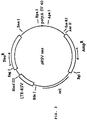
- the vector pGN is an example of this type of construction.
- the insertion DNA can comprise a foreign regulatory sequence.
- the site of insertion and, consequently, the flanking sequences are chosen according to the desired goal, namely either the insertion of the foreign regulatory sequence to give a "double promoter" effect with the endogenous regulatory sequence, or either the replacement of an endogenous promoter by the foreign promoter.
- the coding sequence which is under the control of the regulatory sequence may be endogenous.
- Another possibility would be the targeted insertion of a foreign DNA which comprises both a regulatory sequence and a coding sequence. It is possible that the regulatory sequence is that which is naturally associated with the coding sequence.
- the method of the invention uses a vector containing two "flanking" sequences on either side of the foreign gene. These flanking sequences have at least 150 base pairs and are preferably less than the length of the recipient gene. It is essential that these two flanking sequences are homologous to the two genomic sequences which adjoin the desired insertion site.
- the flanking sequence of the vector which is upstream of the foreign gene to be introduced is normally homologous to the genomic sequence which is situated on the 5 ′ side of the insertion site.
- the flanking sequence of the vector which is downstream of the foreign gene is normally homologous to the genomic sequence which is located at the 3 'side of the insertion site.
- flanking sequences are flanking sequences and the foreign gene, for example sequences allowing the selection of transformants, markers, sequences allowing the cloning of the vector, etc. ..
- PCR Polymerase Chain Reaction
- flanking sequences of the vector are obviously chosen as a function of the desired insertion site so that homologous recombination can take place.
- the flanking sequences can comprise sequences replicating the endogenous promoter and / or modifications to the sequences which precede the initiation codon to improve the rate of translation (upstream sequences) and replica sequences of the termination sequences in particular of the sites of polyadenylation (downstream sequences).
- the insertion gene can be any gene of interest.
- the lacZ gene (as in the model described below) will be cited, the genes coding for interleukin or interferon, the receptor genes, for example retinoic acid or beta-3 adrenergic acid. or HIV, and genes known to be linked to certain diseases, for example myopathy, etc.
- Eukaryotic cells transformed by the process of the invention are also encompassed by the present application.
- the eukaryotic cells are embryonic stem cells (see Ref. 14 and 15).
- a mutated ES cell can be injected into an early embryo which, after reimplantation, may be born in a chimeric form. If the germ line is colonized by the mutated cell, the chimera animal will transmit the mutation to its descendants. Subsequently, we can observe the effects of this mutation, in the homozygous state in certain individuals, on their development, behavior, metabolism, pathology, etc.
- Figure 1 shows the plasmid pGN, which is part of the invention.
- Figures 2 a and b show the pGMA and pGMD molecules respectively constructed from the plasmid pGN with respect to the HOXC8 gene (Hox-3.1). These plasmids are mutagenesis plasmids.
- the two parts of the coding phase of the HOXC8 gene (Hox-3.1) are represented, on chromosome 15, with the "homeo" box in black.
- the corresponding sequences of HOXC8 (Hox-3.1) were cloned into the plasmid pGN.
- A polyadenylation signal
- Enh / Pro enhancer-promoter
- 07 and 08 show the two oligonucleotides used in the PCR.
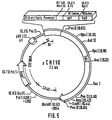
- Figures 3 to 6 show the plasmids used in the construction of pGN.
- FIG. 7 illustrates the detection of homologous recombination with the Polymerase Chain Reaction (P.C.R.) technique on transfected E.S. cells.
- P.C.R. Polymerase Chain Reaction
- Figure 8 (a) and (b) show Southern analyzes of positive individual clones (L5 and F2) and E.S. cells (C.C.E.).
- the process of the invention is of very wide industrial application and can vary according to the nature of the foreign gene introduced, for example for the production of transgenic animals.
- a gene known to be responsible for a certain disease is inserted in a targeted manner into the genome of an ES cell.
- the transgenic animal which is produced subsequently presents a useful model of this illness.
- Another application of the process of the invention consists in the genetic labeling of animals.
- This application consists in inserting an insertion gene which is easily detected e.g. the lacZ gene and which can therefore act as a cell marker. In this way, parentage studies e.g. in competition animals are facilitated, and the breed can be followed.
- the insertion of the lacZ gene as an insertion gene also makes promoter studies possible. Thanks to the possibility of detecting ⁇ -galactosidase activity, the activity and the specificity of different endogenous promoters can be studied by targeting different sites in the same type or different types of cells. The same studies can be performed on an entire organism, during development or in the adult state, using the techniques of chimeric or transgenic animals.
- the inventors have surprisingly found that the frequency of homologous recombination is not affected by the insertion of large fragments, for example Lac Z. This observation suggested to the inventors that the technique of homologous recombination would be well suitable for the insertion of other heterologous genes which are large.
- the invention also relates to the application of the specific replacement or insertion method for gene therapy.
- the method of the invention can therefore also be used as "gene therapy".
- the most obvious uses would consist in inactivating the genes of receptors of infectious agents (virus or bacteria) or toxic. If this mutagenesis turns out to be lethal, the lost function should be restored without restoring sensitivity to harmful agents.
- a modified gene encoding such a receptor could be reintroduced into the mutated cell, unless the modification can be caused by homologous recombination. This modification of the genetic heritage would confer on the animal immunity against the disease considered.
- This protocol can also be used in the context of self-grafting. Cells, sick or healthy, taken from a patient, could be treated and immunized, then reimplanted in the same individual.
- the technique of the invention also lends itself to studies of the activity of pharmaceutical products presumed to have activity with respect to the expression products of a pathological gene linked to a sickness.
- the insertion gene consists of the pathological gene or a fragment thereof and the pharmaceutical product to be tested is administered to the transgenic animal, in order to evaluate its activity on the disease.
- the invention will be illustrated by reference to the plasmid pGN and its use in the targeted insertion of a foreign gene (lacZ, coding for the enzyme E. coli ⁇ -glactosidase) into the genome of a d cell. 'ES of mice.
- lacZ coding for the enzyme E. coli ⁇ -glactosidase
- the lacZ gene was chosen because its expression can be easily detected and is for illustrative purposes only.
- the coding phase of the E. coli ⁇ -galactosidase enzyme (lacZ; 1-3057), fused with a genomic sequence (7292-3) of the murine gene HOXC8 (Hox.3-1) (Ref. 1), begins with the initiation codon for this gene. Indeed, the sequence which precedes the initiation codon of HOXC8 (Hox-3.1) is identical to the consensus sequence observed in vertebrates (Ref. 2), thus allowing a better rate of translation of ⁇ -galactosidase in cells. of vertebrates.
- the lacZ gene is followed by a polyadenylation signal, for example from the SV 40 virus, like most eukaryotic genes, in order to stabilize the messenger S RNA.
- E. coli ⁇ -galactosidase which is functional in eukaryotic cells
- Cells expressing the lacZ gene take on a blue color, after fixation, in the presence of X-Gal, which is a substrate for ⁇ -galactosidase (Ref. 3).
- X-Gal which is a substrate for ⁇ -galactosidase
- FDG fluroroscein di- ⁇ -galactopyranoside
- Cells expressing lacZ accumulate a fluorescent product and can be isolated using a cell sorter or FACS (fluorescence-activated cell sorter).
- the transcription unit of the neomycin resistance gene comes, in large part, from the plasmid pRSV neo (Ref. 5).
- the Lous (long terminal repeat) of the Rous sarcoma virus provides very powerful activator and promoter sequences in many eukaryotic cells (Ref. 6).
- From the Tn5 bacterial transposon come an active promoter in E.Coli and the coding phase of the phosphotransferase enzyme (Ref. 7), which is followed by the polyadenylation signal of the SV40 virus.
- the same gene under the double control of the RSV and Tn5 promoters can confer resistance to neomycin or kanamycin to bacteria and resistance to G418 to eukaryotic cells.
- the unit B of the activator sequences (enhancer) of the PyEC F9.1 strain of the Polyoma virus has become much more active in different types of cells, and in particular in the cells of embryonic carcinoma (EC) (Ref. 8).
- Two copies of this Py F9.1 enhancer were inserted in tandem in the plasmid pGN, upstream of the LTR-RSV, and in the "late promoter" orientation of the regulatory region of the Polyome.
- Neomycin Resistance Gene Transcription Unit could be estimated by transfecting mouse embryonic stem cells (ES).
- ES mouse embryonic stem cells
- Py F9.1 enhancers produced 7.5x more clones resistant to G418 than pRSV neo and 2 to 3x more than pMC1 Neo described by Capecchi et al (ref. 13).
- the number of clones was increased 60x, or 450x compared to pRSV neo, by modifying the translation initiation sequence.
- Homologous recombination can be a fairly rare event, depending on the experimental conditions applied (eg 1/1000 for HPRT, ref. 13).
- a vector having a high selection efficiency is therefore very useful, especially since the electroporation conditions give rise mainly to the integration of a single copy.
- the plasmid pGN also contains an origin of bacterial replication of the colE1 type, pBR322, which allows cloning and preparations in E. Coli.
- M.C.S. multiple cloning site synthesized in vitro, which contains only unique cleavage sites in pGN, was inserted upstream of lacZ, in order to facilitate the uses of this plasmid.
- flanking sequences chosen are homologous to the chromosomal sequences originating from HOXC8 (Hox-3.1) which must subsequently intervene in the homologous recombination.
- FIG. 2 situates the molecule constructed from the plasmid pGN with respect to the HOXC8 gene (Hox-3.1).
- Hox-3.1 a recombination between the plasmid and chromosomal sequences of HOXC8 (Hox-3.1) would result in an insertion at the start of the coding phase of this gene, therefore in its total inactivation.
- the plasmid pGN brings together several advantages for this methodology, which is applicable to any gene.
- homologous recombination can be quite rare (of the order of 1 per 1000 non-homologous integrations)
- the modifications made to the phosphotransferase transcription unit respond perfectly to these problems.
- the homologous recombination mutagenesis method is equivalent to inactivating a gene by insertion or substitution, but the plasmid pGN has the additional advantage of being able to substitute the expression of ⁇ -galactosidase for that of the mutated gene.
- the MCS facilitates the cloning of genomic fragments.
- the intermediate plasmids are numbered according to their stage.
- the two enzymes giving "blunt ends” ends, can be ligated directly. This deletion removes the intron of the SV 40 t antigen, which is not very useful, and appreciably reduces the size of the phosphotransferase transcription unit.
- the 3 ′ part of the coding phase of ⁇ -galactosidase, followed by the polyadenylation signal of the SV 40 virus is isolated from the plasmid p5 by the Xho I-Aat II sites and cloned into the plasmid p4 by the same sites.
- the 5 ′ part of the coding phase of ⁇ -galactosidase is isolated from the plasmid pMC 1871 (Pharmacia) by the Pst I-Sac I sites and cloned into the vector KS- (Stratagene) by the same sites.
- This insert is fused with the 5 ′ part of the coding phase of ⁇ -galactosidase by cloning into the plasmid p7 digested with Apa I-Sma I.
- the protein thus fused contains the codon for initiating the translation of the HOXC8 gene (Hox-3.1) followed of the coding phase of ⁇ -galactosidase (then verified by sequencing).
- the HOXC8 (Hox-3.1) -5 'lacZ fusion is isolated from the plasmid p8 by the Apa I-Sac I sites and cloned into the plasmid p6 by the same sites. This cloning has the effect of reconstituting the coding phase of ⁇ -galactosidase in its entirety.
- neomycin resistance gene (bacterial promoter and coding phase of phosphotransferase) is isolated from pRSV neo by Hind III-Eco RI sites and cloned into the vector KS + (Stratagene).
- the sequence of initiation of translation of phnosphotransferase is modified to be identical to the consensus sequence observed in vertebrates and thus allow a higher rate of initiation of translation therefore increased resistance to G418 for mammalian cells.
- the modification also creates an Apa LI site which makes it possible to control the effectiveness of mutagenesis.
- An oligonucleotide (CTTGTTCAATCATG GTGC ACGATCCTCA) comprising a mismatch region with the sequence of pRSV neo (underlined) is synthesized (Gene Assembler, Pharmacia) then phosphorylated by the polynucleotide kinase of bacteriophage T4.
- a single-stranded matrix of the plasmid p10 is prepared using the origin f1 of the plasmid KS + and hybridized with the mutagenesis oligonucleotide.
- the second strand is synthesized and repaired by Klenow polymerase and DNA ligase from bacteriophage T4. After transformation of bacteria, the mutated clones are screened using the oligonucleotide labeled with 32P. Mutagenesis was verified by digesting with Apa LI as well as by sequencing.
- a fragment containing the modified translation initiation sequence of the neomycin resistance gene is isolated from the plasmid p11 by the enzymes Hind III-Eag I and cloned into the plasmid p9 by the same sites.
- flanking sequences used were chosen according to the desired insertion site (for example, HOXC8 (Hox-3.1), see FIG. 2 a and b pGMA and pGMD).
- mutagenesis plasmid pGMD two arms of DNA homologous to the HOXC8 locus (Hox-3.1) were cloned at the Apa I-Nsi I and Nsi I-Sac II sites of the pGN vector.
- the 5 'arm begins at the Sac II site (CCGCGG) at nucleotide 219 of the c21 cDNA of HOXC8 (Hox-3.1). This fragment extends over 6.8 kb in 5 'to the first BamHI site.
- the 3 'arm begins at Apa I site (GGGCCC) at nucleotide 885 of c21 cDNA.
- This fragment extends over 1.5 kb in 3 'to the first PstI site.
- An NsiI linker was inserted into the BamHI site of the 5 'fragment and into the PstI site of the 3' fragment.
- the 5 ′ and 3 ′ arms were cloned into the vector pGN in the Nsi I-Sac II and Apa I-Nsi I sites, respectively.
- the cDNA sequence of HOXC8 (Hox-3.1) c21 is published (ref. 1).
- the mutagenesis plasmid is linearized by digestion with Nsi I before electroporation of E.S cells. Its ends are formed by two genomic arms cloned at the Apa I-Nsi I and Nsi I-Sac II sites of the pGN vector.
- the plasmid pGMD does not show a polyadenylation signal after the resistance gene but, on the other hand, has a sequence rich in AU responsible for a selective degradation of mRNA, inserted in the sequence of the intron of HOXC8 (Hox-3.1) of the plasmid.
- pGMA Another mutagenesis plasmid, has the same structure as pGMD but contains the polyadenylation and transcription termination signals of SV40 and does not have the AU sequence of degradation of mRNA downstream of the Neo r gene.
- the aim of these modifications was to reduce the rate of Neo r transcripts in clones resulting from random integration.
- clones resulting from homologous recombination events between pGMD and a HOXC8 locus (Hox-3.1) should have an unaltered growth during selection with G418, the AT sequence of degradation of mRNA being eliminated by the recombination process itself, or spliced with the HOXC8 intron (Hox-3.1).
- the mutagenesis plasmids pGMD and pGMA were linearized and introduced by electroporation into E.S. cells in order to promote the insertion of a copy only in the genome (ref. 11).
- the initial transfections were carried out to compare the targeting efficiency of HOXC8 (Hox-3.1) of the plasmids pGMA and pGMD (see table I).
- Table I Homologous recombination in the HOXC8 gene (Hox-3.1) Exp. Mutagenesis plasmid Number of the set analyzed Nb of clones forming the set No. of positive PCR results I pGMA 3 600 0 (2) II pGMD 5 250 3 (5) III pGMD 84 2-3 5 (5)
- the ES “CCE” cell line (ref. 16) was maintained continuously on fibroblastic feeder layers (ref. 17).
- 1.5 ⁇ 107 ES cells in 1.5 ml HeBS were electroporated (ref. 11) at 200 V, with 40 mg of linearized plasmid, then spread on four dishes of cultures (diameter 100 mm).
- the shock was carried out under the same conditions but a quarter of the cells were spread on four 24-well plates.
- 250 ⁇ g ml ⁇ 1 G418 was added. Each transfection resulted in approximately 2400 clones with pGMA and approximately 1000 clones with pGMD.
- the average number of clones of E.S. cells resistant to G418 in each set is indicated in Table I, as well as the number of sets giving a positive result with the P.C.R.
- a positive result means that a 1.6 Kb band could be observed on an agarose gel colored with ethidium bromide (see fig. 7).
- the number of sets giving a positive signal after a Southern analysis of the P.C.R. and hybridization of a specific probe which did not contain the primer sequences is indicated in parentheses (Fig. 8).
- P.C.R. was carried out on 105 cells from a set of 250 clones of transfection II (see lane D in FIG. 7). In the other routes, four sets of transfection III were analyzed together by mixing approximately 4 x 5000 cells. Primers 07 and 08 used in the P.C.R. surround the 3'HOXC8 (Hox-3.1) sequence of the mutagenesis plasmid (fig. 2). The 1.6 Kb fragment covering this 3 'sequence can only be amplified in the case of homologous recombination. Channels 2, 3 and D illustrate positive results.
- the DNA of ES clones was prepared at the time of replication on a filter using the "boiling-proteinase K digestion boiling" method (ref. 18).
- 40 amplification cycles (40 seconds at 94 ° C, 1 minute at 60 ° C, 7 minutes at 72 ° C) were performed in a 100 ⁇ l reaction mixture, containing 67 mM Tris-HCL (pH 8.6), 16.7 mM (NH4) 2SO4, 6.7 mM MgCl2, 10 mM 2-mercaptoethanol, 0.01% (w / v) gelatin, 200 ⁇ M dATP, dTTP and dCTP, 100 ⁇ M dGTP, 100 ⁇ M 7-deaza dGT, 600 ng of each primer (07: AACTTCCCTCTCTGCTATTC and 08: CAGCAGAAACATACAAGCTG) and 3U Taq polymerase (Perkin Elmer Cetus), covered with 100 ⁇ l paraffin.
- Half of the reaction mixture was
- ES cell clones containing the mutated HOXC8 (Hox-3.1) (identified by PCR) were isolated from the positive sets using pipettes. Their DNA was examined by Southern analysis after digestion with the restriction enzymes indicated in FIG. 8, in order to confirm the specific targeting and to distinguish between the recombinant and wild loci. Two different probes were used in the analysis of the 3 'end of the HOXC8 loci (Hox-3.1) in the mutated clones and in the non-mutated ES cells acting as a control (FIG. 8 c). The first probe "a" was contained in the HOXC8 (Hox-3.1) sequences of the mutagenesis plasmid and demonstrated the number of vector integrations and their physical bonds.
- One of the three recombined clones also contained a randomly integrated copy of the plasmid (FIG. 8 a, clone F2).
- the second probe "b" which was not contained in the mutagenesis vector distinguished between the recombinant and wild-type HOXC8 (Hox-3.1) alleles (fig. 8 b).
- the HOXC8 recombinant locus (Hox-3.1) presented, with the two probes, the expected hybridization image from the restriction maps of the mutagenesis vector and of the intact locus.
- the lac Z gene was placed under the control of the promoter and regulatory sequences of HOXC8 (Hox-3.1) upstream of the codon AUG, but the 3 ′ signals of maturation of mRNA came from SV40.
- the expression of lac Z was not detectable by staining with ⁇ -Gal, which is consistent with the absence of transcription of HOXC8 (Hox-3.1) in ES cells determined by protection analysis of RNase.
- ⁇ -Gal activity could be induced in certain cells after 3 or 4 days of culture in the presence of 5.10 5.1M retinoic acid, conditions known to induce the transcription of HOXC8 (Hox-3.1) (ref. 19).
- mutagenesis vector pGMA which has a total homology of 8.3 Kb DNA with the HOXC8 locus (Hox-3.1)
- a 120 bp fragment was replaced by an insertion of 7.2 Kb.
- the frequency of this targeted replacement (1/900) is comparable to that obtained recently (1/1000) with HPRT (ref. 13) or with En-2 (1/260) (ref. 20), the heterologous fragment inserted being however in these latter cases of a much smaller size (1.1 and 1.5 Kb respectively).
- a very high homologous recombination frequency (1/40) could be obtained with the vector pGMD.
- the specific targeting ratio was almost 10 times higher (900/40).
- the same homologous recombination mechanism must have been affected in the experiments with pGMD. A possible explanation for these results would be that a 51 bp AT sequence could provide, in vivo , an open loop in the mutagenesis plasmid due to its lower melting temperature.
- HOXC8 Hox-3.1 sequences neighboring pGMD can be influenced by this opening, on each side of the AT region, they could react more effectively, in the single-stranded state, with the chromosomal locus HOXC8 (Hox-3.1).
- the mitotic recombination model in yeast suggests that it would be initiated by such strand exchange, although the mechanism of homologous recombination remains unknown in more complex eukaryotes.
- FIG. 8 shows the results of the Southern analysis carried out on positive individual clones (L5 and F2) and E.S. cells (C.C.E.).
- the stars indicate the hybridization bands of a copy of the plasmid which has integrated at random.
- the size marker is an Eco RI + Hind III digest of lambda DNA.
- Figure 8 (c) shows the restriction maps of the recombinant (rec.) And wild-type (wt) HOXC8 (Hox-3.1) alleles.
- the parts of the mutagenesis vector and of the HOXC8 locus (Hox-3.1) are indicated with the same symbols as those used in FIG. 2.
- the AT sequence has been integrated by homologous recombination.
- the vertical arrow indicates the 3 'end of the mutagenesis plasmid.
- the location of probes "a" and "b” used in the Southern analysis is also indicated.
- the abbreviations used in Figure 8 are as follows: B, Bam HI; D, Dra I, E, Eco RI; H, Hind III; S, Sal I; X, Xho I.
- HOXC8 Hox-3.1
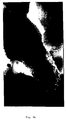
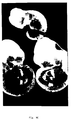
- the transcription grid for HOXC8 (Hox-3.1) at these stages had been determined beforehand by in situ hybridization analysis (ref. 1).
- the HOXC8 (Hox-3.1) transcripts are detectable for the first time at the late gastrulation stage and are distributed in all the tissues of the posterior part of the animal. Later, the distribution becomes progressively limited in space and specific to the tissue.
- transcription is localized in the cervical region of the neural tube, at the level of the heart.
- the 10.5 bp stage appears to be a transitional period, with transcription occurring in both the rear regions and in the cervical neural tube.
- Lac Z therefore correctly illustrated the first part of the transcription of the homeogen HOXC8 (Hox-3.1), that is to say in all the tissues of the caudal regions of the 9.5 and 10.5 bp embryos, and provided new information regarding the mode of transcription of HOXC8 (Hox-3.1).
Landscapes
- Health & Medical Sciences (AREA)
- Life Sciences & Earth Sciences (AREA)
- Genetics & Genomics (AREA)
- Engineering & Computer Science (AREA)
- Chemical & Material Sciences (AREA)
- Organic Chemistry (AREA)
- Zoology (AREA)
- Biotechnology (AREA)
- Wood Science & Technology (AREA)
- Biomedical Technology (AREA)
- General Engineering & Computer Science (AREA)
- Bioinformatics & Cheminformatics (AREA)
- Molecular Biology (AREA)
- General Health & Medical Sciences (AREA)
- Biophysics (AREA)
- Biochemistry (AREA)
- Plant Pathology (AREA)
- Physics & Mathematics (AREA)
- Microbiology (AREA)
- Environmental Sciences (AREA)
- Veterinary Medicine (AREA)
- Mycology (AREA)
- Medicinal Chemistry (AREA)
- Animal Husbandry (AREA)
- Cell Biology (AREA)
- Animal Behavior & Ethology (AREA)
- Toxicology (AREA)
- Gastroenterology & Hepatology (AREA)
- Biodiversity & Conservation Biology (AREA)
- Proteomics, Peptides & Aminoacids (AREA)
- Micro-Organisms Or Cultivation Processes Thereof (AREA)
- Preparation Of Compounds By Using Micro-Organisms (AREA)
- Saccharide Compounds (AREA)
- Measuring Or Testing Involving Enzymes Or Micro-Organisms (AREA)
- Investigating Or Analysing Biological Materials (AREA)
- Pharmaceuticals Containing Other Organic And Inorganic Compounds (AREA)
- Acyclic And Carbocyclic Compounds In Medicinal Compositions (AREA)
Abstract
Description
- L'invention concerne un procédé de remplacement spécifique d'une copie d'un gène présent dans le génome d'un organisme eucaryote receveur par l'intégration d'un gène différent du gène inactivé. De préférence, le gène receveur sera présent en au moins 2 exemplaires dans la cellule hôte transfectée. Le gène receveur est défini comme étant le gène ou se fera l'insertion du gène différent.
- Plus particulièrement, l'invention concerne la production d'animaux transgéniques dans lesquels le gène étranger a été introduit d'une manière ciblée pour permettre, à la fois, le maintien des fonctions génétiques normales de l'animal et l'expression du gène étranger sous le contrôle de promoteurs endogènes.
- Par "gène différent ou étranger" on entend toute séquence nucléotidique correspondant à la totalité ou à une partie d'un gène "étranger ou différent" du gène récepteur telle gu'elle est trouvée normalement dans le génome (ARN ou ADN), ou elle correspond également à une séquence modifiée artificiellement du gène normal ou encore à un fragment de cette séquence.
- L'invention concerne également le procédé de production de ces animaux transgéniques.
- Dans la production d'animaux transgéniques, les méthodes conventionnelles utilisées pour l'introduction de séquences d'ADN hétérologues dans la lignée cellulaire germinale, ne permettent pas de contrôler le site de l'intégration du gène étranger dans le génome, ni le nombre de copies ainsi introduit. L'intégration du gène étranger se fait au hasard et, en général, plusieurs copies du gène s'intègrent en même temps, parfois sous forme de tandem tête à queue, le site de l'intégration et le nombre de copies intégrées variant d'un animal transgénique à l'autre.
- Il peut donc arriver que des gènes cellulaires endogènes, situés au point d'insertion, soient ainsi inactivés, sans que cela soit facilement décélable en raison de nombreuses insertions au hasard. Si le produit de ces gènes est important pour le développement de l'animal, celui-ci sera sérieusement perturbé. D'ailleurs, l'insertion aléatoire du gène étranger peut se faire à un site qui n'est pas approprié pour l'expression du gène. De plus, le fait qu'il y ait variation du site et du nombre d'insertions d'animal en animal rend l'interpétation des études d'expression extrêmement difficile.
- Un problème majeur rencontré dans la production d'animaux transgéniques, est l'obtention de l'expression du gène étranger. D'une manière générale, deux types d'expérience ont été réalisés chez les souris.
- Les gènes introduits dans la lignée germinale sont :
- soit des gènes "complets", comprenant des séquences codantes flanquées de leurs propres séquences régulatrices;
- soit des gènes composites, formés de la séquence codante d'un gène fusionnée à la séquence promotrice d'un autre gène, les deux fragments appartenant même parfois à deux espèces animales différentes.
- On a pu ainsi confirmer que la spécificité de l'expression des gènes dans tel ou tel tissu est déterminée par leur(s) séquence(s) régulatrices.
- Le choix du promoteur approprié pour l'expression du gène étranger chez l'animal transgénique est donc d'une importance primordiale.
- D'autre part, la mutagénèse dirigée de gènes murins dans des cellules souches embryonnaires a récemment été réalisée en faisant appel à une technique de "ciblage génétique" (gene targeting) (Thomas et al., 1987; Thompson et al., 1989).
- Dans le premier cas, le gène murin HPRT a été muté par insertion et remplacement et, dans le deuxième cas, un gène HPRT muté a été corrigé. Thomson et al. ont étendu leurs expériences jusqu'à l'obtention de souris chimères et ont constaté le passage de la modification génétique dans la lignée cellulaire germinale.
- Dans chacun des documents cités, le site précis de l'intégration a été ciblé par recombinaison homologue entre, d'une part, des séquences exogènes comportant la mutation ou correction incluses dans un vecteur, sous le contrôle d'un promoteur exogène, et, d'autre part, leur homologue génomique. Ceci étant, il faut remarquer que les auteurs antérieurs ont réalisé leurs expériences sur un gène spécifique (HPRT) dont l'activation par mutation s'accompagnait d'un phénotype décelable. La mutation ciblée décrite par Thomas et al., avait pour effet d'inactiver le gène HPRT et, par conséquent, de faire disparaître le phénotype décelable normalement associé avec le HPRT. Le gène de sélection NeoR, sous le contrôle d'un promoteur TK, était donc incorporé dans l'ADN d'insertion afin de permettre la sélection des transformants. Il est à noter que les expériences décrites dans l'art antérieur impliquaient une sélection soit par le gène receveur (p. ex HPRT) soit par le gène d'insertion (p. ex NeoR). Le site de l'insertion et/ou le type de gène inséré est donc limité à des gènes conférant un caractère sélectable, une sélection directe.
- En outre, dans l'art antérieur, les séquences exogènes sur le vecteur servent donc à la fois à cibler le site d'intégration et à introduire la modification. Suite à la recombinaison homologue, le gène modifié se trouve toujours dans son environnement génétique normal.
- Rappelons qu'un problème qui se pose au cours de la production d'animaux transgéniques est le danger d'inactiver un gène cellulaire endogène qui se trouve au point d'insertion du gène étranger.
- Selon la fonction du produit du gène inactivé, une telle inactivation peut conduire à des désordres physiologiques ou morphologiques importants chez l'animal transgénique, ou pourrait même empêcher sa survie.
- En revanche, l'inactivation d'un gène pourrait être considéré comme avantageux si le gène en question codait pour un récepteur de virus ou autre agent infectieux.
- Les inventeurs ont étudié la possibilité d'éviter les inconvénients décrits plus haut, et associés, dans certains cas, à l'inactivation possible d'un ou plusieurs gènes cellulaires endogène de fonction importante au cours de la production d'animaux transgéniques.
- L'invention a pour objet un procédé de remplacement ou d'insertion spécifique d'un gène, notamment par ciblage d'un ADN, dit ADN d'insertion constitué par la totalité d'un gène, ou par une partie d'un gène, susceptible d'être rendu fonctionnel, ou dont le fonctionnement peut être rendu plus efficace, lorsqu'il est recombiné avec un ADN de complément pour alors fournir un gène recombinant complet dans le génome d'une cellule eucaryote, caractérisé en ce que
- le site d'insertion se trouve dans un gène choisi, dit gène receveur, et contenant l'ADN de complément, et en ce que
- l'on transfecte des cellules eucaryotes avec un vecteur contenant un insert comprenant lui-même l'ADN d'insertion et deux séquences dites "flanquantes" de part et d'autre de l'ADN d'insertion, respectivement homologues à deux séquences génomiques qui jouxtent le site d'insertion souhaité dans le gène receveur,
- l'ADN d'insertion étant hétérologue vis-à-vis du gène receveur, et
- les séquences flanquantes, étant choisies parmi celles qui constituent le susdit ADN de complément et qui autorisent, par recombinaison homologue avec des séquences correspondantes du gène receveur, la reconstitution d'un gène recombinant complet dans le génome de la cellule eucaryote.
- Selon le procédé de l'invention, ledit ADN d'insertion peut contenir soit une séquence codante soit une séquence régulatrice, le procédé étant alors caractérisé en ce que
- le site d'insertion se trouve dans un gène choisi dit gène receveur et en ce que
- l'on transfecte des cellules eucaryotes avec un vecteur contenant un insérat comprenant lui-même l'ADN d'insertion et deux séquences dites "flanquantes" de part et d'autre de l'ADN d'insertion, respectivement homologues à deux séquences génomiques qui jouxtent le site d'insertion souhaité dans le gène receveur,
- l'ADN d'insertion étant hétérologue vis-à-vis du gène receveur et,
- les séquencés flanquantes étant choisies afin de permettre par recombinaison homologue selon le cas, soit l'expression de la séquence codante de l'ADN d'insertion entier sous le contrôle des séquences régulatrices du gène receveur, soit l'expression d'une séquence codante du gène receveur sous le contrôle de séquences régulatrices de l'ADN d'insertion.
- Par exemple, l'ADN d'insertion peut contenir une séquence codante dépourvue d'élément de régulation, notamment d'un promoteur qui lui est propre.
- L'invention concerne aussi un procédé de production d'animaux transgéniques, caractérisé en ce que des cellules E.S. sont transfectées dans les conditions sus-décrites et sélectionnées pour l'évènement de recombinaison homologue, à savoir l'intégration correcte du gène étranger, les cellules transfectées sont injectées dans des embryons à un stade où ils sont aptes à intégrer les cellules transfectées (par exemple au stade blastocyste), ceux-ci sont ensuite réimplantés dans une mère porteuse et les individus chimères obtenus au terme de la gestation, et chez lesquels est constatée la colonisation par les cellules E.S. de la lignée germinale, sont accouplés. Si les cellules E.S. ont colonisé la lignée germinale de l'animal chimère, des animaux transgéniques hétérogozytes pour le gène remplacé seront obtenus par accouplement (F1) dans la descendance.
- Il est également possible d'insérer l'ADN d'insertion, porté par le vecteur de l'invention, dans l'oeuf peu de temps après la fécondation (c'est-à-dire moins de 24 heures). De cette manière, l'insertion est effectuée pendant que l'oeuf est à l'état unicellulaire.
- L'invention concerne aussi un plasmide apte à effectuer l'insertion ciblée d'un gène recombinant dit gène d'insertion dans le génome d'une cellule eucaryote, caractérisé en ce qu'il contient un insérat comprenant lui-même le gène d'insertion et deux séquences dites "flanquantes" de part et d'autre du gène d'insertion, respectivement homologues aux deux séquences génomiques qui jouxtent le site d'insertion souhaité dans le gène receveur.
- L'ADN d'insertion peut être un gène, ou une partie d'un gène, hétérologue à l'espèce transfectée.
- L'invention concerne également des animaux transgéniques dans lesquels au moins un gène endogène, qui de préférence est présent dans le génome à au moins deux exemplaires, a été inactivé par l'insertion d'un gène qui est différent du gène inactivé, le gène d'insertion étant inséré dans une position qui permet l'expression de ce gène sous le contrôle des séquences régulatrices du gène endogène inactivé.
- Le procédé de l'invention permet, donc, grâce au phénomène de recombinaison homologue, d'insérer d'une manière ciblée des gènes étrangers , en particulier des séquences codantes dépourvues du promoteur qui leur est normalement associé, dans le génome d'un organisme eucaryote à un site qui permet leur expression sous le contrôle du promoteur endogène du gène où se fait l'insertion, et par conséquence, d'inactiver le gène endogène ciblé.
- Selon un mode de réalisation préféré de l'invention, le gène receveur ciblé est un gène qui est présent dans le génome en au moins deux exemplaires. L'utilisation de la technique d'électroporation (Ref. 11) assure l'introduction d'une copie seulement du gène étranger.
- Selon cette variante de l'invention, l'insertion ciblée du gène d'intérêt (c'est-à-dire le gène dit d'insertion) a pour effet d'inactiver la seule copie du gène cellulaire endogène où se fait l'insertion et laisse intacte et fonctionnelle la ou les autre(s) copie(s) de ce gène.
- De cette façon, le fonctionnement génétique de l'animal transgénique n'est pas ou peu perturbé par l'introduction du gène étranger, même si l'insertion inactive une seule copie d'un gène essentiel receveur pour le développement de l'animal. Soit son développement ne serait donc pas affecté par l'insertion du gène étranger, soit les perturbations mineures possibles dans le cas de l'inactivation d'un gène critique ne seraient probablement pas léthales pour l'animal. Les effets de l'insertion du gène étranger à l'état homozygote pourraient être de toute nature et seraient observés en 2ème génération (F2) après croisements d'individus hétérozygotes (F1) entre eux.
- Si, par contre, l'inactivation de toutes les copies d'un gène est souhaitée, par exemple, dans le cas où le gène code pour un récepteur d'agent infectieux, de multiple copies du gène étranger sont introduites. Le contrôle de la quantité introduite peut être assuré en faisant appel à des techniques connues.
- L'insertion ciblée du gène étranger permet donc son introduction dans un site où son expression est sous le contrôle des séquences régulatrices du gène endogène où se fait l'insertion.
- Le procédé de l'invention permet ainsi d'insérer le gène étranger derrière un promoteur endogène qui a les fonctions désirées (par exemple, spécificité d'expression dans tel ou tel tissu), et cela, le cas échéant, sans inactiver les autres copies du gène receveur.
- Selon un mode de réalisation préféré, l'ADN d'insertion, ou le vecteur, contient des séquences intercalées entre l'ADN d'insertion et les séquences flanquantes. Ces séquences peuvent contenir par exemple une séquence codant pour un agent sélectif permettant la sélection des transformants et éventuellement un gène marqueur par exemple le LacZ.
- Selon un mode de réalisation particulièrement préféré de l'invention, l'ADN d'insertion comporte entre les séquences flanquantes, d'une part une séquence d'ADN destinée à être recombinée avec l'ADN de complément dans le gène receveur pour fournir un gène recombinant, et, d'autre part, une séquence codant pour un agent sélectif permettant la sélection des transformants et un promoteur autorisant l'expression de l'agent sélectif, le gène receveur et le gène recombinant codant pour des produits d'expression ne conférant pas de phénotype sélectionable. Selon cette variante, l'insérat du plasmide de l'invention comprend, entre les séquences flanquantes, d'une part une séquence d'ADN destinée à être recombinée avec l'ADN de complément dans le gène receveur, et, d'autre part, une séquence codant pour un agent sélectif permettant la sélection des transformants et un promoteur autorisant l'expression de l'agent sélectif, la séquence d'ADN destinée à être recombinée avec l'ADN de complément étant autre qu'un gène codant pour un agent sélectif.
- De cette manière, la sélection des transformants est entièrement indépendante de la nature du gène receveur et du gène inséré, contrairement aux procédés décrits jusqu'à ce jour dans lesquels le gène inséré ou le gène receveur devait par nécessité coder pour un produit d'expression permettant la sélection des transformants. Le système développé par les inventeurs permet une flexibilité totale en ce qui concerne la nature du gène receveur et du gène inséré ou du gène formé par la recombinaison homologue. Les inventeurs ont constaté d'une manière surprenante que l'insertion de séquences de taille importante (par exemple d'environ 7.5 kb) n'affecte pas la fréquence de recombinaison homologue.
- L'effet que peut avoir l'insertion de la séquence d'ADN selon cet aspect de l'invention inclut, selon le type de séquence insérée par exemple le remplacement d'une séquence codante, le remplacement d'une séquence régulatrice, l'inactivation ou la réactivation d'un gène par mutation ou l'amélioration du taux d'expression d'un gène. Il est possible, selon l'invention, de remplacer une phase codante ou une partie d'une phase codante par une séquence hétérologue qui commence au codon d'initiation du gène remplacé afin que l'expression du gène inséré remplace entièrement l'expression du gène remplacé. Ceci évite la formation de protéines de fusion qui pourrait être indésirable chez un animal transgénique.
- Selon ce mode de réalisation de l'invention, l'ADN d'insertion peut comporter entre les séquences flanquantes une séquence codante hétérologue dépourvue de promoteur, la séquence codante étant autre qu'un gène codant pour un agent de sélection. L'ADN d'insertion peut comporter en outre, en aval de la séquence codante et toujours entre les séquences flanquantes, un gène codant pour un agent de sélection, associé à un promoteur permettant son expression dans la cellule cible.
- De cette manière, la séquence codante hétérologue peut être insérée derrière un promoteur endogène qui a les propriétés souhaitées, par exemple une certaine spécificité d'expression, ou grille de transcription etc, la sélectabilité des cellules transformées étant entièrement indépendante de l'expression de la séquence codante hétérologue. Ce type de construction permet, par exemple, de sélectionner les transformants même si le gène remplacé par la séquence codante hétérologue n'est pas normalement exprimé dans les cellules cibles. Ceci est particulièrement important dans la production d'animaux transgéniques à partir de cellule E.S. ("Embryonic Stem Cells") puisqu'une proportion importante des gènes reste inactive jusqu'à un stade plus avancé du développement de l'animal. Le gène HOXC8 (également connu sous le nom Hox-3.1) est un exemple de ce type de gène. D'autre part, si la séquence codante code pour une protéine facilement décelable, par exemple, la β-Gal, le développement de la grille de transcription du gène endogène remplacé peut être suivi. Le vecteur pGN est un exemple de ce type de construction.
- Selon un autre mode de réalisation de l'invention, l'ADN d'insertion peut comporter une séquence régulatrice étrangère. Le site d'insertion et, par conséquence, les séquences flanquantes sont choisies en fonction du but désiré, à savoir soit l'insertion de la séquence régulatrice étrangère pour donner un effet de "double promoteur" avec la séquence régulatrice endogène, ou soit le remplacement d'un promoteur endogène par le promoteur étranger. La séquence codante qui se trouve sous le contrôle de la séquence régulatrice peut être endogène.
- Une autre possibilité serait l'insertion ciblée d'un ADN étranger qui comporte à la fois une séquence régulatrice et une séquence codante. Il est possible que la séquence régulatrice soit celle qui est naturellement associée avec la séquence codante.
- Le procédé de l'invention met en oeuvre un vecteur contenant deux séquences "flanquantes" de part et d'autre du gène étranger. Ces séquences flanquantes ont au moins 150 paires de bases et sont de préférence inférieures à la longueur du gène receveur. Il est essentiel que ces deux séquences flanquantes soient homologues aux deux séquences génomiques qui jouxtent le site d'insertion souhaité. La séquence flanquante du vecteur qui se trouve en amont du gène étranger à introduire, est normalement homologue à la séquence génomique qui est située du côté 5' du site d'insertion. De la même manière, la séquence flanquante du vecteur qui se trouve en aval du gène étranger, est normalement homologue à la séquence génomique qui est située au côté 3' du site d'insertion.
- Il est possible d'introduire des séquences "intercalantes" entre l'une ou l'autre des séquences flanquantes et le gène étranger, par exemple des séquences permettant la sélection des transformants, des marqueurs, des séquences permettant le clonage du vecteur, etc...
- La position de ces séquences intercalantes vis-à-vis du gène étranger doit pourtant être choisie afin de ne pas empêcher l'expression du gène étranger, en particulier de la séquence d'ADN codante étrangère sous le contrôle du promoteur endogène ou, à l'inverse, la séquence codante d'ADN endogène sous le contrôle d'éléments de régulation étrangers apportés par la séquence d'insertion.
- Malgré la présence des séquences flanquantes, qui encourage une recombinaison homologue, il est possible qu'un certain nombre d'intégrations se fasse au hasard. Afin de vérifier que l'insertion ciblée a bien eu lieu dans le site ciblé et non pas dans un autre endroit, la technique du "Polymerase Chain Reaction" (P.C.R.) (voir Ref. 10) est utilisée pour amplifier la séquence d'ADN du locus où l'insertion se fait, ou aurait dû se faire. De cette façon, seuls les clones transformés à la suite d'une recombinaison homologue sont sélectionnés.
- Les séquences flanquantes du vecteur sont bien évidemment choisies en fonction du site d'insertion désiré pour que la recombinaison homologue puisse avoir lieu. Le cas échéant, les séquences flanquantes peuvent comporter des séquences répliques du promoteur endogène et/ou des modifications aux séquences qui précèdent le codon d'initiation pour améliorer le taux de traduction (séquences amont) et séquences répliques des séquences de terminaison notamment des sites de polyadénylation (séquences aval).
- Le gène d'insertion peut être n'importe quel gène d'intérêt. On citera comme exemples non-limitatifs, le gène lacZ (comme dans le modèle décrit plus loin), les gènes codant pour l'interleukine ou l'interféron, les gènes de récepteur, par exemple de l'acide rétinoique ou beta-3 adrénergique ou de H.I.V., et des gènes connus comme étant liés à certaines maladies, par exemple la myopathie, etc...
- Les cellules eucaryotes transformées par le procédé de l'invention sont aussi englobées par la présente demande.
- Selon une variante préférée de l'invention, les cellules eucaryotes sont des cellules souches embryonnaires (voir Ref. 14 et 15).
- En effet, une cellule E.S. mutée peut être injectée dans un embryon précoce qui, après réimplantation, pourra naître sous une forme chimère. Si la lignée germinale est colonisée par la cellule mutée, l'animal chimère transmettra la mutation à sa descendance. Par la suite, on pourra observer les effets de cette mutation, à l'état homozygote chez certains individus, sur leur développement, leur comportement, leur métabolisme, leur pathologie, etc..
- La figure 1 montre le plasmide pGN, qui fait partie de l'invention.
- Les figures 2 a et b montrent les molécules pGMA et pGMD respectivement construites à partir du plasmide pGN par rapport au gène HOXC8 (Hox-3.1). Ces plasmides sont des plasmides de mutagénèse. Les deux parties de la phase codante du gène HOXC8 (Hox-3.1) sont représentées, sur le chromosome 15, avec la boîte "homéo" en noir. Les séquences correspondantes de HOXC8 (Hox-3.1) ont été clonées dans le plasmide pGN.
(A : signal de polyadénylation; Enh/Pro : enhancer-promoteur).
07 et 08 figurent les deux oligonucléotides utilisés dans la PCR. - Les figures 3 à 6 montrent les plasmides utilisés dans la construction du pGN.
- La figure 7 illustre la détection de recombinaison homologue avec la technique Réaction de Polymérase en Chaîne (P.C.R.) sur des cellules E.S. transfectées.
- La figure 8 (a) et (b) montre des analyses de Southern de clones individus positifs (L5 et F2) et cellules E.S. (C.C.E.).
- Le procédé de l'invention est d'application industrielle très large et peut varier selon la nature du gène étranger introduit, par exemple pour la production d'animaux transgéniques.
- La génétique des mammifères va progresser de manière considérable grâce à la possibilité récente de mutagéniser spécifiquement n'importe quel gène, permettant ainsi de mieux définir son rôle. Par cette technologie qui fait intervenir recombinaison homologue et cellules E.S., des informations précieuses seront apportées sur des oncogènes, des facteurs de croissance, des facteurs de transcription, etc..., gènes qui concernent des sujets très actuels de la recherche fondamentale ou la recherche appliquée. Un débouché important pour la recherche médicale est la possibilité de reproduire une maladie humaine dont la détermination génétique est connue (certaines maladies humaines à pathologie, telle la myopathie de Duchesne) ceci afin de mieux en étudier les mécanismes et de rechercher une thérapeutique.
- En appliquant le procédé de l'invention, un gène connu comme étant responsable d'une certaine maladie est inséré d'une manière ciblée dans le génome d'une cellule E.S. L'animal transgénique qui est produit à la suite présente un modèle utile de cette maladie.
- Si nécessaire, et comme décrit plus haut, les fonctionnements génétiques normaux peuvent être sensiblement maintenus, malgré l'insertion du gène étranger.
- Une autre application du procédé de l'invention consiste en le marquage génétique d'animaux. Cette application consiste à insérer un gène d'insertion qui est facilement décélé e.g. le gène lacZ et qui peut donc jouer le rôle d'un marqueur cellulaire. De cette manière, des études de filiation e.g. chez des animaux de concours sont facilitées, et la race peut être suivie.
- L'insertion du gène lacZ comme gène d'insertion rend aussi possible des études de promoteur. Grâce à la possibilité de déceler l'activité β-galactosidase, l'activité et la spécificité de différents promoteurs endogènes peuvent être étudiées en ciblant différents sites dans le même type ou différents types de cellules. Les mêmes études pourront être effectuées sur un organisme entier, au cours du développement ou à l'état adulte, en utilisant les techniques d'animaux chimères ou transgéniques.
- Les inventeurs ont constaté d'une manière surprenante que la fréquence de recombinaison homologue n'est pas affectée par l'insertion de fragments de taille importante, par exemple le Lac Z. Cette observation a suggéré aux inventeurs que la technique de recombinaison homologue serait bien adaptée à l'insertion d'autres gènes hétérologues qui sont de taille importante.
- L'invention vise également l'application du procédé de remplacement ou d'insertion spécifique pour la thérapie génique.
- Grâce à la possibilité de modifier le génome d'un animal, le procédé de l'invention peut donc également être utilisé en tant que "thérapie génique". Les utilisations les plus évidentes consisteraient à inactiver les gènes de récepteurs d'agents infectieux (virus ou bactéries) ou toxiques. Si cette mutagénèse s'avérait léthale, il faudrait rétablir la fonction perdue sans rétablir la sensibilité aux agents nuisibles. Un gène modifié codant pour un tel récepteur pourrait être réintroduit dans la cellule mutée, à moins que la modification puisse être provoquée par la recombinaison homologue. Cette modification du patrimoine génétique conférerait à l'animal une immunité contre la maladie considérée.
- Ce protocole peut aussi intervenir dans le cadre d'auto-greffe. Des cellules, malades ou saines, prélevées sur un patient, pourraient être soignées et immunisées, puis réimplantées chez le même individu.
- La technique de l'invention se prête aussi aux études d'activité de produits pharmaceutiques présumés avoir une activité à l'égard des produits d'expression d'un gène pathologique lié à une maladie. Dans ce cas, le gène d'insertion est constitué par le gène pathologique ou un fragment de celui-ci et on administre à l'animal transgénique le produit pharmaceutique à tester, en vue d'évaluer son activité sur la maladie.
- L'invention va être illustrée en faisant référence au plasmide pGN et son utilisation dans l'insertion ciblée d'un gène étranger (lacZ, codant pour l'enzyme β-glactosidase d'E.Coli) dans le génome d'une cellule d'E.S. de souris. Le gène lacZ a été choisi en raison du fait que son expression peut être facilement décelée et est simplement à titre illustratif.
- La phase codante de l'enzyme β-galactosidase d'E.Coli (lacZ; 1-3057), fusionnée avec une séquence génomique (7292-3) du gène murin HOXC8 (Hox.3-1) (Ref. 1), débute par le codon d'initiation de ce gène. En effet, la séquence qui précède le codon d'initiation de HOXC8 (Hox-3.1) est identique à la séquence consensus observée chez les vertébrés (Ref. 2), permettant ainsi un meilleur taux de traduction de la β-galactosidase dans les cellules de vertébrés. Le gène lacZ est suivi d'un signal de polyadénylation par exemple du virus SV 40, comme la plupart des gènes eucaryotes, afin de stabiliser les ARNS messagers.
- L'activité de la β-galactosidase d'E.Coli, qui est fonctionnelle dans les cellules eucaryotes, peut être décelée de différentes manières. Des cellules exprimant le gène lacZ prennent une coloration bleue, après fixation, en présence de X-Gal, qui est un substrat de la β-galactosidase (Ref. 3). Un nouveau substrat, le FDG (flurorosceine di-β-galactopyranoside), permet de déceler et de doser l'activité β-gal. tout en gardant les cellules vivantes (Ref. 4). Les cellules exprimant lacZ accumulent un produit fluorescent et peuvent être isolées à l'aide d'un trieur de cellules ou FACS (fluorescence-activated cell sorter).
- L'unité de transcription du gène de résistance à la néomycine provient, en grande partie, du plasmide pRSV neo (Ref. 5). Le LTR (long terminal repeat) du virus du sarcome de Rous procure des séquences activatrice et promotrice très puissantes dans de nombreuses cellules eucaryotes (Ref. 6). Du transposon bactérien Tn5, viennent un promoteur actif dans E.Coli et la phase codante de l'enzyme phosphotransférase (Ref. 7), qui est suivie du signal de polyadénylation du virus SV40. Le même gène sous le double contrôle des promoteurs RSV et Tn5 peut conférer la résistance à la néomycine ou la kanamycine aux bactéries et la résistance au G418 aux cellules eucaryotes.
- Par l'effet d'une simple mutation ponctuelle, l'unité B des séquences activatrices (enhancer) de la souche PyEC F9.1 du virus du Polyome est devenue beaucoup plus active dans différents types de cellules, et en particulier dans les cellules de carcinome embryonnaire (EC) (Ref. 8). Deux copies de cet enhancer Py F9.1 ont été insérées en tandem dans le plasmide pGN, en amont du LTR-RSV, et dans l'orientation "promoteur tardif" de la région régulatrice du Polyome.
- Afin d'améliorer le taux de traduction de la phosphotransférase, la séquence précédent le codon d'initiation a été modifiée lors d'une mutagénèse par oligonucleotide. Ainsi la séquence T T C G C A U G est devenue G C A C C A U G, correspondant beaucoup mieux à la séquence consensus d'initiation de la traduction chez les vertébrés (Ref. 2).
- Les améliorations apportées à l'unité de transcription du gène de résistance à la néomycine ont pu être estimées en transfectant des cellules souches embryonnaires (ES) de souris. A molarité égale en plasmide, une construction avec les enhancer Py F9.1 a produit 7,5x plus de clones résistants au G418 que le pRSV neo et 2 à 3x plus que le pMC1 Neo décrit par Capecchi et al (réf. 13). A nouveau, le nombre de clones a été augmenté 60x, soit 450x par rapport au pRSV neo, en modifiant la séquence d'initiation de la traduction. La recombinaison homologue peut être un événement assez rare, selon les conditions expérimentales appliquées (p. ex 1/1000 pour HPRT, réf. 13). Un vecteur présentant une efficacité de sélection élevée est donc très utile, d'autant plus que les conditions d'électroporation donnent lieu principalement à l'intégration d'une seule copie.
- Le plasmide pGN contient, en outre, une origine de réplication bactérienne de type colE1, pBR322, qui permet les clonages et les préparations dans E.Coli.
- Enfin, un site de clonage multiple (M.C.S.), synthétisé in vitro, qui ne contient que des sites de coupure uniques dans pGN, a été inséré en amont de lacZ, afin de faciliter les utilisations de ce plasmide.
- Les séquences "flanquantes" plasmidiques qui provoquent la recombinaison homologue sont ajoutées aux extrémités du plasmide pGN après linéarisation du plasmide en amont de lacZ, par un site du MCS (voir fig. 2). En l'occurence, les séquences flanquantes choisies sont homologues aux séquences chromosomiques issues de HOXC8 (Hox-3.1) devant ultérieurement intervenir dans la recombinaison homologue.
- La figure 2 situe la molécule construite à partir du plasmide pGN par rapport au gène HOXC8 (Hox-3.1). Dans ce cas, une recombinaison entre les séquences plasmidiques et chromosomales de HOXC8 (Hox-3.1) resulterait en une insertion au début de la phase codante de ce gène, donc à son inactivation totale.
- Le plasmide pGN rassemble plusieurs avantages pour cette méthodologie, qui est applicable à n'importe quel gène. L'évènement de recombinaison homologue pouvant être assez rare (de l'ordre de 1 pour 1000 intégrations non-homologues), il est nécessaire de pouvoir analyser un grand nombre de clones dont la résistance au G418 soit suffisament forte pour s'exprimer dans n'importe quelle partie du génome. Les modifications apportées à l'unité de transcription de la phosphotransférase répondent parfaitement à ces problèmes. La méthode de mutagénèse par recombinaison homologue équivaut à inactiver un gène par une insertion ou une substitution, mais le plasmide pGN présente l'avantage supplémentaire de pouvoir substituer l'expression de la β-galactosidase à celle du gène muté. Enfin, le MCS facilite les clonages de fragments génomiques.
- Les plasmides intermédiaires sont numérotés selon leur étape.
- Insertion d'un linker Xho I dans le site Bgl I de pRSV neo, rempli par le fragment Klenow de l'ADN polymérase d'E.Coli.
- Insertion d'un linker Cla I dans le site Nde I de p1, rempli par la polymérase Klenow.
- Insertion d'enhancer Py F9.1 Pvu II-Pvu II isolé par un site unique, Acc I, dans le site Cla I de p2. Sélection d'un clone contenant deux enhancers orienté dans le sens "promoteur tardif".
- Les deux enzymes, donnant des extrémités "bouts-francs", peuvent être ligués directement. Cette délétion enléve l'intron de l'antigène t de SV 40, qui n'est pas très utile, et diminue de manière appréciable la taille de l'unité de transcription de la phosphotransférase.
- Insertion d'un linker Xho I dans le site Bam HI du plasmide pCH 110 (Pharmacia), rempli par la polymlérase Klenow.
- La partie 3' de la phase codante de la β-galactosidase, suivie du signal de polyadénylation du virus SV 40 est isolée du plasmide p5 par les sites Xho I-Aat II et clonée dans le plasmide p4 par les mêmes sites.
- La partie 5' de la phase codante de la β-galactosidase est isolée du plasmide pMC 1871 (Pharmacia) par les sites Pst I-Sac I et clonée dans le vecteur KS- (Stratagene) par les mêmes sites.
-
- Une séquence génomique du gène HOXC8 (Hox-3.1), clonée dans le vecteur KS-, est purifiée par digestions successives par l'enzyme Sac I, puis par la nucléase Mung bean et enfin par l'enzyme Apa I. Cet insert est fusionné avec la partie 5' de la phase codante de la β-galactosidase par clonage dans le plasmide p7 digéré par Apa I-Sma I. La protéine ainsi fusionnée contient le codon d'initiation de la traduction du gène HOXC8 (Hox-3.1) suivi de la phase codante de la β-galactosidase (vérifiée ensuite par séquençage).

- La fusion HOXC8 (Hox-3.1)-5' lacZ est isolée du plasmide p8 par les sites Apa I-Sac I et clonée dans le plasmide p6 par les mêmes sites. Ce clonage a pour effet de reconstituer la phase codante de la β-galactosidase dans sa totalité.
-
Le gène de résistance à la néomycine (promoteur bactérien et phase codante de la phosphotransférase) est isolée du pRSV neo par les sites Hind III-Eco RI et clonée dans le vecteur KS+ (Stratagene). - La séquence d'initiation de la traduction de la phnosphotransférase est modifiée pour être identique à la séquence consensus observée chez les vertébrés et permettre ainsi un taux supérieur d'initiation de la traduction donc une résistance accrue au G418 pour les cellules de mammifères. La modification crée également un site Apa LI qui permet de contrôler l'efficacité de la mutagénèse.

Un oligonucléotide (CTTGTTCAATCATGGTGCACGATCCTCA) comportant une région de misappariement avec la séquence du pRSV neo (soulignée) est synthétisé (Gene Assembler, Pharmacia) puis phosphorylée par la polynucléotide kinase du bactériophage T4. Une matrice simple brin du plasmide p10 est préparée grâce à l'origine f1 du plasmide KS+ et hybridée avec l'oligonucléotide de mutagénèse. Le deuxième brin est synthétisé et réparé par la polymérase Klenow et l'ADN ligase du bactériophage T4. Aprés transformation de bactéries, les clones mutés sont criblés à l'aide de l'oligonucléotide marqué au ³²P. La mutagénèse a été vérifiée en digérant par Apa LI ainsi que par séquençage. -
- Un fragment contenant la séquence modifiée d'initiation de la traduction du gène de résistance à la néomycine est isolée du plasmide p11 par les enzymes Hind III-Eag I et clonée dans le plasmide p9 par les mêmes sites.
- Deux oligonucléotides complémentaires sont synthétisés (Gene Assembler, Pharmacia) puis phosphorylés. Après appariement, le MCS est cloné dans les sites Apa I- Sac II du plasmide p12 grâce à ses extrémités cohésives

Le site de clonage multiple a également été vérifié par séquençage. - Les séquences flanquantes utilisées ont été choisies en fonction du site d'insertion souhaité (par exemple, HOXC8 (Hox-3.1), voir Fig. 2 a et b pGMA et pGMD).
- Dans la construction du plasmide de mutagénèse pGMD, deux bras d'ADN homologue au locus HOXC8 (Hox-3.1) ont été clonés aux sites Apa I-Nsi I et Nsi I-Sac II du vecteur pGN. Le bras 5' commence au site Sac II (CCGCGG)au nucléotide 219 de l'ADNc c21 de HOXC8 (Hox-3.1). Ce fragment s'étend sur 6.8 kb en 5' jusqu'au premier site BamHI. Le bras 3' commence au site Apa l (GGGCCC) au nucléotide 885 de l'ADNc c21. Ce fragment s'étend sur 1.5 kb en 3' jusqu'au premier site PstI. Un linker NsiI a été inséré dans le site BamHI du fragment 5' et dans le site PstI du fragment 3'. Les bras 5' et 3' ont été clonés dans le vecteur pGN dans les sites Nsi I-Sac II et Apa I-Nsi I, respectivement. La séquence de l'ADNc de HOXC8 (Hox-3.1) c21 est publiée (réf. 1).
- Le plasmide de mutagénèse est linéarisé par digestion avec Nsi I avant électroporation de cellules E.S. Ses extrémités sont formées des deux bras génomiques clonés aux sites Apa I-Nsi I et Nsi I-Sac II du vecteur pGN.
- Le plasmide pGMD ne présente pas de signal de polyadénylation après le gène de résistance mais, en revanche, présente une séquence riche en AU responsable d'une dégradation sélective de mRNA, insérée dans la séquence de l'intron du HOXC8 (Hox-3.1) du plasmide.
- Un autre plasmide de mutagénèse, pGMA, présente la même structure que le pGMD mais contient les signaux de polyadénylation et de terminaison de transcription du SV40 et ne présente pas la séquence AU de dégradation de mRNA en aval du gène Neor. Ces modifications avaient pour but de réduire le taux de transcrits de Neor dans des clones issus d'intégration au hasard. En revanche, des clones issus d'événements de recombinaison homologue entre pGMD et un locus HOXC8 (Hox-3.1) devrait avoir une croissance inaltérée pendant la sélection au G418, la séquence AT de dégradation de mRNA étant éliminée par le procédé de recombinaison même, ou epissée avec l'intron HOXC8 (Hox-3.1).
- Dans les étapes expérimentales qui suivent, le protocole décrit par Thompson et al. 1989, a été suivi pour la production d'animaux chimères.
- La méthode décrite par Thompson et al. 1989, a été utilisée pour transfecter des cellules embryonnaires de souris. L'utilisation de la technique de l'électroporation assure l'introduction d'une seule copie du gène étranger (lacZ) par cellule. Après transfection, plusieurs clones exprimant la β-galactosidase ont été isolés.
- Les plasmides de mutagénèse pGMD et pGMA ont été linéarisés et introduits par électroporation dans des cellules E.S. afin de favoriser l'insertion d'une copie seulement dans le génome (réf. 11).
- Les transfections initiales ont été effectuées pour comparer l'efficacité de ciblage du HOXC8 (Hox-3.1) des plasmides pGMA et pGMD (voir tableau I).
Tableau I Recombinaison homologue dans le gène HOXC8 (Hox-3.1) Exp. Plasmide de muta-génèse N° de l'ensemble analysé Nb de clones formant l'ensemble Nb de résultats P.C.R. positifs I pGMA 3 600 0(2) II pGMD 5 250 3(5) III pGMD 84 2-3 5(5) - La lignée cellulaire E.S. "C.C.E." (réf. 16) a été maintenue d'une manière continue sur des couches nourricières fibroblastiques (réf. 17). Pour les expériences I et II, 1.5 x 10⁷ cellules E.S. dans 1.5 ml HeBS ont été électroporées (réf. 11) à 200 V, avec 40 mg de plasmide linéarisé, puis étalées sur quatre boîtes de cultures (diamètre 100 mm). Pour l'expérience III, le choc a été effectué dans les mêmes conditions mais un quart des cellules ont été étalées sur quatre plaques à 24 puits. Le lendemain, 250 µg ml⁻¹ G418 ont été ajoutés. Chaque transfection a donné lieu à environ 2400 clones avec pGMA et environ 1000 clones avec pGMD.
- Le nombre moyen de clones de cellules E.S. résistantes au G418 dans chaque ensemble est indiqué dans le tableau I, ainsi que le nombre d'ensembles donnant un résultat positif avec la technique P.C.R. Un résultat positif signifie q'une bande de 1.6 Kb a pu être observée sur un gel d'agarose coloré de bromure d'ethidium (voir fig. 7). Le nombre d'ensembles donnant un signal positif après une analyse de Southern du mélange P.C.R. et hybridation d'une sonde spécifique qui ne contenait pas les séquences des amorces est indiqué entre parenthèses (fig. 8).
- P.C.R. a été effectuée sur 10⁵ cellules d'un ensemble de 250 clones de la transfection II (voir voie D de la fig. 7). Dans les autres voies, quatre ensembles de la transfection III ont été analysés ensemble en mélangeant environ 4 x 5000 cellules. Les amorces 07 et 08 utilisées dans la P.C.R. entourent la séquence 3'HOXC8 (Hox-3.1) du plasmide de mutagénèse (fig. 2). Le fragment de 1.6 Kb recouvrant cette séquence 3' ne peut être amplifié que dans le cas d'une recombinaison homologue. Les voies 2, 3 et D illustrent des résultats positifs.
- L'ADN de clones E.S. a été préparé au moment de la réplique sur filtre en utilisant la méthode "boiling-proteinase K digestion boiling" (réf. 18). 40 cycles d'amplification (40 secondes à 94°C, 1 minute à 60°C, 7 minutes à 72°C) ont été effectués dans un mélange réactionnel de 100 µl, contenant 67 mM Tris-HCL (pH 8.6), 16.7 mM (NH₄)₂SO₄, 6.7 mM MgCl₂, 10 mM 2-mercaptoethanol, 0.01 % (p/v) gélatine, 200 µM dATP, dTTP et dCTP, 100 µM dGTP, 100 µM 7-deaza dGT, 600 ng de chaque amorce (07 : AACTTCCCTCTCTGCTATTC et 08 : CAGCAGAAACATACAAGCTG) et 3U polymérase Taq (Perkin Elmer Cetus), couvert de 100 µl paraffin. La moitié du mélange de réaction a été appliquée sur un gel d'agarose 0.7 % coloré au bromure d'ethidium. Le marqueur de taille est un digest Eco RI + Hind III d'ADN lambda.
- Trois clones indépendants de cellules E.S. contenant le HOXC8 (Hox-3.1) muté (identifié par P.C.R.) ont été isolés des ensembles positifs en utilisant des pipettes. Leur ADN a été examiné par analyse de Southern après digestion avec les enzymes de restriction indiqués dans la figure 8, afin de confirmer le ciblage spécifique et de faire la distinction entre les loci recombinés et sauvages. Deux sondes différentes ont été utilisées dans l'analyse de l'extrémité 3' des loci HOXC8 (Hox-3.1) dans les clones mutés et dans les cellules E.S. non-mutées agissant comme témoin (fig. 8 c). La première sonde "a" était contenue dans les séquences HOXC8 (Hox-3.1) du plasmide de mutagénèse et démontrait le nombre d'intégrations de vecteur et leurs liaisons physiques. Un des trois clones recombinés contenait en outre une copie du plasmide intégrée au hasard (fig. 8 a, clone F2). La deuxième sonde "b" qui n'était pas contenue dans le vecteur de mutagénèse faisait la distinction entre les allèles HOXC8 (Hox-3.1) recombinées et sauvages (fig. 8 b). Le locus recombiné HOXC8 (Hox-3.1) présentait, avec les deux sondes, l'image d'hybridation attendue à partir des cartes de restriction du vecteur de mutagénèse et du locus intact. En outre, l'existence de deux domaines de recombinaison dans le bras 3' du vecteur a été confirmée par la présence ou l'absence de la séquence AT dans le locus HOXC8 (Hox-3.1) recombiné (par exemple fig. 8, clone L5). L'extrémité 5' du locus HOXC8 (Hox-3.1) a également été analysée pour l'événement de recombinaison homologue. Des enzymes de restriction ne présentant pas de sites dans la séquence HOXC8 (Hox-3.1) 5' de 6.8 Kb du vecteur de mutagénèse ont été utlisés dans la digestion des ADNs des clones recombinés. Ces ADNs ont ensuite été soumis à une électrophorèse dans un champ pulsé pour différencier les fragments de poids moléculaire élevé. Une analyse de Southern de ce gel a également indiqué les allèles recombinées correctement et les allèles HOXC8 (Hox-3.1) sauvages, en utilisant une sonde présentant une séquence en amont du plasmide de mutagénèse.
- Les analyses de Southern ont démontré g'une allèle du gène HOXC8 (Hox-3.1) a été recombinée comme prévu. La recombinaison homologue était équivalente à un double "crossing-over" entre les bras génomiques du plasmide de mutagénèse et les séquences chromosomales homologues (Fig. 2).
- Dans les clones recombinants, le gène lac Z a été placé sous le contrôle des séquences promotrices et régulatrices du HOXC8 (Hox-3.1) en amont du codon AUG, mais les signaux 3' de maturation de mRNA provenaient du SV40. Dans ces clones recombinés, l'expression de lac Z n'était pas décelable par coloration avec β-Gal, ce qui est cohérent avec l'absence de transcription de HOXC8 (Hox-3.1) dans des cellules E.S. déterminée par analyse de protection de RNase. L'activité de β-Gal pouvait être induite dans certaines cellules après 3 ou 4 jours de culture en présence de 5.10⁻⁷M acide rétinoïque, conditions connues comme induisant la transcription de HOXC8 (Hox-3.1) (réf. 19).
- En utilisant le vecteur de mutagénèse pGMA, qui présente une homologie totale de 8.3 Kb ADN avec le locus HOXC8 (Hox-3.1), un fragment de 120 pb a été remplacé par une insertion de 7.2 Kb. La fréquence de ce remplacement ciblé (1/900) est comparable à celle obtenue récemment (1/1000) avec HPRT (réf. 13) ou avec En-2 (1/260) (réf. 20), le fragment hétérologue inséré étant cependant dans ces derniers cas d'une taille beaucoup moins importante (1.1 et 1.5 Kb respectivement). D'une manière surprenante, il a été constaté qu'une fréquence de recombinaison homologue très élevée (1/40) a pu être obtenue avec le vecteur pGMD. L'élimination des signaux 3' de maturation de mRNA et l'addition de la séquence de dégradation de mRNA au gène de résistance à la néomycine a eu pour effet de réduire le nombre total de clones résistants au G418 par 2.4 (tableau I). Le rapport de ciblage spécifique était presque 10 fois plus élevé (900/40). Le mécanisme de recombinaison homologue même a dû être affecté dans les expériences avec pGMD. Une explication possible de ces résultats serait qu'une séquence AT de 51 pb pourrait fournir, in vivo, une boucle ouverte dans le plasmide de mutagénèse à cause de sa température de fusion plus basse. Si les séquences HOXC8 (Hox-3.1) voisines du pGMD peuvent être influencées par cette ouverture, de chaque côté de la région AT, elles pourraient réagir d'une manière plus efficace, à l'état simple-brin, avec le locus chromosomal HOXC8 (Hox-3.1). Le modèle de recombinaison mitotique chez la levure suggère qu'il serait initié par un tel échange de brins, bien que le mécanisme de recombinaison homologue reste inconnu chez les eukaryotes plus complexes.
- La figure 8 montre les résultats de l'analyse de Southern effectuée sur des clones individus positifs (L5 et F2) et des cellules E.S. (C.C.E.).
- Les sondes utilisées n'hybrident qu'avec des séquences HOXC8 (Hox-3.1) incluses dans le vecteur (a) ou exclues du vecteur de mutagénèse (b). L'image d'hybridation du locus HOXC8 (Hox-3.1) recombiné (triangles ouverts) se distingue clairement du locus sauvage (triangles noirs). Les étoiles indiquent les bandes d'hybridation d'une copie du plasmide qui s'est intégrée au hasard. Le marqueur de taille est un digest Eco RI + Hind III d'ADN lambda.
- La figure 8(c) montre les cartes de restriction des allèles HOXC8 (Hox-3.1) recombinées (rec.) et sauvages (wt). Les parties du vecteur de mutagénèse et du locus HOXC8 (Hox-3.1) sont indiquées avec les mêmes symboles que ceux utilisés dans la figure 2. Dans ce cas, la séquence AT a été intégrée par recombinaison homologue. La flèche verticale indique l'extrémité 3' du plasmide de mutagénèse. La localisation des sondes "a" et "b" utilisées dans l'analyse de Southern est également indiquée. Les abréviations utilisées dans la figure 8 sont les suivantes : B, Bam HI ; D, Dra I, E, Eco RI ; H, Hind III ; S, Sal I ; X, Xho I.
- Une microinjection dans des blastocystes a été effectuée avec deux clones E.S. recombinants contenant un allèle HOXC8 (Hox-3.1) intact et un allèle recombiné, ces clones ne contenaient aucune autre copie du plasmide de mutagénèse. Les kariotypes de ces cellules étaient normaux.
- Dix à quinze cellules mutées ont été microinjectées par blastocyste. Après réimplantation dans des mères porteuses, les embryons ont été recueillis à 9.5, 10.5 et 12.5 jours p.c. et analysés pour expression de lac Z. La grille de transcription de HOXC8 (Hox-3.1) à ces stades avait été déterminée au préalable par analyse d'hybridation in situ (réf. 1). Les transcrits HOXC8 (Hox-3.1) sont détectables pour la première fois au stade de gastrulation tardive et sont répartis dans tous les tissus de la partie postérieure de l'animal. Plus tard, la répartition devient progressivement limitée dans l'espace et spécifique au tissu. Au stade de 12.5 jours p.c., la transcription est localisée dans la région cervicale du tube neural, au niveau du coeur. Au cours de l'embryogenèse, la répartition de la transcription de HOXC8 (Hox-3.1) subit donc des modifications. Le stade 10.5 jours p.c. semble être une période de transition, la transcription ayant lieu à la fois dans les deux régions arrières et dans le tube neural cervical.
- Dans des embryons chimériques de 9.5 et 10.5 jours p.c., la partie caudale au bourgeon postérieur présentait une activité β-Gal intense, tandis que le marqueur n'a jamais été détecté dans la région thoracique antérieure ou la tête (Fig. 9a). Dans la région postérieure, des cellules colorées par le β-Gal ont été observées dans tous les tissus et de toutes les couches embryonnaires. Entre les deux bourgeons qui donnent les membres, des cellules colorées étaient réparties dans des zones restreintes, dans l'ectoderme superficiel (Fig. 9b), comme dans les régions arrières (Fig. 9c) et, en forme de lignes étroites ou rayures, dans le tube neural (Fig. 9b). Ces rayures présentaient une répartition irrégulière et asymétrique sur la paroi du tube neural. La transcription de HOXC8 (Hox-3.1) n'a pas été détectée dans la couche mince de cellules vers la fermeture du tube neural. Ces cellules n'ont peut-être pas résisté aux traitements appliqués lors de l'hybridation in situ. Il a été observé que les cellules de l'ectoderme neural font partie, très tôt, de parties différentes du système nerveux et migrent dans une direction radiale, suivant des mouvements latéraux étroits (réf. 21). Ces résultats sont donc cohérents avec cette observation.
- L'expression de Lac Z a donc illustré correctement la première partie de la transcription de l'homéogène HOXC8 (Hox-3.1), c'est-à-dire dans tous les tissus des régions caudales des embryons de 9.5 et 10.5 jours p.c., et a fourni de nouvelles informations concernant le mode de transcription de HOXC8 (Hox-3.1).
- En revanche, l'expression de Lac Z n'a pas été observée dans les régions cervicales du tube neural d'embryons chimères de 12.5 jours, ni dans la région antérieure d'embryons de 10.5 jours ; ceci n'était pas le résultat attendu à partir des études d'hybridation in situ. La phase ultérieure de transcription de HOXC8 (Hox-3.1) observée à partir du jour 10.5 dans les zones très localisées du tube neural n'était pas mise en évidence par l'activité de β-Gal. Une explication possible pour ce résultat serait que, bien que l'expression de Lac Z soit sous le contrôle du promoteur HOXC8 (Hox-3.1), les séquences 3' du HOXC8 (Hox-3.1) sont absentes dans le gène reporteur. Il est possible que des séquences 3' du codon d'initiation AUG du HOXC8 (Hox-3.1) aient une influence sur l'expression tardive de HOXC8 (Hox-3.1) dans le domaine antérieur. Un effet de "dosage de gène" pourrait aussi expliquer ce résultat. L'autoactivation de plusieurs homéogènes chez Drosophila a été démontrée génétiquement ou suggérée par la formation de complexes entre l'ADN et les protéines des homeobox.
- Si le composant tardif de la transcription de HOXC8 (Hox-3.1) dans le tube neural est maintenu par un mécanisme semblable, l'inactivation d'un allèle pourrait avoir un effet dominant dans les celules de l'ectoderme neural. Puisqu'un allèle seulement produirait la protéine HOXC8 (Hox-3.1), le signal d'activation serait dilué sur les deux promoteurs. La réduction d'autoinactivation dans les deux loci pourrait ainsi conduire à un arrêt total de l'initiation de transcription. Ceci pourrait expliquer pourquoi aucune expression de Lac Z n'a été détectée dans la région cervicale du tube neural d'embryons de 10.5 et 12.5 jours.
- Les effets en F₁ et en F₂ de la modification apportée par l'insertion ciblée ont été observés après reproduction des chimères. Le passage de la modification dans la lignée cellulaire germinale a été constaté.
-
- 1. Le Mouellic, H., Condamine, H. et Brûlet, P. (1988). Genes & Development. 2, 125-135.
- 2. Cavenir, D.R. (1987). Nucleic Acids Res. 15, 1353-1361.
- 3. Sanes, J.R. Rubenstein, J.L.R. et Nicolas, J.F. (1986) EMBO J. 5, 3133-3142.
- 4. Nolan, G.P., Fiering, S., Nicolas, J.F. et Herzenberg, L.A. (1988) Proc. Natl. Acad. Sci. USA 85, 2603-2607.
- 5. Gorman, C., Padmanabhan, R. et Howard, B.H. (1983). Science. 221, 661-553.
- 6. Gormann, C.M., Merlino, G.T. Willingham, M.C. Pastan, I. et Howard, B. H. (1982) Proc. Natl. Acad. Sci. USA 79, 6777-6781.
- 7. Southern, P.J. et Berg, P. (1982) J. Mol. Appl. Genet 1, 327- 341.
- 8. Herbomel, P., Bourachot, B. et Yaniv, M. (1984). Cell. 39, 653-662.
- 9. Robertson, E.J. (1987). Teratocarcinomas and embruonic stem cells: A practical approach. IRL Press, Oxford.
- 10.Kahn, A. (1988). Médecine/Sciences 4, 515-518.
- 11.G. Chu, Hayakawa H., Berg. P. (1987) Nucleic Acid Research 15, Nr. 3, 1311-1326.
- 12.Thompson, S., Clarke, A.R., Pow, A.M., Hooper, M.L., Melton, D.W., (1989) Cell, 56, 313-321.
- 13.Thomas, K.R.,Capecchi, M.R., (1987) Cell, 51 503-512.
- 14. Evans, M.J., Kaufmann, M.H. (1981) Nature, 292, 154-155,
- 15.Robertson, E.J., (1986) Trends in Genetics, 9-13
- 16.Robertson, E., Bradley, A., Kuehn, M. & Evans, M. Nature 323, 445-448 (1986).
- 17.Robertson, E.J. in Teratocarcinomas and Embryonic Stem Cells (ed. Robertson, E.J.) 71-112 (IRL, Oxford, 1987).
- 18.Kim, H.S. & Smithies, O. Nucleic Acids Res. 16, 8887-8903 (1988).
- 19.Breier, G., Bucan, M., Francke, U., Colberg-Poley, A.M. & Gruss, P. EMBO J.5, 2209-2215 (1986).
- 20.Joyner, A.L., Skarnes, W.C. & Rossant, J. Nature 338, 153-156 (1989).
- 21.McKay, R. D. G. Cell 58, 815-821 (1989).
Claims (15)
- Animal transgénique ou chimérique comportant des cellules dont le génome comprend :- un ADN hétérologue, dit ADN d'insertion, et étant constitué par la totalité d'un gène ou par une partie d'un gène ;- l'ADN d'insertion étant positionné dans le génome par rapport à un gène endogène, dit gène receveur, comprenant un ADN de complément, de façon à ce que l'ADN d'insertion ou l'ADN de complément est rendu fonctionnel, ou son fonctionnement est rendu plus efficace grâce à l'association de l'ADN d'insertion et l'ADN de complément.
- Animal selon la revendication 1, caractérisé en ce que l'ADN d'insertion contient soit une séquence codante, dont l'expression a lieu sous le contrôle des séquences régulatrices du gène receveur, soit une séquence régulatrice permettant l'expression d'une séquence codante du gène receveur.
- Animal selon la revendication 2, caractérisé en ce que l'ADN d'insertion est constitué d'une séquence codante autre que la séquence codante d'un gène codant pour un agent de sélection.
- Animal selon la revendication 1, caractérisé en ce que l'ADN d'insertion comprend la totalité d'un gène.
- Animal selon l'une quelconque des revendications précédentes caractérisé en ce que le gène receveur est un gène qui normalement n'est pas transcrit dans la cellule.
- Animal selon l'une quelconque des revendications précédentes caractérisé en ce que le gène receveur est inactivé suite à l'insertion de l'ADN d'insertion, l'expression de l'ADN d'insertion se substituant à celle du gène receveur.
- Animal selon l'une quelconque des revendications précédentes caractérisé en ce que l'ADN d'insertion remplace une partie du gène receveur.
- Animal selon l'une quelconque des revendications précédentes caractérisé en ce que le gène receveur est, hormis la présence de l'ADN d'insertion, dans son environnement génétique naturel.
- Animal selon l'une quelconque des revendications précédentes caractérisé en ce que le génome contient, adjacent à l'ADN d'insertion, une séquence dite "intercalante" comprenant par exemple une séquence codant pour un agent de sélection avec un promoteur autorisant l'expression de l'agent de sélection, ou un marqueur.
- Animal transgénique dans lequel une seule copie d'un gène qui est présent dans le génome à au moins deux exemplaires, a été inactivé par l'insertion d'un gène qui est différent du gène inactivé, le gène d'insertion étant inséré dans une position qui permet l'expression de ce gène sous le contrôle des séquences régulatrices du gène endogène inactivé.
- Animal selon l'une quelconque des revendications précédentes utilisé pour un marquage génétique.
- Procédé de criblage de produits pharmaceutiques présumés avoir une activité à l'égard des produits d'expression d'un gène pathologique lié à une maladie, caractérisé par l'administration du produit à un animal transgénique selon l'une quelconque des revendications 1 à 11, l'ADN d'insertion étant constitué par le gène pathologique ou un fragment de celui-ci.
- Acide nucléique issu de la recombinaison homologue entre un ADN d'insertion et un gène receveur, ledit acide nucléique comprenant :- un ADN d'insertion, hétérologue vis-à-vis du gène receveur, l'ADN d'insertion étant constitué par la totalité d'un gène ou par une partie d'un gène ;- un gène receveur ;- l'ADN d'insertion étant positionné par rapport au gène receveur comprenant un ADN de complément de façon à ce que l'ADN d'insertion ou l'ADN de complément est rendu fonctionnel, ou son fonctionnement est rendu plus efficace grâce à l'association de l'ADN d'insertion et l'ADN de complément.
- Cellule d'animal transgénique selon l'une quelconque des revendications 1 à 10.
- Lignée cellulaire issue d'un animal transgénique selon l'une quelconque des revendications 1 à 10.
Applications Claiming Priority (3)
| Application Number | Priority Date | Filing Date | Title |
|---|---|---|---|
| FR8903630A FR2646438B1 (fr) | 1989-03-20 | 1989-03-20 | Procede de remplacement specifique d'une copie d'un gene present dans le genome receveur par l'integration d'un gene different de celui ou se fait l'integration |
| FR8903630 | 1989-03-20 | ||
| EP90905207A EP0419621B1 (fr) | 1989-03-20 | 1990-03-19 | Procede de remplacement specifique d'une copie d'un gene present dans le genome receveur par l'integration d'un gene different de celui ou se fait l'integration |
Related Parent Applications (1)
| Application Number | Title | Priority Date | Filing Date |
|---|---|---|---|
| EP90905207.8 Division | 1990-10-19 |
Publications (2)
| Publication Number | Publication Date |
|---|---|
| EP0682111A1 true EP0682111A1 (fr) | 1995-11-15 |
| EP0682111B1 EP0682111B1 (fr) | 2011-10-19 |
Family
ID=9379875
Family Applications (4)
| Application Number | Title | Priority Date | Filing Date |
|---|---|---|---|
| EP95107951A Expired - Lifetime EP0682111B1 (fr) | 1989-03-20 | 1990-03-19 | Animal transgénique ou chimérique et procédé de criblage de produits pharmaceutiques |
| EP90905207A Revoked EP0419621B1 (fr) | 1989-03-20 | 1990-03-19 | Procede de remplacement specifique d'une copie d'un gene present dans le genome receveur par l'integration d'un gene different de celui ou se fait l'integration |
| EP95107952A Expired - Lifetime EP0682112B1 (fr) | 1989-03-20 | 1990-03-19 | Procédé pour obtenir l'expression, ou pour améliorer le taux d'expression, d'un gène |
| EP07007307A Expired - Lifetime EP1826215B1 (fr) | 1989-03-20 | 1990-03-19 | Procédé pour obtenir l'expression, ou pour améliorer le taux d'expression, d'un gène |
Family Applications After (3)
| Application Number | Title | Priority Date | Filing Date |
|---|---|---|---|
| EP90905207A Revoked EP0419621B1 (fr) | 1989-03-20 | 1990-03-19 | Procede de remplacement specifique d'une copie d'un gene present dans le genome receveur par l'integration d'un gene different de celui ou se fait l'integration |
| EP95107952A Expired - Lifetime EP0682112B1 (fr) | 1989-03-20 | 1990-03-19 | Procédé pour obtenir l'expression, ou pour améliorer le taux d'expression, d'un gène |
| EP07007307A Expired - Lifetime EP1826215B1 (fr) | 1989-03-20 | 1990-03-19 | Procédé pour obtenir l'expression, ou pour améliorer le taux d'expression, d'un gène |
Country Status (13)
| Country | Link |
|---|---|
| US (6) | US6528313B1 (fr) |
| EP (4) | EP0682111B1 (fr) |
| JP (3) | JP3059481B2 (fr) |
| AT (4) | ATE359363T1 (fr) |
| DE (5) | DE07007307T1 (fr) |
| DK (4) | DK0682112T3 (fr) |
| ES (4) | ES2381039T3 (fr) |
| FR (2) | FR2646438B1 (fr) |
| HK (1) | HK150696A (fr) |
| LU (1) | LU91371I2 (fr) |
| NL (1) | NL300297I2 (fr) |
| SG (2) | SG49112A1 (fr) |
| WO (1) | WO1990011354A1 (fr) |
Cited By (1)
| Publication number | Priority date | Publication date | Assignee | Title |
|---|---|---|---|---|
| US5830729A (en) * | 1996-04-18 | 1998-11-03 | Institut Pasteur | I Sce I-induced gene replacement and gene conversion in embryonic stem cells |
Families Citing this family (208)
| Publication number | Priority date | Publication date | Assignee | Title |
|---|---|---|---|---|
| US6048729A (en) * | 1987-05-01 | 2000-04-11 | Transkaryotic Therapies, Inc. | In vivo protein production and delivery system for gene therapy |
| FR2646438B1 (fr) * | 1989-03-20 | 2007-11-02 | Pasteur Institut | Procede de remplacement specifique d'une copie d'un gene present dans le genome receveur par l'integration d'un gene different de celui ou se fait l'integration |
| US6689610B1 (en) * | 1989-08-22 | 2004-02-10 | University Of Utah Research Foundation | Cells and non-human organisms containing predetermined genomic modifications and positive-negative selection methods and vectors for making same |
| EP0945515A3 (fr) * | 1989-11-06 | 2002-08-21 | Cell Genesys, Inc. | Production de protéines par recombinaison homologue |
| ES2151463T5 (es) * | 1989-12-22 | 2012-10-29 | Merck Serono Sa | Constructos de ADN para la activación y la modificación de la expresión de genes endógenos |
| US5272071A (en) * | 1989-12-22 | 1993-12-21 | Applied Research Systems Ars Holding N.V. | Method for the modification of the expression characteristics of an endogenous gene of a given cell line |
| AU664847B2 (en) * | 1991-05-15 | 1995-12-07 | Cell Genesys, Inc. | Genomic modifications with homologous DNA targeting |
| WO1993004169A1 (fr) * | 1991-08-20 | 1993-03-04 | Genpharm International, Inc. | Ciblage de genes dans des cellules animales au moyen de produits de synthese d'adn isogeniques |
| PT101031B (pt) * | 1991-11-05 | 2002-07-31 | Transkaryotic Therapies Inc | Processo para o fornecimento de proteinas por terapia genetica |
| US6063630A (en) * | 1991-11-05 | 2000-05-16 | Transkaryotic Therapies, Inc. | Targeted introduction of DNA into primary or secondary cells and their use for gene therapy |
| US5641670A (en) * | 1991-11-05 | 1997-06-24 | Transkaryotic Therapies, Inc. | Protein production and protein delivery |
| US5733761A (en) * | 1991-11-05 | 1998-03-31 | Transkaryotic Therapies, Inc. | Protein production and protein delivery |
| US6270989B1 (en) * | 1991-11-05 | 2001-08-07 | Transkaryotic Therapies, Inc. | Protein production and delivery |
| US6054288A (en) * | 1991-11-05 | 2000-04-25 | Transkaryotic Therapies, Inc. | In vivo protein production and delivery system for gene therapy |
| US6692737B1 (en) | 1991-11-05 | 2004-02-17 | Transkaryotic Therapies, Inc. | In vivo protein production and delivery system for gene therapy |
| US6670178B1 (en) | 1992-07-10 | 2003-12-30 | Transkaryotic Therapies, Inc. | In Vivo production and delivery of insulinotropin for gene therapy |
| US6531124B1 (en) | 1992-07-10 | 2003-03-11 | Transkaryotic Therapies, Inc. | In vivo production and delivery of insulinotropin for gene therapy |
| AU5087193A (en) * | 1992-08-21 | 1994-03-15 | Regents Of The University Of California, The | Composition and method for altering dna sequences by homologous recombination |
| DE4228162C1 (de) | 1992-08-25 | 1994-01-13 | Rajewsky Klaus Dr | Verfahren zum Ersetzen homologer Genabschnitte aus Säugern in der Keimbahn von nicht-menschlichen Säugern |
| JP4375759B2 (ja) * | 1993-04-21 | 2009-12-02 | ザ・ユニバーシティ・コート・オブ・ザ・ユニバーシティ・オブ・エディンバラ | 標的とされた発現特性に従う異種遺伝子の発現 |
| US6924146B1 (en) | 1997-02-21 | 2005-08-02 | Sigrid Wattler | Method of constructing vectors for homologous recombination directed mutagenesis |
| AU737155B2 (en) | 1997-03-14 | 2001-08-09 | Biogen Idec Inc. | Method for integrating genes at specific sites in mammalian cells via homologous recombination and vectors for accomplishing the same |
| DE69842225D1 (de) | 1997-04-16 | 2011-05-26 | Millennium Pharm Inc | Zusammensetzung, umfassend einen Antikörper, der selektiv an ein cysteinreiches sekretiertes Protein (CRSP) bindet |
| JP2001522244A (ja) | 1997-04-24 | 2001-11-13 | ユニバーシティ オブ ワシントン | パルボウイルスベクターによる標的化した遺伝子改変 |
| AU757930B2 (en) * | 1997-12-01 | 2003-03-13 | Roche Diagnostics Gmbh | Optimization of cells for endogenous gene activation |
| US6733991B1 (en) | 1998-05-08 | 2004-05-11 | Osi Pharmaceuticals, Inc. | AGS proteins and nucleic acid molecules and uses therefor |
| US6746852B1 (en) | 1998-05-08 | 2004-06-08 | Osi Pharmaceuticals, Inc. | AGS proteins and nucleic acid molecules and uses thereof |
| DE19857609A1 (de) | 1998-12-14 | 2000-06-15 | Hannelore Ehrenreich | Verwendung von Erythropoietin zur Behandlung von cerebralen Ischämien des Menschen |
| EP2301947A3 (fr) | 1999-02-26 | 2011-11-23 | Millennium Pharmaceuticals, Inc. | Protéines sécrétées et utilisations associées |
| US7291714B1 (en) | 1999-06-30 | 2007-11-06 | Millennium Pharmaceuticals, Inc. | Glycoprotein VI and uses thereof |
| GB9918319D0 (en) * | 1999-08-03 | 1999-10-06 | Smithkline Beecham Biolog | Vaccine composition |
| PL354286A1 (en) | 1999-08-23 | 2003-12-29 | Dana-Farber Cancer Institutedana-Farber Cancer Institute | Pd-1, a receptor for b7-4, and uses therefor |
| GB0018876D0 (en) | 2000-08-01 | 2000-09-20 | Applied Research Systems | Method of producing polypeptides |
| ATE448306T1 (de) | 2000-09-01 | 2009-11-15 | Blood Res Center | Veränderte, in gewünschter konformation stabilisierte polypeptide und verfahren zu deren herstellung |
| UA83458C2 (uk) | 2000-09-18 | 2008-07-25 | Байоджен Айдек Ма Інк. | Виділений поліпептид baff-r (рецептор фактора активації в-клітин сімейства tnf) |
| US6596541B2 (en) | 2000-10-31 | 2003-07-22 | Regeneron Pharmaceuticals, Inc. | Methods of modifying eukaryotic cells |
| US20050144655A1 (en) | 2000-10-31 | 2005-06-30 | Economides Aris N. | Methods of modifying eukaryotic cells |
| US7037652B2 (en) | 2000-11-28 | 2006-05-02 | Wyeth | Expression analysis of KIAA nucleic acids and polypeptides useful in the diagnosis and treatment of prostate cancer |
| CA2429722A1 (fr) | 2000-11-28 | 2002-06-06 | Wyeth | Analyse de l'expression des acides nucleiques fkbp et polypeptides utiles dans le diagnostic et le traitement du cancer de la prostate |
| DK1349918T3 (da) | 2000-12-06 | 2014-11-10 | Anthrogenesis Corp | Fremgangsmåde til indsamling af stamceller fra moderkagen |
| US7311905B2 (en) | 2002-02-13 | 2007-12-25 | Anthrogenesis Corporation | Embryonic-like stem cells derived from post-partum mammalian placenta, and uses and methods of treatment using said cells |
| AU2002233230B2 (en) | 2000-12-20 | 2007-02-01 | F. Hoffmann-La Roche Ag | Erythropoietin conjugates |
| EP1345628B1 (fr) | 2000-12-20 | 2011-04-13 | F. Hoffmann-La Roche AG | Conjugues d'erythropoietine (epo) avec polyethylene glycol (peg) |
| PA8536201A1 (es) | 2000-12-29 | 2002-08-29 | Kenneth S Warren Inst Inc | Protección y mejoramiento de células, tejidos y órganos que responden a la eritropoyetina |
| EP2316919B1 (fr) | 2001-02-14 | 2015-10-07 | Anthrogenesis Corporation | Placenta post-gravidique de mammifère, son utilisation et céllules souches placentaires correspondantes |
| EP3246396B1 (fr) | 2001-02-14 | 2020-01-29 | Celularity, Inc. | Rénovation et repopulation de tissus décellularisés et d'organes cadavériques par des cellules souches |
| US8231878B2 (en) | 2001-03-20 | 2012-07-31 | Cosmo Research & Development S.P.A. | Receptor trem (triggering receptor expressed on myeloid cells) and uses thereof |
| US8981061B2 (en) | 2001-03-20 | 2015-03-17 | Novo Nordisk A/S | Receptor TREM (triggering receptor expressed on myeloid cells) and uses thereof |
| WO2002076196A1 (fr) | 2001-03-22 | 2002-10-03 | Abbott Gmbh & Co. Kg | Animaux transgeniques exprimant des anticorps specifiques de genes donnes et utilisations de ceux-ci |
| WO2002079499A1 (fr) | 2001-04-02 | 2002-10-10 | Wyeth | Le pd-1, recepteur du b7-4, et ses utilisations |
| EP2277897A1 (fr) | 2001-04-16 | 2011-01-26 | Wyeth Holdings Corporation | Cadres de lecture ouverts de Streptococcus pneumoniae codant pour des antigenes polypeptidiques, et leurs utilisations |
| FR2824844B1 (fr) * | 2001-05-18 | 2003-09-19 | Genoway | Procede de clonage par double selection et vecteurs pour ce procede |
| US6949691B2 (en) * | 2001-06-15 | 2005-09-27 | New Century Pharmaceuticals Inc. | Human albumin animal models for drug evaluation, toxicology and immunogenicity studies |
| IL160307A0 (en) | 2001-08-31 | 2004-07-25 | Univ Rockefeller | Phosphodiesterase activity and regulation of phosphodiesterase 1-b-mediated signaling in brain |
| EP1525323B1 (fr) | 2001-11-09 | 2015-01-21 | Dana-Farber Cancer Institute, Inc. | Pgc-1beta, un nouvel homologue du pgc-1 et ses utilisations |
| EP2186407A1 (fr) | 2002-02-13 | 2010-05-19 | Anthrogenesis Corporation | Cellules souches de type embryonnaire dérivées de placenta mammalien post-partum, utilisations, et procédés de traitement à base de cellules de ce type |
| US7153685B2 (en) | 2002-03-11 | 2006-12-26 | The Board Of Trustees Of The University Of Illinois | Tamoxifen and 4-hydroxytamoxifen-activated system for regulated production of proteins in eukaryotic cells |
| WO2009095742A1 (fr) | 2008-01-31 | 2009-08-06 | Cellectis | Nouvelle méganucléase à chaîne unique dérivée de l'i-crei et ses utilisations |
| US20100151556A1 (en) * | 2002-03-15 | 2010-06-17 | Cellectis | Hybrid and single chain meganucleases and use thereof |
| AU2003215869B2 (en) * | 2002-03-15 | 2008-04-24 | Cellectis | Hybrid and single chain meganucleases and use thereof |
| US7498171B2 (en) | 2002-04-12 | 2009-03-03 | Anthrogenesis Corporation | Modulation of stem and progenitor cell differentiation, assays, and uses thereof |
| WO2003106656A2 (fr) | 2002-06-17 | 2003-12-24 | Thrasos, Inc. | Composés à domaine unique associés à tdf et analogues de ceux-ci |
| EP2305836A1 (fr) | 2002-08-20 | 2011-04-06 | Millennium Pharmaceuticals, Inc. | Compositions, kits et procédés d'identification, évaluation, prévention et thérapie du cancer du col de l'utérus |
| US7459435B2 (en) | 2002-08-29 | 2008-12-02 | Hoffmann-La Roche Inc. | Treatment of disturbances of iron distribution |
| US7459436B2 (en) | 2002-11-22 | 2008-12-02 | Hoffmann-La Roche Inc. | Treatment of disturbances of iron distribution |
| AU2003298775B2 (en) | 2002-11-26 | 2008-07-17 | Anthrogenesis Corporation | Cytotherapeutics, cytotherapeutic units and methods for treatments using them |
| WO2004064785A2 (fr) | 2003-01-14 | 2004-08-05 | Dana Farber Cancer Institute | Sensibilisant d'une therapie de cancer |
| EP3202899B1 (fr) | 2003-01-28 | 2020-10-21 | Cellectis | Méganucléase sur mesure et son utilisation |
| US9572840B2 (en) | 2003-06-27 | 2017-02-21 | DePuy Synthes Products, Inc. | Regeneration and repair of neural tissue using postpartum-derived cells |
| WO2005001080A2 (fr) | 2003-06-27 | 2005-01-06 | Ethicon, Incorporated | Cellules derivees de tissus post-partum destinees a etre utilisees pour traiter des maladies du coeur et du systeme circulatoire |
| US8790637B2 (en) | 2003-06-27 | 2014-07-29 | DePuy Synthes Products, LLC | Repair and regeneration of ocular tissue using postpartum-derived cells |
| US7875272B2 (en) | 2003-06-27 | 2011-01-25 | Ethicon, Incorporated | Treatment of stroke and other acute neuraldegenerative disorders using postpartum derived cells |
| US9592258B2 (en) | 2003-06-27 | 2017-03-14 | DePuy Synthes Products, Inc. | Treatment of neurological injury by administration of human umbilical cord tissue-derived cells |
| US11311574B2 (en) | 2003-08-08 | 2022-04-26 | Sangamo Therapeutics, Inc. | Methods and compositions for targeted cleavage and recombination |
| US7888121B2 (en) | 2003-08-08 | 2011-02-15 | Sangamo Biosciences, Inc. | Methods and compositions for targeted cleavage and recombination |
| US8409861B2 (en) | 2003-08-08 | 2013-04-02 | Sangamo Biosciences, Inc. | Targeted deletion of cellular DNA sequences |
| US20070134796A1 (en) * | 2005-07-26 | 2007-06-14 | Sangamo Biosciences, Inc. | Targeted integration and expression of exogenous nucleic acid sequences |
| AU2004263865B2 (en) | 2003-08-08 | 2007-05-17 | Sangamo Therapeutics, Inc. | Methods and compositions for targeted cleavage and recombination |
| WO2005032467A2 (fr) | 2003-09-29 | 2005-04-14 | Warren Pharmaceuticals, Inc. | Cytokines de protection des tissus pour le traitement et la prevention des septicemies et de la formation d'adhesions |
| MXPA06003402A (es) | 2003-10-07 | 2006-06-27 | Millennium Pharm Inc | Moleculas de acidos nucleicos y proteinas para la identificacion, evaluacion, prevencion y tratamiento de cancer de ovario. |
| US7951532B2 (en) | 2003-11-12 | 2011-05-31 | Children's Hospital Medical Center | Method of screening a midkine modulating agent |
| CA2546853C (fr) * | 2003-11-21 | 2020-04-21 | Revivicor, Inc. | Utilisation d'arn d'interference dans la production d'animaux transgeniques |
| US7371539B2 (en) | 2003-12-03 | 2008-05-13 | President And Fellows Of Harvard College | Targeted polypeptide degradation |
| SI1696947T1 (sl) * | 2003-12-19 | 2014-05-30 | F. Hoffmann-La Roche Ag | Uporaba eritropoetina pri zdravljenju motenj porazdelitve železa pri kroničnih vnetnih črevesnih boleznih |
| US7622108B2 (en) | 2004-04-23 | 2009-11-24 | Bioe, Inc. | Multi-lineage progenitor cells |
| US8410246B2 (en) | 2004-06-17 | 2013-04-02 | Thrasos, Inc. | TDF-related compounds and analogs thereof |
| US7288385B2 (en) | 2004-06-25 | 2007-10-30 | The Salk Institute For Biological Studies | Increasing life span by modulation of Smek |
| GB0426146D0 (en) | 2004-11-29 | 2004-12-29 | Bioxell Spa | Therapeutic peptides and method |
| WO2006071778A2 (fr) | 2004-12-23 | 2006-07-06 | Ethicon Incorporated | Traitement de la maladie de parkinson et de troubles associes au moyen de cellules derivees postnatales |
| EP1874811B1 (fr) | 2005-04-15 | 2012-06-13 | President and Fellows of Harvard College | Procédé permettant de modeler la formation et la minéralisation osseuses par modulation de l'activité de KRC |
| WO2007030820A2 (fr) | 2005-09-09 | 2007-03-15 | The Johns Hopkins University | Manipulation de cellules t regulatrices et de fonctions dc en ciblant des genes de neuritine a l'aide d'agonistes et d'antagonistes d'anticorps |
| JP2009508596A (ja) | 2005-09-19 | 2009-03-05 | ヒストジェニックス コーポレイション | 細胞支持基材及びその調製方法 |
| DK2497780T3 (en) | 2005-09-20 | 2015-06-01 | Thrasos Innovation Inc | TDF-related compounds and analogs thereof |
| US20070072795A1 (en) * | 2005-09-28 | 2007-03-29 | Anton Haselbeck | Treatment of neurodegenerative disorders |
| US9388382B2 (en) | 2005-10-05 | 2016-07-12 | The Board Of Trustees Of The University Of Illinois | Isolation of CD14 negative, CD45 positive and CD117 positive embryonic-like stem cells free of monocytes from human umbilical cord blood mononuclear cells |
| DK1957633T3 (en) | 2005-10-13 | 2014-03-17 | Anthrogenesis Corp | Immunomodulation USING PLACE SPEECH STEM CELLS |
| WO2007060495A1 (fr) * | 2005-10-25 | 2007-05-31 | Cellectis | Variants de l'endonuclease homing i-crei a nouvelle specificite de clivage et leur utilisation |
| WO2007070870A1 (fr) | 2005-12-16 | 2007-06-21 | Ethicon, Inc. | Compositions et procedes d'inhibition d'une reponse immunitaire negative en transplantation avec defaut d'histocompatibilite |
| US9125906B2 (en) | 2005-12-28 | 2015-09-08 | DePuy Synthes Products, Inc. | Treatment of peripheral vascular disease using umbilical cord tissue-derived cells |
| PT2471904T (pt) | 2005-12-29 | 2019-02-25 | Celularity Inc | População de células estaminais placentárias |
| DE102006004008A1 (de) | 2006-01-27 | 2007-08-02 | Hannelore Prof. Dr. Dr. Ehrenreich | Verfahren zur Behandlung und/oder Prophylaxe von Multipler Sklerose, sowie Verwendung von Erythropoietin zur Herstellung eines Arzneimittels zur intermittierenden Behandlung und/oder intermittierenden Prophylaxe von Multipler Sklerose |
| TWI428448B (zh) | 2006-03-24 | 2014-03-01 | Syntonix Pharmaceuticals Inc | 作為第九因子(factor ix)原肽處理酶之pc5 |
| GB0607063D0 (en) | 2006-04-07 | 2006-05-17 | Cellcentric Ltd | Compositions and methods for epigenetic modification of nucleic acid sequences in vivo |
| US7875453B2 (en) | 2006-06-14 | 2011-01-25 | Bioe Llc | Differentiation of multi-lineage progenitor cells to hepatocytes |
| PL2054074T3 (pl) | 2006-08-04 | 2015-03-31 | Prolong Pharmaceuticals Llc | Zmodyfikowana erytropoetyna |
| BRPI0716427A2 (pt) * | 2006-08-11 | 2014-03-11 | Dow Agrosciences Llc | Recombinação homóloga mediada por nuclease de apêndice de zinco |
| US9580515B2 (en) | 2006-08-21 | 2017-02-28 | Zensun (Shanghai) Science & Technology, Co., Ltd. | Neukinase, a downstream protein of neuregulin |
| WO2008045498A1 (fr) | 2006-10-12 | 2008-04-17 | Ethicon, Inc. | Populations de cellules extraites de reins et leur utilisation pour la réparation et le régénération de tissus |
| CA2666789C (fr) | 2006-10-18 | 2016-11-22 | Yong Zhao | Cellules souches de type embryonnaire derivees du sang peripherique d'un etre humain adulte et procedes d'utilisation associes |
| EP3763376A1 (fr) | 2007-02-12 | 2021-01-13 | Celularity, Inc. | Traitement de maladies inflammatoires au moyen de cellules souches placentaires |
| PL2602323T3 (pl) | 2007-06-01 | 2018-06-29 | Open Monoclonal Technology, Inc. | Kompozycje i sposoby hamowania endogennych genów immunoglobin i wytwarzania transgenicznych ludzkich przeciwciał typu idiotypowego |
| EP2167666A2 (fr) | 2007-06-29 | 2010-03-31 | Pioneer Hi-Bred International Inc. | Procédés de modification du génome d'une cellule de plante monocotylédone |
| CL2008002053A1 (es) | 2007-07-17 | 2009-05-22 | Hoffmann La Roche | Metodo para la purificacion de una eritropoyetina monopeguilada (epompeg) que consiste en proporcionar una solucion que contiene eritropoyetina mono, poli y no peguilada y hacerla pasar por dos pasos de cromatografia de intercambio cationico y metodo para producir epo mpeg que incluye metodo de purificacion. |
| AR067536A1 (es) | 2007-07-17 | 2009-10-14 | Hoffmann La Roche | Metodo para obtener una eritropoyetina mono-pegilada en una forma sustancialmente homogenea |
| WO2009010107A1 (fr) | 2007-07-19 | 2009-01-22 | Hannelore Ehrenreich | Utilisation d'activation ou de stimulation du récepteur de l'epo pour l'amélioration du score edss dans des patients présentant une sclérose en plaques |
| US9200253B1 (en) | 2007-08-06 | 2015-12-01 | Anthrogenesis Corporation | Method of producing erythrocytes |
| NZ599825A (en) | 2007-09-28 | 2014-10-31 | Anthrogenesis Corp | Tumor suppression using human placental perfusate and human placenta-derived intermediate natural killer cells |
| EP2214708A4 (fr) | 2007-10-26 | 2011-01-12 | Centocor Ortho Biotech Inc | Vecteurs, cellules hôtes, procédés de production et utilisations |
| KR20100103810A (ko) * | 2007-12-10 | 2010-09-28 | 알리바 바이오파마수티컬스, 아이엔씨. | 동종 재조합에 의한 표적화된 영역의 순차적인 치환 방법 |
| WO2009101625A2 (fr) | 2008-02-12 | 2009-08-20 | Ramot At Tel-Aviv University Ltd. | Procédé de recherche d’endonucléases de ciblage, de leurs gènes et de leurs cibles |
| WO2009114321A2 (fr) | 2008-03-11 | 2009-09-17 | Precision Biosciencs, Inc. | Méganucléases rationnellement conçues pour modification par génie génétique du génome du maïs |
| CA2720903C (fr) | 2008-04-14 | 2019-01-15 | Sangamo Biosciences, Inc. | Constructions donneuses lineaires pour une integration ciblee |
| CA2722797A1 (fr) * | 2008-04-28 | 2009-11-05 | Precision Biosciences, Inc. | Molecules de fusion de proteines de liaison a l'adn et de domaines effecteurs concus de facon rationnelle |
| AU2009298458B2 (en) | 2008-09-30 | 2015-10-08 | Ablexis, Llc | Non-human mammals for the production of chimeric antibodies |
| AU2009316541B2 (en) | 2008-11-19 | 2015-08-06 | Celularity Inc. | Amnion derived adherent cells |
| CN102387807A (zh) | 2008-12-19 | 2012-03-21 | 先进科技及再生医学有限责任公司 | 肺部疾病和病症的治疗 |
| US10179900B2 (en) | 2008-12-19 | 2019-01-15 | DePuy Synthes Products, Inc. | Conditioned media and methods of making a conditioned media |
| WO2010080985A1 (fr) | 2009-01-08 | 2010-07-15 | Dana-Farber Cancer Institute, Inc. | Compositions et procédés pour induire la différenciation du tissu adipeux brun |
| KR101722961B1 (ko) | 2009-02-11 | 2017-04-04 | 알부메딕스 에이/에스 | 알부민 변이체 및 접합체 |
| SG174551A1 (en) | 2009-03-26 | 2011-10-28 | Ethicon Inc | Human umbilical cord tissue cells as therapy for alzheimer' s disease |
| US8772008B2 (en) | 2009-05-18 | 2014-07-08 | Sangamo Biosciences, Inc. | Methods and compositions for increasing nuclease activity |
| US20110008764A1 (en) * | 2009-06-02 | 2011-01-13 | Davinci Biosciences Llc | Human gonadal stem cells |
| EP2261242A1 (fr) | 2009-06-10 | 2010-12-15 | Universite Catholique De Louvain | Enzyme aspartate-N-acétyltransférase, procédé de diagnostic et procédé thérapeutique |
| WO2011017315A2 (fr) * | 2009-08-03 | 2011-02-10 | Recombinetics, Inc. | Procédés et compositions pour modification de gène ciblé |
| US20110064717A1 (en) * | 2009-08-20 | 2011-03-17 | Ramot At Tel-Aviv University Ltd. | Homing endonuclease genes and their targets |
| EP2483392B1 (fr) | 2009-09-23 | 2015-11-11 | Davinci Biosciences LLC | Cellules souches de paroi intérieure de cordon ombilical et procédé et matériel pour isolement et culture de ces dernières |
| US8323972B2 (en) | 2009-09-30 | 2012-12-04 | Advanced Technologies And Regenerative Medicine, Llc | Mammary artery derived cells and methods of use in tissue repair and regeneration |
| US8889413B2 (en) | 2009-09-30 | 2014-11-18 | DePuy Synthes Products, LLC | Mammary artery derived cells and methods of use in tissue repair and regeneration |
| WO2011088163A1 (fr) | 2010-01-14 | 2011-07-21 | President And Fellows Of Harvard College | Procédés de modulation de remodélisation et structuration squelettiques par modulation de l'activité de shn2, de l'activité de shn3 ou de l'activité combinée de shn2 et de shn3 |
| CA2787685A1 (fr) | 2010-01-22 | 2011-07-28 | Dana-Farber Cancer Institute, Inc. | Compositions, kits, et procedes d'identification, d'evaluation, de prevention, et de therapie de troubles metaboliques |
| DK3284818T3 (da) | 2010-01-26 | 2022-06-20 | Celularity Inc | Behandling af knoglerelateret kræft ved hjælp af placenta stamceller |
| TWI518325B (zh) | 2010-02-04 | 2016-01-21 | 自治醫科大學 | 對alk抑制劑具有先抗性或後抗性癌症的識別、判斷和治療 |
| EP2660318A1 (fr) | 2010-02-09 | 2013-11-06 | Sangamo BioSciences, Inc. | Modification génomique ciblée de molécules partiellement donneuses à simple brin |
| ES2984483T3 (es) | 2010-03-31 | 2024-10-29 | Ablexis Llc | Ingeniería genética de ratones para la producción de anticuerpos quiméricos |
| LT2556145T (lt) | 2010-04-07 | 2016-11-10 | Anthrogenesis Corporation | Angiogenezė naudojant placentos kamienines ląsteles |
| US8383793B2 (en) | 2010-04-15 | 2013-02-26 | St. Jude Children's Research Hospital | Methods and compositions for the diagnosis and treatment of cancer resistant to anaplastic lymphoma kinase (ALK) kinase inhibitors |
| US20130189759A1 (en) | 2010-07-07 | 2013-07-25 | Cellectis | Meganucleases variants cleaving a dna target sequence in the nanog gene and uses thereof |
| ES2666746T3 (es) | 2010-07-13 | 2018-05-07 | Anthrogenesis Corporation | Métodos para generar linfocitos citolíticos naturales |
| WO2012010976A2 (fr) | 2010-07-15 | 2012-01-26 | Cellectis | Variants de méganucléases clivant une séquence d'adn cible dans le gène tert et leurs utilisations |
| CN103118708B (zh) | 2010-09-14 | 2015-08-26 | 霍夫曼-拉罗奇有限公司 | 用于纯化聚乙二醇化的促红细胞生成素的方法 |
| WO2012048213A1 (fr) | 2010-10-08 | 2012-04-12 | Regents Of The University Of Minnesota | Procédé d'augmentation de fréquences de ciblage de gène |
| US8969315B2 (en) | 2010-12-31 | 2015-03-03 | Anthrogenesis Corporation | Enhancement of placental stem cell potency using modulatory RNA molecules |
| JP6104896B2 (ja) | 2011-06-01 | 2017-03-29 | アントフロゲネシス コーポレーション | 胎盤幹細胞を使用する疼痛の治療 |
| CA2848368C (fr) | 2011-09-13 | 2023-02-14 | Dana-Farber Cancer Institute, Inc. | Compositions et procedes pour induction et activite de tissu adipeux brun a l'aide de fndc5 |
| WO2013053076A1 (fr) | 2011-10-10 | 2013-04-18 | Zensun (Shanghai)Science & Technology Limited | Compositions et procédés pour le traitement de l'insuffisance cardiaque |
| GB2496375A (en) | 2011-10-28 | 2013-05-15 | Kymab Ltd | A non-human assay vertebrate comprising human antibody loci and human epitope knock-in, and uses thereof |
| GB201122047D0 (en) | 2011-12-21 | 2012-02-01 | Kymab Ltd | Transgenic animals |
| AU2012358810B2 (en) | 2011-12-23 | 2018-03-15 | DePuy Synthes Products, Inc. | Detection of human umbilical cord tissue-derived cells |
| US9550830B2 (en) | 2012-02-15 | 2017-01-24 | Novo Nordisk A/S | Antibodies that bind and block triggering receptor expressed on myeloid cells-1 (TREM-1) |
| CN104203977A (zh) | 2012-02-15 | 2014-12-10 | 诺和诺德A/S(股份有限公司) | 结合肽聚糖识别蛋白1的抗体 |
| JP6411218B2 (ja) | 2012-02-15 | 2018-10-24 | ノヴォ ノルディスク アー/エス | 骨髄細胞で発現されるトリガー受容体1(trem−1)に結合し、それを遮断する抗体 |
| EP2711428A1 (fr) | 2012-09-21 | 2014-03-26 | Lonza Biologics plc. | Intégration spécifique d'un site |
| TWI606063B (zh) | 2012-08-23 | 2017-11-21 | 艾澤西公司 | 結合至158p1d7蛋白之抗體藥物結合物(adc) |
| CN105121649A (zh) | 2012-11-16 | 2015-12-02 | 赛莱蒂克斯公司 | 靶向修饰藻基因组的方法 |
| WO2014102688A1 (fr) | 2012-12-27 | 2014-07-03 | Cellectis | Nouvelle matrice de conception pour l'amélioration du ciblage génique dirigé par homologie |
| CN115137753A (zh) | 2013-02-05 | 2022-10-04 | 细胞结构公司 | 来自胎盘的自然杀伤细胞 |
| US10066001B2 (en) | 2013-03-15 | 2018-09-04 | Apotex Inc. | Enhanced liquid formulation stability of erythropoietin alpha through purification processing |
| WO2015017552A1 (fr) | 2013-08-01 | 2015-02-05 | Agensys, Inc. | Conjugués anticorps-médicament (adc) se liant à la protéine cd37 |
| AU2015206603B9 (en) | 2014-01-14 | 2019-07-18 | Dana-Farber Cancer Institute, Inc. | Compositions and methods for identification, assessment, prevention, and treatment of melanoma using PD-L1 isoforms |
| GB201407852D0 (en) | 2014-05-02 | 2014-06-18 | Iontas Ltd | Preparation of libraries od protein variants expressed in eukaryotic cells and use for selecting binding molecules |
| EA037844B1 (ru) | 2014-07-17 | 2021-05-27 | Ново Нордиск А/С | Сайт-направленный мутагенез антител к trem-1 |
| CN113717913A (zh) | 2014-09-09 | 2021-11-30 | 流明生物科学公司 | 螺旋藻中的靶向诱变 |
| US10077420B2 (en) | 2014-12-02 | 2018-09-18 | Histogenics Corporation | Cell and tissue culture container |
| EP3268038B1 (fr) | 2015-03-09 | 2021-05-05 | Agensys, Inc. | Conjugués anticorps-médicament (cam) se liant aux protéines flt3 |
| WO2016166268A1 (fr) | 2015-04-17 | 2016-10-20 | Cellectis | Manipulation de génome animal ou végétal à l'aide de systèmes d'interférence argonautes guidés par adn (dais) de procaryotes mésophiles |
| EP3091076A1 (fr) | 2015-05-07 | 2016-11-09 | Limagrain Europe | Polynucléotides responsables de l'induction d'haploïdes dans des plants de maïs et procédés associés |
| EP4679095A3 (fr) | 2015-05-18 | 2026-05-06 | Agensys, Inc. | Anticorps se liant à des protéines axl |
| WO2016187354A1 (fr) | 2015-05-18 | 2016-11-24 | Agensys, Inc. | Anticorps se liant à des protéines axl |
| JP7007261B2 (ja) | 2015-08-20 | 2022-01-24 | アルブミディクス リミティド | アルブミン変異体及びコンジュゲート |
| AU2016343978A1 (en) | 2015-10-29 | 2018-05-17 | Dana-Farber Cancer Institute, Inc. | Methods for identification, assessment, prevention, and treatment of metabolic disorders using PM20D1 and N-lipidated amino acids |
| US10584363B2 (en) | 2016-06-03 | 2020-03-10 | Takara Bio Usa, Inc. | Methods of producing and using single-stranded deoxyribonucleic acids and compositions for use in practicing the same |
| KR102470282B1 (ko) | 2016-07-15 | 2022-11-24 | 에프. 호프만-라 로슈 아게 | Peg화 에리트로포이에틴을 정제하기 위한 방법 |
| WO2018073391A1 (fr) | 2016-10-19 | 2018-04-26 | Cellectis | Insertion de gènes cibles pour immunothérapie cellulaire améliorée |
| IL268049B2 (en) | 2017-01-19 | 2025-08-01 | Omniab Inc | Transgenic rodent human antibodies with multiple immunoglobulin heavy chain loci |
| KR20200075851A (ko) | 2017-10-19 | 2020-06-26 | 셀렉티스 | 개선된 면역 세포들 치료를 위한 nk 억제제들의 타겟인 유전자 통합 |
| US20200362002A1 (en) | 2017-12-29 | 2020-11-19 | Hoffmann-La Roche Inc. | Process for providing pegylated protein composition |
| WO2019129876A1 (fr) | 2017-12-29 | 2019-07-04 | F. Hoffmann-La Roche Ag | Procédé permettant d'obtenir une composition de protéine pegylée |
| WO2019129877A1 (fr) | 2017-12-29 | 2019-07-04 | F. Hoffmann-La Roche Ag | Procédé de production d'une composition de protéine pegylée |
| WO2019195126A1 (fr) | 2018-04-02 | 2019-10-10 | Bristol-Myers Squibb Company | Anticorps anti-trem-1 et utilisations associées |
| EP3794017A4 (fr) | 2018-05-17 | 2022-03-09 | Lumen Bioscience, Inc. | Plate-forme d'administration de vaccin oral d'arthrospira platensis |
| US12252513B2 (en) | 2018-07-16 | 2025-03-18 | Lumen Bioscience, Inc. | Thermostable phycobiliproteins produced from recombinant arthrospira |
| EP3955957A1 (fr) | 2019-04-15 | 2022-02-23 | Qwixel Therapeutics LLC | Compositions de protéines de fusion comprenant des interférons de type i masqués ciblés (ifna et ifnb) et un anticorps contre un antigène tumoral, destinées à être utilisées dans le traitement du cancer |
| CA3143735A1 (fr) | 2019-07-03 | 2021-01-07 | Lumen Bioscience, Inc. | Plate-forme d'administration non parenterale d'agent therapeutique d'arthrospira platensis |
| EP4017542A1 (fr) | 2019-10-04 | 2022-06-29 | Tae Life Sciences | Compositions d'anticorps comprenant des mutations de fc et ayant des propriétés de conjugaison spécifiques à un site |
| WO2022067214A2 (fr) | 2020-09-28 | 2022-03-31 | Vestaron Corporation | Polypeptides variants de mu-diguétoxine dc1a pour la lutte antiparasitaire |
| US12006550B2 (en) | 2020-10-12 | 2024-06-11 | University Of South Carolina | Targeting treatment for ADAM30 in pathological cells |
| WO2022159414A1 (fr) | 2021-01-22 | 2022-07-28 | University Of Rochester | Érythropoïétine pour un dysfonctionnement gastrointestinal |
| WO2022235929A1 (fr) | 2021-05-05 | 2022-11-10 | Radius Pharmaceuticals, Inc. | Modèle animal ayant une recombinaison homologue du récepteur pth1 de souris |
| CA3221878A1 (fr) | 2021-06-18 | 2022-12-22 | David Stover | Composition(s) proteiques de fusion comprenant des interferons (ifna and ifnb) de type i masques pour une utilisation dans le traitement du cancer et methodes assocees |
| WO2023122805A1 (fr) | 2021-12-20 | 2023-06-29 | Vestaron Corporation | Procédé de pression de sélection par sorbitol |
| WO2024026406A2 (fr) | 2022-07-29 | 2024-02-01 | Vestaron Corporation | Peptides actx de nouvelle génération |
| EP4360451A1 (fr) | 2022-10-25 | 2024-05-01 | Limagrain Europe | Mutants pour induction d'haploïdes |
| WO2024091824A1 (fr) | 2022-10-26 | 2024-05-02 | Ada Forsyth Institute, Inc. | Différenciation et reprogrammation de chondrocyte |
| EP4634373A1 (fr) | 2022-12-16 | 2025-10-22 | University of Rochester | Réparation d'un dysfonctionnement de la barrière dans l'oesophage |
| EP4455293A1 (fr) | 2023-04-25 | 2024-10-30 | Limagrain Europe | Procédés pour fournir une plante présentant une résistance accrue à un virus de la famille des lutéoviridae |
| AU2024304180A1 (en) | 2023-06-13 | 2026-01-08 | Adcentrx Therapeutics, Inc. | Methods and compositions related to antibodies and antibody drug conjugates (adcs) that bind nectin-4 proteins |
| WO2025259466A1 (fr) | 2024-06-13 | 2025-12-18 | University Of Rochester | Cellules dendritiques induites par gm-csf et gm-csf améliorant la cicatrisation de fractures et la réparation osseuse |
| WO2025264533A1 (fr) | 2024-06-17 | 2025-12-26 | Adcentrx Therapeutics Inc. | Procédés et compositions associés à des conjugués anticorps-médicament (adcs) qui se lient à des protéines steap-1 |
Citations (5)
| Publication number | Priority date | Publication date | Assignee | Title |
|---|---|---|---|---|
| EP0074808A2 (fr) * | 1981-09-16 | 1983-03-23 | University Patents, Inc. | Méthode recombinante et matériaux |
| EP0169672A1 (fr) * | 1984-06-22 | 1986-01-29 | The President And Fellows Of Harvard College | Méthode pour la production d'animaux transgéniques |
| EP0247494A2 (fr) * | 1986-05-20 | 1987-12-02 | The General Hospital Corporation | Evaluation de l'expression d'insuline |
| EP0279582A2 (fr) * | 1987-02-17 | 1988-08-24 | Pharming B.V. | Séquences d'ADN pour diriger des protéines vers les glandes mammaires afin d'être sécrétées efficacement |
| EP0289121A2 (fr) * | 1987-05-01 | 1988-11-02 | Stratagene | Test de mutagénèse utilisant des êtres non humains transgéniques porteurs des séquences d'ADN à essayer |
Family Cites Families (12)
| Publication number | Priority date | Publication date | Assignee | Title |
|---|---|---|---|---|
| US4748119A (en) * | 1983-09-19 | 1988-05-31 | Alexander Rich | Process for altering and regulating gene expression |
| US5650503A (en) | 1988-11-11 | 1997-07-22 | Ppl Therapeutics (Scotland) Limited | Genetic construct of which protein coding DNA comprises introns and is designed for protein production in transgenic animals |
| FR2646438B1 (fr) | 1989-03-20 | 2007-11-02 | Pasteur Institut | Procede de remplacement specifique d'une copie d'un gene present dans le genome receveur par l'integration d'un gene different de celui ou se fait l'integration |
| US5574205A (en) * | 1989-07-25 | 1996-11-12 | Cell Genesys | Homologous recombination for universal donor cells and chimeric mammalian hosts |
| US5464764A (en) | 1989-08-22 | 1995-11-07 | University Of Utah Research Foundation | Positive-negative selection methods and vectors |
| EP0945515A3 (fr) | 1989-11-06 | 2002-08-21 | Cell Genesys, Inc. | Production de protéines par recombinaison homologue |
| US5272071A (en) | 1989-12-22 | 1993-12-21 | Applied Research Systems Ars Holding N.V. | Method for the modification of the expression characteristics of an endogenous gene of a given cell line |
| WO1993004169A1 (fr) * | 1991-08-20 | 1993-03-04 | Genpharm International, Inc. | Ciblage de genes dans des cellules animales au moyen de produits de synthese d'adn isogeniques |
| US5641670A (en) | 1991-11-05 | 1997-06-24 | Transkaryotic Therapies, Inc. | Protein production and protein delivery |
| JPH05174148A (ja) * | 1991-12-26 | 1993-07-13 | Sony Corp | 動き検出回路 |
| WO1993016177A1 (fr) | 1992-02-11 | 1993-08-19 | Cell Genesys, Inc. | Homogeneisation de ciblages de genes |
| US5639618A (en) | 1994-05-13 | 1997-06-17 | Plurion, Inc. | Method of isolating a lineage specific stem cell in vitro |
-
1989
- 1989-03-20 FR FR8903630A patent/FR2646438B1/fr not_active Expired - Lifetime
-
1990
- 1990-03-19 ES ES07007307T patent/ES2381039T3/es not_active Expired - Lifetime
- 1990-03-19 ES ES95107952T patent/ES2281897T3/es not_active Expired - Lifetime
- 1990-03-19 EP EP95107951A patent/EP0682111B1/fr not_active Expired - Lifetime
- 1990-03-19 AT AT95107952T patent/ATE359363T1/de active
- 1990-03-19 DE DE07007307T patent/DE07007307T1/de active Pending
- 1990-03-19 DE DE200712000066 patent/DE122007000066I1/de active Pending
- 1990-03-19 AT AT07007307T patent/ATE543904T1/de active
- 1990-03-19 WO PCT/FR1990/000185 patent/WO1990011354A1/fr not_active Ceased
- 1990-03-19 AT AT90905207T patent/ATE132189T1/de not_active IP Right Cessation
- 1990-03-19 EP EP90905207A patent/EP0419621B1/fr not_active Revoked
- 1990-03-19 DK DK95107952T patent/DK0682112T3/da active
- 1990-03-19 DE DE69034238T patent/DE69034238T2/de not_active Expired - Lifetime
- 1990-03-19 JP JP2505154A patent/JP3059481B2/ja not_active Expired - Lifetime
- 1990-03-19 DK DK90905207.8T patent/DK0419621T3/da active
- 1990-03-19 DE DE95107951T patent/DE95107951T1/de active Pending
- 1990-03-19 EP EP95107952A patent/EP0682112B1/fr not_active Expired - Lifetime
- 1990-03-19 DK DK07007307.7T patent/DK1826215T3/da active
- 1990-03-19 ES ES95107951T patent/ES2375345T3/es not_active Expired - Lifetime
- 1990-03-19 AT AT95107951T patent/ATE529506T1/de active
- 1990-03-19 SG SG1996006087A patent/SG49112A1/en unknown
- 1990-03-19 DE DE69024440T patent/DE69024440T2/de not_active Expired - Lifetime
- 1990-03-19 SG SG1996006082A patent/SG49110A1/en unknown
- 1990-03-19 DK DK95107951.6T patent/DK0682111T3/da active
- 1990-03-19 ES ES90905207T patent/ES2081977T3/es not_active Expired - Lifetime
- 1990-03-19 EP EP07007307A patent/EP1826215B1/fr not_active Expired - Lifetime
-
1994
- 1994-09-06 US US08/301,037 patent/US6528313B1/en not_active Expired - Lifetime
-
1995
- 1995-06-06 US US08/466,699 patent/US6638768B1/en not_active Expired - Lifetime
- 1995-06-06 US US08/466,539 patent/US6528314B1/en not_active Expired - Lifetime
-
1996
- 1996-08-08 HK HK150696A patent/HK150696A/xx not_active IP Right Cessation
-
1999
- 1999-04-06 JP JP09936699A patent/JP3298842B2/ja not_active Expired - Lifetime
-
2000
- 2000-09-21 JP JP2000287359A patent/JP3298864B2/ja not_active Expired - Lifetime
-
2003
- 2003-08-13 US US10/639,754 patent/US20040250301A1/en not_active Abandoned
-
2004
- 2004-02-04 US US10/770,418 patent/US20040203153A1/en not_active Abandoned
-
2007
- 2007-03-13 US US11/717,037 patent/US20080182331A1/en not_active Abandoned
- 2007-07-10 NL NL300297C patent/NL300297I2/nl unknown
- 2007-10-10 LU LU91371C patent/LU91371I2/fr unknown
-
2008
- 2008-12-22 FR FR0807354A patent/FR2942104B1/fr active Active
Patent Citations (5)
| Publication number | Priority date | Publication date | Assignee | Title |
|---|---|---|---|---|
| EP0074808A2 (fr) * | 1981-09-16 | 1983-03-23 | University Patents, Inc. | Méthode recombinante et matériaux |
| EP0169672A1 (fr) * | 1984-06-22 | 1986-01-29 | The President And Fellows Of Harvard College | Méthode pour la production d'animaux transgéniques |
| EP0247494A2 (fr) * | 1986-05-20 | 1987-12-02 | The General Hospital Corporation | Evaluation de l'expression d'insuline |
| EP0279582A2 (fr) * | 1987-02-17 | 1988-08-24 | Pharming B.V. | Séquences d'ADN pour diriger des protéines vers les glandes mammaires afin d'être sécrétées efficacement |
| EP0289121A2 (fr) * | 1987-05-01 | 1988-11-02 | Stratagene | Test de mutagénèse utilisant des êtres non humains transgéniques porteurs des séquences d'ADN à essayer |
Non-Patent Citations (8)
| Title |
|---|
| A. ZIMMER ET AL.: "Production of chimaeric mice containing embryonic stem (ES) cells carrying a homeobox Hox1.1 alleele mutated by homologous recombination", NATURE, vol. 338, 9 March 1989 (1989-03-09), MACMILLAN JOURNALS LTD., LONDON,UK, pages 150 - 153 * |
| DOETSCHMANN ET AL., NATURE, vol. 330, 1987, pages 576 - 578 |
| DOETSCHMANN ET AL., PROC. NATL. ACAD. SCI. USA, vol. 85, 1988, pages 8583 - 8587 |
| M.A. FROHMAN AND G.R. MARTIN: "Cut, Paste, and Save: New approaches to altering specific genes in mice", CELL, vol. 56, no. 2, 27 January 1989 (1989-01-27), CELL PRESS,CAMBRIDGE,MA,US;, pages 145 - 147, XP024245073, DOI: doi:10.1016/0092-8674(89)90887-8 * |
| R.S. JOHNSON ET AL.: "Targeting of nonexpressed genes in embryonic stem cells via homologous recombination", SCIENCE, vol. 245, 15 September 1989 (1989-09-15), AAAS,WASHINGTON,DC,US, pages 1234 - 1236, XP000619159, DOI: doi:10.1126/science.2506639 * |
| S. THOMPSON ET AL.: "Germ line transmission an dexpression of a corrected HPRT gene produced by gene targeting in embryonic stem cells", CELL, vol. 56, no. 2, 27 January 1989 (1989-01-27), CELL PRESS,CAMBRIDGE,MA,US;, pages 313 - 321 * |
| S.L. MANSOUR ET AL.: "Disruption of the proto-oncogene int-2 in mouse embryo-derived stem cells: a general strategy for targeting mutations to non-selectable genes", NATURE, vol. 336, 24 November 1988 (1988-11-24), MACMILLAN JOURNALS LTD., LONDON,UK, pages 348 - 352, XP002936573, DOI: doi:10.1038/336348a0 * |
| T. DOETSCHMAN ET AL.: "Targeted mutation of the Hprt gene in mouse embryonic stem cells", PROC. NATL.ACAD SCI., vol. 85, no. 22, NATL. ACAD SCI.,WASHINGTON,DC,US;, pages 8583 - 8587, XP002982307, DOI: doi:10.1073/pnas.85.22.8583 * |
Cited By (2)
| Publication number | Priority date | Publication date | Assignee | Title |
|---|---|---|---|---|
| US5830729A (en) * | 1996-04-18 | 1998-11-03 | Institut Pasteur | I Sce I-induced gene replacement and gene conversion in embryonic stem cells |
| US6566579B1 (en) | 1996-04-18 | 2003-05-20 | Institut Pasteur | I-Sce I induced gene replacement and gene conversion in embryonic stem cells |
Also Published As
Similar Documents
| Publication | Publication Date | Title |
|---|---|---|
| EP0419621B1 (fr) | Procede de remplacement specifique d'une copie d'un gene present dans le genome receveur par l'integration d'un gene different de celui ou se fait l'integration | |
| WO2002072846A9 (fr) | Genes synthetiques et plasmides bacteriens depourvus de cpg | |
| CA2591509A1 (fr) | Procede in vitro de production d'ovocytes ou d'oeufs presentant une modification genomique ciblee | |
| FR2740454A1 (fr) | Peptides capables d'inhiber l'endocytose de l'app et sequences nucleotidiques correspondantes | |
| JP2000503538A (ja) | 細胞周期を仲介する組成物および方法 | |
| CN113201559B (zh) | 一种人源胰腺炎相关cel-hyb1基因变异敲入小鼠的构建方法与应用 | |
| WO2001098453A2 (fr) | Vecteurs d'expression comprenant un fragment modifie de l'operon tryptophane | |
| US20020035733A1 (en) | Congenic animal models of non-insulin dependent diabetes mellitus | |
| EP0140762A1 (fr) | Vecteurs d'expression d'une proteine antigenique de la rage dans les cellules eucaryotes et leur application à la préparation d'un vaccin | |
| EP0941319A1 (fr) | Peptides capables d'inhiber l'endocytose de l'app et sequences nucleotidiques correspondantes | |
| CA2284833A1 (fr) | Animal transgenique non humain dans lequel l'expression du gene codant pour l'insuline est supprimee | |
| CA2340594A1 (fr) | Procede pour remodeler le genome d'un animal par transfert zygotique d'une recombinase specifique de site | |
| WO1997044475A1 (fr) | Vecteurs adenoviraux pour la therapie genique | |
| FR2903118A1 (fr) | Procede de remplacement specifique d'une copie d'un gene present dans le genome receveur par l'integration d'un gene different de celui ou se fait l'integration | |
| CA2242382C (fr) | Compositions et procedes de mediation de la progression du cycle cellulaire | |
| FR2552776A1 (fr) | Vecteurs d'expression d'une proteine antigenique de la rage dans les cellules eucaryotes et leur application a la preparation d'un vaccin | |
| JP2002000121A (ja) | テロメレース遺伝子のプロモーターが導入されたトランスジェニックマウス及びその利用 | |
| HK1112466A (en) | Method of obtaining the expression or improving the rate of expression of a gene |
Legal Events
| Date | Code | Title | Description |
|---|---|---|---|
| PUAI | Public reference made under article 153(3) epc to a published international application that has entered the european phase |
Free format text: ORIGINAL CODE: 0009012 |
|
| 17P | Request for examination filed |
Effective date: 19950524 |
|
| AC | Divisional application: reference to earlier application |
Ref document number: 419621 Country of ref document: EP |
|
| AK | Designated contracting states |
Kind code of ref document: A1 Designated state(s): AT BE CH DE DK ES FR GB IT LI LU NL SE |
|
| RIN1 | Information on inventor provided before grant (corrected) |
Inventor name: BRULET, PHILIPPE Inventor name: LE MOUELLIC, HERVE |
|
| 111L | Licence recorded |
Free format text: 20011218 0100 CELLECTIS S.A. |
|
| 17Q | First examination report despatched |
Effective date: 20040414 |
|
| DET | De: translation of patent claims | ||
| GRAP | Despatch of communication of intention to grant a patent |
Free format text: ORIGINAL CODE: EPIDOSNIGR1 |
|
| GRAS | Grant fee paid |
Free format text: ORIGINAL CODE: EPIDOSNIGR3 |
|
| GRAA | (expected) grant |
Free format text: ORIGINAL CODE: 0009210 |
|
| REG | Reference to a national code |
Ref country code: CH Ref legal event code: PL |
|
| AC | Divisional application: reference to earlier application |
Ref document number: 0419621 Country of ref document: EP Kind code of ref document: P |
|
| AK | Designated contracting states |
Kind code of ref document: B1 Designated state(s): AT BE CH DE DK ES FR GB IT LI LU NL SE |
|
| REG | Reference to a national code |
Ref country code: GB Ref legal event code: FG4D Free format text: NOT ENGLISH |
|
| REG | Reference to a national code |
Ref country code: CH Ref legal event code: PK Free format text: COMPLETEMENT D'ENREGISTREMENT DE LICENCE: LICENCE NON-EXCLUSIVE Ref country code: CH Ref legal event code: PK Free format text: DAS EUROPAEISCHE PATENT WURDE AM 19.10.2011, NACH ABLAUF DER MAXIMALEN SCHUTZDAUER VOM 18.03.2010 ERTEILT. Ref country code: CH Ref legal event code: EP |
|
| REG | Reference to a national code |
Ref country code: DE Ref legal event code: R096 Ref document number: 69034271 Country of ref document: DE Effective date: 20111229 |
|
| REG | Reference to a national code |
Ref country code: NL Ref legal event code: V4 Effective date: 20100319 Ref country code: NL Ref legal event code: T3 |
|
| REG | Reference to a national code |
Ref country code: CH Ref legal event code: NV Representative=s name: PATENTANWAELTE SCHAAD, BALASS, MENZL & PARTNER AG |
|
| REG | Reference to a national code |
Ref country code: DK Ref legal event code: T3 |
|
| REG | Reference to a national code |
Ref country code: SE Ref legal event code: TRGR |
|
| REG | Reference to a national code |
Ref country code: GB Ref legal event code: PE20 Expiry date: 20100318 |
|
| REG | Reference to a national code |
Ref country code: ES Ref legal event code: FG2A Ref document number: 2375345 Country of ref document: ES Kind code of ref document: T3 Effective date: 20120229 |
|
| PLBE | No opposition filed within time limit |
Free format text: ORIGINAL CODE: 0009261 |
|
| STAA | Information on the status of an ep patent application or granted ep patent |
Free format text: STATUS: NO OPPOSITION FILED WITHIN TIME LIMIT |
|
| REG | Reference to a national code |
Ref country code: AT Ref legal event code: MK07 Ref document number: 529506 Country of ref document: AT Kind code of ref document: T Effective date: 20100319 |
|
| 26N | No opposition filed |
Effective date: 20120720 |
|
| REG | Reference to a national code |
Ref country code: SE Ref legal event code: EUG |
|
| PG25 | Lapsed in a contracting state [announced via postgrant information from national office to epo] |
Ref country code: SE Free format text: LAPSE BECAUSE OF NON-PAYMENT OF DUE FEES Effective date: 20120320 |
|
| REG | Reference to a national code |
Ref country code: DE Ref legal event code: R097 Ref document number: 69034271 Country of ref document: DE Effective date: 20120720 |
|
| REG | Reference to a national code |
Ref country code: DK Ref legal event code: EUP Effective date: 20100319 |
|
| REG | Reference to a national code |
Ref country code: ES Ref legal event code: FD2A Effective date: 20141120 |
|
| PG25 | Lapsed in a contracting state [announced via postgrant information from national office to epo] |
Ref country code: ES Free format text: LAPSE BECAUSE OF EXPIRATION OF PROTECTION Effective date: 20100320 |