EP0684508A2 - Procédé continu de broyage par recirculation des moyens de broyage - Google Patents
Procédé continu de broyage par recirculation des moyens de broyage Download PDFInfo
- Publication number
- EP0684508A2 EP0684508A2 EP95106651A EP95106651A EP0684508A2 EP 0684508 A2 EP0684508 A2 EP 0684508A2 EP 95106651 A EP95106651 A EP 95106651A EP 95106651 A EP95106651 A EP 95106651A EP 0684508 A2 EP0684508 A2 EP 0684508A2
- Authority
- EP
- European Patent Office
- Prior art keywords
- milling
- media
- compound
- chamber
- milling media
- Prior art date
- Legal status (The legal status is an assumption and is not a legal conclusion. Google has not performed a legal analysis and makes no representation as to the accuracy of the status listed.)
- Granted
Links
- 238000003801 milling Methods 0.000 title claims abstract description 112
- 150000001875 compounds Chemical class 0.000 claims abstract description 68
- 239000002245 particle Substances 0.000 claims abstract description 48
- 238000000034 method Methods 0.000 claims abstract description 40
- 238000003384 imaging method Methods 0.000 claims abstract description 29
- 239000002952 polymeric resin Substances 0.000 claims abstract description 7
- 229920003002 synthetic resin Polymers 0.000 claims abstract description 7
- 238000011437 continuous method Methods 0.000 claims abstract description 6
- 239000000975 dye Substances 0.000 claims description 45
- -1 antifoggants Substances 0.000 claims description 17
- MYRTYDVEIRVNKP-UHFFFAOYSA-N 1,2-Divinylbenzene Chemical compound C=CC1=CC=CC=C1C=C MYRTYDVEIRVNKP-UHFFFAOYSA-N 0.000 claims description 14
- 239000007788 liquid Substances 0.000 claims description 12
- 239000002612 dispersion medium Substances 0.000 claims description 10
- 229920000642 polymer Polymers 0.000 claims description 10
- 230000001235 sensitizing effect Effects 0.000 claims description 9
- 238000011161 development Methods 0.000 claims description 8
- 239000011324 bead Substances 0.000 claims description 7
- 239000003112 inhibitor Substances 0.000 claims description 6
- 238000012546 transfer Methods 0.000 claims description 6
- 238000001238 wet grinding Methods 0.000 claims description 6
- 239000004793 Polystyrene Substances 0.000 claims description 5
- 229920002223 polystyrene Polymers 0.000 claims description 5
- 230000003134 recirculating effect Effects 0.000 claims description 3
- 239000007844 bleaching agent Substances 0.000 claims description 2
- 239000000314 lubricant Substances 0.000 claims description 2
- 239000006249 magnetic particle Substances 0.000 claims description 2
- 230000000873 masking effect Effects 0.000 claims description 2
- 239000006224 matting agent Substances 0.000 claims description 2
- 230000003287 optical effect Effects 0.000 claims description 2
- 230000005855 radiation Effects 0.000 claims description 2
- 229920000193 polymethacrylate Polymers 0.000 claims 1
- 230000008569 process Effects 0.000 abstract description 23
- 238000000926 separation method Methods 0.000 abstract description 6
- 239000010419 fine particle Substances 0.000 abstract description 4
- 239000002002 slurry Substances 0.000 description 22
- 239000006185 dispersion Substances 0.000 description 11
- 239000000463 material Substances 0.000 description 11
- 239000000178 monomer Substances 0.000 description 11
- 239000000203 mixture Substances 0.000 description 10
- 238000012545 processing Methods 0.000 description 8
- PPBRXRYQALVLMV-UHFFFAOYSA-N Styrene Natural products C=CC1=CC=CC=C1 PPBRXRYQALVLMV-UHFFFAOYSA-N 0.000 description 7
- DZVCFNFOPIZQKX-LTHRDKTGSA-M merocyanine Chemical compound [Na+].O=C1N(CCCC)C(=O)N(CCCC)C(=O)C1=C\C=C\C=C/1N(CCCS([O-])(=O)=O)C2=CC=CC=C2O\1 DZVCFNFOPIZQKX-LTHRDKTGSA-M 0.000 description 6
- VLKZOEOYAKHREP-UHFFFAOYSA-N n-Hexane Chemical compound CCCCCC VLKZOEOYAKHREP-UHFFFAOYSA-N 0.000 description 6
- 238000009826 distribution Methods 0.000 description 5
- 230000002572 peristaltic effect Effects 0.000 description 5
- 229910052709 silver Inorganic materials 0.000 description 5
- 239000004332 silver Substances 0.000 description 5
- 239000000126 substance Substances 0.000 description 5
- ANRHNWWPFJCPAZ-UHFFFAOYSA-M thionine Chemical compound [Cl-].C1=CC(N)=CC2=[S+]C3=CC(N)=CC=C3N=C21 ANRHNWWPFJCPAZ-UHFFFAOYSA-M 0.000 description 5
- XLYOFNOQVPJJNP-UHFFFAOYSA-N water Substances O XLYOFNOQVPJJNP-UHFFFAOYSA-N 0.000 description 5
- CSCPPACGZOOCGX-UHFFFAOYSA-N Acetone Chemical compound CC(C)=O CSCPPACGZOOCGX-UHFFFAOYSA-N 0.000 description 4
- 229920001577 copolymer Polymers 0.000 description 4
- 230000000694 effects Effects 0.000 description 4
- 239000000839 emulsion Substances 0.000 description 4
- 239000003607 modifier Substances 0.000 description 4
- 239000003973 paint Substances 0.000 description 4
- 238000010951 particle size reduction Methods 0.000 description 4
- 239000000049 pigment Substances 0.000 description 4
- 239000002904 solvent Substances 0.000 description 4
- LFQSCWFLJHTTHZ-UHFFFAOYSA-N Ethanol Chemical compound CCO LFQSCWFLJHTTHZ-UHFFFAOYSA-N 0.000 description 3
- OKKJLVBELUTLKV-UHFFFAOYSA-N Methanol Chemical compound OC OKKJLVBELUTLKV-UHFFFAOYSA-N 0.000 description 3
- YXFVVABEGXRONW-UHFFFAOYSA-N Toluene Chemical compound CC1=CC=CC=C1 YXFVVABEGXRONW-UHFFFAOYSA-N 0.000 description 3
- 239000011248 coating agent Substances 0.000 description 3
- 238000000576 coating method Methods 0.000 description 3
- 238000001035 drying Methods 0.000 description 3
- 150000002148 esters Chemical class 0.000 description 3
- 238000000227 grinding Methods 0.000 description 3
- 239000004615 ingredient Substances 0.000 description 3
- 238000002156 mixing Methods 0.000 description 3
- 229920005862 polyol Polymers 0.000 description 3
- 150000003077 polyols Chemical class 0.000 description 3
- IJGRMHOSHXDMSA-UHFFFAOYSA-N Atomic nitrogen Chemical compound N#N IJGRMHOSHXDMSA-UHFFFAOYSA-N 0.000 description 2
- 0 C*(C)c1ccc(C=C(C(C)=N*2c(cc3)ccc3C(O)=O)C2=O)cc1 Chemical compound C*(C)c1ccc(C=C(C(C)=N*2c(cc3)ccc3C(O)=O)C2=O)cc1 0.000 description 2
- CURLTUGMZLYLDI-UHFFFAOYSA-N Carbon dioxide Chemical compound O=C=O CURLTUGMZLYLDI-UHFFFAOYSA-N 0.000 description 2
- LYCAIKOWRPUZTN-UHFFFAOYSA-N Ethylene glycol Chemical compound OCCO LYCAIKOWRPUZTN-UHFFFAOYSA-N 0.000 description 2
- CPLXHLVBOLITMK-UHFFFAOYSA-N Magnesium oxide Chemical compound [Mg]=O CPLXHLVBOLITMK-UHFFFAOYSA-N 0.000 description 2
- BAPJBEWLBFYGME-UHFFFAOYSA-N Methyl acrylate Chemical compound COC(=O)C=C BAPJBEWLBFYGME-UHFFFAOYSA-N 0.000 description 2
- LRHPLDYGYMQRHN-UHFFFAOYSA-N N-Butanol Chemical compound CCCCO LRHPLDYGYMQRHN-UHFFFAOYSA-N 0.000 description 2
- GWEVSGVZZGPLCZ-UHFFFAOYSA-N Titan oxide Chemical compound O=[Ti]=O GWEVSGVZZGPLCZ-UHFFFAOYSA-N 0.000 description 2
- NIXOWILDQLNWCW-UHFFFAOYSA-N acrylic acid group Chemical group C(C=C)(=O)O NIXOWILDQLNWCW-UHFFFAOYSA-N 0.000 description 2
- 238000003556 assay Methods 0.000 description 2
- 238000011109 contamination Methods 0.000 description 2
- 239000011521 glass Substances 0.000 description 2
- 125000000623 heterocyclic group Chemical group 0.000 description 2
- 238000012856 packing Methods 0.000 description 2
- 229920001296 polysiloxane Polymers 0.000 description 2
- 238000002360 preparation method Methods 0.000 description 2
- 230000009467 reduction Effects 0.000 description 2
- 238000011160 research Methods 0.000 description 2
- 238000005549 size reduction Methods 0.000 description 2
- 239000007787 solid Substances 0.000 description 2
- 238000000638 solvent extraction Methods 0.000 description 2
- 238000010557 suspension polymerization reaction Methods 0.000 description 2
- 230000007704 transition Effects 0.000 description 2
- XBYRMPXUBGMOJC-UHFFFAOYSA-N 1,2-dihydropyrazol-3-one Chemical class OC=1C=CNN=1 XBYRMPXUBGMOJC-UHFFFAOYSA-N 0.000 description 1
- AIGNCQCMONAWOL-UHFFFAOYSA-N 1,3-benzoselenazole Chemical class C1=CC=C2[se]C=NC2=C1 AIGNCQCMONAWOL-UHFFFAOYSA-N 0.000 description 1
- BCMCBBGGLRIHSE-UHFFFAOYSA-N 1,3-benzoxazole Chemical class C1=CC=C2OC=NC2=C1 BCMCBBGGLRIHSE-UHFFFAOYSA-N 0.000 description 1
- ODIRBFFBCSTPTO-UHFFFAOYSA-N 1,3-selenazole Chemical class C1=C[se]C=N1 ODIRBFFBCSTPTO-UHFFFAOYSA-N 0.000 description 1
- RKDVKSZUMVYZHH-UHFFFAOYSA-N 1,4-dioxane-2,5-dione Chemical compound O=C1COC(=O)CO1 RKDVKSZUMVYZHH-UHFFFAOYSA-N 0.000 description 1
- 150000001473 2,4-thiazolidinediones Chemical class 0.000 description 1
- BIEFDNUEROKZRA-UHFFFAOYSA-N 2-(2-phenylethenyl)aniline Chemical group NC1=CC=CC=C1C=CC1=CC=CC=C1 BIEFDNUEROKZRA-UHFFFAOYSA-N 0.000 description 1
- 125000003504 2-oxazolinyl group Chemical class O1C(=NCC1)* 0.000 description 1
- UGWULZWUXSCWPX-UHFFFAOYSA-N 2-sulfanylideneimidazolidin-4-one Chemical class O=C1CNC(=S)N1 UGWULZWUXSCWPX-UHFFFAOYSA-N 0.000 description 1
- RVBUGGBMJDPOST-UHFFFAOYSA-N 2-thiobarbituric acid Chemical class O=C1CC(=O)NC(=S)N1 RVBUGGBMJDPOST-UHFFFAOYSA-N 0.000 description 1
- DBCAQXHNJOFNGC-UHFFFAOYSA-N 4-bromo-1,1,1-trifluorobutane Chemical compound FC(F)(F)CCCBr DBCAQXHNJOFNGC-UHFFFAOYSA-N 0.000 description 1
- 125000002373 5 membered heterocyclic group Chemical group 0.000 description 1
- 125000004070 6 membered heterocyclic group Chemical group 0.000 description 1
- NIXOWILDQLNWCW-UHFFFAOYSA-M Acrylate Chemical compound [O-]C(=O)C=C NIXOWILDQLNWCW-UHFFFAOYSA-M 0.000 description 1
- 239000004971 Cross linker Substances 0.000 description 1
- VVQNEPGJFQJSBK-UHFFFAOYSA-N Methyl methacrylate Chemical compound COC(=O)C(C)=C VVQNEPGJFQJSBK-UHFFFAOYSA-N 0.000 description 1
- SJEYSFABYSGQBG-UHFFFAOYSA-M Patent blue Chemical compound [Na+].C1=CC(N(CC)CC)=CC=C1C(C=1C(=CC(=CC=1)S([O-])(=O)=O)S([O-])(=O)=O)=C1C=CC(=[N+](CC)CC)C=C1 SJEYSFABYSGQBG-UHFFFAOYSA-M 0.000 description 1
- 239000004952 Polyamide Substances 0.000 description 1
- 229920002732 Polyanhydride Polymers 0.000 description 1
- 229920001710 Polyorthoester Polymers 0.000 description 1
- 239000004743 Polypropylene Substances 0.000 description 1
- 206010070834 Sensitisation Diseases 0.000 description 1
- 229910000831 Steel Inorganic materials 0.000 description 1
- 239000004809 Teflon Substances 0.000 description 1
- 229920006362 Teflon® Polymers 0.000 description 1
- BZHJMEDXRYGGRV-UHFFFAOYSA-N Vinyl chloride Chemical compound ClC=C BZHJMEDXRYGGRV-UHFFFAOYSA-N 0.000 description 1
- 238000009825 accumulation Methods 0.000 description 1
- 239000000980 acid dye Substances 0.000 description 1
- 239000003570 air Substances 0.000 description 1
- 150000001298 alcohols Chemical class 0.000 description 1
- 125000002723 alicyclic group Chemical group 0.000 description 1
- 150000001335 aliphatic alkanes Chemical class 0.000 description 1
- PNEYBMLMFCGWSK-UHFFFAOYSA-N aluminium oxide Inorganic materials [O-2].[O-2].[O-2].[Al+3].[Al+3] PNEYBMLMFCGWSK-UHFFFAOYSA-N 0.000 description 1
- 239000001000 anthraquinone dye Substances 0.000 description 1
- 125000002029 aromatic hydrocarbon group Chemical group 0.000 description 1
- 125000003118 aryl group Chemical group 0.000 description 1
- 239000000987 azo dye Substances 0.000 description 1
- 239000000981 basic dye Substances 0.000 description 1
- 238000010923 batch production Methods 0.000 description 1
- 125000003785 benzimidazolyl group Chemical class N1=C(NC2=C1C=CC=C2)* 0.000 description 1
- KXNQKOAQSGJCQU-UHFFFAOYSA-N benzo[e][1,3]benzothiazole Chemical class C1=CC=C2C(N=CS3)=C3C=CC2=C1 KXNQKOAQSGJCQU-UHFFFAOYSA-N 0.000 description 1
- WMUIZUWOEIQJEH-UHFFFAOYSA-N benzo[e][1,3]benzoxazole Chemical class C1=CC=C2C(N=CO3)=C3C=CC2=C1 WMUIZUWOEIQJEH-UHFFFAOYSA-N 0.000 description 1
- IOJUPLGTWVMSFF-UHFFFAOYSA-N benzothiazole Chemical class C1=CC=C2SC=NC2=C1 IOJUPLGTWVMSFF-UHFFFAOYSA-N 0.000 description 1
- 229920002988 biodegradable polymer Polymers 0.000 description 1
- 239000004621 biodegradable polymer Substances 0.000 description 1
- 230000015572 biosynthetic process Effects 0.000 description 1
- 150000001661 cadmium Chemical class 0.000 description 1
- 125000004432 carbon atom Chemical group C* 0.000 description 1
- 239000001569 carbon dioxide Substances 0.000 description 1
- 229910002092 carbon dioxide Inorganic materials 0.000 description 1
- 229920002678 cellulose Polymers 0.000 description 1
- 229920002301 cellulose acetate Polymers 0.000 description 1
- 229920003086 cellulose ether Polymers 0.000 description 1
- 238000005119 centrifugation Methods 0.000 description 1
- 239000000919 ceramic Substances 0.000 description 1
- 238000012512 characterization method Methods 0.000 description 1
- 239000000084 colloidal system Substances 0.000 description 1
- 238000010924 continuous production Methods 0.000 description 1
- 125000000664 diazo group Chemical group [N-]=[N+]=[*] 0.000 description 1
- 238000009792 diffusion process Methods 0.000 description 1
- 238000010790 dilution Methods 0.000 description 1
- 239000012895 dilution Substances 0.000 description 1
- 239000000982 direct dye Substances 0.000 description 1
- 238000006073 displacement reaction Methods 0.000 description 1
- 238000009837 dry grinding Methods 0.000 description 1
- 239000003480 eluent Substances 0.000 description 1
- 230000003628 erosive effect Effects 0.000 description 1
- STVZJERGLQHEKB-UHFFFAOYSA-N ethylene glycol dimethacrylate Substances CC(=C)C(=O)OCCOC(=O)C(C)=C STVZJERGLQHEKB-UHFFFAOYSA-N 0.000 description 1
- 238000001914 filtration Methods 0.000 description 1
- 239000012530 fluid Substances 0.000 description 1
- WSFSSNUMVMOOMR-UHFFFAOYSA-N formaldehyde Substances O=C WSFSSNUMVMOOMR-UHFFFAOYSA-N 0.000 description 1
- 238000005194 fractionation Methods 0.000 description 1
- 229920001903 high density polyethylene Polymers 0.000 description 1
- 150000002430 hydrocarbons Chemical group 0.000 description 1
- WGCNASOHLSPBMP-UHFFFAOYSA-N hydroxyacetaldehyde Natural products OCC=O WGCNASOHLSPBMP-UHFFFAOYSA-N 0.000 description 1
- 239000005457 ice water Substances 0.000 description 1
- 150000002460 imidazoles Chemical class 0.000 description 1
- 238000007654 immersion Methods 0.000 description 1
- RKJUIXBNRJVNHR-UHFFFAOYSA-N indolenine group Chemical group N1=CCC2=CC=CC=C12 RKJUIXBNRJVNHR-UHFFFAOYSA-N 0.000 description 1
- 150000002475 indoles Chemical class 0.000 description 1
- 239000011261 inert gas Substances 0.000 description 1
- 229910010272 inorganic material Inorganic materials 0.000 description 1
- 239000011147 inorganic material Substances 0.000 description 1
- 239000000395 magnesium oxide Substances 0.000 description 1
- 238000004519 manufacturing process Methods 0.000 description 1
- 239000002609 medium Substances 0.000 description 1
- 229910052751 metal Inorganic materials 0.000 description 1
- 239000002184 metal Substances 0.000 description 1
- 150000002739 metals Chemical class 0.000 description 1
- 229910052757 nitrogen Inorganic materials 0.000 description 1
- QJGQUHMNIGDVPM-UHFFFAOYSA-N nitrogen group Chemical group [N] QJGQUHMNIGDVPM-UHFFFAOYSA-N 0.000 description 1
- 239000011368 organic material Substances 0.000 description 1
- 150000002916 oxazoles Chemical class 0.000 description 1
- RVTZCBVAJQQJTK-UHFFFAOYSA-N oxygen(2-);zirconium(4+) Chemical compound [O-2].[O-2].[Zr+4] RVTZCBVAJQQJTK-UHFFFAOYSA-N 0.000 description 1
- 239000004033 plastic Substances 0.000 description 1
- 229920003023 plastic Polymers 0.000 description 1
- 229920001200 poly(ethylene-vinyl acetate) Polymers 0.000 description 1
- 229920003229 poly(methyl methacrylate) Polymers 0.000 description 1
- 229920002627 poly(phosphazenes) Polymers 0.000 description 1
- 229920000058 polyacrylate Polymers 0.000 description 1
- 229920002647 polyamide Polymers 0.000 description 1
- 229920001610 polycaprolactone Polymers 0.000 description 1
- 239000004417 polycarbonate Substances 0.000 description 1
- 229920000515 polycarbonate Polymers 0.000 description 1
- 229920002338 polyhydroxyethylmethacrylate Polymers 0.000 description 1
- 238000006116 polymerization reaction Methods 0.000 description 1
- 239000004926 polymethyl methacrylate Substances 0.000 description 1
- 229920006324 polyoxymethylene Polymers 0.000 description 1
- 229920001155 polypropylene Polymers 0.000 description 1
- 229920002635 polyurethane Polymers 0.000 description 1
- 239000004814 polyurethane Substances 0.000 description 1
- 150000003222 pyridines Chemical class 0.000 description 1
- 150000003233 pyrroles Chemical class 0.000 description 1
- 150000003236 pyrrolines Chemical class 0.000 description 1
- 150000003248 quinolines Chemical class 0.000 description 1
- 238000007342 radical addition reaction Methods 0.000 description 1
- 150000003254 radicals Chemical class 0.000 description 1
- 229920005989 resin Polymers 0.000 description 1
- 239000011347 resin Substances 0.000 description 1
- KIWUVOGUEXMXSV-UHFFFAOYSA-N rhodanine Chemical class O=C1CSC(=S)N1 KIWUVOGUEXMXSV-UHFFFAOYSA-N 0.000 description 1
- 239000012266 salt solution Substances 0.000 description 1
- 239000004576 sand Substances 0.000 description 1
- 230000035945 sensitivity Effects 0.000 description 1
- 230000008313 sensitization Effects 0.000 description 1
- 238000007873 sieving Methods 0.000 description 1
- 229910001220 stainless steel Inorganic materials 0.000 description 1
- 239000010935 stainless steel Substances 0.000 description 1
- 239000010959 steel Substances 0.000 description 1
- 125000005504 styryl group Chemical group 0.000 description 1
- 239000004094 surface-active agent Substances 0.000 description 1
- 238000003786 synthesis reaction Methods 0.000 description 1
- 150000003536 tetrazoles Chemical class 0.000 description 1
- 150000003557 thiazoles Chemical class 0.000 description 1
- 150000003549 thiazolines Chemical class 0.000 description 1
- 229910052727 yttrium Inorganic materials 0.000 description 1
- VWQVUPCCIRVNHF-UHFFFAOYSA-N yttrium atom Chemical compound [Y] VWQVUPCCIRVNHF-UHFFFAOYSA-N 0.000 description 1
- 229910001928 zirconium oxide Inorganic materials 0.000 description 1
- GFQYVLUOOAAOGM-UHFFFAOYSA-N zirconium(iv) silicate Chemical compound [Zr+4].[O-][Si]([O-])([O-])[O-] GFQYVLUOOAAOGM-UHFFFAOYSA-N 0.000 description 1
Images



Classifications
-
- G—PHYSICS
- G03—PHOTOGRAPHY; CINEMATOGRAPHY; ANALOGOUS TECHNIQUES USING WAVES OTHER THAN OPTICAL WAVES; ELECTROGRAPHY; HOLOGRAPHY
- G03C—PHOTOSENSITIVE MATERIALS FOR PHOTOGRAPHIC PURPOSES; PHOTOGRAPHIC PROCESSES, e.g. CINE, X-RAY, COLOUR, STEREO-PHOTOGRAPHIC PROCESSES; AUXILIARY PROCESSES IN PHOTOGRAPHY
- G03C1/00—Photosensitive materials
- G03C1/005—Silver halide emulsions; Preparation thereof; Physical treatment thereof; Incorporation of additives therein
-
- B—PERFORMING OPERATIONS; TRANSPORTING
- B02—CRUSHING, PULVERISING, OR DISINTEGRATING; PREPARATORY TREATMENT OF GRAIN FOR MILLING
- B02C—CRUSHING, PULVERISING, OR DISINTEGRATING IN GENERAL; MILLING GRAIN
- B02C17/00—Disintegrating by tumbling mills, i.e. mills having a container charged with the material to be disintegrated with or without special disintegrating members such as pebbles or balls
- B02C17/16—Mills in which a fixed container houses stirring means tumbling the charge
- B02C17/161—Arrangements for separating milling media and ground material
-
- B—PERFORMING OPERATIONS; TRANSPORTING
- B02—CRUSHING, PULVERISING, OR DISINTEGRATING; PREPARATORY TREATMENT OF GRAIN FOR MILLING
- B02C—CRUSHING, PULVERISING, OR DISINTEGRATING IN GENERAL; MILLING GRAIN
- B02C17/00—Disintegrating by tumbling mills, i.e. mills having a container charged with the material to be disintegrated with or without special disintegrating members such as pebbles or balls
- B02C17/18—Details
- B02C17/20—Disintegrating members
-
- G—PHYSICS
- G03—PHOTOGRAPHY; CINEMATOGRAPHY; ANALOGOUS TECHNIQUES USING WAVES OTHER THAN OPTICAL WAVES; ELECTROGRAPHY; HOLOGRAPHY
- G03C—PHOTOSENSITIVE MATERIALS FOR PHOTOGRAPHIC PURPOSES; PHOTOGRAPHIC PROCESSES, e.g. CINE, X-RAY, COLOUR, STEREO-PHOTOGRAPHIC PROCESSES; AUXILIARY PROCESSES IN PHOTOGRAPHY
- G03C1/00—Photosensitive materials
- G03C1/005—Silver halide emulsions; Preparation thereof; Physical treatment thereof; Incorporation of additives therein
- G03C1/06—Silver halide emulsions; Preparation thereof; Physical treatment thereof; Incorporation of additives therein with non-macromolecular additives
- G03C1/08—Sensitivity-increasing substances
- G03C2001/0854—Indium
-
- Y—GENERAL TAGGING OF NEW TECHNOLOGICAL DEVELOPMENTS; GENERAL TAGGING OF CROSS-SECTIONAL TECHNOLOGIES SPANNING OVER SEVERAL SECTIONS OF THE IPC; TECHNICAL SUBJECTS COVERED BY FORMER USPC CROSS-REFERENCE ART COLLECTIONS [XRACs] AND DIGESTS
- Y10—TECHNICAL SUBJECTS COVERED BY FORMER USPC
- Y10S—TECHNICAL SUBJECTS COVERED BY FORMER USPC CROSS-REFERENCE ART COLLECTIONS [XRACs] AND DIGESTS
- Y10S977/00—Nanotechnology
- Y10S977/70—Nanostructure
- Y10S977/773—Nanoparticle, i.e. structure having three dimensions of 100 nm or less
-
- Y—GENERAL TAGGING OF NEW TECHNOLOGICAL DEVELOPMENTS; GENERAL TAGGING OF CROSS-SECTIONAL TECHNOLOGIES SPANNING OVER SEVERAL SECTIONS OF THE IPC; TECHNICAL SUBJECTS COVERED BY FORMER USPC CROSS-REFERENCE ART COLLECTIONS [XRACs] AND DIGESTS
- Y10—TECHNICAL SUBJECTS COVERED BY FORMER USPC
- Y10S—TECHNICAL SUBJECTS COVERED BY FORMER USPC CROSS-REFERENCE ART COLLECTIONS [XRACs] AND DIGESTS
- Y10S977/00—Nanotechnology
- Y10S977/70—Nanostructure
- Y10S977/773—Nanoparticle, i.e. structure having three dimensions of 100 nm or less
- Y10S977/775—Nanosized powder or flake, e.g. nanosized catalyst
-
- Y—GENERAL TAGGING OF NEW TECHNOLOGICAL DEVELOPMENTS; GENERAL TAGGING OF CROSS-SECTIONAL TECHNOLOGIES SPANNING OVER SEVERAL SECTIONS OF THE IPC; TECHNICAL SUBJECTS COVERED BY FORMER USPC CROSS-REFERENCE ART COLLECTIONS [XRACs] AND DIGESTS
- Y10—TECHNICAL SUBJECTS COVERED BY FORMER USPC
- Y10S—TECHNICAL SUBJECTS COVERED BY FORMER USPC CROSS-REFERENCE ART COLLECTIONS [XRACs] AND DIGESTS
- Y10S977/00—Nanotechnology
- Y10S977/84—Manufacture, treatment, or detection of nanostructure
- Y10S977/888—Shaping or removal of materials, e.g. etching
-
- Y—GENERAL TAGGING OF NEW TECHNOLOGICAL DEVELOPMENTS; GENERAL TAGGING OF CROSS-SECTIONAL TECHNOLOGIES SPANNING OVER SEVERAL SECTIONS OF THE IPC; TECHNICAL SUBJECTS COVERED BY FORMER USPC CROSS-REFERENCE ART COLLECTIONS [XRACs] AND DIGESTS
- Y10—TECHNICAL SUBJECTS COVERED BY FORMER USPC
- Y10S—TECHNICAL SUBJECTS COVERED BY FORMER USPC CROSS-REFERENCE ART COLLECTIONS [XRACs] AND DIGESTS
- Y10S977/00—Nanotechnology
- Y10S977/84—Manufacture, treatment, or detection of nanostructure
- Y10S977/90—Manufacture, treatment, or detection of nanostructure having step or means utilizing mechanical or thermal property, e.g. pressure, heat
-
- Y—GENERAL TAGGING OF NEW TECHNOLOGICAL DEVELOPMENTS; GENERAL TAGGING OF CROSS-SECTIONAL TECHNOLOGIES SPANNING OVER SEVERAL SECTIONS OF THE IPC; TECHNICAL SUBJECTS COVERED BY FORMER USPC CROSS-REFERENCE ART COLLECTIONS [XRACs] AND DIGESTS
- Y10—TECHNICAL SUBJECTS COVERED BY FORMER USPC
- Y10S—TECHNICAL SUBJECTS COVERED BY FORMER USPC CROSS-REFERENCE ART COLLECTIONS [XRACs] AND DIGESTS
- Y10S977/00—Nanotechnology
- Y10S977/902—Specified use of nanostructure
- Y10S977/904—Specified use of nanostructure for medical, immunological, body treatment, or diagnosis
- Y10S977/927—Diagnostic contrast agent
Definitions
- This invention relates to a continuous recirculation milling process for obtaining small particles of a material, such as pigments for use in paints and compounds useful in imaging elements.
- mills used for size reduction in a continuous mode usually incorporate a means for retaining milling media in the milling zone of the mill (e.g., milling chamber) while allowing passage of the dispersion or slurry through the mill in recirculation to a stirred holding vessel.
- a means for retaining milling media in the milling zone of the mill e.g., milling chamber
- Various techniques have been established for retaining media in these mills, including rotating gap separators, screens, sieves, centrifugally-assisted screens, and similar devices to physically restrict passage of media from the mill.
- One aspect of this invention comprises a continuous method of preparing submicron particles of a compound useful in imaging elements, said method comprising the steps of:
- Another aspect of this invention comprises a continuous method of preparing submicron particles of a compound useful in imaging, said method comprising the steps of:
- particles of a compound useful in imaging elements and particles of a rigid milling media are continuously introduced into the mill where milling occurs to reduce the average particle size of the compound and are continuously
- a material such as a compound useful in imaging elements, is milled in a continuous process using small particle milling media to obtain submicron particles.
- Still another advantageous feature of this invention is that there is provided a continuous milling process which avoids problems, e.g., separator screen plugging, associated with prior art processes requiring the separation of the dispersed compound from the milling media in the milling chamber.
- Yet another advantageous feature of this invention is that there is provided a method of fine milling compounds useful in imaging elements, which method generates less heat and reduces potential heat-related problems such as chemical instability and contamination.
- This invention is directed to milling materials, such as pigments for paints and compounds useful in imaging elements, to obtain extremely fine particles thereof.
- continuous method it is meant that both the dispersed compound and the milling media are continuously introduced and removed from the milling chamber. This can be contrasted to a conventional roller mill process wherein the compound to be milled and the milling media are introduced and removed from the milling chamber in a batch process.
- compounds useful in imaging elements refers to compounds that can be used in photographic elements, electrophotographic elements, thermal transfer elements, and the like. While this invention is described primarily in terms of its application to compounds useful in imaging, it is to be understood that the invention can be applied to a wide variety of materials.
- media is incorporated as an addenda to the dispersion to be milled at a concentration comparable to that which would exist in the milling chamber of a conventional process.
- concentrations may vary from 10-95% by volume depending on the application and would be selected based on milling performance requirements and the flow characteristics of the combined mixture of media and dispersion.
- Media sizes of interest may range from sum to 1000 ⁇ rn and media separator gaps would be adjusted accordingly to a size approximately 2X-10X the size of the largest media particles present.
- Media compositions may include glass, ceramics, plastics, steels, etc.
- the milling material can comprise particles, preferably substantially spherical in shape, e.g., beads, consisting essentially of a polymeric resin.
- polymeric resins suitable for use herein are chemically and physically inert, substantially free of metals, solvent and monomers, and of sufficient hardness and friability to enable them to avoid being chipped or crushed during milling.
- Suitable polymeric resins include crosslinked polystyrenes, such as polystyrene crosslinked with divinylbenzene, styrene copolymers, polyacrylates such as polymethyl methylacrylate, polycarbonates, polyacetals, such as DerlinTM, vinyl chloride polymers and copolymers, polyurethanes, polyamides, poly(tetrafluoroethylenes), e.g., Teflon TM , and other flouropolymers, high density polyethylenes, polypropylenes, cellulose ethers and esters such as cellulose acetate, polyhydrox- ymethacrylate, polyhydroxyethyl acrylate, silicone containing polymers such as polysiloxanes and the like.
- the polymer can be biodegradable.
- biodegradable polymers include poly(lactides), poly-(glycolids) copolymers of lactides and glycolide, polyanhydrides, poly(hydroxyethyl methacrylate), poly-(imino carbonates), poly(N-acylhydroxyproline) esters, poly(N-palmitoyl hydroxyprolino)esters, ethylenevinyl acetate copolymers, poly(orthoesters), poly(caprolactones), and poly(phosphazenes).
- the polymeric resin can have a density from 0.9 to 3.0 g/cm 3. Higher density resins are preferred inasmuch as it is believed that these provide more efficient particle size reduction.
- the preferred method of making polymeric grinding media is by suspension polymerization of acrylic and styrenic monomers.
- Methyl methacrylate and styrene are preferred monomers because they are inexpensive, commercially available materials which make acceptable polymeric grinding media.
- Other acrylic and styrenic monomers have also been demonstrated to work.
- Styrene is preferred.
- free radical addition polymerization in general, and suspension polymerization in particular can not be carried to 100% completion. Residual monomers remain in the beads which can leach out during the milling process and contaminate the product dispersion.
- Removal of the rsidual monomers can be accomplished by any number of methods common to polymer synthesis such as thermal drying, stripping by inert gases such as air or nitrogen, solvent extraction or the like. Drying and stripping processes are limited by the low vapor pressure of the residual monomers and large bead sizes resulting in long diffusion paths. Solvent extraction is therefore preferred. Any solvent can be used such as acetone, toluene, alcohols such as methanol, alkanes such as hexane, supercrital carbon dioxide and the like. Acetone is preferred. However, solvents which are effective in removing residual monomers typically dissolve the polymer made from the monomer, or make the polymer sticky and difficult to handle. Therefore, it is preferred to crosslink the polymer and make it insoluble in the solvent which has an affinity for the monomer.
- Such media include zirconium oxide, such as 95% ZrO stabilized with magnesia, zirconium silicate, glass, stainless steel, titania, alumina, and 95% ZrO stabilized with yttrium.
- the media can range in size up to about 1000 microns.
- the particles preferably are less than about 300 microns, more preferably less than about 100 microns, and even more preferably less than than about 75 microns in size, and most preferably less than or equal to about 50 microns.
- Excellent particle size reduction has been achieved with media having a particle size of about 25 microns, and media milling with media having a particle size of 5 microns or less is contemplated.
- the milling process can be a dry process, e.g., a dry roller milling process, or a wet process, i.e., wet-milling.
- this invention is practiced in accordance with the wet-milling process described in U.S Patent No. 5,145,684 and European Patent Application 498,492.
- the wet milling process can be practiced in conjunction with a liquid dispersion medium and surface modifier such as described in these publications.
- Useful liquid dispersion media include water, aqueous salt solutions, ethanol, butanol, hexane, glycol and the like.
- the surface modifier can be selected from known organic and inorganic materials such as described in these publications.
- the surface modifier can be present in an amount 0.1 - 90%, preferably 1 - 80% by weight based on the total weight of the dry particles.
- the compound useful in imaging elements can be prepared in submicron or nanoparticulate particle size, e.g., less than about 500nm. Applicants have demonstrated that particles having an average particle size of less than 100nm have been prepared in accordance with the present invention. It was particularly surprising and unexpected that such fine particles could be prepared free of unacceptable contamination.
- Milling can take place in any suitable milling mill. Suitable mills include an airjet mill, a roller mill, a ball mill, an attritor mill, a vibratory mill, a planetary mill, a sand mill and a bead mill.
- a high energy media mill is preferred when the milling media consists essentially of the polymeric resin.
- the mill can contain a rotating shaft.
- This invention can also be practiced in conjunction with high speed dispersers such as a Cowles disperser, rotor-stator mixers, or other conventional mixers which can deliver high fluid velocity and high shear.
- the preferred proportions of the milling media, the compound useful in imaging, the optional liquid dispersion medium and surface modifier can vary within wide limits and depends, for example, upon the particular material selected, the size and density of the milling media, the type of mill selected, etc. Milling media concentrations can range from about 10-95%, preferably 20-90 % by volume depending on the application and can be optimized based on milling performance requirements, and the flow characteristics of the combined milling media and compound to be milled.
- the attrition time can vary widely and depends primarily on the compound useful in imaging elements, mechanical means and residence conditions selected, the initial and desired final particle size and so forth. Residence time of less than about 8 hours are generally required using high energy dispersers and or media mills.
- the process can be carried out within a wide range of temperatures and pressures.
- the process preferably is carried out at t temperature which should cause the compound useful in imaging to degrade. Generally, temperatures of less than about 30 ° C -40 °C are preferred. Control of the temperature, e.g., by jacketing or immersion of the milling chamber in ice water are contemplated.
- the process can be practiced with a wide variety of materials, in particular pigments useful in paints and especially compounds useful in imaging elements.
- the compound useful in imaging elements should be capable of being formed into solid particles.
- the compound useful in imaging elements should be poorly soluble and dispersible in at least one liquid medium.
- “poorly soluble” it is meant that the compound useful in imaging elements has a solubility in the liquid dispersion medium, e.g., water, of less that about 10 mg/ml, and preferably of less than about 1 mg/ml.
- the preferred liquid dispersion medium is water. additionally, the invention can be practiced with other liquid media.
- the compound useful in imaging elements is dispersed in water and the resulting dispersion is used in the preparation of the imaging element.
- the liquid dispersion medium preferably comprises water and a surfactant.
- the compound useful in imaging elements and the milling media are continuously removed from the milling chamber. Thereafter, the milling media is separated from the milled particulate compound useful in imaging elements using conventional separation techniques, in a secondary process such as by simple filtration, sieving through a mesh filter screen, and the like. Other separation techniques such as centrifugation may also be employed.
- Suitable compounds useful in imaging elements include for example, dye-forming couplers, development inhibitor release couplers (DIR's), development inhibitor anchimeric release couplers (DI(A)R's), masking couplers, filter dyes, thermal transfer dyes, optical brighteners, nucleators, development accelerators, oxidized developer scavengers, ultraviolet radiation absorbing compounds, sensitizing dyes, development inhibitors, antifoggants, bleach accelerators, magnetic particles, lubricants, matting agents, etc.
- DIR's development inhibitor release couplers
- DI(A)R's development inhibitor anchimeric release couplers
- masking couplers filter dyes, thermal transfer dyes, optical brighteners, nucleators, development accelerators, oxidized developer scavengers, ultraviolet radiation absorbing compounds, sensitizing dyes, development inhibitors, antifoggants, bleach accelerators, magnetic particles, lubricants, matting agents, etc.
- the compound useful in imaging elements is a sensitizing dye, thermal transfer dye or filter dye as described below.
- filter dyes that can be used in accordance with this invention are those described in European patent applications EP 549,089 of Texter et al, and EP 430,180 and U.S. Patents Nos. U.S. 4,803,150; U.S. 4,855,221; U.S. 4,857,446; U.S. 4,900,652; U.S. 4,900,653; U.S. 4,940,654; U.S. 4,948,717; U.S. 4,948,718; U.S. 4,950,586; U.S. 4,988,611; U.S. 4,994,356; U.S. 5,098,820; U.S. 5,213,956; U.S. 5,260,179; and U.S. 5,266,454.
- sensitizing dyes that can be used in accordance with this invention include cyanine dyes, merocyanine dyes, complex cyanine dyes, complex merocyanine dyes, homopolar cyanine dyes, hemicyanine dyes, styryl dyes, and hemioxonol dyes.
- cyanine dyes, merocyanine dyes and complex merocyanine dyes are particularly useful.
- nuclei for cyanine dyes are applicable to these dyes as basic heterocyclic nuclei. That is, a pyrroline nucleus, an oxazoline nucleus, a thiazoline nucleus, a pyrrole nucleus, an oxazole nucleus, a thiazole nucleus, a selenazole nucleus, an imidazole nucleus, a tetrazole nucleus, a pyridine nucleus, etc., and further, nuclei formed by condensing alicyclic hydrocarbon rings with these nuclei and nuclei formed by condensing aromatic hydrocarbon rings with these nuclei, that is, an indolenine nucleus, a benzindolenine nucleus, an indole nucleus, a benzoxazole nucleus, a naphthoxazole nucleus, a benzothiazole nucleus, a naph
- the merocyanine dyes and the complex merocyanine dyes that can be employed contain 5- or 6- membered heterocyclic nuclei such as pyrazolin-5-one nucleus, a thiohydantoin nucleus, a 2-thioxazolidin-2,4-dione nucleus, a thiazolidine-2,4-dione nucleus, a rhodanine nucleus, a thiobarbituric acid nucleus, and the like.
- Solid particle dispersions of sensitizing dyes may be added to a silver halide emulsion together with dyes which themselves do not give rise to spectrally sensitizing effects but exhibit a supersensitizing effect or materials which do not substantially absorb visible light but exhibit a supersensitizing effect.
- dyes which themselves do not give rise to spectrally sensitizing effects but exhibit a supersensitizing effect or materials which do not substantially absorb visible light but exhibit a supersensitizing effect.
- aminostilbene compounds substituted with a nitrogen-containing heterocyclic group e.g., those described in U.S. Patent Nos. 2,933,390 and 3,635,721
- aromatic organic acid-formaldehyde condensates e.g., those described in U.S. Patent No, 3,743,510
- cadmium salts e.g., those described in U.S. Patent No, 3,743,510
- the sensitizing dye may be added to an emulsion comprising silver halide grains and, typically, a hydrophilic colloid at any time prior to (e.g., during or after chemical sensitization) or simultaneous with the coating of the emulsion on a photographic support).
- the dye/silver halide emulsion may be mixed with a dispersion of color image-forming coupler immediately before coating or in advance of coating (for example, 2 hours).
- the above-described sensitizing dyes can be used individually, or may be used in combination, e.g. to also provide the silver halide with additional sensitivity to wavelengths of light outside that provided by one dye or to supersensitize the silver halide.
- Especially preferred compounds useful in imaging elements that can be used in dispersions in accordance with this invention are filter dyes, thermal transfer dyes, and sensitizing dyes, such as those illustrated below. It is to be understood that this list is representative only, and not meant to be exclusive.
- the compound to be milled and milling media are recirculated through the milling chamber.
- suitable means to effect such recirculation include conventional pumps such as peristaltic pumps, diaphragm pumps, piston pumps, centrifugal pumps and other positive displacement pumps which do not use sufficiently close tolerances to damage the milling media.
- Peristaltic pumps are generally preferred.
- Another variation of this process includes the use of mixed media sizes.
- larger media may be employed in a conventional manner where such media is restricted to the milling chamber.
- Smaller milling media may be continuously recirculated through the system and permitted to pass through the agitated bed of larger milling media.
- the smaller media is preferably between about 1 and 300 ⁇ rn in mean particle and the larger milling media is between about 300 and 1000 ⁇ m in mean particle size.
- the process of this invention can be carried out as follows.
- the compound useful in imaging elements 10 and rigid milling media 12 are continuously introduced into milling chamber 14 which, as illustrated, contains rotating shaft 16.
- Peristaltic pump 18 provides the energy to recirculate the dispersion containing both the compound and milling media through the milling chamber to holding tank 20.
- there is no means for retaining the milling media within the milling chamber such as a screen or rotating gap separator.
- aqueous premix slurry of yellow filter dye D-10 was prepared by combining the following ingredients with simple mixing:
- This slurry was combined with 750g of polystyrene milling media of an average diameter of 50 ⁇ m.
- the combined mixture of filter dye slurry and media was processed in a 0.6 liter Dyno Mill (Chicago Boiler Company, Buffalo Grove, II) media mill at 3000rpm for 60 minutes residence time.
- This processing included continuously recirculating the mixture from a stirred holding vessel through the media mill by means of a peristaltic pump at 100 g/min flow rate.
- the media separator gap in the media mill which is normally adjusted to restrict the media to the milling chamber, was adjusted to 500 ⁇ m clearance to allow free passage of the media from the chamber back to the holding vessel. This configuration ensured no significant accumulation of media within the milling chamber.
- a mixture ratio of media:slurry of 1.25 was maintained throughout processing.
- a processing temperature of 20 ° C +/-5°C was maintained.
- the milled slurry was separated from the milling media using an 8am filter.
- Samples of the unmilled premix slurry and milled slurry were characterized for particle size distribution by Capillary Hydrodynamic Fractionation (Matec Applied Sciences, 75 House Street, Hopkinton, MA, 01748) using a high resolution capillary cartridge Serial #208 and eluted with a 10wt% dilution GR-500 aqueous eluent.
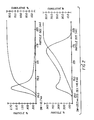
- Figures 1 and 2 compare the particle size number and weight distributions for the unmilled premix and milled slurry, respectively.
- the following table compares the weight average particle diameters for each variation:
- processing with 50 ⁇ m media in a continuous media recirculation process resulted in a significant reduction in the average particle diameter and reduced the number of unwanted particles larger than 200nm.
- a second premix slurry of the same yellow filter dye was prepared as in Example 1. 600g of this slurry was combined with 1170g of 75 ⁇ m mean diameter polymethyl methacrylate milling media. This mixture was processed as in Example 1 and the particle size distributions of both the premix slurry and milled slurry were measured.
- the attached Figure 3 shows the particle size number and weight distributions for the milled slurry relative to the unmilled slurry in Figure 1. The following table compares the weight average particle diameters for each variation:
- An aqueous premix slurry of yellow filter dye D-2 was prepared by combining the following ingredients with simple mixing:
- the filter dye slurry was processed in a 0.6 liter Dyno Mill media mill at 3000rpm for 60 minutes residence time.
- the media mill chamber was charged with 0.48 liters of 500 ⁇ m polystyrene milling media, and the media separator gap was adjusted to 100 ⁇ m to retain the media in the mill during processing.
- Processing included continuously recirculating the slurry from a stirred holding vessel through the media mill by means of a peristaltic pump at 100 g/min flow rate. A processing temperature of 20 ° C +/-5 ° C was maintained during milling. 10g samples were removed during milling at 10, 20, 40, and 60 minutes residence time and were characterized for particle size distribution as in Example 1
- 50 ⁇ m polystryene milling media was added to the slurry while in recirculation through the media mill.
- the 50 ⁇ m media were of sufficiently small size to allow passage through the agitated bed of 500 ⁇ m media in the mill chamber and through the 100 ⁇ m media separator gap. In this way milling was accomplished by both the larger 500 ⁇ m media and smaller 50 ⁇ m in the milling chamber.
- Samples were removed at 80, 100 and 120 minutes residence time during this stage of milling, and the 50 ⁇ m media was removed using an 8 ⁇ m filter. The samples were characterized as before.
- This slurry was combined with 625g of polystryene milling media of an average diameter of 50 ⁇ m.
- the combined mixture of filter dye slurry and media was processed in a 0.6 liter Dyno Mill as in Example 1 for 120 minutes residence time, and samples were removed at 20, 40, 60 and 120 minutes for characterization as before.
- Example 1 may be applicable to materials of other compositions and be an effective means of particle size reduction for such materials.
Landscapes
- Engineering & Computer Science (AREA)
- Chemical & Material Sciences (AREA)
- Food Science & Technology (AREA)
- Chemical Kinetics & Catalysis (AREA)
- Materials Engineering (AREA)
- Physics & Mathematics (AREA)
- General Physics & Mathematics (AREA)
- Crushing And Grinding (AREA)
- Processes Of Treating Macromolecular Substances (AREA)
- Processing And Handling Of Plastics And Other Materials For Molding In General (AREA)
Applications Claiming Priority (2)
| Application Number | Priority Date | Filing Date | Title |
|---|---|---|---|
| US08/248,782 US5513803A (en) | 1994-05-25 | 1994-05-25 | Continuous media recirculation milling process |
| US248782 | 1994-05-25 |
Publications (3)
| Publication Number | Publication Date |
|---|---|
| EP0684508A2 true EP0684508A2 (fr) | 1995-11-29 |
| EP0684508A3 EP0684508A3 (fr) | 1996-01-24 |
| EP0684508B1 EP0684508B1 (fr) | 1999-09-08 |
Family
ID=22940661
Family Applications (1)
| Application Number | Title | Priority Date | Filing Date |
|---|---|---|---|
| EP95106651A Expired - Lifetime EP0684508B1 (fr) | 1994-05-25 | 1995-05-03 | Procédé continu de broyage par recirculation des moyens de broyage |
Country Status (4)
| Country | Link |
|---|---|
| US (1) | US5513803A (fr) |
| EP (1) | EP0684508B1 (fr) |
| JP (1) | JPH07316309A (fr) |
| DE (1) | DE69511937T2 (fr) |
Cited By (4)
| Publication number | Priority date | Publication date | Assignee | Title |
|---|---|---|---|---|
| EP0684519A3 (fr) * | 1994-05-25 | 1996-06-05 | Eastman Kodak Co | Broyage d'un composé utile dans la formation d'images utilisant des agents de broyage polymériques. |
| EP0910473A4 (fr) * | 1996-09-16 | 2000-10-18 | Devmar Group Limited | Procede de production rapide de particules colloidales |
| WO2009058257A3 (fr) * | 2007-10-31 | 2009-11-26 | Eastman Kodak Company | Procédé amélioré de broyage de micromilieux |
| WO2016185442A1 (fr) * | 2015-05-20 | 2016-11-24 | Giuliano Ugolini | Broyeur pour la préparation d'encres sérigraphie |
Families Citing this family (20)
| Publication number | Priority date | Publication date | Assignee | Title |
|---|---|---|---|---|
| GB9710371D0 (en) * | 1997-05-20 | 1997-07-16 | Imation Corp | Formation and photographic use of solid particle dye dispersions |
| US5902711A (en) * | 1997-06-25 | 1999-05-11 | Eastman Kodak Company | Method to media mill particles using crosslinked polymer media and organic solvent |
| US6114079A (en) * | 1998-04-01 | 2000-09-05 | Eastman Kodak Company | Electrically-conductive layer for imaging element containing composite metal-containing particles |
| US6841609B2 (en) | 1998-07-09 | 2005-01-11 | W. R. Grace & Co.-Conn. | Formulation suitable for ink receptive coatings |
| US7919119B2 (en) * | 1999-05-27 | 2011-04-05 | Acusphere, Inc. | Porous drug matrices and methods of manufacture thereof |
| US6395300B1 (en) | 1999-05-27 | 2002-05-28 | Acusphere, Inc. | Porous drug matrices and methods of manufacture thereof |
| US6610317B2 (en) | 1999-05-27 | 2003-08-26 | Acusphere, Inc. | Porous paclitaxel matrices and methods of manufacture thereof |
| AU5300000A (en) * | 1999-06-01 | 2000-12-18 | Elan Pharma International Limited | Small-scale mill and method thereof |
| JP4763957B2 (ja) | 2000-05-10 | 2011-08-31 | オバン・エナジー・リミテッド | メディアミリング |
| JP4969761B2 (ja) * | 2000-08-31 | 2012-07-04 | オバン・エナジー・リミテッド | 所望粒度を持つ固体基材の小粒子および第一材料の小粒状物を含む相乗作用性混合物を製造する方法 |
| DE102006025848A1 (de) * | 2006-03-29 | 2007-10-04 | Byk-Chemie Gmbh | Herstellung von Nanopartikeln, insbesondere Nanopartikelkompositen, ausgehend von Pulveragglomeraten |
| EP2652048B1 (fr) | 2010-12-13 | 2017-04-19 | Sun Chemical Corporation | Procédés de solubilisation de milieux de broyage dans des dispersions de particules de pigments |
| US20140295260A1 (en) * | 2011-11-17 | 2014-10-02 | Toyota Jidosha Kabushiki Kaisha | Method for producing sulfide solid electrolyte |
| US9333507B2 (en) | 2013-01-15 | 2016-05-10 | Knight Industrial Equipment Inc. | Automatic ball charging system for a ball mill assembly |
| JP2016508447A (ja) * | 2013-02-28 | 2016-03-22 | サン・ケミカル・コーポレーション | 連続的微細メディア含有粉砕プロセス |
| MX2021005060A (es) * | 2018-11-02 | 2021-06-15 | Gcp Applied Tech Inc | Produccion de cemento. |
| US11691155B2 (en) * | 2020-09-17 | 2023-07-04 | U.S. Silica Company | Methods and apparatus for producing nanometer scale particles utilizing an electrosterically stabilized slurry in a media mill |
| US12300802B2 (en) * | 2020-09-17 | 2025-05-13 | U.S. Silica Company | Methods and apparatus for producing nanometer scale particles for energy storage materials utilizing an electrosterically stabilized slurry in a media mill |
| IT202100019418A1 (it) * | 2021-07-22 | 2023-01-22 | Paolo Fracassini | Processo e impianto per la produzione di nano-pigmenti in soluzione acquosa |
| CN116408192B (zh) * | 2021-12-29 | 2026-02-17 | 南方科技大学 | 一种表界面调控法制备微纳米碳颗粒的方法 |
Family Cites Families (20)
| Publication number | Priority date | Publication date | Assignee | Title |
|---|---|---|---|---|
| DE273210C (fr) * | ||||
| US3104608A (en) * | 1960-06-20 | 1963-09-24 | Du Pont | Polymer handling |
| ES293103A1 (es) * | 1962-11-12 | 1964-03-16 | Aziende Colori Naz Affini Acna S P A | Procedimiento para la preparación de quinacridona en forma de pigmento |
| US3713593A (en) * | 1970-08-11 | 1973-01-30 | Freeport Sulphur Co | Fine media milling process |
| FR2291793A1 (fr) * | 1974-11-20 | 1976-06-18 | Alcan Aluminium France | Procede de broyage de particules de matiere et broyeur a billes perfectionne pour la mise en oeuvre de ce procede |
| SU580211A1 (ru) * | 1976-01-06 | 1977-11-15 | Минский Опытно-Экспериментальный Завод "Продмаш" | Устройство дл выплавки жира |
| FR2337586A1 (fr) * | 1976-01-08 | 1977-08-05 | Bombled Jean Paul | Broyeur a boulets vertical |
| US4065060A (en) * | 1976-10-06 | 1977-12-27 | Aluminum Company Of America | Metal flake production |
| DE2832761B1 (de) * | 1978-07-26 | 1979-10-31 | Basf Ag | Verfahren zur UEberfuehrung von rohen und/oder grobkristallisierten Perylen-tetracarbonsaeurediimiden in eine Pigmentform |
| US4404346A (en) * | 1980-08-05 | 1983-09-13 | Rohm And Haas Company | Production of powdered resin and the powdered resin so produced |
| JPS58105141A (ja) * | 1981-12-17 | 1983-06-22 | Fuji Photo Film Co Ltd | ハロゲン化銀乳剤の製造方法 |
| US4775393A (en) * | 1985-04-11 | 1988-10-04 | The Standard Oil Company | Autogenous attrition grinding |
| US4974368A (en) * | 1987-03-19 | 1990-12-04 | Canon Kabushiki Kaisha | Polishing apparatus |
| US4940654A (en) * | 1987-12-23 | 1990-07-10 | Eastman Kodak Company | Solid particle dispersion filter dyes for photographic compositions |
| US5066486A (en) * | 1988-10-14 | 1991-11-19 | Revlon, Inc. | Method for preparing cosmetic products and the products obtained thereby |
| US5066335A (en) * | 1989-05-02 | 1991-11-19 | Ogilvie Mills Ltd. | Glass-like polysaccharide abrasive grit |
| JPH04166246A (ja) * | 1990-10-31 | 1992-06-12 | Matsushita Electric Ind Co Ltd | 媒体撹拌ミル及び粉砕方法 |
| AU642066B2 (en) * | 1991-01-25 | 1993-10-07 | Nanosystems L.L.C. | X-ray contrast compositions useful in medical imaging |
| US5145684A (en) * | 1991-01-25 | 1992-09-08 | Sterling Drug Inc. | Surface modified drug nanoparticles |
| AU660852B2 (en) * | 1992-11-25 | 1995-07-06 | Elan Pharma International Limited | Method of grinding pharmaceutical substances |
-
1994
- 1994-05-25 US US08/248,782 patent/US5513803A/en not_active Expired - Fee Related
-
1995
- 1995-05-03 EP EP95106651A patent/EP0684508B1/fr not_active Expired - Lifetime
- 1995-05-03 DE DE69511937T patent/DE69511937T2/de not_active Expired - Fee Related
- 1995-05-25 JP JP7126683A patent/JPH07316309A/ja active Pending
Cited By (4)
| Publication number | Priority date | Publication date | Assignee | Title |
|---|---|---|---|---|
| EP0684519A3 (fr) * | 1994-05-25 | 1996-06-05 | Eastman Kodak Co | Broyage d'un composé utile dans la formation d'images utilisant des agents de broyage polymériques. |
| EP0910473A4 (fr) * | 1996-09-16 | 2000-10-18 | Devmar Group Limited | Procede de production rapide de particules colloidales |
| WO2009058257A3 (fr) * | 2007-10-31 | 2009-11-26 | Eastman Kodak Company | Procédé amélioré de broyage de micromilieux |
| WO2016185442A1 (fr) * | 2015-05-20 | 2016-11-24 | Giuliano Ugolini | Broyeur pour la préparation d'encres sérigraphie |
Also Published As
| Publication number | Publication date |
|---|---|
| US5513803A (en) | 1996-05-07 |
| EP0684508B1 (fr) | 1999-09-08 |
| EP0684508A3 (fr) | 1996-01-24 |
| DE69511937T2 (de) | 2000-03-09 |
| DE69511937D1 (de) | 1999-10-14 |
| JPH07316309A (ja) | 1995-12-05 |
Similar Documents
| Publication | Publication Date | Title |
|---|---|---|
| EP0684508B1 (fr) | Procédé continu de broyage par recirculation des moyens de broyage | |
| EP0684507B1 (fr) | Désintégration avec des moyens de broyage sans forme de petites particules | |
| US5662279A (en) | Process for milling and media separation | |
| DE69503840T2 (de) | Mahlen einer in der Bildaufzeichnung verwendbaren Verbindung unter Verwendung polymerer Mahlhilfsmittel | |
| US5718388A (en) | Continuous method of grinding pharmaceutical substances | |
| JP3440162B2 (ja) | イメージング要素 | |
| JP3479152B2 (ja) | 固体粒子分散液の製造方法 | |
| JPH09122477A (ja) | 固体粒子水性分散体の製造方法、固体粒子分散体、及び写真要素 | |
| US6896212B2 (en) | Method of producing fine solid particles and dispersions | |
| US5709983A (en) | Nonaqueous solid particle dye dispersions | |
| EP0640225B1 (fr) | Melanges aqueux de colorants de sensibilisation spectrale pour emulsions photographiques | |
| EP0146337A2 (fr) | Eléments ayant des couches hydrophiles contenant des substances hydrophobes dans des particules de polymères et méthode de fabrication de ceux-ci | |
| JP2835711B2 (ja) | 写真材料の親水性層の被覆溶液にすぐ使用できる写真的に有用な化合物の分散体の製造方法 | |
| US6750002B2 (en) | Process for the preparation of concentrated dye-water compositions | |
| US5753390A (en) | Method of preparing dispersions of photographically useful compounds | |
| JPH07111550B2 (ja) | ハロゲン化銀写真感光材料及びその製造方法 | |
| JP2000227641A (ja) | ハロゲン化銀写真感光材料 | |
| JPH05162455A (ja) | 4−ヒドロキシ−4’−イソプロポキシジフェニルスルホンの湿式粉砕法 | |
| JPH07270959A (ja) | ハロゲン化銀写真感光材料用染料分散物の製造方法 |
Legal Events
| Date | Code | Title | Description |
|---|---|---|---|
| PUAI | Public reference made under article 153(3) epc to a published international application that has entered the european phase |
Free format text: ORIGINAL CODE: 0009012 |
|
| AK | Designated contracting states |
Kind code of ref document: A2 Designated state(s): BE DE FR GB NL |
|
| PUAL | Search report despatched |
Free format text: ORIGINAL CODE: 0009013 |
|
| AK | Designated contracting states |
Kind code of ref document: A3 Designated state(s): BE CH DE FR GB IT LI NL |
|
| 17P | Request for examination filed |
Effective date: 19960318 |
|
| 17Q | First examination report despatched |
Effective date: 19980505 |
|
| GRAG | Despatch of communication of intention to grant |
Free format text: ORIGINAL CODE: EPIDOS AGRA |
|
| GRAG | Despatch of communication of intention to grant |
Free format text: ORIGINAL CODE: EPIDOS AGRA |
|
| GRAH | Despatch of communication of intention to grant a patent |
Free format text: ORIGINAL CODE: EPIDOS IGRA |
|
| RBV | Designated contracting states (corrected) |
Designated state(s): BE DE FR GB NL |
|
| GRAH | Despatch of communication of intention to grant a patent |
Free format text: ORIGINAL CODE: EPIDOS IGRA |
|
| GRAA | (expected) grant |
Free format text: ORIGINAL CODE: 0009210 |
|
| AK | Designated contracting states |
Kind code of ref document: B1 Designated state(s): BE DE FR GB NL |
|
| REF | Corresponds to: |
Ref document number: 69511937 Country of ref document: DE Date of ref document: 19991014 |
|
| ET | Fr: translation filed | ||
| PLBE | No opposition filed within time limit |
Free format text: ORIGINAL CODE: 0009261 |
|
| STAA | Information on the status of an ep patent application or granted ep patent |
Free format text: STATUS: NO OPPOSITION FILED WITHIN TIME LIMIT |
|
| 26N | No opposition filed | ||
| PGFP | Annual fee paid to national office [announced via postgrant information from national office to epo] |
Ref country code: NL Payment date: 20010319 Year of fee payment: 7 |
|
| PGFP | Annual fee paid to national office [announced via postgrant information from national office to epo] |
Ref country code: GB Payment date: 20010404 Year of fee payment: 7 |
|
| PGFP | Annual fee paid to national office [announced via postgrant information from national office to epo] |
Ref country code: FR Payment date: 20010503 Year of fee payment: 7 |
|
| PGFP | Annual fee paid to national office [announced via postgrant information from national office to epo] |
Ref country code: DE Payment date: 20010530 Year of fee payment: 7 |
|
| PGFP | Annual fee paid to national office [announced via postgrant information from national office to epo] |
Ref country code: BE Payment date: 20010620 Year of fee payment: 7 |
|
| REG | Reference to a national code |
Ref country code: GB Ref legal event code: IF02 |
|
| PG25 | Lapsed in a contracting state [announced via postgrant information from national office to epo] |
Ref country code: GB Free format text: LAPSE BECAUSE OF NON-PAYMENT OF DUE FEES Effective date: 20020503 |
|
| PG25 | Lapsed in a contracting state [announced via postgrant information from national office to epo] |
Ref country code: BE Free format text: LAPSE BECAUSE OF NON-PAYMENT OF DUE FEES Effective date: 20020531 |
|
| PG25 | Lapsed in a contracting state [announced via postgrant information from national office to epo] |
Ref country code: NL Free format text: LAPSE BECAUSE OF NON-PAYMENT OF DUE FEES Effective date: 20021201 |
|
| PG25 | Lapsed in a contracting state [announced via postgrant information from national office to epo] |
Ref country code: DE Free format text: LAPSE BECAUSE OF NON-PAYMENT OF DUE FEES Effective date: 20021203 |
|
| GBPC | Gb: european patent ceased through non-payment of renewal fee |
Effective date: 20020503 |
|
| PG25 | Lapsed in a contracting state [announced via postgrant information from national office to epo] |
Ref country code: FR Free format text: LAPSE BECAUSE OF NON-PAYMENT OF DUE FEES Effective date: 20030131 |
|
| NLV4 | Nl: lapsed or anulled due to non-payment of the annual fee |
Effective date: 20021201 |
|
| REG | Reference to a national code |
Ref country code: FR Ref legal event code: ST |