EP0687318B1 - Cardable hydrophobic polyolefin fibres - Google Patents
Cardable hydrophobic polyolefin fibres Download PDFInfo
- Publication number
- EP0687318B1 EP0687318B1 EP94908989A EP94908989A EP0687318B1 EP 0687318 B1 EP0687318 B1 EP 0687318B1 EP 94908989 A EP94908989 A EP 94908989A EP 94908989 A EP94908989 A EP 94908989A EP 0687318 B1 EP0687318 B1 EP 0687318B1
- Authority
- EP
- European Patent Office
- Prior art keywords
- weight
- fibres
- wax
- fibre
- antistatic agent
- Prior art date
- Legal status (The legal status is an assumption and is not a legal conclusion. Google has not performed a legal analysis and makes no representation as to the accuracy of the status listed.)
- Expired - Lifetime
Links
Images
Classifications
-
- D—TEXTILES; PAPER
- D06—TREATMENT OF TEXTILES OR THE LIKE; LAUNDERING; FLEXIBLE MATERIALS NOT OTHERWISE PROVIDED FOR
- D06M—TREATMENT, NOT PROVIDED FOR ELSEWHERE IN CLASS D06, OF FIBRES, THREADS, YARNS, FABRICS, FEATHERS OR FIBROUS GOODS MADE FROM SUCH MATERIALS
- D06M15/00—Treating fibres, threads, yarns, fabrics, or fibrous goods made from such materials, with macromolecular compounds; Such treatment combined with mechanical treatment
- D06M15/19—Treating fibres, threads, yarns, fabrics, or fibrous goods made from such materials, with macromolecular compounds; Such treatment combined with mechanical treatment with synthetic macromolecular compounds
- D06M15/21—Macromolecular compounds obtained by reactions only involving carbon-to-carbon unsaturated bonds
- D06M15/227—Macromolecular compounds obtained by reactions only involving carbon-to-carbon unsaturated bonds of hydrocarbons, or reaction products thereof, e.g. afterhalogenated or sulfochlorinated
-
- D—TEXTILES; PAPER
- D06—TREATMENT OF TEXTILES OR THE LIKE; LAUNDERING; FLEXIBLE MATERIALS NOT OTHERWISE PROVIDED FOR
- D06M—TREATMENT, NOT PROVIDED FOR ELSEWHERE IN CLASS D06, OF FIBRES, THREADS, YARNS, FABRICS, FEATHERS OR FIBROUS GOODS MADE FROM SUCH MATERIALS
- D06M7/00—Treating fibres, threads, yarns, fabrics, or fibrous goods made of other substances with subsequent freeing of the treated goods from the treating medium, e.g. swelling, e.g. polyolefins
-
- D—TEXTILES; PAPER
- D06—TREATMENT OF TEXTILES OR THE LIKE; LAUNDERING; FLEXIBLE MATERIALS NOT OTHERWISE PROVIDED FOR
- D06M—TREATMENT, NOT PROVIDED FOR ELSEWHERE IN CLASS D06, OF FIBRES, THREADS, YARNS, FABRICS, FEATHERS OR FIBROUS GOODS MADE FROM SUCH MATERIALS
- D06M13/00—Treating fibres, threads, yarns, fabrics or fibrous goods made from such materials, with non-macromolecular organic compounds; Such treatment combined with mechanical treatment
- D06M13/02—Treating fibres, threads, yarns, fabrics or fibrous goods made from such materials, with non-macromolecular organic compounds; Such treatment combined with mechanical treatment with hydrocarbons
-
- D—TEXTILES; PAPER
- D06—TREATMENT OF TEXTILES OR THE LIKE; LAUNDERING; FLEXIBLE MATERIALS NOT OTHERWISE PROVIDED FOR
- D06M—TREATMENT, NOT PROVIDED FOR ELSEWHERE IN CLASS D06, OF FIBRES, THREADS, YARNS, FABRICS, FEATHERS OR FIBROUS GOODS MADE FROM SUCH MATERIALS
- D06M13/00—Treating fibres, threads, yarns, fabrics or fibrous goods made from such materials, with non-macromolecular organic compounds; Such treatment combined with mechanical treatment
- D06M13/244—Treating fibres, threads, yarns, fabrics or fibrous goods made from such materials, with non-macromolecular organic compounds; Such treatment combined with mechanical treatment with compounds containing sulfur or phosphorus
- D06M13/282—Treating fibres, threads, yarns, fabrics or fibrous goods made from such materials, with non-macromolecular organic compounds; Such treatment combined with mechanical treatment with compounds containing sulfur or phosphorus with compounds containing phosphorus
- D06M13/292—Mono-, di- or triesters of phosphoric or phosphorous acids; Salts thereof
-
- D—TEXTILES; PAPER
- D06—TREATMENT OF TEXTILES OR THE LIKE; LAUNDERING; FLEXIBLE MATERIALS NOT OTHERWISE PROVIDED FOR
- D06M—TREATMENT, NOT PROVIDED FOR ELSEWHERE IN CLASS D06, OF FIBRES, THREADS, YARNS, FABRICS, FEATHERS OR FIBROUS GOODS MADE FROM SUCH MATERIALS
- D06M2200/00—Functionality of the treatment composition and/or properties imparted to the textile material
- D06M2200/40—Reduced friction resistance, lubricant properties; Sizing compositions
Definitions
- the present invention relates to cardable and thermobondable polyolefin-based synthetic fibres treated with hydrophobic spin finishes comprising an antistatic agent and a hydrophobic agent, a method for producing the fibres, and nonwoven products prepared from the fibres.
- the fibres which have the advantage of being able to be carded at high speeds, are particularly suitable for use in the preparation of thermally bonded hydrophobic nonwoven fabrics in which a dry, water repellant surface which can function as a liquid barrier is desired, e.g. for disposable diapers and feminine hygienic products.
- the fibres are also suitable for the preparation of thermally bonded nonwoven fabrics for medical use in which a dry, water repellant surface is desired in order to reduce bacterial penetration, for example medical gowns and drapes.
- a number of polyolefin-based hydrophobic synthetic fibres are known, for example hydrophobic textile fibres with dirt and stain resistant properties.
- such fibres generally contain cationic antistatic agents (for example alkylammonium salts, condensation products of fatty acids and ethanol amines, and alkylimidazolinium salts).
- cationic antistatic agents are undesirable or unsuitable for personal hygiene and medical products for toxicological reasons, since they exhibit skin irritating properties due to their non-neutral pH and possible release of di- or tri-ethanolamine, which is suspected of causing allergic reactions.
- Attempts to produce cardable and thermobondable synthetic fibres for hygienic or medical use have not been entirely successful.
- fibres having good cardability properties together with satisfactory hydrophobic properties have not been obtainable. This is particularly important for the many applications in which it is desired that hydrophobic fibres may be carded using high carding speeds.
- Hygienic products such as disposible diapers, sanitary napkins and adult incontinence pads generally have barriers through which fluids absorbed by the absorbent core are not able to penetrate, e.g. in the form of side guards, other structural elements, or as back sheet material opposite to the skin.
- Such barriers may comprise a nonwoven material prepared from hydrophobic staple fibres or a spun-bonded material prepared directly from a hydrophobic polymer.
- spun-bonded materials are very flat and film-like, and do not have the soft, uniform, textile-like comfort that one finds in nonwovens. Spun-bonded fabrics are therefore not the optimal choice for liquid barriers designed to be in contact with the skin of the user.
- nonwovens prepared from staple fibres these tend not to be sufficiently hydrophobic for such liquid barriers, due to the fact that during the spinning process, the fibres are treated with a "spin finish" which facilitates the spinning process by lubricating the fibres and making them antistatic.
- spin finish treatment the fibres become somewhat hydrophilic, which in the present context is undesirable.
- fibres with the desired degree of hydrophobicity have not had optimum antistatic properties, and have therefore not been truly cardable, and certainly not at the high carding speeds typically used for carding of hydrophilic fibres.
- US 4,938,832 discloses a method for preparing hydrophobic polyolefin-containing fibres or filaments in which spun fibres or filaments are treated with a first modifier composition containing 70-100% by weight of at least one neutralized phosphoric acid ester containing a lower alkyl group and up to 30% by weight of at least one polysiloxane with hydrophobic end groups, followed by treatment with a second modifier composition containing 70-100% by weight of the polysiloxane and up to 30% by weight of the neutralized phosphoric acid ester.
- EP 0 486 158 A2 discloses a somewhat similar method for preparing hydrophobic polyolefin-containing fibres or filaments, in which spun fibres or filaments are treated with a first modifier composition containing 0-40% by weight of at least one neutralized phosphoric acid ester containing a lower alkyl group and 60-100% by weight of at least one polysiloxane with hydrophobic end groups, followed by treatment with a second modifier composition containing 50-100% by weight of the neutralized phosphoric acid ester and 0-50% by weight of the polysiloxane.
- EP 0 516 412 A2 discloses a method for treating the surface of polyolefin-containing fibres to improve their lubricity and antistatic properties by applying a liquid lubricating finish containing an alkylated polyol, a water-soluble ester or polyester derived from the polyol or a glycol derived from the polyol.
- a polysiloxane and a neutralized phosphoric acid ester may also optionally be applied to the fibres.
- EP 0 557 024 A1 discloses polyolefin fibres treated with an antistatic agent which is a neutralized phosphate salt, and optionally with a lubricant selected from mineral oils, paraffinic waxes, polyglycols and silicones, the fibres having an hydrostatic head value of at least 102 mm.
- an antistatic agent which is a neutralized phosphate salt, and optionally with a lubricant selected from mineral oils, paraffinic waxes, polyglycols and silicones, the fibres having an hydrostatic head value of at least 102 mm.
- Japanese unexamined publication No. 3-69672/1991 discloses a treating agent for binder fibres containing 20-45% by weight of a C 12 or greater alkylphosphate, 20-70% by weight of a carboxyl-modified polyethylene wax with a MW of 1,000-10,000 and an acid value of 5-50 containing 5-30% of an emulsifier, 5-10% by weight of a higher alcohol, and 2-5% by weight of an optionally modified dimethylsilicone.
- the treating agent is applied to fibres before carding and is thus not a "spin finish" for use during production of the fibres.
- Carboxyl-modified waxes of the type used according to this reference are relatively easy to emulsify, but they are disadvantagous for use in spin finishes for the production of hydrophobic fibres since they have a relatively high melting point and are somewhat hydrophilic.
- the higher alcohol appears to be added to the treating agent in order to help reduce friction caused by the presence of a large amount of the high molecular weight carboxyl-modified wax.
- Japanese patent publication No. 4-24463/1992 discloses polyester fibres coated with a spinning oil consisting of 40-85% by weight of at least one neutral oil with a melting point of 30-150°C, 5-30% by weight of a cationic surfactant, and the balance of an emulsifier.
- a spinning oil consisting of 40-85% by weight of at least one neutral oil with a melting point of 30-150°C, 5-30% by weight of a cationic surfactant, and the balance of an emulsifier.
- cationic surfactants is, however, undesirable in products designed for personal hygiene or medical use.
- An object of the present invention is therefore to provide hydrophobic thermobondable synthetic fibres, in particular for hygienic applications, with improved carding properties and which can be used to prepare nonwovens showing superior strength.
- a further object of the present invention is the provision of a method by which the hydrophobic properties and the fibre/fibre and fibre/metal friction properties of spun fibres may be controlled, thereby allowing optimum fibre distribution and strength in nonwovens containing the fibres.
- the present invention relates to a method for producing cardable, hydrophobic polyolefin-based staple fibres, the method comprising the following steps:
- the present invention relates to a fibre produced by the above method, the fibre being a texturized, cardable, polyolefin-based fibre carrying, at its surface, 0.10-0.50% by weight of the fibre of an antistatic agent, 0.10-0.35% by weight of the fibre of a natural or synthetic hydrocarbon wax with a melting point in the range of 40-120°C or of a wax mixture comprising at least one such hydrocarbon wax and having a melting point in the range of 40-120°C, 0-0.25% by weight of the fibre of a polydiorganosiloxane, and 0.001-0.10% by weight of the fibre of an emulsifier.
- the invention relates to a hydrophobic nonwoven material comprising the fibres of the invention.
- the invention relates to a method for preparing a hydrophobic nonwoven material, comprising processing the fibres of the invention to obtain a web for bonding, and thermobonding the resulting web to obtain the hydrophobic nonwoven material.
- the fibres of the present invention have been found to have superior antistatic properties compared to known hydrophobic fibres and can therefore be carded at high carding speeds comparable to carding speeds typically used for hydrophilic staple fibres.
- the fibres' suitability for high-speed carding is also due to their controlled fibre/fibre and fibre/metal friction properties obtained by varying the composition of the second spin finish. It has furthermore been found that webs prepared from the fibres have a uniform distribution of the fibres in both the machine direction and the transverse direction, and that when these webs are thermobonded by calender bonding nonwovens with improved strength and excellent hydrophobicity are obtained.
- Fibres prepared according to the present invention may be either white (unpigmented) or coloured (pigmented) fibres.
- polyolefin-based refers to the fact that the fibres of the present invention are produced from a polyolefin or a copolymer thereof, including isotactic polypropylene homopolymers as well as random copolymers thereof with ethylene, 1-butene, 4-methyl-1-pentene, etc., and linear polyethylenes of different densities, such as high density polyethylene, low density polyethylene and linear low density polyethylene.
- the melts used to produce the polyolefin-based fibres may also contain various conventional fibre additives, such as calcium stearate, antioxidants, and pigments, including whiteners and colourants such as TiO 2 , etc.
- the hydrophobic fibres may be either monocomponent or bicomponent fibres, the latter being for example sheath-and-core type bicomponent fibres with the core being located either eccentrically (off-center) or concentrically (substantially in the center).
- Bicomponent fibres will typically have a core and sheath which comprise, respectively, polypropylene/polyethylene, high density polyethylene/linear low density polyethylene, polypropylene random copolymer/polyethylene, or polypropylene/polypropylene random copolymer.
- the spinning of the fibres is preferably accomplished using conventional melt spinning (also known as “long spinning"), in particular medium-speed conventional spinning.
- Conventional spinning involves a two-step process, the first step being the extrusion of the melts and the actual spinning of the fibres, and the second step being the stretching of the spun fibres, in contrast to so-called “short spinning", which is a one-step process in which the fibres are both spun and stretched in a single operation.
- the melted fibre components are led from their respective extruders, through a distribution system, and passed through the holes of a spinnerette.
- the extruded melts are then led through a quenching duct, where they are cooled and solidified by a stream of air, and at the same time drawn into filaments, which are gathered into bundles of typically several hundred filaments.
- the spinning speed after the quenching duct is typically at least about 200 m/min, more typically about 400-2500 m/min.
- the filaments are treated with the first spin finish by means of lick rollers.
- Stretching in a long spin process is performed using so-called off-line stretching or off-line drawing, which, as mentioned above, takes place separately from the spinning process.
- the stretching process typically involves a series of hot rollers and a hot air oven, in which a number of bundles of filaments are stretched simultaneously.
- the bundles of filaments pass first through one set of rollers, followed by passage through a hot air oven, and then passage through a second set of rollers.
- Both the hot rollers and the hot air oven typically have a temperature of about 50-140°C, e.g. about 70-130°C, the temperature being chosen according to the type of fibre, e.g.
- the speed of the second set of rollers is faster than the speed of the first set, and the heated bundles of filaments are therefore stretched according to the ratio between the two speeds (called the stretch ratio or draw ratio).
- a second oven and a third set of rollers can also be used (two-stage stretching), with the third set of rollers having a higher speed than the second set. In this case the stretch ratio is the ratio between the speed of the last and the first set of rollers.
- additional sets of rollers and ovens may be used.
- the fibres of the present invention are typically stretched using a stretch ratio of from about 1.05:1 to about 6:1, e.g. from 1.05:1 to 2:1 for polypropylene fibres, from 2:1 to 4.5:1 for polyethylene fibres and polypropylene/polyethylene bicomponent fibres, resulting in an appropriate fineness, i.e. about 1-7 dtex, typically about 1.5-5 dtex, more typically about 1.6-3.4 dtex.
- the bundles of filaments are treated with the second spin finish by means of lick rollers.
- Texturization (crimping) of the stretched fibres is performed in order to make the fibres suitable for carding by giving them a "wavy" form.
- An effective texturization i.e. a relatively large number of crimps in the fibres, allows for high processing speeds in the carding machine, typically at least about 80 m/min, such as at least 100 m/min, and in many cases at least 150 m/min or even 200 m/min or more, and thus a high productivity.
- Crimping is typically carried out using a so-called stuffer box.
- the bundles of filaments are led by a pair of pressure rollers into a chamber in the stuffer box, where they become crimped due to the pressure that results from the fact that they are not drawn forward inside the chamber.
- the degree of crimping can be controlled by the pressure of the rollers prior to the stuffer box, the pressure and temperature in the chamber and the thickness of the bundle of filaments.
- the filaments can be air-texturized by passing them through a nozzle by means of a jet air stream.
- the fibres of the present invention are typically texturized to a level of about 5-15 crimps/cm, typically about 7-12 crimps/cm (the number of crimps being the number of bends in the fibres).
- the fibres After the fibres have been crimped, e.g. in a stuffer box, they are typically fixed by heat treatment in order to reduce tensions which may be present after the stretching and crimping processes, thereby making the texturization more permanent. Fixation and drying of the fibres may take place simultaneously, typically by leading the bundles of filaments from the stuffer box, e.g. via a conveyer belt, through a hot-air oven. The temperature of the oven will depend on the composition of the fibres, but must obviously be below the melting point of the fibre polymer or (in the case of bicomponent fibres) the low melting component.
- the fibres are subjected to a crystallization process which "locks" the fibres in their crimped form, thereby making the texturization more permanent.
- the heat treatment also removes a certain amount of the water from the spin finishes.
- the drying process allows the wax component (together with any polydiorganosiloxane) to melt and become distributed uniformly on the surface of the filaments.
- the filaments are typically dried at a temperature in the range of 90-130°C, typically 95-125°C, depending on factors such as the type of fibre.
- the fixed and dried bundles of filaments are then led to a cutter, where the fibres are cut to staple fibres of the desired length.
- Cutting is typically accomplished by passing the fibres over a wheel containing radially placed knives.
- the fibres are pressed against the knives by pressure from rollers, and are thus cut to the desired length, which is equal to the distance between the knives.
- the fibres of the present invention are typically cut to staple fibres of a length of about 18-150 mm, more typically about 25-100 of in particular about 30-65 mm, depending on the carding equipment and the fineness of the fibres.
- a length of about 38-40 mm will thus often be suitable for a fibre with a fineness of about 2.2 dtex, while a length of 45-50 mm is often suitable for a 3.3 dtex fibre.
- a spin finish for spinning and stretching polymer fibres include the following:
- the present invention is based on spin finishes used in connection with both the spinning and stretching steps which fulfil the requirements listed above with regard to the content of antistatic agent, cohesion conferring agent, oil and water, as well as regulation of fibre/fibre and fibre/metal friction.
- These spin finishes have the further advantage that they function as a processing aid during carding and thus provide the fibre/fibre and fibre/metal friction necessary to obtain sufficient carding of the fibres. As a result, a carding web with a uniform distribution of the fibres is obtained, even when using relatively high carding speeds.
- the majority of the antistatic agent is applied in the spinning stage, and wax (as well as polydiorganosiloxane) are only applied in the stretching stage. There are several reasons for choosing this approach. First of all, the use of wax during spinning results in problems for both spinning and stretching:
- the (relatively hydrophobic) antistatic agent should have sufficient antistatic properties, should contribute to the cohesion of the filaments, and should not have such a high molecular weight that it leads to problems with deposits on the machinery.
- the second spin finish should contain a certain minimum amount of antistatic agent to provide the fibres with sufficient antistatic properties to be able to be carded without problems of static electric build-up.
- the second spin finish should contain a sufficient amount of one or more hydrophobic components (wax and optional polydiorganosiloxane) so that the finished fibres as well as the carded and thermobonded non-wovens prepared from the fibres have sufficient hydrophobic properties.
- hydrophobicity dictate certain limits on the relationship between the amount of antistatic agent on the one hand and the hydrophobic components (wax and polydiorganosiloxane) on the other hand.
- the spin finish in the spinning section should be an antistatic and lubricating finish, and should be as hydrophobic as possible.
- Non-ionic antistatic agents are e.g. polyethylene glycol esters and polyethylene glycol alkyl esters. These non-ionic antistatic agents are highly heat resistant and have good lubricating properties, but they do not have as efficient antistatic properties as the anionic and cationic antistatic agents.
- cationic antistatic agents it has already been explained that these have properties which generally make them undesirable for fibres to be used for hygienic or medical purposes.
- amphoteric antistatic agents i.e. agents which can function as both a cationic and anionic agent, exist, e.g. Betaine and Imidazoline.
- Anionic antistatic agents e.g. of the sulphate and phosphate family, are the most commonly used for the production of hygienic and medical fibres.
- fatty amine and fatty acid ethoxylates are used as neutralizing agents for anionic antistatic agents in order to increase the antistatic effect without adversely affecting the friction properties of the filaments, since anionic antistatic agents are less efficient than cationic antistatic agents.
- anionic antistatic agents are more desirable for products which are designed to be in contact with the skin than are cationic agents.
- a number of anionic antistatic agents in fact fulfil the FDA requirements for indirect food additives.
- Anionic antistatic agents are e.g. sulphated fatty acid esters, sulphated alcohols, phosphate esters of ethoxylated alcohols, alkyl phosphate salts, and phosphated alcohols such as polyethylene glycol alkyl ether phosphate.
- the antistatic agent is preferably an anionic or non-ionic antistatic agent, most preferably an anionic antistatic agent.
- the first spin finish typically contains, as an antistatic agent, a phosphoric acid ester of a water-insoluble alcohol, and is typically in the form of an aqueous dispersion with an active content of about 0.5-2%.
- active content in the context of the present invention refers to the non-water (non-solvent) content of the spin finishes.
- a preferred antistatic agent is a neutralized phosphoric acid ester of the general formula I wherein Alk is a branched or linear aliphatic alkyl or alkenyl group containing 10-24 carbon atoms; R is hydrogen, an alkali metal, an amino group, or a mono-, di- or tri- ⁇ -hydroxyethanol amino group; m is 0, 1 or 2 and n is 1, 2 or 3, the sum of which is 3; or a mixture of such neutralized phosphoric acid esters.
- Alk in the compound of formula I is in particular an alkyl group containing 12-22 carbon atoms, preferably 14-20 carbon atoms, e.g. 16-18 carbon atoms, and preferably a straight chain alkyl group. Preferred compounds are also those in which n is 2 and m is 1.
- the ester of formula I should be solid at temperatures up to at least about 40°C, and preferably up to at least about 80°C, e.g. up to at least about 95°C.
- a preferred first spin finish comprises e.g. a neutralized salt of a stearyl alcohol phosphoric acid ester and, as a lubricant and cohesion conferring agent, ethoxylated castor oil.
- antistatic agents e.g. sulphated fatty acid esters and phosphated alcohols such as a polyethylene glycol alkyl ether phosphate.
- sulphated fatty acid esters and phosphated alcohols such as a polyethylene glycol alkyl ether phosphate.
- phosphated alcohols such as a polyethylene glycol alkyl ether phosphate.
- cohesion conferring agents are e.g. ethoxylated vegetable oils such as ethoxylated palm oil and ethoxylated coconut oil.
- the active content of the first spin finish typically consists of about 80-95% by weight of the antistatic agent and about 5-20% by weight of a lubricant, more typically about 88-92% by weight of the antistatic agent and about 8-12% by weight of a lubricant.
- the amount of the first spin finish applied to the fibres is generally in the range of about 0.08-0.25%, more typically 0.10-0.20%, by weight active content based on the weight of the fibres.
- the spin finish in the stretching section comprises a combination of a relatively hydrophobic antistatic agent (normally of the same type used in the first spin finish, for example a neutralized phosphoric acid alkyl ester), a hydrocarbon wax, an emulsifier and optionally a polydiorganosiloxane, normally in the form of an aqueous dispersion with an active content on the order of about 10%.
- a relatively hydrophobic antistatic agent normally of the same type used in the first spin finish, for example a neutralized phosphoric acid alkyl ester
- a hydrocarbon wax normally in the form of an aqueous dispersion with an active content on the order of about 10%.
- the hydrocarbon wax used in the second spin finish of the present invention is in particular a paraffin wax or microcrystalline wax.
- natural waxes i.e. an insect or plant wax, may also be suitable.
- Paraffin wax is a crystalline hydrocarbon mixture which is solid at room temperature and which is obtained from the light petroleum fraction known as "pressable wax distillate". Paraffin wax normally consists mainly of straight-chained hydrocarbons and some branched-chain hydrocarbons (isoparaffins). Microcrystalline wax, which is also a hydrocarbon mixture that is solid at room temperature, is obtained from heavy petroleum distillates and residues. Microcrystalline wax normally consists mainly of branched-chain hydrocarbons (isoparaffins) and naphthenes (large side chains) along with small amounts of straight-chain hydrocarbons and aromatic hydrocarbons.
- the melting point of paraffin waxes is typically in the range of about 45-65°C, while that of microcrystalline waxes is typically in the range of about 50-95°C. (The solidifying point of a hydrocarbon wax is normally about 2-3°C below the melting point).
- hydrocarbon wax refers to a paraffin or microcrystalline wax of natural or synthetic origin, in particular to a wax with a melting point in the range of 40-80°C, corresponding to an average molecular weight of about 250-800 (as determined by high temperature gel permeation chromatography, using e.g. trichlorobenzene as an eluent, or by mass spectroscopy), or to a mixture of waxes containing a major proportion of a paraffin or microcrystalline wax and having a melting point in the above-mentioned range. While a wax or wax mixture with a relatively low melting point (i.e.
- wax or wax mixtures having a higher melting point e.g. up to about 120°C
- Preferred hydrocarbon waxes have in particular a melting point in the range of 45-65°C, e.g. 50-60°C, corresponding to an average molecular weight in the range of about 400-600.
- the second spin finish is typically applied at a temperature in the range of 25-60°C, e.g. 40-55°C (the fibres generally having a somewhat higher temperature during application of the second spin finish).
- waxes normally consist of a mixture of different hydrocarbons, this will also be the case for the waxes used for the purpose of the present invention.
- the "wax” will therefore typically be a mixture of different wax types, some of which may be waxes having higher or lower molecular weights and melting points than those given above, as long as the melting point of the total mixture lies within the range stated above.
- the wax may also contain a certain amount of a "hydrocarbon resin", i.e. a partially cross-linked hydrocarbon wax with a relatively high melting point, e.g. up to about 120°C.
- Hydrocarbon resins are prepared synthetically by radical polymerisation of hydrocarbon waxes containing aromatic hydrocarbons.
- the amount of these other components will typically comprise no more than 40% by weight of the wax mixture, preferably no more than 30% by weight of the wax mixture, more preferably no more than 20% by weight of the wax mixture.
- natural waxes insect or plant waxes may also be used as the wax component in the second spin finish of the present invention.
- While natural waxes may contain a variety of different components, hydrocarbons are a major component in many of these.
- One natural wax of interest is beeswax, which contains a mixture of hydrocarbons, monoesters, diesters, triesters, hydroxymonoesters, hydroxypolyesters, free acids, acid monoesters and acid polyesters, as well as a small amount of unidentified material.
- Other insect waxes of interest are for example those from crickets, grasshoppers and cockroaches.
- waxes of many plant species contain a major proportion of hydrocarbons, mainly in the form of unbranched alkanes with an odd number of carbon atoms.
- branched alkanes as well as alkenes have also been reported and are probably present in many plant waxes.
- some vegetable waxes, such as carnauba wax contain a relatively small percentage of unbranched alkanes.
- plant waxes also contain various amounts of other components, including monoesters, diesters, hydroxyesters, polyesters, primary and secondary alcohols, acids, aldehydes, ketones, etc.
- Natural waxes used for the purpose of the present invention should have a melting point which lies within the ranges given above for hydrocarbon waxes.
- the second spin finish contains a polydiorganosiloxane compound (silicone).
- a polydiorganosiloxane compound silicone
- at least 6% by weight of the active content of the second spin finish consists of the polydiorganosiloxane, typically at least 8% by weight.
- the polydiorganosiloxane is in particular a polydialkylsiloxane of the general formula II, in which each R is independently an alkyl group containing 1-4 carbon atoms, phenyl or H, n is a number in the range of 500-3000, and X is OH, CH 3 , H, O-CH 3 or O-acetyl.
- a preferred polydialkylsiloxane is polydimethylsiloxane.
- the content of polydiorganosiloxane in the second spin finish will obviously depend on the hydrophobic properties which are desired in the fibres. However, it is possible to define two general categories of spin finish containing polydiorganosiloxane: one for the production of fibres with a medium degree of hydrophobicity, and one for the production of fibres with a very high degree of hydrophobicity.
- the active content of the second spin finish will typically contain about 6-11% by weight of the polydiorganosiloxane, e.g. about 7-10% by weight.
- the active content of the second spin finish will typically contain at least about 12% by weight of the polydiorganosiloxane, e.g. at least about 15% by weight, more typically at least about 20% by weight, and may contain as much as 35% by weight.
- the amount of polydiorganosiloxane in the second spin finish will in this case often be in the range of 20-30% by weight, e.g. 22-28% by weight, of the active content.
- antistatic agent in the second spin finish those antistatic agents discussed above in connection with the first spin finish are also suitable for the second spin finish, and the same antistatic agent may advantageously be used in both the first spin finish and the second spin finish.
- the content of antistatic agent, wax and polydialkylsiloxane in the second spin finish will in each case be determined taking into consideration the carding and hydrophobic properties which are desired in the finished fibres. Thus, a certain minimum antistatic content is required in order to avoid fibres which have a poor cardability due to the presence of a static electric charge. On the other hand, a certain maximum relative antistatic content is dictated by the need to have a certain minimum content of the hydrophobic agent (wax and polydialkylsiloxane) in order to obtain the desired degree of hydrophobicity.
- the second spin finish should include a certain amount of polydialkylsiloxane, which provides increased hydrophobicity compared to spin finishes with a wax alone as the hydrophobic agent.
- the hydrophobic second spin finish is an aqueous dispersion of non-water soluble components
- an emulsifier will normally be necessary in order to prepare and stabilize the dispersions.
- the precise nature of the emulsifier is not believed to be critical.
- Anionic emulsifiers, sulphur-containing emulsifiers, etc. are typically used, for example neutralized alkylbenzene sulphonic acid, lignin sulphonic acid and benzoic acid, since such compounds also have an advantageous corrosion-preventing effect.
- the emulsifier content is preferably as low as possible in order to ensure optimum hydrophobic properties in the fibres.
- the active content of the second spin finish will typically comprise 10-50% by weight of the antistatic agent, 15-70% by weight of the wax, up to 35% by weight of the polydiorganosiloxane, and 5-15% by weight of the emulsifier.
- the active content of the second spin finish comprises 20-45% by weight of the antistatic agent, 40-65% by weight of the wax, and about 6-28% by weight of the polydiorganosiloxane (the remainder of the active content being the emulsifier).
- the second spin finish is typically applied in an amount (total active content by weight of the fibres) of about 0.25-0.60%. Together with that which is applied in the first spin finish, the finished fibres typically carry at their surface a total (by weight of the fibres) of about 0.10-0.50% by weight of the antistatic agent, about 0.10-0.35% by weight of the hydrocarbon wax or wax mixture, from 0% to about 0.25% polydiorganosiloxane and about 0.001-0.10% of an emulsifier.
- the fibres carry at their surface 0.12-0.40% by weight of the antistatic agent, 0.12-0.30% by weight of the wax or wax mixture, 0.01-0.20% by weight of the polydiorganosiloxane and 0.02-0.09% by weight of the emulsifier, e.g. 0.15-0.35% by weight of the antistatic agent, 0.18-0.27% by weight of the wax or wax mixture, 0.03-0.15% by weight of the polydiorganosiloxane and 0.04-0.07% by weight of the emulsifier.
- Fibres produced according to the present invention may also be defined according to the relative amounts, on the surface of the fibres, of the various components applied in the first and second spin finishes.
- a particular embodiment of the invention relates to a texturized, cardable, polyolefin-based fibre carrying, at its surface, a spin finish coating comprising 25-60% by weight of an antistatic agent, 15-60% by weight of a natural or synthetic hydrocarbon wax with a melting point in the range of 40-120°C or of a wax mixture comprising at least one such hydrocarbon wax and having a melting point in the range of 40-120°C, 0-30% by weight of a polydiorganosiloxane, and the remainder of an emulsifier.
- the spin finish coating typically comprises 30-55% by weight of the antistatic agent, 25-50% by weight of the wax or wax mixture, 2-25% by weight of the polydiorganosiloxane and 4-14% by weight of the emulsifier, e.g. 35-50% by weight of the antistatic agent, 30-45% by weight of the wax or wax mixture, 6-20% by weight of the polydiorganosiloxane and 7-12% by weight of the emulsifier.
- the present invention makes it possible to "fine-tune" the hydrophobic properties as well as the fibre/fibre and fibre/metal friction properties of the fibres.
- Control of the hydrophobic properties is accomplished by varying the ratios of the various components in the second spin finish, in particular (a) the ratio between the antistatic agent and the hydrophobic components (wax and polydiorganosiloxane), and (b) the ratio between the wax and the polydiorganosiloxane.
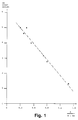
- Fig. 1 shows graphically the repellency (in cm water column) of various nonwovens as a function of the above-mentioned weight ratio between the antistatic agent and the hydrophobic components (A/(W+5 ⁇ S).
- the nonwovens which had a base weight of 22 g/m 2 , were prepared from polypropylene fibres using the methods described below for the Examples.
- the fibres are slightly hydrophobic and have an absorbency time of at least about 6 min, and the strike-through time for a 22 g/m 2 nonwoven produced from the fibres is about 5-10 sec. (see below regarding tests for absorbency and strike-through time).
- the fibres When the ratio A/(W+5 ⁇ S) is in the interval of from about 0.7 to about 1.0, the fibres have a medium degree of hydrophobicity and have an absorbency time of more than about 20 min, and the strike-through time for a 22 g/m 2 nonwoven produced from the fibres is greater than 10 sec.
- the fibres are highly hydrophobic and have an absorbency time of more than about 24 hours, and the strike-through time for a 22 g/m 2 nonwoven produced from the fibres is more than 120 sec.
- the hydrophobic properties of the fibres can also be expressed in terms of the contact angle between water and the surface of the fibres. Fibres with non-wettable characteristics should have a contact angle of more than 90° (as measured e.g. using the Wilhelmy technique-force measurement for single fibre wettability). It is believed that the slightly hydrophobic fibres of the present invention will have a contact angle of slightly above 90°, while the highly hydrophobic fibres will have a contact angle that approaches 180° (a contact angle of 180° being a theoretical maximum for total non-wetting).
- Control of the fibres' processing characteristics is obtained by varying the relationship between the wax and the polydiorganosiloxane in the second spin finish.
- the weight ratio S/W (where S is polydiorganosiloxane and W is wax) can vary from about 0.1 to about 2 (assuming of course that polydiorganosiloxane is present in the second spin finish), and that a significant change in the properties of the fibres occurs at a ratio of about 1, so that a S/W weight ratio of less than 1 gives fibres with a high fibre/fibre and fibre/metal friction and a moderate to high hydrofobicity, while a S/W weight ratio of more than 1 gives more slippery fibres which are highly hydrophobic but which have a relatively low fibre/fibre and fibre/metal friction. Fibres without any polydiorganosiloxane will have a high fibre/fibre and fibre/metal friction and
- the fibres of the present invention are suitable for high-speed carding, this being of particular interest for polypropylene fibres.
- the fibres of the present invention may be processed to a uniform carding web at high speeds in the carding machine, typically at least about 80 m/min, such as at least 100 m/min, and (in particular for polypropylene fibres) in many cases at least 150 m/min or even 200 m/min or more.
- the carding speed chosen in each case will depend on factors such as the type of fibre (e.g. polypropylene, polyethylene, bicomponent, etc.) and the nature of the nonwoven being produced. Carding will typically be by means of a dry-laid carding process.
- Polypropylene fibres according to the invention are preferably able to be carded, at a carding speed of at least 100 m/min, preferably at least 150 m/min, more preferably at least 200 m/min, into a web which can be thermally bonded to a nonwoven in which the ratio between the tensile strength in the machine direction and the tensile strength in the cross direction is at the most 7, preferably at the most 5 (the strengths being determined as explained below).
- Polypropylene/polyethylene bicomponent fibres of the present invention are preferably able to be carded, at a carding speed of at least 80 m/min, preferably at least 100 m/min, into a web which can be thermally bonded to a nonwoven in which the ratio between the tensile strength in the machine direction and the tensile strength in the cross direction is at the most 6.
- Polyethylene fibres of the present invention are preferably able to be carded, at a carding speed of at least 80 m/min, into a web which can be thermally bonded to a nonwoven in which the ratio between the tensile strength in the machine direction and the tensile strength in the cross direction is at the most 5.
- the randomization of fibres in the web expressed as the ratio between the two tensile strengths should be as close to 1 as possible.
- the strengths of different nonwoven materials may be compared by using a so-called “bondability index", which compensates for differences in fibre randomization and which is calculated as explained below on the basis of nonwoven tensile strength measured in the machine direction and the cross direction.
- a standardized carding test for determining the tensile strength of nonwovens is performed as follows: From about 95-105 kg of fibres, webs of a least 15 kg with a base weight of 20-25 g/m 2 fibre web are produced by carding at the chosen speed at optimum roller settings with respect to evenness of the web. The webs are subsequently thermobonded, the individual webs being thermobonded at different temperatures at intervals of typically 2°C within a range chosen according to the type of fibres.
- a web with a base weight of about 20 g/m 2 is prepared by thermobonding at temperatures in the range of 145-157°C, using a calender pressure of 64 N/mm and a typical carding speed of 100 m/min.
- a web with a base weight of about 25 g/m 2 is prepared by thermobonding at temperatures in the range of 126-132°C, with a calender pressure of 40 N/mm and a typical carding speed of 80 m/min.
- a web with a base weight of about 20 g/m 2 is prepared by thermobonding at temperatures in the range of 137-147°C, with a calender pressure of 40 N/mm and a typical carding speed of 80 m/min.
- the tensile strengths of the webs are then determined in the machine direction and the cross direction, the measurements being performed according to the EDANA recommended test: Nonwovens Tensile Strength, 20 February, 1989, which is based on ISO 9073-3:1989 ("Determination of tensile strength and elongation"); however, for the purposes of the present invention the relative humidity was between 50% and 65%.
- a bondability index is calculated for each of the bonding temperatures, the bondability index being defined as the square root of the product of the machine direction strength and the cross direction strength.
- the calculated bondability index for a given sample is multiplied by 20 and divided by the actual base weight in g/m 2 , thereby compensating for the fact that the strength of a nonwoven varies with the base weight.
- the bondability index (BI 20 ) should be at least 15 N/5 cm when carded at a speed of 100 m/min and at least 10 N/5 cm when carded at a speed of 150 m/min, and is preferably at least 17 N/5 cm when carded at a speed of 100 m/min and at least 10 N/5 cm when carded at a speed of 150 m/min.
- the bondability index (BI 20 ) should be at least 7 N/5 cm when carded at a speed of 80 m/min, and is preferably at least 10 N/5 cm when carded at a speed of 80 m/min.
- the bondability index (BI 20 ) should be at least 8 N/5 cm when carded at a speed of 80 m/min, and is preferably at least 10 N/5 cm at 80 m/min.
- the hydrophobic properties of nonwovens prepared from the fibres of the invention may be tested according to various methods. These include a repellency test, a test for liquid absorbency time, a test for liquid strike-through time and a runoff test. The test for liquid absorbency time may also be used for testing the hydrophobic properties of fibres.
- the repellency test is performed according to the EDANA recommended test for nonwovens repellency (No. 120.1-80), with conditioning of the samples for at least 2 hours at a temperature of 23°C and a relative humidity of 50%.
- This test involves measuring the pressure (expressed as cm water column) required to effect water penetration through a nonwoven subjected to an increasing water pressure. Briefly, a circular section of a nonwoven sample of the desired base weight (typically about 22 g/m 2 ) with a diameter of 60 mm is subjected to a water column whose height increases at a rate of 3 cm/min., and the repellency of the nonwoven is determined as the height of the water column at the moment when the third drop of water penetrates the sample.
- nonwovens containing the fibres of present invention should show a repellency of at least about 1.5 cm.
- the repellency should be at least about 2.5 cm, typically at least about 3 cm.
- the repellency should be at least about 4 cm, more preferably at least about 5 cm, e.g. at least about 6 cm.
- Another suitable test method for determining the hydrophobic properties of nonwovens is a test for liquid absorbency time according to the EDANA recommended test for nonwovens absorption (No. 10.1-72). This test involves determining the time required for the complete wetting of a specimen strip (5 g) loosely rolled into a cylindrical wire basket (3 g) and dropped onto the surface of the liquid (typically water) from a height of 25 mm.
- Nonwoven samples for use in this test are for the purpose of the present invention conditioned for at least 2 hours at a temperature of 23°C and a relative humidity of 50%.
- the above liquid absorbency test may also be used, with certain minor amendments, for determining the hydrophobic properties of fibres.
- the EDANA test procedure for nonwovens is amended by conditioning the fibre samples at a temperature of 45°C and at a relative humidity of less than 10% for one hour prior to testing, the samples being allowed to cool to 23°C before testing.
- a carding web with a base weight of approximately 10 g/m 2 is prepared from the fibres to be tested by carding at 15 m/min., and samples having a weight of 5 g are then taken from the web.
- the remainder of the test is carried out according to the EDANA test procedure (10.1-72).
- the absorbency time is defined as the time interval from the moment the wire basket containing the nonwoven or fibre sample hits the liquid to the moment the sample is completely immersed under the surface of the liquid.
- the wetting time i.e. the sinking time
- the wetting time for a sample of hydrophobic fibres should be at least about 6 minutes, preferably at least about 10 minutes, more preferably at least about 20 minutes, e.g. at least about 1 hour.
- the wetting time should be at least about 24 hours.
- a further test for determining the hydrophobic properties of nonwovens is a test for liquid strike-through time (EDANA recommended test: Nonwoven coverstock liquid strike-through time (simulated urine); No. 150.1-90).
- EDANA liquid strike-through time
- Nonwoven coverstock liquid strike-through time simulated urine
- No. 150.1-90 the time required for a known volume of liquid to pass through a nonwoven is measured.
- the liquid is applied to the surface of a test piece of nonwoven coverstock which is in contact with an underlying standard absorbent pad.
- the test is designed to compare the strike-through time of different nonwoven coverstocks.
- the nonwoven samples are for the purpose of the present invention conditioned for at least 2 hours at a temperature of 23°C and a relative humidity of 50%. 5 ml of the test liquid (a 0.9% aqueous NaCl solution) is discharged onto the sample (typical base weight 22 g/m 2 ) in 3.75 sec., and the time required for the liquid to penetrate the nonwoven is measured electronically.
- nonwovens according to the present invention should have a strike-through time of at least about 5 sec., preferably at least about 10 sec., more preferably at least 15 sec.
- the strike-through time should be at least 1 min., preferably at least about 2 min., and more preferably at least about 5 min.
- the hydrophobicity of nonwovens may further be determined by evaluating the runoff percentage according to the following procedure: Runoff is measured using simulated urine (68-72 dyne/cm; 19.4 g urea, 8 g NaCl, 0.54 g MgSO 4 (anhydrous), 1.18 g CaCl 2 ⁇ 6H 2 O, 970.9 g demineralised water).
- the test involves pouring 25 ml of test liquid onto a test material (31 cm in the machine direction and 14 cm in the cross direction) containing a top layer of a nonwoven coverstock and a bottom layer of filter paper, the test material being placed at angle of 10 degrees from horizontal and a collecting tray being placed under the lower end of the test material.
- the coverstock should be placed in the machine direction with the embossed side upwards.
- the runoff percentage is defined as the amount of test liquid which is collected in the tray, expressed as a percentage of the original 25 ml of liquid.
- a good hydrophobic nonwoven should using this method give a runoff of at least 90%, preferably at least 95%.
- the runoff percentage is preferably at least 98%, and can be as high as 99% or more (which essentially corresponds to 0% penetration).
- the runoff percentage is also to a certain extent dependent upon the weight of the material, a heavier material giving a slightly higher runoff percentage, the above-mentioned runoff percentages being based on nonwovens with a base weight of 20 g/m 2 .
- Fibres and nonwovens were prepared as follows:
- the polyolefin raw material (polypropylene, polyethylene, or, for bicomponent fibres, polypropylene for the core and polyethylene for the sheath) was spun into fibres by conventional spinning (long spinning) technology, using spinning speeds of 1500-2000 m/min for polypropylene fibres, 800-1000 m/min for PP/PE bicomponent fibres, and 300-500 m/min for polyethylene fibres, resulting in a bundle of several hundred filaments.
- 0.1% of phthalocyanine blue pigment was added to the raw material prior to spinning.
- the filaments were treated with a first spin finish containing, as an antistatic agent, a neutralized C 16 -C 18 alcohol phosphoric acid ester of which the major part was a neutralized stearyl alcohol phosphoric acid ester (Silastol F203, from Schill & Seilacher, Germany) and an ethoxylated castor oil (Silastol 360, from Schill & Seilacher, Germany) by means of a lick roller.
- a neutralized C 16 -C 18 alcohol phosphoric acid ester of which the major part was a neutralized stearyl alcohol phosphoric acid ester (Silastol F203, from Schill & Seilacher, Germany) and an ethoxylated castor oil (Silastol 360, from Schill & Seilacher, Germany) by means of a lick roller.
- the amounts (active content) of the two compounds applied at this stage varied somewhat, but generally about 0.12-0.20% by weight of the C 16 -C 18 alcohol phosphate ester and about 0.010-0.020% by weight of the ethoxylated castor oil was applied (these amounts being by weight of the filaments).
- the filaments were off-line stretched in a two-stage drawing operation using a combination of hot rollers and a hot air oven, with temperatures in the range of 115-135°C for polypropylene fibres, 110-120°C for PP/PE bicomponent fibres, and 95-105°C for polyethylene fibres.
- the stretch ratios varied between 1.05:1 and 4.5:1, depending on the type of fibre (generally from 1.05:1 to 1.5:1 for polypropylene fibres and about 4:1 for polyethylene fibres and bicomponent fibres).
- the stretched filaments were then treated (by means of a lick roller) with different second spin finishes.
- the second spin finishes were aqueous dispersions containing varying amounts of antistatic agent (the C 16 -C 18 alcohol phosphate ester mentioned above), wax and polydimethylsiloxane (silicone).
- the dispersions were prepared primarily by mixing the proprietary mixtures Silastol F203, Silastol 5072 and Silastol E172 (all from Schill & Seilacher, Germany) in various ratios.
- the wax component was a hydrocarbon wax mixture, about 80% of which was a hydrocarbon wax with a melting point of about 55°C (average molecular weight about 500) and about 20% of which was a hydrocarbon resin with a melting point of about 120°C (average molecular weight about 1300).
- the filaments were then crimped in a stuffer-box crimper and subsequently annealed in an oven at a temperature of about 125°C for polypropylene fibres, 105°C for PP/PE bicomponent fibres and 95°C for polyethylene fibres to reduce contraction of the fibres during the thermal bonding process and to allow the hydrophobic components of the second spin finish (i.e. wax and silicone) to become uniformly distributed on the surface of the filaments. Staple fibres were then produced by cutting the filaments to the desired length.
- the fineness of the finished fibres was measured according to DIN 53812/2, the elongation at break and tenacity of the fibres was measured according to DIN 53816, and the crimp frequency was measured according to ASTM D 3937-82.
- Nonwovens were prepared from the various fibres by carding at various speeds and thermally bonding the webs at various temperatures (see Table 2).
- the tensile strength and elongation was measured in both the machine direction and the cross direction as described above (i.e. using the EDANA recommended test), and a bondability index was calculated as described above on the basis of the measured tensile strengths.
- the bondability indices were as explained above converted to an index for a standard nonwoven with a base weight of 20 g/m 2 (BI 20 ).
- the runoff percentage, strike-through and repellency were also determined, the methods used also being those described above.
- Table 1 shows, in addition to the type of fibre, the following characteristics of the fibres: fineness (dtex), tenacity (cN/dtex), elongation at break (%), length (mm), crimps per 10 cm, total amount of spin finish applied (i.e. the total active content applied as first and second spin finish, in percent by weight of the fibres), the composition of the total spin finish applied (percent by weight antistatic agent, wax, silicone and emulsifier), and the liquid absorbency time of the fibres.
- Table 2 shows the following characteristics of nonwovens prepared from the fibres of Table 1: carding speed (m/min), bonding temperature (°C), maximum tensile strength in the machine direction (MD-max; N/5 cm), elongation at break in the machine direction (MD-max; %), maximum tensile strength in the cross direction (CD-max; N/5 cm), elongation at break in the cross direction (CD-max; %), maximum bondability index (BI-max), standard bondability index (BI 20 ), base weight (g/m 2 ), runoff percentage, repellency (cm), strike-through and a rough classification of the cardability.
- the cardability i.e. the suitability of the fibres for carding was determined using a simple web cohesion test. This test is carried out by measuring the length a thin carding web of approximately 10 g/m 2 can support in a substantially horizontal position before it breaks due to its own weight, the length of the carding web being increased at a rate of about 15 m/min. This it performed by taking the carding web off the card in a horizontal direction at a speed of 15 m/min, which is the carding speed used for this test.
- a higher cardability as a result of a higher fibre/fibre friction gives a higher web cohesion length.
- the fibre/fibre friction is dependent upon factors such as the composition of the second spin finish and the degree of texturization, as well as how permanent the texturization is. Fibre/metal friction is also important for the cardability; if it is either too high or too low, the fibres are difficult to transport through the card.
- Fibres which are well suited for carding will typically be able to support about 1.0 m or more in the above-described web cohesion length test.
- Polypropylene fibres will typically be able to support somewhat more, e.g. about 1.5-2.25 m.
- Example 1 shows the significance of the hydrophobic nature of the antistatic agent in the first spin finish.
- Example 9 shows fibres which contain only silicone as the hydrophobic component. These fibres are highly hydrophobic, but are also very slippery and have relatively poor carding properties, with nonwovens prepared from these fibres having a low bondability index compared to polypropylene fibres prepared according to the invention.
- Example 17 shows another type of fibre treated with only silicone as the hydrophobic component. In this case, the antistatic agent was applied only in the first spin finish, and the low ratio between the antistatic agent and the silicone resulted in fibres with a high degree of static electricity and therefore poor cardability.
- Example 22 is similar to Example 17, although with polyethylene fibres.
Landscapes
- Engineering & Computer Science (AREA)
- Textile Engineering (AREA)
- Chemical & Material Sciences (AREA)
- Chemical Kinetics & Catalysis (AREA)
- Treatments For Attaching Organic Compounds To Fibrous Goods (AREA)
- Nonwoven Fabrics (AREA)
- Artificial Filaments (AREA)
- Multicomponent Fibers (AREA)
- Chemical Treatment Of Fibers During Manufacturing Processes (AREA)
- Spinning Methods And Devices For Manufacturing Artificial Fibers (AREA)
- Paper (AREA)
- Compositions Of Macromolecular Compounds (AREA)
Applications Claiming Priority (3)
| Application Number | Priority Date | Filing Date | Title |
|---|---|---|---|
| DK93248A DK24893D0 (da) | 1993-03-05 | 1993-03-05 | Fibre og fremstilling heraf |
| DK248/93 | 1993-03-05 | ||
| PCT/DK1994/000091 WO1994020664A1 (en) | 1993-03-05 | 1994-03-04 | Cardable hydrophobic polyolefin fibres |
Publications (2)
| Publication Number | Publication Date |
|---|---|
| EP0687318A1 EP0687318A1 (en) | 1995-12-20 |
| EP0687318B1 true EP0687318B1 (en) | 1996-12-27 |
Family
ID=8091402
Family Applications (1)
| Application Number | Title | Priority Date | Filing Date |
|---|---|---|---|
| EP94908989A Expired - Lifetime EP0687318B1 (en) | 1993-03-05 | 1994-03-04 | Cardable hydrophobic polyolefin fibres |
Country Status (12)
| Country | Link |
|---|---|
| EP (1) | EP0687318B1 (da) |
| JP (1) | JPH08507331A (da) |
| KR (1) | KR960701255A (da) |
| CN (1) | CN1119031A (da) |
| AT (1) | ATE146831T1 (da) |
| AU (1) | AU672101B2 (da) |
| BR (1) | BR9406610A (da) |
| CA (1) | CA2154649A1 (da) |
| DE (1) | DE69401266D1 (da) |
| DK (2) | DK24893D0 (da) |
| TW (1) | TW324032B (da) |
| WO (1) | WO1994020664A1 (da) |
Families Citing this family (20)
| Publication number | Priority date | Publication date | Assignee | Title |
|---|---|---|---|---|
| KR100290614B1 (ko) * | 1994-01-14 | 2001-10-24 | 다나클론에이/에스 | 양이온성방사유제를함유한카딩가능한소수성폴리올레핀섬유 |
| JP3525536B2 (ja) * | 1995-02-02 | 2004-05-10 | チッソ株式会社 | 改質ポリオレフィン系繊維およびそれを用いた不織布 |
| JP3460378B2 (ja) * | 1995-04-17 | 2003-10-27 | チッソ株式会社 | 撥水性繊維およびこれを用いた不織布 |
| US5972497A (en) * | 1996-10-09 | 1999-10-26 | Fiberco, Inc. | Ester lubricants as hydrophobic fiber finishes |
| DK0934375T3 (da) * | 1996-10-24 | 2000-08-28 | Fiber Visions As | Polyolefinfibre og fremgangsmåde til fremstilling deraf |
| US6811716B1 (en) | 1996-10-24 | 2004-11-02 | Fibervisions A/S | Polyolefin fibers and method for the production thereof |
| DE1106172T1 (de) | 1999-12-07 | 2001-10-25 | Fort James France, Kunheim | Artikel, insbesondere eine Watte mit einer Oberfläche um wässrige Produkte auf die Haut aufzutragen |
| JP2005539154A (ja) * | 2002-09-17 | 2005-12-22 | ファイバービジョンズ アー/エス | ポリオレフィン繊維ならびに嵩高性およびレジリエンスの高い不織布の作成におけるその使用 |
| JP5796828B2 (ja) | 2009-02-27 | 2015-10-21 | Esファイバービジョンズ株式会社 | 高撥水性複合繊維及びこれを用いた嵩高不織布 |
| JP5448247B2 (ja) * | 2009-11-30 | 2014-03-19 | 株式会社リコー | トナーとその製造方法、現像剤、現像剤収容容器および画像形成方法 |
| BR112013017815B1 (pt) | 2011-01-12 | 2020-05-12 | Compagnie Chomarat | Estruturas de compósito laminado e métodos para fabricar e usar as mesmas |
| US20130089747A1 (en) | 2011-05-20 | 2013-04-11 | William Maxwell Allen, Jr. | Fibers of Polymer-Wax Compositions |
| CN103562291A (zh) * | 2011-05-20 | 2014-02-05 | 宝洁公司 | 聚合物-蜡组合物的纤维 |
| FI124213B (en) | 2012-08-20 | 2014-05-15 | Outotec Oyj | PROCEDURES AND ARRANGEMENTS FOR FEEDING FINE CORN SUBSTANCE TO A SLIG OR STONE BURNER OF A SUSPENSION MELTED OVEN |
| JP6021565B2 (ja) | 2012-09-28 | 2016-11-09 | ユニ・チャーム株式会社 | 吸収性物品 |
| JP6104551B2 (ja) * | 2012-09-28 | 2017-03-29 | ユニ・チャーム株式会社 | 吸収性物品 |
| JP5887033B1 (ja) * | 2014-07-31 | 2016-03-16 | 松本油脂製薬株式会社 | 弾性繊維用処理剤及び弾性繊維 |
| CN104790245B (zh) * | 2015-03-25 | 2017-05-10 | 石家庄天略工业用布有限公司 | 管式膜支撑高强滤纸及其制备方法 |
| CN105386295B (zh) * | 2015-11-07 | 2017-09-29 | 浙江华江科技发展有限公司 | 一种聚烯烃树脂用改性竹纤维的制备方法 |
| DE102019004041A1 (de) * | 2019-06-11 | 2020-12-17 | Friedrich-Schiller-Universität Jena | Beschichtung textiler Materialien |
Family Cites Families (3)
| Publication number | Priority date | Publication date | Assignee | Title |
|---|---|---|---|---|
| US4082887A (en) * | 1976-05-14 | 1978-04-04 | E. I. Du Pont De Nemours And Company | Coating composition for a fibrous nonwoven sheet of polyolefin |
| DE3334575A1 (de) * | 1982-10-04 | 1984-04-05 | Sandoz-Patent-GmbH, 7850 Lörrach | Waessrige wachsdispersionen, deren herstellung und verwendung |
| SG49022A1 (en) * | 1990-11-15 | 1998-05-18 | Hercules Inc | Cardable hydrophobic polyolefin fiber material and method for preparation therof |
-
1993
- 1993-03-05 DK DK93248A patent/DK24893D0/da not_active Application Discontinuation
- 1993-03-11 TW TW082101823A patent/TW324032B/zh active
-
1994
- 1994-03-04 AU AU62026/94A patent/AU672101B2/en not_active Withdrawn - After Issue
- 1994-03-04 BR BR9406610A patent/BR9406610A/pt not_active Application Discontinuation
- 1994-03-04 CA CA002154649A patent/CA2154649A1/en not_active Abandoned
- 1994-03-04 CN CN94191387A patent/CN1119031A/zh active Pending
- 1994-03-04 DK DK94908989.0T patent/DK0687318T3/da active
- 1994-03-04 DE DE69401266T patent/DE69401266D1/de not_active Expired - Lifetime
- 1994-03-04 EP EP94908989A patent/EP0687318B1/en not_active Expired - Lifetime
- 1994-03-04 AT AT94908989T patent/ATE146831T1/de not_active IP Right Cessation
- 1994-03-04 WO PCT/DK1994/000091 patent/WO1994020664A1/en not_active Ceased
- 1994-03-04 JP JP6519479A patent/JPH08507331A/ja active Pending
- 1994-03-04 KR KR1019950703821A patent/KR960701255A/ko not_active Withdrawn
Also Published As
| Publication number | Publication date |
|---|---|
| ATE146831T1 (de) | 1997-01-15 |
| AU6202694A (en) | 1994-09-26 |
| BR9406610A (pt) | 1996-01-09 |
| CN1119031A (zh) | 1996-03-20 |
| KR960701255A (ko) | 1996-02-24 |
| AU672101B2 (en) | 1996-09-19 |
| CA2154649A1 (en) | 1994-09-15 |
| DK24893D0 (da) | 1993-03-05 |
| JPH08507331A (ja) | 1996-08-06 |
| EP0687318A1 (en) | 1995-12-20 |
| WO1994020664A1 (en) | 1994-09-15 |
| DE69401266D1 (de) | 1997-02-06 |
| TW324032B (en) | 1998-01-01 |
| DK0687318T3 (da) | 1997-01-20 |
Similar Documents
| Publication | Publication Date | Title |
|---|---|---|
| AU672101B2 (en) | Cardable hydrophobic polyolefin fibres | |
| EP0739432B1 (en) | Cardable hydrophobic polyolefin fibres comprising cationic spin finishes | |
| US6811716B1 (en) | Polyolefin fibers and method for the production thereof | |
| KR0136575B1 (ko) | 카딩가능한 소수성 폴리프로필렌 섬유, 그의 제조를 위한 재료 및 방법 | |
| US5972497A (en) | Ester lubricants as hydrophobic fiber finishes | |
| EP0557024B1 (en) | Polyolefin fiber | |
| CN109154131B (zh) | 短纤维用纤维处理剂及其利用 | |
| FI81371B (fi) | Vaetbara fibrer eller fina filament som framstaellts av en komposition, vilken innehaoller en olefinpolymer och ett vaetmedel, en kompositionfoer anvaendning i framstaellning av dessa och dessa innehaollande produkter. | |
| EP0934375B1 (en) | Polyolefin fibres and method for the production thereof | |
| CA2180247C (en) | Cardable hydrophobic polyolefin fibres comprising cationic spin finishes | |
| JPH1053958A (ja) | 繊維製品用透水性付与剤および透水性繊維製品 | |
| KR100290634B1 (ko) | Fcc용금속부동화/sox억제조성물 | |
| WO1996033303A1 (en) | Rewettable polyolefin fibres | |
| JPH0369672A (ja) | バインダー繊維用撥水処理剤 |
Legal Events
| Date | Code | Title | Description |
|---|---|---|---|
| PUAI | Public reference made under article 153(3) epc to a published international application that has entered the european phase |
Free format text: ORIGINAL CODE: 0009012 |
|
| 17P | Request for examination filed |
Effective date: 19951005 |
|
| AK | Designated contracting states |
Kind code of ref document: A1 Designated state(s): AT BE CH DE DK ES FR GB GR IE IT LI LU MC NL PT SE |
|
| GRAG | Despatch of communication of intention to grant |
Free format text: ORIGINAL CODE: EPIDOS AGRA |
|
| 17Q | First examination report despatched |
Effective date: 19960212 |
|
| GRAH | Despatch of communication of intention to grant a patent |
Free format text: ORIGINAL CODE: EPIDOS IGRA |
|
| GRAH | Despatch of communication of intention to grant a patent |
Free format text: ORIGINAL CODE: EPIDOS IGRA |
|
| GRAA | (expected) grant |
Free format text: ORIGINAL CODE: 0009210 |
|
| AK | Designated contracting states |
Kind code of ref document: B1 Designated state(s): AT BE CH DE DK ES FR GB GR IE IT LI LU MC NL PT SE |
|
| PG25 | Lapsed in a contracting state [announced via postgrant information from national office to epo] |
Ref country code: NL Free format text: LAPSE BECAUSE OF FAILURE TO SUBMIT A TRANSLATION OF THE DESCRIPTION OR TO PAY THE FEE WITHIN THE PRESCRIBED TIME-LIMIT Effective date: 19961227 Ref country code: LI Effective date: 19961227 Ref country code: IT Free format text: LAPSE BECAUSE OF FAILURE TO SUBMIT A TRANSLATION OF THE DESCRIPTION OR TO PAY THE FEE WITHIN THE PRESCRIBED TIME-LIMIT;WARNING: LAPSES OF ITALIAN PATENTS WITH EFFECTIVE DATE BEFORE 2007 MAY HAVE OCCURRED AT ANY TIME BEFORE 2007. THE CORRECT EFFECTIVE DATE MAY BE DIFFERENT FROM THE ONE RECORDED. Effective date: 19961227 Ref country code: GR Free format text: LAPSE BECAUSE OF FAILURE TO SUBMIT A TRANSLATION OF THE DESCRIPTION OR TO PAY THE FEE WITHIN THE PRESCRIBED TIME-LIMIT Effective date: 19961227 Ref country code: FR Effective date: 19961227 Ref country code: ES Free format text: THE PATENT HAS BEEN ANNULLED BY A DECISION OF A NATIONAL AUTHORITY Effective date: 19961227 Ref country code: CH Effective date: 19961227 Ref country code: BE Effective date: 19961227 Ref country code: AT Effective date: 19961227 |
|
| REF | Corresponds to: |
Ref document number: 146831 Country of ref document: AT Date of ref document: 19970115 Kind code of ref document: T |
|
| RIN1 | Information on inventor provided before grant (corrected) |
Inventor name: HANSEN, PIA, HOLM Inventor name: MARCHER, BJORN Inventor name: CLAUSEN, LYDIA, DAHL |
|
| REG | Reference to a national code |
Ref country code: CH Ref legal event code: NV Representative=s name: ANDRE BRAUN PATENTANWALT VSP |
|
| REG | Reference to a national code |
Ref country code: DK Ref legal event code: T3 |
|
| REF | Corresponds to: |
Ref document number: 69401266 Country of ref document: DE Date of ref document: 19970206 |
|
| REG | Reference to a national code |
Ref country code: IE Ref legal event code: FG4D Free format text: 71294 |
|
| PG25 | Lapsed in a contracting state [announced via postgrant information from national office to epo] |
Ref country code: IE Free format text: LAPSE BECAUSE OF NON-PAYMENT OF DUE FEES Effective date: 19970304 |
|
| PG25 | Lapsed in a contracting state [announced via postgrant information from national office to epo] |
Ref country code: SE Effective date: 19970327 Ref country code: PT Effective date: 19970327 Ref country code: DK Effective date: 19970327 |
|
| REG | Reference to a national code |
Ref country code: DK Ref legal event code: EBP |
|
| PG25 | Lapsed in a contracting state [announced via postgrant information from national office to epo] |
Ref country code: DE Effective date: 19970328 |
|
| PG25 | Lapsed in a contracting state [announced via postgrant information from national office to epo] |
Ref country code: LU Free format text: LAPSE BECAUSE OF NON-PAYMENT OF DUE FEES Effective date: 19970331 |
|
| EN | Fr: translation not filed | ||
| NLV1 | Nl: lapsed or annulled due to failure to fulfill the requirements of art. 29p and 29m of the patents act | ||
| REG | Reference to a national code |
Ref country code: CH Ref legal event code: PL |
|
| PG25 | Lapsed in a contracting state [announced via postgrant information from national office to epo] |
Ref country code: MC Effective date: 19970930 |
|
| PLBE | No opposition filed within time limit |
Free format text: ORIGINAL CODE: 0009261 |
|
| STAA | Information on the status of an ep patent application or granted ep patent |
Free format text: STATUS: NO OPPOSITION FILED WITHIN TIME LIMIT |
|
| 26N | No opposition filed | ||
| PG25 | Lapsed in a contracting state [announced via postgrant information from national office to epo] |
Ref country code: GB Free format text: LAPSE BECAUSE OF NON-PAYMENT OF DUE FEES Effective date: 19980304 |
|
| GBPC | Gb: european patent ceased through non-payment of renewal fee |
Effective date: 19980304 |