EP0687882A1 - Munitionszuführmechanismus - Google Patents
Munitionszuführmechanismus Download PDFInfo
- Publication number
- EP0687882A1 EP0687882A1 EP95401376A EP95401376A EP0687882A1 EP 0687882 A1 EP0687882 A1 EP 0687882A1 EP 95401376 A EP95401376 A EP 95401376A EP 95401376 A EP95401376 A EP 95401376A EP 0687882 A1 EP0687882 A1 EP 0687882A1
- Authority
- EP
- European Patent Office
- Prior art keywords
- rotation
- stop
- ammunition
- mechanism according
- lever
- Prior art date
- Legal status (The legal status is an assumption and is not a legal conclusion. Google has not performed a legal analysis and makes no representation as to the accuracy of the status listed.)
- Granted
Links
- 230000000694 effects Effects 0.000 claims description 7
- 230000002093 peripheral effect Effects 0.000 claims description 2
- 238000012163 sequencing technique Methods 0.000 claims description 2
- 238000013016 damping Methods 0.000 description 2
- 238000000605 extraction Methods 0.000 description 2
- 230000000295 complement effect Effects 0.000 description 1
- 238000010304 firing Methods 0.000 description 1
- 230000037431 insertion Effects 0.000 description 1
- 238000003780 insertion Methods 0.000 description 1
Images



Classifications
-
- F—MECHANICAL ENGINEERING; LIGHTING; HEATING; WEAPONS; BLASTING
- F41—WEAPONS
- F41A—FUNCTIONAL FEATURES OR DETAILS COMMON TO BOTH SMALLARMS AND ORDNANCE, e.g. CANNONS; MOUNTINGS FOR SMALLARMS OR ORDNANCE
- F41A9/00—Feeding or loading of ammunition; Magazines; Guiding means for the extracting of cartridges
- F41A9/01—Feeding of unbelted ammunition
- F41A9/06—Feeding of unbelted ammunition using cyclically moving conveyors, i.e. conveyors having ammunition pusher or carrier elements which are emptied or disengaged from the ammunition during the return stroke
- F41A9/09—Movable ammunition carriers or loading trays, e.g. for feeding from magazines
- F41A9/10—Movable ammunition carriers or loading trays, e.g. for feeding from magazines pivoting or swinging
- F41A9/13—Movable ammunition carriers or loading trays, e.g. for feeding from magazines pivoting or swinging in a vertical plane
- F41A9/14—Movable ammunition carriers or loading trays, e.g. for feeding from magazines pivoting or swinging in a vertical plane which is transverse to the barrel axis
-
- F—MECHANICAL ENGINEERING; LIGHTING; HEATING; WEAPONS; BLASTING
- F41—WEAPONS
- F41A—FUNCTIONAL FEATURES OR DETAILS COMMON TO BOTH SMALLARMS AND ORDNANCE, e.g. CANNONS; MOUNTINGS FOR SMALLARMS OR ORDNANCE
- F41A9/00—Feeding or loading of ammunition; Magazines; Guiding means for the extracting of cartridges
- F41A9/38—Loading arrangements, i.e. for bringing the ammunition into the firing position
- F41A9/39—Ramming arrangements
- F41A9/42—Rammers separate from breech-block
Definitions
- the subject of the present invention is a mechanism for placing ammunition in the breech chamber of a medium or large caliber weapon, comprising on the one hand a device for feeding the ammunition which is rotated by a drive device and on the other hand at least one delivery means and a means for jamming the ammunition operating successively, the delivery means and the jamming means being integral in rotation with the feed device, the latter performing during a cycle of placing the munition successively a first rotation positioning the ammunition on the one hand in the axis of the breech chamber and on the other hand the delivery means to allow it to carry out a delivery of the ammunition, and a second rotation positioning the wedging means to allow it to wedge the ammunition in the forcing cone.
- the first and second rotations take place around two different axes, that is to say with a complex movement, hence a mechanical complexity which has as a corollary a relative mechanical fragility of the whole , not very compatible with the requirements of the new types of artillery equipment.
- the subject of the present invention is a post-setting mechanism of the aforementioned type, but which has a mechanism which is both simpler and more robust than in the prior art.
- the basic idea of the invention is to carry out the two rotations around a single axis so as to obtain the desired simplicity, and consequently, also to save on the time of a complete loading cycle.
- the shift mechanism according to the invention is characterized in that it comprises a rotary part allowing the first and second rotations of the feeding device to take place around the same axis of rotation cooperating with a means of retractable stop allowing the rotation of the feed device to be stopped in a position corresponding to the end of the first rotation.
- the retractable stop means may comprise a retracting device moving the stop means between two positions, namely a first, active position, in which the stop means is capable of causing the rotation of the device to stop. end feed first rotation, and a second position, inactive, in which the stop means is cleared and does not act on the rotation of the feed device.
- the retractable abutment means advantageously comprises a first abutment lever sliding longitudinally relative to said rotary part, but integral in rotation with said part, the feed device comprising means for sliding the first abutment lever along said part rotatable between said first and second positions.
- the first stop lever may in particular comprise a peripheral groove, the means for moving the first lever then comprising a fork engaging in said groove.
- the retractable stop means comprises a second stop lever cooperating with a stop at the end of the first rotation, the first stop lever being capable of driving the second stop lever only when it is in his first position.
- the fork can be articulated around an axis of articulation.
- the fork may have first and second branches, each of which has a region such as a finger engaging in said groove.
- the first branch may include, at one end, a control finger constituting said means for sliding the first stop lever.
- the post-setting mechanism may include a rigid box supporting the drive device, the retractable stop means and said rotary part.
- the mechanism may include means for controlling, between steps a and c , an outward movement of the delivery means so as to effect said delivery of the ammunition and for controlling, between steps c and d , an outward movement of the jamming means so as to effect said jamming of the ammunition, then a return movement of the jamming means.
- the mechanism comprises means for controlling, during step d , a return movement of the delivery means.
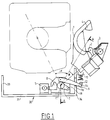
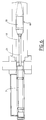
- a device for supplying ammunition 50 comprises a stretcher 1 of semi-circular shape whose concavity is directed upwards and which is provided with an anti-extraction device 4, known per se, which is intended to prevent the ejection of the shell 50 during the rotation of the stretcher 1.
- the stretcher 1 is movable in rotation about a single axis, which is the axis of rotation of a part cylindrical 11.
- a support comprising on the one hand a perforated plate 22 at 26 which extends radially from the cylindrical part 11 to the stretcher 1 and on the other hand two support elements lateral 24 and 25 orthogonal to the plate 22 and the ends 24 'and 25' of which enclose the stretcher 1 so as to constitute a rigid mechanical assembly.
- the stretcher 1 is rotated by a rotary actuator 6 with a helical piston.
- a chain repressor 2 driven by a hydraulic motor and a linear wedging cylinder 3 are mounted on the stretcher 1 and are integral with its rotation about the axis of the part 11.
- the whole is powered by an electro-hydraulic block, itself controlled by an electric control console.
- a lever 7 carrying a drive finger 18 is integral in rotation with the part 11, but its position along the latter is controlled by a fork 8 actuated by a stop cylinder 5.
- This drive in rotation of the lever 7, independently of its longitudinal position along the part 11, is obtained by complementary grooves 15 of an extension 11 'of the part 11, and of the lever 7, which are shown in FIGS. 8 and 9.
- the finger 18 of the lever 7 makes it possible to drive a second lever 9 in rotation as far as a damping stop 10. At its end 14 there is a stop finger 12.
- the fork 8, controlled by the stop cylinder 5, makes it possible to move the lever 7 longitudinally along the axis 11 between an active position in which the pin 18 is capable of rotating the lever 9 and an inactive position in which the rotation of the lever 7 cannot have any influence on the lever 9.
- the lever 9 is recalled by its own weight or by a spring (not shown) in a low position where it is released from the stop 10 and comes to rest in its bottom dead center on a lower edge 16 of an opening of one of the edges 34 of a support box 30 rigid U-shaped having a bottom plate 31 and a second flange 33.
- the box 30 stiffens the assembly and carries a U-shaped plate 36, the branches 37 and 38 of which support the rotary actuator 6, the mechanism retractable stop 5, 7, 8, 9 and one end of the part 11, the other end of which is held by a wing 39 forming an extension of the bottom plate 31, which adjoins the rim 34.
- the shift mechanism then operates according to the following cycle:
- a shell 50 is deposited in the stretcher 1, which is in the insertion position shown in FIGS. 1 and 2. In this position, the chain repressor 2 is at rest. The linear wedging cylinder 3 is retracted rod, the stop cylinder 5 is retracted rod (see Figure 7), which corresponds to the active position of the lever 7, and the rotary cylinder 6 is at rest. The anti-extraction device 4 prevents the shell from being ejected during the first rotation movement of the stretcher 1.
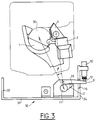
- a first angle rotation ⁇ of the stretcher 1 is carried out around the axis of the part 11 from the position shown in FIG. 1 to the position shown in FIG. 3, in which the arm 9, driven by the finger 18, is applied by its abutment finger 12 against the damping abutment 10.
- the shell 50 has its axis aligned with that of the breech chamber 40 of the barrel and the chain repressor 2 is in a position in which it can repress the shell 50 from the stretcher 1 to the breech chamber 40.
- This repression step is initiated by a position detector of the stretcher 1 which controls the advance of the chain repressor 2.
- a second position detector controls the output of the rod of the stop cylinder 5, which has the effect of releasing the finger 18 from its action on the lever 9, which returns to its bottom dead center, and release the grooved lever 7 to allow it to p continue its rotation without exerting any action on the lever 9.
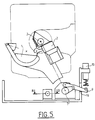
- the stretcher 1 then performs a second angle rotation ⁇ , still under the action of the rotary actuator 6 left under pressure from the position shown in Figure 3 to the position shown in Figure 5.
- the cylinder wedge 3 is brought into alignment with the cylinder head chamber 40 of the muzzle.
- a position detector of the stretcher 1 controls the output of the rod 23 of the wedging cylinder 3 and locks in the firing position the shell 50 in the forcing cone 60 of the chamber 40.
- An electro-hydraulic device hydraulically connected to the rod 23 of the jack 3 controls, as soon as the oil flow drops, the reentry of the rod 23.
- a reentry detector of the rod 23 then controls the return of the stretcher 1 in starting position (FIG. 1) as well as the return of the repressor 2.
- a last detector in the starting position controls the retraction of the stop cylinder 5, which again positions the lever 7 in the active position. The loading device is then ready for a new cycle.
- the device which has been described above, saves time, on the one hand due to the fact that the return of the repressor 2 can be done entirely in masked time and, on the other hand that the return time of rotation of the arm is faster than in the prior art thanks to the unique movement, which contributes to reducing the time of a complete cycle and consequently improves the rate of fire of the material.
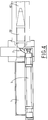
- FIG. 7 shows the lever 7 in its active position where the pin 18 rotates the lever 9. This position corresponds to the rod 82 position retracted from the stop cylinder 5.
- the fork 8 has the general shape of an inverted U ( see Figure 9) which has an upper central branch 84 and two lateral branches 83 and 85 which extend downwards. At its upper part 88, which surmounts the central branch 84, is disposed a hinge 89 allowing the fork 8 to be movable in rotation about a horizontal axis perpendicular to the axis of rotation of the part 11.
- the lower part of the branch 83 has an extension 82 which ends with a finger 81 which engages in the rod 82, which makes it possible to control the movement of the fork 8.
- the middle part of the branches 83 and 85 carries extensions 83 and 87 engaging in a groove 71 of a cylindrical part 72 extending the lever 7 along the axis of the part 11.
- the fork 8 can thus be moved between the active position of the lever 7 (in solid lines in FIG. 10) in which the finger 18 can rotate the lever 9 and a second position making an angle with the vertical and in which, the jack 5 being in the rod 82 out position, the finger 18 is moved (to the right in FIG. 10) so as to be separated from the lever 9 (see the dotted lines in Figure 10).
- FIG. 8 also shows the various positions of the levers 7 and 9 and more particularly the three characteristic positions of the lever 7, namely the first starting position shown in solid lines, then, after the first rotation, the first position corresponding to the setting in stop of the lever 9 (also shown in dotted lines) then finally, the rotation pushing against the clockwise direction, the third position after second rotation in which a rear extension 19 of the lever 7 abuts on a stop 13 indicating the end of the second rotation.
Landscapes
- Engineering & Computer Science (AREA)
- General Engineering & Computer Science (AREA)
- Portable Nailing Machines And Staplers (AREA)
- Transmission Devices (AREA)
Applications Claiming Priority (2)
| Application Number | Priority Date | Filing Date | Title |
|---|---|---|---|
| FR9407355A FR2721387B1 (fr) | 1994-06-16 | 1994-06-16 | Mécanisme de mise à poste d'une munition. |
| FR9407355 | 1994-06-16 |
Publications (2)
| Publication Number | Publication Date |
|---|---|
| EP0687882A1 true EP0687882A1 (de) | 1995-12-20 |
| EP0687882B1 EP0687882B1 (de) | 1999-05-19 |
Family
ID=9464272
Family Applications (1)
| Application Number | Title | Priority Date | Filing Date |
|---|---|---|---|
| EP95401376A Expired - Lifetime EP0687882B1 (de) | 1994-06-16 | 1995-06-13 | Munitionszuführmechanismus |
Country Status (4)
| Country | Link |
|---|---|
| US (1) | US5563363A (de) |
| EP (1) | EP0687882B1 (de) |
| DE (1) | DE69509703T2 (de) |
| FR (1) | FR2721387B1 (de) |
Families Citing this family (8)
| Publication number | Priority date | Publication date | Assignee | Title |
|---|---|---|---|---|
| US5773747A (en) * | 1996-05-07 | 1998-06-30 | United Defense, Lp | Two-piece ammunition flick ram |
| US6073534A (en) * | 1998-01-14 | 2000-06-13 | General Dynamics Armament Systems, Inc. | Transfer mechanism and method for uploading and downloading propellant charges and projectiles |
| FR2796713B1 (fr) * | 1999-07-22 | 2002-09-13 | Giat Ind Sa | Dispositif d'aide au chargement pour artillerie |
| US6513415B2 (en) * | 2001-03-22 | 2003-02-04 | United Defense Lp | Propellant retention device |
| EP2200677A1 (de) | 2007-09-17 | 2010-06-30 | ICU Medical, Inc. | Einführungsinstrumente für infusionsvorrichtungen |
| IT1400863B1 (it) * | 2010-06-22 | 2013-07-02 | Oto Melara Spa | Sistema di evacuazione bossoli |
| DE102017107442B4 (de) * | 2017-04-06 | 2021-03-18 | Krauss-Maffei Wegmann Gmbh & Co. Kg | Vorrichtung zum Laden einer Rohrwaffe mit Munitionskörpern |
| FR3157926B1 (fr) | 2024-01-02 | 2026-01-16 | Nexter Systems | Ensemble de positionnement et de maintien en position d’un projectile dans une civière et dispositif d’aide au chargement comportant un tel ensemble |
Citations (4)
| Publication number | Priority date | Publication date | Assignee | Title |
|---|---|---|---|---|
| FR2346667A1 (fr) * | 1976-03-31 | 1977-10-28 | Bofors Ab | Procede et mecanisme de chargement d'un canon |
| FR2448121A1 (fr) | 1979-02-05 | 1980-08-29 | France Etat | Dispositif de mise a poste de l'obus pour materiel d'artillerie |
| EP0051119A1 (de) * | 1980-08-27 | 1982-05-12 | Fmc Corporation | Selbsttätiges Ladesystem für grosskalibrige Munition |
| DE3306935A1 (de) * | 1983-02-28 | 1984-08-30 | Rheinmetall GmbH, 4000 Düsseldorf | Ladeschalenanordnung an einer rohrwaffe |
Family Cites Families (4)
| Publication number | Priority date | Publication date | Assignee | Title |
|---|---|---|---|---|
| US1682323A (en) * | 1924-06-26 | 1928-08-28 | Thomas A Conlon | Mechanical loader for cannon |
| GB578742A (en) * | 1941-08-20 | 1946-07-10 | Desmond Walter Molins | Improvements in or relating to breech loading mechanism for ordnance |
| US4183281A (en) * | 1976-03-31 | 1980-01-15 | Aktiebolaget Bofors | Method of and device for loading a firearm |
| US4457209A (en) * | 1980-08-27 | 1984-07-03 | Fmc Corporation | Automated large caliber ammunition handling system |
-
1994
- 1994-06-16 FR FR9407355A patent/FR2721387B1/fr not_active Expired - Fee Related
-
1995
- 1995-06-06 US US08/471,727 patent/US5563363A/en not_active Expired - Lifetime
- 1995-06-13 DE DE69509703T patent/DE69509703T2/de not_active Expired - Lifetime
- 1995-06-13 EP EP95401376A patent/EP0687882B1/de not_active Expired - Lifetime
Patent Citations (4)
| Publication number | Priority date | Publication date | Assignee | Title |
|---|---|---|---|---|
| FR2346667A1 (fr) * | 1976-03-31 | 1977-10-28 | Bofors Ab | Procede et mecanisme de chargement d'un canon |
| FR2448121A1 (fr) | 1979-02-05 | 1980-08-29 | France Etat | Dispositif de mise a poste de l'obus pour materiel d'artillerie |
| EP0051119A1 (de) * | 1980-08-27 | 1982-05-12 | Fmc Corporation | Selbsttätiges Ladesystem für grosskalibrige Munition |
| DE3306935A1 (de) * | 1983-02-28 | 1984-08-30 | Rheinmetall GmbH, 4000 Düsseldorf | Ladeschalenanordnung an einer rohrwaffe |
Also Published As
| Publication number | Publication date |
|---|---|
| DE69509703D1 (de) | 1999-06-24 |
| FR2721387B1 (fr) | 1996-08-14 |
| EP0687882B1 (de) | 1999-05-19 |
| FR2721387A1 (fr) | 1995-12-22 |
| DE69509703T2 (de) | 1999-10-14 |
| US5563363A (en) | 1996-10-08 |
Similar Documents
| Publication | Publication Date | Title |
|---|---|---|
| EP0687882B1 (de) | Munitionszuführmechanismus | |
| FR2738059A1 (fr) | Mortier avec une culasse disposee a l'arriere | |
| FR2463379A1 (fr) | Arme de tir a air precomprime | |
| EP1070932B1 (de) | Hilfsvorrichtung zur Ladung einer Kanone mit Schraubverschluss | |
| EP0571285B1 (de) | Automatische Waffe mit einer kippbaren Patronenkammer zum Abschiessen von teleskopischen zylindrischen Munitionen | |
| FR2647892A1 (fr) | Aileron deployable de missile | |
| BE1012500A3 (fr) | Arme a feu avec ejection vers l'avant ou reportee vers l'avant de l'arme. | |
| EP4579169A1 (de) | Vorrichtung zur rückgewinnung von hülsen und waffe mit einer solchen vorrichtung | |
| EP0868979A1 (de) | Eintreibgerät für Befestigungsmittel mit lösbare Laufhaltevorrichtung | |
| EP0321345B1 (de) | Verschlussstück für Artilleriekanone | |
| EP0684442B1 (de) | Zufuhrvorrichtung für Munition für automatische Waffen | |
| LU82629A1 (fr) | Mecanisme de surete pour mitrailleuse rotative a tir tres rapide | |
| FR2547042A1 (fr) | Double alimentation en munitions pour armes automatiques | |
| EP0744016B1 (de) | Feuerunterbrechungseinrichtung und sicherheit für dauerfeuer für eine mehrläufige feuerwaffe von kleinem oder mittlerem kaliber | |
| FR2718837A1 (fr) | Arme à feu automatique multitubes de petit ou moyen calibre du type GATLING, notamment destinée au tir de munitions télescopées. | |
| EP0571266A1 (de) | Einrichtung zum Laden von Munition in einem schwenkbaren Patronenlager | |
| EP0153242A1 (de) | Automatische Ladevorrichtung für Kanonen | |
| EP0599683A1 (de) | Verfahren zum Laden von Munition in einem schwenkbaren Patronenlager, und Anordnung zur Anwendung | |
| FR2472161A1 (fr) | Mecanisme de guidage du mouvement pivotant transversal du bourroir d'un refouloir d'une piece d'artillerie | |
| EP0822009A1 (de) | Vorrichtung zum Auftragen eines nicht-festen Produkts | |
| FR2623608A1 (fr) | Arme a tube automatique a entrainement independant | |
| EP0664430B1 (de) | Munitionsladevorrichtung für eine in einem Panzerturm angeordnete Rohrwaffe | |
| FR2726637A1 (fr) | Dispositif pour refouler une munition dans le tube d'un canon, et pour effectuer l'operation inverse | |
| FR2800650A1 (fr) | Machine a former des extremites de tubes | |
| FR2704943A1 (fr) | Dispositif de chargement semi-automatique de canons, notamment de canons équipant des tourelles de chars. |
Legal Events
| Date | Code | Title | Description |
|---|---|---|---|
| PUAI | Public reference made under article 153(3) epc to a published international application that has entered the european phase |
Free format text: ORIGINAL CODE: 0009012 |
|
| AK | Designated contracting states |
Kind code of ref document: A1 Designated state(s): DE GB IT NL SE |
|
| 17P | Request for examination filed |
Effective date: 19960201 |
|
| 17Q | First examination report despatched |
Effective date: 19970926 |
|
| GRAG | Despatch of communication of intention to grant |
Free format text: ORIGINAL CODE: EPIDOS AGRA |
|
| GRAG | Despatch of communication of intention to grant |
Free format text: ORIGINAL CODE: EPIDOS AGRA |
|
| GRAH | Despatch of communication of intention to grant a patent |
Free format text: ORIGINAL CODE: EPIDOS IGRA |
|
| GRAH | Despatch of communication of intention to grant a patent |
Free format text: ORIGINAL CODE: EPIDOS IGRA |
|
| GRAA | (expected) grant |
Free format text: ORIGINAL CODE: 0009210 |
|
| AK | Designated contracting states |
Kind code of ref document: B1 Designated state(s): DE GB IT NL SE |
|
| PG25 | Lapsed in a contracting state [announced via postgrant information from national office to epo] |
Ref country code: NL Free format text: LAPSE BECAUSE OF FAILURE TO SUBMIT A TRANSLATION OF THE DESCRIPTION OR TO PAY THE FEE WITHIN THE PRESCRIBED TIME-LIMIT Effective date: 19990519 |
|
| PGFP | Annual fee paid to national office [announced via postgrant information from national office to epo] |
Ref country code: SE Payment date: 19990526 Year of fee payment: 5 |
|
| GBT | Gb: translation of ep patent filed (gb section 77(6)(a)/1977) |
Effective date: 19990519 |
|
| REF | Corresponds to: |
Ref document number: 69509703 Country of ref document: DE Date of ref document: 19990624 |
|
| PLBE | No opposition filed within time limit |
Free format text: ORIGINAL CODE: 0009261 |
|
| STAA | Information on the status of an ep patent application or granted ep patent |
Free format text: STATUS: NO OPPOSITION FILED WITHIN TIME LIMIT |
|
| 26N | No opposition filed | ||
| PG25 | Lapsed in a contracting state [announced via postgrant information from national office to epo] |
Ref country code: SE Free format text: LAPSE BECAUSE OF NON-PAYMENT OF DUE FEES Effective date: 20000614 |
|
| EUG | Se: european patent has lapsed |
Ref document number: 95401376.9 |
|
| REG | Reference to a national code |
Ref country code: GB Ref legal event code: IF02 |
|
| PG25 | Lapsed in a contracting state [announced via postgrant information from national office to epo] |
Ref country code: IT Free format text: LAPSE BECAUSE OF NON-PAYMENT OF DUE FEES;WARNING: LAPSES OF ITALIAN PATENTS WITH EFFECTIVE DATE BEFORE 2007 MAY HAVE OCCURRED AT ANY TIME BEFORE 2007. THE CORRECT EFFECTIVE DATE MAY BE DIFFERENT FROM THE ONE RECORDED. Effective date: 20050613 |
|
| REG | Reference to a national code |
Ref country code: GB Ref legal event code: 732E Free format text: REGISTERED BETWEEN 20090625 AND 20090701 |
|
| PGFP | Annual fee paid to national office [announced via postgrant information from national office to epo] |
Ref country code: DE Payment date: 20120524 Year of fee payment: 18 |
|
| PGFP | Annual fee paid to national office [announced via postgrant information from national office to epo] |
Ref country code: GB Payment date: 20120525 Year of fee payment: 18 |
|
| GBPC | Gb: european patent ceased through non-payment of renewal fee |
Effective date: 20130613 |
|
| REG | Reference to a national code |
Ref country code: DE Ref legal event code: R119 Ref document number: 69509703 Country of ref document: DE Effective date: 20140101 |
|
| PG25 | Lapsed in a contracting state [announced via postgrant information from national office to epo] |
Ref country code: GB Free format text: LAPSE BECAUSE OF NON-PAYMENT OF DUE FEES Effective date: 20130613 Ref country code: DE Free format text: LAPSE BECAUSE OF NON-PAYMENT OF DUE FEES Effective date: 20140101 |