EP0691802A1 - Verfahren zur Herstellung einer mehrschichtigen Leiterplatte und Produkt - Google Patents
Verfahren zur Herstellung einer mehrschichtigen Leiterplatte und Produkt Download PDFInfo
- Publication number
- EP0691802A1 EP0691802A1 EP95304322A EP95304322A EP0691802A1 EP 0691802 A1 EP0691802 A1 EP 0691802A1 EP 95304322 A EP95304322 A EP 95304322A EP 95304322 A EP95304322 A EP 95304322A EP 0691802 A1 EP0691802 A1 EP 0691802A1
- Authority
- EP
- European Patent Office
- Prior art keywords
- weight
- epoxy resin
- composition
- acrylate monomer
- oligomer
- Prior art date
- Legal status (The legal status is an assumption and is not a legal conclusion. Google has not performed a legal analysis and makes no representation as to the accuracy of the status listed.)
- Granted
Links
- 238000000034 method Methods 0.000 title claims abstract description 55
- 239000000203 mixture Substances 0.000 claims abstract description 103
- 229920000647 polyepoxide Polymers 0.000 claims abstract description 41
- 239000003822 epoxy resin Substances 0.000 claims abstract description 40
- 239000000178 monomer Substances 0.000 claims abstract description 32
- 239000003431 cross linking reagent Substances 0.000 claims abstract description 30
- NIXOWILDQLNWCW-UHFFFAOYSA-M Acrylate Chemical compound [O-]C(=O)C=C NIXOWILDQLNWCW-UHFFFAOYSA-M 0.000 claims abstract description 29
- 229920002120 photoresistant polymer Polymers 0.000 claims abstract description 26
- 230000008569 process Effects 0.000 claims abstract description 26
- 239000003999 initiator Substances 0.000 claims abstract description 17
- 229910052751 metal Inorganic materials 0.000 claims abstract description 17
- 239000002184 metal Substances 0.000 claims abstract description 17
- NIXOWILDQLNWCW-UHFFFAOYSA-N acrylic acid group Chemical group C(C=C)(=O)O NIXOWILDQLNWCW-UHFFFAOYSA-N 0.000 claims abstract description 16
- 125000002887 hydroxy group Chemical group [H]O* 0.000 claims abstract description 13
- 239000003795 chemical substances by application Substances 0.000 claims abstract description 12
- 239000004841 bisphenol A epoxy resin Substances 0.000 claims abstract description 9
- 238000005530 etching Methods 0.000 claims abstract description 9
- 238000006116 polymerization reaction Methods 0.000 claims abstract description 9
- 150000003254 radicals Chemical class 0.000 claims abstract description 9
- SMZOUWXMTYCWNB-UHFFFAOYSA-N 2-(2-methoxy-5-methylphenyl)ethanamine Chemical compound COC1=CC=C(C)C=C1CCN SMZOUWXMTYCWNB-UHFFFAOYSA-N 0.000 claims abstract description 7
- CERQOIWHTDAKMF-UHFFFAOYSA-N Methacrylic acid Chemical compound CC(=C)C(O)=O CERQOIWHTDAKMF-UHFFFAOYSA-N 0.000 claims abstract description 6
- 150000005690 diesters Chemical class 0.000 claims abstract description 5
- 239000004593 Epoxy Substances 0.000 claims description 28
- 239000007864 aqueous solution Substances 0.000 claims description 18
- 239000000463 material Substances 0.000 claims description 18
- 230000005855 radiation Effects 0.000 claims description 18
- 239000000945 filler Substances 0.000 claims description 13
- 238000000576 coating method Methods 0.000 claims description 12
- 229920003986 novolac Polymers 0.000 claims description 12
- 239000000243 solution Substances 0.000 claims description 12
- 239000011248 coating agent Substances 0.000 claims description 11
- -1 diacrylate ester Chemical class 0.000 claims description 8
- 238000001035 drying Methods 0.000 claims description 8
- QTWJRLJHJPIABL-UHFFFAOYSA-N 2-methylphenol;3-methylphenol;4-methylphenol Chemical compound CC1=CC=C(O)C=C1.CC1=CC=CC(O)=C1.CC1=CC=CC=C1O QTWJRLJHJPIABL-UHFFFAOYSA-N 0.000 claims description 7
- 230000002378 acidificating effect Effects 0.000 claims description 7
- 229930003836 cresol Natural products 0.000 claims description 7
- QGBSISYHAICWAH-UHFFFAOYSA-N dicyandiamide Chemical compound NC(N)=NC#N QGBSISYHAICWAH-UHFFFAOYSA-N 0.000 claims description 7
- 239000003989 dielectric material Substances 0.000 claims description 6
- 239000003960 organic solvent Substances 0.000 claims description 6
- DAKWPKUUDNSNPN-UHFFFAOYSA-N Trimethylolpropane triacrylate Chemical compound C=CC(=O)OCC(CC)(COC(=O)C=C)COC(=O)C=C DAKWPKUUDNSNPN-UHFFFAOYSA-N 0.000 claims description 5
- 150000002118 epoxides Chemical class 0.000 claims description 5
- QQOWHRYOXYEMTL-UHFFFAOYSA-N triazin-4-amine Chemical class N=C1C=CN=NN1 QQOWHRYOXYEMTL-UHFFFAOYSA-N 0.000 claims description 4
- 150000003918 triazines Chemical class 0.000 claims description 4
- BPXVHIRIPLPOPT-UHFFFAOYSA-N 1,3,5-tris(2-hydroxyethyl)-1,3,5-triazinane-2,4,6-trione Chemical compound OCCN1C(=O)N(CCO)C(=O)N(CCO)C1=O BPXVHIRIPLPOPT-UHFFFAOYSA-N 0.000 claims description 2
- 238000011161 development Methods 0.000 abstract description 10
- 239000010410 layer Substances 0.000 description 73
- RYGMFSIKBFXOCR-UHFFFAOYSA-N Copper Chemical compound [Cu] RYGMFSIKBFXOCR-UHFFFAOYSA-N 0.000 description 32
- 229910052802 copper Inorganic materials 0.000 description 29
- 239000010949 copper Substances 0.000 description 29
- 239000002904 solvent Substances 0.000 description 19
- 239000000126 substance Substances 0.000 description 19
- ORTQZVOHEJQUHG-UHFFFAOYSA-L copper(II) chloride Chemical compound Cl[Cu]Cl ORTQZVOHEJQUHG-UHFFFAOYSA-L 0.000 description 11
- VYPSYNLAJGMNEJ-UHFFFAOYSA-N Silicium dioxide Chemical compound O=[Si]=O VYPSYNLAJGMNEJ-UHFFFAOYSA-N 0.000 description 10
- 150000008064 anhydrides Chemical class 0.000 description 8
- 238000001723 curing Methods 0.000 description 8
- KCTAWXVAICEBSD-UHFFFAOYSA-N prop-2-enoyloxy prop-2-eneperoxoate Chemical compound C=CC(=O)OOOC(=O)C=C KCTAWXVAICEBSD-UHFFFAOYSA-N 0.000 description 7
- 229920005989 resin Polymers 0.000 description 7
- 239000011347 resin Substances 0.000 description 7
- 239000007787 solid Substances 0.000 description 7
- IISBACLAFKSPIT-UHFFFAOYSA-N bisphenol A Chemical compound C=1C=C(O)C=CC=1C(C)(C)C1=CC=C(O)C=C1 IISBACLAFKSPIT-UHFFFAOYSA-N 0.000 description 6
- 239000003054 catalyst Substances 0.000 description 6
- 229960003280 cupric chloride Drugs 0.000 description 6
- LNEPOXFFQSENCJ-UHFFFAOYSA-N haloperidol Chemical compound C1CC(O)(C=2C=CC(Cl)=CC=2)CCN1CCCC(=O)C1=CC=C(F)C=C1 LNEPOXFFQSENCJ-UHFFFAOYSA-N 0.000 description 6
- HJOVHMDZYOCNQW-UHFFFAOYSA-N isophorone Chemical compound CC1=CC(=O)CC(C)(C)C1 HJOVHMDZYOCNQW-UHFFFAOYSA-N 0.000 description 6
- 238000006243 chemical reaction Methods 0.000 description 5
- 125000000664 diazo group Chemical group [N-]=[N+]=[*] 0.000 description 5
- MQRJBSHKWOFOGF-UHFFFAOYSA-L disodium;carbonate;hydrate Chemical compound O.[Na+].[Na+].[O-]C([O-])=O MQRJBSHKWOFOGF-UHFFFAOYSA-L 0.000 description 5
- 125000003700 epoxy group Chemical group 0.000 description 5
- 239000007788 liquid Substances 0.000 description 5
- 229940076133 sodium carbonate monohydrate Drugs 0.000 description 5
- 239000000758 substrate Substances 0.000 description 5
- VEXZGXHMUGYJMC-UHFFFAOYSA-N Hydrochloric acid Chemical compound Cl VEXZGXHMUGYJMC-UHFFFAOYSA-N 0.000 description 4
- 229920000877 Melamine resin Polymers 0.000 description 4
- QAOWNCQODCNURD-UHFFFAOYSA-N Sulfuric acid Chemical compound OS(O)(=O)=O QAOWNCQODCNURD-UHFFFAOYSA-N 0.000 description 4
- 239000002253 acid Substances 0.000 description 4
- BHXIWUJLHYHGSJ-UHFFFAOYSA-N ethyl 3-ethoxypropanoate Chemical compound CCOCCC(=O)OCC BHXIWUJLHYHGSJ-UHFFFAOYSA-N 0.000 description 4
- 239000012948 isocyanate Substances 0.000 description 4
- 150000002513 isocyanates Chemical class 0.000 description 4
- 238000005259 measurement Methods 0.000 description 4
- 238000012360 testing method Methods 0.000 description 4
- YIKSHDNOAYSSPX-UHFFFAOYSA-N 1-propan-2-ylthioxanthen-9-one Chemical compound S1C2=CC=CC=C2C(=O)C2=C1C=CC=C2C(C)C YIKSHDNOAYSSPX-UHFFFAOYSA-N 0.000 description 3
- ZWEHNKRNPOVVGH-UHFFFAOYSA-N 2-Butanone Chemical compound CCC(C)=O ZWEHNKRNPOVVGH-UHFFFAOYSA-N 0.000 description 3
- DGQOZCNCJKEVOA-UHFFFAOYSA-N 5-(2,5-dioxooxolan-3-yl)-7-methyl-3a,4,5,7a-tetrahydro-2-benzofuran-1,3-dione Chemical compound C1C(C(OC2=O)=O)C2C(C)=CC1C1CC(=O)OC1=O DGQOZCNCJKEVOA-UHFFFAOYSA-N 0.000 description 3
- QTBSBXVTEAMEQO-UHFFFAOYSA-N Acetic acid Chemical compound CC(O)=O QTBSBXVTEAMEQO-UHFFFAOYSA-N 0.000 description 3
- CSCPPACGZOOCGX-UHFFFAOYSA-N Acetone Chemical compound CC(C)=O CSCPPACGZOOCGX-UHFFFAOYSA-N 0.000 description 3
- XEKOWRVHYACXOJ-UHFFFAOYSA-N Ethyl acetate Chemical compound CCOC(C)=O XEKOWRVHYACXOJ-UHFFFAOYSA-N 0.000 description 3
- ZMXDDKWLCZADIW-UHFFFAOYSA-N N,N-Dimethylformamide Chemical compound CN(C)C=O ZMXDDKWLCZADIW-UHFFFAOYSA-N 0.000 description 3
- HEMHJVSKTPXQMS-UHFFFAOYSA-M Sodium hydroxide Chemical compound [OH-].[Na+] HEMHJVSKTPXQMS-UHFFFAOYSA-M 0.000 description 3
- 125000003178 carboxy group Chemical group [H]OC(*)=O 0.000 description 3
- KRKNYBCHXYNGOX-UHFFFAOYSA-N citric acid Chemical compound OC(=O)CC(O)(C(O)=O)CC(O)=O KRKNYBCHXYNGOX-UHFFFAOYSA-N 0.000 description 3
- 239000011889 copper foil Substances 0.000 description 3
- 238000004132 cross linking Methods 0.000 description 3
- 238000007766 curtain coating Methods 0.000 description 3
- 230000032798 delamination Effects 0.000 description 3
- 230000000694 effects Effects 0.000 description 3
- 238000007772 electroless plating Methods 0.000 description 3
- 125000005395 methacrylic acid group Chemical class 0.000 description 3
- 238000002156 mixing Methods 0.000 description 3
- 238000007747 plating Methods 0.000 description 3
- 238000002360 preparation method Methods 0.000 description 3
- 238000007650 screen-printing Methods 0.000 description 3
- 239000000377 silicon dioxide Substances 0.000 description 3
- XLYOFNOQVPJJNP-UHFFFAOYSA-N water Substances O XLYOFNOQVPJJNP-UHFFFAOYSA-N 0.000 description 3
- ARXJGSRGQADJSQ-UHFFFAOYSA-N 1-methoxypropan-2-ol Chemical compound COCC(C)O ARXJGSRGQADJSQ-UHFFFAOYSA-N 0.000 description 2
- KWVGIHKZDCUPEU-UHFFFAOYSA-N 2,2-dimethoxy-2-phenylacetophenone Chemical compound C=1C=CC=CC=1C(OC)(OC)C(=O)C1=CC=CC=C1 KWVGIHKZDCUPEU-UHFFFAOYSA-N 0.000 description 2
- LEJBBGNFPAFPKQ-UHFFFAOYSA-N 2-(2-prop-2-enoyloxyethoxy)ethyl prop-2-enoate Chemical compound C=CC(=O)OCCOCCOC(=O)C=C LEJBBGNFPAFPKQ-UHFFFAOYSA-N 0.000 description 2
- RXGUIWHIADMCFC-UHFFFAOYSA-N 2-Methylpropyl 2-methylpropionate Chemical compound CC(C)COC(=O)C(C)C RXGUIWHIADMCFC-UHFFFAOYSA-N 0.000 description 2
- YIJYFLXQHDOQGW-UHFFFAOYSA-N 2-[2,4,6-trioxo-3,5-bis(2-prop-2-enoyloxyethyl)-1,3,5-triazinan-1-yl]ethyl prop-2-enoate Chemical compound C=CC(=O)OCCN1C(=O)N(CCOC(=O)C=C)C(=O)N(CCOC(=O)C=C)C1=O YIJYFLXQHDOQGW-UHFFFAOYSA-N 0.000 description 2
- INQDDHNZXOAFFD-UHFFFAOYSA-N 2-[2-(2-prop-2-enoyloxyethoxy)ethoxy]ethyl prop-2-enoate Chemical compound C=CC(=O)OCCOCCOCCOC(=O)C=C INQDDHNZXOAFFD-UHFFFAOYSA-N 0.000 description 2
- POAOYUHQDCAZBD-UHFFFAOYSA-N 2-butoxyethanol Chemical compound CCCCOCCO POAOYUHQDCAZBD-UHFFFAOYSA-N 0.000 description 2
- LWRBVKNFOYUCNP-UHFFFAOYSA-N 2-methyl-1-(4-methylsulfanylphenyl)-2-morpholin-4-ylpropan-1-one Chemical compound C1=CC(SC)=CC=C1C(=O)C(C)(C)N1CCOCC1 LWRBVKNFOYUCNP-UHFFFAOYSA-N 0.000 description 2
- KUDUQBURMYMBIJ-UHFFFAOYSA-N 2-prop-2-enoyloxyethyl prop-2-enoate Chemical compound C=CC(=O)OCCOC(=O)C=C KUDUQBURMYMBIJ-UHFFFAOYSA-N 0.000 description 2
- YEJRWHAVMIAJKC-UHFFFAOYSA-N 4-Butyrolactone Chemical compound O=C1CCCO1 YEJRWHAVMIAJKC-UHFFFAOYSA-N 0.000 description 2
- FFWSICBKRCICMR-UHFFFAOYSA-N 5-methyl-2-hexanone Chemical compound CC(C)CCC(C)=O FFWSICBKRCICMR-UHFFFAOYSA-N 0.000 description 2
- KWOLFJPFCHCOCG-UHFFFAOYSA-N Acetophenone Chemical compound CC(=O)C1=CC=CC=C1 KWOLFJPFCHCOCG-UHFFFAOYSA-N 0.000 description 2
- SOGAXMICEFXMKE-UHFFFAOYSA-N Butylmethacrylate Chemical compound CCCCOC(=O)C(C)=C SOGAXMICEFXMKE-UHFFFAOYSA-N 0.000 description 2
- BAPJBEWLBFYGME-UHFFFAOYSA-N Methyl acrylate Chemical compound COC(=O)C=C BAPJBEWLBFYGME-UHFFFAOYSA-N 0.000 description 2
- KDLHZDBZIXYQEI-UHFFFAOYSA-N Palladium Chemical compound [Pd] KDLHZDBZIXYQEI-UHFFFAOYSA-N 0.000 description 2
- 239000004698 Polyethylene Substances 0.000 description 2
- CDBYLPFSWZWCQE-UHFFFAOYSA-L Sodium Carbonate Chemical compound [Na+].[Na+].[O-]C([O-])=O CDBYLPFSWZWCQE-UHFFFAOYSA-L 0.000 description 2
- FAPWRFPIFSIZLT-UHFFFAOYSA-M Sodium chloride Chemical compound [Na+].[Cl-] FAPWRFPIFSIZLT-UHFFFAOYSA-M 0.000 description 2
- WYURNTSHIVDZCO-UHFFFAOYSA-N Tetrahydrofuran Chemical compound C1CCOC1 WYURNTSHIVDZCO-UHFFFAOYSA-N 0.000 description 2
- 239000000654 additive Substances 0.000 description 2
- 230000001464 adherent effect Effects 0.000 description 2
- 230000008901 benefit Effects 0.000 description 2
- DKPFZGUDAPQIHT-UHFFFAOYSA-N butyl acetate Chemical compound CCCCOC(C)=O DKPFZGUDAPQIHT-UHFFFAOYSA-N 0.000 description 2
- 150000001732 carboxylic acid derivatives Chemical class 0.000 description 2
- 238000011109 contamination Methods 0.000 description 2
- 230000001276 controlling effect Effects 0.000 description 2
- 229910000365 copper sulfate Inorganic materials 0.000 description 2
- ARUVKPQLZAKDPS-UHFFFAOYSA-L copper(II) sulfate Chemical compound [Cu+2].[O-][S+2]([O-])([O-])[O-] ARUVKPQLZAKDPS-UHFFFAOYSA-L 0.000 description 2
- JHIVVAPYMSGYDF-UHFFFAOYSA-N cyclohexanone Chemical compound O=C1CCCCC1 JHIVVAPYMSGYDF-UHFFFAOYSA-N 0.000 description 2
- SWXVUIWOUIDPGS-UHFFFAOYSA-N diacetone alcohol Chemical compound CC(=O)CC(C)(C)O SWXVUIWOUIDPGS-UHFFFAOYSA-N 0.000 description 2
- 150000002148 esters Chemical class 0.000 description 2
- 239000011152 fibreglass Substances 0.000 description 2
- 238000011049 filling Methods 0.000 description 2
- 238000009472 formulation Methods 0.000 description 2
- 229910021485 fumed silica Inorganic materials 0.000 description 2
- CATSNJVOTSVZJV-UHFFFAOYSA-N heptan-2-one Chemical compound CCCCCC(C)=O CATSNJVOTSVZJV-UHFFFAOYSA-N 0.000 description 2
- WQYVRQLZKVEZGA-UHFFFAOYSA-N hypochlorite Chemical compound Cl[O-] WQYVRQLZKVEZGA-UHFFFAOYSA-N 0.000 description 2
- 238000007654 immersion Methods 0.000 description 2
- 239000003112 inhibitor Substances 0.000 description 2
- 238000009413 insulation Methods 0.000 description 2
- 238000003475 lamination Methods 0.000 description 2
- 229940107698 malachite green Drugs 0.000 description 2
- FDZZZRQASAIRJF-UHFFFAOYSA-M malachite green Chemical compound [Cl-].C1=CC(N(C)C)=CC=C1C(C=1C=CC=CC=1)=C1C=CC(=[N+](C)C)C=C1 FDZZZRQASAIRJF-UHFFFAOYSA-M 0.000 description 2
- 238000004519 manufacturing process Methods 0.000 description 2
- 150000002734 metacrylic acid derivatives Chemical class 0.000 description 2
- 230000003647 oxidation Effects 0.000 description 2
- 238000007254 oxidation reaction Methods 0.000 description 2
- NWVVVBRKAWDGAB-UHFFFAOYSA-N p-methoxyphenol Chemical compound COC1=CC=C(O)C=C1 NWVVVBRKAWDGAB-UHFFFAOYSA-N 0.000 description 2
- XNLICIUVMPYHGG-UHFFFAOYSA-N pentan-2-one Chemical compound CCCC(C)=O XNLICIUVMPYHGG-UHFFFAOYSA-N 0.000 description 2
- 239000000049 pigment Substances 0.000 description 2
- 229920000573 polyethylene Polymers 0.000 description 2
- YKYONYBAUNKHLG-UHFFFAOYSA-N propyl acetate Chemical compound CCCOC(C)=O YKYONYBAUNKHLG-UHFFFAOYSA-N 0.000 description 2
- 230000035939 shock Effects 0.000 description 2
- 239000007921 spray Substances 0.000 description 2
- 238000005507 spraying Methods 0.000 description 2
- LCALOJSQZMSPHJ-QMMMGPOBSA-N (2s)-2-amino-3-cyclohexa-1,5-dien-1-ylpropanoic acid Chemical compound OC(=O)[C@@H](N)CC1=CCCC=C1 LCALOJSQZMSPHJ-QMMMGPOBSA-N 0.000 description 1
- LGPAKRMZNPYPMG-UHFFFAOYSA-N (3-hydroxy-2-prop-2-enoyloxypropyl) prop-2-enoate Chemical compound C=CC(=O)OC(CO)COC(=O)C=C LGPAKRMZNPYPMG-UHFFFAOYSA-N 0.000 description 1
- MYWOJODOMFBVCB-UHFFFAOYSA-N 1,2,6-trimethylphenanthrene Chemical compound CC1=CC=C2C3=CC(C)=CC=C3C=CC2=C1C MYWOJODOMFBVCB-UHFFFAOYSA-N 0.000 description 1
- ZDQNWDNMNKSMHI-UHFFFAOYSA-N 1-[2-(2-prop-2-enoyloxypropoxy)propoxy]propan-2-yl prop-2-enoate Chemical compound C=CC(=O)OC(C)COC(C)COCC(C)OC(=O)C=C ZDQNWDNMNKSMHI-UHFFFAOYSA-N 0.000 description 1
- KFQPRNVTVMCYEH-UHFFFAOYSA-N 1-amino-3-(4-methoxyphenoxy)propan-2-ol Chemical compound COC1=CC=C(OCC(O)CN)C=C1 KFQPRNVTVMCYEH-UHFFFAOYSA-N 0.000 description 1
- RWNUSVWFHDHRCJ-UHFFFAOYSA-N 1-butoxypropan-2-ol Chemical compound CCCCOCC(C)O RWNUSVWFHDHRCJ-UHFFFAOYSA-N 0.000 description 1
- LRZPQLZONWIQOJ-UHFFFAOYSA-N 10-(2-methylprop-2-enoyloxy)decyl 2-methylprop-2-enoate Chemical compound CC(=C)C(=O)OCCCCCCCCCCOC(=O)C(C)=C LRZPQLZONWIQOJ-UHFFFAOYSA-N 0.000 description 1
- RHNJVKIVSXGYBD-UHFFFAOYSA-N 10-prop-2-enoyloxydecyl prop-2-enoate Chemical compound C=CC(=O)OCCCCCCCCCCOC(=O)C=C RHNJVKIVSXGYBD-UHFFFAOYSA-N 0.000 description 1
- MIGVPIXONIAZHK-UHFFFAOYSA-N 2,2-dimethylpropane-1,3-diol;prop-2-enoic acid Chemical compound OC(=O)C=C.OC(=O)C=C.OCC(C)(C)CO MIGVPIXONIAZHK-UHFFFAOYSA-N 0.000 description 1
- PUGOMSLRUSTQGV-UHFFFAOYSA-N 2,3-di(prop-2-enoyloxy)propyl prop-2-enoate Chemical compound C=CC(=O)OCC(OC(=O)C=C)COC(=O)C=C PUGOMSLRUSTQGV-UHFFFAOYSA-N 0.000 description 1
- LCPVQAHEFVXVKT-UHFFFAOYSA-N 2-(2,4-difluorophenoxy)pyridin-3-amine Chemical compound NC1=CC=CN=C1OC1=CC=C(F)C=C1F LCPVQAHEFVXVKT-UHFFFAOYSA-N 0.000 description 1
- VXQBJTKSVGFQOL-UHFFFAOYSA-N 2-(2-butoxyethoxy)ethyl acetate Chemical compound CCCCOCCOCCOC(C)=O VXQBJTKSVGFQOL-UHFFFAOYSA-N 0.000 description 1
- FPZWZCWUIYYYBU-UHFFFAOYSA-N 2-(2-ethoxyethoxy)ethyl acetate Chemical compound CCOCCOCCOC(C)=O FPZWZCWUIYYYBU-UHFFFAOYSA-N 0.000 description 1
- OHJYHAOODFPJOD-UHFFFAOYSA-N 2-(2-ethylhexoxy)ethanol Chemical compound CCCCC(CC)COCCO OHJYHAOODFPJOD-UHFFFAOYSA-N 0.000 description 1
- SBASXUCJHJRPEV-UHFFFAOYSA-N 2-(2-methoxyethoxy)ethanol Chemical compound COCCOCCO SBASXUCJHJRPEV-UHFFFAOYSA-N 0.000 description 1
- CUDYYMUUJHLCGZ-UHFFFAOYSA-N 2-(2-methoxypropoxy)propan-1-ol Chemical compound COC(C)COC(C)CO CUDYYMUUJHLCGZ-UHFFFAOYSA-N 0.000 description 1
- DJCYDDALXPHSHR-UHFFFAOYSA-N 2-(2-propoxyethoxy)ethanol Chemical compound CCCOCCOCCO DJCYDDALXPHSHR-UHFFFAOYSA-N 0.000 description 1
- HZAXFHJVJLSVMW-UHFFFAOYSA-N 2-Aminoethan-1-ol Chemical compound NCCO HZAXFHJVJLSVMW-UHFFFAOYSA-N 0.000 description 1
- PTTPXKJBFFKCEK-UHFFFAOYSA-N 2-Methyl-4-heptanone Chemical compound CC(C)CC(=O)CC(C)C PTTPXKJBFFKCEK-UHFFFAOYSA-N 0.000 description 1
- BSYVFGQQLJNJJG-UHFFFAOYSA-N 2-[2-(2-aminophenyl)sulfanylethylsulfanyl]aniline Chemical compound NC1=CC=CC=C1SCCSC1=CC=CC=C1N BSYVFGQQLJNJJG-UHFFFAOYSA-N 0.000 description 1
- HWSSEYVMGDIFMH-UHFFFAOYSA-N 2-[2-[2-(2-methylprop-2-enoyloxy)ethoxy]ethoxy]ethyl 2-methylprop-2-enoate Chemical compound CC(=C)C(=O)OCCOCCOCCOC(=O)C(C)=C HWSSEYVMGDIFMH-UHFFFAOYSA-N 0.000 description 1
- JTXMVXSTHSMVQF-UHFFFAOYSA-N 2-acetyloxyethyl acetate Chemical compound CC(=O)OCCOC(C)=O JTXMVXSTHSMVQF-UHFFFAOYSA-N 0.000 description 1
- NQBXSWAWVZHKBZ-UHFFFAOYSA-N 2-butoxyethyl acetate Chemical compound CCCCOCCOC(C)=O NQBXSWAWVZHKBZ-UHFFFAOYSA-N 0.000 description 1
- ZNQVEEAIQZEUHB-UHFFFAOYSA-N 2-ethoxyethanol Chemical compound CCOCCO ZNQVEEAIQZEUHB-UHFFFAOYSA-N 0.000 description 1
- SVONRAPFKPVNKG-UHFFFAOYSA-N 2-ethoxyethyl acetate Chemical compound CCOCCOC(C)=O SVONRAPFKPVNKG-UHFFFAOYSA-N 0.000 description 1
- WOYWLLHHWAMFCB-UHFFFAOYSA-N 2-ethylhexyl acetate Chemical compound CCCCC(CC)COC(C)=O WOYWLLHHWAMFCB-UHFFFAOYSA-N 0.000 description 1
- UPGSWASWQBLSKZ-UHFFFAOYSA-N 2-hexoxyethanol Chemical compound CCCCCCOCCO UPGSWASWQBLSKZ-UHFFFAOYSA-N 0.000 description 1
- NLGDWWCZQDIASO-UHFFFAOYSA-N 2-hydroxy-1-(7-oxabicyclo[4.1.0]hepta-1,3,5-trien-2-yl)-2-phenylethanone Chemical compound OC(C(=O)c1cccc2Oc12)c1ccccc1 NLGDWWCZQDIASO-UHFFFAOYSA-N 0.000 description 1
- OMIGHNLMNHATMP-UHFFFAOYSA-N 2-hydroxyethyl prop-2-enoate Chemical compound OCCOC(=O)C=C OMIGHNLMNHATMP-UHFFFAOYSA-N 0.000 description 1
- IXPWKHNDQICVPZ-UHFFFAOYSA-N 2-methylhex-1-en-3-yne Chemical compound CCC#CC(C)=C IXPWKHNDQICVPZ-UHFFFAOYSA-N 0.000 description 1
- FGLBSLMDCBOPQK-UHFFFAOYSA-N 2-nitropropane Chemical compound CC(C)[N+]([O-])=O FGLBSLMDCBOPQK-UHFFFAOYSA-N 0.000 description 1
- YEYKMVJDLWJFOA-UHFFFAOYSA-N 2-propoxyethanol Chemical compound CCCOCCO YEYKMVJDLWJFOA-UHFFFAOYSA-N 0.000 description 1
- GGRBZHPJKWFAFZ-UHFFFAOYSA-N 3,4-bis(2-methylprop-2-enoyloxy)butyl 2-methylprop-2-enoate Chemical compound CC(=C)C(=O)OCCC(OC(=O)C(C)=C)COC(=O)C(C)=C GGRBZHPJKWFAFZ-UHFFFAOYSA-N 0.000 description 1
- HTWRFCRQSLVESJ-UHFFFAOYSA-N 3-(2-methylprop-2-enoyloxy)propyl 2-methylprop-2-enoate Chemical compound CC(=C)C(=O)OCCCOC(=O)C(C)=C HTWRFCRQSLVESJ-UHFFFAOYSA-N 0.000 description 1
- XSWHAOGCTCBDIT-UHFFFAOYSA-N 3-Methyloctan-2-one Chemical compound CCCCCC(C)C(C)=O XSWHAOGCTCBDIT-UHFFFAOYSA-N 0.000 description 1
- JYLNVJYYQQXNEK-UHFFFAOYSA-N 3-amino-2-(4-chlorophenyl)-1-propanesulfonic acid Chemical compound OS(=O)(=O)CC(CN)C1=CC=C(Cl)C=C1 JYLNVJYYQQXNEK-UHFFFAOYSA-N 0.000 description 1
- GFLJTEHFZZNCTR-UHFFFAOYSA-N 3-prop-2-enoyloxypropyl prop-2-enoate Chemical compound C=CC(=O)OCCCOC(=O)C=C GFLJTEHFZZNCTR-UHFFFAOYSA-N 0.000 description 1
- LDMRLRNXHLPZJN-UHFFFAOYSA-N 3-propoxypropan-1-ol Chemical compound CCCOCCCO LDMRLRNXHLPZJN-UHFFFAOYSA-N 0.000 description 1
- XOJWAAUYNWGQAU-UHFFFAOYSA-N 4-(2-methylprop-2-enoyloxy)butyl 2-methylprop-2-enoate Chemical compound CC(=C)C(=O)OCCCCOC(=O)C(C)=C XOJWAAUYNWGQAU-UHFFFAOYSA-N 0.000 description 1
- QASBCTGZKABPKX-UHFFFAOYSA-N 4-(methylsulfanyl)phenol Chemical compound CSC1=CC=C(O)C=C1 QASBCTGZKABPKX-UHFFFAOYSA-N 0.000 description 1
- QUTBKTUHIQFLPI-UHFFFAOYSA-N 4-[2-(4-hydroxyphenyl)propan-2-yl]phenol;2-methylprop-2-enoic acid Chemical compound CC(=C)C(O)=O.CC(=C)C(O)=O.C=1C=C(O)C=CC=1C(C)(C)C1=CC=C(O)C=C1 QUTBKTUHIQFLPI-UHFFFAOYSA-N 0.000 description 1
- IKZMAWGJPJMWJG-UHFFFAOYSA-N 4-[2-(4-hydroxyphenyl)propan-2-yl]phenol;prop-2-enoic acid Chemical compound OC(=O)C=C.OC(=O)C=C.C=1C=C(O)C=CC=1C(C)(C)C1=CC=C(O)C=C1 IKZMAWGJPJMWJG-UHFFFAOYSA-N 0.000 description 1
- DBCAQXHNJOFNGC-UHFFFAOYSA-N 4-bromo-1,1,1-trifluorobutane Chemical compound FC(F)(F)CCCBr DBCAQXHNJOFNGC-UHFFFAOYSA-N 0.000 description 1
- JHWGFJBTMHEZME-UHFFFAOYSA-N 4-prop-2-enoyloxybutyl prop-2-enoate Chemical compound C=CC(=O)OCCCCOC(=O)C=C JHWGFJBTMHEZME-UHFFFAOYSA-N 0.000 description 1
- XAMCLRBWHRRBCN-UHFFFAOYSA-N 5-prop-2-enoyloxypentyl prop-2-enoate Chemical compound C=CC(=O)OCCCCCOC(=O)C=C XAMCLRBWHRRBCN-UHFFFAOYSA-N 0.000 description 1
- NUXLDNTZFXDNBA-UHFFFAOYSA-N 6-bromo-2-methyl-4h-1,4-benzoxazin-3-one Chemical compound C1=C(Br)C=C2NC(=O)C(C)OC2=C1 NUXLDNTZFXDNBA-UHFFFAOYSA-N 0.000 description 1
- FIHBHSQYSYVZQE-UHFFFAOYSA-N 6-prop-2-enoyloxyhexyl prop-2-enoate Chemical compound C=CC(=O)OCCCCCCOC(=O)C=C FIHBHSQYSYVZQE-UHFFFAOYSA-N 0.000 description 1
- RZVAJINKPMORJF-UHFFFAOYSA-N Acetaminophen Chemical compound CC(=O)NC1=CC=C(O)C=C1 RZVAJINKPMORJF-UHFFFAOYSA-N 0.000 description 1
- 238000012935 Averaging Methods 0.000 description 1
- ZAMOUSCENKQFHK-UHFFFAOYSA-N Chlorine atom Chemical compound [Cl] ZAMOUSCENKQFHK-UHFFFAOYSA-N 0.000 description 1
- 229910021591 Copper(I) chloride Inorganic materials 0.000 description 1
- JPVYNHNXODAKFH-UHFFFAOYSA-N Cu2+ Chemical compound [Cu+2] JPVYNHNXODAKFH-UHFFFAOYSA-N 0.000 description 1
- KCXVZYZYPLLWCC-UHFFFAOYSA-N EDTA Chemical compound OC(=O)CN(CC(O)=O)CCN(CC(O)=O)CC(O)=O KCXVZYZYPLLWCC-UHFFFAOYSA-N 0.000 description 1
- 229920004546 Hetron™ Polymers 0.000 description 1
- CERQOIWHTDAKMF-UHFFFAOYSA-M Methacrylate Chemical compound CC(=C)C([O-])=O CERQOIWHTDAKMF-UHFFFAOYSA-M 0.000 description 1
- NTIZESTWPVYFNL-UHFFFAOYSA-N Methyl isobutyl ketone Chemical compound CC(C)CC(C)=O NTIZESTWPVYFNL-UHFFFAOYSA-N 0.000 description 1
- UIHCLUNTQKBZGK-UHFFFAOYSA-N Methyl isobutyl ketone Natural products CCC(C)C(C)=O UIHCLUNTQKBZGK-UHFFFAOYSA-N 0.000 description 1
- VVQNEPGJFQJSBK-UHFFFAOYSA-N Methyl methacrylate Chemical compound COC(=O)C(C)=C VVQNEPGJFQJSBK-UHFFFAOYSA-N 0.000 description 1
- SECXISVLQFMRJM-UHFFFAOYSA-N N-Methylpyrrolidone Chemical compound CN1CCCC1=O SECXISVLQFMRJM-UHFFFAOYSA-N 0.000 description 1
- 239000002033 PVDF binder Substances 0.000 description 1
- 229920002845 Poly(methacrylic acid) Polymers 0.000 description 1
- XBDQKXXYIPTUBI-UHFFFAOYSA-M Propionate Chemical compound CCC([O-])=O XBDQKXXYIPTUBI-UHFFFAOYSA-M 0.000 description 1
- 229920002125 Sokalan® Polymers 0.000 description 1
- OKKRPWIIYQTPQF-UHFFFAOYSA-N Trimethylolpropane trimethacrylate Chemical compound CC(=C)C(=O)OCC(CC)(COC(=O)C(C)=C)COC(=O)C(C)=C OKKRPWIIYQTPQF-UHFFFAOYSA-N 0.000 description 1
- TVGGFVNRRGKACD-UHFFFAOYSA-N [2,2,4-trimethyl-3-(2-methylprop-2-enoyloxy)pentyl] 2-methylprop-2-enoate Chemical compound CC(=C)C(=O)OC(C(C)C)C(C)(C)COC(=O)C(C)=C TVGGFVNRRGKACD-UHFFFAOYSA-N 0.000 description 1
- JUDXBRVLWDGRBC-UHFFFAOYSA-N [2-(hydroxymethyl)-3-(2-methylprop-2-enoyloxy)-2-(2-methylprop-2-enoyloxymethyl)propyl] 2-methylprop-2-enoate Chemical compound CC(=C)C(=O)OCC(CO)(COC(=O)C(C)=C)COC(=O)C(C)=C JUDXBRVLWDGRBC-UHFFFAOYSA-N 0.000 description 1
- HVVWZTWDBSEWIH-UHFFFAOYSA-N [2-(hydroxymethyl)-3-prop-2-enoyloxy-2-(prop-2-enoyloxymethyl)propyl] prop-2-enoate Chemical compound C=CC(=O)OCC(CO)(COC(=O)C=C)COC(=O)C=C HVVWZTWDBSEWIH-UHFFFAOYSA-N 0.000 description 1
- KNSXNCFKSZZHEA-UHFFFAOYSA-N [3-prop-2-enoyloxy-2,2-bis(prop-2-enoyloxymethyl)propyl] prop-2-enoate Chemical compound C=CC(=O)OCC(COC(=O)C=C)(COC(=O)C=C)COC(=O)C=C KNSXNCFKSZZHEA-UHFFFAOYSA-N 0.000 description 1
- MDMKOESKPAVFJF-UHFFFAOYSA-N [4-(2-methylprop-2-enoyloxy)phenyl] 2-methylprop-2-enoate Chemical compound CC(=C)C(=O)OC1=CC=C(OC(=O)C(C)=C)C=C1 MDMKOESKPAVFJF-UHFFFAOYSA-N 0.000 description 1
- KXKVLQRXCPHEJC-UHFFFAOYSA-N acetic acid trimethyl ester Natural products COC(C)=O KXKVLQRXCPHEJC-UHFFFAOYSA-N 0.000 description 1
- 239000003929 acidic solution Substances 0.000 description 1
- 150000001252 acrylic acid derivatives Chemical class 0.000 description 1
- 230000009471 action Effects 0.000 description 1
- 125000002252 acyl group Chemical group 0.000 description 1
- 230000000996 additive effect Effects 0.000 description 1
- 239000000443 aerosol Substances 0.000 description 1
- 239000012670 alkaline solution Substances 0.000 description 1
- 125000000217 alkyl group Chemical group 0.000 description 1
- 229940072049 amyl acetate Drugs 0.000 description 1
- PGMYKACGEOXYJE-UHFFFAOYSA-N anhydrous amyl acetate Natural products CCCCCOC(C)=O PGMYKACGEOXYJE-UHFFFAOYSA-N 0.000 description 1
- 239000002518 antifoaming agent Substances 0.000 description 1
- 239000003963 antioxidant agent Substances 0.000 description 1
- 239000012736 aqueous medium Substances 0.000 description 1
- 230000004888 barrier function Effects 0.000 description 1
- WURBFLDFSFBTLW-UHFFFAOYSA-N benzil Chemical compound C=1C=CC=CC=1C(=O)C(=O)C1=CC=CC=C1 WURBFLDFSFBTLW-UHFFFAOYSA-N 0.000 description 1
- RWCCWEUUXYIKHB-UHFFFAOYSA-N benzophenone Chemical compound C=1C=CC=CC=1C(=O)C1=CC=CC=C1 RWCCWEUUXYIKHB-UHFFFAOYSA-N 0.000 description 1
- 239000012965 benzophenone Substances 0.000 description 1
- QRUDEWIWKLJBPS-UHFFFAOYSA-N benzotriazole Chemical compound C1=CC=C2N[N][N]C2=C1 QRUDEWIWKLJBPS-UHFFFAOYSA-N 0.000 description 1
- 239000012964 benzotriazole Substances 0.000 description 1
- 230000015572 biosynthetic process Effects 0.000 description 1
- 229930188620 butyrolactone Natural products 0.000 description 1
- 229910052799 carbon Inorganic materials 0.000 description 1
- 125000004432 carbon atom Chemical group C* 0.000 description 1
- 230000015556 catabolic process Effects 0.000 description 1
- 239000002738 chelating agent Substances 0.000 description 1
- 239000000460 chlorine Substances 0.000 description 1
- 229910052801 chlorine Inorganic materials 0.000 description 1
- 239000004927 clay Substances 0.000 description 1
- 150000001875 compounds Chemical class 0.000 description 1
- 238000006482 condensation reaction Methods 0.000 description 1
- 239000004020 conductor Substances 0.000 description 1
- 239000000498 cooling water Substances 0.000 description 1
- 229910001431 copper ion Inorganic materials 0.000 description 1
- OXBLHERUFWYNTN-UHFFFAOYSA-M copper(I) chloride Chemical compound [Cu]Cl OXBLHERUFWYNTN-UHFFFAOYSA-M 0.000 description 1
- 230000002596 correlated effect Effects 0.000 description 1
- 230000000875 corresponding effect Effects 0.000 description 1
- 229940045803 cuprous chloride Drugs 0.000 description 1
- 230000001419 dependent effect Effects 0.000 description 1
- 125000004386 diacrylate group Chemical group 0.000 description 1
- 229940028356 diethylene glycol monobutyl ether Drugs 0.000 description 1
- XXJWXESWEXIICW-UHFFFAOYSA-N diethylene glycol monoethyl ether Chemical compound CCOCCOCCO XXJWXESWEXIICW-UHFFFAOYSA-N 0.000 description 1
- 229940075557 diethylene glycol monoethyl ether Drugs 0.000 description 1
- 125000005442 diisocyanate group Chemical group 0.000 description 1
- 238000003618 dip coating Methods 0.000 description 1
- 230000009977 dual effect Effects 0.000 description 1
- 239000000975 dye Substances 0.000 description 1
- 238000009713 electroplating Methods 0.000 description 1
- 230000008030 elimination Effects 0.000 description 1
- 238000003379 elimination reaction Methods 0.000 description 1
- 230000007613 environmental effect Effects 0.000 description 1
- STVZJERGLQHEKB-UHFFFAOYSA-N ethylene glycol dimethacrylate Substances CC(=C)C(=O)OCCOC(=O)C(C)=C STVZJERGLQHEKB-UHFFFAOYSA-N 0.000 description 1
- 238000000605 extraction Methods 0.000 description 1
- 238000007765 extrusion coating Methods 0.000 description 1
- 239000000706 filtrate Substances 0.000 description 1
- 230000009969 flowable effect Effects 0.000 description 1
- IVJISJACKSSFGE-UHFFFAOYSA-N formaldehyde;1,3,5-triazine-2,4,6-triamine Chemical compound O=C.NC1=NC(N)=NC(N)=N1 IVJISJACKSSFGE-UHFFFAOYSA-N 0.000 description 1
- 239000003365 glass fiber Substances 0.000 description 1
- 230000036541 health Effects 0.000 description 1
- MNWFXJYAOYHMED-UHFFFAOYSA-M heptanoate Chemical compound CCCCCCC([O-])=O MNWFXJYAOYHMED-UHFFFAOYSA-M 0.000 description 1
- 239000001257 hydrogen Substances 0.000 description 1
- 229910052739 hydrogen Inorganic materials 0.000 description 1
- 125000004435 hydrogen atom Chemical group [H]* 0.000 description 1
- 239000004615 ingredient Substances 0.000 description 1
- 230000000977 initiatory effect Effects 0.000 description 1
- 239000011256 inorganic filler Substances 0.000 description 1
- 229910003475 inorganic filler Inorganic materials 0.000 description 1
- 230000003993 interaction Effects 0.000 description 1
- GJRQTCIYDGXPES-UHFFFAOYSA-N iso-butyl acetate Natural products CC(C)COC(C)=O GJRQTCIYDGXPES-UHFFFAOYSA-N 0.000 description 1
- FGKJLKRYENPLQH-UHFFFAOYSA-M isocaproate Chemical compound CC(C)CCC([O-])=O FGKJLKRYENPLQH-UHFFFAOYSA-M 0.000 description 1
- JMMWKPVZQRWMSS-UHFFFAOYSA-N isopropanol acetate Natural products CC(C)OC(C)=O JMMWKPVZQRWMSS-UHFFFAOYSA-N 0.000 description 1
- 229940011051 isopropyl acetate Drugs 0.000 description 1
- GWYFCOCPABKNJV-UHFFFAOYSA-N isovaleric acid Chemical compound CC(C)CC(O)=O GWYFCOCPABKNJV-UHFFFAOYSA-N 0.000 description 1
- OQAGVSWESNCJJT-UHFFFAOYSA-N isovaleric acid methyl ester Natural products COC(=O)CC(C)C OQAGVSWESNCJJT-UHFFFAOYSA-N 0.000 description 1
- CDOSHBSSFJOMGT-UHFFFAOYSA-N linalool Chemical compound CC(C)=CCCC(C)(O)C=C CDOSHBSSFJOMGT-UHFFFAOYSA-N 0.000 description 1
- 239000002609 medium Substances 0.000 description 1
- JDSHMPZPIAZGSV-UHFFFAOYSA-N melamine Chemical compound NC1=NC(N)=NC(N)=N1 JDSHMPZPIAZGSV-UHFFFAOYSA-N 0.000 description 1
- 229940065472 octyl acrylate Drugs 0.000 description 1
- ANISOHQJBAQUQP-UHFFFAOYSA-N octyl prop-2-enoate Chemical compound CCCCCCCCOC(=O)C=C ANISOHQJBAQUQP-UHFFFAOYSA-N 0.000 description 1
- 239000012766 organic filler Substances 0.000 description 1
- JCGNDDUYTRNOFT-UHFFFAOYSA-N oxolane-2,4-dione Chemical compound O=C1COC(=O)C1 JCGNDDUYTRNOFT-UHFFFAOYSA-N 0.000 description 1
- 229910052763 palladium Inorganic materials 0.000 description 1
- PIBWKRNGBLPSSY-UHFFFAOYSA-L palladium(II) chloride Chemical compound Cl[Pd]Cl PIBWKRNGBLPSSY-UHFFFAOYSA-L 0.000 description 1
- 229920000728 polyester Polymers 0.000 description 1
- 230000000379 polymerizing effect Effects 0.000 description 1
- 229920002981 polyvinylidene fluoride Polymers 0.000 description 1
- 238000003825 pressing Methods 0.000 description 1
- 238000007639 printing Methods 0.000 description 1
- 239000000047 product Substances 0.000 description 1
- 239000001294 propane Substances 0.000 description 1
- LLHKCFNBLRBOGN-UHFFFAOYSA-N propylene glycol methyl ether acetate Chemical compound COCC(C)OC(C)=O LLHKCFNBLRBOGN-UHFFFAOYSA-N 0.000 description 1
- 238000004064 recycling Methods 0.000 description 1
- 230000001105 regulatory effect Effects 0.000 description 1
- 230000004044 response Effects 0.000 description 1
- 238000007761 roller coating Methods 0.000 description 1
- HELHAJAZNSDZJO-OLXYHTOASA-L sodium L-tartrate Chemical compound [Na+].[Na+].[O-]C(=O)[C@H](O)[C@@H](O)C([O-])=O HELHAJAZNSDZJO-OLXYHTOASA-L 0.000 description 1
- 229940001593 sodium carbonate Drugs 0.000 description 1
- 229910000029 sodium carbonate Inorganic materials 0.000 description 1
- 239000011780 sodium chloride Substances 0.000 description 1
- CHQMHPLRPQMAMX-UHFFFAOYSA-L sodium persulfate Substances [Na+].[Na+].[O-]S(=O)(=O)OOS([O-])(=O)=O CHQMHPLRPQMAMX-UHFFFAOYSA-L 0.000 description 1
- 239000001433 sodium tartrate Substances 0.000 description 1
- 229960002167 sodium tartrate Drugs 0.000 description 1
- 235000011004 sodium tartrates Nutrition 0.000 description 1
- JMHCCAYJTTWMCX-QWPJCUCISA-M sodium;(2s)-2-amino-3-[4-(4-hydroxy-3,5-diiodophenoxy)-3,5-diiodophenyl]propanoate;pentahydrate Chemical compound O.O.O.O.O.[Na+].IC1=CC(C[C@H](N)C([O-])=O)=CC(I)=C1OC1=CC(I)=C(O)C(I)=C1 JMHCCAYJTTWMCX-QWPJCUCISA-M 0.000 description 1
- 229910000679 solder Inorganic materials 0.000 description 1
- 241000894007 species Species 0.000 description 1
- 238000004528 spin coating Methods 0.000 description 1
- 239000013589 supplement Substances 0.000 description 1
- 239000002344 surface layer Substances 0.000 description 1
- 238000003786 synthesis reaction Methods 0.000 description 1
- 239000000454 talc Substances 0.000 description 1
- 229910052623 talc Inorganic materials 0.000 description 1
- ISXSCDLOGDJUNJ-UHFFFAOYSA-N tert-butyl prop-2-enoate Chemical compound CC(C)(C)OC(=O)C=C ISXSCDLOGDJUNJ-UHFFFAOYSA-N 0.000 description 1
- 238000010998 test method Methods 0.000 description 1
- YLQBMQCUIZJEEH-UHFFFAOYSA-N tetrahydrofuran Natural products C=1C=COC=1 YLQBMQCUIZJEEH-UHFFFAOYSA-N 0.000 description 1
- 230000008646 thermal stress Effects 0.000 description 1
- 230000009974 thixotropic effect Effects 0.000 description 1
- 238000012546 transfer Methods 0.000 description 1
Images

Classifications
-
- H—ELECTRICITY
- H05—ELECTRIC TECHNIQUES NOT OTHERWISE PROVIDED FOR
- H05K—PRINTED CIRCUITS; CASINGS OR CONSTRUCTIONAL DETAILS OF ELECTRIC APPARATUS; MANUFACTURE OF ASSEMBLAGES OF ELECTRICAL COMPONENTS
- H05K3/00—Apparatus or processes for manufacturing printed circuits
-
- H—ELECTRICITY
- H05—ELECTRIC TECHNIQUES NOT OTHERWISE PROVIDED FOR
- H05K—PRINTED CIRCUITS; CASINGS OR CONSTRUCTIONAL DETAILS OF ELECTRIC APPARATUS; MANUFACTURE OF ASSEMBLAGES OF ELECTRICAL COMPONENTS
- H05K3/00—Apparatus or processes for manufacturing printed circuits
- H05K3/02—Apparatus or processes for manufacturing printed circuits in which the conductive material is applied to the surface of the insulating support and is thereafter removed from such areas of the surface which are not intended for current conducting or shielding
- H05K3/06—Apparatus or processes for manufacturing printed circuits in which the conductive material is applied to the surface of the insulating support and is thereafter removed from such areas of the surface which are not intended for current conducting or shielding the conductive material being removed chemically or electrolytically, e.g. by photo-etch process
- H05K3/061—Etching masks
- H05K3/064—Photoresists
-
- G—PHYSICS
- G03—PHOTOGRAPHY; CINEMATOGRAPHY; ANALOGOUS TECHNIQUES USING WAVES OTHER THAN OPTICAL WAVES; ELECTROGRAPHY; HOLOGRAPHY
- G03F—PHOTOMECHANICAL PRODUCTION OF TEXTURED OR PATTERNED SURFACES, e.g. FOR PRINTING, FOR PROCESSING OF SEMICONDUCTOR DEVICES; MATERIALS THEREFOR; ORIGINALS THEREFOR; APPARATUS SPECIALLY ADAPTED THEREFOR
- G03F7/00—Photomechanical, e.g. photolithographic, production of textured or patterned surfaces, e.g. printing surfaces; Materials therefor, e.g. comprising photoresists; Apparatus specially adapted therefor
- G03F7/004—Photosensitive materials
- G03F7/027—Non-macromolecular photopolymerisable compounds having carbon-to-carbon double bonds, e.g. ethylenic compounds
-
- H—ELECTRICITY
- H05—ELECTRIC TECHNIQUES NOT OTHERWISE PROVIDED FOR
- H05K—PRINTED CIRCUITS; CASINGS OR CONSTRUCTIONAL DETAILS OF ELECTRIC APPARATUS; MANUFACTURE OF ASSEMBLAGES OF ELECTRICAL COMPONENTS
- H05K3/00—Apparatus or processes for manufacturing printed circuits
- H05K3/46—Manufacturing multilayer circuits
- H05K3/4611—Manufacturing multilayer circuits by laminating two or more circuit boards
- H05K3/4626—Manufacturing multilayer circuits by laminating two or more circuit boards characterised by the insulating layers or materials
-
- G—PHYSICS
- G03—PHOTOGRAPHY; CINEMATOGRAPHY; ANALOGOUS TECHNIQUES USING WAVES OTHER THAN OPTICAL WAVES; ELECTROGRAPHY; HOLOGRAPHY
- G03F—PHOTOMECHANICAL PRODUCTION OF TEXTURED OR PATTERNED SURFACES, e.g. FOR PRINTING, FOR PROCESSING OF SEMICONDUCTOR DEVICES; MATERIALS THEREFOR; ORIGINALS THEREFOR; APPARATUS SPECIALLY ADAPTED THEREFOR
- G03F7/00—Photomechanical, e.g. photolithographic, production of textured or patterned surfaces, e.g. printing surfaces; Materials therefor, e.g. comprising photoresists; Apparatus specially adapted therefor
- G03F7/004—Photosensitive materials
- G03F7/038—Macromolecular compounds which are rendered insoluble or differentially wettable
-
- H—ELECTRICITY
- H05—ELECTRIC TECHNIQUES NOT OTHERWISE PROVIDED FOR
- H05K—PRINTED CIRCUITS; CASINGS OR CONSTRUCTIONAL DETAILS OF ELECTRIC APPARATUS; MANUFACTURE OF ASSEMBLAGES OF ELECTRICAL COMPONENTS
- H05K2201/00—Indexing scheme relating to printed circuits covered by H05K1/00
- H05K2201/02—Fillers; Particles; Fibers; Reinforcement materials
- H05K2201/0203—Fillers and particles
- H05K2201/0206—Materials
- H05K2201/0209—Inorganic, non-metallic particles
-
- H—ELECTRICITY
- H05—ELECTRIC TECHNIQUES NOT OTHERWISE PROVIDED FOR
- H05K—PRINTED CIRCUITS; CASINGS OR CONSTRUCTIONAL DETAILS OF ELECTRIC APPARATUS; MANUFACTURE OF ASSEMBLAGES OF ELECTRICAL COMPONENTS
- H05K2203/00—Indexing scheme relating to apparatus or processes for manufacturing printed circuits covered by H05K3/00
- H05K2203/05—Patterning and lithography; Masks; Details of resist
- H05K2203/0562—Details of resist
- H05K2203/0571—Dual purpose resist, e.g. etch resist used as solder resist, solder resist used as plating resist
-
- H—ELECTRICITY
- H05—ELECTRIC TECHNIQUES NOT OTHERWISE PROVIDED FOR
- H05K—PRINTED CIRCUITS; CASINGS OR CONSTRUCTIONAL DETAILS OF ELECTRIC APPARATUS; MANUFACTURE OF ASSEMBLAGES OF ELECTRICAL COMPONENTS
- H05K3/00—Apparatus or processes for manufacturing printed circuits
- H05K3/0011—Working of insulating substrates or insulating layers
- H05K3/0017—Etching of the substrate by chemical or physical means
- H05K3/0023—Etching of the substrate by chemical or physical means by exposure and development of a photosensitive insulating layer
-
- H—ELECTRICITY
- H05—ELECTRIC TECHNIQUES NOT OTHERWISE PROVIDED FOR
- H05K—PRINTED CIRCUITS; CASINGS OR CONSTRUCTIONAL DETAILS OF ELECTRIC APPARATUS; MANUFACTURE OF ASSEMBLAGES OF ELECTRICAL COMPONENTS
- H05K3/00—Apparatus or processes for manufacturing printed circuits
- H05K3/38—Improvement of the adhesion between the insulating substrate and the metal
- H05K3/386—Improvement of the adhesion between the insulating substrate and the metal by the use of an organic polymeric bonding layer, e.g. adhesive
Definitions
- the present invention is directed to a method for forming a multilayer printed circuit board, and more particularly to a method of forming a multilayer printed circuit board in which a photoimageable composition used to print the individual innerlayers forms substantially all of the dielectric material separating the innerlayers from each other.
- Multilayer printed circuit boards comprise a stack of individual printed circuit boards or innerlayers separated by dielectrical material.
- the circuitry of the several innerlayers is electrically connected by bored and plated- through holes.
- Multilayer printed circuit boards provide circuitry in a three-dimensional array and are therefor advantageously space-saving, relative to individual printed circuit boards, which provide at most two layers of circuitry on a two-sided board.
- ground and power planes are commonly solid sheets of copper interrupted only by clearance holes (the perforations required for electrically isolating the through hole pattern of the printed circuit board).
- Ground and power planes provide power voltage and current and ground connections for the components of the multilayer printed circuit.
- a second function of the ground and power planes is to provide electromagnetic shielding for the multilayer printed circuit board and reduce the electromagnetic and radio frequency interference.
- Multiple ground and power planes and additional ground planes on the surface layers with the conductive pattern are common.
- the innerlayers are formed in the manner of individual two-sided printed circuit boards.
- the primary photoresist may be coated as a liquid resist or applied as a dry film.
- the layers of photoresist are exposed to patterned actinic radiation by placing artwork over the photoresist layers and directing light through the artwork to the photo- resist layers. Subsequently, the exposed photoresist layers are developed in an appropriate aqueous medium to remove exposed or unexposed portions of the photoresist layers, depending upon whether the photoresist is positive-acting or negative-acting.
- the metal layer is then etched away in the areas from which the overlying photoresist has been removed. After etching, the remaining portions of the photoresist layers are stripped from the surfaces of the board. In the conventional procedure, the copper surfaces which have been uncovered by the stripping process are then treated to enhance adhesion of the copper to the pre-preg in subsequent steps.
- the individual innerlayers are stacked with alternating layers of "prepreg” material, which typically comprises an epoxy/fiberglass composition.
- prepreg material typically comprises an epoxy/fiberglass composition.
- the assembly of innerlayers and prepregs is then pressed together and heated.
- the pre-preg material initially flows under the heat and pressure, filling the voids between the innerlayers, and eventually cures under these conditions to form a hard permanent dielectric material separating the individual circuitry layers.
- oxide layers are usually applied by immersing the copper surface in hot (40°-110°C), strongly alkaline, hypochlorite solutions. This immersion produces a black, dendritic oxide layer with a high surface area for adhering to organic films, coatings, and laminated layers. In the printed circuit industry, this oxide is commonly called "black oxide”.
- holes are drilled through the cured assembly.
- the heat so generated causes an epoxy resin "drill smear" on the inner layer copper surface around the drilled hole prior to the electroless plating of the hole wall.
- the hole walls are plated to create electrical connections to the inner copper planes.
- the desmearing and plating solutions dissolve the black oxide surrounding the holes and leave non-adherent rings around the holes. This is known as "pink ring" because of the ring of copper visible in the pattern of black oxide. At the pink ring, the adhesion between the copper plane and the laminated insulating layer over it is reduced. Ionic contamination and the failure of insulation between holes occur where pink ring is found.
- the above process requires a number of steps, and it is a primary object of the present invention to produce multilayer printed circuit boards utilizing fewer production steps.
- the boards to be used as innerlayers of a multilayer printed circuit board are formed using a resist that is not only photoimageable but is hardenable to form a permanent dielectric material.
- the individual innerlayers are printed in a usual manner.
- a board of dielectic base material such as a glass fiber reinforced epoxy resin, having a layer of copper on each side thereof is covered on both sides with a hardenable photoimageable resist.
- the resist may be applied by a variety of methods such as screen printing, electrostatic spray coating, spin coating, curtain coating, single- or double-sided roler coating, dip coating, extrusion coating, or as a layer or laminate of dry film.
- the resist is then exposed to patterned actinic radiation and developed in an appropriate developer to remove either the exposed or non-exposed portions of the photoresist.
- the processed board is subjected to an alkaline etch or an etch with an acidic solution of cupric/cuprous chloride that removes the metal layers from those regions where the resist has been removed.
- the resist rather than being stripped after exposure, development and etching, is left on the innerlayers as a supplement for or replacement of the prepregs normally used to form dielectric layers between the innerlayers.
- the photoimageable composition layer under heat and pressure, initially conforms to the contours of the innerlayers, filling in the voids between the innerlayers, and subsequently cures to form at least a portion of permanent dielectric layers separating the circuitry of the individual innerlayers.
- the multilayer board is completed in a normal manner by boring holes through the cured assembly, removing the "drill smear" from the copper layers, and lining the bored holes with metal by an electroless plating procedure.
- the present invention provides an improved process for fabricating a multilayer printed circuit board, rigid or flexible, which comprises:
- Figure 1 is an elevation of an assembly of exposed, developed and etched innerlayers of this invention between two outerlayers as they are about to be pressed to form a multilayer printed circuit board in accordance with the present invention.
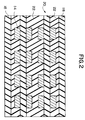
- Figure 2 is an elevation of a multilayer board made from the assembly of Figure 1.
- the photoimageable composition is prepared in two parts, the first part containing the oligomer and the second containing the epoxy resin, and then mixed shortly before application to the substrate.
- the temperature during preparation is chosen to facilitate high shear mixing of the components of the two parts; it may be conveniently at room temperature or high as anbout 200° F at super-atmospheric pressure.
- the photoimageable composition is applied as a layer to the copper clad substrate (or to a support sheet to form a dry film which is then laid on the copper).
- the particular application method used will depend to some degree on the particular formulation of the photoimageable composition used.
- the conveyor speed may from about 5 to about 7 feet per minute.
- the groove density of the rollers is 40 threads per inch, the groove depth is 0.010 inch, and the groove angle is 76°.
- the wet layer is dried to remove organic solvent. During this drying, some reaction of components may occur.
- the thermally driven reaction serves to increase crosslink density and advance the overall molecular weight of the film. Condensation reactions may occur between an anhydride and a melamine-formaldehyde resin, or between an epoxy cresol novolac and a hydroxyl- and/or carboxylic acid functional oligomer.
- the photoimageable layer may be covered by a sheet of black polyethylene or the like. It is then exposed to patterned actinic radiation at an energy level sufficient to cause enough crosslinking to prevent attack by the aqueous alkaline developer that follows in the conventional process.
- the intensity and time of the light exposure must also be correlated with the drying temperatures and the oven conveyor speed to achieve the optimal performance. It is preferred to effect a UV cure at an energy level of from about 150 to about 350 millijoules/cm to tie up any unreacted acrylate prior to lamination and preferably after etching of the copper exposed by the developer. Additional UV flood irradiation upon development prior to etching of the exposed copper is not required.
- the ability to be developed with aqueous or alkaline aqueous solutions and with or without organically based antifoam agents, is an important advantage of the photoimageable composition of the present invention. Eliminating the need for solvent-based developers eliminates the cost of the solvents as well as health, environmental and recycling problems. Although the films formed in accordance with the invention are developable in aqueous solutions without any organic solvents, developers may include some organic solvents, providing that the added organic solvent does not solubilize the exposed portions of the film.
- each innerlayer 10 comprises a base layer 12 of dielectric material, circuitry traces 14 on the opposite faces thereof, and the photoimageable composition 16 overlying the circuitry traces 14.
- the outerlayers 18 may have circuitry traces on their inner faces, only, before pressing of the assembly; the outer faces thereof would still retain a bare layer of copper foil which may be coated with resist, exposed, developed, and etched after the multilayered board comes out of the press.
- the photoimageable composition used instead of composition 16 would have been stripped from the circuitry traces 14 and the exposed circuitry traces would have been treated in a chemical bath.
- the photoimageable composition 16 is not stripped. The need for a stripper is eliminated, as are any problems associated with disposal of the stripper. Elimination of the stripping stages of the conventional process permits increased throughput of a multilayer board and reduces the resources required for its production.
- the innerlayers 10 and outerlayers 18 are merely stacked in a standard multilayer press and the assembly is subjected to heat and pressure which initially squeezes the still flowable photoimageable composition 16 into the voids between the innerlayers 10 to form the board 20 of Figure 2.
- the board 20 is maintained under heat and pressure for from about 3 to about 3.6 hours, during which time the photoimageable composition 16 cures to form hardened, permanent dielectric layers 22 which electrically separate the circuitry traces 14 of the innerlayers 10.
- the conditions of heat and pressure are somewhat dependent upon the particular photoimageable composition selected for the process.
- the assembly In a suitable procedure known as the hot start/dual pressure procedure or the "kiss" procedure, the assembly is held at about 350°F (177°C) at about 50 psi for a short while and then the pressure is increased to from about 450 to about 700 psi.
- the temperature In the hot start/full pressure procedure, the temperature is 350°F but a pressure of from about 600 to about 800 psi (56 kg/cm) is held for the full 3 to 3.6 hours.
- the cured assembly is suitably cooled down at a rate of about 10°F/min.
- An optional postbake of the dielectric layers 22 may be used to further cure or anneal it.
- the option of utilizing only the photoimageable composition to form the dielectric layer 22 has the advantage of eliminating any need for prepregs or additional material, the inclusion of which would constitute additional effort.
- only the photoimageable composition 16 is to be used to form the dielectric layers 22, it must be applied relatively thickly in order that the portions of the photoimageable composition 16 remaining after development provide sufficient material to not only fill in the voids between the traces 14 but also to provide a sufficiently thick dielectric barrier between the traces of adjacent innerlayers 10. Because the photoimageable composition is relatively expensive, thick layers of it are expensive to produce. Also, a thick photoimageable layer produces poorer resolution than a thin one.
- the thickness of the photoimageable layer will vary from about 2.2 mils when 1 oz. copper foil (1.4 mils thick) is used to about 3.2 mils when 2 oz. copper foil (2.8 mils thick) is used.
- Another option is to apply additional dielectric prepreg material to the board after etching. Again, the photoimageable composition layer is not removed from the traces, avoiding the need for stripper and treatment to avoid oxidation.
- the additional material could be more of the photoimageable composition 16, a compatible curable system (without the photosensitive components to minimize cost), or even conventional prepregs.
- the photoimageable composition layer that is left on the traces forms a portion of the dielectric layers 22 in the multilayer board.
- the board 20 is then taken out of the press, the outerlayers are processed as desired and the resulting multilayer board is then processed in a conventional manner. Holes are bored through the layers, and the hole walls are plated to electrically connect the circuitry of the several layers.
- the composition 16 according to the present invention includes an acrylic chemical system by which the composition is photo-polymerized and an epoxy chemical system which is curable to harden the composition after exposure and development.
- the two chemical systems are not exclusive of each other and components of the two chemical systems are believed to interact chemically with each other. This is especially true when the composition includes a cross-linking agent (f).
- the acrylic system includes the acrylate monomers (a), the epoxy-acrylate oligomer (c) and the photoinitiator (b).
- the epoxy system includes the epoxy resin (d) and the acidic curative (e) therefor. If a cross-linking agent (f) is used, it is selected to be reactive with free hydroxyl groups of components of both the acrylic and epoxy systems.
- the preferred photo-imageable composition comprises (a) from 5 to 40% of the acrylate monomers; (b) from 3 to 15% photo initiator; (c) from 5 to 35% of an oligomer consisting of a diester of a bisphenol A epoxy resin and acrylic or methacrylic acid; ; (d) from 20 to 80% of an epoxy resin; (e) from 0.1 to 10% of an acidic curative for the epoxy resin; (f) from 1 to 15 % of the cross-linking agent; and (g) up to 4 % by weight of a filler.
- the preferred composition has a photo-sensitive chemical system which renders exposed portions of the resist insoluble in alkaline aqueous developer and an epoxy-based chemical system which is curable to provide permanence and hardness to the material subsequent to exposure, development, etching and curing.
- a level of the acrylate monomer (a) lower than 5 % may be insufficient to insolubilize the portions of the photoresist layer that have been exposed to actinic radiation. Levels of acrylate monomer higher than 40 % may result in an innerlayer which is too soft.
- the acrylate monomer preferably comprises from 5 to 35 percent of the total weight of components (a)-(f). Unless otherwise stated, all percentages of components (a)-(f) are calculated relative to the total weight of components (a)-(f). The amounts of any additional ingredients, such as fillers, solvents, etc. are also calculated relative to the sum of the weights of (a)-(f).
- the dried composition of (a)-(f) is soluble in alkaline aqueous solution, whereby the photoimageable composition layer 16 on a circuit laminate is developable with alkaline aqueous solution.
- the monomers are selected from a variety of esters of acrylic and methacrylic acids, such as methyl acrylate, methyl methacrylate, hydroxyethyl acrylate, butyl methacrylate, octyl acrylate, 2-ethoxy ethyl methacrylate, t-butyl acrylate; 1,5-pentanediol diacrylate, N,N-diethylaminoethyl acrylate, ethylene glycol diacrylate; 1,4-butanediol diacrylate, diethylene glycol diacrylate, hexamethylene glycol diacrylate; 1,3-propanediol diacrylate, decamethylene glycol diacrylate, decamethylene glycol dimethacrylate; 1,4-cyclohex
- Epoxy-acrylate oligomer (c) means herein an oligomer formed from an epoxy backbone which is reacted with acrylic or methacrylic acid, a low molecular weight polyacrylic or polymethacrylic acid, or a mixture of them, so that at least about 90% of the epoxy groups are esterified with the acid.
- the acid molecules In the reaction of the acid with the epoxy groups of the epoxy resin, the acid molecules each form an ester bond with the resin and a hydroxyl group is formed on the vicinal carbon atom.
- the oligomer functions primarily as an acrylate or methacrylate, said moieties of the oligomer polymerizing along with the acrylic monomers during the photoinitiated reaction which renders exposed portions of the photoimageable composition layer insoluble to aqueous alkaline solution.
- the substantial hydroxyl functionality provides the basis for cross-linking with the cross-linking agent (f), if such a cross-linking agent (f) is used.
- Preferred epoxy-acrylate oligomers are diacrylate (or methacrylate) esters of bisphenol A type resins, novolac resins, and mixtures thereof having a maximum epoxide content of about 0.5 % by weight. These oligomers are developed to combine good UV/EB cure response along with the chemical resistance and durability of the epoxy resins. Said oligomers are derived from bisphenol A resins having a functionality of two so they also have a functionality of two.
- the epoxy-acrylate oligomer preferably comprises from 5 to 35 % of the total weight of components (a)-(f), and more preferably from 12 to 35 %.
- Epoxy-acrylate oligomers used in the photoimageable composition preferably have molecular weights of from about 500 to about 2000.
- a chemical initiator system which generates free radicals in the presence of actinic radiation and thereby causes the polymerization of the acrylic substances.
- Polymerization of acrylic monomers and acrylic moieties of the epoxy-acrylate oligomers into a three dimensional structure insolubilizes the photoimageable composition.
- the choice of the photosensitive, free radical generating initiator system is not considered to be critical to the practice of the present invention, and a wide variety of such compounds may be successfully utilized in the practice of this invention.
- Examples of chemical photoinitiator systems include benzophenone, benzoin ether, benzil ketals, ispropylthioxanthone and acetophenone and its derivatives.
- photoinitiator systems are described, for example, in U.S. Patent Nos. 3,469,982, 4,451,523 and 4,358,477, the teachings of which are incorporated herein by reference.
- the amount of photoinitiator employed may vary over a wide range, depending upon the polymerizable acrylic substances, the particular photoinitiator system and the desired time of development.
- the photoinitiator chemical system comprises from 3 to 15 % of the total weight of components (a)-(f).
- the material which imparts the excellent hardness and durability to the film or layer after development and final curing is the epoxy resin or mixture of epoxy resins.
- the epoxy resin or resins comprise from about 20 to about 80 % (preferably from about 30 to about 60 %) of the total weight of components (a)-(f).
- the epoxy groups of the resin molecules open and react with other materials present.
- the epoxy resin molecules react with the acidic curative (e); however, to a certain extent, the epoxy molecules react during final curing with the cross-linking agent (f), and perhaps also with the photo-polymerized acrylic material and any remaining unpolymerized acrylate monomers or moieties.
- the epoxy resin or mixture of resins is solid at about room temperature.
- the photoimageable composition can be applied as a liquid film to the substrate after dissolving the solid epoxy resin in the solvent-based mixture first.
- epoxy resins are suitable for use in accordance with the present invention.
- epoxies of the Bisphenol A and novolac type are used.
- Other suitable epoxy resins are described, for example, in U.S. Patent No. 4,092,443, the teachings of which are incorporated herein by reference.
- Cycloaliphatic epoxides such as those sold under the trade names Cyanacure UVR-6100 and UVR-6110 by Union Carbide, Danbury, CT are also useful.
- Epoxy resins used in accordance with the invention preferably have epoxide equivalents of from about 90 to about 700.
- the photoimageable composition according to this invention is intended to be hardened to form a permanent innerlayer. Hardening is primarily attributed to the curing of the epoxy resin.
- the photoimageable composition of the present invention employs an acidic curative.
- Acidic cure catalysts include not only substances which have free carboxyl groups, but also chemicals such as anhydrides, which may produce free carboxyl groups.
- an anhydride e.g., an anhydride of a multifunctional carboxylic acid is the preferred curative.
- Other useful catalysts are those having a blocked carboxylic group, which becomes deblocked at a threshold temperature.
- Epoxy cure catalysts are generally used at levels of from about 0.1 to about 10 % of the total weight of components (a)-(f).
- a cross-linking agent (f) is highly desirable.
- a cross-linking agent is particularly useful in connecting the acrylate chemical system and the epoxy chemical system in a single interconnected network in the innerlayer. Free hydroxyl groups on the epoxy resins and the epoxy- acrylate oligomers, generally provide the basis for such cross-linking.
- the cross-linking agent (f) is typically used at a level of at least 1 %, preferably 1.5 -5 %.
- the crosslinking agent is a melamine-formaldehyde resin.
- the melamine-formaldehyde resin reacts to some extent with the anhydride. This opens the anhydride, providing carboxyl functionality for subsequent epoxy curing. This initial reaction also has a surface drying effect.
- Melamine/formaldehyde resin acts to cross-link through free hydroxyl groups.
- the methylol groups of melamine/formaldehyde resins may be alkoxylated to give a suitable cross-linking agent.
- a blocked, multifunctional isocyanate may be used as the cross-linking agent.
- the blocked isocyanate is selected to deblock generally at the cure temperature of the epoxy resin.
- An example of a suitable blocked isocyanate is E-caprolactam-blocked isophorone. If a blocked isocyanate is the cross-linking agent and an anhydride is the curative, some preheating of the photoimageable composition at a time prior to cure is desirable. Such preheating opens anhydride species, providing the acid functionality needed to promote curing of the epoxy resin and needed also for alkaline development.
- the cross-linking agent may also be cyanoguanidine (also known as dicyandiamide or dicyanamide) or a substituted amino triazine such as 2-[ ⁇ -(2'-methylimidazolyl-1']-ethyl-4,5-diamino-s-triazine, which is sold under the trademark CUREZOL 2-Mz-Azine.
- cyanoguanidine also known as dicyandiamide or dicyanamide
- a substituted amino triazine such as 2-[ ⁇ -(2'-methylimidazolyl-1']-ethyl-4,5-diamino-s-triazine, which is sold under the trademark CUREZOL 2-Mz-Azine.
- a mixture of the dicyandiamide and substituted triazine may also be used.
- the components of the photoimageable composition are selected to be soluble in a common solvent to form a single-phase liquid composition.
- the liquid photoimageable composition may be applied to a substrate by a variety of application methods. Each application method has its own peculiarities, and photoimageable compositions in accordance with this invention may be formulated in accordance with the particular requirements of the particular method of application.
- Components (a)-(f) are selected such that a dried composition of these is soluble in alkaline aqueous solution, whereby a layer of the photoimageable composition may be developed in alkaline aqueous solution, e.g., 1% sodium carbonate.
- a mixture of components (a)-(f) is typically too viscous to be easily applied as a layer; accordingly, it is generally the practice to dilute the components (a)-(f) with an organic solvent.
- solvent is used at a level of 10-60 %, but this will vary depending upon the means of application.
- solvent is generally used at 10-20%; for electrostatic spray coating, at 20-60%; for curtain coating generally at 40-50%; and for application as a dry film typically about 50%.
- Suitable solvents include, but are not limited to ethylene glycol monoethyl ether, ethylene glycol monopropyl ether, ethylene glycol monobutyl ether, ethylene glycol-2-ethylhexyl ether, ethylene glycol monohexyl ether, diethylene glycol monomethyl ether, diethylene glycol monoethyl ether, diethylene glycol monopropyl ether, diethylene glycol monobutyl ether, dipropylene glycol methyl ether, propylene glycol monobutyl ether, propylene glycol monopropyl ether, propylene glycol methyl ether, ethylene glycol monoethyl ether acetate, ethylene glycol monobutyl ether acetate, diethylene glycol monoethyl ether acetate, diethylene glycol monobutyl ether acetate, propylene glycol monomethyl ether acetate, ethylene glycol diacetate, 2-ethylhexyl acetate,
- the photoimageable composition may optionally contain additional components which are standard in the art.
- the photoimageable composition optionally may contain organic or inorganic fillers at levels up to 4 %. Some examples of fillers are micro talc, ground polyethylene, clay, fumed silica and polyvinylidene fluoride. Also, relatively small amounts of flow-control agents, dyes, antioxidants, etc. may be added. Fillers may effect the final appearance of innerlayers, e.g. provide a matte finish.
- composition was prepared as follows:
- the photoimageable composition was applied as a wet film via a curtain coating process.
- the following coating conditions were used: 11.1 gm wet coating material per square foot laminate was applied in order to achieve an approximate dry film thickness of 2.0 to 2.2 mils on laminate and 0.8 to 0.9 mil dry film thickness on the copper circuitry. Coating speed was 80 to 90 meters per minute.
- the working viscosity of the photoimageable composition during coating was a Zahn Cup No. 5 reading of 22 seconds, 25°C. This was equivalent to approximately 60 wt. percent solids.
- the photoimageable composition was dried at 90°C for 15 minutes, and cooled to room temperature.
- the second side was then coated in a manner identical to the first side.
- the second side was dried to a tack-free surface at 90°C for 30 minutes.
- Diazo artwork was placed directly on the film, and the film was exposed to actinic radiation having a UV energy exposure level of at least 350 mjoules/cm at the working surface. Exposure time should be such that the exposed portion of the coating remains intact during the aqueous developing process.
- the film was developed in a basic aqueous solution, i.e., 1% by weight sodium carbonate mono-hydrate.
- the film was UV-cured by exposure to actinic radiation having a UV energy exposure level of at least 2 joules/cm.
- the exposed copper was then etched in a cupric chloride solution (an ammoniacal etchant is an alternative) to generate the circuitry traces.
- the etched circuit laminates with the innerlayer resist intact are then pressed into a multi-layer board by the "kiss" procedure described above.
- the performance of rigid multilayer printed circuit boards fabricated with a permanent inner layer photo resist (PILPR) according to the general procedure of Example 1 was measured by test procedures required by the IPC-ML-950-C Performance Specification and MIL-P-55110 General Specification for Printed Wiring Boards. Test coupons of these boards were made to have nominal thicknesses of 0.092, 0.125, and 0.225 inch. The IPC-A-43 comb pattern was imparted to some of the coupons and four-wire plated through hole (PTH) coupons were also tested. In general, it was determined that such boards will meet or exceed the requirements of each specification. Buried layer insulation resistance measurements and high voltage breakdown measurements are conducted on the IPC-A-43 coupons. The high voltage measurements provide a means for detecting delamination of the innerlayers. The PTH test coupon allows measurement of the PTH barrel and interface resistance so that crack initiation and propagation can be detected.
- the boards of this invention meet the standards of the thermal shock test of MIL-P-55110, para. 4.8.6.3, type GF and the thermal stress (solder float) test of IPC-ML-950-C, Class 3, para.4.6.5.1. Said boards exceed the Ionic Contamination requirements of Northern Telecom Corporate Standard 5040.02, Table 5.01 when tested by the method described in Diceon Std. Doc. #108384-026 (Diceon Electronics, Inc.) which is equivalent to methods 2.3.38 and 2.3.39 of IPC-TM-650. A maximum extraction of 6.4 ⁇ g/in is allowed by those standards and the average value for six boards of this invention was 2.7 ⁇ g/in.
- composition was prepared as follows: Component % Wt. Tris(2-hydroxyethyl) isocyanurate triacrylate 18.5 Methylolated melamine 3.4 Hetron 912 6.1 Novacure 3701 6.1 Epoxy cresol novolac resin, epoxy eq.
- compositions of Examples 1 and 2 were applied as a wet film via an electrostatic spray process as follows:
- the photoimageable composition was diluted to a Zahn Cup No. 2 viscosity of 60 seconds using an appropriate solvent. Both sides of the base laminates were coated as they were conveyed at 5 feet per minute through an aerosol spray of the solution charged via the application of 70,000 volts. Drying of the laminates took place at 80°C for 30 minutes. Diazo artwork was placed directly on the tack-free film and the film was exposed to actinic radia- tion having a UV energy exposure level of about 150 to about 400 mills joules/cm at the working surface. Exposure time was such that the exposed portion of the coating remained intact during the development of the film in a basic aqueous solution of 1% by weight of sodium carbonate monohydrate.
- the film was UV-cured by exposure to actinic radiation having a UV energy exposure level of from about 1 to about 4 joules per cm.
- the exposed copper was then etched in a cupric chloride solution to generate the circuitry traces.
- the etched circuit laminates with the innerlayer resist intact are then pressed into a multi-layer board by the "kiss" procedure described above.
- compositions of Examples 1 and 2 were applied as a wet film to base sheets so as to form dry films as follows.
- a wet film of 6 mil thickness was applied by draw down to a base sheet.
- the solvent evaporated from the film which was then covered with a polyester sheet.
- the film was applied to a circuit board laminate by hot roll lamination.
- the diazo artwork was placed on the cover sheet and the film was exposed to actinic radiation having a UV energy exposure level of at least 350 mjoules/cm at the working surface. Exposure time was such that the exposed portion of the coating remained intact during the aqueous developing process.
- the cover sheet was removed from the film before developing.
- the film was developed in a basic aqueous solution, i.e., 1% by weight sodium carbonate monohydrate.
- the film was UV-cured by exposure to actinic radiation having a UV energy exposure level of 2 joules/cm.
- the exposed copper was then etched in a cupric chloride solution to generate the circuitry traces.
- the etched circuit laminates with the innerlayer resist intact are then pressed into a multi-layer board by the "kiss" procedure described above.
- composition was prepared as follows: Component % Wt. Tris(2-hydroxyethyl) isocyanurate triacrylate 7.8 Pentaerythritol Tetraacrylate (Sartomer) 5.7 Epoxy cresol novolac resin, epoxy eq.
- This photoimageable composition was applied as a wet film via screen printing on a printed circuit board.
- the screen mesh was varied from 61 to 120 mesh.
- the screened photoimageable composition was dried at 80°C for 30 minutes, providing a non-tacky film.
- a diazo artwork was placed directly on the film, and the film was exposed to actinic radiation having a UV energy exposure level of 350 mjoules/cm.
- the film was developed in a basic aqueous solution, i.e., 1% by weight sodium carbonate monohydrate.
- the film was UV-cured by exposure to actinic radiation having a UV exposure level of 2 joules/cm.
- the exposed copper was then etched in a cupric chloride solution to generate the circuitry traces.
- the etched circuit laminates with the innerlayer resist intact are then pressed into a multi-layer board by the "kiss" procedure described above.
- the photoimageable composition described in Example 5 may also be used in the making of a multi-layered printed circuit board according to the general procedures described in Examples 1 and 3-5.
- a composition of this invention was prepared in two parts, the components of which are as follows: PART A Component % Wt. Novacure 3701 (diacrylate ester of a bisphenol A epoxy resin) 48.01 5-(2,5-dioxotetrahydrofuryl)-3-methyl-3-cyclohexene-1,2-dicarboxylic anhydride 9.45 QITX isopropylthioxanthone 2.59 Irgacure 907 7.35 Cyanoguanidine (CG 1400) 2.69 BYK 306 1.34 BYK 361 0.60 Malachite green 0.30 Ethyl-3-ethoxy propionate 27.65 100.00 ⁇ PART B Epoxy cresol novolac resin, ECN-1299 52.56 Trimethylolpropane triacrylate 10.03 2-MZ-Azine (CUREZOL) 0.40 BYK-306 1.54 Cab-O-Sil M5A silica 6.96 Modaflow 0.20 Ethyl-3-eth
- Part A For the preparation of Part A, the first two components were mixed with Malachite green in a portion of the proprionate solvent for four hours and controlling the temperature by regulating the speed of the mixer and the flow of cooling water to the reactor jacket. The remainder of the solvent and the remaining components were added while the mixture was stirred at high shear. After a two hour mixing period, the product was filtered through a 10 ⁇ bag filter and the filtrate was a dark green viscous paste having a solids content of 76.4 % (w/w), a Hegman grind of ⁇ 7.5, and a Brookfield viscosity of 14,000 cps using a No.7 spindle at 10rpm for 2 minutes at 25° C.
- Part B For the preparation of Part B, a portion of the solvent and the epoxy novolac resin were mixed at high shear for two hours. The flow agents, the triacruylate, and the Curezol were added and high shear mixing for 90 minutes followed while controlling the temperature in the same manner. The silica was then added over a one hour period, the remainder of the solvent was added, and the mixture was stirred for another four hours.
- This part was an opaque tan colored liquid having thixotropic properties. The viscosity was 3600 cps, the solids content was 69.81 %(w/w), and the Hegman grind was ⁇ 4.5.
- Part A and Part B Equal parts by weight of Part A and Part B were mixed to obtain a photoresist of this invention containing about 5 % of the acrylate monomer, about 24 % of the epoxy/acrylate oligomer, about 26 % of the epoxy novolac resin, and about 28% solvent, by weight. On a solids basis, therefore, the amount of acrylate monomer is about 6.9 %, the oligomer is about 33.3 %, and the epoxy novolac resin is about 36.1 % of the total weight. Laminates were coated with the photoresist using a Burkle double sided roller coater having a zero speed differential between the application rollers and the oven conveyor belt, which was traveling at about 7 feet/minute.
- the wet films were dried in two consecutive temperature zones, the first zone being at 105°C and the second at 177°C.
- the dry films manifested little or no tack.
- the average thickness of the four films was 0.6 ⁇ 0.1 mil.
- Diazo artwork was placed directly on the surface of the films and each was exposed to actinic radiation having a predominant wavelength of 365 nm and an exposure energy level averaging 200 ⁇ 25 mJ/cm .
- the step density in each case was 5 or greater.
- the exposed metal is dissolved by drawing the boards through a 3 Normal aqueous solution of cupric chloride, hydrochloric acid, and chlorine at 120°F at a rate of about 30 inches per minute and they are then rinsed and dried.
- the etched circuit-bearing laminates are then stacked and pressed into a multi-layer board by the "kiss" procedure. Holes are then bored through the multiple layers so that the circuitries of each layer may be connected later by plating the hole walls.
- the "drill smear" on the inner copper layers must first be cleaned off, however, in a desmearing step by immersing the board in a mixture of butyl cellosolve and monoethanolamine at 130°F for 5 minutes, rinsing it with water and then immersing it for five minutes in a mixture of two solutions at 160°F, one solution being 1 molar in sodium hydroxide and the other 1 molar in sodium permanganate.
- the board is rinsed with water again before being neutralized by immersion in a mixture of citric acid and sulfuric acid solutions and then dried.
- the holes are then plated through first by an electroless plating procedure wherein it is immersed in an aqueous solution of sodium persulfate for a short time at room temperature, then rinsed and treated with an aqueous solution of sodium chloride and hydrochloric acid before being immersed in a catalyst bath of palladium chloride in water at 100°F for 3-5 minutes.
- the board is rinsed again and treated with an aqueous solution of stannous fluoborate to fix the palladium catalyst to the non-conductive surfaces of the board.
- the board is rinsed and then immersed in an aqueous solution of copper sulfate, a metal chelator such as sodium tartrate, and EDTA at 100°F for 20 minutes.
- the board is then rinsed and treated with a solution of acetic acid and benzotriazole to inhibit oxidation and dried.
- the copper plated walls of the holes are given a thicker layer of copper in an electroplating process wherein the thin copper lining of the holes acts as the cathode as the copper ions in a bath of dilute sulfuric acid and copper sulfate are reduced and are replenished by a copper anode.
Landscapes
- Engineering & Computer Science (AREA)
- Manufacturing & Machinery (AREA)
- Microelectronics & Electronic Packaging (AREA)
- Physics & Mathematics (AREA)
- Spectroscopy & Molecular Physics (AREA)
- General Physics & Mathematics (AREA)
- Production Of Multi-Layered Print Wiring Board (AREA)
- Epoxy Resins (AREA)
- Manufacturing Of Printed Circuit Boards (AREA)
- Graft Or Block Polymers (AREA)
- Reinforced Plastic Materials (AREA)
- Materials For Photolithography (AREA)
Applications Claiming Priority (2)
| Application Number | Priority Date | Filing Date | Title |
|---|---|---|---|
| US27161494A | 1994-07-07 | 1994-07-07 | |
| US271614 | 1994-07-07 |
Publications (2)
| Publication Number | Publication Date |
|---|---|
| EP0691802A1 true EP0691802A1 (de) | 1996-01-10 |
| EP0691802B1 EP0691802B1 (de) | 2002-08-28 |
Family
ID=23036319
Family Applications (1)
| Application Number | Title | Priority Date | Filing Date |
|---|---|---|---|
| EP95304322A Expired - Lifetime EP0691802B1 (de) | 1994-07-07 | 1995-06-21 | Verfahren und Zusammensetzung zur Herstellung einer mehrschichtigen Leiterplatte |
Country Status (7)
| Country | Link |
|---|---|
| EP (1) | EP0691802B1 (de) |
| JP (1) | JP2693135B2 (de) |
| KR (1) | KR100199539B1 (de) |
| AT (1) | ATE223142T1 (de) |
| DE (1) | DE69527896T2 (de) |
| SG (1) | SG50346A1 (de) |
| TW (1) | TW353858B (de) |
Cited By (2)
| Publication number | Priority date | Publication date | Assignee | Title |
|---|---|---|---|---|
| WO2007042068A1 (en) * | 2005-10-11 | 2007-04-19 | Fci | Method to manufacture a printed circuit partially protected by an insulating layer |
| CN103616799A (zh) * | 2013-11-07 | 2014-03-05 | 李厚民 | 一种固化后有机可溶的光敏树脂、制备方法及溶解方法 |
Families Citing this family (4)
| Publication number | Priority date | Publication date | Assignee | Title |
|---|---|---|---|---|
| TW581911B (en) * | 1997-06-26 | 2004-04-01 | Dainippon Printing Co Ltd | Formation method of lumpy pattern and color filter for liquid crystal display apparatus manufactured by the same |
| JP2003066603A (ja) * | 2001-08-28 | 2003-03-05 | Hitachi Chem Co Ltd | 感光性樹脂組成物及びこれを用いた多層プリント配線板の製造方法 |
| TWI485939B (zh) | 2012-10-29 | 2015-05-21 | Delta Electronics Inc | 模組化的連接器 |
| JP5835416B2 (ja) * | 2014-06-25 | 2015-12-24 | 日立化成株式会社 | 感光性樹脂組成物、感光性フィルム及びレジストパターンの形成方法 |
Citations (17)
| Publication number | Priority date | Publication date | Assignee | Title |
|---|---|---|---|---|
| US3256226A (en) | 1965-03-01 | 1966-06-14 | Robertson Co H H | Hydroxy polyether polyesters having terminal ethylenically unsaturated groups |
| US3317465A (en) | 1963-06-26 | 1967-05-02 | Robertson Co H H | Combination catalyst-inhibitor for betahydroxy carboxylic esters |
| US3345401A (en) | 1964-10-19 | 1967-10-03 | Shell Oil Co | Process for preparing polyesters and resulting products |
| US3373221A (en) | 1964-11-04 | 1968-03-12 | Shell Oil Co | Reaction products of unsaturated esters of polyepoxides and unsaturated carboxylic acids, and polyisocyanates |
| US3377406A (en) | 1963-12-16 | 1968-04-09 | Shell Oil Co | Process of esterification of polyepoxides with ethylenically unsaturated monocarboxylic acids in the presence of onium salts of inorganic acids |
| US3469982A (en) | 1968-09-11 | 1969-09-30 | Jack Richard Celeste | Process for making photoresists |
| US3548030A (en) | 1968-03-27 | 1970-12-15 | Dow Chemical Co | Vinyl ester resins containing esterified secondary hydroxy groups |
| US3564074A (en) | 1966-11-28 | 1971-02-16 | Dow Chemical Co | Thermosetting vinyl resins reacted with dicarboxylic acid anhydrides |
| US3634542A (en) | 1969-08-04 | 1972-01-11 | Shell Oil Co | Unsaturated polyesters esterified with polycarboxylic acid anhydride and containing polyepoxide |
| US3637618A (en) | 1970-03-11 | 1972-01-25 | Shell Oil Co | Unsaturated polyesters from epoxides and ethylenically unsaturated monocarboxylic acid mixed with solid epoxide resin |
| US4092443A (en) | 1976-02-19 | 1978-05-30 | Ciba-Geigy Corporation | Method for making reinforced composites |
| US4358477A (en) | 1978-09-07 | 1982-11-09 | Akzo N.V. | Process of curing unsaturated epoxy coating composition with radiation and epoxy curing agent, and coated substrate |
| US4451523A (en) | 1982-11-12 | 1984-05-29 | Loctite Corporation | Conformal coating systems |
| JPS62265321A (ja) * | 1986-05-14 | 1987-11-18 | Hitachi Ltd | 樹脂組成物 |
| JPS63205313A (ja) * | 1987-02-23 | 1988-08-24 | Hitachi Ltd | エポキシ樹脂用硬化剤 |
| EP0403170A2 (de) * | 1989-06-09 | 1990-12-19 | Morton International, Inc. | Lichtempfindliche Bildaufzeichnungszusammensetzungen |
| EP0570094A2 (de) * | 1992-05-15 | 1993-11-18 | Morton International, Inc. | Verfahren zur Herstellung einer mehrschichtigen Leiterplatte und daraus erhaltenes Produkt |
-
1995
- 1995-03-10 TW TW084102334A patent/TW353858B/zh not_active IP Right Cessation
- 1995-04-17 KR KR1019950008928A patent/KR100199539B1/ko not_active Expired - Fee Related
- 1995-06-21 EP EP95304322A patent/EP0691802B1/de not_active Expired - Lifetime
- 1995-06-21 DE DE69527896T patent/DE69527896T2/de not_active Expired - Fee Related
- 1995-06-21 AT AT95304322T patent/ATE223142T1/de not_active IP Right Cessation
- 1995-06-28 SG SG1995000745A patent/SG50346A1/en unknown
- 1995-07-04 JP JP7169010A patent/JP2693135B2/ja not_active Expired - Lifetime
Patent Citations (18)
| Publication number | Priority date | Publication date | Assignee | Title |
|---|---|---|---|---|
| US3317465A (en) | 1963-06-26 | 1967-05-02 | Robertson Co H H | Combination catalyst-inhibitor for betahydroxy carboxylic esters |
| US3377406A (en) | 1963-12-16 | 1968-04-09 | Shell Oil Co | Process of esterification of polyepoxides with ethylenically unsaturated monocarboxylic acids in the presence of onium salts of inorganic acids |
| US3432478A (en) | 1963-12-16 | 1969-03-11 | Shell Oil Co | Polyhydroxy-containing unsaturated polyesters and their preparation |
| US3345401A (en) | 1964-10-19 | 1967-10-03 | Shell Oil Co | Process for preparing polyesters and resulting products |
| US3373221A (en) | 1964-11-04 | 1968-03-12 | Shell Oil Co | Reaction products of unsaturated esters of polyepoxides and unsaturated carboxylic acids, and polyisocyanates |
| US3256226A (en) | 1965-03-01 | 1966-06-14 | Robertson Co H H | Hydroxy polyether polyesters having terminal ethylenically unsaturated groups |
| US3564074A (en) | 1966-11-28 | 1971-02-16 | Dow Chemical Co | Thermosetting vinyl resins reacted with dicarboxylic acid anhydrides |
| US3548030A (en) | 1968-03-27 | 1970-12-15 | Dow Chemical Co | Vinyl ester resins containing esterified secondary hydroxy groups |
| US3469982A (en) | 1968-09-11 | 1969-09-30 | Jack Richard Celeste | Process for making photoresists |
| US3634542A (en) | 1969-08-04 | 1972-01-11 | Shell Oil Co | Unsaturated polyesters esterified with polycarboxylic acid anhydride and containing polyepoxide |
| US3637618A (en) | 1970-03-11 | 1972-01-25 | Shell Oil Co | Unsaturated polyesters from epoxides and ethylenically unsaturated monocarboxylic acid mixed with solid epoxide resin |
| US4092443A (en) | 1976-02-19 | 1978-05-30 | Ciba-Geigy Corporation | Method for making reinforced composites |
| US4358477A (en) | 1978-09-07 | 1982-11-09 | Akzo N.V. | Process of curing unsaturated epoxy coating composition with radiation and epoxy curing agent, and coated substrate |
| US4451523A (en) | 1982-11-12 | 1984-05-29 | Loctite Corporation | Conformal coating systems |
| JPS62265321A (ja) * | 1986-05-14 | 1987-11-18 | Hitachi Ltd | 樹脂組成物 |
| JPS63205313A (ja) * | 1987-02-23 | 1988-08-24 | Hitachi Ltd | エポキシ樹脂用硬化剤 |
| EP0403170A2 (de) * | 1989-06-09 | 1990-12-19 | Morton International, Inc. | Lichtempfindliche Bildaufzeichnungszusammensetzungen |
| EP0570094A2 (de) * | 1992-05-15 | 1993-11-18 | Morton International, Inc. | Verfahren zur Herstellung einer mehrschichtigen Leiterplatte und daraus erhaltenes Produkt |
Non-Patent Citations (2)
| Title |
|---|
| PATENT ABSTRACTS OF JAPAN vol. 12, no. 148 (C - 493) 7 May 1988 (1988-05-07) * |
| PATENT ABSTRACTS OF JAPAN vol. 12, no. 491 (C - 554) 21 December 1988 (1988-12-21) * |
Cited By (3)
| Publication number | Priority date | Publication date | Assignee | Title |
|---|---|---|---|---|
| WO2007042068A1 (en) * | 2005-10-11 | 2007-04-19 | Fci | Method to manufacture a printed circuit partially protected by an insulating layer |
| CN103616799A (zh) * | 2013-11-07 | 2014-03-05 | 李厚民 | 一种固化后有机可溶的光敏树脂、制备方法及溶解方法 |
| CN103616799B (zh) * | 2013-11-07 | 2016-02-24 | 李厚民 | 一种固化后有机可溶的光敏树脂、制备方法及溶解方法 |
Also Published As
| Publication number | Publication date |
|---|---|
| DE69527896D1 (de) | 2002-10-02 |
| DE69527896T2 (de) | 2003-04-10 |
| ATE223142T1 (de) | 2002-09-15 |
| JPH0851266A (ja) | 1996-02-20 |
| JP2693135B2 (ja) | 1997-12-24 |
| KR100199539B1 (ko) | 1999-06-15 |
| SG50346A1 (en) | 2000-02-22 |
| EP0691802B1 (de) | 2002-08-28 |
| TW353858B (en) | 1999-03-01 |
| HK1005163A1 (en) | 1998-12-24 |
| KR960006715A (ko) | 1996-02-23 |
Similar Documents
| Publication | Publication Date | Title |
|---|---|---|
| US5928839A (en) | Method of forming a multilayer printed circuit board and product thereof | |
| US5544773A (en) | Method for making multilayer printed circuit board having blind holes and resin-coated copper foil used for the method | |
| JP5408655B2 (ja) | プリント配線板及びその製造方法 | |
| KR100239599B1 (ko) | 감광성 수지 조성물 및 회로 기판 제조에 있어서의 그의 사용 방법 | |
| US5532105A (en) | Photolithographically viahole-forming photosensitive element comprising two photosensitive layers for the fabrication process of multilayer wiring board | |
| US5229252A (en) | Photoimageable compositions | |
| EP0723736B1 (de) | Verbinden von innenschichten in der leiterplattenherstellung | |
| JPH06282068A (ja) | 印刷回路のための水性処理可能な多層の光像形成性永久コーティング | |
| EP0570094B1 (de) | Verfahren zur Herstellung einer mehrschichtigen Leiterplatte und daraus erhaltenes Produkt | |
| EP0735809A2 (de) | Photostrukturierbare dielektrische Zusammensetzung zur Verwendung in der Herstellung von Leiterplatten | |
| JPH0792602B2 (ja) | 放射線重合性コンパウンド、放射線重合性複写材料、およびソルダーマスクの製造法 | |
| EP0691802B1 (de) | Verfahren und Zusammensetzung zur Herstellung einer mehrschichtigen Leiterplatte | |
| JP4095163B2 (ja) | プリント配線板用感光性樹脂組成物並びにそれから形成されるソルダーレジスト皮膜や樹脂絶縁層を有するプリント配線板 | |
| KR900003848B1 (ko) | 인쇄 회로 기판의 제조방법 | |
| JP2003082025A (ja) | 樹脂組成物、ソルダーレジスト樹脂組成物及びこれらの硬化物 | |
| JP2002234932A (ja) | アルカリ水溶液可溶性エポキシカルボキシレート化合物及びそれを用いた感光性樹脂組成物並びにその硬化物 | |
| JPH11242332A (ja) | 樹脂組成物、その硬化物及びプリント配線板 | |
| HK1007462B (en) | Method of forming a multilayer printed circuit board and product thereof | |
| HK1005163B (en) | Method and composition for forming a multilayer printed circuit board | |
| JP2560952B2 (ja) | 樹脂組成物、樹脂付き銅はくおよびブラインドバイアホールを有する多層プリント配線板の製造方法 | |
| JPH11307916A (ja) | プリント回路基板の製造方法 | |
| JPH0854732A (ja) | エッチングレジストシートおよびプリント配線板の製造方法 | |
| JPH1036682A (ja) | 硬化性樹脂組成物およびそれを用いた多層プリント配線板の製造方法ならびにその方法でえられた多層プリント配線板 | |
| JPH04281454A (ja) | 一液型感光性熱硬化性樹脂組成物 | |
| JP2008145707A (ja) | 感光性樹脂組成物、感光性フィルム、永久マスクレジスト及びその製造方法 |
Legal Events
| Date | Code | Title | Description |
|---|---|---|---|
| PUAI | Public reference made under article 153(3) epc to a published international application that has entered the european phase |
Free format text: ORIGINAL CODE: 0009012 |
|
| AK | Designated contracting states |
Kind code of ref document: A1 Designated state(s): AT BE CH DE ES FR GB IT LI NL SE |
|
| 17P | Request for examination filed |
Effective date: 19960617 |
|
| RAP1 | Party data changed (applicant data changed or rights of an application transferred) |
Owner name: MORTON INTERNATIONAL, INC. |
|
| 17Q | First examination report despatched |
Effective date: 20000626 |
|
| GRAG | Despatch of communication of intention to grant |
Free format text: ORIGINAL CODE: EPIDOS AGRA |
|
| RTI1 | Title (correction) |
Free format text: METHOD AND COMPOSITION FOR FORMING A MULTILAYER PRINTED CIRCUIT BOARD |
|
| GRAG | Despatch of communication of intention to grant |
Free format text: ORIGINAL CODE: EPIDOS AGRA |
|
| GRAH | Despatch of communication of intention to grant a patent |
Free format text: ORIGINAL CODE: EPIDOS IGRA |
|
| GRAH | Despatch of communication of intention to grant a patent |
Free format text: ORIGINAL CODE: EPIDOS IGRA |
|
| GRAA | (expected) grant |
Free format text: ORIGINAL CODE: 0009210 |
|
| AK | Designated contracting states |
Kind code of ref document: B1 Designated state(s): AT BE CH DE ES FR GB IT LI NL SE |
|
| PG25 | Lapsed in a contracting state [announced via postgrant information from national office to epo] |
Ref country code: NL Free format text: LAPSE BECAUSE OF FAILURE TO SUBMIT A TRANSLATION OF THE DESCRIPTION OR TO PAY THE FEE WITHIN THE PRESCRIBED TIME-LIMIT Effective date: 20020828 Ref country code: LI Free format text: LAPSE BECAUSE OF FAILURE TO SUBMIT A TRANSLATION OF THE DESCRIPTION OR TO PAY THE FEE WITHIN THE PRESCRIBED TIME-LIMIT Effective date: 20020828 Ref country code: IT Free format text: LAPSE BECAUSE OF FAILURE TO SUBMIT A TRANSLATION OF THE DESCRIPTION OR TO PAY THE FEE WITHIN THE PRE;WARNING: LAPSES OF ITALIAN PATENTS WITH EFFECTIVE DATE BEFORE 2007 MAY HAVE OCCURRED AT ANY TIME BEFORE 2007. THE CORRECT EFFECTIVE DATE MAY BE DIFFERENT FROM THE ONE RECORDED.SCRIBED TIME-LIMIT Effective date: 20020828 Ref country code: CH Free format text: LAPSE BECAUSE OF FAILURE TO SUBMIT A TRANSLATION OF THE DESCRIPTION OR TO PAY THE FEE WITHIN THE PRESCRIBED TIME-LIMIT Effective date: 20020828 Ref country code: BE Free format text: LAPSE BECAUSE OF FAILURE TO SUBMIT A TRANSLATION OF THE DESCRIPTION OR TO PAY THE FEE WITHIN THE PRESCRIBED TIME-LIMIT Effective date: 20020828 Ref country code: AT Free format text: LAPSE BECAUSE OF FAILURE TO SUBMIT A TRANSLATION OF THE DESCRIPTION OR TO PAY THE FEE WITHIN THE PRESCRIBED TIME-LIMIT Effective date: 20020828 |
|
| REF | Corresponds to: |
Ref document number: 223142 Country of ref document: AT Date of ref document: 20020915 Kind code of ref document: T |
|
| REG | Reference to a national code |
Ref country code: GB Ref legal event code: FG4D |
|
| REG | Reference to a national code |
Ref country code: CH Ref legal event code: EP |
|
| REF | Corresponds to: |
Ref document number: 69527896 Country of ref document: DE Date of ref document: 20021002 |
|
| PG25 | Lapsed in a contracting state [announced via postgrant information from national office to epo] |
Ref country code: SE Free format text: LAPSE BECAUSE OF FAILURE TO SUBMIT A TRANSLATION OF THE DESCRIPTION OR TO PAY THE FEE WITHIN THE PRESCRIBED TIME-LIMIT Effective date: 20021128 |
|
| NLV1 | Nl: lapsed or annulled due to failure to fulfill the requirements of art. 29p and 29m of the patents act | ||
| PG25 | Lapsed in a contracting state [announced via postgrant information from national office to epo] |
Ref country code: ES Free format text: LAPSE BECAUSE OF FAILURE TO SUBMIT A TRANSLATION OF THE DESCRIPTION OR TO PAY THE FEE WITHIN THE PRESCRIBED TIME-LIMIT Effective date: 20030228 |
|
| REG | Reference to a national code |
Ref country code: CH Ref legal event code: PL |
|
| ET | Fr: translation filed | ||
| PLBE | No opposition filed within time limit |
Free format text: ORIGINAL CODE: 0009261 |
|
| STAA | Information on the status of an ep patent application or granted ep patent |
Free format text: STATUS: NO OPPOSITION FILED WITHIN TIME LIMIT |
|
| 26N | No opposition filed |
Effective date: 20030530 |
|
| PGFP | Annual fee paid to national office [announced via postgrant information from national office to epo] |
Ref country code: FR Payment date: 20060620 Year of fee payment: 12 |
|
| PGFP | Annual fee paid to national office [announced via postgrant information from national office to epo] |
Ref country code: GB Payment date: 20060626 Year of fee payment: 12 |
|
| PGFP | Annual fee paid to national office [announced via postgrant information from national office to epo] |
Ref country code: DE Payment date: 20060731 Year of fee payment: 12 |
|
| REG | Reference to a national code |
Ref country code: FR Ref legal event code: TP |
|
| GBPC | Gb: european patent ceased through non-payment of renewal fee |
Effective date: 20070621 |
|
| REG | Reference to a national code |
Ref country code: FR Ref legal event code: ST Effective date: 20080229 |
|
| PG25 | Lapsed in a contracting state [announced via postgrant information from national office to epo] |
Ref country code: DE Free format text: LAPSE BECAUSE OF NON-PAYMENT OF DUE FEES Effective date: 20080101 |
|
| PG25 | Lapsed in a contracting state [announced via postgrant information from national office to epo] |
Ref country code: GB Free format text: LAPSE BECAUSE OF NON-PAYMENT OF DUE FEES Effective date: 20070621 |
|
| PG25 | Lapsed in a contracting state [announced via postgrant information from national office to epo] |
Ref country code: FR Free format text: LAPSE BECAUSE OF NON-PAYMENT OF DUE FEES Effective date: 20070702 |