EP0696823B1 - Wasserstoffabsorbierende elektrode und deren herstellung - Google Patents
Wasserstoffabsorbierende elektrode und deren herstellung Download PDFInfo
- Publication number
- EP0696823B1 EP0696823B1 EP95909963A EP95909963A EP0696823B1 EP 0696823 B1 EP0696823 B1 EP 0696823B1 EP 95909963 A EP95909963 A EP 95909963A EP 95909963 A EP95909963 A EP 95909963A EP 0696823 B1 EP0696823 B1 EP 0696823B1
- Authority
- EP
- European Patent Office
- Prior art keywords
- hydrogen
- alloy
- electrode
- absorbing
- transition metal
- Prior art date
- Legal status (The legal status is an assumption and is not a legal conclusion. Google has not performed a legal analysis and makes no representation as to the accuracy of the status listed.)
- Expired - Lifetime
Links
- 238000004519 manufacturing process Methods 0.000 title claims description 6
- UFHFLCQGNIYNRP-UHFFFAOYSA-N Hydrogen Chemical compound [H][H] UFHFLCQGNIYNRP-UHFFFAOYSA-N 0.000 title description 4
- 229910052739 hydrogen Inorganic materials 0.000 title description 3
- 239000001257 hydrogen Substances 0.000 title description 3
- 229910045601 alloy Inorganic materials 0.000 claims description 71
- 239000000956 alloy Substances 0.000 claims description 71
- 239000010410 layer Substances 0.000 claims description 43
- 239000002245 particle Substances 0.000 claims description 31
- PXHVJJICTQNCMI-UHFFFAOYSA-N nickel Substances [Ni] PXHVJJICTQNCMI-UHFFFAOYSA-N 0.000 claims description 28
- 229910052761 rare earth metal Inorganic materials 0.000 claims description 23
- 238000010306 acid treatment Methods 0.000 claims description 22
- 238000000034 method Methods 0.000 claims description 20
- 229910052723 transition metal Inorganic materials 0.000 claims description 20
- 150000003624 transition metals Chemical class 0.000 claims description 20
- QTBSBXVTEAMEQO-UHFFFAOYSA-N Acetic acid Chemical compound CC(O)=O QTBSBXVTEAMEQO-UHFFFAOYSA-N 0.000 claims description 18
- 239000000203 mixture Substances 0.000 claims description 11
- 229910052759 nickel Inorganic materials 0.000 claims description 9
- 239000002344 surface layer Substances 0.000 claims description 5
- 239000004411 aluminium Substances 0.000 claims description 4
- 229910052782 aluminium Inorganic materials 0.000 claims description 4
- XAGFODPZIPBFFR-UHFFFAOYSA-N aluminium Chemical compound [Al] XAGFODPZIPBFFR-UHFFFAOYSA-N 0.000 claims description 4
- 239000008351 acetate buffer Substances 0.000 claims description 3
- 239000012062 aqueous buffer Substances 0.000 claims description 3
- 229910052748 manganese Inorganic materials 0.000 claims description 3
- 229910052802 copper Inorganic materials 0.000 claims description 2
- 229910052742 iron Inorganic materials 0.000 claims description 2
- 238000012360 testing method Methods 0.000 description 15
- 230000004913 activation Effects 0.000 description 13
- 238000001994 activation Methods 0.000 description 13
- -1 rare earth hydroxide Chemical class 0.000 description 11
- 238000002441 X-ray diffraction Methods 0.000 description 7
- 230000008569 process Effects 0.000 description 6
- 238000010828 elution Methods 0.000 description 5
- 238000007747 plating Methods 0.000 description 5
- 239000000243 solution Substances 0.000 description 5
- 238000004833 X-ray photoelectron spectroscopy Methods 0.000 description 4
- 239000003513 alkali Substances 0.000 description 4
- 239000003792 electrolyte Substances 0.000 description 4
- 239000007789 gas Substances 0.000 description 4
- 229910000652 nickel hydride Inorganic materials 0.000 description 4
- KWYUFKZDYYNOTN-UHFFFAOYSA-M Potassium hydroxide Chemical compound [OH-].[K+] KWYUFKZDYYNOTN-UHFFFAOYSA-M 0.000 description 3
- 239000007864 aqueous solution Substances 0.000 description 3
- 239000011230 binding agent Substances 0.000 description 3
- 239000011148 porous material Substances 0.000 description 3
- 239000007974 sodium acetate buffer Substances 0.000 description 3
- QGJOPFRUJISHPQ-UHFFFAOYSA-N Carbon disulfide Chemical compound S=C=S QGJOPFRUJISHPQ-UHFFFAOYSA-N 0.000 description 2
- 229910052684 Cerium Inorganic materials 0.000 description 2
- VEXZGXHMUGYJMC-UHFFFAOYSA-N Hydrochloric acid Chemical compound Cl VEXZGXHMUGYJMC-UHFFFAOYSA-N 0.000 description 2
- 229910001122 Mischmetal Inorganic materials 0.000 description 2
- 229910052779 Neodymium Inorganic materials 0.000 description 2
- 229910052777 Praseodymium Inorganic materials 0.000 description 2
- 238000004458 analytical method Methods 0.000 description 2
- 230000015572 biosynthetic process Effects 0.000 description 2
- 239000002131 composite material Substances 0.000 description 2
- 238000007598 dipping method Methods 0.000 description 2
- 238000009826 distribution Methods 0.000 description 2
- 230000000694 effects Effects 0.000 description 2
- 238000010894 electron beam technology Methods 0.000 description 2
- 239000000835 fiber Substances 0.000 description 2
- 239000011261 inert gas Substances 0.000 description 2
- 229910052746 lanthanum Inorganic materials 0.000 description 2
- BDAGIHXWWSANSR-UHFFFAOYSA-N methanoic acid Natural products OC=O BDAGIHXWWSANSR-UHFFFAOYSA-N 0.000 description 2
- 239000002244 precipitate Substances 0.000 description 2
- 230000002035 prolonged effect Effects 0.000 description 2
- 239000000758 substrate Substances 0.000 description 2
- 238000005211 surface analysis Methods 0.000 description 2
- OSWFIVFLDKOXQC-UHFFFAOYSA-N 4-(3-methoxyphenyl)aniline Chemical compound COC1=CC=CC(C=2C=CC(N)=CC=2)=C1 OSWFIVFLDKOXQC-UHFFFAOYSA-N 0.000 description 1
- UGFAIRIUMAVXCW-UHFFFAOYSA-N Carbon monoxide Chemical compound [O+]#[C-] UGFAIRIUMAVXCW-UHFFFAOYSA-N 0.000 description 1
- 238000010521 absorption reaction Methods 0.000 description 1
- 239000002253 acid Substances 0.000 description 1
- 239000010405 anode material Substances 0.000 description 1
- OJIJEKBXJYRIBZ-UHFFFAOYSA-N cadmium nickel Chemical compound [Ni].[Cd] OJIJEKBXJYRIBZ-UHFFFAOYSA-N 0.000 description 1
- 229910052799 carbon Inorganic materials 0.000 description 1
- 229910002091 carbon monoxide Inorganic materials 0.000 description 1
- 239000003638 chemical reducing agent Substances 0.000 description 1
- 230000001351 cycling effect Effects 0.000 description 1
- 238000011161 development Methods 0.000 description 1
- 230000018109 developmental process Effects 0.000 description 1
- 238000003411 electrode reaction Methods 0.000 description 1
- 239000010419 fine particle Substances 0.000 description 1
- 235000019253 formic acid Nutrition 0.000 description 1
- 230000001788 irregular Effects 0.000 description 1
- 238000005259 measurement Methods 0.000 description 1
- 238000002844 melting Methods 0.000 description 1
- 230000008018 melting Effects 0.000 description 1
- 229910000474 mercury oxide Inorganic materials 0.000 description 1
- UKWHYYKOEPRTIC-UHFFFAOYSA-N mercury(ii) oxide Chemical compound [Hg]=O UKWHYYKOEPRTIC-UHFFFAOYSA-N 0.000 description 1
- BFDHFSHZJLFAMC-UHFFFAOYSA-L nickel(ii) hydroxide Chemical compound [OH-].[OH-].[Ni+2] BFDHFSHZJLFAMC-UHFFFAOYSA-L 0.000 description 1
- 230000000737 periodic effect Effects 0.000 description 1
- 229940093932 potassium hydroxide Drugs 0.000 description 1
- 235000011118 potassium hydroxide Nutrition 0.000 description 1
- 150000002910 rare earth metals Chemical class 0.000 description 1
- 230000009257 reactivity Effects 0.000 description 1
- 230000009467 reduction Effects 0.000 description 1
- 230000002441 reversible effect Effects 0.000 description 1
- 238000004904 shortening Methods 0.000 description 1
- 238000003860 storage Methods 0.000 description 1
- 238000006276 transfer reaction Methods 0.000 description 1
- 238000004506 ultrasonic cleaning Methods 0.000 description 1
Images







Classifications
-
- H—ELECTRICITY
- H01—ELECTRIC ELEMENTS
- H01M—PROCESSES OR MEANS, e.g. BATTERIES, FOR THE DIRECT CONVERSION OF CHEMICAL ENERGY INTO ELECTRICAL ENERGY
- H01M4/00—Electrodes
- H01M4/02—Electrodes composed of, or comprising, active material
- H01M4/36—Selection of substances as active materials, active masses, active liquids
- H01M4/38—Selection of substances as active materials, active masses, active liquids of elements or alloys
- H01M4/383—Hydrogen absorbing alloys
-
- B—PERFORMING OPERATIONS; TRANSPORTING
- B22—CASTING; POWDER METALLURGY
- B22F—WORKING METALLIC POWDER; MANUFACTURE OF ARTICLES FROM METALLIC POWDER; MAKING METALLIC POWDER; APPARATUS OR DEVICES SPECIALLY ADAPTED FOR METALLIC POWDER
- B22F1/00—Metallic powder; Treatment of metallic powder, e.g. to facilitate working or to improve properties
- B22F1/14—Treatment of metallic powder
- B22F1/145—Chemical treatment, e.g. passivation or decarburisation
-
- Y—GENERAL TAGGING OF NEW TECHNOLOGICAL DEVELOPMENTS; GENERAL TAGGING OF CROSS-SECTIONAL TECHNOLOGIES SPANNING OVER SEVERAL SECTIONS OF THE IPC; TECHNICAL SUBJECTS COVERED BY FORMER USPC CROSS-REFERENCE ART COLLECTIONS [XRACs] AND DIGESTS
- Y02—TECHNOLOGIES OR APPLICATIONS FOR MITIGATION OR ADAPTATION AGAINST CLIMATE CHANGE
- Y02E—REDUCTION OF GREENHOUSE GAS [GHG] EMISSIONS, RELATED TO ENERGY GENERATION, TRANSMISSION OR DISTRIBUTION
- Y02E60/00—Enabling technologies; Technologies with a potential or indirect contribution to GHG emissions mitigation
- Y02E60/10—Energy storage using batteries
-
- Y—GENERAL TAGGING OF NEW TECHNOLOGICAL DEVELOPMENTS; GENERAL TAGGING OF CROSS-SECTIONAL TECHNOLOGIES SPANNING OVER SEVERAL SECTIONS OF THE IPC; TECHNICAL SUBJECTS COVERED BY FORMER USPC CROSS-REFERENCE ART COLLECTIONS [XRACs] AND DIGESTS
- Y10—TECHNICAL SUBJECTS COVERED BY FORMER USPC
- Y10S—TECHNICAL SUBJECTS COVERED BY FORMER USPC CROSS-REFERENCE ART COLLECTIONS [XRACs] AND DIGESTS
- Y10S420/00—Alloys or metallic compositions
- Y10S420/90—Hydrogen storage
-
- Y—GENERAL TAGGING OF NEW TECHNOLOGICAL DEVELOPMENTS; GENERAL TAGGING OF CROSS-SECTIONAL TECHNOLOGIES SPANNING OVER SEVERAL SECTIONS OF THE IPC; TECHNICAL SUBJECTS COVERED BY FORMER USPC CROSS-REFERENCE ART COLLECTIONS [XRACs] AND DIGESTS
- Y10—TECHNICAL SUBJECTS COVERED BY FORMER USPC
- Y10T—TECHNICAL SUBJECTS COVERED BY FORMER US CLASSIFICATION
- Y10T29/00—Metal working
- Y10T29/49—Method of mechanical manufacture
- Y10T29/49002—Electrical device making
- Y10T29/49108—Electric battery cell making
- Y10T29/49115—Electric battery cell making including coating or impregnating
Definitions
- This invention relates to hydrogen-absorbing electrodes using hydrogen-absorbing alloy, and methods of manufacturing them.
- Nickel-hydride secondary batteries using a hydrogen-absorbing alloy, which can absorb and release hydrogen in a reversible manner, as an anode material have features such as low-pollution and high-energy density making them popular for power sources for portable equipment and electric motors instead of nickel-cadmium secondary batteries; many studies and developments have been made.
- nickel-hydride secondary batteries tend to suffer from a rise of internal pressure at the last stage of charging, with potential breakage of the container and scattering of electrolyte.
- the rise of internal pressure is said to be caused by hydrogen gas produced at the anode during charging.
- To prevent this it is known to form a Ni-plated layer previously on the hydrogen-absorbing alloy so as to enhance its hydrogen-absorbing activity.
- this method has poor productivity because of the extra plating step, as well as problems similar to those of the above treatment(2).
- JP-A-5/225975 It is known from JP-A-5/225975 to treat hydrogen-absorbing alloy particles with hydrochloric acid, e.g. 0.5N Hcl, thereby removing oxide film and improving initial activation.
- hydrochloric acid e.g. 0.5N Hcl
- JP-A-3/093160 describes another technique for removing oxide film in which the hydrogen-absorbing alloy is treated with a reducing agent such as carbon disulphide, formic acid or carbon monoxide.
- this invention provides a hydrogen-absorbing electrode comprising a hydrogen-absorbing alloy including
- a battery using a hydrogen electrode having the above structure can have a high discharge voltage and battery capacity. Especially in a sealed-type battery the capacity balance between anode and cathode at the initial stage of charge/discharge can be maintained and internal pressure rise does not occur so that service life is prolonged. In addition, electrode reaction is promoted with a good efficiency from the first cycle because the enriched layer itself functions as a charge transfer reaction field.
- the enriched layer is formed essentially by surface elution of rare earth, needle-like rare earth hydroxide does not tend to form on the alloy surface so that reduction in conductivity is controlled, even when the electrode is used as the anode in the alkaline electrolyte. Also the battery can have a high capacity and long service life.
- the hydrogen-absorbing alloy has an Mm (misch metal), Al and transition metals as its components.
- Mm is a composite of rare earth elements. La, Ce, Pr and Nd etc. may be mentioned as rare earth elements.
- Elements belonging to VIIa-group, VIII-group and Ib-group in periodic table provide the transition metals, for example, Ni, Co, Mn, Fe and Cu.
- the transition metal component may be mainly composed of Ni.
- a surface part of the enriched layer may consist of a Ni layer.
- the thickness of the enriched layer ranges from 50 to 300 nm. When the thickness is less than 50 nm, the layer does not exert its function fully so that activation becomes necessary. when the thickness is larger than 300 nm the enriched layer tends to peel off so that it does not work, and rare earth hydroxide is produced on the alloy surface so that conductivity is worsened and battery life shortened.
- a second aspect of the invention is a method of making a hydrogen-absorbing electrode comprising hydrogen-absorbing alloy including
- the temperature of the aqueous buffer may be set in the range 20°C to 90°C. Its reactivity is improved by the higher temperature, and the enriched layer is apt to be formed more quickly.
- Ni as a component of the hydrogen-absorbing alloy elutes to some extent, and precipitates on the surface of the enriched layer as a Ni layer. since this Ni layer can be obtained without a plating process, productivity can be improved as compared with the known method in which a Ni layer is formed by plating. When the temperature is lower than 80°C, such a Ni layer is not produced because Ni is scarcely eluted.
- the aqueous solution is acetic acid/acetate buffer, its pH is easily set to in the range 2 to 6 and fluctuation of the pH is small.
- a hydrogen-absorbing alloy ingot may be roughly ground, classified, further finely ground and again classified to prepare particles of the hydrogen-absorbing alloy.
- the alloy surface area is increased by grinding the alloy to fine particles. The removal of oxide film and the elution of Al and rare earth elements then proceed with good efficiency in the acid treatment process so that the enriched layer forms readily.
- the hydrogen-absorbing alloy particles prepared by finely grinding and classifying lie within a grain size range of 45 to 75 ⁇ m, the enriched layer is apt to be produced more easily.
- Fig. 1 is a partial sectional view of a hydrogen-absorbing alloy after undergoing acid treatment (Example 1).
- Fig. 2 shows composition at the alloy interior and surface.
- Fig. 3 shows pore diameter distribution of the treated alloy.
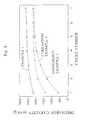
- Fig. 4 shows cycle test results for batteries using electrodes of Example 1 and Comparison Example 1.
- Fig. 5 shows a discharge curve of the electrode of Example 1.
- Fig. 6 shows a discharge curve of the electrode of Comparison Example 1.
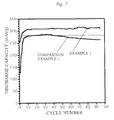
- Fig. 7 shows cycle test results for the electrodes of Example 1 and Comparison Example 1.
- Fig. 8 shows changes of initial discharge capacity for the electrodes of Example 1, Comparison Example 1 and Comparison Example 2.
- Fig. 9 shows X-ray diffraction peaks before charge/discharge of the electrode of Comparison Example 3.
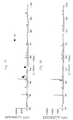
- Fig. 10 shows X-ray diffraction peaks after charge/discharge of the electrode of Example 1.
- Fig. 11 shows corresponding X-ray diffraction peaks for Comparison Example 3.
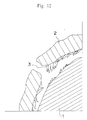
- Fig. 12 is a partial sectional view of the alloy surface of the electrode of Comparison Example 3 after charge/discharge.
- Figs. 13 and 14 show cycle test results for the electrodes of Examples 2 and 3.
- Figs. 15 and 16 compare X-ray diffraction peaks of alloy treated at 80°C to 90°C (Example 3) with that of Comparison Example 1.
- Fig. 17 compares internal gas generation for the electrodes of Example 3 and Comparison Example 1.
- Fig. 18 shows cycle test results for Example 4 and Comparison Example 4.
- Fig. 19 shows cycle test results for batteries using electrodes of Example 5 and Comparison Example 5.
- a hydrogen-absorbing alloy ingot having a composition of MmNi 3.8 Al 0.3 Co 0.7 Mn 0.2 was made up and ground by machine to prepare alloy particles having appropriate sizes (grain size of 75 ⁇ m or smaller).
- Mm represents a misch metal: a composite comprising rare earth elements of one or more kinds of La, Ce, Pr and Nd.
- the alloy particles were dipped in acetic acid/sodium acetate buffer solution adjusted to 60°C and pH3.6, stirred, rinsed and dried. In other words, the alloy particles were subjected to an acid treatment. Since the acetic acid/sodium acetate buffer solution was used, the pH was easily set and its fluctuation was small.
- the prepared alloy particles were mixed with a binder to form a paste, filled into a nickel fibre substrate, dried and pressed to form a hydrogen-absorbing electrode.
- an enriched layer 2 was produced at the surface of a bulk portion 1 by the acid treatment.
- Fig. 2 shows an alloy composition for these parts.
- the bulk 1 has a composition MmNi 3.8 Al 0.3 Co 0.7 Mn 0.2 which is the original composition.
- the enriched layer 2 has a thickness of 50 to 300nm (controlled by the dipping time of the acid treatment) and, as seen in Fig. 2, a larger inclusion percentage of transition metals such as Ni, Co and Mn as compared with the bulk 1, mainly because of elution of Al and the rare earth elements in Mm.
- Pore diameter distribution was measured on the treated alloy particles.
- Fig. 3 shows results measured from an absorption side.
- the surface of the alloy particles had a structure mainly including fine pores having diameters of several tens of ⁇ ngstroms (i.e. several nanometres) .
- the surface area was calculated as about 400 m 2 /g from specific surface area measurement results; this value is fairly large.
- the alloy particles visually presented a black colour due to irregular reflection.
- a hydrogen-absorbing electrode was made up in the same way as in Example 1 except that the acid treatment was omitted.
- a hydrogen-absorbing electrode was made up in the same way as in Example 1 except that an alkali treatment with aqueous alkali was done in place of the acid treatment.
- Example 1 The dipping time in the acid treatment of Example 1 was prolonged to form a rich layer thicker than 300 ⁇ m. Other conditions were identical with those of Example 1.
- Hydrogen-absorbing electrodes were made up in the same way as in Example 1 except that the pH in the acid treatment was set to six different values; 2.09, 2.71, 3.59, 4.00, 4.71 and 5.96.
- Example 2 The prepared electrodes were subjected to cycle tests, and all presented initial characteristics the same as those of Example 1, as illustrated in Fig. 13. So, an enriched layer 2 similar to that of Example 1 is produced if the pH value lies within a range from 2 to 6.
- Hydrogen-absorbing electrodes were made up in the same way as in Example 1 except that the temperature in the acid treatment was set to four different values; 20°C, 40°C, 60°C, and 80 to 90°C.
- X-ray diffractions were measured on the alloy which had the acid treatment at 80 to 90°C (Fig. 15) and the alloy of Comparison Example 1 (Fig. 16).
- Fig. 15 shows Ni peaks. So, the enriched layer is produced on the alloy surface and a nickel layer is produced on the surface of the enriched layer.
- Fig. 17 shows gas generation amounts at the end of initial discharge for electrodes of the same two alloys, and shows that a battery using the electrode with 80 to 90°C treated alloy has lower internal pressure increase than the electrode of Comparison Example 1. So, by setting the temperature condition of acid treatment in the range 80 to 90°C, activation becomes unnecessary because the enriched layer is produced and gas absorbing ability is improved because of the Ni layer produced on the surface of the enriched layer.
- a hydrogen-absorbing electrode was made up in the same way as in Example 1 except that a hydrogen-absorbing alloy of composition MmNi 3.8 Al 0.5 Co 0.7 was used.
- a hydrogen-absorbing electrode was made up in the same way as in Example 4 except that the acid treatment was omitted.
- a hydrogen-absorbing alloy having the composition of MmNi 3.8 Al 0.3 Co 0.7 Mn 0.2 was weighed, thrown in a crucible, and molten by a high-frequency melting furnace under an atmosphere of inert gas to make an ingot. This was rough ground mechanically and classified to select particles within a grain size range 75 to 150 ⁇ m, using a screen. The classified particles were further rough ground mechanically and classified to select particles within a grain size range 45 to 75 ⁇ m, using a screen; these alloy particles were then ready.
- the alloy particles were dipped in acetic acid/sodium acetate buffer solution adjusted to 60°C and pH 3.6, stirred and rinsed and then dried, i.e. subjected to acid treatment.
- the treated particles were mixed with binder to form a paste, filled into a nickel-fibre substrate, dried and pressed to form a hydrogen-absorbing electrode.
- the acid-treated alloy particles were subjected to surface analysis by X-ray photoelectron spectroscopy (XPS), high-magnification surface observation by transmission-type electron microscope (TEM), element analysis and electron beam diffraction, and found to have a sectional structure similar to those of Example 1. Namely, an enriched layer 2, having a larger percentage of transition metal (such as Ni, Co & Mn) than the bulk 1, was produced on the surface of the bulk 1.
- XPS X-ray photoelectron spectroscopy
- TEM transmission-type electron microscope
- An electrode was made up in the same way as in Example 5 except that the acid treatment was omitted.
Landscapes
- Chemical & Material Sciences (AREA)
- Chemical Kinetics & Catalysis (AREA)
- General Chemical & Material Sciences (AREA)
- Electrochemistry (AREA)
- Battery Electrode And Active Subsutance (AREA)
- Powder Metallurgy (AREA)
Claims (9)
- Wasserstoffabsorbierende Elektrode, die eine wasserstoffabsorbierende Legierung umfaßt, dieenthält, gekennzeichnet durch eine angereicherte Oberflächenschicht mit einer Dicke zwischen 50 und 300 nm, die einen höheren Prozentanteil der Übergangsmetallkomponente enthält als die Hauptmasse der Legierung.(a) ein Gemisch von Seltenerdelementen,(b) Aluminium und(c) eine Übergangsmetallkomponente, bei der es sich um ein oder mehrere Metalle handelt, die aus den Übergangsmetallen von Gruppe VIIa, VIII und IB ausgewählt sind,
- Elektrode gemäß Anspruch 1, wobei es sich bei der Übergangsmetallkomponente um ein oder mehrere Metalle handelt, die aus Ni, Co, Mn, Fe und Cu ausgewählt sind.
- Elektrode gemäß Anspruch 1 oder 2, wobei die Übergangsmetallkomponente hauptsächlich aus Ni besteht.
- Elektrode gemäß einem der vorstehenden Ansprüche, wobei die wasserstoffabsorbierende Legierung an der Oberfläche der angereicherten Oberflächenschicht eine Nickelschicht aufweist.
- Verfahren zur Herstellung einer wasserstoffabsorbierenden Elektrode, die eine wasserstoffabsorbierende Legierung umfaßt, dieenthält, gekennzeichnet durch eine Säurebehandlung, bei der man Teilchen der Legierung(a) ein Gemisch von Seltenerdelementen,(b) Aluminium und(c) eine Übergangsmetallkomponente, bei der es sich um ein oder mehrere Metalle handelt, die aus den Übergangsmetallen von Gruppe VIIa, VIII und IB ausgewählt sind,ausreichend lange in einen wäßrigen Essigsäure/Acetat-Puffer mit einem pH-Wert im Bereich von 2 bis 6 eintaucht, daß sich darauf eine angereicherte Oberflächenschicht mit einer Dicke zwischen 50 und 300 nm bildet, die einen höheren Prozentanteil der Übergangsmetallkomponente enthält als die Hauptmasse der Legierung, undabspült und trocknet.
- Verfahren gemäß Anspruch 5, wobei der wäßrige Puffer für die Säurebehandlung eine Temperatur im Bereich von 20°C bis 90°C hat.
- Verfahren gemäß Anspruch 6, wobei die Temperatur im Bereich von 80°C bis 90°C liegt.
- Verfahren gemäß einem der Ansprüche 5 bis 7, wobei als vorbereitender Schritt ein Gußblock der wasserstoffabsorbierenden Legierung grob gemahlen wird, die Teilchen nach der Größe klassiert und die Teilchen der gewählten Größe weiter gemahlen und wiederum auf eine feinere Größe klassiert werden, um Teilchen der wasserstoffabsorbierenden Legierung für die Säurebehandlung herzustellen.
- Verfahren gemäß Anspruch 8, wobei die feinere Größe innerhalb eines Korngrößenbereichs von 45 bis 75 µm liegt.
Applications Claiming Priority (11)
| Application Number | Priority Date | Filing Date | Title |
|---|---|---|---|
| JP27189/94 | 1994-02-25 | ||
| JP2718994 | 1994-02-25 | ||
| JP149142/94 | 1994-06-30 | ||
| JP14914294 | 1994-06-30 | ||
| JP266564/94 | 1994-10-31 | ||
| JP26656494 | 1994-10-31 | ||
| JP274822/94 | 1994-11-09 | ||
| JP27482294 | 1994-11-09 | ||
| JP276899/94 | 1994-11-11 | ||
| JP27689994 | 1994-11-11 | ||
| PCT/JP1995/000262 WO1995023435A1 (fr) | 1994-02-25 | 1995-02-23 | Electrode absorbant l'hydrogene et son procede de production |
Publications (3)
| Publication Number | Publication Date |
|---|---|
| EP0696823A1 EP0696823A1 (de) | 1996-02-14 |
| EP0696823A4 EP0696823A4 (de) | 1996-04-24 |
| EP0696823B1 true EP0696823B1 (de) | 1998-10-28 |
Family
ID=27520906
Family Applications (1)
| Application Number | Title | Priority Date | Filing Date |
|---|---|---|---|
| EP95909963A Expired - Lifetime EP0696823B1 (de) | 1994-02-25 | 1995-02-23 | Wasserstoffabsorbierende elektrode und deren herstellung |
Country Status (5)
| Country | Link |
|---|---|
| US (1) | US5935732A (de) |
| EP (1) | EP0696823B1 (de) |
| JP (1) | JP3661190B2 (de) |
| DE (1) | DE69505611T2 (de) |
| WO (1) | WO1995023435A1 (de) |
Families Citing this family (18)
| Publication number | Priority date | Publication date | Assignee | Title |
|---|---|---|---|---|
| US5536591A (en) * | 1990-04-26 | 1996-07-16 | Ovonic Battery Company, Inc. | Electrochemical hydrogen storage alloys for nickel metal hydride batteries |
| JP3033430B2 (ja) | 1994-04-27 | 2000-04-17 | 住友金属工業株式会社 | 水素吸蔵合金粉末とニッケル−水素電池 |
| EP1713139A1 (de) * | 1996-06-26 | 2006-10-18 | Sanyo Electric Co., Ltd. | Wasserstoffspeicher-Legierungselektrode und zugehöriges Herstellungsverfahren |
| TW444059B (en) * | 1996-11-18 | 2001-07-01 | Shinetsu Chemical Co | Hydrogen storage alloy powder and an electrode comprising the same |
| US5985057A (en) * | 1996-11-29 | 1999-11-16 | Sanyo Electric Co., Ltd. | Method of fabricating hydrogen absorbing alloy electrode |
| WO1998033613A1 (fr) * | 1997-01-31 | 1998-08-06 | Sanyo Electric Co., Ltd. | Poudre d'alliage pour le stockage d'hydrogene et son procede de production |
| US6048644A (en) * | 1997-03-24 | 2000-04-11 | Matsushita Electric Industrial Co., Ltd. | Hydrogen storage alloy electrode |
| JP2982805B1 (ja) * | 1998-02-19 | 1999-11-29 | 松下電器産業株式会社 | 電池用水素吸蔵合金とその製造法及びこれを用いたアルカリ蓄電池 |
| US6235130B1 (en) * | 1998-03-17 | 2001-05-22 | Shin-Etsu Chemical Co., Ltd. | Hydrogen absorbing alloy powder and electrodes formed of the hydrogen absorbing alloy powder |
| WO2000001023A1 (fr) * | 1998-06-26 | 2000-01-06 | Sanyo Electric Co., Ltd. | Alliage absorbeur d'hydrogene pour batteries alcalines et procede de preparation associe |
| JP2988479B1 (ja) * | 1998-09-11 | 1999-12-13 | 松下電器産業株式会社 | アルカリ蓄電池と水素吸蔵合金電極及びその製造法 |
| US20040018450A1 (en) * | 2002-07-25 | 2004-01-29 | United Microlectronics Corp. | Method for transferring patterns |
| FR2886462B1 (fr) | 2005-05-26 | 2007-07-20 | Accumulateurs Fixes | Composition de matiere active et accumulateur a electrolyte alcalin |
| WO2009132036A1 (en) * | 2008-04-21 | 2009-10-29 | Quantumsphere, Inc. | Composition of and method of using nanoscale materials in hydrogen storage applications |
| US10017656B2 (en) | 2015-05-18 | 2018-07-10 | Canon Kabushiki Kaisha | Image recording method, treatment liquid and ink set |
| EP3653296B1 (de) * | 2017-07-12 | 2023-12-13 | Japan Science and Technology Agency | Intermetallische verbindung, wasserstoffspeicher-/freisetzungsmaterial, katalysator und verfahren zur herstellung von ammoniak |
| WO2020195543A1 (ja) * | 2019-03-26 | 2020-10-01 | 日本重化学工業株式会社 | アルカリ蓄電池用水素吸蔵合金およびそれを負極に用いたアルカリ蓄電池ならびに車両 |
| US12266791B2 (en) | 2020-04-10 | 2025-04-01 | Japan Metals And Chemicals Co., Ltd. | Hydrogen storage alloy for alkaline storage battery |
Family Cites Families (11)
| Publication number | Priority date | Publication date | Assignee | Title |
|---|---|---|---|---|
| EP0271043B1 (de) * | 1986-12-08 | 1992-01-22 | Matsushita Electric Industrial Co., Ltd. | Gasdichter Akkumulator und Verfahren zur Herstellung seiner Elektrode |
| JP2733231B2 (ja) * | 1987-11-17 | 1998-03-30 | 松下電器産業株式会社 | 水素吸蔵合金電極の製造法 |
| US4859413A (en) * | 1987-12-04 | 1989-08-22 | The Standard Oil Company | Compositionally graded amorphous metal alloys and process for the synthesis of same |
| JP2994664B2 (ja) * | 1989-09-05 | 1999-12-27 | 三洋電機株式会社 | 水素吸蔵合金電極の製造方法 |
| JP2854109B2 (ja) * | 1990-08-29 | 1999-02-03 | 三洋電機株式会社 | 水素吸蔵合金電極の製造方法 |
| JPH04318106A (ja) * | 1991-04-17 | 1992-11-09 | Furukawa Battery Co Ltd:The | 水素吸蔵合金粉末の製造法 |
| JPH04319258A (ja) * | 1991-04-17 | 1992-11-10 | Furukawa Battery Co Ltd:The | 水素吸蔵合金電極 |
| JPH05225974A (ja) * | 1992-02-10 | 1993-09-03 | Furukawa Battery Co Ltd:The | 水素吸蔵合金電極 |
| JPH05225975A (ja) * | 1992-02-13 | 1993-09-03 | Furukawa Battery Co Ltd:The | 水素吸蔵合金電極 |
| JPH06223827A (ja) * | 1992-10-26 | 1994-08-12 | Sumitomo Metal Ind Ltd | 電池用水素吸蔵合金粉末の製造方法 |
| JPH0773878A (ja) * | 1993-08-31 | 1995-03-17 | Sanyo Electric Co Ltd | 金属水素化物電極の製造方法 |
-
1995
- 1995-02-23 WO PCT/JP1995/000262 patent/WO1995023435A1/ja not_active Ceased
- 1995-02-23 JP JP52225595A patent/JP3661190B2/ja not_active Expired - Lifetime
- 1995-02-23 EP EP95909963A patent/EP0696823B1/de not_active Expired - Lifetime
- 1995-02-23 DE DE69505611T patent/DE69505611T2/de not_active Expired - Fee Related
-
1997
- 1997-06-10 US US08/872,192 patent/US5935732A/en not_active Expired - Lifetime
Also Published As
| Publication number | Publication date |
|---|---|
| DE69505611T2 (de) | 1999-03-25 |
| EP0696823A1 (de) | 1996-02-14 |
| EP0696823A4 (de) | 1996-04-24 |
| DE69505611D1 (de) | 1998-12-03 |
| WO1995023435A1 (fr) | 1995-08-31 |
| US5935732A (en) | 1999-08-10 |
| JP3661190B2 (ja) | 2005-06-15 |
Similar Documents
| Publication | Publication Date | Title |
|---|---|---|
| EP0696823B1 (de) | Wasserstoffabsorbierende elektrode und deren herstellung | |
| EP0591606B1 (de) | Alkalische Speicherbatterie und Verfahren zur Herstellung einer wasserstoffspeichernden Legierung dafür | |
| JPWO2009037806A1 (ja) | ニッケル水素電池用負極活物質およびそれを用いたニッケル水素電池、ならびにニッケル水素電池用負極活物質の処理方法 | |
| US5518509A (en) | Method for producing a hydrogen absorbing alloy electrode | |
| JPWO1995023435A1 (ja) | 水素吸蔵電極及びその製造方法 | |
| EP0986119B1 (de) | Alkalische Batterie, Elektrode aus einer wasserstoffabsorbierenden Legierung und Herstellungsverfahren dafür | |
| CA2264134C (en) | Hydrogen absorbing alloy powder and process for producing same | |
| EP1713139A1 (de) | Wasserstoffspeicher-Legierungselektrode und zugehöriges Herstellungsverfahren | |
| EP1271677B1 (de) | Elektrode aus Wasserstoff absorbierender Legierung | |
| US5943545A (en) | Method of manufacturing a hydrogen-absorbing alloy for use in an alkali storage cell | |
| JP2978094B2 (ja) | 水素吸蔵合金粉末の表面処理方法とそれを適用して得られたアルカリ二次電池 | |
| JP4497828B2 (ja) | ニッケル−水素蓄電池および組電池 | |
| JP3478030B2 (ja) | アルカリ蓄電池 | |
| US20020001750A1 (en) | Metal hydride alkaline storage cell and manufacturing method thereof | |
| JP3432870B2 (ja) | 金属水素化物電極の製造方法 | |
| JPH08333603A (ja) | 水素吸蔵合金粒子およびその製造方法 | |
| JP3322415B2 (ja) | 金属−水素アルカリ蓄電池及びその製造方法 | |
| JP3499923B2 (ja) | 金属−水素化物アルカリ蓄電池用の水素吸蔵合金電極及び金属−水素化物アルカリ蓄電池用の水素吸蔵合金粒子 | |
| JP2002110224A (ja) | 密閉式ニッケル水素蓄電池の活性化方法 | |
| JPH097585A (ja) | ニッケル水素化物電池及びその製造方法 | |
| EP3626845A1 (de) | Metallhydridlegierungspulver für nimh-batterien mit verbesserten eigenschaften, verfahren zur herstellung davon und nimh-batterie mit verbesserten eigenschaften mit dem metallhydridlegierungspulver | |
| JPH05225974A (ja) | 水素吸蔵合金電極 | |
| JPH0949039A (ja) | 水素吸蔵合金粒子の製造方法 | |
| JP2004265720A (ja) | ニッケル−水素蓄電池 | |
| JPH11111303A (ja) | 水素吸蔵合金電極及びその製造方法 |
Legal Events
| Date | Code | Title | Description |
|---|---|---|---|
| PUAI | Public reference made under article 153(3) epc to a published international application that has entered the european phase |
Free format text: ORIGINAL CODE: 0009012 |
|
| 17P | Request for examination filed |
Effective date: 19951114 |
|
| AK | Designated contracting states |
Kind code of ref document: A1 Designated state(s): DE FR GB |
|
| A4 | Supplementary search report drawn up and despatched | ||
| AK | Designated contracting states |
Kind code of ref document: A4 Designated state(s): DE FR GB |
|
| 17Q | First examination report despatched |
Effective date: 19970514 |
|
| GRAG | Despatch of communication of intention to grant |
Free format text: ORIGINAL CODE: EPIDOS AGRA |
|
| GRAG | Despatch of communication of intention to grant |
Free format text: ORIGINAL CODE: EPIDOS AGRA |
|
| GRAH | Despatch of communication of intention to grant a patent |
Free format text: ORIGINAL CODE: EPIDOS IGRA |
|
| GRAH | Despatch of communication of intention to grant a patent |
Free format text: ORIGINAL CODE: EPIDOS IGRA |
|
| GRAA | (expected) grant |
Free format text: ORIGINAL CODE: 0009210 |
|
| AK | Designated contracting states |
Kind code of ref document: B1 Designated state(s): DE FR GB |
|
| REF | Corresponds to: |
Ref document number: 69505611 Country of ref document: DE Date of ref document: 19981203 |
|
| ET | Fr: translation filed | ||
| PLBE | No opposition filed within time limit |
Free format text: ORIGINAL CODE: 0009261 |
|
| STAA | Information on the status of an ep patent application or granted ep patent |
Free format text: STATUS: NO OPPOSITION FILED WITHIN TIME LIMIT |
|
| 26N | No opposition filed | ||
| REG | Reference to a national code |
Ref country code: GB Ref legal event code: IF02 |
|
| PGFP | Annual fee paid to national office [announced via postgrant information from national office to epo] |
Ref country code: DE Payment date: 20060216 Year of fee payment: 12 |
|
| PGFP | Annual fee paid to national office [announced via postgrant information from national office to epo] |
Ref country code: FR Payment date: 20060220 Year of fee payment: 12 |
|
| PGFP | Annual fee paid to national office [announced via postgrant information from national office to epo] |
Ref country code: GB Payment date: 20060222 Year of fee payment: 12 |
|
| GBPC | Gb: european patent ceased through non-payment of renewal fee |
Effective date: 20070223 |
|
| REG | Reference to a national code |
Ref country code: FR Ref legal event code: ST Effective date: 20071030 |
|
| PG25 | Lapsed in a contracting state [announced via postgrant information from national office to epo] |
Ref country code: DE Free format text: LAPSE BECAUSE OF NON-PAYMENT OF DUE FEES Effective date: 20070901 |
|
| PG25 | Lapsed in a contracting state [announced via postgrant information from national office to epo] |
Ref country code: GB Free format text: LAPSE BECAUSE OF NON-PAYMENT OF DUE FEES Effective date: 20070223 Ref country code: FR Free format text: LAPSE BECAUSE OF NON-PAYMENT OF DUE FEES Effective date: 20070228 |