EP0700580B1 - Procede de fabrication d'elements de suspension pour capteurs micro-usines - Google Patents
Procede de fabrication d'elements de suspension pour capteurs micro-usines Download PDFInfo
- Publication number
- EP0700580B1 EP0700580B1 EP95913752A EP95913752A EP0700580B1 EP 0700580 B1 EP0700580 B1 EP 0700580B1 EP 95913752 A EP95913752 A EP 95913752A EP 95913752 A EP95913752 A EP 95913752A EP 0700580 B1 EP0700580 B1 EP 0700580B1
- Authority
- EP
- European Patent Office
- Prior art keywords
- silicon
- layer
- frame member
- mass
- wafer
- Prior art date
- Legal status (The legal status is an assumption and is not a legal conclusion. Google has not performed a legal analysis and makes no representation as to the accuracy of the status listed.)
- Expired - Lifetime
Links
Images

Classifications
-
- G—PHYSICS
- G01—MEASURING; TESTING
- G01P—MEASURING LINEAR OR ANGULAR SPEED, ACCELERATION, DECELERATION, OR SHOCK; INDICATING PRESENCE, ABSENCE, OR DIRECTION, OF MOVEMENT
- G01P15/00—Measuring acceleration; Measuring deceleration; Measuring shock, i.e. sudden change of acceleration
- G01P15/02—Measuring acceleration; Measuring deceleration; Measuring shock, i.e. sudden change of acceleration by making use of inertia forces using solid seismic masses
- G01P15/08—Measuring acceleration; Measuring deceleration; Measuring shock, i.e. sudden change of acceleration by making use of inertia forces using solid seismic masses with conversion into electric or magnetic values
- G01P15/0802—Details
-
- Y—GENERAL TAGGING OF NEW TECHNOLOGICAL DEVELOPMENTS; GENERAL TAGGING OF CROSS-SECTIONAL TECHNOLOGIES SPANNING OVER SEVERAL SECTIONS OF THE IPC; TECHNICAL SUBJECTS COVERED BY FORMER USPC CROSS-REFERENCE ART COLLECTIONS [XRACs] AND DIGESTS
- Y10—TECHNICAL SUBJECTS COVERED BY FORMER USPC
- Y10S—TECHNICAL SUBJECTS COVERED BY FORMER USPC CROSS-REFERENCE ART COLLECTIONS [XRACs] AND DIGESTS
- Y10S148/00—Metal treatment
- Y10S148/012—Bonding, e.g. electrostatic for strain gauges
Definitions
- This invention relates generally to a method for fabricating a sensor, and more particularly to a bulk silicon micromachining process for fabricating a sensor having a mass suspended from a support frame by high precision suspension springs.
- Silicon is a material having highly desirable mechanical properties. Single-crystal or monocrystalline silicon is harder than most metal and is surprisingly resistant to mechanical stress. In both tension and compression, silicon has a higher elastic limit than steel and remains strong under repeated cycles of tension and compression below its elastic limit. So-called micromachining processes allow silicon to be made into mechanical devices of extremely small size allowing miniaturization of such devices in much the same way as has been the miniaturization of electronic devices such as computer chips, etc. Micromachining processes allow many devices to be fabricated at the same time so that the cost per device is low where many devices are fabricated. Micromachined devices are uniform in quality, because the same processing steps operating on a device on one side of a silicon wafer are the same as those on other parts of the wafer.
- Micromachining normally utilizes chemical etching techniques for forming three dimensional shapes, such as pits, boles, trenches or walls.
- Micromachining usually begins with photolithography, a photographic technique used to transfer copies of a master pattern onto the surface of a silicon wafer. The first step is to grow a thin layer of oxide on the wafer surface by heating it to between 800C and 1200C in an atmosphere of steam. Then, a photoresist, a thin layer of an organic polymer sensitive to ultraviolet radiation, is deposited on the oxide surface, and exposed and developed. A pattern of bare and photoresist coated oxide is formed on the wafer surface. After subsequent treatment with acid, the oxide is etched away while the photoresist coated oxide remains. The final result is a pattern of oxide on the wafer surface that duplicates the photoresist pattern.
- the oxide pattern may serve as a mask during the doping of the wafer with impurities, such as boron or phosphorous.
- the oxide pattern is also used as a mask during chemical or anisotropic etching with the etching material attacking the silicon.
- Anisotropic etchants which are also known as orientation-dependent, etch at different rates in different directions in the silicon crystal lattice and can form well defined shapes with sharp corners and edges.
- Acceleration sensors, motion sensors and pressure sensors are examples of devices fabricated by micromachining. There are many others. Examples of micromachined acceleration sensors include the piezoelectric and capacitive types.
- Sensors may include a central sensing mass member supported within an outer support frame for relative movement by one or more suspension members extending between the mass member and the outer support frame.
- Suspension members heretofore have comprised suspension springs, beams, hinges, or diaphragms to support the sensing mass member with respect to the outer support frame.
- suspension members have been micromachined heretofore using a wet anisotropic etch, for example.
- JP 6307643 is directed at the formation of a flexible portion very precise in thickness by a method wherein a p ⁇ +> layer of a prescribed depth is formed by boron diffusion in an Si substrate region to be converted into a flexible portion and a prescribed region on the Si substrate is subjected to etching with the P ⁇ +> layer serving as an etching-stopper layer in a process of forming the flexible portion and a weight portion.
- An Si substate is subjected to processing, whereby a flexible portion equipped with a piezoresistor and a weight portion suspended freely from the flexible portion are formed, for the manufacture of a semiconductor acceleration sensor of this design.
- a P ⁇ +> layer of a prescribed depth is formed by diffusion of boron into the region to be converted into the flexible portion on the Si substrate, and a prescribed region in the Si substrate is subjected to an etching process, wherein a hot alkaline solution is used and the P ⁇ +> layer serves as an etching-stopper layer.
- said piezoresistor is formed by diffusion of phosphorus into the surface of said P ⁇ +> layer and said etching is accomplished through an SiO2 film serving as a mask of a prescribed pattern formed on the Si substrate.
- US Patent No. 4,922,756 dated May 8, 1990 shows a micromachined accelerometer fabricated from silicon by batch photolithographic techniques from a monocrystalline wafer.
- the accelerometer includes E-shaped leaf springs fabricated from silicon dioxide.
- the top silicon spring faces of the E-shaped springs on each side of the wafer are masked, and silicon dioxide is grown on surfaces that are later patterned and etched away by a chemical etching.
- a thin photoresist or stop layer is formed.
- a thick oxide layer is then grown by diffusing a precise amount of oxygen into the silicon to form a precise thickness of silicon dioxide on the wafer.
- the opposite surfaces of the wafer are masked exposing selected areas which are etched down to the silicon surfaces.
- a thin silicon dioxide layer is then grown, masked, and the exposed silicon dioxide etched down to the silicon surface exposed to the silicon etchant.
- a chemical etch of the silicon material is then applied which acts through openings of the silicon dioxide to etch silicon material away while undercutting the legs of the E-shaped springs. Stiff etched stop layers remain for the bases of the springs and the opposite faces of the suspended mass and support structures. Force and sense conducting areas are then deposited on opposite faces of the suspended mass member and on complementary force and sense conducting areas of the opposing support structures.
- three dimensional E-shaped springs are provided with the length of each leg and its thickness accurately controlled to control the spring constant of the sensing member.
- U.S. Patent No. 4,144,516 dated March 13, 1979 is directed to a leaf spring sensor or transducer fabricated by batch photolithographic etching techniques from a monocrystalline silicon material.
- Two separate wafers are formed with an array of spring structures therein.
- Each wafer includes electrical circuitry on a top surface with the bottom surface etched with an anisotropic etchant to define an E-shaped leaf spring structure and surrounding supporting structure.
- the two wafers are joined together such as by adhesive, soldering, or brazing to form a dual spring sensor or transducer.
- Individual transducers are then separated from the joined wafers and subsequently mounted to a suitable support structure.
- Both of the spring systems described above include E shaped springs.
- the prior art of semi-conductor micromachining includes spring and suspension members having straight lines which are characteristic of the chemical etching process along crystallographic planes of diamond cubic materials such as silicon.
- US-A-5,006,487 discloses a method of making an electrostatic silicon accelerometer with a method of fabricating connecting members or "flexures” for suspending a pendulum mass member from a support frame.
- the method uses chemical (“wet") etching of a silicon layer to form straight line openings in accordance with a pattern.
- a method of fabricating a sensor said sensor including a frame member with side walls, a mass member placed within and spaced from said side walls of said frame member, and suspension members connected between said frame member and said mass member, said method comprising:
- the step of dry etching comprises plasma etching to form said suspension members of a generally L-shape extending about corners of a mass member which is rectangularly shaped.
- said chemically etching step is performed for a controlled time not only to remove said etch stop layer but also to remove a portion of said layer of epitaxial silicon adjacent said space between said side walls of said frame member and said suspended mass member so as to control the thickness of the epitaxial silicon which remains.
- said (a), (b) and (c) steps are separated for a second silicon wafer, and then said wafers are bonded to each other to define said mass member and said frame member such that the epitaxial layers are on the outer surfaces of the bonded wafers; and said dry etching step is applied on both outer surfaces of said bonded wafers in the space between the mass member and over the areas of the removed etch stop layer to form upper and lower pairs of spring members between the mass member and the outer frame.
- the step (c) for removing at least a portion of said etch step layer includes the step of after step (b) later chemically etching from said bulk silicon side of said wafer so as to remove said etch stop layer in said space thereby forming said suspension member solely of epitaxial growth silicon material.
- each suspension member has an L-shape having two intersecting legs which attach at a ninety degree angle to the attachment of one leg to frame member side wall and attach at a ninety degree angle to the other leg to a mass member side wall which is disposed at a right angle to said frame member side wall.
- the invention is particularly directed to a process for fabricating an outer surface of the suspended mass member and the springs in arbitrary planar shapes and for fabricating the springs with arbitrary thickness.
- this invention is directed to fabrication of a single silicon wafer to produce such arbitrary shapes of the outer surface of the suspended mass member and springs.
- the process disclosed herein comprises providing two identical silicon wafers, with one wafer, after processing forming the upper half of the suspended mass member and surrounding support frame, and the other wafer forming the lower half of the mass member and surrounding support frame.
- Each wafer includes a bulk silicon layer having on its upper surface an etch stop layer beneath an upper epitaxial (EPI) layer grown on top of the buried etch stop layer.
- the etch stop layer is preferably a P++ layer. (Such etch stop layer could be a buried oxide Si0 2 layer).
- a P++ layer is a thin layer of silicon in which P-type impurities such as Boron are added such that the semi-conductor is characterized by an excess mobile hole concentration which is very, very large.
- a photosensitive oxide layer is provided on the bottom silicon surface of each wafer.
- a "photosensitive oxide layer" for purposes of this specification is an oxide layer on which photoresist material has been disposed.
- a pattern of the central mass and outer support frame is exposed on the photosensitive oxide layer on the bottom surface of each of the wafers.
- the oxide layer pattern of the frame and suspended mass member remain after the exposed area between the frame and mass member has been removed.
- An etching chemical is then applied to the bottom surface of each wafer. Such chemical etches through the pattern which represents the space between the desired frame and the suspended mass member.
- Etching of the silicon layer stops at the P++ or buried oxide etch stop layer.
- the etching for the silicon layer is accomplished with a wet etching material, an anisotropic etchant such as aqueous potassium hydroxide (KOH) or aqueous sodium hydroxide (NaOH).
- KOH potassium hydroxide
- NaOH sodium hydroxide
- the exposed P+ + layer is then etched away with a wet etchant in the areas which will frame the springs between the mass and the outer support frame.
- the thickness of the springs is controlled by controlling the thickness of the EPI material which remains.
- the two wafers or wafer halves are bonded to each other so that the epitaxial (EPI) layers are on the upper and lower surfaces or faces of the bonded wafers.
- the EPI layers are the only layers remaining in the area for the springs between the mass member and the outer support frame for the mass member.
- the spring shape connecting the outer frame and the suspended mass member is patterned on the top and bottom EPI surfaces. The spring shape is formed via the patterns of the EPI surfaces with a dry plasma etch.
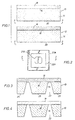
- the method for fabricating a sensor or accelerometer by batch etching techniques from a monocrystalline silicon material is illustrated by the sequential steps set forth in the drawings.
- the micromachining fabrication process utilizes chemical etching techniques followed by dry plasma etching for forming arbitrary three-dimensional shapes for springs or connecting members which extend between a central mass member and an outer support frame of the sensor.
- the sensor formed by the present invention is directed particularly to a micromachined structure sensitive to acceleration which is fabricated from silicon by batch photolithographic techniques.
- the sensor is preferably formed of four separate wafers with two wafers bonded together to form the central mass member and surrounding outer support structure, while the remaining two wafers define outer plates or covers bonded to the surrounding support frame.
- the central mass member-springs-surrounding outer support structure may be fabricated from a single wafer.
- Wafer 10 provides the processed construction material to form the upper half of a central mass member and surrounding support frame
- wafer 12 provides the processed construction material to form the lower half of the central mass member and surrounding support frame.
- the upper and lower halves are identical and for example, may be of around 500 microns in thickness.
- Each wafer 10, 12, includes a layer of silicon shown at 14 and has on its upper surface preferably a P+ + (but alternatively a buried oxide) etch stop layer 16 thereon which, for example, may be about 14 microns in thickness.
- P+ + but alternatively a buried oxide
- Such etch stop layer has been processed to form a rich layer of Boron impurities diffused in silicon.
- An upper epitaxial (EPI) layer 18 is grown on the top of the covered etch stop layer 16.
- a bottom photosensitive oxide layer (formed by thermal oxidation) is provided at 20 on the bottom or lower surface of each wafer 10, 12.
- the term "photosensitive oxide layer” 20 as used herein is a thin layer of silicon oxide 25 on which photoresist has been applied.
- a pattern of a central mass member and outer support frame is masked from exposure as shown generally in Figure 2 with the central mass member shown at 21A and the outer support frame shown at 23A.
- the pattern shown in Figure 2 is exposed and developed on the photoresist covered oxide layers 20 of upper wafer 10 and lower wafer 12.
- the corners of the mass member pattern (as illustrated) and of the support frame (not illustrated) may be compensated, that is provided with a short straight edge from side to side, so as to eliminate subsequent overetching in sharp corners.
- the photoresist material of space 22A between the mass 21A and the frame 23A is removed by a suitable etch, such as 6:1 BOE etch.
- the mass member region 21A and the frame region 23A are protected by unexposed photoresist.
- a wet etching chemical material such as potassium hydroxide (KOH) (33% by weight) is then applied to the surface 22A of layer 20 of each wafer 10, 12. Etching occurs through silicon layer 14 to the etch stop layer 16 formed by the P+ + etch stop material as illustrated in Figure 3. Only the top wafer 10 is shown in Fig. 3. The lower half of wafer 12 is formed in a similar manner.
- the (KOH) chemical etch removes the silicon from layer 14 in a void area 22 to a level preferably of about 450 microns deep. The wafer is rinsed in water.
- a preferential wet etch mixture (preferably 8:3:1 CH3C00H:HN03:HF), is applied for a controlled short time against the exposed P+ + layer 16 in the areas which will form the springs between the central mass member and the outer support frame as shown particularly in Figure 4.
- the amount of removal of the P+ + layer and the EPI layer above it controls the thickness of the resulting springs.
- the thin oxide strip layer 25 (Fig. 3) is removed with a suitable etching material (preferably 6:1 BOE).
- wafers 10 and 12 are fusion bonded to each other as shown in Figure 5 so that the epitaxial (EPI) layers 18 are on the upper and lower surfaces of the bonded wafers 10 and 12 which form the bonded halves of the central mass member and surrounding support frame.
- the EPI layers 18 are the only layers now remaining in the area for the springs between the mass member and the outer support frame for the mass member.
- surfaces 18 are metalized with 100 ⁇ Cr and 1000 ⁇ Au and baked.
- the pattern for the springs 24 is then applied with photoresist onto top and bottom metalized surfaces 18'.
- resilient connecting members or springs 24 are formed between the central mass member and the outer support frame by a dry plasma etch step from the top and bottom surfaces of the bonded halves 10, 12 through patterns created on metalized surfaces 18' of the epitaxial (EPI) layers 18.
- the dry etching is provided to top and bottom surfaces 18' with a plasma etch such as a silicon etch SF 6 (380m Torr. 175 watts) to remove silicon beneath the pattern followed by an oxygen plasma strip (300 watts 400m Torr.) to remove photoresist.
- Plasma etching removes EPI material of layer 18 between the spring 24 and the adjacent frame 23 and the adjacent mass member 21, etc.
- the bonded halves as shown in Figure 7 define central mass member 21 suspended by springs 24 extending between central mass member 21 and outer support frame 23.
- Springs 24 as shown in Figure 7 comprise superjacent pairs of L-shaped springs extending about the corners of the generally rectangular mass 21 member. Top and bottom surfaces of mass member 21 are preferably square or rectangular in shape, but they may be multi-sided, even circular in shape. Inner ends 28 of springs 24 are secured to adjacent sides of mass member 21. Opposite outer ends 30 of springs 24 are secured to adjacent sides of an outer support frame 23. The sides of mass member 21 are joined at corners which may be rounded, if desired.
- suitable conducting areas forming a sensing/conducting area or separate sensing and conducting areas are provided on central mass member 21.
- Opposed upper and lower caps or plates are bonded to the upper and lower surfaces of mass member 21 and outer support frame 23 as well known.
- a single conducting area used both as a sensing and conducting plate may be used in combination with time multiplexing circuitry.
- Table I below presents preferred steps of the process for fabricating the light spring structure as illustrated in Figures 1-7. For completeness, steps relative to providing alignment holes in the top and bottom wafers are mentioned. Likewise, steps for providing electrical contact on mass surfaces via springs are also mentioned.
- STEP 1 Provide 4", 100 silicon wafer, double sided polished: 500 microns thick. 2 Grow EPI layer to 500 oxide microns thick. 3 Thermal oxidize wafer alternating with dry, wet and dry conditions to provide .3 microns layer. 4 Spin wafer on EPI side. Hardbake EPI side on a hotplate. 5 Spin wafer on backside; softbake backside on hot plate. (If lateral vents are not desired go to step 12).
- Plasma etch Silicon plasma etch (380 in Torr., 175 watts) both sides.
- Plasma etch O 2 plasma strip (400 m Torr) both sides.
- springs 24 of a predetermined arbitrary shape and thickness can be provided by the fabricating method of the present invention from batch etching techniques using processed monocrystalline silicon wafers.
- Springs 24 as illustrated herein may be of a generally L-shape with rounded corners where attached to support frame 23 and mass member 21.
- the L-shape springs (such spring shape can also be characterized as an "elbow" shape) fit about a generally rectangular, (or other shape as described above) mass, but such suspension members or springs may be formed of various shapes and sizes in accordance with the present invention.
Landscapes
- Physics & Mathematics (AREA)
- General Physics & Mathematics (AREA)
- Micromachines (AREA)
- Pressure Sensors (AREA)
- Drying Of Semiconductors (AREA)
- Weting (AREA)
- Testing Or Calibration Of Command Recording Devices (AREA)
Claims (6)
- Procédé de fabrication d'un capteur, ledit capteur comportant un élément cadre doté de parois latérales, un élément masse placé à l'intérieur desdites parois latérales dudit élément cadre avec un certain espace d'écartement par rapport à ces parois latérales, et des éléments de suspension connectés entre ledit élément cadre et ledit élément masse, ledit procédé comprenant les opérations suivantes :(a) traiter une plaquette de silicium (10) afin de produire une plaquette traitée qui comporte une couche de silicium non épitaxié (14) et une couche de silicium épitaxié (18) qui sont séparées par une couche d'arrêt de gravure (16) ;(b) depuis le côté du silicium épitaxié (14) de ladite plaquette traitée, graver chimiquement ladite couche de silicium non épitaxié de façon à laisser une épaisseur qui est fonction d'un motif définissant l'espace d'écartement (22) entre lesdites parois latérales dudit élément cadre (23) et ledit élément masse (21), ladite gravure s'arrêtant au niveau de ladite couche d'arrêt de gravure (16) ;(c) retirer au moins une partie de ladite couche d'arrêt de gravure (16) dudit espace (22) existant entre lesdites parois latérales dudit élément cadre (23) et ledit élément masse, dans l'espace formé entre lesdites parois latérales de l'élément cadre et la masse suspendue ; et(d) graver à sec, depuis le côté du silicium épitaxié (18) de ladite plaquette traitée selon un motif d'élément de suspension afin de retirer le matériau de silicium épitaxié (18) dans ledit espace, de manière à laisser des éléments de suspension qui suspendent ladite masse (21) audit élément cadre (23).
- Procédé selon la revendication 1, où l'opération de gravure à sec comprend l'opération consistant à graver au moyen d'un plasma afin de réaliser lesdits éléments de suspension sensiblement en forme de L s'étendant autour des coins d'un élément masse qui est de forme rectangulaire.
- Procédé selon la revendication 1 ou 2, où ladite opération de gravure chimique s'effectue pendant une durée ajustée non seulement pour retirer ladite couche d'arrêt de gravure (16), mais aussi pour retirer une partie de ladite couche (18) de silicium épitaxié au voisinage dudit espace (22) formé entre lesdites parois latérales dudit élément cadre (23) et ledit élément masse suspendu afin de commander l'épaisseur du silicium épitaxié (18) qui reste.
- Procédé selon l'une quelconque des revendications 1 à 3, où on répète lesdites opérations (a), (b) et (c) pour une deuxième plaquette de silicium (14), le procédé comprenant ensuite les opérations suivantes :lier lesdites plaquettes (14) l'une à l'autre afin de définir ledit élément masse et ledit élément cadre (23) de façon que les couches épitaxiales (18) soient sur les surfaces externes des plaquettes liées (14), etgraver à sec depuis le côté du silicium épitaxié (18) de chacune desdites plaquettes selon un motif d'élément de suspension afin de retirer les couches épitaxiales (18) dans ledit espace, de manière à laisser des éléments en suspension qui suspendent ledit élément masse (21) audit élément cadre (23).
- Procédé selon l'une quelconque des revendications 1 à 4, où l'opération (c) destinée à retirer au moins une partie de ladite couche d'arrêt de gravure comporte une opération, après l'opération (b), de gravure chimique depuis ledit côté du silicium non épitaxié de ladite plaquette (14) afin de retirer ladite couche d'arrêt de gravure (16) dans ledit espace (22), de manière à former ledit élément de suspension seulement en le matériau de silicium épitaxié.
- Procédé selon l'une quelconque des revendications précédentes, où ledit élément masse possède quatre parois latérales d'éléments principales qui sont espacées desdites parois latérales correspondantes dudit élément cadre (23), et chaque élément de suspension possède deux pattes d'intersection qui sont attachées, suivant un angle de 90°, à la liaison d'une patte avec une paroi latérale de l'élément cadre et sont attachées, suivant un angle de 90°, à l'autre patte, avec une paroi latérale d'élément masse qui est disposée à angle droit par rapport à ladite paroi latérale de l'élément cadre.
Applications Claiming Priority (3)
| Application Number | Priority Date | Filing Date | Title |
|---|---|---|---|
| US08/218,363 US5484073A (en) | 1994-03-28 | 1994-03-28 | Method for fabricating suspension members for micromachined sensors |
| US218363 | 1994-03-28 | ||
| PCT/US1995/003377 WO1995026567A1 (fr) | 1994-03-28 | 1995-03-16 | Procede de fabrication d'elements de suspension pour capteurs micro-usines |
Publications (3)
| Publication Number | Publication Date |
|---|---|
| EP0700580A1 EP0700580A1 (fr) | 1996-03-13 |
| EP0700580A4 EP0700580A4 (fr) | 1998-02-11 |
| EP0700580B1 true EP0700580B1 (fr) | 2003-08-27 |
Family
ID=22814808
Family Applications (1)
| Application Number | Title | Priority Date | Filing Date |
|---|---|---|---|
| EP95913752A Expired - Lifetime EP0700580B1 (fr) | 1994-03-28 | 1995-03-16 | Procede de fabrication d'elements de suspension pour capteurs micro-usines |
Country Status (7)
| Country | Link |
|---|---|
| US (1) | US5484073A (fr) |
| EP (1) | EP0700580B1 (fr) |
| JP (2) | JP3741723B2 (fr) |
| AU (1) | AU2102195A (fr) |
| CA (1) | CA2159642C (fr) |
| DE (1) | DE69531580T2 (fr) |
| WO (1) | WO1995026567A1 (fr) |
Families Citing this family (50)
| Publication number | Priority date | Publication date | Assignee | Title |
|---|---|---|---|---|
| US5777226A (en) * | 1994-03-28 | 1998-07-07 | I/O Sensors, Inc. | Sensor structure with L-shaped spring legs |
| JPH0936385A (ja) * | 1995-07-25 | 1997-02-07 | Nissan Motor Co Ltd | 半導体装置の製造方法 |
| DE19539049A1 (de) * | 1995-10-20 | 1997-04-24 | Bosch Gmbh Robert | Verfahren zur Herstellung eines Coriolis-Drehratensensors |
| DE19603829A1 (de) * | 1996-02-02 | 1997-08-07 | Daimler Benz Ag | Verfahren zur Herstellung von mikromechanischen Strukturen aus Silizium |
| US5971527A (en) * | 1996-10-29 | 1999-10-26 | Xerox Corporation | Ink jet channel wafer for a thermal ink jet printhead |
| FR2763745B1 (fr) * | 1997-05-23 | 1999-08-27 | Sextant Avionique | Procede de fabrication d'un micro-capteur en silicium usine |
| US6379989B1 (en) * | 1998-12-23 | 2002-04-30 | Xerox Corporation | Process for manufacture of microoptomechanical structures |
| AU3517600A (en) * | 1999-03-17 | 2000-10-04 | Input/Output, Inc. | Calibration of sensors |
| US6871544B1 (en) | 1999-03-17 | 2005-03-29 | Input/Output, Inc. | Sensor design and process |
| DE69925837T2 (de) * | 1999-10-29 | 2005-10-27 | Sensonor Asa | Mikromechanischer Sensor |
| EP2136215A3 (fr) | 2000-06-21 | 2014-01-01 | ION Geophysical Corporation | Accéléromètre avec poutres de support pliées |
| GB2371119A (en) * | 2000-09-25 | 2002-07-17 | Marconi Caswell Ltd | Micro electro-mechanical systems |
| US6479311B1 (en) | 2000-11-27 | 2002-11-12 | Microscan Systems, Inc. | Process for manufacturing micromechanical and microoptomechanical structures with pre-applied patterning |
| US6506620B1 (en) | 2000-11-27 | 2003-01-14 | Microscan Systems Incorporated | Process for manufacturing micromechanical and microoptomechanical structures with backside metalization |
| US6479315B1 (en) | 2000-11-27 | 2002-11-12 | Microscan Systems, Inc. | Process for manufacturing micromechanical and microoptomechanical structures with single crystal silicon exposure step |
| FI113704B (fi) * | 2001-03-21 | 2004-05-31 | Vti Technologies Oy | Menetelmä piianturin valmistamiseksi sekä piianturi |
| US6897538B2 (en) * | 2001-08-20 | 2005-05-24 | Honeywell International, Inc. | Micro-machined electromechanical system (MEMS) accelerometer device having arcuately shaped flexures |
| US20040240034A1 (en) * | 2001-11-30 | 2004-12-02 | Scharf Bruce R. | Diffraction compensation using a patterned reflector |
| US7140250B2 (en) * | 2005-02-18 | 2006-11-28 | Honeywell International Inc. | MEMS teeter-totter accelerometer having reduced non-linearty |
| US7687126B2 (en) | 2005-08-22 | 2010-03-30 | 3M Innovative Properties Company | Adhesive articles and release liners |
| EP1921042A1 (fr) * | 2006-11-10 | 2008-05-14 | ETA SA Manufacture Horlogère Suisse | Procédé de fabrication de pièces de micromécanique multiniveaux en silicium et pièces ainsi obtenues |
| WO2012109266A2 (fr) | 2011-02-07 | 2012-08-16 | Ion Geophysical Corporation | Procédé et appareil de détection de signaux sous-marins |
| US8519515B2 (en) | 2011-04-13 | 2013-08-27 | United Microlectronics Corp. | TSV structure and method for forming the same |
| US8481425B2 (en) | 2011-05-16 | 2013-07-09 | United Microelectronics Corp. | Method for fabricating through-silicon via structure |
| US8822336B2 (en) | 2011-06-16 | 2014-09-02 | United Microelectronics Corp. | Through-silicon via forming method |
| US8828745B2 (en) | 2011-07-06 | 2014-09-09 | United Microelectronics Corp. | Method for manufacturing through-silicon via |
| US8518823B2 (en) | 2011-12-23 | 2013-08-27 | United Microelectronics Corp. | Through silicon via and method of forming the same |
| US8609529B2 (en) | 2012-02-01 | 2013-12-17 | United Microelectronics Corp. | Fabrication method and structure of through silicon via |
| US8691600B2 (en) | 2012-05-02 | 2014-04-08 | United Microelectronics Corp. | Method for testing through-silicon-via (TSV) structures |
| US8691688B2 (en) | 2012-06-18 | 2014-04-08 | United Microelectronics Corp. | Method of manufacturing semiconductor structure |
| US9275933B2 (en) | 2012-06-19 | 2016-03-01 | United Microelectronics Corp. | Semiconductor device |
| US8900996B2 (en) | 2012-06-21 | 2014-12-02 | United Microelectronics Corp. | Through silicon via structure and method of fabricating the same |
| US8525296B1 (en) | 2012-06-26 | 2013-09-03 | United Microelectronics Corp. | Capacitor structure and method of forming the same |
| US8912844B2 (en) | 2012-10-09 | 2014-12-16 | United Microelectronics Corp. | Semiconductor structure and method for reducing noise therein |
| DE102012219660B4 (de) * | 2012-10-26 | 2023-10-12 | Robert Bosch Gmbh | Mechanisches Bauteil |
| US9035457B2 (en) | 2012-11-29 | 2015-05-19 | United Microelectronics Corp. | Substrate with integrated passive devices and method of manufacturing the same |
| US8716104B1 (en) | 2012-12-20 | 2014-05-06 | United Microelectronics Corp. | Method of fabricating isolation structure |
| CN104045049A (zh) * | 2013-03-12 | 2014-09-17 | 北京大学 | 一种基于硅层转移技术(solt)的高精度加速度计的加工方法 |
| US8884398B2 (en) | 2013-04-01 | 2014-11-11 | United Microelectronics Corp. | Anti-fuse structure and programming method thereof |
| US9287173B2 (en) | 2013-05-23 | 2016-03-15 | United Microelectronics Corp. | Through silicon via and process thereof |
| US9123730B2 (en) | 2013-07-11 | 2015-09-01 | United Microelectronics Corp. | Semiconductor device having through silicon trench shielding structure surrounding RF circuit |
| US9024416B2 (en) | 2013-08-12 | 2015-05-05 | United Microelectronics Corp. | Semiconductor structure |
| US8916471B1 (en) | 2013-08-26 | 2014-12-23 | United Microelectronics Corp. | Method for forming semiconductor structure having through silicon via for signal and shielding structure |
| US9048223B2 (en) | 2013-09-03 | 2015-06-02 | United Microelectronics Corp. | Package structure having silicon through vias connected to ground potential |
| US9117804B2 (en) | 2013-09-13 | 2015-08-25 | United Microelectronics Corporation | Interposer structure and manufacturing method thereof |
| US9343359B2 (en) | 2013-12-25 | 2016-05-17 | United Microelectronics Corp. | Integrated structure and method for fabricating the same |
| US10340203B2 (en) | 2014-02-07 | 2019-07-02 | United Microelectronics Corp. | Semiconductor structure with through silicon via and method for fabricating and testing the same |
| US9755139B2 (en) * | 2014-06-30 | 2017-09-05 | Texas Instruments Incorporated | Piezoeletric wet etch process with reduced resist lifting and controlled undercut |
| CN105445495B (zh) * | 2014-07-16 | 2018-11-02 | 中国科学院地质与地球物理研究所 | 一种对称的mems加速度敏感芯片及其制造工艺 |
| US10611628B2 (en) * | 2016-12-29 | 2020-04-07 | Epack, Inc. | MEMS isolation platform with three-dimensional vibration and stress isolation |
Citations (1)
| Publication number | Priority date | Publication date | Assignee | Title |
|---|---|---|---|---|
| JPH05142247A (ja) * | 1991-11-20 | 1993-06-08 | Hitachi Ltd | 半導体加速度センサ |
Family Cites Families (19)
| Publication number | Priority date | Publication date | Assignee | Title |
|---|---|---|---|---|
| US4021766A (en) * | 1975-07-28 | 1977-05-03 | Aine Harry E | Solid state pressure transducer of the leaf spring type and batch method of making same |
| US4071838A (en) * | 1976-02-09 | 1978-01-31 | Diax Corporation | Solid state force transducer and method of making same |
| US4106976A (en) * | 1976-03-08 | 1978-08-15 | International Business Machines Corporation | Ink jet nozzle method of manufacture |
| US4144516A (en) * | 1976-03-29 | 1979-03-13 | Aine Harry E | Solid state transducer and method of making same |
| US4597003A (en) * | 1983-12-01 | 1986-06-24 | Harry E. Aine | Chemical etching of a semiconductive wafer by undercutting an etch stopped layer |
| JPS6197572A (ja) * | 1984-10-19 | 1986-05-16 | Nissan Motor Co Ltd | 半導体加速度センサの製造方法 |
| US5000817A (en) * | 1984-10-24 | 1991-03-19 | Aine Harry E | Batch method of making miniature structures assembled in wafer form |
| US4732647A (en) * | 1984-10-24 | 1988-03-22 | Aine Harry E | Batch method of making miniature capacitive force transducers assembled in wafer form |
| US4679434A (en) * | 1985-07-25 | 1987-07-14 | Litton Systems, Inc. | Integrated force balanced accelerometer |
| US4670092A (en) * | 1986-04-18 | 1987-06-02 | Rockwell International Corporation | Method of fabricating a cantilever beam for a monolithic accelerometer |
| US4922756A (en) * | 1988-06-20 | 1990-05-08 | Triton Technologies, Inc. | Micro-machined accelerometer |
| JPS6376483A (ja) * | 1986-09-19 | 1988-04-06 | Fujitsu Ltd | 半導体加速度センサの製造方法 |
| US4805456A (en) * | 1987-05-19 | 1989-02-21 | Massachusetts Institute Of Technology | Resonant accelerometer |
| US5195371A (en) * | 1988-01-13 | 1993-03-23 | The Charles Stark Draper Laboratory, Inc. | Semiconductor chip transducer |
| JPH01301181A (ja) * | 1988-05-30 | 1989-12-05 | Mitsubishi Electric Corp | 半導体加速度センサの製造方法 |
| JPH02218172A (ja) * | 1989-02-18 | 1990-08-30 | Nippondenso Co Ltd | 半導体加速度センサの製造方法 |
| US5006487A (en) * | 1989-07-27 | 1991-04-09 | Honeywell Inc. | Method of making an electrostatic silicon accelerometer |
| US5233213A (en) * | 1990-07-14 | 1993-08-03 | Robert Bosch Gmbh | Silicon-mass angular acceleration sensor |
| JP2586359B2 (ja) * | 1990-12-17 | 1997-02-26 | 日本電気株式会社 | 半導体加速度センサおよびその製造方法 |
-
1994
- 1994-03-28 US US08/218,363 patent/US5484073A/en not_active Expired - Lifetime
-
1995
- 1995-03-16 WO PCT/US1995/003377 patent/WO1995026567A1/fr not_active Ceased
- 1995-03-16 CA CA002159642A patent/CA2159642C/fr not_active Expired - Lifetime
- 1995-03-16 JP JP52519695A patent/JP3741723B2/ja not_active Expired - Fee Related
- 1995-03-16 EP EP95913752A patent/EP0700580B1/fr not_active Expired - Lifetime
- 1995-03-16 DE DE69531580T patent/DE69531580T2/de not_active Expired - Lifetime
- 1995-03-16 AU AU21021/95A patent/AU2102195A/en not_active Abandoned
-
2005
- 2005-09-20 JP JP2005271996A patent/JP4267611B2/ja not_active Expired - Lifetime
Patent Citations (1)
| Publication number | Priority date | Publication date | Assignee | Title |
|---|---|---|---|---|
| JPH05142247A (ja) * | 1991-11-20 | 1993-06-08 | Hitachi Ltd | 半導体加速度センサ |
Also Published As
| Publication number | Publication date |
|---|---|
| WO1995026567A1 (fr) | 1995-10-05 |
| JPH08511379A (ja) | 1996-11-26 |
| EP0700580A1 (fr) | 1996-03-13 |
| HK1004876A1 (en) | 1998-12-11 |
| JP3741723B2 (ja) | 2006-02-01 |
| DE69531580D1 (de) | 2003-10-02 |
| CA2159642A1 (fr) | 1995-09-29 |
| JP2006116693A (ja) | 2006-05-11 |
| DE69531580T2 (de) | 2004-07-01 |
| EP0700580A4 (fr) | 1998-02-11 |
| AU2102195A (en) | 1995-10-17 |
| US5484073A (en) | 1996-01-16 |
| JP4267611B2 (ja) | 2009-05-27 |
| CA2159642C (fr) | 1999-08-17 |
Similar Documents
| Publication | Publication Date | Title |
|---|---|---|
| US5484073A (en) | Method for fabricating suspension members for micromachined sensors | |
| US4406992A (en) | Semiconductor pressure transducer or other product employing layers of single crystal silicon | |
| JP3493068B2 (ja) | 結晶性材料からなる加速度センサおよびこの加速度センサの製造方法 | |
| US6428713B1 (en) | MEMS sensor structure and microfabrication process therefor | |
| CA1114644A (fr) | Traducteur de force a solide et methode de fabrication | |
| US6743654B2 (en) | Method of fabricating pressure sensor monolithically integrated | |
| US5850042A (en) | Electrostatically force balanced silicon accelerometer | |
| US4050049A (en) | Solid state force transducer, support and method of making same | |
| US4510671A (en) | Dielectrically isolated transducer employing single crystal strain gages | |
| EP0322093B1 (fr) | Elément flexible de façon rectiligne et linéaire, fabriqué à partir d'une tablette | |
| JP4431502B2 (ja) | エピタキシによって半導体デバイスを形成する方法 | |
| JPS6391568A (ja) | 圧電抵抗ひずみ計の製造方法並びにこのひずみ計を含む加速度計の製造方法 | |
| JPH04256866A (ja) | 薄ケイ素膜の形成方法 | |
| JPS5999356A (ja) | 半導体加速度計 | |
| EP0763255A1 (fr) | Element d'ancrage de substrat pour silicium depouille sur des microstructures d'isolateur | |
| US7563720B2 (en) | Boron doped shell for MEMS device | |
| JP2000171318A (ja) | 半導体圧力センサ及びその製造方法 | |
| JPH0453267B2 (fr) | ||
| JPH05343704A (ja) | シリコン内に埋め込んだボスダイヤフラム構造体を製造する方法 | |
| JP2000155030A (ja) | 角速度センサの製造方法 | |
| HK1004876B (en) | Method for fabricating suspension members for micromachined sensors | |
| JPH0323676A (ja) | 半導体加速度センサおよびその製造方法 | |
| JP3107624B2 (ja) | マスク位置合わせのための基準パターン形成方法 | |
| JP2001304995A (ja) | 半導体圧力センサおよびその製造方法 | |
| JPH02230751A (ja) | 結晶方位の同定方法及び本方法を用いて作成した機構デバイス |
Legal Events
| Date | Code | Title | Description |
|---|---|---|---|
| PUAI | Public reference made under article 153(3) epc to a published international application that has entered the european phase |
Free format text: ORIGINAL CODE: 0009012 |
|
| AK | Designated contracting states |
Kind code of ref document: A1 Designated state(s): BE CH DE FR GB LI NL |
|
| 17P | Request for examination filed |
Effective date: 19960318 |
|
| RBV | Designated contracting states (corrected) |
Designated state(s): BE CH DE FR GB LI NL |
|
| A4 | Supplementary search report drawn up and despatched |
Effective date: 19971222 |
|
| AK | Designated contracting states |
Kind code of ref document: A4 Designated state(s): BE CH DE FR GB LI NL |
|
| 17Q | First examination report despatched |
Effective date: 19990907 |
|
| RIC1 | Information provided on ipc code assigned before grant |
Free format text: 7H 01L 21/302 A |
|
| RIC1 | Information provided on ipc code assigned before grant |
Free format text: 7H 01L 21/302 A |
|
| RIC1 | Information provided on ipc code assigned before grant |
Free format text: 7H 01L 21/302 A |
|
| RIC1 | Information provided on ipc code assigned before grant |
Free format text: 7H 01L 21/302 A |
|
| GRAH | Despatch of communication of intention to grant a patent |
Free format text: ORIGINAL CODE: EPIDOS IGRA |
|
| GRAH | Despatch of communication of intention to grant a patent |
Free format text: ORIGINAL CODE: EPIDOS IGRA |
|
| GRAA | (expected) grant |
Free format text: ORIGINAL CODE: 0009210 |
|
| AK | Designated contracting states |
Designated state(s): BE CH DE FR GB LI NL |
|
| PG25 | Lapsed in a contracting state [announced via postgrant information from national office to epo] |
Ref country code: BE Free format text: LAPSE BECAUSE OF FAILURE TO SUBMIT A TRANSLATION OF THE DESCRIPTION OR TO PAY THE FEE WITHIN THE PRESCRIBED TIME-LIMIT Effective date: 20030827 |
|
| REG | Reference to a national code |
Ref country code: GB Ref legal event code: FG4D |
|
| REG | Reference to a national code |
Ref country code: CH Ref legal event code: EP |
|
| REF | Corresponds to: |
Ref document number: 69531580 Country of ref document: DE Date of ref document: 20031002 Kind code of ref document: P |
|
| REG | Reference to a national code |
Ref country code: CH Ref legal event code: NV Representative=s name: DR. R.C. SALGO EUROPEAN PATENT ATTORNEY |
|
| ET | Fr: translation filed | ||
| PLBE | No opposition filed within time limit |
Free format text: ORIGINAL CODE: 0009261 |
|
| 26N | No opposition filed |
Effective date: 20040528 |
|
| REG | Reference to a national code |
Ref country code: CH Ref legal event code: PFA Owner name: I/O SENSORS, INC. Free format text: I/O SENSORS, INC.#SUITE C-100, 1301 CAPITAL OF TEXAS HYW#AUSTIN, TX 78746 (US) -TRANSFER TO- I/O SENSORS, INC.#SUITE C-100, 1301 CAPITAL OF TEXAS HYW#AUSTIN, TX 78746 (US) |
|
| PGFP | Annual fee paid to national office [announced via postgrant information from national office to epo] |
Ref country code: DE Payment date: 20130930 Year of fee payment: 19 |
|
| PGFP | Annual fee paid to national office [announced via postgrant information from national office to epo] |
Ref country code: NL Payment date: 20140308 Year of fee payment: 20 Ref country code: CH Payment date: 20140312 Year of fee payment: 20 |
|
| PGFP | Annual fee paid to national office [announced via postgrant information from national office to epo] |
Ref country code: FR Payment date: 20140311 Year of fee payment: 20 |
|
| PGFP | Annual fee paid to national office [announced via postgrant information from national office to epo] |
Ref country code: GB Payment date: 20140312 Year of fee payment: 20 |
|
| REG | Reference to a national code |
Ref country code: DE Ref legal event code: R119 Ref document number: 69531580 Country of ref document: DE |
|
| REG | Reference to a national code |
Ref country code: DE Ref legal event code: R119 Ref document number: 69531580 Country of ref document: DE Effective date: 20141001 |
|
| PG25 | Lapsed in a contracting state [announced via postgrant information from national office to epo] |
Ref country code: DE Free format text: LAPSE BECAUSE OF NON-PAYMENT OF DUE FEES Effective date: 20141001 |
|
| REG | Reference to a national code |
Ref country code: NL Ref legal event code: V4 Effective date: 20150316 |
|
| REG | Reference to a national code |
Ref country code: CH Ref legal event code: PL |
|
| REG | Reference to a national code |
Ref country code: GB Ref legal event code: PE20 Expiry date: 20150315 |
|
| PG25 | Lapsed in a contracting state [announced via postgrant information from national office to epo] |
Ref country code: GB Free format text: LAPSE BECAUSE OF EXPIRATION OF PROTECTION Effective date: 20150315 |