EP0703382B1 - Gesintertes Kontaktbauteil - Google Patents
Gesintertes Kontaktbauteil Download PDFInfo
- Publication number
- EP0703382B1 EP0703382B1 EP95305276A EP95305276A EP0703382B1 EP 0703382 B1 EP0703382 B1 EP 0703382B1 EP 95305276 A EP95305276 A EP 95305276A EP 95305276 A EP95305276 A EP 95305276A EP 0703382 B1 EP0703382 B1 EP 0703382B1
- Authority
- EP
- European Patent Office
- Prior art keywords
- sintered
- friction
- alloy
- contact
- graphite powder
- Prior art date
- Legal status (The legal status is an assumption and is not a legal conclusion. Google has not performed a legal analysis and makes no representation as to the accuracy of the status listed.)
- Expired - Lifetime
Links
Images


Classifications
-
- B—PERFORMING OPERATIONS; TRANSPORTING
- B22—CASTING; POWDER METALLURGY
- B22F—WORKING METALLIC POWDER; MANUFACTURE OF ARTICLES FROM METALLIC POWDER; MAKING METALLIC POWDER; APPARATUS OR DEVICES SPECIALLY ADAPTED FOR METALLIC POWDER
- B22F1/00—Metallic powder; Treatment of metallic powder, e.g. to facilitate working or to improve properties
- B22F1/09—Mixtures of metallic powders
-
- B—PERFORMING OPERATIONS; TRANSPORTING
- B22—CASTING; POWDER METALLURGY
- B22F—WORKING METALLIC POWDER; MANUFACTURE OF ARTICLES FROM METALLIC POWDER; MAKING METALLIC POWDER; APPARATUS OR DEVICES SPECIALLY ADAPTED FOR METALLIC POWDER
- B22F9/00—Making metallic powder or suspensions thereof
- B22F9/02—Making metallic powder or suspensions thereof using physical processes
- B22F9/04—Making metallic powder or suspensions thereof using physical processes starting from solid material, e.g. by crushing, grinding or milling
-
- C—CHEMISTRY; METALLURGY
- C22—METALLURGY; FERROUS OR NON-FERROUS ALLOYS; TREATMENT OF ALLOYS OR NON-FERROUS METALS
- C22C—ALLOYS
- C22C9/00—Alloys based on copper
- C22C9/02—Alloys based on copper with tin as the next major constituent
-
- F—MECHANICAL ENGINEERING; LIGHTING; HEATING; WEAPONS; BLASTING
- F16—ENGINEERING ELEMENTS AND UNITS; GENERAL MEASURES FOR PRODUCING AND MAINTAINING EFFECTIVE FUNCTIONING OF MACHINES OR INSTALLATIONS; THERMAL INSULATION IN GENERAL
- F16D—COUPLINGS FOR TRANSMITTING ROTATION; CLUTCHES; BRAKES
- F16D69/00—Friction linings; Attachment thereof; Selection of coacting friction substances or surfaces
- F16D69/02—Composition of linings ; Methods of manufacturing
- F16D69/027—Compositions based on metals or inorganic oxides
-
- B—PERFORMING OPERATIONS; TRANSPORTING
- B22—CASTING; POWDER METALLURGY
- B22F—WORKING METALLIC POWDER; MANUFACTURE OF ARTICLES FROM METALLIC POWDER; MAKING METALLIC POWDER; APPARATUS OR DEVICES SPECIALLY ADAPTED FOR METALLIC POWDER
- B22F9/00—Making metallic powder or suspensions thereof
- B22F9/02—Making metallic powder or suspensions thereof using physical processes
- B22F9/04—Making metallic powder or suspensions thereof using physical processes starting from solid material, e.g. by crushing, grinding or milling
- B22F2009/041—Making metallic powder or suspensions thereof using physical processes starting from solid material, e.g. by crushing, grinding or milling by mechanical alloying, e.g. blending, milling
-
- B—PERFORMING OPERATIONS; TRANSPORTING
- B22—CASTING; POWDER METALLURGY
- B22F—WORKING METALLIC POWDER; MANUFACTURE OF ARTICLES FROM METALLIC POWDER; MAKING METALLIC POWDER; APPARATUS OR DEVICES SPECIALLY ADAPTED FOR METALLIC POWDER
- B22F2301/00—Metallic composition of the powder or its coating
- B22F2301/10—Copper
Definitions
- the present invention relates to a copper-based sintered contact component (as for example disclosed in EP-A-0 638 654) which has exceptional resistance to wear and fusion and can stably retain a comparatively high coefficient of friction, such as 0.4 to 0.6, under dry contact conditions.
- the component can stably exhibit a friction coefficient of more than 0.1 when placed in lubricating oil. Further, the component is very unlikely to attack counterpart material and has high strength, high toughness, and high hardness. Therefore, it is applicable for use in the art of contact components, such as clutches and brakes of both dry and wet types.
- JP-A-58-126948 describes a "dry sintered friction material" which comprises a bronze-based sintered alloy and hard particulate matter added thereto to provide higher coefficient of friction.
- Such sintered material has no reaction layer between the hard particulate matter dispersed in the alloy and the matrix, but involves gaps therebetween.
- hard particles may come off the matrix, and this makes it impracticable to expect any high friction coefficient to be stably exhibited.
- Another problem is that fusion may occur relative to counterpart material starting from the point at which such particle fall-off has occurred.
- a further problem is come-off particle bite and attack against counterpart material.
- the sintered material as an abrasion material involves the problem that aforesaid gaps will deteriorate the mechanical characteristics of the material, such as strength, toughness and hardness.
- Another problem is that the dispersed hard particles are diametrically large-sized on the order of 30 to 80 ⁇ m, which fact, as a source of fracture, will induce deterioration in strength and toughness.
- such friction material when held in oil, has a small coefficient of friction only on the order of 0.1 to 0.15. Therefore, in order that a clutch, for example, may provide any sufficient transmission torque, it is necessary that a friction material having larger diameter and larger surface area be used. As a result, the current need for size/weight reduction cannot be met. Further, the paper friction material lacks heat resistance. During friction contact under high temperature conditions, therefore, such friction material may become damaged due to frictional wear and may also be subject to deterioration in its characteristics, which will lower the friction coefficient of the friction material further.
- Japanese Patent Application Laid-Open No. 4-76086 entitled “Friction Material” proposes a friction material such that a pseudoalloy spray coating comprised of two kinds of metal is formed on the contact surface of a friction material (glass fiber and/or rubber binder), whereby the friction material can have a high friction coefficient of the order of more than 0.25.
- bearing-type sintered alloys have many vacancies dispersed in their interior, in a high slide velocity range in excess of 20 m/sec, for example, lubricating oil present within the sintered alloy flows out of the interior so that an oil reservoir may be formed in a vacancy in the contact surface.
- a thick oil film is formed between the contact surface of the friction material and the counterpart material, with the result that the friction coefficient of the friction material is lowered to a 0.01-0.02 level.
- the present invention consists in sintered contact component comprising a copper-based sintered alloy having a structure such that 15 to 25 wt.% of a hard particulate material having a maximum particle diameter of not more than 15 ⁇ m and a mean particle diameter of not more than 5 ⁇ m is uniformly dispersed in former powder particles within an alloy matrix, the sintered contact component having a friction coefficient of not less than 0.4 when in contact with steel material under dry ambient conditions and a friction coefficient of not less than 0.1 when in contact with steel material in lubricating oil, characterised in that the copper-based sintered alloy contains up to 15 wt.% of natural scaly graphite powder and/or expanded graphite powder that is converted from natural scaly graphite powder by expanding the same in the direction of thickness.
- a sintered component comprising hard particles admixed with and finely and uniformly dispersed in a primary particle of a matrix to provide improved friction coefficient under dry and wet contact conditions, and in which the dispersed hard particles are inhibited from coming off the Cu-Sn alloy matrix during contact movement so that the sintered component is possessed of good friction contact characteristics and improved mechanical properties.
- the high-strength sintered contact component can stably retain high friction coefficient under dry and wet friction contact conditions and is, therefore, free of the possibility of attacking counterpart material, and which is less liable to wear due to friction and unlikely to involve fusion relative to the counterpart material.
- alloy compositions of sintered contact components and method of making the same are as stated below.
- the difference between its coefficient of static friction and its coefficient of dynamic friction is not more than 0.1.
- the copper-based sintered alloy preferably comprises vacancies having a mean diameter of not more than 30 um which are uniformly dispersed within the alloy in a range of from 1 vol % to 30 vol %.
- the matrix of the copper-based sintered alloy preferably comprises 3 to 20 wt.% of Sn, with the balance being made up substantially of Cu, the scaly graphite powder and unavoidable impurities.
- the hard particulate material is preferably composed of at least one, or more than one, of iron-based intermetallic compounds including FeMo, FeCr, FeTi, FeW, and FeB.
- the copper-based sintered alloy may contain up to 3 wt.% of a solid lubricating material such as spherical graphite, MoS 2 , CaF 2 and BN.
- the copper-based sintered alloy can be made from a hard-particle dispersed composite copper alloy powder comprising a mixture powder consisting of a Cu-Sn alloy powder containing 3 to 20 wt.% of Sn, 0.5 to 15 wt.% of the scaly or expanded graphite, with the balance being substantially made up of Cu and unavoidable impurities, and 15 to 25 wt.% of a hard particulate material, the mixture powder being subjected to the process of mixing and milling by one of the mechanical alloying, mechanical grinding, and pulverizing techniques so that the hard particulate material is pulverized to a maximum particle size of not more than 15 ⁇ m and a mean particle size of 5 ⁇ m and is uniformly dispersed in the Cu-Sn alloy matrix.
- Sn together with Cu, forms the matrix of the alloy and can enhance high temperature strength and toughness of the alloy. It also can improve fusion resistance of the alloy relative to counterpart material at elevated temperatures. If the proportion of Sn is less than 3 wt.%, no such effect can be obtained, while if Sn is added in excess of 20 wt %, precipitation of a hard and brittle phase will occur, resulting in deterioration in strength and toughness. Therefore, the proportion of Sn is set within the range of 3 to 20 wt %.
- Hard particles are finely and uniformly dispersed in a primary particle of the matrix of the sintered alloy and can inhibit adhesion of the alloy with counterpart material under dry and wet friction conditions at ordinary and elevated temperatures, thereby improving the fusion resistance of the sintered alloy. Also, they come in direct contact with counterpart material surface to provide increased coefficient of friction, thereby enhancing the wear resistance of the sintered alloy.
- the particle size and proportion of such particulate material will have the following effects. If the proportion of hard particles is less than 15 wt %, no improvement in wear resistance can be obtained. If the maximum particle size is greater than 15 ⁇ m or the mean particle size is greater than 5 ⁇ m, or if the proportion of hard particles is more than 25 wt %, the hard particles are likely to become a starting point at which cracking will occur, thus resulting in deterioration in the strength and toughness of the sintered material. Also, from the view point of counterpart attack possibility, addition of hard particles at such particle size and quantity levels is undesirable because it results in considerable wear being caused to the counterpart material.
- the sintered material contains 15 to 25 wt % of hard particles having a particle size range of up to 15 ⁇ m, with a mean particle size of not more than 5 ⁇ m, which are finely and uniformly dispersed in a primary particle of the matrix, the sintered material can have good stability in friction coefficient.
- the hard particles have a particle size range of up to 15 ⁇ m maximum, with a mean particle size of not more than 5 ⁇ m, and the total hard particle content is 15 to 25 wt %.
- the iron-based intermetallic compound is preferably comprised of at least one, or more than one, of FeMo, FeCr, FeTi, FeW, and FeB.
- metallic oxides such as Al 2 O 3 , SiO 2 , and ZrO 2
- ceramics such as SiC and AlN, may be effective for friction coefficient improvement, but particles of these are less machinable as compared with particles of iron-based intermetallic compounds, which fact poses a problem from the view point of economy. Therefore, use of iron-based intermetallic compounds is preferred for purposes of the contact component of the invention.
- a specific method therefor is as follows. That is, the intermetallic compound is mechanically alloyed with a Cu-Sn-based alloy powder or a powder mixture of Su and Sn, whereby the intermetallic compound as ground to a particle size of up to 15 ⁇ m, maximum, with a mean particle size of 5 ⁇ m, can be finely and uniformly dispersed in the Cu-Sn-based alloy particles. After compacting, molding and sintering of the powder, a reaction layer is formed at the interface between the Cu- Sn-based alloy of the matrix and the intermetallic compound, whereby the intermetallic compound can be firmly immobilized in the matrix.
- stearic acid or alcohol as a PCA (process control agent)
- PCA process control agent
- an ATTORITOR unit or ball mill may be suitably employed.
- the former is suited for high-speed processing because it exhibits high grinding efficiency. The latter involves prolonged grinding operation but permits easy atmosphere control and has a relatively good advantage in respect of economy, only if the arrangement for input energy is properly designed.
- the solid lubricating ingredient is effective in correcting the counterpart attack behavior of a sintered contact component under dry friction conditions and also in moderately stabilizing a comparatively high coefficient of the order of about 0.4 to 0.6 under dry contact conditions at elevated temperatures, whereby surface lubricity between contact surfaces can be enhanced, and whereby the problem of squeaks, vibrations and noisiness upon contact can be reasonably overcome.
- the contact component when used at a high velocity level of more than 20/m, the component may be subject to variations/downward changes in friction coefficient.
- the sintered friction material contains solid lubricating material and this provides for improvement in the stability of friction coefficient relative to slide velocity.
- solid lubricating ingredients having these characteristic features are graphite, MoS 2 , CaF 2 , and BN which economically involve fewer problems.
- Pb As another lubricating ingredient, Pb, for example, is used in Cu-Sn alloy-made bearings, but use of this material in a contact component involves fall-off possibilities during contact movement because the material does not function to produce a compound in association with the matrix and is present in the form of fine particles in dendrite arm spacings of ⁇ phase.
- at least one or more of graphite, MoS 2 , CaF 2 , and BN may be loaded in the amount of not more than 3 wt %. Use of the ingredient in excess of 3 wt % is undesirable because it would result in considerable deterioration in the strength and toughness of the sintered body.
- the present inventors made attempts to use natural scaly graphite powder, a graphite powder material which is characteristically different from spheroidal graphite powder conventionally used in powder metallurgy, and/or expanded graphite powder as obtained by expanding the natural scaly graphite powder in the direction of thickness.
- scaly graphite powder as compared with conventional spheroidal graphite powder, is characteristically advantageous in (1) moldability/compressibility and (2) lubricating performance. That is, whereas use of conventional spheroidal graphite powder in excess of 3 wt % of the total will result in some deterioration in the mechanical characteristics of the sintered body, scaly graphite powder or expanded graphite powder, if it is loaded up to 15 wt %, will not induce any such decrease in the mechanical characteristics of the sintered body. Additionally, because of its good lubricating performance, scaly graphite powder can more effectively inhibit such troubles as noisiness, vibrations and squeaks which may occur during contact movement as earlier mentioned. Also, scaly graphite powder helps improve the conformability of the contact component with the counterpart material at an initial contact stage and better stabilize the friction coefficient of the contact component.
- a sintered body fabricated by mixing and compacting a hard-particle dispersed composite copper alloy powder, a main feature of the invention, and aforesaid scaly graphite powder or expanded graphite powder, or both of them, can exhibit more improved mechanical properties and friction contact properties; more particularly it can exhibit a stable coefficient of friction continually from an initial stage of contact movement.
- Vacancies are of a size of not more than 30 ⁇ m and are uniformly distributed over the friction contact surface of the sintered alloy, so that they are subject to deformation upon surface contact and will produce wedging effect to allow air flow into the vacancies during contact movement, which in turn will produce buoyancy. Therefore, under dry contact conditions, vacancies provide good fusion resistance and improved adaptability relative to counterpart component. Under wet contact conditions, aforesaid self-lubricating effect permits an oil reservoir (oil film) to be formed in vacancies, whereby improved fusion resistance can be obtained.
- a vacancy size greater than 30 ⁇ m may be a cause of cracking and results in considerable decrease in the strength and toughness of the sintered product. If the volume of vacancies is less than 1 vol %, the above mentioned advantage is unlikely to be obtained. If vacancies are distributed in excess of 30 vol %, the strength and toughness of the sintered alloy may be lowered. If vacancies are unevenly distributed, the conformability of the sintered alloy relative to counterpart material will be locally reduced; therefore, no stable friction coefficient can be obtained and, in addition, fusion with the counterpart material is likely to occur. In the sintered contact component of the invention, therefore, it is desirable that vacancies should have a size of not more than 30 ⁇ m and be uniformly distributed within a range of 1 to 30 vol % in the contact component. For the purpose of the present invention, above specified vacancy size and volume can be attained by controlling the working pressure during the process of powder pressing and molding.
- Sintered contact components having the above mentioned alloy composition and made according to the foregoing method have mechanical properties, such as strength, toughness and hardness, and also friction resistance and self-lubricating property, which are sufficient to qualify such contact component for use singly as structural material without reinforcement.
- conventional Cu-Sn-based alloys under dry friction contact conditions, have a friction coefficient range of about 0.2 to 0.3 during an initial contact period and, under wet friction contact conditions, have a friction coefficient range of 0.02 to 0.05. As friction progresses, the friction coefficient of such alloy tends to change upward and finally the sintered alloy goes into fusion with counterpart material or the alloy itself gets worn.
- the sintered contact component of the invention can stably retain a comparatively high friction coefficient, say about 0.4 to 0.6 under dry contact conditions and about 0.1 or more under wet contact conditions. Furthermore, it will never attack the counterpart material, nor will it be liable to fusion with or friction wear/damage relative to the counterpart.
- Nos. 1 to 12 and 17 represent sintered components of the invention, while Nos. 13 to 16 and 18 to 28 represent comparative materials, marked 'C'. It is noted that only vacancy measurements are expressed in vol % and all other measurements are expressed in wt %.
- Symbols A, B, C and D for solid lubricating ingredients signify respectively: A for graphite, B for MoS 2 , C for CaF 2 , and D for BN.
- Material Nos. 1 to 12 and 17 represent alloys according to the invention, and their mechanical characteristics and the results of friction tests with them are satisfactory as shown in Table 2.
- Matrix strength is insufficient because the Sn content is as small as 2 %, so that the friction material is worn away, which results in an increase in ⁇ value.
- the Sn content is as large as 35 %, so that the matrix becomes so much hardened as to cause the friction material to attack the counterpart material, which results in an increase in ⁇ value.
- the hard particle content is as small as 10 wt %, so that any sufficient level of ⁇ value cannot be attained.
- the hard particle content is so large on the order of 30 wt %, so that any sufficient level of ⁇ value cannot be attained.
- Mean particle size of hard particles is as large as 15 ⁇ m, which results in decreased strength and toughness, and also in the trouble of the counterpart material being attacked.
- Vacancy size is as large as 45 ⁇ m mean, which results in strength and toughness insufficiency and friction material wear.
- Friction tests were carried out with respect to sintered contact materials of the present invention and comparative materials which were fabricated according to the individual alloy compositions and manufacturing methods as shown in Table 1. Results of the tests (friction coefficient relative to slide velocity, and wear of friction material and that of counterpart material S35C) are shown in Table 3. Abrasion tests were carried out employing the wet abrasion tester shown in Fig. 3. For friction coefficient values, measurements were made at time intervals of one minute beginning from the start of testing, and stable measurements are shown in the table.
- Nos. 1 through 8 represent sintered components of the invention, while Nos. 9 through 18 represent comparative components. Friction test results with respect to alloy Nos. 1 through 8 are satisfactory as shown in Table 3.
- Matrix strength is insufficient because the Sn content is small or only 2 %, so that the friction material is worn and penetrated, which results in an increase in ⁇ value.
- the Sn content is as large as 35 %, so that the matrix becomes so much hardened that the counterpart S35C material is attacked and penetrated, which results in an increase in ⁇ value.
- the hard particle content is large on the order of 30 wt %, so that hard particles attack the counterpart material and penetrate thereinto, which results in increased ⁇ value.
- Nos. 1 through 8 represent sintered components of the invention, while Nos. 9 through 11 represent comparative materials, designated 'C'. It is noted that only vacancy measurements are expressed in vol % and all other measurements are expressed in wt %.
- Symbols A and B for graphite powders signify respectively: A for natural scaly graphite powder, and B for expanded graphite powder.
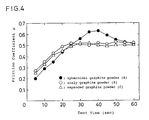
- Friction contact characteristics of sintered contact components of the invention were evaluated using the dry friction tester shown in Fig. 2, with respect to both the case in which spheroidal graphite powder is used and the case in which scaly graphite powder or expanded graphite powder is used.
- No. 11 sample in Table 1 which represents a sintered component incorporating spheroidal graphite powder is designated A
- Nos. 1 and 2 samples in Table 4 which represent sintered components using scaly graphite powder or expanded graphite powder are designated B and C. Changes in dynamnic coefficient of friction as measured in 5-second intervals beginning right after the start of testing are shown as test results in Table 6 and Fig. 4.
- the sintered component in which scaly graphite powder or expanded graphite powder is used is not subject to any such temporary rise in friction coefficient (initial break-in phenomenon) as is seen in the first mentioned case during an initial stage after the start of testing. This ensures good stability in friction coefficient beginning from an initial stage of contact movement.
- the bronze-based sintered contact component of the present invention has self-lubricating characteristics, and this enables a comparatively high friction coefficient of about 0.4 to 0.6 to be stably maintained under dry friction contact conditions, and more than 0.1 under wet friction contact conditions.
- the contact component is not likely to attack the counterpart material, nor is it liable to come into fusion with the counterpart.
- the sintered component has good mechanical characteristics, such as strength, toughness, and hardness; accordingly, it can be used singly as structural material. Therefore, the sintered component of the invention can be used in various applications, including clutch material for compressors, and braking friction material for automobiles, autocycles, and other vehicles. It is also applicable to wet contact members, such as automotive transmission clutches.
Landscapes
- Engineering & Computer Science (AREA)
- General Engineering & Computer Science (AREA)
- Chemical & Material Sciences (AREA)
- Mechanical Engineering (AREA)
- Inorganic Chemistry (AREA)
- Materials Engineering (AREA)
- Metallurgy (AREA)
- Organic Chemistry (AREA)
- Powder Metallurgy (AREA)
- Braking Arrangements (AREA)
- Manufacture Of Alloys Or Alloy Compounds (AREA)
Claims (8)
- Gesintertes Kontaktbauteil, das eine gesintere Legierung auf Kupfergrundlage mit einer solchen Struktur umfaßt, daß 15 bis 25 Gew.-% eines harten Teilchenmaterials mit einem maximalen Teilchendurchmesser von nicht mehr als 15 µm und einem mittleren Teilchendurchmesser von nicht mehr als 5 µm gleichförmig in den vorgenannten Pulverteilchen in einer Legierungsmatrix verteilt sind, wobei das gesinterte Kontaktbauteil einen Reibungskoeffizienten von nicht weniger als 0,4, wenn es mit Stahlwerkstoff unter trockenen Umgebungsbedingungen in Berührung ist, und einen Reibungskoeffizienten von nicht weniger als 0,1 aufweist, wenn es mit dem Stahlwerkstoff durch Schmieröl in Berührung ist, die gesinterte Legierung auf Kupfergrundlage bis zu 15 Gew.-% an natürlichem, blättrigem Graphitpulver und/oder expandiertem Graphitpulver enthält, das aus natürlichem, blättrigem Graphitpulver durch dessen Expansion in der Dickenrichtung umgewandelt ist.
- Gesintertes Kontaktbauteil, wie in Anspruch 1 definiert, wobei, wenn das Bauteil mit dem Stahlwerkstoff unter trockenen Umgebungsbedingungen in Berührung kommt, der Unterschied zwischen seinem Haftreibungskoeffizienten und seinem Gleitreibungskoeffizienten nicht größer als 0,1 ist.
- Gesintertes Kontaktbauteil, wie in Anspruch 1 oder 2 definiert, wobei die gesinterte Legierung auf Kupfergrundlage Lücken mit einem mittleren Durchmesser von nicht mehr als 30 µm umfaßt, die gleichförmig in der Legierung in einem Bereich von 1 Vol.-% bis 30 Vol.-% verteilt sind.
- Gesintertes Kontaktbauteil, wie in irgendeinem vorhergehenden Anspruch definiert, wobei die Matrix der gesinterten Legierung auf Kupfergrundlage 3 bis 20 Gew.-% an Sn umfaßt, wobei der Rest im wesentlichen von Cu, dem blättrigen oder expandierten Graphitpulver und unvermeidbaren Verunreinigungen gebildet ist.
- Gesintertes Kontaktbauteil, wie in irgendeinem vorhergehenden Anspruch definiert, wobei das harte Teilchenmaterial aus einer oder mehreren Intermetallverbindungen auf Eisengrundlage gebildet ist, die aus FeMo, FeCr, FeTi, FeW und FeB ausgewählt sind.
- Gesintertes Kontaktbauteil, wie in irgendeinem vorhergehenden Anspruch definiert, wobei die gesinterte Legierung auf Kupfergrundlage nicht mehr als 3 Gew.-% an einem festen Schmiermaterial umfaßt, das einen oder mehrere Stoffe aus sphärischem Graphit, MoS2, CaF2 und BN umfaßt.
- Verfahren zur Herstellung eines gesinterten Kontaktbauteils, wie es in irgendeinem vorhergehenden Anspruch definiert ist, das umfaßt, Formen und Sintem einer Kupferlegierungspulverzusammensetzung, die 15 bis 25 Gew.-% an hartem Teilchenmaterial enthält, das einen maximalen Teilchendurchmesser von nicht mehr als 15 µm und einen mittleren Teilchendurchmesser von nicht mehr als 5 µm aufweist, 3 bis 20 Gew.-% an Sn und bis zu 15 Gew.-% an natürlichem, blättrigem Graphitpulver und/oder expandiertem Graphitpulver aufweist, das aus natürlichem, blättrigem Graphitpulver umgewandelt wird, indem dieses in der Dikkenrichtung expandiert wird, wobei der Rest im wesentlichen aus Cu und unvermeidbaren Verunreinigungen gebildet ist.
- Verfahren, wie in Anspruch 7 definiert, wobei die Pulvermischung dem Misch- und Mahlprozeß durch eine mechanische Legierungs-, Mahl- oder Pulverisierungstechnik unterzogen wird, so daß das harte Teilchenmaterial zu einer maximalen Teilchengröße von nicht mehr als 15 µm und einer mittleren Teilchengröße von 5 µm pulverisiert und gleichförmig in der Cu-Sn Legierungsmatrix verteilt wird.
Applications Claiming Priority (6)
| Application Number | Priority Date | Filing Date | Title |
|---|---|---|---|
| JP6197985A JPH07102335A (ja) | 1993-08-09 | 1994-07-30 | 焼結摺動部材 |
| JP197985/94 | 1994-07-30 | ||
| JP19798594 | 1994-07-30 | ||
| JP19131195 | 1995-07-03 | ||
| JP191311/95 | 1995-07-03 | ||
| JP7191311A JPH08100227A (ja) | 1994-07-30 | 1995-07-03 | 焼結摺動部材 |
Publications (2)
| Publication Number | Publication Date |
|---|---|
| EP0703382A1 EP0703382A1 (de) | 1996-03-27 |
| EP0703382B1 true EP0703382B1 (de) | 2000-10-04 |
Family
ID=26506618
Family Applications (1)
| Application Number | Title | Priority Date | Filing Date |
|---|---|---|---|
| EP95305276A Expired - Lifetime EP0703382B1 (de) | 1994-07-30 | 1995-07-28 | Gesintertes Kontaktbauteil |
Country Status (6)
| Country | Link |
|---|---|
| US (1) | US5518519A (de) |
| EP (1) | EP0703382B1 (de) |
| JP (1) | JPH08100227A (de) |
| KR (1) | KR100193606B1 (de) |
| CN (1) | CN1121117A (de) |
| DE (1) | DE69519009T2 (de) |
Cited By (3)
| Publication number | Priority date | Publication date | Assignee | Title |
|---|---|---|---|---|
| RU2457268C1 (ru) * | 2011-05-10 | 2012-07-27 | Федеральное государственное бюджетное образовательное учреждение высшего профессионального образования "Тверской государственный технический университет" | Материал для фрикционных деталей |
| RU2458165C1 (ru) * | 2011-05-04 | 2012-08-10 | Государственное образовательное учреждение высшего профессионального образования "Южно-Российский государственный технический университет (Новочеркасский политехнический институт)" | Способ изготовления порошкового материала на основе меди |
| RU2458166C1 (ru) * | 2011-05-04 | 2012-08-10 | Государственное образовательное учреждение высшего профессионального образования "Южно-Российский государственный технический университет (Новочеркасский политехнический институт)" | Способ изготовления порошкового материала на основе меди |
Families Citing this family (26)
| Publication number | Priority date | Publication date | Assignee | Title |
|---|---|---|---|---|
| JPH08253826A (ja) * | 1994-10-19 | 1996-10-01 | Sumitomo Electric Ind Ltd | 焼結摩擦材およびそれに用いられる複合銅合金粉末とそれらの製造方法 |
| JPH09269026A (ja) * | 1996-03-29 | 1997-10-14 | Honda Motor Co Ltd | 焼結摩擦材 |
| JPH09301256A (ja) * | 1996-05-09 | 1997-11-25 | Toshiba Tungaloy Co Ltd | 車両用ローラーブレーキ |
| JPH109294A (ja) * | 1996-06-19 | 1998-01-13 | Sumitomo Electric Ind Ltd | 二輪車用ローラーブレーキとその製造方法 |
| US6245443B1 (en) * | 1996-08-28 | 2001-06-12 | Norton Company | Removable bond for abrasive tool |
| US5832360A (en) * | 1997-08-28 | 1998-11-03 | Norton Company | Bond for abrasive tool |
| DE19815648C2 (de) * | 1998-04-07 | 2000-07-13 | Maxon Motor Gmbh | Verfahren zum Herstellen eines Sintergleitlagers und Sintergleitlager |
| US6187071B1 (en) | 1999-01-14 | 2001-02-13 | Norton Company | Bond for abrasive tool |
| CH710862B1 (de) | 1999-11-26 | 2016-09-15 | Imerys Graphite & Carbon Switzerland Sa | Verfahren zur Herstellung von Graphitpulvern mit erhöhter Schüttdichte. |
| US6521201B1 (en) | 2001-02-14 | 2003-02-18 | Uop Llc | Process for recovery of high purity hydrophilic sulfur |
| US20060204777A1 (en) * | 2001-05-04 | 2006-09-14 | Alto Products Corp. | Process for making adhesive bonded sintered plates |
| JP2003089831A (ja) * | 2001-07-12 | 2003-03-28 | Komatsu Ltd | 銅系焼結摺動材料および複層焼結摺動部材 |
| AU2002349317A1 (en) * | 2001-10-08 | 2003-04-22 | Timcal Ag | Electrochemical cell |
| JP5303102B2 (ja) † | 2006-05-24 | 2013-10-02 | ナブテスコ株式会社 | ディスクブレーキ用パッド |
| WO2009093664A1 (ja) * | 2008-01-23 | 2009-07-30 | Taiho Kogyo Co., Ltd. | 焼結銅合金摺動材の製造方法及び焼結銅合金摺動材 |
| JP5384014B2 (ja) * | 2008-02-21 | 2014-01-08 | Ntn株式会社 | 焼結軸受 |
| JP5252290B2 (ja) * | 2008-12-25 | 2013-07-31 | Ntn株式会社 | 導電性転がり軸受 |
| CN103639404B (zh) * | 2013-11-29 | 2016-03-23 | 国家电网公司 | 一种大功率风电机组用制动闸片材料及其制备工艺 |
| KR102387244B1 (ko) * | 2014-05-12 | 2022-04-14 | 아이티티 이탈리아 에스.알.엘. | 마찰재 |
| CN104525949B (zh) * | 2014-12-30 | 2017-07-07 | 广东省材料与加工研究所 | 一种高耐磨铜基摩擦复合材料及其制备方法 |
| RU2599070C1 (ru) * | 2015-04-06 | 2016-10-10 | Государственное научное учреждение "Институт порошковой металлургии" | Спеченный фрикционный материал на основе меди |
| JP6503229B2 (ja) * | 2015-05-28 | 2019-04-17 | 曙ブレーキ工業株式会社 | 高速鉄道車両用焼結摩擦材の製造方法 |
| RU2651930C1 (ru) * | 2017-08-24 | 2018-04-24 | Юлия Алексеевна Щепочкина | Спеченный фрикционный материал на основе меди |
| US20210316364A1 (en) * | 2018-08-29 | 2021-10-14 | Showa Denko Materials Co., Ltd. | Iron-based sintered sliding material and method for producing the same |
| CN109295335B (zh) * | 2018-10-24 | 2020-12-22 | 中南大学 | 一种改性膨胀石墨-石墨/铜复合材料及其制备方法 |
| DE102020213651A1 (de) | 2020-10-29 | 2022-05-05 | Mahle International Gmbh | Verschleißfeste, hochwärmeleitfähige Sinterlegierung, insbesondere für Lageranwendungen und Ventilsitzringe |
Family Cites Families (8)
| Publication number | Priority date | Publication date | Assignee | Title |
|---|---|---|---|---|
| JPS5517768A (en) * | 1978-07-24 | 1980-02-07 | Kawasaki Heavy Ind Ltd | Disc brake |
| JPS58126948A (ja) | 1982-01-25 | 1983-07-28 | Toshiba Tungaloy Co Ltd | 乾式焼結摩擦材料 |
| GB2212517B (en) * | 1987-11-19 | 1992-01-15 | Ferodo Ltd | Sintered metal friction facing |
| JPH0451285A (ja) * | 1990-06-19 | 1992-02-19 | Oki Electric Ind Co Ltd | カラープラズマディスプレイ |
| JPH0476086A (ja) | 1990-07-17 | 1992-03-10 | Toyota Motor Corp | 湿式摩擦材 |
| JPH05179232A (ja) * | 1991-12-26 | 1993-07-20 | Toshiba Tungaloy Co Ltd | ブレーキ用焼結金属摩擦材 |
| JPH0625653A (ja) | 1992-07-09 | 1994-02-01 | Akebono Brake Res & Dev Center Ltd | ペーパー摩擦材 |
| US5460639A (en) * | 1993-08-09 | 1995-10-24 | Sumitomo Electric Industries, Ltd. | Sintered contact component |
-
1995
- 1995-07-03 JP JP7191311A patent/JPH08100227A/ja active Pending
- 1995-07-25 US US08/506,566 patent/US5518519A/en not_active Expired - Fee Related
- 1995-07-28 DE DE69519009T patent/DE69519009T2/de not_active Expired - Fee Related
- 1995-07-28 EP EP95305276A patent/EP0703382B1/de not_active Expired - Lifetime
- 1995-07-28 CN CN95108696A patent/CN1121117A/zh active Pending
- 1995-07-29 KR KR1019950023073A patent/KR100193606B1/ko not_active Expired - Fee Related
Cited By (3)
| Publication number | Priority date | Publication date | Assignee | Title |
|---|---|---|---|---|
| RU2458165C1 (ru) * | 2011-05-04 | 2012-08-10 | Государственное образовательное учреждение высшего профессионального образования "Южно-Российский государственный технический университет (Новочеркасский политехнический институт)" | Способ изготовления порошкового материала на основе меди |
| RU2458166C1 (ru) * | 2011-05-04 | 2012-08-10 | Государственное образовательное учреждение высшего профессионального образования "Южно-Российский государственный технический университет (Новочеркасский политехнический институт)" | Способ изготовления порошкового материала на основе меди |
| RU2457268C1 (ru) * | 2011-05-10 | 2012-07-27 | Федеральное государственное бюджетное образовательное учреждение высшего профессионального образования "Тверской государственный технический университет" | Материал для фрикционных деталей |
Also Published As
| Publication number | Publication date |
|---|---|
| JPH08100227A (ja) | 1996-04-16 |
| DE69519009D1 (de) | 2000-11-09 |
| US5518519A (en) | 1996-05-21 |
| KR960003860A (ko) | 1996-02-23 |
| KR100193606B1 (ko) | 1999-06-15 |
| EP0703382A1 (de) | 1996-03-27 |
| CN1121117A (zh) | 1996-04-24 |
| DE69519009T2 (de) | 2001-02-15 |
Similar Documents
| Publication | Publication Date | Title |
|---|---|---|
| US5518519A (en) | Sintered contact component | |
| Moazami-Goudarzi et al. | Tribological behavior of self lubricating Cu/MoS2 composites fabricated by powder metallurgy | |
| US7261951B2 (en) | Copper based sintered contact material and double-layered sintered contact member | |
| US20010021353A1 (en) | Copper alloy sliding material | |
| CN101760662B (zh) | 无铅铜合金滑动材料 | |
| GB2045806A (en) | Sintered bearing material | |
| GB2345095A (en) | Sliding bearing including a resin layer consisting of soft metal particles dispersed in a thermosetting resin | |
| EP0638654B1 (de) | Gesintertes Kontaktbauteil, sowie Verfahren seiner Herstellung | |
| US20030209103A1 (en) | Cooper-based sintering sliding material and multi-layered sintered sliding member | |
| US20100190667A1 (en) | Lead-free sintered lubricating material and sinter powder for manufacture of the same | |
| JP3484444B2 (ja) | 摺動部材 | |
| JPH05179232A (ja) | ブレーキ用焼結金属摩擦材 | |
| JP4757460B2 (ja) | 耐焼付性に優れたPbフリー銅合金複合摺動材 | |
| US5841042A (en) | Brake lining material for heavy-load braking device | |
| JPH07102335A (ja) | 焼結摺動部材 | |
| JP4427410B2 (ja) | 耐焼付性に優れたPbフリー銅合金摺動材 | |
| JPH06145845A (ja) | 焼結摩擦材 | |
| JPH0488139A (ja) | 摺動材料 | |
| JPH0727156A (ja) | 焼結摩擦材 | |
| KR0118771B1 (ko) | Cu기 소결합금 마찰재 | |
| JPH0893816A (ja) | 湿式摩擦係合板及びその製造方法 | |
| JPH10226834A (ja) | 銅系焼結摩擦材料 | |
| KR19990061545A (ko) | 동계소결마찰재 | |
| JPH0861406A (ja) | 湿式焼結摩擦材及びその製造方法並びに湿式摩擦係合板 |
Legal Events
| Date | Code | Title | Description |
|---|---|---|---|
| PUAI | Public reference made under article 153(3) epc to a published international application that has entered the european phase |
Free format text: ORIGINAL CODE: 0009012 |
|
| AK | Designated contracting states |
Kind code of ref document: A1 Designated state(s): DE FR GB IT |
|
| 17P | Request for examination filed |
Effective date: 19960809 |
|
| 17Q | First examination report despatched |
Effective date: 19981109 |
|
| GRAG | Despatch of communication of intention to grant |
Free format text: ORIGINAL CODE: EPIDOS AGRA |
|
| GRAG | Despatch of communication of intention to grant |
Free format text: ORIGINAL CODE: EPIDOS AGRA |
|
| GRAG | Despatch of communication of intention to grant |
Free format text: ORIGINAL CODE: EPIDOS AGRA |
|
| GRAH | Despatch of communication of intention to grant a patent |
Free format text: ORIGINAL CODE: EPIDOS IGRA |
|
| GRAH | Despatch of communication of intention to grant a patent |
Free format text: ORIGINAL CODE: EPIDOS IGRA |
|
| GRAA | (expected) grant |
Free format text: ORIGINAL CODE: 0009210 |
|
| AK | Designated contracting states |
Kind code of ref document: B1 Designated state(s): DE FR GB IT |
|
| REF | Corresponds to: |
Ref document number: 69519009 Country of ref document: DE Date of ref document: 20001109 |
|
| ITF | It: translation for a ep patent filed | ||
| ET | Fr: translation filed | ||
| PLBE | No opposition filed within time limit |
Free format text: ORIGINAL CODE: 0009261 |
|
| STAA | Information on the status of an ep patent application or granted ep patent |
Free format text: STATUS: NO OPPOSITION FILED WITHIN TIME LIMIT |
|
| 26N | No opposition filed | ||
| REG | Reference to a national code |
Ref country code: GB Ref legal event code: IF02 |
|
| PGFP | Annual fee paid to national office [announced via postgrant information from national office to epo] |
Ref country code: FR Payment date: 20030711 Year of fee payment: 9 |
|
| PGFP | Annual fee paid to national office [announced via postgrant information from national office to epo] |
Ref country code: GB Payment date: 20030723 Year of fee payment: 9 |
|
| PGFP | Annual fee paid to national office [announced via postgrant information from national office to epo] |
Ref country code: DE Payment date: 20030807 Year of fee payment: 9 |
|
| PG25 | Lapsed in a contracting state [announced via postgrant information from national office to epo] |
Ref country code: GB Free format text: LAPSE BECAUSE OF NON-PAYMENT OF DUE FEES Effective date: 20040728 |
|
| PG25 | Lapsed in a contracting state [announced via postgrant information from national office to epo] |
Ref country code: DE Free format text: LAPSE BECAUSE OF NON-PAYMENT OF DUE FEES Effective date: 20050201 |
|
| GBPC | Gb: european patent ceased through non-payment of renewal fee |
Effective date: 20040728 |
|
| PG25 | Lapsed in a contracting state [announced via postgrant information from national office to epo] |
Ref country code: FR Free format text: LAPSE BECAUSE OF NON-PAYMENT OF DUE FEES Effective date: 20050331 |
|
| REG | Reference to a national code |
Ref country code: FR Ref legal event code: ST |
|
| PG25 | Lapsed in a contracting state [announced via postgrant information from national office to epo] |
Ref country code: IT Free format text: LAPSE BECAUSE OF NON-PAYMENT OF DUE FEES Effective date: 20050728 |