EP0706838B1 - Machine et procédé pour le tri d'objets divers à l'aide d'au moins un bras robotisé - Google Patents
Machine et procédé pour le tri d'objets divers à l'aide d'au moins un bras robotisé Download PDFInfo
- Publication number
- EP0706838B1 EP0706838B1 EP95430008A EP95430008A EP0706838B1 EP 0706838 B1 EP0706838 B1 EP 0706838B1 EP 95430008 A EP95430008 A EP 95430008A EP 95430008 A EP95430008 A EP 95430008A EP 0706838 B1 EP0706838 B1 EP 0706838B1
- Authority
- EP
- European Patent Office
- Prior art keywords
- objects
- sorting
- robotised
- automatic sorting
- arm
- Prior art date
- Legal status (The legal status is an assumption and is not a legal conclusion. Google has not performed a legal analysis and makes no representation as to the accuracy of the status listed.)
- Expired - Lifetime
Links
- 238000000034 method Methods 0.000 title claims abstract description 27
- 230000000295 complement effect Effects 0.000 claims abstract description 27
- 238000001514 detection method Methods 0.000 claims abstract description 24
- 238000012545 processing Methods 0.000 claims abstract description 10
- 230000008569 process Effects 0.000 claims abstract description 6
- 239000000463 material Substances 0.000 claims description 14
- 230000033001 locomotion Effects 0.000 claims description 12
- 230000001939 inductive effect Effects 0.000 claims description 8
- 230000035939 shock Effects 0.000 claims description 8
- 238000005259 measurement Methods 0.000 claims description 6
- 238000007664 blowing Methods 0.000 claims description 5
- 239000002184 metal Substances 0.000 claims description 5
- 229910052751 metal Inorganic materials 0.000 claims description 5
- 239000010816 packaging waste Substances 0.000 claims description 5
- 230000000007 visual effect Effects 0.000 claims description 5
- 230000009471 action Effects 0.000 claims description 4
- 238000013519 translation Methods 0.000 claims description 3
- 230000006835 compression Effects 0.000 claims description 2
- 238000007906 compression Methods 0.000 claims description 2
- 238000007493 shaping process Methods 0.000 claims description 2
- 230000010365 information processing Effects 0.000 claims 2
- 238000012546 transfer Methods 0.000 claims 2
- 239000002699 waste material Substances 0.000 description 10
- 230000001133 acceleration Effects 0.000 description 7
- 238000009434 installation Methods 0.000 description 7
- 230000004807 localization Effects 0.000 description 7
- 241000863032 Trieres Species 0.000 description 6
- 230000008901 benefit Effects 0.000 description 5
- 229920003023 plastic Polymers 0.000 description 5
- 239000004033 plastic Substances 0.000 description 5
- 238000004806 packaging method and process Methods 0.000 description 4
- 239000000470 constituent Substances 0.000 description 3
- 239000010791 domestic waste Substances 0.000 description 3
- 238000003032 molecular docking Methods 0.000 description 3
- 229920000915 polyvinyl chloride Polymers 0.000 description 3
- 239000004800 polyvinyl chloride Substances 0.000 description 3
- 238000004064 recycling Methods 0.000 description 3
- CWYNVVGOOAEACU-UHFFFAOYSA-N Fe2+ Chemical compound [Fe+2] CWYNVVGOOAEACU-UHFFFAOYSA-N 0.000 description 2
- 238000004458 analytical method Methods 0.000 description 2
- 239000011449 brick Substances 0.000 description 2
- 238000006243 chemical reaction Methods 0.000 description 2
- 238000012790 confirmation Methods 0.000 description 2
- 238000010276 construction Methods 0.000 description 2
- 238000000605 extraction Methods 0.000 description 2
- 235000013305 food Nutrition 0.000 description 2
- 239000011521 glass Substances 0.000 description 2
- 230000005484 gravity Effects 0.000 description 2
- 229920001903 high density polyethylene Polymers 0.000 description 2
- 239000004700 high-density polyethylene Substances 0.000 description 2
- 230000000750 progressive effect Effects 0.000 description 2
- 238000007670 refining Methods 0.000 description 2
- 238000011144 upstream manufacturing Methods 0.000 description 2
- 241001344923 Aulorhynchidae Species 0.000 description 1
- 241000135309 Processus Species 0.000 description 1
- 229920000297 Rayon Polymers 0.000 description 1
- 241001639412 Verres Species 0.000 description 1
- 240000008042 Zea mays Species 0.000 description 1
- 238000013459 approach Methods 0.000 description 1
- 230000003416 augmentation Effects 0.000 description 1
- 230000004888 barrier function Effects 0.000 description 1
- 235000012970 cakes Nutrition 0.000 description 1
- 239000011111 cardboard Substances 0.000 description 1
- 235000009508 confectionery Nutrition 0.000 description 1
- 238000011109 contamination Methods 0.000 description 1
- 235000014510 cooky Nutrition 0.000 description 1
- 238000013461 design Methods 0.000 description 1
- 229910052571 earthenware Inorganic materials 0.000 description 1
- 238000011156 evaluation Methods 0.000 description 1
- 230000036541 health Effects 0.000 description 1
- 239000012535 impurity Substances 0.000 description 1
- 230000010354 integration Effects 0.000 description 1
- 238000012804 iterative process Methods 0.000 description 1
- 239000002906 medical waste Substances 0.000 description 1
- 150000002739 metals Chemical class 0.000 description 1
- 239000000203 mixture Substances 0.000 description 1
- 239000003607 modifier Substances 0.000 description 1
- 239000000123 paper Substances 0.000 description 1
- 229920000728 polyester Polymers 0.000 description 1
- 239000002964 rayon Substances 0.000 description 1
- 238000007789 sealing Methods 0.000 description 1
- 239000002356 single layer Substances 0.000 description 1
- 239000007787 solid Substances 0.000 description 1
- 238000004611 spectroscopical analysis Methods 0.000 description 1
- 238000001228 spectrum Methods 0.000 description 1
- KKEYFWRCBNTPAC-UHFFFAOYSA-L terephthalate(2-) Chemical compound [O-]C(=O)C1=CC=C(C([O-])=O)C=C1 KKEYFWRCBNTPAC-UHFFFAOYSA-L 0.000 description 1
- 230000001960 triggered effect Effects 0.000 description 1
Images

Classifications
-
- B—PERFORMING OPERATIONS; TRANSPORTING
- B07—SEPARATING SOLIDS FROM SOLIDS; SORTING
- B07C—POSTAL SORTING; SORTING INDIVIDUAL ARTICLES, OR BULK MATERIAL FIT TO BE SORTED PIECE-MEAL, e.g. BY PICKING
- B07C5/00—Sorting according to a characteristic or feature of the articles or material being sorted, e.g. by control effected by devices which detect or measure such characteristic or feature; Sorting by manually actuated devices, e.g. switches
- B07C5/04—Sorting according to size
- B07C5/12—Sorting according to size characterised by the application to particular articles, not otherwise provided for
- B07C5/122—Sorting according to size characterised by the application to particular articles, not otherwise provided for for bottles, ampoules, jars and other glassware
- B07C5/126—Sorting according to size characterised by the application to particular articles, not otherwise provided for for bottles, ampoules, jars and other glassware by means of photo-electric sensors, e.g. according to colour
-
- B—PERFORMING OPERATIONS; TRANSPORTING
- B07—SEPARATING SOLIDS FROM SOLIDS; SORTING
- B07C—POSTAL SORTING; SORTING INDIVIDUAL ARTICLES, OR BULK MATERIAL FIT TO BE SORTED PIECE-MEAL, e.g. BY PICKING
- B07C5/00—Sorting according to a characteristic or feature of the articles or material being sorted, e.g. by control effected by devices which detect or measure such characteristic or feature; Sorting by manually actuated devices, e.g. switches
- B07C5/34—Sorting according to other particular properties
- B07C5/342—Sorting according to other particular properties according to optical properties, e.g. colour
- B07C5/3422—Sorting according to other particular properties according to optical properties, e.g. colour using video scanning devices, e.g. TV-cameras
Definitions
- the invention relates to a machine and a method. for sorting various objects, using at least one robotic arm, this machine can include advantageously a plurality of robotic arms arranged one after the other.
- the object of the invention is to fully automate sorting of various heterogeneous objects, including conformation, weight and size may vary very sensitively.
- the invention can be advantageously implemented to perform automatic sorting, in particular for their recycling, discarded packaging and making part of household waste and similar waste, such as glass bottles or flasks, various plastic containers such as PVC (polyvinyl chloride), PET (polyester terephthalate), HDPE (high density polyethylene), food bricks made of mixed materials or cardboard, metal packaging, etc., the weight of which can vary from 10 grams to 1000 grams and which are brought in bulk, in varying proportions, to the sites sorting.
- PVC polyvinyl chloride
- PET polyyester terephthalate
- HDPE high density polyethylene
- the waste stream of household packaging to be sorted comes from household waste for which a first sorting has been operated, either directly at the collection, or during previous sorting, according to known methods, in order to eliminate organic products and papers.
- sorting machines for household packaging waste, but these machines are, to date, mainly used after a first sorting operation, usually manual, so to remove the remaining impurities in a stream by elsewhere homogeneous.
- a - The automated sorting machines which consist in separating the objects, in order to make them pass in front of appropriate detectors, then in ejecting them selectively by means of pneumatic nozzles, in special tanks.
- a machine of this kind is, for example, described in documents WO-A-92/07332, and WO-A-92/01272.
- the objects are first put in linear flow, then pass so individually in front of detectors which control or not ejection systems.
- the objects are distributed on a conveyor, without being aligned, and subject to the same type of detectors as above but distributed across the plan. Ejection can also be done by nozzles.
- a sorting machine with planar flow comprising transport means making it possible to convey products from a feeding station to a robotic sorting station, comprising at least one robot arm equipped with a gripping member and an artificial vision system for locating moving products and determining their orientation.
- this machine is specially designed to process products of the same or similar nature such as cakes, cookies, confectionery, etc. ; it is not arranged or configured to recognize heterogeneous objects and sort them according to their appearance, such as household waste, for example.
- - B - Robotic sorting machines intended to prevent manual operators from having direct contact with the objects to be sorted, for reasons of hygiene and safety.
- a sorting robot for hospital waste which avoids the operator contamination. It is an arm of robot whose movements are calculated in a coordinate system Cartesian, operating in remote control mode by a operator.
- This sorting system does not include automatic recognition or localization of waste, and operates on whole bags.
- the present invention aims to create a fully automatic sorting machine and process heterogeneous objects appearing in bulk on a conveyor belt and which are not affected shortcomings or disadvantages previously highlighted, known sorting machines and methods.
- the automatic sorting process and machine according to the invention make it possible to make the recycling of household packaging waste which is currently very not very practical ; indeed, the only practical solution currently implemented for a set of waste heterogeneous, is manual sorting.
- Modularity and reduced bulk allow progressive implementation thus reducing investment.
- Figure 1 is a schematic view of a machine according to the invention comprising a plurality of stations robotic sorting.
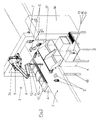
- Figure 2 is a perspective view and schematic, of a robotic sorting station individual.
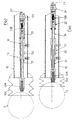
- Figure 3 illustrates, in a sectional view longitudinal, a very interesting embodiment of the complementary detection system, whereby said system is embedded inside the gripper of the robotic arm, the system being shown in its position before entering an object.
- Figure 4 is a view similar to Figure 3 and showing the complementary detection system in its position resulting from the seizure of said object.
- the conveyor belt 2 can be driven by means known per se, either at constant speed, either at controlled variable speed or with stops intermittent. It can be formed continuously, or consisting of several successive sections independent. In all cases, the sorting station robotized or each robotic sorting station must at least know the law of motion of the band. This law of movement is controlled by the supervision module or supervisor 5 which includes a computer or PLC programmable that receives information from belt or conveyor belt 2 (measurement of speed) depending on the occupancy rate of the robots the line and acts on the drive motor (s) 6 of said band.
- the supervision module or supervisor 5 which includes a computer or PLC programmable that receives information from belt or conveyor belt 2 (measurement of speed) depending on the occupancy rate of the robots the line and acts on the drive motor (s) 6 of said band.
- the conveyor belt 2 can be advantageously subject to the operation of the robotic sorting, so as to optimize the sorting rate, the speed of movement of said conveyor belt being accelerated when the station vision system robotic sorting no longer or very little objects, or, conversely, slowed down when objects transported by the band are numerous.
- Intermittent stop mode of travel consists in making the robots work on the belt to stopping, which simplifies and facilitates docking of localized objects.
- the band is only activated by moments, so as to empty the remaining objects from the end of the chain to the receptacle of scrap 4a, and to simultaneously recharge a batch of objects new to sort.
- the machine is provided with a plurality of complementary sensors 12, allowing identification automatic objects by confronting information provided by at least one of them with those provided by the identification system visual 8, triggered as needed, and taken into account according to predefined priorities.
- the complementary detection system 12 is embedded inside the gripper 10 of the arm robotized 9, so as to follow all the movements of said arm and allow to define the nature of objects, as soon as they are entered.
- Inductive sensor 12A and shock sensor 12B are placed at opposite ends of a support elongated shape, for example consisting of a rod tubular 19 passing through a guide 20 fixedly installed at the interior of the rigid tube constituting the gripper 10.
- the inductive sensor 12A is arranged at the end front of rod 19, while shock sensor 12B is arranged at the rear end of the latter.
- the sensors 12A and 12B constitute, with the rod 19, a assembly or mobile equipment mounted with an ability to axial movement in the gripper 10.
- a means tends to push, permanently, the whole mobile 12A-12B-19 towards the active end of the gripper 10.
- This means is, for example, constituted by a spring 21 acting in compression and wedged, by through its opposite ends, on the one hand, against a bulge presented by the anterior part of the rod 19, and, on the other hand, against the end front of guide 20.
- a mechanical stop 22 allows stop the mobile assembly in its extreme position progress (Figure 3).
- the mechanical stop 22 is fixed on the part posterior of the rod 19 of the mobile assembly. She is shaped to protect the shock sensor 12B and it extends in front of the latter. In position advancement of the mobile assembly, it falls against the posterior end of the guide 20.
- the cables 23 from the inductive sensor 12A and the shock sensor 12B pass through the rod 19, to exit, together, through a sealing piece 24 equipping the rear end of said rod.
- the signals emitted by the sensors 12A and 12B are transmitted to shaping means known per se, allowing them to be used by a system identification.
- the 12B accelerometer mounted on the mobile assembly 12A-12B-19 transmits the value of the acceleration undergone by said mobile assembly to an electronic card of conversion.
- This card transforms the input signal analog from the accelerometer as an output signal binary or analog usable by the system identification.
- This output signal has the value 0 (or 1) when the input signal is weak and for value 1 (or 0 respectively), when the signal entry is strong.
- the electronic card has a system for setting the minimum value of the input signal giving an output signal equal to 1.
- the products to be sorted are poured in bulk into the hopper of feeder 1 and brought, by the conveyor belt unloading the latter, on the extreme part upstream of the moving conveyor belt 2.
- the supervision module 5 starts the cycle simultaneously for all robotic sorting stations on the machine.
- Image acquisitions are taken at intervals until the vision system 8, controlled by software module 15, signals the presence an object, locates it, and determines if that object is to seize. If the object is to be grasped, the position of its center of gravity (X, Y) in the field of vision, as well that the position of the conveyor belt 2 when image acquisition are provided by the module software 15 to software module 16. The software module 16 then gives the robotic arm 9 the order to carry out the sorting cycle. If the object should not be seized, it continues its journey on the conveyor belt 2, to the next robotic sorting station or, depending on the case, up to the waste receptacle 4a.
- the sorting cycle breaks down as follows: next: the robotic arm 9 deploys, its end gripping orients itself towards the center of gravity of the object identified and its gripper 10 is activated (by example by switching on the suction). he advances towards the object, in order to seize it. If the object is moving, the arm is controlled by the module software 16, so as to anticipate the position said object during docking, depending on the speed of movement of the conveyor belt. he stops, either at the end of its travel, or when the control sensors 11 signal the presence of object or obstacle. The sensors 11 make it possible to determine if the arm took an object or encountered a barrier. If it is indeed an object, he grabs it through its gripper 10, then active the analysis sensor (s) 12 to determine the material of which it is made.
- the inductive sensor is continuously analyzed by the identification system.
- the inductive sensor 12A Upon contact with a metallic object, the inductive sensor 12A signals the presence of metal.
- the shock sensor 12B transmits the value of the acceleration undergone by the mobile assembly, to an electronic card conversion.
- the arm turns and moves over the chute 17 leading to the particular receptacle 4 intended for the reception of objects made from this material.
- the deposit of the object removed from the planar flow, in the appropriate chute 17, can be done by simple release of said object.
- This removal can also be advantageously produced by blowing with the gripper 10.
- the advantage of removal by blowing not to require an approach movement of the arm in direction of the drop zone in chute 17, ni, therefore, backward movement, which allows thus saving time in the cycle.
- the arrangement of the troughs 17 can be optimized to avoid any extension of the arm robotized before removal.
- the robotic arm When the robotic arm has not taken an object from the following its deployment, it returns to the position of fixed rest folded. It waits, from the software module of piloting 16, the order to continue on the next object, either from this rest position or from from its removal position.
- the machine or sorting facility can have multiple arms robotic 9 placed in series one after the other others, along the conveyor belt, which provides several additional benefits in the installation configuration.
- Robotic sorting stations can thus be produced in the form of modules can be added one after the other.
- each sorting station being then assigned to the recognition and removal of objects belonging to a specific category of objects (for example, PVC bottles) and being programmed in result.
- a specific category of objects for example, PVC bottles
- five robotic arms 9 each associated with 4 discharge channels 17, allow up to twenty output categories, number very high given the size of the installation.
- This specialization can be dynamic, i.e. depending on the composition average observed or known in advance of a batch of donated waste.
- one of the sensors of the complementary detection system 12 is constituted by a spectroscopic analysis sensor, it can be installed so that it can be multiplexing technique, measurements on several robotic cells.
Landscapes
- Engineering & Computer Science (AREA)
- Multimedia (AREA)
- Sorting Of Articles (AREA)
- Manipulator (AREA)
- Control Of Conveyors (AREA)
Description
- A - Les machines de tri automatisé, qui consistent à séparer les objets, afin de les faire défiler devant des détecteurs appropriés, puis à les éjecter sélectivement au moyen de buses pneumatiques, dans des bacs particuliers. Une machine de ce genre, est, par exemple, décrite dans les documents WO-A-92/07332, et WO-A-92/01272.
- de ne pas permettre de trier des groupes d'objets
constitués de matériaux différents en contact les uns
avec les autres, de sorte qu'il est indispensable de
disposer d'une machine d'égrenage permettant de
singulariser les objets, en amont de la machine de tri;
on conçoit qu'il en résulte une augmentation de l'encombrement de la machine de tri ; - de ne pas être modulable, c'est-à-dire de ne pas permettre l'adjonction de modules de tri à une machine existante, par exemple, pour augmenter ou modifier sa capacité de traitement.
- B - Les machines de tri robotisé, destinées à éviter que les opérateurs manuels aient des contacts directs avec les objets à trier, pour des raisons d'hygiène et de sécurité.
- le système de vision est capable de reconnaítre les caractéristiques visuelles des objets, et de les trier en fonction de ces caractéristiques ;
- le poste de tri robotisé comprend au moins un système de détection complémentaire comprenant au moins un capteur permettant de compléter l'identification des objets par la reconnaissance de leur matériau constitutif ;
- le poste de tri robotisé comprend des moyens de traitement des informations de localisation et d'identification fournies par le système de vision et par le système de détection complémentaire, et des moyens permettant le pilotage du bras robotisé assurant l'extraction sélective des objets localisés et identifiés, et leur dépose dans un bac approprié.
- l'automatisation totale du tri permet d'envisager de
faire tourner les équipements en 2 × 8 heures, ou en
3 × 8 heures.
Compte tenu du fait que la main d'oeuvre est actuellement le poste le plus coûteux dans l'opération de tri, cela permet de mieux amortir l'ensemble de l'installation de tri qui comprend notamment : le poste de tri, les postes d'amenée et d'évacuation des produits, les bâtiments ; - la qualité de tri est meilleure et, surtout, a une meilleure répétabilité ; le tri d'affinage avant recyclage n'est alors plus nécessaire (alors qu'il est pratiqué actuellement pour pallier les erreurs humaines inévitables en tri manuel, surtout lors du tri de bouteilles fabriquées dans des matières plastiques différentes) ;
- le coût des postes de tri est réduit grâce à leur grande simplicité de construction ;
- les contraintes sanitaires et la pénibilité du travail impliquées par l'intervention d'opérateurs manuels dans le tri, sont supprimées.
- La possibilité de trier des groupes d'objets constitués de matériaux différents et se trouvant en contact les uns avec les autres ; selon l'invention, ces objets peuvent être pris et triés individuellement. Le système de vision artificielle permet d'isoler un objet dans un groupe d'objets en contact les uns avec les autres. Le bras automatisé ayant trié cet objet, le système de vision peut, par un processus itératif, trier de même les objets restant dans le groupe. Cette fonction, appelée "dégrappage", permet d'optimiser le tri.
- Un encombrement plus faible que celui des systèmes de tri conçus à ce jour. Ceci est dû à l'intégration, dans un seul poste de travail, de toutes les étapes importantes de tri : localisation des objets, préhension individuelle de ceux-ci, reconnaissance du matériau, et dépose dans le bac approprié, alors que, dans les systèmes connus, ces étapes sont réalisées en série par des dispositifs différents, chacun ajoutant son propre encombrement. Pour une capacité de traitement égale à celle de ces systèmes, la présente invention peut utiliser une pluralité de postes de tri robotisés, mais l'encombrement total de la machine revendiquée demeure inférieur à celui desdits systèmes.
- Une modularité découlant de sa conception sous forme de cellules de tri indépendantes qu'il est relativement facile d'ajouter les unes à la suite des autres.
- un alimentateur 1 connu en soi, par exemple constitué par une trémie comportant un tapis de chargement 1a qui peut être formé par un convoyeur à bande sans fin ;
- une bande transporteuse 2 qui peut être avantageusement constituée par un transporteur à bande sans fin et sur l'extrémité de chargement de laquelle les objets à trier sont déversés, en vrac monocouche, par l'alimentateur 1 ;
- au moins un poste de tri robotisé 3 disposé sur le parcours du brin actif de la bande transporteuse 2 ; toutefois, de manière avantageuse, la machine comporte une pluralité de postes de tri (par exemple, cinq à sept postes de tri robotisé 3a, 3b, 3c, 3d, 3e, 3f,...) disposés les uns à la suite des autres le long de la bande transporteuse 2, de préférence à intervalles réguliers ;
- un ensemble de réceptacles de stockage 4, pour la réception des matériaux triés, disposés de chaque côté et le long de la bande transporteuse 2, à proximité du poste ou des postes de tri ; l'ensemble des réceptacles comprend également un réceptacle de rebut 4a, par exemple disposé à proximité de l'extrémité de sortie de la bande transporteuse; les réceptables 4 et 4a peuvent être constitués par des bacs de grande contenance, exécutés en matière plastique rigide ou autres matériaux présentant la rigidité et la robustesse souhaitables ;
- un module de supervision 5 commandant le poste de tri robotisé ou l'ensemble de la ligne des postes de tri robotisé.
- un portique 7 enjambant la bande transporteuse 2 et supportant les différents équipements disposés au dessus de cette dernière ;
- un système de vision artificielle permettant la localisation des objets et la reconnaissance partielle de leur matériau constitutif, ce système de vision, désigné dans son ensemble par la référence 8, comprenant son éclairage spécifique, une caméra, de préférence une caméra couleur, et un système électronique d'acquisition ; ce système de vision artificielle est capable de localiser les objets, de reconnaitre leurs caractéristiques visuelles, de les trier en fonction de celles-ci et, surtout, de réaliser toutes ces opérations sur des objets mal individualisés, c'est-à-dire se trouvant en contact les uns avec les autres ;
- un bras robotisé 9 à géométrie variable et à au moins trois degrés de liberté, par exemple à structure sphérique, dont la particularité est que le foyer de la caméra du système de vision 8 se trouve disposé fixement au centre du repère sphérique du robot ; un tel bras robotisé articulé ou manipulateur à coordonnées sphériques (deux rotations concourantes et une translation vers l'objet à saisir) possédant un système de vision fixe en son centre, étant décrit dans le document EP-A-0270469 ; le bras robotisé 9 et le système de vision 8 sont portés par la poutre horizontale 7a du portique 7 disposée au-dessus de la bande transporteuse 2. De manière préférée, le bras robotisé est centré par rapport à l'axe de défilement de la bande transporteuse 2 ;
- un préhenseur 10 constitué par l'extrémité libre réalisée sous forme de trompe, du bras robotisé et permettant de saisir les objets localisés par le système de vision 8, c'est-à-dire l'un quelconque des objets déposés sur la bande transporteuse 2, dans toutes les positions accessibles au bras robotisé 9 ; ce préhenseur est, par exemple, formé par un dispositif pneumatique fonctionnant en aspiration (ventouse) et/ou en soufflage ; ce dispositif, connu en soi, permet de saisir un objet préalablement identifié, par aspiration, et ensuite de l'éjecter, par soufflage, dans le réceptacle approprié 4, en fonction de sa nature ;
- au moins un capteur 11, monté sur le bras robotisé 9, permettant de contrôler la saisie correcte des objets par le préhenseur 10 ; il peut s'agir, par exemple, d'un capteur de dépression monté sur le circuit d'aspiration ;
- au moins un système de détection complémentaire 12 comportant au moins un capteur permettant la confirmation de la nature des matériaux des objets saisis par le préhenseur 10, par exemple un capteur permettant d'analyser les spectres électromagnétiques spécifiques émis par les différents matériaux constitutifs desdits objets (dans le domaine proche de l'infrarouge, ultraviolet, ou rayons X, etc.), ou un capteur apte à détecter la présence de métaux, ou un capteur apte à mesurer le poids des objets : ce système de détection complémentaire peut être ou ne pas être embarqué sur le robot ;
- une armoire de commande 13 permettant de contrôler le système de vision 8, le bras robotisé 9, le préhenseur 10 et les capteurs 11 et 12 ;
- une armoire de puissance 14 renfermant les circuits de commande et les circuits de puissance, cette armoire fournissant l'énergie électrique au système de vision 8, au bras robotisé 9, au préhenseur 10 et aux capteurs 11 et 12 ;
- un module logiciel 15 permettant le traitement des informations transmises par le système de vision 8 et par le système de détection complémentaire 12 ;
- un module logiciel 16 permettant le pilotage du bras robotisé 9 et du préhenseur 10, suivant les informations fournies par le module logiciel 15 ;
- des goulottes d'éjection 17, par exemple supportées par le châssis 18 soutenant la bande transporteuse 2, chacune d'elles aboutissant dans l'un des réceptacles de stockage 4 des objets triés.
- a) d'accroítre la qualité de détection (par exemple en évitant les étiquettes) ;
- b) de mobiliser les capteurs complémentaires pendant une fraction de temps moins importante, ce qui permet un multiplexage sur plusieurs cellules.
- un capteur inductif 12A réagissant en présence de métal et permettant la détection des objets métalliques (ferreux et non ferreux) ;
- un capteur de chocs 12B permettant la détection des objets massifs (verre, faïence, objets métalliques de forte épaisseur, etc.) ; ce capteur est constitué par un accéléromètre, connu en soi, émettant des signaux proportionnels à l'accélération de l'objet sur lequel il est posé, cet accéléromètre permettant, dans l'application à la présente invention, l'évaluation de la dureté des objets saisis, comme expliqué dans la suite du présent exposé.
- dans le cas d'objets massifs non déformables ou peu déformables, l'énergie de l'objet est intégralement transmise à l'ensemble mobile qui subit une accélération instantanée importante ;
- par contre, pour les objets légers déformables (en plastique par exemple), la déformation de l'objet, sous l'action du ressort 21, absorbe une partie de l'énergie dudit objet ; l'ensemble mobile 12A-12B-19 subit donc une accélération instantanée faible.
Claims (27)
- Machine à flux planaire pour le tri automatique d'objets divers tels que, par exemple, des déchets d'emballages ménagers, comportant des moyens de transport (2) permettant d'acheminer lesdits objets (E) d'un poste d'alimentation où ces derniers sont déversés en vrac, jusqu'à au moins un poste de tri robotisé (3), où ils sont répartis dans des réceptacles appropriés (4), ce poste de tri robotisé (3) comprenant au moins un bras de robot (9) muni d'un organe de préhension (10) et un système de vision artificielle (8) permettant la localisation des objets déposés sur les moyens de transport (2), caractérisée en ce que :le système de vision (8) est capable de reconnaítre les caractéristiques visuelles des objets, et de les trier en fonction de ces caractéristiques ;le poste de tri robotisé comprend au moins un système de détection complémentaire (12) comprenant au moins un capteur (12A, 12B) permettant de compléter l'identification des objets par la reconnaissance de leur matériau constitutif ;le poste de tri robotisé comprend des moyens (15) de traitement des informations de localisation et d'identification fournies par le système de vision (8) et par le système de détection complémentaire (12) et des moyens (16) permettant le pilotage du bras robotisé (9) assurant l'extraction sélective des objets localisés et identifiés, et leur dépose dans un réceptacle approprié (4).
- Machine de tri automatique selon la revendication 1, caractérisée en ce que le bras de robot (9) est constitué par un bras robotisé articulé, à géométrie variable et à coordonnées sphériques (deux rotations concourantes et une translation vers l'objet à saisir) possédant un système de vision (8) en son centre.
- Machine de tri automatique selon l'une des revendications 1 ou 2, caractérisée en ce que les moyens de traitement des informations de localisation et d'identification (15) comprennent un ordinateur pourvu d'un logiciel capable de localiser les objets, de reconnaitre leurs caractéristiques visuelles, et surtout, de réaliser toutes ces opérations sur des objets mal individualisés, c'est-à-dire se trouvant en contact les uns avec les autres.
- Machine de tri automatique selon l'une quelconque des revendications 1 à 3, caractérisée en ce qu'elle comporte un ordinateur permettant le pilotage du bras robotisé (9 - 10) par l'intermédiaire d'un logiciel (16) de traitement des informations fournies par le logiciel de localisation et d'identification (15).
- Machine de tri automatique suivant l'une quelconque des renvendications 1 à 4, caractérisée en ce que le système de détection complémentaire (12) comprend une pluralité de capteurs (12A, 12B) permettant l'identification automatique des objets par confrontation des informations fournies par au moins l'un d'entre eux, avec les informations fournies par le système de vision artificielle (8).
- Machine de tri automatique suivant l'une quelconque des revendications 1 à 5, caractérisée en ce qu'elle comprend au moins un capteur (11) permettant de contrôler la saisie correcte des objets par le préhenseur (10) du bras robotisé (9).
- Machine de tri automatique selon l'une quelconque des revendications 1 à 6, caractérisée en ce que le préhenseur (10) du bras robotisé (9) est constitué par un dispositif pneumatique permettant de saisir un objet (E) par aspiration et de l'éjecter par soufflage dans un réceptable (4) approprié à la nature dudit objet.
- Machine de tri automatique suivant l'une quelconque des revendications 1 à 7, caractérisée en ce que le système de détection complémentaire (12) est logé à l'intérieur du préhenseur (10) du bras robotisé, de façon à permettre de connaítre la nature des objets saisis (E) dès leur entrée en contact avec l'extrémité active (10a) du préhenseur (10).
- Machine de tri automatique selon la revendication 8, caractérisée en ce que le système de détection complémentaire (12) embarqué à l'intérieur du préhenseur (10) comprend : - un capteur inductif (12A) pour la reconnaissance des objets métalliques ; - un capteur de chocs ou accéléromètre (12B) pour l'évaluation de la dureté de l'objet ; - ledit système comprenant encore des moyens de mise en forme des signaux issus des capteurs (12A, 12B) pour les rendre exploitables par un système d'identification.
- Machine de tri automatique suivant la revendication 9, caractérisée en ce que le capteur inductif (12A) et le capteur de chocs (12B) sont disposés, respectivement, à l'extrémité avant et dans la partie postérieure d'un support de forme allongée (19) mobile axialement, un moyen, par exemple constitué par un ressort (21) agissant en compression, tendant à pousser en permanence, l'ensemble mobile (12A, 12B, 19) vers l'extrémité active (10a) du préhenseur (10).
- Machine de tri automatique suivant l'une quelconque des revendications 1 à 10, caractérisée en ce qu'elle comprend des moyens permettant le déplacement de la bande transporteuse (2) soit à vitesse constante, soit à vitesse variable contrôlée, soit de manière intermittente.
- Machine de tri automatique selon l'une quelconque des revendications 1 à 11, caractérisée en ce que la bande transporteuse (2) sur laquelle circulent les objets à trier (E) est asservie au fonctionnement du bras robotisé, par un système d'asservissement connu en soi.
- . Machine de tri automatique, suivant l'une quelconque des revendications 1 à 12, caractérisée en ce qu'elle comprend plusieurs postes de tri robotisés (3a, 3b, 3c, 3d, 3e, 3f,...) installés les uns à la suite des autres sur une même bande de tri (2), de façon à pouvoir s'adapter à des débits variables ou à permettre de spécialiser chaque poste de tri à l'identification et à l'enlèvement des objets appartenant à une catégorie spécifique.
- Machine de tri automatique suivant l'une quelconque des revendications 1 ou 13, caractérisée en ce que chaque poste de tri comprend un portique (7) enjambant la bande transporteuse (2) constituant le moyen de transport des objets (E) à trier, et en ce que le système de vision (8) et le bras robotisé (9) sont portés par la poutre horizontale (7a) de ce portique (7).
- Machine de tri automatique, selon l'une des revendications 13 ou 14, caractérisée en ce qu'elle comporte un ou plusieurs capteurs complémentaires (12) implantés de façon à pouvoir effectuer, par une technique de multiplexage, des mesures sur l'ensemble des cellules robotisées (3a, 3b, 3c, 3d, 3e, 3f) de ladite machine.
- Procédé pour le tri automatique d'objets divers tels que, par exemple, des déchets d'emballages ménagers, caractérisé par les étapes suivantes :déversement des objets (E), en vrac, sur une bande transporteuse (2) et acheminement desdits objets jusqu'à au moins un poste de tri robotisé (3) comprenant un système de vision artificielle (8), au moins un système de détection complémentaire (12) comprenant au moins un capteur (12A, 12B) et un bras robotisé (9) ;localisation et identification partielle des objets par le système de vision artificielle (8) ;identification complémentaire des objets par un ou des capteurs (12A, 12B) du système de détection complémentaire (12) ;analyse des informations de localisation et d'identification fournies par le système de vision artificielle (8) et par le ou les capteurs (12A, 12B) du système de détection complémentaire (12), par un premier système de traitement d'information (15) ;pilotage du bras robotisé (9) effectuant la saisie d'un objet localisé et identifié et sa dépose dans un réceptacle (4) approprié, par un deuxième système de traitement d'informations (16) à partir des données transmises par le premier système d'informations (15).
- Procédé de tri automatique selon la revendication 16, caractérisé en ce que le système de détection complémentaire (12) est embarqué dans le préhenseur (10) du bras robotisé (9) sous forme d'un ensemble mobile (12A, 12B, 19) disposé de façon à entrer en contact avec les objets (E) lors de la saisie de ces derniers, de sorte que le ou les capteurs (12A, 12B) dudit système de détection est ou sont activé(s) et que la nature d'un objet (E) se trouve définie, dès l'entrée en contact dudit ensemble mobile avec ledit objet.
- Procédé de tri automatique, suivant l'une des revendications 16 ou 17, caractérisé en ce que l'identification d'un objet localisé, est réalisée en partie, pendant la dépose de l'objet précédemment saisi et identifié, dans le réceptacle (4) de tri approprié.
- Procédé de tri automatique selon l'une quelconque des revendications 16 à 18, caractérisé en ce que l'identification automatique des objets est réalisée par confrontation des informations fournies par plusieurs capteurs, déclenchés en fonction des besoins, et pris en compte selon des priorités prédéfinies.
- Procédé de tri automatique suivant la revendication 19, caractérisé en ce que l'on effectue, par l'intermédiaire de la vision artificielle (8) et selon la nécessité, une présélection de la portion des objets (E) où doit s'effectuer la mesure du ou des capteurs complémentaires (12).
- Procédé de tri automatique, selon l'une quelconque des revendications 16 à 20, caractérisé en ce que la bande transporteuse (2) est déplacée, durant l'exécution du tri, soit à vitesse constante, soit à vitesse variable contrôlée.
- Procédé de tri automatique selon l'une quelconque des revendications 16 à 20, caractérisé en ce que la bande transporteuse (2) recevant les objets à trier est mise en mouvement, de façon intermittente, et en ce que le repérage, l'identification et la saisie des objets sont opérés pendant les périodes d'arrêt de ladite bande.
- Procédé de tri automatique suivant la revendication 21 caractérisé en ce que l'on asservit la vitesse de déplacement de la bande transporteuse (2) au fonctionnement du bras robotisé (9 - 10).
- Procédé de tri automatique, selon l'une quelconque des revendications 16 à 23, caractérisé en ce que les objets (E) localisés et identifiés sont saisis par le bras robotisé (9 - 10), par aspiration, et sont ensuite éjectés dans les réceptacles appropriés (4), par soufflage.
- Procédé de tri automatique, suivant l'une quelconque des revendications 16 à 24, caractérisé en ce que l'on dispose plusieurs postes de tri robotisés (3a, 3b, 3c, 3d, 3e, 3f), les uns à la suite des autres.
- Procédé de tri automatique, selon la revendication 25, caractérisé en ce que chaque poste de tri robotisé (3a, 3b, 3c, 3d, 3e, 3f) est programmé pour effectuer la reconnaissance et le triage des objets appartenant à une catégorie spécifique d'objets.
- Procédé de tri automatique, suivant l'une des revendications 25 ou 26, caractérisé en ce que les mesures prises sur plusieurs cellules robotisées (3a, 3b, 3c, 3d, 3e, 3f) sont transmises, par multiplexage, à un ou plusieurs capteurs complémentaires (12).
Applications Claiming Priority (2)
| Application Number | Priority Date | Filing Date | Title |
|---|---|---|---|
| FR9412436A FR2725640B1 (fr) | 1994-10-12 | 1994-10-12 | Machine et procede pour le tri d'objets divers a l'aide d'au moins un bras robotise |
| FR9412436 | 1994-10-12 |
Publications (2)
| Publication Number | Publication Date |
|---|---|
| EP0706838A1 EP0706838A1 (fr) | 1996-04-17 |
| EP0706838B1 true EP0706838B1 (fr) | 2000-08-09 |
Family
ID=9467971
Family Applications (1)
| Application Number | Title | Priority Date | Filing Date |
|---|---|---|---|
| EP95430008A Expired - Lifetime EP0706838B1 (fr) | 1994-10-12 | 1995-10-11 | Machine et procédé pour le tri d'objets divers à l'aide d'au moins un bras robotisé |
Country Status (5)
| Country | Link |
|---|---|
| EP (1) | EP0706838B1 (fr) |
| AT (1) | ATE195272T1 (fr) |
| DE (1) | DE69518293T2 (fr) |
| ES (1) | ES2151587T3 (fr) |
| FR (1) | FR2725640B1 (fr) |
Cited By (6)
| Publication number | Priority date | Publication date | Assignee | Title |
|---|---|---|---|---|
| US7474296B2 (en) | 2002-04-12 | 2009-01-06 | Obermeyer Henry K | Multi-axis joystick and transducer means therefore |
| US8781616B2 (en) | 2011-06-27 | 2014-07-15 | The Procter & Gamble Company | Robotic unscrambler and method |
| CN107999399A (zh) * | 2017-12-27 | 2018-05-08 | 华侨大学 | 基于点阵高光谱检测的建筑垃圾在线分拣系统和方法 |
| US11319089B2 (en) | 2019-05-19 | 2022-05-03 | Air Black Box Technologies Llc | Managed connecting service for mass transit baggage |
| US11851292B2 (en) | 2018-04-22 | 2023-12-26 | Mp Zenrobotics Oy | Waste sorting gantry robot |
| GB2626246A (en) * | 2022-12-12 | 2024-07-17 | Matoha Instr Ltd | Article identification and sorting system and apparatus and method of use thereof |
Families Citing this family (50)
| Publication number | Priority date | Publication date | Assignee | Title |
|---|---|---|---|---|
| FR2775204A1 (fr) * | 1998-02-25 | 1999-08-27 | Pellenc Sa | Procede et installation de tri de fruits et legumes, permettant la mesure d'au moins une de leurs caracteristiques |
| EP1063501B1 (fr) * | 1999-06-24 | 2003-05-02 | Sony International (Europe) GmbH | Tête de mesure pour instrument de mesure optique |
| DE60016788T2 (de) | 1999-09-10 | 2005-12-08 | Scanvaegt International A/S | Sortiervorrichtung |
| ES2249123B1 (es) * | 2004-03-25 | 2007-04-16 | Vicente Segui Pascual | Maquina para la extraccion automatica y clasificacion de materiales reciclables basada en la tecnologia de vision artificial. |
| DE102004040100B4 (de) | 2004-08-18 | 2012-05-03 | Deutsche Post Ag | Verfahren und Vorrichtung zum Sortieren von Postsendungen |
| ES2283173B1 (es) * | 2005-02-14 | 2008-09-16 | Logifruit S.L. | Clasificador automatico de paletas de carga. |
| WO2006130911A1 (fr) * | 2005-06-08 | 2006-12-14 | Majek Automation Pty. Ltd. | Appareil de tri |
| DE102007049702A1 (de) * | 2007-10-17 | 2009-04-23 | Robert Bosch Gmbh | Pickerstrasse |
| DE102011009181A1 (de) * | 2011-01-21 | 2012-07-26 | Krones Aktiengesellschaft | Vorrichtung und Verfahren zum Transport von Artikeln |
| DE102011123023B3 (de) * | 2011-01-21 | 2020-09-17 | Krones Aktiengesellschaft | Vorrichtung und Verfahren zum Transport von Artikeln |
| FI20115326A0 (fi) * | 2011-04-05 | 2011-04-05 | Zenrobotics Oy | Menetelmä sensorin mittausten mitätöimiseksi poimintatoiminnon jälkeen robottijärjestelmässä |
| FR2979903B1 (fr) * | 2011-09-09 | 2013-11-22 | Jean-Albert Despres | Systeme de rangement d'objets dans des recipients de rangement predetermines |
| FR2997927B1 (fr) | 2012-11-13 | 2015-07-24 | Unista | Machine de distribution d'objets avec alimentation en vrac |
| CN103008263B (zh) * | 2012-12-10 | 2014-10-29 | 吴江市博众精工科技有限公司 | 一种取放模组 |
| DE102014201616B4 (de) | 2014-01-30 | 2024-11-28 | Volkswagen Aktiengesellschaft | Modulare, universelle Abstapelanlage von Groß-Pressteilen |
| CN105083977B (zh) * | 2014-05-14 | 2018-04-10 | 泰科电子(上海)有限公司 | 自动配料设备 |
| CN104275311A (zh) * | 2014-09-27 | 2015-01-14 | 吴玲玲 | 自动归类分拣装置 |
| FR3032366B1 (fr) | 2015-02-10 | 2017-02-03 | Veolia Environnement-VE | Procede de tri selectif |
| FR3032365B1 (fr) | 2015-02-10 | 2017-02-03 | Veolia Environnement-VE | Procedure de tri selectif |
| CN106475773B (zh) * | 2015-08-28 | 2019-06-14 | 泰科电子(上海)有限公司 | 自动装配系统及方法 |
| DE102017005137B4 (de) * | 2017-05-30 | 2020-09-24 | Infineon Technologies Austria Ag | Stromleitungsgesteuerte elektrische Antriebsinverter |
| DE102017219407A1 (de) * | 2017-10-27 | 2019-05-02 | Robert Bosch Gmbh | Erfassungsvorrichtung |
| CN109807068A (zh) * | 2017-11-21 | 2019-05-28 | 北京京东尚科信息技术有限公司 | 分拣装置和分拣方法 |
| CN108107889B (zh) * | 2017-12-07 | 2023-10-13 | 浙江理工大学 | 一种自带分拣装置的高效率物流小车 |
| CN108097601B (zh) * | 2017-12-15 | 2020-08-07 | 广东五月花网络科技有限公司 | 一种用于煤矿开采过后的筛分装置 |
| SE543177C2 (en) * | 2018-04-22 | 2020-10-20 | Zenrobotics Oy | Waste sorting gantry robot comprising an integrated chute and maintenance door |
| SE544090C2 (en) * | 2018-04-22 | 2021-12-21 | Zenrobotics Oy | Waste Sorting Gantry Robot |
| SE544741C2 (en) | 2018-05-11 | 2022-11-01 | Genie Ind Bv | Waste Sorting Gantry Robot and associated method |
| CN109158320B (zh) * | 2018-11-08 | 2023-11-14 | 深圳蓝胖子机器智能有限公司 | 物流分拣系统及物流分拣方法 |
| NL2022320B1 (en) | 2018-12-28 | 2020-07-23 | Bollegraaf Patents And Brands B V | Suction head for a waste sorting system |
| CN109712509B (zh) * | 2018-12-29 | 2024-01-19 | 天津市天森智能设备有限公司 | 一种模拟生产线实训平台 |
| DE102019207964B4 (de) * | 2019-05-29 | 2022-09-22 | Volkswagen Aktiengesellschaft | Verfahren zum Überführen von Bauteilen sowie Anlage zur Durchführung des Verfahrens |
| CN110449381A (zh) * | 2019-08-19 | 2019-11-15 | 黄山小罐茶业有限公司 | 茶叶杂质的挑拣机械手 |
| CN110550352B (zh) * | 2019-10-12 | 2024-03-26 | 上海宝冶集团南京建筑有限公司 | 一种建筑工地垃圾识别分类智能垃圾回收装置 |
| CN110624857A (zh) * | 2019-10-21 | 2019-12-31 | 广东弓叶科技有限公司 | 物件类别识别方法及分拣设备 |
| SE544045C2 (en) * | 2020-02-10 | 2021-11-16 | Zenrobotics Oy | Waste Sorting Robot comprising a rotatable manipulator mounted on a cross beam |
| CN111377213A (zh) * | 2020-03-20 | 2020-07-07 | 上海电子信息职业技术学院 | 一种机器人动态分拣装置及方法 |
| CN111626117B (zh) * | 2020-04-22 | 2023-04-18 | 杭州电子科技大学 | 基于目标检测的垃圾分拣系统及方法 |
| SE544165C2 (en) | 2020-06-24 | 2022-02-15 | Zenrobotics Oy | Waste Sorting Robot |
| CN114367461B (zh) * | 2020-10-15 | 2024-04-12 | 新疆大学 | 一种基于机器视觉的核桃分拣装置 |
| CA3134358A1 (fr) | 2020-10-19 | 2022-04-19 | Premier Tech Technologies Ltee | Systeme de tri et methode correspondante |
| SE544103C2 (en) | 2020-10-28 | 2021-12-21 | Zenrobotics Oy | Waste Sorting Robot with gripper that releases waste object at a throw position |
| CN112691925A (zh) * | 2020-12-09 | 2021-04-23 | 安徽机电职业技术学院 | 物料堆栈自动在线分拣方法 |
| CN114130689B (zh) * | 2021-11-08 | 2023-07-07 | 徐州机电技师学院 | 一种plc控制的物料称重分拣装置 |
| GB2612653A (en) * | 2021-11-09 | 2023-05-10 | Danu Robotics Ltd | Robotic system and method for picking and/or sorting objects |
| US12564972B1 (en) | 2022-01-27 | 2026-03-03 | Mss, Llc | Sliding guide block for robot end effector |
| US12485556B1 (en) | 2022-01-27 | 2025-12-02 | Mss, Llc | Flexible sheet end effector for robot |
| CN114524247B (zh) * | 2022-02-23 | 2024-05-31 | 广西禾乐生态农业开发有限公司 | 一种含射频识别技术的分拣作业工作台 |
| CN115447924A (zh) * | 2022-09-05 | 2022-12-09 | 广东交通职业技术学院 | 基于机器视觉的垃圾分类分拣方法、系统、装置及介质 |
| CN116329237B (zh) * | 2023-04-06 | 2023-11-03 | 广州拓源电子科技有限公司 | 基于视觉识别的智能回收系统 |
Family Cites Families (5)
| Publication number | Priority date | Publication date | Assignee | Title |
|---|---|---|---|---|
| US4869813A (en) * | 1987-07-02 | 1989-09-26 | Northrop Corporation | Drill inspection and sorting method and apparatus |
| WO1991011885A1 (fr) * | 1990-01-29 | 1991-08-08 | Technistar Corporation | Systeme d'assemblage et de conditionnement automatique |
| FI903419A7 (fi) | 1990-07-06 | 1992-01-07 | Halton Oy | Foerfarande och anordning vid sortering av returfoerpackningar av returflaskor, burkar m.m. |
| US5150307A (en) | 1990-10-15 | 1992-09-22 | Automation Industrial Control, Inc. | Computer-controlled system and method for sorting plastic items |
| US5193685A (en) * | 1991-06-20 | 1993-03-16 | Trevithick William J | Gemstone sorting apparatus and methods |
-
1994
- 1994-10-12 FR FR9412436A patent/FR2725640B1/fr not_active Expired - Fee Related
-
1995
- 1995-10-11 EP EP95430008A patent/EP0706838B1/fr not_active Expired - Lifetime
- 1995-10-11 AT AT95430008T patent/ATE195272T1/de not_active IP Right Cessation
- 1995-10-11 ES ES95430008T patent/ES2151587T3/es not_active Expired - Lifetime
- 1995-10-11 DE DE69518293T patent/DE69518293T2/de not_active Expired - Fee Related
Cited By (10)
| Publication number | Priority date | Publication date | Assignee | Title |
|---|---|---|---|---|
| US7474296B2 (en) | 2002-04-12 | 2009-01-06 | Obermeyer Henry K | Multi-axis joystick and transducer means therefore |
| US8094121B2 (en) | 2002-04-12 | 2012-01-10 | Henry K. Obermeyer | Multi-axis joystick and transducer means therefore |
| US8816962B2 (en) | 2002-04-12 | 2014-08-26 | Henry K. Obermeyer | Multi-axis input apparatus |
| US8781616B2 (en) | 2011-06-27 | 2014-07-15 | The Procter & Gamble Company | Robotic unscrambler and method |
| CN107999399A (zh) * | 2017-12-27 | 2018-05-08 | 华侨大学 | 基于点阵高光谱检测的建筑垃圾在线分拣系统和方法 |
| US11851292B2 (en) | 2018-04-22 | 2023-12-26 | Mp Zenrobotics Oy | Waste sorting gantry robot |
| US11319089B2 (en) | 2019-05-19 | 2022-05-03 | Air Black Box Technologies Llc | Managed connecting service for mass transit baggage |
| US11866199B2 (en) | 2019-05-19 | 2024-01-09 | Air Black Box Technologies Llc | Managed connecting service for mass transit baggage |
| US12168527B2 (en) | 2019-05-19 | 2024-12-17 | Air Black Box Technologies Llc | Managed connecting service for mass transit baggage |
| GB2626246A (en) * | 2022-12-12 | 2024-07-17 | Matoha Instr Ltd | Article identification and sorting system and apparatus and method of use thereof |
Also Published As
| Publication number | Publication date |
|---|---|
| FR2725640A1 (fr) | 1996-04-19 |
| EP0706838A1 (fr) | 1996-04-17 |
| DE69518293T2 (de) | 2001-03-29 |
| FR2725640B1 (fr) | 1997-01-10 |
| ATE195272T1 (de) | 2000-08-15 |
| DE69518293D1 (de) | 2000-09-14 |
| ES2151587T3 (es) | 2001-01-01 |
Similar Documents
| Publication | Publication Date | Title |
|---|---|---|
| EP0706838B1 (fr) | Machine et procédé pour le tri d'objets divers à l'aide d'au moins un bras robotisé | |
| EP3237123B1 (fr) | Installation pour la séparation et l'individualisation d'objets postaux hétérogènes | |
| EP3256268B1 (fr) | Machine de tri postal avec une entrée d'alimentation comprenant un bras robotisé et un convoyeur à plat incliné | |
| CN110997529B (zh) | 物品分类和分拣系统 | |
| US5237801A (en) | Automated utensil packaging system | |
| EP0761578B1 (fr) | Dispositif er procédé de palettisation | |
| EP3110569B1 (fr) | Machine améliorée permettant de classer des objets irréguliers de petite taille et procédé associé | |
| WO2021161341A1 (fr) | Système de classification de tri multi-calibre et procédé associé | |
| EP0675458B1 (fr) | Procédé automatique d'étiquetage et de contrÔle de poches de sang en retour d'analyse et machine en comportant application | |
| FR2983458A1 (fr) | Procede et dispositif d'emballage d'objets tels que des fruits ou legumes a dispositif de convoyage intermediaire a clayettes alveolees | |
| EP3828107A1 (fr) | Installation de tri d'articles tels que colis ou paquets avec un système de contrôle de position des articles par détection de contour | |
| FR2639907A1 (fr) | Procede d'alimentation automatique d'une ligne d'embouteillage. ensemble et dispositif pour sa mise en oeuvr | |
| FR2775204A1 (fr) | Procede et installation de tri de fruits et legumes, permettant la mesure d'au moins une de leurs caracteristiques | |
| JP4875425B2 (ja) | 農産物の選別装置 | |
| EP1353155A1 (fr) | Procédé et dispositif de pesage d'articles en continu, et installation correspondante pour le calibrage de coquillages | |
| EP0161142A1 (fr) | Dispositif pour alimenter un poste d'opération avec une succession d'articles guidés | |
| FR2498089A1 (fr) | Procede et appareil de tri automatique de melanges d'emballages et similaires usages ou non | |
| FR3131231A1 (fr) | Procédé d’alimentation en colis d’un convoyeur de tri à l’aide d’un robot préhenseur à ventouses et à caméra intégrée | |
| WO2018050990A1 (fr) | Dispositif et procédé de groupage et de transfert de caisses palettes de produits triés en lots | |
| JPH0623936U (ja) | 自動選別装置 | |
| EP0746519B1 (fr) | Installation robotisee de prelevenent et de transfert de bacs | |
| EP0941929A1 (fr) | Système d'inspection visuelle pour paquets empilés sur deux rangées | |
| JP2005185993A (ja) | トラッキング情報処理装置 | |
| CN119305800B (zh) | 番茄自动分拣包装机器人系统 | |
| JPH11622A (ja) | 果物類の選別装置 |
Legal Events
| Date | Code | Title | Description |
|---|---|---|---|
| PUAI | Public reference made under article 153(3) epc to a published international application that has entered the european phase |
Free format text: ORIGINAL CODE: 0009012 |
|
| AK | Designated contracting states |
Kind code of ref document: A1 Designated state(s): AT BE CH DE ES FR GB IT LI NL |
|
| 17P | Request for examination filed |
Effective date: 19960906 |
|
| 17Q | First examination report despatched |
Effective date: 19981021 |
|
| GRAG | Despatch of communication of intention to grant |
Free format text: ORIGINAL CODE: EPIDOS AGRA |
|
| GRAG | Despatch of communication of intention to grant |
Free format text: ORIGINAL CODE: EPIDOS AGRA |
|
| GRAH | Despatch of communication of intention to grant a patent |
Free format text: ORIGINAL CODE: EPIDOS IGRA |
|
| GRAH | Despatch of communication of intention to grant a patent |
Free format text: ORIGINAL CODE: EPIDOS IGRA |
|
| GRAA | (expected) grant |
Free format text: ORIGINAL CODE: 0009210 |
|
| AK | Designated contracting states |
Kind code of ref document: B1 Designated state(s): AT BE CH DE ES FR GB IT LI NL |
|
| REF | Corresponds to: |
Ref document number: 195272 Country of ref document: AT Date of ref document: 20000815 Kind code of ref document: T |
|
| REG | Reference to a national code |
Ref country code: CH Ref legal event code: EP |
|
| REF | Corresponds to: |
Ref document number: 69518293 Country of ref document: DE Date of ref document: 20000914 |
|
| ITF | It: translation for a ep patent filed | ||
| GBT | Gb: translation of ep patent filed (gb section 77(6)(a)/1977) |
Effective date: 20001031 |
|
| REG | Reference to a national code |
Ref country code: CH Ref legal event code: PUEA Free format text: S.I.T.A.;PELLENC (SOCIETE ANONYME) TRANSFER- PELLENC (SOCIETE ANONYME) Ref country code: CH Ref legal event code: NV Representative=s name: MICHELI & CIE INGENIEURS-CONSEILS |
|
| REG | Reference to a national code |
Ref country code: ES Ref legal event code: FG2A Ref document number: 2151587 Country of ref document: ES Kind code of ref document: T3 |
|
| RAP2 | Party data changed (patent owner data changed or rights of a patent transferred) |
Owner name: PELLENC (SOCIETE ANONYME) |
|
| NLT2 | Nl: modifications (of names), taken from the european patent patent bulletin |
Owner name: PELLENC (SOCIETE ANONYME) |
|
| NLS | Nl: assignments of ep-patents |
Owner name: PELLENC (SOCIETE ANONYME) |
|
| PLBE | No opposition filed within time limit |
Free format text: ORIGINAL CODE: 0009261 |
|
| STAA | Information on the status of an ep patent application or granted ep patent |
Free format text: STATUS: NO OPPOSITION FILED WITHIN TIME LIMIT |
|
| REG | Reference to a national code |
Ref country code: GB Ref legal event code: 732E |
|
| 26N | No opposition filed | ||
| REG | Reference to a national code |
Ref country code: GB Ref legal event code: IF02 |
|
| PGFP | Annual fee paid to national office [announced via postgrant information from national office to epo] |
Ref country code: GB Payment date: 20021015 Year of fee payment: 8 |
|
| PGFP | Annual fee paid to national office [announced via postgrant information from national office to epo] |
Ref country code: BE Payment date: 20021023 Year of fee payment: 8 |
|
| PGFP | Annual fee paid to national office [announced via postgrant information from national office to epo] |
Ref country code: AT Payment date: 20021024 Year of fee payment: 8 |
|
| PGFP | Annual fee paid to national office [announced via postgrant information from national office to epo] |
Ref country code: ES Payment date: 20021028 Year of fee payment: 8 |
|
| PGFP | Annual fee paid to national office [announced via postgrant information from national office to epo] |
Ref country code: NL Payment date: 20021031 Year of fee payment: 8 |
|
| PGFP | Annual fee paid to national office [announced via postgrant information from national office to epo] |
Ref country code: CH Payment date: 20021127 Year of fee payment: 8 |
|
| PGFP | Annual fee paid to national office [announced via postgrant information from national office to epo] |
Ref country code: DE Payment date: 20021230 Year of fee payment: 8 |
|
| PG25 | Lapsed in a contracting state [announced via postgrant information from national office to epo] |
Ref country code: GB Free format text: LAPSE BECAUSE OF NON-PAYMENT OF DUE FEES Effective date: 20031011 Ref country code: AT Free format text: LAPSE BECAUSE OF NON-PAYMENT OF DUE FEES Effective date: 20031011 |
|
| PG25 | Lapsed in a contracting state [announced via postgrant information from national office to epo] |
Ref country code: ES Free format text: LAPSE BECAUSE OF NON-PAYMENT OF DUE FEES Effective date: 20031013 |
|
| PG25 | Lapsed in a contracting state [announced via postgrant information from national office to epo] |
Ref country code: LI Free format text: LAPSE BECAUSE OF NON-PAYMENT OF DUE FEES Effective date: 20031031 Ref country code: CH Free format text: LAPSE BECAUSE OF NON-PAYMENT OF DUE FEES Effective date: 20031031 Ref country code: BE Free format text: LAPSE BECAUSE OF NON-PAYMENT OF DUE FEES Effective date: 20031031 |
|
| BERE | Be: lapsed |
Owner name: S.A. *PELLENC Effective date: 20031031 |
|
| PG25 | Lapsed in a contracting state [announced via postgrant information from national office to epo] |
Ref country code: NL Free format text: LAPSE BECAUSE OF NON-PAYMENT OF DUE FEES Effective date: 20040501 Ref country code: DE Free format text: LAPSE BECAUSE OF NON-PAYMENT OF DUE FEES Effective date: 20040501 |
|
| GBPC | Gb: european patent ceased through non-payment of renewal fee |
Effective date: 20031011 |
|
| REG | Reference to a national code |
Ref country code: CH Ref legal event code: PL |
|
| NLV4 | Nl: lapsed or anulled due to non-payment of the annual fee |
Effective date: 20040501 |
|
| REG | Reference to a national code |
Ref country code: ES Ref legal event code: FD2A Effective date: 20031013 |
|
| PG25 | Lapsed in a contracting state [announced via postgrant information from national office to epo] |
Ref country code: IT Free format text: LAPSE BECAUSE OF NON-PAYMENT OF DUE FEES Effective date: 20051011 |
|
| REG | Reference to a national code |
Ref country code: FR Ref legal event code: CL Name of requester: PELLENC SELECTIVE TECHNOLOGIES, FR Effective date: 20120509 |
|
| PGFP | Annual fee paid to national office [announced via postgrant information from national office to epo] |
Ref country code: FR Payment date: 20141022 Year of fee payment: 20 |