EP0708134A2 - Verfahren zum Kleben von aromatischen Polyamidfaser an Gummimischungen - Google Patents
Verfahren zum Kleben von aromatischen Polyamidfaser an Gummimischungen Download PDFInfo
- Publication number
- EP0708134A2 EP0708134A2 EP95118841A EP95118841A EP0708134A2 EP 0708134 A2 EP0708134 A2 EP 0708134A2 EP 95118841 A EP95118841 A EP 95118841A EP 95118841 A EP95118841 A EP 95118841A EP 0708134 A2 EP0708134 A2 EP 0708134A2
- Authority
- EP
- European Patent Office
- Prior art keywords
- rubber
- fibers
- weight
- adhesive
- process according
- Prior art date
- Legal status (The legal status is an assumption and is not a legal conclusion. Google has not performed a legal analysis and makes no representation as to the accuracy of the status listed.)
- Granted
Links
Images


Classifications
-
- C—CHEMISTRY; METALLURGY
- C08—ORGANIC MACROMOLECULAR COMPOUNDS; THEIR PREPARATION OR CHEMICAL WORKING-UP; COMPOSITIONS BASED THEREON
- C08J—WORKING-UP; GENERAL PROCESSES OF COMPOUNDING; AFTER-TREATMENT NOT COVERED BY SUBCLASSES C08B, C08C, C08F, C08G or C08H
- C08J5/00—Manufacture of articles or shaped materials containing macromolecular substances
- C08J5/04—Reinforcing macromolecular compounds with loose or coherent fibrous material
- C08J5/06—Reinforcing macromolecular compounds with loose or coherent fibrous material using pretreated fibrous materials
-
- C—CHEMISTRY; METALLURGY
- C08—ORGANIC MACROMOLECULAR COMPOUNDS; THEIR PREPARATION OR CHEMICAL WORKING-UP; COMPOSITIONS BASED THEREON
- C08J—WORKING-UP; GENERAL PROCESSES OF COMPOUNDING; AFTER-TREATMENT NOT COVERED BY SUBCLASSES C08B, C08C, C08F, C08G or C08H
- C08J2321/00—Characterised by the use of unspecified rubbers
-
- Y—GENERAL TAGGING OF NEW TECHNOLOGICAL DEVELOPMENTS; GENERAL TAGGING OF CROSS-SECTIONAL TECHNOLOGIES SPANNING OVER SEVERAL SECTIONS OF THE IPC; TECHNICAL SUBJECTS COVERED BY FORMER USPC CROSS-REFERENCE ART COLLECTIONS [XRACs] AND DIGESTS
- Y10—TECHNICAL SUBJECTS COVERED BY FORMER USPC
- Y10S—TECHNICAL SUBJECTS COVERED BY FORMER USPC CROSS-REFERENCE ART COLLECTIONS [XRACs] AND DIGESTS
- Y10S156/00—Adhesive bonding and miscellaneous chemical manufacture
- Y10S156/91—Bonding tire cord and elastomer: improved adhesive system
-
- Y—GENERAL TAGGING OF NEW TECHNOLOGICAL DEVELOPMENTS; GENERAL TAGGING OF CROSS-SECTIONAL TECHNOLOGIES SPANNING OVER SEVERAL SECTIONS OF THE IPC; TECHNICAL SUBJECTS COVERED BY FORMER USPC CROSS-REFERENCE ART COLLECTIONS [XRACs] AND DIGESTS
- Y10—TECHNICAL SUBJECTS COVERED BY FORMER USPC
- Y10T—TECHNICAL SUBJECTS COVERED BY FORMER US CLASSIFICATION
- Y10T428/00—Stock material or miscellaneous articles
- Y10T428/29—Coated or structually defined flake, particle, cell, strand, strand portion, rod, filament, macroscopic fiber or mass thereof
- Y10T428/2913—Rod, strand, filament or fiber
- Y10T428/2933—Coated or with bond, impregnation or core
- Y10T428/2964—Artificial fiber or filament
- Y10T428/2967—Synthetic resin or polymer
- Y10T428/2969—Polyamide, polyimide or polyester
Definitions
- This invention relates to a method of bonding aromatic polyamide fibers to rubber compounds.
- Synthetic fibers are widely used as such reinforcing fiber materials since they are in general superior to natural fibers such as cotton, wool or hemp in properties such as strength, modulus of elasticity, resistance to friction and dimensional stability when being exposed to water or heat.
- polyamide fibers including aliphatic polyamide fibers and aromatic polyamide fibers and polyester fibers are especially preferred as reinforcements among a variety of synthetic fibers.
- a further method is also diclosed in Japanese Patent Laid-open No. 59-89375 wherein an RFL solution is used which is composed of aqueous mixture of a chloroprene/dichlorobutadiene copolymer latex and resorcinol/formalin resin.
- high saturation or complete saturation rubbers such as high saturation nitrile rubber, ethylene/propylene rubber, chlorinated polyethylene, chlorosulfonated polyethylene, epichlorohydrin rubber or fluororocarbon rubber have come to be used increasingly in various industrial fields in recent years. These rubbers are more poorly bonded to synthetic fibers.
- aromatic polyamide fibers are very poorly wettable to RFL solutions due to their more inactive surface than those of aliphatic polyamide fibers or polyester fibers. Accordingly, when vulcanized composite products of aromatic polyamide fibers and rubbers produced by such known methods as above do not stand uses where large shearing force is generated between the rubber and fibers by, for example, bending, compression or elongation under high temperature conditions, since the adhesion therebetween is insufficient to lead to separation failure at interface between the fibers and rubbers. Thus, the composite products are of short life and fail to make the best use of excellent properties that the aromatic polyamide fibers possess.
- an object of the invention to obviate the problems involved in the prior art adhesion of aromatic polyamide fibers to rubber compounds, and to provide a process to attain strong and durable adhesion between aromatic polyamide fibers and rubbers.
- a process of bonding aromatic polyamide fibers to rubber compounds which comprises: a first step of treating fibers with an aqueous mixture comprising a resorcinol/formalin resin and a latex of a polymer containing halogens in amounts of not less than 45 % by weight based on the polymer; a second step of treating the fibers with an adhesive composition comprising at least one activating agent selected from the group consisting of a polyisocyanate compound and an epoxy compound in amounts of 10-90 parts by weight and an adhesive rubber which is compatible with the rubber in the rubber compound in amounts of 90-10 parts by weight; and a third step of placing the fibers in close contact with the rubber compound and vulcanizing the rubber together with the fibers.
- the resorcinol/formalin resin used in the first step of the invention is per se already known in the art of adhesion of rubbers and fibers.
- the resin is initial or low molecular weight condensates which are prepared by condensation of resorcinol and formalin in a molar ratio of resorcinol/formalin in the range from of 1/3 to 3/1 in the presence of a base catalyst.
- the resin is used as aqueous solutions of 5-80 % by weight in solid content when aqueous mixtures of the resin and rubber latices or RFL solutions are prepared.
- the polymer which contains halogens in amounts of not less than 45 % weight used in the invention is preferably a chlorine containing polymer, and includes, for example, polyvinylcholoride, chlorinated rubber, chlorinated polyethylene, poly(dichlorobutadiene), copolymers of dichlorobutadiene with at least one of such comonomers as vinyl acetate, vinylchloride, maleic anhydride, acrylic esters, methacrylic esters, acrylonitrile, vinyl ethers, ethylene, propylene or chloroprene.
- polyvinyl choloride, chlorinated rubber or their mixtures are preferred.
- the aromatic polyamide fibers are treated with an aqueous mixture composed of the resorcinol/formalin resin and a latex of the polymer which contains halogens in amounts of not less than 45 % by weight.
- the aqueous mixture has a high affinity and wettability to aromatic polyamide fibers on account of high polarity of the halogen containing polymers, but also the mixture forms adhesive layers having large cohesive strength on the fibers.
- polymers containing halogens in amounts of less than 45 % by weight based on the polymers fails to form such cohesive layers on the fibers, and hence such halogen containing polymers are not suitable for use in the process of the invention.
- aqueous mixture containing a latex of polymers which contain halogens in amounts of less than 40 % by weight based on the polymer fails to produce strong adhesion between the aromatic polyamide fibers and rubbers.
- the aqueous mixture used in the first step of the process contains the halogen containing polymer in amounts preferably of 50-1000 parts by weight, more preferably in amounts of 200-800 parts by weight, in relation to 100 parts by weight of the resorcinol/formalin resin. Further, the solid contents of the aqueous mixture is preferably in the range of 5-80 % by weight based on the mixture.
- the fibers are usually dipped into the aqueous mixture, and then dried, preferably under heating at temperatures, for instance, of about 100-270°C, for several minutes to fix the mixture on the fibers.
- the treatment of the aromatic polyamide fibers only with a latex of the halogen containing polymers fails to provide strong adhesion between the fibers and rubbers. Meanwhile, there is found a tendency that more the halogen content of the halogen containing polymers, the harder the adhesive layers, and the more the amount of the resorcinol/formalin resin and the halogen containing polymers fixed on the fibers, the smaller the resistance to flexing fatigue. Consequently, it is preferred that the halogen content of the halogen containing polymers is not more than 50 % by weight based on the polymers.
- the amount of the resorcinol/formalin resin and the halogen containing polymers fixed on the fibers is as small as possible from the standpoint as above described. However, when the amount is rendered small, the resultant adhesion strength may undesirably vary.
- the aromatic polyamide fibers are further treated, as the second step of the process, with a solvent base adhesive composition which comprises at least one activating agent selected from the group consisting of polyisocyanate compounds and polyepoxy compounds in an amount of 10-90 parts by weight, preferably of 20-80 parts by weight, and an adhesive rubber which is compatible with the rubber in the rubber compounds in an amount of 90-10 parts by weight, preferably of 80-20 parts by weight.
- a solvent base adhesive composition which comprises at least one activating agent selected from the group consisting of polyisocyanate compounds and polyepoxy compounds in an amount of 10-90 parts by weight, preferably of 20-80 parts by weight, and an adhesive rubber which is compatible with the rubber in the rubber compounds in an amount of 90-10 parts by weight, preferably of 80-20 parts by weight.
- This second step makes it possible to attain fixed, strong and durable adhesion between the fibers and rubbers without deterioration of resistance to flexing fatigue even when small amounts of the aqueous mixture arefixed on the fibers in the first step.
- the polyisocyanates used are not specifically limited, but preferred examples include tolylenediisocyanate, m-phenylenediisocyanate, diphenylmethane diisocyanate, hexamethylenediisocyanate and polymethylene polyphenyl polyisocyanate.
- the polyisocyanates may be in the form of adducts with compounds which have not less than two active hydrogens in the molecule such as polyhydric alcohols exemplified by trimethylolpropane or pentaerythritol, or in the form of blocked polyisocyanates which are obtained by the reaction of the polyisocyanates with blocking agents such as phenols, tertiary alcohols or secondary amines.
- the polyepoxy compounds used include, for example, reaction products of polyhydric compounds with halogen containing epoxide compounds such as epichlorohydrin.
- polyhydric compounds for example, polyhydric alcohols such as ethylene glycol, glycerine, sorbitol or pentaerythritol; polyalkylene glycols such as polyethylene glycol or polypropylene glycol; or polyfunctional phenols such as resorcinol or bis(4-hydroxyphenyl)dimethylethane; or phenol resins such as phenol/formalin resins or resorcinol/formalin resins.
- polyhydric alcohols such as ethylene glycol, glycerine, sorbitol or pentaerythritol
- polyalkylene glycols such as polyethylene glycol or polypropylene glycol
- polyfunctional phenols such as resorcinol or bis(4-hydroxyphenyl)dimethylethane
- the activating agent used here is resinated during the vulcanization of the rubber compounds with the fibers, thereby to improve cohesion of the adhesive layers formed, but also to form strong adhesive layers by the reaction of methylol groups in the resorcinol/formalin resin used.
- the adhesive rubber which is compatible to the rubber in the rubber compound there may be used usually the same unvulcanized rubber as the rubber species in the rubber compound or unvulcanized rubbers which have chemical structures similar to the rubber species in the rubber compound.
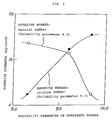
- rubber species which are different in chemical structures from the rubber species in the rubber compound may be used as an adhesive rubber provided that the adhesive rubber is close to the rubber species in polarity or more specifically in solubility parameter, since such adhesive rubbers are compatible to the substrate rubber species in the rubber compounds.
- the adhesive composition usually contains suitable vulcanizing agent depending upon the adhesive rubber used.
- solubility parameters there may be preferably used, as an adhesive rubber, such a rubber as has a solubility parameter in the range of from the solubility parameter of the rubber in the rubber compound plus one to the solubility parameter of the rubber in the rubber compound minus one.
- the adhesive composition further contains chlorinated natural rubber as a second adhesive rubber in amounts of 10-1000 parts by weight in relation to 100 parts by weight of the first adhesive rubber used in the composition.
- chlorinated natural rubber as an addtional adhesive rubber improves the compatibility of the adhesive composition to the mixture of the resorcinol/formalin resin and the halogen containing polymers, and raises cohesion of the resultant adhesive layers, thereby to successfully produce very strong and durable adhesion between the fibers and rubbers.
- the adhesive composition is used in the form of solutions in such organic solvents.
- the solvent used is not specifically limited, but there may be preferably used aromatic hydrocarbons such as benzene, xylene or toluene, aliphatic ketones such as methyl ethyl ketone or methyl isobutyl ketone, alkyl esters of lower aliphatic carboxylic acids, especially acetic acid, such as ethyl acetate or amyl acetate.
- the adhesive composition contains solids in amounts of 10-50 % by weight.
- the fibers are usually dipped into the solvent base adhesive composition, and then dried, preferably under heating at temperatures, for instance, of about 100-270°C, for several minutes to fix the composition on the fibers.
- the aromatic polyamide fibers may be pretreated with at least one activating agent selected from the group consisting of polyisocyanate compounds and polyepoxy compounds prior to the first step.
- the same polyisocyanate or polyepoxy compounds as those hereinbefore mentioned may be used as the activating agent in the pretreatment.
- the organic solvent used may also be the same as those mentioned hereinbefore.
- the content of the activating agent in the activating solution is usually in the range of 10-50 % by weight.
- the pretreatment of the fibers as above activates the surfaces of the aromatic polyamide fibers to improve the wettability of the fibers to the aqueous mixture of resorcinol/formlin resin and the halogen containing polymers applied to the fibers in the first step. Further, the activating agent fixed on the fibers reacts with methylol groups of the resorcinol/formalin resin applied to the fibers in the first step, or is resinated during the vulcanization of the rubber together With the fibers, thereby to form strong and durable adhesion between the fibers and the rubbers.
- the fibers are finally placed in close contact with rubber compounds or mixes in the third step, and the rubber compounds are vulcanized together with the fibers in conventional manners known in the rubbers used.
- the process of the invention is not specifically limited to rubbers to which the aromatic polyamide fibers are bonded, but is suitably applicable to such rubbers as natural rubber, styrene/butadiene rubber, chloroprene rubber, acrylonitrile/butadiene rubber, ethylene/propylene rubber, chlorinated polyethylene rubber, chlorosulfonated polyethylene rubber, epichlorohydrin rubber or fluorocarbon rubber.
- the process is most suitably applied to adhesion of the aromatic polyamide fibers to natural rubber, styrene/butadiene rubber, chloroprene rubber or acrylonitrile/butadiene rubber, however.
- the rubber compounds used may of course contain known rubber chemicals or additives depending upon the individual rubbers used. There may be mentioned as such chemicals or additives, for example, reinforcing fillers including carbon black or silica, softening agents, antioxidants, plasticizers, vucanization accelerators, processing aids and the like.
- the process of the invention thins provides aromatic polyamide fibers-rubber adherend composites which have strong and durable adhesion therebetween, and the process of the invention is suitably employed in the production of dynamic rubber products such as automobile tires, transmission belts or conveyor belts.
- PVC latex Polyvinyl chloride latex
- Zeon 150X50 (Nippon Zeon K.K.) having a solid content of 48 % by weight.
- the polyvinyl chloride had a chlorine content of 57 % by weight and a solubility parameter of 9.7.
- Chlorinated rubber latex Chlorinated rubber latex
- Chloroprene rubber latex Chloroprene rubber latex
- LV-60 (Denki Kagaku Kogyo K.K.) having a solid content of 50 % by weight.
- the chloroprene had a chlorine content of 41 % by weight and a solubility parameter of 9.2.
- Chlorosulfonated polyethylene rubber latex Chlorosulfonated polyethylene rubber latex
- Chlorosulfonated polyethylene rubber latex (Sumitomo Seika K.K.) having a solid content of 40 % by weight.
- the chlorosulfonated polyethylene had a chlorine content of 25 % by weight and a solubility parameter of 9.1.
- SBR latex Styrene/butadiene rubber latex
- Chloroprene rubber Chloroprene rubber
- Neoprene WRT Showa Denko K.K. having a solubility parameter of 9.2.
- Denacol EX 313 glycerol polyglycidyl ether, Nagase Kasei Kogyo K.K.
- Aromatic polyamide fiber cords ("Technola” by Teijin K.K., 1500D/1x3) were dipped into an aqueous mixture (a) as shown in the Table 1, and then dried at 200°C for two minutes.
- Example A and Comparative C as shown in the Table 1, the cords were dipped into an organic solvent base adhesive composition (b) of which ingredients are shown in the Table 1, and dried at 200°C for two minutes.
- the fiber cords were treated with the aqueous mixture (a), but not with the adhesive composition (b), and vulcanized with the rubber compound 1.
- the same aromatic polyamide fiber cords as in the Example 1 were dipped into an aqueous mixture (a) as shown in the Table 7, and then dried at 200°C for two minutes.
- the fiber cords were then dippied in the same aqueous mixture (b) as in the Example A in the Table 6, and dried at 200°C for two minutes.
- the fiber cords were then placed in close contact with the natural rubber compound 1, and the rubber compound was vulcanized at 150°C for 30 minutes.
- aromatic polyamide fiber cords are first treated with an aqueous mixture or an RFL solution containing a polyvinyl chloride latex or a chlorinated rubber latex, and then with an adhesive composition containing natural rubber as an adhesive rubber and a polyisocyanate as an activating agent, followed by vulcanizing with a rubber compound, to provide a natural rubber-fiber cords composite having strong adhesion therebetween.
- the same aromatic polyamide fiber cords as in the Example 1 were dipped into an aqueous mixture (a) as shown in the Table 8, and then dried at 200°C for two minutes.
- the fiber cords were then dippied in an adhesive composition (b) as shown in the Table 8, and dried at 200°C for two minutes.
- the fiber cords were treated with an aqueous mixture (a) and then with an adhesive composition (b) which contained natural rubber having a solubility parameter of 8.3.
- an adhesive composition (b) which contained natural rubber having a solubility parameter of 8.3.
- the compound 1 of natural rubber is bonded strongly to the fiber cords.
- natural rubber has a solubility parameter close to that of chloroprene rubber, the difference therebetween being 0.9, the chloroprene rubber compound 2 is firmly bonded to the fiber cords.
- nitrile rubber has a solubility parameter of 9.7, more than that of the natural rubber as an adhesive rubber by 1.4, so that no strong adhesion is obtained between the nitrile rubber compound 3 and the fiber cords.
- the fiber cords were treated with an adhesive composition containing a nitrile rubber having a solubility parameter of 9.7, while natural rubber has a solubility parameter of 8.3, the difference therebetween being 1.4. Therefore, no strong adhesion was attained between the natural rubber compound 1 and the fiber cords.
- chloroprene rubber has a solubility parameter of 9.2, close to that of the nitrile rubber, so that there is obtained strong adhesion between the chloprene rubber compound 2 and the fiber cords.
- the nitrile rubber compound 3 is firmly bonded to the fiber cords.
- the same aromatic polyamide fiber cords as in the Example 1 were dipped into an aqueous mixture (a) as shown in the Table 4, and then dried at 200°C for two minutes.
- the fiber cords were then dippied in an adhesive composition (b) as shown in the Table 4, and dried at 200°C for two minutes.
- the fiber cords were then placed in close contact with the natural rubber compound 1, and the rubber compound was vulcanized at 150°C for 30 minutes.
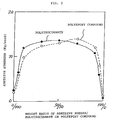
- the fiber cords were treated with adhesive compositions (b) having varied weight ratios of the adhesive rubbers/polyisocyanate or polyepoxy compounds used, and otherwise in the same manner as above, and the fiber cords were vulcanized with the natural rubber compound 1.
- Fig. 3 illustrates the relation between the weight ratios of adhesive rubbers/polyisocyanate or polyepoxy compounds and the adhesion strength of the resultant adherends.
- Table 4 Example A I Aqueous Mixture (a) Resorcinol 5.0 5.0 Formalin 3.1 3.1 PVC latex 61.6 61.6 Water 84.3 84.3 Adhesive Composition (b) Natural rubber 7.0 7.0 Millionate MR 7.0 - Polyepoxy compound - 7.0 Carbon black 3.0 3.0 Toluene 83.0 83.0 Adhesion Strength (Kg/cord) 13.7 13.1 Adhesion Failure R R
- the same aromatic polyamide fiber cords as in the Example 1 were dipped into an aqueous mixture (a) as shown in the Example A in the Table 6, and then dried at 200°C for two minutes.
- the fiber cords were then dippied in adhesive compositions (b) containing chlorinated natural rubber in varied amounts in relation to natural rubber, and dried at 200°C for two minutes.
- the fiber cords were then placed in close contact with the natural rubber compound 1, and the rubber compound was vulcanized at 150°C for 30 minutes.
- the same aromatic polyamide fiber cords as in the Example 1 were dipped into an an activation solution (c) as shown in the Table 5, and then dried at 200°C for two minutes.
- the fiber cords were then treated in the same manner as in the Example A of the Example 1 with the aqueous solution (a) and the adhesive composition (b) in succession.
- the fiber cords were then placed in close contact with the natural rubber compound 1, and the rubber compound was vulcanized at 150°C for 30 minutes.
Landscapes
- Chemical & Material Sciences (AREA)
- Engineering & Computer Science (AREA)
- Materials Engineering (AREA)
- Manufacturing & Machinery (AREA)
- Health & Medical Sciences (AREA)
- Chemical Kinetics & Catalysis (AREA)
- Medicinal Chemistry (AREA)
- Polymers & Plastics (AREA)
- Organic Chemistry (AREA)
- Treatments For Attaching Organic Compounds To Fibrous Goods (AREA)
- Adhesives Or Adhesive Processes (AREA)
- Manufacture Of Macromolecular Shaped Articles (AREA)
- Polyamides (AREA)
- Reinforced Plastic Materials (AREA)
Applications Claiming Priority (7)
| Application Number | Priority Date | Filing Date | Title |
|---|---|---|---|
| JP327235/88 | 1988-12-23 | ||
| JP32723588 | 1988-12-23 | ||
| JP32723488 | 1988-12-23 | ||
| JP327234/88 | 1988-12-23 | ||
| JP32723488A JPH02175974A (ja) | 1988-12-23 | 1988-12-23 | 芳香族ポリアミド繊維とゴム配合物との接着方法 |
| JP32723588A JPH02170830A (ja) | 1988-12-23 | 1988-12-23 | 芳香族ポリアミド繊維とゴム配合物との接着方法 |
| EP89313414A EP0376623B1 (de) | 1988-12-23 | 1989-12-21 | Verfahren zum Kleben von aromatischen Polyamidfasern an Gummimischungen |
Related Parent Applications (2)
| Application Number | Title | Priority Date | Filing Date |
|---|---|---|---|
| EP89313414A Division EP0376623B1 (de) | 1988-12-23 | 1989-12-21 | Verfahren zum Kleben von aromatischen Polyamidfasern an Gummimischungen |
| EP89313414.8 Division | 1989-12-21 |
Publications (3)
| Publication Number | Publication Date |
|---|---|
| EP0708134A2 true EP0708134A2 (de) | 1996-04-24 |
| EP0708134A3 EP0708134A3 (de) | 1996-10-23 |
| EP0708134B1 EP0708134B1 (de) | 2001-11-14 |
Family
ID=26572439
Family Applications (2)
| Application Number | Title | Priority Date | Filing Date |
|---|---|---|---|
| EP95118841A Expired - Lifetime EP0708134B1 (de) | 1988-12-23 | 1989-12-21 | Verfahren zum Kleben von aromatischen Polyamidfaser an Gummimischungen |
| EP89313414A Expired - Lifetime EP0376623B1 (de) | 1988-12-23 | 1989-12-21 | Verfahren zum Kleben von aromatischen Polyamidfasern an Gummimischungen |
Family Applications After (1)
| Application Number | Title | Priority Date | Filing Date |
|---|---|---|---|
| EP89313414A Expired - Lifetime EP0376623B1 (de) | 1988-12-23 | 1989-12-21 | Verfahren zum Kleben von aromatischen Polyamidfasern an Gummimischungen |
Country Status (5)
| Country | Link |
|---|---|
| US (3) | US5306369A (de) |
| EP (2) | EP0708134B1 (de) |
| AT (2) | ATE208801T1 (de) |
| CA (1) | CA2006403C (de) |
| DE (2) | DE68929346T2 (de) |
Cited By (2)
| Publication number | Priority date | Publication date | Assignee | Title |
|---|---|---|---|---|
| WO2006079297A1 (de) * | 2005-01-26 | 2006-08-03 | Interkordsa Gmbh | Hochhaftender kord |
| WO2023229559A1 (en) * | 2022-05-23 | 2023-11-30 | Kordsa Teknik Tekstil A.S. | Textile materials with high raw adhesion value and production method |
Families Citing this family (15)
| Publication number | Priority date | Publication date | Assignee | Title |
|---|---|---|---|---|
| ATE208801T1 (de) * | 1988-12-23 | 2001-11-15 | Bando Chemical Ind | Verfahren zum kleben von aromatischen polyamidfaser an gummimischungen |
| US5691415A (en) * | 1992-03-16 | 1997-11-25 | Tosoh Corporation | Reinforced elastic body and production process thereof |
| US5565507A (en) * | 1994-06-28 | 1996-10-15 | Milliken Research Corporation | Adhesive composition |
| KR100353910B1 (ko) * | 1994-11-04 | 2002-12-28 | 도소 가부시키가이샤 | 결합용처리제,처리된폴리에스테르섬유,탄성체및그것의제조방법 |
| JP3601550B2 (ja) * | 1995-06-07 | 2004-12-15 | 日本ゼオン株式会社 | 接着剤組成物およびゴムと繊維との複合体 |
| KR20000026308A (ko) * | 1998-10-20 | 2000-05-15 | 구광시 | 고무보강 섬유 처리용 접착제 조성물, 이를 처리한 고무보강용디프드 코오드 및 코오드지 |
| CN100359089C (zh) * | 1998-12-16 | 2008-01-02 | 三星皮带株式会社 | 将乙烯·α-烯烃橡胶组合物与纤维线粘合的方法及其所制的纤维线 |
| JP2003139198A (ja) * | 2001-01-26 | 2003-05-14 | Mitsuboshi Belting Ltd | 短繊維の接着処理方法及びゴム組成物並びに動力伝動用ベルト |
| GB2384780B (en) * | 2001-12-07 | 2005-12-07 | Thomas Swan & Company Ltd | A method and composition for bonding fibres to rubbers |
| US20040014389A1 (en) * | 2002-07-18 | 2004-01-22 | Judy Chu | Polychloprene composite having adhesive with copolymer of polychloroprene and dichlorobutadiene |
| US20070102115A1 (en) * | 2002-12-23 | 2007-05-10 | Jpmorgan Chase Bank, N.A. | Adhesion Between Textile Reinforcing Materials And Rubber |
| CN101133261A (zh) * | 2006-03-24 | 2008-02-27 | 阪东化学株式会社 | 传动带 |
| US8142316B2 (en) * | 2006-12-05 | 2012-03-27 | Veyance Technologies, Inc. | Power transmission belts |
| JP5391772B2 (ja) * | 2009-03-26 | 2014-01-15 | 富士ゼロックス株式会社 | 記録装置 |
| WO2019181726A1 (ja) * | 2018-03-23 | 2019-09-26 | バンドー化学株式会社 | 架橋ゴム組成物及びその製造方法 |
Family Cites Families (14)
| Publication number | Priority date | Publication date | Assignee | Title |
|---|---|---|---|---|
| US3190764A (en) * | 1961-06-28 | 1965-06-22 | Goodyear Tire & Rubber | Method of bonding a rubbery composition to a reinforcing element |
| US3577310A (en) * | 1966-10-14 | 1971-05-04 | Montedison Spa | Method of bonding olefin elastomer to textile fiber and product obtained |
| US3803035A (en) * | 1970-10-05 | 1974-04-09 | Goodyear Tire & Rubber | Epoxide finish additive |
| GB1541409A (en) * | 1975-04-25 | 1979-02-28 | Dunlop Ltd | Reinforced elastomeric articles |
| DE3043426A1 (de) * | 1980-11-18 | 1982-07-08 | Bayer Ag, 5090 Leverkusen | Verfahren zur impraegnierung von textilcorden |
| JPS58118332U (ja) * | 1982-02-05 | 1983-08-12 | 三ツ星ベルト株式会社 | 動力伝動用ベルト |
| US4448813A (en) * | 1982-09-20 | 1984-05-15 | The B. F. Goodrich Company | Preparation of cord for bonding to rubber |
| JPH0742448B2 (ja) * | 1985-03-12 | 1995-05-10 | 日本ゼオン株式会社 | ゴム配合物と繊維との接着方法 |
| US5151142A (en) * | 1986-01-13 | 1992-09-29 | Bridgestone Corporation | Heavy duty pneumatic radial tires using rubber reinforcing fiber cords with improved adhesion |
| US4933236A (en) * | 1986-06-23 | 1990-06-12 | Celanese Corporation | Polyester yarn and adhesively activated with a quaternary ammonium salt of a polyepoxide |
| JPS6387303A (ja) * | 1986-09-30 | 1988-04-18 | Toyo Tire & Rubber Co Ltd | 耐久性を改善した空気入りラジアルタイヤ |
| US4978409A (en) * | 1988-07-06 | 1990-12-18 | Bando Chemical Industries, Ltd. | Method of bonding fibers to hydrogenated nitrile rubber |
| ATE208801T1 (de) * | 1988-12-23 | 2001-11-15 | Bando Chemical Ind | Verfahren zum kleben von aromatischen polyamidfaser an gummimischungen |
| US5118545A (en) * | 1990-03-05 | 1992-06-02 | The Goodyear Tire & Rubber Company | Adhesion of aramid cord to rubber |
-
1989
- 1989-12-21 AT AT95118841T patent/ATE208801T1/de not_active IP Right Cessation
- 1989-12-21 EP EP95118841A patent/EP0708134B1/de not_active Expired - Lifetime
- 1989-12-21 DE DE68929346T patent/DE68929346T2/de not_active Expired - Fee Related
- 1989-12-21 AT AT89313414T patent/ATE140944T1/de not_active IP Right Cessation
- 1989-12-21 CA CA002006403A patent/CA2006403C/en not_active Expired - Fee Related
- 1989-12-21 DE DE68926908T patent/DE68926908T2/de not_active Expired - Fee Related
- 1989-12-21 EP EP89313414A patent/EP0376623B1/de not_active Expired - Lifetime
-
1992
- 1992-07-13 US US07/911,377 patent/US5306369A/en not_active Expired - Fee Related
-
1993
- 1993-12-06 US US08/161,486 patent/US5484497A/en not_active Expired - Fee Related
-
1995
- 1995-12-04 US US08/566,510 patent/US5728245A/en not_active Expired - Fee Related
Cited By (2)
| Publication number | Priority date | Publication date | Assignee | Title |
|---|---|---|---|---|
| WO2006079297A1 (de) * | 2005-01-26 | 2006-08-03 | Interkordsa Gmbh | Hochhaftender kord |
| WO2023229559A1 (en) * | 2022-05-23 | 2023-11-30 | Kordsa Teknik Tekstil A.S. | Textile materials with high raw adhesion value and production method |
Also Published As
| Publication number | Publication date |
|---|---|
| ATE140944T1 (de) | 1996-08-15 |
| DE68929346D1 (de) | 2001-12-20 |
| US5484497A (en) | 1996-01-16 |
| EP0708134A3 (de) | 1996-10-23 |
| EP0376623B1 (de) | 1996-07-31 |
| EP0708134B1 (de) | 2001-11-14 |
| EP0376623A2 (de) | 1990-07-04 |
| CA2006403C (en) | 1999-05-11 |
| US5728245A (en) | 1998-03-17 |
| DE68926908D1 (de) | 1996-09-05 |
| ATE208801T1 (de) | 2001-11-15 |
| DE68926908T2 (de) | 1997-03-06 |
| DE68929346T2 (de) | 2002-08-08 |
| US5306369A (en) | 1994-04-26 |
| EP0376623A3 (de) | 1991-07-31 |
| CA2006403A1 (en) | 1990-06-23 |
Similar Documents
| Publication | Publication Date | Title |
|---|---|---|
| EP0376623B1 (de) | Verfahren zum Kleben von aromatischen Polyamidfasern an Gummimischungen | |
| CA1322445C (en) | Method of bonding fibers to hydrogenated nitrile rubber | |
| US3036948A (en) | Adhesion of polyester fiber directly to butyl rubber by means of epoxy resin | |
| US4935297A (en) | Rubber-reinforcing fibrous materials | |
| EP0194678B1 (de) | Verfahren zum Verbinden von Gummi und Fasern | |
| US5626953A (en) | Fiber-reinforced elastic body and power transmission belt using the same | |
| JPH0912997A (ja) | 接着剤組成物 | |
| WO1995022576A1 (en) | Adhesion system | |
| JPH02170830A (ja) | 芳香族ポリアミド繊維とゴム配合物との接着方法 | |
| JP3090185B2 (ja) | ゴム/コード複合体 | |
| US5691415A (en) | Reinforced elastic body and production process thereof | |
| JPH042605B2 (de) | ||
| JPH0633340B2 (ja) | 芳香族ポリアミド繊維とゴム配合物との接着方法 | |
| JP3030466B2 (ja) | 芳香族ポリアミド繊維とゴム配合物との接着方法 | |
| JP3008373B2 (ja) | 繊維とゴム配合物との接着方法 | |
| US3837993A (en) | Adhesion of textiles to rubber | |
| JPH0218426A (ja) | 水素化ニトリルゴム配合物と繊維との接着方法 | |
| JP2998134B2 (ja) | 芳香族ポリアミド繊維とゴム配合物との接着方法 | |
| JP2005213412A (ja) | ゴム・繊維複合体 | |
| JP3212794B2 (ja) | 高圧ホース用ポリエステル繊維の接着処理法 | |
| JPH03227456A (ja) | 芳香族ポリアミド繊維の処理方法 | |
| JPH0641526B2 (ja) | 水素化ニトリルゴム配合物と繊維との接着方法 | |
| JPH07258975A (ja) | 高圧ホース用ポリエステル繊維の接着処理法 | |
| JPH07216755A (ja) | ポリエステル繊維とエチレンプロピレン系ゴムとの接着処理法 | |
| JPH10280280A (ja) | ポリエステル繊維の接着処理方法 |
Legal Events
| Date | Code | Title | Description |
|---|---|---|---|
| PUAI | Public reference made under article 153(3) epc to a published international application that has entered the european phase |
Free format text: ORIGINAL CODE: 0009012 |
|
| AC | Divisional application: reference to earlier application |
Ref document number: 376623 Country of ref document: EP |
|
| AK | Designated contracting states |
Kind code of ref document: A2 Designated state(s): AT DE FR GB IT |
|
| PUAL | Search report despatched |
Free format text: ORIGINAL CODE: 0009013 |
|
| AK | Designated contracting states |
Kind code of ref document: A3 Designated state(s): AT DE FR GB IT |
|
| 17P | Request for examination filed |
Effective date: 19970124 |
|
| 17Q | First examination report despatched |
Effective date: 20000218 |
|
| GRAG | Despatch of communication of intention to grant |
Free format text: ORIGINAL CODE: EPIDOS AGRA |
|
| GRAG | Despatch of communication of intention to grant |
Free format text: ORIGINAL CODE: EPIDOS AGRA |
|
| GRAH | Despatch of communication of intention to grant a patent |
Free format text: ORIGINAL CODE: EPIDOS IGRA |
|
| GRAH | Despatch of communication of intention to grant a patent |
Free format text: ORIGINAL CODE: EPIDOS IGRA |
|
| GRAA | (expected) grant |
Free format text: ORIGINAL CODE: 0009210 |
|
| AC | Divisional application: reference to earlier application |
Ref document number: 376623 Country of ref document: EP |
|
| AK | Designated contracting states |
Kind code of ref document: B1 Designated state(s): AT DE FR GB IT |
|
| PG25 | Lapsed in a contracting state [announced via postgrant information from national office to epo] |
Ref country code: AT Free format text: LAPSE BECAUSE OF FAILURE TO SUBMIT A TRANSLATION OF THE DESCRIPTION OR TO PAY THE FEE WITHIN THE PRESCRIBED TIME-LIMIT Effective date: 20011114 |
|
| REF | Corresponds to: |
Ref document number: 208801 Country of ref document: AT Date of ref document: 20011115 Kind code of ref document: T |
|
| REF | Corresponds to: |
Ref document number: 68929346 Country of ref document: DE Date of ref document: 20011220 |
|
| REG | Reference to a national code |
Ref country code: GB Ref legal event code: IF02 |
|
| PLBE | No opposition filed within time limit |
Free format text: ORIGINAL CODE: 0009261 |
|
| STAA | Information on the status of an ep patent application or granted ep patent |
Free format text: STATUS: NO OPPOSITION FILED WITHIN TIME LIMIT |
|
| 26N | No opposition filed | ||
| PGFP | Annual fee paid to national office [announced via postgrant information from national office to epo] |
Ref country code: GB Payment date: 20021218 Year of fee payment: 14 |
|
| PGFP | Annual fee paid to national office [announced via postgrant information from national office to epo] |
Ref country code: FR Payment date: 20021223 Year of fee payment: 14 |
|
| PGFP | Annual fee paid to national office [announced via postgrant information from national office to epo] |
Ref country code: DE Payment date: 20021231 Year of fee payment: 14 |
|
| PG25 | Lapsed in a contracting state [announced via postgrant information from national office to epo] |
Ref country code: GB Free format text: LAPSE BECAUSE OF NON-PAYMENT OF DUE FEES Effective date: 20031221 |
|
| PG25 | Lapsed in a contracting state [announced via postgrant information from national office to epo] |
Ref country code: DE Free format text: LAPSE BECAUSE OF NON-PAYMENT OF DUE FEES Effective date: 20040701 |
|
| GBPC | Gb: european patent ceased through non-payment of renewal fee |
Effective date: 20031221 |
|
| PG25 | Lapsed in a contracting state [announced via postgrant information from national office to epo] |
Ref country code: FR Free format text: LAPSE BECAUSE OF NON-PAYMENT OF DUE FEES Effective date: 20040831 |
|
| REG | Reference to a national code |
Ref country code: FR Ref legal event code: ST |
|
| PG25 | Lapsed in a contracting state [announced via postgrant information from national office to epo] |
Ref country code: IT Free format text: LAPSE BECAUSE OF NON-PAYMENT OF DUE FEES;WARNING: LAPSES OF ITALIAN PATENTS WITH EFFECTIVE DATE BEFORE 2007 MAY HAVE OCCURRED AT ANY TIME BEFORE 2007. THE CORRECT EFFECTIVE DATE MAY BE DIFFERENT FROM THE ONE RECORDED. Effective date: 20051221 |