EP0708166A1 - Verfahren und Vorrichtung zur Neutralisation von sauren Gasen und zur Beseitigung von Abfall - Google Patents
Verfahren und Vorrichtung zur Neutralisation von sauren Gasen und zur Beseitigung von Abfall Download PDFInfo
- Publication number
- EP0708166A1 EP0708166A1 EP95402224A EP95402224A EP0708166A1 EP 0708166 A1 EP0708166 A1 EP 0708166A1 EP 95402224 A EP95402224 A EP 95402224A EP 95402224 A EP95402224 A EP 95402224A EP 0708166 A1 EP0708166 A1 EP 0708166A1
- Authority
- EP
- European Patent Office
- Prior art keywords
- waste
- calcium carbonate
- treated
- acid gases
- synthetic
- Prior art date
- Legal status (The legal status is an assumption and is not a legal conclusion. Google has not performed a legal analysis and makes no representation as to the accuracy of the status listed.)
- Withdrawn
Links
- 0 C1C2=*CC1*2 Chemical compound C1C2=*CC1*2 0.000 description 1
Images
Classifications
-
- C—CHEMISTRY; METALLURGY
- C10—PETROLEUM, GAS OR COKE INDUSTRIES; TECHNICAL GASES CONTAINING CARBON MONOXIDE; FUELS; LUBRICANTS; PEAT
- C10B—DESTRUCTIVE DISTILLATION OF CARBONACEOUS MATERIALS FOR PRODUCTION OF GAS, COKE, TAR, OR SIMILAR MATERIALS
- C10B53/00—Destructive distillation, specially adapted for particular solid raw materials or solid raw materials in special form
- C10B53/07—Destructive distillation, specially adapted for particular solid raw materials or solid raw materials in special form of solid raw materials consisting of synthetic polymeric materials, e.g. tyres
-
- C—CHEMISTRY; METALLURGY
- C10—PETROLEUM, GAS OR COKE INDUSTRIES; TECHNICAL GASES CONTAINING CARBON MONOXIDE; FUELS; LUBRICANTS; PEAT
- C10B—DESTRUCTIVE DISTILLATION OF CARBONACEOUS MATERIALS FOR PRODUCTION OF GAS, COKE, TAR, OR SIMILAR MATERIALS
- C10B1/00—Retorts
- C10B1/10—Rotary retorts
-
- C—CHEMISTRY; METALLURGY
- C10—PETROLEUM, GAS OR COKE INDUSTRIES; TECHNICAL GASES CONTAINING CARBON MONOXIDE; FUELS; LUBRICANTS; PEAT
- C10B—DESTRUCTIVE DISTILLATION OF CARBONACEOUS MATERIALS FOR PRODUCTION OF GAS, COKE, TAR, OR SIMILAR MATERIALS
- C10B53/00—Destructive distillation, specially adapted for particular solid raw materials or solid raw materials in special form
-
- Y—GENERAL TAGGING OF NEW TECHNOLOGICAL DEVELOPMENTS; GENERAL TAGGING OF CROSS-SECTIONAL TECHNOLOGIES SPANNING OVER SEVERAL SECTIONS OF THE IPC; TECHNICAL SUBJECTS COVERED BY FORMER USPC CROSS-REFERENCE ART COLLECTIONS [XRACs] AND DIGESTS
- Y02—TECHNOLOGIES OR APPLICATIONS FOR MITIGATION OR ADAPTATION AGAINST CLIMATE CHANGE
- Y02P—CLIMATE CHANGE MITIGATION TECHNOLOGIES IN THE PRODUCTION OR PROCESSING OF GOODS
- Y02P20/00—Technologies relating to chemical industry
- Y02P20/141—Feedstock
- Y02P20/143—Feedstock the feedstock being recycled material, e.g. plastics
Definitions
- the present invention relates to the treatment of synthesis products and the neutralization of acid gases resulting from a thermal treatment of waste.
- the invention finds applications in particular in devices making it possible to neutralize acid gases, such as hydrogen chloride, hydrogen fluoride, hydrogen sulfide and / or sulfur oxides, involving a thermal operation.
- acid gases such as hydrogen chloride, hydrogen fluoride, hydrogen sulfide and / or sulfur oxides
- thermolysis The thermal treatment of waste and in particular its thermolysis is a technique which has significant economic advantages. It allows, in particular, to treat any type of non-hazardous waste, preferably solid and heterogeneous.
- This waste is primarily household waste, but also industrial waste, automobile shredder residue, used tires, plastic waste, industrial sludge or from sewage treatment plant ...
- This waste contains chemical compounds rich in chlorine, fluorine and sulfur, which during their decomposition under the action of heat mainly form acid gases.
- waste rich in synthetic chemical compounds such as plastics (PVC, for example)
- elastomers are responsible for the emission of acid gases which are considered to be very corrosive polluting gases. These gases can cause major corrosion problems, especially in exposed parts of thermal waste treatment facilities.
- waste of materials associating an organic part and a mineral part rich in calcium carbonate or its derivatives have a preponderant place.
- calcium carbonate constitutes the largest class of mineral filler used today industrially to modify the properties of materials.
- the automotive industry for example, uses materials made of polyester resin, fiberglass, and calcium carbonate to make certain parts.
- thermoplastics such as thermoplastics, thermosets or elastomers
- mineral fillers such as calcium carbonate
- thermolysis devices which treat acid gases by achieving thermal degradation of the waste in the absence of oxygen at a temperature for example between 200 and 700 ° C, said thermal degradation leading to the formation of a combustible gas and a carbon-rich solid.
- all or part of the combustible gases thus formed is used to heat the oven, while the solid residue undergoes a purification treatment aimed at eliminating certain pollutants and improving its quality by reducing its ash rate. .
- the treatment processes used to neutralize the acid gases are separated into two main categories, the so-called dry or semi-dry processes and the so-called wet processes.
- waste materials associating an organic part and a mineral part rich in calcium carbonate in a thermolysis process makes it possible to carry out simultaneously the following two operations: the neutralization of acid gases and the elimination of waste materials.
- waste relates to the waste to be treated likely to form harmful gases, such as acid gases during a thermolysis process
- synthetic product designates waste of materials comprising at least one organic part and one mineral part rich in calcium carbonate.
- the present invention relates to a process making it possible to eliminate a synthetic product comprising at least calcium carbonate and / or one of its derivatives and to neutralize acid gases resulting from the thermolysis of waste to be treated. It is characterized in that it comprises at least one step during which the mixture consisting of waste to be treated and at least one synthetic product comprising an organic part and a mineral part rich in calcium carbonate is subjected to a heat treatment step at a temperature between 200 and 1500 ° C., during which the acid gases generated by the waste to be treated are neutralized by calcium carbonate and the organic part of the synthesis product is destroyed at least in part under the action of heat.
- the reaction temperature is preferably between 500 and 700 ° C.
- Synthetic products such as waste materials are used, the organic part of which consists of one or more synthetic polymers.
- the synthetic product can comprise an organic part consisting of a polyester resin and glass fibers, in combination with the mineral part rich in calcium carbonate.
- a composite material from the manufacture of "SMC-Sheet Molding Compound” comprising polyester resin, glass fibers and calcium carbonate.
- the present invention also relates to a device for neutralizing acid gases from waste to be treated and destroying or eliminating at least one waste of material comprising an inorganic part rich in calcium carbonate and / or one of its derivatives and an organic part. It is characterized in that it comprises in combination a heat treatment enclosure, and means for mixing the waste to be treated with at least one waste of material.
- the device may include means for controlling and regulating the operating conditions of the heat treatment.
- the mixing means is, for example, a twin worm device, positioned just before the heat treatment enclosure and penetrating at least partially into said enclosure.
- the mixing means can also be a rotating cylinder equipped with blades.
- waste materials from various industries have zero or even negative costs, and their use eliminates all problem relating to their elimination, their storage or their treatment carried out in most cases by operations often complex and expensive.
- Such a material consists of at least one synthetic polymer whose properties have been modified by mineral fillers, and more specifically comprises a polyester resin, glass fibers and calcium carbonate.
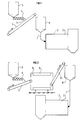
- the device comprises an arrival line 1 of the waste to be treated in a storage capacity 6, adapted to allow its mixing with a waste of material from a hopper 3 whose distribution to line 1 is controlled by means 4 such as a screw metering device or a rotary valve or any other equivalent device known to those skilled in the art.
- the finish line 1 can be a conveyor belt, a bucket elevator or any other equivalent device.
- the material is, for example dispersed thanks to an appropriate means 5, towards the waste to be treated and mixed with the latter due to the movement on the carpet.
- the mixture of waste material and waste to be treated introduced into storage capacity 6 is sent to a thermolysis oven 2 using a line 7.
- thermolysis oven is equipped with temperature sensors Ct to control, preferably permanently, the temperature prevailing in the thermolysis oven and regulate the progress of the operations for neutralization of acid gases and destruction or elimination of material waste.
- sensors in a manner known to those skilled in the art, can be connected to a microcontroller adapted to receive signals, to process them and to generate, if necessary, signals to devices for regulating the temperature of the oven and / or dosing of waste material to be mixed with waste to be treated. In this way it is possible to control the operating conditions of the thermal reaction and the quantity of the elements, namely the waste of material and the waste to be treated, participating in this reaction.
- thermolysis reaction is carried out on the waste material / waste mixture to be treated, which makes it possible to obtain neutralization of the acid gases generated by the thermal decomposition of the waste to be treated and simultaneously, the destruction or elimination of the waste of composite material used for its absorbent properties.
- the polluting acid gases are, for example, trapped by the mineral part rich in calcium carbonate of the material waste and remain in the thermolysis furnace, while the organic part of the material waste is partially or totally destroyed by the action of heat.
- the temperature prevailing in the thermolysis oven is, for example between 200 and 1500 ° C and, preferably, between 400 and 700 ° C.
- the synthetic products used to neutralize acid gases are generally waste materials to be eliminated because of their polluting nature. They comprise at least one mineral part rich in calcium carbonate and / or one of its derivatives, and an organic part. They may also include other elements, preferably in small quantities, which have the particularity of being destroyed, for example under the action of heat under conditions substantially identical to those required for the organic part when they exhibit harmful properties.
- the proportion of the mineral part can be between 10 and 50%.
- Synthetic products such as waste materials are used, the organic part of which consists of one or more synthetic polymers.
- the synthetic product can comprise an organic part consisting of a polyester resin and glass fibers, in combination with the mineral part rich in calcium carbonate.
- the waste material can be used alone or mixed with other waste materials having substantially identical characteristics, this waste being preferably compatible with each other so that their mixture does not destroy the characteristics necessary for the neutralization of acid gases and the destruction or elimination of the complementary part not used to neutralize these acid gases, for example the organic part.
- It can be in different forms, for example in the form of paste, liquid or solids, preferably of small size, so as to allow the product to be mixed with the waste to be treated.
- FIGS. 2 and 3 make it possible to increase the yield of the device of FIG. 1, in particular by improving the mixture formed of the material to be destroyed and the waste to be treated, and possibly optimizing the ratio of waste to be treated / waste of material to be eliminated.
- the waste material / waste mixture to be treated in motion on the conveyor belt 1 is introduced into a device 8 adapted to ensure efficient mixing of the waste material / waste mixture to be treated.
- This device 8 is, for example, a rotating cylinder equipped with vanes 9 positioned according to the generatrices of the cylinder. This improves the waste material / waste mixture to be treated and facilitates its progression in the rotating cylinder.
- the axis of the cylinder can be slightly inclined relative to a horizontal plane to facilitate the movement of the waste to be treated and the waste of material to be eliminated.
- the rotation of the cylinder and the blades is, for example, ensured by a motor not shown in the figure or any other suitable means.
- the optimized mixture is then sent via a line 10 to the storage capacity 6 before being introduced into the thermolysis furnace 2 via line 7 where the acid gases are partially or totally neutralized by the mineral charge of the waste material , more particularly by calcium carbonate and the organic part of the waste material is destroyed under the action of the heat prevailing in the furnace.
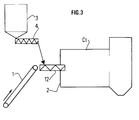
- FIG. 3 Another way of proceeding shown diagrammatically in FIG. 3 consists in using a screw mixing device 12 which optimizes the mixing of the waste to be treated and the composite material, the device being preferably positioned directly before the thermolysis oven 2 and capable of play the role of mixer and of means for introducing the mixture because it penetrates at least partially into the oven.
- This mixing device advantageously consists of one or more twin screws, preferably endless screws.
- the mixture of the waste to be treated with the waste of material to be removed from the mixer 12 enters the thermolysis furnace 2 where the acid gases are neutralized by calcium carbonate or calcium part of the mineral charge of the waste material while the part organic of the latter is destroyed under the effect of temperature.
- the device 12 also makes it possible to control the quantity of the synthesis product introduced into the thermolysis oven.
- the synthetic product used to carry out the process comes from the automotive industry. It is composed of 30% glass fibers, 30% organic polyester resin and 40% calcium carbonate, these three parts being intimately mixed.
- the waste of this product therefore contains 30% of organic matter which should be eliminated, and 40% of matters rich in calcium carbonate which are used to neutralize the acid gases produced by the thermal treatment of waste.
- This synthetic product is used for example to neutralize hydrochloric acid produced by the thermolysis of household waste.
- the temperature regulation advantageously makes it possible to maintain the temperature in the oven 2 at 550 ° C. Under these temperature conditions, the organic part of household waste decomposes and releases acid gases such as hydrochloric acid which react with calcium carbonate, or one of its derivatives, the latter being released by the thermal decomposition of the organic part of the synthesis product and are therefore fixed in the solid residues of the heat treatment.
- acid gases such as hydrochloric acid which react with calcium carbonate, or one of its derivatives
- the capture efficiency of acid gases is thus significantly improved, and goes from 90% before introduction of the synthesis product to 99.5% in the presence of the synthesis product.
Landscapes
- Chemical & Material Sciences (AREA)
- Engineering & Computer Science (AREA)
- Oil, Petroleum & Natural Gas (AREA)
- Materials Engineering (AREA)
- Organic Chemistry (AREA)
- Processing Of Solid Wastes (AREA)
- Treating Waste Gases (AREA)
- Separation, Recovery Or Treatment Of Waste Materials Containing Plastics (AREA)
Applications Claiming Priority (2)
| Application Number | Priority Date | Filing Date | Title |
|---|---|---|---|
| FR9412049 | 1994-10-06 | ||
| FR9412049A FR2725387B1 (fr) | 1994-10-06 | 1994-10-06 | Procede et dispositif de neutralisation de gaz acides et d'elimination de dechets |
Publications (1)
| Publication Number | Publication Date |
|---|---|
| EP0708166A1 true EP0708166A1 (de) | 1996-04-24 |
Family
ID=9467702
Family Applications (1)
| Application Number | Title | Priority Date | Filing Date |
|---|---|---|---|
| EP95402224A Withdrawn EP0708166A1 (de) | 1994-10-06 | 1995-10-05 | Verfahren und Vorrichtung zur Neutralisation von sauren Gasen und zur Beseitigung von Abfall |
Country Status (2)
| Country | Link |
|---|---|
| EP (1) | EP0708166A1 (de) |
| FR (1) | FR2725387B1 (de) |
Citations (7)
| Publication number | Priority date | Publication date | Assignee | Title |
|---|---|---|---|---|
| US3984288A (en) * | 1974-10-04 | 1976-10-05 | Sumitomo Electric Industries, Ltd. | Method for treatment of rubber and plastic wastes |
| GB1569152A (en) * | 1976-11-19 | 1980-06-11 | Procedyne Co | Use of neutralizing solids or gases in the fluidise bed cleaning of contaminated piece parts |
| EP0446930A1 (de) * | 1990-03-14 | 1991-09-18 | Wayne Technologies | Pyrolitisches Konvertierungssystem |
| EP0485255A1 (de) * | 1990-11-07 | 1992-05-13 | Institut Français du Pétrole | Verfahren und Vorrichtung zur Herstellung von einem festen Brennstoff ausgehend von brennbaren Abfällen |
| US5129995A (en) * | 1990-02-01 | 1992-07-14 | General Motors Corporation | Pyrolysis process and apparatus |
| EP0522919A1 (de) * | 1991-07-09 | 1993-01-13 | Institut Français du Pétrole | Verfahren und Einrichtung für die Thermolyse von Industrie- und/oder Haushaltsmüll |
| US5244490A (en) * | 1992-05-07 | 1993-09-14 | General Motors Corporation | Iron making method using waste polymer material |
-
1994
- 1994-10-06 FR FR9412049A patent/FR2725387B1/fr not_active Expired - Fee Related
-
1995
- 1995-10-05 EP EP95402224A patent/EP0708166A1/de not_active Withdrawn
Patent Citations (7)
| Publication number | Priority date | Publication date | Assignee | Title |
|---|---|---|---|---|
| US3984288A (en) * | 1974-10-04 | 1976-10-05 | Sumitomo Electric Industries, Ltd. | Method for treatment of rubber and plastic wastes |
| GB1569152A (en) * | 1976-11-19 | 1980-06-11 | Procedyne Co | Use of neutralizing solids or gases in the fluidise bed cleaning of contaminated piece parts |
| US5129995A (en) * | 1990-02-01 | 1992-07-14 | General Motors Corporation | Pyrolysis process and apparatus |
| EP0446930A1 (de) * | 1990-03-14 | 1991-09-18 | Wayne Technologies | Pyrolitisches Konvertierungssystem |
| EP0485255A1 (de) * | 1990-11-07 | 1992-05-13 | Institut Français du Pétrole | Verfahren und Vorrichtung zur Herstellung von einem festen Brennstoff ausgehend von brennbaren Abfällen |
| EP0522919A1 (de) * | 1991-07-09 | 1993-01-13 | Institut Français du Pétrole | Verfahren und Einrichtung für die Thermolyse von Industrie- und/oder Haushaltsmüll |
| US5244490A (en) * | 1992-05-07 | 1993-09-14 | General Motors Corporation | Iron making method using waste polymer material |
Also Published As
| Publication number | Publication date |
|---|---|
| FR2725387A1 (fr) | 1996-04-12 |
| FR2725387B1 (fr) | 1996-12-27 |
Similar Documents
| Publication | Publication Date | Title |
|---|---|---|
| EP0687692A1 (de) | Verarbeitung von chlorhaltigen Polymerabfällen | |
| KR100766131B1 (ko) | 폐기 플라스틱의 재이용 방법 및 성형 방법 | |
| CN1133569A (zh) | 减少酸的排放 | |
| FR2509634A1 (fr) | Procede de destruction de produits a base de matieres organiques contenant du soufre et/ou des halogenes et applications de celui-ci | |
| US4834003A (en) | Combustion of aqueous sewage sludge by the fluidized bed process | |
| JPH05507749A (ja) | 有機廃棄物を活用する方法およびこの方法を実施する為の装置 | |
| EP4222220A1 (de) | Verfahren zur reifensololysierung mit recycling einer kohlenwasserstofffraktion mit aromatischen verbindungen | |
| KR101760049B1 (ko) | 충전제에 의한 중화 | |
| EP0743079B1 (de) | Verfahren zur Behandlung von schädlichen Metallen enthaltenden Flugstäuben von Müllverbrennungsanlagen | |
| EP2066820B1 (de) | Verfahren zur wärmebehandlung von durch organische verbindungen kontaminierten metallhaltigen rückständen | |
| FR2725387A1 (fr) | Procede et dispositif de neutralisation de gaz acides et d'elimination de dechets | |
| FR3134106A1 (fr) | Noir de carbone recupere obtenu par solvolyse de pneus | |
| EP0797496B1 (de) | Verfahren zur wiederverwendung von verbundwerkstoffen | |
| EP2438142B1 (de) | Verfahren zur kautschukgranulatumwandlung zur herstellung eines halbaktiven karbonisierten stoffes und weichmacher | |
| EP0709125A1 (de) | Verfahren und Vorrichtung zur Neutralisierung von sauren Gasen | |
| EP0921352B1 (de) | Verfahren für Verbrennung von Abfällen und Behandlung von Flugstäuben und Vorrichtung zur Durchführung des Verfahrens | |
| JP7725112B1 (ja) | 固形燃料の製造方法 | |
| EP0970940B1 (de) | Verfahren zur Rückgewinnung von Produkten enthalten in den Schwer-Nebenprodukten aus ihrer Herstellung | |
| FR3163653A1 (fr) | Procédé de récupération de noir de carbone par solvolyse d’élastomères usagés | |
| JP3393967B2 (ja) | プラスチック廃棄物の処理方法および処理装置 | |
| BE1009672A3 (fr) | Procede de distillation et de sechage de vieux solvants. | |
| TW202609032A (zh) | 廢塑膠的處理方法 | |
| WO2025099039A1 (en) | Process for the depolymerization of plastic waste material | |
| CH409893A (fr) | Procédé de fabrication de noir de carbone | |
| WO2026082776A1 (en) | Chemical recycling process for converting contaminated plastic wastes into valuable products |
Legal Events
| Date | Code | Title | Description |
|---|---|---|---|
| PUAI | Public reference made under article 153(3) epc to a published international application that has entered the european phase |
Free format text: ORIGINAL CODE: 0009012 |
|
| AK | Designated contracting states |
Kind code of ref document: A1 Designated state(s): DE ES FR IT |
|
| 17P | Request for examination filed |
Effective date: 19961024 |
|
| 17Q | First examination report despatched |
Effective date: 19990618 |
|
| STAA | Information on the status of an ep patent application or granted ep patent |
Free format text: STATUS: THE APPLICATION IS DEEMED TO BE WITHDRAWN |
|
| 18D | Application deemed to be withdrawn |
Effective date: 19991029 |