EP0708775B1 - TRICYCLISCHE INHIBITOREN VON GP II b III a REZEPTOREN - Google Patents
TRICYCLISCHE INHIBITOREN VON GP II b III a REZEPTOREN Download PDFInfo
- Publication number
- EP0708775B1 EP0708775B1 EP94923512A EP94923512A EP0708775B1 EP 0708775 B1 EP0708775 B1 EP 0708775B1 EP 94923512 A EP94923512 A EP 94923512A EP 94923512 A EP94923512 A EP 94923512A EP 0708775 B1 EP0708775 B1 EP 0708775B1
- Authority
- EP
- European Patent Office
- Prior art keywords
- alkyl
- aryl
- benzodiazepine
- methyl
- oxo
- Prior art date
- Legal status (The legal status is an assumption and is not a legal conclusion. Google has not performed a legal analysis and makes no representation as to the accuracy of the status listed.)
- Expired - Lifetime
Links
- 0 C*N1*=CNC1 Chemical compound C*N1*=CNC1 0.000 description 19
- VZPWIVYDRJFULU-UHFFFAOYSA-N CC#Cc1ccc(C(N)N)cc1 Chemical compound CC#Cc1ccc(C(N)N)cc1 VZPWIVYDRJFULU-UHFFFAOYSA-N 0.000 description 1
- KNGFTOMXAGSFCY-UHFFFAOYSA-N CC(C(OC(N)OC(C)=O)=O)(N)N Chemical compound CC(C(OC(N)OC(C)=O)=O)(N)N KNGFTOMXAGSFCY-UHFFFAOYSA-N 0.000 description 1
- XZUKYLJFQLMFFR-UHFFFAOYSA-N CC(C(c(nc1)ccc1C(N)=N)O)O Chemical compound CC(C(c(nc1)ccc1C(N)=N)O)O XZUKYLJFQLMFFR-UHFFFAOYSA-N 0.000 description 1
- WYBDGIMEBSDRMD-UHFFFAOYSA-N CC(Nc(cc1)ccc1C(N)=N)=O Chemical compound CC(Nc(cc1)ccc1C(N)=N)=O WYBDGIMEBSDRMD-UHFFFAOYSA-N 0.000 description 1
- OJRMFGGWAFFJOO-UHFFFAOYSA-N CC(Nc(cc1)ncc1C(N)=N)=O Chemical compound CC(Nc(cc1)ncc1C(N)=N)=O OJRMFGGWAFFJOO-UHFFFAOYSA-N 0.000 description 1
- WGQOFCYEJSNWDF-UHFFFAOYSA-N CC(Nc1ccc(C(N)N)cc1)=O Chemical compound CC(Nc1ccc(C(N)N)cc1)=O WGQOFCYEJSNWDF-UHFFFAOYSA-N 0.000 description 1
- HFTAZLDXKDBCSA-UHFFFAOYSA-N CC(OC(NC)OC(N)=O)=O Chemical compound CC(OC(NC)OC(N)=O)=O HFTAZLDXKDBCSA-UHFFFAOYSA-N 0.000 description 1
- GOLSFPMYASLXJC-UHFFFAOYSA-N CC(OCCN(C)C)=O Chemical compound CC(OCCN(C)C)=O GOLSFPMYASLXJC-UHFFFAOYSA-N 0.000 description 1
- HBVZRPAKZOLBPL-UHFFFAOYSA-N CC(OCCN)=O Chemical compound CC(OCCN)=O HBVZRPAKZOLBPL-UHFFFAOYSA-N 0.000 description 1
- ZDTRMJAWAIZCSV-UHFFFAOYSA-N CC(OCCN1CCOCC1)=O Chemical compound CC(OCCN1CCOCC1)=O ZDTRMJAWAIZCSV-UHFFFAOYSA-N 0.000 description 1
- FPXVLCLVAIUGPW-UHFFFAOYSA-N CC(OCc1cccnc1)=O Chemical compound CC(OCc1cccnc1)=O FPXVLCLVAIUGPW-UHFFFAOYSA-N 0.000 description 1
- IPBVNPXQWQGGJP-UHFFFAOYSA-N CC(Oc1ccccc1)=O Chemical compound CC(Oc1ccccc1)=O IPBVNPXQWQGGJP-UHFFFAOYSA-N 0.000 description 1
- IGMNKMIXCJMYRO-UHFFFAOYSA-N CC1=NC(N)=SC1 Chemical compound CC1=NC(N)=SC1 IGMNKMIXCJMYRO-UHFFFAOYSA-N 0.000 description 1
- OWZFULPEVHKEKS-UHFFFAOYSA-N CCOC(C(Cl)=O)=O Chemical compound CCOC(C(Cl)=O)=O OWZFULPEVHKEKS-UHFFFAOYSA-N 0.000 description 1
- XSCHKENVJHVZOI-UHFFFAOYSA-N CNC(c1ccnc(N)c1)=O Chemical compound CNC(c1ccnc(N)c1)=O XSCHKENVJHVZOI-UHFFFAOYSA-N 0.000 description 1
- OIIJJGAFRGJQSQ-UHFFFAOYSA-N COC(c1c2cccc1)OC2=O Chemical compound COC(c1c2cccc1)OC2=O OIIJJGAFRGJQSQ-UHFFFAOYSA-N 0.000 description 1
- VZWOXDYRBDIHMA-UHFFFAOYSA-N Cc1ncc[s]1 Chemical compound Cc1ncc[s]1 VZWOXDYRBDIHMA-UHFFFAOYSA-N 0.000 description 1
- IIHIRAAYQJAUAD-UHFFFAOYSA-N Cc1nnc(CN2CCC(O)=O)[n]1-c(ccc(OCc(cc1)ccc1C(N)=N)c1)c1C2=O Chemical compound Cc1nnc(CN2CCC(O)=O)[n]1-c(ccc(OCc(cc1)ccc1C(N)=N)c1)c1C2=O IIHIRAAYQJAUAD-UHFFFAOYSA-N 0.000 description 1
- MXDRPNGTQDRKQM-UHFFFAOYSA-N Cc1nnccc1 Chemical compound Cc1nnccc1 MXDRPNGTQDRKQM-UHFFFAOYSA-N 0.000 description 1
- LAEDYBVKMCXNJU-UHFFFAOYSA-N NC(NCCCC(C=O)NC(C(Cc(cc1)ccc1O)NC(CS(CC(C(O)=O)NC(CCC(O)=O)=O)=O)=O)=O)=N Chemical compound NC(NCCCC(C=O)NC(C(Cc(cc1)ccc1O)NC(CS(CC(C(O)=O)NC(CCC(O)=O)=O)=O)=O)=O)=N LAEDYBVKMCXNJU-UHFFFAOYSA-N 0.000 description 1
Classifications
-
- C—CHEMISTRY; METALLURGY
- C07—ORGANIC CHEMISTRY
- C07D—HETEROCYCLIC COMPOUNDS
- C07D487/00—Heterocyclic compounds containing nitrogen atoms as the only ring hetero atoms in the condensed system, not provided for by groups C07D451/00 - C07D477/00
- C07D487/02—Heterocyclic compounds containing nitrogen atoms as the only ring hetero atoms in the condensed system, not provided for by groups C07D451/00 - C07D477/00 in which the condensed system contains two hetero rings
- C07D487/04—Ortho-condensed systems
-
- A—HUMAN NECESSITIES
- A61—MEDICAL OR VETERINARY SCIENCE; HYGIENE
- A61P—SPECIFIC THERAPEUTIC ACTIVITY OF CHEMICAL COMPOUNDS OR MEDICINAL PREPARATIONS
- A61P7/00—Drugs for disorders of the blood or the extracellular fluid
-
- A—HUMAN NECESSITIES
- A61—MEDICAL OR VETERINARY SCIENCE; HYGIENE
- A61P—SPECIFIC THERAPEUTIC ACTIVITY OF CHEMICAL COMPOUNDS OR MEDICINAL PREPARATIONS
- A61P7/00—Drugs for disorders of the blood or the extracellular fluid
- A61P7/02—Antithrombotic agents; Anticoagulants; Platelet aggregation inhibitors
Definitions
- the present invention relates to tricyclic integrin receptor inhibitors, especially inhibitors of the platelet GPII b III a receptor.
- the invention is directed to 1,4-benzodiazepines having one or more 5- or 6-member heterocycle fused to the diazepine moiety that act as antagonists of the final common pathway of platelet aggregation. These antagonists act as potent antithrombotics.
- the invention further relates to therapeutic applications of these tricyclic inhibitors in diseases for which blocking platelet aggregation is indicated.
- Platelets are particles found in whole blood that initiate and provide the structural basis for the hemostatic plug necessary to stop bleeding. Platelets depend on adhesive interactions with extracellular proteins and other cells for proper function (see Hawiger, J. Atherosclerosis Reviews 21 :165-186 (1990) and Roth J. R Immunology Today 13(2) :100-105 (1992)).
- the external platelet plasma membrane surface is covered with a variety of membrane bound glycoproteins, many of which have recognition and adhesive functions.
- Each integrin receptor is an ⁇ heterodimer displaying characteristic affinity and specificity toward various protein ligands found in serum and/or the extracellular matrix including; von Willebrand factor (vWF), collagen, entactin, tenascin, fibronectin (Fn), vitronectin (Vn), and laminin, as well as fibrinogen (Fg) and thrombospondin (see Kieffer et al. , Ann. Rev. Cell Biol. 6 :329-357(1990) and Ruoslahti, J. Clin. Invest., 87 :1-5 (1991)).
- vWF von Willebrand factor
- Fn fibronectin
- Vn vitronectin
- laminin laminin
- fibrinogen Fg
- thrombospondin see Kieffer et al. , Ann. Rev. Cell Biol. 6 :329-357(1990) and Ruoslahti, J. Clin. Invest
- GPII b III a The most abundant integrin found on the surface of normal platelets is GPII b III a comprising about 50,000 molecules per platelet and representing about 2% of the total platelet protein.
- GPII b III a is a non-covalent, calcium ion dependent heterodimeric complex (Jennings, et al., J. Biol. Chem. 257 : 10458 (1982)) that is restricted in distribution to platelets and other cells of the megakaryocytic lineage (Kieffer et al., supra).
- GPII b III a promiscuously binds a number of protein ligands with varying affinities, including; fibrinogen, fibronectin, von Willebrand factor, vitronectin and thrombospondin (Plow et al., Biochemistry of Platelets, Phillips and Shuman eds., p. 225-256, Orlando: Academic Press [1986]).
- Each of these protein ligands contain at least one tripeptide sequence Arg-Gly-Asp which is commonly referred to as the "recognition sequence".
- GPII b III a binding to its natural ligands can be inhibited to varying degrees by peptides and proteins containing the amino acid recognition sequences; Arg-Gly-Asp (RGD) (Ruoslahti, supra and EPO 0368486, assigned to Merck & Co.), Lys-Gly-Asp (KGD), and the fibrinogen ⁇ -chain carboxy-terminal dodecapeptide HHLGGAKQAGDV and analogues thereof (Timmons et al., Biochemistry, 28 :2919-2922 [1989]).
- Atherosclerotic plaques form niduses for platelet plugs and thrombi that lead to vascular narrowing and occlusion, resulting in myocardial and cerebral ischemic disease. This may happen spontaneously or following procedures such as angioplasty or endarterectomy. Thrombi that break off and are released into the circulation cause infarction of different organs, especially the brain, extremities, heart and kidneys.
- platelets may also play a role in venous thrombosis.
- a large percentage of such patients have no antecedent risk factors and develop venous thrombophlebitis and subsequent pulmonary emboli without a known cause.
- Other patients who form venous thrombi have underlying diseases known to predispose them to these syndromes. Some of these patients may have genetic or acquired deficiencies of factors that normally prevent hypercoagulability, such as antithrombin-3. Others have mechanical obstructions to venous flow, such as tumor masses, that lead to low flow states and thrombosis. Patients with malignancy have a high incidence of thrombotic phenomena for unclear reasons. Antithrombotic therapy in this situation with currently available agents is dangerous and often ineffective.
- a large category of patients including those with atherosclerosis, coronary artery disease, artificial heart valves, cancer, and a history of stroke, phlebitis, or pulmonary emboli, are candidates for limited or chronic antithrombotic therapy.
- the number of available therapeutic agents is limited and these, for the most part, act by inhibiting or reducing levels of circulating clotting factors. These agents are frequently not effective against the patient's underlying hematologic problem, which often concerns an increased propensity for platelet aggregation and adhesion. They also cause the patient to be susceptible to abnormal bleeding.
- Available antiplatelet agents such as aspirin, inhibit only part of the platelet activation process and are therefore often inadequate for therapy and also cause the patient to be susceptible to abnormal bleeding.
- An ideal anti-thrombotic drug would have many properties currently not avialable (see e.g. Sixma, et al. Thrombosis Research 67 : 305-311 [1992]).
- An agent which effectively inhibits the final common pathway of platelet activation, namely fibrinogen binding to the GP II b III a receptor, should accordingly be useful in a large group of disorders characterized by a hyperthrombotic state described above.
- Such agents include anti-thrombotic peptides and pseudopeptides capable of inhibiting platelet aggregation.
- Ruoslahti et al. U.S. patent no. 4,578,079 suggest that tetrapeptides containing the RGD sequence may be used to effect platelet aggregation.
- Zimmerman et al. U.S. patent no. 4,683,291 disclose that positively charged amino acid residues (eg Arg and Lys) and homologues located before or toward the amino terminus of the RGD sequence are superior for inhibiting fibrinogen-platelet binding.
- Adams et al. U.S. patent no.
- Barker et al. disclose substantially rigid RGD cyclic peptides posessing high affinity for the GP Il b III a receptor .
- a particularly efficacious rigid RGD cyclic peptide described by Barker et al. is represented by the following structure: Tjoeng et al. (U.S. patent no.
- 4,879,313 describe peptide mimetic platelet aggregation inhibitors in which the first two residues of the RGD sequence are replaced by the pseudodipeptidyl 8-guanidino-octanoyl moiety.
- Other peptidomimetics in which the Arg of the RGD sequence has been altered include; WO89/07609 (homo-Arg[Har]), EP 341 915 ( Har and alkyl-Arg), WO90/15620 (Har and amidino derivatives eg.
- EP 422 937 aryl-, arylalkyl-, and cycloalkyl-amines
- WO91/07976 alkylamidino and alkylamino derivatives
- WO91/04247 alkylamino and alkylguanidino proline derivatives
- WO93/07867 p -(amidino)benzoyl amino substituted ⁇ amino acid derivatives. See also EP 384 362 (glycine derivatives) and EP 381 033.
- EP 372 486, assigned to Hoffmann La Roche where platelet aggregation inhibitors that are derivatives of benzoic and phenylacetic acid are presented.
- a benzoic acid derivative inhibitor having a particular low IC 50 in an ELISA measurement of fibrinogen GPII b III a binding has the following structure:
- EP 542 708 A1 assigned to Monsanto/Searle discloses related compounds that may be considered p -amidinoanilide derivatives having structures represented by: EP 537 980 A1 assigned to Glaxo Ltd. descloses cyclohexaneacetic acids linked through a piperidinyl or piperazinyl group to a p -amidinophenyl moiety, e.g.
- Fibrinogen receptor antagonists possessing alternative structures can be found in EP 478,362, EP 478,363, and EP 478,328, all assigned to Merck.
- a representative Merck compound has the following structure: Also of interest are biphenyl derivatives described in EP 483,667 and EP 496,378, the latter publication providing a representitive compound having the structure; Quinazoline-3-alkanoic acid derivatives are also reported to have an inhibitory effect on platelet aggregation (although possibly by a different mechanism) in EP 456,835 A1.
- R 2 and R 3 may be interalia hydrogen, lower alkyl, lower alkoxy, aralkyl groups that may be substituted with interalia -NR 4 R 5 , where R 4 or R 5 may be hydrogen, lower alkyl, or connected with each other to make five or six-membered heterocycles which may contain another heteroatom, and A-R 1 may be lower alkyl.
- Benzodiazepines have been reported to be platelet aggregation inhibitors.
- WO 93/00095 Smith-Kline Beecham discloses bicyclic benzodiazepine fibrinogen antagonists in which the benzo moiety is preferably substituted with p -(amidino)benzoyl amino and N-4 may be substituted with carboxyethyl as represented below Benzodiazepinedione platelet aggregation inhibitors are described in WO 93/08174 (Genentech).
- a representative disclosed compound having the p -(amidino)benzoyl amino benzo substituent is
- 1,4-benzodiazepines with fused 6-membered heterocyclic rings used as CCK antagonists for treatment of panic or anxiety disorders are disclosed in EP 0 519 678 and U.S. patent no. 5,210,082(Merck).
- X is inter alia NH 2
- R 2 is inter alia loweralkyl or carboxyl substituted phenyl
- R 10 is H, OH, or methyl
- None of these tricyclic 1,4-benzodiazepines is disclosed as having platelet aggregation inhibition activity.
- R 1 and R 2 are each one or two substituents typically selected from; hydrogen, halo(F, Cl, Br, I), cyano, carboxamido, carboxy, carbamoyloxy, aminocarbonyl, formyloxy, formyl, azido, nitro, imidazolyl, ureido, thioureido, thiocyanato, hydroxy, mercapto, sulfonamido, and an optionally substituted radical selected from; C 1 -C 12 alkyl, C 2 -C 12 alkenyl, C 2 -C 12 alkynyl, C 3 -C 12 cycloalkyl, C 6 -C 14 aryl, C 6 -C 10 aryl-C 1 -C 8 -alkyl, C 1 -C 12 alkyloxy, C 1 -C 12 alkyloxyC 1 -C
- R 1 and R 2 when bonded to adjacent carbon atoms may join to form an unsubstituted or substituted aryl ring, where the substituents are typically selected from halo (F, Cl, Br, I), cyano, azido, nitro, hydroxy, mercapto, sulfonamido, ureido, thioureido, carboxamido, carbamoyloxy, formyloxy, formyl, C 1 -C 4 alkyl, C 1 -C 4 alkoxy, phenyl, and phenoxy.
- halo F, Cl, Br, I
- cyano azido, nitro, hydroxy, mercapto, sulfonamido, ureido, thioureido
- carboxamido carbamoyloxy, formyloxy, formyl, C 1 -C 4 alkyl, C 1 -C 4 alkoxy, phenyl, and phen
- Q is a substituted or unsubstituted moiety selected from:
- L is a bivalent radical containing from 3 to 9 methylene groups where any methylene group or groups may be replaced with one or more alkene, alkyne, aryl, or functional groups containing the heteroatoms selected from the group N, O, and S.
- L is an optionally substituted bivalent radical including; (A) C 3 -C 7 -alkylene, (B) C 3 -C 7 -cycloalkylene, (C) C 3 -C 7 -alkenylene, (D) C 3 -C 7 -alkadienylene, (E) C 3 -C 7 -alkynylene, (F) C 4 -C 7 -alkadiynylene, (G) C 4 -C 7 -alkenynylene, (H) C 6 -C 14 -arylene, (I) C 6 -C 14 -aryl-C 2 -C 4 -alkynylene, (J) C 1 -C 3 -alkyl-C 6 -C 14 -aryl-C 2 -C 4 -alkynylene, (K) C 6 -C 14 -aryl-C 2 -C 4 -alkenylene, (L) C 1 -C 3 -al
- Preferred tricyclic compounds of this invention are represented by structural Formulae IIIa-VIIIb. where R 1 , R 2 , R 18 , R 19 , R 20 , R 21 , R 22 , Q and L are as defined above.
- R 1 and R 2 are one or two substituents selected from hydrogen, fluoro, trifluoromethyl and chloro;
- R 18 , R 19 , R 20 and R 21 are selected from R 1 and methyl;
- a 1 is CH or N;
- a 2 is CH, C-CH 3 , C-CH 2 -CH 3 or N;
- Z 1 is selected from N and CR 1 .
- Most preferred compounds of this invention may be selected from:
- the invention further provides a pharmaceutical composition
- a pharmaceutical composition comprising a pharmaceutically acceptable excipient and/or pharmaceutically acceptable hydrates, solvates, and salts of Formulae I and II .
- the invention provides a method for inhibiting platelet aggregation or reducing platelet aggregation in a mammal comprising administering a platelet aggregation inhibiting amount of the pharmaceutical composition of Formulae I and II .
- the method includes administering the pharmaceutical composition in combination with a peptidyl antithrombotic and/or a thrombolytic agent and/or an anticoagulant.
- alkyl means a branched or unbranched, saturated aliphatic hydrocarbon radical, having the number of carbon atoms specified, or if no number is specified, having up to 12 carbon atoms.
- alkyl radicals include methyl, ethyl, n-propyl, isopropyl, n-butyl, iso-butyl, sec-butyl, tert-butyl, n-pentyl, 2-methylbutyl, 2,2-dimethylpropyl, n-hexyl, 2-methylpentyl, 2,2-dimethylbutyl, n-heptyl, 2-methylhexyl, and the like.
- the terms “lower alkyl” "C 1 -C 6 alkyl” and “alkyl of 1 to 6 carbon atoms” are synonymous and used interchangeably.
- a preferred "C 1 -C 6 alkyl” group is methyl.
- substituted C n -C m alkyl where m and n are integers identifying the range of carbon atoms contained in the alkyl group, denotes the above alkyl groups that are substituted by one, two or three; halogen, hydroxy, protected hydroxy, amino, protected amino, C 1 -C 7 acyloxy, nitro, carboxy, protected carboxy, carbamoyl, carbamoyloxy, cyano, methylsulfonylamino, morpholino, or C 1 -C 4 alkoxy groups.
- the substituted alkyl groups may be substituted once, twice or three times with the same or with different substituents.
- Examples of the above substituted alkyl groups include but are not limited to; cyanomethyl, nitromethyl, hydroxymethyl, hydroxyethyl, trityloxymethyl, propionyloxymethyl, aminomethyl, carboxymethyl, alkyloxycarbonylmethyl, allyloxycarbonylaminomethyl, carbamoyloxymethyl, methoxymethyl, ethoxymethyl, t-butoxymethyl, acetoxymethyl, chloromethyl, bromomethyl, iodomethyl, trifluoromethyl, 2-morpholinoethyl, 6-hydroxyhexyl, 2,4-dichloro(n-butyl), 2-amino(iso-propyl), 2-carbamoyloxyethyl and the like.
- a preferred group of examples within the above "C 1 -C 12 substituted alkyl” group includes the substituted methyl group, e.g. a methyl group substituted by the same substituents as the "substituted C n -C m alkyl" group.
- the substituted methyl group include groups such as hydroxymethyl, protected hydroxymethyl (e.g. tetrahydropyranyloxymethyl), acetoxymethyl, carbamoyloxymethyl, trifluoromethyl, chloromethyl, bromomethyl and iodomethyl.
- C 1 -C 12 alkyloxy or "C 1 -C 12 alkoxy” are used interchangeably herein and denote groups such as methoxy, ethoxy, n-propoxy, isopropoxy, n-butoxy, t-butoxy and like groups. Substituted alkoxy groups include those substituents described above for "alkyl”.
- C 1 -C 12 acyloxy or “C 1 -C 12 alkanoyloxy” are used interchangeably and denote herein groups such as formyloxy, acetoxy, propionyloxy, butyryloxy, pentanoyloxy, hexanoyloxy, heptanoyloxy, and the like.
- C 1 -C 12 alkylcarbonyl C 1 -C 12 alkanoyl
- C 1 -C 12 acyl are used interchangeably herein encompass groups such as formyl, acetyl, propionyl, butyryl, pentanoyl, hexanoyl, heptanoyl, benzoyl and the like.
- cycloalkyl refers to a mono-, bi-, or tricyclic aliphatic ring having 3 to 14 carbon atoms and preferably 3 to 7 carbon atoms.
- alkenyl means a branched or unbranched hydrocarbon radical having the number of carbon atoms designated containing one or more carbon-carbon double bonds, each double bond being independently cis, trans, or a nongeometric isomer.
- alkynyl means a branched or unbranched hydrocarbon radical having the number of carbon atoms designated containing one or more carbon-carbon triple bonds.
- C 1 -C 12 alkylthio and “C 1 -C 12 substituted alkylthio” denote C 1 -C 12 alkyl and C 1 -C 12 substituted alkyl groups, respectively, attached to a sulfur which is in turn the point of attachment for the alkylthio or substituted alkylthio group to the group or substituent designated.
- aryl when used alone means a homocyclic aromatic radical, whether or not fused, having the number of carbon atoms designated.
- Preferred aryl groups include phenyl, napthyl, biphenyl, phenanthrenyl, naphthacenyl, and the like (see e.g. Lang's Handbook of Chemistry (Dean, J. A., ed) 13 th ed. Table 7-2 [1985])
- substituted phenyl or “substituted aryl” denotes a phenyl group or aryl group substituted with one, two or three substituents chosen from halogen(F, Cl, Br, I), hydroxy, protected hydroxy, cyano, nitro, C 1 -C 6 alkyl, C 1 -C 6 alkoxy, carboxy, protected carboxy, carboxymethyl, protected carboxymethyl, hydroxymethyl, protected hydroxymethyl, aminomethyl, protected aminomethyl, trifluoromethyl N-(methylsulfonylamino) or other groups specified.
- substituted phenyl includes but is not limited to a mono- or di(halo)phenyl group such as 4-chlorophenyl, 2,6-dichlorophenyl, 2,5-dichlorophenyl, 3,4-dichlorophenyl, 3-chlorophenyl, 3-bromophenyl, 4-bromophenyl, 3,4-dibromophenyl, 3-chloro-4-fluorophenyl, 2-fluorophenyl and the like; a mono- or di(hydroxy)phenyl group such as 4-hydroxyphenyl, 3-hydroxyphenyl, 2,4-dihydroxyphenyl, the protected-hydroxy derivatives thereof and the like; a nitrophenyl group such as 3- or 4-nitrophenyl; a cyanophenyl group, for example, 4-cyanophenyl; a mono- or di(lower alkyl)phenyl group such as 4-methylphenyl, 2,4-dimethyl
- substituted phenyl represents disubstituted phenyl groups wherein the substituents are different, for example, 3-methyl-4-hydroxyphenyl, 3-chloro-4-hydroxyphenyl, 2-methoxy-4-bromophenyl, 4-ethyl-2-hydroxyphenyl, 3-hydroxy-4-nitrophenyl, 2-hydroxy-4-chlorophenyl and the like.
- Preferred substituted phenyl groups include the 2- and 3-trifluoromethylphenyl, the 4-hydroxyphenyl, the 2-aminomethylphenyl and the 3-(N-(methylsulfonylamino))phenyl groups.
- arylalkyl or “aralkyl” means one, two, or three aryl groups having the number of carbon atoms designated, appended to an alkyl radical having the number of carbon atoms designated including but not limited to; benzyl, napthylmethyl, phenethyl, benzhydryl (diphenylmethyl), trityl, and the like.
- a preferred arylalkyl group is the benzyl group.
- substituted C 6 -C 10 aryl-C 1 -C 8 alkyl denotes a C 1 -C 8 alkyl group substituted at any carbon with a C 6 -C 10 aryl group bonded to the alkyl group through any aryl ring position and substituted on the C 1 -C 8 alkyl portion with one, two or three groups chosen from halogen (F, Cl, Br, I), hydroxy, protected hydroxy, amino, protected amino, C 1 -C 7 acyloxy, nitro, carboxy, protected carboxy, carbamoyl, carbamoyloxy, cyano, C 1 -C 6 alkylthio, N-(methylsulfonylamino) or C 1 -C 4 alkoxy.
- halogen F, Cl, Br, I
- hydroxy, protected hydroxy, amino, protected amino, C 1 -C 7 acyloxy nitro, carboxy, protected carboxy, carbamoyl, carbamoyloxy, cyano
- the aryl group may be substituted with one, two, or three groups chosen from halogen, hydroxy, protected hydroxy, nitro, C 1 -C 6 alkyl, C 1 -C 4 alkoxy, carboxy, protected carboxy, carboxymethyl, protected carboxymethyl, hydroxymethyl, protected hydroxymethyl, aminomethyl, protected aminomethyl, or an N-(methylsulfonylamino) group.
- the substituents can be the same or different.
- substituted C 6 -C 10 arylC 1 -C 8 alkyl examples include groups such as 2-phenyl-1-chloroethyl, 2-(4-methoxyphenyl)ethyl, 2,6-dihydroxy-4-phenyl(n-hexyl), 5-cyano-3-methoxy-2-phenyl(n-pentyl), 3-(2,6-dimethylphenyl)n-propyl, 4-chloro-3-aminobenzyl, 6-(4-methoxyphenyl)-3-carboxy(n-hexyl), 5-(4-aminomethyl phenyl)-3-(aminomethyl)(n-pentyl), and the like.
- carboxy-protecting group refers to one of the ester derivatives of the carboxylic acid group commonly employed to block or protect the carboxylic acid group while reactions are carried out on other functional groups on the compound.
- carboxylic acid protecting groups include 4-nitrobenzyl, 4-methoxybenzyl, 3,4-dimethoxybenzyl, 2,4-dimethoxybenzyl, 2,4,6-trimethoxybenzyl, 2,4,6-trimethylbenzyl, pentamethylbenzyl, 3,4-methylenedioxybenzyl, benzhydryl, 4,4'-dimethoxybenzhydryl, 2,2',4,4'-tetramethoxybenzhydryl, t-butyl, t-amyl, trityl,4-methoxytrityl, 4,4'-dimethoxytrityl, 4,4',4"-trimethoxytrityl, 2-phenylprop-2-yl, trimethylsilyl
- carboxy-protecting group employed is not critical so long as the derivatized carboxylic acid is stable to the condition of subsequent reaction(s) on other positions of the benzodiazepinedione molecule and can be removed at the appropriate point without disrupting the remainder of the molecule.
- Preferred carboxylic acid protecting groups are the allyl and p-nitrobenzyl groups.
- amide-protecting group refers to any group typically used in the peptide art for protecting the peptide nitrogens from undesirable side reactions.
- groups include p-methoxyphenyl, 3,4-dimethoxybenzyl, benzyl, O-nitrobenzyl, di-(p-methoxyphenyl)methyl, triphenylmethyl, (p-methoxyphenyl)diphenylmethyl, diphenyl-4-pyridylmethyl, m-2-(picolyl)-N'-oxide, 5-dibenzosuberyl, trimethylsilyl, t-butyl dimethylsilyl, and the like. Further descriptions of these protecting groups can be found in "Protective Groups in Organic Synthesis", by Theodora W. Greene, 1981, John Wiley and Sons, New York.
- heterocyclic group or “heterocyclic” or “HET” or “heterocyclyl” are used interchangeably herein and refer to any mono-, bi-, or tricyclic saturated, unsaturated, or aromatic ring having the number of atoms designated where at least one ring is a 5-, 6- or 7-membered ring containing from one to four heteroatoms selected from nitrogen, oxygen, and sulfur. Preferably at least one heteroatom is nitrogen (Lang's Handbook of Chemistry, supra).
- the 5-membered ring has 0 to 2 double bonds and the 6- or 7-membered ring has 0 to 3 double bonds and the nitrogen or sulfur heteroatoms may optionally be oxidized, and any nitrogen heteroatom may optionally be quaternized.
- the definition are any bicyclic groups where any of the above heterocyclic rings are fused to a benzene ring. Heterocyclics in which nitrogen is the heteroatom are preferred.
- Heterocyclic 5-membered ring systems containing a sulfur or oxygen atom and one to three nitrogen atoms are also suitable for use in the instant invention.
- preferred groups include thiazolyl, in particular thiazol-2-yl and thiazol-2-yl N-oxide, thiadiazolyl, in particular 1,3,4-thiadiazol-5-yl and 1,2,4-thiadiazol-5-yl, oxazolyl, preferably oxazol-2-yl, and oxadiazolyl, such as 1,3,4-oxadiazol-5-yl, and 1,2,4-oxadiazol-5-yl.
- a group of further preferred examples of 5-membered ring systems with 2 to 4 nitrogen atoms include imidazolyl, preferably imidazol-2-yl; triazolyl, preferably 1,3,4-triazol-5-yl; 1,2,3-triazol-5-yl, 1,2,4-triazol-5-yl, and tetrazolyl, preferably 1H-tetrazol-5-yl.
- heterocylic ring systems are 6-membered ring systems containing one to three nitrogen atoms.
- Such examples include pyridyl, such as pyrid-2-yl, pyrid-3-yl, and pyrid-4-yl; pyrimidyl, preferably pyrimid-2-yl and pyrimid-4-yl; triazinyl, preferably 1,3,4-triazin-2-yl and 1,3,5-triazin-4-yl; pyridazinyl, in particular pyridazin-3-yl, and pyrazinyl.
- pyridine N-oxides and pyridazine N-oxides and the pyridyl, pyrimid-2-yl, pyrimid-4-yl, pyridazinyl and the 1,3,4-triazin-2-yl radicals are a preferred group.
- heterocyclics or “HET” include; 1,3-thiazol-2-yl, 4-(carboxymethyl)-5-methyl-1,3-thiazol-2-yl, 4-(carboxymethyl)-5-methyl-1,3-thiazol-2-yl sodium salt, 1,2,4-thiadiazol-5-yl, 3-methyl-1,2,4-thiadiazol-5-yl, 1,3,4-triazol-5-yl, 2-methyl-1,3,4-triazol-5-yl, 2-hydroxy-1,3,4-triazol-5-yl, 2-carboxy-4-methyl-1,3,4-triazol-5-yl sodium salt, 2-carboxy-4-methyl-1,3,4-triazol-5-yl, 1,3-oxazol-2-yl, 1,3,4-oxadiazol-5-yl, 2-methyl-1,3,4-oxadiazol-5-yl, 2-(hydroxymethyl)-1,3,4-oxadiazol-5-yl, 1,2,4-oxadia
- heterocyclics includes; piperidyl, piperazinyl, morpholinyl, morpholino, 4-(carboxymethyl)-5-methyl-1,3-thiazol-2-yl, 4-(carboxymethyl)-5-methyl-1,3-thiazol-2-yl sodium salt, 1,3,4-triazol-5-yl, 2-methyl-1,3,4-triazol-5-yl, 1H-tetrazol-5-yl, 1-methyl-1H-tetrazol-5-yl, 1-(1-(dimethylamino)eth-2-yl)-1H-tetrazol-5-yl, 1-(carboxymethyl)-1H-tetrazol-5-yl, 1-(carboxymethyl)-1H-tetrazol-5-yl sodium salt, 1-(methylsulfonic acid)-1H-tetrazol-5-yl, 1-(methylsulfonic acid)-1H-tetrazol-5-yl sodium salt, 1,2,3-triazol-5-yl,
- Bivalent radicals L whether branched or unbranched, derived from alkanes, alkenes, alkadienes, alkynes, alkadiynes, and arenes optionally containing O, N and/or S atoms, or homo- and heterocycles either aromatic or aliphatic, are designated by adding the suffix "ene" to the corresponding monovalent radical.
- Atoms bearing the free valences may include any C, O, N or S.
- “Pharmaceutically acceptable salts” include both acid and base addition salts.
- “Pharmaceutically acceptable acid addition salt” refers to those salts which retain the biological effectiveness and properties of the free bases and which are not biologically or otherwise undesirable, formed with inorganic acids such as hydrochloric acid, hydrobromic acid, sulfuric acid, nitric acid, carbonic acid, phosphoric acid and the like, and organic acids may be selected from aliphatic, cycloaliphatic, aromatic, araliphatic, heterocyclic, carboxylic, and sulfonic classes of organic acids such as formic acid, acetic acid, propionic acid, glycolic acid, gluconic acid, lactic acid, pyruvic acid, oxalic acid, malic acid, maleic acid, maloneic acid, succinic acid, fumaric acid, tartaric acid, citric acid, aspartic acid, ascorbic acid, glutamic acid, anthranilic acid, benzoic acid, cinnamic acid, mandelic acid, embonic acid, phenylacetic acid, methanes
- “Pharmaceutically acceptable base addition salts” include those derived from inorganic bases such as sodium, potassium, lithium, ammonium, calcium, magnesium, iron, zinc, copper, manganese, aluminum salts and the like. Particularly preferred are the ammonium, potassium, sodium, calcium and magnesium salts.
- Salts derived from pharmaceutically acceptable organic nontoxic bases includes salts of primary, secondary, and tertiary amines, substituted amines including naturally occurring substituted amines, cyclic amines and basic ion exchange resins, such as isopropylamine, trimethylamine, diethylamine, triethylamine, tripropylamine, ethanolamine, 2-diethylaminoethanol, trimethamine, dicyclohexylamine, lysine, arginine, histidine, caffeine, procaine, hydrabamine, choline, betaine, ethylenediamine, glucosamine, methylglucamine, theobromine, purines, piperizine, piperidine, N-ethylpiperidine, polyamine resins and the like.
- Particularly preferred organic non-toxic bases are isopropylamine, diethylamine, ethanolamine, trimethamine, dicyclohexylamine, choline, and caffeine.
- prodrug means a derivative of a parent drug molecule that enhances pharmaceutically desirable characteristics or properties (e.g. transport, bioavailablity, pharmacodynamics, etc.) and that requires biotransformation, either spontaneous or enzymatic, within the organism to release the active parent drug.
- the present invention is the result of the unexpected discovery that substituted fused 6-7-6 or 6-7-5 membered benzodiazepine compounds defined by Formula I and II , referred to hereafter as "substituted tricyclic benzodiazepines", are capable of acting as fibrinogen receptor antagonists inhibiting both platelet aggregation and binding of fibrinogen to the platelet receptor, GPII b III a , at concentrations comparable to many of the more potent anti-aggregatory peptides of the prior art ( see e.g. Ali et al. EP 341 915).
- the instant fibrinogen receptor antagonists are particularly useful when they inhibit the binding of fibrinogen to the GPII b III a receptor at an IC 50 in a Fg/GPII b III a ELISA as described herein of at least about 35nM, and an IC 50 in a platelet aggregation (PA) assay, also described herein, of at least about 3 ⁇ M.
- PA platelet aggregation
- preferred fibrinogen receptor antagonists represented by Formula I and II will have IC 50 's for Fg/GPII b III a ELISA's and PA assays equal to or greater than that of the prior art compound N-[3-(4-amidinobenzamido)benzoyl]-3-amino proprionoic acid,
- This compound is used as an internal standard and has been found to have an Fg/GPII b III a ELISA IC 50 of about 25 nM and a PA inhibition assay IC 50 of about 3 ⁇ M when measured according to the assays described herein.
- Most preferred fibrinogen receptor antagonists represented by Formula I and II have IC 50 's in Fg/GPII b III a ELISA of at least about 15 nM and in platelet aggregation inhibition assays of at least about 1 ⁇ M or three times more potent in a platelet aggregation inhibition assay than the reference compound N-[3-(4-amidinobenzamido)benzoyl]-3-aminoproprionoic acid.
- This reference compound is readily prepared by standard methods from commercially available precursors (e.g. ⁇ -alanine, m -aminobenzoic acid, and p -amidinobenzoic acid) or may be synthesized according to the procedures set forth in EP 372 486 A2.
- precursors e.g. ⁇ -alanine, m -aminobenzoic acid, and p -amidinobenzoic acid
- the compounds described in the present invention may therefore inhibit the binding of fibrinogen to its receptor on platelets, GPII b III a , and thus prevent the aggregation of platelets and the formation of platelet plugs, emboli and thrombi in the circulatory system in mammals.
- Thromboembolic disorders have been shown to be directly related to the susceptibility of blood platelets to aggregate. Mammals exposed to medical procedures such as angioplasty and thrombolytic therapy are particularly susceptible to thrombus formation.
- the compounds of the present invention can be used to inhibit thrombus formation following angioplasty.
- antithrombolytic agents such as tissue plasminogen activator and its derivatives (US patents 4,752,603; 4,766,075; 4,777,043; EP 199 574; EP 238 304; subsequent to the antithrombolytic agent.
- Mammals exposed to renal dialysis, blood oxygenation, cardiac catheterization and similar medical procedures as well as mammals fitted with certain prosthetic devices are also susceptible to thromboembolic disorders.
- Physiologic conditions, with or without known cause may also lead to thromboembolic disorders.
- the compounds described herein may be useful in treating thromboembolic disorders in mammals.
- the compounds described herein may also be used as adjuncts to anticoagulant therapy, for example in combination with aspirin, heparin or warfarin and other anticoagulant agents.
- aspirin aspirin
- heparin heparin or warfarin and other anticoagulant agents.
- the application of the compounds described herein for these and related disorders will be apparent to those skilled in the art.
- Compounds of this invention are also useful as intermediates generally, or as precursors of inhibitors to GPII b III a or other integrin receptors and thus in addition to treating cardiovascular disease, these compounds may be usefully employed in metastatic disease, or for any disease where antagonism of RGD binding integrin receptors is indicated.
- Vn-VnR vitronectin receptor
- VnR vitronectin receptor
- VnR vitronectin receptor
- the instant compounds are useful in treating bone disorders such as osteoporosis.
- Vn-VnR antagonism is particularly pronounced when substituent Q-L- is bonded to position 8 or 9 based on the benzodiazapinedione numbering system.
- Exemplary Vn-VnR antagonists are represented by structural formula Ib and IIb below, where the substituents are as previously defined.
- One embodiment of the invention comprises a compound represented by Formula I and II , capable of inhibiting binding of the platelet GPII b III a receptor to its native in vivo ligands.
- Preferred nonpeptidyl inhibitors include compounds represented by structural Formulae III-XXI and prodrug forms thereof: where R 1 , R 2 , R 18 , R 19 , R 20 , R 21 , R 22 , R 25 , R 26 , Q and L are defined above.
- Suitable groups Q contain one or more nitrogen atoms and have a pK b sufficiently high so that they are at least 10% positively charged at physiological pH.
- Q may be one or more primary, secondary, tertiary, or quartinary amines or imines either isolated or conjugated with other nitrogen atoms to form groups including but not limited to; aminomethyleneimino, amidino, and guanidino groups and multiples thereof.
- Q may be a saturated or unsaturated (including aromatic) heterocyclic group provided the group bears a positive charge at physiological pH.
- any of the nitrogen containing heterocycles described above may be substituted with amino, imino, amidino, aminomethyleneamino, iminomethylamino, guanidino, N G -amino-guanidino, alkylamino, dialkylamino, trialkylamino, or alkylideneamino groups.
- Exemplary preferred Q groups include the following:
- Q groups are amino, amidino, and piperazinyl groups.
- R 3 , R 4 , or R 5 may be a substituent that transforms compounds represented by structural formulae I-XXI into a prodrug.
- exemplary prodrugs include hydroxyamidines and carbamates.
- the length of the bivalent radical L appears to be important to biological activity.
- length is meant the distance between the "benzo" ring and the first charge bearing N of substituent Q .
- suitable lengths for bivalent radical L range from about 3 to about 9 and preferably 5 or 6 methylene equivalents, where any methylene group or groups may be replaced with one or more or a combination of; alkene, alkyne, aryl, heterocycle or a functional group or groups containing the heteroatoms N, O, and S, so long as the overall length is equivalent to from 3 to 9 methylene groups.
- These functional groups include one or more of the following: and may be isolated within the linker ( e.g.
- ethers thioethers, ketones, sulfoxides and the like
- combining these functional groups produces esters, amides, ureidos, carbamates, carbonates, sulfonamides, sulfoxides, sulfones, and the like.
- the linker may optionally be substituted with one or more substituents selected from loweralkyl, haloloweralkyl, loweralkoxy, cyano, hydroxy, halo, haloloweralkoxy and phenyl optionally substituted with halo or haloloweralkyl, provided only that the linker is stable in aqueous solution and does not exceed the length requirements.
- Preferred L 's are selected from substituted or unsubstituted; C 3 -C 7 -alkylene, C 3 -C 7 -cycloalkylene, C 3 -C 7 -alkenylene, C 4 -C 7 -cycloalkenylene, C 5 -C 8 -cycloalkadienylene, C 3 -C 7 -alkadienylene, C 3 -C 7 -alkynylene, C 4 -C 7 -alkenynylene, C 6 -C 14 -arylene, C 6 -C 14 -aryl-C 2 -C 4 -alkynylene, C 1 -C 3 -alkyl-C 6 -C 14 -aryl-C 2 -C 4 -alkynylene, C 6 -C 14 -aryl-C 2 -C 4 -alkenylene, C 1 -C 3 -alkyl-C 6 -C 14 -aryl-
- R 15 is selected from; a chemical bond, C 1 -C 4 -alkyl, C 2 -C 4 -alkenyl, C 2 -C 4 -alkynyl, C 6 -C 10 -aryl, and C 1 -C 3 -alkyl-C 6 -C 12 -aryl.
- R 16 is selected from; a chemical bond, C 1 -C 5 -alkyl, C 3 -C 7 -cycloalkyl C 3 -C 5 -alkenyl, C 3 -C 5 -alkynyl, C 6 -C 10 -aryl, C 1 -C 3 -alkyl-C 1 -C 12 -aryl, and C 6 -C 10 -aryl-C 1 -C 2 -alkyl.
- the substituents are preferably selected from one to three R 12 defined above.
- More preferred bivalent radicals L are selected from the following : Most preferred Q-L- combinations are selected from: and
- Preferred substituents of the "benzo" ring are R 1 and R 2 , where each R 1 and R 2 , is independently selected from hydrogen, halogen(F, Cl, Br, I), cyano, nitro, carboxyl, mercaptocarbonyl, mercapto, pthalimido and a substituent having from 1 to 12 carbon atoms selected from: alkyl, hydroxyalkyl, formyl, haloalkyl, cycloalkyl, cycloalkylalkyl, cycloalkylhaloalkyl, cycloalkylcarbonyl, alkoxy, aralkyl, aralkylhaloalkyl, aryl, aroyl, aryloxy, aryloxyalkyl, aralkoxy, alkoxyalkyl, alkylcarbonyl, alkylcarbonylalkyl, alkoxycarbonyl, alkenyl, cycloalkenyl, alkylnyl
- each R 1 and R 2 also may be independently selected from sulfonyl, sulfonylamido, amino and amido radicals of the formula: where X is oxygen or sulfur, each "a" is a number independently selected from zero to six, inclusive, and where each of R 3 through R 5 is independently selected from the groups described above.
- R 3 and R 4 taken together, R 4 and R 5 taken together and R 3 and R 5 taken together may each form a heterocyclic having from five to seven ring members including the hetero atom of the sulfonyl, amino or amido radical and which heterocyclic may further contain one or more hetero atoms as ring members selected from oxygen, nitrogen, and sulfur and which heterocyclic group may be saturated or partially saturated.
- R 28 is selected from the groups defined below.
- Substituents of the 7-member "diazepine” ring are preferably hydrogen or halogen.
- Preferred 5-member "amidino containing "rings of Formula I are selected from; where R 1 is preferably hydrogen, lower alkyl, lower alkyl-morpholino, hydroxy lower alkyl, carboxy lower alkyl, amino lower alkyl, and aminocarbonyl lower alkyl; R 2 is preferably hydrogen, lower alkyl-morpholino, the side chain of a naturally occuring ⁇ -amino acid, or the D stereoisomer thereof; R 25 is preferably hydrogen, or lower alkyl; and R 26 is preferably lower alkyl.
- Preferred 6-member " amidino containing " rings of Formula II are selected from; and where R 1 , R 2 , R 25 , andR 26 are defined above.
- R 22 is selected from the group consisting of (a) hydroxy, (b) C 1 -C 8 -alkoxy, (c) C 3 -C 12 -alkenoxy, (d) C 6 -C 12 -aryloxy, (e) C 1 -C 6 -alkyl-C 6 -C 12 -aryloxy, (f) di-C 1 -C 8 -alkylamino-C 1 -C 8 -alkoxy, (g) acylamino-C 1 -C 8 -alkoxy selected from the group (i) acetylaminoethoxy, (ii) nicotinoylaminoethoxy, and (iii) succinamidoethoxy, (h) C 1 -C 8 -alkoyloxy-C 1 -C 8 -alkoxy, (i) C 6 -C 12 -aryl-C 1 -C 8 -alkoxy where the aryl group is unsubsti
- R 23 and R 24 are independently selected from the group (a) hydrogen, (b) C 1 -C 8 -alkyl (c) C 3 -C 8 -alkenyl, (d) C 6 -C 12 -aryl where the aryl group is unsubstituted or substituted with one to three of the groups (i) nitro, (ii) halo (F, Cl, Br, I), (iii) C 1 -C 4 -alkoxy, and (iv) amino, and (e) C 6 -C 12 -aryl-C 1 -C 8 -alkyl where the aryl group is unsubstituted or substituted with one to three of the groups (i) nitro, (ii) halo (F, Cl, Br, I), and (iii) C 1 -C 4 -alkoxy.
- R 22 is preferably a substituent that transforms compounds represented by structural formulae I-XXI into prodrugs.
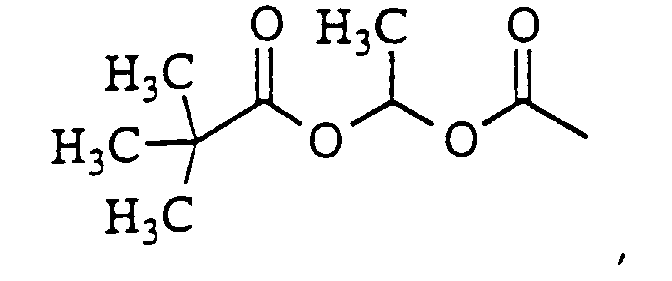
- preferred prodrug forms include simple esters, ⁇ -acyloxyalkyl esters, and amides.
- Preferred esters include compounds where R 22 is selected from;
- Preferred compounds of this invention are represented by structural Formula I and II and are selected from Tables I and II below, where R 1 is hydrogen or chlorine and R 18 , R 19 , R 20 and R 21 are hydrogen or methyl, and the other substituents are as set forth in the tables.
- the key intermediate for synthesis of 5-member heterocycles fused to 1,4-benzodiazepines is the substituted 3,4-dihydro-1 H -1,4-benzodiazepine-2,5-dione 4 .
- the benzodiazepinedione 4 may be prepared from isatoic anhydride 1 , a ⁇ -alanine ester or a ⁇ -amino acid and an ⁇ -haloacetyl halide, according to Scheme 1. Methods for preparation of the isatoic anhydrides 1 are known in the art and are available from commercial sources such as Aldrich Chemical Co.
- isatoic anhydride is converted to N-(2-aminobenzoyl)- ⁇ -alanine ester 2 by allowing 1 to react with a ⁇ -alanine ester or its salt, in the presence an organic base.
- the ⁇ -alanine ester may also be substituted or unsubstituted as the free amine or, more conveniently, as its salt (e.g. HCl).
- the reaction is conducted in a dry polar aprotic solvent, such as dimethylformamide or the like, in the presence of an equimolar amount, or up to 30% excess, of a tertiary amine as the organic base, e.g. triethylamine or 2,6-lutidine.
- a tertiary amine as the organic base
- the reaction may be catalysed by dimethylaminopyridine (Venuti, M.C. Synthesis 266 (1982)).
- the reaction requires between about 0.5 to 2 days at temperatures between about room temperature and 200°C .
- the reaction is conducted at 80°C for about 16 hours in dimethylformamide as the solvent.
- the product is isolated and purified by conventional methods, typically by solvent extraction into a compatible solvent. The product may be further purified by column chromatography or other appropriate methods.
- Cyclization of the acylated N-[2-( ⁇ -bromoacetylamide)benzoyl]- ⁇ -alanine ester 3 may be achieved by reaction with a base such as an alkali metal alkoxide, hydride, or carbonate in a polar solvent at temperatures between about 0°C and 100°C for about 0.5 to 2 hours.
- a base such as an alkali metal alkoxide, hydride, or carbonate
- a polar solvent at temperatures between about 0°C and 100°C for about 0.5 to 2 hours.
- a solution of the ester 3 is commonly added over a period of approximately 15 to 60 minutes to a slurry of an alkali metal carbonate in an appropriate solvent, cooled to 0°C.
- the solvent will be a polar aprotic solvent such as dimethylfomamide and the alkali metal carbonate be sodium carbonate, calcium carbonate, or cesium carbonate.
- the thioimidate ester intermediate 6 may then be reacted with a variety of reagents to produce the fused 5-member rings of this invention according to Scheme III.
- 6 may heated to reflux in a toluene/pyridine ⁇ HCl solution with a substituted propargylamine to produce the substituted imidazo-benzodiazepine 7 .
- 6 may be similarly refluxed with an appropriately substituted acylhydrazid to give the triazolo-benzodiazepine 8 .
- the thioimidate ester intermediate 6 may be reflux in toluene/pyridine ⁇ HCl with a substituted carbazate ester or ⁇ -amino acid ester to produce respectively the oxotriazolo-benzodiazepine 9 or oxoimidazolobenzodiazepine 10 .
- the thiolactam 5 (Scheme II) may be reacted with an appropriately protected ⁇ -amino acid and cyclized with dicyclohexylcarbodiimide to yield 10 (see Ager et al., J. Med. Chem. 20 ( 8 ):1035-1040 (1977).
- 6 may be heated in DMF with sodium azide to form the tetrazolo-benzodiazepine 11 .
- the tetrazolo-benzodiazepine 11 can also be prepared directly from 4 by conversion of the secondary amide directly into a tetrazole using triphenylphosphine and trimethylsilylazide (see Duncia et al., J. Org. Chem. 56(7) :2395-2400 (1991).
- 6-member heterocycles fused to 1,4-benzodiazepines can be prepared by methods known in the art (see e.g. EP 0 519 678 A2). More specifically, begining with the substituted 3,4-dihydro-1 H -1,4-benzodiazepine-2,5-dione 4 (Scheme I) and reacting it with Lawesson's reagent as described in Scheme II produces the thiolactam 5 . This intermediate can be further reacted to produce substituted oxodiazines according to Scheme IV.
- the thiolactam 5 may be treated with ammonia in the presence of a mercury (II) salt to form the intermediate amidine 12 .
- Reacting 12 with diketene followed by cyclization with heat treatment yields the substituted pyridinone-benzodiazepine 14 .
- the thiolactam 5 may be treated with methyl iodide and refluxed in toluene/pyridine ⁇ HCl with an optionally substituted anthranilate ester or a substituted ⁇ -alanine ester to produce respectively the substituted quanizolino-benzodiazepine 15 or substituted pyrimidone-benzodiazepine 16 .
- the intermediate amidine 12 is heated with ethoxymalonic acid diester to yield the carboxyethyl substituted pyrimidineone-benzodiazepine 17 .
- Saponification of 17 yields the free acid 18 which may be decarboxylated by heating to give compound 19 .
- the carboxyethyl substituted pyrimidineone-benzodiazepine 17 may be reduced with sodium cyanoborohydride to give the corresponding alcohol 20 , which can be alkylated with 2,2-dimethyl-1,3-dioxolan-4-ylmethyl- p -toluenesulfonate to yield the glycerol-isopropylidene adduct 21.
- the carboxyethyl substituted pyrimidone-benzodiazepine 17 also provides access to a wide variety of primary, secondary, and tertiary amine adducts as shown in Scheme VI.
- the hydroxyethyl substituted pyrimidineone-benzodiazepine 20 can be treated with a mild oxidizing agent such as manganese dioxide to yield the corresponding aldehyde 23 which in turn can be reductively aminated to produce the primary and tertiary amines 25 , 26 , and 27 .
- a Wolff-Kishner reaction converts aldehyde 23 to the methyl compound 24 .
- the amidine 12 of Scheme V may also be converted into triazinodiones according to Scheme VII.
- amidine 12 is treated with ethoxycarbonyl isocyanate to yield compound 28 .
- 28 is cyclized to the triazinodione 29 .
- 29 may be alkylated with an alkyl halide to give the alkyl substituted triazinodione 30 .
- Triazinobenzodiazepines can be prepared from benzodiazepines according to Scheme VIII.
- 1,4-benzodiazepines 4 are alkylated with ethylbromoacetate and sodium hydride to give the N-1 alkylated carboxyethyl ester 31 .
- Treatment of 31 with Lawesson's reagent produces the N-1 alkylated thiolactam 32 which, upon treatment with an alkyl substituted hydrazine, cyclizes to give the triazinobenzodiazepines 33 .
- reaction of thiolactam 32 with hydrazine followed by alkylation with an alkyl halide as shown in Scheme VII yields 33 .
- thiolactam 5 is treated with hydrazine to give the intermediate amidrazone 34 .
- Amidrazone 34 may be reacted with haloaldehydes and ketones to produce hydrazones 35 which, upon heating, gives triazinobenzodiazepine 36 .
- treatment of 34 with ⁇ -keto esters yields hydrazones 37 which are cyclized by heating in acetic acid to give oxo-triazinobenzodiazepines 38 .
- treatment of 34 with ketoacetals gives hydrazones 39 which upon treatment with concentrated sulfuric acid gives hydroxy-triazinobenzodiazepines 40 .
- oxo-triazinobenzodiazepines and 5-member sulfonamides can be prepared from the intermediate thioimidate ester 6 according to Scheme XI.
- the nitrogen containing substituents Q or a precursor thereof may be added to the linker L and the combination Q-L- , usually in protected form, bonded to the "benzo" ring.
- Q or Q plus a portion of L refered to below as L ', may be added to L or a portion thereof after the "benzo" ring and the rest of the molecule have been formed.
- Q itself may be prepared and bonded to the "benzo” ring by standard methods published in both the scientific and patent literature (see e.g. US patents; 4,992,542, 4,997,936, 4,194,047, 5,003,076, 5,063,207, 5,063,208, and 5,079,357, and references cited therein).
- conversion of the compounds having the structural formula 7 to compounds having the structural formula 48 may be accomplished by allowing 7 to react with an alkyne 47 in the presence of a palladium (II) salt, a copper (I) salt, and an organic base.
- the alkyne 47 is substituted in a way such that the Y group can be synthetically converted to the positively charged Q group of structural Formula I and II .
- the Y group is a protected form of the positively charged Q group.
- alkyne 47 may be a N-Boc-amino alkyne, a benzo or alkylnitrile alkyne, a nitrobenzo alkyne, or the like.
- the reaction is allowed to proceed in a dry organic polar aprotic solvent, such as ethyl acetate or the like, with the exclusion of oxygen, at from room temperature to 180°C for times between about 2 and 48 hours.
- a dry organic polar aprotic solvent such as ethyl acetate or the like
- the reaction will run with a catalytic amount of palladium(II) salt at 10 molar percent and copper (I) salt at 5 molar percent.
- the product 48 can be isolated by solvent extraction in to a suitable organic solvent, such as ethyl acetate, and washed with a solution of 10% ethylenediaminetetraacetic acid and the solvent evaporated. 48 may be further purified by column chromatography.
- a suitable organic solvent such as ethyl acetate
- Preparation of compounds 49 and 50 may be achieved by selective reduction of the alkyne moiety in compounds of the general formula 48 to yield alkene 49 and alkane 50 by allowing the alkyne to stir under an atmosphere of hydrogen in the presence of a small amount of palladium on carbon.
- the reaction is run in an inert solvent, such as ethyl acetate, with a 5-10 molar percent by weight of 10% palladium on carbon at temperatures between about room temperature and 50°C for times between about 15 and 240 minutes.
- the reaction is carried out at room temperature for 1 hour.
- the products are isolated by filtration of the mixture through a filter agent, such as Celite®, and evaporation of solvent.
- Conversion of the compounds of the general formula 48 , 49 , or 50 in which Y is a N-(tert-butoxycarbonyl) amino protected moiety (N-BOC) to the amino ester can be accomplished by allowing the material to react with a strong acid.
- the reaction is carried out by mixing the N-BOC amino ester with a large excess of concentrated solution of a strong acid, such as hydrogen chloride, dissolved in an appropriate inert solvent, such as ethyl acetate.
- the reaction can be conducted at a temperature between about minus 30°C and room temperature for about 0.5 to 24 hours.
- the reaction can be run in the presence of a molar amount of trialkylsilane, such as triethylsilane or the like.
- the reaction will be carried out at room temperature for 2 hours with a molar equivalent of triethylsilane in ethyl acetate.
- the solvent is evaporated and the products can be further purified by high-pressure liquid chromatography using a reverse phase column.
- Conversion of compounds of the general formula 48 , 49 , or 50 in which the Y functional group is an arylnitrile to the benzylamine ester can be achieved by allowing the arylnitriles to react with dicobalt octacarbonyl in the presence of trimethylsilane.
- the reduction of a benzonitrile to a benzylamine is a known reaction (Murai, T.; Sakane, T.; Kato, S. Tetrahedron Lett.
- 26 5145-5148[1985]) and is generally carried out in an inert solvent, such as toluene or the like, at 60°C for 20 hours with an 8 molar percent of dicobalt octacarbonyl and a 10 fold excess of trimethylsilane.
- the solvent is evaporated and the resulting material diluted with methanol and allowed to react with a 5 fold excess of potassium fluoride.
- the products are then isolated by solvent extraction and further purified high-pressure liquid chromatography using a reverse phase column. Conversion of the same arylnitrile compounds to their corresponding amidino esters can be accomplished by sequential reaction with hydrogen sulphide, methyl iodide, and ammonium acetate.
- the resulting amidino esters may be purified by either column chromatography, crystallization, or preparative high-pressure liquid chromatography using a reverse phase column.
- alkynyl benzonitriles containing substituents on the nitrile containining benzo ring can be prepared by known methods. These substituents specifically include a chlorine (positioned either ortho or meta to the aryl nitrile), an amino (suitably protected, positioned ortho to the arylnitrile), fluorine (tetra, i.e., fluorines at both ortho and meta positions relative to the arylnitrile), and a methyl group (positioned ortho and meta to the aryl nitrite).
- substituents specifically include a chlorine (positioned either ortho or meta to the aryl nitrile), an amino (suitably protected, positioned ortho to the arylnitrile), fluorine (tetra, i.e., fluorines at both ortho and meta positions relative to the arylnitrile), and a methyl group (positioned ortho and meta to the aryl nitrite).
- Conversion of the compounds of the general formula 48 , 49 , or 50 in which the Y functional group is a nitroarene, to the anilino ester can be executed by a selective reduction (Bellamy, F.D.; Ou, K. Tetrahedron Lett. 25 : 839-842[1984]).
- the reaction is generally run with a five molar excess of stannous chloride dihydrate in either ethyl acetate or ethanol as the solvent at temperatures between about 50 and 100°C for times between about 15-120 minutes under an inert atmosphere, such as nitrogen.
- the reaction is carried out at 70°C in ethanol for approximately 30 minutes.
- the products are then isolated by solvent extraction and further purified by high-pressure liquid chromatography using a reverse phase column.
- Conversion of the amino esters to their corresponding amino acids of the structural Formula I and II involves saponification using well known conditions and reagents.
- a strong alkali metal base such as sodium hydroxide, lithium hydroxide or the like
- Alcohols which may be used as the solvent for this reaction may include, for example, methanol, ethanol, and isopropanol, but, methanol is preferred.
- the preferred base is sodium hydroxide at a concentration between about 1 to 6N, though 2N is preferred.
- the reaction may be conducted at a temperature between about 0 to 50°C for times between about 10 to 60 minutes.
- the reaction is carried out at room temperature for 30 minutes after which the reaction is neutralized with a concentrated solution of a strong acid, such as hydrochloric acid or the like, and the solvent evaporated.
- a strong acid such as hydrochloric acid or the like
- the products are isolated by high-pressure liquid chromatography using a reverse phase column.
- the conversion of the amino acids to their corresponding guanidino acids of the structural Formula I and II is a known reaction (Kim, K. Lin, Y.-L.; Mosher, H.S. Tetrahedron Lett. 3183-3186 [1988]).
- the reaction can be accomplished by allowing the amino acid to react with aminoiminomethanesulfonic acid.
- the reaction can be conducted with a equimolar to a 10 fold molar excess of aminoiminomethanesulfonic acid at temperatures between 0 to 50°C for times between about 15 to 120 minutes in a polar protic solvent, such as methanol, water or the like.
- the solution, prior to the addition of aminoiminomethanesulfonic acid may be made neutral or basic by the addition of weak base, such as an alkali metal carbonate.
- weak base such as an alkali metal carbonate.
- the amino acid will be allowed to react with a 5 fold excess aminoiminomethanesulfonic acid at room temperature for 30 minutes with 5% potassium bicarbonate in water as the reaction medium, whereas for aryl amines the amino acid will be allowed to react with an equimolar amount of aminoiminomethanesulfonic acid at room temperature for 1 hour in methanol.
- the reaction mixture will be made acidic by the addition of a dilute solution of an acid, such as acetic acid and the solvent evaporated.
- the products are isolated by high-pressure liquid chromatography using a reverse phase column.
- Conversion of the iodoarene 7 to a synthetic precursors of 59 may be accomplished by carbonylation in an alcoholic solvent (R'OH) under a carbon monoxide atmosphere utilizing a palladium(0) catalyst.
- the alcoholic solvent (R'OH) must be chosen so as to allow for the selective removal of the R' group of the diester 51.
- the alcoholic solvent is methanol, and this methyl ester functionality in 51 can be removed by mild basic hydrolysis to afford acid 52 .
- biaryl adducts 53, 7 may be allowed to react with substituted iodoaryls or arylboronates , where Y and L ' are defined as above, in the presence of palladium(0).
- synthetic precursors of 58 and 60 may be prepared by converting iodoarene 7 into the aniline 56 or phenol 57 by standard procedures. Phenol 57 may be converted to ether 58 by combining with the appropriately protected alcohol and dehydrating with diethyl azodicarboxylate-triphenylphosphene (DEAD).
- DEAD diethyl azodicarboxylate-triphenylphosphene
- Precursor carboxylates 52 and anilines 56 may be converted into amides 59 and 60 in a dehydration reaction utilizing dicyclohexylcarbodiimide (DCC) with the appropriate amine or acid according to Scheme XIV.
- DCC dicyclohexylcarbodiimide
- the latter reaction preferably is carried out with an acyl chloride in the presence of triethylammine and 4-dimethylaminopyridine (DMAP).
- products of Formula I and II carbon atoms bonded to four nonidentical substituents are asymmetric. Accordingly, the compounds may exist as diastereoisomers, enantiomers or mixtures thereof.
- the syntheses described above may employ racemates, enantiomers or diastereomers as starting materials or intermediates. Diastereomeric products resulting from such syntheses may be separated by chromatographic or crystallization methods. Likewise, enantiomeric product mixtures may be separated using the same techniques or by other methods known in the art.
- Each of the asymmetric carbon atoms, when present in compounds of Formula I and II may be in one of two configurations (R or S) and both are within the scope of the present invention.
- the compounds described in this invention may be isolated as the free acid or base or converted to salts of various inorganic and organic acids and bases.
- Such salts are within the scope of this invention.
- Examples of such salts include ammonium, metal salts like sodium, potassium, calcium and magnesium; salts with organic bases like dicyclohexylamine, N-methyl-D-glucamine and the like; and salts with amino acids like arginine or lysine.
- Salts with inorganic and organic acids may be likewise prepared, for example, using hydrochloric, hydrobromic, sulfuric, phosphoric, trifluoroacetic, methanesulfonic, malic, maleic, fumaric and the like.
- Non-toxic and physiologically compatible salts are particularly useful although other less desirable salts may have use in the processes of isolation and purification.
- a number of methods are useful for the preparation of the salts described above and are known to those skilled in the art. For example, reaction of the free acid or free base form of a compound of Formula I and II with one or more molar equivalents of the desired acid or base in a solvent or solvent mixture in which the salt is insoluble; or in a solvent like water after which the solvent is removed by evaporation, distillation or freeze drying.
- the free acid or base form of the product may be passed over an ion exchange resin to form the desired salt or one salt form of the product may be converted to another using the same general process.
- the compounds of this invention may be utilized in compositions such as tablets, capsules or elixirs for oral administration; suppositories for rectal administration; sterile solutions or suspensions for injectable administration, and the like.
- Animals in need of treatment using compounds of this invention can be administered dosages that will provide optimal efficacy.
- the dose and method of administration will vary from animal to animal and be dependent upon such factors as weight, diet, concurrent medication and other factors which those skilled in the medical arts will recognize.
- Dosage formulations of the nonpeptidyl inhibitors of the present invention are prepared for storage or administration by mixing the inhibitor having the desired degree of purity with physiologically acceptable carriers, excipients, or stabilizers.
- Such materials are non-toxic to the recipients at the dosages and concentrations employed, and include buffers such as phosphate, citrate, acetate and other organic acid salts; antioxidants such as ascorbic acid; low molecular weight (less than about ten residues) peptides such as polyarginine, proteins, such as serum albumin, gelatin, or immunoglobulins; hydrophilic polymers such as polyvinylpyrrolidinone; amino acids such as glycine, glutamic acid, aspartic acid, or arginine; monosaccharides, disaccharides, and other carbohydrates including cellulose or its derivatives, glucose, mannose, or dextrins; chelating agents such as EDTA; sugar alcohols such as mannitol or sorbitol; counterions such as sodium and/
- Dosage formulations of the nonpeptidyl inhibitors of the present invention to be used for therapeutic administration must be sterile. Sterility is readily accomplished by filtration through sterile filtration membranes such as 0.2 micron membranes. Nonpeptidyl inhibitor formulations ordinarily will be stored in lyophilized form or as an aqueous solution.
- the pH of the cyclic inhibitor preparations typically will be between 3 and 11, more preferably from 5 to 9 and most preferably from 7 to 8. It will be understood that use of certain of the foregoing excipients, carriers, or stabilizers will result in the formation of cyclic polypeptide salts. While the preferred route of administration is by hypodermic injection needle, other methods of administration are also anticipated such as suppositories, aerosols, oral dosage formulations and topical formulations such as ointments, drops and dermal patches.
- Therapeutic nonpeptidyl inhibitor formulations generally are placed into a container having a sterile access port, for example, an intravenous solution bag or vial having a stopper pierceable by hypodermic injection needle.
- Therapeutically effective dosages may be determined by either in vitro or in vivo methods. For each particular nonpeptidyl inhibitor of the present invention, individual determinations may be made to determine the optimal dosage required. The range of therapeutically effective dosages will naturally be influenced by the route of administration. For injection by hypodermic needle it may be assumed the dosage is delivered into the body's fluids. For other routes of administration, the absorption efficiency must be individually determined for each inhibitor by methods well known in pharmacology.
- the range of therapeutic dosages is from about 0.001 nM to 1.0 mM, more preferably from 0.1 nM to 100 mM, and most preferably from 1.0 nM to 50 mM.
- a compound or mixture of compounds of Formula I and II is compounded with a physiologically acceptable vehicle, carrier, excipient, binder, preservative, stabilizer, flavor, etc., as called for by accepted pharmaceutical practice.
- a physiologically acceptable vehicle carrier, excipient, binder, preservative, stabilizer, flavor, etc.
- the amount of active ingredient in these compositions is such that a suitable dosage in the range indicated is obtained.
- Typical adjuvants which may be incorporated into tablets, capsules and the like are a binder such as acacia, corn starch or gelatin; an excipient such as microcrystalline cellulose; a disintegrating agent like corn starch or alginic acid; a lubricant such as magnesium stearate; a sweetening agent such as sucrose or lactose; a flavoring agent such as peppermint, wintergreen or cherry.
- a binder such as acacia, corn starch or gelatin
- an excipient such as microcrystalline cellulose
- a disintegrating agent like corn starch or alginic acid
- a lubricant such as magnesium stearate
- a sweetening agent such as sucrose or lactose
- a flavoring agent such as peppermint, wintergreen or cherry.
- a liquid carrier such as a fatty oil.
- Other materials of various types may be used as coatings or as modifiers of the physical form of the dosage unit.
- a syrup or elixir may contain the active compound, a sweetener such as sucrose, preservatives like propyl paraben, a coloring agent and a flavoring agent such as cherry.
- a sweetener such as sucrose
- preservatives like propyl paraben a coloring agent
- a flavoring agent such as cherry.
- Sterile compositions for injection can be formulated according to conventional pharmaceutical practice. For example, dissolution or suspension of the active compound in a vehicle such as water or naturally occurring vegetable oil like sesame, peanut, or cottonseed oil or a synthetic fatty vehicle like ethyl oleate or the like may be desired. Buffers, preservatives, antioxidants and the like can be incorporated according to accepted pharmaceutical practice.
- In-vitro biological activity of the compounds of Formula I and II are monitored using a modified fibrinogen-GPIIbIIIa ELISA based on the method of Nachman and Leung ( J . Clin. Invest. 69 :263-269 (1982)) which measures the inhibition of fibrinogen binding to purified human platelet GPIIbIIIa receptor.
- Human fibrinogen is prepared by the method of Lipinska, et al. (J. Lab. Clin. Med. 84 :509-516 (1974)).
- Platelet GPII b III a is prepared by the method of Fitzgerald, et al., Anal. Biochem ., 151 :169-177 (1985).
- microtiter plates are coated with fibrinogen (10 mg/ml) and then blocked with TACTS buffer containing 0.5% bovine serum albumin (BSA).
- TACTS buffer contains 20mM Tris.HOI, pH 7.5, 0.02% sodium azide, 2 mM calcium chloride, 0.05% Tween 20, 150 mM sodium chloride.
- PBS phosphate buffered saline
- solubilized GP IIbIIIa receptor 40 mg/ml
- platelet aggregation assays may be performed in human platelet rich plasma (PRP).
- PRP human platelet rich plasma
- Fifty milliliters of whole human blood (9 parts) is drawn on 3.6% sodium citrate (1 part) from a donor who has not taken aspirin or related medications for at least two weeks.
- the blood is centrifuged at 160 x g for 10 min at 22° C and then allowed to stand for 5 min after which the PRP is decanted.
- Platelet poor plasma (PPP) is isolated from the remaining blood after centrifugation at 2000 x g for 25 min.
- the platelet count of the PRP is adjusted to ca. 300,000 per microliter with PPP.
- An aggregating agent (collagen, 1 mg/ml; U46619, 100 ng/ml; or ADP, 8 mM) is added and the platelet aggregation recorded.
- reaction flask After stirring at room temperature for five minutes the reaction flask was stoppered and placed in a 50°C oil bath for 16 hours. TLC (SiO 2 , 4% MeOH, 15% acetone in EtOAc) indicated complete consumption of the nitrile.
- the reaction mixture was diluted to a volume of approximately 2.5 ml by additon of EtOH(approx 0.4 ml), H 2 0(approx.1.0 ml), and acetic acid( approx.
Landscapes
- Chemical & Material Sciences (AREA)
- Organic Chemistry (AREA)
- Health & Medical Sciences (AREA)
- Engineering & Computer Science (AREA)
- Bioinformatics & Cheminformatics (AREA)
- Diabetes (AREA)
- Hematology (AREA)
- Chemical Kinetics & Catalysis (AREA)
- General Chemical & Material Sciences (AREA)
- Medicinal Chemistry (AREA)
- Nuclear Medicine, Radiotherapy & Molecular Imaging (AREA)
- Pharmacology & Pharmacy (AREA)
- Life Sciences & Earth Sciences (AREA)
- Animal Behavior & Ethology (AREA)
- General Health & Medical Sciences (AREA)
- Public Health (AREA)
- Veterinary Medicine (AREA)
- Pharmaceuticals Containing Other Organic And Inorganic Compounds (AREA)
- Nitrogen Condensed Heterocyclic Rings (AREA)
- Nitrogen And Oxygen Or Sulfur-Condensed Heterocyclic Ring Systems (AREA)
Claims (13)
- Verbindung der Strukturformel I oder II:

 R1 und R2 jeweils eine oder zwei Gruppen sind, die unabhängig voneinander ausgewählt sind ausWasserstoffHalogen (F, Cl, Br, I),Cyano,Carboxy,Aminocarbonyl,Carboxamido,Carbamoyloxy,Formyloxy,Formyl,Azido,Nitro,Imidazolyl,Ureido,Thioureido,Thiocyanato,Hyd roxy,Mercapto,Sulfonamido, undeinem gegebenenfalls substituierten Rest, ausgewählt aussich gegebenenfalls R1 und R2, wenn sie an benachbarte Kohlenstoffatome gebunden sind, zu einem annellierten, unsubstituierten oder substituierten C6-C10-Arylring verbinden, wobei die Substituenten ausgewählt sind ausC1-C12-Alkyl,C2-C12-Alkenyl,C3-C12-Alkinyl,C3-C12-Cycloalkyl,C6-C14-Aryl,C6-C10-Aryl-C1-C8-alkyl,C1-C12-Alkyloxy,C1-C12-Alkyloxy-C1-C12-alkyl,C6-C14-Aryloxy,C1-C12-Acylamino,N,N-Di-(C1-C12)-acylamino,N-(C1-C12)-Alkyl-N-(C1-C12)-alkylsulfonylamino,C1-C12-Alkylthiocarbonyl,C1-C12-Alkylthio,C1-C12-Alkylthio-C1-C12-alkyl,C1-C12-Alkylsulfinyl,C1-C12-Alkylsulfinyl-C1-C12-alkyl,C1-C12-Alkylsulfonyl,C1-C12-Alkylsulfonyl-C1-C12-alkyl,C1-C12-Alkylsulfonato,N-(C1-C12)-Alkylsulfonamido,N,N-Di-(C1-C12)-sulfonamido,N-(C1-C12)-Alkyl-N-thioformylamino,C1-C12-Thioacylamino,N-(C1-C12)-Alkyl-N-(C1-C12)-thioacylamino,C1-C12-Alkylsulfinamido,N-(C1-C12)-Alkyl-N-(C1-C12)-alkylsulfinylamino,C1-C12-Carbalkoxy,C1-C12-Alkylcarbonyl,C1-C12-Alkyloxycarbonyl,C1-C12-Alkanoyloxy,N-(C1-C12)-Alkylcarboxamido,N-(C1-C12)-Alkylaminocarbonyl,N,N-Di-(C1-C12)-carboxamido,N,N-Di-(C1-C12)-Alkylaminocarbonyl,N-(C1-C12)-Alkylcarbamoyloxy,N,N-Di-(C1-C12)-carbamoyloxy, undHeterocycloalkyl oder Heteroaryl mit 1 bis 3 Ringen, wobei jeder Ring bis 7 Atome mit 0 bis 3 Heteroatomen aufweist, die aus N, O und S ausgewählt sind, mit der Maßgabe, daß zumindest ein Ring ein Heteroatom enthält,wobei die Substituenten 1 bis 3 Gruppen sind, ausgewählt ausHalogen (F, Cl, Br, I),Amino,Amidino,Guanidino,Imidazolyl,Indolyl,Cyano,Azido,Nitro,Hydroxy,Mercapto,Morpholino,Morpholinyl,Piperazinyl,Piperidinyl,Pyrrolinyl,Sulfonamido,Ureido,Thioureido,Carboxy,Aminocarbonyl,C1-C4-Alkylaminocarbonyl,Carboxamido,Carbamoyloxy,Formyloxy,Formyl,C1-C4-Alkyloxycarbonyl,C1-C4-Alkyl,C1-C4-Alkylamino,Di-(C1-C4)-alkylamino,C1-C4-Alkoxy,Hydroxyphenyl,Phenyl, undPhenoxy,Halogen (F, Cl, Br, I),Cyano,Azido,Nitro,Hydroxy,Mercapto,Sulfonamido,Ureido,Thioureido,Carboxamido,Carbamoyloxy,Formyloxy,Formyl,C1-C4-Alkyl,halogeniertem C1-C4-Alkyl,C1-C4-Alkoxy,Phenyl, undPhenoxy;Q aus der Gruppe ausgewählt ist, die besteht aus
einer Aminogruppe, ausgewählt ausNH2,NR3H,NR3R4R undNR3R4R5,R3, R4 und R5 unabhängig voneinander ausgewählt sind ausWasserstoff,Cyano,NR6R7,C(=NR8)-NR6R7,N=CR9-NR6R7,NR10-CR9=NR8,NR10-C(=NR8)-NR6R7,(mit F, Cl, Br, I) halogeniertem C1-C4-Alkyl, undeiner gegebenenfalls substituierten Gruppe, ausgewählt ausworin die Reste R6, R7, R8, R9 und R10 jeweils unabhängig voneinander ausgewählt sind ausC1-C12-Alkyl,C2-C7-Alkenyl,C3-C12-Cycloalkyl,C5-C12-Cycloalkenyl,C6-C14-Aryl,C1-C6-Alkyl-C6-C14-aryl,C2-C6-Alkenyl-C6-C10-aryl,Heterocyclyl,C1-C6-Alkylheterocyclyl,C1-C8-Alkoxy,C1-C8-Alkoxycarbonyl,C6-C14-Aryloxy,C1-C14-Aryloxycarbonyl undC6-C14-Aryl-C1-C6-alkyloxycarbonyl,Wasserstoff,Cyano,C1-C6-Alkyl undR11,und worin die Substituenten ein bis drei Reste R11 sind,R11 ausgewählt ist aus gegebenenfalls substituiertemC6-C12-Aryloxy,C6-C12-Arylamino,C6-C12-Aroyl,C1-C8-Alkoxy,C1-C8-Alkoxyalkyl,C1-C8-Alkoxyalkyloxy,C1-C6-Alkoxycarbonyl,C1-C8-Alkylcarbonyl,C1-C8-Aralkylcarbonyl,C1-C8-Alkylthiocarbonyl,C6-C12-Aralkylthiocarbonyl,C2-C8-Alkoxythiocarbonyl,C6-C12-Aryl,C1-C4-Alkanoylamino,C1-C6-Alkoxycarbonyl-C1-C6-alkylamino,C1-C8-Alkylsulfonylamino,C6-C10-Aralkylsulfonylamino,C6-C10-Aralkyl,C6-C10-Alkaryl,C1-C8-Alkylthio,C6-C10-Aralkylthio,C1-C8-Alkylsulfinyl,C6-C10-Aralkylsulfinyl,C1-C8-Alkylsulfonyl,C6-C10-Aralkylsulfonyl,C1-C8-Alkylaminosulfonyl,C6-C10-Aralkylsulfonylamino,C2-C8-Alkenyl undeinem 5- oder 6-gliedrigen Heterozyklus, der bis 4 Heteroatome enthält, ausgewählt aus N, O und S,worin die Substituenten ein bis drei Reste R12 sind,R12 ausgewählt ist ausNitro,Amino,C1-C8-Alkylamino,Di-(C1-C8)-alkylamino,Amidino,Aminomethylenimino,Imino,Imino-C1-C4-alkyl,Iminomethylenamino,Guanidino,C6-C10-Arylamino,C1-C8-Acylamino,C1-C4-Alkylsulfonamino,Azido,Cyano,Hydroxy,Hydroxy-C1-C8-alkyl,C1-C8-Alkoxy,Phenyloxy,C1-C8-Alkanoyloxy,C1-C8-Alkanoyl,C6-C12-Aroyl,Benzamido,Phenyl,Halogen (F, Cl, Br, I),halogeniertem C1-C8-Alkyl undC1-C8-Alkyl,Aminosulfonyl,Oxo,Thio,Thiocarbonyl,Hydroxy,Mercapto,Formyl,Formyloxy,Carboxy,Ureido,Glycyl,Phthalimido,Succinimido,Morpholino,C3-C7-Cycloalkyl;gegebenenfalls R3 und R4 miteinander gegebenenfalls substituiertesTetramethylen,Pentamethylen,3-Oxopentamethylen und3-Azapentamethylen,bilden könnnen, worin die Substituenten ausgewählt sind aus 1 bis 3 Resten R12, einer Amidinogruppe, ausgewählt ausC(= NH)-NH2,C(= NH)-NHR3,C(=NR4)-NHR3,C(=NH)-NR3R4 undC(=NR5)-NR3R4,worin R3, R4 und R5 wie oben definiert oder aus folgender Gruppe ausgewählt sindHO-,C1-C10-Alkyl-O-(C=O)-,C1-C10-Alkyl-S-(C=O)-,Cl3CCH2O-(C=O)-,einer Aminoalkyleniminogruppe, ausgewählt aus




 N = CH-NH2,N = CH-NHR3,N = CH-NR3R4 undN = CR5-NR3R4,worin R3, R4 und R5 wie oben definiert sind;
eine Iminoalkylenaminogruppe, ausgewählt aus:NH-CH = NH,NH-CH = NR3,NH-CR4= NR3 undNR3-CR4 = NR3,worin R3, R4 und R3 wie oben definiert sind;
einer Guanidinogruppe, ausgewählt ausNH-C(= NH)-NH2,NH-C(= NH)-NR3H,NH-C(= NH)-NR3R4,NH-C(= NR5)-NR3R4,NR3-C(= NR3)-NR3R4,NR3-C(= NH)-NR3R4,NR3-C(= NR3)-NH2,NR3-C(=NH)-NH2,NR3-C(=NR3)-NHR4 undNR3-C(=NH)-NHR4,worin R3, R4 und R5 wie oben definiert sind;
einer gegebenenfalls substituierten, gesättigten, heterozyklischen Gruppe, ausgewählt aus

 R13 ausgewählt ist ausR6,CR9= NR8,CR9(= NR8)-NR6R7,C(=NR8)-NR6R7,N=CR9-NR6R7,NR10-C9=NR8 undNR10-(C=NR8)-NR6R7,worin die Reste R6 bis R10 wie oben definiert sind, Z2 = O, S oder NR13 ist und die Substituenten unabhängig voneinander ein bis drei Reste R12 sind;
einem gegebenenfalls substituierten, ungesättigten (nichtaromatischen) Heterocyclyl, ausgewählt aus

 m = 1, 2 oder 3 ist;Z2 und R13 wie oben definiert sind unddie Substituenten unabhängig voneinander 1 bis 3 Reste R12 sind,einem gegebenenfalls substituierten, ungesättigten (aromatischen) Heterocyclyl, ausgewählt aus

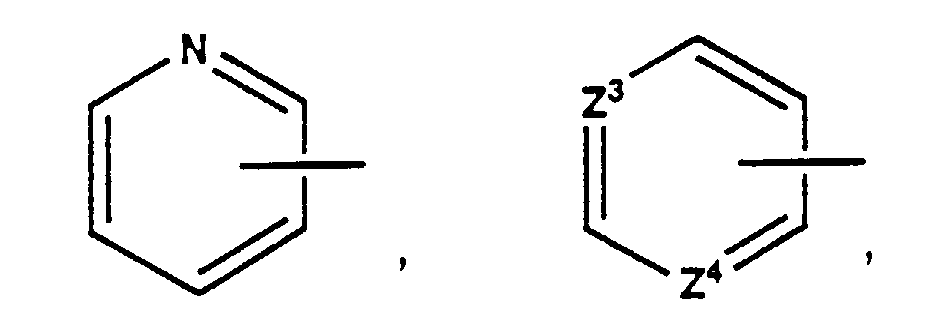
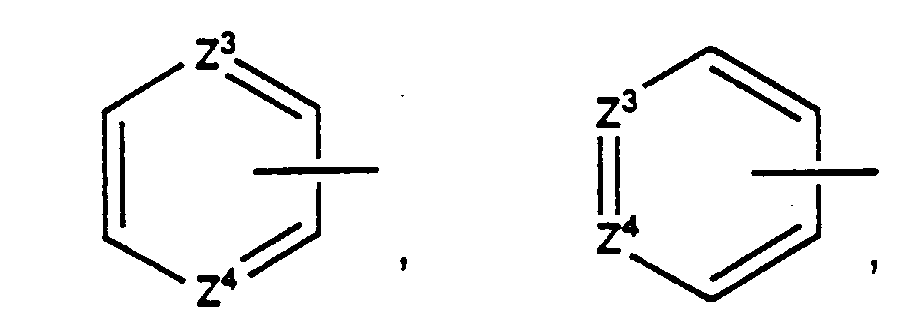


R13 wie oben definiert ist, und die Substituenten unabhängig voneinander ein bis drei Reste R12 sind;L ein gegebenenfalls substituierter zweiwertiger Rest ist, ausgewählt aus folgender Gruppe:C3-C7-Alkylen,C3-C7-Cycloalkylen,C3-C7Alkenylen,C3-C7-Alkadienylen,C3-C7-Alkinylen,C4-C7-Alkadiinylen,C4-C7-Alkeninylen,C6-C14-Arylen,C6-C14-Aryl-C2-C4-alkinylen,C1-C3-Alkyl-C6-C14-aryl-C2-C4-alkinylen,C6-C14-Aryl-C2-C4-alkenylen,C1-C3-Alkyl-C6-C14-arylen,C1-C3-Alkyl-C6-C14-aryl-C2-C4-alkenylen,C6-C14-Aryl-C1-C3-alkylen,C6-C14-Aryl-C1-C3-alkyloxyen,C1-C2-Alkyl-C6-C14-aryl-C1-C2-alkylen,C1-C3-Alkyloxy-C6-C14-arylen,C2-C6-Alkyloxyen,C1-C5-Alkyloxy-C1-C5-alkylen,C6-C10-Aryloxyen,C6-C10-Aryloxy-C1-C5-alkylen,C2-C6-Alkylthioen,C1-C5-Alkylthio-C1-C5-alkylen,C6-C10-Arylthioen,C6-C10-Arylthio-C1-C5-alkylen,C1-C5-Alkylsulfoxid-C1-C5-alkylen,C1-C5-Alkylsulfon-C1-C5-alkylen,worin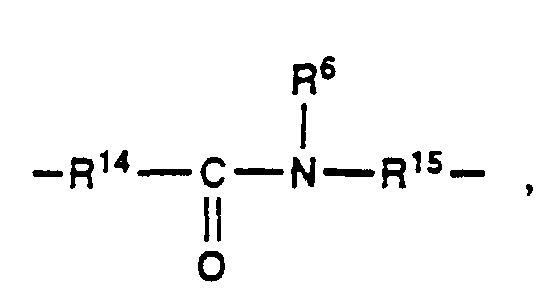


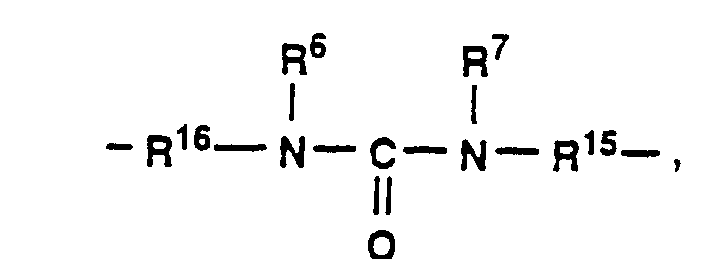

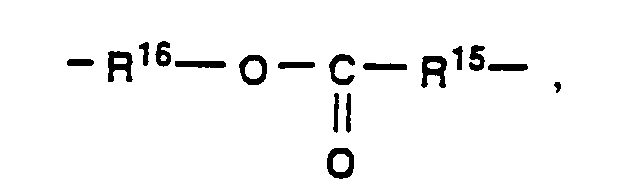


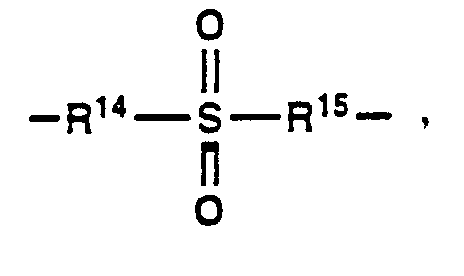
-R 14 -O-R 15 - ,
-R 14 -S-R 15 -,

- HET-R 15 -,
R14 ausgewählt ist auseiner chemischen Bindung,C1-C8-Alkyl,C1-C8-Alkyloxy,C3-C7-Cycloalkyl,C2-C5-Alkenyl,C3-C5-Alkinyl,C6-C10-Aryl,C1-C3-Alkyl-C6-C12-aryl,C1-C2-Alkyl-C6-C10-aryl-C1-C2-alkyl,C6-C10-Aryl-C1-C2-alkyl,C6-C10-Aryloxy-C1-C2-alkyl,HET undPiperizinyl;R15 ausgewählt ist auseiner chemischen Bindung,C1-C4-Alkyl,C2-C4-Alkenyl,C2-C4-Alkinyl,C6-C10-Aryl undC1-C3-Alkyl-C6-C12-aryl;R16 ausgewählt ist auseiner chemischen Bindung,C1-C5-Alkyl,C3-C7-Cycloalkyl,C3-C5-Alkenyl,C3-C5-Alkinyl,C6-C10-Aryl,C1-C3-Alkyl-C6-C12-aryl,C6-C10-Aryl-C1-C2-alkyl,HET undPyridyl;R17 ausgewählt ist ausC3-C4-Alkenyl,C3-C4-Alkinyl,C6-C10-Aryl,Benzyl undHET,worin HET ein gesättigter oder ungesättigter Heterozyklus mit 5 bis 14 Atomen in 1 bis 3 Zyklen ist, wobei jeder Zyklus 1 bis 3 Heteroatome aufweist, die aus N, O und S ausgewählt sind,
und worin die Substituenten aus ein bis drei Resten R12 ausgewählt sind;R18, R19, R20 and R21 unabhängig voneinander ausgewählt sind ausWasserstoffC1-C4-Alkyl,(mit F, Cl, Br, I) halogeniertem C1-C4-Alkyl,C1-C4-Alkoxy,Halogen (F, Cl, Br, I),Cyano,Carboxy,Hydroxy,C1-C4-Alkoxycarbonyl undC1-C4-Alkylsulfonyl-C1-C3-alkyl;R22 aus der Gruppe ausgewählt ist, die besteht ausHydroxy,C1-C8-Alkoxy,C3-C12-Alkenoxy,C6-C12-Aryloxy,C1-C6-Alkyl-C6-C12-aryloxy,Di-C1-C8-alkylamino-C1-C8-alkoxy,Acylamino-C1-C8-alkoxy, ausgewählt aus der GruppeAcetylaminoethoxy,Nicotinoylaminoethoxy undSuccinamidoethoxy,C1-C8-Alkoyloxy-C1-C8-alkoxy undC6-C12-Aryl-C1-C8-alkoxy,
worin alle Arylgruppen unsubstituiert oder mit einer bis drei der folgenden Gruppen substituiert sind:Nitro,Halogen (F, Cl, Br, I),C1-C4-Alkoxy undAmino,Hydroxy-C2-C8-alkoxy,Dihydroxy-C3-C8-alkoxy,Morpholino-C2-C8-alkoxy,Morpholinyl-C1-C8-alkoxy undNR23R24;R23 and R24 unabhängig voneinander aus folgender Gruppe ausgewählt sind:Wasserstoff,C1-C8-Alkyl,C3-C8-Alkenyl,C6-C12-Aryl,C6-C12-Aryl-C1-C8-alkylworin alle Arylgruppen unsubstituiert oder mit einer bis drei der folgenden Gruppen subsituiert sind:Nitro,Halogen (F, Cl, Br, I),C1-C4-Alkoxy undAmino;A1 ausgewählt ist ausCR1,CHR2,N undNR25;A2 ausgewählt ist ausCHR1,CR2,N,O=S=O,S=O,S,O,C=O,C-OR26 undC = N-R25;B1 ausgewählt ist ausCR1,CHR2,N,NR25 undC=O;B2 ausgewählt ist ausCR2,CHR1,NR25,O=S=O,S=O,S,O undC=O;B3 ausgewählt ist ausCR1,CHR2 undC=O;R25 ausgewählt ist ausR6 und(CH2)mR1, worin m = 1, 2 oder 3 ist;R26 ausgewählt ist ausund pharmazeutisch annehmbare Salze davon.Wasserstoff,C1-C8-Alkyl,C6-C12-Aryl undC6-C12-Aryl-C1-C8-alkylworin alle Aryl- oder Alkylgruppen unsubstituiert oder mit einer bis drei der folgenden Gruppen substituiert sind:Nitro undHalogen (F, Cl Br, I); - Verbindung nach Anspruch 1 der Formel III-VIII:

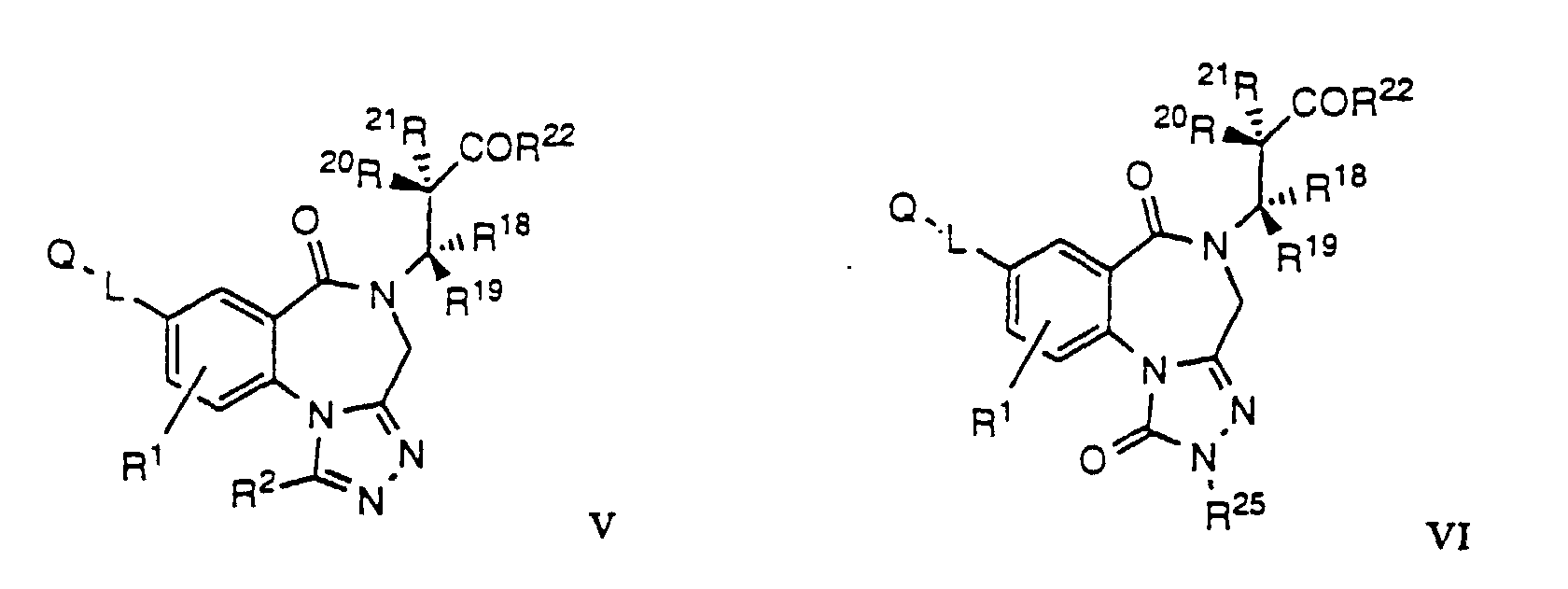
 R1 und R2 unabhängig voneinander ausgewählt sind ausWasserstoff,Halogen (F, Cl, Br, I),Cyano,Carboxy,Aminocarbonyl,Carboxamido,Carbamoyloxy,Formyloxy,Formyl,Azido,Nitro,Imidazolyl,Ureido,Thioureido,Thiocyanato,Hydroxy,Mercapto,Sulfonamido undeinem gegebenenfalls substituierten Rest, ausgewählt ausC1-C12-Alkyl,C1-C12-Alkyloxycarbonyl,C1-C12-Alkyloxy-C1-C12-alkyl,C2-C12-Alkenyl,C2-C12-Alkinyl,C3-C12-Cycloalkyl,C6-C14-Aryl,C6-C10-Aryl-C1-C8-alkyl,C1-C12-Alkyloxy,C6-C14-Aryloxy undC1-C12-Acylamino,worin die Substituenten ausgewählt sind ausHalogen (F, Cl Br, I),Amino,Amidino,Guanidino,Imidazolyl,Indolyl,Cyano,Azido,Nitro,Hydroxy,Mercapto,Morpholino,Morpholinyl,Piperazinyl,Piperidinyl,Pyrrolinyl,Sulfonamido,Ureido,Thioureido,Carboxy,Aminocarbonyl,C1-C4-Alkylaminocarbonyl,Carboxamido,Carbamoyloxy,Formyloxy,Formyl,C1-C4-Alkyloxycarbonyl,C1-C4-Alkyl,C1-C4-Alkylamino,Di-(C1-C4)-alkylamino,C1-C4-Alkoxy,C1-C4-Alkylthio,Hydroxyphenyl,Phenyl undPhenoxy;Q aus der Gruppe ausgewählt ist, bestehend aus
einer Aminogruppe, ausgewählt ausNH2,NR3H,NR3R4 undNR3R4R5,R3, R4 und R5 unabhängig voneinander gegebenenfalls substituierte Reste sind, ausgewählt ausWasserstoff,C1-C4-Alkoxy,C1-C4-Alkyl,(mit F, Cl, Br, I) halogeniertes C1-C4-Alkyl,gegebenenfalls substituiertem C1-C12-Alkyl,gegebenenfalls substituiertem C3-C12-Cycloalkyl,gegebenenfalls substituiertem C6-C14-Aryl,gegebenenfalls substituiertem C1-C6-Alkyl-C6-C14-aryl,gegebenenfalls substituiertem C1-C8-Alkoxy,gegebenenfalls substituiertem C1-C8-Alkoxycarbonyl,gegebenenfalls substituiertem C6-C14-Aryloxy,gegebenenfalls substituiertem C6-C14-Aryloxycarbonyl,NR6R7,C(=NR8)-NR6R7,N=CR9-NR6R7,NR10-CR9 = NR8 undNR10-C(=NR8)-NR6R7,worin alle Reste R6, R7, R8, R9 und R10 unabhängig voneinander ausgewählt sind ausWasserstoff,C1-C4-Alkyl undR11,und worin die Substituenten ein bis drei Reste R11 sind,
alle R11 unabhängig voneinander ausgewählt sind ausgegebenenfalls substituiertem C6-C12-Aryloxy,gegebenenfalls substituiertem C6-C12-Arylamino,gegebenenfalls subsituiertem C6-C12-Aroyl undgegebenenfalls substituiertem C6-C12-Aryl,worin die Substituenten ein bis drei Reste R12 sind,R12 ausgewählt ist ausNitro,Amino,C1-C8-Alkylamino,Di-(C1-C8)-alkylamino,Amidino,Aminomethylenimino,Imino,Imino-C1-C4-alkyl,Iminomethylenamino,Guanidino,C6-C10-Arylamino,C1-C8-Acylamino,C1-C4-Alkylsulfonamino,Azido,Cyano,Hydroxy,Hydroxy-C1-C8-alkyl,C1-C8-Alkoxy,Phenyloxy,C1-C8-Alkanoyloxy,C1-C8-Alkanoyl,C6-C12-Aroyl,Benzamido,Phenyl,Halogen (F, Cl, Br, I),halogeniertem C1-C8-Alkyl,C1-C8-Alkyl,Aminosulfonyl,Oxo,Thio,Thiocarbonyl,Hydroxy,Mercapto,Formyl,Formyloxy,Carboxy,Ureido,Glycyl,Phthalimido,Succinimido,Morpholino undC3-C7-Cycloalkyl;wobei gegebenenfalls R3 und R4 miteinander gegebenenfalls substituiertesTetramethylen,Pentamethylen,3-Oxopentamethylen und3-Azapentamethylenbilden können, worin die Substituenten aus ein bis drei Resten R12 ausgewählt sind,
einer Amidinogruppe, ausgewählt ausC(= NH)-NH2,C(= NH)-NHR3,C(= NR4)-NHR3,C(= NH)-NR3R4 undC(= NR5)-NR3R4,worin R3, R4 und R5 wie oben definiert oder aus folgender Gruppe ausgewählt sind:HO-,C1-C10-Alkyl-O-(C=O)-,C1-C10-Alkyl-S-(C=O)-,Cl3CCH2O-(C=O)-,einer Aminoalkylenaminogruppe, ausgewählt aus


 N = CH-NH2,N = CH-NHR3,N =CH-NR3R4 undN=CR5-NR3R4,worin R3, R4 und R5 die oben definierte Bedeutung haben,
einer Iminoalkylenaminogruppe, ausgewählt ausNH-CH = NH,NH-CH = NR3,NH-CR4= NR3 undNR5-CR4= NR3,worin R3, R4 und R5 wie oben definiert sind,
eine Guanidinogruppe, ausgewählt ausNH-C(= NH)-NH2,NH-C(= NH)-NR3H,NH-C(= NH)-NR3R4,NH-C(= NR5)-NR3R4,NR3-C(= NR3)-NR3R4,NR3-C(= NH)-NR3R4,NR3-C(= NR3)-NH2,NR3-C(= NH)-NH2,NR3-C(= NR3)-NHR4 undNR3-C(= NH)-NHR4,worin R3, R4 und R5 wie oben definiert sind;L ein gegebenenfalls substituierter zweiwertiger Rest ist, ausgewählt aus folgender Gruppe:C3-C7-Alkylen,C3-C7-Cycloalkylen,C3-C7-Alkenylen,C4-C7-Cycloalkenylen,C5-C8-Cycloalkadienylen,C3-C7-Alkadienylen,C3-C7-Alkinylen,C4-C7-Alkeninylen,C6-C14-Arylen,C6-C14-Aryl-C2-C4-alkinylen,C1-C3-Alkyl-C6-C14-aryl-C2-C4-alkinylen,C6-C14-Aryl-C2-C4-alkenylen,C1-C3-Alkyl-C6-C14-arylen,C1-C3-Alkyl-C6-C14-aryl-C2-C4-alkenylen,C6-C14-Aryl-C1-C3-alkylen,C6-C14-Aryl-C1-C3-alkyloxyen,C1-C2-Alkyl-C6-C14-aryl-C1-C2-alkylen,C1-C3-Alkyloxy-C6-C14-arylen,C2-C8-Alkyloxyen,C1-C5-Alkyloxy-C1-C5-alkylen,C6-C10-Aryloxyen,C6-C10-Aryloxy-C1-C5-alkylen,C6-C10-Arylthio-C1-C5-alkylen,worin


-R 14 -S-R 15 -,


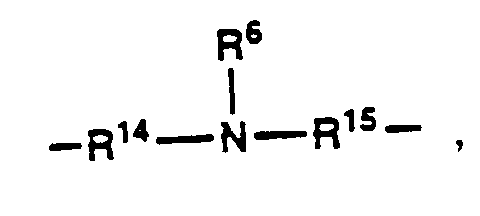
-R 14 -O-R 15 -,
R14 ausgewählt ist auseiner chemischen BindungC1-C8-Alkyl,C1-C8-Alkyloxy,C3-C7-cycloalkyl,C2-C5-AlkenylC3-C5-Alkinyl,C6-C10-Aryl,C1-C3-Alkyl-C6-C12-aryl,C1-C2-Alkyl-C6-C10-aryl-C1-C2-alkyl,C6-C10-Aryl-C1-C2-alkyl,HET undPyridyl;R15 ausgewählt ist auseiner chemischen BindungC1-C4-Alkyl,C2-C4-Alkenyl,C2-C4-Alkinyl undC6-C10-Aryl;R16 ausgewählt ist auseiner chemischen BindungC1-C5-Alkyl,C3-C7-Cycloalkyl,C3-C5-Alkenyl,C3-C5-Alkinyl,C6-C10-Aryl,C1-C3-Alkyl-C6-C12-aryl,C1-C3-Alkyl-C6-C12-aryl,C6-C10-Aryl-C1-C2-alkyl,HET undPyridyl;R18, R19, R20 and R21 unabhäng voneinander ausgewählt sind ausWasserstoff,C1-C4-Alkyl und(mit F, Cl, Br, I) halogeniertem C1-C4-Alkyl,R22 aus der Gruppe ausgewählt ist, bestehend ausHydroxy,C1-C8-Alkoxy,C3-C12-Alkenoxy,C6-C12-Aryloxy,C1-C6-Alkyl-C6-C12-aryloxy,Di-C1-C8-alkylamino-C1-C8-alkoxy,Acylamino-C1-C8-alkoxy, ausgewählt aus der GruppeAcetylam i noethoxy,Nicotinoylaminoethoxy undSuccinamidoethoxy,C1-C8-Alkoyloxy-C1-C8-alkoxy,C6-C12-Aryl-C1-C8-alkoxy, worin die Arylgruppe unsubstituiert oder mit einer bis drei der folgenden Gruppen substituiert ist:Nitro,Halogen (F, Cl, Br, I),C1-C4-Alkoxy undAmino,Hydroxy-C2-C8-alkoxy,Dihydroxy-C3-C8-alkoxy,Morpholino-C2-C8-alkoxy undNR23R24,R23 and R24 unabhängig voneinander ausgewählt sind ausWasserstoff,C1-C8-Alkyl,C3-C8-Alkenyl,C6-C12-Arylworin die Arylgruppe unsubstituiert oder mit einer bis drei der folgenden Gruppen substutiert ist:Nitro,Halogen (F, Cl, Br, I),C1-C4-Alkoxy undAmino undC6-C12-Aryl-C1-C8-alkylworin die Arylgruppe unsubstituiert oder mit einer bis drei der folgenden Gruppen substituiert ist:Nitro,Halogen (F, Cl, Br, I) undC1-C4-Alkoxy;R25 ausgewählt ist ausR6 und(CH2)mR1, worin m = 1, 2 oder 3 ist;R26 ausgewählt ist ausund pharmazeutisch annehmbare Salze davon.Wasserstoff,C1-C8-Alkyl,C6-C12-Aryl undC6-C12-Aryl-C1-C8-alkylworin alle Aryl- oder Alkylgruppen unsubstituiert oder mit einer bis drei der folgenden Gruppen substituiert sind:Nitro undHalogen (F, Cl, Br, I); - Verbindung nach Anspruch 1 der Formel IX-XX:


 R1 und R2 unabhängig voneinander ausgewählt sind ausWasserstoff,Halogen (F, Cl, Br, I),Cyano,Carboxy,Aminocarbonyl,Carboxamido,Carbamoyloxy,Formyloxy,Formyl,Azido,Nitro,Imidazolyl,Ureido,Thioureido,Thiocyanato,Hydroxy,Mercapto,Sulfonamido undeinem gegebenenfalls substituierten Rest, ausgewählt aus:C1-C12-Alkyl,C1-C12-Alkyloxycarbonyl,C1-C12-Alkyloxy-C1-C12-alkyl,C2-C12-Alkenyl,C2-C12-Alkinyl,C3-C12-Cycloalkyl,C6-C14-Aryl,C6-C10-Aryl-C1-C8-alkyl,C1-C12-Alkyloxy,C6-C14-Aryloxy undC1-C12-Acylamino,worin die Substituenten ausgewählt sind ausHalogen (F, Cl, Br, I),Amino,Amidino,Guanidino,Imidazolyl,Indolyl,Cyano,Azido,Nitro,Hydroxy,Mercapto,Morpholino,Morpholinyl,Piperazinyl,Piperidinyl,Pyrrolinyl,Sulfonamido,Ureido,Thioureido,Carboxy,Aminocarbonyl,C1-C4-Alkylaminocarbonyl,Carboxamido,Carbamoyloxy,Formyloxy,Formyl,C1-C4-Alkyloxycarbonyl,C1-C4-Alkyl,C1-C4-Alkylamino,Di-(C1-C4)-alkylamino,C1-C4-Alkoxy,C1-C4-Alkylthio,Hydroxyphenyl,Phenyl undPhenoxy;Q aus der Gruppe ausgewählt ist, bestehend aus
einer Aminogruppe, ausgewählt aus:NH2,NR3H,NR3R4 undNR3R4R5,R3, R4 und R5 unabhängig voneinander jeweils ein gegebenenfalls substituierter Rest sind, ausgewählt ausWasserstoff,C1-C4-Alkoxy,C1-C4-Alkyl,(mit F, Cl, Br, I) halogeniertem C1-C4-Alkyl,gegebenenfalls substituiertem C1-C12-Alkyl,gegebenenfalls substituiertem C3-C12-Cycloalkyl,gegebenenfalls substituiertem C6-C14-Aryl,gegebenenfalls substituiertem C1-C6-Alkyl-C6-C14-aryl,gegebenenfalls substituiertem C1-C8-Alkoxy,gegebenenfalls substituiertem C1-C8-Alkoxycarbonyl,gegebenenfalls substituiertem C6-C14-Aryloxy,gegebenenfalls substituiertem C6-C14-Aryloxycarbonyl,NR6R7,C(= NR8)-NR6R7,N = CR9-NR6R7,NR10-CR9= NR8 undNR10-C(= NR8)-NR6R7,worin alle R6, R7, R8, R9 und R10 unabhängig voneinander ausgewählt sind ausWasserstoff,C1-C4-Alkyl undR11,und worin die Substituenten ein bis drei Reste R11 sind,
die Reste R11 unabhängig voneinander ausgewählt sind ausgegebenenfalls substituiertem C6-C12-Aryloxy,gegebenenfalls substituiertem C6-C12-Arylamino,gegebenenfalls substituiertem C6-C12-Aroyl,gegebenenfalls substituiertem C6-C12-Aryl,worin die Substituenten ein bis drei Reste R12 sind,R12 ausgewählt ist ausNitro,Amino,C1-C8-Alkylamino,Di-(C1-C8)-alkylamino,Amidino,Aminomethylenimino,Imino,Imino-C1-C4-alkyl,Iminomethylenamino,Guanidino,C6-C10-Arylamino,C1-C8-Acylamino,C1-C4-Alkylsulfonamino,Azido,Cyano,Hydroxy,Hydroxy-C1-C8-alkyl,C1-C8-Alkoxy,Phenyloxy,C1-C8-Alkanoyloxy,C1-C8-Alkanoyl,C6-C12-Aroyl,Benzamido,Phenyl,Halogen (F, Cl, Br, I),halogeniertem C1-C8-Alkyl,C1-C8-Alkyl,Aminosulfonyl,Oxo,Thio,Thiocarbonyl,Hydroxy,Mercapto,Formyl,Formyloxy,Carboxy,Ureido,Glycyl,Phthalimido,Succinimido,Morpholino,C3-C7-Cycloalkyl;gegebenenfalls R3 und R4 zusammen gegebenenfalls substituiertesTetramethylen,Pentamethylen,3-Oxopentamethylen und3-Azapentamethylenbilden können, worin die Substituenten aus ein bis drei Resten R12 ausgewählt sind, einer Amidinogruppe, ausgewählt ausC(= NH)-NH2,C(= NH)-NHR3,C(= NR4)-NHR3,C(= NH)-NR3R4 undC(= NR5)-NR3R4,worin R3, R4 und R3 wie oben definiert sind,
einer Aminoalkylenaminogruppe, ausgewählt ausN=CH-NH2,N=CH-NHR3,N=CH-NR3R4 undN=CR5-NR3R4,worin R3, R4 und R5 wie oben definiert sind,
einer Iminoalkylenaminogruppe, ausgewählt ausNH-CH = NH,NH-CH = NR3,NH-CR4 = NR3 undNR5-CR4= NR3,worin R3, R4 und R5 wie oben definiert sind
einer Guanidinogruppe, ausgewählt ausNH-C(= NH)-NH2,NH-C(=NH)-NR3H,NH-C(=NH)-NR3R4,NH-C(=NR5)-NR3R4,NR3-C(= NR3)-NR3R4,NR3-C(= NH)-NR3R4,NR3-C(= NR3)-NH2,NR3-C(=NH)-NH2,NR3-C(= NR3)-NHR4 undNR3-C(= NH)-NHR4,worin R3, R4 und R5 wie oben definiert sind;L ein gegebenenfalls substituierter zweiwertiger Rest ist, ausgewählt aus folgender Gruppe:C3-C7-Alkylen,C3-C7-Cycloalkylen,C3-C7-Alkenylen,C4-C7-Cycloalkenylen,C5-C8-Cycloalkadienylen,C3-C7-Alkadienylen,C3-C7-Alkinylen,C4-C7-Alkeninylen,C6-C14-Arylen,C6-C14-Aryl-C2-C4-alkinylen,C1-C3-Alkyl-C6-C14-aryl-C2-C4-alkinylen,C6-C14-Aryl-C2-C4-alkenylen,C1-C3-Alkyl-C6-C14-arylen,C1-C3-Alkyl-C6-C14-aryl-C2-C4-alkenylen,C6-C14-Aryl-C1-C3-alkylen,C6-C14-Aryl-C1-C3-alkyloxyen,C1-C2-Alkyl-C6-C14-aryl-C1-C2-alkylen,C1-C3-Alkyloxy-C6-C14-arylen,C2-C8-Alkyloxyen,C1-C5-Alkyloxy-C1-C5-alkylen,C6-C10-Aryloxyen,C6-C10-Aryloxy-C1-C5-alkylen,C6-C10-Arylthio-C1-C5-alkylen,worin


-R 14 -S-R 15 - ,


-R 14 -O-R 15 -,
R14 ausgewählt ist auseiner chemischen Bindung,C1-C8-Alkyl,C1-C8-Alkyloxy,C3-C7-Cycloalkyl,C2-C5-Alkenyl,C3-C5-Alkinyl,C6-C10-Aryl,C1-C3-Alkyl-C6-C12-aryl,C1-C2-Alkyl-C6-C10-aryl-C1-C2-alkyl,C6-C10-Aryl-C1-C2-alkyl,HET undPyridyl;R15 ausgewählt ist auseiner chemischen Bindung,C1-C4-Alkyl,C2-C4-Alkenyl,C2-C4-Alkinyl undC6-C10-Aryl;R16 ausgewählt ist auseiner chemischen Bindung,C1-C5-Alkyl,C3-C7-Cycloalkyl,C3-C5-Alkenyl,C3-C5-Alkinyl,C6-C10-Aryl,C1-C3-Alkyl-C6-C12-aryl,C1-C3-Alkyl-C6-C12-aryl,C6-C10-Aryl-C1-C2-alkyl,HET undPyridyl;R22 ausgewählt ist aus der Gruppe, bestehend ausHydroxy,C1-C8-Alkoxy,C3-C12-Alkenoxy,C6-C12-Aryloxy,C1-C6-Alkyl-C6-C12-aryloxy,Di-C1-C8-alkylamino-C1-C8-alkoxy,Acylamino-C1-C8-alkoxy, ausgewählt aus der Gruppe, bestehend ausAcetylaminoethoxy,Nicotinoylaminoethoxy undSuccinamidoethoxy,C1-C8-Alkoyloxy-C1-C8-alkoxy,C6-C12-Aryl-C1-C8-alkoxy, worin die Arylgruppe unsubsituiert oder mit ein bis drei der folgenden Gruppen substituiert ist:Nitro,Halogen (F, Cl, Br, I),C1-C4-Alkoxy undAmino,Hydroxy-C2-C8-alkoxy,Dihydroxy-C3-C8-alkoxy,Morpholino-C2-C8-alkoxy undNR23R24,R23 and R24 unabhängig voneinander ausgewählt sind ausC1-C8-Alkyl,C3-C8-Alkenyl,Wasserstoff,C6-C12-Aryl,worin die Arylgruppe unsubstituiert oder mit ein bis drei der folgenden Gruppen substituiert ist:Nitro,Halogen (F, Cl Br, I),C1-C4-Alkoxy undAmino undC6-C12-Aryl-C1-C8-alkylworin die Arylgruppe unsubstituiert oder mit ein bis drei der folgenden Gruppen substutiert ist:Nitro,Halogen (F, Cl, Br, I) undC1-C4-Alkoxy;R25 ausgewählt ist ausR6 und(CH2)mR1, worin m = 1, 2 oder 3 ist;R26 ausgewählt ist ausund pharmazeutisch annehmbare Salze davon.Wasserstoff,C1-C8-Alkyl,C6-C12-Aryl undC6-C12-Aryl-C1-C8-alkylworin alle Aryl- oder Alkylgruppen unsubstituiert oder mit ein bis drei der folgenden Gruppen substituiert sind:Nitro undHalogen (F, Cl, Br, I); - Verbindung nach Anspruch 2, ausgewählt aus folgender Gruppe:


 R1 ausgewählt ist ausWasserstoff,Halogen (F, Cl, Br, I),Cyano,Carboxy,Aminocarbonyl,Carboxamido,Carbamoyloxy,Formyloxy,Formyl,Azido,Nitro,Imidazolyl,Ureido,Thioureido,Thiocyanato,Hydroxy,Mercapto,Sulfonamido undeinem gegebenenfalls substituierten Rest, ausgewählt aus:C1-C12-Alkyl,C1-C12-Alkyloxycarbonyl,C1-C12-Alkyloxy-C1-C12-alkyl,C2-C12-Alkenyl,C2-C12-Alkinyl,C3-C12-Cycloalkyl,C6-C14-Aryl,C6-C10-Aryl-C1-C8-alkyl,C1-C12-Alkyloxy,C6-C14-Aryloxy undC1-C12-Acylamino,worin die Substituenten ausgewählt sind ausHalogen (F, Cl, Br, I),Amino,Amidino,Guanidino,Imidazolyl,Indolyl,Cyano,Azido,Nitro,Hydroxy,Mercapto,Morpholino,Morpholinyl,Piperazinyl,Piperidinyl,Pyrrolinyl,Sulfonamido,Ureido,Thioureido,Carboxy,Aminocarbonyl,C1-C4-Aminocarbonyl,Carboxamido,Carbamoyloxy,Formyloxy,Formyl,C1-C4-Alkyloxycarbonyl,C1-C4-Alkyl,C1-C4-Alkylamino,Di-(C1-C4)-alkylamino,C1-C4-Alkoxy,C1-C4-Alkylthio,Hydroxyphenyl,Phenyl undPhenoxy;Q aus der Gruppe ausgewählt ist, bestehend aus
einer Aminogruppe, ausgewählt ausNH2,NR3H,NR3R4 undNR3R4R5,R3, R4 und R5 unabhängig voneinander jeweils ein gegebenenfalls substituierter Rest sind, ausgewählt ausWasserstoff,C1-C4-Alkoxy,C1-C4-Alkyl,(mit F, Cl, Br, I) halogeniertes C1-C4-Alkyl,gegebenenfalls substituiertem C1-C12-Alkyl,gegebenenfalls substituiertem C3-C12-Cycloalkyl,gegebenenfalls substituiertem C6-C14-Aryl,gegebenenfalls substituiertem C1-C6-Alkyl-C6-C14-aryl,gegebenenfalls substituiertem C1-C8-Alkoxy,gegebenenfalls substituiertem C1-C8-Alkoxycarbonyl,gegebenenfalls substituiertem C6-C14-Aryloxy,gegebenenfalls substituiertem C6-C14-Aryloxycarbonyl,NR6R7,C(= NR8)-NR6R7,N =CR9-NR6R7,NR10-CR9=NR8 undNR10-C(= NR8)NR6R7,R6, R7, R8, R9 und R10 unabhängig voneinander ausgewählt sind ausWasserstoff,C1-C4-Alkyl undR11,und worin die Substituenten ein bis drei Reste R11 sind,
die Reste R11 unabhängig voneinander ausgewählt sind ausgegebenenfalls substituiertem C6-C12-Aryloxy,gegebenenfalls substituiertem C6-C12-Arylamino,gegebenenfalls substituiertem C6-C12-Aroyl undgegebenenfalls substituiertem C6-C12-Aryl,worin die Substituenten ein bis drei Reste R12 sind,R12 ausgewählt ist ausNitro,Amino,C1-C8-Alkylamino,Di-(C1-C8)-alkylamino,Amidino,Aminomethylenimino,Imino,Imino-C1-C4-alkyl,Iminomethylenamino,Guanidino,C6-C10-Arylamino,C1-C8-Acylamino,C1-C4-Alkylsulfonamino,Azido,Cyano,Hydroxy,Hydroxy-C1-C8-alkyl,C1-C8-Alkoxy,Phenyloxy,C1-C8-Alkanoyloxy,C1-C8-Alkanoyl,C6-C12-Aroyl,Benzamido,Phenyl,Halogen (F, Cl, Br, I),halogeniertem C1-C8-Alkyl,C1-C8-Alkyl,Aminosulfonyl,Oxo,Thio,Thiocarbonyl,Hydroxy,Mercapto,Formyl,Formyloxy,Carboxy,Ureido,Glycyl,Phthalimido,Succinimido,Morpholino,C3-C7-Cycloalkyl undgegebenenfalls R3 and R4 zusammen gegebenenfalls substituiertesTetramethylen,Pentamethylen,3-Oxopentamethylen und3-Azapentamethylen,bilden können, worin die Substituenten aus ein bis drei Resten R12 ausgewählt sind,
einer Amidinogruppe, ausgewählt ausC(= NH)-NH2,C(= NH)-NHR3,C(= NR4)-NHR3,C(= NH)-NR3R4 undC(= NR5)-NR3R4,worin R3, R4 und R5 wie oben definiert oder aus folgender Gruppe ausgewählt sind:HO-,C1-C10-Alkyl-O-(C = O)-,C1-C10-Alkyl-S-(C = O)-,Cl3CCH2O-(C = O)-,einer Aminoalkylenaminogruppe, ausgewählt aus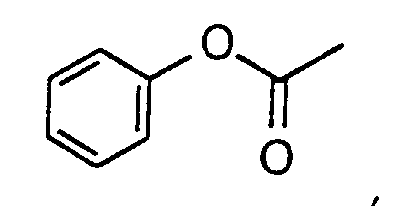


 N = CH-NH2,N = CH-NHR3,N = CH-NR3R4 undN = CR5-NR3R4,worin R3, R4 und R5 wie oben definiert sind,
einer Iminoalkylenaminogruppe, ausgewählt ausNH-CH = NH,NH-CH = NR3,NH-CR4 = NR3 undNR5-CR4 = NR3,worin R3, R4 und R5 wie oben definiert sind,
einer Guanidinogruppe, ausgewählt ausNH-C(= NH)-NH2,NH-C(= NH)-NR3H,NH-C(= N H)-NR3R4,NH-C(= NR5)-NR3R4,NR3-C(= NR3)-NR3R4,NR3-C(=NH)-NR3R4,NR3-C(= NR3)-NH2,NR3-C(= NH)-NH2,NR3-C(= NR3)-NHR4 undNR3-C(= N H)-NHR4,worin R3, R4 und R5 wie oben definiert sind;L ein gegebenenfalls substituierter zweiwertiger Rest ist, ausgewählt aus folgender Gruppe:C3-C7-Alkylen,C3-C7-Cycloalkylen,C3-C7-Alkenylen,C4-C7-Cycloalkenylen,C5-C8-Cycloalkadienylen,C3-C7-Alkadienylen,C3-C7-Alkinylen,C4-C7-Alkeninylen,C6-C14-Arylen,C6-C14-Aryl-C2-C4-alkinylen,C1-C3-Alkyl-C6-C14-aryl-C2-C4-alkinylen,C6-C14-Aryl-C2-C4-alkenylen,C1-C3-Alkyl-C6-C14-arylen,C1-C3-Alkyl-C6-C14-aryl-C2-C4-alkenylen,C6-C14-Aryl-C1-C3-alkylen,C6-C14-Aryl-C1-C3-alkyloxyen,C1-C2-Alkyl-C6-C14-aryl-C1-C2-alkylen,C1-C3-Alkyloxy-C6-C14-arylen,C2-C8-Alkyloxyen,C1-C5-Alkyloxy-C1-C5-alkylen,C6-C1o-Aryloxyen,C6-C10-Aryloxy-C1-C5-alkylen,C6-C10-Arylthio-C1-C5-alkylen,worin

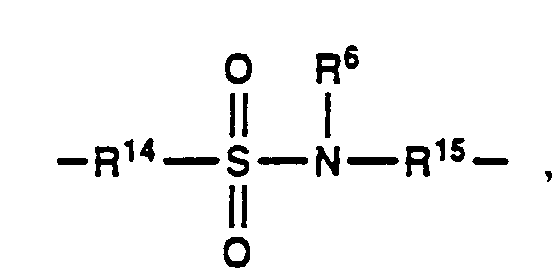

-R 14 -S-R 15 -,

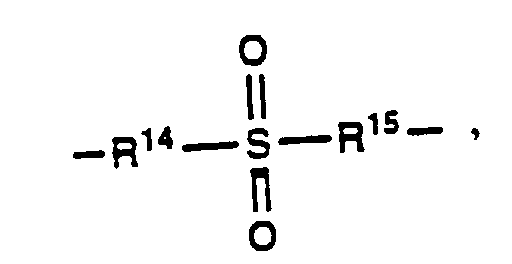


-R 14 -O-R 15 -,
R14 ausgewählt ist auseiner chemischen Bindung,C1-C8-Alkyl,C1-C8-Alkyloxy,C3-C7-Cycloalkyl,C2-C5-Alkenyl,C3-C5-Alkinyl,C6-C10-Aryl,C1-C3-Alkyl-C6-C12-aryl,C1-C2-Alkyl-C6-C10-aryl-C1-C2-alkyl,C6-C10-Aryl-C1-C2-alkyl,HET undPyridyl;R15 ausgewählt ist auseiner chemischen Bindung,C1-C4-Alkyl,C2-C4-Alkenyl,C2-C4-Alkinyl undC6-C10-Aryl;R16 ausgewählt ist auseiner chemischen Bindung,C1-C5-Alkyl,C3-C7-Cycloalkyl,C3-C5-Alkenyl,C3-C5-Alkinyl,C6-C10-Aryl,C1-C3-Alkyl-C6-C12-aryl,C1-C3-Alkyl-C6-C12-aryl,C6-C10-Aryl-C1-C2-alkyl,HET undPyridyl;R18, R19, R20 und R21 unabhängig voneinander ausgewählt sind ausWasserstoff,C1-C4-Alkyl und(mit F, Cl, Br, I) halogeniertem C1-C4-Alkyl;R22 aus der Gruppe ausgewählt ist, bestehend ausHydroxy,C1-C8-Alkoxy,C3-C12-Alkenoxy,C6-C12-Aryloxy,C1-C6-Alkyl-C6-C12-aryloxy,Di-C1-C8-alkylamino-C1-C8-alkoxy,Acylamino-C1-C8-alkoxy, ausgewählt aus der GruppeAcetylaminoethoxy,Nicotinoylaminoethoxy undSuccinamidoethoxy,C1-C8-Alkoyloxy-C1-C8-alkoxy,C6-C12-Aryl-C1-C8-alkoxy, worin die Arylgruppe unsubstituiert oder mit einer bis drei der folgenden Gruppen substituiert ist:Nitro,Halogen (F, Cl, Br, I),C1-C4-Alkoxy undAmino,Hydroxy-C2-C8-alkoxy,Dihydroxy-C3-C8-alkoxy,Morpholino-C2-C8-alkoxy undNR23R24,R23 und R24 unabhängig voneinander ausgewählt sind ausund pharmazeutisch annehmbare Salze davon.Wasserstoff,C1-C8-Alkyl,C3-C8-Alkenyl,C6-C12-Arylworin die Arylgruppe unsubstituiert oder mit einer bis drei der folgenden Gruppen substituiert ist:Nitro,Halogen (F, Cl, Br, I),C1-C4-Alkoxy undAmino undC6-C12-Aryl-C1-C8-alkylworin die Arylgruppe unsubstituiert oder substituiert ist mit:Nitro,Halogen (F, Cl, Br, I) undC1-C4-Alkoxy; - Verbindung nach Anspruch 2, worin Q-L- ausgewählt ist aus


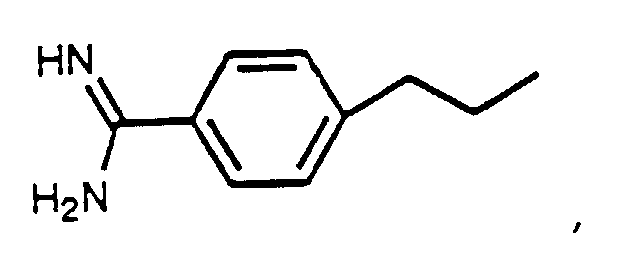


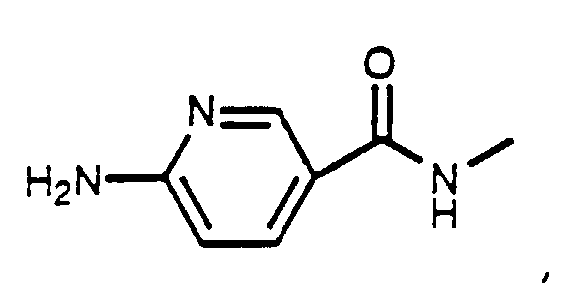


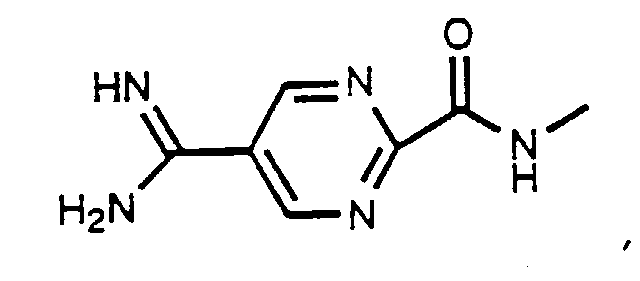


- Verbindung nach Anspruch 2 der Strukturformel Ia
 R1 und R2 jeweils ein oder zwei Substituenten sind, die unabhängig voneinander ausgewählt sind aus Wasserstoff, Fluor, Trifluormethyl und Chlor;R18, R19, R20 und R21 unabhängig voneinander aus R1 und Methyl ausgewählt sind;A1 CH oder N ist;A2 CH, C-CH3, C-CH2-CH3 oder N ist;-X-Y- ausgewählt ist aus -NH-C(=O)-, -C(=O)-NH-, -CC-, -CH2-O-, -O-CH2- und -CH2-CH2-; undZ1 ausgewählt ist aus N und CR1.
 - Verbindung nach Anspruch 2, ausgewählt aus der Gruppe, bestehend aus4H-Imidazo-[1,2-a][1,4]-benzodiazepin-5(6H)-propansäure-8-[[4-(aminoiminomethyl)phenyl]ethinyl]-1-methyl-6-oxo-acetat,4H-Imidazo[1,2-a][1,4]-benzodiazepin-5(6H)-propansäure-8-[[4-(aminoiminomethyl)phenyl]methoxy]-1-methyl-6-oxo-acetat,4H-Imidazo-[1,2-a][1,4]-benzodiazepin-5(6H)-propansäure-8-[[4-(aminoiminomethyl)benzoyl]amino]-1-methyl-6-oxo-acetat,4H-Imidazo-[1,2-a][1,4]-benzodiazepin-5(6H)-propansäure-8-[[4-(aminoiminomethyl)picolinoyl]amino]-1-methyl-6-oxo-acetat,4H-Imidazo-[1,2-a][1,4]-benzodiazepin-5(6H)-propansäure-8-[[4-(aminoiminomethyl)phenyl]ethinyl]-1-phenyl-6-oxo-acetat,4H-Imidazo-[1,2-a][1,4-]benzodiazepin-5(6H)-propansäure-8-[[4-(aminoiminomethyl)phenyl]methoxy]-1-phenyl-6-oxo-acetat,4H-Imidazo-[1,2-a][1,4]-benzodiazepin-5(6H)-propansäure-8-[[4-(aminoiminomethyl)benzoyl]amino]-1-phenyl-6-oxo-acetat,4H-Imidazo-[1,2-a][1,4]-benzodiazepin-5(6H)-propansäure-8-[[4-aminoiminomethyl)picolinoyl]amino]-1-phenyl-6-oxo-acetat,4H-[1,2,4]-Triazolo-[4,3-a][1,4]-benzodiazepin-5(6H)-propansäure-8-[[4-(aminoiminomethyl)phenyl]methoxy]-1-methyl-6-oxo-acetat,4H-[1,2,4]-Triazolo-[4,3-a][1,4]-benzodiazepin-5(6H)-propansäure-8-[[4-(aminoiminomethyl)phenyl]ethinyl]-1-methyl-6-oxo-acetat,4H-[1 ,2,4]-Triazolo-[4,3-a][1,4]-benzodiazepin-5(6H)-propansäure-8-[[4-(aminoiminomethyl)benzoyl]amino]-1-methyl-6-oxo-acetat,4H-[1,2,4]-Triazolo-[4,3-a][1,4]-benzodiazepin-5(6H)-propansäure-8-[[4-(aminoiminomethyl)picolinoyl)amino]-1-methyl-6-oxo-acetat,4H-[4,2,4]-Triazolo-[4,3-a][1,4]-benzodiazepin-5(6H)-propansäure-8-[[4-(aminoiminomethyl)phenyl]methoxy]-1-hydroxy-6-oxo-acetat,4H-[1,2,4]-Triazolo-[4,3-a][1,4]-benzodiazepin-5(6H)-propansäure-8-[[4-(aminoiminomethyl)phenyl]ethinyl]-1-hydroxy-6-acetat,4H-[1,2,4]-Triazolo-[4,3-a][1,4]-benzodiazepin-5(6H)-propansäure-8-[[4-(aminoiminomethyl)benzoyl]amino]-1-hydroxy-6-oxo-acetat,4H-[1,2,4]-Triazolo-[4,3-a][1,4]-benzodiazepin-5(6H)-propansäure-8-[[4-(aminoiminomethyl)picolinoyl]amino]-1-hydroxy-6-oxo-acetat,4H-[1,2,4]triazolo-[4,3-a][1,4]-benzodiazepin-5(6H)-propansäure-8-[[4-(aminoiminomethyl)phenyl]methoxy]-1-methoxy-6-oxo-acetat,4H-[1,2,4]-Triazolo-[4,3-a][1,4]-benzodiazepin-5(6H)-propansäure-8-[[4-(aminoiminomethyl)phenyl]ethinyl]-1-methoxy-6-oxo-acetat,4H-[1,2,4]triazolo-[4,3-a][1,4]-benzodiazepin-5(6H)-propansäure-8-[[4-(aminoiminomethyl)benzoyl]amino]-1-methoxy-6-oxo-acetat,4H-[1,2,4]triazolo-[4,3-a][1,4]-benzodiazepin-5(6H)-propansäure-8-[[4-(aminoiminomethyl)picolinoyl]amino]-1-methoxy-6-oxo-acetat,4H-[1,2,4]-Triazolo-[4,3-a][1,4]-benzodiazepin-5(6H)-propansäure-8-[[4-(aminoiminomethyl)phenyl]methoxy]-1-phenyl-6-oxo-acetat,4H-[1,2,4]-Triazolo-[4,3-a][1,4]-benzodiazepin-5(6H)-propansäure-8-[[4-(aminoiminomethyl)phenyl]ethinyl]-1-phenyl-6-oxo-acetat,4H-[1,2,4]-Triazolo-[4,3-a][1,4]-benzodiazepin-5(6H)-propansäure-8-[[4-(aminoiminomethyl)benzoyl]amino]-1-phenyl-6-oxo-acetat,4H-[1,2,4]-Triazolo-[4,3-a][1,4]-benzodiazepin-5(6H)-propansäure-8-[[4-(aminoiminomethyl)picolinoyl]amino]-1-phenyl-6-oxo-acetat,4H-[1,2,3,4]-Tetrazolo-[1,5-a][1,4]-benzodiazepin-5(6H)-propansäure-8-[[4-aminoiminomethyl)phenyl]methoxy]-6-oxo-acetat,4H-[1,2,3,4]-Tetrazolo-[1,5-a][1,4]-benzodiazepin-5(6H)-propansäure-8-[[4-aminoiminomethyl)phenyl]ethinyl]-6-oxo-acetat,4H-[1,2,3,4]-Tetrazolo-[4,3-a][1,4]-benzodiazepin-5(6H)-propansäure-8-[[4-aminoiminomethyl)benzoyl]amino]-6-oxo-acetat,4H-[1,2,3,4]tetrazolo-[1,5-a][1,4]-benzodiazepin-5(6H)-propansäure-8-[[4-aminoiminomethyl)picolinoyl]amino]-6-oxo-acetat,4H-Imidazo-[1,2-a][1,4]-benzodiazepin-5(6H)-(R)-2-methyl-(S)-3-methylpropansäure-8-[[4-(aminoiminomethyl)phenyl]ethinyl]-1-methyl-6-oxo-acetat,4H-Imidazo-[1,2-a][1,4]-benzodiazepin-5(6H)-(R)-2-methyl-(S)-3-methylpropansäure-8-[[4-(aminoiminomethyl)-3-chlorphenyl]ethinyl]-1-methyl-6-oxo-acetat,4H-Imidazo-[1,2-a][1,4]-benzodiazepin-5(6H)-(R)-2-methyl-(S)-3-methylpropansäure-8-[[4-(aminoiminomethyl)-2-chlorphenyl]ethinyl]-1-methyl-6-oxo-acetat,4H-Imidazo-[1,2-a][1,4]-benzodiazepin-5(6H)-(R)-2-methyl-(S)-3-methylpropansäure-8-[[4-(aminoiminomethyl)pyridyl]ethinyl]-1-methyl-6-oxo-acetat,4H-Imidazo-[1,2-a][1,4]-benzodiazepin-5(6H)-(S)-2-methyl-(R)-3-methylpropansäure-8-[[4-(aminoiminomethyl)phenyl]ethinyl]-1-methyl-6-oxo-acetat,4H-Imdazo-[1,2-a][1,4]-benzodiazepin-5(6H)-(S)-2-methyl-(R)-3-methyl propansäure-8-[[4-(aminoiminomethyl)-3-chlorphenyl]ethinyl]-1-methyl-6-oxo-acetat,4H-Imidazo-[1,2-a][1,4]-benzodiazepin-5(6H)-(S)-2-methyl-(R)-3-methylpropansäure-8-[[4-(aminoiminomethyl)-2-chlorphenyl]ethinyl]-1-methyl-6-oxo-acetat,4H-Imidazo-[1,2-a][1,4]-benzodiazepin-5(6H)-(S)-2-methyl-(R)-3-methylpropansäure-8-[[4-(aminoiminomethyl)pyridyl]ethinyl]-1-methyl-6-oxo-acetat,4H-Imidazo-[1,2-a][1,4]-benzodiazepin-5(6H)-(R)-2-methylpropansäure-8[[4-(aminoiminomethyl)phenyl]ethinyl]-1-methyl-6-oxo-acetat,4H-Imidazo-[1,2-a][1,4]-benzodiazepin-5(6H)-(R)-2-methylpropansäure-8-[[4-(aminoiminomethyl)-3-chlorphenyl]ethinyl]-1-methyl-6-oxo-acetat,4H-Imidazo-[1,2-a][1,4]-benzodiazepin-5(6H)-(R)-2-methylpropansäure-8-[[4-(aminoiminomethyl)-2-chlorphenyl]ethinyl]-1-methyl-6-oxo-acetat,4H-Imidazo-[1,2-a][1,4]-benzodiazepin-5(6H)-(R)-2-methylpropansäure-8-[[4-(aminoiminomethyl)pyridyl]ethinyl]-1-methyl-6-oxo-acetat,4H-Imidazo-[1,2-a][1,4]-benzodiazepin-5(6H)-(S)-2-methylpropansäure-8-[[4-(aminoiminomethyl)phenyl]ethinyl]-1-methyl-6-oxo-acetat,4H-Imidazo-[1,2-a][1,4]-benzodiazepin-5(6H)-(S)-2-methylpropansäure-8-[[4-(aminoiminomethyl)-3-chlorphenyl]ethinyl]-1-methyl-6-oxo-acetat,4H-Imidazo-[1,2-a][1,4]-benzodiazepin-5(6H)-(S)-2-methylpropansäure-8-[[4-(aminoiminomethyl)-2-chlorphenyl]ethinyl]-1-methyl-6-oxo-acetat,4H-Imidazo-[1,2-a][1,4]-benzodiazepin-5(6H)-(S)-2-methyl propansäure-8-[[4-(aminoiminomethyl)]pyridyl]ethinyl]-1-methyl-6-oxo-acetat,4H-Imidazo-[1,2-a][1,4]-benzodiazepin-5(6H)-(S)-3-methylpropansäure-8-[[4-(aminoiminomethyl)phenyl]ethinyl]-1-methyl-6-oxo-acetat,4H-Imidazo-[1,2-a][1,4]-benzodiazepin-5(6H)-(S)-3-methylpropansäure-8-[[4-(aminoiminomethyl)-3-chlorphenyl]ethinyl]-1-methyl-6-oxo-acetat,4H-Imidazo-[1,2-a][1,4]-benzodiazepin-5(6H)-(S)-3-methylpropansäure-8-[[4-(aminoiminomethyl)-2-chlorphenyl]ethinyl]-1-methyl-6-oxo-acetat,4H-Imidazo-[1,2-a][1,4]-benzodiazepin-5(6H)-(S)-3-methylpropansäure-8-[[4-(aminoiminomethyl)-]pyridyl]ethinyl]-1-methyl-6-oxo-acetat,4H-[1,2,3,4]-Tetrazolo-[4,3a][1,4]-benzodiazepin-5(6H)-(R)-2-methyl-(S)-3-methylpropansäure-8-[[4-(aminoiminomethyl)phenyl]methoxy-6-oxo-acetat,4H-[1,2,3,4]-Tetrazolo-[4,3a][1,4]-benzodiazepin-5(6H)-(S)-2-methyl-(R)-3-methylpropansäure-8-[[4-(aminoiminomethyl)phenyl]methoxy-6-oxo-acetat,4H-[1,2,3,4]-Tetrazolo-[4,3a][1,4]-benzodiazepin-5(6H)-(R)-2-methylpropansäure-8-[[4-(aminoiminomethyl)phenyl]methoxy-6-oxo-acetat,4H-[1,2,3,4]-Tetrazolo-[4,3a][1,4]-benzodiazepin-5(6H)-(S)-2-methylpropansäure-8-[[4-(aminoiminomethyl)phenyl]methoxy-6-oxo-acetat,4H-[1,2,3,4]-Tetrazolo-[4,3a][1,4]-benzodiazepin-5(6H)-(S)-3-methylpropansäure-8-[[4-(aminoiminomethyl)phenyl]methoxy-6-oxo-acetat,4H-[1,2,3,4]-Tetrazolo-[4,3a][1,4]-benzodiazepin-5(6H)-(R)-2-methyl-(S)-3-methylpropansäure-8-[[4-(aminoiminomethyl)-7-chlorbenzoyl]amino-6-oxo-acetat,4H-[1,2,3,4]-Tetrazolo-[4,3a][1,4]-benzodiazepin-5(6H)-(R)-2-methyl-(S)-3-methylpropansäure-8-[[4-(aminoiminomethyl)benzoyl]amino]-6-oxo-acetat,4H-[1,2,3,4]-Tetrazolo-[4,3a][1,4]-benzodiazepin-5(6H)-(S)-2-methyl-(R)-3-methylpropansäure-8-[[4-(aminoiminomethyl)-7-chlorbenzoyl]amino]-6-oxo-acetat,4H-[1,2,3,4]-Tetrazolo-[4,3a][1,4]-benzodiazepin-5(6H-(S)-2-methyl-(R)-3-methylpropansäure-8-[[4-(aminoiminomethyl)benzoyl]amino]-6-oxo-acetat,4H-[1,2,3,4]-Tetrazolo-[4,3a][1,4]-benzodiazepin-5(6H)-(R)-2-methylpropansäure-8-[[4-(aminoiminomethyl)-7-chlorbenzoyl]amino]-6-oxo-acetat,4H-[1,2,3,4]-Tetrazolo-[4,3a][1,4]-benzodiazepin-5(6H)-(R)-2-methylpropansäure-8-[[4-(aminoiminomethyl)benzoyl]amino]-6-oxo-acetat,4H-[1,2,3,4]-Tetrazolo-[4,3a][1,4]-benzodiazepin-5(6H)-(S)-2-methylpropansäure-8-[[4-(aminoiminomethyl)-7-chlorbenzoyl]amino]-6-oxo-acetat,4H-[1,2,3,4]-Tetrazolo-[4,3a][1,4]-benzodiazepin-5(6H)-(S)-2-methylpropansäure-8-[[4-(aminoiminomethyl)benzoyl]amino]-6-oxo-acetat,4H-[1,2,3,4]-Tetrazolo-[4,3a][1 ,4]-benzodiazepin-5(6H)-(S)-3-methylpropansäure-8-[[4-(aminoiminomethyl)-7-chlorbenzoyl]amino]-6-oxo-acetat,4H-[1,2,3,4]-Tetrazolo-[4,3a][1,4]-benzodiazepin-5(6H)-(S)-3-methylpropansäure-8-[[4-(aminoiminomethyl)benzoyl]amino]-6-oxo-acetat.
- Pharmazeutische Zusammensetzung, umfassend einen pharmazeutisch annehmbaren Exzipienten und die Verbindung nach einem der Ansprüche 1 bis 7.
- Verbindung nach einem der Ansprüche 1 bis 7 zur Verwendung in einem Behandlungsverfahren.
- Verwendung einer Verbindung nach einem der Ansprüche 1 bis 7 zur Herstellung eines Medikaments zur Reduktion oder Hemmung von Blutplättchenaggregation.
- Verwendung einer Verbindung nach einem der Ansprüche 1 bis 7 zur Herstellung eines Medikaments zur Behandlung eines Säugetier mit erhöhter Neigung zur Thrombusbildung.
- Verwendung nach Anspruch 11, worin das Medikament in Kombination mit einem thrombolytischen Mittel verabreicht wird.
- Verwendung nach Anspruch 11, worin das Medikament in Kombination mit einem Antikoagulans verabreicht wird.
Applications Claiming Priority (3)
| Application Number | Priority Date | Filing Date | Title |
|---|---|---|---|
| US08/099,019 US5493020A (en) | 1993-07-29 | 1993-07-29 | Tricyclic inhibitors of the GPIIb IIIa receptor |
| US99019 | 1993-07-29 | ||
| PCT/US1994/007989 WO1995004057A1 (en) | 1993-07-29 | 1994-07-15 | TRICYCLIC INHIBITORS OF THE GPIIbIIIa RECEPTOR |
Publications (2)
| Publication Number | Publication Date |
|---|---|
| EP0708775A1 EP0708775A1 (de) | 1996-05-01 |
| EP0708775B1 true EP0708775B1 (de) | 1997-05-28 |
Family
ID=22272077
Family Applications (1)
| Application Number | Title | Priority Date | Filing Date |
|---|---|---|---|
| EP94923512A Expired - Lifetime EP0708775B1 (de) | 1993-07-29 | 1994-07-15 | TRICYCLISCHE INHIBITOREN VON GP II b III a REZEPTOREN |
Country Status (7)
| Country | Link |
|---|---|
| US (3) | US5493020A (de) |
| EP (1) | EP0708775B1 (de) |
| JP (1) | JP3929483B2 (de) |
| AT (1) | ATE153665T1 (de) |
| CA (1) | CA2166811C (de) |
| DE (1) | DE69403479T2 (de) |
| WO (1) | WO1995004057A1 (de) |
Cited By (1)
| Publication number | Priority date | Publication date | Assignee | Title |
|---|---|---|---|---|
| TWI645013B (zh) * | 2011-03-25 | 2018-12-21 | Udc Ireland Limited | 用於電子應用之4H-咪唑并[1,2-a]咪唑 |
Families Citing this family (16)
| Publication number | Priority date | Publication date | Assignee | Title |
|---|---|---|---|---|
| US5939412A (en) * | 1992-06-26 | 1999-08-17 | Smithkline Beecham Corporation | Bicyclic fibrinogen antagonists |
| US5693636A (en) * | 1991-06-28 | 1997-12-02 | Smithkline Beecham Corporation | Bicyclic fibrinogen antagonists |
| US5493020A (en) * | 1993-07-29 | 1996-02-20 | Genentech, Inc. | Tricyclic inhibitors of the GPIIb IIIa receptor |
| MA23420A1 (fr) * | 1994-01-07 | 1995-10-01 | Smithkline Beecham Corp | Antagonistes bicycliques de fibrinogene. |
| US5977101A (en) * | 1995-06-29 | 1999-11-02 | Smithkline Beecham Corporation | Benzimidazoles/Imidazoles Linked to a Fibrinogen Receptor Antagonist Template Having Vitronectin Receptor Antagonist Activity |
| US20030125317A1 (en) | 1996-10-02 | 2003-07-03 | Smithkline Beecham Corporation | Vitronectin receptor antagonists |
| US7109326B2 (en) | 1997-04-15 | 2006-09-19 | Genentech, Inc. | Halo-alkoxycarbonyl prodrugs |
| JP2001514253A (ja) * | 1997-09-04 | 2001-09-11 | スミスクライン・ビーチャム・コーポレイション | インテグリンレセプターアンタゴニスト |
| US6210904B1 (en) | 1997-10-14 | 2001-04-03 | Merck & Co., Inc. | Anticoagulant test |
| US6063584A (en) * | 1997-11-21 | 2000-05-16 | Merck & Co., Inc. | Anticoagulant test |
| JP2003504301A (ja) | 1998-04-01 | 2003-02-04 | ブリストル−マイヤーズ スクイブ ファーマ カンパニー | インテグリンアンタゴニスト |
| US6204282B1 (en) | 1998-11-30 | 2001-03-20 | Schering Corporation | Benzimidazole compounds that are vitronectin receptor antagonists |
| AU5826100A (en) * | 1999-07-13 | 2001-01-30 | F. Hoffmann-La Roche Ag | Benzazepinones and quinazolines |
| US6514964B1 (en) * | 1999-09-27 | 2003-02-04 | Amgen Inc. | Fused cycloheptane and fused azacycloheptane compounds and their methods of use |
| IL155035A0 (en) | 2000-09-27 | 2003-10-31 | Ajinomoto Kk | Benzodiazepine derivatives |
| EP1784390A2 (de) * | 2004-08-13 | 2007-05-16 | Amgen Inc. | Substituierte benzokondensierte heterozyklen |
Family Cites Families (3)
| Publication number | Priority date | Publication date | Assignee | Title |
|---|---|---|---|---|
| US5177071A (en) * | 1991-06-17 | 1993-01-05 | Merck & Co., Inc. | 1,4-benzodiazepines with 6-membered heterocyclic rings to treat panic and anxiety disorder |
| US5250679A (en) * | 1991-10-18 | 1993-10-05 | Genentech, Inc. | Nonpeptidyl platelet aggregation inhibitors having specificity for the GPIIb III.sub. receptor |
| US5493020A (en) * | 1993-07-29 | 1996-02-20 | Genentech, Inc. | Tricyclic inhibitors of the GPIIb IIIa receptor |
-
1993
- 1993-07-29 US US08/099,019 patent/US5493020A/en not_active Expired - Fee Related
-
1994
- 1994-07-15 US US08/313,069 patent/US5705890A/en not_active Expired - Lifetime
- 1994-07-15 AT AT94923512T patent/ATE153665T1/de not_active IP Right Cessation
- 1994-07-15 DE DE69403479T patent/DE69403479T2/de not_active Expired - Fee Related
- 1994-07-15 CA CA002166811A patent/CA2166811C/en not_active Expired - Fee Related
- 1994-07-15 JP JP50585395A patent/JP3929483B2/ja not_active Expired - Fee Related
- 1994-07-15 WO PCT/US1994/007989 patent/WO1995004057A1/en not_active Ceased
- 1994-07-15 EP EP94923512A patent/EP0708775B1/de not_active Expired - Lifetime
-
1995
- 1995-05-08 US US08/438,143 patent/US5716951A/en not_active Expired - Lifetime
Cited By (1)
| Publication number | Priority date | Publication date | Assignee | Title |
|---|---|---|---|---|
| TWI645013B (zh) * | 2011-03-25 | 2018-12-21 | Udc Ireland Limited | 用於電子應用之4H-咪唑并[1,2-a]咪唑 |
Also Published As
| Publication number | Publication date |
|---|---|
| WO1995004057A1 (en) | 1995-02-09 |
| DE69403479T2 (de) | 1998-01-22 |
| JPH09501158A (ja) | 1997-02-04 |
| JP3929483B2 (ja) | 2007-06-13 |
| CA2166811C (en) | 2007-04-24 |
| DE69403479D1 (de) | 1997-07-03 |
| EP0708775A1 (de) | 1996-05-01 |
| US5716951A (en) | 1998-02-10 |
| ATE153665T1 (de) | 1997-06-15 |
| CA2166811A1 (en) | 1995-02-09 |
| US5705890A (en) | 1998-01-06 |
| US5493020A (en) | 1996-02-20 |
Similar Documents
| Publication | Publication Date | Title |
|---|---|---|
| EP0610334B1 (de) | Nichtpeptidyl integrin inhibitoren mit spezifität für den gpiib iiia rezeptor | |
| EP0708775B1 (de) | TRICYCLISCHE INHIBITOREN VON GP II b III a REZEPTOREN | |
| US5674865A (en) | Nonpeptidyl integrin inhibitors having specificity for the GPIIb IIIa | |
| EP0512831B1 (de) | Fibrinogen-Rezeptor-Antagonisten | |
| DE69232854T2 (de) | Bizyklische fibrinogenantagonisten | |
| EP0674623B1 (de) | Bicyklische fibrinogen antagoniste | |
| US5602145A (en) | Bicyclic fibrinogen antagonists | |
| PT1214292E (pt) | Derivados de tirosina | |
| WO1996026190A1 (en) | Integrin receptor antagonists | |
| EP0975608B1 (de) | Halo-alkoxycarbonylverbindungen | |
| US6127359A (en) | Bicyclic fibrinogen antagonists | |
| US5726192A (en) | Platelet aggregation inhibiting compounds | |
| JPH11505509A (ja) | 二環式フィブリノーゲン拮抗薬 | |
| AU2004240940A1 (en) | Thiocarbamate inhibitors of alpha-4 integrins | |
| US6028087A (en) | Platelet aggregation inhibiting compounds | |
| US6403578B1 (en) | Bicyclic fibrinogen antagonists | |
| US7109326B2 (en) | Halo-alkoxycarbonyl prodrugs | |
| WO1994022440A1 (en) | Bicyclic compounds which inhibit platelet aggregation | |
| US20010020019A1 (en) | Novel halo-alkoxycarbonyl prodrugs |
Legal Events
| Date | Code | Title | Description |
|---|---|---|---|
| PUAI | Public reference made under article 153(3) epc to a published international application that has entered the european phase |
Free format text: ORIGINAL CODE: 0009012 |
|
| 17P | Request for examination filed |
Effective date: 19960219 |
|
| AK | Designated contracting states |
Kind code of ref document: A1 Designated state(s): AT BE CH DE FR GB IE LI LU MC |
|
| GRAG | Despatch of communication of intention to grant |
Free format text: ORIGINAL CODE: EPIDOS AGRA |
|
| 17Q | First examination report despatched |
Effective date: 19960718 |
|
| GRAH | Despatch of communication of intention to grant a patent |
Free format text: ORIGINAL CODE: EPIDOS IGRA |
|
| GRAH | Despatch of communication of intention to grant a patent |
Free format text: ORIGINAL CODE: EPIDOS IGRA |
|
| RBV | Designated contracting states (corrected) |
Designated state(s): AT BE CH DE FR GB IE LI LU MC |
|
| GRAA | (expected) grant |
Free format text: ORIGINAL CODE: 0009210 |
|
| AK | Designated contracting states |
Kind code of ref document: B1 Designated state(s): AT BE CH DE FR GB IE LI LU MC |
|
| REF | Corresponds to: |
Ref document number: 153665 Country of ref document: AT Date of ref document: 19970615 Kind code of ref document: T |
|
| REG | Reference to a national code |
Ref country code: CH Ref legal event code: EP |
|
| REF | Corresponds to: |
Ref document number: 69403479 Country of ref document: DE Date of ref document: 19970703 |
|
| ET | Fr: translation filed | ||
| PLBE | No opposition filed within time limit |
Free format text: ORIGINAL CODE: 0009261 |
|
| STAA | Information on the status of an ep patent application or granted ep patent |
Free format text: STATUS: NO OPPOSITION FILED WITHIN TIME LIMIT |
|
| 26N | No opposition filed | ||
| REG | Reference to a national code |
Ref country code: GB Ref legal event code: IF02 |
|
| PGFP | Annual fee paid to national office [announced via postgrant information from national office to epo] |
Ref country code: MC Payment date: 20060628 Year of fee payment: 13 |
|
| PGFP | Annual fee paid to national office [announced via postgrant information from national office to epo] |
Ref country code: IE Payment date: 20060712 Year of fee payment: 13 Ref country code: GB Payment date: 20060712 Year of fee payment: 13 Ref country code: AT Payment date: 20060712 Year of fee payment: 13 |
|
| PGFP | Annual fee paid to national office [announced via postgrant information from national office to epo] |
Ref country code: LU Payment date: 20060713 Year of fee payment: 13 Ref country code: DE Payment date: 20060713 Year of fee payment: 13 Ref country code: CH Payment date: 20060713 Year of fee payment: 13 |
|
| PGFP | Annual fee paid to national office [announced via postgrant information from national office to epo] |
Ref country code: FR Payment date: 20060719 Year of fee payment: 13 |
|
| PGFP | Annual fee paid to national office [announced via postgrant information from national office to epo] |
Ref country code: BE Payment date: 20060912 Year of fee payment: 13 |
|
| BERE | Be: lapsed |
Owner name: *GENENTECH INC. Effective date: 20070731 |
|
| REG | Reference to a national code |
Ref country code: CH Ref legal event code: PL |
|
| GBPC | Gb: european patent ceased through non-payment of renewal fee |
Effective date: 20070715 |
|
| PG25 | Lapsed in a contracting state [announced via postgrant information from national office to epo] |
Ref country code: MC Free format text: LAPSE BECAUSE OF NON-PAYMENT OF DUE FEES Effective date: 20070731 Ref country code: LI Free format text: LAPSE BECAUSE OF NON-PAYMENT OF DUE FEES Effective date: 20070731 Ref country code: DE Free format text: LAPSE BECAUSE OF NON-PAYMENT OF DUE FEES Effective date: 20080201 Ref country code: CH Free format text: LAPSE BECAUSE OF NON-PAYMENT OF DUE FEES Effective date: 20070731 |
|
| REG | Reference to a national code |
Ref country code: IE Ref legal event code: MM4A |
|
| PG25 | Lapsed in a contracting state [announced via postgrant information from national office to epo] |
Ref country code: GB Free format text: LAPSE BECAUSE OF NON-PAYMENT OF DUE FEES Effective date: 20070715 |
|
| REG | Reference to a national code |
Ref country code: FR Ref legal event code: ST Effective date: 20080331 |
|
| PG25 | Lapsed in a contracting state [announced via postgrant information from national office to epo] |
Ref country code: AT Free format text: LAPSE BECAUSE OF NON-PAYMENT OF DUE FEES Effective date: 20070715 |
|
| PG25 | Lapsed in a contracting state [announced via postgrant information from national office to epo] |
Ref country code: BE Free format text: LAPSE BECAUSE OF NON-PAYMENT OF DUE FEES Effective date: 20070731 |
|
| PG25 | Lapsed in a contracting state [announced via postgrant information from national office to epo] |
Ref country code: FR Free format text: LAPSE BECAUSE OF NON-PAYMENT OF DUE FEES Effective date: 20070731 |
|
| PG25 | Lapsed in a contracting state [announced via postgrant information from national office to epo] |
Ref country code: IE Free format text: LAPSE BECAUSE OF NON-PAYMENT OF DUE FEES Effective date: 20070716 |
|
| PG25 | Lapsed in a contracting state [announced via postgrant information from national office to epo] |
Ref country code: LU Free format text: LAPSE BECAUSE OF NON-PAYMENT OF DUE FEES Effective date: 20070715 |