EP0714866A1 - Komplexer, substituierter Lanthan-Blei-Zirkon-Titan-Perowskit, keramische Zusammensetzung und Aktuator - Google Patents
Komplexer, substituierter Lanthan-Blei-Zirkon-Titan-Perowskit, keramische Zusammensetzung und Aktuator Download PDFInfo
- Publication number
- EP0714866A1 EP0714866A1 EP95203188A EP95203188A EP0714866A1 EP 0714866 A1 EP0714866 A1 EP 0714866A1 EP 95203188 A EP95203188 A EP 95203188A EP 95203188 A EP95203188 A EP 95203188A EP 0714866 A1 EP0714866 A1 EP 0714866A1
- Authority
- EP
- European Patent Office
- Prior art keywords
- lead
- zirconium
- titanium
- lanthanum
- complex
- Prior art date
- Legal status (The legal status is an assumption and is not a legal conclusion. Google has not performed a legal analysis and makes no representation as to the accuracy of the status listed.)
- Granted
Links
- 239000000919 ceramic Substances 0.000 title claims abstract description 20
- 239000000203 mixture Substances 0.000 title claims description 24
- NUJOXMJBOLGQSY-UHFFFAOYSA-N manganese dioxide Chemical compound O=[Mn]=O NUJOXMJBOLGQSY-UHFFFAOYSA-N 0.000 claims abstract description 34
- 238000005245 sintering Methods 0.000 claims abstract description 12
- 239000010936 titanium Substances 0.000 claims description 16
- QFHDKFMAZXMUBO-UHFFFAOYSA-N [Ti][Zr][La][Pb] Chemical compound [Ti][Zr][La][Pb] QFHDKFMAZXMUBO-UHFFFAOYSA-N 0.000 claims description 9
- 239000011777 magnesium Substances 0.000 description 13
- 239000013078 crystal Substances 0.000 description 12
- MCMNRKCIXSYSNV-UHFFFAOYSA-N Zirconium dioxide Chemical compound O=[Zr]=O MCMNRKCIXSYSNV-UHFFFAOYSA-N 0.000 description 10
- 239000000463 material Substances 0.000 description 8
- 239000010410 layer Substances 0.000 description 7
- 239000000843 powder Substances 0.000 description 7
- 229910020698 PbZrO3 Inorganic materials 0.000 description 5
- 230000005684 electric field Effects 0.000 description 5
- 229910052719 titanium Inorganic materials 0.000 description 5
- RTAQQCXQSZGOHL-UHFFFAOYSA-N Titanium Chemical compound [Ti] RTAQQCXQSZGOHL-UHFFFAOYSA-N 0.000 description 4
- 239000011888 foil Substances 0.000 description 4
- 229910052748 manganese Inorganic materials 0.000 description 4
- 239000011572 manganese Substances 0.000 description 4
- -1 manganese-substituted lanthanum-lead-zirconium-titanium Chemical class 0.000 description 4
- 238000004519 manufacturing process Methods 0.000 description 4
- 229910003781 PbTiO3 Inorganic materials 0.000 description 3
- VYPSYNLAJGMNEJ-UHFFFAOYSA-N Silicium dioxide Chemical compound O=[Si]=O VYPSYNLAJGMNEJ-UHFFFAOYSA-N 0.000 description 3
- 229910010293 ceramic material Inorganic materials 0.000 description 3
- 150000002500 ions Chemical class 0.000 description 3
- 229910052746 lanthanum Inorganic materials 0.000 description 3
- 229910052760 oxygen Inorganic materials 0.000 description 3
- 239000001301 oxygen Substances 0.000 description 3
- 230000010287 polarization Effects 0.000 description 3
- 239000002904 solvent Substances 0.000 description 3
- 238000006467 substitution reaction Methods 0.000 description 3
- 238000012360 testing method Methods 0.000 description 3
- XEEYBQQBJWHFJM-UHFFFAOYSA-N Iron Chemical compound [Fe] XEEYBQQBJWHFJM-UHFFFAOYSA-N 0.000 description 2
- KFZMGEQAYNKOFK-UHFFFAOYSA-N Isopropanol Chemical compound CC(C)O KFZMGEQAYNKOFK-UHFFFAOYSA-N 0.000 description 2
- PWHULOQIROXLJO-UHFFFAOYSA-N Manganese Chemical compound [Mn] PWHULOQIROXLJO-UHFFFAOYSA-N 0.000 description 2
- 229910000831 Steel Inorganic materials 0.000 description 2
- GWEVSGVZZGPLCZ-UHFFFAOYSA-N Titan oxide Chemical compound O=[Ti]=O GWEVSGVZZGPLCZ-UHFFFAOYSA-N 0.000 description 2
- QVGXLLKOCUKJST-UHFFFAOYSA-N atomic oxygen Chemical compound [O] QVGXLLKOCUKJST-UHFFFAOYSA-N 0.000 description 2
- 239000011230 binding agent Substances 0.000 description 2
- 150000001768 cations Chemical class 0.000 description 2
- 239000011651 chromium Substances 0.000 description 2
- 150000001875 compounds Chemical class 0.000 description 2
- 238000001816 cooling Methods 0.000 description 2
- 238000010438 heat treatment Methods 0.000 description 2
- 229910052500 inorganic mineral Inorganic materials 0.000 description 2
- FZLIPJUXYLNCLC-UHFFFAOYSA-N lanthanum atom Chemical compound [La] FZLIPJUXYLNCLC-UHFFFAOYSA-N 0.000 description 2
- 230000007774 longterm Effects 0.000 description 2
- 238000005259 measurement Methods 0.000 description 2
- 238000000034 method Methods 0.000 description 2
- 239000011707 mineral Substances 0.000 description 2
- 239000012071 phase Substances 0.000 description 2
- 239000004014 plasticizer Substances 0.000 description 2
- 239000002994 raw material Substances 0.000 description 2
- 239000006104 solid solution Substances 0.000 description 2
- 239000010959 steel Substances 0.000 description 2
- 239000000126 substance Substances 0.000 description 2
- 239000000725 suspension Substances 0.000 description 2
- 229910001316 Ag alloy Inorganic materials 0.000 description 1
- 229910002971 CaTiO3 Inorganic materials 0.000 description 1
- VYZAMTAEIAYCRO-UHFFFAOYSA-N Chromium Chemical compound [Cr] VYZAMTAEIAYCRO-UHFFFAOYSA-N 0.000 description 1
- XDTMQSROBMDMFD-UHFFFAOYSA-N Cyclohexane Chemical compound C1CCCCC1 XDTMQSROBMDMFD-UHFFFAOYSA-N 0.000 description 1
- FYYHWMGAXLPEAU-UHFFFAOYSA-N Magnesium Chemical group [Mg] FYYHWMGAXLPEAU-UHFFFAOYSA-N 0.000 description 1
- 229910052779 Neodymium Inorganic materials 0.000 description 1
- 229910001252 Pd alloy Inorganic materials 0.000 description 1
- 229910008253 Zr2O3 Inorganic materials 0.000 description 1
- 239000012790 adhesive layer Substances 0.000 description 1
- 239000012298 atmosphere Substances 0.000 description 1
- 238000005266 casting Methods 0.000 description 1
- 238000006243 chemical reaction Methods 0.000 description 1
- 239000003153 chemical reaction reagent Substances 0.000 description 1
- 239000003795 chemical substances by application Substances 0.000 description 1
- 229910052804 chromium Inorganic materials 0.000 description 1
- 238000000975 co-precipitation Methods 0.000 description 1
- 238000004590 computer program Methods 0.000 description 1
- 238000007796 conventional method Methods 0.000 description 1
- 229910052593 corundum Inorganic materials 0.000 description 1
- 239000010431 corundum Substances 0.000 description 1
- 230000008878 coupling Effects 0.000 description 1
- 238000010168 coupling process Methods 0.000 description 1
- 238000005859 coupling reaction Methods 0.000 description 1
- YOXHCYXIAVIFCZ-UHFFFAOYSA-N cyclopropanol Chemical compound OC1CC1 YOXHCYXIAVIFCZ-UHFFFAOYSA-N 0.000 description 1
- 230000001419 dependent effect Effects 0.000 description 1
- NKZSPGSOXYXWQA-UHFFFAOYSA-N dioxido(oxo)titanium;lead(2+) Chemical compound [Pb+2].[O-][Ti]([O-])=O NKZSPGSOXYXWQA-UHFFFAOYSA-N 0.000 description 1
- 230000000694 effects Effects 0.000 description 1
- 230000002349 favourable effect Effects 0.000 description 1
- 239000000446 fuel Substances 0.000 description 1
- 238000000227 grinding Methods 0.000 description 1
- 238000001027 hydrothermal synthesis Methods 0.000 description 1
- 238000002347 injection Methods 0.000 description 1
- 239000007924 injection Substances 0.000 description 1
- 229910052742 iron Inorganic materials 0.000 description 1
- MRELNEQAGSRDBK-UHFFFAOYSA-N lanthanum oxide Inorganic materials [O-2].[O-2].[O-2].[La+3].[La+3] MRELNEQAGSRDBK-UHFFFAOYSA-N 0.000 description 1
- HFGPZNIAWCZYJU-UHFFFAOYSA-N lead zirconate titanate Chemical compound [O-2].[O-2].[O-2].[O-2].[O-2].[Ti+4].[Zr+4].[Pb+2] HFGPZNIAWCZYJU-UHFFFAOYSA-N 0.000 description 1
- 239000007788 liquid Substances 0.000 description 1
- 239000007791 liquid phase Substances 0.000 description 1
- 229910052749 magnesium Inorganic materials 0.000 description 1
- 239000011159 matrix material Substances 0.000 description 1
- 238000001465 metallisation Methods 0.000 description 1
- 238000004377 microelectronic Methods 0.000 description 1
- 210000003205 muscle Anatomy 0.000 description 1
- 229910052758 niobium Inorganic materials 0.000 description 1
- 239000010955 niobium Substances 0.000 description 1
- GUCVJGMIXFAOAE-UHFFFAOYSA-N niobium atom Chemical compound [Nb] GUCVJGMIXFAOAE-UHFFFAOYSA-N 0.000 description 1
- 229910052574 oxide ceramic Inorganic materials 0.000 description 1
- 239000011224 oxide ceramic Substances 0.000 description 1
- KTUFCUMIWABKDW-UHFFFAOYSA-N oxo(oxolanthaniooxy)lanthanum Chemical compound O=[La]O[La]=O KTUFCUMIWABKDW-UHFFFAOYSA-N 0.000 description 1
- 238000010587 phase diagram Methods 0.000 description 1
- 238000003825 pressing Methods 0.000 description 1
- 229910052761 rare earth metal Inorganic materials 0.000 description 1
- 150000002910 rare earth metals Chemical class 0.000 description 1
- 238000007650 screen-printing Methods 0.000 description 1
- 229920002545 silicone oil Polymers 0.000 description 1
- 239000004332 silver Substances 0.000 description 1
- 238000003980 solgel method Methods 0.000 description 1
- 238000010561 standard procedure Methods 0.000 description 1
- 239000007858 starting material Substances 0.000 description 1
- 239000000758 substrate Substances 0.000 description 1
- WFKWXMTUELFFGS-UHFFFAOYSA-N tungsten Chemical group [W] WFKWXMTUELFFGS-UHFFFAOYSA-N 0.000 description 1
- 229910052721 tungsten Chemical group 0.000 description 1
- 239000010937 tungsten Chemical group 0.000 description 1
- XLYOFNOQVPJJNP-UHFFFAOYSA-N water Substances O XLYOFNOQVPJJNP-UHFFFAOYSA-N 0.000 description 1
- 239000000080 wetting agent Substances 0.000 description 1
Classifications
-
- C—CHEMISTRY; METALLURGY
- C04—CEMENTS; CONCRETE; ARTIFICIAL STONE; CERAMICS; REFRACTORIES
- C04B—LIME, MAGNESIA; SLAG; CEMENTS; COMPOSITIONS THEREOF, e.g. MORTARS, CONCRETE OR LIKE BUILDING MATERIALS; ARTIFICIAL STONE; CERAMICS; REFRACTORIES; TREATMENT OF NATURAL STONE
- C04B35/00—Shaped ceramic products characterised by their composition; Ceramics compositions; Processing powders of inorganic compounds preparatory to the manufacturing of ceramic products
- C04B35/01—Shaped ceramic products characterised by their composition; Ceramics compositions; Processing powders of inorganic compounds preparatory to the manufacturing of ceramic products based on oxide ceramics
- C04B35/48—Shaped ceramic products characterised by their composition; Ceramics compositions; Processing powders of inorganic compounds preparatory to the manufacturing of ceramic products based on oxide ceramics based on zirconium or hafnium oxides, zirconates, zircon or hafnates
- C04B35/49—Shaped ceramic products characterised by their composition; Ceramics compositions; Processing powders of inorganic compounds preparatory to the manufacturing of ceramic products based on oxide ceramics based on zirconium or hafnium oxides, zirconates, zircon or hafnates containing also titanium oxides or titanates
- C04B35/491—Shaped ceramic products characterised by their composition; Ceramics compositions; Processing powders of inorganic compounds preparatory to the manufacturing of ceramic products based on oxide ceramics based on zirconium or hafnium oxides, zirconates, zircon or hafnates containing also titanium oxides or titanates based on lead zirconates and lead titanates, e.g. PZT
-
- H—ELECTRICITY
- H10—SEMICONDUCTOR DEVICES; ELECTRIC SOLID-STATE DEVICES NOT OTHERWISE PROVIDED FOR
- H10N—ELECTRIC SOLID-STATE DEVICES NOT OTHERWISE PROVIDED FOR
- H10N30/00—Piezoelectric or electrostrictive devices
- H10N30/80—Constructional details
- H10N30/85—Piezoelectric or electrostrictive active materials
- H10N30/853—Ceramic compositions
Definitions
- the invention relates to a complex, substituted lanthanum-lead-zirconium-titanium perovskite, as well as to a piezoelectric, ceramic composition and an actuator.
- actuators are made from piezoelectric, ceramic materials. Actuators lengthen or shorten under the influence of an electric field. They are also referred to pictorially as the "muscles of microelectronics”.
- EP 0 423 822 A1 discloses a ferroelectric ceramic, ie in the narrower sense piezoelectric ceramic, which is a perovskite mixed crystal and which comprises a mixed crystal (solid solution) with the formula Pb 1- (3/2) a M a ⁇ (Ni 1/3 Nb 2/3 ) 1-b (Zn 1/3 Nb 2/3 ) b ⁇ x Ti y Zr z O3, where M is at least one element the group consisting of La and Nd and x + y + z is 1, a values from 0.005 to 0.03, b values from 0.5 to 0.95, x values from 0.1 to 0, 4, y can have values from 0.3 to 0.5 and z values from 0.2 to 0.5 and the MnO2 in an amount of 0.3 to 1.0 wt .-% of the
- the mixture of the 3 components is mixed and ground, pressed, slowly heated and annealed at 1100-1200 ° C for 3 h, then annealed at 1200-1300 ° C and cooled.
- 0.1-5% by weight of at least one of the oxides of iron, chromium, manganese or rare earth metals, for example lanthanum or niobium, can be included in the starting mixture.
- the known hard piezoceramics change their properties under direct current conditions (R. Waser, T. Baiatu and K.H. Härdtl, J. Am. Ceram. Soc. 73 (1990), 1645).
- the known hard piezo oxides only sinter at very high temperatures. This makes them unsuitable for multi-layer actuators for which electrodes and piezoceramic have to be sintered as a common multi-layer stack package.
- Such a material has very good hard piezoelectric properties, for example a low loss factor tan ⁇ and a high quality factor and it does not age under DC conditions. Since it sinters at low temperatures, it can be used to manufacture multi-layer actuators that have hard piezoelectric properties.
- the doping consists of 1.6 mol% MnO2. Such a material has a particularly high quality factor.
- the invention also relates to a ceramic composition which contains at least one lanthanum-lead-zirconium-titanium perovskite according to the invention and 0.1 to 20 mol% of lead-containing sintering aid. Liquid lead sintering is brought about by the lead-containing sintering aid.
- the invention further relates to an actuator, in particular with a multilayer structure, with at least one layer which contains a complex, manganese-substituted lanthanum-lead-zirconium-titanium perovskite according to the invention.
- This actuator has piezoelectrically hard properties and is particularly long-term stable.
- perovskite is derived from the mineral perovskite. It is generally used for compounds with the composition ABO3 and a cubic or pseudo-cubic crystal structure. In this crystal structure, the A ions occupy the corners of a cube and the B ions the center of the cube. The oxygen ions occupy the center of the surface of the cube.
- the complex, oxidic perovskite derivatives according to the invention are derived from the known complex lanthanum-lead-zirconium-titanium phases (LPZT), which were obtained by coupled substitution with magnesium and tungsten, by incorporating additional manganese cations.
- LZT complex lanthanum-lead-zirconium-titanium phases
- the perovskites according to the invention can be produced by conventional methods.
- a standard method is the "mixed oxide" technique.
- the binary oxides of the respective cations are weighed in a molar ratio according to the formula for a premix in order to form a premix. They are wet-ground in a ball mill, e.g. B. in an agate crucible with agate balls from 10 mm diameter and cyclohexane as solvent for 2 hours.
- premix can also be obtained from the corresponding starting compounds by coprecipitation, sol-gel process or hydrothermal synthesis.
- the premix After the premix has dried, it is calcined, e.g. B. at 800 ° C, 10h, with a heating and cooling rate of 200 ° C / h.
- the powders can be densely sintered without sintering aids.
- the sintering aids effect a liquid phase sintering of the starting powders and form a second phase in the finished sintered ceramic composition, which can be amorphous or crystalline and is homogeneously distributed.
- the calcined powders or the ceramic compositions with a sintering aid are ground again in a ball mill for 2 hours under the same conditions. Then they are ground on a roller bench, e.g. 20 h with cyclopropanol as solvent and yttrium-stabilized ZrO2 balls of 2 mm in diameter.
- These starting powders are first pressed on a block press and then isostatically pressed with a pressing pressure of 320 MPa.
- the finished compacts are sintered at 1075 ° C to 1100 ° C for two hours in an oxygen atmosphere on ZrO2 substrates.
- Example 1 Pb 0.97 La 0.03 Ti 0.44 Zr 0.46 Mg 0.05 W 0.05 O3 with 1.6 mol% MnO2
- the raw materials used were reagents from Merck, Darmstadt, with the purity level "p.a.” used.
- the raw materials 216.49 g PbO, 4.88 g La2O3, 35.16 g TiO2, 56.81 g ZrO2, 10.79 g WO3 2.02 g MgO and 1.39 g MnO2 are suspended in isopropanol and ground together in an agate ball mill for 6 hours. After grinding, the suspension is dried under a surface evaporator at approx. 120 ° C and then prebaked in air in a loosely sealed sintered corundum crucible at 800 ° C for 12 h.
- the powder mixture pre-reacted at 800 ° C is mixed with 345.09 g PbZrO3 and a second time in isopropanolic suspension for 20 h in a ball mill with yttrium-stabilized ZrO2 balls (diameter 2 mm).
- the ground powder is cold isostatically pressed at a pressure of 320 mPa to prismatic bodies measuring 6 x 6 x 15 mm3.
- the samples were heated at 320 ° C / h to 1100 ° C and sintered in an oxygen stream at 1100 ° C for 2 h.
- Slabs of rod serve as a base.
- cylinders with a diameter of 5 mm were ground from the sintered ceramic. These were sawn into lumps 0.4 mm thick and lapped. Then contacts made of Au with a thin adhesive layer made of Ni / Cr were evaporated on both sides of the platelets for the electrical measurements.
- the dielectric and piezoelectric properties were determined before and after polarization.
- the discs were placed under silicone oil for 2 min. exposed to a field of 0.35 kV / 100 ⁇ m at 150 ° C.
- the relevant piezoelectric small signal parameters were determined with the help of an impedance measuring bridge from the resonance behavior of the axially polarized ceramic disks.
- a computer program was used, with whose support the resonance behavior and the capacity of thin, round, axially polarized disks can be determined.
- microstructure of the ceramic compositions according to the invention was investigated on cuts.
- the long-term behavior of the ceramic compositions in relation to their direct current resistance was determined using an ALT test (Accelerated Life Test).
- the DC resistance was measured at 250 ° C and 1 V / ⁇ m.
- green ceramic foils are first produced.
- the calcined powder mixtures are prepared as described above.
- Sintering aids are optionally added to these.
- These ceramic compositions are ground with a solvent, preferably water, and the corresponding plasticizers and then mixed with binders, plasticizers, wetting agents and release agents to give a pourable slip.
- the film caster basically consists of an endless steel belt that is moved horizontally by two rollers.
- the slip runs continuously from a container at one end of the casting belt through an adjustable gap onto the steel belt.
- the thickness of the foils can be varied between 0.2 and 1.5 mm by varying the gap height.
- the film is dried, then rolled up or cut straight into film cards.
- the inner electrodes are applied to the green foil cards by screen printing the electrode pattern with a metallizing paste.
- the metallization pastes usually contain silver or palladium alloys.
- the metallized foil cards are stacked and laminated to a plate with a pressure of 300 MPa.
- the plate is subjected to a temperature treatment in which the binder is first heated and then the ceramic is densely sintered at higher temperatures.
- Typical sintering conditions for the manganese-containing compositions according to the invention are 1150 ° C., 2 h holding time, heating and cooling speed 320 ° C./h. Once sintered, the ceramic layers have a layer thickness of 5 - 15 mm.
- the plates are cut into individual semi-products.
- the exposed inner electrodes are provided with end contacts.
Landscapes
- Chemical & Material Sciences (AREA)
- Engineering & Computer Science (AREA)
- Ceramic Engineering (AREA)
- Composite Materials (AREA)
- Manufacturing & Machinery (AREA)
- Materials Engineering (AREA)
- Structural Engineering (AREA)
- Organic Chemistry (AREA)
- Compositions Of Oxide Ceramics (AREA)
- Particle Formation And Scattering Control In Inkjet Printers (AREA)
Abstract
Description
- Die Erfindung bezieht sich auf einen komplexen, substituierten Lanthan-Blei-Zirkon-Titan-Perowskit sowie auf eine piezoelektrische, keramische Zusammensetzung und einen Aktuator.
- In der elektronischen Industrie besteht heute ein wachsender Bedarf an Bauelementen, die elektronisch gesteuert kleine mechanische Verstellungen ausführen können, z. B. für Tintenstrahl- und Nadeldrucker, für die Brennstoffeinspritzung in Autos, Laufwerke, den Autofokus von Kameras und ähnliches. Bauelemente, die dies können, werden als "Aktuatoren" bezeichnet. Sie werden aus piezoelektrischen, keramischen Materialien hergestellt. Aktuatoren verlängern oder verkürzen sich unter dem Einfluß eines elektrischen Feldes. Sie werden bildhaft auch als die "Muskeln der Mikroelektronik" bezeichnet.
- Es ist bekannt, als piezoelektrische, keramische Werkstoffe komplexe, mehrfach substituierte Blei-Zirkon-Titan-Perowskite (PZT) zu verwenden. Beispielsweise ist aus der EP 0 423 822 A1 eine ferroelektrische, d.h. im engeren Sinne piezoelektrische Keramik bekannt, die ein Perowskitmischkristall ist und die einen Mischkristall (Feste Lösung) umfaßt, mit der Formel
Pb1-(3/2)aMa{(Ni1/3Nb2/3)1-b(Zn1/3Nb2/3)b}xTiyZrzO₃, wobei M mindestens ein Element aus der Gruppe, die aus La und Nd besteht, ist und x + y + z gleich 1 ist, a Werte von 0,005 bis 0,03, b Werte von 0,5 bis 0,95, x Werte von 0,1 bis 0,4, y Werte von 0,3 bis 0,5 und z Werte von 0,2 bis 0,5 haben kann und die MnO₂ in einer Menge von 0,3 bis 1,0 Gew.-% des Perowskitmischkristalls enthält. - Weiterhin ist aus der NL-A- 6714565 ein Verfahren zur Herstellung von piezoelektrischem, keramischem Material bekannt, bei dem man ein Material der Zusammensetzung
(Pb(Mg.W)1/2O₃)x-(PbTiO₃)y mit (PbZrO₃)(1-x-y)
mit solchen Werten für x und y zubereitet, das die Zusammensetzung in dem Dreiphasendiagramm
Pb(Mg.W)1/2O₃ - PbTiO₃ - PbZrO₃
innerhalb des Vielecks ABCDEFGA liegt, das durch die folgende Tabelle definiert ist:Pb(Mg.W)1/2O₃ PbTiO₃ PbZrO₃ mol% mol% mol% A 0.05 0.15 0.80 B 0.05 0.35 0.60 C 0.05 0.55 0.40 D 0.05 0.80 0.15 E 0.10 0.80 0.10 F 0.10 0.10 0.10 G 0.10 0.10 0.80 A 0.05 0.15 0.80 - Das Gemenge der 3 Komponenten wird gemischt und vermahlen, gepresst, langsam aufgeheizt und 3 h bei 1100-1200°C geglüht, danach 1 h bei 1200-1300 °C geglüht und abgekühlt. In die Ausgangsmischung kann zusätzlich 0,1- 5 Gewichtsprozent von mindestens einem der Oxide des Eisens, Chroms, Mangans oder der Seltenen Erdmetalle, beispielsweise Lanthan, oder Niob aufgenommen werden.
- Die technischen Parameter, die für Aktuatoren von Bedeutung sind, sind die sogenannten piezoelektrischen Kleinsignalparameter. Es sind dies die Ladungskonstante d, die das Verhältnis zwischen relativer mechanischer Dehnung S und angelegter Feldstärke E gemäß


- Diese Kleinsignalparameter sind material- und temperaturabhängig. Es gibt "harte" und "weiche" piezoelektrische Oxidkeramiken. "Weiche" Piezokeramiken haben einen niedrigen Gütefaktor für radiale Schwingungen, sie dämpfen angelegte Schwingungen und eignen sich für quasistatische Anwendungen. Harte Piezokeramiken haben niedrige Verlustfaktoren und hohe Gütefaktoren mit Werten > 100. Sie werden bevorzugt für Hochfrequenzanwendungen eingesetzt.
- Die bekannten harten Piezokeramiken verändern ihre Eigenschaften unter Gleichstrombedingungen (R. Waser, T. Baiatu und K.H. Härdtl, J. Am. Ceram. Soc. 73 (1990), 1645). Außerdem sintern die bekannten harten Piezoxide erst bei sehr hohen Temperaturen. Das macht sie ungeeignet für Vielschichtaktuatoren, für die Elektroden und Piezokeramik als gemeinsames Vielschichtstapelpaket gesintert werden müssen.
- Es ist die Aufgabe der vorliegenden Erfindung einen komplexen, substituierten Lanthan-Blei-Zirkon-Titan Pe rowskit zu schaffen, der eine piezoelektrisch harte Keramik ergibt, die im Gleichstrom nicht degradiert und bei niedrigen Temperaturen sintert.
- Die Lösung dieser Aufgabe gelingt durch einen Blei-Lanthan-Zirkon-Titan-Perowskit der Zusammensetzung
Pb1-aLaa (Mgx/2Wx/2)TiyZr₂O₃,
mit 0,01 ≦ a ≦ 0,05; 0,01 ≦ x ≦ 0,06; 0,4 ≦ y ≦ 0,5 und 0,4 ≦ z ≦ 0,5, wobei
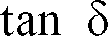
- Ein derartiges Material hat sehr gute harte piezoelektrische Eigenschaften z.B. einen niedrigen Verlustfaktor
- Durch die günstige Kombination von Eigenschaften kann er auch mit Vorteil zur Herstellung von einfachen Aktuatoren für Stellmotoren, Vibratoren, Hybridmotoren, außerdem für Sonare und Wandler verwendet werden.
- Nach einer bevorzugten Ausführungsform ist a = 0,03 und x = 0,5.
- Besonders bevorzugt ist es, wenn die Dotierung aus 1,6 Mol-% MnO₂ besteht. Ein derartiges Material hat einen besonders hohen Gütefaktor.
- Die Erfindung betrifft auch eine keramische Zusammensetzung, die mindestens einen Lanthan-Blei-Zirkon-Titan-Perowskit nach der Erfindung sowie 0,1 bis 20 Mol-% bleihaltiges Sinterhilfsmittel enthält. Durch das bleihaltige Sinterhilfmittel wird eine Flüssigphasensinterung bewirkt.
- Die Erfindung betrifft weiterhin einen Aktuator, insbesondere mit Vielschichtstruktur, mit mindestens einer Schicht, die einen erfindungsgemäßen komplexen,mangansubstituierten Lanthan-Blei-Zirkon-Titan-Perowskit nach der Erfindung enthält. Dieser Aktuator hat piezoelektrisch harte Eigenschaften und ist besonders langzeitstabil.
- Im folgenden wird die Erfindung näher erläutert und es werden Ausführungsbeispiele angegeben.
- Die Bezeichnung "Perowskit" leitet sich von dem Mineral Perowskit ab. Sie wird allgemein verwendet für Verbindungen mit der Zusammensetzung ABO₃ und einer kubischen oder pseudokubischen Kristallstruktur. In dieser Kristallstruktur besetzen die A-Ionen die Ecken eines Würfels und die B-Ionen das Zentrum des Würfels. Die Sauerstoffionen besetzen die Flächenmitten des Würfels.
- Eine ideale Perowskit-Kristallstruktur haben nur einige wenige Verbindungen, z.B. das Mineral Perowskit CaTiO₃ selbst. Das weite Eigenschaftenspektrum der industriell gefertigten Perowskite beruht jedoch auf der Anpassungsfähigkeit der Perowskitstruktur, die viele, sowohl einfache als auch komplexe Strukturveränderungen erlaubt.
- Bei den Variationen der Perowskitstruktur, die kein Symmetriezentrum in der Kristallstruktur enthalten, ist es möglich, ein Dipolmoment im Kristall zu erzeugen, indem man die Kristallite in ein elektrisches Feld bringt. Diese Variationen der Perowskitstruktur treten besonders bei den titanhaltigen Perowskiten ATiO₃ auf. Materialien, die polarisierbar sind und deren Polarisationsrichtungen sich mit Hilfe eines elektrischen Feldes verändern lassen, bezeichnet man als Ferroelektrika.
- Die aus dem Symmetriezentrum herausgerückten Kationen verursachen die Piezoelektrizität einiger Titanate mit Perowskitstruktur. Wenn ein elektrisches Feld die Titanatome verschiebt, dann verändert bei diesen Titan-Perowskiten der gesamte Kristall seine Form, er wird dadurch in einer Richtung etwas länger. Umgekehrt entsteht ein elektrisches Feld, wenn der Kristall mechanisch verformt wird. Diese piezoelektrischen Eigenschaften ermöglichen es, diese Titan-Perowskite für die Umwandlung von mechanischer in elektrische Energie und umgekehrt einzusetzen. Die besten piezoelektrischen Eigenschaften haben feste Lösungen (Mis chkristalle) von Bleititanat mit Bleizirkonat sowie die sich von diesen ableitenden Substitutionsmischkristalle.
- Weitere Substitutionen auf den A- oder B-Gitterplätzen von Blei-Zirkon-Titanat ergeben eine ganze Gruppe kommerziell wichtiger Perowskite, die man alle unter der Abkürzung "PZT" zusammenfaßt. Von besonderer Bedeutung sind die mit Lanthan substituierten "LPZTs".
- Perowskite, die durch gekoppelte Substitution mit Ionen unterschiedlicher Wertigkeit auf einem Gitterplatz entstehen, bezeichnet man als "komplexe Perowskite".
- Die erfindungsgemäßen komplexen, oxidischen Perowskitderivate leiten sich von den bekannten komplexen Lanthan-Blei-Zirkon-Titan- Phasen (LPZT), die durch gekoppelte Substitution mit Magnesium und Wolfram erhalten wurden, durch den Einbau von zusätzlichen Mangan-Kationen ab.
- Es wird angenommen, daß diese Mangan-Kationen auf den B-Plätzen in das Perowskitgitter eingebaut werden.
- Diese theoretische Überlegung dient aber nur dazu, die Erfindung zu erläutern und bildet nicht einen Teil des Erfindungsgedanken.
- Die erfindungsgemäßen Perowskite können nach den herkömmlichen Methoden hergestellt werden. Eine Standardmethode ist die "Mixed Oxide"-Technik. Dazu werden zur Bildung einer Vormischung die binären Oxide der jeweiligen Kationen im molaren Verhältnis entsprechend der Formel zu einer Vormischung abgewogen. Sie werden in einer Kugelmühle naß vermahlen, z. B. in einem Achattiegel mit Achatkugeln von 10 mm Durchmesser und Cyclohexan als Lösungsmittel für 2 Stunden.
- Die Vormischung kann aber auch durch Kopräzipitation, Sol-Gel-Verfahren oder Hydrothermalsynthese aus den entsprechenden Ausgangsverbindungen erhalten werden.
- Nach dem Trocknen der Vormischung wird diese kalziniert, z. B. bei 800°C, 10h, mit einer Heiz- und Abkühlrate von 200°C/h.
- Die Pulver können ohne Sinterhilfsmittel dicht gesintert werden. Es ist jedoch ein Aspekt der Erfindung, eine keramische Zusammensetzung zur Verfügung zu stellen, bei der die erfindungsgemäßen komplexen, substituierten Perowskite mit einem bleihaltigen Sinterhilfsmittel z.B. PbO und PbZrO₃ gemischt werden. Die Sinterhilfsmittel bewirken eine Flüssigphasensinterung der Ausgangspulver und bilden in der fertig gesinterten keramischen Zusammensetzung eine zweite Phase, die amorph oder kristallin sein kann und homogen verteilt ist.
- Die kalzinierten Pulver oder die keramischen Zusammensetzungen mit einem Sinterhilfsmittel werden erneut 2h in einer Kugelmühle unter denselben Bedingungen gemahlen. Anschließend werden sie auf einer Rollenbank gemahlen, z.B. 20 h mit Cyclopropanol als Lösungsmittel und yttriumstabilisierten ZrO₂ -Kugeln von 2 mm Durchmesser.
- Diese Ausgangspulver werden zunächst auf einer Blockpresse vorgepreßt und dann isostatisch mit einem Preßdruck von 320 MPa fertiggepreßt. Die fertigen Preßkörper werden bei Sintertemperaturen von 1075°C bis 1100°C zwei Stunden in Sauerstoffatmosphäre auf ZrO₂- Unterlagen gesintert.
- Als Rohstoffe wurden Reagentien der Fa. Merck, Darmstadt, mit dem Reinheitsgrad "p.a." verwendet.
- Die Ausgangsrohstoffe
216,49 g PbO,
4,88 g La₂O₃,
35,16 g TiO₂,
56,81 g ZrO₂,
10,79 g WO₃
2,02 g MgO und
1,39 g MnO₂
werden in Isopropanol suspendiert und in einer Achatkugelmühle 6 Stunden gemeinsam vermahlen. Nach dem Mahlen wird die Suspension unter einem Oberflächenverdampfer bei ca. 120°C getrocknet und anschließend in einem lose verschlossenen Sinterkorundtiegel 12 h bei 800°C an Luft vorgebrannt. - Das bei 800°C vorreagierte Pulvergemisch wird mit 345,09 g PbZrO₃ gemischt und ein zweites Mal in isopropanolischer Suspension 20 h in einer Kugelmühle mit yttriumstabilisierten ZrO₂-Kugeln (Durchmesser 2 mm) gemahlen. Das gemahlene Pulver wird kaltisostatisch mit einem Druck von 320 mPa zu prismatischen Körpern der Abmessung 6 x 6 x 15 mm³ gepreßt.
- Die Proben wurden mit 320°C/h auf 1100°C aufgeheizt und im Sauerstoffstrom bei 1100°C für 2 h gesintert. Als Unterlage dienen Platten aus stab. ZrO₂ oder aus demselben LPZT-Material. Es wurde eine Dichte von 98 % erreicht.
- In der gleichen Art und Weise werden eine Reihe von weiteren mangandotierten LPZTs hergestellt, deren Zusammensetzung in Tabelle 1 angegeben ist.
Tab.1 Chemische Zusammensetzung NR. CHEMISCHE ZUSAMMENSETZUNG 1 Pb0,99La0,01Ti0,46Zr0,49Mg0,025W0,025O₃ + 1,6 % MnO₂ 2 Pb0,985La0,015Ti0,46Zr0,44Mg0,05W0,05O₃ + 1,6 % MnO₂ 3 Pb0,97La0,03Ti0,45Zr0,50Mg0,025W0,025O₃ + 1,6 % MnO₂ 4 Pb0,985La0,015Ti0,47Zr0,48Mg0,025W0,025O₃ + 0,8 % MnO₂ 5 Pb0,99La0,01Ti0,47Zr0,48Mg0,025W0,025O₃ + 0,8 % MnO₂ 6 Pb0,99La0,01Ti0,47Zr0,49Mg0,02W0,02O₃ + 1,6 % MnO₂ 7 Pb0,985Gd0,015Ti0,46Zr0,49Mg0,025W0,025O₃ + 0,8 % MnO₂ - Zur Bestimmung der relevanten piezoelektrischen Kleinsigalparameter der erfindungsgemäßen Keramik wurden aus der gesinterten Keramik Zylinder mit 5 mm Durchmesser geschliffen. Diese wurden zu Plättchen von 0,4 mm Dicke zersägt und geläppt. Dann wurden für die elektrischen Messungen auf beide Seiten der Plättchen Kontakte aus Au mit einer dünnen Haftschicht aus Ni/Cr aufgedampft.
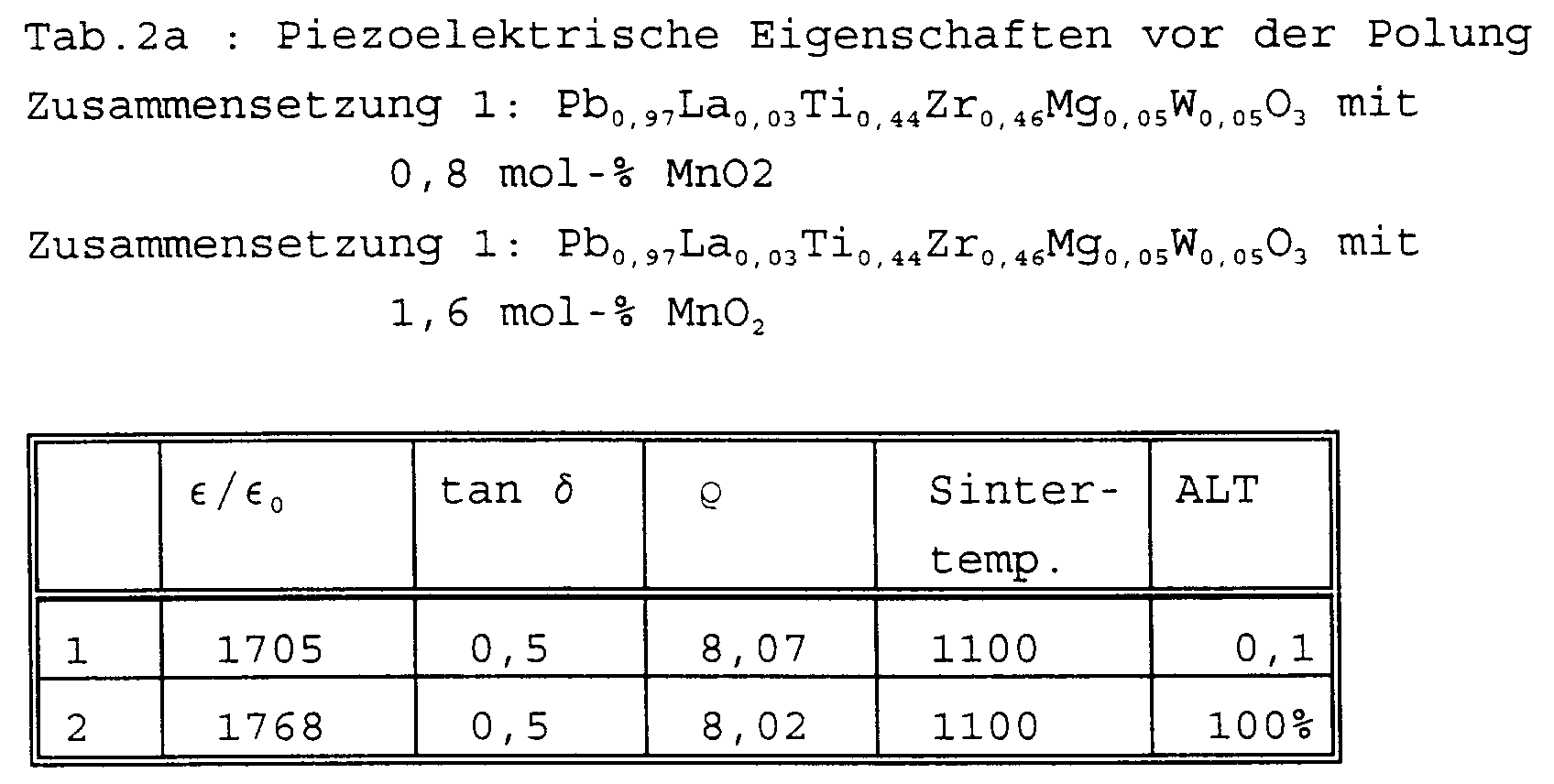
- Die dielektrischen und piezoelektrischen Eigenschaften wurden vor bzw. nach der Polarisation bestimmt. Zur Polarisation wurden die Scheiben unter Silikonöl 2 min. bei 150°C einem Feld von 0,35 kV/100 µm ausgesetzt.
- Die relevanten piezoelektischen Kleinsignalparameter wurden mit Hilfe einer Impedanzmeßbrücke aus dem Resonanzverhalten der axial gepolten keramischen Scheibchen bestimmt. Dazu wurde ein Computerprogramm benutzt, mit dessen Unterstützung das Resonanzverhalten und die Kapazität dünner, runder, axial polarisierter Scheiben bestimmt werden kann.
- Alle Messungen wurden mit einem Hewlett-Packard-4194-A Impedance Analyser mit Unterstützung durch einen HP-9000/-300 Rechner durchgeführt. Aus den so erhaltenen Meßwerten wurden die Dielektrizitätskonstanten und die Kleinsignalparameter berechnet. Die Ergebnisse sind in Tabelle 2 zusammengefaßt.
- Außerdem wurde an Schliffen die Mikrostruktur der erfindungsgemäßen keramischen Zusammensetzungen untersucht.
- Das Langzeitverhalten der keramischen Zusammensetzungen in Bezug auf ihren Gleichstromwiderstand wurde mit einem ALT-Test (Accelerated Life Test) bestimmt. Dafür wurde der Gleichstromwiderstand bei 250 °C und 1 V/µm gemessen.
- Bei einem Material, das mit 0,8 Mol-% MnO₂ dotiert wurde, hat der Gleichstromwiderstand im ALT-Test nach 100 h noch einen Wert von 10% des ursprünglichen Wertes. Bei einem Material, das mit 1,6 Mol-% MnO₂ dotiert wurde, ist der Gleichstromwiderstand selbst nach 100 h unter ALT-Bedingungen unverändert.
Tab. 2b Piezoelektrische Eigenschaften nach der Polung ε/ε₀ tan δ k₃₁ d₃₁ in 10⁻¹²m/V k Q 1 2088 0,8 0,37 181 0.63 207 2 1594 0,5 0,35 142 0.58 595 - Zur Herstellung eines Vielschichtaktuators werden zunächst grüne keramische Folien hergestellt. Dazu werden die kalzinierten Pulvermischungen wie oben beschrieben hergestellt. Diesen werden gegebenenfalls noch Sinterhilfsmittel zugesetzt. Diese keramischen Zusammensetzungen werden mit einem Lösungsmittel, vorzugsweise Wasser, und den entsprechenden Verflüssigern gemahlen und anschließend mit Bindern, Plastifizierern, Netzmittel und Trennmittel zu einem gießfähigen Schlicker gemischt.
- Die Foliengießanlage besteht im Prinzip aus einem endlosen Stahlband, daß über zwei Rollen horizontal bewegt wird. Der Schlicker läuft aus einem Behälter am eine Ende des Gießbandes durch einen verstellbaren Spalt kontinuierlich auf das Stahlband. Durch Variation der Spalthöhe läßt sich die Dicke der Folien zwischen 0,2 und 1,5 mm variieren. Die Folie wird getrocknet, dann aufgewickelt oder gleich zu Folienkarten geschnitten.
- Auf die grünen Folienkarten werden die inneren Elektroden aufgebracht, indem das Elektrodenmuster mit einer Metallisierungspaste im Siebdruck aufgebracht wird. Die Metallisierungspasten enthalten üblicherweise Silber- oder Palladiumlegierungen.
- Die metallisierten Folienkarten werden gestapelt und mit einem Preßdruck von 300 MPa zu einer Platte laminiert. Die Platte wird einer Temperaturbehandlung unterworfen, bei der zunächst der Binder ausgeheizt wird und dann bei höheren Temperaturen die Keramik dichtgesintert wird. Typische Sinterbedingungen sind für die erfindungsgemäßen manganhaltigen Zusammensetzungen 1150°C, 2h Haltezeit, Aufheiz- und Abkühlgeschwindigkeit 320 °C/h. Fertig gesintert haben die keramischen Schichten eine Schichtdicke von 5 - 15 mm.
- Die Platten werden in einzelne Halbprodukte zerschnitten. Die offenliegenden inneren Elektroden werden mit Endkon-takten versehen.
Claims (5)
- Lanthan-Blei-Zirkon-Titan-Perowskit der allgemeinen Zusammensetzung
Pb1-aLaa (Mgx/2Wx/2)TiyZrzO₃,
mit
0,01 ≦ a ≦ 0,05,
0,01 ≦ x ≦ 0,06,
0,4 ≦ y ≦ 0,5 und
0,4 ≦ z ≦ 0,5,
wobei
mit einer Dotierung von 0,5 - 2 Mol-% MnO₂ . - Komplexer substituierter Lanthan- Blei-Zirkon-Titan-Perowskit nach Anspruch 1,
dadurch gekennzeichnet,
daß a = 0,03 und x = 0,5 ist. - Komplexer substituierter Lanthan-Blei-Zirkon-Titan-Perowskit nach Anspruch 1 oder 2,
dadurch gekennzeichnet,
daß die Dotierung 1,6 Mol-% MnO₂ ist. - Keramische Zusammensetzung für piezoelektrische Bauelemente,
dadurch gekennzeichnet,
daß sie mindestens einen Lanthan- Blei-Zirkon-Titan-Perowskit nach der Erfindung und 0,1 bis 20 Mol-% eines bleihaltigen Sinterhilfsmittel enthält. - Aktuator, insbesondere mit Vielschichtstruktur, mit mindestens einer Schicht, die einen Lanthan-Blei-Zirkon-Titan-Perowskit nach der Erfindung enthält.
Applications Claiming Priority (2)
| Application Number | Priority Date | Filing Date | Title |
|---|---|---|---|
| DE4442598A DE4442598A1 (de) | 1994-11-30 | 1994-11-30 | Komplexer, substituierter Lanthan-Blei-Zirkon-Titan-Perowskit, keramische Zusammensetzung und Aktuator |
| DE4442598 | 1994-11-30 |
Publications (2)
| Publication Number | Publication Date |
|---|---|
| EP0714866A1 true EP0714866A1 (de) | 1996-06-05 |
| EP0714866B1 EP0714866B1 (de) | 1999-05-12 |
Family
ID=6534531
Family Applications (1)
| Application Number | Title | Priority Date | Filing Date |
|---|---|---|---|
| EP95203188A Expired - Lifetime EP0714866B1 (de) | 1994-11-30 | 1995-11-21 | Komplexer, substituierter Lanthan-Blei-Zirkon-Titan-Perowskit, keramische Zusammensetzung und Aktuator |
Country Status (4)
| Country | Link |
|---|---|
| US (1) | US5788876A (de) |
| EP (1) | EP0714866B1 (de) |
| JP (1) | JPH08259323A (de) |
| DE (2) | DE4442598A1 (de) |
Cited By (1)
| Publication number | Priority date | Publication date | Assignee | Title |
|---|---|---|---|---|
| US6347862B1 (en) | 1997-04-14 | 2002-02-19 | Matsushita Electric Industrial Co., Ltd. | Ink-jet head |
Families Citing this family (11)
| Publication number | Priority date | Publication date | Assignee | Title |
|---|---|---|---|---|
| JPH10249768A (ja) * | 1997-03-12 | 1998-09-22 | Tokai Rubber Ind Ltd | 力センサー |
| GB9902188D0 (en) | 1999-02-01 | 1999-03-24 | Xaar Technology Ltd | Droplet deposition apparatus |
| MXPA01010639A (es) | 1999-04-20 | 2003-08-20 | Zinc Air Power Corp | Mezcla de compuesto lantano niquel/metal como un tercer electrodo en una bateria de metal-aire. |
| JP4582835B2 (ja) * | 1999-08-30 | 2010-11-17 | 京セラ株式会社 | アクチュエータ用圧電部材の製造方法 |
| JP3783534B2 (ja) * | 2000-08-18 | 2006-06-07 | 株式会社村田製作所 | 圧電磁器焼結体および圧電磁器素子 |
| JP3971906B2 (ja) * | 2001-09-13 | 2007-09-05 | 日本碍子株式会社 | 圧電/電歪膜型素子及びその駆動方法 |
| JP4268354B2 (ja) * | 2001-09-13 | 2009-05-27 | 日本碍子株式会社 | 圧電/電歪素子 |
| JP4492022B2 (ja) * | 2001-11-02 | 2010-06-30 | 株式会社村田製作所 | 積層型圧電体セラミック素子 |
| JP2008074633A (ja) * | 2006-09-19 | 2008-04-03 | Samsung Electro Mech Co Ltd | 磁器コンデンサ、誘電体磁器組成物及びその製造方法 |
| CN113800908A (zh) * | 2021-08-26 | 2021-12-17 | 桂林理工大学 | 中介电常数双钙钛矿微波介质陶瓷材料及其制备方法 |
| JP2026502083A (ja) * | 2022-12-09 | 2026-01-21 | スリーディー システムズ インコーポレーテッド | 高い弾性率および分散安定性を有する3dプリント用のインク |
Citations (5)
| Publication number | Priority date | Publication date | Assignee | Title |
|---|---|---|---|---|
| NL6714565A (de) | 1966-10-26 | 1968-04-29 | ||
| DE2744208A1 (de) * | 1977-09-30 | 1979-04-05 | Siemens Ag | Piezokeramik mit extrem niedriger mechanischer schwingguete |
| DE4005507A1 (de) * | 1989-02-23 | 1990-08-30 | Murata Manufacturing Co | Dielektrische keramische zusammensetzung |
| EP0423822A1 (de) | 1989-10-20 | 1991-04-24 | Mitsui Petrochemical Industries, Ltd. | Ferroelektrisches keramisches Material |
| JPH0570225A (ja) * | 1991-09-09 | 1993-03-23 | Hitachi Metals Ltd | 圧電磁器組成物 |
Family Cites Families (14)
| Publication number | Priority date | Publication date | Assignee | Title |
|---|---|---|---|---|
| FR2055350A5 (de) * | 1969-07-28 | 1971-05-07 | Siemens Ag | |
| NL7903964A (nl) * | 1979-05-21 | 1980-11-25 | Philips Nv | Pieezo-elektrisch lichaam voor een elektromechanisch omvormingselement. |
| DE3206502A1 (de) * | 1982-02-24 | 1983-09-01 | Philips Patentverwaltung Gmbh, 2000 Hamburg | Dielektrikum auf der basis von bleititanaten sowie verfahren zu seiner herstellung und seine verwendung |
| JPH0651572B2 (ja) * | 1985-11-25 | 1994-07-06 | 三菱マテリアル株式会社 | 高誘電体粉末の製造方法 |
| JPS62138360A (ja) * | 1985-12-10 | 1987-06-22 | 三菱鉱業セメント株式会社 | 誘電体磁器組成物 |
| JPS63117959A (ja) * | 1986-11-05 | 1988-05-21 | 日本電気株式会社 | 誘電体磁器組成物 |
| JPS63151667A (ja) * | 1986-12-16 | 1988-06-24 | 京セラ株式会社 | 圧電磁器組成物 |
| JPH01148749A (ja) * | 1987-12-04 | 1989-06-12 | Mitsubishi Kasei Corp | アクチュエータ用圧電セラミック組成物 |
| JPH029757A (ja) * | 1988-06-27 | 1990-01-12 | Tdk Corp | 高誘電率セラミックス組成物 |
| JP2569768B2 (ja) * | 1988-10-28 | 1997-01-08 | 東レ株式会社 | プラスチックフィルムの搬送方法 |
| JPH02123063A (ja) * | 1988-11-01 | 1990-05-10 | Mitsubishi Heavy Ind Ltd | アクティブ張力変動低減装置 |
| JP2762309B2 (ja) * | 1989-12-22 | 1998-06-04 | マルコン電子株式会社 | 誘電体磁器組成物及びこれを使用した電子部品 |
| JP2737451B2 (ja) * | 1991-06-13 | 1998-04-08 | 住友金属工業株式会社 | 圧電磁器材料 |
| US5378382A (en) * | 1993-12-09 | 1995-01-03 | Mitsubishi Kasei Corporation | Piezoelectric ceramic composition for actuator |
-
1994
- 1994-11-30 DE DE4442598A patent/DE4442598A1/de not_active Withdrawn
-
1995
- 1995-11-21 DE DE59505898T patent/DE59505898D1/de not_active Expired - Fee Related
- 1995-11-21 EP EP95203188A patent/EP0714866B1/de not_active Expired - Lifetime
- 1995-11-29 US US08/564,890 patent/US5788876A/en not_active Expired - Fee Related
- 1995-11-30 JP JP7312707A patent/JPH08259323A/ja not_active Abandoned
Patent Citations (5)
| Publication number | Priority date | Publication date | Assignee | Title |
|---|---|---|---|---|
| NL6714565A (de) | 1966-10-26 | 1968-04-29 | ||
| DE2744208A1 (de) * | 1977-09-30 | 1979-04-05 | Siemens Ag | Piezokeramik mit extrem niedriger mechanischer schwingguete |
| DE4005507A1 (de) * | 1989-02-23 | 1990-08-30 | Murata Manufacturing Co | Dielektrische keramische zusammensetzung |
| EP0423822A1 (de) | 1989-10-20 | 1991-04-24 | Mitsui Petrochemical Industries, Ltd. | Ferroelektrisches keramisches Material |
| JPH0570225A (ja) * | 1991-09-09 | 1993-03-23 | Hitachi Metals Ltd | 圧電磁器組成物 |
Non-Patent Citations (3)
| Title |
|---|
| DATABASE WPI Week 9316, Derwent World Patents Index; AN 93-131150 * |
| M. YONEZAWA ET AL.: "A NEW LOW-FIRING X7R MULTILAYER CERAMIC CAPACITORS.", NEC RESEARCH AND DEVELOPMENT, no. 85, TOKYO, JAPAN, pages 1 - 5 * |
| R.WASER, T.BAIATU, K.H.HAERDTL, J. AM. CERAM. SOC., vol. 73, 1990, pages 1645 |
Cited By (1)
| Publication number | Priority date | Publication date | Assignee | Title |
|---|---|---|---|---|
| US6347862B1 (en) | 1997-04-14 | 2002-02-19 | Matsushita Electric Industrial Co., Ltd. | Ink-jet head |
Also Published As
| Publication number | Publication date |
|---|---|
| DE59505898D1 (de) | 1999-06-17 |
| US5788876A (en) | 1998-08-04 |
| JPH08259323A (ja) | 1996-10-08 |
| EP0714866B1 (de) | 1999-05-12 |
| DE4442598A1 (de) | 1996-06-05 |
Similar Documents
| Publication | Publication Date | Title |
|---|---|---|
| DE69815876T2 (de) | Bei verminderter temperatur gleichzeitig mit silber sinterbare pzt-keramikzusammensetzung und verfahren zu ihrer herstellung | |
| EP2837044B1 (de) | Keramisches material und kondensator umfassend das keramische material | |
| DE102008021827B9 (de) | Keramischer Werkstoff, Verfahren zur Herstellung des keramischen Werkstoffs, Bauelement mit dem keramischen Werkstoff und seine Verwendung | |
| EP1337496B1 (de) | Keramischer werkstoff sowie dessen herstellung | |
| DE112018001785B4 (de) | Piezoelektrische zusammensetzung und piezoelektrisches element | |
| EP2200951B1 (de) | Keramikmaterial, verfahren zur herstellung desselben und elektrokeramisches bauelement umfassend das keramikmaterial | |
| EP2773598B1 (de) | Keramikmaterial, verfahren zur herstellung desselben und elektrokeramisches bauelement umfassend das keramikmaterial | |
| EP0714866B1 (de) | Komplexer, substituierter Lanthan-Blei-Zirkon-Titan-Perowskit, keramische Zusammensetzung und Aktuator | |
| DE69923635T2 (de) | Piezoelektrische Keramiken | |
| DE2932870C2 (de) | ||
| DE112018001758B4 (de) | Piezoelektrische Zusammensetzung und piezoelektrisches Element | |
| EP1704602B1 (de) | Keramikmaterial | |
| EP1979291B1 (de) | Bleifreier piezokeramischer werkstoff, verfahren zum herstellen eines piezokeramischen bauteils mit dem werkstoff und verwendung des bauteils | |
| DE102011112008B4 (de) | Piezoelektrisches Bauelement und Verfahren zur Herstellung eines piezoelektrischen Bauelements | |
| DE102019106987A1 (de) | Piezoelektrische zusammensetzung und piezoelektrisches element | |
| WO2007113189A1 (de) | Bleifreier piezokeramischer werkstoff mit kupferdotierung, verfahren zum herstellen eines piezokeramischen bauteils mit dem werkstoff und verwendung des bauteils | |
| DE102007012916B4 (de) | Laminiertes piezoelektrisches Element und Herstellungsverfahren hierfür | |
| DE69014135T2 (de) | Piezoelektrisches Element mit sehr hohem elektrostriktivem Effekt und keramische Zusammensetzung für dessen Herstellung. | |
| DE112018001754T5 (de) | Piezoelektrische zusammensetzung und piezoelektrisches element | |
| DE10331036B4 (de) | PZT-(Blei-Zirkonat-Titanat-)Zusammensetzungen, die bei niedrigen Temperaturen sinterbar sind und daraus hergestellte piezoelektrische Keramikvorrichtungen | |
| DE4327993C1 (de) | Verfahren zur Herstellung von PZT-Werkstoffen mit hoher Depolarisationsfestigkeit und niedriger Sintertemperatur | |
| DE102005061528A1 (de) | Bleizirkonattitanat mit Eisen-Wolfram-Dotierung, Verfahren zum Herstellen eines piezokeramischen Werkstoffs mit dem Bleizirkonattitanat und Verwendung des piezokeramischen Werkstoffs | |
| DE102006008742B4 (de) | Bleifreier piezokeramischer Werkstoff mit Erdalkalidotierung, Verfahren zum Herstellen eines piezokeramischen Bauteils mit dem Werkstoff und Verwendung des Bauteils | |
| DE112005002093T5 (de) | Herstellverfahren für eine piezoelektrische Keramik, Herstellverfahren für ein piezoelektrisches Element und piezoelektrisches Element | |
| DE1922265C3 (de) | Piezoelektrische Keramik |
Legal Events
| Date | Code | Title | Description |
|---|---|---|---|
| PUAI | Public reference made under article 153(3) epc to a published international application that has entered the european phase |
Free format text: ORIGINAL CODE: 0009012 |
|
| AK | Designated contracting states |
Kind code of ref document: A1 Designated state(s): DE FR GB NL |
|
| 17P | Request for examination filed |
Effective date: 19961205 |
|
| GRAG | Despatch of communication of intention to grant |
Free format text: ORIGINAL CODE: EPIDOS AGRA |
|
| 17Q | First examination report despatched |
Effective date: 19980220 |
|
| GRAG | Despatch of communication of intention to grant |
Free format text: ORIGINAL CODE: EPIDOS AGRA |
|
| GRAH | Despatch of communication of intention to grant a patent |
Free format text: ORIGINAL CODE: EPIDOS IGRA |
|
| RAP3 | Party data changed (applicant data changed or rights of an application transferred) |
Owner name: KONINKLIJKE PHILIPS ELECTRONICS N.V. Owner name: PHILIPS PATENTVERWALTUNG GMBH |
|
| GRAH | Despatch of communication of intention to grant a patent |
Free format text: ORIGINAL CODE: EPIDOS IGRA |
|
| GRAA | (expected) grant |
Free format text: ORIGINAL CODE: 0009210 |
|
| AK | Designated contracting states |
Kind code of ref document: B1 Designated state(s): DE FR GB NL |
|
| PG25 | Lapsed in a contracting state [announced via postgrant information from national office to epo] |
Ref country code: NL Free format text: LAPSE BECAUSE OF FAILURE TO SUBMIT A TRANSLATION OF THE DESCRIPTION OR TO PAY THE FEE WITHIN THE PRESCRIBED TIME-LIMIT Effective date: 19990512 |
|
| REF | Corresponds to: |
Ref document number: 59505898 Country of ref document: DE Date of ref document: 19990617 |
|
| GBT | Gb: translation of ep patent filed (gb section 77(6)(a)/1977) |
Effective date: 19990611 |
|
| ET | Fr: translation filed | ||
| RAP4 | Party data changed (patent owner data changed or rights of a patent transferred) |
Owner name: KONINKLIJKE PHILIPS ELECTRONICS N.V. Owner name: PHILIPS CORPORATE INTELLECTUAL PROPERTY GMBH |
|
| PLBE | No opposition filed within time limit |
Free format text: ORIGINAL CODE: 0009261 |
|
| STAA | Information on the status of an ep patent application or granted ep patent |
Free format text: STATUS: NO OPPOSITION FILED WITHIN TIME LIMIT |
|
| 26N | No opposition filed | ||
| REG | Reference to a national code |
Ref country code: GB Ref legal event code: IF02 |
|
| REG | Reference to a national code |
Ref country code: GB Ref legal event code: 746 Effective date: 20020917 |
|
| REG | Reference to a national code |
Ref country code: FR Ref legal event code: D6 |
|
| PGFP | Annual fee paid to national office [announced via postgrant information from national office to epo] |
Ref country code: DE Payment date: 20030118 Year of fee payment: 8 |
|
| PGFP | Annual fee paid to national office [announced via postgrant information from national office to epo] |
Ref country code: FR Payment date: 20031126 Year of fee payment: 9 |
|
| PGFP | Annual fee paid to national office [announced via postgrant information from national office to epo] |
Ref country code: GB Payment date: 20031128 Year of fee payment: 9 |
|
| PG25 | Lapsed in a contracting state [announced via postgrant information from national office to epo] |
Ref country code: DE Free format text: LAPSE BECAUSE OF NON-PAYMENT OF DUE FEES Effective date: 20040602 |
|
| PG25 | Lapsed in a contracting state [announced via postgrant information from national office to epo] |
Ref country code: GB Free format text: LAPSE BECAUSE OF NON-PAYMENT OF DUE FEES Effective date: 20041121 |
|
| GBPC | Gb: european patent ceased through non-payment of renewal fee |
Effective date: 20041121 |
|
| PG25 | Lapsed in a contracting state [announced via postgrant information from national office to epo] |
Ref country code: FR Free format text: LAPSE BECAUSE OF NON-PAYMENT OF DUE FEES Effective date: 20050729 |
|
| REG | Reference to a national code |
Ref country code: FR Ref legal event code: ST |