EP0722973B1 - Polyéthylène de poids moléculaire ultra élevé chimiquement réticulé pour articulations humaines artificielles - Google Patents
Polyéthylène de poids moléculaire ultra élevé chimiquement réticulé pour articulations humaines artificielles Download PDFInfo
- Publication number
- EP0722973B1 EP0722973B1 EP96300113A EP96300113A EP0722973B1 EP 0722973 B1 EP0722973 B1 EP 0722973B1 EP 96300113 A EP96300113 A EP 96300113A EP 96300113 A EP96300113 A EP 96300113A EP 0722973 B1 EP0722973 B1 EP 0722973B1
- Authority
- EP
- European Patent Office
- Prior art keywords
- implant
- crystallinity
- molecular weight
- crosslinking
- crosslinked
- Prior art date
- Legal status (The legal status is an assumption and is not a legal conclusion. Google has not performed a legal analysis and makes no representation as to the accuracy of the status listed.)
- Expired - Lifetime
Links
- 229920000785 ultra high molecular weight polyethylene Polymers 0.000 title claims description 88
- 239000004699 Ultra-high molecular weight polyethylene Substances 0.000 title claims description 31
- -1 polyethylene Polymers 0.000 claims description 94
- 239000004698 Polyethylene Substances 0.000 claims description 86
- 229920000573 polyethylene Polymers 0.000 claims description 86
- 150000002978 peroxides Chemical class 0.000 claims description 78
- 239000007943 implant Substances 0.000 claims description 76
- 238000004132 cross linking Methods 0.000 claims description 75
- 238000000034 method Methods 0.000 claims description 65
- 238000004659 sterilization and disinfection Methods 0.000 claims description 21
- 230000001965 increasing effect Effects 0.000 claims description 20
- 238000000137 annealing Methods 0.000 claims description 17
- 230000008961 swelling Effects 0.000 claims description 17
- 239000007787 solid Substances 0.000 claims description 12
- 230000001954 sterilising effect Effects 0.000 claims description 11
- 210000004394 hip joint Anatomy 0.000 claims description 10
- 210000001624 hip Anatomy 0.000 claims description 9
- 210000000629 knee joint Anatomy 0.000 claims description 4
- 210000001145 finger joint Anatomy 0.000 claims description 2
- 210000003127 knee Anatomy 0.000 claims description 2
- 210000002517 zygapophyseal joint Anatomy 0.000 claims description 2
- 210000003423 ankle Anatomy 0.000 claims 1
- 210000001513 elbow Anatomy 0.000 claims 1
- 210000001847 jaw Anatomy 0.000 claims 1
- 210000002832 shoulder Anatomy 0.000 claims 1
- 229920000642 polymer Polymers 0.000 description 133
- 238000001727 in vivo Methods 0.000 description 20
- 229920006037 cross link polymer Polymers 0.000 description 18
- 239000000463 material Substances 0.000 description 18
- 238000000465 moulding Methods 0.000 description 15
- 238000012360 testing method Methods 0.000 description 14
- 239000000126 substance Substances 0.000 description 12
- 230000000694 effects Effects 0.000 description 11
- 238000002844 melting Methods 0.000 description 11
- 230000008018 melting Effects 0.000 description 11
- 230000003647 oxidation Effects 0.000 description 11
- 238000007254 oxidation reaction Methods 0.000 description 11
- 150000003254 radicals Chemical class 0.000 description 10
- 238000005033 Fourier transform infrared spectroscopy Methods 0.000 description 8
- 238000006243 chemical reaction Methods 0.000 description 8
- 239000013078 crystal Substances 0.000 description 8
- 239000002245 particle Substances 0.000 description 8
- 238000010504 bond cleavage reaction Methods 0.000 description 7
- 238000012937 correction Methods 0.000 description 7
- 230000007017 scission Effects 0.000 description 7
- 239000012620 biological material Substances 0.000 description 6
- 125000002915 carbonyl group Chemical group [*:2]C([*:1])=O 0.000 description 6
- 230000006835 compression Effects 0.000 description 6
- 238000007906 compression Methods 0.000 description 6
- 230000003247 decreasing effect Effects 0.000 description 6
- 239000000155 melt Substances 0.000 description 6
- 239000000843 powder Substances 0.000 description 6
- 238000001953 recrystallisation Methods 0.000 description 6
- 238000000113 differential scanning calorimetry Methods 0.000 description 5
- 239000012530 fluid Substances 0.000 description 5
- 230000007246 mechanism Effects 0.000 description 5
- 230000008569 process Effects 0.000 description 5
- 230000005855 radiation Effects 0.000 description 5
- 230000009467 reduction Effects 0.000 description 5
- ODBCKCWTWALFKM-UHFFFAOYSA-N 2,5-bis(tert-butylperoxy)-2,5-dimethylhex-3-yne Chemical compound CC(C)(C)OOC(C)(C)C#CC(C)(C)OOC(C)(C)C ODBCKCWTWALFKM-UHFFFAOYSA-N 0.000 description 4
- CSCPPACGZOOCGX-UHFFFAOYSA-N Acetone Chemical compound CC(C)=O CSCPPACGZOOCGX-UHFFFAOYSA-N 0.000 description 4
- 229920013683 Celanese Polymers 0.000 description 4
- 241000906034 Orthops Species 0.000 description 4
- 238000010521 absorption reaction Methods 0.000 description 4
- 210000000988 bone and bone Anatomy 0.000 description 4
- 238000012668 chain scission Methods 0.000 description 4
- 238000002425 crystallisation Methods 0.000 description 4
- 230000008025 crystallization Effects 0.000 description 4
- 125000004122 cyclic group Chemical group 0.000 description 4
- 238000005259 measurement Methods 0.000 description 4
- 230000000704 physical effect Effects 0.000 description 4
- 229920003023 plastic Polymers 0.000 description 4
- 239000004033 plastic Substances 0.000 description 4
- 210000001519 tissue Anatomy 0.000 description 4
- 238000004736 wide-angle X-ray diffraction Methods 0.000 description 4
- 229920000049 Carbon (fiber) Polymers 0.000 description 3
- 239000000853 adhesive Substances 0.000 description 3
- 230000001070 adhesive effect Effects 0.000 description 3
- 230000015572 biosynthetic process Effects 0.000 description 3
- 239000004917 carbon fiber Substances 0.000 description 3
- 239000000084 colloidal system Substances 0.000 description 3
- 238000002474 experimental method Methods 0.000 description 3
- 239000012442 inert solvent Substances 0.000 description 3
- 210000001503 joint Anatomy 0.000 description 3
- 239000000314 lubricant Substances 0.000 description 3
- 238000012986 modification Methods 0.000 description 3
- 230000004048 modification Effects 0.000 description 3
- 238000001878 scanning electron micrograph Methods 0.000 description 3
- 238000001356 surgical procedure Methods 0.000 description 3
- 230000004580 weight loss Effects 0.000 description 3
- MYRTYDVEIRVNKP-UHFFFAOYSA-N 1,2-Divinylbenzene Chemical compound C=CC1=CC=CC=C1C=C MYRTYDVEIRVNKP-UHFFFAOYSA-N 0.000 description 2
- OZAIFHULBGXAKX-UHFFFAOYSA-N 2-(2-cyanopropan-2-yldiazenyl)-2-methylpropanenitrile Chemical compound N#CC(C)(C)N=NC(C)(C)C#N OZAIFHULBGXAKX-UHFFFAOYSA-N 0.000 description 2
- XMNIXWIUMCBBBL-UHFFFAOYSA-N 2-(2-phenylpropan-2-ylperoxy)propan-2-ylbenzene Chemical compound C=1C=CC=CC=1C(C)(C)OOC(C)(C)C1=CC=CC=C1 XMNIXWIUMCBBBL-UHFFFAOYSA-N 0.000 description 2
- KCXVZYZYPLLWCC-UHFFFAOYSA-N EDTA Chemical compound OC(=O)CN(CC(O)=O)CCN(CC(O)=O)CC(O)=O KCXVZYZYPLLWCC-UHFFFAOYSA-N 0.000 description 2
- URLKBWYHVLBVBO-UHFFFAOYSA-N Para-Xylene Chemical group CC1=CC=C(C)C=C1 URLKBWYHVLBVBO-UHFFFAOYSA-N 0.000 description 2
- 239000004743 Polypropylene Substances 0.000 description 2
- PXIPVTKHYLBLMZ-UHFFFAOYSA-N Sodium azide Chemical compound [Na+].[N-]=[N+]=[N-] PXIPVTKHYLBLMZ-UHFFFAOYSA-N 0.000 description 2
- QVGXLLKOCUKJST-UHFFFAOYSA-N atomic oxygen Chemical compound [O] QVGXLLKOCUKJST-UHFFFAOYSA-N 0.000 description 2
- 239000000919 ceramic Substances 0.000 description 2
- 238000005520 cutting process Methods 0.000 description 2
- 238000000354 decomposition reaction Methods 0.000 description 2
- 238000010586 diagram Methods 0.000 description 2
- SNRUBQQJIBEYMU-UHFFFAOYSA-N dodecane Chemical compound CCCCCCCCCCCC SNRUBQQJIBEYMU-UHFFFAOYSA-N 0.000 description 2
- 229960001484 edetic acid Drugs 0.000 description 2
- 239000012634 fragment Substances 0.000 description 2
- 238000010438 heat treatment Methods 0.000 description 2
- 238000011835 investigation Methods 0.000 description 2
- 230000007774 longterm Effects 0.000 description 2
- 229910052751 metal Inorganic materials 0.000 description 2
- 239000002184 metal Substances 0.000 description 2
- VNWKTOKETHGBQD-UHFFFAOYSA-N methane Chemical compound C VNWKTOKETHGBQD-UHFFFAOYSA-N 0.000 description 2
- 239000001301 oxygen Substances 0.000 description 2
- 229910052760 oxygen Inorganic materials 0.000 description 2
- 150000002976 peresters Chemical class 0.000 description 2
- 229920001155 polypropylene Polymers 0.000 description 2
- 210000002966 serum Anatomy 0.000 description 2
- 239000007790 solid phase Substances 0.000 description 2
- 239000010935 stainless steel Substances 0.000 description 2
- 229910001220 stainless steel Inorganic materials 0.000 description 2
- 238000011282 treatment Methods 0.000 description 2
- XLYOFNOQVPJJNP-UHFFFAOYSA-N water Chemical compound O XLYOFNOQVPJJNP-UHFFFAOYSA-N 0.000 description 2
- BOOBDAVNHSOIDB-UHFFFAOYSA-N (2,3-dichlorobenzoyl) 2,3-dichlorobenzenecarboperoxoate Chemical compound ClC1=CC=CC(C(=O)OOC(=O)C=2C(=C(Cl)C=CC=2)Cl)=C1Cl BOOBDAVNHSOIDB-UHFFFAOYSA-N 0.000 description 1
- HSLFISVKRDQEBY-UHFFFAOYSA-N 1,1-bis(tert-butylperoxy)cyclohexane Chemical compound CC(C)(C)OOC1(OOC(C)(C)C)CCCCC1 HSLFISVKRDQEBY-UHFFFAOYSA-N 0.000 description 1
- UBRWPVTUQDJKCC-UHFFFAOYSA-N 1,3-bis(2-tert-butylperoxypropan-2-yl)benzene Chemical compound CC(C)(C)OOC(C)(C)C1=CC=CC(C(C)(C)OOC(C)(C)C)=C1 UBRWPVTUQDJKCC-UHFFFAOYSA-N 0.000 description 1
- PAOHAQSLJSMLAT-UHFFFAOYSA-N 1-butylperoxybutane Chemical compound CCCCOOCCCC PAOHAQSLJSMLAT-UHFFFAOYSA-N 0.000 description 1
- HQOVXPHOJANJBR-UHFFFAOYSA-N 2,2-bis(tert-butylperoxy)butane Chemical compound CC(C)(C)OOC(C)(CC)OOC(C)(C)C HQOVXPHOJANJBR-UHFFFAOYSA-N 0.000 description 1
- DMWVYCCGCQPJEA-UHFFFAOYSA-N 2,5-bis(tert-butylperoxy)-2,5-dimethylhexane Chemical compound CC(C)(C)OOC(C)(C)CCC(C)(C)OOC(C)(C)C DMWVYCCGCQPJEA-UHFFFAOYSA-N 0.000 description 1
- JJRDRFZYKKFYMO-UHFFFAOYSA-N 2-methyl-2-(2-methylbutan-2-ylperoxy)butane Chemical compound CCC(C)(C)OOC(C)(C)CC JJRDRFZYKKFYMO-UHFFFAOYSA-N 0.000 description 1
- PHIGUQOUWMSXFV-UHFFFAOYSA-N 2-methyl-2-[2-(2-methylbutan-2-ylperoxy)propan-2-ylperoxy]butane Chemical compound CCC(C)(C)OOC(C)(C)OOC(C)(C)CC PHIGUQOUWMSXFV-UHFFFAOYSA-N 0.000 description 1
- 239000004342 Benzoyl peroxide Substances 0.000 description 1
- OMPJBNCRMGITSC-UHFFFAOYSA-N Benzoylperoxide Chemical compound C=1C=CC=CC=1C(=O)OOC(=O)C1=CC=CC=C1 OMPJBNCRMGITSC-UHFFFAOYSA-N 0.000 description 1
- 241000283707 Capra Species 0.000 description 1
- GUTLYIVDDKVIGB-OUBTZVSYSA-N Cobalt-60 Chemical compound [60Co] GUTLYIVDDKVIGB-OUBTZVSYSA-N 0.000 description 1
- LFQSCWFLJHTTHZ-UHFFFAOYSA-N Ethanol Chemical compound CCO LFQSCWFLJHTTHZ-UHFFFAOYSA-N 0.000 description 1
- JOYRKODLDBILNP-UHFFFAOYSA-N Ethyl urethane Chemical compound CCOC(N)=O JOYRKODLDBILNP-UHFFFAOYSA-N 0.000 description 1
- 239000004705 High-molecular-weight polyethylene Substances 0.000 description 1
- 241000282412 Homo Species 0.000 description 1
- 101000911772 Homo sapiens Hsc70-interacting protein Proteins 0.000 description 1
- 206010061218 Inflammation Diseases 0.000 description 1
- YIVJZNGAASQVEM-UHFFFAOYSA-N Lauroyl peroxide Chemical compound CCCCCCCCCCCC(=O)OOC(=O)CCCCCCCCCCC YIVJZNGAASQVEM-UHFFFAOYSA-N 0.000 description 1
- VVQNEPGJFQJSBK-UHFFFAOYSA-N Methyl methacrylate Chemical compound COC(=O)C(C)=C VVQNEPGJFQJSBK-UHFFFAOYSA-N 0.000 description 1
- 208000003076 Osteolysis Diseases 0.000 description 1
- 229920005372 Plexiglas® Polymers 0.000 description 1
- OUUQCZGPVNCOIJ-UHFFFAOYSA-M Superoxide Chemical compound [O-][O] OUUQCZGPVNCOIJ-UHFFFAOYSA-M 0.000 description 1
- 238000000333 X-ray scattering Methods 0.000 description 1
- WAIPAZQMEIHHTJ-UHFFFAOYSA-N [Cr].[Co] Chemical class [Cr].[Co] WAIPAZQMEIHHTJ-UHFFFAOYSA-N 0.000 description 1
- 238000013019 agitation Methods 0.000 description 1
- PNEYBMLMFCGWSK-UHFFFAOYSA-N aluminium oxide Inorganic materials [O-2].[O-2].[O-2].[Al+3].[Al+3] PNEYBMLMFCGWSK-UHFFFAOYSA-N 0.000 description 1
- 238000004458 analytical method Methods 0.000 description 1
- 238000011882 arthroplasty Methods 0.000 description 1
- 210000000544 articulatio talocruralis Anatomy 0.000 description 1
- 239000012298 atmosphere Substances 0.000 description 1
- 235000021053 average weight gain Nutrition 0.000 description 1
- 125000000751 azo group Chemical group [*]N=N[*] 0.000 description 1
- 230000008953 bacterial degradation Effects 0.000 description 1
- 235000019400 benzoyl peroxide Nutrition 0.000 description 1
- 230000036760 body temperature Effects 0.000 description 1
- 238000009835 boiling Methods 0.000 description 1
- 239000012888 bovine serum Substances 0.000 description 1
- 229910000389 calcium phosphate Inorganic materials 0.000 description 1
- 239000001506 calcium phosphate Substances 0.000 description 1
- 235000011010 calcium phosphates Nutrition 0.000 description 1
- CREMABGTGYGIQB-UHFFFAOYSA-N carbon carbon Chemical compound C.C CREMABGTGYGIQB-UHFFFAOYSA-N 0.000 description 1
- 239000011203 carbon fibre reinforced carbon Substances 0.000 description 1
- 230000015556 catabolic process Effects 0.000 description 1
- 238000010382 chemical cross-linking Methods 0.000 description 1
- 238000000748 compression moulding Methods 0.000 description 1
- 238000011109 contamination Methods 0.000 description 1
- 238000001816 cooling Methods 0.000 description 1
- 230000007547 defect Effects 0.000 description 1
- 238000006731 degradation reaction Methods 0.000 description 1
- 230000003413 degradative effect Effects 0.000 description 1
- 230000002939 deleterious effect Effects 0.000 description 1
- 238000001739 density measurement Methods 0.000 description 1
- 239000004053 dental implant Substances 0.000 description 1
- 230000001419 dependent effect Effects 0.000 description 1
- 238000013461 design Methods 0.000 description 1
- 230000006866 deterioration Effects 0.000 description 1
- LSXWFXONGKSEMY-UHFFFAOYSA-N di-tert-butyl peroxide Chemical compound CC(C)(C)OOC(C)(C)C LSXWFXONGKSEMY-UHFFFAOYSA-N 0.000 description 1
- 239000012969 di-tertiary-butyl peroxide Substances 0.000 description 1
- 239000012153 distilled water Substances 0.000 description 1
- 238000009826 distribution Methods 0.000 description 1
- 150000002019 disulfides Chemical class 0.000 description 1
- 229940079593 drug Drugs 0.000 description 1
- 239000003814 drug Substances 0.000 description 1
- 230000009977 dual effect Effects 0.000 description 1
- 210000002310 elbow joint Anatomy 0.000 description 1
- 238000010894 electron beam technology Methods 0.000 description 1
- 238000002003 electron diffraction Methods 0.000 description 1
- 230000002708 enhancing effect Effects 0.000 description 1
- 238000011156 evaluation Methods 0.000 description 1
- 238000001704 evaporation Methods 0.000 description 1
- 210000000521 femorotibial joint Anatomy 0.000 description 1
- 230000004927 fusion Effects 0.000 description 1
- 238000001879 gelation Methods 0.000 description 1
- 125000004435 hydrogen atom Chemical group [H]* 0.000 description 1
- 230000002706 hydrostatic effect Effects 0.000 description 1
- 238000000338 in vitro Methods 0.000 description 1
- 238000011534 incubation Methods 0.000 description 1
- 230000004054 inflammatory process Effects 0.000 description 1
- 238000009533 lab test Methods 0.000 description 1
- 230000002045 lasting effect Effects 0.000 description 1
- 229920001684 low density polyethylene Polymers 0.000 description 1
- 239000004702 low-density polyethylene Substances 0.000 description 1
- 238000005461 lubrication Methods 0.000 description 1
- 208000029791 lytic metastatic bone lesion Diseases 0.000 description 1
- 238000003754 machining Methods 0.000 description 1
- 238000004519 manufacturing process Methods 0.000 description 1
- ZQMHJBXHRFJKOT-UHFFFAOYSA-N methyl 2-[(1-methoxy-2-methyl-1-oxopropan-2-yl)diazenyl]-2-methylpropanoate Chemical compound COC(=O)C(C)(C)N=NC(C)(C)C(=O)OC ZQMHJBXHRFJKOT-UHFFFAOYSA-N 0.000 description 1
- 238000001000 micrograph Methods 0.000 description 1
- 239000011812 mixed powder Substances 0.000 description 1
- 238000002156 mixing Methods 0.000 description 1
- 230000017074 necrotic cell death Effects 0.000 description 1
- 239000012299 nitrogen atmosphere Substances 0.000 description 1
- 150000001451 organic peroxides Chemical class 0.000 description 1
- 230000010355 oscillation Effects 0.000 description 1
- 230000001590 oxidative effect Effects 0.000 description 1
- 210000004285 patellofemoral joint Anatomy 0.000 description 1
- 238000005502 peroxidation Methods 0.000 description 1
- 229920000515 polycarbonate Polymers 0.000 description 1
- 239000004417 polycarbonate Substances 0.000 description 1
- 229920000728 polyester Polymers 0.000 description 1
- 229920000098 polyolefin Polymers 0.000 description 1
- 238000012805 post-processing Methods 0.000 description 1
- 238000001556 precipitation Methods 0.000 description 1
- 238000003825 pressing Methods 0.000 description 1
- 239000000047 product Substances 0.000 description 1
- 239000000376 reactant Substances 0.000 description 1
- 239000011541 reaction mixture Substances 0.000 description 1
- 239000012048 reactive intermediate Substances 0.000 description 1
- 230000002787 reinforcement Effects 0.000 description 1
- 238000011160 research Methods 0.000 description 1
- 239000011347 resin Substances 0.000 description 1
- 229920005989 resin Polymers 0.000 description 1
- 230000004044 response Effects 0.000 description 1
- 238000010057 rubber processing Methods 0.000 description 1
- 238000004626 scanning electron microscopy Methods 0.000 description 1
- 210000000323 shoulder joint Anatomy 0.000 description 1
- 229910000077 silane Inorganic materials 0.000 description 1
- 238000010583 slow cooling Methods 0.000 description 1
- 239000002904 solvent Substances 0.000 description 1
- 230000002269 spontaneous effect Effects 0.000 description 1
- 230000006641 stabilisation Effects 0.000 description 1
- 238000011105 stabilization Methods 0.000 description 1
- 238000003860 storage Methods 0.000 description 1
- 238000006467 substitution reaction Methods 0.000 description 1
- 239000013589 supplement Substances 0.000 description 1
- 210000001738 temporomandibular joint Anatomy 0.000 description 1
- GJBRNHKUVLOCEB-UHFFFAOYSA-N tert-butyl benzenecarboperoxoate Chemical compound CC(C)(C)OOC(=O)C1=CC=CC=C1 GJBRNHKUVLOCEB-UHFFFAOYSA-N 0.000 description 1
- SWAXTRYEYUTSAP-UHFFFAOYSA-N tert-butyl ethaneperoxoate Chemical compound CC(=O)OOC(C)(C)C SWAXTRYEYUTSAP-UHFFFAOYSA-N 0.000 description 1
- CIHOLLKRGTVIJN-UHFFFAOYSA-N tert‐butyl hydroperoxide Chemical compound CC(C)(C)OO CIHOLLKRGTVIJN-UHFFFAOYSA-N 0.000 description 1
- 150000004655 tetrazenes Chemical class 0.000 description 1
- 238000011541 total hip replacement Methods 0.000 description 1
- QORWJWZARLRLPR-UHFFFAOYSA-H tricalcium bis(phosphate) Chemical compound [Ca+2].[Ca+2].[Ca+2].[O-]P([O-])([O-])=O.[O-]P([O-])([O-])=O QORWJWZARLRLPR-UHFFFAOYSA-H 0.000 description 1
- 238000002460 vibrational spectroscopy Methods 0.000 description 1
Images


Classifications
-
- A—HUMAN NECESSITIES
- A61—MEDICAL OR VETERINARY SCIENCE; HYGIENE
- A61F—FILTERS IMPLANTABLE INTO BLOOD VESSELS; PROSTHESES; DEVICES PROVIDING PATENCY TO, OR PREVENTING COLLAPSING OF, TUBULAR STRUCTURES OF THE BODY, e.g. STENTS; ORTHOPAEDIC, NURSING OR CONTRACEPTIVE DEVICES; FOMENTATION; TREATMENT OR PROTECTION OF EYES OR EARS; BANDAGES, DRESSINGS OR ABSORBENT PADS; FIRST-AID KITS
- A61F2/00—Filters implantable into blood vessels; Prostheses, i.e. artificial substitutes or replacements for parts of the body; Appliances for connecting them with the body; Devices providing patency to, or preventing collapsing of, tubular structures of the body, e.g. stents
- A61F2/02—Prostheses implantable into the body
- A61F2/30—Joints
-
- A—HUMAN NECESSITIES
- A61—MEDICAL OR VETERINARY SCIENCE; HYGIENE
- A61F—FILTERS IMPLANTABLE INTO BLOOD VESSELS; PROSTHESES; DEVICES PROVIDING PATENCY TO, OR PREVENTING COLLAPSING OF, TUBULAR STRUCTURES OF THE BODY, e.g. STENTS; ORTHOPAEDIC, NURSING OR CONTRACEPTIVE DEVICES; FOMENTATION; TREATMENT OR PROTECTION OF EYES OR EARS; BANDAGES, DRESSINGS OR ABSORBENT PADS; FIRST-AID KITS
- A61F2/00—Filters implantable into blood vessels; Prostheses, i.e. artificial substitutes or replacements for parts of the body; Appliances for connecting them with the body; Devices providing patency to, or preventing collapsing of, tubular structures of the body, e.g. stents
- A61F2/02—Prostheses implantable into the body
- A61F2/30—Joints
- A61F2/46—Special tools for implanting artificial joints
- A61F2/468—Testing instruments for artificial joints
-
- A—HUMAN NECESSITIES
- A61—MEDICAL OR VETERINARY SCIENCE; HYGIENE
- A61L—METHODS OR APPARATUS FOR STERILISING MATERIALS OR OBJECTS IN GENERAL; DISINFECTION, STERILISATION OR DEODORISATION OF AIR; CHEMICAL ASPECTS OF BANDAGES, DRESSINGS, ABSORBENT PADS OR SURGICAL ARTICLES; MATERIALS FOR BANDAGES, DRESSINGS, ABSORBENT PADS OR SURGICAL ARTICLES
- A61L27/00—Materials for grafts or prostheses or for coating grafts or prostheses
- A61L27/14—Macromolecular materials
- A61L27/16—Macromolecular materials obtained by reactions only involving carbon-to-carbon unsaturated bonds
-
- B—PERFORMING OPERATIONS; TRANSPORTING
- B29—WORKING OF PLASTICS; WORKING OF SUBSTANCES IN A PLASTIC STATE IN GENERAL
- B29B—PREPARATION OR PRETREATMENT OF THE MATERIAL TO BE SHAPED; MAKING GRANULES OR PREFORMS; RECOVERY OF PLASTICS OR OTHER CONSTITUENTS OF WASTE MATERIAL CONTAINING PLASTICS
- B29B13/00—Conditioning or physical treatment of the material to be shaped
- B29B13/08—Conditioning or physical treatment of the material to be shaped by using wave energy or particle radiation
-
- B—PERFORMING OPERATIONS; TRANSPORTING
- B29—WORKING OF PLASTICS; WORKING OF SUBSTANCES IN A PLASTIC STATE IN GENERAL
- B29C—SHAPING OR JOINING OF PLASTICS; SHAPING OF MATERIAL IN A PLASTIC STATE, NOT OTHERWISE PROVIDED FOR; AFTER-TREATMENT OF THE SHAPED PRODUCTS, e.g. REPAIRING
- B29C71/00—After-treatment of articles without altering their shape; Apparatus therefor
- B29C71/0063—After-treatment of articles without altering their shape; Apparatus therefor for changing crystallisation
-
- C—CHEMISTRY; METALLURGY
- C08—ORGANIC MACROMOLECULAR COMPOUNDS; THEIR PREPARATION OR CHEMICAL WORKING-UP; COMPOSITIONS BASED THEREON
- C08J—WORKING-UP; GENERAL PROCESSES OF COMPOUNDING; AFTER-TREATMENT NOT COVERED BY SUBCLASSES C08B, C08C, C08F, C08G or C08H
- C08J5/00—Manufacture of articles or shaped materials containing macromolecular substances
-
- C—CHEMISTRY; METALLURGY
- C08—ORGANIC MACROMOLECULAR COMPOUNDS; THEIR PREPARATION OR CHEMICAL WORKING-UP; COMPOSITIONS BASED THEREON
- C08J—WORKING-UP; GENERAL PROCESSES OF COMPOUNDING; AFTER-TREATMENT NOT COVERED BY SUBCLASSES C08B, C08C, C08F, C08G or C08H
- C08J7/00—Chemical treatment or coating of shaped articles made of macromolecular substances
- C08J7/04—Coating
- C08J7/0427—Coating with only one layer of a composition containing a polymer binder
-
- A—HUMAN NECESSITIES
- A61—MEDICAL OR VETERINARY SCIENCE; HYGIENE
- A61F—FILTERS IMPLANTABLE INTO BLOOD VESSELS; PROSTHESES; DEVICES PROVIDING PATENCY TO, OR PREVENTING COLLAPSING OF, TUBULAR STRUCTURES OF THE BODY, e.g. STENTS; ORTHOPAEDIC, NURSING OR CONTRACEPTIVE DEVICES; FOMENTATION; TREATMENT OR PROTECTION OF EYES OR EARS; BANDAGES, DRESSINGS OR ABSORBENT PADS; FIRST-AID KITS
- A61F2/00—Filters implantable into blood vessels; Prostheses, i.e. artificial substitutes or replacements for parts of the body; Appliances for connecting them with the body; Devices providing patency to, or preventing collapsing of, tubular structures of the body, e.g. stents
- A61F2/02—Prostheses implantable into the body
- A61F2/30—Joints
- A61F2/3094—Designing or manufacturing processes
-
- A—HUMAN NECESSITIES
- A61—MEDICAL OR VETERINARY SCIENCE; HYGIENE
- A61F—FILTERS IMPLANTABLE INTO BLOOD VESSELS; PROSTHESES; DEVICES PROVIDING PATENCY TO, OR PREVENTING COLLAPSING OF, TUBULAR STRUCTURES OF THE BODY, e.g. STENTS; ORTHOPAEDIC, NURSING OR CONTRACEPTIVE DEVICES; FOMENTATION; TREATMENT OR PROTECTION OF EYES OR EARS; BANDAGES, DRESSINGS OR ABSORBENT PADS; FIRST-AID KITS
- A61F2/00—Filters implantable into blood vessels; Prostheses, i.e. artificial substitutes or replacements for parts of the body; Appliances for connecting them with the body; Devices providing patency to, or preventing collapsing of, tubular structures of the body, e.g. stents
- A61F2/02—Prostheses implantable into the body
- A61F2/30—Joints
- A61F2/32—Joints for the hip
-
- A—HUMAN NECESSITIES
- A61—MEDICAL OR VETERINARY SCIENCE; HYGIENE
- A61F—FILTERS IMPLANTABLE INTO BLOOD VESSELS; PROSTHESES; DEVICES PROVIDING PATENCY TO, OR PREVENTING COLLAPSING OF, TUBULAR STRUCTURES OF THE BODY, e.g. STENTS; ORTHOPAEDIC, NURSING OR CONTRACEPTIVE DEVICES; FOMENTATION; TREATMENT OR PROTECTION OF EYES OR EARS; BANDAGES, DRESSINGS OR ABSORBENT PADS; FIRST-AID KITS
- A61F2/00—Filters implantable into blood vessels; Prostheses, i.e. artificial substitutes or replacements for parts of the body; Appliances for connecting them with the body; Devices providing patency to, or preventing collapsing of, tubular structures of the body, e.g. stents
- A61F2/02—Prostheses implantable into the body
- A61F2/30—Joints
- A61F2/32—Joints for the hip
- A61F2/34—Acetabular cups
-
- A—HUMAN NECESSITIES
- A61—MEDICAL OR VETERINARY SCIENCE; HYGIENE
- A61F—FILTERS IMPLANTABLE INTO BLOOD VESSELS; PROSTHESES; DEVICES PROVIDING PATENCY TO, OR PREVENTING COLLAPSING OF, TUBULAR STRUCTURES OF THE BODY, e.g. STENTS; ORTHOPAEDIC, NURSING OR CONTRACEPTIVE DEVICES; FOMENTATION; TREATMENT OR PROTECTION OF EYES OR EARS; BANDAGES, DRESSINGS OR ABSORBENT PADS; FIRST-AID KITS
- A61F2/00—Filters implantable into blood vessels; Prostheses, i.e. artificial substitutes or replacements for parts of the body; Appliances for connecting them with the body; Devices providing patency to, or preventing collapsing of, tubular structures of the body, e.g. stents
- A61F2/02—Prostheses implantable into the body
- A61F2/30—Joints
- A61F2002/30001—Additional features of subject-matter classified in A61F2/28, A61F2/30 and subgroups thereof
- A61F2002/30108—Shapes
- A61F2002/30199—Three-dimensional shapes
- A61F2002/30224—Three-dimensional shapes cylindrical
- A61F2002/30233—Stepped cylinders, i.e. having discrete diameter changes
-
- A—HUMAN NECESSITIES
- A61—MEDICAL OR VETERINARY SCIENCE; HYGIENE
- A61F—FILTERS IMPLANTABLE INTO BLOOD VESSELS; PROSTHESES; DEVICES PROVIDING PATENCY TO, OR PREVENTING COLLAPSING OF, TUBULAR STRUCTURES OF THE BODY, e.g. STENTS; ORTHOPAEDIC, NURSING OR CONTRACEPTIVE DEVICES; FOMENTATION; TREATMENT OR PROTECTION OF EYES OR EARS; BANDAGES, DRESSINGS OR ABSORBENT PADS; FIRST-AID KITS
- A61F2/00—Filters implantable into blood vessels; Prostheses, i.e. artificial substitutes or replacements for parts of the body; Appliances for connecting them with the body; Devices providing patency to, or preventing collapsing of, tubular structures of the body, e.g. stents
- A61F2/02—Prostheses implantable into the body
- A61F2/30—Joints
- A61F2/30767—Special external or bone-contacting surface, e.g. coating for improving bone ingrowth
- A61F2/30771—Special external or bone-contacting surface, e.g. coating for improving bone ingrowth applied in original prostheses, e.g. holes or grooves
- A61F2002/3082—Grooves
-
- A—HUMAN NECESSITIES
- A61—MEDICAL OR VETERINARY SCIENCE; HYGIENE
- A61F—FILTERS IMPLANTABLE INTO BLOOD VESSELS; PROSTHESES; DEVICES PROVIDING PATENCY TO, OR PREVENTING COLLAPSING OF, TUBULAR STRUCTURES OF THE BODY, e.g. STENTS; ORTHOPAEDIC, NURSING OR CONTRACEPTIVE DEVICES; FOMENTATION; TREATMENT OR PROTECTION OF EYES OR EARS; BANDAGES, DRESSINGS OR ABSORBENT PADS; FIRST-AID KITS
- A61F2/00—Filters implantable into blood vessels; Prostheses, i.e. artificial substitutes or replacements for parts of the body; Appliances for connecting them with the body; Devices providing patency to, or preventing collapsing of, tubular structures of the body, e.g. stents
- A61F2/02—Prostheses implantable into the body
- A61F2/30—Joints
- A61F2/30767—Special external or bone-contacting surface, e.g. coating for improving bone ingrowth
- A61F2/30771—Special external or bone-contacting surface, e.g. coating for improving bone ingrowth applied in original prostheses, e.g. holes or grooves
- A61F2002/30878—Special external or bone-contacting surface, e.g. coating for improving bone ingrowth applied in original prostheses, e.g. holes or grooves with non-sharp protrusions, for instance contacting the bone for anchoring, e.g. keels, pegs, pins, posts, shanks, stems, struts
- A61F2002/30879—Ribs
-
- A—HUMAN NECESSITIES
- A61—MEDICAL OR VETERINARY SCIENCE; HYGIENE
- A61F—FILTERS IMPLANTABLE INTO BLOOD VESSELS; PROSTHESES; DEVICES PROVIDING PATENCY TO, OR PREVENTING COLLAPSING OF, TUBULAR STRUCTURES OF THE BODY, e.g. STENTS; ORTHOPAEDIC, NURSING OR CONTRACEPTIVE DEVICES; FOMENTATION; TREATMENT OR PROTECTION OF EYES OR EARS; BANDAGES, DRESSINGS OR ABSORBENT PADS; FIRST-AID KITS
- A61F2/00—Filters implantable into blood vessels; Prostheses, i.e. artificial substitutes or replacements for parts of the body; Appliances for connecting them with the body; Devices providing patency to, or preventing collapsing of, tubular structures of the body, e.g. stents
- A61F2/02—Prostheses implantable into the body
- A61F2/30—Joints
- A61F2/32—Joints for the hip
- A61F2/36—Femoral heads ; Femoral endoprostheses
- A61F2/3609—Femoral heads or necks; Connections of endoprosthetic heads or necks to endoprosthetic femoral shafts
- A61F2002/3611—Heads or epiphyseal parts of femur
-
- A—HUMAN NECESSITIES
- A61—MEDICAL OR VETERINARY SCIENCE; HYGIENE
- A61F—FILTERS IMPLANTABLE INTO BLOOD VESSELS; PROSTHESES; DEVICES PROVIDING PATENCY TO, OR PREVENTING COLLAPSING OF, TUBULAR STRUCTURES OF THE BODY, e.g. STENTS; ORTHOPAEDIC, NURSING OR CONTRACEPTIVE DEVICES; FOMENTATION; TREATMENT OR PROTECTION OF EYES OR EARS; BANDAGES, DRESSINGS OR ABSORBENT PADS; FIRST-AID KITS
- A61F2230/00—Geometry of prostheses classified in groups A61F2/00 - A61F2/26 or A61F2/82 or A61F9/00 or A61F11/00 or subgroups thereof
- A61F2230/0063—Three-dimensional shapes
- A61F2230/0069—Three-dimensional shapes cylindrical
-
- B—PERFORMING OPERATIONS; TRANSPORTING
- B29—WORKING OF PLASTICS; WORKING OF SUBSTANCES IN A PLASTIC STATE IN GENERAL
- B29C—SHAPING OR JOINING OF PLASTICS; SHAPING OF MATERIAL IN A PLASTIC STATE, NOT OTHERWISE PROVIDED FOR; AFTER-TREATMENT OF THE SHAPED PRODUCTS, e.g. REPAIRING
- B29C35/00—Heating, cooling or curing, e.g. crosslinking or vulcanising; Apparatus therefor
- B29C35/02—Heating or curing, e.g. crosslinking or vulcanizing during moulding, e.g. in a mould
- B29C35/08—Heating or curing, e.g. crosslinking or vulcanizing during moulding, e.g. in a mould by wave energy or particle radiation
- B29C35/0805—Heating or curing, e.g. crosslinking or vulcanizing during moulding, e.g. in a mould by wave energy or particle radiation using electromagnetic radiation
- B29C2035/085—Heating or curing, e.g. crosslinking or vulcanizing during moulding, e.g. in a mould by wave energy or particle radiation using electromagnetic radiation using gamma-ray
-
- B—PERFORMING OPERATIONS; TRANSPORTING
- B29—WORKING OF PLASTICS; WORKING OF SUBSTANCES IN A PLASTIC STATE IN GENERAL
- B29C—SHAPING OR JOINING OF PLASTICS; SHAPING OF MATERIAL IN A PLASTIC STATE, NOT OTHERWISE PROVIDED FOR; AFTER-TREATMENT OF THE SHAPED PRODUCTS, e.g. REPAIRING
- B29C43/00—Compression moulding, i.e. applying external pressure to flow the moulding material; Apparatus therefor
-
- B—PERFORMING OPERATIONS; TRANSPORTING
- B29—WORKING OF PLASTICS; WORKING OF SUBSTANCES IN A PLASTIC STATE IN GENERAL
- B29C—SHAPING OR JOINING OF PLASTICS; SHAPING OF MATERIAL IN A PLASTIC STATE, NOT OTHERWISE PROVIDED FOR; AFTER-TREATMENT OF THE SHAPED PRODUCTS, e.g. REPAIRING
- B29C43/00—Compression moulding, i.e. applying external pressure to flow the moulding material; Apparatus therefor
- B29C43/02—Compression moulding, i.e. applying external pressure to flow the moulding material; Apparatus therefor of articles of definite length, i.e. discrete articles
- B29C43/16—Forging
-
- B—PERFORMING OPERATIONS; TRANSPORTING
- B29—WORKING OF PLASTICS; WORKING OF SUBSTANCES IN A PLASTIC STATE IN GENERAL
- B29K—INDEXING SCHEME ASSOCIATED WITH SUBCLASSES B29B, B29C OR B29D, RELATING TO MOULDING MATERIALS OR TO MATERIALS FOR MOULDS, REINFORCEMENTS, FILLERS OR PREFORMED PARTS, e.g. INSERTS
- B29K2023/00—Use of polyalkenes or derivatives thereof as moulding material
- B29K2023/04—Polymers of ethylene
- B29K2023/06—PE, i.e. polyethylene
- B29K2023/0658—PE, i.e. polyethylene characterised by its molecular weight
- B29K2023/0683—UHMWPE, i.e. ultra high molecular weight polyethylene
-
- B—PERFORMING OPERATIONS; TRANSPORTING
- B29—WORKING OF PLASTICS; WORKING OF SUBSTANCES IN A PLASTIC STATE IN GENERAL
- B29K—INDEXING SCHEME ASSOCIATED WITH SUBCLASSES B29B, B29C OR B29D, RELATING TO MOULDING MATERIALS OR TO MATERIALS FOR MOULDS, REINFORCEMENTS, FILLERS OR PREFORMED PARTS, e.g. INSERTS
- B29K2105/00—Condition, form or state of moulded material or of the material to be shaped
- B29K2105/24—Condition, form or state of moulded material or of the material to be shaped crosslinked or vulcanised
-
- B—PERFORMING OPERATIONS; TRANSPORTING
- B29—WORKING OF PLASTICS; WORKING OF SUBSTANCES IN A PLASTIC STATE IN GENERAL
- B29K—INDEXING SCHEME ASSOCIATED WITH SUBCLASSES B29B, B29C OR B29D, RELATING TO MOULDING MATERIALS OR TO MATERIALS FOR MOULDS, REINFORCEMENTS, FILLERS OR PREFORMED PARTS, e.g. INSERTS
- B29K2995/00—Properties of moulding materials, reinforcements, fillers, preformed parts or moulds
- B29K2995/0037—Other properties
- B29K2995/0087—Wear resistance
-
- B—PERFORMING OPERATIONS; TRANSPORTING
- B29—WORKING OF PLASTICS; WORKING OF SUBSTANCES IN A PLASTIC STATE IN GENERAL
- B29K—INDEXING SCHEME ASSOCIATED WITH SUBCLASSES B29B, B29C OR B29D, RELATING TO MOULDING MATERIALS OR TO MATERIALS FOR MOULDS, REINFORCEMENTS, FILLERS OR PREFORMED PARTS, e.g. INSERTS
- B29K2995/00—Properties of moulding materials, reinforcements, fillers, preformed parts or moulds
- B29K2995/0037—Other properties
- B29K2995/0089—Impact strength or toughness
-
- B—PERFORMING OPERATIONS; TRANSPORTING
- B29—WORKING OF PLASTICS; WORKING OF SUBSTANCES IN A PLASTIC STATE IN GENERAL
- B29L—INDEXING SCHEME ASSOCIATED WITH SUBCLASS B29C, RELATING TO PARTICULAR ARTICLES
- B29L2031/00—Other particular articles
- B29L2031/753—Medical equipment; Accessories therefor
- B29L2031/7532—Artificial members, protheses
-
- C—CHEMISTRY; METALLURGY
- C08—ORGANIC MACROMOLECULAR COMPOUNDS; THEIR PREPARATION OR CHEMICAL WORKING-UP; COMPOSITIONS BASED THEREON
- C08J—WORKING-UP; GENERAL PROCESSES OF COMPOUNDING; AFTER-TREATMENT NOT COVERED BY SUBCLASSES C08B, C08C, C08F, C08G or C08H
- C08J2323/00—Characterised by the use of homopolymers or copolymers of unsaturated aliphatic hydrocarbons having only one carbon-to-carbon double bond; Derivatives of such polymers
- C08J2323/02—Characterised by the use of homopolymers or copolymers of unsaturated aliphatic hydrocarbons having only one carbon-to-carbon double bond; Derivatives of such polymers not modified by chemical after treatment
- C08J2323/04—Homopolymers or copolymers of ethene
- C08J2323/06—Polyethene
Definitions
- the present invention relates to polymers. It discloses a method for enhancing the wear-resistance of polymers, especially polymers that are to be irradiated, by crosslinking the polymers.
- the crosslinked polymers may be annealed to stabilize their size shrinkage.
- the polymers disclosed herein are particularly useful for making in vivo implants.
- UHMW polyethylene U ltra h igh m olecular w eight polyethylene
- UHMW polyethylene U ltra h igh m olecular w eight polyethylene
- Adhesive wear occurs when there is local bonding between asperities on the polymer and the opposing (metal or ceramic) counterface. If the ratio of the strength of the adhesive bond to the cohesive strength of the polymer is great enough, the polymer may be pulled into a fibril, finally breaking loose to form a wear particle. Small wear particles (measuring microns or less) are typically produced.
- Abrasive wear occurs when asperities on the surface of the femoral ball, or entrapped third-body particles, penetrate into the softer polyethylene and cut or plow along the surface during sliding. Debris may be immediately formed by a cutting process, or material may be pushed to the side of the track by plastic deformation, but remain an integral part of the surface.
- Fatigue wear is dependent on cyclic stresses applied to the polymer. As used herein, fatigue wear is an independent wear mechanism involving crack formation and propagation within the polymer. Cracks may form at the surface and coalesce, releasing wear particles as large as several millimeters and leaving behind a corresponding pit on the surface, or cracks may form a distance below the surface and travel parallel to it, eventually causing sloughing off of large parts of the surface.
- UHMW polyethylene components are known to undergo a spontaneous, post-fabrication increase in crystallinity and changes in other physical properties. ⁇ Grood, E.S., et al ., J. Biomedical Materials Res. , 16 :399-405 (1976); Kurth, J., et al ., Trans. Third World Biomaterials Congress, 589 (1988); Rimnac, C.M., et al ., J. Bone & Joint Surgery , 76-A-(7) :1052-1056 (1994) ⁇ .
- the best total hip prosthesis for withstanding wear is one with an alumina head and an irradiated UHMW polyethylene socket, as compared to a un-irradiated socket.
- the irradiated socket had been irradiated with 10 8 rad of ⁇ -radiation, or about 40 times the usual sterilization dose.
- the usual average sterilization dose ranges from 2.5 to 4.0 Mrad.
- DePuy.DuPont Orthopaedics has fabricated acetabular cups from conventionally extruded bar stock that has previously been subjected to heating and hydrostatic pressure that reduces fusion defects and increases the crystallinity, density, stiffness, hardness, yield strength, and resistance to creep, oxidation and fatigue.
- Silane cross-linked UHMW polyethylene has also been used to make acetabular cups for total hip replacements in goats.
- the number of in vivo debris particles appeared to be greater for XLP than conventional UHMW polyethylene cup implants (Ferris, B. D., J. Exp. Path. , 71 :367-373 (1990)).
- One aspect of the invention presents a method for reducing the crystallinity of a polymer so that it can better withstand wear.
- An effective method for reducing the crystallinity of the polymer is by crosslinking.
- the polymer may be irradiated in the melt or, preferably, chemically crosslinked in the molten state.
- the method is particularly useful for polymer which undergoes irradiation sterilization in the solid state. It is advantageous if the crosslinked polymer is annealed to stabilize its shrinkage.
- Another aspect of the invention presents a method for making in vivo implants based on the above treatment of the polymer.
- Another aspect of the invention presents a polymer, made from the above method, having an increased ability to withstand wear.
- Another aspect of the invention presents in vivo implants made from the polymer described above.
- the implants of the present invention are in accordance with claim 1 or 3.
- the implantable bearing components of the present invention are in accordance with claim 19 or 21.
- Methods of making an implant or improving its wear resistance are in accordance with any one of claims 32,33,42,43,52 and 53.
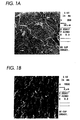
- FIG. 1 presents SEM micrographs of fracture surfaces of the compression molded UHMW polyethylene (after irradiation) at magnifications of (A) x 200 and (B) x 5000.
- FIG. 2 presents SEM micrographs of fracture surfaces of compression molded UHMW polyethylene crosslinked with 1 wt% peroxide (after irradiation) at magnifications of (A) x 200 and (B) x 5000.
- FIG. 3 presents the geometry of the acetabular cup tested for wear on the hip joint simulator used in EXAMPLE 2 below.
- FIG. 4 presents a schamatic diagram of the hip joint simulator used in EXAMPLE 2 below.
- FIG. 5 presents a graph comparing the amounts of wear of the modified and unmodified UHMW polyethylene cups during a run lasting a million cycles.
- Solid polymers that can crystallize generally contain both crystalline and amorphous states. These two states have different physical properties. The applicants believe that the crystalline component of polymers is more brittle and less wear-resistant than the amorphous component, the amorphous component being more ductile and more wear-resistant.
- the degree of crystallinity of the polymer is preferably reduced by crosslinking.
- the crosslinking can be achieved by various methods known in the art, for example, by irradiation crosslinking of the molten polymer; photocrosslinking of the molten polymer; and crosslinking of the polymer with a free radical generating chemical.
- the preferred method is chemical crosslinking.
- the crosslinking is to be achieved by irradiation, the polymer should be irradiated in the melt, unlike the above mentioned prior art irradiation methods, such as in Oonishi et al. Applicants also discovered that such a crosslinked polymer is useful for in vivo implant because it is wear resistant.
- irradiation in fact makes the polymer more susceptible to wear, contrary to the teaching of the prior art such as Oonishi et al , supra .
- applicants' method mitigates the deleterious effects of irradiation, such as chain scission.
- Applicants' method calls for determination of the crystallinity after irradiation to adjust the crosslinking conditions to reduce crystallinity.
- the polymer may also be irradiated under certain conditions e.g. , in nitrogen atmosphere to reduce the immediate and subsequent amounts of oxidation. Reducing oxidation increases the amount of crosslinking.
- the present invention also provides for annealing the crosslinked polymer in order to shrink it to a stable size before reshaping the polymer.
- an example of the present invention presents an UHMW polyethylene acetabular cup of a total hip prosthesis which has been chemically crosslinked by a peroxide, and then sterilized by irradiation, showing only one fifth of the wear of a control cup after a simulated year of in vivo use.
- One aspect of the invention presents a method for treating a polymer to reduce its crystallinity to less than 45% to enable the resulting polymer to better withstand wear.
- the polymer's crystallinity is preferably reduced by crosslinking in the molten state followed by cooling to the solid state.
- the crosslinking reduces the crystallinity of the polymer by about 10% to 50%; more preferably, by about 10% to 40%; and most preferably, by about 10% to 30% compared to an uncrosslinked polymer.
- the preferable degree of crystallinity of crosslinked UHMW polyethylene is between about 24% to 44%; more preferably, between 29% to 44%; and most preferably, between about 34% to 44%.
- the crosslinked polymer After sterilization by irradiation, the crosslinked polymer has a reduced crystallinity compared to the uncrosslinked polymer.
- the irradiated crosslinked polymer possesses about 10% to 50%; more preferably, about 10% to 40%; and most preferably, about 10% to 30% less degree of crystallinity compared to the uncrosslinked but irradiated polymer.
- the preferable degree of crystallinity of irradiated, crosslinked UHMW polyethylene is between about 28% to 51%; more preferably, between about 33% to 51%; and most preferably, between about 39% to 51%.
- EXAMPLE 1 Table 1 below shows the degree of crystallinity for UHMW polyethylene containing different weight percentage of peroxide.
- UHMW polyethylene which was crosslinked by 1% weight (wt) peroxide exhibited about 39.8% crystallinity, i.e. about a 19% reduction in crystallinity compared to uncrosslinked UHMW polyethylene which possessed about 49.2% crystallinity.
- the crosslinked UHMW polyethylene exhibits about 42% crystallinity, i.e., a reduction of about 25% in crystallinity compared to the originally uncrosslinked but radiation sterilized UHMW polyethylene which possessed about 55.8% crystallinity.
- the treated polymer after the usual sterilization dosage in the solid state, which generally averages between 2.5 to 4.0 Mrad, preferably possesses less than about 45% crystallinity, and more preferably about 42% crystallinity or less. Also, the treated polymer preferably possesses less than about 43%, more preferably less than about 40%, crystallinity before irradiation in the solid state.
- the polymer may be placed in the mold and crosslinked therein.
- Further crosslinking examples are: (1) irradiation of the polymer when it is in a molten state, e.g. UHMW polyethylene has been crosslinked in the melt by electron beam irradiation; and molten linear polyethylene has been irradiated with fast electrons (Dijkstra, D.J. et al ., Polymer , 30 :866-709 (1989); Gielenz G. & Jungnickle, B.J., Colloid & Polymer Sci.
- polyethylene and low-density polyethylene have been photocrosslinked ⁇ Chen, Y.L. & Ranby, B., J. Polymer Sci.: Part A: Polymer Chemistry , 27 :4051-4075, 4077-4086 (1989) ⁇ ; Qu, B.J. & Ranby, B., J. Applied Polymer Sci. , 48 :711-719 (1993) ⁇ .
- the polymers are generally polyhydrocarbons. Ductile polymers that wear well are preferred. Examples of such polymers include: polyethylene, polypropylene, polyester and polycarbonates.
- UHMW polymers may be used, such as UHMW polyethylene and UHMW polypropylene.
- An UHMW polymer is a polymer having a molecular weight (MW) of at least about a million.
- UHMW polyethylene is the most preferred polymer as it is known for these properties and is currently widely used to make acetabular cups for total hip prostheses.
- Examples of UHMW polyethylene are: Hostalen GUR 415 medical grade UHMW polyethylene flake (Hoechst-Celanese Corporation, League City, Texas), with a weight average molecular weight of 6 x 10 6 MW; Hostalen GUR 412 with a weight average molecular weight of between 2.5 x 10 6 to 3 x 10 6 MW; Hostalen GUR 413 of 3 x 10 6 to 4 x 10 6 MW; RCH 1000 (Hoechst-Celanese Corp.); and HiFax 1900 of 4 x 10 6 MW (HiMont, Elkton, Maryland).
- GUR 412, 413 and 415 are in the form of powder.
- RCH 1000 is usually available as compression molded bars.
- companies which make implants have used GUR 412 and GUR 415 for making acetabular cups.
- Hoechst-Celanese Corp. changed the designation of GUR 415 to 4150 resin and indicated that 4150 HP was for use in medical implants.
- the degree of crystallinity of the crosslinked polymer may be determined after it has been crosslinked or molded.
- the treated polymer is further irradiated, e.g. , to sterilize the polymer before its implant into humans, the degree of crystallinity may be determined after irradiation, since irradiation effects further crystallization of the polymer.
- the degree of crystallinity can be determined using methods known in the art, e.g. by d ifferential s canning calorimetry (DSC), which is generally used to assess the crystallinity and melting behavior of a polymer.
- DSC d ifferential s canning calorimetry
- X-ray scattering from the resulting polymer can also be used to further confirm the degree of crystallinity of the polymer, e.g. as described in Spruiell, J.E., & Clark, E.S.,in "Methods of Experimental Physics", L. Marton & C. Marton, Eds., Vol. 16, Part B, Academic Press, New York (1980). Swelling is generally used to characterize crosslink distributions in polymers, the procedure is described in Ding, Z. Y., et al. , J. Polymer Sci., Polymer Chem. , 29 : 1035-38 (1990).
- Another method for determining the degree of crystallinity of the resulting polymer may include FTIR ⁇ Painter, P.C. et al. , "The Theory Of Vibrational Spectroscopy And Its Application To Polymeric Materials", John Wiley and Sons, New York, U.S.A. (1982) ⁇ and electron diffraction.
- FTIR assesses the depth profiles of oxidation as well as other chemical changes such as unsaturation ⁇ Nagy, E.V., & Li, S., "A Fourier transform infrared technique for the evaluation of polyethylene orthopaedic bearing materials", Trans. Soc. for Biomaterials , 13 :109 (1990); Shinde, A. & Salovey, R., J. Polymer Sci., Polym. Phys. Ed. , 23 :1681-1689 (1985) ⁇ .
- a further method for determining the degree of crystallinity of the resulting polymer may include density measurement according to ASTM D1505-
- the polymer is preferably chemically crosslinked to decrease its crystallinity.
- the crosslinking chemical i.e. a free radical generating chemical
- the molding temperature is the temperature at which the polymer is molded.
- the molding temperature is generally at or above the melting temperature of polymer. If the crosslinking chemical has a long half-life at the molding temperature, it will decompose slowly, and the resulting free radicals can diffuse in the polymer to form a homogeneous crosslinked network at the molding temperature.
- the molding temperature is also preferably high enough to allow the flow of the polymer to occur to distribute or diffuse the crosslinking chemical and the resulting free radicals to form the homogeneous network.
- the molding temperature is between 150° to 220°C and the molding time is between 1 to 3 hours; the preferable molding temperature and time being 170°C and 2 hours, respectively.
- the crosslinking chemical may be any chemical that decomposes at the molding temperature to form highly reactive intermediates, free radicals, which would react with the polymers to form the crosslinked network.
- free radical generating chemicals are peroxides, peresters, azo compounds, disulfides, dimethacrylates, tetrazenes, and divinyl benzene.
- azo compounds are: azobis-isobutyronitride, azobisisobutyronitrile, and dimethylazodi isobutyrate.
- peresters are t-butyl peracetate and t-butyl perbenzoate.
- the polymer is crosslinked by treating it with an organic peroxide.
- the preferable peroxides are 2,5-dimethyl-2,5-bis(tert-butylperoxy)-3-hexyne (Lupersol 130, Atochem Inc., Philadelphia, Pennsylvania); 2,5-dimethyl-2,5-di-(t-butylperoxy)-hexane; t-butyl ⁇ -cumyl peroxide; di-butyl peroxide; t-butyl hydroperoxide; benzoyl peroxide; dichlorobenzoyl peroxide; dicumyl peroxide; di-tertiary butyl peroxide; 2,5 dimethyl-2,5 di(peroxy benzoate) hexyne-3; 1,3-bis(t-butyl peroxy isopropyl) benzene; lauroyl peroxide; di-t-amyl peroxide; 1,1-di-(t-butylperoxy
- the more preferred peroxide is 2,5-dimethyl-2,5-bis(tert-butylperoxy)-3-hexyne.
- the preferred peroxides have a half-life of between 2 minutes to 1 hour; and more preferably, the half-life is between 5 minutes to 50 minutes at the molding temperature.
- the range is between 0.2 to 5.0 wt% of peroxide; more preferably, the range is between 0.5 to 3.0 wt% of peroxide; and most preferably, the range is between 0.6 to 2 wt%.
- the peroxide can be dissolved in an inert solvent before being added to the polymer powder.
- the inert solvent preferably evaporates before the polymer is molded. Examples of such inert solvents are alcohol and acetone.
- the reaction between the polymer and the crosslinking chemical can generally be carried out at molding pressures.
- the reactants are incubated at molding temperature, between 1 to 3 hours, and more preferably, for about 2 hours.
- the reaction mixture is preferably slowly heated to achieve the molding temperature.
- the crosslinked polymer is preferably slowly cooled down to room temperature.
- the polymer may be left at room temperature and allowed to cool on its own. Slow cooling allows the formation of a stable crystalline structure.
- reaction parameters for crosslinking polymers with peroxide can be determined by one skilled in the art.
- peroxides are available for reaction with polyolefins, and investigations of their relative efficiencies have been reported ⁇ Lem, K.W. & Han, C.D., J. Appl. Polym. Sci. , 27 :1367 (1982); Kampouris, E.M. & Andreopoulos, A.G., J. Appl. Polym. Sci. , 34 :1209 (1987) and Bremner, T. & Rudin, A. J. Appl. Polym. Sci. , 49 :785 (1993) ⁇ .
- dialkyl peroxides on the basis of their ability to increase the gel content, crosslinking efficiency, and storage modulus of virgin polyethylene through a crosslinking mechanism and found that they decreased in the order of ⁇ , ⁇ -bis(tertiary butylperoxy)-p-diisopropyl benzene > dicumyl peroxide > 2,5-dimethyl-2,5-di-(tertiary butylperoxy)-hexyne-3 at the same active peroxide radical concentrations and temperature.
- Another aspect of the invention presents a process for making in vivo implants using the above chemically crosslinked polymer. Since in vivo implants are often irradiated to sterilize them before implant, the present invention provides the further step of selecting for implant use, a polymer with about 45% crystallinity or less after irradiation sterilization. For ⁇ -irradiation sterilization, the minimum dosage is generally 2.5 Mrad. The sterilization dosage generally falls between 2.5 and 4.0 Mrad. The preferable degree of crystallinity is between 25% to 45% crystallinity.
- the polymer has about 39.8% crystallinity after crosslinking; and about 42% crystallinity after further irradiation with ⁇ -radiation to an average dose of about 3.4 Mrad.
- the chemically crosslinked UHMW polymer preferably possesses less than about 43% crystallinity before irradiation in the solid state, and less than about 45% crystallinity after irradiation with ⁇ -radiation to an average dose of about 3.4 Mrad.
- the present invention further provides for annealing a polymer to pre-shrink it to a size which will not shrink further (i.e. stabilize the polymer's shrinkage or size).
- one aspect of the invention provides for a method of: 1) crosslinking a polymer, 2) selecting a crosslinked polymer of reduced crystallinity, 3) annealing the polymer to stabilize its size.
- the polymer can be molded at a size larger than desired, and the molded polymer is then annealed to stabilize its size. After size stabilization, the molded polymer is then resized, such as by machining, into a product with the desired dimension.
- the annealing temperature is preferably chosen to avoid thermal oxidation of the crosslinked polymer which will increase its crystallinity.
- the annealing temperature is preferably below the melting point of the molded polymer before irradiation.
- the melting temperatures of molded UHMW polyethylene and molded 1 wt% peroxide UHMW polyethylene are 132.6°C and 122.3°C, before irradiation, respectively.
- the preferable annealing temperature for both these molded UHMW polyethylenes is between 60°C to 120°C, before irradiation, and more preferably 100°C. These temperatures were determined by observation, based on experiments, of their minimal effect on thermal oxidation of the molded polymers.
- the annealing time is generally between 1 to 6 hours, and more preferably between 2 to 4 hours. In the case of UHMW polyethylene, the annealing time is preferably between 2 to 4 hours, and more preferably about 2 hours.
- the annealing is most preferably conducted in a vacuum oven.
- the crosslinked and annealed polymer has the desired degree of crystallinity
- its degree of crystallinity is preferably determined after the annealing process, using the method(s) described previously.
- Another aspect of the invention presents a polymer with 45% of crystallinity or less, in particular, after irradiation in the solid state and/or annealing.
- the polymer has about 39.8% crystallinity after crosslinking; and about 42% crystallinity, after further irradiation with ⁇ -radiation to an average dose of about 3.4 Mrad; or about 40.8% crystallinity, after crosslinking and annealing, but before irradiation in the solid state.
- the polymers of the present invention can be used in any situation where a polymer, especially UHMW polyethylene, is called for, but especially in situations where high wear resistance is desired and irradiation of the solid polymer is called for. More particularly, these polymers are useful for making in vivo implants.
- an important aspect of this invention presents in vivo implants that are made with the above polymers or according to the method presented herein. These implants are more wear resistant than their untreated counterpart, especially after irradiation.
- these in vivo implants are chemically crosslinked UHMW polymers, which have been molded, annealed, and resized into the shape of the implants.
- the chemically crosslinked UHMW polymer preferably possesses less than about 43% crystallinity before irradiation in the solid state, and less than about 45% crystallinity, after ⁇ -irradiation to an average dose of 3.4 Mrad, in the solid state.
- the modified polymer can be used to make in vivo implants for various parts of the body, such as components of a joint in the body.
- the modified polymer in the hip joints, can be used to make the acetabular cup, or the insert or liner of the cup, or trunnion bearings ( e.g. between the modular head and the stem).
- the modified polymer in the knee joint, can be used to make the tibial plateau (femoro-tibial articulation), the patellar button (patello-femoral articulation), and trunnion or other bearing components, depending on the design of the artificial knee joint.
- the modified polymer can be used to make the talar surface (tibio-talar articulation) and other bearing components.
- the modified polymer can be used to make the radio-humeral joint, ulno-humeral joint, and other bearing components.
- the modified polymer can be used to make the glenoro-humeral articulation, and other bearing components.
- the modified polymer can be used to make intervertebral disk replacement and facet joint replacement.
- the modified polymer can also be made into temporo-mandibular joint (jaw) and finger joints.
- the mixed powder (22g) was poured into the mold cavity and then compression molded in a mold between two stainless-steel plates at 120°C and ram pressure 11 x 10 3 kPa for 10 minutes in order to evacuate the trapped air in the powder. After pressing, the pressure was reduced to 7.5 x 10 3 kPa and the specimen was heated to 170°C by circulated heating oil. These conditions were held for 2 hours. The half-life time of peroxide at 170°C in dodecane is about 9 minutes. After 2 hours, pressure was increased to 15 x 10 3 kPa to avoid cavities in the specimen and sink marks on the surface and the specimen was slowly cooled in the mold to room temperature. The mold was in the shape of an acetabular cup for a total hip prosthesis.
- the specimens were irradiated with ⁇ -rays at room temperature in air atmosphere by SteriGenics International (Tustin, California). Cobalt-60 was used as a source of gamma irradiation.
- the radiation doses were delivered at a dose rate of 5 kGy/hr. Specimens received doses to an average of about 34 kGy ( i.e. , an average of about 3.4 Mrad).
- the degree of crystallinity, peak melting temperature, and recrystallization temperature for the peroxide-free specimen are 49.2%, 132.6 and 115.5°C, respectively.
- the degree of crystallinity, peak melting temperature, and recrystallization temperature are reduced to 39.8%, 122.3 and 110.1°C, respectively.
- Peroxide crosslinking reactions are accompanied by the decomposition of peroxide and abstraction of hydrogen atoms, and the resulting combination of alkyl radicals to produce carbon-carbon crosslinks. Generally, this reaction was performed above the melting temperature of the polymer. Thus the crosslinking step preceded the crystallization step.
- the degree of crystallinity and peak melting temperature after irradiation were increased to 42% (about 2% increase) and 125.1°C, respectively.
- the gel content decreased to 97.5% after irradiation, whereas, the degree of swelling and molecular weight between crosslinks increased to 3.35 and 2782 (g/mol), respectively.
- irradiation-induced scission of taut tie molecules resulted in a decreased gel content and an increased degree of swelling.
- the effect of irradiation on network properties was mitigated. As a result of peroxide crosslinking, radiation-induced chain scission becomes less important in determining gel content.
- peroxide crosslinking reduces the effect of irradiation on the crosslinked network because crosslinks introduced by peroxide crosslinking stabilize chain fragments resulting from the scission of taut tie molecules and suppress recrystallization of broken chains.
- Wide-angle x-ray scattering showed that crystal perfection increased after irradiation. It is suggested that crystal perfection was improved by irradiation-induced scission of taut tie molecules in the amorphous regions.
- peroxide crosslinked samples show a ductile (smooth) fracture surface, compared to the rough fracture surface of peroxide-free specimen.
- the difference in appearance of fracture surfaces for peroxide-free and 1 wt% peroxide specimens is due to the crystallinity difference.
- the degree of crystallinity for the peroxide-free and 1 wt% peroxide specimens were 55.8 and 42%, respectively. It is believed that the peroxide-free specimen (55.8% crystallinity) suffered higher forces and less deformation during the fracturing process, leading to a sharp break in the polymer.
- Peroxide crosslinking leads to a decrease in the degree of crystallinity, peak melting temperatures, and recrystallization temperatures for 1 wt% peroxide specimen. Irradiation produces crosslinking in amorphous regions plus extensive scission of taut tie molecules and leads to increased crystallinity and crystal perfection, reduces gel content, and increases the degree of swelling of a crosslinked network.
- Peroxide crosslinking reduces the effect of irradiation on the crosslinked network. This is because crosslinks introduced by peroxide crosslinking can stabilize the chain fragments resulting from the scission of taut tie molecules and suppress recrystallization of broken chains.
- Wide-angle x-ray scattering shows that crystal perfection increases after irradiation. It is suggested that crystal perfection is improved by irradiation-induced scission of taut tie molecules in the amorphous regions.
- the peroxide-free specimen shows brittle fracture because of higher crystallinity (55.8%), whereas, the 1 wt% peroxide specimen shows ductile fracture due to lower crystallinity (42%).
- the wear resistance of the polyethylenes treated (modified) and untreated (unmodified) with peroxide in EXAMPLE 1 were tested.
- the control (unmodified) and modified polyethylenes were compression molded directly into the form of acetabular cups. These were then exposed to an average of approximately 3.4 Mrad of gamma radiation (SteriGenics International, Tustin, California), to simulate the condition of cups that would be used in patients. Due to different amounts of post-molding shrinkage, the internal surface of each cup was machined to provide nearly identical internal diameters and ball-to-cup clearances among the control and modified cups (Fig. 3). As shown in Fig. 3B, the cup's outer radius 1 is 24.5 mm, its inner radius 2 is 16.1 mm, its height 3 is 29.8 mm, and its diameter 4 is 49.0 mm
- the cups were pre-soaked in distilled water for three weeks prior to the wear test to minimize fluid absorption during the wear test.
- the wear cups were mounted on the hip joint simulator, including four cups of control polyethylene and three cups of modified polyethylene. Each cup was held in a urethane mold and mounted in a stainless steel test chamber, with a plexiglass wall to contain the bovine serum lubricant.
- the lubricant had 0.2% sodium azide added to retard bacterial degradation, and 20 milli-Molar ethylene-diaminetetraacetic acid (EDTA) to prevent precipitation of calcium phosphate on the surfaces of the ball (McKellop, H.
- EDTA milli-Molar ethylene-diaminetetraacetic acid
- Fig. 4 presents a schematic diagram of the hip joint simulator. The arrow indicates the direction of the computer controlled simulated physiological load exerted on the simulated hip joint.
- the simulator contains: a torque transducer 5, the acetabular cup 6, a dual axis offset drive block 7, a test chamber 8, serum 9, and a femoral head 10.
- Three soak-correction acetabular cups of each material were prepared in an identical manner, but were not wear tested. These cups were mounted in a separate test frame and a cyclic load, identical to that used in the wear test, was applied. These soak-correction cups were cleaned and weighed together with the wear test cups, and the average weight gain of the correction cups was added to the apparent weight loss of the wear test cups ( i.e. to correct for fluid absorption by the wear test cups that would obscure the weight loss due to wear).
- WEAR RATES FOR CONTROL AND MODIFIED POLYETHYLENES (INTERVAL FROM 0.5 TO 1.0 MILLION CYCLES) MATERIAL CUP NUMBER WEAR RATE (mg/million cycles) MEAN WEAR RATE (STANDARD DEVIATION) CONTROL POLYETHYLENE C2 21.67 19.19 (2.38) C3 16.78 C4 17.57 C9 20.76 MODIFIED POLYETHYLENE M4 4.08 4.12 (1.26) M5 2.88 M7 5.39
- the corrected weights were lower than the weights before the wear test. This was most likely the result of the wear being very small, and the fluid absorption by the test cups being slightly greater than the average gain of the soak correction cups, such that the correction factor did not entirely offset the fluid gain by the wear cups (giving an apparent "negative” wear).
- a small difference in water absorption rates between the wear cups and the correction cups could arise due to differences in equilibrium temperatures (the wear cups were typically at 35°C to 45°C, whereas the soak correction cups were at room temperature, about 20°C), due to mechanical agitation of the serum during oscillation of the wear test chambers, or other causes.
Landscapes
- Health & Medical Sciences (AREA)
- Chemical & Material Sciences (AREA)
- Transplantation (AREA)
- Engineering & Computer Science (AREA)
- Life Sciences & Earth Sciences (AREA)
- Oral & Maxillofacial Surgery (AREA)
- Orthopedic Medicine & Surgery (AREA)
- Veterinary Medicine (AREA)
- Animal Behavior & Ethology (AREA)
- General Health & Medical Sciences (AREA)
- Public Health (AREA)
- Chemical Kinetics & Catalysis (AREA)
- Medicinal Chemistry (AREA)
- Heart & Thoracic Surgery (AREA)
- Vascular Medicine (AREA)
- Biomedical Technology (AREA)
- Cardiology (AREA)
- Polymers & Plastics (AREA)
- Organic Chemistry (AREA)
- Epidemiology (AREA)
- Crystallography & Structural Chemistry (AREA)
- Dermatology (AREA)
- Physical Education & Sports Medicine (AREA)
- Manufacturing & Machinery (AREA)
- Materials Engineering (AREA)
- Toxicology (AREA)
- Mechanical Engineering (AREA)
- Materials For Medical Uses (AREA)
- Prostheses (AREA)
- Processes Of Treating Macromolecular Substances (AREA)
Claims (60)
- Implant à utiliser dans un corps, ledit implant étant fait de polyéthylène de poids moléculaire ultra élevé, réticulé, irradié, ayant une structure polymère d'une cristallinité d'entre 28% et 51%, telle que mesurée par DSC, de manière à augmenter la résistance à l'usure dudit implant dans le corps.
- L'implant de la revendication 1, où l'implant est en outre stérilisé, la cristallinité étant mesurée après la stérilisation.
- Implant à utiliser dans un corps, ledit implant étant fait d'un polyéthylène de poids moléculaire ultra élevé, réticulé, irradié, ayant une structure polymère d'une cristallinité de moins de 45%, telle que mesurée par DSC, de manière à augmenter la résistance à l'usure dudit implant dans le corps.
- L'implant de la revendication 3, où ledit polyéthylène de poids moléculaire ultra élevé a une cristallinité d'entre 24% et 44%, telle que mesurée par DSC.
- L'implant de la revendication 3 ou 4, où l'implant est en outre stérilisé.
- L'implant de la revendication 5, où la cristallinité est telle que mesurée après la stérilisation.
- L'implant de la revendication 2 ou 5, où ladite stérilisation est faite par irradiation.
- L'implant de l'une quelconque des revendications précédentes, où ledit polyéthylène de poids moléculaire ultra élevé, réticulé, est caractérisé en outre (a) en ayant été réticulé avec une concentration de peroxyde de 1% en poids et en ayant une structure polymère d'une teneur en gel de 99,6% ou de presque 100%, ou (b) en ayant été réticulé avec une concentration de peroxyde de 1% en poids, suivi par l'irradiation et en ayant une structure polymère d'une teneur en gel de 97,5%.
- L'implant de l'une quelconque des revendications précédentes, où la réticulation est réalisée selon le procédé sélectionné parmi le groupe consistant à: réticuler chimiquement un polyéthylène, réticuler par irradiation un polyéthylène dans un état fondu, et photoréticuler un polyéthylène dans un état fondu.
- L'implant de la revendication 7, où ledit implant est irradié à l'état solide.
- L'implant de la revendication 10, où ledit implant est irradié à l'air avec un rayonnement gamma à une dose de 34 kGy.
- L'implant de l'une quelconque des revendications précédentes, où ledit polyéthylène de poids moléculaire ultra élevé, réticulé, est en outre caractérisé en ayant été recuit de manière à le rétrécir à une dimension stable.
- L'implant de l'une quelconque des revendications précédentes, où ledit polyéthylène de poids moléculaire ultra élevé, réticulé, est en outre caractérisé par une structure polymère d'un degré de gonflement de 3,35 fourni par la réticulation avec une concentration de peroxyde de 1% en poids, suivie par l'irradiation, ou par une structure polymère d'un degré de gonflement de 2,53 par la réticulation avec une concentration de peroxyde de 1% en poids.
- L'implant de l'une quelconque des revendications précédentes, où l'implant est un composant à utiliser dans une prothèse articulaire.
- L'implant de la revendication 14, où le composant est un composant porteur.
- L'implant de la revendication 14 ou 15, où la prothèse articulaire est sélectionnée du groupe consistant en: prothèses articulaires de la hanche, du genou, de la cheville, du coude, de la mâchoire, de l'épaule, du doigt et en prothèses articulaires facettaires rachidiennes.
- L'implant de la revendication 16, où la prothèse articulaire est sélectionnée parmi le groupe consistant en: prothèses articulaires de la hanche et du genou.
- L'implant de la revendication 17, où l'implant est sélectionné parmi le groupe consistant en: une cupule cotyloïdienne, un insert de cupule cotyloïdienne et une garniture de cupule cotyloïdienne.
- Composant porteur implantable avec une résistance à l'usure améliorée, ledit composant implantable comprenant un polyéthylène de poids moléculaire ultra élevé, réticulé, irradié, ayant une résistance à l'usure augmentée, et une structure polymère caractérisée par une cristallinité de 28% à 51%, telle que mesurée par DSC.
- Le composant porteur implantable de la revendication 19, où le composant est en outre stérilisé, la cristallinité étant telle que mesurée après la stérilisation.
- Composant porteur implantable avec une résistance à l'usure améliorée, ledit composant implantable comprenant un polyéthylène de poids moléculaire ultra élevé, réticulé, ayant une résistance à l'usure augmentée, ledit polyéthylène de poids moléculaire ultra élevé, réticulé, ayant une structure polymère caractérisée par une cristallinité de moins de 45%, telle que mesurée par DSC.
- Le composant porteur implantable de la revendication 21, où le polyéthylène de poids moléculaire ultra élevé, réticulé, a une structure polymère caractérisée par une cristallinité d'entre 24% et 44%, telle que mesurée par DSC.
- Le composant porteur implantable de la revendication 21 ou 22, où le composant est en outre stérilisé.
- Le composant porteur implantable de la revendication 23, où ladite cristallinité est telle que mesurée après la stérilisation.
- Le composant porteur implantable de la revendication 20 ou 24, où ladite stérilisation est faite par irradiation.
- Le composant porteur implantable de l'une quelconque des revendications 19 à 25, où le polyéthylène de poids moléculaire ultra élevé, réticulé, a une structure polymère
caractérisée par un degré de gonflement de 3,35 fourni par la réticulation avec une concentration de peroxyde de 1% en poids, suivie par l'irradiation, ou une structure polymère d'un degré de gonflement de 2,53 par la réticulation avec une concentration de peroxyde de 1% en poids. - Le composant porteur implantable de l'une quelconque des revendications 19 à 26, où le polyéthylène de poids moléculaire ultra élevé, réticulé, est caractérisé en outre (a) en ayant été réticulé avec une concentration de peroxyde de 1% en poids et en ayant une structure polymère d'une teneur en gel de 99,6% ou de presque 100%, ou (b) en ayant été réticulé avec une concentration de peroxyde de 1% en poids, suivi par l'irradiation et en ayant une structure polymère d'une teneur en gel de 97,5%.
- Le composant porteur implantable de l'une quelconque des revendications 19 à 27, où la réticulation est réalisée selon le procédé sélectionné parmi le groupe consistant à: réticuler chimiquement un polyéthylène, réticuler par irradiation un polyéthylène dans un état fondu, et photoréticuler un polyéthylène dans un état fondu.
- Le composant porteur implantable de l'une quelconque des revendications 19 à 28, où le composant porteur implantable est utilisé dans une prothèse articulaire.
- Le composant porteur implantable de la revendication 29, où la prothèse articulaire est sélectionnée parmi le groupe consistant en: prothèses articulaires de la hanche et du genou.
- Le composant porteur implantable de la revendication 30, où le composant porteur implantable est sélectionné parmi le groupe consistant en: une cupule cotyloïdienne, un insert de cupule cotyloïdienne et une garniture de cupule cotyloïdienne.
- Procédé de production d'un implant avec une résistance à l'usure améliorée, comprenant les étapes consistant à: réticuler un polyéthylène pour produire un polyéthylène de poids moléculaire ultra élevé, réticulé, irradié, ayant une structure polymère caractérisée par une cristallinité de 28% à 51%, telle que mesurée par DSC, et recuire le polyéthylène de poids moléculaire ultra élevé, réticulé, pour prérétrécir et stabiliser sa dimension avant de le transformer en un implant.
- Procédé de production d'un implant avec une résistance à l'usure améliorée, comprenant les étapes consistant à: réticuler un polyéthylène pour produire un polyéthylène de poids moléculaire ultra élevé, réticulé, irradié, ayant une structure polymère caractérisée par une cristallinité de moins de 45%, telle que mesurée par DSC, et recuire le polyéthylène de poids moléculaire ultra élevé, réticulé, pour prérétrécir et stabiliser sa dimension avant de le transformer en un implant.
- Le procédé de la revendication 33, où la structure polymère est caractérisée par une cristallinité d'entre 24% et 44%, telle que mesurée par DSC.
- Le procédé de l'une quelconque des revendications 32 à 34 comprenant une étape de stérilisation, où la cristallinité est telle que mesurée après l'étape de stérilisation.
- Le procédé tel que revendiqué dans la revendication 35, où l'étape de stérilisation est réalisée par irradiation.
- Le procédé de l'une quelconque des revendications 32 à 36, où la structure polymère est caractérisée par un degré de gonflement de 3,35 fourni par la réticulation avec une concentration de peroxyde de 1% en poids et l'irradiation, ou un degré de gonflement de 2,53 par la réticulation avec une concentration de peroxyde de 1% en poids.
- Le procédé de l'une quelconque des revendications 32 à 37, où ledit polyéthylène de poids moléculaire ultra élevé, réticulé, est caractérisé en outre (a) en ayant été réticulé avec une concentration de peroxyde de 1% en poids et en ayant une structure polymère d'une teneur en gel de 99,6% ou de presque 100%, ou (b) en ayant été réticulé avec une concentration de peroxyde de 1% en poids, suivi par l'irradiation et en ayant une structure polymère d'une teneur en gel de 97,5%.
- Le procédé de l'une quelconque des revendications 32 à 38, où l'implant est un composant à utiliser dans une prothèse articulaire.
- Le procédé de l'une quelconque des revendications 32 à 39, où l'implant est un composant porteur.
- Le procédé de l'une quelconque des revendications 32 à 40, où l'implant est sélectionné parmi le groupe consistant en: une cupule cotyloïdienne, un insert de cupule cotyloïdienne et une garniture de cupule cotyloïdienne.
- Procédé pour améliorer la résistance à l'usure d'un implant à utiliser dans un corps, ledit implant étant fait de polyéthylène de poids moléculaire ultra élevé, réticulé, irradié, ledit procédé comprenant l'étape consistant à réticuler un polyéthylène pour donner une structure polymère d'une cristallinité d'entre 28% et 51 %, telle que mesurée par DSC.
- Procédé pour améliorer la résistance à l'usure d'un implant à utiliser dans un corps, ledit implant étant fait de polyéthylène de poids moléculaire ultra élevé, réticulé, irradié, ledit procédé comprenant l'étape consistant à réticuler un polyéthylène pour donner une structure polymère avec une cristallinité de moins de 45%, telle que mesurée par DSC.
- Le procédé de la revendication 43, où la structure polymère est caractérisée par une cristallinité d'entre 24% et 44%, telle que mesurée par DSC.
- Le procédé de l'une quelconque des revendications 42 à 44, comprenant en outre l'étape consistant à stériliser l'implant, où la cristallinité est telle que mesurée après la stérilisation.
- Le procédé de la revendication 45, où la stérilisation est faite par irradiation
- Le procédé de l'une quelconque des revendications 42 à 46, où la structure polymère est caractérisée par un degré de gonflement de 3,35 fourni par la réticulation avec une concentration de peroxyde de 1% en poids et l'irradiation, ou un degré de gonflement de 2,53 par la réticulation avec une concentration de peroxyde de 1% en poids.
- Le procédé de l'une quelconque des revendications 42 à 47, où ledit polyéthylène de poids moléculaire ultra élevé, réticulé, est caractérisé en outre (a) en ayant été réticulé avec une concentration de peroxyde de 1% en poids et en ayant une structure polymère d'une teneur en gel de 99,6% ou de presque 100%, ou (b) en ayant été réticulé avec une concentration de peroxyde de 1% en poids, suivi par l'irradiation et en ayant une structure polymère d'une teneur en gel de 97,5%.
- Le procédé de l'une quelconque des revendications 42 à 48, où l'implant est un composant à utiliser dans une prothèse articulaire.
- Le procédé de l'une quelconque des revendications 42 à 49, où l'implant est un composant prothétique porteur.
- Le procédé de l'une quelconque des revendications 42 à 50, où l'implant est sélectionné parmi le groupe consistant en: une cupule cotyloïdienne, un insert de cupule cotyloïdienne et une garniture de cupule cotyloïdienne.
- Procédé pour faire et améliorer la résistance à l'usure d'un implant à utiliser dans un corps, comprenant les étapes consistant à: (a) réticuler un polyéthylène pour fournir un polyéthylène de poids moléculaire ultra élevé, réticulé, irradié, avec une structure polymère d'une cristallinité d'entre 28% et 51%, telle que mesurée par DSC, et (b) former l'implant avec ledit polyéthylène de poids moléculaire ultra élevé, réticulé.
- Procédé pour faire et améliorer la résistance à l'usure d'un implant à utiliser dans un corps, comprenant les étapes consistant à: (a) réticuler un polyéthylène en un polyéthylène de poids moléculaire ultra élevé, réticulé, irradié avec une structure polymère d'une cristallinité de moins de 45%, telle que mesurée par DSC, et (b) former l'implant avec ledit polyéthylène de poids moléculaire ultra élevé, réticulé.
- Le procédé de la revendication 53, où la structure polymère est caractérisée par une cristallinité d'entre 24% et 44%, telle que mesurée par DSC.
- Le procédé de l'une quelconque des revendications 52 à 54, où l'étape de réticulation fournit en outre au polyéthylène de poids moléculaire ultra élevé, réticulé, une structure polymère d'un degré de gonflement de 3,35 fourni par la réticulation avec une concentration de peroxyde de 1% en poids et l'irradiation, ou un degré de gonflement de 2,53 fourni par la réticulation avec une concentration de peroxyde de 1% en poids.
- Le procédé de l'une quelconque des revendications 52 à 55, où l'étape de réticulation se fait (a) par la réticulation avec une concentration de peroxyde de 1% en poids et fournit en outre au polyéthylène de poids moléculaire ultra élevé, une structure polymère d'une teneur en gel de 99,6% ou de presque 100%, ou (b) par la réticulation avec une concentration de peroxyde de 1% en poids suivie par l'irradiation, et fournit en outre au polyéthylène de poids moléculaire ultra élevé, une structure polymère d'une teneur en gel de 97,5%.
- Le procédé de l'une quelconque des revendications 52 à 56, où l'implant est un composant à utiliser dans une prothèse articulaire.
- Le procédé de l'une quelconque des revendications 52 à 57, où l'implant est un composant prothétique porteur.
- Le procédé de l'une quelconque des revendications 52 à 58, où l'implant est sélectionné parmi le groupe consistant en: une cupule cotyloïdienne, un insert de cupule cotyloïdienne et une garniture de cupule cotyloïdienne.
- Le procédé de l'une quelconque des revendications 52 à 59, comprenant en outre l'étape consistant à recuire le polyéthylène de poids moléculaire ultra élevé, réticulé, à une température de 60°C à 120°C pendant 1 à 6 heures pour en stabiliser la dimension.
Applications Claiming Priority (3)
| Application Number | Priority Date | Filing Date | Title |
|---|---|---|---|
| US37695395A | 1995-01-20 | 1995-01-20 | |
| US376953 | 1995-01-20 | ||
| US69863896A | 1996-08-15 | 1996-08-15 |
Publications (3)
| Publication Number | Publication Date |
|---|---|
| EP0722973A1 EP0722973A1 (fr) | 1996-07-24 |
| EP0722973B1 true EP0722973B1 (fr) | 2003-12-17 |
| EP0722973B2 EP0722973B2 (fr) | 2013-02-13 |
Family
ID=27007631
Family Applications (1)
| Application Number | Title | Priority Date | Filing Date |
|---|---|---|---|
| EP96300113A Expired - Lifetime EP0722973B2 (fr) | 1995-01-20 | 1996-01-05 | Polyéthylène de poids moléculaire ultra élevé chimiquement réticulé pour articulations humaines artificielles |
Country Status (6)
| Country | Link |
|---|---|
| US (6) | US6281264B1 (fr) |
| EP (1) | EP0722973B2 (fr) |
| JP (2) | JP3323728B2 (fr) |
| CA (1) | CA2166450C (fr) |
| DE (1) | DE69631076T2 (fr) |
| IT (1) | IT1284325B1 (fr) |
Cited By (5)
| Publication number | Priority date | Publication date | Assignee | Title |
|---|---|---|---|---|
| US7803310B2 (en) | 2005-06-14 | 2010-09-28 | Omni Life Science, Inc. | Crosslinked polyethylene article |
| US7858671B2 (en) | 1996-02-13 | 2010-12-28 | The General Hospital Corporation | Radiation and melt treated ultra high molecular weight polyethylene prosthetic devices |
| AU2005202521B2 (en) * | 2004-06-30 | 2011-03-03 | Depuy Products, Inc. | Low crystalline polymeric material for orthopaedic implants and an associated method |
| US8563623B2 (en) | 1996-02-13 | 2013-10-22 | The General Hospital Corporation | Radiation melt treated ultra high molecular weight polyethylene prosthetic devices |
| US9155817B2 (en) | 2000-04-27 | 2015-10-13 | Orthopaedic Hospital | Oxidation-resistant and wear-resistant polyethylenes for human joint replacements and methods for making them |
Families Citing this family (169)
| Publication number | Priority date | Publication date | Assignee | Title |
|---|---|---|---|---|
| US5414049A (en) * | 1993-06-01 | 1995-05-09 | Howmedica Inc. | Non-oxidizing polymeric medical implant |
| AU693260B2 (en) | 1994-09-21 | 1998-06-25 | Bmg Incorporated | Ultrahigh-molecular-weight polyethylene molding for artificial joint and process for producing the molding |
| US20050125074A1 (en) * | 1995-01-20 | 2005-06-09 | Ronald Salovey | Crosslinking of polyethylene for low wear using radiation and thermal treatments |
| CA2166450C (fr) * | 1995-01-20 | 2008-03-25 | Ronald Salovey | Polyethylene de masse moleculaire tres elevee, reticule chimiquement, pour articulations artificielles chez l'homme |
| CA2246342C (fr) * | 1996-02-13 | 2008-04-22 | Massachusetts Institute Of Technology | Dispositifs de prothese a base de polyethylene a poids moleculaire tres eleve, traites par fusion et rayonnement |
| JP5073626B2 (ja) * | 1996-02-13 | 2012-11-14 | マサチューセッツ インスティテュート オブ テクノロジー | 放射線および溶融処理済み超高分子量ポリエチレンプロテーゼデバイス |
| US5879400A (en) | 1996-02-13 | 1999-03-09 | Massachusetts Institute Of Technology | Melt-irradiated ultra high molecular weight polyethylene prosthetic devices |
| US20020156536A1 (en) * | 1996-02-13 | 2002-10-24 | Harris William H. | Polyethylene hip joint prosthesis with extended range of motion |
| EP0935446B1 (fr) * | 1996-07-09 | 2007-02-07 | Orthopaedic Hospital | Reticulation du polyethylene pour limiter l'usure au moyen de traitements thermique et a rayonnement |
| US6228900B1 (en) | 1996-07-09 | 2001-05-08 | The Orthopaedic Hospital And University Of Southern California | Crosslinking of polyethylene for low wear using radiation and thermal treatments |
| US6017975A (en) | 1996-10-02 | 2000-01-25 | Saum; Kenneth Ashley | Process for medical implant of cross-linked ultrahigh molecular weight polyethylene having improved balance of wear properties and oxidation resistance |
| EP1028760B1 (fr) * | 1996-10-15 | 2004-04-14 | Orthopaedic Hospital | Polyethylene reticule a gradient de surface, resistant a l'usure |
| US6692679B1 (en) | 1998-06-10 | 2004-02-17 | Depuy Orthopaedics, Inc. | Cross-linked molded plastic bearings |
| JP4503114B2 (ja) * | 1998-06-10 | 2010-07-14 | デピュイ・オルソペディックス・インコーポレイテッド | 架橋成形したプラスチック支持体 |
| US6627141B2 (en) | 1999-06-08 | 2003-09-30 | Depuy Orthopaedics, Inc. | Method for molding a cross-linked preform |
| US6245276B1 (en) | 1999-06-08 | 2001-06-12 | Depuy Orthopaedics, Inc. | Method for molding a cross-linked preform |
| US6432349B1 (en) | 1999-06-29 | 2002-08-13 | Zimmer, Inc. | Process of making an articulating bearing surface |
| US6143232A (en) * | 1999-07-29 | 2000-11-07 | Bristol-Meyers Squibb Company | Method of manufacturing an articulating bearing surface for an orthopaedic implant |
| US6184265B1 (en) | 1999-07-29 | 2001-02-06 | Depuy Orthopaedics, Inc. | Low temperature pressure stabilization of implant component |
| US6365089B1 (en) * | 1999-09-24 | 2002-04-02 | Zimmer, Inc. | Method for crosslinking UHMWPE in an orthopaedic implant |
| EP1242008B1 (fr) | 1999-12-17 | 2006-03-08 | Cartificial A/S | Dispositif prothetique |
| US6395799B1 (en) | 2000-02-21 | 2002-05-28 | Smith & Nephew, Inc. | Electromagnetic and mechanical wave energy treatments of UHMWPE |
| KR20010108801A (ko) * | 2000-05-31 | 2001-12-08 | 안복현 | 초고분자량 폴리에틸렌의 내마모성 향상 방법 |
| US6503439B1 (en) | 2000-06-15 | 2003-01-07 | Albert H. Burstein | Process for forming shaped articles of ultra high molecular weight polyethylene suitable for use as a prosthetic device or a component thereof |
| ES2286131T3 (es) | 2000-07-31 | 2007-12-01 | Massachusetts General Hospital | Componente acetabular monopolar constreñido. |
| US6818172B2 (en) | 2000-09-29 | 2004-11-16 | Depuy Products, Inc. | Oriented, cross-linked UHMWPE molding for orthopaedic applications |
| US20030208278A1 (en) * | 2000-09-29 | 2003-11-06 | Robert Richard | Supercritical fluid treatment of irradiated polyethylene |
| US6626947B2 (en) | 2000-10-03 | 2003-09-30 | Depuy Orthopaedics, Inc. | Press fit acetabular cup and associated method for securing the cup to an acetabulum |
| US6955876B2 (en) * | 2000-11-01 | 2005-10-18 | Kane Michael D | Compositions and systems for identifying and comparing expressed genes (mRNAs) in eukaryotic organisms |
| US6558426B1 (en) | 2000-11-28 | 2003-05-06 | Medidea, Llc | Multiple-cam, posterior-stabilized knee prosthesis |
| DE10105085C1 (de) | 2001-02-05 | 2002-04-18 | Plus Endoprothetik Ag Rotkreuz | Verfahren zur Herstellung von Implantatteilen aus hochvernetztem UHMWPE und deren Verwendung |
| US6547828B2 (en) | 2001-02-23 | 2003-04-15 | Smith & Nephew, Inc. | Cross-linked ultra-high molecular weight polyethylene for medical implant use |
| US20020120340A1 (en) | 2001-02-23 | 2002-08-29 | Metzger Robert G. | Knee joint prosthesis |
| US7497874B1 (en) | 2001-02-23 | 2009-03-03 | Biomet Manufacturing Corp. | Knee joint prosthesis |
| US7695521B2 (en) | 2001-05-01 | 2010-04-13 | Amedica Corporation | Hip prosthesis with monoblock ceramic acetabular cup |
| US7776085B2 (en) * | 2001-05-01 | 2010-08-17 | Amedica Corporation | Knee prosthesis with ceramic tibial component |
| US20050177238A1 (en) * | 2001-05-01 | 2005-08-11 | Khandkar Ashok C. | Radiolucent bone graft |
| AU2002324443A1 (en) * | 2001-06-14 | 2003-01-02 | Amedica Corporation | Metal-ceramic composite articulation |
| US6652586B2 (en) * | 2001-07-18 | 2003-11-25 | Smith & Nephew, Inc. | Prosthetic devices employing oxidized zirconium and other abrasion resistant surfaces contacting surfaces of cross-linked polyethylene |
| US7182784B2 (en) | 2001-07-18 | 2007-02-27 | Smith & Nephew, Inc. | Prosthetic devices employing oxidized zirconium and other abrasion resistant surfaces contacting surfaces of cross-linked polyethylene |
| GB0122117D0 (en) | 2001-09-13 | 2001-10-31 | United Ind Operations Ltd | Method of crosslinking polyolefins |
| US7160492B2 (en) * | 2001-12-12 | 2007-01-09 | Depuy Products, Inc. | Orthopaedic device for implantation in the body of an animal and method for making the same |
| AU2002334649B2 (en) * | 2002-01-04 | 2007-12-06 | Cambridge Polymer Group Inc. | A high modulus crosslinked polyethylene with reduced residual free radical concentration prepared below the melt |
| US7819925B2 (en) * | 2002-01-28 | 2010-10-26 | Depuy Products, Inc. | Composite prosthetic bearing having a crosslinked articulating surface and method for making the same |
| EP1332735B1 (fr) | 2002-01-28 | 2007-08-08 | Depuy Products, Inc. | Procédé de fabrication d'un palier de frottement composite prothétique avec surface d'articulation réticulée |
| US7186364B2 (en) * | 2002-01-28 | 2007-03-06 | Depuy Products, Inc. | Composite prosthetic bearing constructed of polyethylene and an ethylene-acrylate copolymer and method for making the same |
| ATE312704T1 (de) | 2002-01-29 | 2005-12-15 | Paul Smith | Sintern von ultrahochmolekularem polyethylen |
| AU2003211465A1 (en) * | 2002-02-19 | 2003-09-09 | Kazuhiko Ishihara | Artificial joint member made of polymeric material |
| US20030207661A1 (en) * | 2002-05-01 | 2003-11-06 | Alexander Tregub | Annealing of CMP polishing pads |
| JP2003338156A (ja) * | 2002-05-20 | 2003-11-28 | Fuji Photo Film Co Ltd | 磁気ディスクカートリッジ |
| CA2429930C (fr) * | 2002-06-06 | 2008-10-14 | Howmedica Osteonics Corp. | Polyethylene sequence reticule |
| US7485670B2 (en) * | 2002-08-02 | 2009-02-03 | Cambridge Polymer Group, Inc. | Systems and methods for controlling and forming polymer gels |
| US7745532B2 (en) * | 2002-08-02 | 2010-06-29 | Cambridge Polymer Group, Inc. | Systems and methods for controlling and forming polymer gels |
| US7329284B2 (en) | 2002-09-27 | 2008-02-12 | Depuy Products, Inc. | Concave resurfacing prosthesis |
| AU2003299714A1 (en) * | 2002-10-11 | 2004-05-04 | Cartificial A/S | Medical device comprising a bio-compatible polymeric product with a layered structure |
| AU2003287190A1 (en) | 2002-10-23 | 2004-05-13 | Alastair J. T. Clemow | Modular femoral component for a total knee joint replacement for minimally invasive implantation |
| US6677395B1 (en) * | 2002-11-27 | 2004-01-13 | Basell Poliolefine Italia S.P.A. | Irradiated, oxidized olefin polymer dispersing agents |
| AU2003297195A1 (en) * | 2002-12-17 | 2004-07-22 | Amedica Corporation | Total disc implant |
| DE60336013D1 (de) | 2002-12-20 | 2011-03-24 | Smith & Nephew Inc | Hochleistungsknieprothese |
| US7344565B2 (en) * | 2003-02-04 | 2008-03-18 | Wright Medical Technology, Inc. | Acetabular component insertion and extraction tool for use therewith, and method of locking an acetabular component to an insertion and extraction tool |
| US7938861B2 (en) | 2003-04-15 | 2011-05-10 | Depuy Products, Inc. | Implantable orthopaedic device and method for making the same |
| EP1686932B1 (fr) | 2003-06-27 | 2010-01-06 | ABS Corporation | Systeme destines a l'arthroplastie de la cheville |
| US7214764B2 (en) * | 2003-06-30 | 2007-05-08 | Depuy Products, Inc. | Free radical quench process for irradiated ultrahigh molecular weight polyethylene |
| US20040265165A1 (en) * | 2003-06-30 | 2004-12-30 | Depuy Products, Inc. | Free radical quench process for irradiated ultrahigh molecular weight polyethylene |
| WO2005007025A2 (fr) | 2003-07-11 | 2005-01-27 | Depuy Products, Inc. | Compteur de cycles pour implant articulaire in vivo |
| JP4777243B2 (ja) * | 2003-07-11 | 2011-09-21 | デピュイ・プロダクツ・インコーポレイテッド | 体内での関節空間測定装置および測定方法 |
| US7470288B2 (en) * | 2003-07-11 | 2008-12-30 | Depuy Products, Inc. | Telemetric tibial tray |
| US7218232B2 (en) * | 2003-07-11 | 2007-05-15 | Depuy Products, Inc. | Orthopaedic components with data storage element |
| US7922769B2 (en) * | 2004-09-27 | 2011-04-12 | Depuy Products, Inc. | Modular glenoid prosthesis and associated method |
| US7927335B2 (en) | 2004-09-27 | 2011-04-19 | Depuy Products, Inc. | Instrument for preparing an implant support surface and associated method |
| US7892287B2 (en) | 2004-09-27 | 2011-02-22 | Depuy Products, Inc. | Glenoid augment and associated method |
| US20060074353A1 (en) * | 2004-09-27 | 2006-04-06 | Deffenbaugh Daren L | Glenoid instrumentation and associated method |
| US8262976B2 (en) | 2004-10-07 | 2012-09-11 | Biomet Manufacturing Corp. | Solid state deformation processing of crosslinked high molecular weight polymeric materials |
| US7547405B2 (en) | 2004-10-07 | 2009-06-16 | Biomet Manufacturing Corp. | Solid state deformation processing of crosslinked high molecular weight polymeric materials |
| US7462318B2 (en) * | 2004-10-07 | 2008-12-09 | Biomet Manufacturing Corp. | Crosslinked polymeric material with enhanced strength and process for manufacturing |
| US7344672B2 (en) | 2004-10-07 | 2008-03-18 | Biomet Manufacturing Corp. | Solid state deformation processing of crosslinked high molecular weight polymeric materials |
| US7160329B2 (en) * | 2004-12-01 | 2007-01-09 | Mayo Foundation For Medical Research And Education | Radial-capitellar implant |
| US7335697B2 (en) * | 2004-12-23 | 2008-02-26 | Depuy Products, Inc. | Polymer composition comprising cross-linked polyethylene and methods for making the same |
| US7883653B2 (en) | 2004-12-30 | 2011-02-08 | Depuy Products, Inc. | Method of making an implantable orthopaedic bearing |
| US7879275B2 (en) | 2004-12-30 | 2011-02-01 | Depuy Products, Inc. | Orthopaedic bearing and method for making the same |
| US7896921B2 (en) * | 2004-12-30 | 2011-03-01 | Depuy Products, Inc. | Orthopaedic bearing and method for making the same |
| US7435372B2 (en) | 2005-03-31 | 2008-10-14 | Zimmer, Inc. | Liquid bath annealing of polymers for orthopaedic implants |
| EP1896088A2 (fr) * | 2005-06-14 | 2008-03-12 | Cartificial A/S | Dispositif medical s'introduisant dans une articulation |
| US7538379B1 (en) * | 2005-06-15 | 2009-05-26 | Actel Corporation | Non-volatile two-transistor programmable logic cell and array layout |
| EP2277560B1 (fr) | 2005-08-18 | 2013-10-09 | Zimmer GmbH | Articles de polyéthylène à poids moléculaire très élevé et procédés de formation d'articles de polyéthylène à poids moléculaire très élevé |
| US8343230B2 (en) * | 2005-09-22 | 2013-01-01 | Depuy Products, Inc. | Orthopaedic bearing material |
| US20070077268A1 (en) * | 2005-09-30 | 2007-04-05 | Depuy Products, Inc. | Hydrophobic carrier modified implants for beneficial agent delivery |
| US8252058B2 (en) * | 2006-02-16 | 2012-08-28 | Amedica Corporation | Spinal implant with elliptical articulatory interface |
| US20070198093A1 (en) * | 2006-02-17 | 2007-08-23 | Amedica Corporation | Spinal implant with offset keels |
| US7635725B2 (en) * | 2006-02-21 | 2009-12-22 | The Brigham And Women's Hospital, Inc. | Crosslinked polymers |
| EP1999327B1 (fr) * | 2006-03-08 | 2012-01-25 | Reell Precision Manufacturing Corporation | Mecanisme de force de cisaillement avec thermoplastique reticule |
| US7812098B2 (en) | 2006-03-31 | 2010-10-12 | Depuy Products, Inc. | Bearing material of medical implant having reduced wear rate and method for reducing wear rate |
| DE602007009345D1 (de) * | 2006-08-25 | 2010-11-04 | Depuy Products Inc | Material zum Tragen eines medizinischen Implantats |
| US7897170B2 (en) * | 2006-08-25 | 2011-03-01 | Boston Scientific Scimed, Inc. | Medical devices having improved mechanical performance |
| US7897171B2 (en) | 2006-08-25 | 2011-03-01 | Boston Scientific Scimed, Inc. | Medical devices having improved mechanical performance |
| US7604665B2 (en) | 2006-09-20 | 2009-10-20 | Depuy Products, Inc. | Glenoid component for shoulder arthroplasty |
| EP2083981B1 (fr) | 2006-10-30 | 2021-10-06 | Smith & Nephew Orthopaedics AG | Procédés qui comprennent la réticulation de polyéthylène ou l'utilisation du polyéthylène réticulé |
| US8187280B2 (en) | 2007-10-10 | 2012-05-29 | Biomet Manufacturing Corp. | Knee joint prosthesis system and method for implantation |
| US8163028B2 (en) | 2007-01-10 | 2012-04-24 | Biomet Manufacturing Corp. | Knee joint prosthesis system and method for implantation |
| US8562616B2 (en) | 2007-10-10 | 2013-10-22 | Biomet Manufacturing, Llc | Knee joint prosthesis system and method for implantation |
| US8328873B2 (en) | 2007-01-10 | 2012-12-11 | Biomet Manufacturing Corp. | Knee joint prosthesis system and method for implantation |
| JP5448842B2 (ja) | 2007-01-10 | 2014-03-19 | バイオメト マニファクチャリング コーポレイション | 膝関節プロテーゼシステムおよび埋込み方法 |
| US9636228B2 (en) * | 2007-02-10 | 2017-05-02 | Howmedica Osteonics Corp. | Radial head implant |
| US8664290B2 (en) | 2007-04-10 | 2014-03-04 | Zimmer, Inc. | Antioxidant stabilized crosslinked ultra-high molecular weight polyethylene for medical device applications |
| EP2150285B1 (fr) * | 2007-04-10 | 2012-02-08 | Zimmer, Inc. | Polyéthylène réticulé de très haut poids moléculaire stabilisé par des antioxydants pour des applications dans des dispositifs médicaux |
| US8641959B2 (en) | 2007-07-27 | 2014-02-04 | Biomet Manufacturing, Llc | Antioxidant doping of crosslinked polymers to form non-eluting bearing components |
| WO2009032909A2 (fr) | 2007-09-04 | 2009-03-12 | Smith & Nephew Orthopaedics Ag | Polyéthylène de poids moléculaire très élevé pour surfaces portantes |
| US20110035017A1 (en) * | 2007-09-25 | 2011-02-10 | Depuy Products, Inc. | Prosthesis with cut-off pegs and surgical method |
| US8715359B2 (en) | 2009-10-30 | 2014-05-06 | Depuy (Ireland) | Prosthesis for cemented fixation and method for making the prosthesis |
| US8632600B2 (en) | 2007-09-25 | 2014-01-21 | Depuy (Ireland) | Prosthesis with modular extensions |
| US8128703B2 (en) | 2007-09-28 | 2012-03-06 | Depuy Products, Inc. | Fixed-bearing knee prosthesis having interchangeable components |
| US9204967B2 (en) | 2007-09-28 | 2015-12-08 | Depuy (Ireland) | Fixed-bearing knee prosthesis having interchangeable components |
| CA2712559C (fr) | 2008-01-30 | 2015-03-31 | Zimmer, Inc. | Composant orthopedique pour rigidite basse |
| RU2495054C2 (ru) | 2008-05-13 | 2013-10-10 | Смит Энд Нефью Ортопедикс Аг | Устойчивый к окислению высокосшитый сверхвысокомолекулярный полиэтилен |
| US9119723B2 (en) | 2008-06-30 | 2015-09-01 | Depuy (Ireland) | Posterior stabilized orthopaedic prosthesis assembly |
| US8206451B2 (en) | 2008-06-30 | 2012-06-26 | Depuy Products, Inc. | Posterior stabilized orthopaedic prosthesis |
| US8236061B2 (en) | 2008-06-30 | 2012-08-07 | Depuy Products, Inc. | Orthopaedic knee prosthesis having controlled condylar curvature |
| US8828086B2 (en) | 2008-06-30 | 2014-09-09 | Depuy (Ireland) | Orthopaedic femoral component having controlled condylar curvature |
| US8187335B2 (en) | 2008-06-30 | 2012-05-29 | Depuy Products, Inc. | Posterior stabilized orthopaedic knee prosthesis having controlled condylar curvature |
| US8192498B2 (en) | 2008-06-30 | 2012-06-05 | Depuy Products, Inc. | Posterior cructiate-retaining orthopaedic knee prosthesis having controlled condylar curvature |
| US9168145B2 (en) | 2008-06-30 | 2015-10-27 | Depuy (Ireland) | Posterior stabilized orthopaedic knee prosthesis having controlled condylar curvature |
| DE102008047009B4 (de) * | 2008-07-11 | 2020-08-06 | Mathys Ag Bettlach | Gelenkpfanne mit physiologischer Lastübertragung |
| GB2474221B (en) | 2008-08-06 | 2012-12-12 | Milwaukee Electric Tool Corp | Precision torque tool |
| DE102008053793A1 (de) | 2008-10-21 | 2010-04-22 | Aesculap Ag | Antioxidativ wirksames, synthetisches Polymermaterial |
| WO2010057644A1 (fr) | 2008-11-20 | 2010-05-27 | Zimmer Gmbh | Matières à base de polyéthylène |
| US8241365B2 (en) * | 2008-12-23 | 2012-08-14 | Depuy Products, Inc. | Shoulder prosthesis with vault-filling structure having bone-sparing configuration |
| WO2010132785A2 (fr) | 2009-05-15 | 2010-11-18 | Cummins Filtration Ip, Inc. | Coalesceur de surface |
| US9101476B2 (en) | 2009-05-21 | 2015-08-11 | Depuy (Ireland) | Prosthesis with surfaces having different textures and method of making the prosthesis |
| US11213397B2 (en) | 2009-05-21 | 2022-01-04 | Depuy Ireland Unlimited Company | Prosthesis with surfaces having different textures and method of making the prosthesis |
| JP4806717B2 (ja) * | 2009-06-25 | 2011-11-02 | 株式会社沖データ | 画像処理システム |
| WO2011053713A1 (fr) * | 2009-10-29 | 2011-05-05 | Depuy Products, Inc. | Procédés de fabrication d'un matériau polymère réticulé pour implants orthopédiques |
| EP2319462B1 (fr) | 2009-10-30 | 2013-04-03 | DePuy Products, Inc. | Prothèse dotée d'un composant composite |
| DK2617392T3 (da) | 2009-10-30 | 2015-02-16 | Depuy Synthes Products Llc | Protese med overflader med forskellige teksturer |
| ES2406154T3 (es) | 2009-10-30 | 2013-06-05 | Depuy Products, Inc. | Prótesis con extensiones modulares |
| ES2459718T3 (es) | 2009-10-30 | 2014-05-12 | Depuy (Ireland) | Prótesis de fijación sin cemento |
| EP2319460A1 (fr) | 2009-10-30 | 2011-05-11 | DePuy Products, Inc. | Prothèse dotée d'éléments de fixation coupés |
| US8231683B2 (en) * | 2009-12-08 | 2012-07-31 | Depuy Products, Inc. | Shoulder prosthesis assembly having glenoid rim replacement structure |
| GB0922339D0 (en) * | 2009-12-21 | 2010-02-03 | Mcminn Derek J W | Acetabular cup prothesis and introducer thereof |
| US9011547B2 (en) | 2010-01-21 | 2015-04-21 | Depuy (Ireland) | Knee prosthesis system |
| US9132209B2 (en) | 2010-05-07 | 2015-09-15 | Howmedia Osteonics Corp. | Surface crosslinked polyethylene |
| US8523476B2 (en) | 2010-06-01 | 2013-09-03 | Reell Precision Manufacturing Corporation | Positioning and damper device using shear force from cyclic differential compressive strain of a cross-linked thermoplastic |
| DE102010029633A1 (de) | 2010-06-02 | 2011-12-08 | Hd Kunststoffe & Kunststofferzeugnisse Gmbh | Zerkleinerung von ultrahochmolekularen Polyethylenfasern |
| US8399535B2 (en) | 2010-06-10 | 2013-03-19 | Zimmer, Inc. | Polymer [[s]] compositions including an antioxidant |
| US8465548B2 (en) | 2010-11-24 | 2013-06-18 | DePuy Synthes Products, LLC | Modular glenoid prosthesis |
| US8480750B2 (en) | 2010-11-24 | 2013-07-09 | DePuy Synthes Products, LLC | Modular glenoid prosthesis |
| US8551177B2 (en) | 2011-03-18 | 2013-10-08 | DePuy Synthes Products, LLC | Revision glenoid kit |
| US9820758B2 (en) | 2011-03-18 | 2017-11-21 | DePuy Synthes Products, Inc. | Combination reamer/drill bit for shoulder arthoplasty |
| US9763679B2 (en) | 2011-03-18 | 2017-09-19 | DePuy Synthes Products, Inc. | Combination driver/anti-rotation handle for shoulder arthroplasty |
| US8764836B2 (en) | 2011-03-18 | 2014-07-01 | Lieven de Wilde | Circular glenoid method for shoulder arthroplasty |
| US9226830B2 (en) | 2011-03-18 | 2016-01-05 | DePuy Synthes Products, Inc. | Device and method for retroversion correction for shoulder arthroplasty |
| DK2623050T3 (en) | 2012-02-01 | 2015-01-26 | Depuy Synthes Products Llc | Instrument for use in skulderathroplasti |
| WO2013138336A1 (fr) | 2012-03-12 | 2013-09-19 | Reell Precision Manufacturing Corporation | Encliquetage rotatif à déformation circonférentielle |
| US10058808B2 (en) | 2012-10-22 | 2018-08-28 | Cummins Filtration Ip, Inc. | Composite filter media utilizing bicomponent fibers |
| US9949837B2 (en) | 2013-03-07 | 2018-04-24 | Howmedica Osteonics Corp. | Partially porous bone implant keel |
| US9237953B2 (en) | 2013-03-15 | 2016-01-19 | Depuy (Ireland) | Mechanical assembly of pegs to prosthesis |
| US9586370B2 (en) | 2013-08-15 | 2017-03-07 | Biomet Manufacturing, Llc | Method for making ultra high molecular weight polyethylene |
| WO2015050851A1 (fr) | 2013-10-01 | 2015-04-09 | Zimmer, Inc. | Compositions de polymères comprenant un ou plusieurs antioxydants protégés |
| US9144499B2 (en) | 2013-12-17 | 2015-09-29 | Depuy (Ireland) | Low profile mobile/fixed prosthetic knee systems |
| US10184031B2 (en) | 2014-03-12 | 2019-01-22 | Zimmer, Inc. | Melt-stabilized ultra high molecular weight polyethylene and method of making the same |
| CA2969751C (fr) | 2014-12-03 | 2020-09-22 | Zimmer, Inc. | Preparation d'un polyethylene de poids moleculaire tres eleve impregne d'antioxydant |
| CN121222126A (zh) | 2016-07-19 | 2025-12-30 | 安美世滤清系统知识产权公司 | 穿孔层聚结器 |
| US10070959B2 (en) | 2016-09-28 | 2018-09-11 | DePuy Synthes Products, Inc. | Method of texturing prosthetic implants |
| KR102750608B1 (ko) * | 2017-02-07 | 2025-01-09 | 다우 글로벌 테크놀로지스 엘엘씨 | 개질된 고밀도 폴리에틸렌을 사용하여 폴리올레핀 조성물을 발포시키는 방법 |
| US10092675B1 (en) * | 2017-08-12 | 2018-10-09 | Dewey M Sims, Jr. | Wear-resistant joint arthroplasty implant devices |
| US11147903B2 (en) | 2019-03-23 | 2021-10-19 | Dewey M. Sims, Jr. | Wear-resistant joint arthroplasty implant devices |
| MX2022002165A (es) * | 2019-08-29 | 2022-03-22 | Dow Global Technologies Llc | Metodo para hacer una mezcla homogenea de solidos de poliolefina y un peroxido organico. |
| RU2725063C1 (ru) * | 2019-12-25 | 2020-06-29 | Федеральное государственное автономное образовательное учреждение высшего образования "Национальный исследовательский технологический университет "МИСиС" | Полимерный вкладыш ацетабулярного компонента эндопротеза с биоактивным пористым слоем для остеосинтеза |
| WO2023215841A2 (fr) * | 2022-05-04 | 2023-11-09 | Duke University | Composite d'hydrogel synthétique |
| US20250353938A1 (en) * | 2024-05-17 | 2025-11-20 | Braskem America, Inc. | Dynamically crosslinked polyolefin produced through a post-reactor process with a dynamic disulfide crosslinker |
Family Cites Families (147)
| Publication number | Priority date | Publication date | Assignee | Title |
|---|---|---|---|---|
| BE544324A (fr) * | 1955-01-11 | |||
| US2904480A (en) * | 1955-06-06 | 1959-09-15 | Grace W R & Co | Polyethylene |
| US2948666A (en) | 1956-11-21 | 1960-08-09 | Gen Electric | Irradiation process |
| NL91090C (fr) * | 1957-11-02 | 1958-12-15 | ||
| US3563869A (en) * | 1957-11-05 | 1971-02-16 | Grace W R & Co | Irradiated polyethylene |
| US3022543A (en) * | 1958-02-07 | 1962-02-27 | Grace W R & Co | Method of producing film having improved shrink energy |
| US2948866A (en) * | 1958-10-24 | 1960-08-09 | Cie Ind Des Telephones | Adjustable correcting networks |
| US3057791A (en) * | 1959-07-06 | 1962-10-09 | Phillips Petroleum Co | Radiation curing of polymers |
| US3090770A (en) * | 1960-04-26 | 1963-05-21 | Grace W R & Co | Blended polyethylene compositions of improved clarity and method of making same |
| US3297641A (en) | 1964-01-17 | 1967-01-10 | Grace W R & Co | Process for cross-linking polyethylene |
| DE1241994B (de) | 1964-01-31 | 1967-06-08 | Glanzstoff Ag | Verfahren zur Absaettigung von Doppelbindungen in Polyolefinen |
| DE1669649B2 (de) * | 1966-05-27 | 1971-05-19 | Badische Anilin- & Soda-Fabrik Ag, 6700 Ludwigshafen | Verfahren zum herstellen feinteiliger schaumfoermiger olefin polymerisate mit hoher waermestandfestigkeit |
| US3832827A (en) * | 1967-12-18 | 1974-09-03 | J Lemelson | Container forming and filling apparatus |
| DE1805921C3 (de) * | 1968-10-30 | 1979-06-07 | Dynamit Nobel Ag, 5210 Troisdorf | Thermoplastische, zu transparenten Blaskörpern verarbeitbare Polyamid-Formmassen |
| BE794718Q (fr) | 1968-12-20 | 1973-05-16 | Dow Corning Ltd | Procede de reticulation d'olefines |
| JPS4810618B1 (fr) | 1969-03-10 | 1973-04-05 | ||
| US3758273A (en) | 1970-04-03 | 1973-09-11 | Gillette Co | Processes for sterilizing polypropylene objects |
| JPS526314B2 (fr) * | 1971-11-01 | 1977-02-21 | ||
| US4055769A (en) * | 1972-03-21 | 1977-10-25 | Conrad Sander | Method and apparatus for curing, a coating on a substrate |
| US3944536A (en) | 1973-06-18 | 1976-03-16 | E. I. Du Pont De Nemours & Company | Exceptionally rigid and tough ultrahigh molecular weight linear polyethylene |
| US3944538A (en) * | 1973-10-02 | 1976-03-16 | Miklos Bodanszky | Process and apparatus for the synthesis of peptides not linked to polymers |
| DE2447627C3 (de) * | 1974-10-05 | 1980-06-26 | Dr. Rudolf Kuerner Chemische Spezialprodukte Inh. Dr. Rudolf Kuerner, 6380 Bad Homburg | Antimikrobielles Präparat |
| US4055862A (en) | 1976-01-23 | 1977-11-01 | Zimmer Usa, Inc. | Human body implant of graphitic carbon fiber reinforced ultra-high molecular weight polyethylene |
| AU523866B2 (en) * | 1978-04-18 | 1982-08-19 | Du Pont Canada Inc. | Manufacture of film |
| US4138382A (en) | 1978-05-01 | 1979-02-06 | Dow Corning Corporation | Hydrophilic, water-swellable, crosslinked, copolymer gel and prosthesis employing same |
| US4281420A (en) | 1979-02-15 | 1981-08-04 | Raab S | Bone connective prostheses adapted to maximize strength and durability of prostheses-bone cement interface; and methods of forming same |
| US4455691A (en) * | 1979-10-03 | 1984-06-26 | Minnesota Mining And Manufacturing Company | Silicone gel filled prosthesis |
| US5017627A (en) * | 1980-10-09 | 1991-05-21 | National Research Development Corporation | Composite material for use in orthopaedics |
| DE3131812C2 (de) | 1981-08-12 | 1983-06-16 | Hewing GmbH & Co, 4434 Ochtrup | Verfahren zur Herstellung von Formlingen aus durch Bestrahlen mit Elektronenstrahlen vernetzten Polyolefin-Formmassen |
| JPS5829841A (ja) | 1981-08-14 | 1983-02-22 | Asahi Chem Ind Co Ltd | 改良されたポリエチレン組成物 |
| JPS58157830A (ja) | 1982-03-12 | 1983-09-20 | Nitto Electric Ind Co Ltd | 滑りシ−トの製造法 |
| US4483333A (en) | 1982-06-01 | 1984-11-20 | Wrf/Aquaplast Corporation | Orthopedic cast |
| US4586995A (en) * | 1982-09-17 | 1986-05-06 | Phillips Petroleum Company | Polymer and irradiation treatment method |
| US4816517A (en) | 1982-09-29 | 1989-03-28 | Vulkor, Incorporated | Crosslinked polymer interdispersions containing polyolefin and method of making |
| JPS59168050A (ja) * | 1983-03-14 | 1984-09-21 | Mitsuboshi Belting Ltd | 耐摩擦摩耗特性を改善する超高分子量ポリエチレン樹脂組成物 |
| DE3312543A1 (de) * | 1983-04-07 | 1984-10-11 | Bayer Ag, 5090 Leverkusen | 2,2-dimethyl-3-(2-halogen-vinyl)-cyclopropancarbonsaeureester, verfahren zu ihrer herstellung und ihre verwendung als schaedlingsbekaempfungsmittel |
| US4518552A (en) | 1983-11-09 | 1985-05-21 | Mitsuboshi Belting Ltd. | Method of producing accurately sized material of ultra high molecular weight polyethylene |
| GB8332952D0 (en) | 1983-12-09 | 1984-01-18 | Ward I M | Polymer irradiation |
| GB8333032D0 (en) * | 1983-12-10 | 1984-01-18 | Bp Chem Int Ltd | Orientated polyolefins |
| US4587163A (en) * | 1984-03-06 | 1986-05-06 | Zachariades Anagnostis E | Preparation of ultra high molecular weight polyethylene morphologies of totally fused particles with superior mechanical performance |
| US4539374A (en) | 1984-03-21 | 1985-09-03 | E. I. Du Pont De Nemours And Company | Polyolefin with improved processing properties |
| WO1985004323A1 (fr) * | 1984-03-30 | 1985-10-10 | Hexcel Corporation | Dispositif orthopedique et son procede de fabrication |
| DE169259T1 (de) | 1984-07-25 | 1986-04-30 | Surgical Patent Products Inc. Ltd., Panama | Gefaessprothesen fuer trockene aufbewahrung, verfahren zur behandlung und ihre verwendung in chirurgie. |
| US5160472A (en) | 1984-10-24 | 1992-11-03 | Zachariades Anagnostis E | Method of producing composite structures of ultra-high-molecular-weight polymers, such as ultra-high-molecular-weight polyethylene products |
| US4944974A (en) | 1984-10-24 | 1990-07-31 | Zachariades Anagnostis E | Composite structures of ultra-high-molecular-weight polymers, such as ultra-high-molecular-weight polyethylene products, and method of producing such structures |
| US4655769A (en) | 1984-10-24 | 1987-04-07 | Zachariades Anagnostis E | Ultra-high-molecular-weight polyethylene products including vascular prosthesis devices and methods relating thereto and employing pseudo-gel states |
| US4682666A (en) * | 1984-12-31 | 1987-07-28 | J. I. Case Company | Operator compartment assembly |
| US4950151A (en) * | 1985-01-31 | 1990-08-21 | Zachariades Anagnostic E | Rolling die for producing high modulus products |
| US4820466A (en) * | 1985-01-31 | 1989-04-11 | Zachariades Anagnostis E | Process for obtaining ultra-high modulus products |
| IN166935B (fr) * | 1985-01-31 | 1990-08-11 | Himont Inc | |
| JPS61204372A (ja) | 1985-03-06 | 1986-09-10 | Univ Osaka | 電子線による異種原子の固体内注入を利用した材料の非晶質化方法 |
| FR2578780B1 (fr) | 1985-03-12 | 1987-08-14 | Commissariat Energie Atomique | Piece en polyolefine de haut poids moleculaire, notamment pour prothese articulaire, et son procede de fabrication par forgeage en matrice fermee |
| GB2172744B (en) * | 1985-03-23 | 1989-07-19 | Stc Plc | Semiconductor devices |
| DE3545116A1 (de) * | 1985-05-17 | 1986-11-20 | Transaktor KB International, Göteborg | Flasche fuer wassernotverpflegung und verfahren zur herstellung einer flasche mit wassernotverpflegung |
| US4701288A (en) * | 1985-06-05 | 1987-10-20 | Bausch & Lomb Incorporated | Method of making articles of dissimilar polymer compositions |
| JPS6274364A (ja) * | 1985-09-27 | 1987-04-06 | 株式会社 ニツシヨ− | 医療用具 |
| US4876049A (en) | 1985-11-21 | 1989-10-24 | Nippon Petrochemicals Co., Ltd. | Method for preparing molded articles of ultra-high molecular weight polyethylene |
| US4870136A (en) | 1985-11-30 | 1989-09-26 | Mitsui Pertrochemical Industries, Ltd. | Molecular oriented, silane-crosslinked ultra-high-molecular-weight polyethylene molded article and process for preparation thereof |
| JPH0639499B2 (ja) * | 1986-04-17 | 1994-05-25 | 日本石油株式会社 | 超高分子量ポリエチレン架橋物の製造方法 |
| US4682656A (en) * | 1986-06-20 | 1987-07-28 | Otis Engineering Corporation | Completion apparatus and method for gas lift production |
| US4965846A (en) * | 1986-08-11 | 1990-10-23 | Baxter International Inc. | Pivot pin bearing/seal with loose eyelet especially suited for disposable continuous flow blood filtration system cartridges |
| US4743493A (en) | 1986-10-06 | 1988-05-10 | Spire Corporation | Ion implantation of plastics |
| US4828827A (en) * | 1986-12-12 | 1989-05-09 | Ethicon, Inc. | Process for augmenting soft tissue with cross-linked polyvinyl pyrrolidone |
| US4888369A (en) | 1987-01-21 | 1989-12-19 | Himont Incorporated | Polypropylene composition resistant to high energy radiation, and radiation sterilized articles therefrom |
| JP2541567B2 (ja) * | 1987-07-21 | 1996-10-09 | 三井石油化学工業株式会社 | 補強用繊維材料 |
| GB2207436B (en) * | 1987-07-24 | 1991-07-24 | Nat Research And Dev Corp The | Solid phase deformation process |
| JPS6467326A (en) * | 1987-09-09 | 1989-03-14 | Toa Nenryo Kogyo Kk | Manufacture of crosslinking oriented polyethylene film |
| US4981173A (en) * | 1988-03-18 | 1991-01-01 | Otis Engineering Corporation | Electric surface controlled subsurface valve system |
| BE1001574A6 (nl) * | 1988-04-07 | 1989-12-05 | Flatech Internationa B V B A | Orthopedisch en podologisch materiaal voor het verwezenlijken van orthesen, prothesen en steunzolen. |
| FR2631832B1 (fr) | 1988-05-24 | 1994-05-27 | Unirec | Procede pour reduire le coefficient de frottement et l'usure entre une piece metallique et une piece a base d'un polymere ou copolymere organique et son application a des protheses articulaires |
| US5047446A (en) * | 1988-07-22 | 1991-09-10 | Himont Incorporated | Thermal treatment of irradiated propylene polymer material |
| US5014494A (en) * | 1988-09-27 | 1991-05-14 | Sherwood Medical Company | Method of sterilizing medical articles |
| DE68926624T2 (de) | 1988-12-02 | 1996-10-02 | Du Pont | Lineares polyäthylen von ultrahohem molekulargewicht, gegenstände und verfahren zu deren herstellung |
| US5478906A (en) | 1988-12-02 | 1995-12-26 | E. I. Du Pont De Nemours And Company | Ultrahigh molecular weight linear polyethylene and articles thereof |
| JP2590015B2 (ja) * | 1989-02-15 | 1997-03-12 | 三田工業株式会社 | トナー像現像装置 |
| US5030402A (en) * | 1989-03-17 | 1991-07-09 | Zachariades Anagnostis E | Process for producing a new class of ultra-high-molecular-weight polyethylene orthopaedic prostheses with enhanced mechanical properties |
| CA2021814C (fr) | 1989-07-25 | 2002-04-02 | James A. Davidson | Prothese a base d'un alliage de zirconium avec un revetement a base d'oxide ou de nitrure de zirconium |
| DE3929163A1 (de) * | 1989-09-02 | 1991-03-07 | Bayer Ag | Sekundaere aminogruppen aufweisende copolymerisate, ein verfahren zu ihrer herstellung und ihre verwendung als bindemittel oder bindemittelkomponente |
| US5024670A (en) | 1989-10-02 | 1991-06-18 | Depuy, Division Of Boehringer Mannheim Corporation | Polymeric bearing component |
| US5037928A (en) | 1989-10-24 | 1991-08-06 | E. I. Du Pont De Nemours And Company | Process of manufacturing ultrahigh molecular weight linear polyethylene shaped articles |
| CA2031406C (fr) * | 1989-12-21 | 2002-05-28 | Paolo Galli | Copolymeres greffes de polyolefines et une methode pour les produire |
| US5153039A (en) * | 1990-03-20 | 1992-10-06 | Paxon Polymer Company, L.P. | High density polyethylene article with oxygen barrier properties |
| US5200439A (en) | 1990-04-13 | 1993-04-06 | Mitsui Toatsu Chemicals, Inc. | Method for increasing intrinsic viscosity of syndiotactic polypropylene |
| US5130376A (en) | 1990-04-23 | 1992-07-14 | Hercules Incorporated | UHMWPE/styrenic molding compositions with improved flow properties and impact strength |
| US5236563A (en) | 1990-06-18 | 1993-08-17 | Advanced Surface Technology Inc. | Surface-modified bioabsorbables |
| US5133757A (en) | 1990-07-31 | 1992-07-28 | Spire Corporation | Ion implantation of plastic orthopaedic implants |
| US5210130A (en) | 1990-08-07 | 1993-05-11 | E. I. Du Pont De Nemours And Company | Homogeneous, high modulus ultrahigh molecular weight polyethylene composites and processes for the preparation thereof |
| US5352732A (en) * | 1990-08-07 | 1994-10-04 | E. I. Du Pont De Nemours And Company | Homogeneous, high modulus ultrahigh molecular weight polyethylene composites and processes for the preparation thereof |
| US5180484A (en) * | 1990-08-27 | 1993-01-19 | Uop | Caustic free liquid/liquid process for sweeting a sour hydrocarbon fraction |
| US5236669A (en) * | 1990-09-12 | 1993-08-17 | E. I. Du Pont De Nemours And Company | Pressure vessel |
| US5702448A (en) | 1990-09-17 | 1997-12-30 | Buechel; Frederick F. | Prosthesis with biologically inert wear resistant surface |
| DE4030564A1 (de) | 1990-09-27 | 1992-04-02 | Hoechst Ag | Pfropfpolymer auf basis von ultrahochmolekularem polyethylen |
| US5192323A (en) | 1990-11-05 | 1993-03-09 | Zimmer, Inc. | Method of surface hardening orthopedic implant devices |
| JPH04185651A (ja) * | 1990-11-21 | 1992-07-02 | Fujikura Ltd | 架橋ポリオレフィン成形物の製法 |
| JPH04198242A (ja) | 1990-11-27 | 1992-07-17 | Komatsu Ltd | 超高分子量ポリエチレンの組成物 |
| US5178812A (en) * | 1990-11-28 | 1993-01-12 | E. I. Du Pont De Nemours And Company | Method of making composites having improved surface properties |
| US5137688A (en) * | 1990-11-29 | 1992-08-11 | General Electric Company | Irradiated articles molded from polycarbonate-polyamide blends |
| US5059196A (en) * | 1991-03-07 | 1991-10-22 | Dow Corning Wright Corporation | Femoral prosthesis holder/driver tool and method of implantation using same |
| US5292584A (en) * | 1991-04-11 | 1994-03-08 | E. I. Du Pont De Nemours And Company | Ultrahigh molecular weight polyethylene and lightly-filled composites thereof |
| US5508319A (en) * | 1991-06-21 | 1996-04-16 | Montell North America Inc. | High melt strength, ethylene polymer, process for making it, and use thereof |
| US5439949A (en) | 1991-08-21 | 1995-08-08 | Rexene Corporation | Propylene compositions with improved resistance to thermoforming sag |
| US5972444A (en) * | 1991-10-15 | 1999-10-26 | The Dow Chemical Company | Polyolefin compositions with balanced shrink properties |
| US5334640A (en) * | 1992-04-08 | 1994-08-02 | Clover Consolidated, Ltd. | Ionically covalently crosslinked and crosslinkable biocompatible encapsulation compositions and methods |
| US5236583A (en) * | 1992-05-20 | 1993-08-17 | Wang Yiu Te | High-pressure/vacuum operated apparatus for sewage and mud disposal |
| US5296583A (en) * | 1992-07-09 | 1994-03-22 | University Of Michigan | Calcification-resistant synthetic biomaterials |
| US5238563A (en) * | 1992-07-29 | 1993-08-24 | Exxon Research & Engineering Company | Multi-element housing |
| US5505984A (en) * | 1993-01-21 | 1996-04-09 | England; Garry L. | Method for forming biocompatible components using an isostatic press |
| US5443519A (en) | 1993-04-22 | 1995-08-22 | Implex Corporation | Prosthetic ellipsoidal acetabular cup |
| US5414049A (en) * | 1993-06-01 | 1995-05-09 | Howmedica Inc. | Non-oxidizing polymeric medical implant |
| US5435723A (en) * | 1993-08-18 | 1995-07-25 | O'brien; Gary R. | Endosseous dental implant system |
| EP0714460A4 (fr) * | 1993-08-20 | 1998-01-07 | Smith & Nephew Richards Inc | Composites de polyethylene auto-renforces a poids moleculaire extremement eleve |
| US5549700A (en) | 1993-09-07 | 1996-08-27 | Ortho Development Corporation | Segmented prosthetic articulation |
| US5449145A (en) * | 1993-10-08 | 1995-09-12 | Surgin Surgical Instrumentation, Inc. | Valve device for controlling flows in surgical applications |
| US5407623A (en) | 1994-01-06 | 1995-04-18 | Polteco, Inc. | Process for obtaining ultra-high modulus line products with enhanced mechanical properties |
| WO1995021212A1 (fr) | 1994-02-03 | 1995-08-10 | Smith & Nephew Plc | Traitement de surface |
| US5593719A (en) * | 1994-03-29 | 1997-01-14 | Southwest Research Institute | Treatments to reduce frictional wear between components made of ultra-high molecular weight polyethylene and metal alloys |
| US5515590A (en) | 1994-07-19 | 1996-05-14 | University Of Kentucky Research Foundation | Method for reducing the generation of wear particulates from an implant |
| US5709020A (en) * | 1994-07-19 | 1998-01-20 | University Of Kentucky Research Foundation | Method for reducing the generation of wear particulates from an implant |
| US5545453A (en) * | 1994-08-15 | 1996-08-13 | Owens Corning Fiberglas Technology, Inc. | Conformable insulation assembly |
| US5508079A (en) * | 1994-08-15 | 1996-04-16 | Owens-Corning Fiberglas Technology, Inc. | Conformable insulation assembly |
| AU693260B2 (en) | 1994-09-21 | 1998-06-25 | Bmg Incorporated | Ultrahigh-molecular-weight polyethylene molding for artificial joint and process for producing the molding |
| US5507804A (en) | 1994-11-16 | 1996-04-16 | Alcon Laboratories, Inc. | Cross-linked polyethylene oxide coatings to improve the biocompatibility of implantable medical devices |
| US5609638A (en) | 1994-11-29 | 1997-03-11 | Zimmer, Inc. | Reinforced polyethylene for articular surfaces |
| BR9509934A (pt) * | 1994-11-30 | 1998-01-27 | Implant Innovations Inc | Preparação de superficie de implante |
| US5625858A (en) * | 1995-01-18 | 1997-04-29 | Canon Kabushiki Kaisha | Contact charging member, process for producing same and electrophotographic apparatus using same |
| CA2166450C (fr) * | 1995-01-20 | 2008-03-25 | Ronald Salovey | Polyethylene de masse moleculaire tres elevee, reticule chimiquement, pour articulations artificielles chez l'homme |
| US5609643A (en) * | 1995-03-13 | 1997-03-11 | Johnson & Johnson Professional, Inc. | Knee joint prosthesis |
| JP3904095B2 (ja) * | 1995-12-21 | 2007-04-11 | 大日本インキ化学工業株式会社 | 粉体塗料用組成物及びその塗装法 |
| US5674293A (en) * | 1996-01-19 | 1997-10-07 | Implant Sciences Corp. | Coated orthopaedic implant components |
| US5879400A (en) * | 1996-02-13 | 1999-03-09 | Massachusetts Institute Of Technology | Melt-irradiated ultra high molecular weight polyethylene prosthetic devices |
| US8865788B2 (en) * | 1996-02-13 | 2014-10-21 | The General Hospital Corporation | Radiation and melt treated ultra high molecular weight polyethylene prosthetic devices |
| US5753182A (en) * | 1996-02-14 | 1998-05-19 | Biomet, Inc. | Method for reducing the number of free radicals present in ultrahigh molecular weight polyethylene orthopedic components |
| US5721334A (en) * | 1996-02-16 | 1998-02-24 | Newyork Society For The Ruptured And Crippled Maintaining The Hospital For Special Surgery | Process for producing ultra-high molecular weight low modulus polyethylene shaped articles via controlled pressure and temperature and compositions and articles produced therefrom |
| US5714206A (en) * | 1996-05-06 | 1998-02-03 | Morton International, Inc. | Two component powder coating system and method for coating wood therewith |
| EP0935446B1 (fr) * | 1996-07-09 | 2007-02-07 | Orthopaedic Hospital | Reticulation du polyethylene pour limiter l'usure au moyen de traitements thermique et a rayonnement |
| US6228900B1 (en) * | 1996-07-09 | 2001-05-08 | The Orthopaedic Hospital And University Of Southern California | Crosslinking of polyethylene for low wear using radiation and thermal treatments |
| US6017975A (en) * | 1996-10-02 | 2000-01-25 | Saum; Kenneth Ashley | Process for medical implant of cross-linked ultrahigh molecular weight polyethylene having improved balance of wear properties and oxidation resistance |
| US5798417A (en) * | 1996-10-15 | 1998-08-25 | E. I. Du Pont De Nemours And Company | (Fluorovinyl ether)-grafted high-surface-area polyolefins and preparation thereof |
| EP1028760B1 (fr) * | 1996-10-15 | 2004-04-14 | Orthopaedic Hospital | Polyethylene reticule a gradient de surface, resistant a l'usure |
| US5879407A (en) * | 1997-07-17 | 1999-03-09 | Waggener; Herbert A. | Wear resistant ball and socket joint |
| US6125200A (en) * | 1997-12-16 | 2000-09-26 | Adobe Systems Incorporated | Removing non-text information from a color image |
| US6692679B1 (en) * | 1998-06-10 | 2004-02-17 | Depuy Orthopaedics, Inc. | Cross-linked molded plastic bearings |
| EP1000958B1 (fr) * | 1998-11-12 | 2004-03-17 | Takiron Co. Ltd. | Matériau biodégradable et absorbable à mémoire de forme |
| US6245276B1 (en) * | 1999-06-08 | 2001-06-12 | Depuy Orthopaedics, Inc. | Method for molding a cross-linked preform |
| US6184265B1 (en) * | 1999-07-29 | 2001-02-06 | Depuy Orthopaedics, Inc. | Low temperature pressure stabilization of implant component |
| JP4256096B2 (ja) * | 2000-04-27 | 2009-04-22 | ザ オーソピーディック ホスピタル | 人工関節用の耐酸化性及び耐摩耗性ポリエチレン及び該ポリエチレンの製造方法 |
| US6407623B1 (en) * | 2001-01-31 | 2002-06-18 | Qualcomm Incorporated | Bias circuit for maintaining a constant value of transconductance divided by load capacitance |
-
1996
- 1996-01-02 CA CA002166450A patent/CA2166450C/fr not_active Expired - Lifetime
- 1996-01-05 DE DE69631076T patent/DE69631076T2/de not_active Expired - Lifetime
- 1996-01-05 EP EP96300113A patent/EP0722973B2/fr not_active Expired - Lifetime
- 1996-01-18 JP JP00673996A patent/JP3323728B2/ja not_active Expired - Lifetime
- 1996-01-19 IT IT96TO000027A patent/IT1284325B1/it active IP Right Grant
-
1999
- 1999-09-27 US US09/406,305 patent/US6281264B1/en not_active Expired - Lifetime
-
2001
- 2001-07-02 US US09/898,192 patent/US20010049401A1/en not_active Abandoned
-
2002
- 2002-05-02 JP JP2002130495A patent/JP3652669B2/ja not_active Expired - Lifetime
- 2002-09-17 US US10/244,661 patent/US20030158287A1/en not_active Abandoned
- 2002-10-03 US US10/262,869 patent/US20030045603A1/en not_active Abandoned
-
2004
- 2004-01-03 US US10/752,167 patent/US20040208841A1/en not_active Abandoned
-
2007
- 2007-10-31 US US11/982,100 patent/US20080133018A1/en not_active Abandoned
Cited By (9)
| Publication number | Priority date | Publication date | Assignee | Title |
|---|---|---|---|---|
| US7858671B2 (en) | 1996-02-13 | 2010-12-28 | The General Hospital Corporation | Radiation and melt treated ultra high molecular weight polyethylene prosthetic devices |
| US8263676B2 (en) | 1996-02-13 | 2012-09-11 | The General Hospital Corporation | Radiation and melt treated ultra high molecular weight polyethylene prosthetic devices |
| US8563623B2 (en) | 1996-02-13 | 2013-10-22 | The General Hospital Corporation | Radiation melt treated ultra high molecular weight polyethylene prosthetic devices |
| US8865788B2 (en) | 1996-02-13 | 2014-10-21 | The General Hospital Corporation | Radiation and melt treated ultra high molecular weight polyethylene prosthetic devices |
| US9155817B2 (en) | 2000-04-27 | 2015-10-13 | Orthopaedic Hospital | Oxidation-resistant and wear-resistant polyethylenes for human joint replacements and methods for making them |
| US9242025B2 (en) | 2000-04-27 | 2016-01-26 | Orthopaedic Hospital | Oxidation-resistant and wear-resistant polyethylenes for human joint replacements and methods for making them |
| US9302028B2 (en) | 2000-04-27 | 2016-04-05 | Orthopaedic Hospital | Oxidation-resistant and wear-resistant polyethylenes for human joint replacements and methods for making them |
| AU2005202521B2 (en) * | 2004-06-30 | 2011-03-03 | Depuy Products, Inc. | Low crystalline polymeric material for orthopaedic implants and an associated method |
| US7803310B2 (en) | 2005-06-14 | 2010-09-28 | Omni Life Science, Inc. | Crosslinked polyethylene article |
Also Published As
| Publication number | Publication date |
|---|---|
| EP0722973A1 (fr) | 1996-07-24 |
| JP3323728B2 (ja) | 2002-09-09 |
| EP0722973B2 (fr) | 2013-02-13 |
| DE69631076T2 (de) | 2004-10-21 |
| JP2003000698A (ja) | 2003-01-07 |
| DE69631076D1 (de) | 2004-01-29 |
| US20030045603A1 (en) | 2003-03-06 |
| US6281264B1 (en) | 2001-08-28 |
| ITTO960027A1 (it) | 1997-07-19 |
| US20030158287A1 (en) | 2003-08-21 |
| CA2166450C (fr) | 2008-03-25 |
| JPH093207A (ja) | 1997-01-07 |
| US20040208841A1 (en) | 2004-10-21 |
| IT1284325B1 (it) | 1998-05-18 |
| AU716762B2 (en) | 2000-03-09 |
| AU4078596A (en) | 1996-08-01 |
| JP3652669B2 (ja) | 2005-05-25 |
| ITTO960027A0 (it) | 1996-01-19 |
| US20010049401A1 (en) | 2001-12-06 |
| US20080133018A1 (en) | 2008-06-05 |
| CA2166450A1 (fr) | 1996-07-21 |
Similar Documents
| Publication | Publication Date | Title |
|---|---|---|
| EP0722973B1 (fr) | Polyéthylène de poids moléculaire ultra élevé chimiquement réticulé pour articulations humaines artificielles | |
| EP0935446B1 (fr) | Reticulation du polyethylene pour limiter l'usure au moyen de traitements thermique et a rayonnement | |
| US6228900B1 (en) | Crosslinking of polyethylene for low wear using radiation and thermal treatments | |
| AU2003204537B2 (en) | Sequentially cross-linked polyethylene | |
| WO1998001085A9 (fr) | Reticulation du polyethylene pour limiter l'usure au moyen de traitements thermique et a rayonnement | |
| US20050125074A1 (en) | Crosslinking of polyethylene for low wear using radiation and thermal treatments | |
| AU727279B2 (en) | Chemically crosslinked ultrahigh molecular weight polyethylene for artificial human joints |
Legal Events
| Date | Code | Title | Description |
|---|---|---|---|
| PUAI | Public reference made under article 153(3) epc to a published international application that has entered the european phase |
Free format text: ORIGINAL CODE: 0009012 |
|
| AK | Designated contracting states |
Kind code of ref document: A1 Designated state(s): CH DE DK FR GB LI SE |
|
| 17P | Request for examination filed |
Effective date: 19970116 |
|
| 17Q | First examination report despatched |
Effective date: 20000118 |
|
| GRAH | Despatch of communication of intention to grant a patent |
Free format text: ORIGINAL CODE: EPIDOS IGRA |
|
| GRAS | Grant fee paid |
Free format text: ORIGINAL CODE: EPIDOSNIGR3 |
|
| RIN1 | Information on inventor provided before grant (corrected) |
Inventor name: MCKELLOP, HARRY A. Inventor name: SHEN, FU-WEN Inventor name: SALOVEY, RON |
|
| GRAA | (expected) grant |
Free format text: ORIGINAL CODE: 0009210 |
|
| AK | Designated contracting states |
Kind code of ref document: B1 Designated state(s): CH DE DK FR GB LI SE |
|
| REG | Reference to a national code |
Ref country code: GB Ref legal event code: FG4D |
|
| REG | Reference to a national code |
Ref country code: CH Ref legal event code: EP |
|
| REF | Corresponds to: |
Ref document number: 69631076 Country of ref document: DE Date of ref document: 20040129 Kind code of ref document: P |
|
| REG | Reference to a national code |
Ref country code: CH Ref legal event code: NV Representative=s name: RITSCHER & SEIFERT PATENTANWAELTE |
|
| PG25 | Lapsed in a contracting state [announced via postgrant information from national office to epo] |
Ref country code: SE Free format text: LAPSE BECAUSE OF FAILURE TO SUBMIT A TRANSLATION OF THE DESCRIPTION OR TO PAY THE FEE WITHIN THE PRESCRIBED TIME-LIMIT Effective date: 20040317 Ref country code: DK Free format text: LAPSE BECAUSE OF FAILURE TO SUBMIT A TRANSLATION OF THE DESCRIPTION OR TO PAY THE FEE WITHIN THE PRESCRIBED TIME-LIMIT Effective date: 20040317 |
|
| ET | Fr: translation filed | ||
| PLBQ | Unpublished change to opponent data |
Free format text: ORIGINAL CODE: EPIDOS OPPO |
|
| PLBI | Opposition filed |
Free format text: ORIGINAL CODE: 0009260 |
|
| PLAX | Notice of opposition and request to file observation + time limit sent |
Free format text: ORIGINAL CODE: EPIDOSNOBS2 |
|
| 26 | Opposition filed |
Opponent name: ZIMMER INC. Effective date: 20040917 |
|
| PLAX | Notice of opposition and request to file observation + time limit sent |
Free format text: ORIGINAL CODE: EPIDOSNOBS2 |
|
| PLAX | Notice of opposition and request to file observation + time limit sent |
Free format text: ORIGINAL CODE: EPIDOSNOBS2 |
|
| PLBB | Reply of patent proprietor to notice(s) of opposition received |
Free format text: ORIGINAL CODE: EPIDOSNOBS3 |
|
| RDAF | Communication despatched that patent is revoked |
Free format text: ORIGINAL CODE: EPIDOSNREV1 |
|
| APBP | Date of receipt of notice of appeal recorded |
Free format text: ORIGINAL CODE: EPIDOSNNOA2O |
|
| APAH | Appeal reference modified |
Free format text: ORIGINAL CODE: EPIDOSCREFNO |
|
| APBQ | Date of receipt of statement of grounds of appeal recorded |
Free format text: ORIGINAL CODE: EPIDOSNNOA3O |
|
| APBU | Appeal procedure closed |
Free format text: ORIGINAL CODE: EPIDOSNNOA9O |
|
| PLAY | Examination report in opposition despatched + time limit |
Free format text: ORIGINAL CODE: EPIDOSNORE2 |
|
| PLBC | Reply to examination report in opposition received |
Free format text: ORIGINAL CODE: EPIDOSNORE3 |
|
| PLAY | Examination report in opposition despatched + time limit |
Free format text: ORIGINAL CODE: EPIDOSNORE2 |
|
| PUAH | Patent maintained in amended form |
Free format text: ORIGINAL CODE: 0009272 |
|
| STAA | Information on the status of an ep patent application or granted ep patent |
Free format text: STATUS: PATENT MAINTAINED AS AMENDED |
|
| 27A | Patent maintained in amended form |
Effective date: 20130213 |
|
| AK | Designated contracting states |
Kind code of ref document: B2 Designated state(s): CH DE DK FR GB LI SE |
|
| REG | Reference to a national code |
Ref country code: DE Ref legal event code: R102 Ref document number: 69631076 Country of ref document: DE |
|
| PGFP | Annual fee paid to national office [announced via postgrant information from national office to epo] |
Ref country code: GB Payment date: 20121228 Year of fee payment: 18 |
|
| REG | Reference to a national code |
Ref country code: DE Ref legal event code: R102 Ref document number: 69631076 Country of ref document: DE Effective date: 20130213 |
|
| PGFP | Annual fee paid to national office [announced via postgrant information from national office to epo] |
Ref country code: CH Payment date: 20130128 Year of fee payment: 18 Ref country code: FR Payment date: 20130128 Year of fee payment: 18 Ref country code: DE Payment date: 20130116 Year of fee payment: 18 |
|
| REG | Reference to a national code |
Ref country code: DE Ref legal event code: R135 Ref document number: 69631076 Country of ref document: DE Effective date: 20130514 |
|
| PG25 | Lapsed in a contracting state [announced via postgrant information from national office to epo] |
Ref country code: DE Free format text: LAPSE BECAUSE OF FAILURE TO SUBMIT A TRANSLATION OF THE DESCRIPTION OR TO PAY THE FEE WITHIN THE PRESCRIBED TIME-LIMIT Effective date: 20130514 |
|
| REG | Reference to a national code |
Ref country code: CH Ref legal event code: PCAR Free format text: NEW ADDRESS: PESTALOZZISTRASSE 2 POSTFACH 1416, 8201 SCHAFFHAUSEN (CH) |
|
| REG | Reference to a national code |
Ref country code: CH Ref legal event code: PL |
|
| GBPC | Gb: european patent ceased through non-payment of renewal fee |
Effective date: 20140105 |
|
| PG25 | Lapsed in a contracting state [announced via postgrant information from national office to epo] |
Ref country code: CH Free format text: LAPSE BECAUSE OF NON-PAYMENT OF DUE FEES Effective date: 20140131 Ref country code: LI Free format text: LAPSE BECAUSE OF NON-PAYMENT OF DUE FEES Effective date: 20140131 |
|
| REG | Reference to a national code |
Ref country code: FR Ref legal event code: ST Effective date: 20140930 |
|
| PG25 | Lapsed in a contracting state [announced via postgrant information from national office to epo] |
Ref country code: GB Free format text: LAPSE BECAUSE OF NON-PAYMENT OF DUE FEES Effective date: 20140105 Ref country code: FR Free format text: LAPSE BECAUSE OF NON-PAYMENT OF DUE FEES Effective date: 20140131 |